Turning off the Tap
How the world can end plastic
pollution and create a
circular economy
© 2023 United Nations Environment Programme
ISBN: 978-92-807-4024-0
Job number: DTI/2522/NA
This publication may be reproduced in whole or in part and in any form for educational or non-profit services without
special permission from the copyright holder, provided acknowledgement of the source is made. The United Nations
Environment Programme would appreciate receiving a copy of any publication that uses this publication as a source.
No use of this publication may be made for resale or any other commercial purpose whatsoever without prior permission
in writing from the United Nations Environment Programme. Applications for such permission, with a statement of the
purpose and extent of the reproduction, should be addressed to unep-communication-director@un.org.
Disclaimers
The designations employed and the presentation of the material in this publication do not imply the expression of any
opinion whatsoever on the part of the Secretariat of the United Nations concerning the legal status of any country,
territory or city or area or its authorities, or concerning the delimitation of its frontiers or boundaries.
Mention of a commercial company or product in this document does not imply endorsement by the United Nations
Environment Programme or the authors. The use of information from this document for publicity or advertising is not
permitted. Trademark names and symbols are used in an editorial fashion with no intention on infringement of trademark
or copyright laws.
The views expressed in this publication are those of the authors and do not necessarily reflect the views of the United
Nations Environment Programme. We regret any errors or omissions that may have been unwittingly made.
© Maps, photos and illustrations as specified
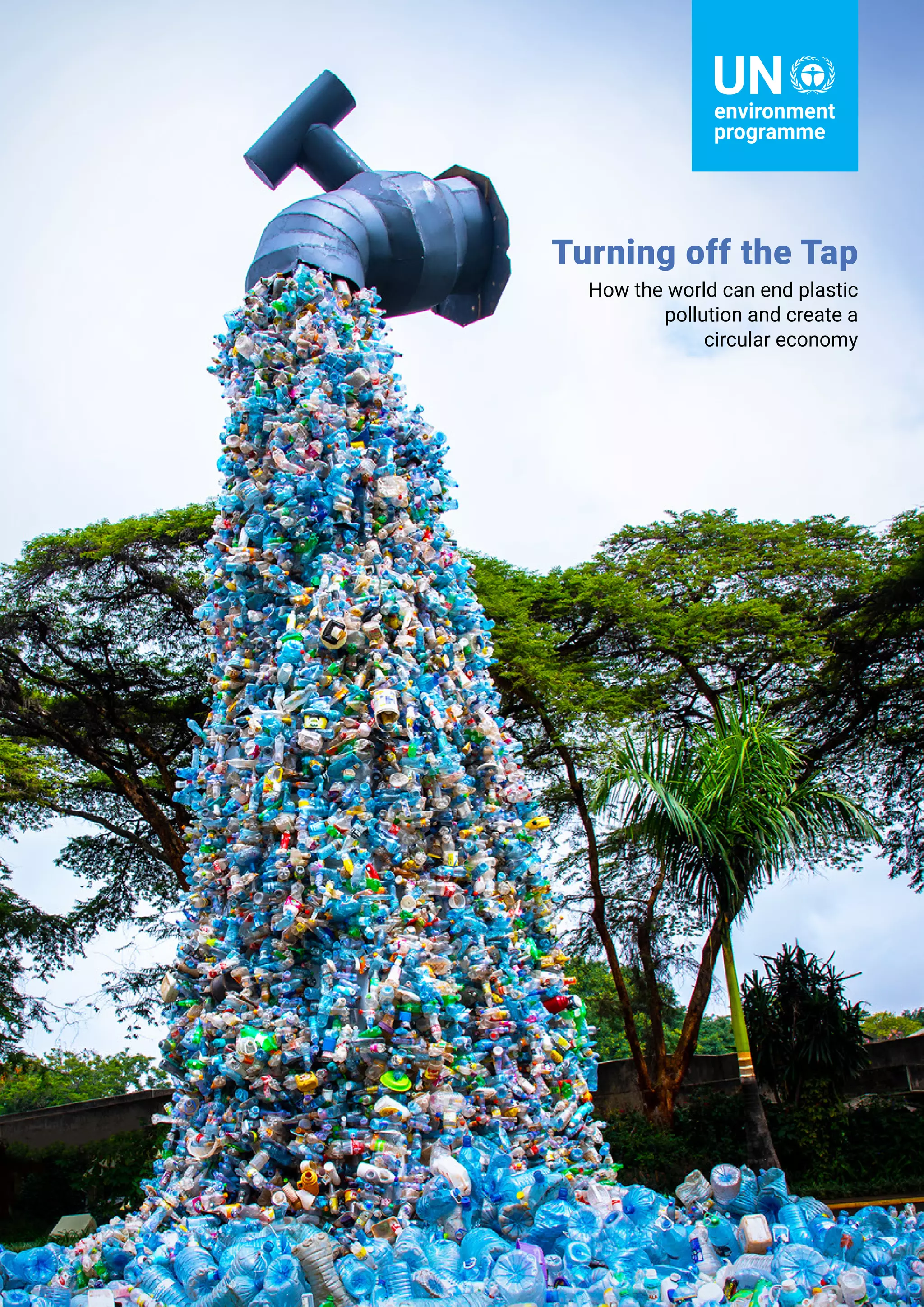
Cover photo: Picture © UNEP. Art Installation © Von Wong Productions, #TurnOffThePlasticTap. The Giant Plastic Tap
was an art installation by artist Benjamin Von Wong at the UN Headquarters in Nairobi. It was on display during the
United Nations Environment Assembly in 2022, when delegates agreed to establish an Intergovernmental Negotiating
Committee with the mandate to forge an international legally binding agreement to end plastic pollution.
Suggested citation: United Nations Environment Programme (2023). Turning off the Tap. How the world can end plastic
pollution and create a circular economy. Nairobi.
Production: United Nations Environment Programme
https://www.unep.org/resources/turning-off-tap-end-plastic-pollution-create-circular-economy
Acknowledgements
“Turning off the Tap. How the world can end plastic pollution and create a circular economy” is the product of the
generous dedication and extraordinary investment of numerous individuals, whose knowledge, expertise and insight
helped shape this important body of work. UNEP acknowledges the contributions made by many governments,
individuals and institutions to the preparation and publication of this report. Special thanks are extended to:
This publication was financially supported by the Governments of Norway and Sweden.
Lead Authors:
UNEP: Llorenç Milà i Canals (lead coordinator); Alison Cairns; Peggy Lefort; Allan Meso; Andrew David Raine; Aphrodite
Smagadi; Steven Stone; Elisa Tonda.
Systemiq: Yoni Shiran; José de la Fuente; Julia Koskella; Anne Titia Bove; Eline Boon.
University of Portsmouth: Steve Fletcher; Antaya March; Keiron Roberts.
KnowlEdge Srl: Andrea Bassi
Overall supervision:
Sheila Aggarwal-Khan, Andrea Hinwood, UNEP.
Contributing authors:
Vincent Aloysius, Sandra Averous, Stephanie Gerretsen, Claudia Giacovelli, Toma Iida, Pushpam Kumar, Stéphanie
Laruelle, Silvana Loayza León, Ekaterina Poleshchuk, Heidi Savelli, Himanshu Sharma, Ran Xie, Xiaozhen Xu (UNEP); Natalie
Harms (UNEP – COBSEA); Kei Ohno Woodall (UNEP – BRS); Kabir Arora (Women in Informal Employment Globalizing and
Organizing, WIEGO); Nao Takeuchi (UN Habitat); Anjali Acharya, Milagros Aimé (World Bank Group).
Reviewers:
The following experts are gratefully acknowledged for supporting the preparation of the report, including providing
comments on two versions of the draft report (July 2022 and March 2023): Carsten Wachholz, Sander Defruyt (Ellen
MacArthur Foundation); John Duncan, Alix Grabowski, Ho Huu Huy, Erin Simon, Anthony Tusino, Jess Zeuner (WWF);
Timothy Grabiel, Thomas Gammage, Christina Dixon, Jacob Kean-Hammerson, Amy Youngman (Environmental
Investigation Agency); Andrés del Castillo, Giulia Carlini (CIEL); Thomas Maes, Ieva Rucevska (GRID-Arendal); Lizzie
Fuller, Dominic Charles, Ebony Minicozzi, Emma Silver, Margot Dons (Minderoo Foundation); Gonzalo Muñoz, Gaspar
Guevara, Carla Germani (Manuia); Carolyn Deere Birkbeck, Mahesh Sugathan, Simon Ardila (TESS); Kabir Arora (WIEGO);
Larke Williams, Ross Alliston, Eric Davidson, So-Jung Youn (U.S. Department of State, Office of Environmental Quality);
Patti Pedrus (Federated States of Micronesia); Gordana Topic (European Commission); Go Kobayashi (Marine Plastic
Pollution Office, Ministry of Environment Japan); Silje Rem (Norwegian Environment Agency); Carmen Zuloaga Marín,
Claudia Alejandra Guerrero Alvarado (Ministry of Environment, Chile); Andrew Brown, Elena Buzzi , Frithjof Laubinger,
Giulia Galli (OECD); Kristin Hughes, Christian Kaufholz, Madeleine Brandes (WEF-Global Plastic Action Partnership);
Anjali Acharya, Milagros Aimé (World Bank Group); Moustapha Kamal Gueye, Tahmina Mahmud, Sarah Gondy, Yasuhiko
Kamakura (International Labour Organization); Gergana Kiskinova, Daniel Ramos (World Trade Organization); Henrique
Silva Pacini Costa (United Nations Conference on Trade and Development); Desiree Raquel Narvaez (UNICEF); Bernard
Barth, Voltaire Acosta (UN Habitat) Bing Zhu (Tsinghua University); Karen Raubenheimer (University of Wollongong);
Paromita Chakraborty (SRM Institute of Science and Technology); Richard Thompson (University of Plymouth); Sabine
Pahl (University of Vienna); Rosalind Malcom (University of Surrey); Rachel Karasik (Duke University); Vikas Chhajer
(Gemini Corporation NV); Jodie Roussell, Jochen Hertlein (Société des Produits Nestlé S.A.); Vincent Colard (CITEO);
Anne-Gaelle Collot (Plastics Europe/World Plastics Council); Stewart Harris (American Chemistry Council/World Plastics
Council); Ed Shepherd (Unilever); Willemijn Peeters (Searious Business); Roland Weber (POPs Environmental Consulting);
Sven Saura (Veolia).
i
Reviewers (UNEP):
The expert review from the following UNEP colleagues is also acknowledged: Jacqueline Alvarez; Katy Ayres; Juan
Bello; Atif Ikram Butt; Beatriz Martins Carneiro; Garrette Clark; Ludgarde Coppens; Jost Dittkrist; Kamala Ernest;
Beatriz Fernández; Hilary French; Tessa Goverse; Bettina Heller; Mijke Hertoghs; Maria Hughes; Toma Iida; Joy Kim;
Brenda Koekkoek; Paolo Marengo; Alexander Mangwiro; David Marquis; Patricia Mbote; Mushtaq Memon; Laura
Mesias; Svitlana Mikhalyeva; Susan Mutebi-Richards; Iyngararasan Mylvakanam; Kakuko Nagatani-Yoshida; Takehiro
Nakamura; Fatou Ndoye; Fabienne Pierre; José Pineda; Jordi Pon; Helena Rey; Amélie Ritscher; David Rubia;
Malgorzata Alicja Stylo; Callum Sweeney; Claire Thibault; Gina Torregroza; Feng Wang; Alison Watson; Ying Zhang;
Maria Cristina Zucca; Tabea Zwimpfer.
Production and launch support: UNEP Communication Division
Editor: Amanda Lawrence-Brown
Design and layout: Beverley McDonald, with contribution from Murat Ozoglu.
ii
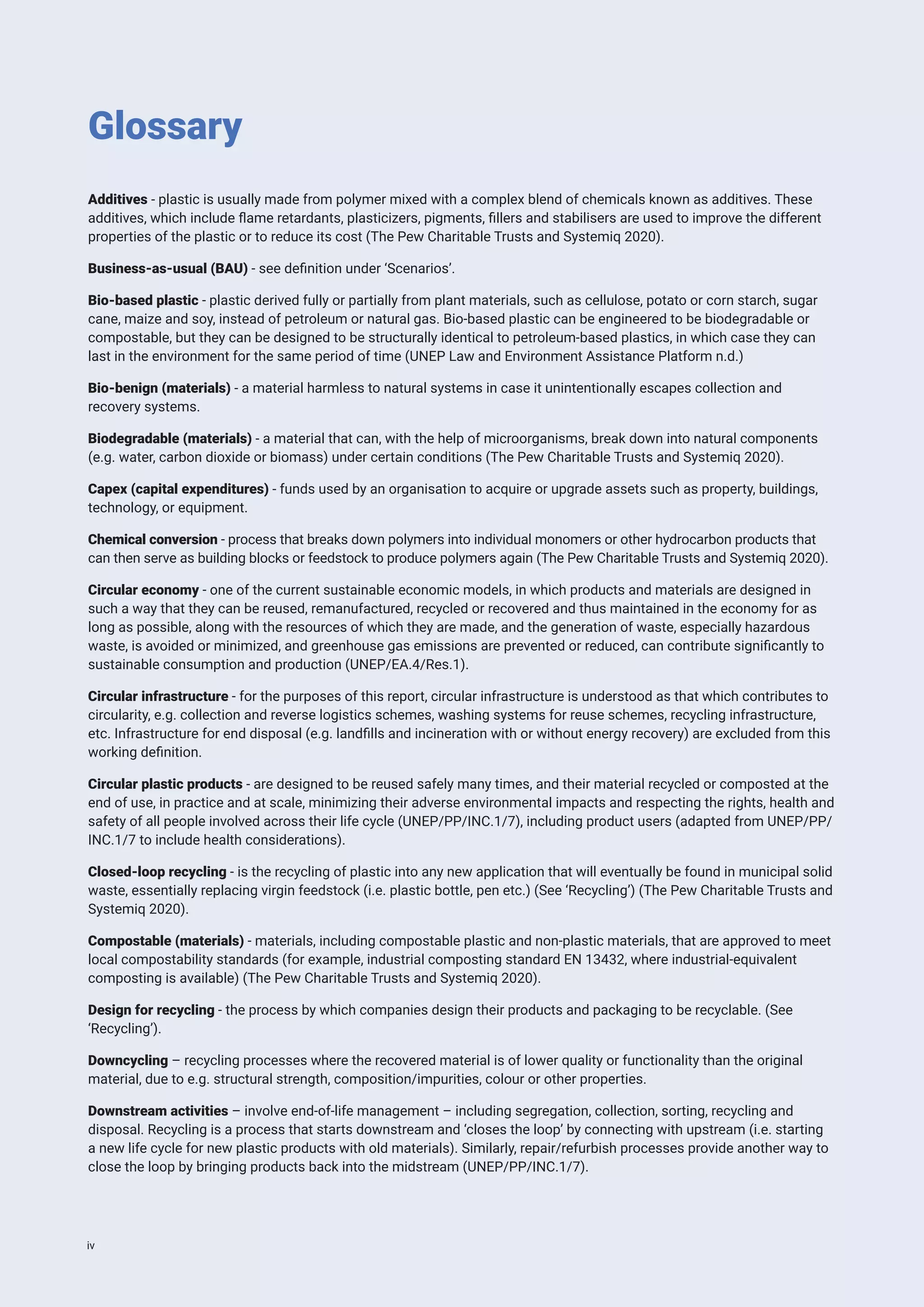
Acronyms
BAU - Business-as-usual
BPA - Bisphenol A
Capex - Capital expenditure
CEN - European Committee of Standardisation
DEHP - Di(2-ethylhexyl) phthalate
EIA - Environmental Investigation Agency
EMF - Ellen MacArthur Foundation
EOL - End-of-Life
EPR - Extended Producer Responsibility
EPS - Expanded polystyrene
ESM - Environmentally sound management
EU - European Union
G20 - The Group of Twenty (the premier forum for
international economic cooperation)
GDP - Gross domestic product
GESAMP - Joint Group of Experts on the Scientific
Aspects of Marine Environmental Protection
GHG - Greenhouse gas
GIZ - German Agency for International Cooperation
HDPE - High-density polyethylene
HI - High-income economies
ICAO - International Civil Aviation Organization
IFC - International Finance Corporation
ILO - International Labour Organization
IMO - International Maritime Organization
INC - Intergovernmental Negotiation Committee
IRP - International Resource Panel
ISO - International Organization for Standardization
ISWA - International Solid Waste Association
IUCN - International Union for Conservation of Nature
LCA - Life Cycle Assessment
LDPE - Low-density polyethylene
LI - Low-income economies
LiFE - Lifestyles for Environment
LLDPE - Linear low-density polyethylene
MMt – Million metric tons
NIVA - Norwegian Institute for Water Research
NPV - Net Present Value
OECD - Organisation for Economic Co-operation and
Development
Opex - Operational expenditure
P2F - Plastic-to-fuel
P2P - Plastic-to-plastic
PBDE - Polybrominated diphenyl ethers
PCDD/F - poly-chlorinated dibenzo-p-dioxins and
dibenzofurans (dioxins and furans)
PCR - Post-consumer recycled content
PE - Polyethylene
PET - Polyethylene terephthalate
PFASs - Polyfluoroalkyl substances
POPs - Persistent organic pollutants
PP - Polypropylene
PPA - Power purchase agreements
PS - Polystyrene
PVC - Polyvinyl chloride
R&D - Research and Development
RDF - Refuse-derived fuel
RPET - Recycled PET
SAPEA - Science Advice for Policy by European
Academies
SC scenario - Systems change scenario
SDG - Sustainable Development Goals
UMI - Upper middle-income economies
UNEP - United Nations Environment Programme
UNIDO - United Nations Industrial Development
Organization
WEEE - Waste from Electrical and Electronic Equipment
WEF - World Economic Forum
WWF - World Wide Fund for Nature
iii
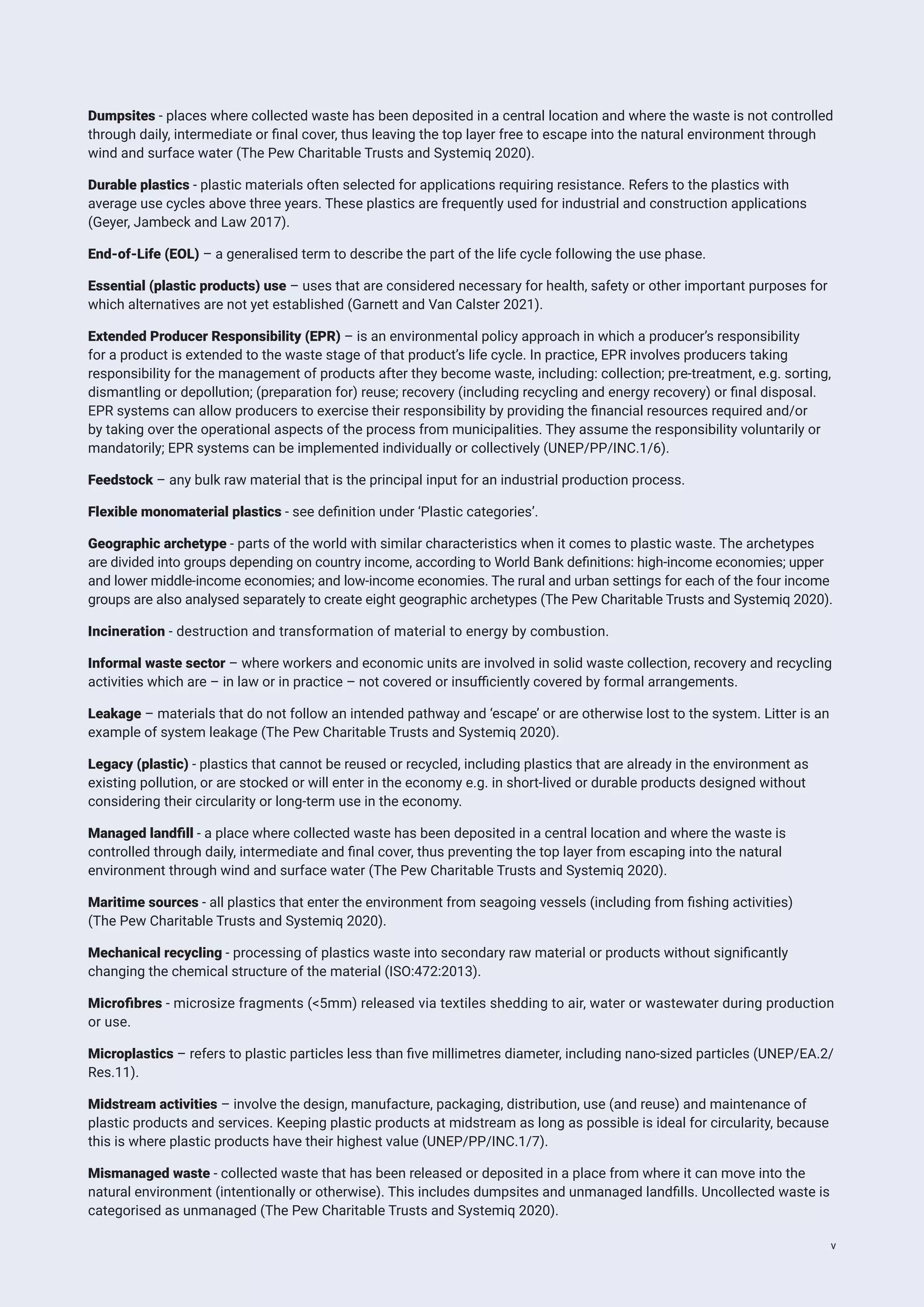
Additives - plastic is usually made from polymer mixed with a complex blend of chemicals known as additives. These
additives, which include flame retardants, plasticizers, pigments, fillers and stabilisers are used to improve the different
properties of the plastic or to reduce its cost (The Pew Charitable Trusts and Systemiq 2020).
Business-as-usual (BAU) - see definition under ‘Scenarios’.
Bio-based plastic - plastic derived fully or partially from plant materials, such as cellulose, potato or corn starch, sugar
cane, maize and soy, instead of petroleum or natural gas. Bio-based plastic can be engineered to be biodegradable or
compostable, but they can be designed to be structurally identical to petroleum-based plastics, in which case they can
last in the environment for the same period of time (UNEP Law and Environment Assistance Platform n.d.)
Bio-benign (materials) - a material harmless to natural systems in case it unintentionally escapes collection and
recovery systems.
Biodegradable (materials) - a material that can, with the help of microorganisms, break down into natural components
(e.g. water, carbon dioxide or biomass) under certain conditions (The Pew Charitable Trusts and Systemiq 2020).
Capex (capital expenditures) - funds used by an organisation to acquire or upgrade assets such as property, buildings,
technology, or equipment.
Chemical conversion - process that breaks down polymers into individual monomers or other hydrocarbon products that
can then serve as building blocks or feedstock to produce polymers again (The Pew Charitable Trusts and Systemiq 2020).
Circular economy - one of the current sustainable economic models, in which products and materials are designed in
such a way that they can be reused, remanufactured, recycled or recovered and thus maintained in the economy for as
long as possible, along with the resources of which they are made, and the generation of waste, especially hazardous
waste, is avoided or minimized, and greenhouse gas emissions are prevented or reduced, can contribute significantly to
sustainable consumption and production (UNEP/EA.4/Res.1).
Circular infrastructure - for the purposes of this report, circular infrastructure is understood as that which contributes to
circularity, e.g. collection and reverse logistics schemes, washing systems for reuse schemes, recycling infrastructure,
etc. Infrastructure for end disposal (e.g. landfills and incineration with or without energy recovery) are excluded from this
working definition.
Circular plastic products - are designed to be reused safely many times, and their material recycled or composted at the
end of use, in practice and at scale, minimizing their adverse environmental impacts and respecting the rights, health and
safety of all people involved across their life cycle (UNEP/PP/INC.1/7), including product users (adapted from UNEP/PP/
INC.1/7 to include health considerations).
Closed-loop recycling - is the recycling of plastic into any new application that will eventually be found in municipal solid
waste, essentially replacing virgin feedstock (i.e. plastic bottle, pen etc.) (See ‘Recycling’) (The Pew Charitable Trusts and
Systemiq 2020).
Compostable (materials) - materials, including compostable plastic and non-plastic materials, that are approved to meet
local compostability standards (for example, industrial composting standard EN 13432, where industrial-equivalent
composting is available) (The Pew Charitable Trusts and Systemiq 2020).
Design for recycling - the process by which companies design their products and packaging to be recyclable. (See
‘Recycling’).
Downcycling – recycling processes where the recovered material is of lower quality or functionality than the original
material, due to e.g. structural strength, composition/impurities, colour or other properties.
Downstream activities – involve end-of-life management – including segregation, collection, sorting, recycling and
disposal. Recycling is a process that starts downstream and ‘closes the loop’ by connecting with upstream (i.e. starting
a new life cycle for new plastic products with old materials). Similarly, repair/refurbish processes provide another way to
close the loop by bringing products back into the midstream (UNEP/PP/INC.1/7).
Glossary
iv
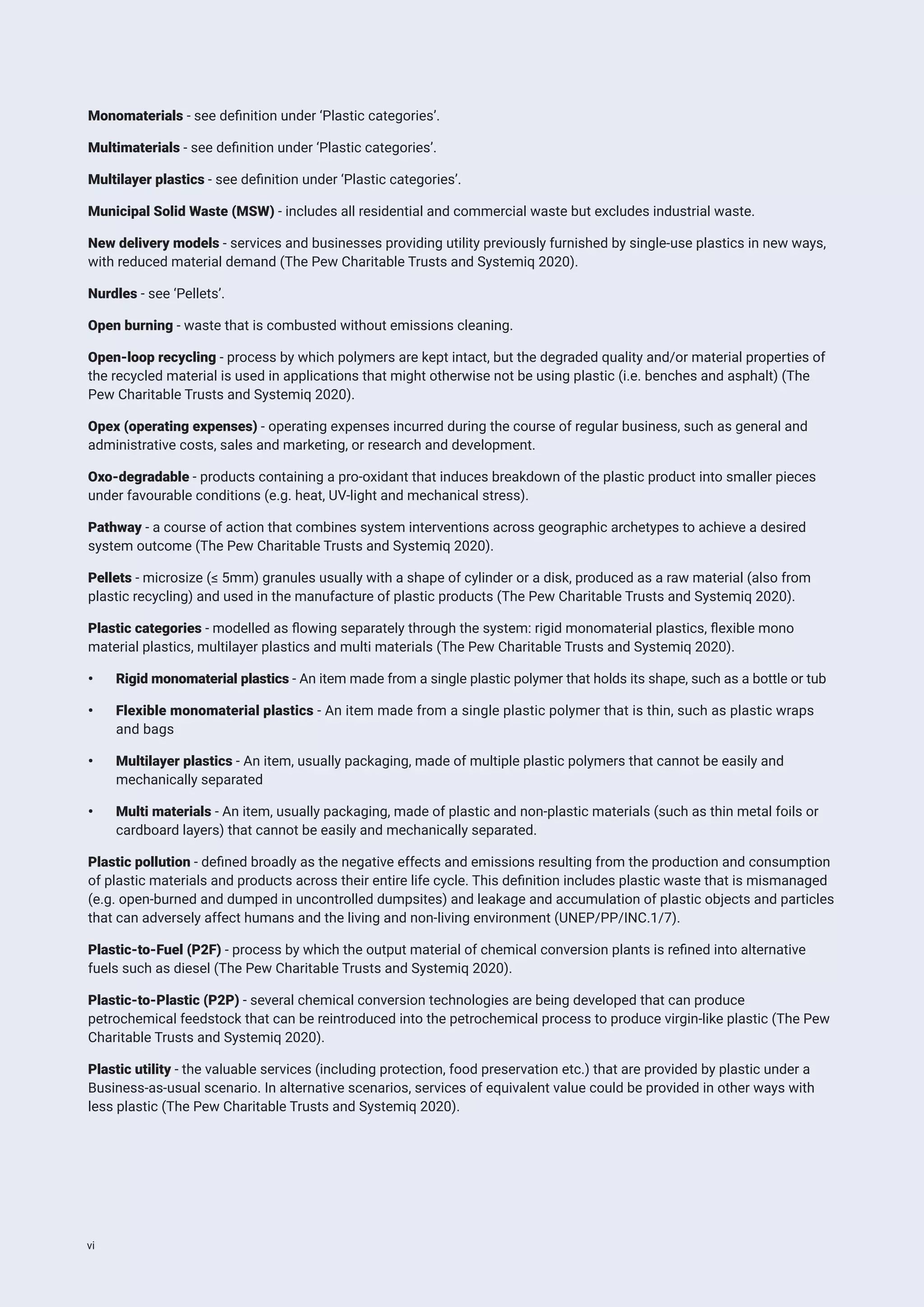
Dumpsites - places where collected waste has been deposited in a central location and where the waste is not controlled
through daily, intermediate or final cover, thus leaving the top layer free to escape into the natural environment through
wind and surface water (The Pew Charitable Trusts and Systemiq 2020).
Durable plastics - plastic materials often selected for applications requiring resistance. Refers to the plastics with
average use cycles above three years. These plastics are frequently used for industrial and construction applications
(Geyer, Jambeck and Law 2017).
End-of-Life (EOL) – a generalised term to describe the part of the life cycle following the use phase.
Essential (plastic products) use – uses that are considered necessary for health, safety or other important purposes for
which alternatives are not yet established (Garnett and Van Calster 2021).
Extended Producer Responsibility (EPR) – is an environmental policy approach in which a producer’s responsibility
for a product is extended to the waste stage of that product’s life cycle. In practice, EPR involves producers taking
responsibility for the management of products after they become waste, including: collection; pre-treatment, e.g. sorting,
dismantling or depollution; (preparation for) reuse; recovery (including recycling and energy recovery) or final disposal.
EPR systems can allow producers to exercise their responsibility by providing the financial resources required and/or
by taking over the operational aspects of the process from municipalities. They assume the responsibility voluntarily or
mandatorily; EPR systems can be implemented individually or collectively (UNEP/PP/INC.1/6).
Feedstock – any bulk raw material that is the principal input for an industrial production process.
Flexible monomaterial plastics - see definition under ‘Plastic categories’.
Geographic archetype - parts of the world with similar characteristics when it comes to plastic waste. The archetypes
are divided into groups depending on country income, according to World Bank definitions: high-income economies; upper
and lower middle-income economies; and low-income economies. The rural and urban settings for each of the four income
groups are also analysed separately to create eight geographic archetypes (The Pew Charitable Trusts and Systemiq 2020).
Incineration - destruction and transformation of material to energy by combustion.
Informal waste sector – where workers and economic units are involved in solid waste collection, recovery and recycling
activities which are – in law or in practice – not covered or insufficiently covered by formal arrangements.
Leakage – materials that do not follow an intended pathway and ‘escape’ or are otherwise lost to the system. Litter is an
example of system leakage (The Pew Charitable Trusts and Systemiq 2020).
Legacy (plastic) - plastics that cannot be reused or recycled, including plastics that are already in the environment as
existing pollution, or are stocked or will enter in the economy e.g. in short-lived or durable products designed without
considering their circularity or long-term use in the economy.
Managed landfill - a place where collected waste has been deposited in a central location and where the waste is
controlled through daily, intermediate and final cover, thus preventing the top layer from escaping into the natural
environment through wind and surface water (The Pew Charitable Trusts and Systemiq 2020).
Maritime sources - all plastics that enter the environment from seagoing vessels (including from fishing activities)
(The Pew Charitable Trusts and Systemiq 2020).
Mechanical recycling - processing of plastics waste into secondary raw material or products without significantly
changing the chemical structure of the material (ISO:472:2013).
Microfibres - microsize fragments (<5mm) released via textiles shedding to air, water or wastewater during production
or use.
Microplastics – refers to plastic particles less than five millimetres diameter, including nano-sized particles (UNEP/EA.2/
Res.11).
Midstream activities – involve the design, manufacture, packaging, distribution, use (and reuse) and maintenance of
plastic products and services. Keeping plastic products at midstream as long as possible is ideal for circularity, because
this is where plastic products have their highest value (UNEP/PP/INC.1/7).
Mismanaged waste - collected waste that has been released or deposited in a place from where it can move into the
natural environment (intentionally or otherwise). This includes dumpsites and unmanaged landfills. Uncollected waste is
categorised as unmanaged (The Pew Charitable Trusts and Systemiq 2020).
v
Monomaterials - see definition under ‘Plastic categories’.
Multimaterials - see definition under ‘Plastic categories’.
Multilayer plastics - see definition under ‘Plastic categories’.
Municipal Solid Waste (MSW) - includes all residential and commercial waste but excludes industrial waste.
New delivery models - services and businesses providing utility previously furnished by single-use plastics in new ways,
with reduced material demand (The Pew Charitable Trusts and Systemiq 2020).
Nurdles - see ‘Pellets’.
Open burning - waste that is combusted without emissions cleaning.
Open-loop recycling - process by which polymers are kept intact, but the degraded quality and/or material properties of
the recycled material is used in applications that might otherwise not be using plastic (i.e. benches and asphalt) (The
Pew Charitable Trusts and Systemiq 2020).
Opex (operating expenses) - operating expenses incurred during the course of regular business, such as general and
administrative costs, sales and marketing, or research and development.
Oxo-degradable - products containing a pro-oxidant that induces breakdown of the plastic product into smaller pieces
under favourable conditions (e.g. heat, UV-light and mechanical stress).
Pathway - a course of action that combines system interventions across geographic archetypes to achieve a desired
system outcome (The Pew Charitable Trusts and Systemiq 2020).
Pellets - microsize (≤ 5mm) granules usually with a shape of cylinder or a disk, produced as a raw material (also from
plastic recycling) and used in the manufacture of plastic products (The Pew Charitable Trusts and Systemiq 2020).
Plastic categories - modelled as flowing separately through the system: rigid monomaterial plastics, flexible mono
material plastics, multilayer plastics and multi materials (The Pew Charitable Trusts and Systemiq 2020).
• Rigid monomaterial plastics - An item made from a single plastic polymer that holds its shape, such as a bottle or tub
• Flexible monomaterial plastics - An item made from a single plastic polymer that is thin, such as plastic wraps
and bags
• Multilayer plastics - An item, usually packaging, made of multiple plastic polymers that cannot be easily and
mechanically separated
• Multi materials - An item, usually packaging, made of plastic and non-plastic materials (such as thin metal foils or
cardboard layers) that cannot be easily and mechanically separated.
Plastic pollution - defined broadly as the negative effects and emissions resulting from the production and consumption
of plastic materials and products across their entire life cycle. This definition includes plastic waste that is mismanaged
(e.g. open-burned and dumped in uncontrolled dumpsites) and leakage and accumulation of plastic objects and particles
that can adversely affect humans and the living and non-living environment (UNEP/PP/INC.1/7).
Plastic-to-Fuel (P2F) - process by which the output material of chemical conversion plants is refined into alternative
fuels such as diesel (The Pew Charitable Trusts and Systemiq 2020).
Plastic-to-Plastic (P2P) - several chemical conversion technologies are being developed that can produce
petrochemical feedstock that can be reintroduced into the petrochemical process to produce virgin-like plastic (The Pew
Charitable Trusts and Systemiq 2020).
Plastic utility - the valuable services (including protection, food preservation etc.) that are provided by plastic under a
Business-as-usual scenario. In alternative scenarios, services of equivalent value could be provided in other ways with
less plastic (The Pew Charitable Trusts and Systemiq 2020).
vi
Polymers:
• PET - Polyethylene terephthalate
• HDPE - High-density polyethylene
• LDPE - Low-density polyethylene
• LLDPE - Linear low-density polyethylene
• PP - Polypropylene
• PVC - Polyvinyl chloride
• EPS - Expanded polystyrene
• PS - Polystyrene
• PA6 - Polyamide 6 (Nylon)
Recyclable - for something to be deemed recyclable, the system must be in place for it to be collected, sorted,
reprocessed, and manufactured back into a new product or packaging—at scale and economically. Recyclable is used
here as a short-hand for ‘mechanically recyclable’. See ‘mechanical recycling’ definition (The Pew Charitable Trusts and
Systemiq 2020).
Recycling - means processing of waste materials for the original purpose or for other purposes, excluding energy
recovery (ISO:472:2013).
Resin - a natural or synthetic solid or viscous organic polymer used as the basis of plastic, adhesives, varnishes or
other products.
Reusable - products and packaging, including plastic bags, that are conceived and designed to accomplish within their
life cycle a minimum number of uses for the same purpose for which they were conceived (adapted from the LEAP UNEP
Plastic Glossary). In terms of ‘minimum number of uses’, the PR3 Standards suggest that reusable (containers) should
be designed to withstand at least 10 reuse cycles.
Reuse - means use of a product more than once in its original form (ISO:472:2013).
Reverse logistics - activities engaged to recapture the value of products, parts, and materials once they have reached
end-of-use or end-of-life. All Value Retention Processes (such as reuse) may be considered to be part of a reverse-
logistics system, and in addition activities including collection, transportation, and secondary markets provide essential
mechanisms for facilitating reverse-logistics (IRP 2018)
Rigid plastics - see definition under ‘Plastic categories’.
Rural vs. Urban - see definition under ‘Urban vs. Rural’.
Safe disposal - ensuring that any waste that reaches its end-of-life is disposed in a way that does not cause leakage
of plastic waste or chemicals into the environment, does not pose hazardous risks to human health and, in the case of
landfills, is contained securely for the long-term (The Pew Charitable Trusts and Systemiq 2020).
Secondary microplastics - small particle pieces that have resulted from the fragmentation and weathering of larger
plastic items (UNEP Plastic Glossary: https://leap.unep.org/knowledge/toolkits/plastic/glossary).
Scenarios - for the purpose of this report, we define the scenarios as:
• Business-as-usual (BAU) scenario: Defined as ‘no intervention’ scenario; in other words, assumes that the current
policy framework, market dynamics, cultural norms, and consumer behaviours do not change.
• Systems change scenario: Assumes all system outcomes are actioned concurrently, ambitiously and immediately.
Short-lived plastic product - plastics within packaging and consumer products. These are the two categories of plastic
products with shortest average use cycles – 0.5 and 3 years respectively (Geyer, Jambeck and Law 2017). Note that the
categorisation is based on average life span, therefore some products in this category will in practice have longer life
spans than three years.
Single-use plastic products - often referred to as disposable plastics, are commonly used plastic items intended to be
used only once before they are thrown away or recycled, e.g. grocery bags, food packaging, bottles, straws, containers,
cups, cutlery etc. (UNEP Plastic Glossary: https://leap.unep.org/knowledge/toolkits/plastic/glossary).
vii
Systems change - captures the idea of addressing the causes, rather than the symptoms of a societal issue by taking
a holistic (or ‘systemic’) view. Systemic change is generally understood to require adjustments or transformations in
policies, practices, power dynamics, social norms or mindsets. It often involves a diverse set of players and can take
place on a local, national or global level (Ashoka Deutschland gGmbH and McKinsey & Company Inc. 2021); systems
change requires modifications in many of the system structures, such as the mindset or the paradigm that creates the
system or the system’s goals or rules (Meadows 1999).
Systems change scenario - see definition under ‘Scenarios’.
Tyre dust - consists of micro size particles with a spectrum from airborne (>10μm) to coarse fraction (>1mm) released
through mechanical abrasion of tyres, with chemical composition depending on rubber type (The Pew Charitable Trusts
and Systemiq 2020).
Upstream activities - include obtaining the raw materials from crude oil, natural gas or recycled and renewable feedstock
(e.g. biomass) and polymerization. Plastic leakage into the environment (e.g. pellets and flakes) already happens at this
stage (UNEP/PP/INC.1/7).
Urban vs. Rural - the classification of urban versus rural is in alignment with the United Nations Statistics Division,
which allows countries to use their own approaches for distinguishing urban and rural areas according to their individual
circumstances (The Pew Charitable Trusts and Systemiq 2020).
viii
Table of Contents
Acknowledgements										i
Acronyms											iii
Glossary												 iv
Foreword											xii
Executive Summary										xiii
1. The need for a compass to end plastic pollution							 01
1.1 Purpose of this report									02
1.2 Scope and methodology									04
1.3 The economic case for circularity in plastics							 05
1.4 The systems change scenario: An economic opportunity						 08
1.5 A better plastics future									14
2. Market transformations: Creating the marketplace for the new circular plastics economy		 18
2.1 Market shift one: Accelerate reuse								20
2.2 Market shift two: Accelerate recycling								25
2.3 Market shift three: Reorient and diversify the market for sustainable and safe plastic alternatives 34
2.4 Addressing demand for durable plastic products						 39
3. Dealing with the legacy										41
3.1 Prevent microplastics at their source								42
3.2 Identify or build safe waste disposal facilities							 44
3.3 Eliminate plastic waste exports except in specific situations					 47
3.4 Deal with the existing pollution								48
4. Policy and legislative changes required								50
4.1 Regulatory interventions									51
4.2 A harmonised approach to measures and obligations						 58
4.3 Establish a global monitoring and reporting system						 59
5. Conclusion											60
References											62
Annex 1: Methodology
Topic sheets:
• Reuse Schemes
• Materials and Products Substitutions
• Extended Producer Responsibility
• Criteria for Chemicals in Plastics
• Design Guidelines for Circularity
• Chemical Recycling
• Just Transition
• Think Global, Act Local, NOW
ix
Table 1:													06
Damage estimates of plastic pollution across the life cycle of plastics (in billion USD per year).
Table 2:													08
Summary of the coefficients used in the study.
Table 3:													16
The systems change scenario outcomes and scale of change in the next 5 years and by 2040.
Table 4:													22
Implications of the reuse shift for different actors across the value chain.
Table 5:													27
Implications of the recycling shift for different actors across the value chain.
Table 6:													33
Innovation opportunities to unlock greater impact from recycling.
Table 7:													36
Implications of the reorient and diversify shift for different actors across the value chain.
Table 8:													53
Policy and legislative options to support the market transformation.
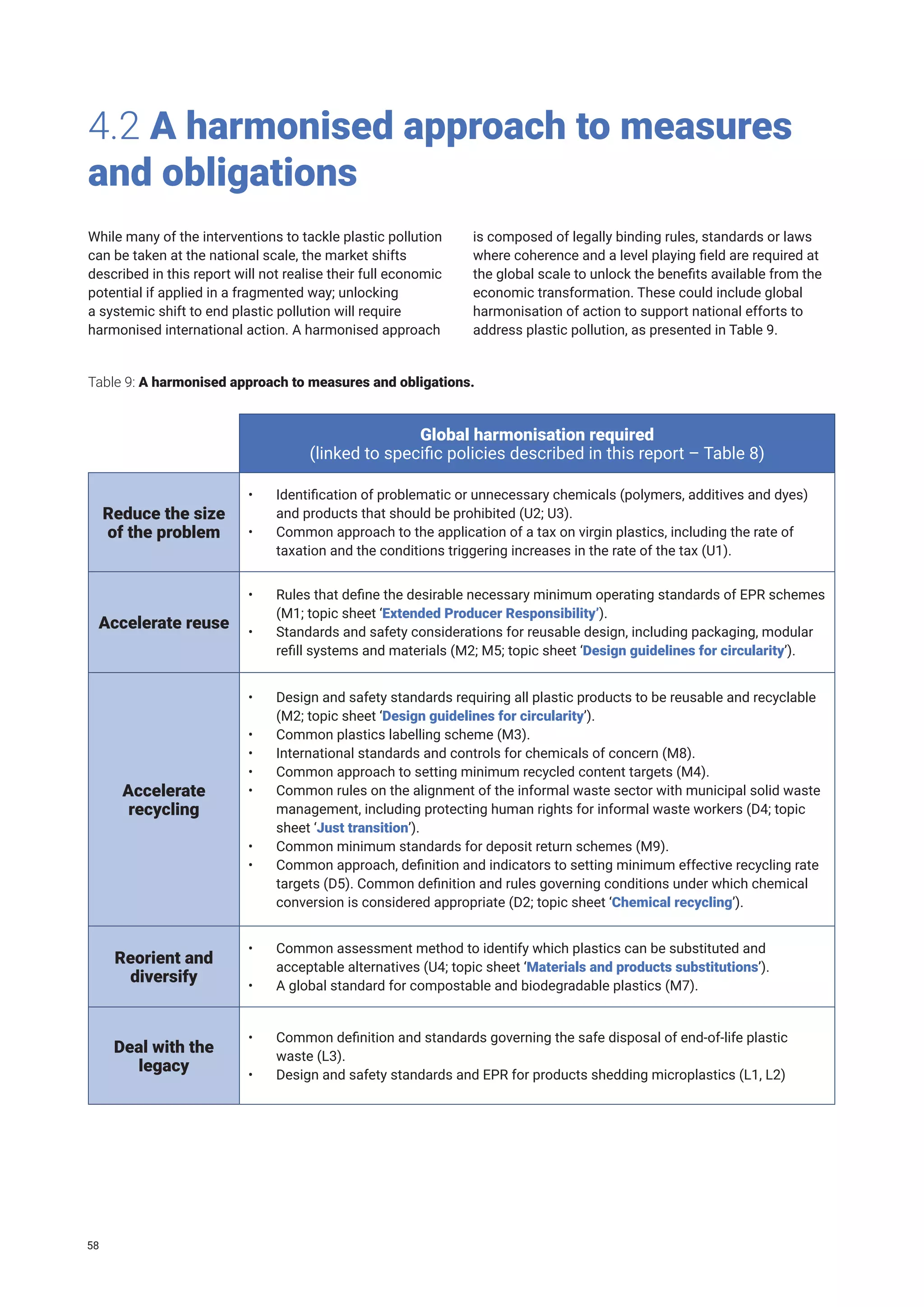
Table 9:													58
A harmonised approach to measures and obligations.
List of figures
Figure ES 1: 											xiv
The systems change towards a new circular plastics economy.
Figure ES 2: 											xvi
Possible plastic futures.
Figure 1: 											02
Short-lived plastic flows in 2020.
Figure 2:												04
Total plastic waste in 2019 by category, million metric tons (MMt).
Figure 3:													05
Relative value of social costs and likelihood of consensus on plastic pollution related externalities.
Figure 4: 												07
Wedges showing share of treatment options for plastics from short-lived products entering the system under a
systems change scenario from 2016 to 2040.
Figure 5: 												09
Total system costs for short-lived plastics for the business-as-usual and systems change scenarios (2021–2040).
Figure 6: 												10
Net change in annual costs between the business-as-usual and systems change scenarios (SC - BAU), 2021-2040
(in constant 2020 USD billion).
Figure 7: 												12
Total jobs in different parts of the short-lived plastics value chain in the current market, and under business-as-
usual and systems change scenarios.
List of tables
x
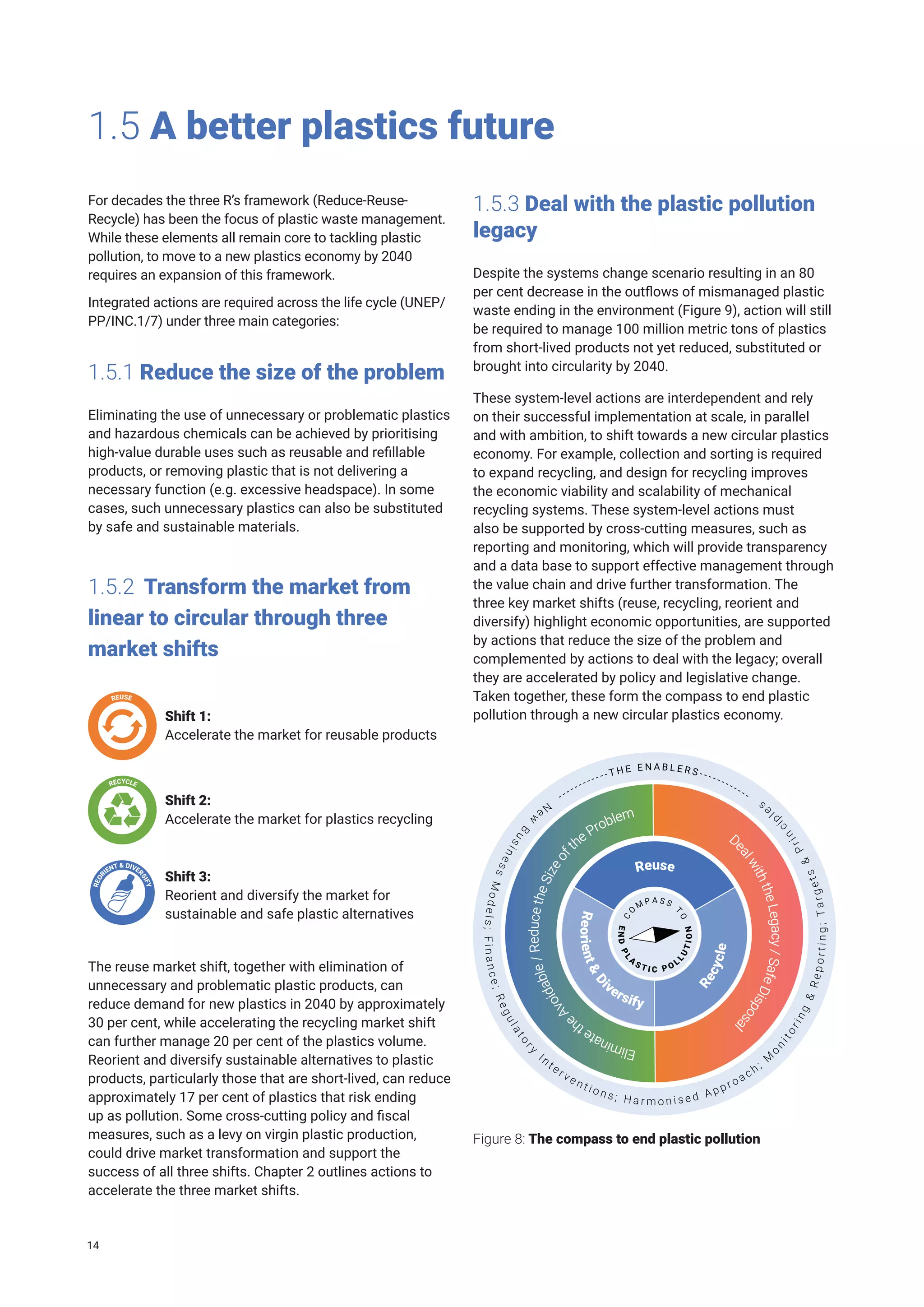
Figure 8:												14
The compass to end plastic pollution.
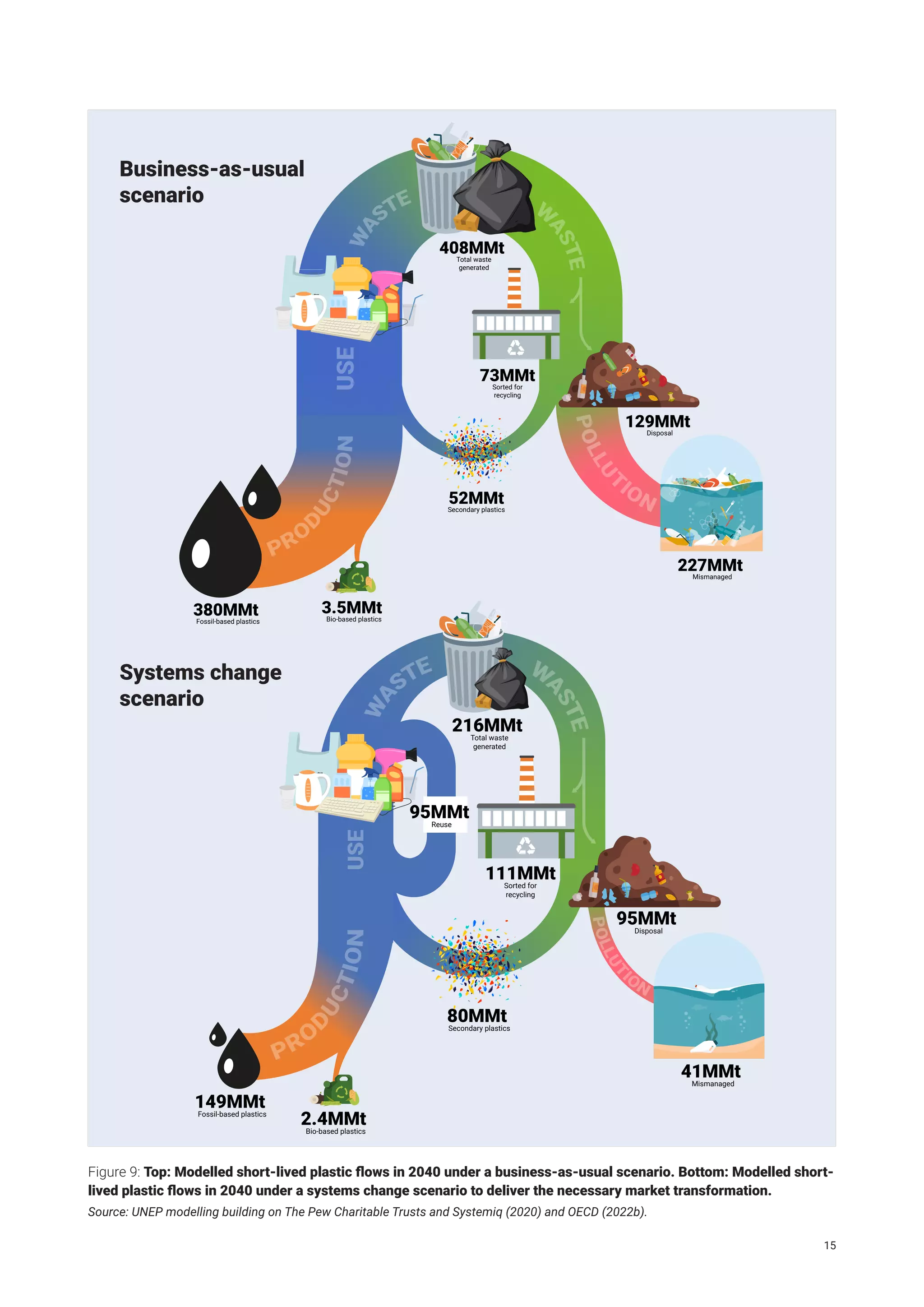
Figure 9: 												15
Top: Modelled short-lived plastic flows in 2040 under a business-as-usual scenario. Bottom: Modelled short-lived
plastic flows in 2040 under a systems change scenario to deliver the necessary market transformation.
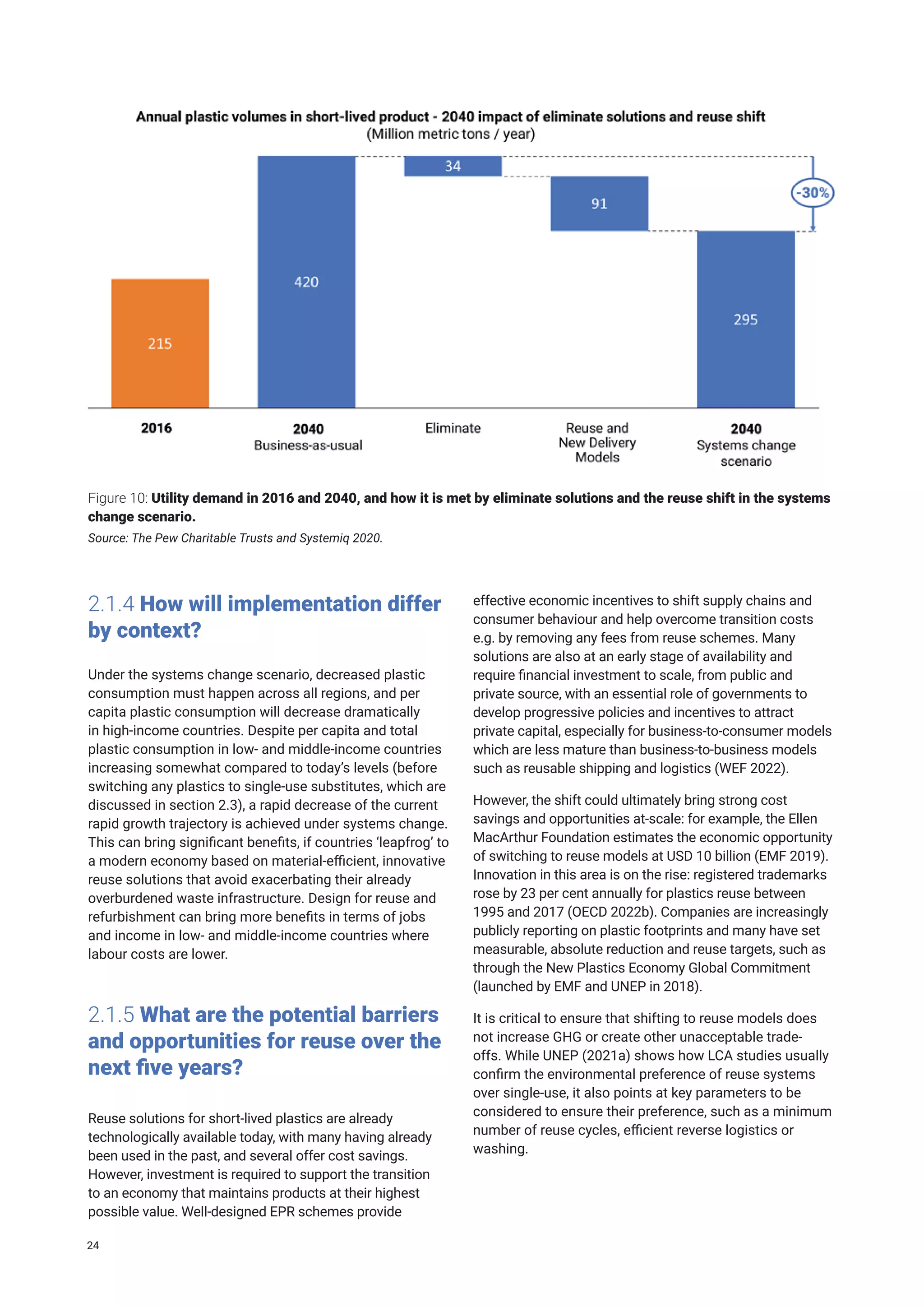
Figure 10: 												24
Utility demand in 2016 and 2040, and how it is met by eliminate solutions and the reuse shift in the systems change
scenario.
Figure 11: 												28
Pollution vs. production by plastic type.
Figure 12: 												29
Collection rates required to achieve systems change.
Figure 13: 												30
Mechanical recycling capacity (MMt/year).
Figure 14:												31
Chemical conversion capacity in 2040 (MMt/year) by region.
Figure 15:												34
The role of reorienting and diversifying in a systems change scenario compared to BAU 2040.
Figure 16:												43
Microplastic pollution under BAU and reduction from four sources under the systems change scenario in 2040.
Figure 17: 												44
Volumes (MMt) to be safely disposed by region.
Figure 18:												47
Volumes (MMt) exported in systems change scenario vs. business-as-usual.
xi
Turning off the Tap
Plastics, in many ways, contribute
positively to society. There is, however,
a dark side: the way we produce, use
and dispose of plastics is polluting
ecosystems, creating risks for human
and animal health and destabilizing
the climate.
For these reasons, the international community is
negotiating a deal to end plastic pollution, which is due
by 2024. This report, Turning off the Tap: How the world
can end plastic pollution and create a circular economy,
is designed to inform negotiations and help end this
pervasive and growing threat.
The report shows that only an integrated, systemic shift
from a linear to a circular economy can keep plastics
out of our ecosystems and bodies, and in the economy.
The report lays out key elements of the required market
transformation – rethinking and redesigning products;
reusing, recycling, reorienting and diversifying markets;
and addressing demand for durable plastics. The reports
also looks at how to manage the legacy of plastic pollution
already in the environment, and it defines the policy and
legislative changes that can drive the transformation.
Crucially, the report demonstrates that the transformation
would provide economic and social wins. Governments
and the private sector would save money and hundreds of
thousands of new jobs would be created, contributing to
poverty alleviation and a just transition for workers.
Everybody has a role to play. Governments can create
the regulatory environment to incentivize the shift to a
circular economy – and the political will to do so is there,
backed by broad social support. The petrochemical
industry, municipalities, informal waste pickers, plastic
converters and key users – such as packaging, textile,
transport, fisheries and agricultural – can accelerate reuse
and recycling and ensure the sustainability of alternatives
introduced in the market. The finance industry can play
a central role by aligning capital flows with a circular
plastics economy.
UNEP, as host of the Intergovernmental Negotiating
Committee and a long-term actor on plastics, is fully
committed to working with all relevant parties to end
plastic pollution. This report provides clear guidance as we
undertake this necessary journey to a healthier and more
prosperous destination. We must all follow this guidance
to start turning off the tap on plastic pollution.
Inger Andersen
Executive Director, UNEP
Foreword
xii
Executive
Summary
In a historic decision at the fifth
United Nations Environment Assembly
in March 2022, all 193 UN Member
States decided to end plastic pollution.
With negotiations on a binding legal
agreement by 2024 now underway, the
question is how to realise that goal.
While many technical solutions for a circular plastics
economy are known, the economic, fiscal and business
models to address the associated impacts while also
safeguarding livelihoods are less clear.
This report examines these issues and proposes a
systems change scenario - addressing the causes of
plastic pollution, rather than just the symptoms. Such
a systems change will enable countries to turn off the
tap and end plastic pollution while at the same time
transitioning towards safer and more stable jobs for
those currently working in the informal sector, and create
business and job opportunities.
The report analyses the opportunities and impacts of
a systems change scenario. The scenario combines
reducing the most problematic and unnecessary plastic
uses with a market transformation towards circularity in
plastics by accelerating three key shifts - Reuse, Recycle,
and Reorient and Diversify – and actions to deal with the
plastic pollution legacy (Figure ES 1).
xiii
Figure ES 1: The systems change towards a new circular plastics economy.
Ending Plastic Pollution
REDUCE
the size
of the
problem
RECYCLE
R
E
O
R
IENT & DIVER
S
I
F
Y
REUSE
Deal
with the
LEGACY
Market transformation to circularity through
3 MARKET SHIFTS
Policies and Regulatory Framework
Shift 1: Reuse
Accelerating the market for reusable products, to
transform the throwaway economy to a reuse society, by
creating the enabling environment to ensure the reuse
market has a stronger business case than the single-use
plastics market. Studies show that reuse systems provide
the highest opportunity to reduce plastic pollution (a
reduction of 30 per cent by 2040) by replacing some of the
most problematic and unnecessary products (The Pew
Charitable Trusts and Systemiq 2020).
Shift 2: Recycle
Accelerating the market for plastics recycling by ensuring
recycling becomes a more stable and profitable venture
could reduce the amount of plastic pollution by an
additional 20 per cent by 2040 (The Pew Charitable
Trusts and Systemiq 2020). This will require an adequate
availability of feedstock that can be recycled and that
recycled materials can compete on a level playing field
with virgin materials.
Shift 3: Reorient and Diversify
Shaping the market for plastic alternatives to enable
sustainable substitutions, thus avoiding replacing plastic
products with alternatives that displace rather than reduce
impacts. Sustainable alternatives could reduce pollution
by 17 per cent by 2040 (The Pew Charitable Trusts and
Systemiq 2020), but struggle to compete in markets with
products made of virgin fossil fuel-based polymers owing
to a number of challenges: cost of product, consumer
demand and lack of appropriate regulations.
Even with the market transformation approach, a
significant volume of plastics cannot be made circular
in the next 10 to 20 years and will require disposal
solutions to prevent pollution. This refers to collecting
and responsibly disposing of plastics that cannot be
reused or recycled, including plastics that are already in
the environment as existing pollution, or are stocked or
will enter in the economy e.g. in short-lived or durable
products designed without considering their circularity or
long-term use in the economy. It also refers to new ways
of financing collection and disposal of legacy plastics and
preventing microplastics from entering the economy and
the environment.
Global plastic production and use has grown exponentially
since the 1950s, with around nine million people employed
globally in polymer production and plastic processing
industries (United Nations Industrial Development
Organization (UNIDO) Data Portal - ISIC codes 2013 and
2220). Light, strong and seemingly inexpensive plastics
have permeated our lives, our societies and our economies
– but at a pace that has escalated into significant costs to
the environment, human health and the economy. Currently,
the world produces 430 million metric tons of plastics
each year (Organisation for Economic Co-operation and
Development [OECD] 2022), of which over two-thirds are
short-lived products which soon become waste, and a
growing amount (139 million metric tons in 2021 [Minderoo
2021]) after one single use. Plastic production is set to
triple by 2060 if ‘business-as-usual’ continues (OECD 2022).
A growing number of researchers are quantifying the social,
economic and environmental costs of plastic pollution.
Scientific literature is linking chemicals in plastic and
xiv
damage to human health at every stage of the plastic life
cycle including workers and ‘fence-line’ communities that
live next door to plastic production and waste disposal
sites (Landrigan et al. 2023; Merkl and Charles 2022; UNEP
2021c). As well as the potential for ecosystem impacts,
microplastics have been found in the deepest recesses of
the ocean, in pristine mountain glaciers, in breast milk and
human bodies (Braun et al. 2021; Ragusa et al. 2021; Jenner
et al. 2022; Horvatits et al. 2022). Research also shows
that under a business-as-usual scenario, plastic could
emit 19 per cent of global greenhouse gas GHG emissions
allowed under a 1.5°C scenario by 2040, essentially making
the goal out of reach (The Pew Charitable Trusts and
Systemiq 2020). Significantly, the costs and impacts are
borne by all but fall disproportionally on people in some of
the world’s poorest nations.
This report indicates a heavy toll arising from the current
linear plastics economy with preliminary estimates of the
annual social and environmental costs linked to plastic
pollution ranging between USD 300-600 billion per year,
with some estimates above USD 1.5 trillion per year
(Landrigan et al. 2023). Data shows potential litigation
stemming from plastic pollution is estimated to exceed
USD 20 billion in corporate liabilities in one country alone
in the period 2022 to 2030 (Merkl and Charles 2022).
These lawsuits express the tension between different
parts of society based on the profits received by the
plastic industry and the costs borne by society at large
but particularly by the most vulnerable, particularly within
the framework of a universally recognized human right to
a clean, healthy and sustainable environment (UN General
Assembly Resolution 76/300 of 28 July 2022).
An economically viable solution for all stakeholders does
exist to achieve an end to plastic pollution. The transition
to a new plastics economy is the most cost-effective
way to ensure plastic pollution is substantially reduced
by 2040, with solutions at hand that require vigilance,
determination and creativity.
While significant, the investment costs of the systems
change are less than the current investment trajectory,
around USD 65 billion per year through 2040 as opposed
to USD 113 billion per year. But time is of the essence: A
5-year delay could lead to an increase of 80 million metric
tons of plastic pollution (The Pew Charitable Trusts and
Systemiq 2020).
A transformed plastics economy will introduce new
economic benefits by bringing new business opportunities
particularly for those who adapt faster. By 2040, it is
estimated a new plastics economy could:
• Create opportunities for jobs, income and innovation:
700,000 additional jobs; improved livelihoods for
millions of workers in informal settings; close to USD
1.3 trillion (10.3 per cent) savings in direct public and
private costs between 2021 and 2040.
• Reduce damage to human health and the environment
by reducing exposure through an 80 per cent
reduction of plastic pollution; 0.5 Gt CO2-eq GHG
emissions prevented annually; avoiding USD 3.3
trillion of environmental and social costs between
2021 and 2040 (32.5 per cent cost savings).
• Reduce liabilities, risks and litigation associated with
damage from plastics pollution.
• When the direct, environmental and social cost
savings are added up, more than USD 4.5 trillion are
saved, or 20.3 per cent reduction in costs overall.
The systems change cannot be done in isolation due to
the cross-border flows of plastics, liabilities and risks:
it requires harmonised international action. Aligned and
coordinated measures and obligations between nations
and across value chains will build synergies and create a
major shift in the plastics policy landscape. A harmonised
knowledge base, driven by strong national reporting
requirements, from which to take informed action,
measure progress and refine regulatory interventions,
depends on a globally coherent approach to monitoring
and reporting. However, it is recognised that countries
will start from different places to implement market
transformations and the specific policy mix appropriate
to a particular country will need to consider the trade-offs
built into policy choices and options.
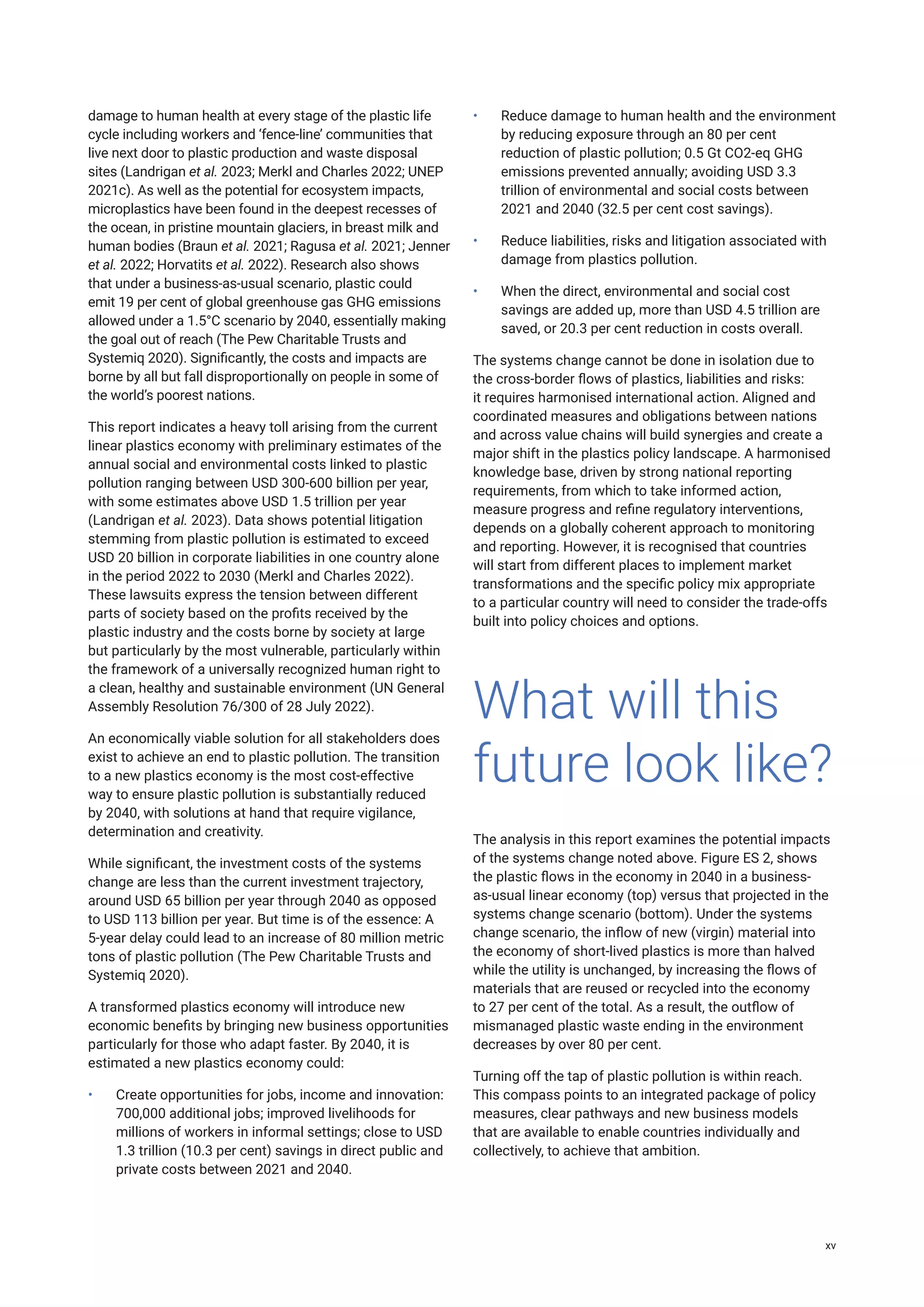
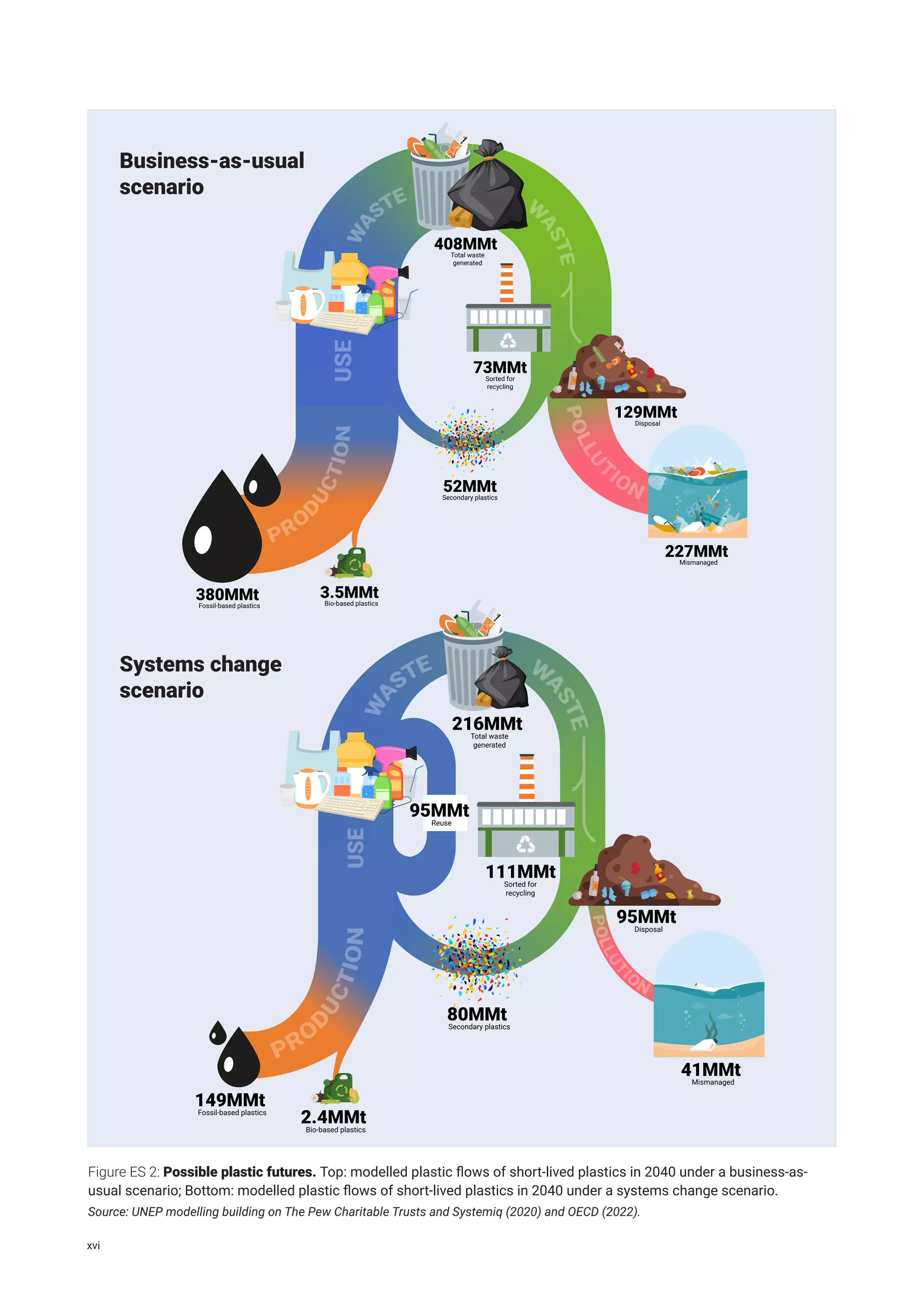
The analysis in this report examines the potential impacts
of the systems change noted above. Figure ES 2, shows
the plastic flows in the economy in 2040 in a business-
as-usual linear economy (top) versus that projected in the
systems change scenario (bottom). Under the systems
change scenario, the inflow of new (virgin) material into
the economy of short-lived plastics is more than halved
while the utility is unchanged, by increasing the flows of
materials that are reused or recycled into the economy
to 27 per cent of the total. As a result, the outflow of
mismanaged plastic waste ending in the environment
decreases by over 80 per cent.
Turning off the tap of plastic pollution is within reach.
This compass points to an integrated package of policy
measures, clear pathways and new business models
that are available to enable countries individually and
collectively, to achieve that ambition.
What will this
future look like?
xv
380MMt
Fossil-based plastics
52MMt
Secondary plastics
408MMt
Total waste
generated
73MMt
Sorted for
recycling
129MMt
Disposal
USE
227MMt
Mismanaged
3.5MMt
Bio-based plastics
80MMt
Secondary plastics
216MMt
Total waste
generated
111MMt
Sorted for
recycling
95MMt
Disposal
USE
41MMt
Mismanaged
95MMt
Reuse
2.4MMt
Bio-based plastics
149MMt
Fossil-based plastics
Figure ES 2: Possible plastic futures. Top: modelled plastic flows of short-lived plastics in 2040 under a business-as-
usual scenario; Bottom: modelled plastic flows of short-lived plastics in 2040 under a systems change scenario.
Source: UNEP modelling building on The Pew Charitable Trusts and Systemiq (2020) and OECD (2022).
Business-as-usual
scenario
Systems change
scenario
xvi
Photo: Getty Images
The need for
a compass to
end plastic
pollution
1
This report is designed to inform decision-makers and
stakeholders across the whole value chain of plastics about
the necessary actions - including market shifts and the
associated policies - that could be taken to achieve their
stated ambition to turn off the tap and end plastic pollution.
Grounded in science and economic analysis, the report
aims to strengthen an understanding of the magnitude
and nature of the change required in the plastics economy
to achieve this goal. Ultimately this report provides
stakeholders a compass to implement change.
Building on previous analyses (Ellen MacArthur
Foundation [EMF] et al. 2016; The Pew Charitable
Trusts and Systemiq 2020; United Nations Environment
Programme [UNEP] 2021c; International Resource Panel
[IRP] 2021; Organization for Economic Cooperation and
Development [OECD] 2022; World Bank Group [WBG]
2022a; UNEP 2022a; Economist Impact 2023), as well
as consultations with leading international experts, the
problems with the current plastics economy are identified
(Box 1) and what is needed to transition to a circular
1.1 Purpose of this report
plastics economy globally is outlined (Box 2). An analysis
is provided of this systemic change and how it can be
implemented: the regulatory and fiscal policy changes,
the incentives to drive new more comprehensive business
models and the practical approaches to manage the job
transition, among others.
Crucially, the economic analysis used in this report shows
that delivering the systems change scenario – addressing
the causes of plastic pollution, rather than just the
symptoms - could save 10.3 per cent of the direct costs
of the plastics life cycle, a value that increases to 20.3 per
cent when including indirect costs as well as addressing
the benefit to the environment and health.
The report is complemented by topic sheets on a range
of issues including design guidelines, chemical recycling,
extended producer responsibility, material and products
substitutes, reuse, ensuring an inclusive transition to a
circular economy and implementation in local settings.
33MMt
Secondary plastics
238MMt
Total waste
generated
46MMt
Sorted for
recycling
98MMt
Disposal
2MMt
Bio-based plastics
USE
219MMt
Fossil-based plastics
107MMt
Mismanaged
Figure 1: Short-lived plastic flows in 2020.
Source: UNEP modelling building on The Pew Charitable Trusts and Systemiq (2020) and OECD (2022).
2
The current use of plastic is a linear economy because material is extracted, produced and used only once
before being disposed or ending in the environment; a very small circular flow of plastic is cycled back into new
uses (Figure 1). Problems with the current plastics economy include:
• structural flaws: For example, 95 per cent1
of the aggregate value of plastic packaging is lost to the
economy after a single use cycle. In addition, many plastic products are placed in markets that lack
the capacity to collect and safely dispose of them. A systemic approach can lead to a fundamental
transformation of the global plastics economy.
• weak waste management systems: Capacities for the control of transboundary movements,
environmentally sound management of plastic waste, including the necessary infrastructure, are often
lacking and have not kept pace with the sharp rise in plastic consumption, particularly in low- and middle-
income countries (UNEP and International Solid Waste Association [ISWA] 2015). Collection of waste is
chronically underfunded and, despite often being the single highest item in the budgets of municipalities,
formal collection coverage remains patchy (UNEP and ISWA 2015). A significant share of plastic waste
collection is carried out by the informal recycling sector, involving exposure to undignified labour
conditions and significant health risks (UN-Habitat and Norwegian Institute for Water Research [NIVA]
2022). Scaling this as plastic consumption grows is difficult as the informal sector typically only collects
high-value plastics. Even when collection is effective (e.g. in many high-income countries) the rate of
plastic waste being recycled back into the economy is very low (approximately 15 per cent for plastics
in short-lived products or 10 per cent for all plastics [UNEP 2021c]). Gender-related aspects of waste
management within value chains also needs to be addressed because when jobs become formalised
they are often taken up by men thus leaving local women without a source of income (UNEP 2015a;
International Environmental Technology Centre [IETC] 2015).
• a lack of incentives to encourage the adoption of new solutions: Today’s markets are structured around
the ubiquitous use of plastic products, particularly in packaging. New business models that meet overall
needs with less environmental impacts have proven effective (UNEP 2021a) but have not reached the
scale of impact needed. There are currently few policy incentives for new business models or to promote
the adoption of safe and sustainable alternative materials, or new delivery models such as reusable or
refillable packaging (Potočnik and Teixeira 2022).
• design and packaging choices that do not account for local infrastructure: Many plastic products are
designed for a global market, with marketing and sales as primary drivers of product design. Globalised
supply chains of consumer goods fail to account for the realities of the local waste management
infrastructure available to deal with them, which can vary greatly from one municipality to another. Fast
innovation cycles in product design outpace slower innovation downstream (waste infrastructure), which
exacerbates the problem further (The Pew Charitable Trusts and Systemiq 2020).
• insufficient data and reporting: Consistent definitions and standards for plastic data and metrics are
lacking, and there is insufficient transparency regarding the plastic being placed on the global market,
including its composition (polymers, chemicals and additives), demand and what drives it, trade flows, waste
production, consumption, post-use patterns and impacts on human health and marine life. This lack of data
and transparency currently limits effective and safe management of plastics throughout their life cycle. In
addition, there is a lack of field data measuring plastic stocks and flows throughout the value chain, and
many parameters have high uncertainty (The Pew Charitable Trusts and Systemiq 2020).
Box 1: Characteristics of the current global plastics economy
1
Share of actual closed loop recycling for plastic in short-lived products is ~5 per cent
3
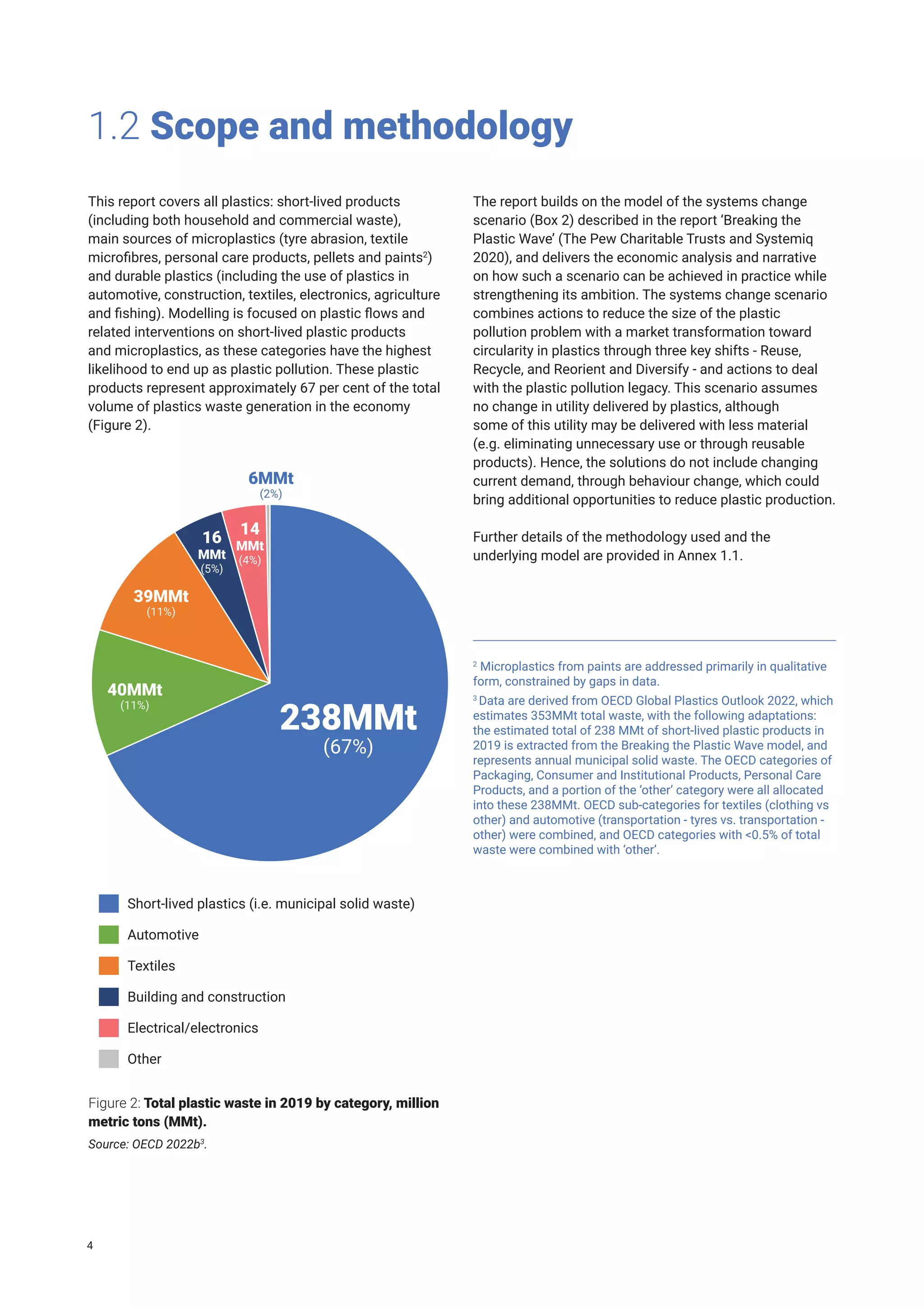
This report covers all plastics: short-lived products
(including both household and commercial waste),
main sources of microplastics (tyre abrasion, textile
microfibres, personal care products, pellets and paints2
)
and durable plastics (including the use of plastics in
automotive, construction, textiles, electronics, agriculture
and fishing). Modelling is focused on plastic flows and
related interventions on short-lived plastic products
and microplastics, as these categories have the highest
likelihood to end up as plastic pollution. These plastic
products represent approximately 67 per cent of the total
volume of plastics waste generation in the economy
(Figure 2).
1.2 Scope and methodology
238MMt
(67%)
39MMt
(11%)
40MMt
(11%)
16
MMt
(5%)
14
MMt
(4%)
6MMt
(2%)
Short-lived plastics (i.e. municipal solid waste)
Automotive
Textiles
Building and construction
Electrical/electronics
Other
Figure 2: Total plastic waste in 2019 by category, million
metric tons (MMt).
Source: OECD 2022b3
.
2
Microplastics from paints are addressed primarily in qualitative
form, constrained by gaps in data.
3
Data are derived from OECD Global Plastics Outlook 2022, which
estimates 353MMt total waste, with the following adaptations:
the estimated total of 238 MMt of short-lived plastic products in
2019 is extracted from the Breaking the Plastic Wave model, and
represents annual municipal solid waste. The OECD categories of
Packaging, Consumer and Institutional Products, Personal Care
Products, and a portion of the ‘other’ category were all allocated
into these 238MMt. OECD sub-categories for textiles (clothing vs
other) and automotive (transportation - tyres vs. transportation -
other) were combined, and OECD categories with <0.5% of total
waste were combined with ‘other’.
The report builds on the model of the systems change
scenario (Box 2) described in the report ‘Breaking the
Plastic Wave’ (The Pew Charitable Trusts and Systemiq
2020), and delivers the economic analysis and narrative
on how such a scenario can be achieved in practice while
strengthening its ambition. The systems change scenario
combines actions to reduce the size of the plastic
pollution problem with a market transformation toward
circularity in plastics through three key shifts - Reuse,
Recycle, and Reorient and Diversify - and actions to deal
with the plastic pollution legacy. This scenario assumes
no change in utility delivered by plastics, although
some of this utility may be delivered with less material
(e.g. eliminating unnecessary use or through reusable
products). Hence, the solutions do not include changing
current demand, through behaviour change, which could
bring additional opportunities to reduce plastic production.
Further details of the methodology used and the
underlying model are provided in Annex 1.1.
4
Producing plastics is immensely profitable, as its
exponential growth over time demonstrates, and creates
utility and social welfare in its many uses throughout the
economy. However, it is profitable primarily because the
external costs it generates have been shifted to others
and into the future. While the primary plastics sector of
polymers and additives accounts for around USD 600-
700 billion per year in revenues4
, it also inflicts a heavy
burden on human health and environmental degradation,
with the poorest in society facing the highest impacts
whilst contributing the least to plastic over-consumption
and waste (UNEP 2018).
1.3 The economic case for circularity in 		
plastics
It is key to factor in gender equality and socio-economic
issues in plastic solutions to ensure a ‘just transition’.
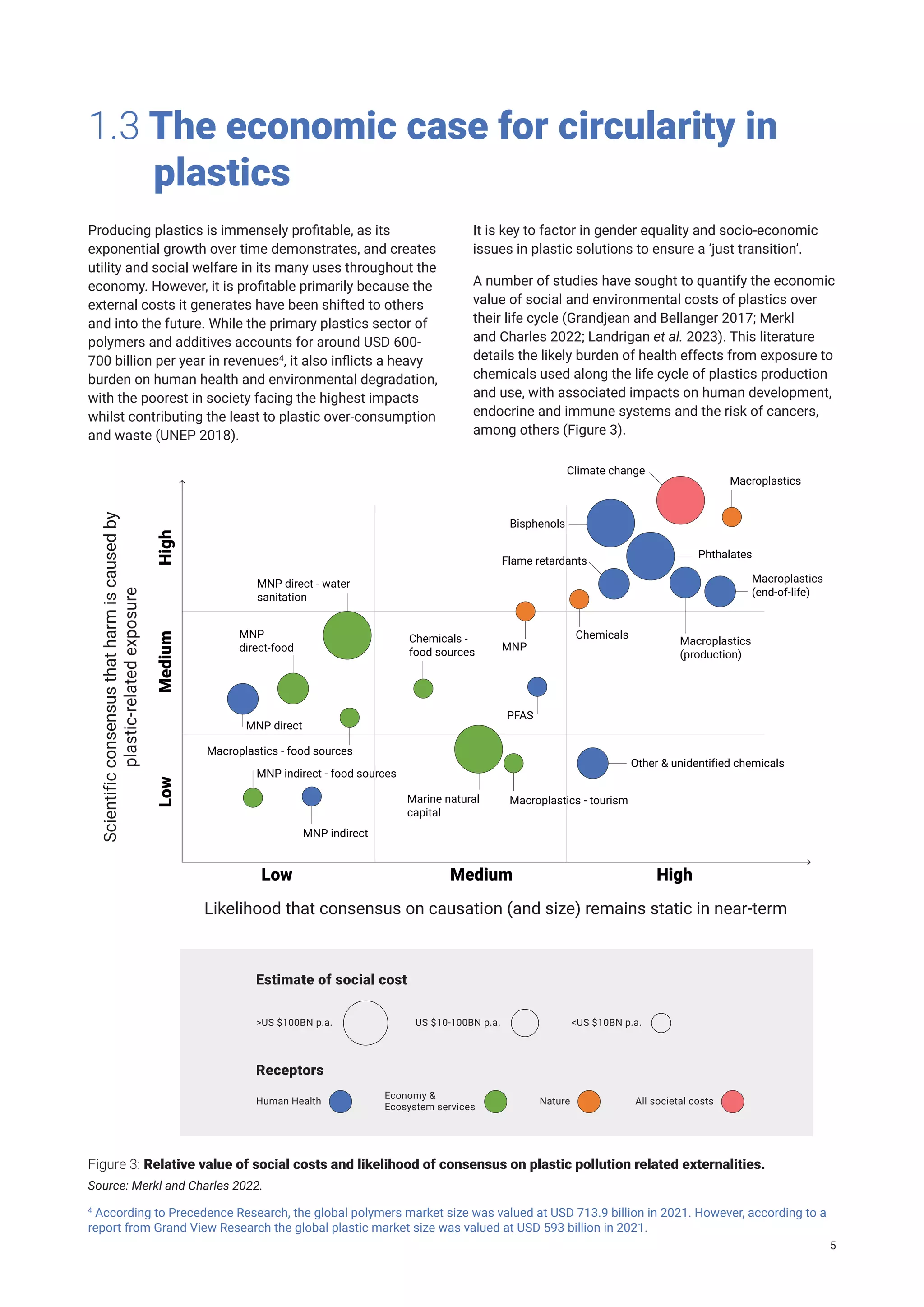
A number of studies have sought to quantify the economic
value of social and environmental costs of plastics over
their life cycle (Grandjean and Bellanger 2017; Merkl
and Charles 2022; Landrigan et al. 2023). This literature
details the likely burden of health effects from exposure to
chemicals used along the life cycle of plastics production
and use, with associated impacts on human development,
endocrine and immune systems and the risk of cancers,
among others (Figure 3).
High
Medium
Low
High
Medium
Low
Scientific
consensus
that
harm
is
caused
by
plastic-related
exposure
Likelihood that consensus on causation (and size) remains static in near-term
MNP indirect - food sources
Macroplastics - food sources
Macroplastics
(production)
Macroplastics
(end-of-life)
Macroplastics
Phthalates
Climate change
Marine natural
capital
Other & unidentified chemicals
MNP
PFAS
Chemicals -
food sources
MNP direct - water
sanitation
MNP indirect
MNP direct
MNP
direct-food
Macroplastics - tourism
Chemicals
Bisphenols
Flame retardants
Estimate of social cost
Receptors
>US $100BN p.a. US $10-100BN p.a. <US $10BN p.a.
Human Health
Economy &
Ecosystem services
Nature All societal costs
Estimate of social cost, and current and future consensus on causation
Figure 3: Relative value of social costs and likelihood of consensus on plastic pollution related externalities.
Source: Merkl and Charles 2022.
4
According to Precedence Research, the global polymers market size was valued at USD 713.9 billion in 2021. However, according to a
report from Grand View Research the global plastic market size was valued at USD 593 billion in 2021.
5
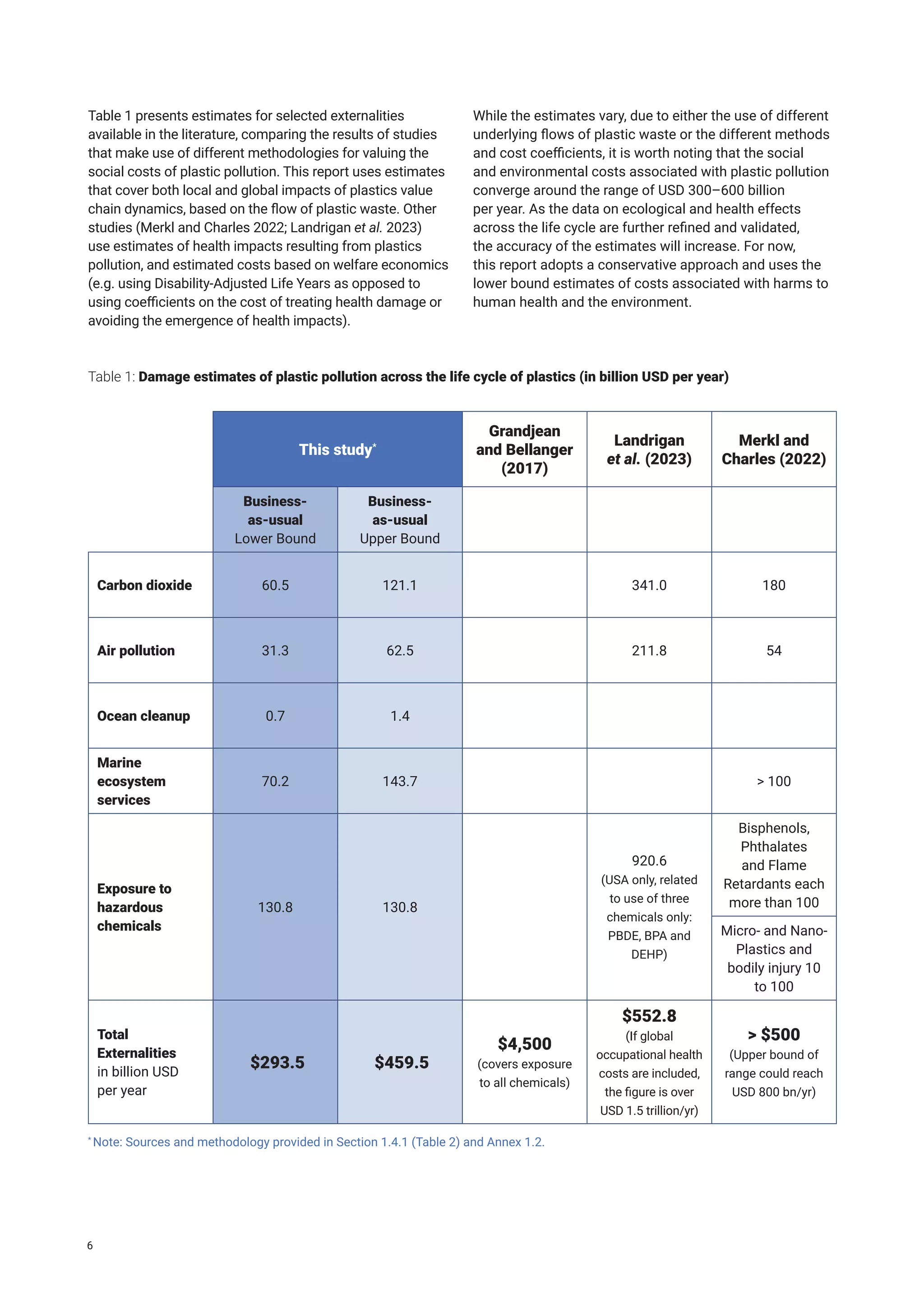
Table 1 presents estimates for selected externalities
available in the literature, comparing the results of studies
that make use of different methodologies for valuing the
social costs of plastic pollution. This report uses estimates
that cover both local and global impacts of plastics value
chain dynamics, based on the flow of plastic waste. Other
studies (Merkl and Charles 2022; Landrigan et al. 2023)
use estimates of health impacts resulting from plastics
pollution, and estimated costs based on welfare economics
(e.g. using Disability-Adjusted Life Years as opposed to
using coefficients on the cost of treating health damage or
avoiding the emergence of health impacts).
While the estimates vary, due to either the use of different
underlying flows of plastic waste or the different methods
and cost coefficients, it is worth noting that the social
and environmental costs associated with plastic pollution
converge around the range of USD 300–600 billion
per year. As the data on ecological and health effects
across the life cycle are further refined and validated,
the accuracy of the estimates will increase. For now,
this report adopts a conservative approach and uses the
lower bound estimates of costs associated with harms to
human health and the environment.
*
Note: Sources and methodology provided in Section 1.4.1 (Table 2) and Annex 1.2.
Table 1: Damage estimates of plastic pollution across the life cycle of plastics (in billion USD per year)
This study*
Grandjean
and Bellanger
(2017)
Landrigan
et al. (2023)
Merkl and
Charles (2022)
Business-
as-usual
Lower Bound
Business-
as-usual
Upper Bound
Carbon dioxide 60.5 121.1 341.0 180
Air pollution 31.3 62.5 211.8 54
Ocean cleanup 0.7 1.4
Marine
ecosystem
services
70.2 143.7 > 100
Exposure to
hazardous
chemicals
130.8 130.8
920.6
(USA only, related
to use of three
chemicals only:
PBDE, BPA and
DEHP)
Bisphenols,
Phthalates
and Flame
Retardants each
more than 100
Micro- and Nano-
Plastics and
bodily injury 10
to 100
Total
Externalities
in billion USD
per year
$293.5 $459.5
$4,500
(covers exposure
to all chemicals)
$552.8
(If global
occupational health
costs are included,
the figure is over
USD 1.5 trillion/yr)
> $500
(Upper bound of
range could reach
USD 800 bn/yr)
6
The vision of a circular, zero-pollution plastics economy is one that eliminates unnecessary production and
consumption, avoids negative impacts on ecosystems and human health, keeps products and materials in
the economy and safely collects and disposes waste that cannot be economically processed. This results in
permanently increasing material circularity, reducing greenhouse gas emissions and stopping plastic pollution.
Achieving this vision requires a fundamental shift to ensure that people responsibly consume, produce and
manage plastic globally. This can be achieved with a systems change.
Systems change “captures the idea of addressing the causes, rather than the symptoms, of a societal issue
by taking a holistic (or ‘systemic’) view. Systemic change is generally understood to require adjustments or
transformations in policies, practices, power dynamics, social norms or mindsets. It often involves a diverse set
of players and can take place on a local, national or global level; systems change requires modifications in many
of the system structures, such as the mindset or paradigm that creates the system or the system’s goals or rules”
(UNEP/PP/INC.1/7).
A systems change involves:
1. simultaneous action across the life cycle to trigger the change. For instance, investment in increased
recycling capacity (downstream) is coupled with incentives to use recycled plastic in new products
(upstream) and the manufacture of products (midstream) that are economically recyclable.
2. international action to create a flourishing circular plastics economy globally that benefits all countries. For
instance, eliminating the manufacture of a problematic product in one country is less effective if that product
can still be exported to a neighbouring country.
The systems change scenario is a feasible solution
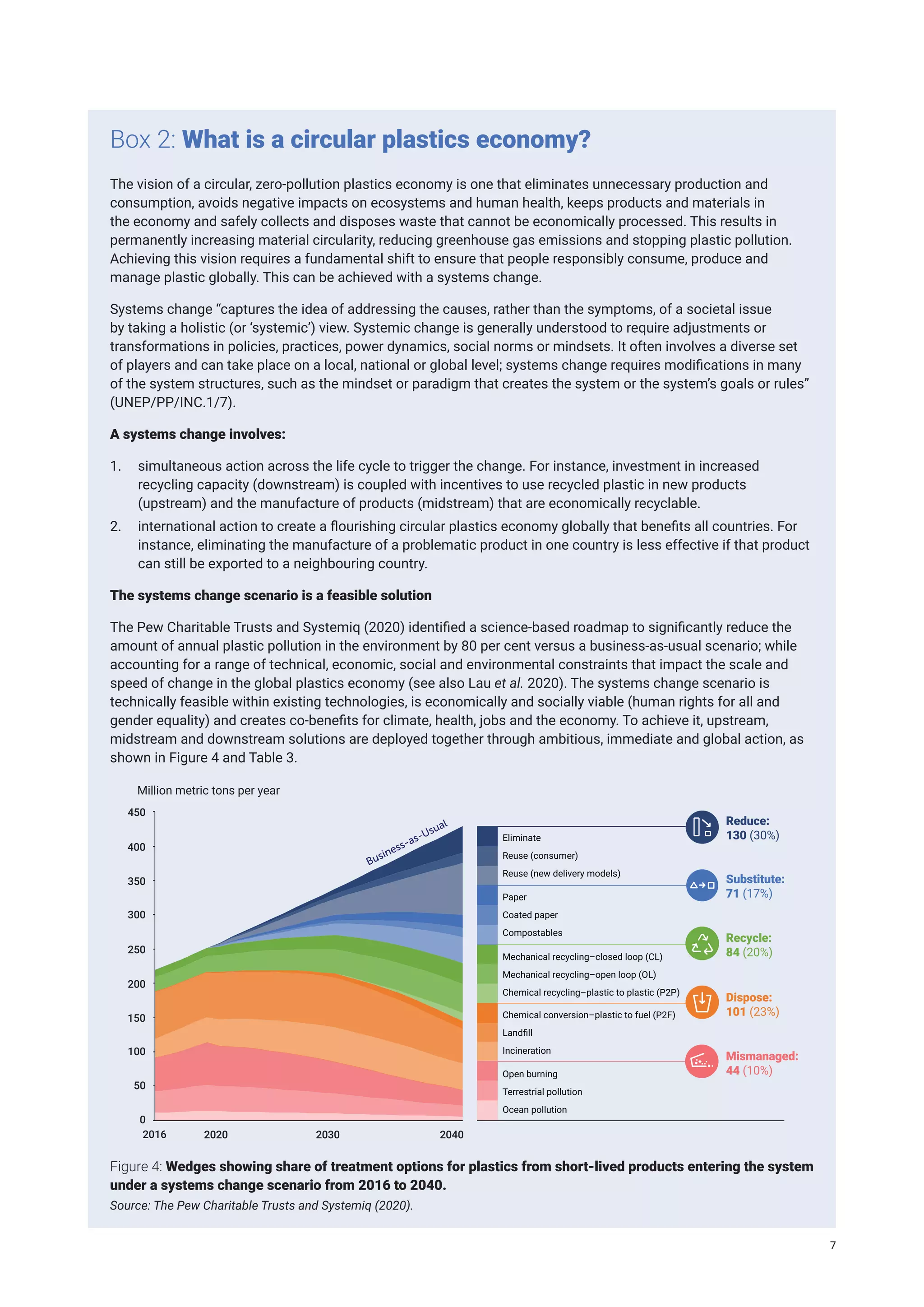
The Pew Charitable Trusts and Systemiq (2020) identified a science-based roadmap to significantly reduce the
amount of annual plastic pollution in the environment by 80 per cent versus a business-as-usual scenario; while
accounting for a range of technical, economic, social and environmental constraints that impact the scale and
speed of change in the global plastics economy (see also Lau et al. 2020). The systems change scenario is
technically feasible within existing technologies, is economically and socially viable (human rights for all and
gender equality) and creates co-benefits for climate, health, jobs and the economy. To achieve it, upstream,
midstream and downstream solutions are deployed together through ambitious, immediate and global action, as
shown in Figure 4 and Table 3.
Box 2: What is a circular plastics economy?
450
400
350
300
250
2030 2040
2016 2020
200
150
100
50
0
Reduce:
130 (30%)
Substitute:
71 (17%)
Recycle:
84 (20%)
Dispose:
101 (23%)
Mismanaged:
44 (10%)
Million metric tons per year
Business-as-Usual
RECYCLE
Eliminate
Reuse (consumer)
Reuse (new delivery models)
Paper
Coated paper
Compostables
Mechanical recycling–closed loop (CL)
Mechanical recycling–open loop (OL)
Chemical recycling–plastic to plastic (P2P)
Chemical conversion–plastic to fuel (P2F)
Landfill
Incineration
Open burning
Terrestrial pollution
Ocean pollution
Figure 4: Wedges showing share of treatment options for plastics from short-lived products entering the system
under a systems change scenario from 2016 to 2040.
Source: The Pew Charitable Trusts and Systemiq (2020).
7
To understand better the full economic implications of
the systems change scenario, an assessment of the
plastic waste and pollution flows was undertaken. This
section provides an overview of the methodology used
to (i) estimate the capital, operations and management
costs, as well as the revenues generated in the plastics
value chain via recycling processes; (ii) evaluate the
most significant health and environment externalities; (iii)
assess the extent to which this scenario impacts costs,
revenues and the value of externalities. The estimation of
costs and revenues is based on the detailed estimation of
plastic flows along the value chain, with consideration of
specific capital and operation and management costs for
each stage considered. This analysis builds on data from
the model of these flows and costs described in The Pew
1.4 The systems change scenario:
An economic opportunity
Charitable Trusts and Systemiq (2020) and Lau et al.
(2020) and is further detailed in Annex 1.2.
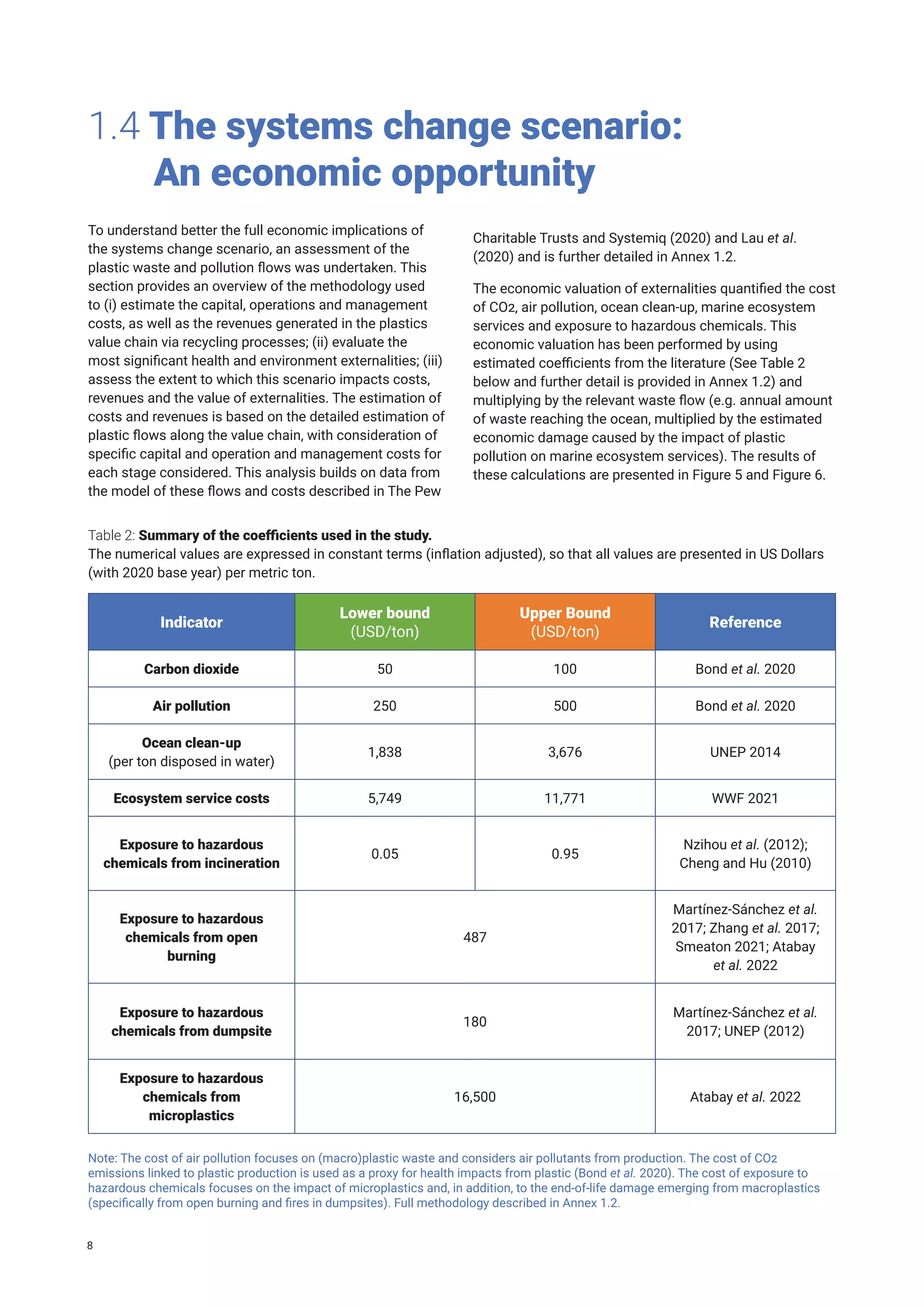
The economic valuation of externalities quantified the cost
of CO2, air pollution, ocean clean-up, marine ecosystem
services and exposure to hazardous chemicals. This
economic valuation has been performed by using
estimated coefficients from the literature (See Table 2
below and further detail is provided in Annex 1.2) and
multiplying by the relevant waste flow (e.g. annual amount
of waste reaching the ocean, multiplied by the estimated
economic damage caused by the impact of plastic
pollution on marine ecosystem services). The results of
these calculations are presented in Figure 5 and Figure 6.
Table 2: Summary of the coefficients used in the study.
The numerical values are expressed in constant terms (inflation adjusted), so that all values are presented in US Dollars
(with 2020 base year) per metric ton.
Indicator
Lower bound
(USD/ton)
Upper Bound
(USD/ton)
Reference
Carbon dioxide 50 100 Bond et al. 2020
Air pollution 250 500 Bond et al. 2020
Ocean clean-up
(per ton disposed in water)
1,838 3,676 UNEP 2014
Ecosystem service costs 5,749 11,771 WWF 2021
Exposure to hazardous
chemicals from incineration
0.05 0.95
Nzihou et al. (2012);
Cheng and Hu (2010)
Exposure to hazardous
chemicals from open
burning
487
Martínez-Sánchez et al.
2017; Zhang et al. 2017;
Smeaton 2021; Atabay
et al. 2022
Exposure to hazardous
chemicals from dumpsite
180
Martínez-Sánchez et al.
2017; UNEP (2012)
Exposure to hazardous
chemicals from
microplastics
16,500 Atabay et al. 2022
Note: The cost of air pollution focuses on (macro)plastic waste and considers air pollutants from production. The cost of CO2
emissions linked to plastic production is used as a proxy for health impacts from plastic (Bond et al. 2020). The cost of exposure to
hazardous chemicals focuses on the impact of microplastics and, in addition, to the end-of-life damage emerging from macroplastics
(specifically from open burning and fires in dumpsites). Full methodology described in Annex 1.2.
8
1.4.1 Estimating the benefits from the systems change scenario by 2040
The results indicate that the systems change scenario is
economically viable and creates immediate annual savings
as compared to that of a business-as-usual (BAU) scenario.
When considering the timeframe, the avoided costs are
significant, reaching between USD 130 billion and USD 200
billion per year by 2040. This magnitude of savings and
avoided cost is a large part of the ‘size of the prize’.
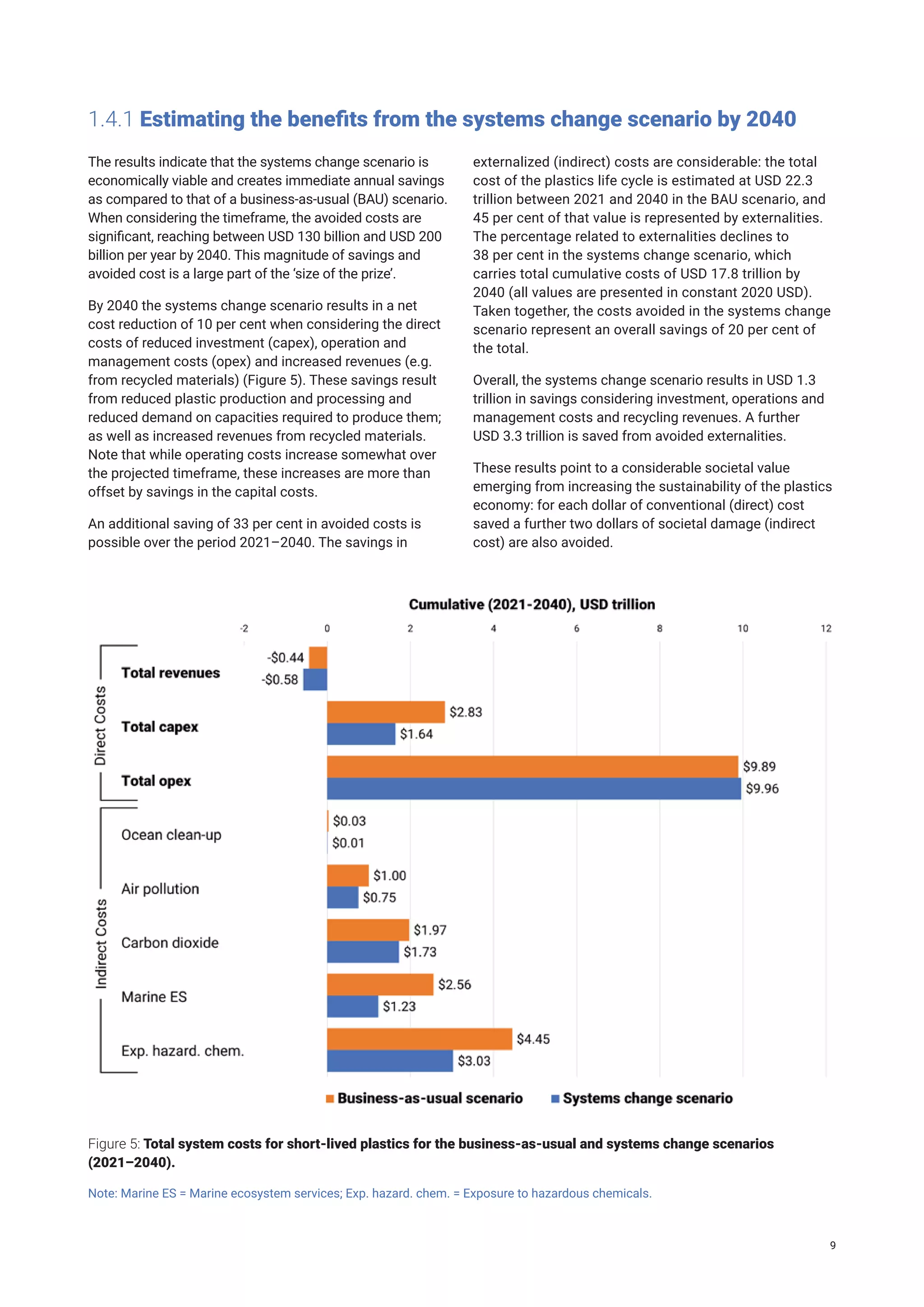
By 2040 the systems change scenario results in a net
cost reduction of 10 per cent when considering the direct
costs of reduced investment (capex), operation and
management costs (opex) and increased revenues (e.g.
from recycled materials) (Figure 5). These savings result
from reduced plastic production and processing and
reduced demand on capacities required to produce them;
as well as increased revenues from recycled materials.
Note that while operating costs increase somewhat over
the projected timeframe, these increases are more than
offset by savings in the capital costs.
An additional saving of 33 per cent in avoided costs is
possible over the period 2021–2040. The savings in
externalized (indirect) costs are considerable: the total
cost of the plastics life cycle is estimated at USD 22.3
trillion between 2021 and 2040 in the BAU scenario, and
45 per cent of that value is represented by externalities.
The percentage related to externalities declines to
38 per cent in the systems change scenario, which
carries total cumulative costs of USD 17.8 trillion by
2040 (all values are presented in constant 2020 USD).
Taken together, the costs avoided in the systems change
scenario represent an overall savings of 20 per cent of
the total.
Overall, the systems change scenario results in USD 1.3
trillion in savings considering investment, operations and
management costs and recycling revenues. A further
USD 3.3 trillion is saved from avoided externalities.
These results point to a considerable societal value
emerging from increasing the sustainability of the plastics
economy: for each dollar of conventional (direct) cost
saved a further two dollars of societal damage (indirect
cost) are also avoided.
Figure 5: Total system costs for short-lived plastics for the business-as-usual and systems change scenarios
(2021–2040).
Note: Marine ES = Marine ecosystem services; Exp. hazard. chem. = Exposure to hazardous chemicals.
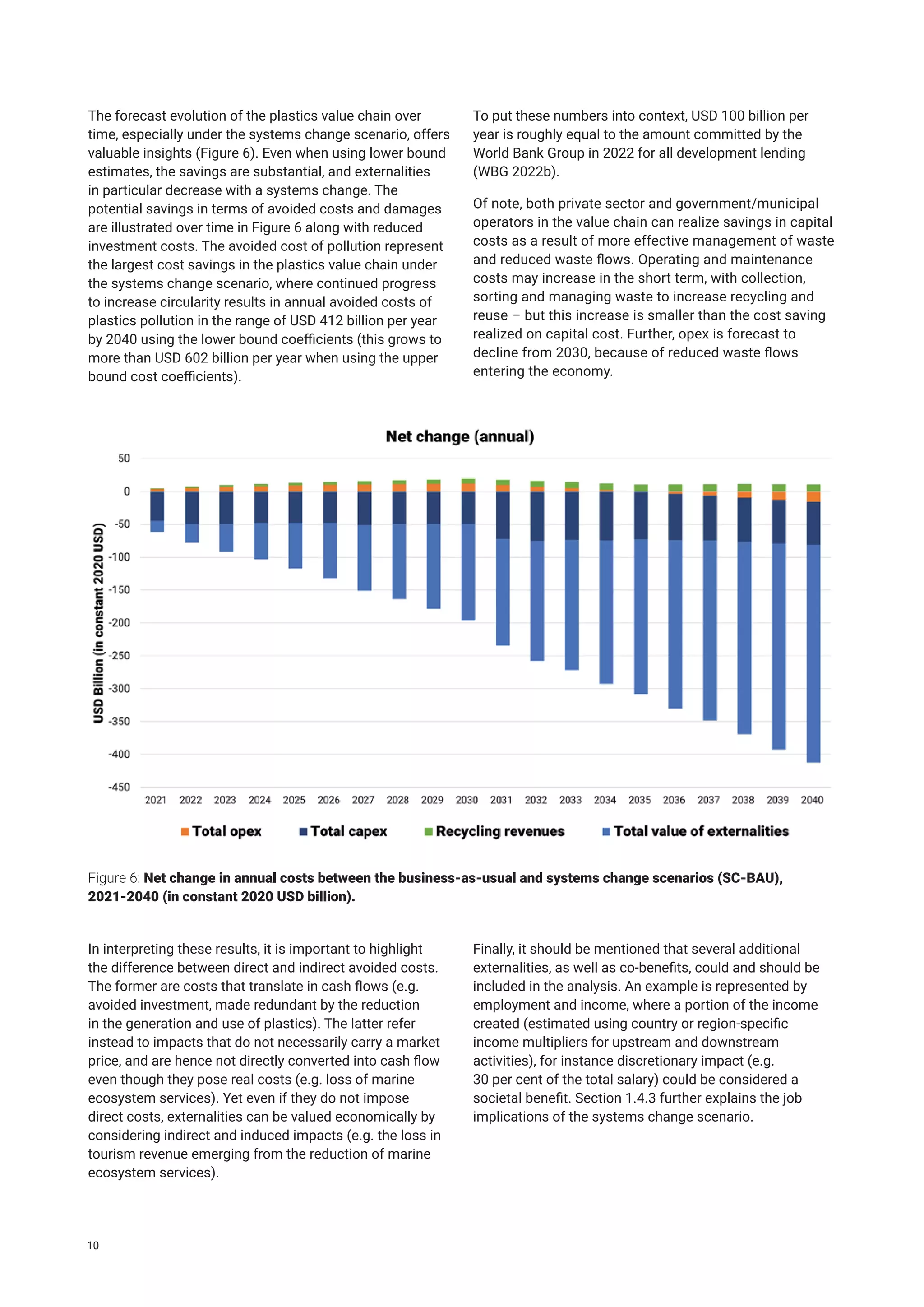
9
The forecast evolution of the plastics value chain over
time, especially under the systems change scenario, offers
valuable insights (Figure 6). Even when using lower bound
estimates, the savings are substantial, and externalities
in particular decrease with a systems change. The
potential savings in terms of avoided costs and damages
are illustrated over time in Figure 6 along with reduced
investment costs. The avoided cost of pollution represent
the largest cost savings in the plastics value chain under
the systems change scenario, where continued progress
to increase circularity results in annual avoided costs of
plastics pollution in the range of USD 412 billion per year
by 2040 using the lower bound coefficients (this grows to
more than USD 602 billion per year when using the upper
bound cost coefficients).
To put these numbers into context, USD 100 billion per
year is roughly equal to the amount committed by the
World Bank Group in 2022 for all development lending
(WBG 2022b).
Of note, both private sector and government/municipal
operators in the value chain can realize savings in capital
costs as a result of more effective management of waste
and reduced waste flows. Operating and maintenance
costs may increase in the short term, with collection,
sorting and managing waste to increase recycling and
reuse – but this increase is smaller than the cost saving
realized on capital cost. Further, opex is forecast to
decline from 2030, because of reduced waste flows
entering the economy.
Figure 6: Net change in annual costs between the business-as-usual and systems change scenarios (SC-BAU),
2021-2040 (in constant 2020 USD billion).
In interpreting these results, it is important to highlight
the difference between direct and indirect avoided costs.
The former are costs that translate in cash flows (e.g.
avoided investment, made redundant by the reduction
in the generation and use of plastics). The latter refer
instead to impacts that do not necessarily carry a market
price, and are hence not directly converted into cash flow
even though they pose real costs (e.g. loss of marine
ecosystem services). Yet even if they do not impose
direct costs, externalities can be valued economically by
considering indirect and induced impacts (e.g. the loss in
tourism revenue emerging from the reduction of marine
ecosystem services).
Finally, it should be mentioned that several additional
externalities, as well as co-benefits, could and should be
included in the analysis. An example is represented by
employment and income, where a portion of the income
created (estimated using country or region-specific
income multipliers for upstream and downstream
activities), for instance discretionary impact (e.g.
30 per cent of the total salary) could be considered a
societal benefit. Section 1.4.3 further explains the job
implications of the systems change scenario.
10
1.4.2 Bridging the finance gap of systems change through public and 		
private financial flows
Maintaining the status quo is far from what is economically
or socially optimal, and support is required to transition to a
more sustainable path in the plastics value chain.
First, support may be provided to generate behavioural
and systems change. A trigger is required, for instance to
reduce plastics use upstream by accelerating reuse, so
that savings can be accrued downstream, on the waste
management side. The recent push by the G20 Presidency
of India to focus on lifestyles for environment (‘LiFE’
for short) is an indicator that behavioural change and
personal choice decisions are on the agenda for many
countries. Actions that promote positive behavioural
change are impactful when they consider gender roles,
consumption and waste generation preferences; this
also helps designing gender-responsive initiatives thus
accelerating progress towards sustainable plastic
management (OECD 2020).
Second, certain investments may require a considerable
amount of upfront capital. Challenges may include the
high cost of financing, a lack of collateral to qualify for
financing for the private sector or a stretched fiscal
balance for the public sector.
Third, the investor may not necessarily be the main
beneficiary of improved sustainability in the context of the
plastics value chain. For instance, if a tax is charged on
plastics consumption, most of the indirect savings will be
accrued by the government (or by the organisations and
institutions managing plastic waste), and only indirectly
by all citizens (e.g. via the reduction of CO2 emissions, air
pollution, marine ecosystem degradation and exposure
to hazardous chemicals). Such taxes may also have
significant impacts on the poorest in society, and further
amplify impoverishment.
While the systems change scenario generates positive
outcomes systems-wide, only a careful design of the
interventions ensures that the transition is economically
and financially viable for all actors involved: producers,
consumers, citizens and the government.
Consider the case of a virgin plastic tax or levy in the
systems change scenario: if 500 USD/metric ton was
charged on virgin plastic produced for short-lived
products5
, an additional cumulative revenue of USD
1.1 trillion would be generated from 2025 until 2040,
higher than the total capex in the same period and circa
16 per cent of the cost of externalities between 2021 and
2040. If, for instance, such levy was to be invested into an
international circularity fund, to leverage private financing,
it could thus finance the capital expenditure as well as part
of the operations expenditure required for the systems
change scenario and greatly accelerate the transition.
This funding could also be used as an incentive (e.g. a
4:1 type of incentive, where the government provides a 20
per cent contribution and the private sector brings in the
remaining 80 per cent), which would deliver five times as
many resources (i.e. USD 5.5 trillion more of investment
available). Higher taxes of 1,000 and 2,000 USD/metric ton
(as suggested in OECD 2022c) would ‘recover’ 33 per cent
and 66 per cent of the externality costs incurred between
2021-2040. Initial analyses suggest that a tax at USD 500/
metric ton would be financially viable for the industry.
Additionally, Figure 5 clearly shows that the highest costs
in both scenarios are related to operational expenditure.
Well-designed Extended Producer Responsibility (EPR)
schemes can cover the full costs of ensuring the
system’s circularity, as shown in successful examples
around the world (see topic sheet on ‘Extended Producer
Responsibility’). In the European Union,for example,
EPR schemes place the responsibility on producers for
the financing of collection, recycling and responsible
end-of-life disposal of packaging, waste from electrical
and electronic equipment, batteries. In France, the fees
collected through the EPR schemes for packaging reduce
the waste management burden of municipalities by over
50 per cent (UN-Habitat Urban Agenda Platform 2022).
Belgium is also often cited as having one of the most
successful EPR schemes with rates of over 80 per cent
recycling for packaging (EXPRA 2023).
Overall, the emerging literature suggests that a
combination of policies are required to shift demand and
‘bend the consumption curve’ (OECD 2022c; Economist
Impact 2023). Price instruments such as levies and even
EPR schemes can be helpful, but due to the low-price
elasticity of demand will do more to raise revenues than
dampen demand; and must therefore be combined with
bans on single use plastic products and additives and
polymers that are particularly hazardous for human health
and the environment.
5
i.e. similar to the tax already in place in a few frontrunner
countries and lower than what OECD (2022c) proposes.
11
1.4.3 The job implications of systems change
As shown in Figure 7, a detailed analysis of direct
employment and livelihood impacts shows that the
systems change scenario is good for the jobs market. By
2040, relative to the BAU scenario, the systems change
scenario would result in 700,000 more jobs directly
associated with short-lived plastics; there is a net growth
of 970,000 jobs in developing countries and a net loss of
270,000 jobs in developed countries (but still a net growth
of 150,000 jobs in the Global North relative to today).
Further details of the job implications of systems change
are shown in Annex 1.1.
This growth is due to the systems change scenario
expanding collection and sorting across developing
countries, which would support more livelihoods.
Additionally, the circular economy is typically more labour
intensive than the linear economy because it shifts
much of the production activity (which relies mainly on
machines) to services which require humans (recycling,
reverse logistics and reuse). The considerations of gender
equality in job creation is crucial to ensure a just transition,
more so in developing countries (International Labour
Organization [ILO] 2022).
WASTE
1.9
Million
3.2
Million
1.5
Million
Virgin plastic
production
1.2
Million
2.1
Million
1.1
Million
Plastic
conversion
3.1
Million
Reorient -
new materials
1.4
Million
Reuse and New
delivery models
4.0
Million
5.9
Million
4.8
Million
Formal and
informal
collection
and sorting
10.5
Thousand
13
Thousand
9
Thousand
Thermal treatment
and landfills
Recycling
(mechanical and
chemical)
TOTAL JOBS
101
Thousand
167
Thousand
250
Thousand
7.2
Million
11.3
Million
12.0
Million
2020 Current
2040 Business-as-usual
2040 Systems change scenario
Figure 7: Total jobs in different parts of the short-lived plastics value chain in the current market, and under business-
as-usual and systems change scenarios.
Source: The Pew Charitable Trusts and Systemiq 2020
12
Many of the manual jobs required by the circular economy
(collection, sorting, recycling, washing of reusables etc.)
also have a direct contribution to poverty alleviation
because these typically require lower skillsets. While the
BAU scenario also has many jobs in these categories,
they are mostly in high-income countries as low-income
countries still suffer from insufficient waste management
infrastructure.
And while areas such as production of virgin plastic and
conversion of plastic products decrease in this scenario
(all of them are in the high-income countries), these are
typically high skilled labour that operate machinery and
work in factories, so this labour can likely be directed
towards other industrial activities. At the same time, new
circular industries like reuse, new delivery models and new
materials development and production have the potential
to create millions of new jobs in the circular economy6
.
As with any transition, job creation and displacement
require careful attention and forward planning, not least
to ensure that adequate skills and retraining opportunities
exist, as new jobs are created and new opportunities
open. The International Labour Organization (ILO) has
outlined measures that can underpin a ‘just transition’
to an economy which is greener and more inclusive for
both women and men and other minority groups who
are often marginalised (ILO 2015). Even if the systems
change scenario results in net increase in jobs, safeguards
and just transition should be in place to care for informal
workers who may not qualify for formal labour and yet still
wish to participate in the system.
Photo: Getty Images
6
Including jobs in the other plastic categories not in the scope
of this analysis (automotive, construction, electronics, textiles,
fishing gear etc.), could increase the growth in net jobs given
that these sectors may experience a smaller relative reduction in
volume compared to packaging and single-use plastic.
13
1.5 A better plastics future
For decades the three R’s framework (Reduce-Reuse-
Recycle) has been the focus of plastic waste management.
While these elements all remain core to tackling plastic
pollution, to move to a new plastics economy by 2040
requires an expansion of this framework.
Integrated actions are required across the life cycle (UNEP/
PP/INC.1/7) under three main categories:
1.5.1 Reduce the size of the problem
Eliminating the use of unnecessary or problematic plastics
and hazardous chemicals can be achieved by prioritising
high-value durable uses such as reusable and refillable
products, or removing plastic that is not delivering a
necessary function (e.g. excessive headspace). In some
cases, such unnecessary plastics can also be substituted
by safe and sustainable materials.
1.5.2 Transform the market from
linear to circular through three
market shifts
Shift 1:
Accelerate the market for reusable products
REUSE
Shift 2:
Accelerate the market for plastics recycling
RECYCLE
Shift 3:
Reorient and diversify the market for
sustainable and safe plastic alternatives
R
E
O
R
IENT & DIVER
S
I
F
Y
The reuse market shift, together with elimination of
unnecessary and problematic plastic products, can
reduce demand for new plastics in 2040 by approximately
30 per cent, while accelerating the recycling market shift
can further manage 20 per cent of the plastics volume.
Reorient and diversify sustainable alternatives to plastic
products, particularly those that are short-lived, can reduce
approximately 17 per cent of plastics that risk ending
up as pollution. Some cross-cutting policy and fiscal
measures, such as a levy on virgin plastic production,
could drive market transformation and support the
success of all three shifts. Chapter 2 outlines actions to
accelerate the three market shifts.
1.5.3 Deal with the plastic pollution
legacy
Despite the systems change scenario resulting in an 80
per cent decrease in the outflows of mismanaged plastic
waste ending in the environment (Figure 9), action will still
be required to manage 100 million metric tons of plastics
from short-lived products not yet reduced, substituted or
brought into circularity by 2040.
These system-level actions are interdependent and rely
on their successful implementation at scale, in parallel
and with ambition, to shift towards a new circular plastics
economy. For example, collection and sorting is required
to expand recycling, and design for recycling improves
the economic viability and scalability of mechanical
recycling systems. These system-level actions must
also be supported by cross-cutting measures, such as
reporting and monitoring, which will provide transparency
and a data base to support effective management through
the value chain and drive further transformation. The
three key market shifts (reuse, recycling, reorient and
diversify) highlight economic opportunities, are supported
by actions that reduce the size of the problem and
complemented by actions to deal with the legacy; overall
they are accelerated by policy and legislative change.
Taken together, these form the compass to end plastic
pollution through a new circular plastics economy.
Figure 8: The compass to end plastic pollution
14
380MMt
Fossil-based plastics
52MMt
Secondary plastics
408MMt
Total waste
generated
73MMt
Sorted for
recycling
129MMt
Disposal
USE
227MMt
Mismanaged
3.5MMt
Bio-based plastics
80MMt
Secondary plastics
216MMt
Total waste
generated
111MMt
Sorted for
recycling
95MMt
Disposal
USE
41MMt
Mismanaged
95MMt
Reuse
2.4MMt
Bio-based plastics
149MMt
Fossil-based plastics
Figure 9: Top: Modelled short-lived plastic flows in 2040 under a business-as-usual scenario. Bottom: Modelled short-
lived plastic flows in 2040 under a systems change scenario to deliver the necessary market transformation.
Source: UNEP modelling building on The Pew Charitable Trusts and Systemiq (2020) and OECD (2022b).
Business-as-usual
scenario
Systems change
scenario
15
1.5.4 Wasting time will lead to more pollution
The next three to five years present a critical window for
action to set the world on the path towards implementing
the systems change scenario by 2040. If it takes longer to
apply these same solutions, the model used indicates that
an additional 80 million metric tons of plastic pollution will
be entering the environment (The Pew Charitable Trusts
and Systemiq 2020).
To deliver the targets set out in Table 3, and ultimately a
better plastics future, it is crucial to align all financial flows
with the goals of the market transformation by 2040 (all
values are in net present value [NPV]).
This includes:
• Reducing by USD 2.2 trillion all financial flows towards
virgin plastic production
• Mobilising at least USD 600 billion from all sources to
reuse and new delivery models
• Increasing by USD 230 billion financial flows to formal
collection and formal sorting in middle income and
low-income countries, and by USD 70 billion financial
flows to improve recycling technologies and increase
recycling capacity
• Mobilising at least USD 1.7 trillion from all sources
to production of sustainable substitute materials and
end of life management facilities and technologies
Required scale of change in the next
five years
Required outcomes and scale of change by
20407
Reduce the
size of the
problem and
Accelerate
reuse
Reduce 10% (25 MMt) of short-lived plastics
versus BAU including at least 20% via reuse
and new delivery models for all bottled
products and beverage cups
Reduce growth in short-lived plastic consumption
to avoid ~30% of 2040 projected plastic waste
generation via elimination, reuse and new delivery
models, including at least 50% via reuse and
new delivery models for bottled products and
beverage cups
Accelerate
recycling
Re-designing 25% of multi material and
multi-layer globally into mono material
formats (13 MMt)
Design products to expand the share of
economically recyclable plastics, e.g. switching
100% of multi-material flexibles to mono-material
Increase the amount of post-consumer
recycled content in all new products from
circa 6% in 2020 to 14% globally (i.e. 69
MMt)
Increase the amount of post-consumer recycled
content in new products to 35% of new short-
lived plastic products (i.e. 80 MMt) and 6% of
durable plastic products (i.e. 19 MMt)
Achieving 70% collection rates (vs. 50%
in 2016) in low-income urban areas, while
supporting livelihoods of informal waste
pickers
Expand waste collection rates in middle and low-
income countries to 90% in urban areas and
50% in rural, supporting the informal collection
sector
Increasing the global mechanical recycling
capacity by 50% versus 2016, from ~43
MMt to ~65 MMt (equivalent to growing
mechanical recycling rate of short-lived
plastics from 14% in 2016 to 20% in 2028)
DOUBLE annual mechanical recycling capacity
globally from 43 MMt to 86 MMt (equivalent to
growing mechanical recycling rate of short-lived
plastics to 35% globally). Enhanced ambition
could TRIPLE mechanical recycling capacity to
129 MMt*
Develop sustainable plastic-to-plastic conversion,
potentially to a global capacity of 13 MMt per
year
Table 3: The systems change scenario outcomes and scale of change in the next 5 years and by 2040.
MMt = million metric tons.
7
Building from Breaking the Plastic Wave - The Pew Charitable Trusts and Systemiq 2020.
* It is important to note that while feasible financially (the necessary investment could pay for itself as the economics of recycling are
favourable and would be more favourable with the integrated actions), this recycling target can only be achieved and can only make
sense with very ambitious design for recycling, collection and sorting requirements ensuring that virtually all plastic otherwise going to
landfill will be recyclable and recycled.
16
Reorient &
diversify
Substitute ~7% (i.e. 22 MMt) of short-lived
plastics for alternatives when these are more
sustainable
Substitute short-lived plastic with alternative
materials when these are more sustainable,
switching ~17% of projected 2040 plastic waste
generation
Deal with the
legacy
Roll-out solutions to prevent ~5.7 MMt of annual
microplastic pollution by 2040 (~50% reduction
microplastic versus total by 2040)
Adding 6 MMt in annual capacity for
controlled waste disposal in low- and middle-
income countries
Build facilities with an annual capacity of ~42
MMt to dispose of necessary but unrecyclable
plastics until we have a better solution
Reduce leakage of 3.5 MMt of plastic to the
environment
Reduce leakage of 7 MMt of plastic to the
environment
Reduce mismanaged waste globally from
40% in 2016 to 27% in 2028
Reduce mismanaged waste globally to 10% in
2040
Reduce plastic waste exports to countries
with low collection and high leakage rates by
50% compared to 2020 plastic waste trade
Completely eliminate plastic waste exports to
countries with low collection and high leakage
rates
1.5.5 Considering further ambition is possible
Two additional considerations in modelling the systems
change scenario to 2040 are as follows:
• Assuming no new incineration capacity is built
after 2020 (and instead take what would have been
incinerated in new capacity to engineered landfill), one
would save USD 7.1 billion NPV from 2021 to 2040
in capex and opex, as well as 240 million metric tons
(MMt) CO2e for the entire period. This would divert an
additional 172 MMt of plastic waste from incineration
to engineered landfill, predominantly in High- and
Upper Middle-Income countries which is where the
new incineration capacity is being built. The impact on
jobs of this assumption would be negligible.
• Adding extra recycling capacity up to 129 MMt
annual capacity by 2040 (instead of letting waste
go to landfill) would cost an incremental capex of
approximately USD 33 billion NPV from 2021 to 2040
and opex of approximately USD 140 billion NPV
from 2021 to 2040 for the recycling infrastructure
(accounting for savings from not building landfill
capacity) plus incremental capex of USD 43 billion
NPV from 2021 to 2040 and opex USD 130 billion for
sorting. In addition, this would save costs for virgin
plastic production and plastic conversion as follows:
capex USD 185 billion NPV from 2021 to 2040 and
opex USD 290 billion NPV from 2021 to 2040. In other
words, tripling recycling capacity (from the capacity
in 2016) instead of ‘only’ doubling it would create a
net cost saving overall. The critical condition for this
to work is ensuring that this extra amount of plastic
waste, that would otherwise go to landfill, can be
designed to be safely mechanically recycled and that
the economics of sorting and mechanical recycling
are attractive enough to justify these investments. An
ambitious legally binding instrument agreed by the
end of 2024 could set the enabling conditions and
economic incentives to make this possible, including
transparency and controls on or criteria for plastics
composition.
The above examples show possible directions of
additional impacts the market transformation to a circular
plastics economy could have if the right ambition and
economic incentives are put in place. This modelling can
support policymakers with a full picture of the economic,
social and environmental impacts of their policy choices.
17
Photo: Getty Images
Market
transformations:
Creating the marketplace
for the new circular
plastics economy
18
Analysis shows that circularity in
plastics requires the simultaneous
acceleration of three market shifts:
reuse, recycling, and reorienting
and diversifying of plastic to more
sustainable alternatives.
The following section defines each of the shifts, how
they can be delivered, the level of ambition that can be
achieved, the barriers that may be encountered and the
potential to improve the economics.
Unnecessary plastics are those with low or no utility (e.g. over-packaging) that can be eliminated
while providing the same utility, those designed for a short use period when reuse or new delivery
models could provide the same utility, and those that can be substituted for alternative materials
with a more sustainable footprint (as validated by Life Cycle Assessment studies). Additional
criteria to identify problematic plastics is whether they contain hazardous chemicals that pose a
significant risk to human health or the environment (applying the precautionary principle), hinder
or disrupt the recyclability or compostability of other items and/or have a high likelihood of being
littered or ending up in the natural environment.
Criteria to help identify problematic or unnecessary plastic uses (EMF 2020):
1. It is not reusable, recyclable or compostable in practice and at scale (as per Global
Commitment definitions).
2. It contains hazardous chemicals that pose a significant risk to human health or the
environment (applying the precautionary principle).
3. It can be avoided (or replaced by a reuse model) while maintaining utility.
4. It hinders or disrupts the recyclability or compostability of other items.
5. It has a high likelihood of being littered or ending up in the natural environment.
Box 3: What are ‘unnecessary and problematic’ plastics
and plastic products?
In parallel to the market transformation to circularity, the
size of the problem needs to be reduced by turning off the
tap, i.e.: eliminating problematic and unnecessary uses of
plastic in the economy (see Box 3). This entails removing
from the economy those plastics which have least
value for recycling precisely because they are the least
recyclable and are neither designed to be reused. This also
includes reducing the production of unnecessary plastics
by redesigning overpackaging and reducing headspace,
developing packaging-free products, increasing utility
per package and extending life of durable goods such as
through reuse and repair.
19
Plastic reuse and new delivery models, together with
elimination of problematic and unnecessary plastics, are
highly effective interventions because they can reduce
waste at source. Reuse schemes (also referred to as reuse
systems or models), refers broadly to new delivery models
in which a single product (e.g. a package) achieves
multiple trips, rotations or uses for the same purpose for
which it was originally used (International Organization for
Standardization [ISO] 2013). This can range from simple
bulk dispensers in-store to more complex schemes with
deposits and packaging take-back, washing and repair.
These include the shift to reusable water bottles, food
containers and bags, new delivery models such as refill
from dispensers and bulk systems in retail, low-packaging
subscription services, concentrated product capsules, and
take-back services with reverse vending machines, deposit
refund schemes and washing pooling systems (EMF 2019;
Environmental Investigation Agency [EIA] 2022).
2.1 Market shift one: Accelerate reuse
These solutions also decrease risk of exposure to
hazardous chemicals in plastics and our dependence
on fossil fuel-based plastics, vital in the face of oil and
gas price volatility, geopolitical risks, and the urgent
need to tackle climate change. Reusable alternatives
are environmentally preferable according to Life Cycle
Assessment (LCA) meta-studies (UNEP 2021a). See topic
sheet on ‘Reuse schemes’ for further details.
This market shift can be unlocked by improving the
economics of reuse (which is in turn supported by
aligning design and sharing of reuse elements to enable
economies of scale); as well as aligning regulation of
chemicals, material and waste flows to reuse.
Photo: Getty Images
Plastic consumption expected
to double by 2040 globally under
BAU versus 2016
of plastics from short-lived
products are avoidable and can
be reduced
of plastic reduction could
come from reuse, refill and new
delivery models
2X 30% ~70%
20
2.1.1 Improve the economics of reuse
Once established, reuse schemes keep resources at a
higher value in the economy and thus avoid losing the
economic value of the manufactured goods after a single
use. Reuse and new delivery models are the most economic
schemes to put in place, after plastic elimination, and are
estimated to generate net savings to the system (USD 1,289
per ton of plastic for reuse schemes and USD 516 per ton
of plastic for new delivery models) (Annex 1.1; The Pew
Charitable Trusts and Systemiq 2020).
However, the costs of shifting to reuse schemes should not
be underestimated: private costs of reuse models (reuse
and new delivery models) are estimated at circa USD 609
billion between 2021 and 2040 (The Pew Charitable Trusts
and Systemiq 2020). Sharing elements of the reuse system
(such as return systems and containers in the case of
reusable packaging) can enable economies of scale thus
improving the economics of reuse. The topic sheet on
‘Design guidelines for circularity’ provides more details on
what can be achieved.
Circular systems tend to be more labour intensive than
linear systems, which are resource intensive; therefore,
shifting the fiscal burden from labour to resources
improves the economics of reuse (and other circular
solutions such as recycling). Several studies (OECD
2022c; World Bank Group 2022a; Economist Impact
2023) have suggested the introduction of a virgin plastic
tax to reduce or reverse the price gap between virgin
single-use products and those that reduce the amount of
virgin plastic demand (such as reuse systems and also
recycled products).
Reuse systems require services and infrastructure, which
were eliminated a few decades ago when disposability
became the norm. Fiscal incentives could support the
transition until reuse becomes commonplace again,
acknowledging that reuse will also deliver favourable
outcomes in terms of jobs, economic benefits and
reduced environmental impacts.
Targets embedded in legislation (such as in France’s
Anti-Waste Law: Government of France 2021) provide
assurance in the market by de-risking the investments
needed from the private sector to shift from the current
single-use models to reuse e.g. through a fund for
change within the EPR such as 5 per cent of the global
EPR fee, eco-modulation with specific one shot bonus to
help brand owners to shift from single use to reusable
products and standards to scale up the reuse and refill
systems. Policies, which also encourage consumers’
behaviour change and increase the demand for reuse,
are a key driver of increased investment in reuse models
since 2015.
Funds raised for reuse schemes between 2015 and 2021
are estimated over USD 1 billion, mostly in the United
States of America, Canada and Europe (where the 2019
directive on single use plastic products has created
the ground for the development of new reuse models).
Policies and incentives will be crucial to unlock financing
in emerging countries and for novel reuse models (World
Economic Forum [WEF] 2022).
When only a few front-running countries/value chains
incentivise reuse, economies of scale are not achieved,
and businesses may have to multiply their delivery
systems to accommodate reuse and disposable systems.
In the extreme this may even result in systems being
incompatible at two ends of the same business, such as
with the aviation industry, confronted with reuse systems
being favoured in one end of the journey and illegal at the
other end (International Civil Aviation Organization [ICAO]
2022). Specifically, reuse systems require the following
elements to run effectively: collection points, return
incentives (to ensure high enough return rates), reverse
logistics (including washing and sanitation), labelling and
communication, consumer awareness, among others.
Like with all transitions, it is crucial to assess and address
any potential negative trade-offs from the market shift to
reuse e.g. on vulnerable groups (such as waste pickers
currently living off streams of single-use plastic products)
or gender impacts e.g. because women are often central
in managing plastic in terms of domestic purchasing
decisions, recycling and disposing (UNEP 2021a).
Overall, improving the economics of reuse requires
addressing the tensions between the economic actors
that may perceive themselves as ‘winning’ or ‘losing’ with
the transition (Table 4).
21
Actor Considerations for the Reuse Shift
Polymer and
chemical producers
• Overall plastic production may plateau / not grow as much as forecast
• Polymer production for short-lived plastics would decrease
• Stopping the expansion of new production plants now will avoid the risk of stranded
assets
• Help diversify possible shift in polymer types / chemicals produced
• Early adopters/innovators of ‘reuse-ready chemicals’ stand to win significantly
Plastic converters
• Smaller volume of production, though higher value products
• May consider shifting business model to ‘polymer leasing’
Brands /
manufacturers
• Significant re-design effort for safe containers and delivery systems
• Likely increase in brand loyalty
• Strengthened social license to operate as ‘branded litter’ diminishes
• Delivering on corporate targets (e.g. New Plastics Economy Global Commitment)
Reuse service
providers sector
• Significant boom expected in this sector
• Major growth in revenues and jobs anticipated
Retailers
• Increased costs as need to devote a share of retail space to reverse logistics / return
systems
• Strengthened social license to operate
• Delivering on corporate targets (e.g. New Plastics Economy Global Commitment)
Governments
• Delivery on waste targets and avoiding growth in greenhouse gas and toxic emissions
linked to plastic production
• Significant job growth particularly in less skilled jobs that may support poverty alleviation
and the economic empowerment of women from lower socio-economic status
(International Labour Organization 2022)
• Reduced health impacts on the population and costs to health services
Consumers
• Need to forego convenience of disposable and get used to products looking less shiny
• Opportunity to shape the future of consumption as reuse systems are co-designed with
the user in mind
• Important to consider the gender dimension in the transition to avoid disproportionate
impact on women
Waste pickers
• Reduced volume of single-use plastic items waste, with potential impact on their
revenues
• Opportunity to become integral part of the reuse service providing sector with safer and
better paid jobs if conditions for a just transition are observed, e.g. by formalising the
informal sector and including waste pickers in new reuse businesses such as reverse
logistics8
and washing services
Waste management
companies
• Reduced volume of waste to be managed vs. BAU, although the sector will still
grow compared to today to increase the population covered by waste collection and
management
• Reduced costs of investment into costly disposal infrastructure.
• Opportunity to diversify into reverse logistics and washing systems for reuse
Recycling companies
• Need to adapt machinery and processes to more durable products (i.e. reusable
products, after at least ten cycles of use)
Table 4: Implications of the reuse shift for different actors across the value chain
8
Reverse logistics refers to activities engaged to recapture the value of products, parts and materials once they have reached end-
of-use or end-of-life. All value retention processes (such as reuse) may be considered to be part of a reverse-logistics system, and in
addition activities including collection, transportation and secondary markets provide essential mechanisms for facilitating reverse-
logistics (IRP 2018).
22
2.1.2 Align regulation of chemicals, material and waste flows to reuse
Chemicals are an integral part of plastics as they confer
them with specific desirable functionalities; however,
they can be released into the air, water and soil at all
stages of the plastic life cycle and have a significant
social and environmental cost (Grandjean and Bellanger
2017). Over 13,000 chemical substances have been
identified as associated with plastics as monomers,
additives and processing aids. After analysing a fraction
of these chemicals (>7,000), 3,200 chemicals have been
catalogued as of concern due to their potential adverse
impacts on human health and the environment in UNEP’s
(2023) ‘Chemicals in Plastics: A Technical Report’.
These include chemicals that can mimic, block or alter
the actions of hormones, reduce fertility and damage the
nervous system. See topic sheet on ‘Criteria for chemicals
in plastics’, which builds on UNEP’s (2023) ‘Chemicals in
Plastics: A Technical Report’.
While there is already legislation in place to regulate the
safety of plastics, it is often designed to ensure safety of
materials used in the economy from a linear perspective,
i.e. assuming they will only go through the economy once.
For example, the Stockholm Convention does control
various persistent organic pollutants (POPs) that have
been used in plastics as additives, flame retardants,
plasticizers or in the manufacture of fluoropolymers.
The perspective of products having to be used and
reused in the economy several times, and their materials
cycled back into new products at the end of life, rather
than disposed, may require alignment of safety-related
regulation. In addition, the economic benefits of allowing
new chemicals entering the market quickly will likely
need to be balanced with the overall society benefits of
those same chemicals and their properties. Improved
transparency and traceability on product contents
(including chemicals used) must be ensured to allow safer
management along the life cycle, for multiple cycles of
products and materials in the economy.
Because circularity (through reuse and recycling) will
increase the time that these chemicals are circulating in
the economy, the reduction of a wide range of hazardous
chemicals will minimise potential impacts on human
health and biota at all stages of the life cycle. This is
particularly important for chemicals that are persistent,
bio accumulative and toxic either at very low levels
(e.g. carcinogens, mutagens, reproductive toxicants
and endocrine disrupting chemicals) or at cumulative
exposure. Higher exposure to chemicals happens during
production, waste management and recycling phases
(mostly in low-income countries). Consumers’ exposure
to chemical additives in plastics is most significant at
the use stage of plastic products (Fantke et al. 2016),
including plastic based food packaging, building materials,
electronics, toys, textiles or household products.
Beyond the regulation of chemicals, waste management
generation has been regulated considering waste as
a nuisance capable of generating impacts from which
humans and the environment need to be protected. While
this has ensured a good level of protection, in the context
of circularity it may impede the most efficient use of
resources. E.g. in reuse schemes empty containers are
transported in reverse logistics schemes, for them to be
washed and reused again. If these empty containers are
classified as waste at the end of each useful cycle, this
would generate high management costs and require the
intervention of accredited waste handling companies
making the shift to reuse economically unfeasible. In
the context of aviation, international catering waste
often needs to be incinerated to avoid spreading animal
diseases, even though research indicates that the risk is
negligible (ICAO 2022).
In summary, safety regulations established in the past may
need to be revisited with a risk management perspective
to ensure losses in efficiency are not disproportionate
compared to gains in safety.
2.1.3 What level of ambition can be achieved through reuse?
Per capita use of plastics in 2040 can be kept at roughly
today’s levels, by eliminating unnecessary plastics
(9 per cent reduction by mass) and switching to reuse and
new delivery models (22 per cent reduction, Figure 10).
Elimination and reuse offer the biggest reduction in plastic
pollution, often represent net savings, and provide the
highest greenhouse gas (GHG) emissions mitigation (The
Pew Charitable Trusts and Systemiq 2020; UNEP 2021a).
In practice, an ambitious shift to reuse will see significant
scale up of product volumes being sold in reusable/refill
models, starting with those product categories where
change may be easiest or impact highest. Examples of
these categories are bottled products, products in sachets,
hospitality, retail and catering (including fast food and
food delivery). Other sectors have the potential for big
impacts (e.g. personal care products such as diapers and
menstrual products), but may require further support.
23
Figure 10: Utility demand in 2016 and 2040, and how it is met by eliminate solutions and the reuse shift in the systems
change scenario.
Source: The Pew Charitable Trusts and Systemiq 2020.
2.1.4 How will implementation differ
by context?
Under the systems change scenario, decreased plastic
consumption must happen across all regions, and per
capita plastic consumption will decrease dramatically
in high-income countries. Despite per capita and total
plastic consumption in low- and middle-income countries
increasing somewhat compared to today’s levels (before
switching any plastics to single-use substitutes, which are
discussed in section 2.3), a rapid decrease of the current
rapid growth trajectory is achieved under systems change.
This can bring significant benefits, if countries ‘leapfrog’ to
a modern economy based on material-efficient, innovative
reuse solutions that avoid exacerbating their already
overburdened waste infrastructure. Design for reuse and
refurbishment can bring more benefits in terms of jobs
and income in low- and middle-income countries where
labour costs are lower.
2.1.5 What are the potential barriers
and opportunities for reuse over the
next five years?
Reuse solutions for short-lived plastics are already
technologically available today, with many having already
been used in the past, and several offer cost savings.
However, investment is required to support the transition
to an economy that maintains products at their highest
possible value. Well-designed EPR schemes provide
effective economic incentives to shift supply chains and
consumer behaviour and help overcome transition costs
e.g. by removing any fees from reuse schemes. Many
solutions are also at an early stage of availability and
require financial investment to scale, from public and
private source, with an essential role of governments to
develop progressive policies and incentives to attract
private capital, especially for business-to-consumer models
which are less mature than business-to-business models
such as reusable shipping and logistics (WEF 2022).
However, the shift could ultimately bring strong cost
savings and opportunities at-scale: for example, the Ellen
MacArthur Foundation estimates the economic opportunity
of switching to reuse models at USD 10 billion (EMF 2019).
Innovation in this area is on the rise: registered trademarks
rose by 23 per cent annually for plastics reuse between
1995 and 2017 (OECD 2022b). Companies are increasingly
publicly reporting on plastic footprints and many have set
measurable, absolute reduction and reuse targets, such as
through the New Plastics Economy Global Commitment
(launched by EMF and UNEP in 2018).
It is critical to ensure that shifting to reuse models does
not increase GHG or create other unacceptable trade-
offs. While UNEP (2021a) shows how LCA studies usually
confirm the environmental preference of reuse systems
over single-use, it also points at key parameters to be
considered to ensure their preference, such as a minimum
number of reuse cycles, efficient reverse logistics or
washing.
24
For many years, the mantra has been to increase public
support for recycling and move away from single-use
plastics. However, plastic products need to be designed
and made of materials that enable recycling. Close to 80
per cent of the plastic in short-lived plastic products is not
economically recyclable due to design decisions such as
additives (e.g. dyes), material combinations or even size.
A tiny proportion of plastic products can be reused safely.
Establishing design rules e.g. to reduce the number of
different polymers altogether, favour the design formats
that are easier to reuse or recycle, or standardize formats
for reuse so they can be shared by multiple companies,
can go a long way in improving the profitability of reuse
and recycling schemes. By agreeing to establish common
design rules and standards in problematic sectors
such as packaging, governments could unlock multiple
benefits such as significantly increasing reuse rates,
expanding the share of economically recyclable plastics
(both contributing to a reduction in total plastic use with
no change in utility) and unlocking the GHG savings
potential of this sector. GHG emissions can be reduced
by approximately 48 per cent when comparing recycling
versus landfilling plastic waste (see Annex 1.1).
However, re-designing plastic products to enable recycling
is not enough; collection systems need to be in place to
facilitate recycling. It is estimated that today there are
about two billion people not connected to waste collection
systems (UNEP and ISWA 2015), and the challenge will
only increase as populations grow. Ensuring inclusivity
in the informal collection sector will enable expansion of
collection and sorting efforts. Aligning the collection and
sorting processes with the recycling system can ensure
recycled plastic matches the quality, consistency and
grade requirements of virgin plastic.
Once the product reaches the recycling plant, the two
possible technologies are mechanical recycling or
chemical conversion. Mechanical recycling is based on
proven technologies, the economics are clearer and it
emits approximately 50 per cent less GHG emissions
per metric ton of plastic product than chemical plastic-
to-plastic conversion (The Pew Charitable Trusts and
Systemiq 2020). Chemical plastic-to-plastic conversion
is at its early stages of development but can become a
2.2 Market shift two: Accelerate recycling
of plastics is
of recycled origin today
(OECD 2022b)
material loss rates in
today’s recycling processes
USD lost to the economy annually
(95% of the material value in
plastic packaging) (EMF, WEF
and McKinsey & Co. 2016)
6% 25-47% 80-120Bn
synergetic solution to mechanical recycling - if and when
its sustainability is demonstrated through LCA studies -
for products that mechanical recycling cannot manage,
including mixed polymers, low-value and/or contaminated
plastic. It creates virgin-like quality which can be used
for food-grade plastics and can accept a wider range of
materials as feedstock. Hence, while this technology is
controversial due to a high environmental footprint, it has
the potential to play a role among the solutions to address
plastic pollution if these challenges can be addressed.
Currently, analyses estimate losses in recycling processes
around 25 per cent; improved technologies could
significantly reduce the losses (The Pew Charitable Trusts
and Systemiq 2020).
Recycling can be accelerated by improving its economics;
aligning the incentives in design with the recycling
economy and ensuring safe and fair recycling in practice
and at scale (i.e. enabling investment in infrastructure).
As with reuse, the presence of specific chemicals of
concern in plastics reduces their potential for circularity,
and thus makes recycling less economically favourable.
The considerations for reuse described in section 2.1.2
also apply to recycling. Trading plastic waste from areas
where there is no recycling infrastructure to places with
surplus recycling capacity can enhance circularity through
economies of scale and ensuring access to feedstock.
By establishing a legally binding framework for the trade
in plastic waste, the Basel Convention plastic waste
amendments creates the conditions for more transparent
global trade in plastic waste. Increased transparency,
traceability and sharing of information will make
enforcement more effective, curbing the illegal dumping
of plastic waste in countries not wishing to receive such
waste or lacking the capabilities for environmentally
sound management. The amendments also provide a
powerful incentive for the private sector, governments
and other stakeholders to create enabling environments
and technologies for recycling as well as for reducing the
generation of plastic waste.
25
2.2.1 Improve the economics of recycling
Recycling markets cannot take off while virgin plastic
has a lower price than secondary plastic. Recycled
materials are often sold at higher prices than virgin plastic
(10 to 47 per cent lower in Europe, except for recycled
polyethylene terephthalate (PET), according to a recent
study by the European Commission’s Joint Research
Center) (García-Gutiérrez et al. 2023). Various subsidies
for fossil fuels can in some countries lower the costs
of producing virgin plastic, making it more difficult for
systems that deliver the same function with less / no
virgin plastic to appear economically attractive.
Hence most recycling technologies are not economically
viable and require support through subsidies or change
is needed to the availability or price of feedstock and the
market for the recycled output. Even though the economic
viability of recycling technologies will evolve over time –
average costs for chemical conversion are estimated to
decrease by 37.5 per cent between 2019 and 2040, while
virgin plastic cost will increase with fossil fuel price rise
– breakeven will be reached as far as in 2040 for certain
technologies (gasification) (García-Gutiérrez et al. 2023).
Considering the indirect costs of the linear plastics
economy as demonstrated earlier in this report,
governments may consider bringing in these external
costs e.g. in the form of a virgin plastic tax or levy as
already operational in a few countries (e.g. Spain and the
United Kingdom of Great Britain & Northern Ireland). EPR
schemes could also modulate their fees to ensure that
easier-to-recycle products (and products that incorporate
recycled content) pay less than harder-to-recycle ones.
Finally, governments and businesses can incentivise and
de-risk investments into recycling infrastructure e.g. through
inclusion of minimum recycled content criteria in public
procurement or long-term offtake contracts to guarantee
demand for recycled polymers, similar to power purchase
agreements in the energy sector.
Photo: Getty Images
26
Actor Considerations for the recycling shift
Polymer and
chemical producers
• Overall plastic production may plateau / not grow so much as forecast
• Polymer production for short-lived plastics would decrease
• Stopping the expansion of new production plants now will avoid the risk of stranded
assets.
• Investing in recycling, particularly chemical recycling technologies that may be closer to
current business models / technology
Plastic converters
• Adapt machinery and design to incorporate growing rates of post-consumer recycled
content
• Adapt processes to deliver different grades of secondary material (e.g. food grade vs.
non-food grade)
Brands /
manufacturers
• Design products suitable for recycling: simplification of polymer types, removal of
dyes etc.
• Engage consumers to buy more recyclable products
• Strengthen social license to operate as recycled content and recyclability are well
understood as part of the solution.
• Delivery of corporate targets (e.g. New Plastics Economy Global Commitment) Higher
contributions to the costs of running the system as EPR schemes expand, but strong
incentives to reduce the fees paid through better and easier to recycle designs
Retailers
• May incur increased costs if deposit-return systems are built into retail space, but
opportunity to play a clear part of the solution
• Strengthened social license to operate
• Choice editing to favour most recycled / recyclable items
• Delivering of corporate targets (e.g. New Plastic Economy Global Commitment)
Governments
• Delivery on waste targets and avoiding growth in greenhouse gas and toxic emissions
linked to plastic production.
• Significant job growth particularly in less skilled jobs that may support poverty alleviation
and gender equality.
• Local governments may need to mobilise significant resources to ensure collection,
sorting and recycling infrastructure is in place, and possible facilitate permitting
processes for these facilities
• Reduced health impacts on the population and costs to health services
Consumers
• Important role in contributing to close the loop
• locally-adapted nudging will help in assuring consumer participation in recycling.
Consumer information required to ensure understanding of how product is handled at
the end of use
• Important to consider the gender dimension in the transition to avoid disproportionate
impact on women
Waste pickers
• Value of plastic waste will increase as its technical and economic recyclability increases,
increasing their revenues
• Risk of excluding informal waste pickers as business of recycling becomes more
profitable
• Opportunity to become formal part of the recycling sector with safer and better paid jobs
if conditions for a just transition are observed
Waste management
companies
• Reduced volume of higher value waste to be managed vs. BAU, but the share of volume
being recycled will grow two-three-fold by 2040, also following growth in waste collection
globally
Recycling companies
• Significant opportunity to grow business as collection of a more valuable plastic waste
expands, and demand for Post-Consumer Recycled content increases boosted by legal
targets
Table 5: Implications of the recycling shift for different actors across the value chain.
27
Today, many plastic items are designed in ways that
make reuse or recycling difficult and uneconomical.
To accelerate recycling, focus needs to first be on the
design phase of plastic products because it creates
the condition for product recyclability from a technical
and economic perspective, facilitates collection and
sorting and ensures products do not hinder or disrupt the
recyclability of other items in the same waste streams.
This will entail designing away from flexible, multilayer
and multi-material plastic products (which account for
80 per cent of pollution – Figure 11 – and are harder
to collect, sort and less economically viable to recycle)
towards rigid and mono-materials, as well as eliminating
Recyclability and recycling
profitability can be doubled
via design
of plastic today is
economically recyclable
of chemicals linked to plastics
bring concerns to health and our
environment (Wiesinger, Wang
and Hellweg 2021)
2X ONLY 21% 25%
2.2.2 Align design incentives with the recycling economy: designing
for recycling
According to the EMF (2020) a packaging or
a packaging component is recyclable if post-
consumer collection, sorting and recycling
is proven to work in practice and at scale.
A package can be considered recyclable if
its main packaging components, together
representing more than 95 per cent of the
entire packaging weight, meet this requirement,
and if the remaining minor components are
compatible with the recycling process and
do not hinder the recyclability of the main
components.
Box 4: What can be called
recyclable?
any additives or pigments that hinder recyclability. Better
design standards will contribute to reducing losses in
sorting, currently around 20 per cent (The Pew Charitable
Trusts and Systemiq 2020). Also critical in the design
phase is addressing issues of associated chemicals of
concern to avoid adverse impacts on human health and
the environment. Design for recyclability can improve
recycling profitability from USD 120 per metric ton to USD
240 per metric ton and increase the share of plastics that
are economically recyclable mechanically from 21 per cent
today to over 50 per cent in 2040.
Figure 11: Pollution vs. production by plastic type.
Source: The Pew Charitable Trusts and Systemiq 2020.
28
Under the systems change scenario, product design would:
• switch 50 per cent of global multi material flexibles
to mono material or recyclable combinations by 2030
and 100 per cent by 2040
• remove all dyes, pigments and additives that interfere
with recycling economics
• increase homogeneity of plastic types and formats,
designing-out and/or banning hard-to-recycle and
problematic polymers (e.g. polyvinyl chloride,
polystyrene and expanded polystyrene in packaging)
• improve and standardise labelling to help customers
sort waste better
• increase the amount of post-consumer recycled
content (PCR) into all new products (e.g. to 35 per
cent in short-lived products by 2040, see Table 3)
• eliminate hazardous chemicals, promote and develop
safe and sustainable alternatives and build on existing
efforts such as UNEP’s work on green and sustainable
chemistry (UNEP 2022b)
The European Investment Bank (EIB) (2023) also
recommends most of the design incentives above. In
the case of durable plastic goods, the design can focus
on design for disassembly and recycling, extending
durability, life spans, refurbishment and reuse. Some
industry specific actions include enhancing the use of
mono material, recyclable textiles, and ensuring electronic
products can be refurbished and reused, including by
making replacement parts available and banning ‘planned
obsolescence’.
Collection is a critical stage in plastic waste management
because uncollected waste not only becomes pollution
but also represents lost revenue as resources are not
reused. Globally, over 22 per cent of plastic from short-
lived products is not collected, and this is predicted to
increase to 34 per cent by 2040 (The Pew Charitable
Trusts and Systemiq 2020). Uncollected plastic waste
leads to open burning, which contributes to the release of
toxins and GHG emissions, and blockage of drains which
is responsible for floods and spread of diseases.
High-income countries already show most of their waste
is collected, even in most rural areas. Rates are lower in
low- and middle-income countries, but with significant
financial investment and improvements in governance it is
possible to reach urban collection rates above 90 per cent
and rural collection rates above 50 per cent, which are
needed to achieve systems change (Figure 12). Public and
private capital are expected to respond to the investments
needs, estimated to USD 54 billion for formal collection
of plastic from short-lived
products is not collected
today
people lack access to
collection services today
(UNEP and ISWA 2015)
informal waste pickers in the
world (The Pew Charitable
Trusts and Systemiq 2020)
22% 2 Bn >11 Mn
2.2.3 Ensure scale-up of safe and fair collection, sorting and recycling of
plastic products
To accelerate recycling both the demand for and the supply of recycled (secondary) plastics needs to be scaled up. Demand
signals such as legal targets help in securing long-term demand and help de-risk investments to improve the supply-side of
recycling. This section considers the latter and focuses on increasing collection, sorting and recycling capacity.
Increase collection and sorting
and sorting between 2021 and 2040. The systems change
scenario assumes economic limitations, especially in rural
areas, prevent complete collection rates.
Figure 12: Collection rates required to achieve systems
change.
Source: The Pew Charitable Trusts and Systemiq 2020.
29
Improve recycling capacity
Higher efficiency in waste management systems can be
achieved by improving sorting rules and infrastructure to
enhance recycling, including sorting waste at source/home
and separation technologies at recycling plants. To ensure
the transition to a systems change scenario the share of
waste sorted at source needs to be over 50 per cent in high-
income countries (currently it is approximately 25 per cent)
and between 20 and 30 per cent in low- and middle-income
countries (currently it is minimal).
The remainder of non-recyclable plastics must also be
managed as part of expanding overall municipal waste
collection services including organic waste, which will
have added health and climate benefits.
Such an expansion is a costly endeavour, and current
waste collection is already a major cost for municipalities
(10–20 per cent of council budgets in low- and middle-
income countries (Kaza et al. 2018)). Investing in
collection rate expansion will increase municipality
budgets in ranges from USD 80–110 million per million
metric tons of plastic waste collected in middle-income
countries and USD 40–80 million in low-income countries
(The Pew Charitable Trusts and Systemiq 2020).
Local taxation is unlikely to cover the investment level
required, even with support from central governments,
therefore additional sources of funding, for example
extending responsibility to producers, will be necessary.
Parallel to increased funding, stronger regulations and
enforcement can accelerate the shift to the systems change
scenario. For example, cost-effective solutions to keep
track of collection vehicles can help prevent direct dumping
of collected waste, a practice common in some countries to
avoid landfill costs and/or long drives to landfills.
It is imperative that actions and regulations consider
the role of the informal sector and build systems where
informal sector workers can access safe, healthy and
fairly paid livelihoods. Close to 800,000 new jobs relative
to today will be required in formal and informal waste
collection by 2040 under the systems change scenario
(Figure 7), which provides a clear opportunity for
improved livelihoods directly alleviating poverty mainly in
the Global South.
Mechanical recycling is among the most important
solutions to eliminate plastics pollution because it is
already proven and managed profitably for some plastic
types/products and in certain geographies. Scaling this up
will reduce pressure on landfills, reduce the dependence
on virgin fossil fuels and potentially lower costs of
materials. In addition, the plastics economy can decouple
economic development from a dependency on virgin fossil
fuels in an environment of volatility and high prices.
With ambitious but realistic assumptions, the systems
change scenario presented in this study estimates global
mechanical recycling capacity can scale up to address
86 MMt per year of plastic waste by 2040; i.e. doubling
the capacity available today and more than doubling the
related jobs. Capacity could even be tripled to 129 MMt
per year, but this would require even more aggressive
progress in accelerating design for recycling as well as
collection and sorting. See Annex 1.1 for further details.
Figure 13: Mechanical recycling capacity (MMt/year).
Source: The Pew Charitable Trusts and Systemiq 2020.
30
When reduction, substitution, design and collection are
implemented in parallel, mechanical recycling can cover
approximately 35 per cent of the total plastics volumes in
short-lived products (versus 15 per cent currently) (The
Pew Charitable Trusts and Systemiq 2020). Mechanical
recycling can bring economic savings into the global
plastics economy; it has the potential to reduce the total
system cost (e.g. closed loop including collection and
sorting costs) by USD 80 to USD 300 per metric ton,
depending on the region and in comparison to non-circular
life cycles. Mechanical recycling emits approximately 60
per cent less emissions than controlled incineration on a
per ton basis. Only the elimination of plastic in the design
or reuse schemes are more beneficial than mechanical
recycling when it comes to GHG emissions.
Chemical conversion promises certain advantages which
can complement mechanical recycling and increase
retention of plastic in the economy once its sustainability
credentials are assured. The output of chemical
conversion can be used in food-grade quality and has
more tolerance to different materials and conditions
for feedstock. Furthermore, chemical conversion
can facilitate many more recycling loops than most
mechanical recycling processes. Chemical conversion
can therefore be used in synergy with mechanical
recycling to address specific plastic types, such as films,
multi materials and contaminated plastic, but this will
require building chemical conversion capacity as it is
currently very low. However, this technology has some
important shortcomings and should be scaled with careful
consideration (García-Gutiérrez et al. 2023) - including high
energy requirements, unproven yields and economics for
certain applications in some geographies.
Chemical conversion refers to a number of
technologies (pyrolysis, depolymerization,
gasification and dissolution) that use chemical
agents or processes to break down plastic
into basic chemical building blocks, either to
make new plastic or other materials. Several
technologies are being developed that can turn
plastic waste back into chemical compounds
to be reintroduced as plastic feedstock with the
same properties as virgin plastic, usually referred
to as plastic-to-plastic (P2P) technologies.
Similar technologies are used widely for plastic-
to-fuel (P2F) conversion. In P2F, the output
material of chemical conversion plants is refined
into alternative fuels such as diesel and therefore
this is not considered recycling. This chapter
about chemical conversion focuses on plastic-to-
plastic conversion only.
Box 5: What is chemical
conversion?
Figure 14: Chemical conversion capacity in 2040 (MMt/year) by region.
Source: The Pew Charitable Trusts and Systemiq 2020.
Using existing investment in chemical plastic-to-plastic
conversion as reference, and accounting for feedstock
availability and the time to build infrastructure, plastic-
to-plastic chemical conversion could reach an annual
capacity of 13 MMt per year by 2040, with an investment
requirement estimated at USD 30 billion (Figure 14).
Chemical conversion would provide a solution for about
5 per cent of the plastics volume in short-lived products
by 2040. While this may seem relatively small, this
volume cannot be recycled mechanically and has no
better solution. Further development of technologies for
chemical conversion would need to address its current
high GHG emissions. The GHG emissions generated
when producing one metric ton of plastic through P2P
(including collection and sorting) is 19 per cent lower than
the emissions of producing one metric ton of virgin plastic
that is later collected, sorted and incinerated (The Pew
Charitable Trusts and Systemiq 2020: Figure 20, page 44).
However P2P emissions are 10 per cent higher when
compared to producing one metric ton of virgin plastic that
is later collected, sorted and landfilled (see Annex 1.1).
31
2.2.4 How will implementation differ by context?
Recyclability depends on local sorting and recycling
infrastructure. Therefore, companies should select their
business models, materials and designs considering the
market where the products will be sold. This is especially
important for multinational corporations who typically
design products and packaging in a central hub for
many markets. Harmonised international standards and
definitions for design for recycling can make it easier for
companies to design products that are recyclable across
markets, as well as streamlining the use of polymers,
additives, dyes and pigments. Certain polymers - such as
PET and High-density polyethylene (HDPE) - are typically
easier to recycle from a technical and economical
perspective, and have more widespread recycling
infrastructure.
Collection may be a challenge in low- and middle-
income countries, where inefficient systems, increase
in per capita plastic consumption and rapid population
growth exacerbate the challenge. Rural regions in these
countries need particular attention as they have the lowest
collection rates and, in some cases, also generate a
disproportionate share of plastic pollution.
Municipalities are typically the main players to improve
collection systems, as they are responsible for allocating
financial resources, creating the appropriate regulations,
encouraging waste management expansions and ensuring
that the livelihoods of people in the informal sector are
improved. Central governments may also contribute by
ensuring national regulations and governance structures
make effective collection possible.
The expansion of mechanical recycling capacity can
benefit all geographies (Figure 13), and the largest
opportunities are in the rural regions in low- and middle-
income countries.
Given that chemical conversion requires a certain amount
of waste density to be economically attractive, it is
typically more applicable in urban areas that have higher
feedstock density and more consistent access to plastic
waste. The 13 MMt per year of P2P capacity required
by 2040 in the systems change scenario could likely be
developed across geographies, with analysis indicating
that by 2040 it is feasible to develop an annual capacity
of nearly 5 MMt in high-income countries, over 4 MMt
in middle-income countries, and 4 MMt in low-income
countries (The Pew Charitable Trusts and Systemiq 2020).
2.2.5 What are the barriers and opportunities over the next five years?
Opportunities exist to expand ongoing voluntary initiatives.
For example, over 1,000 organisations have aligned behind
the Ellen MacArthur Foundation’s New Plastics Economy
vision, and pledged that their products will be completely
reusable, recyclable or compostable by 2025 (EMF 2023).
Additional opportunities can emerge from creating
environments that incentivise investment. Policy and
industry groups can be encouraged to increase research
and development funding and blended capital to
finance capacity expansion, and de-risk investments in
infrastructure. Mexico is an example of a country where
the enabling environment successfully incentivised
investment in recycling. Waste management legislation
requiring large waste producers to develop plans to reduce
and value waste facilitated the expansion of a recycled
PET (rPET) entity created by large beverage companies
to increase recycling in the country. Initially funded by
the International Finance Corporation, the private sector
arm of the World Bank, the rPET entity contributed to
the creation of the first bottle-to bottle recycling facility
in Latin America and increased investment in domestic
recycling infrastructure. Resulting in the increase of
the recycling rate in Mexico from 8.8 per cent in 2002
to 56 per cent in 2018. This also contributed to the
development of new capital market solutions in Mexico
through the issuance of the first green bond with a
sustainability criteria related to the increased use of
recycled PET content (WEF 2022).
Learnings from one country in Southeast Asia indicate
there are three root causes to low waste handling levels:
1. Waste systems are dependent on local leadership
exposure to political pressures/cycles.
2. In rural areas, a local community often has
responsibility for waste management, yet does not
have the financial resources, institutional capacity or
technical knowledge to do so. Often women undertake
this unpaid and unacknowledged role as part of their
gender roles (IETC and GRID-Arendal 2019).
3. There is no enforced mandate for governments to
provide universal waste services and no incentives for
households to responsibly manage their waste.
32
To address these issues and significantly improve waste
governance, these actions have proven beneficial:
• Avoid delegating waste management to local
leadership, and rather institutionalise waste
management with law and regulation
• Assign the government (e.g regency/city government
or municipality) the full responsibility for waste
management, instead of local community led
approaches. The government in partnership with
community-based or private waste operators owns
the responsibility to ensure success
• Create incentives against dumping and open burning
of waste and in favour of households managing
waste responsibly
Design for
recycling
• Enhanced barrier properties for mono-materials including paper and compostables
• Design additional recycling solutions for replacing multi-materials
• Household goods made from recyclable mono-materials, or modular products designed
for disassembly and recycling
Collection
• Reduced collection costs in low-income areas (especially rural, remote and other low-
density areas)
• Improve profitability, productivity, and working conditions for the informal sector through
technology, tools and aggregation markets
Sorting and
mechanical
recycling
• New models for sorting and aggregation of waste, including automated sorting
• Scaling and simplification of source separation in collection systems through regulation,
education, incentives and improved standards
• Improved technology to reduce sorting losses, handle food contamination, or create
higher-quality output affordably, particularly for food-grade outputs
• Investment in innovation in sorting and recycling technology is identified as a priority by
EIB (2023)
Chemical
conversion
• Technology, business or financing solutions to reach widespread collection of low-value
plastics in remote and low-income countries
• Improve process efficiency to increase naphtha fractions and reduce emissions
• Technology to allow variety in feedstock composition and quality
Table 6: Innovation opportunities to unlock greater impact from recycling.
33
2.3 Market shift three: Reorient and
diversify the market for sustainable and
safe plastic alternatives
Plastic consumption is expected
to double by 2040 globally under
BAU versus 2016
of plastics in short-lived
products can be replaced with
sustainable substitutes
average GHG emissions reduction
when switching flexible plastic to
sustainably sourced paper9
2X 17% ~25%
Exploring alternative materials to replace virgin plastics is a
critical upstream outcome in the systems change scenario
to achieve a decrease in overall virgin plastic production
and enable circular end-of-life management. Some plastics
from short-lived products cannot be eliminated or switched
to reuse models but remain problematic because they are
non-recyclable or have high littering rates. In these cases,
switching from traditional plastics to sustainable substitute
materials may be considered if there is LCA-based evidence
demonstrating their sustainability. This section therefore
focuses on plastics from short-lived products, such as
plastic wrappers, sachets and takeaway items.
The careful replacement of specific problematic plastic
products with short-lived products made from alternative
materials, such as paper and compostable materials,
can deliver a 17 per cent decrease in plastic pollution.
The substitutions need to be made in an environmentally
and socially sound manner, considering unintended
consequences of substitutes or prioritising substitutes
that are themselves recycled materials: recycled
(secondary) plastic can also be used as a suitable
substitute material.
Figure 15: The role of reorienting and diversifying in a systems change scenario compared to BAU 2040.
Source: The Pew Charitable Trusts and Systemiq 2020.
Annual plastic volumes in short-lived products - 2040 impact of reorient and diversify solutions
(Million metric tons / year)
9
Average reduction compared to plastic which is mechanically recycled, landfilled or incinerated (See annex - assumes substituting to
paper involves using 1.5 tons of paper for every 1 ton of plastic replaced).
34
The following enablers will help in enhancing the sustainability and accelerating the pace of reorienting: Ensure sustainability
criteria for plastic alternatives are agreed and demonstrable; Improve the economics of reorient and diversify; Align
regulation of alternatives to a safe and fair circular economy.
2.3.1 Ensure sustainability criteria for plastic alternatives are agreed
and demonstrable
Material switches, especially from plastic to renewable
and/or biodegradable materials, are often the most
immediate alternatives that come to mind when
considering ways to end plastic pollution. However,
comprehensive assessments including environmental and
socio-economic indicators often demonstrate that not all
alternatives to plastic lead to better outcomes. Usually,
the better alternatives are reusable products, regardless of
their material (UNEP 2021a).
To identify suitable and more sustainable alternative
materials, a mechanism is needed to assess their potential
to replace plastic and to avoid unintended consequences
of plastic substitution (including costs, land use change,
increases in GHG emissions and nutrient effluents,
contamination within the waste streams and impacts on
human health) (IRP 2021). This should be assured by an
objective case-by-case product-level life cycle assessment
with appropriate testing to ensure the products comply
with sustainability and national health standards (UNEP
2020a; UNEP 2020b; UNEP 2021a).
UNEP’s 10 factors to consider when informing
substitutions of single-use plastic products with Life
Cycle Assessment (UNEP 2021a) and 10 Objectives
and Guiding Considerations for Green and Sustainable
Chemistry (UNEP 2021b) can be used to inform effective
substitution. Due consideration should be given to the
societal distribution of costs and benefits of substitution,
human rights and gender. For packaging specific analysis,
the World Business Council for Sustainable Development
(WBCSD) developed a SPHERE packaging sustainability
assessment framework (WBCSD 2022). The World Bank
has sought to simplify the choice of alternatives by
creating the Plastic Substitution Trade-off Estimator to
provide a holistic comparison of the costs and benefits of
plastics and their alternatives (WBG 2022a).
The topic sheet on ‘Materials and products substitutions’
provides more details on the criteria to consider when
assessing replacements.
Photo: Getty Images
35
2.3.2 Improve the economics of alternatives under reorient and diversify
Substitution with more sustainable alternative materials
has higher production costs on average (one and a half
to two times the cost of plastics), but in some cases
substitutes can improve sustainability (e.g. sustainably
sourced, recyclable paper). A virgin plastic tax would
contribute to improving the economics of alternative
materials by increasing the price of plastic products
made from virgin plastics. The alternative materials
may also save GHG emissions compared to short-lived
plastics if key impact considerations, such as avoiding
waste, packaging weight changes, sustainable sourcing,
and matching substitute materials to available end-of-
life treatment options, are well-managed. The systems
change scenario estimates the industry for paper and
compostables can create around three million jobs
globally by 2040 just from plastic substitutes (Figure 7).
Tensions are anticipated between economic actors that
may perceive themselves as ‘winning’ or ‘losing’ with the
reorient and diversify market shift (Table 7).
Actor Consideration for the Reorient and Diversify Shift
Polymer and
chemical producers
• Consider investing into renewable / bio-based plastics or alternative materials.
Otherwise, this market shift reduces the market share of polymer producers.
Producers of
sustainable
alternative materials
• Investing in assuring the sustainability of materials produced will lead to significant
benefits.
• Need to assure necessary infrastructure (e.g. segregate collection for compostable
plastics and composting plants), and prioritise assessment of safety and sustainability
of alternatives. Including producers of bio-based feedstock
Plastic converters As above
Brands /
manufacturers
• Significant cost implications in shifting to alternative sustainable materials, though in
specific markets this may have good consumer buy-in as it is perceived as part of the
solution.
• Strengthened social license to operate.
• Delivery of corporate targets around compostability (e.g. New Plastics Economy Global
Commitment).
Governments
• Significant job growth linked to alternative materials, which more than compensates
reduced job growth in polymer production sector
• A shift to compostable products needs significant investments in necessary composting
infrastructure and segregate collection
Consumers
• Need for awareness and to understand information conveyed on new materials
• Harmonised labelling requirements will help guide on how to handle the material at the
end of its use
Waste pickers
• Unclear value of new materials, potentially impacting on their revenues
• Opportunity to create new revenue streams through composting if conditions for a just
transition are observed
Waste management
companies
• Need for significant investments in composting facilities
• Segregating organic matter and compostable materials from other recyclables (such as
plastics) will increase the value of waste management globally
Recycling companies • Potential diversification opportunity into composting
Table 7: Implications of the reorient and diversify shift for different actors across the value chain.
36
2.3.3 Align regulation of alternatives to a safe and fair circular economy
In contrast with the durability of plastics, biodegradable
and compostable materials are often presented as
a positive alternative to plastic products. The terms
‘compostable’ and ‘biodegradable’ are widely used but
at present are inconsistently understood and defined,
creating confusion among consumers, companies,
regulators and investors. The extent to which compostable
and biodegradable plastics can be considered suitable
substitutes is highly dependent on their application and
end-of-life processing.
This is exacerbated by the intentional misuse of these
terms to falsely signal that a plastic product has elevated
environmental standards (i.e. ‘greenwashing’). Therefore,
it is valuable to harmonise the use of terms and create
internationally accepted and adopted definitions and
standards for ‘compostable’ and ‘biodegradable’ materials
urgently. This can be accelerated through the International
Organization for Standardization (ISO) work programme
on the development of standards related to plastics.
1. If and how fast a plastic item biodegrades depends on 1) if it is designed for biodegradation or
composting, and 2) the conditions and duration it is exposed to after use. There must be alignment
with the plastics used and the biodegradation or composting facilities and conditions available.
2. The conditions in home composters and in the open environment are very different compared to
industrial composting plants and this affects the rate and extent of breakdown, which again asserts
the importance of alignment between plastics and treatment.
3. Biodegradable, compostable and bio-based plastics need clearer labelling and repeated awareness-
raising campaigns targeting users to ensure their correct disposal and treatment.
4. A certification scheme is needed to ensure the integrity of compostable and biodegradable claims.
Definitions for compostable and biodegradable (as well as bio-based) are provided in the Glossary.
Box 6: Key considerations in the development of standards
for compostable and biodegradable plastics (adapted from
the European Environment Agency) include:
Science Advice for Policy by European Academies
published an evidence-based report (2020) on the
biodegradability of plastics in the open environment,
which is a guide on applications where biodegradables
might bring advantages versus those where they are
not advocated. Using the most up to date evidence to
inform definitions and standards is essential, and they
should be designed with the ability to be updated as more
evidence becomes available. Other types of material
should not be overlooked. For example, there is a strong
case for the development of definitions and standards for
sustainable fibre-based materials, or bio-based materials
more generally. An additional attribute that received some
attention is oxo-degradable. Such products contain a
pro-oxidant that induces degradation under favourable
conditions, although complete breakdown of the polymers
and their subsequent biodegradation have not been
proven (UNEP 2015b). The European Commission (COM
2018a) concludes that fragmented plastics will not fully
biodegrade and present a subsequent risk of accumulation
of microplastics in the environment, and consequently
Directive 2019/904 of 5 June 2019 bans the placing on the
market of products made from oxo-degradable plastic.
37
2.3.4 What are the potential barriers and opportunities over the next
five years?
Deployment of alternatives to plastics should always
be backed by LCA studies providing evidence that the
alternatives are superior to the plastics they replace
(UNEP 2021a). The trade-offs of different material types
vary by geography. Sustainable sourcing of wood is a
critical concern especially in the Global South, where
certification schemes are less developed and paper
demand can drive deforestation (Gaveau et al. 2018).
Under the systems change scenario, low- and middle-
income countries therefore roll out less fibre-based
substitutes, only 6 per cent of 2040 plastics compared
to 12 per cent in high-income countries. Substitute
material choices are matched to the local end-of-life
waste management infrastructure available, such as
paper recycling value chains. The availability of effective
end-of-life composting infrastructure enables the roll out
of compostable materials in specific geographies. Plastic
products most suitable for substitution are problematic
or non-recyclable plastic formats, including on-the-go
takeaway items and multi-material flexibles. When using
recycled (secondary) plastic to substitute virgin plastic,
jobs and economic opportunities in both the formal and
informal waste sectors are likely to grow as the recycled
content targets increase.
Advancing and scaling substitute materials provides an
opportunity for innovation and economic development.
Importantly, deployment at scale of composting
infrastructure for compostable products, as well as
segregate collection, would be crucial in any circumstance
where these products replace plastic items. Innovation
on new materials that are bio-benign, ephemeral, lower-
cost and/or are coupled to available waste infrastructure
for zero leakage can unlock greater impact from reorient
and diversify to near-zero pollution in the coming years.
However, the best alternatives are usually linked to the way
products are used, rather than the materials they are made
of (UNEP 2021a).
Photo: Getty Images
38
2.4 Addressing demand for durable
plastic products
Solutions for durable plastics are addressed from a
qualitative perspective structured by industry sector,
as each has different use cases, tends to not end up in
municipal waste management systems and requires
dedicated end-of-life solutions.
Over 30 per cent of plastic waste generation is estimated
to come from durable products (OECD 2022b), and a high
proportion of this occurs in high-income countries. To
date, evidence of significant pollution from durable plastic
products in the environment is lacking.
Durables may contribute less to plastic pollution because
waste from these products is usually not disposed by
consumers (e.g. construction waste) and tends to be
better managed, heavier and more expensive. However, it
is important to also address pollution from durable plastic
products to ensure greater efficiencies in plastic use and
reuse; also, durable plastic products produced today for
sectors such as transport, textiles and construction will
impact the amount of waste arising for decades to come.
Durable plastic products are those that require resistance and with average use cycles above three years.
These plastics are frequently used for industrial and construction applications (Geyer, Jambeck and Law
2017). Examples of durable plastics include piping and cabling, insulation, flooring and framing in buildings and
construction; structural elements in vehicles; household and industrial machinery; membranes and casings in
batteries; office equipment and furniture.
Box 7: What are durable plastic products?
Upstream reduction measures for durable plastic products
present unique challenges and opportunities:
• Transport and construction plastics play important
roles. Plastics in the transport sector improves vehicle
safety and mileage due to their lightweight nature,
flexibility and strength. Plastics in buildings support
energy and temperature efficiency. Banning, removing
or replacing durable plastics in these sectors could
have knock-on consequences.
• The industrial sectors involved are fragmented. Each
sector - automotive, construction, electronics, textiles
and agriculture - involves different companies and
policy players, making global governance challenging.
• A change in mindset can offer additional
opportunities for reduction of durable plastics. New
forms of elimination would include rethinking how
societal needs are met with fewer resources through
reuse and repair, new delivery models, product lifetime
extension and lifestyle changes.
• Durable products offer high potential for use of
recycled plastic content. While overall consumption
of plastic in durable products may be harder to curb,
it can be satisfied with a larger proportion of recycled
content, i.e. not involving consumption of solely virgin
polymers.
Sensibly reducing plastic demand and waste from durable
plastic products over time can be facilitated by industry-
specific actions including (Systemiq 2022):
• The use of safe and known chemicals, additives
and plastics in construction, automotive and other
durable plastics. Durable construction and automotive
plastics often contain chemicals of concern
potentially risking human and environmental exposure
if they leak into nature, enter the recycling value
chain or become food packaging or children’s toys
(Aurisano et al. 2021).
• The reduction in automotive material usage through
decreasing overall need for vehicles (e.g. promoting
shared and public transport), and the refurbishment
and reuse of plastic components.
• The reduction or reuse of construction plastics, via
a shift towards the renovation and refurbishment of
buildings, selective demolition and the use of recycled
plastic material
• Decreasing demand for electrical goods and textiles
through sharing, reuse, right to repair and increasing
the durability and length of use of goods.
39
An estimated 12.5 MMt of plastic products are used
annually in plant and animal production, and plastic use in
greenhouses, mulching etc. is projected to increase 50 per
cent by 2030 (FAO 2021). For both agricultural and fishing
plastics, upstream measures spanning plastic reduction,
waste collection, recycling and pollution prevention are
likely to be more impactful, and require less labour and
capital investment, than remedial clean-up measures.
Industry-specific actions for source-reduction of fishing
related and agricultural plastic waste include (UNEP
2021d; EIA 2022a):
• Education and economic incentives (such as
Extended Producer Responsibility) supporting fishers
to maintain, repair and prevent loss of nets and gear
(International Union for the Conservation of Nature
[IUCN] 2022).
• Design standards and innovation for fishing gear with
lower loss rates.
• Standards and best practice frameworks for
managing fishing gear (Global Ghost Gear Initiative
2021), and the removal of regulatory barriers.
• Elimination of the most polluting plastic products in
agriculture, including plastic films, polymer coated
fertilisers, seeds and pesticides (FAO 2021; Center for
International Environmental Law [CIEL] 2022), putting
in place incentives for reusable plastics and transition
towards a regenerative agri-food system with fewer
material inputs.
• International voluntary code of conduct for
agricultural plastics.
• Collection and recycling of the remaining plastics.
Photo: Getty Images
40
Dealing with
the legacy
Photo: Getty Images
41
3.1 Prevent microplastics at their source
of annual global plastic
pollution is from
microplastics
of microplastic releases
end up as environmental
pollution
of microplastic pollution can
be reduced by 2040 with
known solutions
>6% 89% ~50%
Microplastics can be primary or secondary, depending
on the source. Primary microplastics are those originally
produced or directly released into the environment as
microsize particles (<5mm size). Secondary microplastics
are microsize fragments originating from the degradation
of large plastic waste into smaller plastic fragments once
exposed to the environment. Microplastics bring risks to
ecosystems and human health (Bouwmeester et al. 2015).
Given these particles become dispersed and are hard to
collect, the most effective policies focus on prevention.
Four key sources of microplastics (non-exhaustive) - tyre
dust, plastic pellets, textiles and personal care products
- contribute six per cent of the annual plastic pollution
entering the environment (The Pew Charitable Trusts and
Systemiq 2020). The actual contribution is higher if the
abrasion of paints and road markings, or the application of
sewage sludge, which contains microplastics, onto fields
is included.
Even with the market transformation
approach described in the previous
sections, a significant volume of
plastics cannot be made circular in
the coming 10 to 20 years and will
require disposal solutions to prevent
pollution. This will be particularly
important in those countries that do
not yet have environmentally sound
waste management infrastructure at
sufficient scale.
Options considered in this section include the elimination
of microplastics at source, using plastic waste as fuel in
existing facilities, engineered landfilling, plastic-to-fuel
(P2F) chemical conversion and incineration with energy
recovery. The practice of exporting plastic waste is
also addressed, as well as options to deal with existing
pollution. It should also be noted that entrepreneurs
across the world are coming up with ways to recover
some value out of non-recyclable plastics by recovering
them as material of lower quality or functionality, what is
commonly known as ‘downcycling’ (e.g. plastics mixed
with sand to produce bricks). Although this report does
not go into details of this option, it is crucial to ensure
that the resulting products do not shed fragments of the
disintegrated plastic material to avoid generating new
sources of microplastic leakage.
Tackling the largest source of microplastics, tyre abrasion,
requires reducing automotive mileage, redesigning
tyres and behavioural change. For textiles, the design
and production phases are critical so that losses from
garments are minimised, and losses that do occur
during washing could be prevented from becoming
pollution at-source by introducing filters on washing
machines. Reducing pollution from plastic pellets requires
improvements in their production and value chains and
facilitating safe transport to prevent spillage including
during maritime transport. Banning the use of intentionally
added microplastics is key for controlling pollution from
personal care products (Figure 16).
42
Figure 16: Microplastic pollution under BAU and reduction from four sources under the systems change
scenario in 2040.
Source: The Pew Charitable Trusts and Systemiq 2020.
The largest efforts are needed in high-income countries,
which contribute three times more microplastic pollution
per capita than low- and middle-income countries. Tackling
high tyre abrasion rates from transportation is particularly
crucial in high-income countries due to high mileage per
capita. Many low- and middle- income countries could
more effectively focus on other solutions, for example as
the bulk of textile production factories are located in those
countries, they could be assisted to reduce and capture
microfibres at source, or they could focus on tackling higher
plastic pellet losses in industrial production and transport
by concentrating on workforce training and enforcement.
3.1.1 What are the barriers and opportunities over the next five years?
Globally coordinated efforts that are supported by policy,
including through trade on reduction, design standards,
substitution and as a second priority downstream
capture, can mobilize action on microplastics. Barriers to
overcome and opportunities to embrace include:
• Some important challenges in microplastic pollution
currently lack robust and scalable solutions,
especially tyre abrasion capture and treatment.
• Challenges in funding and accelerating the roll-out
of wastewater treatment services to collect and
capture microplastics remain after implementing
upstream reduction measures. These services
offer large co-benefits to human and environmental
health, but come with great costs.
• Barriers to trade and investment in sustainable and
safe plastic alternatives as well as environmentally
sound goods and services for waste management
and recycling.
• Large textile industry groups jointly signed an
agreement on textile microfibres and carried
out a fibre fragmentation trial, hoping to create
harmonised CEN (European Committee for
Standardisation) and ISO standards.
• Plastics producers globally have voluntarily signed
up to Operation Clean Sweep® to implement
education and capture technologies for pellet losses
during production and transportation, which could be
classified as a hazardous material to further avoid
leakage during transportation.
• Many sources of microplastics require further
analysis, including microplastic releases directly to
agricultural soils from fertilisers, plastic mulch and
plastic covers, as well as from paints.
Annual microplastics pollution volumes and scale of reduction solutions
(Million metric tons / year)
43
3.2 Identify or build safe waste disposal
facilities
of collected plastic from short-lived
products ends in dumpsites
million metric tons of plastic from short-lived
products need a disposal solution by 2040
23% >100
The systems change scenario accepts that sub-optimal solutions will need to be applied to prevent those plastics that
we cannot eliminate or recycle from becoming pollution. These avoid plastic pollution but require further assessment of
unintended trade-offs such as increased GHG or toxic emissions.
3.2.1 What does this entail?
Governments should assess whether existing facilities
may be available and safe (e.g. cement kilns) or whether
new disposal capacity is required, favouring lowest
investment needs and reducing risk of technological
lock-in. Safe and responsible collection and disposal of
non-circular plastics and plastic pollution recovered from
the environment will avoid the impacts of this plastic
pollution in ecosystems e.g. GHG emissions and air
pollution from open burning.
Figure 17: Volumes (MMt) to be safely disposed by region.
Source: The Pew Charitable Trusts and Systemiq 2020.
44
Most countries have cement kiln production capacities
and the key advantages of using them is the reduced
investment requirements and the capacity to deal with
plastic waste at an industrial scale from plastic hotspots
or mining efforts from landfills and dumpsites (Sharma
et al. 2019). With this approach, the energy content
in non-recyclable plastic waste can be harnessed to
produce clinker while reducing the reliance on fossil fuels.
While the GHG emissions balance is slightly positive
for plastic when compared to coal, there are concerns
of potential toxic emissions such as furans and dioxins
when the conditions in the kilns are not optimal and
close monitoring and quality control are essential. The
GIZ-Holcim guidelines for waste co-processing (GIZ-
LafargeHolcim 2020) provide a guide for the use of waste
as alternative fuels in cement kilns.
While using existing infrastructure requires smaller
investments than building new one, the cement kiln
process does not come without costs. Collecting waste
plastic from landfills, dumpsites and the environment
followed by processing the waste into a suitable
alternative fuel requires investments and operational cost.
The quality assurance aspects also require laboratory
testing facilities. This ties in with the health and safety
aspects that should be considered to mitigate a range of
risks in all steps of the process. Some of the costs related
to using plastic waste as an alternative fuel in the cement
kiln process could be tied to plastic credits associated
with non-recyclable plastics from clean-up activities.
After the use of existing infrastructure, engineered landfills
are the most cost-effective waste disposal method
and they do not require high capex investments like
incinerators. They differ from problematic open landfills
in terms of cover and management practices to prevent
leakages to the environment or the emission of pollutants
from open burning. However, engineered landfills do have
important downsides, for example microplastics can
percolate into the environment even in the most sanitary
landfills. In addition, plastics contaminated with organic
matter become a source of GHG emissions as the organic
matter rots and turns into methane.
And like with all final disposal options, the costs
undergone in their production are lost to the economy
when plastics are landfilled. They also take significant
space, often near urban centres. Engineered landfills
remain a solution for the transition because of low capital
needs and the ease of downsizing as better solutions arise
(i.e. no locked-in effect), although further research into
the chemicals released from plastics in landfills and their
impacts on human health is needed.
Incineration plants incinerate waste including plastics
and can recover energy in the process. These plants
must be managed to a highest standard as otherwise
they can bring serious drawbacks for the environment,
by releasing GHG emissions, and for human health, for
example by emitting pollutants. The disadvantage of
investing in incinerators is it locks a municipality into
needing a long-term, stable flow of plastic feedstock to
recuperate the hundreds of millions of dollars in capital
costs. Stable waste incineration requires waste with a
minimum average calorific value of 7 megajoules per
kilogram (MJ/kg), and should never fall below 6 MJ/kg
for combustion without auxiliary fuel. This energy comes
largely from plastics, cardboard, paper and textiles. Since
these are the materials that are most likely to be collected
by waste pickers for recycling, destroying them via thermal
treatment threatens waste picker livelihoods (UNEP
2019c), and removes the incentive to invest in recycling
the resources back in the economy. Reversely, the overall
trend to advance towards enhanced circularity that the
three market shifts in Chapter 2 highlight, will surely
reduce the amount of plastic waste that will be available
for incineration in the future, and hence increase the risk
of investments in incineration. UNEP (2019c) provides
additional questions that governments should consider
before investing in incineration plants; for most developing
countries the preconditions to build and operate waste
incineration plants are not given.
Chemical conversion of plastic-to-fuel (P2F) has similar
consequences as incineration and creates the same
locked-in risks and concerns for the environment. Plastic-
to-fuel is strongly discouraged.
3.2.2 What will it achieve?
Given the limits to growing better solutions faster, disposal
will still be required in 2040 to prevent approximately
100 MMt of plastic waste pollution in the environment.
Disposal solutions will emit more GHG than recycling
solutions. For example, a ton of plastic waste ending in an
incineration plant emits from 50–150 per cent more GHG
than if it’s mechanically recycled (see Annex 1.1).
However, disposal solutions remain a better option when
compared to open burning - a ton of plastic waste ending
in an incineration plant emits around 20 per cent less GHG
than if the same ton is burnt in the open (See Annex 1.1).
Also, plastic ending up in the environment has been found
to continue emitting hydrocarbons including methane,
particularly when exposed to sunlight (Royer et al. 2018);
while a full quantification of these emissions for plastic
pollution globally is lacking, it is likely that controlled
disposal would reduce such emissions.
45
3.2.3 How will implementation differ by context?
The need for expanding disposal capacities mainly relates
to low- and middle-income countries, particularly as
population and consumption per capita increases and
municipalities improve their collection rates. High-income
countries may downsize their infrastructure and capacity
to dispose of plastic waste as the different actions to
reduce and recycle make an impact.
Some middle-income countries have already announced
aggressive plans for expanding waste-to-energy
incineration plants. For example China has set a target of
disposing of nearly a third of the country’s garbage with
waste-to-energy plants by 2030 (Guo et al. 2021).
Low-income countries require a significant increase
of annual capacity to dispose over 20 MMt of plastic
waste by 2040, starting from minimal capacities in
2016 (1 MMt per year). Given the high need for capital
and lack of margins in incineration plants, the systems
change scenario includes existing cement kilns and
engineered landfills as the preferential option to meet
this need instead of incinerators. A more aggressive
uptake of design for recycling and subsequent collection
for recycling or, ideally, faster shift to reuse models,
would be even better options from socio-economic and
environmental points of view.
3.2.4 What are the opportunities and challenges over the next five years?
One of the challenges is exiting landfilling and incineration
efficiently as circularity expands in high-income countries
and the flows of waste into incinerators and landfills
decreases.
Another challenge is strengthening governance and/or
creating economic incentives for proper management of
plants. Poor administrative capacity and accountability
is likely to be an ongoing barrier to implementing more
formal national regulatory frameworks. Both access-
controlled landfills and incinerators have attracted
criticism because they block the informal recycling sector
from accessing materials that people rely on for income.
Under the European Union Landfill Directive (EU 1999),
member states will be banned from sending more than
10 per cent of their total municipal solid waste to landfills
after 2035, also restricting any waste that is suitable for
recycling. This could have unintended consequences,
motivating countries to pivot from landfilling to
incineration with energy recovery, which would increase
system-level GHG emissions from plastic. The EU Landfill
Directive requires operational best practices to be
implemented.
Photo: UNEP
46
3.3 Eliminate plastic waste exports except
in specific situations
Plastic waste predominantly flows from regions that
are well-prepared to manage waste but with high
recycling costs to countries facing higher rates of waste
mismanagement and inadequate enforcement capacities
(Barnes 2019; Wang et al. 2020). Data is limited for the
amounts of plastic waste exported for recycling, but best
estimates indicate approximately 4 MMt of plastic waste
per year is exported from high-income countries to low-
and middle-income countries10
. Strong arguments to stop
this practice include:
• Evidence suggests mismanagement: There is a lack
of adequate transparency or monitoring of plastic
waste trade flows (March et al. 2022). Anecdotal
evidence suggests that mismanaged or lost volumes
are often not accounted for, falsely boosting the
recycling performance metrics of high-income
countries (Law et al. 2020; Walker 2023).
• Governments are walking away from this business:
After China’s import ban on plastic waste, other
countries, including India, Indonesia, Malaysia,
Thailand, Türkiye and Viet Nam, started to capture
the plastics waste import business. However, some
of these alternative destinations have now also
implemented restrictions, temporary freezes or
bans on material imports over fears that their waste
management systems may become overwhelmed
by the volumes entering the country. They are also
increasingly returning containers of ‘illegal’ plastic
waste that does not meet standards.
• The Basel convention and its amendments: A
reduction in the plastic waste trade may already
be underway. The fourteenth meeting of the
Conference of the Parties to the Basel Convention
adopted amendments to Annexes II, VIII and IX to
the Convention. The amendments aim to enhance
the control of transboundary movements of plastic
waste and clarify the scope of the Basel Convention
as it applies to such waste. They do not specifically
ban the import, transit or export of plastic waste, but
rather clarify when and how the Convention applies
to such waste. The amendments imply that all plastic
waste and mixtures of plastic waste generated by
parties to the Convention, and which are to be moved
to another Party, are subject to the prior informed
consent procedure unless they are non-hazardous and
destined for recycling in an environmentally sound
manner and almost free from contamination and
other types of waste. This will increase transparency
and enable easier monitoring of plastic waste trade.
• The systems change scenario indicates that it is
feasible to reduce exports by around 90 per cent
by 2040 (see Figure 18) if the right policies are
implemented and if infrastructure is built to deal with
this plastic waste locally or regionally. Exceptions to
this reduction will be small nations, like the Pacific
Small Island States, which may have to prioritise
reduction and collection and leverage scaled recycling
in other countries.
Figure 18: Volumes (MMt) exported in systems change
scenario vs. business-as-usual.
Source: The Pew Charitable Trusts and Systemiq 2020.
10
UN Comtrade data - commodity volumes under Heading 3915 -
Waste, parings and scrap, of plastics
While disposal of waste in the country where waste is
generated is preferred, exports of plastic waste between
neighbouring countries that is non-mixed and non-
contaminated is not discouraged if the Prior Informed
Consent procedure is followed: sometimes this may be
the most efficient way to deal with waste. The challenges
described above refer mainly to non-recyclable plastic
waste exports.
47
3.4 Deal with the existing pollution
of plastic waste is mismanaged: ending in
dumpsites, open-burnt or in the environment
of plastic are estimated to have accumulated
in landfills and the environment since 195011
22% 4,900 MMt
According to OECD (2022b) 22 per cent of plastic waste
evades waste management systems and goes into
uncontrolled dumpsites, is burned in open pits or ends
up in terrestrial or aquatic environments, especially in
low- and middle-income economies. The impacts of
this pollution are felt by everyone, but more so by those
from a lower socio-economic status, the majority of
whom are often women and reside closest to the most
polluted environments (UN Women and UN Habitat
2020). Achieving plastic circularity will take time and
commitment from producers, regulators and consumers
alike. As waste leakage to the environment continues to
accumulate, it needs to be cleaned up and dealt with.
Financing instruments are urgently needed to improve
local waste management systems as well as livelihoods
within the informal sector. To address the challenge of
legacy plastics already in the environment, at the First
session of Intergovernmental Negotiating Committee
Ghana brought up the need to establish a legacy fund
to which industrial leaders in the plastics sector could
contribute to allocate resources to remove plastics that
have already entered the environment.
A market-based solution that has emerged is the plastic
credit system. Modelled after carbon credits, businesses
can buy plastic credits from project developers who
engage with the informal waste collectors. Some plastic
credits systems operate as diversion credits; that is,
they pay out when it has been proven that the collected
materials have been prevented from entering nature or a
disposal facility and have been delivered to and accepted
by a recycling or manufacturing system. Other plastic
credits systems provide a premium or bonus payment
above the market price for the plastics sold to the
recycling industry. A price support is only paid on top of
or in association with actual purchase by the recycling or
refurbishment industry. On a lesser scale, some plastic
credits operate as a traceability mechanism and subsidy
for safe end-of-life management, and the payment goes to
supporting the costs of this safe end-of-life management.
3.4.1 What are the opportunities and
risks of plastic credits over the next
five years?
According to the World Wide Fund for Nature (WWF 2021),
plastic credit systems pose risks if not developed and
implemented appropriately. A major issue related to all
plastic credits schemes is the current lack of a globally
agreed-upon definition for a measurable, verifiable and
transferable unit of plastic credit representing a specific
quantity of recyclables that have been collected from the
environment and recycled.
Another issue related to the plastic credit systems is
their dependence on the informal sector to whom the
plastics credit system brings opportunities but also poses
risks. Informal waste collectors often are at the mercy
of fluctuating prices for recyclables and the intermediate
waste aggregators they sell their collected recyclables to.
Since concerns persist concerning the beneficiaries of
these schemes, related to the lack of transparency and
standardised definitions making it difficult to assess
projects’ credibility, and the potential for social and
environmental greenwashing, it is key that environmental
and social safeguard systems are in place to ensure that
the rights of the informal waste collectors are protected
(UN-Habitat and NIVA 2022)
It is expected that increased dependence on the informal
waste collectors will lead to better care on safety and
hygiene aspects and the gradual professionalization
for those supporting the waste value chain. However, it
is crucial to ensure that women are duly absorbed into
formalized systems and are compensated similarly to
men. It is expected also that with more transparency
required from buyers of credits, the informal sector could
gain a stronger voice and strength to negotiate better (UN-
Habitat and NIVA 2022).
11
This estimate represents 60 per cent of all plastic ever
produced Geyer et al. (2017).
48
Regarding the risks for the informal sector, a central
challenge is that buyers of credits may be only temporary
sources of funds, with little or no long-term income
security. The volume-based compensation approach
instead of work time-based income also means that
variability of supply or sources of waste can cause
variability of income for waste collectors. Furthermore, as
buyers look for the cheapest credits, projects can be going
to countries offering cheapest costs.
This can lead to a race to the bottom where the informal
sector can be affected and see their income source
reduced. Meanwhile, new digital tools applied by some
project developers alienate waste collectors who are
not able to own and/or use a smartphone, marginalizing
certain groups of collectors. Substantial learnings
generated from experience with carbon credits should be
leveraged to ensure a robust plastic credit system.
3.4.2 Targeting hotspots of plastic
pollution
In the oceans most of the leaked plastic resides in the
deep-water column, like a plastic cloud, where cost-
effective removal is unachievable without harming the
environment (Harris et al. 2023). Given that rivers are
likely the single biggest carrier of plastic pollution to the
ocean (Jambeck et al. 2015; Meijer et al., 2022), it makes
sense to try and capture plastic in rivers before it reaches
the sea. Recent research suggests that most plastic
pollution that reaches rivers (over 90 per cent) is retained
in them and does not reach the sea (van Emmerik et al.
2022). Nyberg et al. (2023) provide a mapping of which
types of rivers store and spit out waste under different
scenarios, informing what could be the most effective
action to reduce inputs and clean up accumulations.
3.4.3 The special case of ‘ghost gear’
Abandoned, lost and discarded fishing gear (ALDFG)
or ‘ghost gear’ remains largely overlooked in plastic
pollution action around the world. Fishing activities are
estimated to cause at least one per cent of total plastic
pollution (OECD 2022b). Early estimates based on limited
data indicate that an average of 20-30 per cent of plastic
litter in the environment comes from sea-based sources,
including fishing nets, lines, ropes and abandoned
vessels (Li et al. 2016). WWF (2020) calls fishing waste
the deadliest form of marine plastic, threatening 66 per
cent of marine animals, including all sea turtle species
and 50 per cent of seabirds, with entanglement or
entrapment. World Animal Protection (2014) estimates
that abandoned nets kill at least 136,000 seals, sea lions
and whales annually, and injure or kill thousands of birds,
turtles, fish and other species.
While the threat from ghost gear differs from that of
land-based plastics, the types of solutions are similar
and require a coordinated effort across stakeholders,
namely, to stop pollution at its source while improving
waste management and recovery in the environment (see
section 2.4). The hard wearing and durable materials
fishing gear is made of (predominantly nylon, high-
density polyethylene and polystyrene) are recyclable and
can be processed into valuable and high-quality recycled
pellets for new products (Hennøen 2016). However,
recovering and cleaning nets and separating materials
such as lead weights is challenging and time consuming
and impurities impact quality and structural integrity of
recyclables.
Action is needed across the board to prevent leakage into
the environment and sustainably manage ghost gear:
• At community and artisanal fisheries level:
economic incentives; training on cleaning,
identifying, separating, and storing nets using simple
low-cost infrastructure; and awareness raising are
required, to collect and clean nets for recycling
(Environmental Justice Foundation 2021).
• At local and national government level: multi-
stakeholder processes; evidence-based policy
frameworks, enforcement of gear marking and
addressing illegal, unreported and unregulated
fishing; and creating incentive schemes for closed-
loop economy of fishing gear are key to encourage
collection, sorting, recycling, reuse and repair.
• At the manufacturing stage: solutions being
discussed include fishing gear that is completely
biodegradable, encouraging innovative designs to
make it easier to separate and recycle plastics used
by the fishing industry and incentives and facilities
to return gear at the end of its life, including EPR
schemes.
• At regional and international level: coordination
is needed to harmonize regulatory standards,
define common methodologies to assess the
scope, sources and impacts of ghost gear; to
share knowledge, good practices and guidelines on
responsible recovery, management and prevention of
ghost gear; to harmonize gear marking and promote
enforcement of existing laws and regulations; and
invest in cleaning and recycling technologies and
scaling good practices. Governments can leverage
existing partnerships and mechanisms such as
the Regional Seas to share knowledge, data and
good practices, build capacity on ghost gear and
harmonize gear marking.
49
Policy and
legislative
changes
required
Photo: Getty Images
50
4.1 Regulatory interventions
A tailored package of policy and
legislative instruments specific to
the goals and commitments of the
jurisdiction can be brought about to
address market failures and drive
different behaviours that will help enable
the shift to a new plastics economy.
For the purposes of this report, a policy is understood
to be a plan, guideline, strategy or set of principles to
guide actions to achieve a goal. Legislation is understood
to mean any law or laws passed by a legislative body
(e.g. parliament, congress or assembly) as well as any
regulatory instruments or secondary legislation (e.g.
regulations, by-laws or statutory instruments) enacted
or issued by an authority empowered by law to do so.
Plastics governance norms can also exist outside of
these formal or contemporary legislative frameworks and
structures. Other legal norms can exist, such as religious
and customary laws on issues such as property rights
and dispute resolution. In many countries, customary law
norms are pervasive, and should therefore be considered
in the design and implementation of the regulatory
mix needed to shift plastics from a linear to a circular
economy.
Regulatory instruments should also be viewed on a
continuum vis-à-vis the degree of coercion used by a
government to achieve the shift to a circular economy for
plastics. At one end, governments may employ regulatory
interventions that are non-binding but seek to persuade
actors to change behaviour. For example, this may include
voluntary agreements or codes of conduct with or for
plastics industry participants, or a policy to implement
a plastic use public behaviour change communication
campaign. At the other end, governments may employ
binding and enforceable regulatory instruments that
have ‘teeth’, such as virgin-plastic taxation legislation
or a legislative ban on single-use plastic products.
Combinations of such approaches are often used.
In most cases, legislation ‘gives life’ to non-binding
instruments and policies by codifying them; i.e. a policy
or other instrument has more chance of succeeding
if it is implemented and supported by legislation that
is clear, coherent, flexible and enforceable. Similarly, a
government’s policies will be materially facilitated if they
are mandated by legislation.
That said, the choice and design of the optimal package of
regulatory instruments must be informed by the specific
context and commitments of the jurisdiction in question.
The legal norms and traditions, political feasibility and
social context of a country will have a material impact on
what regulatory package should be pursued. For example,
it might be desirable to have a voluntary code of conduct
regarding extended producer responsibility put in place
quickly, while in parallel consulting on and shaping a
regulatory proposal on binding rules on such a scheme
and backed by legislation. Similarly, a policy adopting
and financing a behaviour change campaign does not
necessarily warrant legislative force. A combination of
national, subnational and city-based approaches may also
be appropriate to ensure that local policies complement
national legislation (UNEP 2020b). In all cases, there
are cross-cutting issues that will need to be considered
the design and implementation of the mix of regulatory
instruments. This includes issues around a human rights-
based approach and the need for a just transition to a
circular plastics economy.
UNEP (2020b) provides guidance on the key considerations
and practical recommendations on developing regulatory
instruments to prevent plastic pollution, with a specific
focus on single-use plastic products. Building from that
report, the following four elements need to be considered
by governments when developing regulatory instruments to
tackle plastic pollution:
1. Establishing a knowledge baseline: it is important
that governments consider the knowledge base of
plastic pollution in their jurisdiction, e.g. through a
baseline assessment of plastic import, manufacture,
use, disposal and pollution (see the topic sheet ‘Think
Global – Act Local, NOW’). Baseline assessments
help obtain a comprehensive understanding of
the problem to be addressed. In the assessment,
governments should identify the sources of plastics
and the reasons that they are problematic and
identify their social, economic and environmental
contexts and impacts (UNEP 2020a). Assessments
should also seek to determine the perceptions
of consumers, industry and other stakeholders
regarding plastic pollution and their willingness to
accept regulatory interventions. This is important
for anticipating potential implementation challenges
or public backlash. Establishment of a baseline will
also facilitate the monitoring of results, which is
essential for measuring the effectiveness of a policy
intervention in combating plastic waste and pollution.
Baseline assessments can ensure that the legislation
targets the most problematic plastic products and
determine what alternatives are already known and
available (UNEP 2020b).
2. Considering objectives and policymaking principles:
The goals defined in the market transformation
(Chapter 2), together with the eventual goal(s)
of an international legally binding instrument on
51
plastic pollution, as well as other international treaty
obligations, will inform the selection and drafting
of regulatory instruments, including promotion of
gender equality and human rights. Other principles
and concepts to bear in mind include the waste
management hierarchy, precautionary principle or
approach, polluter pays principle, a just transition
and the right to a healthy environment. Beyond their
international commitments, policymakers should
decide what they wish to accomplish through
the regulatory interventions towards achieving a
circular plastics economy. This will vary depending
on domestic factors such as local policy priorities,
environmental and pollution concerns, consumer
habits, industry and business concerns, national and
local government goals and the political situation
(UNEP 2020b).
3. Selecting appropriate regulatory approaches:
plastic pollution cannot be resolved with individual
policies (‘silver bullets’). Integrated policies and laws
reinforce each other towards the goal of transforming
the economy. UNEP/PP/INC.1/INF/8 provides
useful reflections on priorities for different types of
countries. While the choice of specific instruments is
jurisdiction specific, Table 8 provides an overview of
what high ambition might look like. It details the types
of intervention – including those with ‘teeth’ – that
would be helpful to deliver the ambition described in
this report (e.g. in the targets proposed in Table 3).
The ultimate selection of which individual or package
of policies and legislation to purse in any jurisdiction
will necessarily be informed by the specific context
and commitments of each country, including under
existing multilateral environmental agreements and
any new international legally binding instrument
on plastic pollution. Whatever regulatory mix of
interventions is chosen, effective implementation,
compliance and enforcement of the regulatory
instruments will be critical to their success.
4. Participation, information and access to justice: In
line with Principle 10 of the Rio Declaration and other
relevant commitments, governments and lawmakers
should actively explore and ensure opportunities for
facilitating effective access to information, access
to public participation and access to justice, as key
pillars of sound environmental governance of plastics.
Active engagement with stakeholders would include,
but would not be limited to, civil society, academia,
consumers organizations, industry and private sector
in general and any individuals or interest groups
and communities whose lives and activities may be
affected by the government decision-making.
In addition to regulatory interventions, countries will have
to consider the impact of such measures on trade and
their relationship with their trade partners (import/export).
In an interconnected global economy, supported by a
number of bilateral and multilateral trade and investment
treaties, countries will need to review the extent to
which domestic measures, relating to importation,
manufacturing specifications or labelling, that initially aim
to address plastic pollution may compromise their ability
to honour their obligations under those trade treaties.
Mindful of that dimension of possible non-compliance
with their obligations under the World Trade Organization
(WTO) treaty regime, a group of WTO members have
instigated an informal dialogue within the WTO forum on
how the organization could contribute to efforts to reduce
plastics pollution and promote the transition to more
sustainable trade in plastics. With the WTO system well-
known for its ‘teeth’ due to its effective dispute settlement
mechanism, initiating the dialogue among states on how
to avoid disagreement and sanctions and move towards
harmonized domestic measures is key for international
action to deal with plastic pollution.
Some of the policies and legislative options listed in
Table 8 are to a certain degree also being addressed
through existing instruments and/or agreements. For
example, the technical guidelines for the identification and
environmentally sound management of plastic wastes
and for their disposal, adopted in 2002 by the Conference
of the Parties to the Basel Convention, are currently being
updated. To ensure that no plastic waste is exported to
countries with insufficient waste management capacity,
the Basel Convention and its plastic waste amendments
create the conditions for the global trade in plastic waste
to become more transparent and better regulated.
52
Regulatory
Instrument
What high
ambition might
look like
Degree of
coercion
Possibility to
adopt instruments
with ‘teeth’
Market shifts
UPSTREAM
U1. An incremental
rising tax/fee on the
purchase of virgin
plastic feedstock by
manufacturers of plastic
packaging and plastic-
containing products
An incremental rising
virgin plastic tax/fee is
in place by 2025; rising
from 15% (2025) to 50%
(2040) of the externality
cost
High
taxation
legislation
U2. A prohibition of
products containing
problematic or
unnecessary plastic
No new unnecessary
polymers or products
containing problematic
or unnecessary plastics
are made, distributed or
sold after 2025
High
legislative ban
U3. Control measures
on chemicals of
concern
Control measures to
prevent chemicals of
concern put on the
market after 2025 and
their use in plastic
products
High
legislative
controls
U4. Obligation to
replace plastics if safe
and more sustainable
alternatives exist
Substitution rate of 100%
where more sustainable
alternatives exist by 2030
High
legislative
requirement
U5. Fiscal policy
incentives for
companies shifting their
operations to circular
plastics
Definition of criteria
for sustainable circular
plastic operations by
2025 to see acceleration
of investments by 2030
Medium
fiscal policy
MIDSTREAM
M1. Mandate the
implementation of
Extended Producer
Responsibility schemes
EPR schemes are applied
to 100% of new plastic
products and packaging
by 2030
High
legislative
requirement
M2. Binding common
design standards for
reuse and recycling
Common design rules
and standards for reuse
and recycling in place by
2030
High
legislative
requirement
REUSE RECYCLE
R
E
O
R
IENT & DIVER
S
I
F
Y
RECYCLE
by simplifying recycling processes
by bringing price of virgin plastic
closer to its real cost
REUSE RECYCLE
R
E
O
R
IENT & DIVER
S
I
F
Y
REUSE RECYCLE
REUSE RECYCLE
better design + financing opex/
capex of circular processes
Table 8: Policy and legislative options to support the market transformation.
REUSE RECYCLE
53
MIDSTREAM
M3. A single,
standardised, global
plastics labelling
scheme
A single, standardised
global plastics labelling
scheme is agreed upon
and applied to all new
plastic products by 2025
High
legislative
requirement
M4. A legal requirement
for plastic products
to contain increasing
minimum recycled
content for plastics
All single-use plastic
products to contain
>70% recycled material
by 2040, and 50% for all
other plastic products
(where appropriate). To
be defined per sector/use
High
legislative
requirement
M5. Mandate
establishing large-
scale packaging reuse
schemes in the fast-
moving consumer
goods sector
At least 50% of single
use plastic items and
single use plastic
packaging has been
replaced by reusable
delivery systems by 2030
High
legislative
requirement
M6. Trade mechanisms
to reduce trade of
problematic plastics
Internationally agreed
criteria to identify good
and bad plastics are
adopted and in use by
2025
High
legislative
requirement
M7. International
standard and definitions
for compostable
and biodegradable
materials. If standards
and definitions are not
in place, then the terms
should be banned.
An internationally agreed
standard and definitions
are adopted and in use
by 2025, or if not defined
then the use of the terms
is banned
High
legislative
requirement
M8. International
standards and controls
of chemicals of concern
Full criteria of
international legal
safe standards for the
production, use and
disposal of chemicals by
2030
High
legislative
requirement
M9. Establish deposit
return schemes for all
suitable products
100% of suitable
products operative within
a deposit return scheme
by 2028
High
legislative
requirement
M10. Incorporation
of reuse and recycled
content criteria in public
procurement
Clear criteria for the
support of reuse and
recycling agreed by 2025.
Governments set targets
in line with ambition
proposed in Table 3 by
2027
High
legislative
requirement
REUSE RECYCLE
R
E
O
R
IENT & DIVER
S
I
F
Y
facilitating efficiency with end of
use/end of life
RECYCLE
boosting demand for secondary
plastics/de-risking investment in
recycling capacity
REUSE
de-risking investment in reuse
schemes
RECYCLE
R
E
O
R
IENT & DIVER
S
I
F
Y
R
E
O
R
IENT & DIVER
S
I
F
Y
REUSE RECYCLE
R
E
O
R
IENT & DIVER
S
I
F
Y
REUSE RECYCLE
R
E
O
R
IENT & DIVER
S
I
F
Y
ensuring safe and fair circularity in
practice and at scale
REUSE RECYCLE
strengthening the demand
54
MIDSTREAM
M11. Fiscal policy
incentives for
companies that
implement reuse
models
Criteria to demonstrate
effective reuse agreed
by 2025. Governments
set targets in line with
ambition proposed in
Table 3 by 2027
Medium
fiscal policy
DOWNSTREAM
D1. Increase
mechanical recycling
capacity through
financial and fiscal
policy incentives
50% of all plastics
are recycled by 2030;
mechanical recycling
on course to double
(or triple, in the higher
ambition) globally by
2040
Medium
fiscal policy
D2. Increase chemical
conversion capacity
through financial
incentives for plastic
materials that cannot be
recycled mechanically
(with global standard
ensuring the safety
and sustainability of
chemical recycling
processes)
Support the proportional
expansion of plastic-
to-plastic chemical
conversion capacity
with full assessment
of human and
environmental risks
and impacts, including
by financial incentives
and the incorporation
of chemical conversion
P2P in national targets
by 2025
Medium
fiscal policy
D3. Public investment in
plastic waste collection
100% collection of plastic
waste by 2030
Medium
fiscal policy
D4. Mandate to
strengthen the
alignment between the
informal and formal
plastics waste sector
100% plastic collection
by the informal waste
sector is aligned with
mainstream solid waste
management
High
legislative
requirement
D5. Establish ambitious
recycling targets per
material / application
Over 50% of plastics are
recycled by 2035
High
legislative
requirement
REUSE
improving the economics of
reuse and de-risking investment
into reuse
RECYCLE
ensuring safe and fair recycling in
practice and at scale
RECYCLE
ensuring safe and fair recycling in
practice and at scale
RECYCLE
ensuring safe and fair recycling in
practice and at scale
RECYCLE
ensuring safe and fair recycling in
practice and at scale
RECYCLE
boosting demand for secondary
plastics / de-risking investment in
recycling capacity
55
CROSS-CUTTING
C1. Adopting effective
social and behaviour
change communication
strategies to end plastic
pollution (Box 8)
Low
policy
DEALING
WITH
LEGACY
L1. A prohibition of
all intentionally added
microplastics
No intentionally added
microplastics included in
any products by 2025
High
legislative ban
L2. Design standards
and EPR for products
with high microplastic
shedding rates
EPR schemes and design
standards in place for
the tyre, paint, textile
and other microplastic
shedding industries by
2030
High
legislative
requirement
L3. Global standards
for landfill, incineration
and waste-to-energy
facilities
100% safe disposal of
end-of-life plastics by
2030
High
legislative
requirement
building from
globally agreed
standards/
instrument
L4. Taxes to
disincentivize plastic
disposal in landfills and
incinerators
Established tax on
engineered landfill,
incineration and waste to
energy
High
taxation
legislation
L5. Standards
for downcycled
plastic products to
avoid shedding of
microplastics
Standard agreed by 2026;
100% new downcycled
plastic products aligned
with standard by 2030
High
legislative
requirement
L6. Global standard and
verification system for
plastic credits
Standard agreed by 2025;
100% plastic credits
aligned with standard by
2030
High
legislative
requirement
L7. No plastic waste
exported to nations
with insufficient waste
management capacity
International ban on the
export of waste plastic to
nations with insufficient
safe disposal capacity
by 2025
High
legislative
requirement
L8. EPR schemes for
fishing gear
Guidance for effective
EPR for fishing gear
available in 2025
High
legislative
requirement
REUSE RECYCLE
R
E
O
R
IENT & DIVER
S
I
F
Y
56
Tailored social and behaviour change campaigns and initiatives, focusing on sustainable consumption and safe
disposal, are essential as they strengthen support for and compliance with plastic reduction policies (Martinho
et al. 2017). Along with other initiatives such as educational programming, communication and advocacy
campaigns are effective tools in generating public support and engagement around plastic pollution and
creating a sense of environmental responsibility, which are prerequisites for action (Willis et al. 2018).
Yet, despite the heightened awareness and motivation from individuals to eliminate plastic pollution and move
towards a circular economy, few campaigns have demonstrated success in bringing broader transformative
and societal change to sustainable consumption choices. Tailored campaigns and communication initiatives
that showcase the existence of plausible alternatives and provide opportunities on how to access them are
more likely to turn awareness and concern for plastic pollution into action, unlocking new patterns of social
and behaviour change. Social norms need to be understood and addressed. Focusing on gender roles and
behavioural preferences is key to behavioural change (OECD 2020).
To be effective, citizen change campaigns should:
• Be customizable: Segment messaging based on aims and goals, regional and political context, and by
target audience such as demographic (e.g. gender, age, education levels) and psychographic (e.g. values,
political identity etc.).
• Use positive norms and language: ‘Normalise’ plastic reduction, safe disposal of plastics, and illustrate that
individual choices matter. Consumers are more likely to engage in sustainable practices if they believe a
behaviour is a positive social norm practised widely by others (Borg et al. 2020).
• Convey Benefits: Encourage social and behaviour change by conveying both individual benefits and
change can lead to collective action which provides improved livelihoods on a global scale. Well-designed
campaigns can create sustained impact on individual and societal consumption behaviour. By illustrating
real life examples of how redirecting purchasing behaviour and shaping reuse behaviour can inspire society
to move faster towards sustainable consumption and production practices.
• Specify action: Provide clear achievable tasks to drive action forward. Some key behaviours to promote
include:
a. Saying no to avoidable, harmful and unnecessary plastic products, particularly single-use plastic
products that cannot be recycled or have excess or unnecessary plastic packaging
b. Shifting from disposable to reusable products
c. Actively sorting waste and disposing into correctly labelled containers
d. Ensuring plastic packaging is reused, recycled and composted
e. Purchase packaging-free foods
f. Transitioning from liquid to solid products that require no packaging
• Catalyse commitments: For areas where legislation on plastic pollution has not been advanced, citizen
behaviour campaigns serve as effective advocacy tools to inspire individuals to use their voices to pressure
governments and businesses to legislate or offer plastic free options. Citizens may not have access to
reusable options where they live: it is the responsibility of governments and businesses to meet their
citizen’s needs and create accessible and attraction ‘default’ options.
Box 8: Effective social and behaviour change: Adopting
communication strategies to reduce plastic pollution
57
4.2 A harmonised approach to measures
and obligations
While many of the interventions to tackle plastic pollution
can be taken at the national scale, the market shifts
described in this report will not realise their full economic
potential if applied in a fragmented way; unlocking
a systemic shift to end plastic pollution will require
harmonised international action. A harmonised approach
is composed of legally binding rules, standards or laws
where coherence and a level playing field are required at
the global scale to unlock the benefits available from the
economic transformation. These could include global
harmonisation of action to support national efforts to
address plastic pollution, as presented in Table 9.
Global harmonisation required
(linked to specific policies described in this report – Table 8)
Reduce the size
of the problem
• Identification of problematic or unnecessary chemicals (polymers, additives and dyes)
and products that should be prohibited (U2; U3).
• Common approach to the application of a tax on virgin plastics, including the rate of
taxation and the conditions triggering increases in the rate of the tax (U1).
Accelerate reuse
• Rules that define the desirable necessary minimum operating standards of EPR schemes
(M1; topic sheet ‘Extended Producer Responsibility’).
• Standards and safety considerations for reusable design, including packaging, modular
refill systems and materials (M2; M5; topic sheet ‘Design guidelines for circularity’).
Accelerate
recycling
• Design and safety standards requiring all plastic products to be reusable and recyclable
(M2; topic sheet ‘Design guidelines for circularity’).
• Common plastics labelling scheme (M3).
• International standards and controls for chemicals of concern (M8).
• Common approach to setting minimum recycled content targets (M4).
• Common rules on the alignment of the informal waste sector with municipal solid waste
management, including protecting human rights for informal waste workers (D4; topic
sheet ‘Just transition’).
• Common minimum standards for deposit return schemes (M9).
• Common approach, definition and indicators to setting minimum effective recycling rate
targets (D5). Common definition and rules governing conditions under which chemical
conversion is considered appropriate (D2; topic sheet ‘Chemical recycling’).
Reorient and
diversify
• Common assessment method to identify which plastics can be substituted and
acceptable alternatives (U4; topic sheet ‘Materials and products substitutions’).
• A global standard for compostable and biodegradable plastics (M7).
Deal with the
legacy
• Common definition and standards governing the safe disposal of end-of-life plastic
waste (L3).
• Design and safety standards and EPR for products shedding microplastics (L1, L2)
Table 9: A harmonised approach to measures and obligations.
58
4.3 Establish a global monitoring and
reporting system
At present, there are no consistent plastics reporting or
monitoring requirements at a national or global scale,
resulting in limited information about flows of plastic into
the economy, plastic use and flows out of the economy,
including the distribution and extent of pollution, or
trade and finance flows. These inhibit understanding of
the distribution, causes and effects of plastic pollution,
although enough information exists to select impactful
policies and actions and how they can be refined in an
evidence-based way in the future.
These concerns could be addressed with a harmonised
suite of metrics to inform national action and to report
and measure progress towards global goals and targets to
tackle plastic pollution. Ideally, these would be simple to
understand, offer a direct relationship to policy goals, and
reflect the full plastics life cycle. The link between different
plastics, their degraded states and the gender- and age-
differentiated risks to human health are required to inform
interdisciplinary research and ensure that future health
consequences can be better managed.
The Environmental Investigation Agency suggests that
national reporting includes, inter alia, the following
information (EIA 2022a):
• Virgin pellet and resin production and consumption
including production, imports and exports.
• Recycled plastic production and consumption also
including imports and exports.
• Plastic production, trade and use by market segment,
e.g. packaging, building and construction, transport,
electrical and electronic, household and leisure,
agriculture, appliances and medical.
• Plastic waste management particularly collection,
recycling and disposal.
• Plastic waste trade including plastic waste shipments
and treatment (in coordination with reporting
obligations under the Basel Convention).
• Sea-based sources of plastic pollution from fishing
vessels, shipping, offshore industries and tourism (in
coordination with reporting obligations under the IMO).
• Primary microplastics including from wear and tear of
tyres, road markings, textiles, artificial turf, paint, from
accidental spills and from microplastics intentionally
added to products.
• Chemicals used in plastics at any point in the supply
chain.
To the extent possible, plastics reporting would be
harmonised with existing data collection and reporting
obligations. However, existing metrics alone cannot be
used to monitor national and global progress towards
ending plastic pollution, as they do not capture the above
basic elements of the plastics economy.
Clear reporting metrics may be combined with full
transparency and disclosure by public and private sector
actors to achieve a full picture across the entire plastics
economy. Transparency and disclosure can be built into all
plastics policies together with time-bound and quantitative
goals to provide accountability. They will offer potential
to unlock investment, particularly in areas where progress
is seen, and will support financial flows being directed in
ways that accord with global policy objectives. Disclosure
is being assisted by the development of globally
applicable methods to monitor aspects of the plastics
economy, harmonised reporting metrics and sustainable
finance taxonomies. Examples include the ‘guidelines
for harmonising ocean surface microplastic monitoring
methods’ (Ministry of Environment Japan 2020), GESAMP
‘guidelines or the monitoring and assessment of plastic
litter and microplastics in the ocean (GESAMP 2019),
UNEP’s ‘national guidance for plastic pollution hot spotting
(UNEP 2020a), the ‘national analysis and modelling tool’
by the WEF’s Global Plastic Action Partnership, WWF’s
footprint tracker and corporate reporting initiatives such
as that being developed by CDP.
59
Conclusion
Photo: Getty Images
60
Countries around the world are taking
aim at ending plastics pollution.
As this report has demonstrated, the current approach
to tackling the global plastic pollution crisis has not
proven sufficient. Plastic production continues to rise, and
concerns over well-documented human health risks from
plastic pollution are increasing (Merkl and Charles 2022;
Landrigan et al. 2023). While well-intentioned, national
policies and actions are fragmented and uncoordinated
and lack the scale, scope, connectivity and urgency
to make little more than a superficial or incremental
contribution to tackling global plastic pollution. As the
systems change scenario indicates, only a systemic shift
from a linear to a new circular plastics economy can
substantively tackle the global plastic pollution crisis.
This report shows that to transform the economics of
ending plastic pollution requires reducing the size of the
problem by eliminating problematic and unnecessary
plastics, coupled with the acceleration of three key
market shifts: Reuse, by creating a reuse society not
a throwaway economy; Recycling, by creating a fiscal
framework that enables recycled materials to compete
on a level playing field with virgin materials; and
Reorient and diversify, by shaping the market for plastic
alternatives to enable safe and sustainable substitutions,
avoiding replacing plastic products with alternatives that
displace rather than reduce impacts.
The good news is that this market transformation
presents significant economic opportunities, with the net
creation of 700,000 additional jobs by 2040 (compared to
continuing under a BAU scenario), while reducing overall
costs both for the private sector (USD 1.3 trillion saved)
and governments (USD 70 billion saved). Social and
environmental costs (eventually borne by governments
or individuals) can also be significantly reduced through
the systems change, with a conservative estimate at USD
3 trillion savings from avoided externalities over the period
2021–2040.
In addition to the market transformation, there is an urgent
need to deal with the legacy – to collect and dispose
responsibly the plastics that cannot be recycled, and/
or which are already polluting the environment. This is
because about 40 per cent of the impacts and externality
costs linked to plastic pollution will still not be resolved
in the next 20 to 30 years even with the important market
transformations. The economic transformation will require
palliative measures dealing with the legacy during the
transition period, including a renewed focus on innovation
and research and development.
Accelerating the systems change depends on
having an ambitious and timely start on policy and
legislative changes, which can unlock new business
models, infrastructure investments and new funding
mechanisms. At a national level, legal instruments
chosen by any country will be context specific but may
share the common purpose of levelling the playing field
with economic rules that reward resource efficiency
and disincentivise pollution across value chains and
trading channels. Examples include extended producer
responsibility to ensure producers have the right
incentives to design products meant to be circular; taxes
or disincentives for inefficient use of resources; and
incentives (e.g. through institutional procurement rules)
for reusable or recycled products. System-level actions are
interdependent, and effective consumer choice-making
requires awareness-raising as well as availability of viable
and economic alternative products, services or systems.
Further impulse to the three market shifts will undoubtably
come from a global approach which supports
internationally consistent measures and definitions to
tackle plastic pollution, such as through shared design
guidelines or standards. Such a framework would provide
a stable environment for innovation and infrastructure
investment, increase consistency on policy priorities to
help companies across the value chain, especially those
operating across countries, to update their strategies,
strengthen current efforts, have a level playing field and
support knowledge, technology and benefits sharing to
accelerate effective approaches. It sets the bar high, and
in line with the stated ambition to end plastic pollution.
Crucially, the economics of the systems change scenario
are favourable both in terms of direct and indirect costs.
There are savings to be had from moving towards a
circular plastics economy - with lower costs, more
and greener jobs, reduced toxic and greenhouse gas
emissions and no plastic pollution. To reach the goal
will require shifting prevailing economic incentives from
resource-inefficient, linear models to those that reward
the first movers and innovators behind circular systems
that prevent pollution. There can be no systems change
without policy change.
The evidence is clear and compelling:
policy-makers and governments, industry
and private leads and stakeholders across
the board have in their hands the most
significant opportunity to turn off the tap
and solve plastic pollution. And with this
report, a compass on how to get there.
61
References
62
Al-Sid-Cheikh, M., Rowland, S. J., Stevenson, K.,
Rouleau, C., Henry, T. B. and Thompson, R. C. (2018).
Uptake, Whole-Body Distribution, and Depuration
of Nanoplastics by the Scallop Pecten maximus at
Environmentally Realistic Concentrations. Environmental
Science and Technology 52(24), 14480–14486. https://
doi.org/10.1021/acs.est.8b05266.
Aurisano, N., Huang, L., Milà i Canals, L., Jolliet, O.
and Fantke, P. (2021). Chemicals of concern in plastic
toys. Environment International 146, 106194. https://doi.
org/10.1016/j.envint.2020.106194.
Australian Government. (2021). National Plastics
Plan 2021. Department of Agriculture, Water and the
Environment. https://www.agriculture.gov.au/sites/
default/files/documents/national-plastics-plan-2021.pdf.
Barnes, S.J. 2019. Out of sight, out of mind: Plastic waste
exports, psychological distance and consumer plastic
purchasing. Global Environmental Change 58, 101943.
https://doi.org/10.1016/j.gloenvcha.2019.101943.
Belgian Government. (2021). Nationaal Plan Voor Herstel
En Veerkracht België. Cabinet of the State Secretary for
Recovery and Strategic Investments, responsible for
Science Policy. https://dermine.belgium.be/sites/default/
files/articles/NL%20-%20Nationaal%20plan%20voor%20
herstel%20een%20veerkracht_1.pdf.
Bond, K., Benham, H., Vaughan, E. and Chau, L. (2020).
The Future’s Not in Plastics - Why Plastics demand won’t
rescue the oil sector. Carbon Tracker Initiative. https://
carbontracker.org/reports/the-futures-not-in-plastics.
Borg, K., Curtis, J. and Lindsay, J. (2020). Social norms
and plastic avoidance: Testing the theory of normative
social behaviour on an environmental behaviour. Journal
of Consumer Behaviour 19(6), 594-607.
Bouwmeester, H., Hollman, P. C. H. and Peters, R. J. B.
(2015). Potential Health Impact of Environmentally
Released Micro- and Nanoplastics in the Human Food
Production Chain: Experiences from Nanotoxicology.
Environmental Science and Technology 49(15), 8932–
8947. https://doi.org/10.1021/acs.est.5b01090.
Braun, T., Ehrlich, L., Henrich, W., Koeppel, S., Lomako,
I., Schwabl, P. et al. (2021). Detection of Microplastic
in Human Placenta and Meconium in a Clinical Setting.
Pharmaceutics 13(7), 921. https://doi.org/10.3390/
pharmaceutics13070921.
Breivik, K., Gioia, R., Chakraborty, P., Zhang, G. and
Jones, K. C. (2011). Are Reductions in Industrial Organic
Contaminants Emissions in Rich Countries Achieved Partly
by Export of Toxic Wastes? Environmental Science and
Technology 45(21), 9154–9160. https://doi.org/10.1021/
es202320c.
California State. (2020). AB-2287 Solid waste. An act to
amend Sections 42005.5, 42356, 42357, 42649.1, 42649.2,
42649.8, and 42649.81 of the Public Resources Code,
relating to solid waste. https://leginfo.legislature.ca.gov/
faces/billTextClient.xhtml?bill_id=201920200AB2287.
California State. (2022). AB-2787 Microplastics
in products. https://leginfo.legislature.
ca.gov/faces/billCompareClient.xhtml?bill_
id=202120220AB2787&showamends=false.
CDP. https://www.cdp.net/en/plastics.
Center for International Environmental Law (CIEL).
(2022). Sowing a Plastic Planet: How Microplastics
in Agrochemicals Are Affecting Our Soils, Our Food,
and Our Future. https://www.ciel.org/wp-content/
uploads/2022/12/Sowing-a-Plastic-Planet_1dec22.pdf.
Circular for Resource and Waste Professionals
[CIRCULAR]. (2020, October 22). Designing a ‘world-
leading’ deposit return scheme. Circular Online. https://
www.circularonline.co.uk/opinions/designing-a-world-
leading-deposit-return-scheme/.
Closed Loop Partners. (2021). Transitioning to a Circular
System for Plastics: Assessing Molecular Recycling
Technologies in the United States and Canada. Center for
the Circular Economy. https://www.closedlooppartners.
com/research/transitioning-to-a-circular-system-for-
plastics-assessing-molecular-recycling-technologies-in-
the-united-states-and-canada-2/.
Consumer Goods Forum. (2020). Building a Circular
Economy for Packaging: A View from the Consumer
Goods Industry on Optimal Extended Producer
Responsibility. https://www.theconsumergoodsforum.
com/environmental-sustainability/plastic-waste/.
Consumer Goods Forum. (2022). Guiding Principles
for the Ecomodulation of EPR Fees for Packaging.
https://www.theconsumergoodsforum.com/wp-
content/uploads/2022/02/Guiding-Principles-for-the-
Ecomodulation-of-EPR-Fees-February-2022.pdf.
Consumer Goods Forum’s Plastic Waste Coalition
of Action. (2021). The Golden Design Rules. https://
www.theconsumergoodsforum.com/wp-content/
uploads/2022/03/CGF-PWCoA_Golden-Design-Rules-Fact-
Pack-March-2022.pdf.
Deloitte. (2019). The price tag of plastic pollution: An
economic assessment of river plastic. Deloitte The
Netherlands. https://www2.deloitte.com/content/dam/
Deloitte/nl/Documents/strategy-analytics-and-ma/
deloitte-nl-strategy-analytics-and-ma-the-price-tag-of-
plastic-pollution.pdf.
Diana, Z., Vegh, T., Karasik, R., Bering, J., D. Llano
Caldas, J., Pickle, A. et al. (2022). The evolving global
plastics policy landscape: An inventory and effectiveness
review. Environmental Science and Policy 134, 34–45.
https://doi.org/10.1016/j.envsci.2022.03.028.
63
Duncan, E. M., Broderick, A. C., Fuller, W. J., Galloway, T.
S., Godfrey, M. H., Hamann, M. et al. (2018). Microplastic
ingestion ubiquitous in marine turtles. Global Change
Biology 25(2), 744–752. https://doi.org/10.1111/
gcb.14519.
Economist Impact. (2023). Peak Plastics: Bending the
Consumption Curve. Evaluating the effectiveness of policy
mechanisms to reduce plastic use.
Ellen MacArthur Foundation [EMF], World Economic
Forum and McKinsey & Company. (2016). The New
Plastics Economy: Rethinking the future of plastics.
https://ellenmacarthurfoundation.org/the-new-plastics-
economy-rethinking-the-future-of-plastics.
Ellen MacArthur Foundation [EMF]. (2020). New Plastics
Economy Global Commitment: Commitments, Vision and
Definitions. https://emf.thirdlight.com/link/pq2algvgnv1n-
uitck8/@/preview/1?o.%20Note:%20criteria%20
originally%20crafted%20to%20refer%20to%20plastic%20
packaging.
Ellen MacArthur Foundation [EMF]. (2021). Extended
Producer Responsibility: A necessary part of the solution
to packaging waste and pollution. https://emf.thirdlight.
com/link/cp8djae8ittk-xo55up/@/preview/1.
Ellen MacArthur Foundation [EMF]. (2023). https://
ellenmacarthurfoundation.org/topics/plastics/overview.
Ellen MacArthur Foundation [EMF]. (2019). Reuse
- Rethinking Packaging; https://emf.thirdlight.com/
file/24/_A-BkCs_aXeX02_Am1z_J7vzLt/Reuse%20
%E2%80%93%20rethinking%20packaging.pdf.
Environmental Investigation Agency [EIA]. (2022a).
Convention on Plastic Pollution Essential Elements:
Fishing Gear. https://eia-international.org/wp-content/
uploads/Essential-Elements-Fishing-Gear.pdf.
Environmental Investigation Agency [EIA]. (2022b).
Convention on Plastic Pollution Essential Elements. In
Reporting and Monitoring. https://eia-international.org/wp-
content/uploads/2022-Convention-on-Plastic-Pollution-
Essential-Elements-Reporting-and-Monitoring_SINGLE-
PAGES.pdf.
Environmental Justice Foundation. (2021). Net Free Seas
Handbook 2021. https://ejfoundation.org/resources/
downloads/2021-Net-Free-handbook-EN-lowres.pdf.
European Commission [COMM]. (2018a). Report from the
Commission to the European Parliament and the Council
on the impact of the use of oxo-degradable plastic,
including oxo-degradable plastic carrier bags, on the
environment. https://ec.europa.eu/environment/circular-
economy/pdf/oxo-plastics.pdf.
European Commission [COMM]. (2018b). A European
Strategy for Plastics in a Circular Economy. https://www.
europarc.org/wp-content/uploads/2018/01/Eu-plastics-
strategy-brochure.pdf.
European Commission [COMM]. (2022). Commission
Staff Working Document. In Restrictions Roadmap
Under the Chemicals Strategy for Sustainability. https://
ec.europa.eu/docsroom/documents/49734.
European Investment Bank [EIB]. (2023). Cutting
plastics pollution — Financial measures for a more
circular value chain. https://www.eib.org/attachments/
lucalli/20220248_cutting_plastics_pollution_en.pdf.
European Union [EU]. (1999). Council Directive 1999/31/
EC of 26 April 1999 on the landfill of waste. http://data.
europa.eu/eli/dir/1999/31/2018-07-04.
European Union [EU]. (2019). Directive (EU) 2019/904 of
the European parliament and of the council of 5 June 2019
on the reduction of the impact of certain plastic products
on the environment. Official Journal of the European
Union. https://eur-lex.europa.eu/eli/dir/2019/904/oj.
European Union [EU]. (2020). REGULATION (EU) 2020/740
of the European Parliament and of the Council of 25
May 2020 on the labelling of tyres with respect to fuel
efficiency and other parameters, amending Regulation
(EU) 2017/1369 and repealing Regulation (EC) No
1222/2009. Official Journal of the European Union. https://
eur-lex.europa.eu/eli/reg/2020/740/oj.
Expra. https://www.expra.eu.
Fantke, P., Ernstoff, A. S., Huang, L., Csiszar, S. A. and
Jolliet, O. (2016). Coupled near-field and far-field exposure
assessment framework for chemicals in consumer
products. Environment International 94, 508–518. https://
doi.org/10.1016/j.envint.2016.06.010.
Food and Agriculture Organization of the United States
[FAO]. (2021). Assessment of agricultural plastics and
their sustainability: A call for action. Policy Support and
Governance Gateway. https://doi.org/10.4060/cb7856en.
Garcia-Gutierrez, P., Amadei, A.M., Klenert, D., Nessi,
S., Tonini, D., Tosches, D. et al. (2023). Environmental
and economic assessment of plastic waste recycling A
comparison of mechanical, physical, chemical recycling
and energy recovery of plastic waste, Publications Office
of the European Union, Luxembourg, 2023, https://doi.
org/10.2760/0472. JRC132067.
Garnett, K. and Van Calster, G. (2021). The Concept of
Essential Use: A Novel Approach to Regulating Chemicals
in the European Union. Transnational Environmental
Law 10(1), 159–187. https://doi.org/10.1017/
s2047102521000042.
Gaveau, D. L., Locatelli, B., Salim, M. A., Yaen, H.,
Pacheco, P. and Sheil, D. (2018). Rise and fall of forest
loss and industrial plantations in Borneo (2000–2017).
Conservation Letters 12(3). https://doi.org/10.1111/
conl.12622.
GESAMP. (2019). Guidelines or the monitoring and
assessment of plastic litter and microplastics in the ocean
64
(Kershaw P.J., Turra A. and Galgani F. editors), (IMO/FAO/
UNESCO-IOC/UNIDO/WMO/IAEA/UN/UNEP/UNDP/ISA
Joint Group of Experts on the Scientific Aspects of Marine
Environmental Protection). Rep. Stud. GESAMP No. 99,
130p. (ISSN: 1020-4873). United Nations Environment
Programme (UNEP). http://www.gesamp.org/site/assets/
files/2002/rs99e.pdf.
Geyer, R., Jambeck, J. R. and Law, K. L. (2017). Production,
use, and fate of all plastics ever made. Science Advances
3(7). https://doi.org/10.1126/sciadv.1700782.
GIZ-LafargeHolcim. (2020). Guidelines on Pre- and Co-
processing of Waste in Cement Production – Use of waste
as alternative fuel and raw material. https://www.giz.de/en/
downloads/giz-2020_en_guidelines-pre-coprocessing.pdf.
GIZ. (2010). The Waste Experts: Enabling Conditions for
Informal Sector Integration in Solid Waste Management:
Lessons learned from Brazil, Egypt and India. https://
www.slideshare.net/ACORNInternational/informal-sector-
entwurf-100312.
Global Ghost Gear Initiative. (2021). Best Practice
Framework for the Management of Fishing Gear:
June 2021 Update. Prepared by Huntington, T. of
Poseidon Aquatic Resources Management Ltd. Page
94 and appendices. https://static1.squarespace.com/
static/5b987b8689c172e29293593f/t/6377ce76417732
58453cb834/1668796037597/GGGI+Best+Practice+Fra
mework+for+the+Management+of+Fishing+Gear+%28C-
BPF%29+2021+Update+-+FINAL.pdf.
Global Plastics Policy Centre. (2022). A global review of
plastics policies to support improved decision making
and public accountability. March, A., Salam, S., Evans, T.,
Hilton, J., and Fletcher, S. Revolution Plastics, University of
Portsmouth. https://plasticspolicy.port.ac.uk/wp-content/
uploads/2022/10/GPPC-Report.pdf.
Government of France. (2021). LOI n° 2020-105 du 10
février 2020 relative à la lutte contre le gaspillage et à
l’économie circulaire. https://www.legifrance.gouv.fr/loda/
id/JORFTEXT000041553759/.
Government of India. (2023). https://www.india.gov.in/
spotlight/group-twenty-g20.
Guo, W., Xi, B., Huang, C., Li, J., Tang, Z., Li, W. et al.
(2021). Solid waste management in China: Policy and
driving factors in 2004–2019. Resources, Conservation
and Recycling 173, 105727. https://doi.org/10.1016/j.
resconrec.2021.105727.
Harris, P.T., Maes, T., Raubenheimer, K. and Walsh, J.P.
(2023). A marine plastic cloud - Global mass balance
assessment of oceanic plastic pollution. Continental
Shelf Research 255 (2023). https://doi.org/10.1016/j.
csr.2023.104947.
Hennøen, H.C. (2016). A material flow analysis of
recycling of gillnets from Norwegian fisheries.
Horvatits, T., Tamminga, M., Liu, B., Sebode, M.,
Carambia, A., Fischer, L. et al. (2022). Microplastics
detected in cirrhotic liver tissue. EBioMedicine 82, 104147.
https://doi.org/10.1016/j.ebiom.2022.104147.
International Civil Aviation Organisation [ICAO]. (2022).
A41-WP/71. Improving Cabin Waste Reuse and Recycling
Performance. https://www.icao.int/Meetings/a41/
Documents/WP/wp_071_en.pdf.
International Environmental Technology Centre [IETC]
(2015). Gender and Waste Management. Did you know…?
https://www.ctc-n.org/sites/www.ctc-n.org/files/
resources/gender_and_waste_management.pdf.
International Environmental Technology Centre [IETC]
& GRID-Arendal. (2019). Gender and waste nexus:
experiences from Bhutan, Mongolia and Nepal. https://
wedocs.unep.org/bitstream/handle/20.500.11822/29821/
GaWN.pdf?sequence=1&isAllowed=y.
International Labour Organization [ILO]. (1990).
Chemicals Convention (No. 170). https://www.ilo.org/dyn/
normlex/en/f?p=NORMLEXPUB:12100:0::NO::P12100_
INSTRUMENT_ID:312315.
International Labour Organization [ILO]. (2015). https://
www.ilo.org/wcmsp5/groups/public/@ed_emp/@emp_
ent/documents/publication/wcms_432859.pdf.
International Labour Organization [ILO]. (2022). Just
Transition Policy Brief. https://www.ilo.org/wcmsp5/
groups/public/---ed_emp/---emp_ent/documents/
publication/wcms_860569.pdf.
International Organization for Standardization [ISO].
(2013). ISO 18603:2013 Packaging and the environment
— Reuse
International Resource Panel [IRP]. (2018). Re-defining
Value – The Manufacturing Revolution. Remanufacturing,
Refurbishment, Repair and Direct Reuse in the Circular
Economy. A Report of the International Resource Panel.
United Nations Environment Programme, Nairobi, Kenya.
https://www.resourcepanel.org/reports/re-defining-value-
manufacturing-revolution.
International Resource Panel [IRP]. (2021). Policy options
to eliminate additional marine plastic litter: By 2050
under the G20 Osaka Blue Ocean Vision. United Nations
Environment Programme. https://wedocs.unep.org/
bitstream/handle/20.500.11822/36440/POEAMPL.pdf.
International Union for Conservation of Nature [IUCN].
(2022, June 27). Position paper: Advocating Extended
Producer Responsibility for fishing gear. https://www.
iucn.org/news/marine-and-polar/202110/position-paper-
advocating-extended-producer-responsibility-fishing-gear.
Jambeck J.R., Geyer R., Wilcox C., Siegler T.R., Perryman
M., Andrady A. et al. (2015). Plastic waste inputs from
land into the ocean. Science 347 (6223), 768-771. http://
doi.org/10.1126/science.1260352.
65
Jaramillo, P., Kahn Ribeiro, S., Newman, P., Dhar,
S., Diemuodeke, O.E., Kajino, T. et al. (2022) In IPCC
2022: Climate Change 2022: Mitigation of Climate
Change. Contribution of Working Group III to the Sixth
Assessment Report of the Intergovernmental Panel on
Climate Change [P.R. Shukla, J. Skea, R. Slade, A. Al
Khourdajie, R. van Diemen, D. McCollum, M. Pathak, S.
Some, P. Vyas, R. Fradera, M. Belkacemi, A. Hasija, G.
Lisboa, S. Luz, J. Malley, (eds.)]. Cambridge University
Press, Cambridge, UK and New York, NY, USA. https://doi.
org/10.1017/9781009157926.012.
Jenner, L. C., Rotchell, J. M., Bennett, R. J., Cowen, M.
E., Tentzeris, V. and Sadofsky, L. R. (2022). Detection
of microplastics in human lung tissue using μFTIR
spectroscopy. Science of the Total Environment 831,
154907. https://doi.org/10.1016/j.scitotenv.2022.154907.
Karstensen, K.H., Saha, P.K., Vigerust, E., Paulsen, A.A.,
Engelsen, C.J. and Ahmadi, M. (2020). ‘Ocean plastic:
an opportunity in the circular economy?’: International
Cement Review, October.
Kaza, S., Yao, L., Bhada-Tata, P. and Woerden, F. van.
(2018). What a Waste 2.0: What a Waste 2.0 (Urban
Development). The World Bank. https://openknowledge.
worldbank.org/handle/10986/30317.
Knott, B. C., Erickson, E., Allen, M. D., Gado, J. E.,
Graham, R., Kearns, F. L. et al. (2020). Characterization
and engineering of a two-enzyme system for plastics
depolymerization. Proceedings of the National Academy
of Sciences 117(41), 25476–25485. https://doi.
org/10.1073/pnas.2006753117.
Lammel, G., Heil, A., Stemmler, I., Dvorská, A. and
Klánová, J. (2013). On the Contribution of Biomass Burning
to POPs (PAHs and PCDDs) in Air in Africa. Environmental
Science and Technology 47(20), 11616–11624.
Landrigan, P.J., Raps, H., Cropper, M., Bald, C., Brunner,
M., Canonizado, E.M. et al. (2023). The Minderoo-Monaco
Commission on Plastics and Human Health. Annals of
Global Health 89:3.
Lau, W. W. Y., Shiran, Y., Bailey, R. M., Cook, E., Stuchtey,
M. R., Koskella, J. et al. (2020). Evaluating scenarios
toward zero plastic pollution. Science 369(6510),
1455‑1461. https://doi.org/10.1126/science.aba9475.
Law, K. L., Starr, N., Siegler, T. R., Jambeck, J. R., Mallos,
N. J. and Leonard, G. H. (2020). The United States’
contribution of plastic waste to land and ocean. Science
advances 6(44). https://www.science.org/doi/10.1126/
sciadv.abd0288.
Li, W. C., Tse, H. F. and Fok, L. (2016). Plastic waste in the
marine environment: A review of sources, occurrence and
effects. Science of the Total Environment 566, 333-349.
March, A., Salam, S., Evans, T., Hilton, J. and Fletcher, S.
(2022). A global review of plastics policies to support
improved decision making and public accountability.
Global Plastics Policy Centre. University of Portsmouth.
Martinez-Sanchez, V., Levis, J. W., Damgaard, A.,
DeCarolis, J. F., Barlaz, M. A. and Astrup, T. F. (2017).
Evaluation of externality costs in life-cycle optimization
of municipal solid waste management systems.
Environmental Science Technology 51, 3119–3127.
https://doi.org/10.1021/acs.est.6b06125.
Martinho, G., Balaia, N. and Pires, A. (2017). The
Portuguese plastic carrier bag tax: The effects on
consumers’ behaviour. Waste management 61, 3-12.
Meadows, D. (1999). Leverage points: Places to intervene
in a system. https://donellameadows.org/wp-content/
userfiles/Leverage_Points.pdf.
Meijer, L. J. J., van Emmerik, T., van der Ent, R., Schmidt,
C. and Lebreton, L. (2022). More than 1000 rivers account
for 80% of global riverine plastic emissions into the ocean.
Science Advances 7(18). https://doi.org/10.1126/sciadv.
aaz5803.
Merkl, A. and Charles, D. (2022). The Price of Plastic
Pollution: Social Costs and Corporate Liabilities, Minderoo
Foundation.
Ministry of Environment Japan. (2020). Guidelines for
harmonizing ocean surface microplastic monitoring
methods. https://www.env.go.jp/content/900453438.pdf.
Mogomotsi, P. K., Mogomotsi, G. E. and Phonchi, N. D.
(2018). Plastic bag usage in a taxed environment:
Investigation on the deterrent nature of plastic levy in
Maun, Botswana. Waste Management and Research 37(1),
20–25. https://doi.org/10.1177/0734242x18801495.
Nyberg B., Harris P. T., Kane I. and Maes, T. (2023).
Leaving a plastic legacy: Current and future scenarios
for mismanaged plastic waste in rivers. Science of The
Total Environment 869, 161821. https://doi.org/10.1016/j.
scitotenv.2023.161821.
Organization for Economic Cooperation and Development
[OECD]. (2020), Gender-specific consumption patterns,
behavioural insights, and circular economy. https://www.
oecd.org/env/GFE-Gender-Issues-Note-Session-5.pdf.
Organization for Economic Cooperation and Development
[OECD]. (2022a). Deposit refund schemes. https://
www.oecd.org/stories/ocean/deposit-refund-schemes-
58baff8c/.
Organization for Economic Cooperation and Development
[OECD]. (2022b). Global Plastics Outlook: Economic
Drivers, Environmental Impacts and Policy Options.
https://www.oecd-ilibrary.org/environment/global-plastics-
outlook_de747aef-en.
Organization for Economic Cooperation and Development
[OECD]. (2022c). Global Plastics Outlook: Policy Scenarios
66
to 2060. https://www.oecd.org/publications/global-
plastics-outlook-aa1edf33-en.htm.
The Pew Charitable Trusts and Systemiq. (2020).
Breaking the plastic wave: A comprehensive assessment
of pathways towards stopping plastic pollution. https://
www.systemiq.earth/breakingtheplasticwave/.
Philippines Government. (2019). The ecological solid
waste management act, RA9003 and the Philippine
action plan for sustainable consumption and production
(PAP4SCP). The National Economic and Development
Authority (NEDA). https://sdg.neda.gov.ph/philippine-
action-plan-for-sustainable-consumption-and-production-
pap4scp/.
Potočnik, J. and Teixeira, I. (2022). Making Climate
Targets Achievable: Improving Wellbeing through
Reduced Absolute Resource Use. An opinion piece of
the International Resource Panel Co-Chairs. https://
www.resourcepanel.org/reports/making-climate-targets-
achievable.
Ragusa, A., Svelato, A., Santacroce, C., Catalano, P.,
Sabbatini, S., Carnevali, O. et al. (2021). Plasticenta: First
evidence of microplastics in human placenta. Environment
International 146, 106274.
Royer, S-J., Ferrón, S., Wilson, S.T. and Karl, D.M. (2018)
Production of methane and ethylene from plastic in the
environment. PLoS ONE 13(8): e0200574. https://doi.
org/10.1371/journal.pone.0200574.
Science Advice for Policy by European Academies
[SAPEA]. (2019). A scientific perspective on microplastics
in nature and society. https://www.sapea.info/wp-content/
uploads/report.pdf.
Science Advice for Policy by European Academies
[SAPEA]. (2020). Biodegradability of plastics in the open
environment. https://sapea.info/topic/biodegradability-of-
plastics/.
Sharma, Aloysius and Visvanathan. (2019). Recovery of
plastics from dumpsites and landfills to prevent marine
plastic pollution in Thailand. Zhejiang University Press
Sherrington, C., Darrah, C., Hann, S., Cordle, M. and
Cole, G. (2016). Study to Support the Development of
Measures to Combat a Range of Marine Litter Sources:
Report for the European Commission’s DG Environment.
https://www.eunomia.co.uk/reports-tools/study-to-
support-the-development-of-measures-to-combat-a-
range-of-marine-litter-sources/.
Smeaton, C. (2021) Augmentation of global marine
sedimentary carbon storage in the age of plastic.
Limnology and Oceanography Letters 6(3). https://doi.
org/10.1002/lol2.10187.
Systemiq. (2021). Achieving circularity. In A Zero-waste
Circular Plastic Economy in Norway.
https://www.systemiq.earth/wp-content/
uploads/2021/06/AchievingCircularity-MainReport-
June2021.pdf.
Systemiq. (2022). Reshaping plastics. In Pathways to
a Circular, Climate Neutral System in Europe. https://
plasticseurope.org/reshaping-plastics/.
The European Chemicals Agency [ECHA]. (2020).
Chemical Recycling of Polymeric Materials from Waste in
the Circular Economy. ECHA/2020/571.
United Kingdom [UK]. (2021). Introduction of plastic
packaging tax from April 2022. Policy Paper. https://www.
gov.uk/government/publications/introduction-of-plastic-
packaging-tax-from-april-2022/introduction-of-plastic-
packaging-tax-2021.
United Kingdom [UK]. (2022). Microplastic filters (washing
machines) bill. Private Members’ Bill (under the Ten-
Minute Rule). https://bills.parliament.uk/bills/3077.
United Nations [UN]. (2021). Our Common Agenda –
Report of the Secretary-General. Published by the United
Nations New York, USA.
United Nations Entity for Gender Equality and the
Empowerment of Women [UN Women] and United Nations
Human Settlements Programme [UN-Habitat]. (2020).
Spotlight on Goal 11, Harsh Realities: Marginalised
Women in Cities of the Developing World. https://www.
unwomen.org/en/digital-library/publications/2020/02/
harsh-realities-marginalized-women-in-cities-of-the-
developing-world.
United Nations Environment Programme [UNEP]. (2015a).
Global Waste Management Outlook. Nairobi.
United Nations Environment Programme [UNEP]. (2015b).
Biodegradable Plastics & Marine Litter: Misconceptions,
Concerns and Impacts on Marine Environments. Nairobi.
United Nations Environment Programme [UNEP].
(2016). A framework for shaping sustainable
lifestyles: determinants and strategies. https://www.
oneplanetnetwork.org/sites/default/files/a_framework_
for_shaping_sustainable_lifestyles_determinants_and_
strategies_0.pdf.
United Nations Environment Programme [UNEP]. (2012).
Toolkit for Identification and Quantification of Releases
of Dioxins, Furans and Other Unintentional POPs
under Article 5 of the Stockholm Convention. Geneva,
Switzerland.
United Nations Environment Programme [UNEP]. (2016).
Fostering and communicating sustainable lifestyles.
https://www.oneplanetnetwork.org/sites/default/
files/20170209_un_communicating_sust_lifestyles_
fullreport_lores_2016.pdf.
67
United Nations Environment Programme [UNEP]. (2018).
Global Gender and Environment Outlook (GGEO). https://
www.unep.org/resources/report/global-gender-and-
environment-outlook-ggeo.
United Nations Environment Programme [UNEP]. (2019a).
Plastic’s toxic additives and the circular economy: The
role of the Basel and Stockholm Conventions. Addendum
Report on the activities of the Basel and Stockholm
conventions regional centres.
United Nations Environment Programme [UNEP]. (2019b).
Unwrapping the risks of plastic pollution to the insurance
industry. The First Global Insurance Industry Study on
Managing the Risks Associated With Plastic Pollution,
Marine Plastic Litter and Microplastics. https://www.unepfi.
org/psi/wp-content/uploads/2019/11/PSI-unwrapping-the-
risks-of-plastic-pollution-to-the-insurance-industry.pdf.
United Nations Environment Programme [UNEP]. (2019c).
Waste to energy. Considerations for Informed Decision-
making. https://www.unep.org/ietc/resources/publication/
waste-energy-considerations-informed-decision-making.
United Nations Environment Programme [UNEP].
(2020a). National guidance for plastic pollution
hotspotting and shaping action. https://wedocs.unep.
org/bitstream/handle/20.500.11822/33166/NGP.
pdf?sequence=1&isAllowed=y.
United Nations Environment Programme [UNEP]. (2020b).
Tackling plastic pollution. Legislative Guide for the
Regulation of Single-use Plastic Products. https://www.
unep.org/resources/toolkits-manuals-and-guides/tackling-
plastic-pollution-legislative-guide-regulation.
United Nations Environment Programme [UNEP]. (2021a).
Addressing Single-Use plastic products pollution using
a life cycle approach. https://www.unep.org/resources/
publication/addressing-single-use-plastic-products-
pollution-using-life-cycle-approach.
United Nations Environment Programme [UNEP]. (2021b).
Advancing the 10 objectives and guiding considerations
for green and sustainable chemistry. https://wedocs.unep.
org/bitstream/handle/20.500.11822/37340/AOGCGSC.
pdf?sequence=3&isAllowed=y.
United Nations Environment Programme [UNEP]. (2021c).
From pollution to solution: A global assessment of
marine litter and plastic pollution. https://www.unep.org/
resources/pollution-solution-global-assessment-marine-
litter-and-plastic-pollution.
United Nations Environment Programme [UNEP]. (2021d).
Plastics in agriculture: Sources and impacts - working
paper. https://wedocs.unep.org/20.500.11822/37681.
United Nations Environment Programme [UNEP]. (2022a).
UNEP/PP/INC.1/7. Plastics science. https://wedocs.
unep.org/bitstream/handle/20.500.11822/41263/Plastic_
Science_E.pdf.
United Nations Environment Programme [UNEP]. (2022b).
Green and Sustainable Chemistry. https://www.unep.org/
explore-topics/chemicals-waste/what-we-do/policy-and-
governance/green-and-sustainable-chemistry.
United Nations Environment Programme [UNEP]. (2023).
Chemicals in plastics: a technical report. United Nations
Environment Programme and Secretariat of the Basel,
Rotterdam and Stockholm Conventions. https://www.
unep.org/resources/report/chemicals-plastics-technical-
report.
United Nations Environment Programme [UNEP] and
Convention on Biological Diversity. (2016). Marine debris:
Understanding, preventing and mitigating significant
adverse impacts on marine and coastal biodiversity.
UNEP/CBD/SBSTTA/20/INF/9. https://www.cbd.int/kb/
record/meetingDocument/107999?Event=SBSTTA-20.
United Nations Environment Programme [UNEP] and
International Solid Waste Association [ISWA]. (2015).
Global Waste Management Outlook. https://www.unep.
org/resources/report/global-waste-management-outlook.
United Nations Human Settlements Programme [UN-
Habitat]. https://www.urbanagendaplatform.org/best-
practice/packaging-material-fees.
United Nations Human Settlements Programme [UN-
Habitat] and Norwegian Institute for Water Research
[NIVA]. (2022) Leaving no one behind. How a global
instrument to end plastic pollution can enable a just
transition for the people informally collecting and
recovering waste. https://unhabitat.org/leaving-no-one-
behind-how-a-global-instrument-to-end-plastic-pollution-
can-enable-a-just-transition.
United States Environmental Protection Agency [USEPA].
(2020). Best practices for solid waste management: A
guide for Decision-Makers in developing countries. Office
of Resource Conservation and Recovery. https://www.
epa.gov/sites/default/files/2020-10/documents/master_
swmg_10-20-20_0.pdf.
van Emmerik T., Mellink Y., Hauk R., Waldschläger K.
and Schreyers L. (2022). Rivers as plastic reservoirs.
Frontiers in Water 3, 786936. https://doi.org/10.3389/
frwa.2021.786936.
Walker, T. R. (2023) The Maldives Should Not Become the
World’s Garbage Dump by Importing Plastic Waste. SSRN
http://dx.doi.org/10.2139/ssrn.4332420.
Wang, C., Zhao, L., Lim, M. K., Chen, W. Q. and
Sutherland, J. W. (2020). Structure of the global plastic
waste trade network and the impact of China’s import Ban.
Resources, Conservation and Recycling 153, 104591.
Watkins, E., Schweitzer, J. P., Leinala, E. and Börkey, P.
(2019). Policy approaches to incentivise sustainable
plastic design. OECD Environment Working Papers.
https://doi.org/10.1787/233ac351-en.
68
Wiesinger, H., Wang, Z. and Hellweg, S. (2021). Deep Dive
into Plastic Monomers, Additives, and Processing Aids.
Environmental Science and Technology 55(13), 9339–
9351. https://doi.org/10.1021/acs.est.1c00976.
Williams, M., Gower, R. and Green, J. (2019). No time
to waste. Tackling the Plastic Pollution Crisis Before It’s
Too Late. Tearfund, Fauna and Flora International (FFI),
WasteAid and The Institute of Development Studies (IDS).
https://learn.tearfund.org/en/resources/policy-reports/no-
time-to-waste.
Willis, K., Maureaud, C., Wilcox, C. and Hardesty, B. D.
(2018). How successful are waste abatement campaigns
and government policies at reducing plastic waste into the
marine environment? Marine Policy 96, 243-249.
Wilts, H. (2016). Germany on the Road to a Circular
Economy. Friedrich Ebert Stiftung. https://library.fes.de/
pdf-files/wiso/12622.pdf.
World Animal Protection. (2014). Fishing’s phantom
menace: How ghost fishing gear is endangering our sea
life. https://www.worldanimalprotection.org/sites/default/
files/media/int_files/sea-change-campaign-tacklingghost-
fishing-gear_0.pdf.
World Bank Group [WBG]. (2021). Market study for the
Philippines: Plastics circularity opportunities and barriers.
East Asia and Pacific Region Marine Plastics Series. World
Bank, Washington, DC. © World Bank. http://hdl.handle.
net/10986/35295.
World Bank Group [WBG]. (2022)a. Where is the value in
the chain?: Pathways out of plastic pollution. Washington,
DC. ©World Bank. http://hdl.handle.net/10986/37285.
World Bank Group [WBG]. (2022b). Fiscal Year Data.
https://www.worldbank.org/en/about/annual-report/fiscal-
year-data.
World Business Council for Sustainable Development
[WBCSD]. (2022). SPHERE: The packaging sustainability
framework. https://www.wbcsd.org/contentwbc/
download/14021/202395/1.
World Economic Forum [WEF]. (2022). Unlocking
the Plastics Circular Economy: Case Studies on
Investment. World Economic Forum – GPAP. https://
www.thecirculateinitiative.org/_files/ugd/77554d_
e2bbec97047f40e5891d346a82d24fcc.pdf?index=true.
World Wide Fund for Nature [WWF]. (2000). Plastics:
The costs of society, the environment and the economy.
Dalberg Advisors. https://wwflac.awsassets.panda.org/
downloads/wwf_pctsee_report_english.pdf.
World Wide Fund for Nature [WWF]. (2020). Stop Ghost
Gear. The Most Deadly Form of Marine Plastic Debris.
https://files.worldwildlife.org/wwfcmsprod/files/
Publication/file/3c1g4qur2t_ADVOCACY_REPORT_singles.
pdf?_ga=2.216641302.1449930867.1665414123-
384548275.1665414122.
World Wide Fund for Nature [WWF]. (2022). Chemical
Recycling Implementation principles. https://www.
worldwildlife.org/publications/wwf-position-chemical-
recycling-implementation-principles.
WRAP. (2022). Modelling the impact of selling products
loose or in packaging. https://wrap.org.uk/resources/
report/helping-people-reduce-fresh-produce-waste.
Zhang, M., Buekens, A. and Li, X. (2017). Open burning
as a source of dioxins. Critical Reviews in Environmental
Science and Technology 47(8), 543-620. https://doi.org/10
.1080/10643389.2017.1320154.
Zhang, D., Huang, G., Xu, Y. and Gong, Q. (2015). Waste-
to-Energy in China: Key Challenges and Opportunities.
Energies 8(12), 14182–14196. https://doi.org/10.3390/
en81212422.
Zhang, D., Ling Ng, E., Hu, W., Wang, H., Galaviz, P., Hang,
H. et al. (2020). Plastic pollution in croplands threatens
long‐term food security, Global Change Biology 26(6),
3356–3367.
Zhang, T., Fiedler, H., Yu, G., Ochoa, G. S., Carroll, W.
F., Gullett, B. K. et al. (2011). Emissions of unintentional
persistent organic pollutants from open burning of
municipal solid waste from developing countries.
Chemosphere 84(7), 994–1001.
69
How the world can end plastic pollution and create a circular economy?

How the world can end plastic pollution and create a circular economy?

  • 1.
    Turning off theTap How the world can end plastic pollution and create a circular economy
  • 2.
    © 2023 UnitedNations Environment Programme ISBN: 978-92-807-4024-0 Job number: DTI/2522/NA This publication may be reproduced in whole or in part and in any form for educational or non-profit services without special permission from the copyright holder, provided acknowledgement of the source is made. The United Nations Environment Programme would appreciate receiving a copy of any publication that uses this publication as a source. No use of this publication may be made for resale or any other commercial purpose whatsoever without prior permission in writing from the United Nations Environment Programme. Applications for such permission, with a statement of the purpose and extent of the reproduction, should be addressed to unep-communication-director@un.org. Disclaimers The designations employed and the presentation of the material in this publication do not imply the expression of any opinion whatsoever on the part of the Secretariat of the United Nations concerning the legal status of any country, territory or city or area or its authorities, or concerning the delimitation of its frontiers or boundaries. Mention of a commercial company or product in this document does not imply endorsement by the United Nations Environment Programme or the authors. The use of information from this document for publicity or advertising is not permitted. Trademark names and symbols are used in an editorial fashion with no intention on infringement of trademark or copyright laws. The views expressed in this publication are those of the authors and do not necessarily reflect the views of the United Nations Environment Programme. We regret any errors or omissions that may have been unwittingly made. © Maps, photos and illustrations as specified Cover photo: Picture © UNEP. Art Installation © Von Wong Productions, #TurnOffThePlasticTap. The Giant Plastic Tap was an art installation by artist Benjamin Von Wong at the UN Headquarters in Nairobi. It was on display during the United Nations Environment Assembly in 2022, when delegates agreed to establish an Intergovernmental Negotiating Committee with the mandate to forge an international legally binding agreement to end plastic pollution. Suggested citation: United Nations Environment Programme (2023). Turning off the Tap. How the world can end plastic pollution and create a circular economy. Nairobi. Production: United Nations Environment Programme https://www.unep.org/resources/turning-off-tap-end-plastic-pollution-create-circular-economy
  • 3.
    Acknowledgements “Turning off theTap. How the world can end plastic pollution and create a circular economy” is the product of the generous dedication and extraordinary investment of numerous individuals, whose knowledge, expertise and insight helped shape this important body of work. UNEP acknowledges the contributions made by many governments, individuals and institutions to the preparation and publication of this report. Special thanks are extended to: This publication was financially supported by the Governments of Norway and Sweden. Lead Authors: UNEP: Llorenç Milà i Canals (lead coordinator); Alison Cairns; Peggy Lefort; Allan Meso; Andrew David Raine; Aphrodite Smagadi; Steven Stone; Elisa Tonda. Systemiq: Yoni Shiran; José de la Fuente; Julia Koskella; Anne Titia Bove; Eline Boon. University of Portsmouth: Steve Fletcher; Antaya March; Keiron Roberts. KnowlEdge Srl: Andrea Bassi Overall supervision: Sheila Aggarwal-Khan, Andrea Hinwood, UNEP. Contributing authors: Vincent Aloysius, Sandra Averous, Stephanie Gerretsen, Claudia Giacovelli, Toma Iida, Pushpam Kumar, Stéphanie Laruelle, Silvana Loayza León, Ekaterina Poleshchuk, Heidi Savelli, Himanshu Sharma, Ran Xie, Xiaozhen Xu (UNEP); Natalie Harms (UNEP – COBSEA); Kei Ohno Woodall (UNEP – BRS); Kabir Arora (Women in Informal Employment Globalizing and Organizing, WIEGO); Nao Takeuchi (UN Habitat); Anjali Acharya, Milagros Aimé (World Bank Group). Reviewers: The following experts are gratefully acknowledged for supporting the preparation of the report, including providing comments on two versions of the draft report (July 2022 and March 2023): Carsten Wachholz, Sander Defruyt (Ellen MacArthur Foundation); John Duncan, Alix Grabowski, Ho Huu Huy, Erin Simon, Anthony Tusino, Jess Zeuner (WWF); Timothy Grabiel, Thomas Gammage, Christina Dixon, Jacob Kean-Hammerson, Amy Youngman (Environmental Investigation Agency); Andrés del Castillo, Giulia Carlini (CIEL); Thomas Maes, Ieva Rucevska (GRID-Arendal); Lizzie Fuller, Dominic Charles, Ebony Minicozzi, Emma Silver, Margot Dons (Minderoo Foundation); Gonzalo Muñoz, Gaspar Guevara, Carla Germani (Manuia); Carolyn Deere Birkbeck, Mahesh Sugathan, Simon Ardila (TESS); Kabir Arora (WIEGO); Larke Williams, Ross Alliston, Eric Davidson, So-Jung Youn (U.S. Department of State, Office of Environmental Quality); Patti Pedrus (Federated States of Micronesia); Gordana Topic (European Commission); Go Kobayashi (Marine Plastic Pollution Office, Ministry of Environment Japan); Silje Rem (Norwegian Environment Agency); Carmen Zuloaga Marín, Claudia Alejandra Guerrero Alvarado (Ministry of Environment, Chile); Andrew Brown, Elena Buzzi , Frithjof Laubinger, Giulia Galli (OECD); Kristin Hughes, Christian Kaufholz, Madeleine Brandes (WEF-Global Plastic Action Partnership); Anjali Acharya, Milagros Aimé (World Bank Group); Moustapha Kamal Gueye, Tahmina Mahmud, Sarah Gondy, Yasuhiko Kamakura (International Labour Organization); Gergana Kiskinova, Daniel Ramos (World Trade Organization); Henrique Silva Pacini Costa (United Nations Conference on Trade and Development); Desiree Raquel Narvaez (UNICEF); Bernard Barth, Voltaire Acosta (UN Habitat) Bing Zhu (Tsinghua University); Karen Raubenheimer (University of Wollongong); Paromita Chakraborty (SRM Institute of Science and Technology); Richard Thompson (University of Plymouth); Sabine Pahl (University of Vienna); Rosalind Malcom (University of Surrey); Rachel Karasik (Duke University); Vikas Chhajer (Gemini Corporation NV); Jodie Roussell, Jochen Hertlein (Société des Produits Nestlé S.A.); Vincent Colard (CITEO); Anne-Gaelle Collot (Plastics Europe/World Plastics Council); Stewart Harris (American Chemistry Council/World Plastics Council); Ed Shepherd (Unilever); Willemijn Peeters (Searious Business); Roland Weber (POPs Environmental Consulting); Sven Saura (Veolia). i
  • 4.
    Reviewers (UNEP): The expertreview from the following UNEP colleagues is also acknowledged: Jacqueline Alvarez; Katy Ayres; Juan Bello; Atif Ikram Butt; Beatriz Martins Carneiro; Garrette Clark; Ludgarde Coppens; Jost Dittkrist; Kamala Ernest; Beatriz Fernández; Hilary French; Tessa Goverse; Bettina Heller; Mijke Hertoghs; Maria Hughes; Toma Iida; Joy Kim; Brenda Koekkoek; Paolo Marengo; Alexander Mangwiro; David Marquis; Patricia Mbote; Mushtaq Memon; Laura Mesias; Svitlana Mikhalyeva; Susan Mutebi-Richards; Iyngararasan Mylvakanam; Kakuko Nagatani-Yoshida; Takehiro Nakamura; Fatou Ndoye; Fabienne Pierre; José Pineda; Jordi Pon; Helena Rey; Amélie Ritscher; David Rubia; Malgorzata Alicja Stylo; Callum Sweeney; Claire Thibault; Gina Torregroza; Feng Wang; Alison Watson; Ying Zhang; Maria Cristina Zucca; Tabea Zwimpfer. Production and launch support: UNEP Communication Division Editor: Amanda Lawrence-Brown Design and layout: Beverley McDonald, with contribution from Murat Ozoglu. ii
  • 5.
    Acronyms BAU - Business-as-usual BPA- Bisphenol A Capex - Capital expenditure CEN - European Committee of Standardisation DEHP - Di(2-ethylhexyl) phthalate EIA - Environmental Investigation Agency EMF - Ellen MacArthur Foundation EOL - End-of-Life EPR - Extended Producer Responsibility EPS - Expanded polystyrene ESM - Environmentally sound management EU - European Union G20 - The Group of Twenty (the premier forum for international economic cooperation) GDP - Gross domestic product GESAMP - Joint Group of Experts on the Scientific Aspects of Marine Environmental Protection GHG - Greenhouse gas GIZ - German Agency for International Cooperation HDPE - High-density polyethylene HI - High-income economies ICAO - International Civil Aviation Organization IFC - International Finance Corporation ILO - International Labour Organization IMO - International Maritime Organization INC - Intergovernmental Negotiation Committee IRP - International Resource Panel ISO - International Organization for Standardization ISWA - International Solid Waste Association IUCN - International Union for Conservation of Nature LCA - Life Cycle Assessment LDPE - Low-density polyethylene LI - Low-income economies LiFE - Lifestyles for Environment LLDPE - Linear low-density polyethylene MMt – Million metric tons NIVA - Norwegian Institute for Water Research NPV - Net Present Value OECD - Organisation for Economic Co-operation and Development Opex - Operational expenditure P2F - Plastic-to-fuel P2P - Plastic-to-plastic PBDE - Polybrominated diphenyl ethers PCDD/F - poly-chlorinated dibenzo-p-dioxins and dibenzofurans (dioxins and furans) PCR - Post-consumer recycled content PE - Polyethylene PET - Polyethylene terephthalate PFASs - Polyfluoroalkyl substances POPs - Persistent organic pollutants PP - Polypropylene PPA - Power purchase agreements PS - Polystyrene PVC - Polyvinyl chloride R&D - Research and Development RDF - Refuse-derived fuel RPET - Recycled PET SAPEA - Science Advice for Policy by European Academies SC scenario - Systems change scenario SDG - Sustainable Development Goals UMI - Upper middle-income economies UNEP - United Nations Environment Programme UNIDO - United Nations Industrial Development Organization WEEE - Waste from Electrical and Electronic Equipment WEF - World Economic Forum WWF - World Wide Fund for Nature iii
  • 6.
    Additives - plasticis usually made from polymer mixed with a complex blend of chemicals known as additives. These additives, which include flame retardants, plasticizers, pigments, fillers and stabilisers are used to improve the different properties of the plastic or to reduce its cost (The Pew Charitable Trusts and Systemiq 2020). Business-as-usual (BAU) - see definition under ‘Scenarios’. Bio-based plastic - plastic derived fully or partially from plant materials, such as cellulose, potato or corn starch, sugar cane, maize and soy, instead of petroleum or natural gas. Bio-based plastic can be engineered to be biodegradable or compostable, but they can be designed to be structurally identical to petroleum-based plastics, in which case they can last in the environment for the same period of time (UNEP Law and Environment Assistance Platform n.d.) Bio-benign (materials) - a material harmless to natural systems in case it unintentionally escapes collection and recovery systems. Biodegradable (materials) - a material that can, with the help of microorganisms, break down into natural components (e.g. water, carbon dioxide or biomass) under certain conditions (The Pew Charitable Trusts and Systemiq 2020). Capex (capital expenditures) - funds used by an organisation to acquire or upgrade assets such as property, buildings, technology, or equipment. Chemical conversion - process that breaks down polymers into individual monomers or other hydrocarbon products that can then serve as building blocks or feedstock to produce polymers again (The Pew Charitable Trusts and Systemiq 2020). Circular economy - one of the current sustainable economic models, in which products and materials are designed in such a way that they can be reused, remanufactured, recycled or recovered and thus maintained in the economy for as long as possible, along with the resources of which they are made, and the generation of waste, especially hazardous waste, is avoided or minimized, and greenhouse gas emissions are prevented or reduced, can contribute significantly to sustainable consumption and production (UNEP/EA.4/Res.1). Circular infrastructure - for the purposes of this report, circular infrastructure is understood as that which contributes to circularity, e.g. collection and reverse logistics schemes, washing systems for reuse schemes, recycling infrastructure, etc. Infrastructure for end disposal (e.g. landfills and incineration with or without energy recovery) are excluded from this working definition. Circular plastic products - are designed to be reused safely many times, and their material recycled or composted at the end of use, in practice and at scale, minimizing their adverse environmental impacts and respecting the rights, health and safety of all people involved across their life cycle (UNEP/PP/INC.1/7), including product users (adapted from UNEP/PP/ INC.1/7 to include health considerations). Closed-loop recycling - is the recycling of plastic into any new application that will eventually be found in municipal solid waste, essentially replacing virgin feedstock (i.e. plastic bottle, pen etc.) (See ‘Recycling’) (The Pew Charitable Trusts and Systemiq 2020). Compostable (materials) - materials, including compostable plastic and non-plastic materials, that are approved to meet local compostability standards (for example, industrial composting standard EN 13432, where industrial-equivalent composting is available) (The Pew Charitable Trusts and Systemiq 2020). Design for recycling - the process by which companies design their products and packaging to be recyclable. (See ‘Recycling’). Downcycling – recycling processes where the recovered material is of lower quality or functionality than the original material, due to e.g. structural strength, composition/impurities, colour or other properties. Downstream activities – involve end-of-life management – including segregation, collection, sorting, recycling and disposal. Recycling is a process that starts downstream and ‘closes the loop’ by connecting with upstream (i.e. starting a new life cycle for new plastic products with old materials). Similarly, repair/refurbish processes provide another way to close the loop by bringing products back into the midstream (UNEP/PP/INC.1/7). Glossary iv
  • 7.
    Dumpsites - placeswhere collected waste has been deposited in a central location and where the waste is not controlled through daily, intermediate or final cover, thus leaving the top layer free to escape into the natural environment through wind and surface water (The Pew Charitable Trusts and Systemiq 2020). Durable plastics - plastic materials often selected for applications requiring resistance. Refers to the plastics with average use cycles above three years. These plastics are frequently used for industrial and construction applications (Geyer, Jambeck and Law 2017). End-of-Life (EOL) – a generalised term to describe the part of the life cycle following the use phase. Essential (plastic products) use – uses that are considered necessary for health, safety or other important purposes for which alternatives are not yet established (Garnett and Van Calster 2021). Extended Producer Responsibility (EPR) – is an environmental policy approach in which a producer’s responsibility for a product is extended to the waste stage of that product’s life cycle. In practice, EPR involves producers taking responsibility for the management of products after they become waste, including: collection; pre-treatment, e.g. sorting, dismantling or depollution; (preparation for) reuse; recovery (including recycling and energy recovery) or final disposal. EPR systems can allow producers to exercise their responsibility by providing the financial resources required and/or by taking over the operational aspects of the process from municipalities. They assume the responsibility voluntarily or mandatorily; EPR systems can be implemented individually or collectively (UNEP/PP/INC.1/6). Feedstock – any bulk raw material that is the principal input for an industrial production process. Flexible monomaterial plastics - see definition under ‘Plastic categories’. Geographic archetype - parts of the world with similar characteristics when it comes to plastic waste. The archetypes are divided into groups depending on country income, according to World Bank definitions: high-income economies; upper and lower middle-income economies; and low-income economies. The rural and urban settings for each of the four income groups are also analysed separately to create eight geographic archetypes (The Pew Charitable Trusts and Systemiq 2020). Incineration - destruction and transformation of material to energy by combustion. Informal waste sector – where workers and economic units are involved in solid waste collection, recovery and recycling activities which are – in law or in practice – not covered or insufficiently covered by formal arrangements. Leakage – materials that do not follow an intended pathway and ‘escape’ or are otherwise lost to the system. Litter is an example of system leakage (The Pew Charitable Trusts and Systemiq 2020). Legacy (plastic) - plastics that cannot be reused or recycled, including plastics that are already in the environment as existing pollution, or are stocked or will enter in the economy e.g. in short-lived or durable products designed without considering their circularity or long-term use in the economy. Managed landfill - a place where collected waste has been deposited in a central location and where the waste is controlled through daily, intermediate and final cover, thus preventing the top layer from escaping into the natural environment through wind and surface water (The Pew Charitable Trusts and Systemiq 2020). Maritime sources - all plastics that enter the environment from seagoing vessels (including from fishing activities) (The Pew Charitable Trusts and Systemiq 2020). Mechanical recycling - processing of plastics waste into secondary raw material or products without significantly changing the chemical structure of the material (ISO:472:2013). Microfibres - microsize fragments (<5mm) released via textiles shedding to air, water or wastewater during production or use. Microplastics – refers to plastic particles less than five millimetres diameter, including nano-sized particles (UNEP/EA.2/ Res.11). Midstream activities – involve the design, manufacture, packaging, distribution, use (and reuse) and maintenance of plastic products and services. Keeping plastic products at midstream as long as possible is ideal for circularity, because this is where plastic products have their highest value (UNEP/PP/INC.1/7). Mismanaged waste - collected waste that has been released or deposited in a place from where it can move into the natural environment (intentionally or otherwise). This includes dumpsites and unmanaged landfills. Uncollected waste is categorised as unmanaged (The Pew Charitable Trusts and Systemiq 2020). v
  • 8.
    Monomaterials - seedefinition under ‘Plastic categories’. Multimaterials - see definition under ‘Plastic categories’. Multilayer plastics - see definition under ‘Plastic categories’. Municipal Solid Waste (MSW) - includes all residential and commercial waste but excludes industrial waste. New delivery models - services and businesses providing utility previously furnished by single-use plastics in new ways, with reduced material demand (The Pew Charitable Trusts and Systemiq 2020). Nurdles - see ‘Pellets’. Open burning - waste that is combusted without emissions cleaning. Open-loop recycling - process by which polymers are kept intact, but the degraded quality and/or material properties of the recycled material is used in applications that might otherwise not be using plastic (i.e. benches and asphalt) (The Pew Charitable Trusts and Systemiq 2020). Opex (operating expenses) - operating expenses incurred during the course of regular business, such as general and administrative costs, sales and marketing, or research and development. Oxo-degradable - products containing a pro-oxidant that induces breakdown of the plastic product into smaller pieces under favourable conditions (e.g. heat, UV-light and mechanical stress). Pathway - a course of action that combines system interventions across geographic archetypes to achieve a desired system outcome (The Pew Charitable Trusts and Systemiq 2020). Pellets - microsize (≤ 5mm) granules usually with a shape of cylinder or a disk, produced as a raw material (also from plastic recycling) and used in the manufacture of plastic products (The Pew Charitable Trusts and Systemiq 2020). Plastic categories - modelled as flowing separately through the system: rigid monomaterial plastics, flexible mono material plastics, multilayer plastics and multi materials (The Pew Charitable Trusts and Systemiq 2020). • Rigid monomaterial plastics - An item made from a single plastic polymer that holds its shape, such as a bottle or tub • Flexible monomaterial plastics - An item made from a single plastic polymer that is thin, such as plastic wraps and bags • Multilayer plastics - An item, usually packaging, made of multiple plastic polymers that cannot be easily and mechanically separated • Multi materials - An item, usually packaging, made of plastic and non-plastic materials (such as thin metal foils or cardboard layers) that cannot be easily and mechanically separated. Plastic pollution - defined broadly as the negative effects and emissions resulting from the production and consumption of plastic materials and products across their entire life cycle. This definition includes plastic waste that is mismanaged (e.g. open-burned and dumped in uncontrolled dumpsites) and leakage and accumulation of plastic objects and particles that can adversely affect humans and the living and non-living environment (UNEP/PP/INC.1/7). Plastic-to-Fuel (P2F) - process by which the output material of chemical conversion plants is refined into alternative fuels such as diesel (The Pew Charitable Trusts and Systemiq 2020). Plastic-to-Plastic (P2P) - several chemical conversion technologies are being developed that can produce petrochemical feedstock that can be reintroduced into the petrochemical process to produce virgin-like plastic (The Pew Charitable Trusts and Systemiq 2020). Plastic utility - the valuable services (including protection, food preservation etc.) that are provided by plastic under a Business-as-usual scenario. In alternative scenarios, services of equivalent value could be provided in other ways with less plastic (The Pew Charitable Trusts and Systemiq 2020). vi
  • 9.
    Polymers: • PET -Polyethylene terephthalate • HDPE - High-density polyethylene • LDPE - Low-density polyethylene • LLDPE - Linear low-density polyethylene • PP - Polypropylene • PVC - Polyvinyl chloride • EPS - Expanded polystyrene • PS - Polystyrene • PA6 - Polyamide 6 (Nylon) Recyclable - for something to be deemed recyclable, the system must be in place for it to be collected, sorted, reprocessed, and manufactured back into a new product or packaging—at scale and economically. Recyclable is used here as a short-hand for ‘mechanically recyclable’. See ‘mechanical recycling’ definition (The Pew Charitable Trusts and Systemiq 2020). Recycling - means processing of waste materials for the original purpose or for other purposes, excluding energy recovery (ISO:472:2013). Resin - a natural or synthetic solid or viscous organic polymer used as the basis of plastic, adhesives, varnishes or other products. Reusable - products and packaging, including plastic bags, that are conceived and designed to accomplish within their life cycle a minimum number of uses for the same purpose for which they were conceived (adapted from the LEAP UNEP Plastic Glossary). In terms of ‘minimum number of uses’, the PR3 Standards suggest that reusable (containers) should be designed to withstand at least 10 reuse cycles. Reuse - means use of a product more than once in its original form (ISO:472:2013). Reverse logistics - activities engaged to recapture the value of products, parts, and materials once they have reached end-of-use or end-of-life. All Value Retention Processes (such as reuse) may be considered to be part of a reverse- logistics system, and in addition activities including collection, transportation, and secondary markets provide essential mechanisms for facilitating reverse-logistics (IRP 2018) Rigid plastics - see definition under ‘Plastic categories’. Rural vs. Urban - see definition under ‘Urban vs. Rural’. Safe disposal - ensuring that any waste that reaches its end-of-life is disposed in a way that does not cause leakage of plastic waste or chemicals into the environment, does not pose hazardous risks to human health and, in the case of landfills, is contained securely for the long-term (The Pew Charitable Trusts and Systemiq 2020). Secondary microplastics - small particle pieces that have resulted from the fragmentation and weathering of larger plastic items (UNEP Plastic Glossary: https://leap.unep.org/knowledge/toolkits/plastic/glossary). Scenarios - for the purpose of this report, we define the scenarios as: • Business-as-usual (BAU) scenario: Defined as ‘no intervention’ scenario; in other words, assumes that the current policy framework, market dynamics, cultural norms, and consumer behaviours do not change. • Systems change scenario: Assumes all system outcomes are actioned concurrently, ambitiously and immediately. Short-lived plastic product - plastics within packaging and consumer products. These are the two categories of plastic products with shortest average use cycles – 0.5 and 3 years respectively (Geyer, Jambeck and Law 2017). Note that the categorisation is based on average life span, therefore some products in this category will in practice have longer life spans than three years. Single-use plastic products - often referred to as disposable plastics, are commonly used plastic items intended to be used only once before they are thrown away or recycled, e.g. grocery bags, food packaging, bottles, straws, containers, cups, cutlery etc. (UNEP Plastic Glossary: https://leap.unep.org/knowledge/toolkits/plastic/glossary). vii
  • 10.
    Systems change -captures the idea of addressing the causes, rather than the symptoms of a societal issue by taking a holistic (or ‘systemic’) view. Systemic change is generally understood to require adjustments or transformations in policies, practices, power dynamics, social norms or mindsets. It often involves a diverse set of players and can take place on a local, national or global level (Ashoka Deutschland gGmbH and McKinsey & Company Inc. 2021); systems change requires modifications in many of the system structures, such as the mindset or the paradigm that creates the system or the system’s goals or rules (Meadows 1999). Systems change scenario - see definition under ‘Scenarios’. Tyre dust - consists of micro size particles with a spectrum from airborne (>10μm) to coarse fraction (>1mm) released through mechanical abrasion of tyres, with chemical composition depending on rubber type (The Pew Charitable Trusts and Systemiq 2020). Upstream activities - include obtaining the raw materials from crude oil, natural gas or recycled and renewable feedstock (e.g. biomass) and polymerization. Plastic leakage into the environment (e.g. pellets and flakes) already happens at this stage (UNEP/PP/INC.1/7). Urban vs. Rural - the classification of urban versus rural is in alignment with the United Nations Statistics Division, which allows countries to use their own approaches for distinguishing urban and rural areas according to their individual circumstances (The Pew Charitable Trusts and Systemiq 2020). viii
  • 11.
    Table of Contents Acknowledgements i Acronyms iii Glossary iv Foreword xii Executive Summary xiii 1. The need for a compass to end plastic pollution 01 1.1 Purpose of this report 02 1.2 Scope and methodology 04 1.3 The economic case for circularity in plastics 05 1.4 The systems change scenario: An economic opportunity 08 1.5 A better plastics future 14 2. Market transformations: Creating the marketplace for the new circular plastics economy 18 2.1 Market shift one: Accelerate reuse 20 2.2 Market shift two: Accelerate recycling 25 2.3 Market shift three: Reorient and diversify the market for sustainable and safe plastic alternatives 34 2.4 Addressing demand for durable plastic products 39 3. Dealing with the legacy 41 3.1 Prevent microplastics at their source 42 3.2 Identify or build safe waste disposal facilities 44 3.3 Eliminate plastic waste exports except in specific situations 47 3.4 Deal with the existing pollution 48 4. Policy and legislative changes required 50 4.1 Regulatory interventions 51 4.2 A harmonised approach to measures and obligations 58 4.3 Establish a global monitoring and reporting system 59 5. Conclusion 60 References 62 Annex 1: Methodology Topic sheets: • Reuse Schemes • Materials and Products Substitutions • Extended Producer Responsibility • Criteria for Chemicals in Plastics • Design Guidelines for Circularity • Chemical Recycling • Just Transition • Think Global, Act Local, NOW ix
  • 12.
    Table 1: 06 Damage estimatesof plastic pollution across the life cycle of plastics (in billion USD per year). Table 2: 08 Summary of the coefficients used in the study. Table 3: 16 The systems change scenario outcomes and scale of change in the next 5 years and by 2040. Table 4: 22 Implications of the reuse shift for different actors across the value chain. Table 5: 27 Implications of the recycling shift for different actors across the value chain. Table 6: 33 Innovation opportunities to unlock greater impact from recycling. Table 7: 36 Implications of the reorient and diversify shift for different actors across the value chain. Table 8: 53 Policy and legislative options to support the market transformation. Table 9: 58 A harmonised approach to measures and obligations. List of figures Figure ES 1: xiv The systems change towards a new circular plastics economy. Figure ES 2: xvi Possible plastic futures. Figure 1: 02 Short-lived plastic flows in 2020. Figure 2: 04 Total plastic waste in 2019 by category, million metric tons (MMt). Figure 3: 05 Relative value of social costs and likelihood of consensus on plastic pollution related externalities. Figure 4: 07 Wedges showing share of treatment options for plastics from short-lived products entering the system under a systems change scenario from 2016 to 2040. Figure 5: 09 Total system costs for short-lived plastics for the business-as-usual and systems change scenarios (2021–2040). Figure 6: 10 Net change in annual costs between the business-as-usual and systems change scenarios (SC - BAU), 2021-2040 (in constant 2020 USD billion). Figure 7: 12 Total jobs in different parts of the short-lived plastics value chain in the current market, and under business-as- usual and systems change scenarios. List of tables x
  • 13.
    Figure 8: 14 The compassto end plastic pollution. Figure 9: 15 Top: Modelled short-lived plastic flows in 2040 under a business-as-usual scenario. Bottom: Modelled short-lived plastic flows in 2040 under a systems change scenario to deliver the necessary market transformation. Figure 10: 24 Utility demand in 2016 and 2040, and how it is met by eliminate solutions and the reuse shift in the systems change scenario. Figure 11: 28 Pollution vs. production by plastic type. Figure 12: 29 Collection rates required to achieve systems change. Figure 13: 30 Mechanical recycling capacity (MMt/year). Figure 14: 31 Chemical conversion capacity in 2040 (MMt/year) by region. Figure 15: 34 The role of reorienting and diversifying in a systems change scenario compared to BAU 2040. Figure 16: 43 Microplastic pollution under BAU and reduction from four sources under the systems change scenario in 2040. Figure 17: 44 Volumes (MMt) to be safely disposed by region. Figure 18: 47 Volumes (MMt) exported in systems change scenario vs. business-as-usual. xi
  • 14.
    Turning off theTap Plastics, in many ways, contribute positively to society. There is, however, a dark side: the way we produce, use and dispose of plastics is polluting ecosystems, creating risks for human and animal health and destabilizing the climate. For these reasons, the international community is negotiating a deal to end plastic pollution, which is due by 2024. This report, Turning off the Tap: How the world can end plastic pollution and create a circular economy, is designed to inform negotiations and help end this pervasive and growing threat. The report shows that only an integrated, systemic shift from a linear to a circular economy can keep plastics out of our ecosystems and bodies, and in the economy. The report lays out key elements of the required market transformation – rethinking and redesigning products; reusing, recycling, reorienting and diversifying markets; and addressing demand for durable plastics. The reports also looks at how to manage the legacy of plastic pollution already in the environment, and it defines the policy and legislative changes that can drive the transformation. Crucially, the report demonstrates that the transformation would provide economic and social wins. Governments and the private sector would save money and hundreds of thousands of new jobs would be created, contributing to poverty alleviation and a just transition for workers. Everybody has a role to play. Governments can create the regulatory environment to incentivize the shift to a circular economy – and the political will to do so is there, backed by broad social support. The petrochemical industry, municipalities, informal waste pickers, plastic converters and key users – such as packaging, textile, transport, fisheries and agricultural – can accelerate reuse and recycling and ensure the sustainability of alternatives introduced in the market. The finance industry can play a central role by aligning capital flows with a circular plastics economy. UNEP, as host of the Intergovernmental Negotiating Committee and a long-term actor on plastics, is fully committed to working with all relevant parties to end plastic pollution. This report provides clear guidance as we undertake this necessary journey to a healthier and more prosperous destination. We must all follow this guidance to start turning off the tap on plastic pollution. Inger Andersen Executive Director, UNEP Foreword xii
  • 15.
    Executive Summary In a historicdecision at the fifth United Nations Environment Assembly in March 2022, all 193 UN Member States decided to end plastic pollution. With negotiations on a binding legal agreement by 2024 now underway, the question is how to realise that goal. While many technical solutions for a circular plastics economy are known, the economic, fiscal and business models to address the associated impacts while also safeguarding livelihoods are less clear. This report examines these issues and proposes a systems change scenario - addressing the causes of plastic pollution, rather than just the symptoms. Such a systems change will enable countries to turn off the tap and end plastic pollution while at the same time transitioning towards safer and more stable jobs for those currently working in the informal sector, and create business and job opportunities. The report analyses the opportunities and impacts of a systems change scenario. The scenario combines reducing the most problematic and unnecessary plastic uses with a market transformation towards circularity in plastics by accelerating three key shifts - Reuse, Recycle, and Reorient and Diversify – and actions to deal with the plastic pollution legacy (Figure ES 1). xiii
  • 16.
    Figure ES 1:The systems change towards a new circular plastics economy. Ending Plastic Pollution REDUCE the size of the problem RECYCLE R E O R IENT & DIVER S I F Y REUSE Deal with the LEGACY Market transformation to circularity through 3 MARKET SHIFTS Policies and Regulatory Framework Shift 1: Reuse Accelerating the market for reusable products, to transform the throwaway economy to a reuse society, by creating the enabling environment to ensure the reuse market has a stronger business case than the single-use plastics market. Studies show that reuse systems provide the highest opportunity to reduce plastic pollution (a reduction of 30 per cent by 2040) by replacing some of the most problematic and unnecessary products (The Pew Charitable Trusts and Systemiq 2020). Shift 2: Recycle Accelerating the market for plastics recycling by ensuring recycling becomes a more stable and profitable venture could reduce the amount of plastic pollution by an additional 20 per cent by 2040 (The Pew Charitable Trusts and Systemiq 2020). This will require an adequate availability of feedstock that can be recycled and that recycled materials can compete on a level playing field with virgin materials. Shift 3: Reorient and Diversify Shaping the market for plastic alternatives to enable sustainable substitutions, thus avoiding replacing plastic products with alternatives that displace rather than reduce impacts. Sustainable alternatives could reduce pollution by 17 per cent by 2040 (The Pew Charitable Trusts and Systemiq 2020), but struggle to compete in markets with products made of virgin fossil fuel-based polymers owing to a number of challenges: cost of product, consumer demand and lack of appropriate regulations. Even with the market transformation approach, a significant volume of plastics cannot be made circular in the next 10 to 20 years and will require disposal solutions to prevent pollution. This refers to collecting and responsibly disposing of plastics that cannot be reused or recycled, including plastics that are already in the environment as existing pollution, or are stocked or will enter in the economy e.g. in short-lived or durable products designed without considering their circularity or long-term use in the economy. It also refers to new ways of financing collection and disposal of legacy plastics and preventing microplastics from entering the economy and the environment. Global plastic production and use has grown exponentially since the 1950s, with around nine million people employed globally in polymer production and plastic processing industries (United Nations Industrial Development Organization (UNIDO) Data Portal - ISIC codes 2013 and 2220). Light, strong and seemingly inexpensive plastics have permeated our lives, our societies and our economies – but at a pace that has escalated into significant costs to the environment, human health and the economy. Currently, the world produces 430 million metric tons of plastics each year (Organisation for Economic Co-operation and Development [OECD] 2022), of which over two-thirds are short-lived products which soon become waste, and a growing amount (139 million metric tons in 2021 [Minderoo 2021]) after one single use. Plastic production is set to triple by 2060 if ‘business-as-usual’ continues (OECD 2022). A growing number of researchers are quantifying the social, economic and environmental costs of plastic pollution. Scientific literature is linking chemicals in plastic and xiv
  • 17.
    damage to humanhealth at every stage of the plastic life cycle including workers and ‘fence-line’ communities that live next door to plastic production and waste disposal sites (Landrigan et al. 2023; Merkl and Charles 2022; UNEP 2021c). As well as the potential for ecosystem impacts, microplastics have been found in the deepest recesses of the ocean, in pristine mountain glaciers, in breast milk and human bodies (Braun et al. 2021; Ragusa et al. 2021; Jenner et al. 2022; Horvatits et al. 2022). Research also shows that under a business-as-usual scenario, plastic could emit 19 per cent of global greenhouse gas GHG emissions allowed under a 1.5°C scenario by 2040, essentially making the goal out of reach (The Pew Charitable Trusts and Systemiq 2020). Significantly, the costs and impacts are borne by all but fall disproportionally on people in some of the world’s poorest nations. This report indicates a heavy toll arising from the current linear plastics economy with preliminary estimates of the annual social and environmental costs linked to plastic pollution ranging between USD 300-600 billion per year, with some estimates above USD 1.5 trillion per year (Landrigan et al. 2023). Data shows potential litigation stemming from plastic pollution is estimated to exceed USD 20 billion in corporate liabilities in one country alone in the period 2022 to 2030 (Merkl and Charles 2022). These lawsuits express the tension between different parts of society based on the profits received by the plastic industry and the costs borne by society at large but particularly by the most vulnerable, particularly within the framework of a universally recognized human right to a clean, healthy and sustainable environment (UN General Assembly Resolution 76/300 of 28 July 2022). An economically viable solution for all stakeholders does exist to achieve an end to plastic pollution. The transition to a new plastics economy is the most cost-effective way to ensure plastic pollution is substantially reduced by 2040, with solutions at hand that require vigilance, determination and creativity. While significant, the investment costs of the systems change are less than the current investment trajectory, around USD 65 billion per year through 2040 as opposed to USD 113 billion per year. But time is of the essence: A 5-year delay could lead to an increase of 80 million metric tons of plastic pollution (The Pew Charitable Trusts and Systemiq 2020). A transformed plastics economy will introduce new economic benefits by bringing new business opportunities particularly for those who adapt faster. By 2040, it is estimated a new plastics economy could: • Create opportunities for jobs, income and innovation: 700,000 additional jobs; improved livelihoods for millions of workers in informal settings; close to USD 1.3 trillion (10.3 per cent) savings in direct public and private costs between 2021 and 2040. • Reduce damage to human health and the environment by reducing exposure through an 80 per cent reduction of plastic pollution; 0.5 Gt CO2-eq GHG emissions prevented annually; avoiding USD 3.3 trillion of environmental and social costs between 2021 and 2040 (32.5 per cent cost savings). • Reduce liabilities, risks and litigation associated with damage from plastics pollution. • When the direct, environmental and social cost savings are added up, more than USD 4.5 trillion are saved, or 20.3 per cent reduction in costs overall. The systems change cannot be done in isolation due to the cross-border flows of plastics, liabilities and risks: it requires harmonised international action. Aligned and coordinated measures and obligations between nations and across value chains will build synergies and create a major shift in the plastics policy landscape. A harmonised knowledge base, driven by strong national reporting requirements, from which to take informed action, measure progress and refine regulatory interventions, depends on a globally coherent approach to monitoring and reporting. However, it is recognised that countries will start from different places to implement market transformations and the specific policy mix appropriate to a particular country will need to consider the trade-offs built into policy choices and options. The analysis in this report examines the potential impacts of the systems change noted above. Figure ES 2, shows the plastic flows in the economy in 2040 in a business- as-usual linear economy (top) versus that projected in the systems change scenario (bottom). Under the systems change scenario, the inflow of new (virgin) material into the economy of short-lived plastics is more than halved while the utility is unchanged, by increasing the flows of materials that are reused or recycled into the economy to 27 per cent of the total. As a result, the outflow of mismanaged plastic waste ending in the environment decreases by over 80 per cent. Turning off the tap of plastic pollution is within reach. This compass points to an integrated package of policy measures, clear pathways and new business models that are available to enable countries individually and collectively, to achieve that ambition. What will this future look like? xv
  • 18.
    380MMt Fossil-based plastics 52MMt Secondary plastics 408MMt Totalwaste generated 73MMt Sorted for recycling 129MMt Disposal USE 227MMt Mismanaged 3.5MMt Bio-based plastics 80MMt Secondary plastics 216MMt Total waste generated 111MMt Sorted for recycling 95MMt Disposal USE 41MMt Mismanaged 95MMt Reuse 2.4MMt Bio-based plastics 149MMt Fossil-based plastics Figure ES 2: Possible plastic futures. Top: modelled plastic flows of short-lived plastics in 2040 under a business-as- usual scenario; Bottom: modelled plastic flows of short-lived plastics in 2040 under a systems change scenario. Source: UNEP modelling building on The Pew Charitable Trusts and Systemiq (2020) and OECD (2022). Business-as-usual scenario Systems change scenario xvi
  • 19.
    Photo: Getty Images Theneed for a compass to end plastic pollution 1
  • 20.
    This report isdesigned to inform decision-makers and stakeholders across the whole value chain of plastics about the necessary actions - including market shifts and the associated policies - that could be taken to achieve their stated ambition to turn off the tap and end plastic pollution. Grounded in science and economic analysis, the report aims to strengthen an understanding of the magnitude and nature of the change required in the plastics economy to achieve this goal. Ultimately this report provides stakeholders a compass to implement change. Building on previous analyses (Ellen MacArthur Foundation [EMF] et al. 2016; The Pew Charitable Trusts and Systemiq 2020; United Nations Environment Programme [UNEP] 2021c; International Resource Panel [IRP] 2021; Organization for Economic Cooperation and Development [OECD] 2022; World Bank Group [WBG] 2022a; UNEP 2022a; Economist Impact 2023), as well as consultations with leading international experts, the problems with the current plastics economy are identified (Box 1) and what is needed to transition to a circular 1.1 Purpose of this report plastics economy globally is outlined (Box 2). An analysis is provided of this systemic change and how it can be implemented: the regulatory and fiscal policy changes, the incentives to drive new more comprehensive business models and the practical approaches to manage the job transition, among others. Crucially, the economic analysis used in this report shows that delivering the systems change scenario – addressing the causes of plastic pollution, rather than just the symptoms - could save 10.3 per cent of the direct costs of the plastics life cycle, a value that increases to 20.3 per cent when including indirect costs as well as addressing the benefit to the environment and health. The report is complemented by topic sheets on a range of issues including design guidelines, chemical recycling, extended producer responsibility, material and products substitutes, reuse, ensuring an inclusive transition to a circular economy and implementation in local settings. 33MMt Secondary plastics 238MMt Total waste generated 46MMt Sorted for recycling 98MMt Disposal 2MMt Bio-based plastics USE 219MMt Fossil-based plastics 107MMt Mismanaged Figure 1: Short-lived plastic flows in 2020. Source: UNEP modelling building on The Pew Charitable Trusts and Systemiq (2020) and OECD (2022). 2
  • 21.
    The current useof plastic is a linear economy because material is extracted, produced and used only once before being disposed or ending in the environment; a very small circular flow of plastic is cycled back into new uses (Figure 1). Problems with the current plastics economy include: • structural flaws: For example, 95 per cent1 of the aggregate value of plastic packaging is lost to the economy after a single use cycle. In addition, many plastic products are placed in markets that lack the capacity to collect and safely dispose of them. A systemic approach can lead to a fundamental transformation of the global plastics economy. • weak waste management systems: Capacities for the control of transboundary movements, environmentally sound management of plastic waste, including the necessary infrastructure, are often lacking and have not kept pace with the sharp rise in plastic consumption, particularly in low- and middle- income countries (UNEP and International Solid Waste Association [ISWA] 2015). Collection of waste is chronically underfunded and, despite often being the single highest item in the budgets of municipalities, formal collection coverage remains patchy (UNEP and ISWA 2015). A significant share of plastic waste collection is carried out by the informal recycling sector, involving exposure to undignified labour conditions and significant health risks (UN-Habitat and Norwegian Institute for Water Research [NIVA] 2022). Scaling this as plastic consumption grows is difficult as the informal sector typically only collects high-value plastics. Even when collection is effective (e.g. in many high-income countries) the rate of plastic waste being recycled back into the economy is very low (approximately 15 per cent for plastics in short-lived products or 10 per cent for all plastics [UNEP 2021c]). Gender-related aspects of waste management within value chains also needs to be addressed because when jobs become formalised they are often taken up by men thus leaving local women without a source of income (UNEP 2015a; International Environmental Technology Centre [IETC] 2015). • a lack of incentives to encourage the adoption of new solutions: Today’s markets are structured around the ubiquitous use of plastic products, particularly in packaging. New business models that meet overall needs with less environmental impacts have proven effective (UNEP 2021a) but have not reached the scale of impact needed. There are currently few policy incentives for new business models or to promote the adoption of safe and sustainable alternative materials, or new delivery models such as reusable or refillable packaging (Potočnik and Teixeira 2022). • design and packaging choices that do not account for local infrastructure: Many plastic products are designed for a global market, with marketing and sales as primary drivers of product design. Globalised supply chains of consumer goods fail to account for the realities of the local waste management infrastructure available to deal with them, which can vary greatly from one municipality to another. Fast innovation cycles in product design outpace slower innovation downstream (waste infrastructure), which exacerbates the problem further (The Pew Charitable Trusts and Systemiq 2020). • insufficient data and reporting: Consistent definitions and standards for plastic data and metrics are lacking, and there is insufficient transparency regarding the plastic being placed on the global market, including its composition (polymers, chemicals and additives), demand and what drives it, trade flows, waste production, consumption, post-use patterns and impacts on human health and marine life. This lack of data and transparency currently limits effective and safe management of plastics throughout their life cycle. In addition, there is a lack of field data measuring plastic stocks and flows throughout the value chain, and many parameters have high uncertainty (The Pew Charitable Trusts and Systemiq 2020). Box 1: Characteristics of the current global plastics economy 1 Share of actual closed loop recycling for plastic in short-lived products is ~5 per cent 3
  • 22.
    This report coversall plastics: short-lived products (including both household and commercial waste), main sources of microplastics (tyre abrasion, textile microfibres, personal care products, pellets and paints2 ) and durable plastics (including the use of plastics in automotive, construction, textiles, electronics, agriculture and fishing). Modelling is focused on plastic flows and related interventions on short-lived plastic products and microplastics, as these categories have the highest likelihood to end up as plastic pollution. These plastic products represent approximately 67 per cent of the total volume of plastics waste generation in the economy (Figure 2). 1.2 Scope and methodology 238MMt (67%) 39MMt (11%) 40MMt (11%) 16 MMt (5%) 14 MMt (4%) 6MMt (2%) Short-lived plastics (i.e. municipal solid waste) Automotive Textiles Building and construction Electrical/electronics Other Figure 2: Total plastic waste in 2019 by category, million metric tons (MMt). Source: OECD 2022b3 . 2 Microplastics from paints are addressed primarily in qualitative form, constrained by gaps in data. 3 Data are derived from OECD Global Plastics Outlook 2022, which estimates 353MMt total waste, with the following adaptations: the estimated total of 238 MMt of short-lived plastic products in 2019 is extracted from the Breaking the Plastic Wave model, and represents annual municipal solid waste. The OECD categories of Packaging, Consumer and Institutional Products, Personal Care Products, and a portion of the ‘other’ category were all allocated into these 238MMt. OECD sub-categories for textiles (clothing vs other) and automotive (transportation - tyres vs. transportation - other) were combined, and OECD categories with <0.5% of total waste were combined with ‘other’. The report builds on the model of the systems change scenario (Box 2) described in the report ‘Breaking the Plastic Wave’ (The Pew Charitable Trusts and Systemiq 2020), and delivers the economic analysis and narrative on how such a scenario can be achieved in practice while strengthening its ambition. The systems change scenario combines actions to reduce the size of the plastic pollution problem with a market transformation toward circularity in plastics through three key shifts - Reuse, Recycle, and Reorient and Diversify - and actions to deal with the plastic pollution legacy. This scenario assumes no change in utility delivered by plastics, although some of this utility may be delivered with less material (e.g. eliminating unnecessary use or through reusable products). Hence, the solutions do not include changing current demand, through behaviour change, which could bring additional opportunities to reduce plastic production. Further details of the methodology used and the underlying model are provided in Annex 1.1. 4
  • 23.
    Producing plastics isimmensely profitable, as its exponential growth over time demonstrates, and creates utility and social welfare in its many uses throughout the economy. However, it is profitable primarily because the external costs it generates have been shifted to others and into the future. While the primary plastics sector of polymers and additives accounts for around USD 600- 700 billion per year in revenues4 , it also inflicts a heavy burden on human health and environmental degradation, with the poorest in society facing the highest impacts whilst contributing the least to plastic over-consumption and waste (UNEP 2018). 1.3 The economic case for circularity in plastics It is key to factor in gender equality and socio-economic issues in plastic solutions to ensure a ‘just transition’. A number of studies have sought to quantify the economic value of social and environmental costs of plastics over their life cycle (Grandjean and Bellanger 2017; Merkl and Charles 2022; Landrigan et al. 2023). This literature details the likely burden of health effects from exposure to chemicals used along the life cycle of plastics production and use, with associated impacts on human development, endocrine and immune systems and the risk of cancers, among others (Figure 3). High Medium Low High Medium Low Scientific consensus that harm is caused by plastic-related exposure Likelihood that consensus on causation (and size) remains static in near-term MNP indirect - food sources Macroplastics - food sources Macroplastics (production) Macroplastics (end-of-life) Macroplastics Phthalates Climate change Marine natural capital Other & unidentified chemicals MNP PFAS Chemicals - food sources MNP direct - water sanitation MNP indirect MNP direct MNP direct-food Macroplastics - tourism Chemicals Bisphenols Flame retardants Estimate of social cost Receptors >US $100BN p.a. US $10-100BN p.a. <US $10BN p.a. Human Health Economy & Ecosystem services Nature All societal costs Estimate of social cost, and current and future consensus on causation Figure 3: Relative value of social costs and likelihood of consensus on plastic pollution related externalities. Source: Merkl and Charles 2022. 4 According to Precedence Research, the global polymers market size was valued at USD 713.9 billion in 2021. However, according to a report from Grand View Research the global plastic market size was valued at USD 593 billion in 2021. 5
  • 24.
    Table 1 presentsestimates for selected externalities available in the literature, comparing the results of studies that make use of different methodologies for valuing the social costs of plastic pollution. This report uses estimates that cover both local and global impacts of plastics value chain dynamics, based on the flow of plastic waste. Other studies (Merkl and Charles 2022; Landrigan et al. 2023) use estimates of health impacts resulting from plastics pollution, and estimated costs based on welfare economics (e.g. using Disability-Adjusted Life Years as opposed to using coefficients on the cost of treating health damage or avoiding the emergence of health impacts). While the estimates vary, due to either the use of different underlying flows of plastic waste or the different methods and cost coefficients, it is worth noting that the social and environmental costs associated with plastic pollution converge around the range of USD 300–600 billion per year. As the data on ecological and health effects across the life cycle are further refined and validated, the accuracy of the estimates will increase. For now, this report adopts a conservative approach and uses the lower bound estimates of costs associated with harms to human health and the environment. * Note: Sources and methodology provided in Section 1.4.1 (Table 2) and Annex 1.2. Table 1: Damage estimates of plastic pollution across the life cycle of plastics (in billion USD per year) This study* Grandjean and Bellanger (2017) Landrigan et al. (2023) Merkl and Charles (2022) Business- as-usual Lower Bound Business- as-usual Upper Bound Carbon dioxide 60.5 121.1 341.0 180 Air pollution 31.3 62.5 211.8 54 Ocean cleanup 0.7 1.4 Marine ecosystem services 70.2 143.7 > 100 Exposure to hazardous chemicals 130.8 130.8 920.6 (USA only, related to use of three chemicals only: PBDE, BPA and DEHP) Bisphenols, Phthalates and Flame Retardants each more than 100 Micro- and Nano- Plastics and bodily injury 10 to 100 Total Externalities in billion USD per year $293.5 $459.5 $4,500 (covers exposure to all chemicals) $552.8 (If global occupational health costs are included, the figure is over USD 1.5 trillion/yr) > $500 (Upper bound of range could reach USD 800 bn/yr) 6
  • 25.
    The vision ofa circular, zero-pollution plastics economy is one that eliminates unnecessary production and consumption, avoids negative impacts on ecosystems and human health, keeps products and materials in the economy and safely collects and disposes waste that cannot be economically processed. This results in permanently increasing material circularity, reducing greenhouse gas emissions and stopping plastic pollution. Achieving this vision requires a fundamental shift to ensure that people responsibly consume, produce and manage plastic globally. This can be achieved with a systems change. Systems change “captures the idea of addressing the causes, rather than the symptoms, of a societal issue by taking a holistic (or ‘systemic’) view. Systemic change is generally understood to require adjustments or transformations in policies, practices, power dynamics, social norms or mindsets. It often involves a diverse set of players and can take place on a local, national or global level; systems change requires modifications in many of the system structures, such as the mindset or paradigm that creates the system or the system’s goals or rules” (UNEP/PP/INC.1/7). A systems change involves: 1. simultaneous action across the life cycle to trigger the change. For instance, investment in increased recycling capacity (downstream) is coupled with incentives to use recycled plastic in new products (upstream) and the manufacture of products (midstream) that are economically recyclable. 2. international action to create a flourishing circular plastics economy globally that benefits all countries. For instance, eliminating the manufacture of a problematic product in one country is less effective if that product can still be exported to a neighbouring country. The systems change scenario is a feasible solution The Pew Charitable Trusts and Systemiq (2020) identified a science-based roadmap to significantly reduce the amount of annual plastic pollution in the environment by 80 per cent versus a business-as-usual scenario; while accounting for a range of technical, economic, social and environmental constraints that impact the scale and speed of change in the global plastics economy (see also Lau et al. 2020). The systems change scenario is technically feasible within existing technologies, is economically and socially viable (human rights for all and gender equality) and creates co-benefits for climate, health, jobs and the economy. To achieve it, upstream, midstream and downstream solutions are deployed together through ambitious, immediate and global action, as shown in Figure 4 and Table 3. Box 2: What is a circular plastics economy? 450 400 350 300 250 2030 2040 2016 2020 200 150 100 50 0 Reduce: 130 (30%) Substitute: 71 (17%) Recycle: 84 (20%) Dispose: 101 (23%) Mismanaged: 44 (10%) Million metric tons per year Business-as-Usual RECYCLE Eliminate Reuse (consumer) Reuse (new delivery models) Paper Coated paper Compostables Mechanical recycling–closed loop (CL) Mechanical recycling–open loop (OL) Chemical recycling–plastic to plastic (P2P) Chemical conversion–plastic to fuel (P2F) Landfill Incineration Open burning Terrestrial pollution Ocean pollution Figure 4: Wedges showing share of treatment options for plastics from short-lived products entering the system under a systems change scenario from 2016 to 2040. Source: The Pew Charitable Trusts and Systemiq (2020). 7
  • 26.
    To understand betterthe full economic implications of the systems change scenario, an assessment of the plastic waste and pollution flows was undertaken. This section provides an overview of the methodology used to (i) estimate the capital, operations and management costs, as well as the revenues generated in the plastics value chain via recycling processes; (ii) evaluate the most significant health and environment externalities; (iii) assess the extent to which this scenario impacts costs, revenues and the value of externalities. The estimation of costs and revenues is based on the detailed estimation of plastic flows along the value chain, with consideration of specific capital and operation and management costs for each stage considered. This analysis builds on data from the model of these flows and costs described in The Pew 1.4 The systems change scenario: An economic opportunity Charitable Trusts and Systemiq (2020) and Lau et al. (2020) and is further detailed in Annex 1.2. The economic valuation of externalities quantified the cost of CO2, air pollution, ocean clean-up, marine ecosystem services and exposure to hazardous chemicals. This economic valuation has been performed by using estimated coefficients from the literature (See Table 2 below and further detail is provided in Annex 1.2) and multiplying by the relevant waste flow (e.g. annual amount of waste reaching the ocean, multiplied by the estimated economic damage caused by the impact of plastic pollution on marine ecosystem services). The results of these calculations are presented in Figure 5 and Figure 6. Table 2: Summary of the coefficients used in the study. The numerical values are expressed in constant terms (inflation adjusted), so that all values are presented in US Dollars (with 2020 base year) per metric ton. Indicator Lower bound (USD/ton) Upper Bound (USD/ton) Reference Carbon dioxide 50 100 Bond et al. 2020 Air pollution 250 500 Bond et al. 2020 Ocean clean-up (per ton disposed in water) 1,838 3,676 UNEP 2014 Ecosystem service costs 5,749 11,771 WWF 2021 Exposure to hazardous chemicals from incineration 0.05 0.95 Nzihou et al. (2012); Cheng and Hu (2010) Exposure to hazardous chemicals from open burning 487 Martínez-Sánchez et al. 2017; Zhang et al. 2017; Smeaton 2021; Atabay et al. 2022 Exposure to hazardous chemicals from dumpsite 180 Martínez-Sánchez et al. 2017; UNEP (2012) Exposure to hazardous chemicals from microplastics 16,500 Atabay et al. 2022 Note: The cost of air pollution focuses on (macro)plastic waste and considers air pollutants from production. The cost of CO2 emissions linked to plastic production is used as a proxy for health impacts from plastic (Bond et al. 2020). The cost of exposure to hazardous chemicals focuses on the impact of microplastics and, in addition, to the end-of-life damage emerging from macroplastics (specifically from open burning and fires in dumpsites). Full methodology described in Annex 1.2. 8
  • 27.
    1.4.1 Estimating thebenefits from the systems change scenario by 2040 The results indicate that the systems change scenario is economically viable and creates immediate annual savings as compared to that of a business-as-usual (BAU) scenario. When considering the timeframe, the avoided costs are significant, reaching between USD 130 billion and USD 200 billion per year by 2040. This magnitude of savings and avoided cost is a large part of the ‘size of the prize’. By 2040 the systems change scenario results in a net cost reduction of 10 per cent when considering the direct costs of reduced investment (capex), operation and management costs (opex) and increased revenues (e.g. from recycled materials) (Figure 5). These savings result from reduced plastic production and processing and reduced demand on capacities required to produce them; as well as increased revenues from recycled materials. Note that while operating costs increase somewhat over the projected timeframe, these increases are more than offset by savings in the capital costs. An additional saving of 33 per cent in avoided costs is possible over the period 2021–2040. The savings in externalized (indirect) costs are considerable: the total cost of the plastics life cycle is estimated at USD 22.3 trillion between 2021 and 2040 in the BAU scenario, and 45 per cent of that value is represented by externalities. The percentage related to externalities declines to 38 per cent in the systems change scenario, which carries total cumulative costs of USD 17.8 trillion by 2040 (all values are presented in constant 2020 USD). Taken together, the costs avoided in the systems change scenario represent an overall savings of 20 per cent of the total. Overall, the systems change scenario results in USD 1.3 trillion in savings considering investment, operations and management costs and recycling revenues. A further USD 3.3 trillion is saved from avoided externalities. These results point to a considerable societal value emerging from increasing the sustainability of the plastics economy: for each dollar of conventional (direct) cost saved a further two dollars of societal damage (indirect cost) are also avoided. Figure 5: Total system costs for short-lived plastics for the business-as-usual and systems change scenarios (2021–2040). Note: Marine ES = Marine ecosystem services; Exp. hazard. chem. = Exposure to hazardous chemicals. 9
  • 28.
    The forecast evolutionof the plastics value chain over time, especially under the systems change scenario, offers valuable insights (Figure 6). Even when using lower bound estimates, the savings are substantial, and externalities in particular decrease with a systems change. The potential savings in terms of avoided costs and damages are illustrated over time in Figure 6 along with reduced investment costs. The avoided cost of pollution represent the largest cost savings in the plastics value chain under the systems change scenario, where continued progress to increase circularity results in annual avoided costs of plastics pollution in the range of USD 412 billion per year by 2040 using the lower bound coefficients (this grows to more than USD 602 billion per year when using the upper bound cost coefficients). To put these numbers into context, USD 100 billion per year is roughly equal to the amount committed by the World Bank Group in 2022 for all development lending (WBG 2022b). Of note, both private sector and government/municipal operators in the value chain can realize savings in capital costs as a result of more effective management of waste and reduced waste flows. Operating and maintenance costs may increase in the short term, with collection, sorting and managing waste to increase recycling and reuse – but this increase is smaller than the cost saving realized on capital cost. Further, opex is forecast to decline from 2030, because of reduced waste flows entering the economy. Figure 6: Net change in annual costs between the business-as-usual and systems change scenarios (SC-BAU), 2021-2040 (in constant 2020 USD billion). In interpreting these results, it is important to highlight the difference between direct and indirect avoided costs. The former are costs that translate in cash flows (e.g. avoided investment, made redundant by the reduction in the generation and use of plastics). The latter refer instead to impacts that do not necessarily carry a market price, and are hence not directly converted into cash flow even though they pose real costs (e.g. loss of marine ecosystem services). Yet even if they do not impose direct costs, externalities can be valued economically by considering indirect and induced impacts (e.g. the loss in tourism revenue emerging from the reduction of marine ecosystem services). Finally, it should be mentioned that several additional externalities, as well as co-benefits, could and should be included in the analysis. An example is represented by employment and income, where a portion of the income created (estimated using country or region-specific income multipliers for upstream and downstream activities), for instance discretionary impact (e.g. 30 per cent of the total salary) could be considered a societal benefit. Section 1.4.3 further explains the job implications of the systems change scenario. 10
  • 29.
    1.4.2 Bridging thefinance gap of systems change through public and private financial flows Maintaining the status quo is far from what is economically or socially optimal, and support is required to transition to a more sustainable path in the plastics value chain. First, support may be provided to generate behavioural and systems change. A trigger is required, for instance to reduce plastics use upstream by accelerating reuse, so that savings can be accrued downstream, on the waste management side. The recent push by the G20 Presidency of India to focus on lifestyles for environment (‘LiFE’ for short) is an indicator that behavioural change and personal choice decisions are on the agenda for many countries. Actions that promote positive behavioural change are impactful when they consider gender roles, consumption and waste generation preferences; this also helps designing gender-responsive initiatives thus accelerating progress towards sustainable plastic management (OECD 2020). Second, certain investments may require a considerable amount of upfront capital. Challenges may include the high cost of financing, a lack of collateral to qualify for financing for the private sector or a stretched fiscal balance for the public sector. Third, the investor may not necessarily be the main beneficiary of improved sustainability in the context of the plastics value chain. For instance, if a tax is charged on plastics consumption, most of the indirect savings will be accrued by the government (or by the organisations and institutions managing plastic waste), and only indirectly by all citizens (e.g. via the reduction of CO2 emissions, air pollution, marine ecosystem degradation and exposure to hazardous chemicals). Such taxes may also have significant impacts on the poorest in society, and further amplify impoverishment. While the systems change scenario generates positive outcomes systems-wide, only a careful design of the interventions ensures that the transition is economically and financially viable for all actors involved: producers, consumers, citizens and the government. Consider the case of a virgin plastic tax or levy in the systems change scenario: if 500 USD/metric ton was charged on virgin plastic produced for short-lived products5 , an additional cumulative revenue of USD 1.1 trillion would be generated from 2025 until 2040, higher than the total capex in the same period and circa 16 per cent of the cost of externalities between 2021 and 2040. If, for instance, such levy was to be invested into an international circularity fund, to leverage private financing, it could thus finance the capital expenditure as well as part of the operations expenditure required for the systems change scenario and greatly accelerate the transition. This funding could also be used as an incentive (e.g. a 4:1 type of incentive, where the government provides a 20 per cent contribution and the private sector brings in the remaining 80 per cent), which would deliver five times as many resources (i.e. USD 5.5 trillion more of investment available). Higher taxes of 1,000 and 2,000 USD/metric ton (as suggested in OECD 2022c) would ‘recover’ 33 per cent and 66 per cent of the externality costs incurred between 2021-2040. Initial analyses suggest that a tax at USD 500/ metric ton would be financially viable for the industry. Additionally, Figure 5 clearly shows that the highest costs in both scenarios are related to operational expenditure. Well-designed Extended Producer Responsibility (EPR) schemes can cover the full costs of ensuring the system’s circularity, as shown in successful examples around the world (see topic sheet on ‘Extended Producer Responsibility’). In the European Union,for example, EPR schemes place the responsibility on producers for the financing of collection, recycling and responsible end-of-life disposal of packaging, waste from electrical and electronic equipment, batteries. In France, the fees collected through the EPR schemes for packaging reduce the waste management burden of municipalities by over 50 per cent (UN-Habitat Urban Agenda Platform 2022). Belgium is also often cited as having one of the most successful EPR schemes with rates of over 80 per cent recycling for packaging (EXPRA 2023). Overall, the emerging literature suggests that a combination of policies are required to shift demand and ‘bend the consumption curve’ (OECD 2022c; Economist Impact 2023). Price instruments such as levies and even EPR schemes can be helpful, but due to the low-price elasticity of demand will do more to raise revenues than dampen demand; and must therefore be combined with bans on single use plastic products and additives and polymers that are particularly hazardous for human health and the environment. 5 i.e. similar to the tax already in place in a few frontrunner countries and lower than what OECD (2022c) proposes. 11
  • 30.
    1.4.3 The jobimplications of systems change As shown in Figure 7, a detailed analysis of direct employment and livelihood impacts shows that the systems change scenario is good for the jobs market. By 2040, relative to the BAU scenario, the systems change scenario would result in 700,000 more jobs directly associated with short-lived plastics; there is a net growth of 970,000 jobs in developing countries and a net loss of 270,000 jobs in developed countries (but still a net growth of 150,000 jobs in the Global North relative to today). Further details of the job implications of systems change are shown in Annex 1.1. This growth is due to the systems change scenario expanding collection and sorting across developing countries, which would support more livelihoods. Additionally, the circular economy is typically more labour intensive than the linear economy because it shifts much of the production activity (which relies mainly on machines) to services which require humans (recycling, reverse logistics and reuse). The considerations of gender equality in job creation is crucial to ensure a just transition, more so in developing countries (International Labour Organization [ILO] 2022). WASTE 1.9 Million 3.2 Million 1.5 Million Virgin plastic production 1.2 Million 2.1 Million 1.1 Million Plastic conversion 3.1 Million Reorient - new materials 1.4 Million Reuse and New delivery models 4.0 Million 5.9 Million 4.8 Million Formal and informal collection and sorting 10.5 Thousand 13 Thousand 9 Thousand Thermal treatment and landfills Recycling (mechanical and chemical) TOTAL JOBS 101 Thousand 167 Thousand 250 Thousand 7.2 Million 11.3 Million 12.0 Million 2020 Current 2040 Business-as-usual 2040 Systems change scenario Figure 7: Total jobs in different parts of the short-lived plastics value chain in the current market, and under business- as-usual and systems change scenarios. Source: The Pew Charitable Trusts and Systemiq 2020 12
  • 31.
    Many of themanual jobs required by the circular economy (collection, sorting, recycling, washing of reusables etc.) also have a direct contribution to poverty alleviation because these typically require lower skillsets. While the BAU scenario also has many jobs in these categories, they are mostly in high-income countries as low-income countries still suffer from insufficient waste management infrastructure. And while areas such as production of virgin plastic and conversion of plastic products decrease in this scenario (all of them are in the high-income countries), these are typically high skilled labour that operate machinery and work in factories, so this labour can likely be directed towards other industrial activities. At the same time, new circular industries like reuse, new delivery models and new materials development and production have the potential to create millions of new jobs in the circular economy6 . As with any transition, job creation and displacement require careful attention and forward planning, not least to ensure that adequate skills and retraining opportunities exist, as new jobs are created and new opportunities open. The International Labour Organization (ILO) has outlined measures that can underpin a ‘just transition’ to an economy which is greener and more inclusive for both women and men and other minority groups who are often marginalised (ILO 2015). Even if the systems change scenario results in net increase in jobs, safeguards and just transition should be in place to care for informal workers who may not qualify for formal labour and yet still wish to participate in the system. Photo: Getty Images 6 Including jobs in the other plastic categories not in the scope of this analysis (automotive, construction, electronics, textiles, fishing gear etc.), could increase the growth in net jobs given that these sectors may experience a smaller relative reduction in volume compared to packaging and single-use plastic. 13
  • 32.
    1.5 A betterplastics future For decades the three R’s framework (Reduce-Reuse- Recycle) has been the focus of plastic waste management. While these elements all remain core to tackling plastic pollution, to move to a new plastics economy by 2040 requires an expansion of this framework. Integrated actions are required across the life cycle (UNEP/ PP/INC.1/7) under three main categories: 1.5.1 Reduce the size of the problem Eliminating the use of unnecessary or problematic plastics and hazardous chemicals can be achieved by prioritising high-value durable uses such as reusable and refillable products, or removing plastic that is not delivering a necessary function (e.g. excessive headspace). In some cases, such unnecessary plastics can also be substituted by safe and sustainable materials. 1.5.2 Transform the market from linear to circular through three market shifts Shift 1: Accelerate the market for reusable products REUSE Shift 2: Accelerate the market for plastics recycling RECYCLE Shift 3: Reorient and diversify the market for sustainable and safe plastic alternatives R E O R IENT & DIVER S I F Y The reuse market shift, together with elimination of unnecessary and problematic plastic products, can reduce demand for new plastics in 2040 by approximately 30 per cent, while accelerating the recycling market shift can further manage 20 per cent of the plastics volume. Reorient and diversify sustainable alternatives to plastic products, particularly those that are short-lived, can reduce approximately 17 per cent of plastics that risk ending up as pollution. Some cross-cutting policy and fiscal measures, such as a levy on virgin plastic production, could drive market transformation and support the success of all three shifts. Chapter 2 outlines actions to accelerate the three market shifts. 1.5.3 Deal with the plastic pollution legacy Despite the systems change scenario resulting in an 80 per cent decrease in the outflows of mismanaged plastic waste ending in the environment (Figure 9), action will still be required to manage 100 million metric tons of plastics from short-lived products not yet reduced, substituted or brought into circularity by 2040. These system-level actions are interdependent and rely on their successful implementation at scale, in parallel and with ambition, to shift towards a new circular plastics economy. For example, collection and sorting is required to expand recycling, and design for recycling improves the economic viability and scalability of mechanical recycling systems. These system-level actions must also be supported by cross-cutting measures, such as reporting and monitoring, which will provide transparency and a data base to support effective management through the value chain and drive further transformation. The three key market shifts (reuse, recycling, reorient and diversify) highlight economic opportunities, are supported by actions that reduce the size of the problem and complemented by actions to deal with the legacy; overall they are accelerated by policy and legislative change. Taken together, these form the compass to end plastic pollution through a new circular plastics economy. Figure 8: The compass to end plastic pollution 14
  • 33.
    380MMt Fossil-based plastics 52MMt Secondary plastics 408MMt Totalwaste generated 73MMt Sorted for recycling 129MMt Disposal USE 227MMt Mismanaged 3.5MMt Bio-based plastics 80MMt Secondary plastics 216MMt Total waste generated 111MMt Sorted for recycling 95MMt Disposal USE 41MMt Mismanaged 95MMt Reuse 2.4MMt Bio-based plastics 149MMt Fossil-based plastics Figure 9: Top: Modelled short-lived plastic flows in 2040 under a business-as-usual scenario. Bottom: Modelled short- lived plastic flows in 2040 under a systems change scenario to deliver the necessary market transformation. Source: UNEP modelling building on The Pew Charitable Trusts and Systemiq (2020) and OECD (2022b). Business-as-usual scenario Systems change scenario 15
  • 34.
    1.5.4 Wasting timewill lead to more pollution The next three to five years present a critical window for action to set the world on the path towards implementing the systems change scenario by 2040. If it takes longer to apply these same solutions, the model used indicates that an additional 80 million metric tons of plastic pollution will be entering the environment (The Pew Charitable Trusts and Systemiq 2020). To deliver the targets set out in Table 3, and ultimately a better plastics future, it is crucial to align all financial flows with the goals of the market transformation by 2040 (all values are in net present value [NPV]). This includes: • Reducing by USD 2.2 trillion all financial flows towards virgin plastic production • Mobilising at least USD 600 billion from all sources to reuse and new delivery models • Increasing by USD 230 billion financial flows to formal collection and formal sorting in middle income and low-income countries, and by USD 70 billion financial flows to improve recycling technologies and increase recycling capacity • Mobilising at least USD 1.7 trillion from all sources to production of sustainable substitute materials and end of life management facilities and technologies Required scale of change in the next five years Required outcomes and scale of change by 20407 Reduce the size of the problem and Accelerate reuse Reduce 10% (25 MMt) of short-lived plastics versus BAU including at least 20% via reuse and new delivery models for all bottled products and beverage cups Reduce growth in short-lived plastic consumption to avoid ~30% of 2040 projected plastic waste generation via elimination, reuse and new delivery models, including at least 50% via reuse and new delivery models for bottled products and beverage cups Accelerate recycling Re-designing 25% of multi material and multi-layer globally into mono material formats (13 MMt) Design products to expand the share of economically recyclable plastics, e.g. switching 100% of multi-material flexibles to mono-material Increase the amount of post-consumer recycled content in all new products from circa 6% in 2020 to 14% globally (i.e. 69 MMt) Increase the amount of post-consumer recycled content in new products to 35% of new short- lived plastic products (i.e. 80 MMt) and 6% of durable plastic products (i.e. 19 MMt) Achieving 70% collection rates (vs. 50% in 2016) in low-income urban areas, while supporting livelihoods of informal waste pickers Expand waste collection rates in middle and low- income countries to 90% in urban areas and 50% in rural, supporting the informal collection sector Increasing the global mechanical recycling capacity by 50% versus 2016, from ~43 MMt to ~65 MMt (equivalent to growing mechanical recycling rate of short-lived plastics from 14% in 2016 to 20% in 2028) DOUBLE annual mechanical recycling capacity globally from 43 MMt to 86 MMt (equivalent to growing mechanical recycling rate of short-lived plastics to 35% globally). Enhanced ambition could TRIPLE mechanical recycling capacity to 129 MMt* Develop sustainable plastic-to-plastic conversion, potentially to a global capacity of 13 MMt per year Table 3: The systems change scenario outcomes and scale of change in the next 5 years and by 2040. MMt = million metric tons. 7 Building from Breaking the Plastic Wave - The Pew Charitable Trusts and Systemiq 2020. * It is important to note that while feasible financially (the necessary investment could pay for itself as the economics of recycling are favourable and would be more favourable with the integrated actions), this recycling target can only be achieved and can only make sense with very ambitious design for recycling, collection and sorting requirements ensuring that virtually all plastic otherwise going to landfill will be recyclable and recycled. 16
  • 35.
    Reorient & diversify Substitute ~7%(i.e. 22 MMt) of short-lived plastics for alternatives when these are more sustainable Substitute short-lived plastic with alternative materials when these are more sustainable, switching ~17% of projected 2040 plastic waste generation Deal with the legacy Roll-out solutions to prevent ~5.7 MMt of annual microplastic pollution by 2040 (~50% reduction microplastic versus total by 2040) Adding 6 MMt in annual capacity for controlled waste disposal in low- and middle- income countries Build facilities with an annual capacity of ~42 MMt to dispose of necessary but unrecyclable plastics until we have a better solution Reduce leakage of 3.5 MMt of plastic to the environment Reduce leakage of 7 MMt of plastic to the environment Reduce mismanaged waste globally from 40% in 2016 to 27% in 2028 Reduce mismanaged waste globally to 10% in 2040 Reduce plastic waste exports to countries with low collection and high leakage rates by 50% compared to 2020 plastic waste trade Completely eliminate plastic waste exports to countries with low collection and high leakage rates 1.5.5 Considering further ambition is possible Two additional considerations in modelling the systems change scenario to 2040 are as follows: • Assuming no new incineration capacity is built after 2020 (and instead take what would have been incinerated in new capacity to engineered landfill), one would save USD 7.1 billion NPV from 2021 to 2040 in capex and opex, as well as 240 million metric tons (MMt) CO2e for the entire period. This would divert an additional 172 MMt of plastic waste from incineration to engineered landfill, predominantly in High- and Upper Middle-Income countries which is where the new incineration capacity is being built. The impact on jobs of this assumption would be negligible. • Adding extra recycling capacity up to 129 MMt annual capacity by 2040 (instead of letting waste go to landfill) would cost an incremental capex of approximately USD 33 billion NPV from 2021 to 2040 and opex of approximately USD 140 billion NPV from 2021 to 2040 for the recycling infrastructure (accounting for savings from not building landfill capacity) plus incremental capex of USD 43 billion NPV from 2021 to 2040 and opex USD 130 billion for sorting. In addition, this would save costs for virgin plastic production and plastic conversion as follows: capex USD 185 billion NPV from 2021 to 2040 and opex USD 290 billion NPV from 2021 to 2040. In other words, tripling recycling capacity (from the capacity in 2016) instead of ‘only’ doubling it would create a net cost saving overall. The critical condition for this to work is ensuring that this extra amount of plastic waste, that would otherwise go to landfill, can be designed to be safely mechanically recycled and that the economics of sorting and mechanical recycling are attractive enough to justify these investments. An ambitious legally binding instrument agreed by the end of 2024 could set the enabling conditions and economic incentives to make this possible, including transparency and controls on or criteria for plastics composition. The above examples show possible directions of additional impacts the market transformation to a circular plastics economy could have if the right ambition and economic incentives are put in place. This modelling can support policymakers with a full picture of the economic, social and environmental impacts of their policy choices. 17
  • 36.
    Photo: Getty Images Market transformations: Creatingthe marketplace for the new circular plastics economy 18
  • 37.
    Analysis shows thatcircularity in plastics requires the simultaneous acceleration of three market shifts: reuse, recycling, and reorienting and diversifying of plastic to more sustainable alternatives. The following section defines each of the shifts, how they can be delivered, the level of ambition that can be achieved, the barriers that may be encountered and the potential to improve the economics. Unnecessary plastics are those with low or no utility (e.g. over-packaging) that can be eliminated while providing the same utility, those designed for a short use period when reuse or new delivery models could provide the same utility, and those that can be substituted for alternative materials with a more sustainable footprint (as validated by Life Cycle Assessment studies). Additional criteria to identify problematic plastics is whether they contain hazardous chemicals that pose a significant risk to human health or the environment (applying the precautionary principle), hinder or disrupt the recyclability or compostability of other items and/or have a high likelihood of being littered or ending up in the natural environment. Criteria to help identify problematic or unnecessary plastic uses (EMF 2020): 1. It is not reusable, recyclable or compostable in practice and at scale (as per Global Commitment definitions). 2. It contains hazardous chemicals that pose a significant risk to human health or the environment (applying the precautionary principle). 3. It can be avoided (or replaced by a reuse model) while maintaining utility. 4. It hinders or disrupts the recyclability or compostability of other items. 5. It has a high likelihood of being littered or ending up in the natural environment. Box 3: What are ‘unnecessary and problematic’ plastics and plastic products? In parallel to the market transformation to circularity, the size of the problem needs to be reduced by turning off the tap, i.e.: eliminating problematic and unnecessary uses of plastic in the economy (see Box 3). This entails removing from the economy those plastics which have least value for recycling precisely because they are the least recyclable and are neither designed to be reused. This also includes reducing the production of unnecessary plastics by redesigning overpackaging and reducing headspace, developing packaging-free products, increasing utility per package and extending life of durable goods such as through reuse and repair. 19
  • 38.
    Plastic reuse andnew delivery models, together with elimination of problematic and unnecessary plastics, are highly effective interventions because they can reduce waste at source. Reuse schemes (also referred to as reuse systems or models), refers broadly to new delivery models in which a single product (e.g. a package) achieves multiple trips, rotations or uses for the same purpose for which it was originally used (International Organization for Standardization [ISO] 2013). This can range from simple bulk dispensers in-store to more complex schemes with deposits and packaging take-back, washing and repair. These include the shift to reusable water bottles, food containers and bags, new delivery models such as refill from dispensers and bulk systems in retail, low-packaging subscription services, concentrated product capsules, and take-back services with reverse vending machines, deposit refund schemes and washing pooling systems (EMF 2019; Environmental Investigation Agency [EIA] 2022). 2.1 Market shift one: Accelerate reuse These solutions also decrease risk of exposure to hazardous chemicals in plastics and our dependence on fossil fuel-based plastics, vital in the face of oil and gas price volatility, geopolitical risks, and the urgent need to tackle climate change. Reusable alternatives are environmentally preferable according to Life Cycle Assessment (LCA) meta-studies (UNEP 2021a). See topic sheet on ‘Reuse schemes’ for further details. This market shift can be unlocked by improving the economics of reuse (which is in turn supported by aligning design and sharing of reuse elements to enable economies of scale); as well as aligning regulation of chemicals, material and waste flows to reuse. Photo: Getty Images Plastic consumption expected to double by 2040 globally under BAU versus 2016 of plastics from short-lived products are avoidable and can be reduced of plastic reduction could come from reuse, refill and new delivery models 2X 30% ~70% 20
  • 39.
    2.1.1 Improve theeconomics of reuse Once established, reuse schemes keep resources at a higher value in the economy and thus avoid losing the economic value of the manufactured goods after a single use. Reuse and new delivery models are the most economic schemes to put in place, after plastic elimination, and are estimated to generate net savings to the system (USD 1,289 per ton of plastic for reuse schemes and USD 516 per ton of plastic for new delivery models) (Annex 1.1; The Pew Charitable Trusts and Systemiq 2020). However, the costs of shifting to reuse schemes should not be underestimated: private costs of reuse models (reuse and new delivery models) are estimated at circa USD 609 billion between 2021 and 2040 (The Pew Charitable Trusts and Systemiq 2020). Sharing elements of the reuse system (such as return systems and containers in the case of reusable packaging) can enable economies of scale thus improving the economics of reuse. The topic sheet on ‘Design guidelines for circularity’ provides more details on what can be achieved. Circular systems tend to be more labour intensive than linear systems, which are resource intensive; therefore, shifting the fiscal burden from labour to resources improves the economics of reuse (and other circular solutions such as recycling). Several studies (OECD 2022c; World Bank Group 2022a; Economist Impact 2023) have suggested the introduction of a virgin plastic tax to reduce or reverse the price gap between virgin single-use products and those that reduce the amount of virgin plastic demand (such as reuse systems and also recycled products). Reuse systems require services and infrastructure, which were eliminated a few decades ago when disposability became the norm. Fiscal incentives could support the transition until reuse becomes commonplace again, acknowledging that reuse will also deliver favourable outcomes in terms of jobs, economic benefits and reduced environmental impacts. Targets embedded in legislation (such as in France’s Anti-Waste Law: Government of France 2021) provide assurance in the market by de-risking the investments needed from the private sector to shift from the current single-use models to reuse e.g. through a fund for change within the EPR such as 5 per cent of the global EPR fee, eco-modulation with specific one shot bonus to help brand owners to shift from single use to reusable products and standards to scale up the reuse and refill systems. Policies, which also encourage consumers’ behaviour change and increase the demand for reuse, are a key driver of increased investment in reuse models since 2015. Funds raised for reuse schemes between 2015 and 2021 are estimated over USD 1 billion, mostly in the United States of America, Canada and Europe (where the 2019 directive on single use plastic products has created the ground for the development of new reuse models). Policies and incentives will be crucial to unlock financing in emerging countries and for novel reuse models (World Economic Forum [WEF] 2022). When only a few front-running countries/value chains incentivise reuse, economies of scale are not achieved, and businesses may have to multiply their delivery systems to accommodate reuse and disposable systems. In the extreme this may even result in systems being incompatible at two ends of the same business, such as with the aviation industry, confronted with reuse systems being favoured in one end of the journey and illegal at the other end (International Civil Aviation Organization [ICAO] 2022). Specifically, reuse systems require the following elements to run effectively: collection points, return incentives (to ensure high enough return rates), reverse logistics (including washing and sanitation), labelling and communication, consumer awareness, among others. Like with all transitions, it is crucial to assess and address any potential negative trade-offs from the market shift to reuse e.g. on vulnerable groups (such as waste pickers currently living off streams of single-use plastic products) or gender impacts e.g. because women are often central in managing plastic in terms of domestic purchasing decisions, recycling and disposing (UNEP 2021a). Overall, improving the economics of reuse requires addressing the tensions between the economic actors that may perceive themselves as ‘winning’ or ‘losing’ with the transition (Table 4). 21
  • 40.
    Actor Considerations forthe Reuse Shift Polymer and chemical producers • Overall plastic production may plateau / not grow as much as forecast • Polymer production for short-lived plastics would decrease • Stopping the expansion of new production plants now will avoid the risk of stranded assets • Help diversify possible shift in polymer types / chemicals produced • Early adopters/innovators of ‘reuse-ready chemicals’ stand to win significantly Plastic converters • Smaller volume of production, though higher value products • May consider shifting business model to ‘polymer leasing’ Brands / manufacturers • Significant re-design effort for safe containers and delivery systems • Likely increase in brand loyalty • Strengthened social license to operate as ‘branded litter’ diminishes • Delivering on corporate targets (e.g. New Plastics Economy Global Commitment) Reuse service providers sector • Significant boom expected in this sector • Major growth in revenues and jobs anticipated Retailers • Increased costs as need to devote a share of retail space to reverse logistics / return systems • Strengthened social license to operate • Delivering on corporate targets (e.g. New Plastics Economy Global Commitment) Governments • Delivery on waste targets and avoiding growth in greenhouse gas and toxic emissions linked to plastic production • Significant job growth particularly in less skilled jobs that may support poverty alleviation and the economic empowerment of women from lower socio-economic status (International Labour Organization 2022) • Reduced health impacts on the population and costs to health services Consumers • Need to forego convenience of disposable and get used to products looking less shiny • Opportunity to shape the future of consumption as reuse systems are co-designed with the user in mind • Important to consider the gender dimension in the transition to avoid disproportionate impact on women Waste pickers • Reduced volume of single-use plastic items waste, with potential impact on their revenues • Opportunity to become integral part of the reuse service providing sector with safer and better paid jobs if conditions for a just transition are observed, e.g. by formalising the informal sector and including waste pickers in new reuse businesses such as reverse logistics8 and washing services Waste management companies • Reduced volume of waste to be managed vs. BAU, although the sector will still grow compared to today to increase the population covered by waste collection and management • Reduced costs of investment into costly disposal infrastructure. • Opportunity to diversify into reverse logistics and washing systems for reuse Recycling companies • Need to adapt machinery and processes to more durable products (i.e. reusable products, after at least ten cycles of use) Table 4: Implications of the reuse shift for different actors across the value chain 8 Reverse logistics refers to activities engaged to recapture the value of products, parts and materials once they have reached end- of-use or end-of-life. All value retention processes (such as reuse) may be considered to be part of a reverse-logistics system, and in addition activities including collection, transportation and secondary markets provide essential mechanisms for facilitating reverse- logistics (IRP 2018). 22
  • 41.
    2.1.2 Align regulationof chemicals, material and waste flows to reuse Chemicals are an integral part of plastics as they confer them with specific desirable functionalities; however, they can be released into the air, water and soil at all stages of the plastic life cycle and have a significant social and environmental cost (Grandjean and Bellanger 2017). Over 13,000 chemical substances have been identified as associated with plastics as monomers, additives and processing aids. After analysing a fraction of these chemicals (>7,000), 3,200 chemicals have been catalogued as of concern due to their potential adverse impacts on human health and the environment in UNEP’s (2023) ‘Chemicals in Plastics: A Technical Report’. These include chemicals that can mimic, block or alter the actions of hormones, reduce fertility and damage the nervous system. See topic sheet on ‘Criteria for chemicals in plastics’, which builds on UNEP’s (2023) ‘Chemicals in Plastics: A Technical Report’. While there is already legislation in place to regulate the safety of plastics, it is often designed to ensure safety of materials used in the economy from a linear perspective, i.e. assuming they will only go through the economy once. For example, the Stockholm Convention does control various persistent organic pollutants (POPs) that have been used in plastics as additives, flame retardants, plasticizers or in the manufacture of fluoropolymers. The perspective of products having to be used and reused in the economy several times, and their materials cycled back into new products at the end of life, rather than disposed, may require alignment of safety-related regulation. In addition, the economic benefits of allowing new chemicals entering the market quickly will likely need to be balanced with the overall society benefits of those same chemicals and their properties. Improved transparency and traceability on product contents (including chemicals used) must be ensured to allow safer management along the life cycle, for multiple cycles of products and materials in the economy. Because circularity (through reuse and recycling) will increase the time that these chemicals are circulating in the economy, the reduction of a wide range of hazardous chemicals will minimise potential impacts on human health and biota at all stages of the life cycle. This is particularly important for chemicals that are persistent, bio accumulative and toxic either at very low levels (e.g. carcinogens, mutagens, reproductive toxicants and endocrine disrupting chemicals) or at cumulative exposure. Higher exposure to chemicals happens during production, waste management and recycling phases (mostly in low-income countries). Consumers’ exposure to chemical additives in plastics is most significant at the use stage of plastic products (Fantke et al. 2016), including plastic based food packaging, building materials, electronics, toys, textiles or household products. Beyond the regulation of chemicals, waste management generation has been regulated considering waste as a nuisance capable of generating impacts from which humans and the environment need to be protected. While this has ensured a good level of protection, in the context of circularity it may impede the most efficient use of resources. E.g. in reuse schemes empty containers are transported in reverse logistics schemes, for them to be washed and reused again. If these empty containers are classified as waste at the end of each useful cycle, this would generate high management costs and require the intervention of accredited waste handling companies making the shift to reuse economically unfeasible. In the context of aviation, international catering waste often needs to be incinerated to avoid spreading animal diseases, even though research indicates that the risk is negligible (ICAO 2022). In summary, safety regulations established in the past may need to be revisited with a risk management perspective to ensure losses in efficiency are not disproportionate compared to gains in safety. 2.1.3 What level of ambition can be achieved through reuse? Per capita use of plastics in 2040 can be kept at roughly today’s levels, by eliminating unnecessary plastics (9 per cent reduction by mass) and switching to reuse and new delivery models (22 per cent reduction, Figure 10). Elimination and reuse offer the biggest reduction in plastic pollution, often represent net savings, and provide the highest greenhouse gas (GHG) emissions mitigation (The Pew Charitable Trusts and Systemiq 2020; UNEP 2021a). In practice, an ambitious shift to reuse will see significant scale up of product volumes being sold in reusable/refill models, starting with those product categories where change may be easiest or impact highest. Examples of these categories are bottled products, products in sachets, hospitality, retail and catering (including fast food and food delivery). Other sectors have the potential for big impacts (e.g. personal care products such as diapers and menstrual products), but may require further support. 23
  • 42.
    Figure 10: Utilitydemand in 2016 and 2040, and how it is met by eliminate solutions and the reuse shift in the systems change scenario. Source: The Pew Charitable Trusts and Systemiq 2020. 2.1.4 How will implementation differ by context? Under the systems change scenario, decreased plastic consumption must happen across all regions, and per capita plastic consumption will decrease dramatically in high-income countries. Despite per capita and total plastic consumption in low- and middle-income countries increasing somewhat compared to today’s levels (before switching any plastics to single-use substitutes, which are discussed in section 2.3), a rapid decrease of the current rapid growth trajectory is achieved under systems change. This can bring significant benefits, if countries ‘leapfrog’ to a modern economy based on material-efficient, innovative reuse solutions that avoid exacerbating their already overburdened waste infrastructure. Design for reuse and refurbishment can bring more benefits in terms of jobs and income in low- and middle-income countries where labour costs are lower. 2.1.5 What are the potential barriers and opportunities for reuse over the next five years? Reuse solutions for short-lived plastics are already technologically available today, with many having already been used in the past, and several offer cost savings. However, investment is required to support the transition to an economy that maintains products at their highest possible value. Well-designed EPR schemes provide effective economic incentives to shift supply chains and consumer behaviour and help overcome transition costs e.g. by removing any fees from reuse schemes. Many solutions are also at an early stage of availability and require financial investment to scale, from public and private source, with an essential role of governments to develop progressive policies and incentives to attract private capital, especially for business-to-consumer models which are less mature than business-to-business models such as reusable shipping and logistics (WEF 2022). However, the shift could ultimately bring strong cost savings and opportunities at-scale: for example, the Ellen MacArthur Foundation estimates the economic opportunity of switching to reuse models at USD 10 billion (EMF 2019). Innovation in this area is on the rise: registered trademarks rose by 23 per cent annually for plastics reuse between 1995 and 2017 (OECD 2022b). Companies are increasingly publicly reporting on plastic footprints and many have set measurable, absolute reduction and reuse targets, such as through the New Plastics Economy Global Commitment (launched by EMF and UNEP in 2018). It is critical to ensure that shifting to reuse models does not increase GHG or create other unacceptable trade- offs. While UNEP (2021a) shows how LCA studies usually confirm the environmental preference of reuse systems over single-use, it also points at key parameters to be considered to ensure their preference, such as a minimum number of reuse cycles, efficient reverse logistics or washing. 24
  • 43.
    For many years,the mantra has been to increase public support for recycling and move away from single-use plastics. However, plastic products need to be designed and made of materials that enable recycling. Close to 80 per cent of the plastic in short-lived plastic products is not economically recyclable due to design decisions such as additives (e.g. dyes), material combinations or even size. A tiny proportion of plastic products can be reused safely. Establishing design rules e.g. to reduce the number of different polymers altogether, favour the design formats that are easier to reuse or recycle, or standardize formats for reuse so they can be shared by multiple companies, can go a long way in improving the profitability of reuse and recycling schemes. By agreeing to establish common design rules and standards in problematic sectors such as packaging, governments could unlock multiple benefits such as significantly increasing reuse rates, expanding the share of economically recyclable plastics (both contributing to a reduction in total plastic use with no change in utility) and unlocking the GHG savings potential of this sector. GHG emissions can be reduced by approximately 48 per cent when comparing recycling versus landfilling plastic waste (see Annex 1.1). However, re-designing plastic products to enable recycling is not enough; collection systems need to be in place to facilitate recycling. It is estimated that today there are about two billion people not connected to waste collection systems (UNEP and ISWA 2015), and the challenge will only increase as populations grow. Ensuring inclusivity in the informal collection sector will enable expansion of collection and sorting efforts. Aligning the collection and sorting processes with the recycling system can ensure recycled plastic matches the quality, consistency and grade requirements of virgin plastic. Once the product reaches the recycling plant, the two possible technologies are mechanical recycling or chemical conversion. Mechanical recycling is based on proven technologies, the economics are clearer and it emits approximately 50 per cent less GHG emissions per metric ton of plastic product than chemical plastic- to-plastic conversion (The Pew Charitable Trusts and Systemiq 2020). Chemical plastic-to-plastic conversion is at its early stages of development but can become a 2.2 Market shift two: Accelerate recycling of plastics is of recycled origin today (OECD 2022b) material loss rates in today’s recycling processes USD lost to the economy annually (95% of the material value in plastic packaging) (EMF, WEF and McKinsey & Co. 2016) 6% 25-47% 80-120Bn synergetic solution to mechanical recycling - if and when its sustainability is demonstrated through LCA studies - for products that mechanical recycling cannot manage, including mixed polymers, low-value and/or contaminated plastic. It creates virgin-like quality which can be used for food-grade plastics and can accept a wider range of materials as feedstock. Hence, while this technology is controversial due to a high environmental footprint, it has the potential to play a role among the solutions to address plastic pollution if these challenges can be addressed. Currently, analyses estimate losses in recycling processes around 25 per cent; improved technologies could significantly reduce the losses (The Pew Charitable Trusts and Systemiq 2020). Recycling can be accelerated by improving its economics; aligning the incentives in design with the recycling economy and ensuring safe and fair recycling in practice and at scale (i.e. enabling investment in infrastructure). As with reuse, the presence of specific chemicals of concern in plastics reduces their potential for circularity, and thus makes recycling less economically favourable. The considerations for reuse described in section 2.1.2 also apply to recycling. Trading plastic waste from areas where there is no recycling infrastructure to places with surplus recycling capacity can enhance circularity through economies of scale and ensuring access to feedstock. By establishing a legally binding framework for the trade in plastic waste, the Basel Convention plastic waste amendments creates the conditions for more transparent global trade in plastic waste. Increased transparency, traceability and sharing of information will make enforcement more effective, curbing the illegal dumping of plastic waste in countries not wishing to receive such waste or lacking the capabilities for environmentally sound management. The amendments also provide a powerful incentive for the private sector, governments and other stakeholders to create enabling environments and technologies for recycling as well as for reducing the generation of plastic waste. 25
  • 44.
    2.2.1 Improve theeconomics of recycling Recycling markets cannot take off while virgin plastic has a lower price than secondary plastic. Recycled materials are often sold at higher prices than virgin plastic (10 to 47 per cent lower in Europe, except for recycled polyethylene terephthalate (PET), according to a recent study by the European Commission’s Joint Research Center) (García-Gutiérrez et al. 2023). Various subsidies for fossil fuels can in some countries lower the costs of producing virgin plastic, making it more difficult for systems that deliver the same function with less / no virgin plastic to appear economically attractive. Hence most recycling technologies are not economically viable and require support through subsidies or change is needed to the availability or price of feedstock and the market for the recycled output. Even though the economic viability of recycling technologies will evolve over time – average costs for chemical conversion are estimated to decrease by 37.5 per cent between 2019 and 2040, while virgin plastic cost will increase with fossil fuel price rise – breakeven will be reached as far as in 2040 for certain technologies (gasification) (García-Gutiérrez et al. 2023). Considering the indirect costs of the linear plastics economy as demonstrated earlier in this report, governments may consider bringing in these external costs e.g. in the form of a virgin plastic tax or levy as already operational in a few countries (e.g. Spain and the United Kingdom of Great Britain & Northern Ireland). EPR schemes could also modulate their fees to ensure that easier-to-recycle products (and products that incorporate recycled content) pay less than harder-to-recycle ones. Finally, governments and businesses can incentivise and de-risk investments into recycling infrastructure e.g. through inclusion of minimum recycled content criteria in public procurement or long-term offtake contracts to guarantee demand for recycled polymers, similar to power purchase agreements in the energy sector. Photo: Getty Images 26
  • 45.
    Actor Considerations forthe recycling shift Polymer and chemical producers • Overall plastic production may plateau / not grow so much as forecast • Polymer production for short-lived plastics would decrease • Stopping the expansion of new production plants now will avoid the risk of stranded assets. • Investing in recycling, particularly chemical recycling technologies that may be closer to current business models / technology Plastic converters • Adapt machinery and design to incorporate growing rates of post-consumer recycled content • Adapt processes to deliver different grades of secondary material (e.g. food grade vs. non-food grade) Brands / manufacturers • Design products suitable for recycling: simplification of polymer types, removal of dyes etc. • Engage consumers to buy more recyclable products • Strengthen social license to operate as recycled content and recyclability are well understood as part of the solution. • Delivery of corporate targets (e.g. New Plastics Economy Global Commitment) Higher contributions to the costs of running the system as EPR schemes expand, but strong incentives to reduce the fees paid through better and easier to recycle designs Retailers • May incur increased costs if deposit-return systems are built into retail space, but opportunity to play a clear part of the solution • Strengthened social license to operate • Choice editing to favour most recycled / recyclable items • Delivering of corporate targets (e.g. New Plastic Economy Global Commitment) Governments • Delivery on waste targets and avoiding growth in greenhouse gas and toxic emissions linked to plastic production. • Significant job growth particularly in less skilled jobs that may support poverty alleviation and gender equality. • Local governments may need to mobilise significant resources to ensure collection, sorting and recycling infrastructure is in place, and possible facilitate permitting processes for these facilities • Reduced health impacts on the population and costs to health services Consumers • Important role in contributing to close the loop • locally-adapted nudging will help in assuring consumer participation in recycling. Consumer information required to ensure understanding of how product is handled at the end of use • Important to consider the gender dimension in the transition to avoid disproportionate impact on women Waste pickers • Value of plastic waste will increase as its technical and economic recyclability increases, increasing their revenues • Risk of excluding informal waste pickers as business of recycling becomes more profitable • Opportunity to become formal part of the recycling sector with safer and better paid jobs if conditions for a just transition are observed Waste management companies • Reduced volume of higher value waste to be managed vs. BAU, but the share of volume being recycled will grow two-three-fold by 2040, also following growth in waste collection globally Recycling companies • Significant opportunity to grow business as collection of a more valuable plastic waste expands, and demand for Post-Consumer Recycled content increases boosted by legal targets Table 5: Implications of the recycling shift for different actors across the value chain. 27
  • 46.
    Today, many plasticitems are designed in ways that make reuse or recycling difficult and uneconomical. To accelerate recycling, focus needs to first be on the design phase of plastic products because it creates the condition for product recyclability from a technical and economic perspective, facilitates collection and sorting and ensures products do not hinder or disrupt the recyclability of other items in the same waste streams. This will entail designing away from flexible, multilayer and multi-material plastic products (which account for 80 per cent of pollution – Figure 11 – and are harder to collect, sort and less economically viable to recycle) towards rigid and mono-materials, as well as eliminating Recyclability and recycling profitability can be doubled via design of plastic today is economically recyclable of chemicals linked to plastics bring concerns to health and our environment (Wiesinger, Wang and Hellweg 2021) 2X ONLY 21% 25% 2.2.2 Align design incentives with the recycling economy: designing for recycling According to the EMF (2020) a packaging or a packaging component is recyclable if post- consumer collection, sorting and recycling is proven to work in practice and at scale. A package can be considered recyclable if its main packaging components, together representing more than 95 per cent of the entire packaging weight, meet this requirement, and if the remaining minor components are compatible with the recycling process and do not hinder the recyclability of the main components. Box 4: What can be called recyclable? any additives or pigments that hinder recyclability. Better design standards will contribute to reducing losses in sorting, currently around 20 per cent (The Pew Charitable Trusts and Systemiq 2020). Also critical in the design phase is addressing issues of associated chemicals of concern to avoid adverse impacts on human health and the environment. Design for recyclability can improve recycling profitability from USD 120 per metric ton to USD 240 per metric ton and increase the share of plastics that are economically recyclable mechanically from 21 per cent today to over 50 per cent in 2040. Figure 11: Pollution vs. production by plastic type. Source: The Pew Charitable Trusts and Systemiq 2020. 28
  • 47.
    Under the systemschange scenario, product design would: • switch 50 per cent of global multi material flexibles to mono material or recyclable combinations by 2030 and 100 per cent by 2040 • remove all dyes, pigments and additives that interfere with recycling economics • increase homogeneity of plastic types and formats, designing-out and/or banning hard-to-recycle and problematic polymers (e.g. polyvinyl chloride, polystyrene and expanded polystyrene in packaging) • improve and standardise labelling to help customers sort waste better • increase the amount of post-consumer recycled content (PCR) into all new products (e.g. to 35 per cent in short-lived products by 2040, see Table 3) • eliminate hazardous chemicals, promote and develop safe and sustainable alternatives and build on existing efforts such as UNEP’s work on green and sustainable chemistry (UNEP 2022b) The European Investment Bank (EIB) (2023) also recommends most of the design incentives above. In the case of durable plastic goods, the design can focus on design for disassembly and recycling, extending durability, life spans, refurbishment and reuse. Some industry specific actions include enhancing the use of mono material, recyclable textiles, and ensuring electronic products can be refurbished and reused, including by making replacement parts available and banning ‘planned obsolescence’. Collection is a critical stage in plastic waste management because uncollected waste not only becomes pollution but also represents lost revenue as resources are not reused. Globally, over 22 per cent of plastic from short- lived products is not collected, and this is predicted to increase to 34 per cent by 2040 (The Pew Charitable Trusts and Systemiq 2020). Uncollected plastic waste leads to open burning, which contributes to the release of toxins and GHG emissions, and blockage of drains which is responsible for floods and spread of diseases. High-income countries already show most of their waste is collected, even in most rural areas. Rates are lower in low- and middle-income countries, but with significant financial investment and improvements in governance it is possible to reach urban collection rates above 90 per cent and rural collection rates above 50 per cent, which are needed to achieve systems change (Figure 12). Public and private capital are expected to respond to the investments needs, estimated to USD 54 billion for formal collection of plastic from short-lived products is not collected today people lack access to collection services today (UNEP and ISWA 2015) informal waste pickers in the world (The Pew Charitable Trusts and Systemiq 2020) 22% 2 Bn >11 Mn 2.2.3 Ensure scale-up of safe and fair collection, sorting and recycling of plastic products To accelerate recycling both the demand for and the supply of recycled (secondary) plastics needs to be scaled up. Demand signals such as legal targets help in securing long-term demand and help de-risk investments to improve the supply-side of recycling. This section considers the latter and focuses on increasing collection, sorting and recycling capacity. Increase collection and sorting and sorting between 2021 and 2040. The systems change scenario assumes economic limitations, especially in rural areas, prevent complete collection rates. Figure 12: Collection rates required to achieve systems change. Source: The Pew Charitable Trusts and Systemiq 2020. 29
  • 48.
    Improve recycling capacity Higherefficiency in waste management systems can be achieved by improving sorting rules and infrastructure to enhance recycling, including sorting waste at source/home and separation technologies at recycling plants. To ensure the transition to a systems change scenario the share of waste sorted at source needs to be over 50 per cent in high- income countries (currently it is approximately 25 per cent) and between 20 and 30 per cent in low- and middle-income countries (currently it is minimal). The remainder of non-recyclable plastics must also be managed as part of expanding overall municipal waste collection services including organic waste, which will have added health and climate benefits. Such an expansion is a costly endeavour, and current waste collection is already a major cost for municipalities (10–20 per cent of council budgets in low- and middle- income countries (Kaza et al. 2018)). Investing in collection rate expansion will increase municipality budgets in ranges from USD 80–110 million per million metric tons of plastic waste collected in middle-income countries and USD 40–80 million in low-income countries (The Pew Charitable Trusts and Systemiq 2020). Local taxation is unlikely to cover the investment level required, even with support from central governments, therefore additional sources of funding, for example extending responsibility to producers, will be necessary. Parallel to increased funding, stronger regulations and enforcement can accelerate the shift to the systems change scenario. For example, cost-effective solutions to keep track of collection vehicles can help prevent direct dumping of collected waste, a practice common in some countries to avoid landfill costs and/or long drives to landfills. It is imperative that actions and regulations consider the role of the informal sector and build systems where informal sector workers can access safe, healthy and fairly paid livelihoods. Close to 800,000 new jobs relative to today will be required in formal and informal waste collection by 2040 under the systems change scenario (Figure 7), which provides a clear opportunity for improved livelihoods directly alleviating poverty mainly in the Global South. Mechanical recycling is among the most important solutions to eliminate plastics pollution because it is already proven and managed profitably for some plastic types/products and in certain geographies. Scaling this up will reduce pressure on landfills, reduce the dependence on virgin fossil fuels and potentially lower costs of materials. In addition, the plastics economy can decouple economic development from a dependency on virgin fossil fuels in an environment of volatility and high prices. With ambitious but realistic assumptions, the systems change scenario presented in this study estimates global mechanical recycling capacity can scale up to address 86 MMt per year of plastic waste by 2040; i.e. doubling the capacity available today and more than doubling the related jobs. Capacity could even be tripled to 129 MMt per year, but this would require even more aggressive progress in accelerating design for recycling as well as collection and sorting. See Annex 1.1 for further details. Figure 13: Mechanical recycling capacity (MMt/year). Source: The Pew Charitable Trusts and Systemiq 2020. 30
  • 49.
    When reduction, substitution,design and collection are implemented in parallel, mechanical recycling can cover approximately 35 per cent of the total plastics volumes in short-lived products (versus 15 per cent currently) (The Pew Charitable Trusts and Systemiq 2020). Mechanical recycling can bring economic savings into the global plastics economy; it has the potential to reduce the total system cost (e.g. closed loop including collection and sorting costs) by USD 80 to USD 300 per metric ton, depending on the region and in comparison to non-circular life cycles. Mechanical recycling emits approximately 60 per cent less emissions than controlled incineration on a per ton basis. Only the elimination of plastic in the design or reuse schemes are more beneficial than mechanical recycling when it comes to GHG emissions. Chemical conversion promises certain advantages which can complement mechanical recycling and increase retention of plastic in the economy once its sustainability credentials are assured. The output of chemical conversion can be used in food-grade quality and has more tolerance to different materials and conditions for feedstock. Furthermore, chemical conversion can facilitate many more recycling loops than most mechanical recycling processes. Chemical conversion can therefore be used in synergy with mechanical recycling to address specific plastic types, such as films, multi materials and contaminated plastic, but this will require building chemical conversion capacity as it is currently very low. However, this technology has some important shortcomings and should be scaled with careful consideration (García-Gutiérrez et al. 2023) - including high energy requirements, unproven yields and economics for certain applications in some geographies. Chemical conversion refers to a number of technologies (pyrolysis, depolymerization, gasification and dissolution) that use chemical agents or processes to break down plastic into basic chemical building blocks, either to make new plastic or other materials. Several technologies are being developed that can turn plastic waste back into chemical compounds to be reintroduced as plastic feedstock with the same properties as virgin plastic, usually referred to as plastic-to-plastic (P2P) technologies. Similar technologies are used widely for plastic- to-fuel (P2F) conversion. In P2F, the output material of chemical conversion plants is refined into alternative fuels such as diesel and therefore this is not considered recycling. This chapter about chemical conversion focuses on plastic-to- plastic conversion only. Box 5: What is chemical conversion? Figure 14: Chemical conversion capacity in 2040 (MMt/year) by region. Source: The Pew Charitable Trusts and Systemiq 2020. Using existing investment in chemical plastic-to-plastic conversion as reference, and accounting for feedstock availability and the time to build infrastructure, plastic- to-plastic chemical conversion could reach an annual capacity of 13 MMt per year by 2040, with an investment requirement estimated at USD 30 billion (Figure 14). Chemical conversion would provide a solution for about 5 per cent of the plastics volume in short-lived products by 2040. While this may seem relatively small, this volume cannot be recycled mechanically and has no better solution. Further development of technologies for chemical conversion would need to address its current high GHG emissions. The GHG emissions generated when producing one metric ton of plastic through P2P (including collection and sorting) is 19 per cent lower than the emissions of producing one metric ton of virgin plastic that is later collected, sorted and incinerated (The Pew Charitable Trusts and Systemiq 2020: Figure 20, page 44). However P2P emissions are 10 per cent higher when compared to producing one metric ton of virgin plastic that is later collected, sorted and landfilled (see Annex 1.1). 31
  • 50.
    2.2.4 How willimplementation differ by context? Recyclability depends on local sorting and recycling infrastructure. Therefore, companies should select their business models, materials and designs considering the market where the products will be sold. This is especially important for multinational corporations who typically design products and packaging in a central hub for many markets. Harmonised international standards and definitions for design for recycling can make it easier for companies to design products that are recyclable across markets, as well as streamlining the use of polymers, additives, dyes and pigments. Certain polymers - such as PET and High-density polyethylene (HDPE) - are typically easier to recycle from a technical and economical perspective, and have more widespread recycling infrastructure. Collection may be a challenge in low- and middle- income countries, where inefficient systems, increase in per capita plastic consumption and rapid population growth exacerbate the challenge. Rural regions in these countries need particular attention as they have the lowest collection rates and, in some cases, also generate a disproportionate share of plastic pollution. Municipalities are typically the main players to improve collection systems, as they are responsible for allocating financial resources, creating the appropriate regulations, encouraging waste management expansions and ensuring that the livelihoods of people in the informal sector are improved. Central governments may also contribute by ensuring national regulations and governance structures make effective collection possible. The expansion of mechanical recycling capacity can benefit all geographies (Figure 13), and the largest opportunities are in the rural regions in low- and middle- income countries. Given that chemical conversion requires a certain amount of waste density to be economically attractive, it is typically more applicable in urban areas that have higher feedstock density and more consistent access to plastic waste. The 13 MMt per year of P2P capacity required by 2040 in the systems change scenario could likely be developed across geographies, with analysis indicating that by 2040 it is feasible to develop an annual capacity of nearly 5 MMt in high-income countries, over 4 MMt in middle-income countries, and 4 MMt in low-income countries (The Pew Charitable Trusts and Systemiq 2020). 2.2.5 What are the barriers and opportunities over the next five years? Opportunities exist to expand ongoing voluntary initiatives. For example, over 1,000 organisations have aligned behind the Ellen MacArthur Foundation’s New Plastics Economy vision, and pledged that their products will be completely reusable, recyclable or compostable by 2025 (EMF 2023). Additional opportunities can emerge from creating environments that incentivise investment. Policy and industry groups can be encouraged to increase research and development funding and blended capital to finance capacity expansion, and de-risk investments in infrastructure. Mexico is an example of a country where the enabling environment successfully incentivised investment in recycling. Waste management legislation requiring large waste producers to develop plans to reduce and value waste facilitated the expansion of a recycled PET (rPET) entity created by large beverage companies to increase recycling in the country. Initially funded by the International Finance Corporation, the private sector arm of the World Bank, the rPET entity contributed to the creation of the first bottle-to bottle recycling facility in Latin America and increased investment in domestic recycling infrastructure. Resulting in the increase of the recycling rate in Mexico from 8.8 per cent in 2002 to 56 per cent in 2018. This also contributed to the development of new capital market solutions in Mexico through the issuance of the first green bond with a sustainability criteria related to the increased use of recycled PET content (WEF 2022). Learnings from one country in Southeast Asia indicate there are three root causes to low waste handling levels: 1. Waste systems are dependent on local leadership exposure to political pressures/cycles. 2. In rural areas, a local community often has responsibility for waste management, yet does not have the financial resources, institutional capacity or technical knowledge to do so. Often women undertake this unpaid and unacknowledged role as part of their gender roles (IETC and GRID-Arendal 2019). 3. There is no enforced mandate for governments to provide universal waste services and no incentives for households to responsibly manage their waste. 32
  • 51.
    To address theseissues and significantly improve waste governance, these actions have proven beneficial: • Avoid delegating waste management to local leadership, and rather institutionalise waste management with law and regulation • Assign the government (e.g regency/city government or municipality) the full responsibility for waste management, instead of local community led approaches. The government in partnership with community-based or private waste operators owns the responsibility to ensure success • Create incentives against dumping and open burning of waste and in favour of households managing waste responsibly Design for recycling • Enhanced barrier properties for mono-materials including paper and compostables • Design additional recycling solutions for replacing multi-materials • Household goods made from recyclable mono-materials, or modular products designed for disassembly and recycling Collection • Reduced collection costs in low-income areas (especially rural, remote and other low- density areas) • Improve profitability, productivity, and working conditions for the informal sector through technology, tools and aggregation markets Sorting and mechanical recycling • New models for sorting and aggregation of waste, including automated sorting • Scaling and simplification of source separation in collection systems through regulation, education, incentives and improved standards • Improved technology to reduce sorting losses, handle food contamination, or create higher-quality output affordably, particularly for food-grade outputs • Investment in innovation in sorting and recycling technology is identified as a priority by EIB (2023) Chemical conversion • Technology, business or financing solutions to reach widespread collection of low-value plastics in remote and low-income countries • Improve process efficiency to increase naphtha fractions and reduce emissions • Technology to allow variety in feedstock composition and quality Table 6: Innovation opportunities to unlock greater impact from recycling. 33
  • 52.
    2.3 Market shiftthree: Reorient and diversify the market for sustainable and safe plastic alternatives Plastic consumption is expected to double by 2040 globally under BAU versus 2016 of plastics in short-lived products can be replaced with sustainable substitutes average GHG emissions reduction when switching flexible plastic to sustainably sourced paper9 2X 17% ~25% Exploring alternative materials to replace virgin plastics is a critical upstream outcome in the systems change scenario to achieve a decrease in overall virgin plastic production and enable circular end-of-life management. Some plastics from short-lived products cannot be eliminated or switched to reuse models but remain problematic because they are non-recyclable or have high littering rates. In these cases, switching from traditional plastics to sustainable substitute materials may be considered if there is LCA-based evidence demonstrating their sustainability. This section therefore focuses on plastics from short-lived products, such as plastic wrappers, sachets and takeaway items. The careful replacement of specific problematic plastic products with short-lived products made from alternative materials, such as paper and compostable materials, can deliver a 17 per cent decrease in plastic pollution. The substitutions need to be made in an environmentally and socially sound manner, considering unintended consequences of substitutes or prioritising substitutes that are themselves recycled materials: recycled (secondary) plastic can also be used as a suitable substitute material. Figure 15: The role of reorienting and diversifying in a systems change scenario compared to BAU 2040. Source: The Pew Charitable Trusts and Systemiq 2020. Annual plastic volumes in short-lived products - 2040 impact of reorient and diversify solutions (Million metric tons / year) 9 Average reduction compared to plastic which is mechanically recycled, landfilled or incinerated (See annex - assumes substituting to paper involves using 1.5 tons of paper for every 1 ton of plastic replaced). 34
  • 53.
    The following enablerswill help in enhancing the sustainability and accelerating the pace of reorienting: Ensure sustainability criteria for plastic alternatives are agreed and demonstrable; Improve the economics of reorient and diversify; Align regulation of alternatives to a safe and fair circular economy. 2.3.1 Ensure sustainability criteria for plastic alternatives are agreed and demonstrable Material switches, especially from plastic to renewable and/or biodegradable materials, are often the most immediate alternatives that come to mind when considering ways to end plastic pollution. However, comprehensive assessments including environmental and socio-economic indicators often demonstrate that not all alternatives to plastic lead to better outcomes. Usually, the better alternatives are reusable products, regardless of their material (UNEP 2021a). To identify suitable and more sustainable alternative materials, a mechanism is needed to assess their potential to replace plastic and to avoid unintended consequences of plastic substitution (including costs, land use change, increases in GHG emissions and nutrient effluents, contamination within the waste streams and impacts on human health) (IRP 2021). This should be assured by an objective case-by-case product-level life cycle assessment with appropriate testing to ensure the products comply with sustainability and national health standards (UNEP 2020a; UNEP 2020b; UNEP 2021a). UNEP’s 10 factors to consider when informing substitutions of single-use plastic products with Life Cycle Assessment (UNEP 2021a) and 10 Objectives and Guiding Considerations for Green and Sustainable Chemistry (UNEP 2021b) can be used to inform effective substitution. Due consideration should be given to the societal distribution of costs and benefits of substitution, human rights and gender. For packaging specific analysis, the World Business Council for Sustainable Development (WBCSD) developed a SPHERE packaging sustainability assessment framework (WBCSD 2022). The World Bank has sought to simplify the choice of alternatives by creating the Plastic Substitution Trade-off Estimator to provide a holistic comparison of the costs and benefits of plastics and their alternatives (WBG 2022a). The topic sheet on ‘Materials and products substitutions’ provides more details on the criteria to consider when assessing replacements. Photo: Getty Images 35
  • 54.
    2.3.2 Improve theeconomics of alternatives under reorient and diversify Substitution with more sustainable alternative materials has higher production costs on average (one and a half to two times the cost of plastics), but in some cases substitutes can improve sustainability (e.g. sustainably sourced, recyclable paper). A virgin plastic tax would contribute to improving the economics of alternative materials by increasing the price of plastic products made from virgin plastics. The alternative materials may also save GHG emissions compared to short-lived plastics if key impact considerations, such as avoiding waste, packaging weight changes, sustainable sourcing, and matching substitute materials to available end-of- life treatment options, are well-managed. The systems change scenario estimates the industry for paper and compostables can create around three million jobs globally by 2040 just from plastic substitutes (Figure 7). Tensions are anticipated between economic actors that may perceive themselves as ‘winning’ or ‘losing’ with the reorient and diversify market shift (Table 7). Actor Consideration for the Reorient and Diversify Shift Polymer and chemical producers • Consider investing into renewable / bio-based plastics or alternative materials. Otherwise, this market shift reduces the market share of polymer producers. Producers of sustainable alternative materials • Investing in assuring the sustainability of materials produced will lead to significant benefits. • Need to assure necessary infrastructure (e.g. segregate collection for compostable plastics and composting plants), and prioritise assessment of safety and sustainability of alternatives. Including producers of bio-based feedstock Plastic converters As above Brands / manufacturers • Significant cost implications in shifting to alternative sustainable materials, though in specific markets this may have good consumer buy-in as it is perceived as part of the solution. • Strengthened social license to operate. • Delivery of corporate targets around compostability (e.g. New Plastics Economy Global Commitment). Governments • Significant job growth linked to alternative materials, which more than compensates reduced job growth in polymer production sector • A shift to compostable products needs significant investments in necessary composting infrastructure and segregate collection Consumers • Need for awareness and to understand information conveyed on new materials • Harmonised labelling requirements will help guide on how to handle the material at the end of its use Waste pickers • Unclear value of new materials, potentially impacting on their revenues • Opportunity to create new revenue streams through composting if conditions for a just transition are observed Waste management companies • Need for significant investments in composting facilities • Segregating organic matter and compostable materials from other recyclables (such as plastics) will increase the value of waste management globally Recycling companies • Potential diversification opportunity into composting Table 7: Implications of the reorient and diversify shift for different actors across the value chain. 36
  • 55.
    2.3.3 Align regulationof alternatives to a safe and fair circular economy In contrast with the durability of plastics, biodegradable and compostable materials are often presented as a positive alternative to plastic products. The terms ‘compostable’ and ‘biodegradable’ are widely used but at present are inconsistently understood and defined, creating confusion among consumers, companies, regulators and investors. The extent to which compostable and biodegradable plastics can be considered suitable substitutes is highly dependent on their application and end-of-life processing. This is exacerbated by the intentional misuse of these terms to falsely signal that a plastic product has elevated environmental standards (i.e. ‘greenwashing’). Therefore, it is valuable to harmonise the use of terms and create internationally accepted and adopted definitions and standards for ‘compostable’ and ‘biodegradable’ materials urgently. This can be accelerated through the International Organization for Standardization (ISO) work programme on the development of standards related to plastics. 1. If and how fast a plastic item biodegrades depends on 1) if it is designed for biodegradation or composting, and 2) the conditions and duration it is exposed to after use. There must be alignment with the plastics used and the biodegradation or composting facilities and conditions available. 2. The conditions in home composters and in the open environment are very different compared to industrial composting plants and this affects the rate and extent of breakdown, which again asserts the importance of alignment between plastics and treatment. 3. Biodegradable, compostable and bio-based plastics need clearer labelling and repeated awareness- raising campaigns targeting users to ensure their correct disposal and treatment. 4. A certification scheme is needed to ensure the integrity of compostable and biodegradable claims. Definitions for compostable and biodegradable (as well as bio-based) are provided in the Glossary. Box 6: Key considerations in the development of standards for compostable and biodegradable plastics (adapted from the European Environment Agency) include: Science Advice for Policy by European Academies published an evidence-based report (2020) on the biodegradability of plastics in the open environment, which is a guide on applications where biodegradables might bring advantages versus those where they are not advocated. Using the most up to date evidence to inform definitions and standards is essential, and they should be designed with the ability to be updated as more evidence becomes available. Other types of material should not be overlooked. For example, there is a strong case for the development of definitions and standards for sustainable fibre-based materials, or bio-based materials more generally. An additional attribute that received some attention is oxo-degradable. Such products contain a pro-oxidant that induces degradation under favourable conditions, although complete breakdown of the polymers and their subsequent biodegradation have not been proven (UNEP 2015b). The European Commission (COM 2018a) concludes that fragmented plastics will not fully biodegrade and present a subsequent risk of accumulation of microplastics in the environment, and consequently Directive 2019/904 of 5 June 2019 bans the placing on the market of products made from oxo-degradable plastic. 37
  • 56.
    2.3.4 What arethe potential barriers and opportunities over the next five years? Deployment of alternatives to plastics should always be backed by LCA studies providing evidence that the alternatives are superior to the plastics they replace (UNEP 2021a). The trade-offs of different material types vary by geography. Sustainable sourcing of wood is a critical concern especially in the Global South, where certification schemes are less developed and paper demand can drive deforestation (Gaveau et al. 2018). Under the systems change scenario, low- and middle- income countries therefore roll out less fibre-based substitutes, only 6 per cent of 2040 plastics compared to 12 per cent in high-income countries. Substitute material choices are matched to the local end-of-life waste management infrastructure available, such as paper recycling value chains. The availability of effective end-of-life composting infrastructure enables the roll out of compostable materials in specific geographies. Plastic products most suitable for substitution are problematic or non-recyclable plastic formats, including on-the-go takeaway items and multi-material flexibles. When using recycled (secondary) plastic to substitute virgin plastic, jobs and economic opportunities in both the formal and informal waste sectors are likely to grow as the recycled content targets increase. Advancing and scaling substitute materials provides an opportunity for innovation and economic development. Importantly, deployment at scale of composting infrastructure for compostable products, as well as segregate collection, would be crucial in any circumstance where these products replace plastic items. Innovation on new materials that are bio-benign, ephemeral, lower- cost and/or are coupled to available waste infrastructure for zero leakage can unlock greater impact from reorient and diversify to near-zero pollution in the coming years. However, the best alternatives are usually linked to the way products are used, rather than the materials they are made of (UNEP 2021a). Photo: Getty Images 38
  • 57.
    2.4 Addressing demandfor durable plastic products Solutions for durable plastics are addressed from a qualitative perspective structured by industry sector, as each has different use cases, tends to not end up in municipal waste management systems and requires dedicated end-of-life solutions. Over 30 per cent of plastic waste generation is estimated to come from durable products (OECD 2022b), and a high proportion of this occurs in high-income countries. To date, evidence of significant pollution from durable plastic products in the environment is lacking. Durables may contribute less to plastic pollution because waste from these products is usually not disposed by consumers (e.g. construction waste) and tends to be better managed, heavier and more expensive. However, it is important to also address pollution from durable plastic products to ensure greater efficiencies in plastic use and reuse; also, durable plastic products produced today for sectors such as transport, textiles and construction will impact the amount of waste arising for decades to come. Durable plastic products are those that require resistance and with average use cycles above three years. These plastics are frequently used for industrial and construction applications (Geyer, Jambeck and Law 2017). Examples of durable plastics include piping and cabling, insulation, flooring and framing in buildings and construction; structural elements in vehicles; household and industrial machinery; membranes and casings in batteries; office equipment and furniture. Box 7: What are durable plastic products? Upstream reduction measures for durable plastic products present unique challenges and opportunities: • Transport and construction plastics play important roles. Plastics in the transport sector improves vehicle safety and mileage due to their lightweight nature, flexibility and strength. Plastics in buildings support energy and temperature efficiency. Banning, removing or replacing durable plastics in these sectors could have knock-on consequences. • The industrial sectors involved are fragmented. Each sector - automotive, construction, electronics, textiles and agriculture - involves different companies and policy players, making global governance challenging. • A change in mindset can offer additional opportunities for reduction of durable plastics. New forms of elimination would include rethinking how societal needs are met with fewer resources through reuse and repair, new delivery models, product lifetime extension and lifestyle changes. • Durable products offer high potential for use of recycled plastic content. While overall consumption of plastic in durable products may be harder to curb, it can be satisfied with a larger proportion of recycled content, i.e. not involving consumption of solely virgin polymers. Sensibly reducing plastic demand and waste from durable plastic products over time can be facilitated by industry- specific actions including (Systemiq 2022): • The use of safe and known chemicals, additives and plastics in construction, automotive and other durable plastics. Durable construction and automotive plastics often contain chemicals of concern potentially risking human and environmental exposure if they leak into nature, enter the recycling value chain or become food packaging or children’s toys (Aurisano et al. 2021). • The reduction in automotive material usage through decreasing overall need for vehicles (e.g. promoting shared and public transport), and the refurbishment and reuse of plastic components. • The reduction or reuse of construction plastics, via a shift towards the renovation and refurbishment of buildings, selective demolition and the use of recycled plastic material • Decreasing demand for electrical goods and textiles through sharing, reuse, right to repair and increasing the durability and length of use of goods. 39
  • 58.
    An estimated 12.5MMt of plastic products are used annually in plant and animal production, and plastic use in greenhouses, mulching etc. is projected to increase 50 per cent by 2030 (FAO 2021). For both agricultural and fishing plastics, upstream measures spanning plastic reduction, waste collection, recycling and pollution prevention are likely to be more impactful, and require less labour and capital investment, than remedial clean-up measures. Industry-specific actions for source-reduction of fishing related and agricultural plastic waste include (UNEP 2021d; EIA 2022a): • Education and economic incentives (such as Extended Producer Responsibility) supporting fishers to maintain, repair and prevent loss of nets and gear (International Union for the Conservation of Nature [IUCN] 2022). • Design standards and innovation for fishing gear with lower loss rates. • Standards and best practice frameworks for managing fishing gear (Global Ghost Gear Initiative 2021), and the removal of regulatory barriers. • Elimination of the most polluting plastic products in agriculture, including plastic films, polymer coated fertilisers, seeds and pesticides (FAO 2021; Center for International Environmental Law [CIEL] 2022), putting in place incentives for reusable plastics and transition towards a regenerative agri-food system with fewer material inputs. • International voluntary code of conduct for agricultural plastics. • Collection and recycling of the remaining plastics. Photo: Getty Images 40
  • 59.
  • 60.
    3.1 Prevent microplasticsat their source of annual global plastic pollution is from microplastics of microplastic releases end up as environmental pollution of microplastic pollution can be reduced by 2040 with known solutions >6% 89% ~50% Microplastics can be primary or secondary, depending on the source. Primary microplastics are those originally produced or directly released into the environment as microsize particles (<5mm size). Secondary microplastics are microsize fragments originating from the degradation of large plastic waste into smaller plastic fragments once exposed to the environment. Microplastics bring risks to ecosystems and human health (Bouwmeester et al. 2015). Given these particles become dispersed and are hard to collect, the most effective policies focus on prevention. Four key sources of microplastics (non-exhaustive) - tyre dust, plastic pellets, textiles and personal care products - contribute six per cent of the annual plastic pollution entering the environment (The Pew Charitable Trusts and Systemiq 2020). The actual contribution is higher if the abrasion of paints and road markings, or the application of sewage sludge, which contains microplastics, onto fields is included. Even with the market transformation approach described in the previous sections, a significant volume of plastics cannot be made circular in the coming 10 to 20 years and will require disposal solutions to prevent pollution. This will be particularly important in those countries that do not yet have environmentally sound waste management infrastructure at sufficient scale. Options considered in this section include the elimination of microplastics at source, using plastic waste as fuel in existing facilities, engineered landfilling, plastic-to-fuel (P2F) chemical conversion and incineration with energy recovery. The practice of exporting plastic waste is also addressed, as well as options to deal with existing pollution. It should also be noted that entrepreneurs across the world are coming up with ways to recover some value out of non-recyclable plastics by recovering them as material of lower quality or functionality, what is commonly known as ‘downcycling’ (e.g. plastics mixed with sand to produce bricks). Although this report does not go into details of this option, it is crucial to ensure that the resulting products do not shed fragments of the disintegrated plastic material to avoid generating new sources of microplastic leakage. Tackling the largest source of microplastics, tyre abrasion, requires reducing automotive mileage, redesigning tyres and behavioural change. For textiles, the design and production phases are critical so that losses from garments are minimised, and losses that do occur during washing could be prevented from becoming pollution at-source by introducing filters on washing machines. Reducing pollution from plastic pellets requires improvements in their production and value chains and facilitating safe transport to prevent spillage including during maritime transport. Banning the use of intentionally added microplastics is key for controlling pollution from personal care products (Figure 16). 42
  • 61.
    Figure 16: Microplasticpollution under BAU and reduction from four sources under the systems change scenario in 2040. Source: The Pew Charitable Trusts and Systemiq 2020. The largest efforts are needed in high-income countries, which contribute three times more microplastic pollution per capita than low- and middle-income countries. Tackling high tyre abrasion rates from transportation is particularly crucial in high-income countries due to high mileage per capita. Many low- and middle- income countries could more effectively focus on other solutions, for example as the bulk of textile production factories are located in those countries, they could be assisted to reduce and capture microfibres at source, or they could focus on tackling higher plastic pellet losses in industrial production and transport by concentrating on workforce training and enforcement. 3.1.1 What are the barriers and opportunities over the next five years? Globally coordinated efforts that are supported by policy, including through trade on reduction, design standards, substitution and as a second priority downstream capture, can mobilize action on microplastics. Barriers to overcome and opportunities to embrace include: • Some important challenges in microplastic pollution currently lack robust and scalable solutions, especially tyre abrasion capture and treatment. • Challenges in funding and accelerating the roll-out of wastewater treatment services to collect and capture microplastics remain after implementing upstream reduction measures. These services offer large co-benefits to human and environmental health, but come with great costs. • Barriers to trade and investment in sustainable and safe plastic alternatives as well as environmentally sound goods and services for waste management and recycling. • Large textile industry groups jointly signed an agreement on textile microfibres and carried out a fibre fragmentation trial, hoping to create harmonised CEN (European Committee for Standardisation) and ISO standards. • Plastics producers globally have voluntarily signed up to Operation Clean Sweep® to implement education and capture technologies for pellet losses during production and transportation, which could be classified as a hazardous material to further avoid leakage during transportation. • Many sources of microplastics require further analysis, including microplastic releases directly to agricultural soils from fertilisers, plastic mulch and plastic covers, as well as from paints. Annual microplastics pollution volumes and scale of reduction solutions (Million metric tons / year) 43
  • 62.
    3.2 Identify orbuild safe waste disposal facilities of collected plastic from short-lived products ends in dumpsites million metric tons of plastic from short-lived products need a disposal solution by 2040 23% >100 The systems change scenario accepts that sub-optimal solutions will need to be applied to prevent those plastics that we cannot eliminate or recycle from becoming pollution. These avoid plastic pollution but require further assessment of unintended trade-offs such as increased GHG or toxic emissions. 3.2.1 What does this entail? Governments should assess whether existing facilities may be available and safe (e.g. cement kilns) or whether new disposal capacity is required, favouring lowest investment needs and reducing risk of technological lock-in. Safe and responsible collection and disposal of non-circular plastics and plastic pollution recovered from the environment will avoid the impacts of this plastic pollution in ecosystems e.g. GHG emissions and air pollution from open burning. Figure 17: Volumes (MMt) to be safely disposed by region. Source: The Pew Charitable Trusts and Systemiq 2020. 44
  • 63.
    Most countries havecement kiln production capacities and the key advantages of using them is the reduced investment requirements and the capacity to deal with plastic waste at an industrial scale from plastic hotspots or mining efforts from landfills and dumpsites (Sharma et al. 2019). With this approach, the energy content in non-recyclable plastic waste can be harnessed to produce clinker while reducing the reliance on fossil fuels. While the GHG emissions balance is slightly positive for plastic when compared to coal, there are concerns of potential toxic emissions such as furans and dioxins when the conditions in the kilns are not optimal and close monitoring and quality control are essential. The GIZ-Holcim guidelines for waste co-processing (GIZ- LafargeHolcim 2020) provide a guide for the use of waste as alternative fuels in cement kilns. While using existing infrastructure requires smaller investments than building new one, the cement kiln process does not come without costs. Collecting waste plastic from landfills, dumpsites and the environment followed by processing the waste into a suitable alternative fuel requires investments and operational cost. The quality assurance aspects also require laboratory testing facilities. This ties in with the health and safety aspects that should be considered to mitigate a range of risks in all steps of the process. Some of the costs related to using plastic waste as an alternative fuel in the cement kiln process could be tied to plastic credits associated with non-recyclable plastics from clean-up activities. After the use of existing infrastructure, engineered landfills are the most cost-effective waste disposal method and they do not require high capex investments like incinerators. They differ from problematic open landfills in terms of cover and management practices to prevent leakages to the environment or the emission of pollutants from open burning. However, engineered landfills do have important downsides, for example microplastics can percolate into the environment even in the most sanitary landfills. In addition, plastics contaminated with organic matter become a source of GHG emissions as the organic matter rots and turns into methane. And like with all final disposal options, the costs undergone in their production are lost to the economy when plastics are landfilled. They also take significant space, often near urban centres. Engineered landfills remain a solution for the transition because of low capital needs and the ease of downsizing as better solutions arise (i.e. no locked-in effect), although further research into the chemicals released from plastics in landfills and their impacts on human health is needed. Incineration plants incinerate waste including plastics and can recover energy in the process. These plants must be managed to a highest standard as otherwise they can bring serious drawbacks for the environment, by releasing GHG emissions, and for human health, for example by emitting pollutants. The disadvantage of investing in incinerators is it locks a municipality into needing a long-term, stable flow of plastic feedstock to recuperate the hundreds of millions of dollars in capital costs. Stable waste incineration requires waste with a minimum average calorific value of 7 megajoules per kilogram (MJ/kg), and should never fall below 6 MJ/kg for combustion without auxiliary fuel. This energy comes largely from plastics, cardboard, paper and textiles. Since these are the materials that are most likely to be collected by waste pickers for recycling, destroying them via thermal treatment threatens waste picker livelihoods (UNEP 2019c), and removes the incentive to invest in recycling the resources back in the economy. Reversely, the overall trend to advance towards enhanced circularity that the three market shifts in Chapter 2 highlight, will surely reduce the amount of plastic waste that will be available for incineration in the future, and hence increase the risk of investments in incineration. UNEP (2019c) provides additional questions that governments should consider before investing in incineration plants; for most developing countries the preconditions to build and operate waste incineration plants are not given. Chemical conversion of plastic-to-fuel (P2F) has similar consequences as incineration and creates the same locked-in risks and concerns for the environment. Plastic- to-fuel is strongly discouraged. 3.2.2 What will it achieve? Given the limits to growing better solutions faster, disposal will still be required in 2040 to prevent approximately 100 MMt of plastic waste pollution in the environment. Disposal solutions will emit more GHG than recycling solutions. For example, a ton of plastic waste ending in an incineration plant emits from 50–150 per cent more GHG than if it’s mechanically recycled (see Annex 1.1). However, disposal solutions remain a better option when compared to open burning - a ton of plastic waste ending in an incineration plant emits around 20 per cent less GHG than if the same ton is burnt in the open (See Annex 1.1). Also, plastic ending up in the environment has been found to continue emitting hydrocarbons including methane, particularly when exposed to sunlight (Royer et al. 2018); while a full quantification of these emissions for plastic pollution globally is lacking, it is likely that controlled disposal would reduce such emissions. 45
  • 64.
    3.2.3 How willimplementation differ by context? The need for expanding disposal capacities mainly relates to low- and middle-income countries, particularly as population and consumption per capita increases and municipalities improve their collection rates. High-income countries may downsize their infrastructure and capacity to dispose of plastic waste as the different actions to reduce and recycle make an impact. Some middle-income countries have already announced aggressive plans for expanding waste-to-energy incineration plants. For example China has set a target of disposing of nearly a third of the country’s garbage with waste-to-energy plants by 2030 (Guo et al. 2021). Low-income countries require a significant increase of annual capacity to dispose over 20 MMt of plastic waste by 2040, starting from minimal capacities in 2016 (1 MMt per year). Given the high need for capital and lack of margins in incineration plants, the systems change scenario includes existing cement kilns and engineered landfills as the preferential option to meet this need instead of incinerators. A more aggressive uptake of design for recycling and subsequent collection for recycling or, ideally, faster shift to reuse models, would be even better options from socio-economic and environmental points of view. 3.2.4 What are the opportunities and challenges over the next five years? One of the challenges is exiting landfilling and incineration efficiently as circularity expands in high-income countries and the flows of waste into incinerators and landfills decreases. Another challenge is strengthening governance and/or creating economic incentives for proper management of plants. Poor administrative capacity and accountability is likely to be an ongoing barrier to implementing more formal national regulatory frameworks. Both access- controlled landfills and incinerators have attracted criticism because they block the informal recycling sector from accessing materials that people rely on for income. Under the European Union Landfill Directive (EU 1999), member states will be banned from sending more than 10 per cent of their total municipal solid waste to landfills after 2035, also restricting any waste that is suitable for recycling. This could have unintended consequences, motivating countries to pivot from landfilling to incineration with energy recovery, which would increase system-level GHG emissions from plastic. The EU Landfill Directive requires operational best practices to be implemented. Photo: UNEP 46
  • 65.
    3.3 Eliminate plasticwaste exports except in specific situations Plastic waste predominantly flows from regions that are well-prepared to manage waste but with high recycling costs to countries facing higher rates of waste mismanagement and inadequate enforcement capacities (Barnes 2019; Wang et al. 2020). Data is limited for the amounts of plastic waste exported for recycling, but best estimates indicate approximately 4 MMt of plastic waste per year is exported from high-income countries to low- and middle-income countries10 . Strong arguments to stop this practice include: • Evidence suggests mismanagement: There is a lack of adequate transparency or monitoring of plastic waste trade flows (March et al. 2022). Anecdotal evidence suggests that mismanaged or lost volumes are often not accounted for, falsely boosting the recycling performance metrics of high-income countries (Law et al. 2020; Walker 2023). • Governments are walking away from this business: After China’s import ban on plastic waste, other countries, including India, Indonesia, Malaysia, Thailand, Türkiye and Viet Nam, started to capture the plastics waste import business. However, some of these alternative destinations have now also implemented restrictions, temporary freezes or bans on material imports over fears that their waste management systems may become overwhelmed by the volumes entering the country. They are also increasingly returning containers of ‘illegal’ plastic waste that does not meet standards. • The Basel convention and its amendments: A reduction in the plastic waste trade may already be underway. The fourteenth meeting of the Conference of the Parties to the Basel Convention adopted amendments to Annexes II, VIII and IX to the Convention. The amendments aim to enhance the control of transboundary movements of plastic waste and clarify the scope of the Basel Convention as it applies to such waste. They do not specifically ban the import, transit or export of plastic waste, but rather clarify when and how the Convention applies to such waste. The amendments imply that all plastic waste and mixtures of plastic waste generated by parties to the Convention, and which are to be moved to another Party, are subject to the prior informed consent procedure unless they are non-hazardous and destined for recycling in an environmentally sound manner and almost free from contamination and other types of waste. This will increase transparency and enable easier monitoring of plastic waste trade. • The systems change scenario indicates that it is feasible to reduce exports by around 90 per cent by 2040 (see Figure 18) if the right policies are implemented and if infrastructure is built to deal with this plastic waste locally or regionally. Exceptions to this reduction will be small nations, like the Pacific Small Island States, which may have to prioritise reduction and collection and leverage scaled recycling in other countries. Figure 18: Volumes (MMt) exported in systems change scenario vs. business-as-usual. Source: The Pew Charitable Trusts and Systemiq 2020. 10 UN Comtrade data - commodity volumes under Heading 3915 - Waste, parings and scrap, of plastics While disposal of waste in the country where waste is generated is preferred, exports of plastic waste between neighbouring countries that is non-mixed and non- contaminated is not discouraged if the Prior Informed Consent procedure is followed: sometimes this may be the most efficient way to deal with waste. The challenges described above refer mainly to non-recyclable plastic waste exports. 47
  • 66.
    3.4 Deal withthe existing pollution of plastic waste is mismanaged: ending in dumpsites, open-burnt or in the environment of plastic are estimated to have accumulated in landfills and the environment since 195011 22% 4,900 MMt According to OECD (2022b) 22 per cent of plastic waste evades waste management systems and goes into uncontrolled dumpsites, is burned in open pits or ends up in terrestrial or aquatic environments, especially in low- and middle-income economies. The impacts of this pollution are felt by everyone, but more so by those from a lower socio-economic status, the majority of whom are often women and reside closest to the most polluted environments (UN Women and UN Habitat 2020). Achieving plastic circularity will take time and commitment from producers, regulators and consumers alike. As waste leakage to the environment continues to accumulate, it needs to be cleaned up and dealt with. Financing instruments are urgently needed to improve local waste management systems as well as livelihoods within the informal sector. To address the challenge of legacy plastics already in the environment, at the First session of Intergovernmental Negotiating Committee Ghana brought up the need to establish a legacy fund to which industrial leaders in the plastics sector could contribute to allocate resources to remove plastics that have already entered the environment. A market-based solution that has emerged is the plastic credit system. Modelled after carbon credits, businesses can buy plastic credits from project developers who engage with the informal waste collectors. Some plastic credits systems operate as diversion credits; that is, they pay out when it has been proven that the collected materials have been prevented from entering nature or a disposal facility and have been delivered to and accepted by a recycling or manufacturing system. Other plastic credits systems provide a premium or bonus payment above the market price for the plastics sold to the recycling industry. A price support is only paid on top of or in association with actual purchase by the recycling or refurbishment industry. On a lesser scale, some plastic credits operate as a traceability mechanism and subsidy for safe end-of-life management, and the payment goes to supporting the costs of this safe end-of-life management. 3.4.1 What are the opportunities and risks of plastic credits over the next five years? According to the World Wide Fund for Nature (WWF 2021), plastic credit systems pose risks if not developed and implemented appropriately. A major issue related to all plastic credits schemes is the current lack of a globally agreed-upon definition for a measurable, verifiable and transferable unit of plastic credit representing a specific quantity of recyclables that have been collected from the environment and recycled. Another issue related to the plastic credit systems is their dependence on the informal sector to whom the plastics credit system brings opportunities but also poses risks. Informal waste collectors often are at the mercy of fluctuating prices for recyclables and the intermediate waste aggregators they sell their collected recyclables to. Since concerns persist concerning the beneficiaries of these schemes, related to the lack of transparency and standardised definitions making it difficult to assess projects’ credibility, and the potential for social and environmental greenwashing, it is key that environmental and social safeguard systems are in place to ensure that the rights of the informal waste collectors are protected (UN-Habitat and NIVA 2022) It is expected that increased dependence on the informal waste collectors will lead to better care on safety and hygiene aspects and the gradual professionalization for those supporting the waste value chain. However, it is crucial to ensure that women are duly absorbed into formalized systems and are compensated similarly to men. It is expected also that with more transparency required from buyers of credits, the informal sector could gain a stronger voice and strength to negotiate better (UN- Habitat and NIVA 2022). 11 This estimate represents 60 per cent of all plastic ever produced Geyer et al. (2017). 48
  • 67.
    Regarding the risksfor the informal sector, a central challenge is that buyers of credits may be only temporary sources of funds, with little or no long-term income security. The volume-based compensation approach instead of work time-based income also means that variability of supply or sources of waste can cause variability of income for waste collectors. Furthermore, as buyers look for the cheapest credits, projects can be going to countries offering cheapest costs. This can lead to a race to the bottom where the informal sector can be affected and see their income source reduced. Meanwhile, new digital tools applied by some project developers alienate waste collectors who are not able to own and/or use a smartphone, marginalizing certain groups of collectors. Substantial learnings generated from experience with carbon credits should be leveraged to ensure a robust plastic credit system. 3.4.2 Targeting hotspots of plastic pollution In the oceans most of the leaked plastic resides in the deep-water column, like a plastic cloud, where cost- effective removal is unachievable without harming the environment (Harris et al. 2023). Given that rivers are likely the single biggest carrier of plastic pollution to the ocean (Jambeck et al. 2015; Meijer et al., 2022), it makes sense to try and capture plastic in rivers before it reaches the sea. Recent research suggests that most plastic pollution that reaches rivers (over 90 per cent) is retained in them and does not reach the sea (van Emmerik et al. 2022). Nyberg et al. (2023) provide a mapping of which types of rivers store and spit out waste under different scenarios, informing what could be the most effective action to reduce inputs and clean up accumulations. 3.4.3 The special case of ‘ghost gear’ Abandoned, lost and discarded fishing gear (ALDFG) or ‘ghost gear’ remains largely overlooked in plastic pollution action around the world. Fishing activities are estimated to cause at least one per cent of total plastic pollution (OECD 2022b). Early estimates based on limited data indicate that an average of 20-30 per cent of plastic litter in the environment comes from sea-based sources, including fishing nets, lines, ropes and abandoned vessels (Li et al. 2016). WWF (2020) calls fishing waste the deadliest form of marine plastic, threatening 66 per cent of marine animals, including all sea turtle species and 50 per cent of seabirds, with entanglement or entrapment. World Animal Protection (2014) estimates that abandoned nets kill at least 136,000 seals, sea lions and whales annually, and injure or kill thousands of birds, turtles, fish and other species. While the threat from ghost gear differs from that of land-based plastics, the types of solutions are similar and require a coordinated effort across stakeholders, namely, to stop pollution at its source while improving waste management and recovery in the environment (see section 2.4). The hard wearing and durable materials fishing gear is made of (predominantly nylon, high- density polyethylene and polystyrene) are recyclable and can be processed into valuable and high-quality recycled pellets for new products (Hennøen 2016). However, recovering and cleaning nets and separating materials such as lead weights is challenging and time consuming and impurities impact quality and structural integrity of recyclables. Action is needed across the board to prevent leakage into the environment and sustainably manage ghost gear: • At community and artisanal fisheries level: economic incentives; training on cleaning, identifying, separating, and storing nets using simple low-cost infrastructure; and awareness raising are required, to collect and clean nets for recycling (Environmental Justice Foundation 2021). • At local and national government level: multi- stakeholder processes; evidence-based policy frameworks, enforcement of gear marking and addressing illegal, unreported and unregulated fishing; and creating incentive schemes for closed- loop economy of fishing gear are key to encourage collection, sorting, recycling, reuse and repair. • At the manufacturing stage: solutions being discussed include fishing gear that is completely biodegradable, encouraging innovative designs to make it easier to separate and recycle plastics used by the fishing industry and incentives and facilities to return gear at the end of its life, including EPR schemes. • At regional and international level: coordination is needed to harmonize regulatory standards, define common methodologies to assess the scope, sources and impacts of ghost gear; to share knowledge, good practices and guidelines on responsible recovery, management and prevention of ghost gear; to harmonize gear marking and promote enforcement of existing laws and regulations; and invest in cleaning and recycling technologies and scaling good practices. Governments can leverage existing partnerships and mechanisms such as the Regional Seas to share knowledge, data and good practices, build capacity on ghost gear and harmonize gear marking. 49
  • 68.
  • 69.
    4.1 Regulatory interventions Atailored package of policy and legislative instruments specific to the goals and commitments of the jurisdiction can be brought about to address market failures and drive different behaviours that will help enable the shift to a new plastics economy. For the purposes of this report, a policy is understood to be a plan, guideline, strategy or set of principles to guide actions to achieve a goal. Legislation is understood to mean any law or laws passed by a legislative body (e.g. parliament, congress or assembly) as well as any regulatory instruments or secondary legislation (e.g. regulations, by-laws or statutory instruments) enacted or issued by an authority empowered by law to do so. Plastics governance norms can also exist outside of these formal or contemporary legislative frameworks and structures. Other legal norms can exist, such as religious and customary laws on issues such as property rights and dispute resolution. In many countries, customary law norms are pervasive, and should therefore be considered in the design and implementation of the regulatory mix needed to shift plastics from a linear to a circular economy. Regulatory instruments should also be viewed on a continuum vis-à-vis the degree of coercion used by a government to achieve the shift to a circular economy for plastics. At one end, governments may employ regulatory interventions that are non-binding but seek to persuade actors to change behaviour. For example, this may include voluntary agreements or codes of conduct with or for plastics industry participants, or a policy to implement a plastic use public behaviour change communication campaign. At the other end, governments may employ binding and enforceable regulatory instruments that have ‘teeth’, such as virgin-plastic taxation legislation or a legislative ban on single-use plastic products. Combinations of such approaches are often used. In most cases, legislation ‘gives life’ to non-binding instruments and policies by codifying them; i.e. a policy or other instrument has more chance of succeeding if it is implemented and supported by legislation that is clear, coherent, flexible and enforceable. Similarly, a government’s policies will be materially facilitated if they are mandated by legislation. That said, the choice and design of the optimal package of regulatory instruments must be informed by the specific context and commitments of the jurisdiction in question. The legal norms and traditions, political feasibility and social context of a country will have a material impact on what regulatory package should be pursued. For example, it might be desirable to have a voluntary code of conduct regarding extended producer responsibility put in place quickly, while in parallel consulting on and shaping a regulatory proposal on binding rules on such a scheme and backed by legislation. Similarly, a policy adopting and financing a behaviour change campaign does not necessarily warrant legislative force. A combination of national, subnational and city-based approaches may also be appropriate to ensure that local policies complement national legislation (UNEP 2020b). In all cases, there are cross-cutting issues that will need to be considered the design and implementation of the mix of regulatory instruments. This includes issues around a human rights- based approach and the need for a just transition to a circular plastics economy. UNEP (2020b) provides guidance on the key considerations and practical recommendations on developing regulatory instruments to prevent plastic pollution, with a specific focus on single-use plastic products. Building from that report, the following four elements need to be considered by governments when developing regulatory instruments to tackle plastic pollution: 1. Establishing a knowledge baseline: it is important that governments consider the knowledge base of plastic pollution in their jurisdiction, e.g. through a baseline assessment of plastic import, manufacture, use, disposal and pollution (see the topic sheet ‘Think Global – Act Local, NOW’). Baseline assessments help obtain a comprehensive understanding of the problem to be addressed. In the assessment, governments should identify the sources of plastics and the reasons that they are problematic and identify their social, economic and environmental contexts and impacts (UNEP 2020a). Assessments should also seek to determine the perceptions of consumers, industry and other stakeholders regarding plastic pollution and their willingness to accept regulatory interventions. This is important for anticipating potential implementation challenges or public backlash. Establishment of a baseline will also facilitate the monitoring of results, which is essential for measuring the effectiveness of a policy intervention in combating plastic waste and pollution. Baseline assessments can ensure that the legislation targets the most problematic plastic products and determine what alternatives are already known and available (UNEP 2020b). 2. Considering objectives and policymaking principles: The goals defined in the market transformation (Chapter 2), together with the eventual goal(s) of an international legally binding instrument on 51
  • 70.
    plastic pollution, aswell as other international treaty obligations, will inform the selection and drafting of regulatory instruments, including promotion of gender equality and human rights. Other principles and concepts to bear in mind include the waste management hierarchy, precautionary principle or approach, polluter pays principle, a just transition and the right to a healthy environment. Beyond their international commitments, policymakers should decide what they wish to accomplish through the regulatory interventions towards achieving a circular plastics economy. This will vary depending on domestic factors such as local policy priorities, environmental and pollution concerns, consumer habits, industry and business concerns, national and local government goals and the political situation (UNEP 2020b). 3. Selecting appropriate regulatory approaches: plastic pollution cannot be resolved with individual policies (‘silver bullets’). Integrated policies and laws reinforce each other towards the goal of transforming the economy. UNEP/PP/INC.1/INF/8 provides useful reflections on priorities for different types of countries. While the choice of specific instruments is jurisdiction specific, Table 8 provides an overview of what high ambition might look like. It details the types of intervention – including those with ‘teeth’ – that would be helpful to deliver the ambition described in this report (e.g. in the targets proposed in Table 3). The ultimate selection of which individual or package of policies and legislation to purse in any jurisdiction will necessarily be informed by the specific context and commitments of each country, including under existing multilateral environmental agreements and any new international legally binding instrument on plastic pollution. Whatever regulatory mix of interventions is chosen, effective implementation, compliance and enforcement of the regulatory instruments will be critical to their success. 4. Participation, information and access to justice: In line with Principle 10 of the Rio Declaration and other relevant commitments, governments and lawmakers should actively explore and ensure opportunities for facilitating effective access to information, access to public participation and access to justice, as key pillars of sound environmental governance of plastics. Active engagement with stakeholders would include, but would not be limited to, civil society, academia, consumers organizations, industry and private sector in general and any individuals or interest groups and communities whose lives and activities may be affected by the government decision-making. In addition to regulatory interventions, countries will have to consider the impact of such measures on trade and their relationship with their trade partners (import/export). In an interconnected global economy, supported by a number of bilateral and multilateral trade and investment treaties, countries will need to review the extent to which domestic measures, relating to importation, manufacturing specifications or labelling, that initially aim to address plastic pollution may compromise their ability to honour their obligations under those trade treaties. Mindful of that dimension of possible non-compliance with their obligations under the World Trade Organization (WTO) treaty regime, a group of WTO members have instigated an informal dialogue within the WTO forum on how the organization could contribute to efforts to reduce plastics pollution and promote the transition to more sustainable trade in plastics. With the WTO system well- known for its ‘teeth’ due to its effective dispute settlement mechanism, initiating the dialogue among states on how to avoid disagreement and sanctions and move towards harmonized domestic measures is key for international action to deal with plastic pollution. Some of the policies and legislative options listed in Table 8 are to a certain degree also being addressed through existing instruments and/or agreements. For example, the technical guidelines for the identification and environmentally sound management of plastic wastes and for their disposal, adopted in 2002 by the Conference of the Parties to the Basel Convention, are currently being updated. To ensure that no plastic waste is exported to countries with insufficient waste management capacity, the Basel Convention and its plastic waste amendments create the conditions for the global trade in plastic waste to become more transparent and better regulated. 52
  • 71.
    Regulatory Instrument What high ambition might looklike Degree of coercion Possibility to adopt instruments with ‘teeth’ Market shifts UPSTREAM U1. An incremental rising tax/fee on the purchase of virgin plastic feedstock by manufacturers of plastic packaging and plastic- containing products An incremental rising virgin plastic tax/fee is in place by 2025; rising from 15% (2025) to 50% (2040) of the externality cost High taxation legislation U2. A prohibition of products containing problematic or unnecessary plastic No new unnecessary polymers or products containing problematic or unnecessary plastics are made, distributed or sold after 2025 High legislative ban U3. Control measures on chemicals of concern Control measures to prevent chemicals of concern put on the market after 2025 and their use in plastic products High legislative controls U4. Obligation to replace plastics if safe and more sustainable alternatives exist Substitution rate of 100% where more sustainable alternatives exist by 2030 High legislative requirement U5. Fiscal policy incentives for companies shifting their operations to circular plastics Definition of criteria for sustainable circular plastic operations by 2025 to see acceleration of investments by 2030 Medium fiscal policy MIDSTREAM M1. Mandate the implementation of Extended Producer Responsibility schemes EPR schemes are applied to 100% of new plastic products and packaging by 2030 High legislative requirement M2. Binding common design standards for reuse and recycling Common design rules and standards for reuse and recycling in place by 2030 High legislative requirement REUSE RECYCLE R E O R IENT & DIVER S I F Y RECYCLE by simplifying recycling processes by bringing price of virgin plastic closer to its real cost REUSE RECYCLE R E O R IENT & DIVER S I F Y REUSE RECYCLE REUSE RECYCLE better design + financing opex/ capex of circular processes Table 8: Policy and legislative options to support the market transformation. REUSE RECYCLE 53
  • 72.
    MIDSTREAM M3. A single, standardised,global plastics labelling scheme A single, standardised global plastics labelling scheme is agreed upon and applied to all new plastic products by 2025 High legislative requirement M4. A legal requirement for plastic products to contain increasing minimum recycled content for plastics All single-use plastic products to contain >70% recycled material by 2040, and 50% for all other plastic products (where appropriate). To be defined per sector/use High legislative requirement M5. Mandate establishing large- scale packaging reuse schemes in the fast- moving consumer goods sector At least 50% of single use plastic items and single use plastic packaging has been replaced by reusable delivery systems by 2030 High legislative requirement M6. Trade mechanisms to reduce trade of problematic plastics Internationally agreed criteria to identify good and bad plastics are adopted and in use by 2025 High legislative requirement M7. International standard and definitions for compostable and biodegradable materials. If standards and definitions are not in place, then the terms should be banned. An internationally agreed standard and definitions are adopted and in use by 2025, or if not defined then the use of the terms is banned High legislative requirement M8. International standards and controls of chemicals of concern Full criteria of international legal safe standards for the production, use and disposal of chemicals by 2030 High legislative requirement M9. Establish deposit return schemes for all suitable products 100% of suitable products operative within a deposit return scheme by 2028 High legislative requirement M10. Incorporation of reuse and recycled content criteria in public procurement Clear criteria for the support of reuse and recycling agreed by 2025. Governments set targets in line with ambition proposed in Table 3 by 2027 High legislative requirement REUSE RECYCLE R E O R IENT & DIVER S I F Y facilitating efficiency with end of use/end of life RECYCLE boosting demand for secondary plastics/de-risking investment in recycling capacity REUSE de-risking investment in reuse schemes RECYCLE R E O R IENT & DIVER S I F Y R E O R IENT & DIVER S I F Y REUSE RECYCLE R E O R IENT & DIVER S I F Y REUSE RECYCLE R E O R IENT & DIVER S I F Y ensuring safe and fair circularity in practice and at scale REUSE RECYCLE strengthening the demand 54
  • 73.
    MIDSTREAM M11. Fiscal policy incentivesfor companies that implement reuse models Criteria to demonstrate effective reuse agreed by 2025. Governments set targets in line with ambition proposed in Table 3 by 2027 Medium fiscal policy DOWNSTREAM D1. Increase mechanical recycling capacity through financial and fiscal policy incentives 50% of all plastics are recycled by 2030; mechanical recycling on course to double (or triple, in the higher ambition) globally by 2040 Medium fiscal policy D2. Increase chemical conversion capacity through financial incentives for plastic materials that cannot be recycled mechanically (with global standard ensuring the safety and sustainability of chemical recycling processes) Support the proportional expansion of plastic- to-plastic chemical conversion capacity with full assessment of human and environmental risks and impacts, including by financial incentives and the incorporation of chemical conversion P2P in national targets by 2025 Medium fiscal policy D3. Public investment in plastic waste collection 100% collection of plastic waste by 2030 Medium fiscal policy D4. Mandate to strengthen the alignment between the informal and formal plastics waste sector 100% plastic collection by the informal waste sector is aligned with mainstream solid waste management High legislative requirement D5. Establish ambitious recycling targets per material / application Over 50% of plastics are recycled by 2035 High legislative requirement REUSE improving the economics of reuse and de-risking investment into reuse RECYCLE ensuring safe and fair recycling in practice and at scale RECYCLE ensuring safe and fair recycling in practice and at scale RECYCLE ensuring safe and fair recycling in practice and at scale RECYCLE ensuring safe and fair recycling in practice and at scale RECYCLE boosting demand for secondary plastics / de-risking investment in recycling capacity 55
  • 74.
    CROSS-CUTTING C1. Adopting effective socialand behaviour change communication strategies to end plastic pollution (Box 8) Low policy DEALING WITH LEGACY L1. A prohibition of all intentionally added microplastics No intentionally added microplastics included in any products by 2025 High legislative ban L2. Design standards and EPR for products with high microplastic shedding rates EPR schemes and design standards in place for the tyre, paint, textile and other microplastic shedding industries by 2030 High legislative requirement L3. Global standards for landfill, incineration and waste-to-energy facilities 100% safe disposal of end-of-life plastics by 2030 High legislative requirement building from globally agreed standards/ instrument L4. Taxes to disincentivize plastic disposal in landfills and incinerators Established tax on engineered landfill, incineration and waste to energy High taxation legislation L5. Standards for downcycled plastic products to avoid shedding of microplastics Standard agreed by 2026; 100% new downcycled plastic products aligned with standard by 2030 High legislative requirement L6. Global standard and verification system for plastic credits Standard agreed by 2025; 100% plastic credits aligned with standard by 2030 High legislative requirement L7. No plastic waste exported to nations with insufficient waste management capacity International ban on the export of waste plastic to nations with insufficient safe disposal capacity by 2025 High legislative requirement L8. EPR schemes for fishing gear Guidance for effective EPR for fishing gear available in 2025 High legislative requirement REUSE RECYCLE R E O R IENT & DIVER S I F Y 56
  • 75.
    Tailored social andbehaviour change campaigns and initiatives, focusing on sustainable consumption and safe disposal, are essential as they strengthen support for and compliance with plastic reduction policies (Martinho et al. 2017). Along with other initiatives such as educational programming, communication and advocacy campaigns are effective tools in generating public support and engagement around plastic pollution and creating a sense of environmental responsibility, which are prerequisites for action (Willis et al. 2018). Yet, despite the heightened awareness and motivation from individuals to eliminate plastic pollution and move towards a circular economy, few campaigns have demonstrated success in bringing broader transformative and societal change to sustainable consumption choices. Tailored campaigns and communication initiatives that showcase the existence of plausible alternatives and provide opportunities on how to access them are more likely to turn awareness and concern for plastic pollution into action, unlocking new patterns of social and behaviour change. Social norms need to be understood and addressed. Focusing on gender roles and behavioural preferences is key to behavioural change (OECD 2020). To be effective, citizen change campaigns should: • Be customizable: Segment messaging based on aims and goals, regional and political context, and by target audience such as demographic (e.g. gender, age, education levels) and psychographic (e.g. values, political identity etc.). • Use positive norms and language: ‘Normalise’ plastic reduction, safe disposal of plastics, and illustrate that individual choices matter. Consumers are more likely to engage in sustainable practices if they believe a behaviour is a positive social norm practised widely by others (Borg et al. 2020). • Convey Benefits: Encourage social and behaviour change by conveying both individual benefits and change can lead to collective action which provides improved livelihoods on a global scale. Well-designed campaigns can create sustained impact on individual and societal consumption behaviour. By illustrating real life examples of how redirecting purchasing behaviour and shaping reuse behaviour can inspire society to move faster towards sustainable consumption and production practices. • Specify action: Provide clear achievable tasks to drive action forward. Some key behaviours to promote include: a. Saying no to avoidable, harmful and unnecessary plastic products, particularly single-use plastic products that cannot be recycled or have excess or unnecessary plastic packaging b. Shifting from disposable to reusable products c. Actively sorting waste and disposing into correctly labelled containers d. Ensuring plastic packaging is reused, recycled and composted e. Purchase packaging-free foods f. Transitioning from liquid to solid products that require no packaging • Catalyse commitments: For areas where legislation on plastic pollution has not been advanced, citizen behaviour campaigns serve as effective advocacy tools to inspire individuals to use their voices to pressure governments and businesses to legislate or offer plastic free options. Citizens may not have access to reusable options where they live: it is the responsibility of governments and businesses to meet their citizen’s needs and create accessible and attraction ‘default’ options. Box 8: Effective social and behaviour change: Adopting communication strategies to reduce plastic pollution 57
  • 76.
    4.2 A harmonisedapproach to measures and obligations While many of the interventions to tackle plastic pollution can be taken at the national scale, the market shifts described in this report will not realise their full economic potential if applied in a fragmented way; unlocking a systemic shift to end plastic pollution will require harmonised international action. A harmonised approach is composed of legally binding rules, standards or laws where coherence and a level playing field are required at the global scale to unlock the benefits available from the economic transformation. These could include global harmonisation of action to support national efforts to address plastic pollution, as presented in Table 9. Global harmonisation required (linked to specific policies described in this report – Table 8) Reduce the size of the problem • Identification of problematic or unnecessary chemicals (polymers, additives and dyes) and products that should be prohibited (U2; U3). • Common approach to the application of a tax on virgin plastics, including the rate of taxation and the conditions triggering increases in the rate of the tax (U1). Accelerate reuse • Rules that define the desirable necessary minimum operating standards of EPR schemes (M1; topic sheet ‘Extended Producer Responsibility’). • Standards and safety considerations for reusable design, including packaging, modular refill systems and materials (M2; M5; topic sheet ‘Design guidelines for circularity’). Accelerate recycling • Design and safety standards requiring all plastic products to be reusable and recyclable (M2; topic sheet ‘Design guidelines for circularity’). • Common plastics labelling scheme (M3). • International standards and controls for chemicals of concern (M8). • Common approach to setting minimum recycled content targets (M4). • Common rules on the alignment of the informal waste sector with municipal solid waste management, including protecting human rights for informal waste workers (D4; topic sheet ‘Just transition’). • Common minimum standards for deposit return schemes (M9). • Common approach, definition and indicators to setting minimum effective recycling rate targets (D5). Common definition and rules governing conditions under which chemical conversion is considered appropriate (D2; topic sheet ‘Chemical recycling’). Reorient and diversify • Common assessment method to identify which plastics can be substituted and acceptable alternatives (U4; topic sheet ‘Materials and products substitutions’). • A global standard for compostable and biodegradable plastics (M7). Deal with the legacy • Common definition and standards governing the safe disposal of end-of-life plastic waste (L3). • Design and safety standards and EPR for products shedding microplastics (L1, L2) Table 9: A harmonised approach to measures and obligations. 58
  • 77.
    4.3 Establish aglobal monitoring and reporting system At present, there are no consistent plastics reporting or monitoring requirements at a national or global scale, resulting in limited information about flows of plastic into the economy, plastic use and flows out of the economy, including the distribution and extent of pollution, or trade and finance flows. These inhibit understanding of the distribution, causes and effects of plastic pollution, although enough information exists to select impactful policies and actions and how they can be refined in an evidence-based way in the future. These concerns could be addressed with a harmonised suite of metrics to inform national action and to report and measure progress towards global goals and targets to tackle plastic pollution. Ideally, these would be simple to understand, offer a direct relationship to policy goals, and reflect the full plastics life cycle. The link between different plastics, their degraded states and the gender- and age- differentiated risks to human health are required to inform interdisciplinary research and ensure that future health consequences can be better managed. The Environmental Investigation Agency suggests that national reporting includes, inter alia, the following information (EIA 2022a): • Virgin pellet and resin production and consumption including production, imports and exports. • Recycled plastic production and consumption also including imports and exports. • Plastic production, trade and use by market segment, e.g. packaging, building and construction, transport, electrical and electronic, household and leisure, agriculture, appliances and medical. • Plastic waste management particularly collection, recycling and disposal. • Plastic waste trade including plastic waste shipments and treatment (in coordination with reporting obligations under the Basel Convention). • Sea-based sources of plastic pollution from fishing vessels, shipping, offshore industries and tourism (in coordination with reporting obligations under the IMO). • Primary microplastics including from wear and tear of tyres, road markings, textiles, artificial turf, paint, from accidental spills and from microplastics intentionally added to products. • Chemicals used in plastics at any point in the supply chain. To the extent possible, plastics reporting would be harmonised with existing data collection and reporting obligations. However, existing metrics alone cannot be used to monitor national and global progress towards ending plastic pollution, as they do not capture the above basic elements of the plastics economy. Clear reporting metrics may be combined with full transparency and disclosure by public and private sector actors to achieve a full picture across the entire plastics economy. Transparency and disclosure can be built into all plastics policies together with time-bound and quantitative goals to provide accountability. They will offer potential to unlock investment, particularly in areas where progress is seen, and will support financial flows being directed in ways that accord with global policy objectives. Disclosure is being assisted by the development of globally applicable methods to monitor aspects of the plastics economy, harmonised reporting metrics and sustainable finance taxonomies. Examples include the ‘guidelines for harmonising ocean surface microplastic monitoring methods’ (Ministry of Environment Japan 2020), GESAMP ‘guidelines or the monitoring and assessment of plastic litter and microplastics in the ocean (GESAMP 2019), UNEP’s ‘national guidance for plastic pollution hot spotting (UNEP 2020a), the ‘national analysis and modelling tool’ by the WEF’s Global Plastic Action Partnership, WWF’s footprint tracker and corporate reporting initiatives such as that being developed by CDP. 59
  • 78.
  • 79.
    Countries around theworld are taking aim at ending plastics pollution. As this report has demonstrated, the current approach to tackling the global plastic pollution crisis has not proven sufficient. Plastic production continues to rise, and concerns over well-documented human health risks from plastic pollution are increasing (Merkl and Charles 2022; Landrigan et al. 2023). While well-intentioned, national policies and actions are fragmented and uncoordinated and lack the scale, scope, connectivity and urgency to make little more than a superficial or incremental contribution to tackling global plastic pollution. As the systems change scenario indicates, only a systemic shift from a linear to a new circular plastics economy can substantively tackle the global plastic pollution crisis. This report shows that to transform the economics of ending plastic pollution requires reducing the size of the problem by eliminating problematic and unnecessary plastics, coupled with the acceleration of three key market shifts: Reuse, by creating a reuse society not a throwaway economy; Recycling, by creating a fiscal framework that enables recycled materials to compete on a level playing field with virgin materials; and Reorient and diversify, by shaping the market for plastic alternatives to enable safe and sustainable substitutions, avoiding replacing plastic products with alternatives that displace rather than reduce impacts. The good news is that this market transformation presents significant economic opportunities, with the net creation of 700,000 additional jobs by 2040 (compared to continuing under a BAU scenario), while reducing overall costs both for the private sector (USD 1.3 trillion saved) and governments (USD 70 billion saved). Social and environmental costs (eventually borne by governments or individuals) can also be significantly reduced through the systems change, with a conservative estimate at USD 3 trillion savings from avoided externalities over the period 2021–2040. In addition to the market transformation, there is an urgent need to deal with the legacy – to collect and dispose responsibly the plastics that cannot be recycled, and/ or which are already polluting the environment. This is because about 40 per cent of the impacts and externality costs linked to plastic pollution will still not be resolved in the next 20 to 30 years even with the important market transformations. The economic transformation will require palliative measures dealing with the legacy during the transition period, including a renewed focus on innovation and research and development. Accelerating the systems change depends on having an ambitious and timely start on policy and legislative changes, which can unlock new business models, infrastructure investments and new funding mechanisms. At a national level, legal instruments chosen by any country will be context specific but may share the common purpose of levelling the playing field with economic rules that reward resource efficiency and disincentivise pollution across value chains and trading channels. Examples include extended producer responsibility to ensure producers have the right incentives to design products meant to be circular; taxes or disincentives for inefficient use of resources; and incentives (e.g. through institutional procurement rules) for reusable or recycled products. System-level actions are interdependent, and effective consumer choice-making requires awareness-raising as well as availability of viable and economic alternative products, services or systems. Further impulse to the three market shifts will undoubtably come from a global approach which supports internationally consistent measures and definitions to tackle plastic pollution, such as through shared design guidelines or standards. Such a framework would provide a stable environment for innovation and infrastructure investment, increase consistency on policy priorities to help companies across the value chain, especially those operating across countries, to update their strategies, strengthen current efforts, have a level playing field and support knowledge, technology and benefits sharing to accelerate effective approaches. It sets the bar high, and in line with the stated ambition to end plastic pollution. Crucially, the economics of the systems change scenario are favourable both in terms of direct and indirect costs. There are savings to be had from moving towards a circular plastics economy - with lower costs, more and greener jobs, reduced toxic and greenhouse gas emissions and no plastic pollution. To reach the goal will require shifting prevailing economic incentives from resource-inefficient, linear models to those that reward the first movers and innovators behind circular systems that prevent pollution. There can be no systems change without policy change. The evidence is clear and compelling: policy-makers and governments, industry and private leads and stakeholders across the board have in their hands the most significant opportunity to turn off the tap and solve plastic pollution. And with this report, a compass on how to get there. 61
  • 80.
  • 81.
    Al-Sid-Cheikh, M., Rowland,S. J., Stevenson, K., Rouleau, C., Henry, T. B. and Thompson, R. C. (2018). Uptake, Whole-Body Distribution, and Depuration of Nanoplastics by the Scallop Pecten maximus at Environmentally Realistic Concentrations. Environmental Science and Technology 52(24), 14480–14486. https:// doi.org/10.1021/acs.est.8b05266. Aurisano, N., Huang, L., Milà i Canals, L., Jolliet, O. and Fantke, P. (2021). Chemicals of concern in plastic toys. Environment International 146, 106194. https://doi. org/10.1016/j.envint.2020.106194. Australian Government. (2021). National Plastics Plan 2021. Department of Agriculture, Water and the Environment. https://www.agriculture.gov.au/sites/ default/files/documents/national-plastics-plan-2021.pdf. Barnes, S.J. 2019. Out of sight, out of mind: Plastic waste exports, psychological distance and consumer plastic purchasing. Global Environmental Change 58, 101943. https://doi.org/10.1016/j.gloenvcha.2019.101943. Belgian Government. (2021). Nationaal Plan Voor Herstel En Veerkracht België. Cabinet of the State Secretary for Recovery and Strategic Investments, responsible for Science Policy. https://dermine.belgium.be/sites/default/ files/articles/NL%20-%20Nationaal%20plan%20voor%20 herstel%20een%20veerkracht_1.pdf. Bond, K., Benham, H., Vaughan, E. and Chau, L. (2020). The Future’s Not in Plastics - Why Plastics demand won’t rescue the oil sector. Carbon Tracker Initiative. https:// carbontracker.org/reports/the-futures-not-in-plastics. Borg, K., Curtis, J. and Lindsay, J. (2020). Social norms and plastic avoidance: Testing the theory of normative social behaviour on an environmental behaviour. Journal of Consumer Behaviour 19(6), 594-607. Bouwmeester, H., Hollman, P. C. H. and Peters, R. J. B. (2015). Potential Health Impact of Environmentally Released Micro- and Nanoplastics in the Human Food Production Chain: Experiences from Nanotoxicology. Environmental Science and Technology 49(15), 8932– 8947. https://doi.org/10.1021/acs.est.5b01090. Braun, T., Ehrlich, L., Henrich, W., Koeppel, S., Lomako, I., Schwabl, P. et al. (2021). Detection of Microplastic in Human Placenta and Meconium in a Clinical Setting. Pharmaceutics 13(7), 921. https://doi.org/10.3390/ pharmaceutics13070921. Breivik, K., Gioia, R., Chakraborty, P., Zhang, G. and Jones, K. C. (2011). Are Reductions in Industrial Organic Contaminants Emissions in Rich Countries Achieved Partly by Export of Toxic Wastes? Environmental Science and Technology 45(21), 9154–9160. https://doi.org/10.1021/ es202320c. California State. (2020). AB-2287 Solid waste. An act to amend Sections 42005.5, 42356, 42357, 42649.1, 42649.2, 42649.8, and 42649.81 of the Public Resources Code, relating to solid waste. https://leginfo.legislature.ca.gov/ faces/billTextClient.xhtml?bill_id=201920200AB2287. California State. (2022). AB-2787 Microplastics in products. https://leginfo.legislature. ca.gov/faces/billCompareClient.xhtml?bill_ id=202120220AB2787&showamends=false. CDP. https://www.cdp.net/en/plastics. Center for International Environmental Law (CIEL). (2022). Sowing a Plastic Planet: How Microplastics in Agrochemicals Are Affecting Our Soils, Our Food, and Our Future. https://www.ciel.org/wp-content/ uploads/2022/12/Sowing-a-Plastic-Planet_1dec22.pdf. Circular for Resource and Waste Professionals [CIRCULAR]. (2020, October 22). Designing a ‘world- leading’ deposit return scheme. Circular Online. https:// www.circularonline.co.uk/opinions/designing-a-world- leading-deposit-return-scheme/. Closed Loop Partners. (2021). Transitioning to a Circular System for Plastics: Assessing Molecular Recycling Technologies in the United States and Canada. Center for the Circular Economy. https://www.closedlooppartners. com/research/transitioning-to-a-circular-system-for- plastics-assessing-molecular-recycling-technologies-in- the-united-states-and-canada-2/. Consumer Goods Forum. (2020). Building a Circular Economy for Packaging: A View from the Consumer Goods Industry on Optimal Extended Producer Responsibility. https://www.theconsumergoodsforum. com/environmental-sustainability/plastic-waste/. Consumer Goods Forum. (2022). Guiding Principles for the Ecomodulation of EPR Fees for Packaging. https://www.theconsumergoodsforum.com/wp- content/uploads/2022/02/Guiding-Principles-for-the- Ecomodulation-of-EPR-Fees-February-2022.pdf. Consumer Goods Forum’s Plastic Waste Coalition of Action. (2021). The Golden Design Rules. https:// www.theconsumergoodsforum.com/wp-content/ uploads/2022/03/CGF-PWCoA_Golden-Design-Rules-Fact- Pack-March-2022.pdf. Deloitte. (2019). The price tag of plastic pollution: An economic assessment of river plastic. Deloitte The Netherlands. https://www2.deloitte.com/content/dam/ Deloitte/nl/Documents/strategy-analytics-and-ma/ deloitte-nl-strategy-analytics-and-ma-the-price-tag-of- plastic-pollution.pdf. Diana, Z., Vegh, T., Karasik, R., Bering, J., D. Llano Caldas, J., Pickle, A. et al. (2022). The evolving global plastics policy landscape: An inventory and effectiveness review. Environmental Science and Policy 134, 34–45. https://doi.org/10.1016/j.envsci.2022.03.028. 63
  • 82.
    Duncan, E. M.,Broderick, A. C., Fuller, W. J., Galloway, T. S., Godfrey, M. H., Hamann, M. et al. (2018). Microplastic ingestion ubiquitous in marine turtles. Global Change Biology 25(2), 744–752. https://doi.org/10.1111/ gcb.14519. Economist Impact. (2023). Peak Plastics: Bending the Consumption Curve. Evaluating the effectiveness of policy mechanisms to reduce plastic use. Ellen MacArthur Foundation [EMF], World Economic Forum and McKinsey & Company. (2016). The New Plastics Economy: Rethinking the future of plastics. https://ellenmacarthurfoundation.org/the-new-plastics- economy-rethinking-the-future-of-plastics. Ellen MacArthur Foundation [EMF]. (2020). New Plastics Economy Global Commitment: Commitments, Vision and Definitions. https://emf.thirdlight.com/link/pq2algvgnv1n- uitck8/@/preview/1?o.%20Note:%20criteria%20 originally%20crafted%20to%20refer%20to%20plastic%20 packaging. Ellen MacArthur Foundation [EMF]. (2021). Extended Producer Responsibility: A necessary part of the solution to packaging waste and pollution. https://emf.thirdlight. com/link/cp8djae8ittk-xo55up/@/preview/1. Ellen MacArthur Foundation [EMF]. (2023). https:// ellenmacarthurfoundation.org/topics/plastics/overview. Ellen MacArthur Foundation [EMF]. (2019). Reuse - Rethinking Packaging; https://emf.thirdlight.com/ file/24/_A-BkCs_aXeX02_Am1z_J7vzLt/Reuse%20 %E2%80%93%20rethinking%20packaging.pdf. Environmental Investigation Agency [EIA]. (2022a). Convention on Plastic Pollution Essential Elements: Fishing Gear. https://eia-international.org/wp-content/ uploads/Essential-Elements-Fishing-Gear.pdf. Environmental Investigation Agency [EIA]. (2022b). Convention on Plastic Pollution Essential Elements. In Reporting and Monitoring. https://eia-international.org/wp- content/uploads/2022-Convention-on-Plastic-Pollution- Essential-Elements-Reporting-and-Monitoring_SINGLE- PAGES.pdf. Environmental Justice Foundation. (2021). Net Free Seas Handbook 2021. https://ejfoundation.org/resources/ downloads/2021-Net-Free-handbook-EN-lowres.pdf. European Commission [COMM]. (2018a). Report from the Commission to the European Parliament and the Council on the impact of the use of oxo-degradable plastic, including oxo-degradable plastic carrier bags, on the environment. https://ec.europa.eu/environment/circular- economy/pdf/oxo-plastics.pdf. European Commission [COMM]. (2018b). A European Strategy for Plastics in a Circular Economy. https://www. europarc.org/wp-content/uploads/2018/01/Eu-plastics- strategy-brochure.pdf. European Commission [COMM]. (2022). Commission Staff Working Document. In Restrictions Roadmap Under the Chemicals Strategy for Sustainability. https:// ec.europa.eu/docsroom/documents/49734. European Investment Bank [EIB]. (2023). Cutting plastics pollution — Financial measures for a more circular value chain. https://www.eib.org/attachments/ lucalli/20220248_cutting_plastics_pollution_en.pdf. European Union [EU]. (1999). Council Directive 1999/31/ EC of 26 April 1999 on the landfill of waste. http://data. europa.eu/eli/dir/1999/31/2018-07-04. European Union [EU]. (2019). Directive (EU) 2019/904 of the European parliament and of the council of 5 June 2019 on the reduction of the impact of certain plastic products on the environment. Official Journal of the European Union. https://eur-lex.europa.eu/eli/dir/2019/904/oj. European Union [EU]. (2020). REGULATION (EU) 2020/740 of the European Parliament and of the Council of 25 May 2020 on the labelling of tyres with respect to fuel efficiency and other parameters, amending Regulation (EU) 2017/1369 and repealing Regulation (EC) No 1222/2009. Official Journal of the European Union. https:// eur-lex.europa.eu/eli/reg/2020/740/oj. Expra. https://www.expra.eu. Fantke, P., Ernstoff, A. S., Huang, L., Csiszar, S. A. and Jolliet, O. (2016). Coupled near-field and far-field exposure assessment framework for chemicals in consumer products. Environment International 94, 508–518. https:// doi.org/10.1016/j.envint.2016.06.010. Food and Agriculture Organization of the United States [FAO]. (2021). Assessment of agricultural plastics and their sustainability: A call for action. Policy Support and Governance Gateway. https://doi.org/10.4060/cb7856en. Garcia-Gutierrez, P., Amadei, A.M., Klenert, D., Nessi, S., Tonini, D., Tosches, D. et al. (2023). Environmental and economic assessment of plastic waste recycling A comparison of mechanical, physical, chemical recycling and energy recovery of plastic waste, Publications Office of the European Union, Luxembourg, 2023, https://doi. org/10.2760/0472. JRC132067. Garnett, K. and Van Calster, G. (2021). The Concept of Essential Use: A Novel Approach to Regulating Chemicals in the European Union. Transnational Environmental Law 10(1), 159–187. https://doi.org/10.1017/ s2047102521000042. Gaveau, D. L., Locatelli, B., Salim, M. A., Yaen, H., Pacheco, P. and Sheil, D. (2018). Rise and fall of forest loss and industrial plantations in Borneo (2000–2017). Conservation Letters 12(3). https://doi.org/10.1111/ conl.12622. GESAMP. (2019). Guidelines or the monitoring and assessment of plastic litter and microplastics in the ocean 64
  • 83.
    (Kershaw P.J., TurraA. and Galgani F. editors), (IMO/FAO/ UNESCO-IOC/UNIDO/WMO/IAEA/UN/UNEP/UNDP/ISA Joint Group of Experts on the Scientific Aspects of Marine Environmental Protection). Rep. Stud. GESAMP No. 99, 130p. (ISSN: 1020-4873). United Nations Environment Programme (UNEP). http://www.gesamp.org/site/assets/ files/2002/rs99e.pdf. Geyer, R., Jambeck, J. R. and Law, K. L. (2017). Production, use, and fate of all plastics ever made. Science Advances 3(7). https://doi.org/10.1126/sciadv.1700782. GIZ-LafargeHolcim. (2020). Guidelines on Pre- and Co- processing of Waste in Cement Production – Use of waste as alternative fuel and raw material. https://www.giz.de/en/ downloads/giz-2020_en_guidelines-pre-coprocessing.pdf. GIZ. (2010). The Waste Experts: Enabling Conditions for Informal Sector Integration in Solid Waste Management: Lessons learned from Brazil, Egypt and India. https:// www.slideshare.net/ACORNInternational/informal-sector- entwurf-100312. Global Ghost Gear Initiative. (2021). Best Practice Framework for the Management of Fishing Gear: June 2021 Update. Prepared by Huntington, T. of Poseidon Aquatic Resources Management Ltd. Page 94 and appendices. https://static1.squarespace.com/ static/5b987b8689c172e29293593f/t/6377ce76417732 58453cb834/1668796037597/GGGI+Best+Practice+Fra mework+for+the+Management+of+Fishing+Gear+%28C- BPF%29+2021+Update+-+FINAL.pdf. Global Plastics Policy Centre. (2022). A global review of plastics policies to support improved decision making and public accountability. March, A., Salam, S., Evans, T., Hilton, J., and Fletcher, S. Revolution Plastics, University of Portsmouth. https://plasticspolicy.port.ac.uk/wp-content/ uploads/2022/10/GPPC-Report.pdf. Government of France. (2021). LOI n° 2020-105 du 10 février 2020 relative à la lutte contre le gaspillage et à l’économie circulaire. https://www.legifrance.gouv.fr/loda/ id/JORFTEXT000041553759/. Government of India. (2023). https://www.india.gov.in/ spotlight/group-twenty-g20. Guo, W., Xi, B., Huang, C., Li, J., Tang, Z., Li, W. et al. (2021). Solid waste management in China: Policy and driving factors in 2004–2019. Resources, Conservation and Recycling 173, 105727. https://doi.org/10.1016/j. resconrec.2021.105727. Harris, P.T., Maes, T., Raubenheimer, K. and Walsh, J.P. (2023). A marine plastic cloud - Global mass balance assessment of oceanic plastic pollution. Continental Shelf Research 255 (2023). https://doi.org/10.1016/j. csr.2023.104947. Hennøen, H.C. (2016). A material flow analysis of recycling of gillnets from Norwegian fisheries. Horvatits, T., Tamminga, M., Liu, B., Sebode, M., Carambia, A., Fischer, L. et al. (2022). Microplastics detected in cirrhotic liver tissue. EBioMedicine 82, 104147. https://doi.org/10.1016/j.ebiom.2022.104147. International Civil Aviation Organisation [ICAO]. (2022). A41-WP/71. Improving Cabin Waste Reuse and Recycling Performance. https://www.icao.int/Meetings/a41/ Documents/WP/wp_071_en.pdf. International Environmental Technology Centre [IETC] (2015). Gender and Waste Management. Did you know…? https://www.ctc-n.org/sites/www.ctc-n.org/files/ resources/gender_and_waste_management.pdf. International Environmental Technology Centre [IETC] & GRID-Arendal. (2019). Gender and waste nexus: experiences from Bhutan, Mongolia and Nepal. https:// wedocs.unep.org/bitstream/handle/20.500.11822/29821/ GaWN.pdf?sequence=1&isAllowed=y. International Labour Organization [ILO]. (1990). Chemicals Convention (No. 170). https://www.ilo.org/dyn/ normlex/en/f?p=NORMLEXPUB:12100:0::NO::P12100_ INSTRUMENT_ID:312315. International Labour Organization [ILO]. (2015). https:// www.ilo.org/wcmsp5/groups/public/@ed_emp/@emp_ ent/documents/publication/wcms_432859.pdf. International Labour Organization [ILO]. (2022). Just Transition Policy Brief. https://www.ilo.org/wcmsp5/ groups/public/---ed_emp/---emp_ent/documents/ publication/wcms_860569.pdf. International Organization for Standardization [ISO]. (2013). ISO 18603:2013 Packaging and the environment — Reuse International Resource Panel [IRP]. (2018). Re-defining Value – The Manufacturing Revolution. Remanufacturing, Refurbishment, Repair and Direct Reuse in the Circular Economy. A Report of the International Resource Panel. United Nations Environment Programme, Nairobi, Kenya. https://www.resourcepanel.org/reports/re-defining-value- manufacturing-revolution. International Resource Panel [IRP]. (2021). Policy options to eliminate additional marine plastic litter: By 2050 under the G20 Osaka Blue Ocean Vision. United Nations Environment Programme. https://wedocs.unep.org/ bitstream/handle/20.500.11822/36440/POEAMPL.pdf. International Union for Conservation of Nature [IUCN]. (2022, June 27). Position paper: Advocating Extended Producer Responsibility for fishing gear. https://www. iucn.org/news/marine-and-polar/202110/position-paper- advocating-extended-producer-responsibility-fishing-gear. Jambeck J.R., Geyer R., Wilcox C., Siegler T.R., Perryman M., Andrady A. et al. (2015). Plastic waste inputs from land into the ocean. Science 347 (6223), 768-771. http:// doi.org/10.1126/science.1260352. 65
  • 84.
    Jaramillo, P., KahnRibeiro, S., Newman, P., Dhar, S., Diemuodeke, O.E., Kajino, T. et al. (2022) In IPCC 2022: Climate Change 2022: Mitigation of Climate Change. Contribution of Working Group III to the Sixth Assessment Report of the Intergovernmental Panel on Climate Change [P.R. Shukla, J. Skea, R. Slade, A. Al Khourdajie, R. van Diemen, D. McCollum, M. Pathak, S. Some, P. Vyas, R. Fradera, M. Belkacemi, A. Hasija, G. Lisboa, S. Luz, J. Malley, (eds.)]. Cambridge University Press, Cambridge, UK and New York, NY, USA. https://doi. org/10.1017/9781009157926.012. Jenner, L. C., Rotchell, J. M., Bennett, R. J., Cowen, M. E., Tentzeris, V. and Sadofsky, L. R. (2022). Detection of microplastics in human lung tissue using μFTIR spectroscopy. Science of the Total Environment 831, 154907. https://doi.org/10.1016/j.scitotenv.2022.154907. Karstensen, K.H., Saha, P.K., Vigerust, E., Paulsen, A.A., Engelsen, C.J. and Ahmadi, M. (2020). ‘Ocean plastic: an opportunity in the circular economy?’: International Cement Review, October. Kaza, S., Yao, L., Bhada-Tata, P. and Woerden, F. van. (2018). What a Waste 2.0: What a Waste 2.0 (Urban Development). The World Bank. https://openknowledge. worldbank.org/handle/10986/30317. Knott, B. C., Erickson, E., Allen, M. D., Gado, J. E., Graham, R., Kearns, F. L. et al. (2020). Characterization and engineering of a two-enzyme system for plastics depolymerization. Proceedings of the National Academy of Sciences 117(41), 25476–25485. https://doi. org/10.1073/pnas.2006753117. Lammel, G., Heil, A., Stemmler, I., Dvorská, A. and Klánová, J. (2013). On the Contribution of Biomass Burning to POPs (PAHs and PCDDs) in Air in Africa. Environmental Science and Technology 47(20), 11616–11624. Landrigan, P.J., Raps, H., Cropper, M., Bald, C., Brunner, M., Canonizado, E.M. et al. (2023). The Minderoo-Monaco Commission on Plastics and Human Health. Annals of Global Health 89:3. Lau, W. W. Y., Shiran, Y., Bailey, R. M., Cook, E., Stuchtey, M. R., Koskella, J. et al. (2020). Evaluating scenarios toward zero plastic pollution. Science 369(6510), 1455‑1461. https://doi.org/10.1126/science.aba9475. Law, K. L., Starr, N., Siegler, T. R., Jambeck, J. R., Mallos, N. J. and Leonard, G. H. (2020). The United States’ contribution of plastic waste to land and ocean. Science advances 6(44). https://www.science.org/doi/10.1126/ sciadv.abd0288. Li, W. C., Tse, H. F. and Fok, L. (2016). Plastic waste in the marine environment: A review of sources, occurrence and effects. Science of the Total Environment 566, 333-349. March, A., Salam, S., Evans, T., Hilton, J. and Fletcher, S. (2022). A global review of plastics policies to support improved decision making and public accountability. Global Plastics Policy Centre. University of Portsmouth. Martinez-Sanchez, V., Levis, J. W., Damgaard, A., DeCarolis, J. F., Barlaz, M. A. and Astrup, T. F. (2017). Evaluation of externality costs in life-cycle optimization of municipal solid waste management systems. Environmental Science Technology 51, 3119–3127. https://doi.org/10.1021/acs.est.6b06125. Martinho, G., Balaia, N. and Pires, A. (2017). The Portuguese plastic carrier bag tax: The effects on consumers’ behaviour. Waste management 61, 3-12. Meadows, D. (1999). Leverage points: Places to intervene in a system. https://donellameadows.org/wp-content/ userfiles/Leverage_Points.pdf. Meijer, L. J. J., van Emmerik, T., van der Ent, R., Schmidt, C. and Lebreton, L. (2022). More than 1000 rivers account for 80% of global riverine plastic emissions into the ocean. Science Advances 7(18). https://doi.org/10.1126/sciadv. aaz5803. Merkl, A. and Charles, D. (2022). The Price of Plastic Pollution: Social Costs and Corporate Liabilities, Minderoo Foundation. Ministry of Environment Japan. (2020). Guidelines for harmonizing ocean surface microplastic monitoring methods. https://www.env.go.jp/content/900453438.pdf. Mogomotsi, P. K., Mogomotsi, G. E. and Phonchi, N. D. (2018). Plastic bag usage in a taxed environment: Investigation on the deterrent nature of plastic levy in Maun, Botswana. Waste Management and Research 37(1), 20–25. https://doi.org/10.1177/0734242x18801495. Nyberg B., Harris P. T., Kane I. and Maes, T. (2023). Leaving a plastic legacy: Current and future scenarios for mismanaged plastic waste in rivers. Science of The Total Environment 869, 161821. https://doi.org/10.1016/j. scitotenv.2023.161821. Organization for Economic Cooperation and Development [OECD]. (2020), Gender-specific consumption patterns, behavioural insights, and circular economy. https://www. oecd.org/env/GFE-Gender-Issues-Note-Session-5.pdf. Organization for Economic Cooperation and Development [OECD]. (2022a). Deposit refund schemes. https:// www.oecd.org/stories/ocean/deposit-refund-schemes- 58baff8c/. Organization for Economic Cooperation and Development [OECD]. (2022b). Global Plastics Outlook: Economic Drivers, Environmental Impacts and Policy Options. https://www.oecd-ilibrary.org/environment/global-plastics- outlook_de747aef-en. Organization for Economic Cooperation and Development [OECD]. (2022c). Global Plastics Outlook: Policy Scenarios 66
  • 85.
    to 2060. https://www.oecd.org/publications/global- plastics-outlook-aa1edf33-en.htm. ThePew Charitable Trusts and Systemiq. (2020). Breaking the plastic wave: A comprehensive assessment of pathways towards stopping plastic pollution. https:// www.systemiq.earth/breakingtheplasticwave/. Philippines Government. (2019). The ecological solid waste management act, RA9003 and the Philippine action plan for sustainable consumption and production (PAP4SCP). The National Economic and Development Authority (NEDA). https://sdg.neda.gov.ph/philippine- action-plan-for-sustainable-consumption-and-production- pap4scp/. Potočnik, J. and Teixeira, I. (2022). Making Climate Targets Achievable: Improving Wellbeing through Reduced Absolute Resource Use. An opinion piece of the International Resource Panel Co-Chairs. https:// www.resourcepanel.org/reports/making-climate-targets- achievable. Ragusa, A., Svelato, A., Santacroce, C., Catalano, P., Sabbatini, S., Carnevali, O. et al. (2021). Plasticenta: First evidence of microplastics in human placenta. Environment International 146, 106274. Royer, S-J., Ferrón, S., Wilson, S.T. and Karl, D.M. (2018) Production of methane and ethylene from plastic in the environment. PLoS ONE 13(8): e0200574. https://doi. org/10.1371/journal.pone.0200574. Science Advice for Policy by European Academies [SAPEA]. (2019). A scientific perspective on microplastics in nature and society. https://www.sapea.info/wp-content/ uploads/report.pdf. Science Advice for Policy by European Academies [SAPEA]. (2020). Biodegradability of plastics in the open environment. https://sapea.info/topic/biodegradability-of- plastics/. Sharma, Aloysius and Visvanathan. (2019). Recovery of plastics from dumpsites and landfills to prevent marine plastic pollution in Thailand. Zhejiang University Press Sherrington, C., Darrah, C., Hann, S., Cordle, M. and Cole, G. (2016). Study to Support the Development of Measures to Combat a Range of Marine Litter Sources: Report for the European Commission’s DG Environment. https://www.eunomia.co.uk/reports-tools/study-to- support-the-development-of-measures-to-combat-a- range-of-marine-litter-sources/. Smeaton, C. (2021) Augmentation of global marine sedimentary carbon storage in the age of plastic. Limnology and Oceanography Letters 6(3). https://doi. org/10.1002/lol2.10187. Systemiq. (2021). Achieving circularity. In A Zero-waste Circular Plastic Economy in Norway. https://www.systemiq.earth/wp-content/ uploads/2021/06/AchievingCircularity-MainReport- June2021.pdf. Systemiq. (2022). Reshaping plastics. In Pathways to a Circular, Climate Neutral System in Europe. https:// plasticseurope.org/reshaping-plastics/. The European Chemicals Agency [ECHA]. (2020). Chemical Recycling of Polymeric Materials from Waste in the Circular Economy. ECHA/2020/571. United Kingdom [UK]. (2021). Introduction of plastic packaging tax from April 2022. Policy Paper. https://www. gov.uk/government/publications/introduction-of-plastic- packaging-tax-from-april-2022/introduction-of-plastic- packaging-tax-2021. United Kingdom [UK]. (2022). Microplastic filters (washing machines) bill. Private Members’ Bill (under the Ten- Minute Rule). https://bills.parliament.uk/bills/3077. United Nations [UN]. (2021). Our Common Agenda – Report of the Secretary-General. Published by the United Nations New York, USA. United Nations Entity for Gender Equality and the Empowerment of Women [UN Women] and United Nations Human Settlements Programme [UN-Habitat]. (2020). Spotlight on Goal 11, Harsh Realities: Marginalised Women in Cities of the Developing World. https://www. unwomen.org/en/digital-library/publications/2020/02/ harsh-realities-marginalized-women-in-cities-of-the- developing-world. United Nations Environment Programme [UNEP]. (2015a). Global Waste Management Outlook. Nairobi. United Nations Environment Programme [UNEP]. (2015b). Biodegradable Plastics & Marine Litter: Misconceptions, Concerns and Impacts on Marine Environments. Nairobi. United Nations Environment Programme [UNEP]. (2016). A framework for shaping sustainable lifestyles: determinants and strategies. https://www. oneplanetnetwork.org/sites/default/files/a_framework_ for_shaping_sustainable_lifestyles_determinants_and_ strategies_0.pdf. United Nations Environment Programme [UNEP]. (2012). Toolkit for Identification and Quantification of Releases of Dioxins, Furans and Other Unintentional POPs under Article 5 of the Stockholm Convention. Geneva, Switzerland. United Nations Environment Programme [UNEP]. (2016). Fostering and communicating sustainable lifestyles. https://www.oneplanetnetwork.org/sites/default/ files/20170209_un_communicating_sust_lifestyles_ fullreport_lores_2016.pdf. 67
  • 86.
    United Nations EnvironmentProgramme [UNEP]. (2018). Global Gender and Environment Outlook (GGEO). https:// www.unep.org/resources/report/global-gender-and- environment-outlook-ggeo. United Nations Environment Programme [UNEP]. (2019a). Plastic’s toxic additives and the circular economy: The role of the Basel and Stockholm Conventions. Addendum Report on the activities of the Basel and Stockholm conventions regional centres. United Nations Environment Programme [UNEP]. (2019b). Unwrapping the risks of plastic pollution to the insurance industry. The First Global Insurance Industry Study on Managing the Risks Associated With Plastic Pollution, Marine Plastic Litter and Microplastics. https://www.unepfi. org/psi/wp-content/uploads/2019/11/PSI-unwrapping-the- risks-of-plastic-pollution-to-the-insurance-industry.pdf. United Nations Environment Programme [UNEP]. (2019c). Waste to energy. Considerations for Informed Decision- making. https://www.unep.org/ietc/resources/publication/ waste-energy-considerations-informed-decision-making. United Nations Environment Programme [UNEP]. (2020a). National guidance for plastic pollution hotspotting and shaping action. https://wedocs.unep. org/bitstream/handle/20.500.11822/33166/NGP. pdf?sequence=1&isAllowed=y. United Nations Environment Programme [UNEP]. (2020b). Tackling plastic pollution. Legislative Guide for the Regulation of Single-use Plastic Products. https://www. unep.org/resources/toolkits-manuals-and-guides/tackling- plastic-pollution-legislative-guide-regulation. United Nations Environment Programme [UNEP]. (2021a). Addressing Single-Use plastic products pollution using a life cycle approach. https://www.unep.org/resources/ publication/addressing-single-use-plastic-products- pollution-using-life-cycle-approach. United Nations Environment Programme [UNEP]. (2021b). Advancing the 10 objectives and guiding considerations for green and sustainable chemistry. https://wedocs.unep. org/bitstream/handle/20.500.11822/37340/AOGCGSC. pdf?sequence=3&isAllowed=y. United Nations Environment Programme [UNEP]. (2021c). From pollution to solution: A global assessment of marine litter and plastic pollution. https://www.unep.org/ resources/pollution-solution-global-assessment-marine- litter-and-plastic-pollution. United Nations Environment Programme [UNEP]. (2021d). Plastics in agriculture: Sources and impacts - working paper. https://wedocs.unep.org/20.500.11822/37681. United Nations Environment Programme [UNEP]. (2022a). UNEP/PP/INC.1/7. Plastics science. https://wedocs. unep.org/bitstream/handle/20.500.11822/41263/Plastic_ Science_E.pdf. United Nations Environment Programme [UNEP]. (2022b). Green and Sustainable Chemistry. https://www.unep.org/ explore-topics/chemicals-waste/what-we-do/policy-and- governance/green-and-sustainable-chemistry. United Nations Environment Programme [UNEP]. (2023). Chemicals in plastics: a technical report. United Nations Environment Programme and Secretariat of the Basel, Rotterdam and Stockholm Conventions. https://www. unep.org/resources/report/chemicals-plastics-technical- report. United Nations Environment Programme [UNEP] and Convention on Biological Diversity. (2016). Marine debris: Understanding, preventing and mitigating significant adverse impacts on marine and coastal biodiversity. UNEP/CBD/SBSTTA/20/INF/9. https://www.cbd.int/kb/ record/meetingDocument/107999?Event=SBSTTA-20. United Nations Environment Programme [UNEP] and International Solid Waste Association [ISWA]. (2015). Global Waste Management Outlook. https://www.unep. org/resources/report/global-waste-management-outlook. United Nations Human Settlements Programme [UN- Habitat]. https://www.urbanagendaplatform.org/best- practice/packaging-material-fees. United Nations Human Settlements Programme [UN- Habitat] and Norwegian Institute for Water Research [NIVA]. (2022) Leaving no one behind. How a global instrument to end plastic pollution can enable a just transition for the people informally collecting and recovering waste. https://unhabitat.org/leaving-no-one- behind-how-a-global-instrument-to-end-plastic-pollution- can-enable-a-just-transition. United States Environmental Protection Agency [USEPA]. (2020). Best practices for solid waste management: A guide for Decision-Makers in developing countries. Office of Resource Conservation and Recovery. https://www. epa.gov/sites/default/files/2020-10/documents/master_ swmg_10-20-20_0.pdf. van Emmerik T., Mellink Y., Hauk R., Waldschläger K. and Schreyers L. (2022). Rivers as plastic reservoirs. Frontiers in Water 3, 786936. https://doi.org/10.3389/ frwa.2021.786936. Walker, T. R. (2023) The Maldives Should Not Become the World’s Garbage Dump by Importing Plastic Waste. SSRN http://dx.doi.org/10.2139/ssrn.4332420. Wang, C., Zhao, L., Lim, M. K., Chen, W. Q. and Sutherland, J. W. (2020). Structure of the global plastic waste trade network and the impact of China’s import Ban. Resources, Conservation and Recycling 153, 104591. Watkins, E., Schweitzer, J. P., Leinala, E. and Börkey, P. (2019). Policy approaches to incentivise sustainable plastic design. OECD Environment Working Papers. https://doi.org/10.1787/233ac351-en. 68
  • 87.
    Wiesinger, H., Wang,Z. and Hellweg, S. (2021). Deep Dive into Plastic Monomers, Additives, and Processing Aids. Environmental Science and Technology 55(13), 9339– 9351. https://doi.org/10.1021/acs.est.1c00976. Williams, M., Gower, R. and Green, J. (2019). No time to waste. Tackling the Plastic Pollution Crisis Before It’s Too Late. Tearfund, Fauna and Flora International (FFI), WasteAid and The Institute of Development Studies (IDS). https://learn.tearfund.org/en/resources/policy-reports/no- time-to-waste. Willis, K., Maureaud, C., Wilcox, C. and Hardesty, B. D. (2018). How successful are waste abatement campaigns and government policies at reducing plastic waste into the marine environment? Marine Policy 96, 243-249. Wilts, H. (2016). Germany on the Road to a Circular Economy. Friedrich Ebert Stiftung. https://library.fes.de/ pdf-files/wiso/12622.pdf. World Animal Protection. (2014). Fishing’s phantom menace: How ghost fishing gear is endangering our sea life. https://www.worldanimalprotection.org/sites/default/ files/media/int_files/sea-change-campaign-tacklingghost- fishing-gear_0.pdf. World Bank Group [WBG]. (2021). Market study for the Philippines: Plastics circularity opportunities and barriers. East Asia and Pacific Region Marine Plastics Series. World Bank, Washington, DC. © World Bank. http://hdl.handle. net/10986/35295. World Bank Group [WBG]. (2022)a. Where is the value in the chain?: Pathways out of plastic pollution. Washington, DC. ©World Bank. http://hdl.handle.net/10986/37285. World Bank Group [WBG]. (2022b). Fiscal Year Data. https://www.worldbank.org/en/about/annual-report/fiscal- year-data. World Business Council for Sustainable Development [WBCSD]. (2022). SPHERE: The packaging sustainability framework. https://www.wbcsd.org/contentwbc/ download/14021/202395/1. World Economic Forum [WEF]. (2022). Unlocking the Plastics Circular Economy: Case Studies on Investment. World Economic Forum – GPAP. https:// www.thecirculateinitiative.org/_files/ugd/77554d_ e2bbec97047f40e5891d346a82d24fcc.pdf?index=true. World Wide Fund for Nature [WWF]. (2000). Plastics: The costs of society, the environment and the economy. Dalberg Advisors. https://wwflac.awsassets.panda.org/ downloads/wwf_pctsee_report_english.pdf. World Wide Fund for Nature [WWF]. (2020). Stop Ghost Gear. The Most Deadly Form of Marine Plastic Debris. https://files.worldwildlife.org/wwfcmsprod/files/ Publication/file/3c1g4qur2t_ADVOCACY_REPORT_singles. pdf?_ga=2.216641302.1449930867.1665414123- 384548275.1665414122. World Wide Fund for Nature [WWF]. (2022). Chemical Recycling Implementation principles. https://www. worldwildlife.org/publications/wwf-position-chemical- recycling-implementation-principles. WRAP. (2022). Modelling the impact of selling products loose or in packaging. https://wrap.org.uk/resources/ report/helping-people-reduce-fresh-produce-waste. Zhang, M., Buekens, A. and Li, X. (2017). Open burning as a source of dioxins. Critical Reviews in Environmental Science and Technology 47(8), 543-620. https://doi.org/10 .1080/10643389.2017.1320154. Zhang, D., Huang, G., Xu, Y. and Gong, Q. (2015). Waste- to-Energy in China: Key Challenges and Opportunities. Energies 8(12), 14182–14196. https://doi.org/10.3390/ en81212422. Zhang, D., Ling Ng, E., Hu, W., Wang, H., Galaviz, P., Hang, H. et al. (2020). Plastic pollution in croplands threatens long‐term food security, Global Change Biology 26(6), 3356–3367. Zhang, T., Fiedler, H., Yu, G., Ochoa, G. S., Carroll, W. F., Gullett, B. K. et al. (2011). Emissions of unintentional persistent organic pollutants from open burning of municipal solid waste from developing countries. Chemosphere 84(7), 994–1001. 69