Introduction
The restaurant industry, which has long been shaped by tradition, is now undergoing a significant transformation thanks to
advances in technology. By 2025, we are poised to see a new era in dining experiences, where technology plays an even
more pivotal role in shaping how customers interact with restaurants, how restaurants operate, and how they meet the
evolving demands of the modern food industry. This transformation goes beyond digital menus and online reservations. It
encompasses everything from improved communication between the back and front of house to smarter workforce
management systems that ensure optimal staffing.
Enhanced Communication Between Back and Front of House
Effective communication is vital in any restaurant, yet the divide between the back of house (BOH) and front of house (FOH)
has long been a challenge. Traditionally, servers would relay customer orders to the kitchen, and any changes or issues
would be communicated verbally, sometimes leading to miscommunication and delays. However, in 2025, technology is
bridging this gap like never before.
Also Read: Restaurant Technology: Predicting the future in the year 2030
1
Smart Ordering Systems
A growing trend is the use of smart ordering platforms that provide real-time updates from FOH to BOH. These systems
ensure that kitchen staff receive accurate orders immediately and can flag any changes or special requests directly on
their screens. As soon as a modification is made to an order, such as a dietary restriction or a special ingredient request,
the information is instantly transmitted to the kitchen, reducing errors and speeding up order processing.
2
Kitchen Display Systems (KDS)
KDS technology has revolutionized how restaurants handle orders. Rather than relying on handwritten tickets or paper-
based systems, KDS allows the kitchen to receive digital order information instantly. Not only does this eliminate paper
waste, but it also provides a clearer, more organized workflow. With these systems, kitchen staff can prioritize orders
based on urgency or complexity, improving overall efficiency and ensuring that the FOH team receives timely updates.
3
Real-Time Communication Tools
Another development in communication tools includes real-time messaging apps or software that allow both FOH and
BOH staff to stay in constant communication. These platforms enable the kitchen to alert servers when an order is
ready, while servers can notify the kitchen if there is a special request or adjustment to a dish. This level of
interconnectedness improves efficiency and ultimately enhances the dining experience for customers.
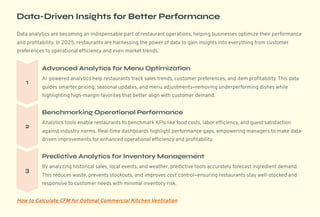
Data-Driven Insights for Better Performance
Data analytics are becoming an indispensable part of restaurant operations, helping businesses optimize their performance
and profitability. In 2025, restaurants are harnessing the power of data to gain insights into everything from customer
preferences to operational efficiency and even market trends.
1
Advanced Analytics for Menu Optimization
AI-powered analytics help restaurants track sales trends, customer preferences, and item profitability. This data
guides smarter pricing, seasonal updates, and menu adjustments4removing underperforming dishes while
highlighting high-margin favorites that better align with customer demand.
2
Benchmarking Operational Performance
Analytics tools enable restaurants to benchmark KPIs like food costs, labor efficiency, and guest satisfaction
against industry norms. Real-time dashboards highlight performance gaps, empowering managers to make data-
driven improvements for enhanced operational efficiency and profitability.
3
Predictive Analytics for Inventory Management
By analyzing historical sales, local events, and weather, predictive tools accurately forecast ingredient demand.
This reduces waste, prevents stockouts, and improves cost control4ensuring restaurants stay well-stocked and
responsive to customer needs with minimal inventory risk.
How to Calculate CFM for Optimal Commercial Kitchen Ventilation
Streamlined Menu Creation Process
In 2025, technology is making menu creation and management more efficient and adaptable. The process of designing and
updating menus has traditionally been time-consuming, but with the help of digital tools, restaurant operators can now
quickly adapt to changing trends and customer preferences.
AI-Powered Menu Engineering
AI-driven tools are allowing restaurant owners and chefs to create optimized menus based on customer feedback, historical
sales data, and ingredient availability. These tools can suggest which dishes should be promoted or removed from the menu,
helping restaurants stay in tune with market trends. AI can also analyze pricing strategies to suggest optimal pricing based
on ingredient costs and local competitors.
Digital Menus with Real-Time Updates
Gone are the days of printing new menus every time there9s a change. In 2025, digital menus that can be
updated in real-time are becoming more common. These menus, whether displayed on tablets, kiosks, or
customer smartphones, allow restaurant owners to instantly update items, pricing, or descriptions. If a dish sells
out or a special menu item is introduced, the changes are reflected immediately across all customer-facing
digital touchpoints, ensuring a seamless experience.
Customization and Personalization
AI is also enabling more personalized menu experiences. Restaurants can use customer data to tailor
recommendations based on previous dining habits, dietary preferences, or even local trends. With this level of
personalization, customers are more likely to enjoy their dining experience and find dishes that suit their tastes,
enhancing customer satisfaction and loyalty.
Harmonizing Takeout and Dine-In Services
With the rise of delivery apps and takeout services, many restaurants are struggling to balance the demands of dine-in
guests with off-premise orders. In 2025, technology is helping restaurants create a seamless experience for both customer
types, ensuring that both dine-in and takeout services are managed efficiently.
Ghost Kitchens and Hybrid Models
Ghost kitchens4delivery-only kitchens that operate without a dine-in component4are growing in popularity.
Technology enables these establishments to use the same infrastructure and tools as traditional restaurants while
focusing exclusively on takeout and delivery orders. At the same time, some restaurants are adopting hybrid models
where they can efficiently manage both dine-in and takeout orders in parallel, using tech solutions to optimize
workflow and minimize bottlenecks.
Optimized Delivery Management
Delivery management software is another area where tech is easing the tension between dine-in and takeout services.
These platforms allow restaurants to track delivery times, manage delivery zones, and optimize delivery routes to
ensure timely service. By integrating delivery platforms with the POS system, restaurants can also monitor the status
of both dine-in and takeout orders in real time, ensuring that the kitchen can handle the influx of orders from both
fronts without compromising quality or service.
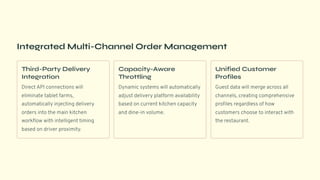
Integrated Multi-Channel Order Management
Third-Party Delivery
Integration
Direct API connections will
eliminate tablet farms,
automatically injecting delivery
orders into the main kitchen
workflow with intelligent timing
based on driver proximity.
Capacity-Aware
Throttling
Dynamic systems will automatically
adjust delivery platform availability
based on current kitchen capacity
and dine-in volume.
Unified Customer
Profiles
Guest data will merge across all
channels, creating comprehensive
profiles regardless of how
customers choose to interact with
the restaurant.
Advanced Workforce Management
Managing staff in a fast-paced restaurant environment has always been a challenge, and it9s only getting more complex with
the rising demand for efficient service. By 2025, technology will play a central role in simplifying workforce management
and ensuring that restaurants are adequately staffed during peak times.
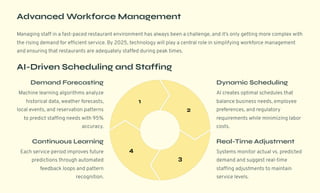
AI-Driven Scheduling and Staffing
1
2
3
4
Demand Forecasting
Machine learning algorithms analyze
historical data, weather forecasts,
local events, and reservation patterns
to predict staffing needs with 95%
accuracy.
Dynamic Scheduling
AI creates optimal schedules that
balance business needs, employee
preferences, and regulatory
requirements while minimizing labor
costs.
Real-Time Adjustment
Systems monitor actual vs. predicted
demand and suggest real-time
staffing adjustments to maintain
service levels.
Continuous Learning
Each service period improves future
predictions through automated
feedback loops and pattern
recognition.
Conclusion
As we move further into 2025, the restaurant industry will continue to evolve, with technology playing a central role in
shaping the customer experience and operational efficiency. From improved communication between back and front of
house staff to data-driven insights that optimize menu creation and workforce management, the ways in which technology
is transforming the dining experience are profound. As these advancements continue to unfold, restaurants that embrace
technology will be better equipped to meet customer expectations, streamline operations, and remain competitive in an
increasingly digital world.
PartsFe Ca is your go-to destination for high-quality commercial restaurant equipment parts, offering everything you need
to keep your kitchen running smoothly. Whether you're looking for replacement parts for ovens, refrigerators, dishwashers,
or fryers, we have a comprehensive selection from top brands.
FAQs
1. What is the future of restaurant technology?
The future of restaurant technology will involve AI-driven systems for enhanced customer personalization, streamlined
operations, and data analytics to optimize menu and staffing.
2. What is the future of dining?
Dining will become more seamless and personalized, with tech-enabled experiences like smart menus, robotic service,
and efficient ordering systems transforming how we eat out.
3. What will restaurants be like in 2050?
By 2050, restaurants will feature highly personalized dining experiences, AI-driven kitchen operations, advanced
robotics for service, and efficient sustainable practices using cutting-edge tech.

How Technology Is Revolutionizing Restaurant Dining in 2025.

  • 2.
    Introduction The restaurant industry,which has long been shaped by tradition, is now undergoing a significant transformation thanks to advances in technology. By 2025, we are poised to see a new era in dining experiences, where technology plays an even more pivotal role in shaping how customers interact with restaurants, how restaurants operate, and how they meet the evolving demands of the modern food industry. This transformation goes beyond digital menus and online reservations. It encompasses everything from improved communication between the back and front of house to smarter workforce management systems that ensure optimal staffing.
  • 3.
    Enhanced Communication BetweenBack and Front of House Effective communication is vital in any restaurant, yet the divide between the back of house (BOH) and front of house (FOH) has long been a challenge. Traditionally, servers would relay customer orders to the kitchen, and any changes or issues would be communicated verbally, sometimes leading to miscommunication and delays. However, in 2025, technology is bridging this gap like never before. Also Read: Restaurant Technology: Predicting the future in the year 2030
  • 4.
    1 Smart Ordering Systems Agrowing trend is the use of smart ordering platforms that provide real-time updates from FOH to BOH. These systems ensure that kitchen staff receive accurate orders immediately and can flag any changes or special requests directly on their screens. As soon as a modification is made to an order, such as a dietary restriction or a special ingredient request, the information is instantly transmitted to the kitchen, reducing errors and speeding up order processing. 2 Kitchen Display Systems (KDS) KDS technology has revolutionized how restaurants handle orders. Rather than relying on handwritten tickets or paper- based systems, KDS allows the kitchen to receive digital order information instantly. Not only does this eliminate paper waste, but it also provides a clearer, more organized workflow. With these systems, kitchen staff can prioritize orders based on urgency or complexity, improving overall efficiency and ensuring that the FOH team receives timely updates. 3 Real-Time Communication Tools Another development in communication tools includes real-time messaging apps or software that allow both FOH and BOH staff to stay in constant communication. These platforms enable the kitchen to alert servers when an order is ready, while servers can notify the kitchen if there is a special request or adjustment to a dish. This level of interconnectedness improves efficiency and ultimately enhances the dining experience for customers.
  • 5.
    Data-Driven Insights forBetter Performance Data analytics are becoming an indispensable part of restaurant operations, helping businesses optimize their performance and profitability. In 2025, restaurants are harnessing the power of data to gain insights into everything from customer preferences to operational efficiency and even market trends. 1 Advanced Analytics for Menu Optimization AI-powered analytics help restaurants track sales trends, customer preferences, and item profitability. This data guides smarter pricing, seasonal updates, and menu adjustments4removing underperforming dishes while highlighting high-margin favorites that better align with customer demand. 2 Benchmarking Operational Performance Analytics tools enable restaurants to benchmark KPIs like food costs, labor efficiency, and guest satisfaction against industry norms. Real-time dashboards highlight performance gaps, empowering managers to make data- driven improvements for enhanced operational efficiency and profitability. 3 Predictive Analytics for Inventory Management By analyzing historical sales, local events, and weather, predictive tools accurately forecast ingredient demand. This reduces waste, prevents stockouts, and improves cost control4ensuring restaurants stay well-stocked and responsive to customer needs with minimal inventory risk. How to Calculate CFM for Optimal Commercial Kitchen Ventilation
  • 6.
    Streamlined Menu CreationProcess In 2025, technology is making menu creation and management more efficient and adaptable. The process of designing and updating menus has traditionally been time-consuming, but with the help of digital tools, restaurant operators can now quickly adapt to changing trends and customer preferences. AI-Powered Menu Engineering AI-driven tools are allowing restaurant owners and chefs to create optimized menus based on customer feedback, historical sales data, and ingredient availability. These tools can suggest which dishes should be promoted or removed from the menu, helping restaurants stay in tune with market trends. AI can also analyze pricing strategies to suggest optimal pricing based on ingredient costs and local competitors.
  • 7.
    Digital Menus withReal-Time Updates Gone are the days of printing new menus every time there9s a change. In 2025, digital menus that can be updated in real-time are becoming more common. These menus, whether displayed on tablets, kiosks, or customer smartphones, allow restaurant owners to instantly update items, pricing, or descriptions. If a dish sells out or a special menu item is introduced, the changes are reflected immediately across all customer-facing digital touchpoints, ensuring a seamless experience. Customization and Personalization AI is also enabling more personalized menu experiences. Restaurants can use customer data to tailor recommendations based on previous dining habits, dietary preferences, or even local trends. With this level of personalization, customers are more likely to enjoy their dining experience and find dishes that suit their tastes, enhancing customer satisfaction and loyalty.
  • 8.
    Harmonizing Takeout andDine-In Services With the rise of delivery apps and takeout services, many restaurants are struggling to balance the demands of dine-in guests with off-premise orders. In 2025, technology is helping restaurants create a seamless experience for both customer types, ensuring that both dine-in and takeout services are managed efficiently. Ghost Kitchens and Hybrid Models Ghost kitchens4delivery-only kitchens that operate without a dine-in component4are growing in popularity. Technology enables these establishments to use the same infrastructure and tools as traditional restaurants while focusing exclusively on takeout and delivery orders. At the same time, some restaurants are adopting hybrid models where they can efficiently manage both dine-in and takeout orders in parallel, using tech solutions to optimize workflow and minimize bottlenecks. Optimized Delivery Management Delivery management software is another area where tech is easing the tension between dine-in and takeout services. These platforms allow restaurants to track delivery times, manage delivery zones, and optimize delivery routes to ensure timely service. By integrating delivery platforms with the POS system, restaurants can also monitor the status of both dine-in and takeout orders in real time, ensuring that the kitchen can handle the influx of orders from both fronts without compromising quality or service.
  • 9.
    Integrated Multi-Channel OrderManagement Third-Party Delivery Integration Direct API connections will eliminate tablet farms, automatically injecting delivery orders into the main kitchen workflow with intelligent timing based on driver proximity. Capacity-Aware Throttling Dynamic systems will automatically adjust delivery platform availability based on current kitchen capacity and dine-in volume. Unified Customer Profiles Guest data will merge across all channels, creating comprehensive profiles regardless of how customers choose to interact with the restaurant.
  • 10.
    Advanced Workforce Management Managingstaff in a fast-paced restaurant environment has always been a challenge, and it9s only getting more complex with the rising demand for efficient service. By 2025, technology will play a central role in simplifying workforce management and ensuring that restaurants are adequately staffed during peak times. AI-Driven Scheduling and Staffing 1 2 3 4 Demand Forecasting Machine learning algorithms analyze historical data, weather forecasts, local events, and reservation patterns to predict staffing needs with 95% accuracy. Dynamic Scheduling AI creates optimal schedules that balance business needs, employee preferences, and regulatory requirements while minimizing labor costs. Real-Time Adjustment Systems monitor actual vs. predicted demand and suggest real-time staffing adjustments to maintain service levels. Continuous Learning Each service period improves future predictions through automated feedback loops and pattern recognition.
  • 11.
    Conclusion As we movefurther into 2025, the restaurant industry will continue to evolve, with technology playing a central role in shaping the customer experience and operational efficiency. From improved communication between back and front of house staff to data-driven insights that optimize menu creation and workforce management, the ways in which technology is transforming the dining experience are profound. As these advancements continue to unfold, restaurants that embrace technology will be better equipped to meet customer expectations, streamline operations, and remain competitive in an increasingly digital world. PartsFe Ca is your go-to destination for high-quality commercial restaurant equipment parts, offering everything you need to keep your kitchen running smoothly. Whether you're looking for replacement parts for ovens, refrigerators, dishwashers, or fryers, we have a comprehensive selection from top brands.
  • 12.
    FAQs 1. What isthe future of restaurant technology? The future of restaurant technology will involve AI-driven systems for enhanced customer personalization, streamlined operations, and data analytics to optimize menu and staffing. 2. What is the future of dining? Dining will become more seamless and personalized, with tech-enabled experiences like smart menus, robotic service, and efficient ordering systems transforming how we eat out. 3. What will restaurants be like in 2050? By 2050, restaurants will feature highly personalized dining experiences, AI-driven kitchen operations, advanced robotics for service, and efficient sustainable practices using cutting-edge tech.