Introduction
In the competitive world of commercial restaurants, operational efficiency is paramount. Whether you're running a small
café or a large fine-dining establishment, maintaining smooth operations can make or break your success. The key to a
profitable and well-functioning restaurant lies in its ability to deliver exceptional service, high-quality food, and a seamless
customer experience4all while managing costs and resources effectively.
In this article, we9ll dive deep into the concept of commercial restaurant efficiency, examine the common operational gaps
that affect it, and provide actionable solutions to fix those gaps. If you're looking to improve your restaurant's efficiency,
this guide will help you identify the problems, implement the right strategies, and optimize your workflow.
How to Maximize Commercial Restaurant Efficiency and Boost
Profitability
1
Cost Control
Implement inventory management systems to track usage and reduce waste. Regularly analyze food and
beverage costs as percentages of sales. Negotiate with suppliers for better pricing and consider joining
purchasing groups to leverage collective buying power.
2
Customer Satisfaction
Collect and analyze feedback through multiple channels, including tableside interactions, comment cards, and
online reviews. Develop service standards that emphasize attentiveness, timeliness, and personalization to create
memorable dining experiences.
3
Employee Productivity
Create clear performance metrics and recognize top performers. Implement incentive programs tied to specific
operational goals. Optimize commercial kitchen and service station layouts to minimize unnecessary movement
and streamline workflows.
4
Profitability
Analyze menu engineering data to promote high-margin items. Implement strategic pricing based on perceived
value rather than just cost markup. Monitor key financial ratios, including prime cost, labor cost percentage, and
contribution margin, to identify improvement opportunities.
Also read on: Restaurant Technology: Predicting the future in the year 2030
How to Spot and Fix Common Operational Gaps in Your
Commercial Restaurant: Poor Inventory Management
A commercial restaurant faces its biggest operational challenge when it comes to inventory management. The management
of inventory without efficiency creates three problems: spoiled food products, excessive stock levels, and insufficient stock
levels that cause both waste and missed sales opportunities.
Solution
A restaurant inventory management system will help organizations achieve better inventory control. Such inventory
management systems provide ongoing inventory visibility while suggesting future buying patterns together with
automatic ordering capabilities. The establishment can maintain proper ingredient stock levels by establishing par
levels for each item, which minimizes the chance of running out of essential materials.
Slow Table Turnover
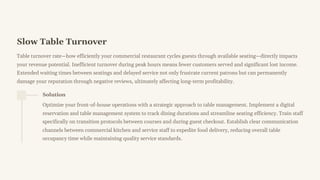
Table turnover rate4how efficiently your commercial restaurant cycles guests through available seating4directly impacts
your revenue potential. Inefficient turnover during peak hours means fewer customers served and significant lost income.
Extended waiting times between seatings and delayed service not only frustrate current patrons but can permanently
damage your reputation through negative reviews, ultimately affecting long-term profitability.
Solution
Optimize your front-of-house operations with a strategic approach to table management. Implement a digital
reservation and table management system to track dining durations and streamline seating efficiency. Train staff
specifically on transition protocols between courses and during guest checkout. Establish clear communication
channels between commercial kitchen and service staff to expedite food delivery, reducing overall table
occupancy time while maintaining quality service standards.
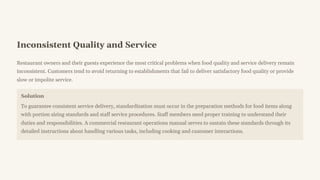
Inconsistent Quality and Service
Restaurant owners and their guests experience the most critical problems when food quality and service delivery remain
inconsistent. Customers tend to avoid returning to establishments that fail to deliver satisfactory food quality or provide
slow or impolite service.
Solution
To guarantee consistent service delivery, standardization must occur in the preparation methods for food items along
with portion sizing standards and staff service procedures. Staff members need proper training to understand their
duties and responsibilities. A commercial restaurant operations manual serves to sustain these standards through its
detailed instructions about handling various tasks, including cooking and customer interactions.
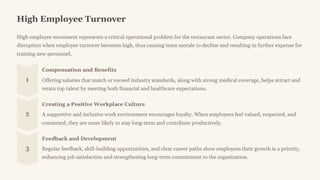
High Employee Turnover
High employee movement represents a critical operational problem for the restaurant sector. Company operations face
disruption when employee turnover becomes high, thus causing team morale to decline and resulting in further expense for
training new personnel.
1
Compensation and Benefits
Offering salaries that match or exceed industry standards, along with strong medical coverage, helps attract and
retain top talent by meeting both financial and healthcare expectations.
2
Creating a Positive Workplace Culture
A supportive and inclusive work environment encourages loyalty. When employees feel valued, respected, and
connected, they are more likely to stay long-term and contribute productively.
3
Feedback and Development
Regular feedback, skill-building opportunities, and clear career paths show employees their growth is a priority,
enhancing job satisfaction and strengthening long-term commitment to the organization.
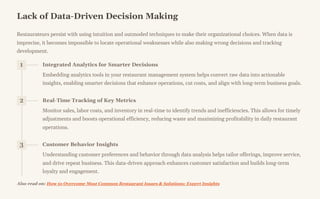
Lack of Data-Driven Decision Making
Restaurateurs persist with using intuition and outmoded techniques to make their organizational choices. When data is
imprecise, it becomes impossible to locate operational weaknesses while also making wrong decisions and tracking
development.
1 Integrated Analytics for Smarter Decisions
Embedding analytics tools in your restaurant management system helps convert raw data into actionable
insights, enabling smarter decisions that enhance operations, cut costs, and align with long-term business goals.
2 Real-Time Tracking of Key Metrics
Monitor sales, labor costs, and inventory in real-time to identify trends and inefficiencies. This allows for timely
adjustments and boosts operational efficiency, reducing waste and maximizing profitability in daily restaurant
operations.
3 Customer Behavior Insights
Understanding customer preferences and behavior through data analysis helps tailor offerings, improve service,
and drive repeat business. This data-driven approach enhances customer satisfaction and builds long-term
loyalty and engagement.
Also read on: How to Overcome Most Common Restaurant Issues & Solutions: Expert Insights
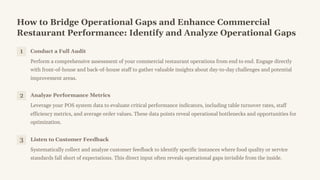
How to Bridge Operational Gaps and Enhance Commercial
Restaurant Performance: Identify and Analyze Operational Gaps
1 Conduct a Full Audit
Perform a comprehensive assessment of your commercial restaurant operations from end to end. Engage directly
with front-of-house and back-of-house staff to gather valuable insights about day-to-day challenges and potential
improvement areas.
2 Analyze Performance Metrics
Leverage your POS system data to evaluate critical performance indicators, including table turnover rates, staff
efficiency metrics, and average order values. These data points reveal operational bottlenecks and opportunities for
optimization.
3 Listen to Customer Feedback
Systematically collect and analyze customer feedback to identify specific instances where food quality or service
standards fall short of expectations. This direct input often reveals operational gaps invisible from the inside.
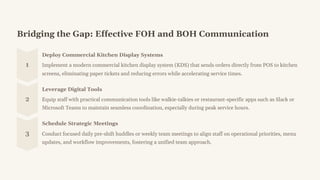
Bridging the Gap: Effective FOH and BOH Communication
1
Deploy Commercial Kitchen Display Systems
Implement a modern commercial kitchen display system (KDS) that sends orders directly from POS to kitchen
screens, eliminating paper tickets and reducing errors while accelerating service times.
2
Leverage Digital Tools
Equip staff with practical communication tools like walkie-talkies or restaurant-specific apps such as Slack or
Microsoft Teams to maintain seamless coordination, especially during peak service hours.
3
Schedule Strategic Meetings
Conduct focused daily pre-shift huddles or weekly team meetings to align staff on operational priorities, menu
updates, and workflow improvements, fostering a unified team approach.
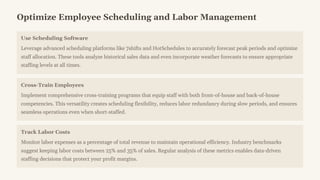
Optimize Employee Scheduling and Labor Management
Use Scheduling Software
Leverage advanced scheduling platforms like 7shifts and HotSchedules to accurately forecast peak periods and optimize
staff allocation. These tools analyze historical sales data and even incorporate weather forecasts to ensure appropriate
staffing levels at all times.
Cross-Train Employees
Implement comprehensive cross-training programs that equip staff with both front-of-house and back-of-house
competencies. This versatility creates scheduling flexibility, reduces labor redundancy during slow periods, and ensures
seamless operations even when short-staffed.
Track Labor Costs
Monitor labor expenses as a percentage of total revenue to maintain operational efficiency. Industry benchmarks
suggest keeping labor costs between 25% and 35% of sales. Regular analysis of these metrics enables data-driven
staffing decisions that protect your profit margins.
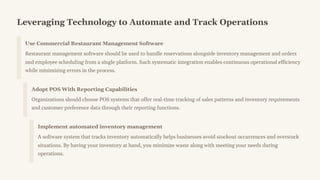
Leveraging Technology to Automate and Track Operations
Use Commercial Restaurant Management Software
Restaurant management software should be used to handle reservations alongside inventory management and orders
and employee scheduling from a single platform. Such systematic integration enables continuous operational efficiency
while minimizing errors in the process.
Adopt POS With Reporting Capabilities
Organizations should choose POS systems that offer real-time tracking of sales patterns and inventory requirements
and customer preference data through their reporting functions.
Implement automated inventory management
A software system that tracks inventory automatically helps businesses avoid stockout occurrences and overstock
situations. By having your inventory at hand, you minimize waste along with meeting your needs during
operations.
Track Key Performance Indicators
Monitor Key Metrics
Regulate your business through regular evaluation of average ticket size and table turnover periods with food expenses,
labor charges, and customer opinion ratings.
Use Analytics Tools
Your POS system should integrate analytics software that produces reports about your KPIs. The data provides you with
necessary information to make strategic operational adjustments.
Regularly Review Performance
Perform quarterly assessments and monthly evaluations of performance to achieve progress goals and set new targets.
Your restaurant will maintain its direction while improving through this method.
Enhance Marketing and Customer Retention
Utilize Social Media
Facebook and Instagram should be used to actively connect with customers through their social media platforms.
Publishing your promotions together with new menu items and customer feedback allows customers to remember your
brand.
Create Loyalty Programs
Develop a loyalty system with rewards such as price deductions along with complimentary goods and distinct
member benefits for regular clients. The implementation of customer retention strategies leads to better customer
loyalty, which results in increased customer visits.
Collect and Act on Feedback
Your business should receive customer feedback, which serves as the foundation to develop better product
capabilities. You should introduce changes in your business that come directly from your customers' requests, no
matter if it means changing food options or upgrading your customer service.
Conclusion
The maintenance of competitive strength within commercial restaurants heavily depends on operational efficiency in an
industry with multiple difficulties. The improvement of operational gaps will generate workflow enhancements and lower
costs, together with elevated customer satisfaction and enhanced profitability. Each tiny aspect matters significantly in the
effort to enhance efficiency in your restaurant. Continuous attention along with regular adjustments is necessary to
maintain an ongoing process of efficiency improvement. Your restaurant will achieve success through the combination of
technological adoption, empowered staff members, and data-driven decision-making. Execute these methods now to see
your commercial restaurant experience both better efficiency and better profitability.
Boost your commercial restaurant9s efficiency with PartsFe Ca! We offer high-quality replacement parts for top
commercial kitchen brands like Viking, Wolf, and Turbo Air. Whether you need oven elements, compressors, or
thermostats, we provide reliable solutions to keep your equipment running smoothly. Shop now for the best parts at
competitive prices!
FAQs
1 What is the gap analysis for the commercial
restaurant?
Conducting a GAP analysis is crucial for businesses in this sector to
identify areas for growth and optimization. This analysis will explore
the current state of the industry, ideal future scenarios, and the
actions needed to bridge the gap between the two.
2 What is a gap-filling strategy?
Gap filling involves retracing prices to the pre-gap level, influenced
by factors like patterns and resistance. Caution is needed when
trading common gaps, and thorough research ensures profitable gap
strategies.

Fix Gaps and Streamline Workflows for Better Restaurant Performance

  • 2.
    Introduction In the competitiveworld of commercial restaurants, operational efficiency is paramount. Whether you're running a small café or a large fine-dining establishment, maintaining smooth operations can make or break your success. The key to a profitable and well-functioning restaurant lies in its ability to deliver exceptional service, high-quality food, and a seamless customer experience4all while managing costs and resources effectively. In this article, we9ll dive deep into the concept of commercial restaurant efficiency, examine the common operational gaps that affect it, and provide actionable solutions to fix those gaps. If you're looking to improve your restaurant's efficiency, this guide will help you identify the problems, implement the right strategies, and optimize your workflow.
  • 3.
    How to MaximizeCommercial Restaurant Efficiency and Boost Profitability 1 Cost Control Implement inventory management systems to track usage and reduce waste. Regularly analyze food and beverage costs as percentages of sales. Negotiate with suppliers for better pricing and consider joining purchasing groups to leverage collective buying power. 2 Customer Satisfaction Collect and analyze feedback through multiple channels, including tableside interactions, comment cards, and online reviews. Develop service standards that emphasize attentiveness, timeliness, and personalization to create memorable dining experiences. 3 Employee Productivity Create clear performance metrics and recognize top performers. Implement incentive programs tied to specific operational goals. Optimize commercial kitchen and service station layouts to minimize unnecessary movement and streamline workflows. 4 Profitability Analyze menu engineering data to promote high-margin items. Implement strategic pricing based on perceived value rather than just cost markup. Monitor key financial ratios, including prime cost, labor cost percentage, and contribution margin, to identify improvement opportunities. Also read on: Restaurant Technology: Predicting the future in the year 2030
  • 4.
    How to Spotand Fix Common Operational Gaps in Your Commercial Restaurant: Poor Inventory Management A commercial restaurant faces its biggest operational challenge when it comes to inventory management. The management of inventory without efficiency creates three problems: spoiled food products, excessive stock levels, and insufficient stock levels that cause both waste and missed sales opportunities. Solution A restaurant inventory management system will help organizations achieve better inventory control. Such inventory management systems provide ongoing inventory visibility while suggesting future buying patterns together with automatic ordering capabilities. The establishment can maintain proper ingredient stock levels by establishing par levels for each item, which minimizes the chance of running out of essential materials.
  • 5.
    Slow Table Turnover Tableturnover rate4how efficiently your commercial restaurant cycles guests through available seating4directly impacts your revenue potential. Inefficient turnover during peak hours means fewer customers served and significant lost income. Extended waiting times between seatings and delayed service not only frustrate current patrons but can permanently damage your reputation through negative reviews, ultimately affecting long-term profitability. Solution Optimize your front-of-house operations with a strategic approach to table management. Implement a digital reservation and table management system to track dining durations and streamline seating efficiency. Train staff specifically on transition protocols between courses and during guest checkout. Establish clear communication channels between commercial kitchen and service staff to expedite food delivery, reducing overall table occupancy time while maintaining quality service standards.
  • 6.
    Inconsistent Quality andService Restaurant owners and their guests experience the most critical problems when food quality and service delivery remain inconsistent. Customers tend to avoid returning to establishments that fail to deliver satisfactory food quality or provide slow or impolite service. Solution To guarantee consistent service delivery, standardization must occur in the preparation methods for food items along with portion sizing standards and staff service procedures. Staff members need proper training to understand their duties and responsibilities. A commercial restaurant operations manual serves to sustain these standards through its detailed instructions about handling various tasks, including cooking and customer interactions.
  • 7.
    High Employee Turnover Highemployee movement represents a critical operational problem for the restaurant sector. Company operations face disruption when employee turnover becomes high, thus causing team morale to decline and resulting in further expense for training new personnel. 1 Compensation and Benefits Offering salaries that match or exceed industry standards, along with strong medical coverage, helps attract and retain top talent by meeting both financial and healthcare expectations. 2 Creating a Positive Workplace Culture A supportive and inclusive work environment encourages loyalty. When employees feel valued, respected, and connected, they are more likely to stay long-term and contribute productively. 3 Feedback and Development Regular feedback, skill-building opportunities, and clear career paths show employees their growth is a priority, enhancing job satisfaction and strengthening long-term commitment to the organization.
  • 8.
    Lack of Data-DrivenDecision Making Restaurateurs persist with using intuition and outmoded techniques to make their organizational choices. When data is imprecise, it becomes impossible to locate operational weaknesses while also making wrong decisions and tracking development. 1 Integrated Analytics for Smarter Decisions Embedding analytics tools in your restaurant management system helps convert raw data into actionable insights, enabling smarter decisions that enhance operations, cut costs, and align with long-term business goals. 2 Real-Time Tracking of Key Metrics Monitor sales, labor costs, and inventory in real-time to identify trends and inefficiencies. This allows for timely adjustments and boosts operational efficiency, reducing waste and maximizing profitability in daily restaurant operations. 3 Customer Behavior Insights Understanding customer preferences and behavior through data analysis helps tailor offerings, improve service, and drive repeat business. This data-driven approach enhances customer satisfaction and builds long-term loyalty and engagement. Also read on: How to Overcome Most Common Restaurant Issues & Solutions: Expert Insights
  • 9.
    How to BridgeOperational Gaps and Enhance Commercial Restaurant Performance: Identify and Analyze Operational Gaps 1 Conduct a Full Audit Perform a comprehensive assessment of your commercial restaurant operations from end to end. Engage directly with front-of-house and back-of-house staff to gather valuable insights about day-to-day challenges and potential improvement areas. 2 Analyze Performance Metrics Leverage your POS system data to evaluate critical performance indicators, including table turnover rates, staff efficiency metrics, and average order values. These data points reveal operational bottlenecks and opportunities for optimization. 3 Listen to Customer Feedback Systematically collect and analyze customer feedback to identify specific instances where food quality or service standards fall short of expectations. This direct input often reveals operational gaps invisible from the inside.
  • 10.
    Bridging the Gap:Effective FOH and BOH Communication 1 Deploy Commercial Kitchen Display Systems Implement a modern commercial kitchen display system (KDS) that sends orders directly from POS to kitchen screens, eliminating paper tickets and reducing errors while accelerating service times. 2 Leverage Digital Tools Equip staff with practical communication tools like walkie-talkies or restaurant-specific apps such as Slack or Microsoft Teams to maintain seamless coordination, especially during peak service hours. 3 Schedule Strategic Meetings Conduct focused daily pre-shift huddles or weekly team meetings to align staff on operational priorities, menu updates, and workflow improvements, fostering a unified team approach.
  • 11.
    Optimize Employee Schedulingand Labor Management Use Scheduling Software Leverage advanced scheduling platforms like 7shifts and HotSchedules to accurately forecast peak periods and optimize staff allocation. These tools analyze historical sales data and even incorporate weather forecasts to ensure appropriate staffing levels at all times. Cross-Train Employees Implement comprehensive cross-training programs that equip staff with both front-of-house and back-of-house competencies. This versatility creates scheduling flexibility, reduces labor redundancy during slow periods, and ensures seamless operations even when short-staffed. Track Labor Costs Monitor labor expenses as a percentage of total revenue to maintain operational efficiency. Industry benchmarks suggest keeping labor costs between 25% and 35% of sales. Regular analysis of these metrics enables data-driven staffing decisions that protect your profit margins.
  • 12.
    Leveraging Technology toAutomate and Track Operations Use Commercial Restaurant Management Software Restaurant management software should be used to handle reservations alongside inventory management and orders and employee scheduling from a single platform. Such systematic integration enables continuous operational efficiency while minimizing errors in the process. Adopt POS With Reporting Capabilities Organizations should choose POS systems that offer real-time tracking of sales patterns and inventory requirements and customer preference data through their reporting functions. Implement automated inventory management A software system that tracks inventory automatically helps businesses avoid stockout occurrences and overstock situations. By having your inventory at hand, you minimize waste along with meeting your needs during operations.
  • 13.
    Track Key PerformanceIndicators Monitor Key Metrics Regulate your business through regular evaluation of average ticket size and table turnover periods with food expenses, labor charges, and customer opinion ratings. Use Analytics Tools Your POS system should integrate analytics software that produces reports about your KPIs. The data provides you with necessary information to make strategic operational adjustments. Regularly Review Performance Perform quarterly assessments and monthly evaluations of performance to achieve progress goals and set new targets. Your restaurant will maintain its direction while improving through this method.
  • 14.
    Enhance Marketing andCustomer Retention Utilize Social Media Facebook and Instagram should be used to actively connect with customers through their social media platforms. Publishing your promotions together with new menu items and customer feedback allows customers to remember your brand. Create Loyalty Programs Develop a loyalty system with rewards such as price deductions along with complimentary goods and distinct member benefits for regular clients. The implementation of customer retention strategies leads to better customer loyalty, which results in increased customer visits. Collect and Act on Feedback Your business should receive customer feedback, which serves as the foundation to develop better product capabilities. You should introduce changes in your business that come directly from your customers' requests, no matter if it means changing food options or upgrading your customer service.
  • 15.
    Conclusion The maintenance ofcompetitive strength within commercial restaurants heavily depends on operational efficiency in an industry with multiple difficulties. The improvement of operational gaps will generate workflow enhancements and lower costs, together with elevated customer satisfaction and enhanced profitability. Each tiny aspect matters significantly in the effort to enhance efficiency in your restaurant. Continuous attention along with regular adjustments is necessary to maintain an ongoing process of efficiency improvement. Your restaurant will achieve success through the combination of technological adoption, empowered staff members, and data-driven decision-making. Execute these methods now to see your commercial restaurant experience both better efficiency and better profitability. Boost your commercial restaurant9s efficiency with PartsFe Ca! We offer high-quality replacement parts for top commercial kitchen brands like Viking, Wolf, and Turbo Air. Whether you need oven elements, compressors, or thermostats, we provide reliable solutions to keep your equipment running smoothly. Shop now for the best parts at competitive prices!
  • 16.
    FAQs 1 What isthe gap analysis for the commercial restaurant? Conducting a GAP analysis is crucial for businesses in this sector to identify areas for growth and optimization. This analysis will explore the current state of the industry, ideal future scenarios, and the actions needed to bridge the gap between the two. 2 What is a gap-filling strategy? Gap filling involves retracing prices to the pre-gap level, influenced by factors like patterns and resistance. Caution is needed when trading common gaps, and thorough research ensures profitable gap strategies.