How Payment Aggregators Help You Go Global
Without a Tech Team
● Businesses today can reach customers in over 190 countries online.
● But payment complexity is the biggest barrier to scaling
internationally.
● Currency conversions, compliance, and integration overwhelm small
teams.
The Global Opportunity
● Multiple currencies and local payment preferences.
● Complex compliance requirements for each region.
● High costs for integrating numerous payment gateways.
● Lack of internal technical expertise slows expansion.
The Challenge
What Is a Payment Aggregator?
● A payment aggregator connects merchants to several payment
methods through one platform.
● They manage onboarding, compliance, settlements, and fraud checks.
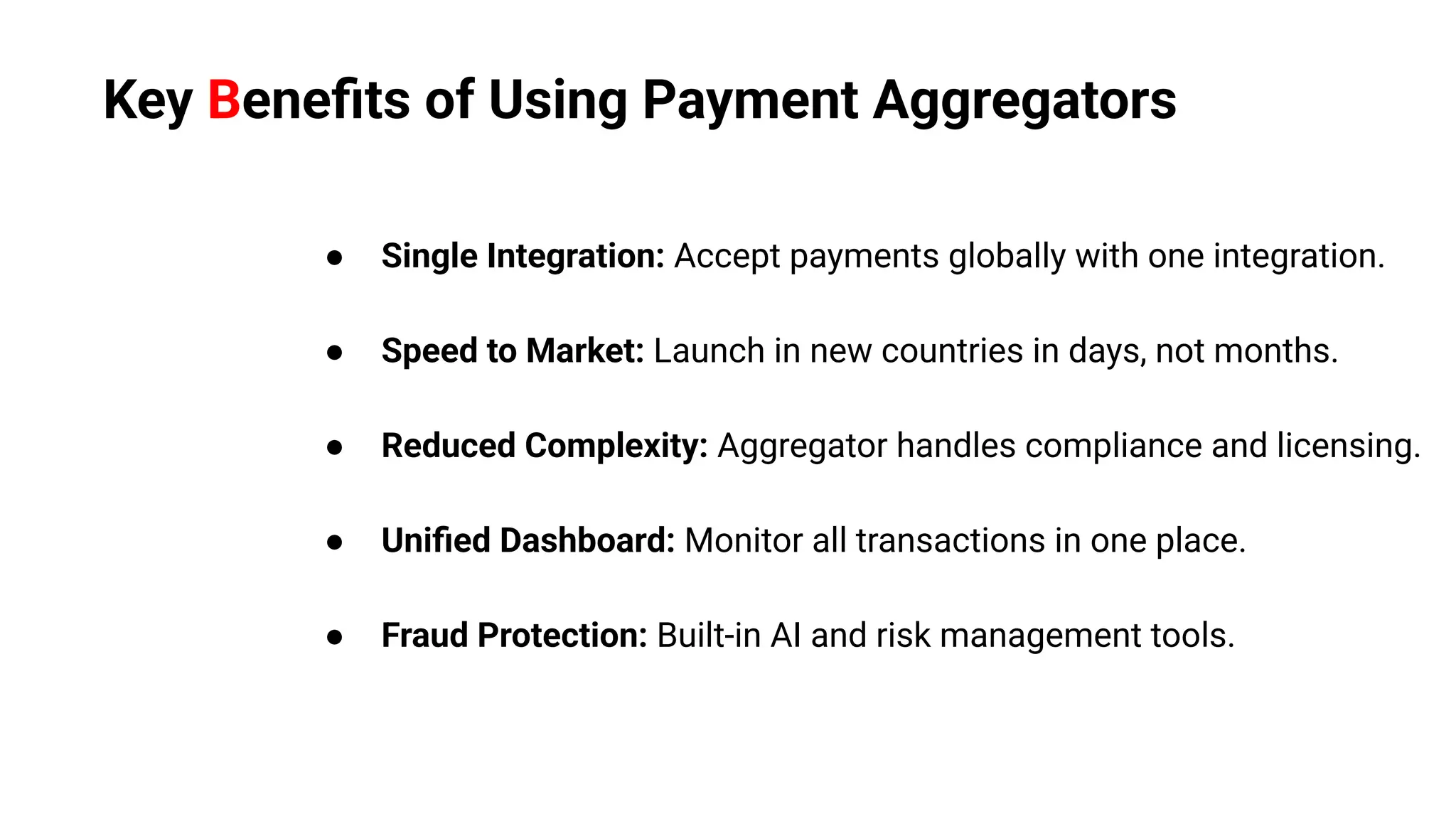
● Single Integration: Accept payments globally with one integration.
● Speed to Market: Launch in new countries in days, not months.
● Reduced Complexity: Aggregator handles compliance and licensing.
● Unified Dashboard: Monitor all transactions in one place.
● Fraud Protection: Built-in AI and risk management tools.
Key Benefits of Using Payment Aggregators
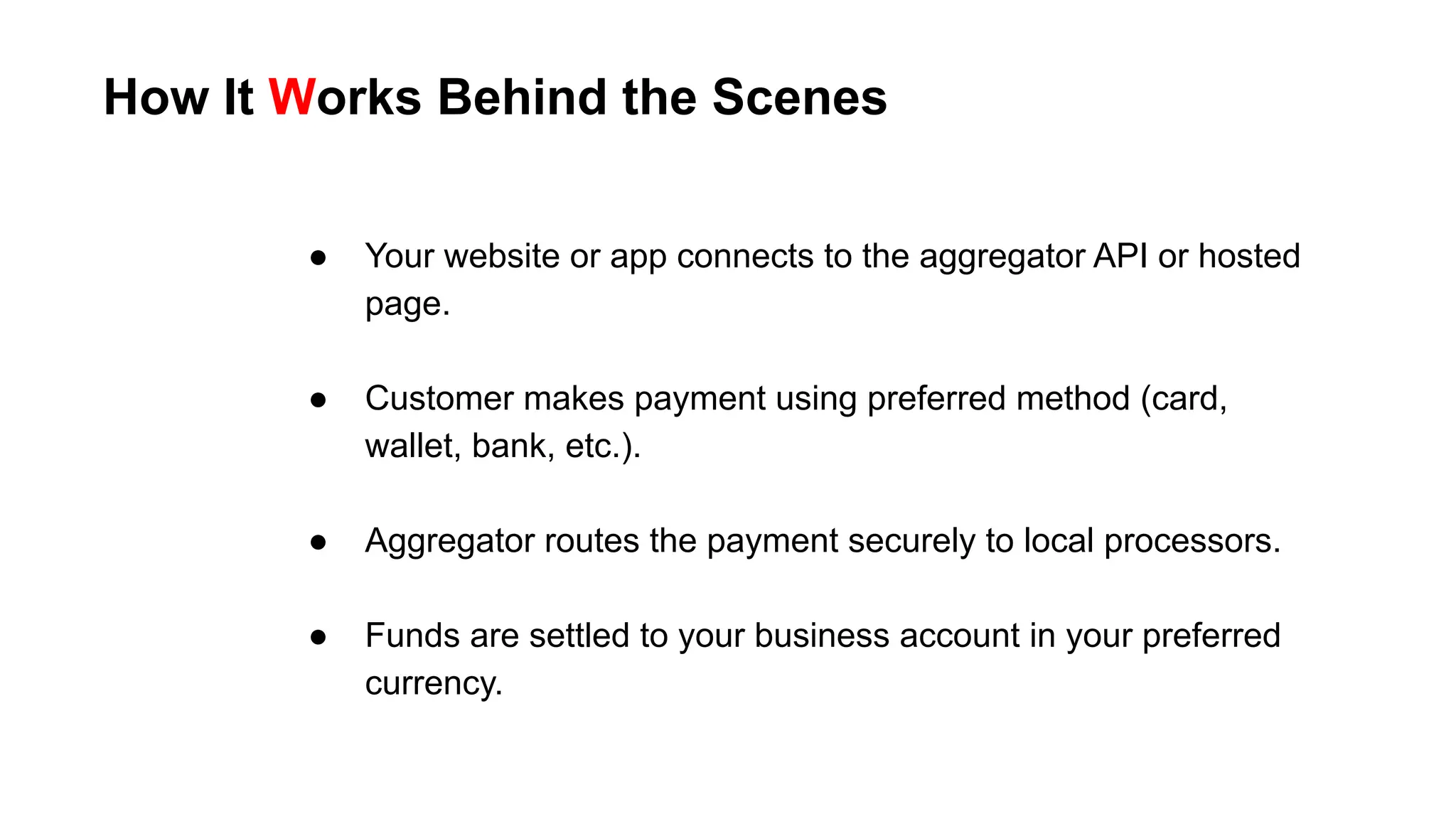
How It Works Behind the Scenes
● Your website or app connects to the aggregator API or hosted
page.
● Customer makes payment using preferred method (card,
wallet, bank, etc.).
● Aggregator routes the payment securely to local processors.
● Funds are settled to your business account in your preferred
currency.
Going Global Without a Tech Team
● Plug-and-play integrations need no heavy development.
● Hosted payment pages or ready-made checkout plugins.
● Minimal maintenance aggregator updates systems
automatically.
● Real-time analytics and customer insights without coding.
Hidden Advantages
● Automated currency conversion and settlement.
● Localized checkout experience increases conversions.
● Scalability for subscription or marketplace models.
● Easy refunds, chargebacks, and reconciliation.
Choosing the Right Payment Aggregator
● Review global coverage and supported payment modes.
● Ensure PCI-DSS compliance and robust security standards.
● Compare transaction fees and settlement timelines.
● Evaluate customer support and documentation.
Future Trends in Payment Aggregation
● Growth of embedded finance and no-code payments.
● Integration with Web3 and digital wallets.
● Real-time international settlements using blockchain.
● You don’t need a big tech team to sell globally.
● Payment aggregators remove friction and complexity.
● Start small, integrate once, and scale everywhere.
Conclusion
Visit Our Website : https://www.tourasuae.com/

How Payment Aggregators Help You Go Global Without a Tech Team.pdf

  • 1.
    How Payment AggregatorsHelp You Go Global Without a Tech Team
  • 2.
    ● Businesses todaycan reach customers in over 190 countries online. ● But payment complexity is the biggest barrier to scaling internationally. ● Currency conversions, compliance, and integration overwhelm small teams. The Global Opportunity
  • 3.
    ● Multiple currenciesand local payment preferences. ● Complex compliance requirements for each region. ● High costs for integrating numerous payment gateways. ● Lack of internal technical expertise slows expansion. The Challenge
  • 4.
    What Is aPayment Aggregator? ● A payment aggregator connects merchants to several payment methods through one platform. ● They manage onboarding, compliance, settlements, and fraud checks.
  • 5.
    ● Single Integration:Accept payments globally with one integration. ● Speed to Market: Launch in new countries in days, not months. ● Reduced Complexity: Aggregator handles compliance and licensing. ● Unified Dashboard: Monitor all transactions in one place. ● Fraud Protection: Built-in AI and risk management tools. Key Benefits of Using Payment Aggregators
  • 6.
    How It WorksBehind the Scenes ● Your website or app connects to the aggregator API or hosted page. ● Customer makes payment using preferred method (card, wallet, bank, etc.). ● Aggregator routes the payment securely to local processors. ● Funds are settled to your business account in your preferred currency.
  • 7.
    Going Global Withouta Tech Team ● Plug-and-play integrations need no heavy development. ● Hosted payment pages or ready-made checkout plugins. ● Minimal maintenance aggregator updates systems automatically. ● Real-time analytics and customer insights without coding.
  • 8.
    Hidden Advantages ● Automatedcurrency conversion and settlement. ● Localized checkout experience increases conversions. ● Scalability for subscription or marketplace models. ● Easy refunds, chargebacks, and reconciliation.
  • 9.
    Choosing the RightPayment Aggregator ● Review global coverage and supported payment modes. ● Ensure PCI-DSS compliance and robust security standards. ● Compare transaction fees and settlement timelines. ● Evaluate customer support and documentation.
  • 10.
    Future Trends inPayment Aggregation ● Growth of embedded finance and no-code payments. ● Integration with Web3 and digital wallets. ● Real-time international settlements using blockchain.
  • 11.
    ● You don’tneed a big tech team to sell globally. ● Payment aggregators remove friction and complexity. ● Start small, integrate once, and scale everywhere. Conclusion Visit Our Website : https://www.tourasuae.com/