Payment Aggregation Platform vs. Traditional Gateway: The
Truth
Introduction to Payment Solutions
Key Points:
● Payment processing is critical for modern businesses.
● Two main options: Payment Aggregation Platforms and Traditional
Gateways.
● Each serves different business needs and scales.
Explanation:
● Payment solutions enable businesses to accept payments securely and
efficiently.
● This presentation compares aggregators and gateways to reveal their true
strengths and weaknesses.
What is a Payment Aggregation Platform?
Key Points:
● Acts as an intermediary, bundling multiple payment methods.
● Single platform for credit cards, digital wallets, and more.
● Ideal for small to medium businesses and startups.
Explanation:
● Aggregators simplify payment processing by managing merchant
accounts and compliance on behalf of businesses.
Key Points:
● Direct connection between merchant, bank, and payment
processor.
● Requires individual merchant accounts.
● Suited for large businesses with high transaction volumes.
Explanation:
● Gateways offer customizable, direct payment processing but often
involve complex setups and higher costs.
What is a Traditional Payment Gateway?
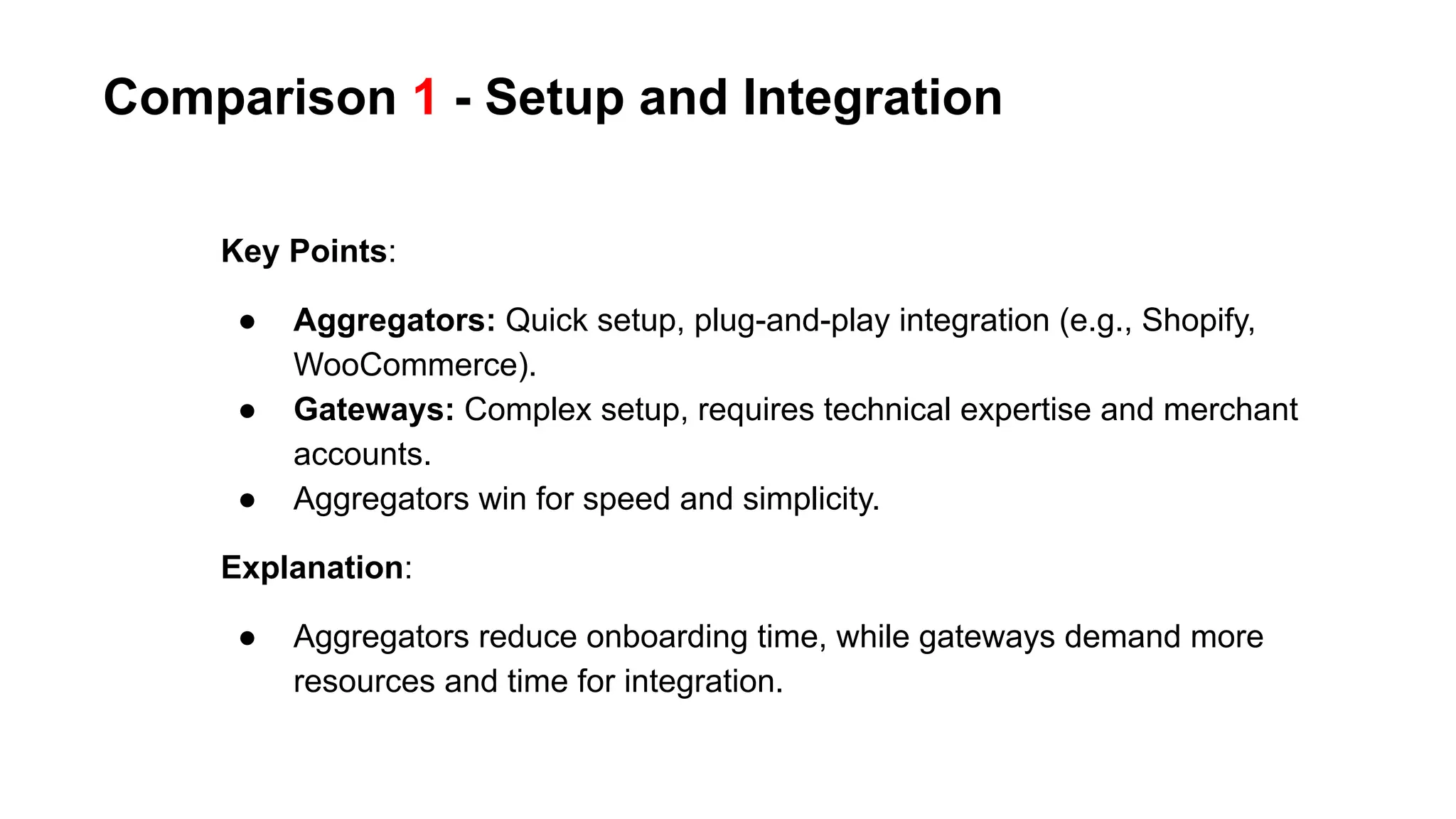
Comparison 1 - Setup and Integration
Key Points:
● Aggregators: Quick setup, plug-and-play integration (e.g., Shopify,
WooCommerce).
● Gateways: Complex setup, requires technical expertise and merchant
accounts.
● Aggregators win for speed and simplicity.
Explanation:
● Aggregators reduce onboarding time, while gateways demand more
resources and time for integration.
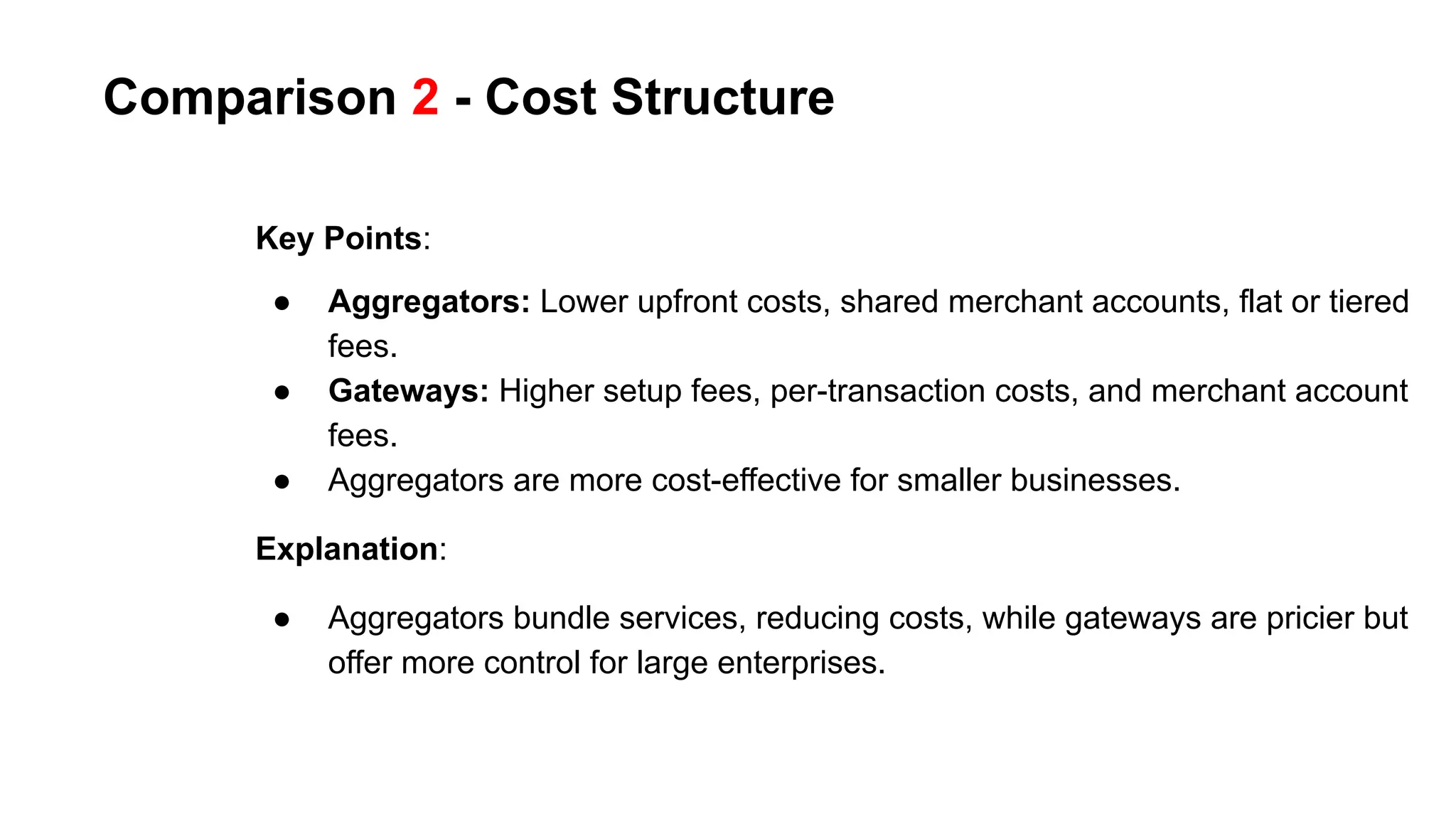
Comparison 2 - Cost Structure
Key Points:
● Aggregators: Lower upfront costs, shared merchant accounts, flat or tiered
fees.
● Gateways: Higher setup fees, per-transaction costs, and merchant account
fees.
● Aggregators are more cost-effective for smaller businesses.
Explanation:
● Aggregators bundle services, reducing costs, while gateways are pricier but
offer more control for large enterprises.
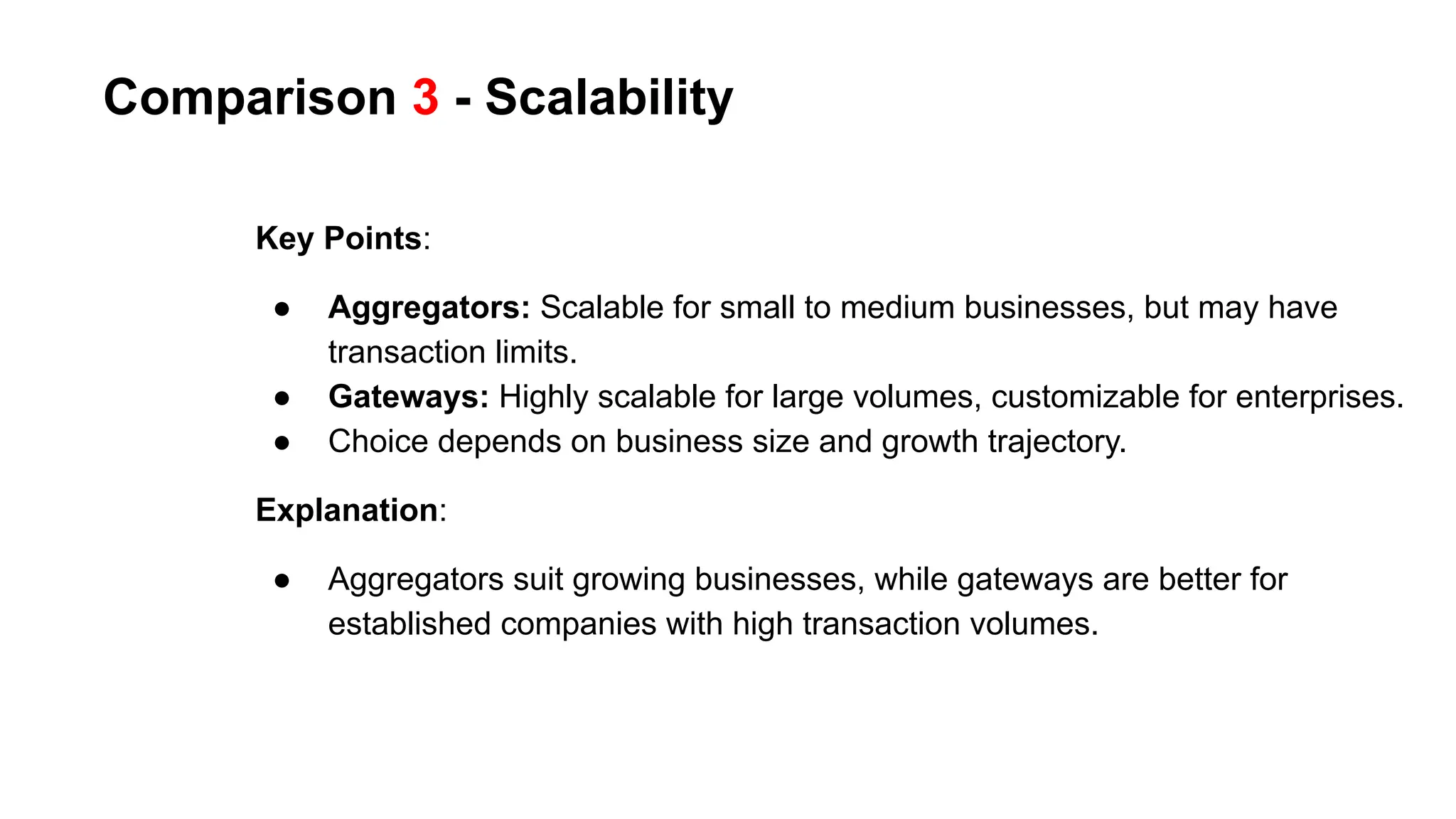
Comparison 3 - Scalability
Key Points:
● Aggregators: Scalable for small to medium businesses, but may have
transaction limits.
● Gateways: Highly scalable for large volumes, customizable for enterprises.
● Choice depends on business size and growth trajectory.
Explanation:
● Aggregators suit growing businesses, while gateways are better for
established companies with high transaction volumes.
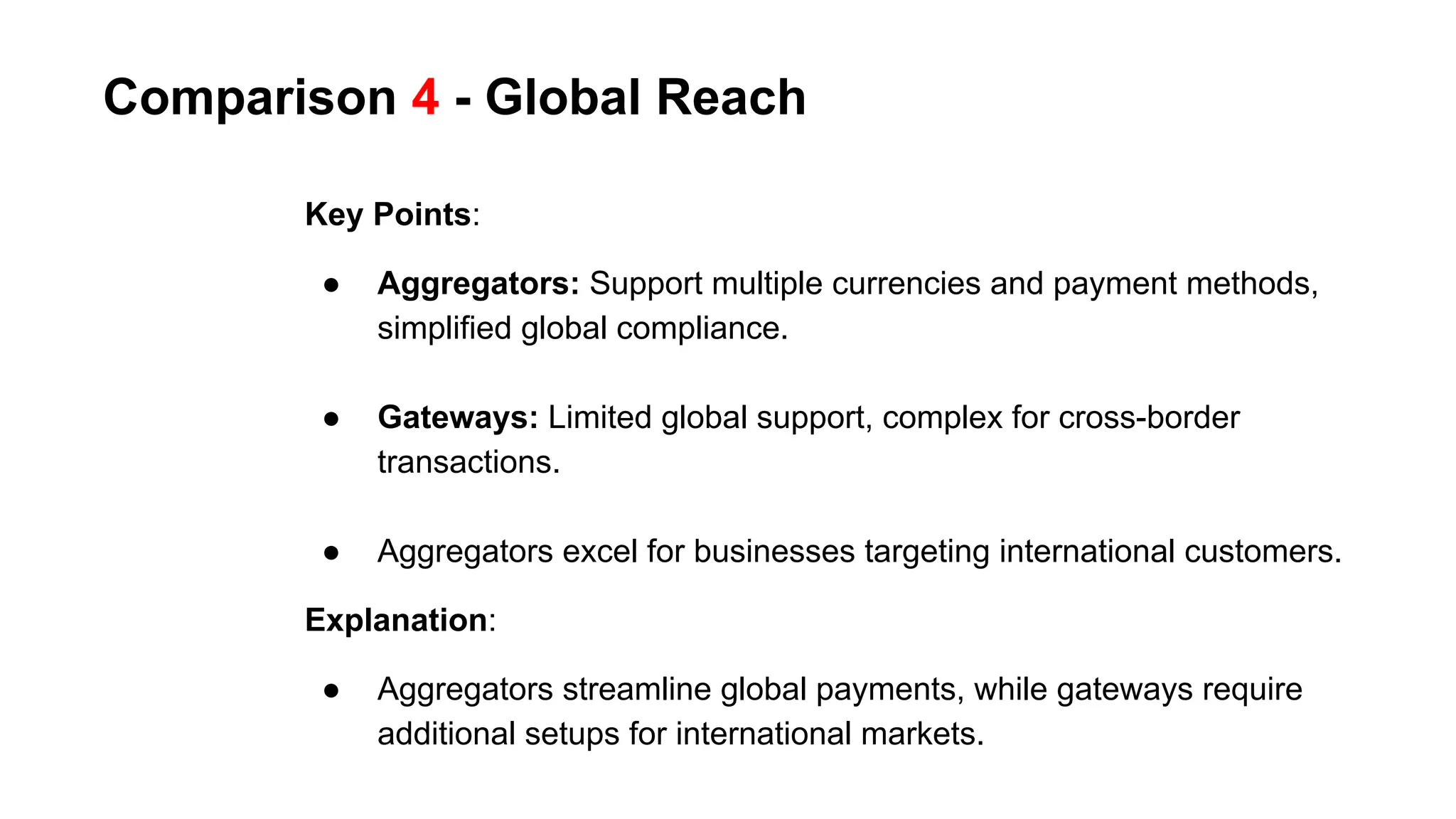
Comparison 4 - Global Reach
Key Points:
● Aggregators: Support multiple currencies and payment methods,
simplified global compliance.
● Gateways: Limited global support, complex for cross-border
transactions.
● Aggregators excel for businesses targeting international customers.
Explanation:
● Aggregators streamline global payments, while gateways require
additional setups for international markets.
Comparison 5 - Security and Compliance
Key Points:
● Aggregators: Built-in PCI DSS compliance, fraud detection tools included.
● Gateways: PCI compliance required, often managed by the business;
advanced security options.
● Aggregators reduce compliance burden for smaller businesses.
Explanation:
● Aggregators handle security for merchants, while gateways require
businesses to manage compliance independently.
Comparison 6 - Customer Experience
Key Points:
● Aggregators: Unified checkout with multiple payment options,
mobile-friendly.
● Gateways: Customizable checkout but may lack flexibility for diverse
payment methods.
● Aggregators enhance customer satisfaction with simplicity.
Explanation:
● Aggregators reduce cart abandonment with streamlined checkouts, while
gateways may require more steps.
Comparison 7 - Analytics and Reporting
Key Points:
● Aggregators: Centralized dashboards, real-time transaction analytics.
● Gateways: Detailed but often fragmented reporting, may require third-party
tools.
● Aggregators simplify data access for decision-making.
Explanation:
● Aggregators provide user-friendly analytics, while gateways offer robust but
complex reporting.
Key Points:
● Aggregators: Best for startups, SMEs, and businesses seeking simplicity
and global reach.
● Gateways: Ideal for large enterprises with high transaction volumes and
customization needs.
● Evaluate based on business size, budget, and goals.
Explanation:
● The “truth” is that neither is universally better; the right choice depends on
your business context.
The Truth: Which is Right for You?
Conclusion
Visit Our Website : https://touras.in/
○ Aggregators offer simplicity, cost savings, and global reach for
smaller businesses.
○ Gateways provide control and scalability for large enterprises.
○ Choose based on your business needs, budget, and growth plans.

Payment Aggregation Platform vs. Traditional Gateway The Truth.pdf

  • 1.
    Payment Aggregation Platformvs. Traditional Gateway: The Truth
  • 2.
    Introduction to PaymentSolutions Key Points: ● Payment processing is critical for modern businesses. ● Two main options: Payment Aggregation Platforms and Traditional Gateways. ● Each serves different business needs and scales. Explanation: ● Payment solutions enable businesses to accept payments securely and efficiently. ● This presentation compares aggregators and gateways to reveal their true strengths and weaknesses.
  • 3.
    What is aPayment Aggregation Platform? Key Points: ● Acts as an intermediary, bundling multiple payment methods. ● Single platform for credit cards, digital wallets, and more. ● Ideal for small to medium businesses and startups. Explanation: ● Aggregators simplify payment processing by managing merchant accounts and compliance on behalf of businesses.
  • 4.
    Key Points: ● Directconnection between merchant, bank, and payment processor. ● Requires individual merchant accounts. ● Suited for large businesses with high transaction volumes. Explanation: ● Gateways offer customizable, direct payment processing but often involve complex setups and higher costs. What is a Traditional Payment Gateway?
  • 5.
    Comparison 1 -Setup and Integration Key Points: ● Aggregators: Quick setup, plug-and-play integration (e.g., Shopify, WooCommerce). ● Gateways: Complex setup, requires technical expertise and merchant accounts. ● Aggregators win for speed and simplicity. Explanation: ● Aggregators reduce onboarding time, while gateways demand more resources and time for integration.
  • 6.
    Comparison 2 -Cost Structure Key Points: ● Aggregators: Lower upfront costs, shared merchant accounts, flat or tiered fees. ● Gateways: Higher setup fees, per-transaction costs, and merchant account fees. ● Aggregators are more cost-effective for smaller businesses. Explanation: ● Aggregators bundle services, reducing costs, while gateways are pricier but offer more control for large enterprises.
  • 7.
    Comparison 3 -Scalability Key Points: ● Aggregators: Scalable for small to medium businesses, but may have transaction limits. ● Gateways: Highly scalable for large volumes, customizable for enterprises. ● Choice depends on business size and growth trajectory. Explanation: ● Aggregators suit growing businesses, while gateways are better for established companies with high transaction volumes.
  • 8.
    Comparison 4 -Global Reach Key Points: ● Aggregators: Support multiple currencies and payment methods, simplified global compliance. ● Gateways: Limited global support, complex for cross-border transactions. ● Aggregators excel for businesses targeting international customers. Explanation: ● Aggregators streamline global payments, while gateways require additional setups for international markets.
  • 9.
    Comparison 5 -Security and Compliance Key Points: ● Aggregators: Built-in PCI DSS compliance, fraud detection tools included. ● Gateways: PCI compliance required, often managed by the business; advanced security options. ● Aggregators reduce compliance burden for smaller businesses. Explanation: ● Aggregators handle security for merchants, while gateways require businesses to manage compliance independently.
  • 10.
    Comparison 6 -Customer Experience Key Points: ● Aggregators: Unified checkout with multiple payment options, mobile-friendly. ● Gateways: Customizable checkout but may lack flexibility for diverse payment methods. ● Aggregators enhance customer satisfaction with simplicity. Explanation: ● Aggregators reduce cart abandonment with streamlined checkouts, while gateways may require more steps.
  • 11.
    Comparison 7 -Analytics and Reporting Key Points: ● Aggregators: Centralized dashboards, real-time transaction analytics. ● Gateways: Detailed but often fragmented reporting, may require third-party tools. ● Aggregators simplify data access for decision-making. Explanation: ● Aggregators provide user-friendly analytics, while gateways offer robust but complex reporting.
  • 12.
    Key Points: ● Aggregators:Best for startups, SMEs, and businesses seeking simplicity and global reach. ● Gateways: Ideal for large enterprises with high transaction volumes and customization needs. ● Evaluate based on business size, budget, and goals. Explanation: ● The “truth” is that neither is universally better; the right choice depends on your business context. The Truth: Which is Right for You?
  • 13.
    Conclusion Visit Our Website: https://touras.in/ ○ Aggregators offer simplicity, cost savings, and global reach for smaller businesses. ○ Gateways provide control and scalability for large enterprises. ○ Choose based on your business needs, budget, and growth plans.