How do young children learn?                                                       This resource was originally created as part of the
                                                                                                                                                            Early Years Outdoors membership scheme from
                                                                                                                                                                              Learning through Landscapes.
                                                                                                                                                                        To find out more about membership
                                                                                                                                                                  call 01962 845 811 or visit www.ltl.org.uk


                                                                        Curriculum                                                                 to meet their desire to move and be
                                                                                                                                                 actively involved, such as role-play contexts
                                                                                                                                               that allow movement and action. Look for
                                                                        Support                                                               ways of extending activities that encourage
                                                                                                                                             whole body involvement, such as in sand and
                                                                                                                                            water play.

                                                                        How do young children learn?                                           Using all the senses
                                                                                                                                                 As adults we rely heavily on our eyes and
                                                                        When planning for outdoor opportunities and                               listening to others talk. Young children use all
                                                                        experiences for your children, it is important to bear                    their senses to find out about the world
                                                                        in mind how young children learn. What learning                           around them. Their brains act like sponges,
                                                                        environments work best for young children? What                        soaking up everything around and building
                                                                        experiences will ensure that learning will be                        literally millions of connections. It is only later that
                                                                        satisfying and successful for them?                                the filtering process takes place that makes us
                                                                        In this Curriculum Support, we will look at some of               focused and direct as adults. It is important that we
                                                                        these key areas. The outdoors offers some of the                support young children during this phase to develop
                                                                        things young children need for learning such as               all their sensory receptors, interpret this sensory
                                                                        room for movement and ample opportunity for                  information and integrate this in their body and brain.
                                                                        hands-on activity. Think about providing small, quiet        Recent research on prioperceptors – sensory nerve
                                                                        places, outside as well as indoors. In your short,           endings that sense changes in body position – shows
                                                                        medium or long term planning include these elements          how we learn to store this knowledge for immediate or
                                                                        and features to create the conditions young children         future use. For children, whole body movement
                                                                        need to thrive best in their learning and development.       opportunities and physical challenges are essential to
                                                                        Many of these elements interact and strong experiences       hone these skills. They also listen to every sound and
                                                                        with a lasting impact can be planned in quite simple         seem to be alert to tiny details in what they see that we
                                                                        ways. The best provision links experiences across the        have learned to filter out. Plan experiences that give
                                                                        indoor and outdoor environments, making use of what          children sensory input, rich in things to see, hear, smell,
                                                                        each has to offer.                                           taste and touch and in which they can move all parts of
                                                                                                                                     the body. There is no shortage of sensory opportunities
                                                                        Doing, movement and whole body involvement                   in the outdoors: ensure rich sensory content, such as
                                                                        Young children like to move and some children,               growing in real soil and playing in the rain.
                                                                        especially many boys, seem to need to move most of
                                                                        the time. It is now well known that movement helps           Real and first-hand experiences
                                                                        learning and that young children learn through doing         Until they have learned through concrete and direct
                                                                        and moving – they are ‘kinaesthetic learners’. Brain-        hands-on experience, children are not ready for abstract
All photographs ©Learning through Landscapes unless otherwise stated.


                                                                        building in young children actually takes place through      thinking or second-hand knowledge. What does a
                                                                        movement of the body, so the more active the child can       metre mean unless you have travelled along many lines
                                                                        be and the more parts of their body they can use at          with your body and got a real feeling for the idea of
                                                                        once, the better the child understands and learns.           distance? What does weight really mean until you have
                                                                        Plan for experiences that encourage and enable children      held something in your hand? Young children will get
                                                                                                                                     deeply absorbed in real experiences, often for
                                                                                                                                     surprisingly long periods of time, and gain hugely from
                                                                                                                                     everything that experience has to offer – the benefit
                                                                                                                                     maybe quite different from that which you had
                                                                                                                                     originally planned! Their experiences will help them
                                                                                                                                     make some wonderful connections and theories about
                                                                                                                                     how the world works. All questions and ideas are valid
                                                                                                                                     and an important part of learning. Children work like
                                                                                                                                     scientists, who don’t assume they understand
                                                                                                                                     something until it has been thoroughly tested through
                                                                                                                                     experiment. The outdoors is rich in possibilities for real
                                                                                                                                     and first-hand experiences and you will have many to
                                                                                                                                     choose from even in a small outdoor area: nature, the
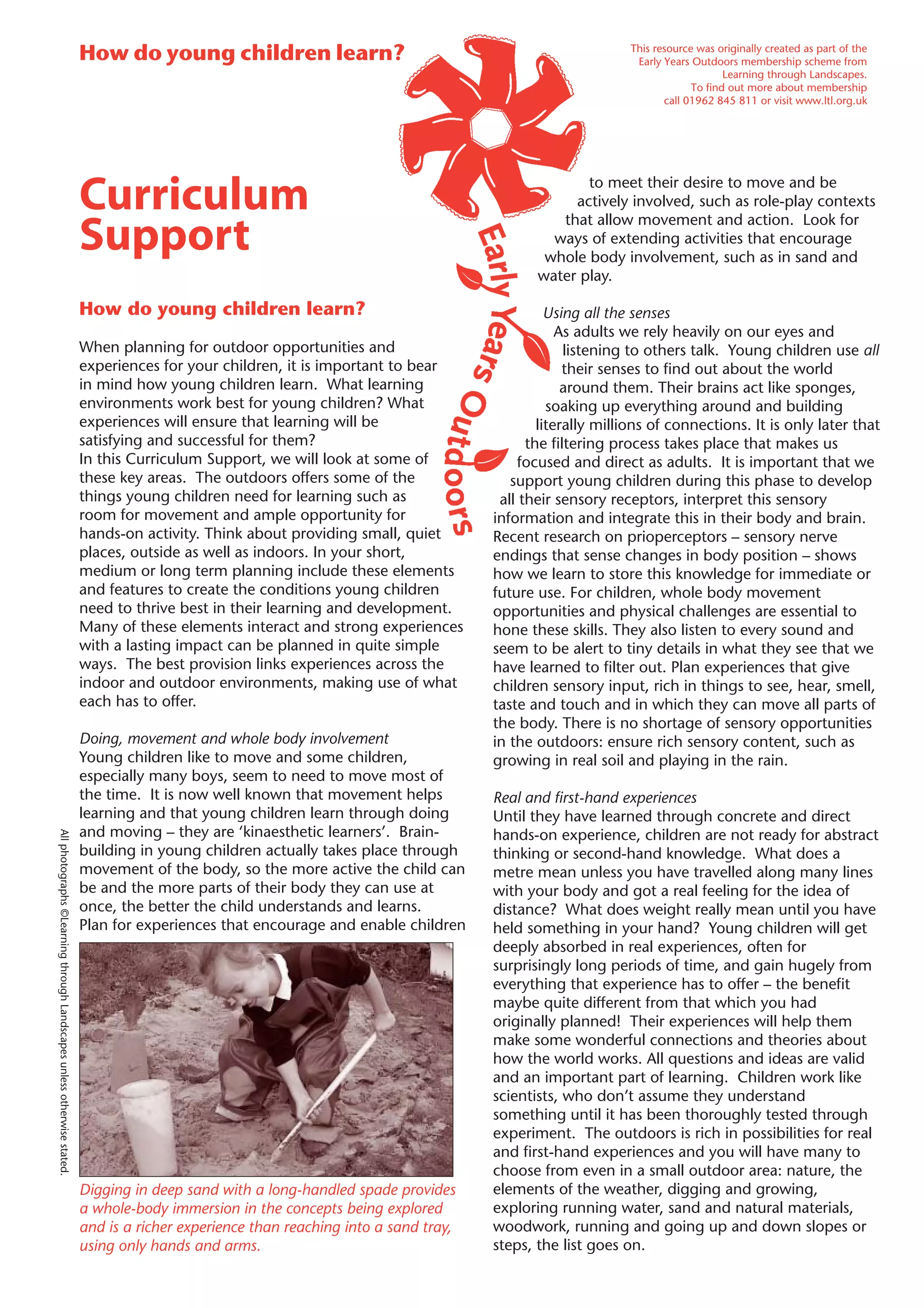
                                                                        Digging in deep sand with a long-handled spade provides      elements of the weather, digging and growing,
                                                                        a whole-body immersion in the concepts being explored        exploring running water, sand and natural materials,
                                                                        and is a richer experience than reaching into a sand tray,   woodwork, running and going up and down slopes or
                                                                        using only hands and arms.                                   steps, the list goes on.
Imitation
                                                               Watching and imitating is a major
                                                               way of learning for young children.
                                                               We can teach young children through
                                                               how we behave. Role modelling
                                                               curiosity and enquiry will bring children’s
                                                               attention to something interesting
                                                               without needing to call them.
                                                               Behave in a confident and careful way
                                                               towards challenges to give children a
                                                               positive approach to risk-taking. Value the
                                                               outdoor environment, show this in
                                                               planning creative activities and making it
                                                               genuinely available. However, because of
                                                               the sponge-like way young children absorb
                                                               their surroundings, impressions have
The importance of planning for play                            unconscious but lasting effects, including
Young children are self-driven learners and are                adult behaviour that give clues as to how
constantly curious and exploratory and discover through        they feel about being outside today! For those children
play. Although they love adult attention and                   who prefer to be outdoors, the perception that adults
interaction, they also want to follow their own ideas and      do not really value it can damage their self-esteem.
find it hard to do what adults want them to for very            Children of the same age and older children can be
long. Children’s play is often based upon what they            excellent tutors for play, communication and behaviour;
know about or are interested in – making sense of              so planning times when ages mix in outdoor play is well
experiences they have had by playing with the ideas,           worth consideration.
often repeatedly. The experiences could be from home
or the setting. The best outdoor provision supplies            Repetition
plenty of play opportunities. Plan for ample time for          Young children like to repeat an activity that interests
children to be able to process ideas at their own pace,        them again and again, until it is fully understood or
making the outdoors available every day for long               mastered. They often like to return to something in
periods. This will have a beneficial impact on children’s       order to practice and refine their ideas and skills, or
learning and development and reward your planning.             simply to feel a sense of familiarity and competence.
                                                               Plan for children to be able to go back to activities or
Social learning                                                experiences over a long period of time, giving them the
Young children are very sociable and learn best by             chance to work at their own pace and repeat as much as
interaction with other children and adults. By sharing         necessary. Plan for long periods of time outdoors and
interest and talking about what they are seeing and            for all weathers, so that children know they will be able
doing they build their thinking abilities and their            to carry on the next day. Plan also for children to access
understanding of how the world works. Encourage                resources themselves so that they can get involved in
children to play and work outdoors with other children         what they want to do without the need for adults to set
and with adults. Give time for long interactions to occur,     things up for them.
supporting a ‘social co-construction’ of knowledge.
Activities that genuinely interest practitioners will offer    Making use of these suggestions and ideas in your
many opportunities for sharing the focus (sustained            setting will give you more time for the important tasks
shared thinking) where both parties are genuinely              of interacting, talking and supporting children’s
interested in something and find out about it together.         learning.

Future issues of Curriculum Support will offer more detailed guidance for planning effective outdoor play.


Suggested Reading
A Shared Vision for Outdoor Play poster in your Early Years   The Potential of a Puddle Claire Warden , 2005,
Outdoors pack.                                                Mindstretchers, ISBN 0954488350.
                                                              www.mindstretchers.co.uk
Smart Moves: why learning is not all your head
Carla Hannaford, 1995, Great Ocean Publishers,                Researching Effective Pedagogy in the Early Years,
ISBN 0915556278.                                              2004, Research report No 356, DfES.
                                                              www.dfes.gov.uk
First hand experience: what matters to children
D. Rich, D. Casanova, M.J. Drummond,
A. Durrant and C. Myer, 2005,
Rich Learning Opportunities, ISBN 0954968301.

How Do Young Children Learn: Outdoor Learning and Play

  • 1.
    How do youngchildren learn? This resource was originally created as part of the Early Years Outdoors membership scheme from Learning through Landscapes. To find out more about membership call 01962 845 811 or visit www.ltl.org.uk Curriculum to meet their desire to move and be actively involved, such as role-play contexts that allow movement and action. Look for Support ways of extending activities that encourage whole body involvement, such as in sand and water play. How do young children learn? Using all the senses As adults we rely heavily on our eyes and When planning for outdoor opportunities and listening to others talk. Young children use all experiences for your children, it is important to bear their senses to find out about the world in mind how young children learn. What learning around them. Their brains act like sponges, environments work best for young children? What soaking up everything around and building experiences will ensure that learning will be literally millions of connections. It is only later that satisfying and successful for them? the filtering process takes place that makes us In this Curriculum Support, we will look at some of focused and direct as adults. It is important that we these key areas. The outdoors offers some of the support young children during this phase to develop things young children need for learning such as all their sensory receptors, interpret this sensory room for movement and ample opportunity for information and integrate this in their body and brain. hands-on activity. Think about providing small, quiet Recent research on prioperceptors – sensory nerve places, outside as well as indoors. In your short, endings that sense changes in body position – shows medium or long term planning include these elements how we learn to store this knowledge for immediate or and features to create the conditions young children future use. For children, whole body movement need to thrive best in their learning and development. opportunities and physical challenges are essential to Many of these elements interact and strong experiences hone these skills. They also listen to every sound and with a lasting impact can be planned in quite simple seem to be alert to tiny details in what they see that we ways. The best provision links experiences across the have learned to filter out. Plan experiences that give indoor and outdoor environments, making use of what children sensory input, rich in things to see, hear, smell, each has to offer. taste and touch and in which they can move all parts of the body. There is no shortage of sensory opportunities Doing, movement and whole body involvement in the outdoors: ensure rich sensory content, such as Young children like to move and some children, growing in real soil and playing in the rain. especially many boys, seem to need to move most of the time. It is now well known that movement helps Real and first-hand experiences learning and that young children learn through doing Until they have learned through concrete and direct and moving – they are ‘kinaesthetic learners’. Brain- hands-on experience, children are not ready for abstract All photographs ©Learning through Landscapes unless otherwise stated. building in young children actually takes place through thinking or second-hand knowledge. What does a movement of the body, so the more active the child can metre mean unless you have travelled along many lines be and the more parts of their body they can use at with your body and got a real feeling for the idea of once, the better the child understands and learns. distance? What does weight really mean until you have Plan for experiences that encourage and enable children held something in your hand? Young children will get deeply absorbed in real experiences, often for surprisingly long periods of time, and gain hugely from everything that experience has to offer – the benefit maybe quite different from that which you had originally planned! Their experiences will help them make some wonderful connections and theories about how the world works. All questions and ideas are valid and an important part of learning. Children work like scientists, who don’t assume they understand something until it has been thoroughly tested through experiment. The outdoors is rich in possibilities for real and first-hand experiences and you will have many to choose from even in a small outdoor area: nature, the Digging in deep sand with a long-handled spade provides elements of the weather, digging and growing, a whole-body immersion in the concepts being explored exploring running water, sand and natural materials, and is a richer experience than reaching into a sand tray, woodwork, running and going up and down slopes or using only hands and arms. steps, the list goes on.
  • 2.
    Imitation Watching and imitating is a major way of learning for young children. We can teach young children through how we behave. Role modelling curiosity and enquiry will bring children’s attention to something interesting without needing to call them. Behave in a confident and careful way towards challenges to give children a positive approach to risk-taking. Value the outdoor environment, show this in planning creative activities and making it genuinely available. However, because of the sponge-like way young children absorb their surroundings, impressions have The importance of planning for play unconscious but lasting effects, including Young children are self-driven learners and are adult behaviour that give clues as to how constantly curious and exploratory and discover through they feel about being outside today! For those children play. Although they love adult attention and who prefer to be outdoors, the perception that adults interaction, they also want to follow their own ideas and do not really value it can damage their self-esteem. find it hard to do what adults want them to for very Children of the same age and older children can be long. Children’s play is often based upon what they excellent tutors for play, communication and behaviour; know about or are interested in – making sense of so planning times when ages mix in outdoor play is well experiences they have had by playing with the ideas, worth consideration. often repeatedly. The experiences could be from home or the setting. The best outdoor provision supplies Repetition plenty of play opportunities. Plan for ample time for Young children like to repeat an activity that interests children to be able to process ideas at their own pace, them again and again, until it is fully understood or making the outdoors available every day for long mastered. They often like to return to something in periods. This will have a beneficial impact on children’s order to practice and refine their ideas and skills, or learning and development and reward your planning. simply to feel a sense of familiarity and competence. Plan for children to be able to go back to activities or Social learning experiences over a long period of time, giving them the Young children are very sociable and learn best by chance to work at their own pace and repeat as much as interaction with other children and adults. By sharing necessary. Plan for long periods of time outdoors and interest and talking about what they are seeing and for all weathers, so that children know they will be able doing they build their thinking abilities and their to carry on the next day. Plan also for children to access understanding of how the world works. Encourage resources themselves so that they can get involved in children to play and work outdoors with other children what they want to do without the need for adults to set and with adults. Give time for long interactions to occur, things up for them. supporting a ‘social co-construction’ of knowledge. Activities that genuinely interest practitioners will offer Making use of these suggestions and ideas in your many opportunities for sharing the focus (sustained setting will give you more time for the important tasks shared thinking) where both parties are genuinely of interacting, talking and supporting children’s interested in something and find out about it together. learning. Future issues of Curriculum Support will offer more detailed guidance for planning effective outdoor play. Suggested Reading A Shared Vision for Outdoor Play poster in your Early Years The Potential of a Puddle Claire Warden , 2005, Outdoors pack. Mindstretchers, ISBN 0954488350. www.mindstretchers.co.uk Smart Moves: why learning is not all your head Carla Hannaford, 1995, Great Ocean Publishers, Researching Effective Pedagogy in the Early Years, ISBN 0915556278. 2004, Research report No 356, DfES. www.dfes.gov.uk First hand experience: what matters to children D. Rich, D. Casanova, M.J. Drummond, A. Durrant and C. Myer, 2005, Rich Learning Opportunities, ISBN 0954968301.