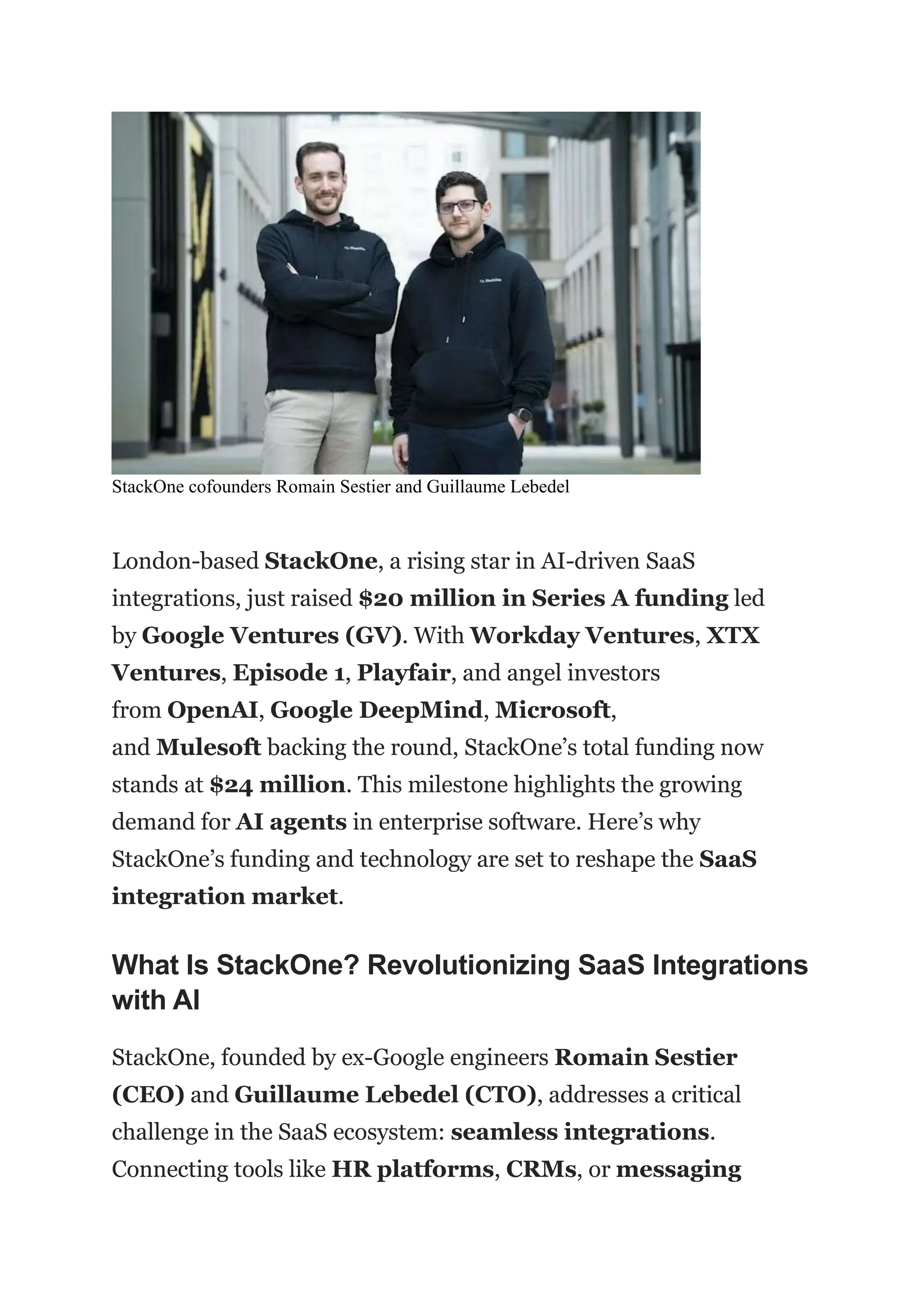
StackOne cofounders Romain Sestier and Guillaume Lebedel
London-based StackOne, a rising star in AI-driven SaaS
integrations, just raised $20 million in Series A funding led
by Google Ventures (GV). With Workday Ventures, XTX
Ventures, Episode 1, Playfair, and angel investors
from OpenAI, Google DeepMind, Microsoft,
and Mulesoft backing the round, StackOne’s total funding now
stands at $24 million. This milestone highlights the growing
demand for AI agents in enterprise software. Here’s why
StackOne’s funding and technology are set to reshape the SaaS
integration market.
What Is StackOne? Revolutionizing SaaS Integrations
with AI
StackOne, founded by ex-Google engineers Romain Sestier
(CEO) and Guillaume Lebedel (CTO), addresses a critical
challenge in the SaaS ecosystem: seamless integrations.
Connecting tools like HR platforms, CRMs, or messaging
apps often requires weeks of custom coding, draining developer
resources. StackOne’s AI agent platform changes that,
enabling enterprise API integrations in days with 5x higher
accuracy than leading large language models (LLMs).
With over 3,000 actions across 200+ connectors, StackOne
streamlines data flow between systems like ticketing
platforms, identity management tools, and more. As Sestier
explains, “Integrations are a pain point for SaaS teams. Our AI
agents deliver enterprise-grade solutions at scale, saving time and
resources.”
Keywords: StackOne, AI agents, SaaS integrations, enterprise API,
AI-driven automation
Why StackOne’s $20M Funding Matters
The $20 million Series A round reflects investor confidence in AI
agents for enterprise software. In 2025, European AI agent
startups raised €481 million in just six weeks, per Sifted, signaling
a surge in interest. StackOne’s funding, backed by industry giants
like GV and Workday Ventures, positions it as a leader in
the $17.5 billion enterprise integration market.
Luna Schmid, partner at GV, said, “StackOne isn’t just another
integration platform — it’s building infrastructure for the AI agent
ecosystem and modern SaaS.” This investment underscores
StackOne’s potential to redefine how businesses connect their tech
stacks.
Keywords: StackOne funding, Series A, AI agent startups,
enterprise integration market, Google Ventures
How StackOne’s AI Platform Works
StackOne’s proprietary AI agent automates complex
integrations, offering:
• Speed: Connect APIs in days, not weeks.
• Accuracy: 5x better than standard LLMs.
• Scale: Supports 3,000+ actions across 200+ connectors.
• Security: Enterprise-grade solutions for industries like HR and
CRM.
Clients like Drata, Attensi, and Localyze are already reaping the
benefits. For instance, Drata launched 100 integrations quickly,
while Mindtools secured a major contract with a rapid Workday
integration. StackOne’s platform has handled over 1 billion API
calls, proving its reliability.
Keywords: AI integration platform, enterprise SaaS, API
automation, Workday integration, Drata
What’s Next for StackOne?
With the new funding, StackOne aims to:
• Upgrade its tool-calling LLM for smarter integrations.
• Expand R&D to lead in AI innovation.
• Grow connector coverage for broader SaaS compatibility.
• Build an AI developer community to drive adoption.
These moves will strengthen StackOne’s position in the fast-
growing SaaS integration and AI agent markets, where seamless
connectivity is critical.
Keywords: StackOne roadmap, AI developer tools, SaaS connector
expansion, LLM upgrades
Why AI-Driven Integrations Are the Future
Integrations are now non-negotiable for B2B SaaS success. A
2025 survey found 83% of B2B buyers prioritize seamless
integrations, yet 71% of SaaS firms take three weeks or more to
deliver a single connection. StackOne’s AI agents bridge this gap,
enabling businesses to adopt AI automation without overhauling
their systems.
As Guillaume Lebedel notes, “Integrations are table stakes for
SaaS and AI agents. Our platform makes them fast, secure, and
scalable.” This is especially crucial as AI agents transform
workflows in HR, customer support, and beyond.
Keywords: B2B SaaS integrations, AI automation trends,
enterprise connectivity, AI agent benefits
The European AI Boom and StackOne’s Role
Europe is emerging as a powerhouse for AI innovation, with
startups like Synthesia and ElevenLabs raising significant funds
in 2025. StackOne’s success adds to this momentum, showcasing
Europe’s ability to compete globally. However, VCs warn of a
potential AI agent bubble. StackOne’s focus on a tangible problem
— SaaS integration inefficiencies — sets it apart from hype-
driven competitors.
Keywords: European AI startups, AI agent market, StackOne
London, AI innovation Europe
Conclusion: StackOne’s Vision for AI and SaaS
StackOne’s $20 million raise is a testament to the transformative
power of AI agents in enterprise software. By automating SaaS
integrations, StackOne is building the foundation for a more
connected, efficient future. As the enterprise integration
market grows, this London startup is poised to lead the charge.
Stay tuned for more updates on StackOne and the AI-driven SaaS
revolution. For now, they’re proving that the future of integrations
is fast, smart, and powered by AI.

StackOne Secures 20M for AI-Driven SaaS Integrations A Game-Changer.pdf

  • 1.
    StackOne cofounders RomainSestier and Guillaume Lebedel London-based StackOne, a rising star in AI-driven SaaS integrations, just raised $20 million in Series A funding led by Google Ventures (GV). With Workday Ventures, XTX Ventures, Episode 1, Playfair, and angel investors from OpenAI, Google DeepMind, Microsoft, and Mulesoft backing the round, StackOne’s total funding now stands at $24 million. This milestone highlights the growing demand for AI agents in enterprise software. Here’s why StackOne’s funding and technology are set to reshape the SaaS integration market. What Is StackOne? Revolutionizing SaaS Integrations with AI StackOne, founded by ex-Google engineers Romain Sestier (CEO) and Guillaume Lebedel (CTO), addresses a critical challenge in the SaaS ecosystem: seamless integrations. Connecting tools like HR platforms, CRMs, or messaging
  • 2.
    apps often requiresweeks of custom coding, draining developer resources. StackOne’s AI agent platform changes that, enabling enterprise API integrations in days with 5x higher accuracy than leading large language models (LLMs). With over 3,000 actions across 200+ connectors, StackOne streamlines data flow between systems like ticketing platforms, identity management tools, and more. As Sestier explains, “Integrations are a pain point for SaaS teams. Our AI agents deliver enterprise-grade solutions at scale, saving time and resources.” Keywords: StackOne, AI agents, SaaS integrations, enterprise API, AI-driven automation Why StackOne’s $20M Funding Matters The $20 million Series A round reflects investor confidence in AI agents for enterprise software. In 2025, European AI agent startups raised €481 million in just six weeks, per Sifted, signaling a surge in interest. StackOne’s funding, backed by industry giants like GV and Workday Ventures, positions it as a leader in the $17.5 billion enterprise integration market. Luna Schmid, partner at GV, said, “StackOne isn’t just another integration platform — it’s building infrastructure for the AI agent ecosystem and modern SaaS.” This investment underscores StackOne’s potential to redefine how businesses connect their tech stacks.
  • 3.
    Keywords: StackOne funding,Series A, AI agent startups, enterprise integration market, Google Ventures How StackOne’s AI Platform Works StackOne’s proprietary AI agent automates complex integrations, offering: • Speed: Connect APIs in days, not weeks. • Accuracy: 5x better than standard LLMs. • Scale: Supports 3,000+ actions across 200+ connectors. • Security: Enterprise-grade solutions for industries like HR and CRM. Clients like Drata, Attensi, and Localyze are already reaping the benefits. For instance, Drata launched 100 integrations quickly, while Mindtools secured a major contract with a rapid Workday integration. StackOne’s platform has handled over 1 billion API calls, proving its reliability. Keywords: AI integration platform, enterprise SaaS, API automation, Workday integration, Drata What’s Next for StackOne? With the new funding, StackOne aims to: • Upgrade its tool-calling LLM for smarter integrations.
  • 4.
    • Expand R&Dto lead in AI innovation. • Grow connector coverage for broader SaaS compatibility. • Build an AI developer community to drive adoption. These moves will strengthen StackOne’s position in the fast- growing SaaS integration and AI agent markets, where seamless connectivity is critical. Keywords: StackOne roadmap, AI developer tools, SaaS connector expansion, LLM upgrades Why AI-Driven Integrations Are the Future Integrations are now non-negotiable for B2B SaaS success. A 2025 survey found 83% of B2B buyers prioritize seamless integrations, yet 71% of SaaS firms take three weeks or more to deliver a single connection. StackOne’s AI agents bridge this gap, enabling businesses to adopt AI automation without overhauling their systems. As Guillaume Lebedel notes, “Integrations are table stakes for SaaS and AI agents. Our platform makes them fast, secure, and scalable.” This is especially crucial as AI agents transform workflows in HR, customer support, and beyond. Keywords: B2B SaaS integrations, AI automation trends, enterprise connectivity, AI agent benefits
  • 5.
    The European AIBoom and StackOne’s Role Europe is emerging as a powerhouse for AI innovation, with startups like Synthesia and ElevenLabs raising significant funds in 2025. StackOne’s success adds to this momentum, showcasing Europe’s ability to compete globally. However, VCs warn of a potential AI agent bubble. StackOne’s focus on a tangible problem — SaaS integration inefficiencies — sets it apart from hype- driven competitors. Keywords: European AI startups, AI agent market, StackOne London, AI innovation Europe Conclusion: StackOne’s Vision for AI and SaaS StackOne’s $20 million raise is a testament to the transformative power of AI agents in enterprise software. By automating SaaS integrations, StackOne is building the foundation for a more connected, efficient future. As the enterprise integration market grows, this London startup is poised to lead the charge. Stay tuned for more updates on StackOne and the AI-driven SaaS revolution. For now, they’re proving that the future of integrations is fast, smart, and powered by AI.