Hot code is faster code
Addressing JVM warm-up
Mark Price
aitusoftware.com
@epickrram
The JVM warm-up problem?
The JVM warm-up feature!
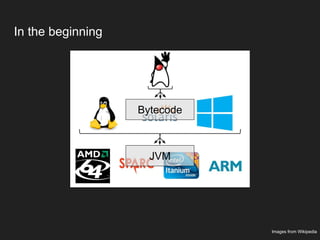
In the beginning
Images from Wikipedia
Bytecode
JVM
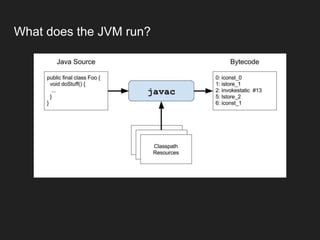
What does the JVM run?
THE INTERPRETER
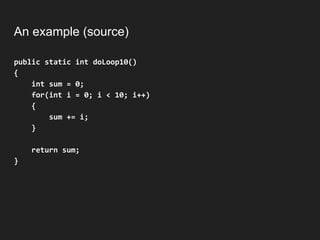
An example (source)
public static int doLoop10()
{
int sum = 0;
for(int i = 0; i < 10; i++)
{
sum += i;
}
return sum;
}
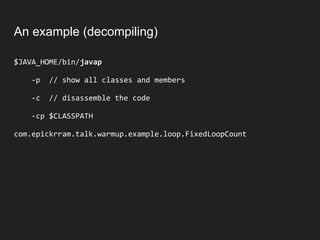
An example (decompiling)
$JAVA_HOME/bin/javap
-p // show all classes and members
-c // disassemble the code
-cp $CLASSPATH
com.epickrram.talk.warmup.example.loop.FixedLoopCount
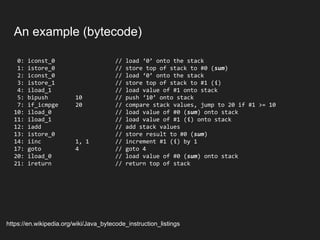
An example (bytecode)
0: iconst_0
1: istore_0
2: iconst_0
3: istore_1
4: iload_1
5: bipush 10
7: if_icmpge 20
10: iload_0
11: iload_1
12: iadd
13: istore_0
14: iinc 1, 1
17: goto 4
20: iload_0
21: ireturn
// load ‘0’ onto the stack
// store top of stack to #0 (sum)
// load ‘0’ onto the stack
// store top of stack to #1 (i)
// load value of #1 onto stack
// push ‘10’ onto stack
// compare stack values, jump to 20 if #1 >= 10
// load value of #0 (sum) onto stack
// load value of #1 (i) onto stack
// add stack values
// store result to #0 (sum)
// increment #1 (i) by 1
// goto 4
// load value of #0 (sum) onto stack
// return top of stack
https://en.wikipedia.org/wiki/Java_bytecode_instruction_listings
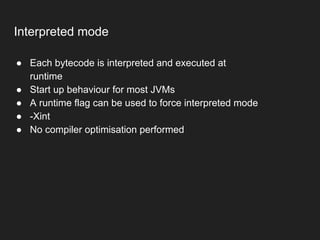
Interpreted mode
● Each bytecode is interpreted and executed at
runtime
● Start up behaviour for most JVMs
● A runtime flag can be used to force interpreted mode
● -Xint
● No compiler optimisation performed
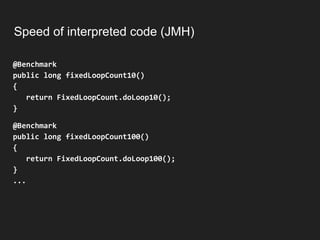
Speed of interpreted code (JMH)
@Benchmark
public long fixedLoopCount10()
{
return FixedLoopCount.doLoop10();
}
@Benchmark
public long fixedLoopCount100()
{
return FixedLoopCount.doLoop100();
}
...
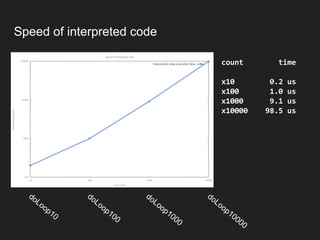
Speed of interpreted code
count time
x10 0.2 us
x100 1.0 us
x1000 9.1 us
x10000 98.5 us
doLoop10
doLoop100
doLoop1000
doLoop10000
THE COMPILER
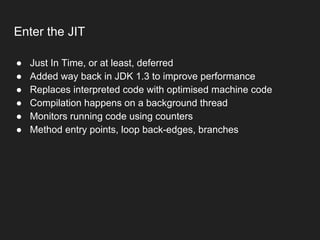
Enter the JIT
● Just In Time, or at least, deferred
● Added way back in JDK 1.3 to improve performance
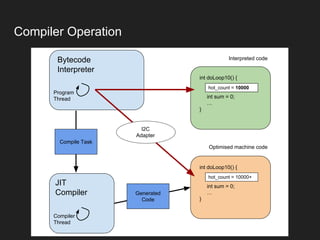
● Replaces interpreted code with optimised machine code
● Compilation happens on a background thread
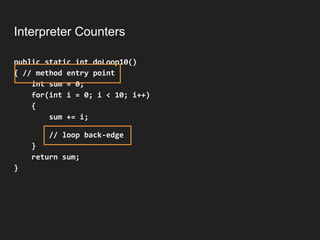
● Monitors running code using counters
● Method entry points, loop back-edges, branches
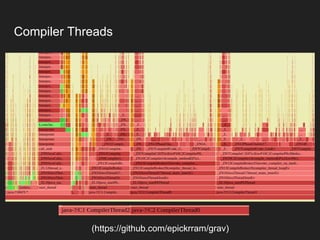
Compiler Threads
(https://github.com/epickrram/grav)
Interpreter Counters
public static int doLoop10()
{ // method entry point
int sum = 0;
for(int i = 0; i < 10; i++)
{
sum += i;
// loop back-edge
}
return sum;
}
Two flavours
● Client (C1) [ -client]
● Server (C2) [ -server]
● Client is focussed on desktop/GUI targeting fast start-up times
● Server is aimed at long-running processes for max performance
● -server should produce most optimised code
● 64-bit JDK ignores -client and goes straight to -server
● -XX:+TieredCompilation (default)
Compiler Operation
Bytecode
Interpreter
Program
Thread
JIT
Compiler
Compiler
Thread
Compile Task
int doLoop10() {
int sum = 0;
…
}
hot_count = 9999
Interpreted code
int doLoop10() {
int sum = 0;
…
}
hot_count = 10000+
Optimised machine code
Generated
Code
hot_count = 10000
I2C
Adapter
LOOKING CLOSER
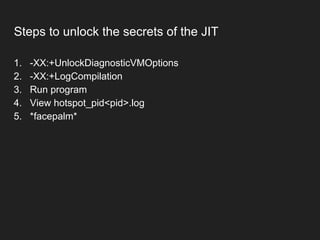
Steps to unlock the secrets of the JIT
1. -XX:+UnlockDiagnosticVMOptions
2. -XX:+LogCompilation
3. Run program
4. View hotspot_pid<pid>.log
5. *facepalm*
1. -XX:+UnlockDiagnosticVMOptions
2. -XX:+LogCompilation
3. Run program
4. View hotspot_pid<pid>.log
5. Scream
TMI
<task_queued compile_id='15' method='com/epickrram/talk/warmup/example/loop/FixedLoopCount doLoop10 ()I' bytes='22' count='205' backedge_count='2048' iicount='205' level='3' stamp='0.096'
comment='tiered' hot_count='205'/>
<writer thread='140617399015168'/>
<nmethod compile_id='15' compiler='C1' level='3' entry='0x00007fe4612b5080' size='1008' address='0x00007fe4612b4f10' relocation_offset='296' insts_offset='368' stub_offset='720'
scopes_data_offset='880' scopes_pcs_offset='920' dependencies_offset='1000' oops_offset='864' method='com/epickrram/talk/warmup/example/loop/FixedLoopCount doLoop10 ()I' bytes='22' count='2793'
backedge_count='27950' iicount='2799' stamp='0.097'/>
<writer thread='140619223398144'/>
<task_queued compile_id='16' method='com/epickrram/talk/warmup/example/loop/FixedLoopCount doLoop10 ()I' bytes='22' count='3456' backedge_count='34550' iicount='3456' stamp='0.097'
comment='tiered' hot_count='3456'/>
<writer thread='140617407436544'/>
<nmethod compile_id='16' compiler='C2' level='4' entry='0x00007fe4612b8080' size='448' address='0x00007fe4612b7f50' relocation_offset='296' insts_offset='304' stub_offset='368'
scopes_data_offset='400' scopes_pcs_offset='408' dependencies_offset='440' oops_offset='392' method='com/epickrram/talk/warmup/example/loop/FixedLoopCount doLoop10 ()I' bytes='22' count='22758'
backedge_count='227698' iicount='22783' stamp='0.099'/>
<make_not_entrant thread='140617407436544' compile_id='15' compiler='C1' level='3' stamp='0.099'/>
<writer thread='140619223398144'/>
<task_queued compile_id='17' compile_kind='osr' method='com/epickrram/talk/warmup/example/loop/FixedLoopCountMain main ([Ljava/lang/String;)V' bytes='13' count='1' backedge_count='60416'
iicount='1' osr_bci='0' level='3' stamp='0.100' comment='tiered' hot_count='60416'/>
<writer thread='140617402173184'/>
<nmethod compile_id='17' compile_kind='osr' compiler='C1' level='3' entry='0x00007fe4612b7b20' size='1440' address='0x00007fe4612b7990' relocation_offset='296' insts_offset='400'
stub_offset='1040' scopes_data_offset='1208' scopes_pcs_offset='1304' dependencies_offset='1432' oops_offset='1184' method='com/epickrram/talk/warmup/example/loop/FixedLoopCountMain main
([Ljava/lang/String;)V' bytes='13' count='1' backedge_count='83294' iicount='1' stamp='0.101'/>
<writer thread='140619223398144'/>
<task_queued compile_id='18' method='com/epickrram/talk/warmup/example/loop/FixedLoopCountMain main ([Ljava/lang/String;)V' bytes='13' count='1' backedge_count='84305' iicount='1' level='3'
stamp='0.101' comment='tiered' hot_count='1'/>
<task_queued compile_id='19' compile_kind='osr' method='com/epickrram/talk/warmup/example/loop/FixedLoopCount doLoop10 ()I' bytes='22' count='23321' backedge_count='233206' iicount='23321'
osr_bci='4' stamp='0.101' comment='tiered' hot_count='233206'/>
<writer thread='140617402173184'/>
<nmethod compile_id='18' compiler='C1' level='3' entry='0x00007fe4612b7560' size='1408' address='0x00007fe4612b73d0' relocation_offset='296' insts_offset='400' stub_offset='1008'
scopes_data_offset='1176' scopes_pcs_offset='1272' dependencies_offset='1400' oops_offset='1152' method='com/epickrram/talk/warmup/example/loop/FixedLoopCountMain main ([Ljava/lang/String;)V'
bytes='13' count='1' backedge_count='94126' iicount='1' stamp='0.101'/>
<writer thread='140619223398144'/>
<task_queued compile_id='20' compile_kind='osr' method='com/epickrram/talk/warmup/example/loop/FixedLoopCountMain main ([Ljava/lang/String;)V' bytes='13' count='1' backedge_count='108881'
iicount='1' osr_bci='0' stamp='0.102' comment='tiered' hot_count='108881'/>
<writer thread='140617409541888'/>
<nmethod compile_id='19' compile_kind='osr' compiler='C2' level='4' entry='0x00007fe4612b5da0' size='608' address='0x00007fe4612b5c50' relocation_offset='296' insts_offset='336'
stub_offset='528' scopes_data_offset='560' scopes_pcs_offset='568' dependencies_offset='600' oops_offset='552' method='com/epickrram/talk/warmup/example/loop/FixedLoopCount doLoop10 ()I'
bytes='22' count='70199' backedge_count='702134' iicount='70232' stamp='0.103'/>
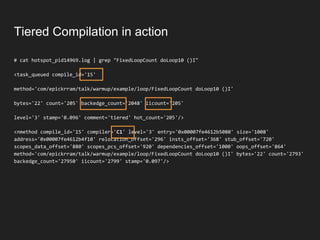
Tiered Compilation in action
# cat hotspot_pid14969.log | grep "FixedLoopCount doLoop10 ()I"
<task_queued compile_id='15'
method='com/epickrram/talk/warmup/example/loop/FixedLoopCount doLoop10 ()I'
bytes='22' count='205' backedge_count='2048' iicount='205'
level='3' stamp='0.096' comment='tiered' hot_count='205'/>
<nmethod compile_id='15' compiler='C1' level='3' entry='0x00007fe4612b5080' size='1008'
address='0x00007fe4612b4f10' relocation_offset='296' insts_offset='368' stub_offset='720'
scopes_data_offset='880' scopes_pcs_offset='920' dependencies_offset='1000' oops_offset='864'
method='com/epickrram/talk/warmup/example/loop/FixedLoopCount doLoop10 ()I' bytes='22' count='2793'
backedge_count='27950' iicount='2799' stamp='0.097'/>
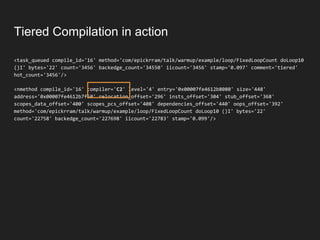
Tiered Compilation in action
<task_queued compile_id='16' method='com/epickrram/talk/warmup/example/loop/FixedLoopCount doLoop10
()I' bytes='22' count='3456' backedge_count='34550' iicount='3456' stamp='0.097' comment='tiered'
hot_count='3456'/>
<nmethod compile_id='16' compiler='C2' level='4' entry='0x00007fe4612b8080' size='448'
address='0x00007fe4612b7f50' relocation_offset='296' insts_offset='304' stub_offset='368'
scopes_data_offset='400' scopes_pcs_offset='408' dependencies_offset='440' oops_offset='392'
method='com/epickrram/talk/warmup/example/loop/FixedLoopCount doLoop10 ()I' bytes='22'
count='22758' backedge_count='227698' iicount='22783' stamp='0.099'/>
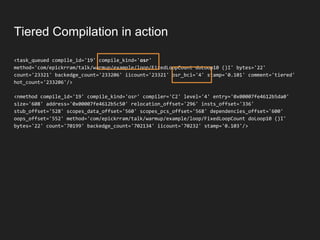
Tiered Compilation in action
<task_queued compile_id='19' compile_kind='osr'
method='com/epickrram/talk/warmup/example/loop/FixedLoopCount doLoop10 ()I' bytes='22'
count='23321' backedge_count='233206' iicount='23321' osr_bci='4' stamp='0.101' comment='tiered'
hot_count='233206'/>
<nmethod compile_id='19' compile_kind='osr' compiler='C2' level='4' entry='0x00007fe4612b5da0'
size='608' address='0x00007fe4612b5c50' relocation_offset='296' insts_offset='336'
stub_offset='528' scopes_data_offset='560' scopes_pcs_offset='568' dependencies_offset='600'
oops_offset='552' method='com/epickrram/talk/warmup/example/loop/FixedLoopCount doLoop10 ()I'
bytes='22' count='70199' backedge_count='702134' iicount='70232' stamp='0.103'/>
Tiered Compilation in action
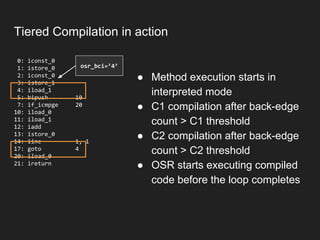
0: iconst_0
1: istore_0
2: iconst_0
3: istore_1
4: iload_1
5: bipush 10
7: if_icmpge 20
10: iload_0
11: iload_1
12: iadd
13: istore_0
14: iinc 1, 1
17: goto 4
20: iload_0
21: ireturn
● Method execution starts in
interpreted mode
● C1 compilation after back-edge
count > C1 threshold
● C2 compilation after back-edge
count > C2 threshold
● OSR starts executing compiled
code before the loop completes
osr_bci=’4’
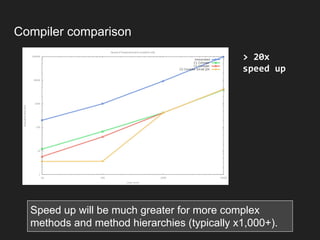
Compiler comparison
> 20x
speed up
Speed up will be much greater for more complex
methods and method hierarchies (typically x1,000+).
KNOWN UNKNOWNS
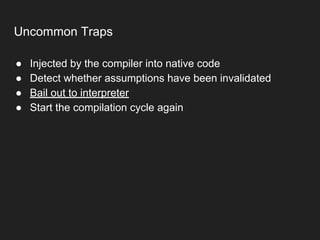
Uncommon Traps
● Injected by the compiler into native code
● Detect whether assumptions have been invalidated
● Bail out to interpreter
● Start the compilation cycle again
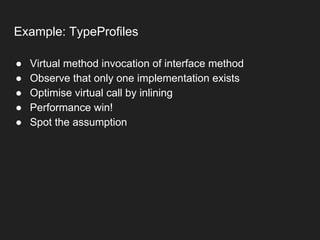
Example: TypeProfiles
● Virtual method invocation of interface method
● Observe that only one implementation exists
● Optimise virtual call by inlining
● Performance win!
● Spot the assumption
Type Profiles
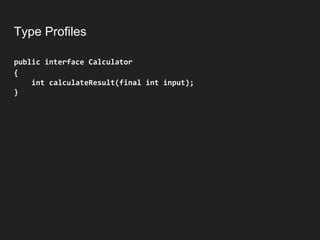
public interface Calculator
{
int calculateResult(final int input);
}
Type Profiles
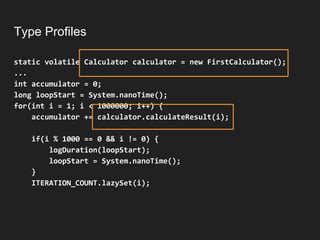
static volatile Calculator calculator = new FirstCalculator();
...
int accumulator = 0;
long loopStart = System.nanoTime();
for(int i = 1; i < 1000000; i++) {
accumulator += calculator.calculateResult(i);
if(i % 1000 == 0 && i != 0) {
logDuration(loopStart);
loopStart = System.nanoTime();
}
ITERATION_COUNT.lazySet(i);
Type Profiles
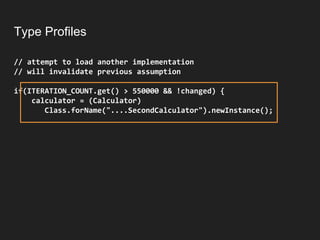
// attempt to load another implementation
// will invalidate previous assumption
if(ITERATION_COUNT.get() > 550000 && !changed) {
calculator = (Calculator)
Class.forName("....SecondCalculator").newInstance();
Type Profiles
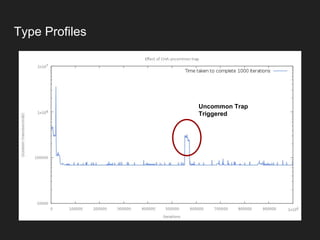
Loop at 550000 took 69090 ns
Loop at 551000 took 68890 ns
Loop at 552000 took 68925 ns
[Loaded com.epickrram.talk.warmup.example.cha.SecondCalculator ]
Loop at 553000 took 305987 ns
Loop at 554000 took 285183 ns
Loop at 555000 took 281293 ns
…
Loop at 572000 took 237633 ns
Loop at 573000 took 71779 ns
Loop at 574000 took 84552 ns
Loop at 575000 took 69061 ns
-XX:+TraceClassLoading
Type Profiles
Uncommon Trap
Triggered
Type Profiles
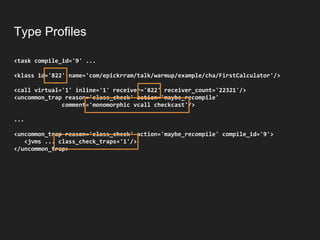
<task compile_id='9' ...
<klass id='822' name='com/epickrram/talk/warmup/example/cha/FirstCalculator'/>
<call virtual='1' inline='1' receiver='822' receiver_count='22321'/>
<uncommon_trap reason='class_check' action='maybe_recompile'
comment='monomorphic vcall checkcast'/>
...
<uncommon_trap reason='class_check' action='maybe_recompile' compile_id='9'>
<jvms ... class_check_traps='1'/>
</uncommon_trap>
STRATEGIES
What’s wrong with cold code?
● Interpreted code will take time to be compiled
● Compilation itself is fast, but methods may not be ‘hot’
● Compiled code cleared after JVM restart/code release
● E.g. market-open in finance applications
● E.g. auction sites
Strategy #1: Warm-up in-place
● Post release or restart
● Send traffic through the system
● Must match production-like traffic
● Must exercise all latency-sensitive code-paths
● Requires good data isolation
Strategy #1: Understand what is happening
● Observe (logging)
● Understand (count threshold, size threshold)
● Modify
● GOTO 10
● Then tweak your traffic generator until the desired result is
achieved
To get this method to work, pay attention to the
following:
Strategy #2: Ahead-of-time Compile
● Commercial solutions available
● Compile user bytecode into machine code
● Pre-compiled runtime
● No warm-up effects
● Static profile guided
Strategy #2.1: jaotc with Graal
● Compile target classes to machine-code using jaotc
● Uses Graal to perform compilation
● Faster start-up times
● Can include tiered profiling information to hook into C2 JIT
● Requires knowledge of what should be compiled
● Native code lives in the JVM code-cache
Strategy #3: Zing ReadyNow!
● Commercial solution
● Compiler profile is logged to file
● On startup, if log file exists, compilation is performed up-front
● Greatly reduces warm-up time
● Susceptible to large code refactorings
● Ship compiler profile from perf-test environment to production
A FEW TOOLS
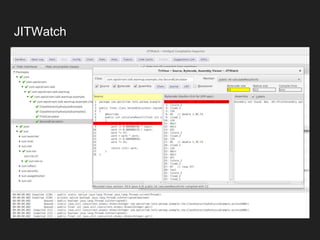
JITWatch
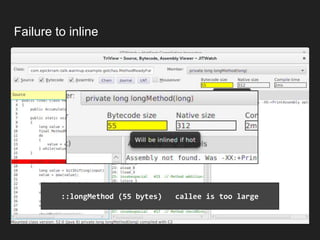
Failure to inline
::longMethod (55 bytes) callee is too large
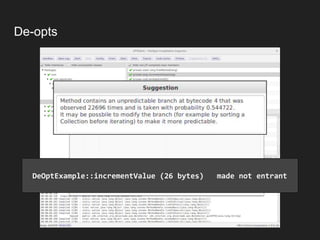
De-opts
DeOptExample::incrementValue (26 bytes) made not entrant
JMH -prof perfasm
● For deep inspection of your code
● Only run within the context of a JMH benchmark
● Uses perf_events (Linux) to sample the thread stack
● Captures -XX:+PrintAssembly
● Matches up executing assembly code with Java methods
● Remember that assembly is arch-specific
● Profile on the same hardware as production systems
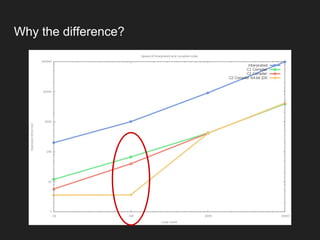
Why the difference?
When N=100
....[Hottest Methods (after inlining)]...............
43.94% 45.25% com.epickrram._jmhTest::fixedLoopCount100_avgt_jmhStub
21.96% 21.72% org.openjdk.jmh.infra.Blackhole::consume
17.78% 18.41% com.epickrram.loop.FixedLoopCountBenchmark::fixedLoopCount100
12.21% 10.70% com.epickrram.loop.FixedLoopCount::doLoop100
Actual method under test is
only 4th hottest…?
This is benchmarking
infrastructure
This is the calling method
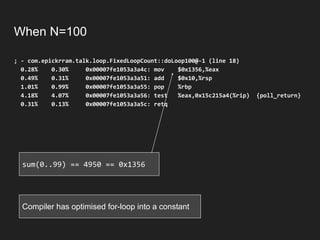
When N=100
; - com.epickrram.talk.loop.FixedLoopCount::doLoop100@-1 (line 18)
0.28% 0.30% 0x00007fe1053a3a4c: mov $0x1356,%eax
0.49% 0.31% 0x00007fe1053a3a51: add $0x10,%rsp
1.01% 0.99% 0x00007fe1053a3a55: pop %rbp
4.18% 4.07% 0x00007fe1053a3a56: test %eax,0x15c215a4(%rip) {poll_return}
0.31% 0.13% 0x00007fe1053a3a5c: retq
Compiler has optimised for-loop into a constant
sum(0..99) == 4950 == 0x1356
When N=1000
...[Hottest Methods (after inlining)]..........
94.50% 95.14% com.epickrram.loop.FixedLoopCount::doLoop1000
1.57% 1.53% native_write_msr_safe ([kernel.kallsyms])
0.54% 0.29% com.epickrram._jmhTest::fixedLoopCount1000_avgt_jmhStub
0.26% 0.28% org.openjdk.jmh.infra.Blackhole::consume
Method under test is now the
hottest method
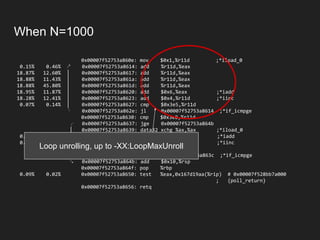
When N=1000
0x00007f52753a860e: mov $0x1,%r11d ;*iload_0
0.15% 0.46% ↗ 0x00007f52753a8614: add %r11d,%eax
18.87% 12.60% │ 0x00007f52753a8617: add %r11d,%eax
18.88% 11.43% │ 0x00007f52753a861a: add %r11d,%eax
18.88% 45.80% │ 0x00007f52753a861d: add %r11d,%eax
18.95% 11.87% │ 0x00007f52753a8620: add $0x6,%eax ;*iadd
18.28% 12.41% │ 0x00007f52753a8623: add $0x4,%r11d ;*iinc
0.07% 0.14% │ 0x00007f52753a8627: cmp $0x3e5,%r11d
╰ 0x00007f52753a862e: jl 0x00007f52753a8614 ;*if_icmpge
0x00007f52753a8630: cmp $0x3e8,%r11d
╭ 0x00007f52753a8637: jge 0x00007f52753a864b
│ 0x00007f52753a8639: data32 xchg %ax,%ax ;*iload_0
0.06% 0.03% │↗ 0x00007f52753a863c: add %r11d,%eax ;*iadd
0.21% 0.20% ││ 0x00007f52753a863f: inc %r11d ;*iinc
││ 0x00007f52753a8642: cmp $0x3e8,%r11d
│╰ 0x00007f52753a8649: jl 0x00007f52753a863c ;*if_icmpge
↘ 0x00007f52753a864b: add $0x10,%rsp
0x00007f52753a864f: pop %rbp
0.09% 0.02% 0x00007f52753a8650: test %eax,0x167d19aa(%rip) # 0x00007f528bb7a000
; {poll_return}
0x00007f52753a8656: retq
Loop unrolling, up to -XX:LoopMaxUnroll
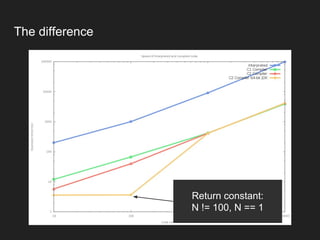
The difference
Return constant:
N != 100, N == 1
AND FINALLY
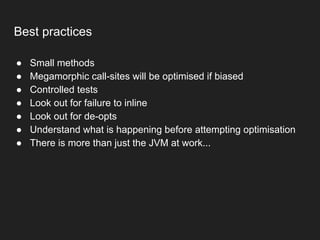
Best practices
● Small methods
● Megamorphic call-sites will be optimised if biased
● Controlled tests
● Look out for failure to inline
● Look out for de-opts
● Understand what is happening before attempting optimisation
● There is more than just the JVM at work...

Hot Code is Faster Code - Addressing JVM Warm-up

  • 1.
    Hot code isfaster code Addressing JVM warm-up Mark Price aitusoftware.com @epickrram
  • 2.
  • 3.
  • 4.
    In the beginning Imagesfrom Wikipedia Bytecode JVM
  • 5.
    What does theJVM run?
  • 6.
  • 7.
    An example (source) publicstatic int doLoop10() { int sum = 0; for(int i = 0; i < 10; i++) { sum += i; } return sum; }
  • 8.
    An example (decompiling) $JAVA_HOME/bin/javap -p// show all classes and members -c // disassemble the code -cp $CLASSPATH com.epickrram.talk.warmup.example.loop.FixedLoopCount
  • 9.
    An example (bytecode) 0:iconst_0 1: istore_0 2: iconst_0 3: istore_1 4: iload_1 5: bipush 10 7: if_icmpge 20 10: iload_0 11: iload_1 12: iadd 13: istore_0 14: iinc 1, 1 17: goto 4 20: iload_0 21: ireturn // load ‘0’ onto the stack // store top of stack to #0 (sum) // load ‘0’ onto the stack // store top of stack to #1 (i) // load value of #1 onto stack // push ‘10’ onto stack // compare stack values, jump to 20 if #1 >= 10 // load value of #0 (sum) onto stack // load value of #1 (i) onto stack // add stack values // store result to #0 (sum) // increment #1 (i) by 1 // goto 4 // load value of #0 (sum) onto stack // return top of stack https://en.wikipedia.org/wiki/Java_bytecode_instruction_listings
  • 10.
    Interpreted mode ● Eachbytecode is interpreted and executed at runtime ● Start up behaviour for most JVMs ● A runtime flag can be used to force interpreted mode ● -Xint ● No compiler optimisation performed
  • 11.
    Speed of interpretedcode (JMH) @Benchmark public long fixedLoopCount10() { return FixedLoopCount.doLoop10(); } @Benchmark public long fixedLoopCount100() { return FixedLoopCount.doLoop100(); } ...
  • 12.
    Speed of interpretedcode count time x10 0.2 us x100 1.0 us x1000 9.1 us x10000 98.5 us doLoop10 doLoop100 doLoop1000 doLoop10000
  • 13.
  • 14.
    Enter the JIT ●Just In Time, or at least, deferred ● Added way back in JDK 1.3 to improve performance ● Replaces interpreted code with optimised machine code ● Compilation happens on a background thread ● Monitors running code using counters ● Method entry points, loop back-edges, branches
  • 15.
  • 16.
    Interpreter Counters public staticint doLoop10() { // method entry point int sum = 0; for(int i = 0; i < 10; i++) { sum += i; // loop back-edge } return sum; }
  • 17.
    Two flavours ● Client(C1) [ -client] ● Server (C2) [ -server] ● Client is focussed on desktop/GUI targeting fast start-up times ● Server is aimed at long-running processes for max performance ● -server should produce most optimised code ● 64-bit JDK ignores -client and goes straight to -server ● -XX:+TieredCompilation (default)
  • 18.
    Compiler Operation Bytecode Interpreter Program Thread JIT Compiler Compiler Thread Compile Task intdoLoop10() { int sum = 0; … } hot_count = 9999 Interpreted code int doLoop10() { int sum = 0; … } hot_count = 10000+ Optimised machine code Generated Code hot_count = 10000 I2C Adapter
  • 19.
  • 20.
    Steps to unlockthe secrets of the JIT 1. -XX:+UnlockDiagnosticVMOptions 2. -XX:+LogCompilation 3. Run program 4. View hotspot_pid<pid>.log 5. *facepalm*
  • 21.
    1. -XX:+UnlockDiagnosticVMOptions 2. -XX:+LogCompilation 3.Run program 4. View hotspot_pid<pid>.log 5. Scream TMI <task_queued compile_id='15' method='com/epickrram/talk/warmup/example/loop/FixedLoopCount doLoop10 ()I' bytes='22' count='205' backedge_count='2048' iicount='205' level='3' stamp='0.096' comment='tiered' hot_count='205'/> <writer thread='140617399015168'/> <nmethod compile_id='15' compiler='C1' level='3' entry='0x00007fe4612b5080' size='1008' address='0x00007fe4612b4f10' relocation_offset='296' insts_offset='368' stub_offset='720' scopes_data_offset='880' scopes_pcs_offset='920' dependencies_offset='1000' oops_offset='864' method='com/epickrram/talk/warmup/example/loop/FixedLoopCount doLoop10 ()I' bytes='22' count='2793' backedge_count='27950' iicount='2799' stamp='0.097'/> <writer thread='140619223398144'/> <task_queued compile_id='16' method='com/epickrram/talk/warmup/example/loop/FixedLoopCount doLoop10 ()I' bytes='22' count='3456' backedge_count='34550' iicount='3456' stamp='0.097' comment='tiered' hot_count='3456'/> <writer thread='140617407436544'/> <nmethod compile_id='16' compiler='C2' level='4' entry='0x00007fe4612b8080' size='448' address='0x00007fe4612b7f50' relocation_offset='296' insts_offset='304' stub_offset='368' scopes_data_offset='400' scopes_pcs_offset='408' dependencies_offset='440' oops_offset='392' method='com/epickrram/talk/warmup/example/loop/FixedLoopCount doLoop10 ()I' bytes='22' count='22758' backedge_count='227698' iicount='22783' stamp='0.099'/> <make_not_entrant thread='140617407436544' compile_id='15' compiler='C1' level='3' stamp='0.099'/> <writer thread='140619223398144'/> <task_queued compile_id='17' compile_kind='osr' method='com/epickrram/talk/warmup/example/loop/FixedLoopCountMain main ([Ljava/lang/String;)V' bytes='13' count='1' backedge_count='60416' iicount='1' osr_bci='0' level='3' stamp='0.100' comment='tiered' hot_count='60416'/> <writer thread='140617402173184'/> <nmethod compile_id='17' compile_kind='osr' compiler='C1' level='3' entry='0x00007fe4612b7b20' size='1440' address='0x00007fe4612b7990' relocation_offset='296' insts_offset='400' stub_offset='1040' scopes_data_offset='1208' scopes_pcs_offset='1304' dependencies_offset='1432' oops_offset='1184' method='com/epickrram/talk/warmup/example/loop/FixedLoopCountMain main ([Ljava/lang/String;)V' bytes='13' count='1' backedge_count='83294' iicount='1' stamp='0.101'/> <writer thread='140619223398144'/> <task_queued compile_id='18' method='com/epickrram/talk/warmup/example/loop/FixedLoopCountMain main ([Ljava/lang/String;)V' bytes='13' count='1' backedge_count='84305' iicount='1' level='3' stamp='0.101' comment='tiered' hot_count='1'/> <task_queued compile_id='19' compile_kind='osr' method='com/epickrram/talk/warmup/example/loop/FixedLoopCount doLoop10 ()I' bytes='22' count='23321' backedge_count='233206' iicount='23321' osr_bci='4' stamp='0.101' comment='tiered' hot_count='233206'/> <writer thread='140617402173184'/> <nmethod compile_id='18' compiler='C1' level='3' entry='0x00007fe4612b7560' size='1408' address='0x00007fe4612b73d0' relocation_offset='296' insts_offset='400' stub_offset='1008' scopes_data_offset='1176' scopes_pcs_offset='1272' dependencies_offset='1400' oops_offset='1152' method='com/epickrram/talk/warmup/example/loop/FixedLoopCountMain main ([Ljava/lang/String;)V' bytes='13' count='1' backedge_count='94126' iicount='1' stamp='0.101'/> <writer thread='140619223398144'/> <task_queued compile_id='20' compile_kind='osr' method='com/epickrram/talk/warmup/example/loop/FixedLoopCountMain main ([Ljava/lang/String;)V' bytes='13' count='1' backedge_count='108881' iicount='1' osr_bci='0' stamp='0.102' comment='tiered' hot_count='108881'/> <writer thread='140617409541888'/> <nmethod compile_id='19' compile_kind='osr' compiler='C2' level='4' entry='0x00007fe4612b5da0' size='608' address='0x00007fe4612b5c50' relocation_offset='296' insts_offset='336' stub_offset='528' scopes_data_offset='560' scopes_pcs_offset='568' dependencies_offset='600' oops_offset='552' method='com/epickrram/talk/warmup/example/loop/FixedLoopCount doLoop10 ()I' bytes='22' count='70199' backedge_count='702134' iicount='70232' stamp='0.103'/>
  • 22.
    Tiered Compilation inaction # cat hotspot_pid14969.log | grep "FixedLoopCount doLoop10 ()I" <task_queued compile_id='15' method='com/epickrram/talk/warmup/example/loop/FixedLoopCount doLoop10 ()I' bytes='22' count='205' backedge_count='2048' iicount='205' level='3' stamp='0.096' comment='tiered' hot_count='205'/> <nmethod compile_id='15' compiler='C1' level='3' entry='0x00007fe4612b5080' size='1008' address='0x00007fe4612b4f10' relocation_offset='296' insts_offset='368' stub_offset='720' scopes_data_offset='880' scopes_pcs_offset='920' dependencies_offset='1000' oops_offset='864' method='com/epickrram/talk/warmup/example/loop/FixedLoopCount doLoop10 ()I' bytes='22' count='2793' backedge_count='27950' iicount='2799' stamp='0.097'/>
  • 23.
    Tiered Compilation inaction <task_queued compile_id='16' method='com/epickrram/talk/warmup/example/loop/FixedLoopCount doLoop10 ()I' bytes='22' count='3456' backedge_count='34550' iicount='3456' stamp='0.097' comment='tiered' hot_count='3456'/> <nmethod compile_id='16' compiler='C2' level='4' entry='0x00007fe4612b8080' size='448' address='0x00007fe4612b7f50' relocation_offset='296' insts_offset='304' stub_offset='368' scopes_data_offset='400' scopes_pcs_offset='408' dependencies_offset='440' oops_offset='392' method='com/epickrram/talk/warmup/example/loop/FixedLoopCount doLoop10 ()I' bytes='22' count='22758' backedge_count='227698' iicount='22783' stamp='0.099'/>
  • 24.
    Tiered Compilation inaction <task_queued compile_id='19' compile_kind='osr' method='com/epickrram/talk/warmup/example/loop/FixedLoopCount doLoop10 ()I' bytes='22' count='23321' backedge_count='233206' iicount='23321' osr_bci='4' stamp='0.101' comment='tiered' hot_count='233206'/> <nmethod compile_id='19' compile_kind='osr' compiler='C2' level='4' entry='0x00007fe4612b5da0' size='608' address='0x00007fe4612b5c50' relocation_offset='296' insts_offset='336' stub_offset='528' scopes_data_offset='560' scopes_pcs_offset='568' dependencies_offset='600' oops_offset='552' method='com/epickrram/talk/warmup/example/loop/FixedLoopCount doLoop10 ()I' bytes='22' count='70199' backedge_count='702134' iicount='70232' stamp='0.103'/>
  • 25.
    Tiered Compilation inaction 0: iconst_0 1: istore_0 2: iconst_0 3: istore_1 4: iload_1 5: bipush 10 7: if_icmpge 20 10: iload_0 11: iload_1 12: iadd 13: istore_0 14: iinc 1, 1 17: goto 4 20: iload_0 21: ireturn ● Method execution starts in interpreted mode ● C1 compilation after back-edge count > C1 threshold ● C2 compilation after back-edge count > C2 threshold ● OSR starts executing compiled code before the loop completes osr_bci=’4’
  • 26.
    Compiler comparison > 20x speedup Speed up will be much greater for more complex methods and method hierarchies (typically x1,000+).
  • 27.
  • 28.
    Uncommon Traps ● Injectedby the compiler into native code ● Detect whether assumptions have been invalidated ● Bail out to interpreter ● Start the compilation cycle again
  • 29.
    Example: TypeProfiles ● Virtualmethod invocation of interface method ● Observe that only one implementation exists ● Optimise virtual call by inlining ● Performance win! ● Spot the assumption
  • 30.
    Type Profiles public interfaceCalculator { int calculateResult(final int input); }
  • 31.
    Type Profiles static volatileCalculator calculator = new FirstCalculator(); ... int accumulator = 0; long loopStart = System.nanoTime(); for(int i = 1; i < 1000000; i++) { accumulator += calculator.calculateResult(i); if(i % 1000 == 0 && i != 0) { logDuration(loopStart); loopStart = System.nanoTime(); } ITERATION_COUNT.lazySet(i);
  • 32.
    Type Profiles // attemptto load another implementation // will invalidate previous assumption if(ITERATION_COUNT.get() > 550000 && !changed) { calculator = (Calculator) Class.forName("....SecondCalculator").newInstance();
  • 33.
    Type Profiles Loop at550000 took 69090 ns Loop at 551000 took 68890 ns Loop at 552000 took 68925 ns [Loaded com.epickrram.talk.warmup.example.cha.SecondCalculator ] Loop at 553000 took 305987 ns Loop at 554000 took 285183 ns Loop at 555000 took 281293 ns … Loop at 572000 took 237633 ns Loop at 573000 took 71779 ns Loop at 574000 took 84552 ns Loop at 575000 took 69061 ns -XX:+TraceClassLoading
  • 34.
  • 35.
    Type Profiles <task compile_id='9'... <klass id='822' name='com/epickrram/talk/warmup/example/cha/FirstCalculator'/> <call virtual='1' inline='1' receiver='822' receiver_count='22321'/> <uncommon_trap reason='class_check' action='maybe_recompile' comment='monomorphic vcall checkcast'/> ... <uncommon_trap reason='class_check' action='maybe_recompile' compile_id='9'> <jvms ... class_check_traps='1'/> </uncommon_trap>
  • 36.
  • 37.
    What’s wrong withcold code? ● Interpreted code will take time to be compiled ● Compilation itself is fast, but methods may not be ‘hot’ ● Compiled code cleared after JVM restart/code release ● E.g. market-open in finance applications ● E.g. auction sites
  • 38.
    Strategy #1: Warm-upin-place ● Post release or restart ● Send traffic through the system ● Must match production-like traffic ● Must exercise all latency-sensitive code-paths ● Requires good data isolation
  • 39.
    Strategy #1: Understandwhat is happening ● Observe (logging) ● Understand (count threshold, size threshold) ● Modify ● GOTO 10 ● Then tweak your traffic generator until the desired result is achieved To get this method to work, pay attention to the following:
  • 40.
    Strategy #2: Ahead-of-timeCompile ● Commercial solutions available ● Compile user bytecode into machine code ● Pre-compiled runtime ● No warm-up effects ● Static profile guided
  • 41.
    Strategy #2.1: jaotcwith Graal ● Compile target classes to machine-code using jaotc ● Uses Graal to perform compilation ● Faster start-up times ● Can include tiered profiling information to hook into C2 JIT ● Requires knowledge of what should be compiled ● Native code lives in the JVM code-cache
  • 42.
    Strategy #3: ZingReadyNow! ● Commercial solution ● Compiler profile is logged to file ● On startup, if log file exists, compilation is performed up-front ● Greatly reduces warm-up time ● Susceptible to large code refactorings ● Ship compiler profile from perf-test environment to production
  • 43.
  • 44.
  • 45.
    Failure to inline ::longMethod(55 bytes) callee is too large
  • 46.
  • 47.
    JMH -prof perfasm ●For deep inspection of your code ● Only run within the context of a JMH benchmark ● Uses perf_events (Linux) to sample the thread stack ● Captures -XX:+PrintAssembly ● Matches up executing assembly code with Java methods ● Remember that assembly is arch-specific ● Profile on the same hardware as production systems
  • 48.
  • 49.
    When N=100 ....[Hottest Methods(after inlining)]............... 43.94% 45.25% com.epickrram._jmhTest::fixedLoopCount100_avgt_jmhStub 21.96% 21.72% org.openjdk.jmh.infra.Blackhole::consume 17.78% 18.41% com.epickrram.loop.FixedLoopCountBenchmark::fixedLoopCount100 12.21% 10.70% com.epickrram.loop.FixedLoopCount::doLoop100 Actual method under test is only 4th hottest…? This is benchmarking infrastructure This is the calling method
  • 50.
    When N=100 ; -com.epickrram.talk.loop.FixedLoopCount::doLoop100@-1 (line 18) 0.28% 0.30% 0x00007fe1053a3a4c: mov $0x1356,%eax 0.49% 0.31% 0x00007fe1053a3a51: add $0x10,%rsp 1.01% 0.99% 0x00007fe1053a3a55: pop %rbp 4.18% 4.07% 0x00007fe1053a3a56: test %eax,0x15c215a4(%rip) {poll_return} 0.31% 0.13% 0x00007fe1053a3a5c: retq Compiler has optimised for-loop into a constant sum(0..99) == 4950 == 0x1356
  • 51.
    When N=1000 ...[Hottest Methods(after inlining)].......... 94.50% 95.14% com.epickrram.loop.FixedLoopCount::doLoop1000 1.57% 1.53% native_write_msr_safe ([kernel.kallsyms]) 0.54% 0.29% com.epickrram._jmhTest::fixedLoopCount1000_avgt_jmhStub 0.26% 0.28% org.openjdk.jmh.infra.Blackhole::consume Method under test is now the hottest method
  • 52.
    When N=1000 0x00007f52753a860e: mov$0x1,%r11d ;*iload_0 0.15% 0.46% ↗ 0x00007f52753a8614: add %r11d,%eax 18.87% 12.60% │ 0x00007f52753a8617: add %r11d,%eax 18.88% 11.43% │ 0x00007f52753a861a: add %r11d,%eax 18.88% 45.80% │ 0x00007f52753a861d: add %r11d,%eax 18.95% 11.87% │ 0x00007f52753a8620: add $0x6,%eax ;*iadd 18.28% 12.41% │ 0x00007f52753a8623: add $0x4,%r11d ;*iinc 0.07% 0.14% │ 0x00007f52753a8627: cmp $0x3e5,%r11d ╰ 0x00007f52753a862e: jl 0x00007f52753a8614 ;*if_icmpge 0x00007f52753a8630: cmp $0x3e8,%r11d ╭ 0x00007f52753a8637: jge 0x00007f52753a864b │ 0x00007f52753a8639: data32 xchg %ax,%ax ;*iload_0 0.06% 0.03% │↗ 0x00007f52753a863c: add %r11d,%eax ;*iadd 0.21% 0.20% ││ 0x00007f52753a863f: inc %r11d ;*iinc ││ 0x00007f52753a8642: cmp $0x3e8,%r11d │╰ 0x00007f52753a8649: jl 0x00007f52753a863c ;*if_icmpge ↘ 0x00007f52753a864b: add $0x10,%rsp 0x00007f52753a864f: pop %rbp 0.09% 0.02% 0x00007f52753a8650: test %eax,0x167d19aa(%rip) # 0x00007f528bb7a000 ; {poll_return} 0x00007f52753a8656: retq Loop unrolling, up to -XX:LoopMaxUnroll
  • 53.
  • 54.
  • 55.
    Best practices ● Smallmethods ● Megamorphic call-sites will be optimised if biased ● Controlled tests ● Look out for failure to inline ● Look out for de-opts ● Understand what is happening before attempting optimisation ● There is more than just the JVM at work...