Hospital Facility Layout
Optimization
Multi-Floor Double-Row Model with
NSGA-II Algorithm
Problem Context
• With growing healthcare demands, hospitals
need efficient layouts to improve patient
experience and staff efficiency. Older layouts
are often based on outdated regulations,
resulting in inefficiencies.
Applications
• The model is applicable to multi-floor
hospitals, focusing on minimizing patient
movement and improving operational
efficiency by optimizing department
placement.
Objective of the Model
• The objectives are:
• 1. Minimize the total movement distance for
patients.
• 2. Maximize the closeness rating between
departments to improve non-logistical aspects
like safety and cleanliness.
Model Formulation
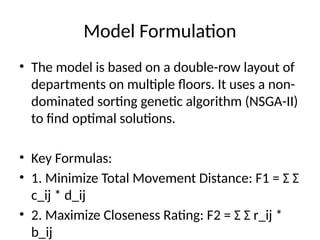
• The model is based on a double-row layout of
departments on multiple floors. It uses a non-
dominated sorting genetic algorithm (NSGA-II)
to find optimal solutions.
• Key Formulas:
• 1. Minimize Total Movement Distance: F1 = Σ Σ
c_ij * d_ij
• 2. Maximize Closeness Rating: F2 = Σ Σ r_ij *
b_ij
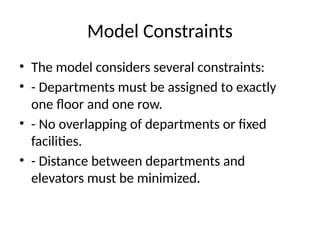
Model Constraints
• The model considers several constraints:
• - Departments must be assigned to exactly
one floor and one row.
• - No overlapping of departments or fixed
facilities.
• - Distance between departments and
elevators must be minimized.
Optimization Approach
• The NSGA-II algorithm is used with an
adaptive local search to find Pareto-optimal
solutions. The genetic algorithm ensures a
good spread of solutions while local search
fine-tunes them.
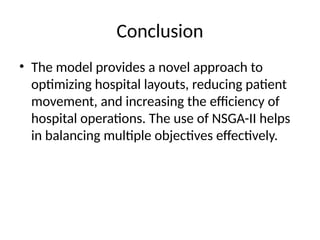
Conclusion
• The model provides a novel approach to
optimizing hospital layouts, reducing patient
movement, and increasing the efficiency of
hospital operations. The use of NSGA-II helps
in balancing multiple objectives effectively.
Hospital layout problema de optimización

  • 1.
    Hospital Facility Layout Optimization Multi-FloorDouble-Row Model with NSGA-II Algorithm
  • 2.
    Problem Context • Withgrowing healthcare demands, hospitals need efficient layouts to improve patient experience and staff efficiency. Older layouts are often based on outdated regulations, resulting in inefficiencies.
  • 3.
    Applications • The modelis applicable to multi-floor hospitals, focusing on minimizing patient movement and improving operational efficiency by optimizing department placement.
  • 4.
    Objective of theModel • The objectives are: • 1. Minimize the total movement distance for patients. • 2. Maximize the closeness rating between departments to improve non-logistical aspects like safety and cleanliness.
  • 5.
    Model Formulation • Themodel is based on a double-row layout of departments on multiple floors. It uses a non- dominated sorting genetic algorithm (NSGA-II) to find optimal solutions. • Key Formulas: • 1. Minimize Total Movement Distance: F1 = Σ Σ c_ij * d_ij • 2. Maximize Closeness Rating: F2 = Σ Σ r_ij * b_ij
  • 6.
    Model Constraints • Themodel considers several constraints: • - Departments must be assigned to exactly one floor and one row. • - No overlapping of departments or fixed facilities. • - Distance between departments and elevators must be minimized.
  • 7.
    Optimization Approach • TheNSGA-II algorithm is used with an adaptive local search to find Pareto-optimal solutions. The genetic algorithm ensures a good spread of solutions while local search fine-tunes them.
  • 8.
    Conclusion • The modelprovides a novel approach to optimizing hospital layouts, reducing patient movement, and increasing the efficiency of hospital operations. The use of NSGA-II helps in balancing multiple objectives effectively.