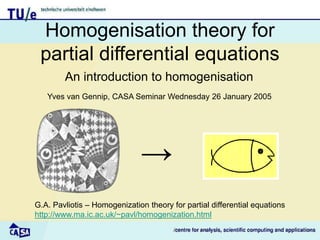
Homogenisation theory for
partial differential equations
G.A. Pavliotis – Homogenization theory for partial differential equations
http://www.ma.ic.ac.uk/~pavl/homogenization.html
→
Yves van Gennip, CASA Seminar Wednesday 26 January 2005
An introduction to homogenisation
• What is homogenisation?
• Homogenisation applied to steady state heat
conduction
• One dimensional case
• Some properties of the homogenised coefficients
Overview of my talk
What is homogenisation?
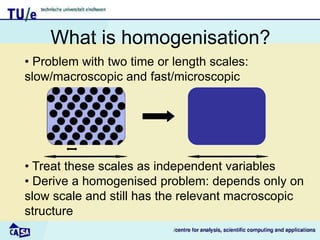
• Problem with two time or length scales:
slow/macroscopic and fast/microscopic
• Treat these scales as independent variables
• Derive a homogenised problem: depends only on
slow scale and still has the relevant macroscopic
structure
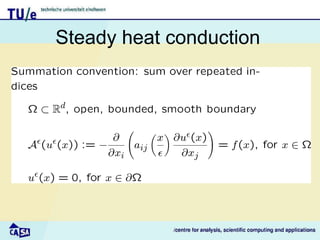
Steady heat conduction
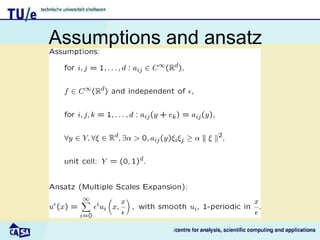
Assumptions and ansatz
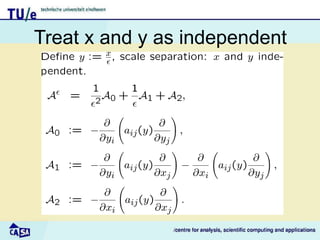
Treat x and y as independent
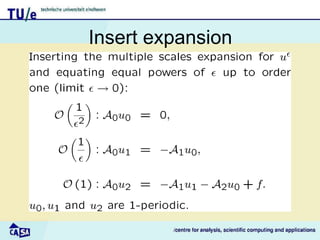
Insert expansion
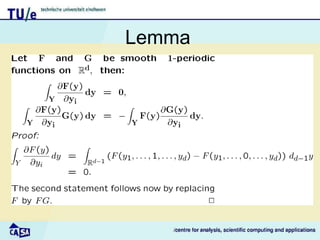
Lemma
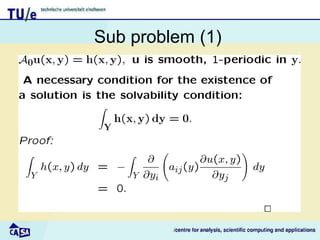
Sub problem (1)
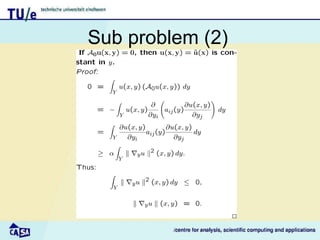
Sub problem (2)
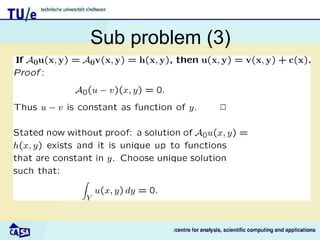
Sub problem (3)
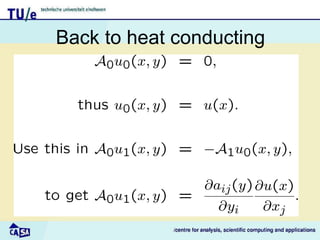
Back to heat conducting
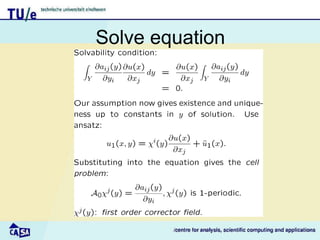
Solve equation
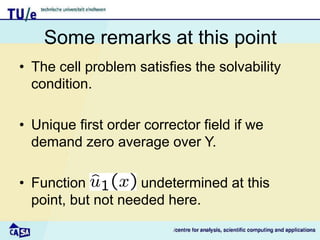
Some remarks at this point
• The cell problem satisfies the solvability
condition.
• Unique first order corrector field if we
demand zero average over Y.
• Function undetermined at this
point, but not needed here.
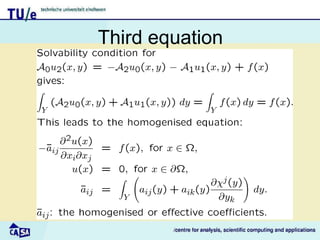
Third equation
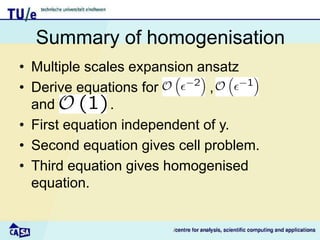
Summary of homogenisation
• Multiple scales expansion ansatz
• Derive equations for ,
and .
• First equation independent of y.
• Second equation gives cell problem.
• Third equation gives homogenised
equation.
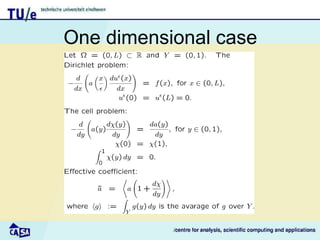
One dimensional case
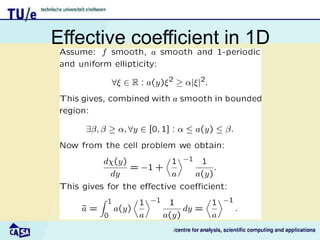
Effective coefficient in 1D
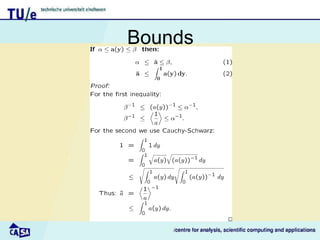
Bounds
Recap
• Homogenised problem for heat
conduction.
• The effective coefficients in the one
dimensional case.
• Now: more general properties of the
coefficients.
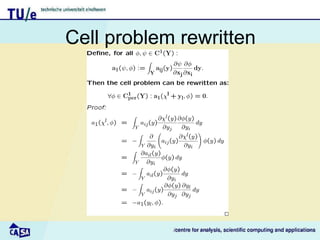
Cell problem rewritten
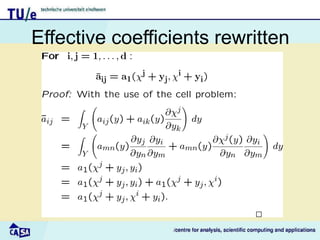
Effective coefficients rewritten
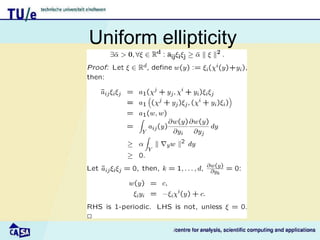
Uniform ellipticity
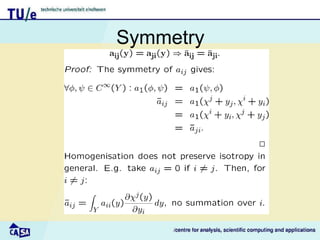
Symmetry
Recap
• Variational formulation for cell problem and
effective coefficients rewritten.
• Homogenisation preserves positive
definiteness and symmetry.
• It does not preserve isotropy.
Conclusions
• Homogenisation: look at macro scale
structure.
• Get cell problem, homogenised equation
and effective coefficients.
• In one dimension we calculated the
coefficient.
• Homogenisation preserves some
properties, not all.

Homogenisation.ppt