HOME OWNERSHIP NOW
• Everything  you wanted to
 know about owning a home
 on Kauai... and then some
WHAT WE’LL TELL YOU
               ABOUT:
                                     • Insuring   your mortgage
•   Current Kauai housing market
                                     • The   sales and escrow
•   What are distressed properties
                                         process
• Budgeting   and finance             • Put  the kids on the
• Pre-approval                           deed?

                                     • Trusts   and life estates
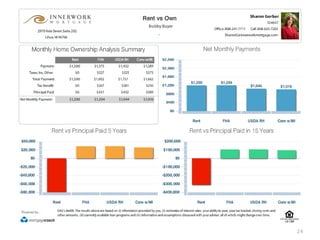
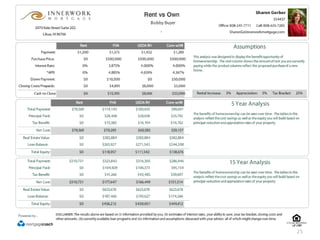
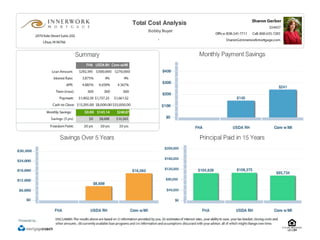
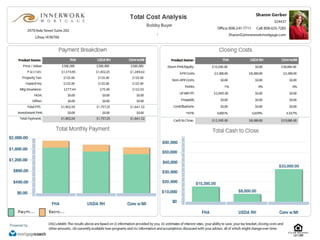
• Rent   vs. Buy
                                     •   Q&A
OUR SPONSORS AND
              PRESENTERS


• Sharon   Gerber

• J. Michael
                                 Seniors Law
               Ratcliffe
                                   Program
• Ron   Margolis, R, CDPE, ABR
OUR SPONSORS AND
              PRESENTERS


• Sharon   Gerber

• J. Michael
                                 Seniors Law
               Ratcliffe
                                   Program
• Ron   Margolis, R, CDPE, ABR
OUR SPONSORS AND
              PRESENTERS


• Sharon   Gerber

• J. Michael
                                 Seniors Law
               Ratcliffe
                                   Program
• Ron   Margolis, R, CDPE, ABR
OUR SPONSORS AND
              PRESENTERS


• Sharon   Gerber

• J. Michael
                                 Seniors Law
               Ratcliffe
                                   Program
• Ron   Margolis, R, CDPE, ABR
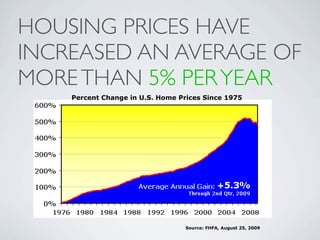
HOUSING PRICES HAVE
INCREASED AN AVERAGE OF
MORE THAN 5% PER YEAR
    Percent Change in U.S. Home Prices Since 1975


                                  Source: FHFA, August 25, 2009
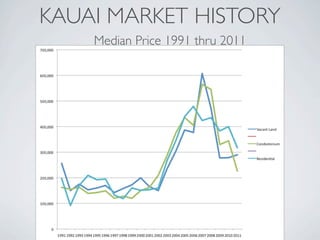
KAUAI MARKET HISTORY
    Median Price 1991 thru 2011
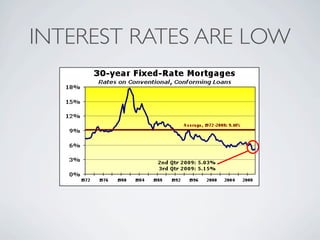
INTEREST RATES ARE LOW
THE HOMEBUYING PROCESS

 • 1. Put   your team together - lender, realtor
THE HOMEBUYING PROCESS

 • 1. Put   your team together - lender, realtor

 • 2. Financing, financing
                        , financing - get pre-approval and
  learn what you qualify for.
THE HOMEBUYING PROCESS

 • 1. Put   your team together - lender, realtor

 • 2. Financing, financing
                        , financing - get pre-approval and
  learn what you qualify for.

 • 3. Shop   to purchase your property
THE HOMEBUYING PROCESS

 • 1. Put   your team together - lender, realtor

 • 2. Financing, financing
                        , financing - get pre-approval and
  learn what you qualify for.

 • 3. Shop   to purchase your property

 • 4. Submit   your best offer on the property
THE HOMEBUYING PROCESS
• 5.   Negotiate to a “meeting of the minds”
THE HOMEBUYING PROCESS
• 5.   Negotiate to a “meeting of the minds”

• 6. OpenEscrow - the process of your real estate
 purchase with a neutral third party that looks out for
 everyone’s interests.
THE HOMEBUYING PROCESS
• 5.   Negotiate to a “meeting of the minds”

• 6. OpenEscrow - the process of your real estate
 purchase with a neutral third party that looks out for
 everyone’s interests.

• 7. Go   through the contract contingencies
THE HOMEBUYING PROCESS
• 5.   Negotiate to a “meeting of the minds”

• 6. OpenEscrow - the process of your real estate
 purchase with a neutral third party that looks out for
 everyone’s interests.

• 7. Go   through the contract contingencies

  • Appraisal
THE HOMEBUYING PROCESS
• 5.   Negotiate to a “meeting of the minds”

• 6. OpenEscrow - the process of your real estate
 purchase with a neutral third party that looks out for
 everyone’s interests.

• 7. Go   through the contract contingencies

  • Appraisal

  • Inspection
THE HOMEBUYING PROCESS
• 5.   Negotiate to a “meeting of the minds”

• 6. OpenEscrow - the process of your real estate
 purchase with a neutral third party that looks out for
 everyone’s interests.

• 7. Go   through the contract contingencies

  • Appraisal

  • Inspection

  • Loan
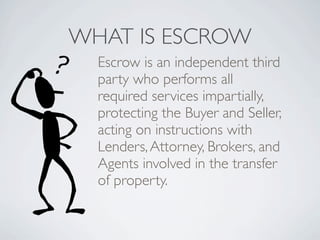
WHAT IS ESCROW
  Escrow is an independent third
  party who performs all
  required services impartially,
  protecting the Buyer and Seller,
  acting on instructions with
  Lenders, Attorney, Brokers, and
  Agents involved in the transfer
  of property.
WHY DO I NEED ESCROW
• EscrowOfficer reviews contract for special conditions
 and notifies parties of those conditions.

• Escrow Officer reminds parties of due dates for terms
 set forth in Sale Contract

• All
    monies are collected and held in the Escrow
 account assuring that bills for services are paid

• EscrowOfficer will assess to each party, payments for
 the property taxes, association dues, and special
 assessments

• Escrow  Officer will pay Buyer’s creditors upon
 instructions from Lender
THE HOMEBUYING PROCESS
• 8.   Meet all the loan conditions
THE HOMEBUYING PROCESS
• 8.   Meet all the loan conditions

• 9.   Final walkthrough of the home
THE HOMEBUYING PROCESS
• 8.   Meet all the loan conditions

• 9.   Final walkthrough of the home

• 10. Close   and recording of the property
THE HOMEBUYING PROCESS
• 8.   Meet all the loan conditions

• 9.   Final walkthrough of the home

• 10. Close   and recording of the property

• 11. HAVE      A HOUSEWARMING PARTY
IS IT A “BUYER’S” MARKET?
             INDUSTRY STATISTICS

 Mortgage(Delinquencies(1(National(Numbers!


   Quarter(3(1(2011!
   !
   All(Mortgages:(

                4.43%(in(Foreclosure((((((((8.2%(in(Default((30+(days(late)(                12.63%(Total(

   Prime(Mortgages:(

                2.56%(in(Foreclosure((((((((4.49%(in(Default((30+(days(late)(               7.05(%(Total(

   Subprime(Mortgages:(

                10.82(%(in(Foreclosure((((((21.78%(in(Default((30+(days(late)(              32.6%(Total(

   FHA(Mortgages:(

                3.27%(in(Foreclosure(((((((12.66%(in(Default((30+(days(late)(               15.93%(in(Default(

   VA(Mortgages:(

                2.25%(in(Foreclosure((((((((6.92%(in(Default((30+(days(late)(               9.17%(Total(in(Default(

                                                                                                  Mortgage(Bankers(Association(
                                                                                                    National(Delinquency(Survey(
                                                                                                    http://mortgagebankers.org(
   !                                                                    Based(on(44,000,000(mortgages(C(Non(Seasonally(Adjusted(
   All(Mortgages(–(2011(            (                                                                                           (
   (                                (                                                                                           (
                                                                                                                                (
   Total(Distressed(Mortgages:(     6,298,000*(                                   *Based(on(default(percentage(for(all(mortgages(
   Total(Predicted(Sales:(          4,970,000**(                                              **NAR,(Lawrence(Yun((September)(
OUR KAUAI
  HOUSING MARKET
3 TYPES OF PROPERTIES
OUR KAUAI
    HOUSING MARKET
  3 TYPES OF PROPERTIES

•Opportunities
OUR KAUAI
    HOUSING MARKET
  3 TYPES OF PROPERTIES

•Opportunities

•DEALS
OUR KAUAI
    HOUSING MARKET
  3 TYPES OF PROPERTIES

•Opportunities

•DEALS

•Everything   Else
DEALS =
    DISTRESSED PROPERTIES


• BANK-OWNED      (REO)

• SHORT   SALES

• PRE-FORECLOSURES
REO (BANK-OWNED)- DEAL

• Musthave pre-approval, sometimes
 with banks lender

• Must   show proof of funds

• Usually AS-IS

• No   Seller’s Disclosure
SHORT SALES
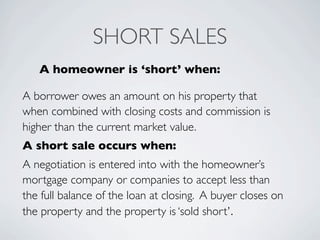
   A homeowner is ‘short’ when:

A borrower owes an amount on his property that
when combined with closing costs and commission is
higher than the current market value.
A short sale occurs when:
A negotiation is entered into with the homeowner’s
mortgage company or companies to accept less than
the full balance of the loan at closing. A buyer closes on
the property and the property is ‘sold short’.
SHORT SALES
• Require   patience

• Submitting   multiple offers

• Know   any additional costs

 • Termites    - Staking

 • Repairs

 • Delinquent    HOA fees - Tax liens

• OTHERSTAKEHOLDERS CAN CHANGE
 THE DEAL!!
FINANCING AND LOANS

Sharon Gerber - Branch Manager/Loan Officer
Home Ownership NOW
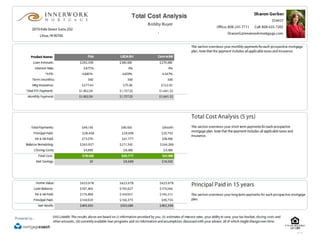
             Loan Pre-approval Process
                 Purchase Options
               Home Equity Investing


03/12/12
Pre-Approval Process
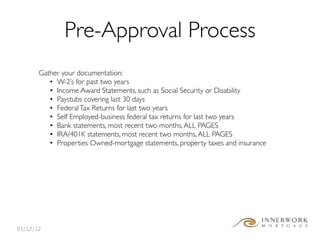
       Gather your documentation:
          • W-2’s for past two years
          • Income Award Statements, such as Social Security or Disability
          • Paystubs covering last 30 days
          • Federal Tax Returns for last two years
          • Self Employed-business federal tax returns for last two years
          • Bank statements, most recent two months, ALL PAGES
          • IRA/401K statements, most recent two months, ALL PAGES
          • Properties Owned-mortgage statements, property taxes and insurance


03/12/12
Pre-Approval Process
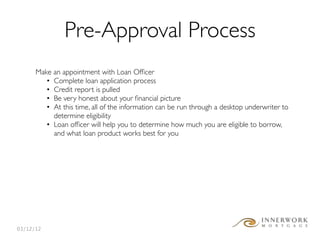
      Make an appointment with Loan Officer
         • Complete loan application process
         • Credit report is pulled
         • Be very honest about your financial picture
         • At this time, all of the information can be run through a desktop underwriter to
           determine eligibility
         • Loan officer will help you to determine how much you are eligible to borrow,


           and what loan product works best for you


03/12/12
Purchase Options
      There are many purchase options available. We call the products:
      • Government loans include:
           FHA
           USDA
           VA (VA jumbo)
      • Conventional Loans-20% down and loan amounts up to $625,500
      • Conventional Loans with Mortgage Insurance
      • Adjustable Rate Mortgages-conventional and jumbo
      • High Balance Conforming
      • Jumbo Loans


03/12/12
Types of Loans
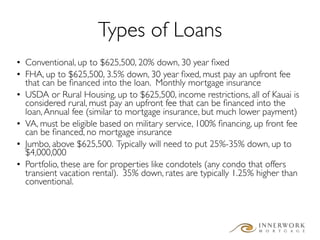
• Conventional, up to $625,500, 20% down, 30 year fixed
• FHA, up to $625,500, 3.5% down, 30 year fixed, must pay an upfront fee
  that can be financed into the loan. Monthly mortgage insurance
• USDA or Rural Housing, up to $625,500, income restrictions, all of Kauai is
  considered rural, must pay an upfront fee that can be financed into the
  loan, Annual fee (similar to mortgage insurance, but much lower payment)
• VA, must be eligible based on military service, 100% financing, up front fee
  can be financed, no mortgage insurance
• Jumbo, above $625,500. Typically will need to put 25%-35% down, up to
  $4,000,000
• Portfolio, these are for properties like condotels (any condo that offers
  transient vacation rental). 35% down, rates are typically 1.25% higher than
  conventional.
24
25
26
27
28
Purchase Options
   What Criteria will we be looking for?

   • Credit score: 740 and above is excellent, 680-720 good, etc. Lowest credit score that I can
     lend on is 620

   • Debt-to-Income Ratio: 45% or below

   • Occupancy: Primary Residence, 2nd home, Investment

   • Property: Single Family Residence, Condo, Condotel, Multiple unit

   • Cash: savings, gift money, retirement savings, one time bonus


03/12/12
Making Home Affordable
• Fannie Mae and Freddie Mac have been offering these for
  several years.
• Borrower can be “underwater” on home, but still refinance
  to a lower rate
• New loan-to-value guidelines available Now, which should
  help for those that were not able to refinance in the past
• Cannot get cash out with this product
• Still only applicable if address is a match in
  – www.fanniemae.com/loanlookup/
  – www.freddiemac.com/mymortgage
How long after….
• How long after a borrower has completed a short
  sale, foreclosure, deed in lieu of, bankruptcy, Chapter
  13, can they apply for a mortgage.

• Many suffered during the Great Recession,
  experiencing a foreclosure, bankruptcy or short sale.
  This does not mean you can never own a property.

• Please see me for a handout based on loan type
Home Equity Investing
• If you have equity in a property, it is still possible
  to do cash out refinances

• I can do loans in Hawaii and California

• Make sure this is a “make sense” investment. With
  interest rates so low it may make sense to borrow
  against a property, but do your homework first!
PUT THE KIDS ON THE DEED?

• J. Michael   Ratcliffe, Esq. -

  • Seniors Law Program - non-
    profit to assist seniors

  • What  exactly do you do with
    your home as you get older to
    make sure your family benefits
    from your hard work to
    acquire the home
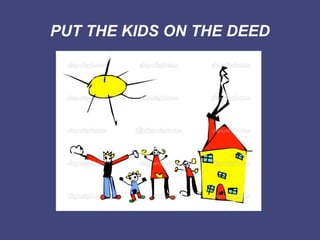
PUT THE KIDS ON THE DEED
The Kids get the House in the
    Trust...So they are already on the
               deed..Right?
➲ WRONG! The trust avoids probate and gets
  the house to the kids when you die...But while
  you are alive ...Your trust is the owner of the
  house.
➲ To put the Kids on the house by trust can
  mean big trouble if you are trying to qualify for
  medicaid long term care
Long Term Care coverage

➲ Medicare does not cover LTC beyond 100
  days
➲ Medical Insurance does not cover LTC
➲ LTC insurance often does not really cover LTC
➲ Medicaid does cover LTC but you have to be
  “Poor”
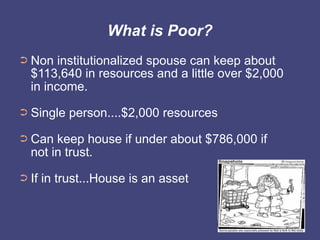
What is Poor?
➲   Non institutionalized spouse can keep about
    $113,640 in resources and a little over $2,000
    in income.
➲   Single person....$2,000 resources
➲   Can keep house if under about $786,000 if
    not in trust.
➲   If in trust...House is an asset
Not Only does the trust not put the
kids on the deed...It might lose the
  house for them when you die.
➲ To qualify must deed back to husband and
  wife
➲ If out of trust has to fall back on will and that
  means probate with all the humbug that is
➲ Once out of trust will qualify for LTC but the
  state will put a lien on the house for LTC costs
➲ Could be up to $13,000 a month...You do the
  math
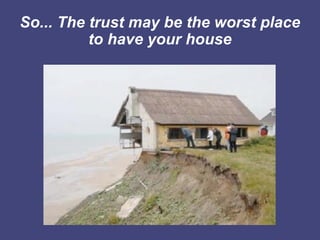
So... The trust may be the worst place
          to have your house
But sometimes it may be the best
       choice you have

➲ If you are planning on selling and moving
  when your spouse dies
➲ If you think you might have to take a mortgage
  or a reverse mortgage
➲ If think you might change your mind about
  who you want to give it to
➲ If you have a disabled child or a kid who
  wants to get a first time homeowner loan
➲ Or many other specific situations
What are the other choices that really
     put the kids on the deed?

➲   Outright deed
➲   Joint Tenancy
➲   Tenancy in Common
➲   Life estate Remainder
➲   Outright deed with Leaseback
Any of these choices could be best for
     you...Or could be a horrible
               mistake!


 Let us look at choices one by one
Outright Gift Deed
➲   Creates a current transfer of all title to a third
    party
➲   Has Property and Gift tax consequences that
    have to be dealt with
➲   Does allow party receiving gift to deal with the
    property immediately ....Mortgage, building
    permits, etc
➲   Reduces the taxable estate
➲   Makes it final...No going back and no pressure
Biggest Problem.....It ain't yours

➲   You have absolutely no rights to the property...
    Even if it was yours and you gave it to your kid!
➲   They can Kick You Out!
➲   They can Charge you Rent!
➲   They can move in their awful, foul mouthed boy/
    girl friend and you can do nothing!
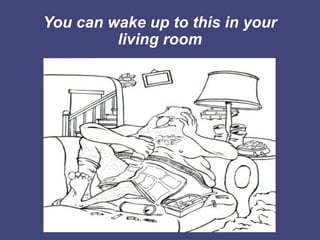
You can wake up to this in your
         living room
Or this in your bathroom


.             .
I am of the Billy Holiday school of law


God Bless the Child that has his own!!
So what if you don't give it all away
 and make the children “joint” on the
               deed?


You can give the kids a percentage of the property
  and then you and the kids would be co-owners of
  the property.

You can do this several ways...Be careful of the
  word “joint”...You can be co-owners and not joint
  owners. Joint tenancy has a very special
  meaning. Lets us look at tenancy in common first.
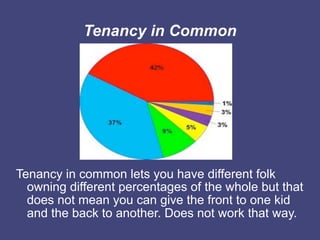
Tenancy in Common


Tenancy in common lets you have different folk
  owning different percentages of the whole but that
  does not mean you can give the front to one kid
  and the back to another. Does not work that way.
Tenancy in Common does not avoid
probate with your share when you die

➲   So, lets say you give one kid 25%, one kid 25%
    and you keep 50% as tenants in common.
➲   When you die, your 50% goes to whoever you left
    it to in your will. If you have no will it follows the
    will the State has already written for you called
    Intestate Succession. In either case you have a
    probate
➲   You also have gift and long term Capital Gain Tax
    problems.
But that is not the worst...The worst is
     you are in bed with your kids
But
➲   The one on the end is getting a divorce
➲   The one on the other end is being sued
➲   The one next to the end is going bankrupt
➲   The one next to the other end has a sick kid and
    wants to sell
➲   The one in the middle just wants his money and
    never liked you much anyway.
➲   The one next to the middle is really cool but his
    wife runs the show and SHE wants the money
All of these situations could make you
           80+ and homeless


Again...God Bless the Child that has his own!
Ok ...How about making the kids
      “Joint Tenants” on the deed?

➲   Well...You do avoid Probate because Joint
    Tenancy has the “right of Survivor-ship”..
➲   You can not give children and you different
    percentages of ownership. All joint tenants must
    have the same percentage of ownership
But joint tenancy still puts you in bed
             with your kids
➲   All the same exposure from Divorce, Creditors of
    your kids, Wives and Husbands of your kids, and
    of course..the kids themselves, as you do with
    tenants in common.
➲   Same gift tax and Long Term Capital Gain
    problems as with tenants in common deed.
➲   Any joint owner can force a sale by filing a
    Partition action.
➲   You can again lose your home
So is there any way to put the kids on
 the deed without having your pants
          completely down?
A couple but they both have
                drawbacks
➲   Life estate/Remainder
➲   Outright gift/Lease back

The methods are conceptually very different but
  they result in the senior having quite similar
  protections to keep pants up as well as saving
  the house from medicaid liens.
➲   Let us examine them in order

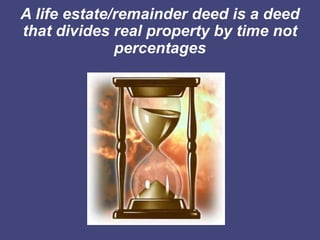
A life estate/remainder deed is a deed
that divides real property by time not
              percentages
The Life estate holder has complete
    control of the property during their
                    lives

➲   The Remainder holder has a vested interest in
    the real property that will become a fee simple
    upon the death of the life estate holder.
➲   Neither interest has contact with the
    other....whatever happens legally to the
    remainder interest does not effect the life estate
    holder and vice/versa
So The life estate holder is not
                 effected by:

➲   Divorce of the remainder holder
➲   Bankruptcy of the remainder holder
➲   Remainder holder being sued
➲   Greedy remainder who wants his/her money
Most important of all...YOU are still the
        ruler of YOUR house
The Remainder gets two big
            advantages as well
➲    First and probably most important, if you go to
    long term care and a lien is put on your home for
    the costs of your long term care (6 to 13 grand a
    month) it does not touch the remainder interest
➲   The remainder still retains a stepped up value for
    long term capital gain tax.
So you basically save the house for
  the kids without losing control
But there are drawbacks
So the Bad Stuff is:
➲   You can't change your mind (any of these deeds
    are forever)
➲   You are disqualified for Medicaid coverage of LTC
    for a period of 5 years from the deed.
➲   You can not mortgage or reverse mortgage the
    property
➲   You can not sell (without their consent and you
    don't get all the money)
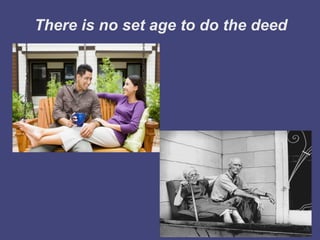
There is no set age to do the deed
It is a place in life, not an age
➲   When you are sitting on the porch with your loved
    one and say:

➲   You know...We ain't ever going to move
➲   We are never going to change our mind on who
    we want the house to go to
➲   We are never going to mortgage the house
➲   We are never going to get a reverse mortgage
➲   And we have at least 5 years before we need
    long term care
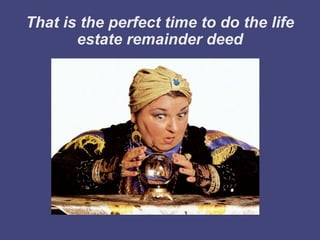
That is the perfect time to do the life
       estate remainder deed
But if you do not know one of these
things for sure then whatever you do
   is a gamble and could be smart
      or ...Could be ...A mistake
So is the outright gift with a lease
              back any better?
➲   It operates pretty much like the life estate
    remainder deed with some differences
➲   The remainder holder has a better ownership of
    the property for the purpose of getting loans and
    building etc
➲   The remainder holder is better able to show it as
    an asset.
➲   Property tax stuff should stay the same as long
    as you maintain the leasehold
But
➲   You are no longer an owner you are a lessor. As
    such you have the obligations of a renter and if
    you fail to perform your obligations you can be
    evicted.
➲   If you forget to renew the lease...You can end up
    with a property tax problem for the owner
    because he or she may have to pay taxes on his
    rate rather than yours....
So what have we learned about
       putting the kids on the deed.


➲   You need to be sure the attorney doing the deed
    is representing you and not your kids!
These are tough choices...And
    whatever you do you are rolling the
                   dice
➲   I am not saying the kids are out to get you..
➲   But there are many, many things to
    consider...And many things to balance...And you
    could end up without a roof if you guess wrong
    and you can lose the house for your kids if you
    guess the other way wrong.
Bottom line...Don't sign anything
unless you have been advised by your
 attorney..And when you have made
 your choice.....Relax and don't look
                 back
WHAT WE TOLD YOU:
•   Current Kauai housing market     • The   sales and escrow
                                         process
•   What are distressed properties
                                     • Put  the kids on the
• Budgeting, reduce   debt               deed?
• Pre-approval                       • Trusts   and life estates
• Rent   vs. Buy                     •   Q&A
QUESTIONS & ANSWERS
MAHALO FOR YOUR KOKUA

Home Ownership Now

  • 1.
    HOME OWNERSHIP NOW •Everything you wanted to know about owning a home on Kauai... and then some
  • 2.
    WHAT WE’LL TELLYOU ABOUT: • Insuring your mortgage • Current Kauai housing market • The sales and escrow • What are distressed properties process • Budgeting and finance • Put the kids on the • Pre-approval deed? • Trusts and life estates • Rent vs. Buy • Q&A
  • 3.
    OUR SPONSORS AND PRESENTERS • Sharon Gerber • J. Michael Seniors Law Ratcliffe Program • Ron Margolis, R, CDPE, ABR
  • 4.
    OUR SPONSORS AND PRESENTERS • Sharon Gerber • J. Michael Seniors Law Ratcliffe Program • Ron Margolis, R, CDPE, ABR
  • 5.
    OUR SPONSORS AND PRESENTERS • Sharon Gerber • J. Michael Seniors Law Ratcliffe Program • Ron Margolis, R, CDPE, ABR
  • 6.
    OUR SPONSORS AND PRESENTERS • Sharon Gerber • J. Michael Seniors Law Ratcliffe Program • Ron Margolis, R, CDPE, ABR
  • 7.
    HOUSING PRICES HAVE INCREASEDAN AVERAGE OF MORE THAN 5% PER YEAR Percent Change in U.S. Home Prices Since 1975 Source: FHFA, August 25, 2009
  • 8.
    KAUAI MARKET HISTORY Median Price 1991 thru 2011
  • 9.
  • 10.
  • 11.
    THE HOMEBUYING PROCESS • 1. Put your team together - lender, realtor
  • 12.
    THE HOMEBUYING PROCESS • 1. Put your team together - lender, realtor • 2. Financing, financing , financing - get pre-approval and learn what you qualify for.
  • 13.
    THE HOMEBUYING PROCESS • 1. Put your team together - lender, realtor • 2. Financing, financing , financing - get pre-approval and learn what you qualify for. • 3. Shop to purchase your property
  • 14.
    THE HOMEBUYING PROCESS • 1. Put your team together - lender, realtor • 2. Financing, financing , financing - get pre-approval and learn what you qualify for. • 3. Shop to purchase your property • 4. Submit your best offer on the property
  • 15.
  • 16.
    THE HOMEBUYING PROCESS •5. Negotiate to a “meeting of the minds”
  • 17.
    THE HOMEBUYING PROCESS •5. Negotiate to a “meeting of the minds” • 6. OpenEscrow - the process of your real estate purchase with a neutral third party that looks out for everyone’s interests.
  • 18.
    THE HOMEBUYING PROCESS •5. Negotiate to a “meeting of the minds” • 6. OpenEscrow - the process of your real estate purchase with a neutral third party that looks out for everyone’s interests. • 7. Go through the contract contingencies
  • 19.
    THE HOMEBUYING PROCESS •5. Negotiate to a “meeting of the minds” • 6. OpenEscrow - the process of your real estate purchase with a neutral third party that looks out for everyone’s interests. • 7. Go through the contract contingencies • Appraisal
  • 20.
    THE HOMEBUYING PROCESS •5. Negotiate to a “meeting of the minds” • 6. OpenEscrow - the process of your real estate purchase with a neutral third party that looks out for everyone’s interests. • 7. Go through the contract contingencies • Appraisal • Inspection
  • 21.
    THE HOMEBUYING PROCESS •5. Negotiate to a “meeting of the minds” • 6. OpenEscrow - the process of your real estate purchase with a neutral third party that looks out for everyone’s interests. • 7. Go through the contract contingencies • Appraisal • Inspection • Loan
  • 22.
    WHAT IS ESCROW Escrow is an independent third party who performs all required services impartially, protecting the Buyer and Seller, acting on instructions with Lenders, Attorney, Brokers, and Agents involved in the transfer of property.
  • 23.
    WHY DO INEED ESCROW • EscrowOfficer reviews contract for special conditions and notifies parties of those conditions. • Escrow Officer reminds parties of due dates for terms set forth in Sale Contract • All monies are collected and held in the Escrow account assuring that bills for services are paid • EscrowOfficer will assess to each party, payments for the property taxes, association dues, and special assessments • Escrow Officer will pay Buyer’s creditors upon instructions from Lender
  • 24.
  • 25.
    THE HOMEBUYING PROCESS •8. Meet all the loan conditions
  • 26.
    THE HOMEBUYING PROCESS •8. Meet all the loan conditions • 9. Final walkthrough of the home
  • 27.
    THE HOMEBUYING PROCESS •8. Meet all the loan conditions • 9. Final walkthrough of the home • 10. Close and recording of the property
  • 28.
    THE HOMEBUYING PROCESS •8. Meet all the loan conditions • 9. Final walkthrough of the home • 10. Close and recording of the property • 11. HAVE A HOUSEWARMING PARTY
  • 29.
    IS IT A“BUYER’S” MARKET? INDUSTRY STATISTICS Mortgage(Delinquencies(1(National(Numbers! Quarter(3(1(2011! ! All(Mortgages:( 4.43%(in(Foreclosure((((((((8.2%(in(Default((30+(days(late)( 12.63%(Total( Prime(Mortgages:( 2.56%(in(Foreclosure((((((((4.49%(in(Default((30+(days(late)( 7.05(%(Total( Subprime(Mortgages:( 10.82(%(in(Foreclosure((((((21.78%(in(Default((30+(days(late)( 32.6%(Total( FHA(Mortgages:( 3.27%(in(Foreclosure(((((((12.66%(in(Default((30+(days(late)( 15.93%(in(Default( VA(Mortgages:( 2.25%(in(Foreclosure((((((((6.92%(in(Default((30+(days(late)( 9.17%(Total(in(Default( Mortgage(Bankers(Association( National(Delinquency(Survey( http://mortgagebankers.org( ! Based(on(44,000,000(mortgages(C(Non(Seasonally(Adjusted( All(Mortgages(–(2011( ( ( ( ( ( ( Total(Distressed(Mortgages:( 6,298,000*( *Based(on(default(percentage(for(all(mortgages( Total(Predicted(Sales:( 4,970,000**( **NAR,(Lawrence(Yun((September)(
  • 30.
    OUR KAUAI HOUSING MARKET 3 TYPES OF PROPERTIES
  • 31.
    OUR KAUAI HOUSING MARKET 3 TYPES OF PROPERTIES •Opportunities
  • 32.
    OUR KAUAI HOUSING MARKET 3 TYPES OF PROPERTIES •Opportunities •DEALS
  • 33.
    OUR KAUAI HOUSING MARKET 3 TYPES OF PROPERTIES •Opportunities •DEALS •Everything Else
  • 34.
    DEALS = DISTRESSED PROPERTIES • BANK-OWNED (REO) • SHORT SALES • PRE-FORECLOSURES
  • 35.
    REO (BANK-OWNED)- DEAL •Musthave pre-approval, sometimes with banks lender • Must show proof of funds • Usually AS-IS • No Seller’s Disclosure
  • 36.
    SHORT SALES A homeowner is ‘short’ when: A borrower owes an amount on his property that when combined with closing costs and commission is higher than the current market value. A short sale occurs when: A negotiation is entered into with the homeowner’s mortgage company or companies to accept less than the full balance of the loan at closing. A buyer closes on the property and the property is ‘sold short’.
  • 37.
    SHORT SALES • Require patience • Submitting multiple offers • Know any additional costs • Termites - Staking • Repairs • Delinquent HOA fees - Tax liens • OTHERSTAKEHOLDERS CAN CHANGE THE DEAL!!
  • 38.
    FINANCING AND LOANS SharonGerber - Branch Manager/Loan Officer
  • 39.
    Home Ownership NOW Loan Pre-approval Process Purchase Options Home Equity Investing 03/12/12
  • 40.
    Pre-Approval Process Gather your documentation: • W-2’s for past two years • Income Award Statements, such as Social Security or Disability • Paystubs covering last 30 days • Federal Tax Returns for last two years • Self Employed-business federal tax returns for last two years • Bank statements, most recent two months, ALL PAGES • IRA/401K statements, most recent two months, ALL PAGES • Properties Owned-mortgage statements, property taxes and insurance 03/12/12
  • 41.
    Pre-Approval Process Make an appointment with Loan Officer • Complete loan application process • Credit report is pulled • Be very honest about your financial picture • At this time, all of the information can be run through a desktop underwriter to determine eligibility • Loan officer will help you to determine how much you are eligible to borrow, and what loan product works best for you 03/12/12
  • 42.
    Purchase Options There are many purchase options available. We call the products: • Government loans include:  FHA  USDA  VA (VA jumbo) • Conventional Loans-20% down and loan amounts up to $625,500 • Conventional Loans with Mortgage Insurance • Adjustable Rate Mortgages-conventional and jumbo • High Balance Conforming • Jumbo Loans 03/12/12
  • 43.
    Types of Loans •Conventional, up to $625,500, 20% down, 30 year fixed • FHA, up to $625,500, 3.5% down, 30 year fixed, must pay an upfront fee that can be financed into the loan. Monthly mortgage insurance • USDA or Rural Housing, up to $625,500, income restrictions, all of Kauai is considered rural, must pay an upfront fee that can be financed into the loan, Annual fee (similar to mortgage insurance, but much lower payment) • VA, must be eligible based on military service, 100% financing, up front fee can be financed, no mortgage insurance • Jumbo, above $625,500. Typically will need to put 25%-35% down, up to $4,000,000 • Portfolio, these are for properties like condotels (any condo that offers transient vacation rental). 35% down, rates are typically 1.25% higher than conventional.
  • 44.
  • 45.
  • 46.
  • 47.
  • 48.
  • 49.
    Purchase Options What Criteria will we be looking for? • Credit score: 740 and above is excellent, 680-720 good, etc. Lowest credit score that I can lend on is 620 • Debt-to-Income Ratio: 45% or below • Occupancy: Primary Residence, 2nd home, Investment • Property: Single Family Residence, Condo, Condotel, Multiple unit • Cash: savings, gift money, retirement savings, one time bonus 03/12/12
  • 50.
    Making Home Affordable •Fannie Mae and Freddie Mac have been offering these for several years. • Borrower can be “underwater” on home, but still refinance to a lower rate • New loan-to-value guidelines available Now, which should help for those that were not able to refinance in the past • Cannot get cash out with this product • Still only applicable if address is a match in – www.fanniemae.com/loanlookup/ – www.freddiemac.com/mymortgage
  • 51.
    How long after…. •How long after a borrower has completed a short sale, foreclosure, deed in lieu of, bankruptcy, Chapter 13, can they apply for a mortgage. • Many suffered during the Great Recession, experiencing a foreclosure, bankruptcy or short sale. This does not mean you can never own a property. • Please see me for a handout based on loan type
  • 52.
    Home Equity Investing •If you have equity in a property, it is still possible to do cash out refinances • I can do loans in Hawaii and California • Make sure this is a “make sense” investment. With interest rates so low it may make sense to borrow against a property, but do your homework first!
  • 53.
    PUT THE KIDSON THE DEED? • J. Michael Ratcliffe, Esq. - • Seniors Law Program - non- profit to assist seniors • What exactly do you do with your home as you get older to make sure your family benefits from your hard work to acquire the home
  • 54.
    PUT THE KIDSON THE DEED
  • 55.
    The Kids getthe House in the Trust...So they are already on the deed..Right? ➲ WRONG! The trust avoids probate and gets the house to the kids when you die...But while you are alive ...Your trust is the owner of the house. ➲ To put the Kids on the house by trust can mean big trouble if you are trying to qualify for medicaid long term care
  • 56.
    Long Term Carecoverage ➲ Medicare does not cover LTC beyond 100 days ➲ Medical Insurance does not cover LTC ➲ LTC insurance often does not really cover LTC ➲ Medicaid does cover LTC but you have to be “Poor”
  • 57.
    What is Poor? ➲ Non institutionalized spouse can keep about $113,640 in resources and a little over $2,000 in income. ➲ Single person....$2,000 resources ➲ Can keep house if under about $786,000 if not in trust. ➲ If in trust...House is an asset
  • 58.
    Not Only doesthe trust not put the kids on the deed...It might lose the house for them when you die. ➲ To qualify must deed back to husband and wife ➲ If out of trust has to fall back on will and that means probate with all the humbug that is ➲ Once out of trust will qualify for LTC but the state will put a lien on the house for LTC costs ➲ Could be up to $13,000 a month...You do the math
  • 59.
    So... The trustmay be the worst place to have your house
  • 60.
    But sometimes itmay be the best choice you have ➲ If you are planning on selling and moving when your spouse dies ➲ If you think you might have to take a mortgage or a reverse mortgage ➲ If think you might change your mind about who you want to give it to ➲ If you have a disabled child or a kid who wants to get a first time homeowner loan ➲ Or many other specific situations
  • 61.
    What are theother choices that really put the kids on the deed? ➲ Outright deed ➲ Joint Tenancy ➲ Tenancy in Common ➲ Life estate Remainder ➲ Outright deed with Leaseback
  • 62.
    Any of thesechoices could be best for you...Or could be a horrible mistake! Let us look at choices one by one
  • 63.
    Outright Gift Deed ➲ Creates a current transfer of all title to a third party ➲ Has Property and Gift tax consequences that have to be dealt with ➲ Does allow party receiving gift to deal with the property immediately ....Mortgage, building permits, etc ➲ Reduces the taxable estate ➲ Makes it final...No going back and no pressure
  • 64.
    Biggest Problem.....It ain'tyours ➲ You have absolutely no rights to the property... Even if it was yours and you gave it to your kid! ➲ They can Kick You Out! ➲ They can Charge you Rent! ➲ They can move in their awful, foul mouthed boy/ girl friend and you can do nothing!
  • 65.
    You can wakeup to this in your living room
  • 66.
    Or this inyour bathroom . .
  • 67.
    I am ofthe Billy Holiday school of law God Bless the Child that has his own!!
  • 68.
    So what ifyou don't give it all away and make the children “joint” on the deed? You can give the kids a percentage of the property and then you and the kids would be co-owners of the property. You can do this several ways...Be careful of the word “joint”...You can be co-owners and not joint owners. Joint tenancy has a very special meaning. Lets us look at tenancy in common first.
  • 69.
    Tenancy in Common Tenancyin common lets you have different folk owning different percentages of the whole but that does not mean you can give the front to one kid and the back to another. Does not work that way.
  • 70.
    Tenancy in Commondoes not avoid probate with your share when you die ➲ So, lets say you give one kid 25%, one kid 25% and you keep 50% as tenants in common. ➲ When you die, your 50% goes to whoever you left it to in your will. If you have no will it follows the will the State has already written for you called Intestate Succession. In either case you have a probate ➲ You also have gift and long term Capital Gain Tax problems.
  • 71.
    But that isnot the worst...The worst is you are in bed with your kids
  • 72.
    But ➲ The one on the end is getting a divorce ➲ The one on the other end is being sued ➲ The one next to the end is going bankrupt ➲ The one next to the other end has a sick kid and wants to sell ➲ The one in the middle just wants his money and never liked you much anyway. ➲ The one next to the middle is really cool but his wife runs the show and SHE wants the money
  • 73.
    All of thesesituations could make you 80+ and homeless Again...God Bless the Child that has his own!
  • 74.
    Ok ...How aboutmaking the kids “Joint Tenants” on the deed? ➲ Well...You do avoid Probate because Joint Tenancy has the “right of Survivor-ship”.. ➲ You can not give children and you different percentages of ownership. All joint tenants must have the same percentage of ownership
  • 75.
    But joint tenancystill puts you in bed with your kids ➲ All the same exposure from Divorce, Creditors of your kids, Wives and Husbands of your kids, and of course..the kids themselves, as you do with tenants in common. ➲ Same gift tax and Long Term Capital Gain problems as with tenants in common deed. ➲ Any joint owner can force a sale by filing a Partition action. ➲ You can again lose your home
  • 76.
    So is thereany way to put the kids on the deed without having your pants completely down?
  • 77.
    A couple butthey both have drawbacks ➲ Life estate/Remainder ➲ Outright gift/Lease back The methods are conceptually very different but they result in the senior having quite similar protections to keep pants up as well as saving the house from medicaid liens. ➲ Let us examine them in order
  • 78.
    A life estate/remainderdeed is a deed that divides real property by time not percentages
  • 79.
    The Life estateholder has complete control of the property during their lives ➲ The Remainder holder has a vested interest in the real property that will become a fee simple upon the death of the life estate holder. ➲ Neither interest has contact with the other....whatever happens legally to the remainder interest does not effect the life estate holder and vice/versa
  • 80.
    So The lifeestate holder is not effected by: ➲ Divorce of the remainder holder ➲ Bankruptcy of the remainder holder ➲ Remainder holder being sued ➲ Greedy remainder who wants his/her money
  • 81.
    Most important ofall...YOU are still the ruler of YOUR house
  • 82.
    The Remainder getstwo big advantages as well ➲ First and probably most important, if you go to long term care and a lien is put on your home for the costs of your long term care (6 to 13 grand a month) it does not touch the remainder interest ➲ The remainder still retains a stepped up value for long term capital gain tax.
  • 83.
    So you basicallysave the house for the kids without losing control
  • 84.
    But there aredrawbacks
  • 85.
    So the BadStuff is: ➲ You can't change your mind (any of these deeds are forever) ➲ You are disqualified for Medicaid coverage of LTC for a period of 5 years from the deed. ➲ You can not mortgage or reverse mortgage the property ➲ You can not sell (without their consent and you don't get all the money)
  • 86.
    There is noset age to do the deed
  • 87.
    It is aplace in life, not an age ➲ When you are sitting on the porch with your loved one and say: ➲ You know...We ain't ever going to move ➲ We are never going to change our mind on who we want the house to go to ➲ We are never going to mortgage the house ➲ We are never going to get a reverse mortgage ➲ And we have at least 5 years before we need long term care
  • 88.
    That is theperfect time to do the life estate remainder deed
  • 89.
    But if youdo not know one of these things for sure then whatever you do is a gamble and could be smart or ...Could be ...A mistake
  • 90.
    So is theoutright gift with a lease back any better? ➲ It operates pretty much like the life estate remainder deed with some differences ➲ The remainder holder has a better ownership of the property for the purpose of getting loans and building etc ➲ The remainder holder is better able to show it as an asset. ➲ Property tax stuff should stay the same as long as you maintain the leasehold
  • 91.
    But ➲ You are no longer an owner you are a lessor. As such you have the obligations of a renter and if you fail to perform your obligations you can be evicted. ➲ If you forget to renew the lease...You can end up with a property tax problem for the owner because he or she may have to pay taxes on his rate rather than yours....
  • 92.
    So what havewe learned about putting the kids on the deed. ➲ You need to be sure the attorney doing the deed is representing you and not your kids!
  • 93.
    These are toughchoices...And whatever you do you are rolling the dice ➲ I am not saying the kids are out to get you.. ➲ But there are many, many things to consider...And many things to balance...And you could end up without a roof if you guess wrong and you can lose the house for your kids if you guess the other way wrong.
  • 94.
    Bottom line...Don't signanything unless you have been advised by your attorney..And when you have made your choice.....Relax and don't look back
  • 96.
    WHAT WE TOLDYOU: • Current Kauai housing market • The sales and escrow process • What are distressed properties • Put the kids on the • Budgeting, reduce debt deed? • Pre-approval • Trusts and life estates • Rent vs. Buy • Q&A
  • 97.
  • 98.