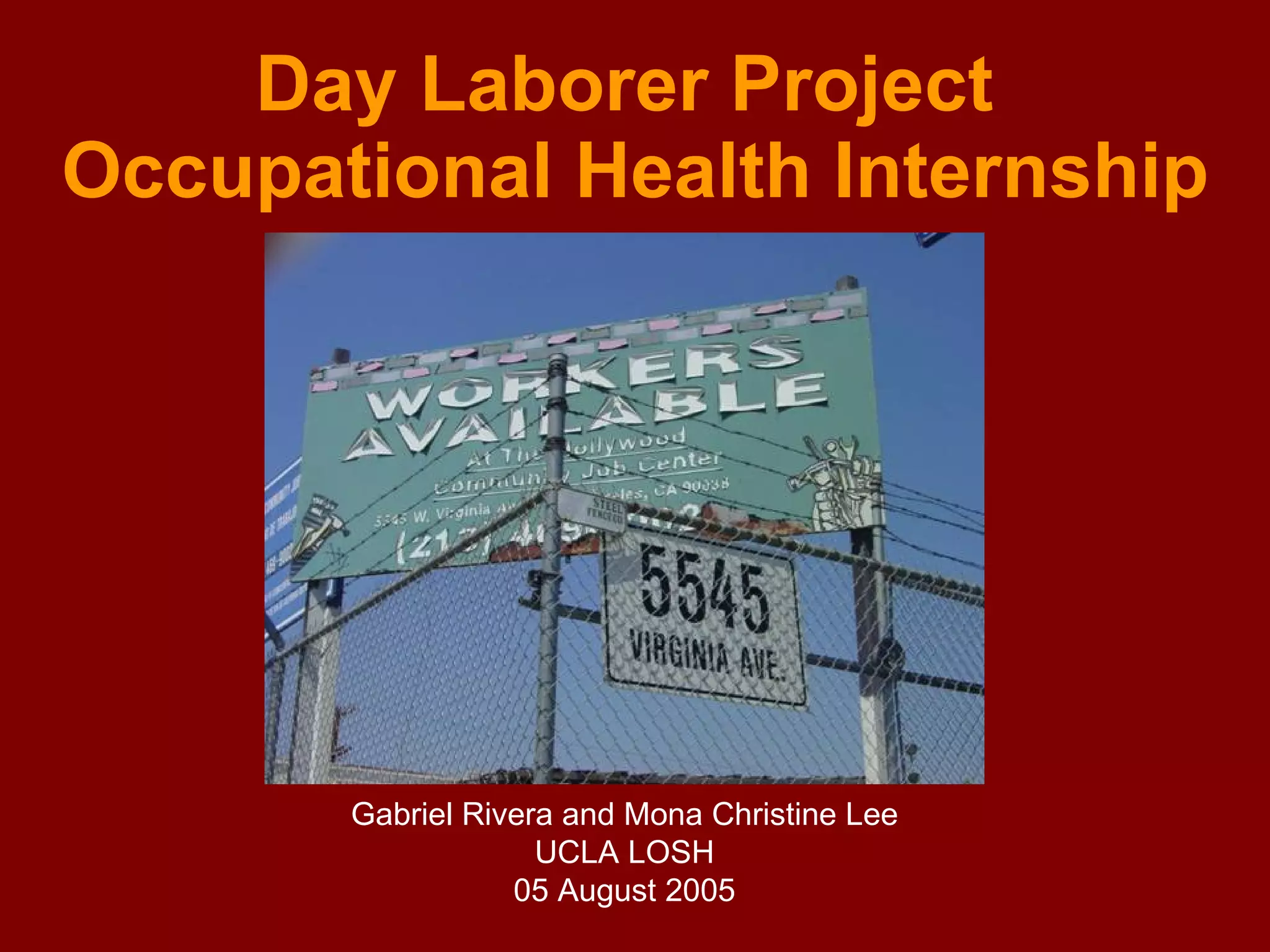
Day Laborer Project  Occupational Health Internship Gabriel Rivera and Mona Christine Lee UCLA LOSH 05 August 2005
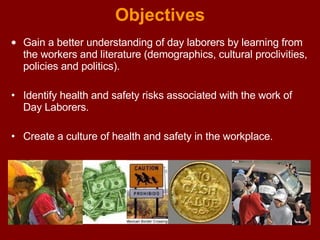
Objectives Gain a better understanding of day laborers by learning from the workers and literature (demographics, cultural proclivities, policies and politics). Identify health and safety risks associated with the work of Day Laborers. Create a culture of health and safety in the workplace.
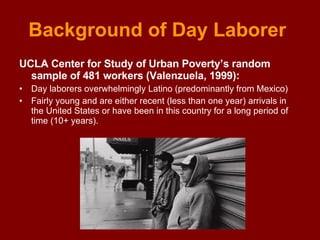
Background of Day Laborer  UCLA Center for Study of Urban Poverty’s random sample of 481 workers (Valenzuela, 1999): Day laborers overwhelmingly Latino (predominantly from Mexico) Fairly young and are either recent (less than one year) arrivals in the United States or have been in this country for a long period of time (10+ years).
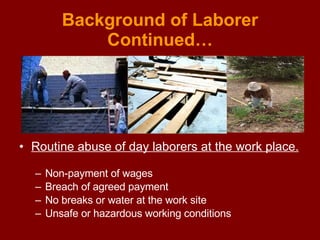
Background of Laborer Continued… Routine abuse of day laborers at the work place.   Non-payment of wages  Breach of agreed payment No breaks or water at the work site Unsafe or hazardous working conditions
Background of Laborer Continued… Richardson (2004), Mexican immigrants were at higher risk of non-fatal workplace injury or illness than any other gender/race/ ethnicity group, 82% greater that of all workers. Fabrega V, Starkey S. (2001), found that although Latinos made up less than16% of the construction workforce, they suffered 23.5% of fatal injuries (2001). Occupational Safety and Health Administration (2001), report that in areas where they have implemented aggressive construction safety training programs among Hispanic workers, combined with increased compliance inspections, fatality rates have declined significantly.
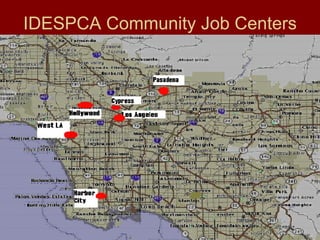
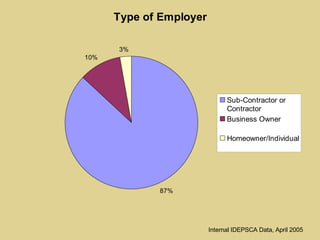
IDESPCA Community Job Centers
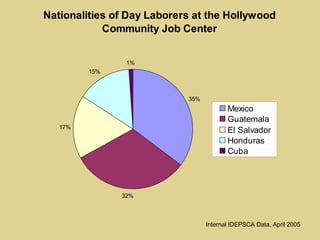
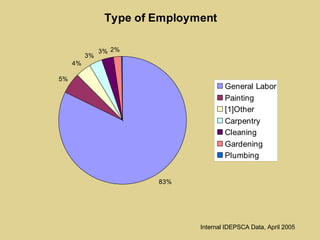
Internal IDEPSCA Data, April 2005
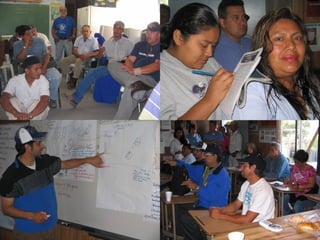
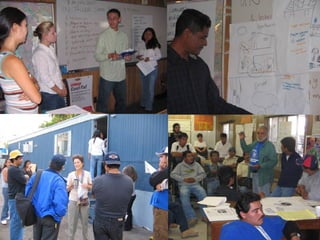
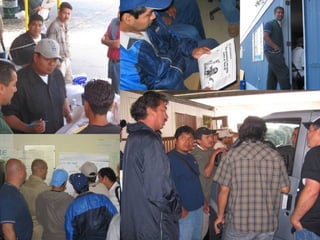
Methods  Based on  Grounded Theory  (Strauss and Corbin, 1990). Literature review Assembly meetings and training session Health and Safety presentation, ie. Risk map Ethnographic observation Fourteen in-depth conversations or interviews Two worksite visits (Hollywood Hills and Beverly Hills)
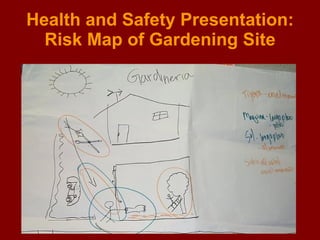
Health and Safety Presentation: Risk Map of Gardening Site
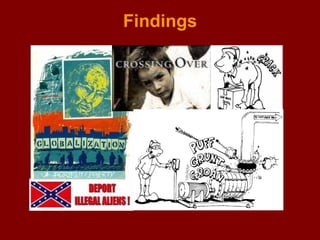
Findings
Examples of Past Injuries Allergic skin reaction  Blunt trauma to the head, ie. metal ladder, large drill Lower back pain and general musculoskeletal pain Eye and respiratory irritation from chemicals used in roofing and painting Fall from rooftop resulting in hand surgery
WORKERS RECOGNIZE MOST HEALTH AND SAFETY HAZARDS Workers identified the following as risks: Poor quality equipment, ie. skill saw without plastic guard, cheap masks. Working with hazardous material, ie. asbestos from insulation and lead from paint in old building, poison oak. Extreme weight lifting, ie. cement bags, refrigerators, washing machines.
MOST WORKERS ARE NOT PROVIDED WITH PERSONAL PROTECTIVE EQUIPMENT (PPE) Workers are familiar with the safety equipment utilized in the workplace, but often not supplied or used. Workers use inventive methods to protect themselves, ie. vasoline and a wet towel.
WORKERS ARE NOT PROVIDED ADEQUATE INTRODUCTION OR ORIENTATION Workers are lucky to have five minute orientation or introduction: May attain employer contact information in case of emergency. May be warned of safety hazards But for the most part, they only: Know name of employer Receive additional information if employer likes or values them.
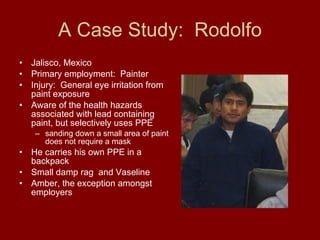
A Case Study:  Rodolfo Jalisco, Mexico Primary employment:  Painter Injury:  General eye irritation from paint exposure  Aware of the health hazards associated with lead containing paint, but selectively uses PPE  sanding down a small area of paint does not require a mask  He carries his own PPE in a backpack  Small damp rag  and Vaseline  Amber, the exception amongst employers
Limitations/Lessons Learned Project time constraint Qualitative/Case studies Trust issue Limited work site visits
Project Successes Establishing rapport allowed for a better understanding of the occupational health and safety risks of Day Laborers.  Created an awareness amongst Day Laborers of health and safety in the work place.
Recommendations A mentoring network can be developed to promote career development and prevent further exploitation Interactive workshops on injury prevention  Qualitative/quantitative study Why do some Day Laborers report and others do not? At what point do workers decide to protect their health? How do Day Laborers prioritize their own health at the work place? How does access to health care services determine utilization of services?


Acknowledgements IDEPSCA Linda Delp, Lizette Paredes, Deogracia Cornelio, UCLA Labor Occupational Health (UCLA-LOSH) Suzan Luu, SoCalCOSH Victor Narro, UCLA Labor Center Hollywood Community Job Center Day laborer participants OHIP team

Hollywood Final Draft

  • 1.
    Day Laborer Project Occupational Health Internship Gabriel Rivera and Mona Christine Lee UCLA LOSH 05 August 2005
  • 2.
    Objectives Gain abetter understanding of day laborers by learning from the workers and literature (demographics, cultural proclivities, policies and politics). Identify health and safety risks associated with the work of Day Laborers. Create a culture of health and safety in the workplace.
  • 3.
    Background of DayLaborer UCLA Center for Study of Urban Poverty’s random sample of 481 workers (Valenzuela, 1999): Day laborers overwhelmingly Latino (predominantly from Mexico) Fairly young and are either recent (less than one year) arrivals in the United States or have been in this country for a long period of time (10+ years).
  • 4.
    Background of LaborerContinued… Routine abuse of day laborers at the work place. Non-payment of wages Breach of agreed payment No breaks or water at the work site Unsafe or hazardous working conditions
  • 5.
    Background of LaborerContinued… Richardson (2004), Mexican immigrants were at higher risk of non-fatal workplace injury or illness than any other gender/race/ ethnicity group, 82% greater that of all workers. Fabrega V, Starkey S. (2001), found that although Latinos made up less than16% of the construction workforce, they suffered 23.5% of fatal injuries (2001). Occupational Safety and Health Administration (2001), report that in areas where they have implemented aggressive construction safety training programs among Hispanic workers, combined with increased compliance inspections, fatality rates have declined significantly.
  • 6.
  • 7.
  • 8.
  • 9.
  • 10.
    Methods Basedon Grounded Theory (Strauss and Corbin, 1990). Literature review Assembly meetings and training session Health and Safety presentation, ie. Risk map Ethnographic observation Fourteen in-depth conversations or interviews Two worksite visits (Hollywood Hills and Beverly Hills)
  • 11.
    Health and SafetyPresentation: Risk Map of Gardening Site
  • 12.
  • 13.
    Examples of PastInjuries Allergic skin reaction Blunt trauma to the head, ie. metal ladder, large drill Lower back pain and general musculoskeletal pain Eye and respiratory irritation from chemicals used in roofing and painting Fall from rooftop resulting in hand surgery
  • 14.
    WORKERS RECOGNIZE MOSTHEALTH AND SAFETY HAZARDS Workers identified the following as risks: Poor quality equipment, ie. skill saw without plastic guard, cheap masks. Working with hazardous material, ie. asbestos from insulation and lead from paint in old building, poison oak. Extreme weight lifting, ie. cement bags, refrigerators, washing machines.
  • 15.
    MOST WORKERS ARENOT PROVIDED WITH PERSONAL PROTECTIVE EQUIPMENT (PPE) Workers are familiar with the safety equipment utilized in the workplace, but often not supplied or used. Workers use inventive methods to protect themselves, ie. vasoline and a wet towel.
  • 16.
    WORKERS ARE NOTPROVIDED ADEQUATE INTRODUCTION OR ORIENTATION Workers are lucky to have five minute orientation or introduction: May attain employer contact information in case of emergency. May be warned of safety hazards But for the most part, they only: Know name of employer Receive additional information if employer likes or values them.
  • 17.
    A Case Study: Rodolfo Jalisco, Mexico Primary employment: Painter Injury: General eye irritation from paint exposure Aware of the health hazards associated with lead containing paint, but selectively uses PPE sanding down a small area of paint does not require a mask He carries his own PPE in a backpack Small damp rag and Vaseline Amber, the exception amongst employers
  • 18.
    Limitations/Lessons Learned Projecttime constraint Qualitative/Case studies Trust issue Limited work site visits
  • 19.
    Project Successes Establishingrapport allowed for a better understanding of the occupational health and safety risks of Day Laborers. Created an awareness amongst Day Laborers of health and safety in the work place.
  • 20.
    Recommendations A mentoringnetwork can be developed to promote career development and prevent further exploitation Interactive workshops on injury prevention Qualitative/quantitative study Why do some Day Laborers report and others do not? At what point do workers decide to protect their health? How do Day Laborers prioritize their own health at the work place? How does access to health care services determine utilization of services?
  • 21.
  • 22.
  • 23.
  • 24.
    Acknowledgements IDEPSCA LindaDelp, Lizette Paredes, Deogracia Cornelio, UCLA Labor Occupational Health (UCLA-LOSH) Suzan Luu, SoCalCOSH Victor Narro, UCLA Labor Center Hollywood Community Job Center Day laborer participants OHIP team