The Holl-Reactor®
for Process Intensification
By Richard Holl, Dipl.-Ing. and Dr.John Cihonski
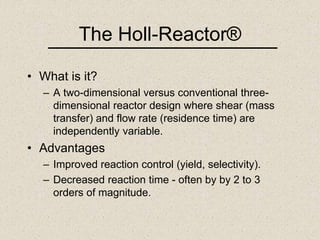
The Holl-Reactor®
• What is it?
– A two-dimensional versus conventional three-
dimensional reactor design where shear (mass
transfer) and flow rate (residence time) are
independently variable.
• Advantages
– Improved reaction control (yield, selectivity).
– Decreased reaction time - often by by 2 to 3
orders of magnitude.
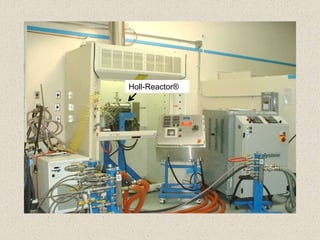
Holl-Reactor®
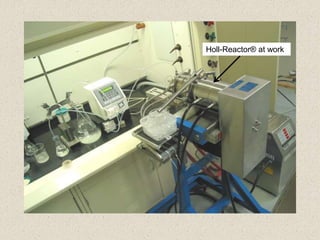
Holl-Reactor® at work
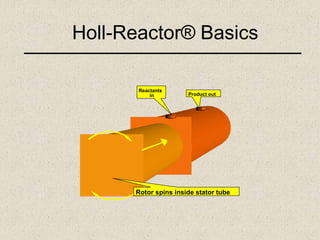
Holl-Reactor® Basics
Rotor spins inside stator tube
Reactants
in Product out
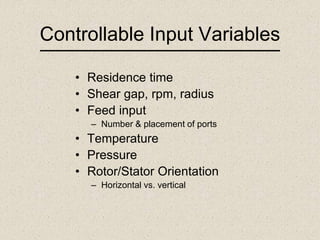
Controllable Input Variables
• Residence time
• Shear gap, rpm, radius
• Feed input
– Number & placement of ports
• Temperature
• Pressure
• Rotor/Stator Orientation
– Horizontal vs. vertical
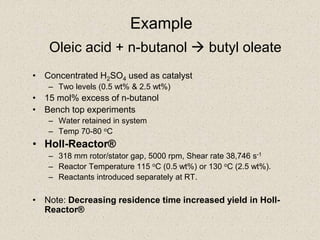
Oleic acid + n-butanol  butyl oleate
• Concentrated H2SO4 used as catalyst
– Two levels (0.5 wt% & 2.5 wt%)
• 15 mol% excess of n-butanol
• Bench top experiments
– Water retained in system
– Temp 70-80 oC
• Holl-Reactor®
– 318 mm rotor/stator gap, 5000 rpm, Shear rate 38,746 s-1
– Reactor Temperature 115 oC (0.5 wt%) or 130 oC (2.5 wt%).
– Reactants introduced separately at RT.
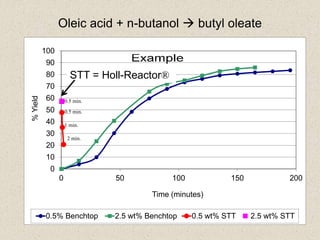
• Note: Decreasing residence time increased yield in Holl-
Reactor®
Example
Oleic acid + n-butanol  butyl oleate
0
10
20
30
40
50
60
70
80
90
100
0 50 100 150 200
%Yield
Time (minutes)
0.5% Benchtop 2.5 wt% Benchtop 0.5 wt% STT 2.5 wt% STT
1 min.
0.5 min.
2 min.
0.5 min.
STT = Holl-Reactor®
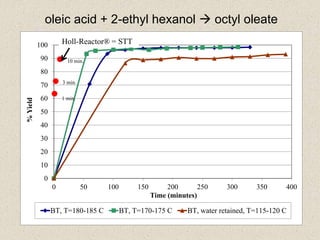
Oleic acid + 2-ethyl hexanol  octyl oleate
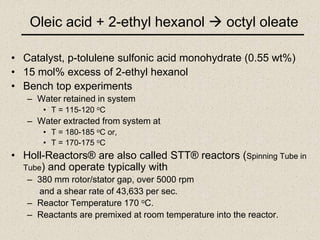
• Catalyst, p-tolulene sulfonic acid monohydrate (0.55 wt%)
• 15 mol% excess of 2-ethyl hexanol
• Bench top experiments
– Water retained in system
• T = 115-120 oC
– Water extracted from system at
• T = 180-185 oC or,
• T = 170-175 oC
• Holl-Reactors® are also called STT® reactors (Spinning Tube in
Tube) and operate typically with
– 380 mm rotor/stator gap, over 5000 rpm
and a shear rate of 43,633 per sec.
– Reactor Temperature 170 oC.
– Reactants are premixed at room temperature into the reactor.
oleic acid + 2-ethyl hexanol  octyl oleate
0
10
20
30
40
50
60
70
80
90
100
0 50 100 150 200 250 300 350 400
%Yield
Time (minutes)
BT, T=180-185 C BT, T=170-175 C BT, water retained, T=115-120 C
1 min.
10 min.
3 min.
Holl-Reactor® = STT
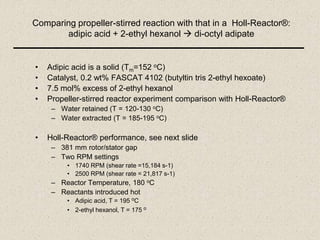
Comparing propeller-stirred reaction with that in a Holl-Reactor®:
adipic acid + 2-ethyl hexanol  di-octyl adipate
• Adipic acid is a solid (Tm=152 oC)
• Catalyst, 0.2 wt% FASCAT 4102 (butyltin tris 2-ethyl hexoate)
• 7.5 mol% excess of 2-ethyl hexanol
• Propeller-stirred reactor experiment comparison with Holl-Reactor®
– Water retained (T = 120-130 oC)
– Water extracted (T = 185-195 oC)
• Holl-Reactor® performance, see next slide
– 381 mm rotor/stator gap
– Two RPM settings
• 1740 RPM (shear rate =15,184 s-1)
• 2500 RPM (shear rate = 21,817 s-1)
– Reactor Temperature, 180 oC
– Reactants introduced hot
• Adipic acid, T = 195 oC
• 2-ethyl hexanol, T = 175 o
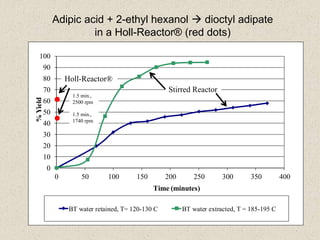
Adipic acid + 2-ethyl hexanol  dioctyl adipate
in a Holl-Reactor® (red dots)
0
10
20
30
40
50
60
70
80
90
100
0 50 100 150 200 250 300 350 400
%Yield
Time (minutes)
BT water retained, T= 120-130 C BT water extracted, T = 185-195 C
1.5 min.,
1740 rpm
1.5 min.,
2500 rpm
Holl-Reactor®
Stirred Reactor
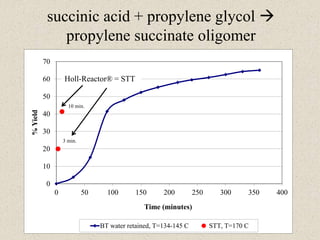
succinic acid + propylene glycol  propylene succinate
oligomer
• Holl-Reactor®
– 381 mm rotor/stator gap, 5000 rpm, Shear rate 43,633 s-1
– Reactor temperature, 170 oC
– Reactants premixed as a slurry and introduced at RT.
• Model system for a number of aromatic diacids
• Succinic acid can dissolve but not melt (Tm=188 oC)
• Catalyst, 0.3 wt% FASCAT 4102 (butyltin tris 2-ethylhexoate)
• 10 mol% excess propylene gylcol
• Bench top experiment
– Water retained (T = 135-145 oC)
succinic acid + propylene glycol 
propylene succinate oligomer
0
10
20
30
40
50
60
70
0 50 100 150 200 250 300 350 400
%Yield
Time (minutes)
BT water retained, T=134-145 C STT, T=170 C
10 min.
3 min.
Holl-Reactor® = STT
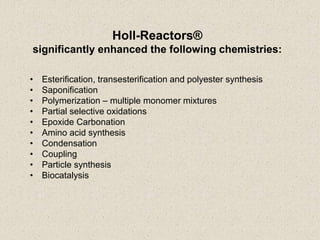
Holl-Reactors®
significantly enhanced the following chemistries:
• Esterification, transesterification and polyester synthesis
• Saponification
• Polymerization – multiple monomer mixtures
• Partial selective oxidations
• Epoxide Carbonation
• Amino acid synthesis
• Condensation
• Coupling
• Particle synthesis
• Biocatalysis
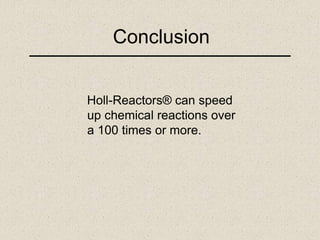
Conclusion
Holl-Reactors® can speed
up chemical reactions over
a 100 times or more.
Holl Partners LLC
www.hollpartners.com

Holl partners

  • 1.
    The Holl-Reactor® for ProcessIntensification By Richard Holl, Dipl.-Ing. and Dr.John Cihonski
  • 2.
    The Holl-Reactor® • Whatis it? – A two-dimensional versus conventional three- dimensional reactor design where shear (mass transfer) and flow rate (residence time) are independently variable. • Advantages – Improved reaction control (yield, selectivity). – Decreased reaction time - often by by 2 to 3 orders of magnitude.
  • 3.
  • 4.
  • 5.
    Holl-Reactor® Basics Rotor spinsinside stator tube Reactants in Product out
  • 6.
    Controllable Input Variables •Residence time • Shear gap, rpm, radius • Feed input – Number & placement of ports • Temperature • Pressure • Rotor/Stator Orientation – Horizontal vs. vertical
  • 7.
    Oleic acid +n-butanol  butyl oleate • Concentrated H2SO4 used as catalyst – Two levels (0.5 wt% & 2.5 wt%) • 15 mol% excess of n-butanol • Bench top experiments – Water retained in system – Temp 70-80 oC • Holl-Reactor® – 318 mm rotor/stator gap, 5000 rpm, Shear rate 38,746 s-1 – Reactor Temperature 115 oC (0.5 wt%) or 130 oC (2.5 wt%). – Reactants introduced separately at RT. • Note: Decreasing residence time increased yield in Holl- Reactor® Example
  • 8.
    Oleic acid +n-butanol  butyl oleate 0 10 20 30 40 50 60 70 80 90 100 0 50 100 150 200 %Yield Time (minutes) 0.5% Benchtop 2.5 wt% Benchtop 0.5 wt% STT 2.5 wt% STT 1 min. 0.5 min. 2 min. 0.5 min. STT = Holl-Reactor®
  • 9.
    Oleic acid +2-ethyl hexanol  octyl oleate • Catalyst, p-tolulene sulfonic acid monohydrate (0.55 wt%) • 15 mol% excess of 2-ethyl hexanol • Bench top experiments – Water retained in system • T = 115-120 oC – Water extracted from system at • T = 180-185 oC or, • T = 170-175 oC • Holl-Reactors® are also called STT® reactors (Spinning Tube in Tube) and operate typically with – 380 mm rotor/stator gap, over 5000 rpm and a shear rate of 43,633 per sec. – Reactor Temperature 170 oC. – Reactants are premixed at room temperature into the reactor.
  • 10.
    oleic acid +2-ethyl hexanol  octyl oleate 0 10 20 30 40 50 60 70 80 90 100 0 50 100 150 200 250 300 350 400 %Yield Time (minutes) BT, T=180-185 C BT, T=170-175 C BT, water retained, T=115-120 C 1 min. 10 min. 3 min. Holl-Reactor® = STT
  • 11.
    Comparing propeller-stirred reactionwith that in a Holl-Reactor®: adipic acid + 2-ethyl hexanol  di-octyl adipate • Adipic acid is a solid (Tm=152 oC) • Catalyst, 0.2 wt% FASCAT 4102 (butyltin tris 2-ethyl hexoate) • 7.5 mol% excess of 2-ethyl hexanol • Propeller-stirred reactor experiment comparison with Holl-Reactor® – Water retained (T = 120-130 oC) – Water extracted (T = 185-195 oC) • Holl-Reactor® performance, see next slide – 381 mm rotor/stator gap – Two RPM settings • 1740 RPM (shear rate =15,184 s-1) • 2500 RPM (shear rate = 21,817 s-1) – Reactor Temperature, 180 oC – Reactants introduced hot • Adipic acid, T = 195 oC • 2-ethyl hexanol, T = 175 o
  • 12.
    Adipic acid +2-ethyl hexanol  dioctyl adipate in a Holl-Reactor® (red dots) 0 10 20 30 40 50 60 70 80 90 100 0 50 100 150 200 250 300 350 400 %Yield Time (minutes) BT water retained, T= 120-130 C BT water extracted, T = 185-195 C 1.5 min., 1740 rpm 1.5 min., 2500 rpm Holl-Reactor® Stirred Reactor
  • 13.
    succinic acid +propylene glycol  propylene succinate oligomer • Holl-Reactor® – 381 mm rotor/stator gap, 5000 rpm, Shear rate 43,633 s-1 – Reactor temperature, 170 oC – Reactants premixed as a slurry and introduced at RT. • Model system for a number of aromatic diacids • Succinic acid can dissolve but not melt (Tm=188 oC) • Catalyst, 0.3 wt% FASCAT 4102 (butyltin tris 2-ethylhexoate) • 10 mol% excess propylene gylcol • Bench top experiment – Water retained (T = 135-145 oC)
  • 14.
    succinic acid +propylene glycol  propylene succinate oligomer 0 10 20 30 40 50 60 70 0 50 100 150 200 250 300 350 400 %Yield Time (minutes) BT water retained, T=134-145 C STT, T=170 C 10 min. 3 min. Holl-Reactor® = STT
  • 15.
    Holl-Reactors® significantly enhanced thefollowing chemistries: • Esterification, transesterification and polyester synthesis • Saponification • Polymerization – multiple monomer mixtures • Partial selective oxidations • Epoxide Carbonation • Amino acid synthesis • Condensation • Coupling • Particle synthesis • Biocatalysis
  • 16.
    Conclusion Holl-Reactors® can speed upchemical reactions over a 100 times or more.
  • 17.