HOLINESS
In the beginning
God created
HOLY
sacred, consecrated, set apart
HOLY
sacred, consecrated, set apart
qadosh (adj)
HOLY
sacred, consecrated, set apart
qadosh (adj)
qadash (verb)
DIVIDING - SEPARATING
DIVIDING – SEPARATING
Light – Darkness
Earth – Sky
Land – Sea
Day – Night
DIVIDING – SEPARATING
Days – Sabbath
Male – Female
Clean – Unclean
Nations – Israel
12 sons of Israel
- Joseph
+ 2 sons of Joseph
= 13 tribes?
DIVIDING – SEPARATING
Tribes of Israel – Levi
Levi - Priests
Priests – High Priest
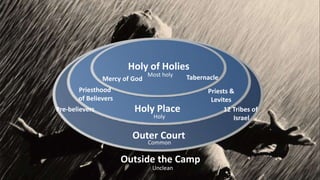
Outer Court – Holy Place – Holy of Holies
Holy of Holies
Holy Place
Outer Court
Tabernacle
Priests &
Levites
12 Tribes of
Israel
Most holy
Holy
Common
Outside the Camp
Unclean
Mercy of God
Priesthood
of Believers
Pre-believers
PRIESTHOOD OF
BELIEVERS
But you are a chosen people, a royal
priesthood, a holy nation, God's special
possession, that you may declare the praises
of him who called you out of
darkness into his wonderful light
1 Peter 2:9
PRIESTHOOD OF
BELIEVERS
Some of you were once like that. But you were
cleansed; you were made holy; you were made right
with God by calling on the name of the Lord Jesus
Christ and by the Spirit of our God.
1 Cor 6:11
DUTIES OF PRIESTS
DUTIES OF PRIESTS
Tending the lamps
DUTIES OF PRIESTS
Tending the lamps
Daily Offering
"This is what you are to offer on the altar regularly each day: two lambs a
year old. Offer one in the morning and the other at twilight. Ex 29:38-39
DUTIES OF PRIESTS
Tending the lamps
Daily Offering
Praising God
through him, then, we may offer up a sacrifice of praise always to God,
that is, the fruit of lips, giving thanks to His name; Heb 13:15
DUTIES OF PRIESTS
Tending the lamps
Daily Offering
Praising God
Preaching the Gospel
Yet I have written you quite boldly on some points to remind you of them
again, because of the grace God gave me to be a minister of Christ Jesus
to the Gentiles. He gave me the priestly duty of proclaiming the gospel of
God, so that the Gentiles might become an offering acceptable to God,
sanctified by the Holy Spirit. Rom 15:15-16

Holiness

Editor's Notes

  • #4 The Bible opens by introducing to its readers a holy God: the only Creator God. And because no other gods- not that they are god - has the ability to create, this God is in a class of its own.
  • #5 The word holy can be used as an adjective. In Hebrew, it is qadosh.
  • #6 The word holy can be used as an adjective. In Hebrew, it is qadosh.
  • #7 This holy God has the authority to make things holy.
  • #11 But keep away from the devoted things, so that you will not bring about your own destruction by taking any of them. Otherwise you will make the camp of Israel liable to destruction and bring trouble on it.
  • #14 But keep away from the devoted things, so that you will not bring about your own destruction by taking any of them. Otherwise you will make the camp of Israel liable to destruction and bring trouble on it.
  • #15 But keep away from the devoted things, so that you will not bring about your own destruction by taking any of them. Otherwise you will make the camp of Israel liable to destruction and bring trouble on it.
  • #16 Tending the lamps. The Candlestand in the Tabernacle provides illumination within the windowless Tent. Tending the lamps speaks of seeking divine revelation. Twice in Biblical history was God silent. During Israel’s sojourn in Egypt for 400 years, the Israelites departed from God and started to assimilate the culture and worship of the Egyptians. Then, God was silent for another 400 years between the Old and New Testaments. During this period, Israel again departed from the Lord. Jewish history during those four centuries between the Testaments runs in six periods: the Persian, the Greek, the Egyptian, the Syrian, the Maccabean and the Roman. In the meantime, Buddhism were born. 2. Daily Offering (Tamid) 3. Praising God.
  • #17 Tending the lamps. The Candlestand in the Tabernacle provides illumination within the windowless Tent. Tending the lamps speaks of seeking divine revelation. Twice in Biblical history was God silent. During Israel’s sojourn in Egypt for 400 years, the Israelites departed from God and started to assimilate the culture and worship of the Egyptians. Then, God was silent for another 400 years between the Old and New Testaments. During this period, Israel again departed from the Lord. Jewish history during those four centuries between the Testaments runs in six periods: the Persian, the Greek, the Egyptian, the Syrian, the Maccabean and the Roman. In the meantime, Buddhism were born. 2. Daily Offering (Tamid) 3. Praising God.
  • #18 Tending the lamps. The Candlestand in the Tabernacle provides illumination within the windowless Tent. Tending the lamps speaks of seeking divine revelation. Twice in Biblical history was God silent. During Israel’s sojourn in Egypt for 400 years, the Israelites departed from God and started to assimilate the culture and worship of the Egyptians. Then, God was silent for another 400 years between the Old and New Testaments. During this period, Israel again departed from the Lord. Jewish history during those four centuries between the Testaments runs in six periods: the Persian, the Greek, the Egyptian, the Syrian, the Maccabean and the Roman. In the meantime, Buddhism were born. 2. Daily Offering (Tamid) 3. Praising God.
  • #19 Tending the lamps. The Candlestand in the Tabernacle provides illumination within the windowless Tent. Tending the lamps speaks of seeking divine revelation. Twice in Biblical history was God silent. During Israel’s sojourn in Egypt for 400 years, the Israelites departed from God and started to assimilate the culture and worship of the Egyptians. Then, God was silent for another 400 years between the Old and New Testaments. During this period, Israel again departed from the Lord. Jewish history during those four centuries between the Testaments runs in six periods: the Persian, the Greek, the Egyptian, the Syrian, the Maccabean and the Roman. In the meantime, Buddhism were born. 2. Daily Offering (Tamid) 3. Praising God.
  • #20 Tending the lamps. The Candlestand in the Tabernacle provides illumination within the windowless Tent. Tending the lamps speaks of seeking divine revelation. Twice in Biblical history was God silent. During Israel’s sojourn in Egypt for 400 years, the Israelites departed from God and started to assimilate the culture and worship of the Egyptians. Then, God was silent for another 400 years between the Old and New Testaments. During this period, Israel again departed from the Lord. Jewish history during those four centuries between the Testaments runs in six periods: the Persian, the Greek, the Egyptian, the Syrian, the Maccabean and the Roman. In the meantime, Buddhism were born. 2. Daily Offering (Tamid) 3. Praising God.