c h a p t e r
c h a p t e r
f o u r
f o u r
© 2006 Prentice Hall Business Publishing Economics R. Glenn Hubbard, Anthony Patrick O’Brien—1st
ed.
Prepared by: Fernando & Yvonn Quijano
Economic Efficiency, Government
Price Setting, and Taxes
2 of 29
© 2006 Prentice Hall Business Publishing Economics R. Glenn Hubbard, Anthony Patrick O’Brien—1st
ed.
CHAPTER
4:
Economic
Efficiency,
Government
Price
Setting,
and
Taxes
After studying this
chapter, you should be
able to:
Understand the concepts
of consumer surplus and
producer surplus.
Understand the concept
of economic efficiency,
and use a graph to
illustrate how economic
efficiency is reduced
when a market is not in
competitive equilibrium.
Use demand and supply
graphs to analyze the
economic impact of price
ceilings and price floors.
Use demand and supply
graphs to analyze the
economic impact of taxes.
Should the Government
Control Apartment Rents?
LEARNING
OBJECTIVES
1
2
3
4
New York City
… About one million of
New York City’s two
million apartments are
subject to rent control.
The other one million
apartments have their
rents determined in the
market by the demand and
supply for apartments.
3 of 29
© 2006 Prentice Hall Business Publishing Economics R. Glenn Hubbard, Anthony Patrick O’Brien—1st
ed.
CHAPTER
4:
Economic
Efficiency,
Government
Price
Setting,
and
Taxes
Economic Efficiency, Government Price Setting, and Taxes
Price ceiling A legally
determined maximum price that
sellers may charge.
Price floor A legally determined
minimum price that sellers may
receive.
4 of 29
© 2006 Prentice Hall Business Publishing Economics R. Glenn Hubbard, Anthony Patrick O’Brien—1st
ed.
CHAPTER
4:
Economic
Efficiency,
Government
Price
Setting,
and
Taxes
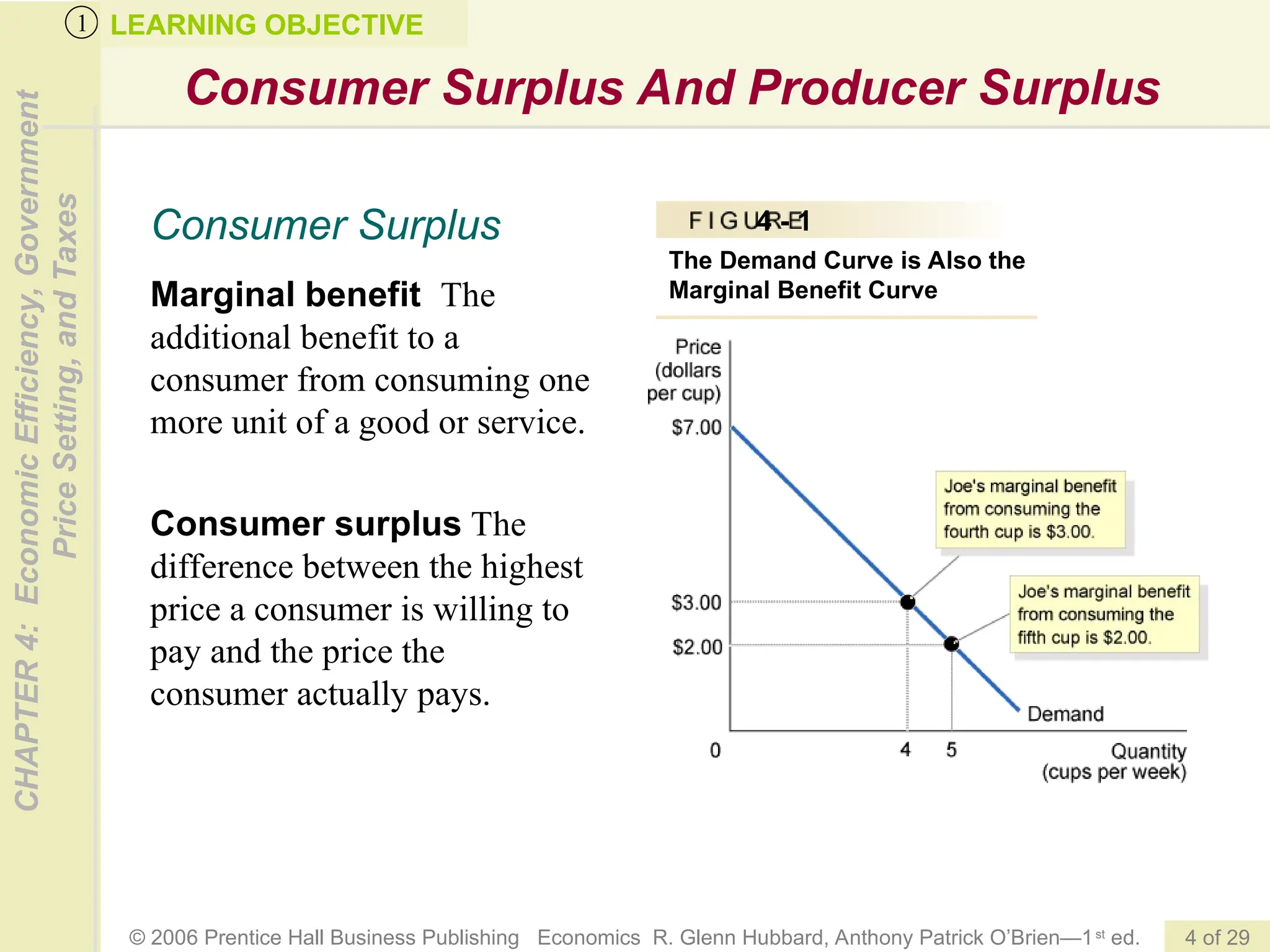
Consumer Surplus And Producer Surplus
Consumer Surplus
LEARNING OBJECTIVE
1
Marginal benefit The
additional benefit to a
consumer from consuming one
more unit of a good or service.
Consumer surplus The
difference between the highest
price a consumer is willing to
pay and the price the
consumer actually pays.
4 - 1
The Demand Curve is Also the
Marginal Benefit Curve
5 of 29
© 2006 Prentice Hall Business Publishing Economics R. Glenn Hubbard, Anthony Patrick O’Brien—1st
ed.
CHAPTER
4:
Economic
Efficiency,
Government
Price
Setting,
and
Taxes
Consumer Surplus and Producer Surplus
Consumer Surplus
4 - 2
Total Consumer Surplus in the
Market for Chai Tea
6 of 29
© 2006 Prentice Hall Business Publishing Economics R. Glenn Hubbard, Anthony Patrick O’Brien—1st
ed.
CHAPTER
4:
Economic
Efficiency,
Government
Price
Setting,
and
Taxes
The Consumer Surplus from
Satellite Television
How much consumer
surplus will the owner of
this satellite dish receive?
4 - 1
7 of 29
© 2006 Prentice Hall Business Publishing Economics R. Glenn Hubbard, Anthony Patrick O’Brien—1st
ed.
CHAPTER
4:
Economic
Efficiency,
Government
Price
Setting,
and
Taxes
Consumer Surplus and Producer Surplus
Producer Surplus
Producer surplus The difference
between the lowest price a firm would
have been willing to accept and the
price it actually receives.
Marginal cost The additional
cost to a firm of producing one
more unit of a good or service.
4 - 3
Producer Surplus
8 of 29
© 2006 Prentice Hall Business Publishing Economics R. Glenn Hubbard, Anthony Patrick O’Brien—1st
ed.
CHAPTER
4:
Economic
Efficiency,
Government
Price
Setting,
and
Taxes
Consumer Surplus and Producer Surplus
What Consumer Surplus and Producer
Surplus Measure
Consumer surplus measures the benefit
to consumers from participating in a
market, and producer surplus measures
the benefit to producers from participating
in a market.
9 of 29
© 2006 Prentice Hall Business Publishing Economics R. Glenn Hubbard, Anthony Patrick O’Brien—1st
ed.
CHAPTER
4:
Economic
Efficiency,
Government
Price
Setting,
and
Taxes
The Efficiency of Competitive Markets
LEARNING OBJECTIVE
2
Marginal Benefit Equals Marginal Cost in Competitive
Equilibrium 4 - 4
Marginal Benefit Equals Marginal
Cost Only at Competitive
Equilibrium
10 of 29
© 2006 Prentice Hall Business Publishing Economics R. Glenn Hubbard, Anthony Patrick O’Brien—1st
ed.
CHAPTER
4:
Economic
Efficiency,
Government
Price
Setting,
and
Taxes
The Efficiency of Competitive Markets
Economic Surplus 4 - 5
Economic Surplus Equals the
Sum of Consumer Surplus and
Producer Surplus
11 of 29
© 2006 Prentice Hall Business Publishing Economics R. Glenn Hubbard, Anthony Patrick O’Brien—1st
ed.
CHAPTER
4:
Economic
Efficiency,
Government
Price
Setting,
and
Taxes
The Efficiency of Competitive Markets
Deadweight Loss
4 - 6
When a Market Is Not in
Equilibrium There is a
Deadweight Loss
Deadweight loss The
reduction in economic
surplus resulting from a
market not being in
competitive equilibrium.
12 of 29
© 2006 Prentice Hall Business Publishing Economics R. Glenn Hubbard, Anthony Patrick O’Brien—1st
ed.
CHAPTER
4:
Economic
Efficiency,
Government
Price
Setting,
and
Taxes
The Efficiency of Competitive Markets
Economic Surplus and Economic Efficiency
Economic efficiency A market
outcome in which the marginal benefit to
consumers of the last unit produced is
equal to its marginal cost of production,
and where the sum of consumer surplus
and producer surplus is at a maximum.
13 of 29
© 2006 Prentice Hall Business Publishing Economics R. Glenn Hubbard, Anthony Patrick O’Brien—1st
ed.
CHAPTER
4:
Economic
Efficiency,
Government
Price
Setting,
and
Taxes
LEARNING OBJECTIVE
3
4 - 7
The Economic Effect of a Price
Floor in the Wheat Market
Government Intervention in the Market:
Price Floors And Price Ceilings
Price Floors: The Example of Agricultural Markets
14 of 29
© 2006 Prentice Hall Business Publishing Economics R. Glenn Hubbard, Anthony Patrick O’Brien—1st
ed.
CHAPTER
4:
Economic
Efficiency,
Government
Price
Setting,
and
Taxes
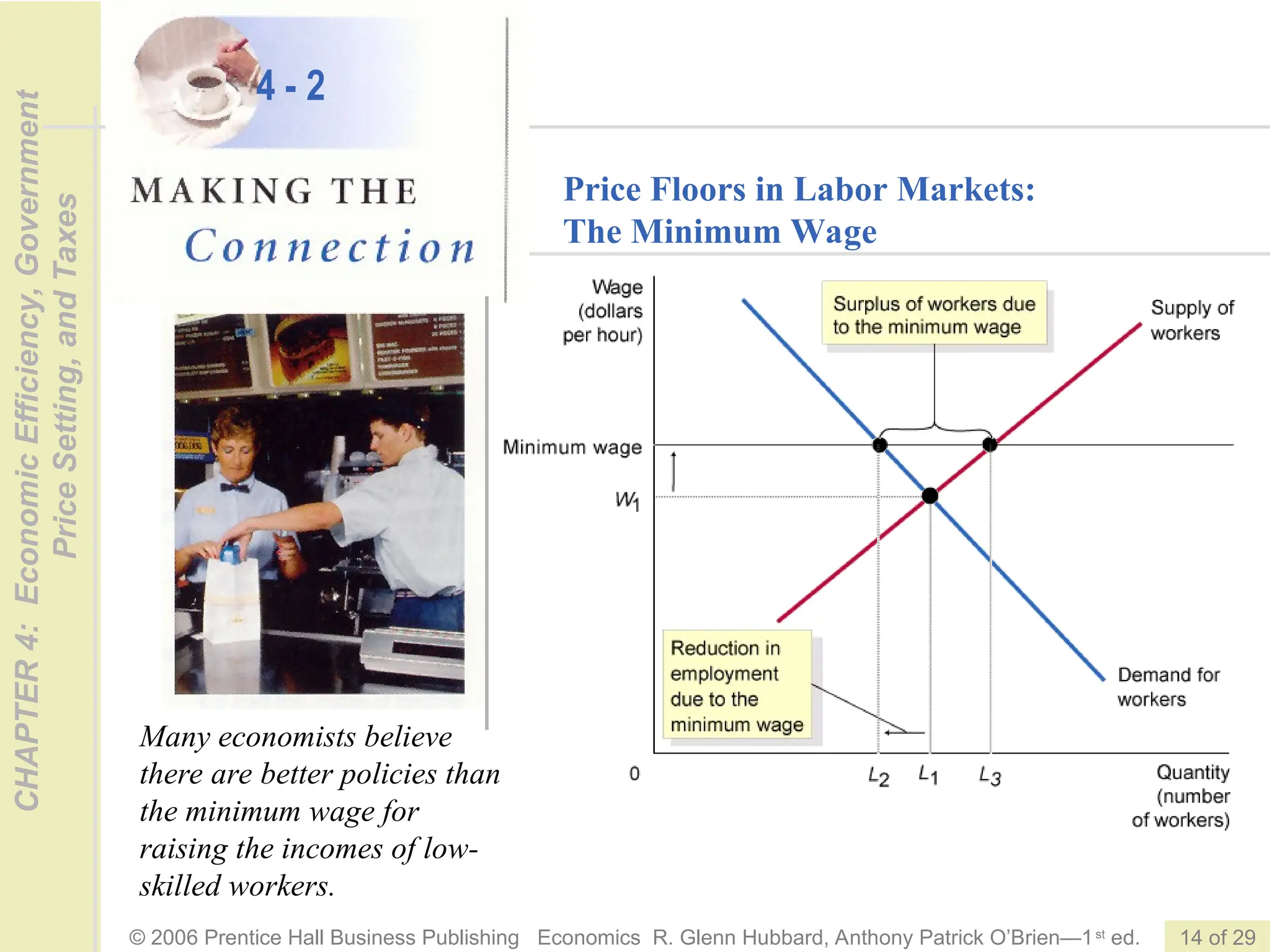
Price Floors in Labor Markets:
The Minimum Wage
4 - 2
Many economists believe
there are better policies than
the minimum wage for
raising the incomes of low-
skilled workers.
15 of 29
© 2006 Prentice Hall Business Publishing Economics R. Glenn Hubbard, Anthony Patrick O’Brien—1st
ed.
CHAPTER
4:
Economic
Efficiency,
Government
Price
Setting,
and
Taxes
Government Intervention In The Market:
Price Floors And Price Ceilings
Price Ceilings: The Example of Rent Controls
4 - 8
The Economic Effect
of a Rent Ceiling
Don’t Confuse “Scarcity” with a “Shortage.”
16 of 29
© 2006 Prentice Hall Business Publishing Economics R. Glenn Hubbard, Anthony Patrick O’Brien—1st
ed.
CHAPTER
4:
Economic
Efficiency,
Government
Price
Setting,
and
Taxes
Government Intervention In The Market:
Price Floors And Price Ceilings
Black Markets
Black markets Buying and selling at
prices that violate government price
regulations.
17 of 29
© 2006 Prentice Hall Business Publishing Economics R. Glenn Hubbard, Anthony Patrick O’Brien—1st
ed.
CHAPTER
4:
Economic
Efficiency,
Government
Price
Setting,
and
Taxes
What’s the Economic Effect of a “Black Market” for
Apartments?
4 - 1
LEARNING OBJECTIVE
3
18 of 29
© 2006 Prentice Hall Business Publishing Economics R. Glenn Hubbard, Anthony Patrick O’Brien—1st
ed.
CHAPTER
4:
Economic
Efficiency,
Government
Price
Setting,
and
Taxes
Does Holiday Gift Giving
Have a Deadweight Loss?
4 - 3
Caution: Gift giving may
lead to deadweight loss.
19 of 29
© 2006 Prentice Hall Business Publishing Economics R. Glenn Hubbard, Anthony Patrick O’Brien—1st
ed.
CHAPTER
4:
Economic
Efficiency,
Government
Price
Setting,
and
Taxes
Government Intervention In The Market:
Price Floors And Price Ceilings
The Results of Government Intervention:
Winners, Losers, and Inefficiency
When the government imposes price floors or price ceilings,
three important results occur:
 Some people win.
 Some people lose.
 There is a loss of economic efficiency.
Positive and Normative Analysis of Price Ceilings
and Price Floors
Whether rent controls are desirable or undesirable is a normative
question. Whether the gains to the winners more than make up for
the losses to the losers and for the decline in economic efficiency is a
matter of judgment and not strictly an economic question.
20 of 29
© 2006 Prentice Hall Business Publishing Economics R. Glenn Hubbard, Anthony Patrick O’Brien—1st
ed.
CHAPTER
4:
Economic
Efficiency,
Government
Price
Setting,
and
Taxes
The Economic Impact of Taxes
LEARNING OBJECTIVE
4
The Effect of Taxes on Economic Efficiency
4 - 9
The Effect of a Tax on the Market
for Cigarettes
21 of 29
© 2006 Prentice Hall Business Publishing Economics R. Glenn Hubbard, Anthony Patrick O’Brien—1st
ed.
CHAPTER
4:
Economic
Efficiency,
Government
Price
Setting,
and
Taxes
The Economic Impact of Taxes
Tax Incidence: Who Actually Pays a Tax?
Tax incidence The actual
division of the burden of a tax
between buyers and sellers in a
market.
22 of 29
© 2006 Prentice Hall Business Publishing Economics R. Glenn Hubbard, Anthony Patrick O’Brien—1st
ed.
CHAPTER
4:
Economic
Efficiency,
Government
Price
Setting,
and
Taxes
The Economic Impact of Taxes
Tax Incidence: Who Actually Pays a Tax?
4 - 10
The Incidence of a Tax on
Gasoline
DETERMINING TAX INCIDENCE ON A DEMAND AND SUPPLY GRAPH
23 of 29
© 2006 Prentice Hall Business Publishing Economics R. Glenn Hubbard, Anthony Patrick O’Brien—1st
ed.
CHAPTER
4:
Economic
Efficiency,
Government
Price
Setting,
and
Taxes
When Do Consumers Pay All of a Sales Tax Increase?
4 - 2
LEARNING OBJECTIVE
4
24 of 29
© 2006 Prentice Hall Business Publishing Economics R. Glenn Hubbard, Anthony Patrick O’Brien—1st
ed.
CHAPTER
4:
Economic
Efficiency,
Government
Price
Setting,
and
Taxes
The Economic Impact Of Taxes
Tax Incidence: Who Actually Pays a Tax?
4 - 11
The Incidence of a Tax on
Gasoline Paid by Buyers
DOES IT MATTER WHETHER THE TAX IS ON BUYERS OR SELLERS?
25 of 29
© 2006 Prentice Hall Business Publishing Economics R. Glenn Hubbard, Anthony Patrick O’Brien—1st
ed.
CHAPTER
4:
Economic
Efficiency,
Government
Price
Setting,
and
Taxes
Is the Burden of the Social
Security Tax Really Shared
Equally between Workers and
Firms?
4 - 4
How much FICA do
you think this
employee pays?
26 of 29
© 2006 Prentice Hall Business Publishing Economics R. Glenn Hubbard, Anthony Patrick O’Brien—1st
ed.
CHAPTER
4:
Economic
Efficiency,
Government
Price
Setting,
and
Taxes
The Romance of Rent Control
Figure 1: In (a), the elimination of rent control causes an increase from Q1 to Q2 in the quantity of
apartments being rented. In (b) this causes the demand for currently non-rent-controlled apartments
to shift to the left from D1 to D2. The equilibrium rent declines from $2,000 to $1,500.
27 of 29
© 2006 Prentice Hall Business Publishing Economics R. Glenn Hubbard, Anthony Patrick O’Brien—1st
ed.
CHAPTER
4:
Economic
Efficiency,
Government
Price
Setting,
and
Taxes
Black market
Consumer surplus
Deadweight loss
Economic efficiency
Economic surplus
Marginal benefit
Marginal cost
Price ceiling
Price floor
Producer surplus
Tax incidence
28 of 29
© 2006 Prentice Hall Business Publishing Economics R. Glenn Hubbard, Anthony Patrick O’Brien—1st
ed.
CHAPTER
4:
Economic
Efficiency,
Government
Price
Setting,
and
Taxes
Appendix 4A:
Quantitative Demand and Supply Analysis
4A-1
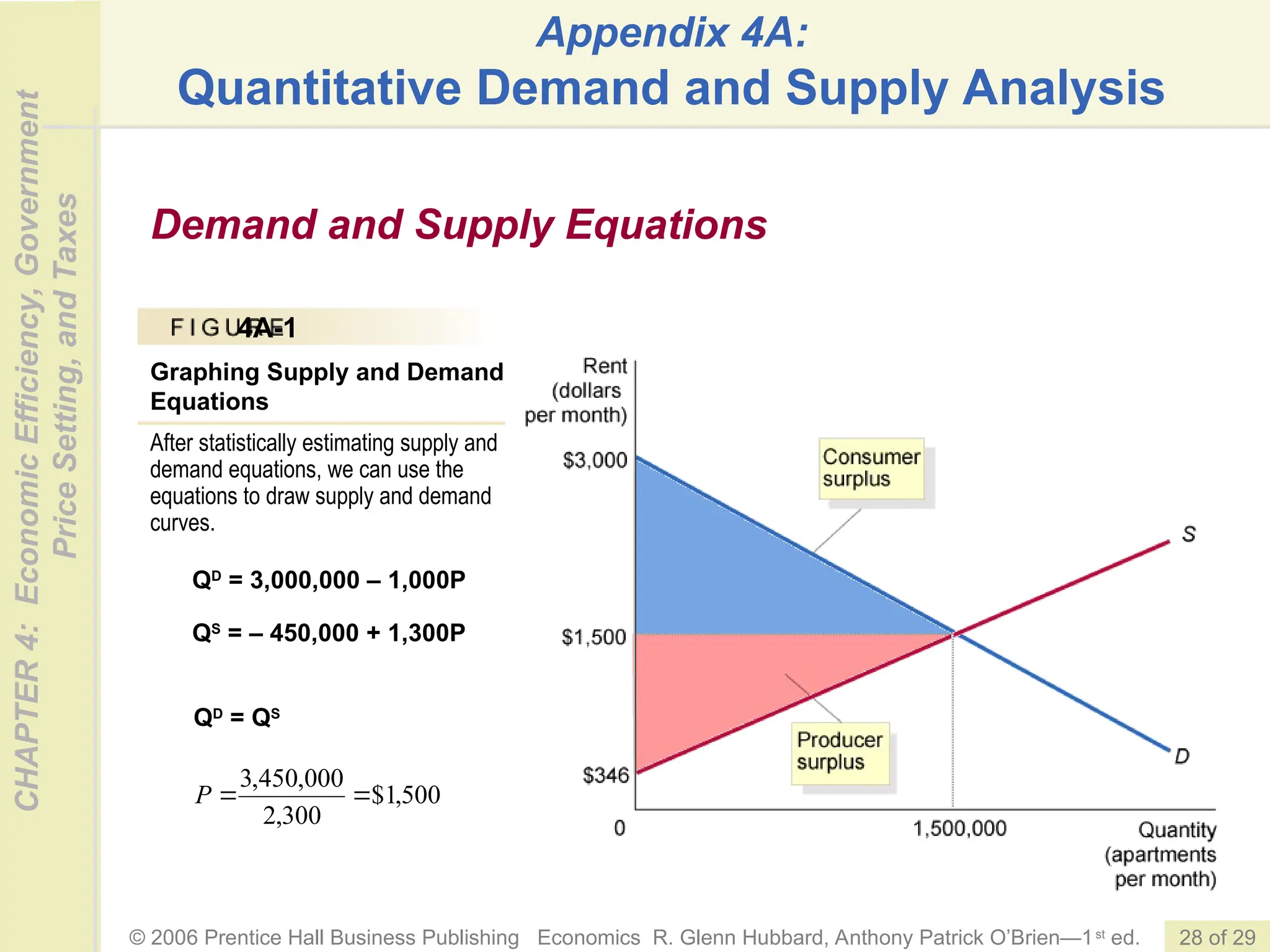
Graphing Supply and Demand
Equations
After statistically estimating supply and
demand equations, we can use the
equations to draw supply and demand
curves.
QD
= 3,000,000 – 1,000P
QS
= – 450,000 + 1,300P
QD
= QS
Demand and Supply Equations
500
,
1
$
300
,
2
000
,
450
,
3


P
29 of 29
© 2006 Prentice Hall Business Publishing Economics R. Glenn Hubbard, Anthony Patrick O’Brien—1st
ed.
CHAPTER
4:
Economic
Efficiency,
Government
Price
Setting,
and
Taxes
4A-2
Calculating the Economic
Effect of Rent Controls
CONSUMER
SURPLUS
PRODUCER
SURPLUS
DEADWEIGHT LOSS
COMPETITIVE
EQUILIBRIUM
$1,125 $865.50 $0
RENT CONTROL $1,338.75 $278 $373.75
Appendix 4A:
Quantitative Demand and Supply Analysis
Calculating Consumer Surplus and Producer Surplus

HOch04_instructor economy comparativ.ppt

  • 1.
    c h ap t e r c h a p t e r f o u r f o u r © 2006 Prentice Hall Business Publishing Economics R. Glenn Hubbard, Anthony Patrick O’Brien—1st ed. Prepared by: Fernando & Yvonn Quijano Economic Efficiency, Government Price Setting, and Taxes
  • 2.
    2 of 29 ©2006 Prentice Hall Business Publishing Economics R. Glenn Hubbard, Anthony Patrick O’Brien—1st ed. CHAPTER 4: Economic Efficiency, Government Price Setting, and Taxes After studying this chapter, you should be able to: Understand the concepts of consumer surplus and producer surplus. Understand the concept of economic efficiency, and use a graph to illustrate how economic efficiency is reduced when a market is not in competitive equilibrium. Use demand and supply graphs to analyze the economic impact of price ceilings and price floors. Use demand and supply graphs to analyze the economic impact of taxes. Should the Government Control Apartment Rents? LEARNING OBJECTIVES 1 2 3 4 New York City … About one million of New York City’s two million apartments are subject to rent control. The other one million apartments have their rents determined in the market by the demand and supply for apartments.
  • 3.
    3 of 29 ©2006 Prentice Hall Business Publishing Economics R. Glenn Hubbard, Anthony Patrick O’Brien—1st ed. CHAPTER 4: Economic Efficiency, Government Price Setting, and Taxes Economic Efficiency, Government Price Setting, and Taxes Price ceiling A legally determined maximum price that sellers may charge. Price floor A legally determined minimum price that sellers may receive.
  • 4.
    4 of 29 ©2006 Prentice Hall Business Publishing Economics R. Glenn Hubbard, Anthony Patrick O’Brien—1st ed. CHAPTER 4: Economic Efficiency, Government Price Setting, and Taxes Consumer Surplus And Producer Surplus Consumer Surplus LEARNING OBJECTIVE 1 Marginal benefit The additional benefit to a consumer from consuming one more unit of a good or service. Consumer surplus The difference between the highest price a consumer is willing to pay and the price the consumer actually pays. 4 - 1 The Demand Curve is Also the Marginal Benefit Curve
  • 5.
    5 of 29 ©2006 Prentice Hall Business Publishing Economics R. Glenn Hubbard, Anthony Patrick O’Brien—1st ed. CHAPTER 4: Economic Efficiency, Government Price Setting, and Taxes Consumer Surplus and Producer Surplus Consumer Surplus 4 - 2 Total Consumer Surplus in the Market for Chai Tea
  • 6.
    6 of 29 ©2006 Prentice Hall Business Publishing Economics R. Glenn Hubbard, Anthony Patrick O’Brien—1st ed. CHAPTER 4: Economic Efficiency, Government Price Setting, and Taxes The Consumer Surplus from Satellite Television How much consumer surplus will the owner of this satellite dish receive? 4 - 1
  • 7.
    7 of 29 ©2006 Prentice Hall Business Publishing Economics R. Glenn Hubbard, Anthony Patrick O’Brien—1st ed. CHAPTER 4: Economic Efficiency, Government Price Setting, and Taxes Consumer Surplus and Producer Surplus Producer Surplus Producer surplus The difference between the lowest price a firm would have been willing to accept and the price it actually receives. Marginal cost The additional cost to a firm of producing one more unit of a good or service. 4 - 3 Producer Surplus
  • 8.
    8 of 29 ©2006 Prentice Hall Business Publishing Economics R. Glenn Hubbard, Anthony Patrick O’Brien—1st ed. CHAPTER 4: Economic Efficiency, Government Price Setting, and Taxes Consumer Surplus and Producer Surplus What Consumer Surplus and Producer Surplus Measure Consumer surplus measures the benefit to consumers from participating in a market, and producer surplus measures the benefit to producers from participating in a market.
  • 9.
    9 of 29 ©2006 Prentice Hall Business Publishing Economics R. Glenn Hubbard, Anthony Patrick O’Brien—1st ed. CHAPTER 4: Economic Efficiency, Government Price Setting, and Taxes The Efficiency of Competitive Markets LEARNING OBJECTIVE 2 Marginal Benefit Equals Marginal Cost in Competitive Equilibrium 4 - 4 Marginal Benefit Equals Marginal Cost Only at Competitive Equilibrium
  • 10.
    10 of 29 ©2006 Prentice Hall Business Publishing Economics R. Glenn Hubbard, Anthony Patrick O’Brien—1st ed. CHAPTER 4: Economic Efficiency, Government Price Setting, and Taxes The Efficiency of Competitive Markets Economic Surplus 4 - 5 Economic Surplus Equals the Sum of Consumer Surplus and Producer Surplus
  • 11.
    11 of 29 ©2006 Prentice Hall Business Publishing Economics R. Glenn Hubbard, Anthony Patrick O’Brien—1st ed. CHAPTER 4: Economic Efficiency, Government Price Setting, and Taxes The Efficiency of Competitive Markets Deadweight Loss 4 - 6 When a Market Is Not in Equilibrium There is a Deadweight Loss Deadweight loss The reduction in economic surplus resulting from a market not being in competitive equilibrium.
  • 12.
    12 of 29 ©2006 Prentice Hall Business Publishing Economics R. Glenn Hubbard, Anthony Patrick O’Brien—1st ed. CHAPTER 4: Economic Efficiency, Government Price Setting, and Taxes The Efficiency of Competitive Markets Economic Surplus and Economic Efficiency Economic efficiency A market outcome in which the marginal benefit to consumers of the last unit produced is equal to its marginal cost of production, and where the sum of consumer surplus and producer surplus is at a maximum.
  • 13.
    13 of 29 ©2006 Prentice Hall Business Publishing Economics R. Glenn Hubbard, Anthony Patrick O’Brien—1st ed. CHAPTER 4: Economic Efficiency, Government Price Setting, and Taxes LEARNING OBJECTIVE 3 4 - 7 The Economic Effect of a Price Floor in the Wheat Market Government Intervention in the Market: Price Floors And Price Ceilings Price Floors: The Example of Agricultural Markets
  • 14.
    14 of 29 ©2006 Prentice Hall Business Publishing Economics R. Glenn Hubbard, Anthony Patrick O’Brien—1st ed. CHAPTER 4: Economic Efficiency, Government Price Setting, and Taxes Price Floors in Labor Markets: The Minimum Wage 4 - 2 Many economists believe there are better policies than the minimum wage for raising the incomes of low- skilled workers.
  • 15.
    15 of 29 ©2006 Prentice Hall Business Publishing Economics R. Glenn Hubbard, Anthony Patrick O’Brien—1st ed. CHAPTER 4: Economic Efficiency, Government Price Setting, and Taxes Government Intervention In The Market: Price Floors And Price Ceilings Price Ceilings: The Example of Rent Controls 4 - 8 The Economic Effect of a Rent Ceiling Don’t Confuse “Scarcity” with a “Shortage.”
  • 16.
    16 of 29 ©2006 Prentice Hall Business Publishing Economics R. Glenn Hubbard, Anthony Patrick O’Brien—1st ed. CHAPTER 4: Economic Efficiency, Government Price Setting, and Taxes Government Intervention In The Market: Price Floors And Price Ceilings Black Markets Black markets Buying and selling at prices that violate government price regulations.
  • 17.
    17 of 29 ©2006 Prentice Hall Business Publishing Economics R. Glenn Hubbard, Anthony Patrick O’Brien—1st ed. CHAPTER 4: Economic Efficiency, Government Price Setting, and Taxes What’s the Economic Effect of a “Black Market” for Apartments? 4 - 1 LEARNING OBJECTIVE 3
  • 18.
    18 of 29 ©2006 Prentice Hall Business Publishing Economics R. Glenn Hubbard, Anthony Patrick O’Brien—1st ed. CHAPTER 4: Economic Efficiency, Government Price Setting, and Taxes Does Holiday Gift Giving Have a Deadweight Loss? 4 - 3 Caution: Gift giving may lead to deadweight loss.
  • 19.
    19 of 29 ©2006 Prentice Hall Business Publishing Economics R. Glenn Hubbard, Anthony Patrick O’Brien—1st ed. CHAPTER 4: Economic Efficiency, Government Price Setting, and Taxes Government Intervention In The Market: Price Floors And Price Ceilings The Results of Government Intervention: Winners, Losers, and Inefficiency When the government imposes price floors or price ceilings, three important results occur:  Some people win.  Some people lose.  There is a loss of economic efficiency. Positive and Normative Analysis of Price Ceilings and Price Floors Whether rent controls are desirable or undesirable is a normative question. Whether the gains to the winners more than make up for the losses to the losers and for the decline in economic efficiency is a matter of judgment and not strictly an economic question.
  • 20.
    20 of 29 ©2006 Prentice Hall Business Publishing Economics R. Glenn Hubbard, Anthony Patrick O’Brien—1st ed. CHAPTER 4: Economic Efficiency, Government Price Setting, and Taxes The Economic Impact of Taxes LEARNING OBJECTIVE 4 The Effect of Taxes on Economic Efficiency 4 - 9 The Effect of a Tax on the Market for Cigarettes
  • 21.
    21 of 29 ©2006 Prentice Hall Business Publishing Economics R. Glenn Hubbard, Anthony Patrick O’Brien—1st ed. CHAPTER 4: Economic Efficiency, Government Price Setting, and Taxes The Economic Impact of Taxes Tax Incidence: Who Actually Pays a Tax? Tax incidence The actual division of the burden of a tax between buyers and sellers in a market.
  • 22.
    22 of 29 ©2006 Prentice Hall Business Publishing Economics R. Glenn Hubbard, Anthony Patrick O’Brien—1st ed. CHAPTER 4: Economic Efficiency, Government Price Setting, and Taxes The Economic Impact of Taxes Tax Incidence: Who Actually Pays a Tax? 4 - 10 The Incidence of a Tax on Gasoline DETERMINING TAX INCIDENCE ON A DEMAND AND SUPPLY GRAPH
  • 23.
    23 of 29 ©2006 Prentice Hall Business Publishing Economics R. Glenn Hubbard, Anthony Patrick O’Brien—1st ed. CHAPTER 4: Economic Efficiency, Government Price Setting, and Taxes When Do Consumers Pay All of a Sales Tax Increase? 4 - 2 LEARNING OBJECTIVE 4
  • 24.
    24 of 29 ©2006 Prentice Hall Business Publishing Economics R. Glenn Hubbard, Anthony Patrick O’Brien—1st ed. CHAPTER 4: Economic Efficiency, Government Price Setting, and Taxes The Economic Impact Of Taxes Tax Incidence: Who Actually Pays a Tax? 4 - 11 The Incidence of a Tax on Gasoline Paid by Buyers DOES IT MATTER WHETHER THE TAX IS ON BUYERS OR SELLERS?
  • 25.
    25 of 29 ©2006 Prentice Hall Business Publishing Economics R. Glenn Hubbard, Anthony Patrick O’Brien—1st ed. CHAPTER 4: Economic Efficiency, Government Price Setting, and Taxes Is the Burden of the Social Security Tax Really Shared Equally between Workers and Firms? 4 - 4 How much FICA do you think this employee pays?
  • 26.
    26 of 29 ©2006 Prentice Hall Business Publishing Economics R. Glenn Hubbard, Anthony Patrick O’Brien—1st ed. CHAPTER 4: Economic Efficiency, Government Price Setting, and Taxes The Romance of Rent Control Figure 1: In (a), the elimination of rent control causes an increase from Q1 to Q2 in the quantity of apartments being rented. In (b) this causes the demand for currently non-rent-controlled apartments to shift to the left from D1 to D2. The equilibrium rent declines from $2,000 to $1,500.
  • 27.
    27 of 29 ©2006 Prentice Hall Business Publishing Economics R. Glenn Hubbard, Anthony Patrick O’Brien—1st ed. CHAPTER 4: Economic Efficiency, Government Price Setting, and Taxes Black market Consumer surplus Deadweight loss Economic efficiency Economic surplus Marginal benefit Marginal cost Price ceiling Price floor Producer surplus Tax incidence
  • 28.
    28 of 29 ©2006 Prentice Hall Business Publishing Economics R. Glenn Hubbard, Anthony Patrick O’Brien—1st ed. CHAPTER 4: Economic Efficiency, Government Price Setting, and Taxes Appendix 4A: Quantitative Demand and Supply Analysis 4A-1 Graphing Supply and Demand Equations After statistically estimating supply and demand equations, we can use the equations to draw supply and demand curves. QD = 3,000,000 – 1,000P QS = – 450,000 + 1,300P QD = QS Demand and Supply Equations 500 , 1 $ 300 , 2 000 , 450 , 3   P
  • 29.
    29 of 29 ©2006 Prentice Hall Business Publishing Economics R. Glenn Hubbard, Anthony Patrick O’Brien—1st ed. CHAPTER 4: Economic Efficiency, Government Price Setting, and Taxes 4A-2 Calculating the Economic Effect of Rent Controls CONSUMER SURPLUS PRODUCER SURPLUS DEADWEIGHT LOSS COMPETITIVE EQUILIBRIUM $1,125 $865.50 $0 RENT CONTROL $1,338.75 $278 $373.75 Appendix 4A: Quantitative Demand and Supply Analysis Calculating Consumer Surplus and Producer Surplus