Sustainability Disclosure 2021
Sharing relevant and accountable information
about our business practices, supply chain and
products is important for tracking our progress
and learnings towards a more sustainable future.
Our reporting includes several components:
— An Annual and Sustainability Report
provides an overview of our financial and non-
financial performance, including our Statutory
Sustainability Report.
— This Sustainability Disclosure complements
our Annual and Sustainability Report by providing
additional detailed information about strategy,
policies, goals, programmes and performance
data. Web content offers further detail on
specific sustainability issues, including our
strategies and policies. Find links throughout
this report.
About this report
— Report Stories showcase highlights from
our work. Follow links across this report.
— External reporting frameworks: Global
Reporting Initiative and UN Guiding Principles
indexes, and Task Force on Climate-Related
Financial Disclosures reporting in our Annual and
Sustainability Report.
This report discloses our goals and performance
for the financial year from 1 December 2020
to 30 November 2021. Read more about the
scope of this report in How We Report.
P.2	 TR ANSPARENT REPORTING SINCE 2002
HOW WE LEAD THE CHANGE
OUR APPROACH TO SUSTAINABILIT Y HIGHLIGHTS 2021 CIRCUL AR & CLIMATE POSITIVE HOW WE REPORT
SUPPLY CHAIN MANAGEMENT
FAIR & EQUAL
How we Lead the Change
How we Lead the Change. . . . . . . . . . . . . . . . . . . . . . . .7
Transparency . . . . . . . . . . . . . . . . . . . . . . . . . . . . . . . . . . . 8
Engaging with our stakeholders . . . . . . . . . . . . . . . . 10
Engaging with policy makers . . . . . . . . . . . . . . . . . . . . 11
Our approach to sustainability
Our approach to sustainability. . . . . . . . . . . . . . . . . . . 4
Key sustainability policies and standards . . . . . . . . 6
Supply chain management
Supply chain management. . . . . . . . . . . . . . . . . . . . . 66
Performance highlights
Highlights 2021. . . . . . . . . . . . . . . . . . . . . . . . . . . . . . . . . 13
External assessments . . . . . . . . . . . . . . . . . . . . . . . . . . 14
KPIs: Circular & Climate Positive . . . . . . . . . . . . . . . . 15
KPIs: Fair & Equal . . . . . . . . . . . . . . . . . . . . . . . . . . . . . . . 16
How we report
How we report. . . . . . . . . . . . . . . . . . . . . . . . . . . . . . . . . 70
UN Sustainable Development Goals . . . . . . . . . . . . 71
Auditor’s report . . . . . . . . . . . . . . . . . . . . . . . . . . . . . . . . 72
Circular & Climate Positive
Circular & Climate Positive. . . . . . . . . . . . . . . . . . . . . .  17
Our Circular & Climate Positive approach . . . . . . . 18
Climate Positive . . . . . . . . . . . . . . . . . . . . . . . . . . . . . . . . 19
Biodiversity . . . . . . . . . . . . . . . . . . . . . . . . . . . . . . . . . . . . 25
Water. . . . . . . . . . . . . . . . . . . . . . . . . . . . . . . . . . . . . . . . . . 27
Our circular ecosystem . . . . . . . . . . . . . . . . . . . . . . . . 29
Circular products:
— Design . . . . . . . . . . . . . . . . . . . . . . . . . . . . . . . . . . . . . . 30
— Material choice . . . . . . . . . . . . . . . . . . . . . . . . . . . . . . 31
— Microfibres. . . . . . . . . . . . . . . . . . . . . . . . . . . . . . . . . . 36
Circular supply chain:
— Optimising resource use . . . . . . . . . . . . . . . . . . . . . 37
— Materials processing . . . . . . . . . . . . . . . . . . . . . . . . 39
— Chemicals . . . . . . . . . . . . . . . . . . . . . . . . . . . . . . . . . . . 40
Circular customer journey:
— Maximising product life & scaling circular
business models . . . . . . . . . . . . . . . . . . . . . . . . . . . . . . . 41
Circular products, supply chain &
customer journey:
— Stores, distribution centres & offices. . . . . . . . . 44
— Packaging . . . . . . . . . . . . . . . . . . . . . . . . . . . . . . . . . . . 45
Fair & Equal
Fair & Equal. . . . . . . . . . . . . . . . . . . . . . . . . . . . . . . . . . . . . 47
Our approach to being Fair & Equal . . . . . . . . . . . . . 48
Respecting & advancing human rights . . . . . . . . . . 49
Inclusion & diversity . . . . . . . . . . . . . . . . . . . . . . . . . . . . 51
Fair jobs in our own operations . . . . . . . . . . . . . . . . . 55
Fair jobs in our production supply chain . . . . . . . . 57
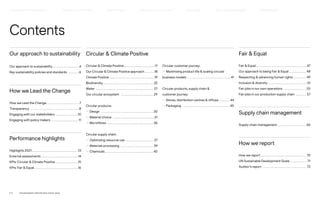
Contents
P.3	 TR ANSPARENT REPORTING SINCE 2002
HOW WE LEAD THE CHANGE
OUR APPROACH TO SUSTAINABILIT Y HIGHLIGHTS 2021 CIRCUL AR & CLIMATE POSITIVE FAIR & EQUAL SUPPLY CHAIN MANAGEMENT HOW WE REPORT
We are continuing to work towards our goal to
make fashion and design accessible to the many,
in a way that’s good for people, the planet, our
industry and our business. Our sustainability
strategy guides us as we work to lead the change
towards a circular and climate positive fashion
industry while being a fair and equal company.
We achieved several milestones in 2021. We are
now working to achieve net-zero greenhouse
gas emissions,1
as part of our climate positive
approach. We previewed our new circular
design tool, Circulator, and developed country-
specific wage strategies in our production supply
chain that consider national contexts and legal
settings. The Covid-19 pandemic has continued
to underline the importance of accelerating our
sustainability agenda.
The way we report on sustainability has also
progressed. This year, we published our first
combined Annual and Sustainability Report,
taking another step on our journey to integrate
sustainability into every part of our business.
Read our Annual and Sustainability Report for
more detail on our sustainability vision and
strategy and how it supports our business, and
information on our sustainability governance.
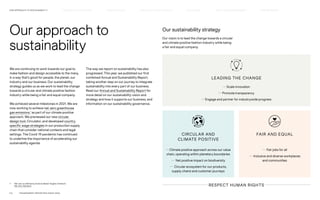
Our approach to
sustainability
CIRCULAR AND
CLIMATE POSITIVE
FAIR AND EQUAL
RESPECT HUMAN RIGHTS
Our vision is to lead the change towards a circular
and climate positive fashion industry while being
a fair and equal company.
— Fair jobs for all
— Inclusive and diverse workplaces
and communities
— Climate positive approach across our value
chain, operating within planetary boundaries
— Net positive impact on biodiversity
— Circular ecosystem for our products,
supply chains and customer journeys
— Scale innovation
— Promote transparency
— Engage and partner for industrywide progress
LEADING THE CHANGE
Our sustainability strategy
1)	
Net-zero as defined by Science Based Targets initiative's
Net-Zero Standard.
P.4	 TR ANSPARENT REPORTING SINCE 2002
OUR APPROACH TO SUSTAINABILIT Y HOW WE LEAD THE CHANGE CIRCUL AR  CLIMATE POSITIVE FAIR  EQUAL SUPPLY CHAIN MANAGEMENT HOW WE REPORT
HIGHLIGHTS 2021
A message from our CEO
This year is the first year that we at the
HM group are integrating our annual and
sustainability reports. This is an important
step, but also a natural development since
sustainability has been an integral part of
our business for a long time.
To meet customers’ ever-increasing
expectations, we are continuing to
develop the customer offering for all our
unique brands by offering customers the
best combination of fashion, quality, price
and sustainability. Demand for good value
and sustainable products is expected to
grow and our customer offering is well
positioned for this. Among other things,
customers can today carry out repairs,
rent clothes or buy and sell second-hand.
I would like to thank all colleagues in
the group for their efforts over the past
year. Our colleagues everywhere in
the organisation have demonstrated
great commitment and worked to meet
customers’ expectations despite the
challenges, restrictions and lockdowns
due to the pandemic. We are proud that
our strong recovery continued in 2021
with much appreciated collections and
products, continued customer focus and
strong relations with our partners.
A message from our
Head of Sustainability
I’m pleased to present the 2021 HM
Group Sustainability Disclosure, detailing
our priorities, progress and learnings on
key environmental and social issues over
the past year. We share the growing sense
of urgency with many around the world
who recognise the fashion industry needs
to move faster towards circularity and
continue to work to develop a fairer, more
transparent and traceable supply chain.
This year, we accelerated our net-zero
ambitions and made progress in key
areas such as material sourcing, inclusion
and diversity, and circular design. We’ve
partnered with others to test and scale
circular materials, processes and business
models, and to progress social protection
and dialogue within our supply chain.
Our approach to sustainability
At the time of writing, however, we are
deeply concerned about the course of
events in Ukraine and our thoughts go out
to all those affected. We are monitoring
developments closely and doing all we can
to help people as much as possible. HM
Group, the HM Foundation and the Erling
Persson Foundation have donated millions
of kronor as well as clothing and other
essentials to organisations such as UNCHR,
Save the Children, the Red Cross and
UNICEF. We join all those around the world
who are calling for peace.
Helena Helmersson
CEO, HM Group
Read the full CEO letter in our Annual and
Sustainability Report.
Looking ahead, we see collaboration as
essential for finding solutions to the
complex and interconnected challenges
we face as an industry. We’ve come a long
way, but we know there is much more to do
to accelerate our transformation. We will
continue to share our progress and learnings,
and welcome collaboration and partnerships
as we continue this journey
Leyla Ertur
Head of Sustainability, HM Group
HM Foundation
The HM Foundation is an independent
non-profit global foundation for public good,
headquartered in Stockholm, Sweden. It is
privately funded by the Stefan Persson family,
founders and main owners of HM Group.
Founded to accelerate the realisation of the
UN Sustainable Development Goals, HM
Foundation uses collaboration and innovation
to co-create, fund and share solutions for
the world’s most urgent challenges.
Since 2013, the family has donated SEK
1.5 billion (USD 200 million) to the Foundation.
Learn more at hmfoundation.com
P.5	 TR ANSPARENT REPORTING SINCE 2002
OUR APPROACH TO SUSTAINABILIT Y HOW WE LEAD THE CHANGE CIRCUL AR  CLIMATE POSITIVE FAIR  EQUAL SUPPLY CHAIN MANAGEMENT HOW WE REPORT
HIGHLIGHTS 2021
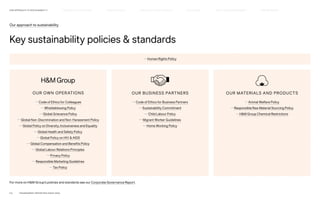
Key sustainability policies  standards
OUR BUSINESS PARTNERS OUR MATERIALS AND PRODUCTS
— Human Rights Policy
— Animal Welfare Policy
— Responsible Raw Material Sourcing Policy
— HM Group Chemical Restrictions
— Code of Ethics for Business Partners
— Sustainability Commitment
— Child Labour Policy
— Migrant Worker Guidelines
— Home Working Policy
— Code of Ethics for Colleagues
— Whistleblowing Policy
— Global Grievance Policy
— Global Non-Discrimination and Non-Harassment Policy
— Global Policy on Diversity, Inclusiveness and Equality
— Global Health and Safety Policy
— Global Policy on HIV  AIDS
— Global Compensation and Benefits Policy
— Global Labour Relations Principles
— Privacy Policy
— Responsible Marketing Guidelines
— Tax Policy
OUR OWN OPERATIONS
For more on HM Group’s policies and standards see our Corporate Governance Report.
Our approach to sustainability
P.6	 TR ANSPARENT REPORTING SINCE 2002
OUR APPROACH TO SUSTAINABILIT Y HOW WE LEAD THE CHANGE CIRCUL AR  CLIMATE POSITIVE FAIR  EQUAL SUPPLY CHAIN MANAGEMENT HOW WE REPORT
HIGHLIGHTS 2021
Competing to transform
fashion
The sixth round of HM Foundation’s
Global Change Awards launched in August
2021. This is the world’s largest innovation
challenge to transform the fashion industry.
The 2022 Award seeks early-stage
innovations contributing to a planet positive
industry by addressing the earth’s global
commons: land, water, oceans, climate and
biodiversity. Applications from more than
100 countries were submitted. Five winners
will be announced in April, 2022.
In 2021, the HM Foundation’s Billion
Dollar Collection campaign presented
ten start-ups that could disrupt the fashion
industry. Each company was showcased
as a garment in a virtual fashion collection,
with the price tag showing the investment
needed to scale up their disruptive
innovations.
We are committed to lead the change to a
better fashion future. This mindset influences
everything we do. We aim to lead by example,
using our size and scale to create positive
impact. Being a first mover is challenging —
trying something new means a greater risk of
failure — but we believe in investing in a business
that meets growing customer interest in more
sustainable products and lifestyles. Improving
the sustainability performance of our value
chain also improves the resilience of our
business operations.
We amplify our positive impact by forming
partnerships, participating in dialogue, and
sharing progress and learnings. Our focus
is on three areas: innovation, transparency,
and engagement with stakeholders and
policy makers.
Innovation
New materials, recycling technologies and
business models that promote circularity, improve
resource use and enhance customers’ experience
are needed to transform our business and the
fashion industry. We identify, test and scale
new solutions:
— Our Circular Innovation Lab supports early-
stage innovations to evaluate new and more
sustainable materials and technologies,
bridging the gap from proof-of-concept projects
to pre-commercial projects all the way to
commercial production.
— Through our investment arm, HM CO:LAB,
we invest in companies developing technologies
and software that enable a circular and
sustainable future.
— Our B2B service Treadler gives other fashion
companies access to HM Group’s supply chain.
This removes barriers to sustainable sourcing
by sharing the benefits of our investments in
circular product development, more sustainable
production and logistics. In 2021, Treadler
introduced a dashboard that lets clients monitor
progress towards their sustainability goals.
— We test and use innovative business models
to offer customers easier access to more
sustainable lifestyles. For example, in Sweden
our subscription-based service Singular Society
gives members access to responsibly made,
high-quality fashion at the price it costs to make.
— 68% of respondents to our annual stakeholder
survey rate HM Group as good or very good
at innovation.
Find more about how innovation speeds
transformation, online and throughout this report.
How we Lead the Change
P.7	 TR ANSPARENT REPORTING SINCE 2002
HOW WE LEAD THE CHANGE
OUR APPROACH TO SUSTAINABILIT Y CIRCUL AR  CLIMATE POSITIVE FAIR  EQUAL SUPPLY CHAIN MANAGEMENT HOW WE REPORT
HIGHLIGHTS 2021
Recognition for
transparency
— HM Group ranked second in Fashion
Revolution’s 2021 Fashion Transparency
Index, scoring 68% (73% in 2020). We
recognise that transparency shouldn’t be
seen as an end goal. Instead, it is a vital
enabler to reach many of our long-term
sustainability objectives.
— Our 2019 Sustainability Performance
Report was named first runner-up in the
honesty and transparency category at
the 2021 Corporate Responsibility
Reporting Awards.
— 71% of stakeholders rate HM Group as
good or very good for transparency. Read
more in Stakeholder Engagement.
Transparency prompts change by:
— Empowering informed choices. Giving
customers information on product and
business sustainability so they can make
informed decisions aligned with their values.
Encouraging customers to adopt more
sustainable behaviours by enabling and
inspiring more sustainable actions.
— Accelerating sustainable change. Increasing
transparency and traceability across our value
chain to give us greater oversight and control
of our impacts. Sharing accurate data on our
performance to identify areas for improvement
and create accountability and comparability
within our industry.
As we continuously improve our data systems
to help reach our ambition of a fully traceable
and transparent supply chain, we’re mindful of
the ethical considerations around collecting and
using data. We see the need for shared guidance
on responsible data handling from policy makers
and the development of strong public governance
procedures. Our Privacy Policy shares how
we process and protect personal data, and we
apply our Responsible AI Checklist every time
we initiate an artificial intelligence (AI) project to
ensure relevant ethical questions are answered.
Communicating openly and honestly about
our business is vital for building meaningful
relationships with colleagues, customers,
investors and others. Transparency alone does
not improve sustainability performance, but
creates accountability and comparability, pushing
us to improve and encouraging others in our
industry to do the same.
Progress: empowering
informed choices
— In 2021, HM was among the first fashion
brands to launch the Sustainable Apparel
Coalition’s (SAC) Higg Index Sustainability Profile
— a new on-product transparency tool sharing
environmental performance scores for materials.
Customers can view profiles on around 850 HM
products online in Europe and the United States.
We continued our partnership with the SAC,
a global multi-stakeholder non-profit alliance
developing tools to standardise sustainability
measurements — sitting on strategic councils
and within working groups.
— HM and HM HOME online continue to offer
customers on-product transparency information
about product materials, factory locations,
garment care and recycling options.
— We expanded MyStore, our store-led
community programme that engages and
educates customers and colleagues on local
sustainability issues. We extended coverage
to central Europe and India, with 140 stores
participating.
— HM completed the roll-out of its initiative
to reward members with Conscious Points,
for making more sustainable choices. The
initiative empowers members to track their
conscious choices, such as using our garment
collecting initiative, bringing their own bag
when shopping in store or choosing climate-
smart delivery when shopping online. In 2021,
HM members completed over 45 million
Transparency
HOW WE LEAD THE CHANGE
OUR APPROACH TO SUSTAINABILIT Y CIRCUL AR  CLIMATE POSITIVE FAIR  EQUAL SUPPLY CHAIN MANAGEMENT HOW WE REPORT
HIGHLIGHTS 2021
P.8	 TR ANSPARENT REPORTING SINCE 2002
conscious choices. HM will continue developing
this concept during 2022.
— HM and COS tested sharing on-product
lifecycle assessment (LCA) data with customers.
Read what we found in Learnings.
Progress: accelerating
sustainable change
— ARKET, COS, HM, Monki,  Other Stories
and Weekday completed the Higg Brand  Retail
Module and took part in data verification for the
programme. The scores will be available to SAC
members, with the eventual goal to share publicly
to enable comparison across brands.
— We continued assessing suppliers’ social
and environmental performance using the
Higg Facility Environmental Module (FEM)
and Higg Facility Social and Labor Module (FSLM).
See Supply Chain Management for more detail.
— We joined the European Commission’s Green
Consumption Pledge Initiative, committing to
disclose details of our work and performance on
our circular and climate positive strategy.
— We’re exploring opportunities to improve
traceability of materials, enrolling in multiple
projects aiming to find scalable solutions to
this challenge. For example, we plan to scale our
TextileGenesis traceability programme to more
materials during 2022. Additionally, together
with Textile Exchange and TextileGenesis, we’re
piloting eTrackit, a digital certified chain of
custody model to improve traceability of materials
through the supply chain.
— Our HM Group supplier list disclosed
information about 1,519 tier 1 supplier factories,
covering 99% of relevant production volume,
and 394 tier 2 supplier factories, covering 71%
of relevant production volume. COS, Monki and
Weekday added supplier lists and ARKET added
a sustainability fact sheet to their websites.
— We continued contributing to the EU Product
Environmental Footprint Technical Secretariat,
which is developing an EU-wide methodology
to measure apparel and footwear product
environmental footprints that could help
substantiate sustainability claims.
Learnings
— Our work to communicate environmental
impacts with customers taught us that they tend
to find LCA information overwhelming. Sharing
data this way is not scalable or comparable
because it is too costly and time consuming.
What we need is a unified industry approach
to measuring and communicating product
impact data.
Transparency
— Our on-product transparency pilots show sharing
product impact data with customers does not appear
to impact customer behaviour in the short term, but
builds trust and loyalty.
Future focus
— We’ll continue improving on-product transparency
to help customers better understand the impacts of
our products. We’ll keep supporting the development
of the Higg Index Sustainability Profiles to improve
sharing of comparable customer-facing sustainability
scores together with the SAC. We plan to use the
profiles for more products and brands, and are keen
to see the scope of profiles extended, including to
social impact categories. In 2022, we’ll pilot the tool’s
expansion to tier 1 supplier factory scores.
— Securing a seamless flow of data between
information systems remains a key challenge.
We’re developing a roadmap for our supply chain
sustainability performance data to improve
integration and accessibility.
P.9	 TR ANSPARENT REPORTING SINCE 2002
HOW WE LEAD THE CHANGE
OUR APPROACH TO SUSTAINABILIT Y CIRCUL AR  CLIMATE POSITIVE FAIR  EQUAL SUPPLY CHAIN MANAGEMENT HOW WE REPORT
HIGHLIGHTS 2021
Our stakeholders include:
— Customers. Our customers are the centre
of our business. We continuously listen to learn
their needs, understand their expectations and
make more sustainable choices as easy and
attractive as possible to them.
— Colleagues. Everyone at HM Group has a
role in achieving our sustainability ambitions.
We welcome the diversity of perspectives,
knowledge and experience contributed by
our many colleagues around the world.
— Business partners — including suppliers
of commercial and non-commercial goods
and services, franchise partners and online
platform channels. We work together to share
expectations, address social and environmental
challenges in our supply chain, and raise industry
standards. We engage with our suppliers’
employees either directly through anonymous
worker surveys or via representative bodies such
as trade unions.
— Experts — including peers, nongovernmental
organisations, academics and researchers,
innovators and multi-stakeholder initiatives.
Together, we can tackle systemic challenges and
have a positive impact beyond our business.
We welcome open dialogue and collaboration
with others within and outside our industry.
Engaging with diverse perspectives challenges us
to do better, accelerates innovation and supports
our transparency efforts. Partnerships help us
progress towards our sustainability ambitions
faster than we could alone and have a positive
impact beyond our own value chain.
Engaging with our stakeholders — Policy makers — including governments
and international institutions. We work to raise
and level the legislative playing field, support
the development of the fashion industry and
encourage governments and businesses to
take shared responsibility for meeting
complex challenges. Read more in Engaging
with Policy Makers.
— Investors. As a publicly listed company,
we are accountable to our investors. We
maintain two-way dialogue with them to share
our progress, seek feedback and inform our
sustainability strategy and reporting.
— Communities. We want to contribute to
positive impacts, growth and development in the
communities where our operations and suppliers
are located, and the demographic communities
that represent our customers and colleagues.
We regularly engage with our stakeholders using
a range of channels. These include webinars
and calls, partnership meetings, surveys
and consultations, training programmes, our
stakeholder newsletter, and regular updates
during the Covid-19 crisis. Each year, we invite
views on our sustainability performance and
reporting via our anonymous stakeholder survey.
Read more about our stakeholder engagement
activities and external collaborations in 2021.
Stakeholder feedback
In 2021, 96 stakeholders (a 15% response
rate) participated in our stakeholder
perception survey (96 in 2020; 350 in 2019).
This year:
— 73% of respondents agree or strongly
agree that HM Group is taking the lead
among fashion retailers for social and
environmental sustainability (76% in 2020;
52% in 2019).
— 89% say they have good or very good
experience interacting with us (92% in
2020; 71% in 2019).
— 77% say HM Group is a company they
can trust (75% in 2020; 55% in 2019).
Additional results relating to specific topics
are shared in the relevant sections of this
report.
HOW WE LEAD THE CHANGE
OUR APPROACH TO SUSTAINABILIT Y CIRCUL AR  CLIMATE POSITIVE FAIR  EQUAL SUPPLY CHAIN MANAGEMENT HOW WE REPORT
HIGHLIGHTS 2021
P.10	 TR ANSPARENT REPORTING SINCE 2002
Our public affairs work is an important enabler
to address systemic issues and achieve policy
developments needed to support meaningful
growth in our industry.
We engage with governments on key
environmental, social and business topics.
The central team reports directly to our chief
financial officer and sets the direction for teams
in our retail and production markets. HM Group
is listed in the EU Transparency Register.
Priority policy areas
We focus on the issues most relevant to our
sustainability work and where we see greatest
potential to contribute to positive change.
An important focus area is upcoming European
Union (EU) and EU country-level legislation on
transparency, circularity and other environmental
and social issues. We also prioritise engaging
with national and international policy and
legislation that:
— Supports transition to a circular and climate
positive fashion industry.
— Impacts social development in our production
markets, with a focus on wages and social
protection mechanisms.
— Enables stable, predictable development of
the industry in our production markets to support
equitable economic growth, in line with the
Sustainable Development Goals.
— Promotes a free and sustainable trade agenda.
— Addresses the emerging artificial intelligence
and digitalisation agenda.
We engage in international dialogue relevant to
our sustainability ambitions, including through
COP26, the International Labour Organization,
the Organisation for Economic Co-operation and
Development, the UN Framework Convention
on Climate Change (UNFCCC), the UN Global
Compact (UNGC) Decent Work in Global Supply
Chains Action Platform, the UNGC CFO taskforce
and the World Economic Forum.
We are members of multi-stakeholder
platforms, including ACT (Action, Collaboration,
Transformation), AFIRM, Business for Nature,
Global Fashion Agenda, the Policy Hub —
Circularity for Apparel and Footwear, the
Sustainable Apparel Coalition, Textile Exchange,
the UNFCCC Fashion Industry Charter for
Climate Action and ZDHC (Zero Discharge of
Hazardous Chemicals).
Key 2021 activities
— We contributed in depth to EU consultations
on the EU Textile Strategy, sustainable product
initiative (including eco-design, circular
business models and digital product passports),
chemicals, due diligence (Sustainable Corporate
Governance), packaging, end-of-waste criteria
for the textile industry, and the EU taxonomy
for sustainable economic activities. Our CEO
and our Head of Sustainability took part in high-
level meetings with the EU Commission and
EU Parliament on topics such as transparency
and sustainable textiles.
— In several production markets, we advocated
for transparent, inclusive minimum wage revisions
and extended social protection mechanisms,
either through policy conversations (for example,
in Bangladesh and Indonesia) or working with our
suppliers to ensure full enforcement of the law
(for example, in Turkey).
— We engaged with national authorities to
support reforms towards a cleaner energy
mix, including in Bangladesh (on the revision
of the Renewable Energy Policy), Cambodia,
and Indonesia (together with CEIA – Clean
Energy Investment Accelerator). In Turkey and
Bangladesh we started a collaboration with
United Nations Development Programme (UNDP)
to understand the legal framework and advocate
for the shift towards a climate positive industry.
Engaging with policy makers
P.11	 TR ANSPARENT REPORTING SINCE 2002
HOW WE LEAD THE CHANGE
OUR APPROACH TO SUSTAINABILIT Y CIRCUL AR  CLIMATE POSITIVE FAIR  EQUAL SUPPLY CHAIN MANAGEMENT HOW WE REPORT
HIGHLIGHTS 2021
Find highlights from across our 2021 sustainability
work in this section, along with reporting on all our
key performance indicators (KPIs).
Highlights 2021. . . . . . . . . . . . . . . . . . . . . . . . . . . . . . . . 13
External assessments . . . . . . . . . . . . . . . . . . . . . . . . . 14
KPIs: Circular  Climate Positive . . . . . . . . . . . . . . . 15
KPIs: Fair  Equal . . . . . . . . . . . . . . . . . . . . . . . . . . . . . . 16
Performance
highlights
P.12	 TR ANSPARENT REPORTING SINCE 2002
HIGHLIGHTS 2021
HOW WE LEAD THE CHANGE
OUR APPROACH TO SUSTAINABILIT Y FAIR  EQUAL
CIRCUL AR  CLIMATE POSITIVE HOW WE REPORT
SUPPLY CHAIN MANAGEMENT
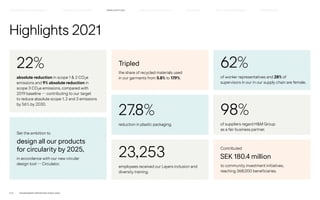
Highlights 2021
22%
absolute reduction in scope 1  2 CO2e
emissions and 9% absolute reduction in
scope 3 CO2e emissions, compared with
2019 baseline — contributing to our target
to reduce absolute scope 1, 2 and 3 emissions
by 56% by 2030.
Set the ambition to
design all our products
for circularity by 2025,
in accordance with our new circular
design tool — Circulator.
Contributed
SEK 180.4 million
to community investment initiatives,
reaching 368,000 beneficiaries.
Tripled
the share of recycled materials used
in our garments from 5.8% to 17.9%.
62%
of worker representatives and 28% of
supervisors in our in our supply chain are female.
27.8%
reduction in plastic packaging.
98%
of suppliers regard HM Group
as a fair business partner.
23,253
employees received our Layers inclusion and
diversity training.
P.13	 TR ANSPARENT REPORTING SINCE 2002
HIGHLIGHTS 2021
HOW WE LEAD THE CHANGE
OUR APPROACH TO SUSTAINABILIT Y CIRCUL AR  CLIMATE POSITIVE FAIR  EQUAL SUPPLY CHAIN MANAGEMENT HOW WE REPORT
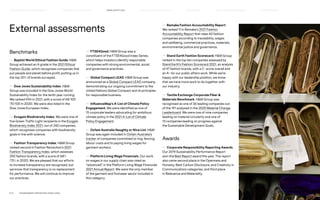
External assessments
Benchmarks
— Baptist World Ethical Fashion Guide. HM
Group achieved an A grade in the 2021 Ethical
Fashion Guide, which recognises companies that
put people and planet before profit, putting us in
the top 20% of brands surveyed.
— Dow Jones Sustainability Index. HM
Group was included in the Dow Jones World
Sustainability Index for the tenth year running.
We ranked fifth in 2021, with a score of 68/100
(70/100 in 2020). We were also listed in the
Dow Jones European Index.
— Ecogain Biodiversity Index. We were one of
five Green Traffic Light recipients in the Ecogain
Biodiversity Index 2021, out of 240 companies,
which recognises companies with biodiversity
goals in line with science.
— Fashion Transparency Index. HM Group
ranked second in Fashion Revolution’s 2021
Fashion Transparency Index, which assesses
250 fashion brands, with a score of 68%
(73% in 2020). We are pleased that our efforts
to increase transparency are recognised, but
we know that transparency is no replacement
for performance. We will continue to improve
our practices.
— FTSE4Good. HM Group was a
constituent of the FTSE4Good Index Series,
which helps investors identify responsible
companies with strong environmental, social
and governance practices.
— Global Compact LEAD. HM Group was
announced as a Global Compact LEAD company,
demonstrating our ongoing commitment to the
United Nations Global Compact and its principles
for responsible business.
— InfluenceMap’s A-List of Climate Policy
Engagement. We were identified as one of
15 corporate leaders advocating for ambitious
climate policy in the 2021 A-List of Climate
Policy Engagement.
— Oxfam Australia Naughty or Nice List. HM
Group was again included in Oxfam Australia’s
tracker of companies committed to ring-fencing
labour costs and to paying living wages for
garment workers.
— Platform Living Wage Financials. Our work
on wages in our supply chain was rated as
“advanced” in the Platform Living Wage Financials
2021 Annual Report. We were the only member
of the garment and footwear sector included in
this category.
— Remake Fashion Accountability Report.
We ranked 11 in Remake’s 2021 Fashion
Accountability Report that rates 60 fashion
companies according to traceability, wages
and wellbeing, commercial practices, materials,
environmental justice and governance.
— Stand Earth Fashion Scorecard. HM Group
ranked in the top ten companies assessed by
Stand Earth’s Fashion Scorecard 2021, an analysis
of 47 fashion brands, with a C- score overall and
an A+ for our public affairs work. While we’re
happy with our leadership position, we know
that we have more work to do together with
our industry.
— Textile Exchange Corporate Fiber 
Materials Benchmark. HM Group was
recognised as one of 36 leading companies out
of the 191 analysed in the 2020 Material Change
Leaderboard. We were one of nine companies
leading on material circularity and one of
13 companies leading on progress against
the Sustainable Development Goals.
Awards
— Corporate Responsibility Reporting Awards.
Our 2019 Sustainability Performance Report
won the Best Report award this year. The report
also came second place in the Openness and
Honesty, Best Carbon Disclosure, and Creativity in
Communications categories, and third place
in Relevance and Materiality.
P.14	 TR ANSPARENT REPORTING SINCE 2002
HIGHLIGHTS 2021
HOW WE LEAD THE CHANGE
OUR APPROACH TO SUSTAINABILIT Y CIRCUL AR  CLIMATE POSITIVE FAIR  EQUAL SUPPLY CHAIN MANAGEMENT HOW WE REPORT
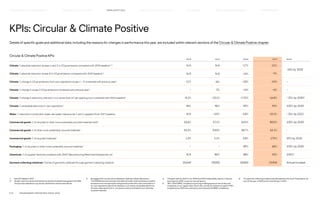
KPIs: Circular  Climate Positive
Details of specific goals and additional data, including the reasons for changes in performance this year, are included within relevant sections of the Circular  Climate Positive chapter.
Circular  Climate Positive KPIs
2018 2019 2020 2021 GOAL
Climate: % absolute reduction (scopes 1 and 2) in CO2e emissions compared with 2019 baseline1,2,3
N/A N/A +17% –22%
-56% by 2030
Climate: % absolute reduction (scope 3) in CO2e emissions compared with 2019 baseline1,3
N/A N/A –14% –9%
Climate: % change in CO2e emissions from own operations (scope 1 + 2) compared with previous year3
–11% +8% +18% –34% −
Climate: % change in scope 3 CO2e emissions compared with previous year3
− –3% –14% +6% −
Climate: % change in electricity intensity in our stores (kwh/m2
per opening hour) compared with 2016 baseline3
–8.2% –10.1% −17.0% –16.8% −25% by 20304
Climate: % renewable electricity in own operations3
96% 96% 90% 95% 100% by 2030
Water: % reduction in production water use (water intensive tier 1 and 2 suppliers) from 2017 baseline N/A –5.9% –3.8% –10.3% −25% by 2022
Commercial goods: % of recycled or other more sustainably sourced materials total3
56.6% 57.1% 64.5% 80.0% 100% by 2030
Commercial goods: % of other more sustainably sourced materials3
55.2% 54.9% 58.7% 62.1% –
Commercial goods: % of recycled materials3
1.4% 2.2% 5.8% 17.9% 30% by 2025
Packaging: % of recycled or other more sustainably sourced materials1
− − 89% 68% 100% by 2030
Chemicals: % of supplier factories compliant with ZDHC Manufacturing Restricted Substances List N/A 80% 88% 95% 100%5
Garment collecting initiatives: Tonnes of garments collected through garment collecting initiative6
20,649 29,005 18,800 15,944 Annual increase
1) 	
New KPI added in 2021.
2) 	
Scope 1 and 2 are direct and indirect emissions of greenhouse gases from HM
Group’s own operations, e.g. stores, distribution centres and offices.
3)	See page 72 for an assurance statement relating to these data points.
The limited assurance process included: all scope 1 and 2 emissions; scope 3
emissions from transportation and garment production; fuel consumption in
our own operations; electricity intensity in our stores; renewable electricity;
all cotton data (apart from in-conversion cotton); and data for our top three
recycled materials.
4) 	
This goal read ‘by 2025’ in our 2020 and 2019 sustainability reports. It should
have read ‘by 2030’, as per our annual reports.
5) 	
100% ZDHC MRSL compliance is proving challenging due to the variety and
complexity of our supply chain. Due to this, we did not achieve our goal of 100%
compliance by 2020 and continue to work towards full MRSL compliance.
6)	
Our garment collecting initiative was disrupted by the Covid-19 pandemic for
part of the year in 2020 and for the full year in 2021.
P.15	 TR ANSPARENT REPORTING SINCE 2002
HIGHLIGHTS 2021
HOW WE LEAD THE CHANGE
OUR APPROACH TO SUSTAINABILIT Y CIRCUL AR  CLIMATE POSITIVE FAIR  EQUAL SUPPLY CHAIN MANAGEMENT HOW WE REPORT
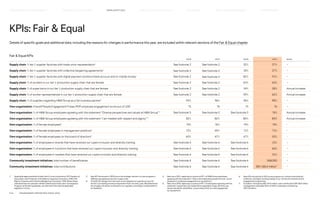
KPIs: Fair  Equal
Details of specific goals and additional data, including the reasons for changes in performance this year, are included within relevant sections of the Fair  Equal chapter.
Fair  Equal KPIs
2018 2019 2020 2021 GOAL
Supply chain: % tier 1 supplier factories with trade union representation1
See footnote 2 See footnote 2 32% 37% −
Supply chain: % tier 1 supplier factories with collective bargaining agreements1
See footnote 2 See footnote 2 18% 27% −
Supply chain: % tier 1 supplier factories with digital payment solutions (bank account and/or mobile money) See footnote 2 See footnote 2 82% 91% −
Supply chain: % of workers in our tier 1 production supply chain that are female See footnote 2 See footnote 2 63% 63% −
Supply chain: % of supervisors in our tier 1 production supply chain that are female See footnote 2 See footnote 2 24% 28% Annual increase
Supply chain: % of worker representatives in our tier 1 production supply chain that are female See footnote 2 See footnote 2 59% 62% Annual increase
Supply chain: % of suppliers regarding HM Group as a fair business partner3
93% 96% 96% 98% −
Own organisation: Overall People Engagement Pulses (PEP) employee engagement score (out of 100) 75 76 75 76 −
Own organisation: % of HM Group employees agreeing with the statement “Diverse perspectives are valued at HM Group” 4
See footnote 5 See footnote 5 See footnote 5 74% Annual increase
Own organisation: % of HM Group employees agreeing with the statement “I am treated with respect and dignity” 5
81% 82% 80% 83% Annual increase
Own organisation: % of female employees6
74% 76% 74% 74% –
Own organisation: % of female employees in management positions6
72% 69% 71% 71% –
Own organisation: % of female employees on the board of directors6
60% 67% 67% 55% –
Own organisation: % of employees in brands that have received our Layers inclusion and diversity training See footnote 6 See footnote 6 See footnote 6 15% −
Own organisation: % of employees in functions that have received our Layers inclusion and diversity training See footnote 6 See footnote 6 See footnote 6 66% −
Own organisation: % of employees in markets that have received our Layers inclusion and diversity training See footnote 6 See footnote 6 See footnote 6 21% −
Community investment initiatives: total number of beneficiaries See footnote 6 See footnote 6 See footnote 6 368,000 −
Community investment initiatives: total contributions See footnote 6 See footnote 6 See footnote 6 SEK 180.4 million7
−
1) 	
Applicable legal standards include: the ILO core conventions; C87 Freedom of
Association and Protection of the Right to Organize Convention, 1948; C98
Right to Organize and Collective Bargaining Convention, 1949. Where these
standards have not yet been ratified, following Social  Labor Convergence
Program verification guidelines, we referred to the national applicable
legislation in force.
2) 	
New KPI introduced in 2020 due to the strategic decision to track progress in
HM Group’s global production supply chain.
3) 	
This KPI will change from next year as we integrate our supplier survey into
the ACT purchasing practices assessment that runs every year. We believe that
this change will reduce workload for our suppliers, providing a trusted platform
for feedback.
4) 	
New since 2021, replacing our previous KPI % of HM Group employees
agreeing with the statement “I feel comfortable being myself at work”, as we
updated our employee engagement survey platform.
5) 	
New since 2018, replacing our previous KPI % of employees agreeing with the
statement “people here are treated fairly regardless of age, ethnicity, sex,
sexual orientation, disabilities”, as we made a shift to a new engagement
survey platform.
6) 	
New KPIs introduced in 2021 as we progress our inclusion and diversity
ambitions, and begin tracking change in our community investment and
engagement programmes.
7)	
Includes in-kind giving SEK 134.5 million, cash contributions SEK 38.8 million,
management overheads SEK 6.3 million, employee volunteering
SEK 0.8 million.
P.16	 TR ANSPARENT REPORTING SINCE 2002
HIGHLIGHTS 2021
HOW WE LEAD THE CHANGE
OUR APPROACH TO SUSTAINABILIT Y CIRCUL AR  CLIMATE POSITIVE FAIR  EQUAL SUPPLY CHAIN MANAGEMENT HOW WE REPORT
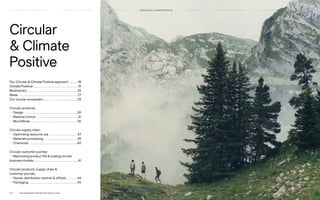
Circular
 Climate
Positive
Our Circular  Climate Positive approach . . . . . . 18
Climate Positive . . . . . . . . . . . . . . . . . . . . . . . . . . . . . . . 19
Biodiversity . . . . . . . . . . . . . . . . . . . . . . . . . . . . . . . . . . . 25
Water	. . . . . . . . . . . . . . . . . . . . . . . . . . . . . . . . . . . . . . . . . 27
Our circular ecosystem . . . . . . . . . . . . . . . . . . . . . . . . 29
Circular products:
— Design . . . . . . . . . . . . . . . . . . . . . . . . . . . . . . . . . . . . . 30
— Material choice . . . . . . . . . . . . . . . . . . . . . . . . . . . . . 31
— Microfibres. . . . . . . . . . . . . . . . . . . . . . . . . . . . . . . . . 36
Circular supply chain:
— Optimising resource use . . . . . . . . . . . . . . . . . . . . 37
— Materials processing . . . . . . . . . . . . . . . . . . . . . . . . 39
— Chemicals . . . . . . . . . . . . . . . . . . . . . . . . . . . . . . . . . . 40
Circular customer journey:
— Maximising product life  scaling circular
business models . . . . . . . . . . . . . . . . . . . . . . . . . . . . . . 41
Circular products, supply chain 
customer journey:
— Stores, distribution centres  offices. . . . . . . . 44
— Packaging . . . . . . . . . . . . . . . . . . . . . . . . . . . . . . . . . . 45
CIRCUL AR  CLIMATE POSITIVE
HOW WE LEAD THE CHANGE
OUR APPROACH TO SUSTAINABILIT Y FAIR  EQUAL SUPPLY CHAIN MANAGEMENT HOW WE REPORT
HIGHLIGHTS 2021
P.17	 TR ANSPARENT REPORTING SINCE 2002
Our Circular  Climate Positive
approach
Our business, our people and the communities
where they live and work are reliant upon
natural resources. In turn, the health of the
planet depends upon how we use, protect and
restore these resources. The actions we take
now to preserve our shared environment lay the
foundation for the business we want to become
and must become for future generations —
offering our customers more sustainable choices
as part of a circular fashion ecosystem.
By reducing our impact on climate and nature,
we also contribute to a more fair and equal
society. Access to a safe, healthy and clean
environment is a human right, while a thriving
environment supports equity, economic
development and wellbeing. Climate change is
already exacerbating inequalities and conflicts,
degrading ecosystems and impacting the
availability of resources.
These interconnected issues of climate and
nature — which include water, biodiversity
and land use changes — are at the heart of our
approach to reducing our environmental impact.
We are determined to work within planetary
boundaries and progress towards a sustainable
fashion future.
Our ambition is to achieve net-zero CO2e
emissions by 2040,1
taking a climate positive
approach and having a net positive impact on
biodiversity.2
Becoming circular throughout our
business is key to achieving these aims. How we
make and use our products directly affects our
carbon and water footprints and our impact
on nature.
Tackling this complex set of issues requires us to
collaborate with peers, experts and policy makers,
for example, through our work with Business for
Nature, the Ellen MacArthur Foundation, Global
Fashion Agenda, Policy Hub, the Stockholm
Resilience Centre and our partnership with WWF.
In 2021, we set new CO2e emissions reduction
goals to support our net-zero and climate positive
ambitions. Compared to our 2019 baseline,
we have reduced our absolute scope 1 and 2
emissions by 22% and our scope 3 emissions
by 9%. We reduced production water use by
6.6% compared to last year. We engaged with
the Science Based Targets Network to begin
developing targets for nature and invested in
projects focused on reducing the biodiversity
impact of our material sourcing. We also
continued our work with WWF to set context-
specific (contextual) water targets and to develop
our new 2030 Water Strategy.
See our Circular  Climate Positive KPIs from
2021.
HM Foundation
In 2021, the HM Foundation launched a
new planet strategy — Planet Positive. The
strategy addresses challenges within the
entire earth system — including climate,
water, ocean, biodiversity and land — and
across every step of the fashion industry’s
value chain.
For our industry to become truly
regenerative it is crucial to look beyond
circularity. The HM Foundation invests
in new research and supports innovations
with a planet positive focus. One example
is the five-year Planet First partnership
with the Hong Kong Research Institute of
Textiles and Apparel (HKRITA), which aims
to consider all aspects of earth’s natural
support systems.
1)	 Net-zero as defined by the SBTi’s Net-Zero Standard.
2)	
Our ambition to have a net positive impact on biodiversity is based
on the definition of nature-positive in the naturepositive.org paper:
A Nature Positive World: The Global Goal for Nature.
CIRCUL AR  CLIMATE POSITIVE
HOW WE LEAD THE CHANGE
OUR APPROACH TO SUSTAINABILIT Y FAIR  EQUAL SUPPLY CHAIN MANAGEMENT HOW WE REPORT
HIGHLIGHTS 2021
P.18	 TR ANSPARENT REPORTING SINCE 2002
Climate Positive
The urgency of the climate crisis is now
undeniable. The sixth report from the
Intergovernmental Panel on Climate Change (IPCC)
states that human-induced climate change already
affects every inhabited region across the globe.
Without steep greenhouse gas (GHG) emission
reductions, the IPCC warns that warming of 1.5o
C
or even 2o
C will be exceeded this century — with
potentially catastrophic consequences for people
and the planet.
We must accelerate our own progress to be part
of the solution. Our work on climate is closely
linked to our work on water, biodiversity, resource
use and circularity.
Our climate strategy
We take a climate positive approach throughout
our value chain and beyond. To do this we will:
— Halve our emissions every decade.
— Achieve net-zero no later than 2040, using the
Science Based Targets initiative’s (SBTi) definition.
We are revising our existing science-based targets
to align with the SBTi’s recently launched Net-Zero
Standard. We have submitted a near-term SBT
with a target year of 2030, and a long-term SBT
to achieve net-zero by 2040, and we are currently
awaiting approval of these by SBTi.
targets and interim milestones as part of our
Net-Zero Roadmap.
We focus on four priority activity areas to support
these targets:
— Energy efficiency. Use as little energy as
possible across the whole value chain — including
in our own operations, logistics activities and
throughout our supply chain.
— Renewable energy. Work to source 100%
renewable electricity in our own operations, and
engage with partners and suppliers to increase
their use of renewable electricity, heat and steam.
We are an RE100 member company.
— Circularity. Our circular ambition and goals are
integral to achieving our climate goals.
— Have a positive effect beyond our value chain,
by engaging in public affairs and collaboration, and
making financial commitments to reduce climate
impacts beyond our value chain emissions.
To help us achieve net-zero, we introduced a
new goal to reduce our absolute scope 1, 2
and 3 emissions by 56% by 2030, from a 2019
baseline.1
This overarching goal supersedes
previous scope 3 goals, including our product
goal. We also have a number of supporting targets
focused on different aspects of our value chain:2
— From January 1, 2022, we will not onboard any
new suppliers or supplier factories into our supply
chain if they have on-site coal boilers in their
factories — as part of a longer-term aim to phase
out coal from our supply chain.
— By 2030, achieve a 25% reduction in electricity
intensity in our stores, from a 2016 baseline.
— By 2030, source 100% renewable electricity in
our own operations.
— By 2030, the electricity sourced in our supply
chain will be 100% renewable.3
— By 2025, source 30% recycled materials.
There are additional goals attached to our
sustainability-linked bond, as well as year-on-year
— Carbon removals. Find nature-based and
engineered solutions for removing GHGs from
the atmosphere. Future investments in carbon
removals will primarily serve to neutralise our
residual emissions in order to achieve net-zero
value chain emissions.
1)	
We chose 2019 as our baseline year, since the impact of the Covid-19
pandemic on our carbon emissions makes 2020 an inappropriate year
against which to measure longer-term performance data. Emissions
from the customer use phase are not included in the scope 3 part of this
goal, to fully align with the target boundary requirements of the SBTi
Net-Zero Standard.
2)	
We are revising our transport emissions target to align with our new
absolute emissions goal.
3)	
Wherever renewable electricity is available for purchase (in rare cases,
some markets do not have renewable electricity for sale).
P.19	 TR ANSPARENT REPORTING SINCE 2002
CIRCUL AR  CLIMATE POSITIVE
HOW WE LEAD THE CHANGE
OUR APPROACH TO SUSTAINABILIT Y FAIR  EQUAL SUPPLY CHAIN MANAGEMENT HOW WE REPORT
HIGHLIGHTS 2021
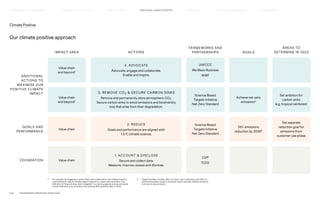
GOALS AND
PERFORMANCE
2. REDUCE
Goals and performance are aligned with
1.5o
C climate science.
Science Based
Targets initiative
Net-Zero Standard
56% emissions
reduction by 20302
Value chain
Set separate
reduction goal for
emissions from
customer use phase
1. ACCOUNT  DISCLOSE
Secure and collect data.
Measure, improve, assess and disclose.
CDP
TCFD
Value chain
FOUNDATION
4. ADVOCATE
Advocate, engage and collaborate.
Enable and inspire.
UNFCCC
We Mean Business
WWF
Value chain
and beyond1
Our climate positive approach
Climate Positive
AREAS TO
DETERMINE IN 2022
GOALS
FRAMEWORKS AND
PARTNERSHIPS
IMPACT AREA ACTIONS
3. REMOVE CO2  SECURE CARBON SINKS
Remove and permanently store atmospheric CO2.
Secure carbon sinks to avoid emissions and biodiversity
loss that arise from their degredation.
Science Based
Targets initiative
Net-Zero Standard
Achieve net-zero
emissions2
Value chain
and beyond1
Set ambition for
carbon sinks
(e.g. tropical rainforest)
ADDITIONAL
ACTIONS TO
MAXIMISE OUR
POSITIVE CLIMATE
IMPACT
1)	
For example, by engaging in public affairs and collaboration, and making financial
commitments to reduce climate impacts beyond our value chain emissions. The
definition of beyond value chain mitigation is a moving agenda, and we anticipate
further definition to be included in the planned SBTi guidance later in 2022.
2)	
Target boundary includes 100% of scope 1 and 2 emissions, and 100% of
minimum boundary scope 3 emissions (which excludes indirect emissions
from use of sold products).
P.20	 TR ANSPARENT REPORTING SINCE 2002
CIRCUL AR  CLIMATE POSITIVE
HOW WE LEAD THE CHANGE
OUR APPROACH TO SUSTAINABILIT Y FAIR  EQUAL SUPPLY CHAIN MANAGEMENT HOW WE REPORT
HIGHLIGHTS 2021
Climate Positive
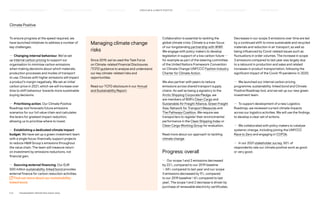
To ensure progress at the speed required, we
have launched initiatives to address a number of
key challenges:
— Changing internal behaviour. We’ve set
up internal carbon pricing to support our
organisation to minimise carbon emissions
when making decisions about which materials,
production processes and modes of transport
to use. Choices with higher emissions will impact
a product’s margin negatively. We set an initial
carbon price in 2021, which we will increase over
time to shift behaviour towards more sustainable
buying decisions.
— Prioritising action. Our Climate Positive
Roadmap tool forecasts future emissions
scenarios for our full value chain and calculates
the levers for greatest impact reduction,
allowing us to prioritise where to invest.
— Establishing a dedicated climate impact
budget. We have set up a green investment team
with a single focus: financially support projects
to reduce HM Group´s emissions throughout
the value chain. The team will measure return
on investment by emissions reductions, not
financial gain.
— Sourcing external financing. Our EUR
500 million sustainability-linked bond provides
external finance for carbon reduction activities.
Find out more about our sustainability-
linked bond.
Collaboration is essential to tackling the
global climate crisis. Climate is a main focus
of our longstanding partnership with WWF.
We engage with policy makers to develop
legislation in support of a low carbon future —
for example as part of the steering committee
of the United Nations Framework Convention
on Climate Change (UNFCCC) Fashion Industry
Charter for Climate Action.
We also partner with peers to reduce
emissions across shared transport supply
chains. As well as being a signatory to the
Arctic Shipping Corporate Pledge, we
are members of BSR’s Clean Cargo and
Sustainable Air Freight Alliance, Green Freight
Asia, Network for Transport Measures and
The Pathways Coalition. We require sea
transporters to register their environmental
performance in the Clean Shipping Index or
Clean Cargo Working Group for evaluation.
Read more about our approach to tackling
climate change.
Progress: overall
— Our scope 1 and 2 emissions decreased
by 22%, compared to our 2019 baseline
(–34% compared to last year) and our scope
3 emissions decreased by 9%, compared
to our 2019 baseline (+6% compared to last
year). The scope 1 and 2 decrease is driven by
purchase of renewable electricity certificates.
Decreases in our scope 3 emissions over time are led
by a continued shift to more sustainable and recycled
materials and reduction in air transport, as well as
being influenced by Covid-related issues such as
fluctuations in order volumes. The increase in scope
3 emissions compared to last year was largely due
to a rebound in production and sales and related
increases in product transportation, following the
significant impact of the Covid-19 pandemic in 2020.
— We launched our internal carbon pricing
programme, sustainability-linked bond and Climate
Positive Roadmap tool, and we set up our new green
investment team.
— To support development of a new Logistics
Roadmap, we reviewed current climate impacts
across our logistics activities. We will use the findings
to develop a clear set of actions.
— We collaborated with policy makers to catalyse
systemic change, including joining the UNFCCC
Race to Zero and engaging in COP26.
— In our 2021 stakeholder survey, 50% of
respondents rate our climate positive work as good
or very good.
Managing climate change
risks
Since 2019, we’ve used the Task Force
on Climate-related Financial Disclosures
(TCFD) guidance to analyse and understand
our key climate-related risks and
opportunities.
Read our TCFD disclosure in our Annual
and Sustainability Report.
P.21	 TR ANSPARENT REPORTING SINCE 2002
CIRCUL AR  CLIMATE POSITIVE
HOW WE LEAD THE CHANGE
OUR APPROACH TO SUSTAINABILIT Y FAIR  EQUAL SUPPLY CHAIN MANAGEMENT HOW WE REPORT
HIGHLIGHTS 2021
Climate Positive
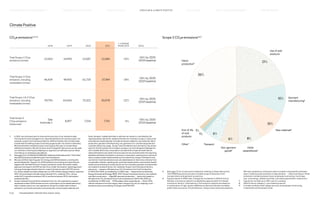
Scope 3 CO2e emissions5,6,7
5) 	
See page 72 for an assurance statement relating to these data points.
The limited assurance process included scope 3 emissions from
transportation and garment production.
6)	
Figures based on 2020 data. Categories are based on GHG Protocol.
Number of products/spend is multiplied by approximate LCA-based
conversion factors. Calculations in the footprint analysis are based on
a combination of high-quality HM Group data and the best available
public data sources on CO2e emissions, using conservative assumptions.
We have updated our emissions data to enable comparability between
years, following improvements in data analysis — read more above. Other
emissions include business travel, employee commuting, franchises,
fuel- and energy-related activities, and waste generated in operations.
7)	 Figures do not add up to 100% due to rounding.
8)	 GHG Protocol category 1: purchased products.
9)	
Includes multiple small categories such as employee commuting,
investments and business travel.
CO2e emissions1,2,3,4
2018 2019 2020 2021
% CHANGE
FROM 2019 GOAL
Total Scope 1 CO2e
emissions (tonnes)
13,363 14,990 13,587 12,684 –15%
–56% by 2030
(2019 baseline)
Total Scope 2 CO2e
emissions, including
renewables (tonnes)
46,429 49,455 61,725 37,394 –24%
–56% by 2030
(2019 baseline)
Total Scope 1  2 CO2e
emissions, including
renewables (tonnes)
59,793 64,444 75,322 50,078 –22%
–56% by 2030
(2019 baseline)
Total Scope 3
CO2e emissions
(kilotonnes)1
See
footnote 1
8,497 7,334 7,742 –9%
–56% by 2030
(2019 baseline)
1)	
In 2021, we continued work to improve the accuracy of our emissions data.
This has led to some changes to our reported emissions for previous years. For
example, scope 1 and 2 emissions data for 2020 and earlier did not historically
include district heating (scope 2) and natural gas (scope 1) for stores in Germany.
We have therefore restated scope 1 and 2 figures this year to include these
additional emissions. We will continue to be transparent about how we calculate
our emissions, learning and adapting our approach as methods improve. Read
more about our emissions calculations.
2 )	See page 72 for an assurance statement relating to these data points. The limited
assurance process included all scope 1 and 2 emissions.
3)	
We use a shifted reporting year for energy and GHG emissions, covering the
period September-August. Our GHG emissions accounting and reporting are
aligned with the GHG Protocol. Scope 2 emissions under the market-based
approach are equal to 50,078 tonnes CO2e. Under the location-based approach
(using grid average emission factors), scope 2 emissions were 507,170 tonnes.
For further details and data, please see our CDP climate change investor response
2021. CO2e emissions include carbon dioxide (CO2), methane (CH4), nitrous
oxide (N2O), hydrofluorocarbons (HFCs), perfluorocarbons (PFCs) and sulphur
hexafluoride (SF6).
4)	
Scope 1 emissions are all direct emissions from our own operations; scope 2
represents indirect GHG emissions from consumption of purchased electricity,
heat or steam used in our own operations. Scope 3 includes other indirect
emissions, such as the extraction and production of purchased materials and
fuels, transport-related activities in vehicles not owned or controlled by the
reporting entity, electricity-related activities not covered in scope 2, outsourced
activities and waste disposal. Includes emissions related to raw materials, fabric
production, garment manufacturing, non-garment/non-commercial goods and
customer electricity usage. Scope 1 and 2 limitations and comments: only stores
open for the full quarter are included; company cars and refrigerant leakage are
not included; electricity consumption includes both actuals and estimations,
where estimations are made if store actuals are not received within the reporting
deadline; estimates are based on previous consumption, opening hours and store
area; includes market-based emissions from electricity. Scope 3 limitations and
comments: franchise emissions are calculated based on electricity intensity from
comparable markets; capital goods, upstream leased assets, downstream leased
assets and processing of sold products are not included; upstream transportation
is included in emission factors for materials. Scope 1 and 2 emissions factors:
electricity — based on IEA data from CO2 Emissions from Fuel Combustion
© OECD/IEA 2020, as modified by UL ES; fuels — Department for Business,
Energy  Industrial Strategy (BEIS), 2021. Scope 3 emissions factors: raw material
and fabric production — Higg MSI; garment production — electricity based on
IEA data from CO2 Emissions from Fuel Combustion © OECD/IEA 2020, as
modified by UL ES; fuels — 2018 update; other expenditures — Defra, 2014,
indirect emissions from the supply chain; transport by rail, air, shipping, truck —
emissions factors provided by Conlogic and NTM 2019.
36%
10%
6%
6%
1%
1%
Fabric
production8
Use of sold
products
Garment
manufacturing8
Raw materials8
Other
expenditures8
Transport
End-of-life
of sold
products
Other9
Non-garment
goods8
8%
21%
10%
P.22	 TR ANSPARENT REPORTING SINCE 2002
CIRCUL AR  CLIMATE POSITIVE
HOW WE LEAD THE CHANGE
OUR APPROACH TO SUSTAINABILIT Y FAIR  EQUAL SUPPLY CHAIN MANAGEMENT HOW WE REPORT
HIGHLIGHTS 2021
Climate Positive
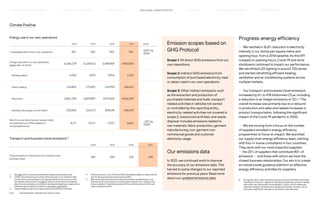
Energy use in our own operations1
2018 2019 2020 2021 GOAL
% renewable electricity in own operations 96% 96% 90% 95%
100% by
2030
Energy use within our own operations
(gigajoules), of which:2
6,186,278 6,229,012 5,408,859 4,963,650 –
– Building diesel 4,355 7,693 9,954 2,101 –
– Direct heating 134,801 175,691 214,990 146,647 –
– Electricity3
5,841,296 5,820,887 4,974,565 4,566,459 –
– Building natural gas, oil and others 205,826 224,472 209,349 248,443 –
Electricity use reduction per square metre
and opening hour (2016 baseline, in
comparable stores)
–8.2% –10.1% –17.0% –16.8%
–25% by
20304
Transport and business travel emissions1,5
2018 2019 2020 2021
CO2e emissions in kilotonnes from transport and
business travel
587 500 442 478
Emission scopes (based on
GHG Protocol)
Scope 1: All direct GHG emissions from our
own operations.
Scope 2: Indirect GHG emissions from
consumption of purchased electricity, heat
or steam used in our own operations.
Scope 3: Other indirect emissions, such
as the extraction and production of
purchased materials and fuels, transport-
related activities in vehicles not owned
or controlled by the reporting entity,
electricity-related activities not covered in
scope 2, outsourced activities, and waste
disposal. Includes emissions related to
raw materials, fabric production, garment
manufacturing, non-garment/non-
commercial goods and customer
electricity usage.
Our emissions data
In 2021, we continued work to improve
the accuracy of our emissions data. This
has led to some changes to our reported
emissions for previous years. Read more
about our updated emissions data.
Progress: energy efficiency
— We reached a 16.8% reduction in electricity
intensity in our stores per square metre and
opening hour, from a 2016 baseline. As this KPI
is based on opening hours, Covid-19 and store
shutdowns continued to impact our performance.
We retrofitted LED lighting in around 720 stores
and started retrofitting efficient heating,
ventilation and air conditioning systems across
multiple markets.
— Our transport and business travel emissions
increased by 6% to 478 kilotonnes CO2e, including
a reduction in air freight emissions of 32%.6
The
overall increase was primarily due to a rebound
in production and sales and related increases in
product transportation, following the significant
impact of the Covid-19 pandemic in 2020.
— We are moving from a focus on the number
of suppliers enrolled in energy efficiency
programmes to focus on impact. We launched
our supply chain energy efficiency team, starting
with four in-house consultants in four countries.
They work with our most impactful suppliers
— the 20% of suppliers that contribute 80% of
emissions — and those with whom we have the
closest business relationships. Our aim is to create
an industrywide guidance platform on effective
energy efficiency activities for suppliers.
6)	
During this year’s data evaluation process we have identified historically
insufficient routines in regards of locking and finalising transport related
data within set timeframes and deadlines. In 2022, we will reevaluate
reported transport emissions and update accordingly. However, we do
not expect significant changes to the historic data reported.
1)	See page 72 for an assurance statement relating to these data points.
2)	
In 2021, we continued work to improve the accuracy of our emissions data.
This has led to some changes to our reported emissions for previous years
(for example, see footnote 1 on page 22). We will continue to be transparent
about how we calculate our emissions, learning and adapting our approach as
methods improve. Read more about our emissions calculations.
3)	 Energy related to electricity-based cooling consumption is included.
4)	
There was an error in our 2019 and 2020 Sustainability Reports, where the end
year for this goal was incorrectly stated as 2025.
5)	Reported scope 3 emissions include goods transport and distribution, and
business travel. CO2e emissions include carbon dioxide (CO2), methane (CH4),
nitrous oxide (N2O), hydrofluorocarbons (HFCs), perfluorocarbons (PFCs) and
sulphur hexafluoride (SF6).
P.23	 TR ANSPARENT REPORTING SINCE 2002
CIRCUL AR  CLIMATE POSITIVE
HOW WE LEAD THE CHANGE
OUR APPROACH TO SUSTAINABILIT Y FAIR  EQUAL SUPPLY CHAIN MANAGEMENT HOW WE REPORT
HIGHLIGHTS 2021
Climate Positive
Progress: renewable electricity,
heat  fuel
— From January 1, 2022, we will not onboard any
new suppliers or supplier factories into our supply
chain if they have on-site coal boilers in their
factories — as part of a longer-term aim to phase
out coal from our supply chain.
— 95% of electricity purchased for our operations
was renewable (90% in 2020).
— 5 of our distribution centres installed solar
panels, with a combined peak capacity of
1,375 MWh.
— Climate-smart delivery solutions are
now available in 34 markets.1
Continued
integration of online and physical sales is
changing our logistics activities, and we’ve been
implementing last-mile delivery using electric
vehicles as part of the solution. We recognise
that the climate impact of electric vehicles
depends on the grid mix in relevant countries,
but still see these as an important contribution
towards fossil-free transport.
— We continued to engage in the LEO Coalition
research project led by Maersk. The coalition
started testing different lignin types for LEO
fuel — a potential near-carbon-neutral biofuel
for shipping.
— We collaborated with suppliers to
implement renewable electricity and heat
projects. For example:
	
– In India, 2 of our suppliers achieved 100%
renewable electricity supply through a
combination of onsite generation and
energy trading.
	
– 75% of HM HOME suppliers have installed
onsite renewable electricity sources.
	
– Approximately 60% of COS garments
produced in Turkey — 18% of global COS
garment production — were produced using
renewable electricity.2
	
– In Indonesia, we collaborated with HSBC,
WWF and the World Resources Institute on
a project to address barriers to transitioning
to biomass boilers. In Cambodia, we launched
an app to enable traceability of boiler
feedstock and we aim for Cambodia to be
our first production country to use 100%
biomass boilers.
Progress: circularity
— Read about our progress towards building
a circular business in Our Circular Ecosystem.
1)	
Climate-smart refers to transport initiatives that have lower CO2e
emissions compared to standard diesel road transport.
2)	 During the period September 2020 to August 2021.
Progress: carbon removals
— Read about our investments in regenerative
agriculture projects, as part of our Biodiversity
work.
Learnings
— Continuing to move from estimated data
towards real supplier data is essential to improving
our scope 3 emissions reporting accuracy. But
we’ve found several challenges, such as reliable
data provision — particularly where volumes of
business with different suppliers change month
to month — and ensuring we have the capacity to
discuss data with suppliers where needed. Digital
solutions that enable easy data sharing are key to
overcoming these challenges.
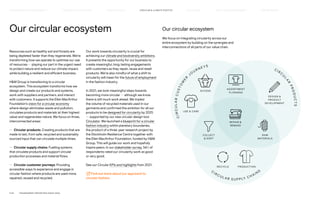
— We continue to see the value of engaging with
policy makers at a local level to influence and align
with climate-related policies.
Future focus
— We will accelerate our focus on supply chain
emissions reductions through investments,
incentives and support systems, while
continuing to explore options for long-term
carbon removals projects.
— We will continue to improve our emissions
data systems. Our Business Tech function will
help develop data analysis systems for the
supplier factory level, and we will work to improve
transport emissions data by partnering with
the Global Logistics Emissions Council to find
a global standard for accurately measuring
logistics emissions.
P.24	 TR ANSPARENT REPORTING SINCE 2002
CIRCUL AR  CLIMATE POSITIVE
HOW WE LEAD THE CHANGE
OUR APPROACH TO SUSTAINABILIT Y HIGHLIGHTS 2021 HOW WE REPORT
SUPPLY CHAIN MANAGEMENT
FAIR  EQUAL
Biodiversity
Biodiversity is a foundation for healthy ecosystems
and communities. It’s also interconnected with
our business. The virgin natural materials in our
products depend upon fertile soil and healthy
forests. And our entire value chain — particularly
our raw material sourcing — has the potential to
impact biodiversity.
The ongoing loss of biodiversity is a systemic
risk that threatens the future prosperity of our
industry and the survival of humanity. Average
wildlife populations have decreased by more
than two-thirds in the past 50 years,1
and
transformative change is needed to reverse this
trend. Shifting from wasteful models of resource
use based on extraction towards a circular,
regenerative economy is essential to restoring
biodiversity and supporting thriving communities.
We have a responsibility to avoid or reduce
our impact on biodiversity by preserving and
enhancing the natural world — for the sake of
current and future generations and to ensure the
resilience of our own business and supply chains.
Our ambition is to have a net positive impact on
biodiversity by:
— Working to prevent and reduce our overall
impact on the biodiversity and natural ecosystems
touched by our value chain.
— Supporting the protection and restoration
of biodiversity and natural ecosystems in line
with scientific advice.
We are developing targets and actions to support
this ambition, in line with the ARRRT (Avoid,
Reduce, Restore  Regenerate, Transform)
framework. Our work on biodiversity has strong
links with our existing goals and activities on
climate, water, materials, circularity and resource
use, and chemicals. We are working to source
more materials farmed with regenerative
practices. These practices aim to improve
environmental wellbeing by increasing soil fertility,
biodiversity, soil carbon sequestration, water
retention and cleanliness, while contributing
to community resilience and livelihoods.
Ongoing international efforts to develop global
biodiversity goals and reporting frameworks
have been delayed due to Covid-19. We remain
engaged in these conversations and we are part
of the Taskforce on Nature-related Financial
Disclosures forum. We contribute to positive
impact beyond our own business through our
commitment to Business for Nature and The
Fashion Pact, our ongoing partnership with WWF
and our participation in the International Platform
for Insetting.
Read more about our approach to biodiversity.
1) 	 WWF Living Planet Report 2020.
P.25	 TR ANSPARENT REPORTING SINCE 2002
CIRCUL AR  CLIMATE POSITIVE
HOW WE LEAD THE CHANGE
OUR APPROACH TO SUSTAINABILIT Y FAIR  EQUAL SUPPLY CHAIN MANAGEMENT HOW WE REPORT
HIGHLIGHTS 2021
Biodiversity
Progress
— To accelerate progress towards our
biodiversity ambition, HM Group is a Science
Based Targets Network (SBTN) Corporate
Engagement Program participant, pledging
alignment with SBTN’s goals and vision, and
contributing advice and end-user insights to the
development of SBTN methods and tools.
— We have started to map our full value chain
using the SBTN method and will use findings to
set targets reducing our impact on nature, based
on prioritisation of our current impacts.
— We invested in initiatives targeting our highest-
impact areas of raw material production:
	
– Through our partnership with WWF, we
started a project in the Satpura-Pench
wildlife corridor in central India, supporting
smallholder cotton farmers to adopt
regenerative farming practices. The project
aims to directly improve soil and pollinator
biodiversity and help farmers build sustainable
incomes, while also improving the local
landscape to support larger species such
as tigers. This year we began a small pilot
with 150 farmers, and plan to scale this up
to reach more than 6,000 farmers over the
next four years.
	
– As a Fashion Pact Signatory, we were able
to join the Transforming Fashion for Nature
project, funded by the Global Environment
Facility in partnership with Conservation
International, through which we will
analyse the land, biodiversity and
ecosystem impacts of our leather supply
chain in Argentina, aligned with the
SBTN framework.
	
– We started a project with WWF in South
Africa, in the location where the newest
National Park in the country is being
established. The project aims to engage
70 communal smallholders and 10 large
commercial sheep farmers in working
towards regenerative wool production
that improves biodiversity and social
development.
	
– Read more about our work on cotton,
man-made cellulosic fibres and other
materials.
— We were one of five recipients of a Green
Traffic Light in the Ecogain Biodiversity Index
2021, out of 240 companies assessed. This
recognition is given to companies aiming
to reach at least no net loss of biodiversity
by 2030, although the requirements will be
adjusted as global goals develop.
— We supported the science-policy interface
for biodiversity by continuing to sponsor the
Intergovernmental Science-Policy Platform on
Biodiversity and Ecosystem Services (IPBES).
— To encourage systemic action on biodiversity,
we contributed to an Ellen MacArthur Foundation
study on how the circular economy can tackle
biodiversity loss and we shared our approach to
protecting nature at IPBES and International Union
for Conservation of Nature (IUCN) events. During
COP15, we called for governments to deliver a
meaningful and actionable Global Biodiversity
Framework by signing the Business for Nature
Letter from CEOs to Heads of State.
— We support and provide advisory input
to WWF’s global Biodiversity Stewardship
Programme through our partnership with WWF.
Learnings
— Like many companies, we are in the early
stages of learning how to measure our impact and
dependency on nature, with the ambition to set
biodiversity targets. Ongoing efforts to develop
global goals, methods and standards will help
guide us.
— To achieve our ambition of a net positive
impact on biodiversity, we have learned that
we need to work in a variety of ways to reach
scalability — both by joining existing initiatives and
developing material-specific projects tailored to
our own business and supply chain.
— The climate crisis and nature loss are two sides
of the same coin — we cannot tackle one without
the other. The regenerative agriculture projects
we’ve started are an example of our commitment
to address these issues. In the coming year we will
start supporting the protection of existing carbon
sinks (e.g. tropical rainforest) and their associated
biodiversity values.
Future focus
— While we finish work to assess our impact and
dependency on nature in line with the SBTN method,
we have already started, and will continue, working
on initial KPIs for biodiversity to support our net
positive ambition. We see this as an iterative process,
as we improve data collection and understanding of
our impacts.
— We will continue to collaborate and work through
cross-sectoral platforms in an effort to advance
shared standards and learning on biodiversity.
— We will invest in projects connected to our
most impactful raw materials, with the aim to
shift to regenerative practices and enhance local
biodiversity. We will also continue to select materials
and processes that decrease our impact on nature.
P.26	 TR ANSPARENT REPORTING SINCE 2002
CIRCUL AR  CLIMATE POSITIVE
HOW WE LEAD THE CHANGE
OUR APPROACH TO SUSTAINABILIT Y FAIR  EQUAL SUPPLY CHAIN MANAGEMENT HOW WE REPORT
HIGHLIGHTS 2021
Water
Water availability is the global issue most impacted
by the climate crisis.1
Existing pressures on water
resources are accelerated by climate change,
placing ecosystems at high risk of water scarcity
under further stress and exacerbating existing
water access inequalities.
Risks to water availability impact our value chain,
which is reliant on water for production processes.
Access to clean, safe water is also a fundamental
human right. Globally, 771 million people don’t have
access to clean water close to home,2
and 31% of
schools do not have clean water.3
We have a duty to use water responsibly and
help safeguard water quality, accessibility and
availability, especially in areas of high water risk.
We work towards reducing negative impact on
water through improvements in our supply chain
and enable others to do the same. Our Water
Stewardship Strategy and Water Roadmap
2018-2022 guide our approach and actions.
We use WWF’s Water Risk Filter to assess risks
in our operations and supply chain. Our water
management requirements for suppliers include
minimum and aspirational requirements on water
use, quality and management.
Water is a key focus for our partnership with WWF.
We also collaborate with organisations such as
the 2030 Water Resources Group (2030 WRG).
We align our reporting with the Sustainable
Apparel Coalition and Zero Discharge of
Hazardous Chemicals.
Progress
— We continued our work with WWF to set
context-specific (contextual) water targets and
develop our new 2030 Water Strategy. Together,
we identified the contextual water conditions for
over 1,100 of our suppliers, including issues such
as external governance, WASH (water, sanitation
and hygiene), quality, water scarcity, flooding and
extreme climate-induced events. We are using
the findings to develop targets for each supplier
site that align water performance with relevant
water challenges.
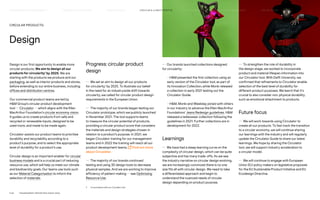
— To share learnings from our work with WWF,
we co-published two guides: Contextual Water
Targets and Putting Water Strategy into Context,
for companies looking to begin or currently
engaged in similar exercises.
— The Covid-19 pandemic continued to affect
suppliers’ water performance:
	
– Due to reduced demand for orders during
the pandemic, many factories had to run
machines at very low production capacity
without being able to achieve equivalent
water use reductions. This impacted progress
toward our water consumption reduction
goal — we achieved a 10.3% reduction in
production water use from a 2017 baseline
and a 6.6% reduction compared to last year,
making it unlikely we will meet our goal of
-25% by 2022.
	
– Partial operation or closure of factories
also affect wastewater treatment plant
performance, many of which require a
continuous flow of wastewater to continue
working effectively. We continued to share
guidance on wastewater treatment care, from
the German development agency GIZ, with all
our business partners. In 2021, 88% of supplier
factories with on-site effluent treatment plant
(ETP) functionality assessments achieved green
grade and 98% had discharge water quality
that is Zero Discharge of Hazardous Chemicals
wastewater compliant.
	
– We paused or delayed dialogue with
suppliers on investments in new technology
or equipment to improve water use.
— Where possible, we continued to partner
with our suppliers to deploy water efficiency
measures. For example, HM HOME implemented
a water efficiency project with suppliers in India,
achieving 35-40% reduction in water use.
— We worked with suppliers in Bangladesh to
expand water recycling in denim washing facilities,
1)	 Based on the sixth report from the IPCC.
2)	 WHO/UNICEF Joint Monitoring Programme 2021.
3)	
WHO/UNICEF Joint Monitoring Programme 2020: Drinking water,
sanitation and hygiene in schools; Global baseline report.
P.27	 TR ANSPARENT REPORTING SINCE 2002
CIRCUL AR  CLIMATE POSITIVE
HOW WE LEAD THE CHANGE
OUR APPROACH TO SUSTAINABILIT Y FAIR  EQUAL SUPPLY CHAIN MANAGEMENT HOW WE REPORT
HIGHLIGHTS 2021
Water
and 34 suppliers now have these facilities in place.
Globally, 21% of production water is being recycled
and 43% of factories in the HM Group supply
chain have rainwater harvesting systems, where
this is feasible.
— We integrated water efficiency and recycling
KPIs into our supplier Sustainability Index, making
a direct link between supplier water performance
and our purchasing decisions.
Learnings
— Our work on contextual water targets has
shown there is sometimes disconnection between
available data and what our teams know is
happening on the ground. This highlights the
importance of engaging with our colleagues and
business partners to understand real-time risks.
— The impacts of Covid-19 emphasised the
need to plan for significant unexpected events,
so that we are always prepared to support
suppliers to continue making progress with water
use, regardless of circumstances. This includes
preparing for climate change induced disasters or
events that can have unprecedented impact like
the Covid-19 pandemic.
— Contextual water strategies set the stage
for future science-based water targets, so it is
important we work now to maximise data quality
and comparability. Gathering granular-level water
data is currently a challenge and makes industry
benchmarking difficult. Progress will require
collaboration with peers and experts.
Future focus
— We are developing a standardised method of
water benchmarking for HM Group suppliers.
As a first step, we engaged with an industry-
leading expert to look at our water efficiency
data for each step in the manufacturing process,
so we can identify the most impactful parts of
our production processes and focus on these
first. The reviewer noted the strong level of
transparency across our supplier water data
and suggested potential actions including
maximum water use caps, efficiency-related
bonus schemes, communication of low-water use
products and technology advice for suppliers.
— We will finalise our new Water Strategy,
based on our work with WWF on contextual
water targets and learnings from our existing
roadmap. This will include setting new goals
focused on outcomes. For example, we’ll move
from goals on production water recycling and
store equipment efficiency to adopt a more
challenging freshwater consumption reduction
goal in line with our circular ambition and to stay
within planetary boundaries.
Key water performance data
2018 2019 2020 2021 2022 GOAL
Reduction of production water usage
compared to 2017 baseline (l/kg, l/pc, l/m)1
— see bar chart below
− –5.9% –3.8% –10.3% –25%
Effluent Treatment Plant (ETP) functionality
assessments achieving green grade2
93% 91% 95% 88% 100%
ETP discharged water quality that is Zero
Discharge of Hazardous Chemicals wastewater
compliant (Foundation Level)
87% 93% 96% 98% 100%
Water recycled out of total production
water consumption3
− 13% 17.6% 21%
15%
(achieved
early)
Litre per unit of product (l/pc)
2017 BASELINE 2021 ACTUAL 2022 TARGET
24
23
104
20
22
86
18
17
78
Litre per metre of fabric (l/m)
Litre per kg dyed fabric (l/kg)
Change in production water efficiency
1) 	Includes manufacturing, fabric dyeing and printing suppliers in both tier 1
and tier 2 with water intensive wet production, based on performance data,
reported by factory and calculated using weighted averages for litre per kg of
dyed knitted fabric, litre per metre of woven/denim fabric, and litre per unit of
product washed. We have updated our weighted average efficiency calculation
this year by factoring in the water consumption for specific products, how
much of each product is produced, and the water consumed by factory,
country, region and globally. This gives us a more accurate picture of
water efficiency improvement and has led to changes in our historic
performance data.
2)	
26 supplier factories (10%) with on-site ETP were approved as suppliers
recently and they are in a two-year timeline to improve their grade to green.
6 supplier factories (2%) are yet to achieve the required level of functionality.
3)	 Based on Q1-Q3 performance data.
P.28	 TR ANSPARENT REPORTING SINCE 2002
CIRCUL AR  CLIMATE POSITIVE
HOW WE LEAD THE CHANGE
OUR APPROACH TO SUSTAINABILIT Y FAIR  EQUAL SUPPLY CHAIN MANAGEMENT HOW WE REPORT
HIGHLIGHTS 2021
Our circular ecosystem
Resources such as healthy soil and forests are
being depleted faster than they regenerate. We’re
transforming how we operate to optimise our use
of resources — playing our part in the urgent need
to protect nature and reduce our climate impact,
while building a resilient and efficient business.
HM Group is transitioning to a circular
ecosystem. This ecosystem transforms how we
design and create our products and systems,
work with suppliers and partners, and interact
with customers. It supports the Ellen MacArthur
Foundation’s vision for a circular economy
where design eliminates waste and pollution,
circulates products and materials (at their highest
value) and regenerates nature. We focus on three,
interconnected areas:
— Circular products. Creating products that are
made to last, from safe, recycled and sustainably
sourced input that can circulate multiple times.
— Circular supply chains. Fuelling systems
that circulate products and support circular
production processes and material flows.
— Circular customer journeys. Providing
accessible ways to experience and engage in
circular fashion where products are used more,
repaired, reused and recycled.
Our work towards circularity is crucial for
achieving our climate and biodiversity ambitions.
It presents the opportunity for our business to
create meaningful, long-lasting engagements
with customers as they repair, reuse and resell
products. We’re also mindful of what a shift to
circularity will mean for the future of employment
in the fashion industry.
In 2021, we took meaningful steps towards
becoming more circular — although we know
there is still much work ahead. We tripled
the volume of recycled materials used in our
garments and confirmed the ambition for all our
products to be designed for circularity by 2025
— supported by our new circular design tool
Circulator. We launched a blueprint for a circular
fashion industry within planetary boundaries,
the product of a three-year research project by
the Stockholm Resilience Centre together with
the Ellen MacArthur Foundation, funded by HM
Group. This will guide our work and hopefully
inspire peers. In our stakeholder survey, 56% of
respondents rated our circularity work as good
or very good.
See our Circular KPIs and highlights from 2021.
Find out more about our approach to
circular fashion.
C
I R C U L A R S U P P LY C H A I N
S
C
I
R
C
U
L
A
R
C
U
S
T
O
M
E
R
J O
U R N E Y S
C I R C
U
L
A
R
P
R
O
D
U
C
T
S
ACCESS
R AW
MATERIALS
USE  CARE
DESIGN 
PRODUCT
DEVELOPMENT
COLLECT
 SORT
ASSORTMENT
PL ANNING
REPAIR 
REMAKE
RECYCLE
Our circular ecosystem
We focus on integrating circularity across our
entire ecosystem by building on the synergies and
interconnections of all parts of our value chain.
PRODUCTION
P.29	 TR ANSPARENT REPORTING SINCE 2002
CIRCUL AR  CLIMATE POSITIVE
HOW WE LEAD THE CHANGE
OUR APPROACH TO SUSTAINABILIT Y FAIR  EQUAL SUPPLY CHAIN MANAGEMENT HOW WE REPORT
HIGHLIGHTS 2021
Design is our first opportunity to enable more
circular products. We aim to design all our
products for circularity1
by 2025. We are
starting with the products we produce and our
packaging, as well as interior products and stores,
before extending to our entire business, including
offices and distribution centres.
Our commercial product teams are led by
HM Group’s circular product development
tool — Circulator — which aligns with the Ellen
MacArthur Foundation’s circular economy vision.
It guides us to create products from safe and
recycled or renewable inputs, designed to be
used more, and made to be made again.
Circulator assists our product teams to prioritise
durability and recyclability according to a
product’s purpose, and to select the appropriate
level of durability for a product’s use.
Circular design is an important enabler for circular
business models and is a crucial part of reducing
resource use, which will help us meet our climate
and biodiversity goals. Our teams use tools such
as our Material Categorisation to inform the
selection of materials.
CIRCULAR PRODUCTS:
Design
Progress: circular product
design
— We set an aim to design all our products
for circularity1
by 2025. To illustrate our belief
in the need for an industrywide shift towards
circularity, we called for circular product design
requirements in the European Union.
— The majority of our brands began testing our
Circulator prototype, which we publicly launched
in November 2021. The tool supports teams
to measure the circular potential of products,
providing a circular product score that considers
the materials and design strategies chosen in
relation to a product’s purpose. In 2021, we
began Circulator training for our management
teams and in 2022 the training will reach all our
product development teams. Find out more
about Circulator.
— The majority of our brands continued
testing and using 3D design tools to decrease
physical samples. And we are working to improve
efficiency of pattern making — see Optimising
Resource Use.
— Our brands launched collections designed
for circularity:
	
– HM presented the first collection using an
early version of the Circulator tool, as part of
its Innovation Collection, while Monki released
a collection in early 2021 testing out the
Circulator Guide.
	
– HM, Monki and Weekday joined with others
in our industry to advance the Ellen MacArthur
Foundations’ Jeans Redesign guidelines. HM
released a ladieswear collection following the
guidelines in 2021. Further collections are in
development for 2022.
Learnings
— We have had a steep learning curve on the
complexity of circular design, which can be quite
subjective and has many trade-offs. As we see
the industry narrative on circular design evolving,
we are increasingly convinced there is no one
size fits all with circular design. We need to take
a differentiated approach and begin to
understand the nuanced needs of circular
design depending on product purpose.
— To strengthen the role of durability in
the design stage, we worked to incorporate
product and material lifespan information into
our Circulator tool. With Delft University, we
confirmed that refinements to Circulator enable
selection of the best level of durability for
different product purposes. We learnt that it’s
crucial to also consider non-physical durability,
such as emotional attachment to products.
Future focus
— We will work towards using Circulator to
create all our products. To fast track the transition
to a circular economy, we will continue sharing
our learnings with the industry and will regularly
update the Circulator Guide to share our latest
learnings. We hope by sharing the Circulator
tool, we will support industry acceleration to
a circular model.
— We will continue to engage with European
Union (EU) policy makers on legislative proposals
for the EU Sustainable Product Initiative and EU
Ecodesign Directive.
1) 	 In accordance with our Circulator tool.
P.30	 TR ANSPARENT REPORTING SINCE 2002
CIRCUL AR  CLIMATE POSITIVE
HOW WE LEAD THE CHANGE
OUR APPROACH TO SUSTAINABILIT Y HIGHLIGHTS 2021 HOW WE REPORT
SUPPLY CHAIN MANAGEMENT
FAIR  EQUAL
The fashion industry depends on materials
to create its products. These can be natural
materials such as cotton, wood and wool,
or synthetic options such as polyester and
polyamide. All materials have an impact on our
planet, from their production, use and, ultimately,
end of life and disposal.
To reduce our environmental impact, we aim
for 100% of our materials to be either recycled
or sourced in a more sustainable way by 2030,
including 30% recycled materials by 2025.
Read more about how we define more sustainably
sourced for different materials in our Material
Categorisation.
We prioritise work on the materials we use
the most or that have the greatest potential
environmental or social impact. For all materials,
our Responsible Raw Material Sourcing Policy
guides our approach. Our material selection is
informed by third-party lifecycle assessment
data and benchmarks — such as the Sustainable
Apparel Coalition’s Materials Sustainability Index
and Textile Exchange’s guidelines on Preferred
Fiber  Materials — and verified by third-party
certification schemes, where applicable. We
work with supply chain partners to improve
traceability and transparency.
CIRCULAR PRODUCTS:
Material choice
1)	
Based on season 3 and season 4 data for 2021. Includes all shell materials —
does not include materials used as filling, lining or trims on garments.
2)	Not all more sustainably sourced materials can be naturally grown or
cultivated, i.e. minerals or stones. In these instances, we set up material-
specific policies such as the use of external standard schemes to secure
more sustainable sourcing.
3)	See page 72 for an assurance statement relating to these data points. The
limited assurance process included all cotton data (apart from in-conversion
cotton) and data for our top three recycled materials.
Achieving our circular ambitions requires us to
accelerate development of new materials and
recycling innovations. We innovate together
with our brands, the Circular Innovation Lab,
our HM CO:LAB investment arm, inventors of
sustainable materials and processes including
winners of HM Foundation’s Global Change
Award, and industry experts.
Progress: overall
— We achieved 80.0% recycled or other more
sustainably sourced materials, including tripling
the share of recycled materials to 17.9% (largely
due to increased volumes of recycled cotton and
polyester), making good progress towards our
2030 goal.
— We established a new internal Material
organisation to accelerate our sustainable
materials strategy. The organisation will work
closely with our assortments teams to scale up
innovations and sustainable material sourcing
across HM Group.
— The Textile Exchange’s 2020 Material Change
Insights Report identified HM Group as one
of 36 leading companies pioneering industry
2021
2020
2019
Recycled
2018
80.0%
64.5%
57.1%
56.6%
17.9%
5.8%
2.2%
1.4%
62.1%
58.7%
54.9%
55.2%
Other more sustainably
sourced2,3
% recycled or other
more sustainably
sourced materials1
Our materials basket1
2025 goal:	 30% recycled
2030 goal: 	100% recycled or
more sustainably sourced
2021
2020
2019
Recycled
2018
80.0%
64.5%
57.1%
56.6%
17.9%
5.8%
2.2%
1.4%
62.1%
58.7%
54.9%
55.2%
Other more sustainably
sourced2,3
61.4%
3.3%
0.1%
8.6%
Cotton
Polyester
Polyamide
Wood and
man-made
cellulosic fibres
Leather
Other
materials
Wool
0.9%
20.1%
5.6%
P.31	 TR ANSPARENT REPORTING SINCE 2002
CIRCUL AR  CLIMATE POSITIVE
HOW WE LEAD THE CHANGE
OUR APPROACH TO SUSTAINABILIT Y FAIR  EQUAL SUPPLY CHAIN MANAGEMENT HOW WE REPORT
HIGHLIGHTS 2021
1)	
Other more sustainably sourced cotton includes cotton sourced through
the Better Cotton Initiative (BCI), in-conversion organic cotton, regenera-
tive cotton, and cotton from other innovative sources.
2) 	 Figures relate to use of BCI cotton.
3)	
Water savings relate to blue water use (irrigation). This relates to farmer
inputs, and no other forms of water use.
4)	See page 72 for an assurance statement relating to these data points.
The limited assurance process included all cotton data (apart from in-
conversion cotton) and data for our top three recycled materials.
2021
2020
2019
Recycled cotton
2018
100%
100%
96.6%
94.8%
1.8% 7.0%
0.6%
0.3%
78.3%
80.0%
79.9%
Organic cotton
Other sustainably sourced cotton1
21.7%
14.6% 16.0% 19.9%
71.3%
2021
2020
2019
Recycled cotton
2018
100%
100%
96.9%
94.8%
1.8% XX%
0.6%
0.3%
XX%
78.3%
80.0%
79.9%
Organic cotton
Other more sustainably sourced cotton1
XX%
14.6% 16.0% 19.9%
% of total cotton that is recycled,
organic, or other more sustainably
sourced1,4
Goal: Continue sourcing 100% recycled, organic,
in-conversion or BCI certified cotton.
Material choice
transformation, out of 191 analysed. We were one
of nine companies leading on material circularity.
— We increased transparency by publishing the
detail of the materials used in our products — see
our materials basket.
Progress: cotton
— In 2020, we achieved our goal to source
100% more sustainably sourced cotton (recycled,
organic and other more sustainably sourced
cotton).1
We will continue to strengthen our
criteria for more sustainably sourced cotton, with
a greater focus on increasing use of recycled,
regenerative and organic cotton, and innovative
alternatives.
— To support more cotton farmers to transition to
organic practices and accelerate capacity building
in the organic cotton sector, we expanded our use
of “in-conversion” cotton. In-conversion cotton
is the output from farms that are in process of
getting organic certification. In 2021, we sourced
in-conversion cotton from 2,000 farmers.
— As part of our increased focus on regenerative
farming practices, we launched a project with 150
smallholder cotton farmers and WWF in India. We
plan to reach more than 6,000 farmers.
— In collaboration with the Circular Innovation
Lab, COS tested Materra™, a new way to grow
cotton that increases yields and fibre quality,
while minimising water and pesticide use as well
as carbon footprint. The systems are optimised
for developing regions facing climate volatility.
HM Group’s Circular Innovation Lab is working
with technology company Materra to set up an
RD farm in India in early 2022. The aim is to
optimise Materra’s hydroponic cotton farming
system to local conditions. The project will run
for two years and generate valuable information
to enable a scale-up of more sustainable cotton
supply chains using Materra’s technology.
— In 2021, our sourcing of other more sustainably
sourced cotton contributed to:2
	 – 30 billion gallons of water being saved.3
	 – 73,287 kilograms of pesticides being avoided.
	 – 
USD 59 million additional profit for farmers.
— HM Group’s support for projects with the
Organic Cotton Accelerator and other organic
cotton initiatives in India during the 2020-2021
crop season resulted in:
	
– 14,000 farmers involved in organic cotton
projects.
	
– USD 1.28 million in premiums received by
farmers, supporting investment in organic
farming.
	
– 100% procurement by HM Group brands
of committed volumes.
P.32	 TR ANSPARENT REPORTING SINCE 2002
CIRCUL AR  CLIMATE POSITIVE
HOW WE LEAD THE CHANGE
OUR APPROACH TO SUSTAINABILIT Y FAIR  EQUAL SUPPLY CHAIN MANAGEMENT HOW WE REPORT
HIGHLIGHTS 2021
— We began requesting that our largest
viscose producers share data through the
Textile Exchange’s new MMC fibre transparency
dashboard, enabling us to track our progress
against the Roadmap towards responsible
viscose and modal fibre manufacturing.
— To make it possible to achieve our 2025 MMC
goal, we worked to increase availability of
MMC fibres that meet our requirements:
	
– As part of our five-year partnership
with Renewcell, we planned how to scale
production of its Circulose® material in
2022 to meet our brands’ future needs.
In 2021, nine styles across various brands
and assortments used Circulose®, an MMC
fibre made from recycled cotton waste and
developed through support from our HM
CO:LAB investment arm.
	
– Following further investment from HM
CO:LAB, Infinited Fibre Company is scaling up
to move closer to commercial volumes. This
will expand production of InfinnaTM
, an MMC
fibre from regenerated cotton waste first
tested by Weekday in collaboration with the
Circular Innovation Lab in 2021.
	
– We signed the Fashion Forever Green Pact,
an FSC initiative to promote responsible
sourcing of MMC fibres. Through this, we
are collaborating to improve supply chain
traceability, which is fundamental to
knowing that all our virgin MMC fibres
Material choice
Progress: wood  man-made
cellulosic (MMC) fibres
— We continued working towards our goals
and commitments:
	– By end of 2025, source responsible
viscose in line with our commitment to
the Changing Markets roadmap.
	– By end of 2025, all wood and paper used in
our products and packaging will be made of
Forest Stewardship Council (FSC) certified
or recycled materials.
	– By end of 2025, we aim to only source
MMC fibres from FSC-certified sources, or
replace them with next-generation fibres
from sources such as agricultural residues
and pre- and post-consumer textiles. This
supplements our requirement that MMC fibre
producers must be verified as low risk by the
CanopyStyle audit.
	
– These goals are part of our commitment to
zero deforestation in our supply chain by the
end of 2025. Learn more in our Responsible
Raw Material Sourcing Policy and Roadmap for
MMC fibres.
— 78% wood in our packaging is FSC-certified.
Find further packaging data in Packaging.
P.33	 TR ANSPARENT REPORTING SINCE 2002
CIRCUL AR  CLIMATE POSITIVE
HOW WE LEAD THE CHANGE
OUR APPROACH TO SUSTAINABILIT Y FAIR  EQUAL SUPPLY CHAIN MANAGEMENT HOW WE REPORT
HIGHLIGHTS 2021
P.33	 TR ANSPARENT REPORTING SINCE 2002
originate from FSC-certified sources by
the end of 2025.
	
– HM Group’s Circular Innovation Lab have
worked with SPINNOVA® and the first products
using their low impact recyclable fibre made of
certified wood will be launched in spring 2022.
	– TreeToTextile, part-owned by the HM
group, continued upscaling production of
its low cost, 100% traceable cellulosic fibre,
sourced from sustainably managed forests.
Progress: animal-based fibres
— 43.6% (12.1% in 2020) of our wool was
Responsible Wool Standard (RWS) compliant —
marking progress towards our goal to, by end
of 2025, only source virgin wool from RWS-
certified farms.
— 95% (13% in 2020) of our cashmere was Good
Cashmere Standard (GCS) compliant — meaning
we are quickly progressing towards our goal to,
by end of 2025, source all virgin cashmere
from GCS-certified farms.
— 100% (100% in 2020) of our mohair was
Responsible Mohair Standard (RMS) compliant
or from recycled sources — continuing our
commitment to only buy from RMS-
certified farms.
— 100% (100% in 2020) of our virgin down was
Responsible Down Standard (RDS) compliant —
maintaining our record of only sourcing from
RDS-certified farms since 2016.
— We continued participating in the Textile
Exchange’s Responsible Animal Fibers
Roundtable, which focuses on the animal welfare
and environmental impacts of animal fibre
production. We are also closely following the
development of Textile Exchange’s Climate+
strategy, which aligns with our environmental
and social strategies.
— HM highlighted innovative animal-substitute
fabrics through its Co-Exist Story Collection, a
completely vegan collection approved by People
for the Ethical Treatment of Animals (PETA).
Material choice
Recycled and more sustainable material sourcing
2019 2020 2021 Goal
Materials from recycled sources, as a percentage of all materials1
2.2% 5.8% 17.9% 30% by 2025
Recycled polyester as a percentage of all polyester 8.3% 20.8% 63.7% 100% by 2025
Responsible Wool Standard-certified (RWS) wool as a percentage of all wool 11.6% 12.1% 43.6% 100% RWS certified, or from recycled or regenerated sources by 2025
Good Cashmere Standard-certified (GCS) cashmere as a percentage of all cashmere N/A2
13% 95.0% 100% GCS certified, or from recycled or regenerated sources by 2025
Responsible Mohair Standard-certified mohair as a percentage of all mohair N/A3
100% 100% Maintain 100%
Responsible Down Standard-certified down as a percentage of all down 100% 100% 100% Maintain 100%
Chrome-free, animal-based leather as a percentage of all leather 40% 44% 50.7% 100% by 2025
1)	See page 72 for an assurance statement relating to these data points. The limited assurance process
included data for our top three recycled materials.
2) 	 Standard adopted in 2020.
3)	
We stopped sourcing mohair in mid-2018 due to PETA revealing systematic animal abuse in May 2018.
The Textile Exchange launched the Responsible Mohair Standard in 2020.
CIRCUL AR  CLIMATE POSITIVE
HOW WE LEAD THE CHANGE
OUR APPROACH TO SUSTAINABILIT Y FAIR  EQUAL SUPPLY CHAIN MANAGEMENT HOW WE REPORT
HIGHLIGHTS 2021
P.34	 TR ANSPARENT REPORTING SINCE 2002
Progress: leather
— 50.7% (44% in 2020) of all leather products
were produced with chrome-free tanned leather,
including vegetable tanned leather and metal-
free leather. By end of 2025, we aim for all our
animal-based leather to be chrome-free.
— By reducing supply chain complexity, we
can better focus on collaborating with tanneries
on sustainable practices. 100% of our tanneries
in Asia comply with Leather Working Group
environmental best practice guidelines. After
simplifying our leather supply chain during 2020
to include only 40-50 tanneries, we started
exploring solutions to extend traceability beyond
the tanneries, eventually back to farm level.
— We continue to engage in Textile Exchange’s
Responsible Leather Round Table to help reduce
the environmental impact at farm level, as well as
advance animal welfare and fair treatment
of workers.
— We maintained our search for bio-based
leather alternatives. For example, HM used
Desserto, a leather alternative partly made from
cactus. HM Group’s Circular Innovation Lab
has worked with Natural Fiber Welding and
the first products using their material MIRUM®
will be launched in spring 2022. MIRUM is an all-
natural, plant-based material using renewable
resources to create a plastic-free alternative
to leather.
Progress: recycled 
innovative materials
— 17.9% (5.8% in 2020) of our materials
were from recycled sources — as we work
towards our goal that by 2025, 30% of our
total materials will be from recycled sources.
This is the result of large increases in our use
of recycled cotton and polyester — two
materials for which recycling technology is
available at scale. Find out more about
how we’re scaling use of recycled materials.
— 63.7% of our polyester is from recycled
sources (according to the Higg Materials
Sustainability Index), which have a significantly
lower carbon footprint than conventional
sources. We have set a new goal to phase out
virgin polyester and source 100% recycled
polyester by 2025, in support of Textile
Exchange’s Recycled Polyester Challenge.
This marks an important milestone on our
journey towards 100% recycled or other more
sustainably sourced materials by 2030.
We continued to examine the possibility of
recycling post-consumer polyester textiles
using scalable, automated sorting techniques
and chemical recycling.
Material choice
P.35	 TR ANSPARENT REPORTING SINCE 2002
CIRCUL AR  CLIMATE POSITIVE
HOW WE LEAD THE CHANGE
OUR APPROACH TO SUSTAINABILIT Y HIGHLIGHTS 2021 HOW WE REPORT
SUPPLY CHAIN MANAGEMENT
FAIR  EQUAL
— To accelerate the development of recycling
technologies and use of more sustainable
materials in Europe, we continued to engage
in the European Union projects DEMETO,1
EFFECTIVE2
and New Cotton.3
The DEMETO
project concluded in 2021, with the establishment
of a demonstration plant in Italy. We have also
worked on influencing policy — read more about
our work on Public Affairs.
— Our brands expanded use of recycled
materials. For example, 93% of polyester and
polyamide used by Weekday in 2021 was
recycled. HM HOME grew its use of recycled
cotton, aluminium and linen, with recycled content
now forming 20% of its collections.
— We increased use of innovative materials,
including:
	– Fairbrics: The Circular Innovation Lab made
the first garment using this potentially climate
positive technology, which was worn by our
CEO, Helena Helmersson at the Fashion CEO
Agenda 2021. Fairbrics is a Global Change
Award winner.
	– FLWRDWN™: down-alternative made
using hand-picked wildflowers and recycled
biological materials, used by COS and HM.
	– Liva Reviva: viscose fibre made from pre-
consumer textile waste and wood pulp, used
by HM HOME and Monki. In addition,  Other
Stories and COS used Livaeco — made from
fully traceable FSC certified fibres.
	– Made of Air: scaled use of this plastic-like
material partly made from biowaste in
HM’s Science Innovation Stories collection,
and began evaluating it for usage in HM
special collections accessories and as a
potential replacement for material used in
internal garment distribution system boxes.
	– Naia™ Renew: fibre from sustainably sourced
wood pulp and recycled waste plastics, used
by ARKET and COS.
Learnings
— In order for us to become a circular business,
long-term partnerships are vital for scaling
availability of more sustainable and recycled
materials. The development process can take
several years before materials are ready to use
across our brands. We need to be an active part
in the transition journey towards more sustainably
sourced materials such as those from organic
and regenerative sources.
— Increasing textile recycling is vital for securing
our future sourcing of recycled materials. Our
survey of more than 25 recycling companies
around the world formed the basis of our material
recyclability assessment at the design stage, so in
future we can develop products that can be more
easily recycled.
— While we use indexes such as the Sustainable
Apparel Coalition’s Materials Sustainability Index,
Textile Exchange’s guidelines on Preferred Fiber
 Materials and certification to inform material
selection, we recognise these tools are based
on specific methodologies that may not cover all
environmental and social considerations.
— We are working with FSC and our supply chain
to solve the challenges with chain of custody in
the MMC fibres supply chain to ensure we only
source FSC certified fibres by the end of 2025.
Future focus
— To meet our climate and biodiversity goals, we
need to base our material sourcing on responsible
and circular principles and optimise the materials
we use.
— We will continue to scale our use of recycled
materials. This includes increasing the supply of
fibres available for recycling as well as developing
the technologies needed to process fibres
into new materials. Our initial focus will be on
expanding textile-to-textile recycling for synthetic
materials, and on increasing our use of recycled
cotton and viscose.
— For virgin natural fibres, we will support use of
regenerative agricultural techniques that improve
farmers’ livelihoods.
— We are closely following the development of
Textile Exchange’s Climate+ strategy, which aligns
with our environmental and social strategies.
1)	DEMETO receives funding from the European Union’s framework
programme for research and innovation horizon 2020 (2014–2020)
under grant agreement no. 768573.
2)	
EFFECTIVE received funding from the Bio-based Industries Joint
Undertaking (JU) under grant agreement no. 792195. The JU receives
support from the European Union’s Horizon 2020 Research and
Innovation Programme and the Bio-based Industries Consortium.
3)	
New Cotton project has received funding from the European Union’s
Horizon 2020 Research and Innovation Programme under grant
agreement no. 101000559.
Tiny fibres — microfibres — can be released when
garments are washed during production and by
customers. These fibres run into oceans, pollute
habitats and can eventually end up in drinking
water and food. Chemicals used to dye and treat
products change how easily fibres degrade.
Selecting materials and production processes
that minimise microfibre shedding is therefore
crucial to reducing the impact of the fashion
industry on our planet.
We are committed to researching and
addressing microfibre emissions, as we
develop a groupwide Microfibres Roadmap.
Our approach includes:
— Choose and design yarns and fabrics that
minimise microfibre shedding.
— Research new production processes and
requirements to minimise shedding.
— Offer repair services and microfibre-reducing
laundry bags to customers, and support the
development of laundry machine filter systems.
— Improve technologies that enable reuse
and recycling.
CIRCULAR PRODUCTS:
Microfibres
Progress
— Microfibres are an industrywide problem
and we collaborate to develop solutions. We
signed The Microfibre Consortium (TMC) 2030
Commitment, a global commitment to work
towards zero impact on nature from textile
fibre fragmentation by 2030. TMC members,
including HM Group, collaborated with research
partners to develop a roadmap to achieve this
commitment based on a common vision for the
fashion industry.
— Our 24-month research project —
A Management Tool for Microplastics from Textile
Production Process — continued in partnership
with the Hong Kong Research Institute of Textiles
and Apparel (HKRITA). Restrictions due to Covid-19
disrupted planned tests of microfibre emissions
at HM supplier factories. Instead, the team
worked to develop new concepts in the HKRITA
laboratory, such as using soundwaves to separate
microfibres from water.
Learnings
— While the problem with microfibres is not new,
widespread awareness is. Our work with TMC
members and research experts demonstrates
the need for a shared understanding of the
issue, as a foundation for aligned action on this
challenge. TMC provides a central hub through
which understanding of individual materials and
processes can be exchanged.
Future focus
— We will continue developing a groupwide
roadmap for microfibres in line with the
Microfibre Consortium 2030 commitment. To
inform this roadmap, we are resuming testing
microfibre emissions with HKRITA and our
suppliers as Covid-19 restrictions ease. Learnings
from this work will be shared with policy makers
as HM Group participates in consultations on
potential legislation.
P.36	 TR ANSPARENT REPORTING SINCE 2002
CIRCUL AR  CLIMATE POSITIVE
HOW WE LEAD THE CHANGE
OUR APPROACH TO SUSTAINABILIT Y HIGHLIGHTS 2021 HOW WE REPORT
SUPPLY CHAIN MANAGEMENT
FAIR  EQUAL
Today, offcuts and scraps generated in the
production process or during product delivery
are considered waste. Our vision is that the
whole mindset of the fashion industry shifts to
treat this waste as the valuable resource it is.
Similarly, faulty clothes or pre-loved items that
have reached the end of their time with our
customers offer a wealth of materials that can
be recovered, reused and eventually recycled
into new products.
To proactively optimise resource use, we:
— Optimise supply to produce to demand.
We increasingly apply predictive artificial
intelligence (AI) to optimise the supply chain and
match production with demand. We use multiple
solutions for quick reactions to fashion trends,
quantification, timing and allocation of products.
This has led to even more relevant customer
offering with more full price sales and fewer
markdowns, as well as a more efficient use of
resources.
— Support resource-efficient production.
We work closely together with suppliers to use
resources as efficiently as possible, guided by our
Responsible Waste Management Guidelines. The
CIRCULAR SUPPLY CHAIN:
Optimising resource use
guidelines help us optimise use of fabric and other
resources — decreasing resource use impact
and reliance on natural resources as well as
reducing financial costs.
— Put faulty products to good use. If a product
is faulty, we reuse or recycle the materials
wherever possible.
— Increase recycling. We work to improve
and scale automatic sorting and efficient
textile recycling.
We also work to optimise resource use at our
stores, distribution centres and offices, during
product delivery, and by maximising product life.
Progress: optimising supply
— We scaled use of AI and other tools to align
production with demand. Our AI tool Movebox
optimises supply by enabling redistribution of
products to locations where there is demand.
In 2021, we rolled out use of Movebox, which is
now used by 60% of our sales markets (including
franchise markets).
— We continued to work to ensure that no
pre-consumer garments that could be used go
to waste:
	
– If a product isn’t performing as planned,
we prioritise selling it within our primary sales
channels, before using the product within
internal circular initiatives. Afound provides
an additional channel to share garments with
customers. Only once we’ve reviewed all
internal uses, we find solutions via trusted
business partners including charities and
outlets. Some of the returns that cannot be
resold via original sales channel are sold via
online-sales platform Sellpy.
	
– The Covid-19 pandemic and lockdowns
resulted in massive changes in customer
demand and behaviour, posing a challenge
for our forecasts. Thanks to our systems to
reassign stock to alternative sales channels
as stores closed and customers increasingly
shopped online, we were able to quickly adapt
to maximise the sale of products already
made, while ensuring nothing that could be
used goes to waste.
Progress: resource efficient
production
— We tested our new Waste Recycling
Strategy to learn how best to link fabric leftover
from our orders with reuse and recycling.
More than 50 of our tier 1 suppliers in five
regions are participating in pilots with Reverse
Resources and Circular Fashion Partnership,
to segregate cutting waste before handing it
onto recyclers.
— 240 patternmakers and product technologists
across HM Group received training in design
software that calculates fabric consumption.
As a result, we reduced fabric waste for our
20 biggest dress styles by 12%.
P.37	 TR ANSPARENT REPORTING SINCE 2002
CIRCUL AR  CLIMATE POSITIVE
HOW WE LEAD THE CHANGE
OUR APPROACH TO SUSTAINABILIT Y HIGHLIGHTS 2021 HOW WE REPORT
SUPPLY CHAIN MANAGEMENT
FAIR  EQUAL
Optimising resource use
Progress: faulty products
— Where a product is faulty, we always look to
reuse and recycling options first:
	
– 0.42% of our total product assortment was
reused, repurposed or recycled (including
charity donations) or recycled due to a fault
(0.32% in 2020).
	
– 0.02% of our total product assortment
was destroyed (prioritising incineration for
energy recovery) due to failure of chemical
tests, contamination by mould (for example,
during transportation), or when no viable
recycling or downcycling solution was
available (0.03% in 2020).
Progress: recycling
— We released a position paper, on waste as a
resource, expressing our support for extended
producer responsibility in the European Union and
the creation of a secondary raw materials market
for textiles.
— By joining Fashion for Good’s 18-month
Sorting for Circularity Project, we started a
collaboration with other brands to scale recycling
capacity in Europe.
— We continued collecting garments in-store,
totalling 15,944 tonnes this year, to provide
feedstock for recycling. We are working to
increase the availability of suitable feedstock.
Learnings
— Testing our Responsible Waste Management
Guidelines shows the need for more localised
recycling infrastructure. Developing this relies
on investment and innovation in waste separation
and recycling technology, and increasing the value
of resources left over from production processes.
Future focus
— Through our 2021 pilots, we successfully
utilised around 500 tonnes of textile waste
from our garment production factories across
most of the production countries, recycling this
back into our products. Next year, we plan to
scale this process, partnering with our suppliers
and with a wider network of recyclers to
increase traceability of material waste within
the value chain and accelerate the uptake of
new recycling technologies.
— Disruptions caused by the Covid-19 pandemic
delayed projects such as Monki’s expansion of
innovative Green Machine mixed-fabric recycling
technology. We will resume delayed projects as
it becomes possible to safely do so.
Faulty products
2019 2020 2021
Total product assortment reused (including charity
donations) or recycled due to the products being faulty
0.41% 0.32% 0.42%
Total product assortment destroyed1
0.03% 0.03% 0.02%
1) 	
Due to the products having failed certain chemical tests, being contaminated by mould (for example during transportation) or when there was no viable recycling or
downcycling solution available. We prioritise incineration for energy recovery where possible.
P.38	 TR ANSPARENT REPORTING SINCE 2002
CIRCUL AR  CLIMATE POSITIVE
HOW WE LEAD THE CHANGE
OUR APPROACH TO SUSTAINABILIT Y FAIR  EQUAL SUPPLY CHAIN MANAGEMENT HOW WE REPORT
HIGHLIGHTS 2021
Materials processing
Raw materials, such as cotton and wool, undergo
a series of processes to produce a fabric and
finally a garment. This includes washing, dyeing
and printing — using energy, chemicals and water.
Lowering the impact of these processes is an
important step towards our climate and circular
ambitions. We’re addressing five areas:
— Chemicals. Reduce use, increase reuse or
regeneration, and use Screened Chemistry.
— Energy. Improve efficiency and reduce CO2e
emissions.
— People. Ensure proper use of personal
protective equipment by workers, avoiding
adverse health or safety effects.
— Production waste. Reduce waste and increase
recovery, reuse and recycling.
— Water. Reduce use, increase reuse and
recycling; for wastewater, reduce quantity and
improve quality.
In 2021, we launched our printing roadmap.
By 2030, our ambition is to maximise the use of
processes that have significant savings in water,
energy and chemicals. To achieve this, we will
test and scale new techniques and technologies
while working with our suppliers to ensure they
follow our guidelines.
Our new business venture, Creator Studio, offers
on-demand B2B print services. This global
platform for the merchandise industry allows
external brands and content creators to utilise our
lean production process and advanced made-to-
order digital printing to reduce waste by matching
supply to demand.
We’re investing in new washing and dyeing
innovations too. For example:
— Our brands use software installed at suppliers
to track the use of low-impact washing — as
defined by Jeanologia’s® Environmental Impact
Measurement (EIM). Currently, 100% of the denim
Weekday and 98% of the denim Monki source
is rated low impact, achieving a green score in
the EIM.
— Colorifix, a biotech company partly backed by
HM Group, uses microbiology to produce and
fix pigments on textiles, significantly reducing the
use of chemicals, water and energy compared to
conventional technology. HM used fabric dyed in
this way in its Colour Story Collection SS21.
— HM CO:LAB invested in digital dyeing and
finishing technology company, Alchemie. In
collaboration with Circular Innovation Lab, HM
piloted Alchemie’s EndeavourTM
waterless smart
dyeing process, as well as imogo’s DigitalDyeing®,
in rental products at its rental outlets in Stockholm
and Berlin.
CIRCULAR SUPPLY CHAIN:
P.39	 TR ANSPARENT REPORTING SINCE 2002
CIRCUL AR  CLIMATE POSITIVE
HOW WE LEAD THE CHANGE
OUR APPROACH TO SUSTAINABILIT Y HIGHLIGHTS 2021 HOW WE REPORT
SUPPLY CHAIN MANAGEMENT
FAIR  EQUAL
CIRCULAR SUPPLY CHAIN:
Chemicals
We want to lead the change towards toxic-free
fashion by 2030. Achieving this is critical to our
circular ambition. Our Chemical Management
Roadmap commits us to zero discharge of
hazardous chemicals and 100% safe and
traceable chemicals. Our progressive approach
takes us beyond compliance to chemicals suitable
for circular products.
Collaboration is key to achieving industrywide
progress. We are members of the AFIRM Group,
Zero Discharge of Hazardous Chemicals (ZDHC)
and ChemSec Business Group.
We follow the AFIRM Restricted Substances
List and the ZDHC Manufacturing Restricted
Substances List 2.0 (MRSL), as well as the
ZDHC Wastewater Guidelines and Chemical
Management System. Our HM Group Chemical
Restrictions commit us to phasing out additional
potentially harmful substances. We use the
Screened Chemistry hazard-based scoring
system (a third-party toxicological assessment)
to identify safer chemicals.
— We engaged with policy makers, including
providing input to the EU Chemicals Strategy
and publishing a position paper on safe-by-
design chemicals.
— We initiated a phase-out of high priority
endocrine disrupting chemicals (EDCs) —
substances that interfere with the hormonal
system. We will continue phasing out all EDCs
over the coming years.
— We used safer alternatives to potassium
permanganate (used to distress denim) for 79%
of our denim products, with the goal to achieve
100% by 2023.
Learnings
— 100% ZDHC MRSL compliance is proving
challenging due to the variety and complexity
of our supply chain.
— Characterising and comparing chemicals’
properties can be a challenge. Screened
Chemistry needs to be more widely adopted
by the chemicals industry so brands can
easily compare chemicals to identify best
available options.
Future focus
— We will continue to pilot and scale use of
Screened Chemistry, as well as engaging with
policy makers on this topic.
— To progress use of safer chemicals in the
non-textile supply chain, we will work towards
common industry MRSLs for these supply chains
and pilot digital chemical management tool BVE3.
1) 	 Compliance tracked using third-party tools CleanChain and BVE3.
2)	
We are working to report the most meaningful metrics for chemicals
performance and will therefore no longer report product compliance
with HM Group Chemical Restrictions.
Progress
— We engaged with peers and experts to
pilot version 3 of the Screened Chemistry
methodology, which includes prints and dyes.
We mapped use of Screened Chemistry in our
denim supply chain and will use the learnings
to scale coverage with these suppliers.
— We were one of five brands (out of 30) awarded
“aspirational level” during the annual assessment
of ZDHC’s Brands to Zero leader programme.
— 609 of our textile and leather suppliers (95%)
are enrolled in the ZDHC programme, achieving
99.9% MRSL compliance for wastewater (99.9%
in 2020) and 95% compliance for chemical input
(88% in 2020).1
Reaching and maintaining 100%
enrolment is challenging due to the dynamic
nature of our supply chain. 81% of chemicals used
were assured to meet ZDHC requirements via the
ZDHC Gateway, exceeding our goal of 60%.2
— Our aim is to accelerate progress towards
circular manufacturing and sustainable
chemistry by encouraging partnership and use
of shared data. For example, we completed our
work with IKEA and others on chemical testing
for recycled textiles.
P.40	 TR ANSPARENT REPORTING SINCE 2002
CIRCUL AR  CLIMATE POSITIVE
HOW WE LEAD THE CHANGE
OUR APPROACH TO SUSTAINABILIT Y HIGHLIGHTS 2021 FAIR  EQUAL SUPPLY CHAIN MANAGEMENT HOW WE REPORT
CIRCULAR CUSTOMER JOURNEY:
Maximising product life 
scaling circular business models
The future of fashion is circular. Instead of linear
resource use — take, make, waste — we continue
to develop ways of doing business that enable
products to be used for longer and reused.
We are working to provide accessible ways for
customers to experience and engage in circular
fashion and choose more sustainable options.
Circular design, focusing on key qualities like
durability and recyclability, is a major enabler
for this shift.
Our ambition to maximise product life and
offer circular business models at scale helps
us build a resilient, customer-focused business.
Expanding circular business models allows us to
meet the growing demand for sustainable design
and services, and to develop more long-term,
meaningful relationships with customers as they
use repair, rental and resell options.
Reducing our resource use by maximising
product life and recirculating resources is
crucial for reducing our environmental impact
and fulfilling our climate and biodiversity goals.
We are mindful that products or services
accessed via these models must replace
products sold through the traditional linear
retail model for an overall positive environmental
impact.
We focus on three levers to maximise product life
and scale circular business models via the circular
customer journey:
— Use  care. We encourage customers to love
their fashion items for longer and extend the life
of their fashion favourites through care and repair
initiatives.
— Access. We offer a diverse range of access
models through which customers can enjoy and
experience fashion while keeping products in
circulation.
— Collect. We support customers to access
services to donate pre-loved products so these
can be reused, remade, or recycled.
Progress: use  care
— HM’s Take Care initiative continued to offer
customers in 46 markets ways to care, repair
and customise their clothing. In 2021, the Take
C
I R C U L A R S U P P LY C H A I N
S
C
I
R
C
U
L
A
R
C
U
S
T
O
M
E
R
J O
U R N E Y S
C I R C
U
L
A
R
P
R
O
D
U
C
T
S
Our circular ecosystem in action
We aim to keep products and resources in
circulation through the multiple loops of our
ecosystem, prioritising the inner loops where
they retain the highest value.
REPAIR
REUSE
REMAKE
RECYCLE
P.41	 TR ANSPARENT REPORTING SINCE 2002
CIRCUL AR  CLIMATE POSITIVE
HOW WE LEAD THE CHANGE
OUR APPROACH TO SUSTAINABILIT Y FAIR  EQUAL SUPPLY CHAIN MANAGEMENT HOW WE REPORT
HIGHLIGHTS 2021
Maximising product life  scaling circular business models
Care product range extended to 7 new markets,
bringing the total to 17 markets. The brand
offers repair services through 6 repair studios in
4 markets.
— To better connect post-consumer garments
with repair services, COS launched a garment
collecting initiative in Austria and Poland that
prioritises fixing and repurposing clothes
before recycling.
Progress: access
— Weekday expanded access to made-to-
measure jeans to the public in its Götgatan store
in Stockholm. The collaboration with unspun
and HM Group Laboratory offers the option
to customise the fit and design of their jeans,
which are then made to order.
— We expanded ways for customers to
resell products:
	– Customers in 24 markets can now shop
second-hand garments through Sellpy, and
customers in 4 markets can sell at Sellpy.
HM Group is a majority shareholder in Sellpy
and HM’s website directs customers to
Sellpy in 7 markets.
	
– HM made it possible to buy second-hand
garments from multiple brands alongside
new HM garments in Sweden from February
2022, offering a new, integrated customer
experience by incorporating a curated
second-hand assortment from Sellpy into
its website.
	
– Customers in 3 markets can now buy and sell
pre-owned clothes through our collaboration
with business technology provider Reflaunt.
HM launched HM Rewear in Canada, while
COS offers COS Resell in Germany and the
United Kingdom.
	
– Weekday launched Weekday Curated
2nd-hand in 3 cities in Sweden. The curated,
in-store collection gives customers the chance
to buy and sell pre-owned clothes offline.
— We expanded options to rent our products:
	
– Customers in 19 markets continued to rent
kids’ clothing through ARKET’s collaboration
with Circos.
	
– Selected HM stores in Amsterdam, Berlin
and Stockholm offer clothes rental services
for specific collections.
	
– HM HOME started offering rental for
occasions and celebrations. Rent a Christmas
offered customers the chance to loan festive
decorations in 5 markets.
	
– Weekday and  Other Stories items are
available on Gemme Collective in Sweden.
P.42	 TR ANSPARENT REPORTING SINCE 2002
CIRCUL AR  CLIMATE POSITIVE
HOW WE LEAD THE CHANGE
OUR APPROACH TO SUSTAINABILIT Y FAIR  EQUAL SUPPLY CHAIN MANAGEMENT HOW WE REPORT
HIGHLIGHTS 2021
Maximising product life  scaling circular business models
Progress: collect
— Our post-consumer, in-store garment
collecting initiative was disrupted for the whole
year due to Covid-19. We gathered 15,944 tonnes
of material (18,800 tonnes in 2020). The initiative
collects post-consumer garments and home
textiles for reuse and recycling, making it easier
for consumers to recycle and demonstrating that
these resources have value. We work with I:CO
to collect and sort garments, with 50-60% sorted
for re-wear and reuse and 35-45% recycled to
become products for other industries or made
into new fibres. We continued collaborating with
partners to make use of the remaining 3-7% that,
as a last resort, had to be disposed of another
way, prioritising incineration for energy recovery
and never sending textiles to landfill. For
example, we’re collaborating with Really to
create new garment collecting boxes from
recycled textiles. Read more about our efforts
increase the share of recycled textiles we use,
and scale recycling technologies.
— ARKET's Patchwork Denim collection used
vintage denim collected via the brand's recycling
programme to create unique, circular pieces.
— We showcased new recycling technologies.
For example, HM ran events for customers in
Sweden featuring its in-store Looop recycling
machine. Looop was awarded the Design Grand
Prix during the 2021 Cannes Lions International
Festival of Creativity. Read more about our
investments in new recycled materials and
technologies.
Learnings
— It is becoming increasingly clear that for
circular business models to help us reach our
climate goals, there needs to be significant
scaling and substitution of (rather than addition
to) existing business models, as outlined in a
2021 EMF report.
— Taking the first steps from resell pilots
towards a scalable solution has taught us a lot
about some of the hurdles to overcome if we
want to make resell a sustainable option at
scale. We need to build solutions that can help
close the gap between customer intentions and
actions to shop more sustainably. The current
lack of access to transparent, brand-agnostic
product information makes it difficult to provide
customers with consistent information.
— Weekday’s made-to-measure jeans pilot
saw fewer returns than for our regular, non-
customised jeans, helping us step towards
closer matching of production with sales. Now
that we have piloted the made-to-measure jeans
on demand production model, we will explore
how to scale the offering.
Garment collecting initiative
2019 2020 2021
Textiles collected in HM Group stores 29,005 tonnes 18,800 tonnes1
15,944 tonnes1
1) 	
Our garment collecting initiative was disrupted by the Covid-19 pandemic for part of the year in 2020 and for the full year in 2021.
— Our multi-brand online shop Itsapark
has developed extensive knowledge of the
sustainably driven fashion, beauty and lifestyle
segment. To better leverage this expertise,
Itsapark has been integrated into HM brand and
closed its customer facing operations. This will
allow learnings from Itsapark to be implemented
on a larger scale, increasing their impact.
Future focus
— We are developing internal performance
indicators to manage expansion of circular
business models at HM Group. We plan to
continue scaling resell, care, repair and other
circular access models.
— As we shift towards a more circular business
model, we are mindful of what this will mean for
the future of employment in the fashion industry.
Read more about our work with circular
business models.
CIRCUL AR  CLIMATE POSITIVE
HOW WE LEAD THE CHANGE
OUR APPROACH TO SUSTAINABILIT Y FAIR  EQUAL SUPPLY CHAIN MANAGEMENT HOW WE REPORT
HIGHLIGHTS 2021
P.43	 TR ANSPARENT REPORTING SINCE 2002
CIRCULAR PRODUCTS, SUPPLY CHAIN  CUSTOMER JOURNEY:
Stores, distribution centres
 offices
— Use only recycled or other more sustainably
sourced materials by 2030, with preference
for recycled content
— Reuse, repair or recycle all store interiors
by 2030
We collaborate with our business partners and
building owners to achieve these goals. As a
minimum we require interior and construction
business partners to sign our Sustainability
Commitment and comply with the HM Group
Chemical Restrictions. All suppliers that produce
interiors and other materials for our stores
participate in our supply chain management
programme.
We have tailored versions of our supplier
Sustainability Commitment for construction
suppliers and landlords.
Progress: reducing emissions
— Together with ARUP, we are assessing the
lifecycle impacts and life expectancy of store
formats. We also aim to establish a carbon
emission baseline (average kg CO2e per m2
) for
HM Group stores. These activities should give
a clear picture of the climate impact and priority
action areas for our stores.
Progress: product design
— We launched our Circular Design Guideline
for the built environment at the end of 2021
to help us achieve our goal to design for
reusability, repairability or recyclability. The
aim is to use the same methodology as for our
commercial products circular design guide and
tool, Circulator.
Progress: recycled  other more
sustainably sourced materials
— Together with Biomason, we developed an
alternative to traditional floor tiles currently used
in our stores, which will significantly reduce their
climate impact. Lab tests to evaluate installation
and wear and tear properties are scheduled for
late 2021, with the hope to conduct in-store tests
in 2022.
— As part of our work to increase use of recycled
materials, we started using wood fibre-based
boards from our supplier Unilin containing 80%
recycled content.
— We started new partnerships to explore more
sustainable concrete as a potential lower-carbon
building material.
— We worked with Really to recycle textiles into
construction materials.
Progress: reuse, repair,
recycling
— We created an online sharing tool to ensure
we reuse surplus store interiors. Currently, 31% of
interior materials shared via the tool are reused.
— We launched our new Reuse  Recycling
Guideline and Store Consolidation Guidelines.
— 92% of waste handled in HM Group
distribution centres was recycled or reused
(92% in 2020).
Learnings
— As our e-commerce business grows, we will
continue consolidating the number of stores. As
well as reusing the interiors, we need to find ways
to recycle them when they are not fit for reuse.
Future focus
— We will continue to increase use of recycled
and more sustainably sourced materials in the
buildings where we operate.
— We will embed our Circular Design
Guideline across the business and continue using
lifecycle analysis to guide our efforts to reduce
carbon emissions.
Although our stores, offices and most distribution
centres are owned by others, we work to ensure
they are built, maintained and furnished in a
circular way.
Our Circular Built Environment Strategy,
created in collaboration with the Ellen MacArthur
Foundation and its knowledge partner ARUP,
prioritises resource optimisation, helping to
reduce our carbon footprint. The strategy guides
us to use circular principles — reduce, reuse,
repair and recycle — when we furnish stores, and
to use only recycled or more sustainably sourced
materials. We plan to extend this to distribution
centres and offices.
Our goals for the buildings where we operate
and the products and materials we use within
them are:
— Reduce CO2e emissions from our operations
by 56% by 2030 — as part of our wider
emissions goal
— Design 100% of store interiors to be
reusable, repairable or recyclable, starting
from 2021
P.44	 TR ANSPARENT REPORTING SINCE 2002
CIRCUL AR  CLIMATE POSITIVE
HOW WE LEAD THE CHANGE
OUR APPROACH TO SUSTAINABILIT Y FAIR  EQUAL SUPPLY CHAIN MANAGEMENT HOW WE REPORT
HIGHLIGHTS 2021
CIRCULAR PRODUCTS, SUPPLY CHAIN  CUSTOMER JOURNEY:
Packaging
— Reuse or recycle 100% of packaging waste
from our own sites by 2025
Read about our detailed plastic packaging goals.
We’re signed up to the Global Commitment of
the New Plastics Economy Initiative. As a Fashion
Pact Signatory, we’ve committed to reduce ocean
pollution. And as part of Canopy’s Pack4Good, we
look to use responsible paper and alternatives to
paper packaging.
Progress
— Our total packaging volume increased by
4% compared to last year. This is primarily due to
an increase in online sales, which require more
packaging per product than in-store sales, as
well as the shift from plastic packaging to paper
packaging and the rebound in sales following the
impact of the Covid-19 pandemic in 2020. Despite
this increase, our plastic packaging volume
decreased by 5% compared to 2020.
— Hangers. In 2021, 60% of hangers were
recycled and 18% were reused. We plan to reuse
or recycle all hangers by 2022, while increasing
the share that is reused.
To prevent damage and waste, our products must
be protected as they travel between our suppliers,
distribution centres, stores and customers. We are
committed to reduce the impact of our packaging
as part of our focus on reducing resource use.
Guided by our Circular Packaging Strategy, we
focus on addressing priority areas first where
greatest impact can be achieved — like reducing
unnecessary and problematic packaging,
including plastic packaging.
Our Circular Product Development Guideline,
Material Guideline and Restricted Substances List
for Packaging support our teams to work towards
our packaging goals:
— Reduce packaging across our value chain
25% by 2025 (2018 baseline), including an
absolute reduction in plastic packaging of
25% by 2025 (2018 baseline)
— Design 100% of packaging to be reusable
and/or recyclable by 2025
— Make 100% of packaging from recycled
or other more sustainably sourced materials by
2030, with a preference for post-consumer
recycled materials
P.45	 TR ANSPARENT REPORTING SINCE 2002
HOW WE LEAD THE CHANGE
OUR APPROACH TO SUSTAINABILIT Y HIGHLIGHTS 2021 CIRCUL AR  CLIMATE POSITIVE HOW WE REPORT
SUPPLY CHAIN MANAGEMENT
FAIR  EQUAL
Packaging
Packaging data1,2
2019 2020 2021 GOAL
Reduce packaging across
the value chain:
-25% by 2025
(2018 baseline3
)
– 
All packaging (reduction
from 2018 baseline)
N/A –14% –10.3%
– 
Plastic packaging (reduction
from 2018 baseline)
N/A -24% -27.8%
Design packaging to be
reusable or recyclable:4
100% by 2025
– 
Plastic packaging that is
reusable or recyclable
N/A 6% 47%
Make packaging from
recycled or other more
sustainably sourced
material, within which:
N/A 89% 68%5 100% by 2030
– 
Packaging from
recycled material
N/A
50%
(25% post-
consumer;
25% pre-
consumer)
42%
(29% post-
consumer;
13% pre-
consumer)
– 
Plastic packaging from
recycled material
65%
(38% post-
consumer;
27% pre-
consumer)
76%
(12% post-
consumer;
64% pre-
consumer
43%
(42% post-
consumer;
1% pre-
consumer)
– 
Wood in packaging
from Forest Stewardship
Council certified sources
78% of paper
97% certified
paper and
cardboard
78% certified
paper and
cardboard5
1) 	
We’re establishing the data systems needed to report progress on reusing
or recycling all packaging waste from our own sites, and to measure the
total volume of our packaging that is reusable or recyclable.
2)	
Some packaging within our value chain remains unreported due to a lack of
comparable data, particularly for packaging purchased locally at distribution
centres and transport packaging for store interiors. We are working to
map all packaging across our network to continue improving our data
collection processes.
3) 	
In 2020, we revised our 2018 baseline data for packaging due to improvements
in data quality.
4)	
We will begin tracking this data once we have completed development of
a digital design tool for circular packaging which will enable us to do so.
5)	
We are updating our packaging data collection systems to improve traceability
of certified Forest Stewardship Council and recycled materials. This has led
to a reduction in the reported share of recycled or other more sustainably
sourced materials in our packaging for this year.
— Polybags. We continued exploring more
sustainable alternatives for transport polybags.
There are multiple solutions to suit different
demands and we are investigating how to apply
them in a scalable way, including elimination, size
optimisation, substituting materials and switching
to a circular system. In 2021, we removed the
garment polybags for our portfolio brands in
several markets to improve the recycling rate by
keeping them under our own control.
— E-commerce packaging. We continued rolling
out our new FSC-certified paper e-commerce
packaging system with HM, scheduled for
completion in 2022. We also researched how to
apply a scalable circular business model for online
packaging.
— Materials. With Canopy, we continued to
drive innovation on paper packaging. We are
investigating how to increase our share of
post-consumer recycled paper and exploring
next-generation paper products made from
alternatives to wood and from recycled content,
such as using agriculture waste to make paper
in India.
Learnings
— Implementing a reusable approach for
transport hangers is taking longer than expected
due to challenges coordinating all our suppliers,
stores and distribution centres globally. We are
learning as we go, working across our markets to
implement this system as soon possible.
— Finding a way to transition from plastic to
post-consumer recycled paper packaging
without compromising on protecting our
products has been a challenge. Together with
Canopy and their Pack4Good initiative, we
plan to test ways to increase the durability of
post-consumer recycled paper as one potential
solution to this issue.
Future focus
— We will continue prioritising eliminating all
unnecessary and problematic packaging, and
shifting to easily recyclable packaging. We’ll
work with partners to increase the share of
high quality post-consumer recycled material,
focusing on paper. For the plastic we do use,
we will develop a roadmap with brands and
functions to phase out problematic polymers.
— We will complete development of a digital
design tool for circular packaging.
P.46	 TR ANSPARENT REPORTING SINCE 2002
CIRCUL AR  CLIMATE POSITIVE
HOW WE LEAD THE CHANGE
OUR APPROACH TO SUSTAINABILIT Y FAIR  EQUAL SUPPLY CHAIN MANAGEMENT HOW WE REPORT
HIGHLIGHTS 2021
Fair  Equal
Our approach to being Fair  Equal . . . . . . . . . . . . 48
Respecting  advancing human rights . . . . . . . . . 49
Inclusion  diversity . . . . . . . . . . . . . . . . . . . . . . . . . . . 51
Fair jobs in our own operations . . . . . . . . . . . . . . . . 55
Fair jobs in our production supply chain . . . . . . . . 57
FAIR  EQUAL
HOW WE LEAD THE CHANGE
OUR APPROACH TO SUSTAINABILIT Y CIRCUL AR  CLIMATE POSITIVE SUPPLY CHAIN MANAGEMENT HOW WE REPORT
HIGHLIGHTS 2021
P.47	 TR ANSPARENT REPORTING SINCE 2002
Our approach to being
Fair  Equal
Our business is characterised by a fundamental
respect for the individual. Everyone has the right
to be treated equally with respect and dignity, feel
empowered to develop and grow, and be who
they want to be.
We constantly learn from the people and
communities around us as we work to accelerate
equality for all those impacted by our business
and value chain — our customers and colleagues,
our suppliers and their employees, and the
communities where we operate.
Our shared values define who we are, what we
stand for and how we act. They support our
efforts to be a fair and equal company.
Our commitment to respect and advance human
rights is the foundation of our approach. These
includes labour rights, inclusion and diversity,
and community rights such as access to clean
water and a healthy environment. Increasingly, the
climate crisis and environmental degradation are
threatening these basic rights and freedoms, and
exacerbating inequities.
Informed by our commitment to human rights and
our identified salient human rights issues, we
commit to focus our efforts to be a fair and
equal company on:
— Fair jobs for all. We support decent,
meaningful jobs with fair compensation and
benefits in safe, secure workplaces free from
discrimination, where everyone has the right
to freedom of association. Our standards
are informed by the International Labour
Organization’s definition of decent work and
relevant conventions and recommendations.
— Inclusion  diversity. We work to enable
inclusive, diverse and equitable workplaces.
We promote diversity and equality through
products and communication, and advance
inclusion in our communities.
In 2021, we progressed work in our production
supply chain to drive fair and competitive wage
increases, and we continued to strengthen our
human rights due diligence processes across
our value chain.
In our 2021 stakeholder survey, 44% of
respondents rate our work on fair jobs as good
or very good and 50% rate our work on inclusion
and diversity as good or very good. Our overall
employee engagement score in our People
Engagement Pulses survey was 76 out of 100
(75 in 2020). In our annual supplier survey, which
suppliers respond to anonymously, 98% of our
suppliers said they consider HM Group to be
a fair business partner (96% in 2020).
See our Fair  Equal KPIs from 2021.
HM Foundation
In 2021, the HM Foundation:
— Partnered with Social Alpha to
launch Techtonic — Innovations in Waste
Management in India — a national challenge
to identify local, disruptive innovations
that improve waste management and the
livelihoods of waste pickers.
— Continued to support female garment
workers in Bangladesh, launching two
pilot projects. The first equips workers
with skills for higher-level managerial
and machine-operator roles. The second
identifies solutions for improving global
competitiveness of the Bangladesh
readymade garment sector and enhancing
the livelihoods of women garment workers.
— Became a founding partner and investor
in the Resilience Fund for Women in
Global Value Chains — uniting investors
with women-led organisations and funds
to create systemic change that improves
opportunities for women in a way that best
fits their communities.
P.48	 TR ANSPARENT REPORTING SINCE 2002
FAIR  EQUAL
HOW WE LEAD THE CHANGE
OUR APPROACH TO SUSTAINABILIT Y CIRCUL AR  CLIMATE POSITIVE SUPPLY CHAIN MANAGEMENT HOW WE REPORT
HIGHLIGHTS 2021
Respecting  advancing
human rights
Our commitment to respect and advance
internationally recognised human rights is a
foundation for everything we do.
We base our approach on the UN Guiding
Principles on Business and Human Rights and
communicate our commitment via our Human
Rights Policy. Ten years on from the launch of the
UN Guiding Principles, our focus on upholding the
rights of colleagues, workers in our supply chain,
customers and communities remains constant.
We adjust our work in response to internal and
external trends and events, such as the Covid-19
pandemic, environmental and political instability
and shifts in working practices and digitalisation.
Our human rights due diligence is risk-based
and applies across our operations, supply chains
and communities. We regularly review our actual
or potential human rights risk and focus on
priority risks: our salient human rights issues.
We report on progress and data in relevant
sections of this report — including water,
fair jobs in our operations and supply chain,
and inclusion  diversity. We pay special
attention to vulnerable groups such as children
and migrant workers. Our supply chain
management programme is an important
mechanism for assessing and addressing
human rights issues in our manufacturing
supply chains.
Read more about our approach to human rights
and due diligence.
We work with the Ethical Trading Initiative and
Shift to progress our approach to human rights.
We also partner with local human rights focused
organisations to gain a deeper understanding
of specific contexts and risks — for example
Better Work, the International Organization for
Migration, the Mekong Club and the Myanmar
Centre for Responsible Business.
Progress
— We strengthened integration of human rights
governance and due diligence in our business by:
	
– Developing a human rights network
across our operational and supply chain
functions and activities. Participants share
learnings, develop joint action plans and
adjust human rights due diligence activities
relevant to their operational context and to
drive integration within their function.
	
– Launching our Speak Up grievance channel
for colleagues and business partners as part
of our new Ethics Portal.
	
– Fine-tuning and expanding our yearly
review of human rights risks across regions
and functions, to inform our regular review
of salient issues.
— We delivered human rights trainings across
our functions:
	
– Together with Shift, we delivered deep-
dive trainings with colleagues responsible
for ongoing human rights due diligence,
including sessions on taking action, and
remedy and grievance.
	
– Our global Materials team received training
on environmental and human rights due
diligence and labour risks, to inform an
ongoing risk review process related to our
material strategies.
	
– The International Organization for Migration
provided training on forced labour to
41 colleagues and 298 supplier factories,
with a total of 517 participants.
	
– Key colleagues in the HM marketing and
communication team participated in training
on child rights led by UNICEF.
— We stayed closely engaged with emerging
mandatory due diligence legislation, for
example the EU Sustainable Corporate
Governance initiative.
Learnings
— Unprecedented situations in our own
operations and supply chains this year, including
war and civil unrest, underscored the importance
of enhanced due diligence in conflict affected
regions. There is often no simple or single answer
for the most responsible course of action. We
learnt the value of acting quickly to ensure the
safety of and assist our colleagues, our suppliers
and their workers. Regular engagement with key
stakeholders, trade unions and employers was
essential to take care of our business and the
workers who make our products.
— We continued to learn about the limitations
of corporate due diligence in solving issues that
are political in nature. Stakeholder engagement,
collaboration and public affairs work are vital
levers for tackling some of the more complex
and structural issues.
Future focus
— We will continue to deepen integration of due
diligence across our business. Ensuring shared
responsibility and continuing training, support
and cross-functional collaboration are important
aspects of this ongoing work.
— As regulation evolves we will review and
update documentation of our work, and expand
reporting.
P.49	 TR ANSPARENT REPORTING SINCE 2002
FAIR  EQUAL
HOW WE LEAD THE CHANGE
OUR APPROACH TO SUSTAINABILIT Y CIRCUL AR  CLIMATE POSITIVE SUPPLY CHAIN MANAGEMENT HOW WE REPORT
HIGHLIGHTS 2021
A focus on child rights
This year we expanded our efforts to promote
child rights within and beyond our supply chain
In the context of an increasingly digital world, we
partnered with UNICEF to review our Responsible
Artificial Intelligence (AI) framework from a child
rights perspective. As a result, we developed
AI for Children guidance. We also engaged with
our marketing team on child rights, leading to an
update of our Responsible Marketing Guidelines.
To spotlight the voices of children making the
world a better place, HM launched the Role
Models campaign, showing age is no barrier
to changing the world. The campaign engaged
approximately 34,000 children, as well as
raising SEK 2 million for UNICEF through sales
of t-shirts featuring inspirational quotes from
the Role Models.
The UN declared 2021 International Year for the
Elimination of Child Labour. We remain committed
to uphold the Children’s Rights and Business
Principles, which includes not accepting child
labour in our supply chain.
As in 2019 and 2020, we identified no cases of
child labour in our tier 1 supply chain in 2021.
We updated our Child Labour Policy, including
clarifying responsibilities for HM Group and our
business partners. We added reference to child
labour and forced labour risks in our Responsible
Raw Material Sourcing Policy. Also in 2021:
— We analysed our key materials to identify gaps
in existing strategies for parts of our supply chain
where there is a heightened risk of child labour or
forced labour.
— On World Day Against Child Labour, we
communicated with all colleagues to raise
awareness of the issue of child labour by sharing
our commitment and actions.
— We continued our membership of the
Centre for Children’s Rights and Business and
joined other brands and retailers in committing
to the Centre’s Joint Action Pledge to eliminate
child labour. We also ran a programme to support
migrant workers with children in Mainland China
— read more in Inclusion  Diversity.
As we work to become a circular business, we
recognise the need for collaboration to ensure
no child labour occurs within new recycling- and
reuse-focused supply chains. We will continue to
work to uphold child rights throughout our value
chain, including through our own marketing and
sales activities.
Respecting  advancing human rights
P.50	 TR ANSPARENT REPORTING SINCE 2002
HOW WE LEAD THE CHANGE
OUR APPROACH TO SUSTAINABILIT Y CIRCUL AR  CLIMATE POSITIVE
HIGHLIGHTS 2021 HOW WE REPORT
SUPPLY CHAIN MANAGEMENT
FAIR  EQUAL
Inclusion  diversity
Growing inequalities and unequal access to
opportunities around the world, exacerbated by
the global pandemic, emphasise the need for
inclusive business. We’re committed to being part
of the solution, working to promote and improve
diversity, equity and inclusion for everyone in
our value chain. By 2025, we aim for our
workplaces to be more inclusive and diverse,
to leverage our diversity for better business,
and to use our business to advance inclusion
in our communities.
To achieve this, we focus on:
— Internal diversity  equality. Improve internal
awareness of inclusion and unconscious bias,
offer fair and equal employment opportunities
and ensure diverse representation in teams and
leadership.
— Promoting diversity  equality. Together with
our brands, encourage inclusion and celebrate
diversity and equality through products and
communications.
— Inclusion. Advance inclusion of people in the
societies we are part of through global and local
initiatives.
— Transparency. Clearly communicate our
strategy and progress to create accountability,
pushing us and others to do better.
Our approach is informed by our Human Rights
Policy, Sustainability Commitment, and other
social policies.
Progress: internal diversity
 equality
— We set specific targets to improve diversity
across our business. Brands and markets have
set inclusion and diversity (ID) commitments and
action plans. We’re working to publicly disclose
these plans and have extended the timeline —
read more in Learnings.
— We are developing and piloting a tool to
help us better understand our inclusion, equity
and diversity performance. Our goal is for the
tool to help monitor our progress and inform
future actions.
— We’re building a network of internal ID
teams to engage colleagues and progress our
2025 ambitions:
	
– We formed a central ID team of colleagues
with experience across business functions.
The team reports to the Head of People and
Organisational Development and supports
our brands and functions with expertise to
further embed and extend our groupwide
ID actions.
	
– Newly formed ID councils, networks
and advisory groups at our brands, functions
and markets are activating a localised
approach to ID. Our production function
formed ID peer committees to progress its
new diversity targets, and our United States
(US) market is developing colleague resource
groups (CRGs) — groups of colleagues
reflecting a specific dimension of diversity
(but open to anyone) who help shape ID
strategy locally. CRGs are also being piloted
in other parts of our business.
	
– Our new Colleague Peer Forum provides
a Group-level platform for 40 colleagues
from across our business to collaborate and
feed back on ID initiatives, including to the
executive management team.
— We updated our approach to talent
acquisition to ensure we assess candidates
fairly, mitigate bias and promote diversity.
For example, we make sure that we advertise jobs
on a range of platforms to target candidates
with different perspectives.
— We disclosed demographic data for Group
operations in the US.
— In 2021, 74% of HM Group colleagues were
female and 71% of management positions were
held by female colleagues (2020: 74%, 71%). Our
board of directors had a 55%:45% (female:male)
gender split (67%:33% in 2020).1
— According to our annual HM Group colleague
survey, People Engagement Pulses, 83% of
respondents agree with the statement “I am
treated with respect and dignity”, and 74% with
the statement “Diverse perspective are valued at
HM Group”.
1)	 Includes directors elected by AGM as well as employee representatives.
P.51	 TR ANSPARENT REPORTING SINCE 2002
FAIR  EQUAL
HOW WE LEAD THE CHANGE
OUR APPROACH TO SUSTAINABILIT Y CIRCUL AR  CLIMATE POSITIVE
HIGHLIGHTS 2021 HOW WE REPORT
SUPPLY CHAIN MANAGEMENT
Inclusion  diversity
— We continued internal trainings to build
awareness and capacity on ID issues (see table).
To complement trainings, we offered regular
digital drop-ins where colleagues can
ask questions to ID experts. For example,
they can seek guidance on creative decisions.
Learnings are continuously integrated into
our practices.
Progress: promote diversity
 equality
— Together with our brands, we joined a
three-year partnership with the Unstereotype
Alliance (UA) — a platform seeking to eradicate
harmful gender-based stereotypes in marketing,
advertising and communications. To achieve
this, we’ve set a plan focusing on assessing
our marketing campaigns against UA’s scoring
system, implementing trainings for creative roles
and updating our creative processes.
— Our brands continued to promote diversity
and equality:
	
– Weekday began a long-term partnership with
Civil Right Defenders (CRD), donating 100% of
the proceeds of its Studio Made collaborations
to CRD during 2021.
	
– Our brands embraced real bodies. Monki
continued its #nofilter underwear campaign
featuring untouched photos of models.
	
– Find out more about how we design
clothes to fit all shapes and sizes.
— We joined the steering committee and
working group of the World Economic Forum
Partnering for Racial Justice in Business
initiative, aiming to build equitable workplaces
with a focus on under-represented racial and
ethnic identities.
— Our International Women’s Day celebrations
raised awareness and supported charities
empowering women. HM lent its social media
platforms to UN Women, Monki launched an
initiative called ‘Speak up, take space!’ as part of
its partnership with PLAN International, while the
 Other Stories #mygrandmamyicon Instagram
campaign raised money for CARE.
— We showed our support for the LGBTQIA+
community:
	
– HM celebrated Pride by launching the
Beyond the Rainbow campaign to support
the United Nations Free  Equal campaign,
a global initiative for LGBTQIA+ equality.
This campaign is not linked to a collection
or product — instead it provides a platform
for voices and stories from the LGBTQIA+
community, including our colleagues, and
encourages other to share their own stories.
	
– COS donated 100% of the proceeds of
its Pride t-shirt capsule collection to local
charity partners, including Kaleidoscope Trust
Inclusion  diversity training at HM Group
COLLEAGUES PARTICIPATING IN ONE OR MORE TR AININGS 2020 2021
Layers ID training, number of colleagues 4,1521
23,2532
– % of colleagues in brands – 15%
– % of colleagues in functions – 66%
– % of colleagues in markets – 21%
Unconscious bias training3
13,713 56,618
Mindful cultural representation training 72 04
Legal and ethical aspects of product development training5
98 286
Total participants in one or more trainings since 2018 24,335 70,331
Total participants in Layers since 2018 7,725 31,005
1) 	 Includes six markets.
2) 	 Includes all brands, functions and markets.
3) 	
Data is for colleagues who have accessed the training on our internal
learning system.
4) 	
Trainings were paused during 2021 while the programme was updated,
with re-launch in a digital format planned for 2022.
5) 	 This was called ‘Product and Print Policy training’ in the 2020 report.
P.52	 TR ANSPARENT REPORTING SINCE 2002
FAIR  EQUAL
HOW WE LEAD THE CHANGE
OUR APPROACH TO SUSTAINABILIT Y CIRCUL AR  CLIMATE POSITIVE SUPPLY CHAIN MANAGEMENT HOW WE REPORT
HIGHLIGHTS 2021
Inclusion  diversity
— a human rights charity campaigning for
LGBTQIA+ people.
	
– Monki’s Head Office was re-certified by
RFSL, the Swedish Federation for Lesbian, Gay,
Bisexual and Transgender Rights.
	

–  Other Stories hosted a local artist takeover at
its US stores, showcasing different perspectives
and experiences from the LGBTQIA+ community
through art, and donated to the United Nations
Free  Equal campaign.
Progress: inclusion
— We continued our work with the TENT
Partnership for Refugees:
	
– As part of our commitment to responsible
recruitment of 2,000 refugees within our
Turkey supply chain by 2025, 710 refugees
were employed in our supply chain. The
Covid-19 pandemic meant we continued to
focus on supporting those already employed
to keep their jobs, rather than on scaling the
programme.
	
– We joined the TENT initiative providing
professional mentoring for refugee women
in Europe to help them gain employment. We
have committed to mentor 50 women across
Germany, the Netherlands and Italy over a
three-year period. Collectively, the TENT
Partnership aims to mentor 1,250 refugee
women during the period.
— We continued a health and wellbeing project in
Indonesia to empower women in our supply chain,
in partnership with the United Nations Population
Fund and others. The project currently reaches
more than 45,000 workers with trainings on
topics including reproductive health, malnutrition
and gender-based violence. We aim to enrol
100% of production factories by 2025.
— In Indonesia, we took part in a workplace
inclusion project for workers with disabilities,
together with Better Work and USAID Mitra Kunci.
17 factories are currently enrolled, with the aim
to cover 100% of our production factories
by 2025.
— HM South Africa continued its partnership
with Clothes to Good (CTG), helping women —
particularly mothers of children with
disabilities — out of poverty. CTG’s micro-
business programme empowers 108 women
to run successful clothing businesses in their
communities. Women receive training on
financial literacy and sales, as well as ongoing
mentoring and support.
Progress: supply chain inclusion
 diversity
— We launched our production supply chain
Women’s Empowerment Strategy, developed in
partnership with Plan International in 2020. Our
ambitions and supporting goals and KPIs focus
on health  safety, career and development,
representation and equal pay. To further
understand the situation for women in our supply
chain and ensure impactful actions to increase
skill levels of women and decrease gender pay
gaps, we conducted a survey with over 700 tier
1 suppliers in Bangladesh, Indonesia, Mainland
China and Turkey.
— We reward suppliers for increasing their ratio
of female supervisors through our supplier
relationship management system. This year
this incentivised our suppliers in Bangladesh
to increase the ratio of female supervisors
from 6% to 10%.
Number of workers in our tier 1 production supply chain in 2021
2020 FEMALE (%) 2021 FEMALE (%) 2021 FEMALE1
2021 MALE1
Workers 63% 63% 677,000 398,000
Supervisors 24% 28% 18,000 46,000
Worker representatives 59% 62% 6,000 4,000
1) 	
To the nearest thousand.
FAIR  EQUAL
HOW WE LEAD THE CHANGE
OUR APPROACH TO SUSTAINABILIT Y CIRCUL AR  CLIMATE POSITIVE SUPPLY CHAIN MANAGEMENT HOW WE REPORT
HIGHLIGHTS 2021
P.53	 TR ANSPARENT REPORTING SINCE 2002
— 10 supplier factories in India participated in
a programme to prevent sexual harassment run
by Swasti, reaching 13,500 workers.
— 27 HM Group supplier factories are enrolled in
the GEAR project in Bangladesh, which promotes
female leadership. In 2021, 156 women workers
were trained, contributing to 87 women workers
being promoted.
— We continued to partner with the International
Organization for Migration (IOM) on a country-
by-country approach to reducing risks of forced
labour for migrant workers, as we work towards
our goal of no recruitment fees in our supply chain
by 2025. Our Migrant Workers Fair Recruitment
and Treatment Guidelines and annual Modern
Slavery Statement communicate our approach
and progress. Also in 2021:
	
– We ran internal and supplier training
with IOM and continued a joint project to
improve inclusion of migrant workers in
our supply chain.
	
– Our logistics function mapped our last-mile
delivery operations to better understand
the use of labour brokers and presence of
vulnerable groups including migrant workers.
We also continued our engagement with the
EU Responsible Trucking Platform.
	
– We recognised the challenge of seafarers
stuck on boats because of Covid-19 lockdowns.
All our shipping partners are Neptune
Inclusion  diversity
Declaration signatories and we followed up
regularly to assess progress, including crew
changes and wellbeing.
	
– In partnership with the Centre for Child
Rights and Business, we ran a programme in
8 supplier factories in Mainland China to
support migrant workers with children. Forty
onsite training sessions were delivered to
more than 1,900 parent workers, benefiting
approximately 2,900 children, and with a
worker satisfaction rate of 90%.
Progress: transparency
— We added transparency and
communication as a focus area of our ID
strategy, highlighting the importance of
sharing progress and staying accountable
to our colleagues, customers and other
stakeholders.
— We are increasing our participation in
indexes and benchmarks to broaden how we
share our ID performance. We were among
35 apparel companies ranked in the World
Benchmarking Alliance Gender Equality
Benchmark based on publicly available
information and data. Our position in the
benchmark (17) showed we need to publicly
disclose more about the work we’re doing.
We we will also make a submission to the
2022 Bloomberg Gender-Equality Index.
Learnings
— We underestimated the complexity of legal
and ethical considerations related to collecting,
aggregating and disclosing demographic and
personal data. This has prolonged the timeline
to disclose our action plans for our markets and
brands. The development of our internal ID
Index, closer collaboration with our compliance
experts and additional resources within our
central ID team will support this process
internally going forward.
— We need a consistent cross-sectoral approach
to collecting ID data. Implementing a compliant
and harmonised global data collection approach
is one of the objectives of the World Economic
Forum Partnering for Racial Justice in Business,
of which we are a member.
— Improving the detail, quality and frequency
of the information we share about our ID
work must be a top priority. Reporting on
our strategy and performance helps us stay
accountable, enabling us to track progress
against our ID strategy and meet stakeholders’
expectations.
Future focus
— Our customers, colleagues and investors
increasingly expect us to share our progress
related to inclusion, diversity and equity. As we
continue to implement our ID strategy, we aim
to proactively communicate our performance
and impact.
— We will continue developing local targets for
all areas of our ID strategy. This process is
central to reaching our ambitions and improving
our level of transparency.
— We are developing a KPI to incentivise suppliers
to decrease the gender pay gap.
— We have raised awareness of fair and inclusive
recruitment of migrant workers among all
relevant production markets and colleagues.
We will now build a roadmap for strengthening
recruitment systems in priority countries and with
high-risk suppliers to reach our 2025 goal of no
recruitment fees.
P.54	 TR ANSPARENT REPORTING SINCE 2002
FAIR  EQUAL
HOW WE LEAD THE CHANGE
OUR APPROACH TO SUSTAINABILIT Y CIRCUL AR  CLIMATE POSITIVE SUPPLY CHAIN MANAGEMENT HOW WE REPORT
HIGHLIGHTS 2021
Fair jobs in our own operations
We aim to offer all HM Group colleagues
healthy, safe, fair and inclusive workplaces.
We focus on:
— Health, safety  wellbeing. We proactively
identify health and safety risks and act to address
these, so we can offer our colleagues safe
workplaces that support their wellbeing. We raise
awareness through trainings and local health and
safety campaigns.
— Professional  personal development.
We want all our colleagues to be able to achieve
their professional ambitions and make a
difference. We encourage a culture of personal
and professional development with regular
feedback and an ongoing dialogue between
managers, teams and team members. Individual
development is also supported by our online
training platform GROW and by everyone having
access to our internal career site. Managers and
their team members meet regularly to agree on
career and development goals.
— Employee relations  engagement.
We encourage constructive workplace dialogue
built on trust and respect, and support colleagues
to share their experiences and ideas. We respect
every employee’s right to freedom of association
and collective bargaining, and communicate this
principle through our Global Labour Relations
Principles and Global Framework Agreement
with Union Network International. All HM Group
workplaces have local grievance procedures,
supported by our Global Grievance Policy.
Colleagues can also use HM Group’s Speak Up
channel for whistleblowing and raising
concerns. Our annual People Engagement
Pulses survey enables colleagues to share views
on how it is to work at HM Group and give
ideas for improvement. Based on the results,
managers and their teams work together to set
action plans.
— Compensation  benefits. We are
committed to providing our colleagues with
fair, competitive compensation, guided by our
Global Compensation and Benefits Policy.
The HM Incentive Program (HIP) provides
incremental investments in HM Group
shares to every part- and full-time HM Group
employee, regardless of position and country of
employment.1
All employees receive discounts
in HM Group stores worldwide.
Progress: health, safety
 wellbeing
— Throughout the Covid-19 pandemic, we
have provided practical support and advice
to our teams. This included enhanced health
and safety guidelines and routines, and personal
protective equipment and training for those who
could not work from home.
— We worked to support colleagues’ mental
health and wellbeing. Different markets, brands
and functions offered a range of initiatives — for
example, a global 24-hour helpline, access to free
mental health services and counselling, mental
health surveys, webinars and workshops.
— We began developing the “HM Group at
Work” model, exploring how we can meet the
challenges and opportunities presented by new
ways of working following the pandemic.
— 65% of respondents to our People
Engagement Pulses (PEP) survey agreed with the
statement “I am able to successfully balance my
work and personal life” (new question for 2021).
— Our new global Meeting and Travel Policy
is designed to support a healthy work-life
balance, as well as reduce negative impacts on
the environment, increase cost consciousness,
optimise productivity and ensure compliance with
travel regulations.
1) 	
Co-workers receive funds when they reach the age of 62, whether or not
they still work for the company. In some markets, co-workers can receive
the first part of their funds once they have worked for HM Group for
ten years. Payment regulations vary in some markets.
P.55	 TR ANSPARENT REPORTING SINCE 2002
FAIR  EQUAL
HOW WE LEAD THE CHANGE
OUR APPROACH TO SUSTAINABILIT Y CIRCUL AR  CLIMATE POSITIVE SUPPLY CHAIN MANAGEMENT HOW WE REPORT
HIGHLIGHTS 2021
Fair jobs in our own operations
Progress: professional 
personal development
— We continued to run trainings remotely for
colleagues working from home. The average
training time per full time equivalent colleague
was 6 hours.1
— 65% of respondents to our PEP survey agreed
with the statement “I have good opportunities to
learn and grow” (new question for 2021).
Progress: employee relations
 engagement
— To meet our customers’ expectations and
navigate the digital shift, we continued our store
portfolio consolidation, i.e. closing or downsizing
relevant stores. Through this process, and through
the challenging times of the Covid-19 pandemic,
we continued to take a responsible, sensitive
approach to supporting our colleagues. Our
markets have taken a range of actions, including
making managers and human resources available
for regular phone calls, providing additional
benefits or compensation to support transition
and offering app-based training to develop
new skills.
— Our overall engagement score in our PEP
survey was 76 out of 100 (75 in 2020).
— We investigated 19 incidents of potential
colleague non-compliance with the Code of
Ethics. These investigations led to 1 written
warning and 5 terminations. Cases involving 5
colleagues remained open into 2022.2
— Our markets, brands and functions engaged
with colleagues in a range of ways. For example,
HM launched the Circular and Climate
Ideation Cup, offering colleagues the chance
to share innovative ideas that contribute to our
sustainability agenda.
— 80% of respondents to our PEP survey
agreed with the statement “I feel empowered
to take ownership about my work” (new question
for 2021).
Progress: compensation
 benefits
— Working with an independent external supplier,
we evaluated and compared jobs within our
organisation and used this to develop our Generic
Job Framework. We use the framework to
evaluate which jobs roles are equal and equivalent
and make accurate salary comparisons.
— This year, SEK 224 million was allocated to the
HM Incentive Program.
— 65% of respondents to our PEP survey agreed
with the statement “I feel satisfied with the
recognition or praise I receive for my work”
(new question for 2021).
Learnings
— The trends towards flexible and digital working
have been accelerated by the pandemic. To
understand and learn from our colleagues post-
Covid, we engaged with more than 2,000 of them
to hear what they value. We concluded that our
offices remain an important part of our unique
culture and identity, and now hold a refreshed
sense of purpose for collaboration, innovation
and community. We have integrated these
findings into our development our new
HM Group at Work model.
Future focus
— We are developing Global Employment
Standards for HM Group, based on international
standards. This consistent approach will cover
areas such as contracts, predictable work, sick
leave, parental leave and employment protection.
— It is important colleagues know which
grievance systems are in place and feel
confident to use them. We are reviewing and
strengthening our Global Grievance Policy and
our assessment and remedy processes.
— We are exploring processes for engaging and
involving our colleagues in company operations
even more. This could, for example, include
establishing employee committees.
— To give all colleagues equal possibility to
develop and grow, we are aiming to establish a
learning experience platform (LXP) that provides
easy access to personalised learning experiences
and supports new ways of learning.
1) 	 Based on data from GROW only.
2)	See page 72 for an assurance statement relating to these data points.
P.56	 TR ANSPARENT REPORTING SINCE 2002
FAIR  EQUAL
HOW WE LEAD THE CHANGE
OUR APPROACH TO SUSTAINABILIT Y CIRCUL AR  CLIMATE POSITIVE SUPPLY CHAIN MANAGEMENT HOW WE REPORT
HIGHLIGHTS 2021
Fair jobs in our production
supply chain
The clothing and textiles supply chain is complex,
with many shared suppliers. Our own tier 1 and
2 production supply chain contributes to the
employment of around one and a half million
people in 24 countries.
It’s our responsibility to respect and work to
advance the human rights of the people working
for our suppliers and ensure they know their
rights. We collaborate to improve industrywide
working conditions, particularly with respect to
wages and worker representation. We take a risk-
based approach, prioritising locations where we
identify potential issues.
We focus on:
— Health, safety  wellbeing. Everyone has
the right to a safe workplace, and health and
safety is an important topic in our supplier
assessments. We are a signatory to the new
International Accord for Health and Safety in the
Textile and Garment Industry.
— Social dialogue. We support the right to
freedom of association and believe that strong
industrial relations contribute to resilient, stable
supply chains and decent work. We work with
suppliers to increase democratically elected
worker representation and to empower workers
to know their rights.
— Compensation, benefits  social
protection. We want to ensure all the workers
in our supply chain are paid fairly1
and are
covered by a strong social protection system.
We work with suppliers to improve wage
management systems and we partner with
peers, experts and governments to improve
wages at the industry and country level. Our
Wage Strategy guides our approach to
improving workers’ livelihoods.
— Supply chain inclusion  diversity. As most
of the workers in our supply chain are women,
we pay specific attention to gender equality,
guided by our Women’s Empowerment Strategy.
To protect the rights of vulnerable groups such
as migrant workers, we identify and address risks
of forced labour in our supply chain and commit
to the goal of no recruitment fees in our supply
chain by 2025. Read more in Inclusion  Diversity.
Collaboration is an important lever to help shape
the industry we want and need in the future:
— Our Global Framework Agreement (GFA) with
trade unions IndustriALL and IF Metall strengthens
industrial relations and enables peaceful conflict
resolution in our supply chain. National Monitoring
Committees (NMCs)2
oversee localised GFA
implementation.
— We’re members of the Industry Summit, a
15-brand collaboration that shares common
approaches to topics such as supplier audits,
joint remediation and gender equality.
1) 	 Read about how we define fair wages.
2) 	
NMCs consist of HM Group representatives working on the ground alongside
national-level trade union representatives affiliated with IndustriALL.
Jobs in a circular fashion
industry
We completed the Keeping Workers in the
Loop project with BSR supported by the
Laudes Foundation. The project explored
how employment opportunities and job
quality could be impacted by the shift to
circular fashion, taking account of macro
developments like automation and climate
disruption.
The final project report recommends
further research on the impact of a
circular transition on workers and skill
requirements, and embedding worker
representation into future governance and
strategy development. We will incorporate
findings from this research into our Fair
Jobs approach and work to ensure we put
all people who work with our products at
the centre of our strategy for a circular
fashion industry.
We advocate for skills development
plans to be in line with a circular, low
carbon fashion industry. For example, we
contribute through the Global Fashion
Agenda to the EU Pact for Skills, a public-
private forum to support workers during
the green and digital transitions.
FAIR  EQUAL
HOW WE LEAD THE CHANGE
OUR APPROACH TO SUSTAINABILIT Y CIRCUL AR  CLIMATE POSITIVE SUPPLY CHAIN MANAGEMENT HOW WE REPORT
HIGHLIGHTS 2021
P.57	 TR ANSPARENT REPORTING SINCE 2002
Fair jobs in our production supply chain
— As an Action, Collaboration, Transformation
(ACT) member and a signatory to its Memorandum
of Understanding, we commit to ensuring our
purchasing practices support suppliers’ ability to
increase wages.
— We work with policy makers on progressive
legislation and support the International Labour
Organization’s (ILO) Decent Work Agenda.
— As a Sustainable Apparel Coalition board
member, we work to progress factory-level data
assessment and verification across our industry —
see our supply chain data.
— We engage peers to discuss and address
supply chain wage issues, for example through
our participation in the UN Global Compact
Platform for Living Wages and Shift.
Progress: health, safety
 wellbeing
— The transition of the Bangladesh Accord2
to
a national regulatory body in 2020 led to global
trade union-led discussions on the need for an
international accord on textile industry safety. We
played a leading role in negotiations towards the
new International Accord for Health and Safety in
the Textile and Garment Industry. This agreement
between brands and trade unions commits us
Supporting our suppliers
through Covid-19
In 2021, we:
— Engaged in Call to Action activities to
support worker access to emergency
funds, wage subsidies, severance pay
and identification documents needed
for vaccine access. We continue to work
through the Call to Action to secure funding
from financial institutions and donors and
develop market-level strategic plans, to
support suppliers and their workers.
— Increased options for supplier payments,
to maintain financial liquidity. It’s now
possible for suppliers to receive payment
approximately three days after sending an
invoice to HM Group. The supplier pays a
financing cost to the bank to receive early
payment, which is usually significantly
lower than the cost of borrowing.
— Maintained our commitment to good
order flow, avoiding cancellations of
existing orders and paying for any material
liabilities1
where necessary. We increased
focus on compliance for issues like
severance pay, wage payments, and health
and safety.
to upholding the health and safety work already
undertaken in Bangladesh and to expand similar
country-specific programmes across our supply
chain.
— Through our supply chain management
programme, we worked with supplier factories to
ensure implementation of all standard operating
procedures relating to Covid-19 measures.
We encouraged suppliers to implement health
guidelines from trusted sources — including local
governments, the World Health Organization and
the ILO.
Progress: social dialogue
— 37% of our tier 1 supplier factories have trade
union representation (32% in 2020) and 27% have
collective bargaining agreements (CBAs) in place
(18% in 2020).
— Our six National Monitoring Committees
(NMCs) in Bangladesh, Cambodia, India, Indonesia,
Myanmar and Turkey cover more than 1 million
workers. Of the 46 issues raised with NMCs
or other labour stakeholders in 2021 and carried
over from 2020, 33 have been resolved (see table).
The operations of the NMC in Myanmar have been
affected by the current political situation in the
country, while we maintain a close dialogue with
global and local trade unions.
— We continued factory-level supplier
evaluations and agreement of workplace
dialogue improvement plans — assessing the
functionality of the committees in place based
on a tool we developed with Better Work. We
also analysed grievance mechanisms in our
supply chain. In Turkey, for example, we found
73% of all grievances in 2021 came from factories
with workplace dialogue (WPD) programmes,
which may mean that workers feel safe bringing
forward concerns or that better systems are
in place to capture grievances. Here, we also
found there were on average 10% more female
worker representatives in factories in our WPD
programme compared to those not enrolled.
— Our NMCs analysed supplier CBAs in
Bangladesh, Cambodia, Indonesia and Turkey.
Outside Turkey, where CBAs are mandated by
law, it was common for existing CBAs to lapse and
not be renewed by the social partners, despite
factory management and workers participating in
capacity building programmes and trainings.
— To understand how supply chain workers
feel about their working conditions, we
launched a workers’ voice survey in Bangladesh,
Mainland China, India, Indonesia and Turkey.
An independent third party gathered input from
10% of supplier factories in each country. We also
launched a workers’ voice survey and worker
dialogue tool in all factories in Myanmar. These
surveys are an important verifier of the data
reported by suppliers and help us understand
if our capacity building programmes have the
desired impact on working conditions.
2) 	
Established in 2013 to improve fire and building safety in the textile industry
in Bangladesh.
1) 	
The fabric a supplier has purchased in the expectation of making
an HM Group product that has not yet been used.
P.58	 TR ANSPARENT REPORTING SINCE 2002
FAIR  EQUAL
HOW WE LEAD THE CHANGE
OUR APPROACH TO SUSTAINABILIT Y CIRCUL AR  CLIMATE POSITIVE SUPPLY CHAIN MANAGEMENT HOW WE REPORT
HIGHLIGHTS 2021
Fair jobs in our production supply chain
— Through our membership of ACT, we engaged
with ongoing work to establish industrywide
CBAs as a tool for enabling a sustainable rise in
wages and benefits over time. Activities in 2021
included a study of options for CBAs from a legal
perspective in Cambodia and Bangladesh, and
developing tools to encourage better freedom
of association across brands and suppliers in all
ACT priority markets. In Myanmar a fast-track
dispute resolution mechanism operated until
October 2021, which was key to ensure workers’
grievances were handled in a timely manner
despite the unrest.
— In 2021, HM Group staff and IndustriALL
affiliated trade union NMC members completed
an eight-module course with the ILO to support
knowledge and skills related to social dialogue.
Progress: compensation,
benefits  social protection
— Following an external review of our wages
work in 2020, we’ve further developed our
approach to increasing wages. We developed
country-specific strategies that consider national
contexts and legal settings, based on the six
areas that drive impact on wages: wage
management systems, productivity, social
protection, statutory minimum wages, collective
bargaining and industrial relations, alongside
our own purchasing practices. We assess our
The benefits of workplace
dialogue
Workplace dialogue is a foundation
for good working conditions, higher
wages and women’s empowerment. Our
wage strategy review last year showed
workplace dialogue programmes and
trade union representation positively
impact wages.1
And in Bangladesh, for
example, we’ve found that factories with
trade unions have higher levels of women
engaged in grievances mechanisms.
NMCs play a key role in enabling dialogue.
For example, this year, the Garment Labor
Union, a member of our India NMC, filed
a complaint alleging workers had been
subjected to too high performance targets,
non-payment of lockout2
and overtime
wages, forced overtime and workplace
harassment. After factory management
initially refused to discuss the situation with
the union, NMC representatives met with
managers and were able to facilitate an
amicable resolution.
Issues brought to National Monitoring Committees in 2021 or carried over from 20203
UNRESOLVED
FROM 2020
R AISED
IN 2021
RESOLVED
IN 2021
UNRESOLVED
INTO 2022
Compensation  benefits,
and severance payment
1 25 20 6
Discrimination  harassment 1 9 7 3
Freedom of association
 collective bargaining
agreements
2 6 4 4
Working hours 0 0 0 0
Forced labour and
modern slavery
0 1 1 0
Social security 0 1 1 0
Total 4 42 33 13
1) 	
We found a statistically significant global average increase on
wages of 5.5%, where trade unions are present.
2) 	
Denial of employment or stoppage of work during a labour dispute.
3) 	
This year, we have included the categories of forced labour and modern slavery and social security. These were not reported against last year, since there were
no cases raised in either of these categories in 2020.
P.59	 TR ANSPARENT REPORTING SINCE 2002
FAIR  EQUAL
HOW WE LEAD THE CHANGE
OUR APPROACH TO SUSTAINABILIT Y CIRCUL AR  CLIMATE POSITIVE SUPPLY CHAIN MANAGEMENT HOW WE REPORT
HIGHLIGHTS 2021
Fair jobs in our production supply chain
1) 	
Reasons for late payment include system errors and non-compliant invoices.
2) 	
The cost of a garment is divided into different costing blocks such as material,
stitching, and labour cost. When we ring-fence the labour cost, we remove that
part from the price negotiations so that the wages are never affected.
3) 	
2021 data includes active and approved manufacturing (tier 1) suppliers for
all commercial product types, and covers the time period 1 January–30 June
2021. 2020 data covers the time period 1 January–31 December 2020. As our
supplier base changes over time, average wage data is not presented as a
like-for-like analysis. All average wage data reflects weighted averages, taking
account of the size of each factory and the number of workers. Minimum wage
data also reflects weighted averages, taking account of any differences in
minimum wage between regions or states.
4) 	
Currency conversions from Thomson Reuters Eikon based on annual average
for 2021.
5)	 In April 2021, the minimum wage in India changed from USD 113 to USD 119.
Average monthly wages (excluding overtime) at HM Group supplier factories versus applicable
minimum wages in key production markets3,4
COUNTRY
MINIMUM
WAGES 2020
(USD)
GROSS
AVER AGE
WAGES 2020
(USD)
DIFFERENCE
BETWEEN
AVER AGE
AND MINIMUM
WAGES 2020
(USD)
MINIMUM
WAGES 2021
(USD)
GROSS
AVER AGE
WAGES 2021
(USD)
DIFFERENCE
BETWEEN
AVER AGE
AND MINIMUM
WAGES 2021
(USD)
Bangladesh 93 128 +38% 93 136 +46%
Cambodia 207 242 +17% 209 246 +18%
Mainland China 262 446 +70% 286 514 +80%
India 112 135 +21% 1165
143 +23%
Indonesia 186 189 +2% 193 201 +4%
Myanmar 109 143 +31% 109 139 +27%
Turkey 378 451 +19% 457 576 +26%
level of influence and impact on each of these
areas, making factory-, country- and industry-
level interventions to drive fair and competitive
wage increases.
— With our suppliers, we completed an
industrywide self-assessment on purchasing
practices, run by ACT. We averaged more than
4 out of 5 in most areas but performed lower
on monitoring and evaluation of our purchasing
practices — this means that suppliers are either
not aware of our existing monitoring systems, or
we need to strengthen and communicate what
we do in this area. This will be a focus area for
improving our purchasing practices in 2022.
— We made more than 99% of our supplier
payments on time1
and currently 68% of in scope
orders are placed using the fact-based costing
tool that enables us to ring-fence labour costs.2
— To facilitate monitoring and review of supply
chain wage payments, we continued expanding
digital payments in Bangladesh to match levels
in other production countries. Digital payments
are now available at 91% of our manufacturing
supplier factories in Bangladesh, and at 91% of
tier 1 supplier factories across all countries
(82% in 2020).
— Wages expert Raymond Robertson reviewed
our role in social protection programmes. He
concluded that, although governments are
best suited to provide comprehensive social
protection programmes, HM Group can
help build capacity and coalitions to increase
awareness and support government action.
We followed this up with an analysis of social
protection legislation in each market, to
identify where our advocacy efforts can be
more impactful.
— We focused on priority wage and social
protection issues in specific countries. For
example, in Turkey, we strengthened checks on
social protection contributions paid to workers.
We committed to a project led by ILO and GIZ
in Bangladesh to advocate for an interim solution
for the employment injury scheme.
— In our annual anonymised supplier survey,
98% said they consider HM Group to be a fair
business partner (96% in 2020). From next year,
we will integrate our supplier survey into the
annual ACT purchasing practices assessment.
We believe that this change will reduce workload
for our suppliers, and provide a trusted platform
for feedback.
— Should we need to stop working with a supplier
factory, for example due to unresolvable non-
compliances, we align with the ACT Responsible
Exit Policy to alleviate potential adverse impacts
on workers.
Find out more about fair jobs in our
production supply chain.
P.60	 TR ANSPARENT REPORTING SINCE 2002
FAIR  EQUAL
HOW WE LEAD THE CHANGE
OUR APPROACH TO SUSTAINABILIT Y CIRCUL AR  CLIMATE POSITIVE SUPPLY CHAIN MANAGEMENT HOW WE REPORT
HIGHLIGHTS 2021
Fair jobs in our production supply chain
Learnings
— Our review of workplace dialogue systems has
shown that factory management and workers
need further support in case handling and dispute
resolution, focused on improving problem solving
skills and documentation of case handling.
Stronger dialogue structures often correlate
with greater participation by women — this is an
area we need to explore further as we seek to
empower women in our supply chain.
— While the pilot workers’ voice survey suggests
only a small percentage of workers are worried
about harassment and abuse, it also shows they
do not speak up. In addition, many of the CBAs in
our supply chain do not get renewed — especially
in Bangladesh and Cambodia. We will focus on
training our staff on harassment and abuse, as
well as take a targeted training approach with
suppliers in countries where this risk is especially
high. NMCs will create their annual plans for
2022 based on the learnings from the CBA
benchmarking tool.
— Although our wage strategy review in 2020
found that wage management systems (WMS)
have increased average wages by up to 5%, the
research also found that WMS appeared less
effective in some locations — for example wages
had not increased at our suppliers in India after
they enrolled in WMS. We are partnering with
researchers at the Accounting Frameworks
Platform at Mistra Center for Sustainable Markets
(Misum), Stockholm School of Economics, to
understand why this was the case in India and how
we can improve wages at the factory level.
Future focus
— We will train our teams and NMC members on
gender-based violence and prevention of sexual
harassment alongside reviewing our policies and
guidelines to ensure we have the most effective
procedures to support our suppliers on these
issues. We will also add an addendum to our case
handling routine — a process that we created
together with IndustriALL and IF Metall — to
include special procedures for cases that involve
these topics.
— Building on our workplace dialogue
programmes, we will develop targeted training
to give worker representatives and management
the skills they need to provide effective access to
grievance remedies.
P.61	 TR ANSPARENT REPORTING SINCE 2002
HOW WE LEAD THE CHANGE
OUR APPROACH TO SUSTAINABILIT Y CIRCUL AR  CLIMATE POSITIVE
HIGHLIGHTS 2021 HOW WE REPORT
SUPPLY CHAIN MANAGEMENT
FAIR  EQUAL
Fair jobs in our production supply chain
Detailed wage  worker data
for 20211
In 2021, we monitored the wages paid to workers
by our suppliers’ factories. In this section, we
present this data for the first nine months of the
calendar year. Our commitment is to contribute to
the full enforcement of statutory minimum wages
and the wage levels agreed through collective
bargaining, while at the same time supporting an
increase of wages over time.
Because national responses to Covid-19 continued
to impact wage trends differently, we continue to
present data country by country. We also present
available data about the number of workers
employed in suppliers’ factories for the first nine
months of the year, to show the ongoing impact
of job disruptions caused by Covid-19.
We share data for nine months rather
than the full year as we collect the data directly
from suppliers and the most recent data is in the
process of being verified at the time of reporting.
Bangladesh
The number of workers and gross average wages
increased compared to 2020. The increase in
worker numbers was largely due to an increase in
orders following the 2020 decline in the wake of
the Covid-19 pandemic.
The uptick in orders also supported the increase
in gross average wages paid during the first nine
months of the year, compared to 2020. There was
a brief period of factory closure in July as part
of Government measures in response to Covid-
19, but this did not have a significant impact on
worker wages.
The next national minimum wage revision in
Bangladesh is due in 2023. In 2021, the national
standard 5% annual wage increment was
implemented for workers who had been working
for a supplier company for more than a year.
1) 	
Worker data covers workers at manufacturing (tier 1) factories for all
commercial product types that have shared complete worker datapoints
with HM Group for the equivalent months in 2021 and 2020. JAN FEB MAR
93
128
APR MAY JUN JUL AUG SEPT
566
560 569 579 572 573
590
571 565
572
550
535
504
578
596 601
503 505
130 127 126
144
157
130
173
127 127
2020
2021
Minimum wage (2021)
Average gross wage (2020)
Gross average wages (USD)
AT SUPPLIER FACTORIES IN BANGL ADESH FOR THE
FIRST NINE MONTHS OF 2021
Average number of workers
(thousands)
AT SUPPLIER FACTORIES IN BANGL ADESH FOR THE
FIRST NINE MONTHS OF 2021, COMPARED TO 2020
P.62	 TR ANSPARENT REPORTING SINCE 2002
FAIR  EQUAL
HOW WE LEAD THE CHANGE
OUR APPROACH TO SUSTAINABILIT Y CIRCUL AR  CLIMATE POSITIVE SUPPLY CHAIN MANAGEMENT HOW WE REPORT
HIGHLIGHTS 2021
Fair jobs in our production supply chain
Mainland China
Compared to 2020, the situation for factories
improved due to a lessening impact from Covid-
19. Gross average wages increased over the first
nine months of the year, consistently above the
minimum wage, and higher than in 2020. There
was a dip in wage in February as a result of the
annual Chinese New Year Holiday.
Average worker numbers increased compared to
2020, with a slight decrease in February partially
due to the Chinese New Year Holiday (a trend
seen every year). Overall, total employment levels
followed normal fluctuations in business patterns.
Cambodia
In response to Covid-19, the Government imposed
a city lockdown from mid-April to May 2021,
impacting more than 40% of the HM Group
supply chain in Cambodia. Legally, employers were
not required to pay workers during this period,
although the Government encouraged factories
to negotiate with workers and pay workers per
their agreed amount. Despite these challenges,
gross average wage was consistently above the
minimum wage.
As the industry recovered, the total number of
workers grew to surpass the number of workers
the previous year during the first nine months
of 2021. This was also enabled by the high
vaccination rate in Cambodia, which allowed
stability of operation.
The Government continued to implement a
directive in which workers suspended due to
supply chain issue received USD 30 per month
from the employer and an additional USD 40 per
month from the Government. The latter amount is
not included in the data below, as transfers were
made directly to workers and cannot be verified.
JAN FEB MAR
286
446
APR MAY JUN JUL AUG SEPT
95
124
121
128 127 127 127
88
94
94 94 93
115
123 122 123
115 113
499
399
529 550 543 559 567 578 571
JAN FEB MAR
209
242
APR MAY JUN JUL AUG SEPT
37
29 28
30 29 29 29
36
34
36
34 33
28
30 31 30
28 28
247 245 250
229 221
282
266 266 264
2020
2021
2020
2021
Minimum wage (2021)
Average gross wage (2020)
Minimum wage (2021)
Average gross wage (2020)
Gross average wages (USD)
AT SUPPLIER FACTORIES IN MAINL AND CHINA FOR
THE FIRST NINE MONTHS OF 2021
Gross average wages (USD)
AT SUPPLIER FACTORIES IN CAMBODIA FOR THE
FIRST NINE MONTHS OF 2021
Average number of workers
(thousands)
AT SUPPLIER FACTORIES IN MAINL AND CHINA FOR THE
FIRST NINE MONTHS OF 2021, COMPARED TO 2020
Average number of workers
(thousands)
AT SUPPLIER FACTORIES IN CAMBODIA FOR THE
FIRST NINE MONTHS OF 2021, COMPARED TO 2020
P.63	 TR ANSPARENT REPORTING SINCE 2002
FAIR  EQUAL
HOW WE LEAD THE CHANGE
OUR APPROACH TO SUSTAINABILIT Y CIRCUL AR  CLIMATE POSITIVE SUPPLY CHAIN MANAGEMENT HOW WE REPORT
HIGHLIGHTS 2021
Fair jobs in our production supply chain
Indonesia
Amidst the second wave of Covid-19, the supply
chain situation in Indonesia remained relatively
stable. At the beginning of the year, 85% of
facilities maintained full operation, with 15% in
partial operation. The recovery process continued
throughout the year, with full operation increasing
to 97%. No factories in the HM Group supply
chain were fully closed in 2021.
Gross average wages show a consistent and
increased development for the first nine months
of 2021. Overall, wages remained in line with local
minimum wage regulations, which are formed at
the regional level.
Compared to 2020, the number of employed
workers increased significantly and remained
consistent for the first nine months of the year.
India
In response to Covid-19, the Government
introduced full lockdown in some Southern India
states in May and June, with impact felt on gross
average wages in May in particular. Most factories
remained fully operational during the first nine
months of the year, and average gross wages
overall improved compared to 2020.
However, in the state of Karnataka, wages did not
increase as payments of the Variable Dearness
Allowance (VDA) — one of two components of
minimum wage — was deferred by the state
Government. The postponement of the VDA has
since then been revoked by Karnataka High Court
and manufacturers have agreed to pay VDA in
arrears since April 2020 to January 2022, and pay
at increased rates going forward.
Employment levels rebounded and remained
relatively stable this year, following the decline
in 2020.
JAN FEB MAR
193
189
APR MAY JUN JUL AUG SEPT
115
150 153 154 153 152 156
115 113
116
110 109 109
153 154 154
111 110
200 200 200 200 205 201 202 203 201
JAN FEB MAR
116
135
APR MAY JUN JUL AUG SEPT
144
161 162 163
149
145 148
145
122
139
114
118
126
124
127
129
128 131
145 143 148 152
121
149 151 153 150
2020
2021
2020
2021
Minimum wage (2021)
Average gross wage (2020)
Minimum wage (2021)
Average gross wage (2020)
Gross average wages (USD)
AT SUPPLIER FACTORIES IN INDONESIA FOR THE
FIRST NINE MONTHS OF 2021
Gross average wages (USD)
AT SUPPLIER FACTORIES IN INDIA FOR THE FIRST
NINE MONTHS OF 2021
Average number of workers
(thousands)
AT SUPPLIER FACTORIES IN INDONESIA FOR THE
FIRST NINE MONTHS OF 2021, COMPARED TO 2020
Average number of workers
(thousands)
AT SUPPLIER FACTORIES IN INDIA FOR THE FIRST
NINE MONTHS OF 2021, COMPARED TO 2020
P.64	 TR ANSPARENT REPORTING SINCE 2002
FAIR  EQUAL
HOW WE LEAD THE CHANGE
OUR APPROACH TO SUSTAINABILIT Y CIRCUL AR  CLIMATE POSITIVE SUPPLY CHAIN MANAGEMENT HOW WE REPORT
HIGHLIGHTS 2021
Fair jobs in our production supply chain
Turkey
Because of Covid-19, approximately 85% of the
factories in the HM Group supply chain reported
not working at full capacity between January and
June. Workers in factories affected by Covid-19
benefited from Government subsidies, defined
by each worker’s specific circumstances. By June,
Government subsidies ended, and workers were
paid fully by facilities even in cases where the
factories were only partially operational. This had
a slight negative effect on average wage levels
during the first six months of the year.
Overall, average gross wages for the first nine
months of the year improved significantly
compared to 2020. The year-on-year average
wage for the first six months increased by
more than 29%.
The total number of workers rose compared
to 2020 and remained at a steady level during
the first nine months of the year, despite the
impact of Covid-19. A moderate decrease was
noted from July onward, following the end of the
ban on dismissal of workers introduced by the
Government during the peak period of Covid-19.
Myanmar
The current situation in Myanmar remains
uncertain and has, together with the third wave
of Covid-19, impacted factories and workers
throughout the year. The worker attendance rate
was significantly impacted at the beginning of
the year as a direct consequence of the coup on
1 February 2021, with an accompanying negative
effect on the gross average wage.
Despite the impact on factory operations, wage
levels remained above the minimum wage. Worker
attendance recovered to some extent at the
end of the year, but still stayed below the 2020
monthly average.
2020
2021
2020
2021
Minimum wage (2021)
Average gross wage (2020)
Minimum wage (2021)
Average gross wage (2020)
Gross average wages (USD)
AT SUPPLIER FACTORIES IN TURKEY FOR THE FIRST
NINE MONTHS OF 2021
Gross average wages (USD)
AT SUPPLIER FACTORIES IN MYANMAR FOR THE
FIRST NINE MONTHS OF 2021
Average number of workers
(thousands)
AT SUPPLIER FACTORIES IN TURKEY FOR THE
FIRST NINE MONTHS OF 2021, COMPARED TO 2020
Average number of workers
(thousands)
AT SUPPLIER FACTORIES IN MYANMAR FOR THE
FIRST NINE MONTHS OF 2021, COMPARED TO 2020
JAN FEB MAR
109
143
APR MAY JUN JUL AUG SEPT
51
49 48
44
38 36
33
51
48
50
47
50 48
33
38 39
48
45
152
132 127
139
146
137 140
150 153
JAN FEB MAR
457
451
APR MAY JUN JUL AUG SEPT
37
51 52 52 52 52 53
37 37
37 37 37 43
49 49 48
43 44
554 545
573 594 600 588
631
603 601
P.65	 TR ANSPARENT REPORTING SINCE 2002
FAIR  EQUAL
HOW WE LEAD THE CHANGE
OUR APPROACH TO SUSTAINABILIT Y CIRCUL AR  CLIMATE POSITIVE SUPPLY CHAIN MANAGEMENT HOW WE REPORT
HIGHLIGHTS 2021
As a global fashion company with an extensive
supply chain, we have a responsibility to manage
our supply chain impacts. We work with suppliers
to move beyond compliance and towards
continuously improving environmental and
social performance. We have the most influence
where our relationships are strongest. That’s
why we focus on building long-term partnerships
with suppliers who share our vision for a more
sustainable industry.
Our Sustainability Commitment outlines our
expectations. This includes compliance with
minimum requirements and international
standards, and the aspiration to go beyond
compliance for lasting impacts. We require all
suppliers and business partners to sign and
adhere to our Sustainability Commitment and
our Code of Ethics.
We monitor compliance and measure
performance using our Sustainable Impact
Partnership Programme (SIPP). We use SIPP to
support suppliers in raising environmental and
social performance while encouraging them to
take ownership of their sustainability agenda.
SIPP includes:
— Minimum requirements. Assessments for new
suppliers and ongoing follow-up checks.
— Self-assessment and validation. Self-
assessment through tools including the
Sustainable Apparel Coalition’s (SAC) Higg
Facility Environmental Module (FEM) and Higg
Facility Social and Labor Module (FSLM), verified
by a third party.
— Capacity building. Identifying priority areas
and setting goals for improvements. Actioned
through targeted support or wider topic-based
programmes.
— Grievance mechanisms and worker voice.
Ensuring effective opportunities for workers to
report concerns and have their voices heard.
— Dealing with incidents. Recording and
investigating potential incidents. Following up
confirmed non-compliance cases with a letter
of concern and corrective action plan.
Supply chain management
How we describe suppliers
Our supply chain has different levels or
“tiers” that materials pass through during
production. We group suppliers into
tiers based on their role in production.
Sometimes there is overlap between the
tiers, where multiple supplier tiers can be
involved in the same production stage.
We work most closely with tier 1 and tier 2
suppliers:
— Tier 1. Includes manufacturing
suppliers and subcontracted factories,
who make products by cutting, sewing
and processing.
— Tier 2. Primarily suppliers who provide
the fabrics, yarns and trims for products,
including spinning, tanning, weaving and
fabric dyeing and printing factories.
Read more about our supplier tiers.
P.66	 TR ANSPARENT REPORTING SINCE 2002
SUPPLY CHAIN MANAGEMENT
HOW WE LEAD THE CHANGE
OUR APPROACH TO SUSTAINABILIT Y CIRCUL AR  CLIMATE POSITIVE FAIR  EQUAL HOW WE REPORT
HIGHLIGHTS 2021
CAPACITY BUILDING
AND TRAINING
STRATEGIC PROGRAMMES, ROADMAPS AND COLLABORATIONS
TAILORED ACTION
PLANS
PUBLIC AFFAIRS
MONITORING AND
PERFORMANCE
ASSESMENT
RISK AND IMPACT
ASSESSMENTS
SUPPLIER
PERFORMANCE
INDICATORS
FEM/FSLM indicators,
Sustainability Index
scores, non-compliances,
grievances and incidents
ENABLING
ENVIRONMENT
Country-level regulations,
governance and industrial
relations
COUNTRY STRATEGIES
To address prioritised environmental and human rights risks and drive positive impact
Our supply chain management ecosystem
Supply chain management
Key Drives action Assessment tools
Country/community
Factory
Industry
P.67	 TR ANSPARENT REPORTING SINCE 2002
SUPPLY CHAIN MANAGEMENT
HOW WE LEAD THE CHANGE
OUR APPROACH TO SUSTAINABILIT Y CIRCUL AR  CLIMATE POSITIVE FAIR  EQUAL HOW WE REPORT
HIGHLIGHTS 2021
Progress: supplier relationships
— We integrated sustainability KPIs into our
Sustainability Index (SI) — the set of internal
metrics we use to gauge overall supplier
sustainability performance. We evaluate suppliers
annually using industry tools and Group specific
performance data on social and environmental
impacts. High performing suppliers are
rewarded with increased business opportunities,
incentivising them to improve. Our SI is weighted
equally between environmental and social
performance:
	– Environmental: GHG emissions, water use
and chemicals.
	– Social: wages, health and safety, inclusion
and diversity, and industrial relations.
Aligning the SI more closely with our sustainability
strategy has been an ongoing project, so we’re
pleased to have reached this milestone. This will
improve our ability to select suppliers who share
our commitment to sustainability.
— We continued adapting to Covid-19
disruptions, completing a mix of onsite and
offsite assessments and verifications for SIPP,
Higg FEM and Higg FSLM, depending on local
restrictions. We prioritised higher-risk suppliers.
— We further integrated the most important
aspects of supplier performance into the
responsibilities of our business teams,
strengthening the link between supplier
performance and our purchasing decisions.
— We participated in the ACT purchasing
practices review. Read more in Fair Jobs in our
Production Supply Chain.
Progress: industry tools 
standards
— We continued contributing to the development
of the Social  Labor Convergence Program
(SLCP) tool and common scoring system within
FSLM. As an FSLM strategic council member,
we’re working in partnership with brands,
manufacturers and Better Work to improve
labour conditions in the apparel and footwear
industries.
— We’re participating in the SAC’s working
group to integrate the Higg Facility Modules
into the On-Product Transparency programme
methodology. Read more about on-product
transparency.
Progress: supplier assessment
 performance
— We transitioned to third-party verification for
the Higg modules. Last year we set a goal for
100% verification of FEM and FSLM assessments
Supply chain management
Higg Index results
TIER 1 TIER 2
SUPPLIER
FACTORIES
THIRD-PART Y
VERIFICATIONS
SUPPLIER
FACTORIES
THIRD-PART Y
VERIFICATIONS
FEM 894 878 (98%) 337 329 (98%)
FSLM 883 850 (96%) 332 311 (94%)
FEM scores − participating tier 1 and 2 supplier factories
2019 2020 2021
Overall score (out of 100)1
47 52 57
Based on the combined average for:
Energy 75 82 87
Water use 62 73 76
Emissions 52 59 70
Wastewater 51 59 67
Waste management 31 34 37
Air emissions 30 29 29
Chemicals 27 29 32
1) 	
Average of all active, approved tier 1 and tier 2 factories that have either a verified score or a self-
reported score. Scores are based on the previous year’s data, e.g. the 2021 overall score is based on
2020 data.
P.68	 TR ANSPARENT REPORTING SINCE 2002
SUPPLY CHAIN MANAGEMENT
HOW WE LEAD THE CHANGE
OUR APPROACH TO SUSTAINABILIT Y CIRCUL AR  CLIMATE POSITIVE FAIR  EQUAL HOW WE REPORT
HIGHLIGHTS 2021
Supply chain management
Letters of concern issued to suppliers for non-compliance with minimum requirements2
ISSUE LETTER OF CONCERN TOPIC/S 2018 2019 2020 20213,4
Health  safety
Legal licences, emergency
planning, fire safety
26 18 3 2
Child labour Child labour 2 0 0 0
Fair living wage
Compensation,
minimum wage,
overtime compensation
39 63 4 2
Freedom of association
 collective bargaining
agreements
Worker involvement
 communication
2 7 2 2
Social security, forced
labour, modern slavery
Recruitment  hiring 8 8 3 1
Discrimination 
harassment
Worker treatment
 development
5 2 0 1
Access to water Water use, waste water 7 7 4 7
Environmental Energy, chemicals 6 4 1 4
Other
Use of undeclared units,
transparency
33 24 11 19
2) 	
Tier 1 supplier factories.
3) 	In 2021 we began extracting minimum requirements non-compliance data from
industry tools where the majority of cases were verified on-site by a third party.
This has resulted in significantly lower minimum requirements non-compliance
cases, reiterating the importance of alternative due diligence approaches,
including workplace dialogue and effective grievance channels for
workers to raise issues.
4) 	
Figures based on 2021 data up to end of Q3.
1) 	 See page 72 for an assurance statement relating to these data points.
by October 2021, but this has been impacted by
Covid-19 preventing verification in most countries.
See table for verification results.
— 100% of tier 1 supplier factories implemented
SIPP. We reached our goal of 100% of tier 2 dyeing
and printing factories implementing SIPP.
— We continued to enrol non-commercial goods
(NCG) suppliers in SIPP. 83% of NCG suppliers and
79% of their factories implemented SIPP.
— Our FEM score across participating supplier
factories was 57 out of 100. We’re working with
SLCP to develop an industry scoring tool for
FSLM, which we’ll use when it’s ready.
— 225 suppliers reported minimum requirement
non-compliances across tier 1 (201) and 2 (24)
suppliers, leading to:
	– 111 minimum requirement non-compliance
cases — 72 for social, 11 for environmental and
28 for business practice issues.
	– 38 letters of concern issued as part of
our process to resolve human rights and
environmental issues (see table opposite).
	– 0 terminations of business relationships with
suppliers due to minimum requirement non-
compliance issues.
— We investigated and closed 5 incidents of
potential non-compliance with the Code of
Ethics by business partners. Investigations led
to 0 terminations and 2 written warnings. Cases
concerning 2 business partners remained open
into 2022.1
Learnings
— The Covid-19 pandemic has led us to
re-examine our role in supporting suppliers
through periods of challenge and increasing
supply chain resilience, to protect the most
vulnerable people in our value chain. We’ve
had to focus on fundamental supply chain
management issues like protecting jobs and
wages. At the same time, we’ve kept driving
progress by developing industry standards
and advocating for policies that enable
suppliers to perform better.
Future focus
— With the help of our Materials team and
Business Tech function, we’ll extend our supply
chain management approach beyond tier 2.
This will enable us to better trace the impacts
of our products and extend our influence
through the supply chain.
— We will continue to align our strategy with
industry tools like Higg FEM and FSLM to drive
impacts through industry collaboration.
P.69	 TR ANSPARENT REPORTING SINCE 2002
SUPPLY CHAIN MANAGEMENT
HOW WE LEAD THE CHANGE
OUR APPROACH TO SUSTAINABILIT Y CIRCUL AR  CLIMATE POSITIVE FAIR  EQUAL HOW WE REPORT
HIGHLIGHTS 2021
Scope
HM Group produces an annual sustainability
performance report that covers sustainability
strategy, policies, goals, programmes and
performance data for the global group operations
of H  M Hennes  Mauritz AB (also called
HM Group in this report). Our 2021 reporting
includes seven HM Group brands (HM, COS,
Weekday, Monki, HM HOME,  Other Stories,
ARKET and Afound), as well as wholly or partially
owned subsidiaries during the financial year
from December 1, 2020 to November 30, 2021,
unless stated otherwise. See our Annual and
Sustainability Report 2021 for a full list of entities.
Our sustainability reporting includes our Annual
and Sustainability Report, which contains
our Statutory Sustainability Report, as well
as our Corporate Governance report and our
Financial reports. This is complemented by this
Sustainability Disclosure, reporting indexes and
supporting web content. Read more about how
we report and our material issues, including how
we identify and update them, and the boundaries
of each issue.
How we report
Frameworks
Global Reporting Initiative (GRI). This report is
prepared in accordance with the revised Universal
GRI Standards. We will use the new sector
standard as soon as it is available. Download our
GRI index.
Task Force on Climate-Related Financial
Disclosures (TCFD). Our risk assessment follows
the TCFD recommendations. Read more in our
Annual and Sustainability Report.
UN Guiding Principles Reporting Framework.
We were one of the first companies to report on
human rights in line with the UN Guiding Principles
Reporting Framework in 2015. Our regular review
of salient human rights issues complements our
materiality assessment. Find more detail of our
reporting approach.
UN Global Compact and CEO Water Mandate.
We are signatories to the UN Global Compact
and named as a UN Global Compact LEAD for
our ongoing commitment to its Ten Principles for
responsible business. Our annual sustainability
reporting serves as our Communication on
Progress for the UN Global Compact and CEO
Water Mandate.
Our emissions data
We continue to improve how we calculate
and compare our scope 1, 2 and 3
emissions data. Read more about how we
calculate our emissions.
P.70	 TR ANSPARENT REPORTING SINCE 2002
HOW WE REPORT
HOW WE LEAD THE CHANGE
OUR APPROACH TO SUSTAINABILIT Y CIRCUL AR  CLIMATE POSITIVE FAIR  EQUAL SUPPLY CHAIN MANAGEMENT
HIGHLIGHTS 2021
UN Sustainable
Development Goals
The United Nations Sustainable Development
Goals (SDGs) and the 2030 Agenda for
Sustainable Development guide our collaborative
mindset to addressing social, environmental and
economic challenges. We are part of the
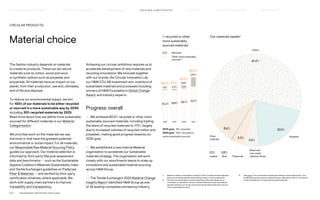
Business Call to Action, which aims to
accelerate progress towards these goals.
We always aim to minimise our negative impact
and maximise positive contribution across the
areas covered by the SDGs, with a focus on
our most material issues. Here, we present
how we contribute to the SDGs — directly
(by delivering on our strategy), indirectly and
through partnerships.
GOAL
DIRECT INFLUENCE
THROUGH OUR STRATEGY
INDIRECT INFLUENCE
THROUGH OUR STRATEGY
CONTRIBUTION THROUGH
PARTNERSHIPS
1 No poverty Fair  Equal
•
2 Zero hunger
• •
3 Good health  well-being
•
4 Quality education
•
5 Gender equality Fair  Equal
•
GOAL
DIRECT INFLUENCE
THROUGH OUR STRATEGY
INDIRECT INFLUENCE
THROUGH OUR STRATEGY
CONTRIBUTION THROUGH
PARTNERSHIPS
6 Clean water  sanitation
Circular  Climate
Positive • •
7 Affordable  clean energy
Circular  Climate
Positive •
8 Decent work  economic growth Fair  Equal
•
9 Industry, innovation and infrastructure
Leading the Change,
Circular  Climate
Positive
•
10 Reduced inequalities Fair  Equal
•
11 Sustainable cities  communities
•
12 Responsible consumption  production
Leading the Change,
Circular  Climate
Positive
•
13 Climate action
Circular  Climate
Positive •
14 Life below water
Circular  Climate
Positive • •
15 Life on land
Circular  Climate
Positive • •
16 Peace, justice and strong institutions Fair  Equal
• •
17 Partnerships for the goals
Leading the Change,
Circular  Climate
Positive, Fair  Equal
• •
Our relationship with the UN SDGs
P.71	 TR ANSPARENT REPORTING SINCE 2002
HOW WE REPORT
HOW WE LEAD THE CHANGE
OUR APPROACH TO SUSTAINABILIT Y CIRCUL AR  CLIMATE POSITIVE FAIR  EQUAL SUPPLY CHAIN MANAGEMENT
HIGHLIGHTS 2021
Auditor’s report
Auditor’s Assurance Report on specified
sustainability information in H  M Group’s
Sustainability Disclosure 2021 report
To H  M Hennes  Mauritz AB, corporate identity
number 556042-7220
Introduction
We have been engaged by the Board of Directors
and Executive Management of HM Hennes 
Mauritz AB (HM Group) to perform a limited
assurance engagement on selected information,
presented in the HM Group’s ‘Sustainability
Disclosure 2021 report’, ‘Material Issues 2021’,
‘Materiality Matrix 2021’ and ‘Stakeholder
Engagement 2021’ with regards to the below
disclosures referred to in the GRI index that
can be found in the ‘GRI content index 2021’.
Reporting principles can be found in ‘How we
Report 2021’.
— Approach to stakeholder engagement
(Disclosure 2-29), reported in ‘Stakeholder
Engagement 2021’, ‘Material Issues 2021’ and on
pages 10-11 in the ‘Sustainability Disclosure 2021
report’.
— Process to determine material topics and list
of material topics (Disclosures 3.1, 3.2), reported
in ‘Material Issues 2021’, ‘Materiality Matrix 2021’,
‘How we report 2021’ and on pages 49 and 70-71
in the ‘Sustainability Disclosure 2021 report’.
— Energy:
Energy consumption within the organization and
percentage of renewable energy (Disclosure
302-1), page 23 in the ‘Sustainability Disclosure
2021 report. Energy intensity (Disclosure 302-3),
page 23 in the ‘Sustainability Disclosure 2021
report’.
— Emissions:
Direct (Scope 1) GHG emissions (Disclosure 305-1),
page 22 in the ‘Sustainability Disclosure 2021
report’. Energy indirect (Scope 2) GHG emissions
(Disclosure 305-2), page 22 in the ‘Sustainability
Disclosure 2021 report’. Other indirect (Scope
3) GHG emissions, limited to transportation and
garment production (part of Disclosure 305-3),
page 22 in the ‘Sustainability Disclosure 2021
report’.
— Materials:
Materials used by weight or volume, limited to
cotton and top three recycled materials (part of
Disclosure 301-1), page 31-32 in the ‘Sustainability
Disclosure 2021 report’.
— Anti-corruption:
Confirmed incidents of non-compliance with
the Code of Ethics and actions taken (Disclosure
205-3), reported on page 56 in the ‘Sustainability
Disclosure 2021 report’.
Responsibilities of the
Board of Directors and the
Executive Management for
the Sustainability Report
The Board of Directors and the Executive
Management are responsible for the preparation
of the Sustainability Report in accordance with
the applicable criteria, as explained on page
70 in the Sustainability Disclosure 2021 report,
and are the parts of the Sustainability Reporting
Guidelines published by GRI (Global Reporting
Initiative) which are applicable to the Sustainability
Report, as well as the accounting and calculation
principles that the Company has developed. This
responsibility also includes the internal control
relevant to the preparation of a Sustainability
Report that is free from material misstatements,
whether due to fraud or error.
Responsibilities of the auditor
Our responsibility is to express a conclusion on
the above specified disclosures in the specified
documents based on the limited assurance
procedures we have performed. The selection of
disclosures to be reviewed has been made by the
management of HM Group. Our engagement
is limited to the above specified information,
which does not include web-links, and is limited
to historical information presented and does
therefore not cover future-oriented information.
We conducted our limited assurance
engagement in accordance with ISAE 3000
Assurance Engagements Other than Audits or
Reviews of Historical Financial Information.
A limited assurance engagement consists of
making inquiries, primarily of persons responsible
for the preparation of the Sustainability
Report, and applying analytical and other
limited assurance procedures. The procedures
performed in a limited assurance engagement
vary in nature from, and are less in extent than for,
a reasonable assurance engagement conducted
in accordance with International Standards on
Auditing and other generally accepted auditing
standards in Sweden.
P.72	 TR ANSPARENT REPORTING SINCE 2002
HOW WE REPORT
HOW WE LEAD THE CHANGE
OUR APPROACH TO SUSTAINABILIT Y CIRCUL AR  CLIMATE POSITIVE FAIR  EQUAL SUPPLY CHAIN MANAGEMENT
HIGHLIGHTS 2021
Auditor’s report
The firm applies ISQC 1 (International Standard
on Quality Control) and accordingly maintains
a comprehensive system of quality control
including documented policies and procedures
regarding compliance with ethical requirements,
professional standards and applicable legal and
regulatory requirements. We are independent
of HM Group in accordance with professional
ethics for accountants in Sweden and have
otherwise fulfilled our ethical responsibilities in
accordance with these requirements.
The procedures performed consequently do
not enable us to obtain assurance that we would
become aware of all significant matters that
might be identified in a reasonable assurance
engagement.
Accordingly, the conclusion of the procedures
performed do not express a reasonable assurance
conclusion.
Our procedures are based on the criteria defined
by the Board of Directors and the Executive
Management as described above. We consider
these criteria suitable for the preparation of the
above specified disclosures presented in the
‘Sustainability Disclosure 2021 report’.
We believe that the evidence we have obtained is
sufficient and appropriate to provide a basis for
our conclusion below.
Conclusion
Based on the limited assurance procedures
we have performed, nothing has come to our
attention that causes us to believe that the
information regarding the above specified
disclosures in HM Group’s ‘Sustainability
Disclosure 2021 report’, is not prepared, in all
material respects, in accordance with the
criteria defined by the Board of Directors and
Executive Management.
Stockholm 25 March 2022
Deloitte AB
Didrik Roos		
Authorized Public Accountant
Lennart Nordqvist		
Expert Member of FAR
P.73	 TR ANSPARENT REPORTING SINCE 2002
HOW WE REPORT
HOW WE LEAD THE CHANGE
OUR APPROACH TO SUSTAINABILIT Y CIRCUL AR  CLIMATE POSITIVE FAIR  EQUAL SUPPLY CHAIN MANAGEMENT
HIGHLIGHTS 2021
Sustainability Disclosure 2021
If you have questions, need help locating
information, or want to find the latest on our
sustainability work including strategy, goals,
standards and policies, please contact
Laura.Cars@hm.com.
We appreciate your feedback.
Thank you

HM-Group-Sustainability-Disclosure-2021.pdf

  • 1.
  • 2.
    Sharing relevant andaccountable information about our business practices, supply chain and products is important for tracking our progress and learnings towards a more sustainable future. Our reporting includes several components: — An Annual and Sustainability Report provides an overview of our financial and non- financial performance, including our Statutory Sustainability Report. — This Sustainability Disclosure complements our Annual and Sustainability Report by providing additional detailed information about strategy, policies, goals, programmes and performance data. Web content offers further detail on specific sustainability issues, including our strategies and policies. Find links throughout this report. About this report — Report Stories showcase highlights from our work. Follow links across this report. — External reporting frameworks: Global Reporting Initiative and UN Guiding Principles indexes, and Task Force on Climate-Related Financial Disclosures reporting in our Annual and Sustainability Report. This report discloses our goals and performance for the financial year from 1 December 2020 to 30 November 2021. Read more about the scope of this report in How We Report. P.2 TR ANSPARENT REPORTING SINCE 2002 HOW WE LEAD THE CHANGE OUR APPROACH TO SUSTAINABILIT Y HIGHLIGHTS 2021 CIRCUL AR & CLIMATE POSITIVE HOW WE REPORT SUPPLY CHAIN MANAGEMENT FAIR & EQUAL
  • 3.
    How we Leadthe Change How we Lead the Change. . . . . . . . . . . . . . . . . . . . . . . .7 Transparency . . . . . . . . . . . . . . . . . . . . . . . . . . . . . . . . . . . 8 Engaging with our stakeholders . . . . . . . . . . . . . . . . 10 Engaging with policy makers . . . . . . . . . . . . . . . . . . . . 11 Our approach to sustainability Our approach to sustainability. . . . . . . . . . . . . . . . . . . 4 Key sustainability policies and standards . . . . . . . . 6 Supply chain management Supply chain management. . . . . . . . . . . . . . . . . . . . . 66 Performance highlights Highlights 2021. . . . . . . . . . . . . . . . . . . . . . . . . . . . . . . . . 13 External assessments . . . . . . . . . . . . . . . . . . . . . . . . . . 14 KPIs: Circular & Climate Positive . . . . . . . . . . . . . . . . 15 KPIs: Fair & Equal . . . . . . . . . . . . . . . . . . . . . . . . . . . . . . . 16 How we report How we report. . . . . . . . . . . . . . . . . . . . . . . . . . . . . . . . . 70 UN Sustainable Development Goals . . . . . . . . . . . . 71 Auditor’s report . . . . . . . . . . . . . . . . . . . . . . . . . . . . . . . . 72 Circular & Climate Positive Circular & Climate Positive. . . . . . . . . . . . . . . . . . . . . . 17 Our Circular & Climate Positive approach . . . . . . . 18 Climate Positive . . . . . . . . . . . . . . . . . . . . . . . . . . . . . . . . 19 Biodiversity . . . . . . . . . . . . . . . . . . . . . . . . . . . . . . . . . . . . 25 Water. . . . . . . . . . . . . . . . . . . . . . . . . . . . . . . . . . . . . . . . . . 27 Our circular ecosystem . . . . . . . . . . . . . . . . . . . . . . . . 29 Circular products: — Design . . . . . . . . . . . . . . . . . . . . . . . . . . . . . . . . . . . . . . 30 — Material choice . . . . . . . . . . . . . . . . . . . . . . . . . . . . . . 31 — Microfibres. . . . . . . . . . . . . . . . . . . . . . . . . . . . . . . . . . 36 Circular supply chain: — Optimising resource use . . . . . . . . . . . . . . . . . . . . . 37 — Materials processing . . . . . . . . . . . . . . . . . . . . . . . . 39 — Chemicals . . . . . . . . . . . . . . . . . . . . . . . . . . . . . . . . . . . 40 Circular customer journey: — Maximising product life & scaling circular business models . . . . . . . . . . . . . . . . . . . . . . . . . . . . . . . 41 Circular products, supply chain & customer journey: — Stores, distribution centres & offices. . . . . . . . . 44 — Packaging . . . . . . . . . . . . . . . . . . . . . . . . . . . . . . . . . . . 45 Fair & Equal Fair & Equal. . . . . . . . . . . . . . . . . . . . . . . . . . . . . . . . . . . . . 47 Our approach to being Fair & Equal . . . . . . . . . . . . . 48 Respecting & advancing human rights . . . . . . . . . . 49 Inclusion & diversity . . . . . . . . . . . . . . . . . . . . . . . . . . . . 51 Fair jobs in our own operations . . . . . . . . . . . . . . . . . 55 Fair jobs in our production supply chain . . . . . . . . 57 Contents P.3 TR ANSPARENT REPORTING SINCE 2002 HOW WE LEAD THE CHANGE OUR APPROACH TO SUSTAINABILIT Y HIGHLIGHTS 2021 CIRCUL AR & CLIMATE POSITIVE FAIR & EQUAL SUPPLY CHAIN MANAGEMENT HOW WE REPORT
  • 4.
    We are continuingto work towards our goal to make fashion and design accessible to the many, in a way that’s good for people, the planet, our industry and our business. Our sustainability strategy guides us as we work to lead the change towards a circular and climate positive fashion industry while being a fair and equal company. We achieved several milestones in 2021. We are now working to achieve net-zero greenhouse gas emissions,1 as part of our climate positive approach. We previewed our new circular design tool, Circulator, and developed country- specific wage strategies in our production supply chain that consider national contexts and legal settings. The Covid-19 pandemic has continued to underline the importance of accelerating our sustainability agenda. The way we report on sustainability has also progressed. This year, we published our first combined Annual and Sustainability Report, taking another step on our journey to integrate sustainability into every part of our business. Read our Annual and Sustainability Report for more detail on our sustainability vision and strategy and how it supports our business, and information on our sustainability governance. Our approach to sustainability CIRCULAR AND CLIMATE POSITIVE FAIR AND EQUAL RESPECT HUMAN RIGHTS Our vision is to lead the change towards a circular and climate positive fashion industry while being a fair and equal company. — Fair jobs for all — Inclusive and diverse workplaces and communities — Climate positive approach across our value chain, operating within planetary boundaries — Net positive impact on biodiversity — Circular ecosystem for our products, supply chains and customer journeys — Scale innovation — Promote transparency — Engage and partner for industrywide progress LEADING THE CHANGE Our sustainability strategy 1) Net-zero as defined by Science Based Targets initiative's Net-Zero Standard. P.4 TR ANSPARENT REPORTING SINCE 2002 OUR APPROACH TO SUSTAINABILIT Y HOW WE LEAD THE CHANGE CIRCUL AR CLIMATE POSITIVE FAIR EQUAL SUPPLY CHAIN MANAGEMENT HOW WE REPORT HIGHLIGHTS 2021
  • 5.
    A message fromour CEO This year is the first year that we at the HM group are integrating our annual and sustainability reports. This is an important step, but also a natural development since sustainability has been an integral part of our business for a long time. To meet customers’ ever-increasing expectations, we are continuing to develop the customer offering for all our unique brands by offering customers the best combination of fashion, quality, price and sustainability. Demand for good value and sustainable products is expected to grow and our customer offering is well positioned for this. Among other things, customers can today carry out repairs, rent clothes or buy and sell second-hand. I would like to thank all colleagues in the group for their efforts over the past year. Our colleagues everywhere in the organisation have demonstrated great commitment and worked to meet customers’ expectations despite the challenges, restrictions and lockdowns due to the pandemic. We are proud that our strong recovery continued in 2021 with much appreciated collections and products, continued customer focus and strong relations with our partners. A message from our Head of Sustainability I’m pleased to present the 2021 HM Group Sustainability Disclosure, detailing our priorities, progress and learnings on key environmental and social issues over the past year. We share the growing sense of urgency with many around the world who recognise the fashion industry needs to move faster towards circularity and continue to work to develop a fairer, more transparent and traceable supply chain. This year, we accelerated our net-zero ambitions and made progress in key areas such as material sourcing, inclusion and diversity, and circular design. We’ve partnered with others to test and scale circular materials, processes and business models, and to progress social protection and dialogue within our supply chain. Our approach to sustainability At the time of writing, however, we are deeply concerned about the course of events in Ukraine and our thoughts go out to all those affected. We are monitoring developments closely and doing all we can to help people as much as possible. HM Group, the HM Foundation and the Erling Persson Foundation have donated millions of kronor as well as clothing and other essentials to organisations such as UNCHR, Save the Children, the Red Cross and UNICEF. We join all those around the world who are calling for peace. Helena Helmersson CEO, HM Group Read the full CEO letter in our Annual and Sustainability Report. Looking ahead, we see collaboration as essential for finding solutions to the complex and interconnected challenges we face as an industry. We’ve come a long way, but we know there is much more to do to accelerate our transformation. We will continue to share our progress and learnings, and welcome collaboration and partnerships as we continue this journey Leyla Ertur Head of Sustainability, HM Group HM Foundation The HM Foundation is an independent non-profit global foundation for public good, headquartered in Stockholm, Sweden. It is privately funded by the Stefan Persson family, founders and main owners of HM Group. Founded to accelerate the realisation of the UN Sustainable Development Goals, HM Foundation uses collaboration and innovation to co-create, fund and share solutions for the world’s most urgent challenges. Since 2013, the family has donated SEK 1.5 billion (USD 200 million) to the Foundation. Learn more at hmfoundation.com P.5 TR ANSPARENT REPORTING SINCE 2002 OUR APPROACH TO SUSTAINABILIT Y HOW WE LEAD THE CHANGE CIRCUL AR CLIMATE POSITIVE FAIR EQUAL SUPPLY CHAIN MANAGEMENT HOW WE REPORT HIGHLIGHTS 2021
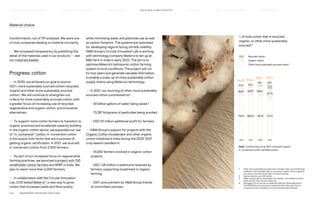
  • 6.
    Key sustainability policies standards OUR BUSINESS PARTNERS OUR MATERIALS AND PRODUCTS — Human Rights Policy — Animal Welfare Policy — Responsible Raw Material Sourcing Policy — HM Group Chemical Restrictions — Code of Ethics for Business Partners — Sustainability Commitment — Child Labour Policy — Migrant Worker Guidelines — Home Working Policy — Code of Ethics for Colleagues — Whistleblowing Policy — Global Grievance Policy — Global Non-Discrimination and Non-Harassment Policy — Global Policy on Diversity, Inclusiveness and Equality — Global Health and Safety Policy — Global Policy on HIV AIDS — Global Compensation and Benefits Policy — Global Labour Relations Principles — Privacy Policy — Responsible Marketing Guidelines — Tax Policy OUR OWN OPERATIONS For more on HM Group’s policies and standards see our Corporate Governance Report. Our approach to sustainability P.6 TR ANSPARENT REPORTING SINCE 2002 OUR APPROACH TO SUSTAINABILIT Y HOW WE LEAD THE CHANGE CIRCUL AR CLIMATE POSITIVE FAIR EQUAL SUPPLY CHAIN MANAGEMENT HOW WE REPORT HIGHLIGHTS 2021
  • 7.
    Competing to transform fashion Thesixth round of HM Foundation’s Global Change Awards launched in August 2021. This is the world’s largest innovation challenge to transform the fashion industry. The 2022 Award seeks early-stage innovations contributing to a planet positive industry by addressing the earth’s global commons: land, water, oceans, climate and biodiversity. Applications from more than 100 countries were submitted. Five winners will be announced in April, 2022. In 2021, the HM Foundation’s Billion Dollar Collection campaign presented ten start-ups that could disrupt the fashion industry. Each company was showcased as a garment in a virtual fashion collection, with the price tag showing the investment needed to scale up their disruptive innovations. We are committed to lead the change to a better fashion future. This mindset influences everything we do. We aim to lead by example, using our size and scale to create positive impact. Being a first mover is challenging — trying something new means a greater risk of failure — but we believe in investing in a business that meets growing customer interest in more sustainable products and lifestyles. Improving the sustainability performance of our value chain also improves the resilience of our business operations. We amplify our positive impact by forming partnerships, participating in dialogue, and sharing progress and learnings. Our focus is on three areas: innovation, transparency, and engagement with stakeholders and policy makers. Innovation New materials, recycling technologies and business models that promote circularity, improve resource use and enhance customers’ experience are needed to transform our business and the fashion industry. We identify, test and scale new solutions: — Our Circular Innovation Lab supports early- stage innovations to evaluate new and more sustainable materials and technologies, bridging the gap from proof-of-concept projects to pre-commercial projects all the way to commercial production. — Through our investment arm, HM CO:LAB, we invest in companies developing technologies and software that enable a circular and sustainable future. — Our B2B service Treadler gives other fashion companies access to HM Group’s supply chain. This removes barriers to sustainable sourcing by sharing the benefits of our investments in circular product development, more sustainable production and logistics. In 2021, Treadler introduced a dashboard that lets clients monitor progress towards their sustainability goals. — We test and use innovative business models to offer customers easier access to more sustainable lifestyles. For example, in Sweden our subscription-based service Singular Society gives members access to responsibly made, high-quality fashion at the price it costs to make. — 68% of respondents to our annual stakeholder survey rate HM Group as good or very good at innovation. Find more about how innovation speeds transformation, online and throughout this report. How we Lead the Change P.7 TR ANSPARENT REPORTING SINCE 2002 HOW WE LEAD THE CHANGE OUR APPROACH TO SUSTAINABILIT Y CIRCUL AR CLIMATE POSITIVE FAIR EQUAL SUPPLY CHAIN MANAGEMENT HOW WE REPORT HIGHLIGHTS 2021
  • 8.
    Recognition for transparency — HMGroup ranked second in Fashion Revolution’s 2021 Fashion Transparency Index, scoring 68% (73% in 2020). We recognise that transparency shouldn’t be seen as an end goal. Instead, it is a vital enabler to reach many of our long-term sustainability objectives. — Our 2019 Sustainability Performance Report was named first runner-up in the honesty and transparency category at the 2021 Corporate Responsibility Reporting Awards. — 71% of stakeholders rate HM Group as good or very good for transparency. Read more in Stakeholder Engagement. Transparency prompts change by: — Empowering informed choices. Giving customers information on product and business sustainability so they can make informed decisions aligned with their values. Encouraging customers to adopt more sustainable behaviours by enabling and inspiring more sustainable actions. — Accelerating sustainable change. Increasing transparency and traceability across our value chain to give us greater oversight and control of our impacts. Sharing accurate data on our performance to identify areas for improvement and create accountability and comparability within our industry. As we continuously improve our data systems to help reach our ambition of a fully traceable and transparent supply chain, we’re mindful of the ethical considerations around collecting and using data. We see the need for shared guidance on responsible data handling from policy makers and the development of strong public governance procedures. Our Privacy Policy shares how we process and protect personal data, and we apply our Responsible AI Checklist every time we initiate an artificial intelligence (AI) project to ensure relevant ethical questions are answered. Communicating openly and honestly about our business is vital for building meaningful relationships with colleagues, customers, investors and others. Transparency alone does not improve sustainability performance, but creates accountability and comparability, pushing us to improve and encouraging others in our industry to do the same. Progress: empowering informed choices — In 2021, HM was among the first fashion brands to launch the Sustainable Apparel Coalition’s (SAC) Higg Index Sustainability Profile — a new on-product transparency tool sharing environmental performance scores for materials. Customers can view profiles on around 850 HM products online in Europe and the United States. We continued our partnership with the SAC, a global multi-stakeholder non-profit alliance developing tools to standardise sustainability measurements — sitting on strategic councils and within working groups. — HM and HM HOME online continue to offer customers on-product transparency information about product materials, factory locations, garment care and recycling options. — We expanded MyStore, our store-led community programme that engages and educates customers and colleagues on local sustainability issues. We extended coverage to central Europe and India, with 140 stores participating. — HM completed the roll-out of its initiative to reward members with Conscious Points, for making more sustainable choices. The initiative empowers members to track their conscious choices, such as using our garment collecting initiative, bringing their own bag when shopping in store or choosing climate- smart delivery when shopping online. In 2021, HM members completed over 45 million Transparency HOW WE LEAD THE CHANGE OUR APPROACH TO SUSTAINABILIT Y CIRCUL AR CLIMATE POSITIVE FAIR EQUAL SUPPLY CHAIN MANAGEMENT HOW WE REPORT HIGHLIGHTS 2021 P.8 TR ANSPARENT REPORTING SINCE 2002
  • 9.
    conscious choices. HMwill continue developing this concept during 2022. — HM and COS tested sharing on-product lifecycle assessment (LCA) data with customers. Read what we found in Learnings. Progress: accelerating sustainable change — ARKET, COS, HM, Monki, Other Stories and Weekday completed the Higg Brand Retail Module and took part in data verification for the programme. The scores will be available to SAC members, with the eventual goal to share publicly to enable comparison across brands. — We continued assessing suppliers’ social and environmental performance using the Higg Facility Environmental Module (FEM) and Higg Facility Social and Labor Module (FSLM). See Supply Chain Management for more detail. — We joined the European Commission’s Green Consumption Pledge Initiative, committing to disclose details of our work and performance on our circular and climate positive strategy. — We’re exploring opportunities to improve traceability of materials, enrolling in multiple projects aiming to find scalable solutions to this challenge. For example, we plan to scale our TextileGenesis traceability programme to more materials during 2022. Additionally, together with Textile Exchange and TextileGenesis, we’re piloting eTrackit, a digital certified chain of custody model to improve traceability of materials through the supply chain. — Our HM Group supplier list disclosed information about 1,519 tier 1 supplier factories, covering 99% of relevant production volume, and 394 tier 2 supplier factories, covering 71% of relevant production volume. COS, Monki and Weekday added supplier lists and ARKET added a sustainability fact sheet to their websites. — We continued contributing to the EU Product Environmental Footprint Technical Secretariat, which is developing an EU-wide methodology to measure apparel and footwear product environmental footprints that could help substantiate sustainability claims. Learnings — Our work to communicate environmental impacts with customers taught us that they tend to find LCA information overwhelming. Sharing data this way is not scalable or comparable because it is too costly and time consuming. What we need is a unified industry approach to measuring and communicating product impact data. Transparency — Our on-product transparency pilots show sharing product impact data with customers does not appear to impact customer behaviour in the short term, but builds trust and loyalty. Future focus — We’ll continue improving on-product transparency to help customers better understand the impacts of our products. We’ll keep supporting the development of the Higg Index Sustainability Profiles to improve sharing of comparable customer-facing sustainability scores together with the SAC. We plan to use the profiles for more products and brands, and are keen to see the scope of profiles extended, including to social impact categories. In 2022, we’ll pilot the tool’s expansion to tier 1 supplier factory scores. — Securing a seamless flow of data between information systems remains a key challenge. We’re developing a roadmap for our supply chain sustainability performance data to improve integration and accessibility. P.9 TR ANSPARENT REPORTING SINCE 2002 HOW WE LEAD THE CHANGE OUR APPROACH TO SUSTAINABILIT Y CIRCUL AR CLIMATE POSITIVE FAIR EQUAL SUPPLY CHAIN MANAGEMENT HOW WE REPORT HIGHLIGHTS 2021
  • 10.
    Our stakeholders include: —Customers. Our customers are the centre of our business. We continuously listen to learn their needs, understand their expectations and make more sustainable choices as easy and attractive as possible to them. — Colleagues. Everyone at HM Group has a role in achieving our sustainability ambitions. We welcome the diversity of perspectives, knowledge and experience contributed by our many colleagues around the world. — Business partners — including suppliers of commercial and non-commercial goods and services, franchise partners and online platform channels. We work together to share expectations, address social and environmental challenges in our supply chain, and raise industry standards. We engage with our suppliers’ employees either directly through anonymous worker surveys or via representative bodies such as trade unions. — Experts — including peers, nongovernmental organisations, academics and researchers, innovators and multi-stakeholder initiatives. Together, we can tackle systemic challenges and have a positive impact beyond our business. We welcome open dialogue and collaboration with others within and outside our industry. Engaging with diverse perspectives challenges us to do better, accelerates innovation and supports our transparency efforts. Partnerships help us progress towards our sustainability ambitions faster than we could alone and have a positive impact beyond our own value chain. Engaging with our stakeholders — Policy makers — including governments and international institutions. We work to raise and level the legislative playing field, support the development of the fashion industry and encourage governments and businesses to take shared responsibility for meeting complex challenges. Read more in Engaging with Policy Makers. — Investors. As a publicly listed company, we are accountable to our investors. We maintain two-way dialogue with them to share our progress, seek feedback and inform our sustainability strategy and reporting. — Communities. We want to contribute to positive impacts, growth and development in the communities where our operations and suppliers are located, and the demographic communities that represent our customers and colleagues. We regularly engage with our stakeholders using a range of channels. These include webinars and calls, partnership meetings, surveys and consultations, training programmes, our stakeholder newsletter, and regular updates during the Covid-19 crisis. Each year, we invite views on our sustainability performance and reporting via our anonymous stakeholder survey. Read more about our stakeholder engagement activities and external collaborations in 2021. Stakeholder feedback In 2021, 96 stakeholders (a 15% response rate) participated in our stakeholder perception survey (96 in 2020; 350 in 2019). This year: — 73% of respondents agree or strongly agree that HM Group is taking the lead among fashion retailers for social and environmental sustainability (76% in 2020; 52% in 2019). — 89% say they have good or very good experience interacting with us (92% in 2020; 71% in 2019). — 77% say HM Group is a company they can trust (75% in 2020; 55% in 2019). Additional results relating to specific topics are shared in the relevant sections of this report. HOW WE LEAD THE CHANGE OUR APPROACH TO SUSTAINABILIT Y CIRCUL AR CLIMATE POSITIVE FAIR EQUAL SUPPLY CHAIN MANAGEMENT HOW WE REPORT HIGHLIGHTS 2021 P.10 TR ANSPARENT REPORTING SINCE 2002
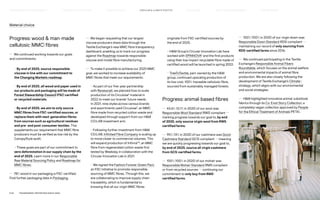
  • 11.
    Our public affairswork is an important enabler to address systemic issues and achieve policy developments needed to support meaningful growth in our industry. We engage with governments on key environmental, social and business topics. The central team reports directly to our chief financial officer and sets the direction for teams in our retail and production markets. HM Group is listed in the EU Transparency Register. Priority policy areas We focus on the issues most relevant to our sustainability work and where we see greatest potential to contribute to positive change. An important focus area is upcoming European Union (EU) and EU country-level legislation on transparency, circularity and other environmental and social issues. We also prioritise engaging with national and international policy and legislation that: — Supports transition to a circular and climate positive fashion industry. — Impacts social development in our production markets, with a focus on wages and social protection mechanisms. — Enables stable, predictable development of the industry in our production markets to support equitable economic growth, in line with the Sustainable Development Goals. — Promotes a free and sustainable trade agenda. — Addresses the emerging artificial intelligence and digitalisation agenda. We engage in international dialogue relevant to our sustainability ambitions, including through COP26, the International Labour Organization, the Organisation for Economic Co-operation and Development, the UN Framework Convention on Climate Change (UNFCCC), the UN Global Compact (UNGC) Decent Work in Global Supply Chains Action Platform, the UNGC CFO taskforce and the World Economic Forum. We are members of multi-stakeholder platforms, including ACT (Action, Collaboration, Transformation), AFIRM, Business for Nature, Global Fashion Agenda, the Policy Hub — Circularity for Apparel and Footwear, the Sustainable Apparel Coalition, Textile Exchange, the UNFCCC Fashion Industry Charter for Climate Action and ZDHC (Zero Discharge of Hazardous Chemicals). Key 2021 activities — We contributed in depth to EU consultations on the EU Textile Strategy, sustainable product initiative (including eco-design, circular business models and digital product passports), chemicals, due diligence (Sustainable Corporate Governance), packaging, end-of-waste criteria for the textile industry, and the EU taxonomy for sustainable economic activities. Our CEO and our Head of Sustainability took part in high- level meetings with the EU Commission and EU Parliament on topics such as transparency and sustainable textiles. — In several production markets, we advocated for transparent, inclusive minimum wage revisions and extended social protection mechanisms, either through policy conversations (for example, in Bangladesh and Indonesia) or working with our suppliers to ensure full enforcement of the law (for example, in Turkey). — We engaged with national authorities to support reforms towards a cleaner energy mix, including in Bangladesh (on the revision of the Renewable Energy Policy), Cambodia, and Indonesia (together with CEIA – Clean Energy Investment Accelerator). In Turkey and Bangladesh we started a collaboration with United Nations Development Programme (UNDP) to understand the legal framework and advocate for the shift towards a climate positive industry. Engaging with policy makers P.11 TR ANSPARENT REPORTING SINCE 2002 HOW WE LEAD THE CHANGE OUR APPROACH TO SUSTAINABILIT Y CIRCUL AR CLIMATE POSITIVE FAIR EQUAL SUPPLY CHAIN MANAGEMENT HOW WE REPORT HIGHLIGHTS 2021
  • 12.
    Find highlights fromacross our 2021 sustainability work in this section, along with reporting on all our key performance indicators (KPIs). Highlights 2021. . . . . . . . . . . . . . . . . . . . . . . . . . . . . . . . 13 External assessments . . . . . . . . . . . . . . . . . . . . . . . . . 14 KPIs: Circular Climate Positive . . . . . . . . . . . . . . . 15 KPIs: Fair Equal . . . . . . . . . . . . . . . . . . . . . . . . . . . . . . 16 Performance highlights P.12 TR ANSPARENT REPORTING SINCE 2002 HIGHLIGHTS 2021 HOW WE LEAD THE CHANGE OUR APPROACH TO SUSTAINABILIT Y FAIR EQUAL CIRCUL AR CLIMATE POSITIVE HOW WE REPORT SUPPLY CHAIN MANAGEMENT
  • 13.
    Highlights 2021 22% absolute reductionin scope 1 2 CO2e emissions and 9% absolute reduction in scope 3 CO2e emissions, compared with 2019 baseline — contributing to our target to reduce absolute scope 1, 2 and 3 emissions by 56% by 2030. Set the ambition to design all our products for circularity by 2025, in accordance with our new circular design tool — Circulator. Contributed SEK 180.4 million to community investment initiatives, reaching 368,000 beneficiaries. Tripled the share of recycled materials used in our garments from 5.8% to 17.9%. 62% of worker representatives and 28% of supervisors in our in our supply chain are female. 27.8% reduction in plastic packaging. 98% of suppliers regard HM Group as a fair business partner. 23,253 employees received our Layers inclusion and diversity training. P.13 TR ANSPARENT REPORTING SINCE 2002 HIGHLIGHTS 2021 HOW WE LEAD THE CHANGE OUR APPROACH TO SUSTAINABILIT Y CIRCUL AR CLIMATE POSITIVE FAIR EQUAL SUPPLY CHAIN MANAGEMENT HOW WE REPORT
  • 14.
    External assessments Benchmarks — BaptistWorld Ethical Fashion Guide. HM Group achieved an A grade in the 2021 Ethical Fashion Guide, which recognises companies that put people and planet before profit, putting us in the top 20% of brands surveyed. — Dow Jones Sustainability Index. HM Group was included in the Dow Jones World Sustainability Index for the tenth year running. We ranked fifth in 2021, with a score of 68/100 (70/100 in 2020). We were also listed in the Dow Jones European Index. — Ecogain Biodiversity Index. We were one of five Green Traffic Light recipients in the Ecogain Biodiversity Index 2021, out of 240 companies, which recognises companies with biodiversity goals in line with science. — Fashion Transparency Index. HM Group ranked second in Fashion Revolution’s 2021 Fashion Transparency Index, which assesses 250 fashion brands, with a score of 68% (73% in 2020). We are pleased that our efforts to increase transparency are recognised, but we know that transparency is no replacement for performance. We will continue to improve our practices. — FTSE4Good. HM Group was a constituent of the FTSE4Good Index Series, which helps investors identify responsible companies with strong environmental, social and governance practices. — Global Compact LEAD. HM Group was announced as a Global Compact LEAD company, demonstrating our ongoing commitment to the United Nations Global Compact and its principles for responsible business. — InfluenceMap’s A-List of Climate Policy Engagement. We were identified as one of 15 corporate leaders advocating for ambitious climate policy in the 2021 A-List of Climate Policy Engagement. — Oxfam Australia Naughty or Nice List. HM Group was again included in Oxfam Australia’s tracker of companies committed to ring-fencing labour costs and to paying living wages for garment workers. — Platform Living Wage Financials. Our work on wages in our supply chain was rated as “advanced” in the Platform Living Wage Financials 2021 Annual Report. We were the only member of the garment and footwear sector included in this category. — Remake Fashion Accountability Report. We ranked 11 in Remake’s 2021 Fashion Accountability Report that rates 60 fashion companies according to traceability, wages and wellbeing, commercial practices, materials, environmental justice and governance. — Stand Earth Fashion Scorecard. HM Group ranked in the top ten companies assessed by Stand Earth’s Fashion Scorecard 2021, an analysis of 47 fashion brands, with a C- score overall and an A+ for our public affairs work. While we’re happy with our leadership position, we know that we have more work to do together with our industry. — Textile Exchange Corporate Fiber Materials Benchmark. HM Group was recognised as one of 36 leading companies out of the 191 analysed in the 2020 Material Change Leaderboard. We were one of nine companies leading on material circularity and one of 13 companies leading on progress against the Sustainable Development Goals. Awards — Corporate Responsibility Reporting Awards. Our 2019 Sustainability Performance Report won the Best Report award this year. The report also came second place in the Openness and Honesty, Best Carbon Disclosure, and Creativity in Communications categories, and third place in Relevance and Materiality. P.14 TR ANSPARENT REPORTING SINCE 2002 HIGHLIGHTS 2021 HOW WE LEAD THE CHANGE OUR APPROACH TO SUSTAINABILIT Y CIRCUL AR CLIMATE POSITIVE FAIR EQUAL SUPPLY CHAIN MANAGEMENT HOW WE REPORT
  • 15.
    KPIs: Circular Climate Positive Details of specific goals and additional data, including the reasons for changes in performance this year, are included within relevant sections of the Circular Climate Positive chapter. Circular Climate Positive KPIs 2018 2019 2020 2021 GOAL Climate: % absolute reduction (scopes 1 and 2) in CO2e emissions compared with 2019 baseline1,2,3 N/A N/A +17% –22% -56% by 2030 Climate: % absolute reduction (scope 3) in CO2e emissions compared with 2019 baseline1,3 N/A N/A –14% –9% Climate: % change in CO2e emissions from own operations (scope 1 + 2) compared with previous year3 –11% +8% +18% –34% − Climate: % change in scope 3 CO2e emissions compared with previous year3 − –3% –14% +6% − Climate: % change in electricity intensity in our stores (kwh/m2 per opening hour) compared with 2016 baseline3 –8.2% –10.1% −17.0% –16.8% −25% by 20304 Climate: % renewable electricity in own operations3 96% 96% 90% 95% 100% by 2030 Water: % reduction in production water use (water intensive tier 1 and 2 suppliers) from 2017 baseline N/A –5.9% –3.8% –10.3% −25% by 2022 Commercial goods: % of recycled or other more sustainably sourced materials total3 56.6% 57.1% 64.5% 80.0% 100% by 2030 Commercial goods: % of other more sustainably sourced materials3 55.2% 54.9% 58.7% 62.1% – Commercial goods: % of recycled materials3 1.4% 2.2% 5.8% 17.9% 30% by 2025 Packaging: % of recycled or other more sustainably sourced materials1 − − 89% 68% 100% by 2030 Chemicals: % of supplier factories compliant with ZDHC Manufacturing Restricted Substances List N/A 80% 88% 95% 100%5 Garment collecting initiatives: Tonnes of garments collected through garment collecting initiative6 20,649 29,005 18,800 15,944 Annual increase 1) New KPI added in 2021. 2) Scope 1 and 2 are direct and indirect emissions of greenhouse gases from HM Group’s own operations, e.g. stores, distribution centres and offices. 3) See page 72 for an assurance statement relating to these data points. The limited assurance process included: all scope 1 and 2 emissions; scope 3 emissions from transportation and garment production; fuel consumption in our own operations; electricity intensity in our stores; renewable electricity; all cotton data (apart from in-conversion cotton); and data for our top three recycled materials. 4) This goal read ‘by 2025’ in our 2020 and 2019 sustainability reports. It should have read ‘by 2030’, as per our annual reports. 5) 100% ZDHC MRSL compliance is proving challenging due to the variety and complexity of our supply chain. Due to this, we did not achieve our goal of 100% compliance by 2020 and continue to work towards full MRSL compliance. 6) Our garment collecting initiative was disrupted by the Covid-19 pandemic for part of the year in 2020 and for the full year in 2021. P.15 TR ANSPARENT REPORTING SINCE 2002 HIGHLIGHTS 2021 HOW WE LEAD THE CHANGE OUR APPROACH TO SUSTAINABILIT Y CIRCUL AR CLIMATE POSITIVE FAIR EQUAL SUPPLY CHAIN MANAGEMENT HOW WE REPORT
  • 16.
    KPIs: Fair Equal Details of specific goals and additional data, including the reasons for changes in performance this year, are included within relevant sections of the Fair Equal chapter. Fair Equal KPIs 2018 2019 2020 2021 GOAL Supply chain: % tier 1 supplier factories with trade union representation1 See footnote 2 See footnote 2 32% 37% − Supply chain: % tier 1 supplier factories with collective bargaining agreements1 See footnote 2 See footnote 2 18% 27% − Supply chain: % tier 1 supplier factories with digital payment solutions (bank account and/or mobile money) See footnote 2 See footnote 2 82% 91% − Supply chain: % of workers in our tier 1 production supply chain that are female See footnote 2 See footnote 2 63% 63% − Supply chain: % of supervisors in our tier 1 production supply chain that are female See footnote 2 See footnote 2 24% 28% Annual increase Supply chain: % of worker representatives in our tier 1 production supply chain that are female See footnote 2 See footnote 2 59% 62% Annual increase Supply chain: % of suppliers regarding HM Group as a fair business partner3 93% 96% 96% 98% − Own organisation: Overall People Engagement Pulses (PEP) employee engagement score (out of 100) 75 76 75 76 − Own organisation: % of HM Group employees agreeing with the statement “Diverse perspectives are valued at HM Group” 4 See footnote 5 See footnote 5 See footnote 5 74% Annual increase Own organisation: % of HM Group employees agreeing with the statement “I am treated with respect and dignity” 5 81% 82% 80% 83% Annual increase Own organisation: % of female employees6 74% 76% 74% 74% – Own organisation: % of female employees in management positions6 72% 69% 71% 71% – Own organisation: % of female employees on the board of directors6 60% 67% 67% 55% – Own organisation: % of employees in brands that have received our Layers inclusion and diversity training See footnote 6 See footnote 6 See footnote 6 15% − Own organisation: % of employees in functions that have received our Layers inclusion and diversity training See footnote 6 See footnote 6 See footnote 6 66% − Own organisation: % of employees in markets that have received our Layers inclusion and diversity training See footnote 6 See footnote 6 See footnote 6 21% − Community investment initiatives: total number of beneficiaries See footnote 6 See footnote 6 See footnote 6 368,000 − Community investment initiatives: total contributions See footnote 6 See footnote 6 See footnote 6 SEK 180.4 million7 − 1) Applicable legal standards include: the ILO core conventions; C87 Freedom of Association and Protection of the Right to Organize Convention, 1948; C98 Right to Organize and Collective Bargaining Convention, 1949. Where these standards have not yet been ratified, following Social Labor Convergence Program verification guidelines, we referred to the national applicable legislation in force. 2) New KPI introduced in 2020 due to the strategic decision to track progress in HM Group’s global production supply chain. 3) This KPI will change from next year as we integrate our supplier survey into the ACT purchasing practices assessment that runs every year. We believe that this change will reduce workload for our suppliers, providing a trusted platform for feedback. 4) New since 2021, replacing our previous KPI % of HM Group employees agreeing with the statement “I feel comfortable being myself at work”, as we updated our employee engagement survey platform. 5) New since 2018, replacing our previous KPI % of employees agreeing with the statement “people here are treated fairly regardless of age, ethnicity, sex, sexual orientation, disabilities”, as we made a shift to a new engagement survey platform. 6) New KPIs introduced in 2021 as we progress our inclusion and diversity ambitions, and begin tracking change in our community investment and engagement programmes. 7) Includes in-kind giving SEK 134.5 million, cash contributions SEK 38.8 million, management overheads SEK 6.3 million, employee volunteering SEK 0.8 million. P.16 TR ANSPARENT REPORTING SINCE 2002 HIGHLIGHTS 2021 HOW WE LEAD THE CHANGE OUR APPROACH TO SUSTAINABILIT Y CIRCUL AR CLIMATE POSITIVE FAIR EQUAL SUPPLY CHAIN MANAGEMENT HOW WE REPORT
  • 17.
    Circular Climate Positive Our Circular Climate Positive approach . . . . . . 18 Climate Positive . . . . . . . . . . . . . . . . . . . . . . . . . . . . . . . 19 Biodiversity . . . . . . . . . . . . . . . . . . . . . . . . . . . . . . . . . . . 25 Water . . . . . . . . . . . . . . . . . . . . . . . . . . . . . . . . . . . . . . . . . 27 Our circular ecosystem . . . . . . . . . . . . . . . . . . . . . . . . 29 Circular products: — Design . . . . . . . . . . . . . . . . . . . . . . . . . . . . . . . . . . . . . 30 — Material choice . . . . . . . . . . . . . . . . . . . . . . . . . . . . . 31 — Microfibres. . . . . . . . . . . . . . . . . . . . . . . . . . . . . . . . . 36 Circular supply chain: — Optimising resource use . . . . . . . . . . . . . . . . . . . . 37 — Materials processing . . . . . . . . . . . . . . . . . . . . . . . . 39 — Chemicals . . . . . . . . . . . . . . . . . . . . . . . . . . . . . . . . . . 40 Circular customer journey: — Maximising product life scaling circular business models . . . . . . . . . . . . . . . . . . . . . . . . . . . . . . 41 Circular products, supply chain customer journey: — Stores, distribution centres offices. . . . . . . . 44 — Packaging . . . . . . . . . . . . . . . . . . . . . . . . . . . . . . . . . . 45 CIRCUL AR CLIMATE POSITIVE HOW WE LEAD THE CHANGE OUR APPROACH TO SUSTAINABILIT Y FAIR EQUAL SUPPLY CHAIN MANAGEMENT HOW WE REPORT HIGHLIGHTS 2021 P.17 TR ANSPARENT REPORTING SINCE 2002
  • 18.
    Our Circular Climate Positive approach Our business, our people and the communities where they live and work are reliant upon natural resources. In turn, the health of the planet depends upon how we use, protect and restore these resources. The actions we take now to preserve our shared environment lay the foundation for the business we want to become and must become for future generations — offering our customers more sustainable choices as part of a circular fashion ecosystem. By reducing our impact on climate and nature, we also contribute to a more fair and equal society. Access to a safe, healthy and clean environment is a human right, while a thriving environment supports equity, economic development and wellbeing. Climate change is already exacerbating inequalities and conflicts, degrading ecosystems and impacting the availability of resources. These interconnected issues of climate and nature — which include water, biodiversity and land use changes — are at the heart of our approach to reducing our environmental impact. We are determined to work within planetary boundaries and progress towards a sustainable fashion future. Our ambition is to achieve net-zero CO2e emissions by 2040,1 taking a climate positive approach and having a net positive impact on biodiversity.2 Becoming circular throughout our business is key to achieving these aims. How we make and use our products directly affects our carbon and water footprints and our impact on nature. Tackling this complex set of issues requires us to collaborate with peers, experts and policy makers, for example, through our work with Business for Nature, the Ellen MacArthur Foundation, Global Fashion Agenda, Policy Hub, the Stockholm Resilience Centre and our partnership with WWF. In 2021, we set new CO2e emissions reduction goals to support our net-zero and climate positive ambitions. Compared to our 2019 baseline, we have reduced our absolute scope 1 and 2 emissions by 22% and our scope 3 emissions by 9%. We reduced production water use by 6.6% compared to last year. We engaged with the Science Based Targets Network to begin developing targets for nature and invested in projects focused on reducing the biodiversity impact of our material sourcing. We also continued our work with WWF to set context- specific (contextual) water targets and to develop our new 2030 Water Strategy. See our Circular Climate Positive KPIs from 2021. HM Foundation In 2021, the HM Foundation launched a new planet strategy — Planet Positive. The strategy addresses challenges within the entire earth system — including climate, water, ocean, biodiversity and land — and across every step of the fashion industry’s value chain. For our industry to become truly regenerative it is crucial to look beyond circularity. The HM Foundation invests in new research and supports innovations with a planet positive focus. One example is the five-year Planet First partnership with the Hong Kong Research Institute of Textiles and Apparel (HKRITA), which aims to consider all aspects of earth’s natural support systems. 1) Net-zero as defined by the SBTi’s Net-Zero Standard. 2) Our ambition to have a net positive impact on biodiversity is based on the definition of nature-positive in the naturepositive.org paper: A Nature Positive World: The Global Goal for Nature. CIRCUL AR CLIMATE POSITIVE HOW WE LEAD THE CHANGE OUR APPROACH TO SUSTAINABILIT Y FAIR EQUAL SUPPLY CHAIN MANAGEMENT HOW WE REPORT HIGHLIGHTS 2021 P.18 TR ANSPARENT REPORTING SINCE 2002
  • 19.
    Climate Positive The urgencyof the climate crisis is now undeniable. The sixth report from the Intergovernmental Panel on Climate Change (IPCC) states that human-induced climate change already affects every inhabited region across the globe. Without steep greenhouse gas (GHG) emission reductions, the IPCC warns that warming of 1.5o C or even 2o C will be exceeded this century — with potentially catastrophic consequences for people and the planet. We must accelerate our own progress to be part of the solution. Our work on climate is closely linked to our work on water, biodiversity, resource use and circularity. Our climate strategy We take a climate positive approach throughout our value chain and beyond. To do this we will: — Halve our emissions every decade. — Achieve net-zero no later than 2040, using the Science Based Targets initiative’s (SBTi) definition. We are revising our existing science-based targets to align with the SBTi’s recently launched Net-Zero Standard. We have submitted a near-term SBT with a target year of 2030, and a long-term SBT to achieve net-zero by 2040, and we are currently awaiting approval of these by SBTi. targets and interim milestones as part of our Net-Zero Roadmap. We focus on four priority activity areas to support these targets: — Energy efficiency. Use as little energy as possible across the whole value chain — including in our own operations, logistics activities and throughout our supply chain. — Renewable energy. Work to source 100% renewable electricity in our own operations, and engage with partners and suppliers to increase their use of renewable electricity, heat and steam. We are an RE100 member company. — Circularity. Our circular ambition and goals are integral to achieving our climate goals. — Have a positive effect beyond our value chain, by engaging in public affairs and collaboration, and making financial commitments to reduce climate impacts beyond our value chain emissions. To help us achieve net-zero, we introduced a new goal to reduce our absolute scope 1, 2 and 3 emissions by 56% by 2030, from a 2019 baseline.1 This overarching goal supersedes previous scope 3 goals, including our product goal. We also have a number of supporting targets focused on different aspects of our value chain:2 — From January 1, 2022, we will not onboard any new suppliers or supplier factories into our supply chain if they have on-site coal boilers in their factories — as part of a longer-term aim to phase out coal from our supply chain. — By 2030, achieve a 25% reduction in electricity intensity in our stores, from a 2016 baseline. — By 2030, source 100% renewable electricity in our own operations. — By 2030, the electricity sourced in our supply chain will be 100% renewable.3 — By 2025, source 30% recycled materials. There are additional goals attached to our sustainability-linked bond, as well as year-on-year — Carbon removals. Find nature-based and engineered solutions for removing GHGs from the atmosphere. Future investments in carbon removals will primarily serve to neutralise our residual emissions in order to achieve net-zero value chain emissions. 1) We chose 2019 as our baseline year, since the impact of the Covid-19 pandemic on our carbon emissions makes 2020 an inappropriate year against which to measure longer-term performance data. Emissions from the customer use phase are not included in the scope 3 part of this goal, to fully align with the target boundary requirements of the SBTi Net-Zero Standard. 2) We are revising our transport emissions target to align with our new absolute emissions goal. 3) Wherever renewable electricity is available for purchase (in rare cases, some markets do not have renewable electricity for sale). P.19 TR ANSPARENT REPORTING SINCE 2002 CIRCUL AR CLIMATE POSITIVE HOW WE LEAD THE CHANGE OUR APPROACH TO SUSTAINABILIT Y FAIR EQUAL SUPPLY CHAIN MANAGEMENT HOW WE REPORT HIGHLIGHTS 2021
  • 20.
    GOALS AND PERFORMANCE 2. REDUCE Goalsand performance are aligned with 1.5o C climate science. Science Based Targets initiative Net-Zero Standard 56% emissions reduction by 20302 Value chain Set separate reduction goal for emissions from customer use phase 1. ACCOUNT DISCLOSE Secure and collect data. Measure, improve, assess and disclose. CDP TCFD Value chain FOUNDATION 4. ADVOCATE Advocate, engage and collaborate. Enable and inspire. UNFCCC We Mean Business WWF Value chain and beyond1 Our climate positive approach Climate Positive AREAS TO DETERMINE IN 2022 GOALS FRAMEWORKS AND PARTNERSHIPS IMPACT AREA ACTIONS 3. REMOVE CO2 SECURE CARBON SINKS Remove and permanently store atmospheric CO2. Secure carbon sinks to avoid emissions and biodiversity loss that arise from their degredation. Science Based Targets initiative Net-Zero Standard Achieve net-zero emissions2 Value chain and beyond1 Set ambition for carbon sinks (e.g. tropical rainforest) ADDITIONAL ACTIONS TO MAXIMISE OUR POSITIVE CLIMATE IMPACT 1) For example, by engaging in public affairs and collaboration, and making financial commitments to reduce climate impacts beyond our value chain emissions. The definition of beyond value chain mitigation is a moving agenda, and we anticipate further definition to be included in the planned SBTi guidance later in 2022. 2) Target boundary includes 100% of scope 1 and 2 emissions, and 100% of minimum boundary scope 3 emissions (which excludes indirect emissions from use of sold products). P.20 TR ANSPARENT REPORTING SINCE 2002 CIRCUL AR CLIMATE POSITIVE HOW WE LEAD THE CHANGE OUR APPROACH TO SUSTAINABILIT Y FAIR EQUAL SUPPLY CHAIN MANAGEMENT HOW WE REPORT HIGHLIGHTS 2021
  • 21.
    Climate Positive To ensureprogress at the speed required, we have launched initiatives to address a number of key challenges: — Changing internal behaviour. We’ve set up internal carbon pricing to support our organisation to minimise carbon emissions when making decisions about which materials, production processes and modes of transport to use. Choices with higher emissions will impact a product’s margin negatively. We set an initial carbon price in 2021, which we will increase over time to shift behaviour towards more sustainable buying decisions. — Prioritising action. Our Climate Positive Roadmap tool forecasts future emissions scenarios for our full value chain and calculates the levers for greatest impact reduction, allowing us to prioritise where to invest. — Establishing a dedicated climate impact budget. We have set up a green investment team with a single focus: financially support projects to reduce HM Group´s emissions throughout the value chain. The team will measure return on investment by emissions reductions, not financial gain. — Sourcing external financing. Our EUR 500 million sustainability-linked bond provides external finance for carbon reduction activities. Find out more about our sustainability- linked bond. Collaboration is essential to tackling the global climate crisis. Climate is a main focus of our longstanding partnership with WWF. We engage with policy makers to develop legislation in support of a low carbon future — for example as part of the steering committee of the United Nations Framework Convention on Climate Change (UNFCCC) Fashion Industry Charter for Climate Action. We also partner with peers to reduce emissions across shared transport supply chains. As well as being a signatory to the Arctic Shipping Corporate Pledge, we are members of BSR’s Clean Cargo and Sustainable Air Freight Alliance, Green Freight Asia, Network for Transport Measures and The Pathways Coalition. We require sea transporters to register their environmental performance in the Clean Shipping Index or Clean Cargo Working Group for evaluation. Read more about our approach to tackling climate change. Progress: overall — Our scope 1 and 2 emissions decreased by 22%, compared to our 2019 baseline (–34% compared to last year) and our scope 3 emissions decreased by 9%, compared to our 2019 baseline (+6% compared to last year). The scope 1 and 2 decrease is driven by purchase of renewable electricity certificates. Decreases in our scope 3 emissions over time are led by a continued shift to more sustainable and recycled materials and reduction in air transport, as well as being influenced by Covid-related issues such as fluctuations in order volumes. The increase in scope 3 emissions compared to last year was largely due to a rebound in production and sales and related increases in product transportation, following the significant impact of the Covid-19 pandemic in 2020. — We launched our internal carbon pricing programme, sustainability-linked bond and Climate Positive Roadmap tool, and we set up our new green investment team. — To support development of a new Logistics Roadmap, we reviewed current climate impacts across our logistics activities. We will use the findings to develop a clear set of actions. — We collaborated with policy makers to catalyse systemic change, including joining the UNFCCC Race to Zero and engaging in COP26. — In our 2021 stakeholder survey, 50% of respondents rate our climate positive work as good or very good. Managing climate change risks Since 2019, we’ve used the Task Force on Climate-related Financial Disclosures (TCFD) guidance to analyse and understand our key climate-related risks and opportunities. Read our TCFD disclosure in our Annual and Sustainability Report. P.21 TR ANSPARENT REPORTING SINCE 2002 CIRCUL AR CLIMATE POSITIVE HOW WE LEAD THE CHANGE OUR APPROACH TO SUSTAINABILIT Y FAIR EQUAL SUPPLY CHAIN MANAGEMENT HOW WE REPORT HIGHLIGHTS 2021
  • 22.
    Climate Positive Scope 3CO2e emissions5,6,7 5) See page 72 for an assurance statement relating to these data points. The limited assurance process included scope 3 emissions from transportation and garment production. 6) Figures based on 2020 data. Categories are based on GHG Protocol. Number of products/spend is multiplied by approximate LCA-based conversion factors. Calculations in the footprint analysis are based on a combination of high-quality HM Group data and the best available public data sources on CO2e emissions, using conservative assumptions. We have updated our emissions data to enable comparability between years, following improvements in data analysis — read more above. Other emissions include business travel, employee commuting, franchises, fuel- and energy-related activities, and waste generated in operations. 7) Figures do not add up to 100% due to rounding. 8) GHG Protocol category 1: purchased products. 9) Includes multiple small categories such as employee commuting, investments and business travel. CO2e emissions1,2,3,4 2018 2019 2020 2021 % CHANGE FROM 2019 GOAL Total Scope 1 CO2e emissions (tonnes) 13,363 14,990 13,587 12,684 –15% –56% by 2030 (2019 baseline) Total Scope 2 CO2e emissions, including renewables (tonnes) 46,429 49,455 61,725 37,394 –24% –56% by 2030 (2019 baseline) Total Scope 1 2 CO2e emissions, including renewables (tonnes) 59,793 64,444 75,322 50,078 –22% –56% by 2030 (2019 baseline) Total Scope 3 CO2e emissions (kilotonnes)1 See footnote 1 8,497 7,334 7,742 –9% –56% by 2030 (2019 baseline) 1) In 2021, we continued work to improve the accuracy of our emissions data. This has led to some changes to our reported emissions for previous years. For example, scope 1 and 2 emissions data for 2020 and earlier did not historically include district heating (scope 2) and natural gas (scope 1) for stores in Germany. We have therefore restated scope 1 and 2 figures this year to include these additional emissions. We will continue to be transparent about how we calculate our emissions, learning and adapting our approach as methods improve. Read more about our emissions calculations. 2 ) See page 72 for an assurance statement relating to these data points. The limited assurance process included all scope 1 and 2 emissions. 3) We use a shifted reporting year for energy and GHG emissions, covering the period September-August. Our GHG emissions accounting and reporting are aligned with the GHG Protocol. Scope 2 emissions under the market-based approach are equal to 50,078 tonnes CO2e. Under the location-based approach (using grid average emission factors), scope 2 emissions were 507,170 tonnes. For further details and data, please see our CDP climate change investor response 2021. CO2e emissions include carbon dioxide (CO2), methane (CH4), nitrous oxide (N2O), hydrofluorocarbons (HFCs), perfluorocarbons (PFCs) and sulphur hexafluoride (SF6). 4) Scope 1 emissions are all direct emissions from our own operations; scope 2 represents indirect GHG emissions from consumption of purchased electricity, heat or steam used in our own operations. Scope 3 includes other indirect emissions, such as the extraction and production of purchased materials and fuels, transport-related activities in vehicles not owned or controlled by the reporting entity, electricity-related activities not covered in scope 2, outsourced activities and waste disposal. Includes emissions related to raw materials, fabric production, garment manufacturing, non-garment/non-commercial goods and customer electricity usage. Scope 1 and 2 limitations and comments: only stores open for the full quarter are included; company cars and refrigerant leakage are not included; electricity consumption includes both actuals and estimations, where estimations are made if store actuals are not received within the reporting deadline; estimates are based on previous consumption, opening hours and store area; includes market-based emissions from electricity. Scope 3 limitations and comments: franchise emissions are calculated based on electricity intensity from comparable markets; capital goods, upstream leased assets, downstream leased assets and processing of sold products are not included; upstream transportation is included in emission factors for materials. Scope 1 and 2 emissions factors: electricity — based on IEA data from CO2 Emissions from Fuel Combustion © OECD/IEA 2020, as modified by UL ES; fuels — Department for Business, Energy Industrial Strategy (BEIS), 2021. Scope 3 emissions factors: raw material and fabric production — Higg MSI; garment production — electricity based on IEA data from CO2 Emissions from Fuel Combustion © OECD/IEA 2020, as modified by UL ES; fuels — 2018 update; other expenditures — Defra, 2014, indirect emissions from the supply chain; transport by rail, air, shipping, truck — emissions factors provided by Conlogic and NTM 2019. 36% 10% 6% 6% 1% 1% Fabric production8 Use of sold products Garment manufacturing8 Raw materials8 Other expenditures8 Transport End-of-life of sold products Other9 Non-garment goods8 8% 21% 10% P.22 TR ANSPARENT REPORTING SINCE 2002 CIRCUL AR CLIMATE POSITIVE HOW WE LEAD THE CHANGE OUR APPROACH TO SUSTAINABILIT Y FAIR EQUAL SUPPLY CHAIN MANAGEMENT HOW WE REPORT HIGHLIGHTS 2021
  • 23.
    Climate Positive Energy usein our own operations1 2018 2019 2020 2021 GOAL % renewable electricity in own operations 96% 96% 90% 95% 100% by 2030 Energy use within our own operations (gigajoules), of which:2 6,186,278 6,229,012 5,408,859 4,963,650 – – Building diesel 4,355 7,693 9,954 2,101 – – Direct heating 134,801 175,691 214,990 146,647 – – Electricity3 5,841,296 5,820,887 4,974,565 4,566,459 – – Building natural gas, oil and others 205,826 224,472 209,349 248,443 – Electricity use reduction per square metre and opening hour (2016 baseline, in comparable stores) –8.2% –10.1% –17.0% –16.8% –25% by 20304 Transport and business travel emissions1,5 2018 2019 2020 2021 CO2e emissions in kilotonnes from transport and business travel 587 500 442 478 Emission scopes (based on GHG Protocol) Scope 1: All direct GHG emissions from our own operations. Scope 2: Indirect GHG emissions from consumption of purchased electricity, heat or steam used in our own operations. Scope 3: Other indirect emissions, such as the extraction and production of purchased materials and fuels, transport- related activities in vehicles not owned or controlled by the reporting entity, electricity-related activities not covered in scope 2, outsourced activities, and waste disposal. Includes emissions related to raw materials, fabric production, garment manufacturing, non-garment/non- commercial goods and customer electricity usage. Our emissions data In 2021, we continued work to improve the accuracy of our emissions data. This has led to some changes to our reported emissions for previous years. Read more about our updated emissions data. Progress: energy efficiency — We reached a 16.8% reduction in electricity intensity in our stores per square metre and opening hour, from a 2016 baseline. As this KPI is based on opening hours, Covid-19 and store shutdowns continued to impact our performance. We retrofitted LED lighting in around 720 stores and started retrofitting efficient heating, ventilation and air conditioning systems across multiple markets. — Our transport and business travel emissions increased by 6% to 478 kilotonnes CO2e, including a reduction in air freight emissions of 32%.6 The overall increase was primarily due to a rebound in production and sales and related increases in product transportation, following the significant impact of the Covid-19 pandemic in 2020. — We are moving from a focus on the number of suppliers enrolled in energy efficiency programmes to focus on impact. We launched our supply chain energy efficiency team, starting with four in-house consultants in four countries. They work with our most impactful suppliers — the 20% of suppliers that contribute 80% of emissions — and those with whom we have the closest business relationships. Our aim is to create an industrywide guidance platform on effective energy efficiency activities for suppliers. 6) During this year’s data evaluation process we have identified historically insufficient routines in regards of locking and finalising transport related data within set timeframes and deadlines. In 2022, we will reevaluate reported transport emissions and update accordingly. However, we do not expect significant changes to the historic data reported. 1) See page 72 for an assurance statement relating to these data points. 2) In 2021, we continued work to improve the accuracy of our emissions data. This has led to some changes to our reported emissions for previous years (for example, see footnote 1 on page 22). We will continue to be transparent about how we calculate our emissions, learning and adapting our approach as methods improve. Read more about our emissions calculations. 3) Energy related to electricity-based cooling consumption is included. 4) There was an error in our 2019 and 2020 Sustainability Reports, where the end year for this goal was incorrectly stated as 2025. 5) Reported scope 3 emissions include goods transport and distribution, and business travel. CO2e emissions include carbon dioxide (CO2), methane (CH4), nitrous oxide (N2O), hydrofluorocarbons (HFCs), perfluorocarbons (PFCs) and sulphur hexafluoride (SF6). P.23 TR ANSPARENT REPORTING SINCE 2002 CIRCUL AR CLIMATE POSITIVE HOW WE LEAD THE CHANGE OUR APPROACH TO SUSTAINABILIT Y FAIR EQUAL SUPPLY CHAIN MANAGEMENT HOW WE REPORT HIGHLIGHTS 2021
  • 24.
    Climate Positive Progress: renewableelectricity, heat fuel — From January 1, 2022, we will not onboard any new suppliers or supplier factories into our supply chain if they have on-site coal boilers in their factories — as part of a longer-term aim to phase out coal from our supply chain. — 95% of electricity purchased for our operations was renewable (90% in 2020). — 5 of our distribution centres installed solar panels, with a combined peak capacity of 1,375 MWh. — Climate-smart delivery solutions are now available in 34 markets.1 Continued integration of online and physical sales is changing our logistics activities, and we’ve been implementing last-mile delivery using electric vehicles as part of the solution. We recognise that the climate impact of electric vehicles depends on the grid mix in relevant countries, but still see these as an important contribution towards fossil-free transport. — We continued to engage in the LEO Coalition research project led by Maersk. The coalition started testing different lignin types for LEO fuel — a potential near-carbon-neutral biofuel for shipping. — We collaborated with suppliers to implement renewable electricity and heat projects. For example: – In India, 2 of our suppliers achieved 100% renewable electricity supply through a combination of onsite generation and energy trading. – 75% of HM HOME suppliers have installed onsite renewable electricity sources. – Approximately 60% of COS garments produced in Turkey — 18% of global COS garment production — were produced using renewable electricity.2 – In Indonesia, we collaborated with HSBC, WWF and the World Resources Institute on a project to address barriers to transitioning to biomass boilers. In Cambodia, we launched an app to enable traceability of boiler feedstock and we aim for Cambodia to be our first production country to use 100% biomass boilers. Progress: circularity — Read about our progress towards building a circular business in Our Circular Ecosystem. 1) Climate-smart refers to transport initiatives that have lower CO2e emissions compared to standard diesel road transport. 2) During the period September 2020 to August 2021. Progress: carbon removals — Read about our investments in regenerative agriculture projects, as part of our Biodiversity work. Learnings — Continuing to move from estimated data towards real supplier data is essential to improving our scope 3 emissions reporting accuracy. But we’ve found several challenges, such as reliable data provision — particularly where volumes of business with different suppliers change month to month — and ensuring we have the capacity to discuss data with suppliers where needed. Digital solutions that enable easy data sharing are key to overcoming these challenges. — We continue to see the value of engaging with policy makers at a local level to influence and align with climate-related policies. Future focus — We will accelerate our focus on supply chain emissions reductions through investments, incentives and support systems, while continuing to explore options for long-term carbon removals projects. — We will continue to improve our emissions data systems. Our Business Tech function will help develop data analysis systems for the supplier factory level, and we will work to improve transport emissions data by partnering with the Global Logistics Emissions Council to find a global standard for accurately measuring logistics emissions. P.24 TR ANSPARENT REPORTING SINCE 2002 CIRCUL AR CLIMATE POSITIVE HOW WE LEAD THE CHANGE OUR APPROACH TO SUSTAINABILIT Y HIGHLIGHTS 2021 HOW WE REPORT SUPPLY CHAIN MANAGEMENT FAIR EQUAL
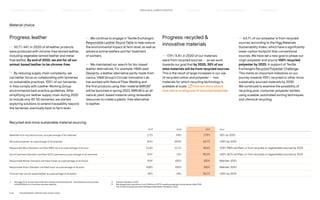
  • 25.
    Biodiversity Biodiversity is afoundation for healthy ecosystems and communities. It’s also interconnected with our business. The virgin natural materials in our products depend upon fertile soil and healthy forests. And our entire value chain — particularly our raw material sourcing — has the potential to impact biodiversity. The ongoing loss of biodiversity is a systemic risk that threatens the future prosperity of our industry and the survival of humanity. Average wildlife populations have decreased by more than two-thirds in the past 50 years,1 and transformative change is needed to reverse this trend. Shifting from wasteful models of resource use based on extraction towards a circular, regenerative economy is essential to restoring biodiversity and supporting thriving communities. We have a responsibility to avoid or reduce our impact on biodiversity by preserving and enhancing the natural world — for the sake of current and future generations and to ensure the resilience of our own business and supply chains. Our ambition is to have a net positive impact on biodiversity by: — Working to prevent and reduce our overall impact on the biodiversity and natural ecosystems touched by our value chain. — Supporting the protection and restoration of biodiversity and natural ecosystems in line with scientific advice. We are developing targets and actions to support this ambition, in line with the ARRRT (Avoid, Reduce, Restore Regenerate, Transform) framework. Our work on biodiversity has strong links with our existing goals and activities on climate, water, materials, circularity and resource use, and chemicals. We are working to source more materials farmed with regenerative practices. These practices aim to improve environmental wellbeing by increasing soil fertility, biodiversity, soil carbon sequestration, water retention and cleanliness, while contributing to community resilience and livelihoods. Ongoing international efforts to develop global biodiversity goals and reporting frameworks have been delayed due to Covid-19. We remain engaged in these conversations and we are part of the Taskforce on Nature-related Financial Disclosures forum. We contribute to positive impact beyond our own business through our commitment to Business for Nature and The Fashion Pact, our ongoing partnership with WWF and our participation in the International Platform for Insetting. Read more about our approach to biodiversity. 1) WWF Living Planet Report 2020. P.25 TR ANSPARENT REPORTING SINCE 2002 CIRCUL AR CLIMATE POSITIVE HOW WE LEAD THE CHANGE OUR APPROACH TO SUSTAINABILIT Y FAIR EQUAL SUPPLY CHAIN MANAGEMENT HOW WE REPORT HIGHLIGHTS 2021
  • 26.
    Biodiversity Progress — To accelerateprogress towards our biodiversity ambition, HM Group is a Science Based Targets Network (SBTN) Corporate Engagement Program participant, pledging alignment with SBTN’s goals and vision, and contributing advice and end-user insights to the development of SBTN methods and tools. — We have started to map our full value chain using the SBTN method and will use findings to set targets reducing our impact on nature, based on prioritisation of our current impacts. — We invested in initiatives targeting our highest- impact areas of raw material production: – Through our partnership with WWF, we started a project in the Satpura-Pench wildlife corridor in central India, supporting smallholder cotton farmers to adopt regenerative farming practices. The project aims to directly improve soil and pollinator biodiversity and help farmers build sustainable incomes, while also improving the local landscape to support larger species such as tigers. This year we began a small pilot with 150 farmers, and plan to scale this up to reach more than 6,000 farmers over the next four years. – As a Fashion Pact Signatory, we were able to join the Transforming Fashion for Nature project, funded by the Global Environment Facility in partnership with Conservation International, through which we will analyse the land, biodiversity and ecosystem impacts of our leather supply chain in Argentina, aligned with the SBTN framework. – We started a project with WWF in South Africa, in the location where the newest National Park in the country is being established. The project aims to engage 70 communal smallholders and 10 large commercial sheep farmers in working towards regenerative wool production that improves biodiversity and social development. – Read more about our work on cotton, man-made cellulosic fibres and other materials. — We were one of five recipients of a Green Traffic Light in the Ecogain Biodiversity Index 2021, out of 240 companies assessed. This recognition is given to companies aiming to reach at least no net loss of biodiversity by 2030, although the requirements will be adjusted as global goals develop. — We supported the science-policy interface for biodiversity by continuing to sponsor the Intergovernmental Science-Policy Platform on Biodiversity and Ecosystem Services (IPBES). — To encourage systemic action on biodiversity, we contributed to an Ellen MacArthur Foundation study on how the circular economy can tackle biodiversity loss and we shared our approach to protecting nature at IPBES and International Union for Conservation of Nature (IUCN) events. During COP15, we called for governments to deliver a meaningful and actionable Global Biodiversity Framework by signing the Business for Nature Letter from CEOs to Heads of State. — We support and provide advisory input to WWF’s global Biodiversity Stewardship Programme through our partnership with WWF. Learnings — Like many companies, we are in the early stages of learning how to measure our impact and dependency on nature, with the ambition to set biodiversity targets. Ongoing efforts to develop global goals, methods and standards will help guide us. — To achieve our ambition of a net positive impact on biodiversity, we have learned that we need to work in a variety of ways to reach scalability — both by joining existing initiatives and developing material-specific projects tailored to our own business and supply chain. — The climate crisis and nature loss are two sides of the same coin — we cannot tackle one without the other. The regenerative agriculture projects we’ve started are an example of our commitment to address these issues. In the coming year we will start supporting the protection of existing carbon sinks (e.g. tropical rainforest) and their associated biodiversity values. Future focus — While we finish work to assess our impact and dependency on nature in line with the SBTN method, we have already started, and will continue, working on initial KPIs for biodiversity to support our net positive ambition. We see this as an iterative process, as we improve data collection and understanding of our impacts. — We will continue to collaborate and work through cross-sectoral platforms in an effort to advance shared standards and learning on biodiversity. — We will invest in projects connected to our most impactful raw materials, with the aim to shift to regenerative practices and enhance local biodiversity. We will also continue to select materials and processes that decrease our impact on nature. P.26 TR ANSPARENT REPORTING SINCE 2002 CIRCUL AR CLIMATE POSITIVE HOW WE LEAD THE CHANGE OUR APPROACH TO SUSTAINABILIT Y FAIR EQUAL SUPPLY CHAIN MANAGEMENT HOW WE REPORT HIGHLIGHTS 2021
  • 27.
    Water Water availability isthe global issue most impacted by the climate crisis.1 Existing pressures on water resources are accelerated by climate change, placing ecosystems at high risk of water scarcity under further stress and exacerbating existing water access inequalities. Risks to water availability impact our value chain, which is reliant on water for production processes. Access to clean, safe water is also a fundamental human right. Globally, 771 million people don’t have access to clean water close to home,2 and 31% of schools do not have clean water.3 We have a duty to use water responsibly and help safeguard water quality, accessibility and availability, especially in areas of high water risk. We work towards reducing negative impact on water through improvements in our supply chain and enable others to do the same. Our Water Stewardship Strategy and Water Roadmap 2018-2022 guide our approach and actions. We use WWF’s Water Risk Filter to assess risks in our operations and supply chain. Our water management requirements for suppliers include minimum and aspirational requirements on water use, quality and management. Water is a key focus for our partnership with WWF. We also collaborate with organisations such as the 2030 Water Resources Group (2030 WRG). We align our reporting with the Sustainable Apparel Coalition and Zero Discharge of Hazardous Chemicals. Progress — We continued our work with WWF to set context-specific (contextual) water targets and develop our new 2030 Water Strategy. Together, we identified the contextual water conditions for over 1,100 of our suppliers, including issues such as external governance, WASH (water, sanitation and hygiene), quality, water scarcity, flooding and extreme climate-induced events. We are using the findings to develop targets for each supplier site that align water performance with relevant water challenges. — To share learnings from our work with WWF, we co-published two guides: Contextual Water Targets and Putting Water Strategy into Context, for companies looking to begin or currently engaged in similar exercises. — The Covid-19 pandemic continued to affect suppliers’ water performance: – Due to reduced demand for orders during the pandemic, many factories had to run machines at very low production capacity without being able to achieve equivalent water use reductions. This impacted progress toward our water consumption reduction goal — we achieved a 10.3% reduction in production water use from a 2017 baseline and a 6.6% reduction compared to last year, making it unlikely we will meet our goal of -25% by 2022. – Partial operation or closure of factories also affect wastewater treatment plant performance, many of which require a continuous flow of wastewater to continue working effectively. We continued to share guidance on wastewater treatment care, from the German development agency GIZ, with all our business partners. In 2021, 88% of supplier factories with on-site effluent treatment plant (ETP) functionality assessments achieved green grade and 98% had discharge water quality that is Zero Discharge of Hazardous Chemicals wastewater compliant. – We paused or delayed dialogue with suppliers on investments in new technology or equipment to improve water use. — Where possible, we continued to partner with our suppliers to deploy water efficiency measures. For example, HM HOME implemented a water efficiency project with suppliers in India, achieving 35-40% reduction in water use. — We worked with suppliers in Bangladesh to expand water recycling in denim washing facilities, 1) Based on the sixth report from the IPCC. 2) WHO/UNICEF Joint Monitoring Programme 2021. 3) WHO/UNICEF Joint Monitoring Programme 2020: Drinking water, sanitation and hygiene in schools; Global baseline report. P.27 TR ANSPARENT REPORTING SINCE 2002 CIRCUL AR CLIMATE POSITIVE HOW WE LEAD THE CHANGE OUR APPROACH TO SUSTAINABILIT Y FAIR EQUAL SUPPLY CHAIN MANAGEMENT HOW WE REPORT HIGHLIGHTS 2021
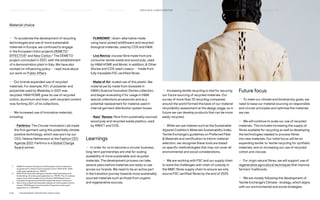
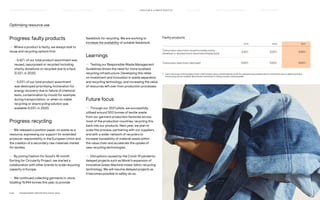
  • 28.
    Water and 34 suppliersnow have these facilities in place. Globally, 21% of production water is being recycled and 43% of factories in the HM Group supply chain have rainwater harvesting systems, where this is feasible. — We integrated water efficiency and recycling KPIs into our supplier Sustainability Index, making a direct link between supplier water performance and our purchasing decisions. Learnings — Our work on contextual water targets has shown there is sometimes disconnection between available data and what our teams know is happening on the ground. This highlights the importance of engaging with our colleagues and business partners to understand real-time risks. — The impacts of Covid-19 emphasised the need to plan for significant unexpected events, so that we are always prepared to support suppliers to continue making progress with water use, regardless of circumstances. This includes preparing for climate change induced disasters or events that can have unprecedented impact like the Covid-19 pandemic. — Contextual water strategies set the stage for future science-based water targets, so it is important we work now to maximise data quality and comparability. Gathering granular-level water data is currently a challenge and makes industry benchmarking difficult. Progress will require collaboration with peers and experts. Future focus — We are developing a standardised method of water benchmarking for HM Group suppliers. As a first step, we engaged with an industry- leading expert to look at our water efficiency data for each step in the manufacturing process, so we can identify the most impactful parts of our production processes and focus on these first. The reviewer noted the strong level of transparency across our supplier water data and suggested potential actions including maximum water use caps, efficiency-related bonus schemes, communication of low-water use products and technology advice for suppliers. — We will finalise our new Water Strategy, based on our work with WWF on contextual water targets and learnings from our existing roadmap. This will include setting new goals focused on outcomes. For example, we’ll move from goals on production water recycling and store equipment efficiency to adopt a more challenging freshwater consumption reduction goal in line with our circular ambition and to stay within planetary boundaries. Key water performance data 2018 2019 2020 2021 2022 GOAL Reduction of production water usage compared to 2017 baseline (l/kg, l/pc, l/m)1 — see bar chart below − –5.9% –3.8% –10.3% –25% Effluent Treatment Plant (ETP) functionality assessments achieving green grade2 93% 91% 95% 88% 100% ETP discharged water quality that is Zero Discharge of Hazardous Chemicals wastewater compliant (Foundation Level) 87% 93% 96% 98% 100% Water recycled out of total production water consumption3 − 13% 17.6% 21% 15% (achieved early) Litre per unit of product (l/pc) 2017 BASELINE 2021 ACTUAL 2022 TARGET 24 23 104 20 22 86 18 17 78 Litre per metre of fabric (l/m) Litre per kg dyed fabric (l/kg) Change in production water efficiency 1) Includes manufacturing, fabric dyeing and printing suppliers in both tier 1 and tier 2 with water intensive wet production, based on performance data, reported by factory and calculated using weighted averages for litre per kg of dyed knitted fabric, litre per metre of woven/denim fabric, and litre per unit of product washed. We have updated our weighted average efficiency calculation this year by factoring in the water consumption for specific products, how much of each product is produced, and the water consumed by factory, country, region and globally. This gives us a more accurate picture of water efficiency improvement and has led to changes in our historic performance data. 2) 26 supplier factories (10%) with on-site ETP were approved as suppliers recently and they are in a two-year timeline to improve their grade to green. 6 supplier factories (2%) are yet to achieve the required level of functionality. 3) Based on Q1-Q3 performance data. P.28 TR ANSPARENT REPORTING SINCE 2002 CIRCUL AR CLIMATE POSITIVE HOW WE LEAD THE CHANGE OUR APPROACH TO SUSTAINABILIT Y FAIR EQUAL SUPPLY CHAIN MANAGEMENT HOW WE REPORT HIGHLIGHTS 2021
  • 29.
    Our circular ecosystem Resourcessuch as healthy soil and forests are being depleted faster than they regenerate. We’re transforming how we operate to optimise our use of resources — playing our part in the urgent need to protect nature and reduce our climate impact, while building a resilient and efficient business. HM Group is transitioning to a circular ecosystem. This ecosystem transforms how we design and create our products and systems, work with suppliers and partners, and interact with customers. It supports the Ellen MacArthur Foundation’s vision for a circular economy where design eliminates waste and pollution, circulates products and materials (at their highest value) and regenerates nature. We focus on three, interconnected areas: — Circular products. Creating products that are made to last, from safe, recycled and sustainably sourced input that can circulate multiple times. — Circular supply chains. Fuelling systems that circulate products and support circular production processes and material flows. — Circular customer journeys. Providing accessible ways to experience and engage in circular fashion where products are used more, repaired, reused and recycled. Our work towards circularity is crucial for achieving our climate and biodiversity ambitions. It presents the opportunity for our business to create meaningful, long-lasting engagements with customers as they repair, reuse and resell products. We’re also mindful of what a shift to circularity will mean for the future of employment in the fashion industry. In 2021, we took meaningful steps towards becoming more circular — although we know there is still much work ahead. We tripled the volume of recycled materials used in our garments and confirmed the ambition for all our products to be designed for circularity by 2025 — supported by our new circular design tool Circulator. We launched a blueprint for a circular fashion industry within planetary boundaries, the product of a three-year research project by the Stockholm Resilience Centre together with the Ellen MacArthur Foundation, funded by HM Group. This will guide our work and hopefully inspire peers. In our stakeholder survey, 56% of respondents rated our circularity work as good or very good. See our Circular KPIs and highlights from 2021. Find out more about our approach to circular fashion. C I R C U L A R S U P P LY C H A I N S C I R C U L A R C U S T O M E R J O U R N E Y S C I R C U L A R P R O D U C T S ACCESS R AW MATERIALS USE CARE DESIGN PRODUCT DEVELOPMENT COLLECT SORT ASSORTMENT PL ANNING REPAIR REMAKE RECYCLE Our circular ecosystem We focus on integrating circularity across our entire ecosystem by building on the synergies and interconnections of all parts of our value chain. PRODUCTION P.29 TR ANSPARENT REPORTING SINCE 2002 CIRCUL AR CLIMATE POSITIVE HOW WE LEAD THE CHANGE OUR APPROACH TO SUSTAINABILIT Y FAIR EQUAL SUPPLY CHAIN MANAGEMENT HOW WE REPORT HIGHLIGHTS 2021
  • 30.
    Design is ourfirst opportunity to enable more circular products. We aim to design all our products for circularity1 by 2025. We are starting with the products we produce and our packaging, as well as interior products and stores, before extending to our entire business, including offices and distribution centres. Our commercial product teams are led by HM Group’s circular product development tool — Circulator — which aligns with the Ellen MacArthur Foundation’s circular economy vision. It guides us to create products from safe and recycled or renewable inputs, designed to be used more, and made to be made again. Circulator assists our product teams to prioritise durability and recyclability according to a product’s purpose, and to select the appropriate level of durability for a product’s use. Circular design is an important enabler for circular business models and is a crucial part of reducing resource use, which will help us meet our climate and biodiversity goals. Our teams use tools such as our Material Categorisation to inform the selection of materials. CIRCULAR PRODUCTS: Design Progress: circular product design — We set an aim to design all our products for circularity1 by 2025. To illustrate our belief in the need for an industrywide shift towards circularity, we called for circular product design requirements in the European Union. — The majority of our brands began testing our Circulator prototype, which we publicly launched in November 2021. The tool supports teams to measure the circular potential of products, providing a circular product score that considers the materials and design strategies chosen in relation to a product’s purpose. In 2021, we began Circulator training for our management teams and in 2022 the training will reach all our product development teams. Find out more about Circulator. — The majority of our brands continued testing and using 3D design tools to decrease physical samples. And we are working to improve efficiency of pattern making — see Optimising Resource Use. — Our brands launched collections designed for circularity: – HM presented the first collection using an early version of the Circulator tool, as part of its Innovation Collection, while Monki released a collection in early 2021 testing out the Circulator Guide. – HM, Monki and Weekday joined with others in our industry to advance the Ellen MacArthur Foundations’ Jeans Redesign guidelines. HM released a ladieswear collection following the guidelines in 2021. Further collections are in development for 2022. Learnings — We have had a steep learning curve on the complexity of circular design, which can be quite subjective and has many trade-offs. As we see the industry narrative on circular design evolving, we are increasingly convinced there is no one size fits all with circular design. We need to take a differentiated approach and begin to understand the nuanced needs of circular design depending on product purpose. — To strengthen the role of durability in the design stage, we worked to incorporate product and material lifespan information into our Circulator tool. With Delft University, we confirmed that refinements to Circulator enable selection of the best level of durability for different product purposes. We learnt that it’s crucial to also consider non-physical durability, such as emotional attachment to products. Future focus — We will work towards using Circulator to create all our products. To fast track the transition to a circular economy, we will continue sharing our learnings with the industry and will regularly update the Circulator Guide to share our latest learnings. We hope by sharing the Circulator tool, we will support industry acceleration to a circular model. — We will continue to engage with European Union (EU) policy makers on legislative proposals for the EU Sustainable Product Initiative and EU Ecodesign Directive. 1) In accordance with our Circulator tool. P.30 TR ANSPARENT REPORTING SINCE 2002 CIRCUL AR CLIMATE POSITIVE HOW WE LEAD THE CHANGE OUR APPROACH TO SUSTAINABILIT Y HIGHLIGHTS 2021 HOW WE REPORT SUPPLY CHAIN MANAGEMENT FAIR EQUAL
  • 31.
    The fashion industrydepends on materials to create its products. These can be natural materials such as cotton, wood and wool, or synthetic options such as polyester and polyamide. All materials have an impact on our planet, from their production, use and, ultimately, end of life and disposal. To reduce our environmental impact, we aim for 100% of our materials to be either recycled or sourced in a more sustainable way by 2030, including 30% recycled materials by 2025. Read more about how we define more sustainably sourced for different materials in our Material Categorisation. We prioritise work on the materials we use the most or that have the greatest potential environmental or social impact. For all materials, our Responsible Raw Material Sourcing Policy guides our approach. Our material selection is informed by third-party lifecycle assessment data and benchmarks — such as the Sustainable Apparel Coalition’s Materials Sustainability Index and Textile Exchange’s guidelines on Preferred Fiber Materials — and verified by third-party certification schemes, where applicable. We work with supply chain partners to improve traceability and transparency. CIRCULAR PRODUCTS: Material choice 1) Based on season 3 and season 4 data for 2021. Includes all shell materials — does not include materials used as filling, lining or trims on garments. 2) Not all more sustainably sourced materials can be naturally grown or cultivated, i.e. minerals or stones. In these instances, we set up material- specific policies such as the use of external standard schemes to secure more sustainable sourcing. 3) See page 72 for an assurance statement relating to these data points. The limited assurance process included all cotton data (apart from in-conversion cotton) and data for our top three recycled materials. Achieving our circular ambitions requires us to accelerate development of new materials and recycling innovations. We innovate together with our brands, the Circular Innovation Lab, our HM CO:LAB investment arm, inventors of sustainable materials and processes including winners of HM Foundation’s Global Change Award, and industry experts. Progress: overall — We achieved 80.0% recycled or other more sustainably sourced materials, including tripling the share of recycled materials to 17.9% (largely due to increased volumes of recycled cotton and polyester), making good progress towards our 2030 goal. — We established a new internal Material organisation to accelerate our sustainable materials strategy. The organisation will work closely with our assortments teams to scale up innovations and sustainable material sourcing across HM Group. — The Textile Exchange’s 2020 Material Change Insights Report identified HM Group as one of 36 leading companies pioneering industry 2021 2020 2019 Recycled 2018 80.0% 64.5% 57.1% 56.6% 17.9% 5.8% 2.2% 1.4% 62.1% 58.7% 54.9% 55.2% Other more sustainably sourced2,3 % recycled or other more sustainably sourced materials1 Our materials basket1 2025 goal: 30% recycled 2030 goal: 100% recycled or more sustainably sourced 2021 2020 2019 Recycled 2018 80.0% 64.5% 57.1% 56.6% 17.9% 5.8% 2.2% 1.4% 62.1% 58.7% 54.9% 55.2% Other more sustainably sourced2,3 61.4% 3.3% 0.1% 8.6% Cotton Polyester Polyamide Wood and man-made cellulosic fibres Leather Other materials Wool 0.9% 20.1% 5.6% P.31 TR ANSPARENT REPORTING SINCE 2002 CIRCUL AR CLIMATE POSITIVE HOW WE LEAD THE CHANGE OUR APPROACH TO SUSTAINABILIT Y FAIR EQUAL SUPPLY CHAIN MANAGEMENT HOW WE REPORT HIGHLIGHTS 2021
  • 32.
    1) Other more sustainablysourced cotton includes cotton sourced through the Better Cotton Initiative (BCI), in-conversion organic cotton, regenera- tive cotton, and cotton from other innovative sources. 2) Figures relate to use of BCI cotton. 3) Water savings relate to blue water use (irrigation). This relates to farmer inputs, and no other forms of water use. 4) See page 72 for an assurance statement relating to these data points. The limited assurance process included all cotton data (apart from in- conversion cotton) and data for our top three recycled materials. 2021 2020 2019 Recycled cotton 2018 100% 100% 96.6% 94.8% 1.8% 7.0% 0.6% 0.3% 78.3% 80.0% 79.9% Organic cotton Other sustainably sourced cotton1 21.7% 14.6% 16.0% 19.9% 71.3% 2021 2020 2019 Recycled cotton 2018 100% 100% 96.9% 94.8% 1.8% XX% 0.6% 0.3% XX% 78.3% 80.0% 79.9% Organic cotton Other more sustainably sourced cotton1 XX% 14.6% 16.0% 19.9% % of total cotton that is recycled, organic, or other more sustainably sourced1,4 Goal: Continue sourcing 100% recycled, organic, in-conversion or BCI certified cotton. Material choice transformation, out of 191 analysed. We were one of nine companies leading on material circularity. — We increased transparency by publishing the detail of the materials used in our products — see our materials basket. Progress: cotton — In 2020, we achieved our goal to source 100% more sustainably sourced cotton (recycled, organic and other more sustainably sourced cotton).1 We will continue to strengthen our criteria for more sustainably sourced cotton, with a greater focus on increasing use of recycled, regenerative and organic cotton, and innovative alternatives. — To support more cotton farmers to transition to organic practices and accelerate capacity building in the organic cotton sector, we expanded our use of “in-conversion” cotton. In-conversion cotton is the output from farms that are in process of getting organic certification. In 2021, we sourced in-conversion cotton from 2,000 farmers. — As part of our increased focus on regenerative farming practices, we launched a project with 150 smallholder cotton farmers and WWF in India. We plan to reach more than 6,000 farmers. — In collaboration with the Circular Innovation Lab, COS tested Materra™, a new way to grow cotton that increases yields and fibre quality, while minimising water and pesticide use as well as carbon footprint. The systems are optimised for developing regions facing climate volatility. HM Group’s Circular Innovation Lab is working with technology company Materra to set up an RD farm in India in early 2022. The aim is to optimise Materra’s hydroponic cotton farming system to local conditions. The project will run for two years and generate valuable information to enable a scale-up of more sustainable cotton supply chains using Materra’s technology. — In 2021, our sourcing of other more sustainably sourced cotton contributed to:2 – 30 billion gallons of water being saved.3 – 73,287 kilograms of pesticides being avoided. – USD 59 million additional profit for farmers. — HM Group’s support for projects with the Organic Cotton Accelerator and other organic cotton initiatives in India during the 2020-2021 crop season resulted in: – 14,000 farmers involved in organic cotton projects. – USD 1.28 million in premiums received by farmers, supporting investment in organic farming. – 100% procurement by HM Group brands of committed volumes. P.32 TR ANSPARENT REPORTING SINCE 2002 CIRCUL AR CLIMATE POSITIVE HOW WE LEAD THE CHANGE OUR APPROACH TO SUSTAINABILIT Y FAIR EQUAL SUPPLY CHAIN MANAGEMENT HOW WE REPORT HIGHLIGHTS 2021
  • 33.
    — We beganrequesting that our largest viscose producers share data through the Textile Exchange’s new MMC fibre transparency dashboard, enabling us to track our progress against the Roadmap towards responsible viscose and modal fibre manufacturing. — To make it possible to achieve our 2025 MMC goal, we worked to increase availability of MMC fibres that meet our requirements: – As part of our five-year partnership with Renewcell, we planned how to scale production of its Circulose® material in 2022 to meet our brands’ future needs. In 2021, nine styles across various brands and assortments used Circulose®, an MMC fibre made from recycled cotton waste and developed through support from our HM CO:LAB investment arm. – Following further investment from HM CO:LAB, Infinited Fibre Company is scaling up to move closer to commercial volumes. This will expand production of InfinnaTM , an MMC fibre from regenerated cotton waste first tested by Weekday in collaboration with the Circular Innovation Lab in 2021. – We signed the Fashion Forever Green Pact, an FSC initiative to promote responsible sourcing of MMC fibres. Through this, we are collaborating to improve supply chain traceability, which is fundamental to knowing that all our virgin MMC fibres Material choice Progress: wood man-made cellulosic (MMC) fibres — We continued working towards our goals and commitments: – By end of 2025, source responsible viscose in line with our commitment to the Changing Markets roadmap. – By end of 2025, all wood and paper used in our products and packaging will be made of Forest Stewardship Council (FSC) certified or recycled materials. – By end of 2025, we aim to only source MMC fibres from FSC-certified sources, or replace them with next-generation fibres from sources such as agricultural residues and pre- and post-consumer textiles. This supplements our requirement that MMC fibre producers must be verified as low risk by the CanopyStyle audit. – These goals are part of our commitment to zero deforestation in our supply chain by the end of 2025. Learn more in our Responsible Raw Material Sourcing Policy and Roadmap for MMC fibres. — 78% wood in our packaging is FSC-certified. Find further packaging data in Packaging. P.33 TR ANSPARENT REPORTING SINCE 2002 CIRCUL AR CLIMATE POSITIVE HOW WE LEAD THE CHANGE OUR APPROACH TO SUSTAINABILIT Y FAIR EQUAL SUPPLY CHAIN MANAGEMENT HOW WE REPORT HIGHLIGHTS 2021 P.33 TR ANSPARENT REPORTING SINCE 2002 originate from FSC-certified sources by the end of 2025. – HM Group’s Circular Innovation Lab have worked with SPINNOVA® and the first products using their low impact recyclable fibre made of certified wood will be launched in spring 2022. – TreeToTextile, part-owned by the HM group, continued upscaling production of its low cost, 100% traceable cellulosic fibre, sourced from sustainably managed forests. Progress: animal-based fibres — 43.6% (12.1% in 2020) of our wool was Responsible Wool Standard (RWS) compliant — marking progress towards our goal to, by end of 2025, only source virgin wool from RWS- certified farms. — 95% (13% in 2020) of our cashmere was Good Cashmere Standard (GCS) compliant — meaning we are quickly progressing towards our goal to, by end of 2025, source all virgin cashmere from GCS-certified farms. — 100% (100% in 2020) of our mohair was Responsible Mohair Standard (RMS) compliant or from recycled sources — continuing our commitment to only buy from RMS- certified farms. — 100% (100% in 2020) of our virgin down was Responsible Down Standard (RDS) compliant — maintaining our record of only sourcing from RDS-certified farms since 2016. — We continued participating in the Textile Exchange’s Responsible Animal Fibers Roundtable, which focuses on the animal welfare and environmental impacts of animal fibre production. We are also closely following the development of Textile Exchange’s Climate+ strategy, which aligns with our environmental and social strategies. — HM highlighted innovative animal-substitute fabrics through its Co-Exist Story Collection, a completely vegan collection approved by People for the Ethical Treatment of Animals (PETA).
  • 34.
    Material choice Recycled andmore sustainable material sourcing 2019 2020 2021 Goal Materials from recycled sources, as a percentage of all materials1 2.2% 5.8% 17.9% 30% by 2025 Recycled polyester as a percentage of all polyester 8.3% 20.8% 63.7% 100% by 2025 Responsible Wool Standard-certified (RWS) wool as a percentage of all wool 11.6% 12.1% 43.6% 100% RWS certified, or from recycled or regenerated sources by 2025 Good Cashmere Standard-certified (GCS) cashmere as a percentage of all cashmere N/A2 13% 95.0% 100% GCS certified, or from recycled or regenerated sources by 2025 Responsible Mohair Standard-certified mohair as a percentage of all mohair N/A3 100% 100% Maintain 100% Responsible Down Standard-certified down as a percentage of all down 100% 100% 100% Maintain 100% Chrome-free, animal-based leather as a percentage of all leather 40% 44% 50.7% 100% by 2025 1) See page 72 for an assurance statement relating to these data points. The limited assurance process included data for our top three recycled materials. 2) Standard adopted in 2020. 3) We stopped sourcing mohair in mid-2018 due to PETA revealing systematic animal abuse in May 2018. The Textile Exchange launched the Responsible Mohair Standard in 2020. CIRCUL AR CLIMATE POSITIVE HOW WE LEAD THE CHANGE OUR APPROACH TO SUSTAINABILIT Y FAIR EQUAL SUPPLY CHAIN MANAGEMENT HOW WE REPORT HIGHLIGHTS 2021 P.34 TR ANSPARENT REPORTING SINCE 2002 Progress: leather — 50.7% (44% in 2020) of all leather products were produced with chrome-free tanned leather, including vegetable tanned leather and metal- free leather. By end of 2025, we aim for all our animal-based leather to be chrome-free. — By reducing supply chain complexity, we can better focus on collaborating with tanneries on sustainable practices. 100% of our tanneries in Asia comply with Leather Working Group environmental best practice guidelines. After simplifying our leather supply chain during 2020 to include only 40-50 tanneries, we started exploring solutions to extend traceability beyond the tanneries, eventually back to farm level. — We continue to engage in Textile Exchange’s Responsible Leather Round Table to help reduce the environmental impact at farm level, as well as advance animal welfare and fair treatment of workers. — We maintained our search for bio-based leather alternatives. For example, HM used Desserto, a leather alternative partly made from cactus. HM Group’s Circular Innovation Lab has worked with Natural Fiber Welding and the first products using their material MIRUM® will be launched in spring 2022. MIRUM is an all- natural, plant-based material using renewable resources to create a plastic-free alternative to leather. Progress: recycled innovative materials — 17.9% (5.8% in 2020) of our materials were from recycled sources — as we work towards our goal that by 2025, 30% of our total materials will be from recycled sources. This is the result of large increases in our use of recycled cotton and polyester — two materials for which recycling technology is available at scale. Find out more about how we’re scaling use of recycled materials. — 63.7% of our polyester is from recycled sources (according to the Higg Materials Sustainability Index), which have a significantly lower carbon footprint than conventional sources. We have set a new goal to phase out virgin polyester and source 100% recycled polyester by 2025, in support of Textile Exchange’s Recycled Polyester Challenge. This marks an important milestone on our journey towards 100% recycled or other more sustainably sourced materials by 2030. We continued to examine the possibility of recycling post-consumer polyester textiles using scalable, automated sorting techniques and chemical recycling.
  • 35.
    Material choice P.35 TRANSPARENT REPORTING SINCE 2002 CIRCUL AR CLIMATE POSITIVE HOW WE LEAD THE CHANGE OUR APPROACH TO SUSTAINABILIT Y HIGHLIGHTS 2021 HOW WE REPORT SUPPLY CHAIN MANAGEMENT FAIR EQUAL — To accelerate the development of recycling technologies and use of more sustainable materials in Europe, we continued to engage in the European Union projects DEMETO,1 EFFECTIVE2 and New Cotton.3 The DEMETO project concluded in 2021, with the establishment of a demonstration plant in Italy. We have also worked on influencing policy — read more about our work on Public Affairs. — Our brands expanded use of recycled materials. For example, 93% of polyester and polyamide used by Weekday in 2021 was recycled. HM HOME grew its use of recycled cotton, aluminium and linen, with recycled content now forming 20% of its collections. — We increased use of innovative materials, including: – Fairbrics: The Circular Innovation Lab made the first garment using this potentially climate positive technology, which was worn by our CEO, Helena Helmersson at the Fashion CEO Agenda 2021. Fairbrics is a Global Change Award winner. – FLWRDWN™: down-alternative made using hand-picked wildflowers and recycled biological materials, used by COS and HM. – Liva Reviva: viscose fibre made from pre- consumer textile waste and wood pulp, used by HM HOME and Monki. In addition, Other Stories and COS used Livaeco — made from fully traceable FSC certified fibres. – Made of Air: scaled use of this plastic-like material partly made from biowaste in HM’s Science Innovation Stories collection, and began evaluating it for usage in HM special collections accessories and as a potential replacement for material used in internal garment distribution system boxes. – Naia™ Renew: fibre from sustainably sourced wood pulp and recycled waste plastics, used by ARKET and COS. Learnings — In order for us to become a circular business, long-term partnerships are vital for scaling availability of more sustainable and recycled materials. The development process can take several years before materials are ready to use across our brands. We need to be an active part in the transition journey towards more sustainably sourced materials such as those from organic and regenerative sources. — Increasing textile recycling is vital for securing our future sourcing of recycled materials. Our survey of more than 25 recycling companies around the world formed the basis of our material recyclability assessment at the design stage, so in future we can develop products that can be more easily recycled. — While we use indexes such as the Sustainable Apparel Coalition’s Materials Sustainability Index, Textile Exchange’s guidelines on Preferred Fiber Materials and certification to inform material selection, we recognise these tools are based on specific methodologies that may not cover all environmental and social considerations. — We are working with FSC and our supply chain to solve the challenges with chain of custody in the MMC fibres supply chain to ensure we only source FSC certified fibres by the end of 2025. Future focus — To meet our climate and biodiversity goals, we need to base our material sourcing on responsible and circular principles and optimise the materials we use. — We will continue to scale our use of recycled materials. This includes increasing the supply of fibres available for recycling as well as developing the technologies needed to process fibres into new materials. Our initial focus will be on expanding textile-to-textile recycling for synthetic materials, and on increasing our use of recycled cotton and viscose. — For virgin natural fibres, we will support use of regenerative agricultural techniques that improve farmers’ livelihoods. — We are closely following the development of Textile Exchange’s Climate+ strategy, which aligns with our environmental and social strategies. 1) DEMETO receives funding from the European Union’s framework programme for research and innovation horizon 2020 (2014–2020) under grant agreement no. 768573. 2) EFFECTIVE received funding from the Bio-based Industries Joint Undertaking (JU) under grant agreement no. 792195. The JU receives support from the European Union’s Horizon 2020 Research and Innovation Programme and the Bio-based Industries Consortium. 3) New Cotton project has received funding from the European Union’s Horizon 2020 Research and Innovation Programme under grant agreement no. 101000559.
  • 36.
    Tiny fibres —microfibres — can be released when garments are washed during production and by customers. These fibres run into oceans, pollute habitats and can eventually end up in drinking water and food. Chemicals used to dye and treat products change how easily fibres degrade. Selecting materials and production processes that minimise microfibre shedding is therefore crucial to reducing the impact of the fashion industry on our planet. We are committed to researching and addressing microfibre emissions, as we develop a groupwide Microfibres Roadmap. Our approach includes: — Choose and design yarns and fabrics that minimise microfibre shedding. — Research new production processes and requirements to minimise shedding. — Offer repair services and microfibre-reducing laundry bags to customers, and support the development of laundry machine filter systems. — Improve technologies that enable reuse and recycling. CIRCULAR PRODUCTS: Microfibres Progress — Microfibres are an industrywide problem and we collaborate to develop solutions. We signed The Microfibre Consortium (TMC) 2030 Commitment, a global commitment to work towards zero impact on nature from textile fibre fragmentation by 2030. TMC members, including HM Group, collaborated with research partners to develop a roadmap to achieve this commitment based on a common vision for the fashion industry. — Our 24-month research project — A Management Tool for Microplastics from Textile Production Process — continued in partnership with the Hong Kong Research Institute of Textiles and Apparel (HKRITA). Restrictions due to Covid-19 disrupted planned tests of microfibre emissions at HM supplier factories. Instead, the team worked to develop new concepts in the HKRITA laboratory, such as using soundwaves to separate microfibres from water. Learnings — While the problem with microfibres is not new, widespread awareness is. Our work with TMC members and research experts demonstrates the need for a shared understanding of the issue, as a foundation for aligned action on this challenge. TMC provides a central hub through which understanding of individual materials and processes can be exchanged. Future focus — We will continue developing a groupwide roadmap for microfibres in line with the Microfibre Consortium 2030 commitment. To inform this roadmap, we are resuming testing microfibre emissions with HKRITA and our suppliers as Covid-19 restrictions ease. Learnings from this work will be shared with policy makers as HM Group participates in consultations on potential legislation. P.36 TR ANSPARENT REPORTING SINCE 2002 CIRCUL AR CLIMATE POSITIVE HOW WE LEAD THE CHANGE OUR APPROACH TO SUSTAINABILIT Y HIGHLIGHTS 2021 HOW WE REPORT SUPPLY CHAIN MANAGEMENT FAIR EQUAL
  • 37.
    Today, offcuts andscraps generated in the production process or during product delivery are considered waste. Our vision is that the whole mindset of the fashion industry shifts to treat this waste as the valuable resource it is. Similarly, faulty clothes or pre-loved items that have reached the end of their time with our customers offer a wealth of materials that can be recovered, reused and eventually recycled into new products. To proactively optimise resource use, we: — Optimise supply to produce to demand. We increasingly apply predictive artificial intelligence (AI) to optimise the supply chain and match production with demand. We use multiple solutions for quick reactions to fashion trends, quantification, timing and allocation of products. This has led to even more relevant customer offering with more full price sales and fewer markdowns, as well as a more efficient use of resources. — Support resource-efficient production. We work closely together with suppliers to use resources as efficiently as possible, guided by our Responsible Waste Management Guidelines. The CIRCULAR SUPPLY CHAIN: Optimising resource use guidelines help us optimise use of fabric and other resources — decreasing resource use impact and reliance on natural resources as well as reducing financial costs. — Put faulty products to good use. If a product is faulty, we reuse or recycle the materials wherever possible. — Increase recycling. We work to improve and scale automatic sorting and efficient textile recycling. We also work to optimise resource use at our stores, distribution centres and offices, during product delivery, and by maximising product life. Progress: optimising supply — We scaled use of AI and other tools to align production with demand. Our AI tool Movebox optimises supply by enabling redistribution of products to locations where there is demand. In 2021, we rolled out use of Movebox, which is now used by 60% of our sales markets (including franchise markets). — We continued to work to ensure that no pre-consumer garments that could be used go to waste: – If a product isn’t performing as planned, we prioritise selling it within our primary sales channels, before using the product within internal circular initiatives. Afound provides an additional channel to share garments with customers. Only once we’ve reviewed all internal uses, we find solutions via trusted business partners including charities and outlets. Some of the returns that cannot be resold via original sales channel are sold via online-sales platform Sellpy. – The Covid-19 pandemic and lockdowns resulted in massive changes in customer demand and behaviour, posing a challenge for our forecasts. Thanks to our systems to reassign stock to alternative sales channels as stores closed and customers increasingly shopped online, we were able to quickly adapt to maximise the sale of products already made, while ensuring nothing that could be used goes to waste. Progress: resource efficient production — We tested our new Waste Recycling Strategy to learn how best to link fabric leftover from our orders with reuse and recycling. More than 50 of our tier 1 suppliers in five regions are participating in pilots with Reverse Resources and Circular Fashion Partnership, to segregate cutting waste before handing it onto recyclers. — 240 patternmakers and product technologists across HM Group received training in design software that calculates fabric consumption. As a result, we reduced fabric waste for our 20 biggest dress styles by 12%. P.37 TR ANSPARENT REPORTING SINCE 2002 CIRCUL AR CLIMATE POSITIVE HOW WE LEAD THE CHANGE OUR APPROACH TO SUSTAINABILIT Y HIGHLIGHTS 2021 HOW WE REPORT SUPPLY CHAIN MANAGEMENT FAIR EQUAL
  • 38.
    Optimising resource use Progress:faulty products — Where a product is faulty, we always look to reuse and recycling options first: – 0.42% of our total product assortment was reused, repurposed or recycled (including charity donations) or recycled due to a fault (0.32% in 2020). – 0.02% of our total product assortment was destroyed (prioritising incineration for energy recovery) due to failure of chemical tests, contamination by mould (for example, during transportation), or when no viable recycling or downcycling solution was available (0.03% in 2020). Progress: recycling — We released a position paper, on waste as a resource, expressing our support for extended producer responsibility in the European Union and the creation of a secondary raw materials market for textiles. — By joining Fashion for Good’s 18-month Sorting for Circularity Project, we started a collaboration with other brands to scale recycling capacity in Europe. — We continued collecting garments in-store, totalling 15,944 tonnes this year, to provide feedstock for recycling. We are working to increase the availability of suitable feedstock. Learnings — Testing our Responsible Waste Management Guidelines shows the need for more localised recycling infrastructure. Developing this relies on investment and innovation in waste separation and recycling technology, and increasing the value of resources left over from production processes. Future focus — Through our 2021 pilots, we successfully utilised around 500 tonnes of textile waste from our garment production factories across most of the production countries, recycling this back into our products. Next year, we plan to scale this process, partnering with our suppliers and with a wider network of recyclers to increase traceability of material waste within the value chain and accelerate the uptake of new recycling technologies. — Disruptions caused by the Covid-19 pandemic delayed projects such as Monki’s expansion of innovative Green Machine mixed-fabric recycling technology. We will resume delayed projects as it becomes possible to safely do so. Faulty products 2019 2020 2021 Total product assortment reused (including charity donations) or recycled due to the products being faulty 0.41% 0.32% 0.42% Total product assortment destroyed1 0.03% 0.03% 0.02% 1) Due to the products having failed certain chemical tests, being contaminated by mould (for example during transportation) or when there was no viable recycling or downcycling solution available. We prioritise incineration for energy recovery where possible. P.38 TR ANSPARENT REPORTING SINCE 2002 CIRCUL AR CLIMATE POSITIVE HOW WE LEAD THE CHANGE OUR APPROACH TO SUSTAINABILIT Y FAIR EQUAL SUPPLY CHAIN MANAGEMENT HOW WE REPORT HIGHLIGHTS 2021
  • 39.
    Materials processing Raw materials,such as cotton and wool, undergo a series of processes to produce a fabric and finally a garment. This includes washing, dyeing and printing — using energy, chemicals and water. Lowering the impact of these processes is an important step towards our climate and circular ambitions. We’re addressing five areas: — Chemicals. Reduce use, increase reuse or regeneration, and use Screened Chemistry. — Energy. Improve efficiency and reduce CO2e emissions. — People. Ensure proper use of personal protective equipment by workers, avoiding adverse health or safety effects. — Production waste. Reduce waste and increase recovery, reuse and recycling. — Water. Reduce use, increase reuse and recycling; for wastewater, reduce quantity and improve quality. In 2021, we launched our printing roadmap. By 2030, our ambition is to maximise the use of processes that have significant savings in water, energy and chemicals. To achieve this, we will test and scale new techniques and technologies while working with our suppliers to ensure they follow our guidelines. Our new business venture, Creator Studio, offers on-demand B2B print services. This global platform for the merchandise industry allows external brands and content creators to utilise our lean production process and advanced made-to- order digital printing to reduce waste by matching supply to demand. We’re investing in new washing and dyeing innovations too. For example: — Our brands use software installed at suppliers to track the use of low-impact washing — as defined by Jeanologia’s® Environmental Impact Measurement (EIM). Currently, 100% of the denim Weekday and 98% of the denim Monki source is rated low impact, achieving a green score in the EIM. — Colorifix, a biotech company partly backed by HM Group, uses microbiology to produce and fix pigments on textiles, significantly reducing the use of chemicals, water and energy compared to conventional technology. HM used fabric dyed in this way in its Colour Story Collection SS21. — HM CO:LAB invested in digital dyeing and finishing technology company, Alchemie. In collaboration with Circular Innovation Lab, HM piloted Alchemie’s EndeavourTM waterless smart dyeing process, as well as imogo’s DigitalDyeing®, in rental products at its rental outlets in Stockholm and Berlin. CIRCULAR SUPPLY CHAIN: P.39 TR ANSPARENT REPORTING SINCE 2002 CIRCUL AR CLIMATE POSITIVE HOW WE LEAD THE CHANGE OUR APPROACH TO SUSTAINABILIT Y HIGHLIGHTS 2021 HOW WE REPORT SUPPLY CHAIN MANAGEMENT FAIR EQUAL
  • 40.
    CIRCULAR SUPPLY CHAIN: Chemicals Wewant to lead the change towards toxic-free fashion by 2030. Achieving this is critical to our circular ambition. Our Chemical Management Roadmap commits us to zero discharge of hazardous chemicals and 100% safe and traceable chemicals. Our progressive approach takes us beyond compliance to chemicals suitable for circular products. Collaboration is key to achieving industrywide progress. We are members of the AFIRM Group, Zero Discharge of Hazardous Chemicals (ZDHC) and ChemSec Business Group. We follow the AFIRM Restricted Substances List and the ZDHC Manufacturing Restricted Substances List 2.0 (MRSL), as well as the ZDHC Wastewater Guidelines and Chemical Management System. Our HM Group Chemical Restrictions commit us to phasing out additional potentially harmful substances. We use the Screened Chemistry hazard-based scoring system (a third-party toxicological assessment) to identify safer chemicals. — We engaged with policy makers, including providing input to the EU Chemicals Strategy and publishing a position paper on safe-by- design chemicals. — We initiated a phase-out of high priority endocrine disrupting chemicals (EDCs) — substances that interfere with the hormonal system. We will continue phasing out all EDCs over the coming years. — We used safer alternatives to potassium permanganate (used to distress denim) for 79% of our denim products, with the goal to achieve 100% by 2023. Learnings — 100% ZDHC MRSL compliance is proving challenging due to the variety and complexity of our supply chain. — Characterising and comparing chemicals’ properties can be a challenge. Screened Chemistry needs to be more widely adopted by the chemicals industry so brands can easily compare chemicals to identify best available options. Future focus — We will continue to pilot and scale use of Screened Chemistry, as well as engaging with policy makers on this topic. — To progress use of safer chemicals in the non-textile supply chain, we will work towards common industry MRSLs for these supply chains and pilot digital chemical management tool BVE3. 1) Compliance tracked using third-party tools CleanChain and BVE3. 2) We are working to report the most meaningful metrics for chemicals performance and will therefore no longer report product compliance with HM Group Chemical Restrictions. Progress — We engaged with peers and experts to pilot version 3 of the Screened Chemistry methodology, which includes prints and dyes. We mapped use of Screened Chemistry in our denim supply chain and will use the learnings to scale coverage with these suppliers. — We were one of five brands (out of 30) awarded “aspirational level” during the annual assessment of ZDHC’s Brands to Zero leader programme. — 609 of our textile and leather suppliers (95%) are enrolled in the ZDHC programme, achieving 99.9% MRSL compliance for wastewater (99.9% in 2020) and 95% compliance for chemical input (88% in 2020).1 Reaching and maintaining 100% enrolment is challenging due to the dynamic nature of our supply chain. 81% of chemicals used were assured to meet ZDHC requirements via the ZDHC Gateway, exceeding our goal of 60%.2 — Our aim is to accelerate progress towards circular manufacturing and sustainable chemistry by encouraging partnership and use of shared data. For example, we completed our work with IKEA and others on chemical testing for recycled textiles. P.40 TR ANSPARENT REPORTING SINCE 2002 CIRCUL AR CLIMATE POSITIVE HOW WE LEAD THE CHANGE OUR APPROACH TO SUSTAINABILIT Y HIGHLIGHTS 2021 FAIR EQUAL SUPPLY CHAIN MANAGEMENT HOW WE REPORT
  • 41.
    CIRCULAR CUSTOMER JOURNEY: Maximisingproduct life scaling circular business models The future of fashion is circular. Instead of linear resource use — take, make, waste — we continue to develop ways of doing business that enable products to be used for longer and reused. We are working to provide accessible ways for customers to experience and engage in circular fashion and choose more sustainable options. Circular design, focusing on key qualities like durability and recyclability, is a major enabler for this shift. Our ambition to maximise product life and offer circular business models at scale helps us build a resilient, customer-focused business. Expanding circular business models allows us to meet the growing demand for sustainable design and services, and to develop more long-term, meaningful relationships with customers as they use repair, rental and resell options. Reducing our resource use by maximising product life and recirculating resources is crucial for reducing our environmental impact and fulfilling our climate and biodiversity goals. We are mindful that products or services accessed via these models must replace products sold through the traditional linear retail model for an overall positive environmental impact. We focus on three levers to maximise product life and scale circular business models via the circular customer journey: — Use care. We encourage customers to love their fashion items for longer and extend the life of their fashion favourites through care and repair initiatives. — Access. We offer a diverse range of access models through which customers can enjoy and experience fashion while keeping products in circulation. — Collect. We support customers to access services to donate pre-loved products so these can be reused, remade, or recycled. Progress: use care — HM’s Take Care initiative continued to offer customers in 46 markets ways to care, repair and customise their clothing. In 2021, the Take C I R C U L A R S U P P LY C H A I N S C I R C U L A R C U S T O M E R J O U R N E Y S C I R C U L A R P R O D U C T S Our circular ecosystem in action We aim to keep products and resources in circulation through the multiple loops of our ecosystem, prioritising the inner loops where they retain the highest value. REPAIR REUSE REMAKE RECYCLE P.41 TR ANSPARENT REPORTING SINCE 2002 CIRCUL AR CLIMATE POSITIVE HOW WE LEAD THE CHANGE OUR APPROACH TO SUSTAINABILIT Y FAIR EQUAL SUPPLY CHAIN MANAGEMENT HOW WE REPORT HIGHLIGHTS 2021
  • 42.
    Maximising product life scaling circular business models Care product range extended to 7 new markets, bringing the total to 17 markets. The brand offers repair services through 6 repair studios in 4 markets. — To better connect post-consumer garments with repair services, COS launched a garment collecting initiative in Austria and Poland that prioritises fixing and repurposing clothes before recycling. Progress: access — Weekday expanded access to made-to- measure jeans to the public in its Götgatan store in Stockholm. The collaboration with unspun and HM Group Laboratory offers the option to customise the fit and design of their jeans, which are then made to order. — We expanded ways for customers to resell products: – Customers in 24 markets can now shop second-hand garments through Sellpy, and customers in 4 markets can sell at Sellpy. HM Group is a majority shareholder in Sellpy and HM’s website directs customers to Sellpy in 7 markets. – HM made it possible to buy second-hand garments from multiple brands alongside new HM garments in Sweden from February 2022, offering a new, integrated customer experience by incorporating a curated second-hand assortment from Sellpy into its website. – Customers in 3 markets can now buy and sell pre-owned clothes through our collaboration with business technology provider Reflaunt. HM launched HM Rewear in Canada, while COS offers COS Resell in Germany and the United Kingdom. – Weekday launched Weekday Curated 2nd-hand in 3 cities in Sweden. The curated, in-store collection gives customers the chance to buy and sell pre-owned clothes offline. — We expanded options to rent our products: – Customers in 19 markets continued to rent kids’ clothing through ARKET’s collaboration with Circos. – Selected HM stores in Amsterdam, Berlin and Stockholm offer clothes rental services for specific collections. – HM HOME started offering rental for occasions and celebrations. Rent a Christmas offered customers the chance to loan festive decorations in 5 markets. – Weekday and Other Stories items are available on Gemme Collective in Sweden. P.42 TR ANSPARENT REPORTING SINCE 2002 CIRCUL AR CLIMATE POSITIVE HOW WE LEAD THE CHANGE OUR APPROACH TO SUSTAINABILIT Y FAIR EQUAL SUPPLY CHAIN MANAGEMENT HOW WE REPORT HIGHLIGHTS 2021
  • 43.
    Maximising product life scaling circular business models Progress: collect — Our post-consumer, in-store garment collecting initiative was disrupted for the whole year due to Covid-19. We gathered 15,944 tonnes of material (18,800 tonnes in 2020). The initiative collects post-consumer garments and home textiles for reuse and recycling, making it easier for consumers to recycle and demonstrating that these resources have value. We work with I:CO to collect and sort garments, with 50-60% sorted for re-wear and reuse and 35-45% recycled to become products for other industries or made into new fibres. We continued collaborating with partners to make use of the remaining 3-7% that, as a last resort, had to be disposed of another way, prioritising incineration for energy recovery and never sending textiles to landfill. For example, we’re collaborating with Really to create new garment collecting boxes from recycled textiles. Read more about our efforts increase the share of recycled textiles we use, and scale recycling technologies. — ARKET's Patchwork Denim collection used vintage denim collected via the brand's recycling programme to create unique, circular pieces. — We showcased new recycling technologies. For example, HM ran events for customers in Sweden featuring its in-store Looop recycling machine. Looop was awarded the Design Grand Prix during the 2021 Cannes Lions International Festival of Creativity. Read more about our investments in new recycled materials and technologies. Learnings — It is becoming increasingly clear that for circular business models to help us reach our climate goals, there needs to be significant scaling and substitution of (rather than addition to) existing business models, as outlined in a 2021 EMF report. — Taking the first steps from resell pilots towards a scalable solution has taught us a lot about some of the hurdles to overcome if we want to make resell a sustainable option at scale. We need to build solutions that can help close the gap between customer intentions and actions to shop more sustainably. The current lack of access to transparent, brand-agnostic product information makes it difficult to provide customers with consistent information. — Weekday’s made-to-measure jeans pilot saw fewer returns than for our regular, non- customised jeans, helping us step towards closer matching of production with sales. Now that we have piloted the made-to-measure jeans on demand production model, we will explore how to scale the offering. Garment collecting initiative 2019 2020 2021 Textiles collected in HM Group stores 29,005 tonnes 18,800 tonnes1 15,944 tonnes1 1) Our garment collecting initiative was disrupted by the Covid-19 pandemic for part of the year in 2020 and for the full year in 2021. — Our multi-brand online shop Itsapark has developed extensive knowledge of the sustainably driven fashion, beauty and lifestyle segment. To better leverage this expertise, Itsapark has been integrated into HM brand and closed its customer facing operations. This will allow learnings from Itsapark to be implemented on a larger scale, increasing their impact. Future focus — We are developing internal performance indicators to manage expansion of circular business models at HM Group. We plan to continue scaling resell, care, repair and other circular access models. — As we shift towards a more circular business model, we are mindful of what this will mean for the future of employment in the fashion industry. Read more about our work with circular business models. CIRCUL AR CLIMATE POSITIVE HOW WE LEAD THE CHANGE OUR APPROACH TO SUSTAINABILIT Y FAIR EQUAL SUPPLY CHAIN MANAGEMENT HOW WE REPORT HIGHLIGHTS 2021 P.43 TR ANSPARENT REPORTING SINCE 2002
  • 44.
    CIRCULAR PRODUCTS, SUPPLYCHAIN CUSTOMER JOURNEY: Stores, distribution centres offices — Use only recycled or other more sustainably sourced materials by 2030, with preference for recycled content — Reuse, repair or recycle all store interiors by 2030 We collaborate with our business partners and building owners to achieve these goals. As a minimum we require interior and construction business partners to sign our Sustainability Commitment and comply with the HM Group Chemical Restrictions. All suppliers that produce interiors and other materials for our stores participate in our supply chain management programme. We have tailored versions of our supplier Sustainability Commitment for construction suppliers and landlords. Progress: reducing emissions — Together with ARUP, we are assessing the lifecycle impacts and life expectancy of store formats. We also aim to establish a carbon emission baseline (average kg CO2e per m2 ) for HM Group stores. These activities should give a clear picture of the climate impact and priority action areas for our stores. Progress: product design — We launched our Circular Design Guideline for the built environment at the end of 2021 to help us achieve our goal to design for reusability, repairability or recyclability. The aim is to use the same methodology as for our commercial products circular design guide and tool, Circulator. Progress: recycled other more sustainably sourced materials — Together with Biomason, we developed an alternative to traditional floor tiles currently used in our stores, which will significantly reduce their climate impact. Lab tests to evaluate installation and wear and tear properties are scheduled for late 2021, with the hope to conduct in-store tests in 2022. — As part of our work to increase use of recycled materials, we started using wood fibre-based boards from our supplier Unilin containing 80% recycled content. — We started new partnerships to explore more sustainable concrete as a potential lower-carbon building material. — We worked with Really to recycle textiles into construction materials. Progress: reuse, repair, recycling — We created an online sharing tool to ensure we reuse surplus store interiors. Currently, 31% of interior materials shared via the tool are reused. — We launched our new Reuse Recycling Guideline and Store Consolidation Guidelines. — 92% of waste handled in HM Group distribution centres was recycled or reused (92% in 2020). Learnings — As our e-commerce business grows, we will continue consolidating the number of stores. As well as reusing the interiors, we need to find ways to recycle them when they are not fit for reuse. Future focus — We will continue to increase use of recycled and more sustainably sourced materials in the buildings where we operate. — We will embed our Circular Design Guideline across the business and continue using lifecycle analysis to guide our efforts to reduce carbon emissions. Although our stores, offices and most distribution centres are owned by others, we work to ensure they are built, maintained and furnished in a circular way. Our Circular Built Environment Strategy, created in collaboration with the Ellen MacArthur Foundation and its knowledge partner ARUP, prioritises resource optimisation, helping to reduce our carbon footprint. The strategy guides us to use circular principles — reduce, reuse, repair and recycle — when we furnish stores, and to use only recycled or more sustainably sourced materials. We plan to extend this to distribution centres and offices. Our goals for the buildings where we operate and the products and materials we use within them are: — Reduce CO2e emissions from our operations by 56% by 2030 — as part of our wider emissions goal — Design 100% of store interiors to be reusable, repairable or recyclable, starting from 2021 P.44 TR ANSPARENT REPORTING SINCE 2002 CIRCUL AR CLIMATE POSITIVE HOW WE LEAD THE CHANGE OUR APPROACH TO SUSTAINABILIT Y FAIR EQUAL SUPPLY CHAIN MANAGEMENT HOW WE REPORT HIGHLIGHTS 2021
  • 45.
    CIRCULAR PRODUCTS, SUPPLYCHAIN CUSTOMER JOURNEY: Packaging — Reuse or recycle 100% of packaging waste from our own sites by 2025 Read about our detailed plastic packaging goals. We’re signed up to the Global Commitment of the New Plastics Economy Initiative. As a Fashion Pact Signatory, we’ve committed to reduce ocean pollution. And as part of Canopy’s Pack4Good, we look to use responsible paper and alternatives to paper packaging. Progress — Our total packaging volume increased by 4% compared to last year. This is primarily due to an increase in online sales, which require more packaging per product than in-store sales, as well as the shift from plastic packaging to paper packaging and the rebound in sales following the impact of the Covid-19 pandemic in 2020. Despite this increase, our plastic packaging volume decreased by 5% compared to 2020. — Hangers. In 2021, 60% of hangers were recycled and 18% were reused. We plan to reuse or recycle all hangers by 2022, while increasing the share that is reused. To prevent damage and waste, our products must be protected as they travel between our suppliers, distribution centres, stores and customers. We are committed to reduce the impact of our packaging as part of our focus on reducing resource use. Guided by our Circular Packaging Strategy, we focus on addressing priority areas first where greatest impact can be achieved — like reducing unnecessary and problematic packaging, including plastic packaging. Our Circular Product Development Guideline, Material Guideline and Restricted Substances List for Packaging support our teams to work towards our packaging goals: — Reduce packaging across our value chain 25% by 2025 (2018 baseline), including an absolute reduction in plastic packaging of 25% by 2025 (2018 baseline) — Design 100% of packaging to be reusable and/or recyclable by 2025 — Make 100% of packaging from recycled or other more sustainably sourced materials by 2030, with a preference for post-consumer recycled materials P.45 TR ANSPARENT REPORTING SINCE 2002 HOW WE LEAD THE CHANGE OUR APPROACH TO SUSTAINABILIT Y HIGHLIGHTS 2021 CIRCUL AR CLIMATE POSITIVE HOW WE REPORT SUPPLY CHAIN MANAGEMENT FAIR EQUAL
  • 46.
    Packaging Packaging data1,2 2019 20202021 GOAL Reduce packaging across the value chain: -25% by 2025 (2018 baseline3 ) – All packaging (reduction from 2018 baseline) N/A –14% –10.3% – Plastic packaging (reduction from 2018 baseline) N/A -24% -27.8% Design packaging to be reusable or recyclable:4 100% by 2025 – Plastic packaging that is reusable or recyclable N/A 6% 47% Make packaging from recycled or other more sustainably sourced material, within which: N/A 89% 68%5 100% by 2030 – Packaging from recycled material N/A 50% (25% post- consumer; 25% pre- consumer) 42% (29% post- consumer; 13% pre- consumer) – Plastic packaging from recycled material 65% (38% post- consumer; 27% pre- consumer) 76% (12% post- consumer; 64% pre- consumer 43% (42% post- consumer; 1% pre- consumer) – Wood in packaging from Forest Stewardship Council certified sources 78% of paper 97% certified paper and cardboard 78% certified paper and cardboard5 1) We’re establishing the data systems needed to report progress on reusing or recycling all packaging waste from our own sites, and to measure the total volume of our packaging that is reusable or recyclable. 2) Some packaging within our value chain remains unreported due to a lack of comparable data, particularly for packaging purchased locally at distribution centres and transport packaging for store interiors. We are working to map all packaging across our network to continue improving our data collection processes. 3) In 2020, we revised our 2018 baseline data for packaging due to improvements in data quality. 4) We will begin tracking this data once we have completed development of a digital design tool for circular packaging which will enable us to do so. 5) We are updating our packaging data collection systems to improve traceability of certified Forest Stewardship Council and recycled materials. This has led to a reduction in the reported share of recycled or other more sustainably sourced materials in our packaging for this year. — Polybags. We continued exploring more sustainable alternatives for transport polybags. There are multiple solutions to suit different demands and we are investigating how to apply them in a scalable way, including elimination, size optimisation, substituting materials and switching to a circular system. In 2021, we removed the garment polybags for our portfolio brands in several markets to improve the recycling rate by keeping them under our own control. — E-commerce packaging. We continued rolling out our new FSC-certified paper e-commerce packaging system with HM, scheduled for completion in 2022. We also researched how to apply a scalable circular business model for online packaging. — Materials. With Canopy, we continued to drive innovation on paper packaging. We are investigating how to increase our share of post-consumer recycled paper and exploring next-generation paper products made from alternatives to wood and from recycled content, such as using agriculture waste to make paper in India. Learnings — Implementing a reusable approach for transport hangers is taking longer than expected due to challenges coordinating all our suppliers, stores and distribution centres globally. We are learning as we go, working across our markets to implement this system as soon possible. — Finding a way to transition from plastic to post-consumer recycled paper packaging without compromising on protecting our products has been a challenge. Together with Canopy and their Pack4Good initiative, we plan to test ways to increase the durability of post-consumer recycled paper as one potential solution to this issue. Future focus — We will continue prioritising eliminating all unnecessary and problematic packaging, and shifting to easily recyclable packaging. We’ll work with partners to increase the share of high quality post-consumer recycled material, focusing on paper. For the plastic we do use, we will develop a roadmap with brands and functions to phase out problematic polymers. — We will complete development of a digital design tool for circular packaging. P.46 TR ANSPARENT REPORTING SINCE 2002 CIRCUL AR CLIMATE POSITIVE HOW WE LEAD THE CHANGE OUR APPROACH TO SUSTAINABILIT Y FAIR EQUAL SUPPLY CHAIN MANAGEMENT HOW WE REPORT HIGHLIGHTS 2021
  • 47.
    Fair Equal Ourapproach to being Fair Equal . . . . . . . . . . . . 48 Respecting advancing human rights . . . . . . . . . 49 Inclusion diversity . . . . . . . . . . . . . . . . . . . . . . . . . . . 51 Fair jobs in our own operations . . . . . . . . . . . . . . . . 55 Fair jobs in our production supply chain . . . . . . . . 57 FAIR EQUAL HOW WE LEAD THE CHANGE OUR APPROACH TO SUSTAINABILIT Y CIRCUL AR CLIMATE POSITIVE SUPPLY CHAIN MANAGEMENT HOW WE REPORT HIGHLIGHTS 2021 P.47 TR ANSPARENT REPORTING SINCE 2002
  • 48.
    Our approach tobeing Fair Equal Our business is characterised by a fundamental respect for the individual. Everyone has the right to be treated equally with respect and dignity, feel empowered to develop and grow, and be who they want to be. We constantly learn from the people and communities around us as we work to accelerate equality for all those impacted by our business and value chain — our customers and colleagues, our suppliers and their employees, and the communities where we operate. Our shared values define who we are, what we stand for and how we act. They support our efforts to be a fair and equal company. Our commitment to respect and advance human rights is the foundation of our approach. These includes labour rights, inclusion and diversity, and community rights such as access to clean water and a healthy environment. Increasingly, the climate crisis and environmental degradation are threatening these basic rights and freedoms, and exacerbating inequities. Informed by our commitment to human rights and our identified salient human rights issues, we commit to focus our efforts to be a fair and equal company on: — Fair jobs for all. We support decent, meaningful jobs with fair compensation and benefits in safe, secure workplaces free from discrimination, where everyone has the right to freedom of association. Our standards are informed by the International Labour Organization’s definition of decent work and relevant conventions and recommendations. — Inclusion diversity. We work to enable inclusive, diverse and equitable workplaces. We promote diversity and equality through products and communication, and advance inclusion in our communities. In 2021, we progressed work in our production supply chain to drive fair and competitive wage increases, and we continued to strengthen our human rights due diligence processes across our value chain. In our 2021 stakeholder survey, 44% of respondents rate our work on fair jobs as good or very good and 50% rate our work on inclusion and diversity as good or very good. Our overall employee engagement score in our People Engagement Pulses survey was 76 out of 100 (75 in 2020). In our annual supplier survey, which suppliers respond to anonymously, 98% of our suppliers said they consider HM Group to be a fair business partner (96% in 2020). See our Fair Equal KPIs from 2021. HM Foundation In 2021, the HM Foundation: — Partnered with Social Alpha to launch Techtonic — Innovations in Waste Management in India — a national challenge to identify local, disruptive innovations that improve waste management and the livelihoods of waste pickers. — Continued to support female garment workers in Bangladesh, launching two pilot projects. The first equips workers with skills for higher-level managerial and machine-operator roles. The second identifies solutions for improving global competitiveness of the Bangladesh readymade garment sector and enhancing the livelihoods of women garment workers. — Became a founding partner and investor in the Resilience Fund for Women in Global Value Chains — uniting investors with women-led organisations and funds to create systemic change that improves opportunities for women in a way that best fits their communities. P.48 TR ANSPARENT REPORTING SINCE 2002 FAIR EQUAL HOW WE LEAD THE CHANGE OUR APPROACH TO SUSTAINABILIT Y CIRCUL AR CLIMATE POSITIVE SUPPLY CHAIN MANAGEMENT HOW WE REPORT HIGHLIGHTS 2021
  • 49.
    Respecting advancing humanrights Our commitment to respect and advance internationally recognised human rights is a foundation for everything we do. We base our approach on the UN Guiding Principles on Business and Human Rights and communicate our commitment via our Human Rights Policy. Ten years on from the launch of the UN Guiding Principles, our focus on upholding the rights of colleagues, workers in our supply chain, customers and communities remains constant. We adjust our work in response to internal and external trends and events, such as the Covid-19 pandemic, environmental and political instability and shifts in working practices and digitalisation. Our human rights due diligence is risk-based and applies across our operations, supply chains and communities. We regularly review our actual or potential human rights risk and focus on priority risks: our salient human rights issues. We report on progress and data in relevant sections of this report — including water, fair jobs in our operations and supply chain, and inclusion diversity. We pay special attention to vulnerable groups such as children and migrant workers. Our supply chain management programme is an important mechanism for assessing and addressing human rights issues in our manufacturing supply chains. Read more about our approach to human rights and due diligence. We work with the Ethical Trading Initiative and Shift to progress our approach to human rights. We also partner with local human rights focused organisations to gain a deeper understanding of specific contexts and risks — for example Better Work, the International Organization for Migration, the Mekong Club and the Myanmar Centre for Responsible Business. Progress — We strengthened integration of human rights governance and due diligence in our business by: – Developing a human rights network across our operational and supply chain functions and activities. Participants share learnings, develop joint action plans and adjust human rights due diligence activities relevant to their operational context and to drive integration within their function. – Launching our Speak Up grievance channel for colleagues and business partners as part of our new Ethics Portal. – Fine-tuning and expanding our yearly review of human rights risks across regions and functions, to inform our regular review of salient issues. — We delivered human rights trainings across our functions: – Together with Shift, we delivered deep- dive trainings with colleagues responsible for ongoing human rights due diligence, including sessions on taking action, and remedy and grievance. – Our global Materials team received training on environmental and human rights due diligence and labour risks, to inform an ongoing risk review process related to our material strategies. – The International Organization for Migration provided training on forced labour to 41 colleagues and 298 supplier factories, with a total of 517 participants. – Key colleagues in the HM marketing and communication team participated in training on child rights led by UNICEF. — We stayed closely engaged with emerging mandatory due diligence legislation, for example the EU Sustainable Corporate Governance initiative. Learnings — Unprecedented situations in our own operations and supply chains this year, including war and civil unrest, underscored the importance of enhanced due diligence in conflict affected regions. There is often no simple or single answer for the most responsible course of action. We learnt the value of acting quickly to ensure the safety of and assist our colleagues, our suppliers and their workers. Regular engagement with key stakeholders, trade unions and employers was essential to take care of our business and the workers who make our products. — We continued to learn about the limitations of corporate due diligence in solving issues that are political in nature. Stakeholder engagement, collaboration and public affairs work are vital levers for tackling some of the more complex and structural issues. Future focus — We will continue to deepen integration of due diligence across our business. Ensuring shared responsibility and continuing training, support and cross-functional collaboration are important aspects of this ongoing work. — As regulation evolves we will review and update documentation of our work, and expand reporting. P.49 TR ANSPARENT REPORTING SINCE 2002 FAIR EQUAL HOW WE LEAD THE CHANGE OUR APPROACH TO SUSTAINABILIT Y CIRCUL AR CLIMATE POSITIVE SUPPLY CHAIN MANAGEMENT HOW WE REPORT HIGHLIGHTS 2021
  • 50.
    A focus onchild rights This year we expanded our efforts to promote child rights within and beyond our supply chain In the context of an increasingly digital world, we partnered with UNICEF to review our Responsible Artificial Intelligence (AI) framework from a child rights perspective. As a result, we developed AI for Children guidance. We also engaged with our marketing team on child rights, leading to an update of our Responsible Marketing Guidelines. To spotlight the voices of children making the world a better place, HM launched the Role Models campaign, showing age is no barrier to changing the world. The campaign engaged approximately 34,000 children, as well as raising SEK 2 million for UNICEF through sales of t-shirts featuring inspirational quotes from the Role Models. The UN declared 2021 International Year for the Elimination of Child Labour. We remain committed to uphold the Children’s Rights and Business Principles, which includes not accepting child labour in our supply chain. As in 2019 and 2020, we identified no cases of child labour in our tier 1 supply chain in 2021. We updated our Child Labour Policy, including clarifying responsibilities for HM Group and our business partners. We added reference to child labour and forced labour risks in our Responsible Raw Material Sourcing Policy. Also in 2021: — We analysed our key materials to identify gaps in existing strategies for parts of our supply chain where there is a heightened risk of child labour or forced labour. — On World Day Against Child Labour, we communicated with all colleagues to raise awareness of the issue of child labour by sharing our commitment and actions. — We continued our membership of the Centre for Children’s Rights and Business and joined other brands and retailers in committing to the Centre’s Joint Action Pledge to eliminate child labour. We also ran a programme to support migrant workers with children in Mainland China — read more in Inclusion Diversity. As we work to become a circular business, we recognise the need for collaboration to ensure no child labour occurs within new recycling- and reuse-focused supply chains. We will continue to work to uphold child rights throughout our value chain, including through our own marketing and sales activities. Respecting advancing human rights P.50 TR ANSPARENT REPORTING SINCE 2002 HOW WE LEAD THE CHANGE OUR APPROACH TO SUSTAINABILIT Y CIRCUL AR CLIMATE POSITIVE HIGHLIGHTS 2021 HOW WE REPORT SUPPLY CHAIN MANAGEMENT FAIR EQUAL
  • 51.
    Inclusion diversity Growinginequalities and unequal access to opportunities around the world, exacerbated by the global pandemic, emphasise the need for inclusive business. We’re committed to being part of the solution, working to promote and improve diversity, equity and inclusion for everyone in our value chain. By 2025, we aim for our workplaces to be more inclusive and diverse, to leverage our diversity for better business, and to use our business to advance inclusion in our communities. To achieve this, we focus on: — Internal diversity equality. Improve internal awareness of inclusion and unconscious bias, offer fair and equal employment opportunities and ensure diverse representation in teams and leadership. — Promoting diversity equality. Together with our brands, encourage inclusion and celebrate diversity and equality through products and communications. — Inclusion. Advance inclusion of people in the societies we are part of through global and local initiatives. — Transparency. Clearly communicate our strategy and progress to create accountability, pushing us and others to do better. Our approach is informed by our Human Rights Policy, Sustainability Commitment, and other social policies. Progress: internal diversity equality — We set specific targets to improve diversity across our business. Brands and markets have set inclusion and diversity (ID) commitments and action plans. We’re working to publicly disclose these plans and have extended the timeline — read more in Learnings. — We are developing and piloting a tool to help us better understand our inclusion, equity and diversity performance. Our goal is for the tool to help monitor our progress and inform future actions. — We’re building a network of internal ID teams to engage colleagues and progress our 2025 ambitions: – We formed a central ID team of colleagues with experience across business functions. The team reports to the Head of People and Organisational Development and supports our brands and functions with expertise to further embed and extend our groupwide ID actions. – Newly formed ID councils, networks and advisory groups at our brands, functions and markets are activating a localised approach to ID. Our production function formed ID peer committees to progress its new diversity targets, and our United States (US) market is developing colleague resource groups (CRGs) — groups of colleagues reflecting a specific dimension of diversity (but open to anyone) who help shape ID strategy locally. CRGs are also being piloted in other parts of our business. – Our new Colleague Peer Forum provides a Group-level platform for 40 colleagues from across our business to collaborate and feed back on ID initiatives, including to the executive management team. — We updated our approach to talent acquisition to ensure we assess candidates fairly, mitigate bias and promote diversity. For example, we make sure that we advertise jobs on a range of platforms to target candidates with different perspectives. — We disclosed demographic data for Group operations in the US. — In 2021, 74% of HM Group colleagues were female and 71% of management positions were held by female colleagues (2020: 74%, 71%). Our board of directors had a 55%:45% (female:male) gender split (67%:33% in 2020).1 — According to our annual HM Group colleague survey, People Engagement Pulses, 83% of respondents agree with the statement “I am treated with respect and dignity”, and 74% with the statement “Diverse perspective are valued at HM Group”. 1) Includes directors elected by AGM as well as employee representatives. P.51 TR ANSPARENT REPORTING SINCE 2002 FAIR EQUAL HOW WE LEAD THE CHANGE OUR APPROACH TO SUSTAINABILIT Y CIRCUL AR CLIMATE POSITIVE HIGHLIGHTS 2021 HOW WE REPORT SUPPLY CHAIN MANAGEMENT
  • 52.
    Inclusion diversity —We continued internal trainings to build awareness and capacity on ID issues (see table). To complement trainings, we offered regular digital drop-ins where colleagues can ask questions to ID experts. For example, they can seek guidance on creative decisions. Learnings are continuously integrated into our practices. Progress: promote diversity equality — Together with our brands, we joined a three-year partnership with the Unstereotype Alliance (UA) — a platform seeking to eradicate harmful gender-based stereotypes in marketing, advertising and communications. To achieve this, we’ve set a plan focusing on assessing our marketing campaigns against UA’s scoring system, implementing trainings for creative roles and updating our creative processes. — Our brands continued to promote diversity and equality: – Weekday began a long-term partnership with Civil Right Defenders (CRD), donating 100% of the proceeds of its Studio Made collaborations to CRD during 2021. – Our brands embraced real bodies. Monki continued its #nofilter underwear campaign featuring untouched photos of models. – Find out more about how we design clothes to fit all shapes and sizes. — We joined the steering committee and working group of the World Economic Forum Partnering for Racial Justice in Business initiative, aiming to build equitable workplaces with a focus on under-represented racial and ethnic identities. — Our International Women’s Day celebrations raised awareness and supported charities empowering women. HM lent its social media platforms to UN Women, Monki launched an initiative called ‘Speak up, take space!’ as part of its partnership with PLAN International, while the Other Stories #mygrandmamyicon Instagram campaign raised money for CARE. — We showed our support for the LGBTQIA+ community: – HM celebrated Pride by launching the Beyond the Rainbow campaign to support the United Nations Free Equal campaign, a global initiative for LGBTQIA+ equality. This campaign is not linked to a collection or product — instead it provides a platform for voices and stories from the LGBTQIA+ community, including our colleagues, and encourages other to share their own stories. – COS donated 100% of the proceeds of its Pride t-shirt capsule collection to local charity partners, including Kaleidoscope Trust Inclusion diversity training at HM Group COLLEAGUES PARTICIPATING IN ONE OR MORE TR AININGS 2020 2021 Layers ID training, number of colleagues 4,1521 23,2532 – % of colleagues in brands – 15% – % of colleagues in functions – 66% – % of colleagues in markets – 21% Unconscious bias training3 13,713 56,618 Mindful cultural representation training 72 04 Legal and ethical aspects of product development training5 98 286 Total participants in one or more trainings since 2018 24,335 70,331 Total participants in Layers since 2018 7,725 31,005 1) Includes six markets. 2) Includes all brands, functions and markets. 3) Data is for colleagues who have accessed the training on our internal learning system. 4) Trainings were paused during 2021 while the programme was updated, with re-launch in a digital format planned for 2022. 5) This was called ‘Product and Print Policy training’ in the 2020 report. P.52 TR ANSPARENT REPORTING SINCE 2002 FAIR EQUAL HOW WE LEAD THE CHANGE OUR APPROACH TO SUSTAINABILIT Y CIRCUL AR CLIMATE POSITIVE SUPPLY CHAIN MANAGEMENT HOW WE REPORT HIGHLIGHTS 2021
  • 53.
    Inclusion diversity —a human rights charity campaigning for LGBTQIA+ people. – Monki’s Head Office was re-certified by RFSL, the Swedish Federation for Lesbian, Gay, Bisexual and Transgender Rights. – Other Stories hosted a local artist takeover at its US stores, showcasing different perspectives and experiences from the LGBTQIA+ community through art, and donated to the United Nations Free Equal campaign. Progress: inclusion — We continued our work with the TENT Partnership for Refugees: – As part of our commitment to responsible recruitment of 2,000 refugees within our Turkey supply chain by 2025, 710 refugees were employed in our supply chain. The Covid-19 pandemic meant we continued to focus on supporting those already employed to keep their jobs, rather than on scaling the programme. – We joined the TENT initiative providing professional mentoring for refugee women in Europe to help them gain employment. We have committed to mentor 50 women across Germany, the Netherlands and Italy over a three-year period. Collectively, the TENT Partnership aims to mentor 1,250 refugee women during the period. — We continued a health and wellbeing project in Indonesia to empower women in our supply chain, in partnership with the United Nations Population Fund and others. The project currently reaches more than 45,000 workers with trainings on topics including reproductive health, malnutrition and gender-based violence. We aim to enrol 100% of production factories by 2025. — In Indonesia, we took part in a workplace inclusion project for workers with disabilities, together with Better Work and USAID Mitra Kunci. 17 factories are currently enrolled, with the aim to cover 100% of our production factories by 2025. — HM South Africa continued its partnership with Clothes to Good (CTG), helping women — particularly mothers of children with disabilities — out of poverty. CTG’s micro- business programme empowers 108 women to run successful clothing businesses in their communities. Women receive training on financial literacy and sales, as well as ongoing mentoring and support. Progress: supply chain inclusion diversity — We launched our production supply chain Women’s Empowerment Strategy, developed in partnership with Plan International in 2020. Our ambitions and supporting goals and KPIs focus on health safety, career and development, representation and equal pay. To further understand the situation for women in our supply chain and ensure impactful actions to increase skill levels of women and decrease gender pay gaps, we conducted a survey with over 700 tier 1 suppliers in Bangladesh, Indonesia, Mainland China and Turkey. — We reward suppliers for increasing their ratio of female supervisors through our supplier relationship management system. This year this incentivised our suppliers in Bangladesh to increase the ratio of female supervisors from 6% to 10%. Number of workers in our tier 1 production supply chain in 2021 2020 FEMALE (%) 2021 FEMALE (%) 2021 FEMALE1 2021 MALE1 Workers 63% 63% 677,000 398,000 Supervisors 24% 28% 18,000 46,000 Worker representatives 59% 62% 6,000 4,000 1) To the nearest thousand. FAIR EQUAL HOW WE LEAD THE CHANGE OUR APPROACH TO SUSTAINABILIT Y CIRCUL AR CLIMATE POSITIVE SUPPLY CHAIN MANAGEMENT HOW WE REPORT HIGHLIGHTS 2021 P.53 TR ANSPARENT REPORTING SINCE 2002
  • 54.
    — 10 supplierfactories in India participated in a programme to prevent sexual harassment run by Swasti, reaching 13,500 workers. — 27 HM Group supplier factories are enrolled in the GEAR project in Bangladesh, which promotes female leadership. In 2021, 156 women workers were trained, contributing to 87 women workers being promoted. — We continued to partner with the International Organization for Migration (IOM) on a country- by-country approach to reducing risks of forced labour for migrant workers, as we work towards our goal of no recruitment fees in our supply chain by 2025. Our Migrant Workers Fair Recruitment and Treatment Guidelines and annual Modern Slavery Statement communicate our approach and progress. Also in 2021: – We ran internal and supplier training with IOM and continued a joint project to improve inclusion of migrant workers in our supply chain. – Our logistics function mapped our last-mile delivery operations to better understand the use of labour brokers and presence of vulnerable groups including migrant workers. We also continued our engagement with the EU Responsible Trucking Platform. – We recognised the challenge of seafarers stuck on boats because of Covid-19 lockdowns. All our shipping partners are Neptune Inclusion diversity Declaration signatories and we followed up regularly to assess progress, including crew changes and wellbeing. – In partnership with the Centre for Child Rights and Business, we ran a programme in 8 supplier factories in Mainland China to support migrant workers with children. Forty onsite training sessions were delivered to more than 1,900 parent workers, benefiting approximately 2,900 children, and with a worker satisfaction rate of 90%. Progress: transparency — We added transparency and communication as a focus area of our ID strategy, highlighting the importance of sharing progress and staying accountable to our colleagues, customers and other stakeholders. — We are increasing our participation in indexes and benchmarks to broaden how we share our ID performance. We were among 35 apparel companies ranked in the World Benchmarking Alliance Gender Equality Benchmark based on publicly available information and data. Our position in the benchmark (17) showed we need to publicly disclose more about the work we’re doing. We we will also make a submission to the 2022 Bloomberg Gender-Equality Index. Learnings — We underestimated the complexity of legal and ethical considerations related to collecting, aggregating and disclosing demographic and personal data. This has prolonged the timeline to disclose our action plans for our markets and brands. The development of our internal ID Index, closer collaboration with our compliance experts and additional resources within our central ID team will support this process internally going forward. — We need a consistent cross-sectoral approach to collecting ID data. Implementing a compliant and harmonised global data collection approach is one of the objectives of the World Economic Forum Partnering for Racial Justice in Business, of which we are a member. — Improving the detail, quality and frequency of the information we share about our ID work must be a top priority. Reporting on our strategy and performance helps us stay accountable, enabling us to track progress against our ID strategy and meet stakeholders’ expectations. Future focus — Our customers, colleagues and investors increasingly expect us to share our progress related to inclusion, diversity and equity. As we continue to implement our ID strategy, we aim to proactively communicate our performance and impact. — We will continue developing local targets for all areas of our ID strategy. This process is central to reaching our ambitions and improving our level of transparency. — We are developing a KPI to incentivise suppliers to decrease the gender pay gap. — We have raised awareness of fair and inclusive recruitment of migrant workers among all relevant production markets and colleagues. We will now build a roadmap for strengthening recruitment systems in priority countries and with high-risk suppliers to reach our 2025 goal of no recruitment fees. P.54 TR ANSPARENT REPORTING SINCE 2002 FAIR EQUAL HOW WE LEAD THE CHANGE OUR APPROACH TO SUSTAINABILIT Y CIRCUL AR CLIMATE POSITIVE SUPPLY CHAIN MANAGEMENT HOW WE REPORT HIGHLIGHTS 2021
  • 55.
    Fair jobs inour own operations We aim to offer all HM Group colleagues healthy, safe, fair and inclusive workplaces. We focus on: — Health, safety wellbeing. We proactively identify health and safety risks and act to address these, so we can offer our colleagues safe workplaces that support their wellbeing. We raise awareness through trainings and local health and safety campaigns. — Professional personal development. We want all our colleagues to be able to achieve their professional ambitions and make a difference. We encourage a culture of personal and professional development with regular feedback and an ongoing dialogue between managers, teams and team members. Individual development is also supported by our online training platform GROW and by everyone having access to our internal career site. Managers and their team members meet regularly to agree on career and development goals. — Employee relations engagement. We encourage constructive workplace dialogue built on trust and respect, and support colleagues to share their experiences and ideas. We respect every employee’s right to freedom of association and collective bargaining, and communicate this principle through our Global Labour Relations Principles and Global Framework Agreement with Union Network International. All HM Group workplaces have local grievance procedures, supported by our Global Grievance Policy. Colleagues can also use HM Group’s Speak Up channel for whistleblowing and raising concerns. Our annual People Engagement Pulses survey enables colleagues to share views on how it is to work at HM Group and give ideas for improvement. Based on the results, managers and their teams work together to set action plans. — Compensation benefits. We are committed to providing our colleagues with fair, competitive compensation, guided by our Global Compensation and Benefits Policy. The HM Incentive Program (HIP) provides incremental investments in HM Group shares to every part- and full-time HM Group employee, regardless of position and country of employment.1 All employees receive discounts in HM Group stores worldwide. Progress: health, safety wellbeing — Throughout the Covid-19 pandemic, we have provided practical support and advice to our teams. This included enhanced health and safety guidelines and routines, and personal protective equipment and training for those who could not work from home. — We worked to support colleagues’ mental health and wellbeing. Different markets, brands and functions offered a range of initiatives — for example, a global 24-hour helpline, access to free mental health services and counselling, mental health surveys, webinars and workshops. — We began developing the “HM Group at Work” model, exploring how we can meet the challenges and opportunities presented by new ways of working following the pandemic. — 65% of respondents to our People Engagement Pulses (PEP) survey agreed with the statement “I am able to successfully balance my work and personal life” (new question for 2021). — Our new global Meeting and Travel Policy is designed to support a healthy work-life balance, as well as reduce negative impacts on the environment, increase cost consciousness, optimise productivity and ensure compliance with travel regulations. 1) Co-workers receive funds when they reach the age of 62, whether or not they still work for the company. In some markets, co-workers can receive the first part of their funds once they have worked for HM Group for ten years. Payment regulations vary in some markets. P.55 TR ANSPARENT REPORTING SINCE 2002 FAIR EQUAL HOW WE LEAD THE CHANGE OUR APPROACH TO SUSTAINABILIT Y CIRCUL AR CLIMATE POSITIVE SUPPLY CHAIN MANAGEMENT HOW WE REPORT HIGHLIGHTS 2021
  • 56.
    Fair jobs inour own operations Progress: professional personal development — We continued to run trainings remotely for colleagues working from home. The average training time per full time equivalent colleague was 6 hours.1 — 65% of respondents to our PEP survey agreed with the statement “I have good opportunities to learn and grow” (new question for 2021). Progress: employee relations engagement — To meet our customers’ expectations and navigate the digital shift, we continued our store portfolio consolidation, i.e. closing or downsizing relevant stores. Through this process, and through the challenging times of the Covid-19 pandemic, we continued to take a responsible, sensitive approach to supporting our colleagues. Our markets have taken a range of actions, including making managers and human resources available for regular phone calls, providing additional benefits or compensation to support transition and offering app-based training to develop new skills. — Our overall engagement score in our PEP survey was 76 out of 100 (75 in 2020). — We investigated 19 incidents of potential colleague non-compliance with the Code of Ethics. These investigations led to 1 written warning and 5 terminations. Cases involving 5 colleagues remained open into 2022.2 — Our markets, brands and functions engaged with colleagues in a range of ways. For example, HM launched the Circular and Climate Ideation Cup, offering colleagues the chance to share innovative ideas that contribute to our sustainability agenda. — 80% of respondents to our PEP survey agreed with the statement “I feel empowered to take ownership about my work” (new question for 2021). Progress: compensation benefits — Working with an independent external supplier, we evaluated and compared jobs within our organisation and used this to develop our Generic Job Framework. We use the framework to evaluate which jobs roles are equal and equivalent and make accurate salary comparisons. — This year, SEK 224 million was allocated to the HM Incentive Program. — 65% of respondents to our PEP survey agreed with the statement “I feel satisfied with the recognition or praise I receive for my work” (new question for 2021). Learnings — The trends towards flexible and digital working have been accelerated by the pandemic. To understand and learn from our colleagues post- Covid, we engaged with more than 2,000 of them to hear what they value. We concluded that our offices remain an important part of our unique culture and identity, and now hold a refreshed sense of purpose for collaboration, innovation and community. We have integrated these findings into our development our new HM Group at Work model. Future focus — We are developing Global Employment Standards for HM Group, based on international standards. This consistent approach will cover areas such as contracts, predictable work, sick leave, parental leave and employment protection. — It is important colleagues know which grievance systems are in place and feel confident to use them. We are reviewing and strengthening our Global Grievance Policy and our assessment and remedy processes. — We are exploring processes for engaging and involving our colleagues in company operations even more. This could, for example, include establishing employee committees. — To give all colleagues equal possibility to develop and grow, we are aiming to establish a learning experience platform (LXP) that provides easy access to personalised learning experiences and supports new ways of learning. 1) Based on data from GROW only. 2) See page 72 for an assurance statement relating to these data points. P.56 TR ANSPARENT REPORTING SINCE 2002 FAIR EQUAL HOW WE LEAD THE CHANGE OUR APPROACH TO SUSTAINABILIT Y CIRCUL AR CLIMATE POSITIVE SUPPLY CHAIN MANAGEMENT HOW WE REPORT HIGHLIGHTS 2021
  • 57.
    Fair jobs inour production supply chain The clothing and textiles supply chain is complex, with many shared suppliers. Our own tier 1 and 2 production supply chain contributes to the employment of around one and a half million people in 24 countries. It’s our responsibility to respect and work to advance the human rights of the people working for our suppliers and ensure they know their rights. We collaborate to improve industrywide working conditions, particularly with respect to wages and worker representation. We take a risk- based approach, prioritising locations where we identify potential issues. We focus on: — Health, safety wellbeing. Everyone has the right to a safe workplace, and health and safety is an important topic in our supplier assessments. We are a signatory to the new International Accord for Health and Safety in the Textile and Garment Industry. — Social dialogue. We support the right to freedom of association and believe that strong industrial relations contribute to resilient, stable supply chains and decent work. We work with suppliers to increase democratically elected worker representation and to empower workers to know their rights. — Compensation, benefits social protection. We want to ensure all the workers in our supply chain are paid fairly1 and are covered by a strong social protection system. We work with suppliers to improve wage management systems and we partner with peers, experts and governments to improve wages at the industry and country level. Our Wage Strategy guides our approach to improving workers’ livelihoods. — Supply chain inclusion diversity. As most of the workers in our supply chain are women, we pay specific attention to gender equality, guided by our Women’s Empowerment Strategy. To protect the rights of vulnerable groups such as migrant workers, we identify and address risks of forced labour in our supply chain and commit to the goal of no recruitment fees in our supply chain by 2025. Read more in Inclusion Diversity. Collaboration is an important lever to help shape the industry we want and need in the future: — Our Global Framework Agreement (GFA) with trade unions IndustriALL and IF Metall strengthens industrial relations and enables peaceful conflict resolution in our supply chain. National Monitoring Committees (NMCs)2 oversee localised GFA implementation. — We’re members of the Industry Summit, a 15-brand collaboration that shares common approaches to topics such as supplier audits, joint remediation and gender equality. 1) Read about how we define fair wages. 2) NMCs consist of HM Group representatives working on the ground alongside national-level trade union representatives affiliated with IndustriALL. Jobs in a circular fashion industry We completed the Keeping Workers in the Loop project with BSR supported by the Laudes Foundation. The project explored how employment opportunities and job quality could be impacted by the shift to circular fashion, taking account of macro developments like automation and climate disruption. The final project report recommends further research on the impact of a circular transition on workers and skill requirements, and embedding worker representation into future governance and strategy development. We will incorporate findings from this research into our Fair Jobs approach and work to ensure we put all people who work with our products at the centre of our strategy for a circular fashion industry. We advocate for skills development plans to be in line with a circular, low carbon fashion industry. For example, we contribute through the Global Fashion Agenda to the EU Pact for Skills, a public- private forum to support workers during the green and digital transitions. FAIR EQUAL HOW WE LEAD THE CHANGE OUR APPROACH TO SUSTAINABILIT Y CIRCUL AR CLIMATE POSITIVE SUPPLY CHAIN MANAGEMENT HOW WE REPORT HIGHLIGHTS 2021 P.57 TR ANSPARENT REPORTING SINCE 2002
  • 58.
    Fair jobs inour production supply chain — As an Action, Collaboration, Transformation (ACT) member and a signatory to its Memorandum of Understanding, we commit to ensuring our purchasing practices support suppliers’ ability to increase wages. — We work with policy makers on progressive legislation and support the International Labour Organization’s (ILO) Decent Work Agenda. — As a Sustainable Apparel Coalition board member, we work to progress factory-level data assessment and verification across our industry — see our supply chain data. — We engage peers to discuss and address supply chain wage issues, for example through our participation in the UN Global Compact Platform for Living Wages and Shift. Progress: health, safety wellbeing — The transition of the Bangladesh Accord2 to a national regulatory body in 2020 led to global trade union-led discussions on the need for an international accord on textile industry safety. We played a leading role in negotiations towards the new International Accord for Health and Safety in the Textile and Garment Industry. This agreement between brands and trade unions commits us Supporting our suppliers through Covid-19 In 2021, we: — Engaged in Call to Action activities to support worker access to emergency funds, wage subsidies, severance pay and identification documents needed for vaccine access. We continue to work through the Call to Action to secure funding from financial institutions and donors and develop market-level strategic plans, to support suppliers and their workers. — Increased options for supplier payments, to maintain financial liquidity. It’s now possible for suppliers to receive payment approximately three days after sending an invoice to HM Group. The supplier pays a financing cost to the bank to receive early payment, which is usually significantly lower than the cost of borrowing. — Maintained our commitment to good order flow, avoiding cancellations of existing orders and paying for any material liabilities1 where necessary. We increased focus on compliance for issues like severance pay, wage payments, and health and safety. to upholding the health and safety work already undertaken in Bangladesh and to expand similar country-specific programmes across our supply chain. — Through our supply chain management programme, we worked with supplier factories to ensure implementation of all standard operating procedures relating to Covid-19 measures. We encouraged suppliers to implement health guidelines from trusted sources — including local governments, the World Health Organization and the ILO. Progress: social dialogue — 37% of our tier 1 supplier factories have trade union representation (32% in 2020) and 27% have collective bargaining agreements (CBAs) in place (18% in 2020). — Our six National Monitoring Committees (NMCs) in Bangladesh, Cambodia, India, Indonesia, Myanmar and Turkey cover more than 1 million workers. Of the 46 issues raised with NMCs or other labour stakeholders in 2021 and carried over from 2020, 33 have been resolved (see table). The operations of the NMC in Myanmar have been affected by the current political situation in the country, while we maintain a close dialogue with global and local trade unions. — We continued factory-level supplier evaluations and agreement of workplace dialogue improvement plans — assessing the functionality of the committees in place based on a tool we developed with Better Work. We also analysed grievance mechanisms in our supply chain. In Turkey, for example, we found 73% of all grievances in 2021 came from factories with workplace dialogue (WPD) programmes, which may mean that workers feel safe bringing forward concerns or that better systems are in place to capture grievances. Here, we also found there were on average 10% more female worker representatives in factories in our WPD programme compared to those not enrolled. — Our NMCs analysed supplier CBAs in Bangladesh, Cambodia, Indonesia and Turkey. Outside Turkey, where CBAs are mandated by law, it was common for existing CBAs to lapse and not be renewed by the social partners, despite factory management and workers participating in capacity building programmes and trainings. — To understand how supply chain workers feel about their working conditions, we launched a workers’ voice survey in Bangladesh, Mainland China, India, Indonesia and Turkey. An independent third party gathered input from 10% of supplier factories in each country. We also launched a workers’ voice survey and worker dialogue tool in all factories in Myanmar. These surveys are an important verifier of the data reported by suppliers and help us understand if our capacity building programmes have the desired impact on working conditions. 2) Established in 2013 to improve fire and building safety in the textile industry in Bangladesh. 1) The fabric a supplier has purchased in the expectation of making an HM Group product that has not yet been used. P.58 TR ANSPARENT REPORTING SINCE 2002 FAIR EQUAL HOW WE LEAD THE CHANGE OUR APPROACH TO SUSTAINABILIT Y CIRCUL AR CLIMATE POSITIVE SUPPLY CHAIN MANAGEMENT HOW WE REPORT HIGHLIGHTS 2021
  • 59.
    Fair jobs inour production supply chain — Through our membership of ACT, we engaged with ongoing work to establish industrywide CBAs as a tool for enabling a sustainable rise in wages and benefits over time. Activities in 2021 included a study of options for CBAs from a legal perspective in Cambodia and Bangladesh, and developing tools to encourage better freedom of association across brands and suppliers in all ACT priority markets. In Myanmar a fast-track dispute resolution mechanism operated until October 2021, which was key to ensure workers’ grievances were handled in a timely manner despite the unrest. — In 2021, HM Group staff and IndustriALL affiliated trade union NMC members completed an eight-module course with the ILO to support knowledge and skills related to social dialogue. Progress: compensation, benefits social protection — Following an external review of our wages work in 2020, we’ve further developed our approach to increasing wages. We developed country-specific strategies that consider national contexts and legal settings, based on the six areas that drive impact on wages: wage management systems, productivity, social protection, statutory minimum wages, collective bargaining and industrial relations, alongside our own purchasing practices. We assess our The benefits of workplace dialogue Workplace dialogue is a foundation for good working conditions, higher wages and women’s empowerment. Our wage strategy review last year showed workplace dialogue programmes and trade union representation positively impact wages.1 And in Bangladesh, for example, we’ve found that factories with trade unions have higher levels of women engaged in grievances mechanisms. NMCs play a key role in enabling dialogue. For example, this year, the Garment Labor Union, a member of our India NMC, filed a complaint alleging workers had been subjected to too high performance targets, non-payment of lockout2 and overtime wages, forced overtime and workplace harassment. After factory management initially refused to discuss the situation with the union, NMC representatives met with managers and were able to facilitate an amicable resolution. Issues brought to National Monitoring Committees in 2021 or carried over from 20203 UNRESOLVED FROM 2020 R AISED IN 2021 RESOLVED IN 2021 UNRESOLVED INTO 2022 Compensation benefits, and severance payment 1 25 20 6 Discrimination harassment 1 9 7 3 Freedom of association collective bargaining agreements 2 6 4 4 Working hours 0 0 0 0 Forced labour and modern slavery 0 1 1 0 Social security 0 1 1 0 Total 4 42 33 13 1) We found a statistically significant global average increase on wages of 5.5%, where trade unions are present. 2) Denial of employment or stoppage of work during a labour dispute. 3) This year, we have included the categories of forced labour and modern slavery and social security. These were not reported against last year, since there were no cases raised in either of these categories in 2020. P.59 TR ANSPARENT REPORTING SINCE 2002 FAIR EQUAL HOW WE LEAD THE CHANGE OUR APPROACH TO SUSTAINABILIT Y CIRCUL AR CLIMATE POSITIVE SUPPLY CHAIN MANAGEMENT HOW WE REPORT HIGHLIGHTS 2021
  • 60.
    Fair jobs inour production supply chain 1) Reasons for late payment include system errors and non-compliant invoices. 2) The cost of a garment is divided into different costing blocks such as material, stitching, and labour cost. When we ring-fence the labour cost, we remove that part from the price negotiations so that the wages are never affected. 3) 2021 data includes active and approved manufacturing (tier 1) suppliers for all commercial product types, and covers the time period 1 January–30 June 2021. 2020 data covers the time period 1 January–31 December 2020. As our supplier base changes over time, average wage data is not presented as a like-for-like analysis. All average wage data reflects weighted averages, taking account of the size of each factory and the number of workers. Minimum wage data also reflects weighted averages, taking account of any differences in minimum wage between regions or states. 4) Currency conversions from Thomson Reuters Eikon based on annual average for 2021. 5) In April 2021, the minimum wage in India changed from USD 113 to USD 119. Average monthly wages (excluding overtime) at HM Group supplier factories versus applicable minimum wages in key production markets3,4 COUNTRY MINIMUM WAGES 2020 (USD) GROSS AVER AGE WAGES 2020 (USD) DIFFERENCE BETWEEN AVER AGE AND MINIMUM WAGES 2020 (USD) MINIMUM WAGES 2021 (USD) GROSS AVER AGE WAGES 2021 (USD) DIFFERENCE BETWEEN AVER AGE AND MINIMUM WAGES 2021 (USD) Bangladesh 93 128 +38% 93 136 +46% Cambodia 207 242 +17% 209 246 +18% Mainland China 262 446 +70% 286 514 +80% India 112 135 +21% 1165 143 +23% Indonesia 186 189 +2% 193 201 +4% Myanmar 109 143 +31% 109 139 +27% Turkey 378 451 +19% 457 576 +26% level of influence and impact on each of these areas, making factory-, country- and industry- level interventions to drive fair and competitive wage increases. — With our suppliers, we completed an industrywide self-assessment on purchasing practices, run by ACT. We averaged more than 4 out of 5 in most areas but performed lower on monitoring and evaluation of our purchasing practices — this means that suppliers are either not aware of our existing monitoring systems, or we need to strengthen and communicate what we do in this area. This will be a focus area for improving our purchasing practices in 2022. — We made more than 99% of our supplier payments on time1 and currently 68% of in scope orders are placed using the fact-based costing tool that enables us to ring-fence labour costs.2 — To facilitate monitoring and review of supply chain wage payments, we continued expanding digital payments in Bangladesh to match levels in other production countries. Digital payments are now available at 91% of our manufacturing supplier factories in Bangladesh, and at 91% of tier 1 supplier factories across all countries (82% in 2020). — Wages expert Raymond Robertson reviewed our role in social protection programmes. He concluded that, although governments are best suited to provide comprehensive social protection programmes, HM Group can help build capacity and coalitions to increase awareness and support government action. We followed this up with an analysis of social protection legislation in each market, to identify where our advocacy efforts can be more impactful. — We focused on priority wage and social protection issues in specific countries. For example, in Turkey, we strengthened checks on social protection contributions paid to workers. We committed to a project led by ILO and GIZ in Bangladesh to advocate for an interim solution for the employment injury scheme. — In our annual anonymised supplier survey, 98% said they consider HM Group to be a fair business partner (96% in 2020). From next year, we will integrate our supplier survey into the annual ACT purchasing practices assessment. We believe that this change will reduce workload for our suppliers, and provide a trusted platform for feedback. — Should we need to stop working with a supplier factory, for example due to unresolvable non- compliances, we align with the ACT Responsible Exit Policy to alleviate potential adverse impacts on workers. Find out more about fair jobs in our production supply chain. P.60 TR ANSPARENT REPORTING SINCE 2002 FAIR EQUAL HOW WE LEAD THE CHANGE OUR APPROACH TO SUSTAINABILIT Y CIRCUL AR CLIMATE POSITIVE SUPPLY CHAIN MANAGEMENT HOW WE REPORT HIGHLIGHTS 2021
  • 61.
    Fair jobs inour production supply chain Learnings — Our review of workplace dialogue systems has shown that factory management and workers need further support in case handling and dispute resolution, focused on improving problem solving skills and documentation of case handling. Stronger dialogue structures often correlate with greater participation by women — this is an area we need to explore further as we seek to empower women in our supply chain. — While the pilot workers’ voice survey suggests only a small percentage of workers are worried about harassment and abuse, it also shows they do not speak up. In addition, many of the CBAs in our supply chain do not get renewed — especially in Bangladesh and Cambodia. We will focus on training our staff on harassment and abuse, as well as take a targeted training approach with suppliers in countries where this risk is especially high. NMCs will create their annual plans for 2022 based on the learnings from the CBA benchmarking tool. — Although our wage strategy review in 2020 found that wage management systems (WMS) have increased average wages by up to 5%, the research also found that WMS appeared less effective in some locations — for example wages had not increased at our suppliers in India after they enrolled in WMS. We are partnering with researchers at the Accounting Frameworks Platform at Mistra Center for Sustainable Markets (Misum), Stockholm School of Economics, to understand why this was the case in India and how we can improve wages at the factory level. Future focus — We will train our teams and NMC members on gender-based violence and prevention of sexual harassment alongside reviewing our policies and guidelines to ensure we have the most effective procedures to support our suppliers on these issues. We will also add an addendum to our case handling routine — a process that we created together with IndustriALL and IF Metall — to include special procedures for cases that involve these topics. — Building on our workplace dialogue programmes, we will develop targeted training to give worker representatives and management the skills they need to provide effective access to grievance remedies. P.61 TR ANSPARENT REPORTING SINCE 2002 HOW WE LEAD THE CHANGE OUR APPROACH TO SUSTAINABILIT Y CIRCUL AR CLIMATE POSITIVE HIGHLIGHTS 2021 HOW WE REPORT SUPPLY CHAIN MANAGEMENT FAIR EQUAL
  • 62.
    Fair jobs inour production supply chain Detailed wage worker data for 20211 In 2021, we monitored the wages paid to workers by our suppliers’ factories. In this section, we present this data for the first nine months of the calendar year. Our commitment is to contribute to the full enforcement of statutory minimum wages and the wage levels agreed through collective bargaining, while at the same time supporting an increase of wages over time. Because national responses to Covid-19 continued to impact wage trends differently, we continue to present data country by country. We also present available data about the number of workers employed in suppliers’ factories for the first nine months of the year, to show the ongoing impact of job disruptions caused by Covid-19. We share data for nine months rather than the full year as we collect the data directly from suppliers and the most recent data is in the process of being verified at the time of reporting. Bangladesh The number of workers and gross average wages increased compared to 2020. The increase in worker numbers was largely due to an increase in orders following the 2020 decline in the wake of the Covid-19 pandemic. The uptick in orders also supported the increase in gross average wages paid during the first nine months of the year, compared to 2020. There was a brief period of factory closure in July as part of Government measures in response to Covid- 19, but this did not have a significant impact on worker wages. The next national minimum wage revision in Bangladesh is due in 2023. In 2021, the national standard 5% annual wage increment was implemented for workers who had been working for a supplier company for more than a year. 1) Worker data covers workers at manufacturing (tier 1) factories for all commercial product types that have shared complete worker datapoints with HM Group for the equivalent months in 2021 and 2020. JAN FEB MAR 93 128 APR MAY JUN JUL AUG SEPT 566 560 569 579 572 573 590 571 565 572 550 535 504 578 596 601 503 505 130 127 126 144 157 130 173 127 127 2020 2021 Minimum wage (2021) Average gross wage (2020) Gross average wages (USD) AT SUPPLIER FACTORIES IN BANGL ADESH FOR THE FIRST NINE MONTHS OF 2021 Average number of workers (thousands) AT SUPPLIER FACTORIES IN BANGL ADESH FOR THE FIRST NINE MONTHS OF 2021, COMPARED TO 2020 P.62 TR ANSPARENT REPORTING SINCE 2002 FAIR EQUAL HOW WE LEAD THE CHANGE OUR APPROACH TO SUSTAINABILIT Y CIRCUL AR CLIMATE POSITIVE SUPPLY CHAIN MANAGEMENT HOW WE REPORT HIGHLIGHTS 2021
  • 63.
    Fair jobs inour production supply chain Mainland China Compared to 2020, the situation for factories improved due to a lessening impact from Covid- 19. Gross average wages increased over the first nine months of the year, consistently above the minimum wage, and higher than in 2020. There was a dip in wage in February as a result of the annual Chinese New Year Holiday. Average worker numbers increased compared to 2020, with a slight decrease in February partially due to the Chinese New Year Holiday (a trend seen every year). Overall, total employment levels followed normal fluctuations in business patterns. Cambodia In response to Covid-19, the Government imposed a city lockdown from mid-April to May 2021, impacting more than 40% of the HM Group supply chain in Cambodia. Legally, employers were not required to pay workers during this period, although the Government encouraged factories to negotiate with workers and pay workers per their agreed amount. Despite these challenges, gross average wage was consistently above the minimum wage. As the industry recovered, the total number of workers grew to surpass the number of workers the previous year during the first nine months of 2021. This was also enabled by the high vaccination rate in Cambodia, which allowed stability of operation. The Government continued to implement a directive in which workers suspended due to supply chain issue received USD 30 per month from the employer and an additional USD 40 per month from the Government. The latter amount is not included in the data below, as transfers were made directly to workers and cannot be verified. JAN FEB MAR 286 446 APR MAY JUN JUL AUG SEPT 95 124 121 128 127 127 127 88 94 94 94 93 115 123 122 123 115 113 499 399 529 550 543 559 567 578 571 JAN FEB MAR 209 242 APR MAY JUN JUL AUG SEPT 37 29 28 30 29 29 29 36 34 36 34 33 28 30 31 30 28 28 247 245 250 229 221 282 266 266 264 2020 2021 2020 2021 Minimum wage (2021) Average gross wage (2020) Minimum wage (2021) Average gross wage (2020) Gross average wages (USD) AT SUPPLIER FACTORIES IN MAINL AND CHINA FOR THE FIRST NINE MONTHS OF 2021 Gross average wages (USD) AT SUPPLIER FACTORIES IN CAMBODIA FOR THE FIRST NINE MONTHS OF 2021 Average number of workers (thousands) AT SUPPLIER FACTORIES IN MAINL AND CHINA FOR THE FIRST NINE MONTHS OF 2021, COMPARED TO 2020 Average number of workers (thousands) AT SUPPLIER FACTORIES IN CAMBODIA FOR THE FIRST NINE MONTHS OF 2021, COMPARED TO 2020 P.63 TR ANSPARENT REPORTING SINCE 2002 FAIR EQUAL HOW WE LEAD THE CHANGE OUR APPROACH TO SUSTAINABILIT Y CIRCUL AR CLIMATE POSITIVE SUPPLY CHAIN MANAGEMENT HOW WE REPORT HIGHLIGHTS 2021
  • 64.
    Fair jobs inour production supply chain Indonesia Amidst the second wave of Covid-19, the supply chain situation in Indonesia remained relatively stable. At the beginning of the year, 85% of facilities maintained full operation, with 15% in partial operation. The recovery process continued throughout the year, with full operation increasing to 97%. No factories in the HM Group supply chain were fully closed in 2021. Gross average wages show a consistent and increased development for the first nine months of 2021. Overall, wages remained in line with local minimum wage regulations, which are formed at the regional level. Compared to 2020, the number of employed workers increased significantly and remained consistent for the first nine months of the year. India In response to Covid-19, the Government introduced full lockdown in some Southern India states in May and June, with impact felt on gross average wages in May in particular. Most factories remained fully operational during the first nine months of the year, and average gross wages overall improved compared to 2020. However, in the state of Karnataka, wages did not increase as payments of the Variable Dearness Allowance (VDA) — one of two components of minimum wage — was deferred by the state Government. The postponement of the VDA has since then been revoked by Karnataka High Court and manufacturers have agreed to pay VDA in arrears since April 2020 to January 2022, and pay at increased rates going forward. Employment levels rebounded and remained relatively stable this year, following the decline in 2020. JAN FEB MAR 193 189 APR MAY JUN JUL AUG SEPT 115 150 153 154 153 152 156 115 113 116 110 109 109 153 154 154 111 110 200 200 200 200 205 201 202 203 201 JAN FEB MAR 116 135 APR MAY JUN JUL AUG SEPT 144 161 162 163 149 145 148 145 122 139 114 118 126 124 127 129 128 131 145 143 148 152 121 149 151 153 150 2020 2021 2020 2021 Minimum wage (2021) Average gross wage (2020) Minimum wage (2021) Average gross wage (2020) Gross average wages (USD) AT SUPPLIER FACTORIES IN INDONESIA FOR THE FIRST NINE MONTHS OF 2021 Gross average wages (USD) AT SUPPLIER FACTORIES IN INDIA FOR THE FIRST NINE MONTHS OF 2021 Average number of workers (thousands) AT SUPPLIER FACTORIES IN INDONESIA FOR THE FIRST NINE MONTHS OF 2021, COMPARED TO 2020 Average number of workers (thousands) AT SUPPLIER FACTORIES IN INDIA FOR THE FIRST NINE MONTHS OF 2021, COMPARED TO 2020 P.64 TR ANSPARENT REPORTING SINCE 2002 FAIR EQUAL HOW WE LEAD THE CHANGE OUR APPROACH TO SUSTAINABILIT Y CIRCUL AR CLIMATE POSITIVE SUPPLY CHAIN MANAGEMENT HOW WE REPORT HIGHLIGHTS 2021
  • 65.
    Fair jobs inour production supply chain Turkey Because of Covid-19, approximately 85% of the factories in the HM Group supply chain reported not working at full capacity between January and June. Workers in factories affected by Covid-19 benefited from Government subsidies, defined by each worker’s specific circumstances. By June, Government subsidies ended, and workers were paid fully by facilities even in cases where the factories were only partially operational. This had a slight negative effect on average wage levels during the first six months of the year. Overall, average gross wages for the first nine months of the year improved significantly compared to 2020. The year-on-year average wage for the first six months increased by more than 29%. The total number of workers rose compared to 2020 and remained at a steady level during the first nine months of the year, despite the impact of Covid-19. A moderate decrease was noted from July onward, following the end of the ban on dismissal of workers introduced by the Government during the peak period of Covid-19. Myanmar The current situation in Myanmar remains uncertain and has, together with the third wave of Covid-19, impacted factories and workers throughout the year. The worker attendance rate was significantly impacted at the beginning of the year as a direct consequence of the coup on 1 February 2021, with an accompanying negative effect on the gross average wage. Despite the impact on factory operations, wage levels remained above the minimum wage. Worker attendance recovered to some extent at the end of the year, but still stayed below the 2020 monthly average. 2020 2021 2020 2021 Minimum wage (2021) Average gross wage (2020) Minimum wage (2021) Average gross wage (2020) Gross average wages (USD) AT SUPPLIER FACTORIES IN TURKEY FOR THE FIRST NINE MONTHS OF 2021 Gross average wages (USD) AT SUPPLIER FACTORIES IN MYANMAR FOR THE FIRST NINE MONTHS OF 2021 Average number of workers (thousands) AT SUPPLIER FACTORIES IN TURKEY FOR THE FIRST NINE MONTHS OF 2021, COMPARED TO 2020 Average number of workers (thousands) AT SUPPLIER FACTORIES IN MYANMAR FOR THE FIRST NINE MONTHS OF 2021, COMPARED TO 2020 JAN FEB MAR 109 143 APR MAY JUN JUL AUG SEPT 51 49 48 44 38 36 33 51 48 50 47 50 48 33 38 39 48 45 152 132 127 139 146 137 140 150 153 JAN FEB MAR 457 451 APR MAY JUN JUL AUG SEPT 37 51 52 52 52 52 53 37 37 37 37 37 43 49 49 48 43 44 554 545 573 594 600 588 631 603 601 P.65 TR ANSPARENT REPORTING SINCE 2002 FAIR EQUAL HOW WE LEAD THE CHANGE OUR APPROACH TO SUSTAINABILIT Y CIRCUL AR CLIMATE POSITIVE SUPPLY CHAIN MANAGEMENT HOW WE REPORT HIGHLIGHTS 2021
  • 66.
    As a globalfashion company with an extensive supply chain, we have a responsibility to manage our supply chain impacts. We work with suppliers to move beyond compliance and towards continuously improving environmental and social performance. We have the most influence where our relationships are strongest. That’s why we focus on building long-term partnerships with suppliers who share our vision for a more sustainable industry. Our Sustainability Commitment outlines our expectations. This includes compliance with minimum requirements and international standards, and the aspiration to go beyond compliance for lasting impacts. We require all suppliers and business partners to sign and adhere to our Sustainability Commitment and our Code of Ethics. We monitor compliance and measure performance using our Sustainable Impact Partnership Programme (SIPP). We use SIPP to support suppliers in raising environmental and social performance while encouraging them to take ownership of their sustainability agenda. SIPP includes: — Minimum requirements. Assessments for new suppliers and ongoing follow-up checks. — Self-assessment and validation. Self- assessment through tools including the Sustainable Apparel Coalition’s (SAC) Higg Facility Environmental Module (FEM) and Higg Facility Social and Labor Module (FSLM), verified by a third party. — Capacity building. Identifying priority areas and setting goals for improvements. Actioned through targeted support or wider topic-based programmes. — Grievance mechanisms and worker voice. Ensuring effective opportunities for workers to report concerns and have their voices heard. — Dealing with incidents. Recording and investigating potential incidents. Following up confirmed non-compliance cases with a letter of concern and corrective action plan. Supply chain management How we describe suppliers Our supply chain has different levels or “tiers” that materials pass through during production. We group suppliers into tiers based on their role in production. Sometimes there is overlap between the tiers, where multiple supplier tiers can be involved in the same production stage. We work most closely with tier 1 and tier 2 suppliers: — Tier 1. Includes manufacturing suppliers and subcontracted factories, who make products by cutting, sewing and processing. — Tier 2. Primarily suppliers who provide the fabrics, yarns and trims for products, including spinning, tanning, weaving and fabric dyeing and printing factories. Read more about our supplier tiers. P.66 TR ANSPARENT REPORTING SINCE 2002 SUPPLY CHAIN MANAGEMENT HOW WE LEAD THE CHANGE OUR APPROACH TO SUSTAINABILIT Y CIRCUL AR CLIMATE POSITIVE FAIR EQUAL HOW WE REPORT HIGHLIGHTS 2021
  • 67.
    CAPACITY BUILDING AND TRAINING STRATEGICPROGRAMMES, ROADMAPS AND COLLABORATIONS TAILORED ACTION PLANS PUBLIC AFFAIRS MONITORING AND PERFORMANCE ASSESMENT RISK AND IMPACT ASSESSMENTS SUPPLIER PERFORMANCE INDICATORS FEM/FSLM indicators, Sustainability Index scores, non-compliances, grievances and incidents ENABLING ENVIRONMENT Country-level regulations, governance and industrial relations COUNTRY STRATEGIES To address prioritised environmental and human rights risks and drive positive impact Our supply chain management ecosystem Supply chain management Key Drives action Assessment tools Country/community Factory Industry P.67 TR ANSPARENT REPORTING SINCE 2002 SUPPLY CHAIN MANAGEMENT HOW WE LEAD THE CHANGE OUR APPROACH TO SUSTAINABILIT Y CIRCUL AR CLIMATE POSITIVE FAIR EQUAL HOW WE REPORT HIGHLIGHTS 2021
  • 68.
    Progress: supplier relationships —We integrated sustainability KPIs into our Sustainability Index (SI) — the set of internal metrics we use to gauge overall supplier sustainability performance. We evaluate suppliers annually using industry tools and Group specific performance data on social and environmental impacts. High performing suppliers are rewarded with increased business opportunities, incentivising them to improve. Our SI is weighted equally between environmental and social performance: – Environmental: GHG emissions, water use and chemicals. – Social: wages, health and safety, inclusion and diversity, and industrial relations. Aligning the SI more closely with our sustainability strategy has been an ongoing project, so we’re pleased to have reached this milestone. This will improve our ability to select suppliers who share our commitment to sustainability. — We continued adapting to Covid-19 disruptions, completing a mix of onsite and offsite assessments and verifications for SIPP, Higg FEM and Higg FSLM, depending on local restrictions. We prioritised higher-risk suppliers. — We further integrated the most important aspects of supplier performance into the responsibilities of our business teams, strengthening the link between supplier performance and our purchasing decisions. — We participated in the ACT purchasing practices review. Read more in Fair Jobs in our Production Supply Chain. Progress: industry tools standards — We continued contributing to the development of the Social Labor Convergence Program (SLCP) tool and common scoring system within FSLM. As an FSLM strategic council member, we’re working in partnership with brands, manufacturers and Better Work to improve labour conditions in the apparel and footwear industries. — We’re participating in the SAC’s working group to integrate the Higg Facility Modules into the On-Product Transparency programme methodology. Read more about on-product transparency. Progress: supplier assessment performance — We transitioned to third-party verification for the Higg modules. Last year we set a goal for 100% verification of FEM and FSLM assessments Supply chain management Higg Index results TIER 1 TIER 2 SUPPLIER FACTORIES THIRD-PART Y VERIFICATIONS SUPPLIER FACTORIES THIRD-PART Y VERIFICATIONS FEM 894 878 (98%) 337 329 (98%) FSLM 883 850 (96%) 332 311 (94%) FEM scores − participating tier 1 and 2 supplier factories 2019 2020 2021 Overall score (out of 100)1 47 52 57 Based on the combined average for: Energy 75 82 87 Water use 62 73 76 Emissions 52 59 70 Wastewater 51 59 67 Waste management 31 34 37 Air emissions 30 29 29 Chemicals 27 29 32 1) Average of all active, approved tier 1 and tier 2 factories that have either a verified score or a self- reported score. Scores are based on the previous year’s data, e.g. the 2021 overall score is based on 2020 data. P.68 TR ANSPARENT REPORTING SINCE 2002 SUPPLY CHAIN MANAGEMENT HOW WE LEAD THE CHANGE OUR APPROACH TO SUSTAINABILIT Y CIRCUL AR CLIMATE POSITIVE FAIR EQUAL HOW WE REPORT HIGHLIGHTS 2021
  • 69.
    Supply chain management Lettersof concern issued to suppliers for non-compliance with minimum requirements2 ISSUE LETTER OF CONCERN TOPIC/S 2018 2019 2020 20213,4 Health safety Legal licences, emergency planning, fire safety 26 18 3 2 Child labour Child labour 2 0 0 0 Fair living wage Compensation, minimum wage, overtime compensation 39 63 4 2 Freedom of association collective bargaining agreements Worker involvement communication 2 7 2 2 Social security, forced labour, modern slavery Recruitment hiring 8 8 3 1 Discrimination harassment Worker treatment development 5 2 0 1 Access to water Water use, waste water 7 7 4 7 Environmental Energy, chemicals 6 4 1 4 Other Use of undeclared units, transparency 33 24 11 19 2) Tier 1 supplier factories. 3) In 2021 we began extracting minimum requirements non-compliance data from industry tools where the majority of cases were verified on-site by a third party. This has resulted in significantly lower minimum requirements non-compliance cases, reiterating the importance of alternative due diligence approaches, including workplace dialogue and effective grievance channels for workers to raise issues. 4) Figures based on 2021 data up to end of Q3. 1) See page 72 for an assurance statement relating to these data points. by October 2021, but this has been impacted by Covid-19 preventing verification in most countries. See table for verification results. — 100% of tier 1 supplier factories implemented SIPP. We reached our goal of 100% of tier 2 dyeing and printing factories implementing SIPP. — We continued to enrol non-commercial goods (NCG) suppliers in SIPP. 83% of NCG suppliers and 79% of their factories implemented SIPP. — Our FEM score across participating supplier factories was 57 out of 100. We’re working with SLCP to develop an industry scoring tool for FSLM, which we’ll use when it’s ready. — 225 suppliers reported minimum requirement non-compliances across tier 1 (201) and 2 (24) suppliers, leading to: – 111 minimum requirement non-compliance cases — 72 for social, 11 for environmental and 28 for business practice issues. – 38 letters of concern issued as part of our process to resolve human rights and environmental issues (see table opposite). – 0 terminations of business relationships with suppliers due to minimum requirement non- compliance issues. — We investigated and closed 5 incidents of potential non-compliance with the Code of Ethics by business partners. Investigations led to 0 terminations and 2 written warnings. Cases concerning 2 business partners remained open into 2022.1 Learnings — The Covid-19 pandemic has led us to re-examine our role in supporting suppliers through periods of challenge and increasing supply chain resilience, to protect the most vulnerable people in our value chain. We’ve had to focus on fundamental supply chain management issues like protecting jobs and wages. At the same time, we’ve kept driving progress by developing industry standards and advocating for policies that enable suppliers to perform better. Future focus — With the help of our Materials team and Business Tech function, we’ll extend our supply chain management approach beyond tier 2. This will enable us to better trace the impacts of our products and extend our influence through the supply chain. — We will continue to align our strategy with industry tools like Higg FEM and FSLM to drive impacts through industry collaboration. P.69 TR ANSPARENT REPORTING SINCE 2002 SUPPLY CHAIN MANAGEMENT HOW WE LEAD THE CHANGE OUR APPROACH TO SUSTAINABILIT Y CIRCUL AR CLIMATE POSITIVE FAIR EQUAL HOW WE REPORT HIGHLIGHTS 2021
  • 70.
    Scope HM Group producesan annual sustainability performance report that covers sustainability strategy, policies, goals, programmes and performance data for the global group operations of H M Hennes Mauritz AB (also called HM Group in this report). Our 2021 reporting includes seven HM Group brands (HM, COS, Weekday, Monki, HM HOME, Other Stories, ARKET and Afound), as well as wholly or partially owned subsidiaries during the financial year from December 1, 2020 to November 30, 2021, unless stated otherwise. See our Annual and Sustainability Report 2021 for a full list of entities. Our sustainability reporting includes our Annual and Sustainability Report, which contains our Statutory Sustainability Report, as well as our Corporate Governance report and our Financial reports. This is complemented by this Sustainability Disclosure, reporting indexes and supporting web content. Read more about how we report and our material issues, including how we identify and update them, and the boundaries of each issue. How we report Frameworks Global Reporting Initiative (GRI). This report is prepared in accordance with the revised Universal GRI Standards. We will use the new sector standard as soon as it is available. Download our GRI index. Task Force on Climate-Related Financial Disclosures (TCFD). Our risk assessment follows the TCFD recommendations. Read more in our Annual and Sustainability Report. UN Guiding Principles Reporting Framework. We were one of the first companies to report on human rights in line with the UN Guiding Principles Reporting Framework in 2015. Our regular review of salient human rights issues complements our materiality assessment. Find more detail of our reporting approach. UN Global Compact and CEO Water Mandate. We are signatories to the UN Global Compact and named as a UN Global Compact LEAD for our ongoing commitment to its Ten Principles for responsible business. Our annual sustainability reporting serves as our Communication on Progress for the UN Global Compact and CEO Water Mandate. Our emissions data We continue to improve how we calculate and compare our scope 1, 2 and 3 emissions data. Read more about how we calculate our emissions. P.70 TR ANSPARENT REPORTING SINCE 2002 HOW WE REPORT HOW WE LEAD THE CHANGE OUR APPROACH TO SUSTAINABILIT Y CIRCUL AR CLIMATE POSITIVE FAIR EQUAL SUPPLY CHAIN MANAGEMENT HIGHLIGHTS 2021
  • 71.
    UN Sustainable Development Goals TheUnited Nations Sustainable Development Goals (SDGs) and the 2030 Agenda for Sustainable Development guide our collaborative mindset to addressing social, environmental and economic challenges. We are part of the Business Call to Action, which aims to accelerate progress towards these goals. We always aim to minimise our negative impact and maximise positive contribution across the areas covered by the SDGs, with a focus on our most material issues. Here, we present how we contribute to the SDGs — directly (by delivering on our strategy), indirectly and through partnerships. GOAL DIRECT INFLUENCE THROUGH OUR STRATEGY INDIRECT INFLUENCE THROUGH OUR STRATEGY CONTRIBUTION THROUGH PARTNERSHIPS 1 No poverty Fair Equal • 2 Zero hunger • • 3 Good health well-being • 4 Quality education • 5 Gender equality Fair Equal • GOAL DIRECT INFLUENCE THROUGH OUR STRATEGY INDIRECT INFLUENCE THROUGH OUR STRATEGY CONTRIBUTION THROUGH PARTNERSHIPS 6 Clean water sanitation Circular Climate Positive • • 7 Affordable clean energy Circular Climate Positive • 8 Decent work economic growth Fair Equal • 9 Industry, innovation and infrastructure Leading the Change, Circular Climate Positive • 10 Reduced inequalities Fair Equal • 11 Sustainable cities communities • 12 Responsible consumption production Leading the Change, Circular Climate Positive • 13 Climate action Circular Climate Positive • 14 Life below water Circular Climate Positive • • 15 Life on land Circular Climate Positive • • 16 Peace, justice and strong institutions Fair Equal • • 17 Partnerships for the goals Leading the Change, Circular Climate Positive, Fair Equal • • Our relationship with the UN SDGs P.71 TR ANSPARENT REPORTING SINCE 2002 HOW WE REPORT HOW WE LEAD THE CHANGE OUR APPROACH TO SUSTAINABILIT Y CIRCUL AR CLIMATE POSITIVE FAIR EQUAL SUPPLY CHAIN MANAGEMENT HIGHLIGHTS 2021
  • 72.
    Auditor’s report Auditor’s AssuranceReport on specified sustainability information in H M Group’s Sustainability Disclosure 2021 report To H M Hennes Mauritz AB, corporate identity number 556042-7220 Introduction We have been engaged by the Board of Directors and Executive Management of HM Hennes Mauritz AB (HM Group) to perform a limited assurance engagement on selected information, presented in the HM Group’s ‘Sustainability Disclosure 2021 report’, ‘Material Issues 2021’, ‘Materiality Matrix 2021’ and ‘Stakeholder Engagement 2021’ with regards to the below disclosures referred to in the GRI index that can be found in the ‘GRI content index 2021’. Reporting principles can be found in ‘How we Report 2021’. — Approach to stakeholder engagement (Disclosure 2-29), reported in ‘Stakeholder Engagement 2021’, ‘Material Issues 2021’ and on pages 10-11 in the ‘Sustainability Disclosure 2021 report’. — Process to determine material topics and list of material topics (Disclosures 3.1, 3.2), reported in ‘Material Issues 2021’, ‘Materiality Matrix 2021’, ‘How we report 2021’ and on pages 49 and 70-71 in the ‘Sustainability Disclosure 2021 report’. — Energy: Energy consumption within the organization and percentage of renewable energy (Disclosure 302-1), page 23 in the ‘Sustainability Disclosure 2021 report. Energy intensity (Disclosure 302-3), page 23 in the ‘Sustainability Disclosure 2021 report’. — Emissions: Direct (Scope 1) GHG emissions (Disclosure 305-1), page 22 in the ‘Sustainability Disclosure 2021 report’. Energy indirect (Scope 2) GHG emissions (Disclosure 305-2), page 22 in the ‘Sustainability Disclosure 2021 report’. Other indirect (Scope 3) GHG emissions, limited to transportation and garment production (part of Disclosure 305-3), page 22 in the ‘Sustainability Disclosure 2021 report’. — Materials: Materials used by weight or volume, limited to cotton and top three recycled materials (part of Disclosure 301-1), page 31-32 in the ‘Sustainability Disclosure 2021 report’. — Anti-corruption: Confirmed incidents of non-compliance with the Code of Ethics and actions taken (Disclosure 205-3), reported on page 56 in the ‘Sustainability Disclosure 2021 report’. Responsibilities of the Board of Directors and the Executive Management for the Sustainability Report The Board of Directors and the Executive Management are responsible for the preparation of the Sustainability Report in accordance with the applicable criteria, as explained on page 70 in the Sustainability Disclosure 2021 report, and are the parts of the Sustainability Reporting Guidelines published by GRI (Global Reporting Initiative) which are applicable to the Sustainability Report, as well as the accounting and calculation principles that the Company has developed. This responsibility also includes the internal control relevant to the preparation of a Sustainability Report that is free from material misstatements, whether due to fraud or error. Responsibilities of the auditor Our responsibility is to express a conclusion on the above specified disclosures in the specified documents based on the limited assurance procedures we have performed. The selection of disclosures to be reviewed has been made by the management of HM Group. Our engagement is limited to the above specified information, which does not include web-links, and is limited to historical information presented and does therefore not cover future-oriented information. We conducted our limited assurance engagement in accordance with ISAE 3000 Assurance Engagements Other than Audits or Reviews of Historical Financial Information. A limited assurance engagement consists of making inquiries, primarily of persons responsible for the preparation of the Sustainability Report, and applying analytical and other limited assurance procedures. The procedures performed in a limited assurance engagement vary in nature from, and are less in extent than for, a reasonable assurance engagement conducted in accordance with International Standards on Auditing and other generally accepted auditing standards in Sweden. P.72 TR ANSPARENT REPORTING SINCE 2002 HOW WE REPORT HOW WE LEAD THE CHANGE OUR APPROACH TO SUSTAINABILIT Y CIRCUL AR CLIMATE POSITIVE FAIR EQUAL SUPPLY CHAIN MANAGEMENT HIGHLIGHTS 2021
  • 73.
    Auditor’s report The firmapplies ISQC 1 (International Standard on Quality Control) and accordingly maintains a comprehensive system of quality control including documented policies and procedures regarding compliance with ethical requirements, professional standards and applicable legal and regulatory requirements. We are independent of HM Group in accordance with professional ethics for accountants in Sweden and have otherwise fulfilled our ethical responsibilities in accordance with these requirements. The procedures performed consequently do not enable us to obtain assurance that we would become aware of all significant matters that might be identified in a reasonable assurance engagement. Accordingly, the conclusion of the procedures performed do not express a reasonable assurance conclusion. Our procedures are based on the criteria defined by the Board of Directors and the Executive Management as described above. We consider these criteria suitable for the preparation of the above specified disclosures presented in the ‘Sustainability Disclosure 2021 report’. We believe that the evidence we have obtained is sufficient and appropriate to provide a basis for our conclusion below. Conclusion Based on the limited assurance procedures we have performed, nothing has come to our attention that causes us to believe that the information regarding the above specified disclosures in HM Group’s ‘Sustainability Disclosure 2021 report’, is not prepared, in all material respects, in accordance with the criteria defined by the Board of Directors and Executive Management. Stockholm 25 March 2022 Deloitte AB Didrik Roos Authorized Public Accountant Lennart Nordqvist Expert Member of FAR P.73 TR ANSPARENT REPORTING SINCE 2002 HOW WE REPORT HOW WE LEAD THE CHANGE OUR APPROACH TO SUSTAINABILIT Y CIRCUL AR CLIMATE POSITIVE FAIR EQUAL SUPPLY CHAIN MANAGEMENT HIGHLIGHTS 2021
  • 74.
    Sustainability Disclosure 2021 Ifyou have questions, need help locating information, or want to find the latest on our sustainability work including strategy, goals, standards and policies, please contact Laura.Cars@hm.com. We appreciate your feedback. Thank you