HIV/AIDS AWARENESS
WORKSHOP
Act now!
Know your status
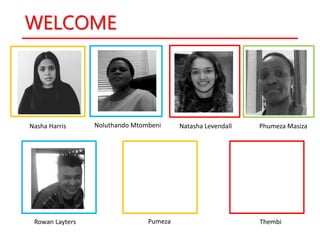
WELCOME
Nasha Harris Natasha Levendall
Rowan Layters
Noluthando Mtombeni
Pumeza Thembi
Phumeza Masiza
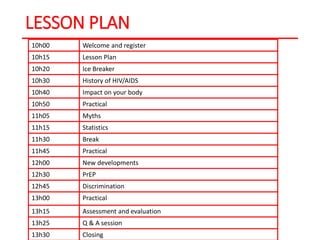
LESSON PLAN
10h00 Welcome and register
10h15 Lesson Plan
10h20 Ice Breaker
10h30 History of HIV/AIDS
10h40 Impact on your body
10h50 Practical
11h05 Myths
11h15 Statistics
11h30 Break
11h45 Practical
12h00 New developments
12h30 PrEP
12h45 Discrimination
13h00 Practical
13h15 Assessment and evaluation
13h25 Q & A session
13h30 Closing
GROUND RULES
Cellphone should remain on silent
Toilet breaks
Participate don’t anticipate
Safe space to share
Respect towards all
ICE BREAKER
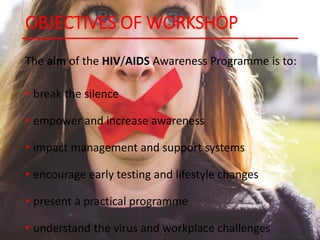
OBJECTIVES OF WORKSHOP
The aim of the HIV/AIDS Awareness Programme is to:
• break the silence
• empower and increase awareness
• impact management and support systems
• encourage early testing and lifestyle changes
• present a practical programme
• understand the virus and workplace challenges
HISTORY
HISTORY OF HIV / AIDS
Origin
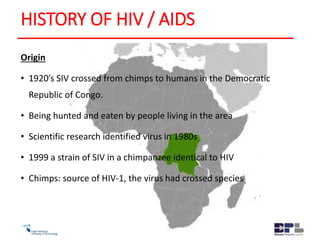
• 1920’s SIV crossed from chimps to humans in the Democratic
Republic of Congo.
• Being hunted and eaten by people living in the area
• Scientific research identified virus in 1980s
• 1999 a strain of SIV in a chimpanzee identical to HIV
• Chimps: source of HIV-1, the virus had crossed species
HISTORY OF HIV / AIDS
Evolution of the virus
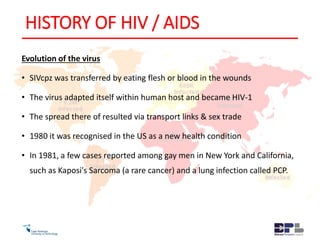
• SIVcpz was transferred by eating flesh or blood in the wounds
• The virus adapted itself within human host and became HIV-1
• The spread there of resulted via transport links & sex trade
• 1980 it was recognised in the US as a new health condition
• In 1981, a few cases reported among gay men in New York and California,
such as Kaposi's Sarcoma (a rare cancer) and a lung infection called PCP.
HISTORY OF HIV / AIDS
Evolution of the virus
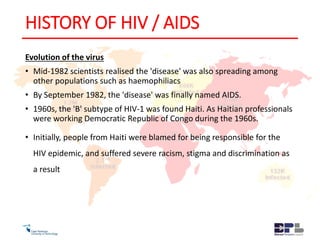
• Mid-1982 scientists realised the 'disease' was also spreading among
other populations such as haemophiliacs
• By September 1982, the 'disease' was finally named AIDS.
• 1960s, the 'B' subtype of HIV-1 was found Haiti. As Haitian professionals
were working Democratic Republic of Congo during the 1960s.
• Initially, people from Haiti were blamed for being responsible for the
HIV epidemic, and suffered severe racism, stigma and discrimination as
a result
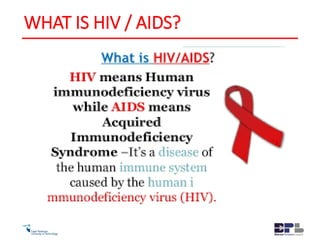
WHAT IS HIV / AIDS?
IMPACT ON YOUR
BODY
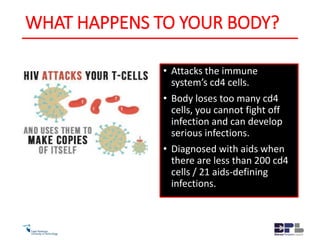
WHAT HAPPENS TO YOUR BODY?
• Attacks the immune
system’s cd4 cells.
• Body loses too many cd4
cells, you cannot fight off
infection and can develop
serious infections.
• Diagnosed with aids when
there are less than 200 cd4
cells / 21 aids-defining
infections.
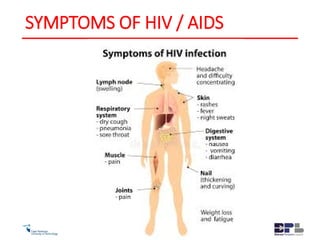
SYMPTOMS OF HIV / AIDS
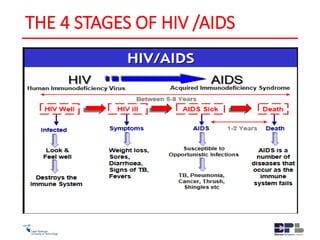
THE 4 STAGES OF HIV /AIDS
HOW IS HIV / AIDS TRANSMITTED?
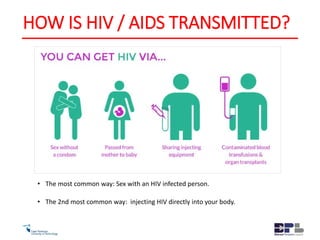
• The most common way: Sex with an HIV infected person.
• The 2nd most common way: injecting HIV directly into your body.
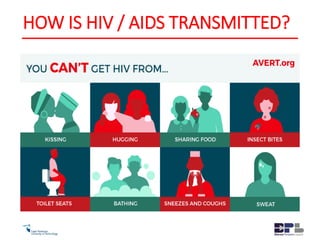
HOW IS HIV / AIDS TRANSMITTED?
PRACTICAL
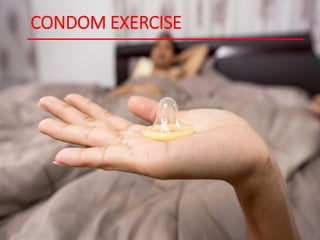
CONDOM EXERCISE
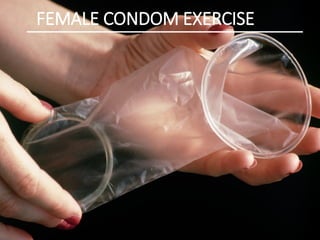
FEMALE CONDOM EXERCISE
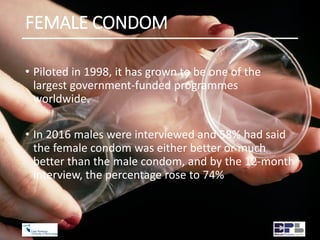
FEMALE CONDOM
• Piloted in 1998, it has grown to be one of the
largest government-funded programmes
worldwide.
• In 2016 males were interviewed and 58% had said
the female condom was either better or much
better than the male condom, and by the 12-month
interview, the percentage rose to 74%
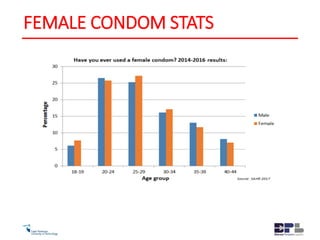
FEMALE CONDOM STATS
MYTHS
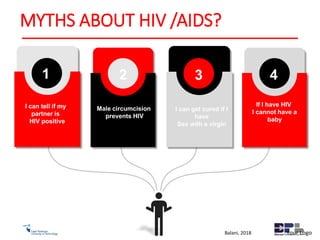
MYTHS ABOUT HIV /AIDS?
Balani, 2018
2
Male circumcision
prevents HIV
4
If I have HIV
I cannot have a
baby
3
I can get cured if I
have
Sex with a virgin
1
I can tell if my
partner is
HIV positive
Your Logo
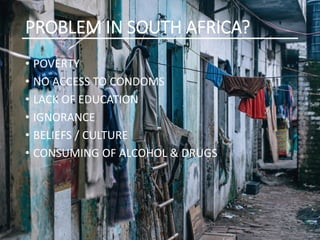
PROBLEM IN SOUTH AFRICA?
• POVERTY
• NO ACCESS TO CONDOMS
• LACK OF EDUCATION
• IGNORANCE
• BELIEFS / CULTURE
• CONSUMING OF ALCOHOL & DRUGS
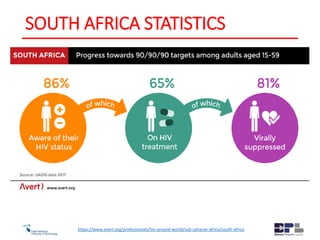
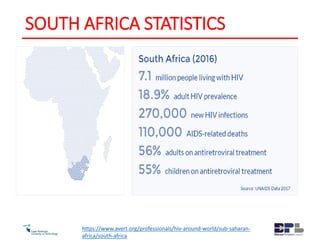
SOUTH AFRICA STATISTICS
https://www.avert.org/professionals/hiv-around-world/sub-saharan-africa/south-africa
CURE FOR HIV / AIDS?
• No cure exists for AIDS, but strict adherence to
antiretroviral regimens (ARVs) can dramatically
slow the disease's progress as well as prevent
secondary infections and complications.
SOUTH AFRICA STATISTICS
https://www.avert.org/professionals/hiv-around-world/sub-saharan-
africa/south-africa
CASE STUDY
• Lebogang Motsumi was 27 when she acquired HIV from a
“sugar daddy” – a man significantly older than her who was
capable of showering her with the gifts she believed she
needed to fit in with her friends and feel more accepting of
herself. She was reluctant to use a condom because she
feared being perceived as promiscuous by men and felt she
was “not in control” of the situation when she was with her
sexual partners.
Now a mother, Motsumi says she wishes she had received
more information at home and at school about risky sexual
behaviour, and is using her experience to advocate non-
judgemental, face-to-face conversations with young people
about relationships with older men.
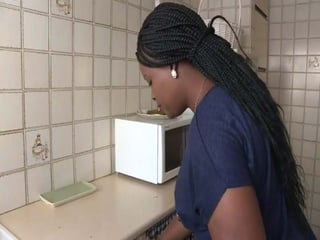
• https://www.youtube.com/watch?v=9xMfWAEekG
4
• WHY DO GIRLS / WOMEN GET INTO A
RELATIONSHIP WITH SUGAR DADDIES / BLESSERS?
NEW
DEVELOPMENTS
NEW DEVELOPMENTS
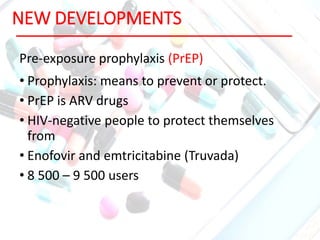
Pre-exposure prophylaxis (PrEP)
• Prophylaxis: means to prevent or protect.
• PrEP is ARV drugs
• HIV-negative people to protect themselves
from
• Enofovir and emtricitabine (Truvada)
• 8 500 – 9 500 users
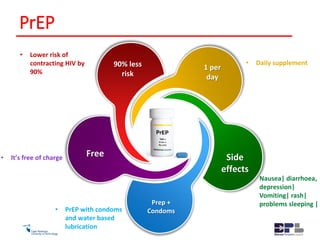
PrEP
1 per
day
Side
effects
Prep +
Condoms
Free
90% less
risk
• Daily supplement
Nausea| diarrhoea,
depression|
Vomiting| rash|
problems sleeping |
• PrEP with condoms
and water based
lubrication
• It’s free of charge
• Lower risk of
contracting HIV by
90%
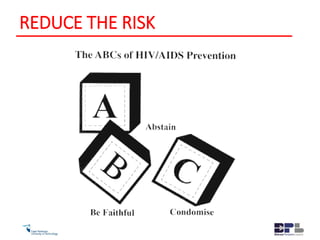
REDUCE THE RISK
01
T E S T E D
• Take the test
• Know your status
• Know your partners
status.
02
C O N D O M
• Always be prepared
• Always use a
condom.
P A R T N E R
• Remove multiple
partners
• Be faithful to one
partner.
03
P r E P
• Consult with a
professional
• Educate yourself
04
N O D R U G S
• Don’t do drug
• Don't inject yourself
05
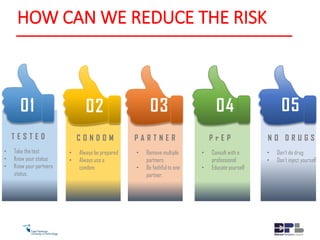
HOW CAN WE REDUCE THE RISK
STIGMA &
DISCRIMINATION
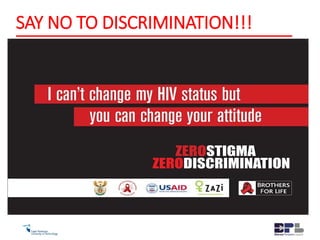
SAY NO TO DISCRIMINATION!!!
STIGMAS KNOWN
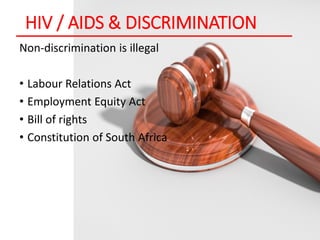
HIV / AIDS & DISCRIMINATION
Non-discrimination is illegal
• Labour Relations Act
• Employment Equity Act
• Bill of rights
• Constitution of South Africa
BPL WORKPLACE
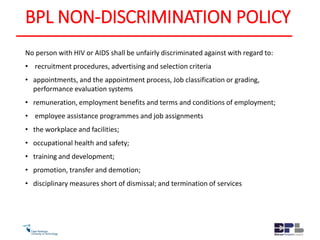
BPL NON-DISCRIMINATION POLICY
No person with HIV or AIDS shall be unfairly discriminated against with regard to:
• recruitment procedures, advertising and selection criteria
• appointments, and the appointment process, Job classification or grading,
performance evaluation systems
• remuneration, employment benefits and terms and conditions of employment;
• employee assistance programmes and job assignments
• the workplace and facilities;
• occupational health and safety;
• training and development;
• promotion, transfer and demotion;
• disciplinary measures short of dismissal; and termination of services
PRACTICAL
STIGMA PRACTICAL
NEXT STEPS
GET TESTED
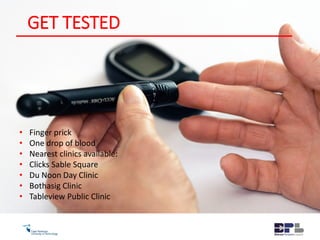
• Finger prick
• One drop of blood
• Nearest clinics available:
• Clicks Sable Square
• Du Noon Day Clinic
• Bothasig Clinic
• Tableview Public Clinic
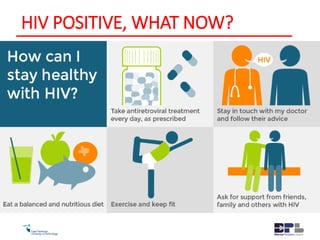
HIV POSITIVE, WHAT NOW?
HIV POSITIVE | BALANCED DIET
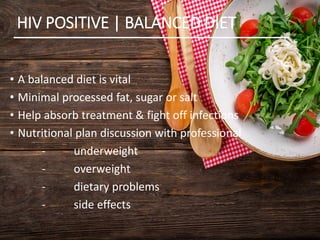
• A balanced diet is vital
• Minimal processed fat, sugar or salt
• Help absorb treatment & fight off infections
• Nutritional plan discussion with professional
- underweight
- overweight
- dietary problems
- side effects
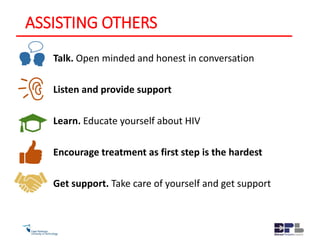
ASSISTING OTHERS
Talk. Open minded and honest in conversation
Listen and provide support
Learn. Educate yourself about HIV
Encourage treatment as first step is the hardest
Get support. Take care of yourself and get support
HELPLINE DETAILS
ASSESSMENT
Q & A Session

HIV WORK SHOP 2018_Presentation ready.pdf

  • 1.
  • 2.
    WELCOME Nasha Harris NatashaLevendall Rowan Layters Noluthando Mtombeni Pumeza Thembi Phumeza Masiza
  • 3.
    LESSON PLAN 10h00 Welcomeand register 10h15 Lesson Plan 10h20 Ice Breaker 10h30 History of HIV/AIDS 10h40 Impact on your body 10h50 Practical 11h05 Myths 11h15 Statistics 11h30 Break 11h45 Practical 12h00 New developments 12h30 PrEP 12h45 Discrimination 13h00 Practical 13h15 Assessment and evaluation 13h25 Q & A session 13h30 Closing
  • 4.
    GROUND RULES Cellphone shouldremain on silent Toilet breaks Participate don’t anticipate Safe space to share Respect towards all
  • 5.
  • 6.
    OBJECTIVES OF WORKSHOP Theaim of the HIV/AIDS Awareness Programme is to: • break the silence • empower and increase awareness • impact management and support systems • encourage early testing and lifestyle changes • present a practical programme • understand the virus and workplace challenges
  • 7.
  • 8.
    HISTORY OF HIV/ AIDS Origin • 1920’s SIV crossed from chimps to humans in the Democratic Republic of Congo. • Being hunted and eaten by people living in the area • Scientific research identified virus in 1980s • 1999 a strain of SIV in a chimpanzee identical to HIV • Chimps: source of HIV-1, the virus had crossed species
  • 9.
    HISTORY OF HIV/ AIDS Evolution of the virus • SIVcpz was transferred by eating flesh or blood in the wounds • The virus adapted itself within human host and became HIV-1 • The spread there of resulted via transport links & sex trade • 1980 it was recognised in the US as a new health condition • In 1981, a few cases reported among gay men in New York and California, such as Kaposi's Sarcoma (a rare cancer) and a lung infection called PCP.
  • 10.
    HISTORY OF HIV/ AIDS Evolution of the virus • Mid-1982 scientists realised the 'disease' was also spreading among other populations such as haemophiliacs • By September 1982, the 'disease' was finally named AIDS. • 1960s, the 'B' subtype of HIV-1 was found Haiti. As Haitian professionals were working Democratic Republic of Congo during the 1960s. • Initially, people from Haiti were blamed for being responsible for the HIV epidemic, and suffered severe racism, stigma and discrimination as a result
  • 11.
    WHAT IS HIV/ AIDS?
  • 12.
  • 13.
    WHAT HAPPENS TOYOUR BODY? • Attacks the immune system’s cd4 cells. • Body loses too many cd4 cells, you cannot fight off infection and can develop serious infections. • Diagnosed with aids when there are less than 200 cd4 cells / 21 aids-defining infections.
  • 14.
  • 15.
    THE 4 STAGESOF HIV /AIDS
  • 16.
    HOW IS HIV/ AIDS TRANSMITTED? • The most common way: Sex with an HIV infected person. • The 2nd most common way: injecting HIV directly into your body.
  • 17.
    HOW IS HIV/ AIDS TRANSMITTED?
  • 18.
  • 19.
  • 20.
  • 21.
    FEMALE CONDOM • Pilotedin 1998, it has grown to be one of the largest government-funded programmes worldwide. • In 2016 males were interviewed and 58% had said the female condom was either better or much better than the male condom, and by the 12-month interview, the percentage rose to 74%
  • 22.
  • 23.
  • 24.
    MYTHS ABOUT HIV/AIDS? Balani, 2018 2 Male circumcision prevents HIV 4 If I have HIV I cannot have a baby 3 I can get cured if I have Sex with a virgin 1 I can tell if my partner is HIV positive Your Logo
  • 25.
    PROBLEM IN SOUTHAFRICA? • POVERTY • NO ACCESS TO CONDOMS • LACK OF EDUCATION • IGNORANCE • BELIEFS / CULTURE • CONSUMING OF ALCOHOL & DRUGS
  • 26.
  • 27.
    CURE FOR HIV/ AIDS? • No cure exists for AIDS, but strict adherence to antiretroviral regimens (ARVs) can dramatically slow the disease's progress as well as prevent secondary infections and complications.
  • 28.
  • 29.
    CASE STUDY • LebogangMotsumi was 27 when she acquired HIV from a “sugar daddy” – a man significantly older than her who was capable of showering her with the gifts she believed she needed to fit in with her friends and feel more accepting of herself. She was reluctant to use a condom because she feared being perceived as promiscuous by men and felt she was “not in control” of the situation when she was with her sexual partners. Now a mother, Motsumi says she wishes she had received more information at home and at school about risky sexual behaviour, and is using her experience to advocate non- judgemental, face-to-face conversations with young people about relationships with older men.
  • 30.
    • https://www.youtube.com/watch?v=9xMfWAEekG 4 • WHYDO GIRLS / WOMEN GET INTO A RELATIONSHIP WITH SUGAR DADDIES / BLESSERS?
  • 31.
  • 32.
    NEW DEVELOPMENTS Pre-exposure prophylaxis(PrEP) • Prophylaxis: means to prevent or protect. • PrEP is ARV drugs • HIV-negative people to protect themselves from • Enofovir and emtricitabine (Truvada) • 8 500 – 9 500 users
  • 33.
    PrEP 1 per day Side effects Prep + Condoms Free 90%less risk • Daily supplement Nausea| diarrhoea, depression| Vomiting| rash| problems sleeping | • PrEP with condoms and water based lubrication • It’s free of charge • Lower risk of contracting HIV by 90%
  • 34.
  • 35.
    01 T E ST E D • Take the test • Know your status • Know your partners status. 02 C O N D O M • Always be prepared • Always use a condom. P A R T N E R • Remove multiple partners • Be faithful to one partner. 03 P r E P • Consult with a professional • Educate yourself 04 N O D R U G S • Don’t do drug • Don't inject yourself 05 HOW CAN WE REDUCE THE RISK
  • 36.
  • 37.
    SAY NO TODISCRIMINATION!!!
  • 38.
  • 39.
    HIV / AIDS& DISCRIMINATION Non-discrimination is illegal • Labour Relations Act • Employment Equity Act • Bill of rights • Constitution of South Africa
  • 40.
  • 41.
    BPL NON-DISCRIMINATION POLICY Noperson with HIV or AIDS shall be unfairly discriminated against with regard to: • recruitment procedures, advertising and selection criteria • appointments, and the appointment process, Job classification or grading, performance evaluation systems • remuneration, employment benefits and terms and conditions of employment; • employee assistance programmes and job assignments • the workplace and facilities; • occupational health and safety; • training and development; • promotion, transfer and demotion; • disciplinary measures short of dismissal; and termination of services
  • 42.
  • 43.
  • 44.
  • 45.
    GET TESTED • Fingerprick • One drop of blood • Nearest clinics available: • Clicks Sable Square • Du Noon Day Clinic • Bothasig Clinic • Tableview Public Clinic
  • 46.
  • 47.
    HIV POSITIVE |BALANCED DIET • A balanced diet is vital • Minimal processed fat, sugar or salt • Help absorb treatment & fight off infections • Nutritional plan discussion with professional - underweight - overweight - dietary problems - side effects
  • 48.
    ASSISTING OTHERS Talk. Openminded and honest in conversation Listen and provide support Learn. Educate yourself about HIV Encourage treatment as first step is the hardest Get support. Take care of yourself and get support
  • 49.
  • 50.
  • 51.
    Q & ASession