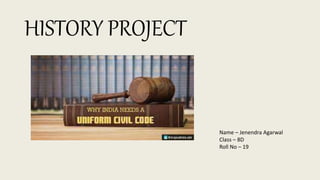
HISTORY PROJECT
Name – Jenendra Agarwal
Class – 8D
Roll No – 19
.SUMMARY
• INTODUCTION
• HISTORY
• CONCEPT
• PERSONAL LAWS
• NEED OF UNIFORM CIVIL CODE
• MERITS
• CONCLUSION
What is Uniform Civil
Code?
Uniform Civil Code is observed as the same
set of secular civil laws so as to govern all
people irrespective of their religion, caste
and tribe. The need for such a code was felt
to take into account the constitutional
mandate of securing justice and equality for
all its citizens.[1]In simple words, Uniform
Civil Code was defined as a proposal in
which the personal laws of the country
should be replaced on the basis of the
scriptures and customs of each major
religious community in India with a common
set governing every citizen.
HISTORY
• Throughout the country, there was a variation in preference for
scriptural or customary laws because in many Hindu and Muslim
communities, these were sometimes at conflict; such instances were
present in communities like the and the The for instance, allowed
widow remarriage completely contrary to the scriptural The Hindu laws
got preference because of their relative ease in implementation,
preference for such a system by both British and Indian judges and
their fear of opposition from the high caste Hindus. The difficulty in
investigating each specific practice of any community, case-by-case,
made customary laws harder to implement. Towards the end of the
nineteenth century, favoring local opinion, the recognition of individual
customs and traditions increased.
Concept of Uniform Civil
Code
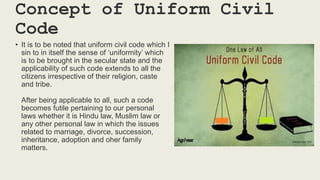
• It is to be noted that uniform civil code which I
sin to in itself the sense of ‘uniformity’ which
is to be brought in the secular state and the
applicability of such code extends to all the
citizens irrespective of their religion, caste
and tribe.
After being applicable to all, such a code
becomes futile pertaining to our personal
laws whether it is Hindu law, Muslim law or
any other personal law in which the issues
related to marriage, divorce, succession,
inheritance, adoption and oher family
matters.
Personal Laws
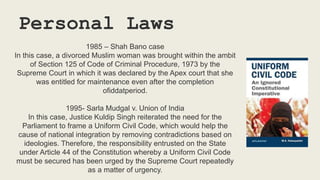
1985 – Shah Bano case
In this case, a divorced Muslim woman was brought within the ambit
of Section 125 of Code of Criminal Procedure, 1973 by the
Supreme Court in which it was declared by the Apex court that she
was entitled for maintenance even after the completion
ofiddatperiod.
1995- Sarla Mudgal v. Union of India
In this case, Justice Kuldip Singh reiterated the need for the
Parliament to frame a Uniform Civil Code, which would help the
cause of national integration by removing contradictions based on
ideologies. Therefore, the responsibility entrusted on the State
under Article 44 of the Constitution whereby a Uniform Civil Code
must be secured has been urged by the Supreme Court repeatedly
as a matter of urgency.
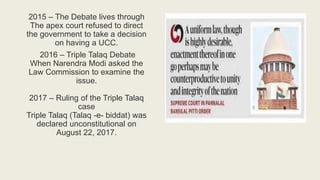
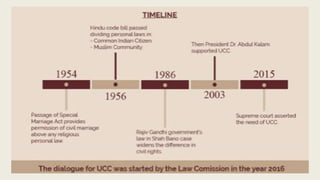
2015 – The Debate lives through
The apex court refused to direct
the government to take a decision
on having a UCC.
2016 – Triple Talaq Debate
When Narendra Modi asked the
Law Commission to examine the
issue.
2017 – Ruling of the Triple Talaq
case
Triple Talaq (Talaq -e- biddat) was
declared unconstitutional on
August 22, 2017.
Need of Uniform Civil
Code
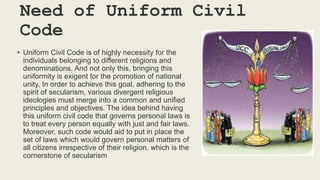
• Uniform Civil Code is of highly necessity for the
individuals belonging to different religions and
denominations. And not only this, bringing this
uniformity is exigent for the promotion of national
unity. In order to achieve this goal, adhering to the
spirit of secularism, various divergent religious
ideologies must merge into a common and unified
principles and objectives. The idea behind having
this uniform civil code that governs personal laws is
to treat every person equally with just and fair laws.
Moreover, such code would aid to put in place the
set of laws which would govern personal matters of
all citizens irrespective of their religion, which is the
cornerstone of secularism
• Another pros of having this code would ensure
national unity and integrity, to put an end to
gender discrimination and also to strengthen the
secular fabric. It is to be noted that the emphasis
has been laid only on the gender friendly reforms
of personal laws which is seen from Shah Bano
case to Shayara Bano case who filed PIL in the
Supreme Court in which triple talaq was declared
unconstitutional. It is noteworthy that in the
political and social scenario, the liberal sections
of the society are demanding this code to be put
into effect which would govern individuals across
all religions, caste and tribe and to protect their
fundamental and constitutional rights as
guaranteed by the Constitution of India.
Merits of Uniform
Civil Code
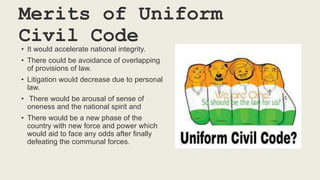
• It would accelerate national integrity.
• There could be avoidance of overlapping
of provisions of law.
• Litigation would decrease due to personal
law.
• There would be arousal of sense of
oneness and the national spirit and
• There would be a new phase of the
country with new force and power which
would aid to face any odds after finally
defeating the communal forces.
Conclusion
• After such a deliberate discussion and constitutional debates, it can be
concluded that mere three words and the nation will break into hysterical
jubilation and frantic wailing. Uniform Civil Code covers the aspects of
social, political and religious aspects.
According to a man of ordinary prudence, the code should be just and fair
and a balance should be carved between protection of fundamental rights
and religious dogmas of individuals by the UCC. It is to be identified that
what is the moving jurisprudence behind UCC that is it the integrity of the
nation with one nation people motto or is it the eradication of the gender
based injustices engrained in all personal laws. However, it is noteworthy
that UCC has come up with as a champion of gender equality.
.
• It is of no doubt that the issue of the reform of personal laws of different
communities and the enactment of uniform civil code is a tedious task. The
deep rooted multiplicity of personal laws, culture and custom are the real
hurdles for the implementation of uniform civil code.
• Two questions need to be addressed which are being completely ignored
in the present din around UCC.
• Firstly, how can uniformity in personal laws are brought without disturbing
the distinct essence of each and every component of the society. What
makes us believe that practices of one community are backward and
unjust?
• The second question is that whether uniformity has been able to eradicate
gender inequalities which diminish the status of women in our society?
Sooner or the later we will be coming with the answers to this questions
that have created turmoil in our mind.
WEBSITES TO VISIT:
www.legalserviceindia.com
THANK YOU

HISTORY PROJECT.pptx

  • 1.
    HISTORY PROJECT Name –Jenendra Agarwal Class – 8D Roll No – 19
  • 2.
    .SUMMARY • INTODUCTION • HISTORY •CONCEPT • PERSONAL LAWS • NEED OF UNIFORM CIVIL CODE • MERITS • CONCLUSION
  • 3.
    What is UniformCivil Code? Uniform Civil Code is observed as the same set of secular civil laws so as to govern all people irrespective of their religion, caste and tribe. The need for such a code was felt to take into account the constitutional mandate of securing justice and equality for all its citizens.[1]In simple words, Uniform Civil Code was defined as a proposal in which the personal laws of the country should be replaced on the basis of the scriptures and customs of each major religious community in India with a common set governing every citizen.
  • 4.
    HISTORY • Throughout thecountry, there was a variation in preference for scriptural or customary laws because in many Hindu and Muslim communities, these were sometimes at conflict; such instances were present in communities like the and the The for instance, allowed widow remarriage completely contrary to the scriptural The Hindu laws got preference because of their relative ease in implementation, preference for such a system by both British and Indian judges and their fear of opposition from the high caste Hindus. The difficulty in investigating each specific practice of any community, case-by-case, made customary laws harder to implement. Towards the end of the nineteenth century, favoring local opinion, the recognition of individual customs and traditions increased.
  • 5.
    Concept of UniformCivil Code • It is to be noted that uniform civil code which I sin to in itself the sense of ‘uniformity’ which is to be brought in the secular state and the applicability of such code extends to all the citizens irrespective of their religion, caste and tribe. After being applicable to all, such a code becomes futile pertaining to our personal laws whether it is Hindu law, Muslim law or any other personal law in which the issues related to marriage, divorce, succession, inheritance, adoption and oher family matters.
  • 6.
    Personal Laws 1985 –Shah Bano case In this case, a divorced Muslim woman was brought within the ambit of Section 125 of Code of Criminal Procedure, 1973 by the Supreme Court in which it was declared by the Apex court that she was entitled for maintenance even after the completion ofiddatperiod. 1995- Sarla Mudgal v. Union of India In this case, Justice Kuldip Singh reiterated the need for the Parliament to frame a Uniform Civil Code, which would help the cause of national integration by removing contradictions based on ideologies. Therefore, the responsibility entrusted on the State under Article 44 of the Constitution whereby a Uniform Civil Code must be secured has been urged by the Supreme Court repeatedly as a matter of urgency.
  • 7.
    2015 – TheDebate lives through The apex court refused to direct the government to take a decision on having a UCC. 2016 – Triple Talaq Debate When Narendra Modi asked the Law Commission to examine the issue. 2017 – Ruling of the Triple Talaq case Triple Talaq (Talaq -e- biddat) was declared unconstitutional on August 22, 2017.
  • 8.
    Need of UniformCivil Code • Uniform Civil Code is of highly necessity for the individuals belonging to different religions and denominations. And not only this, bringing this uniformity is exigent for the promotion of national unity. In order to achieve this goal, adhering to the spirit of secularism, various divergent religious ideologies must merge into a common and unified principles and objectives. The idea behind having this uniform civil code that governs personal laws is to treat every person equally with just and fair laws. Moreover, such code would aid to put in place the set of laws which would govern personal matters of all citizens irrespective of their religion, which is the cornerstone of secularism
  • 9.
    • Another prosof having this code would ensure national unity and integrity, to put an end to gender discrimination and also to strengthen the secular fabric. It is to be noted that the emphasis has been laid only on the gender friendly reforms of personal laws which is seen from Shah Bano case to Shayara Bano case who filed PIL in the Supreme Court in which triple talaq was declared unconstitutional. It is noteworthy that in the political and social scenario, the liberal sections of the society are demanding this code to be put into effect which would govern individuals across all religions, caste and tribe and to protect their fundamental and constitutional rights as guaranteed by the Constitution of India.
  • 10.
    Merits of Uniform CivilCode • It would accelerate national integrity. • There could be avoidance of overlapping of provisions of law. • Litigation would decrease due to personal law. • There would be arousal of sense of oneness and the national spirit and • There would be a new phase of the country with new force and power which would aid to face any odds after finally defeating the communal forces.
  • 12.
    Conclusion • After sucha deliberate discussion and constitutional debates, it can be concluded that mere three words and the nation will break into hysterical jubilation and frantic wailing. Uniform Civil Code covers the aspects of social, political and religious aspects. According to a man of ordinary prudence, the code should be just and fair and a balance should be carved between protection of fundamental rights and religious dogmas of individuals by the UCC. It is to be identified that what is the moving jurisprudence behind UCC that is it the integrity of the nation with one nation people motto or is it the eradication of the gender based injustices engrained in all personal laws. However, it is noteworthy that UCC has come up with as a champion of gender equality. .
  • 13.
    • It isof no doubt that the issue of the reform of personal laws of different communities and the enactment of uniform civil code is a tedious task. The deep rooted multiplicity of personal laws, culture and custom are the real hurdles for the implementation of uniform civil code. • Two questions need to be addressed which are being completely ignored in the present din around UCC. • Firstly, how can uniformity in personal laws are brought without disturbing the distinct essence of each and every component of the society. What makes us believe that practices of one community are backward and unjust? • The second question is that whether uniformity has been able to eradicate gender inequalities which diminish the status of women in our society? Sooner or the later we will be coming with the answers to this questions that have created turmoil in our mind.
  • 14.