History of Technology Volume 21 1st Edition Graham Hollister-Short (Editor)
History of Technology Volume 21 1st Edition Graham Hollister-Short (Editor)
History of Technology Volume 21 1st Edition Graham Hollister-Short (Editor)
History of Technology Volume 21 1st Edition Graham Hollister-Short (Editor)
History of Technology Volume 21 1st Edition Graham Hollister-Short (Editor)
1.
History of TechnologyVolume 21 1st Edition
Graham Hollister-Short (Editor) install download
https://ebookmeta.com/product/history-of-technology-
volume-21-1st-edition-graham-hollister-short-editor/
Download more ebook from https://ebookmeta.com
2.
We believe theseproducts will be a great fit for you. Click
the link to download now, or visit ebookmeta.com
to discover even more!
History of Technology Volume 28 1st Edition Ian Inkster
(Editor)
https://ebookmeta.com/product/history-of-technology-
volume-28-1st-edition-ian-inkster-editor/
History of Technology Volume 11 1st Edition Norman
Smith (Editor)
https://ebookmeta.com/product/history-of-technology-
volume-11-1st-edition-norman-smith-editor/
History of Technology Volume 1 1st Edition A. Rupert
Hall
https://ebookmeta.com/product/history-of-technology-volume-1-1st-
edition-a-rupert-hall/
Crucial Conversations Tools for Talking When Stakes Are
High Second Edition Kerry Patterson Joseph Grenny Ron
Mcmillan Al Switzler
https://ebookmeta.com/product/crucial-conversations-tools-for-
talking-when-stakes-are-high-second-edition-kerry-patterson-
joseph-grenny-ron-mcmillan-al-switzler/
3.
Odell's Clinical ProblemSolving in Dentistry 4th
Edition Avijit Banerjee
https://ebookmeta.com/product/odells-clinical-problem-solving-in-
dentistry-4th-edition-avijit-banerjee/
Teaching Languages in the Primary School 2nd Edition
Philip Hood Kristina Tobutt
https://ebookmeta.com/product/teaching-languages-in-the-primary-
school-2nd-edition-philip-hood-kristina-tobutt/
Liberating France Third Edition. Edition Judy Anderson
Allan Kerr
https://ebookmeta.com/product/liberating-france-third-edition-
edition-judy-anderson-allan-kerr/
Fixed - How to Perfect the Fine Art of Problem Solving
1st Edition Amy E. Herman
https://ebookmeta.com/product/fixed-how-to-perfect-the-fine-art-
of-problem-solving-1st-edition-amy-e-herman/
Optics Sound and Waves 5th Edition Nelkon Michael F
https://ebookmeta.com/product/optics-sound-and-waves-5th-edition-
nelkon-michael-f/
4.
The Art ofCreative Research A Field Guide for Writers
Chicago Guides to Writing Editing and Publishing 1st
Edition Gerard
https://ebookmeta.com/product/the-art-of-creative-research-a-
field-guide-for-writers-chicago-guides-to-writing-editing-and-
publishing-1st-edition-gerard/
HISTORY OF TECHNOLOGY
Editor
DrGraham Hollister-Short
INSTITUTE OF HISTORICAL RESEARCH
Senate House, University of London, London WCIE 7HU
EDITORIAL BOARD
Professor Hans-Joachim Braun,
Universitat der Bundeswehr Hamburg,
Holstenhofweg 85,
22039 Hamburg,
Germany
Professor R.A. Buchanan,
School of Social Sciences,
University of Bath,
Claverton Down,
Bath BA2 7AY,
England
Professor Andre Guillerme,
LTnstitut Francais d'Urbanisme,
Cite Descartes,
47 rue Albert Einstein,
77463 Champ-sur-Marne,
France
Professor A. Rupert Hall, FBA,
14 Ball Lane,
Tackley,
Oxfordshire OX5 3AG,
England
Professor Alexandre Herlea,
Directeur du Departement Humanites,
Institut Polytechnique de Sevenans,
90010 Belfort,
France
Professor Ian Inkster,
International Studies,
Nottingham Trent University,
Clifton Lane,
Nottingham NG11 8NS,
England
Dr A.G. Keller,
Department of History,
University of Leicester,
University Road,
Leicester LEI 7RH,
England
Professor David Lewis,
Department of History,
Auburn University,
Auburn, Alabama 36849,
USA
Professor Carlo Poni,
Dipartimento di Scienze Economiche,
Universita degli Studi di Bologna,
Strada Maggiore 45,
40125 Bologna,
Italy
Professor Hugh Torrens,
Department of Geology,
Keele University,
Keele,
Staffordshire ST5 5BG,
England
Professor R.D. Vergani,
Dipartimento di Storia,
Universita degli Studi di Padova,
Piazza Capitaniato 3,
35139 Padua,
Italy
9.
History of
Technology
Volume 21,1999
Edited by
Graham Hollister-Short
LONDON • OXFORD • NEW YORK • NEW DELHI • SYDNEY
Bloomsbury Academic
An imprint of Bloomsbury Publishing Plc
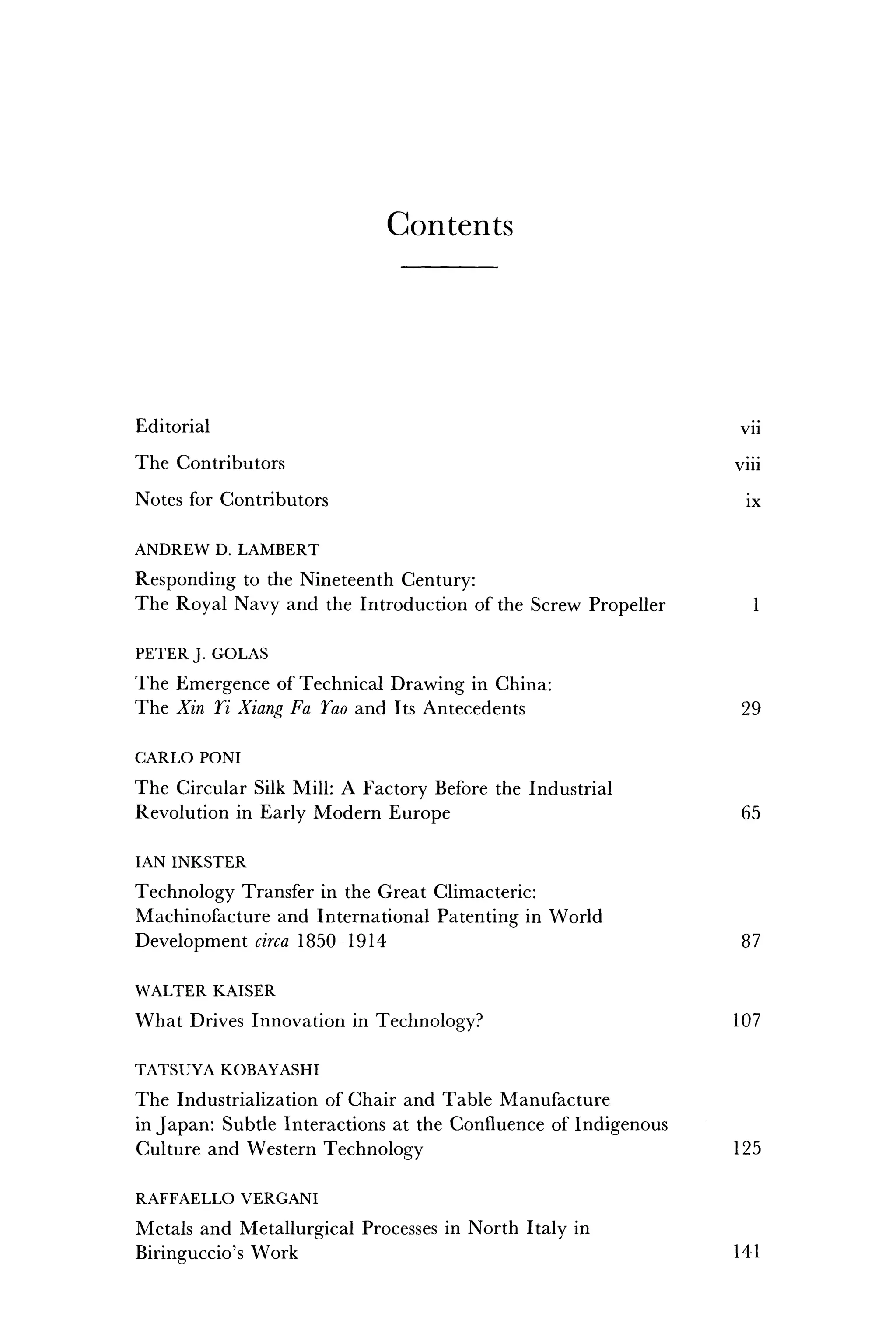
C o nt e n t s
Editorial vii
The Contributors viii
Notes for Contributors ix
ANDREW D. LAMBERT
Responding to the Nineteenth Century:
The Royal Navy and the Introduction of the Screw Propeller 1
PETER J. GOLAS
The Emergence of Technical Drawing in China:
The Xin Ti Xiang Fa Tao and Its Antecedents 29
CARLO PONI
The Circular Silk Mill: A Factory Before the Industrial
Revolution in Early Modern Europe 65
IAN INKSTER
Technology Transfer in the Great Climacteric:
Machinofacture and International Patenting in World
Development circa 1850-1914 87
WALTER KAISER
What Drives Innovation in Technology? 107
TATSUYA KOBAYASHI
The Industrialization of Chair and Table Manufacture
in Japan: Subtle Interactions at the Confluence of Indigenous
Culture and Western Technology 125
RAFFAELLO VERGANI
Metals and Metallurgical Processes in North Italy in
Biringuccio's Work 141
12.
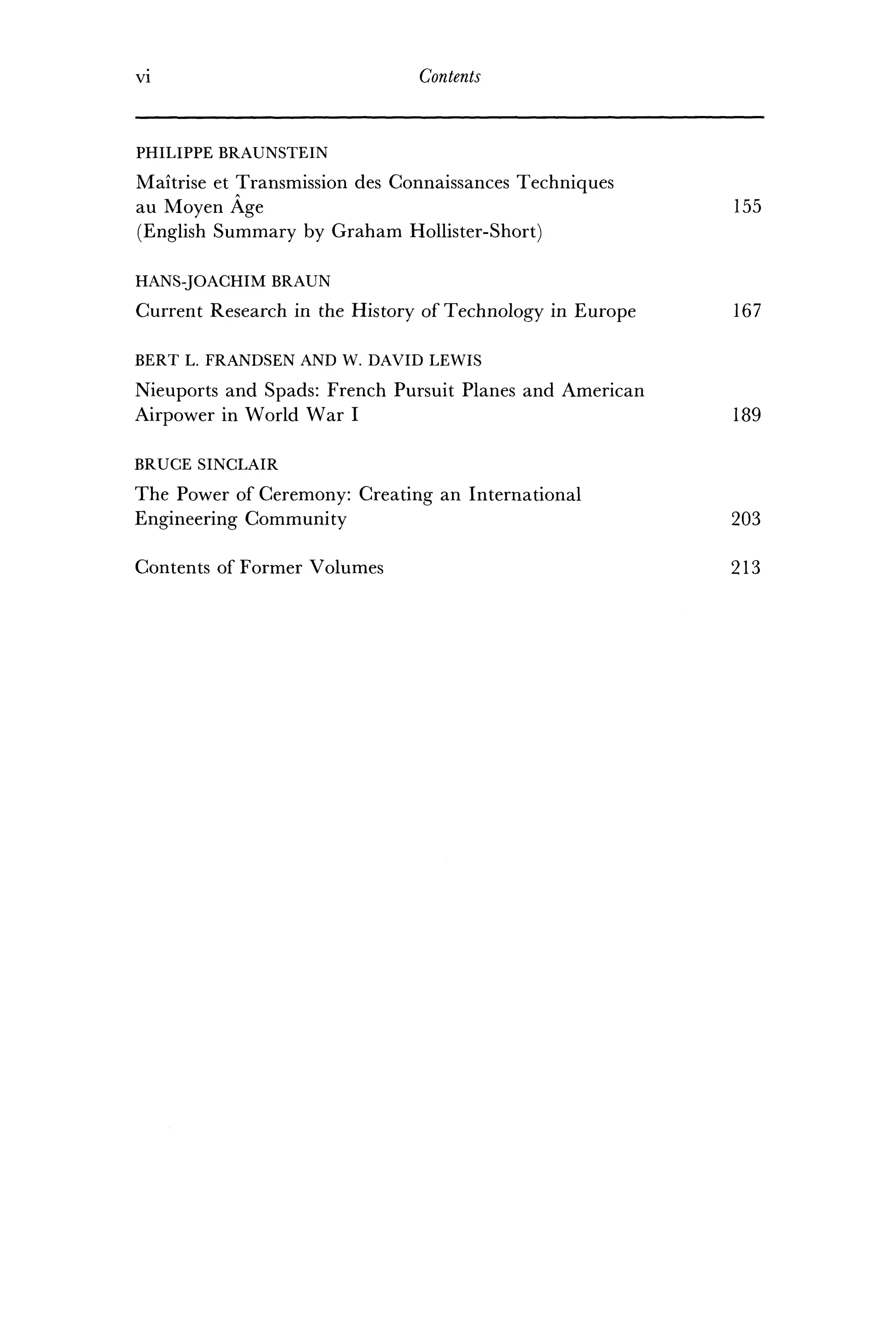
VI Contents
PHILIPPE BRAUNSTEIN
Maitriseet Transmission des Connaissances Techniques
au Moyen Age 155
(English Summary by Graham Hollister-Short)
HANS-JOACHIM BRAUN
Current Research in the History of Technology in Europe 167
BERT L. FRANDSEN AND W. DAVID LEWIS
Nieuports and Spads: French Pursuit Planes and American
Airpower in World War I 189
BRUCE SINCLAIR
The Power of Ceremony: Creating an International
Engineering Community 203
Contents of Former Volumes 213
13.
E d it o r i a l
With the appearance of the twenty-first volume of this journal, a backward
glance may not be out of place. Until History of Technology began to appear
in 1976 there were relatively few outlets for papers in the subject. It was
precisely to try to relieve this situation and reduce the time it was taking to
get articles into print that Rupert Hall, then Professor of the History of
Science and Technology at Imperial College, assisted by Dr Norman
Smith, took the decision to establish a new journal. To reverse Canning's
aphorism, it was almost a question of calling in the old world to redress the
balance of the new.
Since that time other journals have entered the field, good evidence that
the decision was a timely one and that the discipline was on the point of
achieving the more broadly based existence it has today, although it has to
be said that this statement would be truer of the United States and
Germany than of this country.
From the beginning previous editors, like the present editor, have
sought to cast the net widely to avoid, as far as possible, a Europocentric
approach and, equally important in our view, any undue concentration on
the more recent aspects of the history of technology. Also important has
been the recognition of, and the attempt to redress, an undeniable
tendency among Anglophone historians of technology to overlook the very
different technological experience of mainland Europe before its absorp-
tion into the Anglo-Saxon technological ecumene in the mid-nineteenth
century: what, to use Mumfordian shorthand, might be called the coming
of carboniferous capitalism. Or, as Josef Rosowsky has remarked so
amusingly, 'And then there was England and discontent entered the
world.'
In the present volume I have sought to bring together as wide an
international group of scholars as possible, and I hope it will be specially
welcome by reason of the variety of aspects of history of technology that
are covered not only across the centuries but across the globe as well.
Graham Hollister-Short
London
14.
T h eC o n t r i b u t o r s
Professor Hans-Joachim Braun
Universitat der Bundeswehr
Hamburg
Holstenhofweg 85
D-22039 Hamburg, Germany
Professor Philippe Braunstein
Ecole des Hautes Etudes
en Sciences Sociales
54, Blvd. Raspail
75270 Paris, Cedex 06
France
Bert L. Frandsen
Department of History
310 Thach Hall
Auburn University, AL 36849-5207
USA
Professor Peter J. Golas
Department of History
2199 S. University of Denver
Colorado, USA
Professor Ian Inkster
Faculty of Humanities
Nottingham Trent University
Nottingham NG11 8NS
England
Professor Walter Kaiser
Technische Hochschule
Rheinisch-Westfalische
D-52056 Aachen
Germany
Professor Tatsuya Kobayashi
3-147 Hachimandai
Seto City, Aichi Pref. 489
Japan
Professor Andrew David Lambert
Department of War Studies
Kings College London
Strand
London WC2R 2LS
England
Professor W. David Lewis
Department of History
310 Thach Hall
Auburn University, AL 36849-5207
USA
Professor Carlo Poni
Dipartimento di Scienze
Economichi
Universita degli Studi di Bologna
Strada Maggiore 45
40125 Bologna, Italy
Professor Bruce Sinclair
404 High Street
Bethlehem, PA 18018
USA
Professor Raffaello Vergani
Dipartimento di Storia
Universita degli Studi di Padova
Piazza Capitaniato 3
35139 Padua, Italy
15.
N o te s f o r C o n t r i b u t o r s
Contributions are welcome and should be sent to the editor. They are
considered on the understanding that they are previously unpublished
in English and are not on offer to another journal. Papers in French and
German will be considered for publication, but an English summary
will be required. The editor will also consider publishing English
translations of papers already published in languages other than
English. Include an abstract of 150-200 words.
Authors who have passages originally in Cyrillic or oriental scripts
should indicate the system of transliteration they have used. Be clear and
consistent.
All papers should be rigorously documented, with references to primary
and secondary sources typed separately from the text, double-line spaced
and numbered consecutively. Cite as follows for:
BOOKS
1. David Gooding, Experiment and the Making of Meaning: Human Agency in
Scientific Observation and Experiment (Dordrecht, 1990), 54-5.
Only name the publisher for good reason.
Reference to a previous note:
3. Gooding, op. cit. (1), 43.
Titles of standard works may be cited by abbreviation: DJVB, DBB, etc.
THESES
Cite University Microfilm order number or at least Dissertation Abstract
number.
ARTICLES
13. Andrew Nahum, 'The Rotary Aero Engine', Hist. Tech., 1986, 11: 125-66,
esp. 139.
Please note the following guidelines for the submission and presentation of
all contributions:
16.
x Notesfor Contributors
1.Type your manuscript on good quality paper, on one side only and
double-line spaced throughout. The text, including all endnotes,
references and indented block quotes, should be in one typesize (if
possible 12 pt).
2. In the first instance submit two copies only. Once the text has been
agreed, then you need to submit three copies of the final version, one
for the editor and two for the publishers. You should, of course, retain
a copy for yourself.
3. Number the pages consecutively throughout (including endnotes and
any figures/tables).
4. Spelling should conform to the latest edition of the Concise Oxford
English Dictionary.
5. Quoted material of more than three lines should be indented, without
quotation marks, and double-line spaced.
6. Use single quotes for shorter, non-indented, quotations. For quotes
within quotes use double quotation marks.
7. The source of all extracts, illustrations, etc., should be cited and/or
acknowledged.
8. Italic type should be indicated by underlining. Italics (i.e. under-
lining) should be used for foreign words and titles of books and
journals. Articles in journals are not italicized but placed within single
quotation marks.
9. Figures. Line drawings should be drawn boldly in black ink on stout
white paper, feint-ruled paper or tracing paper. Photographs should
be glossy prints of good contrast and well matched for tonal range.
Each illustration must be numbered and have a caption. Xerox copies
may be sent when the article is first submitted for consideration.
Please do not send originals of photographs or transparencies but if
possible have a good quality copy made. While every care will be
taken, the publishers cannot be held responsible for any loss or
damage. Photographs or other illustrative material should be kept
separate from the text. They should be keyed to your typescript with a
note in the margin to indicate where they should appear.
Provide a separate list of captions for the figures.
10. Notes should come at the end of the text as endnotes, double-line
spaced.
11. It is the responsibility of the author to obtain copyright clearance for
the use of previously published material and for photographs.
19.
R e sp o n d i n g t o t h e
N i n e t e e n t h C e n t u r y
T h e R o y a l N a v y a n d t h e I n t r o d u c t i o n
o f t h e S c r e w P r o p e l l e r
A N D R E W D. L A M B E R T
ABSTRACT
This paper will reconsider the old view that navies in general, and the
Royal Navy in particular, were opposed to the introduction of new
technology in the nineteenth century. Through a case study of one critical
technology, the screw propeller, it is possible to see how the play of politics,
strategy, economics, technology and patent law influenced the process.
This analysis will provide a sharp contrast with the narrow, self-serving or
adulatory polemics produced by contemporary engineers and their
hagiographers. It does not diminish Brunei, Francis Pettit Smith and
John Ericsson, to name but three, to discover that their motivations were
fame and money, rather than the 'benefit of civilization' so often claimed.
Their naval contemporaries were more astute. Charged with professional
responsibility for the security of a global empire they could not afford to
reject progress. Instead they harnessed the intellectual and engineering
resources of the private sector to bring new technologies to production
readiness. In the process they were more likely to defraud the engineers
than ignore them.
* * *
There is an enduring myth that the directors of the world's navies were
reactionary, or at best unduly conservative, in their handling of technical
change in the nineteenth century. This, it has been argued, was
symptomatic of large hierarchically structured bureaucracies which were
opposed to change in any area, from uniform regulations to weapons
procurement.
This view is reflected in the work of historians of the liberal progressive
school for whom conservatism in technology, as in politics, is the mark of
the unthinking and bigoted reactionary. They contend that had the
world's navies been more adventurous, technical progress would have been
History of Technology, Volume Twenty-one, 1999
20.
2 Responding tothe Nineteenth Century
more rapid, and more economical. As the largest, and among the best
documented of navies, the Royal Navy has often been criticized for
technological conservatism throughout the long nineteenth century
(1815-1914). This line has been adopted in studies of the introduction
of steam power, iron ships, the screw propeller, armour plate, turrets and
a number of other important new systems. The case against the Admiralty
has been supported by the contention that France, the United States and
even Russia were, at various times, more far-seeing and technologically
astute.
However, examining these issues in a different context, that of British
international policy, provides completely different results. Between 1815
and 1914 Britain worked for a peaceful and stable European balance as the
most effective means of securing her unique global trading empire from
hostile competition. The power behind British policy was naval deterrence.
If the Admiralty was slow in responding to new technology how did
Britain win major arms races with France and Imperial Germany, defeat
Russia and deter all four of her Great Power rivals at various times
between 1840 and 1911? The British Empire could not have been secured
by an obsolescent fleet based on yesterday's technology. This would
suggest that the case needs to be re-examined.
This paper offers a new analytical model of the way in which large
bureaucratic organizations handle major technical developments. By
reconsidering one of the most famous case studies of alleged inertia,
hostility and conservatism, the introduction of the screw propeller, it will
demonstrate that the existing historiography is weak and profoundly
flawed, both as to underlying assumptions and research methods.
Existing accounts treat the introduction of the screw propeller as a
purely technical issue, isolated from politics, finance, strategy, tactics, and
even the inner workings of naval administration. For too long the
underlying assumptions about the propeller, and the engineers who
worked on it, have been based on self-serving contemporary pamphlet
literature, the latter day complaints of disappointed speculators and the
anti-establishment outpourings of advanced liberals of the mid-century,
who really believed the millennium was at hand. By failing to question the
underlying assumptions of this literature subsequent generations have
done a grave disservice to the memories of several hard-working,
professional men.
The essential argument is that a 'conservative' bureaucracy either
misunderstood or deliberately opposed each new manifestation of progress.
This line of attack can be traced back through contemporary pamphlets,
which were little more than glorified sales brochures, into the more
durable biographies and general histories. Perhaps the first and most
influential rendition of this 'critical' version was provided by Isambard
Kingdom Brunei junior's biography of his father in 1870. Brunei junior
largely created the genre, by linking his father with other engineers and
inventors of the era. He based his case on Brunei's favourite anecdote
about the 'adverse influence which had been exerted in some departments
History of Technology, Volume Twenty-one, 1999
21.
Andrew D. Lambert3
of the Admiralty to prevent the successful issue of these experiments'.1
This
version was perpetuated in the standard modern life.2
The source for the
anecdote was 'Captain' Christopher Claxton, Brunei's close friend.
Claxton's naval connections had provided critical input for the form and
structure of the steamship Great Western, while he proved to be a major
influence on the Great Western Steamship Company and various other
shipbuilding and railways projects around Bristol. However, Claxton was
only a half-pay lieutenant, he was not promoted commander until 1842,
and finally became a captain in 1860. Clearly Claxton had a grudge
against the Admiralty, elaborating the most extreme version of an
anecdote that his friend had told so often that it became a parody of truth.
Not everyone connected with Brunei believed Claxton's version. His
younger son Henry never believed the stories, and was disappointed to find
his brother retailing them in the biography.3
They were good stories, but
they do not stand up to close scrutiny.
When John Ericsson received his valedictory biography his brief
relationship with the Admiralty was portrayed in equally bleak terms.4
Even before this version appeared the liberal progressivist version, in
which the Admiralty was the source of all obstruction, had been adopted
by the standard history of the Royal Navy.5
It would be followed in the
standard account of the development of marine engineering.6
These accounts all assume that anyone but a fool, and a peculiarly
conservative fool at that, could have seen the merits of the propeller from
the beginning, and pressed for its immediate adoption. They ignore the
key questions that surrounded the process. These were financial, technical,
political, tactical and strategic. When they have been addressed it is
possible to see the propeller in a wider context, thus providing an
altogether more complex chain of events.
The Admiralty was not dragged, reluctantly, into the propeller. It was
well aware of what was happening from the beginning, maintained a
careful watching brief, intervened in particular experiments to great effect,
forced the private sector to conduct almost all the fundamental research
and early practical trials, without adequate recompense, and then
intervened in the process at a decisive moment, just as the technology
matured, to clear up all the patent rights and build the world's first all-
steam fleet. Far from the reactionary image created by the engineers and
their hagiographers, the most common complaint of contemporaries was
that they had been 'defrauded', and that the Admiralty would only deal
with people it could 'bully or defraud'.7
Such problems as there were
reflected the impact of political change and internal friction on a semi-
reformed naval administration.
STEAM, STRATEGY AND TACTICS
By the mid-1830s intelligent naval officers were well informed about steam
technology, and capable of thinking through the implications of each new
development without any prompting from the host of inventors,
History of Technology, Volume Twenty-one, 1999
22.
4 Responding tothe Nineteenth Century
speculators and cranks who pestered the Admiralty. In consequence the
latter's response to new technology was not one of unthinking animosity
and blind worship of the past. They were well informed because the
development of naval strategy and tactics between 1805 and 1840 made
steam increasingly important. After the crushing victory of Trafalgar the
whole thrust of naval operations had shifted from fleet combat to the
projection of power from the sea against the shore. Such operations were
only practical for large vessels with their own power, independent of the
wind. Consequently steam propulsion was critical to the maintenance of
naval mastery under the new circumstances, and was the occasion for the
first two naval arms races of the nineteenth century.
The earliest naval steamers were paddle-wheel packet boats, for
strategic communications, and tugs, to get large sailing warships out of
harbour. As they became larger and more powerful paddle-wheel warships
were able to mount a small number of heavy guns, making them useful
auxiliary warships, and capable of tactical towing. By 1850 the best
paddle-wheel frigates, such as HMS Terrible, were capable of strategic
towing, mounted 24 heavy guns, and cost as much as a small battleship.
However, they were not capable of taking their place in the line of battle,
because their large wheels blocked much of the broadside, and the
machinery, wheels, shafts, cranks and even, most dangerously, boilers,
were exposed to gunfire damage. Consequently paddle warships tended to
carry an upper-deck battery of extra heavy guns, for long-range fire. They
were also poor performers under sail, which limited their strategic utility.
Their real value was in amphibious and power projection operations,
where their mobility and large paddle-box boats made them ideal for
amphibious assault and inshore bombardment.8
Because there were no
regular fleet actions between 1805 and 1866 the paddle-wheel steamer
achieved a misleadingly high profile as a naval weapons system.
The problems of the paddle-wheel warship, however, were well known
by the mid-1830s, and intelligent officers were already looking for
solutions.9
Ultimately the screw propeller would answer all of their
requirements, enabling the standard wooden sailing warship to be fitted
for steam power without the loss of its broadside battery, or efficient sailing
rig. The screw transformed steam from an auxiliary power installed in
auxiliary warships to an auxiliary power installed in front-line warships.
Before examining how the new system was introduced it is essential to
consider the administrative structure that had to manage the change.
THE ADMIRALTY AND THE STEAM WARSHIP
There has been much criticism of the role of the Admiralty in the
introduction of the steam warship, and of the screw propeller. However,
the real problem was one of administrative structure, rather than decision-
making. In 1832 British naval administration had been subjected to a
comprehensive overhaul, the first root-and-branch reorganization in four
hundred years. The age-old distinction between the Board of Admiralty,
History of Technology, Volume Twenty-one, 1999
23.
Andrew D. Lambert5
the body charged with executing the duties of the Lord High Admiral,
essentially the military direction of the Navy, and the Navy and
Victualling Boards, which administered the civil aspect, maintaining the
fleet, running the dockyards, and feeding the men, was ended. Day-to-day
superintendence of all aspects of naval administration was turned over to
the Board of Admiralty, the other Boards being abolished. At one level this
saved a small amount of money, in accordance with the political
programme of the new Whig Government. More fundamentally the
Whigs had long wanted to abolish the Navy Board, which they believed
was dominated by conservative nominees. The 1832 reform was a triumph
of ideology and political revenge over common sense.10
Hitherto the Navy Board had developed the annual construction
programme, organized the work of the dockyards and advised the
Admiralty on all matters relating to shipbuilding and steam engineering.
Led by an experienced naval officer and a leading ship designer, the Navy
Board also had its own engineer. In the two decades that followed, when
the need for sound advice on technology and long-term policy was greater
than ever before, the Navy Board would be sadly missed. Under the new
system the Admiralty would be advised on these issues by the Surveyor of
the Navy, under the supervision of the First Naval Lord. Hitherto the
Surveyor had been a dockyard-trained shipbuilder and designer with a
seat on the Navy Board, but the new incumbent, Captain William
Symonds, was a naval officer with some intuitive design ideas. The central
tenet of Symonds's work was the primacy of speed in naval warfare, both
under sail and steam. He was convinced that the problem would be to
catch the enemy. Although tasked with developing construction policy
Symonds was more interested in promoting his own designs, and lacked
the funds to maintain the fleet at an adequate level. In addition he had
been appointed by the Whig ministers, and his term in office would be
dominated by party politics.11
Furthermore the Surveyor's Office, like
every other department of the new Admiralty, was short of staff and
money. The Admiralty simply did not have the manpower to conduct
fundamental research, and, as this paper will demonstrate, found it hard to
exploit, or even retain the results of such research as it had already
conducted.12
It was against this background, starved of funds, short-
handed and lacking any coherent long-term policy, that the Royal Navy
had to respond to the screw propeller. Despite these problems the naval
response was successful, demonstrating the underlying professionalism of
the Admiralty
To add to the confusion a new Steam Department, under a Controller
of Steam, was created on 19 April 1837. This was an official recognition
that steam was now critical to naval operations. The first Controller, the
Arctic explorer Captain Sir Edward Parry, was no expert. His claims to
office had more to do with the fact that his brother-in-law, Lord Stanley of
Alderley, was Patronage Secretary to the Whig Ministry than to any
expertise.13
The expertise of the new department was provided by Peter
Ewart, a conservative Boulton & Watt-trained engineer. As the relationship
History of Technology, Volume Twenty-one, 1999
24.
6 Responding tothe Nineteenth Century
between the two departments was never formally settled Symonds, by far
the stronger character, effectively ignored Parry and left the Steam
Department to fit engines into his ships, rather than develop steam warship
designs as a coherent entity.14
This was particularly problematic as the
Symonds hull form, which combined a broad beam with sharply rising
floors, was peculiarly ill-suited to the installation of machinery. Symonds's
deputy, the senior constructor John Edye, was a cautious man. He was
responsible for the structure of warships, and was well aware that paddle-
wheel propulsion, that applied the drive above the upper deck, made less
fundamental demands on the structure of the ship than a submerged
propeller. His concerns had been focused by recent problems with the stern
frames of large sailing warships.15
Only in March 1850 was the relationship between steam engines and
the warships placed on a proper basis, when the Steam Department was
subsumed into the Surveyor's Office. This reform recognized that an all-
steam Navy was only months away.16
For the preceding twenty years the
fractures and divisions within the Admiralty, lack of manpower and
money, the clash of individuals, and the failure to prepare long-term
programmes had all influenced the handling of the new technology.
Fortunately the private sector had been prepared to carry out the
fundamental research, and compete for the rewards.
THE SHIP PROPELLER COMPANY AND THE PROMOTION
OF THE SCREW PROPELLER, 1836-1852
In examining how the Admiralty responded to the screw propeller it has to
be stressed that finance and politics were far more important than
technological innovation. One of the perennial, irritating features of so
much comment on the supposed 'failure' of the Royal Navy and the
mercantile community to adopt steam and the various improvements in
power and propulsion at the proper time is the conceit that Ericsson, Pettit
Smith and others were attempting to 'interest' their fellow men in the new
technology for the good of mankind.17
In truth the engineering community
wanted to sell these new ideas for significant financial reward. Ericsson's
disgust at the failure to sell his designs in Britain should be viewed in
purely commercial terms. It is incredible to argue that commercial success
was not his prime motive. His sense of outrage reflected his failure to secure
financial support from the Admiralty, and the brief confinement in the
debtors' prison that followed, rather than concern for his fellow men. The
prison term was particularly revealing. It demonstrated that Ericsson
simply did not have access to the capital required to develop the screw. His
system, whatever its merits, needed Admiralty support, and was in
consequence doomed to fail. Similarly Smith, and the backers of the Ship
Propeller Company (SPC), were not interested in science and experiment,
but in the royalties and financial success they anticipated from the patent
of 1836. While the Admiralty demonstrated remarkable skill, or an
incredible degree of luck, both in avoiding such entanglements and in
History of Technology, Volume Twenty-one, 1999
25.
Andrew D. Lambert1
securing proven technology for the country at a reasonable price, the
mercantile community made relatively little use of the patented system. In
fact, the screw was of only limited value to the mercantile community
before the development of compound engines and iron hulls. Only the
world's navies could afford the cost of large wooden screw-propelled ships:
both the capital outlay and the alarming frequency of major repairs made
them uneconomic.18
It should be recalled that any number of speculators
and cranks were also trying to lighten both private owners and the
Government of funds, making caution essential. One of the main reasons
for creating the post of Controller of Steam had been to filter out the
'cranks' before they troubled the Board.19
The Admiralty, like the Navy
Board before it, preferred to work with a small number of large and
reliable contractors. For the screw propeller this role would be filled by the
SPC.
The SPC will serve as an example of the relationship between industry,
commerce and Government in the transitional era. While it proved vital to
the success of the screw in the period 1840-45, it failed utterly in its main
object, to make money, and consequently split apart and collapsed.
The marine screw propeller was not 'invented' by Francis Pettit Smith
and John Ericsson. Marine screw propellers had been demonstrated thirty
years before these two men took out their patents. Furthermore when
Smith refined his original general patent of 31 May 1836 on 30 April 1839
he restricted his claim to the position of screw in the deadwood.20
Similarly
Ericsson's patent of 13 January 1837 was for 'an improved propeller
applicable to steam navigation'. There had been at least five worthwhile
'inventions' of the screw propeller, for use with steam engines, before
1836.21
Instead Smith and Ericsson's deserved primacy in the field reflects
their ability to secure the funds required to develop and exploit the new
technology, and not to any leap in design or technology. In Ericsson's case
the funds were provided by a private individual, who anticipated sales to
the American Government and profitable employment on his Canal
system. Smith's ideas were taken up on an altogether larger scale. The SPC
was incorporated by an Act of Parliament on 29 July 1839. However,
before examining the work of the company it is necessary to reconsider the
origins of the patent that it was formed to exploit.
Francis Pettit Smith, although normally referred to as a 'sheep farmer',
was an educated man. His father had been tutor to Lord Sligo, and ended
his days as Postmaster at Hythe, close to Sligo's country seat. He had not
neglected his son's education. Smith wrote lucid explanations for his ideas
and developed rational, if not necessarily accurate, arguments to support
his work. After a decade of close contact the Admiralty engineer Thomas
Lloyd declared that Smith was 'a man of very excellent and sound
judgement'.22
It was no coincidence that he referred to the 'Archimedean'
screw in his patent; this at once revealed his classical education, and placed
his idea in a context with which all educated men of the age would be
familiar. Through his leading apologist, John Bourne, Smith initially
claimed to have hit upon the concept of the screw placed in the deadwood
History of Technology, Volume Twenty-one, 1999
26.
8 Responding tothe Nineteenth Century
in 1835. Following a particularly vicious pamphlet attack in the late 1850s,
which implied a degree of industrial espionage, or conspiracy, Bourne
found it necessary to extend Smith's propeller experiments back to 1834,
and to add a lifetime of interest in marine propulsion in the second edition
of his A Treatise on the Screw Propeller.23
Despite the close relationship
between Pettit Smith and Bourne the second edition of Bourne's book is
not a defence against these claims, and does nothing to dispel the
possibility of conspiracy.24
The pamphlets suggest or imply that Smith was
merely a front for improper conduct by named and unnamed individuals.
It requires more specific rebuttal than Smith was ever willing or able to
provide. However, the continued employment of Smith by the Admiralty,
ever anxious to save money, after the collapse of the SPC, his work with
John Penn on stern gland bearings and the massive success of his
testimonial in 1856 should dispel the 'front' element of the conspiracy
theory. Whatever the source of his design, Smith alone secured the vital
element that his less fortunate predecessors lacked, financial support. From
the spring of 1836, before the patent had been issued, the banker John
Wright was acting as Smith's backer. This support was secured within a
year of the first experiments. It allowed Smith to engage an engineer to
assist with mechanical development, and to secure a patent, which was
then an expensive business.
At this time the English patent system was just entering a new phase,
one in which intellectual property rights were becoming defensible in
court. Before 1830 protection had been limited, and was rarely accorded to
intangibles. Thereafter the argument of public utility had seen the courts
adopt a more favourable view, upholding nearly twice as many patents as
hitherto. The development of specialist patent agents ensured that the
specifications were more accurate, and helped to link the innovators with
the capitalists. Only if a patent was defensible at law, and the patentee
could afford to defend it, was there any value in the invention.25
The
introduction of the screw propeller into the Royal and United States's
navies would be dominated by the legal implications of patents.26
On the day Smith's patent was proved the six-ton boat F.P. Smith was
tried on the Limehouse Canal. In February 1837 its full-turn screw broke,
creating a marked improvement in performance and demonstrating an
empirical approach to development. This is significant. Further trials at
Dover in September 1837, in the presence of Wright, led to an approach to
the Admiralty in March 1838. Smith and his backers, Wright and the
Rennie brothers, then leading lights in the London engineering commu-
nity and the earliest advocates of the screw, secured a favourable response
from SirJohn Barrow, the influential Second (Permanent) Secretary to the
Admiralty. In marked contrast to the dismissive treatment accorded to
Ericsson, the Smith Consortium was advised that a 200-ton vessel would
be required to demonstrate their system. In effect the Admiralty was
asking if the projectors had the necessary capital to develop the system to
the point at which it would be immediately useful. They had never been
interested in clever devices, only finished products, ready for service. The
History of Technology, Volume Twenty-one, 1999
27.
Andrew D. Lambert9
Admiralty's response persuaded the projectors that a quick response would
prove financially beneficial, and in consequence they concentrated on the
Royal Navy as the preferred customer. The support of the Rennies, in
particular that of Sir John Rennie, was critical. He had followed his father
as the Admiralty's preferred consultant on all civil and mechanical
engineering matters.27
The 200-ton Archimedes was laid down in March 1838 by Henry
Wimshurst and engined by George Rennie; both were consortium
members, and both would have a major input into the prospectus of the
SPC. The ship was launched a year later and completed just as the SPC
was incorporated as a joint stock company, whose objects were to purchase
Smith's patents, transfer the financial interest to the company and sell
licences to use the patented location for the propeller, not the propeller
itself. The business was begun on the largest possible scale, with a capital of
£100,000 in 10,000 £10 shares. The SPC was only the fifth such company
formed to exploit a patent, and only 21 were formed between 1837 and
1852.28
All existing sources suggest that Wright and the Rennies were the
major backers, the Rennies to the tune of £1,000 each, with a number of
lesser speculators. Howe Peter Browne (1788-1845), second Lord Sligo,
often named in this role, was a very useful front, being a leading Whig
politician, a prominent yachtsman and a grandson of Earl Howe. He had
also served as Governor of Jamaica between 1833 and 1836, where he
came to appreciate the services of Commander George Evans. The first
commissioned officer to command a steamship, Evans had commanded
HMS Rhadamanthus, the first Royal Navy steamship to operate in the New
World between 1832 and 1835, which played a significant role in
suppressing a slave revolt in Jamaica. In May 1836 Smith approached
Sligo, whom he would have known very well, and Sligo brought Evans
along to advise him. Evans, employed to investigate the Post Office Packet
Service, suggested that it would be a good investment to build a larger
version of the F.P. Smith.29
However, Sligo's will would suggest that he
lacked the disposable capital to take a major financial stake in the
company. Despite this, his friendship with Lord Holland, and close ties to
other ministers made him particularly useful.30
The company began with the widest parameters, including building,
fitting or running screw ships, erecting workshops and selling licences. The
prospectus emphasized the auxiliary role of the screw propeller, placing
the machinery abaft the mainmast in merchant steamers, using Rennie's
high-pressure machinery to save weight and space, with the ultimate
possibility of employing Earl Dundonald's rotary engine, to save three-
quarters of the cost. However, the commercial sector was not the primary
target. Only the Royal Navy could be expected to provide a major source
of funds in the short term, the 14 years in which the patent would remain
in force.
The early trials of the Archimedes were attended by a large number of
naval officers, both on active duty and on half pay. Earl Dundonald visited
the ship while she lay at Portsmouth, while Admiral Sir Robert Otway,
History of Technology, Volume Twenty-one, 1999
28.
10 Responding tothe Nineteenth Century
Commander-in-Chief at Sheerness, contended that she was the 'best steam
vessel ever' being without paddle boxes and carrying her engines below the
water line, something which 'must lead to the introduction of the screw
into Her Majesty's service'. He was also aware of the superior sailing
properties of the screw steamer. Such testimony was particularly valuable
when it could be reproduced, as Otway's was, in a sales brochure.31
Otway's comments, and those of other officers, closely reflected the sales
pitch being employed by the company. Of particular interest was the idea
that a small steam engine, placed in the orlop, could provide a battleship
with sufficient tactical mobility to manoeuvre in battle for a favourable
firing position. The London engineers Seaward brothers had hit upon the
same concept, but their effort was still linked to the paddle wheel, and as
such was of limited interest, despite sea trials in two Indiamen in the late
1830s.32
The first report to members of the Board of Admiralty, by Captain
George Evans, was little more than a repetition of the company's claims.
Evans was not a new convert to the system, having inspected the six-ton
F.P. Smith in London in May 1836. At this stage it should be emphasized
that the politics of innovation had a major influence on the propeller.
Sligo, Evans and the Admiralty Board were all members of the Whig/
Liberal Party. The most prominent public advocate of the system,
Admiral Sir Edward Codrington, Commander-in-Chief at Portsmouth
1839-42, was on the advanced or radical wing of the party. Codrington's
support was particularly useful, since he was the acknowledged master of
naval tactics, the sphere in which the screw had most to offer.33
This
degree of success in their chosen market encouraged the SPC to pursue
their preferred customer. Over the next six years the company provided
the Admiralty, or senior members of the Board, with details of all new
ships fitted with the Smith screw, with log entries and claims of speed and
engineering improvements.34
Not one of these approaches had the desired
effect. The Admiralty Board took a long-term view, and was well aware of
the objects of the SPC. They waited for the company to complete the
development of the screw, and built just one experimental screw warship,
HMS Rattler, ordered in 1840.
Although only a secondary target the mercantile community proved
more receptive. By the end of her round-Britain promotional tour the
Archimedes had garnered plaudits from every port visited. However, these
did little to reward the backers of the project, and nothing to improve the
cohesion of the company. Furthermore, many of the early screw steamers
were designed with little or no understanding of the system, and built in
haste. Although the screw propeller worked, the related technologies
required for machinery, stern bearings and water-tight glands were
insufficiently advanced before 1850 to be employed by cost-conscious
shipowners. Before this date only visionary men with access to other men's
pockets would have taken the risk of adopting the new system.
The promoters of the SPC petitioned to bring a Bill into the House of
Commons to form a limited company on 20 February 1839, eleven months
History of Technology, Volume Twenty-one, 1999
29.
Andrew D. Lambert11
after the Archimedes had been laid down. Despite the opposition of the
Manchester inventor and patent agent Bennet Woodcroft, and his backer
Robert Gardner, the Bill received Royal Assent on 29 July.35
Woodcroft
and his backer did not have the capital to fight the SPC at this stage.
As a commercial venture the SPC proved to be an unmitigated disaster.
The leading members, Wright, Currie, Lord Sligo, Caldwell, Smith,
Wimshurst and the Rennie brothers, were unable to co-operate.
Eventually the company became moribund, leaving Smith to sell his
services direct to the Admiralty, and finally to surrender his patent and the
right to royalties for a one-third share in the £20,000 once-and-for-all
payment offered by the Admiralty. Even as the company was formed the
seeds of disaster were evident. The Archimedes (briefly the SS Propeller), its
only physical asset, had been built as a mobile test bed and demonstration
model. She cost £10,500, a large sum for a 200-ton steamship, largely on
account of her novel machinery and drive arrangement. Her design cruelly
exposed the limited nature of previous experimental work. It soon became
clear that the success of the F.P. Smith had been relative, for many details
of the new ship were fatally flawed. Early trials demonstrated that the final
drive arrangement, which attempted to avoid using a shaft passing directly
through the deadwood - by passing through two sets of bevels and
emerging from above the waterline just ahead of the screw - was
unnecessarily complex and wasted power and space, while the wooden
spur-wheel gearing to increase the shaft speed generated enough noise to
render the ship unsuitable for naval service or passenger traffic. In
addition the propeller aperture, intended for a screw with a full turn, was
far longer than required, weakening the ship, and wasting space in the
hold. In essence the ship had been designed without conducting adequate
experimental work. She was, therefore, too much of an experiment herself
to do justice to the system she was supposed to promote.
To make matters worse George Rennie had, with the full concurrence of
the company, adopted his own experimental high-pressure boiler, break-
ing the cardinal rule of sound experimentation, that only one novelty should
be tried at a time. Rennie's intention was sound, to employ the smallest
power plant for 'occasional use', the auxiliary role for which the SPC held
out great hope. Unfortunately the boiler exploded before the first public
trial, and, on the order of the Coroner's Court, was replaced by a
conventional item designed by a William Miller. This did not generate
enough steam to work the 80 hp engine up to the design speed. Until the
screw was changed, and the boiler uprated, Archimedes would be capable of
no more than 8 knots, depriving her of even bare equality with paddle
steamers of similar size. The SPC admitted the lack of speed in the
prospectus, and stressed that the failure lay in the power plant, and not the
propeller. Fortunately the ship had been designed to sail as well as steam,
with a good contemporary hull form. This combination of steam and sail
was the real point of interest for the Admiralty.
It is important to note that the Archimedes was demonstrated to the
Admiralty before the mercantile community. In October 1839 the Master
History of Technology, Volume Twenty-one, 1999
30.
12 Responding tothe Nineteenth Century
of the William and Mary, a yacht employed as the flagship at Woolwich,
was ordered to take a log line on board the Archimedes at London Bridge for
the trial.36
The officers and engineers who were present at the first
demonstration to the Navy on 16 October 1839, including Edward Parry,
William Symonds, Peter Ewart, and George Evans, were impressed. They
recognized the experimental nature of the vessel, and the auxiliary nature
of the propeller. They could also see that the ship was fatally flawed by the
limited amount of experience available before her design was fixed. The
extremely long screw aperture was unnecessary, as were the convoluted
bevel drive to the propeller and the cog-wheel geared drive, while the
inability of the company to settle on the purpose of the experiment, as an
auxiliary steamship or a full-powered competitor for the paddle wheel,
limited her performance. Having proved the big point she was of no
further use as a trials platform, being restricted to the role of commercial
demonstrator. Almost immediately the Board instructed Captain Chap-
pell, the Superintendent of the Packet Service, and the engineer Thomas
Lloyd to report on the ship and the system. They stressed the auxiliary
role, and the clear broadside.37
On the basis of their reports the Admiralty
hired the ship for further trials.38
After her round-Britain cruise, which was a critical rather than a
commercial success, and her experimental work on the Dover-Calais run,
the Archimedes was offered for sale to the Admiralty.39
Although the
company was only asking for £3,500 the Admiralty had no intention of
buying the ship. Her work as a test bed had been effectively complete
within months of going to sea, and with their own screw ship the Rattler on
order, engineered by Brunei for effective trials, there would be no point
purchasing the Archimedes. Her last service to the cause of the propeller,
after some years laid up in a London dock, was to tow the Rattler from
Sheerness to the East India Dock to receive her machinery in April 1843.40
Instead the Board purchased George Rennie's purpose-built iron-screw
steamer the Mermaid in July 1843. Renamed the Dwarf this sleek little
yacht was the principal experimental vessel for propeller trials once the
Rattler had entered regular service.41
She had become available at a low
cost following the failure ofJohn Wright's bank in 1842. Wright had been
the principal backer of the SPC and of George Rennie.42
By this stage the
question had long ceased to be whether the screw propeller worked, but
which of the many designs was the most efficient.
The sale of Rennie's yacht, along with the offer for sale of Henry
Wimshurst's auxiliary screw steamer the Novelty, symbolized the collapse of
the SPC. Having failed to sell a worthwhile number of licences, and exhausted
much of its funds in litigation to protect its only asset, Smith's patent, the
company had been pulled apart by the very different ambitions of Rennie,
who hoped to sell ships and engines to the Admiralty, Wimshurt, who hoped
to build ships, Smith, who wanted to make his fortune, and Wright, who
wanted a good return. As a result a very large amount of money had been
invested without success. By 1845 the company was little more than a business
address for Smith, and had failed to maintain its primacy in the field.
History of Technology, Volume Twenty-one, 1999
31.
Andrew D. Lambert13
It has to be stressed that the SPC was attempting to sell the right to
exploit intellectual property; it had no other source of revenue. This was a
relatively novel way of doing business, which did nothing to smooth the path
of the company. The Admiralty was most unwilling to enter into any such
arrangement, and spent years avoiding the financial implications of Smith's
patent. There was never any doubt that the Archimedes had proved the point:
the propeller was the future. However, the Admiralty was not willing to
place itself in the hands of the SPC. Fortunately they were able to call on an
entirely different source of advice, a man who did not have a financial stake
in the success of the propeller. During her round-Britain tour the Archimedes
had visited Bristol in May 1840, where she had been hired by the Great
Western Steamship Company for a series of trials. By October 1840 these had
led their engineering adviser, Isambard Kingdom Brunei, to recommend
that the new iron Atlantic steamer should be adapted for the propeller.
Although Brunei, who inspected the ship after her trip to Holland and the
subsequent repairs to the broken crank, considered her an inefficient
compromise, he had the vision to modify his new iron transatlantic steamer
into a screw vessel. Alone of all those who first saw the ship he had recognized
the fundamental advantages of the screw for full-powered ships of the largest
size, and was prepared to make a complete commitment to its success as the
principal drive for a massive ocean-going vessel.43
During the trials Brunei
kept the SPC fully informed of the work he was doing, and provided
important suggestions on how to transmit power from the crankshaft to the
propeller. He recognized that the Admiralty was already involved in the
process, and would provide support for more ambitious trials.44
The decision
of the Great Western Company was made that much easier by the SPC,
which offered one or two free licences to use the patented location of the
propeller in their vessel.45
The Steam Department at the Admiralty had been
receiving reports on the voyages of the Great Western for several years, but
Captain Parry was more interested in 'the large iron ship, including the
Screw'.46
At this stage the process of adopting the screw for the Navy, and for
the Great Western Company, was going ahead smoothly, Brunei having
Captain Chappell and Pettit Smith to dine.47
Within a month Brunei had
submitted a copy of his report to the Directors of the Great Western
Steamship Company to the Admiralty, unofficially, through Chappell, with
a suggestion that Lord Minto, the First Lord of the Admiralty, might like to
read it.48
The following day Ewart, Chappell and the engine-builder
Seaward were directed to attend a Committee on the Screw at the Office of
the Controller of Steam.49
The relationship between the Great Western Steamship Company and
the Admiralty was complicated by the negotiations for the Atlantic mail
contract. The Company had responded to an Admiralty advertisement by
tendering for the service in December 1839, only to be curtly rejected the
following month.50
As the final contract, awarded to Samuel Cunard, was
almost identical to the Great Western offer, the rejection left a bitter legacy
of mistrust between the Great Western and the Admiralty, which
influenced Brunei's subsequent work.
History of Technology, Volume Twenty-one, 1999
32.
14 Responding tothe Nineteenth Century
Even before he had solicited Brunei's report, which he would have been
advised of by the SPC, Parry, head of the Steam Department, had
recommended that a new vessel be built. Chappell, who was closely involved
with the SPC, had advised using a replica of an existing 200 nominal hp
paddle-wheel steam packet. Although a conversion was proposed Parry and
the SPC were anxious to build a new vessel.51
Symonds agreed, although he
was concerned that the new system would not be as fast as the old, and had
always emphasized the value of speed. His report was adopted by Lord
Minto.52
Parry advised that an experimental ship, based on the 200 nhp
packet Polyphemus, should be built with her stern configured for testing
various screws.53
More immediately the Board sanctioned the construction
of a 42-ton instructional steamer, the Bee, for the Gunnery Training Ship
Excellent. This little ship was fitted for a screw and paddle wheels, and was
the first Royal Navy vessel to be completed with a screw. Captain Chappell
and Pettit Smith were involved in the design.54
To advance the larger project a model of the stern of Polyphemus was sent
to the SPC for their advice on how it should be modified. Their reply
alarmed Symonds; he very properly considered that an aperture 8 feet long
and 9 feet 3 inches deep would 'weaken the ship ... particularly if she
strikes the ground'.55
This early clash of priorities between the Surveyor
and the Steam Department was, in all probability, instrumental in
bringing Brunei into the equation. In mid-March he was called to the
Admiralty by Parry and invited to direct the project to build the 200 nhp
vessel, working with Symonds and Ewart, but being in sole charge of the
mechanical arrangements and the experimental testing of the ship. After
the previous experience of the Great Western Company this was
'gratifying'.56
Having settled the matter at the Admiralty, in a meeting
attended by Minto on 27 April, Brunei's first concern was to produce
accurate and reliable trials data from the Polyphemus, to form the basis of
his calculations. Symonds made the ship available very quickly, and
attended the trials. Brunei was very appreciative of the trouble he had
taken and, once he had finished the experiments, wrote to the Surveyor in
the most flattering terms about the excellent form of the ship, which had
created less resistance in proportion to the midship area than any ship for
which Brunei had seen data.57
He then secured drawings and estimates for
three different sets of 200 nhp engines from different builders, and reported
to Parry. He also advised Caldwell, the Secretary of the SPC, to see if he
could exert any influence on Minto to hasten the project. The report to
Parry advised an aperture 10 feet 6 inches long and 11 feet 6 inches deep.
As a structural engineer and designer of the Great Western Brunei
recognized that such a vast opening would be fatal to the adoption of
the system, but stressed that 'the construction of the vessel should, in the
first instance, be made entirely subservient to the single object of making a
full and complete experiment upon this system of propelling'. Once this was
complete the screw aperture could be modified to suit the needs of the ship.
He stressed that one of the major advantages of the new system would,
'undoubtedly be the facility it affords of carrying sail, either with or
History of Technology, Volume Twenty-one, 1999
33.
Andrew D. Lambert15
without the steam'.58
Deputy Surveyor John Edye, writing in Symonds's
absence, rehearsed all the Surveyor's arguments with a vehemence that
revealed their source. He was the shipbuilder in the Surveyor's Office.
Symonds was an intuitive designer, Edye the experienced constructor. He
objected to the elongated stern and sharp lines as lacking in buoyancy, and
preventing the installation of a pivot gun at the stern.59
The stern
remained a very sensitive area for Edye and Symonds after the partial
collapse of the Warspite's stern in 1839.60
There was a minor crisis of confidence at this point, when Brunei
believed that the engineering staff were reporting on his work. Parry
hastened to assure him that this was not the case, and that Ewart was
particularly anxious that Brunei should direct the whole project.61
Whether this was out of admiration for his genius, or an unwillingness
to enter into any more quarrels with Symonds remains an open question.
In order to place the process on a regular footing the main participants -
First Sea Lord Admiral Sir Charles Adam, Symonds, Parry, Chappell,
Ewart, Brunei and Pettit Smith - assembled in Minto's room at the
Admiralty in late September. Parry recommended that Brunei should be
admitted to the 'conference' on the propeller, in view of the work he had
already carried out for the Admiralty and the Great Western Company,
and the fact that he had no financial stake in the project.62
Although he
agreed, Symonds objected that Brunei's proposed aperture was even
greater than the one Smith had suggested. He considered this a serious
objection to the propeller.63
Smith was, understandably, far from pleased
by this turn of events.64
A year later he was still arguing that Brunei had no
right to interfere. The Admiralty informed Smith that he could not be
given the overall direction of a project, and that he must work with Brunei,
who would be responsible for installing the machinery and propeller. He
was to confine himself to the design, location and aperture of the screw.65
In late September 1841 the whole process was thrown into confusion by
the fall of Lord Melbourne's Whig Ministry, which was replaced by the
Conservative regime of Sir Robert Peel. As Brunei's relationship with the
Board had been essentially a gentleman's agreement, based on mutual trust
and a degree of political friendship, the change came at a particularly
unfortunate time. Just as the whole process was beginning to take shape,
and the personal relationships that were essential to the smooth functioning
of nineteenth-century administration had been established, he would have
to create a whole new series of links with men of whom he had no
experience. While Parry and Symonds would survive, their influence would
be greatly reduced by reason of their well-known Whig sympathies: both
were political appointees, intimately linked to the outgoing ministers.
The resulting period of confusion would have been an ideal opportunity
for Symonds, who had been an outright opponent of the project, to have
stifled or redirected the effort. Both Brunei junior and Rolt have suggested
that he was the villain of the piece, creating a wholly erroneous model of
how the propeller would be applied, which reduced the new First Sea
Lord, Admiral Sir George Cockburn, to apoplexy.66
In fact the problems
History of Technology, Volume Twenty-one, 1999
34.
16 Responding tothe Nineteenth Century
arose in a different quarter, and their solution required Brunei to take
Symonds's advice, not engage the Surveyor in open warfare.
Throughout the second half of 1841 the Great Western's experimental
work with the Archimedes was continued by Thomas Guppy, and Brunei fed
the results into his work on the new ship.67
He hoped these would 'enable
me to obviate some of the objections which I understand have been felt
regards the construction of the vessel'.68
When he was called to a new
conference at the Admiralty late in 1841 he was 'most anxious' to have the
latest Bristol results.69
These turned out to be necessary, because on 5
January 1842 Cockburn called Brunei, Parry, Symonds and Ewart to a
conference, where he decided that an existing vessel should be converted,
and ordered Symonds to report on the suitability of the Acheron.1
® Symonds
decided that an aperture five feet long should suffice, and although he
recognized that the conversion would make all the comparative results
unreliable, he did not think it was necessary to do more than inform Brunei
of the change.71
Brunei had been too surprised by this sudden shift of
direction to make an effective response, but he was convinced that it would
be a wrong step. He reminded Sir George, in a letter of 17 January 1842,
that private individuals (the SPC) had already demonstrated that the
screw would do the same work as the paddle wheel, which remained the
system of choice for the Navy. What remained to be settled was
whether all the advantages claimed by the promoters of the invention
anticipate, of the vessel being capable of being constructed with
perfect sailing qualities - and of a press of sail being advantageously
carried, either with or without the working of the engines and without
stopping to connect or disconnect, and of the efficient working of the
screw in the heaviest sea, and whether when working against a very
strong head wind which reduces the speed of the vessel to two or three
knots - the screw does or does not enable you to keep the vessel's head
to the wind and to prevent her falling off, which I think will be found
to be the case.72
In order to determine these questions, and to reach reliable conclusions
about the relative efficiency of the screw and paddle wheels it was essential
to build a vessel with a form suitable for the screw, and for good sailing. If
a compromise were adopted now it would all have to be done again.
Brunei's concerns increased when he discovered that Symonds had
reported that the Acheron was suitable for conversion. He obtained a copy
of her draft, and compared it with that of the Archimedes, before writing to
ask Symonds how he could best represent to the Admiralty that the
conversion of the Acheron would be a waste of time and money.73
He then
sent a letter to the Board, repeating much of what he had written to
Cockburn, and adding a list of the Acheron's faults. She was too full in the
after body for an efficient use of the screw, and had built-in sponsons that
would interfere with her sailing. He was adamant that only a new vessel
would answer the needs of the Board.74
The letter had an immediate
impact: the Board directed that Symonds and Parry should be consulted.75
History of Technology, Volume Twenty-one, 1999
35.
Andrew D. Lambert17
Three weeks later Brunei exploited the fact that he would be away for
several weeks to encourage Parry to have the matter settled. Ts there any
possibility of inducing their Lordships to do the thing properly and
quickly?'76
In fact things were going his way, for Symonds reported that
the steamers then building were all too large for the 200 nhp engines that
had already been ordered, and that it would be best to return to the plan
of December 1840 to build a replica of the Polyphemus, at Sheerness in place
of the projected paddle-wheel steamer Rattler. This ship had been
suspended before any construction work had been started, but the
seasoned timber required had been collected. This was approved by the
Board on 24 February, and a sheer draft was submitted on 6 April.77
To
hasten the construction Symonds was instructed to communicate with
Smith, and send the remaining drawings and scantlings to Sheerness as
soon as they could be prepared.78
This reflected urgency, not delay, and
was largely driven by Symonds.
It should be stressed that the Rattler was a wholly new design, built with
seasoned timber already collected for the larger 280 nhp paddle-wheel
vessel of the Styx class. The decision to build at Sheerness reflected the
importance of seasoned timber to the post-1815 Royal Navy - it was the
only dockyard with the materials to hand in a state for immediate use.79
Brunei's biographers contended that Sheerness was chosen to hide the ship,
but this is incredible.80
Brunei was not immediately informed because he was by then in Italy
on railway business. On his return he discovered that the work was already
in hand, with Smith advising the Shipwright officers on the screw
aperture, the screw, and the gearing. The latter point was one of the key
areas where Brunei's superior general engineering background proved to
be vital. Smith provided for a cog-wheel drive, similar to the noisy, bulky
system used aboard the Archimedes?1
(Brunei had long argued that ropes
operating on flat drums would be the most efficient drive, and his system
was ultimately adopted.)
Brunei realized he was being ignored, and complained to the Board.
The fault here lay with the Board: it had simply forgotten to mention him
in the order of 6 April 1842 to proceed with the Rattler, leaving Symonds to
surmise that he was no longer involved. After a meeting with Cockburn on
22 July Brunei was able to report to Claxton that the matter was put
straight, and would get straighter. Cockburn was 'evidently surprised to
find that nobody had communicated with me and was rather angry when
he was told by a clerk that the hole was making for Smith's long thread
instead of the short one as he had supposed'.82
This is the origin of the
apoplectic Admiral of Claxton's account. The villain of the piece, as far as
there is one, is simple bureaucratic weakness. The Board ratified
Cockburn's declaration that Brunei was to be involved early the following
month. He was now back where he had been during Minto's regime. He
was to liaise with Maudslay's and the Captain Superintendent at
Sheerness to ensure the successful installation of the machinery.83
However, when Brunei invited Smith to come and discuss the vessel it
History of Technology, Volume Twenty-one, 1999
36.
18 Responding tothe Nineteenth Century
became clear that their relationship had still to be settled by the Board
(this was only done by a minute of 3 March 1843). Smith was under the
distinct impression that he was responsible for the aperture, the engines
and other aspects which were in Brunei's domain. Brunei offered to give up
his role, as he could not act to the benefit of the Board, or his own credit, in
such confusion.84
The lines of authority being defined, Brunei agreed that
Smith should advise on the form of the propeller, and left it to him to
decide if the screw should be fitted for unshipping without going into
dock.85
Far from wishing to delay the ship Symonds was annoyed to find, on a
visit to Sheerness, that work was suspended 'on account of the indecision of
the Engineers who are to provide a screw propeller for her'.86
Brunei, stung
by the complaint, hastened to excuse himself on grounds of ill health,
claiming that 'no avoidable delay has occurred on my part', and stressed
that Maudslay's should prepare all the structural ironwork connected with
the screw, to ensure an accurate fit. Cockburn endorsed the letter for
Symonds's 'information and guidance'.87
From this point the correspondence reveals a fundamental conflict of
ambition between Brunei, who was anxious to finish the Rattler and try her
afloat to make comparisons with Polyphemus, and the Admiralty, especially
the Surveyor's Department, which was anxious to build the ship properly,
which meant taking time to season the structure at various stages. Brunei's
anxiety was not unconnected with the imminent completion of his own
project, the Great Britain, for which Rattler would provide important
experimental data for the design of propellers.88
When the trials of the
Rattler began, in October 1843, they quickly revealed that the propeller
would need to be far shorter, and of rather greater diameter. Subsequent
fine tuning, under Brunei's direction, led to the very successful form
devised for the Great Britain in 1844.
In that year the Admiralty made it clear that they would not confine
their interest to Smith's patent, but would entertain any propeller designs.
In consequence there was no interest in the offer of exclusive rights to the
use of the patent. This was hardly surprising when the Smith patent did
not protect the propeller, only the location. However, the SPC found this a
bitter pill, particularly when the most prominent designers were
Woodcroft and Steinman, both of whom the company was threatening
to prosecute. That the company was reduced to making the offer suggests
that the commercial sector had been little more forthcoming than the
Admiralty. The SPG was in financial trouble.89
The Board considered
further trials would be necessary before reaching a decision. At this stage
the trials were still running in the company's favour, with the Smith and
Rennie forms proving superior to that of Steinman.90
However, Brunei was
still submitting valuable advice for the cost of his expenses. This only
served to point out how much better qualified Brunei was than Smith.91
The first trial of The Great Britain gave the SPC a welcome opportunity
to recoup some credit from Brunei.92
However, the report of The Times
indicated that the political world was still opposed to the SPC, and to
History of Technology, Volume Twenty-one, 1999
37.
Andrew D. Lambert19
Smith, making an inaccurate assault on Smith's propeller. This is
significant for two reasons: clearly the leading London newspaper was
ignorant of the Smith patent, and more significantly, was a sounding
board for the opinions of the Government. On 23 April 1845 The Great
Britain, then at Blackwall, was visited by the Queen, Prince Albert and the
Board of Admiralty aboard the Dwarf. Smith presented the Queen with a
gold model of the propeller of the new Royal Yacht Fairy, then fitting out
at Ditchburn & Mare's Yard. This, however, availed the SPC very little.93
Two months after this show of Royal and political support the SPC met
a significant rebuff. Their request for a royalty on the use of screws in the
Arctic Discovery vessels Erebus and Terror was ignored. The screw used was
of the Ericsson type, and the installation, designed by Master Shipwright
Oliver Lang at Woolwich, appears to have been a deliberate attempt to
evade the patent. If so it was a qualified success, but the loss of both vessels
and their crews, along with the change of Ministry, ensured that nothing
further was attempted along those lines.94
A letter of 11 June 1845 is the last
reference to the SPC in the Admiralty files. It appears that the company
simply disappeared. Unable to make any money from the patent, the
collapse of Wright's bank in 1842 had been a major blow. The royalties
paid on all screw steamers built down to 1845, many of which, like The
Great Britain, had been granted a free licence, would hardly have kept the
Archimedes in coal, which would explain why she had dropped out of class
and, apparently, out of repair. The office at Fish Street Hill had been closed
in 1844, leaving Smith to resuscitate the company at Beaufort Buildings on
the Strand in 1847-48. Litigation both failed to establish the dominance of
the company vis-a-vis other propeller projectors and made inroads into the
share capital. Other projectors, notably Woodcroft, were also selling
licences.95
In consequence the SPC was essentially moribund after mid-1845,
although it, or perhaps Smith acting alone under the company name,
contested the extension of Woodcroft's patent in 1846, without success.
The SPC had failed to secure real financial reward from the Admiralty,
and did little better with shipowners. Only Brunei built a merchant ship
that the SPC could look upon as an unqualified success, yet there was a
marked reluctance to make too much of Brunei's work, for fear he might
take further interest in the subject, at the company's expense. Furthermore
the Great Western Company had been granted a free licence. Before 1848
the commercial use of the screw propeller was dominated by Liverpool and
Dublin. Even here the Great Northern and the efforts of John Laird to sell
iron-screw steamers to the Admiralty were of only limited value. Liverpool
steam tonnage had only reached 11,000 by 1851; the real growth came far
too late to help the SPC. Only in the more favourable economic conditions
of the mid-1850s did Liverpool move into iron-screw steamships.96
However, the General Screw Steam Shipping Company's (GSSC)
successful auxiliary voyages quickly reduced the insurance premium on
screw ships from 4 to 1.25 per cent. Until the mercantile community had
brought this work to a successful conclusion the Admiralty was reluctant to
History of Technology, Volume Twenty-one, 1999
38.
20 Responding tothe Nineteenth Century
act. The GSSC made the auxiliary work for short sea service, and their
experience influenced the design of the early screw sloops. For oceanic
voyages, other than those on the subsidized mail services, steamships were
simply uneconomic, be they paddle wheel or screw propeller. While the
Royal Navy did not have to worry about economy in the same way, it was
forced to rely on known coal supplies for service outside home waters. Few
steamships were deployed further afield than the Mediterranean. The slow
take up of the auxiliary concept in the mercantile community, allied to the
caution of the Admiralty, ensured that the SPC would always have
problems securing the rewards that had been anticipated back in 1837-38.
In this respect their failure to complete anything more than the most basic
trials before launching the company, as indicated by the problems of the
Archimedes, proved critical. The product did not reach commercial
maturity in the lifetime of the SPC. However, if the SPC failed they were
not alone. The propeller attracted much interest, and it was largely to
forestall other patentees that the SPC moved, and once they began to
promote the screw the process could not be stopped.
Most accounts cite the loss to the projectors as approximately £50,000,
half the share capital. Much of this went into building and running the
Archimedes, while further sums were used to improve Smith's standard of
living, notably in moving from his Hendon sheep farm to a large house in
central London.
SMITH AFTER THE FAILURE OF THE COMPANY
After the effective collapse of the SPC Smith, who had no funds of his own,
required some means of support. In mid-1846 he offered to superintend the
installation of the screw for the Royal Navy. The Controller of Steam
offered two guineas a day, with expenses. In addition the Surveyor of the
Navy recommended that Smith be employed as the 'supervisor of
screws'.97
That this change in fortune for Smith was concurrent with the
return of a Whig Ministry may have been entirely coincidental, but that
would appear unlikely.
The major problem for naval architects was the form of the stern run.
Brunei had made it clear in February 1842 that a fine stern run was vital
for the efficient use of the propeller.98
However, this advice had either been
forgotten or ignored in the Board's enthusiasm for auxiliary, low-powered
ships, and had to be relearnt after much wasted effort with the first group
of large-screw steamships. Apparently unaware of Brunei's advice and the
fraught events of 1842 Thomas Lloyd declared that the fine stern run of
the Rattler had been accidental, occasioned by the long-screw aperture.
Lloyd had objected to the use of a square stern from a sense that it was
wrong, and pressed for the critical trials with the Dwarf, which proved his
case. At the time everyone, he believed, had adopted the square form, and
he believed Smith was largely responsible for the popularity of this view.99
However, he considered Smith 'a man of very excellent and sound
judgement'.100
Symonds had been quick to use Lloyd's Report, of
History of Technology, Volume Twenty-one, 1999
39.
Andrew D. Lambert21
3 November 1846, to reinforce his own view that the bluff stern was
wrong, and press for the suspension of the ship's building or converting.101
Once again the shift in the balance of political power in naval design
circles had a major impact on the resolution of this problem. The 'Tory'
designers, those favoured by, and supporters of, the Tory Ministry, had
adopted very bluff stern lines for their screw ships. That their ambitions
were limited to local defence and auxiliary service at sea needs to be
recalled. In 1845 a major programme of new and converted screw steamers
was ordered to meet the challenge of France, not from any conviction that
the system was the way of the future, merely to meet a pressing current need.
Returning to office in 1846 the Whigs inherited a large, if ill-structured,
screw-warship programme. The First Lord, Lord Auckland, 1846-48,
needed little convincing. In 1848 he declared:
I am satisfied that the whole theory of ship building will be directed
from the old notions of sailing ships to the manner in which the screw
auxiliary may be best combined with good sailing qualities.102
This required the Admiralty to abandon Symonds's controversial wide-
beamed and sharp-floored form. Symonds had been manoeuvred out of
office in mid-1847, not because he opposed the screw, which he did not,
but because he was 'a very difficult man to deal with' on all matters
relating to his department. The occasion for his retirement had been the
Board's sanctioning of modifications to the form of two new 91-gun sailing
ships.103
The additional length of the screw ships, and their fine stern runs,
sacrificed manoeuvrability and speed to windward for effective use of the
screw, but as a bonus the new hulls also provided improved performance
off the wind, leaving the engine to solve the age-old problem of windward
sailing. This solution, of classic simplicity, made the screw steam auxiliary
a far more effective warship than any that had gone before. In June 1848
the Board directed that when designing ships and converting timber for
their construction consideration should be given to the possibility that
ships would be converted into screw steamers.104
The Select Committee on
Naval Estimates that sat throughout the first six months of 1848 produced
a wealth of evidence on the state of the steam Navy. Only one member of
the Committee, the Peelite Sir James Graham, author of the 1832 reforms,
and responsible for the appointment of Symonds, was unconvinced. The
majority of naval officers, engineers and politicians considered the screw
would be adopted for all ships in the future, although they disagreed
about how soon that would be. The screw had yet to displace the paddle
wheel as the drive of choice for full-powered steamers. John Edye, the
Deputy Surveyor, was the lone voice of restraint. He still argued for slow
and steady progress, one ship at a time, and objected to the ordering of
four blockship conversions. He was soon proved correct: the first ships
being converted with square sterns proved slow and inefficient. He
believed the screw was more vulnerable than the paddle wheel: one hit
on the stern frame would disable the whole apparatus, while paddle
wheels could take a lot of damage.105
However, he was not reflecting on
History of Technology, Volume Twenty-one, 1999
40.
22 Responding tothe Nineteenth Century
the strategic and diplomatic pressures that led to the steam-warship
programmes of 1844-45, just the technology.
After successful trials off Lisbon, involving the pioneer screw frigate
Arrogant, the Board had accepted that auxiliary screw propulsion would be
extended to all classes of warship.106
The pioneer steam battleship
Agamemnon had been ordered the previous year. Already under pressure
to reduce costs the Board baulked at the cost of Smith's services, as the
experimental phase had come to an end, but the Controller of Steam,
Captain Alexander Ellice, was quick to defend the use of his expertise. The
'inconsiderable expense' contrasted sharply with the 'injury to the service'
that might result from an early termination of his contract.107
Ellice left
office in February 1850, his post being amalgamated with that of Captain
Sir Baldwin Walker, Surveyor of the Navy since 1848. Smith's patent had
just been granted a five-year extension and this, with the opportune
retirement of Ellice, prompted a sharpening of the Board's methods.108
Smith was informed that the Board would not continue his position, but
would only call upon him as occasion required. The 'salary' was
discontinued and a gratuity of £400 provided in final settlement.109
This
softened up Smith quite effectively, to judge from the haste with which
John Wright, Smith's major backer in the formation of the SPC, wrote to
claim
the merit of having started the Archimedes and assisted Mr Smith by his
money, and patronage, and complains of having been defrauded of his
shares in the Archimedes by a wilful depreciation of their value.110
The Board had exploited the opportunity created by the legion of screw
projectors and the failure of the SPC to establish a dominant position in
the field. From 1843 the Admiralty had studied the legal value of the
various propeller patents, looking for an economical solution (in view of
their limited requirements this was almost certainly the cheapest patent),
holding off claims for payment for as long as practicable and ignoring the
offer of'exclusive rights'. In 1844 they requested all patentees to send in
details of their charges for the use of their patents.111
By 1847 it was clear that the rights of Smith and the moribund SPC
could be bought up for a reasonable sum; but still the Board waited.112
The reason for the delay would appear to have been the timing of the
patent. If the patent were to lapse, or could not be upheld against the
numerous counterclaims and objectors, there would be no need to make
any payment. In the event the patent was extended for five years on 11
February 1850. This reflected the failure of the SPC to secure any
significant economic advantage from their invention.113
Negotiations for
the purchase of all rights were opened immediately, by withdrawing
Smith's 'salary'.114
The Board concluded their manoeuvre by purchasing
the patent rights of all patentees in 1851. They forced all interested parties
to act together by the simple expedient of making a once-and-for-all offer
of £20,000. The patentees were represented by Henry Currie, MP for
Guildford 1847-52, a partner in Wright's bank and one of the original
History of Technology, Volume Twenty-one, 1999
41.
Andrew D. Lambert23
promoters of the SPC. Smith, Woodcroft and Lowe received one-third of
the money each.115
Smith exhibited a series of models illustrating the
development of the system at the Great Exhibition of 1851, and received a
medal for his efforts. This would appear to be the origin of the important
collection now held by the Science Museum in London.
Having carefully watched the development of the screw, providing a
degree of assistance in 1845, which was in itself more a product of
international tension than technical commitment or financial relaxation,
the Admiralty finally moved to secure the patent rights in 1850. By this
stage the twelve-year period of experiment was at an and. The private
sector had funded the proving stage of screw propeller development, albeit
unwillingly, having been outmanoeuvred all along the line by Admiralty
Boards well aware of the financial savings.
There was a widespread belief within the naval and engineering
community that Smith had not received a proper reward for his efforts.
When he was planning the Great Eastern Brunei wrote to consult 'my friend
Mr F.P. Smith, to whom the public are indebted for the success of the
screw'.116
In 1854 the 'Smith Testimonial Fund' was set up, with a
committee that included almost every shipbuilder, marine engineer, naval
architect and naval officer connected with the introduction, development
and adoption of the propeller. After soliciting testimonials from Lord
Minto and Lord Haddington they opened a subscription. The first impact
of this widespread agitation came when Smith was awarded a Civil List
pension of £200 on 21 January 1855. This was one of the first acts of the
Palmerston Government, coming into office in the middle of a major war.
In addition he received £3,000 from the Testimonial.117
Reflecting on his
own experience of trying to work with the Admiralty during the Russian
War Brunei reflected that 'they' had a penchant for bullying and
defrauding inventors. The fact that he had just put £50 into the
Testimonial for his friend Smith may well have been at the front of his
mind as he wrote.118
Subsequently Smith worked with John Penn on the critical issue of stern
bearings, helping to develop the lignum vitae gland that was as important
to the commercial success of the screw as the position of the propeller. Yet
his own business acumen seems to have been limited. His farm on
Guernsey failed and in 1860 he was given a post in the Patent Office
Museum, under Bennet Woodcroft, one of his rivals in the early days of the
propeller. He was knighted in 1871, and died at South Kensington in the
same year.
CONCLUSION
This study of the Admiralty's handling of the introduction of the screw
propeller provides a sharp lesson in respect of the dangers facing private
capital when engaged in a commercial speculation with the Government
as one of the major potential customers. The problems were doubled by
the fact that what was on offer was intellectual property, rather than
History of Technology, Volume Twenty-one, 1999
42.
24 Responding tothe Nineteenth Century
tangible product. There was a marked resistance to the idea of paying for
the use of intellectual property. This has implications far wider than the
history of the Screw Propeller Company. The Admiralty refused to be
made use of in the manner the SPC had hoped, that is, as a conduit to
channel Government funds into a commercial venture, the exploitation of
Smith's patent. It is possible that the change of Ministry in 1841 had a
major influence on the situation, for the SPC had many supporters among
the Whig elite, but found very few in Tory ranks. The Admiralty's
handling of the screw propeller demonstrated the value of caution, or
rather something approaching sharp practice. By holding back, experi-
menting and employing Brunei rather than Smith to install the screw in
the Rattler the Admiralty paid very little for the use of the patent, and even
then moved sufficiently slowly to deny the SPC any tangible reward in the
time frame anticipated at Fish Street Hill. By mid-1845, when the
technical success of the screw could no longer be denied, the company had
fallen apart, leaving Smith to act alone. Without his backers Smith was
forced to accept a modest daily rate for the benefit of his experience. When
the patents were renewed, and well aware that the Navy would soon be
shifting to an all-screw steam force, the Admiralty secured the undisputed
right to all and any screw and placement for the sum of £20,000, only two-
fifths of the sum expended over the previous fifteen years by the SPC alone.
It would appear that the Admiralty, well aware of the value of Smith's
patent, and of the intentions of the SPC, used their position, as the target
customer, to break down the commercial value of the patent, and then to
snap up the remains at a bargain price. That Smith received only one-
third of the final settlement, the same share as Woodcroft and Lowe, is
both revealing and startling. Smith and his backers built the Archimedes,
which was the practical proof of the propeller. That they received no
benefit for this supports the Victorian convention that they were indeed
merely attempting to interest the Admiralty in the invention for the benefit
of the nation; for this was indeed all that they actually achieved. Having
failed with their target audience the SPC could draw little benefit from the
few merchant vessels that used the patent. Failure in both markets
reflected the lack of development of the system before taking out the
patent, and the limited value of the Archimedes as a practical steamship. It
is possible that the projectors acted in haste from a fear that other
patentees might reap the anticipated benefits.
Without the SPC the screw would not have been adopted so quickly,
and similarly without Stockton as his backer Ericsson would have
abandoned his screw project, turning his fertile mind to other areas just
as he had abandoned the field of locomotives after the failure at Rainhill.
Financial support was critical to the success of nineteenth-century
innovation and invention. Backers were vital to cover the cost of basic
development and early trials, and in return men like Wright and Stockton
hoped to make money. Both were disappointed.
The self-serving, politically naive and technologically determinist
accounts left by nineteenth-century engineers, who wished to portray
History of Technology, Volume Twenty-one, 1999
43.
Andrew D. Lambert25
themselves as high-minded servants of humanity, have been taken at face
value for too long. By contrast the Admiralty was technologically dynamic,
and adopted a professional approach to the management of change, which
it handled with great skill between 1815 and 1914. There were a few
spectacular examples of failure, notably the loss of HMS Captain in 1870,
but this was caused by the politicians overriding or ignoring their
professional advisers. Significantly for the mythology of the liberal
engineer as hero it was Brunei who gave Cowper Coles the railway
turntable as the base for his revolving turret, and free access to his drawing
office for the production of his specifications and publicity.
Far from being backward or unduly conservative the Royal Navy
exploited the dynamic engineering sector of the Victorian economy with
great skill. It could mobilize resources on an unrivalled scale for such
disparate projects as the screw propeller and the 'Great Armament' of
1856. By contrast France started four technology-based arms races, and
lost every one within five years. Because the Royal Navy was central to
British strategy the Admiralty had to be certain that it could meet its
commitments; it could not afford to take any risks with the core capability,
the battlefleet. Britain won the naval races because it had long-term
finance, a superior industrial base and greater political commitment. The
role of the Admiralty was to ensure that the fleet remained modern and
effective on a reasonable budget. It was remarkably successful.
Notes and References
This paper was given at the XXth International Congress of the History of Science,
Technology and Industry at Liege on 25 July 1997. My thanks go to the organizers of the
Conference, and especially to Professor David Zimmerman who chaired the session in which it
was delivered.
1. I.K. Brunei, Life of Isambard Kingdom Brunei (London, 1870), Vol. I, 285-6.
2. L.T.C. Rolt, Isambard Kingdom Brunei (London, 1957), 282-5.
3. Henry Brunei, Private Journal, 12.2.1863 (Brunei Collection, Bristol University
Library). Courtesy of D.K. Brown, who notes that Rolt would not have had access to this
source.
4. W.C. Church, Life ofEricsson (New York, 1907), Vol. I, 87.
5. Sir W.L. Clowes, The Royal Navy: A History (London, 1901), Vol. VI, 196-8.
6. E.C. Smith, A Short History of Marine Engineering (Cambridge, 1937), 68.
7. Wright to Admiralty, 2.4.1850; ADM 12/528. Brunei to Burgoyne, 29.8.1856, in G.
Wrottesley, Life and Correspondence ofField Marshal Sir John Burgoyne (London, 1873), Vol. II,
357-9.
8. Paddle-box boats were large pontoons mounted upturned over the top of the paddle
wheel sponsons. They were used to land heavy, bulky loads and horses.
9. D.K. Brown, Before the Ironclad: The Development ofShip Design, Propulsion and Armam
the Royal Navy, 1815-1860 (London, 1990), 99.
10. A.D. Lambert, The Last Sailing Battlefleet: Maintaining Naval Mastery 1815-1850
(London, 1991), 27-38.
11. Ibid., 27-38, 67-87.
12. Ibid., 116.
13. A. Parry, Parry of the Arctic, 1790-1855 (London, 1963), 197-209, esp. 203.
14. Thomas Lloyd, evidence to the 1848 Select Committee PP. 1848, 430.
15. Lambert, op. cit. (10), 159 re HMS Warspite.
16. Ibid., 90.
History of Technology, Volume Twenty-one, 1999
44.
26 Responding tothe Nineteenth Century
17. J. Hewish, The Indefatigable Mr. Woodcroft: The Legacy ofInvention (London, 1979).
18. Edye Evidence PP. 1848, 186; see A.D. Lambert, Battleships in Transition (London,
1984), 55 etseq.
19. J. Barrow, An Autobiographical Memoir ofSir John Barrow Bt (London, 1847).
20. The deadwood is the triangular area ofsolid timber where the stern and the keel meet.
It is critical to the structural strength of any seagoing wooden ship.
21. W.M. Petty, 'The Introduction of the Screw Propeller' (Unpublished University of
London MA thesis, 1969). The work ofStevens, Owen and Ressel failed from the inadequacy
ofcontemporary engine and boiler technology. Ressel's effort, as might have been expected in
the Austria of Metternich, was brought to a premature end by the secret police. Wilson's
valuable work (op. cit. (24)) with hand-cranked screws, which anticipated the correct position
for the propeller, was never linked to an engine, while Marc Brunei did not realize the idea
was sufficiently novel to be worth patenting.
22. Ibid., 435.
23. J. Bourne, A Treatise on the Screw Propeller, 2nd edn (London, 1867), 188-9.
24. J. Nicol, Who Invented the Screw Propeller? (London, 1858); R. Wilson, The Screw Propeller:
Who Invented It? (Glasgow, 1860).
25. H.I. Dutton, The Patent System and Inventive Activity in the Industrial Revolution 1750-
(Manchester 1984), esp. 69, 72, 78-80, 86, 93-4.
26. D.L. Canney, The Old Steam Navy (Annapolis, 1990), Vol. I, 21-30 on the USS Princeton
and the Hunter Wheel experiments.
27. Sir J. Rennie, An Autobiography (London, 1882).
28. Dutton, op. cit. (25), 163-4.
29. Evans to Rear Admiral Sir W. Parker (Second Sea Lord) 28.10.1839 in G.H. Guest, A
Record of the Services ofAdmiral George Evans (London, 1876), 11-14.
30. A.D. Kriegel, The Holland House Diaries: 1831-1840 (London, 1977), 335, 409.
31. Otway to C.A. Caldwell, 12.5.1839; Ship Propeller Company Prospectus 1840.
32. Surveyor of the Navy to Seaward Brothers, 9.10.1839; ADM 91/9.
33. Codrington to the Admiralty, 28.5.1840; ADM12/375 A502; Codrington to Sidney
Herbert First Secretary to the Admiralty, 6.10.1841 & 4.8.1843; National Maritime Museum,
Codrington papers, COD/172 & 20.2.
34. Caldwell to Lord Minto, 3.6.1841 re New Brighton; Minto MSS National Library of
Scotland; SPC to Admiralty, 11.6.1842 (geared cranks); ADM 87/14. Smith to Admiralty,
31.12.1843; ADM 83/26.
35. Journals of the House of Commons, Vol. 94, 1839.
36. Admiralty to Woolwich Dockyard 14.10.1839; ADM 12/361.
37. Reports of Lloyd and Chappell, 2.5.1840; reprinted in Brown, op. cit. (9), 104-7.
38. Request SPC to detail terms for hire, 23.5.1840; ADM 12/361.
39. SPC to Admiralty, 6.7.1842; ADM 12/402 ProS 480.
40. SPC to Admiralty, 20.4.1843, accepted 22.4.1843; ADM12/417 ProS 217.
41. Admiralty to Woolwich Dockyard, 19.7.1843; ADM12/417.
42. Rennie, op.cit. (27).
43. Brunei, 'Report to the Directors of the Great Western Steamship Company on Screw
Propellers, 17.10.1840' in Brunei, op. cit. (1).
44. Brunei to Caldwell, 8.7.1840; Brunei Letter Book (LB), 2B, 77.
45. Brunei to Captain Chappell, 8.10.1840; LB, 2B, 94.
46. Parry to Claxton, 6.11.1840; ADM 92/4 S420-1.
47. Brunei to Guppy, 23.11.1840; LB, 2B, 117.
48. Brunei to Chappell, 18.12.1840; ibid., 130.
49. Controller of Steam, 19.12.1840; ADM 12/375.
50. D. Griffiths, Brunei's Great Western (Wellingborough, 1985), 53-4.
51. Admiralty to Surveyor, 4.11.1840; ADM83/25 S5055.
52. Surveyor to Admiralty, 16.11.1840 & 16.1.1841; ADM92/9 S340 & 413. Minto
endorsed the latter. Admiral Sir Charles Adam (First Naval Lord) to Minto, 18.11.1840; L:
NMM ELL/228.
53. Parry to Admiralty, 14.12.1840; ADM 92/4 S423-4.
54. Surveyor to Admiralty, 26.2.1841; ADM 92/9 S442.
55. Surveyor to Admiralty, 16.1. & 12.2.1841; ADM 92/9 S413, 432.
History of Technology, Volume Twenty-one, 1999
45.
Andrew D. Lambert27
56. Brunei to Claxton, 19.3.1841; Brunei DM800. Brunei's letter to Chappell of the
following day in LB 2B, 166 is very non-committal, but his relationship with Claxton suggests
that the letter to his friend was more explicit than that to a recent acquaintance.
57. Brunei to Symonds, 30.4. & 6.5.1841; LB 2B 175 & 177.
58. Brunei to Caldwell, 3.7.1841 and Brunei to Parry, 3.7.1841; LB 2B, 190 & 192.
59. Edye Minute, 26.7.1841; Report on the Naval and Ordnance Estimates 1848 PP., 1031.
60. Lambert, op. cit. (10), 159.
61. Parry to Brunei, 31.7.1841; ADM 92/4 S446-7.
62. Parry Minute sent to Symonds, 28.9.1841; ADM 92/4 S453-4.
63. Surveyor to Admiralty, 26.10.1841; ADM 92/10 S165.
64. Smith to Admiralty, 1.7.1841; ADM 12/388.
65. Board Minute, 3.3.1843; ADM 12/417.
66. Brunei, op. cit. (1); Rolt, op. cit. (2), 284-5.
67. Brunei to Guppy, 21.9.1841; LB 2B, 214.
68. Brunei to Captain W.A.B. Hamilton, PS to Lord Haddington, 25.8.1841; LB 2B, 215.
69. Brunei to Guppy, 20.12.1841; LB 2B, 241.
70. Admiralty to Surveyor, 1.1.1842; ADM 83/25 SI928.
71. Admiralty to Surveyor, 10.1.1842, with notes by Symonds and Parry of 13.1.1842;
ADM 1/5522 S2018.
72. Brunei to Cockburn, 17.1.1842; LB 2B, 253.
73. Brunei to Parry, 28.1.42, to Symonds, 7.2.1842 (twice), to Smith, 7.2.1842; LB 2B,
259-67.
74. Brunei to Admiralty, 16.2.1842; LB 2B, 271.
75. Endorsement on above, 18.2.1842 signed Sidney Herbert (Political Secretary).
76. Brunei to Parry, 7.3.1842; LB 2B, 280.
77. Admiralty to Surveyor, 19.2.1842, endorsed in Symonds's hand, 22.2.1842; ADM
1/5522 S2407. Admiralty to Surveyor, 24.2.1842, endorsed 6.4.1842; ADM 83/25 S2458.
78. Surveyor to Captain Fisher (Captain Superintendent of Sheerness Dockyard), various
April-July 1842; ADM 83/25.
79. Lambert, op. cit. (10).
80. Surveyor to Admiralty, 17.1.1842; ADM 92/10 S2156, Rolt, op. cit. (2) 286, quoting a
letter from Claxton to Henry Brunei.
81. Smith to Surveyor, 4.6.1842; ADM 87/12 S3361.
82. Brunei to Claxton, 22.7.1842; LB 2C, 16.
83. Admiralty to Brunei, 9.8.1842; ADM 83/26 S3942.
84. Brunei to Admiralty Clerk, Waller Clifton (to whom he was directed to refer all
requests for material relating to this project), 1.8.1842; LB 2C, 33.
85. Brunei to Smith, 10.8.1842; LB 2C, 38.
86. Surveyor to Admiralty, 3.9.1842; ADM 83/27 S4354.
87. Brunei to Admiralty, 17.9.1842, endorsed by Cockburn, 28.9.1842; ADM 83/27.
88. Brunei to Guppy, 23.11.1843, 27.11.1843 and to Harmer (Chief Engineer at Bristol)
6.2.1844, 12.2.1844 on propeller design and pitch; LB 2C 264, 283, 294, 303.
89. Admiralty to Controller of Steam, 23.10.1844, SPC to Admiralty, asserting sole rights
to the screw, 4.11.1844, SPG to Admiralty, 17.12. and Steinman to Admiralty, 21.12.1844;
ADM 12/432.
90. Controller of Steam to Admiralty, 21.12.1844; ADM 12/432.
91. Admiralty to Controller of Steam, 7.5.1844; ADM 12/432.
92. Crispin and Lloyd to Admiralty, 29.1.1845; ADM 12/449.
93. Corlett, The Iron Ship (Bradford on Avon, 1975), 97.
94. M.J.T. Lewis, 'Erebus and Terror', Journal of the Railway and Canal Historical Society,
October 1971, 65-8. Lang was a favourite of the Tory Board, 1841-6, but on the change of
Ministry his star waned; Lambert, op. cit. (10), 79-90.
95. Hewish, op. cit. (17), 11.
96. Smith to Laird, 22.1.1842; Laird MSS. P.L. Cottrell, 'The Steamship on the Mersey,
1815-80: Investment and Ownership' in P. Davis and D. Aldcroft, Shipping and Trade
(Leicester, 1981), 137-63.
97. Controller of Steam to Smith, 30.6, 20 & 30.7.1846; ADM 12/465. Surveyor to
Admiralty, 10.7.1846; ibid.
History of Technology), Volume Twenty-one, 1999
46.
28 Responding tothe Nineteenth Century
98. Brunei to Admiralty, 10.2.1842; ADM 83/25.
99. Thomas Lloyd, testimony before the Select Committee, 9.5.1848 PP, 430-5.
100. Ibid., 435.
101. Symonds to Admiralty, 6.11.1846; PP 1848, 1032.
102. Auckland to Admiral Sir Charles Napier, 7.9.1848; B.M. Add. MSS. 40, 023 f278.
103. Lambert, op. cit. (10), 86, 155-6.
104. Admiralty to Surveyor, 12.6.1848; ADM12/497.
105. PP 1848 John Edye, 10.4.1848, 186-90.
106. Board Minute, 6.12.1850; ADM 87/35. Lambert, op. cit. (18), 30-32.
107. Ellice to Admiralty, 22.1.1848 in Anon, On the Introduction ofthe Screw Propeller into H.M.
Service (London, 1856), 24.
108. Solicitor to Admiralty, 11.2.1850; ADM 12/528.
109. Board Minute, 8.3.1850. Controller of Steam to Board, 11.3.1850, reply 27.3.1850;
ADM 12/528.
110. Wright to Admiralty, 2.4.1850; ADM 12/528 ProW 705.
111. Solicitor to Admiralty, 26.1.1843 re Ericsson & Blaxland's Patents; Rennie to
Admiralty, 21.8.1843; ADM 12/417; Board Minute, 5.9.1843, Controller of Steam to
Admiralty 23 & 24.10.1843; SPC to Admiralty, 4.11 & 17 & 21.12.1844; ADM 12/432.
112. Lloyd, Report for Solicitor, 14.5.1847; ADM 12/481. Law Officer on Patent Rights,
23.8.1848; ADM 12/497. Controller of Steam, 30.11.1849; ADM 12/512.
113. Dutton, op. cit. (25), 155-6.
114. Solicitor to Admiralty, 11.2.1850; ADM 12/528.
115. Solicitor, 13, 20 & 22.9.1851; ADM 12/544. Currie to Admiralty; ADM 1/5641.
116. Brunei to Scott Russell, 21.7.1852 in G.S. Emmerson, John Scott Russell (London, 1977),
66.
117. Palmerston to Smith, 21.1.1855; Anon, op. cit. (107), 61.
118. Brunei to General Sir John Burgoyne, 29.8.1856; Wrottesley, op. cit. (7).
History of Technology, Volume Twenty-one, 1999
47.
T h eE m e r g e n c e o f
T e c h n i c a l D r a w i n g i n
C h i n a : T h e X i n Y i X i a n g
F a Y a o a n d I t s A n t e c e d e n t s
P E T E R J . G O L A S
By the second half of the tenth century at the latest, Chinese technical
illustration had reached a major milestone: the production of a large set
of sophisticated drawings to illustrate in detail the workings of a
complicated mechanism. This mechanism was an astronomical clock-
tower built by Zhang Sixun ^5Sfl| with the support of emperor
Taizong ^ 7 ^ (r. 976-997) some time in the years 976-8. The
clocktower itself represented a significant advance over astronomical
instruments that preceded it: in rotating a demonstrational armillary
sphere for the first time by means of a chain-drive power transmission, it
made possible a working model of the heavens that would parallel their
movement with a minimum of human intervention.1
It appears that copies of many of the drawings produced to illustrate the
workings of that clocktower as well as further drawings from another
clocktower built by Zhou Riyan M B M in the 1078-1085 period have
survived in the account of a later astronomical clocktower, built by Su
Song g£gi and Han Gonglian ^|£>JS in the late 1080s and early 1090s.2
Many of the earlier drawings were apparently brought into Su's
account without alteration, even when they did not coincide very well
with the workings of the more advanced mechanism of Su and Han.3
Probably about 38 of the 47 illustrations we have today in Su Song's
account derive originally from Zhang Sixun's work, which has not
survived.4
The account of Su Song's astronomical clocktower with its illustrations,
the Xinyi xiangfa yao 0riH^8c|? o r
'New Armillary Sphere and Celestial
Globe System Essentials',5
has been brilliantly studied by Joseph Needham,
Wang Ling, DerekJ. de Solla Price and John H. Combridge, but always with
a main focus on trying to explain how this very complex mechanism
actually functioned.6
No study to my knowledge has taken as its main
purpose an examination of these illustrations in order to place them in
the overall context of the early development of technical illustration in
History of Technology, Volume Twenty-one, 1999
48.
30 The Emergenceof Technical Drawing in China
China. That is what I shall attempt here, beginning with a review of
what had preceded them.
EARLIEST REPRESENTATIONS OF TECHNOLOGY IN CHINA
Portrayals by Chinese artists and craftsmen of scenes that at least touch on
technology go back very far in Chinese history, easily pre-dating the Han
dynasty (BCE 206-220 CE). For example, battle and hunting scenes
engraved on 'pictorial bronzes' of the Warring States period (403-221
BCE) can give us an idea of the weaponry and vehicles in use at that time.7
The 'technology' here, however, is purely decorative, an accidental
appendage to what more often than not were wild flights of artistic
imagination.
In the centuries before the Han, however, a revolutionary intellectual
and aesthetic transition was occurring in which the Chinese increasingly
left behind the fantastical, magical world view that had dominated their
consciousness and their arts from earliest times in favour of what we might
call a more realistic and objective view.8
A reflection of this change is seen
in the increasing emphasis in the visual arts on subjects having to do with
daily life, including scenes of people at work. The richest surviving
evidence is found in the archaeological discoveries of funereal art from the
Han dynasty and the centuries immediately following, in which three
forms dominate:
(1) Bas-relief carvings on stone ('tomb reliefs') that have been
discovered in almost every part of China.9
These portray a variety
of production processes, mainly agricultural (digging10
and plough-
ing,11
sowing,12
hoeing,13
weeding,14
harvesting,15
hulling,16
winnowing17
) and, much less often, sericultural (weaving),18
but
also including scenes relating to salt production,19
the iron
industry,20
the making of wheels,21
fishing,22
winemaking23
and
cooking techniques.24
Pictures of well-sweeps,25
vehicles (usually,
horse-drawn) such as carriages,26
chariots,27
wagons and baggage
carts,28
boats,29
and wheelbarrows,30
as well as weapons used in
hunting31
and warfare32
also provide clues about the technology
employed in their construction and about how they were used.
Portrayals of buildings often tell us much about their architectural
details.33
(2) Models of objects in bronze or wood or clay placed in graves for
the use of the dead in the afterlife.34
Technological representations
include pulley assemblies,35
trip-hammers and pestles;36
querns;37
stoves, braziers and cooking vessels;38
ploughs and harrows;39
water-flow control devices for irrigation;40
carriages,41
boats42
and
buildings.43
(3) Paintings on tiles and on the walls of tombs or on funeral banners,
dealing especially with rural activities. Especially well-known here
are the tomb-tile paintings from Jiayuguan in the present day
northwestern province of Gansu (Figure l).44
History of Technology, Volume Twenty-one, 1999
49.
Peter J. Golas31
Figure 1 A tomb-tile illustration of ploughing from Jiayuguan in Gansu
province, either from later Han or shortly thereafter. Anon., Han Tang Bi Hua
(Murals from the Han to the Tang Dynasty) (Beijing, 1974), Fig. 49.
Various explanations have been proposed to account for the
prominence of scenes of daily life in early Chinese art. In the case of
funereal art, the motivation was above all practical or functional. The
scenes that decorated the graves or tombs would remind their occupants
what their life had been like in this world. The models of actual objects
with which the occupant had been surrounded in this life made those
objects available for use in the afterlife.45
But there were at least two other
reasons of a more 'ideological' character that seem to have encouraged
such portrayals. They are especially important in that they were to remain
important stimulators of illustrations of technology for the succeeding two
millennia. We can perhaps approach them best by looking at their
influence on Chinese painting.
TECHNICAL ILLUSTRATION AND EARLY CHINESE PAINTING
Most of the evidence for early Chinese painting not connected with
funereal practices survives unfortunately only in literary references. For
example, we are told of great cycles of painting that decorated the halls
and palaces of the Han, but whatever indications of the technology they
might have contained have long since disappeared, along with the
paintings themselves.46
That at least some of them included productive
activities is suggested not only by the Han tomb scenes but also by slightly
later evidence that the emperor Ming Di of the Jin dynasty (r. 323-325)
himself painted a series to illustrate a famous early Chinese poem dealing
with the yearly round of rural activities, including agriculture and
sericulture.47
However, even without the paintings themselves, the
surviving references suggest some of the motivations that guided early
painters.
We mentioned above the transition in Chinese thinking in the middle of
the first millennium BCE away from a fabulous toward a more realistic
History of Technology, Volume Twenty-one, 1999
195
Harry would haveliked to add more protests about
leaving their young leader alone on the River Swallow
with the men, who, as they all knew, had deep cause to
hate the railroad man’s son. But there was no choice in
the matter for him, for, as they all knew, when Ralph’s
mind was made up to anything, he could not be
swerved from his determination.
In due time the River Swallow lay to off the lights of the
Piquetville Yacht Club. The place was brightly
illuminated and so was the town that lay behind it.
Piquetville was a bustling, busy place. It maintained
plenty of business and was very up-to-date in every
way.
Down rattled the anchor.
“I wonder what Malvin thinks is in the wind,” said Harry,
as he slipped into a shore-going coat and Percy
appeared on deck by his side all ready to board the
tender as soon as it should be lowered.
“You can depend upon it that he is sharp enough to
know that something is up, but you can also bet that he
will be too sharp to show it,” was Ralph’s rejoinder.
“Lower away the tender!” he hailed as Malvin reported
the anchor down.
“Aye, aye, sir,” came in cheerful, willing tones.
If they had not known Malvin to be such a rascal, they
would have found it hard to believe that the owner of
such a cheerful voice could be the schemer they knew
him to be, and the criminal that they suspected more
than strongly he was.
52.
196
197
“Good-bye.”
“Take care ofyourself.”
These were the leave takings between the boys
accompanied by a warm pressure of hands that meant
more than words. A few moments later the tender was
chugging off ashore and Ralph was left alone on board
the River Swallow. He would have given a good deal to
know what Malvin thought of the night’s proceedings.
He knew the fellow was far too shrewd not to guess
that something was about due to break. But if Malvin
really had such ideas, he kept them to himself with
admirable coolness.
After the tender had departed, he came aft to where
Ralph was sitting in a deck chair and inquired if there
was anything more to be done.
“No; if all is snug, you may take a nap, Malvin, or
amuse yourself as you see fit.”
“Thank you, sir. I reckon I’ll turn in and get forty winks,
sir,” rejoined Malvin.
He touched his cap and hurried off forward.
“Now who would suspect that that man is the central
figure in a big smuggling scheme of some sort?”
thought Ralph as the man departed. “He is certainly an
admirable actor.”
Ralph leaned back in his chair and watched the
twinkling lights ashore. It was a beautiful night, calm,
peaceful and starlit. The water shimmered like a sheet
of silver. Hardly a ripple disturbed the mirror-like surface
of the St. Lawrence, which, at this point, was fully two
53.
198
and a halfmiles wide, a mighty lake of swift flowing
water.
It was delightful to be seated there in the River
Swallow’s comfortable cockpit. But somehow Ralph did
not think much of the scene about him. His mind was
busy with the dilemma of which his father’s despatch
had informed him.
What an odd turn of fate it seemed, that, while he and
his chums were on the trail of a gang of miscreants who
had been using Dexter Island as a rendezvous, his
father should be arrested in Montreal for the very crime
which they were trying to lay at the door of Malvin and
Co.!
“I wonder how long this sort of thing has been going
on,” mused Ralph; “probably for some time, perhaps
ever since Malvin, two years ago, entered my father’s
service. I remember Dad congratulated himself on
obtaining a man of such education and refinement to
handle the River Swallow. He was rather astonished,
too, that a fellow who was so intelligent and apparently
well educated should be willing to take such a post. It’s
all clear enough now.
“The job Dad gave him afforded Malvin just the
opportunity he wanted to carry on his smuggling
schemes without being suspected of a connection with
any such dealings. No wonder he had it in for us when
we came and deposed him from his position of boss of
the River Swallow! It meant that he could no longer
have things all his own way. That henceforth he would
be liable to be watched, and that the visits of the Artful
Dodger to Dexter Island would be likely to be observed
and suspicion aroused.”
54.
199
200
He had beenwatching the lights of the tender as the
speedy little craft sped toward the shore. Now he saw
them pause alongside the yacht club dock and come to
a standstill.
“The boys have got ashore,” he thought, “in a few
minutes they will be in consultation with the customs
authorities. Then we shall see what the next step in this
little drama is going to be. I rather think that, by this
time to-morrow, Messrs. Malvin and Co. will have seen a
great light.”
In the meantime, Harry Ware and Percy Simmons had
made their boat fast and clambered up on the dock.
A man in a uniform that they recognized as that of a U.
S. Customs Inspector stepped up to them the instant
they set foot on shore.
“Off the River Swallow?” he asked.
“Yes,” rejoined Percy, “we——”
“That is all, be good enough to come with me.”
“Why—what——” began the boys, but the official sternly
cut them off.
“No questions now, the chief inspector wants to see you
at once. I guess, too, I’ll be sending somebody out to
watch the River Swallow.”
“What have we done? What’s the matter?” demanded
Harry.
“Never mind. You’ll know soon enough,” was the
brusque reply, as the official bade them come with him
202
CHAPTER XXII.
“NOT JUSTYET, STETSON!”
Ralph was interrupted in his reverie by the sound of a
swift, cat-like footfall behind him. He was conscious of a
sudden thrill that was not exactly fear but rather
apprehension, as whoever was pussy-footing through
the dark cock-pit drew closer.
No man on an honest errand, as he well knew, would
have adopted that stealthy method of approach. For an
instant Ralph regretted that he was not armed. But it
was only a momentary thought.
He turned his eyes, till out of their corners he could see
a dark form drawing close to his chair.
Ralph gave no sign that he had heard anything unusual.
He kept his gaze apparently riveted on the shore and
sat motionless, without the quiver of a muscle. But for
all his seeming calmness, he sensed that a crisis of
some kind had arrived.
Then out of the darkness emerged the figure of Malvin.
The man was a very different being from the
obsequious creature he had hitherto appeared to be. His
voice rang harsh and stridently and in his hand Ralph
could catch the glint of a pistol.
57.
203
The weapon wasaimed at the boy’s head.
“See here, Stetson,” the fellow grated, “you’re alone on
this boat and in my power. Are you going to do what I
say without making trouble?”
Ralph did not turn. There was not the flicker of an
eyelid to show the great bound his heart had given as
he realized his situation. That Malvin was a desperate
man, the boy knew well enough; but just the same, he
had not believed that the man would ever dream of
adopting the tactics he had now assumed.
“Well?”
Malvin’s grating voice, a very different one from the
honeyed accents he had hitherto used to address the
young commander, came again in tones of impatient
interrogation.
“Supposing, as commander of this boat, I don’t choose
to take orders from you?” questioned Ralph.
“In that case, jig is up for you, young fellow.”
“Going to kill me?” asked Ralph without a quiver in his
voice, although a very unpleasant feeling had taken
possession of him.
He felt that Malvin meant what he said. And he was in
the fellow’s power absolutely.
“Yes,” spoke Malvin. “I mean to use this little piece of
hardware unless——”
He paused as if uncertain of his next words.
58.
204
205
“He’s nervous,” thoughtRalph, “he doesn’t like this job.
He’s doing it at the orders of somebody else, probably
Hawke, who appears to exercise an influence over him.”
“Well, unless?” asked the boy aloud.
“Unless you obey orders absolutely. Just as I have had
to obey your orders since you sneaked your way into
command of this craft.”
“You forget that this is my father’s boat,” reminded
Ralph.
“Yes, your father,” sneered Malvin. “Your father, who is
in jail in Montreal!”
“So you know that?” cried Ralph, startled out of his
assumed calm.
“Know it? Why, yes. Men with whom I am associated
engineered his arrest. Cleverly done, wasn’t it?”
“You contemptible sneak!” burst out Ralph. “So it was
your gang that did this?”
“I don’t see any reason to deny it. We wanted him out
of the way and sent that message summoning him to
Montreal. Once there, our agents saw to it that he was
put where he wouldn’t trouble us for a while.”
Words failed Ralph utterly. He saw red for a minute. But
almost simultaneously he steadied his nerves to meet
the crisis.
“I may as well tell you, Malvin,” he said, “that it will pay
you better in the long run to desert these men with
whom you are associated and array yourself upon the
59.
206
side of lawand order. Do this and I’ll promise you that,
when the authorities descend upon you, I will do what I
can to make things easier for you.”
It was a forlorn hope and—it failed.
Malvin hesitated for one instant, and Ralph’s mind
swung pendulum-wise between hope and apprehension.
But the man’s next words showed him that Malvin was
irrevocably tied to the diamond smugglers.
“As if I’d be fool enough to listen to such stuff!” he
sneered. “Come now, youngster; no more nonsense. We
know what your two chums went ashore for. To get the
authorities, didn’t they?”
“Since you must have it, they did,” shot out Ralph.
“I thought so. We know every move you have made.
Now you’re going to learn that it doesn’t pay to butt in
where you are not wanted.”
“What are you going to do?” demanded Ralph.
“Get right out of here with this boat. You’ll work her out.
Do you understand?”
“Your words don’t admit of any misconstruction,” was
the calm reply.
“Mosey up on the bridge, then. Look sharp! Do you
hear?”
“I hear. Suppose I don’t choose to obey?”
“In that case——”
60.
207
208
Malvin emphasized thiswith a poke in the ribs from the
revolver.
“See here, Malvin,” asked Ralph, eying the fellow
without flinching, “have you been drinking to-night, or
are you simply ill-advised by bad companions?”
“No more trifling,” warned Malvin sullenly. “You’ve
robbed me of my job as commander of this boat. Not
content with that, you’ve tried to interfere with my
business. Do what I say at once, or let me give you a
straight warning. You’re playing with your life.”
Ralph tried another tack.
“Well,” he said, “of course I don’t want to get shot. Let’s
get down to cases. What do you want me to do?”
“Navigate this boat out of here. Hansen and—and—
somebody else will attend to the engines.”
“The somebody else being the man who put the sand in
our carburetors—Hawke.”
Malvin was perceptibly startled.
“Hawke! What do you know about him?” he demanded.
“Oh, quite a good deal. You’re a fool to travel with such
a man, Malvin. We met him on Windmill Island. We
know that you picked him up there and have kept him
concealed on the River Swallow. I more than suspect,
moreover, that he is a certain notorious diamond
smuggler for whom the authorities on both sides of the
border have their nets spread. Is that enough?”
61.
209
“Yes, it’s morethan enough. You’re too flip. Now get up
on that bridge or take the consequences.”
“All right. Tell your men to get the anchor up.”
Malvin uttered a peculiar whistle. It must have been a
signal, for the clank of the windlass was heard almost
immediately. The River Swallow began to swing her bow
as the current turned her down river.
Again came a whistle from Malvin and the engines
began to rumble and shake the craft with their
revolutions. They were running “free.” That is, the
clutch that caused them to engage the shafts had not
yet been “thrown.”
Ralph had a plan in his mind. It was a desperate chance
to take, but his seemingly ready agreement with
Malvin’s orders had proceeded from this same wild plan
he had suddenly formed.
“Get up on that bridge. Remember, I’m behind you. One
false move and——”
Malvin did not finish the sentence. He did not need to.
His tone was sufficiently eloquent.
The boy ascended the few steps that led to the bridge.
Malvin was right behind him. Ralph could see in his
mind’s eye that menacing pistol held close to the small
of his back.
They reached the bridge. The moment for Ralph’s plan
to be put into execution had arrived.
He turned swiftly.
62.
210
211
“Look!” he cried.“There comes a boat—a customs
house boat!”
Malvin, startled, off his guard, turned his head for an
instant toward the shore.
With a loud cry, Ralph leaped for the man. He seized his
pistol wrist and wrenched it backward. Then he threw
himself on the fellow with the whole force of his
vigorous young strength.
As Malvin crashed backward down the steps, Ralph
leaped for the pneumatic whistle. It was operated by a
lever.
“Now for a police call!” he exclaimed pantingly as he
grasped it. In another moment a cry for aid would have
gone shrieking out from the River Swallow’s siren.
Ralph’s fingers trembled on the lever and he had just
given it the first move toward him when something
happened.
He felt himself seized from behind in a powerful grasp
and his arms pinioned to his side.
“Thought you’d get the police, eh?” snarled a voice in
his ear. “Not just yet, Stetson.”
63.
212
CHAPTER XXIII.
THE MISSINGBOAT.
“So these boys are off the River Swallow?” asked Chief
Inspector Barrett of the U. S. Customs service as he
gazed at Harry Ware and Percy Simmons.
They stood before him in his private office, whither they
had been escorted by the official who had met them on
the wharf. Both boys were indignant. The manner in
which they had been treated had not served to soothe
their feelings. They had, in fact, been looked upon as
malefactors, when, in reality, they had come ashore for
the purpose of exposing a gang of rascals. It was a
strange trick that Fate had played upon them.
“What have we done?” demanded Harry Ware angrily.
“Yes, you’d think we were criminals from the way we’ve
been treated,” seconded Percy Simmons.
“Now, now, keep cool,” conciliated the inspector. “We’ve
had our eye on the River Swallow for some time. To-
night we heard from Canada that she was to touch in
here to-night with gem smugglers on board. We’ve been
on the lookout for the gang that is suspected for some
time.”
64.
213
“And you meanto say you think that we have anything
to do with it?” gasped Harry angrily.
“I didn’t say so. But I’d like you to explain a few things.”
“Very well. But please hurry. We have left a friend on
board the River Swallow with three desperate men. We
want to hurry back. We had counted on your
assistance.”
“Well and good, and you shall have it. I think it only fair
to inform you that Dexter Island has been shadowed for
some time. A motor craft has been seen visiting there at
night. We suspect the boat to be one used by the
diamond smugglers. The River Swallow has been used
to convey the gems to this side. Doubtless you young
men are not aware of the extensive range of gem
smuggling operations on the Canadian border. In that
case, let me inform you that the duty on cut gems
brought into America is sixty per cent. ad valorem. You
can see, therefore, what a fortune these gem smugglers
can make by evading the lawful duty.”
“And in the meantime,” said Harry sarcastically, “the
men you want,—or at least a part of the gang,—are on
board the River Swallow.”
“What’s that? What do you mean?” demanded the
inspector quickly.
“I’d have explained sooner, if you’d let me,” said Harry
dryly.
He proceeded at the inspector’s direction to give him a
hasty sketch of the events that had led up to the
present night. The inspector listened with interest at
first and then with absorption.
65.
214
215
“Give me adescription of this man Hawke,” he said.
Harry described the man as well as he could.
“Jennings,” exclaimed the chief inspector, “this Hawke is
La Rue, the head and front with Rawson of the whole
gem smuggling gang! I’m sure of it from the
description. You will accompany these young men to
their boat. Take Adams and Prescott with you. Arrest all
three of the men. So far, I know nothing of Malvin or
Hansen; I suspect they are mere understrappers. Bring
them here at once. Hurry now.”
“Yes, sir. Come along, young men,” said Jennings,
preparing briskly to execute his chief’s orders.
“And Jennings.”
“Yes, sir.”
“You had better be armed. Tell the other men to take
weapons, too. La Rue is a desperate man and the
others may give you trouble, also.”
Jennings and the two boys hurried off. Harry Ware and
Percy Simmons were delighted at the turn affairs had
taken. The arrest of Hawke,—or to give him his real
name, La Rue,—was at hand. Before long, by their
instrumentality, the gem smugglers would be safely in
the hands of the customs officials.
Only one doubt assailed them as Jennings hastily
summoned his two aides. Would they be in time? The
knowledge that Ralph had been left alone on the River
Swallow, without weapons to defend himself, and in the
company of three men who had good reason to fear the
66.
216
worst from theboys’ visit ashore, had a disquieting
effect upon them.
As they hurried through the streets, they wished that
Jennings would make even more haste.
When they reached the main custom house, where
Adams and Prescott, who were on night duty, were to
be picked up, a low, rumbling sound came from the
northern sky.
Jennings glanced up quickly. To the north the stars had
been blotted out. Heavy clouds had rolled up obscuring
them. As the boys followed the direction of Jennings’s
gaze, they saw a sudden lambent flash, as yet far off,
flare up and vanish on the cloud bank.
“Lightning!” exclaimed Harry.
“Yes, we’re in for a storm, I guess,” said Jennings. “We
get them pretty bad up this way when they do come,
too.”
“Regular hummers, eh?” asked Harry.
“I guess that’s the word for it. The old timers say that
they follow the river. I don’t know how that may be, but
I do know that I never saw worse electric storms than
we get right along the St. Lawrence.”
Adams and Prescott, who had received directions by
telephone from the inspector’s office, were ready and
waiting for them when they arrived at the custom
house. They were placed in possession of the facts of
the case by Jennings, as they and the boys hastened to
the yacht club dock.
67.
217
218
Both were warmin their praises of the way the boys
had handled the situation, and waxed humorous over
their practical arrest as suspects. Percy and Harry,
however, failed to see anything screamingly comical
about it.
The dock was reached and then and there the party
received a big surprise.
The lights of the River Swallow were not in sight!
So far as could be observed, no boat lay at anchor
where the boys had left the speedy craft.
A search conducted from the motor tender only
confirmed their worst fears. The River Swallow had
vanished, and on board her was Ralph, alone and in the
power of the gem smugglers.
68.
219
CHAPTER XXIV.
IN THEGRIP OF THE STORM.
Ziz-z-z-z-z-z!
A ragged, flaming bolt of lightning ripped across the
black sky. It showed the broad reach of the St.
Lawrence in the vicinity of Piquetville lashed into a fury
of white-capped waves and turbulent waters.
Through the furious electric storm the River Swallow
was wallowing along, rolling and plunging terrifically.
Owing to her narrow beam, the craft was far more
“cranky” than an ordinary boat, and to anyone not used
to her actions in rough water, the experience would
have been an alarming one. Besides being familiar with
the craft he was guiding, however, Ralph had other
things to worry him beside the storm.
For one thing, La Rue,—or Hawke, as Ralph still knew
him,—was standing beside him, pistol in hand, and from
what Ralph knew of the man, there was little doubt that
he would hesitate to use the weapon if the need arose.
The boy had another cause for worry in the fact that he
did not know what his companions, who had gone
ashore, would think of the disappearance of the River
Swallow. He knew that they would be worrying over his
69.
220
situation on boardher, and the thought of their anxiety
disquieted him to the full as much as his own
predicament.
But, with it all, Ralph had a certain grim satisfaction in
one factor of his problem. Below decks in a bunk, with a
badly damaged head, incurred in his fall down the steps
leading from the bridge, lay Malvin. The man was
incapacitated for duty and was, in fact, only half
conscious. As he had fallen from the bridge, it was La
Rue who had seized Ralph’s arms before the boy could
sound the alarm, and who had ordered Ralph, upon the
pain of being shot down, to steer the River Swallow out
of the harbor. The young skipper had no recourse but to
obey, and so the River Swallow was struggling with the
storm, with an inexperienced man—Hansen—in the
engine room and on the bridge a boy who was menaced
with a pistol in the hands of the diamond smuggler.
With the storm had arisen a wind that screeched and
howled like a witches’ carnival about the River Swallow.
The craft was rather high out of the water and of light
draught, like most of the St. Lawrence River craft. She
pitched and rolled awesomely under the blast. There
was no real danger, as Ralph well knew, but, as has
been said, to anyone unused to her violent motions in a
storm, the wild behavior of the River Swallow was, to
say the least, alarming.
To complicate matters, it was pitchy dark, the frequent
flashes of lightning alone illumining the gloom. The wind
was blowing the same way as the current, and below
them lay a labyrinth of rapids, shoals and islands that
required an experienced skipper to thread, even by
daylight.
70.
221
222
“This is afine fix,” thought Ralph to himself, as the wind
tore about him, the waters rolled high and the lightning
flashed and zigzagged across the thunder-ridden sky. “If
I ever get the River Swallow through this without piling
her up on a shoal or getting the bottom ripped out of
her in some rapids, I’m entitled to a gold medal.”
“Will this get worse?” asked La Rue.
The boy noted with glee that there was a note of
apprehension in the fellow’s voice.
“I hope not,” Ralph rejoined, shaking his head
fearsomely.
“Why?” La Rue was scared. It was plain enough in his
voice, which was nervous and jerky. “Are—are we in any
danger?” he demanded tremblingly.
“The—the very g-g-g-greatest,” exclaimed Ralph,
cleverly acting the part of a seriously alarmed young
skipper.
“You mean that if the storm does not die down we may
be wrecked?”
“The storm will get a lot worse before it gets any
better,” rejoined Ralph. “This is one of the worst nights I
have ever seen on the river.”
The River Swallow gave a fearful roll, almost burying
her lee gunwale in flying spume. An exclamation that
was almost a shriek burst from La Rue’s lips. The man
was ashen pale. He was terrified, and, moreover, he was
becoming conscious of another feeling. What this was,
we shall see before long.
71.
223
224
“Gracious! I thoughtwe were gone that time!” cried
Ralph, appearing to be on the verge of panic.
“Then there is a pup-pup-possibility that the boat may
capsize?”
“I shouldn’t wonder,” said Ralph gravely.
A groan escaped La Rue.
“You really think that, ker-ker-captain?”
Ralph couldn’t help smiling at the title La Rue had
conferred on him in his fawning, miserable fright.
“Of course I do,” replied Ralph. “Why, her timbers are
very thin. She was only built for a racing machine, not
for such work as this.”
Bang! Who-o-o-o-f!
A big sea, which Ralph had purposely met quartering,
smote the River Swallow a terrific buffet on the port
bow. The spray and spume flew high in the air,
drenching the occupants of the bridge.
“A few more of those and we’re goners, sure,” said
Ralph with a grin, which he had to turn away his face to
conceal, as La Rue broke into a whimper.
“Isn’t there anything you can do, captain?”
“Nothing, except trust to Providence that we don’t go to
the bottom within the next half hour,” rejoined Ralph.
Another huge wave hit the craft. A tremor ran through
her but it was nothing to the anguish that convulsed the
terrified La Rue as the sea struck.