NASA Science Mission Directorate (SMD)
F.15 High Priority
Open-Source Science (HPOSS)
Information Session
January 19, 2023
Dr. Rachel Paseka, SMD Support Scientist & Program Officer
Dr. Steve Crawford, SMD Science Data Officer
Cynthia Hall, NASA TOPS Community Engagement
1
NASA Open-Source Science Initiative
How to Participate in Today’s Event
● We are recording today’s event. The slides and presentation
recording will be posted.
● Please submit your questions here:
https://nasa.cnf.io/sessions/tgn4/#!/dashboard
● Attendees are muted by default. Please raise your hand if you
would like to ask a question aloud.
● Questions from today’s event will be added to a list of Frequently
Asked Questions, to be posted on NSPIRES.
2
NASA Open-Source Science Initiative
Agenda
● Background on NASA’s Open-Source Science Initiative
● High Priority Open-Source Science Program Overview
● Proposal Preparation and Review Highlights
● Question & Answer
3
Background:
NASA’s
Open-Source
Science Initiative
4
NASA Open-Source Science Initiative
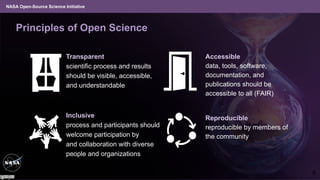
Inclusive
process and participants should
welcome participation by
and collaboration with diverse
people and organizations
Transparent
scientific process and results
should be visible, accessible,
and understandable
Accessible
data, tools, software,
documentation, and
publications should be
accessible to all (FAIR)
Reproducible
reproducible by members of
the community
Principles of Open Science
5
NASA Open-Source Science Initiative
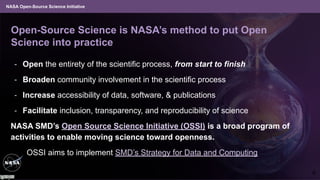
Open-Source Science is NASA’s method to put Open
Science into practice
- Open the entirety of the scientific process, from start to finish
- Broaden community involvement in the scientific process
- Increase accessibility of data, software, & publications
- Facilitate inclusion, transparency, and reproducibility of science
NASA SMD’s Open Source Science Initiative (OSSI) is a broad program of
activities to enable moving science toward openness.
OSSI aims to implement SMD’s Strategy for Data and Computing
6
NASA Open-Source Science Initiative
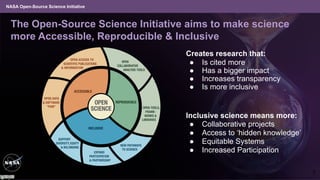
The Open-Source Science Initiative aims to make science
more Accessible, Reproducible & Inclusive
Creates research that:
● Is cited more
● Has a bigger impact
● Increases transparency
● Is more inclusive
Inclusive science means more:
● Collaborative projects
● Access to ‘hidden knowledge’
● Equitable Systems
● Increased Participation
7
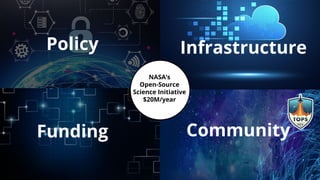
Community
Funding
Infrastructure
Policy
NASA’s
Open-Source
Science Initiative
$20M/year
8
NASA Open-Source Science Initiative
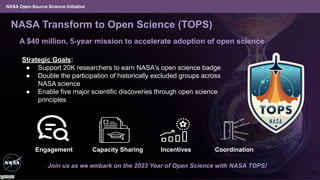
NASA Transform to Open Science (TOPS)
A $40 million, 5-year mission to accelerate adoption of open science
Strategic Goals:
● Support 20K researchers to earn NASA's open science badge
● Double the participation of historically excluded groups across
NASA science
● Enable five major scientific discoveries through open science
principles
Engagement Incentives Coordination
Capacity Sharing
Join us as we embark on the 2023 Year of Open Science with NASA TOPS!
9
NASA Open-Source Science Initiative
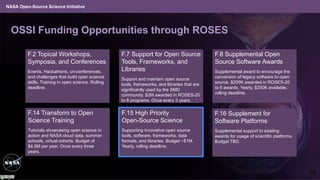
OSSI Funding Opportunities through ROSES
F.16 Supplement for
Software Platforms
Supplemental support to existing
awards for usage of scientific platforms.
Budget TBD.
F.2 Topical Workshops,
Symposia, and Conferences
Events, Hackathons, un-conferences,
and challenges that build open science
skills, Training in open science. Rolling
deadline.
F.7 Support for Open Source
Tools, Frameworks, and
Libraries
Support and maintain open source
tools, frameworks, and libraries that are
significantly used by the SMD
community. $2M awarded in ROSES-20
to 8 programs. Once every 3 years.
F.8 Supplemental Open
Source Software Awards
Supplemental award to encourage the
conversion of legacy software to open
source. $200K awarded in ROSES-20
to 6 awards. Yearly, $250K available,
rolling deadline.
F.15 High Priority
Open-Source Science
Supporting innovative open source
tools, software, frameworks, data
formats, and libraries. Budget ~$1M.
Yearly, rolling deadline.
F.14 Transform to Open
Science Training
Tutorials showcasing open science in
action and NASA cloud data, summer
schools, virtual cohorts. Budget of
$4.5M per year. Once every three
years.
10
High Priority
Open-Source Science
Program Overview
11
NASA Open-Source Science Initiative
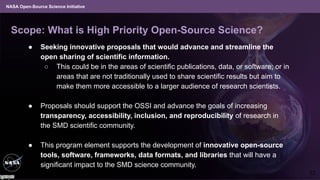
Scope: What is High Priority Open-Source Science?
● Seeking innovative proposals that would advance and streamline the
open sharing of scientific information.
○ This could be in the areas of scientific publications, data, or software; or in
areas that are not traditionally used to share scientific results but aim to
make them more accessible to a larger audience of research scientists.
● Proposals should support the OSSI and advance the goals of increasing
transparency, accessibility, inclusion, and reproducibility of research in
the SMD scientific community.
● This program element supports the development of innovative open-source
tools, software, frameworks, data formats, and libraries that will have a
significant impact to the SMD science community.
12
NASA Open-Source Science Initiative
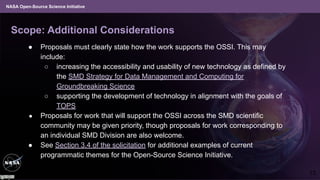
Scope: Additional Considerations
● Proposals must clearly state how the work supports the OSSI. This may
include:
○ increasing the accessibility and usability of new technology as defined by
the SMD Strategy for Data Management and Computing for
Groundbreaking Science
○ supporting the development of technology in alignment with the goals of
TOPS
● Proposals for work that will support the OSSI across the SMD scientific
community may be given priority, though proposals for work corresponding to
an individual SMD Division are also welcome.
● See Section 3.4 of the solicitation for additional examples of current
programmatic themes for the Open-Source Science Initiative.
13
NASA Open-Source Science Initiative
Scope: Additional Considerations
● Proposals submitted in response to this program element must be for new
work that is not currently supported by SMD.
● Proposals may expand existing SMD-supported projects with the addition
of innovative open-source tools, software, frameworks, data formats, and
libraries, as long as these are new additions that are not currently supported
by SMD.
● Innovative projects related directly to answering a scientific question
using new tools or software development are to be submitted to the relevant
program in each SMD Division, e.g., D.2 Astrophysics Data Analysis, B.20
Heliophysics Tools and Methods, and F.19 Multidomain Reusable Artificial
Intelligence Tools.
14
NASA Open-Source Science Initiative
What will an HPOSS award entail?
● Each award will be approximately $100,000.
● Proposals submitted to this program element will be expected to
complete the work within one year.
15
● ROSES-2022 (apply by March 29, 2023)
○ $300,000 to support 3-5 awards of ~$100,000
● Planned for ROSES-2023 (apply after March 29, 2023)
○ $1,000,000 to support 6-10 awards of ~$100,000
How many awards will be made?
NASA Open-Source Science Initiative
Who is eligible for this program?
Eligibility for ROSES funding is based on the proposing organization, not the individual investigator.
See section III of the ROSES-2022 Summary of Solicitation for full details on eligibility.
Participation is open to all categories of U.S. institutions including:
- Educational,
- For-profit, and not-for-profit organizations,
- Federally Funded Research and Development Centers,
- University Affiliated Research Centers,
- NASA Centers including JPL, and
- other Government agencies
Proposals from non-U.S. institutions are welcome, but they must be on a no-exchange-of-funds
basis; funding may not be requested to support activities at non-US institutions but may be requested to
support activities at US institutions, e.g., for funding a Co-Investigator at a U.S. institution.
NOTE: Restriction on NASA funding involving China, see the ROSES Summary of Solicitation for details.
16
Proposal Preparation
and Review Highlights
17
NASA Open-Source Science Initiative
When are proposals due?
HPOSS accepts proposals on a rolling basis. There is No Due Date (NoDD).
● Proposals will be reviewed throughout the year.
● There is no need to submit a Notice of Intent (NOI) for HPOSS.
● Apply by March 29, 2023 for ROSES-2022.
● After March 29, 2023, you may apply for HPOSS under ROSES-2023.
● A proposal may not be resubmitted to the same or another program in the same ROSES
year or to any NoDD program within one year of the most recent submission
● See Section 4.1 of the solicitation for more details on NoDD submissions.
18
NASA Open-Source Science Initiative
What is an Open-Source Science Development Plan?
● Proposals must include an Open-Source Science Development Plan that describes
how the scientific information resulting from the work will be made openly available.
○ The plan must describe the management of the data, software, and publications
developed as part of the project and how they will be released openly.
○ The plan can also include any other activities that will support the sharing of
scientific information.
● 2 page limit, anonymized, follow policies or guidance from the SMD Division most
relevant to the proposal.
● These plans will become standard for ROSES proposals starting with ROSES-23,
under the name ‘Open Science and Data Management Plan’.
● See the SMD Open-Source Science Guidance for suggested components of an
OSDMP.
19
NASA Open-Source Science Initiative
What is Dual-Anonymous Peer-Review?
● Proposals submitted to this program will be evaluated using a dual-anonymous
peer review (DAPR) process.
● Proposers are unaware of identify of reviewers; reviewers are not told the identity
of the proposers until after evaluation of anonymized components of proposals.
● The objective of DAPR is to minimize bias in the evaluation of the merit of a
proposal.
● Please follow the instructions in Section 4.3 of the solicitation to prepare your
proposal for DAPR.
● Learn more: https://science.nasa.gov/researchers/dual-anonymous-peer-review
20
NASA Open-Source Science Initiative
How will proposals be evaluated?
The following elements must be included in the proposal to allow for evaluation:
● A clear description of the project and relevance to the SMD science community and the
relationship to the NASA SMD Science Vision and Strategy for Data Management and
Computing for Groundbreaking Science
● The development activities to be undertaken for the project (i.e., the innovative
technology to be developed as part of the project and the work to be done to develop the
technology)
● The project management approach (i.e., governance and development model,
accessibility information, and timeline for completing the project)
For proposals advancing an existing project with the addition of innovative open-source
tools, software, frameworks, data formats, and libraries, there must be clear support from
the leadership of that project. 21
See Section 4 of the solicitation for
full details.
Resources and
Contact Information
22
NASA Open-Source Science Initiative
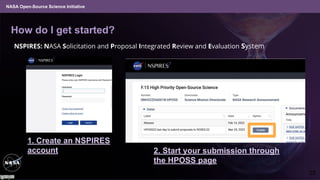
How do I get started?
23
NSPIRES: NASA Solicitation and Proposal Integrated Review and Evaluation System
1. Create an NSPIRES
account 2. Start your submission through
the HPOSS page
NASA Open-Source Science Initiative
HPOSS Resources and Contact Information
Resources
1. HPOSS page on NSPIRES
Access official documentation
Submit your proposal
Coming soon: today’s presentation & FAQ
2. General ROSES Guidance
The NASA Guidebook for Proposers - 2022
- ROSES FAQ
ROSES How to Guide
Points of Contact
Rachel Paseka
rachel.e.paseka@nasa.gov
(202) 731-3575
Steve Crawford
steven.m.crawford@nasa.gov
(202) 596-0442
24
Question &
Answer
25
Please submit your questions here:
https://nasa.cnf.io/sessions/tgn4/#!/dashboard
Backup Slides
26
NASA Open-Source Science Initiative
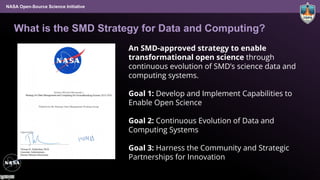
An SMD-approved strategy to enable
transformational open science through
continuous evolution of SMD’s science data and
computing systems.
Goal 1: Develop and Implement Capabilities to
Enable Open Science
Goal 2: Continuous Evolution of Data and
Computing Systems
Goal 3: Harness the Community and Strategic
Partnerships for Innovation
What is the SMD Strategy for Data and Computing?
27
NASA Open-Source Science Initiative
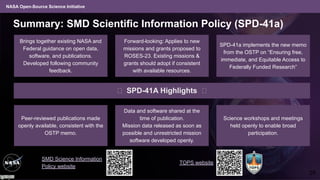
Summary: SMD Scientific Information Policy (SPD-41a)
Data and software shared at the
time of publication.
Mission data released as soon as
possible and unrestricted mission
software developed openly.
Brings together existing NASA and
Federal guidance on open data,
software, and publications.
Developed following community
feedback.
Forward-looking: Applies to new
missions and grants proposed to
ROSES-23. Existing missions &
grants should adopt if consistent
with available resources.
SPD-41a implements the new memo
from the OSTP on “Ensuring free,
immediate, and Equitable Access to
Federally Funded Research”
🠋 SPD-41A Highlights 🠋
Science workshops and meetings
held openly to enable broad
participation.
Peer-reviewed publications made
openly available, consistent with the
OSTP memo.
SMD Science Information
Policy website
TOPS website
28
NASA Open-Source Science Initiative
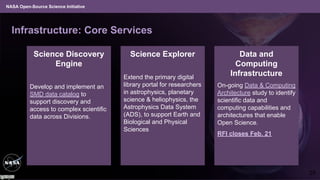
Infrastructure: Core Services
Science Discovery
Engine
Develop and implement an
SMD data catalog to
support discovery and
access to complex scientific
data across Divisions.
Science Explorer
Extend the primary digital
library portal for researchers
in astrophysics, planetary
science & heliophysics, the
Astrophysics Data System
(ADS), to support Earth and
Biological and Physical
Sciences
Data and
Computing
Infrastructure
On-going Data & Computing
Architecture study to identify
scientific data and
computing capabilities and
architectures that enable
Open Science.
RFI closes Feb. 21
29

High Priority Open-Source Science (HPOSS)

  • 1.
    NASA Science MissionDirectorate (SMD) F.15 High Priority Open-Source Science (HPOSS) Information Session January 19, 2023 Dr. Rachel Paseka, SMD Support Scientist & Program Officer Dr. Steve Crawford, SMD Science Data Officer Cynthia Hall, NASA TOPS Community Engagement 1
  • 2.
    NASA Open-Source ScienceInitiative How to Participate in Today’s Event ● We are recording today’s event. The slides and presentation recording will be posted. ● Please submit your questions here: https://nasa.cnf.io/sessions/tgn4/#!/dashboard ● Attendees are muted by default. Please raise your hand if you would like to ask a question aloud. ● Questions from today’s event will be added to a list of Frequently Asked Questions, to be posted on NSPIRES. 2
  • 3.
    NASA Open-Source ScienceInitiative Agenda ● Background on NASA’s Open-Source Science Initiative ● High Priority Open-Source Science Program Overview ● Proposal Preparation and Review Highlights ● Question & Answer 3
  • 4.
  • 5.
    NASA Open-Source ScienceInitiative Inclusive process and participants should welcome participation by and collaboration with diverse people and organizations Transparent scientific process and results should be visible, accessible, and understandable Accessible data, tools, software, documentation, and publications should be accessible to all (FAIR) Reproducible reproducible by members of the community Principles of Open Science 5
  • 6.
    NASA Open-Source ScienceInitiative Open-Source Science is NASA’s method to put Open Science into practice - Open the entirety of the scientific process, from start to finish - Broaden community involvement in the scientific process - Increase accessibility of data, software, & publications - Facilitate inclusion, transparency, and reproducibility of science NASA SMD’s Open Source Science Initiative (OSSI) is a broad program of activities to enable moving science toward openness. OSSI aims to implement SMD’s Strategy for Data and Computing 6
  • 7.
    NASA Open-Source ScienceInitiative The Open-Source Science Initiative aims to make science more Accessible, Reproducible & Inclusive Creates research that: ● Is cited more ● Has a bigger impact ● Increases transparency ● Is more inclusive Inclusive science means more: ● Collaborative projects ● Access to ‘hidden knowledge’ ● Equitable Systems ● Increased Participation 7
  • 8.
  • 9.
    NASA Open-Source ScienceInitiative NASA Transform to Open Science (TOPS) A $40 million, 5-year mission to accelerate adoption of open science Strategic Goals: ● Support 20K researchers to earn NASA's open science badge ● Double the participation of historically excluded groups across NASA science ● Enable five major scientific discoveries through open science principles Engagement Incentives Coordination Capacity Sharing Join us as we embark on the 2023 Year of Open Science with NASA TOPS! 9
  • 10.
    NASA Open-Source ScienceInitiative OSSI Funding Opportunities through ROSES F.16 Supplement for Software Platforms Supplemental support to existing awards for usage of scientific platforms. Budget TBD. F.2 Topical Workshops, Symposia, and Conferences Events, Hackathons, un-conferences, and challenges that build open science skills, Training in open science. Rolling deadline. F.7 Support for Open Source Tools, Frameworks, and Libraries Support and maintain open source tools, frameworks, and libraries that are significantly used by the SMD community. $2M awarded in ROSES-20 to 8 programs. Once every 3 years. F.8 Supplemental Open Source Software Awards Supplemental award to encourage the conversion of legacy software to open source. $200K awarded in ROSES-20 to 6 awards. Yearly, $250K available, rolling deadline. F.15 High Priority Open-Source Science Supporting innovative open source tools, software, frameworks, data formats, and libraries. Budget ~$1M. Yearly, rolling deadline. F.14 Transform to Open Science Training Tutorials showcasing open science in action and NASA cloud data, summer schools, virtual cohorts. Budget of $4.5M per year. Once every three years. 10
  • 11.
  • 12.
    NASA Open-Source ScienceInitiative Scope: What is High Priority Open-Source Science? ● Seeking innovative proposals that would advance and streamline the open sharing of scientific information. ○ This could be in the areas of scientific publications, data, or software; or in areas that are not traditionally used to share scientific results but aim to make them more accessible to a larger audience of research scientists. ● Proposals should support the OSSI and advance the goals of increasing transparency, accessibility, inclusion, and reproducibility of research in the SMD scientific community. ● This program element supports the development of innovative open-source tools, software, frameworks, data formats, and libraries that will have a significant impact to the SMD science community. 12
  • 13.
    NASA Open-Source ScienceInitiative Scope: Additional Considerations ● Proposals must clearly state how the work supports the OSSI. This may include: ○ increasing the accessibility and usability of new technology as defined by the SMD Strategy for Data Management and Computing for Groundbreaking Science ○ supporting the development of technology in alignment with the goals of TOPS ● Proposals for work that will support the OSSI across the SMD scientific community may be given priority, though proposals for work corresponding to an individual SMD Division are also welcome. ● See Section 3.4 of the solicitation for additional examples of current programmatic themes for the Open-Source Science Initiative. 13
  • 14.
    NASA Open-Source ScienceInitiative Scope: Additional Considerations ● Proposals submitted in response to this program element must be for new work that is not currently supported by SMD. ● Proposals may expand existing SMD-supported projects with the addition of innovative open-source tools, software, frameworks, data formats, and libraries, as long as these are new additions that are not currently supported by SMD. ● Innovative projects related directly to answering a scientific question using new tools or software development are to be submitted to the relevant program in each SMD Division, e.g., D.2 Astrophysics Data Analysis, B.20 Heliophysics Tools and Methods, and F.19 Multidomain Reusable Artificial Intelligence Tools. 14
  • 15.
    NASA Open-Source ScienceInitiative What will an HPOSS award entail? ● Each award will be approximately $100,000. ● Proposals submitted to this program element will be expected to complete the work within one year. 15 ● ROSES-2022 (apply by March 29, 2023) ○ $300,000 to support 3-5 awards of ~$100,000 ● Planned for ROSES-2023 (apply after March 29, 2023) ○ $1,000,000 to support 6-10 awards of ~$100,000 How many awards will be made?
  • 16.
    NASA Open-Source ScienceInitiative Who is eligible for this program? Eligibility for ROSES funding is based on the proposing organization, not the individual investigator. See section III of the ROSES-2022 Summary of Solicitation for full details on eligibility. Participation is open to all categories of U.S. institutions including: - Educational, - For-profit, and not-for-profit organizations, - Federally Funded Research and Development Centers, - University Affiliated Research Centers, - NASA Centers including JPL, and - other Government agencies Proposals from non-U.S. institutions are welcome, but they must be on a no-exchange-of-funds basis; funding may not be requested to support activities at non-US institutions but may be requested to support activities at US institutions, e.g., for funding a Co-Investigator at a U.S. institution. NOTE: Restriction on NASA funding involving China, see the ROSES Summary of Solicitation for details. 16
  • 17.
  • 18.
    NASA Open-Source ScienceInitiative When are proposals due? HPOSS accepts proposals on a rolling basis. There is No Due Date (NoDD). ● Proposals will be reviewed throughout the year. ● There is no need to submit a Notice of Intent (NOI) for HPOSS. ● Apply by March 29, 2023 for ROSES-2022. ● After March 29, 2023, you may apply for HPOSS under ROSES-2023. ● A proposal may not be resubmitted to the same or another program in the same ROSES year or to any NoDD program within one year of the most recent submission ● See Section 4.1 of the solicitation for more details on NoDD submissions. 18
  • 19.
    NASA Open-Source ScienceInitiative What is an Open-Source Science Development Plan? ● Proposals must include an Open-Source Science Development Plan that describes how the scientific information resulting from the work will be made openly available. ○ The plan must describe the management of the data, software, and publications developed as part of the project and how they will be released openly. ○ The plan can also include any other activities that will support the sharing of scientific information. ● 2 page limit, anonymized, follow policies or guidance from the SMD Division most relevant to the proposal. ● These plans will become standard for ROSES proposals starting with ROSES-23, under the name ‘Open Science and Data Management Plan’. ● See the SMD Open-Source Science Guidance for suggested components of an OSDMP. 19
  • 20.
    NASA Open-Source ScienceInitiative What is Dual-Anonymous Peer-Review? ● Proposals submitted to this program will be evaluated using a dual-anonymous peer review (DAPR) process. ● Proposers are unaware of identify of reviewers; reviewers are not told the identity of the proposers until after evaluation of anonymized components of proposals. ● The objective of DAPR is to minimize bias in the evaluation of the merit of a proposal. ● Please follow the instructions in Section 4.3 of the solicitation to prepare your proposal for DAPR. ● Learn more: https://science.nasa.gov/researchers/dual-anonymous-peer-review 20
  • 21.
    NASA Open-Source ScienceInitiative How will proposals be evaluated? The following elements must be included in the proposal to allow for evaluation: ● A clear description of the project and relevance to the SMD science community and the relationship to the NASA SMD Science Vision and Strategy for Data Management and Computing for Groundbreaking Science ● The development activities to be undertaken for the project (i.e., the innovative technology to be developed as part of the project and the work to be done to develop the technology) ● The project management approach (i.e., governance and development model, accessibility information, and timeline for completing the project) For proposals advancing an existing project with the addition of innovative open-source tools, software, frameworks, data formats, and libraries, there must be clear support from the leadership of that project. 21 See Section 4 of the solicitation for full details.
  • 22.
  • 23.
    NASA Open-Source ScienceInitiative How do I get started? 23 NSPIRES: NASA Solicitation and Proposal Integrated Review and Evaluation System 1. Create an NSPIRES account 2. Start your submission through the HPOSS page
  • 24.
    NASA Open-Source ScienceInitiative HPOSS Resources and Contact Information Resources 1. HPOSS page on NSPIRES Access official documentation Submit your proposal Coming soon: today’s presentation & FAQ 2. General ROSES Guidance The NASA Guidebook for Proposers - 2022 - ROSES FAQ ROSES How to Guide Points of Contact Rachel Paseka rachel.e.paseka@nasa.gov (202) 731-3575 Steve Crawford steven.m.crawford@nasa.gov (202) 596-0442 24
  • 25.
    Question & Answer 25 Please submityour questions here: https://nasa.cnf.io/sessions/tgn4/#!/dashboard
  • 26.
  • 27.
    NASA Open-Source ScienceInitiative An SMD-approved strategy to enable transformational open science through continuous evolution of SMD’s science data and computing systems. Goal 1: Develop and Implement Capabilities to Enable Open Science Goal 2: Continuous Evolution of Data and Computing Systems Goal 3: Harness the Community and Strategic Partnerships for Innovation What is the SMD Strategy for Data and Computing? 27
  • 28.
    NASA Open-Source ScienceInitiative Summary: SMD Scientific Information Policy (SPD-41a) Data and software shared at the time of publication. Mission data released as soon as possible and unrestricted mission software developed openly. Brings together existing NASA and Federal guidance on open data, software, and publications. Developed following community feedback. Forward-looking: Applies to new missions and grants proposed to ROSES-23. Existing missions & grants should adopt if consistent with available resources. SPD-41a implements the new memo from the OSTP on “Ensuring free, immediate, and Equitable Access to Federally Funded Research” 🠋 SPD-41A Highlights 🠋 Science workshops and meetings held openly to enable broad participation. Peer-reviewed publications made openly available, consistent with the OSTP memo. SMD Science Information Policy website TOPS website 28
  • 29.
    NASA Open-Source ScienceInitiative Infrastructure: Core Services Science Discovery Engine Develop and implement an SMD data catalog to support discovery and access to complex scientific data across Divisions. Science Explorer Extend the primary digital library portal for researchers in astrophysics, planetary science & heliophysics, the Astrophysics Data System (ADS), to support Earth and Biological and Physical Sciences Data and Computing Infrastructure On-going Data & Computing Architecture study to identify scientific data and computing capabilities and architectures that enable Open Science. RFI closes Feb. 21 29