Informed search algorithms
Lecture 4
Introduction
• Heuristics are formalized as rules for choosing
those branches in a state space that are most
likely to lead to an acceptable problem solution.
• Much more efficient than un-informed searches.
• Heuristics are employed in two basic situations:
– A problem may not have an exact solution because of
inherent ambiguities in the problem statement or
available data
– A problem may have an exact solution, but the
computational cost of finding it may be prohibitive
Limitations
• Heuristics are fallible
• Only an informed guess of the next step to
be taken in solving a problem
• Based on limited information
• Often based on experience or intuition
• Heuristic algorithm has two parts
– The heuristic measurement
– An algorithm that uses it to search the state
space (best first search)
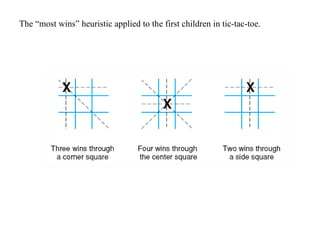
The “most wins” heuristic applied to the first children in tic-tac-toe.
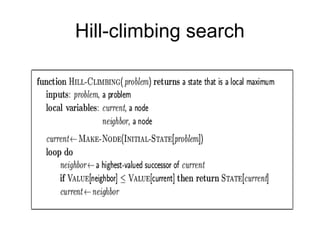
Hill Climbing Search
• The simplest way to implement a heuristic search
• Like climbing the Mount Everest in thick fog with
amnesia
• Hill climbing strategies expand the current state in
the search and evaluate its children
• The best child is selected for further expansion;
neither its parent nor its siblings are retained
• Search halts when it reaches a state that is better
than any of its children
Hill-climbing search
Limitations of Hill Climbing Search
• Because it keeps no history, the algorithm
cannot recover from failure of its strategy
• Tendency to become stuck in local
maxima
Hill-climbing search Example
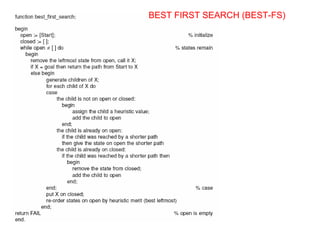
BEST FIRST SEARCH (BEST-FS)
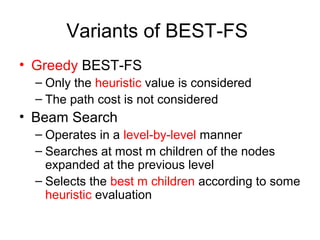
Variants of BEST-FS
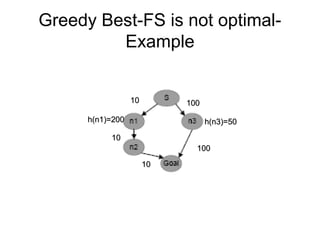
• Greedy BEST-FS
– Only the heuristic value is considered
– The path cost is not considered
• Beam Search
– Operates in a level-by-level manner
– Searches at most m children of the nodes
expanded at the previous level
– Selects the best m children according to some
heuristic evaluation
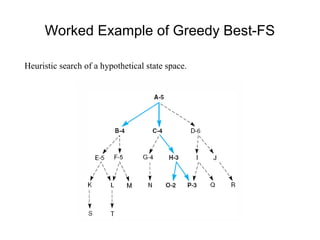
Heuristic search of a hypothetical state space.
Worked Example of Greedy Best-FS
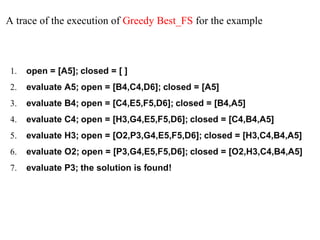
A trace of the execution of Greedy Best_FS for the example
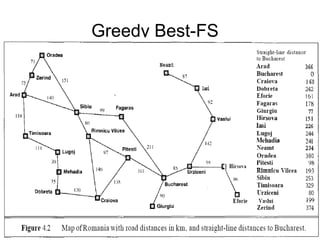
Greedy Best-FS
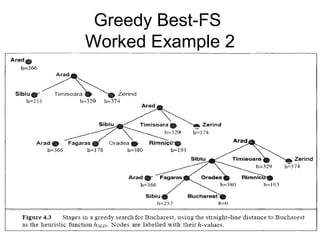
Greedy Best-FS
Worked Example 2
Greedy Best-FS is not optimal-
Example
h(n1)=200h(n1)=200 h(n3)=50h(n3)=50
100100
100100
1010
1010
1010
Implementing heuristic evaluation
functions (A* Search)
• Because heuristics are fallible, it is
possible that a search algorithm can be
misled down some path that fails to lead to
a goal
• If two states have approximately the same
heuristic value, examine the state that is
nearest to the root of the state graph.
• This state will have a greater chance of
being on the shortest path to the goal
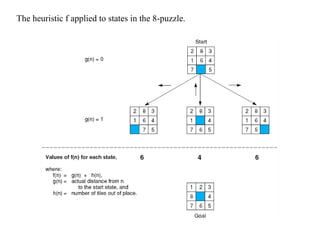
• this makes our evaluation function, f, the
sum of two components
f(n)=g(n)+h(n)
• where g(n) measures the actual length of
the path from any state n to the start state.
• h(n) is an admissible heuristic estimate of
the distance from state n to a goal
A* Search
The heuristic f applied to states in the 8-puzzle.
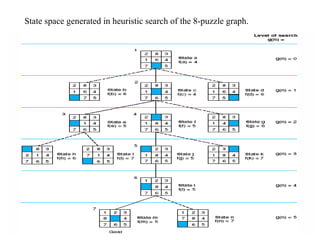
State space generated in heuristic search of the 8-puzzle graph.
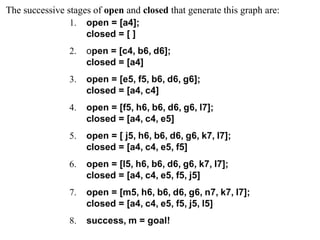
The successive stages of open and closed that generate this graph are:

heuristic search

  • 1.
  • 2.
    Introduction • Heuristics areformalized as rules for choosing those branches in a state space that are most likely to lead to an acceptable problem solution. • Much more efficient than un-informed searches. • Heuristics are employed in two basic situations: – A problem may not have an exact solution because of inherent ambiguities in the problem statement or available data – A problem may have an exact solution, but the computational cost of finding it may be prohibitive
  • 3.
    Limitations • Heuristics arefallible • Only an informed guess of the next step to be taken in solving a problem • Based on limited information • Often based on experience or intuition • Heuristic algorithm has two parts – The heuristic measurement – An algorithm that uses it to search the state space (best first search)
  • 4.
    The “most wins”heuristic applied to the first children in tic-tac-toe.
  • 5.
    Hill Climbing Search •The simplest way to implement a heuristic search • Like climbing the Mount Everest in thick fog with amnesia • Hill climbing strategies expand the current state in the search and evaluate its children • The best child is selected for further expansion; neither its parent nor its siblings are retained • Search halts when it reaches a state that is better than any of its children
  • 6.
  • 7.
    Limitations of HillClimbing Search • Because it keeps no history, the algorithm cannot recover from failure of its strategy • Tendency to become stuck in local maxima
  • 8.
  • 9.
  • 10.
    Variants of BEST-FS •Greedy BEST-FS – Only the heuristic value is considered – The path cost is not considered • Beam Search – Operates in a level-by-level manner – Searches at most m children of the nodes expanded at the previous level – Selects the best m children according to some heuristic evaluation
  • 11.
    Heuristic search ofa hypothetical state space. Worked Example of Greedy Best-FS
  • 12.
    A trace ofthe execution of Greedy Best_FS for the example
  • 13.
  • 14.
  • 15.
    Greedy Best-FS isnot optimal- Example h(n1)=200h(n1)=200 h(n3)=50h(n3)=50 100100 100100 1010 1010 1010
  • 16.
    Implementing heuristic evaluation functions(A* Search) • Because heuristics are fallible, it is possible that a search algorithm can be misled down some path that fails to lead to a goal • If two states have approximately the same heuristic value, examine the state that is nearest to the root of the state graph. • This state will have a greater chance of being on the shortest path to the goal
  • 17.
    • this makesour evaluation function, f, the sum of two components f(n)=g(n)+h(n) • where g(n) measures the actual length of the path from any state n to the start state. • h(n) is an admissible heuristic estimate of the distance from state n to a goal A* Search
  • 18.
    The heuristic fapplied to states in the 8-puzzle.
  • 19.
    State space generatedin heuristic search of the 8-puzzle graph.
  • 20.
    The successive stagesof open and closed that generate this graph are:

Editor's Notes