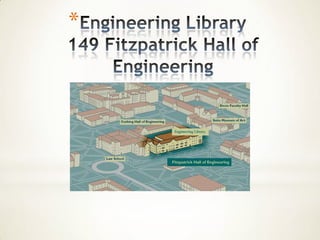
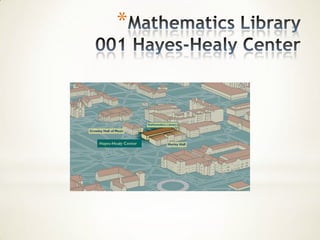
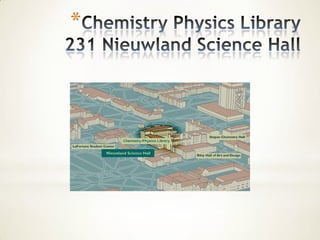
*
    Naomi Bishop
    Librarian in Residence
*
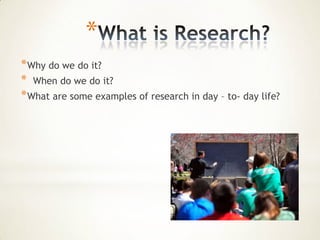
* Why do we do it?
* When do we do it?
* What are some examples of research in day – to- day life?
*
*
What we do…
* acquire and organize information resources (like books,
 journals, and electronic databases);
* assist faculty, staff, and graduate/ undergraduate students in
 identifying and using the resources;
* and strive to preserve resources for future users as a record
 of collective knowledge
* Teach, train, and help researchers, professors,
 administrators, and students do their jobs.
Information Literacy n. the ability to
identify, locate, analyze, synthesize, and
present information to solve a specific
problem.


               *
*


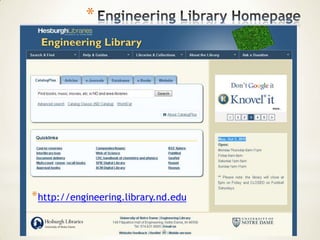
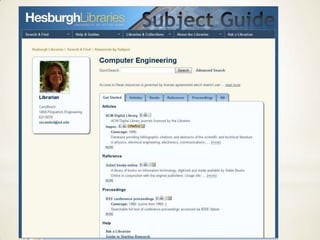
* http://engineering.library.nd.edu
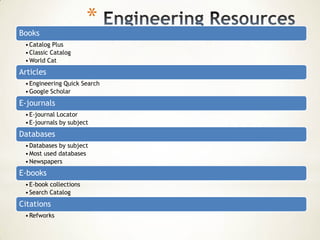
Books
                        *
 • Catalog Plus
 • Classic Catalog
 • World Cat
Articles
 • Engineering Quick Search
 • Google Scholar
E-journals
 • E-journal Locator
 • E-journals by subject
Databases
 • Databases by subject
 • Most used databases
 • Newspapers
E-books
 • E-book collections
 • Search Catalog
Citations
 • Refworks
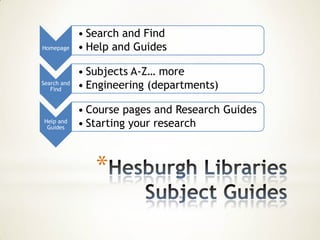
• Search and Find
Homepage     • Help and Guides

             • Subjects A-Z… more
Search and
   Find      • Engineering (departments)

             • Course pages and Research Guides
Help and
 Guides      • Starting your research


                *
*
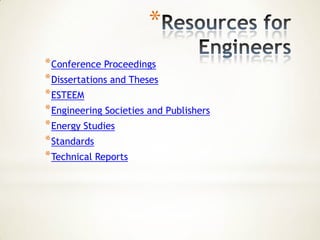
* Conference Proceedings
* Dissertations and Theses
* ESTEEM
* Engineering Societies and Publishers
* Energy Studies
* Standards
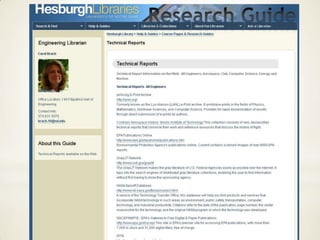
* Technical Reports
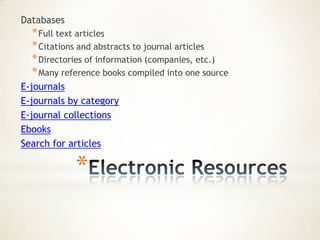
Databases
  * Full text articles
  * Citations and abstracts to journal articles
  * Directories of information (companies, etc.)
  * Many reference books compiled into one source
E-journals
E-journals by category
E-journal collections
Ebooks
Search for articles

            *
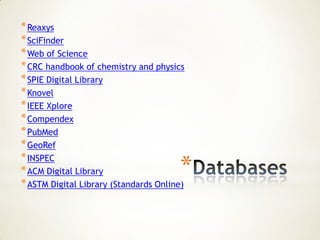
* Reaxys
* SciFinder
* Web of Science
* CRC handbook of chemistry and physics
* SPIE Digital Library
* Knovel
* IEEE Xplore
* Compendex
* PubMed
* GeoRef

                                       *
* INSPEC
* ACM Digital Library
* ASTM Digital Library (Standards Online)
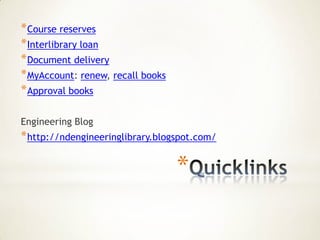
* Course reserves
* Interlibrary loan
* Document delivery
* MyAccount: renew, recall books
* Approval books

Engineering Blog
* http://ndengineeringlibrary.blogspot.com/

                                   *
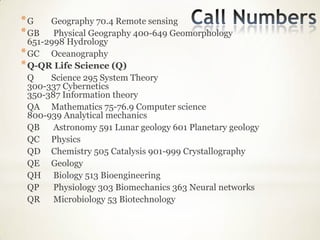
*G     Geography 70.4 Remote sensing
* GB    Physical Geography 400-649 Geomorphology
  651-2998 Hydrology
* GC Oceanography
* Q-QR Life Science (Q)
  Q    Science 295 System Theory
  300-337 Cybernetics
  350-387 Information theory
  QA Mathematics 75-76.9 Computer science
  800-939 Analytical mechanics
  QB    Astronomy 591 Lunar geology 601 Planetary geology
  QC Physics
  QD Chemistry 505 Catalysis 901-999 Crystallography
  QE Geology
  QH Biology 513 Bioengineering
  QP    Physiology 303 Biomechanics 363 Neural networks
  QR Microbiology 53 Biotechnology
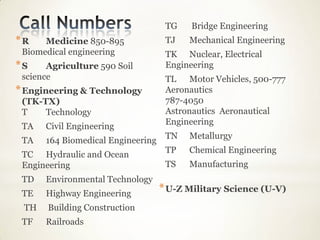
TG    Bridge Engineering
*R    Medicine 850-895              TJ   Mechanical Engineering
 Biomedical engineering             TK Nuclear, Electrical
*S     Agriculture 590 Soil         Engineering
 science                            TL Motor Vehicles, 500-777
* Engineering & Technology          Aeronautics
 (TK-TX)                            787-4050
 T    Technology                    Astronautics Aeronautical
                                    Engineering
 TA   Civil Engineering
                                    TN   Metallurgy
 TA   164 Biomedical Engineering
                                    TP   Chemical Engineering
 TC Hydraulic and Ocean
 Engineering                        TS   Manufacturing
 TD   Environmental Technology
 TE   Highway Engineering
                                   * U-Z Military Science (U-V)
 TH    Building Construction
 TF   Railroads
*
*
*
*
* Always remember to cite your sources using a standard
   format.


  Failure to cite is plagiarism!!


  * If you’re not sure how to do something, just ask us!

Naomi Bishop, nbishop1@nd.edu Librarian in Residence
Carol Brach, brach10@nd.edu Engineering Librarian

           *
*

Hesburgh libraries 101

  • 1.
    * Naomi Bishop Librarian in Residence
  • 2.
    * * Why dowe do it? * When do we do it? * What are some examples of research in day – to- day life?
  • 3.
  • 4.
    * What we do… *acquire and organize information resources (like books, journals, and electronic databases); * assist faculty, staff, and graduate/ undergraduate students in identifying and using the resources; * and strive to preserve resources for future users as a record of collective knowledge * Teach, train, and help researchers, professors, administrators, and students do their jobs.
  • 5.
    Information Literacy n.the ability to identify, locate, analyze, synthesize, and present information to solve a specific problem. *
  • 6.
  • 7.
    Books * • Catalog Plus • Classic Catalog • World Cat Articles • Engineering Quick Search • Google Scholar E-journals • E-journal Locator • E-journals by subject Databases • Databases by subject • Most used databases • Newspapers E-books • E-book collections • Search Catalog Citations • Refworks
  • 8.
    • Search andFind Homepage • Help and Guides • Subjects A-Z… more Search and Find • Engineering (departments) • Course pages and Research Guides Help and Guides • Starting your research *
  • 11.
    * * Conference Proceedings *Dissertations and Theses * ESTEEM * Engineering Societies and Publishers * Energy Studies * Standards * Technical Reports
  • 12.
    Databases *Full text articles * Citations and abstracts to journal articles * Directories of information (companies, etc.) * Many reference books compiled into one source E-journals E-journals by category E-journal collections Ebooks Search for articles *
  • 13.
    * Reaxys * SciFinder *Web of Science * CRC handbook of chemistry and physics * SPIE Digital Library * Knovel * IEEE Xplore * Compendex * PubMed * GeoRef * * INSPEC * ACM Digital Library * ASTM Digital Library (Standards Online)
  • 14.
    * Course reserves *Interlibrary loan * Document delivery * MyAccount: renew, recall books * Approval books Engineering Blog * http://ndengineeringlibrary.blogspot.com/ *
  • 15.
    *G Geography 70.4 Remote sensing * GB Physical Geography 400-649 Geomorphology 651-2998 Hydrology * GC Oceanography * Q-QR Life Science (Q) Q Science 295 System Theory 300-337 Cybernetics 350-387 Information theory QA Mathematics 75-76.9 Computer science 800-939 Analytical mechanics QB Astronomy 591 Lunar geology 601 Planetary geology QC Physics QD Chemistry 505 Catalysis 901-999 Crystallography QE Geology QH Biology 513 Bioengineering QP Physiology 303 Biomechanics 363 Neural networks QR Microbiology 53 Biotechnology
  • 16.
    TG Bridge Engineering *R Medicine 850-895 TJ Mechanical Engineering Biomedical engineering TK Nuclear, Electrical *S Agriculture 590 Soil Engineering science TL Motor Vehicles, 500-777 * Engineering & Technology Aeronautics (TK-TX) 787-4050 T Technology Astronautics Aeronautical Engineering TA Civil Engineering TN Metallurgy TA 164 Biomedical Engineering TP Chemical Engineering TC Hydraulic and Ocean Engineering TS Manufacturing TD Environmental Technology TE Highway Engineering * U-Z Military Science (U-V) TH Building Construction TF Railroads
  • 17.
  • 18.
  • 19.
  • 20.
  • 21.
    * Always rememberto cite your sources using a standard format. Failure to cite is plagiarism!! * If you’re not sure how to do something, just ask us! Naomi Bishop, nbishop1@nd.edu Librarian in Residence Carol Brach, brach10@nd.edu Engineering Librarian *
  • 22.

Editor's Notes

  • #3 Buying a cell phone with the features you wantFinding a good restaurant in South Bend
  • #6 Knowing what you’re looking for, knowing where to look, being able to separate relevant from irrelevant results, being able to derive meaning from those results, and being able to communicate the content of the information in your own words, either orally or in writing.