A Year of Plants
Herbology Final Review Project
Herbology 101
Professor Tudor
Hogwarts School of Witchcraft and Wizardry
An Introduction to Herbology
What is Herbology?
â—Ź Herbology is the study and use of magical and non-
magical plants.
â—Ź Herbology can be a dangerous field as there are many
poisonous and deadly plants.
â—Ź Herbology has many uses for magical people; a witch or
wizard can use plants in potions and for healing.
â—Ź Every plant, including the non-magical ones, has its own
useful properties.
Necessary Equipment
â—Ź Dragon-hide gloves of a good, strong quality to protect
your hands as well as keep them clean.
â—Ź A wand, because you will need to use magic when
dealing with certain plants.
â—Ź Earmuffs are important, certain plants like the mandrake
can kill you with their cries.
â—Ź Closed toe shoes, an apron, and a mask are also
advised for protection.
Plant Nutrition
â—Ź Dragon Dung can often be used as a fertilizer or a
compost to create fertilizer for soil. It is scentless and
breaks things down exceptionally well due to its high
acidity.
â—Ź Mooncalf Dung is another fertilizer option, though not as
strong as Dragon Dung. This option is better for more
sensitive plants, though it may lack enough nutrients for
the plant.
â—Ź Centaur Tears are a controversial way to bring rich
nutrients to a plant; the tears can revive a dying plant in
moments. They are toxic to some plants.
Class Objectives
â—Ź Students will learn to understand and appreciate
Herbology's role in the Wizarding World.
â—Ź Students will understand the equipment necessary for
Herbology and why it's necessary.
â—Ź To help students appreciate the uniqueness of plants
and understand that different plants need to be cared for
in different ways.
â—Ź For students to understand that first years have no due
dates.
Brewing with Care
Plants and Potion Ingredients
â—Ź Mistletoe Berries and Poppy Heads
â—Ź Rose Thorns and Rose Oil
â—Ź Asphodel and Fluxweed
â—Ź Lovage and Motherwort
â—Ź Nettle and Aconite/monkshood/wolfsbane
â—Ź Valerian Sprigs and Leaping Toadstool
â—Ź Knotgrass and Peppermint
â—Ź Root of Aconite and Shrivelfigs
â—Ź Nux Myristica and Silverweed
â—Ź Snakeweed and Moonstone
â—Ź Starpuffs and Wormwood
Plant Environment
â—Ź Each plant is unique in the same way that humans are,
they need different things to thrive.
â—Ź Certain habitats will only be suitable to one type of plant
versus another.
â—Ź Different plants need different amounts of water, sunlight,
and types of fertilizer.
â—Ź Soil and the depth of the plant seed play an important
role in the plant's development as well as repotting.
Plant Specifics
â—Ź Starpuffs have a hypnotic quality while Moonstone
causes drowsiness.
â—Ź Wormwood and Asphodel can be used to make a very
powerful potion called the Draught of Living Death.
â—Ź Mistletoe Berries cause hallucinations while Valerian
Sprigs are used as a sedative, perfect for the
Forgetfulness Potion.
â—Ź Plants are chosen for potions based on their properties.
Healers would use non-toxic plants that have healing
powers, while flowers might be used in beauty potions.
Herbsand FungiGillyweed
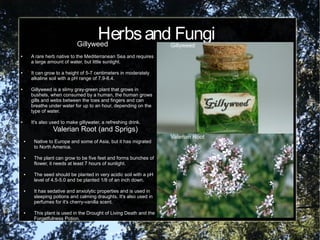
â—Ź A rare herb native to the Mediterranean Sea and requires
a large amount of water, but little sunlight.
â—Ź It can grow to a height of 5-7 centimeters in moderately
alkaline soil with a pH range of 7.9-8.4.
â—Ź Gillyweed is a slimy gray-green plant that grows in
bushels, when consumed by a human, the human grows
gills and webs between the toes and fingers and can
breathe under water for up to an hour, depending on the
type of water.
â—Ź It's also used to make gillywater, a refreshing drink.
Gillyweed
Valerian Root
Valerian Root (and Sprigs)
â—Ź Native to Europe and some of Asia, but it has migrated
to North America.
â—Ź The plant can grow to be five feet and forms bunches of
flower, it needs at least 7 hours of sunlight.
â—Ź The seed should be planted in very acidic soil with a pH
level of 4.5-5.0 and be planted 1/8 of an inch down.
â—Ź It has sedative and anxiolytic properties and is used in
sleeping potions and calming draughts. It's also used in
perfumes for it's cherry-vanilla scent.
â—Ź This plant is used in the Drought of Living Death and the
Forgetfulness Potion.
Herbsand Fungi Pt. 2
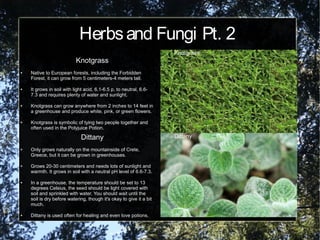
Knotgrass
â—Ź Native to European forests, including the Forbidden
Forest, it can grow from 5 centimeters-4 meters tall.
â—Ź It grows in soil with light acid, 6.1-6.5 p, to neutral, 6.6-
7.3 and requires plenty of water and sunlight.
â—Ź Knotgrass can grow anywhere from 2 inches to 14 feet in
a greenhouse and produce white, pink, or green flowers.
â—Ź Knotgrass is symbolic of tying two people together and
often used in the Polyjuice Potion.
Knotgrass
DittanyDittany
â—Ź Only grows naturally on the mountainside of Crete,
Greece, but it can be grown in greenhouses.
â—Ź Grows 20-30 centimeters and needs lots of sunlight and
warmth. It grows in soil with a neutral pH level of 6.6-7.3.
â—Ź In a greenhouse, the temperature should be set to 13
degrees Celsius, the seed should be light covered with
soil and sprinkled with water. You should wait until the
soil is dry before watering, though it's okay to give it a bit
much.
â—Ź Dittany is used often for healing and even love potions.
Risky Business
Dangerous Plants
â—Ź Not all magical and non-magical plants are exactly
friendly or harmless. There are many dangerous plants
used in the Wizarding World.
â—Ź While studying Herbology, students will be exposed to
several dangerous plants, some can even kill you.
â—Ź It is extremely important that students understand how to
care for dangerous plants and know what precautions to
take when dealing with them.
â—Ź Protective gear is extremely important when dealing with
plants that can endanger students.
â—Ź It is also important that the students know certain spells
and the proper way to save themselves or someone else
if they should be harmed or ensnared by a dangerous
plant.
â—Ź Like the more harmless plants, dangerous plants also
have many uses in potions and the magical world, so it's
necessary to learn how to care for them.
â—Ź These plants also have their own needs when it comes
to habitat, soil, sunlight, and water.
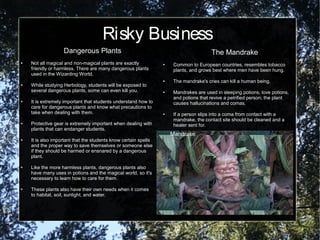
The Mandrake
â—Ź Common to European countries, resembles tobacco
plants, and grows best where men have been hung.
â—Ź The mandrake's cries can kill a human being.
â—Ź Mandrakes are used in sleeping potions, love potions,
and potions that revive a petrified person; the plant
causes hallucinations and comas.
â—Ź If a person slips into a coma from contact with a
mandrake, the contact site should be cleaned and a
healer sent for.
Mandrake
Risky BusinessPt. 2
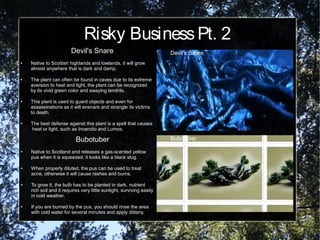
Devil's Snare
â—Ź Native to Scottish highlands and lowlands, it will grow
almost anywhere that is dark and damp.
â—Ź The plant can often be found in caves due to its extreme
aversion to heat and light, the plant can be recognized
by its vivid green color and swaying tendrils.
â—Ź This plant is used to guard objects and even for
assassinations as it will ensnare and strangle its victims
to death.
â—Ź The best defense against this plant is a spell that causes
heat or light, such as Incendio and Lumos.
Devil's Snare
BubotuberBubotuber
â—Ź Native to Scotland and releases a gas-scented yellow
pus when it is squeezed; it looks like a black slug.
â—Ź When properly diluted, the pus can be used to treat
acne, otherwise it will cause rashes and burns.
â—Ź To grow it, the bulb has to be planted in dark, nutrient
rich soil and it requires very little sunlight, surviving easily
in cold weather.
â—Ź If you are burned by the pus, you should rinse the area
with cold water for several minutes and apply dittany.
A Jack of All Trades
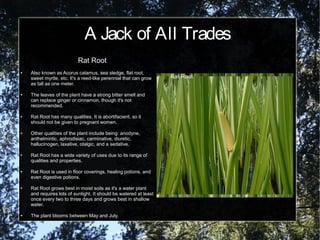
Rat Root
â—Ź Also known as Acorus calamus, sea sledge, flat root,
sweet myrtle, etc. It's a reed-like perennial that can grow
as tall as one meter.
â—Ź The leaves of the plant have a strong bitter smell and
can replace ginger or cinnamon, though it's not
recommended.
â—Ź Rat Root has many qualities. It is abortifacient, so it
should not be given to pregnant women.
â—Ź Other qualities of the plant include being: anodyne,
anthelmintic, aphrodisiac, carminative, diuretic,
hallucinogen, laxative, otalgic, and a sedative.
â—Ź Rat Root has a wide variety of uses due to its range of
qualities and properties.
â—Ź Rat Root is used in floor coverings, healing potions, and
even digestive potions.
â—Ź Rat Root grows best in moist soils as it's a water plant
and requires lots of sunlight. It should be watered at least
once every two to three days and grows best in shallow
water.
â—Ź The plant blooms between May and July.
Rat Root
Caring for Advanced Plants
Bouncing Bulb
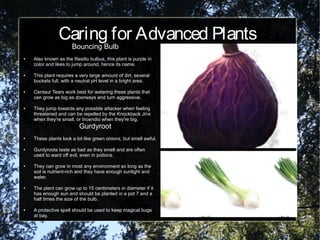
â—Ź Also known as the Resilio bulbus, this plant is purple in
color and likes to jump around, hence its name.
â—Ź This plant requires a very large amount of dirt, several
buckets full, with a neutral pH level in a bright area.
â—Ź Centaur Tears work best for watering these plants that
can grow as big as doorways and turn aggressive.
â—Ź They jump towards any possible attacker when feeling
threatened and can be repelled by the Knockback Jinx
when they're small, or Incendio when they're big.
Bouncing Bulb
Gurdyroot
Gurdyroot
â—Ź These plants look a lot like green onions, but smell awful.
â—Ź Gurdyroots taste as bad as they smell and are often
used to ward off evil, even in potions.
â—Ź They can grow in most any environment so long as the
soil is nutrient-rich and they have enough sunlight and
water.
â—Ź The plant can grow up to 15 centimeters in diameter if it
has enough sun and should be planted in a pot 7 and a
half times the size of the bulb.
â—Ź A protective spell should be used to keep magical bugs
at bay.
Caring for Advanced PlantsPt. 2
Aconite
â—Ź Also known as monkshood or wolfsbane, and many
other names by muggles, it is very poisonous.
â—Ź It's a very powerful, poisonous sedative and can be used
to treat prickly pain in the skin when used cautiously.
â—Ź It grows best in the wild, in forest and mountain ranges,
in mild temperatures. Dark, fluffy, nutritious soil is
necessary for this plant to grow.
â—Ź If the aconite gets in your system, you should seek
medical help immediately as large doses can be instantly
fatal.
Aconite
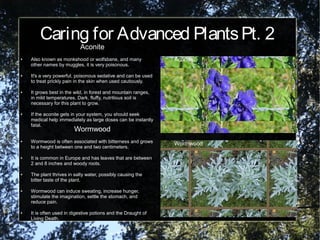
Wormwood
Wormwood
â—Ź Wormwood is often associated with bitterness and grows
to a height between one and two centimeters.
â—Ź It is common in Europe and has leaves that are between
2 and 8 inches and woody roots.
â—Ź The plant thrives in salty water, possibly causing the
bitter taste of the plant.
â—Ź Wormwood can induce sweating, increase hunger,
stimulate the imagination, settle the stomach, and
reduce pain.
â—Ź It is often used in digestive potions and the Draught of
Living Death.
A LittleLessMagical
Lily Plants
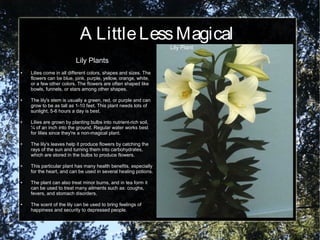
â—Ź Lilies come in all different colors, shapes and sizes. The
flowers can be blue, pink, purple, yellow, orange, white,
or a few other colors. The flowers are often shaped like
bowls, funnels, or stars among other shapes.
â—Ź The lily's stem is usually a green, red, or purple and can
grow to be as tall as 1-10 feet. This plant needs lots of
sunlight, 5-6 hours a day is best.
â—Ź Lilies are grown by planting bulbs into nutrient-rich soil,
ÂĽ of an inch into the ground. Regular water works best
for lilies since they're a non-magical plant.
â—Ź The lily's leaves help it produce flowers by catching the
rays of the sun and turning them into carbohydrates,
which are stored in the bulbs to produce flowers.
â—Ź This particular plant has many health benefits, especially
for the heart, and can be used in several healing potions.
â—Ź The plant can also treat minor burns, and in tea form it
can be used to treat many ailments such as: coughs,
fevers, and stomach disorders.
â—Ź The scent of the lily can be used to bring feelings of
happiness and security to depressed people.
Lily Plant
A LittleLessMagical Pt. 2
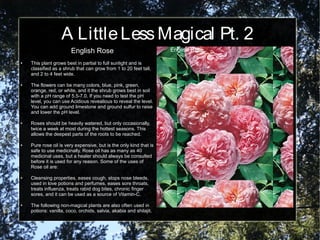
English Rose
â—Ź This plant grows best in partial to full sunlight and is
classified as a shrub that can grow from 1 to 20 feet tall,
and 2 to 4 feet wide.
â—Ź The flowers can be many colors, blue, pink, green,
orange, red, or white, and it the shrub grows best in soil
with a pH range of 5.5-7.0. If you need to test the pH
level, you can use Acidious revealious to reveal the level.
You can add ground limestone and ground sulfur to raise
and lower the pH level.
â—Ź Roses should be heavily watered, but only occasionally,
twice a week at most during the hottest seasons. This
allows the deepest parts of the roots to be reached.
â—Ź Pure rose oil is very expensive, but is the only kind that is
safe to use medicinally. Rose oil has as many as 40
medicinal uses, but a healer should always be consulted
before it is used for any reason. Some of the uses of
Rose oil are:
â—Ź Cleansing properties, eases cough, stops nose bleeds,
used in love potions and perfumes, eases sore throats,
treats influenza, treats rabid dog bites, chronic finger
sores, and it can be used as a source of Vitamin-C.
â—Ź The following non-magical plants are also often used in
potions: vanilla, coco, orchids, salvia, akabia and shilajit.
English Rose
Troubleswith Herbology
The Gardening Effect
â—Ź Herbologists face quite a few controversial issues in their
field of study, many of them brought on by the lack of
respect shown to the field, except by Potioneers and
Healers.
â—Ź Due to the modern world and the modern way of
thinking, many muggles believe that plants aren't nearly
as important as material things, and wizards and witches
seem to think that Herbology and plants have more to do
with the muggle world than the Wizarding World.
â—Ź However, witches and wizards are as much a part of the
natural world as muggles and plants. Magic is a part of
the natural world, though we sometimes forget that fact.
â—Ź Due to the Gardening Effect, we also lose a lot of
funding in the field oh Herbology to other fields that are
considered more respectable. Therefore, we're unable to
study as many plants as we would like. We do get some
help from Potioneers and Healers.
â—Ź However, we also lose a lot of Herbologists to the fields
of potion-making and healing as such positions require
the same amount of education and pay more. There's
also the added bonus of not being ridiculed for their line
of work as it's considered respectable.
Alien Species
â—Ź By alien species, I don't mean those things that fought
against the predators in that one movie or even little
green men from space. Alien species are plants that
have somehow integrated into a new habitat that is not
their native habitat.
â—Ź The seed propagates into the new territory and adapts,
then begins to change the habitat, possibly destroying
the original ecosystem by using up the resources that
were not originally meant for the plant. Eventually, many
of the plant species that lived there can become extinct
due to the alien species' take over.
â—Ź There are many hazards that come from such a take
over by a foreign plant. As I said before, the original
ecosystem is not equipped to handle the new species
and so many of the resources that go to other plants will
be drained by this specie. Plant species can go extinct
and the altered habitat becomes at risk for fire and other
natural calamities.
â—Ź It's important for Herbologists to know where there are
alien species in a habitat because it's best if plants are
studied in their natural habitat.
â—Ź Dandelions were actually introduced to North America to
help strengthen the ground, these alien species aren't
always a bad thing.
Thank you for taking thetimeto look over my final
project, theHerbology Review. I hopeyou enjoyed it!

Herbology review

  • 1.
    A Year ofPlants Herbology Final Review Project Herbology 101 Professor Tudor Hogwarts School of Witchcraft and Wizardry
  • 2.
    An Introduction toHerbology What is Herbology? â—Ź Herbology is the study and use of magical and non- magical plants. â—Ź Herbology can be a dangerous field as there are many poisonous and deadly plants. â—Ź Herbology has many uses for magical people; a witch or wizard can use plants in potions and for healing. â—Ź Every plant, including the non-magical ones, has its own useful properties. Necessary Equipment â—Ź Dragon-hide gloves of a good, strong quality to protect your hands as well as keep them clean. â—Ź A wand, because you will need to use magic when dealing with certain plants. â—Ź Earmuffs are important, certain plants like the mandrake can kill you with their cries. â—Ź Closed toe shoes, an apron, and a mask are also advised for protection. Plant Nutrition â—Ź Dragon Dung can often be used as a fertilizer or a compost to create fertilizer for soil. It is scentless and breaks things down exceptionally well due to its high acidity. â—Ź Mooncalf Dung is another fertilizer option, though not as strong as Dragon Dung. This option is better for more sensitive plants, though it may lack enough nutrients for the plant. â—Ź Centaur Tears are a controversial way to bring rich nutrients to a plant; the tears can revive a dying plant in moments. They are toxic to some plants. Class Objectives â—Ź Students will learn to understand and appreciate Herbology's role in the Wizarding World. â—Ź Students will understand the equipment necessary for Herbology and why it's necessary. â—Ź To help students appreciate the uniqueness of plants and understand that different plants need to be cared for in different ways. â—Ź For students to understand that first years have no due dates.
  • 3.
    Brewing with Care Plantsand Potion Ingredients â—Ź Mistletoe Berries and Poppy Heads â—Ź Rose Thorns and Rose Oil â—Ź Asphodel and Fluxweed â—Ź Lovage and Motherwort â—Ź Nettle and Aconite/monkshood/wolfsbane â—Ź Valerian Sprigs and Leaping Toadstool â—Ź Knotgrass and Peppermint â—Ź Root of Aconite and Shrivelfigs â—Ź Nux Myristica and Silverweed â—Ź Snakeweed and Moonstone â—Ź Starpuffs and Wormwood Plant Environment â—Ź Each plant is unique in the same way that humans are, they need different things to thrive. â—Ź Certain habitats will only be suitable to one type of plant versus another. â—Ź Different plants need different amounts of water, sunlight, and types of fertilizer. â—Ź Soil and the depth of the plant seed play an important role in the plant's development as well as repotting. Plant Specifics â—Ź Starpuffs have a hypnotic quality while Moonstone causes drowsiness. â—Ź Wormwood and Asphodel can be used to make a very powerful potion called the Draught of Living Death. â—Ź Mistletoe Berries cause hallucinations while Valerian Sprigs are used as a sedative, perfect for the Forgetfulness Potion. â—Ź Plants are chosen for potions based on their properties. Healers would use non-toxic plants that have healing powers, while flowers might be used in beauty potions.
  • 4.
    Herbsand FungiGillyweed â—Ź Arare herb native to the Mediterranean Sea and requires a large amount of water, but little sunlight. â—Ź It can grow to a height of 5-7 centimeters in moderately alkaline soil with a pH range of 7.9-8.4. â—Ź Gillyweed is a slimy gray-green plant that grows in bushels, when consumed by a human, the human grows gills and webs between the toes and fingers and can breathe under water for up to an hour, depending on the type of water. â—Ź It's also used to make gillywater, a refreshing drink. Gillyweed Valerian Root Valerian Root (and Sprigs) â—Ź Native to Europe and some of Asia, but it has migrated to North America. â—Ź The plant can grow to be five feet and forms bunches of flower, it needs at least 7 hours of sunlight. â—Ź The seed should be planted in very acidic soil with a pH level of 4.5-5.0 and be planted 1/8 of an inch down. â—Ź It has sedative and anxiolytic properties and is used in sleeping potions and calming draughts. It's also used in perfumes for it's cherry-vanilla scent. â—Ź This plant is used in the Drought of Living Death and the Forgetfulness Potion.
  • 5.
    Herbsand Fungi Pt.2 Knotgrass â—Ź Native to European forests, including the Forbidden Forest, it can grow from 5 centimeters-4 meters tall. â—Ź It grows in soil with light acid, 6.1-6.5 p, to neutral, 6.6- 7.3 and requires plenty of water and sunlight. â—Ź Knotgrass can grow anywhere from 2 inches to 14 feet in a greenhouse and produce white, pink, or green flowers. â—Ź Knotgrass is symbolic of tying two people together and often used in the Polyjuice Potion. Knotgrass DittanyDittany â—Ź Only grows naturally on the mountainside of Crete, Greece, but it can be grown in greenhouses. â—Ź Grows 20-30 centimeters and needs lots of sunlight and warmth. It grows in soil with a neutral pH level of 6.6-7.3. â—Ź In a greenhouse, the temperature should be set to 13 degrees Celsius, the seed should be light covered with soil and sprinkled with water. You should wait until the soil is dry before watering, though it's okay to give it a bit much. â—Ź Dittany is used often for healing and even love potions.
  • 6.
    Risky Business Dangerous Plants â—ŹNot all magical and non-magical plants are exactly friendly or harmless. There are many dangerous plants used in the Wizarding World. â—Ź While studying Herbology, students will be exposed to several dangerous plants, some can even kill you. â—Ź It is extremely important that students understand how to care for dangerous plants and know what precautions to take when dealing with them. â—Ź Protective gear is extremely important when dealing with plants that can endanger students. â—Ź It is also important that the students know certain spells and the proper way to save themselves or someone else if they should be harmed or ensnared by a dangerous plant. â—Ź Like the more harmless plants, dangerous plants also have many uses in potions and the magical world, so it's necessary to learn how to care for them. â—Ź These plants also have their own needs when it comes to habitat, soil, sunlight, and water. The Mandrake â—Ź Common to European countries, resembles tobacco plants, and grows best where men have been hung. â—Ź The mandrake's cries can kill a human being. â—Ź Mandrakes are used in sleeping potions, love potions, and potions that revive a petrified person; the plant causes hallucinations and comas. â—Ź If a person slips into a coma from contact with a mandrake, the contact site should be cleaned and a healer sent for. Mandrake
  • 7.
    Risky BusinessPt. 2 Devil'sSnare â—Ź Native to Scottish highlands and lowlands, it will grow almost anywhere that is dark and damp. â—Ź The plant can often be found in caves due to its extreme aversion to heat and light, the plant can be recognized by its vivid green color and swaying tendrils. â—Ź This plant is used to guard objects and even for assassinations as it will ensnare and strangle its victims to death. â—Ź The best defense against this plant is a spell that causes heat or light, such as Incendio and Lumos. Devil's Snare BubotuberBubotuber â—Ź Native to Scotland and releases a gas-scented yellow pus when it is squeezed; it looks like a black slug. â—Ź When properly diluted, the pus can be used to treat acne, otherwise it will cause rashes and burns. â—Ź To grow it, the bulb has to be planted in dark, nutrient rich soil and it requires very little sunlight, surviving easily in cold weather. â—Ź If you are burned by the pus, you should rinse the area with cold water for several minutes and apply dittany.
  • 8.
    A Jack ofAll Trades Rat Root â—Ź Also known as Acorus calamus, sea sledge, flat root, sweet myrtle, etc. It's a reed-like perennial that can grow as tall as one meter. â—Ź The leaves of the plant have a strong bitter smell and can replace ginger or cinnamon, though it's not recommended. â—Ź Rat Root has many qualities. It is abortifacient, so it should not be given to pregnant women. â—Ź Other qualities of the plant include being: anodyne, anthelmintic, aphrodisiac, carminative, diuretic, hallucinogen, laxative, otalgic, and a sedative. â—Ź Rat Root has a wide variety of uses due to its range of qualities and properties. â—Ź Rat Root is used in floor coverings, healing potions, and even digestive potions. â—Ź Rat Root grows best in moist soils as it's a water plant and requires lots of sunlight. It should be watered at least once every two to three days and grows best in shallow water. â—Ź The plant blooms between May and July. Rat Root
  • 9.
    Caring for AdvancedPlants Bouncing Bulb â—Ź Also known as the Resilio bulbus, this plant is purple in color and likes to jump around, hence its name. â—Ź This plant requires a very large amount of dirt, several buckets full, with a neutral pH level in a bright area. â—Ź Centaur Tears work best for watering these plants that can grow as big as doorways and turn aggressive. â—Ź They jump towards any possible attacker when feeling threatened and can be repelled by the Knockback Jinx when they're small, or Incendio when they're big. Bouncing Bulb Gurdyroot Gurdyroot â—Ź These plants look a lot like green onions, but smell awful. â—Ź Gurdyroots taste as bad as they smell and are often used to ward off evil, even in potions. â—Ź They can grow in most any environment so long as the soil is nutrient-rich and they have enough sunlight and water. â—Ź The plant can grow up to 15 centimeters in diameter if it has enough sun and should be planted in a pot 7 and a half times the size of the bulb. â—Ź A protective spell should be used to keep magical bugs at bay.
  • 10.
    Caring for AdvancedPlantsPt. 2 Aconite â—Ź Also known as monkshood or wolfsbane, and many other names by muggles, it is very poisonous. â—Ź It's a very powerful, poisonous sedative and can be used to treat prickly pain in the skin when used cautiously. â—Ź It grows best in the wild, in forest and mountain ranges, in mild temperatures. Dark, fluffy, nutritious soil is necessary for this plant to grow. â—Ź If the aconite gets in your system, you should seek medical help immediately as large doses can be instantly fatal. Aconite Wormwood Wormwood â—Ź Wormwood is often associated with bitterness and grows to a height between one and two centimeters. â—Ź It is common in Europe and has leaves that are between 2 and 8 inches and woody roots. â—Ź The plant thrives in salty water, possibly causing the bitter taste of the plant. â—Ź Wormwood can induce sweating, increase hunger, stimulate the imagination, settle the stomach, and reduce pain. â—Ź It is often used in digestive potions and the Draught of Living Death.
  • 11.
    A LittleLessMagical Lily Plants â—ŹLilies come in all different colors, shapes and sizes. The flowers can be blue, pink, purple, yellow, orange, white, or a few other colors. The flowers are often shaped like bowls, funnels, or stars among other shapes. â—Ź The lily's stem is usually a green, red, or purple and can grow to be as tall as 1-10 feet. This plant needs lots of sunlight, 5-6 hours a day is best. â—Ź Lilies are grown by planting bulbs into nutrient-rich soil, ÂĽ of an inch into the ground. Regular water works best for lilies since they're a non-magical plant. â—Ź The lily's leaves help it produce flowers by catching the rays of the sun and turning them into carbohydrates, which are stored in the bulbs to produce flowers. â—Ź This particular plant has many health benefits, especially for the heart, and can be used in several healing potions. â—Ź The plant can also treat minor burns, and in tea form it can be used to treat many ailments such as: coughs, fevers, and stomach disorders. â—Ź The scent of the lily can be used to bring feelings of happiness and security to depressed people. Lily Plant
  • 12.
    A LittleLessMagical Pt.2 English Rose â—Ź This plant grows best in partial to full sunlight and is classified as a shrub that can grow from 1 to 20 feet tall, and 2 to 4 feet wide. â—Ź The flowers can be many colors, blue, pink, green, orange, red, or white, and it the shrub grows best in soil with a pH range of 5.5-7.0. If you need to test the pH level, you can use Acidious revealious to reveal the level. You can add ground limestone and ground sulfur to raise and lower the pH level. â—Ź Roses should be heavily watered, but only occasionally, twice a week at most during the hottest seasons. This allows the deepest parts of the roots to be reached. â—Ź Pure rose oil is very expensive, but is the only kind that is safe to use medicinally. Rose oil has as many as 40 medicinal uses, but a healer should always be consulted before it is used for any reason. Some of the uses of Rose oil are: â—Ź Cleansing properties, eases cough, stops nose bleeds, used in love potions and perfumes, eases sore throats, treats influenza, treats rabid dog bites, chronic finger sores, and it can be used as a source of Vitamin-C. â—Ź The following non-magical plants are also often used in potions: vanilla, coco, orchids, salvia, akabia and shilajit. English Rose
  • 13.
    Troubleswith Herbology The GardeningEffect â—Ź Herbologists face quite a few controversial issues in their field of study, many of them brought on by the lack of respect shown to the field, except by Potioneers and Healers. â—Ź Due to the modern world and the modern way of thinking, many muggles believe that plants aren't nearly as important as material things, and wizards and witches seem to think that Herbology and plants have more to do with the muggle world than the Wizarding World. â—Ź However, witches and wizards are as much a part of the natural world as muggles and plants. Magic is a part of the natural world, though we sometimes forget that fact. â—Ź Due to the Gardening Effect, we also lose a lot of funding in the field oh Herbology to other fields that are considered more respectable. Therefore, we're unable to study as many plants as we would like. We do get some help from Potioneers and Healers. â—Ź However, we also lose a lot of Herbologists to the fields of potion-making and healing as such positions require the same amount of education and pay more. There's also the added bonus of not being ridiculed for their line of work as it's considered respectable. Alien Species â—Ź By alien species, I don't mean those things that fought against the predators in that one movie or even little green men from space. Alien species are plants that have somehow integrated into a new habitat that is not their native habitat. â—Ź The seed propagates into the new territory and adapts, then begins to change the habitat, possibly destroying the original ecosystem by using up the resources that were not originally meant for the plant. Eventually, many of the plant species that lived there can become extinct due to the alien species' take over. â—Ź There are many hazards that come from such a take over by a foreign plant. As I said before, the original ecosystem is not equipped to handle the new species and so many of the resources that go to other plants will be drained by this specie. Plant species can go extinct and the altered habitat becomes at risk for fire and other natural calamities. â—Ź It's important for Herbologists to know where there are alien species in a habitat because it's best if plants are studied in their natural habitat. â—Ź Dandelions were actually introduced to North America to help strengthen the ground, these alien species aren't always a bad thing.
  • 14.
    Thank you fortaking thetimeto look over my final project, theHerbology Review. I hopeyou enjoyed it!