Donating to the Animal Shelters
A Multi-age Service Learning Project
*
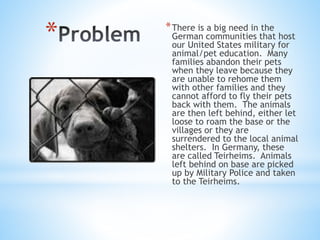
* *There is a big need in the
German communities that host
our United States military for
animal/pet education. Many
families abandon their pets
when they leave because they
are unable to rehome them
with other families and they
cannot afford to fly their pets
back with them. The animals
are then left behind, either let
loose to roam the base or the
villages or they are
surrendered to the local animal
shelters. In Germany, these
are called Teirheims. Animals
left behind on base are picked
up by Military Police and taken
to the Teirheims.
*Although this project is
focusing on a community or
local level, homeless and
abandoned pets is a global
issue. Locally, the issue has
become so prominent that at
one US Military base in
Germany, the local Teirheim
refuses to accept US
member’s surrendered pets.
*
Students will learn about planning and communication by designing
a service-learning project that will have beneficial value to the
local animal shelters.
Students will become aware of the effects of animal abandonment
in our military community and how this not only affects our military
community but the local community.
Students will write and produce a public service announcement
using a Web 2.0 tool and the announcement will be displayed for
the entire school to view on the big screen television in the school
foyer.
*
*
Grade 3: Social Studies Standard 3SS3: Students draw from
historical and community resources to describe how the events and
the environment influence the growth and change of communities.
Grade 2: Social Studies Standard 2SS4: Students understand how
the actions and integrity of individuals change the ways in which
people in society work and live together.
Grade 1: Social Studies Standard 1SS4: Students explore and
describe similarities and differences in the ways groups; societies
and cultures address similar needs and concerns.
*
Cognitive Complexity
C Level: Level 3
Justification with lesson examples: Students are asked to create
and participate in a service-learning project that will benefit the
military community they are living in.
Justification with CReaTE Framework: This is a teacher directed
assignment that has students determining what service-learning
projects they want to do, investigating the types of places that
would benefit from the projects and evaluating their work when
completed. The lesson will engage the students in learning to use
a Web 2.0 tool to create a public service announcement.
*
Real World Learning
R Level: Level 3
Justification with lesson examples: Learning about serving
one’s community has real world application because it
demonstrates to children how we are all part of a community
and we work together for the benefit all. Creating a public
service announcement allows children to experience the role of
creator and producer of an informational short film.
Justification with CReaTE Framework: It provides real life
application using a topic that is a part of everyday life as well
as simulating a real world career.
*
Engaged Learning
E Level: Level 3
Justification with lesson examples: The assignments associated with
creating a service-learning project allow for children to become engaged
with the content through hands-on activities that are related to the
service-learning topic they have chosen.
Justification with CReaTE Framework: This is an initial teacher-
directed assignment but the students themselves voted on the topic and
the areas that are to be addressed. They guide all projects created
within their group through discussion among themselves. Students are
collaborating with their peers as well as partnering with their teachers to
create a short public service announcement. Each group chooses how
they are going to create their announcement using Animoto.
*
Technology Integration
T Level: Level 3
Justification with lesson examples: This assignment has
students writing and producing a 30 second public service
announcement using Animoto. The service announcement will
play on the school-wide television.
Justification with CReaTE Framework: This technology
portion is not necessary to complete the service-learning
project, but is considered an add-on activity. It is a
collaborative piece as each team must work together to create
their service announcement.
*
*http://www.stripes.com/news/military-wants-harsher-
consequences-for-abandoning-pets-1.172958
*http://www.operationwearehere.com/Pets.html
*http://www.humanesociety.org/parents_educators/service_learni
ng_animal_protection.html
*http://www.kyhumane.org/give/volunteer/service-learning-
projects-for-school
*http://www.projectwild.org/learning.htm
http://vpartlow.blogspot.de/
*
*
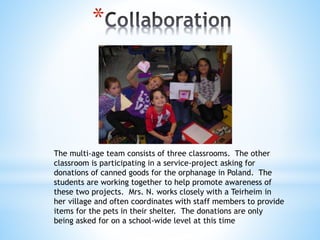
The multi-age team consists of three classrooms. The other
classroom is participating in a service-project asking for
donations of canned goods for the orphanage in Poland. The
students are working together to help promote awareness of
these two projects. Mrs. N. works closely with a Teirheim in
her village and often coordinates with staff members to provide
items for the pets in their shelter. The donations are only
being asked for on a school-wide level at this time
Classroom discussion of the issue during large group time.
Chart the different needs the Teirheims have.
Break up into four teams, each team addressing a different donation request. Each team has a
Team Leader and a Team Recorder.
Large group discussion and examples of Slogans.
Student will discuss and brainstorm within their group’s different slogans that will work for donation
request.
Students will create a poster that contains the slogan they choose. (Bedding for small animals,
Litter for cats, Food for all animals, Blankets for all animals)
Team recorders will search for pictures on the Internet to add to their posters.
Two students will create the donation box that will be in the school foyer.
Request for donations will also be added to the school’s Facebook page.
During large group instruction in the computer lab, students will be guided through a tutorial on
using Animoto. (Picking music, pictures, videos and text and then producing the video).
Each group is assigned an adult to work with that specific group on using Animoto (teachers, high
school student, computer technologist)
Students will work together to create their project that reflects the purpose of the project and
theme.
When complete, project will be uploaded to the Intranet (school internet) to be played for the
student body and visitors as they come into the school.
*
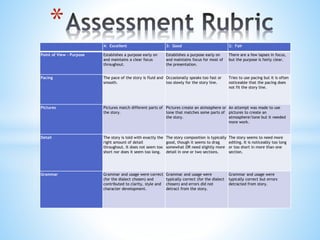
4: Excellent 3: Good 2: Fair
Point of View - Purpose Establishes a purpose early on
and maintains a clear focus
throughout.
Establishes a purpose early on
and maintains focus for most of
the presentation.
There are a few lapses in focus,
but the purpose is fairly clear.
Pacing The pace of the story is fluid and
smooth.
Occasionally speaks too fast or
too slowly for the story line.
Tries to use pacing but it is often
noticeable that the pacing does
not fit the story line.
Pictures Pictures match different parts of
the story.
Pictures create an atmosphere or
tone that matches some parts of
the story.
An attempt was made to use
pictures to create an
atmosphere/tone but it needed
more work.
Detail The story is told with exactly the
right amount of detail
throughout. It does not seem too
short nor does it seem too long.
The story composition is typically
good, though it seems to drag
somewhat OR need slightly more
detail in one or two sections.
The story seems to need more
editing. It is noticeably too long
or too short in more than one
section.
Grammar Grammar and usage were correct
(for the dialect chosen) and
contributed to clarity, style and
character development.
Grammar and usage were
typically correct (for the dialect
chosen) and errors did not
detract from the story.
Grammar and usage were
typically correct but errors
detracted from story.
*
The students in the multi-age class will write a
reflection at the conclusion of the project. During
large group discussion, the students will discuss what
they have learned from this project. They always
have the option of sharing with the class or passing.
The teacher in this class always has the students write
about what they have learned, what was their favorite
part or ways that they project can be improved upon.
*
The students demonstrated to the other class the
slogans they created and the signs they made to
hang in the foyer. At the conclusion of the project,
they will present the donated items to the animal
shelter that will send a representative to the
school to pick up the items.
*

Helping our community

  • 1.
    Donating to theAnimal Shelters A Multi-age Service Learning Project *
  • 2.
    * *There isa big need in the German communities that host our United States military for animal/pet education. Many families abandon their pets when they leave because they are unable to rehome them with other families and they cannot afford to fly their pets back with them. The animals are then left behind, either let loose to roam the base or the villages or they are surrendered to the local animal shelters. In Germany, these are called Teirheims. Animals left behind on base are picked up by Military Police and taken to the Teirheims.
  • 3.
    *Although this projectis focusing on a community or local level, homeless and abandoned pets is a global issue. Locally, the issue has become so prominent that at one US Military base in Germany, the local Teirheim refuses to accept US member’s surrendered pets. *
  • 4.
    Students will learnabout planning and communication by designing a service-learning project that will have beneficial value to the local animal shelters. Students will become aware of the effects of animal abandonment in our military community and how this not only affects our military community but the local community. Students will write and produce a public service announcement using a Web 2.0 tool and the announcement will be displayed for the entire school to view on the big screen television in the school foyer. *
  • 5.
    * Grade 3: SocialStudies Standard 3SS3: Students draw from historical and community resources to describe how the events and the environment influence the growth and change of communities. Grade 2: Social Studies Standard 2SS4: Students understand how the actions and integrity of individuals change the ways in which people in society work and live together. Grade 1: Social Studies Standard 1SS4: Students explore and describe similarities and differences in the ways groups; societies and cultures address similar needs and concerns.
  • 6.
    * Cognitive Complexity C Level:Level 3 Justification with lesson examples: Students are asked to create and participate in a service-learning project that will benefit the military community they are living in. Justification with CReaTE Framework: This is a teacher directed assignment that has students determining what service-learning projects they want to do, investigating the types of places that would benefit from the projects and evaluating their work when completed. The lesson will engage the students in learning to use a Web 2.0 tool to create a public service announcement.
  • 7.
    * Real World Learning RLevel: Level 3 Justification with lesson examples: Learning about serving one’s community has real world application because it demonstrates to children how we are all part of a community and we work together for the benefit all. Creating a public service announcement allows children to experience the role of creator and producer of an informational short film. Justification with CReaTE Framework: It provides real life application using a topic that is a part of everyday life as well as simulating a real world career.
  • 8.
    * Engaged Learning E Level:Level 3 Justification with lesson examples: The assignments associated with creating a service-learning project allow for children to become engaged with the content through hands-on activities that are related to the service-learning topic they have chosen. Justification with CReaTE Framework: This is an initial teacher- directed assignment but the students themselves voted on the topic and the areas that are to be addressed. They guide all projects created within their group through discussion among themselves. Students are collaborating with their peers as well as partnering with their teachers to create a short public service announcement. Each group chooses how they are going to create their announcement using Animoto.
  • 9.
    * Technology Integration T Level:Level 3 Justification with lesson examples: This assignment has students writing and producing a 30 second public service announcement using Animoto. The service announcement will play on the school-wide television. Justification with CReaTE Framework: This technology portion is not necessary to complete the service-learning project, but is considered an add-on activity. It is a collaborative piece as each team must work together to create their service announcement.
  • 10.
  • 11.
  • 12.
    * The multi-age teamconsists of three classrooms. The other classroom is participating in a service-project asking for donations of canned goods for the orphanage in Poland. The students are working together to help promote awareness of these two projects. Mrs. N. works closely with a Teirheim in her village and often coordinates with staff members to provide items for the pets in their shelter. The donations are only being asked for on a school-wide level at this time
  • 13.
    Classroom discussion ofthe issue during large group time. Chart the different needs the Teirheims have. Break up into four teams, each team addressing a different donation request. Each team has a Team Leader and a Team Recorder. Large group discussion and examples of Slogans. Student will discuss and brainstorm within their group’s different slogans that will work for donation request. Students will create a poster that contains the slogan they choose. (Bedding for small animals, Litter for cats, Food for all animals, Blankets for all animals) Team recorders will search for pictures on the Internet to add to their posters. Two students will create the donation box that will be in the school foyer. Request for donations will also be added to the school’s Facebook page. During large group instruction in the computer lab, students will be guided through a tutorial on using Animoto. (Picking music, pictures, videos and text and then producing the video). Each group is assigned an adult to work with that specific group on using Animoto (teachers, high school student, computer technologist) Students will work together to create their project that reflects the purpose of the project and theme. When complete, project will be uploaded to the Intranet (school internet) to be played for the student body and visitors as they come into the school. *
  • 14.
    4: Excellent 3:Good 2: Fair Point of View - Purpose Establishes a purpose early on and maintains a clear focus throughout. Establishes a purpose early on and maintains focus for most of the presentation. There are a few lapses in focus, but the purpose is fairly clear. Pacing The pace of the story is fluid and smooth. Occasionally speaks too fast or too slowly for the story line. Tries to use pacing but it is often noticeable that the pacing does not fit the story line. Pictures Pictures match different parts of the story. Pictures create an atmosphere or tone that matches some parts of the story. An attempt was made to use pictures to create an atmosphere/tone but it needed more work. Detail The story is told with exactly the right amount of detail throughout. It does not seem too short nor does it seem too long. The story composition is typically good, though it seems to drag somewhat OR need slightly more detail in one or two sections. The story seems to need more editing. It is noticeably too long or too short in more than one section. Grammar Grammar and usage were correct (for the dialect chosen) and contributed to clarity, style and character development. Grammar and usage were typically correct (for the dialect chosen) and errors did not detract from the story. Grammar and usage were typically correct but errors detracted from story. *
  • 15.
    The students inthe multi-age class will write a reflection at the conclusion of the project. During large group discussion, the students will discuss what they have learned from this project. They always have the option of sharing with the class or passing. The teacher in this class always has the students write about what they have learned, what was their favorite part or ways that they project can be improved upon. *
  • 16.
    The students demonstratedto the other class the slogans they created and the signs they made to hang in the foyer. At the conclusion of the project, they will present the donated items to the animal shelter that will send a representative to the school to pick up the items. *