IMPROVING QUALITY BY PARTNERING WITH YOUR
CUSTOMERS:
A “HOW TO” STORY
Armand Spoto
Director, Professional Services
 May 23, 2016
AgendaBackground
Overview
Agile Development vs Delivery
Case Study (Phase 1)
Interactive Exercise
Case Study (Phase 2)
Summary
Background
20 years of experience in professional services industry
Provided strategy, project management, and
implementation of large scale programs for a number of
Fortune 500 companies
10 years providing Training and Development solutions to
the Life Science Industry
Full time Project Management and PMO responsibility for
past 7 years
Scrum master since 2014
M.S. in Industrial/Organizational Psychology in 1997 from
Radford University.
Who Are We?
~400 employees across three Continents
~175 P.S. employees
Project Management
Business Analysis, Insurance Domain
.Net Development
QA/Testing
80+ Carrier, Financial Inst. and Distribution
Implementations
Average 20 Deployments Weekly
Key Partners
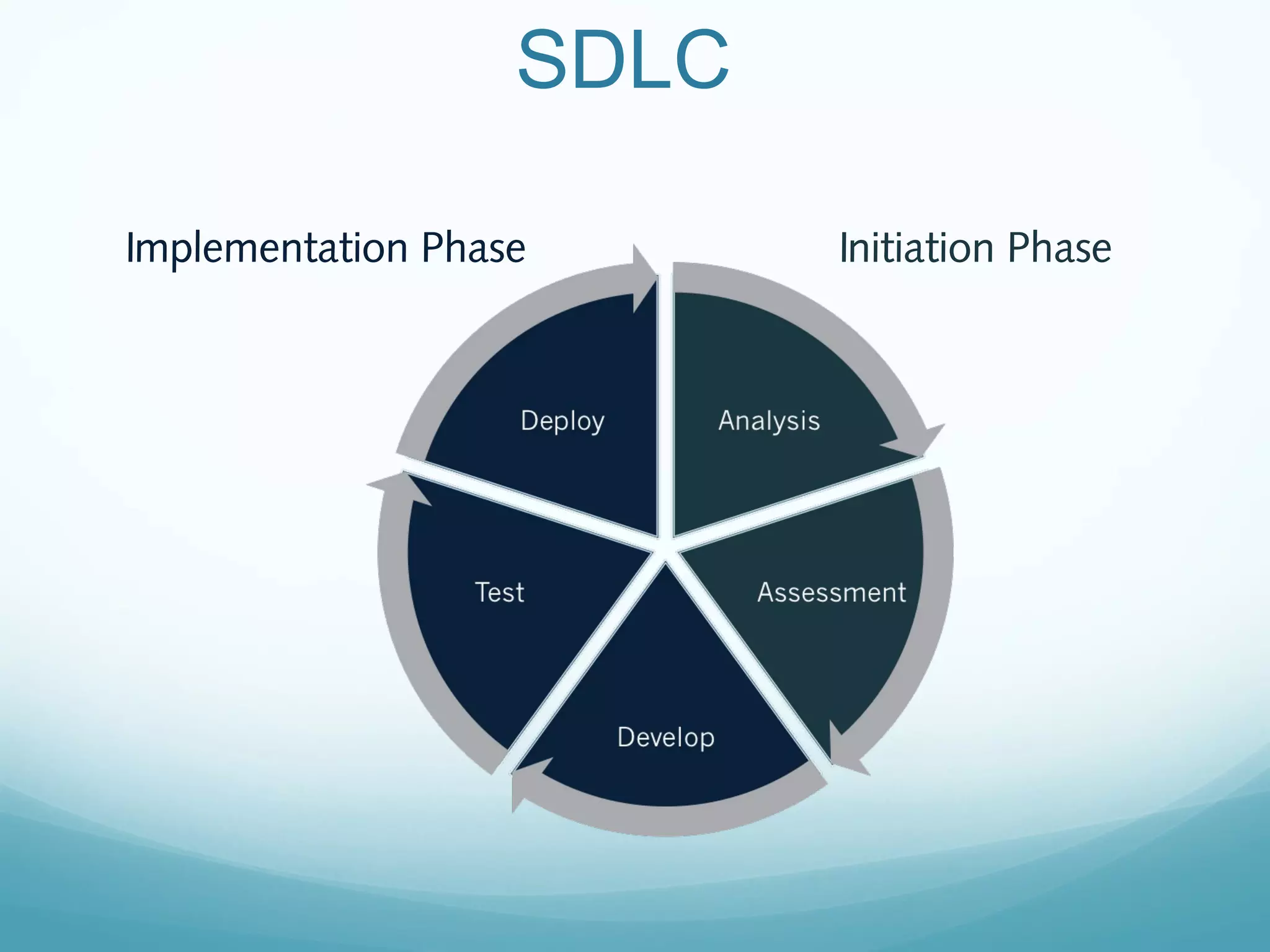
SDLC
Implementation Phase Initiation Phase
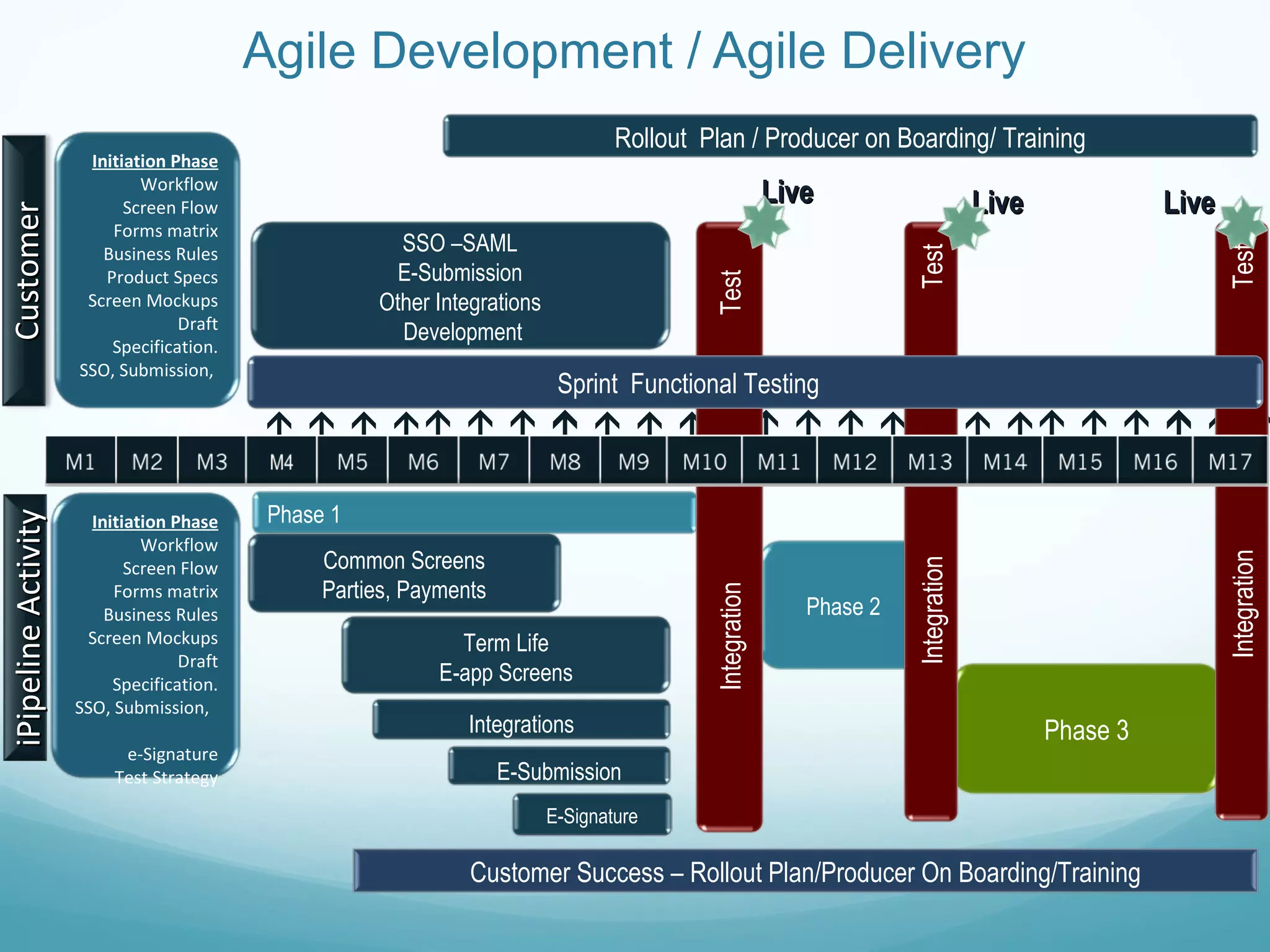
Phase 3
Agile Development / Agile Delivery
Customer Success – Rollout Plan/Producer On Boarding/Training
Rollout Plan / Producer on Boarding/ Training
SSO –SAML
E-Submission
Other Integrations
Development
Initiation Phase
Workflow
Screen Flow
Forms matrix
Business Rules
Product Specs
Screen Mockups
Draft
Specification.
SSO, Submission,
e-Signature
Test Strategy
Phase 1

CustomerCustomer
            
LiveLive
iPipelineActivityiPipelineActivity
Common Screens
Parties, Payments
Term Life
E-app Screens
E-Signature
Phase 2
Integrations
E-Submission
IntegrationTest
Initiation Phase
Workflow
Screen Flow
Forms matrix
Business Rules
Screen Mockups
Draft
Specification.
SSO, Submission,
e-Signature
Test Strategy
IntegrationTest
LiveLive
IntegrationTest
LiveLive
Sprint Functional Testing
iPipeline Agile Implementation
Requirements clearly understood and documented
Business & Product Rules Defined in Initiation
Collaborative Planning
Release & Sprint Planning, aligning on integration
Continuous Involvement
Testing (End Users, Business and Project Team)
Project
Scoping
High
Level
Req.
Prioritization
Final
Assembly
Final
UAT
Delivery
Support
Agile
Sprint Sprint Sprint Sprint
Customer
Review
Customer
Review
Customer
Review
A
D C
T
A
D C
T
A
D C
T
A
D C
T
Customer
Review
Phase 1
THE PROJECT THAT WOULDN’T END
The Situation
Phase 1
•Build 4 Insurance Illustrations Products
• Two Term
• Two Guarantee Universal Life
•Develop and Test
• User Interface Screens
• Calculate Engine
• Crystal Reports (Output)
•Planned Start: February 2014
•Planned Finish: October 2014
•Budget: $475,000
Phase 1: Client Defects per Month
Phase 1: # of Requirement Changes
What is Your RCA?
Break up into small groups
•Spend ~10 minutes brainstorming what do you think went
wrong and why?
•What are impacts on:
• Team?
• Client?
• Budget?
•Ask any clarification question
The Lightbulb Moment
Phase 1
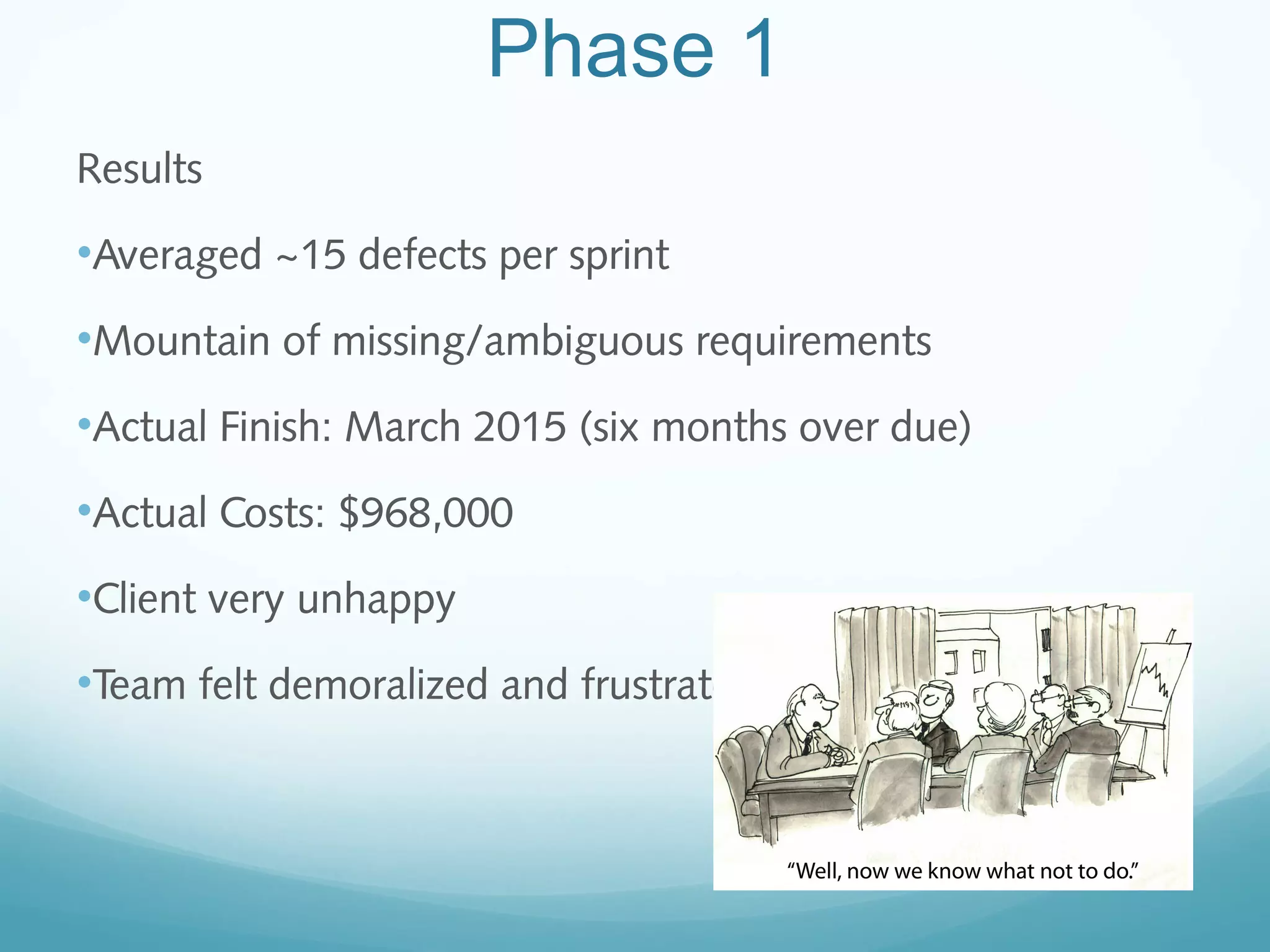
Results
•Averaged ~15 defects per sprint
•Mountain of missing/ambiguous requirements
•Actual Finish: March 2015 (six months over due)
•Actual Costs: $968,000
•Client very unhappy
•Team felt demoralized and frustrated
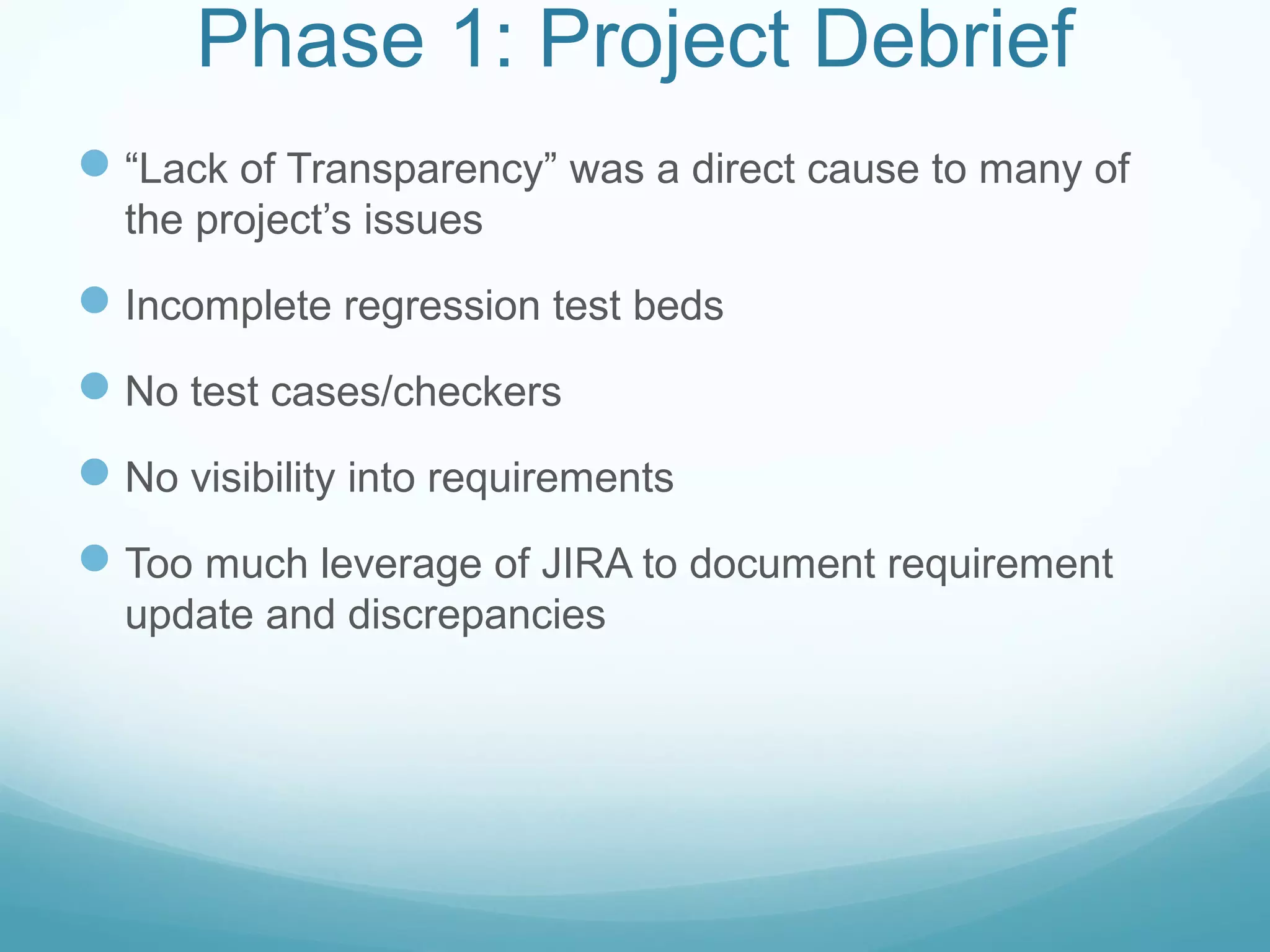
Phase 1: Project Debrief
“Lack of Transparency” was a direct cause to many of
the project’s issues
Incomplete regression test beds
No test cases/checkers
No visibility into requirements
Too much leverage of JIRA to document requirement
update and discrepancies
Phase 1: Project DebriefAdjusted Three Key Processes
Phase 2
The Redemption
The Situation
Phase 2
•Build 12 Insurance Illustrations Products
• Eight Indexed Universal Life
• Four Universal Life
• Client wanted to complete all Crystal Reports (Output) Work
•Created two full-teams
• 1 FTE Business Analyst
• 1 FTE User Interface Developer
• 2.5 FTE Calc Engine Developers
• 2 FTE Quality Assurance
•Planned Start: March 2015
•Planned Finish: April 2016
•Budget: $1,025,000
Requirements Gathering
Client’s “Business” has to sign-off on their requirements
Used to create developer Requirements, which is signed
off between both parties
Focus on the completion of a specific Feature/Function
of a specific product
BRD Document Walkthrough
 Functional Overview
 Requirements
 User Stories
 User Story Details
 UI Definitions (Windows, Menus,
Toolbars)
 Calculation Engine Checkers
 Report Design
 Configuration Settings
 iGO Integration Impacts
 Base/R&D Integration Impacts
 Content Impacts
Client Input Required
• Detailed Technical Design
• Code Review
• Unit Test Review
• Test Plans and Requirements Traceability
• Issues List
Testing Strategy
 Development begins on that signed-off set of features
 Develop to Checkers
 Execute testing based on firm test cases and checkers provided by client
 Regression is run twice per sprint
 Features are released to UAT based on QA results
Communication
Client attends all Agile Ceremonies
•Scrums
•Scope Overviews
•Sprint Planning
•Bi-weekly QA Meeting
•See all backlog items/burndowns in VersionOne
Additional touch-points
•Quarterly on-site visits
•Bi-weekly Executive touch-point
•Distribute 3 sprint Release plan every sprint
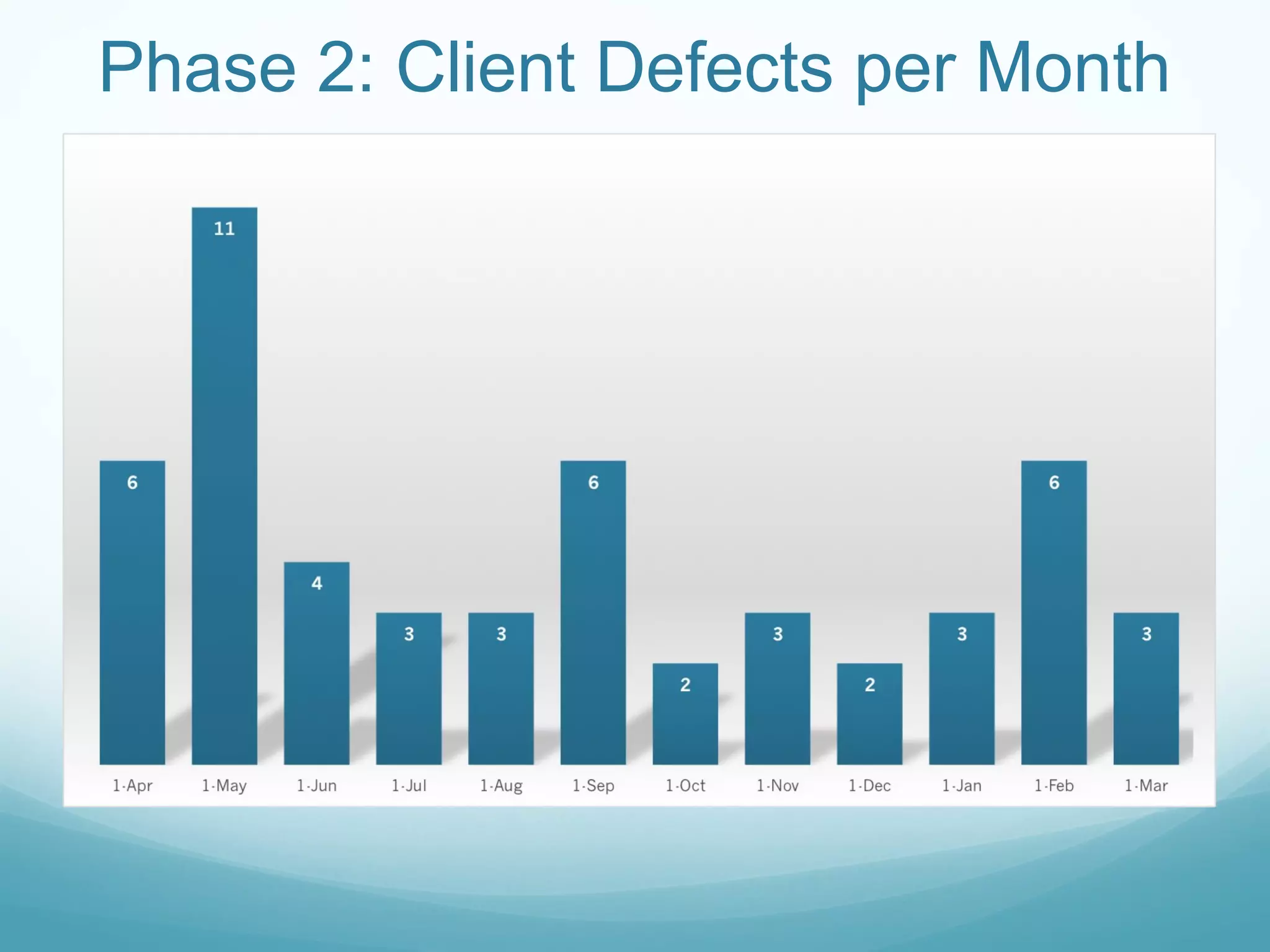
Phase 2: Client Defects per Month
Phase 2: # of Requirement Changes
Results
Strengthening the partnership
New work projects through 2017
More strategic discussions w/ Executives
Virtually eliminated all escalation issues
 Exposed ownership of issues to be unblocked
Broadened conversation to address issues
Remove blockers
Improve velocity
Summary
Exposing your dirty laundry elevates everyone’s game
Open to trying new processes, and modifying when
necessary
Your metrics aren’t my metrics
Someone has to be out of the weeds, or you’ll always be
lost
Client culture is key to understand how to modify your
processes

HeartofAgile_Presentation_v3

  • 1.
    IMPROVING QUALITY BYPARTNERING WITH YOUR CUSTOMERS: A “HOW TO” STORY Armand Spoto Director, Professional Services  May 23, 2016
  • 2.
    AgendaBackground Overview Agile Development vsDelivery Case Study (Phase 1) Interactive Exercise Case Study (Phase 2) Summary
  • 3.
    Background 20 years ofexperience in professional services industry Provided strategy, project management, and implementation of large scale programs for a number of Fortune 500 companies 10 years providing Training and Development solutions to the Life Science Industry Full time Project Management and PMO responsibility for past 7 years Scrum master since 2014 M.S. in Industrial/Organizational Psychology in 1997 from Radford University.
  • 4.
    Who Are We? ~400employees across three Continents ~175 P.S. employees Project Management Business Analysis, Insurance Domain .Net Development QA/Testing 80+ Carrier, Financial Inst. and Distribution Implementations Average 20 Deployments Weekly Key Partners
  • 5.
  • 6.
    Phase 3 Agile Development/ Agile Delivery Customer Success – Rollout Plan/Producer On Boarding/Training Rollout Plan / Producer on Boarding/ Training SSO –SAML E-Submission Other Integrations Development Initiation Phase Workflow Screen Flow Forms matrix Business Rules Product Specs Screen Mockups Draft Specification. SSO, Submission, e-Signature Test Strategy Phase 1  CustomerCustomer              LiveLive iPipelineActivityiPipelineActivity Common Screens Parties, Payments Term Life E-app Screens E-Signature Phase 2 Integrations E-Submission IntegrationTest Initiation Phase Workflow Screen Flow Forms matrix Business Rules Screen Mockups Draft Specification. SSO, Submission, e-Signature Test Strategy IntegrationTest LiveLive IntegrationTest LiveLive Sprint Functional Testing
  • 7.
    iPipeline Agile Implementation Requirementsclearly understood and documented Business & Product Rules Defined in Initiation Collaborative Planning Release & Sprint Planning, aligning on integration Continuous Involvement Testing (End Users, Business and Project Team) Project Scoping High Level Req. Prioritization Final Assembly Final UAT Delivery Support Agile Sprint Sprint Sprint Sprint Customer Review Customer Review Customer Review A D C T A D C T A D C T A D C T Customer Review
  • 8.
    Phase 1 THE PROJECTTHAT WOULDN’T END
  • 9.
    The Situation Phase 1 •Build4 Insurance Illustrations Products • Two Term • Two Guarantee Universal Life •Develop and Test • User Interface Screens • Calculate Engine • Crystal Reports (Output) •Planned Start: February 2014 •Planned Finish: October 2014 •Budget: $475,000
  • 10.
    Phase 1: ClientDefects per Month
  • 11.
    Phase 1: #of Requirement Changes
  • 12.
    What is YourRCA? Break up into small groups •Spend ~10 minutes brainstorming what do you think went wrong and why? •What are impacts on: • Team? • Client? • Budget? •Ask any clarification question
  • 13.
  • 14.
    Phase 1 Results •Averaged ~15defects per sprint •Mountain of missing/ambiguous requirements •Actual Finish: March 2015 (six months over due) •Actual Costs: $968,000 •Client very unhappy •Team felt demoralized and frustrated
  • 15.
    Phase 1: ProjectDebrief “Lack of Transparency” was a direct cause to many of the project’s issues Incomplete regression test beds No test cases/checkers No visibility into requirements Too much leverage of JIRA to document requirement update and discrepancies
  • 16.
    Phase 1: ProjectDebriefAdjusted Three Key Processes
  • 17.
  • 18.
    The Situation Phase 2 •Build12 Insurance Illustrations Products • Eight Indexed Universal Life • Four Universal Life • Client wanted to complete all Crystal Reports (Output) Work •Created two full-teams • 1 FTE Business Analyst • 1 FTE User Interface Developer • 2.5 FTE Calc Engine Developers • 2 FTE Quality Assurance •Planned Start: March 2015 •Planned Finish: April 2016 •Budget: $1,025,000
  • 19.
    Requirements Gathering Client’s “Business”has to sign-off on their requirements Used to create developer Requirements, which is signed off between both parties Focus on the completion of a specific Feature/Function of a specific product
  • 20.
    BRD Document Walkthrough Functional Overview  Requirements  User Stories  User Story Details  UI Definitions (Windows, Menus, Toolbars)  Calculation Engine Checkers  Report Design  Configuration Settings  iGO Integration Impacts  Base/R&D Integration Impacts  Content Impacts Client Input Required • Detailed Technical Design • Code Review • Unit Test Review • Test Plans and Requirements Traceability • Issues List
  • 21.
    Testing Strategy  Developmentbegins on that signed-off set of features  Develop to Checkers  Execute testing based on firm test cases and checkers provided by client  Regression is run twice per sprint  Features are released to UAT based on QA results
  • 22.
    Communication Client attends allAgile Ceremonies •Scrums •Scope Overviews •Sprint Planning •Bi-weekly QA Meeting •See all backlog items/burndowns in VersionOne Additional touch-points •Quarterly on-site visits •Bi-weekly Executive touch-point •Distribute 3 sprint Release plan every sprint
  • 23.
    Phase 2: ClientDefects per Month
  • 24.
    Phase 2: #of Requirement Changes
  • 25.
    Results Strengthening the partnership Newwork projects through 2017 More strategic discussions w/ Executives Virtually eliminated all escalation issues  Exposed ownership of issues to be unblocked Broadened conversation to address issues Remove blockers Improve velocity
  • 26.
    Summary Exposing your dirtylaundry elevates everyone’s game Open to trying new processes, and modifying when necessary Your metrics aren’t my metrics Someone has to be out of the weeds, or you’ll always be lost Client culture is key to understand how to modify your processes