Congenital Heart Disease in
Adults
Background
 8/1000 Live born births
 32,000 cases/yr
 Live born prevalence lower than fetal prevalence
– Fetal echo
 20% die within first year
– 80% of first year survivors reach adulthood
– Prevalence 800,000 adults in U.S.
 Focus on Adult congenital heart disease
Classification of Congenital Heart
Diseases
 Simple or complex
– Simple includes ASD, VSD, or singular valvular
abnormalities (Ebstein’s anomaly)
– Complex includes those with multiple defects, AV
canal defects, or “single” ventricle physiology.
 Cyanotic or non-cyanotic
– Non-cyanotic: ASD, VSD, sinus venosus defect, patent
ductus arteriosus, aortic stenosis, pulmonary stenosis,
aortic coarctation
– Cyanotic: Tetralogy of Fallot, Ebstein’s anomaly,
transposition of the great arteries, Eisenmenger’s
syndrome, truncus arteriosus, tricuspid atresia, total
anomalous pulmonary venous return “5 Ts and 2 Es”
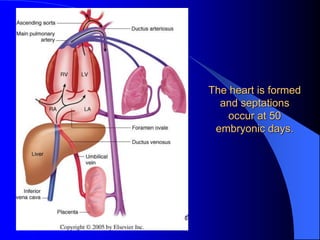
The heart is formed
and septations
occur at 50
embryonic days.
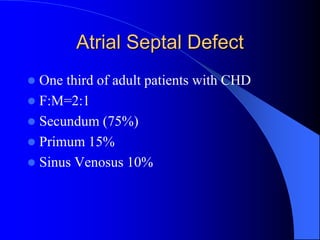
Atrial Septal Defect
 One third of adult patients with CHD
 F:M=2:1
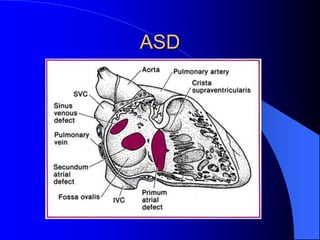
 Secundum (75%)
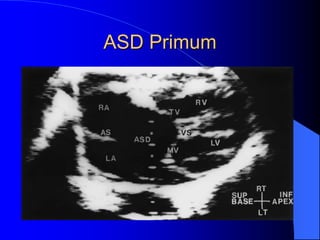
 Primum 15%
 Sinus Venosus 10%
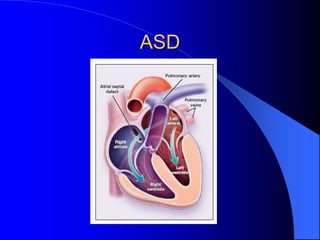
ASD
ASD
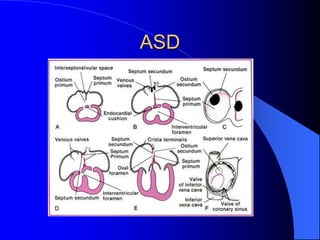
ASD
ASD
Associated Abnormalities
 MVP (mitral valve prolapse)
 Cleft Mitral Leaflet MR (Primum)
 Anomalous Pulmonary Venous Return
– Sinus Venosus
ASD Physiology
 Increased flow L-R
– High-low pressure
 Increased Right sided blood flow
 Dilation of RA, RV and PA
ASD Clinical Presentation
 No symptoms until third or fourth decades of life
despite pulmonary to systemic flow (Qp:Qs) of 1.5
or more
 Over the years, the increased volume of blood
usually causes right ventricular dilatation and
failure
 Fatigue or dyspnea on exertion
 Supraventricular arrhythmias
 Paradoxical embolism, or recurrent pulmonary
infections
 Death from RV failure or Arrhythmias in 40-50’s if
uncorrected
Physical Exam
 Right ventricular or pulmonary arterial
impulse may be palpable.
 Wide and fixed splitting of the second heart
sound
– Increased blood flow in PA
 A systolic ejection murmur second left
intercostal space (pulmonic)
– usually so soft that it is mistaken for an
“innocent”flow murmur.
 Flow across the atrial septal defect itself does
not produce a murmur.
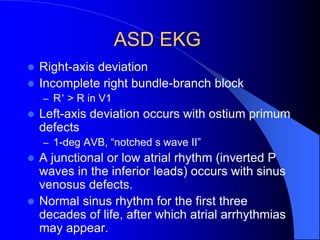
ASD EKG
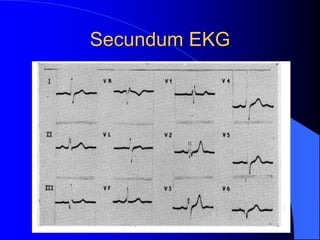
 Right-axis deviation
 Incomplete right bundle-branch block
– R’ > R in V1
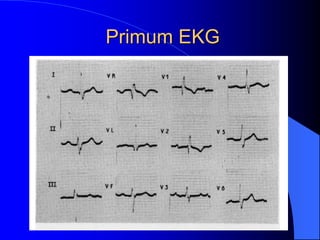
 Left-axis deviation occurs with ostium primum
defects
– 1-deg AVB, “notched s wave II”
 A junctional or low atrial rhythm (inverted P
waves in the inferior leads) occurs with sinus
venosus defects.
 Normal sinus rhythm for the first three
decades of life, after which atrial arrhythmias
may appear.
Secundum EKG
Primum EKG
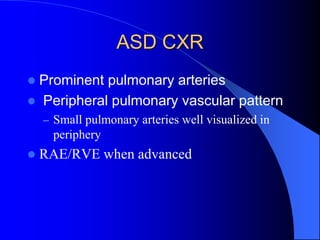
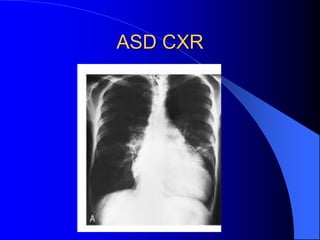
ASD CXR
 Prominent pulmonary arteries
 Peripheral pulmonary vascular pattern
– Small pulmonary arteries well visualized in
periphery
 RAE/RVE when advanced
ASD CXR
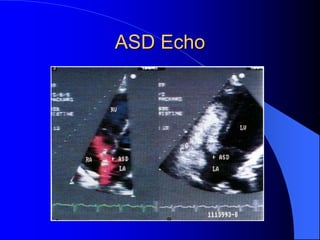
ASD Echo
 RAE/RVE
 Direct visualization of Primum and
Secundum defects
 Sinus venosus defects require TEE
 Microbubbles to assist with diagnosis
ASD Echo
ASD Primum
ASD Treatment
 Qp:Qs 1.5 or more should be closed to
prevent right ventricular dysfunction
 Not recommended if irreversible
pulmonary hypertension
 Prophylaxis against infective
endocarditis
– Except for first 6 months after closure
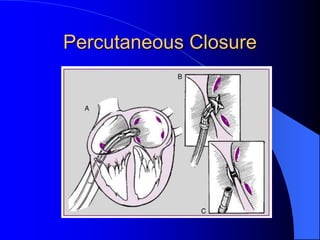
Percutaneous Closure
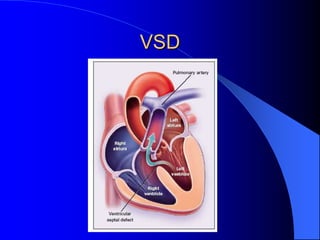
VSD
VSD
 Most common congenital cardiac abnormality in
infants and children
 M:F=1:1
 25-40 percent close spontaneously by 2 y.o.
 90 percent of those that eventually close do so by
age10
 70% are membranous, 20% muscular
 5% just below the aortic valve (undermining the
valve annulus and causing regurgitation),
VSD Physiology
 Initially left-to-right shunting
predominates
 Over time pulmonary vascular
resistance increases and left-to-right
shunting declines
 Eventually the pulmonary vascular
resistance exceeds the systemic
resistance and right to left shunting
begins
VSD Exam
 With left-to-right shunting and no pulmonary
hypertension
– left ventricular impulse is dynamic and laterally
displaced
– murmur is holosystolic, loudest at the lower left
sternal border usually accompanied by a palpable
thrill
– A short mid-diastolic apical rumble (caused by
increased flow through the mitral valve) may be
heard
VSD Exam
 Small, muscular VSD may produce high frequency
systolic ejection murmurs that terminate before the
end of systole
– High pressure, small defect
– defect is occluded by contracting heart muscle.
 If pulmonary hypertension develops, RV heave
and a pulsation over the pulmonary trunk may be
palpated
– Murmur and thrill eventually disappear as flow through
the defect decreases
 Cyanosis and clubbing are late findings
VSD ECG
 Small defect-normal
 Large defect- left atrial and ventricular
enlargement
 If pulmonary hypertension occurs
– QRS axis shifts to the right,
– right atrial and ventricular enlargement
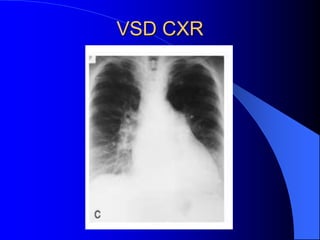
VSD CXR
 Small defect- normal
 Large defect “Shunt Vascularity”
 Pulmonary hypertension:
– proximal pulmonary arteries enlarged
– rapid taperingof the peripheral pulmonary
arteries, and oligemic lung fields “Pruning”
VSD CXR
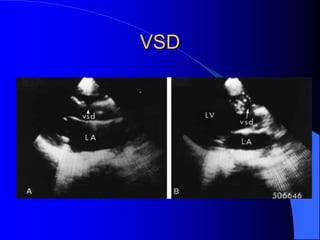
VSD Echo
 Two-dimensional echocardiography
 Confirm the presence and location
 Color-flow mapping provides
information about the magnitude and
direction of shunting
 Qp:Qs
VSD
VSD Management
 Small defects (Qp:Qs < 1.5)
– No need for surgery
– High Risk SBE (subacute bacterial (intfective) endocarditis ),
Prophylaxis provided
 Large defects who survive to adulthood usually
have left ventricular failure or pulmonary
hypertension/ right ventricular failure
– Surgical closure recommended
 Once the ratio of pulmonary to systemic vascular
resistance > 0.7 risk of surgery is prohibitive
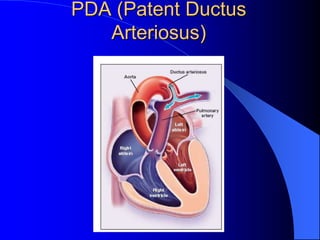
PDA (Patent Ductus
Arteriosus)
PDA
 Connects descending aorta (just distal to the
left subclavian artery) to the left pulmonary
artery
 In the fetus, it permits pulmonary arterial
blood to bypass lungs and enter the
descending aorta for oxygenation in the
placenta
 10 percent of cases of congenital heart
disease.
– Perinatal hypoxemia
– Maternal rubella
– Infants born at high altitude or prematurely
PDA Exam
 Bounding arterial pulses with widened pulse
pressure
 Hyperdynamic left ventricular impulse
 A continuous “machinery” murmur
– Second left anterior intercostal space
– Peaks immediately after the second heart sound
(thereby obscuring it)
– declines in intensity during diastole.
 If pulmonary hypertension develops continuous
murmur decreases in duration eventually
disappears
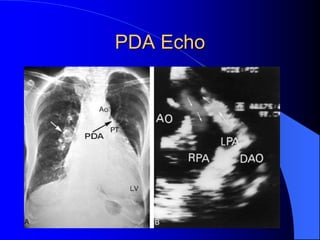
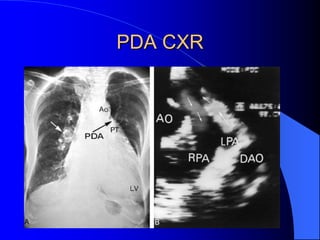
PDA CXR
 Left atrial and ventricular hypertrophy
 Pulmonary plethora, proximal
pulmonary arterial dilatation, RVH
 Prominent ascending aorta
 May be visualized as an opacity at the
confluence of the descending aorta and
the aortic knob
PDA CXR
PDA Imaging
 With two-dimensional echocardiography
the ductus arteriosus can usually be
visualized
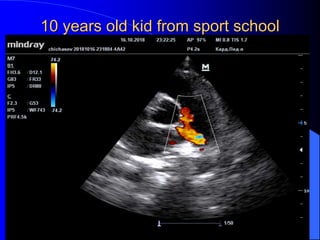
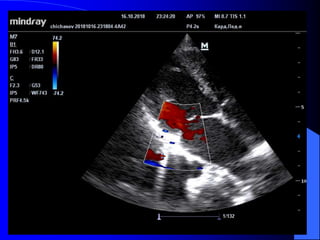
 Doppler studies demonstrate
continuous flow in the pulmonary trunk
 Quantify the magnitude of shunting
PDA Echo
10 years old kid from sport school
PDA Management
 Small defects
– No need for surgery
– High Risk SBE (0.45 % annually after age 20)
Prophylaxis provided
– Some recommend closure to prevent SBE
 Large defects
– Sx during childhood or adulthood: fatigue,
dyspnea, or palpitations
– The ductus arteriosus may become aneurysmal
and calcified, which may lead to its rupture
– Left ventricular failure from Vol overload
– When pulmonary vascular resistance exceeds
systemic vascular resistance, the direction of
shunting reverses (Cyanosis)
PDA Surgery
 1/3 of patients not surgically repaired die of heart
failure, pulmonary hypertension, or endarteritis by
age 40 2/3 die by age 60
 Surgical ligation or percutaneous closure
accomplished without cardiopulmonary bypass
 Mortality of less than 0.5 percent
 Once severe pulmonary vascular obstructive
disease develops closure is contraindicated.
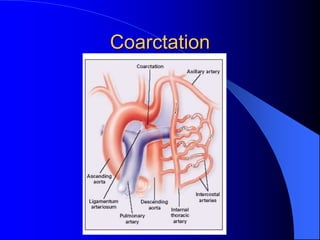
Coarctation
Coarctation Physiology
 A diaphragm-like ridge extending into aorta just
distal to the left subclavian artery at the
ligamentum arteriosum
 Less commonly immediately proximal to the left
subclavian artery
– difference in arterial pressure is noted between the
arms
 Collateral circulation through the internal thoracic,
intercostal, subclavian, and scapular arteries
develops
Coarctation
 M:F = 4-5:1
 Associated abnormalities:
 Gonadal dysgenesis (e.g.,Turner’s
syndrome)
 Bicuspid aortic valve (30%)
 Ventricular septal defect
 Patent ductus arteriosus
 Mitral stenosis or regurgitation
 Aneurysms of the circle of Willis
Coarctation Presentation
 Most adults are asymptomatic
 Diagnosis is made during physical exam
– Systemic arterial hypertension observed in the arms, with
diminished or absent femoral pulses
 If symptoms are present, they are usually those of
hypertension: headache, epistaxis, dizziness, and
palpitations.
 Occasionally, diminished blood flow to the legs
causes claudication
 May present with heart failure or aortic dissection
 Women with coarctation are at high risk for aortic
dissection during pregnancy
Coarctation Physical Exam
 Systolic arterial pressure higher in the arms than in
the legs
 The femoral arterial pulses are weak and delayed
 A systolic thrill in the suprasternal notch
 A systolic ejection click (due to a bicuspid aortic
valve)
 A harsh systolic ejection murmur along the left
sternal border and in the back, particularly over the
coarctation
 A systolic murmur, caused by flow through
collateral vessels, may be heard in the back
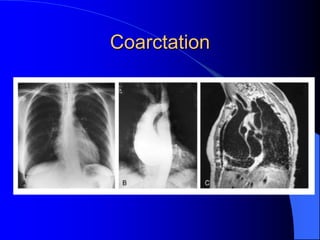
Coarctation CXR
 Increased collateral flow through the intercostal
arteries causes notching of the posterior third of
the third through eighth ribs
– Usually symmetric.
 Notching is not seen in the anterior ribs
– Anterior intercostal arteries are not located in costal
grooves
 The coarctation may be visible as an indentation
of the aorta with prestenotic and poststenotic
dilatation of the aorta, producing the “reversed E”
or “3” sign
Coarctation
Coarctation Imaging
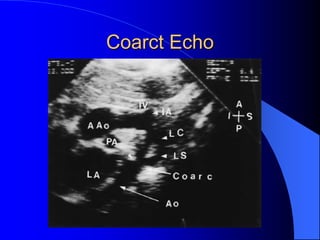
 The coarctation may be visualized
echocardiographically
 Doppler examination can estimate
transcoarctation pressure gradient.
 Computed tomography, magnetic
resonance imaging, and contrast
aortography
– Location and length of the coarctation
– Visualization of the collateral circulation
– Measurement of Gradient on Cath
Coarct Echo
Coarctation Complications
 Hypertension
 Left ventricular failure (2/3 of pts > 40 yo)
 Aortic dissection
 Premature coronary artery disease
 Infective endocarditis
 Cerebrovascular accidents (due to the
rupture of an intracerebral aneurysm)
 If uncorrected 3/4 die by the age of 50, and
90% by the age of 60
Coarctation Repair
 Repair considered for transcoarctation pressure
gradient of more than 30 mm Hg
 Balloon dilatation is a therapeutic alternative
– Higher incidence of subsequent aortic aneurysm and
recurrent coarctation than surgical repair
 Postoperative complications include residual or
recurrent hypertension, recurrent coarctation, and
the possible sequelae of a bicuspid aortic valve
Age at Time of Repair
 Surgery during childhood:
– 90 percent are normotensive 5 years later,
50 percent are normotensive 20 years later
– 89 percent of patients are alive 15 years
later and 83 percent are alive 25 years
later
 Surgery after age 40:
– Half have persistent hypertension
– 15-year survival is only 50 percent
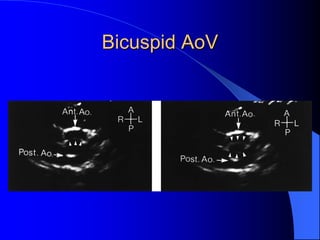
Bicuspid AoV
Aortic Stenosis
 Supravalvular and Infravalvular Stenoses typically present
in childhood
 Bicuspid aortic valve 2 to 3 percent adult population.
 M:F=4:1
 20% have associated cardiovascular abnormality such as
patent ductus arteriosus or aortic coarctation.
 Not stenotic at birth, subject to abnormal hemodynamic
stress, leads to thickening and calcification of the leaflets
 Abnormality of the medial layer of the aorta above the
Valve predisposes to dilatation of the aortic root
Aortic Stenosis Presentation
 The classic symptoms are angina pectoris,
syncope and heart failure
 Adults with aortic stenosis who are
asymptomatic have a normal life expectancy;
they should receive antibiotic prophylaxis
 Once symptoms appear, survival is limited:
the median survival
– five years after angina develops
– three years after syncope occurs
– two years after heart failure appears
Aortic Stenosis Physical Exam
 Carotid upstroke delayed and diminished (parvus
et tardus)
 The aortic component of S2 diminished or
inaudible
 Fourth heart sound is present
 A harsh systolic crescendo–decrescendo murmur
is audible over the aortic area and often radiates
to the neck
 As the aortic stenosis worsens, the murmur peaks
progressively later in systole
Aortic Stenosis Work Up
 Left ventricular hypertrophy is usually evident on
ECG
 Unless the left ventricle dilates, CXR demonstrates
a normal cardiac silhouette
 TTE with Doppler permits assessment of the
severity of the stenosis and of left ventricular
systolic function.
 Cardiac catheterization is performed to determine
the severity of aortic stenosis and to determine
concomitant coronary artery disease.
Aortic Stenosis Treatment
 If mild, only SBE prophylaxis
 If symptomatic, valve replacement
necessary
 Valve replacement prior to development of
LV dysfxn
– Nl LV fxn
– LVH will regress
Pulmonic Stenosis
 10 to 12 percent of congenital heart disease in
adults.
 Valvular in 90 percent of patients, remainder
supravalvular or subvalvular
 Supravalvular pulmonary stenosis in pulmonary
trunk or branches
– Often coexists with other congenital cardiac
abnormalities (valvular pulmonary stenosis, ASD, VSD,
PDA, tetralogy of Fallot or Williams syndrome)
 Subvalvular pulmonary stenosis caused by
narrowing of the right ventricular infundibulum
usually occurs in ventricular septal defect.
Pulmonary Stenosis
Physiology
 Typically is an isolated abnormality, may occur with
VSD
 Valve leaflets usually are thin and pliant; all three
valve cusps are present
 Commissures are fused
– Valve is dome-shaped with a small central orifice
– 10-15 percent have dysplastic thickened leaflets
 2/3 of patients with Noonan’s syndrome have
pulmonary stenosis due to valve dysplasia.
Pulmonic Stenosis Definition
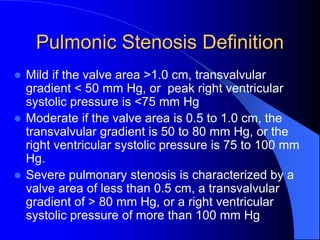
 Mild if the valve area >1.0 cm, transvalvular
gradient < 50 mm Hg, or peak right ventricular
systolic pressure is <75 mm Hg
 Moderate if the valve area is 0.5 to 1.0 cm, the
transvalvular gradient is 50 to 80 mm Hg, or the
right ventricular systolic pressure is 75 to 100 mm
Hg.
 Severe pulmonary stenosis is characterized by a
valve area of less than 0.5 cm, a transvalvular
gradient of > 80 mm Hg, or a right ventricular
systolic pressure of more than 100 mm Hg
Pulmonic Stenosis
Presentation
 If mild, usually Asx
 When the stenosis is severe, dyspnea on exertion
or fatigability may occur
 Less often may have chest pain or syncope with
exertion
 Eventually, right ventricular failure may develop,
with peripheral edema and abdominal swelling
 If the foramen ovale patent, shunting of blood from
the right to the left causing cyanosis and clubbing
Pulmonic Stenosis Physical
Exam
 With moderate or severe pulmonary stenosis:
 A right ventricular impulse at the left sternal border
 Thrill at the second left intercostal space
 Harsh crescendo–decrescendo systolic murmur increases
with inspiration at left sternal border
 If the valve is pliable, an ejection click often precedes the
murmur
 As the stenosis becomes more severe, the systolic
murmur peaks later in systole
Pumonic Stenosis CXR
 Post-stenotic dilatation of the main
pulmonary artery
 Diminished pulmonary vascular
markings
 The cardiac silhouette is usually normal
– An enlarged cardiac silhouette may be
seen if the patient has right ventricular
failure or tricuspid regurgitation.
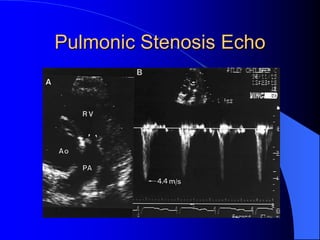
Pulmonic Stenosis Echo
 Right ventricular hypertrophy and
paradoxical septal motion during
 Site of obstruction can be visualized in
most patients.
 With the use of Doppler flow studies,
the severity of stenosis can usually be
assessed
Pulmonic Stenosis Echo
Pulmonic Stenosis, Treatment
 If mild only SBE Prophylaxis
 Survival 94 percent 20 years after diagnosis
 Severe stenosis should be relieved
 Moderate pulmonary stenosis have an excellent
prognosis with either medical or interventional
therapy
– Interventional therapy is usually recommended, since
most patients with moderate pulmonary stenosis
eventually progress
Balloon Valvuloplasty
 The procedure of choice
 High success rate provided the valve is
mobile and pliant
 Long-term results are excellent
 Secondary hypertrophic subpulmonary
stenosis regresses after successful
intervention
 Valve replacement is required if the leaflets
are dysplastic or calcified or if marked
regurgitation is present
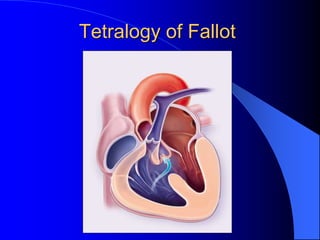
Tetrology of Fallot
 Most common cyanotic heart defect after
infancy
 Overiding aorta
 Obstruction of RVOT
 RVH
 VSD
 Associated with L-PA stenosis (40%), R
sided aortic Arch (25%), ASD (10%),
Coronary Anomalies (10%)
Tetralogy of Fallot
Tetralogy of Fallot
 Equal pressure in R and L ventricles
 R-L shunting due to elevated RV pressures
from RVOT obstruction
 Changes in SV resistance affect shunting
– Increased SVR (systemic vascular resistance )
decreases R-L shunting
Tetralogy of Fallot
Presentation
 Cyanotic spells beginning in first year of life
– Tachypnea, cyanosis
– Can progress to LOC (level of consciousness),
Seizures, CVA (Cerebrovascular accident), Death
 Adults
– Dyspnea and limited exercise tolerance
– Complications of chronic cyanosis- erythrocytosis,
hyperviscosity, abnormalities of hemostasis,
cerebral abscesses or stroke, and endocarditis.
Tetralogy of Fallot
Physical Exam
 Cyanosis and digital clubbing
– Severity determined by the degree of RVOT obstruction
 RV lift is palpable
 A Systolic ejection murmur caused by turbulent flow
across the RVOT (thrill may be may be palpable)
– Intensity and duration inversely proportional to severity of
obstruction- flow shunted across VSD
– a soft, short murmur suggests severe obstruction
 Second heart sound is single, since its pulmonary
component is inaudible
 An aortic ejection click (due to a dilated, overriding
aorta) may be heard
Tetralogy of Fallot
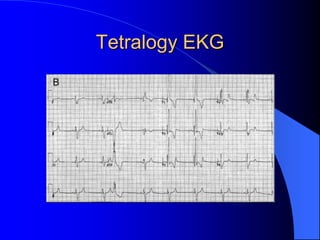
 ECG- right-axis deviation and right
ventricular hypertrophy.
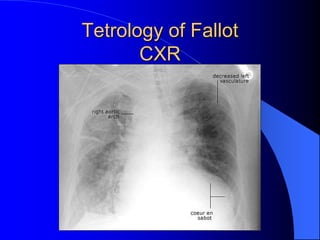
 CXR- heart size is normal or small
– lung markings are diminished.
– “bootshaped,” heart
– upturned right ventricular apex and
concave main pulmonary arterial segment.
– A right sided aortic arch may be present.
Tetrology of Fallot
CXR
Tetralogy EKG
Tetralogy of Fallot
Echo
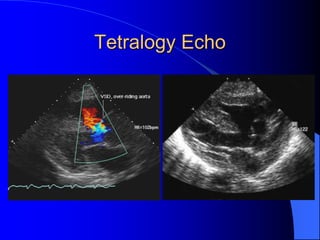
 Establishes diagnosis
 Determines severity of RVOT obstruction
 Flow across VSD
 Cardiac Cath
– Pressures, gradients, shunting, O2 sat, VSD
– Origins of coronary arteries
 Also seen by MRI or CTA
Tetralogy Echo
Tetralogy of Fallot
 Without surgical intervention, most
patients die in childhood
 Survival rate- 66 percent at 1 year of
age, 40 percent at 3 years, 11 percent
at 20 years, 6 percent at 30 years, and
3 percent at 40 years
Tetralogy of Fallot
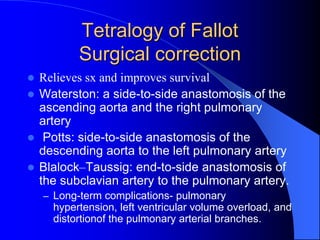
Surgical correction
 Relieves sx and improves survival
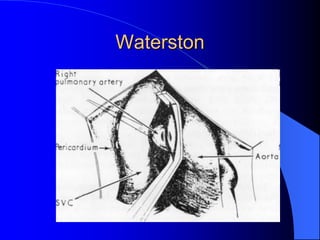
 Waterston: a side-to-side anastomosis of the
ascending aorta and the right pulmonary
artery
 Potts: side-to-side anastomosis of the
descending aorta to the left pulmonary artery
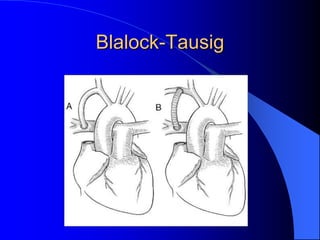
 Blalock–Taussig: end-to-side anastomosis of
the subclavian artery to the pulmonary artery.
– Long-term complications- pulmonary
hypertension, left ventricular volume overload, and
distortionof the pulmonary arterial branches.
Blalock-Tausig
Waterston
Tetralogy of Fallot
Surgical correction
 Complete surgical correction
– Closure of VSD
– Relief of RVOT obstruction
 Mortality 3% in children, 2.5-8% in Adults
 Rate of survival 32 years after surgery
86% with repair vs. 96% in age-
matched controls
Tetralogy of Fallot
Post Surgical Complications
 Ventricular arrhythmias detected with
Holter monitoring in 40 to 50 percent
 Moderate or severe pulmonary
regurgitation
 Systolic and diastolic ventricular
dysfunction
 Atrial fibrillation or flutter are common
Tetralogy of Fallot
Post Surgical Complications
 Pulmonary regurgitation may develop as a
consequence of surgical repair of the RVOT
– Can result in RVE and RV dysfunction
– May require repair or replacement of the pulmonary
valve
 RVOT aneurysm may occur at site of repair
– Rupture has been reported
 Recurrent obstruction of RVOT may occur
 10-20% have residual VSD
 CHB may occur
 AI is common but usually mild
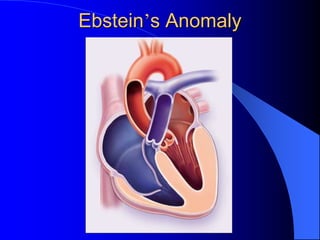
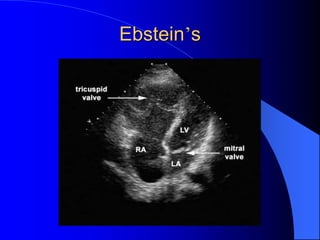
Ebstein’s Anomaly
 Downward displacement of septal leaflet of
Tricuspid valve
– Sometime posterior leaflet as well
 “Atrialized Ventricle”
 Tricuspid regurg common
 80% have ASD or PFO
– Can result in R-L shunting
Ebstein’s Anomaly
Ebstein’s
Ebstein’s Anomaly
 Severity of defect depends upon degree of valvular
displacement
 Presentation ranges from severe HF in neonate to
incidental discovery in adults
 Neonates with severe disease have cyanosis, heart failure,
murmur noted in the first days of life
– Worsens after the ductus arteriosus closes
 Older children with Ebstein’s anomaly often come to
medical attention because of an incidental murmur
 Adolescents and adults present with a supraventricular
arrhythmia.
Ebstein’s Anomaly
Physical Exam
 Severity of cyanosis depends on the
magnitude of right-to-left shunting
 Tricuspid regurgitation is usually present at
the left lower sternal border.
 Hepatomegaly from passive hepatic
congestion due to elevated right atrial
pressure may be present.
Ebstein’s Anomaly
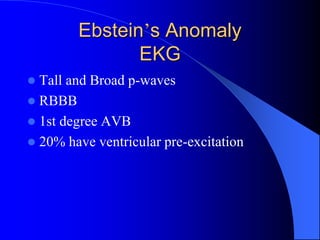
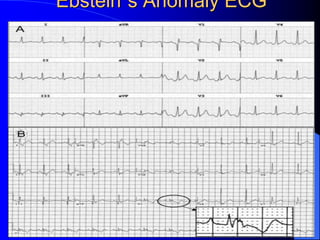
EKG
 Tall and Broad p-waves
 RBBB
 1st degree AVB
 20% have ventricular pre-excitation
Ebstein’s Anomaly ECG
Ebstein’s Anomaly
CXR
 Normal in mild cases
 Cardiomegally from RAE
 Pulmonary markings decreased in severe
cases
– Marked R-L shunting across ASD
Ebstein’s Anomaly
Treatment
 Focuses on preventing and treating
complications
 SBE prophylaxis
 CHF
 Rx of SVT
– RFA for accessory pathway
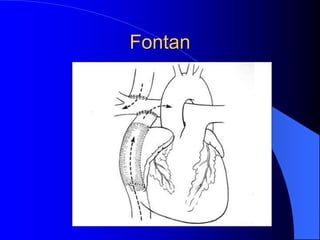
 Fontan procedure in severe cases
Fontan
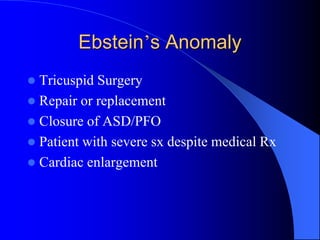
Ebstein’s Anomaly
 Tricuspid Surgery
 Repair or replacement
 Closure of ASD/PFO
 Patient with severe sx despite medical Rx
 Cardiac enlargement
Transposition of the Great
Vessels
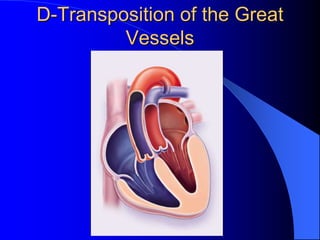
 Aorta from RV, PA from LV
 Complete separation of pulmonic and
arterial saturation
 Requires communication between the
circuits for survivial
– PDA, VSD, ASD or PFO
D-Transposition of the Great
Vessels
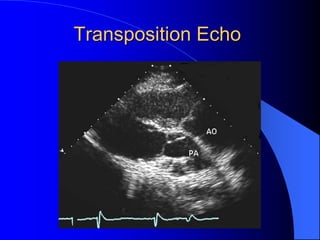
Transposition Echo
Transposition of the Great
Vessels Physical Exam
 Findings are nonspecific.
 Infants have cyanosis and tachypnea.
 The second heart sound is single and loud
(due to the anterior position of the aorta).
 In patients with mild cyanosis, a holosystolic
murmur caused by a ventricular septal defect
may be heard.
 A soft systolic ejection murmur (due to
pulmonary stenosis, ejection into the
anteriorly located aorta, or both) may be
audible.
Transposition of the Great
Vessels EKG
 RAD
 RVH- RV is systemic ventricle
 LVH- if VSD, PDA, Pulmonic Stenosis
present
Transposition of the Great
Vessels CXR
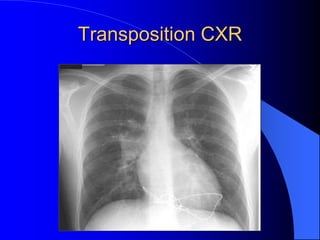
 Increased pulmonary vascularity
 Egg Shaped with a narrow stalk
Transposition CXR
Transposition of the Great
Vessels
 Mortality 90% by 6 months if uncorrected
 Infusion of prostaglandin E (to maintain
or restore patency of the ductus
arteriosus),
 Creation of an atrial septal defect by
means of balloon atrial septostomy (the
Rashkind procedure).
 Oxygen- to decrease PVR, increase
pulmonary blood flow
Transposition of the Great
Vessels-Surgery
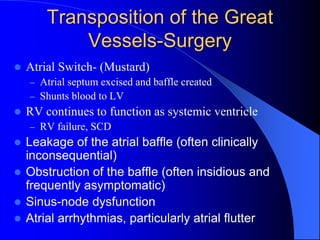
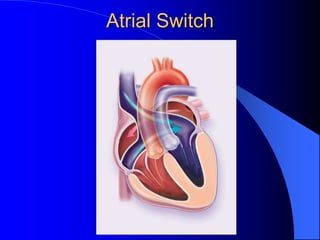
 Atrial Switch- (Mustard)
– Atrial septum excised and baffle created
– Shunts blood to LV
 RV continues to function as systemic ventricle
– RV failure, SCD
 Leakage of the atrial baffle (often clinically
inconsequential)
 Obstruction of the baffle (often insidious and
frequently asymptomatic)
 Sinus-node dysfunction
 Atrial arrhythmias, particularly atrial flutter
Atrial Switch
Arterial Switch
Transposition of the Great
Vessels-Surgery
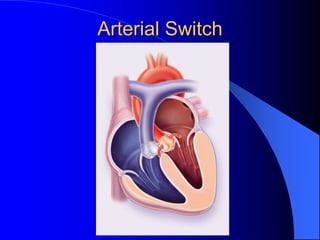
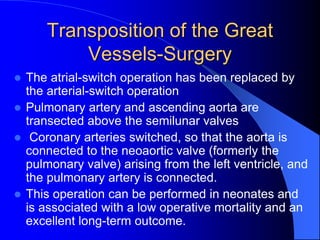
 The atrial-switch operation has been replaced by
the arterial-switch operation
 Pulmonary artery and ascending aorta are
transected above the semilunar valves
 Coronary arteries switched, so that the aorta is
connected to the neoaortic valve (formerly the
pulmonary valve) arising from the left ventricle, and
the pulmonary artery is connected.
 This operation can be performed in neonates and
is associated with a low operative mortality and an
excellent long-term outcome.

Врожд. пороки сердца у взрослых Heart deferts(англ).ppt

  • 1.
  • 2.
    Background  8/1000 Liveborn births  32,000 cases/yr  Live born prevalence lower than fetal prevalence – Fetal echo  20% die within first year – 80% of first year survivors reach adulthood – Prevalence 800,000 adults in U.S.  Focus on Adult congenital heart disease
  • 3.
    Classification of CongenitalHeart Diseases  Simple or complex – Simple includes ASD, VSD, or singular valvular abnormalities (Ebstein’s anomaly) – Complex includes those with multiple defects, AV canal defects, or “single” ventricle physiology.  Cyanotic or non-cyanotic – Non-cyanotic: ASD, VSD, sinus venosus defect, patent ductus arteriosus, aortic stenosis, pulmonary stenosis, aortic coarctation – Cyanotic: Tetralogy of Fallot, Ebstein’s anomaly, transposition of the great arteries, Eisenmenger’s syndrome, truncus arteriosus, tricuspid atresia, total anomalous pulmonary venous return “5 Ts and 2 Es”
  • 4.
    The heart isformed and septations occur at 50 embryonic days.
  • 5.
    Atrial Septal Defect One third of adult patients with CHD  F:M=2:1  Secundum (75%)  Primum 15%  Sinus Venosus 10%
  • 6.
  • 7.
  • 8.
  • 9.
    ASD Associated Abnormalities  MVP(mitral valve prolapse)  Cleft Mitral Leaflet MR (Primum)  Anomalous Pulmonary Venous Return – Sinus Venosus
  • 10.
    ASD Physiology  Increasedflow L-R – High-low pressure  Increased Right sided blood flow  Dilation of RA, RV and PA
  • 11.
    ASD Clinical Presentation No symptoms until third or fourth decades of life despite pulmonary to systemic flow (Qp:Qs) of 1.5 or more  Over the years, the increased volume of blood usually causes right ventricular dilatation and failure  Fatigue or dyspnea on exertion  Supraventricular arrhythmias  Paradoxical embolism, or recurrent pulmonary infections  Death from RV failure or Arrhythmias in 40-50’s if uncorrected
  • 12.
    Physical Exam  Rightventricular or pulmonary arterial impulse may be palpable.  Wide and fixed splitting of the second heart sound – Increased blood flow in PA  A systolic ejection murmur second left intercostal space (pulmonic) – usually so soft that it is mistaken for an “innocent”flow murmur.  Flow across the atrial septal defect itself does not produce a murmur.
  • 13.
    ASD EKG  Right-axisdeviation  Incomplete right bundle-branch block – R’ > R in V1  Left-axis deviation occurs with ostium primum defects – 1-deg AVB, “notched s wave II”  A junctional or low atrial rhythm (inverted P waves in the inferior leads) occurs with sinus venosus defects.  Normal sinus rhythm for the first three decades of life, after which atrial arrhythmias may appear.
  • 14.
  • 15.
  • 16.
    ASD CXR  Prominentpulmonary arteries  Peripheral pulmonary vascular pattern – Small pulmonary arteries well visualized in periphery  RAE/RVE when advanced
  • 17.
  • 18.
    ASD Echo  RAE/RVE Direct visualization of Primum and Secundum defects  Sinus venosus defects require TEE  Microbubbles to assist with diagnosis
  • 19.
  • 20.
  • 21.
    ASD Treatment  Qp:Qs1.5 or more should be closed to prevent right ventricular dysfunction  Not recommended if irreversible pulmonary hypertension  Prophylaxis against infective endocarditis – Except for first 6 months after closure
  • 22.
  • 23.
  • 24.
    VSD  Most commoncongenital cardiac abnormality in infants and children  M:F=1:1  25-40 percent close spontaneously by 2 y.o.  90 percent of those that eventually close do so by age10  70% are membranous, 20% muscular  5% just below the aortic valve (undermining the valve annulus and causing regurgitation),
  • 25.
    VSD Physiology  Initiallyleft-to-right shunting predominates  Over time pulmonary vascular resistance increases and left-to-right shunting declines  Eventually the pulmonary vascular resistance exceeds the systemic resistance and right to left shunting begins
  • 26.
    VSD Exam  Withleft-to-right shunting and no pulmonary hypertension – left ventricular impulse is dynamic and laterally displaced – murmur is holosystolic, loudest at the lower left sternal border usually accompanied by a palpable thrill – A short mid-diastolic apical rumble (caused by increased flow through the mitral valve) may be heard
  • 27.
    VSD Exam  Small,muscular VSD may produce high frequency systolic ejection murmurs that terminate before the end of systole – High pressure, small defect – defect is occluded by contracting heart muscle.  If pulmonary hypertension develops, RV heave and a pulsation over the pulmonary trunk may be palpated – Murmur and thrill eventually disappear as flow through the defect decreases  Cyanosis and clubbing are late findings
  • 28.
    VSD ECG  Smalldefect-normal  Large defect- left atrial and ventricular enlargement  If pulmonary hypertension occurs – QRS axis shifts to the right, – right atrial and ventricular enlargement
  • 29.
    VSD CXR  Smalldefect- normal  Large defect “Shunt Vascularity”  Pulmonary hypertension: – proximal pulmonary arteries enlarged – rapid taperingof the peripheral pulmonary arteries, and oligemic lung fields “Pruning”
  • 30.
  • 31.
    VSD Echo  Two-dimensionalechocardiography  Confirm the presence and location  Color-flow mapping provides information about the magnitude and direction of shunting  Qp:Qs
  • 32.
  • 33.
    VSD Management  Smalldefects (Qp:Qs < 1.5) – No need for surgery – High Risk SBE (subacute bacterial (intfective) endocarditis ), Prophylaxis provided  Large defects who survive to adulthood usually have left ventricular failure or pulmonary hypertension/ right ventricular failure – Surgical closure recommended  Once the ratio of pulmonary to systemic vascular resistance > 0.7 risk of surgery is prohibitive
  • 34.
  • 35.
    PDA  Connects descendingaorta (just distal to the left subclavian artery) to the left pulmonary artery  In the fetus, it permits pulmonary arterial blood to bypass lungs and enter the descending aorta for oxygenation in the placenta  10 percent of cases of congenital heart disease. – Perinatal hypoxemia – Maternal rubella – Infants born at high altitude or prematurely
  • 36.
    PDA Exam  Boundingarterial pulses with widened pulse pressure  Hyperdynamic left ventricular impulse  A continuous “machinery” murmur – Second left anterior intercostal space – Peaks immediately after the second heart sound (thereby obscuring it) – declines in intensity during diastole.  If pulmonary hypertension develops continuous murmur decreases in duration eventually disappears
  • 37.
    PDA CXR  Leftatrial and ventricular hypertrophy  Pulmonary plethora, proximal pulmonary arterial dilatation, RVH  Prominent ascending aorta  May be visualized as an opacity at the confluence of the descending aorta and the aortic knob
  • 38.
  • 39.
    PDA Imaging  Withtwo-dimensional echocardiography the ductus arteriosus can usually be visualized  Doppler studies demonstrate continuous flow in the pulmonary trunk  Quantify the magnitude of shunting
  • 40.
  • 41.
    10 years oldkid from sport school
  • 43.
    PDA Management  Smalldefects – No need for surgery – High Risk SBE (0.45 % annually after age 20) Prophylaxis provided – Some recommend closure to prevent SBE  Large defects – Sx during childhood or adulthood: fatigue, dyspnea, or palpitations – The ductus arteriosus may become aneurysmal and calcified, which may lead to its rupture – Left ventricular failure from Vol overload – When pulmonary vascular resistance exceeds systemic vascular resistance, the direction of shunting reverses (Cyanosis)
  • 44.
    PDA Surgery  1/3of patients not surgically repaired die of heart failure, pulmonary hypertension, or endarteritis by age 40 2/3 die by age 60  Surgical ligation or percutaneous closure accomplished without cardiopulmonary bypass  Mortality of less than 0.5 percent  Once severe pulmonary vascular obstructive disease develops closure is contraindicated.
  • 45.
  • 46.
    Coarctation Physiology  Adiaphragm-like ridge extending into aorta just distal to the left subclavian artery at the ligamentum arteriosum  Less commonly immediately proximal to the left subclavian artery – difference in arterial pressure is noted between the arms  Collateral circulation through the internal thoracic, intercostal, subclavian, and scapular arteries develops
  • 47.
    Coarctation  M:F =4-5:1  Associated abnormalities:  Gonadal dysgenesis (e.g.,Turner’s syndrome)  Bicuspid aortic valve (30%)  Ventricular septal defect  Patent ductus arteriosus  Mitral stenosis or regurgitation  Aneurysms of the circle of Willis
  • 48.
    Coarctation Presentation  Mostadults are asymptomatic  Diagnosis is made during physical exam – Systemic arterial hypertension observed in the arms, with diminished or absent femoral pulses  If symptoms are present, they are usually those of hypertension: headache, epistaxis, dizziness, and palpitations.  Occasionally, diminished blood flow to the legs causes claudication  May present with heart failure or aortic dissection  Women with coarctation are at high risk for aortic dissection during pregnancy
  • 49.
    Coarctation Physical Exam Systolic arterial pressure higher in the arms than in the legs  The femoral arterial pulses are weak and delayed  A systolic thrill in the suprasternal notch  A systolic ejection click (due to a bicuspid aortic valve)  A harsh systolic ejection murmur along the left sternal border and in the back, particularly over the coarctation  A systolic murmur, caused by flow through collateral vessels, may be heard in the back
  • 50.
    Coarctation CXR  Increasedcollateral flow through the intercostal arteries causes notching of the posterior third of the third through eighth ribs – Usually symmetric.  Notching is not seen in the anterior ribs – Anterior intercostal arteries are not located in costal grooves  The coarctation may be visible as an indentation of the aorta with prestenotic and poststenotic dilatation of the aorta, producing the “reversed E” or “3” sign
  • 51.
  • 52.
    Coarctation Imaging  Thecoarctation may be visualized echocardiographically  Doppler examination can estimate transcoarctation pressure gradient.  Computed tomography, magnetic resonance imaging, and contrast aortography – Location and length of the coarctation – Visualization of the collateral circulation – Measurement of Gradient on Cath
  • 53.
  • 54.
    Coarctation Complications  Hypertension Left ventricular failure (2/3 of pts > 40 yo)  Aortic dissection  Premature coronary artery disease  Infective endocarditis  Cerebrovascular accidents (due to the rupture of an intracerebral aneurysm)  If uncorrected 3/4 die by the age of 50, and 90% by the age of 60
  • 55.
    Coarctation Repair  Repairconsidered for transcoarctation pressure gradient of more than 30 mm Hg  Balloon dilatation is a therapeutic alternative – Higher incidence of subsequent aortic aneurysm and recurrent coarctation than surgical repair  Postoperative complications include residual or recurrent hypertension, recurrent coarctation, and the possible sequelae of a bicuspid aortic valve
  • 56.
    Age at Timeof Repair  Surgery during childhood: – 90 percent are normotensive 5 years later, 50 percent are normotensive 20 years later – 89 percent of patients are alive 15 years later and 83 percent are alive 25 years later  Surgery after age 40: – Half have persistent hypertension – 15-year survival is only 50 percent
  • 57.
  • 58.
    Aortic Stenosis  Supravalvularand Infravalvular Stenoses typically present in childhood  Bicuspid aortic valve 2 to 3 percent adult population.  M:F=4:1  20% have associated cardiovascular abnormality such as patent ductus arteriosus or aortic coarctation.  Not stenotic at birth, subject to abnormal hemodynamic stress, leads to thickening and calcification of the leaflets  Abnormality of the medial layer of the aorta above the Valve predisposes to dilatation of the aortic root
  • 59.
    Aortic Stenosis Presentation The classic symptoms are angina pectoris, syncope and heart failure  Adults with aortic stenosis who are asymptomatic have a normal life expectancy; they should receive antibiotic prophylaxis  Once symptoms appear, survival is limited: the median survival – five years after angina develops – three years after syncope occurs – two years after heart failure appears
  • 60.
    Aortic Stenosis PhysicalExam  Carotid upstroke delayed and diminished (parvus et tardus)  The aortic component of S2 diminished or inaudible  Fourth heart sound is present  A harsh systolic crescendo–decrescendo murmur is audible over the aortic area and often radiates to the neck  As the aortic stenosis worsens, the murmur peaks progressively later in systole
  • 61.
    Aortic Stenosis WorkUp  Left ventricular hypertrophy is usually evident on ECG  Unless the left ventricle dilates, CXR demonstrates a normal cardiac silhouette  TTE with Doppler permits assessment of the severity of the stenosis and of left ventricular systolic function.  Cardiac catheterization is performed to determine the severity of aortic stenosis and to determine concomitant coronary artery disease.
  • 62.
    Aortic Stenosis Treatment If mild, only SBE prophylaxis  If symptomatic, valve replacement necessary  Valve replacement prior to development of LV dysfxn – Nl LV fxn – LVH will regress
  • 63.
    Pulmonic Stenosis  10to 12 percent of congenital heart disease in adults.  Valvular in 90 percent of patients, remainder supravalvular or subvalvular  Supravalvular pulmonary stenosis in pulmonary trunk or branches – Often coexists with other congenital cardiac abnormalities (valvular pulmonary stenosis, ASD, VSD, PDA, tetralogy of Fallot or Williams syndrome)  Subvalvular pulmonary stenosis caused by narrowing of the right ventricular infundibulum usually occurs in ventricular septal defect.
  • 64.
    Pulmonary Stenosis Physiology  Typicallyis an isolated abnormality, may occur with VSD  Valve leaflets usually are thin and pliant; all three valve cusps are present  Commissures are fused – Valve is dome-shaped with a small central orifice – 10-15 percent have dysplastic thickened leaflets  2/3 of patients with Noonan’s syndrome have pulmonary stenosis due to valve dysplasia.
  • 65.
    Pulmonic Stenosis Definition Mild if the valve area >1.0 cm, transvalvular gradient < 50 mm Hg, or peak right ventricular systolic pressure is <75 mm Hg  Moderate if the valve area is 0.5 to 1.0 cm, the transvalvular gradient is 50 to 80 mm Hg, or the right ventricular systolic pressure is 75 to 100 mm Hg.  Severe pulmonary stenosis is characterized by a valve area of less than 0.5 cm, a transvalvular gradient of > 80 mm Hg, or a right ventricular systolic pressure of more than 100 mm Hg
  • 66.
    Pulmonic Stenosis Presentation  Ifmild, usually Asx  When the stenosis is severe, dyspnea on exertion or fatigability may occur  Less often may have chest pain or syncope with exertion  Eventually, right ventricular failure may develop, with peripheral edema and abdominal swelling  If the foramen ovale patent, shunting of blood from the right to the left causing cyanosis and clubbing
  • 67.
    Pulmonic Stenosis Physical Exam With moderate or severe pulmonary stenosis:  A right ventricular impulse at the left sternal border  Thrill at the second left intercostal space  Harsh crescendo–decrescendo systolic murmur increases with inspiration at left sternal border  If the valve is pliable, an ejection click often precedes the murmur  As the stenosis becomes more severe, the systolic murmur peaks later in systole
  • 68.
    Pumonic Stenosis CXR Post-stenotic dilatation of the main pulmonary artery  Diminished pulmonary vascular markings  The cardiac silhouette is usually normal – An enlarged cardiac silhouette may be seen if the patient has right ventricular failure or tricuspid regurgitation.
  • 69.
    Pulmonic Stenosis Echo Right ventricular hypertrophy and paradoxical septal motion during  Site of obstruction can be visualized in most patients.  With the use of Doppler flow studies, the severity of stenosis can usually be assessed
  • 70.
  • 71.
    Pulmonic Stenosis, Treatment If mild only SBE Prophylaxis  Survival 94 percent 20 years after diagnosis  Severe stenosis should be relieved  Moderate pulmonary stenosis have an excellent prognosis with either medical or interventional therapy – Interventional therapy is usually recommended, since most patients with moderate pulmonary stenosis eventually progress
  • 72.
    Balloon Valvuloplasty  Theprocedure of choice  High success rate provided the valve is mobile and pliant  Long-term results are excellent  Secondary hypertrophic subpulmonary stenosis regresses after successful intervention  Valve replacement is required if the leaflets are dysplastic or calcified or if marked regurgitation is present
  • 73.
    Tetrology of Fallot Most common cyanotic heart defect after infancy  Overiding aorta  Obstruction of RVOT  RVH  VSD  Associated with L-PA stenosis (40%), R sided aortic Arch (25%), ASD (10%), Coronary Anomalies (10%)
  • 74.
  • 75.
    Tetralogy of Fallot Equal pressure in R and L ventricles  R-L shunting due to elevated RV pressures from RVOT obstruction  Changes in SV resistance affect shunting – Increased SVR (systemic vascular resistance ) decreases R-L shunting
  • 76.
    Tetralogy of Fallot Presentation Cyanotic spells beginning in first year of life – Tachypnea, cyanosis – Can progress to LOC (level of consciousness), Seizures, CVA (Cerebrovascular accident), Death  Adults – Dyspnea and limited exercise tolerance – Complications of chronic cyanosis- erythrocytosis, hyperviscosity, abnormalities of hemostasis, cerebral abscesses or stroke, and endocarditis.
  • 77.
    Tetralogy of Fallot PhysicalExam  Cyanosis and digital clubbing – Severity determined by the degree of RVOT obstruction  RV lift is palpable  A Systolic ejection murmur caused by turbulent flow across the RVOT (thrill may be may be palpable) – Intensity and duration inversely proportional to severity of obstruction- flow shunted across VSD – a soft, short murmur suggests severe obstruction  Second heart sound is single, since its pulmonary component is inaudible  An aortic ejection click (due to a dilated, overriding aorta) may be heard
  • 78.
    Tetralogy of Fallot ECG- right-axis deviation and right ventricular hypertrophy.  CXR- heart size is normal or small – lung markings are diminished. – “bootshaped,” heart – upturned right ventricular apex and concave main pulmonary arterial segment. – A right sided aortic arch may be present.
  • 79.
  • 80.
  • 81.
    Tetralogy of Fallot Echo Establishes diagnosis  Determines severity of RVOT obstruction  Flow across VSD  Cardiac Cath – Pressures, gradients, shunting, O2 sat, VSD – Origins of coronary arteries  Also seen by MRI or CTA
  • 82.
  • 83.
    Tetralogy of Fallot Without surgical intervention, most patients die in childhood  Survival rate- 66 percent at 1 year of age, 40 percent at 3 years, 11 percent at 20 years, 6 percent at 30 years, and 3 percent at 40 years
  • 84.
    Tetralogy of Fallot Surgicalcorrection  Relieves sx and improves survival  Waterston: a side-to-side anastomosis of the ascending aorta and the right pulmonary artery  Potts: side-to-side anastomosis of the descending aorta to the left pulmonary artery  Blalock–Taussig: end-to-side anastomosis of the subclavian artery to the pulmonary artery. – Long-term complications- pulmonary hypertension, left ventricular volume overload, and distortionof the pulmonary arterial branches.
  • 85.
  • 86.
  • 87.
    Tetralogy of Fallot Surgicalcorrection  Complete surgical correction – Closure of VSD – Relief of RVOT obstruction  Mortality 3% in children, 2.5-8% in Adults  Rate of survival 32 years after surgery 86% with repair vs. 96% in age- matched controls
  • 88.
    Tetralogy of Fallot PostSurgical Complications  Ventricular arrhythmias detected with Holter monitoring in 40 to 50 percent  Moderate or severe pulmonary regurgitation  Systolic and diastolic ventricular dysfunction  Atrial fibrillation or flutter are common
  • 89.
    Tetralogy of Fallot PostSurgical Complications  Pulmonary regurgitation may develop as a consequence of surgical repair of the RVOT – Can result in RVE and RV dysfunction – May require repair or replacement of the pulmonary valve  RVOT aneurysm may occur at site of repair – Rupture has been reported  Recurrent obstruction of RVOT may occur  10-20% have residual VSD  CHB may occur  AI is common but usually mild
  • 90.
    Ebstein’s Anomaly  Downwarddisplacement of septal leaflet of Tricuspid valve – Sometime posterior leaflet as well  “Atrialized Ventricle”  Tricuspid regurg common  80% have ASD or PFO – Can result in R-L shunting
  • 91.
  • 92.
  • 93.
    Ebstein’s Anomaly  Severityof defect depends upon degree of valvular displacement  Presentation ranges from severe HF in neonate to incidental discovery in adults  Neonates with severe disease have cyanosis, heart failure, murmur noted in the first days of life – Worsens after the ductus arteriosus closes  Older children with Ebstein’s anomaly often come to medical attention because of an incidental murmur  Adolescents and adults present with a supraventricular arrhythmia.
  • 94.
    Ebstein’s Anomaly Physical Exam Severity of cyanosis depends on the magnitude of right-to-left shunting  Tricuspid regurgitation is usually present at the left lower sternal border.  Hepatomegaly from passive hepatic congestion due to elevated right atrial pressure may be present.
  • 95.
    Ebstein’s Anomaly EKG  Talland Broad p-waves  RBBB  1st degree AVB  20% have ventricular pre-excitation
  • 96.
  • 97.
    Ebstein’s Anomaly CXR  Normalin mild cases  Cardiomegally from RAE  Pulmonary markings decreased in severe cases – Marked R-L shunting across ASD
  • 98.
    Ebstein’s Anomaly Treatment  Focuseson preventing and treating complications  SBE prophylaxis  CHF  Rx of SVT – RFA for accessory pathway  Fontan procedure in severe cases
  • 99.
  • 100.
    Ebstein’s Anomaly  TricuspidSurgery  Repair or replacement  Closure of ASD/PFO  Patient with severe sx despite medical Rx  Cardiac enlargement
  • 101.
    Transposition of theGreat Vessels  Aorta from RV, PA from LV  Complete separation of pulmonic and arterial saturation  Requires communication between the circuits for survivial – PDA, VSD, ASD or PFO
  • 102.
  • 103.
  • 104.
    Transposition of theGreat Vessels Physical Exam  Findings are nonspecific.  Infants have cyanosis and tachypnea.  The second heart sound is single and loud (due to the anterior position of the aorta).  In patients with mild cyanosis, a holosystolic murmur caused by a ventricular septal defect may be heard.  A soft systolic ejection murmur (due to pulmonary stenosis, ejection into the anteriorly located aorta, or both) may be audible.
  • 105.
    Transposition of theGreat Vessels EKG  RAD  RVH- RV is systemic ventricle  LVH- if VSD, PDA, Pulmonic Stenosis present
  • 106.
    Transposition of theGreat Vessels CXR  Increased pulmonary vascularity  Egg Shaped with a narrow stalk
  • 107.
  • 108.
    Transposition of theGreat Vessels  Mortality 90% by 6 months if uncorrected  Infusion of prostaglandin E (to maintain or restore patency of the ductus arteriosus),  Creation of an atrial septal defect by means of balloon atrial septostomy (the Rashkind procedure).  Oxygen- to decrease PVR, increase pulmonary blood flow
  • 109.
    Transposition of theGreat Vessels-Surgery  Atrial Switch- (Mustard) – Atrial septum excised and baffle created – Shunts blood to LV  RV continues to function as systemic ventricle – RV failure, SCD  Leakage of the atrial baffle (often clinically inconsequential)  Obstruction of the baffle (often insidious and frequently asymptomatic)  Sinus-node dysfunction  Atrial arrhythmias, particularly atrial flutter
  • 110.
  • 111.
  • 112.
    Transposition of theGreat Vessels-Surgery  The atrial-switch operation has been replaced by the arterial-switch operation  Pulmonary artery and ascending aorta are transected above the semilunar valves  Coronary arteries switched, so that the aorta is connected to the neoaortic valve (formerly the pulmonary valve) arising from the left ventricle, and the pulmonary artery is connected.  This operation can be performed in neonates and is associated with a low operative mortality and an excellent long-term outcome.