vlrFilter
http://www.whmsoft.com
Multifunction audio filter
with remote control.
- 3D positional audio.
- Fast FFT convolution.
- Hearing loss corrections.
- Noise reduction.
Hearing Loss Corrections
Audio Equalization
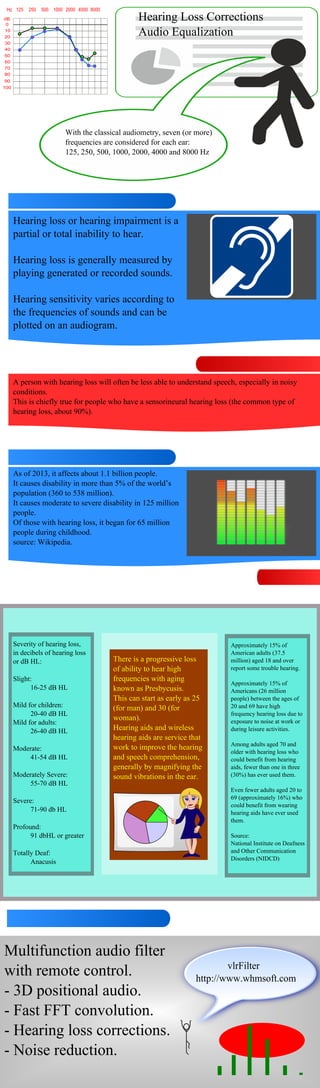
With the classical audiometry, seven (or more)
frequencies are considered for each ear:
125, 250, 500, 1000, 2000, 4000 and 8000 Hz
Hearing loss or hearing impairment is a
partial or total inability to hear.
Hearing loss is generally measured by
playing generated or recorded sounds.
Hearing sensitivity varies according to
the frequencies of sounds and can be
plotted on an audiogram.
A person with hearing loss will often be less able to understand speech, especially in noisy
conditions.
This is chiefly true for people who have a sensorineural hearing loss (the common type of
hearing loss, about 90%).
As of 2013, it affects about 1.1 billion people.
It causes disability in more than 5% of the world’s
population (360 to 538 million).
It causes moderate to severe disability in 125 million
people.
Of those with hearing loss, it began for 65 million
people during childhood.
source: Wikipedia.
Severity of hearing loss,
in decibels of hearing loss
or dB HL:
Slight:
16-25 dB HL
Mild for children:
20-40 dB HL
Mild for adults:
26-40 dB HL
Moderate:
41-54 dB HL
Moderately Severe:
55-70 dB HL
Severe:
71-90 db HL
Profound:
91 dbHL or greater
Totally Deaf:
Anacusis
Approximately 15% of
American adults (37.5
million) aged 18 and over
report some trouble hearing.
Approximately 15% of
Americans (26 million
people) between the ages of
20 and 69 have high
frequency hearing loss due to
exposure to noise at work or
during leisure activities.
Among adults aged 70 and
older with hearing loss who
could benefit from hearing
aids, fewer than one in three
(30%) has ever used them.
Even fewer adults aged 20 to
69 (approximately 16%) who
could benefit from wearing
hearing aids have ever used
them.
Source:
National Institute on Deafness
and Other Communication
Disorders (NIDCD)
There is a progressive loss
of ability to hear high
frequencies with aging
known as Presbycusis.
This can start as early as 25
(for man) and 30 (for
woman).
Hearing aids and wireless
hearing aids are service that
work to improve the hearing
and speech comprehension,
generally by magnifying the
sound vibrations in the ear.
20
50
0
10
30
40
60
70
80
90
100
dB
125 250 500 1000 2000 4000 8000Hz

Hearing Loss Corrections with Audio Equalization

  • 1.
    vlrFilter http://www.whmsoft.com Multifunction audio filter withremote control. - 3D positional audio. - Fast FFT convolution. - Hearing loss corrections. - Noise reduction. Hearing Loss Corrections Audio Equalization With the classical audiometry, seven (or more) frequencies are considered for each ear: 125, 250, 500, 1000, 2000, 4000 and 8000 Hz Hearing loss or hearing impairment is a partial or total inability to hear. Hearing loss is generally measured by playing generated or recorded sounds. Hearing sensitivity varies according to the frequencies of sounds and can be plotted on an audiogram. A person with hearing loss will often be less able to understand speech, especially in noisy conditions. This is chiefly true for people who have a sensorineural hearing loss (the common type of hearing loss, about 90%). As of 2013, it affects about 1.1 billion people. It causes disability in more than 5% of the world’s population (360 to 538 million). It causes moderate to severe disability in 125 million people. Of those with hearing loss, it began for 65 million people during childhood. source: Wikipedia. Severity of hearing loss, in decibels of hearing loss or dB HL: Slight: 16-25 dB HL Mild for children: 20-40 dB HL Mild for adults: 26-40 dB HL Moderate: 41-54 dB HL Moderately Severe: 55-70 dB HL Severe: 71-90 db HL Profound: 91 dbHL or greater Totally Deaf: Anacusis Approximately 15% of American adults (37.5 million) aged 18 and over report some trouble hearing. Approximately 15% of Americans (26 million people) between the ages of 20 and 69 have high frequency hearing loss due to exposure to noise at work or during leisure activities. Among adults aged 70 and older with hearing loss who could benefit from hearing aids, fewer than one in three (30%) has ever used them. Even fewer adults aged 20 to 69 (approximately 16%) who could benefit from wearing hearing aids have ever used them. Source: National Institute on Deafness and Other Communication Disorders (NIDCD) There is a progressive loss of ability to hear high frequencies with aging known as Presbycusis. This can start as early as 25 (for man) and 30 (for woman). Hearing aids and wireless hearing aids are service that work to improve the hearing and speech comprehension, generally by magnifying the sound vibrations in the ear. 20 50 0 10 30 40 60 70 80 90 100 dB 125 250 500 1000 2000 4000 8000Hz