HIGHER EDUCATION ACHIEVEMENT REPORT
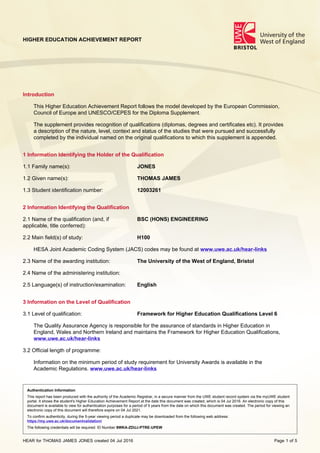
Authentication Information
This report has been produced with the authority of the Academic Registrar, in a secure manner from the UWE student record system via the myUWE student
portal. It shows the student's Higher Education Achievement Report at the date this document was created, which is 04 Jul 2016. An electronic copy of this
document is available to view for authentication purposes for a period of 5 years from the date on which this document was created. The period for viewing an
electronic copy of this document will therefore expire on 04 Jul 2021.
To confirm authenticity, during the 5-year viewing period a duplicate may be downloaded from the following web address:
https://my.uwe.ac.uk/documentvalidation/
The following credentials will be required: ID Number 9WKA-ZDUJ-PTRE-UPEW
HEAR for THOMAS JAMES JONES created 04 Jul 2016 Page 1 of 5
Introduction
This Higher Education Achievement Report follows the model developed by the European Commission,
Council of Europe and UNESCO/CEPES for the Diploma Supplement.
The supplement provides recognition of qualifications (diplomas, degrees and certificates etc). It provides
a description of the nature, level, context and status of the studies that were pursued and successfully
completed by the individual named on the original qualifications to which this supplement is appended.
1 Information Identifying the Holder of the Qualification
1.1 Family name(s): JONES
1.2 Given name(s): THOMAS JAMES
1.3 Student identification number: 12003261
2 Information Identifying the Qualification
2.1 Name of the qualification (and, if
applicable, title conferred):
BSC (HONS) ENGINEERING
2.2 Main field(s) of study: H100
HESA Joint Academic Coding System (JACS) codes may be found at www.uwe.ac.uk/hear-links
2.3 Name of the awarding institution: The University of the West of England, Bristol
2.4 Name of the administering institution:
2.5 Language(s) of instruction/examination: English
3 Information on the Level of Qualification
3.1 Level of qualification: Framework for Higher Education Qualifications Level 6
The Quality Assurance Agency is responsible for the assurance of standards in Higher Education in
England, Wales and Northern Ireland and maintains the Framework for Higher Education Qualifications,
www.uwe.ac.uk/hear-links
3.2 Official length of programme:
Information on the minimum period of study requirement for University Awards is available in the
Academic Regulations. www.uwe.ac.uk/hear-links
HIGHER EDUCATION ACHIEVEMENT REPORT
HEAR for THOMAS JAMES JONES created 04 Jul 2016 Page 2 of 5
3.3 Access requirement(s):
The University's minimum access requirements are stated in the prospectus. Those access requirements
conform with those shown in the Diagram of Higher Education Qualification Levels in England, Wales and
Northern Ireland available at www.uwe.ac.uk/hear-links
4 Information on the Contents and Results Gained
4.1 Mode of study: Full time
4.2 Programme requirements:
Engineering graduates will be able to demonstrate a sound understanding of core engineering science and
manufacturing technologies. They will be able to show the principles of IT and data communications from a
user’s perspective. They will also understand management principles and business practices.
These graduates will be able to demonstrate knowledge and understanding of the complexity of large-scale
manufacturing systems and projects. They will have acquired knowledge of mathematical and statistical
methods appropriate to engineering, as well as the properties, characteristics and selection of materials used
in components and systems.
Graduates will be able to use scientific principles and techniques in the analysis of manufacturing systems,
processes and products - and in the development of engineering solutions to practical problems. They will also
be able to use problem solving strategies in programming and mathematical sciences applications.
Graduates of Engineering will be able to understand issues relating to the marketing of products and the
management processes associated with their design and manufacture. They will be able to think independently
when developing engineering solutions.
Graduates will have show that they are able to critically review literature on topics related to manufacturing
engineering and have a professional attitude to the responsibilities of engineering practitioners.
They will be able to use appropriate methods to communicate technical subjects effectively, for example;
reports, oral presentations, handbooks, sketches, posters, CAD drawings. They will also be able to decide
upon appropriate methods for modelling and analysing problems.
As well as this, graduates will be able to use experimental methods in the laboratory relating to design, test
and measurement as well as apply technical analysis and critical evaluation of results.
They will be able to use a wide range of computing and IT systems, as well as use software to solve problems
and to interpret findings. They will be able to take into account industrial and commercial concerns by applying
engineering techniques.
Furthermore, graduates will be able to work as an effective member of a team. They will also be able to
manage their time, to meet deadlines and learn independently whilst using literature to support their learning.
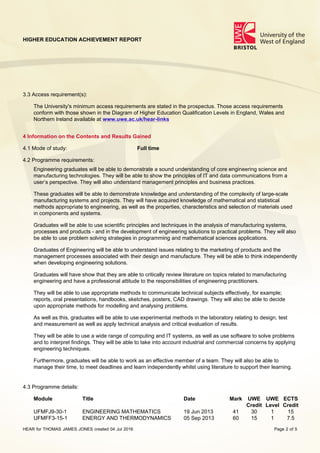
4.3 Programme details:
Module Title Date Mark UWE
Credit
UWE
Level
ECTS
Credit
UFMFJ9-30-1 ENGINEERING MATHEMATICS 19 Jun 2013 41 30 1 15
UFMFF3-15-1 ENERGY AND THERMODYNAMICS 05 Sep 2013 60 15 1 7.5
HIGHER EDUCATION ACHIEVEMENT REPORT
HEAR for THOMAS JAMES JONES created 04 Jul 2016 Page 3 of 5
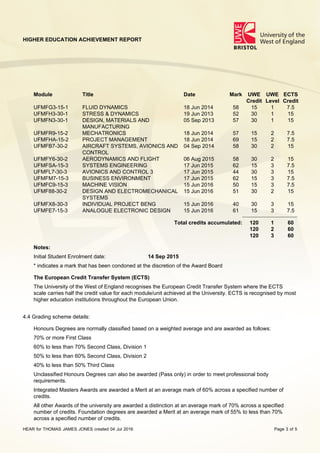
Module Title Date Mark UWE
Credit
UWE
Level
ECTS
Credit
UFMFG3-15-1 FLUID DYNAMICS 18 Jun 2014 58 15 1 7.5
UFMFH3-30-1 STRESS & DYNAMICS 19 Jun 2013 52 30 1 15
UFMFN3-30-1 DESIGN, MATERIALS AND
MANUFACTURING
05 Sep 2013 57 30 1 15
UFMFR9-15-2 MECHATRONICS 18 Jun 2014 57 15 2 7.5
UFMFHA-15-2 PROJECT MANAGEMENT 18 Jun 2014 69 15 2 7.5
UFMFB7-30-2 AIRCRAFT SYSTEMS, AVIONICS AND
CONTROL
04 Sep 2014 58 30 2 15
UFMFY6-30-2 AERODYNAMICS AND FLIGHT 06 Aug 2015 58 30 2 15
UFMFSA-15-3 SYSTEMS ENGINEERING 17 Jun 2015 62 15 3 7.5
UFMFL7-30-3 AVIONICS AND CONTROL 3 17 Jun 2015 44 30 3 15
UFMFM7-15-3 BUSINESS ENVIRONMENT 17 Jun 2015 62 15 3 7.5
UFMFC9-15-3 MACHINE VISION 15 Jun 2016 50 15 3 7.5
UFMF88-30-2 DESIGN AND ELECTROMECHANICAL
SYSTEMS
15 Jun 2016 51 30 2 15
UFMFX8-30-3 INDIVIDUAL PROJECT BENG 15 Jun 2016 40 30 3 15
UFMFE7-15-3 ANALOGUE ELECTRONIC DESIGN 15 Jun 2016 61 15 3 7.5
Total credits accumulated: 120 1 60
120 2 60
120 3 60
Notes:
Initial Student Enrolment date: 14 Sep 2015
* indicates a mark that has been condoned at the discretion of the Award Board
The European Credit Transfer System (ECTS)
The University of the West of England recognises the European Credit Transfer System where the ECTS
scale carries half the credit value for each module/unit achieved at the University. ECTS is recognised by most
higher education institutions throughout the European Union.
4.4 Grading scheme details:
Honours Degrees are normally classified based on a weighted average and are awarded as follows:
70% or more First Class
60% to less than 70% Second Class, Division 1
50% to less than 60% Second Class, Division 2
40% to less than 50% Third Class
Unclassified Honours Degrees can also be awarded (Pass only) in order to meet professional body
requirements.
Integrated Masters Awards are awarded a Merit at an average mark of 60% across a specified number of
credits.
All other Awards of the university are awarded a distinction at an average mark of 70% across a specified
number of credits. Foundation degrees are awarded a Merit at an average mark of 55% to less than 70%
across a specified number of credits.
HIGHER EDUCATION ACHIEVEMENT REPORT
HEAR for THOMAS JAMES JONES created 04 Jul 2016 Page 4 of 5
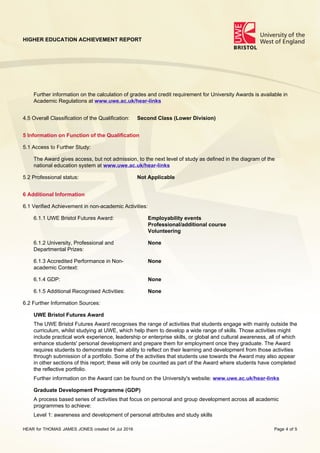
Further information on the calculation of grades and credit requirement for University Awards is available in
Academic Regulations at www.uwe.ac.uk/hear-links
4.5 Overall Classification of the Qualification: Second Class (Lower Division)
5 Information on Function of the Qualification
5.1 Access to Further Study:
The Award gives access, but not admission, to the next level of study as defined in the diagram of the
national education system at www.uwe.ac.uk/hear-links
5.2 Professional status: Not Applicable
6 Additional Information
6.1 Verified Achievement in non-academic Activities:
6.1.1 UWE Bristol Futures Award: Employability events
Professional/additional course
Volunteering
6.1.2 University, Professional and
Departmental Prizes:
None
6.1.3 Accredited Performance in Non-
academic Context:
None
6.1.4 GDP: None
6.1.5 Additional Recognised Activities: None
6.2 Further Information Sources:
UWE Bristol Futures Award
The UWE Bristol Futures Award recognises the range of activities that students engage with mainly outside the
curriculum, whilst studying at UWE, which help them to develop a wide range of skills. Those activities might
include practical work experience, leadership or enterprise skills, or global and cultural awareness, all of which
enhance students' personal development and prepare them for employment once they graduate. The Award
requires students to demonstrate their ability to reflect on their learning and development from those activities
through submission of a portfolio. Some of the activities that students use towards the Award may also appear
in other sections of this report; these will only be counted as part of the Award where students have completed
the reflective portfolio.
Further information on the Award can be found on the University's website: www.uwe.ac.uk/hear-links
Graduate Development Programme (GDP)
A process based series of activities that focus on personal and group development across all academic
programmes to achieve:
Level 1: awareness and development of personal attributes and study skills
HIGHER EDUCATION ACHIEVEMENT REPORT
HEAR for THOMAS JAMES JONES created 04 Jul 2016 Page 5 of 5
Level 2: exploration of future options, with a focus on employability skills development and gaining experience
through work placements or volunteering
Level 3: completion of major final work, reflecting on achievements and the progression of the student to
employment or further study
Further information on GDP can be found at www.uwe.ac.uk/hear-links
Higher Education Achievement Record (HEAR) at UWE
Further information on HEAR at UWE can be found at www.uwe.ac.uk/hear-links
7 Certification of the HEAR
7.1 Date: 04 Jul 2016
7.2 Capacity: Academic Registrar
7.3 Official Stamp or Seal:
8 Information of the National Higher Education System
Further information on the United Kingdom (England) Higher Education System may be obtained at
www.uwe.ac.uk/hear-links
A diagram of the United Kingdom (England) Higher Education System may be obtained at www.uwe.ac.uk/
hear-links

hear eng bsc

  • 1.
    HIGHER EDUCATION ACHIEVEMENTREPORT Authentication Information This report has been produced with the authority of the Academic Registrar, in a secure manner from the UWE student record system via the myUWE student portal. It shows the student's Higher Education Achievement Report at the date this document was created, which is 04 Jul 2016. An electronic copy of this document is available to view for authentication purposes for a period of 5 years from the date on which this document was created. The period for viewing an electronic copy of this document will therefore expire on 04 Jul 2021. To confirm authenticity, during the 5-year viewing period a duplicate may be downloaded from the following web address: https://my.uwe.ac.uk/documentvalidation/ The following credentials will be required: ID Number 9WKA-ZDUJ-PTRE-UPEW HEAR for THOMAS JAMES JONES created 04 Jul 2016 Page 1 of 5 Introduction This Higher Education Achievement Report follows the model developed by the European Commission, Council of Europe and UNESCO/CEPES for the Diploma Supplement. The supplement provides recognition of qualifications (diplomas, degrees and certificates etc). It provides a description of the nature, level, context and status of the studies that were pursued and successfully completed by the individual named on the original qualifications to which this supplement is appended. 1 Information Identifying the Holder of the Qualification 1.1 Family name(s): JONES 1.2 Given name(s): THOMAS JAMES 1.3 Student identification number: 12003261 2 Information Identifying the Qualification 2.1 Name of the qualification (and, if applicable, title conferred): BSC (HONS) ENGINEERING 2.2 Main field(s) of study: H100 HESA Joint Academic Coding System (JACS) codes may be found at www.uwe.ac.uk/hear-links 2.3 Name of the awarding institution: The University of the West of England, Bristol 2.4 Name of the administering institution: 2.5 Language(s) of instruction/examination: English 3 Information on the Level of Qualification 3.1 Level of qualification: Framework for Higher Education Qualifications Level 6 The Quality Assurance Agency is responsible for the assurance of standards in Higher Education in England, Wales and Northern Ireland and maintains the Framework for Higher Education Qualifications, www.uwe.ac.uk/hear-links 3.2 Official length of programme: Information on the minimum period of study requirement for University Awards is available in the Academic Regulations. www.uwe.ac.uk/hear-links
  • 2.
    HIGHER EDUCATION ACHIEVEMENTREPORT HEAR for THOMAS JAMES JONES created 04 Jul 2016 Page 2 of 5 3.3 Access requirement(s): The University's minimum access requirements are stated in the prospectus. Those access requirements conform with those shown in the Diagram of Higher Education Qualification Levels in England, Wales and Northern Ireland available at www.uwe.ac.uk/hear-links 4 Information on the Contents and Results Gained 4.1 Mode of study: Full time 4.2 Programme requirements: Engineering graduates will be able to demonstrate a sound understanding of core engineering science and manufacturing technologies. They will be able to show the principles of IT and data communications from a user’s perspective. They will also understand management principles and business practices. These graduates will be able to demonstrate knowledge and understanding of the complexity of large-scale manufacturing systems and projects. They will have acquired knowledge of mathematical and statistical methods appropriate to engineering, as well as the properties, characteristics and selection of materials used in components and systems. Graduates will be able to use scientific principles and techniques in the analysis of manufacturing systems, processes and products - and in the development of engineering solutions to practical problems. They will also be able to use problem solving strategies in programming and mathematical sciences applications. Graduates of Engineering will be able to understand issues relating to the marketing of products and the management processes associated with their design and manufacture. They will be able to think independently when developing engineering solutions. Graduates will have show that they are able to critically review literature on topics related to manufacturing engineering and have a professional attitude to the responsibilities of engineering practitioners. They will be able to use appropriate methods to communicate technical subjects effectively, for example; reports, oral presentations, handbooks, sketches, posters, CAD drawings. They will also be able to decide upon appropriate methods for modelling and analysing problems. As well as this, graduates will be able to use experimental methods in the laboratory relating to design, test and measurement as well as apply technical analysis and critical evaluation of results. They will be able to use a wide range of computing and IT systems, as well as use software to solve problems and to interpret findings. They will be able to take into account industrial and commercial concerns by applying engineering techniques. Furthermore, graduates will be able to work as an effective member of a team. They will also be able to manage their time, to meet deadlines and learn independently whilst using literature to support their learning. 4.3 Programme details: Module Title Date Mark UWE Credit UWE Level ECTS Credit UFMFJ9-30-1 ENGINEERING MATHEMATICS 19 Jun 2013 41 30 1 15 UFMFF3-15-1 ENERGY AND THERMODYNAMICS 05 Sep 2013 60 15 1 7.5
  • 3.
    HIGHER EDUCATION ACHIEVEMENTREPORT HEAR for THOMAS JAMES JONES created 04 Jul 2016 Page 3 of 5 Module Title Date Mark UWE Credit UWE Level ECTS Credit UFMFG3-15-1 FLUID DYNAMICS 18 Jun 2014 58 15 1 7.5 UFMFH3-30-1 STRESS & DYNAMICS 19 Jun 2013 52 30 1 15 UFMFN3-30-1 DESIGN, MATERIALS AND MANUFACTURING 05 Sep 2013 57 30 1 15 UFMFR9-15-2 MECHATRONICS 18 Jun 2014 57 15 2 7.5 UFMFHA-15-2 PROJECT MANAGEMENT 18 Jun 2014 69 15 2 7.5 UFMFB7-30-2 AIRCRAFT SYSTEMS, AVIONICS AND CONTROL 04 Sep 2014 58 30 2 15 UFMFY6-30-2 AERODYNAMICS AND FLIGHT 06 Aug 2015 58 30 2 15 UFMFSA-15-3 SYSTEMS ENGINEERING 17 Jun 2015 62 15 3 7.5 UFMFL7-30-3 AVIONICS AND CONTROL 3 17 Jun 2015 44 30 3 15 UFMFM7-15-3 BUSINESS ENVIRONMENT 17 Jun 2015 62 15 3 7.5 UFMFC9-15-3 MACHINE VISION 15 Jun 2016 50 15 3 7.5 UFMF88-30-2 DESIGN AND ELECTROMECHANICAL SYSTEMS 15 Jun 2016 51 30 2 15 UFMFX8-30-3 INDIVIDUAL PROJECT BENG 15 Jun 2016 40 30 3 15 UFMFE7-15-3 ANALOGUE ELECTRONIC DESIGN 15 Jun 2016 61 15 3 7.5 Total credits accumulated: 120 1 60 120 2 60 120 3 60 Notes: Initial Student Enrolment date: 14 Sep 2015 * indicates a mark that has been condoned at the discretion of the Award Board The European Credit Transfer System (ECTS) The University of the West of England recognises the European Credit Transfer System where the ECTS scale carries half the credit value for each module/unit achieved at the University. ECTS is recognised by most higher education institutions throughout the European Union. 4.4 Grading scheme details: Honours Degrees are normally classified based on a weighted average and are awarded as follows: 70% or more First Class 60% to less than 70% Second Class, Division 1 50% to less than 60% Second Class, Division 2 40% to less than 50% Third Class Unclassified Honours Degrees can also be awarded (Pass only) in order to meet professional body requirements. Integrated Masters Awards are awarded a Merit at an average mark of 60% across a specified number of credits. All other Awards of the university are awarded a distinction at an average mark of 70% across a specified number of credits. Foundation degrees are awarded a Merit at an average mark of 55% to less than 70% across a specified number of credits.
  • 4.
    HIGHER EDUCATION ACHIEVEMENTREPORT HEAR for THOMAS JAMES JONES created 04 Jul 2016 Page 4 of 5 Further information on the calculation of grades and credit requirement for University Awards is available in Academic Regulations at www.uwe.ac.uk/hear-links 4.5 Overall Classification of the Qualification: Second Class (Lower Division) 5 Information on Function of the Qualification 5.1 Access to Further Study: The Award gives access, but not admission, to the next level of study as defined in the diagram of the national education system at www.uwe.ac.uk/hear-links 5.2 Professional status: Not Applicable 6 Additional Information 6.1 Verified Achievement in non-academic Activities: 6.1.1 UWE Bristol Futures Award: Employability events Professional/additional course Volunteering 6.1.2 University, Professional and Departmental Prizes: None 6.1.3 Accredited Performance in Non- academic Context: None 6.1.4 GDP: None 6.1.5 Additional Recognised Activities: None 6.2 Further Information Sources: UWE Bristol Futures Award The UWE Bristol Futures Award recognises the range of activities that students engage with mainly outside the curriculum, whilst studying at UWE, which help them to develop a wide range of skills. Those activities might include practical work experience, leadership or enterprise skills, or global and cultural awareness, all of which enhance students' personal development and prepare them for employment once they graduate. The Award requires students to demonstrate their ability to reflect on their learning and development from those activities through submission of a portfolio. Some of the activities that students use towards the Award may also appear in other sections of this report; these will only be counted as part of the Award where students have completed the reflective portfolio. Further information on the Award can be found on the University's website: www.uwe.ac.uk/hear-links Graduate Development Programme (GDP) A process based series of activities that focus on personal and group development across all academic programmes to achieve: Level 1: awareness and development of personal attributes and study skills
  • 5.
    HIGHER EDUCATION ACHIEVEMENTREPORT HEAR for THOMAS JAMES JONES created 04 Jul 2016 Page 5 of 5 Level 2: exploration of future options, with a focus on employability skills development and gaining experience through work placements or volunteering Level 3: completion of major final work, reflecting on achievements and the progression of the student to employment or further study Further information on GDP can be found at www.uwe.ac.uk/hear-links Higher Education Achievement Record (HEAR) at UWE Further information on HEAR at UWE can be found at www.uwe.ac.uk/hear-links 7 Certification of the HEAR 7.1 Date: 04 Jul 2016 7.2 Capacity: Academic Registrar 7.3 Official Stamp or Seal: 8 Information of the National Higher Education System Further information on the United Kingdom (England) Higher Education System may be obtained at www.uwe.ac.uk/hear-links A diagram of the United Kingdom (England) Higher Education System may be obtained at www.uwe.ac.uk/ hear-links