Healthcare IT Transformation Bridging Innovation
Integration Interoperability and Analytics 1st
Edition John C. Dodd (Author) download pdf
https://ebookultra.com/download/healthcare-it-transformation-bridging-
innovation-integration-interoperability-and-analytics-1st-edition-john-
c-dodd-author/
Discover thousands of ebooks and textbooks at ebookultra.com
download your favorites today!
Here are some recommended products for you. Click the link to
download, or explore more at ebookultra.com
Healthcare Informatics and Analytics Emerging Issues and
Trends 1st Edition Madjid Tavana
https://ebookultra.com/download/healthcare-informatics-and-analytics-
emerging-issues-and-trends-1st-edition-madjid-tavana/
Cases on Semantic Interoperability for Information Systems
Integration Practices and Applications 1st Edition Yannis
Kalfoglou
https://ebookultra.com/download/cases-on-semantic-interoperability-
for-information-systems-integration-practices-and-applications-1st-
edition-yannis-kalfoglou/
Big Data Big Innovation Enabling Competitive
Differentiation through Business Analytics 1st Edition
Evan Stubbs
https://ebookultra.com/download/big-data-big-innovation-enabling-
competitive-differentiation-through-business-analytics-1st-edition-
evan-stubbs/
Challenges of African Transformation Exploring Through
Innovation Approach 1st Edition Mammo Muchie
https://ebookultra.com/download/challenges-of-african-transformation-
exploring-through-innovation-approach-1st-edition-mammo-muchie/
Lean Leadership for Healthcare Approaches to Lean
Transformation 1st Edition Ronald G. Bercaw
https://ebookultra.com/download/lean-leadership-for-healthcare-
approaches-to-lean-transformation-1st-edition-ronald-g-bercaw/
Enterprise Interoperability Interoperability for Agility
Resilience and Plasticity of Collaborations I ESA 14
Proceedings 1st Edition Matthieu Lauras
https://ebookultra.com/download/enterprise-interoperability-
interoperability-for-agility-resilience-and-plasticity-of-
collaborations-i-esa-14-proceedings-1st-edition-matthieu-lauras/
Leading Healthcare IT Managing to Succeed 1st Edition
Susan T. Snedaker (Author)
https://ebookultra.com/download/leading-healthcare-it-managing-to-
succeed-1st-edition-susan-t-snedaker-author/
DK Essential Managers Innovation 1st Edition John Bessant
https://ebookultra.com/download/dk-essential-managers-innovation-1st-
edition-john-bessant/
Capital and Power Political Economy and Social
Transformation 1st Edition John Girling
https://ebookultra.com/download/capital-and-power-political-economy-
and-social-transformation-1st-edition-john-girling/
Healthcare IT Transformation Bridging Innovation
Integration Interoperability and Analytics 1st Edition
John C. Dodd (Author) Digital Instant Download
Author(s): John C. Dodd (Author)
ISBN(s): 9781498778459, 1498778445
Edition: 1
File Details: PDF, 19.02 MB
Year: 2016
Language: english
Healthcare IT
Transformation
Bridging Innovation,
Integration, Interoperability,
and Analytics
Healthcare IT
Transformation
Bridging Innovation,
Integration, Interoperability,
and Analytics
John C. Dodd
CRC Press
Taylor & Francis Group
6000 Broken Sound Parkway NW, Suite 300
Boca Raton, FL 33487-2742
© 2017 by Taylor & Francis Group, LLC
CRC Press is an imprint of Taylor & Francis Group, an Informa business
No claim to original U.S. Government works
Printed on acid-free paper
Version Date: 20160719
International Standard Book Number-13: 978-1-4987-7844-2 (Hardback)
This book contains information obtained from authentic and highly regarded sources. Reasonable efforts have been
made to publish reliable data and information, but the author and publisher cannot assume responsibility for the valid-
ity of all materials or the consequences of their use. The authors and publishers have attempted to trace the copyright
holders of all material reproduced in this publication and apologize to copyright holders if permission to publish in this
form has not been obtained. If any copyright material has not been acknowledged please write and let us know so we may
rectify in any future reprint.
Except as permitted under U.S. Copyright Law, no part of this book may be reprinted, reproduced, transmitted, or uti-
lized in any form by any electronic, mechanical, or other means, now known or hereafter invented, including photocopy-
ing, microfilming, and recording, or in any information storage or retrieval system, without written permission from the
publishers.
For permission to photocopy or use material electronically from this work, please access www.copyright.com (http://
www.copyright.com/) or contact the Copyright Clearance Center, Inc. (CCC), 222 Rosewood Drive, Danvers, MA 01923,
978-750-8400. CCC is a not-for-profit organization that provides licenses and registration for a variety of users. For
organizations that have been granted a photocopy license by the CCC, a separate system of payment has been arranged.
Trademark Notice: Product or corporate names may be trademarks or registered trademarks, and are used only for
identification and explanation without intent to infringe.
Visit the Taylor & Francis Web site at
http://www.taylorandfrancis.com
and the CRC Press Web site at
http://www.crcpress.com
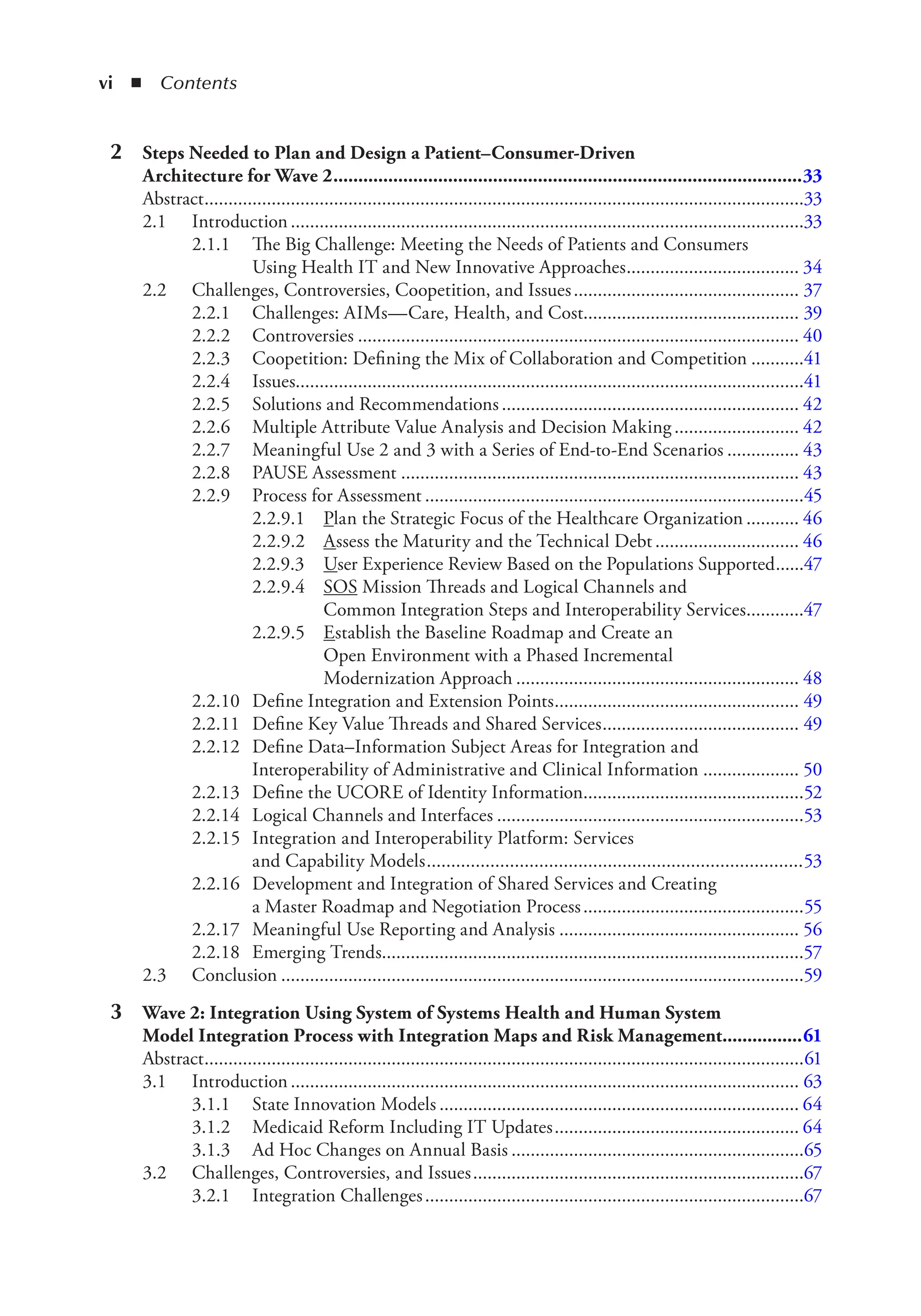
v
Contents
Preface: Shift to Patient–Consumer-Centric Health IT with Innovation at All Levels..... xiii
Acknowledgments....................................................................................................................xv
Author.....................................................................................................................................xvii
1 Wave 2: Integration–Interoperability and Analytics Overview ...................................1
Abstract.............................................................................................................................. 1
1.1 Introduction............................................................................................................ 1
1.1.1 Do We Really Have to Change to Get Patient–Consumer Engagement? ..... 5
1.2 Must Change! Current Progress: Shift to Patient–Consumer Focus ........................ 8
1.3 Government: Medical Providers—Health Information Industry Partnerships ........ 9
1.4 Years, Not Months..................................................................................................11
1.5 Mixed World: Fitting the Pieces Together from the Middle .................................. 12
1.6 Background: Build upon the Accomplishments......................................................17
1.7 Where is Healthcare Transformation Now? At the Federal Level, within
State Innovation Models, Medicaid Reforms, and CMMI Grants..........................17
1.8 Integration: Start from the Patient–Consumer Perspective and Use
Information-Centric Content Management Approaches ........................................19
1.9 Interoperability...................................................................................................... 20
1.10 Analytics Integrated into Fact-Based Decision Making ......................................... 20
1.10.1 Reference Model: L Value-Driven Bi-Directional Business-
Knowledge and Integration....................................................................... 20
1.11 Creating Integration and Interoperability Solutions and Implementing
Shared Services Projects......................................................................................... 22
1.12 Intercloud Framework for Patient–Consumer Linking to Value-Driven SOS
for Government and Community Health Architecture and Shared Services
Analysis ................................................................................................................. 23
1.13 Building Keystone Shared Services and Ability to Adapt and Extend
with Value Adds .....................................................................................................25
1.14 Information Sharing Services .................................................................................25
1.15 Governance Actions for a Shared Services SOS ..................................................... 28
1.16 Integration and Interoperability/As-A-Service ....................................................... 28
1.17 Pilot Bi-Directional and Improvement Networks for a Rare Disease Collaborative.....29
1.18 Building in Protection: Policy-Based Machines, Data Segments, and Layers
of Protection.......................................................................................................... 30
1.19 Emerging Trends................................................................................................... 30
1.20 Conclusion ............................................................................................................ 32
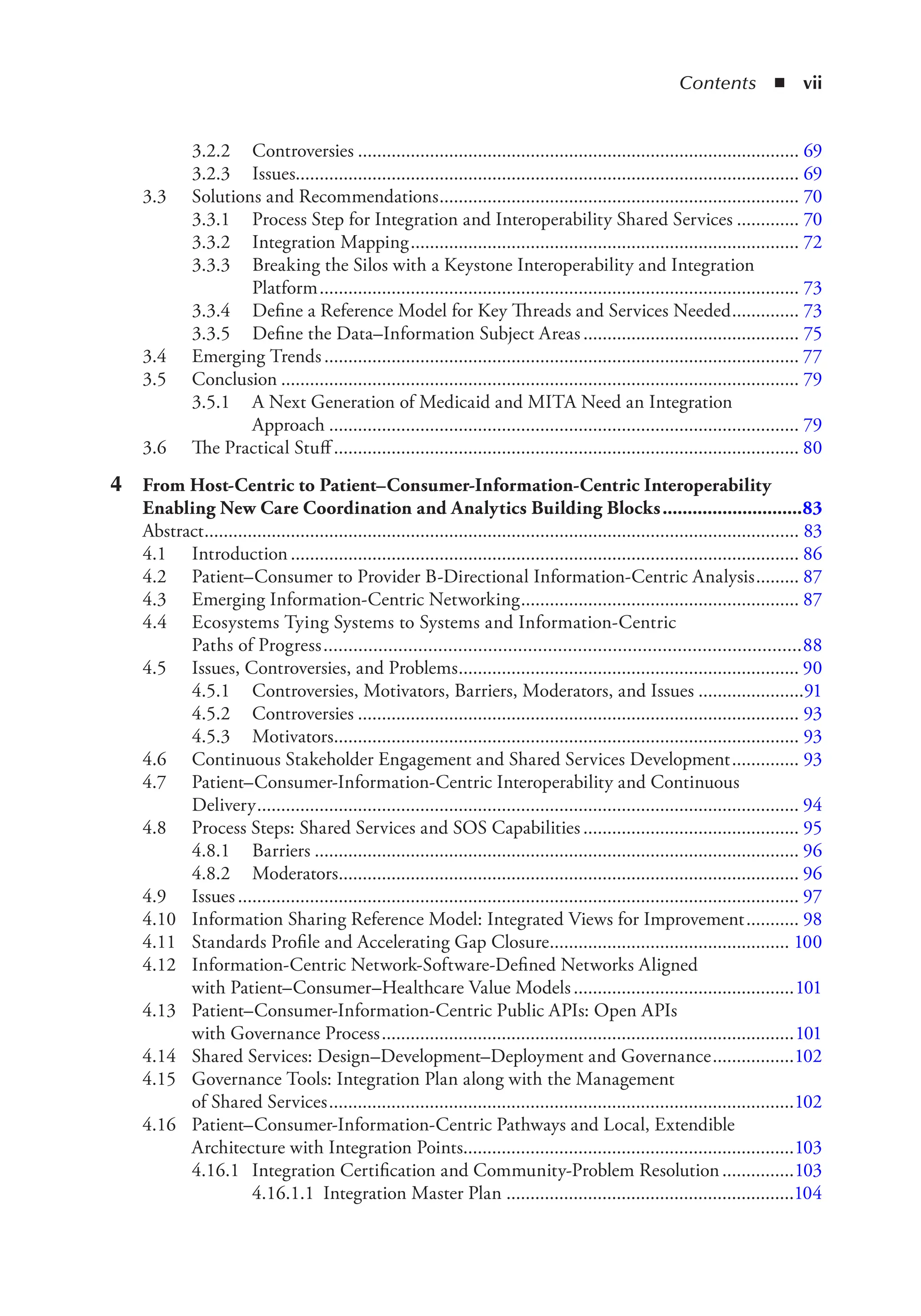
vi ◾ Contents
2 Steps Needed to Plan and Design a Patient–Consumer-Driven
Architecture for Wave 2..............................................................................................33
Abstract.............................................................................................................................33
2.1 Introduction...........................................................................................................33
2.1.1 The Big Challenge: Meeting the Needs of Patients and Consumers
Using Health IT and New Innovative Approaches.................................... 34
2.2 Challenges, Controversies, Coopetition, and Issues............................................... 37
2.2.1 Challenges: AIMs—Care, Health, and Cost............................................. 39
2.2.2 Controversies ............................................................................................ 40
2.2.3 Coopetition: Defining the Mix of Collaboration and Competition ...........41
2.2.4 Issues..........................................................................................................41
2.2.5 Solutions and Recommendations.............................................................. 42
2.2.6 Multiple Attribute Value Analysis and Decision Making .......................... 42
2.2.7 Meaningful Use 2 and 3 with a Series of End-to-End Scenarios ............... 43
2.2.8 PAUSE Assessment ................................................................................... 43
2.2.9 Process for Assessment ...............................................................................45
2.2.9.1 Plan the Strategic Focus of the Healthcare Organization ........... 46
2.2.9.2 Assess the Maturity and the Technical Debt .............................. 46
2.2.9.3 User Experience Review Based on the Populations Supported......47
2.2.9.4 SOS Mission Threads and Logical Channels and
Common Integration Steps and Interoperability Services............47
2.2.9.5 Establish the Baseline Roadmap and Create an
Open Environment with a Phased Incremental
Modernization Approach ........................................................... 48
2.2.10 Define Integration and Extension Points................................................... 49
2.2.11 Define Key Value Threads and Shared Services......................................... 49
2.2.12 Define Data–Information Subject Areas for Integration and
Interoperability of Administrative and Clinical Information .................... 50
2.2.13 Define the UCORE of Identity Information..............................................52
2.2.14 Logical Channels and Interfaces ................................................................53
2.2.15 Integration and Interoperability Platform: Services
and Capability Models.............................................................................53
2.2.16 Development and Integration of Shared Services and Creating
a Master Roadmap and Negotiation Process..............................................55
2.2.17 Meaningful Use Reporting and Analysis .................................................. 56
2.2.18 Emerging Trends........................................................................................57
2.3 Conclusion .............................................................................................................59
3 Wave 2: Integration Using System of Systems Health and Human System
Model Integration Process with Integration Maps and Risk Management................61
Abstract.............................................................................................................................61
3.1 Introduction.......................................................................................................... 63
3.1.1 State Innovation Models ........................................................................... 64
3.1.2 Medicaid Reform Including IT Updates................................................... 64
3.1.3 Ad Hoc Changes on Annual Basis .............................................................65
3.2 Challenges, Controversies, and Issues.....................................................................67
3.2.1 Integration Challenges...............................................................................67
Contents ◾ vii
3.2.2 Controversies ............................................................................................ 69
3.2.3 Issues......................................................................................................... 69
3.3 Solutions and Recommendations........................................................................... 70
3.3.1 Process Step for Integration and Interoperability Shared Services ............. 70
3.3.2 Integration Mapping................................................................................. 72
3.3.3 Breaking the Silos with a Keystone Interoperability and Integration
Platform.................................................................................................... 73
3.3.4 Define a Reference Model for Key Threads and Services Needed.............. 73
3.3.5 Define the Data–Information Subject Areas............................................. 75
3.4 Emerging Trends................................................................................................... 77
3.5 Conclusion ............................................................................................................ 79
3.5.1 A Next Generation of Medicaid and MITA Need an Integration
Approach .................................................................................................. 79
3.6 The Practical Stuff ................................................................................................. 80
4 From Host-Centric to Patient–Consumer-Information-Centric Interoperability
Enabling New Care Coordination and Analytics Building Blocks............................83
Abstract............................................................................................................................ 83
4.1 Introduction.......................................................................................................... 86
4.2 Patient–Consumer to Provider B-Directional Information-Centric Analysis......... 87
4.3 Emerging Information-Centric Networking.......................................................... 87
4.4 Ecosystems Tying Systems to Systems and Information-Centric
Paths of Progress................................................................................................88
4.5 Issues, Controversies, and Problems....................................................................... 90
4.5.1 Controversies, Motivators, Barriers, Moderators, and Issues ......................91
4.5.2 Controversies ............................................................................................ 93
4.5.3 Motivators................................................................................................. 93
4.6 Continuous Stakeholder Engagement and Shared Services Development.............. 93
4.7 Patient–Consumer-Information-Centric Interoperability and Continuous
Delivery................................................................................................................. 94
4.8 Process Steps: Shared Services and SOS Capabilities............................................. 95
4.8.1 Barriers ..................................................................................................... 96
4.8.2 Moderators................................................................................................ 96
4.9 Issues..................................................................................................................... 97
4.10 Information Sharing Reference Model: Integrated Views for Improvement........... 98
4.11 Standards Profile and Accelerating Gap Closure.................................................. 100
4.12 Information-Centric Network-Software-Defined Networks Aligned
with Patient–Consumer–Healthcare Value Models..............................................101
4.13 Patient–Consumer-Information-Centric Public APIs: Open APIs
with Governance Process......................................................................................101
4.14 Shared Services: Design–Development–Deployment and Governance.................102
4.15 Governance Tools: Integration Plan along with the Management
of Shared Services.................................................................................................102
4.16 Patient–Consumer-Information-Centric Pathways and Local, Extendible
Architecture with Integration Points.....................................................................103
4.16.1 Integration Certification and Community-Problem Resolution...............103
4.16.1.1 Integration Master Plan ............................................................104
viii ◾ Contents
4.16.2 Integration Master Plan and Integration Points........................................104
4.16.3 Creating a Regional or State Transformation Integration Plan.................105
4.16.4 Connecting to the Current Capabilities: Integration and Extension Points......106
4.16.5 CMS Patient–Consumer-Information-Centric Enterprise Architecture
Needs to Extend to the Ecosystem and Communities of Interest.............107
4.16.6 Using Simple Semantics Ontologies Today ..............................................111
4.16.7 Strategy and Principle Agreement and Mapping ......................................111
4.17 Leveraging Emerging Trends................................................................................113
4.17.1 Fitting the Individual Organization into the Related Networks...............115
4.18 Conclusion ...........................................................................................................116
5 Using New Medicaid Reform with Next-Generation MITA for Patient–
Consumer-Information-Centric Health and Human Services Interoperability
Architecture and Shared Services in the 2018–2020 Time Frame............................117
Abstract...........................................................................................................................117
5.1 Introduction.........................................................................................................118
5.1.1 Background .............................................................................................118
5.2 Challenges, Controversies, and Issues...................................................................118
5.2.1 Challenges ...............................................................................................118
5.2.2 Controversies ...........................................................................................119
5.2.3 Issues....................................................................................................... 120
5.3 Solution and Recommendations...........................................................................121
5.3.1 New BI Analytics Framework Needed.................................................... 122
5.4 Integration Master Roadmap and Negotiation Process........................................ 124
5.4.1 Cross Clinical and Administrative Coordination Scenario: Mental
Health and Medicaid Alignment with Integration and Interoperability
Shared Services ....................................................................................... 124
5.4.2 School Behavior Referral Scenario .......................................................... 124
5.4.3 ED Set-Up of Mental Health and Medicaid Connections....................... 126
5.5 Emerging Trends................................................................................................. 127
5.6 Moving the Medicaid Systems to a Patient–Consumer Focus.............................. 127
5.7 Conclusion .......................................................................................................... 130
5.8 The Practical Stuff ................................................................................................133
6 Fostering Innovation and Integration, Alignment and Continuous Planning
into Your Evolutionary Life Cycle............................................................................135
Abstract...........................................................................................................................135
6.1 Introduction: Fast Smart Ready Technology ........................................................135
6.1.1 Innovation Manifesto ..............................................................................137
6.2 Fostering Innovation and Selecting Ready Technology with Ingenuity
Workshops and Governance.................................................................................138
6.2.1 Moving Innovation and Integration to a Primary Focus and Placing
in Life Cycle.............................................................................................139
6.3 Leveraging Capabilities: Ready Technologies........................................................142
6.4 Challenges, Controversies, and Issues...................................................................142
6.4.1 Challenges ...............................................................................................142
6.4.2 Controversies ...........................................................................................143
6.4.3 Issues........................................................................................................144
Random documents with unrelated
content Scribd suggests to you:
the boy scouts? You’ve been trying to imitate them with your
smattering about ‘spooring.’ Who said anything about spooring? Hold
on, now—I know what you’re going to say. Of course, there’s no
crime in all that. You can come down the road standing on your
head for all I care, but just the same I’m going to see what’s under
that stone.”
“I thought a scout feller was supposed—”
“Oh, a scout fellow is supposed to put this and that together,”
Harry interrupted with some impatience; “and if you think I came
here for the benefit of my health you’re mistaken.”
He stepped toward the stone and saw the other look
apprehensively at the house. His predicament was a sore one, and
Harry had foreseen and counted on it. If he precipitated a scuffle, it
would rouse the inmates of the house. If he didn’t, the game was
up. He fell back on the only course open to him—a weak attempt at
explanation.
“Haven’t I got a right to pick up what I find, hey? What business
have you got to trac—follow me, anyway? Haven’t I got a good right
to bring home anything I find?”
Harry disdained to answer. Kneeling, he raised the edge of the
stone. But the wretched boy who watched him could not quite stand
by and see that done. He put his big hand on Arnold’s shoulder, and
roughly thrust him back. Like lightning Harry’s hand was on his
ankle. He tripped, staggered clumsily, and went down with a thud.
When he had pulled himself together Harry was standing a few feet
away examining his find, but keeping a weather eye on his new
acquaintance. There was a wallet containing money and a letter. The
wallet and the money he thrust into his pocket; the letter he read as
best he could by the light from the window. It was dated several
days before, and read:
Dear Walter,—
I have no objection to the canoe if Mr. Wade approves.
You say several others have them. You had better take Al
Wilson to Ticonderoga with you and be sure you are getting
a good one. I should say the one you mention would be a
bargain if it is in good condition.
Your examination papers are here and I want to talk
over this matter of the mathematics with you. Suppose you
run down home over Sunday. You could go back Monday or
Tuesday, and I’ll give you the money while you are here.
Yours,
Father.
All this was a puzzle to Harry, for there was no Walter in the
Oakwood troop. But he betrayed not the slightest surprise as he
spoke to the other boy.
“So you stole Walter’s canoe money, eh?”
“I found it in the road,” was the sullen answer. “I was going to—”
“Sure you were—you were going to hide it. What’s the matter—
afraid to let your folks know you found something in the road?” His
tone was full of contempt now, and he paused, in a quandary what
to do. He knew he could not arrest the farmer boy, and he was not
sure that he wanted to. He did not know that the crime had been all
but murder. His only feeling was that of disgust, and he surveyed the
great, clumsy figure before him from head to foot.
“Go on into the house,” he said impatiently. “Who’s in there, your
mother and father?”
“My mother.”
“Well, go on in and go to bed.”
“What are you going to do?” the wretched fellow asked
desperately.
“I don’t know what I’m going to do, if you mean about you. I’ve
got to consult my scoutmaster. Go on in and go to bed—How old is
your mother?”
“She’s nearly seventy.”
Harry surveyed him slowly, contemptuously, from head to foot.
He did not understand dishonesty. “Well, go on in,” he repeated,
“and don’t wake her up. I guess you’re about through for to-night.”
He paused, looking steadily, curiously, at the other, as one might
look at a strange animal. Then he wheeled about and went silently
off across the field.
“Blamed if I know who Al Wilson is, or Walter, either, but if they
buy a second-hand canoe in Ticonderoga they get stuck. Jiminy, but
that Kid’s the greatest! I wonder what he’s been pushing into now.”
Gordon squatted before the dying signal-fire, an occasional gape
of stupendous dimensions distorting his round face. Below him the
camp slept peacefully. The dim light glimmered in the invalid’s tent,
occasionally blurred by the shadow of the “First Aid” boy moving to
and fro. Gordon knew now that his mind’s-eye picture of Arnold
arriving like a conquering hero was an extravagant vision. He knew
that the Albany scouts knew it, too.
“Al Wilson could not have done it,” said he, “nor any of the rest
of ’em. Nobody can do impossibilities. These fellows think it’s easy to
bring a ca-a-a-a—” He was trying to say canoe and gape at the
same time.
“Hello, Kid,” said a low, careless voice, almost in his ear. “What
are you doing here?”
“Harry!”
“Sure—who’d you think? Where’ve you been, anyway?”
“But Harry—”
“Who the dickens is Walter?”
The younger boy clutched his friend by the arm. “Harry—I—he’s
a boy here—they—did you—why—”
“I’ve got forty dollars belonging to him. What’s the news,
anyway?”
CHAPTER X
THE SWASTIKA
In the morning it began, bright and early. Harry lay alone in the
tepee, dead to the world. Mr. Wade had been quietly roused by
Gordon and had accorded Harry this resting-place with strict
instructions to pay no attention to reveille. Gordon had crept back
among the sleeping Hyenas.
It started when the two boys who had gone in search of Harry
returned to camp a few minutes after reveille, passing the Hyenas’
tent.
“How’s Walter?” they called to the one or two who had risen
promptly.
“All right when we turned in. Any news?”
“No—couldn’t find a sign of his friend. He may have gone back to
Ticonderoga. He didn’t come along this road—that’s sure.”
“Maybe he’s up on Dibble Mountain making rice puddings.”
“Keep quiet, you’ll wake him.”
All this Gordon heard in a delicious half-sleep.
“We met a chap on a bicycle from a summer place up Crown
Point way—said he was hunting for a hand-bag a lady left on a stone
wall—auto broke down and she sat on the wall to wait for them to
fix it.”
“I haven’t it,” called one Hyena.
“You can search me,” said another.
“Guess she’ll never see it again.”
“Oh, she may, you can’t tell; the bicycle chap may find it.
Nobody’s likely to have noticed it on a stone wall at night—it’s early
yet. Honest, didn’t you hear anything of that Oakwood chap?”
“Didn’t we tell you, no?”
“Gone back to the log jam, I guess. The kid’ll be awful
disappointed. He’s got the bee in his bonnet that his friend’s as
clever as he is,—he’s a mighty nice little fellow.”
“Sure, it’s fun to see him grin when you jolly him. Wade’s stuck
on him, all right.”
“Yes, and he’s got Al hypnotized.”
By this time the Hyenas were dragging themselves heavily from
their cots and sleepily aiding the conversation.
“I’d like to know what was the use of sending that message,
anyway. We might have known it wouldn’t do any good. Why, man
alive, if any one did sneak down that road, it must have been an
hour before we got the fire started. Chuck my belt over here, will
you, Dan?”
“Well, it was good exercise, anyway. Oh, but my arm is stiff!”
The camp was soon astir, and Gordon, wrestling desperately to
suppress his scout smile, came forth with the last stragglers. He
stood in the fresh morning air, watching the routine, which began
early. A boy with a pointed stick moved about, spearing papers and
depositing them in a box for burning. “No news of your pal?” said
he, as he passed. Gordon smiled and said nothing. Another boy was
hurrying here and there, filling, trimming, and wiping lanterns.
“Hello, Oakwood,” he called, “guess your patrol leader was asleep at
the switch when we sent that little fire note—don’t you care.”
Several others were rigging a rope fence outside Walter’s tent,
where a Red Cross flag had already been raised. Everything seemed
to move like clockwork. Two boys came in for firewood and departed
for more. One was sorting and chopping the pieces. Others were
setting the long table-board with plates, while the savory odor of
coffee came from the lean-to. Gordon wandered among these early
toilers, responding to a pleasant word or a good-natured taunt from
each, fascinated with this first view of genuine camp life.
Mr. Wade sat at a small table under a tree, while several scouts
hovered near, waiting his leisure. Al Wilson, standing at his elbow,
beckoned to Gordon.
“Don’t you worry,” said he. “No doubt your friend is all right. I
think he may have gone into Ticonderoga. Most of the folks around
here know our camp, and I guess you’ll see him come walking in
before the day’s over. And don’t think that he ought to have made
good—it was impossible.”
“The fellows say you could have done it,” ventured Gordon.
“Well, I couldn’t. I might have made out the message, but that’s
all the good it would have done me. None of us can do the
impossible, can we, Mr. Wade?”
“Not as a rule,” said Mr. Wade, intent on his writing. Presently he
handed three small pieces of birch-bark to a boy, on each of which
was written in lead pencil, “10:30.” These were for the patrol leaders
and meant, “Come to council.” Atwell, leader of the Hyenas, received
his while helping to raise the colors, and was puzzled. Al read his in
silence and was puzzled, too, but knew better than to question his
chief. Frankie, leader of the Elephants, standing in the door of his
tent, took his with great condescension.
“Frankie got a pretty picture card?” asked a passing scout. For
answer, Frankie let fly a huge, overripe pear, which went to its mark
with deadly precision.
“I suppose you know those Hyenas are a bunch of jolliers,” he
remarked to Gordon, who stood near.
“I don’t mind that,” Gordon answered.
“Well, you would if you were I. But I’ve got a way to fix them.
It’s my corporal’s idea. You’re going to be here through to-day, aren’t
you? Well, you’ll see some fun. I’ve got to attend council at ten-
thirty, and after that I’ve called a special patrol meeting to consider
the plan.”
“Peek-a-boo, Frankie,” called a passing boy.
“That’s one of the worst of the lot,” said Frankie, confidentially.
“What’s the plan?” Gordon asked.
“You’ll see—it’ll be the Laughing Elephants by to-night.”
In a little while came the call to prayers, then breakfast. There
was a camp historian in the Albany troop whose business it was to
record the doings of each day and to read the entries of the day
before, every morning before the campers rose from the early meal.
Since the patrols often went about their pleasures separately and
the boys were wont to wander off in pairs for a day of fishing,
stalking, or exploring, it fell out that this record often contained
matter unfamiliar to the camp as a whole, and so its reading was
awaited with interest.
This morning, owing to the affair of Walter Lee, it would have a
special interest. For Mr. Wade had been so much occupied during the
evening and night before that none had ventured to question him.
When the meal was finished Henry Earle, the historian, rose at
his place and, according to custom, first announced the camp
routine for the day.
Plans for any special expeditions were submitted to Mr. Wade and
then handed to Earle. From these he now read:
“The Raven patrol attends to the cooking from to-day
until the 10th inclusive. Not more than two members to
leave camp at one time for longer than an hour. No sentry
duty. Collins relieved of all patrol duties because of troop
duty.” (Collins was “First Aid” boy.) “The Hyena Patrol
canoes to the Lake this afternoon for fishing. Elephant
Patrol to accompany them for outing and assistance.”
(Smiles from the Raven Patrol.) “Meals as usual. Camp-fire
yarns to-night. Blake to go into the village for mail and
errands; must have commissions and letters before eleven
o’clock. Patrol leaders in conference with scoutmaster at
10:30. No leaves of absence for this evening.”
He thrust the papers into his pocket and took up his book. The
brief record of Walter Lee’s return, with the circumstances, was read.
Gordon’s name was mentioned without comment or compliment.
The troop listened attentively.
“The suspicions of robbery were entertained,” Earle
read, “because of a footprint and other signs near the
chasm. The visit of two country boys to camp a few days
ago and the conversation they heard about Walter’s visiting
home to get money for a canoe were regarded with some
suspicion. It was thought that the fugitive might have taken
the road under the hill, and as the friend and scout partner
of Gordon Lord was supposed to be waiting for him on the
road under Dibble Mountain, a Morse signal message was
sent up telling Lord’s whereabouts and asking him to watch
the road. But the fugitive, it appears, did not take the
road.”
At this sentence the boys started, and a stir of surprise passed
round the board. Even the quiet Al Wilson looked inquiringly at Mr.
Wade. Gordon wrestled valiantly with his scout smile, and looked
straight before him.
“At ten minutes after two this morning,” the reader
continued, “a scout, Harry Arnold by name, leader of the
Beaver Patrol, 1st Oakwood, N. J., Troop, brought to camp
and delivered to Mr. E. C. Wade, Scoutmaster, a wallet
containing two letters and forty dollars belonging to Walter
Lee.”
Murmurs of astonishment followed this announcement. Gordon’s
eyes were riveted upon a distant tree.
“The full details of how he received and read the Morse
message, made sure that no one had gone along the road,
traced the robber by means of finger prints on the flooring
of a bridge, and followed his trail over hard land by the
print of a nail embedded in his shoe; how he came upon
the thief in the very act of hiding his booty near his home,
took it from him and brought it here; these details belong
to the history of the 1st Oakwood Troop, Oakwood, N. J.,
and will constitute a glorious page in that troop’s annals.”
Gordon, still looking straight before him, had conquered his scout
smile; yet he was not wholly victorious, for instead his eyes were
brimming over.
“Where is he? Where is he, anyway?” shouted several boys,
jumping up. Cattell rose, knocking over a cup, stumbled round the
board, and clapped Gordon on the shoulder. “Where is he?” he
shouted. “Let’s have a look at him.” Al Wilson came around and
placed his arm over Gordon’s shoulder, smiling, saying nothing.
Some one suggested the tepee, and it was not till a roystering,
shouting group had started in that direction that Gordon got himself
under control. They did not wait for him. They had forgotten him.
But Harry Arnold, his chum, his friend, his idol, had made good, as
he always made good, and they were going to honor him. This was
joy enough for Gordon. Then, realizing what they were bent on
doing, he rushed pell-mell in pursuit, and coming between them and
the closed tepee, spread out his arms.
“You can’t go in, fellows,” he panted. “He’s asleep and Mr. Wade
doesn’t want him waked up. He’s awfully tired—honest, he is!” Then,
as they paused, he said, as if on second thought, and so as not to
make their disappointment too heavy, “But if you come quiet, you
can peek in and take a look at him if you want to.”
An hour later Harry sat down to a belated but welcome
breakfast, served by enthusiastic Ravens who rejoiced in their
special privilege to minister to his comfort. A continually changing
group lolled about the long board, asking questions and commenting
on his exploit. He answered all their questions in his easy, careless
way, correcting when they overrated the difficulty of this or that.
“Oh, no,” he said, answering one of Al Wilson’s questions, “hard
ground’s better than soft when there’s a loose nail in a shoe or
anything sticking on the sole—there’s nothing hard about following
that—anybody could do it.”
“That’s just like him! That’s just like him!” cried Gordon, excitedly.
His breakfast over, Harry wandered about, a dozen Albany scouts
surrounding him. Gordon walked over to the boy who was clearing
the table and whispered to him confidentially. “You can’t get him to
wear a belt,” said he. “Red Deer tried to, and his corporal gave him
an alligator-skin one, but he wouldn’t wear it—he just wears that
book-strap. And we can’t get him to wear the scout uniform—he
likes that blue shirt,—he’s very funny about some things.”
“Eccentricities of genius,” suggested Al Wilson, who stood near.
“He won’t even wear a coat,” said Gordon.
“Never mind,” said Al, “let him wear what he likes.”
There was never a happier boy than Gordon Lord that morning.
In the excitement of Harry’s coming his own adventure of the day
before had fallen into the shadow. No one spoke of that now, but
Harry knew about it and had praised him, and that was enough. He
was constantly near his friend, feasting on the praises which Harry,
much to his discomfort, was forced to hear. The rule requiring a
scout to “smile and look pleasant” was obeyed by Gordon to the full
ability of his mouth. But the climax of his triumph was reached as
they sat about under a huge oak waiting for the early dinner which
was to precede the trip down to the lake. Harry lolled indolently on
the sward, amusing himself with mumbly-peg, and occasionally
joining in the conversation.
“Wonder if that bicycle chap found the bag he was after?” one
said.
“Like enough—nobody’d see it in the dark and he was out early.”
“What kind of a bag was it, anyway?”
“Oh, kind of—this—what do you call it—mesh-work, he said.”
“Bottle of smelling salts in it?” asked Harry, as he twirled his jack-
knife and sent it plunging into the earth.
The boys stared.
“Sure,” answered one of those who had met the bicyclist. “What
do you know about it?”
Harry laid the blade of his knife between two fingers, eyed it
critically, and struck the bone handle with the first finger of his other
hand. The knife made four complete somersaults and landed upright
in the grass.
“Handkerchief—sixteen cents?” said he.
“Sure!” cried the astonished boy.
Harry fumbled in his pocket, brought forth the reticule, and slung
it by its chain to the boy who had spoken. Then he held his knife
suspended vertically and, forming a ring with his thumb and finger
about twelve inches below it, dropped the knife through the ring.
“Can you do that, Kid?” he said to Gordon, who sat near him.
“Where’d you get this bag?” asked the boy who held it.
“Picked it up on a stone wall near where there’d been an
automobile accident.”
“How did you know there was an automobile accident?” chimed
in another.
“Oh, I don’t know—just noticed it—that is, the signs of it—there
was an auto, that’s sure, and somebody doing acrobatic tricks in the
road. Who does the bag belong to, do you know?”
“Lady in Crown Point, that’s all I know.”
“We’ll have to hunt her up, Kid; here” (handing the knife to
Gordon) “try this—it’s a good trick—I bet you pull your fingers away.
This is the hardest one I ever did.”
“Then you admit there’s something hard you can do,” laughed Al
Wilson, admiringly.
“Oh, yes,” Harry laughed back. “I’m the star mumbly-peg player
—hey, Kid?” And he slapped Gordon on the shoulder. But Gordon
was too astonished to speak.
The meeting of the patrol leaders with Mr. Wade had taken place
earlier in the morning, but no one had been able to get a clue as to
what it was all about. Frankie carried himself with an air of profound
mystery—but that was for reasons of his own. Of course, Al Wilson
knew, but you couldn’t pry anything out of Al with a crowbar.
The dinner hour came, and it was a merry company that
gathered around the rough, tree-shaded board. The trip to the lake
was discussed, talk of canoes, fishing tackle, and such things went
round, and an occasional remark, in a particularly loud, significant
tone, about Frankie and the Elephants, passed from one Hyena to
another. But the Elephants paid no heed to these flippant
observations.
When Mr. Wade rose from the table, he asked the entire troop to
gather in fifteen minutes under the “assembly tree.” This was a
spreading oak from whose low branches hung a variety of forest
trophies, masterpieces of whittling and willowworking (the product
of rainy afternoons), and other specimens of camp handiwork. About
six feet from the ground a rough board with ragged ends had been
fastened to the trunk, on which was carved the quotation:
And this, our life, exempt from public haunts,
Finds tongues in trees, books in the running brooks,
Sermons in stones, and good in everything.
This had been their meeting-place ever since they started camp.
Here two of Frankie’s patrol, the Stetson brothers, having come from
the city to join the scouts, had stood in the dim, solemn light under
the thick branches, and taken the Scouts’ Oath to do their duty to
God and country, to help others at all times, and to obey the Scout
Law. Here Fred Brownell, Hyena, had stood before the Court of
Honor and received from Mr. Wade’s hand the badge for
marksmanship, which Frankie’s vote had helped to award him. For
Frankie was incorruptible in the discharge of public duties, and his
worst jollier could be sure of justice at his hands.
The full troop always gathered here for morning prayers and to
sing the patriotic anthem when the sun went down. There was
always a quiet atmosphere under this green roof, and the boys, as
they straggled into the old tree’s shade, removed their hats and
stood together in little groups. Harry and Gordon stood apart.
Presently Mr. Wade came out of the tepee and through the
assembled boys to his usual place, directly under the rustic sign.
“Scouts,” he said, “it is written in the law that it is a scout’s duty
to be useful and to help others, even though he give up his own
pleasure or comfort or safety to do it, and that he is bound to carry
out an order to the very best of his ability, and to let nothing
interfere with his doing so.”
(“He means you,” whispered Gordon.
“Nonsense!” answered Harry.)
“If he be a good scout, he may conceive a mere suggestion, a
hint, to be an order, and map out his own path of duty as if he were
acting under command. The path may lead him among strangers. He
may have to decide his duty, standing alone, without counsel, in the
darkness of the night. But that is the law.”
(“He does mean you,” protested Gordon.
“Keep still, will you.”)
“The hint may come to him in such a way that an ordinary boy—I
had almost said an ordinary scout—could not have known his duty
from it. We are not all equally favored by Providence.”
(“There, what more do you want?” whispered Gordon, excitedly.
“Nonsense,” said Harry, blushing a little.)
“He may limit himself to the letter of the law if he chooses,”
continued Mr. Wade, “but he usually follows its spirit. The path of his
duty may wind its way through hardship or suffering or peril, but
these things he will not see.”
(“Tha—”
“Keep still, I tell you!” whispered Harry.)
“If he be a scout favored by the gods and have the gift of
prowess—”
(“That’s you, sure!”
“Oh, give us a rest!”)
“—the measure of his achievement may be large, and applause
and admiration follow after him to pay him tribute.”
(Harry managed with difficulty to control Gordon.)
“The path may lead him to the wounded, the dying. It may bring
him face to face with the guilty and the desperate.”
This time Gordon had no chance to whisper, for a shout went up
that echoed back from the hill to meet another and still another,
yelled out by a score of boys, who waved their arms and threw their
hats in the air.
“Hurrah for Oakwood! Hurray for the Beavers! Hurray for the
Beavers’ leader! Hurray for Gordon Lord!”
Mr. Wade’s upraised arm could not stem the tide, nor could
Gordon turn it all upon his friend. His attempt to do so, the tendency
that he had shown from the first, only increased their admiration
and enthusiasm for him. It was as if a dam had burst and
overwhelmed him—a dam which had been seeking vent for two
days. Harry patted Gordon proudly on the shoulder.
“Hurray for Oakwood!” went up again and again. “Hurrah for
Harry Arnold! Three cheers for Kid Lord!”
A rousing “tiger” was given, and then Mr. Wade motioned again
for silence.
“I have been authorized by our three patrols,” he said,
“represented by their leaders, to present to Harry Arnold, leader of
the Beaver Patrol, 1st Oakwood, N. J., Troop, and to Gordon Lord,
one of his scouts, the swastika badge of gratitude.
“These badges were made especially for our troop,” he went on,
looking toward Gordon and Harry, “and were planned by us as a
means of offering some grateful tribute to those who, whether
scouts or not, may chance to do us some special service. Intrinsically
they are mere trifles,” he said, holding up a small swastika of narrow
band silver, “but they will serve as souvenirs to keep in memory
deeds of which you two boys may be justly proud. They are given
‘lest you forget’ for your memories, it appears, are poor. One of you
has already forgotten his achievement of last evening in praising the
achievement of his friend; and his friend’s interest in mumbly-peg
seems to be so great that he can remember little else.”
A general laugh followed this.
“He’s got eyes in the back of his head,” Frankie whispered
confidentially, in Harry’s ear. “He’s on to everything.”
“These little testimonials of our admiration and gratitude are
given you with the wish that you will remain with us as long as you
can. But we realize that you are searching for your own troop, and
we must not detain you long. It is the earnest request of our three
patrols, who agree in this if in nothing else” (he glanced slyly at
Frankie and at the Hyenas’ leader) “that you, at least, remain for
camp-fire this evening and let us have you for our guests one night
more.”
Harry stepped forward and received the little silver swastika
badge in his easy, offhand, but not ungrateful manner; then Gordon,
beaming with pride and delight, and smiling his scout smile from ear
to ear. It was the first honor he had received from the Boy Scouts,
and though many honors were to come his way, there was never
another one which gave him just the same pleasure. And though he
was destined to learn much, there was one thing that he never
learned, and that was why, with such a fellow as Harry Arnold to
admire, scouts, young and old (to say nothing of scoutmasters),
loved to make him smile his scout smile and persisted in helping
him, in jollying him, in liking him, and in cheering him like wild
Indians whenever they got the chance.
CHAPTER XI
FRANKIE SQUARES ACCOUNTS
“Come, come, hurry up, Frankie! Don’t be all day! Are you all
there? Where’s the Stetson twins?”
“Coming,” answered Frankie, as he and three of his patrol
reached the shore. “What’s in that bottle?”
“Soothing sirup, in case you cry,” said a boy, who was bailing out
the dory.
Frankie and his scouts got into the boat, and soon the Stetson
twins (aged ten, the very youngest of the troop, and known as
“tenderfeetlets”) came down. One of them, “Giant George,” was
hardly big enough to see without a magnifying glass, if you care to
believe Atwell, but he made up in fearlessness and resolution.
“There mustn’t be more than one boy in the boat with Giant
George,” spoke up Brownell. “Mr. Wade says we must run no risks.
Who’s willing to volunteer to paddle the canoe occupied by Giant
George?”
“I’ll take that job,” said Harry Arnold.
“Got a good muscle?” asked Brownell, seriously.
“I guess I can manage it,” smiled Harry.
“All right; now, let’s see. Frankie, Corporal Tommy, Eddie Worth,
and Charles Augustus Denning in the dory—here, Atwell, it’s up to
you—get in and keep your eye on this bunch. Now, William Stetson,
hop in the canoe there with Oakwood” (meaning Gordon), “and I’ll
make up the trio.” This left four members of the Hyena Patrol, who
got into the other canoe.
The stream flowed about a quarter of a mile from camp, and,
passing under the three roads which had figured in the night’s
adventures, wound through a beautiful, wooded valley into Lake
Champlain. The dory, flying Frankie’s official banner ostentatiously at
its stern, headed the procession, and the three canoes hovered
about it, gliding easily upon the current. Now one of them would
swerve near the majestic flagship to make some slurring comment
on the Elephant Patrol, now dart forward like a playful child to await
the squadron under low-hanging boughs farther down the stream.
Now and again a lazy frog, startled by the passing pageant, dived
into his muddy sanctum, and here and there along the way the birds
complained to one another of this invasion of their domain. The
scene was peaceful, quiet, and one might fancy the adventurous
Champlain exploring these same woods in his own rough, Indian-
paddled craft, many years before. Only, where the colors of France
or the banner of the French Jesuits once grazed the overhanging
branches, now the flag of the Elephant Patrol waved gayly and
defiantly in the breeze. And never had the bold Champlain such a
startling enterprise to carry through as the young leader of the
Elephants.
Harry managed his canoe as an experienced driver manages his
horse. He never appeared to exert himself. He never had to undo
the effect of one stroke with that of another. “Giant George,” his sole
passenger, sat in the bow and watched him with unbounded
admiration. The canoe containing the four Hyenas had been skirting
the shore and its passengers had been reaching out and plucking
leaves or twigs or berries. Now one of them called out:
“Here, Giant George, have a pear?”
Giant George’s small hands went up to receive the luscious
missile which bounded through the air.
“Ouch!” he said, as he caught and dropped it.
“What is it?” Harry asked.
“Burs!” Giant George answered.
“Sit in the middle, Giant George, and don’t bear down too hard,”
came from Atwell, in the dory.
“Hey, Giant George, sit in the middle!” shouted Brownell,
excitedly. “What are you trying to do, tip the canoe?” Others took up
the cry, yelling at him to sit in the middle, till they had stirred up
quite a panic. It was difficult to sit anywhere except in the middle,
for Giant George was wedged into the bow where there wasn’t
anything but middle, but he sat straight upright and was very much
frightened. Then he began to shake the hand which stung him from
catching the burs.
“Don’t do that!” came from a neighboring canoe. “My, but you’re
reckless! Shake the other one too if you must shake!” Poor Giant
George was very much frightened, until presently an assuring word
came from Frankie.
“Splash some water on them,” he called. But Giant George would
not budge.
“Don’t you mind them,” said Harry. “Suppose I lose you
overboard and we’ll make one of those Laughing Hyenas go in after
you.”
“I can’t swim,” said Giant George, promptly.
“No, I don’t suppose you can,” said Harry, looking the little fellow
over with an amused grin. “But you don’t need to sit so straight, and
you can shake your hand all you want to—they’re only joking you.”
“We’re going to get square on them,” said Giant George,
encouraged by Harry’s show of friendship. “My patrol leader’s got a
scheme to make them laugh on the other side of their faces; he’s
awful smart—Frankie is.”
“What’s the scheme?”
“Well, I can’t tell you yet, but you’ll see. Will you stand by us?”
“Surest thing you know. I’m with the Elephants to the last ditch.”
“Hey, Oakwood,” some one called to Harry; “don’t let him jolly
you. Here you go, Giant, catch this!” But Giant George was out of
the business of catching things.
Presently Gordon’s canoe came alongside Harry’s, and naturally
enough a race was in order. Gordon was much troubled. He did not
want to be in the losing canoe, but he did not want to see Harry
beaten. There was not much danger of this, however, for Brownell
had plenty to learn in wielding the paddle. The two canoes shot
forward, Brownell taking the lead and splashing water over his rival.
Harry soon passed him, however, making neither sound nor spray,
and a loud cheer went up, to the delight of Giant George, who was
very proud of his companion.
Harry’s swift glide brought his canoe into a marshy basin filled
with reeds, beyond which was Lake Champlain.
“Don’t push through there,” called Brownell; “run her up and we’ll
cut across that little cape.”
The craft were all drawn up on the shore, and Gordon and Harry
saw that a walk of some two minutes across a little grassy point of
land would bring them out upon the lake. A beaten path ran here,
and it was evident to the two Oakwood boys that this was the
customary way to reach Lake Champlain.
“Now, Frankie,” said Atwell, “here’s your happy hunting ground;
get busy and dig us some bait while we’re over having a soak.” The
Hyenas, one and all, undressed, throwing their clothing into the
boats and putting on their trunks. Gordon and Harry followed suit,
wearing trunks which had been lent them by the Ravens.
“Come, Giant George, hurry up!” called Atwell, as George
stepped gingerly from his canoe. “Who’s got the can, anyway?” The
can was not to be found. “Well, that’s a nice fix to get us in, Frankie;
here, let’s have that bottle—you’ll have to put the bait in that.”
“How’ll we get ’em out?” asked Brownell.
“Just whistle and they’ll come out.”
“Let’s have the bottle a minute,” said Gordon.
“Let him have it,” laughed Harry; “he’s got a way.”
And sure enough, he had. He placed the bottle between his
knees, wound a piece of fishing line once around it just below the
neck, pulled it rapidly back and forth for several seconds, then
plunged the bottle into the water. The neck remained in the stream
and Gordon handed to Brownell a perfect drinking cup, smooth and
even where it had broken off.
“Good for you!” exclaimed Atwell.
“Isn’t he the greatest!” said Frankie.
“That’s nothing,” said Gordon.
“Here, Frankie,” said Brownell, “you and the youngsters get busy
now. We’ll be back in half an hour and fish upstream a ways. Good-
by, Giant George.” The group passed out of sight, and the Elephants
gathered faithfully about their leader.
“That big Oakwood fellow’s with us,” spoke up Giant George; “he
said he’d stand by us to the last ditch.” This was encouraging, for
with the exception of Frankie, they were a little fearful and had a
cowardly tendency to backslide. But the patronage of such a scout
as Harry Arnold reassured them, and Frankie’s enthusiasm and
resolve lent them courage.
“Quick, now,” said he, “one of them may be back any minute. Put
your hand up inside my jacket, George. Feel that cardboard?” Giant
George presently loosened from under his leader’s garment a large
square of cardboard on which was printed:
THE ELEPHANTS’ COMPLIMENTS
TO
THE HYENAS
This was fastened to a tree in a conspicuous place, while other
members of the patrol went through various extraordinary
contortions to release from under the rear of their jackets other
squares of cardboard, bearing a variety of significant observations:
CAMP TWO MILES
TAKE FIRST PATH TO LEFT
BEWARE OF PINE NEEDLES
AFTER YOU, MY DEAR HYENAS
TEN CENTS TO SEE THE
LAUGHING HYENAS LAUGH!
ELEPHANTS SUDDENLY CALLED
BACK TO THE JUNGLE
HAVE A LEMON, ATWELL?
DON’T FORGET SCOUT LAW,
“SMILE AND LOOK PLEASANT”
“Take one shoe from each pair,” Frankie ordered. “They can’t
wear the other one, and it will make something for them to carry.
Same with socks and stockings. And leave them one garter each.
Now pitch the rest—everything—in the boat.”
In less than five minutes the tree trunks were decorated with
signs and artistic representations of hyenas laughing, ironic
directions for reaching home, and so forth. From one tree there
dangled here and there an odd shoe, an odd sock, or a garter. A sign
proclaimed this “The Shoe Tree,” and another sign invited the
beholder to “Help Yourself.”
In one canoe they laid, in two neat piles, Harry’s and Gordon’s
clothing, shoes and all, and upon them a sign which read:
FOR THE OAKWOOD SCOUTS
TO COME HOME IN
(BE SURE TO SIT IN THE MIDDLE)
Then, after Frankie had contemplated his work admiringly for
fully half a minute, the Elephant Patrol pushed off the boat, and
towing the two canoes behind, turned their prow gleefully upstream
and rowed away with the official banner of the Elephants flaunted
gayly at their stern.
Meanwhile, the afternoon “soak” had begun. The lake was
narrow at this point and across the water they could see the
Vermont shore rising gradually, and beyond the Green Mountains,
onetime home of the adventurous Ethan Allen. The little Lake
Champlain steamer, making a prodigious racket for its insignificant
size, came tooting down, and a deckful of summer tourists waved
their handkerchiefs to the boys. On the shore stood an old, disused
railroad water tank (for the railroad hugs the shore here), and across
the top of the butt which stood on lofty spindles the boys had
fastened a springy board for diving.
Scarcely had they reached the shore when every one of them
was splashing in the water. Gordon found it much warmer than at
the sea beach where he was used to bathing. But he was a novice at
swimming and, despite the pleasure he took in bathing, had been
slow to pick up the art. He explained this by saying that he “tried to
think of things” while in the water and could not give his undivided
attention to it.
“What’s the matter, Oakwood?” Brownell asked, as Gordon came
out, wiping the water from his eyes.
“My, but they smart!” answered Gordon.
“That’s because you keep them open when you go under—trying
to pick up trails, I suppose.”
“Tails?” gasped Gordon, wringing out his hair.
“No—trails,” said Brownell; “didn’t you know you can follow a
fish’s trail?”
Gordon grinned.
“Sure,” said Atwell, always to the fore when there was any
jollying afoot; “that is, some fishes’; they say it’s almost impossible
to follow a shark’s trail.”
“Stow that, Atwell,” said the Hyenas’ corporal. Then, turning to
Gordon, “Better shut your eyes when you go under; guess you’re
used to surf bathing, hey? Well, that’s the reason. The eyes are used
to salt water—it doesn’t hurt them. Don’t you know the secretions of
the eye are salty? Tears never hurt you, did they?”
This was plausible enough, but seeing that it was a Hyena who
spoke, Gordon was on his guard.
“He never sheds tears,” called Harry, who was sitting astride the
diving board. “Come on up and have a dive.”
Soon they were launching themselves, one after another, from
the height of twenty feet into the lake. Brownell had the stiff dive to
perfection, his straight body turning so as to bring his head down
into the water like an arrow. Atwell did the “drop” to the admiration
of all, falling limp and lifeless, till he almost reached the water, then
straightening out like magic. The clown element was furnished by
Gordon, who came up each time choking and sputtering, but with a
grin always on his face. None of his calculations for reaching the
water panned out, but he managed to get there each time in some
fashion.
“What do you call that one?” one of the boys asked him.
“That’s the celebrated roly-poly tumble, I guess,” volunteered
Brownell. “Here’s a good one.” He sprang sideways, maintaining the
position till he almost reached the water, then swerved about.
“Good,” said Harry. “Ever do this one?”
He stood a moment on the end of the board, sprang high, turned
a complete backward somersault, and sank into the water feet first
and hands high in air.
“That was simply great!” Atwell shouted.
“Try this one,” said Harry, as he clambered off the ladder on to
the plank. Placing his feet on the very end of the board, he allowed
himself to fall to a horizontal position, rolled in the air like a hoop
slightly opened at one side, and pierced the water turning like a
wheel.
“Fine! Magnificent!” said Brownell, as Harry clambered up again
to take his place beside the others who were sitting along the board
with their feet dangling into the butt.
“That fellow over there,” said one of the Hyenas, “makes more
noise than a ferry-boat.” He pointed to a canoe out in the lake which
was occupied by a young man and a small boy. The boy was waving
his handkerchief ecstatically in applause of Harry’s feat, and his
companion was splashing the water with his paddle, apparently for
the same purpose. As they watched, they saw the young man ship
the paddle, rise, step toward the middle of the canoe, lift what
appeared to be a red sweater and wave it. Suddenly he staggered,
and the next thing the boys saw was an overturned canoe, a lot of
paraphernalia, and two figures sprawling desperately in the water.
Harry had risen and without a single word walked across the
knees of the other boys and disappeared, before the canoeists were
really in the lake and before the other boys had moved. He did not
stop to dive or even to jump, he simply walked off the end of the
board. Then Brownell, who was at the outer end of the board, dived,
but by that time Harry had almost reached the small boy, who was
uttering pitiable cries. The young man had managed to get from
deep water and stood chest deep near the farther shore, wringing
his hands and screaming like a girl.
As Harry neared the boy the floundering figure disappeared and
he waited. Presently it rose logily, heavily, the head back. “That’s
right,” said Harry, “keep your head back and don’t move.” The only
response was a scream and a panic-stricken clutch for Harry’s wrist.
He loosened the small hand easily by turning his thumb against its
wrist, but the boy’s two hands went convulsively to his neck, clinging
desperately. He put his arm around the little fellow’s waist and his
other hand, palm upward, under the chin, the tips of his fingers
reaching the boy’s nose. Then he pulled and pushed jerkily. In a
moment the little hands let go their hold. Like lightning, the boy was
turned, almost brutally, as it seemed, and Harry was behind him
again, his arms under the little fellow’s armpits, grasping each hand
as it tried convulsively to clutch him, and making for the shore.
“Is he all right?” called Brownell, who, with one or two others,
was almost across.
“Is he dead? Oh, is he dead?” gasped the young fellow who had
been his companion. Harry paid no attention to the question, nor to
the excited youth, but helped the boy to get rid of the water he had
swallowed and tried to calm him.
“You’re all right,” said he; “and see how nice and clean your
hands and face are. Where do you live?”
“He lives right up the hill in that handsome mansion,”
volunteered the boy’s friend, who lisped and panted out his words
excitedly with chattering teeth. He wore a gorgeous silk outing shirt,
a neckerchief with ends tied loosely and hanging in a way of studied
nonchalance, and a silly little trinket in the way of a compass hung
on a lanyard about his neck. He was the true amateur camper, put
together in a sporting-goods store, and now presented a ridiculous
appearance as he stood shivering and dripping. Even his jack-knife,
which might easily have been carried in his pocket, was suspended
on a little silver hook from his belt.
“His people are extremely well-to-do,” he explained in his rapid,
lisping voice. “I am a guest there myself; I have not the slightest
doubt they will reward you suitably for your bravery.”
Harry surveyed him curiously, but did not answer. “What’s your
name, sport?” he asked the boy, who was gradually getting
possession of his senses.
“His name is Danforth—Penfield Danforth,” spoke up the summer
sportsman; “he’s a delicate boy, father thinks the world of him,
youngest child and all that sort of thing. Poor little codger, he seems
to be quite upset. I—”
“Oh, let up,” Harry broke out.
“Pardon me?”
“He was upset, all right,” laughed Atwell.
“Yes, indeed, in more ways than one,” said the young man,
smiling.
“Well, I guess you’d better take him home,” said Harry. “There’s
your canoe down there under that tree; you can get it later. Take
him up and get him something hot to drink.”
“I was very much impressed with your diving,” said the young
man, “especially that last one—”
“I guess you can get him up the hill, all right?” said Harry.
“Indeed, yes, but I must ask your name. Mr. Danforth will, no
doubt, wish to communicate with you.” He pulled out a little blank
book with a red morocco cover, somewhat draggled from his plunge,
and a pencil pocket along its edge. On the cover was printed in gold
letters, My Summer in the Woods.
Harry eyed it amusedly.
“Your name, please?”
“Buffalo Bill,” said Harry.
“I’m afraid you’re joking. May I ask yours?”
“Daniel Boone,” said Atwell.
He dropped the book on its cord. “Well, we shall be able to find
you anyway; you can’t hide your light under a bushel.”
Harry helped the boy to his feet, and watched the pair make their
way up toward a large house with spacious lawns that crowned a hill
a little way back from the shore. Then the boys swam across the
lake and made for the little grove where they had left the Elephants.
“What the dickens is this?” said one. He was standing in front of
a sign which read:
CAN’T GET AWAY TO DIG BAIT FOR
YOU TO-DAY, MY PATROL WON’T LET ME.
“And look at this one, will you?” said the amazed Atwell.
“Here’s another,” called Brownell.
They walked about reading the various signs which Frankie had
lost a night’s sleep to manufacture.
“Well, what do you think of that?” said Brownell, as they stood
surveying the “shoe tree.” “The little imps! I wonder how many pairs
they’ve left?”
“Haven’t left any, of course; they’re all odd shoes.”
Meanwhile, Gordon and Harry had discovered the canoe and
begun quietly to put on their clothes.
The others gathered about and looked on enviously. “You fellows
must have a pull with Frankie,” said one. “Going to give us a ride
home?”
“Two of you can come,” answered Harry, “two light-weights. I
don’t think it would be quite safe with Brownell or Atwell.” He was
not going to lessen Frankie’s triumph any more than necessary and
he knew that these two were the chief targets of Frankie’s
vengeance. Two of the Hyenas lost no time in getting in, and while
the others were wandering here and there, ruefully surveying the
Elephants’ handiwork, Gordon and Harry pushed off.
“Hey, Oakwood, take these shoes and things, will you?” came
from the shore. But Harry was almost in midstream and making a
great splash with his paddle, and was discreetly unable to hear.
Two hours later, Frankie sat on a camp chair before the
Elephants’ tent, playing dominoes with Giant George. His faithful
corporal stood at his elbow.
“Here they come,” said Giant George, in an undertone. Frankie
glanced covertly up at a sight which gladdened his heart. The
Hyenas, in their bathing trunks, each one carrying a single shoe,
were straggling to their stronghold. The perspiration dripped from
them, for the heat was intense and their long walk home had been
under a broiling sun. The Elephants had thoughtfully relieved them
even of their hats and caps.
Mr. Wade and Al Wilson stood in the path, talking. The
scoutmaster had a twinkle in his eye as the procession passed, and
even the sober Al could not repress a smile.
“What are you going to do about it?” he asked.
“Nothing,” said Mr. Wade, chuckling. “I don’t want to be drawn
into these political broils.”
CHAPTER XII
SHADES OF THE GREEN MOUNTAIN BOYS
During the boys’ absence, a doctor from Ticonderoga had visited
Walter Lee, and pronounced his injuries comparatively slight,
predicting a quick recovery. A sheriff had come out with him,
secured the best description he could of the robber, and, satisfied
who the fellow was, had gone in search of him. But the bird had
flown, as he informed Mr. Wade on his way back. Harry was not
altogether sorry to hear this, for he had not been able to get the
wretched young man’s mother out of his thoughts.
That night as they sat around the camp-fire the conversation
turned upon the history of the old Fort Ticonderoga and its capture
by the patriot, Ethan Allen, in the early days of the War of
Independence.
“He was a queer old fellow,” said Mr. Wade, who was always
“great” at camp-fire, “but I’ve never been able to make out how he
did that trick. There he was, a backwoods farmer, up in Bennington,
Vermont, which was then a wilderness, with a pack of lumbering
backwoodsmen following him about. Why, half of them didn’t have
firearms, and half the guns they had didn’t work. I understand they
used to use their swords to hoe potatoes. A uniform would have
been a curiosity. They were simply a parcel of big, burly, ignorant
farmers, strong just as an ox is strong, and almost as stupid. Allen
had some wit, though. Well, finally the news works up that way that
the colonists are going to war. Up jumps old Allen, and says he,
‘Come on, let’s go over there and take those two forts. Crown Point
and Ticonderoga.’
“They were loafing around the village store, talking about liberty
and tyranny and all that sort of thing. ‘It’s a go,’ said Seth Warner,
who was as reckless as Allen himself. ‘I’m with you,’ piped up the
sheriff. ‘Me too,’ called another, and they got ready, chose Allen
leader, and came right down through to Shoreham, opposite
Ticonderoga.—Put another log on the fire, and rake her up a bit, will
you, Cattell?
“Well, sir, there was one man who happened along, and he had
some military training, but they had no use for him—said he was
nothing but a soldier, and that was young Benedict Arnold, who
turned traitor before the end of the war. But they let him go along.
Now, history tells us that this pack of rough farmers, I don’t know
just how many, brought up on the shore right opposite Ticonderoga
and Allen made them a great speech. Then they appropriated a few
dories that happened to be moored about, for transports.
“That was long after midnight. They kept crossing and recrossing
till daylight, bringing the men over. You know, the fort, garrisoned by
English regulars, was scarcely two hundred feet from the shore. And
this thing was going on right under Captain Delaplace’s nose till
daylight. Then the whole crowd started up the hill, overpowered the
sentry, marched in, and Allen called upstairs for Delaplace to come
down.
“‘What for?’ says Delaplace. ‘For me,’ says Allen; ‘I want the
surrender of this fort.’ ‘In whose name?’ called down the Captain, his
nightcap bobbing over the stairs. ‘In the name of the great Jehovah
and the Continental Congress,’ shouted Allen. And according to all
accounts, the Captain immediately surrendered the fort. Then, as if
that wasn’t enough, Seth Warner finished the job by taking Crown
Point Fort in the same way. And the Americans held them till General
Burgoyne came down through this country and retook them.
“Now, all things together, I say the whole thing was impossible!”
“It was done,” said Al Wilson, quietly.
“I know, Al,” said Mr. Wade, “but it was impossible just the same
—couldn’t be done.”
There was a great laugh, and Fred Brownell said: “You’re like the
old farmer that went to the menagerie and saw a camel for the first
time. He’d seen dromedaries with one hump before, but when he
came to the real camel with two humps he stood and looked at it for
a few minutes in amazement with his mouth wide open. Then he let
out, ‘Gosh, ther ain’t no such animal!’”
“Those farmers were full of patriotism,” ventured a boy, when the
laughter had subsided.
“Yes, and patriotism will carry one a long way,” said the
scoutmaster; “but I could never understand that capture—that and
Paul Jones’s victory. We’ll look over the ground when we go down
there; the doctor told me this morning that he’d see if he couldn’t
get us permission to camp a week or so right in the old fort. They
say an old underground passage to the lake is still there.”
Harry had listened carelessly to all this, but now an idea came to
him.
“You mean to camp in the old fort, sir?” he asked.
“That’s the idea, if we can get permission. We’ll pick up here
about the middle of August and spend our last two weeks on historic
ground. You know, they’ve been restoring the old fortress after a
fashion. A patriotic woman became interested in it, and they’ve
made quite a fort of it. You two boys ought to see it. You know, old
Ticonderoga has a great history. It played a part in the bloody
French and Indian War, passed from the French to the English, then
to the Americans when Ethan Allen took it, then back to the English
when Burgoyne took it, then finally back to the Americans again.
And now the Boy Scouts propose to occupy it!
“We’ll explore the old Trout Brook where young Lord Howe was
killed by the Indians. I believe I can pick out the very spot.”
“Then you do admit Ethan Allen took it?” smiled Harry.
“Well, in a way,” laughed the scoutmaster, “according to history,
yes; according to reason and common sense, no.” Then, more
seriously, he added, “There are some things in history, freakish
things, which are theoretically impossible, but which are done. Paul
Jones’s great battle is one. The storming of Stony Point by Mad
Anthony Wayne is another.”
“Washington put him up to that,” protested Al Wilson.
“No, he didn’t, Al; Washington told him to go ahead if he wanted
to, and Wayne, who was as crazy as a March hare, went ahead.”
“And succeeded,” finished Al.
“Yes, but logically he oughtn’t to have succeeded,” laughed Mr.
Wade, “and Ethan Allen ought not to have succeeded. There was
something wrong somewhere. If I were a military man and had a
force of regular soldiers under me in that old fort, do you suppose a
pack of undrilled backwoodsmen could land under my very nose, fire
off a patriotic speech, and take the fort without the loss of a single
life or the shedding of a drop of blood? No sirree!”
They all laughed at his good-natured vehemence, and he
laughed himself, for at such times he was no more than a boy
among them.
“Oh, but it was great, though!” cried Gordon. Harry said nothing;
he was idly whittling a stick, and thinking. He hoped Gordon would
not have the same thought, and blurt it out. He was thinking that if
this thing could be done once without the shedding of a drop of
blood, it could be done again.
“The last two weeks in August,” he said to himself. “I wonder
what Red Deer will think of it.”
It was natural enough after this that the camp-fire “yarns” should
turn on the history of the famous lake, of the old forts at
Ticonderoga and Crown Point, and the story of the reckless,
adventurous Ethan Allen and his Green Mountain Boys. Thus the
evening passed, the cheerful fire crackling and lighting up the
solemn woods and shining upon the faces of the merry company.
They sat later than usual, in honor of the two guests who were to
bid them farewell in the morning.
Gordon and Harry had the tepee to themselves, and the next
day, early, they took their leave of the hospitable camp. But first
they went in to see Walter Lee, who was to sit up that day. They had
seen but little of Collins, the “First Aid” boy, and now the three sat
about the injured scout’s couch and talked. Harry liked Collins
immensely. When they rose to go and had shaken hands with Walter,
Harry lingered a moment. “I want to ask you a question,” he said.
“You remember when you passed us in the train, you made me the
full salute? How did you know I was patrol leader?”
Walter’s hand went up to a slightly frayed buttonhole in Harry’s
flannel shirt. “I guess that’s where you fasten the lanyard of your
patrol whistle, isn’t it?”
Harry smiled. “You’ll do,” said he.
Welcome to our website – the ideal destination for book lovers and
knowledge seekers. With a mission to inspire endlessly, we offer a
vast collection of books, ranging from classic literary works to
specialized publications, self-development books, and children's
literature. Each book is a new journey of discovery, expanding
knowledge and enriching the soul of the reade
Our website is not just a platform for buying books, but a bridge
connecting readers to the timeless values of culture and wisdom. With
an elegant, user-friendly interface and an intelligent search system,
we are committed to providing a quick and convenient shopping
experience. Additionally, our special promotions and home delivery
services ensure that you save time and fully enjoy the joy of reading.
Let us accompany you on the journey of exploring knowledge and
personal growth!
ebookultra.com

Healthcare IT Transformation Bridging Innovation Integration Interoperability and Analytics 1st Edition John C. Dodd (Author)


  • 1.
    Healthcare IT TransformationBridging Innovation Integration Interoperability and Analytics 1st Edition John C. Dodd (Author) download pdf https://ebookultra.com/download/healthcare-it-transformation-bridging- innovation-integration-interoperability-and-analytics-1st-edition-john- c-dodd-author/ Discover thousands of ebooks and textbooks at ebookultra.com download your favorites today!

  • 2.
    Here are somerecommended products for you. Click the link to download, or explore more at ebookultra.com Healthcare Informatics and Analytics Emerging Issues and Trends 1st Edition Madjid Tavana https://ebookultra.com/download/healthcare-informatics-and-analytics- emerging-issues-and-trends-1st-edition-madjid-tavana/ Cases on Semantic Interoperability for Information Systems Integration Practices and Applications 1st Edition Yannis Kalfoglou https://ebookultra.com/download/cases-on-semantic-interoperability- for-information-systems-integration-practices-and-applications-1st- edition-yannis-kalfoglou/ Big Data Big Innovation Enabling Competitive Differentiation through Business Analytics 1st Edition Evan Stubbs https://ebookultra.com/download/big-data-big-innovation-enabling- competitive-differentiation-through-business-analytics-1st-edition- evan-stubbs/ Challenges of African Transformation Exploring Through Innovation Approach 1st Edition Mammo Muchie https://ebookultra.com/download/challenges-of-african-transformation- exploring-through-innovation-approach-1st-edition-mammo-muchie/
  • 3.
    Lean Leadership forHealthcare Approaches to Lean Transformation 1st Edition Ronald G. Bercaw https://ebookultra.com/download/lean-leadership-for-healthcare- approaches-to-lean-transformation-1st-edition-ronald-g-bercaw/ Enterprise Interoperability Interoperability for Agility Resilience and Plasticity of Collaborations I ESA 14 Proceedings 1st Edition Matthieu Lauras https://ebookultra.com/download/enterprise-interoperability- interoperability-for-agility-resilience-and-plasticity-of- collaborations-i-esa-14-proceedings-1st-edition-matthieu-lauras/ Leading Healthcare IT Managing to Succeed 1st Edition Susan T. Snedaker (Author) https://ebookultra.com/download/leading-healthcare-it-managing-to- succeed-1st-edition-susan-t-snedaker-author/ DK Essential Managers Innovation 1st Edition John Bessant https://ebookultra.com/download/dk-essential-managers-innovation-1st- edition-john-bessant/ Capital and Power Political Economy and Social Transformation 1st Edition John Girling https://ebookultra.com/download/capital-and-power-political-economy- and-social-transformation-1st-edition-john-girling/
  • 5.
    Healthcare IT TransformationBridging Innovation Integration Interoperability and Analytics 1st Edition John C. Dodd (Author) Digital Instant Download Author(s): John C. Dodd (Author) ISBN(s): 9781498778459, 1498778445 Edition: 1 File Details: PDF, 19.02 MB Year: 2016 Language: english

  • 7.
  • 9.
    Healthcare IT Transformation Bridging Innovation, Integration,Interoperability, and Analytics John C. Dodd
  • 10.
    CRC Press Taylor &Francis Group 6000 Broken Sound Parkway NW, Suite 300 Boca Raton, FL 33487-2742 © 2017 by Taylor & Francis Group, LLC CRC Press is an imprint of Taylor & Francis Group, an Informa business No claim to original U.S. Government works Printed on acid-free paper Version Date: 20160719 International Standard Book Number-13: 978-1-4987-7844-2 (Hardback) This book contains information obtained from authentic and highly regarded sources. Reasonable efforts have been made to publish reliable data and information, but the author and publisher cannot assume responsibility for the valid- ity of all materials or the consequences of their use. The authors and publishers have attempted to trace the copyright holders of all material reproduced in this publication and apologize to copyright holders if permission to publish in this form has not been obtained. If any copyright material has not been acknowledged please write and let us know so we may rectify in any future reprint. Except as permitted under U.S. Copyright Law, no part of this book may be reprinted, reproduced, transmitted, or uti- lized in any form by any electronic, mechanical, or other means, now known or hereafter invented, including photocopy- ing, microfilming, and recording, or in any information storage or retrieval system, without written permission from the publishers. For permission to photocopy or use material electronically from this work, please access www.copyright.com (http:// www.copyright.com/) or contact the Copyright Clearance Center, Inc. (CCC), 222 Rosewood Drive, Danvers, MA 01923, 978-750-8400. CCC is a not-for-profit organization that provides licenses and registration for a variety of users. For organizations that have been granted a photocopy license by the CCC, a separate system of payment has been arranged. Trademark Notice: Product or corporate names may be trademarks or registered trademarks, and are used only for identification and explanation without intent to infringe. Visit the Taylor & Francis Web site at http://www.taylorandfrancis.com and the CRC Press Web site at http://www.crcpress.com
  • 11.
    v Contents Preface: Shift toPatient–Consumer-Centric Health IT with Innovation at All Levels..... xiii Acknowledgments....................................................................................................................xv Author.....................................................................................................................................xvii 1 Wave 2: Integration–Interoperability and Analytics Overview ...................................1 Abstract.............................................................................................................................. 1 1.1 Introduction............................................................................................................ 1 1.1.1 Do We Really Have to Change to Get Patient–Consumer Engagement? ..... 5 1.2 Must Change! Current Progress: Shift to Patient–Consumer Focus ........................ 8 1.3 Government: Medical Providers—Health Information Industry Partnerships ........ 9 1.4 Years, Not Months..................................................................................................11 1.5 Mixed World: Fitting the Pieces Together from the Middle .................................. 12 1.6 Background: Build upon the Accomplishments......................................................17 1.7 Where is Healthcare Transformation Now? At the Federal Level, within State Innovation Models, Medicaid Reforms, and CMMI Grants..........................17 1.8 Integration: Start from the Patient–Consumer Perspective and Use Information-Centric Content Management Approaches ........................................19 1.9 Interoperability...................................................................................................... 20 1.10 Analytics Integrated into Fact-Based Decision Making ......................................... 20 1.10.1 Reference Model: L Value-Driven Bi-Directional Business- Knowledge and Integration....................................................................... 20 1.11 Creating Integration and Interoperability Solutions and Implementing Shared Services Projects......................................................................................... 22 1.12 Intercloud Framework for Patient–Consumer Linking to Value-Driven SOS for Government and Community Health Architecture and Shared Services Analysis ................................................................................................................. 23 1.13 Building Keystone Shared Services and Ability to Adapt and Extend with Value Adds .....................................................................................................25 1.14 Information Sharing Services .................................................................................25 1.15 Governance Actions for a Shared Services SOS ..................................................... 28 1.16 Integration and Interoperability/As-A-Service ....................................................... 28 1.17 Pilot Bi-Directional and Improvement Networks for a Rare Disease Collaborative.....29 1.18 Building in Protection: Policy-Based Machines, Data Segments, and Layers of Protection.......................................................................................................... 30 1.19 Emerging Trends................................................................................................... 30 1.20 Conclusion ............................................................................................................ 32
  • 12.
    vi ◾ Contents 2Steps Needed to Plan and Design a Patient–Consumer-Driven Architecture for Wave 2..............................................................................................33 Abstract.............................................................................................................................33 2.1 Introduction...........................................................................................................33 2.1.1 The Big Challenge: Meeting the Needs of Patients and Consumers Using Health IT and New Innovative Approaches.................................... 34 2.2 Challenges, Controversies, Coopetition, and Issues............................................... 37 2.2.1 Challenges: AIMs—Care, Health, and Cost............................................. 39 2.2.2 Controversies ............................................................................................ 40 2.2.3 Coopetition: Defining the Mix of Collaboration and Competition ...........41 2.2.4 Issues..........................................................................................................41 2.2.5 Solutions and Recommendations.............................................................. 42 2.2.6 Multiple Attribute Value Analysis and Decision Making .......................... 42 2.2.7 Meaningful Use 2 and 3 with a Series of End-to-End Scenarios ............... 43 2.2.8 PAUSE Assessment ................................................................................... 43 2.2.9 Process for Assessment ...............................................................................45 2.2.9.1 Plan the Strategic Focus of the Healthcare Organization ........... 46 2.2.9.2 Assess the Maturity and the Technical Debt .............................. 46 2.2.9.3 User Experience Review Based on the Populations Supported......47 2.2.9.4 SOS Mission Threads and Logical Channels and Common Integration Steps and Interoperability Services............47 2.2.9.5 Establish the Baseline Roadmap and Create an Open Environment with a Phased Incremental Modernization Approach ........................................................... 48 2.2.10 Define Integration and Extension Points................................................... 49 2.2.11 Define Key Value Threads and Shared Services......................................... 49 2.2.12 Define Data–Information Subject Areas for Integration and Interoperability of Administrative and Clinical Information .................... 50 2.2.13 Define the UCORE of Identity Information..............................................52 2.2.14 Logical Channels and Interfaces ................................................................53 2.2.15 Integration and Interoperability Platform: Services and Capability Models.............................................................................53 2.2.16 Development and Integration of Shared Services and Creating a Master Roadmap and Negotiation Process..............................................55 2.2.17 Meaningful Use Reporting and Analysis .................................................. 56 2.2.18 Emerging Trends........................................................................................57 2.3 Conclusion .............................................................................................................59 3 Wave 2: Integration Using System of Systems Health and Human System Model Integration Process with Integration Maps and Risk Management................61 Abstract.............................................................................................................................61 3.1 Introduction.......................................................................................................... 63 3.1.1 State Innovation Models ........................................................................... 64 3.1.2 Medicaid Reform Including IT Updates................................................... 64 3.1.3 Ad Hoc Changes on Annual Basis .............................................................65 3.2 Challenges, Controversies, and Issues.....................................................................67 3.2.1 Integration Challenges...............................................................................67
  • 13.
    Contents ◾ vii 3.2.2Controversies ............................................................................................ 69 3.2.3 Issues......................................................................................................... 69 3.3 Solutions and Recommendations........................................................................... 70 3.3.1 Process Step for Integration and Interoperability Shared Services ............. 70 3.3.2 Integration Mapping................................................................................. 72 3.3.3 Breaking the Silos with a Keystone Interoperability and Integration Platform.................................................................................................... 73 3.3.4 Define a Reference Model for Key Threads and Services Needed.............. 73 3.3.5 Define the Data–Information Subject Areas............................................. 75 3.4 Emerging Trends................................................................................................... 77 3.5 Conclusion ............................................................................................................ 79 3.5.1 A Next Generation of Medicaid and MITA Need an Integration Approach .................................................................................................. 79 3.6 The Practical Stuff ................................................................................................. 80 4 From Host-Centric to Patient–Consumer-Information-Centric Interoperability Enabling New Care Coordination and Analytics Building Blocks............................83 Abstract............................................................................................................................ 83 4.1 Introduction.......................................................................................................... 86 4.2 Patient–Consumer to Provider B-Directional Information-Centric Analysis......... 87 4.3 Emerging Information-Centric Networking.......................................................... 87 4.4 Ecosystems Tying Systems to Systems and Information-Centric Paths of Progress................................................................................................88 4.5 Issues, Controversies, and Problems....................................................................... 90 4.5.1 Controversies, Motivators, Barriers, Moderators, and Issues ......................91 4.5.2 Controversies ............................................................................................ 93 4.5.3 Motivators................................................................................................. 93 4.6 Continuous Stakeholder Engagement and Shared Services Development.............. 93 4.7 Patient–Consumer-Information-Centric Interoperability and Continuous Delivery................................................................................................................. 94 4.8 Process Steps: Shared Services and SOS Capabilities............................................. 95 4.8.1 Barriers ..................................................................................................... 96 4.8.2 Moderators................................................................................................ 96 4.9 Issues..................................................................................................................... 97 4.10 Information Sharing Reference Model: Integrated Views for Improvement........... 98 4.11 Standards Profile and Accelerating Gap Closure.................................................. 100 4.12 Information-Centric Network-Software-Defined Networks Aligned with Patient–Consumer–Healthcare Value Models..............................................101 4.13 Patient–Consumer-Information-Centric Public APIs: Open APIs with Governance Process......................................................................................101 4.14 Shared Services: Design–Development–Deployment and Governance.................102 4.15 Governance Tools: Integration Plan along with the Management of Shared Services.................................................................................................102 4.16 Patient–Consumer-Information-Centric Pathways and Local, Extendible Architecture with Integration Points.....................................................................103 4.16.1 Integration Certification and Community-Problem Resolution...............103 4.16.1.1 Integration Master Plan ............................................................104
  • 14.
    viii ◾ Contents 4.16.2Integration Master Plan and Integration Points........................................104 4.16.3 Creating a Regional or State Transformation Integration Plan.................105 4.16.4 Connecting to the Current Capabilities: Integration and Extension Points......106 4.16.5 CMS Patient–Consumer-Information-Centric Enterprise Architecture Needs to Extend to the Ecosystem and Communities of Interest.............107 4.16.6 Using Simple Semantics Ontologies Today ..............................................111 4.16.7 Strategy and Principle Agreement and Mapping ......................................111 4.17 Leveraging Emerging Trends................................................................................113 4.17.1 Fitting the Individual Organization into the Related Networks...............115 4.18 Conclusion ...........................................................................................................116 5 Using New Medicaid Reform with Next-Generation MITA for Patient– Consumer-Information-Centric Health and Human Services Interoperability Architecture and Shared Services in the 2018–2020 Time Frame............................117 Abstract...........................................................................................................................117 5.1 Introduction.........................................................................................................118 5.1.1 Background .............................................................................................118 5.2 Challenges, Controversies, and Issues...................................................................118 5.2.1 Challenges ...............................................................................................118 5.2.2 Controversies ...........................................................................................119 5.2.3 Issues....................................................................................................... 120 5.3 Solution and Recommendations...........................................................................121 5.3.1 New BI Analytics Framework Needed.................................................... 122 5.4 Integration Master Roadmap and Negotiation Process........................................ 124 5.4.1 Cross Clinical and Administrative Coordination Scenario: Mental Health and Medicaid Alignment with Integration and Interoperability Shared Services ....................................................................................... 124 5.4.2 School Behavior Referral Scenario .......................................................... 124 5.4.3 ED Set-Up of Mental Health and Medicaid Connections....................... 126 5.5 Emerging Trends................................................................................................. 127 5.6 Moving the Medicaid Systems to a Patient–Consumer Focus.............................. 127 5.7 Conclusion .......................................................................................................... 130 5.8 The Practical Stuff ................................................................................................133 6 Fostering Innovation and Integration, Alignment and Continuous Planning into Your Evolutionary Life Cycle............................................................................135 Abstract...........................................................................................................................135 6.1 Introduction: Fast Smart Ready Technology ........................................................135 6.1.1 Innovation Manifesto ..............................................................................137 6.2 Fostering Innovation and Selecting Ready Technology with Ingenuity Workshops and Governance.................................................................................138 6.2.1 Moving Innovation and Integration to a Primary Focus and Placing in Life Cycle.............................................................................................139 6.3 Leveraging Capabilities: Ready Technologies........................................................142 6.4 Challenges, Controversies, and Issues...................................................................142 6.4.1 Challenges ...............................................................................................142 6.4.2 Controversies ...........................................................................................143 6.4.3 Issues........................................................................................................144
  • 15.
    Random documents withunrelated content Scribd suggests to you:
  • 16.
    the boy scouts?You’ve been trying to imitate them with your smattering about ‘spooring.’ Who said anything about spooring? Hold on, now—I know what you’re going to say. Of course, there’s no crime in all that. You can come down the road standing on your head for all I care, but just the same I’m going to see what’s under that stone.” “I thought a scout feller was supposed—” “Oh, a scout fellow is supposed to put this and that together,” Harry interrupted with some impatience; “and if you think I came here for the benefit of my health you’re mistaken.” He stepped toward the stone and saw the other look apprehensively at the house. His predicament was a sore one, and Harry had foreseen and counted on it. If he precipitated a scuffle, it would rouse the inmates of the house. If he didn’t, the game was up. He fell back on the only course open to him—a weak attempt at explanation. “Haven’t I got a right to pick up what I find, hey? What business have you got to trac—follow me, anyway? Haven’t I got a good right to bring home anything I find?” Harry disdained to answer. Kneeling, he raised the edge of the stone. But the wretched boy who watched him could not quite stand by and see that done. He put his big hand on Arnold’s shoulder, and roughly thrust him back. Like lightning Harry’s hand was on his ankle. He tripped, staggered clumsily, and went down with a thud. When he had pulled himself together Harry was standing a few feet away examining his find, but keeping a weather eye on his new acquaintance. There was a wallet containing money and a letter. The wallet and the money he thrust into his pocket; the letter he read as best he could by the light from the window. It was dated several days before, and read: Dear Walter,— I have no objection to the canoe if Mr. Wade approves. You say several others have them. You had better take Al Wilson to Ticonderoga with you and be sure you are getting
  • 17.
    a good one.I should say the one you mention would be a bargain if it is in good condition. Your examination papers are here and I want to talk over this matter of the mathematics with you. Suppose you run down home over Sunday. You could go back Monday or Tuesday, and I’ll give you the money while you are here. Yours, Father. All this was a puzzle to Harry, for there was no Walter in the Oakwood troop. But he betrayed not the slightest surprise as he spoke to the other boy. “So you stole Walter’s canoe money, eh?” “I found it in the road,” was the sullen answer. “I was going to—” “Sure you were—you were going to hide it. What’s the matter— afraid to let your folks know you found something in the road?” His tone was full of contempt now, and he paused, in a quandary what to do. He knew he could not arrest the farmer boy, and he was not sure that he wanted to. He did not know that the crime had been all but murder. His only feeling was that of disgust, and he surveyed the great, clumsy figure before him from head to foot. “Go on into the house,” he said impatiently. “Who’s in there, your mother and father?” “My mother.” “Well, go on in and go to bed.” “What are you going to do?” the wretched fellow asked desperately. “I don’t know what I’m going to do, if you mean about you. I’ve got to consult my scoutmaster. Go on in and go to bed—How old is your mother?” “She’s nearly seventy.” Harry surveyed him slowly, contemptuously, from head to foot. He did not understand dishonesty. “Well, go on in,” he repeated, “and don’t wake her up. I guess you’re about through for to-night.” He paused, looking steadily, curiously, at the other, as one might
  • 18.
    look at astrange animal. Then he wheeled about and went silently off across the field. “Blamed if I know who Al Wilson is, or Walter, either, but if they buy a second-hand canoe in Ticonderoga they get stuck. Jiminy, but that Kid’s the greatest! I wonder what he’s been pushing into now.” Gordon squatted before the dying signal-fire, an occasional gape of stupendous dimensions distorting his round face. Below him the camp slept peacefully. The dim light glimmered in the invalid’s tent, occasionally blurred by the shadow of the “First Aid” boy moving to and fro. Gordon knew now that his mind’s-eye picture of Arnold arriving like a conquering hero was an extravagant vision. He knew that the Albany scouts knew it, too. “Al Wilson could not have done it,” said he, “nor any of the rest of ’em. Nobody can do impossibilities. These fellows think it’s easy to bring a ca-a-a-a—” He was trying to say canoe and gape at the same time. “Hello, Kid,” said a low, careless voice, almost in his ear. “What are you doing here?” “Harry!” “Sure—who’d you think? Where’ve you been, anyway?” “But Harry—” “Who the dickens is Walter?” The younger boy clutched his friend by the arm. “Harry—I—he’s a boy here—they—did you—why—” “I’ve got forty dollars belonging to him. What’s the news, anyway?”
  • 19.
    CHAPTER X THE SWASTIKA Inthe morning it began, bright and early. Harry lay alone in the tepee, dead to the world. Mr. Wade had been quietly roused by Gordon and had accorded Harry this resting-place with strict instructions to pay no attention to reveille. Gordon had crept back among the sleeping Hyenas. It started when the two boys who had gone in search of Harry returned to camp a few minutes after reveille, passing the Hyenas’ tent. “How’s Walter?” they called to the one or two who had risen promptly. “All right when we turned in. Any news?” “No—couldn’t find a sign of his friend. He may have gone back to Ticonderoga. He didn’t come along this road—that’s sure.” “Maybe he’s up on Dibble Mountain making rice puddings.” “Keep quiet, you’ll wake him.” All this Gordon heard in a delicious half-sleep. “We met a chap on a bicycle from a summer place up Crown Point way—said he was hunting for a hand-bag a lady left on a stone wall—auto broke down and she sat on the wall to wait for them to fix it.” “I haven’t it,” called one Hyena. “You can search me,” said another. “Guess she’ll never see it again.” “Oh, she may, you can’t tell; the bicycle chap may find it. Nobody’s likely to have noticed it on a stone wall at night—it’s early yet. Honest, didn’t you hear anything of that Oakwood chap?” “Didn’t we tell you, no?” “Gone back to the log jam, I guess. The kid’ll be awful disappointed. He’s got the bee in his bonnet that his friend’s as clever as he is,—he’s a mighty nice little fellow.”
  • 20.
    “Sure, it’s funto see him grin when you jolly him. Wade’s stuck on him, all right.” “Yes, and he’s got Al hypnotized.” By this time the Hyenas were dragging themselves heavily from their cots and sleepily aiding the conversation. “I’d like to know what was the use of sending that message, anyway. We might have known it wouldn’t do any good. Why, man alive, if any one did sneak down that road, it must have been an hour before we got the fire started. Chuck my belt over here, will you, Dan?” “Well, it was good exercise, anyway. Oh, but my arm is stiff!” The camp was soon astir, and Gordon, wrestling desperately to suppress his scout smile, came forth with the last stragglers. He stood in the fresh morning air, watching the routine, which began early. A boy with a pointed stick moved about, spearing papers and depositing them in a box for burning. “No news of your pal?” said he, as he passed. Gordon smiled and said nothing. Another boy was hurrying here and there, filling, trimming, and wiping lanterns. “Hello, Oakwood,” he called, “guess your patrol leader was asleep at the switch when we sent that little fire note—don’t you care.” Several others were rigging a rope fence outside Walter’s tent, where a Red Cross flag had already been raised. Everything seemed to move like clockwork. Two boys came in for firewood and departed for more. One was sorting and chopping the pieces. Others were setting the long table-board with plates, while the savory odor of coffee came from the lean-to. Gordon wandered among these early toilers, responding to a pleasant word or a good-natured taunt from each, fascinated with this first view of genuine camp life. Mr. Wade sat at a small table under a tree, while several scouts hovered near, waiting his leisure. Al Wilson, standing at his elbow, beckoned to Gordon. “Don’t you worry,” said he. “No doubt your friend is all right. I think he may have gone into Ticonderoga. Most of the folks around here know our camp, and I guess you’ll see him come walking in before the day’s over. And don’t think that he ought to have made good—it was impossible.”
  • 21.
    “The fellows sayyou could have done it,” ventured Gordon. “Well, I couldn’t. I might have made out the message, but that’s all the good it would have done me. None of us can do the impossible, can we, Mr. Wade?” “Not as a rule,” said Mr. Wade, intent on his writing. Presently he handed three small pieces of birch-bark to a boy, on each of which was written in lead pencil, “10:30.” These were for the patrol leaders and meant, “Come to council.” Atwell, leader of the Hyenas, received his while helping to raise the colors, and was puzzled. Al read his in silence and was puzzled, too, but knew better than to question his chief. Frankie, leader of the Elephants, standing in the door of his tent, took his with great condescension. “Frankie got a pretty picture card?” asked a passing scout. For answer, Frankie let fly a huge, overripe pear, which went to its mark with deadly precision. “I suppose you know those Hyenas are a bunch of jolliers,” he remarked to Gordon, who stood near. “I don’t mind that,” Gordon answered. “Well, you would if you were I. But I’ve got a way to fix them. It’s my corporal’s idea. You’re going to be here through to-day, aren’t you? Well, you’ll see some fun. I’ve got to attend council at ten- thirty, and after that I’ve called a special patrol meeting to consider the plan.” “Peek-a-boo, Frankie,” called a passing boy. “That’s one of the worst of the lot,” said Frankie, confidentially. “What’s the plan?” Gordon asked. “You’ll see—it’ll be the Laughing Elephants by to-night.” In a little while came the call to prayers, then breakfast. There was a camp historian in the Albany troop whose business it was to record the doings of each day and to read the entries of the day before, every morning before the campers rose from the early meal. Since the patrols often went about their pleasures separately and the boys were wont to wander off in pairs for a day of fishing, stalking, or exploring, it fell out that this record often contained matter unfamiliar to the camp as a whole, and so its reading was awaited with interest.
  • 22.
    This morning, owingto the affair of Walter Lee, it would have a special interest. For Mr. Wade had been so much occupied during the evening and night before that none had ventured to question him. When the meal was finished Henry Earle, the historian, rose at his place and, according to custom, first announced the camp routine for the day. Plans for any special expeditions were submitted to Mr. Wade and then handed to Earle. From these he now read: “The Raven patrol attends to the cooking from to-day until the 10th inclusive. Not more than two members to leave camp at one time for longer than an hour. No sentry duty. Collins relieved of all patrol duties because of troop duty.” (Collins was “First Aid” boy.) “The Hyena Patrol canoes to the Lake this afternoon for fishing. Elephant Patrol to accompany them for outing and assistance.” (Smiles from the Raven Patrol.) “Meals as usual. Camp-fire yarns to-night. Blake to go into the village for mail and errands; must have commissions and letters before eleven o’clock. Patrol leaders in conference with scoutmaster at 10:30. No leaves of absence for this evening.” He thrust the papers into his pocket and took up his book. The brief record of Walter Lee’s return, with the circumstances, was read. Gordon’s name was mentioned without comment or compliment. The troop listened attentively. “The suspicions of robbery were entertained,” Earle read, “because of a footprint and other signs near the chasm. The visit of two country boys to camp a few days ago and the conversation they heard about Walter’s visiting home to get money for a canoe were regarded with some suspicion. It was thought that the fugitive might have taken the road under the hill, and as the friend and scout partner of Gordon Lord was supposed to be waiting for him on the road under Dibble Mountain, a Morse signal message was
  • 23.
    sent up tellingLord’s whereabouts and asking him to watch the road. But the fugitive, it appears, did not take the road.” At this sentence the boys started, and a stir of surprise passed round the board. Even the quiet Al Wilson looked inquiringly at Mr. Wade. Gordon wrestled valiantly with his scout smile, and looked straight before him. “At ten minutes after two this morning,” the reader continued, “a scout, Harry Arnold by name, leader of the Beaver Patrol, 1st Oakwood, N. J., Troop, brought to camp and delivered to Mr. E. C. Wade, Scoutmaster, a wallet containing two letters and forty dollars belonging to Walter Lee.” Murmurs of astonishment followed this announcement. Gordon’s eyes were riveted upon a distant tree. “The full details of how he received and read the Morse message, made sure that no one had gone along the road, traced the robber by means of finger prints on the flooring of a bridge, and followed his trail over hard land by the print of a nail embedded in his shoe; how he came upon the thief in the very act of hiding his booty near his home, took it from him and brought it here; these details belong to the history of the 1st Oakwood Troop, Oakwood, N. J., and will constitute a glorious page in that troop’s annals.” Gordon, still looking straight before him, had conquered his scout smile; yet he was not wholly victorious, for instead his eyes were brimming over. “Where is he? Where is he, anyway?” shouted several boys, jumping up. Cattell rose, knocking over a cup, stumbled round the board, and clapped Gordon on the shoulder. “Where is he?” he shouted. “Let’s have a look at him.” Al Wilson came around and
  • 24.
    placed his armover Gordon’s shoulder, smiling, saying nothing. Some one suggested the tepee, and it was not till a roystering, shouting group had started in that direction that Gordon got himself under control. They did not wait for him. They had forgotten him. But Harry Arnold, his chum, his friend, his idol, had made good, as he always made good, and they were going to honor him. This was joy enough for Gordon. Then, realizing what they were bent on doing, he rushed pell-mell in pursuit, and coming between them and the closed tepee, spread out his arms. “You can’t go in, fellows,” he panted. “He’s asleep and Mr. Wade doesn’t want him waked up. He’s awfully tired—honest, he is!” Then, as they paused, he said, as if on second thought, and so as not to make their disappointment too heavy, “But if you come quiet, you can peek in and take a look at him if you want to.” An hour later Harry sat down to a belated but welcome breakfast, served by enthusiastic Ravens who rejoiced in their special privilege to minister to his comfort. A continually changing group lolled about the long board, asking questions and commenting on his exploit. He answered all their questions in his easy, careless way, correcting when they overrated the difficulty of this or that. “Oh, no,” he said, answering one of Al Wilson’s questions, “hard ground’s better than soft when there’s a loose nail in a shoe or anything sticking on the sole—there’s nothing hard about following that—anybody could do it.” “That’s just like him! That’s just like him!” cried Gordon, excitedly. His breakfast over, Harry wandered about, a dozen Albany scouts surrounding him. Gordon walked over to the boy who was clearing the table and whispered to him confidentially. “You can’t get him to wear a belt,” said he. “Red Deer tried to, and his corporal gave him an alligator-skin one, but he wouldn’t wear it—he just wears that book-strap. And we can’t get him to wear the scout uniform—he likes that blue shirt,—he’s very funny about some things.” “Eccentricities of genius,” suggested Al Wilson, who stood near. “He won’t even wear a coat,” said Gordon. “Never mind,” said Al, “let him wear what he likes.”
  • 25.
    There was nevera happier boy than Gordon Lord that morning. In the excitement of Harry’s coming his own adventure of the day before had fallen into the shadow. No one spoke of that now, but Harry knew about it and had praised him, and that was enough. He was constantly near his friend, feasting on the praises which Harry, much to his discomfort, was forced to hear. The rule requiring a scout to “smile and look pleasant” was obeyed by Gordon to the full ability of his mouth. But the climax of his triumph was reached as they sat about under a huge oak waiting for the early dinner which was to precede the trip down to the lake. Harry lolled indolently on the sward, amusing himself with mumbly-peg, and occasionally joining in the conversation. “Wonder if that bicycle chap found the bag he was after?” one said. “Like enough—nobody’d see it in the dark and he was out early.” “What kind of a bag was it, anyway?” “Oh, kind of—this—what do you call it—mesh-work, he said.” “Bottle of smelling salts in it?” asked Harry, as he twirled his jack- knife and sent it plunging into the earth. The boys stared. “Sure,” answered one of those who had met the bicyclist. “What do you know about it?” Harry laid the blade of his knife between two fingers, eyed it critically, and struck the bone handle with the first finger of his other hand. The knife made four complete somersaults and landed upright in the grass. “Handkerchief—sixteen cents?” said he. “Sure!” cried the astonished boy. Harry fumbled in his pocket, brought forth the reticule, and slung it by its chain to the boy who had spoken. Then he held his knife suspended vertically and, forming a ring with his thumb and finger about twelve inches below it, dropped the knife through the ring. “Can you do that, Kid?” he said to Gordon, who sat near him. “Where’d you get this bag?” asked the boy who held it. “Picked it up on a stone wall near where there’d been an automobile accident.”
  • 26.
    “How did youknow there was an automobile accident?” chimed in another. “Oh, I don’t know—just noticed it—that is, the signs of it—there was an auto, that’s sure, and somebody doing acrobatic tricks in the road. Who does the bag belong to, do you know?” “Lady in Crown Point, that’s all I know.” “We’ll have to hunt her up, Kid; here” (handing the knife to Gordon) “try this—it’s a good trick—I bet you pull your fingers away. This is the hardest one I ever did.” “Then you admit there’s something hard you can do,” laughed Al Wilson, admiringly. “Oh, yes,” Harry laughed back. “I’m the star mumbly-peg player —hey, Kid?” And he slapped Gordon on the shoulder. But Gordon was too astonished to speak. The meeting of the patrol leaders with Mr. Wade had taken place earlier in the morning, but no one had been able to get a clue as to what it was all about. Frankie carried himself with an air of profound mystery—but that was for reasons of his own. Of course, Al Wilson knew, but you couldn’t pry anything out of Al with a crowbar. The dinner hour came, and it was a merry company that gathered around the rough, tree-shaded board. The trip to the lake was discussed, talk of canoes, fishing tackle, and such things went round, and an occasional remark, in a particularly loud, significant tone, about Frankie and the Elephants, passed from one Hyena to another. But the Elephants paid no heed to these flippant observations. When Mr. Wade rose from the table, he asked the entire troop to gather in fifteen minutes under the “assembly tree.” This was a spreading oak from whose low branches hung a variety of forest trophies, masterpieces of whittling and willowworking (the product of rainy afternoons), and other specimens of camp handiwork. About six feet from the ground a rough board with ragged ends had been fastened to the trunk, on which was carved the quotation:
  • 27.
    And this, ourlife, exempt from public haunts, Finds tongues in trees, books in the running brooks, Sermons in stones, and good in everything. This had been their meeting-place ever since they started camp. Here two of Frankie’s patrol, the Stetson brothers, having come from the city to join the scouts, had stood in the dim, solemn light under the thick branches, and taken the Scouts’ Oath to do their duty to God and country, to help others at all times, and to obey the Scout Law. Here Fred Brownell, Hyena, had stood before the Court of Honor and received from Mr. Wade’s hand the badge for marksmanship, which Frankie’s vote had helped to award him. For Frankie was incorruptible in the discharge of public duties, and his worst jollier could be sure of justice at his hands. The full troop always gathered here for morning prayers and to sing the patriotic anthem when the sun went down. There was always a quiet atmosphere under this green roof, and the boys, as they straggled into the old tree’s shade, removed their hats and stood together in little groups. Harry and Gordon stood apart. Presently Mr. Wade came out of the tepee and through the assembled boys to his usual place, directly under the rustic sign. “Scouts,” he said, “it is written in the law that it is a scout’s duty to be useful and to help others, even though he give up his own pleasure or comfort or safety to do it, and that he is bound to carry out an order to the very best of his ability, and to let nothing interfere with his doing so.” (“He means you,” whispered Gordon. “Nonsense!” answered Harry.) “If he be a good scout, he may conceive a mere suggestion, a hint, to be an order, and map out his own path of duty as if he were acting under command. The path may lead him among strangers. He may have to decide his duty, standing alone, without counsel, in the darkness of the night. But that is the law.” (“He does mean you,” protested Gordon. “Keep still, will you.”)
  • 28.
    “The hint maycome to him in such a way that an ordinary boy—I had almost said an ordinary scout—could not have known his duty from it. We are not all equally favored by Providence.” (“There, what more do you want?” whispered Gordon, excitedly. “Nonsense,” said Harry, blushing a little.) “He may limit himself to the letter of the law if he chooses,” continued Mr. Wade, “but he usually follows its spirit. The path of his duty may wind its way through hardship or suffering or peril, but these things he will not see.” (“Tha—” “Keep still, I tell you!” whispered Harry.) “If he be a scout favored by the gods and have the gift of prowess—” (“That’s you, sure!” “Oh, give us a rest!”) “—the measure of his achievement may be large, and applause and admiration follow after him to pay him tribute.” (Harry managed with difficulty to control Gordon.) “The path may lead him to the wounded, the dying. It may bring him face to face with the guilty and the desperate.” This time Gordon had no chance to whisper, for a shout went up that echoed back from the hill to meet another and still another, yelled out by a score of boys, who waved their arms and threw their hats in the air. “Hurrah for Oakwood! Hurray for the Beavers! Hurray for the Beavers’ leader! Hurray for Gordon Lord!” Mr. Wade’s upraised arm could not stem the tide, nor could Gordon turn it all upon his friend. His attempt to do so, the tendency that he had shown from the first, only increased their admiration and enthusiasm for him. It was as if a dam had burst and overwhelmed him—a dam which had been seeking vent for two days. Harry patted Gordon proudly on the shoulder. “Hurray for Oakwood!” went up again and again. “Hurrah for Harry Arnold! Three cheers for Kid Lord!” A rousing “tiger” was given, and then Mr. Wade motioned again for silence.
  • 29.
    “I have beenauthorized by our three patrols,” he said, “represented by their leaders, to present to Harry Arnold, leader of the Beaver Patrol, 1st Oakwood, N. J., Troop, and to Gordon Lord, one of his scouts, the swastika badge of gratitude. “These badges were made especially for our troop,” he went on, looking toward Gordon and Harry, “and were planned by us as a means of offering some grateful tribute to those who, whether scouts or not, may chance to do us some special service. Intrinsically they are mere trifles,” he said, holding up a small swastika of narrow band silver, “but they will serve as souvenirs to keep in memory deeds of which you two boys may be justly proud. They are given ‘lest you forget’ for your memories, it appears, are poor. One of you has already forgotten his achievement of last evening in praising the achievement of his friend; and his friend’s interest in mumbly-peg seems to be so great that he can remember little else.” A general laugh followed this. “He’s got eyes in the back of his head,” Frankie whispered confidentially, in Harry’s ear. “He’s on to everything.” “These little testimonials of our admiration and gratitude are given you with the wish that you will remain with us as long as you can. But we realize that you are searching for your own troop, and we must not detain you long. It is the earnest request of our three patrols, who agree in this if in nothing else” (he glanced slyly at Frankie and at the Hyenas’ leader) “that you, at least, remain for camp-fire this evening and let us have you for our guests one night more.” Harry stepped forward and received the little silver swastika badge in his easy, offhand, but not ungrateful manner; then Gordon, beaming with pride and delight, and smiling his scout smile from ear to ear. It was the first honor he had received from the Boy Scouts, and though many honors were to come his way, there was never another one which gave him just the same pleasure. And though he was destined to learn much, there was one thing that he never learned, and that was why, with such a fellow as Harry Arnold to admire, scouts, young and old (to say nothing of scoutmasters), loved to make him smile his scout smile and persisted in helping
  • 30.
    him, in jollyinghim, in liking him, and in cheering him like wild Indians whenever they got the chance.
  • 31.
    CHAPTER XI FRANKIE SQUARESACCOUNTS “Come, come, hurry up, Frankie! Don’t be all day! Are you all there? Where’s the Stetson twins?” “Coming,” answered Frankie, as he and three of his patrol reached the shore. “What’s in that bottle?” “Soothing sirup, in case you cry,” said a boy, who was bailing out the dory. Frankie and his scouts got into the boat, and soon the Stetson twins (aged ten, the very youngest of the troop, and known as “tenderfeetlets”) came down. One of them, “Giant George,” was hardly big enough to see without a magnifying glass, if you care to believe Atwell, but he made up in fearlessness and resolution. “There mustn’t be more than one boy in the boat with Giant George,” spoke up Brownell. “Mr. Wade says we must run no risks. Who’s willing to volunteer to paddle the canoe occupied by Giant George?” “I’ll take that job,” said Harry Arnold. “Got a good muscle?” asked Brownell, seriously. “I guess I can manage it,” smiled Harry. “All right; now, let’s see. Frankie, Corporal Tommy, Eddie Worth, and Charles Augustus Denning in the dory—here, Atwell, it’s up to you—get in and keep your eye on this bunch. Now, William Stetson, hop in the canoe there with Oakwood” (meaning Gordon), “and I’ll make up the trio.” This left four members of the Hyena Patrol, who got into the other canoe. The stream flowed about a quarter of a mile from camp, and, passing under the three roads which had figured in the night’s adventures, wound through a beautiful, wooded valley into Lake Champlain. The dory, flying Frankie’s official banner ostentatiously at its stern, headed the procession, and the three canoes hovered about it, gliding easily upon the current. Now one of them would
  • 32.
    swerve near themajestic flagship to make some slurring comment on the Elephant Patrol, now dart forward like a playful child to await the squadron under low-hanging boughs farther down the stream. Now and again a lazy frog, startled by the passing pageant, dived into his muddy sanctum, and here and there along the way the birds complained to one another of this invasion of their domain. The scene was peaceful, quiet, and one might fancy the adventurous Champlain exploring these same woods in his own rough, Indian- paddled craft, many years before. Only, where the colors of France or the banner of the French Jesuits once grazed the overhanging branches, now the flag of the Elephant Patrol waved gayly and defiantly in the breeze. And never had the bold Champlain such a startling enterprise to carry through as the young leader of the Elephants. Harry managed his canoe as an experienced driver manages his horse. He never appeared to exert himself. He never had to undo the effect of one stroke with that of another. “Giant George,” his sole passenger, sat in the bow and watched him with unbounded admiration. The canoe containing the four Hyenas had been skirting the shore and its passengers had been reaching out and plucking leaves or twigs or berries. Now one of them called out: “Here, Giant George, have a pear?” Giant George’s small hands went up to receive the luscious missile which bounded through the air. “Ouch!” he said, as he caught and dropped it. “What is it?” Harry asked. “Burs!” Giant George answered. “Sit in the middle, Giant George, and don’t bear down too hard,” came from Atwell, in the dory. “Hey, Giant George, sit in the middle!” shouted Brownell, excitedly. “What are you trying to do, tip the canoe?” Others took up the cry, yelling at him to sit in the middle, till they had stirred up quite a panic. It was difficult to sit anywhere except in the middle, for Giant George was wedged into the bow where there wasn’t anything but middle, but he sat straight upright and was very much
  • 33.
    frightened. Then hebegan to shake the hand which stung him from catching the burs. “Don’t do that!” came from a neighboring canoe. “My, but you’re reckless! Shake the other one too if you must shake!” Poor Giant George was very much frightened, until presently an assuring word came from Frankie. “Splash some water on them,” he called. But Giant George would not budge. “Don’t you mind them,” said Harry. “Suppose I lose you overboard and we’ll make one of those Laughing Hyenas go in after you.” “I can’t swim,” said Giant George, promptly. “No, I don’t suppose you can,” said Harry, looking the little fellow over with an amused grin. “But you don’t need to sit so straight, and you can shake your hand all you want to—they’re only joking you.” “We’re going to get square on them,” said Giant George, encouraged by Harry’s show of friendship. “My patrol leader’s got a scheme to make them laugh on the other side of their faces; he’s awful smart—Frankie is.” “What’s the scheme?” “Well, I can’t tell you yet, but you’ll see. Will you stand by us?” “Surest thing you know. I’m with the Elephants to the last ditch.” “Hey, Oakwood,” some one called to Harry; “don’t let him jolly you. Here you go, Giant, catch this!” But Giant George was out of the business of catching things. Presently Gordon’s canoe came alongside Harry’s, and naturally enough a race was in order. Gordon was much troubled. He did not want to be in the losing canoe, but he did not want to see Harry beaten. There was not much danger of this, however, for Brownell had plenty to learn in wielding the paddle. The two canoes shot forward, Brownell taking the lead and splashing water over his rival. Harry soon passed him, however, making neither sound nor spray, and a loud cheer went up, to the delight of Giant George, who was very proud of his companion. Harry’s swift glide brought his canoe into a marshy basin filled with reeds, beyond which was Lake Champlain.
  • 34.
    “Don’t push throughthere,” called Brownell; “run her up and we’ll cut across that little cape.” The craft were all drawn up on the shore, and Gordon and Harry saw that a walk of some two minutes across a little grassy point of land would bring them out upon the lake. A beaten path ran here, and it was evident to the two Oakwood boys that this was the customary way to reach Lake Champlain. “Now, Frankie,” said Atwell, “here’s your happy hunting ground; get busy and dig us some bait while we’re over having a soak.” The Hyenas, one and all, undressed, throwing their clothing into the boats and putting on their trunks. Gordon and Harry followed suit, wearing trunks which had been lent them by the Ravens. “Come, Giant George, hurry up!” called Atwell, as George stepped gingerly from his canoe. “Who’s got the can, anyway?” The can was not to be found. “Well, that’s a nice fix to get us in, Frankie; here, let’s have that bottle—you’ll have to put the bait in that.” “How’ll we get ’em out?” asked Brownell. “Just whistle and they’ll come out.” “Let’s have the bottle a minute,” said Gordon. “Let him have it,” laughed Harry; “he’s got a way.” And sure enough, he had. He placed the bottle between his knees, wound a piece of fishing line once around it just below the neck, pulled it rapidly back and forth for several seconds, then plunged the bottle into the water. The neck remained in the stream and Gordon handed to Brownell a perfect drinking cup, smooth and even where it had broken off. “Good for you!” exclaimed Atwell. “Isn’t he the greatest!” said Frankie. “That’s nothing,” said Gordon. “Here, Frankie,” said Brownell, “you and the youngsters get busy now. We’ll be back in half an hour and fish upstream a ways. Good- by, Giant George.” The group passed out of sight, and the Elephants gathered faithfully about their leader. “That big Oakwood fellow’s with us,” spoke up Giant George; “he said he’d stand by us to the last ditch.” This was encouraging, for with the exception of Frankie, they were a little fearful and had a
  • 35.
    cowardly tendency tobackslide. But the patronage of such a scout as Harry Arnold reassured them, and Frankie’s enthusiasm and resolve lent them courage. “Quick, now,” said he, “one of them may be back any minute. Put your hand up inside my jacket, George. Feel that cardboard?” Giant George presently loosened from under his leader’s garment a large square of cardboard on which was printed: THE ELEPHANTS’ COMPLIMENTS TO THE HYENAS This was fastened to a tree in a conspicuous place, while other members of the patrol went through various extraordinary contortions to release from under the rear of their jackets other squares of cardboard, bearing a variety of significant observations: CAMP TWO MILES TAKE FIRST PATH TO LEFT BEWARE OF PINE NEEDLES AFTER YOU, MY DEAR HYENAS TEN CENTS TO SEE THE LAUGHING HYENAS LAUGH! ELEPHANTS SUDDENLY CALLED BACK TO THE JUNGLE HAVE A LEMON, ATWELL? DON’T FORGET SCOUT LAW, “SMILE AND LOOK PLEASANT” “Take one shoe from each pair,” Frankie ordered. “They can’t wear the other one, and it will make something for them to carry.
  • 36.
    Same with socksand stockings. And leave them one garter each. Now pitch the rest—everything—in the boat.” In less than five minutes the tree trunks were decorated with signs and artistic representations of hyenas laughing, ironic directions for reaching home, and so forth. From one tree there dangled here and there an odd shoe, an odd sock, or a garter. A sign proclaimed this “The Shoe Tree,” and another sign invited the beholder to “Help Yourself.” In one canoe they laid, in two neat piles, Harry’s and Gordon’s clothing, shoes and all, and upon them a sign which read: FOR THE OAKWOOD SCOUTS TO COME HOME IN (BE SURE TO SIT IN THE MIDDLE) Then, after Frankie had contemplated his work admiringly for fully half a minute, the Elephant Patrol pushed off the boat, and towing the two canoes behind, turned their prow gleefully upstream and rowed away with the official banner of the Elephants flaunted gayly at their stern. Meanwhile, the afternoon “soak” had begun. The lake was narrow at this point and across the water they could see the Vermont shore rising gradually, and beyond the Green Mountains, onetime home of the adventurous Ethan Allen. The little Lake Champlain steamer, making a prodigious racket for its insignificant size, came tooting down, and a deckful of summer tourists waved their handkerchiefs to the boys. On the shore stood an old, disused railroad water tank (for the railroad hugs the shore here), and across the top of the butt which stood on lofty spindles the boys had fastened a springy board for diving. Scarcely had they reached the shore when every one of them was splashing in the water. Gordon found it much warmer than at the sea beach where he was used to bathing. But he was a novice at swimming and, despite the pleasure he took in bathing, had been slow to pick up the art. He explained this by saying that he “tried to
  • 37.
    think of things”while in the water and could not give his undivided attention to it. “What’s the matter, Oakwood?” Brownell asked, as Gordon came out, wiping the water from his eyes. “My, but they smart!” answered Gordon. “That’s because you keep them open when you go under—trying to pick up trails, I suppose.” “Tails?” gasped Gordon, wringing out his hair. “No—trails,” said Brownell; “didn’t you know you can follow a fish’s trail?” Gordon grinned. “Sure,” said Atwell, always to the fore when there was any jollying afoot; “that is, some fishes’; they say it’s almost impossible to follow a shark’s trail.” “Stow that, Atwell,” said the Hyenas’ corporal. Then, turning to Gordon, “Better shut your eyes when you go under; guess you’re used to surf bathing, hey? Well, that’s the reason. The eyes are used to salt water—it doesn’t hurt them. Don’t you know the secretions of the eye are salty? Tears never hurt you, did they?” This was plausible enough, but seeing that it was a Hyena who spoke, Gordon was on his guard. “He never sheds tears,” called Harry, who was sitting astride the diving board. “Come on up and have a dive.” Soon they were launching themselves, one after another, from the height of twenty feet into the lake. Brownell had the stiff dive to perfection, his straight body turning so as to bring his head down into the water like an arrow. Atwell did the “drop” to the admiration of all, falling limp and lifeless, till he almost reached the water, then straightening out like magic. The clown element was furnished by Gordon, who came up each time choking and sputtering, but with a grin always on his face. None of his calculations for reaching the water panned out, but he managed to get there each time in some fashion. “What do you call that one?” one of the boys asked him. “That’s the celebrated roly-poly tumble, I guess,” volunteered Brownell. “Here’s a good one.” He sprang sideways, maintaining the
  • 38.
    position till healmost reached the water, then swerved about. “Good,” said Harry. “Ever do this one?” He stood a moment on the end of the board, sprang high, turned a complete backward somersault, and sank into the water feet first and hands high in air. “That was simply great!” Atwell shouted. “Try this one,” said Harry, as he clambered off the ladder on to the plank. Placing his feet on the very end of the board, he allowed himself to fall to a horizontal position, rolled in the air like a hoop slightly opened at one side, and pierced the water turning like a wheel. “Fine! Magnificent!” said Brownell, as Harry clambered up again to take his place beside the others who were sitting along the board with their feet dangling into the butt. “That fellow over there,” said one of the Hyenas, “makes more noise than a ferry-boat.” He pointed to a canoe out in the lake which was occupied by a young man and a small boy. The boy was waving his handkerchief ecstatically in applause of Harry’s feat, and his companion was splashing the water with his paddle, apparently for the same purpose. As they watched, they saw the young man ship the paddle, rise, step toward the middle of the canoe, lift what appeared to be a red sweater and wave it. Suddenly he staggered, and the next thing the boys saw was an overturned canoe, a lot of paraphernalia, and two figures sprawling desperately in the water. Harry had risen and without a single word walked across the knees of the other boys and disappeared, before the canoeists were really in the lake and before the other boys had moved. He did not stop to dive or even to jump, he simply walked off the end of the board. Then Brownell, who was at the outer end of the board, dived, but by that time Harry had almost reached the small boy, who was uttering pitiable cries. The young man had managed to get from deep water and stood chest deep near the farther shore, wringing his hands and screaming like a girl. As Harry neared the boy the floundering figure disappeared and he waited. Presently it rose logily, heavily, the head back. “That’s right,” said Harry, “keep your head back and don’t move.” The only
  • 39.
    response was ascream and a panic-stricken clutch for Harry’s wrist. He loosened the small hand easily by turning his thumb against its wrist, but the boy’s two hands went convulsively to his neck, clinging desperately. He put his arm around the little fellow’s waist and his other hand, palm upward, under the chin, the tips of his fingers reaching the boy’s nose. Then he pulled and pushed jerkily. In a moment the little hands let go their hold. Like lightning, the boy was turned, almost brutally, as it seemed, and Harry was behind him again, his arms under the little fellow’s armpits, grasping each hand as it tried convulsively to clutch him, and making for the shore. “Is he all right?” called Brownell, who, with one or two others, was almost across. “Is he dead? Oh, is he dead?” gasped the young fellow who had been his companion. Harry paid no attention to the question, nor to the excited youth, but helped the boy to get rid of the water he had swallowed and tried to calm him. “You’re all right,” said he; “and see how nice and clean your hands and face are. Where do you live?” “He lives right up the hill in that handsome mansion,” volunteered the boy’s friend, who lisped and panted out his words excitedly with chattering teeth. He wore a gorgeous silk outing shirt, a neckerchief with ends tied loosely and hanging in a way of studied nonchalance, and a silly little trinket in the way of a compass hung on a lanyard about his neck. He was the true amateur camper, put together in a sporting-goods store, and now presented a ridiculous appearance as he stood shivering and dripping. Even his jack-knife, which might easily have been carried in his pocket, was suspended on a little silver hook from his belt. “His people are extremely well-to-do,” he explained in his rapid, lisping voice. “I am a guest there myself; I have not the slightest doubt they will reward you suitably for your bravery.” Harry surveyed him curiously, but did not answer. “What’s your name, sport?” he asked the boy, who was gradually getting possession of his senses. “His name is Danforth—Penfield Danforth,” spoke up the summer sportsman; “he’s a delicate boy, father thinks the world of him,
  • 40.
    youngest child andall that sort of thing. Poor little codger, he seems to be quite upset. I—” “Oh, let up,” Harry broke out. “Pardon me?” “He was upset, all right,” laughed Atwell. “Yes, indeed, in more ways than one,” said the young man, smiling. “Well, I guess you’d better take him home,” said Harry. “There’s your canoe down there under that tree; you can get it later. Take him up and get him something hot to drink.” “I was very much impressed with your diving,” said the young man, “especially that last one—” “I guess you can get him up the hill, all right?” said Harry. “Indeed, yes, but I must ask your name. Mr. Danforth will, no doubt, wish to communicate with you.” He pulled out a little blank book with a red morocco cover, somewhat draggled from his plunge, and a pencil pocket along its edge. On the cover was printed in gold letters, My Summer in the Woods. Harry eyed it amusedly. “Your name, please?” “Buffalo Bill,” said Harry. “I’m afraid you’re joking. May I ask yours?” “Daniel Boone,” said Atwell. He dropped the book on its cord. “Well, we shall be able to find you anyway; you can’t hide your light under a bushel.” Harry helped the boy to his feet, and watched the pair make their way up toward a large house with spacious lawns that crowned a hill a little way back from the shore. Then the boys swam across the lake and made for the little grove where they had left the Elephants. “What the dickens is this?” said one. He was standing in front of a sign which read: CAN’T GET AWAY TO DIG BAIT FOR YOU TO-DAY, MY PATROL WON’T LET ME. “And look at this one, will you?” said the amazed Atwell.
  • 41.
    “Here’s another,” calledBrownell. They walked about reading the various signs which Frankie had lost a night’s sleep to manufacture. “Well, what do you think of that?” said Brownell, as they stood surveying the “shoe tree.” “The little imps! I wonder how many pairs they’ve left?” “Haven’t left any, of course; they’re all odd shoes.” Meanwhile, Gordon and Harry had discovered the canoe and begun quietly to put on their clothes. The others gathered about and looked on enviously. “You fellows must have a pull with Frankie,” said one. “Going to give us a ride home?” “Two of you can come,” answered Harry, “two light-weights. I don’t think it would be quite safe with Brownell or Atwell.” He was not going to lessen Frankie’s triumph any more than necessary and he knew that these two were the chief targets of Frankie’s vengeance. Two of the Hyenas lost no time in getting in, and while the others were wandering here and there, ruefully surveying the Elephants’ handiwork, Gordon and Harry pushed off. “Hey, Oakwood, take these shoes and things, will you?” came from the shore. But Harry was almost in midstream and making a great splash with his paddle, and was discreetly unable to hear. Two hours later, Frankie sat on a camp chair before the Elephants’ tent, playing dominoes with Giant George. His faithful corporal stood at his elbow. “Here they come,” said Giant George, in an undertone. Frankie glanced covertly up at a sight which gladdened his heart. The Hyenas, in their bathing trunks, each one carrying a single shoe, were straggling to their stronghold. The perspiration dripped from them, for the heat was intense and their long walk home had been under a broiling sun. The Elephants had thoughtfully relieved them even of their hats and caps. Mr. Wade and Al Wilson stood in the path, talking. The scoutmaster had a twinkle in his eye as the procession passed, and even the sober Al could not repress a smile. “What are you going to do about it?” he asked.
  • 42.
    “Nothing,” said Mr.Wade, chuckling. “I don’t want to be drawn into these political broils.”
  • 43.
    CHAPTER XII SHADES OFTHE GREEN MOUNTAIN BOYS During the boys’ absence, a doctor from Ticonderoga had visited Walter Lee, and pronounced his injuries comparatively slight, predicting a quick recovery. A sheriff had come out with him, secured the best description he could of the robber, and, satisfied who the fellow was, had gone in search of him. But the bird had flown, as he informed Mr. Wade on his way back. Harry was not altogether sorry to hear this, for he had not been able to get the wretched young man’s mother out of his thoughts. That night as they sat around the camp-fire the conversation turned upon the history of the old Fort Ticonderoga and its capture by the patriot, Ethan Allen, in the early days of the War of Independence. “He was a queer old fellow,” said Mr. Wade, who was always “great” at camp-fire, “but I’ve never been able to make out how he did that trick. There he was, a backwoods farmer, up in Bennington, Vermont, which was then a wilderness, with a pack of lumbering backwoodsmen following him about. Why, half of them didn’t have firearms, and half the guns they had didn’t work. I understand they used to use their swords to hoe potatoes. A uniform would have been a curiosity. They were simply a parcel of big, burly, ignorant farmers, strong just as an ox is strong, and almost as stupid. Allen had some wit, though. Well, finally the news works up that way that the colonists are going to war. Up jumps old Allen, and says he, ‘Come on, let’s go over there and take those two forts. Crown Point and Ticonderoga.’ “They were loafing around the village store, talking about liberty and tyranny and all that sort of thing. ‘It’s a go,’ said Seth Warner, who was as reckless as Allen himself. ‘I’m with you,’ piped up the sheriff. ‘Me too,’ called another, and they got ready, chose Allen leader, and came right down through to Shoreham, opposite
  • 44.
    Ticonderoga.—Put another logon the fire, and rake her up a bit, will you, Cattell? “Well, sir, there was one man who happened along, and he had some military training, but they had no use for him—said he was nothing but a soldier, and that was young Benedict Arnold, who turned traitor before the end of the war. But they let him go along. Now, history tells us that this pack of rough farmers, I don’t know just how many, brought up on the shore right opposite Ticonderoga and Allen made them a great speech. Then they appropriated a few dories that happened to be moored about, for transports. “That was long after midnight. They kept crossing and recrossing till daylight, bringing the men over. You know, the fort, garrisoned by English regulars, was scarcely two hundred feet from the shore. And this thing was going on right under Captain Delaplace’s nose till daylight. Then the whole crowd started up the hill, overpowered the sentry, marched in, and Allen called upstairs for Delaplace to come down. “‘What for?’ says Delaplace. ‘For me,’ says Allen; ‘I want the surrender of this fort.’ ‘In whose name?’ called down the Captain, his nightcap bobbing over the stairs. ‘In the name of the great Jehovah and the Continental Congress,’ shouted Allen. And according to all accounts, the Captain immediately surrendered the fort. Then, as if that wasn’t enough, Seth Warner finished the job by taking Crown Point Fort in the same way. And the Americans held them till General Burgoyne came down through this country and retook them. “Now, all things together, I say the whole thing was impossible!” “It was done,” said Al Wilson, quietly. “I know, Al,” said Mr. Wade, “but it was impossible just the same —couldn’t be done.” There was a great laugh, and Fred Brownell said: “You’re like the old farmer that went to the menagerie and saw a camel for the first time. He’d seen dromedaries with one hump before, but when he came to the real camel with two humps he stood and looked at it for a few minutes in amazement with his mouth wide open. Then he let out, ‘Gosh, ther ain’t no such animal!’”
  • 45.
    “Those farmers werefull of patriotism,” ventured a boy, when the laughter had subsided. “Yes, and patriotism will carry one a long way,” said the scoutmaster; “but I could never understand that capture—that and Paul Jones’s victory. We’ll look over the ground when we go down there; the doctor told me this morning that he’d see if he couldn’t get us permission to camp a week or so right in the old fort. They say an old underground passage to the lake is still there.” Harry had listened carelessly to all this, but now an idea came to him. “You mean to camp in the old fort, sir?” he asked. “That’s the idea, if we can get permission. We’ll pick up here about the middle of August and spend our last two weeks on historic ground. You know, they’ve been restoring the old fortress after a fashion. A patriotic woman became interested in it, and they’ve made quite a fort of it. You two boys ought to see it. You know, old Ticonderoga has a great history. It played a part in the bloody French and Indian War, passed from the French to the English, then to the Americans when Ethan Allen took it, then back to the English when Burgoyne took it, then finally back to the Americans again. And now the Boy Scouts propose to occupy it! “We’ll explore the old Trout Brook where young Lord Howe was killed by the Indians. I believe I can pick out the very spot.” “Then you do admit Ethan Allen took it?” smiled Harry. “Well, in a way,” laughed the scoutmaster, “according to history, yes; according to reason and common sense, no.” Then, more seriously, he added, “There are some things in history, freakish things, which are theoretically impossible, but which are done. Paul Jones’s great battle is one. The storming of Stony Point by Mad Anthony Wayne is another.” “Washington put him up to that,” protested Al Wilson. “No, he didn’t, Al; Washington told him to go ahead if he wanted to, and Wayne, who was as crazy as a March hare, went ahead.” “And succeeded,” finished Al. “Yes, but logically he oughtn’t to have succeeded,” laughed Mr. Wade, “and Ethan Allen ought not to have succeeded. There was
  • 46.
    something wrong somewhere.If I were a military man and had a force of regular soldiers under me in that old fort, do you suppose a pack of undrilled backwoodsmen could land under my very nose, fire off a patriotic speech, and take the fort without the loss of a single life or the shedding of a drop of blood? No sirree!” They all laughed at his good-natured vehemence, and he laughed himself, for at such times he was no more than a boy among them. “Oh, but it was great, though!” cried Gordon. Harry said nothing; he was idly whittling a stick, and thinking. He hoped Gordon would not have the same thought, and blurt it out. He was thinking that if this thing could be done once without the shedding of a drop of blood, it could be done again. “The last two weeks in August,” he said to himself. “I wonder what Red Deer will think of it.” It was natural enough after this that the camp-fire “yarns” should turn on the history of the famous lake, of the old forts at Ticonderoga and Crown Point, and the story of the reckless, adventurous Ethan Allen and his Green Mountain Boys. Thus the evening passed, the cheerful fire crackling and lighting up the solemn woods and shining upon the faces of the merry company. They sat later than usual, in honor of the two guests who were to bid them farewell in the morning. Gordon and Harry had the tepee to themselves, and the next day, early, they took their leave of the hospitable camp. But first they went in to see Walter Lee, who was to sit up that day. They had seen but little of Collins, the “First Aid” boy, and now the three sat about the injured scout’s couch and talked. Harry liked Collins immensely. When they rose to go and had shaken hands with Walter, Harry lingered a moment. “I want to ask you a question,” he said. “You remember when you passed us in the train, you made me the full salute? How did you know I was patrol leader?” Walter’s hand went up to a slightly frayed buttonhole in Harry’s flannel shirt. “I guess that’s where you fasten the lanyard of your patrol whistle, isn’t it?” Harry smiled. “You’ll do,” said he.
  • 47.
    Welcome to ourwebsite – the ideal destination for book lovers and knowledge seekers. With a mission to inspire endlessly, we offer a vast collection of books, ranging from classic literary works to specialized publications, self-development books, and children's literature. Each book is a new journey of discovery, expanding knowledge and enriching the soul of the reade Our website is not just a platform for buying books, but a bridge connecting readers to the timeless values of culture and wisdom. With an elegant, user-friendly interface and an intelligent search system, we are committed to providing a quick and convenient shopping experience. Additionally, our special promotions and home delivery services ensure that you save time and fully enjoy the joy of reading. Let us accompany you on the journey of exploring knowledge and personal growth! ebookultra.com