ADDRESSING
OPHTHALMOLOGISTS TRAINING IN
FRANCOPHONE WEST AFRICA
Adidja AMANI, MD, MPH
HR PROGRAMME MANAGER , SIGHTSAVERS
“Skills have become the global currency of the 21st century. Without proper
investment in skills, progress does not translate into economic growth”
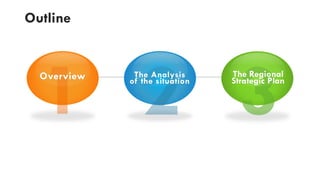
Outline
Overview The Analysis
of the situation
The Regional
Strategic Plan
Overview of the Problem
How did we get there?
Nigel
Crisp, the
inspirer
Caroline
Harper,
CEO
Ronnie
Graham,
HRH D
• 10-Year Strategy to respond to
the HReH Crisis in Africa
Objective 4:Meeting the
specific health workforce
challenges in Francophone
and Lusophone Africa
Francophone West Africa at a Glance
 16 countries - 8 francophone
 Area=3, 455, 984 km2
 Population of 99, 599, 066 (CIA fact book, 2012)
 Average life expectancy = 53 years
 % of Urban Population = 37% (17-50%)
 the population aged over 50 years will double
during the next 20 years (UNFPA) greater number
of people with visual loss and blindness from
cataract that will need eye services
 Health budgets =5.84%
The CSR in Francophone Africa remains<500
CSR AFRO , 2003 CSR AFRO, 2004
SOURCE: Prevention of Blindness and Visual Impairment WHO-AFRO
CSR Global, 2004
What is the problem?
 The Escalating Number of avoidable blindness
 Heavy non operated cataract burden in FWAC --
------ >>>> unnecessary losses in productivity
How best can we support FWAC to meet their needs
/the vision 2020 targets?
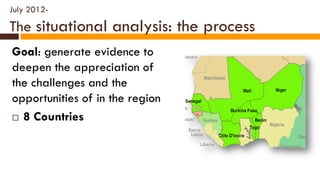
July 2012-
The situational analysis: the process
Goal: generate evidence to
deepen the appreciation of
the challenges and the
opportunities of in the region
 8 Countries
360 degree stakeholder’s consultation…
Benin, Dean and Chief
of department
Senegal, Dean
Cheik Anta Diop
Residents in
ophthalmology
CBM D.O
Cote d’Ivoire
OCO, ON and Chief of
department
Patients at USE Niger with
HR Director, NEEC
Burkina Faso,
Medical council
Findings: The Gap
Country Training
program
Population Ophtalomologists
Current Required Gap
BENIN YES 9598787 26 38 18
BURKINA F NO 17275115 27 68 41
COTE
D’IVOIRE
YES 21952053 82 84 2
GUINEE YES 9300000 24 37 13
MALI YES 14533511 34 57 23
NIGER NO 17078839 14 68 54
SENEGAL YES 12969606 54 51 +3
TOGO YES 6191155 18 24 6
Total 279 427 167
Who perform eye surgery in FWAC?
Ophthalmologists who reported to perform surgery vs
Medical ophthalmologist
Source: Adapted from WAHO data, 2010
 Cataract surgeons are not really
present nor accepted as a cadre.#IOTA
 TSO= conflicts of competences
 Various eye camps by INGOs “Not
welcomed” : Mercy Ships, Nadi El
Bassar, Islamic relief, etc= “Neither
integrated nor sustainable, they are a
strong disruptor of health system”
 The regions has the lowest % of
surgically-active o’gists (Resnikoff and al., 2012)
Medical
ophtalmolog
ists
44%
Ophthalmolo
gistwho
reported to
perform
surgery
56%
.
The number of O’gists in FWAC range from 14 in
Niger to a maximum of 60 in Senegal
Findings: Shortage, quality, equipment …
U. of
Lome-
TOGO
12%
UCAD-
SENEGAL
14%
DESSO-
GUINNEE
16%U of
Bamako-
MALI
17%
U. Abomey
Calavi-
BENIN
19%
U of
Coccody-
COTE
D’IVOIRE
22%
53% of the Residents in
ophthalmology do not perform
surgery at all
53%
Training centres for
ophtalomologists
Faculty Cataract
surgery
/10
N. of
functional
wet lab
Max per
batch
Current
batch
Faculté des Sciences de la
Santé of the University of
Abomey Calavi -Benin 5 3 0 N/A 5
Unités de Formation et de
Recherche of the University
of Cocody – Cote d’Ivoire 16 1 0 10 3
Faculty of Medicine,
Pharmacy and
Odontostomatology of the
University Cheickh Anta
Diop in Dakar -Senegal
8 5 1 6 4
Faculty of Medecin and
Pharmacy of the University
of Lome-Togo 3 4 0 4 2
18
in 2013
28
34
in 2015
23
28
in 2017
36
in 2018
1 2 3 4 5 6
N. of graduates
 Projection of the N. of graduates in
ophthalmology in the region /year
 Evolution of the number of post graduates in
ophthalmology in the Francophone West Africa
for the last 40 years
50% are more than 55 years
Retirement rate is up, the production is not enough and the quality of graduates do not meet
the population needs
74 74
75
84
68
70
72
74
76
78
80
82
84
86
Priorities are crosscutting:
Strengthen surgical skills and Equipping
Country Priority n°1 Priority n° 2
Benin Upgrade surgical skills for trainees &
o’gists
Start to train TSO’s
Burkina Faso Start training og’ists
upgrade surgical skills for O’gists
Equip health centers
Cote d’Ivoire Upgrade surgical skills for trainees and
o’gists
Equip the training institution and
health centers
Niger Start training og’ists Equip
Sénégal Upgrade surgical skills for trainees Equip the training institution
Togo Upgrade surgical skills for trainees Equip training institution
Mali Training of trainers Equip health centers
The Regional Strategic Plan
The Need To Rethink Approaches To Training Is
Not New, But Is Becoming URGENT
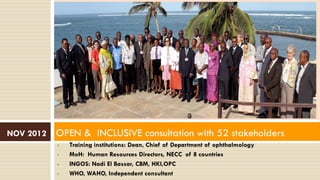
• Training institutions: Dean, Chief of Department of ophthalmology
• MoH: Human Resources Directors, NECC of 8 countries
• INGOS: Nadi El Bassar, CBM, HKI,OPC
• WHO, WAHO, Independent consultant
NOV 2012 OPEN & INCLUSIVE consultation with 52 stakeholders
The strategic plan
The goal: produce surgically skilled ophtalomologists well
equipped to address eye health challenges
1. Increase the number of surgically skilled ophthalmologists at
the regional level( Residency program, medical o’gist CPD)
2. upgrade and scale up the infrastructures of the training
institutions
3. Upgrade the equipment and training materials for all the
training institutions and for their university teaching hospital
4. mobilize resources and coordinate the implementation of the
regional strategic plan
“Erasing red dividing line” between training and Needs
 Accreditation of non-academic high volume surgery centres for internships of
residents
 Post trainees in high volume centers like Dabou, IOTA ,Bopp,Gléï, CADESSO
 CPD for medical ophtalomologists
 upgrade the infrastructures of training institutions and
 Upgrade the equipment and training materials for all the training institutions
and the university teaching hospitals
 Train domestically (Niger and Burkina Faso)
 Equip residents  improve the productivity and retention
 Regionalize areas of sub specialization (Paediatric ophthalmology)
according to the relative endowment of individual institutions
Better Skills, Better Lives
COUNTRIES COSTS
GUINEE £ 76,984
CROSS CUTTING ACTIVITIES £ 291,005
MALI £ 506,613
BENIN £ 507,275
SENEGAL £ 515,211
COTE D'IVOIRE £ 836,068
TOGO £ 1,012,566
NIGER £ 1,136,243
BURKINA FASO £ 4,412,698
TOTAL £ 9, 294, 663
 There is a need, and the
potential to do things
differently
 Do more with less by
integrating useful skills
 Avoid costly medical
evacuations
 However, the successful
delivery of these interventions
will require broad-based
partnerships
“Massive scaling up = Massive funding”
On trainees
9%
On trainers
14%
CPD for
medical
ophtalmologist
4%
Equipment and
Upgrading
63%
Construction
and extension
7%
Advocacy,
M&E,etc
3%Other
10%
Where will the money go?
NIGER
12%
COTE
D'IVOIRE
9%
SENEGAL
6%
TOGO
11%
BENIN
6%
BURKINA
FASO
49%
MALI
6%
GUINEE
1%
Budget By Country
Half full
Half
empty
The elimination of avoidable in blindness in
FWAC is within our grasp. When it is achieved,
it will be a major public health triumph.
What is stopping us?

ADDRESSING OPHTHALMOLOGISTS TRAINING IN FRANCOPHONE WEST AFRICA

  • 1.
    ADDRESSING OPHTHALMOLOGISTS TRAINING IN FRANCOPHONEWEST AFRICA Adidja AMANI, MD, MPH HR PROGRAMME MANAGER , SIGHTSAVERS “Skills have become the global currency of the 21st century. Without proper investment in skills, progress does not translate into economic growth”
  • 2.
    Outline Overview The Analysis ofthe situation The Regional Strategic Plan
  • 3.
  • 4.
    How did weget there? Nigel Crisp, the inspirer Caroline Harper, CEO Ronnie Graham, HRH D • 10-Year Strategy to respond to the HReH Crisis in Africa Objective 4:Meeting the specific health workforce challenges in Francophone and Lusophone Africa
  • 5.
    Francophone West Africaat a Glance  16 countries - 8 francophone  Area=3, 455, 984 km2  Population of 99, 599, 066 (CIA fact book, 2012)  Average life expectancy = 53 years  % of Urban Population = 37% (17-50%)  the population aged over 50 years will double during the next 20 years (UNFPA) greater number of people with visual loss and blindness from cataract that will need eye services  Health budgets =5.84%
  • 6.
    The CSR inFrancophone Africa remains<500 CSR AFRO , 2003 CSR AFRO, 2004 SOURCE: Prevention of Blindness and Visual Impairment WHO-AFRO CSR Global, 2004
  • 7.
    What is theproblem?  The Escalating Number of avoidable blindness  Heavy non operated cataract burden in FWAC -- ------ >>>> unnecessary losses in productivity How best can we support FWAC to meet their needs /the vision 2020 targets?
  • 9.
    July 2012- The situationalanalysis: the process Goal: generate evidence to deepen the appreciation of the challenges and the opportunities of in the region  8 Countries
  • 10.
    360 degree stakeholder’sconsultation… Benin, Dean and Chief of department Senegal, Dean Cheik Anta Diop Residents in ophthalmology CBM D.O Cote d’Ivoire OCO, ON and Chief of department Patients at USE Niger with HR Director, NEEC Burkina Faso, Medical council
  • 11.
    Findings: The Gap CountryTraining program Population Ophtalomologists Current Required Gap BENIN YES 9598787 26 38 18 BURKINA F NO 17275115 27 68 41 COTE D’IVOIRE YES 21952053 82 84 2 GUINEE YES 9300000 24 37 13 MALI YES 14533511 34 57 23 NIGER NO 17078839 14 68 54 SENEGAL YES 12969606 54 51 +3 TOGO YES 6191155 18 24 6 Total 279 427 167
  • 12.
    Who perform eyesurgery in FWAC? Ophthalmologists who reported to perform surgery vs Medical ophthalmologist Source: Adapted from WAHO data, 2010  Cataract surgeons are not really present nor accepted as a cadre.#IOTA  TSO= conflicts of competences  Various eye camps by INGOs “Not welcomed” : Mercy Ships, Nadi El Bassar, Islamic relief, etc= “Neither integrated nor sustainable, they are a strong disruptor of health system”  The regions has the lowest % of surgically-active o’gists (Resnikoff and al., 2012) Medical ophtalmolog ists 44% Ophthalmolo gistwho reported to perform surgery 56%
  • 13.
    . The number ofO’gists in FWAC range from 14 in Niger to a maximum of 60 in Senegal
  • 14.
    Findings: Shortage, quality,equipment … U. of Lome- TOGO 12% UCAD- SENEGAL 14% DESSO- GUINNEE 16%U of Bamako- MALI 17% U. Abomey Calavi- BENIN 19% U of Coccody- COTE D’IVOIRE 22% 53% of the Residents in ophthalmology do not perform surgery at all 53% Training centres for ophtalomologists Faculty Cataract surgery /10 N. of functional wet lab Max per batch Current batch Faculté des Sciences de la Santé of the University of Abomey Calavi -Benin 5 3 0 N/A 5 Unités de Formation et de Recherche of the University of Cocody – Cote d’Ivoire 16 1 0 10 3 Faculty of Medicine, Pharmacy and Odontostomatology of the University Cheickh Anta Diop in Dakar -Senegal 8 5 1 6 4 Faculty of Medecin and Pharmacy of the University of Lome-Togo 3 4 0 4 2
  • 15.
    18 in 2013 28 34 in 2015 23 28 in2017 36 in 2018 1 2 3 4 5 6 N. of graduates  Projection of the N. of graduates in ophthalmology in the region /year  Evolution of the number of post graduates in ophthalmology in the Francophone West Africa for the last 40 years 50% are more than 55 years Retirement rate is up, the production is not enough and the quality of graduates do not meet the population needs 74 74 75 84 68 70 72 74 76 78 80 82 84 86
  • 16.
    Priorities are crosscutting: Strengthensurgical skills and Equipping Country Priority n°1 Priority n° 2 Benin Upgrade surgical skills for trainees & o’gists Start to train TSO’s Burkina Faso Start training og’ists upgrade surgical skills for O’gists Equip health centers Cote d’Ivoire Upgrade surgical skills for trainees and o’gists Equip the training institution and health centers Niger Start training og’ists Equip Sénégal Upgrade surgical skills for trainees Equip the training institution Togo Upgrade surgical skills for trainees Equip training institution Mali Training of trainers Equip health centers
  • 17.
    The Regional StrategicPlan The Need To Rethink Approaches To Training Is Not New, But Is Becoming URGENT
  • 18.
    • Training institutions:Dean, Chief of Department of ophthalmology • MoH: Human Resources Directors, NECC of 8 countries • INGOS: Nadi El Bassar, CBM, HKI,OPC • WHO, WAHO, Independent consultant NOV 2012 OPEN & INCLUSIVE consultation with 52 stakeholders
  • 19.
    The strategic plan Thegoal: produce surgically skilled ophtalomologists well equipped to address eye health challenges 1. Increase the number of surgically skilled ophthalmologists at the regional level( Residency program, medical o’gist CPD) 2. upgrade and scale up the infrastructures of the training institutions 3. Upgrade the equipment and training materials for all the training institutions and for their university teaching hospital 4. mobilize resources and coordinate the implementation of the regional strategic plan
  • 20.
    “Erasing red dividingline” between training and Needs  Accreditation of non-academic high volume surgery centres for internships of residents  Post trainees in high volume centers like Dabou, IOTA ,Bopp,Gléï, CADESSO  CPD for medical ophtalomologists  upgrade the infrastructures of training institutions and  Upgrade the equipment and training materials for all the training institutions and the university teaching hospitals  Train domestically (Niger and Burkina Faso)  Equip residents  improve the productivity and retention  Regionalize areas of sub specialization (Paediatric ophthalmology) according to the relative endowment of individual institutions
  • 21.
    Better Skills, BetterLives COUNTRIES COSTS GUINEE £ 76,984 CROSS CUTTING ACTIVITIES £ 291,005 MALI £ 506,613 BENIN £ 507,275 SENEGAL £ 515,211 COTE D'IVOIRE £ 836,068 TOGO £ 1,012,566 NIGER £ 1,136,243 BURKINA FASO £ 4,412,698 TOTAL £ 9, 294, 663  There is a need, and the potential to do things differently  Do more with less by integrating useful skills  Avoid costly medical evacuations  However, the successful delivery of these interventions will require broad-based partnerships
  • 22.
    “Massive scaling up= Massive funding” On trainees 9% On trainers 14% CPD for medical ophtalmologist 4% Equipment and Upgrading 63% Construction and extension 7% Advocacy, M&E,etc 3%Other 10% Where will the money go? NIGER 12% COTE D'IVOIRE 9% SENEGAL 6% TOGO 11% BENIN 6% BURKINA FASO 49% MALI 6% GUINEE 1% Budget By Country
  • 23.
  • 24.
    The elimination ofavoidable in blindness in FWAC is within our grasp. When it is achieved, it will be a major public health triumph. What is stopping us?