A M A N I A D I D J A , M D M P H
H E A D O F C H I L D A N D N E W B O R N H E A L T H
M O H C A M E R O O N
The GFF PROCESS IN
CAMEROON
.
Investment
Case
Safe Mothers & Newborns Leadership Workshop
Nairobi, Kenya, 11th - 16th June 2017
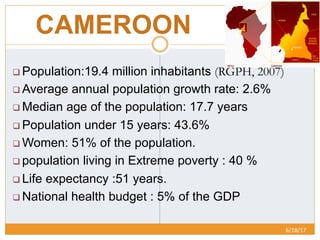
CAMEROON
6/18/17	
  
q Population:19.4 million inhabitants (RGPH, 2007)
q Average annual population growth rate: 2.6%
q Median age of the population: 17.7 years
q Population under 15 years: 43.6%
q Women: 51% of the population.
q population living in Extreme poverty : 40 %
q Life expectancy :51 years.
q National health budget : 5% of the GDP
RMNCAH CHALLENGES
—  MMR: 782 / 100,000 in 2011 (DHS 2011).
—  Infant- child mortality remains high in poor parts of the
country,(173 & 154 /1,000 LB)
—  Households bear the largest share of health
expenditure: 70.42%
—  Insecurity : Boko-Haram
—  Quality of care is undermined by limited HR,
infrastructure, poor governance;
—  Inter–region equity gap+ intra-region equity gap
—  Lack of robust data for decision- making, transparency
and accountability.
WHAT IS THE GFF?
—  Launched in 2015
—  “the key financing platform in support of the UNSG’s
EWEC global movement, with the aim to accelerate
efforts to end preventable MNCAH deaths and improve
the health and quality of life of women, adolescents
and children by 2030
—  Goal: increase resources spent on maternal and child
health in 63 of the world’s poorest countries.
—  Cameroon is one of the 12 GFF Trust Fund supported
countries.
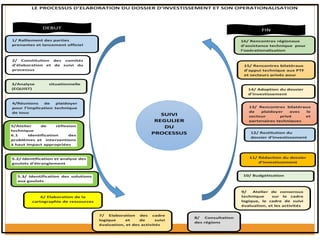
LE	
  PROCESSUS	
  D’ELABORATION	
  DU	
  DOSSIER	
  D’INVESTISSEMENT	
  ET	
  SON	
  OPERATIONALISATION	


6/	
  Elaboration	
  de	
  la	
  
cartographie	
  de	
  ressources	
  
11/	
  Rédaction	
  du	
  dossier	
  
d’investissement	
  
10/	
  Budgétisation	
  
12/	
  Restitution	
  du	
  
dossier	
  d’investissement	
  
7/	
   Elaboration	
   des	
   cadre	
  
logique	
   et	
   de	
   suivi	
  
évaluation,	
  et	
  des	
  activités	


8/	
   Consultation	
  
des	
  régions	
  
14/	
  Adoption	
  du	
  dossier	
  
d’investissement	
  
15/	
  Rencontres	
  bilatéraux	
  
d’appui	
  technique	
  aux	
  PTF	
  	
  
et	
  secteurs	
  privés	
  pour	
  	
  
5.3/	
   Identification	
   des	
   solutions	
  
aux	
  goulots	


5.2/	
  Identification	
  et	
  analyse	
  des	
  
goulots	
  d’étranglement	


5/Atelier	
   de	
   réflexion	
  
technique	
  
6.1	
   Identification	
   des	
  
problèmes	
   et	
   	
   interventions	
  
à	
  haut	
  impact	
  appropriées	


4/Réunions	
   de	
   plaidoyer	
  
pour	
  l’implication	
  technique	
  
de	
  tous	


3/Analyse	
   situationnelle	
  	
  
(EQUIST)	


2/	
   Constitution	
   des	
   comités	
  
d’élaboration	
   et	
   de	
   suivi	
   du	
  
processus	


1/	
  Ralliement	
  des	
  parties	
  
prenantes	
  et	
  lancement	
  officiel	


16/	
  Rencontres	
  régionaux	
  
d’assistance	
  technique	
  	
  pour	
  
l’opérationalisation	
  
9/	
   	
   Atelier	
   de	
   consensus	
  
technique	
   	
   sur	
   le	
   cadre	
  
logique,	
   le	
   cadre	
   de	
   suivi	
  
évaluation,	
  et	
  les	
  activités	


13/	
   Rencontres	
   bilatéraux	
  
de	
   plaidoyer	
   avec	
   le	
  
secteur	
   privé	
   et	
  
partenaires	
  techniques	


SUIVI	
  
REGULIER	
  
DU	
  
PROCESSUS	
  
FIN	
  DEBUT	
  
INVESTMENT CASE DESIGN
Preparatory work
—  Official Launching of the GFF process at national level
—  Validated chronogram for the investment case.
—  Coordination platform created and operational
—  Priorization workshop held with participation of main
stakeholders (UN, CSO, others public sectors,
parliamentarians, Bilaterals, INS, private sectors , mobile
phones companies)
—  Inclusive and participative process
Review of national data
—  Source of data: DHS (2004, 2011), MICS (2011, 2014),
EmONC2015, CRVS, Qualitative studies
—  Tools: EQUIST (for RMNCH), One Health
INVESTMENT CASE DESIGN (2/2)
—  Finalize the situation analysis: include
adolescent needs assessment, CRVS evaluation
—  Prioritize the interventions
—  Develop of the investment case based on the
existing Reproductive, Maternal, Newborn, Child
and Adolescent National Strategic plan 2014-2020
—  Costing : Budgeting: One Health Tool
INVESTMENT CASE
A comprehensive National RMNCAH Investment Case
o  Evidence informed
o  Equity-focused and logical
o  Main causes of deaths per target group
o  Coverage of high impact interventions,
o  All this linked with geographic/regional and
urban/rural differences
o  Identified interventions by the 3 service delivery
platforms
o  Highlight key bottlenecks, causes of bottlenecks
and priority, solutions/strategies
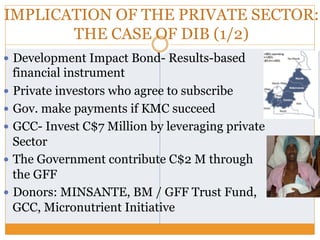
IMPLICATION OF THE PRIVATE SECTOR:
THE CASE OF DIB (1/2)
—  Development Impact Bond- Results-based
financial instrument
—  Private investors who agree to subscribe
—  Gov. make payments if KMC succeed
—  GCC- Invest C$7 Million by leveraging private
Sector
—  The Government contribute C$2 M through
the GFF
—  Donors: MINSANTE, BM / GFF Trust Fund,
GCC, Micronutrient Initiative
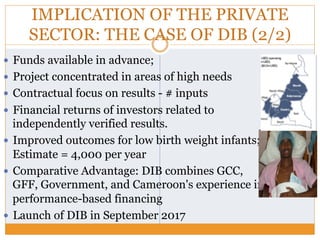
IMPLICATION OF THE PRIVATE
SECTOR: THE CASE OF DIB (2/2)
—  Funds available in advance;
—  Project concentrated in areas of high needs
—  Contractual focus on results - # inputs
—  Financial returns of investors related to
independently verified results.
—  Improved outcomes for low birth weight infants;
Estimate = 4,000 per year
—  Comparative Advantage: DIB combines GCC,
GFF, Government, and Cameroon's experience in
performance-based financing
—  Launch of DIB in September 2017
CHALLENGES
—  Ensuring a coherent approach in the country:
inclusiveness + alignment is needed at country level
with different strategic documents;
—  Align the HSS and GFF process timelines,
outcomes :that has to be aligned and coherent not only
with the SDGs targets but also the country strategic
documents.
—  harmonization of indicators , but also the need to
be ambitious in other to meet the SDGs goal
LESSONS LEARNED(1/2)
—  Improve data quality and completeness
upfront : adolescent health, CRVS, RMNCH sub
national data with equity breakdown, and structural
barriers
—  Inclusive capacity building on the
prioritization tool(EQUIST) accelerated the
consensus+ appropriation
—  Prioritizing VS. Compromising. All stakeholders
wants their issue to be fully addressed, with disregard
of value for money
LESSONS LEARNED (1/2)
—  Harmonize the cost categories used both in the
budget and in the resource mapping in anticipation
of the generation of funding gaps
—  A consensus on the logical framework and
interventions must be obtained before budgeting is
done
CONCLUSION
—  RMNCAH is still a big challenge
—  The GFF was a great opportunity
¡  to design and sharpen the health financing policy
¡  Generate discussion and a UHC strategy
¡  To identify and reduce sources of inefficiencies
¡  To design a CRVS strategic plan and reinforce the HIS
¡  to optimize our work with private sector, test innovative
strategies like the DIB for KMC
Global financing facility process in Cameroon

Global financing facility process in Cameroon

  • 1.
    A M AN I A D I D J A , M D M P H H E A D O F C H I L D A N D N E W B O R N H E A L T H M O H C A M E R O O N The GFF PROCESS IN CAMEROON . Investment Case Safe Mothers & Newborns Leadership Workshop Nairobi, Kenya, 11th - 16th June 2017
  • 2.
    CAMEROON 6/18/17   q Population:19.4 millioninhabitants (RGPH, 2007) q Average annual population growth rate: 2.6% q Median age of the population: 17.7 years q Population under 15 years: 43.6% q Women: 51% of the population. q population living in Extreme poverty : 40 % q Life expectancy :51 years. q National health budget : 5% of the GDP
  • 3.
    RMNCAH CHALLENGES —  MMR:782 / 100,000 in 2011 (DHS 2011). —  Infant- child mortality remains high in poor parts of the country,(173 & 154 /1,000 LB) —  Households bear the largest share of health expenditure: 70.42% —  Insecurity : Boko-Haram —  Quality of care is undermined by limited HR, infrastructure, poor governance; —  Inter–region equity gap+ intra-region equity gap —  Lack of robust data for decision- making, transparency and accountability.
  • 4.
    WHAT IS THEGFF? —  Launched in 2015 —  “the key financing platform in support of the UNSG’s EWEC global movement, with the aim to accelerate efforts to end preventable MNCAH deaths and improve the health and quality of life of women, adolescents and children by 2030 —  Goal: increase resources spent on maternal and child health in 63 of the world’s poorest countries. —  Cameroon is one of the 12 GFF Trust Fund supported countries.
  • 5.
    LE  PROCESSUS  D’ELABORATION  DU  DOSSIER  D’INVESTISSEMENT  ET  SON  OPERATIONALISATION                                               6/  Elaboration  de  la   cartographie  de  ressources   11/  Rédaction  du  dossier   d’investissement   10/  Budgétisation   12/  Restitution  du   dossier  d’investissement   7/   Elaboration   des   cadre   logique   et   de   suivi   évaluation,  et  des  activités     8/   Consultation   des  régions   14/  Adoption  du  dossier   d’investissement   15/  Rencontres  bilatéraux   d’appui  technique  aux  PTF     et  secteurs  privés  pour     5.3/   Identification   des   solutions   aux  goulots     5.2/  Identification  et  analyse  des   goulots  d’étranglement         5/Atelier   de   réflexion   technique   6.1   Identification   des   problèmes   et     interventions   à  haut  impact  appropriées         4/Réunions   de   plaidoyer   pour  l’implication  technique   de  tous     3/Analyse   situationnelle     (EQUIST)     2/   Constitution   des   comités   d’élaboration   et   de   suivi   du   processus     1/  Ralliement  des  parties   prenantes  et  lancement  officiel     16/  Rencontres  régionaux   d’assistance  technique    pour   l’opérationalisation   9/     Atelier   de   consensus   technique     sur   le   cadre   logique,   le   cadre   de   suivi   évaluation,  et  les  activités       13/   Rencontres   bilatéraux   de   plaidoyer   avec   le   secteur   privé   et   partenaires  techniques     SUIVI   REGULIER   DU   PROCESSUS   FIN  DEBUT  
  • 6.
    INVESTMENT CASE DESIGN Preparatorywork —  Official Launching of the GFF process at national level —  Validated chronogram for the investment case. —  Coordination platform created and operational —  Priorization workshop held with participation of main stakeholders (UN, CSO, others public sectors, parliamentarians, Bilaterals, INS, private sectors , mobile phones companies) —  Inclusive and participative process Review of national data —  Source of data: DHS (2004, 2011), MICS (2011, 2014), EmONC2015, CRVS, Qualitative studies —  Tools: EQUIST (for RMNCH), One Health
  • 7.
    INVESTMENT CASE DESIGN(2/2) —  Finalize the situation analysis: include adolescent needs assessment, CRVS evaluation —  Prioritize the interventions —  Develop of the investment case based on the existing Reproductive, Maternal, Newborn, Child and Adolescent National Strategic plan 2014-2020 —  Costing : Budgeting: One Health Tool
  • 8.
    INVESTMENT CASE A comprehensiveNational RMNCAH Investment Case o  Evidence informed o  Equity-focused and logical o  Main causes of deaths per target group o  Coverage of high impact interventions, o  All this linked with geographic/regional and urban/rural differences o  Identified interventions by the 3 service delivery platforms o  Highlight key bottlenecks, causes of bottlenecks and priority, solutions/strategies
  • 9.
    IMPLICATION OF THEPRIVATE SECTOR: THE CASE OF DIB (1/2) —  Development Impact Bond- Results-based financial instrument —  Private investors who agree to subscribe —  Gov. make payments if KMC succeed —  GCC- Invest C$7 Million by leveraging private Sector —  The Government contribute C$2 M through the GFF —  Donors: MINSANTE, BM / GFF Trust Fund, GCC, Micronutrient Initiative
  • 10.
    IMPLICATION OF THEPRIVATE SECTOR: THE CASE OF DIB (2/2) —  Funds available in advance; —  Project concentrated in areas of high needs —  Contractual focus on results - # inputs —  Financial returns of investors related to independently verified results. —  Improved outcomes for low birth weight infants; Estimate = 4,000 per year —  Comparative Advantage: DIB combines GCC, GFF, Government, and Cameroon's experience in performance-based financing —  Launch of DIB in September 2017
  • 11.
    CHALLENGES —  Ensuring acoherent approach in the country: inclusiveness + alignment is needed at country level with different strategic documents; —  Align the HSS and GFF process timelines, outcomes :that has to be aligned and coherent not only with the SDGs targets but also the country strategic documents. —  harmonization of indicators , but also the need to be ambitious in other to meet the SDGs goal
  • 12.
    LESSONS LEARNED(1/2) —  Improvedata quality and completeness upfront : adolescent health, CRVS, RMNCH sub national data with equity breakdown, and structural barriers —  Inclusive capacity building on the prioritization tool(EQUIST) accelerated the consensus+ appropriation —  Prioritizing VS. Compromising. All stakeholders wants their issue to be fully addressed, with disregard of value for money
  • 13.
    LESSONS LEARNED (1/2) — Harmonize the cost categories used both in the budget and in the resource mapping in anticipation of the generation of funding gaps —  A consensus on the logical framework and interventions must be obtained before budgeting is done
  • 14.
    CONCLUSION —  RMNCAH isstill a big challenge —  The GFF was a great opportunity ¡  to design and sharpen the health financing policy ¡  Generate discussion and a UHC strategy ¡  To identify and reduce sources of inefficiencies ¡  To design a CRVS strategic plan and reinforce the HIS ¡  to optimize our work with private sector, test innovative strategies like the DIB for KMC