Health Optimizing Physical
Education 2:
Athletics in Relation
to Health-Related
Fitness
JERICO A. TAMONDONG
ATHLETICS
•Brief History
Athletics is composed of sports involving running, walking, jumping, and
throwing. It is a group of sports divided mainly in what is popularly known as
track and field and it has been played centuries ago in a sports competition. In
776 B.C, Greeks started to promote track and field and it opened the Olympic
Games. Since then, it has been staged every four years until 394 A.D. Athens
revived the Olympic Games in 1896. After that, the Olympic Games is stage every
four years.
In the early stage, the Greeks’ participation in athletics was intended to show the
strong body and skills of the soldiers. The beauty of the games caught the
attention and interest of more than 5000 people. Olympic Games became very
competitive and in 1923 women were included in the event. The competition was
under the support of the Amateur Athletics Union.
• Track and field event was
introduced to the Filipinos by
the Americans. It was warmly
accepted as one of the events
for competition. Athletics, as
part of the local competition,
was governed by the Philippine
Athletics Track and Field
Association. It followed the
rules of International Amateur
Athletic Federation as a world
governing body for track and
field athletics. Because of its
worth and value, it was
included as a subject in the
Physical Education.
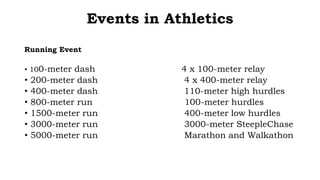
Events in Athletics
Running Event
• 100-meter dash 4 x 100-meter relay
• 200-meter dash 4 x 400-meter relay
• 400-meter dash 110-meter high hurdles
• 800-meter run 100-meter hurdles
• 1500-meter run 400-meter low hurdles
• 3000-meter run 3000-meter SteepleChase
• 5000-meter run Marathon and Walkathon
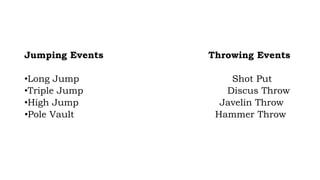
Jumping Events Throwing Events
•Long Jump Shot Put
•Triple Jump Discus Throw
•High Jump Javelin Throw
•Pole Vault Hammer Throw
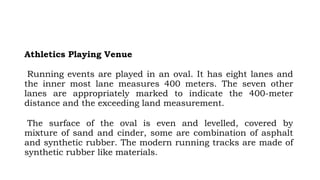
Athletics Playing Venue
Running events are played in an oval. It has eight lanes and
the inner most lane measures 400 meters. The seven other
lanes are appropriately marked to indicate the 400-meter
distance and the exceeding land measurement.
The surface of the oval is even and levelled, covered by
mixture of sand and cinder, some are combination of asphalt
and synthetic rubber. The modern running tracks are made of
synthetic rubber like materials.
Running Events
• Sprinters are innately gifted with a larger number of fast-
twitch muscle fibers. It permits them to execute explosive
movements and participate in high-intensity exercise for
short period of time. According to National Academy of
Sports Medicine (NASM), the same goes for powerlifters,
bodybuilders, and other strength athletes. Fast-twitch
fibers can produce more force in a shorter time than
slow-twitch fibers. Also, sprinters are naturally more
muscular and have a bigger build than long-distance
runners.
The Hurdles
Hurdling is a sport in athletics (track and field) in which a runner
sprints and leaps over a series of hurdles, which are set on a track
with specific distance apart. Runners must stay in their respective
lanes throughout the race. If the runner knocks the hurdles down
while leaping, a runner who trails a foot or leg alongside a hurdle or
knocks it down with a hand is disqualified. The winner will be the
first player who been complete the course without violation.
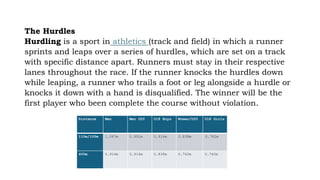
Distance Men Men U20 U18 Boys Women/U20 U18 Girls
110m/100m 1.067m 0.991m 0.914m 0.838m 0.762m
400m 0.914m 0.914m 0.838m 0.762m 0.762m
•Rules of a Relay
A team may be disqualified from a relay for:
 False Starting
 Incorrect baton passing
 For 4 x 400m illegal switching
 Passing of the baton outside the takeover zone
 During the race an athlete takes or picks up the
baton of another team
 Deliberately impeding, improperly crossing the
lane, or in any other way interfering with
another competitor
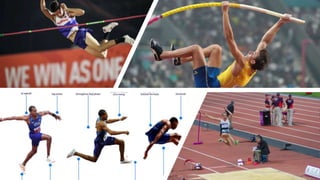
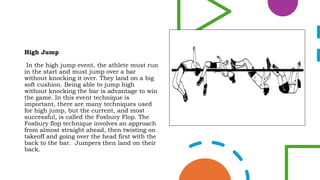
High Jump
In the high jump event, the athlete must run
in the start and must jump over a bar
without knocking it over. They land on a big
soft cushion. Being able to jump high
without knocking the bar is advantage to win
the game. In this event technique is
important, there are many techniques used
for high jump, but the current, and most
successful, is called the Fosbury Flop. The
Fosbury flop technique involves an approach
from almost straight ahead, then twisting on
takeoff and going over the head first with the
back to the bar. Jumpers then land on their
back.
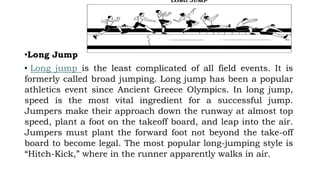
•Long Jump
• Long jump is the least complicated of all field events. It is
formerly called broad jumping. Long jump has been a popular
athletics event since Ancient Greece Olympics. In long jump,
speed is the most vital ingredient for a successful jump.
Jumpers make their approach down the runway at almost top
speed, plant a foot on the takeoff board, and leap into the air.
Jumpers must plant the forward foot not beyond the take-off
board to become legal. The most popular long-jumping style is
“Hitch-Kick,” where in the runner apparently walks in air.
•Triple Jump
• The triple jump is like long jump, it is known as the
hop, step, and jump. The jumper will first run down the
track gaining speed; at the start of the jump or take
off point they will jump or spring from one foot and
land on that same foot (hop); next they jump again, at
this time landing on the opposite foot (step); lastly,
they jump as far as they can and land on both feet
(jump) into the sand pit or landing pit.
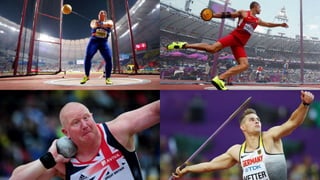
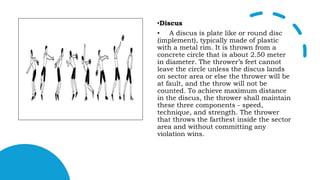
•Discus
• A discus is plate like or round disc
(implement), typically made of plastic
with a metal rim. It is thrown from a
concrete circle that is about 2.50 meter
in diameter. The thrower’s feet cannot
leave the circle unless the discus lands
on sector area or else the thrower will be
at fault, and the throw will not be
counted. To achieve maximum distance
in the discus, the thrower shall maintain
these three components - speed,
technique, and strength. The thrower
that throws the farthest inside the sector
area and without committing any
violation wins.
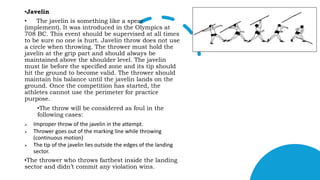
•Javelin
• The javelin is something like a spear
(implement). It was introduced in the Olympics at
708 BC. This event should be supervised at all times
to be sure no one is hurt. Javelin throw does not use
a circle when throwing. The thrower must hold the
javelin at the grip part and should always be
maintained above the shoulder level. The javelin
must lie before the specified zone and its tip should
hit the ground to become valid. The thrower should
maintain his balance until the javelin lands on the
ground. Once the competition has started, the
athletes cannot use the perimeter for practice
purpose.
•The throw will be considered as foul in the
following cases:
 Improper throw of the javelin in the attempt.
 Thrower goes out of the marking line while throwing
(continuous motion)
 The tip of the javelin lies outside the edges of the landing
sector.
•The thrower who throws farthest inside the landing
sector and didn’t commit any violation wins.
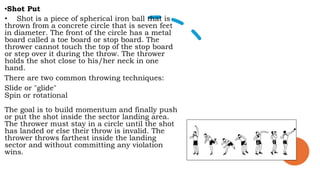
•Shot Put
• Shot is a piece of spherical iron ball that is
thrown from a concrete circle that is seven feet
in diameter. The front of the circle has a metal
board called a toe board or stop board. The
thrower cannot touch the top of the stop board
or step over it during the throw. The thrower
holds the shot close to his/her neck in one
hand.
There are two common throwing techniques:
Slide or "glide"
Spin or rotational
The goal is to build momentum and finally push
or put the shot inside the sector landing area.
The thrower must stay in a circle until the shot
has landed or else their throw is invalid. The
thrower throws farthest inside the landing
sector and without committing any violation
wins.
•Hammer Throw
• Hammer throw does not actually involve throwing a usual
hammer like you think. In this Athletics throwing event, the thrower
throws a metal ball attached to a handle and a straight wire about
three feet long. The hammer is thrown from a concrete circle 2.15
meter in diameter (just like the shot put) but there is no toe board
or stop board. Like the discus and the shot put, the thrower must
stay in a circle until the hammer lands. The thrower rotates several
times to gain momentum prior to releasing and throwing the
hammer. Maintaining balance is important due to the force
generated by having the heavy ball at the end of the wire. The
thrower that throws farthest without committing any violation wins.
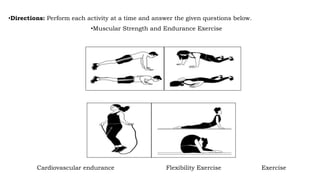
•Directions: Perform each activity at a time and answer the given questions below.
•Muscular Strength and Endurance Exercise
Cardiovascular endurance Flexibility Exercise Exercise
Answer the following questions after performing the activities.
1. How did you feel while performing the activities?
__________________________________________________________________________________
2. How was your breathing?
__________________________________________________________________________________
3. How much did you sweat?
__________________________________________________________________________________
4. Do you feel pain in your muscle while doing the exercises? Why do you think so?
__________________________________________________________________________________
Reflection:
On a scale of 1 to 10, how fit do you see yourself? Why?

Health Optimizing exercises and Physical Education a

  • 1.
    Health Optimizing Physical Education2: Athletics in Relation to Health-Related Fitness JERICO A. TAMONDONG
  • 2.
    ATHLETICS •Brief History Athletics iscomposed of sports involving running, walking, jumping, and throwing. It is a group of sports divided mainly in what is popularly known as track and field and it has been played centuries ago in a sports competition. In 776 B.C, Greeks started to promote track and field and it opened the Olympic Games. Since then, it has been staged every four years until 394 A.D. Athens revived the Olympic Games in 1896. After that, the Olympic Games is stage every four years. In the early stage, the Greeks’ participation in athletics was intended to show the strong body and skills of the soldiers. The beauty of the games caught the attention and interest of more than 5000 people. Olympic Games became very competitive and in 1923 women were included in the event. The competition was under the support of the Amateur Athletics Union.
  • 3.
    • Track andfield event was introduced to the Filipinos by the Americans. It was warmly accepted as one of the events for competition. Athletics, as part of the local competition, was governed by the Philippine Athletics Track and Field Association. It followed the rules of International Amateur Athletic Federation as a world governing body for track and field athletics. Because of its worth and value, it was included as a subject in the Physical Education.
  • 4.
    Events in Athletics RunningEvent • 100-meter dash 4 x 100-meter relay • 200-meter dash 4 x 400-meter relay • 400-meter dash 110-meter high hurdles • 800-meter run 100-meter hurdles • 1500-meter run 400-meter low hurdles • 3000-meter run 3000-meter SteepleChase • 5000-meter run Marathon and Walkathon
  • 5.
    Jumping Events ThrowingEvents •Long Jump Shot Put •Triple Jump Discus Throw •High Jump Javelin Throw •Pole Vault Hammer Throw
  • 8.
    Athletics Playing Venue Runningevents are played in an oval. It has eight lanes and the inner most lane measures 400 meters. The seven other lanes are appropriately marked to indicate the 400-meter distance and the exceeding land measurement. The surface of the oval is even and levelled, covered by mixture of sand and cinder, some are combination of asphalt and synthetic rubber. The modern running tracks are made of synthetic rubber like materials.
  • 9.
    Running Events • Sprintersare innately gifted with a larger number of fast- twitch muscle fibers. It permits them to execute explosive movements and participate in high-intensity exercise for short period of time. According to National Academy of Sports Medicine (NASM), the same goes for powerlifters, bodybuilders, and other strength athletes. Fast-twitch fibers can produce more force in a shorter time than slow-twitch fibers. Also, sprinters are naturally more muscular and have a bigger build than long-distance runners.
  • 10.
    The Hurdles Hurdling isa sport in athletics (track and field) in which a runner sprints and leaps over a series of hurdles, which are set on a track with specific distance apart. Runners must stay in their respective lanes throughout the race. If the runner knocks the hurdles down while leaping, a runner who trails a foot or leg alongside a hurdle or knocks it down with a hand is disqualified. The winner will be the first player who been complete the course without violation. Distance Men Men U20 U18 Boys Women/U20 U18 Girls 110m/100m 1.067m 0.991m 0.914m 0.838m 0.762m 400m 0.914m 0.914m 0.838m 0.762m 0.762m
  • 11.
    •Rules of aRelay A team may be disqualified from a relay for:  False Starting  Incorrect baton passing  For 4 x 400m illegal switching  Passing of the baton outside the takeover zone  During the race an athlete takes or picks up the baton of another team  Deliberately impeding, improperly crossing the lane, or in any other way interfering with another competitor
  • 12.
    High Jump In thehigh jump event, the athlete must run in the start and must jump over a bar without knocking it over. They land on a big soft cushion. Being able to jump high without knocking the bar is advantage to win the game. In this event technique is important, there are many techniques used for high jump, but the current, and most successful, is called the Fosbury Flop. The Fosbury flop technique involves an approach from almost straight ahead, then twisting on takeoff and going over the head first with the back to the bar. Jumpers then land on their back.
  • 13.
    •Long Jump • Longjump is the least complicated of all field events. It is formerly called broad jumping. Long jump has been a popular athletics event since Ancient Greece Olympics. In long jump, speed is the most vital ingredient for a successful jump. Jumpers make their approach down the runway at almost top speed, plant a foot on the takeoff board, and leap into the air. Jumpers must plant the forward foot not beyond the take-off board to become legal. The most popular long-jumping style is “Hitch-Kick,” where in the runner apparently walks in air.
  • 14.
    •Triple Jump • Thetriple jump is like long jump, it is known as the hop, step, and jump. The jumper will first run down the track gaining speed; at the start of the jump or take off point they will jump or spring from one foot and land on that same foot (hop); next they jump again, at this time landing on the opposite foot (step); lastly, they jump as far as they can and land on both feet (jump) into the sand pit or landing pit.
  • 15.
    •Discus • A discusis plate like or round disc (implement), typically made of plastic with a metal rim. It is thrown from a concrete circle that is about 2.50 meter in diameter. The thrower’s feet cannot leave the circle unless the discus lands on sector area or else the thrower will be at fault, and the throw will not be counted. To achieve maximum distance in the discus, the thrower shall maintain these three components - speed, technique, and strength. The thrower that throws the farthest inside the sector area and without committing any violation wins.
  • 16.
    •Javelin • The javelinis something like a spear (implement). It was introduced in the Olympics at 708 BC. This event should be supervised at all times to be sure no one is hurt. Javelin throw does not use a circle when throwing. The thrower must hold the javelin at the grip part and should always be maintained above the shoulder level. The javelin must lie before the specified zone and its tip should hit the ground to become valid. The thrower should maintain his balance until the javelin lands on the ground. Once the competition has started, the athletes cannot use the perimeter for practice purpose. •The throw will be considered as foul in the following cases:  Improper throw of the javelin in the attempt.  Thrower goes out of the marking line while throwing (continuous motion)  The tip of the javelin lies outside the edges of the landing sector. •The thrower who throws farthest inside the landing sector and didn’t commit any violation wins.
  • 17.
    •Shot Put • Shotis a piece of spherical iron ball that is thrown from a concrete circle that is seven feet in diameter. The front of the circle has a metal board called a toe board or stop board. The thrower cannot touch the top of the stop board or step over it during the throw. The thrower holds the shot close to his/her neck in one hand. There are two common throwing techniques: Slide or "glide" Spin or rotational The goal is to build momentum and finally push or put the shot inside the sector landing area. The thrower must stay in a circle until the shot has landed or else their throw is invalid. The thrower throws farthest inside the landing sector and without committing any violation wins.
  • 18.
    •Hammer Throw • Hammerthrow does not actually involve throwing a usual hammer like you think. In this Athletics throwing event, the thrower throws a metal ball attached to a handle and a straight wire about three feet long. The hammer is thrown from a concrete circle 2.15 meter in diameter (just like the shot put) but there is no toe board or stop board. Like the discus and the shot put, the thrower must stay in a circle until the hammer lands. The thrower rotates several times to gain momentum prior to releasing and throwing the hammer. Maintaining balance is important due to the force generated by having the heavy ball at the end of the wire. The thrower that throws farthest without committing any violation wins.
  • 19.
    •Directions: Perform eachactivity at a time and answer the given questions below. •Muscular Strength and Endurance Exercise Cardiovascular endurance Flexibility Exercise Exercise
  • 20.
    Answer the followingquestions after performing the activities. 1. How did you feel while performing the activities? __________________________________________________________________________________ 2. How was your breathing? __________________________________________________________________________________ 3. How much did you sweat? __________________________________________________________________________________ 4. Do you feel pain in your muscle while doing the exercises? Why do you think so? __________________________________________________________________________________ Reflection: On a scale of 1 to 10, how fit do you see yourself? Why?