HDN
INTRODUCTION
 It is an antibody induced haemolytic anaemia caused by incompatibility of
blood group between mother and foetus.
 It is also known as ERYTHROBLASTOSIS FETALIS ,HEMOLYTIC DISEASE OF FETUS
AND NEWBORN.
 Normally red blood cells lasts for 120 days ,but in this disorder red cells are
destroyed.
 In most instances the mother is Rh negative and foetus is Rh positive.
DEFINITION
 It is a haemolytic disease of new born or foetus caused by
transplacental passage of maternal antibodies against foetal
erythrocyte antigens.
CLASSIFICATION
 HDFN classified in to three categories depending on the antibody
specificity
Rh D HDN
ABO HDN
OTHER BLOOD GROUP INCOMPATIBILITY
ETIOPATHOGENESIS
 ROLE OF PLACENTA DURING PREGNANCY
 Placenta functions as a site of exchange for oxygen, nutrients , and waste
materials.
 Placenta also act as a barrier between maternal and foetal circulations. During
pregnancy, the placental barrier limits the entry of the number of foetal red
cells in to the maternal circulations there by reduces the chances of antibody
production.
.
 HDN can occur due to blood group incompatibility between the mother and
foetus. The mother may be alloimmunised to red cells antigens either following
transplacental haemorrhage of incompatible foetal red cells during pregnancy
or labour or by transfusion of incompatible red cells.
 The Rh negative mother’s immune system see the baby’s Rh positive blood cells
as a foreign
 The mother’s immune system responds by making antibodies to fight against
and destroy these foreign cells.
 The immune system stores these antibodies in case these foreign cells come
back again. This can appear in future pregnancy. So the mother is now
sensitised.
 Rh sensitisation normally isn’t a problem with first pregnancy
 Most problems occur in future pregnancy with another Rh positive baby.
 During that pregnancy the mother’s antibody cross placenta to fight Rh positive
cells in the baby’s body.
 As the antibody destroys the cells , the baby get sick. This is called
erythroblastosis fetalis during pregnancy.
 Once the baby is born , it is called HDN
CONSEQUENSES
 BEFORE DELIVERY
 HEMOLYSIS
 HYPERBILIRUBINEMIA
 ANEAMIA
 ACCELERATED ERYTHROPOIESIS
 HEPATISPLENOMEGALY
HYDROPS FETALIS
high output cardiac failure.
 Results in generalized edema, effusions and ascites
 These features are characteristic of condition called
hydrops fetalis ( edema in the fetus )
 Anemia can also lead to tissue hypoxia and death in
utero ( stillbirth )
 Cardiac failure is the greatest threat to the fetus.
AFTER DELIVERY
 HEMOLYSIS AFTER BIRTH
 HYPERBILIRUBINEMIA
 KERNICTERUS
 When there is moderate to severe hemolysis ,the unconjugated bilirubin may
reach about more than 18 to 20 mg/dl, it is toxic to central nervous system.
 If not treated ,this toxic level can cross through CSF because of poorly formed
blood brain barrier (BBB) and reach to the infants brain.
 In the brain ,it may bind with tissues of the central nervous system ( CNS ) and
cause permanent damage to parts of the brain ( kernicterus )
 This results in deafness, mental retardation ,or death .
Rh D HDN
 DEFINITION
 Hemolysis of Rh D antigen positive fetal RBCs caused by the IgG Rh D
antibodies acquired through the placenta from a sensitized Rh D
negative mother.
 The anti-D IgG antibodies are the main cause of severe HDFN.
 D antigen is potent immunogen.
 HDFN develop if father is Rh-positive ( D +) Mother is Rh negative ( D -)
and fetus is Rh positive(D+)
 Isoimmunization of Rh ( D ) negative mother may occur due to Rh ( D ) positive
pregnancy or transfusion of Rh positive blood.
 In most of the cases the volume of fetomaternal haemorrhage is small. However
haemorrhage as little as 1ml of foetal RBC can immunise the mother.
 First pregnancy ( first-born ) Rh positive infant of a Rh negative mother is usually not
affected by Rh ( D) HDFN because the mother has not yet been immunized
FACTORS AFFECTING IMMUNISATION AND
SEVERITY OF HDN
 AMOUNT OF FETOMATERNAL HAEMORRHAGE
Fetomaternal bleed increase greater risk.
 HOST FACTORS
 The ability of individuals to produce antibodies in response to antigenic response
 PARITY ; Usually first pregnancy is not affected by HDFN and in about 70% of cases it
develops in 2nd and 3rd pregnancy
 ZYGOSITY OF FATHER
 If the father is heterozygous for the implicated antibody, there is 50% possibility of child
being affected by Rh HDFN.
 If father is homozygous for the implicated antibody ,there is 100 % possibility of child
being affected by Rh HDFN.
 IMMUNOGLOBULIN CLASS / TYPE
 IgG can cross placenta
 Of the four subclasses of IgG antibody, the more efficient hemolysis of RBC is
caused by IgG1, and IgG3,rather than IgG2,IgG4.
 ANTIBODY SPECIFICITY
 D Antigen most antigenic
 OTHER ANTIGENS: C,c,E
 MEDICAL TERMINATION OF PREGNANCIES OR MISCARRIAGE
DIAGNOSIS AND MANAGEMENT
 PRENATAL/ANTENATAL EVALUATION OF Rh HDF
 In mother
 PURPOSE
 To identify D negative women with a high risk of delivering a baby with Rh HDFN and
who require RhIg
 To identify women with antibodies capable of causing HDFN . This helps to assess
the risk to the foetus.
 Detailed history :
 Obstetric history
 History of previous pregnancies and bad obstetric history ( hydrops fetalis , stillbirth ,
or HDFN )
 History of prior blood transfusion:
 If Rh-negative women are transfused with Rh-positive blood ,it may immunize the
women
Investigations:
1. ABO and Rh grouping
2. Antibody screening
3. paternal phenotype and genotype: father’s probable Rh genotype
4. foetal DNA testing
5. Antibody–dependent cell-mediated cytotoxicity ( ADCC ) test
6. Color Doppler middle cerebral artery peak systolic velocity
7. Cordocentesis ( percutaneous umbilical blood sampling )
8. Amniocentesis
9. Foetal maturity
 FETAL DNA TESTING
 PCR to amplify DNA obtained from amniocentesis or chorionic villous sampling.
 it can be performed as early as 10-12 weeks gestation.
 Testing can be done for the genes coding c, e, C, E, K, Fya, Fyb, Jka, Jkb , M , and
others.
 CORDOCENTESIS (PERCUTANEOUS UMBILICAL BLOOD SAMPLING )
 It is a procedure in which clinician obtain a sample of fetal blood using
advanced sonography.
 The umbilical vein is visualized at the level of the cord insertion into the
placenta by using high resolution ultrasound with color Doppler enhancement
of blood flow.
 A sample of the fetal blood is obtained by inserting a spinal needle into the
umbilical vein.
 The fetal blood sample can be tested for hemoglobin ,hematocrit , bilirubin,
blood type, DAT, antigen phenotype, genotype.
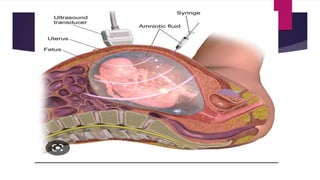
 AMNIOCENTESIS :
 Amniotic fluid is normally almost colorless and in a fetus with severe hemolysis it appears
bright yellow due to the presence of bilirubin.
 Procedure
 Amniocentesis is usually performed between 28th weeks and 32nd weeks of gestation .
 Amniotic fluid is obtained by USG –guided amniocentesis by inserting needle through
abdominal wall into the uterine cavity .
 Significance
 The amniotic fluid obtained by amniocentesis is tested for bilirubin by
spectrophotometry.
 The concentration of bilirubin pigment in amniotic fluid indicates the extent of
fetal hemolysis and helps in predicting the degree of hemolytic process in
pregnancy and severity of HDFN.
 High values indicate severe and often life-threatening hemolysis ( fetal
hemoglobin less than 8g/dl ).
 FETAL MATURITY
 Maturity of fetal lung and thereby the ability of the fetus to survive after early
delivery , can be predicted by estimation of lecithin / sphingomyelin ratio in
amniotic fluid.
 L/S ratio of less than 2.0/1.0 indicates that the lung is immature and need
intrauterine transfusion.
INVESTIGATION ( SEROLOGICAL TESTING ) OF NEWBORN
INFANTS
 ABO grouping
 Rh typing including DU
 Direct antiglobulin test ( DAT )
 Elution : screening and identification of antibody in cord serum ( is necessary )
 Estimation of hemoglobin in cord blood (Normal level of cord blood Hb is 18.6 -
19.6 g/dl)
 Cord blood bilirubin level ( Normal cord blood bilirubin value is 0.7-3.1 mg /dl.)
 Hematological parameters on cord blood : it shows increased number of
nucleated red cells and reticulocyte count : but it is not specific for HDFN
Antenatal management of Rh immunization
 Intrauterine transfusion
 Plasmapheresis
 Premature induction of labour
 Intravenous immune globulin
Postnatal management of infant
 Phototherapy to reduce serum bilirubin concentration
 Phototherapy is exposure of newborn infants to fluorescent light.
 On exposure to light in the region of 460-490 nm ,unconjugated bilirubin gets
converted to the nontoxic pigment isomer, biliverdin, and lowers serum bilirubin
concentration.
 Blood transfusion
 Moderate to severe HDN require exchange transfusion.
PREVENTION OF Rh (D) HDFN
 Rh immune Globulin ( RhIG)
 Principle
 Active immunization induced by RBC antigen can be prevented by the concurrent
administration of the corresponding RBC antibody.
 Used to prevent immunisation to D antigen by using high tittered RhIG
 Mechanism of action of RhIG
 RhIG is an antibody administered to the Rh negative mother during pregnancy
and after delivery.
 This RhIG attaches to the fetal Rh positive RBCs in the maternal circulation .
 The antibody coated RBCs are removed by the macrophages In the maternal
spleen.
 Indications for RhIG
 Antenatal
 Amniocentesis
 Chorionic villus sampling
 Abdominal trauma
 Greater than 40 weeks gestation
 Postpartum
 Undergone abortion or medical termination of pregnancy
 Ectopic pregnancy
 Transfusion
 Accidental or inadvertent transfusion.
 Antenatal
 There is a known risk of Rh immunization during pregnancy.
 Hence RhIG should be administrated to the mother early in the third trimester
, or at about 28 weeks gestation .
 It may procedure a positive DAT result in the newborn.
 Post partum
 Non immunized Rh negative mother should receive RhIG soon after delivery of
a Rh positive infants.
:
 A full dose of RhIG ( about 300 micro gram ) is sufficient to counteract the
immunizing effects of 15 ml of D positive red cells or 30 ml of fetal whole
blood.
 It is given intramuscularly within 72 hours after delivery to Rh ( D ) negative
woman.
Massive fetomaternal haemorrhage
 Massive fetomaternal hemorrhage of more than 30 ml of whole blood can
occur in less than 1% of deliveries.
 A full dose of RhIG ( about 300 micro gram ) is not sufficient for immunization
in such cases and they need adequate RhIG .
 To prevent under treatment of these cases various methods to
screen large fetomaternal hemorrhage are available.
1. Microscopic weak D
2. Rosette technique
 3. Kleihauer –betkke acid elution test
 If rosette test is positive quantitation of the haemorrhage must be done by
KB test or by flow cytometry.
 This test is used to quantitate the amount of fetal red cells in maternal
circulation.
 Principle
 kleihauer – betke test depends on principle that fetal hemoglobin resist acid
elution compared to adults haemoglobin
 Method
 A maternal blood smear is prepared , treated with acid and then stained with
counter stain
 Fetal red cells contain fetal hemoglobin is resistant to acid and will remain pink
 The maternal red cells are not acid resistant and will appear as ghosts.
 After 2000 red cells are counted and the percentage of fetal cells in maternal
circulation is determined
 Volume of fetomaternal hemorrhage = number of foetal cells *maternal blood
volume
number of maternal cells
ABO hemolytic disease of fetus and newborn (HDFN)
 ABO incompatibility between the mother and newborn infant can cause HDFN.
 ABO incompatible between mother and infant are observed one in every five
pregnancies.
 ABO HDFN occur in group A or group B infants born to group O mothers.
 It is caused by IgG anti-A, anti-B , or isolated IgG anti-A or anti-B in the mothers
circulation.
 These IgG antibodies can cross the placenta and attach to the ABO-
incompatible antigens of the fetal RBCs.
 Alloantibodies causing HDFN other than ANTI-D
 Any IgG antibody can produce HDFN if the fetal red cells have the antigen and
the antigen is well developed at birth.
 After anti-D , anti-c and anti-K are the next most common antibodies to cause
HDFN.
 Less commonly other antibodies such as anti-E , anti-k, anti-kpa anti-kpb, anti-
Jsa, anti-Jsb , anti-Jka, anti-Fyb, anti –S, anti-s, anti –U Can cause HDFN.
 Antibodies to low –frequency antigens ( eg: Jsa,kpa) may not be detected by
the antibody screening or panel cells.
THANK YOU

HDN.tutorial [Autosaved.....]-1 (1).pptx

  • 1.
  • 2.
    INTRODUCTION  It isan antibody induced haemolytic anaemia caused by incompatibility of blood group between mother and foetus.  It is also known as ERYTHROBLASTOSIS FETALIS ,HEMOLYTIC DISEASE OF FETUS AND NEWBORN.  Normally red blood cells lasts for 120 days ,but in this disorder red cells are destroyed.  In most instances the mother is Rh negative and foetus is Rh positive.
  • 3.
    DEFINITION  It isa haemolytic disease of new born or foetus caused by transplacental passage of maternal antibodies against foetal erythrocyte antigens.
  • 4.
    CLASSIFICATION  HDFN classifiedin to three categories depending on the antibody specificity Rh D HDN ABO HDN OTHER BLOOD GROUP INCOMPATIBILITY
  • 5.
    ETIOPATHOGENESIS  ROLE OFPLACENTA DURING PREGNANCY  Placenta functions as a site of exchange for oxygen, nutrients , and waste materials.  Placenta also act as a barrier between maternal and foetal circulations. During pregnancy, the placental barrier limits the entry of the number of foetal red cells in to the maternal circulations there by reduces the chances of antibody production. .
  • 6.
     HDN canoccur due to blood group incompatibility between the mother and foetus. The mother may be alloimmunised to red cells antigens either following transplacental haemorrhage of incompatible foetal red cells during pregnancy or labour or by transfusion of incompatible red cells.  The Rh negative mother’s immune system see the baby’s Rh positive blood cells as a foreign
  • 7.
     The mother’simmune system responds by making antibodies to fight against and destroy these foreign cells.  The immune system stores these antibodies in case these foreign cells come back again. This can appear in future pregnancy. So the mother is now sensitised.  Rh sensitisation normally isn’t a problem with first pregnancy  Most problems occur in future pregnancy with another Rh positive baby.
  • 8.
     During thatpregnancy the mother’s antibody cross placenta to fight Rh positive cells in the baby’s body.  As the antibody destroys the cells , the baby get sick. This is called erythroblastosis fetalis during pregnancy.  Once the baby is born , it is called HDN
  • 9.
    CONSEQUENSES  BEFORE DELIVERY HEMOLYSIS  HYPERBILIRUBINEMIA  ANEAMIA  ACCELERATED ERYTHROPOIESIS  HEPATISPLENOMEGALY
  • 10.
    HYDROPS FETALIS high outputcardiac failure.  Results in generalized edema, effusions and ascites  These features are characteristic of condition called hydrops fetalis ( edema in the fetus )  Anemia can also lead to tissue hypoxia and death in utero ( stillbirth )  Cardiac failure is the greatest threat to the fetus.
  • 11.
    AFTER DELIVERY  HEMOLYSISAFTER BIRTH  HYPERBILIRUBINEMIA
  • 12.
     KERNICTERUS  Whenthere is moderate to severe hemolysis ,the unconjugated bilirubin may reach about more than 18 to 20 mg/dl, it is toxic to central nervous system.  If not treated ,this toxic level can cross through CSF because of poorly formed blood brain barrier (BBB) and reach to the infants brain.  In the brain ,it may bind with tissues of the central nervous system ( CNS ) and cause permanent damage to parts of the brain ( kernicterus )  This results in deafness, mental retardation ,or death .
  • 13.
    Rh D HDN DEFINITION  Hemolysis of Rh D antigen positive fetal RBCs caused by the IgG Rh D antibodies acquired through the placenta from a sensitized Rh D negative mother.  The anti-D IgG antibodies are the main cause of severe HDFN.  D antigen is potent immunogen.  HDFN develop if father is Rh-positive ( D +) Mother is Rh negative ( D -) and fetus is Rh positive(D+)
  • 14.
     Isoimmunization ofRh ( D ) negative mother may occur due to Rh ( D ) positive pregnancy or transfusion of Rh positive blood.  In most of the cases the volume of fetomaternal haemorrhage is small. However haemorrhage as little as 1ml of foetal RBC can immunise the mother.  First pregnancy ( first-born ) Rh positive infant of a Rh negative mother is usually not affected by Rh ( D) HDFN because the mother has not yet been immunized
  • 15.
    FACTORS AFFECTING IMMUNISATIONAND SEVERITY OF HDN  AMOUNT OF FETOMATERNAL HAEMORRHAGE Fetomaternal bleed increase greater risk.  HOST FACTORS  The ability of individuals to produce antibodies in response to antigenic response  PARITY ; Usually first pregnancy is not affected by HDFN and in about 70% of cases it develops in 2nd and 3rd pregnancy  ZYGOSITY OF FATHER  If the father is heterozygous for the implicated antibody, there is 50% possibility of child being affected by Rh HDFN.  If father is homozygous for the implicated antibody ,there is 100 % possibility of child being affected by Rh HDFN.
  • 16.
     IMMUNOGLOBULIN CLASS/ TYPE  IgG can cross placenta  Of the four subclasses of IgG antibody, the more efficient hemolysis of RBC is caused by IgG1, and IgG3,rather than IgG2,IgG4.  ANTIBODY SPECIFICITY  D Antigen most antigenic  OTHER ANTIGENS: C,c,E  MEDICAL TERMINATION OF PREGNANCIES OR MISCARRIAGE
  • 17.
    DIAGNOSIS AND MANAGEMENT PRENATAL/ANTENATAL EVALUATION OF Rh HDF  In mother  PURPOSE  To identify D negative women with a high risk of delivering a baby with Rh HDFN and who require RhIg  To identify women with antibodies capable of causing HDFN . This helps to assess the risk to the foetus.
  • 18.
     Detailed history:  Obstetric history  History of previous pregnancies and bad obstetric history ( hydrops fetalis , stillbirth , or HDFN )  History of prior blood transfusion:  If Rh-negative women are transfused with Rh-positive blood ,it may immunize the women
  • 19.
    Investigations: 1. ABO andRh grouping 2. Antibody screening 3. paternal phenotype and genotype: father’s probable Rh genotype 4. foetal DNA testing 5. Antibody–dependent cell-mediated cytotoxicity ( ADCC ) test 6. Color Doppler middle cerebral artery peak systolic velocity 7. Cordocentesis ( percutaneous umbilical blood sampling ) 8. Amniocentesis 9. Foetal maturity
  • 20.
     FETAL DNATESTING  PCR to amplify DNA obtained from amniocentesis or chorionic villous sampling.  it can be performed as early as 10-12 weeks gestation.  Testing can be done for the genes coding c, e, C, E, K, Fya, Fyb, Jka, Jkb , M , and others.
  • 21.
     CORDOCENTESIS (PERCUTANEOUSUMBILICAL BLOOD SAMPLING )  It is a procedure in which clinician obtain a sample of fetal blood using advanced sonography.  The umbilical vein is visualized at the level of the cord insertion into the placenta by using high resolution ultrasound with color Doppler enhancement of blood flow.  A sample of the fetal blood is obtained by inserting a spinal needle into the umbilical vein.  The fetal blood sample can be tested for hemoglobin ,hematocrit , bilirubin, blood type, DAT, antigen phenotype, genotype.
  • 23.
     AMNIOCENTESIS : Amniotic fluid is normally almost colorless and in a fetus with severe hemolysis it appears bright yellow due to the presence of bilirubin.  Procedure  Amniocentesis is usually performed between 28th weeks and 32nd weeks of gestation .  Amniotic fluid is obtained by USG –guided amniocentesis by inserting needle through abdominal wall into the uterine cavity .
  • 24.
     Significance  Theamniotic fluid obtained by amniocentesis is tested for bilirubin by spectrophotometry.  The concentration of bilirubin pigment in amniotic fluid indicates the extent of fetal hemolysis and helps in predicting the degree of hemolytic process in pregnancy and severity of HDFN.  High values indicate severe and often life-threatening hemolysis ( fetal hemoglobin less than 8g/dl ).
  • 27.
     FETAL MATURITY Maturity of fetal lung and thereby the ability of the fetus to survive after early delivery , can be predicted by estimation of lecithin / sphingomyelin ratio in amniotic fluid.  L/S ratio of less than 2.0/1.0 indicates that the lung is immature and need intrauterine transfusion.
  • 28.
    INVESTIGATION ( SEROLOGICALTESTING ) OF NEWBORN INFANTS  ABO grouping  Rh typing including DU  Direct antiglobulin test ( DAT )  Elution : screening and identification of antibody in cord serum ( is necessary )  Estimation of hemoglobin in cord blood (Normal level of cord blood Hb is 18.6 - 19.6 g/dl)  Cord blood bilirubin level ( Normal cord blood bilirubin value is 0.7-3.1 mg /dl.)  Hematological parameters on cord blood : it shows increased number of nucleated red cells and reticulocyte count : but it is not specific for HDFN
  • 29.
    Antenatal management ofRh immunization  Intrauterine transfusion  Plasmapheresis  Premature induction of labour  Intravenous immune globulin
  • 30.
    Postnatal management ofinfant  Phototherapy to reduce serum bilirubin concentration  Phototherapy is exposure of newborn infants to fluorescent light.  On exposure to light in the region of 460-490 nm ,unconjugated bilirubin gets converted to the nontoxic pigment isomer, biliverdin, and lowers serum bilirubin concentration.  Blood transfusion  Moderate to severe HDN require exchange transfusion.
  • 31.
    PREVENTION OF Rh(D) HDFN  Rh immune Globulin ( RhIG)  Principle  Active immunization induced by RBC antigen can be prevented by the concurrent administration of the corresponding RBC antibody.  Used to prevent immunisation to D antigen by using high tittered RhIG
  • 32.
     Mechanism ofaction of RhIG  RhIG is an antibody administered to the Rh negative mother during pregnancy and after delivery.  This RhIG attaches to the fetal Rh positive RBCs in the maternal circulation .  The antibody coated RBCs are removed by the macrophages In the maternal spleen.
  • 33.
     Indications forRhIG  Antenatal  Amniocentesis  Chorionic villus sampling  Abdominal trauma  Greater than 40 weeks gestation  Postpartum  Undergone abortion or medical termination of pregnancy  Ectopic pregnancy  Transfusion  Accidental or inadvertent transfusion.
  • 34.
     Antenatal  Thereis a known risk of Rh immunization during pregnancy.  Hence RhIG should be administrated to the mother early in the third trimester , or at about 28 weeks gestation .  It may procedure a positive DAT result in the newborn.  Post partum  Non immunized Rh negative mother should receive RhIG soon after delivery of a Rh positive infants.
  • 35.
    :  A fulldose of RhIG ( about 300 micro gram ) is sufficient to counteract the immunizing effects of 15 ml of D positive red cells or 30 ml of fetal whole blood.  It is given intramuscularly within 72 hours after delivery to Rh ( D ) negative woman. Massive fetomaternal haemorrhage  Massive fetomaternal hemorrhage of more than 30 ml of whole blood can occur in less than 1% of deliveries.  A full dose of RhIG ( about 300 micro gram ) is not sufficient for immunization in such cases and they need adequate RhIG .
  • 36.
     To preventunder treatment of these cases various methods to screen large fetomaternal hemorrhage are available. 1. Microscopic weak D 2. Rosette technique
  • 37.
     3. Kleihauer–betkke acid elution test  If rosette test is positive quantitation of the haemorrhage must be done by KB test or by flow cytometry.  This test is used to quantitate the amount of fetal red cells in maternal circulation.  Principle  kleihauer – betke test depends on principle that fetal hemoglobin resist acid elution compared to adults haemoglobin
  • 38.
     Method  Amaternal blood smear is prepared , treated with acid and then stained with counter stain  Fetal red cells contain fetal hemoglobin is resistant to acid and will remain pink  The maternal red cells are not acid resistant and will appear as ghosts.  After 2000 red cells are counted and the percentage of fetal cells in maternal circulation is determined  Volume of fetomaternal hemorrhage = number of foetal cells *maternal blood volume number of maternal cells
  • 39.
    ABO hemolytic diseaseof fetus and newborn (HDFN)  ABO incompatibility between the mother and newborn infant can cause HDFN.  ABO incompatible between mother and infant are observed one in every five pregnancies.  ABO HDFN occur in group A or group B infants born to group O mothers.  It is caused by IgG anti-A, anti-B , or isolated IgG anti-A or anti-B in the mothers circulation.  These IgG antibodies can cross the placenta and attach to the ABO- incompatible antigens of the fetal RBCs.
  • 40.
     Alloantibodies causingHDFN other than ANTI-D  Any IgG antibody can produce HDFN if the fetal red cells have the antigen and the antigen is well developed at birth.  After anti-D , anti-c and anti-K are the next most common antibodies to cause HDFN.  Less commonly other antibodies such as anti-E , anti-k, anti-kpa anti-kpb, anti- Jsa, anti-Jsb , anti-Jka, anti-Fyb, anti –S, anti-s, anti –U Can cause HDFN.  Antibodies to low –frequency antigens ( eg: Jsa,kpa) may not be detected by the antibody screening or panel cells.
  • 41.