Wondering how HDMI ARC and Optical differ? Explore key contrasts: audio quality, bandwidth, compatibility, and features. Choose the best for your home theater setup!
HDMI ARC vsOptical: What are the
Differences?
In the past, a coaxial cable was used to transmit audio and video. But
then it was gradually replaced by HDMI and digital optical. It is known
that the quality of audio can largely affect your experience. With the
birth of HDMI ARC, you may struggle to choose HDMI ARC or digital
optical. To better understand the differences between HDMI
ARC and digital optical, you need to dive into our article.
What is HDMI ARC?
HDMI ARC means Audio Return Channel, first introduced in HDMI
1.4 standard. Before the introduction of HDMI 1.4, the HDMI port only
allows for one-direction transmission from source equipment to
displays. HDMI ARC allows for bi-directional transmission, so you
never need an extra audio cable. Audio and video signals are
transmitted from the source device to the display, then the audio
signal will be transmitted by HDMI ARC back to the A/V receiver. For
example, if you use the standard HDMI cable, you need to use one
HDMI cable to connect the sound bar and TV and another audio
cable to transmit audio signals from the TV to the soundbar. HDMI
ARC has totally changed this condition as it allows for video and
audio transmission through a single HDMI cable.
HDMI ARC allows for high-quality audio transmission and supports
various multi-channel audio formats like Dolby and DTS. However,
the compatibility of certain audio formats with your soundbar may
vary depending on the manufacturer.
HDMI ARC can also help you remote control the volume of your AV
equipment through HDMI CEC (Consumer Electronics Control). Now
there is eARC which stands for Enhanced Audio Return Channel. It is
the next version of ARC, delivering better-quality audio and video.
2.
Note: The eARCstandard is introduced by the latest HDMI 2.1 with
broader bandwidth and higher speed. It supports 24-bit/192kHz,
uncompressed 5.1 and 7.1 data streams and 32-channel audio.
Different from HDMI ARC, eARC can support Dolby® TrueHD and
DTS-HD. Moreover, eARC has improved an automated lip-sync
function so that you don’t need to make any adjustments yourself.
What is Digital Optical?
3.
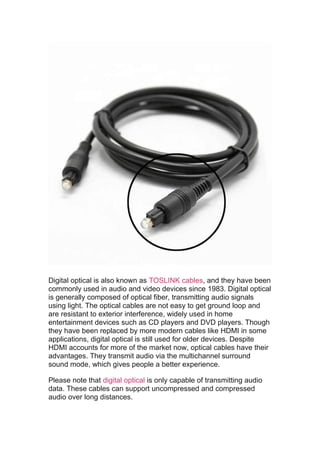
Digital optical isalso known as TOSLINK cables, and they have been
commonly used in audio and video devices since 1983. Digital optical
is generally composed of optical fiber, transmitting audio signals
using light. The optical cables are not easy to get ground loop and
are resistant to exterior interference, widely used in home
entertainment devices such as CD players and DVD players. Though
they have been replaced by more modern cables like HDMI in some
applications, digital optical is still used for older devices. Despite
HDMI accounts for more of the market now, optical cables have their
advantages. They transmit audio via the multichannel surround
sound mode, which gives people a better experience.
Please note that digital optical is only capable of transmitting audio
data. These cables can support uncompressed and compressed
audio over long distances.
4.
HDMI ARC andoptical share the same purposes, for example, they
both support multi-channel audio from one device to many other
devices. But they also have some differences and we’ll further
explore them in the following content.
Differences between HDMI ARC and Optical
Aspect HDMI ARC Optic