
DATA QUALITY
THROUGH OECD’S
MUTUAL ACCEPTANCE
OF DATA SYSTEM
Bob Diderich, OECD, ENV/EHS
24 May 2019
1
• Reliable (reproducible)
• Relevant (useful measured effect)
Test Guideline
• Generated via good process and conditions
(planned, performed, monitored,
recorded, archived and reported)
Good Laboratory Practice
2
What do we mean by data quality ?
Mutual Acceptance of Data
Avoids duplication of testing by industry and
non-tariff trade barriers
MAD Council Decisions open to non-members
“data generated in the testing of chemicals in an OECD Member country
in accordance with OECD Test Guidelines and OECD Principles of Good
Laboratory Practice shall be accepted in other Member countries for
purposes of assessment and other uses relating to the protection of man
and the environment”
OECD Principles of Good
Laboratory Practice and Compliance
Monitoring ProceduresOECD Test Guidelines
Mutual Acceptance of Data
3
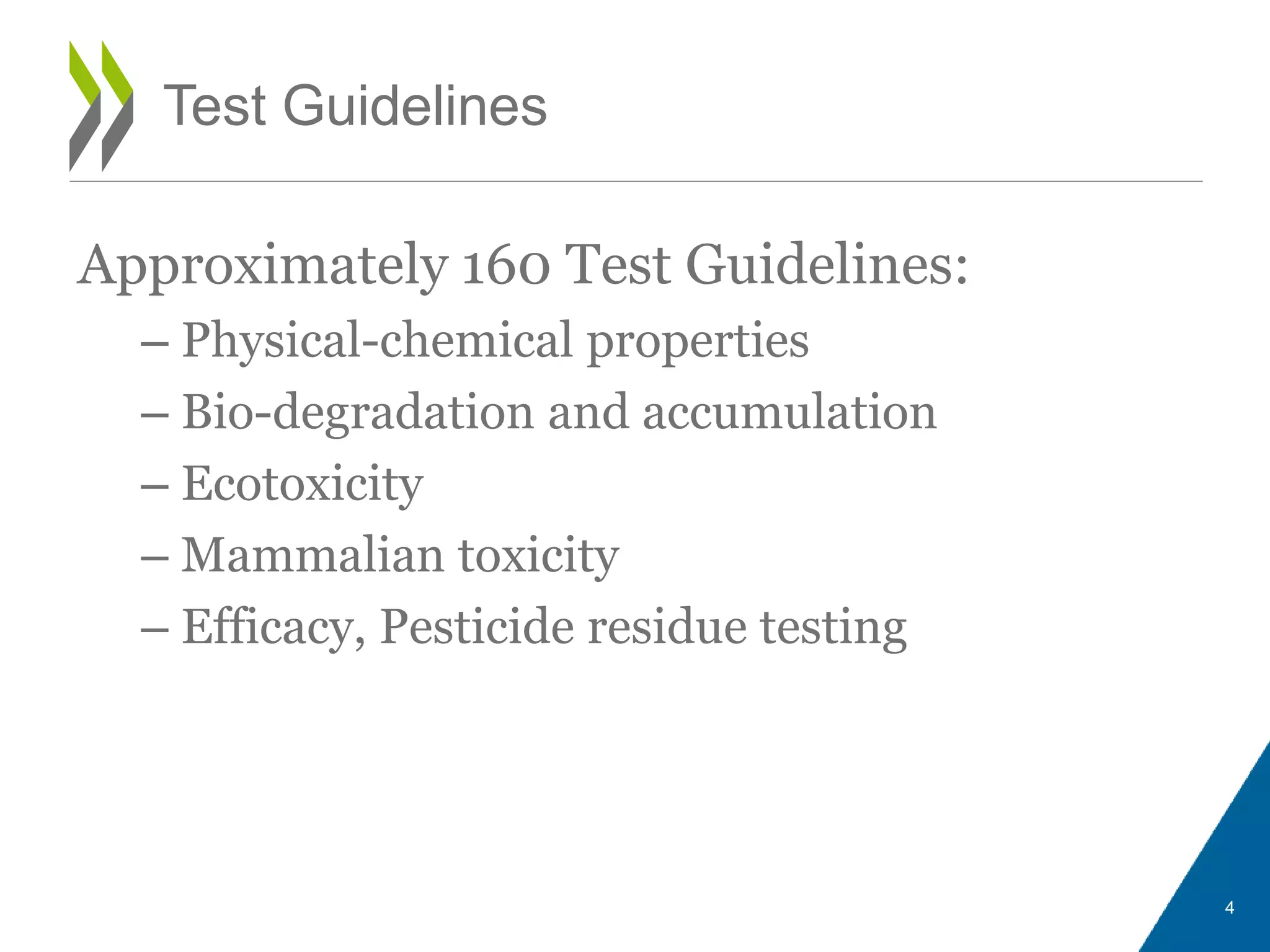
Approximately 160 Test Guidelines:
– Physical-chemical properties
– Bio-degradation and accumulation
– Ecotoxicity
– Mammalian toxicity
– Efficacy, Pesticide residue testing
Test Guidelines
4
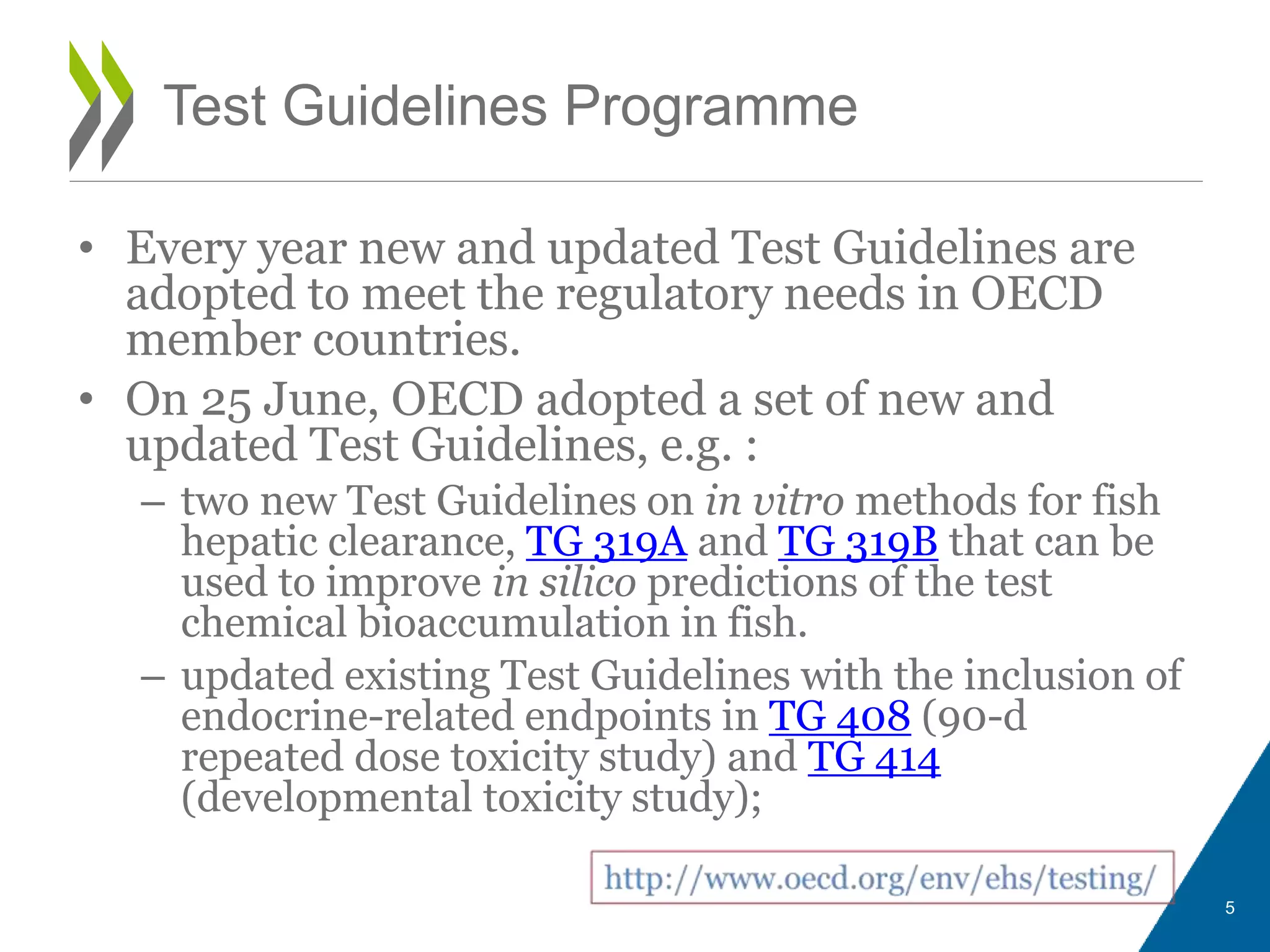
• Every year new and updated Test Guidelines are
adopted to meet the regulatory needs in OECD
member countries.
• On 25 June, OECD adopted a set of new and
updated Test Guidelines, e.g. :
– two new Test Guidelines on in vitro methods for fish
hepatic clearance, TG 319A and TG 319B that can be
used to improve in silico predictions of the test
chemical bioaccumulation in fish.
– updated existing Test Guidelines with the inclusion of
endocrine-related endpoints in TG 408 (90-d
repeated dose toxicity study) and TG 414
(developmental toxicity study);
5
Test Guidelines Programme
• A single quality standard for test facilities
throughout OECD and applied for testing
of all chemical substances
OECD Principles of Good Laboratory
Practice
6
http://www.oecd.org/env/glp
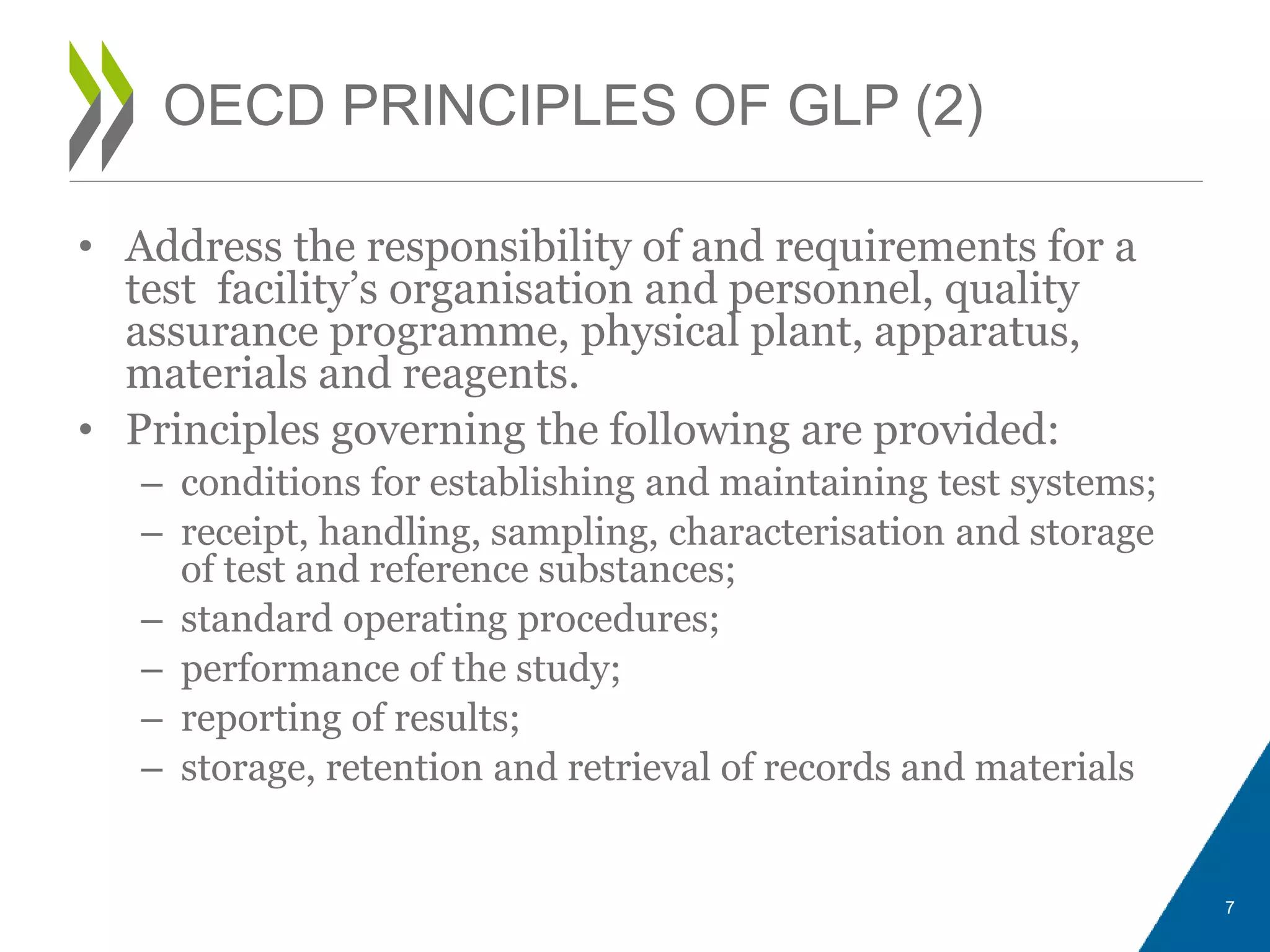
• Address the responsibility of and requirements for a
test facility’s organisation and personnel, quality
assurance programme, physical plant, apparatus,
materials and reagents.
• Principles governing the following are provided:
– conditions for establishing and maintaining test systems;
– receipt, handling, sampling, characterisation and storage
of test and reference substances;
– standard operating procedures;
– performance of the study;
– reporting of results;
– storage, retention and retrieval of records and materials
7
OECD PRINCIPLES OF GLP (2)
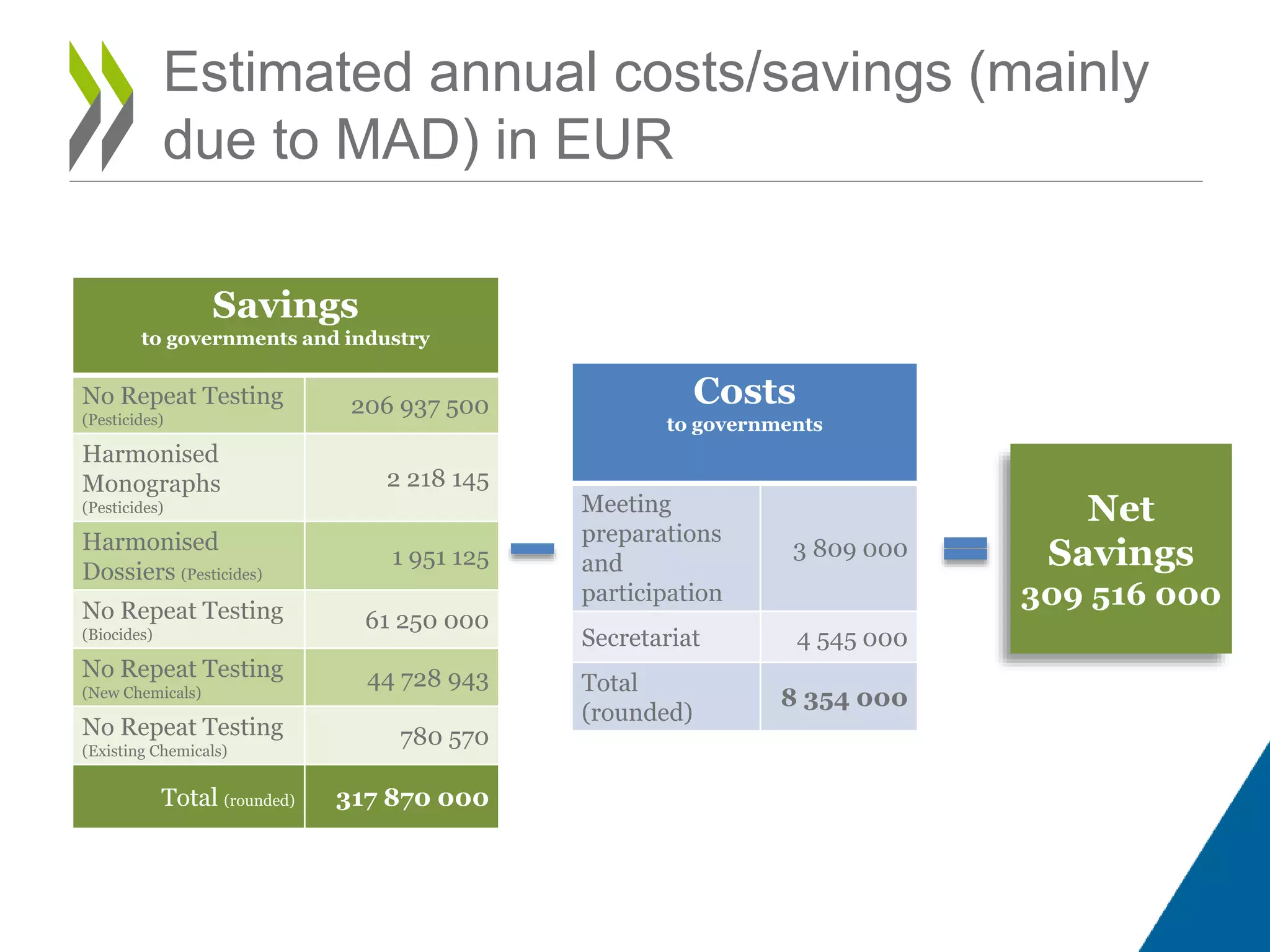
Costs
to governments
Meeting
preparations
and
participation
3 809 000
Secretariat 4 545 000
Total
(rounded)
8 354 000
Estimated annual costs/savings (mainly
due to MAD) in EUR
Savings
to governments and industry
No Repeat Testing
(Pesticides)
206 937 500
Harmonised
Monographs
(Pesticides)
2 218 145
Harmonised
Dossiers (Pesticides)
1 951 125
No Repeat Testing
(Biocides)
61 250 000
No Repeat Testing
(New Chemicals)
44 728 943
No Repeat Testing
(Existing Chemicals)
780 570
Total (rounded) 317 870 000
Net
Savings
309 516 000
• Keep up with scientific developments
– Rate of update of Test Guidelines
– Use of New Approach Methods under MAD
• Reconciling public access to information
with intellectual property rights
9
Challenges

HCF 2019 Panel 5: Bob Diderich

  • 1.
    DATA QUALITY THROUGH OECD’S MUTUALACCEPTANCE OF DATA SYSTEM Bob Diderich, OECD, ENV/EHS 24 May 2019 1
  • 2.
    • Reliable (reproducible) •Relevant (useful measured effect) Test Guideline • Generated via good process and conditions (planned, performed, monitored, recorded, archived and reported) Good Laboratory Practice 2 What do we mean by data quality ?
  • 3.
    Mutual Acceptance ofData Avoids duplication of testing by industry and non-tariff trade barriers MAD Council Decisions open to non-members “data generated in the testing of chemicals in an OECD Member country in accordance with OECD Test Guidelines and OECD Principles of Good Laboratory Practice shall be accepted in other Member countries for purposes of assessment and other uses relating to the protection of man and the environment” OECD Principles of Good Laboratory Practice and Compliance Monitoring ProceduresOECD Test Guidelines Mutual Acceptance of Data 3
  • 4.
    Approximately 160 TestGuidelines: – Physical-chemical properties – Bio-degradation and accumulation – Ecotoxicity – Mammalian toxicity – Efficacy, Pesticide residue testing Test Guidelines 4
  • 5.
    • Every yearnew and updated Test Guidelines are adopted to meet the regulatory needs in OECD member countries. • On 25 June, OECD adopted a set of new and updated Test Guidelines, e.g. : – two new Test Guidelines on in vitro methods for fish hepatic clearance, TG 319A and TG 319B that can be used to improve in silico predictions of the test chemical bioaccumulation in fish. – updated existing Test Guidelines with the inclusion of endocrine-related endpoints in TG 408 (90-d repeated dose toxicity study) and TG 414 (developmental toxicity study); 5 Test Guidelines Programme
  • 6.
    • A singlequality standard for test facilities throughout OECD and applied for testing of all chemical substances OECD Principles of Good Laboratory Practice 6 http://www.oecd.org/env/glp
  • 7.
    • Address theresponsibility of and requirements for a test facility’s organisation and personnel, quality assurance programme, physical plant, apparatus, materials and reagents. • Principles governing the following are provided: – conditions for establishing and maintaining test systems; – receipt, handling, sampling, characterisation and storage of test and reference substances; – standard operating procedures; – performance of the study; – reporting of results; – storage, retention and retrieval of records and materials 7 OECD PRINCIPLES OF GLP (2)
  • 8.
    Costs to governments Meeting preparations and participation 3 809000 Secretariat 4 545 000 Total (rounded) 8 354 000 Estimated annual costs/savings (mainly due to MAD) in EUR Savings to governments and industry No Repeat Testing (Pesticides) 206 937 500 Harmonised Monographs (Pesticides) 2 218 145 Harmonised Dossiers (Pesticides) 1 951 125 No Repeat Testing (Biocides) 61 250 000 No Repeat Testing (New Chemicals) 44 728 943 No Repeat Testing (Existing Chemicals) 780 570 Total (rounded) 317 870 000 Net Savings 309 516 000
  • 9.
    • Keep upwith scientific developments – Rate of update of Test Guidelines – Use of New Approach Methods under MAD • Reconciling public access to information with intellectual property rights 9 Challenges

Editor's Notes

  • #4 The following non-member countries are full adherents of the system: Argentina, Brazil, India, Malaysia, Singapore, South Africa. Thailand is a provisional adherent and it is expected that Thailand will become a full member in 2019. Collaboration is on-going with Russia, China and Indonesia to explore adherence.
  • #5 To ensure scientific relevance, the Test Guidelines need to be continuously updated and new Test Guidelines need to be developed (e.g. for identifying endocrine disruptors are for manufactured nanomaterials)