
WASHINGTON COUNTY
MULTI-JURISDICTIONAL
HAZARD MITIGATION PLAN
2012
CREATED FOR THE JURISDICTIONS OF:
WASHINGTON COUNTY, AINSWORTH, BRIGHTON
CRAWFORDSVILLE, KALONA, WASHINGTON AND
WEST CHESTER

Created by the
East Central Iowa Council of Governments
th
700 16 Street NE, Suite 301
Cedar Rapids, IA 52402
Phone: 319-365-9941
Fax: 319-365-9981
P LAN O RGANIZATION
The Washington County Multi-Jurisdictional Hazard Mitigation Plan is organized into seven sections: Introduction,
Prerequisite, Planning Process, Risk Assessment, Mitigation Strategy, and Plan Maintenance. These sections are consistent
with the multi-hazard mitigation planning guidance issued by the Federal Emergency Management Agency (FEMA), the
Iowa Department of Homeland Security and Emergency Management, and the Iowa Hazard Mitigation Plan of 2007 and
2010. The plan sections and primary subsections are shown in the table of contents to follow:

T ABLE OF C ONTENTS
Chapter 1 Introduction ........................................................................ 1-1
Executive Summary ..............................................................................1-3
Community Profile ...............................................................................1-4
Location...........................................................................................1-4
Development Patterns ....................................................................1-9
Chapter 2 Pre-Requisites......................................................................... 1
NFIP Participation.................................................................................2-2
Multi-Jurisdictional Plan Adoption .......................................................... 2
Chapter 3 Planning Process .................................................................. 3-1
Documentation of the Planning Process ..............................................3-2
Acknowledgements ..............................................................................3-2
Ainsworth ........................................................................................3-2
Brighton ..........................................................................................3-2
Crawfordsville .................................................................................3-2
Kalona .............................................................................................3-2
Washington .....................................................................................3-3
West Chester ...................................................................................3-3
Washington County .........................................................................3-3
Background ..........................................................................................3-3
Scope...............................................................................................3-3
Authority .........................................................................................3-3
Funding ...........................................................................................3-4
Purpose ...........................................................................................3-4
Process .................................................................................................3-5
Public Involvement ..........................................................................3-7

Notification of Neighboring Entities ................................................3-7
Review of Existing Plans and Studies ...............................................3-7
Chapter 4 Risk Assessment .................................................................. 4-1
Identifying Hazards ..............................................................................4-2
Assessing Vulnerability ......................................................................... 4-5
Overview .........................................................................................4-5
Identifying Structures ...................................................................... 4-8
Profiling Hazards ................................................................................4-11
Results ................................................................................................4-13
Chapter 5 Mitigation Strategy .............................................................. 5-1
Local Hazard Mitigation Goals ..............................................................5-2
Identification and Analysis of Mitigation Actions ................................. 5-4
Implementation of Mitigation Actions .................................................5-6
Prioritization of Mitigation Actions .................................................5-6
Mitigation Action Steps ................................................................... 5-8
Multi-Jurisdictional Mitigation Actions ..............................................5-46
Action Items ..................................................................................5-46
Chapter 6 Plan Maintenance ................................................................ 6-1
Monitoring, Evaluating, and Updating The Plan ................................... 6-2
Incorporation into Existing Planning Methods ..................................... 6-3
Continued Public Involvement .............................................................6-3
Chapter 7 Appendices .......................................................................... 7-1
Appendix 1: Resolutions of Adoption ...................................................7-2
Appendix 2: Historical Events Tables ....................................................7-9
Appendix 3: Glossary of Terms ...........................................................7-20

T ABLE OF F IGURES
Figure 1: Location ......................................................................................1-4
Figure 2: Washington County ....................................................................1-5
Figure 3: Land Use .....................................................................................1-6
Figure 4: Ainsworth Land Use....................................................................1-7
Figure 5: Brighton Land Use ......................................................................1-7
Figure 6: Crawfordsville Land Use .............................................................1-7
Figure 7: Kalona Land Use .........................................................................1-8
Figure 8: Washington Land Use.................................................................1-8
Figure 9: West Chester Land Use ..............................................................1-8
Figure 10: Washington County Population Change, 1960-2010 ..............1-10
Figure 11: Washington County Critical Facilities .....................................1-13
Figure 12: Conservation Board Sites .......................................................1-14
Figure 13: School Districts .......................................................................1-15

Figure 14: Ainsworth in 1930 and 2009 ..................................................1-16
Figure 15: Ainsworth Population Change, 1960-2010 .............................1-16
Figure 16: Ainsworth Critical Facilities ....................................................1-18
Figure 17: Brighton in 1930 and 2009 .....................................................1-19
Figure 18: Brighton Population Change, 1960-2010................................1-19
Figure 19: Brighton Critical Facilities .......................................................1-21
Figure 20: Crawfordsville in 1930 and 2009 ............................................1-22
Figure 21: Crawfordsville Population Change, 1960-2010 ......................1-22
Figure 22: Crawfordsville Critical Facilities ..............................................1-24
Figure 23: Kalona in 1930 and 2009 ........................................................1-25
Figure 24: Kalona Population Change, 1960-2010 .................................. 1-25
Figure 25: Kalona Critical Facilities ..........................................................1-27
Figure 26: Washington in 1930 and 2009 ................................................1-28
Figure 27: Washington Population Change 1960-2010 ...........................1-28
Figure 28: Washington Critical Facilities..................................................1-30
Figure 29: West Chester in 1930 and 2009 .............................................1-31
Figure 30: West Chester Critical Facilities ...............................................1-33
Figure 31: Ainsworth Flood Insurance Rate Map ......................................2-2
Figure 32: Number of Reported Droughts in Iowa ..................................4-22
Figure 33: Iowa Seismic Zones ................................................................4-25
Figure 34: Earthquake Intensity ..............................................................4-26
Figure 35: Expansive Soils Risk Areas ......................................................4-28
Figure 36: Potentially Expansive Soils .....................................................4-30
Figure 37: Potentially Expansive Soils, Ainsworth ...................................4-31
Figure 38: Potentially Expansive Soils, Brighton ......................................4-31
Figure 39: Potentially Expansive Soils, Crawfordsville .............................4-32
Figure 40: Potentially Expansive Soils, Kalona .........................................4-32
Figure 41: Potentially Expansive Soils, Washington ................................4-33
Figure 42: Potentially Expansive Soils, West Chester ..............................4-33
Figure 43: Heat Index Chart.....................................................................4-36
Figure 44: Historic Flood Frequency ........................................................4-41
Figure 45: Washington County Preliminary FIRM, 2010 ..........................4-42
Figure 46 Ainsworth Flood Frequency .....................................................4-43
Figure 47: Ainsworth Preliminary FIRM 2010 ..........................................4-43
Figure 48: Ainsworth FIRM 2012 ................................................................ 43
Figure 49: Brighton Flood Frequency ......................................................4-44
Figure 50: Brighton Preliminary FIRM 2010 ............................................4-44
Figure 51: Brighton FIRM 2012................................................................... 44
Figure 52: Crawfordsville Flood Frequency .............................................4-45
Figure 53: Crawfordsville Preliminary FIRM 2010 ...................................4-45
Figure 54: Crawfordsville FIRM 2012.......................................................4-45
Figure 55: Kalona Flood Frequency ............................................................ 46
Figure 56: Kalona Preliminary FIRM 2010 .................................................. 46
Figure 57: Kalona FIRM 2012...................................................................4-47
Figure 58: Washington Flood Frequency .................................................4-48
Figure 59: Washington Preliminary FIRM 2010 .......................................4-48
Figure 60: Washington FIRM 2012 ............................................................. 48
Figure 61: West Chester Flood Frequency...............................................4-49

Figure 62: West Chester Preliminary FIRM 2010 ..................................... 4-49
Figure 63: West Chester FIRM................................................................. 4-49
Figure 64: 12-Digit HUC Watersheds .......................................................4-50
Figure 65: Ainsworth HUC-12 Watersheds ..............................................4-51
Figure 66: Brighton HUC-12 Watersheds ................................................4-51
Figure 67: Crawfordsville HUC-12 Watershed .........................................4-52
Figure 68: Kalona HUC-12 Watersheds ...................................................4-52
Figure 69: Washington HUC-12 Watersheds ...........................................4-53
Figure 70: West Chester HUC-12 Watersheds .........................................4-53
Figure 71:Washington County Elevations................................................4-59
Figure 72: Washington County Landslide Risk Areas ...............................4-60
Figure 73: Ainsworth Elevations ..............................................................4-61
Figure 74: Ainsworth Landslide Risk Areas ..............................................4-61
Figure 75: Brighton Elevations ................................................................4-62
Figure 76: Brighton Landslide Risk Areas.................................................4-62
Figure 77: Crawfordsville Elevations .......................................................4-63
Figure 78: Crawfordsville Landslide Risk Areas........................................4-63
Figure 79: Kalona Elevations ................................................................... 4-64
Figure 80: Kalona Landslide Risk Areas ...................................................4-64
Figure 81: Washington Elevations ...........................................................4-65
Figure 82: Washington Landslide Risk Areas ...........................................4-65
Figure 83: West Chester Elevations .........................................................4-66
Figure 84: West Chester Landslide Risk Areas .........................................4-66
Figure 85: Wind Zones in the United States ............................................4-76
Figure 86: HazMat Teams........................................................................ 4-83
Figure 87: Nuclear Power Plants in Iowa .................................................4-93
Figure 88: Active Railroads in Washington County................................4-101
Figure 89: Traffic Accidents in Washington County, 2004 – 2008 .........4-103
Figure 90: Countywide Waterway Risk Areas ........................................4-105
Figure 91: Ainsworth Waterway Risk Areas ..........................................4-106
Figure 92: Brighton Waterway Risk Areas .............................................4-107
Figure 93: Crawfordsville Waterway Risk Areas .................................... 4-107
Figure 94: Kalona Waterway Risk Areas ................................................4-108
Figure 95: Washington Waterway Riak Areas .......................................4-108
Figure 96: West Chester Waterway Risk Areas ..................................... 4-109

T ABLE OF T ABLES
Table 1: Washington County Population Projection ................................1-10
Table 2: Ainsworth Population Projection ...............................................1-17
Table 3: Brighton Population Projection .................................................1-20
Table 4: Crawfordsville Population Projection ........................................1-23
Table 5: Kalona Population Projection ....................................................1-26
Table 6: Washington Population Projection ............................................1-29
Table 7: West Chester Population Change, 1960-2010 ...........................1-31
Table 8: West Chester Population Projection ..........................................1-32
Table 9: Planning Meetings .......................................................................3-6
Table 10: Record of Participation ..............................................................3-6
Table 11: Record of Document Review .....................................................3-8
Table 12: Hazards Addressed ....................................................................4-2
Table 13: NID Listed Dams in the Planning Area .......................................4-4
Table 14: Overall Summary of Vulnerability by Jurisdiction ......................4-7
Table 15: Unincorporated Potential Losses ...............................................4-9
Table 16: Washington Potential Losses .....................................................4-9
Table 17: West Chester Potential Losses .................................................4-10

Table 18: Brighton Potential Losses ........................................................4-10
Table 19: Crawfordsville Potential Losses ...............................................4-10
Table 20: Kalona Potential Losses ...........................................................4-10
Table 21: Historical Occurrence Results ..................................................4-14
Table 22: Probability Results ................................................................... 4-15
Table 23: Vulnerability Results ................................................................4-16
Table 24: Maximum Threat Results .........................................................4-17
Table 25: Severity of Impact Results .......................................................4-18
Table 26: Speed of Onset Results ............................................................4-19
Table 27: HARA Totals and Priority Groups .............................................4-20
Table 28: Drinking Water Sources ...........................................................4-24
Table 29: Brighton Potential Losses, Expansive Soils...............................4-28
Table 30: Crawfordsville Potential Losses, Expansive Soils......................4-29
Table 31: Kalona Potential Losses, Expansive Soils.................................. 4-29
Table 32: Unincorporated Potential Losses, Expansive Soils ...................4-29
Table 33: Washington Potential Losses, Expansive Soils .........................4-29
Table 34: West Chester Potential Losses, Expansive Soils .......................4-30
Table 35: Economic Impact of Loss of Electricity .....................................4-37
Table 36: Ainsworth Potential Losses, Flood (Flash and Riverine) ...........4-39
Table 37: Brighton Potential Losses, Flood (Flash and Riverine) .............4-39
Table 38: Kalona Potential Losses, Flood (Flash and Riverine) ................4-40
Table 39: Washington Potential Losses, Flood (Flash and Riverine) ........4-40
Table 40: Unincorporated Potential Losses, Flood (Flash and Riverine) ..4-40
Table 41: Economic Impact of Loss of Wastewater Service.....................4-54
Table 42: Chart of Hail Size Comparisons ................................................4-55
Table 43: Torro Scale ...............................................................................4-56
Table 44: Ainsworth Potential Losses, Unstable Soils..............................4-58
Table 45: Brighton Potential Losses, Unstable Soils ................................4-58
Table 46: Unincorporated Potential Losses, Unstable Soils .....................4-59
Table 47: Washington Potential Losses, Unstable Soils ...........................4-59
Table 48: Washington Winter-Related Crashes ......................................4-69
Table 49: Statewide Crash Costs .............................................................4-69
Table 50: Economic Impact of Crash Injuries...........................................4-69
Table 51: Estimated Crash Property Costs ..............................................4-70
Table 52: Economic Impact of Loss of Electricity .....................................4-70
Table 53: The Enhanced Fujita Scale .......................................................4-73
Table 54: Beaufort Scale..........................................................................4-75
Table 55: Historical Pipeline Incidents Across Iowa, 1990 – 2008 ...........4-85
Table 56: Washington County Traffic Accidents ....................................4-102
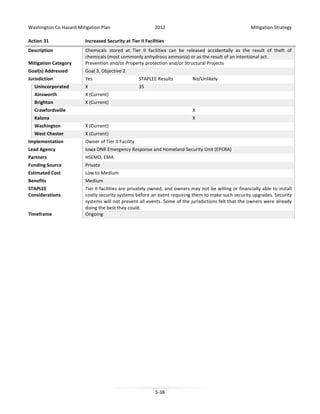
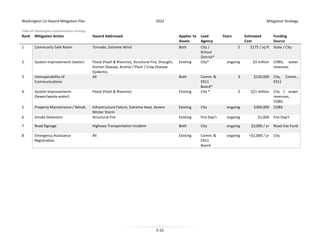
Table 57: Summary of Mitigation Actions. ................................................5-5
Table 58: STAPLEE Criteria ........................................................................5-7

Table 59: Mitigation Action Steps .............................................................5-8
Table 60: Ainsworth Implementation Strategy .......................................5-47
Table 61: Brighton Implementation Strategy ..........................................5-48
Table 62: Crawfordsville Implementation Strategy ................................. 5-49
Table 63: Kalona Implementation Strategy .............................................5-50
Table 64: Washington Implementation Strategy..................................... 5-52
Table 65: Washington County Implementation Strategy ........................5-53
Table 66: West Chester Implementation Strategy .................................. 5-55
Table 67: Historical Occurrences of Drought.............................................7-9
Table 68: Historical Occurrences of Extreme Heat .................................... 7-9
Table 69: Historical Occurrences of Flash Flood ........................................7-9
Table 70: Historical Occurrences of River Flood ......................................7-10
Table 71: Historical Occurrences of Hailstorm ........................................7-10
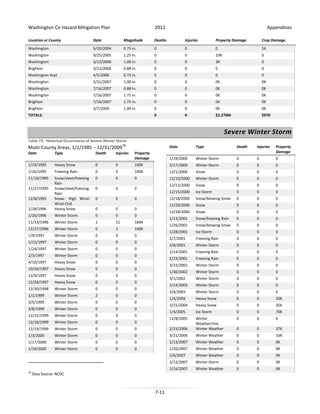
Table 72: Historical Occurrences of Severe Winter Storm......................7-11
Table 73: Historical Occurrences of Tornado ............................................. 12
Table 74: Historical Occurrences of Thunderstorm ................................. 7-12
Table 75: Historical Occurrences of Windstorms .................................... 7-13
Table 76: Historical Occurrence of Hazardous Materials Incident...........7-14
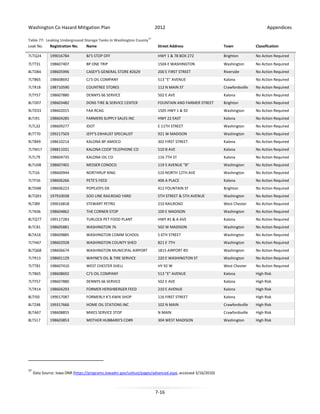
Table 77: Leaking Underground Storage Tanks in Washington County .. 7-16
Table 78: Historical Occurrence of Transportation HazMat Incidents ..... 7-17
Table 79: Historical Occurrence of Rail Transportation Incidents ...........7-17
Table 80: Historical Occurrences of Air Transportation Incident .............7-17
Table 81: Incidences of wildfire in Washington County ..........................7-18
Table 82: Incidences of Structural Fires in Washington County ..............7-19
1
Chapter 1 INTRODUCTION
1-1
Washington Co Hazard Mitigation Plan

2012

Introduction

E XECUTIVE S UMMARY
The Washington County Multi-Jurisdictional Hazard Mitigation Plan was prepared for several jurisdictions and the
unincorporated areas of Washington County, Iowa in response to the Disaster Mitigation Act of 2000 (DMA 2000). DMA
2000 requires states and local governments to prepare hazard mitigation plans in order to remain eligible to receive federal
funds made available in the wake of a Presidential Disaster declaration and to receive funds for pre-disaster mitigation,
severe repetitive loss, and other such funding sources. It is important to remember that mitigation funds are distinct from
response and recovery funds available from state and federal sources intended for immediate disaster relief. To produce a
DMA 2000 compliant plan, municipalities must document their hazard mitigation planning process and identify hazards,
potential losses, and mitigation needs, goals and strategies.
The Federal Emergency Management Agency (FEMA) effectively defines Hazard Mitigation as follows: “Mitigation is defined
as any sustained action taken to reduce or eliminate long-term risk to human life and property from a hazard event.
Mitigation, also known as prevention (when done before a disaster), encourages long-term reduction of hazard
vulnerability. The goal of mitigation is to decrease the need for response as opposed to simply increasing the response
capability (www.fema.gov).” With that definition in mind, a mitigation plan is a document that accomplishes several things.
First, through the planning process, the hazards that pose a risk to the community are identified; second, hazards are
assessed based on their historic patterns of occurrence, the number of people that could be impacted, the area of the
community that could be affected, the potential costs that the County, individuals and organizations may incur, the
likelihood of future occurrence, and the amount of warning time before that hazard event occurs.
Once the assessment is completed, a list of current and historic mitigation efforts is compiled and discussed. Through this
discussion, areas that can be improved upon are identified and developed into “action steps.” Early in the planning process,
meeting attendees will identify broad goals that briefly state what the plan should attempt to accomplish. Every action step
should, if implemented, work toward one of more of the goals of the plan. An action step may suggest continuing a current
mitigation effort or propose an entirely new project.
When implemented appropriately, mitigation projects can save lives, reduce property damage, and are both cost effective
and environmentally sound. This, in turn, can reduce the enormous cost of disasters to property owners and all levels of
government. In addition, mitigation can protect critical community facilities, reduce exposure to liability, and minimize
community disruption.

1-3
Washington Co Hazard Mitigation Plan

2012

Introduction

C OMMUNITY P ROFILE
An important first step in the planning process was to develop a community profile for Washington County and the
jurisdictions participating in this hazard mitigation plan. This required the Planning Committee to research climate and
weather, geography, land use, and other conditions that impact the jurisdictions or can be influenced by hazards present in
the planning area. This information is utilized throughout the plan to identify hazard risk areas and other vulnerabilities.

L OCATION
Figure 1: Location

Washington County is located in southeast Iowa (41.334722, -91.719722) and covers 556.75 square miles (356,320 acres) in
the richest of America's agricultural region. It is bordered by Johnson County to the northeast, Iowa County to the
northwest, Keokuk County to the west, Jefferson County to the southwest, Henry County to the southeast, and Louisa
County to the east. The nine incorporated cities in the county are Ainsworth, Brighton, Coppock, Crawfordsville, Kalona,
Riverside, Washington, Wellman, and West Chester. Of these nine cities, 7 communities are participating in the multijurisdictional planning process: Ainsworth, Brighton, Crawfordsville, Kalona, Washington, West Chester, and the
unincorporated portions of Washington County.

1-4
Washington Co Hazard Mitigation Plan

2012

Introduction

Figure 2: Washington County

Ainsworth: Ainsworth is located in the eastern portion of Washington County (41.209175, -91.554283) just west of Highway
218. The city has a total land area of 0.4 square miles.
Brighton: Brighton is located in the southwestern portion of Washington County (41.173361, -91.820784) near the
intersection of Iowa Highway 1 and Iowa Highway 78. It occupies a total of 0.7 sq mi. Lake Darling State Park is situated 3
miles to the west of Brighton.
Crawfordsville: Crawfordsville is located in the southeastern portion of Washington County (41.215393, -91.537844) east of
US Route 218. The city is situated on approximately 0.4 sq mi to the south of Ainsworth.
Kalona: Kalona is located in the northern portion of Washington County (41.486944, -91.705278) at the intersection of Iowa
Highways 1 and 22. The city is situated on approximately 2 sq mi directly north of Washington.
Washington: Washington is located in the central portion of Washington County (41.299941, -91689175) near the
intersection of Iowa Highways 1 and 92. The city has a total of 12.6 sq mi, all of which is land.
West Chester: West Chester is located in the west central portion of Washington County (41.338512, -91.816725) near the
intersection of Iowa Highway 92 and County Highway W38. The city occupies approximately 0.2 sq mi to the northwest of
Washington.
1-5
Washington Co Hazard Mitigation Plan

2012

Introduction

L AND U SE
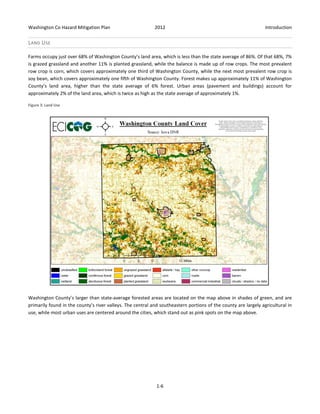
Farms occupy just over 68% of Washington County’s land area, which is less than the state average of 86%. Of that 68%, 7%
is grazed grassland and another 11% is planted grassland, while the balance is made up of row crops. The most prevalent
row crop is corn, which covers approximately one third of Washington County, while the next most prevalent row crop is
soy bean, which covers approximately one fifth of Washington County. Forest makes up approximately 11% of Washington
County’s land area, higher than the state average of 6% forest. Urban areas (pavement and buildings) account for
approximately 2% of the land area, which is twice as high as the state average of approximately 1%.
Figure 3: Land Use

Washington County’s larger than state-average forested areas are located on the map above in shades of green, and are
primarily found in the county’s river valleys. The central and southeastern portions of the county are largely agricultural in
use, while most urban uses are centered around the cities, which stand out as pink spots on the map above.

1-6
Washington Co Hazard Mitigation Plan

2012

Introduction

Figure 4: Ainsworth Land Use

As detailed in the map to the left, a mixture of land uses
are evident in Ainsworth. The dominant land use is
residential, interspersed with ungrazed grassland. A few
pockets of commercial / industrial land uses are present,
with a larger area in the southeastern portion of town. A
large patch of alfalfa / hay occupies the southwest
corner, and a swath of deciduous forest lies to the west
of a corn field in the northeast corner. Small patches of
planted grassland are located in the southern portion of
Ainsworth as well.

Figure 5: Brighton Land Use

The dominant land use in Brighton is residential,
interspersed with ungrazed grassland and small pockets
of grazed grassland. Row crops are present in the
northwest and southwest portions of town, with
soybeans to the north and corn to the south. Deciduous
forest is present in the northeastern corner.

Figure 6: Crawfordsville Land Use

Crawfordsville is primarily made up of agricultural land
uses – grazed grassland, and alfalfa / hay, are dominant
in the southern half of town. A cluster of residential
areas interspersed with commercial / industrial is present
in the north central and south central portion of town
south central section of town. Row crops within
Crawfordsville include both corn and soybeans, and
planted grassland is also present. A small patch of
deciduous and pine forest lies in the northwest corner of
town.

1-7
Washington Co Hazard Mitigation Plan

2012

Introduction

Figure 7: Kalona Land Use

The residential and commercial / industrial areas of
Kalona are mainly centered within the city limits. These
areas are bordered by, and intermixed with, ungrazed
grassland areas. Areas of corn and soybeans border the
outskirts of town, with a few pockets of alfalfa / hay
fields. The English River runs east-west just to the south
of Kalona.

Figure 8: Washington Land Use

The commercial / industrial areas of Washington are
mainly concentrated within the central portion of town,
and also branch out toward the northeast; some
scattered areas of this land use are present throughout
other areas of town as well. Mixed land uses border the
residential portions of town, including grazed and
ungrazed grassland, corn and soybeans, and small
patches of alfalfa / hay and deciduous forest.

Figure 9: West Chester Land Use

The town of West Chester is made up primarily of
agricultural areas. Large areas of corn and soybeans are
present in the northwest and east portions of town.
Grasslands make up a significant portion of town as well,
especially in the western areas. Small residential and
commercial / industrial areas are scattered in the
remaining areas of town.

1-8
Washington Co Hazard Mitigation Plan

2012

Introduction

D EVELOPMENT P ATTERNS
Requirement §201.6(c)(2)(ii)(C): [The plan should describe vulnerability in terms of] providing a general description of land
uses and development trends within the community so that mitigation options can be considered in future land use
decisions.
As detailed in FEMA’s guidance, hazard mitigation plans should provide a general overview of land uses and types of
development occurring within each community participating in the plan. This can include existing land uses and
development densities in the identified hazard areas, as well as any anticipated future/proposed land uses, including
anticipated new development, and redevelopment, and anticipated annexation areas. This information is recommended
for mitigation plans because an analysis of development trends provides a basis for making decisions on the type of
mitigation approaches to consider, and the locations where these approaches can be implemented. This information can
also be used to influence decisions regarding future development in hazard areas.
FEMA suggests consideration of the following areas when analyzing development trends, and where possible, relevant data
was presented for each of the participating jurisdictions listed below.





Development trends, described both by amount and location of development
Differentiation of distinct land uses with unique densities
Location of future development, if any
Expected growth, if any

Also noted in this section are critical facilities. Critical facilities are essential to the health and welfare of the whole
population and are especially important following hazard events. Since vulnerability is based on service losses as well as
building structure integrity and content value, the loss of the following structures shown in the figures below would have a
proportionally greater impact for the participating jurisdictions. For purposes of this Hazard Mitigation Plan, Planning
Committee members in each participating jurisdiction identified the critical facility for each community. These facilities
include emergency service facilities such as hospitals and other medical facilities, jails, police and fire stations, emergency
operations centers, police and fire stations, public works facilities, evacuation shelters, schools, other centers that house
special needs populations, and facilities that provide necessary services, such as provision of food, gasoline, or
pharmaceutical supplies.

C OUNTY - WIDE
According to the Washington County 2008 Comprehensive Plan, approximately 4 percent of population growth has been in
1
the unincorporated areas of Washington County, which has led to increased housing developments. In addition,
Washington, Kalona, Riverside and Wellman have all experienced development over the past decade.
As discussed in the Community Profile section of this Hazard Mitigation Plan, the dominant land use in Washington County
is agriculture (68% of the County’s land area). Urban and residential areas account for just 2% of the County’s total land
area.
The following housing analysis comes from Washington County’s Comprehensive Plan:

1

Washington County 2008 Comprehensive Plan

1-9
Washington Co Hazard Mitigation Plan

2012

Introduction

Using the mixed rate growth projection, in development terms, the projected population increase is equivalent to
approximately 3,587 new residents or 1,435 new housing units countywide by the year 2030. This represents an average
annual construction rate of approximately 63 new units per year.
In 1990, there were 7,866 housing units in Washington County. By 2000, the Census showed 8,543 housing units, an
increase of 8.6 percent. This is consistent with the population growth during that time. According to the 2000 Census, there
were 487 vacant housing units (5.7 percent). Five percent vacancy is considered healthy for a community. This allows
market flexibility for area homeowners as well as the ability for a community to handle sudden population increases.
As mentioned previously, there were 656 new septic permits issued between July 2000 and August of 2006. That would
place the current approximate number of housing units in the county at 9,199. In addition, in 1990, the people per housing
unit was 2.55. That number decreased for the year 2000 to 2.5. This number is projected to drop across the region. By the
year 2030, Washington County is expected to have approximately 2.3 people per housing unit. Based on this figure and the
mixed rate growth projection, Washington County should plan on needing a total of approximately 10,634 housing units by
2030. Most of the new housing units will be located within the existing cities or annexed into the existing communities
during that time.
Population: Despite declines during the 1960s and 1980s, Washington County has generally been growing in population
over the past five decades. The largest percent increase in population occurred between 1990 and 2000, an increase of
6.2%. The rate of population growth slowed to an increase of 3.3% between 2000 and 2008.
Figure 10: Washington County Population Change, 1960-2010

22,000
21,704

21,000
20,000
19,000

20,670

20,141
19,406

18,000

19,612

18,967

17,000
1960

1970

1980

1990

2000

2010

Table 1: Washington County Population Projection

Year
1960
1970
1980
1990
2000
2008

2010
2020

Number Change
(Linear Method)

Population

Average (1960 to 2008)

19,406
18,967
20,141
19,612
20,670
21,343

Projection:
Projection:
1-10

n/a
-439
1,174
-529
1,058
673
1937 / 4.8 = 403.5
Linear
21,747
22,150

Growth/Decline Rate
(Geometric Method)
n/a
-2.26%
6.19%
-2.63%
5.39%
3.26%
9.95 / 4.8 = 2.1%
Geometric
21,791
22,249
Washington Co Hazard Mitigation Plan

2012

Introduction

U NINCORPORATED
History: Washington County: The following history of Washington County was provided by Mike Zahs, a local historian:
Three villages of agricultural nomadic Indians welcomed people of European descent in the middle 1830s to Washington
County. First settlements were along rivers and streams because of the presence of trees, transportation, and water power.
Much of the county was open prairie. Buffalo, elk and native Americans moved out as settlers moved in. The county was
part of the Wisconsin Territory with the county seat at Astoria, south of present day Ainsworth. Initially called Slaughter
County, the county was renamed Washington County and the county seat moved to Washington in 1839.
Most pre-Civil War settlers to the county were from eastern states and interested in obtaining farm land. Early roads
followed buffalo and Indian trails. After the county was surveyed, most roads followed section lines.
In the fall of 1858 the Mississippi and Missouri Railroad was completed to Washington. More railroad construction did not
occur until 1869. Washington grew rapidly for eleven years as a result of the new rail access. As railroads were built in other
parts of the county, fourteen towns were begun as stations on the railroads.
After automobiles became common and roads improved, people traveled farther and many small towns diminished as
trading centers. Paved roads became more common in the 1930s.
Washington County has always been a leader in corn, soybean, and hog production. Even though industry and
manufacturing have declined in the last decade, the population of the county has remained fairly constant since the Civil
War. More people are now employed outside of the county than in the past.
A large Old Order Amish settlement is in the north central part of the county. It began in 1846 and is the largest Old Order
Amish settlement west of Ohio. The largest group to come directly to the county from Europe was the Bohemians in the
1870s – 1880s. Many Hispanic families have settled in Washington County in the last 20 years.
Development Trends: Growth in the unincorporated portions of Washington County has consisted primarily of scattered
residential housing throughout the county with a larger concentration in the northeast corner of the county near the
Riverside area. From 2003 – 2007 there were approximately 60 new homes built each year in the unincorporated parts of
the county.
Just as in the whole of Washington County, the majority of land use in the unincorporated areas is agriculture (69%), with a
small percent of residential land use (2%).
There is a large wind farm being proposed to go across the center part of the county, east to west between Hwy 92 and G36
to the south and the English River to the north.
Residential growth is expected to continue in and near the cities and around the areas already seeing development
throughout the county. Through the implementation of zoning, an area for industrial growth was identified near the SW
corner of the intersection of Hwy 218 and G36; which is near an electric transmission station and some gas lines.
The following information from growth trends is from the Washington County 2008 Comprehensive Plan:
Based on historical trends, approximately four percent of the population increases have been in the unincorporated areas
of the county. The last six years have seen even larger percentage growth increases in the unincorporated areas. It is
estimated that approximately 7,876 residents live in rural Washington County. However, as mentioned before, due to rising

1-11
Washington Co Hazard Mitigation Plan

2012

Introduction

energy costs and smaller families, that number will likely drop going forward (3% by 2020 before leveling out at 2% by
2030).
Using a mixed rate growth projection for the unincorporated areas, it is projected that by 2030, there will be approximately
9,800 residents living in the unincorporated portion of the county. This means there will be approximately 831 new
residents in the unincorporated part of the county by that time. Based on the people per housing unit number, there will be
a need for approximately 332 new housing units in the unincorporated area of the county. At a density of 1 unit per acre,
the new units would require approximately 332 acres of land. At an average density of three acres per unit, it would require
nearly 1,000 acres. At five acres per unit, it would require over 1,660 acres. 10 acres per unit would require 3,320 acres.
Obviously, the larger the lots that are approved, the more acres of land it would require. In addition, that does not include
rights-of-way for streets and other utilities. As a general rule, 10 percent of developed land is consumed by rights-of-way.
So, for example, if the average new lot size in the county is ten acres, it would require approximately 3,320 acres of land
plus 332 acres for utilities and streets for a total of 3,652 acres of land converted to residential use.
Utilities:
Place

Gas

Waste/water

Sanitation

Electric

Phone

Cable TV

Internet

Brighton

City

City

Alliant

Iowa Telecom

Starwest

Kalona

Alliant

City

Waste
Management
Johnson
County
Refuse

Alliant

Kalona Coop
Telephone
Company

Crawfordsville

Private (LP
tanks)

Mark’s
Sanitation

Alliant

Windstream

Washington

Alliant
Energy

Wapello
Rural Water
& Sewer
City

MediaCom
& Kalona
Coop.
Telephone
None

Iowa
Telecom
MediaCom
& Kalona
Coop.
Telephone
Any

Alliant

Iowa Telecom

Mediacom

Mediacom,
Iowa
Telecom

West Chester

Alliant
Energy

SEMCO
landfill;
private
hauler
Mark’s
Sanitation

Alliant

Iowa Telecom

None

Any

Alliant,
Southeast IA
Coop
Electric, TIP
REC, Farmers
Electric
Coop,
Eastern IA
L&P

Farmers and
Merchants
Telephone Co,
Iowa
Telephone Co

ICN

Washington
County

City
Wapello
Rural Water
Association

1-12
Washington Co Hazard Mitigation Plan

2012

Introduction

Critical Facilities:
•
•
•
•
•
•
•
•
•
•

Federation Bank (Washington County Public Health
office located here): 102 E. Main
th
Washington County Ambulance: 1120 N. 8 Ave
Washington County Rescue: 205 E. Washington St.
nd
Washington County Sheriff’s Office: 221 W. 2 St.
Washington County Jail: 2185 Lexington Blvd.
Highland Community Middle & High School: 1715
Vine Ave, Riverside
Highland Elementary: 835 Park Street, Ainsworth
nd
Washington County 911 Com Bldg: 211 W. 2 St.
Communications Center
McCreedy Building

•
•
•
•
•

Washington County Courthouse
All Fire Stations
All Schools
All Libraries
Secondary Roads Sheds:
th
o Crawfordsville – 3090 305 St.
st
o Kalona – 314 – 316 1 Ave
o Riverside – 1347 Riverside Rd
o Rubio – 3019 Birch Ave
o West Chester – 2149 Hemlock Ave
th
o Washington – 821 E. 7 St.

Figure 11: Washington County Critical Facilities

The following map shows conservation and recreation areas in Washington County maintained by the Washington County
Conservation Board. Because Washington County is located in an area of the country where tornado risk is fairly high,
people in these locations may be at an elevated risk in the event of a tornado or high wind event because of a lack of
shelter. The publicly owned facilities on the map are viable locations for a FEMA 361 compliant tornado safe room, and are
thus considered critical facilities in that regard.
1-13
Washington Co Hazard Mitigation Plan

2012

Figure 12: Conservation Board Sites

1-14

Introduction
Washington Co Hazard Mitigation Plan

2012

Introduction

S CHOOL D ISTRICTS
School districts within the planning area do not share the same planning boundaries as any other entity in the planning
process, so the districts that participated are those that are primarily located within Washington County and also within the
Grant Wood Area Education Agency – the state-designated Region 10 AEA serving the planning area. These school districts
are Mid-Prairie and Washington, as detailed on the map from the Grant Wood AEA below. Representatives from each
school district participated on the planning team for the jurisdiction that houses the majority of the school district’s
facilities. Planning team members determined that the risk assessment and subsequent mitigation strategy for each school
shall be the same as the risk assessment and mitigation strategy for the planning entity in which the school is located.
Mid-Prairie Community School District primarily serves the northwestern and west-central portions of Washington County
including the cities of Wellman and Kalona. Facilities include Mid-Prairie High in Wellman, Mid-Prairie Alternative Learning
Center in Wellman, Mid-Prairie Middle School in Kalona, Kalona Elementary, Washington Township Elementary, and
Wellman Elementary. Mid-Prairie participated in the Kalona planning process.
Washington Community School District (also referred to as WACO) primarily serves the central and southern portions of the
county, and is based out of the city of Washington.
Figure 13: School Districts

1-15
Washington Co Hazard Mitigation Plan

2012

Introduction

Ainsworth
History:
Ainsworth was platted in October, 1858, by D. H. Ainsworth. The city was the first station on the Oskaloosa branch of the
Chicago, Rock Island and Pacific Railroad east of the county seat at Washington. During its early history, the town was home
to a grain house, two stores, a steam grist mill, and several mechanics’ shops. The elementary school was constructed in
1879 at a cost of $5,000, and was part of an independent Ainsworth public school district. The United Brethren Church was
organized in 1860, and the Ainsworth United Presbyterian Church followed in 1864. The original town cemetery was
located in section 28 of Oregon twp., however it was abandoned and converted to a cornfield in favor of the current site on
2
the northwest side of town.
Ainsworth operates its own water and wastewater system which, according to the city’s Community Builder Plan (1996),
was built in 1983 and serves approximately 216 facilities. The effective storage capacity is equal to the average daily
demand of approximately 44,000 gallons. The storage capacity at the time was 30,000 to 35,000 gallons; however peak
3
daily consumption was 55,000 to 60,000 gallons, which posed a limitation to additional development.
Figure 14: Ainsworth in 1930 and 2009

Population:
Figure 15: Ainsworth Population Change, 1960-2010

600
400
200

371

455

547

506

524

1990

2000

567

0
1960

2
3

1970

1980

The History of Washington County, Iowa: Its Cities, Towns and C…., 1880. The Union Historical Company
Washington County Housing Needs Assessment and Action Plan, 1999. East Central Iowa Council of Governments

1-16

2010
Washington Co Hazard Mitigation Plan

2012

Introduction

Although the City of Ainsworth’s population has increased by 47.1% from 1960 – 2010, growth has declined slightly since
the peak population was reached in 1980. The period of largest growth occurred during 1960-1970, when population
increased by about 23%. The decade of the 1970s also saw a strong increase in population growth.
Table 2: Ainsworth Population Projection

Year

Number Change
(Linear Method)

Population

1960
1970
1980
1990
2000
2010
Average (1960 to 2010)
2020
2030

371
455
547
506
524
567

Growth/Decline Rate
(Geometric Method)
n/a
84
92
-41
18
43

196 / 5 = 39.2
Linear

Projection:
Projection:

606
645

n/a
22.64%
20.22%
-7.50%
3.56%
8.21%
47.1% / 5 = 9.4%
Geometric
620
679

Development Trends:
The City of Ainsworth experienced growth in the 1960s and 1970s, however the population has remained relatively stable
since the 1980s. The older sections of town are located along Railroad Street near State Highway 92, and growth has
generally occurred to the north and west of town; areas to the east of town border the North Fork Long Creek, and
development has trended away from this area. Additional growth has taken place just outside the corporate limits near the
intersection of Highway 92 and Highway 218, which is a high volume, four lane divided highway that connects with
Interstate 380 in Johnson County.
4

According to a focus group conducted during the Washington County Housing Needs Assessment and Action Plan , a variety
of growth limiting factors were noted, including: a limited number of vacant residential lots (although participants stated
that agricultural land was likely available for residential development); limited availability of contractors in the area; and
lack of community services including availability of retail outlets. Participants also noted that development of additional
commercial services could be challenging given that many of the city’s residents are employed in either Washington or Iowa
City, and would likely continue to frequent commercial venues in these communities even were additional services
provided in Ainsworth.

4

Washington County Housing Needs Assessment and Action Plan, 1999. East Central Iowa Council of Governments

1-17
Washington Co Hazard Mitigation Plan

2012

Introduction

Critical Facilities:
•
•
•
•
•

•
•
•
•

Farmers’ Co-op Assn: 2952 Hwy 92
Fire Department: 134 N Railroad St
City Hall: 134 N Railroad St
Water Treatment Plant: 134 N Railroad St
Ainsworth Elementary School: 835 Park St

Figure 16: Ainsworth Critical Facilities

1-18

Post Office: 150 N Railroad St
Community Church: 322 Washington St
Ainsworth 4 Corners Fuel : 3112 Hwy 92
Dairy Mart: 2521 Vine Ave
Washington Co Hazard Mitigation Plan

2012

Introduction

B RIGHTON
History:
Although Brighton was not incorporated until 1870, it was platted in 1840 and the first addition was added in 1848, but the
first settlers began arriving as early as 1837. In the winter of 1837 – 1838 Silas Washburn, a native of Massachusetts, and
Morgan Hart lived in a shanty about a quarter of a mile from an old mill site. In April, Seneca Beach, a relative of Washburn,
along with his family and that of Washburn, made their way west to join him. That same season, the Washburns built a onestory building, 16’ x 18’ of logs covered with clapboards and a sod chimney. The building was built where the Municipal
Building and the City Park are now located. Brighton now had its beginnings. The first water and sewer system was
completed in August of 1920 at a cost of $24,950 for the waterworks and $61,442.33 for the sewers. In 1923 digging began
for a new city well. It took three months of drilling and was 1815’ deep. When tested it was not possible to lower the water
level below 90 feet from the surface. In 1946 a water softener was installed. The first park was established in the spring of
1917 with improvements made in 1930. First streets were oiled in 1921 with the first paving done in 1927. The chip and seal
process began in 1954. Telephones came to Brighton in approximately 1900. In 1915 electric lights made their debut in
Brighton. In 1965 Brighton’s natural gas system was installed.
Figure 17: Brighton in 1930 and 2009

Population:
Figure 18: Brighton Population Change, 1960-2010

1000
800
600

724

804
684

687

652

1990

632

2000

2010

400
200
0
1960

1970

1980

1-19
Washington Co Hazard Mitigation Plan

2012

Introduction

Despite a 27% population increase during the 1970s, the City of Brighton’s population experienced an overall decline of
5.07% during 1960-2010. A 17% drop in population occurred during the 1980s, though population held fairly steady during
the period of 1990-2008.
Table 3: Brighton Population Projection

Year

Number Change
(Linear Method)

Population

1960
1970
1980
1990
2000
2010
Average (1960 to 2010)
2020
2030

724
632
804
684
687
652

Projection:
Projection:

72 / 5 = -14.4
Linear

Growth/Decline Rate
(Geometric Method)
n/a
-92
172
-120
3
-35

638
623

n/a
-12.71%
27.22%
-14.93%
0.44%
-5.09%
-5.07% / 5 = -1.3%
Geometric
644
635

Development Trends:
The City of Brighton has experienced very low growth in its residential, commercial, and industrial sectors over the past 10
years. A survey was taken for a subdivision roughly 20 years ago, with 26 homes plotted. However, no further action was
taken. The town is about 37.6% farmland and 26% residential. No development is planned for the future; in fact Brighton’s
population has been slowly declining since the 1960s.
Brighton: The City operates its own water utility system. For water service, the cost is $17.25 for the first 1,000 gallons, and
$4.00 for each additional 1,000 gallons.
Brighton: The City of Brighton operates its own sewer system. The cost is $20.00 for the first 1,000 gallons, and $4.00 for
each additional 1,000 gallons. Updates to the sewer system are planned for the near future, though the Planning
Committee did not know exactly when. The City does not operate any municipal storm sewers.

1-20
Washington Co Hazard Mitigation Plan

2012

Critical Facilities:
•
•
•
•
•
•
•

City Hall/Community Building/Emergency Shelter – 100 E. Washington St.
BJ’s Stop Off (gas station) – 206 E. Fountain St.
Brighton Amoco Food Shop – 209 S. Van Buren St.
Federation Bank – 122 E. Washington St.
Church of God / Family Center / Gym – Washington St.
Brighton Meat Locker – 205 E. Washington St.
Brighton Fire Department – E. Washington St.

Figure 19: Brighton Critical Facilities

1-21

Introduction
Washington Co Hazard Mitigation Plan

2012

Introduction

C RAWFORDSVILLE
History:
Among the first people to come to what is now Crawfordsville were the Neal brothers: Walker, Joseph, and Robert. The
date the town was laid out was July 4, 1839, and it was called Nealtown. It was located in part of Section 15. Some records
say it was not surveyed until 1841. There were eight blocks laid off and each block had eight lots, 66 feet by 132 feet. The
plot was four blocks long, north to south, and two blocks, east to west. The east-west streets were, beginning at the north
line: North, Vine, Columbus City, Smithfield, and South. Those running north-south, beginning at the east line, were:
Chestnut, Main, and Washington. Most of the businesses were on Main and still are.
Figure 20: Crawfordsville in 1930 and 2009

Population:
Figure 21: Crawfordsville Population Change, 1960-2010

350
300

317
288

250

1970

295

290

1980

265

264

200
150
100
50
0
1960

1990

1-22

2000

2010
Washington Co Hazard Mitigation Plan

2012

Introduction

The population of Crawfordsville has changed very little from 1960-2008. The population declined very slightly through the
1960s and 1970s, and dipped by about 17% in the 1980s. The population rebounded to nearly its 1960 level in 2000 before
declining again in the 2010 Census.
Table 4: Crawfordsville Population Projection

Year

Number Change
(Linear Method)

Population

1960
1970
1980
1990
2000
2010
Average (1960 to 2010)
2020
2030

317
288
290
265
295
264

Projection:
Projection:

-53 / 5 = -10.6
Linear

Growth/Decline Rate
(Geometric Method)
n/a
-29
2
-25
30
-31

233
202

n/a
-9.15%
0.69%
-8.62%
11.32%
-10.51%
-1.63% / 5 = -3.3%
Geometric
255
247

Development Trends:
Very limited growth has occurred in Crawfordsville over the past 10 years; the Planning Committee noted that only one
house was built during that time, to their knowledge. An expansion to a current house was completed in recent years. Land
use in Crawfordsville is approximately 36% agriculture and 28% urban, in addition to other open lands.
Thanks to a grant from the Riverside Casino, a new building for the fire department and city hall was constructed in 2009.
An addition to the school was completed in 2000.
No other developments are currently being planned, and the committee did not expect to see any growth over the next 10
years. This makes sense given that Crawfordsville population has slightly decreased since the 1960s.
Crawfordsville: The City utilizes Wapello Rural Water and Sewer.

1-23
Washington Co Hazard Mitigation Plan

2012

Critical Facilities:
•
•
•
•

United Presbyterian Church: 105 North Chestnut
US Post Office / American Legion Building: 111 East Vine Street
WACO Community School District: 200 South Main Street
People’s Savings Bank: 100 S. Main Street

Figure 22: Crawfordsville Critical Facilities

1-24

Introduction
Washington Co Hazard Mitigation Plan

2012

Introduction

K ALONA
History:
5

The following history of Kalona is from the Kalona Comprehensive Plan :
…Three Amish families established homesteads and set the stage for the founding of the community of Kalona in an area
that is now home to the largest Amish Settlement west of the Mississippi River. Officially established and platted in 1879,
the City of Kalona, like many others of its time in Iowa, began out of necessity as a railroad depot and filling station for
steam locomotives…The young community grew, survived two major fires in 1899 and 1906, and had the nickname of
‘Bulltown’ for a short time, signifying both strength and endurance. These qualities, though fortunately not the nickname,
have continued to characterize a community that has grown and prospered to this day. Kalona reached a population high of
2,293 of in 2000, an 18.1% growth in population from 1990. Kalona, as part of the rapidly growing Cedar Rapids/Iowa City
Technology Corridor, will continue to see growth over coming years.
Figure 23: Kalona in 1930 and 2009

Population:

Figure 24: Kalona Population Change, 1960-2010

2500
2293

2000
1862

1500
1000

1235

1990

2000

2010

1942

1980

2363

1488

500
0
1960

5

1970

The Kalona Comprehensive Plan, October 2007. Developed by RDG Planning and Design, with the City of Kalona.

1-25
Washington Co Hazard Mitigation Plan

2012

Introduction

The City of Kalona’s population nearly doubled between 1960 and 2010, making it the fastest growing community in
Washington County. Unlike other communities in Washington County, Kalona did not experience a decrease in population
during the 1980s, though the rate of growth did decrease slightly.
Table 5: Kalona Population Projection

Year
1960
1970
1980
1990
2000
2010

Number Change
(Linear Method)

Population
1235
1488
1862
1942
2293
2363

Average (1960 to 2010)

2020
2030

Projection:
Projection:

1128 / 5 = 225.6
Linear

Growth/Decline Rate
(Geometric Method)
n/a
253
374
80
351
70

2433
2503

n/a
20.49%
25.13%
4.30%
18.07%
3.05%
71.0% / 5 = 14.2%
Geometric
2694
3071

Development Trends:
6

According to Kalona’s Comprehensive Plan , agriculture / open space is the biggest land use in Kalona, at 49% of the total
land area. Low density residential is the next biggest land use, at about 20% of the total land area in the Kalona city limits.
Commercial land use occupies about 7% of the land area, and industrial occupies about 3%.
The majority of residential land use in Kalona is single-family. Growth is projected to rise over the next 15 years, with an
average of 20 new housing units constructed per year. The Kalona Comprehensive Plan estimates that higher-density
housing that maintains single-family characteristics will grow in popularity. The following description of land area required
to fulfill housing needs at the projected growth rate comes from the Kalona Comprehensive Plan:
On average, three single-family detached units will require one acre of land, six single family attached units will require an
acre, and the average gross density of multi-family development will be 12 units to an acre. As a standard, the plan
recommends that land provided for residential development over a twenty-year period be equal to twice the area that new
growth actually needs. This is necessary to preserve competitive land pricing and provide consumer choice.
It is anticipated that the city will absorb about 5.5 acres of residential land each year, for a total of 109 acres by 2025. Using
the rule of designating land at a rate of two times the “hard demand,” it is suggested that 218 acres be reserved for future
residential development. The development concept outlined later in this chapter identifies areas in which this potential
development should occur.
According to Kalona’s Comprehensive Plan, commercial development is projected to increase over the next 15 years,
keeping pace with projections of increased populations. The Plan estimates that 39-40 acres of additional commercial land
will be required to meet the demands of the growing community. Industrial land uses are expected to increase as well, and
the plan recommends that the community expect to provide 43 – 47 acres for this land use.

6

The Kalona Comprehensive Plan (October, 2007)

1-26
Washington Co Hazard Mitigation Plan

2012

Introduction

Kalona: The City operates its own water utility system. For water service, the cost is a flat charge of $11.20 per month, plus
$2.29 per 1,000 gallons.
Kalona: The City operates its own wastewater treatment system. The cost for sewer service is a flat rate of $11.00 per
month plus $2.50 per 1,000 gallons. A new lift station was recently put in, and water tower is less than five years old.
Critical Facilities:
•
•
•
•
•
•

JW’s Foods: 122 E Avenue
th
Mid-Prairie Elementary School: 706 6 Street
Mid-Prairie Middle School: 713 F Avenue
Kalona City Hall / Community Center: 511 C Ave
th
Fire Department: 310 5 Street
th
First Responders: 104 6 Street United Christian
Baptist Church: 401 E Avenue

Figure 25: Kalona Critical Facilities

1-27

•

•
•
•

Gas Stations:
o Casey’s: 601 E Avenue
st
o BP Amoco: 302 1 Street S
st
o West Side Petro: 103 1 Street S
rd
Mercy Family Practice Clinic: 503 3 Street
rd
Pleasantview Home: 811 3 Street
rd
REM Iowa: 507 3 Street
Washington Co Hazard Mitigation Plan

2012

Introduction

W ASHINGTON
History:
The City of Washington was founded in 1839 and is the county seat of Washington County. It was named as a Main Street
Community in 2008. The town features a daily newspaper, a local radio station, 17 churches, and over 100 civic and social
clubs. Washington retails many of its historic features. A unique fountain was constructed in the town’s Central Park in
honor of Washington’s 1930 Centennial Celebration. The fountain is the only one of its type in the continental US, featuring
a light show and distinctive water patterns. The F Troop Military Museum was initially used as the administrative office of
Troop F, World War I’s 113th Iowa National Guard Cavalry. Now, patrons can peruse through unique military memorabilia
from the Civil War, WW I, WW II, the Korean Conflict, Vietnam, Desert Storm, Iran and Iraq. There are many annual festivals
and celebrations, a weekly farmer’s market, and an extensive park system.
Figure 26: Washington in 1930 and 2009

Population:
Figure 27: Washington Population Change 1960-2010

8000
7000
6000
5000

6037

6317

7074

7266

1990

6584

7047

2000

2010

4000
3000
2000
1000
0
1960

1970

1980

1-28
Washington Co Hazard Mitigation Plan

2012

Introduction

The City of Washington is the most populous city of Washington County, probably due to the fact that it is the county seat.
Through the period of 1960-2008, the City of Washington experienced a steady 4-7% increase in population for each decade
of measurement. The only exception to this pattern is a 1% decrease in population during the 1990s. Overall, the
population increased 20% between 1960 and 2010.
Table 6: Washington Population Projection

Year
1960
1970
1980
1990
2000
2010

Number Change
(Linear Method)

Population

Average (1960 to 2010)

2020
2030

6037
6317
6584
7074
7047
7266

Projection:
Projection:

n/a
280
267
490
-27
219
1229 / 5 = 245.8
Linear
7512
7758

Growth/Decline Rate
(Geometric Method)
n/a
4.64%
4.23%
7.44%
-0.38%
3.11%
19.0/ 5 = 3.8%
Geometric
7542
7829

Development Trends:
The City of Washington has experienced low to moderate growth in its residential, commercial, and industrial sectors over
the past 10 years. Approximately 39% of Washington’s land use is agriculture and 42% is urban. Most residential
development has consisted of single family and two-family homes built in the southwest (Timber Ridge Subdivision Phases I
th
th
and II), southeast (between S. 10 Ave and S. 15 Ave) and in the northeast (Highland Park Subdivision). In a typical year,
approximately 6 to 12 residential units are constructed in the city. The city has also experienced low to moderate
commercial growth. The largest development was the construction of a new Super Wal-Mart in 2008-2009. A new large Ace
Hardware-Farm Supply store was opened in 2009, and Orschlen’s, a farm-supply / hardware store, expanded at the former
Wal-Mart location. Hogs Slats, a retailer serving the farming community, opened a store on the east side of Washington in
2008.
Regarding industrial development, a 15 lot industrial park on the northeast side of the city was nearly built-out over the
th
past decade. Most notably, Iowa Renewable Energy built a biodiesel manufacturing plant on E. 7 St, east of the industrial
park, and Hogs Slats, Inc. constructed a concrete products manufacturing operation in the industrial park. Both companies
suspended or reduced manufacturing operations due to the poor national economic climate. Three years ago, Whitesell
purchased the former Washington Manufacturing Co. / Fansteel and moved the firm’s operations to the former vacant
calendar factory.
The city can accommodate substantial commercial growth on the east side, near the new Wal-Mart, and on the west side,
near Hy-Vee. The city can also accommodate commercial redevelopment and growth in the downtown area. Residential
growth will likely occur on the southwest, southeast, and west sides due to proximity to utilities and residential uses.
Industrial growth will likely occur on the northeast side near existing industries.
Washington: The City operates its own water utility system. For water service, the cost is a minimum of $30.02 per month,
and $1.47 for first 1400 cu ft. Washington: The City operates its own sewer system. The cost is $5.50 minimum, and $1.27
per 100 cu ft. As of the time of writing, the City plans to construct a new sewer plant in 2010. They plan to construct a new
1-29
Washington Co Hazard Mitigation Plan

2012

Introduction

14,000-gallon gravity sewer and a new 1 million-gallon water tower. Rates will soon increase dramatically to fund the debt
service for the new sewer plant and related improvements.
Critical Facilities:
•
•
•
•
•
•

City Hall / Fire Department / Police Department –
215 E. Washington St.
Old library (presently Public Health Dep’t, soon to
become City Hall) – 120 E. Main St.
Wastewater Treatment Facility – 1065 Buchanan
St.
th
Water Treatment Plant – 522 N. 4 Ave.
th
th
Central Water Tower – E. 6 & N. 5 St.
th
South Water Tower – E. Adams & S. 13 Ave.

Figure 28: Washington Critical Facilities

1-30

•
•
•

Library – 115 W. Washington St.
th
Maintenance Garage & Offices – 515 E. 6 St.
Emergency Sirens:
o W. Main St.
o S. Ave. E
o E. Main St. & S. Iowa Ave.
o E. Adams Street
rd
o N. 3 Street
Washington Co Hazard Mitigation Plan

2012

Introduction

W EST C HESTER
History:
West Chester: The land where West Chester is now located originally consisted of wild prairie with log cabins dotted here
and there. The town was first named Chester and began as a railroad town, when the land was purchased from Ed Clemons
in 1872. After learning that a town called Chester already existed in Iowa, the City’s forefathers changed the name to West
Chester in the spring of 1873. The first building in the town of West Chester was the depot, and the second building was the
Elevator, followed by a general store that later became a hotel. The first dwelling was erected in 1873 and still stands where
it was built, on the north side of the Forinash Restaurant. There is now one church, several businesses, two restaurants,
and a Heritage Building (formerly the Consolidated School) in the town of West Chester.
Figure 29: West Chester in 1930 and 2009

Population:
Table 7: West Chester Population Change, 1960-2010

300
250

253

200

199

191

191

150

159

146

100
50
0
1960

1970

1980

1990

1-31

2000

2010
Washington Co Hazard Mitigation Plan

2012

Introduction

The City of West Chester has the smallest population of all the communities in Washington County, and experienced a
steady decline in population from 1960 – 2010. The population decreased 46% from 253 in 1960 to 146 in 2010. The most
precipitous decline occurred during the 1990s, with a 21% drop in population. The Planning Committee members felt that
the lack of new housing, and the declining condition of the current housing, both contributed to this trend.
Table 8: West Chester Population Projection

Year
1960
1970
1980
1990
2000
2010

2020
2030

Number Change
(Linear Method)

Population

Average (1960 to 2010)

253
199
191
191
159
146

Projection:
Projection:

-107 / 5 = -21.4
Linear

Growth/Decline Rate
(Geometric Method)
n/a
-54
-8
0
-32
-13

125
103

n/a
-21.34%
-4.02%
0.00%
-16.75%
-8.18%
-42.1 / 5 = -8.4
Geometric
134
123

Development Trends:
No growth is occurring in West Chester at this time, which is made up of about 51% agriculture and 27% residential land
uses. Over the past 10 years, the city has seen the addition of two downtown businesses, but no future developments are
planned. The Methodist Church is planning an expansion to its current facility, but that is the only planned construction that
the Planning Committee was aware of. The population in West Chester has significantly declined over the past 50 years,
which explains the lack of development in the community.
West Chester: The City of West Chester operates its own water utility service. The cost is $11.00 for a minimum 4000
gallons.
West Chester: The City of West Chester operates its own sewer utility service. The cost is $17.00 for a minimum 3000
gallons. There is also a $6.00 maintenance fee. No updates are planned, but the City does regular pumping of individual
septic tanks.

1-32
Washington Co Hazard Mitigation Plan

2012

Critical Facilities:
•
•
•
•
•
•

Stewart’s Petroleum / Pump & Stuff (gas station & convenience store) – 201 Highway 92
United States Postal Office – 305 Franklin St.
Heritage Building – 510 Main St.
United Methodist Church – 403 Franklin St.
West Chester City Hall – 508 Main St.
City of West Chester Water and Sewer

Figure 30: West Chester Critical Facilities

1-33

Introduction
2
Chapter 2 PRE-REQUISITES
2-1
Washington Co Hazard Mitigation Plan

2012

Pre-Requisites

NFIP P ARTICIPATION
To be eligible to participate in 404 mitigation grants, communities that have been issued FEMA flood maps must participate
in the National Flood Insurance program. Of the communities included in this plan, only the City of Ainsworth has a current
FIRM (as of late 2010), which is shown below. The initial FHBM was identified 9/19/1975, and was converted by letter to
the current FIRM on 9/1/1987. The remaining communities were mapped during the planning process, and FIRMs will be
th
effective on January 16 , 2013.
Figure 31: Ainsworth Flood Insurance Rate Map

Community ID numbers:
Ainsworth:
Brighton:
Crawfordsville:

190525
190557
190722

Kalona:
Washington (City of):
West Chester:

190601
190677
N/A

Unincorporated
Washington Co:

190913

M ULTI -J URISDICTIONAL P LAN A DOPTION
Multihazard Requirement §201.6(c)(5): For multi-jurisdictional plans, each jurisdiction requesting approval of the plan must
document that it has been formally adopted.
The jurisdictions that participated in the plan are: Ainsworth, Brighton, Crawfordsville, Kalona, Washington, West Chester
and unincorporated Washington County. The resolutions of adoption will be placed in Appendix 1 as the communities
adopt the plan.

2-2
3
Chapter 3 PLANNING PROCESS
3-1
Washington Co Hazard Mitigation Plan

2012

Planning Process

D OCUMENTATION OF THE P LANNING P ROCESS
Multihazard Requirement §201.6(b): An open public involvement process is essential to the development of an effective
plan.
Multihazard Requirement §201.6(b): In order to develop a more comprehensive approach to reducing the effects of natural
disasters, the planning process shall include:
(1)
An opportunity for the public to comment on the plan during the drafting stage and prior to plan approval;
(2)
An opportunity for neighboring communities, local and regional agencies involved in hazard mitigation
activities, and agencies that have the authority to regulate development, as well as businesses, academia
and other private and non-profit interests to be involved in the planning process; and
(3)
Review and incorporation, if appropriate, of existing plans, studies, reports, and technical information.
Multihazard Requirement §201.6(c)(1): [The plan shall document] the planning process used to develop the plan, including
how it was prepared, who was involved in the process, and how the public was involved.

A CKNOWLEDGEMENTS
A number of people were involved in the creation of this plan. City staff, council members and citizens from Ainsworth,
Brighton, Crawfordsville, Kalona, Washington, and West Chester participated in the Planning Committees. Additional
Washington County staff from the offices of the Engineer, Public Health, Conservation, Emergency Management Agency,
Planning and Zoning, and the Board of Supervisors also were members of the Planning Committees.
The participating jurisdictions used either the Direct Representation Model or Authorized Representation Model depending
on the capabilities of the local jurisdiction. The City of Ainsworth selected the Authorized Representation Model to allow
the East Central Iowa Council of Governments (plan author) to represent their community. In this model, the consultant
drafted the plan, and presented the plan to the City Council for review and comment. The City Council then reviewed the
draft plan and made corrections and comments as necessary to meet the needs of their community. All other jurisdictions
selected the Direct Representation Model, and formed Planning Committees to guide the creation of the plan. Below is a
list of Planning Committee participants that assisted in the research, hazard analysis and risk assessment, and identification
of mitigation actions and recommendations for each jurisdiction.

A INSWORTH

C RAWFORDSVILLE

Teresa Hazelett, City Council
Troy McCarthy, City Council
Virginia Schuerman, City Council
Cheryl Smith, City Clerk
Keith Sollazzo, City Council
Dawn Stewart, Mayor
Gary Stewart, City Council

Brenda Davey, QRS and Resident
Jeremy Campbell, Assistant Fire Chief
Gene Miller, City Council
Amy Gardner, Resident
Vicki Reynolds, WACO Elementary Principal
Mike Massey, WACO Elementary Custodian

K ALONA

B RIGHTON

Larry E. Christenson, Planning & Zoning Chair
Karen Christner, City Clerk
Ryan Schlabaugh, City Administrator
Mike Bowlin, Public Works Director
Steve Yotty, Fire Chief
Jerry Zahradneh, Fire Department
Mark Schneider, Mid-Prairie School District
Lori TeBockhorst, Planning & Zoning, Hills Bank
Gregory Van Egdon, LHHP, LLP

Linda Burger, City Clerk
Robert Farley, Mayor
Bill Farmer, Fire Chief
Mel Rich, City Council – City of Brighton
Ron Rich, Assistant Fire Chief
Joe Sanner, Superintendent of Utilities

3-2
Washington Co Hazard Mitigation Plan

2012

Planning Process

W ASHINGTON

W ASHINGTON C OUNTY

J.J. Bell, Maintenance
Greg Goodman, Chief of Police
Merle Hagie, City Council
Sandra Johnson, Mayor
Dave Plyman, City Administrator
Tom Wide, Fire Chief

Larry Smith, Washington Co EMC
Edie Nebel, Public Health & Home Care Administrator
Jeff Thomann, County Health Programs Administrator
Steve Lafaurie, Planning and Zoning Administrator
Steve Davis, County Supervisor
Jacob Thorius, Engineer

W EST C HESTER
Judy Augustine, City Council
Craig Capps, Safety Coordinator – Vision Ag.
Sue Janecek, City Clerk
Tim Minard, Terminal Manager – Koch Industrial
st
Sue Stutzman, 1 Responder

B ACKGROUND
On October 30, 2000, the President signed into law the Disaster Mitigation Act of 2000, also known as DMA 2000, which
amended the Stafford Act. DMA 2000 streamlines the delivery and utilization of disaster recovery assistance and places
increased emphasis on local mitigation planning. It requires local governments to develop and submit mitigation plans as a
condition of receiving Pre-Disaster Mitigation (PDM) and Hazard Mitigation Grant Program (HMGP) project grants.
Title 44 of the Code of Federal Regulations (44 CFR) Section 201.6 describes requirements of DMA 2000 for single
jurisdictional plans, but includes options for multi-jurisdictional plans. This is called the Interim Final Rule and was first
published in the Federal Register on February 26, 2002. Because deadlines were subsequently modified, relevant sections
of the Rule were again published in the Federal Register on October 1, 2002, and again on October 28, 2003, when one
section was reworded.

S COPE
This plan applies to Ainsworth, Brighton, Crawfordsville, Kalona, Washington, West Chester, and the unincorporated areas
of Washington County, or, in other words, all portions of Washington County excepting the incorporated areas of Coppock,
Riverside, and Wellman. This plan shall be effective until 5 years from the date of plan adoption (this time period begins
when the first jurisdiction adopts the plan), or when replaced by an updated DMA 2000 compliant plan for the participating
jurisdictions, whichever is sooner.

A UTHORITY
Section 322 of the Robert T Stafford Disaster Relief and Emergency Assistance Act (Stafford Act) 42 U.S.C. 5165, as amended
by the DMA 2000, provides for States, Tribes and local governments to undertake a risk-based approach to reducing risks to
natural hazards through mitigation planning. The National Flood Insurance Act of 1968, as amended, 42 U.S.C 4001 et seq,
reinforced the need and requirement for mitigation plans, linking flood mitigation to assistance programs to State, tribal

3-3
Washington Co Hazard Mitigation Plan

2012

Planning Process

and Local Mitigation Plans. Under this authority, the Cities of Ainsworth, Brighton, Crawfordsville, Kalona, Washington and
West Chester along with Washington County are represented in this document.
The Washington County Multi-Jurisdictional Plan will be adopted by each participating jurisdiction (see Prerequisites) and
will be approved by FEMA.

F UNDING
This multi-jurisdictional hazard mitigation plan was funded under an HMGP planning grant made available after the
presidential disaster declaration FEMA-1763-DR, Iowa, for the flooding and tornadoes of 2008. Washington County applied
for a planning grant on behalf of the involved jurisdictions, and became the recipient of the planning grant in October of
2009. Washington County received a federal grant of $28,584 and a state grant of $3,811 to complete the plan. The
jurisdictions participating in the plan met the local match requirements of at least 15% of total funds expended.
Washington County contracted with ECICOG to write the plan and facilitate the planning meetings as described by the Iowa
HMGP Planning Application ‘Local Hazard Mitigation Plan Scope of Work.’

P URPOSE
The purpose of the Washington County Multi-Jurisdictional Hazard Mitigation Plan is to decrease risk of property damage,
injury, and / or loss of life due to natural or anthropogenic hazards by undertaking comprehensive mitigation strategies
prior to a hazard event. The Washington County Multi-Jurisdictional Hazard Mitigation Plan also allows the County and
participating Cities to access sources of funding for mitigation projects made available under the DMA 2000. This multijurisdictional hazard mitigation plan is specifically for Washington County, and the jurisdictions of the county that have
chosen to take part in the planning process: the Cities of Brighton, Crawfordsville, Kalona, and Washington.
Hazard mitigation is any sustained action taken to reduce or eliminate the long-term risk to human life and property from
hazards. Mitigation activities may be implemented prior to, during, or after an incident. However, it has been demonstrated
that hazard mitigation is most effective when based on an inclusive, comprehensive, long-term plan that is developed
before a disaster occurs.
A Local Mitigation Plan as defined in 44 CFR §201.6 is required for local jurisdictions that elect to participate in FEMA hazard
mitigation assistance programs as a subapplicant or subgrantee. The Stafford Act authorizes up to 7 percent of available
HMGP funds for State, Tribal, or local mitigation planning purposes. Also, funds from the PDM program may be used to
develop mitigation plans, and the FMA program provides annual grant funds for flood mitigation planning. This plan was
funded by an HMGP grant awarded to Washington County as the subgrantee.
The Local Mitigation Plan requirements encourage agencies at all levels, local residents, businesses, and the nonprofit
sector to participate in the mitigation planning and implementation process. This broad public participation enables the
development of mitigation actions that are supported by these various stakeholders and reflect the needs of the
community. Private sector participation, in particular, may lead to identifying local funding that would not otherwise have
been considered for mitigation activities.
A hazard mitigation plan is a document that is intended to accomplish several things. First, through the planning process,
the hazards that pose a risk to the community are identified. Second, hazards are assessed based on their historic pattern of
occurrence, the number of people that could be impacted, the area of the community that could be affected, the potential

3-4
Washington Co Hazard Mitigation Plan

2012

Planning Process

costs that the County and Cities, individuals, and organizations may incur, the likelihood of future occurrence, and the
amount of warning before that hazard event occurs.
Once the assessment is completed, a list of current and historic mitigation efforts is compiled and discussed. Through this
discussion, areas that can be improved upon are identified and developed into “action steps.” Early in the planning process,
meeting attendees will identify broad goals that briefly state what the plan should attempt to accomplish. Every action step
should, if implemented, work toward one of more of the goals of the plan. An action step may suggest continuing a current
mitigation effort or propose an entirely new project.
When implemented appropriately, mitigation projects can save lives, reduce property damage, and are both cost effective
and environmentally sound. This mitigation, in turn, can reduce the enormous cost of disasters to property owners and all
levels of government. In addition, mitigation can protect critical community facilities, reduce exposure to liability, and
minimize community disruption.

PREVIOUS HAZARD MITIGATION PLANS
No previous hazard mitigation plans exist for the jurisdictions participating in this plan. However, a previous hazard
mitigation plan was completed for Wellman, IA in 2009, though Wellman is not included in this document. No other plans
exist for jurisdictions within Washington County.

P ROCESS
The Washington County Multi-Jurisdictional Hazard Plan was completed through participation of the following jurisdictions:
Washington County, the Cities of Ainsworth, Brighton, Crawfordsville, Kalona, Washington, and West Chester. Each
jurisdiction had a Planning Committee made up of representatives from government entities, local business, and interested
citizens. The Planning Committees of each participating jurisdiction were made up of residents of each jurisdiction.
The planning process followed in the creation of the Washington County Multi-Jurisdictional Hazard Mitigation plan
generally followed the outlined scope of services provided by Homeland Security and Emergency Management Division on
the HMGP grant application that funded this project. As such, the participating jurisdictions selected a Planning Committee
that met monthly to discuss the items provided on the sample meeting agendas from the scope of work, and the consultant
provided data (which was supplemented by the community) and compiled the plan. Additional Planning Committees were
then formed within each community to discuss the specific details of the plan as it related to situations within each
jurisdiction.
After the Planning Committee had completed the steps outlined by the State, the consultant compiled a draft of the plan.
This draft was submitted to the State to determine whether it was approvable and returned to the Planning Committee for
review. After review by the Planning Committee, the plan entered into a public comment period. Comments were received
by City staff and the consultant. Once the comments were addressed, a final draft was presented to the Cities and County
for review. CD’s of the draft were mailed to the participating jurisdictions, and the draft was published on ECICOG’s website
so that the public, school districts, and neighboring governments and agencies could download a copy of the plan for
review.
This plan was created by primarily following FEMA’s Authorized Representation Model for Multi-Jurisdictional Planning,
however some aspects of direct representation were also involved. This approach is sometimes referred to as the
Combination Model. The planning process was coordinated by Mary Beth Stevenson, with GIS services, grant oversight and

3-5
Washington Co Hazard Mitigation Plan

2012

Planning Process

final plan provided by Hilary Copeland, AICP. Stevenson coordinated with Jacob Thorius, of the Washington County
Engineer’s Office, to coordinate Planning Committees at each of the participating jurisdictions.
In each participating jurisdiction, 2-4 planning meetings were held. The planning process started with a meeting, during
which the Planning Committees identified hazards for inclusion in the plan and provided the preliminary scoring for the
hazard analysis. The second meeting analyzed mitigation steps and reviewed mitigation steps for multi-jurisdictional
coordination. During the third meeting, the mitigation steps were scored according to their social, technical, political, legal,
environmental, economic, and administrative concerns. The final meeting was an opportunity for the Planning Committees
to determine their top priorities for mitigation to recommend to the municipal authorities. In some communities, the
second and third meetings, and sometimes the fourth, were blended into one meeting to help streamline the process. All of
these meetings were open to the public (notices posted on local buildings and invitations from City staff). Following this
process, at least two additional public meetings were held in conjunction with a City Council or Board of Supervisors
meeting to further refine the risk assessment and mitigation actions, and also to identify critical facilities. The following
table outlines the dates of meetings held in each jurisdiction.

Brighton

Crawfordsville

Kalona

Washington

West Chester

Hazard Identification & Risk
Assessment
Vulnerability Assessment
Mitigation Activities / STAPLEE
Mitigation Action
Implementation Strategy

Ainsworth

Meetings

Unincorporated

Table 9: Planning Meetings

3/8/2010

2/1/2011

3/29/2010

8/5/2010

9/14/2010

5/18/2010

4/28/2010

7/12/2010
8/9/2010

2/1/2011
2/1/2011

7/1/2010
8/4/2010

8/19/2010

9/30/2010
10/19/2010

7/6/2010
7/19/2010

6/10/2010
7/8/2010

9/27/2010

2/1/2011

10/7/2010

9/16/2010

11/3/2010

8/30/2010

8/26/2010

The following table outlines the nature of each jurisdiction’s participation.

Ainsworth
3-6

Kalona

Washington

West Chester

Washington Co

Attended meetings or work sessions (minimum of two will be considered
satisfactory).
Reviewed reports and plans relevant to hazard mitigation.
Reviewed list of hazards that affect the jurisdiction.
Reviewed description of what is at risk (including local critical facilities and
infrastructure at risk from specific hazards).
Reviewed a description or map of local land use patterns (current and
proposed/expected) or created one with ECICOG’s consultant.
Reviewed goals for the community.
Reviewed mitigation actions with an analysis/explanation of why those actions
were selected.

Crawfordsville

Nature of Participation

Brighton

Table 10: Record of Participation

Yes

Yes

Yes

Yes

Yes

Yes

Yes

Yes
Yes
Yes

Yes
Yes

Yes
Yes

Yes
Yes

Yes
Yes

Yes
Yes

Yes
Yes

Yes

Yes

Yes

Yes

Yes

Yes

Yes

Yes

Yes

Yes

Yes

Yes

Yes

Yes

Yes

Yes

Yes

Yes

Yes

Yes

Yes

Yes

Yes

Yes

Yes
Yes
Yes
Nature of Participation

Crawfordsville

Kalona

Washington

West Chester

Washington Co

Planning Process

Brighton

2012

Ainsworth

Washington Co Hazard Mitigation Plan

Reviewed prioritized actions emphasizing relative cost-effectiveness.
Reviewed and commented on draft plan.
Hosted opportunities for public involvement.

Yes
Yes
Yes

Yes
Yes
Yes

Yes
Yes
Yes

Yes
Yes
Yes

Yes
Yes
Yes

Yes
Yes
Yes

Yes
Yes
Yes

P UBLIC I NVOLVEMENT
In each community, 2-4 meetings were held. These meetings were all open to the public. At least one additional meeting
was held in each jurisdiction, in conjunction with either City Council meetings or Board of Supervisors meetings (in the case
of Washington County). The purpose of these additional meetings was to present the draft plan to the public and announce
the beginning and ending of public comment periods. The public was notified of the meetings through bulletins posted in
public offices and other places, such as libraries, where residents would see them.

N OTIFICATION OF N EIGHBORING E NTITIES
A letter was sent to the Emergency Managers of all surrounding counties inviting them to take part in planning meetings
and review a draft of the Washington County Multi-Jurisdictional Hazard Mitigation Plan. In addition, representatives from
local public schools participated in Planning Committees in Crawfordsville and Kalona. The local schools were also invited to
participate in the plan review process in anticipation of adopting the plan.

R EVIEW OF E XISTING P LANS AND S TUDIES
During the planning process, the existing programs, policies and technical documents for the participating jurisdictions were
reviewed. In addition to the documents listed below, the jurisdictions also reviewed the Mitigation Strategies booklet
produced by FEMA Region 5 to provide an overview of the types of mitigation actions appropriate to include in this plan.
The Mitigation Strategies booklet provides a wealth of mitigation ideas and was provided to the Planning Committee to
provide them with a background on the various types of mitigation projects, strategies and actions that are possible. Due to
the length of this document, the Mitigation Strategies booklet was not included as an appendix; however interested parties
should contact FEMA or the consultant to receive a copy of this booklet. The following table displays the results of this
review:

3-7
Washington Co Hazard Mitigation Plan

2012

Planning Process

Unincorp.
Washington Co

Ainswortth

Brighton

Crawfordsville

Kalona

Washington

West Chester

Table 11: Record of Document Review

Comprehensive Plan

Yes

No

No

No

Yes

Yes

No

Growth Management Plan
Capital Improvements
Plan/Program
Flood Damage Prevention
Ordinance
Floodplain Management Plan
Flood Insurance Studies or similar
Hazard Vulnerability Analysis
Emergency Management Plan
Zoning Ordinance
Building Code
Drainage Ordinance
Critical Facilities Maps

No

No

No

No

No

No

No

Used for assessing development trends
and future vulnerabilities
N/A

No

No

No

No

No

Yes

Yes

Mitigation Strategies

No

No

No

No

No

No

No

N/A

No
No
Yes
Yes
Yes
No
No
Yes

No
No
Yes
No
No
No
No
Yes

No
No
Yes
No
No
No
No
Yes

No
No
Yes
No
No
No
No
Yes

No
No
Yes
No
Yes
Yes
No
Yes

No
No
Yes
Yes
Yes
Yes
No
Yes

No
No
Yes
No
No
No
No
Yes

Existing Land Use Maps

Yes

No

No

No

Yes

Yes

No

Elevation Certificates
State Plan
HazUS MH

No
Yes
No

No
Yes
No

No
Yes
No

No
Yes
No

No
Yes
No

No
Yes
No

No
Yes
No

N/A
N/A
Risk Area Mapping
Mitigation Strategies
Assessment of development trends
Infrastructure Failure
Jurisdictions meet state code
Created during planning process
Used for assessing development trends
and future vulnerabilities
N/A – Majority of county unmapped
Incorporated risk assessment data
N/A

Existing Program / Policy /
Technical Documents

3-8

Method of incorporation into the plan
4
Chapter 4 RISK ASSESSMENT
4-1
Washington Co Hazard Mitigation Plan

2012

Risk Assessment

RISK ASSESSMENT: §201.6(c)(2): The plan shall include a risk assessment that provides the factual basis for activities
proposed in the strategy to reduce losses from identified hazards. Local risk assessments must provide sufficient information
to enable the jurisdiction to identify and prioritize appropriate mitigation actions to reduce losses from identified hazards.
Risk assessment, in the context of Hazard Mitigation Planning, is the process of identifying and profiling hazards that have
affected (or may affect) a participating jurisdiction. This process therefore provides the factual basis for the mitigation
actions proposed in the next section of this Hazard Mitigation Plan, insofar as it assesses the exposure of lives, property,
and infrastructure to the identified hazards. The risk assessment section of this document was completed using the 2007
State of Iowa Hazard Mitigation Plan (and updated with information from the 2010 Hazard Mitigation Plan when it became
available) as a guiding reference and was supplemented with resources provided by the Iowa Department of Homeland
Security and Emergency Management.

I DENTIFYING H AZARDS
Multihazard Requirement §201.6(c)(2)(i): [The risk assessment shall include a] description of the type … of all natural
hazards that can affect the jurisdiction.
The Planning Committees of each participating jurisdiction reviewed a base list of hazards provided by the 2007 State
Hazard Mitigation Plan, and the list was later updated to reflect the 2010 plan. However, the determination was made to
retain the hazards of Energy Failure and Structural Fire, both of which were present in the 2007 plan and removed from the
2010 plan. The natural hazards in the State Plan are mandated by FEMA Region VII, while the other hazards were
determined by Iowa Homeland Security and Emergency Management Division to be applicable to Iowa as a whole. The
Planning Committees determined which of the hazards in the State Plan were applicable to their communities, and were
also given the option of adding additional hazards to the plan. Each of these hazards is listed alphabetically by hazard type
in the table below. An “X” indicates that the hazard could affect the jurisdiction, while “--” indicates that the event is not a
hazard to the jurisdiction.

West Chester

Washington

Kalona

Crawfordsville

Hazard

Brighton

Wash.Cty.

Ainsworth

Table 12: Hazards Addressed

--

--

--

--

--

--

--

Drought

X

X

X

X

X

X

X

Earthquake

Natural Hazards

Dam Failure

X

X

X

X

X

X

X

Expansive Soils

X

X

--

X

X

X

--

Extreme Heat

X

X

X

X

X

X

X

Flood - Flash

X

X

X

X

X

X

X

Flood - River

X

X

X

X

X

X

--

Hailstorm

X

X

X

X

X

X

X

Landslide

X

X

X

X

X

X

--

Levee Failure

--

--

--

--

--

--

--

Severe Winter Storm

X

X

4-2

X

X

X

X

X
Brighton

Crawfordsville

Kalona

Washington

West Chester

Risk Assessment

Ainsworth

2012

Wash.Cty.

Washington Co Hazard Mitigation Plan

Sink Holes

--

--

--

--

--

--

--

Thunderstorm and Lightning

X

X

X

X

X

X

X

Tornado

X

X

X

X

X

X

X

Wildfire

X

X

X

X

X

X

X

Windstorm

X

X

X

X

X

X

X

Animal/Plant/Crop Disease

X

X

--

--

X

X

--

Energy Failure**

X

X

X

X

X

X

X

Hazardous Materials

X

X

X

X

X

X

X

Infrastructure Failure

X

X

X

X

X

X

X

Human Disease

X

X

--

X

X

X

X

Radiological

X

X

--

--

X

X

--

Structural Fire**

X

X

X

X

X

X

X

Terrorism

X

X

--

X

X

X

X

Transportation Incident

X

X

X

X

X

X

X

Waterway / Waterbody Incident**

X

X

X

X

X

--

--

Human Caused/Combination
Hazards

Hazard

** Indicates hazard retained from 2007 State Mitigation Plan list
After reviewing the above list of hazards, the oversight committee edited the above list of hazards to best suit all of
Washington County. This included the removal of some hazards and a modification of other hazards, explained as follows:
Sink holes: This hazard was removed as there was no documented history of sink holes in the area. As with most geologic
hazards, specific soil types and/or a history of mining are associated with the occurrence of this hazard, and Washington
County does not have soil types prone to sink holes or a history of mining, so this hazard was removed from consideration.
Levee Failure: According to the Iowa Hazard Mitigation Plan, there are no Federal Levee System levees in Washington
County. A review of USACE levees listed none in Washington County, nor any immediately outside the planning area. The
Planning Committees confirmed that while there are some structural flood mitigation projects in Washington County, they
were not known to be levees. However, determination of exactly what private structures may exist, particularly in
agricultural areas, was extremely difficult, and while it appeared that no people or property within the planning area could
be affected by the failure of any levee or private flood mitigation structure (located inside or outside the planning area),
should information on private flood protection systems change (or should an actual levee be constructed), the inclusion of
this hazard should be reevaluated during the update of this document.
Dam Failure: According to the Iowa DNR’s Dam Safety office in the Water Resources Section, there are no high hazard dams
in Washington County. The following table lists all of the dams in Washington County. Based on analysis provided by
Washington County EMA Coordinator Larry Smith, the significant hazard dam at Lake Darling was determined by the
Planning Committee to not pose a risk to life, private property or critical facilities, and was thus removed from
consideration. Dam failure inundation area maps were not available at this time, but should they become available, they
will be reviewed during the next update of this plan.

4-3
Washington Co Hazard Mitigation Plan

2012

Risk Assessment

Table 13: NID Listed Dams in the Planning Area
Name

River

Year

Engineer

Owner

Hazard
Potential

Purposes

Eichelberger Dam

Tr- East Fork
Crooked Creek

1996

NRCS

Dave Eichelberger

L

Small Pond

Cuddeback Dam

Tr- Dutch Creek

1996

NRCS

Jim Cuddeback

L

Small Pond

Tr- Dutch Creek

1996

NRCS

R. Dean Luers

L

Small Pond

Washington County Conservation Board

L

Recreation

Luers Dam

Fuller Green Valley
Wetland Dam

Tr- South Fork Long
Creek
Tr- North Fork
English River

Kauffman Dam

Marr Park Dam

1994
1995

NRCS

Washington County Conservation Board

L

Recreation

Tr- Crooked Creek

1986

SCS

Tom Kauffman

L

Small Pond

Reed Dam

Tr- Dutch Creek

1968

SCS

Reed

L

Small Pond

Statler Dam

Tr- West Fork
Crooked Creek

1969

SCS

Kay Statler

L

Small Pond

Dickinson Dam

Tr-Skunk River

1972

USDA SCS

Donald B Dickinson

L

Small Pond

Gilliand Dam

Tr-Goose Creek

1972

USDA SCS

Harold Gilliand

L

Small Pond

Tr-English River

1970

USDA SCS &
COUNTY ENGR

M Stutzman & County

L

Small Pond

Griggs Dam

Tr-Indian Creek

1969

USDA SCS

Allen Griggs

L

Small Pond

Waterhouse Dam

Tr-Dutch Creek

1969

USDA SCS

Robert Waterhouse

L

Small Pond

Greiner/Vogel Dam

Tr-West Fork
Crooked Creek

1965

USDA SCS

F W Greiner & V Vogel

L

Small Pond

Flynn/Sheetz Dam

Tr-Dutch Creek

1964

USDA SCS

R M Flynn & H W Sheetz

L

Small Pond

Owen Dam

Tr-Indian Creek

1966

USDA SCS

Ruth M Owen

L

Small Pond/Rec

Skubal Dam

Tr-Whiskey Creek

1975

USDA SCS

Skubal, John & Joe

L

Small Pond

Waterhouse Dam

Tr-Dutch Creek

1977

USDA SCS

Robert Waterhouse

L

Small Pond

Simmering Dam

Tr-South Fork Long
Creek

1976

USDA SCS

Donald C. Simmering Ii

L

Small Pond

Campbell Farms Dam

Tr-Cedar Creek

1974

USDA SCS

Campbell Farms Inc

L

Small Pond

Washington Co Board Of Supervisors

L

Small Pond

Stutzman Dam

Iowa Noname84

Tr-Dutch Creek

1974

WASHINGTON
CO ENGINEER

Shiloh Dam

Tr- Camp Creek

1988

SCS

Shiloh, Inc.

L

Small Pond

Bloomer Dam

Goose Creek

1972

USDA SCS

Keith Bloomer

L

Small Pond

Iowa DOT

L

Small Pond

Iowa Noname57

Tr-Davis Creek

1971

IA STATE HWY
COMM

Reed Dam

Tr-Dutch Creek

1970

USDA SCS

Edmund Reed

L

Small Pond

1950

HOWARD R
GREEN CO.

Iowa Dept. Of Natural Resources

S

Recreation

1945

Washington Co Board Of Supervisors

L

Small Pond

1968

Washington Co Board Of Supervisors

L

Recreation

G And R Farms

L

Small Pond

William Chmelar

L

Small Pond

Lake Darling Dam
Iowa Noname63
Iowa Noname64
G&R Farms Dam
Sunrise Lake Dam

Honey Creek
Tr-Waiskey Run
Creek
Tr-West Fork
Crooked Creek
Tr East Fork Crooked
Creek
Tr-Cedar Creek

1977

USDA SCS

1963

4-4
Washington Co Hazard Mitigation Plan

2012

Risk Assessment

Data on the past occurrences and future probabilities of these hazards were collected from the following sources:
•
•
•
•

Iowa Hazard Mitigation Plan (September 2007)
Climate data from the National Climatic Data Center (NCDC) & the National Oceanic and Atmospheric Association
(NOAA)
Various articles and publications from multiple sources (all sources are cited in the text)
Mitigation Plan for Washington County, Iowa (done by Washington County Emergency Management Agency in
August, 2009)

Some hazards vary across the planning area. These hazards include river flood, flash flood, railway incidents, fixed
hazardous material incidents, and landslides. In Section 3 Part 6, each Hazard Profile lists the best available data on where
past events have occurred and discusses their impact on different jurisdictions where appropriate.

A SSESSING V ULNERABILITY
Requirement §201.6(c)(2)(ii): ]The risk assessment shall include a] description of the jurisdiction’s vulnerability to the
hazards described in paragraph (c)(2)(i) of this section. This description shall include an overall summary of each hazard and
its impact on the community.
This section provides a detailed discussion of the planning area’s vulnerability to the hazards identified. To determine what
populations or properties may be affected by a particular hazard event, the hazards discussed in the previous section are
summarized below in terms of the jurisdictions’ overall vulnerability to the hazard and its impact.
While this section is often included in mitigation plans after the hazard profiles are presented, the plan editor placed the
vulnerability analysis ahead of the hazard profiles so that the reader would have a better understanding of exactly what is
at risk when reviewing the hazards and their scores.

O VERVIEW
Below, each hazard is grouped according to whether or not it poses a risk of structural damage, and whether it has a
defined geographical risk area. Hazards with defined geographical risk areas (such as flood-related hazards or hazards
associated with certain soil types) will only occur in certain places due to geologic or hydrologic conditions, whereas other
hazards, such as weather-related hazards, could affect any or all parts of the entire town.
1 - Hazards with well-defined risk areas and with risk of structural damage:
Flash Flood, River Flood, Expansive Soils, Landslide
Vulnerability - People living, working, or otherwise being present inside these risk areas, as well as structures inside these
risk areas, are most vulnerable to the effects of these hazards. In general, there are relatively few area at risk of flooding in
Washington County. Of the participating jurisdictions, Kalona and portions of unincorporated Washington County (along
the Skunk River and the English River) are at greatest risk of flood damage. Similarly, there are relatively few area that are
susceptible to landslide. On the other hand, soils conducive to expansion through freeze-thaw cycles are prevalent
throughout Washington County.
Impact - While these hazards may have an extremely detrimental impact on lives and property in their path, the typical
occurrences of these hazards will not impact other people or property within the jurisdiction, except when a critical facility

4-5
Washington Co Hazard Mitigation Plan

2012

Risk Assessment

is impacted. For example, flooding of a wastewater treatment facility, which could be caused by flash flooding, riverine
flooding or a dam failure, would impact areas of town outside of the defined hazard area.
2 - Hazards with well-defined risk areas and without significant risk of structural damage:
Waterway or Water Body Incident
A waterway or water body incident, as applicable to the types of water craft located in the planning area, would likely be a
very isolated incident involving only the people experiencing duress and those responding to the incident. Structural
damage is very unlikely to occur, although property damage, such as damage to a boat or a vehicle running off the road into
the waterway could be the causal factor in this type of hazard.
3 - Hazards with specific areas of elevated risk and with risk of structural damage:
Wildfire, Landslide, Transportation Incident, Hazardous Materials Incident, Structural Fire.
Vulnerability – Hazards with specific areas of elevated risk are those that are more likely to occur in a certain, identified
location, however they are not guaranteed to be limited to that location. Wildfires normally only impact areas with enough
vegetative fuel and slope to sustain the fire. However, other factors may impact the spread of a wildfire, such as materials
stored in specific areas that may ignite and spread a fire over a greater area than might have been predicted by vegetation
and terrain alone. Landslides are again typically seen in areas of steep slopes, unstable soil types and vegetation lacking
substantial root systems. All of these factors can be mapped to provide an overview of where landslides are most likely to
occur. However, weather factors and human development can significantly change land stability, and cause landslides to
occur in areas outside of where they would normally be expected. Transportation events as well as hazardous materials
events can almost always be expected to occur in specific areas: transportation events will likely originate on or near
roadways, railroads or other transportation infrastructure; many hazardous materials sites are well known to first
responders and have federal and state reporting requirements. In general, people and properties in the vicinity of the
hazards listed above are most vulnerable to these effects.
Impact - It is difficult to predict the impact of any specific event because these types of events are uncommon, and the
circumstances surrounding the events will impact the extent of damage or injuries that occur. Impacts could range from
minor property damage and minor injuries to total destruction of property, serious illness, and possibly fatality.
4 - Hazards without defined areas of elevated risk and with risk of structural damage:
Thunderstorms and Lightning, Severe Winter Storm, Hailstorm, Tornado, Windstorm, Earthquake, Infrastructure Failure,
Terrorism,
Vulnerability - These hazards have no defined area in which they are known to occur, and could occur in either limited
sections of the jurisdiction or over the entire jurisdiction at once. It is not possible to predict beforehand where the hazard
will occur.
Impact - These hazards are able to directly cause substantial structural losses, and potentially loss of life.
5 - Hazards without defined areas of elevated risk and without high risk of structural damage:
Energy failure, Extreme Heat, Drought, Animal-Plant-Crop Disease Epidemic.
Vulnerability - These types of hazards are those that could occur either throughout the entire jurisdiction or at any isolated
location within the jurisdiction. It is not possible to predict beforehand where the hazard is most likely to occur.
4-6
Washington Co Hazard Mitigation Plan

2012

Risk Assessment

Impact - Any of these hazards could occur without causing damage to the structures in the jurisdiction. However, any of
these events could be combined with other hazards or circumstances to create property damage, although they are least
likely to directly cause structural damage. However, these hazards will still create losses, which are likely to be economic,
either due to a disruption in the provision of an essential service or to a loss of some type of product such as crop failure.
Hazard Identified

Unincorporated

Ainsworth

Brighton

Crawfordsville

Kalona

Washington

West Chester

Table 14: Overall Summary of Vulnerability by Jurisdiction

Drought

H

M

M

M

M

M

M

Earthquake

L

L

L

L

L

L

L

Expansive Soils

L

L

L

H

L

L

L

Extreme Heat

H

H

H

H

H

H

H

Flood - Flash

H

M

L

M

H

M

M

Flood - Riverine

H

M

L

L

H

M

M

Hailstorm

M

M

M

M

M

M

M

Landslide

L

L

L

L

L

L

L

Severe Winter Storm

H

H

H

H

M

H

H

Thunderstorm and Lightning

H

H

H

H

H

H

H

Tornado

M

M

M

M

M

M

M

Windstorm

H

H

H

H

H

H

H

Wildfire

H

M

M

M

L

M

M

Animal / Plant / Crop Disease

H

L

L

L

L

L

L

Energy Failure

H

H

H

H

H

H

H

Hazardous Materials Incident

H

M

H

M

M

M

H

Human Disease

H

M

M

H

M

M

M

Infrastructure Failure

H

H

M

M

M

H

M

Radiological Incident

M

L

L

L

L

L

L

Structural Fire

M

M

H

M

L

M

M

Transportation Incident

H

M

M

M

M

M

M

Terrorism

L

L

L

L

L

L

L

Waterway or Waterbody Incident

L

L

L

L

L

L

L

Key:
L
M
H

= Low to no risk; little damage potential
= Medium risk; moderate damage potential or infrequent occurrence
= High risk; significant risk or major damage potential or frequent hazard occurrence

4-7
Washington Co Hazard Mitigation Plan

2012

Risk Assessment

I DENTIFYING S TRUCTURES
Requirement §201.6(c)(2)(ii)(A): The plan should describe vulnerability in terms of the types and numbers of existing and
future buildings, infrastructure, and critical facilities located in the identified hazard area…
Hazard mitigation plans should describe vulnerability in terms of the types and numbers of existing and future buildings,
infrastructure and critical facilities located in the identified hazard areas. Thus, the next step in the planning process was to
determine who and what is at risk in the event that any of the selected hazards do occur. To determine this, the consultant
provided an overview of the potential property losses by assessment classification to provide information on potential
property losses and populations likely to be affected.

P OTENTIAL L OSSES
Requirement §201.6(c)(2)(ii)(B): [The plan should describe vulnerability in terms of an] estimate of the potential dollar
losses to vulnerable structures identified in paragraph (c)(2)(ii)(A) of this section and a description of the methodology used
to prepare the estimate…
Describing vulnerability in terms of dollar losses provides the communities and the State with a common framework in
which to measure the effects of hazards on vulnerable structures. Plans are encouraged to include an estimate of losses for
the identified vulnerable structures. This is intended to be a monetary estimate for each hazard including the value of the
structure, contents, and loss of function to present a full picture of the total loss for each asset.
As a guide, the hazard mitigation planning “Blue Book” recommends that structure loss is defined as a percentage of the
Replacement Value x Percentage of Damage. Content loss is defined as a percentage of the Replacement Value x
Percentage of Damage. Functional Losses are indirect effects that usually involve interruptions in asset operations. Because
the majority of mitigation projects fundable under the Stafford Act require a detailed Benefit Cost Analysis (BCA), FEMA
does have standard values available for calculating replacement value of contents and functional losses based on the type
and use of the structure in question.
Where data are limited, the guidance allows Planning Committees to select the most likely event for each hazard and
estimate the potential losses for that event. Because detailed historical records of loss values associated with many hazards
were unavailable, loss estimations have only been performed for the natural hazards identified in this plan.
In addition to data collected during the planning process, this plan also references the loss estimations completed for the
2007 Iowa Hazard Mitigation Plan. The State’s plan contains loss estimations completed by HSEMD for the 5 most common
natural hazards: flooding, tornadoes, windstorms, hailstorms and winter storms. These loss estimates were categorized by
type of damage where data was available. The primary source of data relating to weather patterns was the NCDC, and data
associated with flooding primarily came from the USACE Annual Flood Damage Report to Congress. Note that this data set
was compiled prior to 2007, and does not include severe winter storms in 2007-2008 and flooding in 2008.
The data below represent the 2009 assessed values and 2008 population estimate based on where people live rather than
where they work (or attend school). The Washington County Assessor’s office provided the data attached to the GIS parcel
layer for Washington County. The 2008 population estimate comes from the US Census. Values for most of the tax-exempt
structures were not available at this time, and further research could be done in an updated version of this plan to provide
values of these structures during an update. In addition, specific building type classifications were not available at this time,
but will be added should they become available when this plan is next updated. When interpreting the data above to
provide loss estimates for the jurisdiction in a worst-case scenario event, it is also useful to keep in mind that the assessed

4-8
Washington Co Hazard Mitigation Plan

2012

Risk Assessment

value of the property is presented, which may not directly correlate to the fair market or replacement value of that
property. A common method used in Iowa to adjust from assessed value to fair market value is to increase the assessed
value by 110%, however every property is unique and this may not be accurate in all cases.
As previously discussed, only certain hazards have well-defined risk areas, and only some of those hazards pose a risk of
structural losses. Thus, the hazards of riverine flooding, flash flooding, expansive soils and landslide are the only hazards
examined in this document since GIS enables the identification of structures that would be at risk should one of these
hazards occur. For the purpose of reviewing riverine and flash flooding, the two hazards were combined and properties
were reviewed for overlap with the boundaries of the identified special flood hazard area. As with the previously presented
property valuations, these figures reflect the 2009 County assessments and the 2008 Census estimates.

A LL P ROPERTIES - P OTENTIAL S TRUCTURAL L OSSES
Table 15: Unincorporated Potential Losses

Use Type

Properties

Average
Value

Land
Value

Building
Value

Dwelling
Value

Total
Value

Population

Agricultural

11,487

$45,784

$341,123,500

$38,810,400

$145,656,700

$525,927,894

3212

Commercial

110

$706,514

$8,871,000

$68,845,600

--

$77,716,600

0

Exempt

375

--

--

--

--

--

0

14

$258,114

$444,700

$3,168,900

--

$3,613,600

0

2466

$110,949

$56,791,100

--

$216,809,700

$273,600,800

5425

14,077

$1,121,362

$407,230,300

$110,824,900

$362,466,400

$880,858,894

8637

Properties

Average
Value

Land
Value

Building
Value

Dwelling
Value

Total
Value

Population

Agricultural

78

$20,364

$1,257,600

$330,800

--

$1,588,400

0

Commercial

348

$148,541

$9,612,900

$42,079,500

--

$51,692,400

0

Exempt

219

$189

$3,000

$38,600

--

$41,600

0

Industrial
Residential
Total

Table 16: Washington Potential Losses

Use Type

21

$628,028

$1,540,200

$11,648,400

--

$13,188,600

0

Residential

2685

$92,934

$50,144,100

--

$199,385,100

$249,529,200

6988

Total

3351

$890,058

$62,557,800

$54,097,300

$199,385,100

$316,040,200

6988

Industrial

4-9
Washington Co Hazard Mitigation Plan

2012

Risk Assessment

Table 17: West Chester Potential Losses

Use Type

Properties

Average
Value

Land
Value

Building
Value

Dwelling
Value

Total
Value

Population

Agricultural

9

$14,311

$128,300

$500

--

$128,800

0

Commercial

13

$28,915

$68,800

$307,100

--

$375,900

0

Exempt

15

--

--

--

--

--

0

1

$192,100

$10,800

$181,300

--

$192,100

0

94

$30,225

$404,600

--

$2,436,600

$2,841,200

148

132

$265,552

$612,500

$488,900

$2,436,600

$3,538,000

148

Properties

Average Value

Land Value

Building Value

Dwelling Value

Total Value

Population

Agricultural

26

$12,123

$291,700

$23,500

--

$315,200

0

Commercial

43

$32,137

$277,000

$1,104,900

--

$1,381,900

0

Exempt

29

--

--

--

--

--

0

Industrial
Residential
Total

Table 18: Brighton Potential Losses

Use Type

--

--

--

--

--

--

0

Residential

326

$41,975

$1,539,100

--

$12,145,000

$13,684,100

677

Total

424

$47,181

$2,107,800

$1,128,400

$12,145,000

$15,381,200

677

Industrial

Table 19: Crawfordsville Potential Losses

Use Type

Properties

Average Value

Land
Value

Building
Value

Dwelling
Value

Total Value

Population

Agricultural

11

$14,554

Commercial

21

$37,761

$110,300

$49,800

--

$160,100

0

$134,900

$532,100

--

$667,000

0

Exempt

14

--

--

--

--

--

0

2

$188,100

$69,800

$306,400

--

$376,200

0

Residential

137

$53,308

$627,500

--

$6,675,700

$7,303,200

301

Total

185

$45,981

$942,500

$888,300

$6,675,700

$8,506,500

301

Industrial

Table 20: Kalona Potential Losses

Use Type

Properties

Average
Value

Land
Value

Building
Value

Dwelling
Value

Total
Value

Population

Agricultural

43

$20,153

$804,400

$62,200

--

$866,600

0

Commercial

161

$131,673

$4,544,800

$16,654,700

--

$21,199,500

0

Exempt

53

--

--

--

--

--

0

Industrial

13

$355,000

$599,300

$4,015,700

--

$4,615,000

0

923

$132,890

$25,241,200

--

$97,416,300

$122,657,500

2267

1193

$125,179

$31,189,700

$20,732,600

$97,416,300

$149,338,600

2267

Residential
Total

4-10
Washington Co Hazard Mitigation Plan

2012

Risk Assessment

P ROFILING H AZARDS
Requirement §201.6(c)(2)(i): [The risk assessment shall include a] description of the … location and extent of all natural
hazards that can affect the jurisdiction. The plan shall include information on previous occurrences of hazard events and on
the probability of future hazard events.
Inclusion of a narrative of the location, extent, probability, and historical occurrences of the identified hazards is required in
the risk assessment section of Local Hazard Mitigation Plans. This Hazard Profile section therefore profiles in detail each
hazard that Planning Committee participants identified in Identifying Hazards (p. 4-2). The Hazard Profile includes a
description of the hazard, and also provides the results of the two-step Hazard Analysis / Risk Assessment (HARA) process:
Hazard Analysis: Narrative description of the historical occurrence, location, risk, and other relevant information relating to
each hazard, based on the results of research completed by the consultant.
Risk Assessment: The Committee discussed the results of the data collection and scored the hazards according to the
methodology recommended by Iowa HSEMD. This methodology using a scoring system that requires the Planning
Committee participants to rank each hazard based on the following six factors:
Historical Occurrence
Probability
Vulnerability
Maximum Threat
Severity of Impact
Speed of Onset
The process started by collecting data provided by the Iowa Homeland Security and Emergency Management Division,
made available to the public on their website. This data was then enhanced by research performed by the consultant, which
included web-based research, which included a review of data posted on sites such as NOAA, the NCDC, the Weather
Channel, FEMA, the Iowa DOT, and others (cited within text). This information was then presented to the committees, and
members added local data as necessary to complete the profiles.
Each factor and the rating scale the Committee used to assess the hazards’ risk to the community is described below:
HISTORICAL OCCURRENCE – Number of times that a hazard has occurred in the community in the past, within a 25-year
timeframe unless stated as otherwise.
Rating
1-2
3-4
5-6
7-9

Frequency
Rare
Occasional
Repeated
Recurring

Number of Historical Occurrences
< 4 occurrences
4-7 occurrences
8-12 occurrences
> 12 occurrences

PROBABILITY – Likelihood of the hazard occurrence, sometimes without regard to hazard history.
Rating
1-2
3-4
5-6
7-9

Likelihood
Unlikely
Occasional
Likely
Highly Likely

Frequency of Occurrence
< 1% probability in the next 100 years
>1% and <10% probability in next year, or at least one chance in the next 100 years
>10% and <100% probability in next year, or at least one chance in next 10 years
Near 100% chance in the next year

4-11
Washington Co Hazard Mitigation Plan

2012

Risk Assessment

VULNERABILITY – Measure of the percentage of people and property that would be affected by the hazard event
Rating
1-2
3-4
5-6
7-9

Magnitude
Negligible
Moderate
Critical
Catastrophic

Percentage of people and property affected
< 10%
10 to 25%
25 to 50%
More than 50%

MAXIMUM THREAT – Spatial extent of the community that might be impacted
Rating
1-2
3-4
5-6
7-9

Magnitude
Negligible
Moderate
Critical
Catastrophic

Percentage of jurisdiction that can be affected
< 10%
>10 to <25%
>25 to <50%
>50%

SEVERITY OF IMPACT – Assessment of the severity in terms of fatalities, injuries, property losses, and economic losses
Rating
1-2

Level
Negligible

3-4

Moderate

5-6

Critical

7-9

Catastrophic

Characteristics
-Few if any injuries or illness.
-Minor quality of life lost with little or no property damage.
-Brief interruption of essential facilities and services for less than four hours.
-Minor injuries and illness.
-Minor or short term property damage that does not threaten structural stability.
-Shutdown of essential facilities and services for 4 to 24 hours.
-Serious injury and illness.
-Major or long term property damage, which threatens structural stability.
-Shutdown of essential facilities and services for 24 to 72 hours.
-Multiple deaths.
-Property destroyed or damaged beyond repair.
-Complete shutdown of essential facilities and services for 3 days or more.

SPEED OF ONSET – Potential amount of warning time available before the hazard occurs.
Rating
1-2
3-4
5-6
7-9

Warning
Days
Day
Hours
Minimal

Probable amount of warning time
> 24 hours warning time
<12 to >24 hours warning time
< 4 to >12 hours warning time
<12 hours warning time

4-12
Washington Co Hazard Mitigation Plan

2012

Risk Assessment

R ESULTS
The following tables outline the results of the hazard analysis and risk assessment (provided in greater detail on the
following pages). Based on the results, the oversight committee grouped the hazards based on priority; priority 1 hazards
are candidates for immediate mitigation strategies and shown in blue, priority 2 hazards are hazards for which mitigation
strategies should be implemented as funding allows and are shown in green, and priority 3 hazards are shown in yellow and
are generally not thought to be cost effective to mitigate.
Note that while the participating jurisdictions assessed all the natural hazards as mandated, several jurisdictions decided
not to assess certain hazards. The decision of whether or not to assess a hazard was based on several factors: whether or
not the hazard was perceived to be an imminent threat in the community; whether the jurisdiction had the technical and
administrative resources at hand to address / respond to a threat; and whether or not the entity of the Washington County
government would have better capability to address the hazard.

4-13
Washington Co Hazard Mitigation Plan

2012

Risk Assessment

Table 21: Historical Occurrence Results

Hailstorm

9

Windstorm

9

Thunderstorm
and Lightning

9

Sev Winter Storm
Thunderstorm
and Lightning
Windstorm

9

Energy Failure

9

Energy Failure

9
9

9
9

Energy Failure

9

Structural Fire
Sev Winter Storm
Thunderstorm
and Lightning

Wildfire

9

Flash Flood

8

Extreme Heat
Drought

7
6

Structural Fire
HazMat
Animal Disease

5
4
4

Tornado

3

Transportation

2

Human Disease
Infra. Failure
Earthquake
Expansive Soils
Landslide
River Flood
Radiological
Terrorism

2
2
1
1
1
1
1
1

9

Energy Failure

9

River Flood

9

HazMat

6

Wildfire

9

Drought

8

Sev Winter Storm

9

Drought

9

Hailstorm

5

Flash Flood

8

Extreme Heat

5

Thunderstorm
and Lightning

9

HazMat
Hailstorm

6
4

Expansive Soils
Sev Winter Storm

5
3

Extreme Heat
Drought

7
6

Structural Fire
Flash Flood

5
4

Windstorm
Energy Failure

4
4
2

9
9

4
3
1

Energy Failure
Structural Fire
River Flood

3
3
2

Structural Fire
HazMat
Animal Disease

5
4
4

Expansive Soils
HazMat
Transportation

3
2
2

HazMat
Transportation
Wildfire

9
9
9

2

Windstorm
Structural Fire
Tornado
Infrastructure
Failure

Infra.Failure

1

Terrorism

1

Tornado

3

Earthquake

1

Infra. Failure

9

Tornado

1

Transportation

1

Tornado

1

Transportation

2

Landslide

1

Tornado

6

Earthquake
Expansive Soils
Landslide
River Flood

1
1
1
1

Human Disease
Terrorism
Wildfire
Waterway
Earthquake
Landslide
River Flood

1
1
1
1
1
1
1

Wildfire
Infra. Failure
Earthquake
Landslide
Transportation
Waterway
Animal Disease
Human Disease

1
1
1
1
1
1
1
1

Human Disease
Infra. Failure
Earthquake
Expansive Soils
Landslide
River Flood
Radiological
Terrorism

2
2
1
1
1
1
1
1

River Flood
Tornado
Terrorism
Infra.Failure

1
1
1
1

Expansive Soils
Earthquake
Landslide
Radiological
Waterway
Terrorism
Animal Disease
Structural Fire
Human Disease

3
1
1
1
1
1
1
1
1

Frequency

9

Repeated
Occasional

Rare

Rare

Repeated
Occasional
Rare

Rare

4-14

Recurring

Energy Failure

Repeated

6

Occasional

Flash Flood

Rare

Extreme Heat
Waterway
Transportation

Score
9
9

9
9

Repeated

5
5

Hazard
Flash Flood
Hailstorm

9
9

Occasional

Drought
Flash Flood

Frequency

9

Recurring

Extreme Heat

Rare

9

Score
9

Repeated

9

Hazard
Sev Winter Storm
Thunderstorm
and Lightning
Windstorm

Occasional

Flash Flood

Frequency

9

7
7

Sev Winter Storm
Thunderstorm
and Lightning
Windstorm

9

Recurring

9

Repeated

9

Score

Drought

Occasional

9

Hazard

9

Recurring

Hailstorm

Rare

Expansive Soils

Unincorporated

9

Recurring

9

West Chester

Hailstorm

Recurring

Drought
Windstorm

HazMat

Recurring

9
9

Wildfire

Repeated

Sev Winter Storm
Extreme Heat

Hailstorm

Occasional

9

9

Extreme Heat
Thunderstorm
and Lightning

Frequency

Washington
Score

Hazard

Frequency

Kalona

Score

Hazard

Frequency

Crawfordsville
Score

Hazard

Frequency

Brighton
Score

Hazard

Ainsworth
Washington Co Hazard Mitigation Plan

2012

Risk Assessment

Table 22: Probability Results

Energy Failure

9

Sev Winter Storm

9

Hailstorm

7

Hailstorm

9

9

Structural Fire

7

Wildfire

9

9

HazMat

6

Flash Flood

9

Infra. Failure

8

Transportation

6

Transportation

9

5

Flash Flood

7

Tornado

6

Drought

7

Energy Failure

3

Extreme Heat

6

Drought

5

HazMat

6

Structural Fire

3

Drought

6

Extreme Heat

5

Tornado

6

River Flood

3

HazMat

5

Flash Flood

5

Infra. Failure

6

Tornado

3

Earthquake

5

Infra. Failure

5

River Flood

6

2

Infra. Failure

3

Animal Disease

4

Expansive Soils

3

Extreme Heat

5

Human Disease

1

Earthquake

2

Tornado

4

Earthquake

1

Human Disease

5

3

Terrorism

1

Terrorism

1

Human Disease

4

Landslide

1

Terrorism

4

1

Wildfire

1

Wildfire

1

Radiological

4

4

Waterway

1

Landslide

1

Transportation

3

1
1

Animal Disease

1
1

River Flood
Terrorism

Radiological

3

Earthquake

1

Transportation

1

Expansive Soils

3

Structural Fire

3

Landslide
River Flood

1
1

Waterway

1

Terrorism

3

Earthquake

3

Animal Disease
Human Disease

1
1

Landslide
River Flood

1
1

Landslide

3

Expansive Soils
Waterway

3
1

9

Windstorm

9

Extreme Heat

9

Energy Failure

9

Hailstorm

9

Expansive Soils

Wildfire

9

Wildfire

9

Structural Fire

9

Windstorm

7

Infra. Failure

8

Extreme Heat

Flash Flood

7

Extreme Heat
Drought
HazMat

5

Earthquake

9

Flash Flood

9

Flash Flood

5

Wildfire

Drought

6

Hailstorm

5

Structural Fire

5

HazMat

6

Expansive Soils

5

Drought

5

Structural Fire

6

Sev Winter Storm

6

Infra. Failure

5

Tornado

6

6

Tornado

4

Hailstorm

5

Waterway

4

Windstorm

4

5

HazMat

3

Infra. Failure

4

Animal Disease

4

Transportation

3

Transportation

Tornado

4

Flash Flood

3

Human Disease

4

Earthquake

Radiological

4

Expansive Soils

Transportation

3

Expansive Soils

3

Landslide
River Flood

Terrorism
Landslide

3
1

River Flood

1

4-15

Likely
Occasional
Unlikely

Likely
Occasional
Unlikely

Likely
Occasional
Unlikely

Unlikely

Energy Failure

Highly Likely

5

Likely

Drought

Occasional

9

Unlikely

9

Highly Likely

Windstorm

Highly Likely

6

Highly Likely

HazMat

Highly Likely

7

9

Windstorm

Likely

Sev Winter Storm

Occasi
onal

9

Likely

Likelihood

9

Sev Winter Storm
Thunderstorm
and Lightning

Highly Likely

Energy Failure

9

Sev Winter Storm
Thunderstorm
and Lightning

9

Likely

9

9

Occasional

Windstorm

Energy Failure

9

Unlikely

9

9

9

Score
9

Structural Fire

Extreme Heat
Thunderstorm
and Lightning

Hazard
Windstorm

9

Hailstorm

Occasional

Likelihood

9

9

Highly Likely

Score

9

Thunderstorm
and Lightning

Score

9

9

Score

Thunderstorm
and Lightning

Energy Failure

Unlikely

Unincorporated

Hazard

Likelihood

West Chester

9

9

Hazard

Likelihood

Washington

Sev Winter Storm
Thunderstorm
and Lightning

Hailstorm
Sev Winter
Storm
Thunderstorm
and Lightning

Hazard

Likelihood

Kalona

Score

Hazard

Likelihood

Crawfordsville
Score

Hazard

Likelihood

Brighton
Score

Hazard

Ainsworth
Washington Co Hazard Mitigation Plan

2012

Risk Assessment

Table 23: Vulnerability Results

Terrorism

7

Energy Failure

9

Sev Winter Storm

6

6

Sev Winter Storm

9

Tornado

6

Structural Fire

6

Extreme Heat

9

Extreme Heat

6

Expansive Soils

9

5

Sev Winter Storm
Thunderstorm
and Lightning

Tornado

Expansive Soils

5

Windstorm

6

Flash Flood

4

Extreme Heat

Drought

4

Extreme Heat

3

Animal Disease

3

Tornado

4

Energy Failure

6

HazMat

9

Human Disease

8

9

Flash Flood

4

Human Disease

5

Tornado

9

Animal Disease

8

Hailstorm

9

Hailstorm

4

Expansive Soils

5

Terrorism

9

Energy Failure

7

6

Windstorm

9

River Flood

4

Flash Flood

4

Hailstorm

7

Flash Flood

6

Hailstorm

5

Human Disease

9

3

Drought

4

Extreme Heat

6

Drought

6

Drought

3

HazMat

4

Energy Failure
Thunderstorm
and Lightning

2

Extreme Heat

3

Earthquake

6

Hailstorm

5

Wildfire

2

Drought

3

Windstorm

2

Animal Disease

3

Flash Flood

3

Tornado

5

3

Waterway

2

Structural Fire

2

Expansive Soils

2

Tornado

3

Structural Fire

2

Extreme Heat

5

Radiological

3

Infra. Failure

1

Flash Flood

1

Wildfire

2

Radiological

3

Drought

2

Radiological

5

Terrorism

3

Flash Flood

1

Infra. Failure

1

HazMat

1

Terrorism

3

Transportation

1

Wildfire

4

Wildfire

2

Transportation

1

Transportation

1

Structural Fire

1

Wildfire

2

Infra.Failure

1

River Flood

4

Infra. Failure

2

Earthquake

1

Terrorism

1

Infra.Failure

1

Infra.Failure

2

Expansive Soils

1

Earthquake

4

HazMat

2

Expansive Soils

1

Wildfire

1

Earthquake

1

HazMat

2

Landslide

1

HazMat

3

Structural Fire

1

1
1

1

Landslide

1

Structural Fire

1

River Flood

1

Landslide

2

1

Landslide
River Flood

Waterway

Earthquake

Earthquake

1

Transportation

1

Earthquake

1

Transportation

1

Transportation

1

Landslide

1

Waterway

1

Transportation

1

Infra. Failure

1

Landslide
River Flood

1
1

River Flood

1

Animal Disease

1

Landslide

1

Structural Fire

1

Human Disease

1

River Flood

1

Expansive Soils

1

Waterway

1

4-16

Critical

6

Catastrophic

Drought

Critical

8

Moderate

Windstorm

8

Negligible

9

Likelihood

Score

Hazard

Energy Failure

6

Mode
t

Human Disease

Magnitude

4

Catastrophic

9

Negligible

6

Score

Windstorm

Moderate

Energy Failure

Hazard

6

6

Hailstorm

Negligible

Energy Failure

9

Critical

9

Sev Winter Storm
Thunderstorm
and Lightning

Terrorism
Thunderstorm
and Lightning

Moderate

6

Score

9

Negligible

Sev Winter Storm
Thunderstorm
and Lightning

Hazard

6

Negligible

7

Modera
te

Tornado

Negligible

6

Critical

9

Catastrophic

Sev Winter Storm

Critical

9

Moderate

Hailstorm

Windstorm

Unincorporated

Sev Winter Storm
Thunderstorm
and Lightning

Modera
te

9

Critical

HazMat

Negligible

9

West Chester
Catastro Magnitude
hi

9

Windstorm

Catastrophic

Thunderstorm
and Lightning

Catastro Magnitude
hi

Washington
Score

Hazard

Magnitude

Kalona

Score

Hazard

Magnitude

Crawfordsville
Score

Hazard

Catastro Magnitude
hi

Brighton
Score

Hazard

Ainsworth
Washington Co Hazard Mitigation Plan

2012

Risk Assessment

Table 24: Maximum Threat Results

9

Extreme Heat

9

HazMat

9

9

6

Tornado

9

HazMat
Thunderstorm
and Lightning

Energy Failure

6

Terrorism

9

Human Disease

8

HazMat

6

Drought

9

Animal Disease

8

3

Earthquake

6

Hailstorm

7

Energy Failure

7

2

Expansive Soils

5

Extreme Heat

7

Windstorm

6

2

Flash Flood
Thunderstorm
and Lightning

2

Human Disease

3

Earthquake

6

Radiological

5

Structural Fire

2

Windstorm

2

Flash Flood

3

Flash Flood

6

Flash Flood

4

1

Flash Flood

1

Wildfire

2

Animal Disease

3

Expansive Soils

3

Hailstorm

4

1

Infra Failure

1

HazMat

1

Tornado

3

Structural Fire

2

Tornado

4

Transportation

1

Transportation

1

Structural Fire

1

Radiological

3

Transportation

1

Wildfire

4

3

Earthquake

1

Terrorism

1

Infra Failure

1

Terrorism

3

Infra Failure

1

River Flood

4

Wildfire

2

Expansive Soils

1

Wildfire

1

Earthquake

1

Wildfire

2

Landslide

1

Expansive Soils

3

Infra Failure

2

Landslide

1

Waterway

1

Landslide

1

Infra Failure

2

River Flood

1

Earthquake

1

Structural Fire

1

River Flood

1

Earthquake

1

Transportation

1

Structural Fire

1

Landslide

1

Transportation

1

Landslide

1

Waterway

1

Transportation

1

Transportation

1

Landslide

1

River Flood

1

Animal Disease

1

Landslide

1

Infra. Failure

1

River Flood

1

Human Disease

1

River Flood

1

Structural Fire

1

Waterway

1

Earthquake

4

4

Windstorm

9

Hailstorm

4

Drought

4

Human Disease

9

River Flood

3

6

Flash Flood

3

Energy Failure

6

Energy Failure

Expansive Soils

5

Haz Mat

3

HazMat

4

Human Disease

3

Structural Fire

2

Drought

Flash Flood

3

Wildfire

2

Animal Disease

3

Waterway

Tornado

3

Infra Failure

Radiological

3

Terrorism

4-17

Critical
Moderate
Negligible

Critical
Moderate
Negligible

Catastrophic
Critical
Moderate
Negligible

Catastrophic

Tornado

Critical

9

Moderate

Hailstorm

6

Negligible

6

Catastrophic

Expansive Soils

Catastrophic

9

Extreme Heat
Hailstorm
Thunderstorm
and Lightning

Critical

6

9

Tornado

Hailstorm
Thunderstorm
and Lightning

8

Mode
rate

HazMat

Expansive Soils

6

Extreme Heat

Drought

Negligible

Hailstorm

7

7

Terrorism
Severe Winter
Storm

Catastrophic

6

9

8

9

Critical

Energy Failure

Extreme Heat

Drought

Sev Winter Storm

Moderate

6

9

Negligible

Extreme Heat

Score
6

Hazard

Energy Failure

Drought

9

8

Catastrophic

Energy Failure

6

Windstorm

6

9

9

9

Critical

Score

7

7

Sev Winter Storm

Sev Winter Storm

Windstorm

Moderate

Hazard

9

9

Negligible

Score

Drought

Extreme Heat

Catastrophic

Hazard

9

7

9

9

Score

Windstorm

Tornado

Thunderstorm
and Lightning

Windstorm

Hazard

9

Score

Terrorism

Hazard

9

9

Score

9

Sev Winter Storm
Thunderstorm
and Lightning

Hazard

Sev Winter Storm

Score

9

Hazard

Sev Winter Storm
Thunderstorm
and Lightning

Magnitude

Unincorporated
Magnitude

West Chester
Magnitude

Washington
Magnitude

Kalona
Magnitude

Crawfordsville
Magnitude

Brighton
Magnitude

Ainsworth
Washington Co Hazard Mitigation Plan

2012

Risk Assessment

Table 25: Severity of Impact Results

8

6

Windstorm

8

4

Radiological

7

Hailstorm

7

3

Tornado

7

Hailstorm

2

Transportation

7

4

Earthquake

2

Infra Failure

7

3

Flash Flood

2

Waterway

7

Drought

1

Drought

6

1

Extreme Heat

6

3

Expansive Soils
Infrastructure
Failure

1

River Flood

6

Animal Disease
Thunderstorm
and Lightning

3

Landslide

1

Energy Failure

5

2

River Flood

1

Wildfire

5

Expansive Soils

2

Landslide

5

1

Landslide

2

Flash Flood

4

Earthquake

1

Earthquake

1

Structural Fire

4

Landslide

1

River Flood

1

Expansive Soils

1

Earthquake

1

Waterway

5

Windstorm

6

Structural Fire

7

Tornado

9

Extreme Heat

HazMat

6

Transportation

7

Human Disease

9

Radiological

6

Hailstorm

6

Structural Fire

9

Transportation

6

Infra Failure

5

Terrorism

Wildfire

5

Tornado

4

Infra Failure

Sev Winter Storm

4

Energy Failure

4

Drought

4

Extreme Heat

Human Disease

4

Extreme Heat

3

Hailstorm

3

Energy Failure

7

Wildfire

3

Highway Trans

7

Structural Fire

4

Wildfire

7

Drought

2

Hailstorm

5

Flash Flood

2

Extreme Heat

4

Wildfire

2

Fixed Hazmat

4

3

Waterway

2

Waterway

Flash Flood

3

Earthquake

1

Animal Disease
Thunderstorm
and Lightning

3

Expansive Soils

1

2

Landslide

1

Expansive Soils

2

River Flood

1

Landslide

2

Earthquake

1

River Flood

1

Level

6

Energy Failure

6

3

Radiological

6

3

Transportation

6

Structural Fire
Thunderstorm
and Lightning

Wildfire

5

Transportation

4

3

Sev Winter Storm

4

Extreme Heat

Infra Failure

3

Drought

4

Animal Disease

3

Human Disease

Human Disease

3

Extreme Heat

Energy Failure

2

Hailstorm

3

3

Flash Flood

2

Energy Failure

3

Drought

2

Windstorm

2

Flash Flood

Expansive Soils

1

Drought

1

Flash Flood

1

Expansive Soils

1

Earthquake

1

Hailstorm

1

Landslide

1

HazMat

River Flood

1

4-18

Moderate
Negligible

Crit.
Moderate
Negligible

Critical

HazMat

Catastrophic

8

River Flood
Thunderstorm
and Lightning

Moderate

6

Critical

4

Negligible

Windstorm

Moderate

Sev Winter Storm

Critical

6

Negligible

Windstorm

Moderate

Sev Winter Storm

Critical

4

Negligible

Terrorism

Catastrophic

8

Catastrophic

9

Tornado

Catastrophic

Structural Fire

7

8
Catastrophic

9

9

Tornado

9

Critical

5

Windstorm

Structural Fire

Tornado

Moderate

Transportation

7

9

Negligible

9

Windstorm

Infra Failure

Catastrophic

Sev Winter Storm

8

Level

6

Critical

Tornado

9

9

Moderate

9

Infra. Failure

HazMat

Negligible

Energy Failure

Catastro
phic

Level

7

9

Level

Human Disease

Sev Winter Storm
Thunderstorm
and Lightning

Terrorism

Level

9

7

Score

9

Animal Disease
Thunderstorm
and Lightning

Terrorism

Hazard

HazMat

6

9

Score

9

Thunderstorm
and Lightning

Hazard

9

Score

Terrorism

Hazard

9

9

9

Unincorporated

Sev Winter Storm

HazMat

Terrorism

West Chester

Score

Washington

Hazard

Kalona

Score

Level

Hazard

Crawfordsville
Score

Level

Hazard

Brighton
Score

Hazard

Ainsworth
Washington Co Hazard Mitigation Plan

2012

Risk Assessment

Table 26: Speed of Onset Results

Sev Winter Storm

9

Infra. Failure

9

Windstorm

9

Tornado

9

Tornado

9

Infra. Failure

9

Tornado

9

Terrorism

9

Structural Fire

9

Structural Fire

9

Windstorm

9

Transportation

9

Structural Fire

9

Terrorism

9

HazMat

9

Tornado

9

Transportation

9

Energy Failure

9

Waterway

9

Tornado

9

Windstorm

9

9

Windstorm

9

Energy Failure

9

Structural Fire

9

Wildfire

9

Windstorm

9

Energy Failure

9

Animal Disease
Thunderstorm
and Lightning

HazMat

9

Wildfire

9

Terrorism

9

Structural Fire

9

HazMat

9

Structural Fire

9

Human Disease

8

Radiological

9

Waterway

9

Infra. Failure

9

Energy Failure

9

Radiological

9

Transportation

9

Windstorm

8

Transportation

9

Tornado

8

Transportation

9

Flash Flood

9

Transportation

9

Earthquake

9

Radiological

7

Hailstorm

9

Earthquake

8

Hailstorm

9

Hailstorm

9

Hailstorm

9

Hailstorm

7

Hailstorm

7

Energy Failure

9

Hailstorm

7

HazMat

9

HazMat

9

Energy Failure

9

Infra. Failure

7

Tornado

7

Earthquake

9

Flash Flood

5

Waterway

9

Earthquake

9

Earthquake

9

River Flood

7

Transportation

7

5

Infra Failure

7

Waterway

Warning

Score

9

7

8

Wildfire

7

Animal Disease

7

7

Sev Winter Storm

3

7

Infra. Failure

1

Landslide

7

Human Disease

7

Flash Flood
Thunderstorm
and Lightning

7

Flash Flood

3

Drought

6

7

Extreme Heat

1

Human Disease

5

7

Landslide

7

Extreme Heat

1

Extreme Heat

6

Drought

1

Flash Flood

5

Windstorm
Thunderstorm
and Lightning

Sev Winter Storm

4

Drought

1

River Flood

6

2

Expansive Soils

1

Sev Winter Storm

1

Sev Winter Storm

4

Extreme Heat

2

Expansive Soils

1

Energy Failure

5

Animal Disease

2

Landslide

1

Extreme Heat

1

Landslide

2

Animal Disease

2

Landslide

1

Wildfire

5

Drought

1

River Flood

1

Drought

1

Extreme Heat

1

Drought

1

Landslide

5

Human Disease

1

Expansive Soils

1

River Flood

1

Human Disease

1

Flash Flood

4

Expansive Soils

1

River Flood

1

Drought

1

Expansive Soils

1

Structural Fire

4

River Flood

1

Expansive Soils

1

River Flood

1

Expansive Soils

1

Earthquake

1

4-19

Days

Day
Days

Day

5

Days

Extreme Heat

Days

4

Day

Sev Winter Storm

Days

Landslide

Hours

1

Flash Flood
Thunderstorm
and Lightning

Day

7

Days

Wildfire

Hours

7

Day

Infra. Failure

Hours

9

7

Hours

Earthquake

Wildfire

Days

1

7

Sev Winter Storm
Thunderstorm
and Lightning

Thunderstorm
and Lightning

Minimal

Minimal

HazMat

Score

9

Minimal

Terrorism

Score

9

Minimal

Terrorism

Score

9

Minimal

Hazard

Warning

Unincorporated

Thunderstorm
and Lightning

Score

Hazard

Warning

West Chester

9

Minimal

Hazard

Warning

Washington

HazMat

Hours

Hazard

Warning

Kalona

9

Score

Hazard

Warning

Crawfordsville

Terrorism

Minimal

Hazard

Warning

Brighton
Score

Hazard

Ainsworth
Washington Co Hazard Mitigation Plan

2012

Risk Assessment

Table 27: HARA Totals and Priority Groups

36

Windstorm

51

Windstorm

51

Hailstorm

42

Energy Failure

43

Energy Failure

51

32

Hailstorm

42

Energy Failure

42

HazMat

42

Windstorm

44

Terrorism
Thunderstorm
and Lightning

30

Energy Failure

42

Energy Failure
Thunderstorm
and Lightning

Sev Winter Storm
Thunderstorm
and Lightning

41

Structural Fire

42

Tornado

43

Tornado

29

41

Sev Winter Storm

45

HazMat

Structural Fire

54

51

Sev Winter Storm
Thunderstorm
and Lightning

45

Windstorm

48

HazMat

45

44

Drought

Priority

Extreme Heat

Score

54

Hazard

Thunderstorm and
Lightning

Priority

45

Score

Windstorm

Score

Hazard

Priority

Unincorporated

51

Score

Hazard

Priority

West Chester

Windstorm

43

50

Flash Flood

28

Sev Winter Storm
Thunderstorm
and Lightning

38

Hailstorm

28

Structural Fire

34

Tornado

43

Energy Failure

42

Expansive Soils

38

Sev Winter Storm

28

Wildfire

34

Hailstorm

39

Hailstorm

41

33

Hailstorm

37

Windstorm

27

Infra. Failure

32

Terrorism

38

Terrorism

41

Tornado

31

HazMat

34

Drought

27

HazMat

32

Structural Fire

31

Extreme Heat

40

Extreme Heat

26

Human Disease

32

HazMat

24

Flash Flood

32

Extreme Heat

27

Animal Disease

39

30

Transportation

23

Structural Fire

31

Energy Failure

23

Tornado

30

Drought

26

Human Disease

38

29

Waterway

22

Flash Flood
Infrastructure
Failure

29

Structural Fire

20

Drought

29

Earthquake

25

Flash Flood

36

Terrorism

28

Transportation

23

Wildfire

36

1

39

1

41

Extreme Heat

41

34

Sev Winter Storm
Thunderstorm
and Lightning

41

Sev. Winter Storm

Wildfire

34

Hailstorm

40

Infra. Failure

32

Wildfire

HazMat

32

Flash Flood

32

Tornado
Drought
Terrorism

Hazard

Washington

Score

Priority

Kalona

Hazard

Priority

Crawfordsville

Score

Hazard

Priority

Brighton

Score

Hazard

Ainsworth

1

28

Drought

2

20

1

25

Expansive Soils
2

20

2

39

1

1

2

Extreme Heat

28

Flash Flood

19

Drought

23

Transportation

18

Extreme Heat

28

Flash Flood

23

Tornado

35

Radiological

26

Earthquake

15

Transportation

23

Waterway

18

Radiological

26

Infra. Failure

16

River Flood

35

Earthquake

23

Infra. Failure

15

Terrorism

22

Wildfire

18

Earthquake

23

River Flood

12

Infra Failure

31

Transportation

22

Expansive Soils

6

Wildfire

18

Infra. Failure

16

Transportation

22

Expansive Soils

12

Radiological

28

Animal Disease

19

River Flood

6

Landslide

18

River Flood

16

Animal Disease

19

Landslide

Transportation

26

Human Disease

19

Landslide

6

Waterway

16

Earthquake

15

Human Disease

19

Waterway

18

Expansive Soils

17

Landslide

17

Landslide

13

Structural Fire

14

6

Expansive Soils

12

Earthquake

11

1

Expansive Soils

17

Landslide

13

River Flood

6

2

3

3

Earthquake

14

River Flood

6

3

Animal Disease

14

Human Disease

14

Landslide

7

4-20

3

River Flood

2

6
3

3

2

3
Washington Co Hazard Mitigation Plan

2012

Risk Assessment

Index of Natural Hazards

Natural Hazards
Drought

p.4-22

Earthquake

p.4-25

Expansive Soils

p.4-27

Extreme Heat

p.4-34

Flood – Flash and Riverine
Hailstorm

p.4-37
p.4-55

Landslide

p.4-57

Severe Winter Storm

p.4-67

Thunderstorm and Lightning

p.4-70

Tornado

p.4-73

Windstorm

p.4-75

Wildfire

p.4-77

4-21
Washington Co Hazard Mitigation Plan

2012

Risk Assessment

Drought
Description: Drought refers to an extended period of time (months or years) when a region experiences a deficiency in its
water supply. The most typical cause for drought is below-average precipitation, although changes in human development
patterns can also have a strong impact on water supply. Recent droughts in the United States have caused environmental
damage resulting in agricultural and associated economic losses; droughts can and have caused mass migrations and
humanitarian crises.
There are three main types of drought:
•
•
•

Meteorological drought, which is triggered by prolonged periods with less than average precipitation.
Agricultural drought, which affect crop production and may be a result of extreme erosion from poorly planned
agricultural practices, development, or deforestation.
Hydrological drought, which is caused when levels of water reserves (such as aquifers, lakes, and reservoirs) fall
below the statistical average.

Drought
Total Score

Ainsworth

Brighton

Crawfordsville

Kalona

Washington

West Chester

Washington Co

29

20

23

27

29

26

43

th

Historical Occurrence. During the 20
Figure 32: Number of Reported Droughts in Iowa
Century, two severe droughts impacted
the Midwest (the Dust Bowl of the
1930s and the 1976-1977 drought).
Since 1995, NOAA in Washington
County has recorded 11 drought
events. The drought in 1995 caused half
a billion dollars in crop damages across
Iowa, while the total damage to
Washington County crops alone was
$312.5 million in 2003. The July and
August droughts in 2005 caused nearly
$200 million in crop damages. Winter
droughts have also occurred, the most
recent of which was during the winter
of 2005/2006. For a detailed account of
historical occurrences, please consult
Appendix 2.
According to the Iowa Hazard
Mitigation Plan, there have been over
eight reported droughts in Washington County, which is generally higher than drought occurrence for the rest of the state
7
(see map ).

7

Image Source: Iowa Hazard Mitigation Plan 2007

4-22
Washington Co Hazard Mitigation Plan

2012

Risk Assessment

Probability. Historical occurrence patterns indicate that the probability of severe drought is at least one chance in 100
years. However, the Committee noted that the probability of a less severe drought is much higher; 10 droughts have been
recorded in Washington County since 1995.
Vulnerability. A severe drought would impact all participating jurisdictions. The agricultural sector would be most severely
impacted, and due to Washington County’s rural setting, impact on the agricultural sector would have a larger than average
impact on the rest of the community. Drought in the Midwest is typically a concern for farmers and agricultural
communities, and does not always have a significant impact on urban dwellers. Crop losses in the Midwest due to drought
can be quite significant as there is no widespread irrigation system in place in most areas (because such is not typically
needed during the average growing season). Crop losses will vary based on the severity of the drought and the type of crop
planted.
In Iowa, the smaller cities are more frequently negatively impacted by a drought that reduces the groundwater supply. This
is because smaller towns tend to rely more heavily on groundwater (rather than a combination of groundwater and surface
water) for potable water supplies. Additionally, small towns are more likely to have shallow wells drilled to smaller aquifers
rather than deep wells drilled to the larger Jordan aquifer. Typically, production from smaller aquifers closer to the surface,
such as the Silurian aquifer, can only produce half as much water as a Jordan well, and these smaller wells are more
susceptible to hydrological drought caused by meteorological drought. This is because they are closer to the surface of the
ground and are smaller in overall storage capacity.
Future Vulnerability: Drought is more likely to have a greater impact on those communities that have greater water
requirements. Communities that are experiencing growth are thought to also be more vulnerable to this hazard in the
future, which includes Ainsworth, Kalona and Washington. However, communities that are experiencing growth are also
likely to be implementing infrastructure improvements that are not possible in communities that are experiencing either a
steady or declining population. If some of the communities that are not experiencing growth, including Brighton,
Crawfordsville and West Chester, are unable to maintain their water infrastructure, their vulnerability to drought could also
increase in the future. In the unincorporated areas, no change in vulnerability is expected under the assumption that the
frequency or severity of future droughts remains similar to those in the past.
Maximum Threat. Severe droughts generally impact large geographical areas as indicated Figure 32, a drought would likely
affect most of Iowa and certainly Washington County as a whole.
Severity. Drought in Washington County would not directly cause structural damage or injury, and is highly unlikely to cause
loss of life. Impacts are costly in terms of economic, environmental, and social factors, especially in an agriculturally based
community like Washington County. Economic losses within the agricultural community are the most common impact of a
drought. However, if groundwater supplies and water storage facilities were sufficiently depleted, fire suppression could
become a major concern for the community. Additionally, droughts can change the concentration of chemicals, minerals,
and contaminants in the groundwater; these could be molecules that were present in the water prior to the drought but
are now less dilute due to the drought conditions, or added runoff due to a rain event occurring during a drought when soils
are too dehydrated to absorb rainwater or agricultural conditioning agents. These scenarios could cause health problems
for the very old, the very young, and persons with immune deficiencies, among other ailments. Drought in the United
States seldom results directly in the loss of life except in extreme conditions.
The monetary values of losses that could be associated with a severe drought are difficult to estimate, but likely fall into
two categories: agricultural losses and loss of essential services. Over the past 15 years, $1.01 billion in crop damages have
been reported across the state; however, data on a smaller scale could not be retrieved. According to the EPA, all of the
public water sources in Washington County are groundwater (rather than surface water from a river, or similar). Generally,

4-23
Washington Co Hazard Mitigation Plan

2012

Risk Assessment

groundwater sources experience less fluctuation in levels associated with climate than would a surface water source. If a
drought were to occur that affected a drinking water source, it would likely initially be on a well-by-well basis, then
escalating into exhaustion of sections of aquifers. The following water systems are located in Washington County, and loss
of service cost indicates the economic impact of a loss of drinking on a per-day basis (based on FEMA’s standard value of
8
$93/person/day for loss of potable water service) .
Table 28: Drinking Water Sources

Water System Name

Water
System ID

Primary Water
Source Type

System Type

Brighton Municipal Water Supply
Crawfordsville Water Supply
Kalona Water Department
Linn Hollow MHP
Shiloh
Timberline Estates
Waldschmidt Subdivision
Wapello Rural Water Association
Washington Water Department
West Chester Municipal Water
Supply
Highland High School
Iowa Mennonite School
Pathway Christian School
Washington Twp Elem. School
Bryn Mawr Restaurant & Motel
Crooked Creek Christian Camp
Dairy Mart
Eagles Nest
Golden Delight Bakery
Him Hearth N Home Cooking
Marr Park
Sylvia Ropp Home
Windmill Ridge Campground

IA9209043
IA9214085
IA9233012
IA9200601
IA9233460
IA9260302
IA9260301
IA9000742
IA9271068
IA9281006

Groundwater
Groundwater
Groundwater
Groundwater
Groundwater
Groundwater
Groundwater
Surface water
Groundwater
Groundwater

Community
Community
Community
Community
Community
Community
Community
Community
Community
Community

IA9260528
IA9233520
IA9233501
IA9233522
IA9203754
IA9271801
IA9203763
IA9212201
IA9233206
IA9233205
IA9203461
IA9233204
IA9233201

Groundwater
Groundwater
Groundwater
Groundwater
Groundwater
Groundwater
Groundwater
Groundwater
Groundwater
Groundwater
Groundwater
Groundwater
Groundwater

Non-community
Non-community
Non-community
Non-community
Non-community
Non-community
Non-community
Non-community
Non-community
Non-community
Non-community
Non-community
Non-community

Pop
Served

Daily loss
of Service

687
295
2293
60
60
75
45
10690
7047
159

$63,891
$27,435
$213,249
$5,580
$5,580
$6,975
$4,185
$994,170
$655,371
$14,787

405
202
92
160
72
43
62
42
68
57
148
47
27

$37,665
$18,786
$8,556
$14,880
$6,696
$3,999
$5,766
$3,906
$6,324
$5,301
$13,764
$4,371
$2,511

In addition to the above populations, numerous homes in the rural and unincorporated areas have private wells. While the
exact number of people utilizing the private wells could not be determined at this time, this information should be added in
an update if the data become available. This number is estimated at the entire unincorporated population of approximately
7,091 (2009) plus an unknown number of residents in incorporated cities who are not connected to that city’s water
system. A loss of drinking water to the unincorporated residents would result in an economic impact of $659,463 per day
according to FEMA’s standard values.
Speed of Onset. Droughts develop over wide geographical areas over an extended period of time. During the past decade,
research efforts have attempted to predict droughts and develop policy on preparedness, mitigation, and warnings.

8

EPA Envirofacts Website (http://oaspub.epa.gov/enviro/sdw_form_v2.create_page?state_abbr=IA, accessed 5/27/10)

4-24
Washington Co Hazard Mitigation Plan

2012

Risk Assessment

However, this research is still in its early stages and accurate, consistent drought warnings are not readily available. While
the warning of the drought may not come until the drought is already occurring, the secondary effects of a drought may be
predicted and warned against weeks in advance.

Earthquake
Description: An earthquake is any sudden movement of the ground triggered by shifts in the tectonic plates in the Earth’s
crust that may impose a direct threat on life and property. The shaking can cause infrastructure failure, disrupt utility
services, and cause flash floods and fires. The three general classes of earthquakes now recognized are: tectonic, volcanic,
and artificially produced.
Earthquake

Ainsworth

Brighton

Crawfordsville

Kalona

Washington

West Chester

Washington Co

Total Score

23

15

14

15

23

25

11

Historical Occurrence. According to the National Weather Service, there have been 13 earthquakes with epicenters in Iowa,
the last being a 2004 quake near Shenandoah. The New Madrid earthquakes of 1811-1812, when five earthquakes of
th
magnitude MSn 8.0 or higher occurred from December 16, 1811 to February 7 , 1812, were some of the largest recorded in
the United States since European settlement. Tremors from the New Madrid fault line can still be faintly felt in the area,
th
most recently on April 18 , 2008, when a magnitude 5.2 earthquake occurred. The most recent earthquake felt in the area
of Washington County was April 18, 2008. The quake originated at the less well-known Wabash Valley fault line located in
west-central Indiana. That quake registered a 5.2, and was only felt by people in eastern Iowa as the equivalent of a heavy
truck going by, and many people slept through the quake entirely.
Figure 33: Iowa Seismic Zones 9

Probability. Washington County is an area of the United States that is
considered to be at lowest seismic risk (seismic zone 0). However, earthquakes
are still occasionally felt in Washington County. A 2006 National Geographic
article noted that the New Madrid seismic zone (where Missouri, Kentucky,
Arkansas, and Tennessee meet) has been the site of massive earthquakes in the
past, and could generate additional large earthquakes in the future.
Seismologists attempt to forecast earthquake size and frequency based on data
from previous events. In the New Madrid Fault Zone, this analysis is difficult
because there are few historic moderate or large earthquakes, and the active faults are too deeply buried to monitor
effectively. Based on recurrence intervals for small earthquakes, scientists estimate a 90% chance of a Richter magnitude
6.0 earthquake in the New Madrid Fault Zone by 2040. A magnitude 6.5 in New Madrid would create a magnitude 4 effect
in Iowa resulting in little or no damage or fear.
Vulnerability. Most of Iowa is located in Seismic Zone 0, the lowest risk zone in the United States. This does not mean that
Washington County is not vulnerable to earthquake effects; the relatively low magnitude of the possible quake could lead
to minor property damage (such as minor foundational damage) since building codes in seismic zone 0 do not recommend
mitigation techniques for earthquakes. The most vulnerable structures are those built on poorly consolidated substrate,

9

Iowa Geological Society (http://www.igsb.uiowa.edu/Browse/earthqua/iowa_quakes.htm, accessed 4/9/10)

4-25
Washington Co Hazard Mitigation Plan

2012

Risk Assessment

especially floodplain materials. The nearest larger city to Washington County (population greater than 100,000) is Cedar
Rapids, which does carry $5 million in earthquake insurance, but most municipalities do not have coverage. A 2008 FEMA
report on the possibility of a 7.7 magnitude earthquake at the New Madrid fault suggested that structural damage would be
less than 5%, and likely closer to none.
Future Vulnerability: Because of the infrequency with which this hazard occurs, changes in vulnerability in the future were
difficult to determine, but the planning committees observed that the communities that are not growing are likely to have
older buildings, which may be more likely to have age related maintenance issues. With this in mind, the committees
determined that Brighton, Crawfordsville, West Chester, and some of the unincorporated areas, may become slightly more
vulnerable to earthquakes overtime.
Maximum Threat. Due to the wide range of tremors from the New Madrid Fault Zone, any earthquake could be felt
throughout the entire County. One study, The Next New Madrid Earthquake (1989), suggested that a magnitude 6.5
earthquake at the New Madrid fault would produce effects similar to those seen during the Wabash Valley quake of 2008,
and that a magnitude 8 earthquake at New Madrid could produce a magnitude 4 effect in Washington County, as detailed
on the map shown (Figure 34). It should be noted that this 1989 study was produced at a time when the 1811-1812 New
Madrid quakes were thought to have been an 8.3-8.7 event (modern estimates are commonly more in line with FEMA’s 7.7
estimate used in the 2008 report), so additional research would enhance the understanding of how severe earthquakes
could impact Washington County.
Figure 34: Earthquake Intensity

10

Severity. Due to the relatively low magnitude of earthquakes that would
occur in the state, and the distance from the epicenter of an earthquake
that would occur in the New Madrid Fault Zone, Iowans would likely see
only minor impacts (though it is difficult to determine exactly what type of
damage could occur in a worst case scenario for an earthquake in
Washington County and its associated jurisdictions). Fatalities would be
very rare, injuries limited to falls and injury from unsecured objects,
property loss would likely be minimal, and economic loss would be limited
to short disruptions in commercial and industrial activities.
Unreinforced masonry buildings, much like many of the commercial and
religious structures in Washington County (and much of the Midwest) are
at greatest risk of collapse. Most of the one and two story wood frame
buildings in Washington County would likely fare better in the event of an
earthquake because their wood structures are more pliant and resilient than masonry. The level of damage to the masonry
buildings would vary depending on the construction and maintenance of the structure and the degree of severity of the
earthquake. Soil type also plays a factor in whether or not a foundation can withstand an earthquake. However, multi-story,
unreinforced, masonry buildings are frequently the site of severe injuries and deaths in the event of an earthquake.
Speed of Onset. Earthquake prediction is an inexact science. The relative rarity of earthquakes in the Midwest makes the
study of faults in this area more challenging. Even along more well-known fault zones, there is rarely any warning available
to residents.

10

Based on maps in W. Atkinson, 1989, The Next New Madrid Earthquake, Southern Illinois University Press. Image from Iowa DNR.

4-26
Washington Co Hazard Mitigation Plan

2012

Risk Assessment

Expansive Soils
Description: Expansive soils are those that tend to swell or shrink excessively due to changes in moisture content, and thus
are sometimes known as shrink-swell soils. Expansive soils generally contain clay minerals (though soils with parent
material of volcanic rock may also be expansive), and are capable of substantially increasing in volume when wetted.
Expansive soils are most prevalent in the western portions of the United States, but they are found in some quantity in all
states. The expansion potential of a soil is determined by the percentage of clay and the type of clay in the soil. When
potentially expansive soil becomes saturated, water becomes trapped between the layers of clay within the soil, causing
the volume to shrink or swell. Additionally, the incorporation of the water into the structure of the clay will also cause a
reduction in the carrying capacity or strength of the soil. During periods of low moisture content in the soil, which can be
the result of drainage or evaporation, the water between the layers of clay is released and the overall volume of the clay is
reduced. As the moisture leaves the soil, the shrinking soil can develop voids or desiccation cracks. These shrinkage cracks
can be readily observed on the surface of bare soils and can serve as an indicator of the presence of expansive soils at that
location.
Expansive Soils
Total Score

Ainsworth

Brighton

Crawfordsville

Kalona

Washington

West Chester

Washington Co

17

6

38

20

17

12

12

Historical Occurrence. Data on the historical occurrence of this hazard are difficult to prepare. This is consistent with other
geologic hazards that occur slowly over time.
Probability. Soils with a clay content of 25% or greater are generally considered to be potentially expansive. The map on
page 4-28 indicates that Washington County has a low probability of occurrence for expansive soils. Although expansive
soils can be broadly classified as those with clay content in excess of 25%, other factors (such as specific mineral content
and surrounding moisture content and location) can affect the rate of percentage for which soils may expand and contract.
Additionally, the specific design and weight of the structure placed on the expansive soils will have a significant impact on
whether any damage from expansive soils is ever noted. With that in mind, the following information is generalized and is
certainly a worst-case scenario.
Probability and frequency analyses are difficult to prepare because of the nature of occurrence of this hazard. This is
consistent with other geologic hazards that occur slowly over time. The best available information on the probability of
occurrence of expansive soils in Washington County is from the Soil Survey Geographic (SSURGO), a resource provided by
the Natural Resource Conservation Service that provides detailed information on a variety of soil types based on data
collected in the 1970s. In the early 2000s, the NRCS and the National Cartography and Geospatial Center (NCGC) created
digitized formats of the SSURGO data. ECICOG developed a map of potentially expansive soils (i.e., soils with a clay midrange value of 25% or higher) in Washington County based on these data. From these data, it appears that approximately
316,620 acres of Washington County have soils that have the potential to be expansive. Communities such as Crawfordsville
have a very high incidence of expansive soils.
The following provides an estimate of which areas of the United States are most at risk of damage from expansive soils.
Based on this map, Washington County appears to be located in an area of the U.S. where there is relatively low risk for
damage from expansive soils. However, some jurisdictions in Washington County have a higher percentage of potentially
expansive soils than others, and their perceived risk was greater (in particular, Crawfordsville).

4-27
Washington Co Hazard Mitigation Plan

2012

Risk Assessment

>50 percent of these areas are underlain by soils with abundant clays of high swelling potential.
< 50 percent of these areas are underlain by soils with clays of high swelling potential.
>50 percent of these areas are underlain by soils with abundant clays of slight to moderate swelling potential.
< 50 percent of these areas are underlain by soils with abundant clays of slight to moderate swelling potential.
These areas are underlain by soils with little to no clays with swelling potential.
Data insufficient to indicate the clay content or the swelling potential of soils.
Figure 35: Expansive Soils Risk Areas

11

Vulnerability. Damage from expansive soils in Iowa is
typically limited to slowly occurring property damage,
with little if any direct human impacts. Impacts
commonly involve swelling clays beneath areas
covered by buildings and slabs of concrete and asphalt,
such as those used in construction of highways,
walkways, and airport runways. The Planning
Committee in Crawfordsville noted that damage from
expansive soils was readily observed in numerous
homes.
Future Vulnerability: Vulnerability is likely to increase
as communities expand onto ground that is prone to expansive activity. The only communities participating that are
experiencing growth that may require annexation of additional land are Ainsworth, Kalona and Washington. Ainsworth is
surrounded (in some parts, see maps on following page) by land with lower clay content so that growth could occur in areas
where vulnerability to this hazard would not increase.
Expansive Soils – Potential Structural Losses
Table 29: Brighton Potential Losses, Expansive Soils

Use Type

Total
Properties

% in
Hazard Area

Total Value

Total
Population

% Population in
Hazard Area

Agricultural

19

73%

$292,300

0

0

Commercial

20

47%

$674,100

0

0

Exempt

16

55%

--

0

0

--

--

--

0

0

Residential

228

70%

$10,152,000

524

78%

Total

283

67%

$11,118,400

524

78%

Industrial

11

Map based on "Swelling Clays Map of the Conterminous United States" by W. Olive, A. Chleborad, C. Frahme, J. Shlocker, R. Schneider and R. Schuster,

USGS Miscellaneous Investigations Series, Map I-1940, 1989. Images from http://geology.com/articles/soil/. Retrieved 2/25/2010.

4-28
Washington Co Hazard Mitigation Plan

2012

Risk Assessment

Table 30: Crawfordsville Potential Losses, Expansive Soils

Use Type

Total
Properties

% in Hazard Area

Total Value

Total
Population

% Population in
Hazard Area

Agricultural

11

100%

$160,100

0

0

Commercial

21

100%

$667,000

0

0

Exempt

14

100%

--

0

0

2

100%

$376,200

0

0

Residential

137

100%

$7,313,200

301

100%

Total

185

100%

$8,516,500

301

100%

Total
Properties

% in
Hazard Area

Total Value

Total
Population

% Population in
Hazard Area

Agricultural

43

100%

$866,600

0

0

Commercial

158

98%

$20,962,700

0

0

52

98%

--

0

0

Industrial

Table 31: Kalona Potential Losses, Expansive Soils

Use Type

Exempt

13

100%

$4,615,000

0

0

914

99%

$121,676,900

2102

93%

1180

99%

$148,121,200

2102

93%

Total
Properties

% in
Hazard Area

Total Value

Total
Population

% Population in
Hazard Area

Agricultural

9846

86%

$494,176,800

2856

89%

Commercial

83

76%

$73,825,200

0

0

212

57%

--

0

0

Industrial
Residential
Total

Table 32: Unincorporated Potential Losses, Expansive Soils

Use Type

Exempt

14

100%

$3,613,600

0

0

1,443

59%

$170,467,000

3,175

59%

14,077

82%

$742,082,600

8637

70%

Total
Properties

% in
Hazard Area

Total Value

Total
Population

% Population in
Hazard Area

Agricultural

72

92%

$1,577,100

0

0

Commercial

338

97%

$49,368,700

0

0

Exempt

210

96%

$41,600

0

0

17

81%

$12,417,200

0

0

Residential

2,658

99%

$245,659,900

6,113

87%

Total

3,295

98%

$309,064,500

6,113

87%

Industrial
Residential
Total

Table 33: Washington Potential Losses, Expansive Soils

Use Type

Industrial

4-29
Washington Co Hazard Mitigation Plan

2012

Risk Assessment

Table 34: West Chester Potential Losses, Expansive Soils

Use Type

Total
Properties

% in
Hazard Area

Total Value

Total
Population

% Population in
Hazard Area

Agricultural

9

100%

$128,800

0

0

Commercial

13

100%

$375,900

0

0

Exempt

15

100%

--

0

0

Industrial
Residential
Total

1

100%

$192,100

0

0

94

100%

$2,841,200

148

100%

132

100%

$3,538,000

148

100%

Maximum Threat. The effects of expansive soils are most prevalent in regions of moderate to high precipitation, where
prolonged periods of drought are followed by long periods of rainfall. The hazard occurs in many parts of the central United
States. The availability of data on expansive soils varies greatly. In or near metropolitan areas and at dam sites, abundant
information on the amount of clay generally is available. However, for large areas of the United States, little information is
reported other than field observations of the physical characteristics of clay. The SSURGO of Washington County records a
variety of characteristics of various soil types. Generally, soils in excess of 25% clay are considered potentially expansive,
and the following areas were recorded to have a clay range of 25% or higher by the SSURGO:
The area highlighted in red on the following map has the potential to be expansive. This area is approximately 316,620
acres, and the total area of Washington County is 356,320 acres, so approximately 89% of Washington County could contain
expansive soils.
Figure 36: Potentially Expansive Soils

4-30
Washington Co Hazard Mitigation Plan

2012

Risk Assessment

Figure 37: Potentially Expansive Soils, Ainsworth

Ainsworth has a relatively low concentration of potentially expansive soils. Some potential for expansive activity exists
along a drainage ditch that runs through the city, and some of the land on the south side of town also has a higher clay
content. No critical facilities were found to be located in areas where expansive soils were likely to be present.
Figure 38: Potentially Expansive Soils, Brighton

Approximately half of the incorporated area of Brighton is at risk for potentially expansive soils due to an elevated clay
content. However, all critical facilities with the exception of the water source are located outside of the risk area.

4-31
Washington Co Hazard Mitigation Plan

2012

Risk Assessment

Figure 39: Potentially Expansive Soils, Crawfordsville

The entire city of Crawfordsville is in an area of elevated risk of potentially expansive soils due to high clay content. Areas
immediately surrounding the city are also at risk, and thus any growth that may occur within the city would still be at risk of
expansive soils. All critical facilities are also at risk.
Figure 40: Potentially Expansive Soils, Kalona

The majority of Kalona exhibits a mid range clay content of 25% or greater, and thus almost the entire community is at an
elevated risk of experiencing damage associated with expansive soils. All critical facilities excepting the West Side Petro
station and the BP Amoco are located on potentially expansive soils.

4-32
Washington Co Hazard Mitigation Plan

2012

Risk Assessment

Figure 41: Potentially Expansive Soils, Washington

The majority of Washington is located on soils with a 25% or greater mid range clay content, and thus are more likely to
experience damages associated with expansive soils. All critical facilities were found to be located on potentially expansive
soils.
Figure 42: Potentially Expansive Soils, West Chester

The entire incorporated area of West Chester is at an elevated risk of expansive soils due to high clay content. The majority
of the areas immediately surrounding the corporate limits are also at risk of expansive activity, and thus any growth that
may occur would also likely be at risk. All critical facilities identified are within the potentially expansive soils risk area.

4-33
Washington Co Hazard Mitigation Plan

2012

Risk Assessment

Severity. Because the hazard develops gradually and seldom presents a threat to life, expansive soils have received limited
attention, despite their costly effects. The most common examples of damage from expansive soils are cracked foundation,
floor, basement walls, and damage to infrastructure. The most extensive damage from expansive soils occurs to highways
and streets. Houses and one-story commercial buildings are more apt to be damaged by the expansion of swelling than are
multi-story buildings, which usually are heavy enough to counter swelling pressures. The most obvious manifestations of
damage to buildings are sticking doors, uneven floors, and cracked foundations, floors, walls, ceilings, and windows.
The cost to repair structures damaged by expansive soils can vary substantially according to the degree of damage. Some of
the indications listed above, such as separation or cracks in a concrete driveway or patio can be relatively minor repairs
costing under $100, or the amount of damage may be deemed tolerable and a repair may not be necessary. Tilting of
retaining walls may require that the wall be disassembled, re-graded and rebuilt using additional reinforcing material at a
cost dependent upon the size of the retaining wall. Repairing crack in a foundation may cost a few hundred dollars per
crack, depending on the extent of the crack. More serious structural concerns may require additional steel piering to
support the foundation.
The American Society of Civil Engineers estimates that ¼ of all homes in the United States have some damage caused by
expansive soils. Frequently, homeowners do not have information regarding the type of soil on which their home was
constructed. According to the 1986 A Guide to Foundation Maintenance by M.B. Addison, there are both interior and
exterior types of building damage that may indicate the presence of expansive soils:
Exterior Indicators
Diagonal cracks in brick walls. Cracks may go through brick
or mortar and vary in width.
Sagging brick lines when sighting along a wall.
Bowed or non-vertical walls.
Separation of wood trim joints at corners.
Separation of concrete driveway, patio, or sidewalk from
foundation.
Tilting of landscaping retaining walls.

Interior Indicators
Cracks in sheetrock walls or ceilings.
Bowed or non-vertical walls.
Cracks at wall corners.
Cracks above doors.
Sticking doors (warped door frames) or windows.
Sloping floor surface.
th
Cracks in concrete floor 1/16 ” or wider.

Speed of Onset. The speed of onset is very slow, and is consistent with other geological hazards that occur over time.
However, there are few warning signs of expansive soils until after structural damage becomes apparent, and that
structural damage becomes apparent, and that structural damage may occur slowly or extremely quickly.

Extreme Heat
Description: Extreme heat is defined as temperatures (including heat index) in excess of 100 degrees Fahrenheit (F) or 3
successive days of 90+ degrees Fahrenheit. A heat advisory is issued when temperatures reach 105° F and a warning is
issued at 115° F.
Extreme heat can impose severe stress on humans and animals. Heatstroke, sunstroke, cramps, exhaustion, and fatigue are
possible with prolonged exposure or physical activity due to the body’s inability to dissipate the heat. According to FEMA,
heat kills by pushing the human body beyond its limits. In extreme heat and high humidity, evaporation is slowed and the
body must work extra hard to maintain normal temperature. Most heat disorders occur because the victim has been over-

4-34
Washington Co Hazard Mitigation Plan

2012

Risk Assessment

exposed to heat or has over-exercised for his / her age and physical condition. Conditions that can induce heat-related
illnesses include stagnant atmospheric conditions, high humidity, and poor air quality.
The National Weather Service issues two types of warnings pertaining to extreme heat:
• Excessive Heat Warning: This warning is issued when a heat index with extreme temperatures occurs, typically
above 110° F (43° C) for three hours or more during the day and at or above 80° F (27° C) at night. Specific criteria
vary over different county warning areas.
• Heat Advisory: The advisory is issued in the occurrence of an extreme heat index with temperatures reaching 105°
F – 110° C (40° C – 43° C) for three hours or more during the day and at or above 75° F (24° C) at night. Specific
criteria vary over different county warning areas.
Extreme Heat
Total Score

Ainsworth

Brighton

Crawfordsville

Kalona

Washington

West Chester

Washington Co

28

26

41

36

28

27

40

Historical Occurrence. According to NOAA, the last recorded excessive heat event in Washington County was in August of
2000. Some Planning Committees were more sensitive to historical extreme heat events than others and felt that these
events were more common than reported. Therefore, they chose to give a higher score to the Historical Occurrence
criteria. For a detailed account of historical occurrences, please consult Appendix 2.
Probability. Based on historical information, Iowa will likely experience about 26 days a year with temperatures above 90° F.
There is a very good chance that there will also be a period of three consecutive days or more with temperatures in the 90s.
It is also common for the temperature to hit 100° F or more once every three years during the summer months. Again, the
perceived frequency and probability was higher in some communities, and the hazard scores for Probability reflect this
difference.
Vulnerability. Elderly persons, small children, chronic invalids, those on certain medications or drugs (especially tranquilizers
and anticholinergics), and persons with weight and alcohol problems are particularly susceptible to heat reactions. Healthy
individuals working outdoors in the sun and heat are vulnerable as well. Individuals and families with low budgets can also
be susceptible due to poor access to air-conditioned rooms. The Community Profile section of this plan shows the number
of young and old who may be more vulnerable to extreme heat. The elderly population in some Washington County
communities (Crawfordsville, Kalona, and Washington) is above the state average, and thus the expected overall
vulnerability to extreme heat is higher than the Iowa average in these locations.
According to the Center for Disease Control (CDC), Iowa’s obesity rate was 26.0% in 2008, and in Washington County 28.1%
of adults were obese in 2007. The national obesity rate was estimated to be 32.3% in adult men and 35.5% among adult
12
women in 2007-2008 . These individuals may be at an increased risk of health effects from extreme heat.

12

Flegal et al. 2010. JAMA. 303(3):235-241. Published online January 13, 2010; retrieved 2/25/2010

4-35
Washington Co Hazard Mitigation Plan

2012

Risk Assessment

The following diagram denotes risk associated with increasing temperature and humidity combinations.
Figure 43: Heat Index Chart

13

Future Vulnerability: The planning committees determined that future vulnerability was not likely to change substantially,
however residents of older buildings that do not have central air conditioning may be at greater risk of heat stroke or
similar negative effects of extreme heat, and a larger percentage of homes in Brighton, Crawfordsville and West Chester as
well as in the unincorporated areas are older (due to lack of growth leading to lack of new construction) and thus these
areas may become more vulnerable to extreme heat over time.
Maximum Threat. The entire planning area is subject to extreme heat. In addition, the agricultural areas of Washington
County may be impacted by hydrological drought that can be exacerbated by extreme heat. Planning Committees in
jurisdictions where air conditioners were less prevalent scored this hazard higher, since the heat would have a more intense
impact across the community.
Severity. Extreme heat has a wide array of impacts, including but not limited to:
• Loss of life or heat-related illness
• Economic losses related to crop losses and/or increased energy costs and increased wear and tear on machinery
and vehicles
• Damage to infrastructure
• Loss of livestock
• Increased demand for water and electricity may lead to shortages
The stagnant atmospheric conditions of the heat wave may trap fertilizers and other agricultural chemicals in the air and
add to the stresses of hot weather.
Damage to infrastructure may occur in areas where roads are constructed out of chip seal or asphalt, both of which can
become unstable under extreme heat and begin to soften. Damage can range from fixing potholes and dents in the road to

13

Data Source: National Weather Service (http://www.nws.noaa.gov/om/heat/index.shtml. Accessed 2/25/2010)

4-36
Washington Co Hazard Mitigation Plan

2012

Risk Assessment

completely resurfacing sections of streets. Damage can sometimes be minimized by placing weight restrictions on, or
completely closing, roads that are suspected to have softened due to high temperatures. If this is the case, rerouting of
traffic may cause delays. Excessive heat exacerbates the effects of a drought, which can be particularly damaging to crops.
The most damaging extreme heat event on record for the area occurred in July of 1995, causing $3.8 million in property
damage statewide. Three deaths were also attributed to the heat, though none occurred in Washington County. Livestock
damages across the state were significant, in the $5-6 million range, comprising the deaths of an estimated 4,000 cattle,
370 hogs, 1,250,000 chickens and 250,000 turkeys. Little crop damage was reported. Although statewide damages are
difficult to scale appropriately to the planning area, dividing the totals reported equally by county would yield property
damages of approximately $40,000 and agricultural losses of $50,000 to $60,000 for an extreme heat event. Planning
Committees also noted that extreme heat often results in high use of electricity, which can occasionally cause outages or
brownouts. Based on the current FEMA loss of electrical service standard values for the population of each community
14
($126/person/day), the following per-day economic losses could apply during a disruption.
Table 35: Economic Impact of Loss of Electricity

Washington County

Brighton

Crawfordsville

Kalona

Washington

West Chester

$2,689,218

$86,058

$37,926

$317,016

$914,004

$20,034

No record of the value of structural losses could be located. Losses to structures such as buildings are highly unlikely in an
extreme heat event. However, transportation infrastructure can be damaged by extreme heat conditions, especially when
combined with very wet conditions. Roadways can buckle and pop during the heat, and the result of this would be costs
associated with fixing the road, as well as potential travel delays and possible damage to vehicles if motorists drive over
damaged roadways or if vehicles are hit by debris in the road.
Speed of Onset. As with other weather phenomena, periods of extreme heat are predictable to a few degrees within three
days or so, and are almost expected during the summer months in Iowa. Variations in local conditions can affect the actual
temperature within a matter of hours or even minutes. The National Weather Service will initiate alert procedures when
the heat index is expected to exceed 105° F for at least two consecutive days.

Flood – Flash and Riverine
Description:
Flash: A flash flood is a type of flooding event in which water levels rise at an extremely fast rate (generally less than six
hours) and have high flow velocities. Flash flooding is an extremely dangerous form of flooding as flood peak can be
reached in only a few minutes, allowing little or no time for protective measures to be taken by those in its path. Flash
flooding often results in higher loss of life, both human and animal, than river and stream floods that develop more slowly.
Flash floods are usually characterized by raging torrents that rip through riverbeds, urban streets, or mountain canyons.
Geomorphic low-lying areas such as washes, rivers, and streams and areas with large amounts of impervious surfaces, such
as pavement, tend to be more prone to flash flooding. Flash floods can occur as a result of heavy rain associated with a

14

Based on US Census 2008 Population Estimate

4-37
Washington Co Hazard Mitigation Plan

2012

Risk Assessment

thunderstorm, hurricane, or tropical storm. They can also occur even if no rain has fallen as a result of an ice dam collapse
or a dam failure incident.
Riverine: A riverine flood is the overflow of a river, tributary, or other body of water into the floodplain area when the
channel’s capacity is exceeded. The volume of water in the floodplain is a function of the size of the contributing watershed
and topographic characteristics such as watershed shape and slope, and climatic and land-use characteristics. Riverine
floods are the second-most common and widespread of all natural disasters (after fire). Most communities in the United
States can experience some kind of flooding after spring rains, heavy thunderstorms, winter snow thaws, waterway
obstructions, or levee / dam failures. The extent of flood damage is influenced by six characteristics:
Depth or elevation of flooding
Flow velocity

Flood frequency
Rate of rise and fall water

Duration
Debris impact

Ainsworth

Brighton

Crawfordsville

Kalona

Washington

West Chester

Washington Co

Flash Flood Total Score

32

19

29

28

32

23

36

River Flood Total Score

6

6

6

16

6

12

35

Historical Occurrence.
Flash: The Committees noted that flash flooding is a fairly common event in some parts of Washington County such as in
the streets of most participating jurisdictions. The Washington County Planning Committee noted that even during a
drought year, flash floods can still occur. For a detailed account of historical occurrences, consult Appendix 2.
Riverine: Over the past 25 years, river floods generally occur somewhere in Washington County on a yearly or biannual
basis. For a detailed account of historical occurrences, please consult Appendix 2.
Probability.
Flash: Flash flooding in Washington County has historically been the result of very heavy, slowly moving thunderstorms,
which occur every year to every few years. Based on this level of frequency, probability of future flash flooding with
significant impacts in multiple areas of Washington County is considered highly likely.
Riverine: Historically, moderate riverine flooding is generally a common occurrence in much of the Midwest along the 100year floodplain areas. Based on the NCDC data showing 19 riverine flood events over the past 25 years, the committees of
flood-affected jurisdictions estimated that there is at least a 10% chance of a flood in the next year.
Vulnerability.
Flash: People and property located in low-lying areas near rivers and other water bodies are at greatest risk in the event of
a flash flood. In Washington County, areas at risk of flash flooding are primarily along the English River, Skunk River, Smith
Creek, and Crooked Creek. Additionally, flash flooding often affects roadways, and most Planning Committees noted that
many roads running throughout towns are impassable as a result of high water, at least for a few hours during storms each
year. This creates dangerous situations for drivers who attempt to navigate through floodwaters, and creates delays for
those who reroute around floodwaters. The Washington County Planning Committee did note that because roads tend to

4-38
Washington Co Hazard Mitigation Plan

2012

Risk Assessment

be washed out during flash floods, drivers are often at a high risk, especially when they attempt to drive through the flood
waters. They anecdotally recounted incidences of rescues of stranded individuals that have occurred in recent years.
Future Vulnerability: The planning committees determined that all communities will likely see an increased vulnerability to
flash flooding in the future. This is because of recent weather trends, erosion, aging infrastructure and (in Ainsworth,
Kalona and Washington) increased growth that can sometimes contribute to increased problems with runoff.
Riverine: Vulnerability to a riverine flood is most often limited to people living in or around floodplain areas. Properties at
higher elevations rarely flood, so the risk is generally limited to the floodway and other low-lying areas.
Future Vulnerability: The planning committees determined that communities that experience very low vulnerability to river
floods (primarily because Ainsworth, Brighton, Crawfordsville, Washington and West Chester are not located near rivers)
are unlikely to see an increase in vulnerability in the future because no riverine floodplain exists in these communities or
areas that these communities are likely to ever annex. Areas that do experience riverine flooding, which are largely in the
unincorporated areas, are likely to experience greater vulnerability in the future based on weather patterns over the past
years and increased flood frequency and depth. Based on the preliminary FIRM for the City of Kalona, vulnerability in this
community may also increase in the future as the area identified as 100 year floodplain is much larger than was shown in
previous non-FEMA issued flood maps.

FLASH FLOOD - POTENTIAL STRUCTURAL LOSSES (BASED ON SSURGO)
Table 36: Ainsworth Potential Losses, Flood (Flash and Riverine)

Use Type

Total
Properties

% in Hazard Area

Total Value

Total
Population

%Population

Agricultural

7

70%

$50,900

0

0%

Commercial

0

0%

--

0

0%

Exempt

3

8%

$0

0

0%

Industrial

0

0%

--

0

0%

Residential

2

1%

$22,800

541

1%

12

4%

$73,700

541

1%

Total
Properties

% in
Hazard Area

Total Value

Total
Population

% Population in
Hazard Area

Agricultural

4

15%

$14,200

0

0

Commercial

0

0%

0

0

Exempt

0

0%

0

0

Industrial

--

--

0

0

Residential

2

0.6%

$121,200

5

0.7%

Total

6

1%

$135,400

5

0.7%

Total

Table 37: Brighton Potential Losses, Flood (Flash and Riverine)

Use Type

4-39
Washington Co Hazard Mitigation Plan

2012

Risk Assessment

Table 38: Kalona Potential Losses, Flood (Flash and Riverine)

Use Type

Properties

% in
Hazard Area

Total Value

Population

% Population in
Hazard Area

Agricultural

10

23%

$249,800

0

0

Commercial

3

2%

$1,118,900

0

0

Exempt

0

0%

--

0

0

0

0%

--

0

0

Residential

45

5%

$5,356,300

104

5%

Total

58

5%

$6,725,000

104

5%

Properties

% in
Hazard Area

Total Value

Population

% Population in
Hazard Area

Agricultural

14

18%

$296,300

0

0

Commercial

4

1%

$713,700

0

0

Exempt

3

1%

$0

0

0

Industrial

Table 39: Washington Potential Losses, Flood (Flash and Riverine)

Use Type

0

0%

--

0

0

Residential

27

1%

$4,986,900

62

1%

Total

48

1%

$5,996,900

62

1%

Properties

% in
Hazard Area

Total Value

Total
Population

% Population in
Hazard Area

Agricultural

4,422

39%

$239,610,900

845

26%

Commercial

19

17%

--

0

0

161

43%

--

0

0

1

7%

--

0

0

362

15%

--

796

15%

4,965

35%

$239,610,900

1641

19%

Industrial

Table 40: Unincorporated Potential Losses, Flood (Flash and Riverine)

Use Type

Exempt
Industrial
Residential
Total
Maximum Threat.

Flash: The jurisdictions situated near rivers are particularly at risk of flash flooding. In particular, the communities of the
unincorporated areas, Kalona, and Washington are the most at risk of flash flooding.
Riverine: The areas most likely to be impacted by a riverine flood in Washington County are those near rivers and other
water bodies, as in the flood frequency maps shown below. Due to the nature of flooding, the maximum flood depth is not
known, however floods are a danger given the right combination of events such as substantial winter snowfall combined
with heavy rains throughout the watershed over an extended period of time.
The consultant reviewed the SSURGO for information on flood history (for a map of the SSURGO flood data, see the
Community Profile of this document) while the initial FIRM maps for Washington County were being prepared. The majority
of the mitigation planning process was undertaken prior to the release of the final FIRMs, which the consultant received in
April of 2012. Following the release of the FIRMS, the draft plan was updated to include the new vulnerability information
provided, and the communities were invited to review the identified flood mitigation strategies again. Based on these

4-40
Washington Co Hazard Mitigation Plan

2012

Risk Assessment

maps, it appears that the highest frequency of riverine flooding occurs along the English River and the Skunk River.
Frequent flooding also occurs along Crooked Creek, and in some areas near Lake Darling.
Based on data from the FEMA NFIP and Natural Resources Conservation Service (NRCS) Soil Survey Geographic (SSURGO)
data for Washington County, shown on the following maps, it appears that many areas in Washington County have a history
of floods. A digital Flood Insurance Rate Map (DFIRM) is not currently available for Washington County. Washington County
contains a number of rivers and streams, and many of the stream banks and other low-lying areas occasionally flood. Some
areas closer to the English and Skunk Rivers in particular have a history of frequent floods. No other substantial areas of
land outside of these two river basins were found to be ponded. For detailed information concerning the soils of the
immediate region, please consult the full SSURGO of Washington County.
Figure 44: Historic Flood Frequency

Note that this map was the best data available at the beginning of the planning process:

4-41
Washington Co Hazard Mitigation Plan

2012

Risk Assessment

Figure 45: Washington County Preliminary FIRM, 2010

Washington County’s preliminary FIRM was contested due to incomplete analysis and inconsistent regression methodology
in that analysis. The map shown above represents the results of that first analysis. The flood maps were revised with the
assistance of the Iowa Flood Center, and the new FIRMS are shown on the following maps.

4-42
Washington Co Hazard Mitigation Plan

2012

Figure 46 Ainsworth Flood Frequency

Risk Assessment
Figure 47: Ainsworth Preliminary FIRM 2010

Figure 48: Ainsworth FIRM 2012

The low-lying areas along the North Fork Long Creek are have a history of occasional flooding, affecting driving conditions
on Highway 92 but unlikely to affect residences or buildings, including schools and critical facilities. The preliminary FIRM
for the area is similar to the SSURGO flood frequency data, with the exception of area directly to the south of and along
Highway 92, which was removed in the final FIRM.

4-43
Washington Co Hazard Mitigation Plan

2012

Figure 49: Brighton Flood Frequency

Risk Assessment
Figure 50: Brighton Preliminary FIRM 2010

For the most part Brighton is not affected by flooding. In the northeast corner of town, occasional flooding does occur from
a tributary to the Skunk River. This flooding would not affect many residents but could affect driving conditions in Highway
1. The preliminary FIRM for Washington County identified additional areas to the northwest of Brighton that are prone to
flooding, however the area was removed in the final FIRM.
Figure 51: Brighton FIRM 2012

4-44
Washington Co Hazard Mitigation Plan

2012

Figure 52: Crawfordsville Flood Frequency

Risk Assessment
Figure 53: Crawfordsville Preliminary FIRM 2010

Crawfordsville does not have any areas with a history of flooding. However, the preliminary and final FIRM of Washington
County does identify areas outside of Crawfordsville that will become Special Flood Hazard Areas. These areas are far
enough away from the developed areas of town that no construction is thought likely to take place in the SFHA.
Figure 54: Crawfordsville FIRM 2012

4-45
Washington Co Hazard Mitigation Plan

2012

Figure 55: Kalona Flood Frequency

Risk Assessment

Figure 56: Kalona Preliminary FIRM 2010

In the city limits, flooding occasionally occurs in the northwest portion of town near one of the unnamed drainage creeks
that feeds into the English River. This flooding would potentially affect residences in this area. In addition, occasional
flooding occurs in the east central portion of town, mainly affecting agricultural areas. As detailed on the maps above, the
preliminary FIRM of Washington County presented substantial differences in flood risk areas from those detailed by the
SSURGO. All critical facilities except for the Mid-Prairie Elementary School have some portion of their property located
within the SFHA, however the structures for the Pleasantview Home and the Mid-Prairie Middle School appear to be
located just outside of the SFHA based on a preliminary assessment.
The revised FIRM for the area did decrease the amount of identified floodplain within Kalona, however large areas of town
are still included. Based on an evaluation of the DFIRM (and without a site-by-site analysis of specific building/property
elevations), several critical facilities appear to be affected by flooding at the 100 year level. These facilities are: Kalona Fire
Department, City Hall, First Responders, Kalona Library, Kalona Elementary School, West Side Petro, Caseys, United
Christian Baptist Church, and Mercy Family Practice Clinic. Due to the amount of floodplain identified, Kalona’s FIRM is
shown in a larger format on the following page.

4-46
Washington Co Hazard Mitigation Plan

2012
Figure 57: Kalona FIRM 2012

4-47

Risk Assessment
Washington Co Hazard Mitigation Plan

2012

Figure 58: Washington Flood Frequency

Risk Assessment
Figure 59: Washington Preliminary FIRM 2010

Occasional flooding occurs in the city limits of Washington, primarily only in the west and southwest portions of town. This
flooding occurs in low lying areas around small tributaries that feed into West Fork Clemons creek, and affects mainly
agricultural lands. The preliminary and final FIRM of Washington County did not vary substantially from the SSURGO, and
no critical facilities appear to be located within the SFHA.
Figure 60: Washington FIRM 2012

4-48
Washington Co Hazard Mitigation Plan

2012

Figure 61: West Chester Flood Frequency

Risk Assessment
Figure 62: West Chester Preliminary FIRM 2010

West Chester does not have any areas that have a history of flooding, and no SFHA was identified by the preliminary FIRM
or final FIRM of Washington County.
Figure 63: West Chester FIRM

4-49
Washington Co Hazard Mitigation Plan

2012

Risk Assessment

The map below depicts the level 12 HUC sub-watersheds within Washington County. While most people are more familiar
with HUC 10 watersheds than HUC 12 watersheds, the HUC 12 watersheds are displayed because they are a more common
scale for watershed management plans. There are a large number of creeks within Washington County, and as such, there
are approximately 26 HUC 12 watersheds within the county.
Figure 64: 12-Digit HUC Watersheds

4-50
Washington Co Hazard Mitigation Plan

2012

Risk Assessment

Figure 65: Ainsworth HUC-12 Watersheds

Ainsworth is located in the North Fork Long Creek sub-watershed. It is just to the northeast of the South Fork Long Creek
sub-watershed.
Figure 66: Brighton HUC-12 Watersheds

Brighton straddles two sub-watersheds: the Burr Oak Creek-Walnut Creek sub-watershed to the southwest, and the Skunk
River-Walnut Creek sub-watershed to the northeast.

4-51
Washington Co Hazard Mitigation Plan

2012

Risk Assessment

Figure 67: Crawfordsville HUC-12 Watershed

Crawfordsville is located in the Lower East Fork Crooked Creek sub-watershed. The Big Slough Creek sub-watershed is to
north.
Figure 68: Kalona HUC-12 Watersheds

Kalona is primarily located in the Ramsey Creek sub-watershed. The eastern portion of the town lies in the Bulgers Run subwatershed. Both of these sub-watersheds are part of the English River drainage.

4-52
Washington Co Hazard Mitigation Plan

2012

Risk Assessment

Figure 69: Washington HUC-12 Watersheds

Washington lies primarily in the Middle West Fork Crooked Creek sub-watershed, with the eastern portion in the South
Fork Long Creek sub-watershed. To the south lies the Lower West Fork Crooked Creek sub-watershed.

Figure 70: West Chester HUC-12 Watersheds

Like Washington, West Chester is located in the Middle West Crooked Creek sub-watershed. The Upper West Fork Crooked
Creek is to the north.

4-53
Washington Co Hazard Mitigation Plan

2012

Risk Assessment

Severity.
Flash: Impacts of a flash flood can include: loss of life; property damage and destruction; damage and disruption of
communications, transportation, electric service, and community services; crop and livestock damage and loss or
interruption of business. Hazards of fire, health and transportation accidents, and contamination of water supplies are likely
effects of flash flooding situations.
Riverine: Impacts of a riverine flood could include the shutdown of essential facilities, the potential for injury, and possible
property and infrastructure damage from floodwater inundation, debris impact, flow velocity, and contamination issues.
According to the 2007 Iowa Hazard Mitigation plan, annual losses from flooding (both flash and riverine) in Washington
County are estimated at $1,489,868, or $70 per person (based on 2008 Census estimate of 21,343). Statewide values for
flood loss per person range from $266 in Crawford County to $35 in Davis County, and Washington County is in the lower
third of county flood losses on a per-person basis. The total loss estimation is further broken down between the categories
of: residential/commercial; public facilities; agriculture; and ranked as very high, high, medium, low or very low loss.
Washington County is rated in the medium loss category, with residential losses estimated at $195,889, losses to public
facilities totaling $695,765, and agricultural losses of $598,215.
For values of property located in identified flood hazard areas broken down by jurisdiction, please see the tables in Part 9 –
Identifying Structures: Building Stock: Flood. Note that the hazard areas were derived from the SSURGO, not an actual
FIRM, since the participating jurisdictions have not been mapped for participation in the National Flood Insurance Program.
In addition, loss of wastewater service may also occur during flood events due to floodwaters inundating sewer plants.
15
Based on the current FEMA loss of service values for the population of each community ($41/person/day) , the following
16

per-day economic losses could apply during a disruption as a result of flash and/or riverine flood .
Table 41: Economic Impact of Loss of Wastewater Service

Washington County

Brighton

Crawfordsville

Kalona

Washington

West Chester

$875,063

$28,003

$12,341

$103,156

$297,414

$6,519

Speed of Onset.
Flash: Historically, flash flooding in Washington County appears with little to no warning time. Typically the only indication
of the possibility of flash flooding is substantial rainfall or snowmelt. They did note that the National Weather Service does
issue warnings when conditions are favorable to flash floods. In communities such as West Chester where flash flooding is
of less concern, the Planning Committee members felt that when a flash flood does occur, the community is generally
expecting it to happen.
Riverine: Gages along streams, and rain gages throughout the state, provide for an early riverine flood warning system.
Additional river gages in Washington County could increase warning time. Riverine flooding usually develops over the
course of several hours to several days, depending on the basin characteristics and particular stream reach. The National
Weather Service provides flood forecasts for Iowa. Flood warnings are issued over emergency radio and television

15

FEMA - Benefit-Cost Analysis (BCA) Manual, Appendix C

16

Based on US Census 2008 Population Estimate

4-54
Washington Co Hazard Mitigation Plan

2012

Risk Assessment

messages, as well as the NOAA Weather Radio. The Committee noted that historically, people have usually had time to take
necessary precautions, such as sand-bagging, before a slower-moving river flood takes place.

ADDRESSING REPETITIVE LOSS PROPERTIES
Requirement §201.6(c)(2)(ii): [The risk assessment] must also address National Flood Insurance Program (NFIP) insured
structures that have been repetitively damaged floods.
Repetitive loss properties are those for which two or more losses of at least $1,000 each have been paid under the National
Flood Insurance Program (NFIP) within any 10-year period since 1978. Use of the flood insurance claim and disaster
assistance information is subject to The Privacy Act of 1974, as amended, which prohibits public release of the names of
policy holders or recipients of financial assistance and the amount of the claim payment or assistance. However, maps
showing areas where claims have been made can be made public, and are encouraged to be placed in mitigation plans. For
the purposes of preparing this plan, the consultant requested a list of partial addresses for repetitive loss properties located
in Washington County from HSEMD. At the time of plan preparation, there were no repetitive loss properties located in
Washington County.

Hailstorm
Description: A hailstorm is an outgrowth of a severe thunderstorm in which balls or irregularly shaped lumps of ice of
varying sizes fall with rain. Hail is produced by cumulonimbi (thunderclouds), normally at the front of a storm system. Hail
can be smaller than a pea or as large as a softball and can be very destructive to plants and crops. Hail is distinguished from
sleet or ice pellets because hail is formed in layers that accumulate as the hailstones move up and down within clouds. In
the United States, hail is commonly measured by comparison to round objects of various sizes. The chart below lists the
approximate size comparison between the objects and their actual size.
Table 42: Chart of Hail Size Comparisons

Object
Diameter
Object
Diameter
Pea
6.4 mm (0.25”)
Walnut
38 mm (1.5”)
Dime
17.9 mm (0.7”)
Golf ball
44 mm (1.7”)
Penny
19 mm (0.75”)
Tennis ball
64 mm (2.5”)
Nickel
21.2 mm (0.83”)
Cricket ball
71 mm (2.8”)
Quarter
24.26 mm (0.955”)
Baseball
73 mm (2.9”)
Half dollar
30.6 mm (1.2”)
Softball
114 mm (4.5”)
In the United Kingdom, the Tornado and Storm Research Organization (TORRO) has a scale for measuring hail that
associates hail size with damage. Although not widely used in this country, the comparison is still useful in determining the
risk associated with various sizes of hailstones.

4-55
Washington Co Hazard Mitigation Plan

2012

Risk Assessment

Table 43: Torro Scale

Category

Diameter

Typical Damage Impacts

Hard Hail
Potentially Damaging
Significant
Severe
Severe
Destructive
Destructive
Destructive
Destructive
Super Hailstorm
Super Hailstorm

0.2”-0.4”
0.4”-0.6”
0.6”-0.8”
0.8”-1.2”
1.2”-1.6”
1.6”-2.0”
2.0”-2.4”
2.4”-3.0”
3.0”-3.5”
3.6”-3.9”
4.0”+

No damage
Slight general damage to plants, crops
Significant damage to fruit, crops, vegetation
Severe damage to crops, damage to glass and plastic structures, paint and wood
Widespread glass damage, vehicle bodywork damage
Wholesale destruction of glass, damage to tiled roofs, significant risk of injuries
Bodywork of grounded aircraft dented, brick walls pitted
Severe roof damage, risk of serious injuries
(Severest recorded in the British Isles) Severe damage to aircraft bodywork
Extensive structural damage. Risk of fatalities to persons caught in the open

Hailstorm
Total Score

Ainsworth

Brighton

Crawfordsville

Kalona

Washington

West Chester

Washington Co

42

40

37

28

42

39

41

Historical Occurrence. Hailstorms are very common in Washington County, typically occurring through April through August,
although they can occur at other times of the year. According to NOAA, Washington County has experienced 40 hailstorms
since 1969. The Committees noted that hailstorms occur nearly every summer, if not several times per year. Very large hail
is less common in Washington County, with most hail being approximately pea or dime sized. However, the Washington
County Planning Committee could recall instances of hailstorms that completely destroyed crops and caused significant
economic distress. For a detailed account of historical occurrences, please consult Appendix 2. Crawfordsville and Kalona
Planning Committee members could not recall very many hailstorms within their jurisdictions, so ranked Historical
Occurrence lower than other areas.
Probability. Based on the data above, the frequency of hailstorms varies, but at least one hailstorm occurs every year, and
in some years multiple storms do occur. Given this frequency, at least one hailstorm per year is expected in Washington
County. Again, Crawfordsville and Kalona felt this average did not accurately reflect conditions in their jurisdictions.
Vulnerability. The entire planning area is at risk to hailstorms. People whose livelihoods depend on items that must remain
outdoors are at greatest risk. This would include farmers, landscaping businesses, car dealerships, bus barns, rental car
agencies, and any other business that may have limited access to structural inventory protection. Agricultural crops such as
the corn and beans grown around Washington County are particularly vulnerable to hailstorms stripping the plants of
leaves. Hail can also do considerable damage to vehicles and buildings, particularly roofs. Hail only rarely results in loss of
life directly although injuries can occur. People who are not able to locate appropriate shelter in the event of hailstorm are
also at a greater level of risk. This would include people engaging in recreational activities such as cycling, camping, hiking,
boating, or engaging in a variety of sports that are practiced outside. People who work outside and people who otherwise
do not have access to sufficiently protective shelter are also at risk.
Future Vulnerability: The planning committees determined that older structures are more likely to be vulnerable to hail
damage as roofs and other building materials deteriorate over time. With that in mind, the communities that have a greater
percentage of older structures because they are not experiencing growth (Brighton, Crawfordsville and West Chester) as
well as the unincorporated areas because of both age and potential for crop damage, are likely to see an increase in
vulnerability to this hazard over time.
Maximum Threat. The land area affected by individual hailstorms is not much different than that of the parent
thunderstorm, which is generally an average of 15 miles in diameter around the center of the storm. A hailstorm could
4-56
Washington Co Hazard Mitigation Plan

2012

Risk Assessment

occur anywhere in Washington County, and could occur across most, if not all, of the county although damage would be
heavier in some areas than in others. Brighton, Washington County, and Kalona all recalled incidences where a hailstorm
affected an isolated section of the jurisdiction.
Severity. According to the historical data from NCDC, most of the hailstorms recorded in Washington County since 2000
have been between “significant” (causing substantial crop damage) to “destructive,” capable of causing severe roof damage
and significant risk of injury, with the largest being 2.75”, capable of severe roof damage and injuries. NCDC records
indicate that the recorded damage from hailstorms in Washington County has been around $2.27 million in property
damage and $97,000 in crop damage, although the total is likely higher because persons with no insurance and those with
higher deductibles often do not report damage. The most damaging event occurred in Washington in May of 2000, causing
$2.0 million in property damage and $50,000 in crop damage when 1.75” hail was reported. According to the 2007 Iowa
Hazard Mitigation Plan, the estimated annual losses from hailstorms in Washington County are $133,481. This equates to
about $6 per person per year in hail related damages, which is $1 greater than the median value for per-person hail
damages in the state. The most commonly damaged items in the event of a hailstorm are roofs and cars. Roof damage from
a severe hailstorm frequently is approximately equivalent to 5% of the value of a structure. Hail may cause a few hundred
to a few thousand dollars of damage to cars by causing dents in the bodywork or breaking through windows or convertible
roofs. While the most common forms of hail do not typically cause injury, very large hail (tennis ball and larger) can cause
severe injuries, and occasionally deaths are reported from extremely large hail.
Speed of Onset. Forecasting hailstorms – as with their parent thunderstorms – is becoming quite accurate due to the
advancement in NEXRAD Doppler Radar and analysis of reflectivity data at multiple angles, specifically the Vertically
Integrated Liquid (VIL), operated by the National Weather Service and many television-weather departments. Warnings in
the 20 to 30 minute range are usually available prior to the occurrence of the storm. Despite warnings, significant damage
will occur when it is impossible to protect property from the hail.

Landslide
Description: A landslide is a downward and outward movement of slope-forming materials reacting under the force of
gravity. Landslides occur when masses of rock, earth, or debris move down a slope. Landslides may be very small or very
large, and can move at slow to very high speeds. Many landslides have been occurring over the same terrain since
prehistoric times. Landslides may occur as a result of rainstorms, fires, earthquakes, or human modification of the land.
Many landslides have known causes or contributing factors, and it is possible to geographically locate areas where a
number of causal factors occur in the same space. Soil types that are known to be unstable include: Armstrong, Burkhardt,
Chelsea, Chelsea-Lamont-Fayette, Dickinson, Fayette, Gara, Gara-Armstrong-Lamont, Lamont, Lindley, Sparta, and Whittier.
Area soils also have a tendency to become unstable when the minimum slope range is in excess of 15%. Land use patterns
such as farming and residential, commercial, and industrial development typically involve the removal of natural ground
covers that have stabilizing root systems, increasing the instability of soils in these areas. Landslides have the greatest
potential to occur in areas with steep slopes, unstable soil formations and ornamental vegetative coverings with shallow
root systems that do not provide sufficient soil stabilization.
Landslide
Total Score

Ainsworth

Brighton

Crawfordsville

Kalona

Washington

West Chester

Washington Co

13

6

18

7

13

6

17

4-57
Washington Co Hazard Mitigation Plan

2012

Risk Assessment

Historical Occurrence. The Washington County Planning Committee recalled one small landslide that occurred in recent
years. The landslide occurred along the English River south of Kalona, which swallowed the road. An estimated $75,000 in
damages was incurred. The City of Brighton also noted a landslide event occurred in recent years, although no damage was
done since the landslide occurred on undeveloped land.
Probability. It is not likely that a severe landslide will occur in Washington County, due to the overall topography. County
contains a limited range of elevations; the lowest are found in the river valleys, particularly the English River in the northern
part of the county and the Skunk River in the south. The highest elevation in the unincorporated portion of the county is
825 feet above sea level, and the lowest is 598 feet above sea level.
Vulnerability. The number of people who are vulnerable to landslides occurring in Washington County is very low.
Generally, building does not occur upon sites that appear to be unstable or on very steep slopes, and since demand for land
in Washington County has not exceeded the availability of land, landslides are unlikely to affect places where people have
constructed buildings or other structures that could cause injury during collapse in the event of a landslide. People who live
in structures in or directly below susceptible areas are at greatest risk.
Future Vulnerability: The planning committees determined that future vulnerability was unlikely to change across the
planning area because landslides are primarily a geological hazard that is either present or not present. However, they did
note that poor development patterns could increase the likelihood of small scale landslides, but those would likely be such
localized events that the planning committee was unable to identify any particular area likely to experience an increase in
vulnerability in the future.
The following properties were identified in Ainsworth, Brighton, Washington and the unincorporated areas. Risk areas in
Crawfordsville, Kalona and West Chester were minimal and unlikely to pose a risk to structures, so no loss tables are
included below for those jurisdictions.
Table 44: Ainsworth Potential Losses, Unstable Soils

Use Type

Total
Properties

% in Hazard Area

Total Value

Total
Population

%Population

Agricultural

10

10%

$3,402

0

0

Commercial

27

4%

$45,301

0

0

Exempt

24

0%

--

0

0

1

0%

--

0

0

Residential

198

1%

$72,300

541

1%

Total

260

2%

$121,003

541

1%

Total
Properties

% in
Hazard Area

Total Value

Total
Population

% Population in
Hazard Area

Agricultural

7

27%

$54,700

0

0

Commercial

0

0%

--

0

0

Exempt

8

28%

--

0

0

Industrial

0

0%

--

0

0

13

4%

$373,100

30

4%

424

7%

$427,800

30

4%

Industrial

Table 45: Brighton Potential Losses, Unstable Soils

Use Type

Residential
Total

4-58
Washington Co Hazard Mitigation Plan

2012

Risk Assessment

Table 46: Unincorporated Potential Losses, Unstable Soils

Use Type

Total
Properties

% in
Hazard Area

Total Value

Total
Population

% Population in
Hazard Area

Agricultural

2,412

21%

$82,652,600

697

22%

Commercial

11

10%

$66,224,800

0

0

Exempt

38

10%

--

0

0

0

0

0

0

0

222

9%

$27,618,300

488

9%

2,683

19%

$176,495,700

1,185

14%

Total
Properties

% in
Hazard Area

Total Value

Total
Population

% Population in
Hazard Area

Agricultural

1

1%

$13,300

0

0

Commercial

7

2%

$1,334,300

0

0

Exempt

2

0.9%

--

0

0

Industrial
Residential
Total

Table 47: Washington Potential Losses, Unstable Soils

Use Type

0

0

--

0

0

Residential

19

0.7%

$3,415,900

44

0.6%

Total

29

0.8%

$4,763,500

44

0.6%

Industrial

Maximum Threat. The maximum extent of
potential landslides is likely to be very limited
because of Iowa’s gently rolling slopes, which are
not conducive to a large-scale landslide such as is
seen in more mountainous regions. Due to the
relatively flat ground around much of Washington
County, landslides would typically not affect large
areas, but rather would be relatively localized
events. Areas of steep slope may be unstable, and
the following maps may allow for an identification
of higher risk areas. Washington

Figure 71:Washington County Elevations

4-59
Washington Co Hazard Mitigation Plan

2012

Figure 72: Washington County Landslide Risk Areas

4-60

Risk Assessment
Washington Co Hazard Mitigation Plan

2012

Risk Assessment

Figure 73: Ainsworth Elevations

The lowest elevations in Ainsworth are present in the eastern part of town where the North Fork Long Creek runs, with a
low of 661 feet below sea level. The highest elevation is 746 ft. No critical facilities were identified as being located in
areas with an elevated risk of landslide.
Figure 74: Ainsworth Landslide Risk Areas

4-61
Washington Co Hazard Mitigation Plan

2012

Risk Assessment

Figure 75: Brighton Elevations

The lowest elevations in Brighton are in the northeastern part of town, where Walnut Creek runs, with a low of 661 feet
above sea level. The rest of the town is at a fairly level elevation, averaging at 762 feet above sea level. No critical facilities
were identified as being located in areas with an elevated risk of landslide.
Figure 76: Brighton Landslide Risk Areas

4-62
Washington Co Hazard Mitigation Plan

2012

Risk Assessment

Figure 77: Crawfordsville Elevations

As compared to the other jurisdictions, elevation in Crawfordsville is more level overall. The lowest elevations are in the
western and southern areas of town, with a range of 683 – 730 ft. No critical facilities were identified as being located in
areas with an elevated risk of landslide.
Figure 78: Crawfordsville Landslide Risk Areas

4-63
Washington Co Hazard Mitigation Plan

2012

Risk Assessment

Figure 79: Kalona Elevations

Most of Kalona is at a relatively low elevation, which is lowest in the southern part of Kalona at 649 feet above sea level,
toward the English River, and begins to increase moving northward through town to a high of 767 feet above sea level.
There are several other small tributaries that have low elevations and branch into the northern part of town, but the higher
elevations are generally to the north and to the east. No critical facilities were identified as being located in areas with an
elevated risk of landslide.
Figure 80: Kalona Landslide Risk Areas

4-64
Washington Co Hazard Mitigation Plan

2012

Risk Assessment

Figure 81: Washington Elevations

The lowest elevations are in the western part of town, along the Middle West Fork Crooked Creek, with a low of 681 feet
above sea level. The rest of the town levels out to a fairly even elevation, with a high of 764 feet above sea level, with the
exception of a few small tributaries that branch through the western part of town. No critical facilities were identified as
being located in areas with an elevated risk of landslide.
Figure 82: Washington Landslide Risk Areas

4-65
Washington Co Hazard Mitigation Plan

2012

Risk Assessment

Figure 83: West Chester Elevations

West Chester is relatively flat, with a change in elevation of only 17 feet: a high of 776 feet above sea level and a low of 759
feet above sea level. No critical facilities were identified as being located in areas with an elevated risk of landslide.
Figure 84: West Chester Landslide Risk Areas

4-66
Washington Co Hazard Mitigation Plan

2012

Risk Assessment

Severity. Landslides have damaged homes and disrupted electricity, water service, communications, and transportation
routes. Injuries and deaths are unlikely except in the case of undetected slope failure warning signs in structures on steep
slopes. The Planning Committees determined that the older age of homes and infrastructure would increase the risk of
property damage and personal injury (due to building or road collapse) in the event of a landslide. Poorly drained storm
water can also cause additional problems with erosion and can lead to damage to or undermining of infrastructure. When
this occurs to a roadway, people using that section of road are also at risk, and others may experience economic impacts or
delays. No database of historical landslide losses could be located, so the following values reflect the total property that
could be lost due to landslide, rather than one particular landslide event. These estimates were obtained by compiling the
values of properties located on unstable soil types.
Speed of Onset. Landslides are often involved in, or triggered by, other natural hazards. Landslides and flooding are often
related events due to the fact that precipitation, runoff, and ground saturation work in combination to destabilize soil and
rock. For this reason, landslides can be detected if potential landslide areas are monitored. However, due to the low
likelihood of landslides in Washington County, there is currently no warning system or monitoring program in place. Some
jurisdictions noted that they were aware of areas / buildings susceptible to landslides, whereas other communities
indicated that they would not be able to receive advance notice of such an event occurring.

Severe Winter Storm
Description: A severe winter storm is characterized by harsh cold and weather conditions that affect day-to-day activities.
These can include blizzard conditions, heavy snow, blowing snow, freezing rain, heavy sleet, and extreme cold. Severe
winter storms are most likely to occur between late October and late March. In the Midwestern and Great Plains states,
winter storms usually begin as mid-altitude depression weather systems originating in Canada and the Arctic. Blizzards, the
most dangerous of severe winter storms, combine low temperatures, heavy snowfall, and high winds that blow the snow
into drifts and reduce visibility. The National Weather Service describes a blizzard as large amounts of falling or blowing
snow and winds of at least 35 miles per hour that are expected to last for several hours. A severe blizzard is characterized
by considerable falling or blowing snow, winds of at least 45 miles per hour, and temperatures of 10° F or lower lasting for
several hours. A heavy snowstorm is one that drops four or more inches of snow in a 12-hour period, or six or more inches
in a 24-hour period. Often high winds accompany the storm, blowing the snow into drifts and causing poor visibility.
Severe Winter Storm
Total Score

Ainsworth

Brighton

Crawfordsville

Kalona

Washington

West Chester

Washington Co

41

41

38

28

41

45

54

Historical Occurrence. According to NOAA, there were 89 severe winter storms in Washington County between 1/1/1985
and 11/30/2009. These storms resulted in 4 deaths and 14 injuries, as well as more than $2 million in damages. Kalona
chose to assign a lower score for Historical Occurrence than other communities, because they perceived the incidence of
severe winter storms to be less prevalent in their jurisdiction. For a detailed account of historical occurrences, please
consult Appendix 2.
Probability. In Washington County, snow depths with a 5% chance of being equaled or exceeded in any given year are
between 19.5” – 29.25”. A snowfall of six inches or more from one storm only occurs in 49% of Iowa winters, while a large
winter storm event of 10” or more will occur about once every 3 years. The winters of 2007-2008 and 2009-2010 saw very
high snowfall totals for much of eastern Iowa, and many areas had multiple storm events in excess of 10”. Most Planning
Committees noted there is a high probability that a severe winter storm will occur in any given year, except Kalona, which
perceived there to be a lower probability in any given year.

4-67
Washington Co Hazard Mitigation Plan

2012

Risk Assessment

Vulnerability. The entire planning area is at risk of a severe winter storm. The leading cause of death during winter storms is
transportation accidents. About 70% of winter-related deaths occur in automobiles, and about 25% are people caught out
in the storm. The Washington County Planning Committee noted that many accidents have occurred in the county due to
poor driving conditions. They recalled one traffic accident in snowy weather that resulted in 8 deaths. Schools often close
during extreme cold or heavy snow conditions to protect the safety of children and bus drivers.
People who are at greatest risk are those who must travel a significant distance on a regular basis and portions of the
populations who are less able to accommodate extreme cold or power outages. This would include people who live in
homes that are not well maintained (leaky windows and doors, lack of insulation, older heating systems, etc), people who
may have existing medical conditions that make them less able to tolerate temperature extreme, the very old, and the very
young.
Emergency services such as police, fire, and ambulance are often unable to respond due to road conditions. Emergency
needs of remote or isolated residents for food or fuel, as well as for feed, water, and shelter for livestock are unable to be
met. Citizens’ use of kerosene heaters and other alternative forms of heating may create other hazards such as structural
fires and carbon monoxide poisoning. People, pets, and livestock are also susceptible to frostbite and hypothermia during
winter storms. Those at risk are primarily either engaged in outdoor activity (shoveling snow, digging out vehicles, or
assisting stranded motorists), or are the elderly or very young.
Future Vulnerability: The planning committees determined that future vulnerability to this hazard is affected by frequency
of occurrence/severity of the hazard event, age of population (very young and very old are at greater risk), and ability to
prepare for and respond to the hazard. The committees did not determine with complete certainty that the frequency or
severity of this hazard would increase in the future, so that factor was not determined to be likely to contribute to an
increase in future vulnerability. The planning committees did observe that areas that are not experiencing growth generally
also have aging populations, so vulnerability due to age in Brighton, Crawfordsville and West Chester is likely to increase
over time. The planning committees also determined that because these three communities have decreasing populations,
the cities are likely to have decreasing revenue available for tasks such as snow removal, and thus responding to a severe
winter storm may become increasingly burdensome for these communities, which could also increase vulnerability to
residents in the future.
Maximum Threat. Since severe winter storms are generally large, most or even all of Washington County is likely to be
impacted at one time although specific areas may experience heavier damage. As detailed in the NOAA events table,
although snow frequently occurs during severe winter storms, ice is also a concern for residents of Washington County.
While extremely deep snow may make roadways impassible until plowed, ice can be more difficult to remove and is
somewhat more dangerous because it cannot always be seen on the roadways. Another concern over the location of ice is
its buildup on power lines and tree branches, where heavy coatings of ice can cause power lines and tree branches to
break. Kalona scored lower because areas within town are less susceptible to areas of blowing snow and have access to
snow plowing.
Severity. The severity of a winter storm’s impact depends on the type, intensity, duration, ability to respond, and the degree
to which the community understands and responds to weather advisories. Heavy ice and snow may disrupt power
distribution. A very intense storm or those with longer durations may impact the utility company’s ability to restore power
and the City’s ability to remove ice and/or snow from roads and highways. The main complications from severe winter
storms are hazardous driving conditions and extreme cold. Sometimes severe winter storms are also accompanied by
significant ice, which can accumulate on power lines and cause widespread outages. Power outages and transportation
disruptions could impact emergency services.

4-68
Washington Co Hazard Mitigation Plan

2012

Risk Assessment

In Washington County, the impact of severe winter storms has usually been limited to transportation problems from snow
or icy conditions and power failures. Transportation incidents can be quite severe and at times deadly as a result of winter
storms, and the Committees noted that a number of accidents have occurred on highways running through the county.
Freezing and thawing, salt, and frequent plowing also takes a toll on the roads and sidewalks, which can have lasting
impacts in the form of large potholes and frost heaves.
According to the 2007 Iowa Hazard Mitigation Plan, annual losses associated with severe winter storms in Washington
County amount to $96,378, or $4.50 per person, which is $.50 greater than the median per-person value figured by county
in the state.
One of the hazardous aspects of a severe winter storm is the disruption in travel. The Planning Committees determined
that power outages and traffic accidents were the two most common problematic events resulting from a severe winter
storm event. Hazard mitigation experts from Story County have noted that additional costs for a 3-day severe winter storm
event could include costs to utility companies for repair and replacement of downed power lines of approximately
$713,100, additional road maintenance costs of $158,900, and response related costs estimated at $81,900. According to
the DOT, the following winter weather related traffic accidents occurred in Washington County:
Table 48: Washington Winter-Related Crashes

Year

Crashes

2004
2005
2006
2007
2008
Totals:

Fatal
27
48
12
52
69
208

Table 49: Statewide Crash Costs
Year
1997
1998
Crashes

17

Major
0
0
0
0
1
1

1999

Minor

Unknown

2
1
0
1
5
9
2000

No Injuries

5
6
0
9
4
24

2001

2002

3
13
4
5
16
41
2003

2004

17
28
8
37
43
133

2005

2006

Average

2590

2423

2629

2585

2232

2365

2536

2604

2412

2164

2454

Property
Damage

$7,874,557

$6,215,711

$4,572,100

$3,888,172

$9,834,770

$10,255,642

$11,236,890

$11,515,982

$11,034,121

$9,902,256

$8,633,020

Avg cost/
accident

$3,040

$2,565

$1,739

$1,504

$4,406

$4,336

$4,431

$4,422

$4,575

$4,576

$3,559

Additionally, according to the FAA, the “willingness to pay” value for a self-treated injury is $12,000, $90,000 for a treat and
release, $1,088,000 for a hospitalization and $5,800,000 for a fatality.
Table 50: Economic Impact of Crash Injuries

Fatality
Hospitalization
Treat and Release
Self Treat

17

Persons
1
13
28
56

FAA Cost
$5,800,000
$1,088,000
$90,000
$12,000
Total

Iowa Department of Transportation (http://www.iowadot.gov/crashanalysis/data/county/washington.htm, accessed 5/26/2010)

4-69

Total
$5,800,000
$14,144,000
$2,520,000
$672,000
$23,136,000
Washington Co Hazard Mitigation Plan

2012

Risk Assessment

Using those figures, injuries from 2004 to 2008 in Washington County had an economic impact of $23,136,000. A total of
208 weather-related crashes occurred during winter between 2004 and 2008. Based on the average statewide crash cost
values, the incidents in Washington County had an estimated total damage value of $811,235. Note that values are
available from the above table for the years 2004 – 2006; for the years 2007 – 2008 the statewide values were averaged
($3,449).
Table 51: Estimated Crash Property Costs

Year

2004

Crashes

2005

2006

2007

2008

Total

27

48

12

52

69

83

$4,422

$4,575

$4,576

$3,449

$3,449

N/A

$119,394

$219,600

$54,912

$179,348

$237,981

$811,235

Average Cost
Total

As mentioned above, electrical outages are also a common result of severe winter storms. According to the current FEMA
standard value for economic loss associated with loss of electric power of $126 per person per day, each day of electrical
failure would result in the following economic losses in the participating communities:
Table 52: Economic Impact of Loss of Electricity

Washington County

Brighton

Crawfordsville

Kalona

Washington

West Chester

$2,689,218

$86,058

$37,926

$317,016

$914,004

$20,034

Speed of Onset. The National Weather Service issues a wide variety of specific advisories and warnings that are widely
broadcast. Radio, TV, and Weather Alert Radios provide the most immediate means to do this. Often, a few days notice may
be given of an impending severe winter storm. However, several Planning Committees noted that not everyone stays in
touch with weather predictions, and therefore have less access to early warnings of impending severe winter storms.

Thunderstorm and Lightning
Description: Thunderstorms and lightning are weather systems that occur as a result of atmospheric imbalance and
turbulence. These storms are characterized by heavy rains, and may also be associated with winds reaching or exceeding 58
mph, tornadoes, or surface hail at least 0.75 inches in diameter. Thunderstorms and lightning are common in Iowa and can
occur singly, in clusters, or in lines. Compared to other atmospheric hazards such as hurricanes and winter storms, they
tend to affect relatively small areas. A typical thunderstorm is 15 miles in diameter and lasts an average of 30 minutes, but
may travel distances in excess of 600 miles. Thunderstorms and lightning are formed from a combination of moisture,
rapidly raising warm air, and a lifting mechanism such as clashing warm and cold air masses. Most thunderstorms produce
only thunder, lightning, and rain. Severe storms however, can produce tornadoes, high straight-line winds above 58 mph,
microbursts, lightning, hailstorms, and flooding. High straight-line winds, which can often exceed 60 mph, are often
mistaken for tornadoes. Lightning is an electrical discharge that results from the buildup of positive and negative charges
within a thunderstorm. When the buildup becomes strong enough, lightning appears as a “bolt.” This flash of light usually
occurs within the clouds or between the clouds and the ground. A bolt of lightning reaches temperatures approaching
50,000 degrees Fahrenheit in a split second. This rapid heating, expansion, and cooling of air near the lightning bolt creates
thunder. In the U.S., an average of 93 people are killed and 300 are injured each year by lightning. Most lighting casualties
occur in the summer months during the afternoon and early evening.
Thunderstorm
and Lightning
Total Score

Ainsworth
39

Brighton
41

Crawfordsville

Kalona

Washington

West Chester

54

30

39

45

4-70

Washington Co
50
Washington Co Hazard Mitigation Plan

2012

Risk Assessment

Historical Occurrence. Thunderstorms and lightning occur every year in Iowa, and can occur during any season. Only the
severity changes between events. According to the Committee, thunderstorms historically occur several times per summer,
and according to NOAA, there were 11 recorded thunderstorms (not including hail or tornado/funnel cloud events) in
Washington County during 2007 alone. NOAA data indicate that 67 thunderstorms occurred in Washington County over the
past 25 years, for an average of about 2.6 storms per year. For a detailed account of historical occurrences, please consult
Appendix 2.
Probability. Iowa experiences between 30-50 thunderstorm and lightning days per year on average. With Iowa’s location in
the interior of the US, there is a very high likelihood that a few of these summer storms will become severe and cause
damage. Because of the humid continental climate that Iowa experiences, ingredients of a severe thunderstorm are usually
available (moisture to form clouds and rain, relatively warm and unstable air that can rise rapidly, and weather fronts and
convective systems that lift air masses). It is likely that several thunderstorm events will happen in Washington County
within the next year.
Vulnerability. Although thunderstorm and lightning are large enough to affect the entire jurisdiction at one time, those who
are at greatest risk are people who do not have access to shelters to avoid the adverse effects of a storm. This would
include people who engage in recreational activities outside away from buildings where they could seek shelter (particularly
hikers, golfers, cross country runners, people in non-motorized watercraft, etc.), people who are camping, people who live
in mobile homes, people who live in homes in need of structural repairs, and people who cannot easily understand the
warning systems in place in the community, whether due to language barriers, disability or limited access to media outlets.
Sudden strong winds often accompany a severe thunderstorm and may blow down trees across roads and power lines.
Lightning presents the greatest immediate danger to people and livestock during a thunderstorm. It is the second most
frequent weather-related killer in the US with nearly 100 deaths and 500 injuries each year. (Floods and flash floods are the
number one cause of weather-related deaths). Livestock and people who are outdoors, especially under a tree or other
natural lightning rods, in or on water, or on or near hilltops are at risk from lightning.
Future Vulnerability: The planning committees determined that thunderstorms and lightning events do not have specific
areas of elevated risk and are not triggered by other events, and thus vulnerability to this hazard is unlikely to increase in
the future. The committees noted that as communication and electrical utilities become more redundant, it is possible that
vulnerability may decrease, though specific geographical areas that may experience this decrease were not identified.
Maximum Threat. Severe thunderstorms and lightning can be quite expansive with areas of localized severe conditions.
Most severe thunderstorm cells are 5 to 25 miles wide with a larger area of heavy rain and strong winds around the main
cell.
Severity. Thunderstorms and lightning can cause death, serious injury, and substantial property damage. The power of
lightning’s electrical charge and intense heat can electrocute people and livestock on contact, split trees, ignite fires, and
cause electrical failures Severe thunderstorms can bring a variety of associated hazards with them including straight-line
winds in excess of 100 mph, which are responsible for most thunderstorm damage. High winds can damage trees, homes
(especially mobile homes), and businesses and can knock vehicles off of the road. The planning committee noted that
straight-line winds caused eight days of power outages in parts of Washington County during 1998. Thunderstorm and
lightning events are quite common throughout the summer months in the planning area, yet do not normally cause
reportable damage. When damage does occur, it may be caused by high winds, heavy rainfall or by lightning striking an
object. The damaging effects of heavy rainfall typically results in flash flooding, a hazard that is addressed separately.
Thunderstorms can vary substantially in scale, which means that losses associated with thunderstorms are also variable.
The largest loss reported from a thunderstorm that affected Washington County occurred in June of 1998, causing $21

4-71
Washington Co Hazard Mitigation Plan

2012

Risk Assessment

million in property damage across multiple counties, mostly related to high winds that reached 123 mph in Washington. On
a smaller scale, the most damaging storm recorded affecting a single jurisdiction in Washington County occurred in
Brighton in May of 2003. This storm caused $100,000 in property damage, largely due to high winds. The property damage
associated with this storm is equivalent to a damage percentage of 0.7%, and when applied to the properties in the other
participating jurisdictions, would yield the following damages: Crawfordsville, $59,545.50; Kalona, $1,045,370.20;
Washington, $2,212,281.40; West Chester, $24,766. In the unincorporated areas, crop losses would become a greater
concern. The largest crop loss associated with a thunderstorm in Washington County to date occurred in September of
2000. Damage was variable, but in some areas losses were reported as high as 10% of the corn crop. Damage associated
with lightning occurs much less frequently than damage from high winds. Only one damaging lightning event is recorded by
the NCDC as having occurred in Washington County. This event took place in Washington in August of 1994, and caused
$5,000 in property damage. A review of lightning events recorded in nearby counties revealed that damages in the $10,000
to $20,000 range are common when lightning does not cause a fire, and only damages the electrical system of the affected
building. However, when a fire does occur, damages are much higher, and records show that the complete loss of one
building has occurred multiple times, and in some cases neighboring structures were also damaged.
Other dangers associated with severe thunderstorms and lightning include hail, flash floods, and tornadoes. For more
details on the vulnerabilities from the flooding, hail, and tornado hazards, see the specific profile for that hazard.
Speed of Onset. Some thunderstorms and lightning can be seen approaching, while others hit without warning. The
National Weather Service issues severe thunderstorm watches and warnings as well as statements about severe weather
and localized storms. These messages are broadcast over NOAA Weather Alert Radios and area TV and radio stations.
Advances in weather prediction and surveillance have increased warning times. The resolutions of radar and Doppler radar
have increased the accuracy of storm location and direction. Weather forecasting and severe weather warnings issued by
the National Weather Service usually provide residents and visitors alike adequate time to prepare. Isolated problems arise
when warnings are ignored. Several Planning Committees noted that not everyone stays in touch with weather predictions,
and therefore have less access to early warnings of impending severe winter storms.

4-72
Washington Co Hazard Mitigation Plan

2012

Risk Assessment

Tornado
Description: A tornado is a violent, destructive, rotating column of air taking the shape of a funnel-shaped cloud in contact
with the ground that moves in a narrow, erratic path. The funnel is made visible by the dust sucked up and by condensation
of water droplets in the center of the funnel. Rotating wind speeds can exceed 200 mph and travel across the ground at
average speeds of 25-30 mph. The tornado can be a few yards to about a mile wide where it touches the ground. An
average tornado, however, is a few hundred yards or approximately 500’ wide. It can move over land for distances ranging
from short hops to many miles (the Tri-State tornado of 1925 was on the ground for 219 miles), causing great damage
wherever it descends.
The original rating scale used to rate tornado intensity was called the Fujita Scale. Introduced in 1971, the scale was
retroactively applied to tornado reports from 1950 onward. The Fujita scale originally ranged from F0 (the weakest) to F12
(the most devastating). However, later research demonstrated that the original Fujita scale overestimated wind speeds, and
this was addressed somewhat in the 1992 Modified Fujita Scale. On February 1, 2007, the Fujita Scale was officially replaced
by the Enhanced Fujita Scale, which provides rankings of EF0 through EF5. Note that each of these scales provides wind
estimates, not measurements, based on the extent of damage.
Table 53: The Enhanced Fujita Scale

Rating

EF0

EF1

EF2

EF3

EF4

EF5

Description

Gale tornado
65-85 mph

Significant
tornado
111-135 mph

Severe tornado

Wind Speed

Moderate
tornado
86-110 mph

Devastating
tornado
166-200 mph

Incredible
tornado
> 200 mph

Tornado
Total Score

136-165 mph

Ainsworth

Brighton

Crawfordsville

Kalona

Washington

West Chester

Washington Co

30

31

43

29

30

43

35

Historical Occurrence. Numerous communities in Washington County have experienced significant losses due to tornadoes.
Washington County is located in an area at risk for tornado activity, which is shown in detail in the map below. Overall,
there have been 11 tornadoes reported in Washington County over the last 25 years; for a detailed account of historical
occurrences, please consult Appendix 2.
Probability. According to FEMA, Iowa is within the “moderate risk” area for tornadoes. The Uniform Building Code wind risk
map shows 80 miles per hour as Washington County’s 50-year return period fastest mile per hour speed. According to
NOAA, the strongest of the tornadoes that have occurred in Washington County over the last 25 years was F3 that hit the
city of Washington 5/15/1998, causing 28 injuries and $9 million in property damage.
The frequency of tornadoes appears to be increasing, with 7 of the 11 tornadoes occurring during the past decade.
Although changes in weather patterns may be the cause, the increase in urbanized areas over the past 10 years may have
led to an increase in tornado sightings.
Vulnerability. Following the 1999 outbreak of tornadoes in Kansas and Oklahoma, FEMA assessed the performance of
buildings during the tornadoes. They found that manufactured homes and those that did not meet established building
codes sustain the greatest damages. Other vulnerable segments of the population include:
• People in automobiles, boats, or operating other forms of machinery
• People in campgrounds

4-73
Washington Co Hazard Mitigation Plan
•
•
•
•
•

2012

Risk Assessment

People unable to interpret the meaning of warnings, possibly as the result of a language barrier
People unable to hear the warning sirens or who are outside the siren coverage area
People unable to reach shelter areas due to distance from a shelter or physical limitations
The elderly and the very young
People living in manufactured homes, or mobile homes, are particularly vulnerable to extreme winds, especially in
areas where building codes do not apply to mobile homes or do not require homes to be secured to footing.

Future Vulnerability: The planning committees determined that future vulnerability in areas experiencing growth and new
construction was likely to remain steady or decrease as communities implement building codes and replace older building
stock, while in communities that are not growing are likely to experience an increase in vulnerability.
Maximum Threat. Generally, the destructive path of a tornado is only a few hundred feet in width, but stronger tornadoes
can leave a path of devastation up to a mile wide. Normally a tornado will stay on the ground for no more than 20 minutes;
however, one tornado can touch ground several times in different areas. Large hail, strong straight-line winds, heavy rains,
flash flooding, and lightning are also associated with severe storms and may cause significant damage to a wider area.
Tornadoes can also cause additional damage from flying debris. Given the small geographic size of some of the communities
in Washington County, a significant tornado could easily damage at least half of a jurisdiction.
Severity. The severity of damage from tornadoes can be very high. Impacts can range from broken tree branches, shingle
damage to roofs, and some broken windows to severe damage such as complete destruction and disintegration of wellconstructed buildings, infrastructure, and trees. Injury or death related to tornadoes most often occurs when buildings
collapse. People may also be injured by flying objects or trapped in cars. Although some residents may find shelter in
basements, they may still be in danger from flying or falling debris and projectiles if the basement becomes exposed due to
upper-level damage. From 1968 - 2007, Iowa has had 1,831 injuries relating to tornadoes and 61 deaths.
Damages caused by tornadoes can have a significant impact on communities, resulting in extensive property damage, crop
loss, injury, and loss of essential services. According to the 2007 Iowa Hazard Mitigation Plan, annual loss estimation of
tornadoes in Washington County is $135,902. In severe cases, incidents of tornadoes may lead to disaster declarations. A
Presidential Disaster Declaration was declared in 2004 for tornadoes that occurred in Washington County. Total claims in
18
Iowa that resulted from this disaster declaration (FEMA # 1518) totaled $34,523,110. According to the NCDC, the most
significant damage to a single jurisdiction resulting from a tornado occurred in 1998 from a category F3 tornado in
Washington. A total of $9 million in damages was reported to the NCDC in Washington, where extensive damage occurred
to numerous structures. Property damages included: destruction of 14 single-family homes, major damage to 14 homes,
minor damage to 45 homes; destruction of three multi-family housing units and major damage to two; losses ranging from
moderate to heavy at 14 farmsteads; utility damage was listed at $218,000. There were reports of 27 minor injuries
requiring medical treatment, and one instance of a serious injury to an individual who was hospitalized for treatment of
injuries he received when his automobile was picked up and rolled over by the tornado.
Speed of Onset. Tornado and severe weather watches provide warning that conditions are favorable for the development of
a tornado. Recent advances in tracking storms and disseminating storm information have improved warning times.
However, at best, the lead-time for a specific severe storm that may contain a tornado is about 30 minutes. The Committee
noted that recent changes from county-wide warnings to polygon warnings is an improvement, but warning time is often
insufficient to allow a person in an elevated risk location (such as a car, mobile home, or campground) to relocate to a safe-

18

University of Delaware: (http://maggie6.cadsr.udel.edu/website/presdec/viewer.htm, accessed 5/28/10)

4-74
Washington Co Hazard Mitigation Plan

2012

Risk Assessment

room location. Additionally, tornadoes have been known to change paths very rapidly, thus limiting the time in which to
take shelter. Tornadoes may not be visible on the ground due to blowing dust or driving rain and hail.

Windstorm
Description: Windstorms are often associated with severe winter storms, severe thunderstorms, downbursts, and very
steep pressure gradients. Extreme winds other than tornadoes, also referred to as “straight-line winds,” are experienced in
all regions of the United States. It is difficult to separate the various wind components that cause damage from other windrelated natural events that often occur with or generate windstorms.
The standard measurement for windstorm classification is the Beaufort Scale. The Beaufort Scale can be used on water or
on land, but as there are no coastal areas near Washington County, the coastal equivalents have been omitted from the
following table sourced from NOAA:
Table 54: Beaufort Scale

Scale
0
1
2
3
4
5
6
7
8
9
10

Knots
<1
1-3
4-6
7-10
11-16
17-21
22-27
28-33
34-40
41-47
48-55

Description
Calm
Light Air
Light Breeze
Gentle Breeze
Moderate Breeze
Fresh Breeze
Strong Breeze
Near Gale
Gale
Strong Gale
Storm

11
12

56-63
64+

Effects on Land
Calm, smoke rises vertically
Smoke drift indicates wind direction; wind vanes are still
Wind felt on face; leaves rustle; vanes being to move
Leaves and small twigs constantly moving; light flags extended
Dust, leaves, paper lifted; small tree branches move
Small trees in leaf begin to sway
Larger tree branches moving; whistling in wires
Whole trees moving; resistance felt walking against wind
Whole trees in motion, strong resistance felt walking against wind
Slight structural damage occurs, slate blows off roofs
Seldom experienced on land; trees broken or uprooted; considerable
structural damage
Severe structural damage
Extensive destruction

Violent Storm
Hurricane

Windstorm

Ainsworth

Brighton

Crawfordsville

Kalona

Washington

West Chester

Washington Co

Total Score

51

45

44

27

51

51

48

Historical Occurrence. NOAA recorded 88 windstorms in Washington County over the past 25 years, which averages to
about 3.5 events per year. For a detailed account of historical occurrences, please consult Appendix 2.
Probability. Based on historical averages, Iowa would expect to have about 7 to 10 windstorms each year in which wind
speeds exceed 70 knots (80.5 mph). Note that Washington County is located in Wind Zone IV, the highest wind zone, as
detailed in Figure 85.

4-75
Washington Co Hazard Mitigation Plan

2012

Risk Assessment

Figure 85: Wind Zones in the United States 19

Vulnerability. All structures and people in the
jurisdictions are at risk of experiencing damage or
injury as the result of a windstorm; it is possible that
50% or more of the population in any given jurisdiction
would be affected by a windstorm. Windstorms that
take place at night or after dark are typically the most
dangerous, as people may not be awake to receive
warnings issued over radio or television. The Kalona
Planning Committee members perceived their
vulnerability to be less than that of other
jurisdictions; they believe that windstorms have had
a negligible impact on the community.
Future Vulnerability: The planning committees
determined that future vulnerability in areas
experiencing growth and new construction was likely to remain steady or decrease as communities implement building
codes and replace older building stock, while in communities that are not growing are likely to experience an increase in
vulnerability.
Maximum Threat. Unlike tornadoes, windstorms may have a destructive path that is tens of miles wide. Large hail, strong
straight-line winds, heavy rains, flash flooding, and lightning are also associated with severe storms and may cause
significant damage to a wider area. Again, Kalona perceived the Maximum Threat to be less expansive within the
jurisdiction.
Severity. The severity of damage from windstorms can be very high. The extent of damage from a windstorm depends on
the on the magnitude and extent of the storm, what areas of town were affected, and what time the storm took place. A
windstorm could down trees onto houses, cars, people, livestock, roadways, and power lines; this type of damage could
lead to injury, utility outages, or transportation difficulties Impacts can be in the low to medium range, with broken tree
branches, shingle damage to roofs, and some broken windows. More severe damage can also be seen, ranging up to
complete destruction and disintegration of well-constructed buildings, infrastructure, and trees. Injury and death related to
windstorm most often occurs when buildings collapse, or when people are hit by flying objects or are in a vehicle. Crop
damage is often associated with windstorms, laying down crops, breaking stalks, and twisting plants, reducing the yield and
creating difficult harvest conditions. The Kalona Planning Committee again ranked severity lower than other communities,
as the members could not recall examples of severe damage within their jurisdiction resulting from windstorms.
High winds are common in Iowa, and are generally associated with other storm events such as blizzards or thunderstorms.
According to the NCDC, 15 wind events have been reported in Washington County; five of these events had no associated
property damage while the others ranged from $10,000 to $5 million in damages to properties in multiple counties.
According to the 2010 Iowa Hazard Mitigation Plan, annual loss estimations for windstorms in Washington County average
$11,785 per year. As mentioned above, electrical outages can be a result of high winds; refer to above sections for loss of
service estimates for the participating jurisdictions.

19

Map from FEMA (http://www.fema.gov/plan/prevent/saferoom/tsfs02_wind_zones.shtm, accessed 3/12/10)

4-76
Washington Co Hazard Mitigation Plan

2012

Risk Assessment

Speed of Onset. Wind speeds may approach 120 mph and a storm can travel across the ground at more than 30 mph. These
winds can uproot trees and structures and turn harmless objects into deadly missiles, all in a matter of seconds. The
advancements in weather forecasting have allowed watches to be delivered to those in the path of these storms up to
hours in advance. The best lead-time for a specific severe storm is about 30 minutes.

Wildfire
Description: A wildfire is an uncontrolled fire that threatens life and property in either a rural or wooded area and is beyond
normal day-to-day response capabilities. Wildfires are more likely during periods of drought when natural vegetation is dry
and subject to combustibility. Fires can be exacerbated due to development patterns in surrounding areas, which leads to a
build-up of fuel in forest or grassland. Risk is associated with specific terrain and groundcover. Areas rural areas are
generally where wildfires burn, and the ecosystem type is typically forests, ditches, prairie remnants, or poorly maintained
fields. Wildfires can be made worse by the addition of steep slopes, which make any fire that does occur more likely to
spread and more difficult to control, especially in high winds and dry conditions.
Wildfire
Total Score

Ainsworth

Brighton

Crawfordsville

Kalona

Washington

34

33

18

18

34

West Chester
N/A

Washington Co
36

Historical Occurrence. The Planning Committees determined that wildfires of some variety occur every year within the
planning area, typically several times per year. Historical incident tables are provided in Appendix 2. Because wildfires are
isolated events, incidents of these events varied among the jurisdictions. During the next revision of the plan, data on
wildfires will be added as it becomes available. The City of Washington did provide an Incident Type Report which recorded
four wildfire incidents in recent years. No losses were associated with these incidents.
Probability. There is nearly 100% chance that there will be a wildfire in each county in the state each year, according to the
Iowa Hazard Mitigation Plan. Jurisdictions that had few historical incidences of wildfire tended to rank this element lower.
Vulnerability. People who are at greatest risk in the event of a wildfire include those who happen to be in the immediate
vicinity of the fire, and the owners of property that is burned. First responders are also at a significantly higher risk than
others. Smoke inhalation, burns, and heat exhaustion are the cause of most injuries and potential deaths that result from
wildfires. People living in rural settings are more vulnerable to wildfire, but grass fires (the most likely type of wildfire to
occur in Iowa) are often more easily contained and extinguished before there is significant damage to developed property.
It is possible for fires to burn large portions of field crops, particularly in the fall when the crops are dry and the harvesting
equipment overheats or throws sparks. This can be quite costly to farmers in terms of lost productions.
Future Vulnerability: The committees determined vulnerability will not increase as development tends to decrease wildfires.
Maximum Extent. Wildfires are most likely to occur in rural areas. The participating jurisdictions consist of and/or
surrounded by rural area that is vulnerable to wildfire given the appropriate conditions. Most wildfires are contained to
highway and rail right-of-ways, and are generally less than a few acres in size. However, high winds can turn a small flame
into a multi-acre grassfire within a matter of minutes.
Severity. Wildfires in Washington County are normally within the response capabilities of the municipal fire departments.
Direct effects from a wildfire include loss of property such as crops and / or homes, and potential infrastructure damage if
the fire reaches a roadway, propane tank, or electricity line. Excessive smoke could potentially cause visibility issues for

4-77
Washington Co Hazard Mitigation Plan

2012

Risk Assessment

drivers. Injuries or deaths from fighting the fire most often occur by indirect causes such as heart attack or stroke. Property
damage is usually limited to grass, small trees, or outbuildings.. No records of the value of losses due to wildfire could be
located for most participating jurisdictions. The Iowa DNR recently started tracking occurrences of wildfires via selfreporting, and the program is not highly utilized by local fire departments. Staff noted that the majority of fire departments
are run by volunteers, and fires are frequently not reported due to lack of time to complete the required paperwork.
Speed of Onset. As mentioned above, most wildfires occur without warning and travel at a moderate rate. However, given
the right moisture, wind, and cover conditions, a wildfire can spread quite rapidly.

4-78
Washington Co Hazard Mitigation Plan

2012

Risk Assessment

Human Caused
or
Combination Hazards
Animal / Plant / Crop Disease

p.4-80

Energy Failure

p.4-82

Hazardous Materials Incident

p.4-83

Human Disease

p.4-88

Infrastructure Failure

p.4-91

Radiological Incident

p.4-93

Structural Fire

p.4-96

Terrorism

p.4-97

Transportation Incident

p.4-101

Waterway Incident

p.4-105

4-79
Washington Co Hazard Mitigation Plan

2012

Risk Assessment

Animal / Plant / Crop Disease
Description: An outbreak of disease that can be transmitted from animal to animal or plant to plant represents an
animal/crop/plant – disease / infestation. The infestation will likely have a significant economic implication or public health
impact. The animal/crop/plant – disease / infestation will likely have severe economic implications, cause significant crop
production losses, or significant environmental damage, and may also cause public health concerns. Major animal diseases
include foot and mouth disease, rinderpest, African swine fever, brucellosis, lumpy skin disease, and others.
Animal Diseases: One of the best sources of information on animal diseases is the USDA’s National Animal Disease Center
in Ames, Iowa. The Center tracks information on animal diseases and conducts research to solve animal health and food
20

safety problems faced by livestock producers and the public. The Center has four main areas of research :
• Ruminant Disease and Immunology: Addresses disease problems in cattle, including mastitis, calf health, BVDV,
and respiratory disease.
• Infections Bacterial Disease: Focuses on providing innovative approaches for solving bacterial disease problems in
domestic livestock and wildlife.
• Food Safety and Enteric Pathogens: Provides scientific leadership in reducing the prevalence of human food-borne
pathogens in livestock and to elucidate the basic mechanisms of selected enteric diseases of hogs. Their end goal I
to provide basic and applied multi-disciplinary research that will benefit the American consumer and the livestock
industry.
• Virus and Prion Research: Identifies and characterizes viruses and prions (abnormal disease-causing proteins)
associated with economically important diseases of livestock and develop methods to control or eradicate these
diseases.
Plant & Crop Diseases: According to the Washington County Extension Service, soybean rust is a crop disease for which
area farmers constantly watch, although it may never be a significant threat or may be years before it develops into a major
problem. Although no major outbreaks of other crop diseases have occurred, the Extension service scouts for problems and
will take action when issues grow near or beyond the economic threshold. The monitoring so far has not shown any
indication of any epidemics to come. The greatest agricultural issues may actually be the threat of bio-terrorism and food
supply.
Animal/Plant/Crop
Disease
Total Score

Ainsworth
19

Brighton

Crawfordsville

N/A

N/A

Kalona
14

Washington
19

West
Chester
N/A

Washington
Co
39

Historical Occurrence. Recent examples of animal/crop/plant disease include West Nile Virus (WNV). First identified in New
York City and carried by birds and mosquitoes, the disease spread to four states in 1999 and to 12 states and the District of
Columbia in 2000. WNV causes severe neuralgic infections in humans, horses, and other mammal species. As of early 2003,
the disease has been found in nearly all states east of the Rocky Mountains, including Iowa. Five human cases and one
equine case of WNV were reported in Iowa in 2009. Another example of a recent disease of major concern was the
discovery of rabbit calcivirus on a farm in Crawford County in 2000. The population was quarantined and the cages
destroyed. No further outbreaks have occurred in Iowa. The Emerald Ash Borer, an invasive Asian insect that has

20

USDA Animal Disease Research Center, http://ars.usda.gov/Main/site_main.htm?modecode=36-25-30-00 (accessed 3/29/10)

4-80
Washington Co Hazard Mitigation Plan

2012

Risk Assessment

devastated populations of ash trees across the Midwestern United States, has not yet been reported in Iowa, but the state
21
has developed an “Iowa Emerald Ash Borer Readiness Plan” to prepare the state for the threat .
Probability. As the nation’s number one producer of corn, soybeans, eggs, and hogs, Iowa farmers and producers know the
importance of securing America’s food supply. With hundreds of thousands of head of livestock produced and transported
in Iowa each year, the state could be a rich environment for an animal/crop/plant – disease / infestation to take hold if
precautions such as vaccinations and handling procedures are not rigorously followed. With the millions of animals and
animal products that move across our state yearly, probability is high for the communities with a larger livestock sector.
Vulnerability. Anyone who relies on America’s food production systems could be vulnerable to the impacts of an
animal/crop/plant – disease / infestation. US agriculture is very vulnerable to the introduction of a foreign animal disease.
Outbreaks can be inadvertently introduced by contaminated material carried by an international traveler, or by the
importation of infected animals or plants. Foreign animal or plant diseases could enter the US vectored by wild plants or
animals, insects, or migratory birds; they could also be intentionally introduced to cause severe economic problems or to
target human health (see Biological Terrorism for more information on this specific hazard).
Most animal/crop/plant – disease / infestation have the greatest impact on people with an agriculture-based livelihood.
The impacts are frequently economic, in terms of increased costs associated with treatment, quarantine, or loss of
livestock. In some cases, these diseases can cross over into humans. In general, people who live or work in close contact
with animals are at greatest risk of infection, which would include farmers, veterinarians, and people in the livestock sales
and transportation sectors. Diseases of the type would generally include diseases such as Avian Influenza, which typically
infects those living in close contact with infected livestock and then spreads throughout the rest of the population.
However, some of the more recent animal disease epidemics, such as Mad Cow Disease and West Nile virus have the
potential to spread to much greater sectors of the population. In the case of Mad Cow and other diseases that contaminate
the food chain, risk may only be reduced once the pathogen and source have been identified. Unfortunately, this typically
means that anyone who relies on conventional food systems may be at risk, at least in the early stages of the disease
epidemic. Diseases that are spread by insects, such as West Nile Virus, also have the ability to infect wide portions of the
population. In such cases, preventative measures such as insect repellant and avoiding unnecessary contact with animals
may be highly effective.
Maximum Extent. State and federal animal health programs have been very successful in preventing or limiting the scope
and magnitude of animal/crop/plant disease. However, because threats to animal and plant health are always changing
through rapid evolution of diseases, and due to the mobility of animal population and crop distribution systems, an
emergency could have local, regional, or statewide impacts.
Severity. Animal/crop/plant – disease / infestation can take many forms: disease epidemics, large-scale incidents of feed or
water contaminations, periods of drought, exposure to chemical or radiological agents, and large-scale infestation of
invasive pests or diseases carried by fungi, insects, or rodents. In the event that livestock diseases spread to human
populations, then health effects may be further spread across multiple populations of animals and humans. Severe
outbreaks of disease may compel livestock producers to destroy entire farm populations of animals, and crop disease may
lead to the loss of entire harvests. Economic impacts may include the immediate effects on farmers and producers, as well
as ripple effects caused by rising food prices.

21

http://www.extension.iastate.edu/pme/EmeraldAshBorer.html

4-81
Washington Co Hazard Mitigation Plan

2012

Risk Assessment

Speed of Onset. The USDA monitors reports submitted by veterinarians and labs to identify patterns in animal/crop/plant
disease. The Department is proactive in distributing information to the agricultural community relating to animal health
concerns. Local agricultural extension offices are also resources for information about current conditions relating to crop
health, soil and climatic conditions. Although an initial outbreak may occur with no warning, infested populations may be
quarantined or destroyed giving additional time to alert other farmers and livestock producers of the concern.

Energy Failure
Description: An energy failure is an extended interruption of electric, petroleum, or natural gas service, which could result
from a variety of situations. International events could potentially affect supplies of energy-producing products, while local
conditions could affect distribution of electricity, petroleum, or natural gas. The magnitude and frequency of energy
shortages are associated with international markets. Local and state events such as ice storms can disrupt transportation
and distribution systems. If disruptions are long lasting, public shelters may need to be activated to provide shelter from
either extreme cold or extreme heat. Stockpiles of energy products eliminate short disruptions, but can also increase the
risk to people and property in proximity to the storage site.
Energy Failure
Total Score

Ainsworth

Brighton

Crawfordsville

Kalona

Washington

West Chester

Washington Co

42

43

51

23

42

51

42

Historical Occurrence. Most energy failures in Washington County are related to severe winter storms or thunderstorms
and lightning. Winter storms, especially ice storms, can down power lines and cause hazardous conditions for the
transportation of energy products. Thunderstorms and lightning can disrupt electrical systems. The Planning Committees in
each jurisdiction noted that electrical outages of at least a few hours occur in almost every year, although more severe
instances occur rarely. The most notable energy failure in recent years occurred in Brighton, where a loss of power in some
parts of town extended over a period of eight days.
Probability. The most common type of energy failure in Washington County is loss of electrical power. The state of Iowa has
three strategies to limit the likelihood of an energy shortage: voluntary and mandatory demand reduction mechanisms; the
substitution of alternative energy sources when possible; and state government programs to curtail excessive use, so that
energy supply and demand can be kept in check. The federal government has a strategic petroleum reserve to supplement
the fuel supply during emergencies. Despite these measures, shortages, especially electrical shortages, can be
unpredictable with immediate effects. Natural events, human destruction, price escalation, and national security energy
emergencies can cause unavoidable energy shortages. Given the history of weather-related extended power outages in the
planning area, it is likely that at least a minor energy disruption will occur in the next year. The Brighton Planning
Committee noted that Alliant Energy has informed them that a loss of power is highly likely to occur in the future for a
period of more than one week, due to their remote location and aging infrastructure.
Vulnerability. The populations at greatest risk depend on the exact type of energy failure. People at risk of being directly
affected by an electricity outage are those living or working in older areas of towns where power lines are not buried and
are at greater risk of being damaged in the event of thunderstorm, ice storm, or strong wind event. Because Iowa is almost
entirely dependent on out-of-state resources for energy, Iowans must purchase oil, coal, and natural gas from outside
sources. World and regional fuel disruptions are felt in Iowa. It is likely that increasing prices will occur as market
mechanisms are used to manage supply disruptions. This will disproportionately affect the low-income population because
of their lower purchasing power. Agricultural, industrial, and transportation sectors are also vulnerable to supply,
consumption, and price fluctuations, and Washington County is a predominantly agricultural area. In Iowa, petroleum
4-82
Washington Co Hazard Mitigation Plan

2012

Risk Assessment

represents 97% of transportation fuel. Individual consumers such as commuters are also vulnerable which, when combined,
would represent the majority of the city.
Maximum Threat. An energy failure can occur anywhere in the planning area. Because the distribution systems are well
developed, local shortages can quickly be covered. The extent of the shortage would depend on the type and cause of the
disruption.
Severity. In most cases, a brief electrical outage would mainly be a source of inconvenience. Events of longer durations in
residential areas can lead to health and safety concerns from lack of temperature control and potential lack of access to
emergency response for people who rely on cordless landlines for communication. Longer duration events that affect
businesses or commercial districts could lead to economic losses for those businesses. Injuries and fatalities would not be
directly caused by an energy shortage, but could occur if energy was not available for heating during extreme cold periods
or for cooling during extreme heat or for directing traffic. Hospitals, shelters, emergency response vehicles and facilities,
and other critical facilities would have priority during energy shortages. Effects could range from minor heating and air
conditioning disruptions to transportation limitations all the way to civil unrest due to the high demand, low supply, and
subsequent high price. Business disruption and increased cost of business would have far-reaching financial implications
across many sectors of the economy.
Speed of Onset. The Iowa Department of Natural Resources (DNR) Energy Bureau monitors domestic and international
energy situations and has developed a plan to deal with an energy crisis. However, if the shortage or disruption were
related to an accident or weather patterns, as has been the case in the past, there would likely be no warning available.

Hazardous Materials Incident
Figure 86: HazMat Teams

Description: A hazardous substance is
one that may cause damage to persons,
property, or the environment when
released to soil, water, or air. Chemicals
are manufactured and used in ever
increasing types and quantities. As
many as 500,000 products pose
physical or health hazards and can be
defined as “hazardous chemicals.” Each
year, over 1,000 new synthetic
chemicals are introduced. Hazardous
substances are categorized as toxic,
corrosive, flammable, irritant, or
explosive.
Hazardous
materials
incidents generally affect a localized
area and the use of planning and zoning
can minimize the area of impact.
Muscatine HazMat Team Service Area
covers Washington County, as shown
on the above map.

4-83
Washington Co Hazard Mitigation Plan

HazMat Incident
Total Score

2012

Risk Assessment

Ainsworth

Brighton

Crawfordsville

Kalona

Washington

West Chester

Washington Co

32

42

34

24

32

44

45

Fixed: A fixed hazardous materials incident is an accidental release of chemical substances or mixtures that presents danger
to the public health or safety during production or handling at a fixed facility. This is considered a separate hazard from an
event that may occur as the result of a transportation incident.
Transportation: A transportation hazardous materials incident is an accidental release that occurs during transportation of
chemical substances or mixtures that presents danger to the public health or safety. A tanker truck spill is an example of
this type of incident, as is a car accident that causes a gas or oil leak. Each year, over 1,000 new synthetic chemicals are
introduced and transported across Washington County via semi-truck and train. Hazardous materials incidents generally
affect a localized area, and the use of planning and zoning can minimize the area of impact.
Pipeline: A pipeline incident is a break in a pipeline that creates a potential for an explosion or leak of a dangerous
substance (oil, gas, etc.), possibly requiring evacuation. Many high-pressure pipelines serve Iowa residents and industries.
An underground pipeline transportation incident can be caused by environmental disruption, accidental damage, or
sabotage. Incidents can range from a small slow leak that is not ignited to a large rupture in which the gas is ignited.
Inspection and maintenance of the pipeline system along with marked gas line locations and an early warning and response
procedure can lessen the risk to those in proximity to the pipelines.
The Iowa Pipeline Association (IPA) regulates pipelines in Iowa at the state level. According to the IPA, there are 41,410
miles of hazardous liquid and natural gas pipelines in Iowa. This is lower than the national average of 51,765 miles per state.
The IPA notes that these figures include pipelines that are large-diameter lines carrying energy products to population
centers as well as small-diameter lines that may deliver natural gas to end-users. These smaller pipelines are typically a local
responsibility, and are not included in the 29,407 miles of pipeline recorded by the US Department of Transportation
Pipeline and Hazardous Materials Safety Administration’s (PHMSA’s) Pipeline Safety Program. Of the above miles, 4,161 are
hazardous liquid lines, 7,926 are gas transmission lines and 17,319 are gas distribution lines.
Historical Occurrence.
Fixed: Many incidents involving hazardous materials in Washington County have been related to the use of anhydrous
ammonia in methamphetamine production. In other instances, leaks from anhydrous ammonia tanks have also been
reported in Washington County. The following jurisdictions in Washington County have anhydrous ammonia storage
facilities within or near their boundaries: Brighton, Kalona, West Chester. A table that provides a listing of all fixed
22
hazardous materials incidents that have occurred in Washington County over the past 15 years is provided in Appendix 2.
Most incidents are either agriculture-related or fuel spills.
Transportation: Three accounts of transportation hazardous materials incidents could be found, and they occurred between
1990 and 2007. For a detailed account of historical occurrences, please consult Appendix 2.
Pipeline: The Planning Committees noted that multiple pipeline transportation incidents have occurred throughout
Washington County, but no specific documentation of the events could be located. The following table shows historical

22

Data Source: Iowa DNR (https://programs.iowadnr.gov/hazardousspills/Introductory.aspx, accessed 3/15/2010)

4-84
Washington Co Hazard Mitigation Plan

2012

Risk Assessment

occurrences of pipeline transportation incidents across Iowa from 1990 – 2008. Although the following events are for the
entire state rather than just Washington County, they do give an overview of the number of people killed or injured in a
pipeline incident, as well as the resulting average property and material damage or loss. Note that the only fatality recorded
in the past decade was the result of a gas transmission incident (rather than hazardous liquid or gas distribution).
Washington County cited more historical occurrences of pipeline transportation incidents, probably because their
jurisdiction encompasses far more area than that of the other jurisdictions.
Table 55: Historical Pipeline Incidents Across Iowa, 1990 – 2008 23

Year

1999

2000

2001

2002

2003

2004

2005

2006

2007

2008

Average

Incidents

8

3

4

6

1

4

8

3

1

5

4

Fatalities

1

0

0

0

0

0

0

0

0

0

0

Injuries

2

0

1

0

1

1

1

0

0

2

1

$3,086,855

$1,706,418

$2,400,533

$1,173,947

$0

$741,429

$1,243,496

$502,726

$216,242

$1,363,180

$1,243,483

4,617

769

1,784

300

0

52

191

0

100

9,103

1,692

385

203

1,784

71

0

52

110

0

100

9,102

1,181

Property
Damage
Gross
Barrels
Lost
Net
Barrels
Lost
Probability.

Fixed: As detailed above, spills happen at least once a year, if not multiple times. Based on this, there is a high probability
that an event will happen in any given year. In Washington County, 43 USTs are leaking and 13 are considered to be high
risk. For a list of these sites, please review Appendix 2. The potential for a hazardous materials event is always present, and
based on historical trends, it is possible that at least a minor event will occur, with a possibility for a major event in the next
decade.
Transportation: Large quantities of hazardous materials are transported daily on Iowa streets, highways, interstates, and
railways. Hazardous materials are commonly released on roadways and railways. The DOT regulates routes and speed limits
of hazardous material carriers, and monitors the types of hazardous materials crossing state lines. Despite increasing
safeguards, more and more potentially hazardous materials are being used in commercial, agricultural, and domestic uses
and are being transported on Iowa roads and railways. Some jurisdictions have a higher probability of a hazardous material
transportation incident occurring, such as those with anhydrous ammonia facilities in the vicinity, or communities with a
larger industrial base
Pipeline: According to the PHMSA, Washington County contains 1.7% of pipelines in the entire state, which is approximately
two times the expected mileage value based on the land area of the county. Therefore it is likely that residents of
Washington County are more likely than residents of most other counties to be at risk of a pipeline transportation incident.
The vast majority of pipeline transportation incidents that occur are caused by third-party damage to the pipeline, often
due to construction or some other activity that involves trenching or digging operations. Petroleum and natural gas pipeline
accidents occur with some regularity, but they usually have a limited impact and are quickly and adequately handled by

23

Data Source: PHMSA (http://primis.phmsa.dot.gov/comm/reports/safety/IA_detail1.html, accessed 3/19/10)

4-85
Washington Co Hazard Mitigation Plan

2012

Risk Assessment

pipeline company emergency crews and local and state responders. Given the historical occurrence, most Planning
Committees assigned a fairly low probability that another pipeline incident will occur in the next year. Brighton was
particularly concerned about a pipeline transportation incident, due to a buried gas line running along a creek bed
susceptible to erosion and exposure.
Vulnerability.
Fixed: The maps above show locations in Washington County at a relatively higher risk of experiencing a hazardous
materials incident. People, pets, livestock, and vegetation in close proximity to facilities producing, storing, or transporting
hazardous substances are at higher risk. Populations downstream, downwind, and downhill of a released substance are
particularly vulnerable. Depending on the characteristics of the substance released, a larger area and potentially entire
jurisdictions may be in danger from explosion, absorption, injection, ingestion, or inhalation. Large releases of anhydrous
ammonia or chlorine gas, or an explosion caused by hazardous materials could require the evacuation of several city blocks
or more. In these cases, people living and working closest to the incident site would also be at an elevated risk.
Transportation: Roads in all parts of the entire planning area are at risk of a transportation hazardous materials incident.
Transportation hazardous materials incidents almost always occur on the roadway, in the road right-of-way, or at a transfer
site. In some cases, poor road design or the presence of structures that have been ‘grandfathered’ into the road right-ofway can lead to accidents where a vehicle strikes a structure or runs on to an adjacent property. In these cases, occupants
of the damaged structures are at risk as well. Generally, those involved in the actual transportation incident and first
responders are at greatest risk in the event of a transportation hazardous materials incident. In particular, jurisdictions with
anhydrous ammonia tanks are especially at risk due to the number of vehicles transporting hazardous materials through the
area. Vulnerable populations include people, pets, livestock, and vegetation in close proximity to transportation corridors or
downstream, downhill, or downwind of a released substance are particularly vulnerable. Depending on the characteristics
of the substance released, a larger area may be in danger from explosion, absorption, injection, ingestion, or inhalation.
Occupants of areas previously contaminated by a persistent material may also be harmed either directly or through
consumption of contaminated food and water.
Pipeline: People working on construction projects near pipelines are at the greatest risk, but people who live or spend time
near pipelines are also at risk. The location of major pipelines is detailed in the community profile, but the network of
smaller pipelines through towns is substantially more extensive. The percentage of the population affected would depend
on the severity of the pipeline incident. However, because natural gas is a highly flammable material, there is the potential
that more than half of the population could be impacted in the event of a large explosion. West Chester perceived their
vulnerability to pipeline transportation incidents to be relatively high due to the proximity of a large anhydrous ammonia
facility and associated infrastructure.

Maximum Threat.
Fixed: Due to the locations of anhydrous ammonia storage tanks, high-risk LUSTs, and pipeline, the following communities
are primarily at risk: Kalona, West Chester, Washington, Crawfordsville. Depending on the characteristic of the hazardous
material or the volume of product involved, the affected area can be as small as a room in a building or as large as 5 square
miles or more. Given that most communities within Washington County are less than 5 square miles in size, it is possible
that entire towns could be affected. More widespread effects occur when the product contaminates the municipal water
supply or environments such as rivers, lakes, or aquifers. In the event of a fixed hazardous materials incident, the entire
planning area is potentially at risk of harmful effects.

4-86
Washington Co Hazard Mitigation Plan

2012

Risk Assessment

Transportation: Most of the hazardous materials incidents are localized and are quickly contained or stabilized by the highly
trained fire departments and hazardous materials teams (see Fixed Hazardous Materials Incident for map of relevant
HazMat teams). Depending on the characteristic of the hazardous material or the volume of product involved, the affected
area can be as small as a room in a building or more than 5 square miles. Many times, additional regions outside the
immediately affected area are evacuated for precautionary reasons. More widespread effects occur when the product
contaminates the municipal water supply or water system such as a river, lake, or aquifer.
Pipeline: Though often overlooked, petroleum and natural gas pipelines pose a real threat in the community. Most
incidents affect only the area directly above or near the damaged pipeline. Depending on the size of the pipeline and
amount of product released, the extent of impact could be several hundred feet in diameter. Large areas may need to be
evacuated to remove people from the threat of fire, explosion, or exposure. Pipelines have automatic shutoff valves
installed so that damaged sections can be isolated and the volume of product escaping can be limited. Identification and
caution signs are posted wherever pipelines pass under roads, streams, fence lines, or at any aboveground utilities.
Severity.
Fixed: Immediate dangers from hazardous materials include fire and explosion. The release of some toxic gases may cause
immediate death, disablement, or sickness if absorbed through the skin, injected, ingested, or inhaled. Contaminated water
resources may be unsafe and unusable, depending on the amount of contaminant. Some chemicals cause painful and
damaging burns to skin if they come in direct contact with the body. Contamination of air, ground, or water may result in
harm to fish, wildlife, livestock, and crops. The release of hazardous materials into the environment may cause debilitation,
disease, or birth defects over a long period of time. Loss of livestock and crops may lead to economic hardships within the
community. Occupants of areas previously contaminated by a persistent material may also be harmed either directly or
through consumption of contaminated food or water. Facilities are required to have an off-site consequence plan that
addresses the population of the surrounding area. Responding personnel are required to be trained to HAZMAT Operations
Level to respond to the scene, and those personnel that come into direct contact with the substances released are required
to have HAZMAT Technician level training. Washington County’s HAZMAT response comes from Muscatine, so lengthy
response time is a potential concern.
Transportation: Many injuries and fatalities from incidents that occur during transport of hazardous materials are related to
the collision itself rather than to the product released. Immediate dangers from hazardous materials include fire and
explosion. The release of some toxic gases may cause immediate death, disablement, or sickness if absorbed through the
skin, injected, ingested, or inhaled. Contaminated water resources may be unsafe and unusable, depending on the amount
of contaminant. Some chemicals cause painful and damaging burns to skin if they come in direct contact with the body.
Contamination of air, ground, or water may result in harm to fish, wildlife, livestock, and crops. The release of hazardous
materials into the environment may cause debilitation, disease, or birth defects over a long period of time. Loss of livestock
and crops may lead to economic hardships within the community.
Pipeline: On average, hazardous liquid incidents cause more property damage than gas transmission incidents or gas
distribution incidents, but the actual property damage varies widely between events. Petroleum and natural gas pipelines
can leak or erupt and cause property damage, environmental contamination, injuries, and even loss of life. Internal or
external corrosion, defective welds, incorrect operation, outside damage, or other defective pipeline or equipment may
cause accidents. Most incidents involve crude oil, gasoline, or natural gas pipelines. All petroleum liquids pose dangers from
fire or explosion, and the fire may produce poisonous or irritating gasses. Toxic fumes and direct contact can cause health
hazards. Vapor clouds can travel a distance and settle in low-lying areas where the fumes may overcome people and

4-87
Washington Co Hazard Mitigation Plan

2012

Risk Assessment

animals. Released products should be treated as any other hazardous material. Large areas may need to be evacuated to
remove people from the threat of fire, explosion, or exposure. These evacuations potentially save lives and limit injury, but
the also disrupt businesses and inconvenience residents. A break in water pipelines may impact fire protection and
continuity of operations at business and industry and may affect the area by saturating the soil and causing rapid erosion.
Speed of Onset.
Fixed: and Transportation: When managed under proper conditions, hazardous materials pose little risk. However, when
handled improperly or in the event of an accident, hazardous materials can pose a significant risk to the population and can
occur with no warning. Even if reported immediately, people in the area of the release have very little time to be warned
and evacuated. The at-risk population in Washington County may be more difficult to evacuate. During some events,
sheltering in-place is the best alternative to evacuation because the material has already affected the area and there is no
time to evacuate safely. Public address systems, radio, and the NOAA Weather Alert Radios are used to disseminate
emergency messages about hazardous materials incidents.
Pipeline: A pipeline transportation incident may occur suddenly, but sight, sound, and smell can alert individuals that there
may have been damage done to a pipeline in the area. Products may bubble up from the ground or collect in low-lying
areas, a noise may be heard, and most products give off a distinct odor. These warning signs can alert individuals not to use
any devices.

Human Disease
Description: A human disease is a medical, health, or sanitation threat to the general public (such as contamination,
epidemics, plagues, and insect infestation). Disease control has resulted from improvements in sanitation and hygiene, the
discovery of antibiotics, and the implementation of universal childhood vaccination programs. Scientific and technologic
advances have played a major role in each of these areas and are the foundation for today's disease surveillance and
control systems. Scientific findings also have contributed to a new understanding of the evolving relationship between
humans and microbes. As of January 1, 2000, a total of 60 infectious diseases were designated as notifiable at the national
level. A ‘notifiable disease’ is one for which regular, frequent, and timely information regarding individual cases is
considered necessary for the prevention and control of the disease. As of July 9, 2009, a total of 67 infectious diseases were
designated as notifiable at the national level. A notifiable disease is one for which regular, frequent and timely information
regarding individual cases is considered necessary for the prevention and control of the disease. Notifiable diseases vary by
country (as the determinations are made by the Center for Disease Control or equivalent body in each nation). In the US,
notifiable diseases are generally classified as bacterial, viral, or other (a classification that primarily includes small organisms
and fungal infections).
Acquired immunodeficiency syndrome
(AIDS)
Anthrax
Domestic arboviral diseases
California serogroup virus disease
Eastern equine encephalitis virus
disease
Powassan virus disease
St. Louis encephalitis virus disease
West Nile virus disease
Western equine encephalitis virus
disease

Botulism (foodborne, infant, or other:
wound and unspecified)
Brucellosis
Chancroid
Chlamydia trachomatis, genital
infection
Cholera
Coccidioidomycosis
Cryptosporidiosis
Cyclosporiasis
Diphtheria

4-88

Ehrlichiosis (human granulocytic,
human monocytic, other, or
unspecified agent)
Giardiasis
Gonorrhea
Haemophilus influenzae, invasive
disease
Hansen disease (leprosy)
Hantavirus pulmonary syndrome
Hemolytic uremic syndrome,
postdiarrheal
Hepatitis A, acute
Hepatitis B, acute
Washington Co Hazard Mitigation Plan
Hepatitis B, chronic
Hepatitis B virus, perinatal infection
Hepatitis C, acute
Hepatitis C virus infection (past or
present)
Human immunodeficiency virus (HIV)
infection (adult or pediatric)
Influenza-associated pediatric
mortality
Legionellosis
Listeriosis
Lyme disease
Malaria
Measles
Meningococcal disease
Mumps
Novel influenza A virus infections
Pertussis
Plague
Poliomyelitis, paralytic
Poliovirus infection, nonparalytic
Psittacosis
Q fever
Rabies (animal or human)
Rocky Mountain spotted fever
Rubella
Rubella, congenital syndrome
Salmonellosis
Severe acute respiratory syndrome–
associated coronavirus (SARS-CoV)
disease
Shiga toxin-producing Escherichia coli
(STEC)
Shigellosis
Smallpox
Streptococcal disease, invasive, group
A
Streptococcal toxic-shock syndrome
Streptococcus pneumoniae, invasive
disease (drug resistant – all ages; age
<5, nondrug resistant)
Syphilis
Syphilis, congenital
Tetanus
Toxic-shock syndrome (other than
streptococcal)
Trichinellosis
Tuberculosis
Tularemia
Typhoid fever
Vancomycin-intermediate
Staphylococcus aureus infection (VISA)

2012
Vancomycin-resistant Staphylococcus
aureus infection (VRSA)
Varicella infection (morbidity)
Varicella (mortality)
Vibriosis (non-cholera Vibrio
infections)
Yellow fever

Risk Assessment
These are the notifiable diseases for
24
the US:

24

Center for Disease Control. 2009. Morbidity
and Mortality Weekly Report. Summary of
Notifiable Diseases – United States, 2007 56:53
(www.cdc.gov/mmwr, accessed 3/26/10)

4-89
Washington Co Hazard Mitigation Plan
Human Disease
Total Score

Ainsworth
19

2012
Brighton
N/A

Risk Assessment

Crawfordsville

Kalona

Washington

32

14

19

West Chester
N/A

Washington Co
46

Historical Occurrence. The Iowa Department of Public Health tracks epidemiological statistics in Iowa. Their data indicate no
major human diseases that have high percentages of loss of life or severe illness. Each year, there are many cases of the
diseases on the national notification list.
Probability. Public health agencies work to protect Iowans from human diseases and preserve the health and safety of
through: disease surveillance; investigation of acute outbreaks; education and consultation to county, local, and private
health agencies on infectious diseases; immunization and vaccine guidelines; treatment after animal bites; and vaccines for
international travel. While this reduces the number of cases, it does not eliminate them, and the recent scare with the
H1N1 influenza strain highlights the fact that an epidemic is at risk of occurring at any given time. Given the lack of
historical data, it was difficult for the jurisdictions to assess probability. Crawfordsville and Kalona felt that human disease
was unlikely to occur in the next five years, whereas Washington and Washington County thought an epidemic was either
possible or somewhat likely.
Vulnerability. Although the entire jurisdiction is at risk of being affected by a human disease, certain segments of the
population are at greater risk than others. In a general sense, the very old, the very young and people with certain health
conditions that either suppress the immune system or whose medical treatment suppresses the immune system are at
greatest risk. However, specific diseases may be more likely to impact other segments of the population. For example,
meningitis outbreaks are most common in older teens and young adults, who are normally the most likely to be in good
health and capable of fighting off or surviving other diseases, however specific behavioral practices and a tendency to live in
close quarters facilitates the spread of disease. Opinions varied among the Planning Committees regarding overall
vulnerability. Some jurisdictions felt that a severe epidemic could affect the whole community, whereas others took a more
conservative approach. For most diseases, the very young and the very old are the primary age groups of particular
concern, although the entire population would be at risk also.
Maximum Threat. Because of our highly mobile society, human diseases can move rapidly across the state and across the
nation with days, weeks, or months. For example, H1N1 was widespread throughout the state during 2009.
Severity. Many of the human diseases on the national notification list result in serious illness if not death. Some are
treatable, for others only the symptoms are treatable. Public health agencies work to reduce the impact of communicable
diseases in Iowa and to eliminate the morbidity associated with these diseases. Prevention and care services target
chlamydia, syphilis, gonorrhea, HIV/AIDS, and tuberculosis. Programs guide community-based prevention planning, monitor
current infectious disease trends, prevent transmission of infectious diseases, provide early detection and treatment for
infected persons, and ensure access to health care for refugees in Iowa. While vaccines are available for many diseases,
Iowans remain vulnerable to other diseases known and unknown. Given the wide range in potential impacts of an epidemic,
communities assigned varying scores to this element.
Speed of Onset. The private practitioner is the first line of defense and will undoubtedly be the first to witness the
symptoms of human disease. The Iowa Department of Public Health and the U.S. Centers for Disease Control monitor
reports submitted by doctors, hospitals, and labs to identify patterns. The Department and CDC are proactive in providing
information to the health care community on medical concerns. Conditions related to scope and magnitude can escalate
quickly and area resources can be drained of personnel, medications, and vaccinations rather quickly. Again, communities
differed in their opinions in this element. Some pointed out that the communities that first experience the outbreak will
have very little notice. However, other communities noted that there is generally more than 24 hours lead time to prepare.

4-90
Washington Co Hazard Mitigation Plan

2012

Risk Assessment

Infrastructure Failure
Description: Infrastructure Failure is the collapse (partial or total) of any public or private structure including roads, bridges,
towers, and buildings. A road, bridge, or building may collapse due to the failure of the structural components or because
the structure was overloaded. Natural events such as heavy snow may cause a building roof to collapse under the weight of
the snow. Heavy rains and flooding can undercut and wash out a road or bridge. The age of the structure is sometimes
independent of the cause of the failure. Enforcement of building codes can better guarantee that structures are designed to
hold up under normal conditions. Routine inspection of older structures may alert inspectors to “weak” points. The level of
damage and severity of the failure is dependent on factors such size, occupants, the time of day, day of week, amount of
traffic on the road or bridge, and the type and amount of products stored in the structure.
Infrastructure Failure
Total Score

Ainsworth

Brighton

Crawfordsville

Kalona

Washington

West Chester

Washington Co

32

15

25

16

32

16

23

Historical Occurrence. Structures in Washington County date from the mid-nineteenth century onward, and a substantial
number of structures in Washington County are at or approaching 100 years of age. Although infrastructure is updated and
replaced as frequently as finances allow, the age of structures and infrastructure in town do lead to a threat of
Infrastructure Failure of some type in nearly every participating jurisdiction. The Brighton Planning Committee noted that
several buildings in recent years have succumbed to failure. In addition, there is one condemned building in town that is still
under threat of failure. This building is in town and near other buildings that would be affected were this structure to fail.
The City currently does not have funding available to take down the building; in recent years the City has paid for 3
buildings to be taken down.
Probability. Civil structures may fail in a variety of modes. The unprecedented growth in technology has resulted in a host of
problems related to complex structures, special materials, and severe operational and environmental loads, such as fire,
excessive vibrations, explosion, high-energy piping failures, missiles, and earthquakes. With the possible exception of
misuse, accidental or environmental loads, the causes of failure may be found in deficiencies of design, detailing, material,
workmanship, or inspection. With the aging structures in the country along with problems with new materials discussed
above, Infrastructure Failures will continue to occur. Efforts to inspect and maintain these structures will lessen the
probability of a failure, but not guarantee that it will not happen in the future. Internal weaknesses can be hidden from
inspectors and not be realized until it is too late.
Age and disrepair are significant factors in most infrastructure failures. Much of the structures in the participating
jurisdictions are likely to be at least 60 years old based on Census data (see Community Profile section). While this is
certainly no indication that these buildings are ever going to experience a Infrastructure Failure, the data provide an
indication of the buildings that may have a relatively higher probability of failure.
Infrastructure Failure can also be caused by a significant shift in the ground on which a building is situated. A higher risk of
infrastructure failure may occur where soils generally classified as unstable due to soil content and slope. Again, this is not
an indication that a building will ever experience a Infrastructure Failure, but that the structures are at a higher risk of
infrastructure failure and may require a higher level of property maintenance regardless of building age to avoid an
infrastructure failure.
Vulnerability. There are many buildings in Iowa that are very old or which may become hazardous in the event of an
earthquake, fire, high winds, or other natural events. All bridges are vulnerable to the effects of the elements and the
deterioration that results. Increases in the amount and weight of traffic they are expected to support increase their

4-91
Washington Co Hazard Mitigation Plan

2012

Risk Assessment

vulnerability to failure. Vulnerability to a Infrastructure Failure depends on the type of Infrastructure Failure. In most cases,
Infrastructure Failure happens to either buildings or to infrastructure, such as a bridge or water main. People who are
vulnerable to Infrastructure Failure are those who are in or nearest to the structure experiencing a failure. In the case of a
bridge failure, people who are directly vulnerable are those who are on the bridge at the time of collapse. However,
substantially larger numbers of people will be indirectly affected by the closure of the bridge and subsequent detour. In the
event of a water main break or other pipeline or water infrastructure disruption, people who are vulnerable are those who
either live or work at locations that are no longer able to receive water, sewer or other services due to the failure.
Maximum Extent. Infrastructure Failure can occur in any area of the jurisdictions where there are either buildings or
infrastructure. The impacts of the failed structure would generally be contained to the immediate area and adjacent
properties. This could be as small as the house and yard of a fallen chimney, or the area could be relatively extensive if the
structure that failed was a multi-story building of a downtown high-rise or a tall communication tower. Some of the older
areas of towns have smaller setback requirements, and thus one structure’s collapse may damage a nearby or attached
building. These areas of town would include the downtown, where there are no front or side setbacks, and the older
neighborhoods where homes are located on the narrow lots of the original town plat.
Severity of Impact. Bridge failures and debris in the streets and sidewalks would interrupt normal routes of travel.
Functional purpose of the building would be terminated or suspended until the integrity of the structure could be restored.
Personal injury, death, and property damage may occur in the collapse itself or by falling debris from nearby structures.
There would also be a considerable price tag to replace or fix the structure, not to mention the loss of revenue that would
occur because the structure could not be used. Utilities may be cut off to surrounding areas and communication
transmissions may be lost for a period of time.
Speed of Onset. The actual failure of the structure would likely occur suddenly with little or no warning. There are several
events that could lead up to the failure, and these have various warning times and are discussed in separate hazard
worksheets. Casual hazards can include fire, explosion, overloading of ice and snow, vibration, earthquakes, flooding, high
wind, erosion, chemical corrosion, subsidence, and lack of general upkeep. Communities had differing views regarding how
much warning is available that a structure is in danger of failing. Some jurisdictions are aware of buildings that have the
potential to fail. Other communities noted that Infrastructure Failure can occur with no notice, such as the I-35 bridge
collapse that occurred in Minnesota in 2007.

4-92
Washington Co Hazard Mitigation Plan

2012

Risk Assessment

Radiological Incident
Description:
Figure 87: Nuclear Power Plants in Iowa 25

Fixed: A fixed radiological materials incident is the
result of a release of radiological material at a fixed
facility, such as a power plant, hospital, or
laboratory. Although the term “nuclear accident” has
no strict technical definition, it generally refers to
events involving the release of significant levels of
radiation. Most commercial nuclear facilities in the
United States were developed in the mid-1960s and
are designed to withstand aircraft attack. Therefore,
they should withstand most natural hazards.
Radiation exposure from the sun, radioactive
elements in the soil and rocks, household appliances,
and medical and dental x-rays are the most common
sources of exposure. 71% of radiation exposure in
the US comes from natural background radiation. Radon from rocks and soil provide 55% of all sources of radiation in the
US. Cracked, poorly ventilated basements can contain high levels of radon, and hence increase exposure to those in the
house. Other sources of radioactive materials include medical products, industrial products, nuclear power plant fuel,
nuclear weapons, and radioactive waste from hospitals, laboratories, nuclear reactors, and military facilities.
Transportation: Transportation of radioactive materials through Iowa over the Interstate highway system is considered a
radiological hazard, and a transportation radiological materials incident occurs when there is an accidental release of
radioactive material during transport. The transportation of radioactive material by all means of transport is licensed and
regulated by the federal government. As a rule there are two categories of radioactive materials that are shipped over the
Interstate highways. Low-level waste consists primarily of materials that have been contaminated by low-level radioactive
substances, but pose no serious threat except through long-term exposure. These materials are shipped in sealed drums
within placarded trailers. The danger to the public is no more than a wide array of other hazardous materials. High-level
waste, usually in the form of spent fuel from nuclear plants, is transported in specially constructed casks that are built to
withstand a direct hit from a locomotive. When these materials are moved across Iowa highways, Iowa officials are notified
and appropriate escorts are provided.
Radiological Incident
Total Score

Ainsworth
26

Brighton

Crawfordsville

Kalona

N/A

N/A

N/A

Washington
26

West Chester
N/A

Historical Occurrence.
(Fixed and Transportation) There is no recorded history of a radiological incident in Washington County.

25

Image source: Iowa Hazard Mitigation Plan (2007)

4-93

Washington Co
36
Washington Co Hazard Mitigation Plan

2012

Risk Assessment

Probability.
Fixed: Iowa has one nuclear power plant located within its borders. DAEC is located near Palo in Linn County. The two most
likely scenarios for a fixed radiological materials incident in Washington County involve an accidental release of isotopes
from medical equipment, and a worst-case scenario event at Duane Arnold Energy Center (DAEC) in Palo, Linn County.
Washington County is outside of the evacuation area for DAEC. There is very little probability (<1%) of an event happening
in the next 100 years.
Transportation: Transportation accidents are the most common type of incident involving radioactive materials because of
the sheer number of shipments. However, the Committees did not feel that this hazard posed a substantial risk to
Washington County and the associated jurisdictions, because substantial safety measures are in place during the
transportation of this type of material. In addition, according to the State of Iowa HSEMD, there are no potential
transportation routes for nuclear waste material through Washington County (radioactive waste products are only
transported on federal interstates, the Union Pacific rail line and the Burlington Northern Santa Fe rail line, none of which
pass through the planning area). The likelihood of a transportation radiological materials incident is perceived to be very
low (possibility of one chance in the next 100 years).
Vulnerability.
Fixed: No facilities that generate nuclear energy or radioactive waste are known to be located near Washington County. A
fixed radiological materials incident involving medical equipment that was accidental in nature would only affect people
standing directly next to equipment as t he materials used generate low levels of radiation.
Transportation: The locations affected and vulnerable populations would change depending on the magnitude of the
transportation radiological materials incident, and the effects would be similar to those posed by other hazardous materials
transportation incidents. Transportation of radioactive materials mainly involves shipments of low-level waste that are not
considered to pose a serious threat except through long-term exposure. Those working with or near sources of radiation
are at a greater risk than the general public, and first responders should be trained in recognizing a radiological incident and
minimizing exposure to radioactive materials. However, local responders would not be responsible for responding to this
type of incident, which further reduces the potential risk to members of the Washington County communities.
Maximum Threat.
Fixed: A worst-case scenario at DAEC could potentially impact the northern half of Washington County, which is located
within the 50-mile ingestion pathway where drinking water could become contaminated (see Figure 60). In 30 years of
nuclear power production in the US, no deaths or serious injuries from radiation have been recorded among the general
public. Wide-scale radiological hazards would come from naturally occurring radiation such as radon. According to the
United States Geological Survey, all of Iowa has a high potential of exposure to geologic radon. Each of the nuclear facilities
in the country identifies a 10-mile radius Emergency Planning Zone and a 50-mile radius Ingestion Pathway Zone. The
northern half of Washington County is within the 50-mile radius of DAEC. If an event did occur at DAEC that was significant
enough to reach Washington County, it would likely impact the entire northern half.
Transportation: Other than a transportation incident involving large amounts of high-level radioactive materials, radiation
exposure will be limited to very localized areas.
Severity.
Fixed: Time, distance, and shielding minimize radiation exposure to the body. Nuclear radiation above normal levels could
be a health and safety consideration because of its ability to damage human cells biologically as well as its long-lasting

4-94
Washington Co Hazard Mitigation Plan

2012

Risk Assessment

effect on the environment. Depending on the level of exposure, radiation can cause loss of life, long- and short-term human
health effects, property damage from contamination, and disruption of business because of potential evacuations.
Contamination control measures would be implemented to protect the public from eating or drinking any contaminated
food or water, however persons in outlying areas or those who are unwilling or unable to comply with control guidelines
are at greater risk. Although some nuclear power plants in the US have had malfunctions, none have ever caused damage
outside their immediate area. Based on the lack of historical occurrences, it is likely that the vast majority of incidents at
DAEC would have little to no impact on Washington County.
Transportation: Time, distance, and shielding minimize radiation exposure to the body. Nuclear radiation above normal
levels could be a health and safety consideration because of its ability to damage human cells biologically as well as its longlasting effect on the environment. Depending on the level of exposure, radiation can cause loss of life, long- and short-term
human health effects, property damage from contamination, and disruption of business because of potential evacuations.
Despite the frequency of shipments, there have been no known serious nuclear radiation exposure incidents resulting from
transportation accidents. This is due to the nature of materials being transported, protective packaging, and labeling and
response information.
Speed of Onset.
Fixed: Ionizing radiation cannot be seen, smelled, heard, or detected with human senses. Detection instruments are needed
to indicate the existence of dangerous radiation. Distance from the incident would dictate the amount of time needed to
avoid exposure from damaging radiation. Protective actions directed by state and county officials will depend upon weather
conditions and developments at the power plant. In an actual emergency, the public can turn to their local Emergency alert
system station or NOAA Weather Radio.
Transportation: A transportation radiological materials incident in Iowa would occur with little to no warning. Ionizing
radiation cannot be seen, smelled, heard, or detected with human senses. Detection instruments are needed to indicate
the existence of dangerous radiation. Distance from the incident would dictate the amount of time needed to avoid
exposure from damaging radiation. The Federal DOT requires the use of placards to indicate to the public and first
responders the types of materials on board.

4-95
Washington Co Hazard Mitigation Plan

2012

Risk Assessment

Structural Fire
Description: A structural fire is an uncontrolled fire in a populated area that threatens life and property and is beyond
normal day-to-day response capabilities. Structural fires present a threat to life and property and have the potential for
significant economic losses. Modern fire codes and fire suppression requirements in new construction and building
renovations, coupled with improved firefighting equipment, training, and techniques, lessen the chance and impact of a
major structural fire. Most structural fires occur in residential structures, but the occurrence of a fire in a commercial or
industrial facility could affect more people and pose a greater threat to those near the fire or fighting the fire because of
the volume or type of the material involved.
Particular buildings that are more prone to structural fire are those with older wiring systems or electrical wiring that does
not meet code, and manufacturing facilities that use heat to process materials. Structural fires can also result from usererror or negligence, and certain activities can lead to greater risk. Leaving sources of heat or flame unattended can result in
a fire, which would include cigarettes, candles, fireplaces, small heaters, hair styling tools, or various food-preparation
related heat sources. Storing combustible items near a heat source can also cause a fire. Children who are allowed access to
flammable materials may cause a structural fire. People who manufacture methamphetamine are also at an unusually high
risk for causing a structural fire. Property maintenance (including cleaning chimneys and maintaining gas connections) can
reduce risk.
Structural Fire
Total Score

Ainsworth

Brighton

Crawfordsville

Kalona

Washington

West Chester

Washington Co

34

42

31

20

34

31

14

Historical Occurrence. Below are tables summarizing the available structural fire incident data in several jurisdictions in
Washington County. The incident reports were obtained from the fire departments of relevant jurisdictions and show
incidents within the jurisdiction and the surrounding areas. Data were not available for all communities, nor were there
data for the entire 25-year period in all communities that provided information. Because wildfires are isolated events and
do not usually affect area, historical incidences of wildfire have varied among the jurisdictions. During the next revision of
the plan, data on wildfires will be added as it becomes available. Another thing to note is that not all jurisdiction have their
own fire department. Washington County, for example, does not have any data on incidences of structural fires throughout
the unincorporated areas. Future plan will address this issue if data become available. For a detailed account of historical
occurrences, please consult Appendix 2.
Probability. Much of the structural fire prevention efforts have gone into nonresidential fires and the results have been
highly effective. Even with an increase in the prevention efforts in residential fires, both residential and nonresidential fires
will continue to occur. During colder months, clogged chimneys and faulty furnaces and fireplaces can increase the
probability of structural fires. Based on the frequency of fires, the Planning Committees generally assigned structural fire
incidents a higher risk of happening in any given year.
Vulnerability. The entire population of the jurisdiction is at some risk of being directly affected by a structural fire. Certain
situations may make properties more prone to structural fire. Older structures with outdated electrical systems not built to
current fire codes are particularly vulnerable to fire. Combustible building materials obviously are more vulnerable than
structures constructed of steel or concrete. Structures without early detection devices are more likely to be completely
destroyed before containment by response agencies. Structures in areas served by older, smaller, or otherwise inadequate
water distribution infrastructure such as water mains and hydrants are also at significant risk. Problems vary from region to
region, often as a result of climate, poverty, education, and demographics, but Iowa has about 13.4 fire deaths per million
people. The fire death risk for the elderly is more than two times that of the average population, while the risk for children
5 years of age or less is nearly two times that of the average population.

4-96
Washington Co Hazard Mitigation Plan

2012

Risk Assessment

Maximum Extent. All areas of each jurisdiction that have structures are at risk of structural fire. The central areas of town
are most densely built, and these areas are at greatest risk. With modern training, equipment, fire detection devices, and
building regulations and inspections, most fires can be quickly contained and limited to the immediate structure involved.
Certain circumstances, such as the involvement of highly combustible materials or high winds, can threaten a larger area.
The age and density of a particular neighborhood can also make it more vulnerable to fire due to the spreading of fire from
neighboring structures
Severity. Based on national averages in the 1990s, there is one death for every 119 residential structure fires and one injury
for every 22 residential fires. On average, each residential fire causes nearly $11,000 of damage. In nonresidential fires,
there is one death for every 917 fires, one injury for each 52 fires, and each nonresidential fire causes an average of nearly
$20,000 in damage.
Speed of Onset. While structural fires usually start with little or no warning time, alert devices can allow time for responders
to contain the fire and allow occupants to evacuate the area. It is vital that residents / building managers maintain their fire
alarms and smoke detectors in proper working order to ensure adequate warning of a structural fire.

Terrorism
Description: Terrorism is the use of conventional weapons, chemical agents, biological agents, or other weapons against
persons or property in violation of the criminal laws of the United States for purposes of intimidation, coercion, or ransom.
Terrorism may also include cyber terrorism, which is an electronic attack using one computer system against another in
order to cause disruption, chaos, financial losses or other harm.
Terrorism
Total Score

Ainsworth
28

Brighton
N/A

Crawfordsville

Kalona

Washington

West Chester

Washington Co

22

32

28

38

41

Historical Occurrence.
Bio Terrorism: Iowa has not been immune to acts of terrorism or sabotage. The state has experienced many bomb threats
in the distant and recent past. The biological terrorism history, fortunately, has been limited to threats and hoaxes only.
While these acts have caused terror, they have not resulted in injuries or death. Because there have been no historical
events of biological terrorism, Brighton chose not to assess this hazard.
Chemical Terrorism: No known acts of chemical terrorism have occurred aside from threats or hoaxes. Because there have
been no historical events of chemical terrorism, Brighton chose not to assess this hazard.
Conventional Terrorism: The Washington County Planning Committee recalled specific bomb threat incidents in the
planning area. During the spring of 2002, 18 pipe bombs were found in mailboxes in five states stretching from Illinois to
Texas, including Iowa. Six people were injured in the bombings in Iowa and Illinois.
Cyber Terrorism: At the national level, frequent cyber terrorism attacks indicate that security has been a relatively low
priority in the development of computer software and Internet systems. These attacks have disrupted electronic commerce
and have risked the personal and financial information of individual users and institutions.

4-97
Washington Co Hazard Mitigation Plan

2012

Risk Assessment

Probability.
Bio Terrorism: There will never be a way to completely eliminate the possibility of a biological terrorist attack. Because of
Iowa’s elevated importance in food production at a national level, there is an increased risk of agri-terrorist activity.
However, the relatively stable political climate and the absence of historical data suggest that while an attack is a
possibility, most jurisdictions reasoned there is a low (1-10%) chance of such an event occurring over the next 1 year.
However, given the importance of Iowa within the nation’s food production systems, some jurisdictions chose to rank this
element slightly higher.
Chemical Terrorism: There will never be a way to eliminate the threat of chemical terrorism. However, given the relatively
stable political climate and the lack of past occurrences the Planning Committees surmised there is less than a 1% risk of an
incident.
Conventional Terrorism: There will never be a way to totally eliminate all types of conventional terrorist attacks. Bombs can
be made out of materials easily available to the general public, and various types of guns are also easily available to most
people. However, given the relatively stable political climate in Washington County and the very rare occurrence of
conventional terrorist incidents in Iowa, the Planning Committee assigned a low probability of 1-10% chance of occurrence
in the next 100 years. Because there have been no historical events of biological terrorism in Brighton, the community
chose not to assess this hazard.
Cyber Terrorism: Security experts describe the threat of cyber terrorism as imminent. Intrusion detection systems log
thousands of attempted acts in a single month. There are constant probes by individuals and groups with intent to cause
minor disturbances or total system shutdown. The Washington County Planning Committee was able to recall multiple
instances of virus attack in recent years. The overall sentiment was that minor attacks are very likely to occur, and most of
the Planning Committees assigned a probability of 10-100% chance of an incident happening in the next year. Washington
County assigned a much higher probability, based on the fact that cyber-attacks happen frequently and they felt their
systems were more likely to be attacked.
Vulnerability.
Bio Terrorism: The entire jurisdiction would be impacted to some degree by an act of biological terrorism. An event has the
potential to destroy an entire jurisdiction, however it could also only directly impact specific targets within the town. In
Washington County, the jurisdictions with a larger agricultural base indicated that their communities would be more
vulnerable in the event of an agri-terrorist attack. The general public is not vaccinated for many of the agents used as
weapons by terrorist groups. Iowa vaccinated volunteers against smallpox at 15 hospitals in early 2003.
Chemical Terrorism: The entire jurisdiction could be impacted to some degree by chemical terrorism. An attack has the
potential to destroy an entire jurisdiction; however it could also only directly impact specific targets within the town. Not all
jurisdictions came to the same conclusion about the hypothetical vulnerability the community would have. Kalona in
particular felt that a chemical terrorist attack could have widespread ramifications within the community. Other
jurisdictions believed the most likely scenario of chemical attack would involve an incident that could be readily contained
and would affect a relatively small portion of the population.
Conventional Terrorism: In the event if a conventional terrorist attack, all members of the public in a given jurisdiction could
be vulnerable at any given time. Other terrorist attacks have targeted individuals with political, financial, or social status;
terrorist attacks have also included large buildings likely to hold many people, or public transportation (rail, air, and

4-98
Washington Co Hazard Mitigation Plan

2012

Risk Assessment

highways). The impact of the incident will be greatest at the target, but will logarithmically decrease as a function of
distance from the seat of blast.
Cyber Terrorism: Security professionals argue that current approaches to safeguard against cyber terrorism are inadequate.
With companies, governments, and other institutions increasingly using the Internet to connect to suppliers and customers,
the risk of exposing data to attack will also increase. In addition, more individuals rely on the Internet to facilitate highly
secure personal transactions such as bank deposits / withdrawals and on-line purchases.
Maximum Extent.
Bio Terrorism: Because of the characteristics of the weapons terrorists use, the affected area can be limited to a room,
building, or the entire community. Depending on the agent used and the effectiveness with which it is deployed,
contamination can be spread via wind and water. Infections can be spread via human or animal vectors. Because of the
variables described above, the geographic extent could become quite broad before the incident is recognized as a terrorist
act. As mentioned above, jurisdictions with strong agricultural sectors tended to score this element higher, given the
relative impact an agri-terrorist attack could have.
Chemical Terrorism: Contamination can be spread outside of the initial target area by persons, vehicles, water, and wind.
The extent is largely determined by the type of chemical involved, the method of dispersal, and the conditions at the time it
is released. As above, there were differing conclusions regarding the hypothetical impact of a chemical terrorist event.
Kalona indicated their belief that were an attack to occur, it would be catastrophic. Washington County thought that an
attack could reach critical levels across the county. The other jurisdictions that chose to assess this hazard felt an incident
would most likely be readily contained
Conventional Terrorism: Extent of damage from a conventional terrorist attack is determined by type and quantity of
explosive device or the weapon used. Effects are generally static other than cascading consequences such as Infrastructure
Failure due to explosive device, or fire.
Cyber Terrorism: A cyber terrorism attack could be launched from anywhere on Earth and could cause impacts as small as
one isolated computer lab, to the entire World Wide Web.
Severity.
Bio Terrorism: A biological terrorism incident would likely result in illness at a minimum, with multiple deaths and long-term
health problems in a worst-case scenario. Economic impacts from an agri-terrorism incident would be far-reaching in
Washington County given the strong agricultural economy, causing loss of production and long-term disruption of
commodity flows.
Chemical Terrorism: Chemicals may be corrosive or otherwise damaging over time if not remediated. Air temperature can
affect evaporation of aerosols and ground temperatures may affect evaporation of liquids. Humidity can enlarge aerosol
particles, reducing the inhalation hazard. Precipitation can dilute agents, but may also spread contamination.
Conventional Terrorism: Property damage and injuries are almost certain outcomes if a conventional bomb is detonated in,
or a gunman targets, a developed or populated area. Threats and scares have psychological impacts as well, and can disrupt
activities at a cost to productivity.
Cyber Terrorism: Generally, there are not likely to be direct effects on the built environment from cyber terrorism. Impacts
can range from annoyance to complete shutdown of critical infrastructure due to infiltration of supervisory control and

4-99
Washington Co Hazard Mitigation Plan

2012

Risk Assessment

data acquisition (SCADA) systems. Secondary impacts could affect welfare of people and property by affecting the flow of
vital community services.
Speed of Onset.
Bio Terrorism: Acts of biological terrorism can be immediate and often come after little to no warning. There are occasions
when terrorists have warned the targeted organization beforehand, but often the attack comes without previous threat.
Terrorists threaten people and facilities through “bomb threats” and other scare tactics. Even if it is a shallow threat,
precautions must be taken to ensure the safety of the people and property involved.
Chemical Terrorism: Acts of chemical terrorism can be immediate and often come after little to no warning. There are
occasions when terrorists have warned the targeted population beforehand, but often the attack comes without previous
threat.
Conventional Terrorism: Explosions are usually instantaneous; additional secondary devices may be used, which may
lengthen the duration of the hazard until the attack site is determined to be clear. Individuals bearing weapons may attack
with no warning, and in the event of a sniper attack, considerable time may pass before the location of the attacker is
determined.
Cyber Terrorism: Because of the networks (formal and informal) that exist to spread warnings of potential intrusion
attempts, alerts can be issued in advance to inform users to take protective security measures such as updating virus
detection software. In severe cases, little to no warning may be available in the event of a new form of cyber attack, and
viruses, worms, and other threats can proliferate rapidly via email or web sites. The effects of hacking can be
instantaneous. While Kalona and Washington County felt they would not have any advance warning of an attack,
Washington felt they would have some sense of an impending attack. West Chester, which relies very little on
computerized systems, felt they would also receive some advance notice of an attack.

4-100
Washington Co Hazard Mitigation Plan

2012

Risk Assessment

Transportation Incident
Description:
Highway: A highway transportation incident is a single or multi-vehicle incident that requires responses exceeding normal
day-to-day capabilities. While Washington County does not have the same volumes of traffic present in nearby areas such
as Iowa City, the potential for a major incident does exist, particularly around high-traffic areas such as the Riverside Casino.
Poor weather conditions are also a significant cause of transportation incidents. When these traffic incidents involve
vehicles transporting hazardous substances, the associated hazards are even greater.
Railway: According to the 2007 Iowa Hazard Mitigation Plan, a railway transportation incident is a train accident that
directly threatens life and/or property, or adversely impacts a community’s ability to provide emergency services. The
incidents could include derailments, collisions, or crossing accidents, and may result from a number of causes ranging from
human error to mechanical failure. Hazardous materials may be involved in these incidents, and casualties can sometimes
occur in extreme events. Figure 88 shows the rail lines that cross through Washington County. Currently, the Dakota,
Minnesota, and Eastern Railroad Company (DME) is the only active line in the county. Other rail lines historically existed in
th
the county, but were abandoned throughout the 20 century, as
late as the 1980s.
Air: An air transportation incident is any incident involving a
military, commercial, or private aircraft. Air transportation is
playing a more prominent role in transportation as a whole.
Airplanes, helicopters, and other modes of air transportation are
used to transport passengers for business, recreation, and medical
purposes; thousands of tons of cargo are also transported via
aircraft. A variety of circumstances can result in an air
transportation incident. Mechanical failure, pilot error, enemy
attack, terrorism, weather conditions, and on-board fire can all
lead to an incident at the airport or mid-flight. Other types of air
transportation incidents may result from fuel starvation or pilot
error. Air transportation incidents can occur in remote
unpopulated areas, residential areas, or downtown business
districts.
Figure 88: Active Railroads in Washington County 26

Transportation Incident
Total Score

Ainsworth

Brighton

Crawfordsville

Kalona

Washington

West Chester

Washington Co

22

23

23

18

22

23

26

Historical Occurrence.
Highway: Numerous highway transportation incidents have occurred in Washington County. In the period of 2004 - 2008
alone, a total of 1,346 accidents occurred with 16 fatalities.

26

Iowa Railroad Base Map, Iowa Office of Rail Transportation (http://www.iowadot.gov/iowarail/railroads/maps/Base_09.pdf; accessed 10/12/10)

4-101
Washington Co Hazard Mitigation Plan

2012

Risk Assessment

Table 56: Washington County Traffic Accidents 27

Year
2004
2005
2006
2007
2008

County
Washington
Washington
Washington
Washington
Washington
Totals:

Crashes

Fatal Crashes
291
269
256
291
239
1346

Injuries
4
2
1
4
2
13

Fatalities
133
115
92
129
116
585

5
2
1
5
3
16

Although certain intersections may pose an unusually high risk of accidents due to a tight turning radius or low sight
distance, traffic volume is also a factor in accidents, as streets with more traffic have a greater likelihood of incidents. Most
fatalities in Washington County occur on major streets, highways, or Interstates. This is not unexpected as injuries are
typically more severe at higher speeds. Accidents in general appear to occur more often along major thoroughfares and in
the central portions of town where there is more traffic.

Rail: According to the Federal Railroad Administration, during the period of 1985 - 2010 18 railway transportation incidents
occurred in Washington County. These accidents involved a collision between a rail car and a vehicle (truck or car). The
table below summarizes the incidents. As a result of these incidents, 7 fatalities and 3 injuries occurred, and roughly
$70,300 in vehicle damages was reported. For more details, please consult Appendix 2.
Air: According to the National Transportation Safety Board (NTSB), 18 air transportation incidents have occurred in
Washington County. Note that Kalona and Brighton chose not to assess this hazard because they did not perceive air
transportation incidents to be a current threat in their communities. Appendix 2 contains detailed reports.
Probability.
Highway: The combination of large numbers of people on the road, unpredictable weather conditions, potential mechanical
problems, and human error always contributes to the potential for transportation accidents to occur. Based on past trends
and increasing traffic volumes, it is highly likely (near 100% chance) that a highway transportation incident will occur in
Washington County in the next year.
Rail: Fourteen incidents have occurred over a 25 year period, which averages out just more than one chance every two
years. In the City of Washington, which has had the highest number of incidents, the Planning Committee determined that
it was likely that another accident could occur in the next year. In other jurisdictions where rail lines do not pass, the
probability of occurrence was much lower.
Air: Based on occurrences of air transportation incidents in Washington County over the past 25 years, there is a 24%
chance that an air transportation incident will occur during any given year.
Vulnerability.
Highway: A highway transportation incident could potentially occur on any street or road within the planning area. Those
who use the surface transportation system are most vulnerable. Travelers, truckers, delivery personnel, and commuters are

27

Data Source: Iowa DOT

4-102
Washington Co Hazard Mitigation Plan

2012

Risk Assessment

at risk at all times that they are on the road. However, pedestrians, bicyclists, and road workers may also be affected by an
incident or may directly be the cause of an incident. During rush hours and holidays the number of people on the road in
Iowa is significantly higher.
Rail: People driving in cars or
trucks crossing rail lines, and
railroad workers and passengers,
are the most vulnerable to this
type of incident. According to the
data from the Federal Railroad
Administration, all of the casualties
were in the vehicle that collided
with the train; no casualties of
railroad
employees
or
rail
passengers were reported. The
places where rail lines cross are
also more vulnerable to these
types of incidents; in the planning
area these include Washington,
Grace Hill, and Rubio.
Air: People aboard airplanes are
the most vulnerable. Statistics
Figure 89: Traffic Accidents in Washington County, 2004 – 20081
from the NTSB and the airline
industry show that the majority (over 75%) of airplane crashes and accidents occur during the takeoff or landing phases of a
flight. There have been no instances of people outside of the aircraft being injured from an air transportation incident in
Washington County.
Maximum Threat.
Highway: Most transportation incidents do not leave the right of way of the road, and there are few areas of Washington
Count where structures are located within the road right of way. Very few highway incidents affect areas outside the
traveled portion of the road and the right-of-way. Extensive segments of the transportation system can be impacted during
significant weather events, such as a large snowstorm, when multiple separate accidents occur. The area of impact can
extend beyond the localized area if the vehicle(s) involved are transporting hazardous materials.
Rail: Generally speaking, a railway transportation incident is limited to the immediate vicinity where a collision, derailment,
or equipment failure occurs. In the event that a hazardous material is involved (either being transported by the train or
affected vehicle), the affected zone may be larger, depending upon the extent of the spill. Depending on the amount of
product released, the extent of impact could be several hundred feet in diameter. Large areas may need to be evacuated to
remove people from the threat of fire, explosion, or exposure.
Air: As mentioned above, most accidents occur during takeoffs and landings. Accordingly, the spatial extent of most
incidents would occur on airport grounds or adjacent areas. Compared to many other hazards, an air transportation
incident would occupy a relatively small area. The extent to which the impacts would be felt would depend on the materials
involved. For example, if a cargo plane transporting volatile or hazardous substances were involved in an accident (such as

4-103
Washington Co Hazard Mitigation Plan

2012

Risk Assessment

pesticides on a crop-duster) the area of concern could be larger than an accident concerning an aircraft containing no such
materials. The largest share of accidents would likely affect no more than a few city blocks.
In Washington County, air transportation incidents have occurred in unpopulated areas. This is partially because many of
the aircraft in the area are crop-dusters and thus do not tend to fly over towns, and because pilots of distressed lanes will
typically head toward an area devoid of people and obstructions to attempt a safe emergency landing. Thus, people at
greatest risk of injury or death in the event of an air transportation incident are the occupants of the plane. In some cases,
people who live or work near a landing strip or other wide open, straight roadway may also be at risk in the event of an
emergency landing. Property damage typically only involves the damaged (often destroyed) aircraft and possibly damage to
the runway or landing strip.
Severity.
Highway: Highway transportation incidents threaten the health and lives of people in the vehicles, pedestrians, and citizens
of the community if hazardous materials are involved. Mass casualty events can occur if mass transit vehicles are involved.
Community bus lines, metro transit buses, and school buses have a good safety record, but accidents can and do occur.
Numerous injuries are possible in situations involving mass transit vehicles. Property damage would be limited to vehicles
and cargo involved: roads, bridges, and other infrastructure; utilities such as light and power poles; and third-party property
adjacent to the accident scene such as buildings and yards. In the 10-year period from 1990 – 1999, there were a total of
714,322 total traffic accidents in Iowa. These resulted in 32,837 major injuries, 138,155 minor injuries, and 4,724 deaths.
Property damage can be significant; one or multiple cars may be completely irreparable, and damages can be even greater
if structures in town are damaged as a result of an accident, or if hazardous materials are involved.
Rail: Railway transportation incidents can range from being very minor, with only minimal damage to the affected train /
vehicle, to being very severe, resulting in multiple deaths and thousands of dollars in damage. Incidents from both ends of
the spectrum have occurred in Washington County, with the most serious incident during the past 25 years occurring in
1985. This event involved a vehicle carrying 5 passengers that collided with a train travelling at 51 miles per hour. Three
people were killed and two were injured, with serious damage done to the vehicle. However, most of the incidents in
Washington County resulted in neither injury nor fatality, and with damages of less than $2,000.
Air: The level of severity would depend on the type of aircraft involved, the type of cargo on board, and the area on which
the accident occurred. The lives and health of the pilot, crew, passengers, and the population on the ground would be at
risk. There are very few injuries and fatalities when compared to the number of people involved in travel as a whole, but if
there is an accident, it is very likely that the injuries will be serious or fatal. The involved aircraft may be a complete loss,
and significant damages can also occur to property on the ground. Often buildings, fences, utility lines, and trees are
damaged or destroyed in the event of a plane crash. The cargo aboard a plane that has crashed can also sustain damage or
destruction.
Speed of Onset.
Highway: There is usually no warning of highway transportation incidents. During snow storms and other weather events
that may impede travel, there is generally ample warning to alert the public of hazardous travel conditions.
Rail: A railway transportation incident can occur quite suddenly. Generally, there is warning of an oncoming train, either in
the form of road signs, auditory signals, lights, or gates that close. In poor weather where visibility is limited, or when icy
conditions exist that make it difficult for a quickly moving vehicle to stop in time, these types or warnings may not be
adequate and it is necessary for drivers to take precautions when approaching a rail crossing.

4-104
Washington Co Hazard Mitigation Plan

2012

Risk Assessment

Air: The amount of warning time prior to an aircraft accident could vary from tens of minutes to a matter of seconds. Crew
aboard a troubled aircraft can radio to ground crew to prepare for the incident, but little can be done to lessen the direct
effects of the impact. Rarely is there adequate time to do more than position on-site response personnel and alert mass
casualty care providers of the possible event.

Waterway Incident
Description: A waterway incident is an accident involving any water vessel that threatens life or which adversely impacts a
community’s capability to provide emergency service. Waterway incidents will primarily involve pleasure craft on the area’s
rivers and lakes. Threats from incidents involving watercraft include drowning, fuel spillage, and property damage. Incidents
may also include events in which persons fell through the ice on partially frozen water bodies. Water rescue events are
largely handled by first responding agencies, particularly during winter conditions. Waterway incidents may also include
events in which a person / persons falls through ice, is stranded in a river with a fast current (such as a river at flood stage),
or jumps / falls from a bridge. As with other incidents, those who are most vulnerable are the person(s) in distress and the
rescuers.
Waterway Incident

Ainsworth

Total Score

N/A

Brighton

Crawfordsville

Kalona

22

16

18

Washington

West Chester

N/A

N/A

Washington Co
18

Historical Occurrence. With the exception of Brighton, there have been no significant waterway incidents in Washington
County, outside of
Figure 90: Countywide Waterway Risk Areas
transportation incidents
/ flood events involving
cars ending up in
waterways.
Probability. The most
likely location for a
waterway incident to
occur is Lake Darling,
where
extensive
swimming and boating
opportunities
exist.
According to the Lake
Darling
State
Park
website, the lake is
popular boating spot
and boat rentals are
available. Any size boat
may be operated on the
lake
at
“no-wake”
speeds.
While most
Planning Committees
felt that the likelihood

4-105
Washington Co Hazard Mitigation Plan

2012

Risk Assessment

of a significant incident occurring was <1% probability over the next 100 years, Brighton ranked this element higher due to
the proximity of Lake Darling and the Skunk River.
Vulnerability. Individuals on vessels are most vulnerable to boating-related waterway incidents, and vulnerability does not
normally extend beyond these people. However, waterway rescues can be dangerous, and responders can be at risk also,
particularly if poor weather conditions are involved.
Maximum Extent. Waterway incidents obviously will take place on body of water. However, flood conditions may result in
incidents that occur outside of the normal boundaries of the waterway. The only exception would include a search and
rescue event that could expand downstream. In the case of a hazardous material being released to the waterway, the
impact could expand considerably. The largest river in the county is the Skunk, which runs to the north of Brighton. The
Skunk River is a tributary of the Mississippi. The river is approximately 265 miles long, and originates near Webster City, and
ends in the Mississippi about seven miles south of Burlington. The English is also a large river in the county, and flows near
Wellman, Kalona, and Riverside in the northern portion of the county. The English is a tributary of the Iowa River, which
feeds into the Mississippi River. The English River is approximately 35 miles long from its origin in Poweshiek County to
where it joins the Iowa River in Johnson County.
Figure 91: Ainsworth Waterway Risk Areas

The North Fork Long Creek runs in the southwest portion of Ainsworth. The South Fork runs to the south of Ainsworth.

4-106
Washington Co Hazard Mitigation Plan

2012

Risk Assessment

Figure 92: Brighton Waterway Risk Areas

Brighton does not have any water bodies running through it, other than an unnamed tributary to the Skunk River.
Figure 93: Crawfordsville Waterway Risk Areas

Crawfordsville also does not have rivers or streams running through the city limits. It is situated to the north of the East
Fork of Crooked Creek, which appears to be the biggest creek in the immediate vicinity of Crawfordsville.

4-107
Washington Co Hazard Mitigation Plan

2012

Risk Assessment

Figure 94: Kalona Waterway Risk Areas

No rivers or streams run through West Chester. The city is situated in between the West Fork of Crooked Creek to the
north, and Clemons Creek to the south.
Figure 95: Washington Waterway Riak Areas

The West Fork of Crooked Creek runs to the west and south of Washington, and a few tributaries to the creek run through
the city limits. None of these are officially named, however.

4-108
Washington Co Hazard Mitigation Plan

2012

Risk Assessment

Figure 96: West Chester Waterway Risk Areas

A number of small tributaries that feed into the English River run through Kalona. None of these are named, and essentially
serve as drainage ditches through the community.

Severity. Impacts would be limited to personal injuries and possibly death of the person(s) directly involved. Typically the
only property damage that would result from a waterway incident is damage to or loss of a vessel in the water.
Environmental damage could occur if hazardous materials are released from boats or barges. In extreme cases, such as
during flood events, structural damage to a bridge, culvert, or buildings could occur.
Speed of Onset. Incidents would occur with little or no warning. Leading causes of waterway incidents are inclement
weather and operator error. Weather forecasts usually give ample time to take shelter off the water.

4-109
5
Chapter 5 MITIGATION STRATEGY
5-1
Washington Co Hazard Mitigation Plan

2012

Mitigation Strategy

Requirement §201.6(c)(3): The plan shall include a mitigation strategy that provides the jurisdiction’s blueprint for reducing
the potential losses identified in the risk assessment, based on existing authorities, policies, programs and resources, and its
ability to expand on and improve these existing tools.

L OCAL H AZARD M ITIGATION G OALS
Requirement §201.6(c)(3)(i): [The hazard mitigation strategy shall include a] description of mitigation goals to reduce or
avoid long-term vulnerabilities to the identified hazards.
The mitigation strategy of this plan serves as the long-term blueprint for reducing the potential losses identified in the risk
assessment. This strategy should be based on existing authorities, policies, programs and resources, and its ability to
expand on and improve these existing tools. To provide an overall framework for the mitigation strategy, participating
jurisdictions are required to include a description of mitigation goals to reduce or avoid long-term vulnerabilities to the
hazards identified in the previous section of this plan. Mitigation goals are broad policy statements that explain what is to
be achieved, and along with the corresponding objectives, guide the development and implementation of mitigation
actions. These goals were mainly developed through meetings and discussion with the Planning Committees. The guiding
document for these goals was the State’s Hazard Mitigation Plan (2007). The Planning Committees also consulted other
local hazard mitigation plans from the area for guidance, including the Wellman single jurisdiction plan, as well as the
Winneshiek County and Jones County multi-jurisdictional hazard mitigation plans. In addition, guidance was also obtained
28
from FEMA Region 5’s “Mitigation Ideas .”
Goal 1: Protect critical facilities, infrastructure and other community assets from the impacts of hazards
Goal 2: Protect the health, safety and property of residents of the planning area
Goal 3: Improve education and awareness regarding hazards, risk and reducing vulnerability in the planning area
Goal 4: Ensure that public funds are used in the most efficient manner
The above goals are supported by the following mitigation objectives, which will serve as guidance during future project
development. The objectives are numbered as to correspond with the above goals.
Objective 1.1: The participating jurisdictions will engage in activities and practices that will help mitigate the impacts of
natural hazards
Objective 1.2: The participating jurisdictions will integrate mitigation principles into the capital improvements planning
process
Objective 2.1: The participating jurisdictions will work to prevent infrastructure extensions from occurring in hazardous
areas to reduce the risk of residents being subjected to unsafe conditions
Objective 3.1: The communities will strengthen communication between agencies and the public regarding risk reduction
Objective 3.2: The participating jurisdictions will inform the public of private-side risk reduction techniques and disaster
preparation

28

FEMA Region 5: Mitigation Ideas: Possible Mitigation Measures by Hazard Type (September 2002)

5-2
Washington Co Hazard Mitigation Plan

2012

Mitigation Strategy

Objective 4.1: The participating jurisdictions will work to develop in such a way that growth does not occur in known or
predictable pathways of natural or man-made hazard.
Objective 4.2: The participating jurisdictions will coordinate mitigation efforts with surrounding entities to provide efficient
provision of services.

NATIONAL FLOOD INSURANCE PROGRAM
Most of Washington County is not mapped through the National Flood Insurance Program. Of the entire county, only
Ainsworth, Riverside, and Wellman have been mapped, and of these, only Ainsworth is participating in this plan (Wellman
has a standalone hazard mitigation plan, and Riverside declined to participate in the plan when the grant that funded this
plan was written). Because the other communities and unincorporated areas are not mapped, they are thus not able to
participate in the program. There are plans to produce better flood maps for Washington County and each community
confirmed that when they are mapped, they will all participate in the NFIP.
Participation in the NFIP is based on an agreement between communities and FEMA. The NFIP has three basic aspects,
outlined below. Ainsworth currently fulfills these requirements and will continue to do so throughout the life of this plan
and beyond.




Floodplain identification and mapping
Floodplain management
Flood insurance

Communities are required to adopt flood maps because mapping flood hazards creates better awareness of the flood
hazards and provides the data necessary to administer floodplain management program and flood insurance. Ainsworth’s
(and, when possible, the other communities’) participation in the NFIP is multifaceted, and includes the following:
•
•
•
•
•
•

Adoption and enforcement of the jurisdiction’s floodplain ordinance.
Promoting growth away from the floodplain; new residential subdivisions should be outside of the 500 year
floodplain.
Maintaining floodplain maps and access to online mapping tools.
Providing the public with copies of floodplain maps for the jurisdiction, showing the extent of all identified flood
hazard areas.
Participating in local floodplain updates and map modernization when requested.
Monitoring flood events and informing downstream communities of floods or high water.

Ainsworth, and when possible, Brighton, Crawfordsville, Kalona, Washington, West Chester and Washington County, will
continue these activities and consider expanding beyond minimum NFIP requirements.

5-3
Washington Co Hazard Mitigation Plan

2012

Mitigation Strategy

I DENTIFICATION AND A NALYSIS OF M ITIGATION A CTIONS
Requirement §201.6(c)(3)(ii): [The mitigation strategy shall include a] section that identifies and analyzes a comprehensive
range of specific mitigation actions and projects being considered to reduce the effects of each hazard, with particular
emphasis on new and existing buildings and infrastructure.
The participating jurisdictions are required to identify and analyze a full spectrum of specific mitigation actions and projects
that would reduce the effects of the hazards discussed above. This analysis should include a discussion of how each
mitigation action would reduce the effects hazards on both new and existing development. Mitigation actions fall into six
broad categories: prevention, property protection, public education and awareness, natural resource protection, and
structural projects. Awareness of these six categories helped the Planning Committees generate and evaluate various
mitigation options. The six categories are as follows:
Prevention: Government, administrative or regulatory actions or processes that influence the way land and buildings are
developed and built. These actions also include public activities to reduce hazard losses. Examples include land use
regulations including zoning and subdivision ordinances, building codes, floodplain regulations, capital improvement
programs (if applicable), watershed planning, drainage district management, and storm water management regulations.
Property Protection: Actions that involve (1) modification of existing buildings or structures to protect them from a hazard
or (2) removal of the structures from the hazard area. Examples include acquisition, elevation, relocation, structural
retrofits, storm shutters, and shatter-resistant glass.
Public Education and Awareness: Actions to inform and educate citizens, elected officials, and property owners about
hazards and potential ways to mitigate them. Such actions include outreach projects, real estate disclosure, hazard
information centers, and school-age and adult education programs.
Natural Resource Protection: Actions that minimize hazard loss and also preserve or restore the functions of natural
systems. These actions include sediment and erosion control, stream corridor restoration, watershed management, forest
and vegetation management, and wetland restoration and preservation.
Emergency Services: Actions that protect people and property, during and immediately following, a disaster or hazard
event. Services include warning systems, emergency response services, and the protection of essential facilities.
Structural Projects: Actions that involve the construction of structures to reduce the impact of a hazard. Such structures
include dams, setback levees, floodwalls, retaining walls, and safe rooms.
The Planning Committees of each participating jurisdiction reviewed a comprehensive list of mitigation actions that were
29
derived from sources including FEMA recommendations and a review of existing hazard mitigation plans in Iowa. Table 57
lists all the mitigation actions that were considered by each community, and denotes the implementation status of the
action in each jurisdiction. The Planning Committees determined the following for each mitigation action: whether the
jurisdiction was currently implementing the mitigation action, might potentially implement the action, or was not at all
likely to implement the action. All mitigation actions that were categorized as having the potential to be implemented (and
could thus be labeled an ‘alternative strategy’) were selected and prioritized using the methods outlined and suggested by
Iowa Homeland Security and Emergency Management Division, as detailed to follow.

29

FEMA Region 5 - Mitigation Ideas: Possible Mitigation Measures by Hazard Type

5-4
Washington Co Hazard Mitigation Plan

2012

Mitigation Strategy

Table 57: Summary of Mitigation Actions.

Washington
County

Brighton

Crawfordsville

Kalona

Washington

West Chester

Acquire flood prone structures
Back-up Generators
Back-up Heat Sources
Basement Backflow Protection
Building Codes
Bury / Harden Power Lines
Capital Improvements Planning
City Street Maintenance
Community Outreach
Community Safe Room
Compliance with NFIP
Critical Infrastructure Protection
Dam/Water Body Safety Signage
Detention Basin / Wetland Dry Cell
Distribute Weather Radios
Early Warning System
Elevate Flood-prone Structures
Emergency Assistance Registration
Emergency Operations Plan
FCC-Compliant Radios
Floodplain Management
Floodproof Infrastructure
Hazardous Materials Response
Improve / maintain Water System Infrastructure
to ensure response capability
Improve response capabilities
Improve materials & equip – rescue & response
Increase safety of culverts and bridges
Increased E911 Capabilities
Increased security at Tier II facilities
Interoperability of Communications
List of reliable contractors
Mass Casualty Preparation
Police Enforcement – speed limits
Prescribed burning
Property Maintenance / Rehab.
Purchased stream gage
Relocate flood prone structures
Response Personnel
Road Signage
Secure access to ATV for emergencies
Smoke Detectors
Sprinkler systems
Storm Drainage Improvements
StormReady Designation

Ainsworth

Mitigation Action

P
P
P
N
P
C
P
P
P
P
C
P
P
N
P
P
P
C
P
P
P
P
P
P

P
P
P
N
N
P
P
C
P
P
C
N
N
N
P
P
P
P
P
C
P
P
P
P

P
C
C
N
N
N
N
C
P
P
C
N
N
N
P
P
P
P
P
C
P
P
P
P

P
P
P
P
N
N
N
C
P
P
C
P
C
N
P
C
P
P
P
C
P
N
N
C

P
P
P
N
C
N
P
C
P
P
C
C
N
P
N
P
P
C
P
C
P
P
C
P

P
P
P
P
C
N
N
C
C
P
C
P
P
N
P
P
P
P
C
C
P
N
C
P

P
P
P
N
N
P
N
C
P
P
C
N
N
N
P
C
P
P
P
N
P
N
N
P

P
P
P
P
P
P
P
P
C
P
P
N
P
P
P
C
P
P
P
P

P
P
P
P
P
P
N
C
C
C
P
N
P
P
C
C
P
N
P
P

P
N
N
C
C
C
N
C
C
P
P
N
N
P
P
C
P
N
P
P

P
N
N
N
N
C
N
C
C
N
P
N
N
C
C
C
P
N
P
N

P
N
P
N
N
C
N
C
C
N
P
N
P
C
C
C
P
C
P
N

C
N
C
P
C
P
C
C
C
C
P
N
N
P
P
C
P
P
P
P

N
N
C
C
C
N
N
P
C
N
P
N
N
C
C
P
P
N
P
P

5-5
Washington Co Hazard Mitigation Plan

2012

Mitigation Strategy

Washington
County

Brighton

Crawfordsville

Kalona

Washington

West Chester

Stormwater Management Ordinance
Structural Flood Mitigation Project
Study/Evaluate/Maintain current mitigation
projects
Subdivision Ordinances
System Improvements (sewer/wastewater)
Tree Maintenance Ordinance
Trim trees around power lines
Updated Floodplain Mapping & Studies

Ainsworth

Mitigation Action

P
P
P

P
P
P

P
P
N

N
P
N

P
P
P

P
P
N

N
P
N

C
P
P
C
C

N
P
P
C
C

N
P
C
C
C

N
N
C
C
C

C
P
P
C
C

C
P
C
C
C

N
P
P
C
C

C = mitigation action is currently implemented, P = mitigation action has the potential to be implemented, No = mitigation
action is not likely to be implemented for various reasons.

I MPLEMENTATION OF M ITIGATION A CTIONS
Requirement §201.6(c)(3)(iii): [The mitigation strategy section shall include] an action plan describing how the actions
identified in section (c)(3)(ii) will be prioritized, implemented, and administered by the local jurisdiction. Prioritization shall
include a special emphasis on the extent to which benefits are maximized according to a cost benefit review of the proposed
projects and their associated costs.

P RIORITIZATION OF M ITIGATION A CTIONS
After identifying the mitigation actions that the participating jurisdictions could potentially implement to mitigate the
effects of hazards, the actions must be prioritized in the order in which actions will be implemented. To accomplish this
step, the Planning Committees first subjected each potential mitigation action to a generalized Benefit-Cost Review.
Because each mitigation option would need to be specifically priced by an expert in that field in order to obtain an accurate
cost estimate, the cost analysis for the mitigation options is fairly broad. For the purposes of the planning process, the cost
analysis consisted of assigning each mitigation action to one of three cost categories:
High Cost: Existing funding levels are not adequate to cover the costs of the proposed project, and in some circumstances,
funding may only be available after a presidential disaster declaration. These are items anticipated to cost in excess of
$100,000. This amount was selected as it corresponds to a change in procurement policy under 44CFR.
Medium Cost: The project could possibly be implemented with existing funding but would require a reapportionment of
the budget or a budget amendment, or possibly a bond option. These items have an anticipated cost between $10,000 and
$100,000.
Low Cost: The project could be funded immediately under the existing budget, generally at levels under $10,000. Some low
cost options could be funded nearly entirely as volunteer or general office staff time projects.
The benefit analysis examines the short- and long-term impact the mitigation option would have on decreasing risk and
increasing ability to respond to events.

5-6
Washington Co Hazard Mitigation Plan

2012

Mitigation Strategy

High Benefit: Projects will have an immediate impact on the reduction of risk and exposure to hazards, and are generally
well supported by the community. These are also projects that are within the City’s legal jurisdiction.
Medium Benefit: Projects will have a long term impact on the reduction of risk and exposure to hazards or project will have
an immediate impact on the above. These projects may require more work to obtain full community support or may impact
a smaller percentage of the community than High Benefit Projects.
Low Benefit: Benefits of the project may be difficult to quantify or the project may not result in a significant improvement
over existing conditions. Project may involve private/governmental property rights issues or other aspects that are
generally outside of city control, or improvement of coordination with agencies where existing levels of cooperation are
acceptable.
Potential mitigation actions were broken into three categories: not viable, disaster recovery only, and viable. If the
mitigation action was not deemed viable (in other words, the cost of the project would not justify the benefit), then the
mitigation action was removed from further consideration by the Planning Committees. Certain mitigation actions, such as
the demolition of flooded structures, may not appear to be cost effective at this time, but could be considered to be cost
effective at a future date (such as after flood maps are produced for Washington County, and/or after a
major/presidentially declared disaster). The Planning Committees determined that these actions are unlikely to be pursued
given current conditions, but would like to retain use of these options in the event of a disaster, and thus these mitigation
options are considered disaster recovery only, and labeled “DR” in the mitigation action step tables. If the mitigation action
was deemed viable according to this initial benefit-cost analysis, the Planning Committee then utilized FEMA’s STAPLEE
methodology to assign a prioritized ranking to each mitigation action. This technique assists in identifying, evaluating and
prioritizing mitigation actions based on existing local conditions. The STAPLEE analysis is based on a set of criteria,
summarized below:
Table 58: STAPLEE Criteria

S
T
A
P
L
E
E

Social
Technical
Administrative
Political
Legal
Economic
Environmental

The public must support the overall implementation strategy and specific mitigation
actions. Therefore, the project is evaluated in terms of community acceptance.
The proposed option must be technically feasible, must reduce losses in the long term,
and have minimal secondary impacts.
The anticipated staffing, funding and maintenance requirements to determine if existing
capabilities exist or if outside staffing is needed.
Determining how community leadership feels about issues to gauge the level of political
support for proposed mitigation objectives
Identifying what level of government (or other entity) has the legal authority to
undertake the mitigation action.
Differentiating between cost effective mitigation actions that can be funded in the near
future and those that are only economically feasible in a post-disaster scenario.
Impact on the environment is evaluated, including compliance with statutory
considerations such as NEPA

In order to establish a ranking of each mitigation action, each of the STAPLEE criteria was assigned a value of 1 - 5 points
each, for a total possible STAPLEE score of 35 points. Points were assigned to each mitigation action based on how well
each of the STAPLEE criteria would be met under each action. For example, a mitigation action would receive the highest
possible score of 35 if: Strong public support existed for the action, there were no technical concerns hindering
implementation, the necessary administrative support was available, strong political support existed, there were no legal
ramifications, the project would be cost effective, and there were no associated environmental concerns.

5-7
Washington Co Hazard Mitigation Plan

2012

Mitigation Strategy

After the identification of mitigation actions was performed by the Planning Committee, it became clear that a number of
related hazards have the same mitigation actions, and for the purposes of streamlining the analysis process, these items
have been grouped together.
Priority 1 and Priority 2 hazards have been analyzed for mitigation actions as follows. Priority 3 hazards are those hazards
that the Committee determined to have an acceptable level of risk, and establishing mitigation projects solely for Priority 3
hazards would not be cost effective.

M ITIGATION A CTION S TEPS
The following section is a synopsis of all mitigation actions that passed the initial Benefit-Cost Review. The synopsis provides
information on which jurisdiction favored that particular mitigation action step, how the mitigation action step would be
implemented and who would be the lead agency, any partner agencies, funding sources, estimated costs, benefits, STAPLEE
considerations and timeframe. The following steps are listed in no specific order and do not indicate prioritization; priorities
are identified by each jurisdiction’s implementation plan.
Table 59: Mitigation Action Steps

Action 1

Acquisition of Flood-prone Structures

Description
Mitigation Category

Acquisition of structures that have an extensive history of flood damage may be a good option to
permanently reduce flood related disaster losses.
Property Protection

Goal(s) Addressed

Goal 2 Objective 1

Jurisdiction

Yes / Possible

STAPLEE Results

Unincorporated

X

13

Ainsworth

DR

Brighton

DR

Crawfordsville

DR

Kalona

DR

Washington

DR

West Chester

DR

Implementation

No/Unlikely

Lead Agency

Various programs exist for implementing this strategy, and different agencies frequently have
different program guidelines and qualifications. However, nearly all programs available require
the City (or in the unincorporated area, the County) to submit an application, individual property
owners cannot normally apply directly to the funding agency. Thus, the administrative
department at the participating jurisdiction would normally be responsible for implementation,
frequently with assistance from the EMA
Varies by program; may be HSEMD, IDED, Corps of Engineers, DNR or other

Partners

Washington County EMA and ECICOG

Funding Source

Hazard Mitigation Grant Program, Pre-Disaster Mitigation Grant Program, Severe Repetitive Loss
Program, USACE, CDBG or other
High; cost is typically the fair market value of the property plus administration fees, relocation
costs, and demolition
No future disaster payments on that particular property; if larger areas are cleared, restoration
of wetlands may reduce flood depths in other areas.
Social issues may arise if a community must decide which properties to acquire. Acquisition is
usually technically feasible, but asbestos or other contamination may complicate the project.
Program can require extensive administration. Depending on title of building and land being

Estimated Cost
Benefits
STAPLEE
Considerations

5-8
Washington Co Hazard Mitigation Plan

2012

Mitigation Strategy

Action 1

Acquisition of Flood-prone Structures

Timeframe

acquired, legal issues could prevent acquisition. Not all buildings that a community may wish to
acquire will pass a benefit cost analysis. Demolition of structures can result in large quantities of
waste being sent to the landfill.
As needed or as grants are available; typically more funding exists after a large flood event

Action 2

Backup Generators

Description

Acquisition and installation of backup generators at critical facilities in the planning area. These
could be used to provide heat or maintain function of sewer / water services.
Emergency Services
Goal 1, Objective 1 and 2
Yes / Possible
STAPLEE Results
No/Unlikely
X
32
X
X (Current)
X
31
X
X
35
X
26
Each participating jurisdiction would likely be responsible for the implementation of this project,
particularly the administrative branch of the participating jurisdiction, or at the County level, the
particular department interested in the generator. If critical facilities identified for this project
are not City or County owned facilities, the local government will need to coordinate with the
owner of that particular facility to develop the mitigation project
HSEMD
Washington County EMA, ECICOG, possibly private businesses or human service providers
5% Initiative
Mid to High. Cost of a single generator is normally a mid-range expenditure depending on the
electrical needs of the equipment the generator is designed to run. If a community required the
operation of more than one well, the project would likely become a high cost mitigation action.
Dependent on the location of the generator. Could allow for the provision of medical, ventilation
or climate control services at a shelter site, provision of water or possibly sewer services, or
emergency communications equipment.
Funding can be difficult to obtain

Mitigation Category
Goal(s) Addressed
Jurisdiction
Unincorporated
Ainsworth
Brighton
Crawfordsville
Kalona
Washington
West Chester
Implementation

Lead Agency
Partners
Funding Source
Estimated Cost
Benefits
STAPLEE
Considerations
Timeframe

As funding opportunities become available; main funding source is 5% initiative that does not
occur on a regular basis. May also be written into the CIP process where communities have funds
available.

5-9
Washington Co Hazard Mitigation Plan

2012

Mitigation Strategy

Action 3

Bury or Harden Power Lines

Description

Mitigation Category

Overhead power lines can be buried to prevent damage from storms. Storms may damage lines
by causing poles or tree branches to snap and break lines, or by coating lines in ice and again
causing breakage. Burying lines can prevent this damage, but comes at a higher cost to install
and maintain. Hardening power lines can be an option for communities where burying is not
technically feasible or desirable
Property Protection

Goal(s) Addressed

Goal 1, Objective 1 and 2

Jurisdiction

Yes / Possible

Unincorporated

DR

Brighton

DR

Crawfordsville

DR

Kalona

DR

Washington

DR

West Chester

No/Unlikely

X (Current)

Ainsworth

STAPLEE Results

DR

Implementation
Lead Agency

Cooperative effort between participating jurisdiction and electrical utility provider/owner of
power lines in question.
HSEMD

Partners

Washington County EMA, ECICOG

Funding Source

HMGP, PDM

Estimated Cost

High; Cost varies depending on the distance of underground wiring required, but project is
typically high cost when carried out over a large enough area to provide a noticeable upgrade in
service.
High; reduce the likelihood of costly future repairs and prevent interruptions of service,
especially during/after ice storms when temperature regulation of buildings, vehicle access
(garage doors) and communications are critical.
Some communities like the possibility of improved service and reduction in tree trimming while
others may be opposed to the amount of construction required or the high cost involved. Action
is a large project but normally technically feasible; the jurisdictions who were uncertain as to
whether this would be a viable project were those who had the most concerns regarding the
status of their water or wastewater infrastructure and determined that having the electrical
infrastructure located adjacent to frequently failing water infrastructure could be problematic.
Project would require administration, however these projects are typically initiated by the utility.
Legal jurisdiction is not normally a problem though sufficient right of way is required.
Participation from the owner of the power lines is also required and this was deemed to be
problematic in small jurisdictions.
This is a long-term project as it comes at a high cost that would need to be planned into the
utility company’s budget; involves major construction and requires coordination between the
participating jurisdiction and the utility provider.

Benefits
STAPLEE
Considerations

Timeframe

5-10
Washington Co Hazard Mitigation Plan

2012

Mitigation Strategy

Action 4

Community Outreach

Description

Local governments and partner agencies can continue to increase public awareness about a
variety of hazards and available mitigation techniques as well as insurance options for property
owners. Projects could include providing hazard maps on the website, outreach about anhydrous
ammonia safety.
Public Education and Awareness

Mitigation Category
Goal(s) Addressed
Jurisdiction

Goal 3 Objectives 1 and 2
Goal 4 Objective 2
Yes
STAPLEE Results

Unincorporated

X

35

Ainsworth

X

35

Brighton

X

35

Crawfordsville

X

35

Kalona

X

35

Washington

X

35

West Chester

X

No/Unlikely

30

Implementation
Lead Agency

Cooperative effort between local jurisdictions, EMA, non-profit agencies, schools, other
governmental agencies and insurance providers
EMA

Partners

Local Jurisdictions, ECICOG, FEMA

Funding Source

Varies by outreach/education subject

Estimated Cost

Low to Medium

Benefits

High; education can reduce losses through preventing individuals from engaging in high risk
practices (fire safety, food safety, education regarding floodplains, etc.) or allow people to take
steps to become physically or financially more disaster-resistant (smoke detectors, flood
insurance, etc.)
The breadth of topics covered by this category may increase the difficulty of administration, as
multiple parties could take on the roll of lead agency depending on the type of outreach.
Outreach often involves public-private partnerships, and depending on the type of agency
(especially something such as insurance), conflict of interest concerns could arise if a public
entity appeared to be encouraging residents to seek the services of a particular for-profit entity.
In small jurisdictions with limited staff, the issue of who will implement the program becomes
more of a barrier.
Ongoing

STAPLEE
Considerations

Timeframe

5-11
Washington Co Hazard Mitigation Plan

2012

Mitigation Strategy

Action 5

Critical Infrastructure Protection

Description

Critical Infrastructure Protection (CIP) is a concept that relates to the preparedness and response
to serious incidents that involve the critical infrastructure of the communities. The Department
of Defense has identified ten sectors of critical infrastructure: financial services, transportation,
public works, global information grid command control (GIG/C2), intelligence surveillance and
reconnaissance (ISR), health affairs, personnel, space, logistics, and defense industrial base.
Property Protection and/or Structural Projects

Mitigation Category
Goal(s) Addressed
Jurisdiction
Unincorporated

Goal 1, Objectives 1 and 2
Goal 3, Objective 1
Goal 4, Objective 2
Yes
STAPLEE Results
X

No/Unlikely

35

Ainsworth

X

Brighton

X

Crawfordsville

X

Kalona

X (current)

Washington

X (current)

35

West Chester

X

Implementation

Local Jurisdictions

Lead Agency

HSEMD

Partners

EMA, ECICOG, local educational resources (Kirkwood Community College, ISU Extension Office,
etc.)
HSEMD Threat Information and Protection Program (TIPP)
FEMA Buffer Zone Protection Program (BZPP)
Mid to High; TIPP has two objectives. The information sharing networking objective is likely a
mid-cost scenario for the planning area, whereas protection of critical infrastructure and key
resources would likely be a higher cost. The BZPP program supports the implementation of
Buffer Zone Plans (BZPs) by providing the funding to buy equipment and support planning
efforts.
High; provides protection against worst-case scenario disasters and also establishes
communications, networking and public-private partnerships that can enhance day-to-day
service provisions throughout the planning area.
TIPP is primarily a counter-terrorism project, and some communities may not feel the need
(politically, economically, publicly) to support counter-terrorism as risk in smaller communities
located in the central US is generally perceived to be very low. BZPP potential projects sites are
prioritized by the DHS and the locations and potential funding levels are not public information.
Ongoing

Funding Source
Estimated Cost

Benefits
STAPLEE
Considerations
Timeframe

5-12
Washington Co Hazard Mitigation Plan

2012

Mitigation Strategy

Action 6

(Increased) E911 Capabilities and Cell Phone Triangulation

Description

Expanding E911 capabilities allows first responders to have access to a more accurate location of
the call to which they are responding. Cell phone triangulation abilities are also important as
there is no fixed address point associated with a cell phone.
Emergency Services

Mitigation Category
Goal(s) Addressed

Goal 3, Objective 1
Goal 4, Objective 4
Yes / Possible

STAPLEE Results

Unincorporated

X

31

Ainsworth

X

34

Brighton

X (current)

Jurisdiction

Crawfordsville

No/Unlikely

X

Kalona

X (current)

Washington

X

West Chester

X (current)

34

Implementation

EMA

Lead Agency

Iowa 911 Communications Council / HSEMD

Partners

HSEMD, Iowa Statewide Interoperable Communications System Board (DPS)

Funding Source

Wireless E911 Emergency Communications Carryover Funds PSAP (HSEMD), Next Gen Project

Estimated Cost

High

Benefits

High

STAPLEE
Considerations

Economic and technical hurdles exist. Some community members may have privacy concerns or
may choose not to supply information/register for alerts/participate in full capabilities of
selected system.
5 years

Timeframe

5-13
Washington Co Hazard Mitigation Plan

2012

Mitigation Strategy

Action 7

Early Warning Systems

Description

A variety of early warning systems exist that are tailored to whichever specific hazard the
community wishes to address. Examples of early warning systems of interest in the planning area
re expanded tornado siren coverage (outdoor warning systems) and county-wide reverse 911
capabilities.
Emergency Services

Mitigation Category
Goal(s) Addressed
Jurisdiction

Goal 1, Objective 1
Goal 3, Objective 1 and 2
Goal 4, Objective 2
Yes / Possible
STAPLEE Results

Unincorporated

X

29

Ainsworth

X

29

Brighton

X

35

Crawfordsville

X (current)

Kalona

X

31

Washington

X

29

West Chester

No/Unlikely

X (current)

Implementation

Local Governments

Lead Agency

HSEMD

Partners

COG, EMA

Funding Source

5% Initiative

Estimated Cost

Mid range. Base costs typically around $15,000+ per siren. Additional costs could include solar
panels, activation/monitoring software, encoders and installation, bringing total project closer to
$20,000 to $25,000 per siren depending on project specs.
The planning area is at high risk for severe storms and tornadoes, warning systems are an
efficient way to alert people to take shelter and reduce risk. The planning area also has a number
of hazardous materials storage tanks, particularly anhydrous ammonia, located near population
centers and the warning systems could assist in the evacuation process.
Program requires a local cost share, may eventually lead to increased local maintenance
expenses. The siting of the alarms may be controversial from the perspective of local residents.
As grant program becomes available

Benefits

STAPLEE
Considerations
Timeframe

5-14
Washington Co Hazard Mitigation Plan

2012

Mitigation Strategy

Action 8

Structural Flood Mitigation Projects

Description

Structures (and infrastructure) that are located within the 100 year floodplain or in other areas
that have a history of flooding may be cost-beneficial to elevate. This typically involves raising
the structure off of its existing foundation and building a new, higher elevation underneath, then
lowering the house back down onto the new, higher footings. Properties may be elevated only a
foot or two for floodplain regulation purposes, or properties may be elevated an entire floor or
more. Infrastructure such as roads may also be elevated to prevent road closures during a time
of flood. Other infrastructure such as pump stations, well houses and water/wastewater facilities
may also benefit from elevation where technically feasible.
Property Protection

Mitigation Category
Goal(s) Addressed
Jurisdiction

Goal 1, Objective 1 and 2
Goal 2, Objective 1
Goal 3, Objective 2
Yes / Possible
STAPLEE Results

Unincorporated

X

Ainsworth

DR

Brighton

X

Crawfordsville

DR

Kalona

X

Washington

DR

West Chester

No/Unlikely

DR

35
35
17

Implementation

Private property owners and/or local governments

Lead Agency

HSEMD

Partners

EMA, COG, NFIP

Funding Source

HMGP, PDM, SRL, FMA, increased cost of compliance NFIP coverage

Estimated Cost

Medium; most start at $15,000 for a small, simple structure, and cost can run substantially above
that figure for larger or more complex structures.
Reduced flood damage in the future

Benefits
STAPLEE
Considerations
Timeframe

Elevation can be costly, and obtaining grant funding for these types of projects is greatly
enhanced when communities have a detailed Flood Insurance Study (showing 10, 50, 100 and
500 year flood levels), which the communities currently do not have.
Ongoing

5-15
Washington Co Hazard Mitigation Plan

2012

Mitigation Strategy

Action 9

Emergency Operations Plans

Description

Emergency operations plans provide a description of how a community will proceed in the event
of a disaster. These plans may be specific to one hazard, such as flooding, or may be more
general in nature. Once plans are developed, they should be maintained so that they meet
current national guidelines and so that staff or other community members are aware of the
contents of the plan and what role they may be called upon to fulfill in the event of a disaster.
While local governments should participate in this type of planning, many businesses and
schools may also find it beneficial to participate in emergency operations planning or similar
continuity of operations (COOP) planning.
Emergency Services

Mitigation Category
Goal(s) Addressed

Goal 1, Objective 1
Goal 3, Objective 1
Yes / Possible

STAPLEE Results

Unincorporated

X

32

Ainsworth

X

32

Brighton

X

35

Crawfordsville

X

35

Kalona

X

32

Washington

X (Current)

Jurisdiction

West Chester

No/Unlikely

X

Implementation

Local Governments

Lead Agency

EMA

Partners

HSEMD, ECICOG

Funding Source

Emergency Management Performance Grants,

Estimated Cost

Low to Mid
Planning efforts could range from locating and updating existing emergency operation plans to
writing a new municipal emergency plan based on the sample plan provided by HSEMD, to hiring
a consultant to draft a plan.
Better organization post-disaster, can prevent situations from becoming worse or streamline the
clean-up bid process. Planning for an event can also ensure that costs are incurred correctly so
that the local government can be reimbursed by FEMA
Concerns were mainly administrative and economic. While EOPs are valuable, they are rarely
used and easily fall out of date.
Ongoing

Benefits
STAPLEE
Considerations
Timeframe

5-16
Washington Co Hazard Mitigation Plan

2012

Mitigation Strategy

Action 10

Emergency Assistance Registration

Description

An emergency assistance registration is a list of individuals with special needs or who otherwise
may require additional assistance during a time of disaster. This may include people who would
have difficulty evacuating on their own or who may be unable to understand warning systems, or
who may have specific medical needs.
Emergency Services

Mitigation Category
Goal(s) Addressed
Jurisdiction

Goal 1, Objective 1
Goal 4, Objective 2
Yes / Possible

STAPLEE Results

Unincorporated

X (current)

Ainsworth

X

35

Brighton

X

35

Crawfordsville

X

35

Kalona

X (current)

Washington

X

35

West Chester

X

No/Unlikely

28

Implementation

EMA

Lead Agency

EMA

Partners

Local Governments, Non Profit Agencies, 1 Responders

Funding Source

Homeland Security Grant Program

Estimated Cost

Low to Medium; dependent on scope

Benefits

Allow targeted response in the event of a disaster, could save lives and reduce response costs

STAPLEE
Considerations
Timeframe

Privacy concerns exits, list may be incomplete. List would also have to be monitored and kept up
to date to remain useful. Need common definition of who can register.
Ongoing

st

5-17
Washington Co Hazard Mitigation Plan

2012

Mitigation Strategy

Action 11

Study/Evaluate and Maintain Existing Structural Flood Mitigation Projects

Description

Some participating jurisdictions have existing structural flood mitigation projects that are dated,
have potentially not been maintained, and/or may actually worsen flooding.
Property Protection and/or Structural Projects

Mitigation Category
Goal(s) Addressed
Jurisdiction
Unincorporated

Goal 1, Objectives 1 and 2
Goal 2, Objective 1
Yes
STAPLEE Results
X

No/Unlikely

35

Ainsworth

X

Brighton

X

Crawfordsville

X

Kalona

X

18

Washington

X

West Chester

X

Implementation

Local Government

Lead Agency

HSEMD

Partners

COG, EMA

Funding Source

PDM, HMGP, USACE

Estimated Cost

High

Benefits

High; benefits must equal or exceed cost to allow project to be funded by above programs.

STAPLEE
Considerations

If costs exceed benefit, project will not be funded. Current floodplain data may not be accurate
or detailed enough to support projects passing benefits cost analyses. Projects are
administratively and technically complex. Successful projects can substantially reduce disaster
losses.
3-5 years

Timeframe

5-18
Washington Co Hazard Mitigation Plan

2012

Mitigation Strategy

Action 12

Floodplain Management

Description

Floodplain management involves regulating the type of development that occurs within the
delineated special flood hazard area, at a minimum. Minimum NFIP regulations, from a simplistic
construction perspective, require 1 foot of freeboard in the 100 year floodplain.
Prevention and/or Natural Resource Protection

Mitigation Category
Goal(s) Addressed

Goal 1, Objective 1
Goal 2, Objective 1
Yes / Possible

STAPLEE Results

Unincorporated

X

24

Ainsworth

DR

Brighton

X

Crawfordsville

DR

Kalona

X

Washington

DR

West Chester

DR

Jurisdiction

No/Unlikely

18

Implementation

Local Government

Lead Agency

NFIP, FEMA

Partners

HSEMD, EMA

Funding Source

FMA, SRL, HMGP, PDM, USACE

Estimated Cost

Low to high dependent on scope

Benefits

Reduction in flood risk, reduced negative environmental impacts from flooding

STAPLEE
Considerations

Requires additional regulation of private property; requiring any more than 1 foot of freeboard is
extremely controversial and would be difficult to enforce. May require additional staff training,
but staff training in floodplain management is frequently provided free of cost via the Emergency
Management Institute and other local/state opportunities through HSEMD.
Ongoing

Timeframe

5-19
Washington Co Hazard Mitigation Plan

2012

Mitigation Strategy

Action 13

Flood-proofing Infrastructure

Description

Infrastructure that can be subject to flood damage includes but is not limited to roads, bridges,
electrical and gas utility lines, water treatment facilities, well houses, pump and lift stations and
sewer treatment facilities. Flood-proofing of these types of facilities may be an option when they
either cannot be moved or it would not be cost effective to move the facility. Techniques for
flood-proofing may involve partial floodwalls, elevation of specific interior mechanical
improvements, or sealing various walls, all of which generally fall into the category of dry floodproofing. Wet flood-proofing, which allows water to flow through designated areas or spaces in
the infrastructure may also be an option. Another possibility is an increase in the capacity of
certain types of infrastructure such as storm sewers or placing backflow valves.
Property Protection and/or Structural Projects

Mitigation Category
Goal(s) Addressed
Jurisdiction

Goal 1, Objectives 1 and 2
Goal 2, Objective 1
Goal 4, Objective 1
Yes
STAPLEE Results

Unincorporated

X

Ainsworth

DR

Brighton

X

Crawfordsville

DR

Kalona

X

Washington

DR

West Chester

No/Unlikely

DR

35
35
18

Implementation

Local Governments, PNP utility providers

Lead Agency

HSEMD

Partners

EMA, COG

Funding Source

PDM, HMGP

Estimated Cost

High

Benefits

High

STAPLEE
Considerations

Projects are typically structural and have a high economic, technical and administrative cost.
However, projects typically involve some type of critical infrastructure with a high loss of service
value to the community. Additionally, environmental concerns may stem from not pursuing the
project when the project involves sewer plants or runoff. Local match is typically large enough to
require full budget process; should be included in Capital Improvement Programs/Plans
2-5 years

Timeframe

5-20
Washington Co Hazard Mitigation Plan

2012

Mitigation Strategy

Action 14

Hazardous Materials Response

Description

Hazardous materials response is provided from Linn County, and thus response times can in
some cases be longer than might be ideal. A greater supply of containment materials available
locally could prevent spills and/or leaks from spreading while the jurisdictions wait for the
HAZMAT team to arrive. Additional training would also be necessary to implement this action.
Emergency Services

Mitigation Category
Goal(s) Addressed
Jurisdiction

Goal 3, Objectives 1 and 2
Goal 4, Objective 2
Yes
STAPLEE Results

Unincorporated

X

Ainsworth

X (Current)

Brighton

No/Unlikely

X (Current)

35

Crawfordsville

X

Kalona

X (Current)

Washington

X (Current)

West Chester

X

Implementation

Local Governments

Lead Agency

EMA

Partners

HSEMD, Muscatine County HAZMAT, PHMSA

Funding Source

Hazardous Materials Emergency Preparedness Grants (PHMSA/DOT)
Household Hazardous Materials General Awareness Grants Program (DNR)
Environmental Education Grants (EPA)
Medium

Estimated Cost
Benefits
STAPLEE
Considerations
Timeframe

Can reduce spread of hazardous materials events, prevent hazardous materials incident from
triggering another hazard
Requires administrative time, those without proper training should not attempt to respond to
hazardous materials incidents
Ongoing

5-21
Washington Co Hazard Mitigation Plan

2012

Mitigation Strategy

Action 15

Mass Casualty Preparation

Description

Mass casualty events require medical response beyond the normal, day-to-day capabilities of
most of the jurisdictions. Planning for these events will allow first responders to quickly
categorize and treat victims. Beyond planning and training, exercises are critical to the
preparedness process.
Emergency Services and/or Public Education and Awareness

Mitigation Category
Goal(s) Addressed

Goal 1, Objective 1
Goal 3, Objective 1
Goal 4, objective 2
Yes / Possible

STAPLEE Results

Unincorporated

X

35

Ainsworth

X (Current)

Brighton

X (Current)

Crawfordsville

X (Current)

Kalona

X (Current)

Washington

X (Current)

Jurisdiction

West Chester

No/Unlikely

X

Implementation

EMA

Lead Agency

EMA

Partners

HSEMD/DHS; Washington County

Funding Source

MMRS

Estimated Cost

Low to Mid

Benefits

Many of the smaller communities and the rural areas within the County do not have medical
facilities capable of handling a mass casualty event nearby.
Largest considerations would likely be the administrative time necessary to coordinate the
event. Preparation could also involve purchase of additional materials necessary to respond to
an event. Another overall consideration is that grants available in this area are often targeted
toward larger communities.
Ongoing

STAPLEE
Considerations
Timeframe

5-22
Washington Co Hazard Mitigation Plan

2012

Mitigation Strategy

Action 16

Response Personnel

Description

Timely and accurate response to hazard situations can prevent situations from worsening.
Additional personnel or additional training opportunities for response personnel would
accomplish this action step. Training opportunities could include on-site workshops, off-site
training at various federal institutes, table tops or drills.
Emergency Services

Mitigation Category
Goal(s) Addressed

Goal 1, Objective 1
Goal 4, Objective 2
Yes / Possible

STAPLEE Results

Unincorporated

X

35

Ainsworth

X (Current)

Brighton

X

Crawfordsville

X (Current)

Kalona

X (Current)

Washington

X

West Chester

X (Current)

Jurisdiction

No/Unlikely

35

31

Implementation

Local Governments

Lead Agency

HSEMD

Partners

EMA

Funding Source
Estimated Cost

Varies, EMI or FLETC through HSEMD offer various training courses
SAFER (Staffing for Adequate Fire and Emergency Response) Grants (offered through FEMA)
Assistance to Firefighters Grants
Low for additional training, high for additional personnel

Benefits

Mid

STAPLEE
Considerations

One of the most cost effective ways to address the need for additional staff and/or staff training
would be to coordinate within the planning area as much as possible. In some instances,
jurisdictions may be able to share staff, or arrange for training opportunities to be offered to
representatives from all jurisdictions. The main drawbacks to doing this are economic; even
training programs that are provided without cost to the local communities require staff time that
may not always be available, and hiring additional staff is not financially possible at this time.
Financial concerns could be addressed by applying for grants. Specifically related to fire
response, SAFER grants may be an option as the goal of the program is to enhance the local fire
departments’ ability to comply with staffing, response and operational standards established by
the NFPA and OSHA. The Assistance to Firefighters grant helps firefighters obtain equipment,
protective gear, emergency vehicles, training and other resources.
Ongoing

Timeframe

5-23
Washington Co Hazard Mitigation Plan

2012

Mitigation Strategy

Action 17

Safe Rooms (Tornado)

Description

Tornado safe rooms constructed to FEMA publication 361 guidelines provide a high level of
protection against tornadoes. Construction of safe rooms, either as new build projects or
retrofits of existing buildings, would reduce vulnerability to tornado and high wind events. This
project may involve coordination between local jurisdictions and other entities such as school
districts if a school is identified as the appropriate site for a safe room
Structural Projects (new construction) and/or Property Protection (retrofit)

Mitigation Category
Goal(s) Addressed

Goal 1, Objective 1
Goal 2, Objective 2
Goal 3, Objective 1
Goal 4, Objective 2
Yes / Possible

STAPLEE Results

Unincorporated

X

35

Ainsworth

X

35

Brighton

X

26

Crawfordsville

X

32

Kalona

X

32

Washington

X

35

West Chester

X

16

Jurisdiction

No/Unlikely

Implementation

Local Governmental Body

Lead Agency

HSEMD

Partners

COG/EMA

Funding Source

HMGP, PDM

Estimated Cost

High, $175 per square ft

Benefits

High

STAPLEE
Considerations

Administratively and technically complex project. Safe rooms are generally socially and politically
accepted in cities, but sometimes concerns are raised about maintenance, safety (when not in
use) and supervision in more rural areas. Property ownership issues (Legal) can also arise, as the
site must be under the control of an eligible planning entity. All other factors were favorable.
Whenever construction plans and grant opportunities coincide.

Timeframe

5-24
Washington Co Hazard Mitigation Plan

2012

Mitigation Strategy

Action 18

Interoperability of Communications Systems

Description

All of the jurisdictions involved expressed concern over either a general lack of communications
equipment or the inability of various departments (i.e. responders and public works) to
communicate using existing communications equipment. In the event of a disaster, cell phone
systems may become overwhelmed and another means of communication between all branches
of local government (and partner agencies) should be available.
Emergency Services

Mitigation Category
Goal(s) Addressed

Goal 1, Objective 1
Goal 3, Objective 1
Goal 4, Objective 2
Yes / Possible

STAPLEE Results

Unincorporated

X

33

Ainsworth

x

35

Brighton

X (current)

Crawfordsville

X (current)

Kalona

X (current)

Washington

X

Jurisdiction

No/Unlikely

35

West Chester

X

Implementation

Local Government/County (PSIC grants)

Lead Agency

Iowa Statewide Interoperable Communications System Board / PSIC

Partners

EMA/ECICOG

Funding Source

Public Safety Interoperable Communications (PSIC) Grants

Estimated Cost

High

Benefits

High

STAPLEE
Considerations

The implementation of narrowbanding requirements is an ongoing issue being handled at the
state level. Retrofitting of existing systems to enhance the current lack of interoperability and
comply with coming standards changes will require substantial investments in communications
equipment as well as administrative time. However, no hindrances outside of time and cost were
identified, and all other factors were favorable. Some political concerns were raised regarding
the controversy of unfunded mandates such as this.
As funds are available and/or particularly leading up to narrowbanding requirement change in
2013.

Timeframe

5-25
Washington Co Hazard Mitigation Plan

2012

Mitigation Strategy

Action 19

Storm Drainage System Improvements

Description

Problems with storm drainage systems are a common cause or contributing factor to flash
flooding. A variety of problems can occur with storm drainage systems, such as low capacity,
poor maintenance or clogs and illegal tie-ins. Typically expanding capacity and removing illegal
tie-ins can substantially reduce surface flooding on roadways or in other areas that experience
flash flooding as a result of improper drainage.
Property Protection and/or Structural Projects

Mitigation Category
Goal(s) Addressed
Jurisdiction

Goal 1, Objective 1
Goal 2, Objective 1
Goal 2, Objective 2
Yes / Possible

STAPLEE Rank

Unincorporated

No/Unlikely
X

Ainsworth

x

34

Brighton

X

31

Crawfordsville

X

31

Kalona

X

20

Washington

X

34

West Chester

X

27

Implementation

Local Governments (Cities)

Lead Agency

HSEMD or IDED

Partners

ECICOG

Funding Source

HMGP or CDBG

Estimated Cost

High

Benefits

High

STAPLEE
Considerations

Very costly project that is also administratively and technically complex. Depending on
availability of appropriate easements, legal issues may arise. Addressing storm drainage issues is
typically very beneficial to the environment, and when storm drainage issues are addressed to
alleviate damage from flooding, they are usually socially and politically accepted. Removing
illegal tie-ins may cause some opposition from residents or business owners who utilize them.
As funding is available.

Timeframe

5-26
Washington Co Hazard Mitigation Plan

2012

Mitigation Strategy

Action 20

System Improvements (Sewer/ Wastewater)

Description

A number of concerns about wastewater systems were identified. These included flooding of
lagoons or sewer plants during high water conditions, stormwater infiltration, lack of sufficient
valves to prevent flooding, insufficient capacity, treatment techniques requiring storage of large
quantities of hazardous materials, and low quality of effluent. In the cities, these concerns are
the responsibility of the local government to address, while private septic systems exist in the
county and can be more difficult to regulate.
Property Protection and/or Structural Projects

Mitigation Category
Goal(s) Addressed
Jurisdiction

Goal 1, Objective 1
Goal 2, Objective 1
Goal 2, Objective 2
Yes / Possible

STAPLEE Results

Unincorporated

No/Unlikely
X

Ainsworth

X

35

Brighton

X

26

Kalona

X

19

Washington

X

35

West Chester

X

21

Crawfordsville

X

Implementation

Local Governments (Cities)

Lead Agency

HSEMD or IDED or Environmental Protection Agency (EPA)

Partners

COGs

Funding Source
Estimated Cost

HMGP or CDBG
EPA funding from the Clean Water State Revolving
High

Benefits

High

STAPLEE
Considerations

Considerations vary based on the type of improvement considered. Backflow valves receive
generally favorable remarks on all criteria as they are comparatively low in cost, usually not
difficult to install and have minimal environmental considerations other than that they prevent
flood damage and thus keep materials out of the landfill. Larger projects that would include any
type of excavation would have some environmental impacts that would need to be off-set by
losses avoided. Larger projects also have obvious economic considerations and are
administratively and technically challenging. Because of the cost and likely disruption caused by
excavation, social and political support for the project would vary depending on project specifics.
As funding is available.

Timeframe

5-27
Washington Co Hazard Mitigation Plan

2012

Mitigation Strategy

Action 21

System Improvements (Water)

Description

Water systems are important for health and fire protection. All communities expressed concern
regarding insufficient line capacity and strength, which prevents the use of modern firefighting
equipment (the pressure from many new fire trucks would cause lines to collapse). Additionally,
storage capacity is a concern; all of the cities have densely built cores where fires can spread
quickly so communities need sufficient water for potentially large fires.
Property Protection and/or Structural Projects

Mitigation Category
Goal(s) Addressed
Jurisdiction

Goal 1, Objective 1
Goal 2, Objective 1
Goal 2, Objective 2
Yes / Possible

STAPLEE Results

Unincorporated

No/Unlikely
X

Ainsworth

X

35

Brighton

X

35

Crawfordsville

X (current)

Kalona

X

32

Washington

X

35

West Chester

X

21

Implementation

Local Governments (Cities)

Lead Agency

Environmental Protection Agency (EPA) HSEMD or Iowa Department of Economic Development
(IDED)
COGs

Partners
Funding Source
Estimated Cost

HMGP or Community Development Block Grants (CDBG)
EPA funding from the Drinking Water State Revolving Fund
High

Benefits

High

STAPLEE
Considerations
Timeframe

Technically and administratively complex project. Cost associated with project is also very high
and funding can be difficult to secure as competition for grant funding is high across the state.
Ongoing in some communities; as funding allows in others.

5-28
Washington Co Hazard Mitigation Plan

2012

Mitigation Strategy

Action 22

Stormwater Management Ordinances and Amendments

Description

Quality and quantity of stormwater runoff can also significantly influence flooding and water
quality. Stormwater management ordinances can apply to new development or address existing
development to attempt to increase the quality and decrease the quantity of runoff. Many of
these types of ordinances and amendments will relate to private property regulation and general
education of the public about best management practices.
Prevention

Mitigation Category
Goal(s) Addressed
Jurisdiction

Goal 1, Objective 1
Goal 2, Objective 2
Goal 3, Objective 2
Yes / Possible

STAPLEE Results

Unincorporated

No/Unlikely
X

Ainsworth

X

22

Brighton

X

21

Kalona

X

17

Washington

X

22

Crawfordsville

X

West Chester

X

Implementation

Local Governments

Lead Agency

EPA, Department of Natural Resources (DNR), Natural Resources Conservation Service (NRCS)

Partners

COGs, land owners

Funding Source

Estimated Cost

The EPA offers Targeted Watershed Grants, Wetland Program Development Grants, Section 319
Nonpoint Source Implementation Grants, Section 106 Water Pollution Control Program Grants
and Section 104(b)(3) Water Quality Cooperative Agreements. The DNR offers program such as
Watershed Improvement Grants (Section 319) for the creation of watershed projects. NCRS
offers various programs typically appropriate for rural areas including funding to purchase
easements to restore farmland to wetland, REAP water quality protection practices and projects,
State Cost-Share to control erosion and reduce sediment, Local Water Protection Loan Program
to improve water quality from open feedlots, General Non-Point Source Program providing low
interest loans to a variety of stormwater related projects, the Conservation Reserve Program
offering site restoration, and the CREP program to remove nitrate from tile-drained water from
cropland.
Low

Benefits

Low to Medium depending on community

STAPLEE
Considerations

Social and political concerns were the greatest potential complication, largely due to concern
over regulation of private property. Administrative time would be required. Costs are generally
low; however, benefits may be low for urban stormwater management ordinances in areas
lacking growth.
5 years

Timeframe

5-29
Washington Co Hazard Mitigation Plan

2012

Mitigation Strategy

Action 23

Updated Floodplain Mapping and Studies

Description

Most of the jurisdictions participating in the Hazard Mitigation Plan for Washington County are
not mapped by FEMA. Kalona did note that plans to map the community would be undertaken in
the near future by FEMA. The other communities did not think they were likely to be mapped
due to their geographic location.
Prevention

Mitigation Category
Goal(s) Addressed

Unincorporated

Goal 1, Objective 1
Goal 2, Objective 1
Yes
/ STAPLEE Results
Possible
X
35

Ainsworth

X

Brighton

DR

Crawfordsville

DR

Kalona

X

Washington

DR

West Chester

DR

Jurisdiction

No/Unlikely

35

Implementation

Local Governments or FEMA, possibly USACE

Lead Agency

FEMA

Partners

EMA

Funding Source

Local government or FEMA

Estimated Cost

Mid to High

Benefits

Mid to High

STAPLEE
Considerations

The largest hindrances to producing more accurate floodplain maps would likely be economic,
technical and administrative concerns associated with hiring out some type of additional study.
Support for this would vary by jurisdiction as some areas have more accurate flood mapping than
others.
Only as funding becomes available.

Timeframe

5-30
Washington Co Hazard Mitigation Plan

2012

Mitigation Strategy

Action 24

Updated or New Building Codes

Description

Adoption and administration of building codes can ensure that structures are constructed in a
safe manner. However, all participating jurisdictions had concerns about the cost of enforcing
building codes. Many of the communities experience a slow rate of growth and/or new
construction and had not experienced problems with not having building codes.
Prevention

Mitigation Category
Goal(s) Addressed

Jurisdiction
Unincorporated

Goal 1, Objective 1
Goal 3, Objective 2
Goal 4, Objective 1
Goal 4, Objective 2
Yes/Possibly

STAPLEE Results

X

23

No/Unlikely

Ainsworth

X

Brighton

X

Crawfordsville

X

Kalona

X (Current)

Washington

X (Current)

West Chester

X

Implementation

Local Governments

Lead Agency

Municipal Governments; Washington County

Partners

International Code Council

Funding Source

Local Governments

Estimated Cost

Mid

Benefits

Low to Mid

STAPLEE
Considerations

The main reasons for not implementing building codes seem to be due to the cost of
implementing those codes (i.e. hiring an inspector) and the administrative time needed to issue
permits. Other social and political considerations stemmed from the frequently held belief that
inspections are not necessary within the planning area, as the communities are generally smaller
and bad contractors have a reputation as such and can be avoided.
Within 5 years

Timeframe

5-31
Washington Co Hazard Mitigation Plan

2012

Mitigation Strategy

Action 25

Smoke Detectors and Fire Prevention Measures

Description

Installation of smoke detectors and proper maintenance of smoke detectors (changing batteries,
etc.) can help save lives and reduce the spread of fires. Other fire prevention measures such as
fire safety education and property maintenance education can also reduce the risk of fire or,
should a fire occur, prevent such a fire from spreading out of control.
Prevention and/or Public Education and Awareness

Mitigation Category
Goal(s) Addressed

Goal 1, Objective 1
Goal 3, Objective 2
Yes

STAPLEE Results

Unincorporated

X

35

Ainsworth

X

35

Brighton

X

35

Crawfordsville

X

35

Kalona

X

35

Washington

X

35

West Chester

X

31

Jurisdiction

No/Unlikely

Implementation

Local fire departments, Homeowners

Lead Agency

Local fire departments

Partners

EMA

Funding Source

Fire Prevention and Safety (FP&S) Grants, Private funding

Estimated Cost

Low to Mid

Benefits

Mid

STAPLEE
Considerations

To a large extent, local fire departments are already providing public outreach and educational
services regarding smoke detectors and other fire prevention techniques. All Planning
Committees noted that these programs are important to the community and should be
continued and expanded as possible. The primary limitations are funding, all other criteria
received positive marks.
Ongoing

Timeframe

5-32
Washington Co Hazard Mitigation Plan

2012

Mitigation Strategy

Action 26

Sprinklers

Description

Installation and use of sprinkler systems is gaining popularity to prevent the spread of fires. This
technique requires not only the installation of sprinklers themselves, but requires water mains of
sufficient capacity to support the sprinkler system.
Property Protection and/or Prevention

Mitigation Category
Goal(s) Addressed
Jurisdiction

Goal 1, Objective 1
Goal 3, Objective 2
Yes/Possibly

STAPLEE Results

No/Unlikely

Unincorporated

X

Ainsworth

X

Brighton

X

Crawfordsville

X

Kalona

X

Washington

X

25

West Chester

X

Implementation

Private (or owner of facility, could be installed in a government building)

Lead Agency

Local Governments

Partners

EMA, HSEMD, COG

Funding Source

Private

Estimated Cost

Medium to High, depends on size of structure and condition of municipal water infrastructure

Benefits

Medium

STAPLEE
Considerations

Installation can be very costly if water infrastructure does not support volume of water required
to make sprinklers effective. Sprinklers may not be advantageous in all applications as severe
water damage could be caused by a false alarm. Suitability of application should be determined
on a case by case basis.
Ongoing

Timeframe

5-33
Washington Co Hazard Mitigation Plan

2012

Mitigation Strategy

Action 27

Property Maintenance / Rehabilitation

Description

Mitigation Category

Maintaining property can prevent Infrastructure Failure and fire, and can also make buildings
better able to withstand high winds, hail, temperature extremes or other harsh weather
conditions. Additionally, property maintenance may play a preventative measure in decreasing
the spread of certain types of disease. May be an entirely privately funded initiative, or
supported by local governments through programs such as CDBG housing rehabilitation, Federal
Home Loan programs, or even though disaster recovery programs.
Property Protection and/or Prevention

Goal(s) Addressed

Goal 2, Objective 2

Jurisdiction

Yes / Possible

STAPLEE Results

Unincorporated

X

35

Ainsworth

X

35

Brighton

X

35

Crawfordsville

X

35

Kalona

X

35

Washington

X

35

West Chester

X

28

No/Unlikely

Implementation

Local Government

Lead Agency

Local Government or COG

Partners

COG

Funding Source

CDBG, FHLB

Estimated Cost

Low to Medium

Benefits

Low to Medium; higher in critical facilities

STAPLEE
Considerations

Administration of CDBG funding can be a long process. Selection of properties to rehabilitate can
be difficult. Federal environmental regulations and corresponding funding thresholds can hinder
the amount of rehabilitation reasonable to provide to a site.
Ongoing

Timeframe

5-34
Washington Co Hazard Mitigation Plan

2012

Mitigation Strategy

Action 28

StormReady City/County Designations

Description

StormReady municipalities are better prepared to reduce injuries and lives in the event of a
severe storm through increased local safety programs and education
Public Awareness and Education and Emergency Services

Mitigation Category
Goal(s) Addressed
Jurisdiction
Unincorporated

Goal 2, Objective 2
Goal 3, Objective 2
Yes / Possible

STAPLEE Results

X

35

Ainsworth
Brighton

No/Unlikely
X

X

27

Crawfordsville

X

Kalona

X

Washington

X

West Chester

X

Implementation

Local Jurisdiction / County

Lead Agency

EMA

Partners

NWS/NOAA (Davenport office)

Funding Source

Local, EMA

Estimated Cost

Low

Benefits

Medium

STAPLEE
Considerations

Requires staff time (administrative). ISO may provide CRS points to participating communities,
which may lower NFIP rates. May require purchase/upgrade of emergency preparedness
infrastructure (warning radios, etc). In smaller jurisdictions, the necessary infrastructure
requirements (such as back-up notification systems) could be insurmountable.
3 years

Timeframe

5-35
Washington Co Hazard Mitigation Plan

2012

Mitigation Strategy

Action 29

Road Signage

Description
Mitigation Category

Additional signage along roads can alert motorists to hazardous road conditions (entering/exiting
traffic, sharp turns, lack of shoulder, etc.)
Prevention

Goal(s) Addressed

Goal 3, Objective 1

Jurisdiction

Yes/Possible

STAPLEE Results

Unincorporated

X

25

Ainsworth

X (Current)

Brighton

X

Crawfordsville

X (Current)

Kalona

X (Current)

Washington

X

West Chester

X (Current)

No/Unlikely

35

35

Implementation

Entity Owning Road

Lead Agency

Local Government

Partners

DOT, County Engineer

Funding Source
Estimated Cost

Entity Owning Road; some trails signage grants available
DOT Small Town Sign Replacement Program (pop < 5000)
Low; Small Town Sign Replacement Program offers up to $5,000 to replace signs and sign posts.

Benefits

Low

STAPLEE
Considerations

Administrative or legal difficulties may arise when the local government does not own the road
in question. Generally this is a low cost project and is easy to complete once permission to
pursue project is obtained.
Ongoing

Timeframe

5-36
Washington Co Hazard Mitigation Plan

2012

Mitigation Strategy

Action 30

Basement Backflow Protection

Description

Insufficient backflow valves can extend flood effects well beyond the floodplain

Mitigation Category

Property Protection

Goal(s) Addressed

Goal 2, Objective 1

Jurisdiction

Yes

STAPLEE Results

No/Unlikely

Unincorporated

X

Ainsworth

X

Brighton

X

Crawfordsville

X

31

Kalona

X

Washington

X

West Chester

X

Implementation

Private or Local Government

Lead Agency

Local Government

Partners

HSEMD/FEMA (Design specification manuals)

Funding Source

Private / Local

Estimated Cost

Low to Medium; backflow valves are usually under $1,500 for a combined gate/flap valve or less
than half that for a flap valve only in residential construction. On larger lines with more
complicated installation, valves could be upward of $30,000.
High; Basement backflow cleanup can run as high as $10,000 per event in finished properties

Benefits
STAPLEE
Considerations
Timeframe

Determining who pays for the backflow valve can be controversial; could be paid for by the
property owner, the City, or via a cost-share arrangement between the two. Valves have ongoing
maintenance costs and should be tested yearly.
Ongoing

5-37
Washington Co Hazard Mitigation Plan

2012

Mitigation Strategy

Action 31

Increased Security at Tier II Facilities

Description
Mitigation Category

Chemicals stored at Tier II facilities can be released accidentally as the result of theft of
chemicals (most commonly anhydrous ammonia) or as the result of an intentional act.
Prevention and/or Property protection and/or Structural Projects

Goal(s) Addressed

Goal 3, Objective 2

Jurisdiction

Yes

STAPLEE Results

Unincorporated

X

35

Ainsworth

X (Current)

Brighton

X (Current)

Crawfordsville

No/Unlikely

X

Kalona

X

Washington

X (Current)

West Chester

X (Current)

Implementation

Owner of Tier II Facility

Lead Agency

Iowa DNR Emergency Response and Homeland Security Unit (EPCRA)

Partners

HSEMD, EMA

Funding Source

Private

Estimated Cost

Low to Medium

Benefits

Medium

STAPLEE
Considerations

Tier II facilities are privately owned, and owners may not be willing or financially able to install
costly security systems before an event requiring them to make such security upgrades. Security
systems will not prevent all events. Some of the jurisdictions felt that the owners were already
doing the best they could.
Ongoing

Timeframe

5-38
Washington Co Hazard Mitigation Plan

2012

Mitigation Strategy

Action 32

Improved Response Capabilities

Description

Improve response capabilities through increased supplies, training, drills, equipment and
facilities
Emergency Services

Mitigation Category
Goal(s) Addressed
Jurisdiction

Goal 1, Objective 1
Goal 1, Objective 2
Yes

STAPLEE Results

Unincorporated

No/Unlikely
X

Ainsworth
Brighton

X

35

Crawfordsville

X

35

Kalona

X

32

Washington

X (Current)

West Chester

X

Implementation

Fire department

Lead Agency

Local government or township fire department

Partners

Local government, COG, EMA

Funding Source

Estimated Cost

FEMA Assistance to Firefighters grants
FEMA SAFER grants
FEMA Assistance to Firefighters Station Construction Grants (SCG)
HSEMD Public Safety Interoperability Communications Grant Funds
High

Benefits

High

STAPLEE
Considerations

Economic cost is the primary limiting factor. Complications can arise from inadequate water
infrastructure to support fire response capabilities. Addressing existing infrastructure can be
technically challenging, and construction can involve land acquisition, which could present legal
issues.
Ongoing

Timeframe

5-39
Washington Co Hazard Mitigation Plan

2012

Mitigation Strategy

Action 33

Distribute Weather Radios

Description

Provide /program weather radios to insure that all are aware of oncoming weather hazards.

Mitigation Category

Emergency Services

Goal(s) Addressed

Goal 1, Objective 1
Goal 1, Objective 2
Yes

STAPLEE Results

X

35

Jurisdiction
Unincorporated
Ainsworth

No/Unlikely
X

Brighton

X

35

Crawfordsville

X

35

Washington

X

35

West Chester

X

35

Kalona

X

Implementation

Fire department, local government, EMA

Lead Agency

Local government, EMA

Partners

County government

Funding Source

Varies

Estimated Cost
Benefits

Low
High

STAPLEE
Considerations

A low cost initiative that could provide a high amount of benefit, especially where homes are not
reached by existing warning systems. Outreach would be needed to make residents aware of the
program and to instruct people on how to properly program the units.
Ongoing

Timeframe

5-40
Washington Co Hazard Mitigation Plan

2012

Mitigation Strategy

Action 34

Increase safety of culverts and bridges

Description

Mitigation Category

Conduct necessary upgrades and maintenance work to improve the overall safety of culverts and
bridges. This could include reinforcement, barriers, and appropriate signage among other
activities. In particular, Kalona and the County had structures of concern that will need
improvement in upcoming years.
Property Protection

Goal(s) Addressed

Goal 1, Objective 1.1; Goal 2, Objective 2.2

Jurisdiction

Yes

STAPLEE Results

Unincorporated

X

35

Ainsworth

DR

Brighton

DR

Crawfordsville

DR

Kalona

X

Washington

DR

West Chester

DR

No/Unlikely

32

Implementation

Local and/or County Government

Lead Agency

Local and / or County Government

Partners

EMA

Funding Source

CDBG, local funds

Estimated Cost

High

Benefits

High

STAPLEE
Considerations

Expense will be the primary limiting factor for this mitigation action. Costs include engineering
plans and construction. Addressing existing infrastructure can be technically challenging, and
construction can involve land acquisition, which could present legal issues.
Ongoing

Timeframe

5-41
Washington Co Hazard Mitigation Plan

2012

Mitigation Strategy

Action 35

Conduct prescribed burning

Description
Mitigation Category

Intensive burns of wildlands to clear a buildup of fuel that could lead to wildfires that are difficult
to control.
Natural Resource Protection

Goal(s) Addressed

Goal 1, Objective 1; Goal 2, Objective 2

Jurisdiction

Yes / Possible

Unincorporated

X (Current)

Brighton

X

No/Unlikely

X (Current)

Ainsworth

STAPLEE Results

31

Crawfordsville

X

Kalona

X

Washington

X (Current)

West Chester

X

Implementation

Fire department

Lead Agency

Local government or township fire department

Partners

Local government, COG, EMA

Funding Source

Local, County

Estimated Cost

Low

Benefits

Medium

STAPLEE
Considerations

Prescribed burning can be controversial due to the smoke that is created from the fire. The fires
need to be timed very carefully to ensure that the ideal climatic conditions are present, such as
favorable wind speed / direction and humidity levels. This can pose an administrative challenge,
especially to volunteer fire departments.
Ongoing

Timeframe

5-42
Washington Co Hazard Mitigation Plan

2012

Mitigation Strategy

Action 36

Tree Maintenance Ordinance

Description

An ordinance that would prescribe a schedule for tree trimming. This could reduce incidences of
tree branches collapsing on power lines or structures.
Prevention

Mitigation Category
Goal(s) Addressed

Goal 1, Objective 1
Goal 1, Objective 2
Yes

STAPLEE Results

Unincorporated

X

35

Ainsworth

X (Current)

Brighton

X (Current)

Crawfordsville

X (Current)

Kalona

X (Current)

Washington

X (Current)

Jurisdiction

West Chester

No/Unlikely

X

Implementation

City / County Conservation

Lead Agency

County Conservation

Partners

Utility companies, city governments

Funding Source

Local

Estimated Cost

Low

Benefits

High

STAPLEE
Considerations

Private property issues may be a concern for gaining access to trees in need of trimming.
Outreach to residents would be needed to explain tree trimming schedules. Parking may need to
be restricted on roads where trimming will be occurring, which may be problematic in busy areas
of town.
Ongoing

Timeframe

5-43
Washington Co Hazard Mitigation Plan

2012

Mitigation Strategy

Action 37

Provide law enforcement & response teams radios compliant with FCC Narrowbanding
Requirements

Description

The following comes from the an informational document published to educate emergency
services staff about the FCC’s mandatory narrowbanding rule: Licensees in the private land
mobile VHF and UHF bands traditionally have employed systems that operate on channel
bandwidths of 25 kHz. “Narrowbanding” refers to a requirement by the FCC that — on or before
January 1, 2013 — all existing licensees implement equipment designed to operate on channel
bandwidths of 12.5 kHz or less or that meets a specific efficiency standard (discussed in more
detail in Chapter 2). What this means is that licensees will need to convert their existing
wideband (25 kHz) systems to narrowband (12.5 kHz) operation. Any equipment that is not
30
capable of operating on channels of 12.5 kHz or less will need to be replaced .
Emergency Services

Mitigation Category
Goal(s) Addressed

Goal 1, Objective 1
Goal 1, Objective 2
Yes / Possible

STAPLEE Results

Unincorporated

X

29

Ainsworth

X (Current)

Brighton

X (Current)

Crawfordsville

X (Current)

Kalona

X (Current)

Washington

X (Current)

Jurisdiction

West Chester

No/Unlikely

X

Implementation

Fire departments and QRS

Lead Agency

County EMA

Partners

Local governments

Funding Source

Local

Estimated Cost

High

Benefits

High

STAPLEE
Considerations

Cost will be the biggest consideration in implementing this action. However, the upgraded radios
are required by the federal government to be in place by 2013. This gives some lead time to
slowly replace radios over time.
Ongoing

Timeframe

30

FCC Narrowbanding Mandate: A public safety guide for compliance (International Association of Fire Chiefs and International Municipal
Signal Association, 2006)

5-44
Washington Co Hazard Mitigation Plan

2012

Mitigation Strategy

Action 38

Street Maintenance

Description

Clearing snow and ice from roads during winter conditions, and repairing damage to roads such
as potholes.
Prevention

Mitigation Category
Goal(s) Addressed

Goal 1, Objective 1
Goal 1, Objective 2
Yes

STAPLEE Results

Unincorporated

X

35

Ainsworth

X (Current)

Brighton

X (Current)

Crawfordsville

X (Current)

Kalona

X (Current)

Washington

X (Current)

West Chester

X (Current)

Jurisdiction

No/Unlikely

Implementation

City / County Roads and Public Works

Lead Agency

Local Government

Partners

City, County

Funding Source

Local

Estimated Cost

Low

Benefits

High

STAPLEE
Considerations

During times of stretched budgets, assigning funds to winter road maintenance can be difficult.
There may be some difficult decisions as to how best to prioritize certain roads. In extreme
situations of financial duress, local governments may choose to clear roads of snow and ice less
frequently on less-travelled roads.
Ongoing

Timeframe

5-45
Washington Co Hazard Mitigation Plan

2012

Mitigation Strategy

M ULTI -J URISDICTIONAL M ITIGATION A CTIONS
Requirement §201.6(c)(3)(iv): For multi-jurisdictional plans, there must be identifiable action items specific to the
jurisdiction requesting FEMA approval or credit of the plan.
A CTION I TEMS
A requirement of mitigation plans is that they include an action plan (in this case, referred to as the implementation
strategy). This section describes how the mitigation strategies identified in the previous section will be prioritized,
implemented and administered by the local jurisdiction. Prioritization shall include a special emphasis on the extent to
which benefits are maximized according to a cost benefit review of the proposed projects and their associated costs.
Jurisdictions were asked to identify their top ten (or so) mitigation actions. While these actions will be priorities for
implementation, this does not mean that the other actions identified in the previous section will not be pursued; in the
event that unanticipated funding becomes available, a jurisdiction may change their prioritization and purse one option
ahead of their anticipated schedule. These actions were identified by the committees as actions that were believed to be
cost effective and were well supported by the community.

5-46
Washington Co Hazard Mitigation Plan

2012

Mitigation Strategy

Table 60: Ainsworth Implementation Strategy

Rank

Mitigation Action

Hazard Addressed

Applies to
Assets

Lead
Agency

1

Community Safe Room

Tornado, Extreme Wind

Both

2

System Improvements (water)

Flood (Flash & Riverine), Structural Fire, Drought,
Human Disease, Animal / Plant / Crop Disease ,

Existing

City /
School
District*
City*

3

All

Both

Flood (Flash & Riverine)

Existing

E911
Board*
City *

5

Interoperability of
Communications
System Improvements
(Sewer/waste-water)
Property Maintenance / Rehab.

Existing

6

Smoke Detectors

Infrastructure Failure, Extreme Heat, Severe
Winter Storm
Structural Fire

7

Road Signage

8

Emergency Assistance
Registration

4

Years

Estimated
Cost

Funding
Source

5

$175 / sq ft

ongoing

$3 million

CDBG, water
revenues

3

$150,000

2

$21 million

City, Comm.,
E911
City, CDBG

City

ongoing

$300,000

Existing

Fire Dep't

ongoing

$1,000

Highway Transportation Incident

Both

City

ongoing

$3,000 / yr

All

Existing

E911
Board

ongoing

<$1,000 / yr

5-47

State / City

CDBG
Fire Dep't
Road Use Fund
City
Washington Co Hazard Mitigation Plan

2012

Mitigation Strategy

Table 61: Brighton Implementation Strategy

Rank

Mitigation Action

Hazard Addressed

Applies
to Assets

Lead
Agency

1
1

Floodproof Infrastructure
Structural Flood Mitigation
Project
Early Warning System

Flood
Flood (Flash & Riverine)

Existing
Existing

City*
City

2-3
2-3

>$300,000
>$300,000

Tornado, Extreme Wind, HazMat Incident,
Thunderstorm & Lightning
Flood (Flash & Riverine)

Existing

2-3

>$20,000

Existing

Fire
Dep't*
City *

ongoing

$25 million

All

Existing

City

ongoing

low cost

2
3

Years

Estimated
Cost

Funding
Source
Various
HMGP, PDM
Various

4

System Improvements
(Sewer/waste-water)
Emergency Operations Plan

5
6

Smoke Detectors
Improve response capabilities

Structural Fire
Wildfire, Structural Fire, Terrorism

Existing
Existing

Fire Dep't
Fire Dep.*

1
ongoing

unknown
~$10,000

7

Response Personnel

All

Both

ongoing

unknown

8

Distribute Weather Radios

Existing

1

<$1,000

9

Storm Drainage Improvements

Flood (Flash & Riverine), Tornado, Windstorm,
Hail, Severe Winter Storm, Thunder and Lightning
Flood (Flash & Riverine)

County /
Fire/ EMA
Public
Health
City*

ongoing

$2 million

10
11

Wildfire
Flash Flooding

ongoing
3-5

low cost
low cost

All

Existing
New &
Existing
Both

Fire Dep't
City

12

Prescribed burning
Stormwater Management
Ordinance
Community Outreach

HMGP, PDM,
CDBG
Various
city

City

ongoing

low cost

City

13

Emergency Assistance Reg.

All

Existing

Fire Dept

ongoing

low cost

City

14

Property Maintenance / Rehab.

Existing

City

15

Road Signage

Infrastructure Failure, Extreme Heat, Severe
Winter Storm
Highway Transportation Incident

New

City

16

Community Safe Room

Tornado, Extreme Wind

Both

17

System Improvements (water)

Flood (Flash & Riverine), Structural Fire, Drought,
Human Disease, Animal / Plant / Crop Disease

Existing

5-48

Both

as funding is available
by 2012

Unknown

City *

2-3 yrs

$175/ sq ft

City*

As needed

unknown

I-JOBS, loans
City
various
HSEMD Fire
Grants
Various
Various

CDBG
DOT, City
HMGP or PDM
various
Washington Co Hazard Mitigation Plan

2012

Mitigation Strategy

Table 62: Crawfordsville Implementation Strategy

Rank

Mitigation Action

Hazard Addressed

Applied
to Assets

Lead
Agency

Years

1

Community Outreach

All

Both

City

ongoing

See Action 4

2

Emergency Operations Plan (for
school)

All

Existing

School

reviewed
annually

See Action 10

3

Improve response capabilities

Wildfire, Structural Fire, Terrorism

Both

Fire Dept

$250,000

4

Property Maintenance / Rehab.

Infrastructure Failure, Extreme Heat, Severe
Winter Storm

Existing

City

As funds
available
As funds
available

5

Community Safe Room

Tornado, Extreme Wind

Both

>4

6

Distribute Weather Radios

Existing

7

Existing

Fire Dep't

3

8

Critical Infrastructure
Protection
Emergency Assistance Reg.

Flood (Flash & Riverine), Tornado, Windstorm,
Hail, Severe Winter Storm, Thunder and
Lightning
Terrorism (Conventional, Chemical, Biological)

City /
School
City, EMA

All

Existing

EMA

9

Smoke Detectors

Structural Fire

Existing

10

Back-up Generators / Heat
Source

11

Storm Drainage Improvements

Energy Failure, Flash Flooding, Tornadoes,
Windstorms, Severe Winter Storm,
Thunderstorm & Lightning
Flood (Flash & Riverine)

12

Basement Backflow Protection

Flash Flooding

ongoing

Estimated
Cost

Varies
$175/ sq ft;
See Action 19
$40 each

Funding
Source
Unknown
School Budget
Unknown
CDBG
HMGP or PDM
Unknown
Unknown

ongoing

See Action 11

Unknown

Fire Dep't

Ongoing

See Action 27

Unknown

Both

EMA*

2 - 4 yrs

See Action 2

unknown

Both

City*

>4

See Action 21

404, CDBG

Existing

5-49

See Action 5

City /
Private*

>4

$1,000 each

CDBG
Washington Co Hazard Mitigation Plan

2012

Mitigation Strategy

Table 63: Kalona Implementation Strategy

Rank

Mitigation Action

Hazard Addressed

Applied
to Assets

Lead
Agency

1

Back-up Generators / Heat
Source
Floodplain Mapping

Energy Failure, Flash Flooding, Tornadoes,
Windstorms, Winter Storm, Thunder & Lightning
Flood (Flash & Riverine)

Both

City*

Both

FEMA

Flood (Flash & Riverine)

Both

Flood (Flash & Riverine)

7

Work with U of I Flood Center
on mitigation strategy
development and
implementation
Easements /buffers along
ditches and other drainage
areas
Cleaning/Dredging ditches to
increase capacity
Acquisitions – at least one
property may need to be
acquired to implement
easements along waterways
Capital Improvements Planning

8

System Improvements (water)

9

Increase safety of culverts and
bridges
Early Warning System

2
3

4
5
6

Years

Estimated
Cost

Funding
Source

1

$75,000

1-3

High

FEMA

City*

ongoing

High

City,
State,
University

Both

City

ongoing

Medium to
High

City

Flood (Flash & Riverine)

Both

City

1-3

Medium

City

Flood (Flash & Riverine)

Both

City

1-3

Medium

HMGP

Flood, Structural Fire, Infrastructure Failure

Existing

City*

ongoing

<$1,000

City

Flood (Flash & Riverine), Structural Fire,
Drought, Human Disease, Animal / Plant / Crop
Disease,
Waterway or Water Body Incident, Dam Failure,
Flash Flooding
Tornado, Extreme Wind, Fixed Hazardous
Materials Incident, Thunderstorm & Lightning
Flood (Flash & Riverine)

Existing

City*

As funding
avail.

$1 million

Existing

City*

2

$500,000

Existing

City*

3-5

$50,000

Both

City*

3-5

$1 million

2-3

>$1 million

10

Storm Drainage Improvements

11

Flood (Flash & Riverine)

Existing

City *

12

System Improvements
(Sewer/wastewater)
Community Outreach

All

Both

City /Fire
Dept

ongoing

$2,000

13

Smoke Detectors

Structural Fire

Existing

Fire Dep't

ongoing

$11,000

5-50

City, grants

CDBG,
Revenue
Accounts
City & IJOBS
City,
other
grants
HMGP, PDM,
CDBG
HMGP, PDM,
CDBG
City / Fire
Dep't / EMS
City
Washington Co Hazard Mitigation Plan

2012

Mitigation Strategy

Rank

Mitigation Action

Hazard Addressed

Applied
to Assets

Lead
Agency

14

Property Maintenance / Rehab.

Existing

City*

15

Emergency Operations Plan

Infrastructure Failure, Extreme Heat, Severe
Winter Storm
All

Existing

City /
County

ongoing

<$1,000

16

Improve response capabilities

Wildfire, Structural Fire, Terrorism

Existing

Fire Dep.

ongoing

$750,000

17

Community Safe Room

Tornado, Extreme Wind

Both

School

3

$175/ sq ft

18

Floodplain Man’t / Regulation

Flood

Both

County

1

$5,000

19

Flood (Flash & Riverine)

Existing

City

2-3

$1 million

Flood (Flash & Riverine)

Existing

County

1-2

$25,000

21

Structural Flood Mitigation
Project
Study/Evaluate/Maintain
current mitigation projects
Floodproof Infrastructure

Flood

Existing

City

22

Compliance with NFIP

Flood (Riverine and Flash)

both

City /
FEMA

1

$5,000

23

Stormwater Management Ord.

Flash Flooding

New &
Existing

City

1

<$1,000

20

5-51

Years

Estimated
Cost
As funding available

Funding
Source
CDBG
City
HSEMD
Fire
grants
HMGP or PDM
City
HMGP, PDM
City, 404

As funding available
unknown
Stormwater
assessment
Washington Co Hazard Mitigation Plan

2012

Mitigation Strategy

Table 64: Washington Implementation Strategy

Rank

Mitigation Action

Hazard Addressed

Applies to
Assets

Lead
Agency

1

Community Safe Room

Tornado, Extreme Wind

Both

2

System Improvements (water)

Existing

3

Interoperability of
Communications

Flood (Flash & Riverine), Structural Fire, Drought,
Human Disease, Animal / Plant / Crop Disease
Epidemic,
All

City /
School
District*
City*

4

System Improvements
(Sewer/waste-water)

Flood (Flash & Riverine)

Existing

Comm. &
E911
Board*
City *

5

Property Maintenance / Rehab.

Existing

6

Smoke Detectors

Infrastructure Failure, Extreme Heat, Severe
Winter Storm
Structural Fire

7

Road Signage

8

Emergency Assistance
Registration

Years

Estimated
Cost

Funding
Source

5

$175 / sq ft

ongoing

$3 million

CDBG, water
revenues

3

$150,000

City, Comm.,
E911

2

$21 million

City

ongoing

$300,000

City / sewer
revenues,
CDBG
CDBG

Existing

Fire Dep't

ongoing

$1,000

Highway Transportation Incident

Both

City

ongoing

$3,000 / yr

All

Existing

Comm. &
E911
Board

ongoing

<$1,000 / yr

5-52

Both

State / City

Fire Dep't
Road Use Fund
City
Washington Co Hazard Mitigation Plan

2012

Mitigation Strategy

Table 65: Washington County Implementation Strategy

Rank

Mitigation Action

Hazard Addressed

Applies to
Assets

Lead Agency

1

Increased E911 Capabilities

All

Both

5-7

~$300,000

2

Response Personnel

All

Both

ongoing

$25,000

State / HSEMD

3

Mass Casualty Preparation

Both

ongoing

<$1,000

Local

4

Emergency Operations Plan

Tornado, Transportation Incident, HazMat
Incident
All

Communications
& 911*
County / Fire/
EMA
EMA

Existing

County

ongoing

<$1,000

Local

5

Critical Infrastructure
Protection
Increase safety of culverts and
bridges
Interoperability of
Communications
Community Outreach
Property Maintenance /
Rehab.

Terrorism (Conventional, Chemical,
Biological)
Waterway or Water Body Incident, Flash
Flooding
All

Both

EMA & Law
Enforcement
County*

ongoing

$25,000

FEMA

ongoing

>$400,000

Both
Existing

Deadline
in 2013
ongoing
ongoing

$200,000

All
Infrastructure Failure, Extreme Heat,
Severe Winter Storm

Communications
& 911*
County
County

10

County Road Maintenance

Severe Winter Storm

Both

County

ongoing

Various

11

Distribute Weather Radios

Existing

Public Health

ongoing

12

Smoke Detectors

Flood (Flash & Riverine), Tornado,
Windstorm, Hail, Severe Winter Storm,
Thunderstorm and Lightning
Structural Fire

$15 - 50
million
$2500 / yr

Existing

Fire Dep't

ongoing

$5,000

Various

13

Flood (Flash & Riverine)

Existing

NRCS

Both

EMA

15

Community Safe Room

Tornado, Windstorm, Hailstorm, Severe
Winter Storm, Thunderstorm & Lightning
Tornado, Extreme Wind

As funds
available
1-5

>$300,000

14

Structural Flood Mitigation
Project
StormReady Designation

Both

Conservation*

1-2

$175/ sq ft

HMGP or PDM

16

Capital Improvements Planning

Flood, Structural Fire, Infrastructure Failure

Existing

County*

>$100,000

unknown

17

Study/Evaluate/Maintain
current mitigation projects

Flood (Flash & Riverine)

Existing

County*

As funds
available
ongoing

unknown

unknown

6
7
8
9

5-53

Existing
Existing

Years

Estimated
Cost

<$1,000
$50,000

$2,000

Funding
Source
Various

FEMA, County,
State
Phone
surcharge
Local
CDBG

Various

FEMA
Local
Washington Co Hazard Mitigation Plan

2012

Mitigation Strategy

Rank

Mitigation Action

Hazard Addressed

Applies to
Assets

Lead Agency

18

Hazardous Materials Response

Fixed Hazardous Materials Incident

Existing

EMA

ongoing

$5,000

19

Increased security at Tier II
facilities
Tree Maintenance Ordinance

Fixed Hazardous Materials Incident

Both

Facility Owner

ongoing

unknown

Windstorm, Energy Disruption, Thunder
and Lightning, Severe Winter Storm

Existing

Conservation

ongoing

$2,000

21

Back-up Generators / Heat
Source

Both

County*

As funds
available

>$100,000

22

Early Warning System

Existing

County,
Conservation*

2-3

$100,000

23

FCC-Compliant Radios

Energy Failure, Flash Flooding, Tornadoes,
Windstorms, Severe Winter Storm,
Thunder & Lightning
Tornado, Extreme Wind, Fixed Hazardous
Materials Incident, Thunderstorm &
Lightning
All

Both

911 / County

ongoing

$75,000

24

Road Signage

Highway Transportation Incident

Both

County

ongoing

$200,000

25

Floodplain Man’t / Regulation

Flood

Both

County

ongoing

>$100,000

unknown

26

Acquire flood prone structures

Flood (Flash & Riverine)

Existing

County

as needed

unknown

unknown

20

5-54

Years

Estimated
Cost

Funding
Source
Various
unknown
County
unknown
Various
unknown
Various
Washington Co Hazard Mitigation Plan

2012

Mitigation Strategy

Table 66: West Chester Implementation Strategy

Rank

Mitigation Action/

Hazard Addressed

Applies to
Assets

Lead
Agency

1

Back-up Generators / Heat
Source
Storm Drainage Improvements
System Improvements (water)

Energy Failure, Flash Flooding, Tornadoes,
Windstorms, Winter Storm, Thunder & Lightning
Flood (Flash & Riverine)
Flood (Flash & Riverine), Structural Fire, Drought,
Human Disease, Animal / Plant / Crop Disease
Flood (Flash & Riverine), Structural Fire, Wildfire

Both

1-3

$200,000

Various

Both
Existing

EMA /
City*
City*
City*

1 - 5)
4-5

Unknown

404, CDBG
CDBG, various

Existing

City *

1-5

?

Infrastructure Failure, Extreme Heat, Severe
Winter Storm
All

Existing

COG / City

3-5

> $100,000

Both

QRS / City

1-4

<$1,000

Various

Existing /
New

City, EMA

2-4

< $1,000

Various

Existing

Fire Dep't

1

Low

Various

1-2

<$1,000

Various

1-2

<$1,000

Various

4-5

$175/ sq ft

2
3
4

5

System Improvements
(Sewer/wastewater): Need
standing pipe for fire response
Property Maintenance / Rehab.

6

Emergency Operations Plan

7

Distribute Weather Radios

8

Smoke Detectors

Flood (Flash & Riverine), Tornado, Windstorm,
Hail, Severe Winter Storm, Thunderstorm and
Lightning
Structural Fire

9

Community Outreach

All

Both

City

10

Emergency Assistance
Registration
Community Safe Room

All

Existing

QRS / City

Tornado, Extreme Wind

Both

City *

11

5-55

Years

Estimated
Cost

Funding
Source

CDBG

HMGP or PDM
6
Chapter 6 PLAN MAINTENANCE
6-1
Washington Co Hazard Mitigation Plan

2012

Plain Maintenance

M ONITORING , E VALUATING , AND U PDATING T HE P LAN
Requirement §201.6(c)(4)(i): [The plan maintenance process shall include a] section describing the method and schedule of
monitoring, evaluating, and updating the mitigation plan within a five-year cycle.
The plan maintenance process includes a method and schedule for monitoring, evaluating, and updating the plan at least
every five (5) years. When the plan is updated, local jurisdictions assess how the Local Mitigation Plan maintenance process
worked and identify whether changes to the process are needed. Taking into consideration future updates, adjustments to
the method and schedule for maintaining the plan may be necessary to ensure its value for comprehensive risk reduction.
When the community prepares a plan update, the mitigation planning regulation at 44 CFR Part 201 requires that the plan
discuss how the community was kept involved during the plan maintenance process over the previous five years. This
discussion may take place within the planning process section of the plan update rather than the plan maintenance section.
The plan maintenance section is intended to be forward-thinking and emphasize future plan maintenance. Plan
maintenance has three main components:
Monitoring, Evaluating and Updating
Incorporation into Existing Planning
Continued Public Involvement
the Plan
Mechanisms
The plan will be monitored by the Washington County Emergency Management Agency. The plan will be evaluated by the
engineering staff using the worksheets in the attached appendix after every completed action step with a cost level of
medium, and will be updated every five (5) years unless the Planning Committee or EMA determines that an update is
needed sooner. To ensure that an update is completed on time, the EMA will reconvene the Planning Committee a
maximum of four (4) years after plan adoption to begin the review and update process.
Between updates, the lead departments should make note of any completed mitigation action steps, and the date by which
those steps were completed in a publically available copy of the adopted Local Multi-Hazard Mitigation Plan. Any member
of City or County staff or any member of the community may submit suggestions to the EMA for aspects of the plan that
may need to be changed. Additionally, a second opinion regarding monitoring or updates may be sought by contacting the
planning consultant or the East Central Iowa Council of Governments. The planning agency may also provide advice and
assistance in any grant projects that may result from implementation of the mitigation action steps.
During the review process, available representatives of the current Planning Committee and/or any additional interested
residents or new City or County staff will serve as the reviewing committee to retain as much institutional knowledge about
the planning process as possible. The review process should include an evaluation of the following:
• The effectiveness of the planning process
• The effectiveness of the City’s (or County’s) actions
• Progress made toward implementing the mitigation action steps
• Determination of the relative success of any implemented action steps
Additionally, the plan updates should include an evaluation of the plan, which will include a discussion of the following
items. This will be completed by the Planning Committee and/or a consultant selected by the County:
• How the goals and objectives address current and expected conditions.
• Whether the nature, magnitude, and/or type of risks have changed.
• If the current resources are appropriate for implementing the plan.
• Any implementation problems, such as technical, political, legal, or coordination issues with other agencies.
• Whether the outcomes have occurred as expected (a demonstration of progress).
• How the agencies and other partners participated as originally proposed.

6-2
Washington Co Hazard Mitigation Plan

2012

Plain Maintenance

The updated plan will also include a reviewed and/or revised recommendation on the method and schedule of plan
maintenance. After the above considerations are addressed by the Planning Committee and/or the selected consultant, the
EMA or the selected consultant resubmit the plan for approval.

I NCORPORATION INTO E XISTING P LANNING M ETHODS
Section §201.6(c)(4)(ii): [The plan shall include a] process by which local governments incorporate the requirements of the
mitigation plan into other planning mechanisms such as comprehensive or capital improvement plans, when appropriate.
Updates of this planning document will include a summary of any mitigation items that were incorporated into other
planning mechanisms. The Planning Committee or the selected consultant should particularly examine the following when
incorporating this document into existing planning mechanisms:
•
•

•
•
•
•
•

Updates to the floodplain maps or floodplain regulations.
Updates of the zoning code that may include additional regulations on building near identified hazard areas, which
may include steep slopes, unstable soils, special flood hazard areas, proximity of residential areas to
transportation, HAZMAT, flooding and other hazards.
Updates to the comprehensive plan that include the goals of the mitigation strategy or mitigation related goals.
Updates to the subdivision ordinance relating to setbacks on properties that pose a higher than average risk from
Infrastructure Failure, hazardous materials incident or fire.
Updates to the building code that may include adoption of a full set of building codes or adoption of more
stringent building codes.
Any new additions to the City/County Code or administrative policies that may include but are not limited to: solid
waste regulations, landscape codes, evacuation plans, response plans, fire mitigation programs, and construction
or retrofit programs.
An overview of how the information contained in the HARA was used in any other planning documents.

The above considerations and any others deemed appropriate will constitute part of the required explanation of how the
Cities and the County incorporated the mitigation plan into other planning mechanisms.

C ONTINUED P UBLIC I NVOLVEMENT
Requirement §201.6(c)(4)(iii): [The plan maintenance process shall include a] discussion on how the community will
continue public participation in the plan maintenance process.
Upon review and update of the plan, the participating jurisdictions will host a public strategic meeting to analyze public
opinion about the past mitigation plan and determine what additions may need to be made to the update. The exact details
of public involvement will be determined at the time the involvement is sought based on the number of jurisdictions
participating in the planning process at that time, growth trends and new facilities that may be constructed between now
and that time. However, appropriate methods of public involvement would include posting notices on public buildings and
other community facilities, circulating flyers, and posting proposed changes on the appropriate City/County website. This
information will be used by the Planning Committee and/or the selected consultant to guide the update of the plan. Upon
completion of a final draft of the plan update, the final draft will be made publically available at the participating
jurisdictions city halls or the County office for review and comment by the public, with a specifically noted end date for the
public comment period. Public comment shall be submitted to the EMA in writing before the end of the public comment
period or shall be delivered in person to the public meeting of the City Councils and County Board of Supervisors for formal
adoption of the revised plan.

6-3
7
Chapter 7 APPENDICES
7-1
Washington Co Hazard Mitigation Plan

2012

A PPENDIX 1: R ESOLUTIONS OF A DOPTION
Washington County Resolution of Adoption

7-2

Appendices
Washington Co Hazard Mitigation Plan

2012

Ainsworth Resolution of Adoption

7-3

Appendices
Washington Co Hazard Mitigation Plan

2012

Brighton Resolution of Adoption

7-4

Appendices
Washington Co Hazard Mitigation Plan

2012

Crawfordsville Resolution of Adoption

7-5

Appendices
Washington Co Hazard Mitigation Plan

2012

Kalona Resolution of Adoption

7-6

Appendices
Washington Co Hazard Mitigation Plan

2012

Washington Resolution of Adoption

7-7

Appendices
Washington Co Hazard Mitigation Plan

2012

West Chester Resolution of Adoption

7-8

Appendices
Washington Co Hazard Mitigation Plan

2012

Appendices

A PPENDIX 2: H ISTORICAL E VENTS T ABLES
Drought
Table 67: Historical Occurrences of Drought

Since 1995

31

# Counties Affected

Date

Type

Deaths

Injuries

Property
Damage

Crop Damage

Whole State
21 Counties
20 Counties
20 Counties
20 Counties
20 Counties
18 Counties
18 Counties
18 Counties
17 Counties
16 Counties
TOTALS:

8/1/1995
8/1/2003
7/1/2005
8/1/2005
9/1/2005
10/1/2005
11/1/2005
12/1/2005
1/1/2006
2/1/2006
3/1/2006

Drought
Drought
Drought
Drought
Drought
Drought
Drought
Drought
Drought
Drought
Drought

0
0
0
0
0
0
0
0
0
0
0

0
0
0
0
0
0
0
0
0
0
0

0
0
0
0
0
0
0
0
0
0
0

$0.5 billion
$312.5 million
$154.7 million
$42.7 million
0
0
0
0
0
0
0
$1.01 billion

Extreme Heat
Table 68: Historical Occurrences of Extreme Heat

1/1/1985 – 12/31/2009
# Counties Affected

Date

Type

Deaths

Injuries

Property Damage

Whole State
22 Counties
22 Counties
11 Counties

7/12/1995
7/25/1997
7/19/1999
8/31/2000

Heat Wave
Excessive Heat
Excessive Heat
Excessive Heat

3
0
0
0

0
12
0
0

$3.8 million
$1,000
0
0

Flood - Flash
Table 69: Historical Occurrences of Flash Flood

1/1/1985 – 12/31/2009

32

County / Location

Date

Type

Deaths

Injuries

Property Damage

Washington County

5/3/1993

Flash Flood

0

0

$50K

Washington County

5/9/1996

Flash Flood

0

0

0

Washington County

10/17/1998

Flash Flood

0

0

0

Washington County

6/22/2007

Flash Flood

0

0

0

Washington County

6/22/2007

Flash Flood

0

0

0

Washington County

6/22/2007

Flash Flood

0

0

$100K

Washington County

7/16/2007

Flash Flood

0

0

0

Washington County

6/3/2008

Flash Flood

0

0

0

Washington County

6/12/2008

Flash Flood

0

0

0

Washington County

6/27/2008

Flash Flood

0

0

0

Washington County

6/21/2009

Flash Flood

0

0

$100K

31
32

Data Source: National Climatic Data Center (http://www4.ncdc.noaa.gov/cgi-win/wwcgi.dll?wwevent~storms; accessed 2/26/2010)
Data Source: NCDC

7-9
Washington Co Hazard Mitigation Plan

2012

Appendices

County / Location

Date

Type

Deaths

Injuries

Property Damage

Washington County

6/21/2009

Flash Flood

0

0

$100K

Washington County

8/26/2009

Flash Flood

0

0

$10K

Washington County

8/27/2009

Flash Flood

0

0

0

0

0

$360k

TOTALS:

Flood - Riverine
Table 70: Historical Occurrences of River Flood

1/1/1985 – 12/31/2009

33

Location or County

Multi County Area

Date

34

Type

Property Damage

Crop Damage

3/2/93 – 10/1/93

Major Flooding

>125M

0

Multi-County Area

4/10/1995

Flooding

10K

0

Multi-County Area

4/26/1995

Flooding

25K

0

Multi-County Area

5/7/1995

Flooding

200K

10K

Multi-County Area

6/6/1995

Flood

50K

100K

Multi-County Area

5/9/1996

Flood

0

0

Countywide

2/20/1997

Flood

0

0

Countywide

7/9/1998

Urban/sml Stream Fld

0

0

Countywide

7/21/1998

Urban/sml Stream Fld

0

0

Washington

4/8/1999

Urban/sml Stream Fld

0

0

Countywide

7/4/2000

Urban/sml Stream Fld

0

0

Countywide

2/24/2001

Urban/sml Stream Fld

0

0

Multi-County Area

5/12/2002

Flood

0

0

Multi-County Area

3/5/2004

Flood

0

0

Multi-County Area

5/30/2004

Flood

0

0

Multi-County Area

6/1/2004

Flood

0

0

Hailstorm
Table 71: Historical Occurrences of Hailstorm

1/1/1985 – 12/31/2009

35

Location or County

Date

Magnitude

Deaths

Injuries

Property Damage

Crop Damage

Washington County

5/26/1985

2.00 in.

0

0

0

0

Washington County

4/26/1989

1.50 in.

0

0

0

0

Brighton

5/15/1998

1.50 in.

0

0

0

0

Washington

6/6/1999

2.75 in.

0

0

0

0

Washington

5/18/2000

1.75 in.

0

0

2.0M

50K

Washington

5/18/2000

1.50 in.

0

0

0

0

Washington

5/18/2000

1.75 in.

0

0

0

0

Washington

5/18/2000

1.75 in.

0

0

0

0

West Chester

4/9/2001

0.75 in.

0

0

0

0

Crawfordsville

4/30/2003

0.75 in.

0

0

0

0

Brighton

4/30/2003

0.75 in.

0

0

0

0

Brighton

8/1/2003

1.75 in.

0

0

150K

25K

33

Data Source: NCDC
NCDC reports 15 separate flood events for Washington County and surrounding areas during 1993; all are combined here.
35
Data Source: National Climatic Data Center (http://www4.ncdc.noaa.gov/cgi-win/wwcgi.dll?wwevent~storms, accessed 2/26/2010)
34

7-10
Washington Co Hazard Mitigation Plan

2012

Appendices

Location or County

Date

Magnitude

Deaths

Injuries

Property Damage

Crop Damage

Washington

5/20/2004

0.75 in.

0

0

0

5K

Washington

9/25/2005

1.25 in.

0

0

10K

0

Washington

3/12/2006

1.00 in.

0

0

3K

0

Brighton

3/12/2006

0.88 in.

0

0

0

0

Washington Arpt

4/5/2006

0.75 in.

0

0

0

0

Washington

3/31/2007

1.00 in.

0

0

0K

0K

Washington

7/16/2007

0.88 in.

0

0

0K

0K

Washington

7/16/2007

1.75 in.

0

0

0K

0K

Brighton

7/16/2007

1.75 in.

0

0

0K

0K

Brighton

3/7/2009

1.00 in.

0

0

0K

0K

0

0

$2.270M

$97K

TOTALS:

Severe Winter Storm
Table 72: Historical Occurrences of Severe Winter Storm
36

Date

Type

Death

Injuries

Date

Type

Death

Injuries

Property
Damage

Property
Damage

1/29/2000

Winter Storm

0

0

0

1/19/1995

Heavy Snow

0

0

100K

2/17/2000

Winter Storm

0

0

0

1/26/1995

Freezing Rain

0

0

100K

12/1/2000

Snow

0

0

0

11/10/1995

0

0

0

12/10/2000

Winter Storm

0

0

0

0

0

0

12/13/2000

Snow

0

0

0

12/15/2000

Ice Storm

0

0

0

0

0

0

12/18/2000

Snow/blowing Snow

0

0

0

1/18/1996

Snow/sleet/freezing
Rain
Snow/sleet/freezing
Rain
Snow- High WindWind Chill
Heavy Snow

0

0

0

12/20/2000

Snow

0

0

0

1/26/1996

Winter Storm

0

0

0

12/28/2000

Snow

0

0

0

11/14/1996

Winter Storm

1

11

184K

1/13/2001

Snow/freezing Rain

0

0

0

12/27/1996

Winter Storm

0

3

100K

1/26/2001

Snow/blowing Snow

0

0

0

1/9/1997

Winter Storm

0

0

0

1/28/2001

Ice Storm

0

0

0

1/15/1997

Winter Storm

0

0

0

2/7/2001

Freezing Rain

0

0

0

1/24/1997

Winter Storm

0

0

0

2/8/2001

Winter Storm

0

0

0

2/3/1997

Winter Storm

0

0

0

2/14/2001

Freezing Rain

0

0

0

4/10/1997

Heavy Snow

0

0

0

2/23/2001

Freezing Rain

0

0

0

10/26/1997

Heavy Snow

0

0

0

3/15/2001

Winter Storm

0

0

0

12/9/1997

Heavy Snow

0

0

0

1/30/2002

Winter Storm

0

0

0

12/24/1997

Heavy Snow

0

0

0

3/1/2002

Winter Storm

0

0

0

12/30/1998

Winter Storm

0

0

0

2/14/2003

Winter Storm

0

0

0

1/1/1999

Winter Storm

2

0

0

3/4/2003

Winter Storm

0

0

0

3/5/1999

Winter Storm

0

0

0

1/4/2004

Heavy Snow

0

0

50K

3/8/1999

Winter Storm

0

0

0

3/15/2004

Heavy Snow

0

0

35K

12/15/1999

Winter Storm

0

0

0

1/4/2005

Ice Storm

0

0

70K

12/16/1999

Winter Storm

0

0

0

12/8/2005

0

0

0

12/19/1999

Winter Storm

0

0

0

2/15/2006

Winter
Weather/mix
Winter Weather

0

0

37K

1/3/2000

Winter Storm

0

0

0

3/21/2006

Winter Weather

0

0

16K

1/17/2000

Winter Storm

0

0

0

1/13/2007

Winter Weather

0

0

0K

1/19/2000

Winter Storm

0

0

0

1/20/2007

Winter Weather

0

0

0K

2/6/2007

Winter Weather

0

0

0K

2/12/2007

Winter Storm

0

0

0K

2/16/2007

Winter Weather

0

0

0K

Multi-County Areas, 1/1/1985 – 12/31/2009

11/27/1995
12/8/1995

36

Data Source: NCDC

7-11
Washington Co Hazard Mitigation Plan

2012

Appendices

Date

Type

Death

Injuries

Property
Damage

Date

Type

Death

Injuries

Property
Damage

2/24/2007

Ice Storm

0

0

377K

2/3/2008

Winter Storm

0

0

0K

3/1/2007

Winter Weather

0

0

0K

2/5/2008

Winter Storm

0

0

0K

12/1/2007

Ice Storm

0

0

0K

2/16/2008

Winter Storm

0

0

0K

12/6/2007

Winter Weather

0

0

0K

2/25/2008

Winter Weather

0

0

0K

12/10/2007

Ice Storm

0

0

0K

2/28/2008

Winter Weather

0

0

0K

12/15/2007

Winter Weather

0

0

0K

11/29/2008

Winter Weather

0

0

0K

12/22/2007

Winter Storm

0

0

0K

12/3/2008

Winter Weather

0

0

0K

12/28/2007

Winter Weather

0

0

0K

12/16/2008

Winter Weather

0

0

0K

12/31/2007

Winter Weather

0

0

0K

12/18/2008

Ice Storm

0

0

0K

1/17/2008

Winter Weather

0

0

0K

12/24/2008

Winter Weather

0

0

0K

1/29/2008

Winter Weather

0

0

0K

3/28/2009

Winter Weather

0

0

0K

Tornado
Table 73: Historical Occurrences of Tornado

Through 12/27/2010
Location

Date

Type

Magnitude

Injuries

Property Damage

Washington County

6/7/1984

Tornado

F2

0

2.5M

Washington County

5/20/1987

Tornado

F1

0

250K

Washington County

5/8/1988

Tornado

F2

0

2.5M

Washington County

5/8/1988

Tornado

F2

0

25.0M

Washington

5/15/1998

Tornado

F3

28

9.0M

Kalona

4/11/2001

Tornado

F0

0

0

Washington

6/12/2002

Tornado

F0

0

0

Washington

4/2/2006

Tornado

F2

0

25K

Riverside

4/2/2006

Tornado

F1

0

5K

Kalona

6/6/2006

Tornado

F0

0

0

Washington

7/16/2007

Tornado

F1

0

100K

Thunderstorm and Lightning
Table 74: Historical Occurrences of Thunderstorm

5/9/1996-6/27/2009
Location

Date

Location

Date

Property
Damage ($)

Crop
Damage ($)

Property
Damage ($)

Crop
Damage ($)

Washington

5/9/1996

100K

0

Washington

5/10/1996

20K

0

Washington

6/21/2007

5K

0K

Washington

4/5/1997

0

0

Kalona

7/16/2007

0K

0K

Wellman

6/21/1997

20K

0

Washington

7/16/2007

0K

0K

Brighton

6/21/1997

0

0

Kalona

7/16/2007

25K

0K

Washington

6/21/1997

0

0

Washington Arpt

7/16/2007

0K

0K

Brighton

6/21/1997

5K

0

Washington

7/16/2007

0K

0K

Washington

6/21/1997

0

0

Brighton

6/8/2008

0K

0K

Kalona

7/19/1997

0

0

Brighton

6/8/2008

0K

0K

Washington

7/19/1997

0

0

Washington

6/8/2008

0K

0K

Washington

6/28/1998

2K

0

Washington

6/8/2008

0K

0K

Countywide

6/29/1998

21.0M

0

Brighton

8/5/2008

0K

0K

Washington

6/29/1998

0

0

Washington Arpt

5/8/2009

0K

0K

Washington

5/16/1999

2K

0

Brighton

6/19/2009

0K

0K

West Chester

5/16/1999

1K

0

Washington Arpt

6/27/2009

0K

0K

Brighton

6/6/1999

0

0

7-12
Washington Co Hazard Mitigation Plan

2012

Appendices

Location

Date

Property
Damage ($)

Crop
Damage ($)

Location

Date

Property
Damage ($)

Crop
Damage ($)

Washington

5/18/2000

5K

0

Washington

7/9/2003

50K

5K

Washington

6/13/2000

1K

0

Washington

8/25/2003

50K

5K

Washington

6/13/2000

0

0

Washington

10/29/2004

1K

0

Kalona

7/2/2000

25K

0

Brighton

6/8/2005

3K

0

Washington

8/9/2000

2K

0

Washington Arpt

4/2/2006

1K

0

Washington

8/9/2000

10K

0

Washington

4/2/2006

4K

0

Countywide

9/11/2000

0

1.0M

Washington

4/2/2006

25K

0

Washington

6/14/2001

0

0

Washington

4/2/2006

5K

0

Washington

9/7/2001

0

0

Washington

7/17/2006

1K

0

Washington

3/9/2002

0

0

Brighton

5/10/2003

100K

0

Windstorm
Table 75: Historical Occurrences of Windstorms

1995 - 2009

Location or County

Date

Type

Magnitude

Property Damage

Crop Damage

Iowa

2/10/1995

High Winds

0 kts.

100K

0

Washington County

4/3/1995

High Winds

0 kts.

125K

0

Washington County

4/18/1995

High Winds

0 kts.

500K

0

Washington

5/9/1996

Thunderstorm Wind

90 kts.

100K

0

Washington

5/10/1996

Thunderstorm Wind

80 kts.

20K

0

Washington County

10/29/1996

High Wind

52 kts.

20K

0

Washington

4/5/1997

Thunderstorm Wind

52 kts.

0

0

Washington County

4/6/1997

High Wind

59 kts.

2.6M

0

Brighton

6/21/1997

Thunderstorm Wind

60 kts.

0

0

Washington

6/21/1997

Thunderstorm Wind

60 kts.

0

0

Brighton

6/21/1997

Thunderstorm Wind

60 kts.

5K

0

Washington

6/21/1997

Thunderstorm Wind

51 kts.

0

0

Kalona

7/19/1997

Thunderstorm Wind

60 kts.

0

0

Washington

7/19/1997

Thunderstorm Wind

52 kts.

0

0

Washington County

9/29/1997

High Wind

52 kts.

10K

0

Washington

6/28/1998

Thunderstorm Wind

0 kts.

2K

0

Countywide

6/29/1998

Thunderstorm Wind

83 kts.

21.0M

0

Washington

6/29/1998

Thunderstorm Wind

107 kts.

0

0

Washington County

11/9/1998

High Wind

59 kts.

0

0

Washington

5/16/1999

Thunderstorm Wind

0 kts.

2K

0

West Chester

5/16/1999

Thunderstorm Wind

0 kts.

1K

0

Brighton

6/6/1999

Thunderstorm Wind

53 kts.

0

0

Washington

5/18/2000

Thunderstorm Wind

0 kts.

5K

0

Washington

6/13/2000

Thunderstorm Wind

0 kts.

1K

0

Washington

6/13/2000

Thunderstorm Wind

53 kts.

0

0

Kalona

7/2/2000

Thunderstorm Wind

0 kts.

25K

0

Washington

8/9/2000

Thunderstorm Wind

0 kts.

2K

0

Washington

8/9/2000

Thunderstorm Wind

60 kts.

10K

0

Countywide

9/11/2000

Thunderstorm Wind

0 kts.

0

1.0M

Washington County

2/25/2001

High Wind

50 kts.

0

0

Washington County

4/23/2001

Gradient Wind

N/A

0

0

7-13
Washington Co Hazard Mitigation Plan

2012

Appendices

Location or County

Date

Type

Magnitude

Property Damage

Crop Damage

Washington

6/14/2001

Thunderstorm Wind

52 kts.

0

0

Washington

9/7/2001

Thunderstorm Wind

61 kts.

0

0

Washington

3/9/2002

Thunderstorm Wind

57 kts.

0

0

Washington County

2/11/2003

High Wind

52 kts.

0

0

Brighton

5/10/2003

Thunderstorm Wind

56 kts.

100K

0

Washington

7/9/2003

Thunderstorm Wind

60 kts.

50K

5K

Washington

8/25/2003

Thunderstorm Wind

55 kts.

50K

5K

Washington

10/29/2004

Thunderstorm Wind

51 kts.

1K

0

Brighton

6/8/2005

Thunderstorm Wind

52 kts.

3K

0

Washington County

1/24/2006

High Wind

51 kts.

0

0

Washington Arpt

4/2/2006

Thunderstorm Wind

53 kts.

1K

0

Washington

4/2/2006

Thunderstorm Wind

61 kts.

4K

0

Washington

4/2/2006

Thunderstorm Wind

74 kts.

25K

0

Washington

4/2/2006

Thunderstorm Wind

74 kts.

5K

0

Washington

7/17/2006

Thunderstorm Wind

57 kts.

1K

0

Washington

6/21/2007

Thunderstorm Wind

65 kts.

5K

0K

Kalona

7/16/2007

Thunderstorm Wind

56 kts.

0K

0K

Washington

7/16/2007

Thunderstorm Wind

53 kts.

0K

0K

Kalona

7/16/2007

Thunderstorm Wind

65 kts.

25K

0K

Washington Arpt

7/16/2007

Thunderstorm Wind

61 kts.

0K

0K

Washington

7/16/2007

Thunderstorm Wind

52 kts.

0K

0K

Brighton

6/8/2008

Thunderstorm Wind

70 kts.

0K

0K

Brighton

6/8/2008

Thunderstorm Wind

61 kts.

0K

0K

Washington

6/8/2008

Thunderstorm Wind

56 kts.

0K

0K

Washington

6/8/2008

Thunderstorm Wind

56 kts.

0K

0K

Brighton

8/5/2008

Thunderstorm Wind

52 kts.

0K

0K

Washington Arpt

5/8/2009

Thunderstorm Wind

60 kts.

0K

0K

Washington County

5/15/2009

High Wind

52 kts.

0K

0K

Brighton

6/19/2009

Thunderstorm Wind

61 kts.

0K

0K

Washington Arpt

6/27/2009

Thunderstorm Wind

51 kts.

0K

0K

Hazardous Materials Incident
Table 76: Historical Occurrence of Hazardous Materials Incident

Fixed source incidents, 1995 – 2010
Reported
Date

Responsible Party

Mode

Type

Element
Contaminated

Material Name

Amount

3/2/2010

Kalona Tire

Fire

Petroleum

Surface Water

oil and water

20k gal

2/1/2010

Seneca Companies

Handling /Storage

Petroleum

Land

Diesel Fuel

48 gal

1/8/2010

Kirk,Todd

Handling /Storage

Petroleum

Land

Diesel Fuel

30 gal

12/15/2009

NPKK Pork LLC

Manure

Manure

Land, water

Manure

N/A

11/22/2009

Iowa Grow Inc.

Manure

Manure

Land, water

Manure

100 gal

8/24/2009

Eldon C. Stutsman, Inc.

Handling /Storage

Fertilizer/ Pesticide

Air

NH3

800 lbs

8/11/2009

Perry Yoder Farm

Manure

Manure

Surface water

Manure

N/A

7/1/2009

Air Advantage

Other

Fertilizer Pesticide

Land

28% nitrogen fertilizer

N/A

6/20/2009

Unknown

Handling /Storage

Petroleum

Land

Diesel Fuel

200 gal

5/19/2009

Cargill Meat Solutions

Manure

Manure

Land, Groundwater

Hog manure

N/A

3/3/2009

Unknown

Manure

NH3

Air

NH3

N/A

1/23/2009

Maschhoffs Enviro.

Manure

NH3

Air

NH3

N/A

7-14
Washington Co Hazard Mitigation Plan

2012

Appendices

Reported
Date

Responsible Party

Mode

Type

Element
Contaminated

Material Name

Amount

1/20/2009

Behrens,Phil

Manure

NH3

Air

NH3

N/A

1/13/2009

Koch Nitrogen Company

Handling /Storage

NH3

Air

NH3

500 lbs

1/8/2009

Iowa Renewable Energy

Handling /Storage

Animal Product

Land

Bio-Diesel waste water

2700 gal

9/2/2008

Riverland Poultry

Manure

Manure

Land

Manure

200 gal

8/21/2008

Schwan's Ice Cream

Handling /Storage

Propane

Air

Liquid Propane

N/A

7/24/2008

Unknown

Handling /Storage

Petroleum

Land

Used Oil

5 gal

5/13/2008

Kum-N-Go

Handling /Storage

Petroleum

Land

Gasoline

10 gal

12/5/2007

Washington

Handling /Storage

Inorganic Chemical

Land, Groundwater

calcium chloride

250 gal

8/9/2007

Access Energy Coop

Transformer

Petroleum

Land

Mineral oil

3 gal

7/16/2007

Koch Nitrogen Company

Handling /Storage

NH3

Air

NH3

5 lbs

4/18/2007

Liqui-Gro, Inc.

Handling /Storage

Fertilizer Pesticide

Land, Groundwater

32% liquid fertilizer

500 gal

8/24/2006

Koch Nitrogen Company

Handling /Storage

Fertilizer/ Pesticide

Air

NH3

700 lbs

5/31/2006

Highland Com. School

Unknown

Inorganic Chemical

Land

Elemental mercury

3 oz

9/24/2005

Unknown

Other

PCB

Land

capacitor oil

2 gal

1/27/2005

Highland Com. School

Handling /Storage

Petroleum

Land

Diesel Fuel

50 gal

7/16/2004

Unknown

Fire

Petroleum

Land

Gasoline

N/A

4/6/2004

Solar Transport

Handling /Storage

Petroleum

Land

Gasohol

10 gal

12/31/2003

New Alliance FS

Theft

Fertilizer/ Pesticide

Air

NH3

3862 lbs

9/14/2003

Cobb Oil Co.

Handling /Storage

Petroleum

Land

Gasoline

59 gal

9/6/2003

Paul T. Miller Farm

Manure

Manure

Land

Manure

100 gal

6/30/2003

Troyer Farms

Manure

Manure

Land

Chicken manure

N/A

1/25/2002

Unknown

Handling /Storage

Petroleum

Land

Hydraulic Oil

25 gal

9/8/2001

Alliant Energy

Transformer

Acids/ Bases

Land

Transformer oil PCB

15 gal

7/22/2001

Unknown

Transformer

Acids/ Bases

Land

Transformer oil PCB

1 gal

6/13/2001

Hora Fairview Farms

Manure

Manure

Land

Manure

2000 gal

5/22/2001

Unknown

Handling /Storage

Petroleum

Land

Hydraulic Oil

1 gal

11/17/2000

Casey's General Stores

Handling /Storage

Petroleum

Land

Gasoline

5 gal

10/18/2000

Unknown

Transformer

Acids/ Bases

Land

Transformer oil PCB

2 qt

8/9/2000

Jason Sieren

Manure

Manure

Groundwater

Manure

N/A

7/3/2000

Alliant Energy

Transformer

Acids/ Bases

Land

Transformer oil PCB

13 gal

6/21/2000

Unknown

Transformer

oil/PCB

Land

Transformer mineral oil

2 qt

4/10/2000

Unknown

Handling /Storage

Inorganic Chemical

Air

Nitrogen oxide (NO)

58 lbs

10/26/1998

Whittloft Farm Supply

Handling /Storage

Acids/ Bases

Land, Groundwater

32 % NITROGEN FERTILIZER

N/A

8/15/1998

Casey’s General Store

Handling /Storage

Petroleum

N/A

Gasoline

N/A

7/3/1998

ALLIANT,

Transformer

PCB

Land, Groundwater

Transformer Oil

N/A

7/3/1998

ALLIANT,

Transformer

PCB

Land

Transformer Oil

N/A

6/25/1998

Twin Lakes Engineering

Handling /Storage

Fertilizer Pesticide

Land

32% nitrogen fertilizer

N/A

5/21/1998

UTILITIES,IES

Transformer

PCB

Land

Transformer Oil

N/A

8/11/1997

KUM & GO

Handling /Storage

Petroleum

Land

Gasoline

N/A

10/1/1996

Brighton AgraService

Handling /Storage

Fertilizer/ Pesticide

Land

11-37-O LIQUID FERTILIZER

N/A

4/5/1996

Farmer’s Coop

Transformer

NH3

Air

NH3

N/A

7/17/1995

Messer Oil

Handling /Storage

Petroleum

Land

Used Oil

N/A

7-15
Washington Co Hazard Mitigation Plan

2012

Appendices

Table 77: Leaking Underground Storage Tanks in Washington County 37
Leak No.
Registration No.
Name

Street Address

Town

Classification

7LTQ24

199016784

BJ'S STOP OFF

HWY 1 & 78 BOX 272

Brighton

No Action Required

7LTT31

198607407

BP ONE TRIP

1504 E WASHINGTON

Washington

No Action Required

8LTD84

198605996

CASEY'S GENERAL STORE #2629

200 E FIRST STREET

Riverside

No Action Required

7LTB65

198608692

CJ'S OIL COMPANY

513 "E" AVENUE

Kalona

No Action Required

7LTR18

198710590

COUNTREE STORES

112 N MAIN ST

Crawfordsville

No Action Required

7LTY57

198607880

DENNYS 66 SERVICE

502 E AVE

Kalona

No Action Required

8LTD07

198603482

DONS TIRE & SERVICE CENTER

FOUNTAIN AND FARMER STREET

Brighton

No Action Required

9LTD33

198602015

FAA RCAG

1505 HWY 1 & 92

Washington

No Action Required

8LTJ91

198604285

FARMERS SUPPLY SALES INC

HWY 22 EAST

Kalona

No Action Required

7LTL32

198609277

IDOT

E 11TH STREET

Washington

No Action Required

8LTT70

199217503

JEFF'S EXHAUST SPECIALIST

921 W MADISON

Washington

No Action Required

9LTB49

198610214

KALONA BP AMOCO

302 FIRST STREET

Kalona

No Action Required

7LTM17

198811031

KALONA COOP TELEPHONE CO

510 B AVE

Kalona

No Action Required

7LTL79

198604735

KALONA OIL CO

116 7TH ST

Kalona

No Action Required

8LTU08

198607401

MESSER CONOCO

119 S AVENUE "B"

Washington

No Action Required

7LTI16

198600944

NORTHRUP KING

510 NORTH 12TH AVE

Washington

No Action Required

7LTF56

198606266

PETE'S FEED

406 A PLACE

Kalona

No Action Required

8LTD48

198606223

POPEJOYS DX

412 FOUNTAIN ST

Brighton

No Action Required

8LTQ93

197910038

SOO LINE RAILROAD YARD

5TH STREET & 5TH AVENUE

Washington

No Action Required

9LTJ89

199016818

STEWART PETRO

210 RAILROAD

West Chester

No Action Required

7LTK06

198604862

THE CORNER STOP

100 E MADISON

Washington

No Action Required

8LTQ77

199117283

TURLOCK PET FOOD PLANT

HWY #1 & A AVE

Kalona

No Action Required

8LTC81

198605881

WASHINGTON 76

502 W MADISON

Washington

No Action Required

8LTA16

198609885

WASHINGTON COMM SCHOOL

S 6TH STREET

Washington

No Action Required

7LTH67

198602928

WASHINGTON COUNTY SHED

821 E 7TH

Washington

No Action Required

8LTQ68

198606674

WASHINGTON MUNICIPAL AIRPORT

1815 AIRPORT RD

Washington

No Action Required

7LTR13

198601129

WAYNE'S OIL & TIRE SERVICE

220 E WASHINGTON ST

Washington

No Action Required

7LTT81

198607410

WEST CHESTER SHELL

HY 92 W

West Chester

No Action Required

7LTB65

198608692

CJ'S OIL COMPANY

513 "E" AVENUE

Kalona

High Risk

7LTY57

198607880

DENNYS 66 SERVICE

502 E AVE

Kalona

High Risk

7LTR14

198604293

FORMER HERSHBERGER FEED

210 E AVENUE

Kalona

High Risk

8LTI50

199017087

FORMERLY K'S KWIK SHOP

116 FIRST STREET

Kalona

High Risk

8LTZ48

199317666

HOME OIL STATIONS INC

102 N MAIN

Crawfordsville

High Risk

8LTA67

198608855

MIKES SERVICE STOP

N MAIN

Crawfordsville

High Risk

8LTS17

198603853

MOTHER HUBBARD'S CO#9

304 WEST MADISON

Washington

High Risk

37

Data Source: Iowa DNR (https://programs.iowadnr.gov/ustlust/pages/advanced.aspx, accessed 3/16/2010)

7-16
Washington Co Hazard Mitigation Plan

2012

Table 78: Historical Occurrence of Transportation HazMat Incidents 38
Date / Time Description

Appendices

Location

Responsible

Medium

Material Name

5/23/1990

Equipment Failure Semi truck / nozzle jumped out of tank of
truck causing the spill

Washington

Schneider
Tank Lines

Land

8/28/2007

Transport Accident Caller is reporting a discharge of diesel fuel
from a tractor trailer truck's saddle tanks due to the operator
driving off the road into a creek.

Crawfordsville

Landes
Trucking
Incorporated

Water

(Waste) 1,1,1Trichloroethane
Oil, Fuel: No. 2-D

1/1/2006

Equipment Failure Caller reported that a freight train derailed 7
loads of corn starch, seed, and canola meal when a journal
burned off one of the railcars.

Rubio

Iowa Chicago
& Eastern

Rail

N/A

Transportation Incident
Table 79: Historical Occurrence of Rail Transportation Incidents

1985 - 2010

39

Date

Time

City

Highway

Veh. Damage

Fatalities

Injuries

1/21/1985

11:10 AM

WASHINGTON

N. AVENUE F

$ 3,500

3

2

6/16/1987

2:09 PM

WASHINGTON

MARION AVE

$

50

1

0

1/30/1990

9:20 PM

WASHINGTON

4TH AVENUE NORTH

$ 3,000

0

0

6/16/1990

10:55 PM

COTTER

FARM XING

$

750

0

0

12/26/1993

12:00 PM

WASHINGTON

D AVENUE

$

500

0

0

8/24/1996

2:45 AM

RUBIO

COUNTY ROAD

$

-

0

0

7/19/1998

4:55 PM

WASHINGTON

NORTH AVENUE D

$

500

0

0

2/10/1998

1:00 PM

COTTER

PRIVATE

$ 1,800

1

0

9/8/1999

7:25 AM

WASHINGTON

SPRUCE AVE.

$ 5,500

0

0

3/3/1999

8:50 PM

WASHINGTON

IVY AVE

$ 4,000

0

1

7/18/2001

3:10 PM

WASHINGTON

PALM AVE

$ 1,500

0

0

10/30/2001

9:00 AM

WASHINGTON

N. AVENUE D

$ 1,200

1

0

3/20/2006

5:10 AM

WASHINGTON

N. AVENUE D

$

0

0

2/14/2008

4:40 PM

RUBIO

MAIN STREET

$ 8,000

0

0

-

Table 80: Historical Occurrences of Air Transportation Incident
Place
Date
Probable Cause

Make/Model

Injuries

Operations Type

Kalona

8/12/1964

Engine failure; collided with fence

PIPER PA24

1 minor

Non-commercial business

Kalona

4/25/1966

Engine Failure

CESSNA 175

1 minor

Non-commercial practice

Washington

11/17/1967

Hard landing, gear collapse

CESSNA 150

1 minor

Non-commercial business

Washington

9/10/1969

Collided with fence

BREEZY 17A

1 serious

Personal use

Kalona

10/15/1975

Pilot error led to hard landing and gear collapse

PIPER PA-22

1 minor

Instructional Training

Washington

5/4/1978

Propeller / rotor failure

PIPER PA-32

6 minor

Non-commercial business

Washington

6/4/1978

Improper level off, improper recovery from bounced landing

PIPER PA-28

1 minor

Personal use

Kalona

7/31/1981

Engine Failure

CESSNA 172

1 minor

Personal use

Washington

2/7/1982

Inadequate flight instructor, poor weather conditions

PIPER PA-38

none

Instructional

Washington

8/21/1982

Rotorcraft flight control, cyclic control disconnected

BELL 47G-2A

none

General Aviation

Kalona

9/20/1985

Inadequate pre-flight planning / preparation

CESSNA 172K

1 minor

Agricultural

38

Data Source: National Response Center (http://www.nrc.uscg.mil/apex/f?p=109:1:2226030260249123, accessed 3/19/10)
Data from the Federal Railroad Administration Office of Safety Analysis
(http://safetydata.fra.dot.gov/OfficeofSafety/publicsite/on_the_fly_download.aspx; accessed 10/12/10)
39

7-17
Washington Co Hazard Mitigation Plan

2012

Appendices

Place

Date

Probable Cause

Make/Model

Injuries

Operations Type

Washington

8/1/1988

Inadequate pre-flight planning / preparation

VARGA 2150A

1 minor

not given

Washington

9/16/2002

Bailey DSA-1

1 serious

not given

Washington

7/23/2008

Failure of oil pressure gage line and unsuitable terrain for
landing
Low airspeed and improper climb rate

1 minor

General Aviation

Washington

8/16/2009

Pilot did not use carburetor heat leading to carburetor icing

Howell
FW2C80TR
PIPER PA-28161

1 serious

General Aviation

Wildfire
Table 81: Incidences of wildfire in Washington County
Brighton
Year

Total Calls

Total Acres

Smallest

Largest

1990

2

80.1

0.1

80

1991

8

27.8

0.3

20

1992

5

3.5

0.5

2

1993

5

2.1

0.1

1

1994

9

14.4

0.3

2

1995

6

14.5

0.3

10

1996

12

56.5

1

25

1997

4

56

4

25

1998

1

4

4

4

1999

9

11.8

0.3

5

2000

17

330.3

0.3

100

2001

3

205.3

0.3

200

2002

18

77.6

0.1

20

2003

12

386.5

0.3

320

2004

7

63.8

0.3

30

2005

8

32.4

0.1

25

2006

11

14.1

0.1

7

2007

2

11

1

10

2008

10

224.4

0.1

200

2009

9

147.1

.1

40

Washington (2005 – 2010)
Type

Number of Incidents

Total Est. Loss

Wildland

102

$0

Kalona (2008 – 2009)

Year

Crop Fire

Wildland / Grassland Fire

2008
2009

4
5

3
6

7-18
Washington Co Hazard Mitigation Plan

2012

Appendices

Structural Fire
Table 82: Incidences of Structural Fires in Washington County
Brighton
Year

Total Calls

Residential Structure

Commercial Structure

Agricultural Structure

1990

12

3

4

5

1991

7

5

0

2

1992

4

3

1

0

1993

6

2

0

4

1994

2

1

1

0

1995

7

5

1

1

1996

4

3

0

1

1997

2

2

0

0

1998

6

3

0

3

1999

4

4

0

0

2000

8

7

0

1

2001

7

3

0

4

2002

5

4

0

1

2003

0

0

0

0

2004

6

6

0

0

2005

8

5

0

3

2006

9

4

4

1

2007

6

4

1

1

2008

8

8

0

0

2009

2

2

0

0

Washington (2005 – 2010)
Type

Number of Incidents

Total Est. Loss

Building

98

$1,551,700

Kalona (2008 – 2009)
Year

Number of Incidents

2008

10

2009

9

7-19
Washington Co Hazard Mitigation Plan

2012

Appendices

A PPENDIX 3: G LOSSARY OF T ERMS
Acceleration: The rate of change of velocity with respect to time. Acceleration due to gravity at the earth’s surface is 9.8
2
meters per second squared (9.8 m ). That means that every second that something falls toward the surface of earth its
velocity increases by 9.8 meters per second.
Anchoring: Special connections made to ensure that a building will not float off, blow off or be pushed off its foundation
during a flood or storm.
Asset: Any manmade or natural feature that has value, including, but not limited to people; buildings; infrastructure like
bridges, roads, and sewer and water systems; lifelines like electricity and communication resources; or environmental,
cultural, or recreational features like parks, dunes, wetlands, or landmarks.
Base Flood: Flood that has a 1 percent probability of being equaled or exceeded in any given year. Also known as the 100year flood.
Base Flood Elevation (BFE): Elevation of the base flood in relation to a specified datum, such as the National Geodetic
Vertical Datum of 1929. The Base Flood Elevation is used as the standard for the National Flood Insurance Program.
Basement: Any floor level below grade.
Bedrock: The solid rock that underlies loose material, such as soil, sand, clay, or gravel.
Building: A structure that is walled and roofed, principally above ground and permanently affixed to a site. The term
includes a manufactured home on a permanent foundation on which the wheels and axles carry no weight.
Community Rating System (CRS): A National Flood Insurance Program (NFIP) that provides incentives for NFIP communities
to complete activities that reduce flood hazard risk. When the community completes specified activities, the insurance
premiums of policyholders in these communities are reduced.
Computer-Aided Design And Drafting (CADD): A computerized system enabling quick and accurate electronic 2-D and 3-D
drawings, topographic mapping, site plans, and profile/cross-section drawings.
Consequences: The damages, injuries, and loss of life, property, environment, and business that can be quantified by some
unit of measure, often in economic or financial terms.
Contour: A line of equal ground elevation on a topographic (contour) map.
Critical Facility: Facilities that are critical to the health and welfare of the population and that are especially important
during and following hazard events. Critical facilities include shelters, police and fire stations, schools, childcare centers,
senior citizen centers, hospitals, disability centers, vehicle and equipment storage facilities, emergency operations centers,
and County hall. The term also includes buildings or locations that, if damaged, would create secondary disasters, such as
hazardous materials facilities, vulnerable facilities, day care centers, nursing homes, and housing likely to contain occupants
who are not very mobile. Other critical County infrastructure such as telephone exchanges and water treatment plants are
referred to as lifelines. See Lifelines.
Dam Breach Inundation Area: The area flooded by a dam failure or programmed release.
Debris: The scattered remains of assets broken or destroyed in a hazard event. Debris caused by a wind or water hazard
event can cause additional damage to other assets.
Development: Any man-made change to real estate.

7-20
Washington Co Hazard Mitigation Plan

2012

Appendices

Digitize: To convert electronically points, lines, and area boundaries shown on maps into x, y coordinates (e.g., latitude and
longitude, universal transverse mercator (UTM), or table coordinates) for use in computer applications.
Duration: How long a hazard event lasts.
Earthquake: A sudden motion or trembling that is caused by a release of strain accumulated within or along the edge of
earth's tectonic plates.
Emergency: Any hurricane, tornado, storm, flood, high water, wind-driven water, tidal wave, tsunami, earthquake, volcanic
eruption, landslide, mudslide, snowstorm, drought, fire, explosion, or other catastrophe in any part of the United States
which requires federal emergency assistance to supplement State and local efforts to save lives and protect property, public
health and safety, or to avert or lessen the threat of a disaster. Defined in Title V of Public Law 93-288, Section 102(1).
Emergency Operations Center (EOC): A facility that houses communications equipment that is used to coordinate the
response to a disaster or emergency.
Emergency Operations Plan (EOP): Sets forth actions to be taken by State or local governments for response to
emergencies or major disasters.
Emergency Response Plan: A document that contains information on the actions that may be taken by a governmental
jurisdiction to protect people and property before, during, and after a disaster.
Extent: The size of an area affected by a hazard or hazard event.
Fault: A fracture in the continuity of a rock formation caused by a shifting or dislodging of the earth's crust, in which
adjacent surfaces are differentially displaced parallel to the plane of fracture.
Federal Emergency Management Agency (FEMA): The independent agency created in 1978 to provide a single point of
accountability for all Federal activities related to disaster mitigation and emergency preparedness, response and recovery.
FIPS: Stands for Federal Information Processing Standards. Under the Information Technology Management Reform Act
(Public Law 104-106), the Secretary of Commerce approves standards and guidelines that are developed by the National
Institute of Standards and Technology (NIST) for Federal computer systems. These standards and guidelines are issued by
NIST as Federal Information Processing Standards (FIPS) for use government-wide. NIST develops FIPS when there are
compelling Federal government requirements such as for security and interoperability and there are no acceptable industry
standards or solutions.
Fire Potential Index (FPI): Developed by United States Geological Survey (USGS) and United States Forest Service (USFS) to
assess and map fire hazard potential over broad areas. Based on such geographic information, national policy makers and
on-the-ground fire managers established priorities for prevention activities in the defined area to reduce the risk of
managed and wildfire ignition and spread. Prediction of fire hazard shortens the time between fire ignition and initial attack
by enabling fire managers to pre-allocate and stage suppression forces to high fire risk areas.
Flash Flood: A flood event occurring with little or no warning where water levels rise at an extremely fast rate.
Flood: A general and temporary condition of partial or complete inundation of normally dry land areas from (1) the
overflow of inland or tidal waters, (2) the unusual and rapid accumulation or runoff of surface waters from any source, or
(3) mudflows or the sudden collapse of shoreline land.
Flood Depth: Height of the flood water surface above the ground surface.
Flood Elevation: Elevation of the water surface above an established datum, e.g. National Geodetic Vertical Datum of 1929,
North American Vertical Datum of 1988, or Mean Sea Level.

7-21
Washington Co Hazard Mitigation Plan

2012

Appendices

Flood Hazard Area: The area shown to be inundated by a flood of a given magnitude on a map.
Flood Insurance Rate Map (FIRM): Map of a community, prepared by the Federal Emergency Management Agency, which
shows both the special flood hazard areas and the risk premium zones applicable to the community.
Flood Insurance Study (FIS): A study that provides an examination, evaluation, and determination of flood hazards and, if
appropriate, corresponding water surface elevations in a community or communities.
Flood Mitigation Assistance Program (FMA): A planning and project implementation grant program funded by the National
Flood Insurance Program. Provides pre-disaster grants to State and local governments for both planning and
implementation of mitigation strategies. Grant funds are made available from NFIP insurance premiums, and therefore are
only available to communities participating in the NFIP.
Flood of Record: The highest known flood level for the area, as recorded in historical documents.
Floodplain: Any land area, including watercourse, susceptible to partial or complete inundation by water from any source.
Floodproofing: Protective measures added to or incorporated in a building to prevent or minimize flood damage. “Dry
floodproofing” measures are designed to keep water from entering a building. “Wet floodproofing” measures minimize
damage to a structure and its contents from water that is allowed into a building.
Floodway: The stream channel and that portion of the adjacent floodplain which must remain open to permit conveyance
of the base flood. Floodwaters are generally the swiftest and deepest in the floodway. The floodway should remain clear of
buildings and impediments to the flow of water.
Freeboard: A margin of safety added to a protection measure to account for waves, debris, miscalculations, lack of scientific
data, floodplain fill, or upstream development.
Frequency: A measure of how often events of a particular magnitude are expected to occur. Frequency describes how often
a hazard of a specific magnitude, duration, and/or extent typically occurs, on average. Statistically, a hazard with a 100-year
recurrence interval is expected to occur once every 100 years on average, and would have a 1 percent chance – its
probability – of happening in any given year. The reliability of this information varies depending on the kind of hazard being
considered.
Fujita Scale of Tornado Intensity: Rates tornadoes with numeric values from F0 to F5 based on tornado wind speed and
damage sustained. An F0 indicates minimal damage such as broken tree limbs or signs, while an F5 indicates severe damage
sustained.
Functional Downtime: The average time (in days) during which a function (business or service) is unable to provide its
services due to a hazard event.
Geographic Area Impacted: The physical area in which the effects of the hazard areexperienced.
Geographic Information System (GIS): A computer software application that relates physical features on the earth to a
database to be used for mapping and analysis.
Ground Motion: The vibration or shaking of the ground during an earthquake. When a fault ruptures, seismic waves
radiate, causing the ground to vibrate. The severity of the vibration increases with the amount of energy released and
decreases with distance from the causative fault or epicenter, but soft soils can further amplify ground motions.
Hazard: A source of potential danger or adverse condition. An event or physical condition that has the potential to cause
fatalities, injuries, property and infrastructure damage, agriculture loss, damage to the environment, interruption of
business, or other types of harm or loss. Hazards, as defined in this study, will include naturally occurring events such as

7-22
Washington Co Hazard Mitigation Plan

2012

Appendices

floods, dam failures, levee failures, tornadoes, high winds, hailstorms, lightning, winter storms, extreme heat, drought,
expansive soils, urban fires, wildfires that strike populated areas, and earthquakes. A natural event is a hazard when it has
the potential to harm people or property. For purposes of this study, hazardous materials events are also included.
Hazard Event: A specific occurrence of a particular type of hazard.
Hazard Identification: The process of defining and describing a hazard, including its physical characteristics, magnitude and
severity, probability and frequency, causative factors, and locations or areas affected.
Hazard Mitigation: Sustained actions taken to reduce or eliminate long-term risk to human life and property from natural
and technological hazards and their effects. Note that this emphasis on long-term risk distinguishes mitigation from actions
geared primarily to emergency preparedness and short-term recovery.
Hazard Mitigation Grant Program (HMGP): Authorized under Section 404 of the Stafford Act; a FEMA disaster assistance
grant program that funds mitigation projects in conformance with post-disaster mitigation plans required under Section
409 of the Stafford Act. The program is available only after a Presidential disaster declaration.
Hazard Mitigation Plan: The plan resulting from a systematic evaluation of the nature and extent of vulnerability to the
effects of natural hazards present in society that includes he actions needed to minimize future vulnerability to hazards.
Section 409 of the Stafford Act requires the identification and evaluation of mitigation opportunities, and that all repairs be
made to applicable codes and standards, as condition for receiving Federal disaster assistance. Enacted to encourage
identification and mitigation of hazards at all levels of government.
Hazard Profile: A description of the physical characteristics of hazards and a determination of various descriptors including
magnitude, duration, frequency, probability, and extent. In most cases, a community can most easily use these descriptors
when they are recorded and displayed as maps.
HAZUS (Hazards U.S.): A GIS-based nationally standardized earthquake loss estimation tool developed by FEMA.
Hydrology: The science of dealing with the waters of the earth. A flood discharge is developed by a hydrologic study.
Infrastructure: The public services of a community that have a direct impact on the quality of life. Infrastructure includes
communication technology such as phone lines or Internet access, vital services such as public water supplies and sewer
treatment facilities, and includes an area's transportation system such as airports, heliports; highways, bridges, tunnels,
roadbeds, overpasses, railways, bridges, rail yards, depots, and waterways, canals, locks, and regional dams.
Insurance Service Office, Inc. (ISO): An insurance organization that administers several programs that rate a community’s
hazard mitigation activities.
Intensity: A measure of the effects of a hazard event at a particular place.
Landslide: Downward movement of a slope and materials under the force of gravity.
Lifelines: Transportation and utility systems that are essential to the function of a region and to the well being of its
inhabitants. Transportation systems include highways, air, rail, and waterways, ports, and harbors. Utility systems include
electric power, gas and liquid fuels, telecommunications, water, and wastewater.
Liquefaction: The phenomenon that occurs when ground shaking causes loose soils to lose strength and act like viscous
fluid. Liquefaction causes two types of ground failure: lateral spread and loss of bearing strength.
Lowest Floor: Under the NFIP, the lowest floor of the lowest enclosed area (including basement) of a structure.

7-23
Washington Co Hazard Mitigation Plan

2012

Appendices

Magnitude: A measure of the strength of a hazard event. The magnitude (also referred to as severity) of a given hazard
event is usually determined using technical measures specific to the hazard.
Mitigation: Sustained action taken to reduce or eliminate the long-term risk to human life and property from natural and
technological hazards and their effects. Note that this emphasis on long-term risk distinguishes mitigation from actions
geared primarily to emergency preparedness and short-term recovery (Burby, 1998).
National Flood Insurance Program (NFIP): A federal program created by Congress in 1968 that provides the availability of
flood insurance to communities in exchange for the adoption and enforcement of a minimum floodplain management
ordinance specified in 44 CFR §60.3. The ordinance regulates new and substantially damaged or improved development in
identified flood hazard areas.
National Geodetic Vertical Datum of 1929 (NGVD): Datum established in 1929 and used in the NFIP as a basis for
measuring flood, ground, and structural elevations, previously referred to as Sea Level Datum or Mean Sea Level. The Base
Flood Elevations shown on most of the Flood Insurance Rate Maps issued by the Federal Emergency Management Agency
are referenced to NGVD.
National Weather Service (NWS): Prepares and issues flood, severe weather, and coastal storm warnings and can provide
technical assistance to Federal and state entities in preparing weather and flood warning plans.
Oklahoma Department of Civil Emergency Management (ODCEM): The State
department responsible for hazard mitigation, community preparedness, emergency response, and disaster recovery.
Oklahoma Water Resources Board (OWRB): The State agency responsible for administration of the National Flood
Insurance Program, and the dam safety program.
Planimetric: Describes maps that indicate only man-made features like buildings.
Planning: The act or process of making or carrying out plans; the establishment of goals, policies and procedures for a social
or economic unit.
Planning for Post-Disaster Reconstruction: The process of planning (preferably prior to an actual disaster) those steps the
community will take to implement long-term reconstruction with one of the primary goals being to reduce or minimize its
vulnerability to future disasters. These measures can include a wide variety of land-use planning tools, such as acquisition,
design review, zoning, and subdivision review procedures. It can also involve coordination with other types of plans and
agencies but is distinct from planning for emergency operations, such as restoration of utility services and basic
infrastructure.
Preparedness: Activities to ensure that people are ready for a disaster and respond to it effectively. Preparedness requires
figuring out what will be done if essential services break down, developing a plan for contingencies, and practicing the plan.
Probability: A statistical measure of the likelihood that a hazard event will occur.
Project Impact: A program that encourages business, government agencies and the public to work together to build
disaster-resistant communities.
Reconstruction: The long-term process of rebuilding the community’s destroyed or damaged buildings, public facilities, or
other structures.
Recovery: The process of restoring normal public or utility services following a disaster, perhaps starting during but
extending beyond the emergency period to that point when the vast majority of such services, including electriCounty,
water, communications, and public transportation have resumed normal operations. Recovery activities necessary to

7-24
Washington Co Hazard Mitigation Plan

2012

Appendices

rebuild after a disaster include rebuilding homes, businesses and public facilities, clearing debris, repairing roads and
bridges, and restoring water, sewer and other essential services. Short-term recovery does not include the reconstruction
of the built environment, although reconstruction may commence during this period.
Recurrence Interval: The time between hazard events of similar size in a given location. It is based on the probability that
the given event will be equaled or exceeded in any given year.
Repetitive Loss Property: A property that is currently insured for which two or more
National Flood Insurance Program losses (occurring more than ten days apart) of at least $1000 each have been paid within
any 10-year period since 1978. While Repetitive Loss Properties constitute only 2% of insured properties, they account for
40% of flood damage claims against the NFIP.
Replacement Value: The cost of rebuilding a structure. This is usually expressed in terms of cost per square foot, and
reflects the present-day cost of labor and materials to construct a building of a particular size, type and quality.
Retrofitting: Modifications to a building or other structure to reduce its susceptibility todamage by a hazard.
Richter Scale: A numerical scale of earthquake magnitude devised by seismologist C.F. Richter in 1935.
Risk: The estimated impact that a hazard would have on people, services, facilities, andstructures in a community; the
likelihood of a hazard event resulting in an adverse condition that causes injury or damage. Risk is often expressed in
relative terms such as a high, moderate or low likelihood of sustaining damage above a particular threshold due to a specific
type of hazard event. It also can be expressed in terms of potential monetary losses associated with the intensity of the
hazard.
Risk Assessment: A process or method for evaluating risk associated with a specific hazard and defined in terms of
probability and frequency of occurrence, magnitude and severity, exposure and consequences. Also defined as: “The
process of measuring the potential loss of life, personal property, housing, public facilities, equipment, and infrastructure;
lost jobs, business earnings, and lost revenues, as well as indirect losses caused by interruption of business and production;
and the public cost of planning, preparedness, mitigation, response, and recovery. (Burby, 1998).
Riverine: Of or produced by a river.
Scale: A proportion used in determining a dimensional relationship; the ratio of the distance between two points on a map
and the actual distance between the two points on the earth's surface.
Scarp: A steep slope.
Scour: Removal of soil or fill material by the flow of flood waters. The term is frequently used to describe storm-induced,
localized conical erosion around pilings and other foundation supports where the obstruction of flow increases turbulence.
Seismicity: Describes the likelihood of an area being subject to earthquakes.
Special Flood Hazard Area (SFHA): An area within a floodplain having a 1 percent or greater chance of flood occurrence in
any given year (100-year floodplain); represented on Flood Insurance Rate Maps by darkly shaded areas with zone
designations that include the letter A or V.
Stafford Act: The Robert T. Stafford Disaster Relief and Emergency Assistance Act, PL 100-107 was signed into law
November 23, 1988 and amended the Disaster Relief Act of 1974, PL 93-288. The Stafford Act is the statutory authority for
most Federal disaster response activities, especially as they pertain to FEMA and its programs.

7-25
Washington Co Hazard Mitigation Plan

2012

Appendices

State Hazard Mitigation Team: Composed of key State agency representatives, the team evaluates hazards, identifies
strategies, coordinates resources, and implements measures that will reduce the vulnerability of people and property to
damage from hazards. The Oklahoma State Hazard Mitigation Team is convened by the Oklahoma Department of
Emergency Management (ODEM), and includes the State departments of Agriculture, Climatological Survey, Commerce,
Environmental Quality, Health, Human Services, Insurance, Transportation, Wildlife Conservation, Conservation
Commission,
Corporation Commission, Historical Society, Insurance Commission, Water Resources Board, Association of County
Commissioners (AACCO), Oklahoma Municipal League (OML), Department of Housing and Urban Development (HUD), and
the U.S. Army Corps of Engineers (USACE).
State Hazard Mitigation Officer (SHMO): The representative of state government who is the primary point of contact with
FEMA, other state and Federal agencies, and local units of government in the planning and implementation of pre- and
post-disaster mitigation activities.
Stormwater Management: Efforts to reduce the impact of stormwater or snowmelt runoff on flooding and water quality.
Stormwater Detention: The storing of stormwater runoff for release at a restricted rate after the storm subsides, or the
flood crest passes.
Substantial Damage: Damage of any origin sustained by a structure in a Special Flood Hazard Area whereby the cost of
restoring the structure to its before-damaged condition would equal or exceed 50 percent of the market value of the
structure before the damage.
Surface Faulting: The differential movement of two sides of a fracture – in other words, the location where the ground
breaks apart. The length, width, and displacement of the ground characterize surface faults.
Tectonic Plate: Torsionally rigid, thin segments of the earth's lithosphere that may be assumed to move horizontally and
adjoin other plates. It is the friction between plate boundaries that cause seismic activity.
Topographic: Characterizes maps that show natural features and indicate the physical shape of the land using contour lines.
These maps may also include man-made features.
Tornado: A violently rotating column of air extending from a thunderstorm to the ground.
UST: An underground storage tank. LUST denotes a leaking underground storage tank.
Vulnerability: Describes how exposed or susceptible to damage an asset is. Vulnerability depends on an asset's
construction, contents, and the economic value of its functions. Like indirect damages, the vulnerability of one element of
the community is often related to the vulnerability of another. For example, many businesses depend on uninterrupted
electrical power – if an electric substation is flooded, it will affect not only the substation itself, but a number of businesses
as well. Often, indirect effects can be much more widespread and damaging than direct ones.
Vulnerability Assessment: The extent of injury and damage that may result from a hazard event of a given intensity in a
given area. The vulnerability assessment should address impacts of hazard events on the existing and future built
environment.
Wildfire: An uncontrolled fire spreading through vegetative fuels, exposing and possibly consuming structures.
Zone: A geographical area shown on a Flood Insurance Rate Map (FIRM) that reflects the severity or type of flooding in the
area

7-26

Hazard mitigation plan

  • 1.
    WASHINGTON COUNTY MULTI-JURISDICTIONAL HAZARD MITIGATIONPLAN 2012 CREATED FOR THE JURISDICTIONS OF: WASHINGTON COUNTY, AINSWORTH, BRIGHTON CRAWFORDSVILLE, KALONA, WASHINGTON AND WEST CHESTER Created by the East Central Iowa Council of Governments th 700 16 Street NE, Suite 301 Cedar Rapids, IA 52402 Phone: 319-365-9941 Fax: 319-365-9981
  • 2.
    P LAN ORGANIZATION The Washington County Multi-Jurisdictional Hazard Mitigation Plan is organized into seven sections: Introduction, Prerequisite, Planning Process, Risk Assessment, Mitigation Strategy, and Plan Maintenance. These sections are consistent with the multi-hazard mitigation planning guidance issued by the Federal Emergency Management Agency (FEMA), the Iowa Department of Homeland Security and Emergency Management, and the Iowa Hazard Mitigation Plan of 2007 and 2010. The plan sections and primary subsections are shown in the table of contents to follow: T ABLE OF C ONTENTS Chapter 1 Introduction ........................................................................ 1-1 Executive Summary ..............................................................................1-3 Community Profile ...............................................................................1-4 Location...........................................................................................1-4 Development Patterns ....................................................................1-9 Chapter 2 Pre-Requisites......................................................................... 1 NFIP Participation.................................................................................2-2 Multi-Jurisdictional Plan Adoption .......................................................... 2 Chapter 3 Planning Process .................................................................. 3-1 Documentation of the Planning Process ..............................................3-2 Acknowledgements ..............................................................................3-2 Ainsworth ........................................................................................3-2 Brighton ..........................................................................................3-2 Crawfordsville .................................................................................3-2 Kalona .............................................................................................3-2 Washington .....................................................................................3-3 West Chester ...................................................................................3-3 Washington County .........................................................................3-3 Background ..........................................................................................3-3 Scope...............................................................................................3-3 Authority .........................................................................................3-3 Funding ...........................................................................................3-4 Purpose ...........................................................................................3-4 Process .................................................................................................3-5 Public Involvement ..........................................................................3-7 Notification of Neighboring Entities ................................................3-7 Review of Existing Plans and Studies ...............................................3-7 Chapter 4 Risk Assessment .................................................................. 4-1 Identifying Hazards ..............................................................................4-2 Assessing Vulnerability ......................................................................... 4-5 Overview .........................................................................................4-5 Identifying Structures ...................................................................... 4-8 Profiling Hazards ................................................................................4-11 Results ................................................................................................4-13 Chapter 5 Mitigation Strategy .............................................................. 5-1 Local Hazard Mitigation Goals ..............................................................5-2 Identification and Analysis of Mitigation Actions ................................. 5-4 Implementation of Mitigation Actions .................................................5-6 Prioritization of Mitigation Actions .................................................5-6 Mitigation Action Steps ................................................................... 5-8 Multi-Jurisdictional Mitigation Actions ..............................................5-46 Action Items ..................................................................................5-46 Chapter 6 Plan Maintenance ................................................................ 6-1 Monitoring, Evaluating, and Updating The Plan ................................... 6-2 Incorporation into Existing Planning Methods ..................................... 6-3 Continued Public Involvement .............................................................6-3 Chapter 7 Appendices .......................................................................... 7-1 Appendix 1: Resolutions of Adoption ...................................................7-2 Appendix 2: Historical Events Tables ....................................................7-9 Appendix 3: Glossary of Terms ...........................................................7-20 T ABLE OF F IGURES Figure 1: Location ......................................................................................1-4 Figure 2: Washington County ....................................................................1-5 Figure 3: Land Use .....................................................................................1-6 Figure 4: Ainsworth Land Use....................................................................1-7 Figure 5: Brighton Land Use ......................................................................1-7 Figure 6: Crawfordsville Land Use .............................................................1-7 Figure 7: Kalona Land Use .........................................................................1-8 Figure 8: Washington Land Use.................................................................1-8 Figure 9: West Chester Land Use ..............................................................1-8 Figure 10: Washington County Population Change, 1960-2010 ..............1-10 Figure 11: Washington County Critical Facilities .....................................1-13 Figure 12: Conservation Board Sites .......................................................1-14 Figure 13: School Districts .......................................................................1-15 Figure 14: Ainsworth in 1930 and 2009 ..................................................1-16 Figure 15: Ainsworth Population Change, 1960-2010 .............................1-16 Figure 16: Ainsworth Critical Facilities ....................................................1-18 Figure 17: Brighton in 1930 and 2009 .....................................................1-19 Figure 18: Brighton Population Change, 1960-2010................................1-19 Figure 19: Brighton Critical Facilities .......................................................1-21 Figure 20: Crawfordsville in 1930 and 2009 ............................................1-22 Figure 21: Crawfordsville Population Change, 1960-2010 ......................1-22 Figure 22: Crawfordsville Critical Facilities ..............................................1-24 Figure 23: Kalona in 1930 and 2009 ........................................................1-25 Figure 24: Kalona Population Change, 1960-2010 .................................. 1-25 Figure 25: Kalona Critical Facilities ..........................................................1-27 Figure 26: Washington in 1930 and 2009 ................................................1-28
  • 3.
    Figure 27: WashingtonPopulation Change 1960-2010 ...........................1-28 Figure 28: Washington Critical Facilities..................................................1-30 Figure 29: West Chester in 1930 and 2009 .............................................1-31 Figure 30: West Chester Critical Facilities ...............................................1-33 Figure 31: Ainsworth Flood Insurance Rate Map ......................................2-2 Figure 32: Number of Reported Droughts in Iowa ..................................4-22 Figure 33: Iowa Seismic Zones ................................................................4-25 Figure 34: Earthquake Intensity ..............................................................4-26 Figure 35: Expansive Soils Risk Areas ......................................................4-28 Figure 36: Potentially Expansive Soils .....................................................4-30 Figure 37: Potentially Expansive Soils, Ainsworth ...................................4-31 Figure 38: Potentially Expansive Soils, Brighton ......................................4-31 Figure 39: Potentially Expansive Soils, Crawfordsville .............................4-32 Figure 40: Potentially Expansive Soils, Kalona .........................................4-32 Figure 41: Potentially Expansive Soils, Washington ................................4-33 Figure 42: Potentially Expansive Soils, West Chester ..............................4-33 Figure 43: Heat Index Chart.....................................................................4-36 Figure 44: Historic Flood Frequency ........................................................4-41 Figure 45: Washington County Preliminary FIRM, 2010 ..........................4-42 Figure 46 Ainsworth Flood Frequency .....................................................4-43 Figure 47: Ainsworth Preliminary FIRM 2010 ..........................................4-43 Figure 48: Ainsworth FIRM 2012 ................................................................ 43 Figure 49: Brighton Flood Frequency ......................................................4-44 Figure 50: Brighton Preliminary FIRM 2010 ............................................4-44 Figure 51: Brighton FIRM 2012................................................................... 44 Figure 52: Crawfordsville Flood Frequency .............................................4-45 Figure 53: Crawfordsville Preliminary FIRM 2010 ...................................4-45 Figure 54: Crawfordsville FIRM 2012.......................................................4-45 Figure 55: Kalona Flood Frequency ............................................................ 46 Figure 56: Kalona Preliminary FIRM 2010 .................................................. 46 Figure 57: Kalona FIRM 2012...................................................................4-47 Figure 58: Washington Flood Frequency .................................................4-48 Figure 59: Washington Preliminary FIRM 2010 .......................................4-48 Figure 60: Washington FIRM 2012 ............................................................. 48 Figure 61: West Chester Flood Frequency...............................................4-49 Figure 62: West Chester Preliminary FIRM 2010 ..................................... 4-49 Figure 63: West Chester FIRM................................................................. 4-49 Figure 64: 12-Digit HUC Watersheds .......................................................4-50 Figure 65: Ainsworth HUC-12 Watersheds ..............................................4-51 Figure 66: Brighton HUC-12 Watersheds ................................................4-51 Figure 67: Crawfordsville HUC-12 Watershed .........................................4-52 Figure 68: Kalona HUC-12 Watersheds ...................................................4-52 Figure 69: Washington HUC-12 Watersheds ...........................................4-53 Figure 70: West Chester HUC-12 Watersheds .........................................4-53 Figure 71:Washington County Elevations................................................4-59 Figure 72: Washington County Landslide Risk Areas ...............................4-60 Figure 73: Ainsworth Elevations ..............................................................4-61 Figure 74: Ainsworth Landslide Risk Areas ..............................................4-61 Figure 75: Brighton Elevations ................................................................4-62 Figure 76: Brighton Landslide Risk Areas.................................................4-62 Figure 77: Crawfordsville Elevations .......................................................4-63 Figure 78: Crawfordsville Landslide Risk Areas........................................4-63 Figure 79: Kalona Elevations ................................................................... 4-64 Figure 80: Kalona Landslide Risk Areas ...................................................4-64 Figure 81: Washington Elevations ...........................................................4-65 Figure 82: Washington Landslide Risk Areas ...........................................4-65 Figure 83: West Chester Elevations .........................................................4-66 Figure 84: West Chester Landslide Risk Areas .........................................4-66 Figure 85: Wind Zones in the United States ............................................4-76 Figure 86: HazMat Teams........................................................................ 4-83 Figure 87: Nuclear Power Plants in Iowa .................................................4-93 Figure 88: Active Railroads in Washington County................................4-101 Figure 89: Traffic Accidents in Washington County, 2004 – 2008 .........4-103 Figure 90: Countywide Waterway Risk Areas ........................................4-105 Figure 91: Ainsworth Waterway Risk Areas ..........................................4-106 Figure 92: Brighton Waterway Risk Areas .............................................4-107 Figure 93: Crawfordsville Waterway Risk Areas .................................... 4-107 Figure 94: Kalona Waterway Risk Areas ................................................4-108 Figure 95: Washington Waterway Riak Areas .......................................4-108 Figure 96: West Chester Waterway Risk Areas ..................................... 4-109 T ABLE OF T ABLES Table 1: Washington County Population Projection ................................1-10 Table 2: Ainsworth Population Projection ...............................................1-17 Table 3: Brighton Population Projection .................................................1-20 Table 4: Crawfordsville Population Projection ........................................1-23 Table 5: Kalona Population Projection ....................................................1-26 Table 6: Washington Population Projection ............................................1-29 Table 7: West Chester Population Change, 1960-2010 ...........................1-31 Table 8: West Chester Population Projection ..........................................1-32 Table 9: Planning Meetings .......................................................................3-6 Table 10: Record of Participation ..............................................................3-6 Table 11: Record of Document Review .....................................................3-8 Table 12: Hazards Addressed ....................................................................4-2 Table 13: NID Listed Dams in the Planning Area .......................................4-4 Table 14: Overall Summary of Vulnerability by Jurisdiction ......................4-7 Table 15: Unincorporated Potential Losses ...............................................4-9 Table 16: Washington Potential Losses .....................................................4-9 Table 17: West Chester Potential Losses .................................................4-10 Table 18: Brighton Potential Losses ........................................................4-10 Table 19: Crawfordsville Potential Losses ...............................................4-10 Table 20: Kalona Potential Losses ...........................................................4-10 Table 21: Historical Occurrence Results ..................................................4-14 Table 22: Probability Results ................................................................... 4-15 Table 23: Vulnerability Results ................................................................4-16 Table 24: Maximum Threat Results .........................................................4-17 Table 25: Severity of Impact Results .......................................................4-18 Table 26: Speed of Onset Results ............................................................4-19 Table 27: HARA Totals and Priority Groups .............................................4-20 Table 28: Drinking Water Sources ...........................................................4-24 Table 29: Brighton Potential Losses, Expansive Soils...............................4-28 Table 30: Crawfordsville Potential Losses, Expansive Soils......................4-29 Table 31: Kalona Potential Losses, Expansive Soils.................................. 4-29 Table 32: Unincorporated Potential Losses, Expansive Soils ...................4-29 Table 33: Washington Potential Losses, Expansive Soils .........................4-29 Table 34: West Chester Potential Losses, Expansive Soils .......................4-30
  • 4.
    Table 35: EconomicImpact of Loss of Electricity .....................................4-37 Table 36: Ainsworth Potential Losses, Flood (Flash and Riverine) ...........4-39 Table 37: Brighton Potential Losses, Flood (Flash and Riverine) .............4-39 Table 38: Kalona Potential Losses, Flood (Flash and Riverine) ................4-40 Table 39: Washington Potential Losses, Flood (Flash and Riverine) ........4-40 Table 40: Unincorporated Potential Losses, Flood (Flash and Riverine) ..4-40 Table 41: Economic Impact of Loss of Wastewater Service.....................4-54 Table 42: Chart of Hail Size Comparisons ................................................4-55 Table 43: Torro Scale ...............................................................................4-56 Table 44: Ainsworth Potential Losses, Unstable Soils..............................4-58 Table 45: Brighton Potential Losses, Unstable Soils ................................4-58 Table 46: Unincorporated Potential Losses, Unstable Soils .....................4-59 Table 47: Washington Potential Losses, Unstable Soils ...........................4-59 Table 48: Washington Winter-Related Crashes ......................................4-69 Table 49: Statewide Crash Costs .............................................................4-69 Table 50: Economic Impact of Crash Injuries...........................................4-69 Table 51: Estimated Crash Property Costs ..............................................4-70 Table 52: Economic Impact of Loss of Electricity .....................................4-70 Table 53: The Enhanced Fujita Scale .......................................................4-73 Table 54: Beaufort Scale..........................................................................4-75 Table 55: Historical Pipeline Incidents Across Iowa, 1990 – 2008 ...........4-85 Table 56: Washington County Traffic Accidents ....................................4-102 Table 57: Summary of Mitigation Actions. ................................................5-5 Table 58: STAPLEE Criteria ........................................................................5-7 Table 59: Mitigation Action Steps .............................................................5-8 Table 60: Ainsworth Implementation Strategy .......................................5-47 Table 61: Brighton Implementation Strategy ..........................................5-48 Table 62: Crawfordsville Implementation Strategy ................................. 5-49 Table 63: Kalona Implementation Strategy .............................................5-50 Table 64: Washington Implementation Strategy..................................... 5-52 Table 65: Washington County Implementation Strategy ........................5-53 Table 66: West Chester Implementation Strategy .................................. 5-55 Table 67: Historical Occurrences of Drought.............................................7-9 Table 68: Historical Occurrences of Extreme Heat .................................... 7-9 Table 69: Historical Occurrences of Flash Flood ........................................7-9 Table 70: Historical Occurrences of River Flood ......................................7-10 Table 71: Historical Occurrences of Hailstorm ........................................7-10 Table 72: Historical Occurrences of Severe Winter Storm......................7-11 Table 73: Historical Occurrences of Tornado ............................................. 12 Table 74: Historical Occurrences of Thunderstorm ................................. 7-12 Table 75: Historical Occurrences of Windstorms .................................... 7-13 Table 76: Historical Occurrence of Hazardous Materials Incident...........7-14 Table 77: Leaking Underground Storage Tanks in Washington County .. 7-16 Table 78: Historical Occurrence of Transportation HazMat Incidents ..... 7-17 Table 79: Historical Occurrence of Rail Transportation Incidents ...........7-17 Table 80: Historical Occurrences of Air Transportation Incident .............7-17 Table 81: Incidences of wildfire in Washington County ..........................7-18 Table 82: Incidences of Structural Fires in Washington County ..............7-19
  • 5.
  • 7.
    Washington Co HazardMitigation Plan 2012 Introduction E XECUTIVE S UMMARY The Washington County Multi-Jurisdictional Hazard Mitigation Plan was prepared for several jurisdictions and the unincorporated areas of Washington County, Iowa in response to the Disaster Mitigation Act of 2000 (DMA 2000). DMA 2000 requires states and local governments to prepare hazard mitigation plans in order to remain eligible to receive federal funds made available in the wake of a Presidential Disaster declaration and to receive funds for pre-disaster mitigation, severe repetitive loss, and other such funding sources. It is important to remember that mitigation funds are distinct from response and recovery funds available from state and federal sources intended for immediate disaster relief. To produce a DMA 2000 compliant plan, municipalities must document their hazard mitigation planning process and identify hazards, potential losses, and mitigation needs, goals and strategies. The Federal Emergency Management Agency (FEMA) effectively defines Hazard Mitigation as follows: “Mitigation is defined as any sustained action taken to reduce or eliminate long-term risk to human life and property from a hazard event. Mitigation, also known as prevention (when done before a disaster), encourages long-term reduction of hazard vulnerability. The goal of mitigation is to decrease the need for response as opposed to simply increasing the response capability (www.fema.gov).” With that definition in mind, a mitigation plan is a document that accomplishes several things. First, through the planning process, the hazards that pose a risk to the community are identified; second, hazards are assessed based on their historic patterns of occurrence, the number of people that could be impacted, the area of the community that could be affected, the potential costs that the County, individuals and organizations may incur, the likelihood of future occurrence, and the amount of warning time before that hazard event occurs. Once the assessment is completed, a list of current and historic mitigation efforts is compiled and discussed. Through this discussion, areas that can be improved upon are identified and developed into “action steps.” Early in the planning process, meeting attendees will identify broad goals that briefly state what the plan should attempt to accomplish. Every action step should, if implemented, work toward one of more of the goals of the plan. An action step may suggest continuing a current mitigation effort or propose an entirely new project. When implemented appropriately, mitigation projects can save lives, reduce property damage, and are both cost effective and environmentally sound. This, in turn, can reduce the enormous cost of disasters to property owners and all levels of government. In addition, mitigation can protect critical community facilities, reduce exposure to liability, and minimize community disruption. 1-3
  • 8.
    Washington Co HazardMitigation Plan 2012 Introduction C OMMUNITY P ROFILE An important first step in the planning process was to develop a community profile for Washington County and the jurisdictions participating in this hazard mitigation plan. This required the Planning Committee to research climate and weather, geography, land use, and other conditions that impact the jurisdictions or can be influenced by hazards present in the planning area. This information is utilized throughout the plan to identify hazard risk areas and other vulnerabilities. L OCATION Figure 1: Location Washington County is located in southeast Iowa (41.334722, -91.719722) and covers 556.75 square miles (356,320 acres) in the richest of America's agricultural region. It is bordered by Johnson County to the northeast, Iowa County to the northwest, Keokuk County to the west, Jefferson County to the southwest, Henry County to the southeast, and Louisa County to the east. The nine incorporated cities in the county are Ainsworth, Brighton, Coppock, Crawfordsville, Kalona, Riverside, Washington, Wellman, and West Chester. Of these nine cities, 7 communities are participating in the multijurisdictional planning process: Ainsworth, Brighton, Crawfordsville, Kalona, Washington, West Chester, and the unincorporated portions of Washington County. 1-4
  • 9.
    Washington Co HazardMitigation Plan 2012 Introduction Figure 2: Washington County Ainsworth: Ainsworth is located in the eastern portion of Washington County (41.209175, -91.554283) just west of Highway 218. The city has a total land area of 0.4 square miles. Brighton: Brighton is located in the southwestern portion of Washington County (41.173361, -91.820784) near the intersection of Iowa Highway 1 and Iowa Highway 78. It occupies a total of 0.7 sq mi. Lake Darling State Park is situated 3 miles to the west of Brighton. Crawfordsville: Crawfordsville is located in the southeastern portion of Washington County (41.215393, -91.537844) east of US Route 218. The city is situated on approximately 0.4 sq mi to the south of Ainsworth. Kalona: Kalona is located in the northern portion of Washington County (41.486944, -91.705278) at the intersection of Iowa Highways 1 and 22. The city is situated on approximately 2 sq mi directly north of Washington. Washington: Washington is located in the central portion of Washington County (41.299941, -91689175) near the intersection of Iowa Highways 1 and 92. The city has a total of 12.6 sq mi, all of which is land. West Chester: West Chester is located in the west central portion of Washington County (41.338512, -91.816725) near the intersection of Iowa Highway 92 and County Highway W38. The city occupies approximately 0.2 sq mi to the northwest of Washington. 1-5
  • 10.
    Washington Co HazardMitigation Plan 2012 Introduction L AND U SE Farms occupy just over 68% of Washington County’s land area, which is less than the state average of 86%. Of that 68%, 7% is grazed grassland and another 11% is planted grassland, while the balance is made up of row crops. The most prevalent row crop is corn, which covers approximately one third of Washington County, while the next most prevalent row crop is soy bean, which covers approximately one fifth of Washington County. Forest makes up approximately 11% of Washington County’s land area, higher than the state average of 6% forest. Urban areas (pavement and buildings) account for approximately 2% of the land area, which is twice as high as the state average of approximately 1%. Figure 3: Land Use Washington County’s larger than state-average forested areas are located on the map above in shades of green, and are primarily found in the county’s river valleys. The central and southeastern portions of the county are largely agricultural in use, while most urban uses are centered around the cities, which stand out as pink spots on the map above. 1-6
  • 11.
    Washington Co HazardMitigation Plan 2012 Introduction Figure 4: Ainsworth Land Use As detailed in the map to the left, a mixture of land uses are evident in Ainsworth. The dominant land use is residential, interspersed with ungrazed grassland. A few pockets of commercial / industrial land uses are present, with a larger area in the southeastern portion of town. A large patch of alfalfa / hay occupies the southwest corner, and a swath of deciduous forest lies to the west of a corn field in the northeast corner. Small patches of planted grassland are located in the southern portion of Ainsworth as well. Figure 5: Brighton Land Use The dominant land use in Brighton is residential, interspersed with ungrazed grassland and small pockets of grazed grassland. Row crops are present in the northwest and southwest portions of town, with soybeans to the north and corn to the south. Deciduous forest is present in the northeastern corner. Figure 6: Crawfordsville Land Use Crawfordsville is primarily made up of agricultural land uses – grazed grassland, and alfalfa / hay, are dominant in the southern half of town. A cluster of residential areas interspersed with commercial / industrial is present in the north central and south central portion of town south central section of town. Row crops within Crawfordsville include both corn and soybeans, and planted grassland is also present. A small patch of deciduous and pine forest lies in the northwest corner of town. 1-7
  • 12.
    Washington Co HazardMitigation Plan 2012 Introduction Figure 7: Kalona Land Use The residential and commercial / industrial areas of Kalona are mainly centered within the city limits. These areas are bordered by, and intermixed with, ungrazed grassland areas. Areas of corn and soybeans border the outskirts of town, with a few pockets of alfalfa / hay fields. The English River runs east-west just to the south of Kalona. Figure 8: Washington Land Use The commercial / industrial areas of Washington are mainly concentrated within the central portion of town, and also branch out toward the northeast; some scattered areas of this land use are present throughout other areas of town as well. Mixed land uses border the residential portions of town, including grazed and ungrazed grassland, corn and soybeans, and small patches of alfalfa / hay and deciduous forest. Figure 9: West Chester Land Use The town of West Chester is made up primarily of agricultural areas. Large areas of corn and soybeans are present in the northwest and east portions of town. Grasslands make up a significant portion of town as well, especially in the western areas. Small residential and commercial / industrial areas are scattered in the remaining areas of town. 1-8
  • 13.
    Washington Co HazardMitigation Plan 2012 Introduction D EVELOPMENT P ATTERNS Requirement §201.6(c)(2)(ii)(C): [The plan should describe vulnerability in terms of] providing a general description of land uses and development trends within the community so that mitigation options can be considered in future land use decisions. As detailed in FEMA’s guidance, hazard mitigation plans should provide a general overview of land uses and types of development occurring within each community participating in the plan. This can include existing land uses and development densities in the identified hazard areas, as well as any anticipated future/proposed land uses, including anticipated new development, and redevelopment, and anticipated annexation areas. This information is recommended for mitigation plans because an analysis of development trends provides a basis for making decisions on the type of mitigation approaches to consider, and the locations where these approaches can be implemented. This information can also be used to influence decisions regarding future development in hazard areas. FEMA suggests consideration of the following areas when analyzing development trends, and where possible, relevant data was presented for each of the participating jurisdictions listed below.     Development trends, described both by amount and location of development Differentiation of distinct land uses with unique densities Location of future development, if any Expected growth, if any Also noted in this section are critical facilities. Critical facilities are essential to the health and welfare of the whole population and are especially important following hazard events. Since vulnerability is based on service losses as well as building structure integrity and content value, the loss of the following structures shown in the figures below would have a proportionally greater impact for the participating jurisdictions. For purposes of this Hazard Mitigation Plan, Planning Committee members in each participating jurisdiction identified the critical facility for each community. These facilities include emergency service facilities such as hospitals and other medical facilities, jails, police and fire stations, emergency operations centers, police and fire stations, public works facilities, evacuation shelters, schools, other centers that house special needs populations, and facilities that provide necessary services, such as provision of food, gasoline, or pharmaceutical supplies. C OUNTY - WIDE According to the Washington County 2008 Comprehensive Plan, approximately 4 percent of population growth has been in 1 the unincorporated areas of Washington County, which has led to increased housing developments. In addition, Washington, Kalona, Riverside and Wellman have all experienced development over the past decade. As discussed in the Community Profile section of this Hazard Mitigation Plan, the dominant land use in Washington County is agriculture (68% of the County’s land area). Urban and residential areas account for just 2% of the County’s total land area. The following housing analysis comes from Washington County’s Comprehensive Plan: 1 Washington County 2008 Comprehensive Plan 1-9
  • 14.
    Washington Co HazardMitigation Plan 2012 Introduction Using the mixed rate growth projection, in development terms, the projected population increase is equivalent to approximately 3,587 new residents or 1,435 new housing units countywide by the year 2030. This represents an average annual construction rate of approximately 63 new units per year. In 1990, there were 7,866 housing units in Washington County. By 2000, the Census showed 8,543 housing units, an increase of 8.6 percent. This is consistent with the population growth during that time. According to the 2000 Census, there were 487 vacant housing units (5.7 percent). Five percent vacancy is considered healthy for a community. This allows market flexibility for area homeowners as well as the ability for a community to handle sudden population increases. As mentioned previously, there were 656 new septic permits issued between July 2000 and August of 2006. That would place the current approximate number of housing units in the county at 9,199. In addition, in 1990, the people per housing unit was 2.55. That number decreased for the year 2000 to 2.5. This number is projected to drop across the region. By the year 2030, Washington County is expected to have approximately 2.3 people per housing unit. Based on this figure and the mixed rate growth projection, Washington County should plan on needing a total of approximately 10,634 housing units by 2030. Most of the new housing units will be located within the existing cities or annexed into the existing communities during that time. Population: Despite declines during the 1960s and 1980s, Washington County has generally been growing in population over the past five decades. The largest percent increase in population occurred between 1990 and 2000, an increase of 6.2%. The rate of population growth slowed to an increase of 3.3% between 2000 and 2008. Figure 10: Washington County Population Change, 1960-2010 22,000 21,704 21,000 20,000 19,000 20,670 20,141 19,406 18,000 19,612 18,967 17,000 1960 1970 1980 1990 2000 2010 Table 1: Washington County Population Projection Year 1960 1970 1980 1990 2000 2008 2010 2020 Number Change (Linear Method) Population Average (1960 to 2008) 19,406 18,967 20,141 19,612 20,670 21,343 Projection: Projection: 1-10 n/a -439 1,174 -529 1,058 673 1937 / 4.8 = 403.5 Linear 21,747 22,150 Growth/Decline Rate (Geometric Method) n/a -2.26% 6.19% -2.63% 5.39% 3.26% 9.95 / 4.8 = 2.1% Geometric 21,791 22,249
  • 15.
    Washington Co HazardMitigation Plan 2012 Introduction U NINCORPORATED History: Washington County: The following history of Washington County was provided by Mike Zahs, a local historian: Three villages of agricultural nomadic Indians welcomed people of European descent in the middle 1830s to Washington County. First settlements were along rivers and streams because of the presence of trees, transportation, and water power. Much of the county was open prairie. Buffalo, elk and native Americans moved out as settlers moved in. The county was part of the Wisconsin Territory with the county seat at Astoria, south of present day Ainsworth. Initially called Slaughter County, the county was renamed Washington County and the county seat moved to Washington in 1839. Most pre-Civil War settlers to the county were from eastern states and interested in obtaining farm land. Early roads followed buffalo and Indian trails. After the county was surveyed, most roads followed section lines. In the fall of 1858 the Mississippi and Missouri Railroad was completed to Washington. More railroad construction did not occur until 1869. Washington grew rapidly for eleven years as a result of the new rail access. As railroads were built in other parts of the county, fourteen towns were begun as stations on the railroads. After automobiles became common and roads improved, people traveled farther and many small towns diminished as trading centers. Paved roads became more common in the 1930s. Washington County has always been a leader in corn, soybean, and hog production. Even though industry and manufacturing have declined in the last decade, the population of the county has remained fairly constant since the Civil War. More people are now employed outside of the county than in the past. A large Old Order Amish settlement is in the north central part of the county. It began in 1846 and is the largest Old Order Amish settlement west of Ohio. The largest group to come directly to the county from Europe was the Bohemians in the 1870s – 1880s. Many Hispanic families have settled in Washington County in the last 20 years. Development Trends: Growth in the unincorporated portions of Washington County has consisted primarily of scattered residential housing throughout the county with a larger concentration in the northeast corner of the county near the Riverside area. From 2003 – 2007 there were approximately 60 new homes built each year in the unincorporated parts of the county. Just as in the whole of Washington County, the majority of land use in the unincorporated areas is agriculture (69%), with a small percent of residential land use (2%). There is a large wind farm being proposed to go across the center part of the county, east to west between Hwy 92 and G36 to the south and the English River to the north. Residential growth is expected to continue in and near the cities and around the areas already seeing development throughout the county. Through the implementation of zoning, an area for industrial growth was identified near the SW corner of the intersection of Hwy 218 and G36; which is near an electric transmission station and some gas lines. The following information from growth trends is from the Washington County 2008 Comprehensive Plan: Based on historical trends, approximately four percent of the population increases have been in the unincorporated areas of the county. The last six years have seen even larger percentage growth increases in the unincorporated areas. It is estimated that approximately 7,876 residents live in rural Washington County. However, as mentioned before, due to rising 1-11
  • 16.
    Washington Co HazardMitigation Plan 2012 Introduction energy costs and smaller families, that number will likely drop going forward (3% by 2020 before leveling out at 2% by 2030). Using a mixed rate growth projection for the unincorporated areas, it is projected that by 2030, there will be approximately 9,800 residents living in the unincorporated portion of the county. This means there will be approximately 831 new residents in the unincorporated part of the county by that time. Based on the people per housing unit number, there will be a need for approximately 332 new housing units in the unincorporated area of the county. At a density of 1 unit per acre, the new units would require approximately 332 acres of land. At an average density of three acres per unit, it would require nearly 1,000 acres. At five acres per unit, it would require over 1,660 acres. 10 acres per unit would require 3,320 acres. Obviously, the larger the lots that are approved, the more acres of land it would require. In addition, that does not include rights-of-way for streets and other utilities. As a general rule, 10 percent of developed land is consumed by rights-of-way. So, for example, if the average new lot size in the county is ten acres, it would require approximately 3,320 acres of land plus 332 acres for utilities and streets for a total of 3,652 acres of land converted to residential use. Utilities: Place Gas Waste/water Sanitation Electric Phone Cable TV Internet Brighton City City Alliant Iowa Telecom Starwest Kalona Alliant City Waste Management Johnson County Refuse Alliant Kalona Coop Telephone Company Crawfordsville Private (LP tanks) Mark’s Sanitation Alliant Windstream Washington Alliant Energy Wapello Rural Water & Sewer City MediaCom & Kalona Coop. Telephone None Iowa Telecom MediaCom & Kalona Coop. Telephone Any Alliant Iowa Telecom Mediacom Mediacom, Iowa Telecom West Chester Alliant Energy SEMCO landfill; private hauler Mark’s Sanitation Alliant Iowa Telecom None Any Alliant, Southeast IA Coop Electric, TIP REC, Farmers Electric Coop, Eastern IA L&P Farmers and Merchants Telephone Co, Iowa Telephone Co ICN Washington County City Wapello Rural Water Association 1-12
  • 17.
    Washington Co HazardMitigation Plan 2012 Introduction Critical Facilities: • • • • • • • • • • Federation Bank (Washington County Public Health office located here): 102 E. Main th Washington County Ambulance: 1120 N. 8 Ave Washington County Rescue: 205 E. Washington St. nd Washington County Sheriff’s Office: 221 W. 2 St. Washington County Jail: 2185 Lexington Blvd. Highland Community Middle & High School: 1715 Vine Ave, Riverside Highland Elementary: 835 Park Street, Ainsworth nd Washington County 911 Com Bldg: 211 W. 2 St. Communications Center McCreedy Building • • • • • Washington County Courthouse All Fire Stations All Schools All Libraries Secondary Roads Sheds: th o Crawfordsville – 3090 305 St. st o Kalona – 314 – 316 1 Ave o Riverside – 1347 Riverside Rd o Rubio – 3019 Birch Ave o West Chester – 2149 Hemlock Ave th o Washington – 821 E. 7 St. Figure 11: Washington County Critical Facilities The following map shows conservation and recreation areas in Washington County maintained by the Washington County Conservation Board. Because Washington County is located in an area of the country where tornado risk is fairly high, people in these locations may be at an elevated risk in the event of a tornado or high wind event because of a lack of shelter. The publicly owned facilities on the map are viable locations for a FEMA 361 compliant tornado safe room, and are thus considered critical facilities in that regard. 1-13
  • 18.
    Washington Co HazardMitigation Plan 2012 Figure 12: Conservation Board Sites 1-14 Introduction
  • 19.
    Washington Co HazardMitigation Plan 2012 Introduction S CHOOL D ISTRICTS School districts within the planning area do not share the same planning boundaries as any other entity in the planning process, so the districts that participated are those that are primarily located within Washington County and also within the Grant Wood Area Education Agency – the state-designated Region 10 AEA serving the planning area. These school districts are Mid-Prairie and Washington, as detailed on the map from the Grant Wood AEA below. Representatives from each school district participated on the planning team for the jurisdiction that houses the majority of the school district’s facilities. Planning team members determined that the risk assessment and subsequent mitigation strategy for each school shall be the same as the risk assessment and mitigation strategy for the planning entity in which the school is located. Mid-Prairie Community School District primarily serves the northwestern and west-central portions of Washington County including the cities of Wellman and Kalona. Facilities include Mid-Prairie High in Wellman, Mid-Prairie Alternative Learning Center in Wellman, Mid-Prairie Middle School in Kalona, Kalona Elementary, Washington Township Elementary, and Wellman Elementary. Mid-Prairie participated in the Kalona planning process. Washington Community School District (also referred to as WACO) primarily serves the central and southern portions of the county, and is based out of the city of Washington. Figure 13: School Districts 1-15
  • 20.
    Washington Co HazardMitigation Plan 2012 Introduction Ainsworth History: Ainsworth was platted in October, 1858, by D. H. Ainsworth. The city was the first station on the Oskaloosa branch of the Chicago, Rock Island and Pacific Railroad east of the county seat at Washington. During its early history, the town was home to a grain house, two stores, a steam grist mill, and several mechanics’ shops. The elementary school was constructed in 1879 at a cost of $5,000, and was part of an independent Ainsworth public school district. The United Brethren Church was organized in 1860, and the Ainsworth United Presbyterian Church followed in 1864. The original town cemetery was located in section 28 of Oregon twp., however it was abandoned and converted to a cornfield in favor of the current site on 2 the northwest side of town. Ainsworth operates its own water and wastewater system which, according to the city’s Community Builder Plan (1996), was built in 1983 and serves approximately 216 facilities. The effective storage capacity is equal to the average daily demand of approximately 44,000 gallons. The storage capacity at the time was 30,000 to 35,000 gallons; however peak 3 daily consumption was 55,000 to 60,000 gallons, which posed a limitation to additional development. Figure 14: Ainsworth in 1930 and 2009 Population: Figure 15: Ainsworth Population Change, 1960-2010 600 400 200 371 455 547 506 524 1990 2000 567 0 1960 2 3 1970 1980 The History of Washington County, Iowa: Its Cities, Towns and C…., 1880. The Union Historical Company Washington County Housing Needs Assessment and Action Plan, 1999. East Central Iowa Council of Governments 1-16 2010
  • 21.
    Washington Co HazardMitigation Plan 2012 Introduction Although the City of Ainsworth’s population has increased by 47.1% from 1960 – 2010, growth has declined slightly since the peak population was reached in 1980. The period of largest growth occurred during 1960-1970, when population increased by about 23%. The decade of the 1970s also saw a strong increase in population growth. Table 2: Ainsworth Population Projection Year Number Change (Linear Method) Population 1960 1970 1980 1990 2000 2010 Average (1960 to 2010) 2020 2030 371 455 547 506 524 567 Growth/Decline Rate (Geometric Method) n/a 84 92 -41 18 43 196 / 5 = 39.2 Linear Projection: Projection: 606 645 n/a 22.64% 20.22% -7.50% 3.56% 8.21% 47.1% / 5 = 9.4% Geometric 620 679 Development Trends: The City of Ainsworth experienced growth in the 1960s and 1970s, however the population has remained relatively stable since the 1980s. The older sections of town are located along Railroad Street near State Highway 92, and growth has generally occurred to the north and west of town; areas to the east of town border the North Fork Long Creek, and development has trended away from this area. Additional growth has taken place just outside the corporate limits near the intersection of Highway 92 and Highway 218, which is a high volume, four lane divided highway that connects with Interstate 380 in Johnson County. 4 According to a focus group conducted during the Washington County Housing Needs Assessment and Action Plan , a variety of growth limiting factors were noted, including: a limited number of vacant residential lots (although participants stated that agricultural land was likely available for residential development); limited availability of contractors in the area; and lack of community services including availability of retail outlets. Participants also noted that development of additional commercial services could be challenging given that many of the city’s residents are employed in either Washington or Iowa City, and would likely continue to frequent commercial venues in these communities even were additional services provided in Ainsworth. 4 Washington County Housing Needs Assessment and Action Plan, 1999. East Central Iowa Council of Governments 1-17
  • 22.
    Washington Co HazardMitigation Plan 2012 Introduction Critical Facilities: • • • • • • • • • Farmers’ Co-op Assn: 2952 Hwy 92 Fire Department: 134 N Railroad St City Hall: 134 N Railroad St Water Treatment Plant: 134 N Railroad St Ainsworth Elementary School: 835 Park St Figure 16: Ainsworth Critical Facilities 1-18 Post Office: 150 N Railroad St Community Church: 322 Washington St Ainsworth 4 Corners Fuel : 3112 Hwy 92 Dairy Mart: 2521 Vine Ave
  • 23.
    Washington Co HazardMitigation Plan 2012 Introduction B RIGHTON History: Although Brighton was not incorporated until 1870, it was platted in 1840 and the first addition was added in 1848, but the first settlers began arriving as early as 1837. In the winter of 1837 – 1838 Silas Washburn, a native of Massachusetts, and Morgan Hart lived in a shanty about a quarter of a mile from an old mill site. In April, Seneca Beach, a relative of Washburn, along with his family and that of Washburn, made their way west to join him. That same season, the Washburns built a onestory building, 16’ x 18’ of logs covered with clapboards and a sod chimney. The building was built where the Municipal Building and the City Park are now located. Brighton now had its beginnings. The first water and sewer system was completed in August of 1920 at a cost of $24,950 for the waterworks and $61,442.33 for the sewers. In 1923 digging began for a new city well. It took three months of drilling and was 1815’ deep. When tested it was not possible to lower the water level below 90 feet from the surface. In 1946 a water softener was installed. The first park was established in the spring of 1917 with improvements made in 1930. First streets were oiled in 1921 with the first paving done in 1927. The chip and seal process began in 1954. Telephones came to Brighton in approximately 1900. In 1915 electric lights made their debut in Brighton. In 1965 Brighton’s natural gas system was installed. Figure 17: Brighton in 1930 and 2009 Population: Figure 18: Brighton Population Change, 1960-2010 1000 800 600 724 804 684 687 652 1990 632 2000 2010 400 200 0 1960 1970 1980 1-19
  • 24.
    Washington Co HazardMitigation Plan 2012 Introduction Despite a 27% population increase during the 1970s, the City of Brighton’s population experienced an overall decline of 5.07% during 1960-2010. A 17% drop in population occurred during the 1980s, though population held fairly steady during the period of 1990-2008. Table 3: Brighton Population Projection Year Number Change (Linear Method) Population 1960 1970 1980 1990 2000 2010 Average (1960 to 2010) 2020 2030 724 632 804 684 687 652 Projection: Projection: 72 / 5 = -14.4 Linear Growth/Decline Rate (Geometric Method) n/a -92 172 -120 3 -35 638 623 n/a -12.71% 27.22% -14.93% 0.44% -5.09% -5.07% / 5 = -1.3% Geometric 644 635 Development Trends: The City of Brighton has experienced very low growth in its residential, commercial, and industrial sectors over the past 10 years. A survey was taken for a subdivision roughly 20 years ago, with 26 homes plotted. However, no further action was taken. The town is about 37.6% farmland and 26% residential. No development is planned for the future; in fact Brighton’s population has been slowly declining since the 1960s. Brighton: The City operates its own water utility system. For water service, the cost is $17.25 for the first 1,000 gallons, and $4.00 for each additional 1,000 gallons. Brighton: The City of Brighton operates its own sewer system. The cost is $20.00 for the first 1,000 gallons, and $4.00 for each additional 1,000 gallons. Updates to the sewer system are planned for the near future, though the Planning Committee did not know exactly when. The City does not operate any municipal storm sewers. 1-20
  • 25.
    Washington Co HazardMitigation Plan 2012 Critical Facilities: • • • • • • • City Hall/Community Building/Emergency Shelter – 100 E. Washington St. BJ’s Stop Off (gas station) – 206 E. Fountain St. Brighton Amoco Food Shop – 209 S. Van Buren St. Federation Bank – 122 E. Washington St. Church of God / Family Center / Gym – Washington St. Brighton Meat Locker – 205 E. Washington St. Brighton Fire Department – E. Washington St. Figure 19: Brighton Critical Facilities 1-21 Introduction
  • 26.
    Washington Co HazardMitigation Plan 2012 Introduction C RAWFORDSVILLE History: Among the first people to come to what is now Crawfordsville were the Neal brothers: Walker, Joseph, and Robert. The date the town was laid out was July 4, 1839, and it was called Nealtown. It was located in part of Section 15. Some records say it was not surveyed until 1841. There were eight blocks laid off and each block had eight lots, 66 feet by 132 feet. The plot was four blocks long, north to south, and two blocks, east to west. The east-west streets were, beginning at the north line: North, Vine, Columbus City, Smithfield, and South. Those running north-south, beginning at the east line, were: Chestnut, Main, and Washington. Most of the businesses were on Main and still are. Figure 20: Crawfordsville in 1930 and 2009 Population: Figure 21: Crawfordsville Population Change, 1960-2010 350 300 317 288 250 1970 295 290 1980 265 264 200 150 100 50 0 1960 1990 1-22 2000 2010
  • 27.
    Washington Co HazardMitigation Plan 2012 Introduction The population of Crawfordsville has changed very little from 1960-2008. The population declined very slightly through the 1960s and 1970s, and dipped by about 17% in the 1980s. The population rebounded to nearly its 1960 level in 2000 before declining again in the 2010 Census. Table 4: Crawfordsville Population Projection Year Number Change (Linear Method) Population 1960 1970 1980 1990 2000 2010 Average (1960 to 2010) 2020 2030 317 288 290 265 295 264 Projection: Projection: -53 / 5 = -10.6 Linear Growth/Decline Rate (Geometric Method) n/a -29 2 -25 30 -31 233 202 n/a -9.15% 0.69% -8.62% 11.32% -10.51% -1.63% / 5 = -3.3% Geometric 255 247 Development Trends: Very limited growth has occurred in Crawfordsville over the past 10 years; the Planning Committee noted that only one house was built during that time, to their knowledge. An expansion to a current house was completed in recent years. Land use in Crawfordsville is approximately 36% agriculture and 28% urban, in addition to other open lands. Thanks to a grant from the Riverside Casino, a new building for the fire department and city hall was constructed in 2009. An addition to the school was completed in 2000. No other developments are currently being planned, and the committee did not expect to see any growth over the next 10 years. This makes sense given that Crawfordsville population has slightly decreased since the 1960s. Crawfordsville: The City utilizes Wapello Rural Water and Sewer. 1-23
  • 28.
    Washington Co HazardMitigation Plan 2012 Critical Facilities: • • • • United Presbyterian Church: 105 North Chestnut US Post Office / American Legion Building: 111 East Vine Street WACO Community School District: 200 South Main Street People’s Savings Bank: 100 S. Main Street Figure 22: Crawfordsville Critical Facilities 1-24 Introduction
  • 29.
    Washington Co HazardMitigation Plan 2012 Introduction K ALONA History: 5 The following history of Kalona is from the Kalona Comprehensive Plan : …Three Amish families established homesteads and set the stage for the founding of the community of Kalona in an area that is now home to the largest Amish Settlement west of the Mississippi River. Officially established and platted in 1879, the City of Kalona, like many others of its time in Iowa, began out of necessity as a railroad depot and filling station for steam locomotives…The young community grew, survived two major fires in 1899 and 1906, and had the nickname of ‘Bulltown’ for a short time, signifying both strength and endurance. These qualities, though fortunately not the nickname, have continued to characterize a community that has grown and prospered to this day. Kalona reached a population high of 2,293 of in 2000, an 18.1% growth in population from 1990. Kalona, as part of the rapidly growing Cedar Rapids/Iowa City Technology Corridor, will continue to see growth over coming years. Figure 23: Kalona in 1930 and 2009 Population: Figure 24: Kalona Population Change, 1960-2010 2500 2293 2000 1862 1500 1000 1235 1990 2000 2010 1942 1980 2363 1488 500 0 1960 5 1970 The Kalona Comprehensive Plan, October 2007. Developed by RDG Planning and Design, with the City of Kalona. 1-25
  • 30.
    Washington Co HazardMitigation Plan 2012 Introduction The City of Kalona’s population nearly doubled between 1960 and 2010, making it the fastest growing community in Washington County. Unlike other communities in Washington County, Kalona did not experience a decrease in population during the 1980s, though the rate of growth did decrease slightly. Table 5: Kalona Population Projection Year 1960 1970 1980 1990 2000 2010 Number Change (Linear Method) Population 1235 1488 1862 1942 2293 2363 Average (1960 to 2010) 2020 2030 Projection: Projection: 1128 / 5 = 225.6 Linear Growth/Decline Rate (Geometric Method) n/a 253 374 80 351 70 2433 2503 n/a 20.49% 25.13% 4.30% 18.07% 3.05% 71.0% / 5 = 14.2% Geometric 2694 3071 Development Trends: 6 According to Kalona’s Comprehensive Plan , agriculture / open space is the biggest land use in Kalona, at 49% of the total land area. Low density residential is the next biggest land use, at about 20% of the total land area in the Kalona city limits. Commercial land use occupies about 7% of the land area, and industrial occupies about 3%. The majority of residential land use in Kalona is single-family. Growth is projected to rise over the next 15 years, with an average of 20 new housing units constructed per year. The Kalona Comprehensive Plan estimates that higher-density housing that maintains single-family characteristics will grow in popularity. The following description of land area required to fulfill housing needs at the projected growth rate comes from the Kalona Comprehensive Plan: On average, three single-family detached units will require one acre of land, six single family attached units will require an acre, and the average gross density of multi-family development will be 12 units to an acre. As a standard, the plan recommends that land provided for residential development over a twenty-year period be equal to twice the area that new growth actually needs. This is necessary to preserve competitive land pricing and provide consumer choice. It is anticipated that the city will absorb about 5.5 acres of residential land each year, for a total of 109 acres by 2025. Using the rule of designating land at a rate of two times the “hard demand,” it is suggested that 218 acres be reserved for future residential development. The development concept outlined later in this chapter identifies areas in which this potential development should occur. According to Kalona’s Comprehensive Plan, commercial development is projected to increase over the next 15 years, keeping pace with projections of increased populations. The Plan estimates that 39-40 acres of additional commercial land will be required to meet the demands of the growing community. Industrial land uses are expected to increase as well, and the plan recommends that the community expect to provide 43 – 47 acres for this land use. 6 The Kalona Comprehensive Plan (October, 2007) 1-26
  • 31.
    Washington Co HazardMitigation Plan 2012 Introduction Kalona: The City operates its own water utility system. For water service, the cost is a flat charge of $11.20 per month, plus $2.29 per 1,000 gallons. Kalona: The City operates its own wastewater treatment system. The cost for sewer service is a flat rate of $11.00 per month plus $2.50 per 1,000 gallons. A new lift station was recently put in, and water tower is less than five years old. Critical Facilities: • • • • • • JW’s Foods: 122 E Avenue th Mid-Prairie Elementary School: 706 6 Street Mid-Prairie Middle School: 713 F Avenue Kalona City Hall / Community Center: 511 C Ave th Fire Department: 310 5 Street th First Responders: 104 6 Street United Christian Baptist Church: 401 E Avenue Figure 25: Kalona Critical Facilities 1-27 • • • • Gas Stations: o Casey’s: 601 E Avenue st o BP Amoco: 302 1 Street S st o West Side Petro: 103 1 Street S rd Mercy Family Practice Clinic: 503 3 Street rd Pleasantview Home: 811 3 Street rd REM Iowa: 507 3 Street
  • 32.
    Washington Co HazardMitigation Plan 2012 Introduction W ASHINGTON History: The City of Washington was founded in 1839 and is the county seat of Washington County. It was named as a Main Street Community in 2008. The town features a daily newspaper, a local radio station, 17 churches, and over 100 civic and social clubs. Washington retails many of its historic features. A unique fountain was constructed in the town’s Central Park in honor of Washington’s 1930 Centennial Celebration. The fountain is the only one of its type in the continental US, featuring a light show and distinctive water patterns. The F Troop Military Museum was initially used as the administrative office of Troop F, World War I’s 113th Iowa National Guard Cavalry. Now, patrons can peruse through unique military memorabilia from the Civil War, WW I, WW II, the Korean Conflict, Vietnam, Desert Storm, Iran and Iraq. There are many annual festivals and celebrations, a weekly farmer’s market, and an extensive park system. Figure 26: Washington in 1930 and 2009 Population: Figure 27: Washington Population Change 1960-2010 8000 7000 6000 5000 6037 6317 7074 7266 1990 6584 7047 2000 2010 4000 3000 2000 1000 0 1960 1970 1980 1-28
  • 33.
    Washington Co HazardMitigation Plan 2012 Introduction The City of Washington is the most populous city of Washington County, probably due to the fact that it is the county seat. Through the period of 1960-2008, the City of Washington experienced a steady 4-7% increase in population for each decade of measurement. The only exception to this pattern is a 1% decrease in population during the 1990s. Overall, the population increased 20% between 1960 and 2010. Table 6: Washington Population Projection Year 1960 1970 1980 1990 2000 2010 Number Change (Linear Method) Population Average (1960 to 2010) 2020 2030 6037 6317 6584 7074 7047 7266 Projection: Projection: n/a 280 267 490 -27 219 1229 / 5 = 245.8 Linear 7512 7758 Growth/Decline Rate (Geometric Method) n/a 4.64% 4.23% 7.44% -0.38% 3.11% 19.0/ 5 = 3.8% Geometric 7542 7829 Development Trends: The City of Washington has experienced low to moderate growth in its residential, commercial, and industrial sectors over the past 10 years. Approximately 39% of Washington’s land use is agriculture and 42% is urban. Most residential development has consisted of single family and two-family homes built in the southwest (Timber Ridge Subdivision Phases I th th and II), southeast (between S. 10 Ave and S. 15 Ave) and in the northeast (Highland Park Subdivision). In a typical year, approximately 6 to 12 residential units are constructed in the city. The city has also experienced low to moderate commercial growth. The largest development was the construction of a new Super Wal-Mart in 2008-2009. A new large Ace Hardware-Farm Supply store was opened in 2009, and Orschlen’s, a farm-supply / hardware store, expanded at the former Wal-Mart location. Hogs Slats, a retailer serving the farming community, opened a store on the east side of Washington in 2008. Regarding industrial development, a 15 lot industrial park on the northeast side of the city was nearly built-out over the th past decade. Most notably, Iowa Renewable Energy built a biodiesel manufacturing plant on E. 7 St, east of the industrial park, and Hogs Slats, Inc. constructed a concrete products manufacturing operation in the industrial park. Both companies suspended or reduced manufacturing operations due to the poor national economic climate. Three years ago, Whitesell purchased the former Washington Manufacturing Co. / Fansteel and moved the firm’s operations to the former vacant calendar factory. The city can accommodate substantial commercial growth on the east side, near the new Wal-Mart, and on the west side, near Hy-Vee. The city can also accommodate commercial redevelopment and growth in the downtown area. Residential growth will likely occur on the southwest, southeast, and west sides due to proximity to utilities and residential uses. Industrial growth will likely occur on the northeast side near existing industries. Washington: The City operates its own water utility system. For water service, the cost is a minimum of $30.02 per month, and $1.47 for first 1400 cu ft. Washington: The City operates its own sewer system. The cost is $5.50 minimum, and $1.27 per 100 cu ft. As of the time of writing, the City plans to construct a new sewer plant in 2010. They plan to construct a new 1-29
  • 34.
    Washington Co HazardMitigation Plan 2012 Introduction 14,000-gallon gravity sewer and a new 1 million-gallon water tower. Rates will soon increase dramatically to fund the debt service for the new sewer plant and related improvements. Critical Facilities: • • • • • • City Hall / Fire Department / Police Department – 215 E. Washington St. Old library (presently Public Health Dep’t, soon to become City Hall) – 120 E. Main St. Wastewater Treatment Facility – 1065 Buchanan St. th Water Treatment Plant – 522 N. 4 Ave. th th Central Water Tower – E. 6 & N. 5 St. th South Water Tower – E. Adams & S. 13 Ave. Figure 28: Washington Critical Facilities 1-30 • • • Library – 115 W. Washington St. th Maintenance Garage & Offices – 515 E. 6 St. Emergency Sirens: o W. Main St. o S. Ave. E o E. Main St. & S. Iowa Ave. o E. Adams Street rd o N. 3 Street
  • 35.
    Washington Co HazardMitigation Plan 2012 Introduction W EST C HESTER History: West Chester: The land where West Chester is now located originally consisted of wild prairie with log cabins dotted here and there. The town was first named Chester and began as a railroad town, when the land was purchased from Ed Clemons in 1872. After learning that a town called Chester already existed in Iowa, the City’s forefathers changed the name to West Chester in the spring of 1873. The first building in the town of West Chester was the depot, and the second building was the Elevator, followed by a general store that later became a hotel. The first dwelling was erected in 1873 and still stands where it was built, on the north side of the Forinash Restaurant. There is now one church, several businesses, two restaurants, and a Heritage Building (formerly the Consolidated School) in the town of West Chester. Figure 29: West Chester in 1930 and 2009 Population: Table 7: West Chester Population Change, 1960-2010 300 250 253 200 199 191 191 150 159 146 100 50 0 1960 1970 1980 1990 1-31 2000 2010
  • 36.
    Washington Co HazardMitigation Plan 2012 Introduction The City of West Chester has the smallest population of all the communities in Washington County, and experienced a steady decline in population from 1960 – 2010. The population decreased 46% from 253 in 1960 to 146 in 2010. The most precipitous decline occurred during the 1990s, with a 21% drop in population. The Planning Committee members felt that the lack of new housing, and the declining condition of the current housing, both contributed to this trend. Table 8: West Chester Population Projection Year 1960 1970 1980 1990 2000 2010 2020 2030 Number Change (Linear Method) Population Average (1960 to 2010) 253 199 191 191 159 146 Projection: Projection: -107 / 5 = -21.4 Linear Growth/Decline Rate (Geometric Method) n/a -54 -8 0 -32 -13 125 103 n/a -21.34% -4.02% 0.00% -16.75% -8.18% -42.1 / 5 = -8.4 Geometric 134 123 Development Trends: No growth is occurring in West Chester at this time, which is made up of about 51% agriculture and 27% residential land uses. Over the past 10 years, the city has seen the addition of two downtown businesses, but no future developments are planned. The Methodist Church is planning an expansion to its current facility, but that is the only planned construction that the Planning Committee was aware of. The population in West Chester has significantly declined over the past 50 years, which explains the lack of development in the community. West Chester: The City of West Chester operates its own water utility service. The cost is $11.00 for a minimum 4000 gallons. West Chester: The City of West Chester operates its own sewer utility service. The cost is $17.00 for a minimum 3000 gallons. There is also a $6.00 maintenance fee. No updates are planned, but the City does regular pumping of individual septic tanks. 1-32
  • 37.
    Washington Co HazardMitigation Plan 2012 Critical Facilities: • • • • • • Stewart’s Petroleum / Pump & Stuff (gas station & convenience store) – 201 Highway 92 United States Postal Office – 305 Franklin St. Heritage Building – 510 Main St. United Methodist Church – 403 Franklin St. West Chester City Hall – 508 Main St. City of West Chester Water and Sewer Figure 30: West Chester Critical Facilities 1-33 Introduction
  • 38.
  • 39.
    Washington Co HazardMitigation Plan 2012 Pre-Requisites NFIP P ARTICIPATION To be eligible to participate in 404 mitigation grants, communities that have been issued FEMA flood maps must participate in the National Flood Insurance program. Of the communities included in this plan, only the City of Ainsworth has a current FIRM (as of late 2010), which is shown below. The initial FHBM was identified 9/19/1975, and was converted by letter to the current FIRM on 9/1/1987. The remaining communities were mapped during the planning process, and FIRMs will be th effective on January 16 , 2013. Figure 31: Ainsworth Flood Insurance Rate Map Community ID numbers: Ainsworth: Brighton: Crawfordsville: 190525 190557 190722 Kalona: Washington (City of): West Chester: 190601 190677 N/A Unincorporated Washington Co: 190913 M ULTI -J URISDICTIONAL P LAN A DOPTION Multihazard Requirement §201.6(c)(5): For multi-jurisdictional plans, each jurisdiction requesting approval of the plan must document that it has been formally adopted. The jurisdictions that participated in the plan are: Ainsworth, Brighton, Crawfordsville, Kalona, Washington, West Chester and unincorporated Washington County. The resolutions of adoption will be placed in Appendix 1 as the communities adopt the plan. 2-2
  • 40.
  • 41.
    Washington Co HazardMitigation Plan 2012 Planning Process D OCUMENTATION OF THE P LANNING P ROCESS Multihazard Requirement §201.6(b): An open public involvement process is essential to the development of an effective plan. Multihazard Requirement §201.6(b): In order to develop a more comprehensive approach to reducing the effects of natural disasters, the planning process shall include: (1) An opportunity for the public to comment on the plan during the drafting stage and prior to plan approval; (2) An opportunity for neighboring communities, local and regional agencies involved in hazard mitigation activities, and agencies that have the authority to regulate development, as well as businesses, academia and other private and non-profit interests to be involved in the planning process; and (3) Review and incorporation, if appropriate, of existing plans, studies, reports, and technical information. Multihazard Requirement §201.6(c)(1): [The plan shall document] the planning process used to develop the plan, including how it was prepared, who was involved in the process, and how the public was involved. A CKNOWLEDGEMENTS A number of people were involved in the creation of this plan. City staff, council members and citizens from Ainsworth, Brighton, Crawfordsville, Kalona, Washington, and West Chester participated in the Planning Committees. Additional Washington County staff from the offices of the Engineer, Public Health, Conservation, Emergency Management Agency, Planning and Zoning, and the Board of Supervisors also were members of the Planning Committees. The participating jurisdictions used either the Direct Representation Model or Authorized Representation Model depending on the capabilities of the local jurisdiction. The City of Ainsworth selected the Authorized Representation Model to allow the East Central Iowa Council of Governments (plan author) to represent their community. In this model, the consultant drafted the plan, and presented the plan to the City Council for review and comment. The City Council then reviewed the draft plan and made corrections and comments as necessary to meet the needs of their community. All other jurisdictions selected the Direct Representation Model, and formed Planning Committees to guide the creation of the plan. Below is a list of Planning Committee participants that assisted in the research, hazard analysis and risk assessment, and identification of mitigation actions and recommendations for each jurisdiction. A INSWORTH C RAWFORDSVILLE Teresa Hazelett, City Council Troy McCarthy, City Council Virginia Schuerman, City Council Cheryl Smith, City Clerk Keith Sollazzo, City Council Dawn Stewart, Mayor Gary Stewart, City Council Brenda Davey, QRS and Resident Jeremy Campbell, Assistant Fire Chief Gene Miller, City Council Amy Gardner, Resident Vicki Reynolds, WACO Elementary Principal Mike Massey, WACO Elementary Custodian K ALONA B RIGHTON Larry E. Christenson, Planning & Zoning Chair Karen Christner, City Clerk Ryan Schlabaugh, City Administrator Mike Bowlin, Public Works Director Steve Yotty, Fire Chief Jerry Zahradneh, Fire Department Mark Schneider, Mid-Prairie School District Lori TeBockhorst, Planning & Zoning, Hills Bank Gregory Van Egdon, LHHP, LLP Linda Burger, City Clerk Robert Farley, Mayor Bill Farmer, Fire Chief Mel Rich, City Council – City of Brighton Ron Rich, Assistant Fire Chief Joe Sanner, Superintendent of Utilities 3-2
  • 42.
    Washington Co HazardMitigation Plan 2012 Planning Process W ASHINGTON W ASHINGTON C OUNTY J.J. Bell, Maintenance Greg Goodman, Chief of Police Merle Hagie, City Council Sandra Johnson, Mayor Dave Plyman, City Administrator Tom Wide, Fire Chief Larry Smith, Washington Co EMC Edie Nebel, Public Health & Home Care Administrator Jeff Thomann, County Health Programs Administrator Steve Lafaurie, Planning and Zoning Administrator Steve Davis, County Supervisor Jacob Thorius, Engineer W EST C HESTER Judy Augustine, City Council Craig Capps, Safety Coordinator – Vision Ag. Sue Janecek, City Clerk Tim Minard, Terminal Manager – Koch Industrial st Sue Stutzman, 1 Responder B ACKGROUND On October 30, 2000, the President signed into law the Disaster Mitigation Act of 2000, also known as DMA 2000, which amended the Stafford Act. DMA 2000 streamlines the delivery and utilization of disaster recovery assistance and places increased emphasis on local mitigation planning. It requires local governments to develop and submit mitigation plans as a condition of receiving Pre-Disaster Mitigation (PDM) and Hazard Mitigation Grant Program (HMGP) project grants. Title 44 of the Code of Federal Regulations (44 CFR) Section 201.6 describes requirements of DMA 2000 for single jurisdictional plans, but includes options for multi-jurisdictional plans. This is called the Interim Final Rule and was first published in the Federal Register on February 26, 2002. Because deadlines were subsequently modified, relevant sections of the Rule were again published in the Federal Register on October 1, 2002, and again on October 28, 2003, when one section was reworded. S COPE This plan applies to Ainsworth, Brighton, Crawfordsville, Kalona, Washington, West Chester, and the unincorporated areas of Washington County, or, in other words, all portions of Washington County excepting the incorporated areas of Coppock, Riverside, and Wellman. This plan shall be effective until 5 years from the date of plan adoption (this time period begins when the first jurisdiction adopts the plan), or when replaced by an updated DMA 2000 compliant plan for the participating jurisdictions, whichever is sooner. A UTHORITY Section 322 of the Robert T Stafford Disaster Relief and Emergency Assistance Act (Stafford Act) 42 U.S.C. 5165, as amended by the DMA 2000, provides for States, Tribes and local governments to undertake a risk-based approach to reducing risks to natural hazards through mitigation planning. The National Flood Insurance Act of 1968, as amended, 42 U.S.C 4001 et seq, reinforced the need and requirement for mitigation plans, linking flood mitigation to assistance programs to State, tribal 3-3
  • 43.
    Washington Co HazardMitigation Plan 2012 Planning Process and Local Mitigation Plans. Under this authority, the Cities of Ainsworth, Brighton, Crawfordsville, Kalona, Washington and West Chester along with Washington County are represented in this document. The Washington County Multi-Jurisdictional Plan will be adopted by each participating jurisdiction (see Prerequisites) and will be approved by FEMA. F UNDING This multi-jurisdictional hazard mitigation plan was funded under an HMGP planning grant made available after the presidential disaster declaration FEMA-1763-DR, Iowa, for the flooding and tornadoes of 2008. Washington County applied for a planning grant on behalf of the involved jurisdictions, and became the recipient of the planning grant in October of 2009. Washington County received a federal grant of $28,584 and a state grant of $3,811 to complete the plan. The jurisdictions participating in the plan met the local match requirements of at least 15% of total funds expended. Washington County contracted with ECICOG to write the plan and facilitate the planning meetings as described by the Iowa HMGP Planning Application ‘Local Hazard Mitigation Plan Scope of Work.’ P URPOSE The purpose of the Washington County Multi-Jurisdictional Hazard Mitigation Plan is to decrease risk of property damage, injury, and / or loss of life due to natural or anthropogenic hazards by undertaking comprehensive mitigation strategies prior to a hazard event. The Washington County Multi-Jurisdictional Hazard Mitigation Plan also allows the County and participating Cities to access sources of funding for mitigation projects made available under the DMA 2000. This multijurisdictional hazard mitigation plan is specifically for Washington County, and the jurisdictions of the county that have chosen to take part in the planning process: the Cities of Brighton, Crawfordsville, Kalona, and Washington. Hazard mitigation is any sustained action taken to reduce or eliminate the long-term risk to human life and property from hazards. Mitigation activities may be implemented prior to, during, or after an incident. However, it has been demonstrated that hazard mitigation is most effective when based on an inclusive, comprehensive, long-term plan that is developed before a disaster occurs. A Local Mitigation Plan as defined in 44 CFR §201.6 is required for local jurisdictions that elect to participate in FEMA hazard mitigation assistance programs as a subapplicant or subgrantee. The Stafford Act authorizes up to 7 percent of available HMGP funds for State, Tribal, or local mitigation planning purposes. Also, funds from the PDM program may be used to develop mitigation plans, and the FMA program provides annual grant funds for flood mitigation planning. This plan was funded by an HMGP grant awarded to Washington County as the subgrantee. The Local Mitigation Plan requirements encourage agencies at all levels, local residents, businesses, and the nonprofit sector to participate in the mitigation planning and implementation process. This broad public participation enables the development of mitigation actions that are supported by these various stakeholders and reflect the needs of the community. Private sector participation, in particular, may lead to identifying local funding that would not otherwise have been considered for mitigation activities. A hazard mitigation plan is a document that is intended to accomplish several things. First, through the planning process, the hazards that pose a risk to the community are identified. Second, hazards are assessed based on their historic pattern of occurrence, the number of people that could be impacted, the area of the community that could be affected, the potential 3-4
  • 44.
    Washington Co HazardMitigation Plan 2012 Planning Process costs that the County and Cities, individuals, and organizations may incur, the likelihood of future occurrence, and the amount of warning before that hazard event occurs. Once the assessment is completed, a list of current and historic mitigation efforts is compiled and discussed. Through this discussion, areas that can be improved upon are identified and developed into “action steps.” Early in the planning process, meeting attendees will identify broad goals that briefly state what the plan should attempt to accomplish. Every action step should, if implemented, work toward one of more of the goals of the plan. An action step may suggest continuing a current mitigation effort or propose an entirely new project. When implemented appropriately, mitigation projects can save lives, reduce property damage, and are both cost effective and environmentally sound. This mitigation, in turn, can reduce the enormous cost of disasters to property owners and all levels of government. In addition, mitigation can protect critical community facilities, reduce exposure to liability, and minimize community disruption. PREVIOUS HAZARD MITIGATION PLANS No previous hazard mitigation plans exist for the jurisdictions participating in this plan. However, a previous hazard mitigation plan was completed for Wellman, IA in 2009, though Wellman is not included in this document. No other plans exist for jurisdictions within Washington County. P ROCESS The Washington County Multi-Jurisdictional Hazard Plan was completed through participation of the following jurisdictions: Washington County, the Cities of Ainsworth, Brighton, Crawfordsville, Kalona, Washington, and West Chester. Each jurisdiction had a Planning Committee made up of representatives from government entities, local business, and interested citizens. The Planning Committees of each participating jurisdiction were made up of residents of each jurisdiction. The planning process followed in the creation of the Washington County Multi-Jurisdictional Hazard Mitigation plan generally followed the outlined scope of services provided by Homeland Security and Emergency Management Division on the HMGP grant application that funded this project. As such, the participating jurisdictions selected a Planning Committee that met monthly to discuss the items provided on the sample meeting agendas from the scope of work, and the consultant provided data (which was supplemented by the community) and compiled the plan. Additional Planning Committees were then formed within each community to discuss the specific details of the plan as it related to situations within each jurisdiction. After the Planning Committee had completed the steps outlined by the State, the consultant compiled a draft of the plan. This draft was submitted to the State to determine whether it was approvable and returned to the Planning Committee for review. After review by the Planning Committee, the plan entered into a public comment period. Comments were received by City staff and the consultant. Once the comments were addressed, a final draft was presented to the Cities and County for review. CD’s of the draft were mailed to the participating jurisdictions, and the draft was published on ECICOG’s website so that the public, school districts, and neighboring governments and agencies could download a copy of the plan for review. This plan was created by primarily following FEMA’s Authorized Representation Model for Multi-Jurisdictional Planning, however some aspects of direct representation were also involved. This approach is sometimes referred to as the Combination Model. The planning process was coordinated by Mary Beth Stevenson, with GIS services, grant oversight and 3-5
  • 45.
    Washington Co HazardMitigation Plan 2012 Planning Process final plan provided by Hilary Copeland, AICP. Stevenson coordinated with Jacob Thorius, of the Washington County Engineer’s Office, to coordinate Planning Committees at each of the participating jurisdictions. In each participating jurisdiction, 2-4 planning meetings were held. The planning process started with a meeting, during which the Planning Committees identified hazards for inclusion in the plan and provided the preliminary scoring for the hazard analysis. The second meeting analyzed mitigation steps and reviewed mitigation steps for multi-jurisdictional coordination. During the third meeting, the mitigation steps were scored according to their social, technical, political, legal, environmental, economic, and administrative concerns. The final meeting was an opportunity for the Planning Committees to determine their top priorities for mitigation to recommend to the municipal authorities. In some communities, the second and third meetings, and sometimes the fourth, were blended into one meeting to help streamline the process. All of these meetings were open to the public (notices posted on local buildings and invitations from City staff). Following this process, at least two additional public meetings were held in conjunction with a City Council or Board of Supervisors meeting to further refine the risk assessment and mitigation actions, and also to identify critical facilities. The following table outlines the dates of meetings held in each jurisdiction. Brighton Crawfordsville Kalona Washington West Chester Hazard Identification & Risk Assessment Vulnerability Assessment Mitigation Activities / STAPLEE Mitigation Action Implementation Strategy Ainsworth Meetings Unincorporated Table 9: Planning Meetings 3/8/2010 2/1/2011 3/29/2010 8/5/2010 9/14/2010 5/18/2010 4/28/2010 7/12/2010 8/9/2010 2/1/2011 2/1/2011 7/1/2010 8/4/2010 8/19/2010 9/30/2010 10/19/2010 7/6/2010 7/19/2010 6/10/2010 7/8/2010 9/27/2010 2/1/2011 10/7/2010 9/16/2010 11/3/2010 8/30/2010 8/26/2010 The following table outlines the nature of each jurisdiction’s participation. Ainsworth 3-6 Kalona Washington West Chester Washington Co Attended meetings or work sessions (minimum of two will be considered satisfactory). Reviewed reports and plans relevant to hazard mitigation. Reviewed list of hazards that affect the jurisdiction. Reviewed description of what is at risk (including local critical facilities and infrastructure at risk from specific hazards). Reviewed a description or map of local land use patterns (current and proposed/expected) or created one with ECICOG’s consultant. Reviewed goals for the community. Reviewed mitigation actions with an analysis/explanation of why those actions were selected. Crawfordsville Nature of Participation Brighton Table 10: Record of Participation Yes Yes Yes Yes Yes Yes Yes Yes Yes Yes Yes Yes Yes Yes Yes Yes Yes Yes Yes Yes Yes Yes Yes Yes Yes Yes Yes Yes Yes Yes Yes Yes Yes Yes Yes Yes Yes Yes Yes Yes Yes Yes Yes Yes Yes Yes Yes Yes Yes
  • 46.
    Nature of Participation Crawfordsville Kalona Washington WestChester Washington Co Planning Process Brighton 2012 Ainsworth Washington Co Hazard Mitigation Plan Reviewed prioritized actions emphasizing relative cost-effectiveness. Reviewed and commented on draft plan. Hosted opportunities for public involvement. Yes Yes Yes Yes Yes Yes Yes Yes Yes Yes Yes Yes Yes Yes Yes Yes Yes Yes Yes Yes Yes P UBLIC I NVOLVEMENT In each community, 2-4 meetings were held. These meetings were all open to the public. At least one additional meeting was held in each jurisdiction, in conjunction with either City Council meetings or Board of Supervisors meetings (in the case of Washington County). The purpose of these additional meetings was to present the draft plan to the public and announce the beginning and ending of public comment periods. The public was notified of the meetings through bulletins posted in public offices and other places, such as libraries, where residents would see them. N OTIFICATION OF N EIGHBORING E NTITIES A letter was sent to the Emergency Managers of all surrounding counties inviting them to take part in planning meetings and review a draft of the Washington County Multi-Jurisdictional Hazard Mitigation Plan. In addition, representatives from local public schools participated in Planning Committees in Crawfordsville and Kalona. The local schools were also invited to participate in the plan review process in anticipation of adopting the plan. R EVIEW OF E XISTING P LANS AND S TUDIES During the planning process, the existing programs, policies and technical documents for the participating jurisdictions were reviewed. In addition to the documents listed below, the jurisdictions also reviewed the Mitigation Strategies booklet produced by FEMA Region 5 to provide an overview of the types of mitigation actions appropriate to include in this plan. The Mitigation Strategies booklet provides a wealth of mitigation ideas and was provided to the Planning Committee to provide them with a background on the various types of mitigation projects, strategies and actions that are possible. Due to the length of this document, the Mitigation Strategies booklet was not included as an appendix; however interested parties should contact FEMA or the consultant to receive a copy of this booklet. The following table displays the results of this review: 3-7
  • 47.
    Washington Co HazardMitigation Plan 2012 Planning Process Unincorp. Washington Co Ainswortth Brighton Crawfordsville Kalona Washington West Chester Table 11: Record of Document Review Comprehensive Plan Yes No No No Yes Yes No Growth Management Plan Capital Improvements Plan/Program Flood Damage Prevention Ordinance Floodplain Management Plan Flood Insurance Studies or similar Hazard Vulnerability Analysis Emergency Management Plan Zoning Ordinance Building Code Drainage Ordinance Critical Facilities Maps No No No No No No No Used for assessing development trends and future vulnerabilities N/A No No No No No Yes Yes Mitigation Strategies No No No No No No No N/A No No Yes Yes Yes No No Yes No No Yes No No No No Yes No No Yes No No No No Yes No No Yes No No No No Yes No No Yes No Yes Yes No Yes No No Yes Yes Yes Yes No Yes No No Yes No No No No Yes Existing Land Use Maps Yes No No No Yes Yes No Elevation Certificates State Plan HazUS MH No Yes No No Yes No No Yes No No Yes No No Yes No No Yes No No Yes No N/A N/A Risk Area Mapping Mitigation Strategies Assessment of development trends Infrastructure Failure Jurisdictions meet state code Created during planning process Used for assessing development trends and future vulnerabilities N/A – Majority of county unmapped Incorporated risk assessment data N/A Existing Program / Policy / Technical Documents 3-8 Method of incorporation into the plan
  • 48.
    4 Chapter 4 RISKASSESSMENT 4-1
  • 49.
    Washington Co HazardMitigation Plan 2012 Risk Assessment RISK ASSESSMENT: §201.6(c)(2): The plan shall include a risk assessment that provides the factual basis for activities proposed in the strategy to reduce losses from identified hazards. Local risk assessments must provide sufficient information to enable the jurisdiction to identify and prioritize appropriate mitigation actions to reduce losses from identified hazards. Risk assessment, in the context of Hazard Mitigation Planning, is the process of identifying and profiling hazards that have affected (or may affect) a participating jurisdiction. This process therefore provides the factual basis for the mitigation actions proposed in the next section of this Hazard Mitigation Plan, insofar as it assesses the exposure of lives, property, and infrastructure to the identified hazards. The risk assessment section of this document was completed using the 2007 State of Iowa Hazard Mitigation Plan (and updated with information from the 2010 Hazard Mitigation Plan when it became available) as a guiding reference and was supplemented with resources provided by the Iowa Department of Homeland Security and Emergency Management. I DENTIFYING H AZARDS Multihazard Requirement §201.6(c)(2)(i): [The risk assessment shall include a] description of the type … of all natural hazards that can affect the jurisdiction. The Planning Committees of each participating jurisdiction reviewed a base list of hazards provided by the 2007 State Hazard Mitigation Plan, and the list was later updated to reflect the 2010 plan. However, the determination was made to retain the hazards of Energy Failure and Structural Fire, both of which were present in the 2007 plan and removed from the 2010 plan. The natural hazards in the State Plan are mandated by FEMA Region VII, while the other hazards were determined by Iowa Homeland Security and Emergency Management Division to be applicable to Iowa as a whole. The Planning Committees determined which of the hazards in the State Plan were applicable to their communities, and were also given the option of adding additional hazards to the plan. Each of these hazards is listed alphabetically by hazard type in the table below. An “X” indicates that the hazard could affect the jurisdiction, while “--” indicates that the event is not a hazard to the jurisdiction. West Chester Washington Kalona Crawfordsville Hazard Brighton Wash.Cty. Ainsworth Table 12: Hazards Addressed -- -- -- -- -- -- -- Drought X X X X X X X Earthquake Natural Hazards Dam Failure X X X X X X X Expansive Soils X X -- X X X -- Extreme Heat X X X X X X X Flood - Flash X X X X X X X Flood - River X X X X X X -- Hailstorm X X X X X X X Landslide X X X X X X -- Levee Failure -- -- -- -- -- -- -- Severe Winter Storm X X 4-2 X X X X X
  • 50.
    Brighton Crawfordsville Kalona Washington West Chester Risk Assessment Ainsworth 2012 Wash.Cty. WashingtonCo Hazard Mitigation Plan Sink Holes -- -- -- -- -- -- -- Thunderstorm and Lightning X X X X X X X Tornado X X X X X X X Wildfire X X X X X X X Windstorm X X X X X X X Animal/Plant/Crop Disease X X -- -- X X -- Energy Failure** X X X X X X X Hazardous Materials X X X X X X X Infrastructure Failure X X X X X X X Human Disease X X -- X X X X Radiological X X -- -- X X -- Structural Fire** X X X X X X X Terrorism X X -- X X X X Transportation Incident X X X X X X X Waterway / Waterbody Incident** X X X X X -- -- Human Caused/Combination Hazards Hazard ** Indicates hazard retained from 2007 State Mitigation Plan list After reviewing the above list of hazards, the oversight committee edited the above list of hazards to best suit all of Washington County. This included the removal of some hazards and a modification of other hazards, explained as follows: Sink holes: This hazard was removed as there was no documented history of sink holes in the area. As with most geologic hazards, specific soil types and/or a history of mining are associated with the occurrence of this hazard, and Washington County does not have soil types prone to sink holes or a history of mining, so this hazard was removed from consideration. Levee Failure: According to the Iowa Hazard Mitigation Plan, there are no Federal Levee System levees in Washington County. A review of USACE levees listed none in Washington County, nor any immediately outside the planning area. The Planning Committees confirmed that while there are some structural flood mitigation projects in Washington County, they were not known to be levees. However, determination of exactly what private structures may exist, particularly in agricultural areas, was extremely difficult, and while it appeared that no people or property within the planning area could be affected by the failure of any levee or private flood mitigation structure (located inside or outside the planning area), should information on private flood protection systems change (or should an actual levee be constructed), the inclusion of this hazard should be reevaluated during the update of this document. Dam Failure: According to the Iowa DNR’s Dam Safety office in the Water Resources Section, there are no high hazard dams in Washington County. The following table lists all of the dams in Washington County. Based on analysis provided by Washington County EMA Coordinator Larry Smith, the significant hazard dam at Lake Darling was determined by the Planning Committee to not pose a risk to life, private property or critical facilities, and was thus removed from consideration. Dam failure inundation area maps were not available at this time, but should they become available, they will be reviewed during the next update of this plan. 4-3
  • 51.
    Washington Co HazardMitigation Plan 2012 Risk Assessment Table 13: NID Listed Dams in the Planning Area Name River Year Engineer Owner Hazard Potential Purposes Eichelberger Dam Tr- East Fork Crooked Creek 1996 NRCS Dave Eichelberger L Small Pond Cuddeback Dam Tr- Dutch Creek 1996 NRCS Jim Cuddeback L Small Pond Tr- Dutch Creek 1996 NRCS R. Dean Luers L Small Pond Washington County Conservation Board L Recreation Luers Dam Fuller Green Valley Wetland Dam Tr- South Fork Long Creek Tr- North Fork English River Kauffman Dam Marr Park Dam 1994 1995 NRCS Washington County Conservation Board L Recreation Tr- Crooked Creek 1986 SCS Tom Kauffman L Small Pond Reed Dam Tr- Dutch Creek 1968 SCS Reed L Small Pond Statler Dam Tr- West Fork Crooked Creek 1969 SCS Kay Statler L Small Pond Dickinson Dam Tr-Skunk River 1972 USDA SCS Donald B Dickinson L Small Pond Gilliand Dam Tr-Goose Creek 1972 USDA SCS Harold Gilliand L Small Pond Tr-English River 1970 USDA SCS & COUNTY ENGR M Stutzman & County L Small Pond Griggs Dam Tr-Indian Creek 1969 USDA SCS Allen Griggs L Small Pond Waterhouse Dam Tr-Dutch Creek 1969 USDA SCS Robert Waterhouse L Small Pond Greiner/Vogel Dam Tr-West Fork Crooked Creek 1965 USDA SCS F W Greiner & V Vogel L Small Pond Flynn/Sheetz Dam Tr-Dutch Creek 1964 USDA SCS R M Flynn & H W Sheetz L Small Pond Owen Dam Tr-Indian Creek 1966 USDA SCS Ruth M Owen L Small Pond/Rec Skubal Dam Tr-Whiskey Creek 1975 USDA SCS Skubal, John & Joe L Small Pond Waterhouse Dam Tr-Dutch Creek 1977 USDA SCS Robert Waterhouse L Small Pond Simmering Dam Tr-South Fork Long Creek 1976 USDA SCS Donald C. Simmering Ii L Small Pond Campbell Farms Dam Tr-Cedar Creek 1974 USDA SCS Campbell Farms Inc L Small Pond Washington Co Board Of Supervisors L Small Pond Stutzman Dam Iowa Noname84 Tr-Dutch Creek 1974 WASHINGTON CO ENGINEER Shiloh Dam Tr- Camp Creek 1988 SCS Shiloh, Inc. L Small Pond Bloomer Dam Goose Creek 1972 USDA SCS Keith Bloomer L Small Pond Iowa DOT L Small Pond Iowa Noname57 Tr-Davis Creek 1971 IA STATE HWY COMM Reed Dam Tr-Dutch Creek 1970 USDA SCS Edmund Reed L Small Pond 1950 HOWARD R GREEN CO. Iowa Dept. Of Natural Resources S Recreation 1945 Washington Co Board Of Supervisors L Small Pond 1968 Washington Co Board Of Supervisors L Recreation G And R Farms L Small Pond William Chmelar L Small Pond Lake Darling Dam Iowa Noname63 Iowa Noname64 G&R Farms Dam Sunrise Lake Dam Honey Creek Tr-Waiskey Run Creek Tr-West Fork Crooked Creek Tr East Fork Crooked Creek Tr-Cedar Creek 1977 USDA SCS 1963 4-4
  • 52.
    Washington Co HazardMitigation Plan 2012 Risk Assessment Data on the past occurrences and future probabilities of these hazards were collected from the following sources: • • • • Iowa Hazard Mitigation Plan (September 2007) Climate data from the National Climatic Data Center (NCDC) & the National Oceanic and Atmospheric Association (NOAA) Various articles and publications from multiple sources (all sources are cited in the text) Mitigation Plan for Washington County, Iowa (done by Washington County Emergency Management Agency in August, 2009) Some hazards vary across the planning area. These hazards include river flood, flash flood, railway incidents, fixed hazardous material incidents, and landslides. In Section 3 Part 6, each Hazard Profile lists the best available data on where past events have occurred and discusses their impact on different jurisdictions where appropriate. A SSESSING V ULNERABILITY Requirement §201.6(c)(2)(ii): ]The risk assessment shall include a] description of the jurisdiction’s vulnerability to the hazards described in paragraph (c)(2)(i) of this section. This description shall include an overall summary of each hazard and its impact on the community. This section provides a detailed discussion of the planning area’s vulnerability to the hazards identified. To determine what populations or properties may be affected by a particular hazard event, the hazards discussed in the previous section are summarized below in terms of the jurisdictions’ overall vulnerability to the hazard and its impact. While this section is often included in mitigation plans after the hazard profiles are presented, the plan editor placed the vulnerability analysis ahead of the hazard profiles so that the reader would have a better understanding of exactly what is at risk when reviewing the hazards and their scores. O VERVIEW Below, each hazard is grouped according to whether or not it poses a risk of structural damage, and whether it has a defined geographical risk area. Hazards with defined geographical risk areas (such as flood-related hazards or hazards associated with certain soil types) will only occur in certain places due to geologic or hydrologic conditions, whereas other hazards, such as weather-related hazards, could affect any or all parts of the entire town. 1 - Hazards with well-defined risk areas and with risk of structural damage: Flash Flood, River Flood, Expansive Soils, Landslide Vulnerability - People living, working, or otherwise being present inside these risk areas, as well as structures inside these risk areas, are most vulnerable to the effects of these hazards. In general, there are relatively few area at risk of flooding in Washington County. Of the participating jurisdictions, Kalona and portions of unincorporated Washington County (along the Skunk River and the English River) are at greatest risk of flood damage. Similarly, there are relatively few area that are susceptible to landslide. On the other hand, soils conducive to expansion through freeze-thaw cycles are prevalent throughout Washington County. Impact - While these hazards may have an extremely detrimental impact on lives and property in their path, the typical occurrences of these hazards will not impact other people or property within the jurisdiction, except when a critical facility 4-5
  • 53.
    Washington Co HazardMitigation Plan 2012 Risk Assessment is impacted. For example, flooding of a wastewater treatment facility, which could be caused by flash flooding, riverine flooding or a dam failure, would impact areas of town outside of the defined hazard area. 2 - Hazards with well-defined risk areas and without significant risk of structural damage: Waterway or Water Body Incident A waterway or water body incident, as applicable to the types of water craft located in the planning area, would likely be a very isolated incident involving only the people experiencing duress and those responding to the incident. Structural damage is very unlikely to occur, although property damage, such as damage to a boat or a vehicle running off the road into the waterway could be the causal factor in this type of hazard. 3 - Hazards with specific areas of elevated risk and with risk of structural damage: Wildfire, Landslide, Transportation Incident, Hazardous Materials Incident, Structural Fire. Vulnerability – Hazards with specific areas of elevated risk are those that are more likely to occur in a certain, identified location, however they are not guaranteed to be limited to that location. Wildfires normally only impact areas with enough vegetative fuel and slope to sustain the fire. However, other factors may impact the spread of a wildfire, such as materials stored in specific areas that may ignite and spread a fire over a greater area than might have been predicted by vegetation and terrain alone. Landslides are again typically seen in areas of steep slopes, unstable soil types and vegetation lacking substantial root systems. All of these factors can be mapped to provide an overview of where landslides are most likely to occur. However, weather factors and human development can significantly change land stability, and cause landslides to occur in areas outside of where they would normally be expected. Transportation events as well as hazardous materials events can almost always be expected to occur in specific areas: transportation events will likely originate on or near roadways, railroads or other transportation infrastructure; many hazardous materials sites are well known to first responders and have federal and state reporting requirements. In general, people and properties in the vicinity of the hazards listed above are most vulnerable to these effects. Impact - It is difficult to predict the impact of any specific event because these types of events are uncommon, and the circumstances surrounding the events will impact the extent of damage or injuries that occur. Impacts could range from minor property damage and minor injuries to total destruction of property, serious illness, and possibly fatality. 4 - Hazards without defined areas of elevated risk and with risk of structural damage: Thunderstorms and Lightning, Severe Winter Storm, Hailstorm, Tornado, Windstorm, Earthquake, Infrastructure Failure, Terrorism, Vulnerability - These hazards have no defined area in which they are known to occur, and could occur in either limited sections of the jurisdiction or over the entire jurisdiction at once. It is not possible to predict beforehand where the hazard will occur. Impact - These hazards are able to directly cause substantial structural losses, and potentially loss of life. 5 - Hazards without defined areas of elevated risk and without high risk of structural damage: Energy failure, Extreme Heat, Drought, Animal-Plant-Crop Disease Epidemic. Vulnerability - These types of hazards are those that could occur either throughout the entire jurisdiction or at any isolated location within the jurisdiction. It is not possible to predict beforehand where the hazard is most likely to occur. 4-6
  • 54.
    Washington Co HazardMitigation Plan 2012 Risk Assessment Impact - Any of these hazards could occur without causing damage to the structures in the jurisdiction. However, any of these events could be combined with other hazards or circumstances to create property damage, although they are least likely to directly cause structural damage. However, these hazards will still create losses, which are likely to be economic, either due to a disruption in the provision of an essential service or to a loss of some type of product such as crop failure. Hazard Identified Unincorporated Ainsworth Brighton Crawfordsville Kalona Washington West Chester Table 14: Overall Summary of Vulnerability by Jurisdiction Drought H M M M M M M Earthquake L L L L L L L Expansive Soils L L L H L L L Extreme Heat H H H H H H H Flood - Flash H M L M H M M Flood - Riverine H M L L H M M Hailstorm M M M M M M M Landslide L L L L L L L Severe Winter Storm H H H H M H H Thunderstorm and Lightning H H H H H H H Tornado M M M M M M M Windstorm H H H H H H H Wildfire H M M M L M M Animal / Plant / Crop Disease H L L L L L L Energy Failure H H H H H H H Hazardous Materials Incident H M H M M M H Human Disease H M M H M M M Infrastructure Failure H H M M M H M Radiological Incident M L L L L L L Structural Fire M M H M L M M Transportation Incident H M M M M M M Terrorism L L L L L L L Waterway or Waterbody Incident L L L L L L L Key: L M H = Low to no risk; little damage potential = Medium risk; moderate damage potential or infrequent occurrence = High risk; significant risk or major damage potential or frequent hazard occurrence 4-7
  • 55.
    Washington Co HazardMitigation Plan 2012 Risk Assessment I DENTIFYING S TRUCTURES Requirement §201.6(c)(2)(ii)(A): The plan should describe vulnerability in terms of the types and numbers of existing and future buildings, infrastructure, and critical facilities located in the identified hazard area… Hazard mitigation plans should describe vulnerability in terms of the types and numbers of existing and future buildings, infrastructure and critical facilities located in the identified hazard areas. Thus, the next step in the planning process was to determine who and what is at risk in the event that any of the selected hazards do occur. To determine this, the consultant provided an overview of the potential property losses by assessment classification to provide information on potential property losses and populations likely to be affected. P OTENTIAL L OSSES Requirement §201.6(c)(2)(ii)(B): [The plan should describe vulnerability in terms of an] estimate of the potential dollar losses to vulnerable structures identified in paragraph (c)(2)(ii)(A) of this section and a description of the methodology used to prepare the estimate… Describing vulnerability in terms of dollar losses provides the communities and the State with a common framework in which to measure the effects of hazards on vulnerable structures. Plans are encouraged to include an estimate of losses for the identified vulnerable structures. This is intended to be a monetary estimate for each hazard including the value of the structure, contents, and loss of function to present a full picture of the total loss for each asset. As a guide, the hazard mitigation planning “Blue Book” recommends that structure loss is defined as a percentage of the Replacement Value x Percentage of Damage. Content loss is defined as a percentage of the Replacement Value x Percentage of Damage. Functional Losses are indirect effects that usually involve interruptions in asset operations. Because the majority of mitigation projects fundable under the Stafford Act require a detailed Benefit Cost Analysis (BCA), FEMA does have standard values available for calculating replacement value of contents and functional losses based on the type and use of the structure in question. Where data are limited, the guidance allows Planning Committees to select the most likely event for each hazard and estimate the potential losses for that event. Because detailed historical records of loss values associated with many hazards were unavailable, loss estimations have only been performed for the natural hazards identified in this plan. In addition to data collected during the planning process, this plan also references the loss estimations completed for the 2007 Iowa Hazard Mitigation Plan. The State’s plan contains loss estimations completed by HSEMD for the 5 most common natural hazards: flooding, tornadoes, windstorms, hailstorms and winter storms. These loss estimates were categorized by type of damage where data was available. The primary source of data relating to weather patterns was the NCDC, and data associated with flooding primarily came from the USACE Annual Flood Damage Report to Congress. Note that this data set was compiled prior to 2007, and does not include severe winter storms in 2007-2008 and flooding in 2008. The data below represent the 2009 assessed values and 2008 population estimate based on where people live rather than where they work (or attend school). The Washington County Assessor’s office provided the data attached to the GIS parcel layer for Washington County. The 2008 population estimate comes from the US Census. Values for most of the tax-exempt structures were not available at this time, and further research could be done in an updated version of this plan to provide values of these structures during an update. In addition, specific building type classifications were not available at this time, but will be added should they become available when this plan is next updated. When interpreting the data above to provide loss estimates for the jurisdiction in a worst-case scenario event, it is also useful to keep in mind that the assessed 4-8
  • 56.
    Washington Co HazardMitigation Plan 2012 Risk Assessment value of the property is presented, which may not directly correlate to the fair market or replacement value of that property. A common method used in Iowa to adjust from assessed value to fair market value is to increase the assessed value by 110%, however every property is unique and this may not be accurate in all cases. As previously discussed, only certain hazards have well-defined risk areas, and only some of those hazards pose a risk of structural losses. Thus, the hazards of riverine flooding, flash flooding, expansive soils and landslide are the only hazards examined in this document since GIS enables the identification of structures that would be at risk should one of these hazards occur. For the purpose of reviewing riverine and flash flooding, the two hazards were combined and properties were reviewed for overlap with the boundaries of the identified special flood hazard area. As with the previously presented property valuations, these figures reflect the 2009 County assessments and the 2008 Census estimates. A LL P ROPERTIES - P OTENTIAL S TRUCTURAL L OSSES Table 15: Unincorporated Potential Losses Use Type Properties Average Value Land Value Building Value Dwelling Value Total Value Population Agricultural 11,487 $45,784 $341,123,500 $38,810,400 $145,656,700 $525,927,894 3212 Commercial 110 $706,514 $8,871,000 $68,845,600 -- $77,716,600 0 Exempt 375 -- -- -- -- -- 0 14 $258,114 $444,700 $3,168,900 -- $3,613,600 0 2466 $110,949 $56,791,100 -- $216,809,700 $273,600,800 5425 14,077 $1,121,362 $407,230,300 $110,824,900 $362,466,400 $880,858,894 8637 Properties Average Value Land Value Building Value Dwelling Value Total Value Population Agricultural 78 $20,364 $1,257,600 $330,800 -- $1,588,400 0 Commercial 348 $148,541 $9,612,900 $42,079,500 -- $51,692,400 0 Exempt 219 $189 $3,000 $38,600 -- $41,600 0 Industrial Residential Total Table 16: Washington Potential Losses Use Type 21 $628,028 $1,540,200 $11,648,400 -- $13,188,600 0 Residential 2685 $92,934 $50,144,100 -- $199,385,100 $249,529,200 6988 Total 3351 $890,058 $62,557,800 $54,097,300 $199,385,100 $316,040,200 6988 Industrial 4-9
  • 57.
    Washington Co HazardMitigation Plan 2012 Risk Assessment Table 17: West Chester Potential Losses Use Type Properties Average Value Land Value Building Value Dwelling Value Total Value Population Agricultural 9 $14,311 $128,300 $500 -- $128,800 0 Commercial 13 $28,915 $68,800 $307,100 -- $375,900 0 Exempt 15 -- -- -- -- -- 0 1 $192,100 $10,800 $181,300 -- $192,100 0 94 $30,225 $404,600 -- $2,436,600 $2,841,200 148 132 $265,552 $612,500 $488,900 $2,436,600 $3,538,000 148 Properties Average Value Land Value Building Value Dwelling Value Total Value Population Agricultural 26 $12,123 $291,700 $23,500 -- $315,200 0 Commercial 43 $32,137 $277,000 $1,104,900 -- $1,381,900 0 Exempt 29 -- -- -- -- -- 0 Industrial Residential Total Table 18: Brighton Potential Losses Use Type -- -- -- -- -- -- 0 Residential 326 $41,975 $1,539,100 -- $12,145,000 $13,684,100 677 Total 424 $47,181 $2,107,800 $1,128,400 $12,145,000 $15,381,200 677 Industrial Table 19: Crawfordsville Potential Losses Use Type Properties Average Value Land Value Building Value Dwelling Value Total Value Population Agricultural 11 $14,554 Commercial 21 $37,761 $110,300 $49,800 -- $160,100 0 $134,900 $532,100 -- $667,000 0 Exempt 14 -- -- -- -- -- 0 2 $188,100 $69,800 $306,400 -- $376,200 0 Residential 137 $53,308 $627,500 -- $6,675,700 $7,303,200 301 Total 185 $45,981 $942,500 $888,300 $6,675,700 $8,506,500 301 Industrial Table 20: Kalona Potential Losses Use Type Properties Average Value Land Value Building Value Dwelling Value Total Value Population Agricultural 43 $20,153 $804,400 $62,200 -- $866,600 0 Commercial 161 $131,673 $4,544,800 $16,654,700 -- $21,199,500 0 Exempt 53 -- -- -- -- -- 0 Industrial 13 $355,000 $599,300 $4,015,700 -- $4,615,000 0 923 $132,890 $25,241,200 -- $97,416,300 $122,657,500 2267 1193 $125,179 $31,189,700 $20,732,600 $97,416,300 $149,338,600 2267 Residential Total 4-10
  • 58.
    Washington Co HazardMitigation Plan 2012 Risk Assessment P ROFILING H AZARDS Requirement §201.6(c)(2)(i): [The risk assessment shall include a] description of the … location and extent of all natural hazards that can affect the jurisdiction. The plan shall include information on previous occurrences of hazard events and on the probability of future hazard events. Inclusion of a narrative of the location, extent, probability, and historical occurrences of the identified hazards is required in the risk assessment section of Local Hazard Mitigation Plans. This Hazard Profile section therefore profiles in detail each hazard that Planning Committee participants identified in Identifying Hazards (p. 4-2). The Hazard Profile includes a description of the hazard, and also provides the results of the two-step Hazard Analysis / Risk Assessment (HARA) process: Hazard Analysis: Narrative description of the historical occurrence, location, risk, and other relevant information relating to each hazard, based on the results of research completed by the consultant. Risk Assessment: The Committee discussed the results of the data collection and scored the hazards according to the methodology recommended by Iowa HSEMD. This methodology using a scoring system that requires the Planning Committee participants to rank each hazard based on the following six factors: Historical Occurrence Probability Vulnerability Maximum Threat Severity of Impact Speed of Onset The process started by collecting data provided by the Iowa Homeland Security and Emergency Management Division, made available to the public on their website. This data was then enhanced by research performed by the consultant, which included web-based research, which included a review of data posted on sites such as NOAA, the NCDC, the Weather Channel, FEMA, the Iowa DOT, and others (cited within text). This information was then presented to the committees, and members added local data as necessary to complete the profiles. Each factor and the rating scale the Committee used to assess the hazards’ risk to the community is described below: HISTORICAL OCCURRENCE – Number of times that a hazard has occurred in the community in the past, within a 25-year timeframe unless stated as otherwise. Rating 1-2 3-4 5-6 7-9 Frequency Rare Occasional Repeated Recurring Number of Historical Occurrences < 4 occurrences 4-7 occurrences 8-12 occurrences > 12 occurrences PROBABILITY – Likelihood of the hazard occurrence, sometimes without regard to hazard history. Rating 1-2 3-4 5-6 7-9 Likelihood Unlikely Occasional Likely Highly Likely Frequency of Occurrence < 1% probability in the next 100 years >1% and <10% probability in next year, or at least one chance in the next 100 years >10% and <100% probability in next year, or at least one chance in next 10 years Near 100% chance in the next year 4-11
  • 59.
    Washington Co HazardMitigation Plan 2012 Risk Assessment VULNERABILITY – Measure of the percentage of people and property that would be affected by the hazard event Rating 1-2 3-4 5-6 7-9 Magnitude Negligible Moderate Critical Catastrophic Percentage of people and property affected < 10% 10 to 25% 25 to 50% More than 50% MAXIMUM THREAT – Spatial extent of the community that might be impacted Rating 1-2 3-4 5-6 7-9 Magnitude Negligible Moderate Critical Catastrophic Percentage of jurisdiction that can be affected < 10% >10 to <25% >25 to <50% >50% SEVERITY OF IMPACT – Assessment of the severity in terms of fatalities, injuries, property losses, and economic losses Rating 1-2 Level Negligible 3-4 Moderate 5-6 Critical 7-9 Catastrophic Characteristics -Few if any injuries or illness. -Minor quality of life lost with little or no property damage. -Brief interruption of essential facilities and services for less than four hours. -Minor injuries and illness. -Minor or short term property damage that does not threaten structural stability. -Shutdown of essential facilities and services for 4 to 24 hours. -Serious injury and illness. -Major or long term property damage, which threatens structural stability. -Shutdown of essential facilities and services for 24 to 72 hours. -Multiple deaths. -Property destroyed or damaged beyond repair. -Complete shutdown of essential facilities and services for 3 days or more. SPEED OF ONSET – Potential amount of warning time available before the hazard occurs. Rating 1-2 3-4 5-6 7-9 Warning Days Day Hours Minimal Probable amount of warning time > 24 hours warning time <12 to >24 hours warning time < 4 to >12 hours warning time <12 hours warning time 4-12
  • 60.
    Washington Co HazardMitigation Plan 2012 Risk Assessment R ESULTS The following tables outline the results of the hazard analysis and risk assessment (provided in greater detail on the following pages). Based on the results, the oversight committee grouped the hazards based on priority; priority 1 hazards are candidates for immediate mitigation strategies and shown in blue, priority 2 hazards are hazards for which mitigation strategies should be implemented as funding allows and are shown in green, and priority 3 hazards are shown in yellow and are generally not thought to be cost effective to mitigate. Note that while the participating jurisdictions assessed all the natural hazards as mandated, several jurisdictions decided not to assess certain hazards. The decision of whether or not to assess a hazard was based on several factors: whether or not the hazard was perceived to be an imminent threat in the community; whether the jurisdiction had the technical and administrative resources at hand to address / respond to a threat; and whether or not the entity of the Washington County government would have better capability to address the hazard. 4-13
  • 61.
    Washington Co HazardMitigation Plan 2012 Risk Assessment Table 21: Historical Occurrence Results Hailstorm 9 Windstorm 9 Thunderstorm and Lightning 9 Sev Winter Storm Thunderstorm and Lightning Windstorm 9 Energy Failure 9 Energy Failure 9 9 9 9 Energy Failure 9 Structural Fire Sev Winter Storm Thunderstorm and Lightning Wildfire 9 Flash Flood 8 Extreme Heat Drought 7 6 Structural Fire HazMat Animal Disease 5 4 4 Tornado 3 Transportation 2 Human Disease Infra. Failure Earthquake Expansive Soils Landslide River Flood Radiological Terrorism 2 2 1 1 1 1 1 1 9 Energy Failure 9 River Flood 9 HazMat 6 Wildfire 9 Drought 8 Sev Winter Storm 9 Drought 9 Hailstorm 5 Flash Flood 8 Extreme Heat 5 Thunderstorm and Lightning 9 HazMat Hailstorm 6 4 Expansive Soils Sev Winter Storm 5 3 Extreme Heat Drought 7 6 Structural Fire Flash Flood 5 4 Windstorm Energy Failure 4 4 2 9 9 4 3 1 Energy Failure Structural Fire River Flood 3 3 2 Structural Fire HazMat Animal Disease 5 4 4 Expansive Soils HazMat Transportation 3 2 2 HazMat Transportation Wildfire 9 9 9 2 Windstorm Structural Fire Tornado Infrastructure Failure Infra.Failure 1 Terrorism 1 Tornado 3 Earthquake 1 Infra. Failure 9 Tornado 1 Transportation 1 Tornado 1 Transportation 2 Landslide 1 Tornado 6 Earthquake Expansive Soils Landslide River Flood 1 1 1 1 Human Disease Terrorism Wildfire Waterway Earthquake Landslide River Flood 1 1 1 1 1 1 1 Wildfire Infra. Failure Earthquake Landslide Transportation Waterway Animal Disease Human Disease 1 1 1 1 1 1 1 1 Human Disease Infra. Failure Earthquake Expansive Soils Landslide River Flood Radiological Terrorism 2 2 1 1 1 1 1 1 River Flood Tornado Terrorism Infra.Failure 1 1 1 1 Expansive Soils Earthquake Landslide Radiological Waterway Terrorism Animal Disease Structural Fire Human Disease 3 1 1 1 1 1 1 1 1 Frequency 9 Repeated Occasional Rare Rare Repeated Occasional Rare Rare 4-14 Recurring Energy Failure Repeated 6 Occasional Flash Flood Rare Extreme Heat Waterway Transportation Score 9 9 9 9 Repeated 5 5 Hazard Flash Flood Hailstorm 9 9 Occasional Drought Flash Flood Frequency 9 Recurring Extreme Heat Rare 9 Score 9 Repeated 9 Hazard Sev Winter Storm Thunderstorm and Lightning Windstorm Occasional Flash Flood Frequency 9 7 7 Sev Winter Storm Thunderstorm and Lightning Windstorm 9 Recurring 9 Repeated 9 Score Drought Occasional 9 Hazard 9 Recurring Hailstorm Rare Expansive Soils Unincorporated 9 Recurring 9 West Chester Hailstorm Recurring Drought Windstorm HazMat Recurring 9 9 Wildfire Repeated Sev Winter Storm Extreme Heat Hailstorm Occasional 9 9 Extreme Heat Thunderstorm and Lightning Frequency Washington Score Hazard Frequency Kalona Score Hazard Frequency Crawfordsville Score Hazard Frequency Brighton Score Hazard Ainsworth
  • 62.
    Washington Co HazardMitigation Plan 2012 Risk Assessment Table 22: Probability Results Energy Failure 9 Sev Winter Storm 9 Hailstorm 7 Hailstorm 9 9 Structural Fire 7 Wildfire 9 9 HazMat 6 Flash Flood 9 Infra. Failure 8 Transportation 6 Transportation 9 5 Flash Flood 7 Tornado 6 Drought 7 Energy Failure 3 Extreme Heat 6 Drought 5 HazMat 6 Structural Fire 3 Drought 6 Extreme Heat 5 Tornado 6 River Flood 3 HazMat 5 Flash Flood 5 Infra. Failure 6 Tornado 3 Earthquake 5 Infra. Failure 5 River Flood 6 2 Infra. Failure 3 Animal Disease 4 Expansive Soils 3 Extreme Heat 5 Human Disease 1 Earthquake 2 Tornado 4 Earthquake 1 Human Disease 5 3 Terrorism 1 Terrorism 1 Human Disease 4 Landslide 1 Terrorism 4 1 Wildfire 1 Wildfire 1 Radiological 4 4 Waterway 1 Landslide 1 Transportation 3 1 1 Animal Disease 1 1 River Flood Terrorism Radiological 3 Earthquake 1 Transportation 1 Expansive Soils 3 Structural Fire 3 Landslide River Flood 1 1 Waterway 1 Terrorism 3 Earthquake 3 Animal Disease Human Disease 1 1 Landslide River Flood 1 1 Landslide 3 Expansive Soils Waterway 3 1 9 Windstorm 9 Extreme Heat 9 Energy Failure 9 Hailstorm 9 Expansive Soils Wildfire 9 Wildfire 9 Structural Fire 9 Windstorm 7 Infra. Failure 8 Extreme Heat Flash Flood 7 Extreme Heat Drought HazMat 5 Earthquake 9 Flash Flood 9 Flash Flood 5 Wildfire Drought 6 Hailstorm 5 Structural Fire 5 HazMat 6 Expansive Soils 5 Drought 5 Structural Fire 6 Sev Winter Storm 6 Infra. Failure 5 Tornado 6 6 Tornado 4 Hailstorm 5 Waterway 4 Windstorm 4 5 HazMat 3 Infra. Failure 4 Animal Disease 4 Transportation 3 Transportation Tornado 4 Flash Flood 3 Human Disease 4 Earthquake Radiological 4 Expansive Soils Transportation 3 Expansive Soils 3 Landslide River Flood Terrorism Landslide 3 1 River Flood 1 4-15 Likely Occasional Unlikely Likely Occasional Unlikely Likely Occasional Unlikely Unlikely Energy Failure Highly Likely 5 Likely Drought Occasional 9 Unlikely 9 Highly Likely Windstorm Highly Likely 6 Highly Likely HazMat Highly Likely 7 9 Windstorm Likely Sev Winter Storm Occasi onal 9 Likely Likelihood 9 Sev Winter Storm Thunderstorm and Lightning Highly Likely Energy Failure 9 Sev Winter Storm Thunderstorm and Lightning 9 Likely 9 9 Occasional Windstorm Energy Failure 9 Unlikely 9 9 9 Score 9 Structural Fire Extreme Heat Thunderstorm and Lightning Hazard Windstorm 9 Hailstorm Occasional Likelihood 9 9 Highly Likely Score 9 Thunderstorm and Lightning Score 9 9 Score Thunderstorm and Lightning Energy Failure Unlikely Unincorporated Hazard Likelihood West Chester 9 9 Hazard Likelihood Washington Sev Winter Storm Thunderstorm and Lightning Hailstorm Sev Winter Storm Thunderstorm and Lightning Hazard Likelihood Kalona Score Hazard Likelihood Crawfordsville Score Hazard Likelihood Brighton Score Hazard Ainsworth
  • 63.
    Washington Co HazardMitigation Plan 2012 Risk Assessment Table 23: Vulnerability Results Terrorism 7 Energy Failure 9 Sev Winter Storm 6 6 Sev Winter Storm 9 Tornado 6 Structural Fire 6 Extreme Heat 9 Extreme Heat 6 Expansive Soils 9 5 Sev Winter Storm Thunderstorm and Lightning Tornado Expansive Soils 5 Windstorm 6 Flash Flood 4 Extreme Heat Drought 4 Extreme Heat 3 Animal Disease 3 Tornado 4 Energy Failure 6 HazMat 9 Human Disease 8 9 Flash Flood 4 Human Disease 5 Tornado 9 Animal Disease 8 Hailstorm 9 Hailstorm 4 Expansive Soils 5 Terrorism 9 Energy Failure 7 6 Windstorm 9 River Flood 4 Flash Flood 4 Hailstorm 7 Flash Flood 6 Hailstorm 5 Human Disease 9 3 Drought 4 Extreme Heat 6 Drought 6 Drought 3 HazMat 4 Energy Failure Thunderstorm and Lightning 2 Extreme Heat 3 Earthquake 6 Hailstorm 5 Wildfire 2 Drought 3 Windstorm 2 Animal Disease 3 Flash Flood 3 Tornado 5 3 Waterway 2 Structural Fire 2 Expansive Soils 2 Tornado 3 Structural Fire 2 Extreme Heat 5 Radiological 3 Infra. Failure 1 Flash Flood 1 Wildfire 2 Radiological 3 Drought 2 Radiological 5 Terrorism 3 Flash Flood 1 Infra. Failure 1 HazMat 1 Terrorism 3 Transportation 1 Wildfire 4 Wildfire 2 Transportation 1 Transportation 1 Structural Fire 1 Wildfire 2 Infra.Failure 1 River Flood 4 Infra. Failure 2 Earthquake 1 Terrorism 1 Infra.Failure 1 Infra.Failure 2 Expansive Soils 1 Earthquake 4 HazMat 2 Expansive Soils 1 Wildfire 1 Earthquake 1 HazMat 2 Landslide 1 HazMat 3 Structural Fire 1 1 1 1 Landslide 1 Structural Fire 1 River Flood 1 Landslide 2 1 Landslide River Flood Waterway Earthquake Earthquake 1 Transportation 1 Earthquake 1 Transportation 1 Transportation 1 Landslide 1 Waterway 1 Transportation 1 Infra. Failure 1 Landslide River Flood 1 1 River Flood 1 Animal Disease 1 Landslide 1 Structural Fire 1 Human Disease 1 River Flood 1 Expansive Soils 1 Waterway 1 4-16 Critical 6 Catastrophic Drought Critical 8 Moderate Windstorm 8 Negligible 9 Likelihood Score Hazard Energy Failure 6 Mode t Human Disease Magnitude 4 Catastrophic 9 Negligible 6 Score Windstorm Moderate Energy Failure Hazard 6 6 Hailstorm Negligible Energy Failure 9 Critical 9 Sev Winter Storm Thunderstorm and Lightning Terrorism Thunderstorm and Lightning Moderate 6 Score 9 Negligible Sev Winter Storm Thunderstorm and Lightning Hazard 6 Negligible 7 Modera te Tornado Negligible 6 Critical 9 Catastrophic Sev Winter Storm Critical 9 Moderate Hailstorm Windstorm Unincorporated Sev Winter Storm Thunderstorm and Lightning Modera te 9 Critical HazMat Negligible 9 West Chester Catastro Magnitude hi 9 Windstorm Catastrophic Thunderstorm and Lightning Catastro Magnitude hi Washington Score Hazard Magnitude Kalona Score Hazard Magnitude Crawfordsville Score Hazard Catastro Magnitude hi Brighton Score Hazard Ainsworth
  • 64.
    Washington Co HazardMitigation Plan 2012 Risk Assessment Table 24: Maximum Threat Results 9 Extreme Heat 9 HazMat 9 9 6 Tornado 9 HazMat Thunderstorm and Lightning Energy Failure 6 Terrorism 9 Human Disease 8 HazMat 6 Drought 9 Animal Disease 8 3 Earthquake 6 Hailstorm 7 Energy Failure 7 2 Expansive Soils 5 Extreme Heat 7 Windstorm 6 2 Flash Flood Thunderstorm and Lightning 2 Human Disease 3 Earthquake 6 Radiological 5 Structural Fire 2 Windstorm 2 Flash Flood 3 Flash Flood 6 Flash Flood 4 1 Flash Flood 1 Wildfire 2 Animal Disease 3 Expansive Soils 3 Hailstorm 4 1 Infra Failure 1 HazMat 1 Tornado 3 Structural Fire 2 Tornado 4 Transportation 1 Transportation 1 Structural Fire 1 Radiological 3 Transportation 1 Wildfire 4 3 Earthquake 1 Terrorism 1 Infra Failure 1 Terrorism 3 Infra Failure 1 River Flood 4 Wildfire 2 Expansive Soils 1 Wildfire 1 Earthquake 1 Wildfire 2 Landslide 1 Expansive Soils 3 Infra Failure 2 Landslide 1 Waterway 1 Landslide 1 Infra Failure 2 River Flood 1 Earthquake 1 Structural Fire 1 River Flood 1 Earthquake 1 Transportation 1 Structural Fire 1 Landslide 1 Transportation 1 Landslide 1 Waterway 1 Transportation 1 Transportation 1 Landslide 1 River Flood 1 Animal Disease 1 Landslide 1 Infra. Failure 1 River Flood 1 Human Disease 1 River Flood 1 Structural Fire 1 Waterway 1 Earthquake 4 4 Windstorm 9 Hailstorm 4 Drought 4 Human Disease 9 River Flood 3 6 Flash Flood 3 Energy Failure 6 Energy Failure Expansive Soils 5 Haz Mat 3 HazMat 4 Human Disease 3 Structural Fire 2 Drought Flash Flood 3 Wildfire 2 Animal Disease 3 Waterway Tornado 3 Infra Failure Radiological 3 Terrorism 4-17 Critical Moderate Negligible Critical Moderate Negligible Catastrophic Critical Moderate Negligible Catastrophic Tornado Critical 9 Moderate Hailstorm 6 Negligible 6 Catastrophic Expansive Soils Catastrophic 9 Extreme Heat Hailstorm Thunderstorm and Lightning Critical 6 9 Tornado Hailstorm Thunderstorm and Lightning 8 Mode rate HazMat Expansive Soils 6 Extreme Heat Drought Negligible Hailstorm 7 7 Terrorism Severe Winter Storm Catastrophic 6 9 8 9 Critical Energy Failure Extreme Heat Drought Sev Winter Storm Moderate 6 9 Negligible Extreme Heat Score 6 Hazard Energy Failure Drought 9 8 Catastrophic Energy Failure 6 Windstorm 6 9 9 9 Critical Score 7 7 Sev Winter Storm Sev Winter Storm Windstorm Moderate Hazard 9 9 Negligible Score Drought Extreme Heat Catastrophic Hazard 9 7 9 9 Score Windstorm Tornado Thunderstorm and Lightning Windstorm Hazard 9 Score Terrorism Hazard 9 9 Score 9 Sev Winter Storm Thunderstorm and Lightning Hazard Sev Winter Storm Score 9 Hazard Sev Winter Storm Thunderstorm and Lightning Magnitude Unincorporated Magnitude West Chester Magnitude Washington Magnitude Kalona Magnitude Crawfordsville Magnitude Brighton Magnitude Ainsworth
  • 65.
    Washington Co HazardMitigation Plan 2012 Risk Assessment Table 25: Severity of Impact Results 8 6 Windstorm 8 4 Radiological 7 Hailstorm 7 3 Tornado 7 Hailstorm 2 Transportation 7 4 Earthquake 2 Infra Failure 7 3 Flash Flood 2 Waterway 7 Drought 1 Drought 6 1 Extreme Heat 6 3 Expansive Soils Infrastructure Failure 1 River Flood 6 Animal Disease Thunderstorm and Lightning 3 Landslide 1 Energy Failure 5 2 River Flood 1 Wildfire 5 Expansive Soils 2 Landslide 5 1 Landslide 2 Flash Flood 4 Earthquake 1 Earthquake 1 Structural Fire 4 Landslide 1 River Flood 1 Expansive Soils 1 Earthquake 1 Waterway 5 Windstorm 6 Structural Fire 7 Tornado 9 Extreme Heat HazMat 6 Transportation 7 Human Disease 9 Radiological 6 Hailstorm 6 Structural Fire 9 Transportation 6 Infra Failure 5 Terrorism Wildfire 5 Tornado 4 Infra Failure Sev Winter Storm 4 Energy Failure 4 Drought 4 Extreme Heat Human Disease 4 Extreme Heat 3 Hailstorm 3 Energy Failure 7 Wildfire 3 Highway Trans 7 Structural Fire 4 Wildfire 7 Drought 2 Hailstorm 5 Flash Flood 2 Extreme Heat 4 Wildfire 2 Fixed Hazmat 4 3 Waterway 2 Waterway Flash Flood 3 Earthquake 1 Animal Disease Thunderstorm and Lightning 3 Expansive Soils 1 2 Landslide 1 Expansive Soils 2 River Flood 1 Landslide 2 Earthquake 1 River Flood 1 Level 6 Energy Failure 6 3 Radiological 6 3 Transportation 6 Structural Fire Thunderstorm and Lightning Wildfire 5 Transportation 4 3 Sev Winter Storm 4 Extreme Heat Infra Failure 3 Drought 4 Animal Disease 3 Human Disease Human Disease 3 Extreme Heat Energy Failure 2 Hailstorm 3 3 Flash Flood 2 Energy Failure 3 Drought 2 Windstorm 2 Flash Flood Expansive Soils 1 Drought 1 Flash Flood 1 Expansive Soils 1 Earthquake 1 Hailstorm 1 Landslide 1 HazMat River Flood 1 4-18 Moderate Negligible Crit. Moderate Negligible Critical HazMat Catastrophic 8 River Flood Thunderstorm and Lightning Moderate 6 Critical 4 Negligible Windstorm Moderate Sev Winter Storm Critical 6 Negligible Windstorm Moderate Sev Winter Storm Critical 4 Negligible Terrorism Catastrophic 8 Catastrophic 9 Tornado Catastrophic Structural Fire 7 8 Catastrophic 9 9 Tornado 9 Critical 5 Windstorm Structural Fire Tornado Moderate Transportation 7 9 Negligible 9 Windstorm Infra Failure Catastrophic Sev Winter Storm 8 Level 6 Critical Tornado 9 9 Moderate 9 Infra. Failure HazMat Negligible Energy Failure Catastro phic Level 7 9 Level Human Disease Sev Winter Storm Thunderstorm and Lightning Terrorism Level 9 7 Score 9 Animal Disease Thunderstorm and Lightning Terrorism Hazard HazMat 6 9 Score 9 Thunderstorm and Lightning Hazard 9 Score Terrorism Hazard 9 9 9 Unincorporated Sev Winter Storm HazMat Terrorism West Chester Score Washington Hazard Kalona Score Level Hazard Crawfordsville Score Level Hazard Brighton Score Hazard Ainsworth
  • 66.
    Washington Co HazardMitigation Plan 2012 Risk Assessment Table 26: Speed of Onset Results Sev Winter Storm 9 Infra. Failure 9 Windstorm 9 Tornado 9 Tornado 9 Infra. Failure 9 Tornado 9 Terrorism 9 Structural Fire 9 Structural Fire 9 Windstorm 9 Transportation 9 Structural Fire 9 Terrorism 9 HazMat 9 Tornado 9 Transportation 9 Energy Failure 9 Waterway 9 Tornado 9 Windstorm 9 9 Windstorm 9 Energy Failure 9 Structural Fire 9 Wildfire 9 Windstorm 9 Energy Failure 9 Animal Disease Thunderstorm and Lightning HazMat 9 Wildfire 9 Terrorism 9 Structural Fire 9 HazMat 9 Structural Fire 9 Human Disease 8 Radiological 9 Waterway 9 Infra. Failure 9 Energy Failure 9 Radiological 9 Transportation 9 Windstorm 8 Transportation 9 Tornado 8 Transportation 9 Flash Flood 9 Transportation 9 Earthquake 9 Radiological 7 Hailstorm 9 Earthquake 8 Hailstorm 9 Hailstorm 9 Hailstorm 9 Hailstorm 7 Hailstorm 7 Energy Failure 9 Hailstorm 7 HazMat 9 HazMat 9 Energy Failure 9 Infra. Failure 7 Tornado 7 Earthquake 9 Flash Flood 5 Waterway 9 Earthquake 9 Earthquake 9 River Flood 7 Transportation 7 5 Infra Failure 7 Waterway Warning Score 9 7 8 Wildfire 7 Animal Disease 7 7 Sev Winter Storm 3 7 Infra. Failure 1 Landslide 7 Human Disease 7 Flash Flood Thunderstorm and Lightning 7 Flash Flood 3 Drought 6 7 Extreme Heat 1 Human Disease 5 7 Landslide 7 Extreme Heat 1 Extreme Heat 6 Drought 1 Flash Flood 5 Windstorm Thunderstorm and Lightning Sev Winter Storm 4 Drought 1 River Flood 6 2 Expansive Soils 1 Sev Winter Storm 1 Sev Winter Storm 4 Extreme Heat 2 Expansive Soils 1 Energy Failure 5 Animal Disease 2 Landslide 1 Extreme Heat 1 Landslide 2 Animal Disease 2 Landslide 1 Wildfire 5 Drought 1 River Flood 1 Drought 1 Extreme Heat 1 Drought 1 Landslide 5 Human Disease 1 Expansive Soils 1 River Flood 1 Human Disease 1 Flash Flood 4 Expansive Soils 1 River Flood 1 Drought 1 Expansive Soils 1 Structural Fire 4 River Flood 1 Expansive Soils 1 River Flood 1 Expansive Soils 1 Earthquake 1 4-19 Days Day Days Day 5 Days Extreme Heat Days 4 Day Sev Winter Storm Days Landslide Hours 1 Flash Flood Thunderstorm and Lightning Day 7 Days Wildfire Hours 7 Day Infra. Failure Hours 9 7 Hours Earthquake Wildfire Days 1 7 Sev Winter Storm Thunderstorm and Lightning Thunderstorm and Lightning Minimal Minimal HazMat Score 9 Minimal Terrorism Score 9 Minimal Terrorism Score 9 Minimal Hazard Warning Unincorporated Thunderstorm and Lightning Score Hazard Warning West Chester 9 Minimal Hazard Warning Washington HazMat Hours Hazard Warning Kalona 9 Score Hazard Warning Crawfordsville Terrorism Minimal Hazard Warning Brighton Score Hazard Ainsworth
  • 67.
    Washington Co HazardMitigation Plan 2012 Risk Assessment Table 27: HARA Totals and Priority Groups 36 Windstorm 51 Windstorm 51 Hailstorm 42 Energy Failure 43 Energy Failure 51 32 Hailstorm 42 Energy Failure 42 HazMat 42 Windstorm 44 Terrorism Thunderstorm and Lightning 30 Energy Failure 42 Energy Failure Thunderstorm and Lightning Sev Winter Storm Thunderstorm and Lightning 41 Structural Fire 42 Tornado 43 Tornado 29 41 Sev Winter Storm 45 HazMat Structural Fire 54 51 Sev Winter Storm Thunderstorm and Lightning 45 Windstorm 48 HazMat 45 44 Drought Priority Extreme Heat Score 54 Hazard Thunderstorm and Lightning Priority 45 Score Windstorm Score Hazard Priority Unincorporated 51 Score Hazard Priority West Chester Windstorm 43 50 Flash Flood 28 Sev Winter Storm Thunderstorm and Lightning 38 Hailstorm 28 Structural Fire 34 Tornado 43 Energy Failure 42 Expansive Soils 38 Sev Winter Storm 28 Wildfire 34 Hailstorm 39 Hailstorm 41 33 Hailstorm 37 Windstorm 27 Infra. Failure 32 Terrorism 38 Terrorism 41 Tornado 31 HazMat 34 Drought 27 HazMat 32 Structural Fire 31 Extreme Heat 40 Extreme Heat 26 Human Disease 32 HazMat 24 Flash Flood 32 Extreme Heat 27 Animal Disease 39 30 Transportation 23 Structural Fire 31 Energy Failure 23 Tornado 30 Drought 26 Human Disease 38 29 Waterway 22 Flash Flood Infrastructure Failure 29 Structural Fire 20 Drought 29 Earthquake 25 Flash Flood 36 Terrorism 28 Transportation 23 Wildfire 36 1 39 1 41 Extreme Heat 41 34 Sev Winter Storm Thunderstorm and Lightning 41 Sev. Winter Storm Wildfire 34 Hailstorm 40 Infra. Failure 32 Wildfire HazMat 32 Flash Flood 32 Tornado Drought Terrorism Hazard Washington Score Priority Kalona Hazard Priority Crawfordsville Score Hazard Priority Brighton Score Hazard Ainsworth 1 28 Drought 2 20 1 25 Expansive Soils 2 20 2 39 1 1 2 Extreme Heat 28 Flash Flood 19 Drought 23 Transportation 18 Extreme Heat 28 Flash Flood 23 Tornado 35 Radiological 26 Earthquake 15 Transportation 23 Waterway 18 Radiological 26 Infra. Failure 16 River Flood 35 Earthquake 23 Infra. Failure 15 Terrorism 22 Wildfire 18 Earthquake 23 River Flood 12 Infra Failure 31 Transportation 22 Expansive Soils 6 Wildfire 18 Infra. Failure 16 Transportation 22 Expansive Soils 12 Radiological 28 Animal Disease 19 River Flood 6 Landslide 18 River Flood 16 Animal Disease 19 Landslide Transportation 26 Human Disease 19 Landslide 6 Waterway 16 Earthquake 15 Human Disease 19 Waterway 18 Expansive Soils 17 Landslide 17 Landslide 13 Structural Fire 14 6 Expansive Soils 12 Earthquake 11 1 Expansive Soils 17 Landslide 13 River Flood 6 2 3 3 Earthquake 14 River Flood 6 3 Animal Disease 14 Human Disease 14 Landslide 7 4-20 3 River Flood 2 6 3 3 2 3
  • 68.
    Washington Co HazardMitigation Plan 2012 Risk Assessment Index of Natural Hazards Natural Hazards Drought p.4-22 Earthquake p.4-25 Expansive Soils p.4-27 Extreme Heat p.4-34 Flood – Flash and Riverine Hailstorm p.4-37 p.4-55 Landslide p.4-57 Severe Winter Storm p.4-67 Thunderstorm and Lightning p.4-70 Tornado p.4-73 Windstorm p.4-75 Wildfire p.4-77 4-21
  • 69.
    Washington Co HazardMitigation Plan 2012 Risk Assessment Drought Description: Drought refers to an extended period of time (months or years) when a region experiences a deficiency in its water supply. The most typical cause for drought is below-average precipitation, although changes in human development patterns can also have a strong impact on water supply. Recent droughts in the United States have caused environmental damage resulting in agricultural and associated economic losses; droughts can and have caused mass migrations and humanitarian crises. There are three main types of drought: • • • Meteorological drought, which is triggered by prolonged periods with less than average precipitation. Agricultural drought, which affect crop production and may be a result of extreme erosion from poorly planned agricultural practices, development, or deforestation. Hydrological drought, which is caused when levels of water reserves (such as aquifers, lakes, and reservoirs) fall below the statistical average. Drought Total Score Ainsworth Brighton Crawfordsville Kalona Washington West Chester Washington Co 29 20 23 27 29 26 43 th Historical Occurrence. During the 20 Figure 32: Number of Reported Droughts in Iowa Century, two severe droughts impacted the Midwest (the Dust Bowl of the 1930s and the 1976-1977 drought). Since 1995, NOAA in Washington County has recorded 11 drought events. The drought in 1995 caused half a billion dollars in crop damages across Iowa, while the total damage to Washington County crops alone was $312.5 million in 2003. The July and August droughts in 2005 caused nearly $200 million in crop damages. Winter droughts have also occurred, the most recent of which was during the winter of 2005/2006. For a detailed account of historical occurrences, please consult Appendix 2. According to the Iowa Hazard Mitigation Plan, there have been over eight reported droughts in Washington County, which is generally higher than drought occurrence for the rest of the state 7 (see map ). 7 Image Source: Iowa Hazard Mitigation Plan 2007 4-22
  • 70.
    Washington Co HazardMitigation Plan 2012 Risk Assessment Probability. Historical occurrence patterns indicate that the probability of severe drought is at least one chance in 100 years. However, the Committee noted that the probability of a less severe drought is much higher; 10 droughts have been recorded in Washington County since 1995. Vulnerability. A severe drought would impact all participating jurisdictions. The agricultural sector would be most severely impacted, and due to Washington County’s rural setting, impact on the agricultural sector would have a larger than average impact on the rest of the community. Drought in the Midwest is typically a concern for farmers and agricultural communities, and does not always have a significant impact on urban dwellers. Crop losses in the Midwest due to drought can be quite significant as there is no widespread irrigation system in place in most areas (because such is not typically needed during the average growing season). Crop losses will vary based on the severity of the drought and the type of crop planted. In Iowa, the smaller cities are more frequently negatively impacted by a drought that reduces the groundwater supply. This is because smaller towns tend to rely more heavily on groundwater (rather than a combination of groundwater and surface water) for potable water supplies. Additionally, small towns are more likely to have shallow wells drilled to smaller aquifers rather than deep wells drilled to the larger Jordan aquifer. Typically, production from smaller aquifers closer to the surface, such as the Silurian aquifer, can only produce half as much water as a Jordan well, and these smaller wells are more susceptible to hydrological drought caused by meteorological drought. This is because they are closer to the surface of the ground and are smaller in overall storage capacity. Future Vulnerability: Drought is more likely to have a greater impact on those communities that have greater water requirements. Communities that are experiencing growth are thought to also be more vulnerable to this hazard in the future, which includes Ainsworth, Kalona and Washington. However, communities that are experiencing growth are also likely to be implementing infrastructure improvements that are not possible in communities that are experiencing either a steady or declining population. If some of the communities that are not experiencing growth, including Brighton, Crawfordsville and West Chester, are unable to maintain their water infrastructure, their vulnerability to drought could also increase in the future. In the unincorporated areas, no change in vulnerability is expected under the assumption that the frequency or severity of future droughts remains similar to those in the past. Maximum Threat. Severe droughts generally impact large geographical areas as indicated Figure 32, a drought would likely affect most of Iowa and certainly Washington County as a whole. Severity. Drought in Washington County would not directly cause structural damage or injury, and is highly unlikely to cause loss of life. Impacts are costly in terms of economic, environmental, and social factors, especially in an agriculturally based community like Washington County. Economic losses within the agricultural community are the most common impact of a drought. However, if groundwater supplies and water storage facilities were sufficiently depleted, fire suppression could become a major concern for the community. Additionally, droughts can change the concentration of chemicals, minerals, and contaminants in the groundwater; these could be molecules that were present in the water prior to the drought but are now less dilute due to the drought conditions, or added runoff due to a rain event occurring during a drought when soils are too dehydrated to absorb rainwater or agricultural conditioning agents. These scenarios could cause health problems for the very old, the very young, and persons with immune deficiencies, among other ailments. Drought in the United States seldom results directly in the loss of life except in extreme conditions. The monetary values of losses that could be associated with a severe drought are difficult to estimate, but likely fall into two categories: agricultural losses and loss of essential services. Over the past 15 years, $1.01 billion in crop damages have been reported across the state; however, data on a smaller scale could not be retrieved. According to the EPA, all of the public water sources in Washington County are groundwater (rather than surface water from a river, or similar). Generally, 4-23
  • 71.
    Washington Co HazardMitigation Plan 2012 Risk Assessment groundwater sources experience less fluctuation in levels associated with climate than would a surface water source. If a drought were to occur that affected a drinking water source, it would likely initially be on a well-by-well basis, then escalating into exhaustion of sections of aquifers. The following water systems are located in Washington County, and loss of service cost indicates the economic impact of a loss of drinking on a per-day basis (based on FEMA’s standard value of 8 $93/person/day for loss of potable water service) . Table 28: Drinking Water Sources Water System Name Water System ID Primary Water Source Type System Type Brighton Municipal Water Supply Crawfordsville Water Supply Kalona Water Department Linn Hollow MHP Shiloh Timberline Estates Waldschmidt Subdivision Wapello Rural Water Association Washington Water Department West Chester Municipal Water Supply Highland High School Iowa Mennonite School Pathway Christian School Washington Twp Elem. School Bryn Mawr Restaurant & Motel Crooked Creek Christian Camp Dairy Mart Eagles Nest Golden Delight Bakery Him Hearth N Home Cooking Marr Park Sylvia Ropp Home Windmill Ridge Campground IA9209043 IA9214085 IA9233012 IA9200601 IA9233460 IA9260302 IA9260301 IA9000742 IA9271068 IA9281006 Groundwater Groundwater Groundwater Groundwater Groundwater Groundwater Groundwater Surface water Groundwater Groundwater Community Community Community Community Community Community Community Community Community Community IA9260528 IA9233520 IA9233501 IA9233522 IA9203754 IA9271801 IA9203763 IA9212201 IA9233206 IA9233205 IA9203461 IA9233204 IA9233201 Groundwater Groundwater Groundwater Groundwater Groundwater Groundwater Groundwater Groundwater Groundwater Groundwater Groundwater Groundwater Groundwater Non-community Non-community Non-community Non-community Non-community Non-community Non-community Non-community Non-community Non-community Non-community Non-community Non-community Pop Served Daily loss of Service 687 295 2293 60 60 75 45 10690 7047 159 $63,891 $27,435 $213,249 $5,580 $5,580 $6,975 $4,185 $994,170 $655,371 $14,787 405 202 92 160 72 43 62 42 68 57 148 47 27 $37,665 $18,786 $8,556 $14,880 $6,696 $3,999 $5,766 $3,906 $6,324 $5,301 $13,764 $4,371 $2,511 In addition to the above populations, numerous homes in the rural and unincorporated areas have private wells. While the exact number of people utilizing the private wells could not be determined at this time, this information should be added in an update if the data become available. This number is estimated at the entire unincorporated population of approximately 7,091 (2009) plus an unknown number of residents in incorporated cities who are not connected to that city’s water system. A loss of drinking water to the unincorporated residents would result in an economic impact of $659,463 per day according to FEMA’s standard values. Speed of Onset. Droughts develop over wide geographical areas over an extended period of time. During the past decade, research efforts have attempted to predict droughts and develop policy on preparedness, mitigation, and warnings. 8 EPA Envirofacts Website (http://oaspub.epa.gov/enviro/sdw_form_v2.create_page?state_abbr=IA, accessed 5/27/10) 4-24
  • 72.
    Washington Co HazardMitigation Plan 2012 Risk Assessment However, this research is still in its early stages and accurate, consistent drought warnings are not readily available. While the warning of the drought may not come until the drought is already occurring, the secondary effects of a drought may be predicted and warned against weeks in advance. Earthquake Description: An earthquake is any sudden movement of the ground triggered by shifts in the tectonic plates in the Earth’s crust that may impose a direct threat on life and property. The shaking can cause infrastructure failure, disrupt utility services, and cause flash floods and fires. The three general classes of earthquakes now recognized are: tectonic, volcanic, and artificially produced. Earthquake Ainsworth Brighton Crawfordsville Kalona Washington West Chester Washington Co Total Score 23 15 14 15 23 25 11 Historical Occurrence. According to the National Weather Service, there have been 13 earthquakes with epicenters in Iowa, the last being a 2004 quake near Shenandoah. The New Madrid earthquakes of 1811-1812, when five earthquakes of th magnitude MSn 8.0 or higher occurred from December 16, 1811 to February 7 , 1812, were some of the largest recorded in the United States since European settlement. Tremors from the New Madrid fault line can still be faintly felt in the area, th most recently on April 18 , 2008, when a magnitude 5.2 earthquake occurred. The most recent earthquake felt in the area of Washington County was April 18, 2008. The quake originated at the less well-known Wabash Valley fault line located in west-central Indiana. That quake registered a 5.2, and was only felt by people in eastern Iowa as the equivalent of a heavy truck going by, and many people slept through the quake entirely. Figure 33: Iowa Seismic Zones 9 Probability. Washington County is an area of the United States that is considered to be at lowest seismic risk (seismic zone 0). However, earthquakes are still occasionally felt in Washington County. A 2006 National Geographic article noted that the New Madrid seismic zone (where Missouri, Kentucky, Arkansas, and Tennessee meet) has been the site of massive earthquakes in the past, and could generate additional large earthquakes in the future. Seismologists attempt to forecast earthquake size and frequency based on data from previous events. In the New Madrid Fault Zone, this analysis is difficult because there are few historic moderate or large earthquakes, and the active faults are too deeply buried to monitor effectively. Based on recurrence intervals for small earthquakes, scientists estimate a 90% chance of a Richter magnitude 6.0 earthquake in the New Madrid Fault Zone by 2040. A magnitude 6.5 in New Madrid would create a magnitude 4 effect in Iowa resulting in little or no damage or fear. Vulnerability. Most of Iowa is located in Seismic Zone 0, the lowest risk zone in the United States. This does not mean that Washington County is not vulnerable to earthquake effects; the relatively low magnitude of the possible quake could lead to minor property damage (such as minor foundational damage) since building codes in seismic zone 0 do not recommend mitigation techniques for earthquakes. The most vulnerable structures are those built on poorly consolidated substrate, 9 Iowa Geological Society (http://www.igsb.uiowa.edu/Browse/earthqua/iowa_quakes.htm, accessed 4/9/10) 4-25
  • 73.
    Washington Co HazardMitigation Plan 2012 Risk Assessment especially floodplain materials. The nearest larger city to Washington County (population greater than 100,000) is Cedar Rapids, which does carry $5 million in earthquake insurance, but most municipalities do not have coverage. A 2008 FEMA report on the possibility of a 7.7 magnitude earthquake at the New Madrid fault suggested that structural damage would be less than 5%, and likely closer to none. Future Vulnerability: Because of the infrequency with which this hazard occurs, changes in vulnerability in the future were difficult to determine, but the planning committees observed that the communities that are not growing are likely to have older buildings, which may be more likely to have age related maintenance issues. With this in mind, the committees determined that Brighton, Crawfordsville, West Chester, and some of the unincorporated areas, may become slightly more vulnerable to earthquakes overtime. Maximum Threat. Due to the wide range of tremors from the New Madrid Fault Zone, any earthquake could be felt throughout the entire County. One study, The Next New Madrid Earthquake (1989), suggested that a magnitude 6.5 earthquake at the New Madrid fault would produce effects similar to those seen during the Wabash Valley quake of 2008, and that a magnitude 8 earthquake at New Madrid could produce a magnitude 4 effect in Washington County, as detailed on the map shown (Figure 34). It should be noted that this 1989 study was produced at a time when the 1811-1812 New Madrid quakes were thought to have been an 8.3-8.7 event (modern estimates are commonly more in line with FEMA’s 7.7 estimate used in the 2008 report), so additional research would enhance the understanding of how severe earthquakes could impact Washington County. Figure 34: Earthquake Intensity 10 Severity. Due to the relatively low magnitude of earthquakes that would occur in the state, and the distance from the epicenter of an earthquake that would occur in the New Madrid Fault Zone, Iowans would likely see only minor impacts (though it is difficult to determine exactly what type of damage could occur in a worst case scenario for an earthquake in Washington County and its associated jurisdictions). Fatalities would be very rare, injuries limited to falls and injury from unsecured objects, property loss would likely be minimal, and economic loss would be limited to short disruptions in commercial and industrial activities. Unreinforced masonry buildings, much like many of the commercial and religious structures in Washington County (and much of the Midwest) are at greatest risk of collapse. Most of the one and two story wood frame buildings in Washington County would likely fare better in the event of an earthquake because their wood structures are more pliant and resilient than masonry. The level of damage to the masonry buildings would vary depending on the construction and maintenance of the structure and the degree of severity of the earthquake. Soil type also plays a factor in whether or not a foundation can withstand an earthquake. However, multi-story, unreinforced, masonry buildings are frequently the site of severe injuries and deaths in the event of an earthquake. Speed of Onset. Earthquake prediction is an inexact science. The relative rarity of earthquakes in the Midwest makes the study of faults in this area more challenging. Even along more well-known fault zones, there is rarely any warning available to residents. 10 Based on maps in W. Atkinson, 1989, The Next New Madrid Earthquake, Southern Illinois University Press. Image from Iowa DNR. 4-26
  • 74.
    Washington Co HazardMitigation Plan 2012 Risk Assessment Expansive Soils Description: Expansive soils are those that tend to swell or shrink excessively due to changes in moisture content, and thus are sometimes known as shrink-swell soils. Expansive soils generally contain clay minerals (though soils with parent material of volcanic rock may also be expansive), and are capable of substantially increasing in volume when wetted. Expansive soils are most prevalent in the western portions of the United States, but they are found in some quantity in all states. The expansion potential of a soil is determined by the percentage of clay and the type of clay in the soil. When potentially expansive soil becomes saturated, water becomes trapped between the layers of clay within the soil, causing the volume to shrink or swell. Additionally, the incorporation of the water into the structure of the clay will also cause a reduction in the carrying capacity or strength of the soil. During periods of low moisture content in the soil, which can be the result of drainage or evaporation, the water between the layers of clay is released and the overall volume of the clay is reduced. As the moisture leaves the soil, the shrinking soil can develop voids or desiccation cracks. These shrinkage cracks can be readily observed on the surface of bare soils and can serve as an indicator of the presence of expansive soils at that location. Expansive Soils Total Score Ainsworth Brighton Crawfordsville Kalona Washington West Chester Washington Co 17 6 38 20 17 12 12 Historical Occurrence. Data on the historical occurrence of this hazard are difficult to prepare. This is consistent with other geologic hazards that occur slowly over time. Probability. Soils with a clay content of 25% or greater are generally considered to be potentially expansive. The map on page 4-28 indicates that Washington County has a low probability of occurrence for expansive soils. Although expansive soils can be broadly classified as those with clay content in excess of 25%, other factors (such as specific mineral content and surrounding moisture content and location) can affect the rate of percentage for which soils may expand and contract. Additionally, the specific design and weight of the structure placed on the expansive soils will have a significant impact on whether any damage from expansive soils is ever noted. With that in mind, the following information is generalized and is certainly a worst-case scenario. Probability and frequency analyses are difficult to prepare because of the nature of occurrence of this hazard. This is consistent with other geologic hazards that occur slowly over time. The best available information on the probability of occurrence of expansive soils in Washington County is from the Soil Survey Geographic (SSURGO), a resource provided by the Natural Resource Conservation Service that provides detailed information on a variety of soil types based on data collected in the 1970s. In the early 2000s, the NRCS and the National Cartography and Geospatial Center (NCGC) created digitized formats of the SSURGO data. ECICOG developed a map of potentially expansive soils (i.e., soils with a clay midrange value of 25% or higher) in Washington County based on these data. From these data, it appears that approximately 316,620 acres of Washington County have soils that have the potential to be expansive. Communities such as Crawfordsville have a very high incidence of expansive soils. The following provides an estimate of which areas of the United States are most at risk of damage from expansive soils. Based on this map, Washington County appears to be located in an area of the U.S. where there is relatively low risk for damage from expansive soils. However, some jurisdictions in Washington County have a higher percentage of potentially expansive soils than others, and their perceived risk was greater (in particular, Crawfordsville). 4-27
  • 75.
    Washington Co HazardMitigation Plan 2012 Risk Assessment >50 percent of these areas are underlain by soils with abundant clays of high swelling potential. < 50 percent of these areas are underlain by soils with clays of high swelling potential. >50 percent of these areas are underlain by soils with abundant clays of slight to moderate swelling potential. < 50 percent of these areas are underlain by soils with abundant clays of slight to moderate swelling potential. These areas are underlain by soils with little to no clays with swelling potential. Data insufficient to indicate the clay content or the swelling potential of soils. Figure 35: Expansive Soils Risk Areas 11 Vulnerability. Damage from expansive soils in Iowa is typically limited to slowly occurring property damage, with little if any direct human impacts. Impacts commonly involve swelling clays beneath areas covered by buildings and slabs of concrete and asphalt, such as those used in construction of highways, walkways, and airport runways. The Planning Committee in Crawfordsville noted that damage from expansive soils was readily observed in numerous homes. Future Vulnerability: Vulnerability is likely to increase as communities expand onto ground that is prone to expansive activity. The only communities participating that are experiencing growth that may require annexation of additional land are Ainsworth, Kalona and Washington. Ainsworth is surrounded (in some parts, see maps on following page) by land with lower clay content so that growth could occur in areas where vulnerability to this hazard would not increase. Expansive Soils – Potential Structural Losses Table 29: Brighton Potential Losses, Expansive Soils Use Type Total Properties % in Hazard Area Total Value Total Population % Population in Hazard Area Agricultural 19 73% $292,300 0 0 Commercial 20 47% $674,100 0 0 Exempt 16 55% -- 0 0 -- -- -- 0 0 Residential 228 70% $10,152,000 524 78% Total 283 67% $11,118,400 524 78% Industrial 11 Map based on "Swelling Clays Map of the Conterminous United States" by W. Olive, A. Chleborad, C. Frahme, J. Shlocker, R. Schneider and R. Schuster, USGS Miscellaneous Investigations Series, Map I-1940, 1989. Images from http://geology.com/articles/soil/. Retrieved 2/25/2010. 4-28
  • 76.
    Washington Co HazardMitigation Plan 2012 Risk Assessment Table 30: Crawfordsville Potential Losses, Expansive Soils Use Type Total Properties % in Hazard Area Total Value Total Population % Population in Hazard Area Agricultural 11 100% $160,100 0 0 Commercial 21 100% $667,000 0 0 Exempt 14 100% -- 0 0 2 100% $376,200 0 0 Residential 137 100% $7,313,200 301 100% Total 185 100% $8,516,500 301 100% Total Properties % in Hazard Area Total Value Total Population % Population in Hazard Area Agricultural 43 100% $866,600 0 0 Commercial 158 98% $20,962,700 0 0 52 98% -- 0 0 Industrial Table 31: Kalona Potential Losses, Expansive Soils Use Type Exempt 13 100% $4,615,000 0 0 914 99% $121,676,900 2102 93% 1180 99% $148,121,200 2102 93% Total Properties % in Hazard Area Total Value Total Population % Population in Hazard Area Agricultural 9846 86% $494,176,800 2856 89% Commercial 83 76% $73,825,200 0 0 212 57% -- 0 0 Industrial Residential Total Table 32: Unincorporated Potential Losses, Expansive Soils Use Type Exempt 14 100% $3,613,600 0 0 1,443 59% $170,467,000 3,175 59% 14,077 82% $742,082,600 8637 70% Total Properties % in Hazard Area Total Value Total Population % Population in Hazard Area Agricultural 72 92% $1,577,100 0 0 Commercial 338 97% $49,368,700 0 0 Exempt 210 96% $41,600 0 0 17 81% $12,417,200 0 0 Residential 2,658 99% $245,659,900 6,113 87% Total 3,295 98% $309,064,500 6,113 87% Industrial Residential Total Table 33: Washington Potential Losses, Expansive Soils Use Type Industrial 4-29
  • 77.
    Washington Co HazardMitigation Plan 2012 Risk Assessment Table 34: West Chester Potential Losses, Expansive Soils Use Type Total Properties % in Hazard Area Total Value Total Population % Population in Hazard Area Agricultural 9 100% $128,800 0 0 Commercial 13 100% $375,900 0 0 Exempt 15 100% -- 0 0 Industrial Residential Total 1 100% $192,100 0 0 94 100% $2,841,200 148 100% 132 100% $3,538,000 148 100% Maximum Threat. The effects of expansive soils are most prevalent in regions of moderate to high precipitation, where prolonged periods of drought are followed by long periods of rainfall. The hazard occurs in many parts of the central United States. The availability of data on expansive soils varies greatly. In or near metropolitan areas and at dam sites, abundant information on the amount of clay generally is available. However, for large areas of the United States, little information is reported other than field observations of the physical characteristics of clay. The SSURGO of Washington County records a variety of characteristics of various soil types. Generally, soils in excess of 25% clay are considered potentially expansive, and the following areas were recorded to have a clay range of 25% or higher by the SSURGO: The area highlighted in red on the following map has the potential to be expansive. This area is approximately 316,620 acres, and the total area of Washington County is 356,320 acres, so approximately 89% of Washington County could contain expansive soils. Figure 36: Potentially Expansive Soils 4-30
  • 78.
    Washington Co HazardMitigation Plan 2012 Risk Assessment Figure 37: Potentially Expansive Soils, Ainsworth Ainsworth has a relatively low concentration of potentially expansive soils. Some potential for expansive activity exists along a drainage ditch that runs through the city, and some of the land on the south side of town also has a higher clay content. No critical facilities were found to be located in areas where expansive soils were likely to be present. Figure 38: Potentially Expansive Soils, Brighton Approximately half of the incorporated area of Brighton is at risk for potentially expansive soils due to an elevated clay content. However, all critical facilities with the exception of the water source are located outside of the risk area. 4-31
  • 79.
    Washington Co HazardMitigation Plan 2012 Risk Assessment Figure 39: Potentially Expansive Soils, Crawfordsville The entire city of Crawfordsville is in an area of elevated risk of potentially expansive soils due to high clay content. Areas immediately surrounding the city are also at risk, and thus any growth that may occur within the city would still be at risk of expansive soils. All critical facilities are also at risk. Figure 40: Potentially Expansive Soils, Kalona The majority of Kalona exhibits a mid range clay content of 25% or greater, and thus almost the entire community is at an elevated risk of experiencing damage associated with expansive soils. All critical facilities excepting the West Side Petro station and the BP Amoco are located on potentially expansive soils. 4-32
  • 80.
    Washington Co HazardMitigation Plan 2012 Risk Assessment Figure 41: Potentially Expansive Soils, Washington The majority of Washington is located on soils with a 25% or greater mid range clay content, and thus are more likely to experience damages associated with expansive soils. All critical facilities were found to be located on potentially expansive soils. Figure 42: Potentially Expansive Soils, West Chester The entire incorporated area of West Chester is at an elevated risk of expansive soils due to high clay content. The majority of the areas immediately surrounding the corporate limits are also at risk of expansive activity, and thus any growth that may occur would also likely be at risk. All critical facilities identified are within the potentially expansive soils risk area. 4-33
  • 81.
    Washington Co HazardMitigation Plan 2012 Risk Assessment Severity. Because the hazard develops gradually and seldom presents a threat to life, expansive soils have received limited attention, despite their costly effects. The most common examples of damage from expansive soils are cracked foundation, floor, basement walls, and damage to infrastructure. The most extensive damage from expansive soils occurs to highways and streets. Houses and one-story commercial buildings are more apt to be damaged by the expansion of swelling than are multi-story buildings, which usually are heavy enough to counter swelling pressures. The most obvious manifestations of damage to buildings are sticking doors, uneven floors, and cracked foundations, floors, walls, ceilings, and windows. The cost to repair structures damaged by expansive soils can vary substantially according to the degree of damage. Some of the indications listed above, such as separation or cracks in a concrete driveway or patio can be relatively minor repairs costing under $100, or the amount of damage may be deemed tolerable and a repair may not be necessary. Tilting of retaining walls may require that the wall be disassembled, re-graded and rebuilt using additional reinforcing material at a cost dependent upon the size of the retaining wall. Repairing crack in a foundation may cost a few hundred dollars per crack, depending on the extent of the crack. More serious structural concerns may require additional steel piering to support the foundation. The American Society of Civil Engineers estimates that ¼ of all homes in the United States have some damage caused by expansive soils. Frequently, homeowners do not have information regarding the type of soil on which their home was constructed. According to the 1986 A Guide to Foundation Maintenance by M.B. Addison, there are both interior and exterior types of building damage that may indicate the presence of expansive soils: Exterior Indicators Diagonal cracks in brick walls. Cracks may go through brick or mortar and vary in width. Sagging brick lines when sighting along a wall. Bowed or non-vertical walls. Separation of wood trim joints at corners. Separation of concrete driveway, patio, or sidewalk from foundation. Tilting of landscaping retaining walls. Interior Indicators Cracks in sheetrock walls or ceilings. Bowed or non-vertical walls. Cracks at wall corners. Cracks above doors. Sticking doors (warped door frames) or windows. Sloping floor surface. th Cracks in concrete floor 1/16 ” or wider. Speed of Onset. The speed of onset is very slow, and is consistent with other geological hazards that occur over time. However, there are few warning signs of expansive soils until after structural damage becomes apparent, and that structural damage becomes apparent, and that structural damage may occur slowly or extremely quickly. Extreme Heat Description: Extreme heat is defined as temperatures (including heat index) in excess of 100 degrees Fahrenheit (F) or 3 successive days of 90+ degrees Fahrenheit. A heat advisory is issued when temperatures reach 105° F and a warning is issued at 115° F. Extreme heat can impose severe stress on humans and animals. Heatstroke, sunstroke, cramps, exhaustion, and fatigue are possible with prolonged exposure or physical activity due to the body’s inability to dissipate the heat. According to FEMA, heat kills by pushing the human body beyond its limits. In extreme heat and high humidity, evaporation is slowed and the body must work extra hard to maintain normal temperature. Most heat disorders occur because the victim has been over- 4-34
  • 82.
    Washington Co HazardMitigation Plan 2012 Risk Assessment exposed to heat or has over-exercised for his / her age and physical condition. Conditions that can induce heat-related illnesses include stagnant atmospheric conditions, high humidity, and poor air quality. The National Weather Service issues two types of warnings pertaining to extreme heat: • Excessive Heat Warning: This warning is issued when a heat index with extreme temperatures occurs, typically above 110° F (43° C) for three hours or more during the day and at or above 80° F (27° C) at night. Specific criteria vary over different county warning areas. • Heat Advisory: The advisory is issued in the occurrence of an extreme heat index with temperatures reaching 105° F – 110° C (40° C – 43° C) for three hours or more during the day and at or above 75° F (24° C) at night. Specific criteria vary over different county warning areas. Extreme Heat Total Score Ainsworth Brighton Crawfordsville Kalona Washington West Chester Washington Co 28 26 41 36 28 27 40 Historical Occurrence. According to NOAA, the last recorded excessive heat event in Washington County was in August of 2000. Some Planning Committees were more sensitive to historical extreme heat events than others and felt that these events were more common than reported. Therefore, they chose to give a higher score to the Historical Occurrence criteria. For a detailed account of historical occurrences, please consult Appendix 2. Probability. Based on historical information, Iowa will likely experience about 26 days a year with temperatures above 90° F. There is a very good chance that there will also be a period of three consecutive days or more with temperatures in the 90s. It is also common for the temperature to hit 100° F or more once every three years during the summer months. Again, the perceived frequency and probability was higher in some communities, and the hazard scores for Probability reflect this difference. Vulnerability. Elderly persons, small children, chronic invalids, those on certain medications or drugs (especially tranquilizers and anticholinergics), and persons with weight and alcohol problems are particularly susceptible to heat reactions. Healthy individuals working outdoors in the sun and heat are vulnerable as well. Individuals and families with low budgets can also be susceptible due to poor access to air-conditioned rooms. The Community Profile section of this plan shows the number of young and old who may be more vulnerable to extreme heat. The elderly population in some Washington County communities (Crawfordsville, Kalona, and Washington) is above the state average, and thus the expected overall vulnerability to extreme heat is higher than the Iowa average in these locations. According to the Center for Disease Control (CDC), Iowa’s obesity rate was 26.0% in 2008, and in Washington County 28.1% of adults were obese in 2007. The national obesity rate was estimated to be 32.3% in adult men and 35.5% among adult 12 women in 2007-2008 . These individuals may be at an increased risk of health effects from extreme heat. 12 Flegal et al. 2010. JAMA. 303(3):235-241. Published online January 13, 2010; retrieved 2/25/2010 4-35
  • 83.
    Washington Co HazardMitigation Plan 2012 Risk Assessment The following diagram denotes risk associated with increasing temperature and humidity combinations. Figure 43: Heat Index Chart 13 Future Vulnerability: The planning committees determined that future vulnerability was not likely to change substantially, however residents of older buildings that do not have central air conditioning may be at greater risk of heat stroke or similar negative effects of extreme heat, and a larger percentage of homes in Brighton, Crawfordsville and West Chester as well as in the unincorporated areas are older (due to lack of growth leading to lack of new construction) and thus these areas may become more vulnerable to extreme heat over time. Maximum Threat. The entire planning area is subject to extreme heat. In addition, the agricultural areas of Washington County may be impacted by hydrological drought that can be exacerbated by extreme heat. Planning Committees in jurisdictions where air conditioners were less prevalent scored this hazard higher, since the heat would have a more intense impact across the community. Severity. Extreme heat has a wide array of impacts, including but not limited to: • Loss of life or heat-related illness • Economic losses related to crop losses and/or increased energy costs and increased wear and tear on machinery and vehicles • Damage to infrastructure • Loss of livestock • Increased demand for water and electricity may lead to shortages The stagnant atmospheric conditions of the heat wave may trap fertilizers and other agricultural chemicals in the air and add to the stresses of hot weather. Damage to infrastructure may occur in areas where roads are constructed out of chip seal or asphalt, both of which can become unstable under extreme heat and begin to soften. Damage can range from fixing potholes and dents in the road to 13 Data Source: National Weather Service (http://www.nws.noaa.gov/om/heat/index.shtml. Accessed 2/25/2010) 4-36
  • 84.
    Washington Co HazardMitigation Plan 2012 Risk Assessment completely resurfacing sections of streets. Damage can sometimes be minimized by placing weight restrictions on, or completely closing, roads that are suspected to have softened due to high temperatures. If this is the case, rerouting of traffic may cause delays. Excessive heat exacerbates the effects of a drought, which can be particularly damaging to crops. The most damaging extreme heat event on record for the area occurred in July of 1995, causing $3.8 million in property damage statewide. Three deaths were also attributed to the heat, though none occurred in Washington County. Livestock damages across the state were significant, in the $5-6 million range, comprising the deaths of an estimated 4,000 cattle, 370 hogs, 1,250,000 chickens and 250,000 turkeys. Little crop damage was reported. Although statewide damages are difficult to scale appropriately to the planning area, dividing the totals reported equally by county would yield property damages of approximately $40,000 and agricultural losses of $50,000 to $60,000 for an extreme heat event. Planning Committees also noted that extreme heat often results in high use of electricity, which can occasionally cause outages or brownouts. Based on the current FEMA loss of electrical service standard values for the population of each community 14 ($126/person/day), the following per-day economic losses could apply during a disruption. Table 35: Economic Impact of Loss of Electricity Washington County Brighton Crawfordsville Kalona Washington West Chester $2,689,218 $86,058 $37,926 $317,016 $914,004 $20,034 No record of the value of structural losses could be located. Losses to structures such as buildings are highly unlikely in an extreme heat event. However, transportation infrastructure can be damaged by extreme heat conditions, especially when combined with very wet conditions. Roadways can buckle and pop during the heat, and the result of this would be costs associated with fixing the road, as well as potential travel delays and possible damage to vehicles if motorists drive over damaged roadways or if vehicles are hit by debris in the road. Speed of Onset. As with other weather phenomena, periods of extreme heat are predictable to a few degrees within three days or so, and are almost expected during the summer months in Iowa. Variations in local conditions can affect the actual temperature within a matter of hours or even minutes. The National Weather Service will initiate alert procedures when the heat index is expected to exceed 105° F for at least two consecutive days. Flood – Flash and Riverine Description: Flash: A flash flood is a type of flooding event in which water levels rise at an extremely fast rate (generally less than six hours) and have high flow velocities. Flash flooding is an extremely dangerous form of flooding as flood peak can be reached in only a few minutes, allowing little or no time for protective measures to be taken by those in its path. Flash flooding often results in higher loss of life, both human and animal, than river and stream floods that develop more slowly. Flash floods are usually characterized by raging torrents that rip through riverbeds, urban streets, or mountain canyons. Geomorphic low-lying areas such as washes, rivers, and streams and areas with large amounts of impervious surfaces, such as pavement, tend to be more prone to flash flooding. Flash floods can occur as a result of heavy rain associated with a 14 Based on US Census 2008 Population Estimate 4-37
  • 85.
    Washington Co HazardMitigation Plan 2012 Risk Assessment thunderstorm, hurricane, or tropical storm. They can also occur even if no rain has fallen as a result of an ice dam collapse or a dam failure incident. Riverine: A riverine flood is the overflow of a river, tributary, or other body of water into the floodplain area when the channel’s capacity is exceeded. The volume of water in the floodplain is a function of the size of the contributing watershed and topographic characteristics such as watershed shape and slope, and climatic and land-use characteristics. Riverine floods are the second-most common and widespread of all natural disasters (after fire). Most communities in the United States can experience some kind of flooding after spring rains, heavy thunderstorms, winter snow thaws, waterway obstructions, or levee / dam failures. The extent of flood damage is influenced by six characteristics: Depth or elevation of flooding Flow velocity Flood frequency Rate of rise and fall water Duration Debris impact Ainsworth Brighton Crawfordsville Kalona Washington West Chester Washington Co Flash Flood Total Score 32 19 29 28 32 23 36 River Flood Total Score 6 6 6 16 6 12 35 Historical Occurrence. Flash: The Committees noted that flash flooding is a fairly common event in some parts of Washington County such as in the streets of most participating jurisdictions. The Washington County Planning Committee noted that even during a drought year, flash floods can still occur. For a detailed account of historical occurrences, consult Appendix 2. Riverine: Over the past 25 years, river floods generally occur somewhere in Washington County on a yearly or biannual basis. For a detailed account of historical occurrences, please consult Appendix 2. Probability. Flash: Flash flooding in Washington County has historically been the result of very heavy, slowly moving thunderstorms, which occur every year to every few years. Based on this level of frequency, probability of future flash flooding with significant impacts in multiple areas of Washington County is considered highly likely. Riverine: Historically, moderate riverine flooding is generally a common occurrence in much of the Midwest along the 100year floodplain areas. Based on the NCDC data showing 19 riverine flood events over the past 25 years, the committees of flood-affected jurisdictions estimated that there is at least a 10% chance of a flood in the next year. Vulnerability. Flash: People and property located in low-lying areas near rivers and other water bodies are at greatest risk in the event of a flash flood. In Washington County, areas at risk of flash flooding are primarily along the English River, Skunk River, Smith Creek, and Crooked Creek. Additionally, flash flooding often affects roadways, and most Planning Committees noted that many roads running throughout towns are impassable as a result of high water, at least for a few hours during storms each year. This creates dangerous situations for drivers who attempt to navigate through floodwaters, and creates delays for those who reroute around floodwaters. The Washington County Planning Committee did note that because roads tend to 4-38
  • 86.
    Washington Co HazardMitigation Plan 2012 Risk Assessment be washed out during flash floods, drivers are often at a high risk, especially when they attempt to drive through the flood waters. They anecdotally recounted incidences of rescues of stranded individuals that have occurred in recent years. Future Vulnerability: The planning committees determined that all communities will likely see an increased vulnerability to flash flooding in the future. This is because of recent weather trends, erosion, aging infrastructure and (in Ainsworth, Kalona and Washington) increased growth that can sometimes contribute to increased problems with runoff. Riverine: Vulnerability to a riverine flood is most often limited to people living in or around floodplain areas. Properties at higher elevations rarely flood, so the risk is generally limited to the floodway and other low-lying areas. Future Vulnerability: The planning committees determined that communities that experience very low vulnerability to river floods (primarily because Ainsworth, Brighton, Crawfordsville, Washington and West Chester are not located near rivers) are unlikely to see an increase in vulnerability in the future because no riverine floodplain exists in these communities or areas that these communities are likely to ever annex. Areas that do experience riverine flooding, which are largely in the unincorporated areas, are likely to experience greater vulnerability in the future based on weather patterns over the past years and increased flood frequency and depth. Based on the preliminary FIRM for the City of Kalona, vulnerability in this community may also increase in the future as the area identified as 100 year floodplain is much larger than was shown in previous non-FEMA issued flood maps. FLASH FLOOD - POTENTIAL STRUCTURAL LOSSES (BASED ON SSURGO) Table 36: Ainsworth Potential Losses, Flood (Flash and Riverine) Use Type Total Properties % in Hazard Area Total Value Total Population %Population Agricultural 7 70% $50,900 0 0% Commercial 0 0% -- 0 0% Exempt 3 8% $0 0 0% Industrial 0 0% -- 0 0% Residential 2 1% $22,800 541 1% 12 4% $73,700 541 1% Total Properties % in Hazard Area Total Value Total Population % Population in Hazard Area Agricultural 4 15% $14,200 0 0 Commercial 0 0% 0 0 Exempt 0 0% 0 0 Industrial -- -- 0 0 Residential 2 0.6% $121,200 5 0.7% Total 6 1% $135,400 5 0.7% Total Table 37: Brighton Potential Losses, Flood (Flash and Riverine) Use Type 4-39
  • 87.
    Washington Co HazardMitigation Plan 2012 Risk Assessment Table 38: Kalona Potential Losses, Flood (Flash and Riverine) Use Type Properties % in Hazard Area Total Value Population % Population in Hazard Area Agricultural 10 23% $249,800 0 0 Commercial 3 2% $1,118,900 0 0 Exempt 0 0% -- 0 0 0 0% -- 0 0 Residential 45 5% $5,356,300 104 5% Total 58 5% $6,725,000 104 5% Properties % in Hazard Area Total Value Population % Population in Hazard Area Agricultural 14 18% $296,300 0 0 Commercial 4 1% $713,700 0 0 Exempt 3 1% $0 0 0 Industrial Table 39: Washington Potential Losses, Flood (Flash and Riverine) Use Type 0 0% -- 0 0 Residential 27 1% $4,986,900 62 1% Total 48 1% $5,996,900 62 1% Properties % in Hazard Area Total Value Total Population % Population in Hazard Area Agricultural 4,422 39% $239,610,900 845 26% Commercial 19 17% -- 0 0 161 43% -- 0 0 1 7% -- 0 0 362 15% -- 796 15% 4,965 35% $239,610,900 1641 19% Industrial Table 40: Unincorporated Potential Losses, Flood (Flash and Riverine) Use Type Exempt Industrial Residential Total Maximum Threat. Flash: The jurisdictions situated near rivers are particularly at risk of flash flooding. In particular, the communities of the unincorporated areas, Kalona, and Washington are the most at risk of flash flooding. Riverine: The areas most likely to be impacted by a riverine flood in Washington County are those near rivers and other water bodies, as in the flood frequency maps shown below. Due to the nature of flooding, the maximum flood depth is not known, however floods are a danger given the right combination of events such as substantial winter snowfall combined with heavy rains throughout the watershed over an extended period of time. The consultant reviewed the SSURGO for information on flood history (for a map of the SSURGO flood data, see the Community Profile of this document) while the initial FIRM maps for Washington County were being prepared. The majority of the mitigation planning process was undertaken prior to the release of the final FIRMs, which the consultant received in April of 2012. Following the release of the FIRMS, the draft plan was updated to include the new vulnerability information provided, and the communities were invited to review the identified flood mitigation strategies again. Based on these 4-40
  • 88.
    Washington Co HazardMitigation Plan 2012 Risk Assessment maps, it appears that the highest frequency of riverine flooding occurs along the English River and the Skunk River. Frequent flooding also occurs along Crooked Creek, and in some areas near Lake Darling. Based on data from the FEMA NFIP and Natural Resources Conservation Service (NRCS) Soil Survey Geographic (SSURGO) data for Washington County, shown on the following maps, it appears that many areas in Washington County have a history of floods. A digital Flood Insurance Rate Map (DFIRM) is not currently available for Washington County. Washington County contains a number of rivers and streams, and many of the stream banks and other low-lying areas occasionally flood. Some areas closer to the English and Skunk Rivers in particular have a history of frequent floods. No other substantial areas of land outside of these two river basins were found to be ponded. For detailed information concerning the soils of the immediate region, please consult the full SSURGO of Washington County. Figure 44: Historic Flood Frequency Note that this map was the best data available at the beginning of the planning process: 4-41
  • 89.
    Washington Co HazardMitigation Plan 2012 Risk Assessment Figure 45: Washington County Preliminary FIRM, 2010 Washington County’s preliminary FIRM was contested due to incomplete analysis and inconsistent regression methodology in that analysis. The map shown above represents the results of that first analysis. The flood maps were revised with the assistance of the Iowa Flood Center, and the new FIRMS are shown on the following maps. 4-42
  • 90.
    Washington Co HazardMitigation Plan 2012 Figure 46 Ainsworth Flood Frequency Risk Assessment Figure 47: Ainsworth Preliminary FIRM 2010 Figure 48: Ainsworth FIRM 2012 The low-lying areas along the North Fork Long Creek are have a history of occasional flooding, affecting driving conditions on Highway 92 but unlikely to affect residences or buildings, including schools and critical facilities. The preliminary FIRM for the area is similar to the SSURGO flood frequency data, with the exception of area directly to the south of and along Highway 92, which was removed in the final FIRM. 4-43
  • 91.
    Washington Co HazardMitigation Plan 2012 Figure 49: Brighton Flood Frequency Risk Assessment Figure 50: Brighton Preliminary FIRM 2010 For the most part Brighton is not affected by flooding. In the northeast corner of town, occasional flooding does occur from a tributary to the Skunk River. This flooding would not affect many residents but could affect driving conditions in Highway 1. The preliminary FIRM for Washington County identified additional areas to the northwest of Brighton that are prone to flooding, however the area was removed in the final FIRM. Figure 51: Brighton FIRM 2012 4-44
  • 92.
    Washington Co HazardMitigation Plan 2012 Figure 52: Crawfordsville Flood Frequency Risk Assessment Figure 53: Crawfordsville Preliminary FIRM 2010 Crawfordsville does not have any areas with a history of flooding. However, the preliminary and final FIRM of Washington County does identify areas outside of Crawfordsville that will become Special Flood Hazard Areas. These areas are far enough away from the developed areas of town that no construction is thought likely to take place in the SFHA. Figure 54: Crawfordsville FIRM 2012 4-45
  • 93.
    Washington Co HazardMitigation Plan 2012 Figure 55: Kalona Flood Frequency Risk Assessment Figure 56: Kalona Preliminary FIRM 2010 In the city limits, flooding occasionally occurs in the northwest portion of town near one of the unnamed drainage creeks that feeds into the English River. This flooding would potentially affect residences in this area. In addition, occasional flooding occurs in the east central portion of town, mainly affecting agricultural areas. As detailed on the maps above, the preliminary FIRM of Washington County presented substantial differences in flood risk areas from those detailed by the SSURGO. All critical facilities except for the Mid-Prairie Elementary School have some portion of their property located within the SFHA, however the structures for the Pleasantview Home and the Mid-Prairie Middle School appear to be located just outside of the SFHA based on a preliminary assessment. The revised FIRM for the area did decrease the amount of identified floodplain within Kalona, however large areas of town are still included. Based on an evaluation of the DFIRM (and without a site-by-site analysis of specific building/property elevations), several critical facilities appear to be affected by flooding at the 100 year level. These facilities are: Kalona Fire Department, City Hall, First Responders, Kalona Library, Kalona Elementary School, West Side Petro, Caseys, United Christian Baptist Church, and Mercy Family Practice Clinic. Due to the amount of floodplain identified, Kalona’s FIRM is shown in a larger format on the following page. 4-46
  • 94.
    Washington Co HazardMitigation Plan 2012 Figure 57: Kalona FIRM 2012 4-47 Risk Assessment
  • 95.
    Washington Co HazardMitigation Plan 2012 Figure 58: Washington Flood Frequency Risk Assessment Figure 59: Washington Preliminary FIRM 2010 Occasional flooding occurs in the city limits of Washington, primarily only in the west and southwest portions of town. This flooding occurs in low lying areas around small tributaries that feed into West Fork Clemons creek, and affects mainly agricultural lands. The preliminary and final FIRM of Washington County did not vary substantially from the SSURGO, and no critical facilities appear to be located within the SFHA. Figure 60: Washington FIRM 2012 4-48
  • 96.
    Washington Co HazardMitigation Plan 2012 Figure 61: West Chester Flood Frequency Risk Assessment Figure 62: West Chester Preliminary FIRM 2010 West Chester does not have any areas that have a history of flooding, and no SFHA was identified by the preliminary FIRM or final FIRM of Washington County. Figure 63: West Chester FIRM 4-49
  • 97.
    Washington Co HazardMitigation Plan 2012 Risk Assessment The map below depicts the level 12 HUC sub-watersheds within Washington County. While most people are more familiar with HUC 10 watersheds than HUC 12 watersheds, the HUC 12 watersheds are displayed because they are a more common scale for watershed management plans. There are a large number of creeks within Washington County, and as such, there are approximately 26 HUC 12 watersheds within the county. Figure 64: 12-Digit HUC Watersheds 4-50
  • 98.
    Washington Co HazardMitigation Plan 2012 Risk Assessment Figure 65: Ainsworth HUC-12 Watersheds Ainsworth is located in the North Fork Long Creek sub-watershed. It is just to the northeast of the South Fork Long Creek sub-watershed. Figure 66: Brighton HUC-12 Watersheds Brighton straddles two sub-watersheds: the Burr Oak Creek-Walnut Creek sub-watershed to the southwest, and the Skunk River-Walnut Creek sub-watershed to the northeast. 4-51
  • 99.
    Washington Co HazardMitigation Plan 2012 Risk Assessment Figure 67: Crawfordsville HUC-12 Watershed Crawfordsville is located in the Lower East Fork Crooked Creek sub-watershed. The Big Slough Creek sub-watershed is to north. Figure 68: Kalona HUC-12 Watersheds Kalona is primarily located in the Ramsey Creek sub-watershed. The eastern portion of the town lies in the Bulgers Run subwatershed. Both of these sub-watersheds are part of the English River drainage. 4-52
  • 100.
    Washington Co HazardMitigation Plan 2012 Risk Assessment Figure 69: Washington HUC-12 Watersheds Washington lies primarily in the Middle West Fork Crooked Creek sub-watershed, with the eastern portion in the South Fork Long Creek sub-watershed. To the south lies the Lower West Fork Crooked Creek sub-watershed. Figure 70: West Chester HUC-12 Watersheds Like Washington, West Chester is located in the Middle West Crooked Creek sub-watershed. The Upper West Fork Crooked Creek is to the north. 4-53
  • 101.
    Washington Co HazardMitigation Plan 2012 Risk Assessment Severity. Flash: Impacts of a flash flood can include: loss of life; property damage and destruction; damage and disruption of communications, transportation, electric service, and community services; crop and livestock damage and loss or interruption of business. Hazards of fire, health and transportation accidents, and contamination of water supplies are likely effects of flash flooding situations. Riverine: Impacts of a riverine flood could include the shutdown of essential facilities, the potential for injury, and possible property and infrastructure damage from floodwater inundation, debris impact, flow velocity, and contamination issues. According to the 2007 Iowa Hazard Mitigation plan, annual losses from flooding (both flash and riverine) in Washington County are estimated at $1,489,868, or $70 per person (based on 2008 Census estimate of 21,343). Statewide values for flood loss per person range from $266 in Crawford County to $35 in Davis County, and Washington County is in the lower third of county flood losses on a per-person basis. The total loss estimation is further broken down between the categories of: residential/commercial; public facilities; agriculture; and ranked as very high, high, medium, low or very low loss. Washington County is rated in the medium loss category, with residential losses estimated at $195,889, losses to public facilities totaling $695,765, and agricultural losses of $598,215. For values of property located in identified flood hazard areas broken down by jurisdiction, please see the tables in Part 9 – Identifying Structures: Building Stock: Flood. Note that the hazard areas were derived from the SSURGO, not an actual FIRM, since the participating jurisdictions have not been mapped for participation in the National Flood Insurance Program. In addition, loss of wastewater service may also occur during flood events due to floodwaters inundating sewer plants. 15 Based on the current FEMA loss of service values for the population of each community ($41/person/day) , the following 16 per-day economic losses could apply during a disruption as a result of flash and/or riverine flood . Table 41: Economic Impact of Loss of Wastewater Service Washington County Brighton Crawfordsville Kalona Washington West Chester $875,063 $28,003 $12,341 $103,156 $297,414 $6,519 Speed of Onset. Flash: Historically, flash flooding in Washington County appears with little to no warning time. Typically the only indication of the possibility of flash flooding is substantial rainfall or snowmelt. They did note that the National Weather Service does issue warnings when conditions are favorable to flash floods. In communities such as West Chester where flash flooding is of less concern, the Planning Committee members felt that when a flash flood does occur, the community is generally expecting it to happen. Riverine: Gages along streams, and rain gages throughout the state, provide for an early riverine flood warning system. Additional river gages in Washington County could increase warning time. Riverine flooding usually develops over the course of several hours to several days, depending on the basin characteristics and particular stream reach. The National Weather Service provides flood forecasts for Iowa. Flood warnings are issued over emergency radio and television 15 FEMA - Benefit-Cost Analysis (BCA) Manual, Appendix C 16 Based on US Census 2008 Population Estimate 4-54
  • 102.
    Washington Co HazardMitigation Plan 2012 Risk Assessment messages, as well as the NOAA Weather Radio. The Committee noted that historically, people have usually had time to take necessary precautions, such as sand-bagging, before a slower-moving river flood takes place. ADDRESSING REPETITIVE LOSS PROPERTIES Requirement §201.6(c)(2)(ii): [The risk assessment] must also address National Flood Insurance Program (NFIP) insured structures that have been repetitively damaged floods. Repetitive loss properties are those for which two or more losses of at least $1,000 each have been paid under the National Flood Insurance Program (NFIP) within any 10-year period since 1978. Use of the flood insurance claim and disaster assistance information is subject to The Privacy Act of 1974, as amended, which prohibits public release of the names of policy holders or recipients of financial assistance and the amount of the claim payment or assistance. However, maps showing areas where claims have been made can be made public, and are encouraged to be placed in mitigation plans. For the purposes of preparing this plan, the consultant requested a list of partial addresses for repetitive loss properties located in Washington County from HSEMD. At the time of plan preparation, there were no repetitive loss properties located in Washington County. Hailstorm Description: A hailstorm is an outgrowth of a severe thunderstorm in which balls or irregularly shaped lumps of ice of varying sizes fall with rain. Hail is produced by cumulonimbi (thunderclouds), normally at the front of a storm system. Hail can be smaller than a pea or as large as a softball and can be very destructive to plants and crops. Hail is distinguished from sleet or ice pellets because hail is formed in layers that accumulate as the hailstones move up and down within clouds. In the United States, hail is commonly measured by comparison to round objects of various sizes. The chart below lists the approximate size comparison between the objects and their actual size. Table 42: Chart of Hail Size Comparisons Object Diameter Object Diameter Pea 6.4 mm (0.25”) Walnut 38 mm (1.5”) Dime 17.9 mm (0.7”) Golf ball 44 mm (1.7”) Penny 19 mm (0.75”) Tennis ball 64 mm (2.5”) Nickel 21.2 mm (0.83”) Cricket ball 71 mm (2.8”) Quarter 24.26 mm (0.955”) Baseball 73 mm (2.9”) Half dollar 30.6 mm (1.2”) Softball 114 mm (4.5”) In the United Kingdom, the Tornado and Storm Research Organization (TORRO) has a scale for measuring hail that associates hail size with damage. Although not widely used in this country, the comparison is still useful in determining the risk associated with various sizes of hailstones. 4-55
  • 103.
    Washington Co HazardMitigation Plan 2012 Risk Assessment Table 43: Torro Scale Category Diameter Typical Damage Impacts Hard Hail Potentially Damaging Significant Severe Severe Destructive Destructive Destructive Destructive Super Hailstorm Super Hailstorm 0.2”-0.4” 0.4”-0.6” 0.6”-0.8” 0.8”-1.2” 1.2”-1.6” 1.6”-2.0” 2.0”-2.4” 2.4”-3.0” 3.0”-3.5” 3.6”-3.9” 4.0”+ No damage Slight general damage to plants, crops Significant damage to fruit, crops, vegetation Severe damage to crops, damage to glass and plastic structures, paint and wood Widespread glass damage, vehicle bodywork damage Wholesale destruction of glass, damage to tiled roofs, significant risk of injuries Bodywork of grounded aircraft dented, brick walls pitted Severe roof damage, risk of serious injuries (Severest recorded in the British Isles) Severe damage to aircraft bodywork Extensive structural damage. Risk of fatalities to persons caught in the open Extensive structural damage. Risk of fatalities to persons caught in the open Hailstorm Total Score Ainsworth Brighton Crawfordsville Kalona Washington West Chester Washington Co 42 40 37 28 42 39 41 Historical Occurrence. Hailstorms are very common in Washington County, typically occurring through April through August, although they can occur at other times of the year. According to NOAA, Washington County has experienced 40 hailstorms since 1969. The Committees noted that hailstorms occur nearly every summer, if not several times per year. Very large hail is less common in Washington County, with most hail being approximately pea or dime sized. However, the Washington County Planning Committee could recall instances of hailstorms that completely destroyed crops and caused significant economic distress. For a detailed account of historical occurrences, please consult Appendix 2. Crawfordsville and Kalona Planning Committee members could not recall very many hailstorms within their jurisdictions, so ranked Historical Occurrence lower than other areas. Probability. Based on the data above, the frequency of hailstorms varies, but at least one hailstorm occurs every year, and in some years multiple storms do occur. Given this frequency, at least one hailstorm per year is expected in Washington County. Again, Crawfordsville and Kalona felt this average did not accurately reflect conditions in their jurisdictions. Vulnerability. The entire planning area is at risk to hailstorms. People whose livelihoods depend on items that must remain outdoors are at greatest risk. This would include farmers, landscaping businesses, car dealerships, bus barns, rental car agencies, and any other business that may have limited access to structural inventory protection. Agricultural crops such as the corn and beans grown around Washington County are particularly vulnerable to hailstorms stripping the plants of leaves. Hail can also do considerable damage to vehicles and buildings, particularly roofs. Hail only rarely results in loss of life directly although injuries can occur. People who are not able to locate appropriate shelter in the event of hailstorm are also at a greater level of risk. This would include people engaging in recreational activities such as cycling, camping, hiking, boating, or engaging in a variety of sports that are practiced outside. People who work outside and people who otherwise do not have access to sufficiently protective shelter are also at risk. Future Vulnerability: The planning committees determined that older structures are more likely to be vulnerable to hail damage as roofs and other building materials deteriorate over time. With that in mind, the communities that have a greater percentage of older structures because they are not experiencing growth (Brighton, Crawfordsville and West Chester) as well as the unincorporated areas because of both age and potential for crop damage, are likely to see an increase in vulnerability to this hazard over time. Maximum Threat. The land area affected by individual hailstorms is not much different than that of the parent thunderstorm, which is generally an average of 15 miles in diameter around the center of the storm. A hailstorm could 4-56
  • 104.
    Washington Co HazardMitigation Plan 2012 Risk Assessment occur anywhere in Washington County, and could occur across most, if not all, of the county although damage would be heavier in some areas than in others. Brighton, Washington County, and Kalona all recalled incidences where a hailstorm affected an isolated section of the jurisdiction. Severity. According to the historical data from NCDC, most of the hailstorms recorded in Washington County since 2000 have been between “significant” (causing substantial crop damage) to “destructive,” capable of causing severe roof damage and significant risk of injury, with the largest being 2.75”, capable of severe roof damage and injuries. NCDC records indicate that the recorded damage from hailstorms in Washington County has been around $2.27 million in property damage and $97,000 in crop damage, although the total is likely higher because persons with no insurance and those with higher deductibles often do not report damage. The most damaging event occurred in Washington in May of 2000, causing $2.0 million in property damage and $50,000 in crop damage when 1.75” hail was reported. According to the 2007 Iowa Hazard Mitigation Plan, the estimated annual losses from hailstorms in Washington County are $133,481. This equates to about $6 per person per year in hail related damages, which is $1 greater than the median value for per-person hail damages in the state. The most commonly damaged items in the event of a hailstorm are roofs and cars. Roof damage from a severe hailstorm frequently is approximately equivalent to 5% of the value of a structure. Hail may cause a few hundred to a few thousand dollars of damage to cars by causing dents in the bodywork or breaking through windows or convertible roofs. While the most common forms of hail do not typically cause injury, very large hail (tennis ball and larger) can cause severe injuries, and occasionally deaths are reported from extremely large hail. Speed of Onset. Forecasting hailstorms – as with their parent thunderstorms – is becoming quite accurate due to the advancement in NEXRAD Doppler Radar and analysis of reflectivity data at multiple angles, specifically the Vertically Integrated Liquid (VIL), operated by the National Weather Service and many television-weather departments. Warnings in the 20 to 30 minute range are usually available prior to the occurrence of the storm. Despite warnings, significant damage will occur when it is impossible to protect property from the hail. Landslide Description: A landslide is a downward and outward movement of slope-forming materials reacting under the force of gravity. Landslides occur when masses of rock, earth, or debris move down a slope. Landslides may be very small or very large, and can move at slow to very high speeds. Many landslides have been occurring over the same terrain since prehistoric times. Landslides may occur as a result of rainstorms, fires, earthquakes, or human modification of the land. Many landslides have known causes or contributing factors, and it is possible to geographically locate areas where a number of causal factors occur in the same space. Soil types that are known to be unstable include: Armstrong, Burkhardt, Chelsea, Chelsea-Lamont-Fayette, Dickinson, Fayette, Gara, Gara-Armstrong-Lamont, Lamont, Lindley, Sparta, and Whittier. Area soils also have a tendency to become unstable when the minimum slope range is in excess of 15%. Land use patterns such as farming and residential, commercial, and industrial development typically involve the removal of natural ground covers that have stabilizing root systems, increasing the instability of soils in these areas. Landslides have the greatest potential to occur in areas with steep slopes, unstable soil formations and ornamental vegetative coverings with shallow root systems that do not provide sufficient soil stabilization. Landslide Total Score Ainsworth Brighton Crawfordsville Kalona Washington West Chester Washington Co 13 6 18 7 13 6 17 4-57
  • 105.
    Washington Co HazardMitigation Plan 2012 Risk Assessment Historical Occurrence. The Washington County Planning Committee recalled one small landslide that occurred in recent years. The landslide occurred along the English River south of Kalona, which swallowed the road. An estimated $75,000 in damages was incurred. The City of Brighton also noted a landslide event occurred in recent years, although no damage was done since the landslide occurred on undeveloped land. Probability. It is not likely that a severe landslide will occur in Washington County, due to the overall topography. County contains a limited range of elevations; the lowest are found in the river valleys, particularly the English River in the northern part of the county and the Skunk River in the south. The highest elevation in the unincorporated portion of the county is 825 feet above sea level, and the lowest is 598 feet above sea level. Vulnerability. The number of people who are vulnerable to landslides occurring in Washington County is very low. Generally, building does not occur upon sites that appear to be unstable or on very steep slopes, and since demand for land in Washington County has not exceeded the availability of land, landslides are unlikely to affect places where people have constructed buildings or other structures that could cause injury during collapse in the event of a landslide. People who live in structures in or directly below susceptible areas are at greatest risk. Future Vulnerability: The planning committees determined that future vulnerability was unlikely to change across the planning area because landslides are primarily a geological hazard that is either present or not present. However, they did note that poor development patterns could increase the likelihood of small scale landslides, but those would likely be such localized events that the planning committee was unable to identify any particular area likely to experience an increase in vulnerability in the future. The following properties were identified in Ainsworth, Brighton, Washington and the unincorporated areas. Risk areas in Crawfordsville, Kalona and West Chester were minimal and unlikely to pose a risk to structures, so no loss tables are included below for those jurisdictions. Table 44: Ainsworth Potential Losses, Unstable Soils Use Type Total Properties % in Hazard Area Total Value Total Population %Population Agricultural 10 10% $3,402 0 0 Commercial 27 4% $45,301 0 0 Exempt 24 0% -- 0 0 1 0% -- 0 0 Residential 198 1% $72,300 541 1% Total 260 2% $121,003 541 1% Total Properties % in Hazard Area Total Value Total Population % Population in Hazard Area Agricultural 7 27% $54,700 0 0 Commercial 0 0% -- 0 0 Exempt 8 28% -- 0 0 Industrial 0 0% -- 0 0 13 4% $373,100 30 4% 424 7% $427,800 30 4% Industrial Table 45: Brighton Potential Losses, Unstable Soils Use Type Residential Total 4-58
  • 106.
    Washington Co HazardMitigation Plan 2012 Risk Assessment Table 46: Unincorporated Potential Losses, Unstable Soils Use Type Total Properties % in Hazard Area Total Value Total Population % Population in Hazard Area Agricultural 2,412 21% $82,652,600 697 22% Commercial 11 10% $66,224,800 0 0 Exempt 38 10% -- 0 0 0 0 0 0 0 222 9% $27,618,300 488 9% 2,683 19% $176,495,700 1,185 14% Total Properties % in Hazard Area Total Value Total Population % Population in Hazard Area Agricultural 1 1% $13,300 0 0 Commercial 7 2% $1,334,300 0 0 Exempt 2 0.9% -- 0 0 Industrial Residential Total Table 47: Washington Potential Losses, Unstable Soils Use Type 0 0 -- 0 0 Residential 19 0.7% $3,415,900 44 0.6% Total 29 0.8% $4,763,500 44 0.6% Industrial Maximum Threat. The maximum extent of potential landslides is likely to be very limited because of Iowa’s gently rolling slopes, which are not conducive to a large-scale landslide such as is seen in more mountainous regions. Due to the relatively flat ground around much of Washington County, landslides would typically not affect large areas, but rather would be relatively localized events. Areas of steep slope may be unstable, and the following maps may allow for an identification of higher risk areas. Washington Figure 71:Washington County Elevations 4-59
  • 107.
    Washington Co HazardMitigation Plan 2012 Figure 72: Washington County Landslide Risk Areas 4-60 Risk Assessment
  • 108.
    Washington Co HazardMitigation Plan 2012 Risk Assessment Figure 73: Ainsworth Elevations The lowest elevations in Ainsworth are present in the eastern part of town where the North Fork Long Creek runs, with a low of 661 feet below sea level. The highest elevation is 746 ft. No critical facilities were identified as being located in areas with an elevated risk of landslide. Figure 74: Ainsworth Landslide Risk Areas 4-61
  • 109.
    Washington Co HazardMitigation Plan 2012 Risk Assessment Figure 75: Brighton Elevations The lowest elevations in Brighton are in the northeastern part of town, where Walnut Creek runs, with a low of 661 feet above sea level. The rest of the town is at a fairly level elevation, averaging at 762 feet above sea level. No critical facilities were identified as being located in areas with an elevated risk of landslide. Figure 76: Brighton Landslide Risk Areas 4-62
  • 110.
    Washington Co HazardMitigation Plan 2012 Risk Assessment Figure 77: Crawfordsville Elevations As compared to the other jurisdictions, elevation in Crawfordsville is more level overall. The lowest elevations are in the western and southern areas of town, with a range of 683 – 730 ft. No critical facilities were identified as being located in areas with an elevated risk of landslide. Figure 78: Crawfordsville Landslide Risk Areas 4-63
  • 111.
    Washington Co HazardMitigation Plan 2012 Risk Assessment Figure 79: Kalona Elevations Most of Kalona is at a relatively low elevation, which is lowest in the southern part of Kalona at 649 feet above sea level, toward the English River, and begins to increase moving northward through town to a high of 767 feet above sea level. There are several other small tributaries that have low elevations and branch into the northern part of town, but the higher elevations are generally to the north and to the east. No critical facilities were identified as being located in areas with an elevated risk of landslide. Figure 80: Kalona Landslide Risk Areas 4-64
  • 112.
    Washington Co HazardMitigation Plan 2012 Risk Assessment Figure 81: Washington Elevations The lowest elevations are in the western part of town, along the Middle West Fork Crooked Creek, with a low of 681 feet above sea level. The rest of the town levels out to a fairly even elevation, with a high of 764 feet above sea level, with the exception of a few small tributaries that branch through the western part of town. No critical facilities were identified as being located in areas with an elevated risk of landslide. Figure 82: Washington Landslide Risk Areas 4-65
  • 113.
    Washington Co HazardMitigation Plan 2012 Risk Assessment Figure 83: West Chester Elevations West Chester is relatively flat, with a change in elevation of only 17 feet: a high of 776 feet above sea level and a low of 759 feet above sea level. No critical facilities were identified as being located in areas with an elevated risk of landslide. Figure 84: West Chester Landslide Risk Areas 4-66
  • 114.
    Washington Co HazardMitigation Plan 2012 Risk Assessment Severity. Landslides have damaged homes and disrupted electricity, water service, communications, and transportation routes. Injuries and deaths are unlikely except in the case of undetected slope failure warning signs in structures on steep slopes. The Planning Committees determined that the older age of homes and infrastructure would increase the risk of property damage and personal injury (due to building or road collapse) in the event of a landslide. Poorly drained storm water can also cause additional problems with erosion and can lead to damage to or undermining of infrastructure. When this occurs to a roadway, people using that section of road are also at risk, and others may experience economic impacts or delays. No database of historical landslide losses could be located, so the following values reflect the total property that could be lost due to landslide, rather than one particular landslide event. These estimates were obtained by compiling the values of properties located on unstable soil types. Speed of Onset. Landslides are often involved in, or triggered by, other natural hazards. Landslides and flooding are often related events due to the fact that precipitation, runoff, and ground saturation work in combination to destabilize soil and rock. For this reason, landslides can be detected if potential landslide areas are monitored. However, due to the low likelihood of landslides in Washington County, there is currently no warning system or monitoring program in place. Some jurisdictions noted that they were aware of areas / buildings susceptible to landslides, whereas other communities indicated that they would not be able to receive advance notice of such an event occurring. Severe Winter Storm Description: A severe winter storm is characterized by harsh cold and weather conditions that affect day-to-day activities. These can include blizzard conditions, heavy snow, blowing snow, freezing rain, heavy sleet, and extreme cold. Severe winter storms are most likely to occur between late October and late March. In the Midwestern and Great Plains states, winter storms usually begin as mid-altitude depression weather systems originating in Canada and the Arctic. Blizzards, the most dangerous of severe winter storms, combine low temperatures, heavy snowfall, and high winds that blow the snow into drifts and reduce visibility. The National Weather Service describes a blizzard as large amounts of falling or blowing snow and winds of at least 35 miles per hour that are expected to last for several hours. A severe blizzard is characterized by considerable falling or blowing snow, winds of at least 45 miles per hour, and temperatures of 10° F or lower lasting for several hours. A heavy snowstorm is one that drops four or more inches of snow in a 12-hour period, or six or more inches in a 24-hour period. Often high winds accompany the storm, blowing the snow into drifts and causing poor visibility. Severe Winter Storm Total Score Ainsworth Brighton Crawfordsville Kalona Washington West Chester Washington Co 41 41 38 28 41 45 54 Historical Occurrence. According to NOAA, there were 89 severe winter storms in Washington County between 1/1/1985 and 11/30/2009. These storms resulted in 4 deaths and 14 injuries, as well as more than $2 million in damages. Kalona chose to assign a lower score for Historical Occurrence than other communities, because they perceived the incidence of severe winter storms to be less prevalent in their jurisdiction. For a detailed account of historical occurrences, please consult Appendix 2. Probability. In Washington County, snow depths with a 5% chance of being equaled or exceeded in any given year are between 19.5” – 29.25”. A snowfall of six inches or more from one storm only occurs in 49% of Iowa winters, while a large winter storm event of 10” or more will occur about once every 3 years. The winters of 2007-2008 and 2009-2010 saw very high snowfall totals for much of eastern Iowa, and many areas had multiple storm events in excess of 10”. Most Planning Committees noted there is a high probability that a severe winter storm will occur in any given year, except Kalona, which perceived there to be a lower probability in any given year. 4-67
  • 115.
    Washington Co HazardMitigation Plan 2012 Risk Assessment Vulnerability. The entire planning area is at risk of a severe winter storm. The leading cause of death during winter storms is transportation accidents. About 70% of winter-related deaths occur in automobiles, and about 25% are people caught out in the storm. The Washington County Planning Committee noted that many accidents have occurred in the county due to poor driving conditions. They recalled one traffic accident in snowy weather that resulted in 8 deaths. Schools often close during extreme cold or heavy snow conditions to protect the safety of children and bus drivers. People who are at greatest risk are those who must travel a significant distance on a regular basis and portions of the populations who are less able to accommodate extreme cold or power outages. This would include people who live in homes that are not well maintained (leaky windows and doors, lack of insulation, older heating systems, etc), people who may have existing medical conditions that make them less able to tolerate temperature extreme, the very old, and the very young. Emergency services such as police, fire, and ambulance are often unable to respond due to road conditions. Emergency needs of remote or isolated residents for food or fuel, as well as for feed, water, and shelter for livestock are unable to be met. Citizens’ use of kerosene heaters and other alternative forms of heating may create other hazards such as structural fires and carbon monoxide poisoning. People, pets, and livestock are also susceptible to frostbite and hypothermia during winter storms. Those at risk are primarily either engaged in outdoor activity (shoveling snow, digging out vehicles, or assisting stranded motorists), or are the elderly or very young. Future Vulnerability: The planning committees determined that future vulnerability to this hazard is affected by frequency of occurrence/severity of the hazard event, age of population (very young and very old are at greater risk), and ability to prepare for and respond to the hazard. The committees did not determine with complete certainty that the frequency or severity of this hazard would increase in the future, so that factor was not determined to be likely to contribute to an increase in future vulnerability. The planning committees did observe that areas that are not experiencing growth generally also have aging populations, so vulnerability due to age in Brighton, Crawfordsville and West Chester is likely to increase over time. The planning committees also determined that because these three communities have decreasing populations, the cities are likely to have decreasing revenue available for tasks such as snow removal, and thus responding to a severe winter storm may become increasingly burdensome for these communities, which could also increase vulnerability to residents in the future. Maximum Threat. Since severe winter storms are generally large, most or even all of Washington County is likely to be impacted at one time although specific areas may experience heavier damage. As detailed in the NOAA events table, although snow frequently occurs during severe winter storms, ice is also a concern for residents of Washington County. While extremely deep snow may make roadways impassible until plowed, ice can be more difficult to remove and is somewhat more dangerous because it cannot always be seen on the roadways. Another concern over the location of ice is its buildup on power lines and tree branches, where heavy coatings of ice can cause power lines and tree branches to break. Kalona scored lower because areas within town are less susceptible to areas of blowing snow and have access to snow plowing. Severity. The severity of a winter storm’s impact depends on the type, intensity, duration, ability to respond, and the degree to which the community understands and responds to weather advisories. Heavy ice and snow may disrupt power distribution. A very intense storm or those with longer durations may impact the utility company’s ability to restore power and the City’s ability to remove ice and/or snow from roads and highways. The main complications from severe winter storms are hazardous driving conditions and extreme cold. Sometimes severe winter storms are also accompanied by significant ice, which can accumulate on power lines and cause widespread outages. Power outages and transportation disruptions could impact emergency services. 4-68
  • 116.
    Washington Co HazardMitigation Plan 2012 Risk Assessment In Washington County, the impact of severe winter storms has usually been limited to transportation problems from snow or icy conditions and power failures. Transportation incidents can be quite severe and at times deadly as a result of winter storms, and the Committees noted that a number of accidents have occurred on highways running through the county. Freezing and thawing, salt, and frequent plowing also takes a toll on the roads and sidewalks, which can have lasting impacts in the form of large potholes and frost heaves. According to the 2007 Iowa Hazard Mitigation Plan, annual losses associated with severe winter storms in Washington County amount to $96,378, or $4.50 per person, which is $.50 greater than the median per-person value figured by county in the state. One of the hazardous aspects of a severe winter storm is the disruption in travel. The Planning Committees determined that power outages and traffic accidents were the two most common problematic events resulting from a severe winter storm event. Hazard mitigation experts from Story County have noted that additional costs for a 3-day severe winter storm event could include costs to utility companies for repair and replacement of downed power lines of approximately $713,100, additional road maintenance costs of $158,900, and response related costs estimated at $81,900. According to the DOT, the following winter weather related traffic accidents occurred in Washington County: Table 48: Washington Winter-Related Crashes Year Crashes 2004 2005 2006 2007 2008 Totals: Fatal 27 48 12 52 69 208 Table 49: Statewide Crash Costs Year 1997 1998 Crashes 17 Major 0 0 0 0 1 1 1999 Minor Unknown 2 1 0 1 5 9 2000 No Injuries 5 6 0 9 4 24 2001 2002 3 13 4 5 16 41 2003 2004 17 28 8 37 43 133 2005 2006 Average 2590 2423 2629 2585 2232 2365 2536 2604 2412 2164 2454 Property Damage $7,874,557 $6,215,711 $4,572,100 $3,888,172 $9,834,770 $10,255,642 $11,236,890 $11,515,982 $11,034,121 $9,902,256 $8,633,020 Avg cost/ accident $3,040 $2,565 $1,739 $1,504 $4,406 $4,336 $4,431 $4,422 $4,575 $4,576 $3,559 Additionally, according to the FAA, the “willingness to pay” value for a self-treated injury is $12,000, $90,000 for a treat and release, $1,088,000 for a hospitalization and $5,800,000 for a fatality. Table 50: Economic Impact of Crash Injuries Fatality Hospitalization Treat and Release Self Treat 17 Persons 1 13 28 56 FAA Cost $5,800,000 $1,088,000 $90,000 $12,000 Total Iowa Department of Transportation (http://www.iowadot.gov/crashanalysis/data/county/washington.htm, accessed 5/26/2010) 4-69 Total $5,800,000 $14,144,000 $2,520,000 $672,000 $23,136,000
  • 117.
    Washington Co HazardMitigation Plan 2012 Risk Assessment Using those figures, injuries from 2004 to 2008 in Washington County had an economic impact of $23,136,000. A total of 208 weather-related crashes occurred during winter between 2004 and 2008. Based on the average statewide crash cost values, the incidents in Washington County had an estimated total damage value of $811,235. Note that values are available from the above table for the years 2004 – 2006; for the years 2007 – 2008 the statewide values were averaged ($3,449). Table 51: Estimated Crash Property Costs Year 2004 Crashes 2005 2006 2007 2008 Total 27 48 12 52 69 83 $4,422 $4,575 $4,576 $3,449 $3,449 N/A $119,394 $219,600 $54,912 $179,348 $237,981 $811,235 Average Cost Total As mentioned above, electrical outages are also a common result of severe winter storms. According to the current FEMA standard value for economic loss associated with loss of electric power of $126 per person per day, each day of electrical failure would result in the following economic losses in the participating communities: Table 52: Economic Impact of Loss of Electricity Washington County Brighton Crawfordsville Kalona Washington West Chester $2,689,218 $86,058 $37,926 $317,016 $914,004 $20,034 Speed of Onset. The National Weather Service issues a wide variety of specific advisories and warnings that are widely broadcast. Radio, TV, and Weather Alert Radios provide the most immediate means to do this. Often, a few days notice may be given of an impending severe winter storm. However, several Planning Committees noted that not everyone stays in touch with weather predictions, and therefore have less access to early warnings of impending severe winter storms. Thunderstorm and Lightning Description: Thunderstorms and lightning are weather systems that occur as a result of atmospheric imbalance and turbulence. These storms are characterized by heavy rains, and may also be associated with winds reaching or exceeding 58 mph, tornadoes, or surface hail at least 0.75 inches in diameter. Thunderstorms and lightning are common in Iowa and can occur singly, in clusters, or in lines. Compared to other atmospheric hazards such as hurricanes and winter storms, they tend to affect relatively small areas. A typical thunderstorm is 15 miles in diameter and lasts an average of 30 minutes, but may travel distances in excess of 600 miles. Thunderstorms and lightning are formed from a combination of moisture, rapidly raising warm air, and a lifting mechanism such as clashing warm and cold air masses. Most thunderstorms produce only thunder, lightning, and rain. Severe storms however, can produce tornadoes, high straight-line winds above 58 mph, microbursts, lightning, hailstorms, and flooding. High straight-line winds, which can often exceed 60 mph, are often mistaken for tornadoes. Lightning is an electrical discharge that results from the buildup of positive and negative charges within a thunderstorm. When the buildup becomes strong enough, lightning appears as a “bolt.” This flash of light usually occurs within the clouds or between the clouds and the ground. A bolt of lightning reaches temperatures approaching 50,000 degrees Fahrenheit in a split second. This rapid heating, expansion, and cooling of air near the lightning bolt creates thunder. In the U.S., an average of 93 people are killed and 300 are injured each year by lightning. Most lighting casualties occur in the summer months during the afternoon and early evening. Thunderstorm and Lightning Total Score Ainsworth 39 Brighton 41 Crawfordsville Kalona Washington West Chester 54 30 39 45 4-70 Washington Co 50
  • 118.
    Washington Co HazardMitigation Plan 2012 Risk Assessment Historical Occurrence. Thunderstorms and lightning occur every year in Iowa, and can occur during any season. Only the severity changes between events. According to the Committee, thunderstorms historically occur several times per summer, and according to NOAA, there were 11 recorded thunderstorms (not including hail or tornado/funnel cloud events) in Washington County during 2007 alone. NOAA data indicate that 67 thunderstorms occurred in Washington County over the past 25 years, for an average of about 2.6 storms per year. For a detailed account of historical occurrences, please consult Appendix 2. Probability. Iowa experiences between 30-50 thunderstorm and lightning days per year on average. With Iowa’s location in the interior of the US, there is a very high likelihood that a few of these summer storms will become severe and cause damage. Because of the humid continental climate that Iowa experiences, ingredients of a severe thunderstorm are usually available (moisture to form clouds and rain, relatively warm and unstable air that can rise rapidly, and weather fronts and convective systems that lift air masses). It is likely that several thunderstorm events will happen in Washington County within the next year. Vulnerability. Although thunderstorm and lightning are large enough to affect the entire jurisdiction at one time, those who are at greatest risk are people who do not have access to shelters to avoid the adverse effects of a storm. This would include people who engage in recreational activities outside away from buildings where they could seek shelter (particularly hikers, golfers, cross country runners, people in non-motorized watercraft, etc.), people who are camping, people who live in mobile homes, people who live in homes in need of structural repairs, and people who cannot easily understand the warning systems in place in the community, whether due to language barriers, disability or limited access to media outlets. Sudden strong winds often accompany a severe thunderstorm and may blow down trees across roads and power lines. Lightning presents the greatest immediate danger to people and livestock during a thunderstorm. It is the second most frequent weather-related killer in the US with nearly 100 deaths and 500 injuries each year. (Floods and flash floods are the number one cause of weather-related deaths). Livestock and people who are outdoors, especially under a tree or other natural lightning rods, in or on water, or on or near hilltops are at risk from lightning. Future Vulnerability: The planning committees determined that thunderstorms and lightning events do not have specific areas of elevated risk and are not triggered by other events, and thus vulnerability to this hazard is unlikely to increase in the future. The committees noted that as communication and electrical utilities become more redundant, it is possible that vulnerability may decrease, though specific geographical areas that may experience this decrease were not identified. Maximum Threat. Severe thunderstorms and lightning can be quite expansive with areas of localized severe conditions. Most severe thunderstorm cells are 5 to 25 miles wide with a larger area of heavy rain and strong winds around the main cell. Severity. Thunderstorms and lightning can cause death, serious injury, and substantial property damage. The power of lightning’s electrical charge and intense heat can electrocute people and livestock on contact, split trees, ignite fires, and cause electrical failures Severe thunderstorms can bring a variety of associated hazards with them including straight-line winds in excess of 100 mph, which are responsible for most thunderstorm damage. High winds can damage trees, homes (especially mobile homes), and businesses and can knock vehicles off of the road. The planning committee noted that straight-line winds caused eight days of power outages in parts of Washington County during 1998. Thunderstorm and lightning events are quite common throughout the summer months in the planning area, yet do not normally cause reportable damage. When damage does occur, it may be caused by high winds, heavy rainfall or by lightning striking an object. The damaging effects of heavy rainfall typically results in flash flooding, a hazard that is addressed separately. Thunderstorms can vary substantially in scale, which means that losses associated with thunderstorms are also variable. The largest loss reported from a thunderstorm that affected Washington County occurred in June of 1998, causing $21 4-71
  • 119.
    Washington Co HazardMitigation Plan 2012 Risk Assessment million in property damage across multiple counties, mostly related to high winds that reached 123 mph in Washington. On a smaller scale, the most damaging storm recorded affecting a single jurisdiction in Washington County occurred in Brighton in May of 2003. This storm caused $100,000 in property damage, largely due to high winds. The property damage associated with this storm is equivalent to a damage percentage of 0.7%, and when applied to the properties in the other participating jurisdictions, would yield the following damages: Crawfordsville, $59,545.50; Kalona, $1,045,370.20; Washington, $2,212,281.40; West Chester, $24,766. In the unincorporated areas, crop losses would become a greater concern. The largest crop loss associated with a thunderstorm in Washington County to date occurred in September of 2000. Damage was variable, but in some areas losses were reported as high as 10% of the corn crop. Damage associated with lightning occurs much less frequently than damage from high winds. Only one damaging lightning event is recorded by the NCDC as having occurred in Washington County. This event took place in Washington in August of 1994, and caused $5,000 in property damage. A review of lightning events recorded in nearby counties revealed that damages in the $10,000 to $20,000 range are common when lightning does not cause a fire, and only damages the electrical system of the affected building. However, when a fire does occur, damages are much higher, and records show that the complete loss of one building has occurred multiple times, and in some cases neighboring structures were also damaged. Other dangers associated with severe thunderstorms and lightning include hail, flash floods, and tornadoes. For more details on the vulnerabilities from the flooding, hail, and tornado hazards, see the specific profile for that hazard. Speed of Onset. Some thunderstorms and lightning can be seen approaching, while others hit without warning. The National Weather Service issues severe thunderstorm watches and warnings as well as statements about severe weather and localized storms. These messages are broadcast over NOAA Weather Alert Radios and area TV and radio stations. Advances in weather prediction and surveillance have increased warning times. The resolutions of radar and Doppler radar have increased the accuracy of storm location and direction. Weather forecasting and severe weather warnings issued by the National Weather Service usually provide residents and visitors alike adequate time to prepare. Isolated problems arise when warnings are ignored. Several Planning Committees noted that not everyone stays in touch with weather predictions, and therefore have less access to early warnings of impending severe winter storms. 4-72
  • 120.
    Washington Co HazardMitigation Plan 2012 Risk Assessment Tornado Description: A tornado is a violent, destructive, rotating column of air taking the shape of a funnel-shaped cloud in contact with the ground that moves in a narrow, erratic path. The funnel is made visible by the dust sucked up and by condensation of water droplets in the center of the funnel. Rotating wind speeds can exceed 200 mph and travel across the ground at average speeds of 25-30 mph. The tornado can be a few yards to about a mile wide where it touches the ground. An average tornado, however, is a few hundred yards or approximately 500’ wide. It can move over land for distances ranging from short hops to many miles (the Tri-State tornado of 1925 was on the ground for 219 miles), causing great damage wherever it descends. The original rating scale used to rate tornado intensity was called the Fujita Scale. Introduced in 1971, the scale was retroactively applied to tornado reports from 1950 onward. The Fujita scale originally ranged from F0 (the weakest) to F12 (the most devastating). However, later research demonstrated that the original Fujita scale overestimated wind speeds, and this was addressed somewhat in the 1992 Modified Fujita Scale. On February 1, 2007, the Fujita Scale was officially replaced by the Enhanced Fujita Scale, which provides rankings of EF0 through EF5. Note that each of these scales provides wind estimates, not measurements, based on the extent of damage. Table 53: The Enhanced Fujita Scale Rating EF0 EF1 EF2 EF3 EF4 EF5 Description Gale tornado 65-85 mph Significant tornado 111-135 mph Severe tornado Wind Speed Moderate tornado 86-110 mph Devastating tornado 166-200 mph Incredible tornado > 200 mph Tornado Total Score 136-165 mph Ainsworth Brighton Crawfordsville Kalona Washington West Chester Washington Co 30 31 43 29 30 43 35 Historical Occurrence. Numerous communities in Washington County have experienced significant losses due to tornadoes. Washington County is located in an area at risk for tornado activity, which is shown in detail in the map below. Overall, there have been 11 tornadoes reported in Washington County over the last 25 years; for a detailed account of historical occurrences, please consult Appendix 2. Probability. According to FEMA, Iowa is within the “moderate risk” area for tornadoes. The Uniform Building Code wind risk map shows 80 miles per hour as Washington County’s 50-year return period fastest mile per hour speed. According to NOAA, the strongest of the tornadoes that have occurred in Washington County over the last 25 years was F3 that hit the city of Washington 5/15/1998, causing 28 injuries and $9 million in property damage. The frequency of tornadoes appears to be increasing, with 7 of the 11 tornadoes occurring during the past decade. Although changes in weather patterns may be the cause, the increase in urbanized areas over the past 10 years may have led to an increase in tornado sightings. Vulnerability. Following the 1999 outbreak of tornadoes in Kansas and Oklahoma, FEMA assessed the performance of buildings during the tornadoes. They found that manufactured homes and those that did not meet established building codes sustain the greatest damages. Other vulnerable segments of the population include: • People in automobiles, boats, or operating other forms of machinery • People in campgrounds 4-73
  • 121.
    Washington Co HazardMitigation Plan • • • • • 2012 Risk Assessment People unable to interpret the meaning of warnings, possibly as the result of a language barrier People unable to hear the warning sirens or who are outside the siren coverage area People unable to reach shelter areas due to distance from a shelter or physical limitations The elderly and the very young People living in manufactured homes, or mobile homes, are particularly vulnerable to extreme winds, especially in areas where building codes do not apply to mobile homes or do not require homes to be secured to footing. Future Vulnerability: The planning committees determined that future vulnerability in areas experiencing growth and new construction was likely to remain steady or decrease as communities implement building codes and replace older building stock, while in communities that are not growing are likely to experience an increase in vulnerability. Maximum Threat. Generally, the destructive path of a tornado is only a few hundred feet in width, but stronger tornadoes can leave a path of devastation up to a mile wide. Normally a tornado will stay on the ground for no more than 20 minutes; however, one tornado can touch ground several times in different areas. Large hail, strong straight-line winds, heavy rains, flash flooding, and lightning are also associated with severe storms and may cause significant damage to a wider area. Tornadoes can also cause additional damage from flying debris. Given the small geographic size of some of the communities in Washington County, a significant tornado could easily damage at least half of a jurisdiction. Severity. The severity of damage from tornadoes can be very high. Impacts can range from broken tree branches, shingle damage to roofs, and some broken windows to severe damage such as complete destruction and disintegration of wellconstructed buildings, infrastructure, and trees. Injury or death related to tornadoes most often occurs when buildings collapse. People may also be injured by flying objects or trapped in cars. Although some residents may find shelter in basements, they may still be in danger from flying or falling debris and projectiles if the basement becomes exposed due to upper-level damage. From 1968 - 2007, Iowa has had 1,831 injuries relating to tornadoes and 61 deaths. Damages caused by tornadoes can have a significant impact on communities, resulting in extensive property damage, crop loss, injury, and loss of essential services. According to the 2007 Iowa Hazard Mitigation Plan, annual loss estimation of tornadoes in Washington County is $135,902. In severe cases, incidents of tornadoes may lead to disaster declarations. A Presidential Disaster Declaration was declared in 2004 for tornadoes that occurred in Washington County. Total claims in 18 Iowa that resulted from this disaster declaration (FEMA # 1518) totaled $34,523,110. According to the NCDC, the most significant damage to a single jurisdiction resulting from a tornado occurred in 1998 from a category F3 tornado in Washington. A total of $9 million in damages was reported to the NCDC in Washington, where extensive damage occurred to numerous structures. Property damages included: destruction of 14 single-family homes, major damage to 14 homes, minor damage to 45 homes; destruction of three multi-family housing units and major damage to two; losses ranging from moderate to heavy at 14 farmsteads; utility damage was listed at $218,000. There were reports of 27 minor injuries requiring medical treatment, and one instance of a serious injury to an individual who was hospitalized for treatment of injuries he received when his automobile was picked up and rolled over by the tornado. Speed of Onset. Tornado and severe weather watches provide warning that conditions are favorable for the development of a tornado. Recent advances in tracking storms and disseminating storm information have improved warning times. However, at best, the lead-time for a specific severe storm that may contain a tornado is about 30 minutes. The Committee noted that recent changes from county-wide warnings to polygon warnings is an improvement, but warning time is often insufficient to allow a person in an elevated risk location (such as a car, mobile home, or campground) to relocate to a safe- 18 University of Delaware: (http://maggie6.cadsr.udel.edu/website/presdec/viewer.htm, accessed 5/28/10) 4-74
  • 122.
    Washington Co HazardMitigation Plan 2012 Risk Assessment room location. Additionally, tornadoes have been known to change paths very rapidly, thus limiting the time in which to take shelter. Tornadoes may not be visible on the ground due to blowing dust or driving rain and hail. Windstorm Description: Windstorms are often associated with severe winter storms, severe thunderstorms, downbursts, and very steep pressure gradients. Extreme winds other than tornadoes, also referred to as “straight-line winds,” are experienced in all regions of the United States. It is difficult to separate the various wind components that cause damage from other windrelated natural events that often occur with or generate windstorms. The standard measurement for windstorm classification is the Beaufort Scale. The Beaufort Scale can be used on water or on land, but as there are no coastal areas near Washington County, the coastal equivalents have been omitted from the following table sourced from NOAA: Table 54: Beaufort Scale Scale 0 1 2 3 4 5 6 7 8 9 10 Knots <1 1-3 4-6 7-10 11-16 17-21 22-27 28-33 34-40 41-47 48-55 Description Calm Light Air Light Breeze Gentle Breeze Moderate Breeze Fresh Breeze Strong Breeze Near Gale Gale Strong Gale Storm 11 12 56-63 64+ Effects on Land Calm, smoke rises vertically Smoke drift indicates wind direction; wind vanes are still Wind felt on face; leaves rustle; vanes being to move Leaves and small twigs constantly moving; light flags extended Dust, leaves, paper lifted; small tree branches move Small trees in leaf begin to sway Larger tree branches moving; whistling in wires Whole trees moving; resistance felt walking against wind Whole trees in motion, strong resistance felt walking against wind Slight structural damage occurs, slate blows off roofs Seldom experienced on land; trees broken or uprooted; considerable structural damage Severe structural damage Extensive destruction Violent Storm Hurricane Windstorm Ainsworth Brighton Crawfordsville Kalona Washington West Chester Washington Co Total Score 51 45 44 27 51 51 48 Historical Occurrence. NOAA recorded 88 windstorms in Washington County over the past 25 years, which averages to about 3.5 events per year. For a detailed account of historical occurrences, please consult Appendix 2. Probability. Based on historical averages, Iowa would expect to have about 7 to 10 windstorms each year in which wind speeds exceed 70 knots (80.5 mph). Note that Washington County is located in Wind Zone IV, the highest wind zone, as detailed in Figure 85. 4-75
  • 123.
    Washington Co HazardMitigation Plan 2012 Risk Assessment Figure 85: Wind Zones in the United States 19 Vulnerability. All structures and people in the jurisdictions are at risk of experiencing damage or injury as the result of a windstorm; it is possible that 50% or more of the population in any given jurisdiction would be affected by a windstorm. Windstorms that take place at night or after dark are typically the most dangerous, as people may not be awake to receive warnings issued over radio or television. The Kalona Planning Committee members perceived their vulnerability to be less than that of other jurisdictions; they believe that windstorms have had a negligible impact on the community. Future Vulnerability: The planning committees determined that future vulnerability in areas experiencing growth and new construction was likely to remain steady or decrease as communities implement building codes and replace older building stock, while in communities that are not growing are likely to experience an increase in vulnerability. Maximum Threat. Unlike tornadoes, windstorms may have a destructive path that is tens of miles wide. Large hail, strong straight-line winds, heavy rains, flash flooding, and lightning are also associated with severe storms and may cause significant damage to a wider area. Again, Kalona perceived the Maximum Threat to be less expansive within the jurisdiction. Severity. The severity of damage from windstorms can be very high. The extent of damage from a windstorm depends on the on the magnitude and extent of the storm, what areas of town were affected, and what time the storm took place. A windstorm could down trees onto houses, cars, people, livestock, roadways, and power lines; this type of damage could lead to injury, utility outages, or transportation difficulties Impacts can be in the low to medium range, with broken tree branches, shingle damage to roofs, and some broken windows. More severe damage can also be seen, ranging up to complete destruction and disintegration of well-constructed buildings, infrastructure, and trees. Injury and death related to windstorm most often occurs when buildings collapse, or when people are hit by flying objects or are in a vehicle. Crop damage is often associated with windstorms, laying down crops, breaking stalks, and twisting plants, reducing the yield and creating difficult harvest conditions. The Kalona Planning Committee again ranked severity lower than other communities, as the members could not recall examples of severe damage within their jurisdiction resulting from windstorms. High winds are common in Iowa, and are generally associated with other storm events such as blizzards or thunderstorms. According to the NCDC, 15 wind events have been reported in Washington County; five of these events had no associated property damage while the others ranged from $10,000 to $5 million in damages to properties in multiple counties. According to the 2010 Iowa Hazard Mitigation Plan, annual loss estimations for windstorms in Washington County average $11,785 per year. As mentioned above, electrical outages can be a result of high winds; refer to above sections for loss of service estimates for the participating jurisdictions. 19 Map from FEMA (http://www.fema.gov/plan/prevent/saferoom/tsfs02_wind_zones.shtm, accessed 3/12/10) 4-76
  • 124.
    Washington Co HazardMitigation Plan 2012 Risk Assessment Speed of Onset. Wind speeds may approach 120 mph and a storm can travel across the ground at more than 30 mph. These winds can uproot trees and structures and turn harmless objects into deadly missiles, all in a matter of seconds. The advancements in weather forecasting have allowed watches to be delivered to those in the path of these storms up to hours in advance. The best lead-time for a specific severe storm is about 30 minutes. Wildfire Description: A wildfire is an uncontrolled fire that threatens life and property in either a rural or wooded area and is beyond normal day-to-day response capabilities. Wildfires are more likely during periods of drought when natural vegetation is dry and subject to combustibility. Fires can be exacerbated due to development patterns in surrounding areas, which leads to a build-up of fuel in forest or grassland. Risk is associated with specific terrain and groundcover. Areas rural areas are generally where wildfires burn, and the ecosystem type is typically forests, ditches, prairie remnants, or poorly maintained fields. Wildfires can be made worse by the addition of steep slopes, which make any fire that does occur more likely to spread and more difficult to control, especially in high winds and dry conditions. Wildfire Total Score Ainsworth Brighton Crawfordsville Kalona Washington 34 33 18 18 34 West Chester N/A Washington Co 36 Historical Occurrence. The Planning Committees determined that wildfires of some variety occur every year within the planning area, typically several times per year. Historical incident tables are provided in Appendix 2. Because wildfires are isolated events, incidents of these events varied among the jurisdictions. During the next revision of the plan, data on wildfires will be added as it becomes available. The City of Washington did provide an Incident Type Report which recorded four wildfire incidents in recent years. No losses were associated with these incidents. Probability. There is nearly 100% chance that there will be a wildfire in each county in the state each year, according to the Iowa Hazard Mitigation Plan. Jurisdictions that had few historical incidences of wildfire tended to rank this element lower. Vulnerability. People who are at greatest risk in the event of a wildfire include those who happen to be in the immediate vicinity of the fire, and the owners of property that is burned. First responders are also at a significantly higher risk than others. Smoke inhalation, burns, and heat exhaustion are the cause of most injuries and potential deaths that result from wildfires. People living in rural settings are more vulnerable to wildfire, but grass fires (the most likely type of wildfire to occur in Iowa) are often more easily contained and extinguished before there is significant damage to developed property. It is possible for fires to burn large portions of field crops, particularly in the fall when the crops are dry and the harvesting equipment overheats or throws sparks. This can be quite costly to farmers in terms of lost productions. Future Vulnerability: The committees determined vulnerability will not increase as development tends to decrease wildfires. Maximum Extent. Wildfires are most likely to occur in rural areas. The participating jurisdictions consist of and/or surrounded by rural area that is vulnerable to wildfire given the appropriate conditions. Most wildfires are contained to highway and rail right-of-ways, and are generally less than a few acres in size. However, high winds can turn a small flame into a multi-acre grassfire within a matter of minutes. Severity. Wildfires in Washington County are normally within the response capabilities of the municipal fire departments. Direct effects from a wildfire include loss of property such as crops and / or homes, and potential infrastructure damage if the fire reaches a roadway, propane tank, or electricity line. Excessive smoke could potentially cause visibility issues for 4-77
  • 125.
    Washington Co HazardMitigation Plan 2012 Risk Assessment drivers. Injuries or deaths from fighting the fire most often occur by indirect causes such as heart attack or stroke. Property damage is usually limited to grass, small trees, or outbuildings.. No records of the value of losses due to wildfire could be located for most participating jurisdictions. The Iowa DNR recently started tracking occurrences of wildfires via selfreporting, and the program is not highly utilized by local fire departments. Staff noted that the majority of fire departments are run by volunteers, and fires are frequently not reported due to lack of time to complete the required paperwork. Speed of Onset. As mentioned above, most wildfires occur without warning and travel at a moderate rate. However, given the right moisture, wind, and cover conditions, a wildfire can spread quite rapidly. 4-78
  • 126.
    Washington Co HazardMitigation Plan 2012 Risk Assessment Human Caused or Combination Hazards Animal / Plant / Crop Disease p.4-80 Energy Failure p.4-82 Hazardous Materials Incident p.4-83 Human Disease p.4-88 Infrastructure Failure p.4-91 Radiological Incident p.4-93 Structural Fire p.4-96 Terrorism p.4-97 Transportation Incident p.4-101 Waterway Incident p.4-105 4-79
  • 127.
    Washington Co HazardMitigation Plan 2012 Risk Assessment Animal / Plant / Crop Disease Description: An outbreak of disease that can be transmitted from animal to animal or plant to plant represents an animal/crop/plant – disease / infestation. The infestation will likely have a significant economic implication or public health impact. The animal/crop/plant – disease / infestation will likely have severe economic implications, cause significant crop production losses, or significant environmental damage, and may also cause public health concerns. Major animal diseases include foot and mouth disease, rinderpest, African swine fever, brucellosis, lumpy skin disease, and others. Animal Diseases: One of the best sources of information on animal diseases is the USDA’s National Animal Disease Center in Ames, Iowa. The Center tracks information on animal diseases and conducts research to solve animal health and food 20 safety problems faced by livestock producers and the public. The Center has four main areas of research : • Ruminant Disease and Immunology: Addresses disease problems in cattle, including mastitis, calf health, BVDV, and respiratory disease. • Infections Bacterial Disease: Focuses on providing innovative approaches for solving bacterial disease problems in domestic livestock and wildlife. • Food Safety and Enteric Pathogens: Provides scientific leadership in reducing the prevalence of human food-borne pathogens in livestock and to elucidate the basic mechanisms of selected enteric diseases of hogs. Their end goal I to provide basic and applied multi-disciplinary research that will benefit the American consumer and the livestock industry. • Virus and Prion Research: Identifies and characterizes viruses and prions (abnormal disease-causing proteins) associated with economically important diseases of livestock and develop methods to control or eradicate these diseases. Plant & Crop Diseases: According to the Washington County Extension Service, soybean rust is a crop disease for which area farmers constantly watch, although it may never be a significant threat or may be years before it develops into a major problem. Although no major outbreaks of other crop diseases have occurred, the Extension service scouts for problems and will take action when issues grow near or beyond the economic threshold. The monitoring so far has not shown any indication of any epidemics to come. The greatest agricultural issues may actually be the threat of bio-terrorism and food supply. Animal/Plant/Crop Disease Total Score Ainsworth 19 Brighton Crawfordsville N/A N/A Kalona 14 Washington 19 West Chester N/A Washington Co 39 Historical Occurrence. Recent examples of animal/crop/plant disease include West Nile Virus (WNV). First identified in New York City and carried by birds and mosquitoes, the disease spread to four states in 1999 and to 12 states and the District of Columbia in 2000. WNV causes severe neuralgic infections in humans, horses, and other mammal species. As of early 2003, the disease has been found in nearly all states east of the Rocky Mountains, including Iowa. Five human cases and one equine case of WNV were reported in Iowa in 2009. Another example of a recent disease of major concern was the discovery of rabbit calcivirus on a farm in Crawford County in 2000. The population was quarantined and the cages destroyed. No further outbreaks have occurred in Iowa. The Emerald Ash Borer, an invasive Asian insect that has 20 USDA Animal Disease Research Center, http://ars.usda.gov/Main/site_main.htm?modecode=36-25-30-00 (accessed 3/29/10) 4-80
  • 128.
    Washington Co HazardMitigation Plan 2012 Risk Assessment devastated populations of ash trees across the Midwestern United States, has not yet been reported in Iowa, but the state 21 has developed an “Iowa Emerald Ash Borer Readiness Plan” to prepare the state for the threat . Probability. As the nation’s number one producer of corn, soybeans, eggs, and hogs, Iowa farmers and producers know the importance of securing America’s food supply. With hundreds of thousands of head of livestock produced and transported in Iowa each year, the state could be a rich environment for an animal/crop/plant – disease / infestation to take hold if precautions such as vaccinations and handling procedures are not rigorously followed. With the millions of animals and animal products that move across our state yearly, probability is high for the communities with a larger livestock sector. Vulnerability. Anyone who relies on America’s food production systems could be vulnerable to the impacts of an animal/crop/plant – disease / infestation. US agriculture is very vulnerable to the introduction of a foreign animal disease. Outbreaks can be inadvertently introduced by contaminated material carried by an international traveler, or by the importation of infected animals or plants. Foreign animal or plant diseases could enter the US vectored by wild plants or animals, insects, or migratory birds; they could also be intentionally introduced to cause severe economic problems or to target human health (see Biological Terrorism for more information on this specific hazard). Most animal/crop/plant – disease / infestation have the greatest impact on people with an agriculture-based livelihood. The impacts are frequently economic, in terms of increased costs associated with treatment, quarantine, or loss of livestock. In some cases, these diseases can cross over into humans. In general, people who live or work in close contact with animals are at greatest risk of infection, which would include farmers, veterinarians, and people in the livestock sales and transportation sectors. Diseases of the type would generally include diseases such as Avian Influenza, which typically infects those living in close contact with infected livestock and then spreads throughout the rest of the population. However, some of the more recent animal disease epidemics, such as Mad Cow Disease and West Nile virus have the potential to spread to much greater sectors of the population. In the case of Mad Cow and other diseases that contaminate the food chain, risk may only be reduced once the pathogen and source have been identified. Unfortunately, this typically means that anyone who relies on conventional food systems may be at risk, at least in the early stages of the disease epidemic. Diseases that are spread by insects, such as West Nile Virus, also have the ability to infect wide portions of the population. In such cases, preventative measures such as insect repellant and avoiding unnecessary contact with animals may be highly effective. Maximum Extent. State and federal animal health programs have been very successful in preventing or limiting the scope and magnitude of animal/crop/plant disease. However, because threats to animal and plant health are always changing through rapid evolution of diseases, and due to the mobility of animal population and crop distribution systems, an emergency could have local, regional, or statewide impacts. Severity. Animal/crop/plant – disease / infestation can take many forms: disease epidemics, large-scale incidents of feed or water contaminations, periods of drought, exposure to chemical or radiological agents, and large-scale infestation of invasive pests or diseases carried by fungi, insects, or rodents. In the event that livestock diseases spread to human populations, then health effects may be further spread across multiple populations of animals and humans. Severe outbreaks of disease may compel livestock producers to destroy entire farm populations of animals, and crop disease may lead to the loss of entire harvests. Economic impacts may include the immediate effects on farmers and producers, as well as ripple effects caused by rising food prices. 21 http://www.extension.iastate.edu/pme/EmeraldAshBorer.html 4-81
  • 129.
    Washington Co HazardMitigation Plan 2012 Risk Assessment Speed of Onset. The USDA monitors reports submitted by veterinarians and labs to identify patterns in animal/crop/plant disease. The Department is proactive in distributing information to the agricultural community relating to animal health concerns. Local agricultural extension offices are also resources for information about current conditions relating to crop health, soil and climatic conditions. Although an initial outbreak may occur with no warning, infested populations may be quarantined or destroyed giving additional time to alert other farmers and livestock producers of the concern. Energy Failure Description: An energy failure is an extended interruption of electric, petroleum, or natural gas service, which could result from a variety of situations. International events could potentially affect supplies of energy-producing products, while local conditions could affect distribution of electricity, petroleum, or natural gas. The magnitude and frequency of energy shortages are associated with international markets. Local and state events such as ice storms can disrupt transportation and distribution systems. If disruptions are long lasting, public shelters may need to be activated to provide shelter from either extreme cold or extreme heat. Stockpiles of energy products eliminate short disruptions, but can also increase the risk to people and property in proximity to the storage site. Energy Failure Total Score Ainsworth Brighton Crawfordsville Kalona Washington West Chester Washington Co 42 43 51 23 42 51 42 Historical Occurrence. Most energy failures in Washington County are related to severe winter storms or thunderstorms and lightning. Winter storms, especially ice storms, can down power lines and cause hazardous conditions for the transportation of energy products. Thunderstorms and lightning can disrupt electrical systems. The Planning Committees in each jurisdiction noted that electrical outages of at least a few hours occur in almost every year, although more severe instances occur rarely. The most notable energy failure in recent years occurred in Brighton, where a loss of power in some parts of town extended over a period of eight days. Probability. The most common type of energy failure in Washington County is loss of electrical power. The state of Iowa has three strategies to limit the likelihood of an energy shortage: voluntary and mandatory demand reduction mechanisms; the substitution of alternative energy sources when possible; and state government programs to curtail excessive use, so that energy supply and demand can be kept in check. The federal government has a strategic petroleum reserve to supplement the fuel supply during emergencies. Despite these measures, shortages, especially electrical shortages, can be unpredictable with immediate effects. Natural events, human destruction, price escalation, and national security energy emergencies can cause unavoidable energy shortages. Given the history of weather-related extended power outages in the planning area, it is likely that at least a minor energy disruption will occur in the next year. The Brighton Planning Committee noted that Alliant Energy has informed them that a loss of power is highly likely to occur in the future for a period of more than one week, due to their remote location and aging infrastructure. Vulnerability. The populations at greatest risk depend on the exact type of energy failure. People at risk of being directly affected by an electricity outage are those living or working in older areas of towns where power lines are not buried and are at greater risk of being damaged in the event of thunderstorm, ice storm, or strong wind event. Because Iowa is almost entirely dependent on out-of-state resources for energy, Iowans must purchase oil, coal, and natural gas from outside sources. World and regional fuel disruptions are felt in Iowa. It is likely that increasing prices will occur as market mechanisms are used to manage supply disruptions. This will disproportionately affect the low-income population because of their lower purchasing power. Agricultural, industrial, and transportation sectors are also vulnerable to supply, consumption, and price fluctuations, and Washington County is a predominantly agricultural area. In Iowa, petroleum 4-82
  • 130.
    Washington Co HazardMitigation Plan 2012 Risk Assessment represents 97% of transportation fuel. Individual consumers such as commuters are also vulnerable which, when combined, would represent the majority of the city. Maximum Threat. An energy failure can occur anywhere in the planning area. Because the distribution systems are well developed, local shortages can quickly be covered. The extent of the shortage would depend on the type and cause of the disruption. Severity. In most cases, a brief electrical outage would mainly be a source of inconvenience. Events of longer durations in residential areas can lead to health and safety concerns from lack of temperature control and potential lack of access to emergency response for people who rely on cordless landlines for communication. Longer duration events that affect businesses or commercial districts could lead to economic losses for those businesses. Injuries and fatalities would not be directly caused by an energy shortage, but could occur if energy was not available for heating during extreme cold periods or for cooling during extreme heat or for directing traffic. Hospitals, shelters, emergency response vehicles and facilities, and other critical facilities would have priority during energy shortages. Effects could range from minor heating and air conditioning disruptions to transportation limitations all the way to civil unrest due to the high demand, low supply, and subsequent high price. Business disruption and increased cost of business would have far-reaching financial implications across many sectors of the economy. Speed of Onset. The Iowa Department of Natural Resources (DNR) Energy Bureau monitors domestic and international energy situations and has developed a plan to deal with an energy crisis. However, if the shortage or disruption were related to an accident or weather patterns, as has been the case in the past, there would likely be no warning available. Hazardous Materials Incident Figure 86: HazMat Teams Description: A hazardous substance is one that may cause damage to persons, property, or the environment when released to soil, water, or air. Chemicals are manufactured and used in ever increasing types and quantities. As many as 500,000 products pose physical or health hazards and can be defined as “hazardous chemicals.” Each year, over 1,000 new synthetic chemicals are introduced. Hazardous substances are categorized as toxic, corrosive, flammable, irritant, or explosive. Hazardous materials incidents generally affect a localized area and the use of planning and zoning can minimize the area of impact. Muscatine HazMat Team Service Area covers Washington County, as shown on the above map. 4-83
  • 131.
    Washington Co HazardMitigation Plan HazMat Incident Total Score 2012 Risk Assessment Ainsworth Brighton Crawfordsville Kalona Washington West Chester Washington Co 32 42 34 24 32 44 45 Fixed: A fixed hazardous materials incident is an accidental release of chemical substances or mixtures that presents danger to the public health or safety during production or handling at a fixed facility. This is considered a separate hazard from an event that may occur as the result of a transportation incident. Transportation: A transportation hazardous materials incident is an accidental release that occurs during transportation of chemical substances or mixtures that presents danger to the public health or safety. A tanker truck spill is an example of this type of incident, as is a car accident that causes a gas or oil leak. Each year, over 1,000 new synthetic chemicals are introduced and transported across Washington County via semi-truck and train. Hazardous materials incidents generally affect a localized area, and the use of planning and zoning can minimize the area of impact. Pipeline: A pipeline incident is a break in a pipeline that creates a potential for an explosion or leak of a dangerous substance (oil, gas, etc.), possibly requiring evacuation. Many high-pressure pipelines serve Iowa residents and industries. An underground pipeline transportation incident can be caused by environmental disruption, accidental damage, or sabotage. Incidents can range from a small slow leak that is not ignited to a large rupture in which the gas is ignited. Inspection and maintenance of the pipeline system along with marked gas line locations and an early warning and response procedure can lessen the risk to those in proximity to the pipelines. The Iowa Pipeline Association (IPA) regulates pipelines in Iowa at the state level. According to the IPA, there are 41,410 miles of hazardous liquid and natural gas pipelines in Iowa. This is lower than the national average of 51,765 miles per state. The IPA notes that these figures include pipelines that are large-diameter lines carrying energy products to population centers as well as small-diameter lines that may deliver natural gas to end-users. These smaller pipelines are typically a local responsibility, and are not included in the 29,407 miles of pipeline recorded by the US Department of Transportation Pipeline and Hazardous Materials Safety Administration’s (PHMSA’s) Pipeline Safety Program. Of the above miles, 4,161 are hazardous liquid lines, 7,926 are gas transmission lines and 17,319 are gas distribution lines. Historical Occurrence. Fixed: Many incidents involving hazardous materials in Washington County have been related to the use of anhydrous ammonia in methamphetamine production. In other instances, leaks from anhydrous ammonia tanks have also been reported in Washington County. The following jurisdictions in Washington County have anhydrous ammonia storage facilities within or near their boundaries: Brighton, Kalona, West Chester. A table that provides a listing of all fixed 22 hazardous materials incidents that have occurred in Washington County over the past 15 years is provided in Appendix 2. Most incidents are either agriculture-related or fuel spills. Transportation: Three accounts of transportation hazardous materials incidents could be found, and they occurred between 1990 and 2007. For a detailed account of historical occurrences, please consult Appendix 2. Pipeline: The Planning Committees noted that multiple pipeline transportation incidents have occurred throughout Washington County, but no specific documentation of the events could be located. The following table shows historical 22 Data Source: Iowa DNR (https://programs.iowadnr.gov/hazardousspills/Introductory.aspx, accessed 3/15/2010) 4-84
  • 132.
    Washington Co HazardMitigation Plan 2012 Risk Assessment occurrences of pipeline transportation incidents across Iowa from 1990 – 2008. Although the following events are for the entire state rather than just Washington County, they do give an overview of the number of people killed or injured in a pipeline incident, as well as the resulting average property and material damage or loss. Note that the only fatality recorded in the past decade was the result of a gas transmission incident (rather than hazardous liquid or gas distribution). Washington County cited more historical occurrences of pipeline transportation incidents, probably because their jurisdiction encompasses far more area than that of the other jurisdictions. Table 55: Historical Pipeline Incidents Across Iowa, 1990 – 2008 23 Year 1999 2000 2001 2002 2003 2004 2005 2006 2007 2008 Average Incidents 8 3 4 6 1 4 8 3 1 5 4 Fatalities 1 0 0 0 0 0 0 0 0 0 0 Injuries 2 0 1 0 1 1 1 0 0 2 1 $3,086,855 $1,706,418 $2,400,533 $1,173,947 $0 $741,429 $1,243,496 $502,726 $216,242 $1,363,180 $1,243,483 4,617 769 1,784 300 0 52 191 0 100 9,103 1,692 385 203 1,784 71 0 52 110 0 100 9,102 1,181 Property Damage Gross Barrels Lost Net Barrels Lost Probability. Fixed: As detailed above, spills happen at least once a year, if not multiple times. Based on this, there is a high probability that an event will happen in any given year. In Washington County, 43 USTs are leaking and 13 are considered to be high risk. For a list of these sites, please review Appendix 2. The potential for a hazardous materials event is always present, and based on historical trends, it is possible that at least a minor event will occur, with a possibility for a major event in the next decade. Transportation: Large quantities of hazardous materials are transported daily on Iowa streets, highways, interstates, and railways. Hazardous materials are commonly released on roadways and railways. The DOT regulates routes and speed limits of hazardous material carriers, and monitors the types of hazardous materials crossing state lines. Despite increasing safeguards, more and more potentially hazardous materials are being used in commercial, agricultural, and domestic uses and are being transported on Iowa roads and railways. Some jurisdictions have a higher probability of a hazardous material transportation incident occurring, such as those with anhydrous ammonia facilities in the vicinity, or communities with a larger industrial base Pipeline: According to the PHMSA, Washington County contains 1.7% of pipelines in the entire state, which is approximately two times the expected mileage value based on the land area of the county. Therefore it is likely that residents of Washington County are more likely than residents of most other counties to be at risk of a pipeline transportation incident. The vast majority of pipeline transportation incidents that occur are caused by third-party damage to the pipeline, often due to construction or some other activity that involves trenching or digging operations. Petroleum and natural gas pipeline accidents occur with some regularity, but they usually have a limited impact and are quickly and adequately handled by 23 Data Source: PHMSA (http://primis.phmsa.dot.gov/comm/reports/safety/IA_detail1.html, accessed 3/19/10) 4-85
  • 133.
    Washington Co HazardMitigation Plan 2012 Risk Assessment pipeline company emergency crews and local and state responders. Given the historical occurrence, most Planning Committees assigned a fairly low probability that another pipeline incident will occur in the next year. Brighton was particularly concerned about a pipeline transportation incident, due to a buried gas line running along a creek bed susceptible to erosion and exposure. Vulnerability. Fixed: The maps above show locations in Washington County at a relatively higher risk of experiencing a hazardous materials incident. People, pets, livestock, and vegetation in close proximity to facilities producing, storing, or transporting hazardous substances are at higher risk. Populations downstream, downwind, and downhill of a released substance are particularly vulnerable. Depending on the characteristics of the substance released, a larger area and potentially entire jurisdictions may be in danger from explosion, absorption, injection, ingestion, or inhalation. Large releases of anhydrous ammonia or chlorine gas, or an explosion caused by hazardous materials could require the evacuation of several city blocks or more. In these cases, people living and working closest to the incident site would also be at an elevated risk. Transportation: Roads in all parts of the entire planning area are at risk of a transportation hazardous materials incident. Transportation hazardous materials incidents almost always occur on the roadway, in the road right-of-way, or at a transfer site. In some cases, poor road design or the presence of structures that have been ‘grandfathered’ into the road right-ofway can lead to accidents where a vehicle strikes a structure or runs on to an adjacent property. In these cases, occupants of the damaged structures are at risk as well. Generally, those involved in the actual transportation incident and first responders are at greatest risk in the event of a transportation hazardous materials incident. In particular, jurisdictions with anhydrous ammonia tanks are especially at risk due to the number of vehicles transporting hazardous materials through the area. Vulnerable populations include people, pets, livestock, and vegetation in close proximity to transportation corridors or downstream, downhill, or downwind of a released substance are particularly vulnerable. Depending on the characteristics of the substance released, a larger area may be in danger from explosion, absorption, injection, ingestion, or inhalation. Occupants of areas previously contaminated by a persistent material may also be harmed either directly or through consumption of contaminated food and water. Pipeline: People working on construction projects near pipelines are at the greatest risk, but people who live or spend time near pipelines are also at risk. The location of major pipelines is detailed in the community profile, but the network of smaller pipelines through towns is substantially more extensive. The percentage of the population affected would depend on the severity of the pipeline incident. However, because natural gas is a highly flammable material, there is the potential that more than half of the population could be impacted in the event of a large explosion. West Chester perceived their vulnerability to pipeline transportation incidents to be relatively high due to the proximity of a large anhydrous ammonia facility and associated infrastructure. Maximum Threat. Fixed: Due to the locations of anhydrous ammonia storage tanks, high-risk LUSTs, and pipeline, the following communities are primarily at risk: Kalona, West Chester, Washington, Crawfordsville. Depending on the characteristic of the hazardous material or the volume of product involved, the affected area can be as small as a room in a building or as large as 5 square miles or more. Given that most communities within Washington County are less than 5 square miles in size, it is possible that entire towns could be affected. More widespread effects occur when the product contaminates the municipal water supply or environments such as rivers, lakes, or aquifers. In the event of a fixed hazardous materials incident, the entire planning area is potentially at risk of harmful effects. 4-86
  • 134.
    Washington Co HazardMitigation Plan 2012 Risk Assessment Transportation: Most of the hazardous materials incidents are localized and are quickly contained or stabilized by the highly trained fire departments and hazardous materials teams (see Fixed Hazardous Materials Incident for map of relevant HazMat teams). Depending on the characteristic of the hazardous material or the volume of product involved, the affected area can be as small as a room in a building or more than 5 square miles. Many times, additional regions outside the immediately affected area are evacuated for precautionary reasons. More widespread effects occur when the product contaminates the municipal water supply or water system such as a river, lake, or aquifer. Pipeline: Though often overlooked, petroleum and natural gas pipelines pose a real threat in the community. Most incidents affect only the area directly above or near the damaged pipeline. Depending on the size of the pipeline and amount of product released, the extent of impact could be several hundred feet in diameter. Large areas may need to be evacuated to remove people from the threat of fire, explosion, or exposure. Pipelines have automatic shutoff valves installed so that damaged sections can be isolated and the volume of product escaping can be limited. Identification and caution signs are posted wherever pipelines pass under roads, streams, fence lines, or at any aboveground utilities. Severity. Fixed: Immediate dangers from hazardous materials include fire and explosion. The release of some toxic gases may cause immediate death, disablement, or sickness if absorbed through the skin, injected, ingested, or inhaled. Contaminated water resources may be unsafe and unusable, depending on the amount of contaminant. Some chemicals cause painful and damaging burns to skin if they come in direct contact with the body. Contamination of air, ground, or water may result in harm to fish, wildlife, livestock, and crops. The release of hazardous materials into the environment may cause debilitation, disease, or birth defects over a long period of time. Loss of livestock and crops may lead to economic hardships within the community. Occupants of areas previously contaminated by a persistent material may also be harmed either directly or through consumption of contaminated food or water. Facilities are required to have an off-site consequence plan that addresses the population of the surrounding area. Responding personnel are required to be trained to HAZMAT Operations Level to respond to the scene, and those personnel that come into direct contact with the substances released are required to have HAZMAT Technician level training. Washington County’s HAZMAT response comes from Muscatine, so lengthy response time is a potential concern. Transportation: Many injuries and fatalities from incidents that occur during transport of hazardous materials are related to the collision itself rather than to the product released. Immediate dangers from hazardous materials include fire and explosion. The release of some toxic gases may cause immediate death, disablement, or sickness if absorbed through the skin, injected, ingested, or inhaled. Contaminated water resources may be unsafe and unusable, depending on the amount of contaminant. Some chemicals cause painful and damaging burns to skin if they come in direct contact with the body. Contamination of air, ground, or water may result in harm to fish, wildlife, livestock, and crops. The release of hazardous materials into the environment may cause debilitation, disease, or birth defects over a long period of time. Loss of livestock and crops may lead to economic hardships within the community. Pipeline: On average, hazardous liquid incidents cause more property damage than gas transmission incidents or gas distribution incidents, but the actual property damage varies widely between events. Petroleum and natural gas pipelines can leak or erupt and cause property damage, environmental contamination, injuries, and even loss of life. Internal or external corrosion, defective welds, incorrect operation, outside damage, or other defective pipeline or equipment may cause accidents. Most incidents involve crude oil, gasoline, or natural gas pipelines. All petroleum liquids pose dangers from fire or explosion, and the fire may produce poisonous or irritating gasses. Toxic fumes and direct contact can cause health hazards. Vapor clouds can travel a distance and settle in low-lying areas where the fumes may overcome people and 4-87
  • 135.
    Washington Co HazardMitigation Plan 2012 Risk Assessment animals. Released products should be treated as any other hazardous material. Large areas may need to be evacuated to remove people from the threat of fire, explosion, or exposure. These evacuations potentially save lives and limit injury, but the also disrupt businesses and inconvenience residents. A break in water pipelines may impact fire protection and continuity of operations at business and industry and may affect the area by saturating the soil and causing rapid erosion. Speed of Onset. Fixed: and Transportation: When managed under proper conditions, hazardous materials pose little risk. However, when handled improperly or in the event of an accident, hazardous materials can pose a significant risk to the population and can occur with no warning. Even if reported immediately, people in the area of the release have very little time to be warned and evacuated. The at-risk population in Washington County may be more difficult to evacuate. During some events, sheltering in-place is the best alternative to evacuation because the material has already affected the area and there is no time to evacuate safely. Public address systems, radio, and the NOAA Weather Alert Radios are used to disseminate emergency messages about hazardous materials incidents. Pipeline: A pipeline transportation incident may occur suddenly, but sight, sound, and smell can alert individuals that there may have been damage done to a pipeline in the area. Products may bubble up from the ground or collect in low-lying areas, a noise may be heard, and most products give off a distinct odor. These warning signs can alert individuals not to use any devices. Human Disease Description: A human disease is a medical, health, or sanitation threat to the general public (such as contamination, epidemics, plagues, and insect infestation). Disease control has resulted from improvements in sanitation and hygiene, the discovery of antibiotics, and the implementation of universal childhood vaccination programs. Scientific and technologic advances have played a major role in each of these areas and are the foundation for today's disease surveillance and control systems. Scientific findings also have contributed to a new understanding of the evolving relationship between humans and microbes. As of January 1, 2000, a total of 60 infectious diseases were designated as notifiable at the national level. A ‘notifiable disease’ is one for which regular, frequent, and timely information regarding individual cases is considered necessary for the prevention and control of the disease. As of July 9, 2009, a total of 67 infectious diseases were designated as notifiable at the national level. A notifiable disease is one for which regular, frequent and timely information regarding individual cases is considered necessary for the prevention and control of the disease. Notifiable diseases vary by country (as the determinations are made by the Center for Disease Control or equivalent body in each nation). In the US, notifiable diseases are generally classified as bacterial, viral, or other (a classification that primarily includes small organisms and fungal infections). Acquired immunodeficiency syndrome (AIDS) Anthrax Domestic arboviral diseases California serogroup virus disease Eastern equine encephalitis virus disease Powassan virus disease St. Louis encephalitis virus disease West Nile virus disease Western equine encephalitis virus disease Botulism (foodborne, infant, or other: wound and unspecified) Brucellosis Chancroid Chlamydia trachomatis, genital infection Cholera Coccidioidomycosis Cryptosporidiosis Cyclosporiasis Diphtheria 4-88 Ehrlichiosis (human granulocytic, human monocytic, other, or unspecified agent) Giardiasis Gonorrhea Haemophilus influenzae, invasive disease Hansen disease (leprosy) Hantavirus pulmonary syndrome Hemolytic uremic syndrome, postdiarrheal Hepatitis A, acute Hepatitis B, acute
  • 136.
    Washington Co HazardMitigation Plan Hepatitis B, chronic Hepatitis B virus, perinatal infection Hepatitis C, acute Hepatitis C virus infection (past or present) Human immunodeficiency virus (HIV) infection (adult or pediatric) Influenza-associated pediatric mortality Legionellosis Listeriosis Lyme disease Malaria Measles Meningococcal disease Mumps Novel influenza A virus infections Pertussis Plague Poliomyelitis, paralytic Poliovirus infection, nonparalytic Psittacosis Q fever Rabies (animal or human) Rocky Mountain spotted fever Rubella Rubella, congenital syndrome Salmonellosis Severe acute respiratory syndrome– associated coronavirus (SARS-CoV) disease Shiga toxin-producing Escherichia coli (STEC) Shigellosis Smallpox Streptococcal disease, invasive, group A Streptococcal toxic-shock syndrome Streptococcus pneumoniae, invasive disease (drug resistant – all ages; age <5, nondrug resistant) Syphilis Syphilis, congenital Tetanus Toxic-shock syndrome (other than streptococcal) Trichinellosis Tuberculosis Tularemia Typhoid fever Vancomycin-intermediate Staphylococcus aureus infection (VISA) 2012 Vancomycin-resistant Staphylococcus aureus infection (VRSA) Varicella infection (morbidity) Varicella (mortality) Vibriosis (non-cholera Vibrio infections) Yellow fever Risk Assessment These are the notifiable diseases for 24 the US: 24 Center for Disease Control. 2009. Morbidity and Mortality Weekly Report. Summary of Notifiable Diseases – United States, 2007 56:53 (www.cdc.gov/mmwr, accessed 3/26/10) 4-89
  • 137.
    Washington Co HazardMitigation Plan Human Disease Total Score Ainsworth 19 2012 Brighton N/A Risk Assessment Crawfordsville Kalona Washington 32 14 19 West Chester N/A Washington Co 46 Historical Occurrence. The Iowa Department of Public Health tracks epidemiological statistics in Iowa. Their data indicate no major human diseases that have high percentages of loss of life or severe illness. Each year, there are many cases of the diseases on the national notification list. Probability. Public health agencies work to protect Iowans from human diseases and preserve the health and safety of through: disease surveillance; investigation of acute outbreaks; education and consultation to county, local, and private health agencies on infectious diseases; immunization and vaccine guidelines; treatment after animal bites; and vaccines for international travel. While this reduces the number of cases, it does not eliminate them, and the recent scare with the H1N1 influenza strain highlights the fact that an epidemic is at risk of occurring at any given time. Given the lack of historical data, it was difficult for the jurisdictions to assess probability. Crawfordsville and Kalona felt that human disease was unlikely to occur in the next five years, whereas Washington and Washington County thought an epidemic was either possible or somewhat likely. Vulnerability. Although the entire jurisdiction is at risk of being affected by a human disease, certain segments of the population are at greater risk than others. In a general sense, the very old, the very young and people with certain health conditions that either suppress the immune system or whose medical treatment suppresses the immune system are at greatest risk. However, specific diseases may be more likely to impact other segments of the population. For example, meningitis outbreaks are most common in older teens and young adults, who are normally the most likely to be in good health and capable of fighting off or surviving other diseases, however specific behavioral practices and a tendency to live in close quarters facilitates the spread of disease. Opinions varied among the Planning Committees regarding overall vulnerability. Some jurisdictions felt that a severe epidemic could affect the whole community, whereas others took a more conservative approach. For most diseases, the very young and the very old are the primary age groups of particular concern, although the entire population would be at risk also. Maximum Threat. Because of our highly mobile society, human diseases can move rapidly across the state and across the nation with days, weeks, or months. For example, H1N1 was widespread throughout the state during 2009. Severity. Many of the human diseases on the national notification list result in serious illness if not death. Some are treatable, for others only the symptoms are treatable. Public health agencies work to reduce the impact of communicable diseases in Iowa and to eliminate the morbidity associated with these diseases. Prevention and care services target chlamydia, syphilis, gonorrhea, HIV/AIDS, and tuberculosis. Programs guide community-based prevention planning, monitor current infectious disease trends, prevent transmission of infectious diseases, provide early detection and treatment for infected persons, and ensure access to health care for refugees in Iowa. While vaccines are available for many diseases, Iowans remain vulnerable to other diseases known and unknown. Given the wide range in potential impacts of an epidemic, communities assigned varying scores to this element. Speed of Onset. The private practitioner is the first line of defense and will undoubtedly be the first to witness the symptoms of human disease. The Iowa Department of Public Health and the U.S. Centers for Disease Control monitor reports submitted by doctors, hospitals, and labs to identify patterns. The Department and CDC are proactive in providing information to the health care community on medical concerns. Conditions related to scope and magnitude can escalate quickly and area resources can be drained of personnel, medications, and vaccinations rather quickly. Again, communities differed in their opinions in this element. Some pointed out that the communities that first experience the outbreak will have very little notice. However, other communities noted that there is generally more than 24 hours lead time to prepare. 4-90
  • 138.
    Washington Co HazardMitigation Plan 2012 Risk Assessment Infrastructure Failure Description: Infrastructure Failure is the collapse (partial or total) of any public or private structure including roads, bridges, towers, and buildings. A road, bridge, or building may collapse due to the failure of the structural components or because the structure was overloaded. Natural events such as heavy snow may cause a building roof to collapse under the weight of the snow. Heavy rains and flooding can undercut and wash out a road or bridge. The age of the structure is sometimes independent of the cause of the failure. Enforcement of building codes can better guarantee that structures are designed to hold up under normal conditions. Routine inspection of older structures may alert inspectors to “weak” points. The level of damage and severity of the failure is dependent on factors such size, occupants, the time of day, day of week, amount of traffic on the road or bridge, and the type and amount of products stored in the structure. Infrastructure Failure Total Score Ainsworth Brighton Crawfordsville Kalona Washington West Chester Washington Co 32 15 25 16 32 16 23 Historical Occurrence. Structures in Washington County date from the mid-nineteenth century onward, and a substantial number of structures in Washington County are at or approaching 100 years of age. Although infrastructure is updated and replaced as frequently as finances allow, the age of structures and infrastructure in town do lead to a threat of Infrastructure Failure of some type in nearly every participating jurisdiction. The Brighton Planning Committee noted that several buildings in recent years have succumbed to failure. In addition, there is one condemned building in town that is still under threat of failure. This building is in town and near other buildings that would be affected were this structure to fail. The City currently does not have funding available to take down the building; in recent years the City has paid for 3 buildings to be taken down. Probability. Civil structures may fail in a variety of modes. The unprecedented growth in technology has resulted in a host of problems related to complex structures, special materials, and severe operational and environmental loads, such as fire, excessive vibrations, explosion, high-energy piping failures, missiles, and earthquakes. With the possible exception of misuse, accidental or environmental loads, the causes of failure may be found in deficiencies of design, detailing, material, workmanship, or inspection. With the aging structures in the country along with problems with new materials discussed above, Infrastructure Failures will continue to occur. Efforts to inspect and maintain these structures will lessen the probability of a failure, but not guarantee that it will not happen in the future. Internal weaknesses can be hidden from inspectors and not be realized until it is too late. Age and disrepair are significant factors in most infrastructure failures. Much of the structures in the participating jurisdictions are likely to be at least 60 years old based on Census data (see Community Profile section). While this is certainly no indication that these buildings are ever going to experience a Infrastructure Failure, the data provide an indication of the buildings that may have a relatively higher probability of failure. Infrastructure Failure can also be caused by a significant shift in the ground on which a building is situated. A higher risk of infrastructure failure may occur where soils generally classified as unstable due to soil content and slope. Again, this is not an indication that a building will ever experience a Infrastructure Failure, but that the structures are at a higher risk of infrastructure failure and may require a higher level of property maintenance regardless of building age to avoid an infrastructure failure. Vulnerability. There are many buildings in Iowa that are very old or which may become hazardous in the event of an earthquake, fire, high winds, or other natural events. All bridges are vulnerable to the effects of the elements and the deterioration that results. Increases in the amount and weight of traffic they are expected to support increase their 4-91
  • 139.
    Washington Co HazardMitigation Plan 2012 Risk Assessment vulnerability to failure. Vulnerability to a Infrastructure Failure depends on the type of Infrastructure Failure. In most cases, Infrastructure Failure happens to either buildings or to infrastructure, such as a bridge or water main. People who are vulnerable to Infrastructure Failure are those who are in or nearest to the structure experiencing a failure. In the case of a bridge failure, people who are directly vulnerable are those who are on the bridge at the time of collapse. However, substantially larger numbers of people will be indirectly affected by the closure of the bridge and subsequent detour. In the event of a water main break or other pipeline or water infrastructure disruption, people who are vulnerable are those who either live or work at locations that are no longer able to receive water, sewer or other services due to the failure. Maximum Extent. Infrastructure Failure can occur in any area of the jurisdictions where there are either buildings or infrastructure. The impacts of the failed structure would generally be contained to the immediate area and adjacent properties. This could be as small as the house and yard of a fallen chimney, or the area could be relatively extensive if the structure that failed was a multi-story building of a downtown high-rise or a tall communication tower. Some of the older areas of towns have smaller setback requirements, and thus one structure’s collapse may damage a nearby or attached building. These areas of town would include the downtown, where there are no front or side setbacks, and the older neighborhoods where homes are located on the narrow lots of the original town plat. Severity of Impact. Bridge failures and debris in the streets and sidewalks would interrupt normal routes of travel. Functional purpose of the building would be terminated or suspended until the integrity of the structure could be restored. Personal injury, death, and property damage may occur in the collapse itself or by falling debris from nearby structures. There would also be a considerable price tag to replace or fix the structure, not to mention the loss of revenue that would occur because the structure could not be used. Utilities may be cut off to surrounding areas and communication transmissions may be lost for a period of time. Speed of Onset. The actual failure of the structure would likely occur suddenly with little or no warning. There are several events that could lead up to the failure, and these have various warning times and are discussed in separate hazard worksheets. Casual hazards can include fire, explosion, overloading of ice and snow, vibration, earthquakes, flooding, high wind, erosion, chemical corrosion, subsidence, and lack of general upkeep. Communities had differing views regarding how much warning is available that a structure is in danger of failing. Some jurisdictions are aware of buildings that have the potential to fail. Other communities noted that Infrastructure Failure can occur with no notice, such as the I-35 bridge collapse that occurred in Minnesota in 2007. 4-92
  • 140.
    Washington Co HazardMitigation Plan 2012 Risk Assessment Radiological Incident Description: Figure 87: Nuclear Power Plants in Iowa 25 Fixed: A fixed radiological materials incident is the result of a release of radiological material at a fixed facility, such as a power plant, hospital, or laboratory. Although the term “nuclear accident” has no strict technical definition, it generally refers to events involving the release of significant levels of radiation. Most commercial nuclear facilities in the United States were developed in the mid-1960s and are designed to withstand aircraft attack. Therefore, they should withstand most natural hazards. Radiation exposure from the sun, radioactive elements in the soil and rocks, household appliances, and medical and dental x-rays are the most common sources of exposure. 71% of radiation exposure in the US comes from natural background radiation. Radon from rocks and soil provide 55% of all sources of radiation in the US. Cracked, poorly ventilated basements can contain high levels of radon, and hence increase exposure to those in the house. Other sources of radioactive materials include medical products, industrial products, nuclear power plant fuel, nuclear weapons, and radioactive waste from hospitals, laboratories, nuclear reactors, and military facilities. Transportation: Transportation of radioactive materials through Iowa over the Interstate highway system is considered a radiological hazard, and a transportation radiological materials incident occurs when there is an accidental release of radioactive material during transport. The transportation of radioactive material by all means of transport is licensed and regulated by the federal government. As a rule there are two categories of radioactive materials that are shipped over the Interstate highways. Low-level waste consists primarily of materials that have been contaminated by low-level radioactive substances, but pose no serious threat except through long-term exposure. These materials are shipped in sealed drums within placarded trailers. The danger to the public is no more than a wide array of other hazardous materials. High-level waste, usually in the form of spent fuel from nuclear plants, is transported in specially constructed casks that are built to withstand a direct hit from a locomotive. When these materials are moved across Iowa highways, Iowa officials are notified and appropriate escorts are provided. Radiological Incident Total Score Ainsworth 26 Brighton Crawfordsville Kalona N/A N/A N/A Washington 26 West Chester N/A Historical Occurrence. (Fixed and Transportation) There is no recorded history of a radiological incident in Washington County. 25 Image source: Iowa Hazard Mitigation Plan (2007) 4-93 Washington Co 36
  • 141.
    Washington Co HazardMitigation Plan 2012 Risk Assessment Probability. Fixed: Iowa has one nuclear power plant located within its borders. DAEC is located near Palo in Linn County. The two most likely scenarios for a fixed radiological materials incident in Washington County involve an accidental release of isotopes from medical equipment, and a worst-case scenario event at Duane Arnold Energy Center (DAEC) in Palo, Linn County. Washington County is outside of the evacuation area for DAEC. There is very little probability (<1%) of an event happening in the next 100 years. Transportation: Transportation accidents are the most common type of incident involving radioactive materials because of the sheer number of shipments. However, the Committees did not feel that this hazard posed a substantial risk to Washington County and the associated jurisdictions, because substantial safety measures are in place during the transportation of this type of material. In addition, according to the State of Iowa HSEMD, there are no potential transportation routes for nuclear waste material through Washington County (radioactive waste products are only transported on federal interstates, the Union Pacific rail line and the Burlington Northern Santa Fe rail line, none of which pass through the planning area). The likelihood of a transportation radiological materials incident is perceived to be very low (possibility of one chance in the next 100 years). Vulnerability. Fixed: No facilities that generate nuclear energy or radioactive waste are known to be located near Washington County. A fixed radiological materials incident involving medical equipment that was accidental in nature would only affect people standing directly next to equipment as t he materials used generate low levels of radiation. Transportation: The locations affected and vulnerable populations would change depending on the magnitude of the transportation radiological materials incident, and the effects would be similar to those posed by other hazardous materials transportation incidents. Transportation of radioactive materials mainly involves shipments of low-level waste that are not considered to pose a serious threat except through long-term exposure. Those working with or near sources of radiation are at a greater risk than the general public, and first responders should be trained in recognizing a radiological incident and minimizing exposure to radioactive materials. However, local responders would not be responsible for responding to this type of incident, which further reduces the potential risk to members of the Washington County communities. Maximum Threat. Fixed: A worst-case scenario at DAEC could potentially impact the northern half of Washington County, which is located within the 50-mile ingestion pathway where drinking water could become contaminated (see Figure 60). In 30 years of nuclear power production in the US, no deaths or serious injuries from radiation have been recorded among the general public. Wide-scale radiological hazards would come from naturally occurring radiation such as radon. According to the United States Geological Survey, all of Iowa has a high potential of exposure to geologic radon. Each of the nuclear facilities in the country identifies a 10-mile radius Emergency Planning Zone and a 50-mile radius Ingestion Pathway Zone. The northern half of Washington County is within the 50-mile radius of DAEC. If an event did occur at DAEC that was significant enough to reach Washington County, it would likely impact the entire northern half. Transportation: Other than a transportation incident involving large amounts of high-level radioactive materials, radiation exposure will be limited to very localized areas. Severity. Fixed: Time, distance, and shielding minimize radiation exposure to the body. Nuclear radiation above normal levels could be a health and safety consideration because of its ability to damage human cells biologically as well as its long-lasting 4-94
  • 142.
    Washington Co HazardMitigation Plan 2012 Risk Assessment effect on the environment. Depending on the level of exposure, radiation can cause loss of life, long- and short-term human health effects, property damage from contamination, and disruption of business because of potential evacuations. Contamination control measures would be implemented to protect the public from eating or drinking any contaminated food or water, however persons in outlying areas or those who are unwilling or unable to comply with control guidelines are at greater risk. Although some nuclear power plants in the US have had malfunctions, none have ever caused damage outside their immediate area. Based on the lack of historical occurrences, it is likely that the vast majority of incidents at DAEC would have little to no impact on Washington County. Transportation: Time, distance, and shielding minimize radiation exposure to the body. Nuclear radiation above normal levels could be a health and safety consideration because of its ability to damage human cells biologically as well as its longlasting effect on the environment. Depending on the level of exposure, radiation can cause loss of life, long- and short-term human health effects, property damage from contamination, and disruption of business because of potential evacuations. Despite the frequency of shipments, there have been no known serious nuclear radiation exposure incidents resulting from transportation accidents. This is due to the nature of materials being transported, protective packaging, and labeling and response information. Speed of Onset. Fixed: Ionizing radiation cannot be seen, smelled, heard, or detected with human senses. Detection instruments are needed to indicate the existence of dangerous radiation. Distance from the incident would dictate the amount of time needed to avoid exposure from damaging radiation. Protective actions directed by state and county officials will depend upon weather conditions and developments at the power plant. In an actual emergency, the public can turn to their local Emergency alert system station or NOAA Weather Radio. Transportation: A transportation radiological materials incident in Iowa would occur with little to no warning. Ionizing radiation cannot be seen, smelled, heard, or detected with human senses. Detection instruments are needed to indicate the existence of dangerous radiation. Distance from the incident would dictate the amount of time needed to avoid exposure from damaging radiation. The Federal DOT requires the use of placards to indicate to the public and first responders the types of materials on board. 4-95
  • 143.
    Washington Co HazardMitigation Plan 2012 Risk Assessment Structural Fire Description: A structural fire is an uncontrolled fire in a populated area that threatens life and property and is beyond normal day-to-day response capabilities. Structural fires present a threat to life and property and have the potential for significant economic losses. Modern fire codes and fire suppression requirements in new construction and building renovations, coupled with improved firefighting equipment, training, and techniques, lessen the chance and impact of a major structural fire. Most structural fires occur in residential structures, but the occurrence of a fire in a commercial or industrial facility could affect more people and pose a greater threat to those near the fire or fighting the fire because of the volume or type of the material involved. Particular buildings that are more prone to structural fire are those with older wiring systems or electrical wiring that does not meet code, and manufacturing facilities that use heat to process materials. Structural fires can also result from usererror or negligence, and certain activities can lead to greater risk. Leaving sources of heat or flame unattended can result in a fire, which would include cigarettes, candles, fireplaces, small heaters, hair styling tools, or various food-preparation related heat sources. Storing combustible items near a heat source can also cause a fire. Children who are allowed access to flammable materials may cause a structural fire. People who manufacture methamphetamine are also at an unusually high risk for causing a structural fire. Property maintenance (including cleaning chimneys and maintaining gas connections) can reduce risk. Structural Fire Total Score Ainsworth Brighton Crawfordsville Kalona Washington West Chester Washington Co 34 42 31 20 34 31 14 Historical Occurrence. Below are tables summarizing the available structural fire incident data in several jurisdictions in Washington County. The incident reports were obtained from the fire departments of relevant jurisdictions and show incidents within the jurisdiction and the surrounding areas. Data were not available for all communities, nor were there data for the entire 25-year period in all communities that provided information. Because wildfires are isolated events and do not usually affect area, historical incidences of wildfire have varied among the jurisdictions. During the next revision of the plan, data on wildfires will be added as it becomes available. Another thing to note is that not all jurisdiction have their own fire department. Washington County, for example, does not have any data on incidences of structural fires throughout the unincorporated areas. Future plan will address this issue if data become available. For a detailed account of historical occurrences, please consult Appendix 2. Probability. Much of the structural fire prevention efforts have gone into nonresidential fires and the results have been highly effective. Even with an increase in the prevention efforts in residential fires, both residential and nonresidential fires will continue to occur. During colder months, clogged chimneys and faulty furnaces and fireplaces can increase the probability of structural fires. Based on the frequency of fires, the Planning Committees generally assigned structural fire incidents a higher risk of happening in any given year. Vulnerability. The entire population of the jurisdiction is at some risk of being directly affected by a structural fire. Certain situations may make properties more prone to structural fire. Older structures with outdated electrical systems not built to current fire codes are particularly vulnerable to fire. Combustible building materials obviously are more vulnerable than structures constructed of steel or concrete. Structures without early detection devices are more likely to be completely destroyed before containment by response agencies. Structures in areas served by older, smaller, or otherwise inadequate water distribution infrastructure such as water mains and hydrants are also at significant risk. Problems vary from region to region, often as a result of climate, poverty, education, and demographics, but Iowa has about 13.4 fire deaths per million people. The fire death risk for the elderly is more than two times that of the average population, while the risk for children 5 years of age or less is nearly two times that of the average population. 4-96
  • 144.
    Washington Co HazardMitigation Plan 2012 Risk Assessment Maximum Extent. All areas of each jurisdiction that have structures are at risk of structural fire. The central areas of town are most densely built, and these areas are at greatest risk. With modern training, equipment, fire detection devices, and building regulations and inspections, most fires can be quickly contained and limited to the immediate structure involved. Certain circumstances, such as the involvement of highly combustible materials or high winds, can threaten a larger area. The age and density of a particular neighborhood can also make it more vulnerable to fire due to the spreading of fire from neighboring structures Severity. Based on national averages in the 1990s, there is one death for every 119 residential structure fires and one injury for every 22 residential fires. On average, each residential fire causes nearly $11,000 of damage. In nonresidential fires, there is one death for every 917 fires, one injury for each 52 fires, and each nonresidential fire causes an average of nearly $20,000 in damage. Speed of Onset. While structural fires usually start with little or no warning time, alert devices can allow time for responders to contain the fire and allow occupants to evacuate the area. It is vital that residents / building managers maintain their fire alarms and smoke detectors in proper working order to ensure adequate warning of a structural fire. Terrorism Description: Terrorism is the use of conventional weapons, chemical agents, biological agents, or other weapons against persons or property in violation of the criminal laws of the United States for purposes of intimidation, coercion, or ransom. Terrorism may also include cyber terrorism, which is an electronic attack using one computer system against another in order to cause disruption, chaos, financial losses or other harm. Terrorism Total Score Ainsworth 28 Brighton N/A Crawfordsville Kalona Washington West Chester Washington Co 22 32 28 38 41 Historical Occurrence. Bio Terrorism: Iowa has not been immune to acts of terrorism or sabotage. The state has experienced many bomb threats in the distant and recent past. The biological terrorism history, fortunately, has been limited to threats and hoaxes only. While these acts have caused terror, they have not resulted in injuries or death. Because there have been no historical events of biological terrorism, Brighton chose not to assess this hazard. Chemical Terrorism: No known acts of chemical terrorism have occurred aside from threats or hoaxes. Because there have been no historical events of chemical terrorism, Brighton chose not to assess this hazard. Conventional Terrorism: The Washington County Planning Committee recalled specific bomb threat incidents in the planning area. During the spring of 2002, 18 pipe bombs were found in mailboxes in five states stretching from Illinois to Texas, including Iowa. Six people were injured in the bombings in Iowa and Illinois. Cyber Terrorism: At the national level, frequent cyber terrorism attacks indicate that security has been a relatively low priority in the development of computer software and Internet systems. These attacks have disrupted electronic commerce and have risked the personal and financial information of individual users and institutions. 4-97
  • 145.
    Washington Co HazardMitigation Plan 2012 Risk Assessment Probability. Bio Terrorism: There will never be a way to completely eliminate the possibility of a biological terrorist attack. Because of Iowa’s elevated importance in food production at a national level, there is an increased risk of agri-terrorist activity. However, the relatively stable political climate and the absence of historical data suggest that while an attack is a possibility, most jurisdictions reasoned there is a low (1-10%) chance of such an event occurring over the next 1 year. However, given the importance of Iowa within the nation’s food production systems, some jurisdictions chose to rank this element slightly higher. Chemical Terrorism: There will never be a way to eliminate the threat of chemical terrorism. However, given the relatively stable political climate and the lack of past occurrences the Planning Committees surmised there is less than a 1% risk of an incident. Conventional Terrorism: There will never be a way to totally eliminate all types of conventional terrorist attacks. Bombs can be made out of materials easily available to the general public, and various types of guns are also easily available to most people. However, given the relatively stable political climate in Washington County and the very rare occurrence of conventional terrorist incidents in Iowa, the Planning Committee assigned a low probability of 1-10% chance of occurrence in the next 100 years. Because there have been no historical events of biological terrorism in Brighton, the community chose not to assess this hazard. Cyber Terrorism: Security experts describe the threat of cyber terrorism as imminent. Intrusion detection systems log thousands of attempted acts in a single month. There are constant probes by individuals and groups with intent to cause minor disturbances or total system shutdown. The Washington County Planning Committee was able to recall multiple instances of virus attack in recent years. The overall sentiment was that minor attacks are very likely to occur, and most of the Planning Committees assigned a probability of 10-100% chance of an incident happening in the next year. Washington County assigned a much higher probability, based on the fact that cyber-attacks happen frequently and they felt their systems were more likely to be attacked. Vulnerability. Bio Terrorism: The entire jurisdiction would be impacted to some degree by an act of biological terrorism. An event has the potential to destroy an entire jurisdiction, however it could also only directly impact specific targets within the town. In Washington County, the jurisdictions with a larger agricultural base indicated that their communities would be more vulnerable in the event of an agri-terrorist attack. The general public is not vaccinated for many of the agents used as weapons by terrorist groups. Iowa vaccinated volunteers against smallpox at 15 hospitals in early 2003. Chemical Terrorism: The entire jurisdiction could be impacted to some degree by chemical terrorism. An attack has the potential to destroy an entire jurisdiction; however it could also only directly impact specific targets within the town. Not all jurisdictions came to the same conclusion about the hypothetical vulnerability the community would have. Kalona in particular felt that a chemical terrorist attack could have widespread ramifications within the community. Other jurisdictions believed the most likely scenario of chemical attack would involve an incident that could be readily contained and would affect a relatively small portion of the population. Conventional Terrorism: In the event if a conventional terrorist attack, all members of the public in a given jurisdiction could be vulnerable at any given time. Other terrorist attacks have targeted individuals with political, financial, or social status; terrorist attacks have also included large buildings likely to hold many people, or public transportation (rail, air, and 4-98
  • 146.
    Washington Co HazardMitigation Plan 2012 Risk Assessment highways). The impact of the incident will be greatest at the target, but will logarithmically decrease as a function of distance from the seat of blast. Cyber Terrorism: Security professionals argue that current approaches to safeguard against cyber terrorism are inadequate. With companies, governments, and other institutions increasingly using the Internet to connect to suppliers and customers, the risk of exposing data to attack will also increase. In addition, more individuals rely on the Internet to facilitate highly secure personal transactions such as bank deposits / withdrawals and on-line purchases. Maximum Extent. Bio Terrorism: Because of the characteristics of the weapons terrorists use, the affected area can be limited to a room, building, or the entire community. Depending on the agent used and the effectiveness with which it is deployed, contamination can be spread via wind and water. Infections can be spread via human or animal vectors. Because of the variables described above, the geographic extent could become quite broad before the incident is recognized as a terrorist act. As mentioned above, jurisdictions with strong agricultural sectors tended to score this element higher, given the relative impact an agri-terrorist attack could have. Chemical Terrorism: Contamination can be spread outside of the initial target area by persons, vehicles, water, and wind. The extent is largely determined by the type of chemical involved, the method of dispersal, and the conditions at the time it is released. As above, there were differing conclusions regarding the hypothetical impact of a chemical terrorist event. Kalona indicated their belief that were an attack to occur, it would be catastrophic. Washington County thought that an attack could reach critical levels across the county. The other jurisdictions that chose to assess this hazard felt an incident would most likely be readily contained Conventional Terrorism: Extent of damage from a conventional terrorist attack is determined by type and quantity of explosive device or the weapon used. Effects are generally static other than cascading consequences such as Infrastructure Failure due to explosive device, or fire. Cyber Terrorism: A cyber terrorism attack could be launched from anywhere on Earth and could cause impacts as small as one isolated computer lab, to the entire World Wide Web. Severity. Bio Terrorism: A biological terrorism incident would likely result in illness at a minimum, with multiple deaths and long-term health problems in a worst-case scenario. Economic impacts from an agri-terrorism incident would be far-reaching in Washington County given the strong agricultural economy, causing loss of production and long-term disruption of commodity flows. Chemical Terrorism: Chemicals may be corrosive or otherwise damaging over time if not remediated. Air temperature can affect evaporation of aerosols and ground temperatures may affect evaporation of liquids. Humidity can enlarge aerosol particles, reducing the inhalation hazard. Precipitation can dilute agents, but may also spread contamination. Conventional Terrorism: Property damage and injuries are almost certain outcomes if a conventional bomb is detonated in, or a gunman targets, a developed or populated area. Threats and scares have psychological impacts as well, and can disrupt activities at a cost to productivity. Cyber Terrorism: Generally, there are not likely to be direct effects on the built environment from cyber terrorism. Impacts can range from annoyance to complete shutdown of critical infrastructure due to infiltration of supervisory control and 4-99
  • 147.
    Washington Co HazardMitigation Plan 2012 Risk Assessment data acquisition (SCADA) systems. Secondary impacts could affect welfare of people and property by affecting the flow of vital community services. Speed of Onset. Bio Terrorism: Acts of biological terrorism can be immediate and often come after little to no warning. There are occasions when terrorists have warned the targeted organization beforehand, but often the attack comes without previous threat. Terrorists threaten people and facilities through “bomb threats” and other scare tactics. Even if it is a shallow threat, precautions must be taken to ensure the safety of the people and property involved. Chemical Terrorism: Acts of chemical terrorism can be immediate and often come after little to no warning. There are occasions when terrorists have warned the targeted population beforehand, but often the attack comes without previous threat. Conventional Terrorism: Explosions are usually instantaneous; additional secondary devices may be used, which may lengthen the duration of the hazard until the attack site is determined to be clear. Individuals bearing weapons may attack with no warning, and in the event of a sniper attack, considerable time may pass before the location of the attacker is determined. Cyber Terrorism: Because of the networks (formal and informal) that exist to spread warnings of potential intrusion attempts, alerts can be issued in advance to inform users to take protective security measures such as updating virus detection software. In severe cases, little to no warning may be available in the event of a new form of cyber attack, and viruses, worms, and other threats can proliferate rapidly via email or web sites. The effects of hacking can be instantaneous. While Kalona and Washington County felt they would not have any advance warning of an attack, Washington felt they would have some sense of an impending attack. West Chester, which relies very little on computerized systems, felt they would also receive some advance notice of an attack. 4-100
  • 148.
    Washington Co HazardMitigation Plan 2012 Risk Assessment Transportation Incident Description: Highway: A highway transportation incident is a single or multi-vehicle incident that requires responses exceeding normal day-to-day capabilities. While Washington County does not have the same volumes of traffic present in nearby areas such as Iowa City, the potential for a major incident does exist, particularly around high-traffic areas such as the Riverside Casino. Poor weather conditions are also a significant cause of transportation incidents. When these traffic incidents involve vehicles transporting hazardous substances, the associated hazards are even greater. Railway: According to the 2007 Iowa Hazard Mitigation Plan, a railway transportation incident is a train accident that directly threatens life and/or property, or adversely impacts a community’s ability to provide emergency services. The incidents could include derailments, collisions, or crossing accidents, and may result from a number of causes ranging from human error to mechanical failure. Hazardous materials may be involved in these incidents, and casualties can sometimes occur in extreme events. Figure 88 shows the rail lines that cross through Washington County. Currently, the Dakota, Minnesota, and Eastern Railroad Company (DME) is the only active line in the county. Other rail lines historically existed in th the county, but were abandoned throughout the 20 century, as late as the 1980s. Air: An air transportation incident is any incident involving a military, commercial, or private aircraft. Air transportation is playing a more prominent role in transportation as a whole. Airplanes, helicopters, and other modes of air transportation are used to transport passengers for business, recreation, and medical purposes; thousands of tons of cargo are also transported via aircraft. A variety of circumstances can result in an air transportation incident. Mechanical failure, pilot error, enemy attack, terrorism, weather conditions, and on-board fire can all lead to an incident at the airport or mid-flight. Other types of air transportation incidents may result from fuel starvation or pilot error. Air transportation incidents can occur in remote unpopulated areas, residential areas, or downtown business districts. Figure 88: Active Railroads in Washington County 26 Transportation Incident Total Score Ainsworth Brighton Crawfordsville Kalona Washington West Chester Washington Co 22 23 23 18 22 23 26 Historical Occurrence. Highway: Numerous highway transportation incidents have occurred in Washington County. In the period of 2004 - 2008 alone, a total of 1,346 accidents occurred with 16 fatalities. 26 Iowa Railroad Base Map, Iowa Office of Rail Transportation (http://www.iowadot.gov/iowarail/railroads/maps/Base_09.pdf; accessed 10/12/10) 4-101
  • 149.
    Washington Co HazardMitigation Plan 2012 Risk Assessment Table 56: Washington County Traffic Accidents 27 Year 2004 2005 2006 2007 2008 County Washington Washington Washington Washington Washington Totals: Crashes Fatal Crashes 291 269 256 291 239 1346 Injuries 4 2 1 4 2 13 Fatalities 133 115 92 129 116 585 5 2 1 5 3 16 Although certain intersections may pose an unusually high risk of accidents due to a tight turning radius or low sight distance, traffic volume is also a factor in accidents, as streets with more traffic have a greater likelihood of incidents. Most fatalities in Washington County occur on major streets, highways, or Interstates. This is not unexpected as injuries are typically more severe at higher speeds. Accidents in general appear to occur more often along major thoroughfares and in the central portions of town where there is more traffic. Rail: According to the Federal Railroad Administration, during the period of 1985 - 2010 18 railway transportation incidents occurred in Washington County. These accidents involved a collision between a rail car and a vehicle (truck or car). The table below summarizes the incidents. As a result of these incidents, 7 fatalities and 3 injuries occurred, and roughly $70,300 in vehicle damages was reported. For more details, please consult Appendix 2. Air: According to the National Transportation Safety Board (NTSB), 18 air transportation incidents have occurred in Washington County. Note that Kalona and Brighton chose not to assess this hazard because they did not perceive air transportation incidents to be a current threat in their communities. Appendix 2 contains detailed reports. Probability. Highway: The combination of large numbers of people on the road, unpredictable weather conditions, potential mechanical problems, and human error always contributes to the potential for transportation accidents to occur. Based on past trends and increasing traffic volumes, it is highly likely (near 100% chance) that a highway transportation incident will occur in Washington County in the next year. Rail: Fourteen incidents have occurred over a 25 year period, which averages out just more than one chance every two years. In the City of Washington, which has had the highest number of incidents, the Planning Committee determined that it was likely that another accident could occur in the next year. In other jurisdictions where rail lines do not pass, the probability of occurrence was much lower. Air: Based on occurrences of air transportation incidents in Washington County over the past 25 years, there is a 24% chance that an air transportation incident will occur during any given year. Vulnerability. Highway: A highway transportation incident could potentially occur on any street or road within the planning area. Those who use the surface transportation system are most vulnerable. Travelers, truckers, delivery personnel, and commuters are 27 Data Source: Iowa DOT 4-102
  • 150.
    Washington Co HazardMitigation Plan 2012 Risk Assessment at risk at all times that they are on the road. However, pedestrians, bicyclists, and road workers may also be affected by an incident or may directly be the cause of an incident. During rush hours and holidays the number of people on the road in Iowa is significantly higher. Rail: People driving in cars or trucks crossing rail lines, and railroad workers and passengers, are the most vulnerable to this type of incident. According to the data from the Federal Railroad Administration, all of the casualties were in the vehicle that collided with the train; no casualties of railroad employees or rail passengers were reported. The places where rail lines cross are also more vulnerable to these types of incidents; in the planning area these include Washington, Grace Hill, and Rubio. Air: People aboard airplanes are the most vulnerable. Statistics Figure 89: Traffic Accidents in Washington County, 2004 – 20081 from the NTSB and the airline industry show that the majority (over 75%) of airplane crashes and accidents occur during the takeoff or landing phases of a flight. There have been no instances of people outside of the aircraft being injured from an air transportation incident in Washington County. Maximum Threat. Highway: Most transportation incidents do not leave the right of way of the road, and there are few areas of Washington Count where structures are located within the road right of way. Very few highway incidents affect areas outside the traveled portion of the road and the right-of-way. Extensive segments of the transportation system can be impacted during significant weather events, such as a large snowstorm, when multiple separate accidents occur. The area of impact can extend beyond the localized area if the vehicle(s) involved are transporting hazardous materials. Rail: Generally speaking, a railway transportation incident is limited to the immediate vicinity where a collision, derailment, or equipment failure occurs. In the event that a hazardous material is involved (either being transported by the train or affected vehicle), the affected zone may be larger, depending upon the extent of the spill. Depending on the amount of product released, the extent of impact could be several hundred feet in diameter. Large areas may need to be evacuated to remove people from the threat of fire, explosion, or exposure. Air: As mentioned above, most accidents occur during takeoffs and landings. Accordingly, the spatial extent of most incidents would occur on airport grounds or adjacent areas. Compared to many other hazards, an air transportation incident would occupy a relatively small area. The extent to which the impacts would be felt would depend on the materials involved. For example, if a cargo plane transporting volatile or hazardous substances were involved in an accident (such as 4-103
  • 151.
    Washington Co HazardMitigation Plan 2012 Risk Assessment pesticides on a crop-duster) the area of concern could be larger than an accident concerning an aircraft containing no such materials. The largest share of accidents would likely affect no more than a few city blocks. In Washington County, air transportation incidents have occurred in unpopulated areas. This is partially because many of the aircraft in the area are crop-dusters and thus do not tend to fly over towns, and because pilots of distressed lanes will typically head toward an area devoid of people and obstructions to attempt a safe emergency landing. Thus, people at greatest risk of injury or death in the event of an air transportation incident are the occupants of the plane. In some cases, people who live or work near a landing strip or other wide open, straight roadway may also be at risk in the event of an emergency landing. Property damage typically only involves the damaged (often destroyed) aircraft and possibly damage to the runway or landing strip. Severity. Highway: Highway transportation incidents threaten the health and lives of people in the vehicles, pedestrians, and citizens of the community if hazardous materials are involved. Mass casualty events can occur if mass transit vehicles are involved. Community bus lines, metro transit buses, and school buses have a good safety record, but accidents can and do occur. Numerous injuries are possible in situations involving mass transit vehicles. Property damage would be limited to vehicles and cargo involved: roads, bridges, and other infrastructure; utilities such as light and power poles; and third-party property adjacent to the accident scene such as buildings and yards. In the 10-year period from 1990 – 1999, there were a total of 714,322 total traffic accidents in Iowa. These resulted in 32,837 major injuries, 138,155 minor injuries, and 4,724 deaths. Property damage can be significant; one or multiple cars may be completely irreparable, and damages can be even greater if structures in town are damaged as a result of an accident, or if hazardous materials are involved. Rail: Railway transportation incidents can range from being very minor, with only minimal damage to the affected train / vehicle, to being very severe, resulting in multiple deaths and thousands of dollars in damage. Incidents from both ends of the spectrum have occurred in Washington County, with the most serious incident during the past 25 years occurring in 1985. This event involved a vehicle carrying 5 passengers that collided with a train travelling at 51 miles per hour. Three people were killed and two were injured, with serious damage done to the vehicle. However, most of the incidents in Washington County resulted in neither injury nor fatality, and with damages of less than $2,000. Air: The level of severity would depend on the type of aircraft involved, the type of cargo on board, and the area on which the accident occurred. The lives and health of the pilot, crew, passengers, and the population on the ground would be at risk. There are very few injuries and fatalities when compared to the number of people involved in travel as a whole, but if there is an accident, it is very likely that the injuries will be serious or fatal. The involved aircraft may be a complete loss, and significant damages can also occur to property on the ground. Often buildings, fences, utility lines, and trees are damaged or destroyed in the event of a plane crash. The cargo aboard a plane that has crashed can also sustain damage or destruction. Speed of Onset. Highway: There is usually no warning of highway transportation incidents. During snow storms and other weather events that may impede travel, there is generally ample warning to alert the public of hazardous travel conditions. Rail: A railway transportation incident can occur quite suddenly. Generally, there is warning of an oncoming train, either in the form of road signs, auditory signals, lights, or gates that close. In poor weather where visibility is limited, or when icy conditions exist that make it difficult for a quickly moving vehicle to stop in time, these types or warnings may not be adequate and it is necessary for drivers to take precautions when approaching a rail crossing. 4-104
  • 152.
    Washington Co HazardMitigation Plan 2012 Risk Assessment Air: The amount of warning time prior to an aircraft accident could vary from tens of minutes to a matter of seconds. Crew aboard a troubled aircraft can radio to ground crew to prepare for the incident, but little can be done to lessen the direct effects of the impact. Rarely is there adequate time to do more than position on-site response personnel and alert mass casualty care providers of the possible event. Waterway Incident Description: A waterway incident is an accident involving any water vessel that threatens life or which adversely impacts a community’s capability to provide emergency service. Waterway incidents will primarily involve pleasure craft on the area’s rivers and lakes. Threats from incidents involving watercraft include drowning, fuel spillage, and property damage. Incidents may also include events in which persons fell through the ice on partially frozen water bodies. Water rescue events are largely handled by first responding agencies, particularly during winter conditions. Waterway incidents may also include events in which a person / persons falls through ice, is stranded in a river with a fast current (such as a river at flood stage), or jumps / falls from a bridge. As with other incidents, those who are most vulnerable are the person(s) in distress and the rescuers. Waterway Incident Ainsworth Total Score N/A Brighton Crawfordsville Kalona 22 16 18 Washington West Chester N/A N/A Washington Co 18 Historical Occurrence. With the exception of Brighton, there have been no significant waterway incidents in Washington County, outside of Figure 90: Countywide Waterway Risk Areas transportation incidents / flood events involving cars ending up in waterways. Probability. The most likely location for a waterway incident to occur is Lake Darling, where extensive swimming and boating opportunities exist. According to the Lake Darling State Park website, the lake is popular boating spot and boat rentals are available. Any size boat may be operated on the lake at “no-wake” speeds. While most Planning Committees felt that the likelihood 4-105
  • 153.
    Washington Co HazardMitigation Plan 2012 Risk Assessment of a significant incident occurring was <1% probability over the next 100 years, Brighton ranked this element higher due to the proximity of Lake Darling and the Skunk River. Vulnerability. Individuals on vessels are most vulnerable to boating-related waterway incidents, and vulnerability does not normally extend beyond these people. However, waterway rescues can be dangerous, and responders can be at risk also, particularly if poor weather conditions are involved. Maximum Extent. Waterway incidents obviously will take place on body of water. However, flood conditions may result in incidents that occur outside of the normal boundaries of the waterway. The only exception would include a search and rescue event that could expand downstream. In the case of a hazardous material being released to the waterway, the impact could expand considerably. The largest river in the county is the Skunk, which runs to the north of Brighton. The Skunk River is a tributary of the Mississippi. The river is approximately 265 miles long, and originates near Webster City, and ends in the Mississippi about seven miles south of Burlington. The English is also a large river in the county, and flows near Wellman, Kalona, and Riverside in the northern portion of the county. The English is a tributary of the Iowa River, which feeds into the Mississippi River. The English River is approximately 35 miles long from its origin in Poweshiek County to where it joins the Iowa River in Johnson County. Figure 91: Ainsworth Waterway Risk Areas The North Fork Long Creek runs in the southwest portion of Ainsworth. The South Fork runs to the south of Ainsworth. 4-106
  • 154.
    Washington Co HazardMitigation Plan 2012 Risk Assessment Figure 92: Brighton Waterway Risk Areas Brighton does not have any water bodies running through it, other than an unnamed tributary to the Skunk River. Figure 93: Crawfordsville Waterway Risk Areas Crawfordsville also does not have rivers or streams running through the city limits. It is situated to the north of the East Fork of Crooked Creek, which appears to be the biggest creek in the immediate vicinity of Crawfordsville. 4-107
  • 155.
    Washington Co HazardMitigation Plan 2012 Risk Assessment Figure 94: Kalona Waterway Risk Areas No rivers or streams run through West Chester. The city is situated in between the West Fork of Crooked Creek to the north, and Clemons Creek to the south. Figure 95: Washington Waterway Riak Areas The West Fork of Crooked Creek runs to the west and south of Washington, and a few tributaries to the creek run through the city limits. None of these are officially named, however. 4-108
  • 156.
    Washington Co HazardMitigation Plan 2012 Risk Assessment Figure 96: West Chester Waterway Risk Areas A number of small tributaries that feed into the English River run through Kalona. None of these are named, and essentially serve as drainage ditches through the community. Severity. Impacts would be limited to personal injuries and possibly death of the person(s) directly involved. Typically the only property damage that would result from a waterway incident is damage to or loss of a vessel in the water. Environmental damage could occur if hazardous materials are released from boats or barges. In extreme cases, such as during flood events, structural damage to a bridge, culvert, or buildings could occur. Speed of Onset. Incidents would occur with little or no warning. Leading causes of waterway incidents are inclement weather and operator error. Weather forecasts usually give ample time to take shelter off the water. 4-109
  • 157.
  • 158.
    Washington Co HazardMitigation Plan 2012 Mitigation Strategy Requirement §201.6(c)(3): The plan shall include a mitigation strategy that provides the jurisdiction’s blueprint for reducing the potential losses identified in the risk assessment, based on existing authorities, policies, programs and resources, and its ability to expand on and improve these existing tools. L OCAL H AZARD M ITIGATION G OALS Requirement §201.6(c)(3)(i): [The hazard mitigation strategy shall include a] description of mitigation goals to reduce or avoid long-term vulnerabilities to the identified hazards. The mitigation strategy of this plan serves as the long-term blueprint for reducing the potential losses identified in the risk assessment. This strategy should be based on existing authorities, policies, programs and resources, and its ability to expand on and improve these existing tools. To provide an overall framework for the mitigation strategy, participating jurisdictions are required to include a description of mitigation goals to reduce or avoid long-term vulnerabilities to the hazards identified in the previous section of this plan. Mitigation goals are broad policy statements that explain what is to be achieved, and along with the corresponding objectives, guide the development and implementation of mitigation actions. These goals were mainly developed through meetings and discussion with the Planning Committees. The guiding document for these goals was the State’s Hazard Mitigation Plan (2007). The Planning Committees also consulted other local hazard mitigation plans from the area for guidance, including the Wellman single jurisdiction plan, as well as the Winneshiek County and Jones County multi-jurisdictional hazard mitigation plans. In addition, guidance was also obtained 28 from FEMA Region 5’s “Mitigation Ideas .” Goal 1: Protect critical facilities, infrastructure and other community assets from the impacts of hazards Goal 2: Protect the health, safety and property of residents of the planning area Goal 3: Improve education and awareness regarding hazards, risk and reducing vulnerability in the planning area Goal 4: Ensure that public funds are used in the most efficient manner The above goals are supported by the following mitigation objectives, which will serve as guidance during future project development. The objectives are numbered as to correspond with the above goals. Objective 1.1: The participating jurisdictions will engage in activities and practices that will help mitigate the impacts of natural hazards Objective 1.2: The participating jurisdictions will integrate mitigation principles into the capital improvements planning process Objective 2.1: The participating jurisdictions will work to prevent infrastructure extensions from occurring in hazardous areas to reduce the risk of residents being subjected to unsafe conditions Objective 3.1: The communities will strengthen communication between agencies and the public regarding risk reduction Objective 3.2: The participating jurisdictions will inform the public of private-side risk reduction techniques and disaster preparation 28 FEMA Region 5: Mitigation Ideas: Possible Mitigation Measures by Hazard Type (September 2002) 5-2
  • 159.
    Washington Co HazardMitigation Plan 2012 Mitigation Strategy Objective 4.1: The participating jurisdictions will work to develop in such a way that growth does not occur in known or predictable pathways of natural or man-made hazard. Objective 4.2: The participating jurisdictions will coordinate mitigation efforts with surrounding entities to provide efficient provision of services. NATIONAL FLOOD INSURANCE PROGRAM Most of Washington County is not mapped through the National Flood Insurance Program. Of the entire county, only Ainsworth, Riverside, and Wellman have been mapped, and of these, only Ainsworth is participating in this plan (Wellman has a standalone hazard mitigation plan, and Riverside declined to participate in the plan when the grant that funded this plan was written). Because the other communities and unincorporated areas are not mapped, they are thus not able to participate in the program. There are plans to produce better flood maps for Washington County and each community confirmed that when they are mapped, they will all participate in the NFIP. Participation in the NFIP is based on an agreement between communities and FEMA. The NFIP has three basic aspects, outlined below. Ainsworth currently fulfills these requirements and will continue to do so throughout the life of this plan and beyond.    Floodplain identification and mapping Floodplain management Flood insurance Communities are required to adopt flood maps because mapping flood hazards creates better awareness of the flood hazards and provides the data necessary to administer floodplain management program and flood insurance. Ainsworth’s (and, when possible, the other communities’) participation in the NFIP is multifaceted, and includes the following: • • • • • • Adoption and enforcement of the jurisdiction’s floodplain ordinance. Promoting growth away from the floodplain; new residential subdivisions should be outside of the 500 year floodplain. Maintaining floodplain maps and access to online mapping tools. Providing the public with copies of floodplain maps for the jurisdiction, showing the extent of all identified flood hazard areas. Participating in local floodplain updates and map modernization when requested. Monitoring flood events and informing downstream communities of floods or high water. Ainsworth, and when possible, Brighton, Crawfordsville, Kalona, Washington, West Chester and Washington County, will continue these activities and consider expanding beyond minimum NFIP requirements. 5-3
  • 160.
    Washington Co HazardMitigation Plan 2012 Mitigation Strategy I DENTIFICATION AND A NALYSIS OF M ITIGATION A CTIONS Requirement §201.6(c)(3)(ii): [The mitigation strategy shall include a] section that identifies and analyzes a comprehensive range of specific mitigation actions and projects being considered to reduce the effects of each hazard, with particular emphasis on new and existing buildings and infrastructure. The participating jurisdictions are required to identify and analyze a full spectrum of specific mitigation actions and projects that would reduce the effects of the hazards discussed above. This analysis should include a discussion of how each mitigation action would reduce the effects hazards on both new and existing development. Mitigation actions fall into six broad categories: prevention, property protection, public education and awareness, natural resource protection, and structural projects. Awareness of these six categories helped the Planning Committees generate and evaluate various mitigation options. The six categories are as follows: Prevention: Government, administrative or regulatory actions or processes that influence the way land and buildings are developed and built. These actions also include public activities to reduce hazard losses. Examples include land use regulations including zoning and subdivision ordinances, building codes, floodplain regulations, capital improvement programs (if applicable), watershed planning, drainage district management, and storm water management regulations. Property Protection: Actions that involve (1) modification of existing buildings or structures to protect them from a hazard or (2) removal of the structures from the hazard area. Examples include acquisition, elevation, relocation, structural retrofits, storm shutters, and shatter-resistant glass. Public Education and Awareness: Actions to inform and educate citizens, elected officials, and property owners about hazards and potential ways to mitigate them. Such actions include outreach projects, real estate disclosure, hazard information centers, and school-age and adult education programs. Natural Resource Protection: Actions that minimize hazard loss and also preserve or restore the functions of natural systems. These actions include sediment and erosion control, stream corridor restoration, watershed management, forest and vegetation management, and wetland restoration and preservation. Emergency Services: Actions that protect people and property, during and immediately following, a disaster or hazard event. Services include warning systems, emergency response services, and the protection of essential facilities. Structural Projects: Actions that involve the construction of structures to reduce the impact of a hazard. Such structures include dams, setback levees, floodwalls, retaining walls, and safe rooms. The Planning Committees of each participating jurisdiction reviewed a comprehensive list of mitigation actions that were 29 derived from sources including FEMA recommendations and a review of existing hazard mitigation plans in Iowa. Table 57 lists all the mitigation actions that were considered by each community, and denotes the implementation status of the action in each jurisdiction. The Planning Committees determined the following for each mitigation action: whether the jurisdiction was currently implementing the mitigation action, might potentially implement the action, or was not at all likely to implement the action. All mitigation actions that were categorized as having the potential to be implemented (and could thus be labeled an ‘alternative strategy’) were selected and prioritized using the methods outlined and suggested by Iowa Homeland Security and Emergency Management Division, as detailed to follow. 29 FEMA Region 5 - Mitigation Ideas: Possible Mitigation Measures by Hazard Type 5-4
  • 161.
    Washington Co HazardMitigation Plan 2012 Mitigation Strategy Table 57: Summary of Mitigation Actions. Washington County Brighton Crawfordsville Kalona Washington West Chester Acquire flood prone structures Back-up Generators Back-up Heat Sources Basement Backflow Protection Building Codes Bury / Harden Power Lines Capital Improvements Planning City Street Maintenance Community Outreach Community Safe Room Compliance with NFIP Critical Infrastructure Protection Dam/Water Body Safety Signage Detention Basin / Wetland Dry Cell Distribute Weather Radios Early Warning System Elevate Flood-prone Structures Emergency Assistance Registration Emergency Operations Plan FCC-Compliant Radios Floodplain Management Floodproof Infrastructure Hazardous Materials Response Improve / maintain Water System Infrastructure to ensure response capability Improve response capabilities Improve materials & equip – rescue & response Increase safety of culverts and bridges Increased E911 Capabilities Increased security at Tier II facilities Interoperability of Communications List of reliable contractors Mass Casualty Preparation Police Enforcement – speed limits Prescribed burning Property Maintenance / Rehab. Purchased stream gage Relocate flood prone structures Response Personnel Road Signage Secure access to ATV for emergencies Smoke Detectors Sprinkler systems Storm Drainage Improvements StormReady Designation Ainsworth Mitigation Action P P P N P C P P P P C P P N P P P C P P P P P P P P P N N P P C P P C N N N P P P P P C P P P P P C C N N N N C P P C N N N P P P P P C P P P P P P P P N N N C P P C P C N P C P P P C P N N C P P P N C N P C P P C C N P N P P C P C P P C P P P P P C N N C C P C P P N P P P P C C P N C P P P P N N P N C P P C N N N P C P P P N P N N P P P P P P P P P C P P N P P P C P P P P P P P P P P N C C C P N P P C C P N P P P N N C C C N C C P P N N P P C P N P P P N N N N C N C C N P N N C C C P N P N P N P N N C N C C N P N P C C C P C P N C N C P C P C C C C P N N P P C P P P P N N C C C N N P C N P N N C C P P N P P 5-5
  • 162.
    Washington Co HazardMitigation Plan 2012 Mitigation Strategy Washington County Brighton Crawfordsville Kalona Washington West Chester Stormwater Management Ordinance Structural Flood Mitigation Project Study/Evaluate/Maintain current mitigation projects Subdivision Ordinances System Improvements (sewer/wastewater) Tree Maintenance Ordinance Trim trees around power lines Updated Floodplain Mapping & Studies Ainsworth Mitigation Action P P P P P P P P N N P N P P P P P N N P N C P P C C N P P C C N P C C C N N C C C C P P C C C P C C C N P P C C C = mitigation action is currently implemented, P = mitigation action has the potential to be implemented, No = mitigation action is not likely to be implemented for various reasons. I MPLEMENTATION OF M ITIGATION A CTIONS Requirement §201.6(c)(3)(iii): [The mitigation strategy section shall include] an action plan describing how the actions identified in section (c)(3)(ii) will be prioritized, implemented, and administered by the local jurisdiction. Prioritization shall include a special emphasis on the extent to which benefits are maximized according to a cost benefit review of the proposed projects and their associated costs. P RIORITIZATION OF M ITIGATION A CTIONS After identifying the mitigation actions that the participating jurisdictions could potentially implement to mitigate the effects of hazards, the actions must be prioritized in the order in which actions will be implemented. To accomplish this step, the Planning Committees first subjected each potential mitigation action to a generalized Benefit-Cost Review. Because each mitigation option would need to be specifically priced by an expert in that field in order to obtain an accurate cost estimate, the cost analysis for the mitigation options is fairly broad. For the purposes of the planning process, the cost analysis consisted of assigning each mitigation action to one of three cost categories: High Cost: Existing funding levels are not adequate to cover the costs of the proposed project, and in some circumstances, funding may only be available after a presidential disaster declaration. These are items anticipated to cost in excess of $100,000. This amount was selected as it corresponds to a change in procurement policy under 44CFR. Medium Cost: The project could possibly be implemented with existing funding but would require a reapportionment of the budget or a budget amendment, or possibly a bond option. These items have an anticipated cost between $10,000 and $100,000. Low Cost: The project could be funded immediately under the existing budget, generally at levels under $10,000. Some low cost options could be funded nearly entirely as volunteer or general office staff time projects. The benefit analysis examines the short- and long-term impact the mitigation option would have on decreasing risk and increasing ability to respond to events. 5-6
  • 163.
    Washington Co HazardMitigation Plan 2012 Mitigation Strategy High Benefit: Projects will have an immediate impact on the reduction of risk and exposure to hazards, and are generally well supported by the community. These are also projects that are within the City’s legal jurisdiction. Medium Benefit: Projects will have a long term impact on the reduction of risk and exposure to hazards or project will have an immediate impact on the above. These projects may require more work to obtain full community support or may impact a smaller percentage of the community than High Benefit Projects. Low Benefit: Benefits of the project may be difficult to quantify or the project may not result in a significant improvement over existing conditions. Project may involve private/governmental property rights issues or other aspects that are generally outside of city control, or improvement of coordination with agencies where existing levels of cooperation are acceptable. Potential mitigation actions were broken into three categories: not viable, disaster recovery only, and viable. If the mitigation action was not deemed viable (in other words, the cost of the project would not justify the benefit), then the mitigation action was removed from further consideration by the Planning Committees. Certain mitigation actions, such as the demolition of flooded structures, may not appear to be cost effective at this time, but could be considered to be cost effective at a future date (such as after flood maps are produced for Washington County, and/or after a major/presidentially declared disaster). The Planning Committees determined that these actions are unlikely to be pursued given current conditions, but would like to retain use of these options in the event of a disaster, and thus these mitigation options are considered disaster recovery only, and labeled “DR” in the mitigation action step tables. If the mitigation action was deemed viable according to this initial benefit-cost analysis, the Planning Committee then utilized FEMA’s STAPLEE methodology to assign a prioritized ranking to each mitigation action. This technique assists in identifying, evaluating and prioritizing mitigation actions based on existing local conditions. The STAPLEE analysis is based on a set of criteria, summarized below: Table 58: STAPLEE Criteria S T A P L E E Social Technical Administrative Political Legal Economic Environmental The public must support the overall implementation strategy and specific mitigation actions. Therefore, the project is evaluated in terms of community acceptance. The proposed option must be technically feasible, must reduce losses in the long term, and have minimal secondary impacts. The anticipated staffing, funding and maintenance requirements to determine if existing capabilities exist or if outside staffing is needed. Determining how community leadership feels about issues to gauge the level of political support for proposed mitigation objectives Identifying what level of government (or other entity) has the legal authority to undertake the mitigation action. Differentiating between cost effective mitigation actions that can be funded in the near future and those that are only economically feasible in a post-disaster scenario. Impact on the environment is evaluated, including compliance with statutory considerations such as NEPA In order to establish a ranking of each mitigation action, each of the STAPLEE criteria was assigned a value of 1 - 5 points each, for a total possible STAPLEE score of 35 points. Points were assigned to each mitigation action based on how well each of the STAPLEE criteria would be met under each action. For example, a mitigation action would receive the highest possible score of 35 if: Strong public support existed for the action, there were no technical concerns hindering implementation, the necessary administrative support was available, strong political support existed, there were no legal ramifications, the project would be cost effective, and there were no associated environmental concerns. 5-7
  • 164.
    Washington Co HazardMitigation Plan 2012 Mitigation Strategy After the identification of mitigation actions was performed by the Planning Committee, it became clear that a number of related hazards have the same mitigation actions, and for the purposes of streamlining the analysis process, these items have been grouped together. Priority 1 and Priority 2 hazards have been analyzed for mitigation actions as follows. Priority 3 hazards are those hazards that the Committee determined to have an acceptable level of risk, and establishing mitigation projects solely for Priority 3 hazards would not be cost effective. M ITIGATION A CTION S TEPS The following section is a synopsis of all mitigation actions that passed the initial Benefit-Cost Review. The synopsis provides information on which jurisdiction favored that particular mitigation action step, how the mitigation action step would be implemented and who would be the lead agency, any partner agencies, funding sources, estimated costs, benefits, STAPLEE considerations and timeframe. The following steps are listed in no specific order and do not indicate prioritization; priorities are identified by each jurisdiction’s implementation plan. Table 59: Mitigation Action Steps Action 1 Acquisition of Flood-prone Structures Description Mitigation Category Acquisition of structures that have an extensive history of flood damage may be a good option to permanently reduce flood related disaster losses. Property Protection Goal(s) Addressed Goal 2 Objective 1 Jurisdiction Yes / Possible STAPLEE Results Unincorporated X 13 Ainsworth DR Brighton DR Crawfordsville DR Kalona DR Washington DR West Chester DR Implementation No/Unlikely Lead Agency Various programs exist for implementing this strategy, and different agencies frequently have different program guidelines and qualifications. However, nearly all programs available require the City (or in the unincorporated area, the County) to submit an application, individual property owners cannot normally apply directly to the funding agency. Thus, the administrative department at the participating jurisdiction would normally be responsible for implementation, frequently with assistance from the EMA Varies by program; may be HSEMD, IDED, Corps of Engineers, DNR or other Partners Washington County EMA and ECICOG Funding Source Hazard Mitigation Grant Program, Pre-Disaster Mitigation Grant Program, Severe Repetitive Loss Program, USACE, CDBG or other High; cost is typically the fair market value of the property plus administration fees, relocation costs, and demolition No future disaster payments on that particular property; if larger areas are cleared, restoration of wetlands may reduce flood depths in other areas. Social issues may arise if a community must decide which properties to acquire. Acquisition is usually technically feasible, but asbestos or other contamination may complicate the project. Program can require extensive administration. Depending on title of building and land being Estimated Cost Benefits STAPLEE Considerations 5-8
  • 165.
    Washington Co HazardMitigation Plan 2012 Mitigation Strategy Action 1 Acquisition of Flood-prone Structures Timeframe acquired, legal issues could prevent acquisition. Not all buildings that a community may wish to acquire will pass a benefit cost analysis. Demolition of structures can result in large quantities of waste being sent to the landfill. As needed or as grants are available; typically more funding exists after a large flood event Action 2 Backup Generators Description Acquisition and installation of backup generators at critical facilities in the planning area. These could be used to provide heat or maintain function of sewer / water services. Emergency Services Goal 1, Objective 1 and 2 Yes / Possible STAPLEE Results No/Unlikely X 32 X X (Current) X 31 X X 35 X 26 Each participating jurisdiction would likely be responsible for the implementation of this project, particularly the administrative branch of the participating jurisdiction, or at the County level, the particular department interested in the generator. If critical facilities identified for this project are not City or County owned facilities, the local government will need to coordinate with the owner of that particular facility to develop the mitigation project HSEMD Washington County EMA, ECICOG, possibly private businesses or human service providers 5% Initiative Mid to High. Cost of a single generator is normally a mid-range expenditure depending on the electrical needs of the equipment the generator is designed to run. If a community required the operation of more than one well, the project would likely become a high cost mitigation action. Dependent on the location of the generator. Could allow for the provision of medical, ventilation or climate control services at a shelter site, provision of water or possibly sewer services, or emergency communications equipment. Funding can be difficult to obtain Mitigation Category Goal(s) Addressed Jurisdiction Unincorporated Ainsworth Brighton Crawfordsville Kalona Washington West Chester Implementation Lead Agency Partners Funding Source Estimated Cost Benefits STAPLEE Considerations Timeframe As funding opportunities become available; main funding source is 5% initiative that does not occur on a regular basis. May also be written into the CIP process where communities have funds available. 5-9
  • 166.
    Washington Co HazardMitigation Plan 2012 Mitigation Strategy Action 3 Bury or Harden Power Lines Description Mitigation Category Overhead power lines can be buried to prevent damage from storms. Storms may damage lines by causing poles or tree branches to snap and break lines, or by coating lines in ice and again causing breakage. Burying lines can prevent this damage, but comes at a higher cost to install and maintain. Hardening power lines can be an option for communities where burying is not technically feasible or desirable Property Protection Goal(s) Addressed Goal 1, Objective 1 and 2 Jurisdiction Yes / Possible Unincorporated DR Brighton DR Crawfordsville DR Kalona DR Washington DR West Chester No/Unlikely X (Current) Ainsworth STAPLEE Results DR Implementation Lead Agency Cooperative effort between participating jurisdiction and electrical utility provider/owner of power lines in question. HSEMD Partners Washington County EMA, ECICOG Funding Source HMGP, PDM Estimated Cost High; Cost varies depending on the distance of underground wiring required, but project is typically high cost when carried out over a large enough area to provide a noticeable upgrade in service. High; reduce the likelihood of costly future repairs and prevent interruptions of service, especially during/after ice storms when temperature regulation of buildings, vehicle access (garage doors) and communications are critical. Some communities like the possibility of improved service and reduction in tree trimming while others may be opposed to the amount of construction required or the high cost involved. Action is a large project but normally technically feasible; the jurisdictions who were uncertain as to whether this would be a viable project were those who had the most concerns regarding the status of their water or wastewater infrastructure and determined that having the electrical infrastructure located adjacent to frequently failing water infrastructure could be problematic. Project would require administration, however these projects are typically initiated by the utility. Legal jurisdiction is not normally a problem though sufficient right of way is required. Participation from the owner of the power lines is also required and this was deemed to be problematic in small jurisdictions. This is a long-term project as it comes at a high cost that would need to be planned into the utility company’s budget; involves major construction and requires coordination between the participating jurisdiction and the utility provider. Benefits STAPLEE Considerations Timeframe 5-10
  • 167.
    Washington Co HazardMitigation Plan 2012 Mitigation Strategy Action 4 Community Outreach Description Local governments and partner agencies can continue to increase public awareness about a variety of hazards and available mitigation techniques as well as insurance options for property owners. Projects could include providing hazard maps on the website, outreach about anhydrous ammonia safety. Public Education and Awareness Mitigation Category Goal(s) Addressed Jurisdiction Goal 3 Objectives 1 and 2 Goal 4 Objective 2 Yes STAPLEE Results Unincorporated X 35 Ainsworth X 35 Brighton X 35 Crawfordsville X 35 Kalona X 35 Washington X 35 West Chester X No/Unlikely 30 Implementation Lead Agency Cooperative effort between local jurisdictions, EMA, non-profit agencies, schools, other governmental agencies and insurance providers EMA Partners Local Jurisdictions, ECICOG, FEMA Funding Source Varies by outreach/education subject Estimated Cost Low to Medium Benefits High; education can reduce losses through preventing individuals from engaging in high risk practices (fire safety, food safety, education regarding floodplains, etc.) or allow people to take steps to become physically or financially more disaster-resistant (smoke detectors, flood insurance, etc.) The breadth of topics covered by this category may increase the difficulty of administration, as multiple parties could take on the roll of lead agency depending on the type of outreach. Outreach often involves public-private partnerships, and depending on the type of agency (especially something such as insurance), conflict of interest concerns could arise if a public entity appeared to be encouraging residents to seek the services of a particular for-profit entity. In small jurisdictions with limited staff, the issue of who will implement the program becomes more of a barrier. Ongoing STAPLEE Considerations Timeframe 5-11
  • 168.
    Washington Co HazardMitigation Plan 2012 Mitigation Strategy Action 5 Critical Infrastructure Protection Description Critical Infrastructure Protection (CIP) is a concept that relates to the preparedness and response to serious incidents that involve the critical infrastructure of the communities. The Department of Defense has identified ten sectors of critical infrastructure: financial services, transportation, public works, global information grid command control (GIG/C2), intelligence surveillance and reconnaissance (ISR), health affairs, personnel, space, logistics, and defense industrial base. Property Protection and/or Structural Projects Mitigation Category Goal(s) Addressed Jurisdiction Unincorporated Goal 1, Objectives 1 and 2 Goal 3, Objective 1 Goal 4, Objective 2 Yes STAPLEE Results X No/Unlikely 35 Ainsworth X Brighton X Crawfordsville X Kalona X (current) Washington X (current) 35 West Chester X Implementation Local Jurisdictions Lead Agency HSEMD Partners EMA, ECICOG, local educational resources (Kirkwood Community College, ISU Extension Office, etc.) HSEMD Threat Information and Protection Program (TIPP) FEMA Buffer Zone Protection Program (BZPP) Mid to High; TIPP has two objectives. The information sharing networking objective is likely a mid-cost scenario for the planning area, whereas protection of critical infrastructure and key resources would likely be a higher cost. The BZPP program supports the implementation of Buffer Zone Plans (BZPs) by providing the funding to buy equipment and support planning efforts. High; provides protection against worst-case scenario disasters and also establishes communications, networking and public-private partnerships that can enhance day-to-day service provisions throughout the planning area. TIPP is primarily a counter-terrorism project, and some communities may not feel the need (politically, economically, publicly) to support counter-terrorism as risk in smaller communities located in the central US is generally perceived to be very low. BZPP potential projects sites are prioritized by the DHS and the locations and potential funding levels are not public information. Ongoing Funding Source Estimated Cost Benefits STAPLEE Considerations Timeframe 5-12
  • 169.
    Washington Co HazardMitigation Plan 2012 Mitigation Strategy Action 6 (Increased) E911 Capabilities and Cell Phone Triangulation Description Expanding E911 capabilities allows first responders to have access to a more accurate location of the call to which they are responding. Cell phone triangulation abilities are also important as there is no fixed address point associated with a cell phone. Emergency Services Mitigation Category Goal(s) Addressed Goal 3, Objective 1 Goal 4, Objective 4 Yes / Possible STAPLEE Results Unincorporated X 31 Ainsworth X 34 Brighton X (current) Jurisdiction Crawfordsville No/Unlikely X Kalona X (current) Washington X West Chester X (current) 34 Implementation EMA Lead Agency Iowa 911 Communications Council / HSEMD Partners HSEMD, Iowa Statewide Interoperable Communications System Board (DPS) Funding Source Wireless E911 Emergency Communications Carryover Funds PSAP (HSEMD), Next Gen Project Estimated Cost High Benefits High STAPLEE Considerations Economic and technical hurdles exist. Some community members may have privacy concerns or may choose not to supply information/register for alerts/participate in full capabilities of selected system. 5 years Timeframe 5-13
  • 170.
    Washington Co HazardMitigation Plan 2012 Mitigation Strategy Action 7 Early Warning Systems Description A variety of early warning systems exist that are tailored to whichever specific hazard the community wishes to address. Examples of early warning systems of interest in the planning area re expanded tornado siren coverage (outdoor warning systems) and county-wide reverse 911 capabilities. Emergency Services Mitigation Category Goal(s) Addressed Jurisdiction Goal 1, Objective 1 Goal 3, Objective 1 and 2 Goal 4, Objective 2 Yes / Possible STAPLEE Results Unincorporated X 29 Ainsworth X 29 Brighton X 35 Crawfordsville X (current) Kalona X 31 Washington X 29 West Chester No/Unlikely X (current) Implementation Local Governments Lead Agency HSEMD Partners COG, EMA Funding Source 5% Initiative Estimated Cost Mid range. Base costs typically around $15,000+ per siren. Additional costs could include solar panels, activation/monitoring software, encoders and installation, bringing total project closer to $20,000 to $25,000 per siren depending on project specs. The planning area is at high risk for severe storms and tornadoes, warning systems are an efficient way to alert people to take shelter and reduce risk. The planning area also has a number of hazardous materials storage tanks, particularly anhydrous ammonia, located near population centers and the warning systems could assist in the evacuation process. Program requires a local cost share, may eventually lead to increased local maintenance expenses. The siting of the alarms may be controversial from the perspective of local residents. As grant program becomes available Benefits STAPLEE Considerations Timeframe 5-14
  • 171.
    Washington Co HazardMitigation Plan 2012 Mitigation Strategy Action 8 Structural Flood Mitigation Projects Description Structures (and infrastructure) that are located within the 100 year floodplain or in other areas that have a history of flooding may be cost-beneficial to elevate. This typically involves raising the structure off of its existing foundation and building a new, higher elevation underneath, then lowering the house back down onto the new, higher footings. Properties may be elevated only a foot or two for floodplain regulation purposes, or properties may be elevated an entire floor or more. Infrastructure such as roads may also be elevated to prevent road closures during a time of flood. Other infrastructure such as pump stations, well houses and water/wastewater facilities may also benefit from elevation where technically feasible. Property Protection Mitigation Category Goal(s) Addressed Jurisdiction Goal 1, Objective 1 and 2 Goal 2, Objective 1 Goal 3, Objective 2 Yes / Possible STAPLEE Results Unincorporated X Ainsworth DR Brighton X Crawfordsville DR Kalona X Washington DR West Chester No/Unlikely DR 35 35 17 Implementation Private property owners and/or local governments Lead Agency HSEMD Partners EMA, COG, NFIP Funding Source HMGP, PDM, SRL, FMA, increased cost of compliance NFIP coverage Estimated Cost Medium; most start at $15,000 for a small, simple structure, and cost can run substantially above that figure for larger or more complex structures. Reduced flood damage in the future Benefits STAPLEE Considerations Timeframe Elevation can be costly, and obtaining grant funding for these types of projects is greatly enhanced when communities have a detailed Flood Insurance Study (showing 10, 50, 100 and 500 year flood levels), which the communities currently do not have. Ongoing 5-15
  • 172.
    Washington Co HazardMitigation Plan 2012 Mitigation Strategy Action 9 Emergency Operations Plans Description Emergency operations plans provide a description of how a community will proceed in the event of a disaster. These plans may be specific to one hazard, such as flooding, or may be more general in nature. Once plans are developed, they should be maintained so that they meet current national guidelines and so that staff or other community members are aware of the contents of the plan and what role they may be called upon to fulfill in the event of a disaster. While local governments should participate in this type of planning, many businesses and schools may also find it beneficial to participate in emergency operations planning or similar continuity of operations (COOP) planning. Emergency Services Mitigation Category Goal(s) Addressed Goal 1, Objective 1 Goal 3, Objective 1 Yes / Possible STAPLEE Results Unincorporated X 32 Ainsworth X 32 Brighton X 35 Crawfordsville X 35 Kalona X 32 Washington X (Current) Jurisdiction West Chester No/Unlikely X Implementation Local Governments Lead Agency EMA Partners HSEMD, ECICOG Funding Source Emergency Management Performance Grants, Estimated Cost Low to Mid Planning efforts could range from locating and updating existing emergency operation plans to writing a new municipal emergency plan based on the sample plan provided by HSEMD, to hiring a consultant to draft a plan. Better organization post-disaster, can prevent situations from becoming worse or streamline the clean-up bid process. Planning for an event can also ensure that costs are incurred correctly so that the local government can be reimbursed by FEMA Concerns were mainly administrative and economic. While EOPs are valuable, they are rarely used and easily fall out of date. Ongoing Benefits STAPLEE Considerations Timeframe 5-16
  • 173.
    Washington Co HazardMitigation Plan 2012 Mitigation Strategy Action 10 Emergency Assistance Registration Description An emergency assistance registration is a list of individuals with special needs or who otherwise may require additional assistance during a time of disaster. This may include people who would have difficulty evacuating on their own or who may be unable to understand warning systems, or who may have specific medical needs. Emergency Services Mitigation Category Goal(s) Addressed Jurisdiction Goal 1, Objective 1 Goal 4, Objective 2 Yes / Possible STAPLEE Results Unincorporated X (current) Ainsworth X 35 Brighton X 35 Crawfordsville X 35 Kalona X (current) Washington X 35 West Chester X No/Unlikely 28 Implementation EMA Lead Agency EMA Partners Local Governments, Non Profit Agencies, 1 Responders Funding Source Homeland Security Grant Program Estimated Cost Low to Medium; dependent on scope Benefits Allow targeted response in the event of a disaster, could save lives and reduce response costs STAPLEE Considerations Timeframe Privacy concerns exits, list may be incomplete. List would also have to be monitored and kept up to date to remain useful. Need common definition of who can register. Ongoing st 5-17
  • 174.
    Washington Co HazardMitigation Plan 2012 Mitigation Strategy Action 11 Study/Evaluate and Maintain Existing Structural Flood Mitigation Projects Description Some participating jurisdictions have existing structural flood mitigation projects that are dated, have potentially not been maintained, and/or may actually worsen flooding. Property Protection and/or Structural Projects Mitigation Category Goal(s) Addressed Jurisdiction Unincorporated Goal 1, Objectives 1 and 2 Goal 2, Objective 1 Yes STAPLEE Results X No/Unlikely 35 Ainsworth X Brighton X Crawfordsville X Kalona X 18 Washington X West Chester X Implementation Local Government Lead Agency HSEMD Partners COG, EMA Funding Source PDM, HMGP, USACE Estimated Cost High Benefits High; benefits must equal or exceed cost to allow project to be funded by above programs. STAPLEE Considerations If costs exceed benefit, project will not be funded. Current floodplain data may not be accurate or detailed enough to support projects passing benefits cost analyses. Projects are administratively and technically complex. Successful projects can substantially reduce disaster losses. 3-5 years Timeframe 5-18
  • 175.
    Washington Co HazardMitigation Plan 2012 Mitigation Strategy Action 12 Floodplain Management Description Floodplain management involves regulating the type of development that occurs within the delineated special flood hazard area, at a minimum. Minimum NFIP regulations, from a simplistic construction perspective, require 1 foot of freeboard in the 100 year floodplain. Prevention and/or Natural Resource Protection Mitigation Category Goal(s) Addressed Goal 1, Objective 1 Goal 2, Objective 1 Yes / Possible STAPLEE Results Unincorporated X 24 Ainsworth DR Brighton X Crawfordsville DR Kalona X Washington DR West Chester DR Jurisdiction No/Unlikely 18 Implementation Local Government Lead Agency NFIP, FEMA Partners HSEMD, EMA Funding Source FMA, SRL, HMGP, PDM, USACE Estimated Cost Low to high dependent on scope Benefits Reduction in flood risk, reduced negative environmental impacts from flooding STAPLEE Considerations Requires additional regulation of private property; requiring any more than 1 foot of freeboard is extremely controversial and would be difficult to enforce. May require additional staff training, but staff training in floodplain management is frequently provided free of cost via the Emergency Management Institute and other local/state opportunities through HSEMD. Ongoing Timeframe 5-19
  • 176.
    Washington Co HazardMitigation Plan 2012 Mitigation Strategy Action 13 Flood-proofing Infrastructure Description Infrastructure that can be subject to flood damage includes but is not limited to roads, bridges, electrical and gas utility lines, water treatment facilities, well houses, pump and lift stations and sewer treatment facilities. Flood-proofing of these types of facilities may be an option when they either cannot be moved or it would not be cost effective to move the facility. Techniques for flood-proofing may involve partial floodwalls, elevation of specific interior mechanical improvements, or sealing various walls, all of which generally fall into the category of dry floodproofing. Wet flood-proofing, which allows water to flow through designated areas or spaces in the infrastructure may also be an option. Another possibility is an increase in the capacity of certain types of infrastructure such as storm sewers or placing backflow valves. Property Protection and/or Structural Projects Mitigation Category Goal(s) Addressed Jurisdiction Goal 1, Objectives 1 and 2 Goal 2, Objective 1 Goal 4, Objective 1 Yes STAPLEE Results Unincorporated X Ainsworth DR Brighton X Crawfordsville DR Kalona X Washington DR West Chester No/Unlikely DR 35 35 18 Implementation Local Governments, PNP utility providers Lead Agency HSEMD Partners EMA, COG Funding Source PDM, HMGP Estimated Cost High Benefits High STAPLEE Considerations Projects are typically structural and have a high economic, technical and administrative cost. However, projects typically involve some type of critical infrastructure with a high loss of service value to the community. Additionally, environmental concerns may stem from not pursuing the project when the project involves sewer plants or runoff. Local match is typically large enough to require full budget process; should be included in Capital Improvement Programs/Plans 2-5 years Timeframe 5-20
  • 177.
    Washington Co HazardMitigation Plan 2012 Mitigation Strategy Action 14 Hazardous Materials Response Description Hazardous materials response is provided from Linn County, and thus response times can in some cases be longer than might be ideal. A greater supply of containment materials available locally could prevent spills and/or leaks from spreading while the jurisdictions wait for the HAZMAT team to arrive. Additional training would also be necessary to implement this action. Emergency Services Mitigation Category Goal(s) Addressed Jurisdiction Goal 3, Objectives 1 and 2 Goal 4, Objective 2 Yes STAPLEE Results Unincorporated X Ainsworth X (Current) Brighton No/Unlikely X (Current) 35 Crawfordsville X Kalona X (Current) Washington X (Current) West Chester X Implementation Local Governments Lead Agency EMA Partners HSEMD, Muscatine County HAZMAT, PHMSA Funding Source Hazardous Materials Emergency Preparedness Grants (PHMSA/DOT) Household Hazardous Materials General Awareness Grants Program (DNR) Environmental Education Grants (EPA) Medium Estimated Cost Benefits STAPLEE Considerations Timeframe Can reduce spread of hazardous materials events, prevent hazardous materials incident from triggering another hazard Requires administrative time, those without proper training should not attempt to respond to hazardous materials incidents Ongoing 5-21
  • 178.
    Washington Co HazardMitigation Plan 2012 Mitigation Strategy Action 15 Mass Casualty Preparation Description Mass casualty events require medical response beyond the normal, day-to-day capabilities of most of the jurisdictions. Planning for these events will allow first responders to quickly categorize and treat victims. Beyond planning and training, exercises are critical to the preparedness process. Emergency Services and/or Public Education and Awareness Mitigation Category Goal(s) Addressed Goal 1, Objective 1 Goal 3, Objective 1 Goal 4, objective 2 Yes / Possible STAPLEE Results Unincorporated X 35 Ainsworth X (Current) Brighton X (Current) Crawfordsville X (Current) Kalona X (Current) Washington X (Current) Jurisdiction West Chester No/Unlikely X Implementation EMA Lead Agency EMA Partners HSEMD/DHS; Washington County Funding Source MMRS Estimated Cost Low to Mid Benefits Many of the smaller communities and the rural areas within the County do not have medical facilities capable of handling a mass casualty event nearby. Largest considerations would likely be the administrative time necessary to coordinate the event. Preparation could also involve purchase of additional materials necessary to respond to an event. Another overall consideration is that grants available in this area are often targeted toward larger communities. Ongoing STAPLEE Considerations Timeframe 5-22
  • 179.
    Washington Co HazardMitigation Plan 2012 Mitigation Strategy Action 16 Response Personnel Description Timely and accurate response to hazard situations can prevent situations from worsening. Additional personnel or additional training opportunities for response personnel would accomplish this action step. Training opportunities could include on-site workshops, off-site training at various federal institutes, table tops or drills. Emergency Services Mitigation Category Goal(s) Addressed Goal 1, Objective 1 Goal 4, Objective 2 Yes / Possible STAPLEE Results Unincorporated X 35 Ainsworth X (Current) Brighton X Crawfordsville X (Current) Kalona X (Current) Washington X West Chester X (Current) Jurisdiction No/Unlikely 35 31 Implementation Local Governments Lead Agency HSEMD Partners EMA Funding Source Estimated Cost Varies, EMI or FLETC through HSEMD offer various training courses SAFER (Staffing for Adequate Fire and Emergency Response) Grants (offered through FEMA) Assistance to Firefighters Grants Low for additional training, high for additional personnel Benefits Mid STAPLEE Considerations One of the most cost effective ways to address the need for additional staff and/or staff training would be to coordinate within the planning area as much as possible. In some instances, jurisdictions may be able to share staff, or arrange for training opportunities to be offered to representatives from all jurisdictions. The main drawbacks to doing this are economic; even training programs that are provided without cost to the local communities require staff time that may not always be available, and hiring additional staff is not financially possible at this time. Financial concerns could be addressed by applying for grants. Specifically related to fire response, SAFER grants may be an option as the goal of the program is to enhance the local fire departments’ ability to comply with staffing, response and operational standards established by the NFPA and OSHA. The Assistance to Firefighters grant helps firefighters obtain equipment, protective gear, emergency vehicles, training and other resources. Ongoing Timeframe 5-23
  • 180.
    Washington Co HazardMitigation Plan 2012 Mitigation Strategy Action 17 Safe Rooms (Tornado) Description Tornado safe rooms constructed to FEMA publication 361 guidelines provide a high level of protection against tornadoes. Construction of safe rooms, either as new build projects or retrofits of existing buildings, would reduce vulnerability to tornado and high wind events. This project may involve coordination between local jurisdictions and other entities such as school districts if a school is identified as the appropriate site for a safe room Structural Projects (new construction) and/or Property Protection (retrofit) Mitigation Category Goal(s) Addressed Goal 1, Objective 1 Goal 2, Objective 2 Goal 3, Objective 1 Goal 4, Objective 2 Yes / Possible STAPLEE Results Unincorporated X 35 Ainsworth X 35 Brighton X 26 Crawfordsville X 32 Kalona X 32 Washington X 35 West Chester X 16 Jurisdiction No/Unlikely Implementation Local Governmental Body Lead Agency HSEMD Partners COG/EMA Funding Source HMGP, PDM Estimated Cost High, $175 per square ft Benefits High STAPLEE Considerations Administratively and technically complex project. Safe rooms are generally socially and politically accepted in cities, but sometimes concerns are raised about maintenance, safety (when not in use) and supervision in more rural areas. Property ownership issues (Legal) can also arise, as the site must be under the control of an eligible planning entity. All other factors were favorable. Whenever construction plans and grant opportunities coincide. Timeframe 5-24
  • 181.
    Washington Co HazardMitigation Plan 2012 Mitigation Strategy Action 18 Interoperability of Communications Systems Description All of the jurisdictions involved expressed concern over either a general lack of communications equipment or the inability of various departments (i.e. responders and public works) to communicate using existing communications equipment. In the event of a disaster, cell phone systems may become overwhelmed and another means of communication between all branches of local government (and partner agencies) should be available. Emergency Services Mitigation Category Goal(s) Addressed Goal 1, Objective 1 Goal 3, Objective 1 Goal 4, Objective 2 Yes / Possible STAPLEE Results Unincorporated X 33 Ainsworth x 35 Brighton X (current) Crawfordsville X (current) Kalona X (current) Washington X Jurisdiction No/Unlikely 35 West Chester X Implementation Local Government/County (PSIC grants) Lead Agency Iowa Statewide Interoperable Communications System Board / PSIC Partners EMA/ECICOG Funding Source Public Safety Interoperable Communications (PSIC) Grants Estimated Cost High Benefits High STAPLEE Considerations The implementation of narrowbanding requirements is an ongoing issue being handled at the state level. Retrofitting of existing systems to enhance the current lack of interoperability and comply with coming standards changes will require substantial investments in communications equipment as well as administrative time. However, no hindrances outside of time and cost were identified, and all other factors were favorable. Some political concerns were raised regarding the controversy of unfunded mandates such as this. As funds are available and/or particularly leading up to narrowbanding requirement change in 2013. Timeframe 5-25
  • 182.
    Washington Co HazardMitigation Plan 2012 Mitigation Strategy Action 19 Storm Drainage System Improvements Description Problems with storm drainage systems are a common cause or contributing factor to flash flooding. A variety of problems can occur with storm drainage systems, such as low capacity, poor maintenance or clogs and illegal tie-ins. Typically expanding capacity and removing illegal tie-ins can substantially reduce surface flooding on roadways or in other areas that experience flash flooding as a result of improper drainage. Property Protection and/or Structural Projects Mitigation Category Goal(s) Addressed Jurisdiction Goal 1, Objective 1 Goal 2, Objective 1 Goal 2, Objective 2 Yes / Possible STAPLEE Rank Unincorporated No/Unlikely X Ainsworth x 34 Brighton X 31 Crawfordsville X 31 Kalona X 20 Washington X 34 West Chester X 27 Implementation Local Governments (Cities) Lead Agency HSEMD or IDED Partners ECICOG Funding Source HMGP or CDBG Estimated Cost High Benefits High STAPLEE Considerations Very costly project that is also administratively and technically complex. Depending on availability of appropriate easements, legal issues may arise. Addressing storm drainage issues is typically very beneficial to the environment, and when storm drainage issues are addressed to alleviate damage from flooding, they are usually socially and politically accepted. Removing illegal tie-ins may cause some opposition from residents or business owners who utilize them. As funding is available. Timeframe 5-26
  • 183.
    Washington Co HazardMitigation Plan 2012 Mitigation Strategy Action 20 System Improvements (Sewer/ Wastewater) Description A number of concerns about wastewater systems were identified. These included flooding of lagoons or sewer plants during high water conditions, stormwater infiltration, lack of sufficient valves to prevent flooding, insufficient capacity, treatment techniques requiring storage of large quantities of hazardous materials, and low quality of effluent. In the cities, these concerns are the responsibility of the local government to address, while private septic systems exist in the county and can be more difficult to regulate. Property Protection and/or Structural Projects Mitigation Category Goal(s) Addressed Jurisdiction Goal 1, Objective 1 Goal 2, Objective 1 Goal 2, Objective 2 Yes / Possible STAPLEE Results Unincorporated No/Unlikely X Ainsworth X 35 Brighton X 26 Kalona X 19 Washington X 35 West Chester X 21 Crawfordsville X Implementation Local Governments (Cities) Lead Agency HSEMD or IDED or Environmental Protection Agency (EPA) Partners COGs Funding Source Estimated Cost HMGP or CDBG EPA funding from the Clean Water State Revolving High Benefits High STAPLEE Considerations Considerations vary based on the type of improvement considered. Backflow valves receive generally favorable remarks on all criteria as they are comparatively low in cost, usually not difficult to install and have minimal environmental considerations other than that they prevent flood damage and thus keep materials out of the landfill. Larger projects that would include any type of excavation would have some environmental impacts that would need to be off-set by losses avoided. Larger projects also have obvious economic considerations and are administratively and technically challenging. Because of the cost and likely disruption caused by excavation, social and political support for the project would vary depending on project specifics. As funding is available. Timeframe 5-27
  • 184.
    Washington Co HazardMitigation Plan 2012 Mitigation Strategy Action 21 System Improvements (Water) Description Water systems are important for health and fire protection. All communities expressed concern regarding insufficient line capacity and strength, which prevents the use of modern firefighting equipment (the pressure from many new fire trucks would cause lines to collapse). Additionally, storage capacity is a concern; all of the cities have densely built cores where fires can spread quickly so communities need sufficient water for potentially large fires. Property Protection and/or Structural Projects Mitigation Category Goal(s) Addressed Jurisdiction Goal 1, Objective 1 Goal 2, Objective 1 Goal 2, Objective 2 Yes / Possible STAPLEE Results Unincorporated No/Unlikely X Ainsworth X 35 Brighton X 35 Crawfordsville X (current) Kalona X 32 Washington X 35 West Chester X 21 Implementation Local Governments (Cities) Lead Agency Environmental Protection Agency (EPA) HSEMD or Iowa Department of Economic Development (IDED) COGs Partners Funding Source Estimated Cost HMGP or Community Development Block Grants (CDBG) EPA funding from the Drinking Water State Revolving Fund High Benefits High STAPLEE Considerations Timeframe Technically and administratively complex project. Cost associated with project is also very high and funding can be difficult to secure as competition for grant funding is high across the state. Ongoing in some communities; as funding allows in others. 5-28
  • 185.
    Washington Co HazardMitigation Plan 2012 Mitigation Strategy Action 22 Stormwater Management Ordinances and Amendments Description Quality and quantity of stormwater runoff can also significantly influence flooding and water quality. Stormwater management ordinances can apply to new development or address existing development to attempt to increase the quality and decrease the quantity of runoff. Many of these types of ordinances and amendments will relate to private property regulation and general education of the public about best management practices. Prevention Mitigation Category Goal(s) Addressed Jurisdiction Goal 1, Objective 1 Goal 2, Objective 2 Goal 3, Objective 2 Yes / Possible STAPLEE Results Unincorporated No/Unlikely X Ainsworth X 22 Brighton X 21 Kalona X 17 Washington X 22 Crawfordsville X West Chester X Implementation Local Governments Lead Agency EPA, Department of Natural Resources (DNR), Natural Resources Conservation Service (NRCS) Partners COGs, land owners Funding Source Estimated Cost The EPA offers Targeted Watershed Grants, Wetland Program Development Grants, Section 319 Nonpoint Source Implementation Grants, Section 106 Water Pollution Control Program Grants and Section 104(b)(3) Water Quality Cooperative Agreements. The DNR offers program such as Watershed Improvement Grants (Section 319) for the creation of watershed projects. NCRS offers various programs typically appropriate for rural areas including funding to purchase easements to restore farmland to wetland, REAP water quality protection practices and projects, State Cost-Share to control erosion and reduce sediment, Local Water Protection Loan Program to improve water quality from open feedlots, General Non-Point Source Program providing low interest loans to a variety of stormwater related projects, the Conservation Reserve Program offering site restoration, and the CREP program to remove nitrate from tile-drained water from cropland. Low Benefits Low to Medium depending on community STAPLEE Considerations Social and political concerns were the greatest potential complication, largely due to concern over regulation of private property. Administrative time would be required. Costs are generally low; however, benefits may be low for urban stormwater management ordinances in areas lacking growth. 5 years Timeframe 5-29
  • 186.
    Washington Co HazardMitigation Plan 2012 Mitigation Strategy Action 23 Updated Floodplain Mapping and Studies Description Most of the jurisdictions participating in the Hazard Mitigation Plan for Washington County are not mapped by FEMA. Kalona did note that plans to map the community would be undertaken in the near future by FEMA. The other communities did not think they were likely to be mapped due to their geographic location. Prevention Mitigation Category Goal(s) Addressed Unincorporated Goal 1, Objective 1 Goal 2, Objective 1 Yes / STAPLEE Results Possible X 35 Ainsworth X Brighton DR Crawfordsville DR Kalona X Washington DR West Chester DR Jurisdiction No/Unlikely 35 Implementation Local Governments or FEMA, possibly USACE Lead Agency FEMA Partners EMA Funding Source Local government or FEMA Estimated Cost Mid to High Benefits Mid to High STAPLEE Considerations The largest hindrances to producing more accurate floodplain maps would likely be economic, technical and administrative concerns associated with hiring out some type of additional study. Support for this would vary by jurisdiction as some areas have more accurate flood mapping than others. Only as funding becomes available. Timeframe 5-30
  • 187.
    Washington Co HazardMitigation Plan 2012 Mitigation Strategy Action 24 Updated or New Building Codes Description Adoption and administration of building codes can ensure that structures are constructed in a safe manner. However, all participating jurisdictions had concerns about the cost of enforcing building codes. Many of the communities experience a slow rate of growth and/or new construction and had not experienced problems with not having building codes. Prevention Mitigation Category Goal(s) Addressed Jurisdiction Unincorporated Goal 1, Objective 1 Goal 3, Objective 2 Goal 4, Objective 1 Goal 4, Objective 2 Yes/Possibly STAPLEE Results X 23 No/Unlikely Ainsworth X Brighton X Crawfordsville X Kalona X (Current) Washington X (Current) West Chester X Implementation Local Governments Lead Agency Municipal Governments; Washington County Partners International Code Council Funding Source Local Governments Estimated Cost Mid Benefits Low to Mid STAPLEE Considerations The main reasons for not implementing building codes seem to be due to the cost of implementing those codes (i.e. hiring an inspector) and the administrative time needed to issue permits. Other social and political considerations stemmed from the frequently held belief that inspections are not necessary within the planning area, as the communities are generally smaller and bad contractors have a reputation as such and can be avoided. Within 5 years Timeframe 5-31
  • 188.
    Washington Co HazardMitigation Plan 2012 Mitigation Strategy Action 25 Smoke Detectors and Fire Prevention Measures Description Installation of smoke detectors and proper maintenance of smoke detectors (changing batteries, etc.) can help save lives and reduce the spread of fires. Other fire prevention measures such as fire safety education and property maintenance education can also reduce the risk of fire or, should a fire occur, prevent such a fire from spreading out of control. Prevention and/or Public Education and Awareness Mitigation Category Goal(s) Addressed Goal 1, Objective 1 Goal 3, Objective 2 Yes STAPLEE Results Unincorporated X 35 Ainsworth X 35 Brighton X 35 Crawfordsville X 35 Kalona X 35 Washington X 35 West Chester X 31 Jurisdiction No/Unlikely Implementation Local fire departments, Homeowners Lead Agency Local fire departments Partners EMA Funding Source Fire Prevention and Safety (FP&S) Grants, Private funding Estimated Cost Low to Mid Benefits Mid STAPLEE Considerations To a large extent, local fire departments are already providing public outreach and educational services regarding smoke detectors and other fire prevention techniques. All Planning Committees noted that these programs are important to the community and should be continued and expanded as possible. The primary limitations are funding, all other criteria received positive marks. Ongoing Timeframe 5-32
  • 189.
    Washington Co HazardMitigation Plan 2012 Mitigation Strategy Action 26 Sprinklers Description Installation and use of sprinkler systems is gaining popularity to prevent the spread of fires. This technique requires not only the installation of sprinklers themselves, but requires water mains of sufficient capacity to support the sprinkler system. Property Protection and/or Prevention Mitigation Category Goal(s) Addressed Jurisdiction Goal 1, Objective 1 Goal 3, Objective 2 Yes/Possibly STAPLEE Results No/Unlikely Unincorporated X Ainsworth X Brighton X Crawfordsville X Kalona X Washington X 25 West Chester X Implementation Private (or owner of facility, could be installed in a government building) Lead Agency Local Governments Partners EMA, HSEMD, COG Funding Source Private Estimated Cost Medium to High, depends on size of structure and condition of municipal water infrastructure Benefits Medium STAPLEE Considerations Installation can be very costly if water infrastructure does not support volume of water required to make sprinklers effective. Sprinklers may not be advantageous in all applications as severe water damage could be caused by a false alarm. Suitability of application should be determined on a case by case basis. Ongoing Timeframe 5-33
  • 190.
    Washington Co HazardMitigation Plan 2012 Mitigation Strategy Action 27 Property Maintenance / Rehabilitation Description Mitigation Category Maintaining property can prevent Infrastructure Failure and fire, and can also make buildings better able to withstand high winds, hail, temperature extremes or other harsh weather conditions. Additionally, property maintenance may play a preventative measure in decreasing the spread of certain types of disease. May be an entirely privately funded initiative, or supported by local governments through programs such as CDBG housing rehabilitation, Federal Home Loan programs, or even though disaster recovery programs. Property Protection and/or Prevention Goal(s) Addressed Goal 2, Objective 2 Jurisdiction Yes / Possible STAPLEE Results Unincorporated X 35 Ainsworth X 35 Brighton X 35 Crawfordsville X 35 Kalona X 35 Washington X 35 West Chester X 28 No/Unlikely Implementation Local Government Lead Agency Local Government or COG Partners COG Funding Source CDBG, FHLB Estimated Cost Low to Medium Benefits Low to Medium; higher in critical facilities STAPLEE Considerations Administration of CDBG funding can be a long process. Selection of properties to rehabilitate can be difficult. Federal environmental regulations and corresponding funding thresholds can hinder the amount of rehabilitation reasonable to provide to a site. Ongoing Timeframe 5-34
  • 191.
    Washington Co HazardMitigation Plan 2012 Mitigation Strategy Action 28 StormReady City/County Designations Description StormReady municipalities are better prepared to reduce injuries and lives in the event of a severe storm through increased local safety programs and education Public Awareness and Education and Emergency Services Mitigation Category Goal(s) Addressed Jurisdiction Unincorporated Goal 2, Objective 2 Goal 3, Objective 2 Yes / Possible STAPLEE Results X 35 Ainsworth Brighton No/Unlikely X X 27 Crawfordsville X Kalona X Washington X West Chester X Implementation Local Jurisdiction / County Lead Agency EMA Partners NWS/NOAA (Davenport office) Funding Source Local, EMA Estimated Cost Low Benefits Medium STAPLEE Considerations Requires staff time (administrative). ISO may provide CRS points to participating communities, which may lower NFIP rates. May require purchase/upgrade of emergency preparedness infrastructure (warning radios, etc). In smaller jurisdictions, the necessary infrastructure requirements (such as back-up notification systems) could be insurmountable. 3 years Timeframe 5-35
  • 192.
    Washington Co HazardMitigation Plan 2012 Mitigation Strategy Action 29 Road Signage Description Mitigation Category Additional signage along roads can alert motorists to hazardous road conditions (entering/exiting traffic, sharp turns, lack of shoulder, etc.) Prevention Goal(s) Addressed Goal 3, Objective 1 Jurisdiction Yes/Possible STAPLEE Results Unincorporated X 25 Ainsworth X (Current) Brighton X Crawfordsville X (Current) Kalona X (Current) Washington X West Chester X (Current) No/Unlikely 35 35 Implementation Entity Owning Road Lead Agency Local Government Partners DOT, County Engineer Funding Source Estimated Cost Entity Owning Road; some trails signage grants available DOT Small Town Sign Replacement Program (pop < 5000) Low; Small Town Sign Replacement Program offers up to $5,000 to replace signs and sign posts. Benefits Low STAPLEE Considerations Administrative or legal difficulties may arise when the local government does not own the road in question. Generally this is a low cost project and is easy to complete once permission to pursue project is obtained. Ongoing Timeframe 5-36
  • 193.
    Washington Co HazardMitigation Plan 2012 Mitigation Strategy Action 30 Basement Backflow Protection Description Insufficient backflow valves can extend flood effects well beyond the floodplain Mitigation Category Property Protection Goal(s) Addressed Goal 2, Objective 1 Jurisdiction Yes STAPLEE Results No/Unlikely Unincorporated X Ainsworth X Brighton X Crawfordsville X 31 Kalona X Washington X West Chester X Implementation Private or Local Government Lead Agency Local Government Partners HSEMD/FEMA (Design specification manuals) Funding Source Private / Local Estimated Cost Low to Medium; backflow valves are usually under $1,500 for a combined gate/flap valve or less than half that for a flap valve only in residential construction. On larger lines with more complicated installation, valves could be upward of $30,000. High; Basement backflow cleanup can run as high as $10,000 per event in finished properties Benefits STAPLEE Considerations Timeframe Determining who pays for the backflow valve can be controversial; could be paid for by the property owner, the City, or via a cost-share arrangement between the two. Valves have ongoing maintenance costs and should be tested yearly. Ongoing 5-37
  • 194.
    Washington Co HazardMitigation Plan 2012 Mitigation Strategy Action 31 Increased Security at Tier II Facilities Description Mitigation Category Chemicals stored at Tier II facilities can be released accidentally as the result of theft of chemicals (most commonly anhydrous ammonia) or as the result of an intentional act. Prevention and/or Property protection and/or Structural Projects Goal(s) Addressed Goal 3, Objective 2 Jurisdiction Yes STAPLEE Results Unincorporated X 35 Ainsworth X (Current) Brighton X (Current) Crawfordsville No/Unlikely X Kalona X Washington X (Current) West Chester X (Current) Implementation Owner of Tier II Facility Lead Agency Iowa DNR Emergency Response and Homeland Security Unit (EPCRA) Partners HSEMD, EMA Funding Source Private Estimated Cost Low to Medium Benefits Medium STAPLEE Considerations Tier II facilities are privately owned, and owners may not be willing or financially able to install costly security systems before an event requiring them to make such security upgrades. Security systems will not prevent all events. Some of the jurisdictions felt that the owners were already doing the best they could. Ongoing Timeframe 5-38
  • 195.
    Washington Co HazardMitigation Plan 2012 Mitigation Strategy Action 32 Improved Response Capabilities Description Improve response capabilities through increased supplies, training, drills, equipment and facilities Emergency Services Mitigation Category Goal(s) Addressed Jurisdiction Goal 1, Objective 1 Goal 1, Objective 2 Yes STAPLEE Results Unincorporated No/Unlikely X Ainsworth Brighton X 35 Crawfordsville X 35 Kalona X 32 Washington X (Current) West Chester X Implementation Fire department Lead Agency Local government or township fire department Partners Local government, COG, EMA Funding Source Estimated Cost FEMA Assistance to Firefighters grants FEMA SAFER grants FEMA Assistance to Firefighters Station Construction Grants (SCG) HSEMD Public Safety Interoperability Communications Grant Funds High Benefits High STAPLEE Considerations Economic cost is the primary limiting factor. Complications can arise from inadequate water infrastructure to support fire response capabilities. Addressing existing infrastructure can be technically challenging, and construction can involve land acquisition, which could present legal issues. Ongoing Timeframe 5-39
  • 196.
    Washington Co HazardMitigation Plan 2012 Mitigation Strategy Action 33 Distribute Weather Radios Description Provide /program weather radios to insure that all are aware of oncoming weather hazards. Mitigation Category Emergency Services Goal(s) Addressed Goal 1, Objective 1 Goal 1, Objective 2 Yes STAPLEE Results X 35 Jurisdiction Unincorporated Ainsworth No/Unlikely X Brighton X 35 Crawfordsville X 35 Washington X 35 West Chester X 35 Kalona X Implementation Fire department, local government, EMA Lead Agency Local government, EMA Partners County government Funding Source Varies Estimated Cost Benefits Low High STAPLEE Considerations A low cost initiative that could provide a high amount of benefit, especially where homes are not reached by existing warning systems. Outreach would be needed to make residents aware of the program and to instruct people on how to properly program the units. Ongoing Timeframe 5-40
  • 197.
    Washington Co HazardMitigation Plan 2012 Mitigation Strategy Action 34 Increase safety of culverts and bridges Description Mitigation Category Conduct necessary upgrades and maintenance work to improve the overall safety of culverts and bridges. This could include reinforcement, barriers, and appropriate signage among other activities. In particular, Kalona and the County had structures of concern that will need improvement in upcoming years. Property Protection Goal(s) Addressed Goal 1, Objective 1.1; Goal 2, Objective 2.2 Jurisdiction Yes STAPLEE Results Unincorporated X 35 Ainsworth DR Brighton DR Crawfordsville DR Kalona X Washington DR West Chester DR No/Unlikely 32 Implementation Local and/or County Government Lead Agency Local and / or County Government Partners EMA Funding Source CDBG, local funds Estimated Cost High Benefits High STAPLEE Considerations Expense will be the primary limiting factor for this mitigation action. Costs include engineering plans and construction. Addressing existing infrastructure can be technically challenging, and construction can involve land acquisition, which could present legal issues. Ongoing Timeframe 5-41
  • 198.
    Washington Co HazardMitigation Plan 2012 Mitigation Strategy Action 35 Conduct prescribed burning Description Mitigation Category Intensive burns of wildlands to clear a buildup of fuel that could lead to wildfires that are difficult to control. Natural Resource Protection Goal(s) Addressed Goal 1, Objective 1; Goal 2, Objective 2 Jurisdiction Yes / Possible Unincorporated X (Current) Brighton X No/Unlikely X (Current) Ainsworth STAPLEE Results 31 Crawfordsville X Kalona X Washington X (Current) West Chester X Implementation Fire department Lead Agency Local government or township fire department Partners Local government, COG, EMA Funding Source Local, County Estimated Cost Low Benefits Medium STAPLEE Considerations Prescribed burning can be controversial due to the smoke that is created from the fire. The fires need to be timed very carefully to ensure that the ideal climatic conditions are present, such as favorable wind speed / direction and humidity levels. This can pose an administrative challenge, especially to volunteer fire departments. Ongoing Timeframe 5-42
  • 199.
    Washington Co HazardMitigation Plan 2012 Mitigation Strategy Action 36 Tree Maintenance Ordinance Description An ordinance that would prescribe a schedule for tree trimming. This could reduce incidences of tree branches collapsing on power lines or structures. Prevention Mitigation Category Goal(s) Addressed Goal 1, Objective 1 Goal 1, Objective 2 Yes STAPLEE Results Unincorporated X 35 Ainsworth X (Current) Brighton X (Current) Crawfordsville X (Current) Kalona X (Current) Washington X (Current) Jurisdiction West Chester No/Unlikely X Implementation City / County Conservation Lead Agency County Conservation Partners Utility companies, city governments Funding Source Local Estimated Cost Low Benefits High STAPLEE Considerations Private property issues may be a concern for gaining access to trees in need of trimming. Outreach to residents would be needed to explain tree trimming schedules. Parking may need to be restricted on roads where trimming will be occurring, which may be problematic in busy areas of town. Ongoing Timeframe 5-43
  • 200.
    Washington Co HazardMitigation Plan 2012 Mitigation Strategy Action 37 Provide law enforcement & response teams radios compliant with FCC Narrowbanding Requirements Description The following comes from the an informational document published to educate emergency services staff about the FCC’s mandatory narrowbanding rule: Licensees in the private land mobile VHF and UHF bands traditionally have employed systems that operate on channel bandwidths of 25 kHz. “Narrowbanding” refers to a requirement by the FCC that — on or before January 1, 2013 — all existing licensees implement equipment designed to operate on channel bandwidths of 12.5 kHz or less or that meets a specific efficiency standard (discussed in more detail in Chapter 2). What this means is that licensees will need to convert their existing wideband (25 kHz) systems to narrowband (12.5 kHz) operation. Any equipment that is not 30 capable of operating on channels of 12.5 kHz or less will need to be replaced . Emergency Services Mitigation Category Goal(s) Addressed Goal 1, Objective 1 Goal 1, Objective 2 Yes / Possible STAPLEE Results Unincorporated X 29 Ainsworth X (Current) Brighton X (Current) Crawfordsville X (Current) Kalona X (Current) Washington X (Current) Jurisdiction West Chester No/Unlikely X Implementation Fire departments and QRS Lead Agency County EMA Partners Local governments Funding Source Local Estimated Cost High Benefits High STAPLEE Considerations Cost will be the biggest consideration in implementing this action. However, the upgraded radios are required by the federal government to be in place by 2013. This gives some lead time to slowly replace radios over time. Ongoing Timeframe 30 FCC Narrowbanding Mandate: A public safety guide for compliance (International Association of Fire Chiefs and International Municipal Signal Association, 2006) 5-44
  • 201.
    Washington Co HazardMitigation Plan 2012 Mitigation Strategy Action 38 Street Maintenance Description Clearing snow and ice from roads during winter conditions, and repairing damage to roads such as potholes. Prevention Mitigation Category Goal(s) Addressed Goal 1, Objective 1 Goal 1, Objective 2 Yes STAPLEE Results Unincorporated X 35 Ainsworth X (Current) Brighton X (Current) Crawfordsville X (Current) Kalona X (Current) Washington X (Current) West Chester X (Current) Jurisdiction No/Unlikely Implementation City / County Roads and Public Works Lead Agency Local Government Partners City, County Funding Source Local Estimated Cost Low Benefits High STAPLEE Considerations During times of stretched budgets, assigning funds to winter road maintenance can be difficult. There may be some difficult decisions as to how best to prioritize certain roads. In extreme situations of financial duress, local governments may choose to clear roads of snow and ice less frequently on less-travelled roads. Ongoing Timeframe 5-45
  • 202.
    Washington Co HazardMitigation Plan 2012 Mitigation Strategy M ULTI -J URISDICTIONAL M ITIGATION A CTIONS Requirement §201.6(c)(3)(iv): For multi-jurisdictional plans, there must be identifiable action items specific to the jurisdiction requesting FEMA approval or credit of the plan. A CTION I TEMS A requirement of mitigation plans is that they include an action plan (in this case, referred to as the implementation strategy). This section describes how the mitigation strategies identified in the previous section will be prioritized, implemented and administered by the local jurisdiction. Prioritization shall include a special emphasis on the extent to which benefits are maximized according to a cost benefit review of the proposed projects and their associated costs. Jurisdictions were asked to identify their top ten (or so) mitigation actions. While these actions will be priorities for implementation, this does not mean that the other actions identified in the previous section will not be pursued; in the event that unanticipated funding becomes available, a jurisdiction may change their prioritization and purse one option ahead of their anticipated schedule. These actions were identified by the committees as actions that were believed to be cost effective and were well supported by the community. 5-46
  • 203.
    Washington Co HazardMitigation Plan 2012 Mitigation Strategy Table 60: Ainsworth Implementation Strategy Rank Mitigation Action Hazard Addressed Applies to Assets Lead Agency 1 Community Safe Room Tornado, Extreme Wind Both 2 System Improvements (water) Flood (Flash & Riverine), Structural Fire, Drought, Human Disease, Animal / Plant / Crop Disease , Existing City / School District* City* 3 All Both Flood (Flash & Riverine) Existing E911 Board* City * 5 Interoperability of Communications System Improvements (Sewer/waste-water) Property Maintenance / Rehab. Existing 6 Smoke Detectors Infrastructure Failure, Extreme Heat, Severe Winter Storm Structural Fire 7 Road Signage 8 Emergency Assistance Registration 4 Years Estimated Cost Funding Source 5 $175 / sq ft ongoing $3 million CDBG, water revenues 3 $150,000 2 $21 million City, Comm., E911 City, CDBG City ongoing $300,000 Existing Fire Dep't ongoing $1,000 Highway Transportation Incident Both City ongoing $3,000 / yr All Existing E911 Board ongoing <$1,000 / yr 5-47 State / City CDBG Fire Dep't Road Use Fund City
  • 204.
    Washington Co HazardMitigation Plan 2012 Mitigation Strategy Table 61: Brighton Implementation Strategy Rank Mitigation Action Hazard Addressed Applies to Assets Lead Agency 1 1 Floodproof Infrastructure Structural Flood Mitigation Project Early Warning System Flood Flood (Flash & Riverine) Existing Existing City* City 2-3 2-3 >$300,000 >$300,000 Tornado, Extreme Wind, HazMat Incident, Thunderstorm & Lightning Flood (Flash & Riverine) Existing 2-3 >$20,000 Existing Fire Dep't* City * ongoing $25 million All Existing City ongoing low cost 2 3 Years Estimated Cost Funding Source Various HMGP, PDM Various 4 System Improvements (Sewer/waste-water) Emergency Operations Plan 5 6 Smoke Detectors Improve response capabilities Structural Fire Wildfire, Structural Fire, Terrorism Existing Existing Fire Dep't Fire Dep.* 1 ongoing unknown ~$10,000 7 Response Personnel All Both ongoing unknown 8 Distribute Weather Radios Existing 1 <$1,000 9 Storm Drainage Improvements Flood (Flash & Riverine), Tornado, Windstorm, Hail, Severe Winter Storm, Thunder and Lightning Flood (Flash & Riverine) County / Fire/ EMA Public Health City* ongoing $2 million 10 11 Wildfire Flash Flooding ongoing 3-5 low cost low cost All Existing New & Existing Both Fire Dep't City 12 Prescribed burning Stormwater Management Ordinance Community Outreach HMGP, PDM, CDBG Various city City ongoing low cost City 13 Emergency Assistance Reg. All Existing Fire Dept ongoing low cost City 14 Property Maintenance / Rehab. Existing City 15 Road Signage Infrastructure Failure, Extreme Heat, Severe Winter Storm Highway Transportation Incident New City 16 Community Safe Room Tornado, Extreme Wind Both 17 System Improvements (water) Flood (Flash & Riverine), Structural Fire, Drought, Human Disease, Animal / Plant / Crop Disease Existing 5-48 Both as funding is available by 2012 Unknown City * 2-3 yrs $175/ sq ft City* As needed unknown I-JOBS, loans City various HSEMD Fire Grants Various Various CDBG DOT, City HMGP or PDM various
  • 205.
    Washington Co HazardMitigation Plan 2012 Mitigation Strategy Table 62: Crawfordsville Implementation Strategy Rank Mitigation Action Hazard Addressed Applied to Assets Lead Agency Years 1 Community Outreach All Both City ongoing See Action 4 2 Emergency Operations Plan (for school) All Existing School reviewed annually See Action 10 3 Improve response capabilities Wildfire, Structural Fire, Terrorism Both Fire Dept $250,000 4 Property Maintenance / Rehab. Infrastructure Failure, Extreme Heat, Severe Winter Storm Existing City As funds available As funds available 5 Community Safe Room Tornado, Extreme Wind Both >4 6 Distribute Weather Radios Existing 7 Existing Fire Dep't 3 8 Critical Infrastructure Protection Emergency Assistance Reg. Flood (Flash & Riverine), Tornado, Windstorm, Hail, Severe Winter Storm, Thunder and Lightning Terrorism (Conventional, Chemical, Biological) City / School City, EMA All Existing EMA 9 Smoke Detectors Structural Fire Existing 10 Back-up Generators / Heat Source 11 Storm Drainage Improvements Energy Failure, Flash Flooding, Tornadoes, Windstorms, Severe Winter Storm, Thunderstorm & Lightning Flood (Flash & Riverine) 12 Basement Backflow Protection Flash Flooding ongoing Estimated Cost Varies $175/ sq ft; See Action 19 $40 each Funding Source Unknown School Budget Unknown CDBG HMGP or PDM Unknown Unknown ongoing See Action 11 Unknown Fire Dep't Ongoing See Action 27 Unknown Both EMA* 2 - 4 yrs See Action 2 unknown Both City* >4 See Action 21 404, CDBG Existing 5-49 See Action 5 City / Private* >4 $1,000 each CDBG
  • 206.
    Washington Co HazardMitigation Plan 2012 Mitigation Strategy Table 63: Kalona Implementation Strategy Rank Mitigation Action Hazard Addressed Applied to Assets Lead Agency 1 Back-up Generators / Heat Source Floodplain Mapping Energy Failure, Flash Flooding, Tornadoes, Windstorms, Winter Storm, Thunder & Lightning Flood (Flash & Riverine) Both City* Both FEMA Flood (Flash & Riverine) Both Flood (Flash & Riverine) 7 Work with U of I Flood Center on mitigation strategy development and implementation Easements /buffers along ditches and other drainage areas Cleaning/Dredging ditches to increase capacity Acquisitions – at least one property may need to be acquired to implement easements along waterways Capital Improvements Planning 8 System Improvements (water) 9 Increase safety of culverts and bridges Early Warning System 2 3 4 5 6 Years Estimated Cost Funding Source 1 $75,000 1-3 High FEMA City* ongoing High City, State, University Both City ongoing Medium to High City Flood (Flash & Riverine) Both City 1-3 Medium City Flood (Flash & Riverine) Both City 1-3 Medium HMGP Flood, Structural Fire, Infrastructure Failure Existing City* ongoing <$1,000 City Flood (Flash & Riverine), Structural Fire, Drought, Human Disease, Animal / Plant / Crop Disease, Waterway or Water Body Incident, Dam Failure, Flash Flooding Tornado, Extreme Wind, Fixed Hazardous Materials Incident, Thunderstorm & Lightning Flood (Flash & Riverine) Existing City* As funding avail. $1 million Existing City* 2 $500,000 Existing City* 3-5 $50,000 Both City* 3-5 $1 million 2-3 >$1 million 10 Storm Drainage Improvements 11 Flood (Flash & Riverine) Existing City * 12 System Improvements (Sewer/wastewater) Community Outreach All Both City /Fire Dept ongoing $2,000 13 Smoke Detectors Structural Fire Existing Fire Dep't ongoing $11,000 5-50 City, grants CDBG, Revenue Accounts City & IJOBS City, other grants HMGP, PDM, CDBG HMGP, PDM, CDBG City / Fire Dep't / EMS City
  • 207.
    Washington Co HazardMitigation Plan 2012 Mitigation Strategy Rank Mitigation Action Hazard Addressed Applied to Assets Lead Agency 14 Property Maintenance / Rehab. Existing City* 15 Emergency Operations Plan Infrastructure Failure, Extreme Heat, Severe Winter Storm All Existing City / County ongoing <$1,000 16 Improve response capabilities Wildfire, Structural Fire, Terrorism Existing Fire Dep. ongoing $750,000 17 Community Safe Room Tornado, Extreme Wind Both School 3 $175/ sq ft 18 Floodplain Man’t / Regulation Flood Both County 1 $5,000 19 Flood (Flash & Riverine) Existing City 2-3 $1 million Flood (Flash & Riverine) Existing County 1-2 $25,000 21 Structural Flood Mitigation Project Study/Evaluate/Maintain current mitigation projects Floodproof Infrastructure Flood Existing City 22 Compliance with NFIP Flood (Riverine and Flash) both City / FEMA 1 $5,000 23 Stormwater Management Ord. Flash Flooding New & Existing City 1 <$1,000 20 5-51 Years Estimated Cost As funding available Funding Source CDBG City HSEMD Fire grants HMGP or PDM City HMGP, PDM City, 404 As funding available unknown Stormwater assessment
  • 208.
    Washington Co HazardMitigation Plan 2012 Mitigation Strategy Table 64: Washington Implementation Strategy Rank Mitigation Action Hazard Addressed Applies to Assets Lead Agency 1 Community Safe Room Tornado, Extreme Wind Both 2 System Improvements (water) Existing 3 Interoperability of Communications Flood (Flash & Riverine), Structural Fire, Drought, Human Disease, Animal / Plant / Crop Disease Epidemic, All City / School District* City* 4 System Improvements (Sewer/waste-water) Flood (Flash & Riverine) Existing Comm. & E911 Board* City * 5 Property Maintenance / Rehab. Existing 6 Smoke Detectors Infrastructure Failure, Extreme Heat, Severe Winter Storm Structural Fire 7 Road Signage 8 Emergency Assistance Registration Years Estimated Cost Funding Source 5 $175 / sq ft ongoing $3 million CDBG, water revenues 3 $150,000 City, Comm., E911 2 $21 million City ongoing $300,000 City / sewer revenues, CDBG CDBG Existing Fire Dep't ongoing $1,000 Highway Transportation Incident Both City ongoing $3,000 / yr All Existing Comm. & E911 Board ongoing <$1,000 / yr 5-52 Both State / City Fire Dep't Road Use Fund City
  • 209.
    Washington Co HazardMitigation Plan 2012 Mitigation Strategy Table 65: Washington County Implementation Strategy Rank Mitigation Action Hazard Addressed Applies to Assets Lead Agency 1 Increased E911 Capabilities All Both 5-7 ~$300,000 2 Response Personnel All Both ongoing $25,000 State / HSEMD 3 Mass Casualty Preparation Both ongoing <$1,000 Local 4 Emergency Operations Plan Tornado, Transportation Incident, HazMat Incident All Communications & 911* County / Fire/ EMA EMA Existing County ongoing <$1,000 Local 5 Critical Infrastructure Protection Increase safety of culverts and bridges Interoperability of Communications Community Outreach Property Maintenance / Rehab. Terrorism (Conventional, Chemical, Biological) Waterway or Water Body Incident, Flash Flooding All Both EMA & Law Enforcement County* ongoing $25,000 FEMA ongoing >$400,000 Both Existing Deadline in 2013 ongoing ongoing $200,000 All Infrastructure Failure, Extreme Heat, Severe Winter Storm Communications & 911* County County 10 County Road Maintenance Severe Winter Storm Both County ongoing Various 11 Distribute Weather Radios Existing Public Health ongoing 12 Smoke Detectors Flood (Flash & Riverine), Tornado, Windstorm, Hail, Severe Winter Storm, Thunderstorm and Lightning Structural Fire $15 - 50 million $2500 / yr Existing Fire Dep't ongoing $5,000 Various 13 Flood (Flash & Riverine) Existing NRCS Both EMA 15 Community Safe Room Tornado, Windstorm, Hailstorm, Severe Winter Storm, Thunderstorm & Lightning Tornado, Extreme Wind As funds available 1-5 >$300,000 14 Structural Flood Mitigation Project StormReady Designation Both Conservation* 1-2 $175/ sq ft HMGP or PDM 16 Capital Improvements Planning Flood, Structural Fire, Infrastructure Failure Existing County* >$100,000 unknown 17 Study/Evaluate/Maintain current mitigation projects Flood (Flash & Riverine) Existing County* As funds available ongoing unknown unknown 6 7 8 9 5-53 Existing Existing Years Estimated Cost <$1,000 $50,000 $2,000 Funding Source Various FEMA, County, State Phone surcharge Local CDBG Various FEMA Local
  • 210.
    Washington Co HazardMitigation Plan 2012 Mitigation Strategy Rank Mitigation Action Hazard Addressed Applies to Assets Lead Agency 18 Hazardous Materials Response Fixed Hazardous Materials Incident Existing EMA ongoing $5,000 19 Increased security at Tier II facilities Tree Maintenance Ordinance Fixed Hazardous Materials Incident Both Facility Owner ongoing unknown Windstorm, Energy Disruption, Thunder and Lightning, Severe Winter Storm Existing Conservation ongoing $2,000 21 Back-up Generators / Heat Source Both County* As funds available >$100,000 22 Early Warning System Existing County, Conservation* 2-3 $100,000 23 FCC-Compliant Radios Energy Failure, Flash Flooding, Tornadoes, Windstorms, Severe Winter Storm, Thunder & Lightning Tornado, Extreme Wind, Fixed Hazardous Materials Incident, Thunderstorm & Lightning All Both 911 / County ongoing $75,000 24 Road Signage Highway Transportation Incident Both County ongoing $200,000 25 Floodplain Man’t / Regulation Flood Both County ongoing >$100,000 unknown 26 Acquire flood prone structures Flood (Flash & Riverine) Existing County as needed unknown unknown 20 5-54 Years Estimated Cost Funding Source Various unknown County unknown Various unknown Various
  • 211.
    Washington Co HazardMitigation Plan 2012 Mitigation Strategy Table 66: West Chester Implementation Strategy Rank Mitigation Action/ Hazard Addressed Applies to Assets Lead Agency 1 Back-up Generators / Heat Source Storm Drainage Improvements System Improvements (water) Energy Failure, Flash Flooding, Tornadoes, Windstorms, Winter Storm, Thunder & Lightning Flood (Flash & Riverine) Flood (Flash & Riverine), Structural Fire, Drought, Human Disease, Animal / Plant / Crop Disease Flood (Flash & Riverine), Structural Fire, Wildfire Both 1-3 $200,000 Various Both Existing EMA / City* City* City* 1 - 5) 4-5 Unknown 404, CDBG CDBG, various Existing City * 1-5 ? Infrastructure Failure, Extreme Heat, Severe Winter Storm All Existing COG / City 3-5 > $100,000 Both QRS / City 1-4 <$1,000 Various Existing / New City, EMA 2-4 < $1,000 Various Existing Fire Dep't 1 Low Various 1-2 <$1,000 Various 1-2 <$1,000 Various 4-5 $175/ sq ft 2 3 4 5 System Improvements (Sewer/wastewater): Need standing pipe for fire response Property Maintenance / Rehab. 6 Emergency Operations Plan 7 Distribute Weather Radios 8 Smoke Detectors Flood (Flash & Riverine), Tornado, Windstorm, Hail, Severe Winter Storm, Thunderstorm and Lightning Structural Fire 9 Community Outreach All Both City 10 Emergency Assistance Registration Community Safe Room All Existing QRS / City Tornado, Extreme Wind Both City * 11 5-55 Years Estimated Cost Funding Source CDBG HMGP or PDM
  • 212.
    6 Chapter 6 PLANMAINTENANCE 6-1
  • 213.
    Washington Co HazardMitigation Plan 2012 Plain Maintenance M ONITORING , E VALUATING , AND U PDATING T HE P LAN Requirement §201.6(c)(4)(i): [The plan maintenance process shall include a] section describing the method and schedule of monitoring, evaluating, and updating the mitigation plan within a five-year cycle. The plan maintenance process includes a method and schedule for monitoring, evaluating, and updating the plan at least every five (5) years. When the plan is updated, local jurisdictions assess how the Local Mitigation Plan maintenance process worked and identify whether changes to the process are needed. Taking into consideration future updates, adjustments to the method and schedule for maintaining the plan may be necessary to ensure its value for comprehensive risk reduction. When the community prepares a plan update, the mitigation planning regulation at 44 CFR Part 201 requires that the plan discuss how the community was kept involved during the plan maintenance process over the previous five years. This discussion may take place within the planning process section of the plan update rather than the plan maintenance section. The plan maintenance section is intended to be forward-thinking and emphasize future plan maintenance. Plan maintenance has three main components: Monitoring, Evaluating and Updating Incorporation into Existing Planning Continued Public Involvement the Plan Mechanisms The plan will be monitored by the Washington County Emergency Management Agency. The plan will be evaluated by the engineering staff using the worksheets in the attached appendix after every completed action step with a cost level of medium, and will be updated every five (5) years unless the Planning Committee or EMA determines that an update is needed sooner. To ensure that an update is completed on time, the EMA will reconvene the Planning Committee a maximum of four (4) years after plan adoption to begin the review and update process. Between updates, the lead departments should make note of any completed mitigation action steps, and the date by which those steps were completed in a publically available copy of the adopted Local Multi-Hazard Mitigation Plan. Any member of City or County staff or any member of the community may submit suggestions to the EMA for aspects of the plan that may need to be changed. Additionally, a second opinion regarding monitoring or updates may be sought by contacting the planning consultant or the East Central Iowa Council of Governments. The planning agency may also provide advice and assistance in any grant projects that may result from implementation of the mitigation action steps. During the review process, available representatives of the current Planning Committee and/or any additional interested residents or new City or County staff will serve as the reviewing committee to retain as much institutional knowledge about the planning process as possible. The review process should include an evaluation of the following: • The effectiveness of the planning process • The effectiveness of the City’s (or County’s) actions • Progress made toward implementing the mitigation action steps • Determination of the relative success of any implemented action steps Additionally, the plan updates should include an evaluation of the plan, which will include a discussion of the following items. This will be completed by the Planning Committee and/or a consultant selected by the County: • How the goals and objectives address current and expected conditions. • Whether the nature, magnitude, and/or type of risks have changed. • If the current resources are appropriate for implementing the plan. • Any implementation problems, such as technical, political, legal, or coordination issues with other agencies. • Whether the outcomes have occurred as expected (a demonstration of progress). • How the agencies and other partners participated as originally proposed. 6-2
  • 214.
    Washington Co HazardMitigation Plan 2012 Plain Maintenance The updated plan will also include a reviewed and/or revised recommendation on the method and schedule of plan maintenance. After the above considerations are addressed by the Planning Committee and/or the selected consultant, the EMA or the selected consultant resubmit the plan for approval. I NCORPORATION INTO E XISTING P LANNING M ETHODS Section §201.6(c)(4)(ii): [The plan shall include a] process by which local governments incorporate the requirements of the mitigation plan into other planning mechanisms such as comprehensive or capital improvement plans, when appropriate. Updates of this planning document will include a summary of any mitigation items that were incorporated into other planning mechanisms. The Planning Committee or the selected consultant should particularly examine the following when incorporating this document into existing planning mechanisms: • • • • • • • Updates to the floodplain maps or floodplain regulations. Updates of the zoning code that may include additional regulations on building near identified hazard areas, which may include steep slopes, unstable soils, special flood hazard areas, proximity of residential areas to transportation, HAZMAT, flooding and other hazards. Updates to the comprehensive plan that include the goals of the mitigation strategy or mitigation related goals. Updates to the subdivision ordinance relating to setbacks on properties that pose a higher than average risk from Infrastructure Failure, hazardous materials incident or fire. Updates to the building code that may include adoption of a full set of building codes or adoption of more stringent building codes. Any new additions to the City/County Code or administrative policies that may include but are not limited to: solid waste regulations, landscape codes, evacuation plans, response plans, fire mitigation programs, and construction or retrofit programs. An overview of how the information contained in the HARA was used in any other planning documents. The above considerations and any others deemed appropriate will constitute part of the required explanation of how the Cities and the County incorporated the mitigation plan into other planning mechanisms. C ONTINUED P UBLIC I NVOLVEMENT Requirement §201.6(c)(4)(iii): [The plan maintenance process shall include a] discussion on how the community will continue public participation in the plan maintenance process. Upon review and update of the plan, the participating jurisdictions will host a public strategic meeting to analyze public opinion about the past mitigation plan and determine what additions may need to be made to the update. The exact details of public involvement will be determined at the time the involvement is sought based on the number of jurisdictions participating in the planning process at that time, growth trends and new facilities that may be constructed between now and that time. However, appropriate methods of public involvement would include posting notices on public buildings and other community facilities, circulating flyers, and posting proposed changes on the appropriate City/County website. This information will be used by the Planning Committee and/or the selected consultant to guide the update of the plan. Upon completion of a final draft of the plan update, the final draft will be made publically available at the participating jurisdictions city halls or the County office for review and comment by the public, with a specifically noted end date for the public comment period. Public comment shall be submitted to the EMA in writing before the end of the public comment period or shall be delivered in person to the public meeting of the City Councils and County Board of Supervisors for formal adoption of the revised plan. 6-3
  • 215.
  • 216.
    Washington Co HazardMitigation Plan 2012 A PPENDIX 1: R ESOLUTIONS OF A DOPTION Washington County Resolution of Adoption 7-2 Appendices
  • 217.
    Washington Co HazardMitigation Plan 2012 Ainsworth Resolution of Adoption 7-3 Appendices
  • 218.
    Washington Co HazardMitigation Plan 2012 Brighton Resolution of Adoption 7-4 Appendices
  • 219.
    Washington Co HazardMitigation Plan 2012 Crawfordsville Resolution of Adoption 7-5 Appendices
  • 220.
    Washington Co HazardMitigation Plan 2012 Kalona Resolution of Adoption 7-6 Appendices
  • 221.
    Washington Co HazardMitigation Plan 2012 Washington Resolution of Adoption 7-7 Appendices
  • 222.
    Washington Co HazardMitigation Plan 2012 West Chester Resolution of Adoption 7-8 Appendices
  • 223.
    Washington Co HazardMitigation Plan 2012 Appendices A PPENDIX 2: H ISTORICAL E VENTS T ABLES Drought Table 67: Historical Occurrences of Drought Since 1995 31 # Counties Affected Date Type Deaths Injuries Property Damage Crop Damage Whole State 21 Counties 20 Counties 20 Counties 20 Counties 20 Counties 18 Counties 18 Counties 18 Counties 17 Counties 16 Counties TOTALS: 8/1/1995 8/1/2003 7/1/2005 8/1/2005 9/1/2005 10/1/2005 11/1/2005 12/1/2005 1/1/2006 2/1/2006 3/1/2006 Drought Drought Drought Drought Drought Drought Drought Drought Drought Drought Drought 0 0 0 0 0 0 0 0 0 0 0 0 0 0 0 0 0 0 0 0 0 0 0 0 0 0 0 0 0 0 0 0 0 $0.5 billion $312.5 million $154.7 million $42.7 million 0 0 0 0 0 0 0 $1.01 billion Extreme Heat Table 68: Historical Occurrences of Extreme Heat 1/1/1985 – 12/31/2009 # Counties Affected Date Type Deaths Injuries Property Damage Whole State 22 Counties 22 Counties 11 Counties 7/12/1995 7/25/1997 7/19/1999 8/31/2000 Heat Wave Excessive Heat Excessive Heat Excessive Heat 3 0 0 0 0 12 0 0 $3.8 million $1,000 0 0 Flood - Flash Table 69: Historical Occurrences of Flash Flood 1/1/1985 – 12/31/2009 32 County / Location Date Type Deaths Injuries Property Damage Washington County 5/3/1993 Flash Flood 0 0 $50K Washington County 5/9/1996 Flash Flood 0 0 0 Washington County 10/17/1998 Flash Flood 0 0 0 Washington County 6/22/2007 Flash Flood 0 0 0 Washington County 6/22/2007 Flash Flood 0 0 0 Washington County 6/22/2007 Flash Flood 0 0 $100K Washington County 7/16/2007 Flash Flood 0 0 0 Washington County 6/3/2008 Flash Flood 0 0 0 Washington County 6/12/2008 Flash Flood 0 0 0 Washington County 6/27/2008 Flash Flood 0 0 0 Washington County 6/21/2009 Flash Flood 0 0 $100K 31 32 Data Source: National Climatic Data Center (http://www4.ncdc.noaa.gov/cgi-win/wwcgi.dll?wwevent~storms; accessed 2/26/2010) Data Source: NCDC 7-9
  • 224.
    Washington Co HazardMitigation Plan 2012 Appendices County / Location Date Type Deaths Injuries Property Damage Washington County 6/21/2009 Flash Flood 0 0 $100K Washington County 8/26/2009 Flash Flood 0 0 $10K Washington County 8/27/2009 Flash Flood 0 0 0 0 0 $360k TOTALS: Flood - Riverine Table 70: Historical Occurrences of River Flood 1/1/1985 – 12/31/2009 33 Location or County Multi County Area Date 34 Type Property Damage Crop Damage 3/2/93 – 10/1/93 Major Flooding >125M 0 Multi-County Area 4/10/1995 Flooding 10K 0 Multi-County Area 4/26/1995 Flooding 25K 0 Multi-County Area 5/7/1995 Flooding 200K 10K Multi-County Area 6/6/1995 Flood 50K 100K Multi-County Area 5/9/1996 Flood 0 0 Countywide 2/20/1997 Flood 0 0 Countywide 7/9/1998 Urban/sml Stream Fld 0 0 Countywide 7/21/1998 Urban/sml Stream Fld 0 0 Washington 4/8/1999 Urban/sml Stream Fld 0 0 Countywide 7/4/2000 Urban/sml Stream Fld 0 0 Countywide 2/24/2001 Urban/sml Stream Fld 0 0 Multi-County Area 5/12/2002 Flood 0 0 Multi-County Area 3/5/2004 Flood 0 0 Multi-County Area 5/30/2004 Flood 0 0 Multi-County Area 6/1/2004 Flood 0 0 Hailstorm Table 71: Historical Occurrences of Hailstorm 1/1/1985 – 12/31/2009 35 Location or County Date Magnitude Deaths Injuries Property Damage Crop Damage Washington County 5/26/1985 2.00 in. 0 0 0 0 Washington County 4/26/1989 1.50 in. 0 0 0 0 Brighton 5/15/1998 1.50 in. 0 0 0 0 Washington 6/6/1999 2.75 in. 0 0 0 0 Washington 5/18/2000 1.75 in. 0 0 2.0M 50K Washington 5/18/2000 1.50 in. 0 0 0 0 Washington 5/18/2000 1.75 in. 0 0 0 0 Washington 5/18/2000 1.75 in. 0 0 0 0 West Chester 4/9/2001 0.75 in. 0 0 0 0 Crawfordsville 4/30/2003 0.75 in. 0 0 0 0 Brighton 4/30/2003 0.75 in. 0 0 0 0 Brighton 8/1/2003 1.75 in. 0 0 150K 25K 33 Data Source: NCDC NCDC reports 15 separate flood events for Washington County and surrounding areas during 1993; all are combined here. 35 Data Source: National Climatic Data Center (http://www4.ncdc.noaa.gov/cgi-win/wwcgi.dll?wwevent~storms, accessed 2/26/2010) 34 7-10
  • 225.
    Washington Co HazardMitigation Plan 2012 Appendices Location or County Date Magnitude Deaths Injuries Property Damage Crop Damage Washington 5/20/2004 0.75 in. 0 0 0 5K Washington 9/25/2005 1.25 in. 0 0 10K 0 Washington 3/12/2006 1.00 in. 0 0 3K 0 Brighton 3/12/2006 0.88 in. 0 0 0 0 Washington Arpt 4/5/2006 0.75 in. 0 0 0 0 Washington 3/31/2007 1.00 in. 0 0 0K 0K Washington 7/16/2007 0.88 in. 0 0 0K 0K Washington 7/16/2007 1.75 in. 0 0 0K 0K Brighton 7/16/2007 1.75 in. 0 0 0K 0K Brighton 3/7/2009 1.00 in. 0 0 0K 0K 0 0 $2.270M $97K TOTALS: Severe Winter Storm Table 72: Historical Occurrences of Severe Winter Storm 36 Date Type Death Injuries Date Type Death Injuries Property Damage Property Damage 1/29/2000 Winter Storm 0 0 0 1/19/1995 Heavy Snow 0 0 100K 2/17/2000 Winter Storm 0 0 0 1/26/1995 Freezing Rain 0 0 100K 12/1/2000 Snow 0 0 0 11/10/1995 0 0 0 12/10/2000 Winter Storm 0 0 0 0 0 0 12/13/2000 Snow 0 0 0 12/15/2000 Ice Storm 0 0 0 0 0 0 12/18/2000 Snow/blowing Snow 0 0 0 1/18/1996 Snow/sleet/freezing Rain Snow/sleet/freezing Rain Snow- High WindWind Chill Heavy Snow 0 0 0 12/20/2000 Snow 0 0 0 1/26/1996 Winter Storm 0 0 0 12/28/2000 Snow 0 0 0 11/14/1996 Winter Storm 1 11 184K 1/13/2001 Snow/freezing Rain 0 0 0 12/27/1996 Winter Storm 0 3 100K 1/26/2001 Snow/blowing Snow 0 0 0 1/9/1997 Winter Storm 0 0 0 1/28/2001 Ice Storm 0 0 0 1/15/1997 Winter Storm 0 0 0 2/7/2001 Freezing Rain 0 0 0 1/24/1997 Winter Storm 0 0 0 2/8/2001 Winter Storm 0 0 0 2/3/1997 Winter Storm 0 0 0 2/14/2001 Freezing Rain 0 0 0 4/10/1997 Heavy Snow 0 0 0 2/23/2001 Freezing Rain 0 0 0 10/26/1997 Heavy Snow 0 0 0 3/15/2001 Winter Storm 0 0 0 12/9/1997 Heavy Snow 0 0 0 1/30/2002 Winter Storm 0 0 0 12/24/1997 Heavy Snow 0 0 0 3/1/2002 Winter Storm 0 0 0 12/30/1998 Winter Storm 0 0 0 2/14/2003 Winter Storm 0 0 0 1/1/1999 Winter Storm 2 0 0 3/4/2003 Winter Storm 0 0 0 3/5/1999 Winter Storm 0 0 0 1/4/2004 Heavy Snow 0 0 50K 3/8/1999 Winter Storm 0 0 0 3/15/2004 Heavy Snow 0 0 35K 12/15/1999 Winter Storm 0 0 0 1/4/2005 Ice Storm 0 0 70K 12/16/1999 Winter Storm 0 0 0 12/8/2005 0 0 0 12/19/1999 Winter Storm 0 0 0 2/15/2006 Winter Weather/mix Winter Weather 0 0 37K 1/3/2000 Winter Storm 0 0 0 3/21/2006 Winter Weather 0 0 16K 1/17/2000 Winter Storm 0 0 0 1/13/2007 Winter Weather 0 0 0K 1/19/2000 Winter Storm 0 0 0 1/20/2007 Winter Weather 0 0 0K 2/6/2007 Winter Weather 0 0 0K 2/12/2007 Winter Storm 0 0 0K 2/16/2007 Winter Weather 0 0 0K Multi-County Areas, 1/1/1985 – 12/31/2009 11/27/1995 12/8/1995 36 Data Source: NCDC 7-11
  • 226.
    Washington Co HazardMitigation Plan 2012 Appendices Date Type Death Injuries Property Damage Date Type Death Injuries Property Damage 2/24/2007 Ice Storm 0 0 377K 2/3/2008 Winter Storm 0 0 0K 3/1/2007 Winter Weather 0 0 0K 2/5/2008 Winter Storm 0 0 0K 12/1/2007 Ice Storm 0 0 0K 2/16/2008 Winter Storm 0 0 0K 12/6/2007 Winter Weather 0 0 0K 2/25/2008 Winter Weather 0 0 0K 12/10/2007 Ice Storm 0 0 0K 2/28/2008 Winter Weather 0 0 0K 12/15/2007 Winter Weather 0 0 0K 11/29/2008 Winter Weather 0 0 0K 12/22/2007 Winter Storm 0 0 0K 12/3/2008 Winter Weather 0 0 0K 12/28/2007 Winter Weather 0 0 0K 12/16/2008 Winter Weather 0 0 0K 12/31/2007 Winter Weather 0 0 0K 12/18/2008 Ice Storm 0 0 0K 1/17/2008 Winter Weather 0 0 0K 12/24/2008 Winter Weather 0 0 0K 1/29/2008 Winter Weather 0 0 0K 3/28/2009 Winter Weather 0 0 0K Tornado Table 73: Historical Occurrences of Tornado Through 12/27/2010 Location Date Type Magnitude Injuries Property Damage Washington County 6/7/1984 Tornado F2 0 2.5M Washington County 5/20/1987 Tornado F1 0 250K Washington County 5/8/1988 Tornado F2 0 2.5M Washington County 5/8/1988 Tornado F2 0 25.0M Washington 5/15/1998 Tornado F3 28 9.0M Kalona 4/11/2001 Tornado F0 0 0 Washington 6/12/2002 Tornado F0 0 0 Washington 4/2/2006 Tornado F2 0 25K Riverside 4/2/2006 Tornado F1 0 5K Kalona 6/6/2006 Tornado F0 0 0 Washington 7/16/2007 Tornado F1 0 100K Thunderstorm and Lightning Table 74: Historical Occurrences of Thunderstorm 5/9/1996-6/27/2009 Location Date Location Date Property Damage ($) Crop Damage ($) Property Damage ($) Crop Damage ($) Washington 5/9/1996 100K 0 Washington 5/10/1996 20K 0 Washington 6/21/2007 5K 0K Washington 4/5/1997 0 0 Kalona 7/16/2007 0K 0K Wellman 6/21/1997 20K 0 Washington 7/16/2007 0K 0K Brighton 6/21/1997 0 0 Kalona 7/16/2007 25K 0K Washington 6/21/1997 0 0 Washington Arpt 7/16/2007 0K 0K Brighton 6/21/1997 5K 0 Washington 7/16/2007 0K 0K Washington 6/21/1997 0 0 Brighton 6/8/2008 0K 0K Kalona 7/19/1997 0 0 Brighton 6/8/2008 0K 0K Washington 7/19/1997 0 0 Washington 6/8/2008 0K 0K Washington 6/28/1998 2K 0 Washington 6/8/2008 0K 0K Countywide 6/29/1998 21.0M 0 Brighton 8/5/2008 0K 0K Washington 6/29/1998 0 0 Washington Arpt 5/8/2009 0K 0K Washington 5/16/1999 2K 0 Brighton 6/19/2009 0K 0K West Chester 5/16/1999 1K 0 Washington Arpt 6/27/2009 0K 0K Brighton 6/6/1999 0 0 7-12
  • 227.
    Washington Co HazardMitigation Plan 2012 Appendices Location Date Property Damage ($) Crop Damage ($) Location Date Property Damage ($) Crop Damage ($) Washington 5/18/2000 5K 0 Washington 7/9/2003 50K 5K Washington 6/13/2000 1K 0 Washington 8/25/2003 50K 5K Washington 6/13/2000 0 0 Washington 10/29/2004 1K 0 Kalona 7/2/2000 25K 0 Brighton 6/8/2005 3K 0 Washington 8/9/2000 2K 0 Washington Arpt 4/2/2006 1K 0 Washington 8/9/2000 10K 0 Washington 4/2/2006 4K 0 Countywide 9/11/2000 0 1.0M Washington 4/2/2006 25K 0 Washington 6/14/2001 0 0 Washington 4/2/2006 5K 0 Washington 9/7/2001 0 0 Washington 7/17/2006 1K 0 Washington 3/9/2002 0 0 Brighton 5/10/2003 100K 0 Windstorm Table 75: Historical Occurrences of Windstorms 1995 - 2009 Location or County Date Type Magnitude Property Damage Crop Damage Iowa 2/10/1995 High Winds 0 kts. 100K 0 Washington County 4/3/1995 High Winds 0 kts. 125K 0 Washington County 4/18/1995 High Winds 0 kts. 500K 0 Washington 5/9/1996 Thunderstorm Wind 90 kts. 100K 0 Washington 5/10/1996 Thunderstorm Wind 80 kts. 20K 0 Washington County 10/29/1996 High Wind 52 kts. 20K 0 Washington 4/5/1997 Thunderstorm Wind 52 kts. 0 0 Washington County 4/6/1997 High Wind 59 kts. 2.6M 0 Brighton 6/21/1997 Thunderstorm Wind 60 kts. 0 0 Washington 6/21/1997 Thunderstorm Wind 60 kts. 0 0 Brighton 6/21/1997 Thunderstorm Wind 60 kts. 5K 0 Washington 6/21/1997 Thunderstorm Wind 51 kts. 0 0 Kalona 7/19/1997 Thunderstorm Wind 60 kts. 0 0 Washington 7/19/1997 Thunderstorm Wind 52 kts. 0 0 Washington County 9/29/1997 High Wind 52 kts. 10K 0 Washington 6/28/1998 Thunderstorm Wind 0 kts. 2K 0 Countywide 6/29/1998 Thunderstorm Wind 83 kts. 21.0M 0 Washington 6/29/1998 Thunderstorm Wind 107 kts. 0 0 Washington County 11/9/1998 High Wind 59 kts. 0 0 Washington 5/16/1999 Thunderstorm Wind 0 kts. 2K 0 West Chester 5/16/1999 Thunderstorm Wind 0 kts. 1K 0 Brighton 6/6/1999 Thunderstorm Wind 53 kts. 0 0 Washington 5/18/2000 Thunderstorm Wind 0 kts. 5K 0 Washington 6/13/2000 Thunderstorm Wind 0 kts. 1K 0 Washington 6/13/2000 Thunderstorm Wind 53 kts. 0 0 Kalona 7/2/2000 Thunderstorm Wind 0 kts. 25K 0 Washington 8/9/2000 Thunderstorm Wind 0 kts. 2K 0 Washington 8/9/2000 Thunderstorm Wind 60 kts. 10K 0 Countywide 9/11/2000 Thunderstorm Wind 0 kts. 0 1.0M Washington County 2/25/2001 High Wind 50 kts. 0 0 Washington County 4/23/2001 Gradient Wind N/A 0 0 7-13
  • 228.
    Washington Co HazardMitigation Plan 2012 Appendices Location or County Date Type Magnitude Property Damage Crop Damage Washington 6/14/2001 Thunderstorm Wind 52 kts. 0 0 Washington 9/7/2001 Thunderstorm Wind 61 kts. 0 0 Washington 3/9/2002 Thunderstorm Wind 57 kts. 0 0 Washington County 2/11/2003 High Wind 52 kts. 0 0 Brighton 5/10/2003 Thunderstorm Wind 56 kts. 100K 0 Washington 7/9/2003 Thunderstorm Wind 60 kts. 50K 5K Washington 8/25/2003 Thunderstorm Wind 55 kts. 50K 5K Washington 10/29/2004 Thunderstorm Wind 51 kts. 1K 0 Brighton 6/8/2005 Thunderstorm Wind 52 kts. 3K 0 Washington County 1/24/2006 High Wind 51 kts. 0 0 Washington Arpt 4/2/2006 Thunderstorm Wind 53 kts. 1K 0 Washington 4/2/2006 Thunderstorm Wind 61 kts. 4K 0 Washington 4/2/2006 Thunderstorm Wind 74 kts. 25K 0 Washington 4/2/2006 Thunderstorm Wind 74 kts. 5K 0 Washington 7/17/2006 Thunderstorm Wind 57 kts. 1K 0 Washington 6/21/2007 Thunderstorm Wind 65 kts. 5K 0K Kalona 7/16/2007 Thunderstorm Wind 56 kts. 0K 0K Washington 7/16/2007 Thunderstorm Wind 53 kts. 0K 0K Kalona 7/16/2007 Thunderstorm Wind 65 kts. 25K 0K Washington Arpt 7/16/2007 Thunderstorm Wind 61 kts. 0K 0K Washington 7/16/2007 Thunderstorm Wind 52 kts. 0K 0K Brighton 6/8/2008 Thunderstorm Wind 70 kts. 0K 0K Brighton 6/8/2008 Thunderstorm Wind 61 kts. 0K 0K Washington 6/8/2008 Thunderstorm Wind 56 kts. 0K 0K Washington 6/8/2008 Thunderstorm Wind 56 kts. 0K 0K Brighton 8/5/2008 Thunderstorm Wind 52 kts. 0K 0K Washington Arpt 5/8/2009 Thunderstorm Wind 60 kts. 0K 0K Washington County 5/15/2009 High Wind 52 kts. 0K 0K Brighton 6/19/2009 Thunderstorm Wind 61 kts. 0K 0K Washington Arpt 6/27/2009 Thunderstorm Wind 51 kts. 0K 0K Hazardous Materials Incident Table 76: Historical Occurrence of Hazardous Materials Incident Fixed source incidents, 1995 – 2010 Reported Date Responsible Party Mode Type Element Contaminated Material Name Amount 3/2/2010 Kalona Tire Fire Petroleum Surface Water oil and water 20k gal 2/1/2010 Seneca Companies Handling /Storage Petroleum Land Diesel Fuel 48 gal 1/8/2010 Kirk,Todd Handling /Storage Petroleum Land Diesel Fuel 30 gal 12/15/2009 NPKK Pork LLC Manure Manure Land, water Manure N/A 11/22/2009 Iowa Grow Inc. Manure Manure Land, water Manure 100 gal 8/24/2009 Eldon C. Stutsman, Inc. Handling /Storage Fertilizer/ Pesticide Air NH3 800 lbs 8/11/2009 Perry Yoder Farm Manure Manure Surface water Manure N/A 7/1/2009 Air Advantage Other Fertilizer Pesticide Land 28% nitrogen fertilizer N/A 6/20/2009 Unknown Handling /Storage Petroleum Land Diesel Fuel 200 gal 5/19/2009 Cargill Meat Solutions Manure Manure Land, Groundwater Hog manure N/A 3/3/2009 Unknown Manure NH3 Air NH3 N/A 1/23/2009 Maschhoffs Enviro. Manure NH3 Air NH3 N/A 7-14
  • 229.
    Washington Co HazardMitigation Plan 2012 Appendices Reported Date Responsible Party Mode Type Element Contaminated Material Name Amount 1/20/2009 Behrens,Phil Manure NH3 Air NH3 N/A 1/13/2009 Koch Nitrogen Company Handling /Storage NH3 Air NH3 500 lbs 1/8/2009 Iowa Renewable Energy Handling /Storage Animal Product Land Bio-Diesel waste water 2700 gal 9/2/2008 Riverland Poultry Manure Manure Land Manure 200 gal 8/21/2008 Schwan's Ice Cream Handling /Storage Propane Air Liquid Propane N/A 7/24/2008 Unknown Handling /Storage Petroleum Land Used Oil 5 gal 5/13/2008 Kum-N-Go Handling /Storage Petroleum Land Gasoline 10 gal 12/5/2007 Washington Handling /Storage Inorganic Chemical Land, Groundwater calcium chloride 250 gal 8/9/2007 Access Energy Coop Transformer Petroleum Land Mineral oil 3 gal 7/16/2007 Koch Nitrogen Company Handling /Storage NH3 Air NH3 5 lbs 4/18/2007 Liqui-Gro, Inc. Handling /Storage Fertilizer Pesticide Land, Groundwater 32% liquid fertilizer 500 gal 8/24/2006 Koch Nitrogen Company Handling /Storage Fertilizer/ Pesticide Air NH3 700 lbs 5/31/2006 Highland Com. School Unknown Inorganic Chemical Land Elemental mercury 3 oz 9/24/2005 Unknown Other PCB Land capacitor oil 2 gal 1/27/2005 Highland Com. School Handling /Storage Petroleum Land Diesel Fuel 50 gal 7/16/2004 Unknown Fire Petroleum Land Gasoline N/A 4/6/2004 Solar Transport Handling /Storage Petroleum Land Gasohol 10 gal 12/31/2003 New Alliance FS Theft Fertilizer/ Pesticide Air NH3 3862 lbs 9/14/2003 Cobb Oil Co. Handling /Storage Petroleum Land Gasoline 59 gal 9/6/2003 Paul T. Miller Farm Manure Manure Land Manure 100 gal 6/30/2003 Troyer Farms Manure Manure Land Chicken manure N/A 1/25/2002 Unknown Handling /Storage Petroleum Land Hydraulic Oil 25 gal 9/8/2001 Alliant Energy Transformer Acids/ Bases Land Transformer oil PCB 15 gal 7/22/2001 Unknown Transformer Acids/ Bases Land Transformer oil PCB 1 gal 6/13/2001 Hora Fairview Farms Manure Manure Land Manure 2000 gal 5/22/2001 Unknown Handling /Storage Petroleum Land Hydraulic Oil 1 gal 11/17/2000 Casey's General Stores Handling /Storage Petroleum Land Gasoline 5 gal 10/18/2000 Unknown Transformer Acids/ Bases Land Transformer oil PCB 2 qt 8/9/2000 Jason Sieren Manure Manure Groundwater Manure N/A 7/3/2000 Alliant Energy Transformer Acids/ Bases Land Transformer oil PCB 13 gal 6/21/2000 Unknown Transformer oil/PCB Land Transformer mineral oil 2 qt 4/10/2000 Unknown Handling /Storage Inorganic Chemical Air Nitrogen oxide (NO) 58 lbs 10/26/1998 Whittloft Farm Supply Handling /Storage Acids/ Bases Land, Groundwater 32 % NITROGEN FERTILIZER N/A 8/15/1998 Casey’s General Store Handling /Storage Petroleum N/A Gasoline N/A 7/3/1998 ALLIANT, Transformer PCB Land, Groundwater Transformer Oil N/A 7/3/1998 ALLIANT, Transformer PCB Land Transformer Oil N/A 6/25/1998 Twin Lakes Engineering Handling /Storage Fertilizer Pesticide Land 32% nitrogen fertilizer N/A 5/21/1998 UTILITIES,IES Transformer PCB Land Transformer Oil N/A 8/11/1997 KUM & GO Handling /Storage Petroleum Land Gasoline N/A 10/1/1996 Brighton AgraService Handling /Storage Fertilizer/ Pesticide Land 11-37-O LIQUID FERTILIZER N/A 4/5/1996 Farmer’s Coop Transformer NH3 Air NH3 N/A 7/17/1995 Messer Oil Handling /Storage Petroleum Land Used Oil N/A 7-15
  • 230.
    Washington Co HazardMitigation Plan 2012 Appendices Table 77: Leaking Underground Storage Tanks in Washington County 37 Leak No. Registration No. Name Street Address Town Classification 7LTQ24 199016784 BJ'S STOP OFF HWY 1 & 78 BOX 272 Brighton No Action Required 7LTT31 198607407 BP ONE TRIP 1504 E WASHINGTON Washington No Action Required 8LTD84 198605996 CASEY'S GENERAL STORE #2629 200 E FIRST STREET Riverside No Action Required 7LTB65 198608692 CJ'S OIL COMPANY 513 "E" AVENUE Kalona No Action Required 7LTR18 198710590 COUNTREE STORES 112 N MAIN ST Crawfordsville No Action Required 7LTY57 198607880 DENNYS 66 SERVICE 502 E AVE Kalona No Action Required 8LTD07 198603482 DONS TIRE & SERVICE CENTER FOUNTAIN AND FARMER STREET Brighton No Action Required 9LTD33 198602015 FAA RCAG 1505 HWY 1 & 92 Washington No Action Required 8LTJ91 198604285 FARMERS SUPPLY SALES INC HWY 22 EAST Kalona No Action Required 7LTL32 198609277 IDOT E 11TH STREET Washington No Action Required 8LTT70 199217503 JEFF'S EXHAUST SPECIALIST 921 W MADISON Washington No Action Required 9LTB49 198610214 KALONA BP AMOCO 302 FIRST STREET Kalona No Action Required 7LTM17 198811031 KALONA COOP TELEPHONE CO 510 B AVE Kalona No Action Required 7LTL79 198604735 KALONA OIL CO 116 7TH ST Kalona No Action Required 8LTU08 198607401 MESSER CONOCO 119 S AVENUE "B" Washington No Action Required 7LTI16 198600944 NORTHRUP KING 510 NORTH 12TH AVE Washington No Action Required 7LTF56 198606266 PETE'S FEED 406 A PLACE Kalona No Action Required 8LTD48 198606223 POPEJOYS DX 412 FOUNTAIN ST Brighton No Action Required 8LTQ93 197910038 SOO LINE RAILROAD YARD 5TH STREET & 5TH AVENUE Washington No Action Required 9LTJ89 199016818 STEWART PETRO 210 RAILROAD West Chester No Action Required 7LTK06 198604862 THE CORNER STOP 100 E MADISON Washington No Action Required 8LTQ77 199117283 TURLOCK PET FOOD PLANT HWY #1 & A AVE Kalona No Action Required 8LTC81 198605881 WASHINGTON 76 502 W MADISON Washington No Action Required 8LTA16 198609885 WASHINGTON COMM SCHOOL S 6TH STREET Washington No Action Required 7LTH67 198602928 WASHINGTON COUNTY SHED 821 E 7TH Washington No Action Required 8LTQ68 198606674 WASHINGTON MUNICIPAL AIRPORT 1815 AIRPORT RD Washington No Action Required 7LTR13 198601129 WAYNE'S OIL & TIRE SERVICE 220 E WASHINGTON ST Washington No Action Required 7LTT81 198607410 WEST CHESTER SHELL HY 92 W West Chester No Action Required 7LTB65 198608692 CJ'S OIL COMPANY 513 "E" AVENUE Kalona High Risk 7LTY57 198607880 DENNYS 66 SERVICE 502 E AVE Kalona High Risk 7LTR14 198604293 FORMER HERSHBERGER FEED 210 E AVENUE Kalona High Risk 8LTI50 199017087 FORMERLY K'S KWIK SHOP 116 FIRST STREET Kalona High Risk 8LTZ48 199317666 HOME OIL STATIONS INC 102 N MAIN Crawfordsville High Risk 8LTA67 198608855 MIKES SERVICE STOP N MAIN Crawfordsville High Risk 8LTS17 198603853 MOTHER HUBBARD'S CO#9 304 WEST MADISON Washington High Risk 37 Data Source: Iowa DNR (https://programs.iowadnr.gov/ustlust/pages/advanced.aspx, accessed 3/16/2010) 7-16
  • 231.
    Washington Co HazardMitigation Plan 2012 Table 78: Historical Occurrence of Transportation HazMat Incidents 38 Date / Time Description Appendices Location Responsible Medium Material Name 5/23/1990 Equipment Failure Semi truck / nozzle jumped out of tank of truck causing the spill Washington Schneider Tank Lines Land 8/28/2007 Transport Accident Caller is reporting a discharge of diesel fuel from a tractor trailer truck's saddle tanks due to the operator driving off the road into a creek. Crawfordsville Landes Trucking Incorporated Water (Waste) 1,1,1Trichloroethane Oil, Fuel: No. 2-D 1/1/2006 Equipment Failure Caller reported that a freight train derailed 7 loads of corn starch, seed, and canola meal when a journal burned off one of the railcars. Rubio Iowa Chicago & Eastern Rail N/A Transportation Incident Table 79: Historical Occurrence of Rail Transportation Incidents 1985 - 2010 39 Date Time City Highway Veh. Damage Fatalities Injuries 1/21/1985 11:10 AM WASHINGTON N. AVENUE F $ 3,500 3 2 6/16/1987 2:09 PM WASHINGTON MARION AVE $ 50 1 0 1/30/1990 9:20 PM WASHINGTON 4TH AVENUE NORTH $ 3,000 0 0 6/16/1990 10:55 PM COTTER FARM XING $ 750 0 0 12/26/1993 12:00 PM WASHINGTON D AVENUE $ 500 0 0 8/24/1996 2:45 AM RUBIO COUNTY ROAD $ - 0 0 7/19/1998 4:55 PM WASHINGTON NORTH AVENUE D $ 500 0 0 2/10/1998 1:00 PM COTTER PRIVATE $ 1,800 1 0 9/8/1999 7:25 AM WASHINGTON SPRUCE AVE. $ 5,500 0 0 3/3/1999 8:50 PM WASHINGTON IVY AVE $ 4,000 0 1 7/18/2001 3:10 PM WASHINGTON PALM AVE $ 1,500 0 0 10/30/2001 9:00 AM WASHINGTON N. AVENUE D $ 1,200 1 0 3/20/2006 5:10 AM WASHINGTON N. AVENUE D $ 0 0 2/14/2008 4:40 PM RUBIO MAIN STREET $ 8,000 0 0 - Table 80: Historical Occurrences of Air Transportation Incident Place Date Probable Cause Make/Model Injuries Operations Type Kalona 8/12/1964 Engine failure; collided with fence PIPER PA24 1 minor Non-commercial business Kalona 4/25/1966 Engine Failure CESSNA 175 1 minor Non-commercial practice Washington 11/17/1967 Hard landing, gear collapse CESSNA 150 1 minor Non-commercial business Washington 9/10/1969 Collided with fence BREEZY 17A 1 serious Personal use Kalona 10/15/1975 Pilot error led to hard landing and gear collapse PIPER PA-22 1 minor Instructional Training Washington 5/4/1978 Propeller / rotor failure PIPER PA-32 6 minor Non-commercial business Washington 6/4/1978 Improper level off, improper recovery from bounced landing PIPER PA-28 1 minor Personal use Kalona 7/31/1981 Engine Failure CESSNA 172 1 minor Personal use Washington 2/7/1982 Inadequate flight instructor, poor weather conditions PIPER PA-38 none Instructional Washington 8/21/1982 Rotorcraft flight control, cyclic control disconnected BELL 47G-2A none General Aviation Kalona 9/20/1985 Inadequate pre-flight planning / preparation CESSNA 172K 1 minor Agricultural 38 Data Source: National Response Center (http://www.nrc.uscg.mil/apex/f?p=109:1:2226030260249123, accessed 3/19/10) Data from the Federal Railroad Administration Office of Safety Analysis (http://safetydata.fra.dot.gov/OfficeofSafety/publicsite/on_the_fly_download.aspx; accessed 10/12/10) 39 7-17
  • 232.
    Washington Co HazardMitigation Plan 2012 Appendices Place Date Probable Cause Make/Model Injuries Operations Type Washington 8/1/1988 Inadequate pre-flight planning / preparation VARGA 2150A 1 minor not given Washington 9/16/2002 Bailey DSA-1 1 serious not given Washington 7/23/2008 Failure of oil pressure gage line and unsuitable terrain for landing Low airspeed and improper climb rate 1 minor General Aviation Washington 8/16/2009 Pilot did not use carburetor heat leading to carburetor icing Howell FW2C80TR PIPER PA-28161 1 serious General Aviation Wildfire Table 81: Incidences of wildfire in Washington County Brighton Year Total Calls Total Acres Smallest Largest 1990 2 80.1 0.1 80 1991 8 27.8 0.3 20 1992 5 3.5 0.5 2 1993 5 2.1 0.1 1 1994 9 14.4 0.3 2 1995 6 14.5 0.3 10 1996 12 56.5 1 25 1997 4 56 4 25 1998 1 4 4 4 1999 9 11.8 0.3 5 2000 17 330.3 0.3 100 2001 3 205.3 0.3 200 2002 18 77.6 0.1 20 2003 12 386.5 0.3 320 2004 7 63.8 0.3 30 2005 8 32.4 0.1 25 2006 11 14.1 0.1 7 2007 2 11 1 10 2008 10 224.4 0.1 200 2009 9 147.1 .1 40 Washington (2005 – 2010) Type Number of Incidents Total Est. Loss Wildland 102 $0 Kalona (2008 – 2009) Year Crop Fire Wildland / Grassland Fire 2008 2009 4 5 3 6 7-18
  • 233.
    Washington Co HazardMitigation Plan 2012 Appendices Structural Fire Table 82: Incidences of Structural Fires in Washington County Brighton Year Total Calls Residential Structure Commercial Structure Agricultural Structure 1990 12 3 4 5 1991 7 5 0 2 1992 4 3 1 0 1993 6 2 0 4 1994 2 1 1 0 1995 7 5 1 1 1996 4 3 0 1 1997 2 2 0 0 1998 6 3 0 3 1999 4 4 0 0 2000 8 7 0 1 2001 7 3 0 4 2002 5 4 0 1 2003 0 0 0 0 2004 6 6 0 0 2005 8 5 0 3 2006 9 4 4 1 2007 6 4 1 1 2008 8 8 0 0 2009 2 2 0 0 Washington (2005 – 2010) Type Number of Incidents Total Est. Loss Building 98 $1,551,700 Kalona (2008 – 2009) Year Number of Incidents 2008 10 2009 9 7-19
  • 234.
    Washington Co HazardMitigation Plan 2012 Appendices A PPENDIX 3: G LOSSARY OF T ERMS Acceleration: The rate of change of velocity with respect to time. Acceleration due to gravity at the earth’s surface is 9.8 2 meters per second squared (9.8 m ). That means that every second that something falls toward the surface of earth its velocity increases by 9.8 meters per second. Anchoring: Special connections made to ensure that a building will not float off, blow off or be pushed off its foundation during a flood or storm. Asset: Any manmade or natural feature that has value, including, but not limited to people; buildings; infrastructure like bridges, roads, and sewer and water systems; lifelines like electricity and communication resources; or environmental, cultural, or recreational features like parks, dunes, wetlands, or landmarks. Base Flood: Flood that has a 1 percent probability of being equaled or exceeded in any given year. Also known as the 100year flood. Base Flood Elevation (BFE): Elevation of the base flood in relation to a specified datum, such as the National Geodetic Vertical Datum of 1929. The Base Flood Elevation is used as the standard for the National Flood Insurance Program. Basement: Any floor level below grade. Bedrock: The solid rock that underlies loose material, such as soil, sand, clay, or gravel. Building: A structure that is walled and roofed, principally above ground and permanently affixed to a site. The term includes a manufactured home on a permanent foundation on which the wheels and axles carry no weight. Community Rating System (CRS): A National Flood Insurance Program (NFIP) that provides incentives for NFIP communities to complete activities that reduce flood hazard risk. When the community completes specified activities, the insurance premiums of policyholders in these communities are reduced. Computer-Aided Design And Drafting (CADD): A computerized system enabling quick and accurate electronic 2-D and 3-D drawings, topographic mapping, site plans, and profile/cross-section drawings. Consequences: The damages, injuries, and loss of life, property, environment, and business that can be quantified by some unit of measure, often in economic or financial terms. Contour: A line of equal ground elevation on a topographic (contour) map. Critical Facility: Facilities that are critical to the health and welfare of the population and that are especially important during and following hazard events. Critical facilities include shelters, police and fire stations, schools, childcare centers, senior citizen centers, hospitals, disability centers, vehicle and equipment storage facilities, emergency operations centers, and County hall. The term also includes buildings or locations that, if damaged, would create secondary disasters, such as hazardous materials facilities, vulnerable facilities, day care centers, nursing homes, and housing likely to contain occupants who are not very mobile. Other critical County infrastructure such as telephone exchanges and water treatment plants are referred to as lifelines. See Lifelines. Dam Breach Inundation Area: The area flooded by a dam failure or programmed release. Debris: The scattered remains of assets broken or destroyed in a hazard event. Debris caused by a wind or water hazard event can cause additional damage to other assets. Development: Any man-made change to real estate. 7-20
  • 235.
    Washington Co HazardMitigation Plan 2012 Appendices Digitize: To convert electronically points, lines, and area boundaries shown on maps into x, y coordinates (e.g., latitude and longitude, universal transverse mercator (UTM), or table coordinates) for use in computer applications. Duration: How long a hazard event lasts. Earthquake: A sudden motion or trembling that is caused by a release of strain accumulated within or along the edge of earth's tectonic plates. Emergency: Any hurricane, tornado, storm, flood, high water, wind-driven water, tidal wave, tsunami, earthquake, volcanic eruption, landslide, mudslide, snowstorm, drought, fire, explosion, or other catastrophe in any part of the United States which requires federal emergency assistance to supplement State and local efforts to save lives and protect property, public health and safety, or to avert or lessen the threat of a disaster. Defined in Title V of Public Law 93-288, Section 102(1). Emergency Operations Center (EOC): A facility that houses communications equipment that is used to coordinate the response to a disaster or emergency. Emergency Operations Plan (EOP): Sets forth actions to be taken by State or local governments for response to emergencies or major disasters. Emergency Response Plan: A document that contains information on the actions that may be taken by a governmental jurisdiction to protect people and property before, during, and after a disaster. Extent: The size of an area affected by a hazard or hazard event. Fault: A fracture in the continuity of a rock formation caused by a shifting or dislodging of the earth's crust, in which adjacent surfaces are differentially displaced parallel to the plane of fracture. Federal Emergency Management Agency (FEMA): The independent agency created in 1978 to provide a single point of accountability for all Federal activities related to disaster mitigation and emergency preparedness, response and recovery. FIPS: Stands for Federal Information Processing Standards. Under the Information Technology Management Reform Act (Public Law 104-106), the Secretary of Commerce approves standards and guidelines that are developed by the National Institute of Standards and Technology (NIST) for Federal computer systems. These standards and guidelines are issued by NIST as Federal Information Processing Standards (FIPS) for use government-wide. NIST develops FIPS when there are compelling Federal government requirements such as for security and interoperability and there are no acceptable industry standards or solutions. Fire Potential Index (FPI): Developed by United States Geological Survey (USGS) and United States Forest Service (USFS) to assess and map fire hazard potential over broad areas. Based on such geographic information, national policy makers and on-the-ground fire managers established priorities for prevention activities in the defined area to reduce the risk of managed and wildfire ignition and spread. Prediction of fire hazard shortens the time between fire ignition and initial attack by enabling fire managers to pre-allocate and stage suppression forces to high fire risk areas. Flash Flood: A flood event occurring with little or no warning where water levels rise at an extremely fast rate. Flood: A general and temporary condition of partial or complete inundation of normally dry land areas from (1) the overflow of inland or tidal waters, (2) the unusual and rapid accumulation or runoff of surface waters from any source, or (3) mudflows or the sudden collapse of shoreline land. Flood Depth: Height of the flood water surface above the ground surface. Flood Elevation: Elevation of the water surface above an established datum, e.g. National Geodetic Vertical Datum of 1929, North American Vertical Datum of 1988, or Mean Sea Level. 7-21
  • 236.
    Washington Co HazardMitigation Plan 2012 Appendices Flood Hazard Area: The area shown to be inundated by a flood of a given magnitude on a map. Flood Insurance Rate Map (FIRM): Map of a community, prepared by the Federal Emergency Management Agency, which shows both the special flood hazard areas and the risk premium zones applicable to the community. Flood Insurance Study (FIS): A study that provides an examination, evaluation, and determination of flood hazards and, if appropriate, corresponding water surface elevations in a community or communities. Flood Mitigation Assistance Program (FMA): A planning and project implementation grant program funded by the National Flood Insurance Program. Provides pre-disaster grants to State and local governments for both planning and implementation of mitigation strategies. Grant funds are made available from NFIP insurance premiums, and therefore are only available to communities participating in the NFIP. Flood of Record: The highest known flood level for the area, as recorded in historical documents. Floodplain: Any land area, including watercourse, susceptible to partial or complete inundation by water from any source. Floodproofing: Protective measures added to or incorporated in a building to prevent or minimize flood damage. “Dry floodproofing” measures are designed to keep water from entering a building. “Wet floodproofing” measures minimize damage to a structure and its contents from water that is allowed into a building. Floodway: The stream channel and that portion of the adjacent floodplain which must remain open to permit conveyance of the base flood. Floodwaters are generally the swiftest and deepest in the floodway. The floodway should remain clear of buildings and impediments to the flow of water. Freeboard: A margin of safety added to a protection measure to account for waves, debris, miscalculations, lack of scientific data, floodplain fill, or upstream development. Frequency: A measure of how often events of a particular magnitude are expected to occur. Frequency describes how often a hazard of a specific magnitude, duration, and/or extent typically occurs, on average. Statistically, a hazard with a 100-year recurrence interval is expected to occur once every 100 years on average, and would have a 1 percent chance – its probability – of happening in any given year. The reliability of this information varies depending on the kind of hazard being considered. Fujita Scale of Tornado Intensity: Rates tornadoes with numeric values from F0 to F5 based on tornado wind speed and damage sustained. An F0 indicates minimal damage such as broken tree limbs or signs, while an F5 indicates severe damage sustained. Functional Downtime: The average time (in days) during which a function (business or service) is unable to provide its services due to a hazard event. Geographic Area Impacted: The physical area in which the effects of the hazard areexperienced. Geographic Information System (GIS): A computer software application that relates physical features on the earth to a database to be used for mapping and analysis. Ground Motion: The vibration or shaking of the ground during an earthquake. When a fault ruptures, seismic waves radiate, causing the ground to vibrate. The severity of the vibration increases with the amount of energy released and decreases with distance from the causative fault or epicenter, but soft soils can further amplify ground motions. Hazard: A source of potential danger or adverse condition. An event or physical condition that has the potential to cause fatalities, injuries, property and infrastructure damage, agriculture loss, damage to the environment, interruption of business, or other types of harm or loss. Hazards, as defined in this study, will include naturally occurring events such as 7-22
  • 237.
    Washington Co HazardMitigation Plan 2012 Appendices floods, dam failures, levee failures, tornadoes, high winds, hailstorms, lightning, winter storms, extreme heat, drought, expansive soils, urban fires, wildfires that strike populated areas, and earthquakes. A natural event is a hazard when it has the potential to harm people or property. For purposes of this study, hazardous materials events are also included. Hazard Event: A specific occurrence of a particular type of hazard. Hazard Identification: The process of defining and describing a hazard, including its physical characteristics, magnitude and severity, probability and frequency, causative factors, and locations or areas affected. Hazard Mitigation: Sustained actions taken to reduce or eliminate long-term risk to human life and property from natural and technological hazards and their effects. Note that this emphasis on long-term risk distinguishes mitigation from actions geared primarily to emergency preparedness and short-term recovery. Hazard Mitigation Grant Program (HMGP): Authorized under Section 404 of the Stafford Act; a FEMA disaster assistance grant program that funds mitigation projects in conformance with post-disaster mitigation plans required under Section 409 of the Stafford Act. The program is available only after a Presidential disaster declaration. Hazard Mitigation Plan: The plan resulting from a systematic evaluation of the nature and extent of vulnerability to the effects of natural hazards present in society that includes he actions needed to minimize future vulnerability to hazards. Section 409 of the Stafford Act requires the identification and evaluation of mitigation opportunities, and that all repairs be made to applicable codes and standards, as condition for receiving Federal disaster assistance. Enacted to encourage identification and mitigation of hazards at all levels of government. Hazard Profile: A description of the physical characteristics of hazards and a determination of various descriptors including magnitude, duration, frequency, probability, and extent. In most cases, a community can most easily use these descriptors when they are recorded and displayed as maps. HAZUS (Hazards U.S.): A GIS-based nationally standardized earthquake loss estimation tool developed by FEMA. Hydrology: The science of dealing with the waters of the earth. A flood discharge is developed by a hydrologic study. Infrastructure: The public services of a community that have a direct impact on the quality of life. Infrastructure includes communication technology such as phone lines or Internet access, vital services such as public water supplies and sewer treatment facilities, and includes an area's transportation system such as airports, heliports; highways, bridges, tunnels, roadbeds, overpasses, railways, bridges, rail yards, depots, and waterways, canals, locks, and regional dams. Insurance Service Office, Inc. (ISO): An insurance organization that administers several programs that rate a community’s hazard mitigation activities. Intensity: A measure of the effects of a hazard event at a particular place. Landslide: Downward movement of a slope and materials under the force of gravity. Lifelines: Transportation and utility systems that are essential to the function of a region and to the well being of its inhabitants. Transportation systems include highways, air, rail, and waterways, ports, and harbors. Utility systems include electric power, gas and liquid fuels, telecommunications, water, and wastewater. Liquefaction: The phenomenon that occurs when ground shaking causes loose soils to lose strength and act like viscous fluid. Liquefaction causes two types of ground failure: lateral spread and loss of bearing strength. Lowest Floor: Under the NFIP, the lowest floor of the lowest enclosed area (including basement) of a structure. 7-23
  • 238.
    Washington Co HazardMitigation Plan 2012 Appendices Magnitude: A measure of the strength of a hazard event. The magnitude (also referred to as severity) of a given hazard event is usually determined using technical measures specific to the hazard. Mitigation: Sustained action taken to reduce or eliminate the long-term risk to human life and property from natural and technological hazards and their effects. Note that this emphasis on long-term risk distinguishes mitigation from actions geared primarily to emergency preparedness and short-term recovery (Burby, 1998). National Flood Insurance Program (NFIP): A federal program created by Congress in 1968 that provides the availability of flood insurance to communities in exchange for the adoption and enforcement of a minimum floodplain management ordinance specified in 44 CFR §60.3. The ordinance regulates new and substantially damaged or improved development in identified flood hazard areas. National Geodetic Vertical Datum of 1929 (NGVD): Datum established in 1929 and used in the NFIP as a basis for measuring flood, ground, and structural elevations, previously referred to as Sea Level Datum or Mean Sea Level. The Base Flood Elevations shown on most of the Flood Insurance Rate Maps issued by the Federal Emergency Management Agency are referenced to NGVD. National Weather Service (NWS): Prepares and issues flood, severe weather, and coastal storm warnings and can provide technical assistance to Federal and state entities in preparing weather and flood warning plans. Oklahoma Department of Civil Emergency Management (ODCEM): The State department responsible for hazard mitigation, community preparedness, emergency response, and disaster recovery. Oklahoma Water Resources Board (OWRB): The State agency responsible for administration of the National Flood Insurance Program, and the dam safety program. Planimetric: Describes maps that indicate only man-made features like buildings. Planning: The act or process of making or carrying out plans; the establishment of goals, policies and procedures for a social or economic unit. Planning for Post-Disaster Reconstruction: The process of planning (preferably prior to an actual disaster) those steps the community will take to implement long-term reconstruction with one of the primary goals being to reduce or minimize its vulnerability to future disasters. These measures can include a wide variety of land-use planning tools, such as acquisition, design review, zoning, and subdivision review procedures. It can also involve coordination with other types of plans and agencies but is distinct from planning for emergency operations, such as restoration of utility services and basic infrastructure. Preparedness: Activities to ensure that people are ready for a disaster and respond to it effectively. Preparedness requires figuring out what will be done if essential services break down, developing a plan for contingencies, and practicing the plan. Probability: A statistical measure of the likelihood that a hazard event will occur. Project Impact: A program that encourages business, government agencies and the public to work together to build disaster-resistant communities. Reconstruction: The long-term process of rebuilding the community’s destroyed or damaged buildings, public facilities, or other structures. Recovery: The process of restoring normal public or utility services following a disaster, perhaps starting during but extending beyond the emergency period to that point when the vast majority of such services, including electriCounty, water, communications, and public transportation have resumed normal operations. Recovery activities necessary to 7-24
  • 239.
    Washington Co HazardMitigation Plan 2012 Appendices rebuild after a disaster include rebuilding homes, businesses and public facilities, clearing debris, repairing roads and bridges, and restoring water, sewer and other essential services. Short-term recovery does not include the reconstruction of the built environment, although reconstruction may commence during this period. Recurrence Interval: The time between hazard events of similar size in a given location. It is based on the probability that the given event will be equaled or exceeded in any given year. Repetitive Loss Property: A property that is currently insured for which two or more National Flood Insurance Program losses (occurring more than ten days apart) of at least $1000 each have been paid within any 10-year period since 1978. While Repetitive Loss Properties constitute only 2% of insured properties, they account for 40% of flood damage claims against the NFIP. Replacement Value: The cost of rebuilding a structure. This is usually expressed in terms of cost per square foot, and reflects the present-day cost of labor and materials to construct a building of a particular size, type and quality. Retrofitting: Modifications to a building or other structure to reduce its susceptibility todamage by a hazard. Richter Scale: A numerical scale of earthquake magnitude devised by seismologist C.F. Richter in 1935. Risk: The estimated impact that a hazard would have on people, services, facilities, andstructures in a community; the likelihood of a hazard event resulting in an adverse condition that causes injury or damage. Risk is often expressed in relative terms such as a high, moderate or low likelihood of sustaining damage above a particular threshold due to a specific type of hazard event. It also can be expressed in terms of potential monetary losses associated with the intensity of the hazard. Risk Assessment: A process or method for evaluating risk associated with a specific hazard and defined in terms of probability and frequency of occurrence, magnitude and severity, exposure and consequences. Also defined as: “The process of measuring the potential loss of life, personal property, housing, public facilities, equipment, and infrastructure; lost jobs, business earnings, and lost revenues, as well as indirect losses caused by interruption of business and production; and the public cost of planning, preparedness, mitigation, response, and recovery. (Burby, 1998). Riverine: Of or produced by a river. Scale: A proportion used in determining a dimensional relationship; the ratio of the distance between two points on a map and the actual distance between the two points on the earth's surface. Scarp: A steep slope. Scour: Removal of soil or fill material by the flow of flood waters. The term is frequently used to describe storm-induced, localized conical erosion around pilings and other foundation supports where the obstruction of flow increases turbulence. Seismicity: Describes the likelihood of an area being subject to earthquakes. Special Flood Hazard Area (SFHA): An area within a floodplain having a 1 percent or greater chance of flood occurrence in any given year (100-year floodplain); represented on Flood Insurance Rate Maps by darkly shaded areas with zone designations that include the letter A or V. Stafford Act: The Robert T. Stafford Disaster Relief and Emergency Assistance Act, PL 100-107 was signed into law November 23, 1988 and amended the Disaster Relief Act of 1974, PL 93-288. The Stafford Act is the statutory authority for most Federal disaster response activities, especially as they pertain to FEMA and its programs. 7-25
  • 240.
    Washington Co HazardMitigation Plan 2012 Appendices State Hazard Mitigation Team: Composed of key State agency representatives, the team evaluates hazards, identifies strategies, coordinates resources, and implements measures that will reduce the vulnerability of people and property to damage from hazards. The Oklahoma State Hazard Mitigation Team is convened by the Oklahoma Department of Emergency Management (ODEM), and includes the State departments of Agriculture, Climatological Survey, Commerce, Environmental Quality, Health, Human Services, Insurance, Transportation, Wildlife Conservation, Conservation Commission, Corporation Commission, Historical Society, Insurance Commission, Water Resources Board, Association of County Commissioners (AACCO), Oklahoma Municipal League (OML), Department of Housing and Urban Development (HUD), and the U.S. Army Corps of Engineers (USACE). State Hazard Mitigation Officer (SHMO): The representative of state government who is the primary point of contact with FEMA, other state and Federal agencies, and local units of government in the planning and implementation of pre- and post-disaster mitigation activities. Stormwater Management: Efforts to reduce the impact of stormwater or snowmelt runoff on flooding and water quality. Stormwater Detention: The storing of stormwater runoff for release at a restricted rate after the storm subsides, or the flood crest passes. Substantial Damage: Damage of any origin sustained by a structure in a Special Flood Hazard Area whereby the cost of restoring the structure to its before-damaged condition would equal or exceed 50 percent of the market value of the structure before the damage. Surface Faulting: The differential movement of two sides of a fracture – in other words, the location where the ground breaks apart. The length, width, and displacement of the ground characterize surface faults. Tectonic Plate: Torsionally rigid, thin segments of the earth's lithosphere that may be assumed to move horizontally and adjoin other plates. It is the friction between plate boundaries that cause seismic activity. Topographic: Characterizes maps that show natural features and indicate the physical shape of the land using contour lines. These maps may also include man-made features. Tornado: A violently rotating column of air extending from a thunderstorm to the ground. UST: An underground storage tank. LUST denotes a leaking underground storage tank. Vulnerability: Describes how exposed or susceptible to damage an asset is. Vulnerability depends on an asset's construction, contents, and the economic value of its functions. Like indirect damages, the vulnerability of one element of the community is often related to the vulnerability of another. For example, many businesses depend on uninterrupted electrical power – if an electric substation is flooded, it will affect not only the substation itself, but a number of businesses as well. Often, indirect effects can be much more widespread and damaging than direct ones. Vulnerability Assessment: The extent of injury and damage that may result from a hazard event of a given intensity in a given area. The vulnerability assessment should address impacts of hazard events on the existing and future built environment. Wildfire: An uncontrolled fire spreading through vegetative fuels, exposing and possibly consuming structures. Zone: A geographical area shown on a Flood Insurance Rate Map (FIRM) that reflects the severity or type of flooding in the area 7-26