Comp 122, Spring 2004
Hash Tables – 1
Comp 122
Dictionary
• Dictionary:
– Dynamic-set data structure for storing items indexed
using keys.
– Supports operations Insert, Search, and Delete.
– Applications:
• Symbol table of a compiler.
• Memory-management tables in operating systems.
• Large-scale distributed systems.
• Hash Tables:
– Effective way of implementing dictionaries.
– Generalization of ordinary arrays.
Comp 122
Direct-address Tables
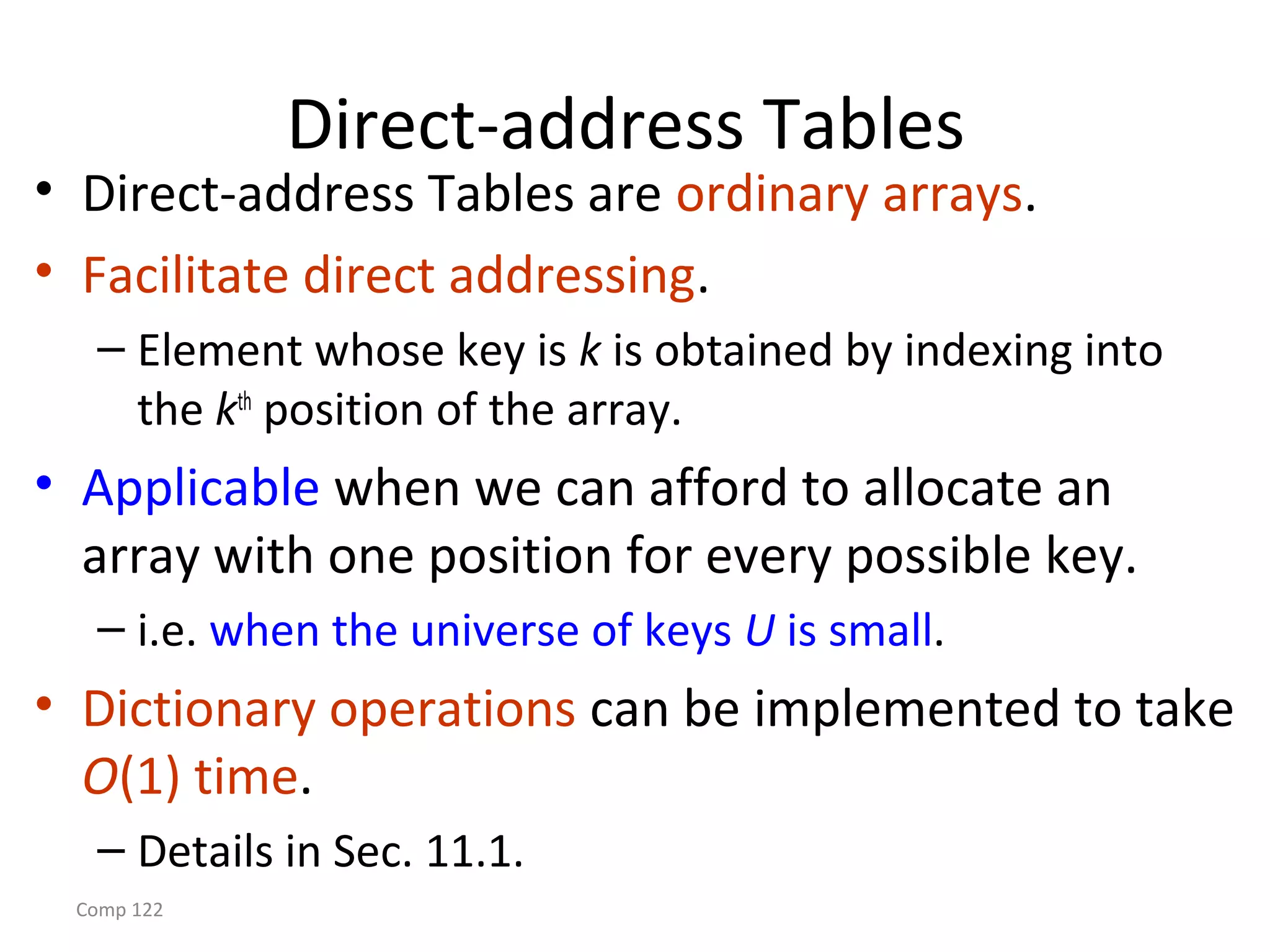
• Direct-address Tables are ordinary arrays.
• Facilitate direct addressing.
– Element whose key is k is obtained by indexing into
the kth
position of the array.
• Applicable when we can afford to allocate an
array with one position for every possible key.
– i.e. when the universe of keys U is small.
• Dictionary operations can be implemented to take
O(1) time.
– Details in Sec. 11.1.
Comp 122
Hash Tables
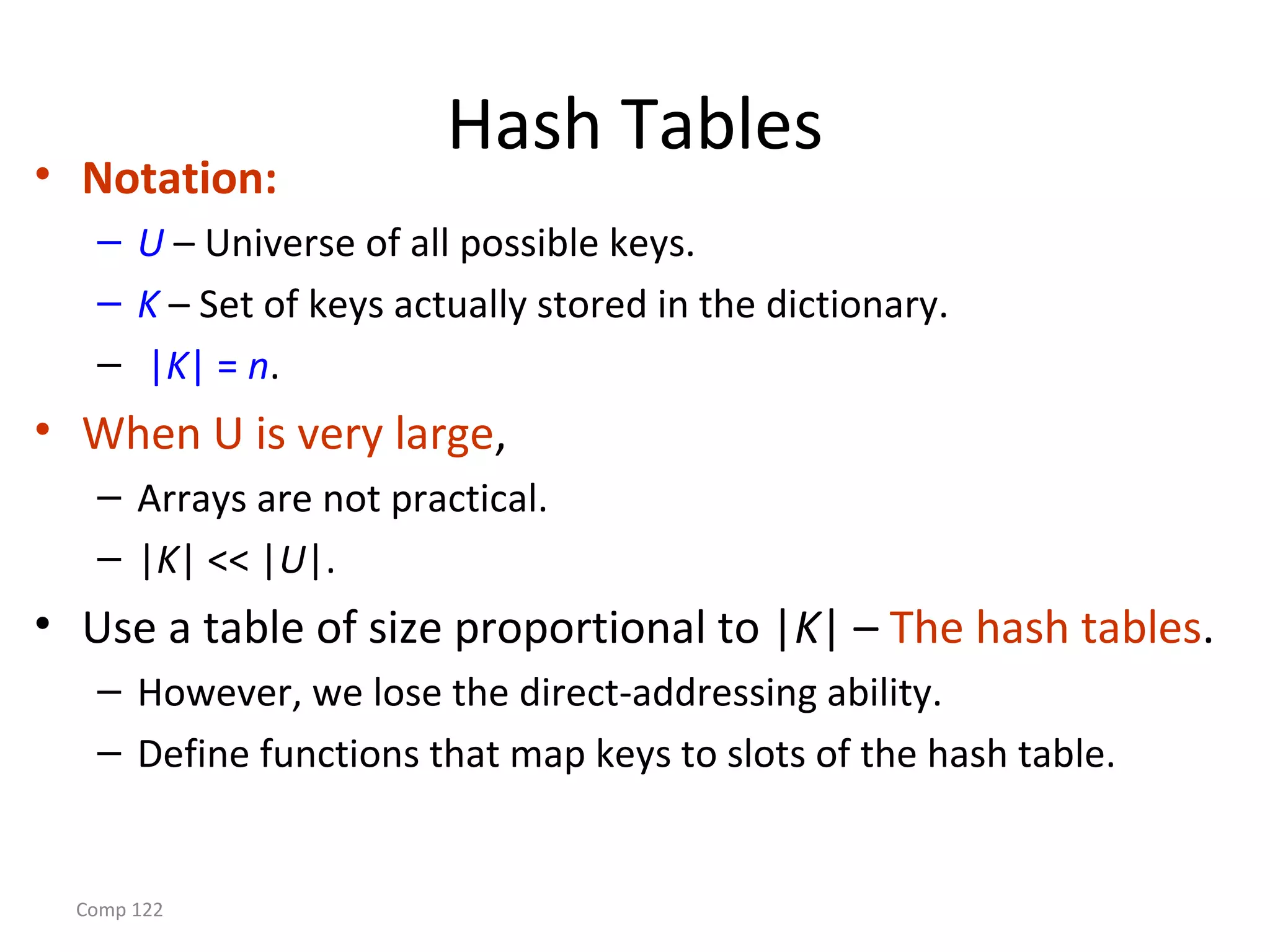
• Notation:
– U – Universe of all possible keys.
– K – Set of keys actually stored in the dictionary.
– |K| = n.
• When U is very large,
– Arrays are not practical.
– |K| << |U|.
• Use a table of size proportional to |K| – The hash tables.
– However, we lose the direct-addressing ability.
– Define functions that map keys to slots of the hash table.
Comp 122
Hashing
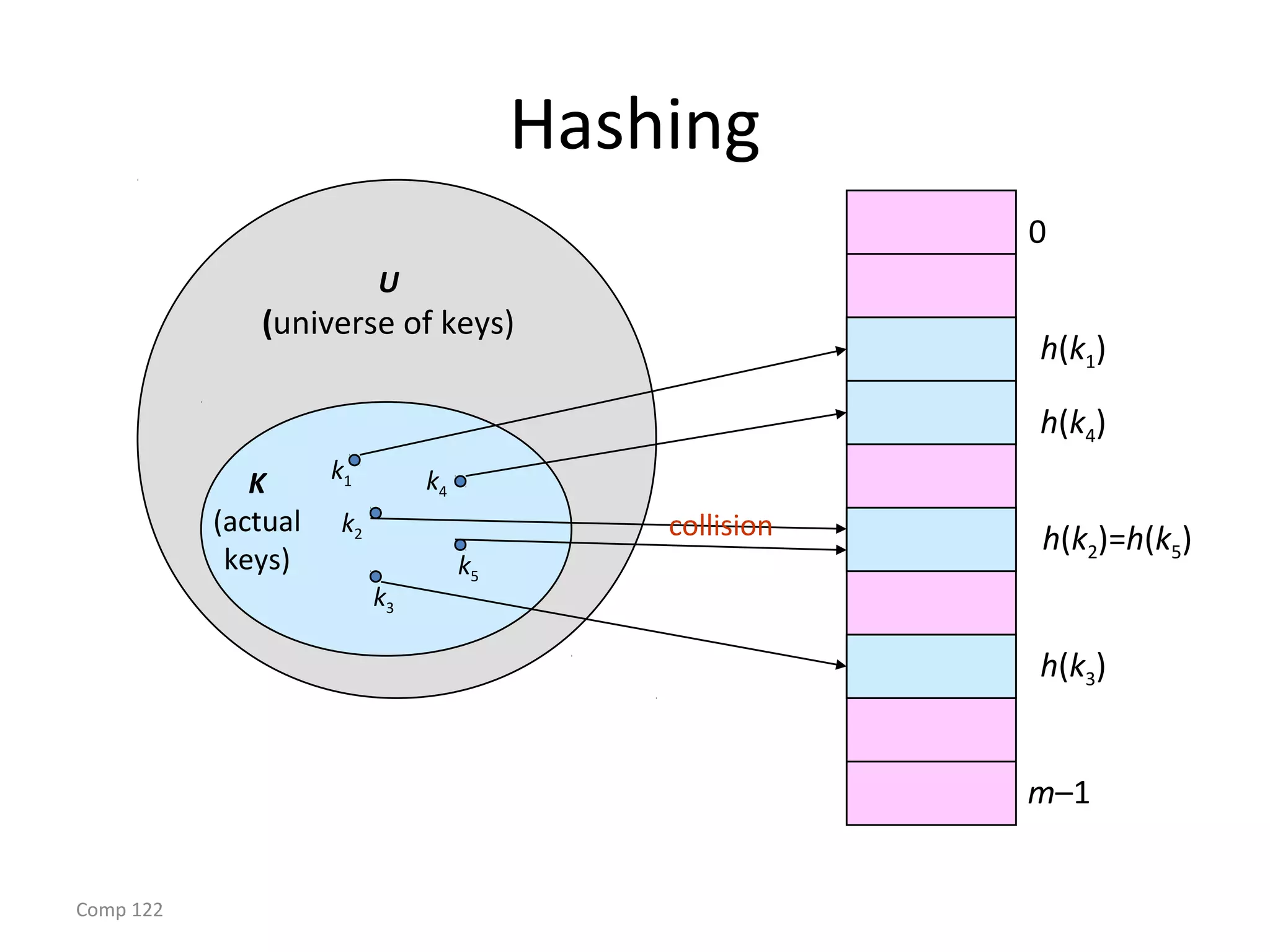
• Hash function h: Mapping from U to the slots of a
hash table T[0..m–1].
h : U → {0,1,…, m–1}
• With arrays, key k maps to slot A[k].
• With hash tables, key k maps or “hashes” to slot
T[h[k]].
• h[k] is the hash value of key k.
Comp 122
Hashing
0
m–1
h(k1)
h(k4)
h(k2)=h(k5)
h(k3)
U
(universe of keys)
K
(actual
keys)
k1
k2
k3
k5
k4
collision
Comp 122
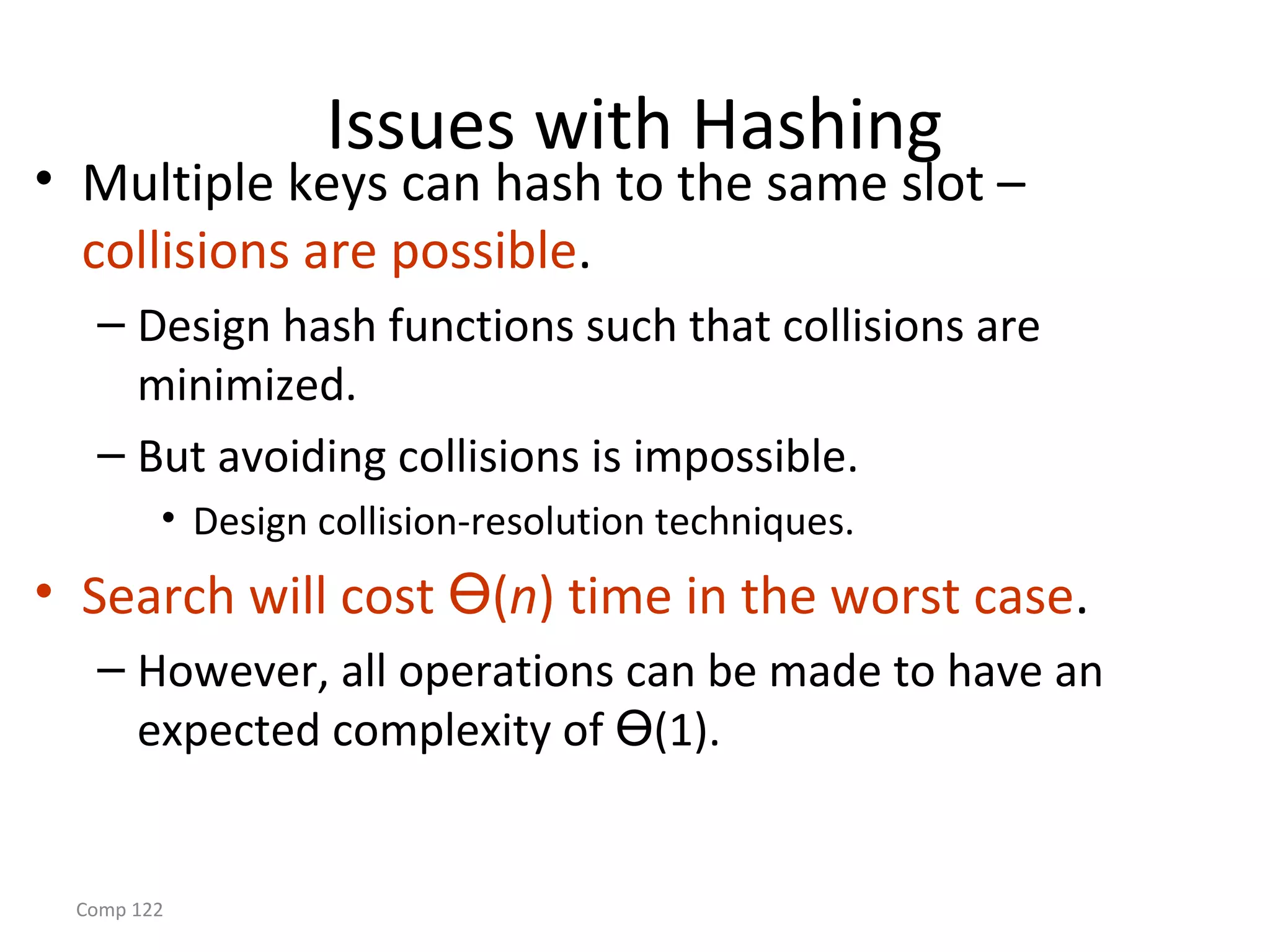
Issues with Hashing
• Multiple keys can hash to the same slot –
collisions are possible.
– Design hash functions such that collisions are
minimized.
– But avoiding collisions is impossible.
• Design collision-resolution techniques.
• Search will cost Ө(n) time in the worst case.
– However, all operations can be made to have an
expected complexity of Ө(1).
Comp 122
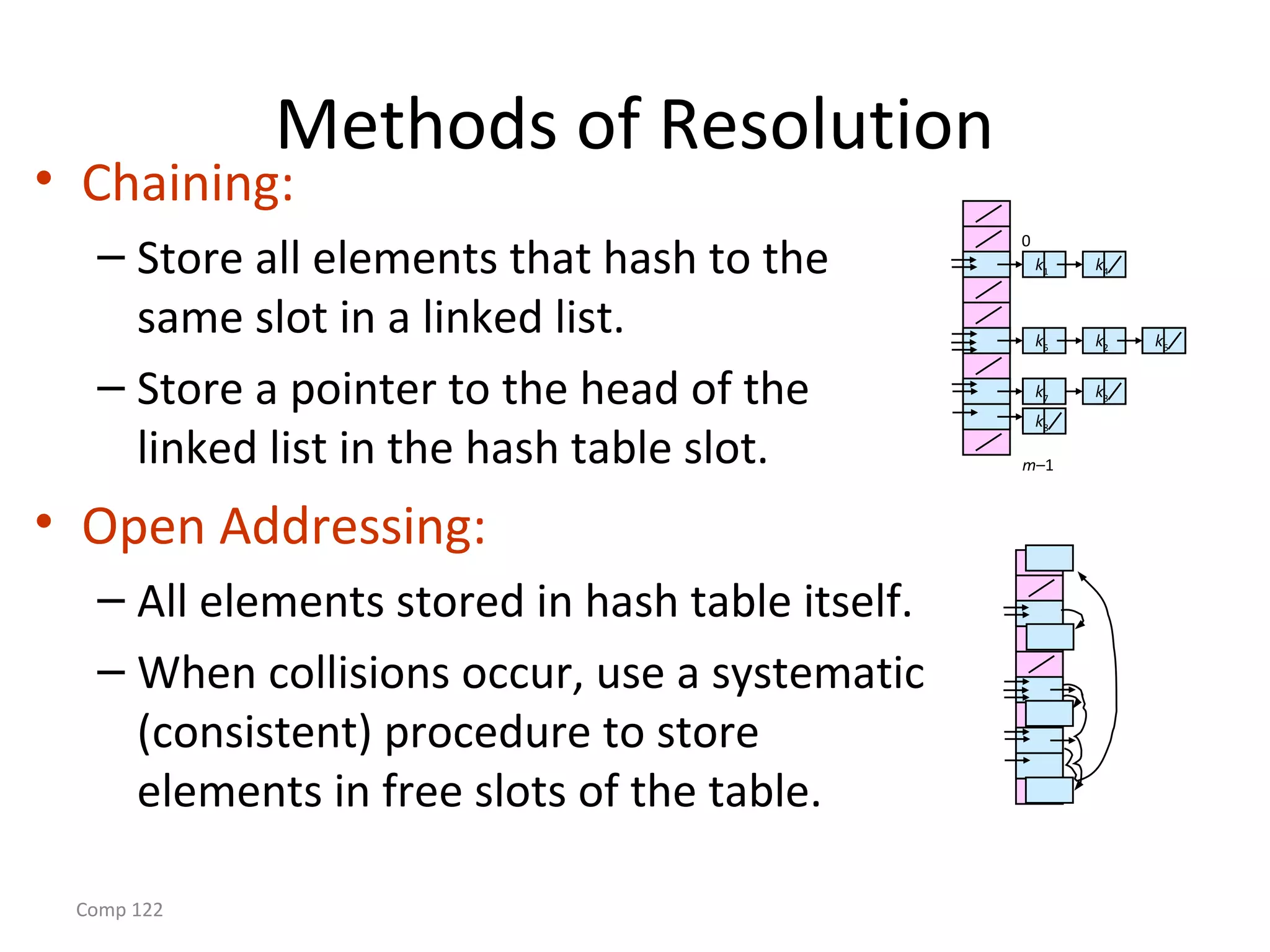
Methods of Resolution
• Chaining:
– Store all elements that hash to the
same slot in a linked list.
– Store a pointer to the head of the
linked list in the hash table slot.
• Open Addressing:
– All elements stored in hash table itself.
– When collisions occur, use a systematic
(consistent) procedure to store
elements in free slots of the table.
k2
0
m–1
k1 k4
k5 k6
k7 k3
k8
Comp 122
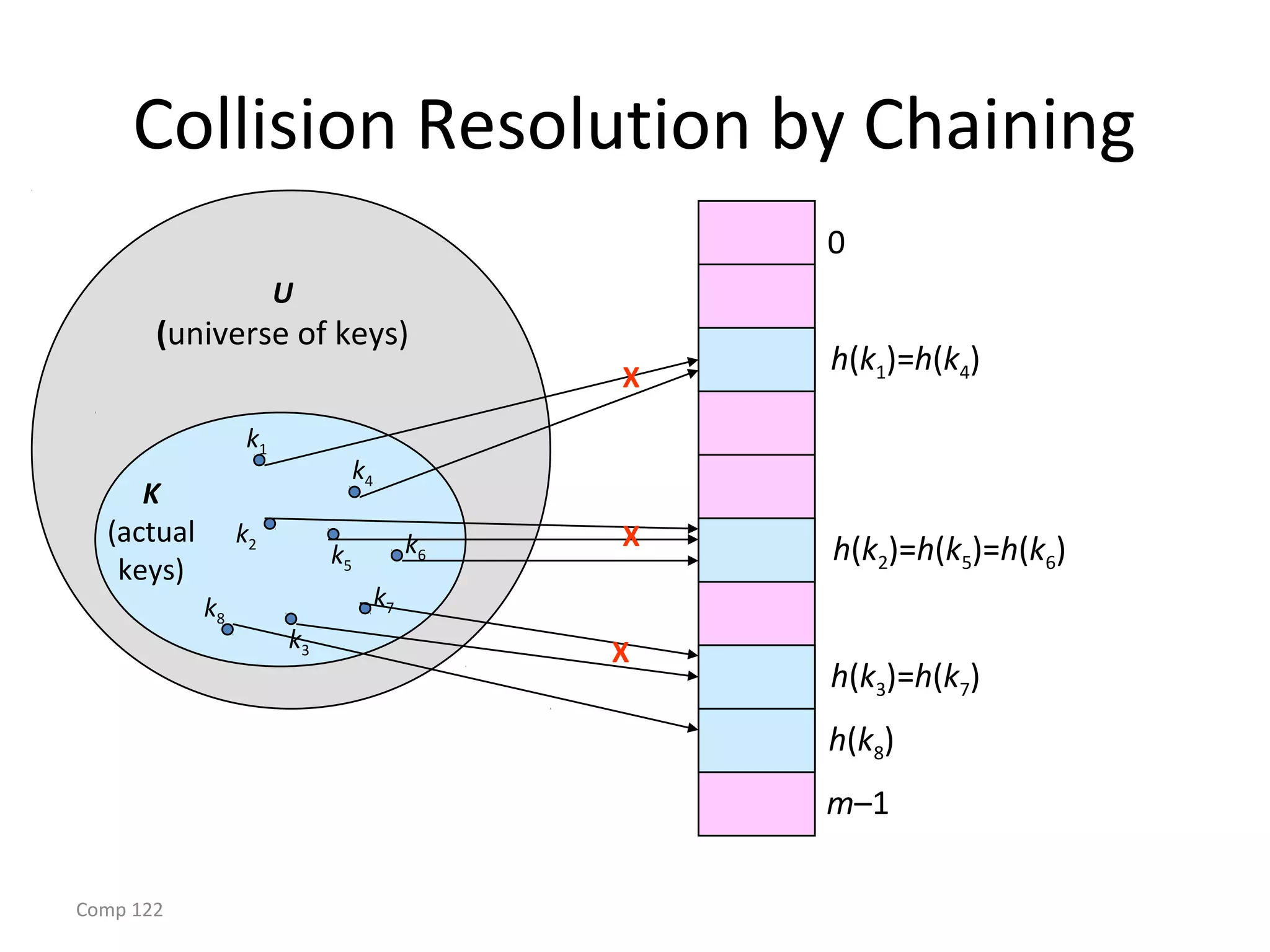
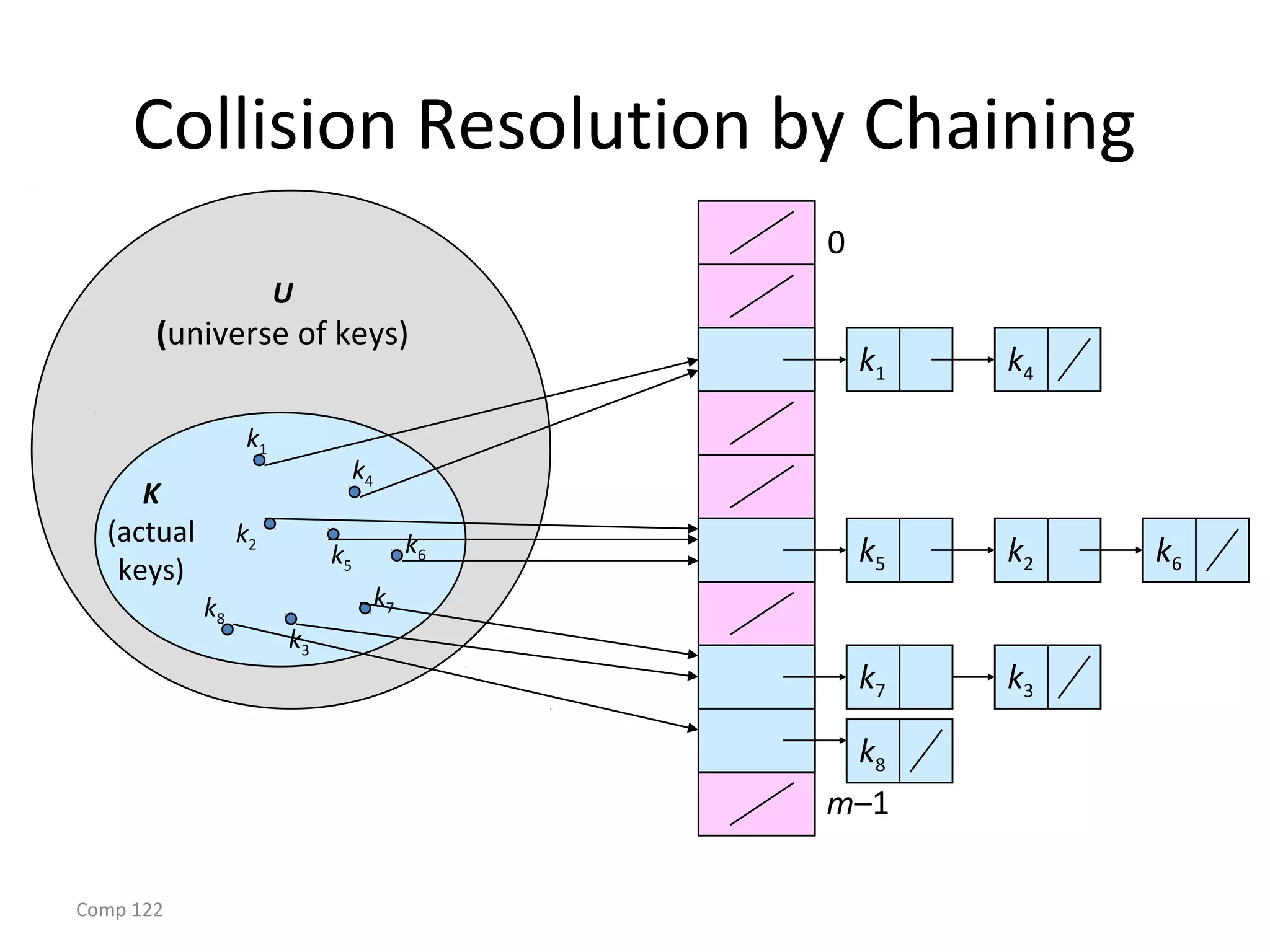
Collision Resolution by Chaining
0
m–1
h(k1)=h(k4)
h(k2)=h(k5)=h(k6)
h(k3)=h(k7)
U
(universe of keys)
K
(actual
keys)
k1
k2
k3
k5
k4
k6
k7k8
h(k8)
X
X
X
Comp 122
k2
Collision Resolution by Chaining
0
m–1
U
(universe of keys)
K
(actual
keys)
k1
k2
k3
k5
k4
k6
k7k8
k1 k4
k5 k6
k7 k3
k8
Comp 122
Hashing with Chaining
Dictionary Operations:
• Chained-Hash-Insert (T, x)
– Insert x at the head of list T[h(key[x])].
– Worst-case complexity – O(1).
• Chained-Hash-Delete (T, x)
– Delete x from the list T[h(key[x])].
– Worst-case complexity – proportional to length of list with
singly-linked lists. O(1) with doubly-linked lists.
• Chained-Hash-Search (T, k)
– Search an element with key k in list T[h(k)].
– Worst-case complexity – proportional to length of list.
Comp 122
Analysis on Chained-Hash-Search
• Load factor α=n/m = average keys per slot.
– m – number of slots.
– n – number of elements stored in the hash table.
• Worst-case complexity: Θ(n) + time to compute h(k).
• Average depends on how h distributes keys among m slots.
• Assume
– Simple uniform hashing.
• Any key is equally likely to hash into any of the m slots,
independent of where any other key hashes to.
– O(1) time to compute h(k).
• Time to search for an element with key k is Θ(|T[h(k)]|).
• Expected length of a linked list = load factor = α = n/m.
Comp 122
Expected Cost of an Unsuccessful Search
Proof:
• Any key not already in the table is equally likely to hash
to any of the m slots.
• To search unsuccessfully for any key k, need to search to
the end of the list T[h(k)], whose expected length is α.
• Adding the time to compute the hash function, the total
time required is Θ(1+α).
Theorem:
An unsuccessful search takes expected time Θ(1+α).
Comp 122
Expected Cost of a Successful Search
Proof:
• The probability that a list is searched is proportional to the number of
elements it contains.
• Assume that the element being searched for is equally likely to be any of
the n elements in the table.
• The number of elements examined during a successful search for an
element x is 1 more than the number of elements that appear before x
in x’s list.
– These are the elements inserted after x was inserted.
• Goal:
– Find the average, over the n elements x in the table, of how many elements
were inserted into x’s list after x was inserted.
Theorem:
A successful search takes expected time Θ(1+α).
Comp 122
Expected Cost of a Successful Search
Proof (contd):
• Let xi be the ith
element inserted into the table, and let ki = key[xi].
• Define indicator random variables Xij = I{h(ki) = h(kj)}, for all i, j.
• Simple uniform hashing ⇒ Pr{h(ki) = h(kj)} = 1/m
⇒ E[Xij] = 1/m.
• Expected number of elements examined in a successful search is:
Theorem:
A successful search takes expected time Θ(1+α).












+∑ ∑= +=
n
i
n
ij
ijX
n
E
1 1
1
1
No. of elements inserted after xi into the same slot as xi.
Comp 122
Proof – Contd.
n
m
n
nn
n
nm
in
nm
in
nm
mn
XE
n
X
n
E
n
i
n
i
n
i
n
i
n
ij
n
i
n
ij
ij
n
i
n
ij
ij
22
1
2
1
1
2
)1(1
1
1
1
)(
1
1
1
1
1
][1
1
1
1
2
1 1
1
1 1
1 1
1 1
αα
−+=
−
+=





 +
−+=






−+=
−+=






+=






+=












+
∑ ∑
∑
∑ ∑
∑ ∑
∑ ∑
= =
=
= +=
= +=
= +=
(linearity of expectation)
Expected total time for a successful search = Time to
compute hash function + Time to search
= O(2+α/2 – α/2n) = O(1+ α).
Comp 122
Expected Cost – Interpretation
• If n = O(m), then α=n/m = O(m)/m = O(1).
⇒ Searching takes constant time on average.
• Insertion is O(1) in the worst case.
• Deletion takes O(1) worst-case time when lists are
doubly linked.
• Hence, all dictionary operations take O(1) time on
average with hash tables with chaining.

Hash tables

  • 1.
    Comp 122, Spring2004 Hash Tables – 1
  • 2.
    Comp 122 Dictionary • Dictionary: –Dynamic-set data structure for storing items indexed using keys. – Supports operations Insert, Search, and Delete. – Applications: • Symbol table of a compiler. • Memory-management tables in operating systems. • Large-scale distributed systems. • Hash Tables: – Effective way of implementing dictionaries. – Generalization of ordinary arrays.
  • 3.
    Comp 122 Direct-address Tables •Direct-address Tables are ordinary arrays. • Facilitate direct addressing. – Element whose key is k is obtained by indexing into the kth position of the array. • Applicable when we can afford to allocate an array with one position for every possible key. – i.e. when the universe of keys U is small. • Dictionary operations can be implemented to take O(1) time. – Details in Sec. 11.1.
  • 4.
    Comp 122 Hash Tables •Notation: – U – Universe of all possible keys. – K – Set of keys actually stored in the dictionary. – |K| = n. • When U is very large, – Arrays are not practical. – |K| << |U|. • Use a table of size proportional to |K| – The hash tables. – However, we lose the direct-addressing ability. – Define functions that map keys to slots of the hash table.
  • 5.
    Comp 122 Hashing • Hashfunction h: Mapping from U to the slots of a hash table T[0..m–1]. h : U → {0,1,…, m–1} • With arrays, key k maps to slot A[k]. • With hash tables, key k maps or “hashes” to slot T[h[k]]. • h[k] is the hash value of key k.
  • 6.
    Comp 122 Hashing 0 m–1 h(k1) h(k4) h(k2)=h(k5) h(k3) U (universe ofkeys) K (actual keys) k1 k2 k3 k5 k4 collision
  • 7.
    Comp 122 Issues withHashing • Multiple keys can hash to the same slot – collisions are possible. – Design hash functions such that collisions are minimized. – But avoiding collisions is impossible. • Design collision-resolution techniques. • Search will cost Ө(n) time in the worst case. – However, all operations can be made to have an expected complexity of Ө(1).
  • 8.
    Comp 122 Methods ofResolution • Chaining: – Store all elements that hash to the same slot in a linked list. – Store a pointer to the head of the linked list in the hash table slot. • Open Addressing: – All elements stored in hash table itself. – When collisions occur, use a systematic (consistent) procedure to store elements in free slots of the table. k2 0 m–1 k1 k4 k5 k6 k7 k3 k8
  • 9.
    Comp 122 Collision Resolutionby Chaining 0 m–1 h(k1)=h(k4) h(k2)=h(k5)=h(k6) h(k3)=h(k7) U (universe of keys) K (actual keys) k1 k2 k3 k5 k4 k6 k7k8 h(k8) X X X
  • 10.
    Comp 122 k2 Collision Resolutionby Chaining 0 m–1 U (universe of keys) K (actual keys) k1 k2 k3 k5 k4 k6 k7k8 k1 k4 k5 k6 k7 k3 k8
  • 11.
    Comp 122 Hashing withChaining Dictionary Operations: • Chained-Hash-Insert (T, x) – Insert x at the head of list T[h(key[x])]. – Worst-case complexity – O(1). • Chained-Hash-Delete (T, x) – Delete x from the list T[h(key[x])]. – Worst-case complexity – proportional to length of list with singly-linked lists. O(1) with doubly-linked lists. • Chained-Hash-Search (T, k) – Search an element with key k in list T[h(k)]. – Worst-case complexity – proportional to length of list.
  • 12.
    Comp 122 Analysis onChained-Hash-Search • Load factor α=n/m = average keys per slot. – m – number of slots. – n – number of elements stored in the hash table. • Worst-case complexity: Θ(n) + time to compute h(k). • Average depends on how h distributes keys among m slots. • Assume – Simple uniform hashing. • Any key is equally likely to hash into any of the m slots, independent of where any other key hashes to. – O(1) time to compute h(k). • Time to search for an element with key k is Θ(|T[h(k)]|). • Expected length of a linked list = load factor = α = n/m.
  • 13.
    Comp 122 Expected Costof an Unsuccessful Search Proof: • Any key not already in the table is equally likely to hash to any of the m slots. • To search unsuccessfully for any key k, need to search to the end of the list T[h(k)], whose expected length is α. • Adding the time to compute the hash function, the total time required is Θ(1+α). Theorem: An unsuccessful search takes expected time Θ(1+α).
  • 14.
    Comp 122 Expected Costof a Successful Search Proof: • The probability that a list is searched is proportional to the number of elements it contains. • Assume that the element being searched for is equally likely to be any of the n elements in the table. • The number of elements examined during a successful search for an element x is 1 more than the number of elements that appear before x in x’s list. – These are the elements inserted after x was inserted. • Goal: – Find the average, over the n elements x in the table, of how many elements were inserted into x’s list after x was inserted. Theorem: A successful search takes expected time Θ(1+α).
  • 15.
    Comp 122 Expected Costof a Successful Search Proof (contd): • Let xi be the ith element inserted into the table, and let ki = key[xi]. • Define indicator random variables Xij = I{h(ki) = h(kj)}, for all i, j. • Simple uniform hashing ⇒ Pr{h(ki) = h(kj)} = 1/m ⇒ E[Xij] = 1/m. • Expected number of elements examined in a successful search is: Theorem: A successful search takes expected time Θ(1+α).             +∑ ∑= += n i n ij ijX n E 1 1 1 1 No. of elements inserted after xi into the same slot as xi.
  • 16.
    Comp 122 Proof –Contd. n m n nn n nm in nm in nm mn XE n X n E n i n i n i n i n ij n i n ij ij n i n ij ij 22 1 2 1 1 2 )1(1 1 1 1 )( 1 1 1 1 1 ][1 1 1 1 2 1 1 1 1 1 1 1 1 1 αα −+= − +=       + −+=       −+= −+=       +=       +=             + ∑ ∑ ∑ ∑ ∑ ∑ ∑ ∑ ∑ = = = = += = += = += (linearity of expectation) Expected total time for a successful search = Time to compute hash function + Time to search = O(2+α/2 – α/2n) = O(1+ α).
  • 17.
    Comp 122 Expected Cost– Interpretation • If n = O(m), then α=n/m = O(m)/m = O(1). ⇒ Searching takes constant time on average. • Insertion is O(1) in the worst case. • Deletion takes O(1) worst-case time when lists are doubly linked. • Hence, all dictionary operations take O(1) time on average with hash tables with chaining.