Algorithms
Divide And Conquer -Surfing Lower
Bounds
2 -2
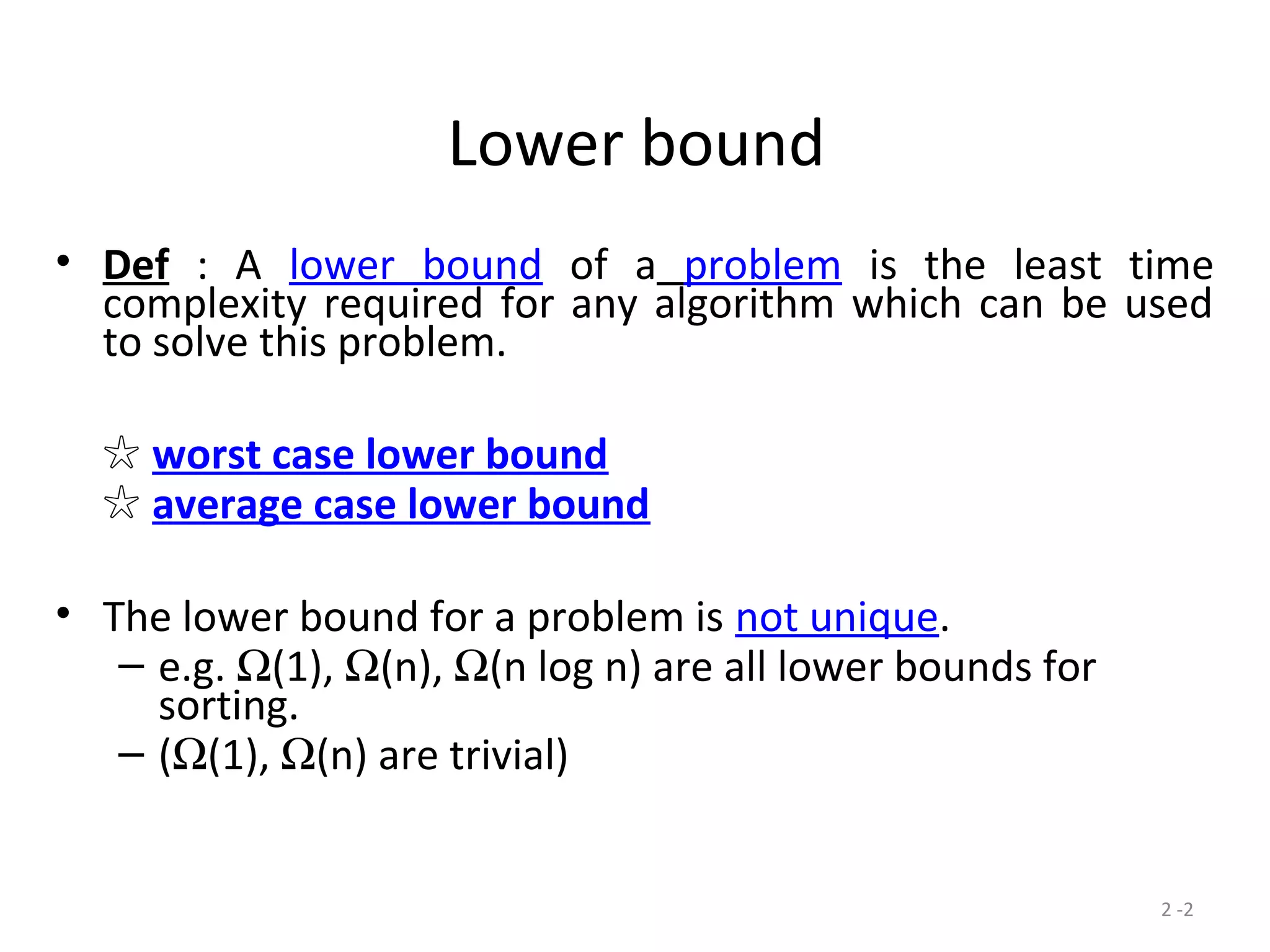
Lower bound
• Def : A lower bound of a problem is the least time
complexity required for any algorithm which can be used
to solve this problem.
☆ worst case lower bound
☆ average case lower bound
• The lower bound for a problem is not unique.
– e.g. Ω(1), Ω(n), Ω(n log n) are all lower bounds for
sorting.
– (Ω(1), Ω(n) are trivial)
2 -3
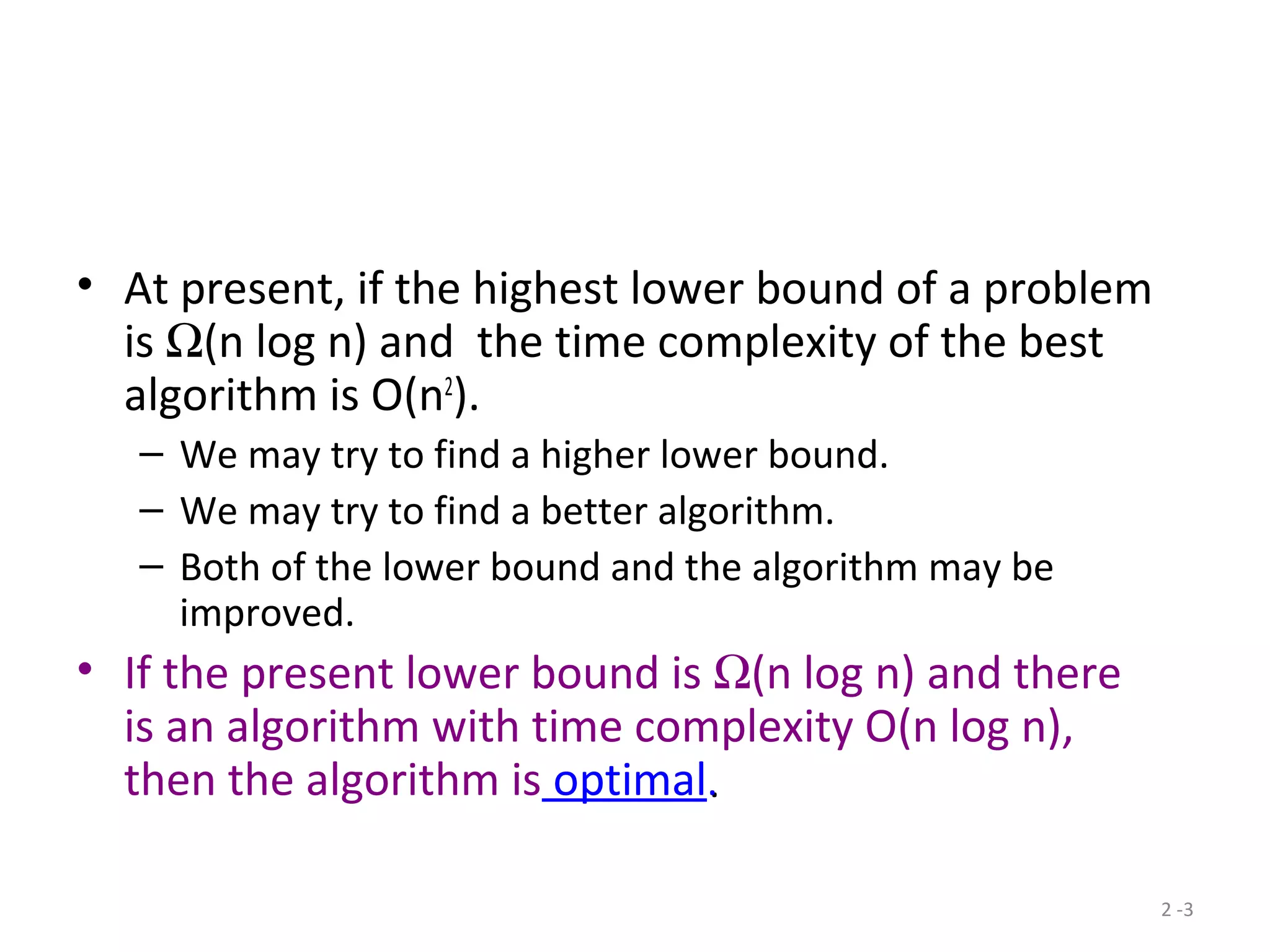
• At present, if the highest lower bound of a problem
is Ω(n log n) and the time complexity of the best
algorithm is O(n2
).
– We may try to find a higher lower bound.
– We may try to find a better algorithm.
– Both of the lower bound and the algorithm may be
improved.
• If the present lower bound is Ω(n log n) and there
is an algorithm with time complexity O(n log n),
then the algorithm is optimal..
2 -4
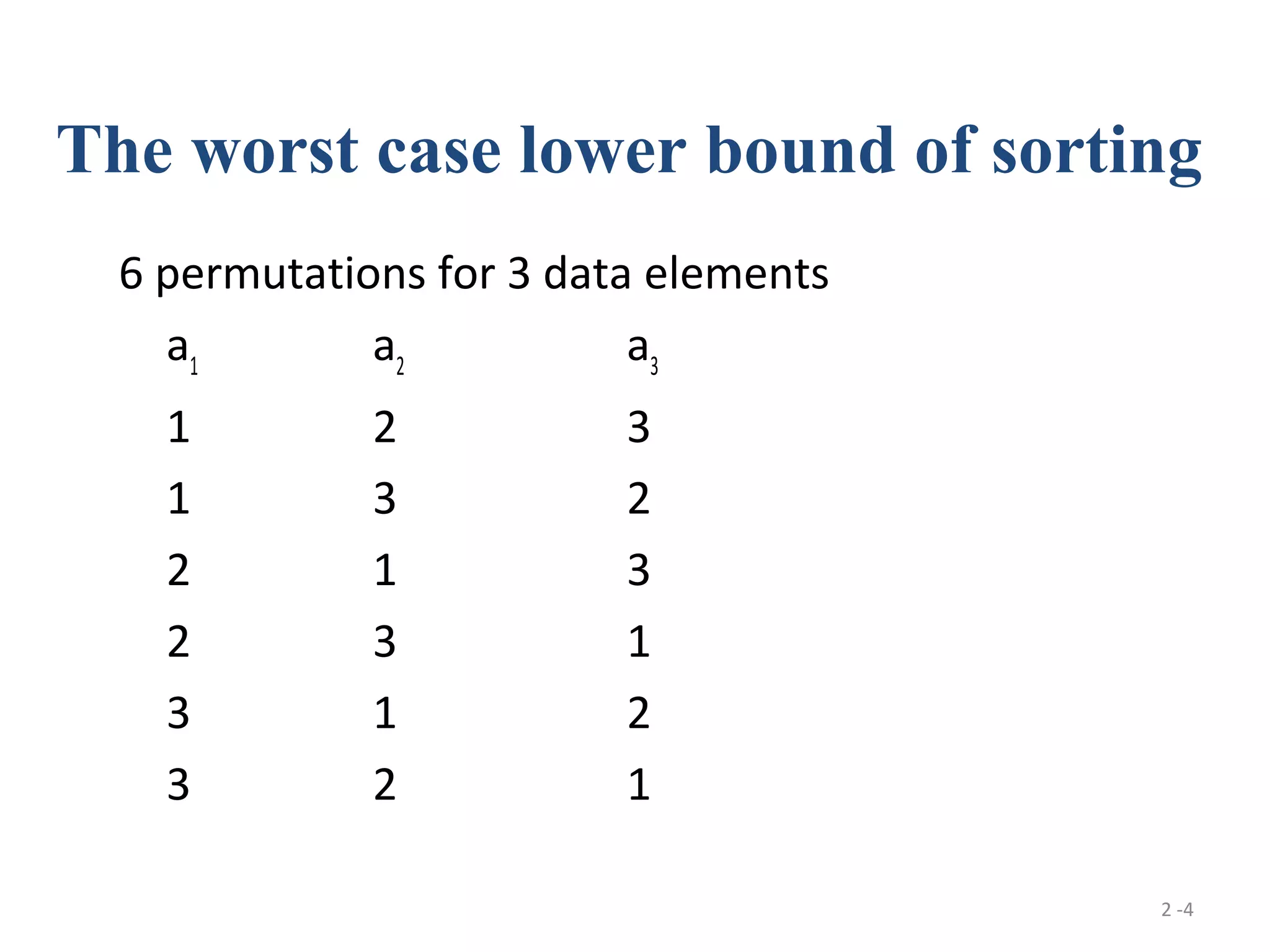
6 permutations for 3 data elements
a1
a2
a3
1 2 3
1 3 2
2 1 3
2 3 1
3 1 2
3 2 1
The worst case lower bound of sorting
2 -5
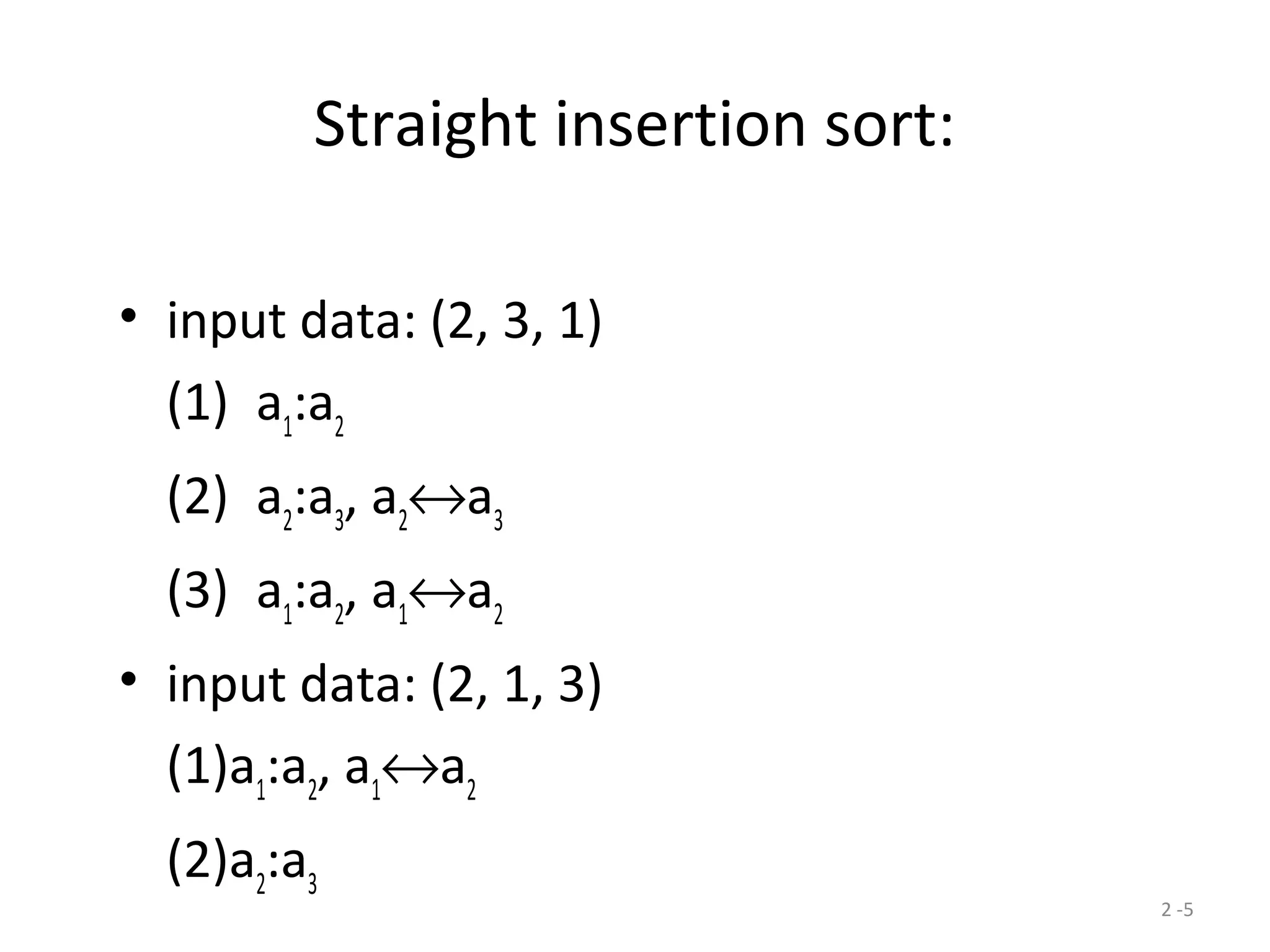
Straight insertion sort:
• input data: (2, 3, 1)
(1)  a1
:a2
(2)  a2
:a3
, a2
↔a3
(3)  a1
:a2
, a1
↔a2
• input data: (2, 1, 3)
(1)a1
:a2
, a1
↔a2
(2)a2
:a3
2 -6
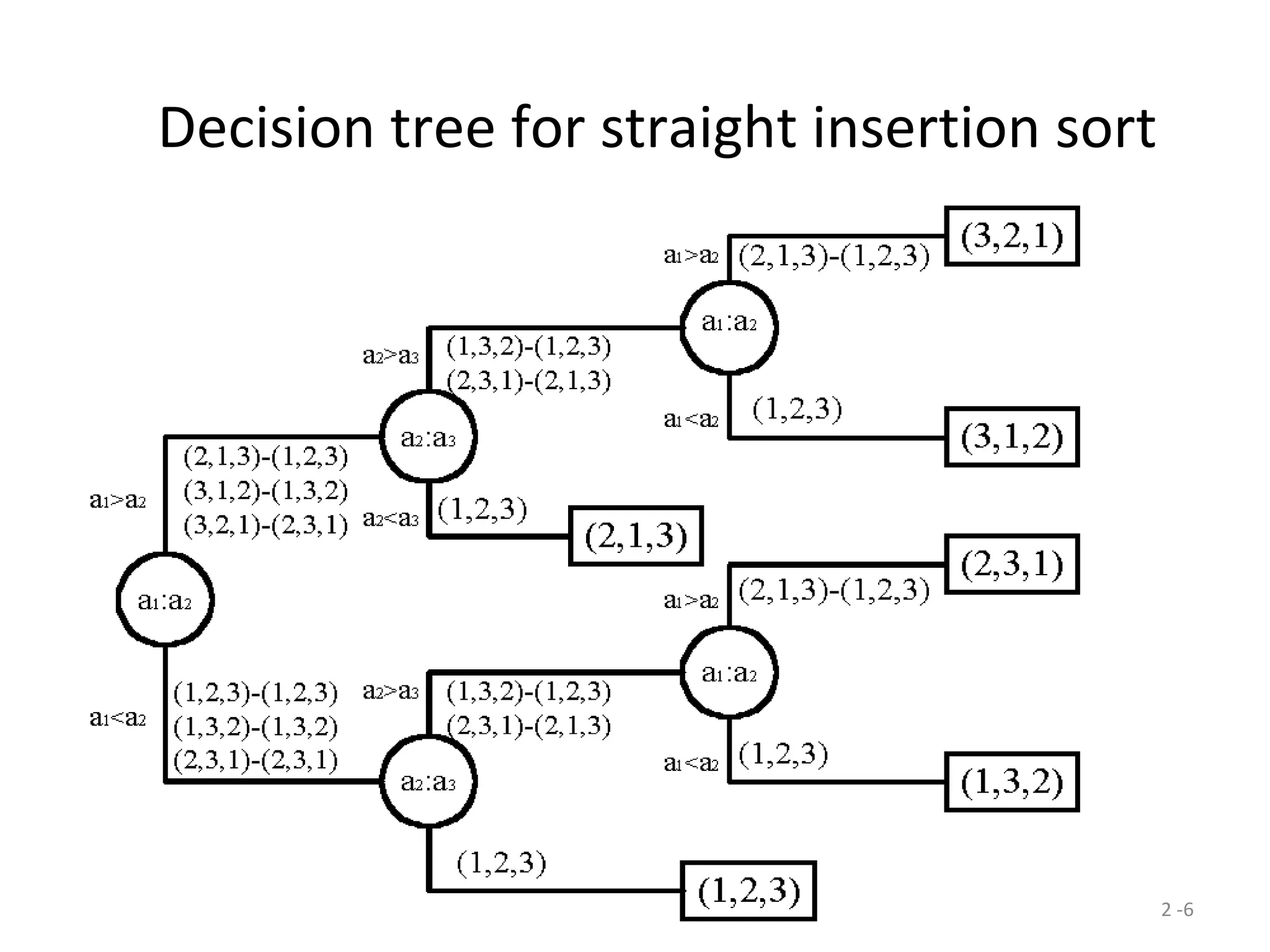
Decision tree for straight insertion sort
2 -7
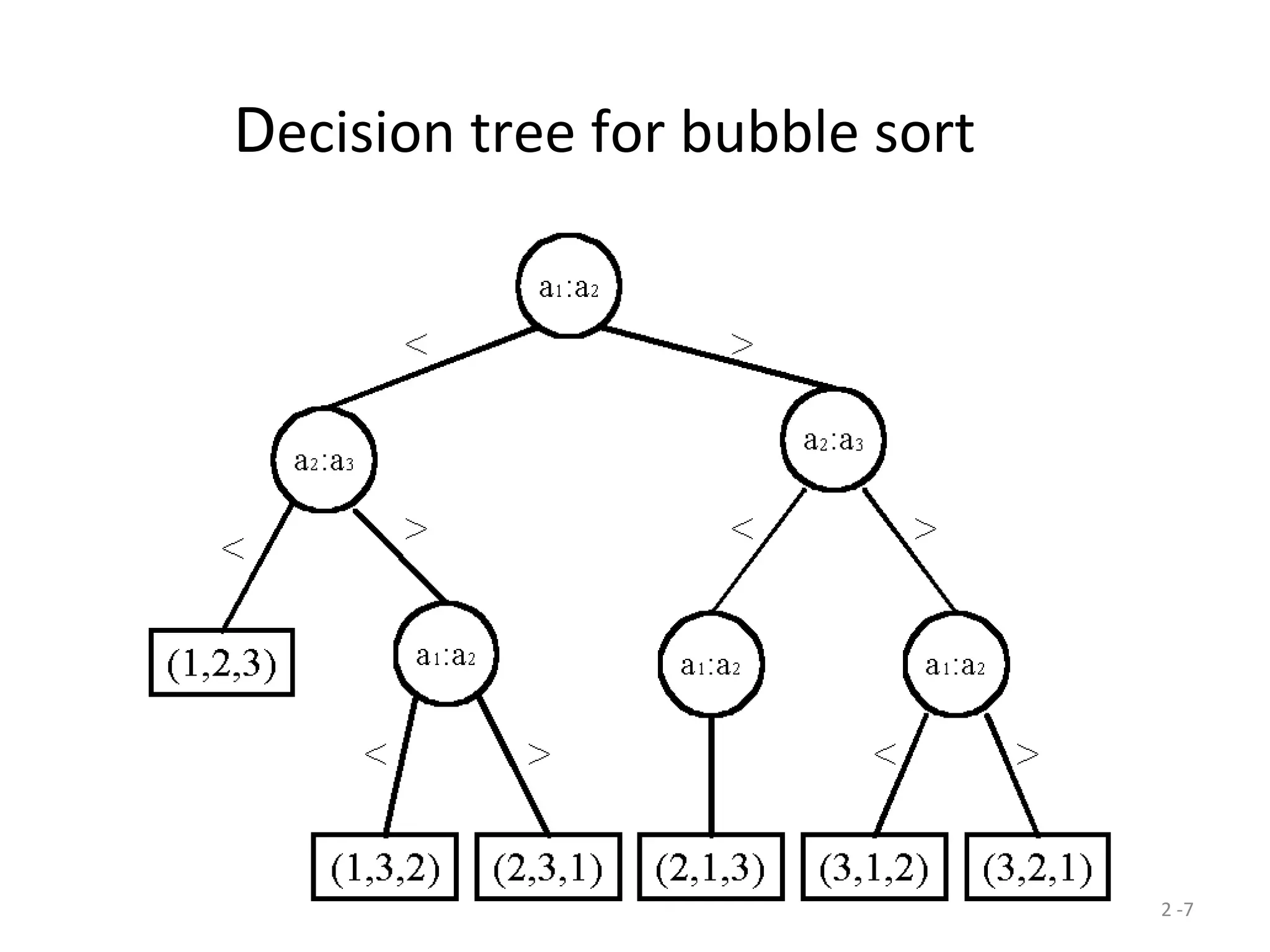
Decision tree for bubble sort
2 -8
Lower bound of sorting
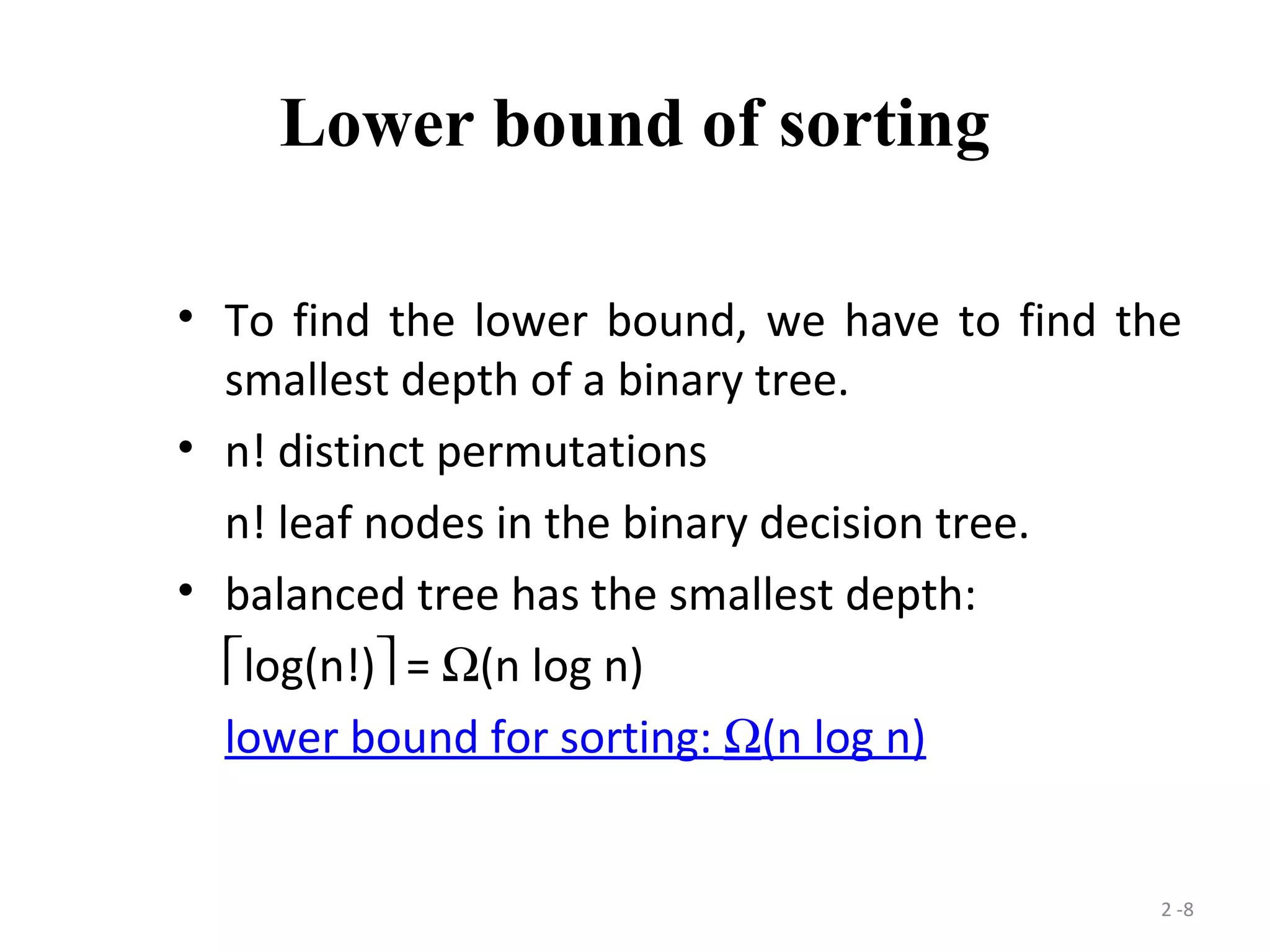
• To find the lower bound, we have to find the
smallest depth of a binary tree.
• n! distinct permutations
n! leaf nodes in the binary decision tree.
• balanced tree has the smallest depth:
log(n!) = Ω(n log n)
lower bound for sorting: Ω(n log n)
2 -9
Method 1:
log(n!) = log(n(n− 1)…1)
= log2 + log3 +…+ log n
> log xdx
n
1∫
= log e ln xdx
n
1∫
= log e[ ln ]x x x n
− 1
= log e(n ln n − n + 1)
= n log n − n log e + 1.44
≥ n log n − 1.44n
=Ω (n log n)
2 -10
Method 2:
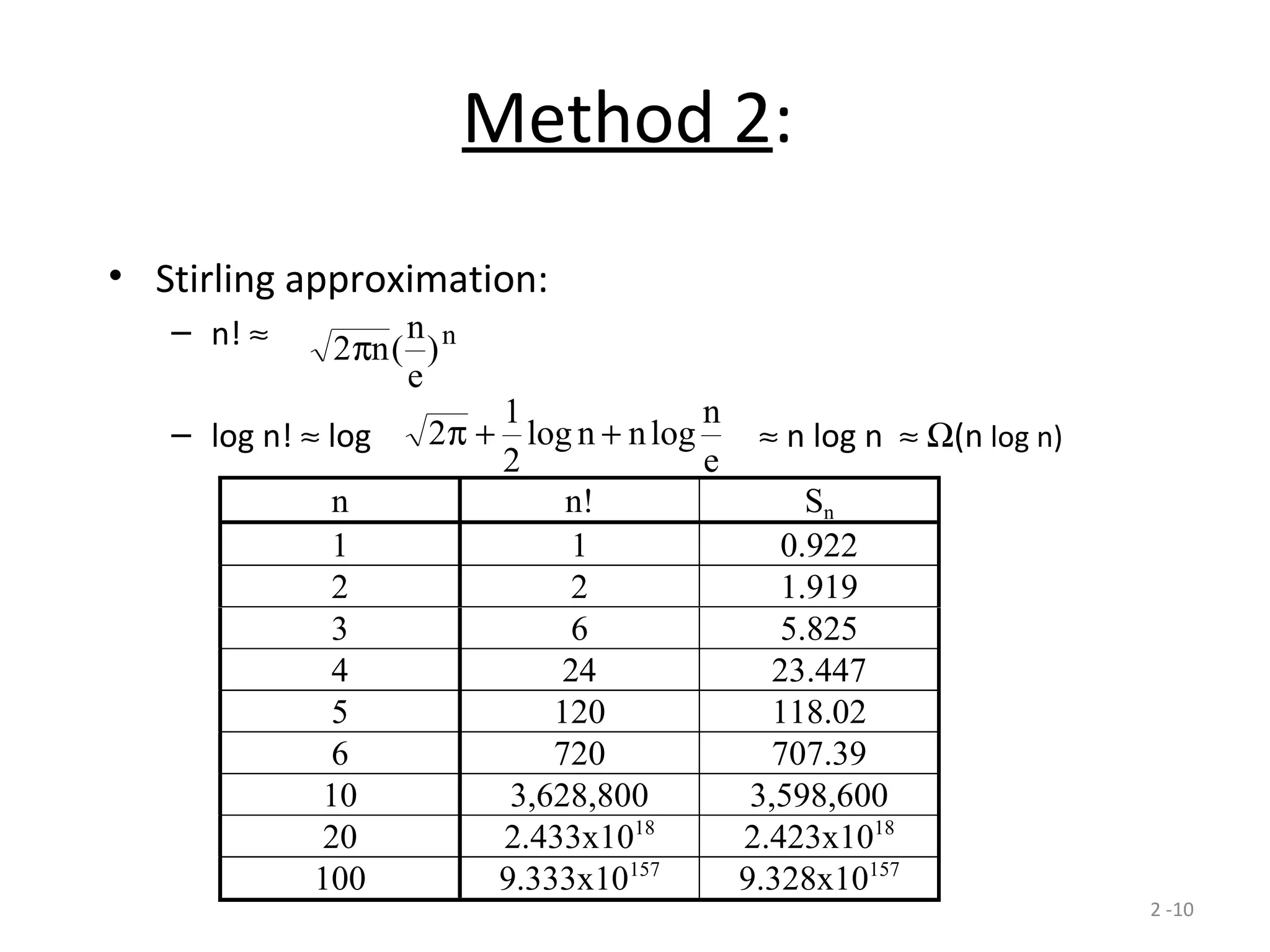
• Stirling approximation:
– n! ≈
– log n! ≈ log ≈ n log n ≈ Ω(n log n)
2πn
n
e
n
( )
2
1
2
π + +log logn n
n
e
n n! Sn
1 1 0.922
2 2 1.919
3 6 5.825
4 24 23.447
5 120 118.02
6 720 707.39
10 3,628,800 3,598,600
20 2.433x10¹⁸
2.423x10¹⁸
100 9.333x10157
9.328x10157
2 -11
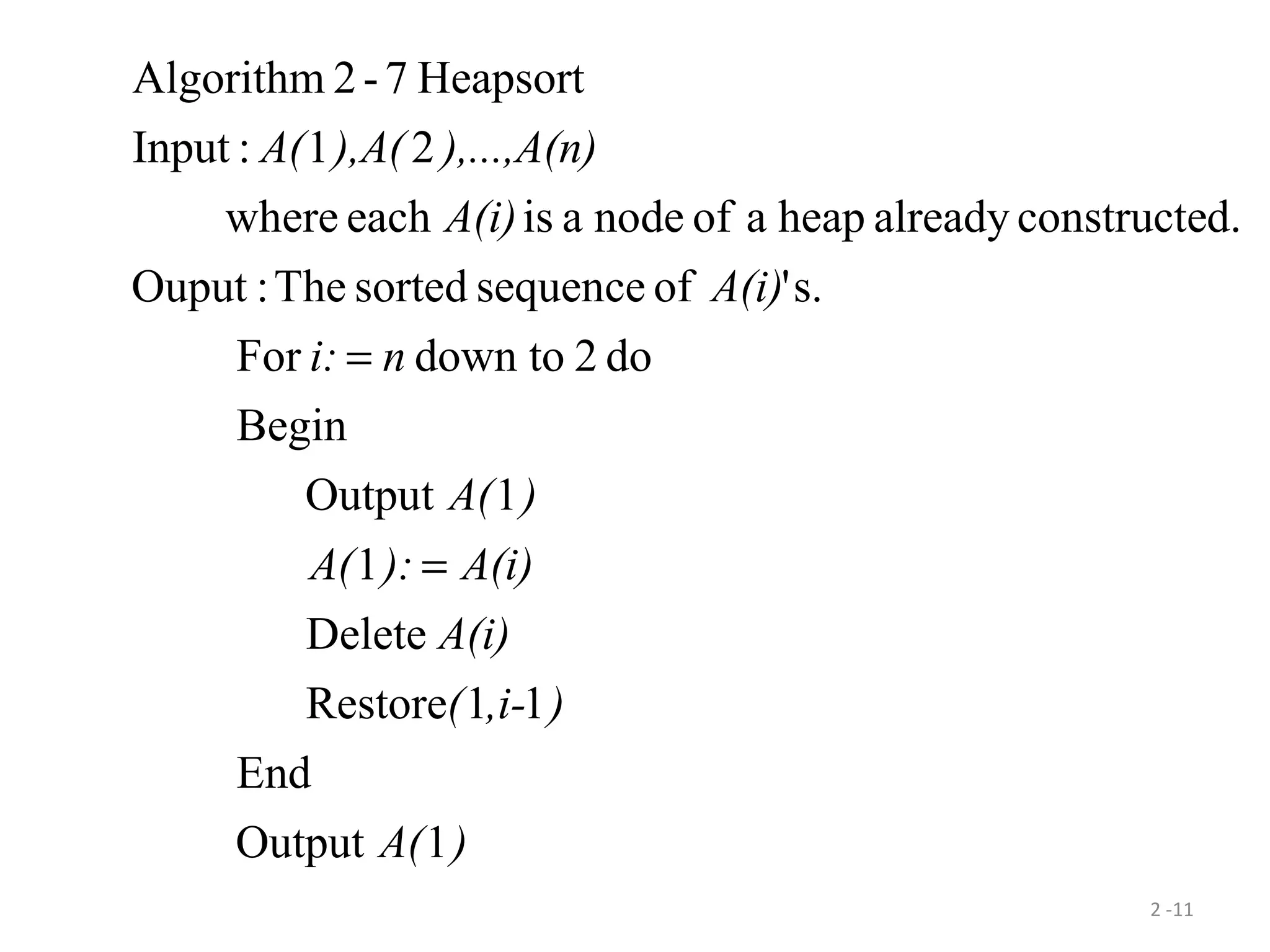
)A(
),i-(
A(i)
A(i)):A(
)A(
ni:
A(i)
A(i)
),...,A(n)),A(A(
1Output
End
11Restore
Delete
1
1Output
Begin
do2down toFor
s.'ofsequencesortedThe:Ouput
d.constructealreadyheapaofnodeaiseacherewh
21:Input
Heapsort7-2Algorithm
=
=
2 -12
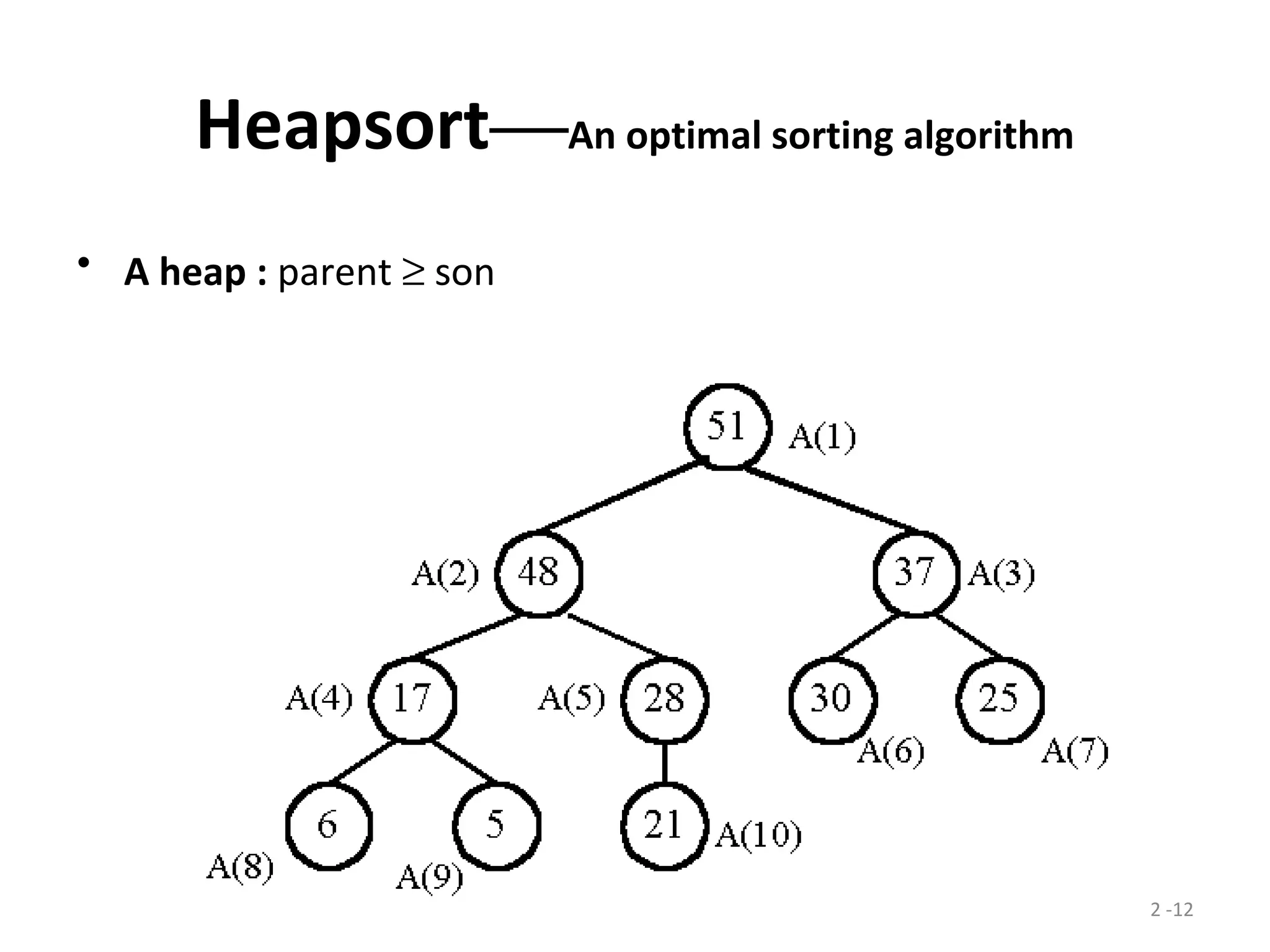
Heapsort—An optimal sorting algorithm
• A heap : parent ≥ son
2 -13
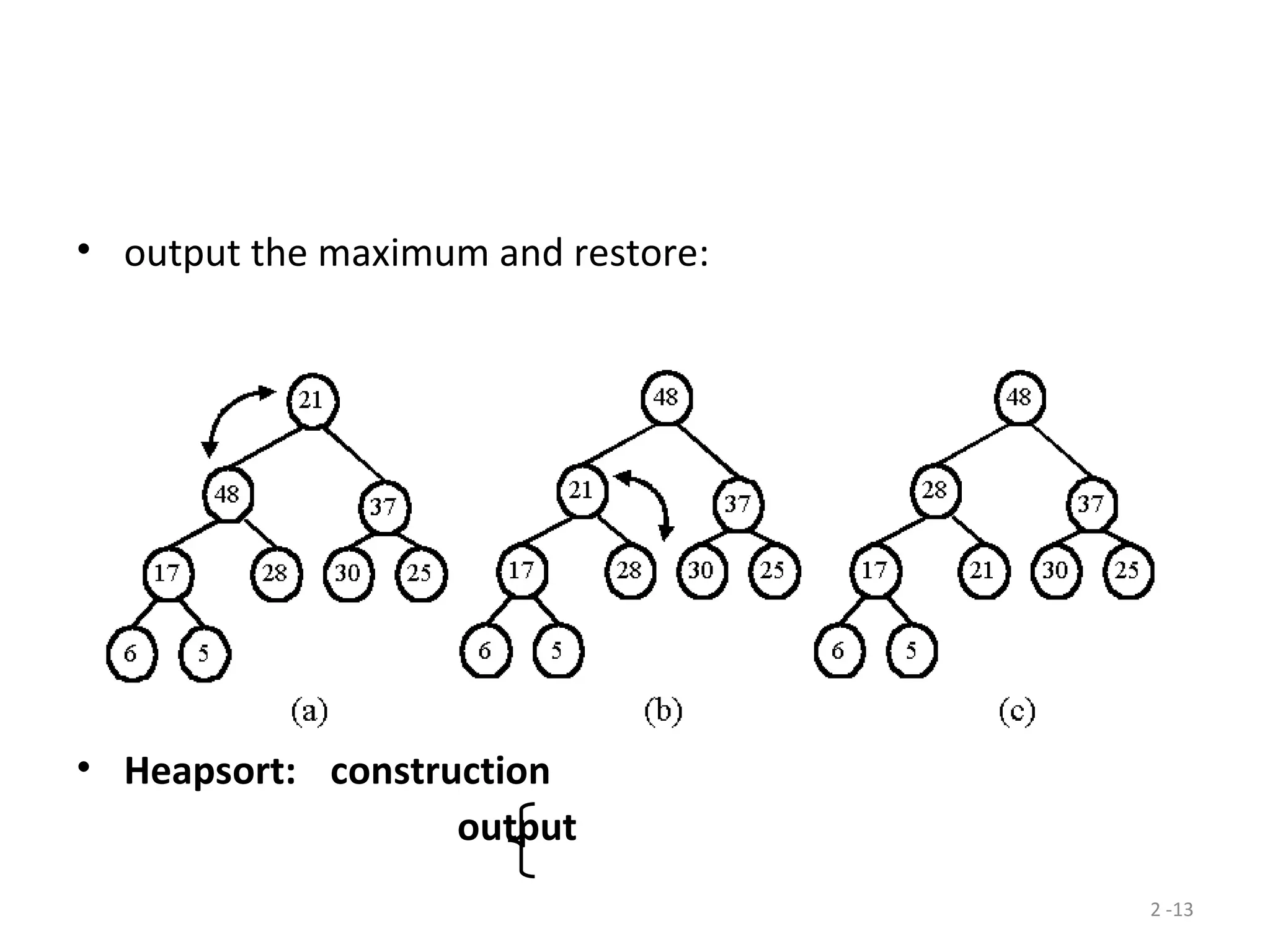
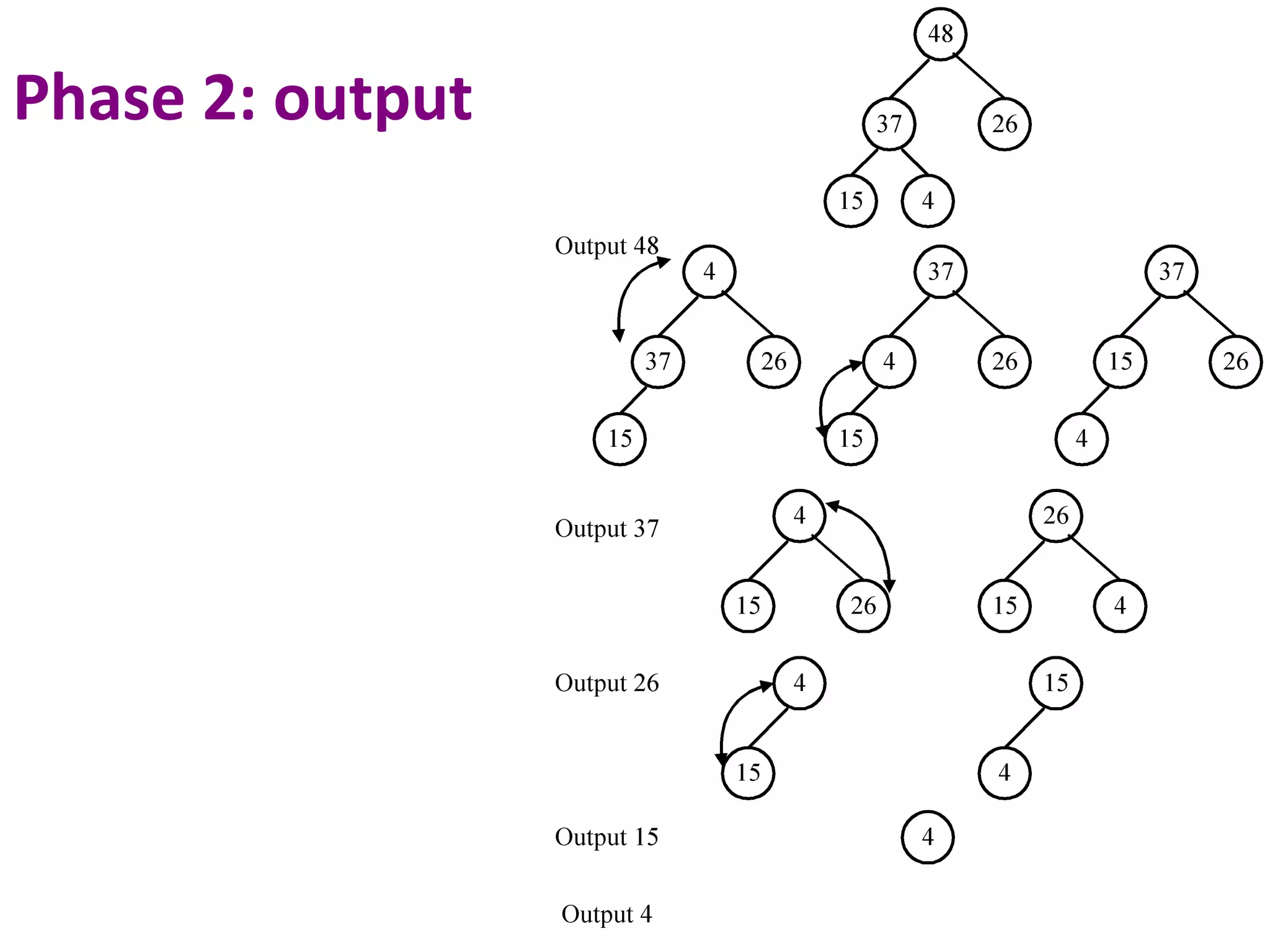
• output the maximum and restore:
• Heapsort: construction
output
2 -14
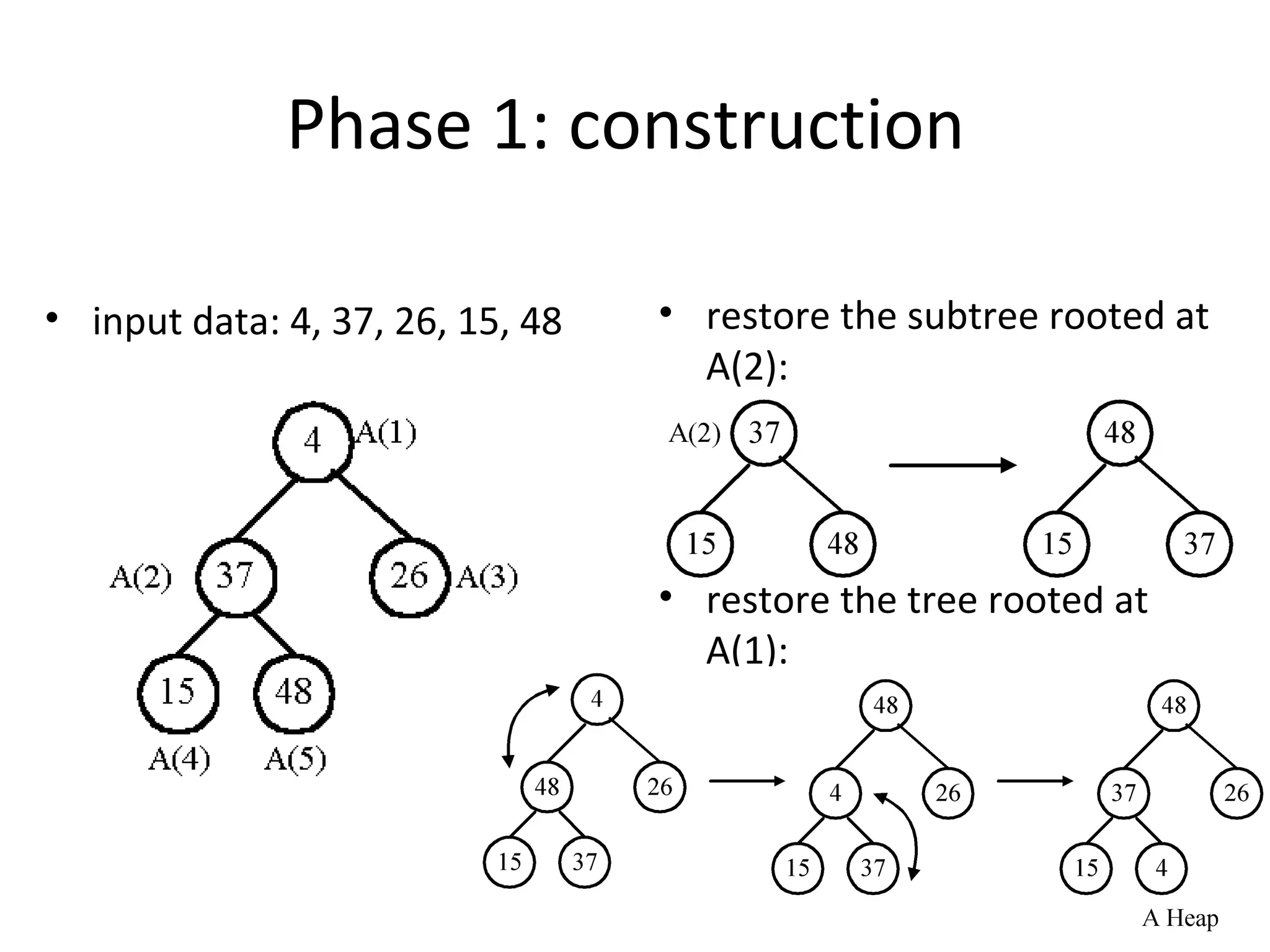
Phase 1: construction
• input data: 4, 37, 26, 15, 48 • restore the subtree rooted at
A(2):
• restore the tree rooted at
A(1):
2 -15
Phase 2: output
2 -16
Implementation
• using a linear array
not a binary tree.
– The sons of A(h) are A(2h) and A(2h+1).
• time complexity: O(n log n)
2 -17
Time complexity
Phase 1: construction
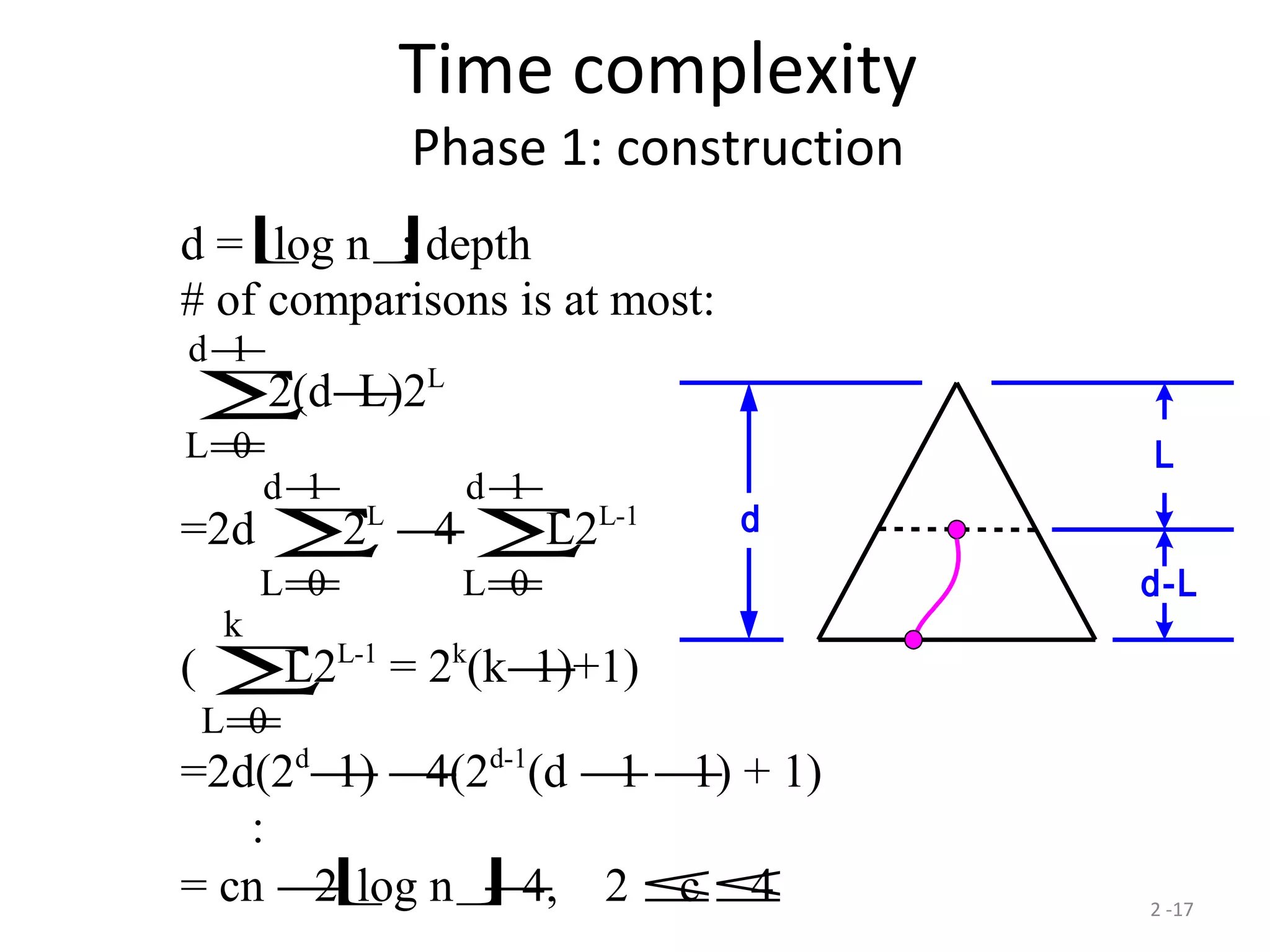
d = log n: depth
# of comparisons is at most:
L
d
=
−
∑
0
1
2(d−L)2L
=2d
L
d
=
−
∑
0
1
2L
−4
L
d
=
−
∑
0
1
L2L-1
(
L
k
=
∑
0
L2L-1
= 2k
(k−1)+1)
=2d(2d
−1) −4(2d-1
(d −1 −1) + 1)
:
= cn −2log n−4, 2 ≤c ≤4
d
L
d-L
2 -18
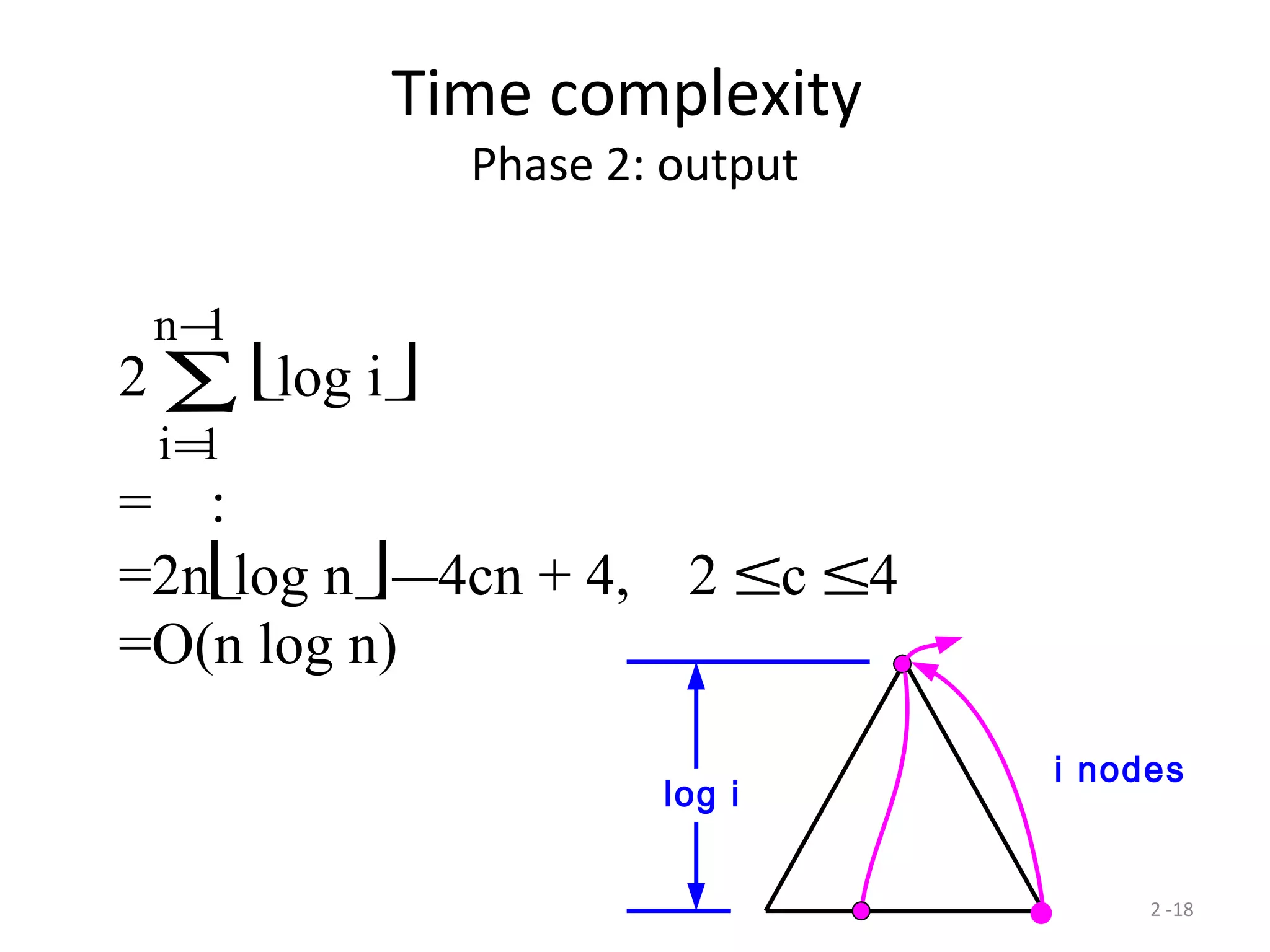
Time complexity
Phase 2: output
2
i
n
=
−
∑
1
1
log i
= :
=2nlog n−4cn + 4, 2 ≤c ≤4
=O(n log n)
log i
i nodes
2 -19
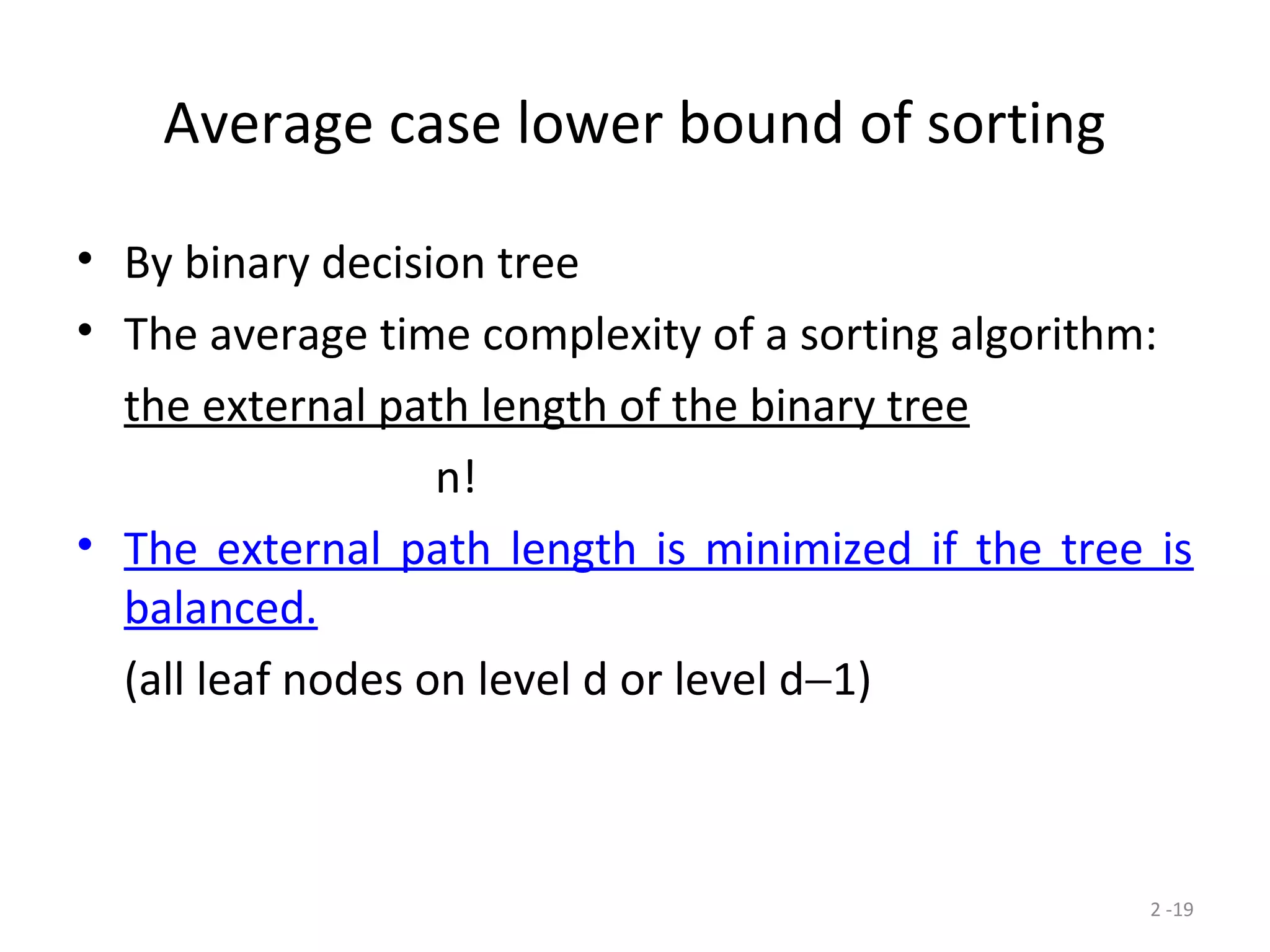
Average case lower bound of sorting
• By binary decision tree
• The average time complexity of a sorting algorithm:
the external path length of the binary tree
n!
• The external path length is minimized if the tree is
balanced.
(all leaf nodes on level d or level d−1)
2 -20
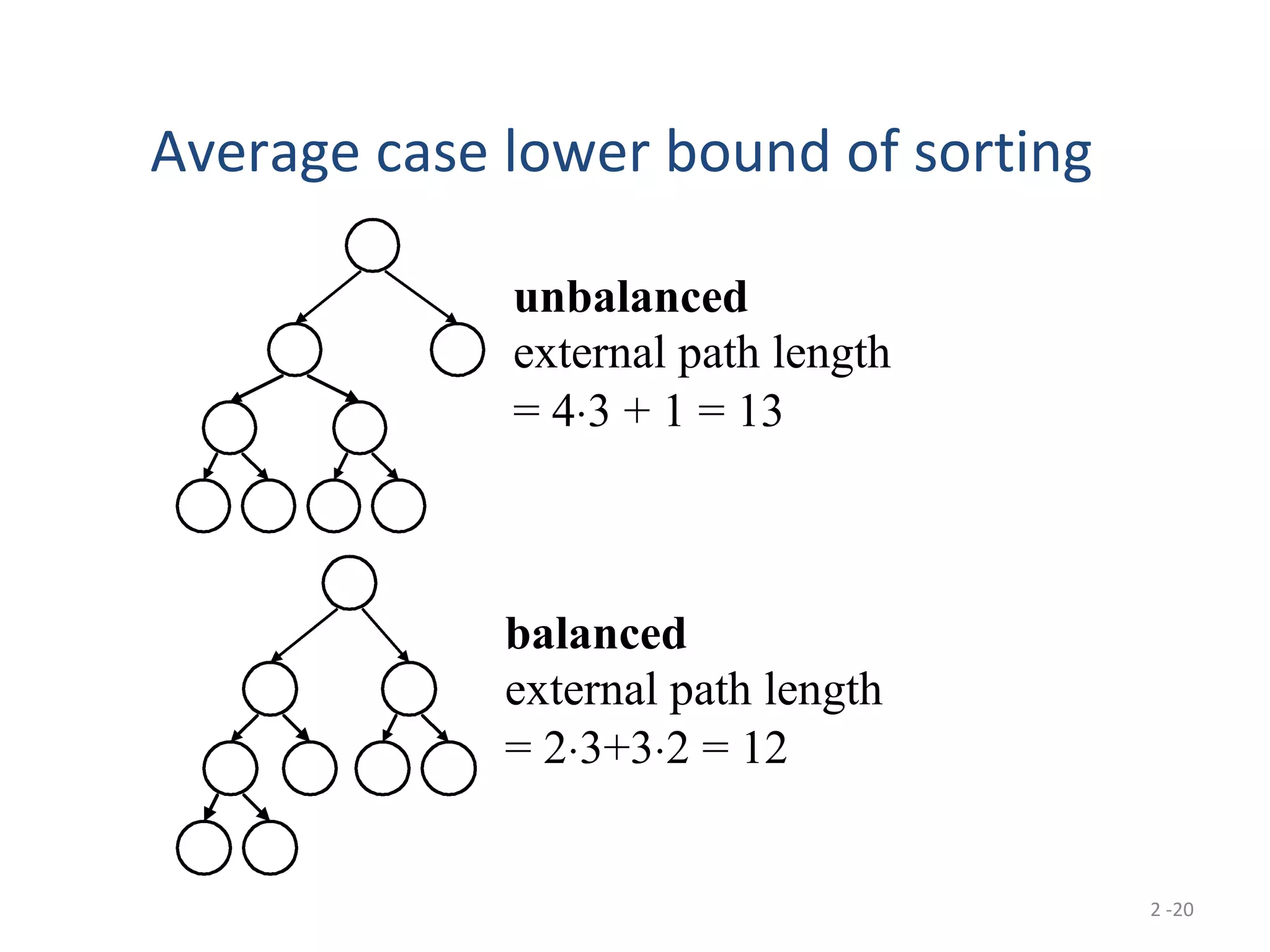
unbalanced
external path length
= 4⋅3 + 1 = 13
balanced
external path length
= 2⋅3+3⋅2 = 12
Average case lower bound of sorting
2 -21
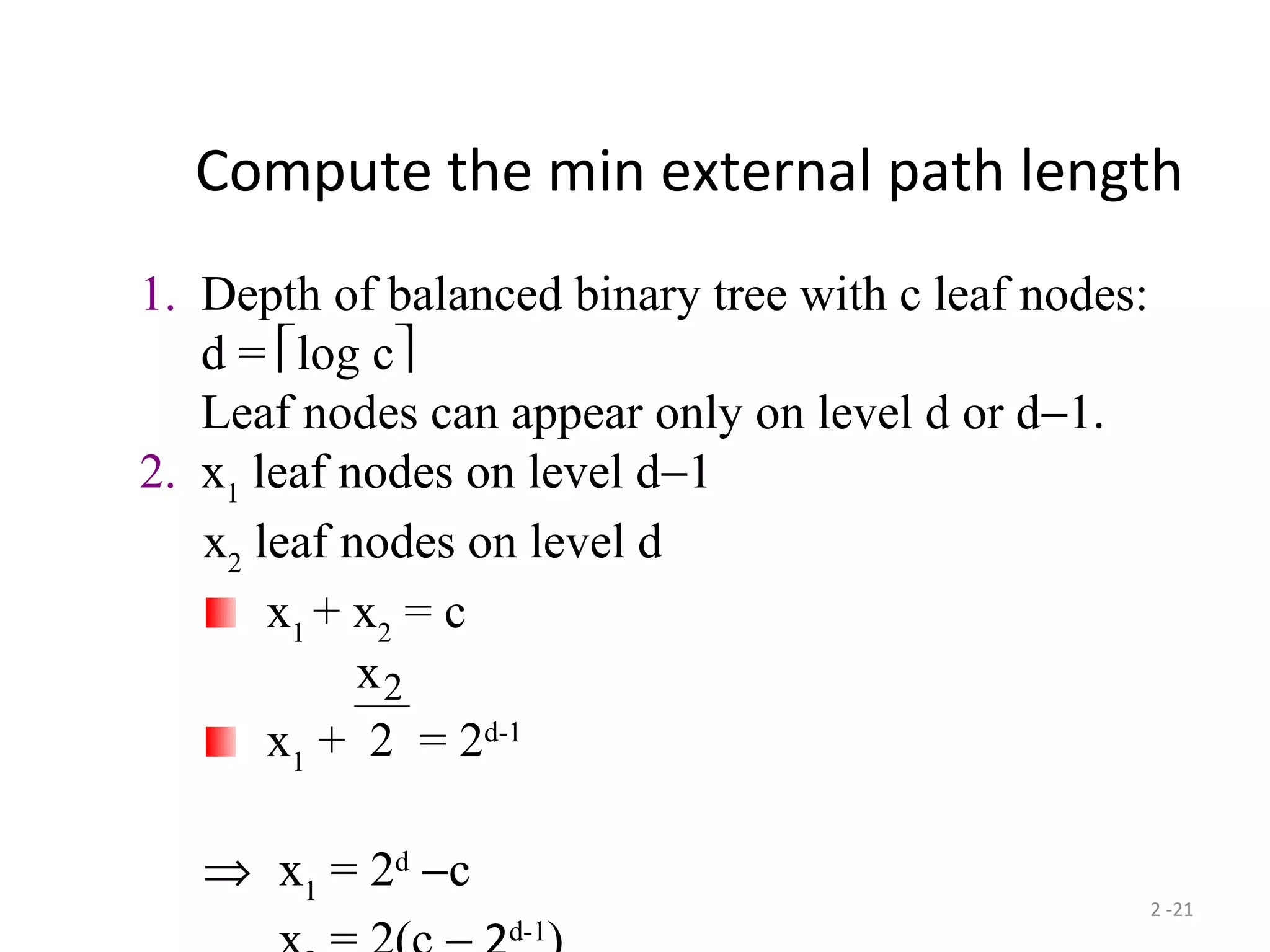
Compute the min external path length
1. Depth of balanced binary tree with c leaf nodes:
d = log c
Leaf nodes can appear only on level d or d−1.
2. x1
leaf nodes on level d−1
x2
leaf nodes on level d
x1
+ x2
= c
x1
+ = 2d-1
⇒ x1
= 2d
−c
d-1
x2
2
2 -22
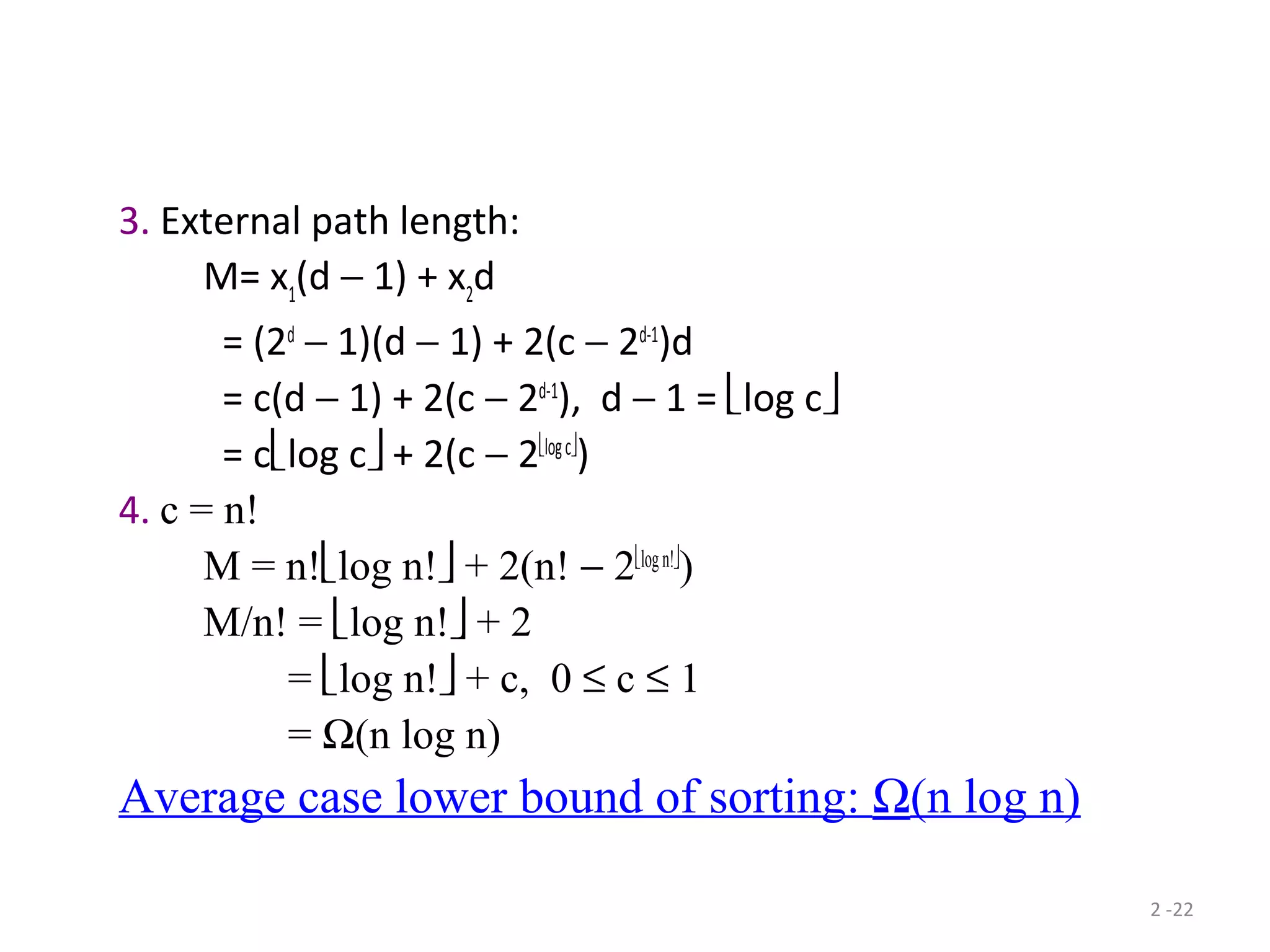
3. External path length:
M= x1
(d − 1) + x2
d
= (2d
− 1)(d − 1) + 2(c − 2d-1
)d
= c(d − 1) + 2(c − 2d-1
), d − 1 = log c
= clog c + 2(c − 2logc
)
4. c = n!
M = n!log n! + 2(n! − 2logn!
)
M/n! = log n! + 2
= log n! + c, 0 ≤ c ≤ 1
= Ω(n log n)
Average case lower bound of sorting: Ω(n log n)
2 -23
Quicksort & Heapsort
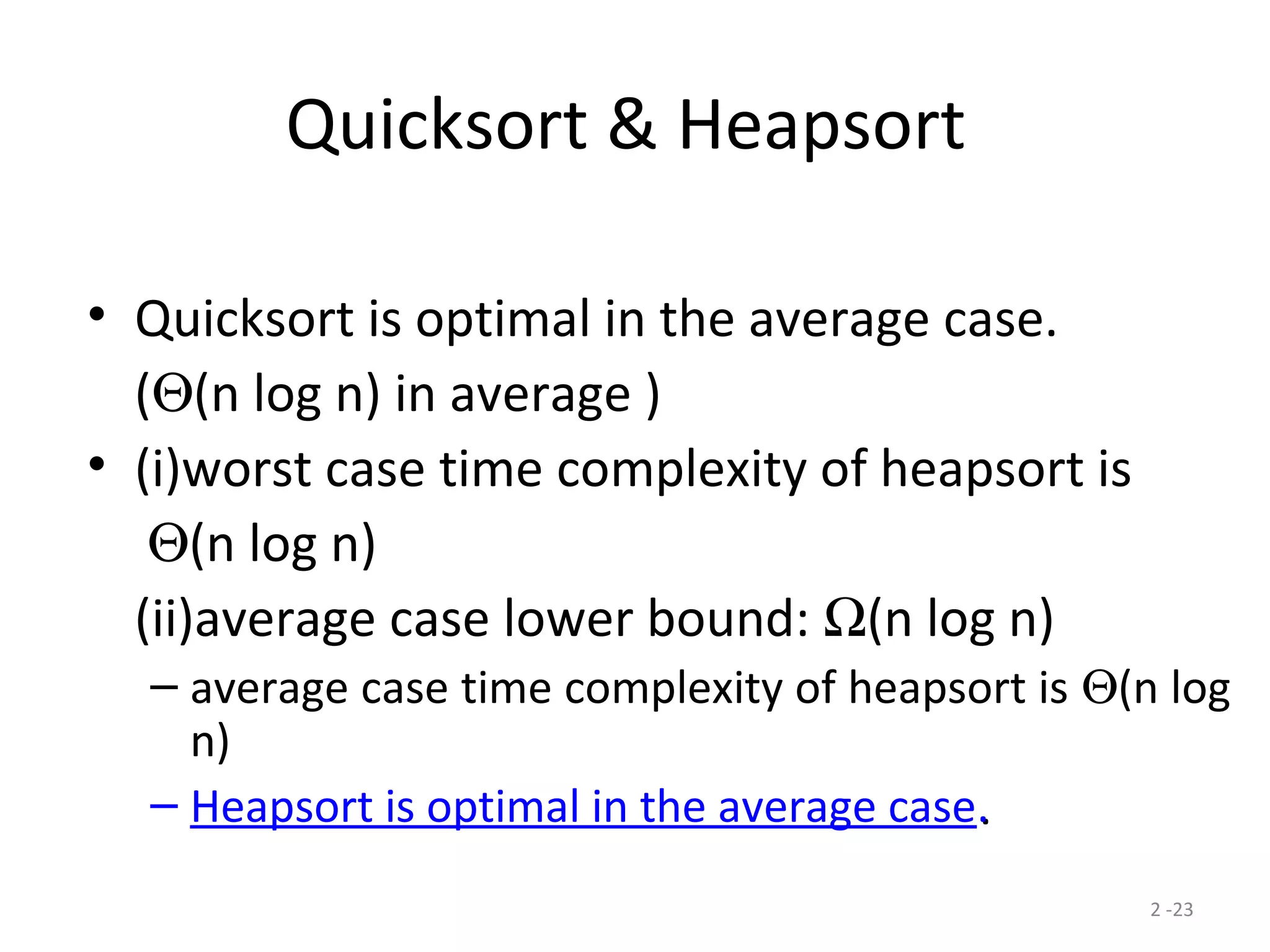
• Quicksort is optimal in the average case.
(Θ(n log n) in average )
• (i)worst case time complexity of heapsort is
Θ(n log n)
(ii)average case lower bound: Ω(n log n)
– average case time complexity of heapsort is Θ(n log
n)
– Heapsort is optimal in the average case..
2 -24
Improving a lower bound through
oracles
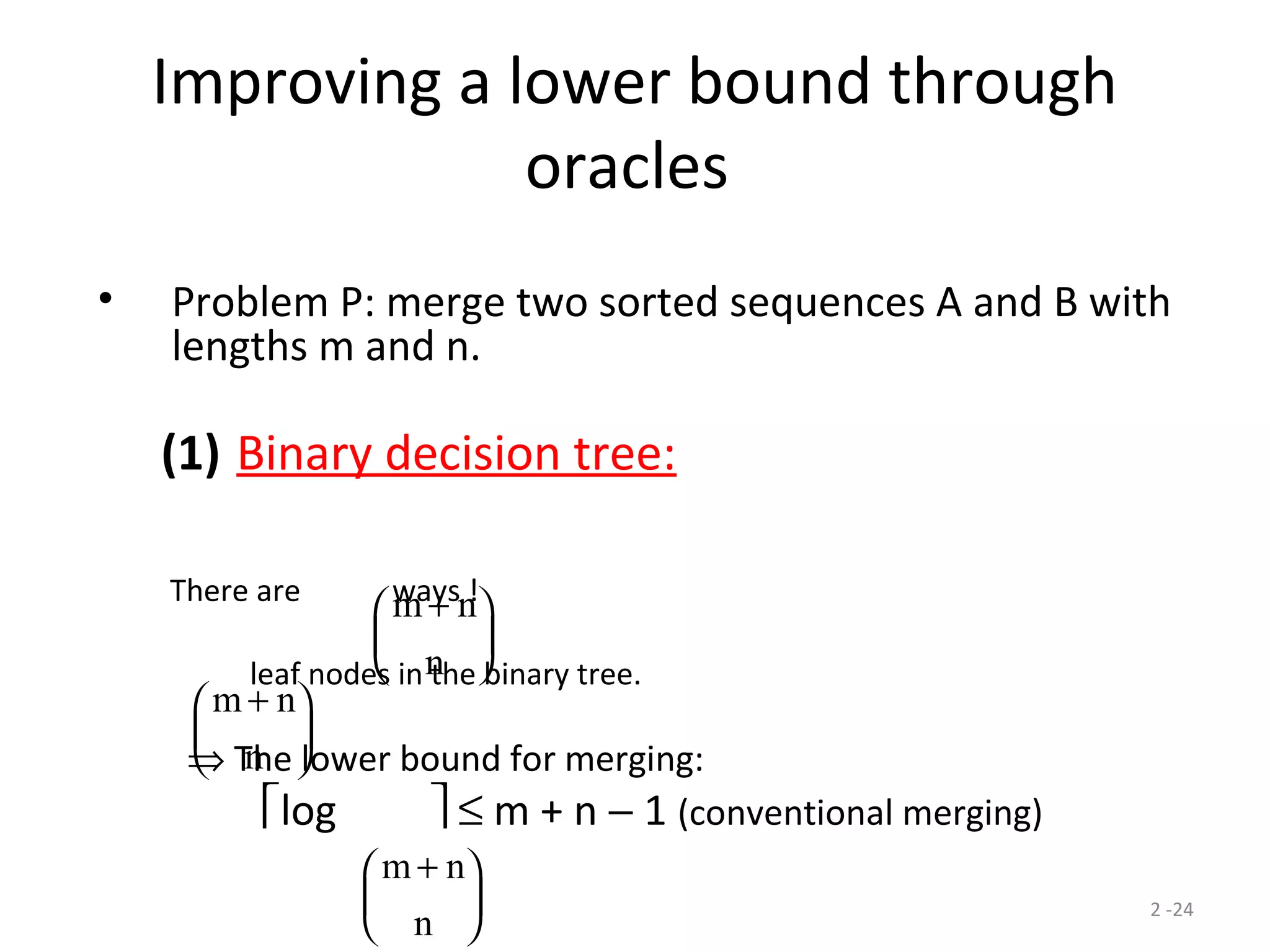
• Problem P: merge two sorted sequences A and B with
lengths m and n.
(1) Binary decision tree:
There are ways !
leaf nodes in the binary tree.
⇒ The lower bound for merging:
log  ≤ m + n − 1 (conventional merging)
m n
n
+





m n
n
+





m n
n
+





2 -25
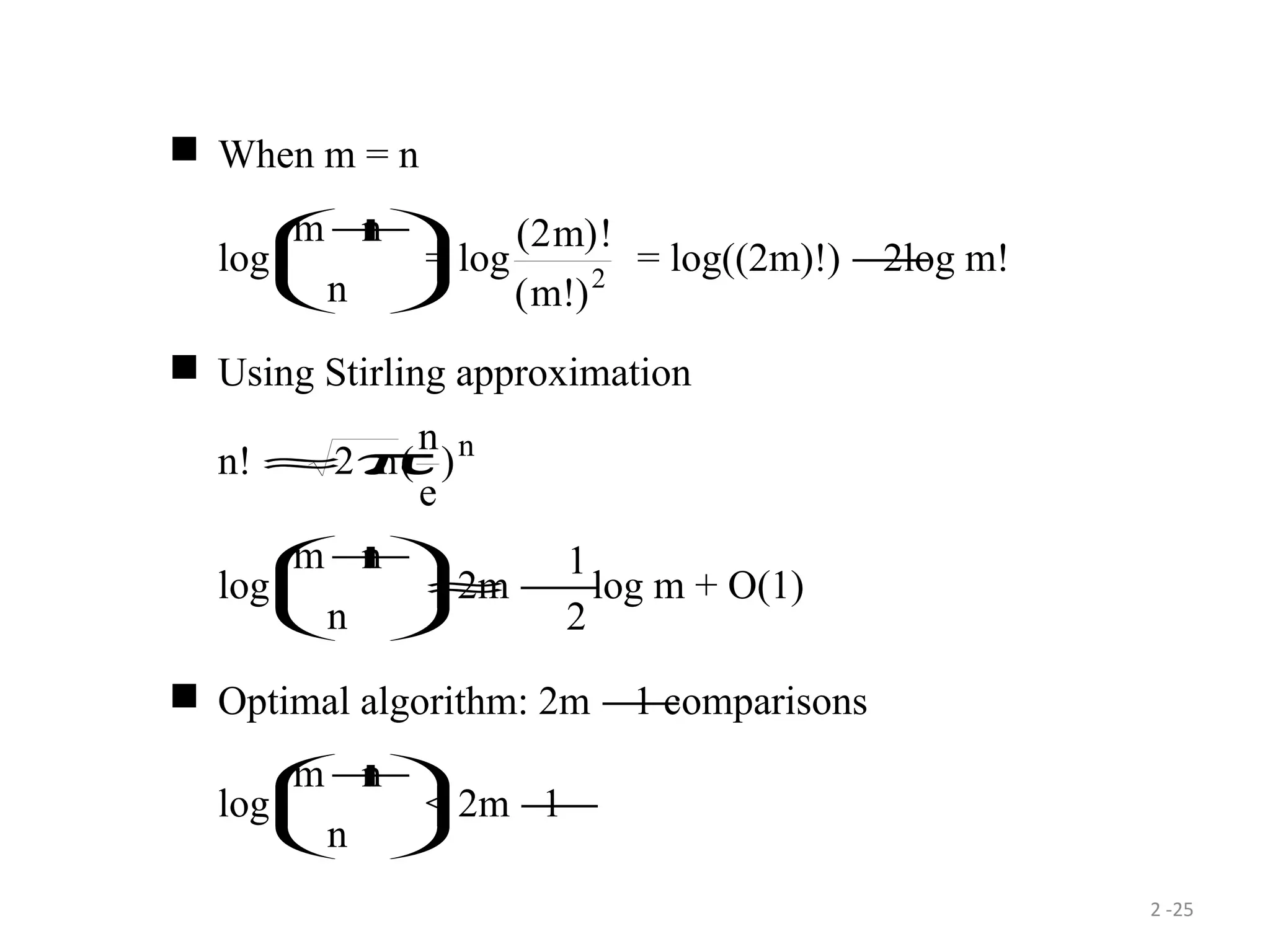
When m = n
log
m n
n
+




= log
( )!
( !)
2
2
m
m
= log((2m)!) −2log m!
Using Stirling approximation
n! ≈2πn
n
e
n
( )
log
m n
n
+




≈2m −
1
2
log m + O(1)
Optimal algorithm: 2m −1 comparisons
log
m n
n
+




< 2m −1
2 -26
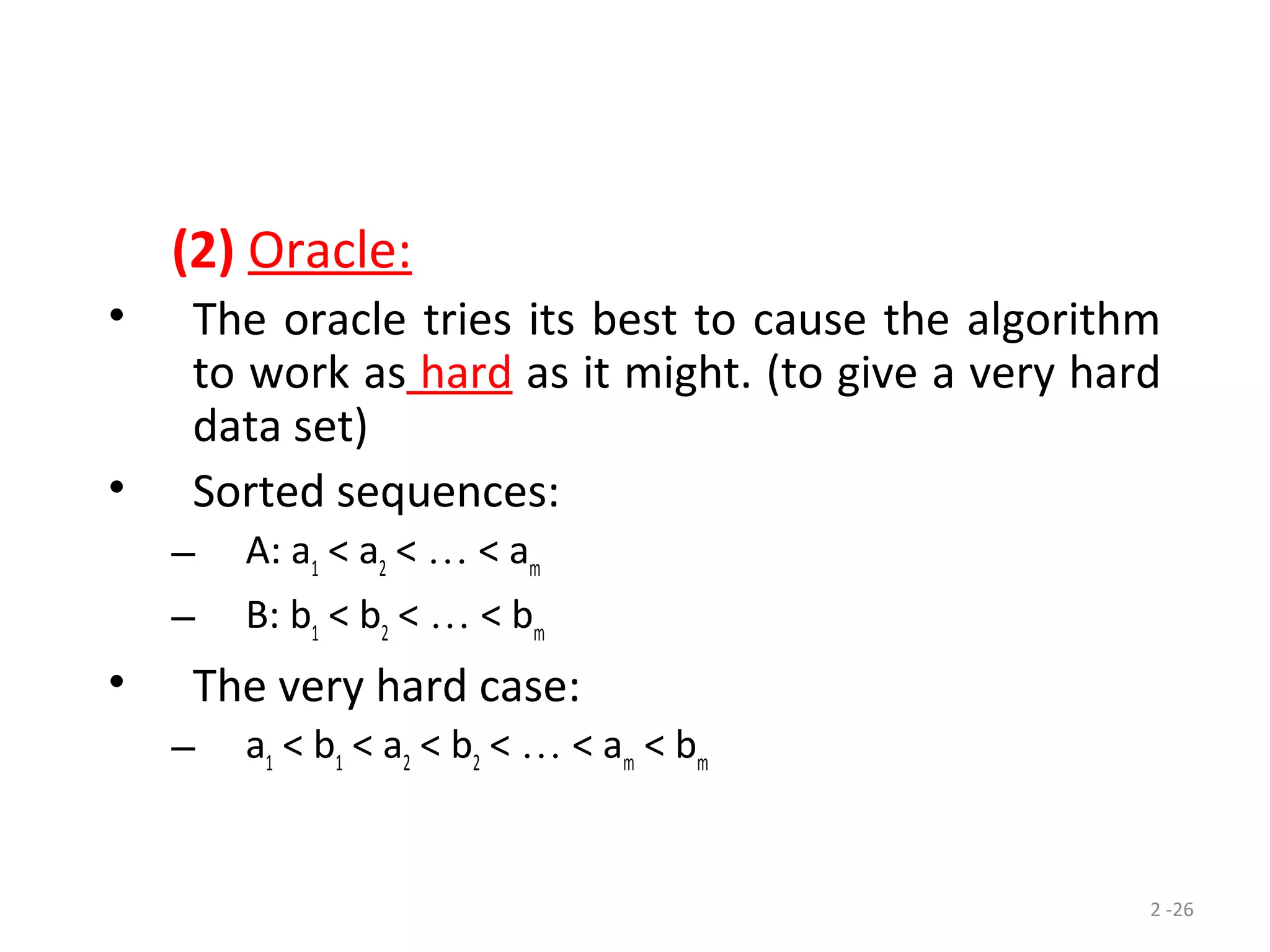
(2) Oracle:
• The oracle tries its best to cause the algorithm
to work as hard as it might. (to give a very hard
data set)
• Sorted sequences:
– A: a1
< a2
< … < am
– B: b1
< b2
< … < bm
• The very hard case:
– a1
< b1
< a2
< b2
< … < am
< bm
2 -27
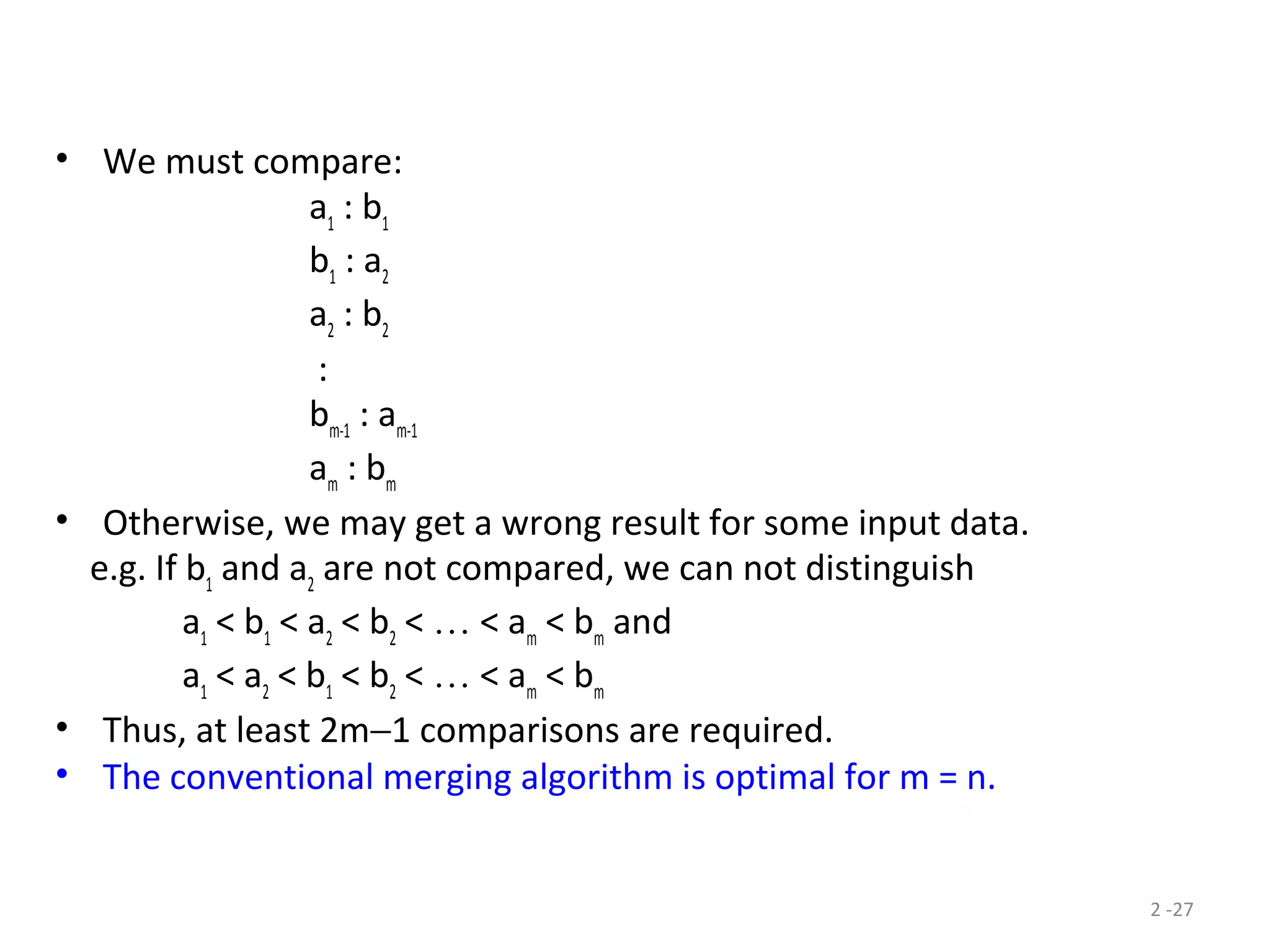
• We must compare:
a1
: b1
b1
: a2
a2
: b2
:
bm-1
: am-1
am
: bm
• Otherwise, we may get a wrong result for some input data.
e.g. If b1
and a2
are not compared, we can not distinguish
a1
< b1
< a2
< b2
< … < am
< bm
and
a1
< a2
< b1
< b2
< … < am
< bm
• Thus, at least 2m−1 comparisons are required.
• The conventional merging algorithm is optimal for m = n.
2 -28
Finding lower bound by problem
transformation
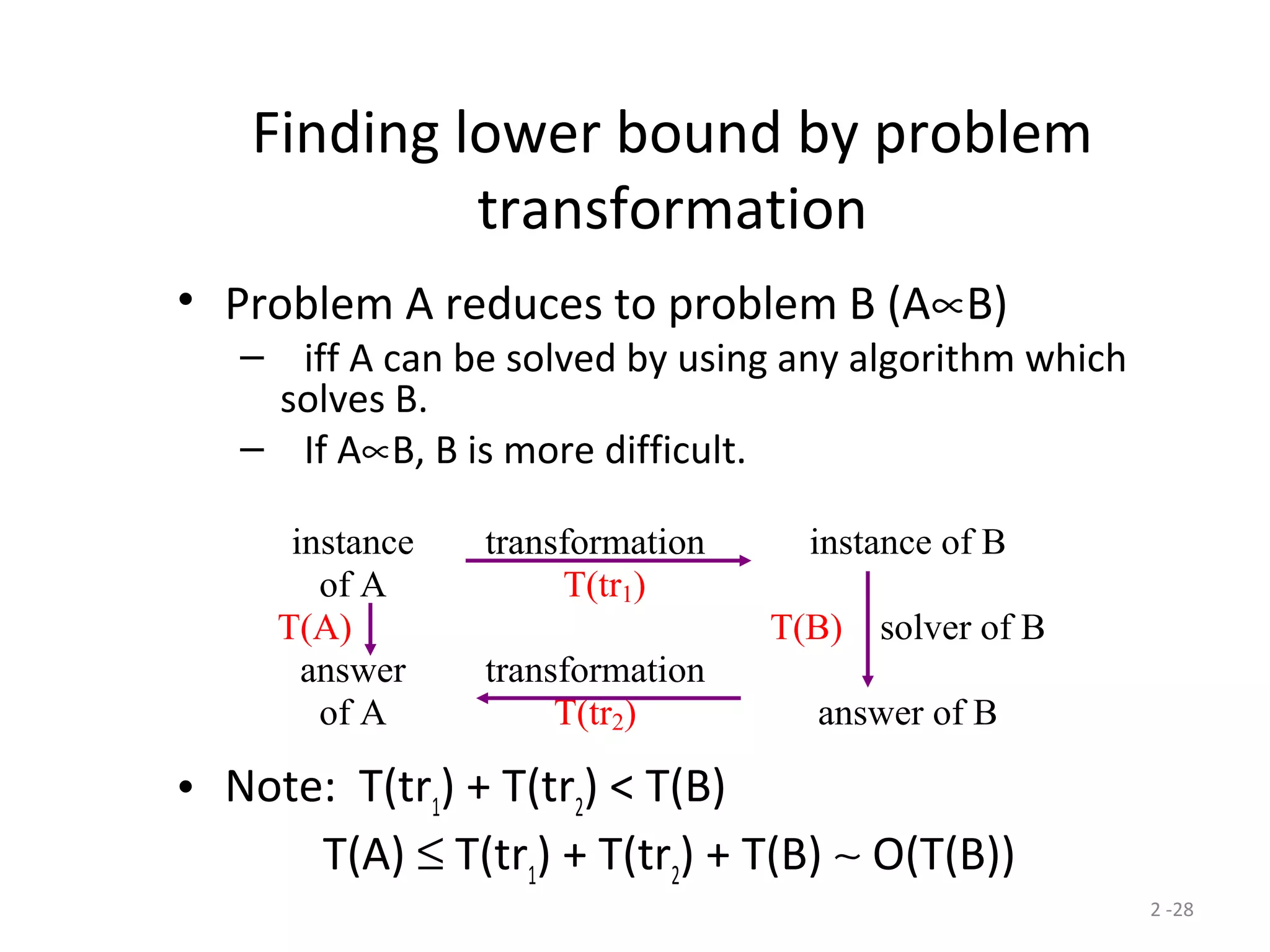
• Problem A reduces to problem B (A∝B)
– iff A can be solved by using any algorithm which
solves B.
– If A∝B, B is more difficult.
• Note: T(tr1
) + T(tr2
) < T(B)
T(A) ≤ T(tr1
) + T(tr2
) + T(B) ∼ O(T(B))
instance
of A
transformation
T(tr1)
instance of B
T(A) T(B) solver of B
answer
of A
transformation
T(tr2) answer of B
2 -29
The lower bound of the convex
hull problem
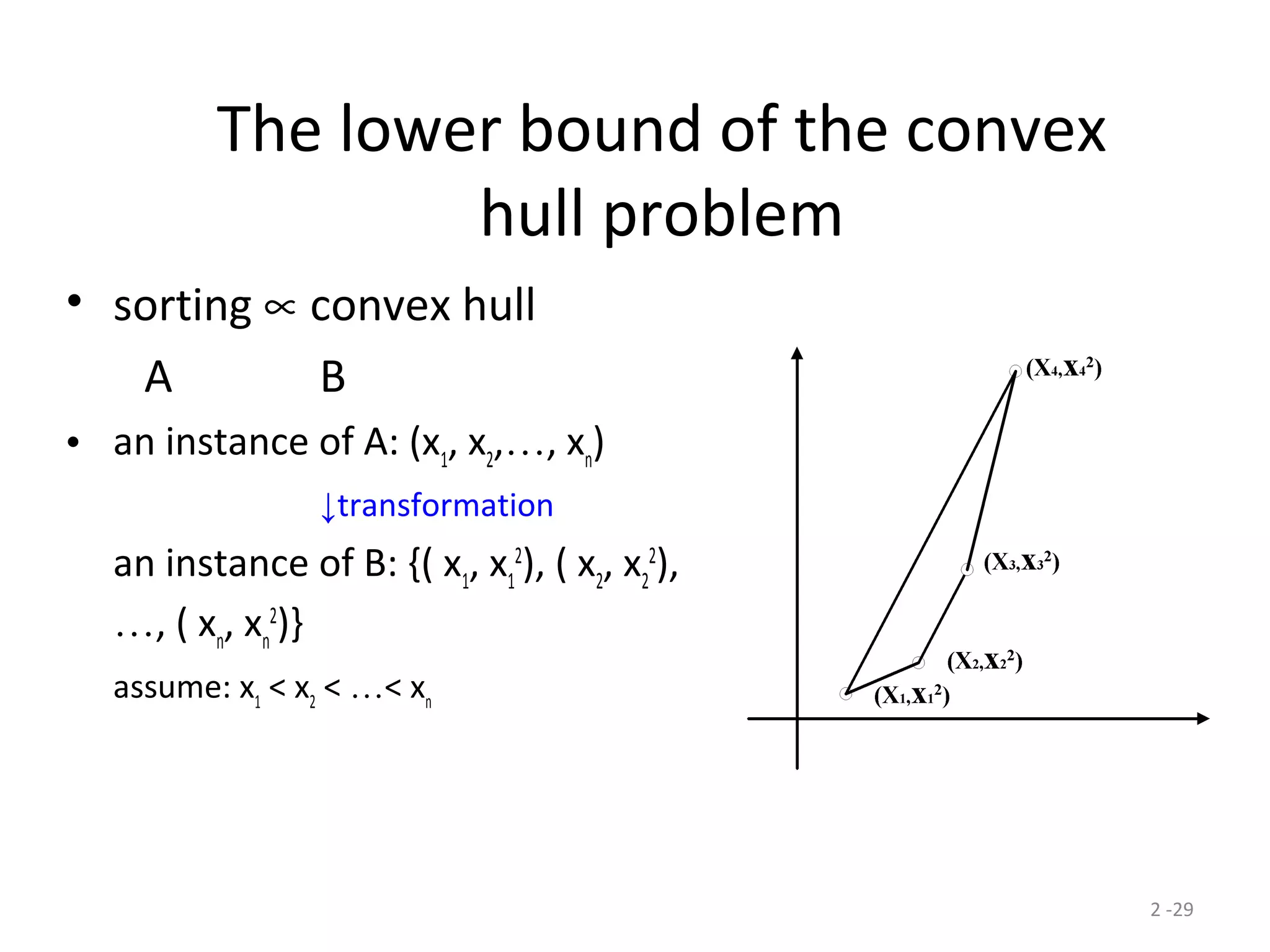
• sorting ∝ convex hull
A B
• an instance of A: (x1
, x2
,…, xn
)
↓transformation
an instance of B: {( x1
, x1
2
), ( x2
, x2
2
),
…, ( xn
, xn
2
)}
assume: x1
< x2
< …< xn
2 -30
• If the convex hull problem can be solved,
we can also solve the sorting problem.
– The lower bound of sorting: Ω(n log n)
• The lower bound of the convex hull
problem: Ω(n log n)
2 -31
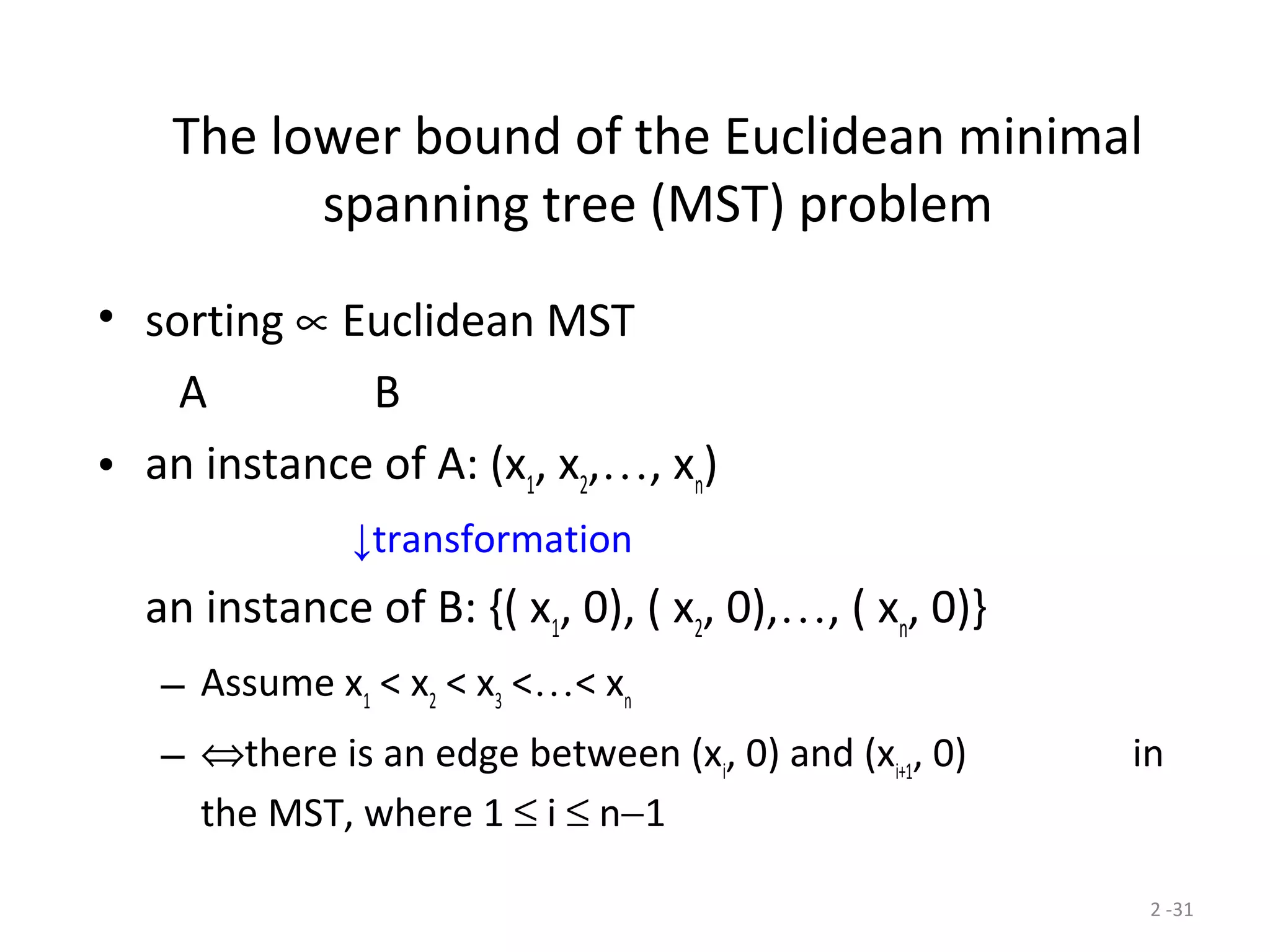
The lower bound of the Euclidean minimal
spanning tree (MST) problem
• sorting ∝ Euclidean MST
A B
• an instance of A: (x1
, x2
,…, xn
)
↓transformation
an instance of B: {( x1
, 0), ( x2
, 0),…, ( xn
, 0)}
– Assume x1
< x2
< x3
<…< xn
– ⇔there is an edge between (xi
, 0) and (xi+1
, 0) in
the MST, where 1 ≤ i ≤ n−1
2 -32
• If the Euclidean MST problem can be
solved, we can also solve the sorting
problem.
– The lower bound of sorting: Ω(n log n)
• The lower bound of the Euclidean MST
problem: Ω(n log n)

Divide and conquer surfing lower bounds

  • 1.
    Algorithms Divide And Conquer-Surfing Lower Bounds
  • 2.
    2 -2 Lower bound •Def : A lower bound of a problem is the least time complexity required for any algorithm which can be used to solve this problem. ☆ worst case lower bound ☆ average case lower bound • The lower bound for a problem is not unique. – e.g. Ω(1), Ω(n), Ω(n log n) are all lower bounds for sorting. – (Ω(1), Ω(n) are trivial)
  • 3.
    2 -3 • Atpresent, if the highest lower bound of a problem is Ω(n log n) and the time complexity of the best algorithm is O(n2 ). – We may try to find a higher lower bound. – We may try to find a better algorithm. – Both of the lower bound and the algorithm may be improved. • If the present lower bound is Ω(n log n) and there is an algorithm with time complexity O(n log n), then the algorithm is optimal..
  • 4.
    2 -4 6 permutationsfor 3 data elements a1 a2 a3 1 2 3 1 3 2 2 1 3 2 3 1 3 1 2 3 2 1 The worst case lower bound of sorting
  • 5.
    2 -5 Straight insertionsort: • input data: (2, 3, 1) (1)  a1 :a2 (2)  a2 :a3 , a2 ↔a3 (3)  a1 :a2 , a1 ↔a2 • input data: (2, 1, 3) (1)a1 :a2 , a1 ↔a2 (2)a2 :a3
  • 6.
    2 -6 Decision treefor straight insertion sort
  • 7.
    2 -7 Decision treefor bubble sort
  • 8.
    2 -8 Lower boundof sorting • To find the lower bound, we have to find the smallest depth of a binary tree. • n! distinct permutations n! leaf nodes in the binary decision tree. • balanced tree has the smallest depth: log(n!) = Ω(n log n) lower bound for sorting: Ω(n log n)
  • 9.
    2 -9 Method 1: log(n!)= log(n(n− 1)…1) = log2 + log3 +…+ log n > log xdx n 1∫ = log e ln xdx n 1∫ = log e[ ln ]x x x n − 1 = log e(n ln n − n + 1) = n log n − n log e + 1.44 ≥ n log n − 1.44n =Ω (n log n)
  • 10.
    2 -10 Method 2: •Stirling approximation: – n! ≈ – log n! ≈ log ≈ n log n ≈ Ω(n log n) 2πn n e n ( ) 2 1 2 π + +log logn n n e n n! Sn 1 1 0.922 2 2 1.919 3 6 5.825 4 24 23.447 5 120 118.02 6 720 707.39 10 3,628,800 3,598,600 20 2.433x10¹⁸ 2.423x10¹⁸ 100 9.333x10157 9.328x10157
  • 11.
  • 12.
    2 -12 Heapsort—An optimalsorting algorithm • A heap : parent ≥ son
  • 13.
    2 -13 • outputthe maximum and restore: • Heapsort: construction output
  • 14.
    2 -14 Phase 1:construction • input data: 4, 37, 26, 15, 48 • restore the subtree rooted at A(2): • restore the tree rooted at A(1):
  • 15.
  • 16.
    2 -16 Implementation • usinga linear array not a binary tree. – The sons of A(h) are A(2h) and A(2h+1). • time complexity: O(n log n)
  • 17.
    2 -17 Time complexity Phase1: construction d = log n: depth # of comparisons is at most: L d = − ∑ 0 1 2(d−L)2L =2d L d = − ∑ 0 1 2L −4 L d = − ∑ 0 1 L2L-1 ( L k = ∑ 0 L2L-1 = 2k (k−1)+1) =2d(2d −1) −4(2d-1 (d −1 −1) + 1) : = cn −2log n−4, 2 ≤c ≤4 d L d-L
  • 18.
    2 -18 Time complexity Phase2: output 2 i n = − ∑ 1 1 log i = : =2nlog n−4cn + 4, 2 ≤c ≤4 =O(n log n) log i i nodes
  • 19.
    2 -19 Average caselower bound of sorting • By binary decision tree • The average time complexity of a sorting algorithm: the external path length of the binary tree n! • The external path length is minimized if the tree is balanced. (all leaf nodes on level d or level d−1)
  • 20.
    2 -20 unbalanced external pathlength = 4⋅3 + 1 = 13 balanced external path length = 2⋅3+3⋅2 = 12 Average case lower bound of sorting
  • 21.
    2 -21 Compute themin external path length 1. Depth of balanced binary tree with c leaf nodes: d = log c Leaf nodes can appear only on level d or d−1. 2. x1 leaf nodes on level d−1 x2 leaf nodes on level d x1 + x2 = c x1 + = 2d-1 ⇒ x1 = 2d −c d-1 x2 2
  • 22.
    2 -22 3. Externalpath length: M= x1 (d − 1) + x2 d = (2d − 1)(d − 1) + 2(c − 2d-1 )d = c(d − 1) + 2(c − 2d-1 ), d − 1 = log c = clog c + 2(c − 2logc ) 4. c = n! M = n!log n! + 2(n! − 2logn! ) M/n! = log n! + 2 = log n! + c, 0 ≤ c ≤ 1 = Ω(n log n) Average case lower bound of sorting: Ω(n log n)
  • 23.
    2 -23 Quicksort &Heapsort • Quicksort is optimal in the average case. (Θ(n log n) in average ) • (i)worst case time complexity of heapsort is Θ(n log n) (ii)average case lower bound: Ω(n log n) – average case time complexity of heapsort is Θ(n log n) – Heapsort is optimal in the average case..
  • 24.
    2 -24 Improving alower bound through oracles • Problem P: merge two sorted sequences A and B with lengths m and n. (1) Binary decision tree: There are ways ! leaf nodes in the binary tree. ⇒ The lower bound for merging: log  ≤ m + n − 1 (conventional merging) m n n +      m n n +      m n n +     
  • 25.
    2 -25 When m= n log m n n +     = log ( )! ( !) 2 2 m m = log((2m)!) −2log m! Using Stirling approximation n! ≈2πn n e n ( ) log m n n +     ≈2m − 1 2 log m + O(1) Optimal algorithm: 2m −1 comparisons log m n n +     < 2m −1
  • 26.
    2 -26 (2) Oracle: •The oracle tries its best to cause the algorithm to work as hard as it might. (to give a very hard data set) • Sorted sequences: – A: a1 < a2 < … < am – B: b1 < b2 < … < bm • The very hard case: – a1 < b1 < a2 < b2 < … < am < bm
  • 27.
    2 -27 • Wemust compare: a1 : b1 b1 : a2 a2 : b2 : bm-1 : am-1 am : bm • Otherwise, we may get a wrong result for some input data. e.g. If b1 and a2 are not compared, we can not distinguish a1 < b1 < a2 < b2 < … < am < bm and a1 < a2 < b1 < b2 < … < am < bm • Thus, at least 2m−1 comparisons are required. • The conventional merging algorithm is optimal for m = n.
  • 28.
    2 -28 Finding lowerbound by problem transformation • Problem A reduces to problem B (A∝B) – iff A can be solved by using any algorithm which solves B. – If A∝B, B is more difficult. • Note: T(tr1 ) + T(tr2 ) < T(B) T(A) ≤ T(tr1 ) + T(tr2 ) + T(B) ∼ O(T(B)) instance of A transformation T(tr1) instance of B T(A) T(B) solver of B answer of A transformation T(tr2) answer of B
  • 29.
    2 -29 The lowerbound of the convex hull problem • sorting ∝ convex hull A B • an instance of A: (x1 , x2 ,…, xn ) ↓transformation an instance of B: {( x1 , x1 2 ), ( x2 , x2 2 ), …, ( xn , xn 2 )} assume: x1 < x2 < …< xn
  • 30.
    2 -30 • Ifthe convex hull problem can be solved, we can also solve the sorting problem. – The lower bound of sorting: Ω(n log n) • The lower bound of the convex hull problem: Ω(n log n)
  • 31.
    2 -31 The lowerbound of the Euclidean minimal spanning tree (MST) problem • sorting ∝ Euclidean MST A B • an instance of A: (x1 , x2 ,…, xn ) ↓transformation an instance of B: {( x1 , 0), ( x2 , 0),…, ( xn , 0)} – Assume x1 < x2 < x3 <…< xn – ⇔there is an edge between (xi , 0) and (xi+1 , 0) in the MST, where 1 ≤ i ≤ n−1
  • 32.
    2 -32 • Ifthe Euclidean MST problem can be solved, we can also solve the sorting problem. – The lower bound of sorting: Ω(n log n) • The lower bound of the Euclidean MST problem: Ω(n log n)