INTERNATIONAL PAYMENTS -
Driving the Evolution of BizTech Banks
Table of Contents
Introduction 03
Payment Globalization 04
Transformation of Banks to BizTech Banks 05
Shared Services-Based Payment Architecture 06
Disruptions in the Space of Global Payments 07
Role of technology solutions providers in the
transformation of Global Payments 08
Introduction
In the world of interconnected networks, long value chains, multi-geo locations, outsourcing, and third-party
partnerships, payment processes can play a crucial role in driving success.Also, the mode of making payments has
changed so rapidly that it is hard for businesses to keep their finger on the pulse.Technology is driving many Point of
Sale (POS) experiences – from the card and contactless to mobile and eCommerce.With smart devices and apps
dominating the digital era, businesses now rely heavily on these methods to operate their routine transactions for
several stakeholders.These key stakeholders can include buyers/customers, banks/Fintechs, payment processors, and
suppliers.
Business transactions often require a range of terms like GMEI codes and reference numbers for proper recording
and management of payments. Furthermore, regulatory standards and compliance needs also add several more
keywords across the value chain. More often than expected, businesses strive to keep a tab on all such terms and
record transactions in the right format and code.
The payment complexity further increases manifold at the verification stage. Businesses face complex processes to
secure money transfer and evade chances of money laundering or fraudulent transactions. In this stage, many
stakeholders are involved in meeting the customer expectations of fast, assured, and secured payments. Moreover,
these customer expectations keep on changing based on new technologies and new ways
of doing business.And that’s the reason, every stakeholder participating in
payments has an innovative role to play to make sure that the end
customer is satisfied.
This paper focuses on the complexities of International
Payments and how businesses can optimally address them.
© 2020 HARMAN International | services.harman.com 3
Payment Globalization
International Payments have long served as the engine enabling
cross-border trade and investment.They have been instrumental in
the emergence of today’s global economy. But with more
cross-border transactions than ever before, international payment
facilitation is now transforming from an ancillary service to a critical
service for customers. And while most businesses enable such
transactions with traditional business models of imports and
exports – it has several drawbacks when it comes to the demands
of the modern-age customer. Fortunately, emerging technologies can
now allow remote services and global infrastructure facilitations for
sophisticated payment options on a global scale. It is therefore
advisable to enable International Payments, or rather any payment at
all, with the new payment tenets in mind.
It is time to change from Bank to Tech-Bank.
Seller/Buyer New Payment tenets
⚫ I should be able to sell across the globe with ease of payment
facilitations for my buyer
⚫ I should be able to buy services from global sources and pay them
as per agreed terms
⚫ The bank manages my finances. So, the bank should provide all
possible means of making or receiving payments
⚫ I need to make my payments instantly. If there is any processing time
involved, then I need the status of payment processes at any given
point of time
⚫ I don’t want to follow critical physical documentation processing or
any operational processes
⚫ Banks should be able to help me to integrate payment facilitation
(sending/receiving) to my systems
⚫ I should not be charged heavily for my international transactions.
Also, the transaction should be transparent
⚫ I am expecting banks/payment facilitators to guide me for the “right”
time of payments to get benefits of currency rate fluctuations
⚫ Banks should add value by providing me proactive guidance, if any,
for my payments (receiving/paying.) It should include insights on
breach of any payment regulations
⚫ eCommerce facilitation, single umbrella
payments, aggregation services
⚫ Insights-driven account payables management to
get benefits of credit period and currency rates
⚫ Guidance about using cards, wire transfer, virtual
account payments, and blockchain
⚫ Payment tracking
⚫ Paperless payment process
⚫ Seamless payment API, IoT-based payment
initiation
⚫ Value-based flexible pricing
⚫ Advantage analytics
⚫ Compliance
© 2020 HARMAN International | services.harman.com 4
Transformation of Banks to BizTech Banks
As banks gradually integrate technology into their systems and transform into BizTech banks, the trusted and tested banking
approach encounters challenges from emerging alternative solutions. Big banks mostly rely on in-house infrastructure and have
investment muscles to stay ahead in the game by adopting new technologies. Small and mid-size banks rely on banking platform
providers to stay competitive.And both of these classes are feeling the pressure as new players upend the industry’s fundamentals.
Reasons to speed up the transformation process are many - from shifting regulatory and sanctions frameworks to accelerating
international commerce to the introduction of new payment techs like cards and network innovations, and most importantly,
changing customer demands. Now is the right time for banks to look into their current facilitation and move towards futuristic
architecture by using the following principles.
Many players have already started the transformation
process.Visa has taken a step towards BizTech by
providingVisa direct APIs to simplify processes. Banks can
take advantage of this and move beyond just doing
“finance as a business” to open new revenue streams by
providing “financial technology services as a business.”
This approach will allow them to work closely with their
customers by playing the role of “Business Growth
Enabler” rather than a “Facilitator.” Banks will become
BizTech banks.
© 2020 HARMAN International | services.harman.com 5
Customer Facing
Right time, right way, and at right price
payment services
Inward facing
Payment Hub for standard processes
Universal file upload
Payment HUB APIs - Pluggable internal APIs
for wiring surrounding apps with Payment hub
Expose common payment APIs
Payment HUB APIs – Pluggable external (back
gate) APIs to remain flexible for integrating
payment processing facilitators
Customer Biz Payment Offerings
Channels
Payment Products
Outbound
Payments
Processing
Core Payments Services
PSP
Integrations
Existing/
Legacy
Payment
Platforms
Inward
Integration
APIs
⚫ Acquisition
⚫ Processing
⚫ Settlement
⚫ Orders Processing
⚫ Exceptions
⚫ Routing
Fintech
APIs
Customer
Tech Value
Offerings
Inbound
Payments
Processing
New Payment
Services
Cross Functionalities
Country Variants
Evolving Payment Services Compliance and
from Partners LikeVPA, Regulatory
Blockchain Services
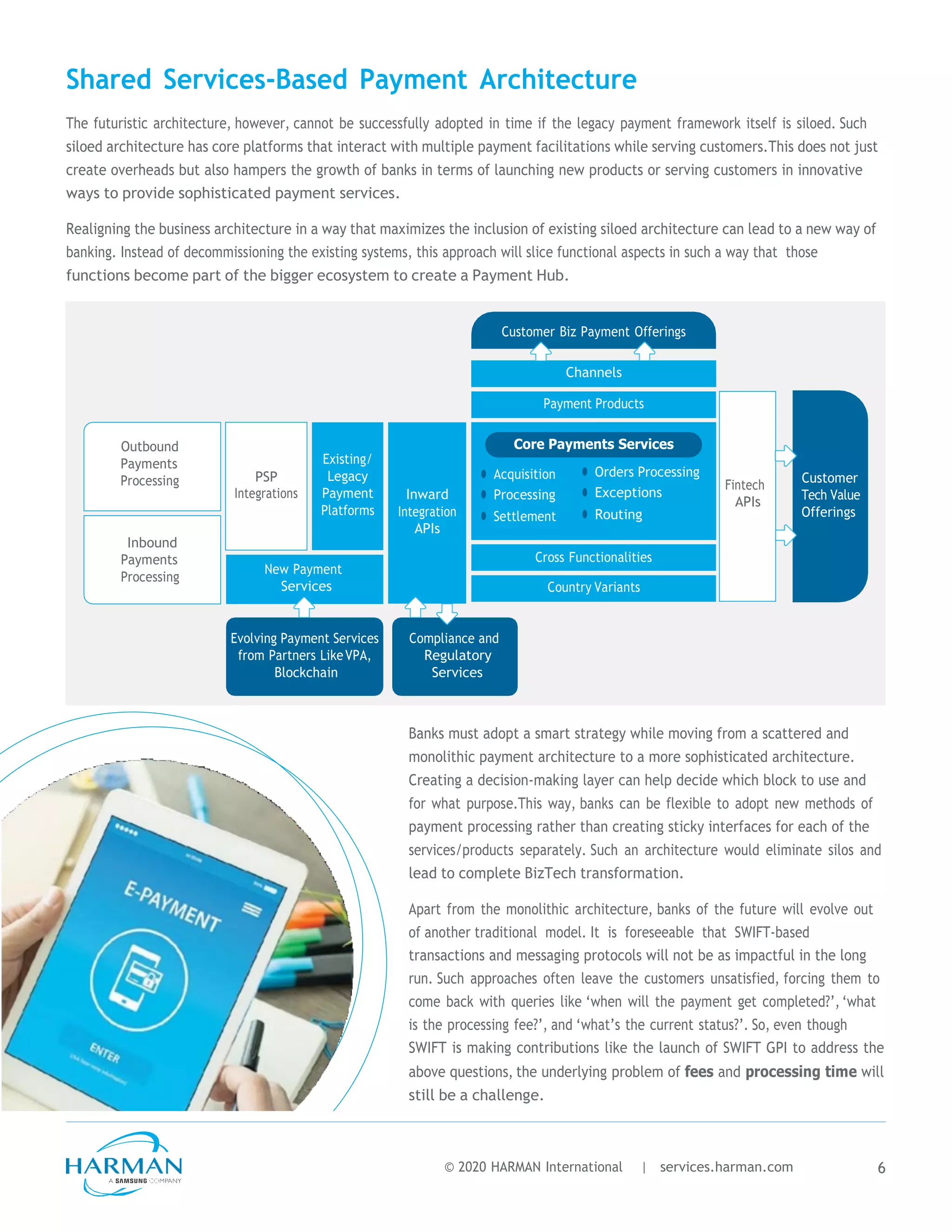
Shared Services-Based Payment Architecture
The futuristic architecture, however, cannot be successfully adopted in time if the legacy payment framework itself is siloed. Such
siloed architecture has core platforms that interact with multiple payment facilitations while serving customers.This does not just
create overheads but also hampers the growth of banks in terms of launching new products or serving customers in innovative
ways to provide sophisticated payment services.
Realigning the business architecture in a way that maximizes the inclusion of existing siloed architecture can lead to a new way of
banking. Instead of decommissioning the existing systems, this approach will slice functional aspects in such a way that those
functions become part of the bigger ecosystem to create a Payment Hub.
Banks must adopt a smart strategy while moving from a scattered and
monolithic payment architecture to a more sophisticated architecture.
Creating a decision-making layer can help decide which block to use and
for what purpose.This way, banks can be flexible to adopt new methods of
payment processing rather than creating sticky interfaces for each of the
services/products separately. Such an architecture would eliminate silos and
lead to complete BizTech transformation.
Apart from the monolithic architecture, banks of the future will evolve out
of another traditional model. It is foreseeable that SWIFT-based
transactions and messaging protocols will not be as impactful in the long
run. Such approaches often leave the customers unsatisfied, forcing them to
come back with queries like ‘when will the payment get completed?’,‘what
is the processing fee?’, and ‘what’s the current status?’. So, even though
SWIFT is making contributions like the launch of SWIFT GPI to address the
above questions, the underlying problem of fees and processing time will
still be a challenge.
© 2020 HARMAN International | services.harman.com 6
Disruptions in the Space of Global Payments
Tonnes of new, innovative solutions have arisen in the past few years.While technology nudges banks to transform their operating
models - one solution stands out from the crowd. Blockchain, or Distributed Ledger Technology (DLT), is poised to be a
gamechanger in the banking industry. So much so, Ripple and Veem have already launched cost-effective and fast solutions by using
bitcoin as a central handshake currency to make cross-border payments. If the source of payments (payer) and receiver of
payment (seller) ensure regulatory compliance, blockchain will be a great advantage.
Role of technology solutions providers in the transformation
of Global Payments
Who can help Banks to become BizTech Banks?
Many Payment Service Providers (PSPs) and FinTechs are already working in their domains
to make BizTech a reality. However, banks cannot just rely on these two players to
transform banking payment architecture into a next-gen model. It’s advisable to work with
the bank’s own IT team or IT service companies.These teams work closely with banks to
manage IT services and have the best understanding of requirements, deliverables, and vision
to execute strategies realistically.
How HARMAN can help transform banks to BizTech banks
HARMAN works with many financial institutes, helping them move from business banks to become
BizTech banks. HARMAN’s banking business unit is continuously investing in research for simplifying the
current scattered architecture of banks to more orchestrated architecture.Additionally, in collaboration
with Samsung, HARMAN offers a blockchain platform “Nextledger” to enable banks to take advantage
of the public blockchain to streamline many multi-hop processes in banks, including payments.
The way forward in payments technology
With the increasing pressure from all governments to reduce the payment expenses for
customers while delivering effective services, the only way for banks to drive payment revenue
is by creating a robust technology architecture.The flexible payment hub-based architecture of
BizTech can enable banks to offer omnichannel services cost-effectively and efficiently.
© 2020 HARMAN International | services.harman.com 7
ABOUT HARMAN
HARMAN (services.harman.com) designs and engineers
connected products and solutions for automakers, consum-
ers, and enterprises worldwide, including connected car
systems, audio and visual products, enterprise automation
solutions; and services supporting the Internet of Things.With
leading brands including AKG®, HARMAN Kardon®,
Infinity®, JBL®, Lexicon®, Mark Levinson® and Revel®.
HARMAN is admired by audiophiles, musicians and the
entertainment venues where they perform around the world.
More than 50 million automobiles on the road today are
equipped with HARMAN audio and connected car systems.
Our software services power billions of mobile devices and
systems that are connected, integrated and secure across all
platforms, from work and home to car and mobile. HARMAN
has a workforce of approximately 30,000 people across the
Americas, Europe, and Asia. In 2017, HARMAN became a
wholly-owned subsidiary of Samsung Electronics Co., Ltd.
© 2020 HARMAN International Industries, Incorporated.All
rights reserved. HARMAN Kardon, Infinity, JBL, Lexicon and
Mark Levinson are trademarks of HARMAN International
Industries, Incorporated, registered in the United States
and/or other countries. AKG is a trademark of AKG
Acoustics GmbH, registered in the United States and/ or
other countries. Features, specifications and appearance are
subject to change without notice.
CORPORATE HEADQUARTERS
HARMAN International
400 Atlantic Street
Stamford, CT 06901, USA
Email: askcs@harman.com
Reach us on

Harman_International_Payments_Whitepaper.pdf

  • 1.
    INTERNATIONAL PAYMENTS - Drivingthe Evolution of BizTech Banks
  • 2.
    Table of Contents Introduction03 Payment Globalization 04 Transformation of Banks to BizTech Banks 05 Shared Services-Based Payment Architecture 06 Disruptions in the Space of Global Payments 07 Role of technology solutions providers in the transformation of Global Payments 08
  • 3.
    Introduction In the worldof interconnected networks, long value chains, multi-geo locations, outsourcing, and third-party partnerships, payment processes can play a crucial role in driving success.Also, the mode of making payments has changed so rapidly that it is hard for businesses to keep their finger on the pulse.Technology is driving many Point of Sale (POS) experiences – from the card and contactless to mobile and eCommerce.With smart devices and apps dominating the digital era, businesses now rely heavily on these methods to operate their routine transactions for several stakeholders.These key stakeholders can include buyers/customers, banks/Fintechs, payment processors, and suppliers. Business transactions often require a range of terms like GMEI codes and reference numbers for proper recording and management of payments. Furthermore, regulatory standards and compliance needs also add several more keywords across the value chain. More often than expected, businesses strive to keep a tab on all such terms and record transactions in the right format and code. The payment complexity further increases manifold at the verification stage. Businesses face complex processes to secure money transfer and evade chances of money laundering or fraudulent transactions. In this stage, many stakeholders are involved in meeting the customer expectations of fast, assured, and secured payments. Moreover, these customer expectations keep on changing based on new technologies and new ways of doing business.And that’s the reason, every stakeholder participating in payments has an innovative role to play to make sure that the end customer is satisfied. This paper focuses on the complexities of International Payments and how businesses can optimally address them. © 2020 HARMAN International | services.harman.com 3
  • 4.
    Payment Globalization International Paymentshave long served as the engine enabling cross-border trade and investment.They have been instrumental in the emergence of today’s global economy. But with more cross-border transactions than ever before, international payment facilitation is now transforming from an ancillary service to a critical service for customers. And while most businesses enable such transactions with traditional business models of imports and exports – it has several drawbacks when it comes to the demands of the modern-age customer. Fortunately, emerging technologies can now allow remote services and global infrastructure facilitations for sophisticated payment options on a global scale. It is therefore advisable to enable International Payments, or rather any payment at all, with the new payment tenets in mind. It is time to change from Bank to Tech-Bank. Seller/Buyer New Payment tenets ⚫ I should be able to sell across the globe with ease of payment facilitations for my buyer ⚫ I should be able to buy services from global sources and pay them as per agreed terms ⚫ The bank manages my finances. So, the bank should provide all possible means of making or receiving payments ⚫ I need to make my payments instantly. If there is any processing time involved, then I need the status of payment processes at any given point of time ⚫ I don’t want to follow critical physical documentation processing or any operational processes ⚫ Banks should be able to help me to integrate payment facilitation (sending/receiving) to my systems ⚫ I should not be charged heavily for my international transactions. Also, the transaction should be transparent ⚫ I am expecting banks/payment facilitators to guide me for the “right” time of payments to get benefits of currency rate fluctuations ⚫ Banks should add value by providing me proactive guidance, if any, for my payments (receiving/paying.) It should include insights on breach of any payment regulations ⚫ eCommerce facilitation, single umbrella payments, aggregation services ⚫ Insights-driven account payables management to get benefits of credit period and currency rates ⚫ Guidance about using cards, wire transfer, virtual account payments, and blockchain ⚫ Payment tracking ⚫ Paperless payment process ⚫ Seamless payment API, IoT-based payment initiation ⚫ Value-based flexible pricing ⚫ Advantage analytics ⚫ Compliance © 2020 HARMAN International | services.harman.com 4
  • 5.
    Transformation of Banksto BizTech Banks As banks gradually integrate technology into their systems and transform into BizTech banks, the trusted and tested banking approach encounters challenges from emerging alternative solutions. Big banks mostly rely on in-house infrastructure and have investment muscles to stay ahead in the game by adopting new technologies. Small and mid-size banks rely on banking platform providers to stay competitive.And both of these classes are feeling the pressure as new players upend the industry’s fundamentals. Reasons to speed up the transformation process are many - from shifting regulatory and sanctions frameworks to accelerating international commerce to the introduction of new payment techs like cards and network innovations, and most importantly, changing customer demands. Now is the right time for banks to look into their current facilitation and move towards futuristic architecture by using the following principles. Many players have already started the transformation process.Visa has taken a step towards BizTech by providingVisa direct APIs to simplify processes. Banks can take advantage of this and move beyond just doing “finance as a business” to open new revenue streams by providing “financial technology services as a business.” This approach will allow them to work closely with their customers by playing the role of “Business Growth Enabler” rather than a “Facilitator.” Banks will become BizTech banks. © 2020 HARMAN International | services.harman.com 5 Customer Facing Right time, right way, and at right price payment services Inward facing Payment Hub for standard processes Universal file upload Payment HUB APIs - Pluggable internal APIs for wiring surrounding apps with Payment hub Expose common payment APIs Payment HUB APIs – Pluggable external (back gate) APIs to remain flexible for integrating payment processing facilitators
  • 6.
    Customer Biz PaymentOfferings Channels Payment Products Outbound Payments Processing Core Payments Services PSP Integrations Existing/ Legacy Payment Platforms Inward Integration APIs ⚫ Acquisition ⚫ Processing ⚫ Settlement ⚫ Orders Processing ⚫ Exceptions ⚫ Routing Fintech APIs Customer Tech Value Offerings Inbound Payments Processing New Payment Services Cross Functionalities Country Variants Evolving Payment Services Compliance and from Partners LikeVPA, Regulatory Blockchain Services Shared Services-Based Payment Architecture The futuristic architecture, however, cannot be successfully adopted in time if the legacy payment framework itself is siloed. Such siloed architecture has core platforms that interact with multiple payment facilitations while serving customers.This does not just create overheads but also hampers the growth of banks in terms of launching new products or serving customers in innovative ways to provide sophisticated payment services. Realigning the business architecture in a way that maximizes the inclusion of existing siloed architecture can lead to a new way of banking. Instead of decommissioning the existing systems, this approach will slice functional aspects in such a way that those functions become part of the bigger ecosystem to create a Payment Hub. Banks must adopt a smart strategy while moving from a scattered and monolithic payment architecture to a more sophisticated architecture. Creating a decision-making layer can help decide which block to use and for what purpose.This way, banks can be flexible to adopt new methods of payment processing rather than creating sticky interfaces for each of the services/products separately. Such an architecture would eliminate silos and lead to complete BizTech transformation. Apart from the monolithic architecture, banks of the future will evolve out of another traditional model. It is foreseeable that SWIFT-based transactions and messaging protocols will not be as impactful in the long run. Such approaches often leave the customers unsatisfied, forcing them to come back with queries like ‘when will the payment get completed?’,‘what is the processing fee?’, and ‘what’s the current status?’. So, even though SWIFT is making contributions like the launch of SWIFT GPI to address the above questions, the underlying problem of fees and processing time will still be a challenge. © 2020 HARMAN International | services.harman.com 6
  • 7.
    Disruptions in theSpace of Global Payments Tonnes of new, innovative solutions have arisen in the past few years.While technology nudges banks to transform their operating models - one solution stands out from the crowd. Blockchain, or Distributed Ledger Technology (DLT), is poised to be a gamechanger in the banking industry. So much so, Ripple and Veem have already launched cost-effective and fast solutions by using bitcoin as a central handshake currency to make cross-border payments. If the source of payments (payer) and receiver of payment (seller) ensure regulatory compliance, blockchain will be a great advantage. Role of technology solutions providers in the transformation of Global Payments Who can help Banks to become BizTech Banks? Many Payment Service Providers (PSPs) and FinTechs are already working in their domains to make BizTech a reality. However, banks cannot just rely on these two players to transform banking payment architecture into a next-gen model. It’s advisable to work with the bank’s own IT team or IT service companies.These teams work closely with banks to manage IT services and have the best understanding of requirements, deliverables, and vision to execute strategies realistically. How HARMAN can help transform banks to BizTech banks HARMAN works with many financial institutes, helping them move from business banks to become BizTech banks. HARMAN’s banking business unit is continuously investing in research for simplifying the current scattered architecture of banks to more orchestrated architecture.Additionally, in collaboration with Samsung, HARMAN offers a blockchain platform “Nextledger” to enable banks to take advantage of the public blockchain to streamline many multi-hop processes in banks, including payments. The way forward in payments technology With the increasing pressure from all governments to reduce the payment expenses for customers while delivering effective services, the only way for banks to drive payment revenue is by creating a robust technology architecture.The flexible payment hub-based architecture of BizTech can enable banks to offer omnichannel services cost-effectively and efficiently. © 2020 HARMAN International | services.harman.com 7
  • 8.
    ABOUT HARMAN HARMAN (services.harman.com)designs and engineers connected products and solutions for automakers, consum- ers, and enterprises worldwide, including connected car systems, audio and visual products, enterprise automation solutions; and services supporting the Internet of Things.With leading brands including AKG®, HARMAN Kardon®, Infinity®, JBL®, Lexicon®, Mark Levinson® and Revel®. HARMAN is admired by audiophiles, musicians and the entertainment venues where they perform around the world. More than 50 million automobiles on the road today are equipped with HARMAN audio and connected car systems. Our software services power billions of mobile devices and systems that are connected, integrated and secure across all platforms, from work and home to car and mobile. HARMAN has a workforce of approximately 30,000 people across the Americas, Europe, and Asia. In 2017, HARMAN became a wholly-owned subsidiary of Samsung Electronics Co., Ltd. © 2020 HARMAN International Industries, Incorporated.All rights reserved. HARMAN Kardon, Infinity, JBL, Lexicon and Mark Levinson are trademarks of HARMAN International Industries, Incorporated, registered in the United States and/or other countries. AKG is a trademark of AKG Acoustics GmbH, registered in the United States and/ or other countries. Features, specifications and appearance are subject to change without notice. CORPORATE HEADQUARTERS HARMAN International 400 Atlantic Street Stamford, CT 06901, USA Email: askcs@harman.com Reach us on