happy Morning
LIVE THE BEST
Welcome
Presentation of Industrial Trainning
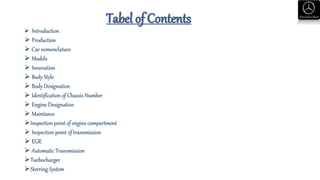
Tabel of Contents
 Introduction
 Production
 Car nomenclature
 Models
 Innovation
 Body Style
 Body Designation
 Identification of Chassis Number
 Engine Designation
 Maintance
Inspection point of engine compartment
 Inspection point of transmission
 EGR
 Automatic Transmission
Turbocharger
Sterring System
Introduction
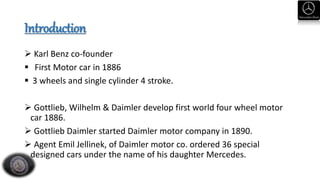
 Karl Benz co-founder
 First Motor car in 1886
 3 wheels and single cylinder 4 stroke.
 Gottlieb, Wilhelm & Daimler develop first world four wheel motor
car 1886.
 Gottlieb Daimler started Daimler motor company in 1890.
 Agent Emil Jellinek, of Daimler motor co. ordered 36 special
designed cars under the name of his daughter Mercedes.
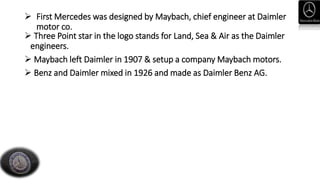
 First Mercedes was designed by Maybach, chief engineer at Daimler
motor co.
 Three Point star in the logo stands for Land, Sea & Air as the Daimler
engineers.
 Maybach left Daimler in 1907 & setup a company Maybach motors.
 Benz and Daimler mixed in 1926 and made as Daimler Benz AG.
Production
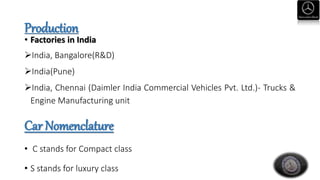
• Factories in India
India, Bangalore(R&D)
India(Pune)
India, Chennai (Daimler India Commercial Vehicles Pvt. Ltd.)- Trucks &
Engine Manufacturing unit
Car Nomenclature
• C stands for Compact class
• S stands for luxury class
• E stands for Executive class
• M stands for luxuries SUV
• G stands for SUV off roads
• “4MATIC” indicates the vehicle is equipped with all-wheel-drive.
• “Blue TEC” indicates a desiel engine with selective catalytic reduction
exhaust aftertreatment.
• “Blue EFFICIENCY” indicates special fuel economy feature (direct
injection, start-stop system, aerodynamic modification, etc.)
• “CGI” (Charged Gasoline Injection) indicates direct gasoline injection.
• “CDI” (Common-rail Direct Injection) indicates a common-rail diesel
engine.
• “Kompressor” indicates a supercharged engine.
Models A-Class-Hatchback
 B-Class-Multi Purpose vehicle(MPV)
 C-Class-Saloon, Estate &Coupe
 CL-Class-Luxury coupe
 CLA-Class-4 Door coupe
 CLS-Class-4 Door Coupe and Estate
 E-Class-Saloon, Estate, Coupe and Carbriolet
 G-Class-Sports Utility Vehicle (SUV)
 GL-Class-Sports Utility Vehicle (SUV)
 GLA-Class-Sports Utility Vehicle (SUV)
 GLB-Class-Sports Utility Vehicle (SUV)
 GLK-Class-Sports Utility Vehicle (SUV)
 M-Class-Sports Utility Vehicle (SUV)
 R-Class-Multi Purpose Vehicle (MPV)
 S-Class-Luxury Sedan
 SL-Class-Roadster
 SLK-Class-Roadster
Innovations
 The internal combustion engine automobile was developed independently
by Benz and Daimler & Maybach in 1886
 Daimler invented the honeycomb radiator of the type still used on all water
–cooled vehicles today.
 Daimler invented the float carburetor which was used until replaced by fuel
injection.
 The first passenger road car to have brakes on all four wheels (1924)
 In 1936, the Mercedes –Benz 260 D was the first diesel powered passenger
car.
 Mercedes –Benz were the first to offer direct fuel injection on the
Mercedes –Benz 300SL Gullwing
• In September 2003, Mercedes –Benz introduced the world’s first
seven-speed automatic transmission called ‘7G-Tronic’
• Airbags were first introduced in the European market, beginning with
model year 1981 s-class
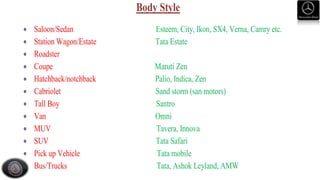
Body Style
 Saloon/Sedan Esteem, City, Ikon, SX4, Verna, Camry etc.
 Station Wagon/Estate Tata Estate
 Roadster
 Coupe Maruti Zen
 Hatchback/notchback Palio, Indica, Zen
 Cabriolet Sand storm (san motors)
 Tall Boy Santro
 Van Omni
 MUV Tavera, Innova
 SUV Tata Safari
 Pick up Vehicle Tata mobile
 Bus/Trucks Tata, Ashok Leyland, AMW
SR. NO. MODEL
DESIGNATION
SALES
DESIGNATION
ENGINE
CODE
TYPE
1 V221 S300 L M212 V
2 463 G55 AMG M113 V
3 463 G350 Bluetech OM643 V
4 172 SLK350 M276 V
5 230 SL63 AMG M156 V
6 W204 C 63 AMG M156 V
7 218 CLS350 M276 V
8 251 R350 4Matic M272 V
9 164 ML350 CDI OM642 V
10 X164 GL350 CDI OM642 V
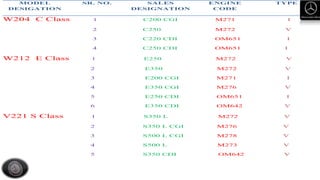
Model designation
MODEL
DESIGATION
SR. NO. SALES
DESIGNATION
ENGINE
CODE
TYPE
W204 C Class 1 C200 CGI M271 I
2 C250 M272 V
3 C220 CDI OM651 I
4 C250 CDI OM651 I
W212 E Class 1 E250 M272 V
2 E350 M272 V
3 E200 CGI M271 I
4 E350 CGI M276 V
5 E250 CDI OM651 I
6 E350 CDI OM642 V
V221 S Class 1 S350 L M272 V
2 S350 L CGI M276 V
3 S500 L CGI M278 V
4 S500 L M273 V
5 S350 CDI OM642 V
SL. NO. NOMENCLATURE MODEL CODE
1 A-class 168,169,176
2 B-class 242,245,246
3 C-class 201,202,203,204,205
4 CLA-class 117
5 CLK-class 208,209
6 CLS-class 218,219
7 CL-class 140,215,216
8 E-class 207,210,211,212
9 G-class 460,461,463
10 GL-class 166,164,
11 GLC-class 253
12 GLK-class 204
13 GLA-class 156
14 GLE-class 292
15 M-class 163,164,166
16 S-class 126,140,217,220,221,222
17 SLK-class 170,171,172
18 SL-class 107,129,230,231
19 SLS-class 197
20 R-class 251
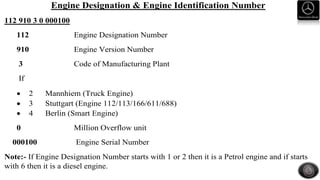
Engine Designation & Engine Identification Number
112 910 3 0 000100
112 Engine Designation Number
910 Engine Version Number
3 Code of Manufacturing Plant
If
 2 Mannhiem (Truck Engine)
 3 Stuttgart (Engine 112/113/166/611/688)
 4 Berlin (Smart Engine)
0 Million Overflow unit
000100 Engine Serial Number
Note:- If Engine Designation Number starts with 1 or 2 then it is a Petrol engine and if starts
with 6 then it is a diesel engine.
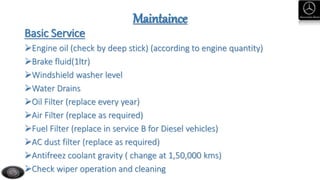
Maintaince
Basic Service
Engine oil (check by deep stick) (according to engine quantity)
Brake fluid(1ltr)
Windshield washer level
Water Drains
Oil Filter (replace every year)
Air Filter (replace as required)
Fuel Filter (replace in service B for Diesel vehicles)
AC dust filter (replace as required)
Antifreez coolant gravity ( change at 1,50,000 kms)
Check wiper operation and cleaning
Spark plug (replace in every 4 year)
Headlamp range
Clean sliding roof guide rails
Tire condition/tire tread depth
Adjust tyre pressure
Check battery condition with Midtronic
Power sterring oil level
Brake disc thickness (vernier calliper)
Brake pad thickness
Brake wear sensor for any damage
Quick test
Reset service indicator
Note:- every service perform after 15,000 kms or 1 year
Inspectionpoints engine compartment
Engine mountings
Starter operation, for any abnormal noise
Check for any abnormal noise
All fuel line routing/damage
Wiring harness routing /damages
Drive pulley movement
Check poly V belt for damages and wear
Inspection points transmission
Transmission fluid (replace at every 60,000 kms)
Transmission mounting
Transmission oil leaks
EGR
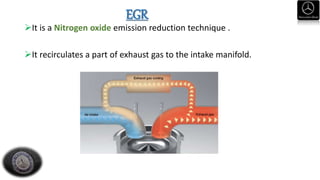
It is a Nitrogen oxide emission reduction technique .
It recirculates a part of exhaust gas to the intake manifold.
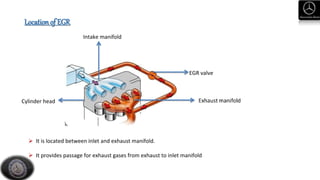
Location of EGR
EGR valve
 It is located between inlet and exhaust manifold.
 It provides passage for exhaust gases from exhaust to inlet manifold
Cylinder head
Intake manifold
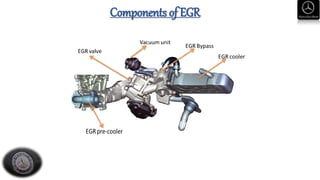
Components of EGR
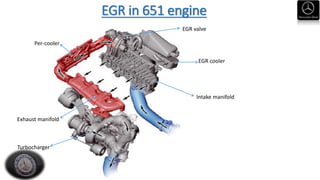
EGR in 651 engine
EGR valve
EGR cooler
Intake manifold
Turbocharger
Exhaust manifold
Per-cooler
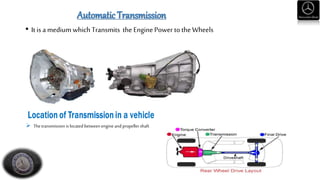
Automatic Transmission
• It is a medium which Transmits the Engine Power to the Wheels
 Thetransmission is located between engineand propeller shaft
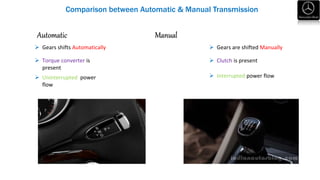
Automatic Manual
Comparison between Automatic & Manual Transmission
 Gears shifts Automatically  Gears are shifted Manually
 Torque converter is
present
 Clutch is present
 Uninterrupted power
flow
 Interrupted power flow
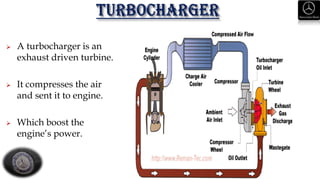
 A turbocharger is an
exhaust driven turbine.
 It compresses the air
and sent it to engine.
 Which boost the
engine’s power.
 The technique of sending forced air into
combustion chamber in an I.C engine was
invented by Gottlieb Daimler in 1885.
 The turbocharger was invented in
1905 by Swiss engineer “Alfred
Buchi”.
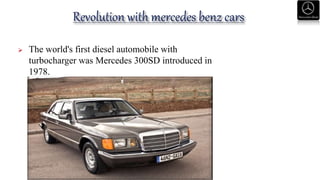
 The world's first diesel automobile with
turbocharger was Mercedes 300SD introduced in
1978.
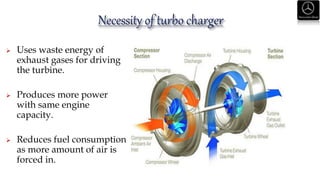
 Uses waste energy of
exhaust gases for driving
the turbine.
 Produces more power
with same engine
capacity.
 Reduces fuel consumption
as more amount of air is
forced in.
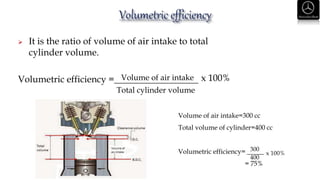
 It is the ratio of volume of air intake to total
cylinder volume.
Volumetric efficiency =__________________Volume of air intake
Total cylinder volume
x 100%
Volume of air intake=300 cc
Total volume of cylinder=400 cc
Volumetric efficiency= _____
= 75%
400
300
INTRODUCTION TO STEERING SYSTEM
 The steering system is the
collection of component and
linkages.
 It allows a vehicle to follow
certain path desired by the
driver through the steering
wheel.
COMPONENTS OF STEERING SYSTEM
 Steering wheel
 Steering shaft
 Steering gear box
 Tie rod
 Tie rod ends
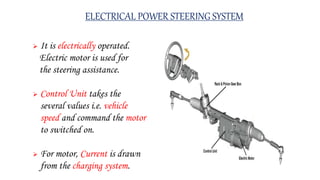
ELECTRICAL POWER STEERING SYSTEM
 It is electrically operated.
Electric motor is used for
the steering assistance.
 Control Unit takes the
several values i.e. vehicle
speed and command the motor
to switched on.
 For motor, Current is drawn
from the charging system.
mercedes benz training presentation

mercedes benz training presentation

  • 1.
  • 2.
  • 3.
  • 4.
    Tabel of Contents Introduction  Production  Car nomenclature  Models  Innovation  Body Style  Body Designation  Identification of Chassis Number  Engine Designation  Maintance Inspection point of engine compartment  Inspection point of transmission  EGR  Automatic Transmission Turbocharger Sterring System
  • 5.
    Introduction  Karl Benzco-founder  First Motor car in 1886  3 wheels and single cylinder 4 stroke.  Gottlieb, Wilhelm & Daimler develop first world four wheel motor car 1886.  Gottlieb Daimler started Daimler motor company in 1890.  Agent Emil Jellinek, of Daimler motor co. ordered 36 special designed cars under the name of his daughter Mercedes.
  • 6.
     First Mercedeswas designed by Maybach, chief engineer at Daimler motor co.  Three Point star in the logo stands for Land, Sea & Air as the Daimler engineers.  Maybach left Daimler in 1907 & setup a company Maybach motors.  Benz and Daimler mixed in 1926 and made as Daimler Benz AG.
  • 7.
    Production • Factories inIndia India, Bangalore(R&D) India(Pune) India, Chennai (Daimler India Commercial Vehicles Pvt. Ltd.)- Trucks & Engine Manufacturing unit Car Nomenclature • C stands for Compact class • S stands for luxury class
  • 8.
    • E standsfor Executive class • M stands for luxuries SUV • G stands for SUV off roads • “4MATIC” indicates the vehicle is equipped with all-wheel-drive. • “Blue TEC” indicates a desiel engine with selective catalytic reduction exhaust aftertreatment. • “Blue EFFICIENCY” indicates special fuel economy feature (direct injection, start-stop system, aerodynamic modification, etc.) • “CGI” (Charged Gasoline Injection) indicates direct gasoline injection. • “CDI” (Common-rail Direct Injection) indicates a common-rail diesel engine. • “Kompressor” indicates a supercharged engine.
  • 9.
    Models A-Class-Hatchback  B-Class-MultiPurpose vehicle(MPV)  C-Class-Saloon, Estate &Coupe  CL-Class-Luxury coupe  CLA-Class-4 Door coupe  CLS-Class-4 Door Coupe and Estate  E-Class-Saloon, Estate, Coupe and Carbriolet  G-Class-Sports Utility Vehicle (SUV)  GL-Class-Sports Utility Vehicle (SUV)  GLA-Class-Sports Utility Vehicle (SUV)  GLB-Class-Sports Utility Vehicle (SUV)  GLK-Class-Sports Utility Vehicle (SUV)  M-Class-Sports Utility Vehicle (SUV)  R-Class-Multi Purpose Vehicle (MPV)  S-Class-Luxury Sedan  SL-Class-Roadster  SLK-Class-Roadster
  • 10.
    Innovations  The internalcombustion engine automobile was developed independently by Benz and Daimler & Maybach in 1886  Daimler invented the honeycomb radiator of the type still used on all water –cooled vehicles today.  Daimler invented the float carburetor which was used until replaced by fuel injection.  The first passenger road car to have brakes on all four wheels (1924)  In 1936, the Mercedes –Benz 260 D was the first diesel powered passenger car.  Mercedes –Benz were the first to offer direct fuel injection on the Mercedes –Benz 300SL Gullwing
  • 11.
    • In September2003, Mercedes –Benz introduced the world’s first seven-speed automatic transmission called ‘7G-Tronic’ • Airbags were first introduced in the European market, beginning with model year 1981 s-class
  • 12.
    Body Style  Saloon/SedanEsteem, City, Ikon, SX4, Verna, Camry etc.  Station Wagon/Estate Tata Estate  Roadster  Coupe Maruti Zen  Hatchback/notchback Palio, Indica, Zen  Cabriolet Sand storm (san motors)  Tall Boy Santro  Van Omni  MUV Tavera, Innova  SUV Tata Safari  Pick up Vehicle Tata mobile  Bus/Trucks Tata, Ashok Leyland, AMW
  • 13.
    SR. NO. MODEL DESIGNATION SALES DESIGNATION ENGINE CODE TYPE 1V221 S300 L M212 V 2 463 G55 AMG M113 V 3 463 G350 Bluetech OM643 V 4 172 SLK350 M276 V 5 230 SL63 AMG M156 V 6 W204 C 63 AMG M156 V 7 218 CLS350 M276 V 8 251 R350 4Matic M272 V 9 164 ML350 CDI OM642 V 10 X164 GL350 CDI OM642 V Model designation
  • 14.
    MODEL DESIGATION SR. NO. SALES DESIGNATION ENGINE CODE TYPE W204C Class 1 C200 CGI M271 I 2 C250 M272 V 3 C220 CDI OM651 I 4 C250 CDI OM651 I W212 E Class 1 E250 M272 V 2 E350 M272 V 3 E200 CGI M271 I 4 E350 CGI M276 V 5 E250 CDI OM651 I 6 E350 CDI OM642 V V221 S Class 1 S350 L M272 V 2 S350 L CGI M276 V 3 S500 L CGI M278 V 4 S500 L M273 V 5 S350 CDI OM642 V
  • 15.
    SL. NO. NOMENCLATUREMODEL CODE 1 A-class 168,169,176 2 B-class 242,245,246 3 C-class 201,202,203,204,205 4 CLA-class 117 5 CLK-class 208,209 6 CLS-class 218,219 7 CL-class 140,215,216 8 E-class 207,210,211,212 9 G-class 460,461,463 10 GL-class 166,164, 11 GLC-class 253 12 GLK-class 204 13 GLA-class 156 14 GLE-class 292 15 M-class 163,164,166 16 S-class 126,140,217,220,221,222 17 SLK-class 170,171,172 18 SL-class 107,129,230,231 19 SLS-class 197 20 R-class 251
  • 17.
    Engine Designation &Engine Identification Number 112 910 3 0 000100 112 Engine Designation Number 910 Engine Version Number 3 Code of Manufacturing Plant If  2 Mannhiem (Truck Engine)  3 Stuttgart (Engine 112/113/166/611/688)  4 Berlin (Smart Engine) 0 Million Overflow unit 000100 Engine Serial Number Note:- If Engine Designation Number starts with 1 or 2 then it is a Petrol engine and if starts with 6 then it is a diesel engine.
  • 18.
    Maintaince Basic Service Engine oil(check by deep stick) (according to engine quantity) Brake fluid(1ltr) Windshield washer level Water Drains Oil Filter (replace every year) Air Filter (replace as required) Fuel Filter (replace in service B for Diesel vehicles) AC dust filter (replace as required) Antifreez coolant gravity ( change at 1,50,000 kms) Check wiper operation and cleaning
  • 19.
    Spark plug (replacein every 4 year) Headlamp range Clean sliding roof guide rails Tire condition/tire tread depth Adjust tyre pressure Check battery condition with Midtronic Power sterring oil level Brake disc thickness (vernier calliper) Brake pad thickness Brake wear sensor for any damage Quick test Reset service indicator Note:- every service perform after 15,000 kms or 1 year
  • 20.
    Inspectionpoints engine compartment Enginemountings Starter operation, for any abnormal noise Check for any abnormal noise All fuel line routing/damage Wiring harness routing /damages Drive pulley movement Check poly V belt for damages and wear Inspection points transmission Transmission fluid (replace at every 60,000 kms) Transmission mounting Transmission oil leaks
  • 21.
    EGR It is aNitrogen oxide emission reduction technique . It recirculates a part of exhaust gas to the intake manifold.
  • 22.
    Location of EGR EGRvalve  It is located between inlet and exhaust manifold.  It provides passage for exhaust gases from exhaust to inlet manifold Cylinder head Intake manifold
  • 23.
  • 24.
    EGR in 651engine EGR valve EGR cooler Intake manifold Turbocharger Exhaust manifold Per-cooler
  • 25.
    Automatic Transmission • Itis a medium which Transmits the Engine Power to the Wheels  Thetransmission is located between engineand propeller shaft
  • 26.
    Automatic Manual Comparison betweenAutomatic & Manual Transmission  Gears shifts Automatically  Gears are shifted Manually  Torque converter is present  Clutch is present  Uninterrupted power flow  Interrupted power flow
  • 27.
     A turbochargeris an exhaust driven turbine.  It compresses the air and sent it to engine.  Which boost the engine’s power.
  • 28.
     The techniqueof sending forced air into combustion chamber in an I.C engine was invented by Gottlieb Daimler in 1885.  The turbocharger was invented in 1905 by Swiss engineer “Alfred Buchi”.
  • 29.
     The world'sfirst diesel automobile with turbocharger was Mercedes 300SD introduced in 1978.
  • 30.
     Uses wasteenergy of exhaust gases for driving the turbine.  Produces more power with same engine capacity.  Reduces fuel consumption as more amount of air is forced in.
  • 31.
     It isthe ratio of volume of air intake to total cylinder volume. Volumetric efficiency =__________________Volume of air intake Total cylinder volume x 100% Volume of air intake=300 cc Total volume of cylinder=400 cc Volumetric efficiency= _____ = 75% 400 300
  • 33.
    INTRODUCTION TO STEERINGSYSTEM  The steering system is the collection of component and linkages.  It allows a vehicle to follow certain path desired by the driver through the steering wheel.
  • 34.
    COMPONENTS OF STEERINGSYSTEM  Steering wheel  Steering shaft  Steering gear box  Tie rod  Tie rod ends
  • 35.
    ELECTRICAL POWER STEERINGSYSTEM  It is electrically operated. Electric motor is used for the steering assistance.  Control Unit takes the several values i.e. vehicle speed and command the motor to switched on.  For motor, Current is drawn from the charging system.