July 2009 By DT’s Instructor  Officer George Durham A Milford NH Police Department Presentation
Handcuffing  and Suspect Control Two Handcuffing Techniques  Lee Handcuffing Lee Modified or “speed cuffing”
Lee Handcuffing Proper Verbalization in practice Proper Suspect positioning Handcuffs in hand single strand out with key holes facing away from the palm Grasp the suspect hand by thumb Bottom Strand on first Grasp the other hand with your opposite hand and place the wrist into your top strand.
Lee Method Continued Check for tightness Double Lock for security and safety Check for capillary response Use verbal commands to control the suspect Search and Search well!!!
ALWAYS  CHECK FOR PROPER TIGHTNESS AND DOUBLE LOCK TO PREVENT ESCAPE AND INJURY!
Lee Modified or Speed Cuffing Handcuffs in hand single strand forward Keyholes to the palm Grasp subjects hand by the meaty portion of the thumb Apply the top strand first with the push/pull method Grasp suspects other hand in a reverse handshake and apply the bottom strand with the push/pull method
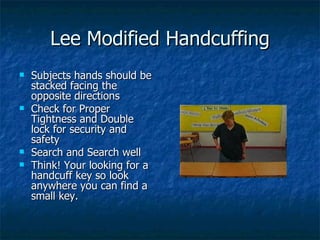
Lee Modified Handcuffing Subjects hands should be stacked facing the opposite directions Check for Proper Tightness and Double lock for security and safety Search and Search well Think! Your looking for a handcuff key so look anywhere you can find a small key.
OPERATIONAL GUIDELINE - 7101 SECURE TRANSPORTATION OF PRISONERS For purposes of this Operational Guideline, the terms "prisoner," "arrestee," or "arrested person" shall mean any person in official police custody because he or she has been: 1. arrested and charged with a crime; 2.taken into protective custody under RSA 172-B; 3.taken into protective custody under RSA 135-C; 4.charged with a juvenile offense * You may handcuff a person who you deem as a hostile for yours and their safety
OPERATIONAL GUIDELINE - 7101 SECURE TRANSPORTATION OF PRISONERS Once a person is arrested and restrained, it is the responsibility of the arresting officer to search the prisoner. . 1.The searching officer should wear protective gloves unless the tactical situation prevents it. 2.Prior to any persons being placed in a cruiser for transportation, that person shall be searched for weapons, contraband, or implements of escape by the transporting officer.
OPERATIONAL GUIDELINE - 7101 SECURE TRANSPORTATION OF PRISONERS 3.A basic prisoner search shall include, but not be limited to: a) removal and inspection of all outer garments (coats, hats, etc.); b) emptying, inverting, and inspecting all pockets; c) pat down of all "patch" pockets; d) finger sweep of belts, boot and shoe tops, collars, and lapels. e) Pat and grab all outer clothing. 4. Ancillary articles, such as purses, backpacks, "fanny" packs, coats, or extra clothing, should be searched and kept separate and secure from the prisoner.
APPLICATION OF RESTRAINING DEVICES Only authorized restraining devices, used in the manner for which they were designed, shall be used in prisoner transports. When used, handcuffs shall be double locked. While transporting arrested persons to the station from a location in Milford, handcuffs shall be used except when, in the judgment of the transporting officer, it is unnecessary or inappropriate because the prisoner exhibits:
APPLICATION OF RESTRAINING DEVICES Transporting officers may use a waist chain or belt on prisoners whenever they feel it is appropriate. However, on all prisoners who will be in transit for sixty (60) minutes or more, handcuffs and a waist chain or belt shall be used.
Escort holds and Arm Bars Three basic techniques used: A) Escort Hold to take down or escort B) Arm bar to Take down  C) Shoulder roll
Arm Bars and Take Downs Static- Very Slow No resistance one movement per count  Fluid Medium- smooth but slow progression through the technique Dynamic- The whole technique with power and speed added. THIS IS NOT EVERYTHING YOU GOT! About 70% power.
Course Safety YOU ARE RESPONSIBILE FOR SAFETY AT ALL TIMES!!
Course Safety Firearms  UNLOADED! Ammunition  SECURED!  OC Spray  SECURED!   Edged Weapons  SECURED!
Course Safety NO TRAINING HAZARDS! Keep batons & other equipment up off the FLOOR at all time! Check Footwear
Course Safety PRACTICE: TECHNIQUES BEING TAUGHT IN CLASS! PRACTICE: TECHNIQUES SLOWLY AT FIRST! PRACTICE: SAFELY AROUND OTHERS!
Course Safety REPORT any prior INJURY that may limit your active participation! Wear Red Wrist Band Tell Your Training Partner About Your Physical Limits Prior To The Start Of Training

Handcuffing 07 09

  • 1.
    July 2009 ByDT’s Instructor Officer George Durham A Milford NH Police Department Presentation
  • 2.
    Handcuffing andSuspect Control Two Handcuffing Techniques Lee Handcuffing Lee Modified or “speed cuffing”
  • 3.
    Lee Handcuffing ProperVerbalization in practice Proper Suspect positioning Handcuffs in hand single strand out with key holes facing away from the palm Grasp the suspect hand by thumb Bottom Strand on first Grasp the other hand with your opposite hand and place the wrist into your top strand.
  • 4.
    Lee Method ContinuedCheck for tightness Double Lock for security and safety Check for capillary response Use verbal commands to control the suspect Search and Search well!!!
  • 5.
    ALWAYS CHECKFOR PROPER TIGHTNESS AND DOUBLE LOCK TO PREVENT ESCAPE AND INJURY!
  • 6.
    Lee Modified orSpeed Cuffing Handcuffs in hand single strand forward Keyholes to the palm Grasp subjects hand by the meaty portion of the thumb Apply the top strand first with the push/pull method Grasp suspects other hand in a reverse handshake and apply the bottom strand with the push/pull method
  • 7.
    Lee Modified HandcuffingSubjects hands should be stacked facing the opposite directions Check for Proper Tightness and Double lock for security and safety Search and Search well Think! Your looking for a handcuff key so look anywhere you can find a small key.
  • 8.
    OPERATIONAL GUIDELINE -7101 SECURE TRANSPORTATION OF PRISONERS For purposes of this Operational Guideline, the terms "prisoner," "arrestee," or "arrested person" shall mean any person in official police custody because he or she has been: 1. arrested and charged with a crime; 2.taken into protective custody under RSA 172-B; 3.taken into protective custody under RSA 135-C; 4.charged with a juvenile offense * You may handcuff a person who you deem as a hostile for yours and their safety
  • 9.
    OPERATIONAL GUIDELINE -7101 SECURE TRANSPORTATION OF PRISONERS Once a person is arrested and restrained, it is the responsibility of the arresting officer to search the prisoner. . 1.The searching officer should wear protective gloves unless the tactical situation prevents it. 2.Prior to any persons being placed in a cruiser for transportation, that person shall be searched for weapons, contraband, or implements of escape by the transporting officer.
  • 10.
    OPERATIONAL GUIDELINE -7101 SECURE TRANSPORTATION OF PRISONERS 3.A basic prisoner search shall include, but not be limited to: a) removal and inspection of all outer garments (coats, hats, etc.); b) emptying, inverting, and inspecting all pockets; c) pat down of all "patch" pockets; d) finger sweep of belts, boot and shoe tops, collars, and lapels. e) Pat and grab all outer clothing. 4. Ancillary articles, such as purses, backpacks, "fanny" packs, coats, or extra clothing, should be searched and kept separate and secure from the prisoner.
  • 11.
    APPLICATION OF RESTRAININGDEVICES Only authorized restraining devices, used in the manner for which they were designed, shall be used in prisoner transports. When used, handcuffs shall be double locked. While transporting arrested persons to the station from a location in Milford, handcuffs shall be used except when, in the judgment of the transporting officer, it is unnecessary or inappropriate because the prisoner exhibits:
  • 12.
    APPLICATION OF RESTRAININGDEVICES Transporting officers may use a waist chain or belt on prisoners whenever they feel it is appropriate. However, on all prisoners who will be in transit for sixty (60) minutes or more, handcuffs and a waist chain or belt shall be used.
  • 13.
    Escort holds andArm Bars Three basic techniques used: A) Escort Hold to take down or escort B) Arm bar to Take down C) Shoulder roll
  • 14.
    Arm Bars andTake Downs Static- Very Slow No resistance one movement per count Fluid Medium- smooth but slow progression through the technique Dynamic- The whole technique with power and speed added. THIS IS NOT EVERYTHING YOU GOT! About 70% power.
  • 15.
    Course Safety YOUARE RESPONSIBILE FOR SAFETY AT ALL TIMES!!
  • 16.
    Course Safety Firearms UNLOADED! Ammunition SECURED! OC Spray SECURED! Edged Weapons SECURED!
  • 17.
    Course Safety NOTRAINING HAZARDS! Keep batons & other equipment up off the FLOOR at all time! Check Footwear
  • 18.
    Course Safety PRACTICE:TECHNIQUES BEING TAUGHT IN CLASS! PRACTICE: TECHNIQUES SLOWLY AT FIRST! PRACTICE: SAFELY AROUND OTHERS!
  • 19.
    Course Safety REPORTany prior INJURY that may limit your active participation! Wear Red Wrist Band Tell Your Training Partner About Your Physical Limits Prior To The Start Of Training