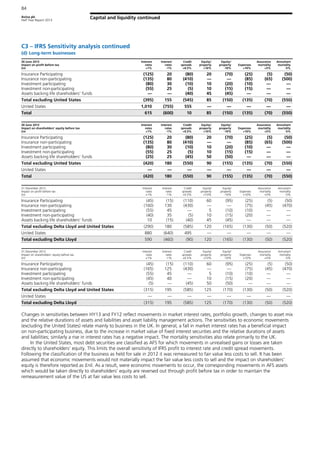
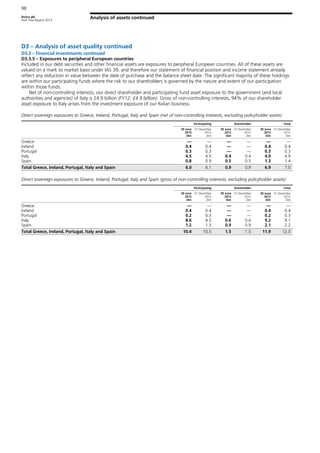
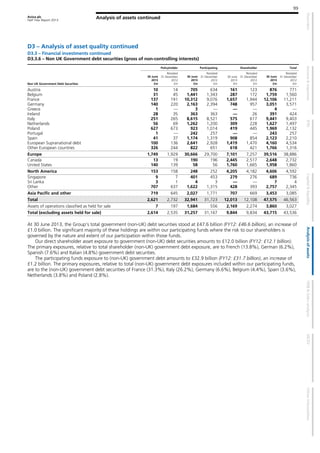
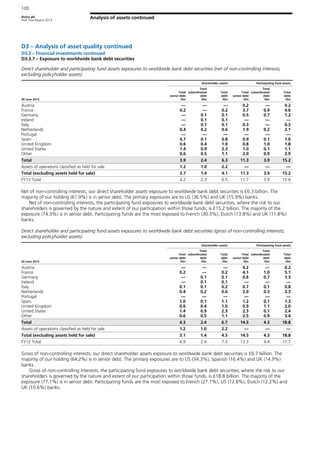
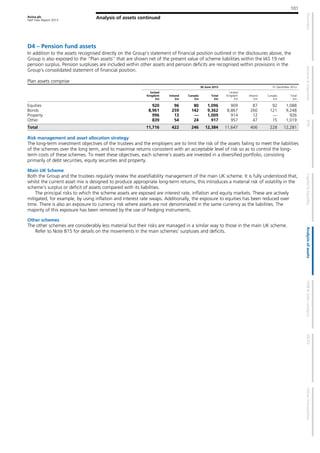
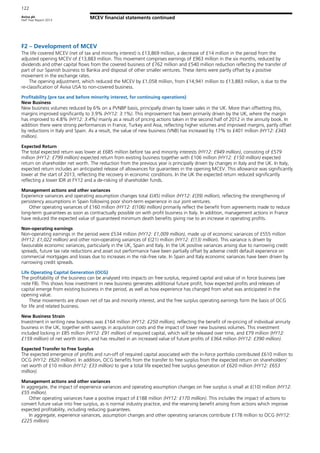
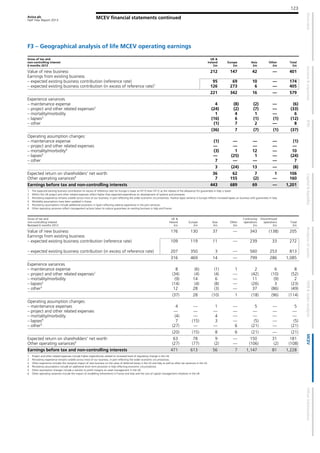
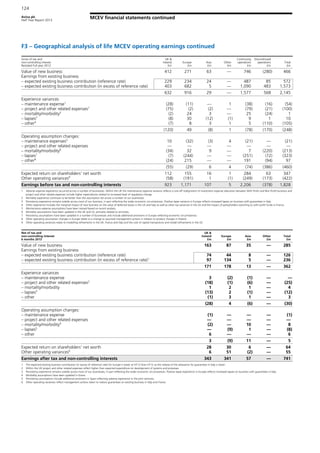
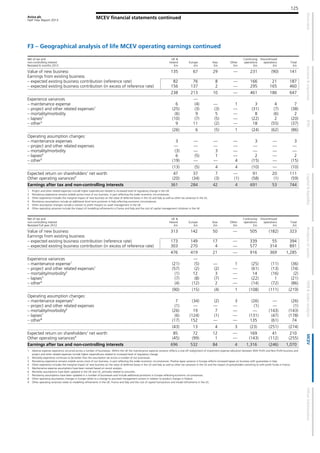
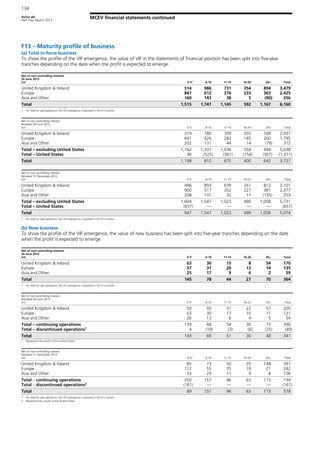
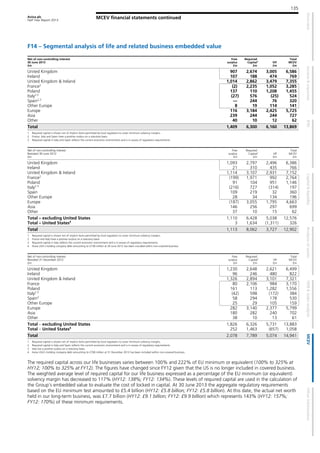
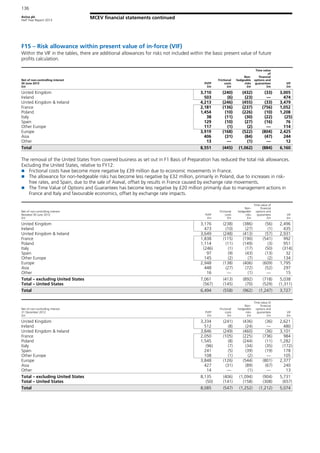
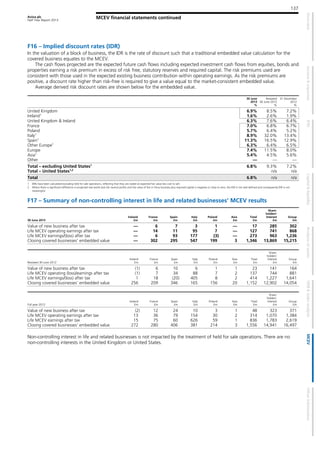
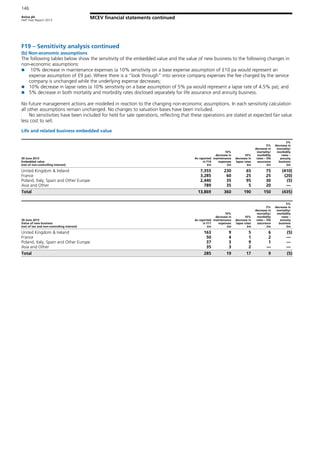
1 On a continuing basis, excluding US Life and Delta Lloyd.
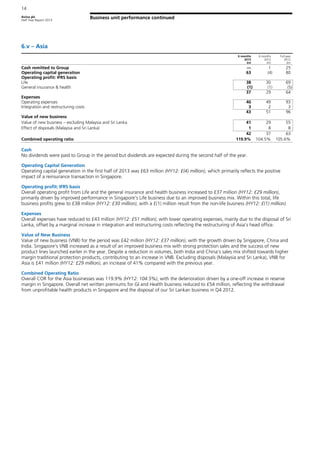
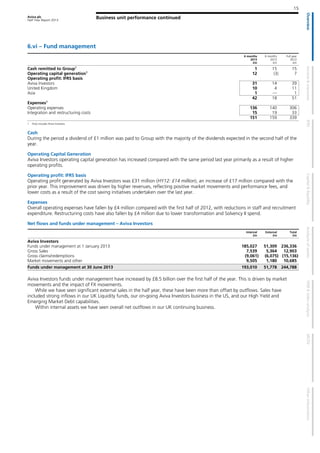
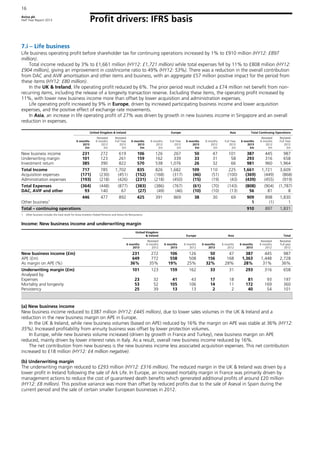
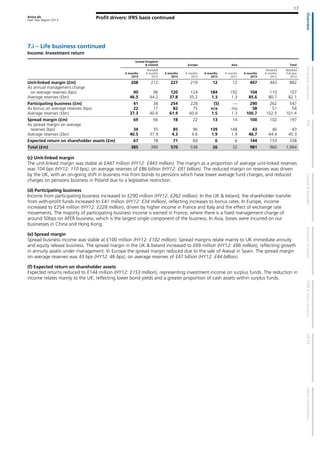
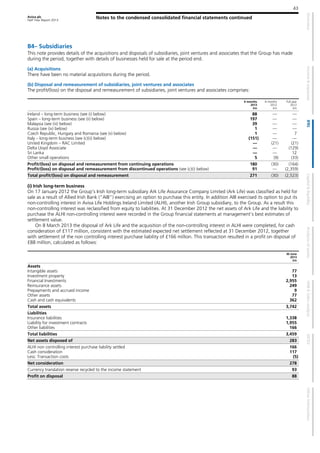
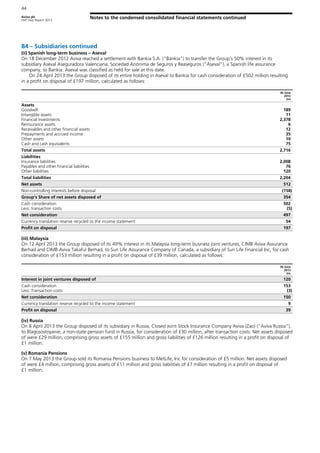
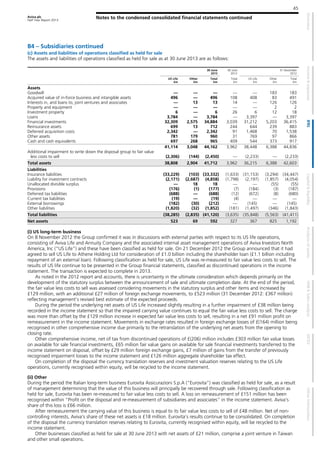
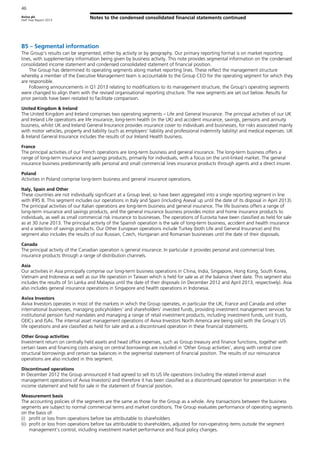
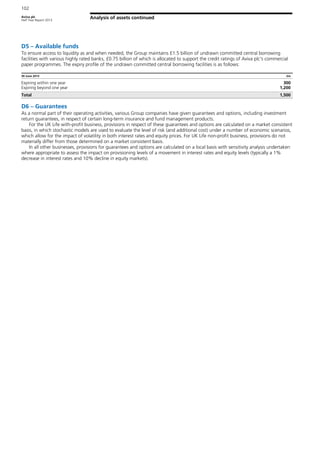
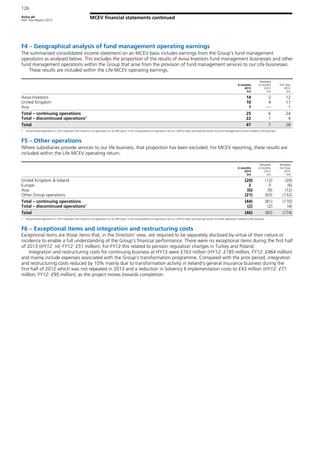
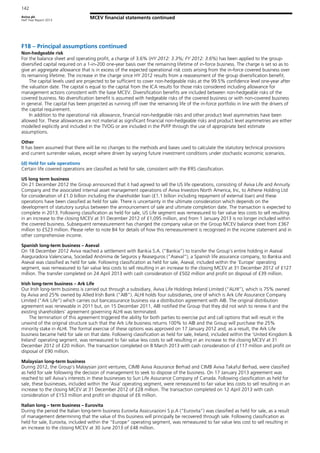
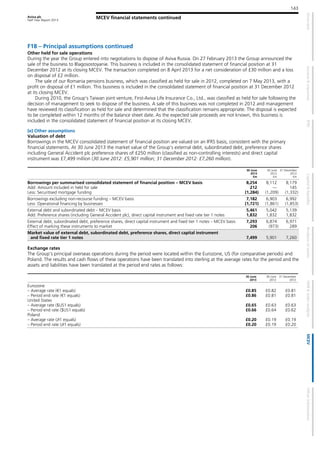
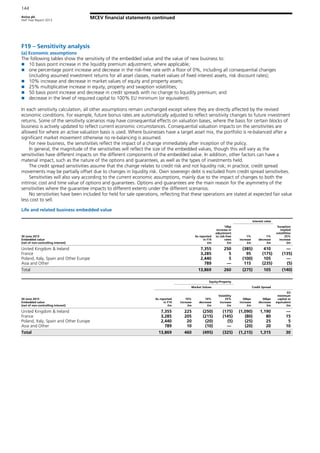
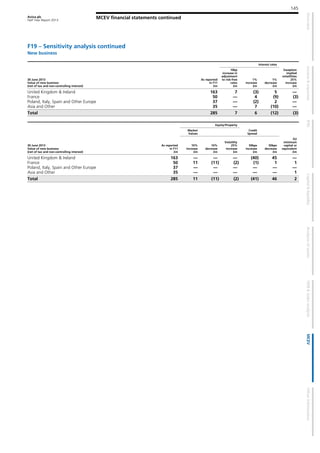
2 Operating expenses excludes integration and restructuring costs, US Life and Delta Lloyd.
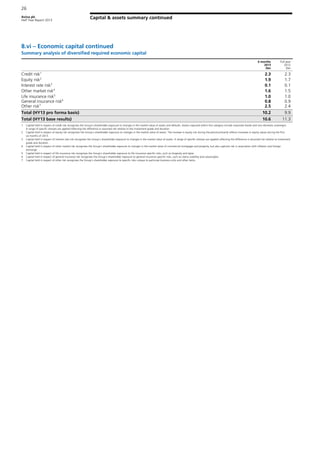
3 The pro forma economic capital surplus at HY13 includes the impact of the US Life transaction and an increase in pension scheme risk allowance from five to ten years of stressed contributions (FY12: includes the benefit of
completing the US Life, Aseval, Delta Lloyd and Malaysia transactions).
4 The economic capital surplus represents an estimated position. The capital requirement is based on Aviva’s own internal assessment and capital management policies. The term ‘economic capital’ does not imply capital as required by
regulators or other third parties.
News Release
Aviva plc
Aviva plc Interim Results Statement
6 months 30 June 2013
8 August 2013
Aviva plc
Interim Results Announcement 2013
Mark Wilson, Group Chief Executive Officer, said:
“In the first half we have taken a number of steps to deliver our investment thesis of cash flow and growth.
These results show satisfactory progress in Aviva’s turnaround.
“We have achieved profit after tax of £776 million, in contrast to the £624 million loss last year. Cash flows
to the Group have increased by 30% to £573 million. Our key measure of sales – value of new business –
has increased 17%, driven by the UK, France, Poland, Turkey and Asia.
“Although these results continue the positive trends of the first quarter, tackling our legacy issues will take
time.
“I am committed to achieving for investors what we set out to do: turning around the company to unlock
the considerable value in Aviva.”
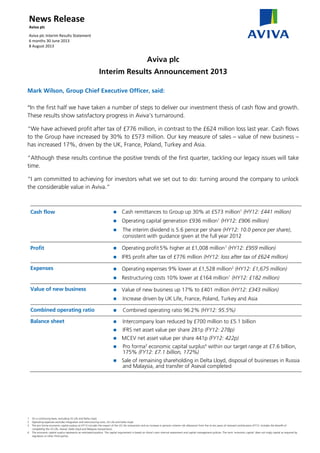
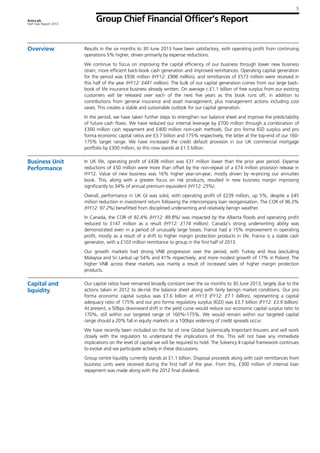
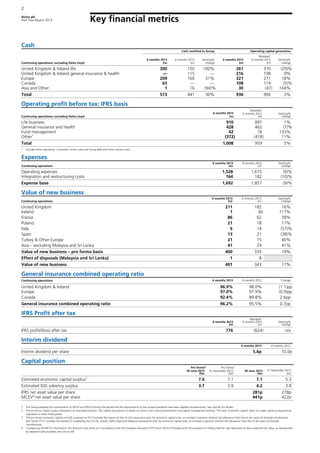
Cash flow Cash remittances to Group up 30% at £573 million1
(HY12: £441 million)
Operating capital generation £936 million1
(HY12: £906 million)
The interim dividend is 5.6 pence per share (HY12: 10.0 pence per share),
consistent with guidance given at the full year 2012
Profit Operating profit 5% higher at £1,008 million1
(HY12: £959 million)
IFRS profit after tax of £776 million (HY12: loss after tax of £624 million)
Expenses Operating expenses 9% lower at £1,528 million2
(HY12: £1,675 million)
Restructuring costs 10% lower at £164 million1
(HY12: £182 million)
Value of new business Value of new business up 17% to £401 million (HY12: £343 million)
Increase driven by UK Life, France, Poland, Turkey and Asia
Combined operating ratio Combined operating ratio 96.2% (HY12: 95.5%)
Balance sheet Intercompany loan reduced by £700 million to £5.1 billion
IFRS net asset value per share 281p (FY12: 278p)
MCEV net asset value per share 441p (FY12: 422p)
Pro forma3
economic capital surplus4
within our target range at £7.6 billion,
175% (FY12: £7.1 billion, 172%)
Sale of remaining shareholding in Delta Lloyd, disposal of businesses in Russia
and Malaysia, and transfer of Aseval completed
Aviva plc
Half Year Report 2013
2
Key financial metrics
Cash
Cash remitted to Group Operating capital generation
Continuing operations, excluding Delta Lloyd
6 months 2013
£m
6 months 2012
£m
Sterling%
change
6 months 2013
£m
Restated1
6 months 2012
£m
Sterling%
change
United Kingdom & Ireland life 300 150 100% 261 370 (29)%
United Kingdom & Ireland general insurance & health — 115 — 216 198 9%
Europe 209 160 31% 321 271 18%
Canada 63 — — 108 114 (5)%
Asia and Other 1 16 (94)% 30 (47) 164%
Total 573 441 30% 936 906 3%
Operating profit before tax: IFRS basis
Continuing operations, excluding Delta Lloyd
6 months 2013
£m
Restated1
6 months 2012
£m
Sterling%
change
Life business 910 897 1%
General insurance and health 428 462 (7)%
Fund management 42 18 133%
Other* (372) (418) 11%
Total 1,008 959 5%
* Includes other operations, Corporate Centre costs and Group debt and other interest costs.
Expenses
Continuing operations
6 months 2013
£m
6 months 2012
£m
Sterling%
change
Operating expenses 1,528 1,675 (9)%
Integration and restructuring costs 164 182 (10)%
Expense base 1,692 1,857 (9)%
Value of new business
Continuing operations
6 months 2013
£m
6 months 2012
£m
Sterling%
change
United Kingdom 211 182 16%
Ireland 1 (6) 117%
France 86 62 39%
Poland 21 18 17%
Italy 6 14 (57)%
Spain 13 21 (38)%
Turkey & Other Europe 21 15 40%
Asia – excluding Malaysia and Sri Lanka 41 29 41%
Value of new business – pro forma basis 400 335 19%
Effect of disposals (Malaysia and Sri Lanka) 1 8
Value of new business 401 343 17%
General insurance combined operating ratio
Continuing operations 6 months 2013 6 months 2012 Change
United Kingdom & Ireland 96.9% 98.0% (1.1)pp
Europe 97.0% 97.9% (0.9)pp
Canada 92.4% 89.8% 2.6pp
General insurance combined operating ratio 96.2% 95.5% 0.7pp
IFRS Profit after tax
6 months 2013
£m
Restated1
6 months 2012
£m
Sterling%
change
IFRS profit/(loss) after tax 776 (624) n/a
Interim dividend
6 months 2013 6 months 2012
Interim dividend per share 5.6p 10.0p
Capital position
Pro forma3
30 June 2013
£bn
Pro forma3
31 December 2012
£bn
30 June 2013
£bn
31 December 2012
£bn
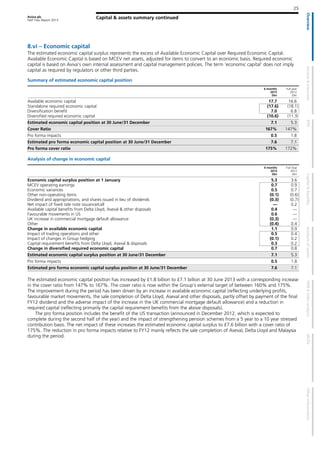
Estimated economic capital surplus2
7.6 7.1 7.1 5.3
Estimated IGD solvency surplus 3.7 3.9 4.2 3.8
IFRS net asset value per share 281p 278p
MCEV4
net asset value per share 441p 422p
1 The Group adopted the amendments to IAS19 and IFRS10 during the period and the requirements of the revised standards have been applied retrospectively.
2 The economic capital surplus represents an estimated position. The capital requirement is based on Aviva’s own internal assessment and capital management policies. The term ‘economic capital’ does not imply capital as required by
regulators or other third parties.
3 The pro forma economic capital and IGD surpluses at HY13 include the impact of the US Life transaction and, for economic capital only, an increase in pension scheme risk allowance from five to ten years of stressed contributions
(pro forma FY12: includes the benefit of completing the US Life, Aseval, Delta Lloyd and Malaysia transactions and, for economic capital only, an increase in pension scheme risk allowance from five to ten years of stressed
contributions).
4 In preparing the MCEV information, the directors have done so in accordance with the European Insurance CFO Forum MCEV Principles with the exception of stating held for sale operations at their expected fair value, as represented
by expected sale proceeds, less cost to sell.
Group Chief Executive Officer’s Report
3
Aviva plc
Half year report 2013
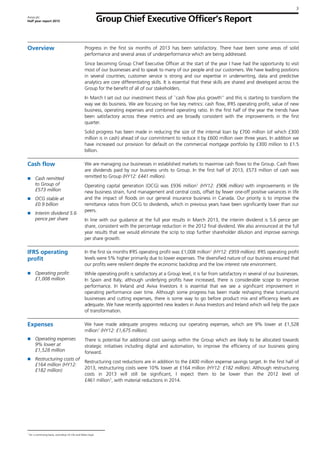
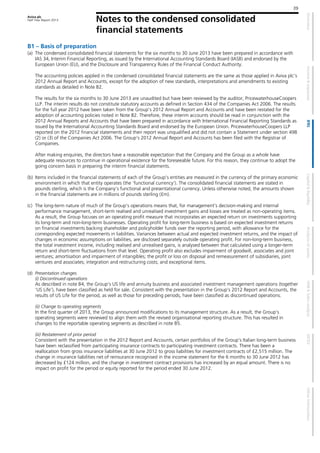
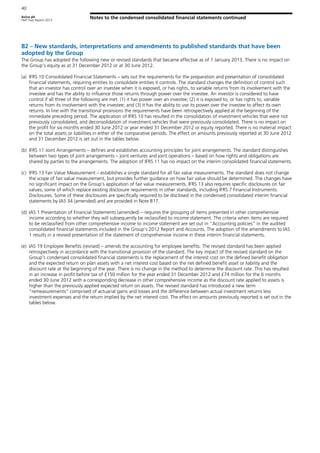
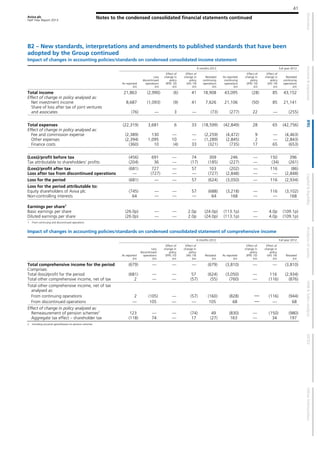
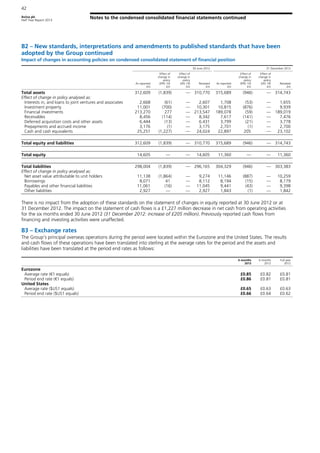
Overview Progress in the first six months of 2013 has been satisfactory. There have been some areas of solid
performance and several areas of underperformance which are being addressed.
Since becoming Group Chief Executive Officer at the start of the year I have had the opportunity to visit
most of our businesses and to speak to many of our people and our customers. We have leading positions
in several countries; customer service is strong and our expertise in underwriting, data and predictive
analytics are core differentiating skills. It is essential that these skills are shared and developed across the
Group for the benefit of all of our stakeholders.
In March I set out our investment thesis of ``cash flow plus growth’’ and this is starting to transform the
way we do business. We are focusing on five key metrics: cash flow, IFRS operating profit, value of new
business, operating expenses and combined operating ratio. In the first half of the year the trends have
been satisfactory across these metrics and are broadly consistent with the improvements in the first
quarter.
Solid progress has been made in reducing the size of the internal loan by £700 million (of which £300
million is in cash) ahead of our commitment to reduce it by £600 million over three years. In addition we
have increased our provision for default on the commercial mortgage portfolio by £300 million to £1.5
billion.
Cash flow
Cash remitted
to Group of
£573 million
OCG stable at
£0.9 billion
Interim dividend 5.6
pence per share
We are managing our businesses in established markets to maximise cash flows to the Group. Cash flows
are dividends paid by our business units to Group. In the first half of 2013, £573 million of cash was
remitted to Group (HY12: £441 million).
Operating capital generation (OCG) was £936 million1
(HY12: £906 million) with improvements in life
new business strain, fund management and central costs, offset by fewer one-off positive variances in life
and the impact of floods on our general insurance business in Canada. Our priority is to improve the
remittance ratios from OCG to dividends, which in previous years have been significantly lower than our
peers.
In line with our guidance at the full year results in March 2013, the interim dividend is 5.6 pence per
share, consistent with the percentage reduction in the 2012 final dividend. We also announced at the full
year results that we would eliminate the scrip to stop further shareholder dilution and improve earnings
per share growth.
IFRS operating
profit
Operating profit:
£1,008 million
In the first six months IFRS operating profit was £1,008 million1
(HY12: £959 million). IFRS operating profit
levels were 5% higher primarily due to lower expenses. The diversified nature of our business ensured that
our profits were resilient despite the economic backdrop and the low interest rate environment.
While operating profit is satisfactory at a Group level, it is far from satisfactory in several of our businesses.
In Spain and Italy, although underlying profits have increased, there is considerable scope to improve
performance. In Ireland and Aviva Investors it is essential that we see a significant improvement in
operating performance over time. Although some progress has been made reshaping these turnaround
businesses and cutting expenses, there is some way to go before product mix and efficiency levels are
adequate. We have recently appointed new leaders in Aviva Investors and Ireland which will help the pace
of transformation.
Expenses
Operating expenses
9% lower at
£1,528 million
Restructuring costs of
£164 million (HY12:
£182 million)
We have made adequate progress reducing our operating expenses, which are 9% lower at £1,528
million1
(HY12: £1,675 million).
There is potential for additional cost savings within the Group which are likely to be allocated towards
strategic initiatives including digital and automation, to improve the efficiency of our business going
forward.
Restructuring cost reductions are in addition to the £400 million expense savings target. In the first half of
2013, restructuring costs were 10% lower at £164 million (HY12: £182 million). Although restructuring
costs in 2013 will still be significant, I expect them to be lower than the 2012 level of
£461 million1
, with material reductions in 2014.
1
On a continuing basis, excluding US Life and Delta Lloyd.
Aviva plc
Half Year Report 2013
4
Group Chief Executive Officer’s Report continued
Value of new
business
VNB up 17% to
£401 million
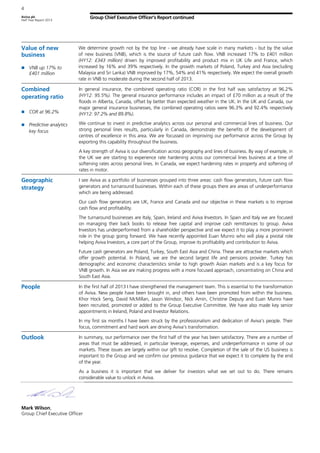
We determine growth not by the top line - we already have scale in many markets - but by the value
of new business (VNB), which is the source of future cash flow. VNB increased 17% to £401 million
(HY12: £343 million) driven by improved profitability and product mix in UK Life and France, which
increased by 16% and 39% respectively. In the growth markets of Poland, Turkey and Asia (excluding
Malaysia and Sri Lanka) VNB improved by 17%, 54% and 41% respectively. We expect the overall growth
rate in VNB to moderate during the second half of 2013.
Combined
operating ratio
COR at 96.2%
Predictive analytics
key focus
In general insurance, the combined operating ratio (COR) in the first half was satisfactory at 96.2%
(HY12: 95.5%). The general insurance performance includes an impact of £70 million as a result of the
floods in Alberta, Canada, offset by better than expected weather in the UK. In the UK and Canada, our
major general insurance businesses, the combined operating ratios were 96.3% and 92.4% respectively
(HY12: 97.2% and 89.8%).
We continue to invest in predictive analytics across our personal and commercial lines of business. Our
strong personal lines results, particularly in Canada, demonstrate the benefits of the development of
centres of excellence in this area. We are focussed on improving our performance across the Group by
exporting this capability throughout the business.
A key strength of Aviva is our diversification across geography and lines of business. By way of example, in
the UK we are starting to experience rate hardening across our commercial lines business at a time of
softening rates across personal lines. In Canada, we expect hardening rates in property and softening of
rates in motor.
Geographic
strategy
I see Aviva as a portfolio of businesses grouped into three areas: cash flow generators, future cash flow
generators and turnaround businesses. Within each of these groups there are areas of underperformance
which are being addressed.
Our cash flow generators are UK, France and Canada and our objective in these markets is to improve
cash flow and profitability.
The turnaround businesses are Italy, Spain, Ireland and Aviva Investors. In Spain and Italy we are focused
on managing their back books to release free capital and improve cash remittances to group. Aviva
Investors has underperformed from a shareholder perspective and we expect it to play a more prominent
role in the group going forward. We have recently appointed Euan Munro who will play a pivotal role
helping Aviva Investors, a core part of the Group, improve its profitability and contribution to Aviva.
Future cash generators are Poland, Turkey, South East Asia and China. These are attractive markets which
offer growth potential. In Poland, we are the second largest life and pensions provider. Turkey has
demographic and economic characteristics similar to high growth Asian markets and is a key focus for
VNB growth. In Asia we are making progress with a more focused approach, concentrating on China and
South East Asia.
People In the first half of 2013 I have strengthened the management team. This is essential to the transformation
of Aviva. New people have been brought in, and others have been promoted from within the business.
Khor Hock Seng, David McMillan, Jason Windsor, Nick Amin, Christine Deputy and Euan Munro have
been recruited, promoted or added to the Group Executive Committee. We have also made key senior
appointments in Ireland, Poland and Investor Relations.
In my first six months I have been struck by the professionalism and dedication of Aviva’s people. Their
focus, commitment and hard work are driving Aviva’s transformation.
Outlook In summary, our performance over the first half of the year has been satisfactory. There are a number of
areas that must be addressed, in particular leverage, expenses, and underperformance in some of our
markets. These issues are largely within our gift to resolve. Completion of the sale of the US business is
important to the Group and we confirm our previous guidance that we expect it to complete by the end
of the year.
As a business it is important that we deliver for investors what we set out to do. There remains
considerable value to unlock in Aviva.
Mark Wilson,
Group Chief Executive Officer
5
Aviva plc
Half Year Report 2013
Group Chief Financial Officer’s Report
Overview Results in the six months to 30 June 2013 have been satisfactory, with operating profit from continuing
operations 5% higher, driven primarily by expense reductions.
We continue to focus on improving the capital efficiency of our business through lower new business
strain, more efficient back-book cash generation and improved remittances. Operating capital generation
for the period was £936 million (HY12: £906 million), and remittances of £573 million were received in
this half of the year (HY12: £441 million). The bulk of our capital generation comes from our large back-
book of life insurance business already written. On average c.£1.1 billion of free surplus from our existing
customers will be released over each of the next five years as this book runs off, in addition to
contributions from general insurance and asset management, plus management actions including cost
saves. This creates a stable and sustainable outlook for our capital generation.
In the period, we have taken further steps to strengthen our balance sheet and improve the predictability
of future cash flows. We have reduced our internal leverage by £700 million through a combination of
£300 million cash repayment and £400 million non-cash methods. Our pro forma IGD surplus and pro
forma economic capital ratios are £3.7 billion and 175% respectively, the latter at the top-end of our 160-
175% target range. We have increased the credit default provision in our UK commercial mortgage
portfolio by £300 million, so this now stands at £1.5 billion.
Business Unit
Performance
In UK life, operating profit of £438 million was £31 million lower than the prior year period. Expense
reductions of £50 million were more than offset by the non-repeat of a £74 million provision release in
HY12. Value of new business was 16% higher year-on-year, mostly driven by re-pricing our annuities
book. This, along with a greater focus on risk products, resulted in new business margin improving
significantly to 34% of annual premium equivalent (HY12: 25%).
Overall, performance in UK GI was solid, with operating profit of £239 million, up 5%, despite a £45
million reduction in investment return following the intercompany loan reorganisation. The COR of 96.3%
(HY12: 97.2%) benefitted from disciplined underwriting and relatively benign weather.
In Canada, the COR of 92.4% (HY12: 89.8%) was impacted by the Alberta floods and operating profit
reduced to £147 million as a result (HY12: £174 million). Canada’s strong underwriting ability was
demonstrated even in a period of unusually large losses. France had a 15% improvement in operating
profit, mostly as a result of a shift to higher margin protection products in life. France is a stable cash
generator, with a £103 million remittance to group in the first half of 2013.
Our growth markets had strong VNB progression over the period, with Turkey and Asia (excluding
Malaysia and Sri Lanka) up 54% and 41% respectively, and more modest growth of 17% in Poland. The
higher VNB across these markets was mainly a result of increased sales of higher margin protection
products.
Capital and
liquidity
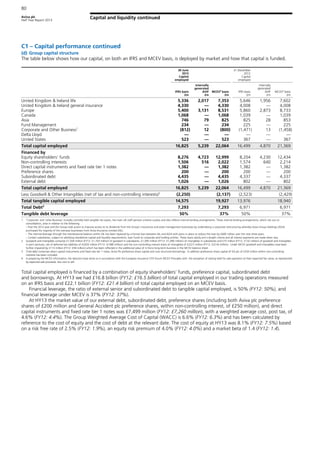
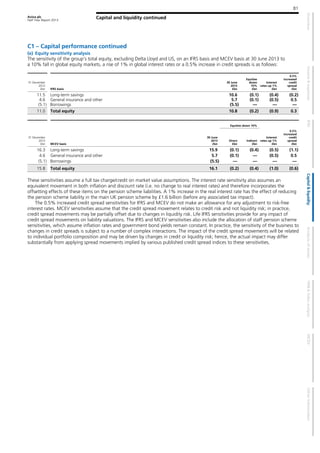
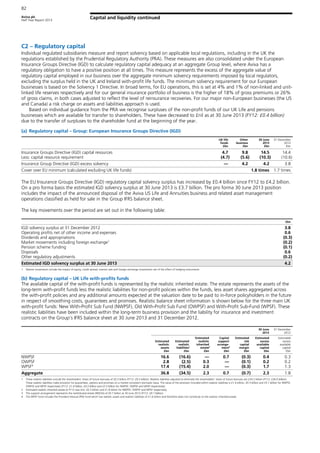
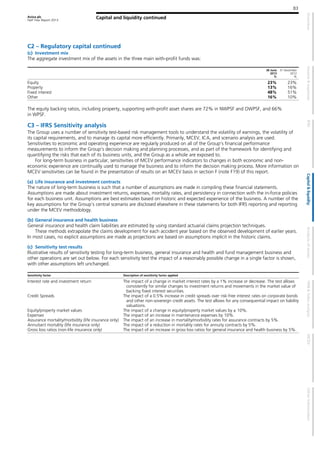
Our capital ratios have remained broadly constant over the six months to 30 June 2013, largely due to the
actions taken in 2012 to de-risk the balance sheet along with fairly benign market conditions. Our pro
forma economic capital surplus was £7.6 billion at HY13 (FY12: £7.1 billion), representing a capital
adequacy ratio of 175% and our pro forma regulatory surplus (IGD) was £3.7 billion (FY12: £3.9 billion).
At present, a 50bps downward shift in the yield curve would reduce our economic capital surplus ratio to
170%, still within our targeted range of 160%-175%. We would remain within our targeted capital
range should a 20% fall in equity markets or a 100bps widening of credit spreads occur.
We have recently been included on the list of nine Global Systemically Important Insurers and will work
closely with the regulators to understand the implications of this. This will not have any immediate
implications on the level of capital we will be required to hold. The Solvency II capital framework continues
to evolve and we participate actively in these discussions.
Group centre liquidity currently stands at £1.1 billion. Disposal proceeds along with cash remittances from
business units were received during the first half of the year. From this, £300 million of internal loan
repayment was made along with the 2012 final dividend.
Aviva plc
Half Year Report 2013
6
Group Chief Financial Officer’s Report continued
Intercompany
loan
Following the restructure of Aviva Insurance Limited (AIL) announced earlier in the year, a £5.8 billion formal
loan was established between AIL and Aviva Group Holdings (AGH), the parent company of many of our
international subsidiaries. Since then, we have repaid £300 million of the internal loan in cash. Following the
removal of AIL’s guarantee of the Group’s commercial paper and consequent increase in economic capital in
AIL, a further £400 million of the loan was retired, bringing the balance down to £5.1 billion.
As previously announced, we intend to reduce the internal loan by a further £300 million of cash by the
end of 2015. We plan on taking additional steps to reduce the loan balance by non-cash methods.
External
leverage
External leverage remains broadly unchanged over the six months of 2013, with a debt to tangible equity
ratio of 50% (FY12: 50%). In July 2013, we raised €650 million of hybrid debt ahead of the £0.8 billion of
debt up for call in the next eight months. We remain focused on reducing our external leverage ratio to
below 40% in the medium term. We anticipate using some of the proceeds from the US life disposal
towards reducing our external leverage.
Asset
portfolio
Aviva has a large balance sheet with exposure to approximately £265 billion of financial investments and
loans. Most of these assets are held on behalf of policyholders, with no risk of investment loss to
shareholders, or in participating funds where most of any potential loss is borne by policyholders. Of the
c.£87 billion financial assets to which shareholders are directly exposed, the vast majority is in fixed interest
bonds and loans.
De-risking of our asset portfolio has continued over the six months, albeit at a more moderate pace. We
have made gross disposals of £1 billion1
of Italian sovereign bonds, offset by market movements including
FX and disposed of £35 million of Co-Operative Bank bonds prior to the announced bail-in.
In the UK, the asset portfolio backing the UK annuity business includes £14.4 billion of corporate debt
securities and £12.2 billion of commercial mortgages. Excluding £4.1 billion of healthcare and Private
Finance Initiative (PFI) mortgages, which have lower risk characteristics, there exists £8.1 billion of
commercial mortgages to which shareholders are exposed. During the first half of the year, impairments
on the mortgage portfolio increased above our long term trend and we subsequently carried out an
extensive review of the portfolio. Consequently, we have increased the direct provisions against default in
the mortgage portfolio by £300 million. The allowance in the liability valuation for mortgages is now £1.5
billion.
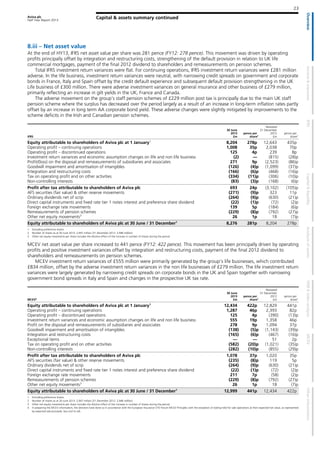
Net Asset
Value
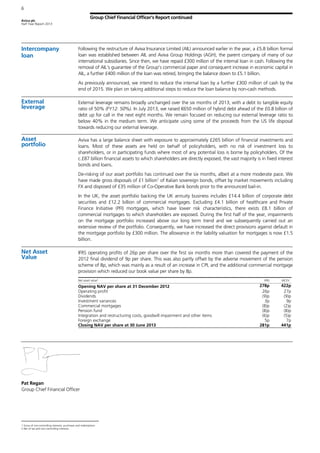
IFRS operating profits of 26p per share over the first six months more than covered the payment of the
2012 final dividend of 9p per share. This was also partly offset by the adverse movement of the pension
scheme of 8p, which was mainly as a result of an increase in CPI, and the additional commercial mortgage
provision which reduced our book value per share by 8p.
Net asset value2
IFRS MCEV
Opening NAV per share at 31 December 2012 278p 422p
Operating profit 26p 27p
Dividends (9)p (9)p
Investment variances 3p 9p
Commercial mortgages (8)p (2)p
Pension fund (8)p (8)p
Integration and restructuring costs, goodwill impairment and other items (6)p (5)p
Foreign exchange 5p 7p
Closing NAV per share at 30 June 2013 281p 441p
Pat Regan
Group Chief Financial Officer
1 Gross of non-controlling interests, purchases and redemptions.
2 Net of tax and non-controlling interests.
7
Aviva plc
Half Year Report 2013 Notes to editors
Notes to editors
All comparators are for 6 months to 30 June 2013 unless
otherwise stated.
Income and expenses of foreign entities are translated at average
exchange rates while their assets and liabilities are translated at
the closing rates on 30 June 2013, 30 June 2012 and 31
December 2012 respectively. The average rates employed in this
announcement are 1 euro = £0.85 (6 months to 30 June 2012: 1
euro = £0.82, 12 months to 31 December 2012: 1 euro = £0.81)
and US$1 = £0.65 (6 months to 30 June 2012: 1 US$ = £0.63,
12 months to 31 December 2012: 1 US$ = £0.63).
Growth rates in the press release have been provided in sterling
terms unless stated otherwise. The following supplement
presents this information on both a sterling and local currency
basis.
Cautionary statements:
This should be read in conjunction with the documents filed by
Aviva plc (the “Company” or “Aviva”) with the United States
Securities and Exchange Commission (“SEC”). This
announcement contains, and we may make verbal statements
containing, “forward-looking statements” with respect to certain
of Aviva’s plans and current goals and expectations relating to
future financial condition, performance, results, strategic
initiatives and objectives. Statements containing the words
“believes”, “intends”, “expects”, “plans”, “will,” “seeks”,
“aims”, “may”, “could”, “outlook”, “estimates” and
“anticipates”, and words of similar meaning, are forward-
looking. By their nature, all forward-looking statements involve
risk and uncertainty. Accordingly, there are or will be important
factors that could cause actual results to differ materially from
those indicated in these statements. Aviva believes factors that
could cause actual results to differ materially from those indicated
in forward-looking statements in the presentation include, but
are not limited to: the impact of ongoing difficult conditions in
the global financial markets and the economy generally; the
impact of various local political, regulatory and economic
conditions; market developments and government actions
regarding the sovereign debt crisis in Europe; the effect of credit
spread volatility on the net unrealised value of the investment
portfolio; the effect of losses due to defaults by counterparties,
including potential sovereign debt defaults or restructurings, on
the value of our investments; changes in interest rates that may
cause policyholders to surrender their contracts, reduce the value
of our portfolio and impact our asset and liability matching; the
impact of changes in equity or property prices on our investment
portfolio; fluctuations in currency exchange rates; the effect of
market fluctuations on the value of options and guarantees
embedded in some of our life insurance products and the value
of the assets backing their reserves; the amount of allowances
and impairments taken on our investments; the effect of adverse
capital and credit market conditions on our ability to meet
liquidity needs and our access to capital; a cyclical downturn of
the insurance industry; changes in or inaccuracy of assumptions
in pricing and reserving for insurance business (particularly with
regard to mortality and morbidity trends, lapse rates and policy
renewal rates), longevity and endowments; the impact of
catastrophic events on our business activities and results of
operations; the inability of reinsurers to meet obligations or
unavailability of reinsurance coverage; increased competition in
the UK and in other countries where we have significant
operations; the effect of the European Union’s “Solvency II” rules
on our regulatory capital requirements; the impact of actual
experience differing from estimates used in valuing and
amortising deferred acquisition costs (“DAC”) and acquired value
of in-force business (“AVIF”); the impact of recognising an
impairment of our goodwill or intangibles with indefinite lives;
changes in valuation methodologies, estimates and assumptions
used in the valuation of investment securities; the effect of legal
proceedings and regulatory investigations; the impact of
operational risks, including inadequate or failed internal and
external processes, systems and human error or from external
events; risks associated with arrangements with third parties,
including joint ventures; funding risks associated with our
participation in defined benefit staff pension schemes; the failure
to attract or retain the necessary key personnel; the effect of
systems errors or regulatory changes on the calculation of unit
prices or deduction of charges for our unit-linked products that
may require retrospective compensation to our customers; the
effect of a decline in any of our ratings by rating agencies on our
standing among customers, broker-dealers, agents, wholesalers
and other distributors of our products and services; changes to
our brand and reputation; changes in government regulations or
tax laws in jurisdictions where we conduct business; the inability
to protect our intellectual property; the effect of undisclosed
liabilities, integration issues and other risks associated with our
acquisitions; and the timing impact and other uncertainties
relating to acquisitions and disposals and relating to other future
acquisitions, combinations or disposals within relevant industries.
For a more detailed description of these risks, uncertainties and
other factors, please see Item 3d, “Risk Factors”, and Item 5,
“Operating and Financial Review and Prospects” in Aviva’s
Annual Report Form 20-F as filed with the SEC on 25 March
2013. Aviva undertakes no obligation to update the forward
looking statements in this announcement or any other forward-
looking statements we may make. Forward-looking statements in
this presentation are current only as of the date on which such
statements are made.
Aviva plc is a company registered in England No. 2468686.
Registered office
St Helen's
1 Undershaft
London
EC3P 3DQ
Contacts
Investor contacts Media contacts Timings
Colin Simpson
+44 (0)20 7662 8115
David Elliot
+44 (0)20 7662 8048
Nigel Prideaux
+44 (0)20 7662 0215
Andrew Reid
+44 (0)20 7662 3131
Sarah Swailes
+44 (0)20 7662 6700
Real time media conference call
07:15 hrs BST
Analyst presentation
08:15 hrs BST
Presentation slides
www.aviva.com
06.30hrs BST
Live webcast
www.avivawebcast.com/interims2013/
08:15 hrs BST


This page is intentionally left blank 
Aviva plc
Half Year Report 2013
1
Contents
In this section Page
Overview
Key financial metrics 2
1 Cash 3
i Cash remitted to Group 3
ii Operating capital generation 3
iii Free surplus emergence 5
2 Operating profit: IFRS basis 6
3 Expenses 7
4 Value of new business 8
5 Combined operating ratio 9
6 Business unit performance 10
i United Kingdom and Ireland Life 10
ii United Kingdom and Ireland General
insurance & health 11
iii Europe 12
iv Canada 13
v Asia 14
vi Fund management 15
7 Profit drivers: IFRS basis 16
i Life business 16
ii General insurance and health 19
iii Net flows 20
8 Capital & assets summary 21
i Summary of assets 21
ii External leverage 22
iii Net asset value 23
iv Return on equity 24
v European Insurance Groups Directive (IGD) 24
vi Economic capital 25
Financial supplement 27
Income & expenses 28
IFRS financial statements 33
Capital & assets 77
Capital & liquidity 78
Analysis of assets 87
VNB & Sales analysis 103
MCEV financial statements 109
Other information 149
Aviva plc
Half Year Report 2013
2
Key financial metrics
Cash
Cash remitted to Group Operating capital generation
Continuing operations, excluding Delta Lloyd
6 months 2013
£m
6 months 2012
£m
Sterling%
change
6 months 2013
£m
Restated1
6 months 2012
£m
Sterling%
change
United Kingdom & Ireland life 300 150 100% 261 370 (29)%
United Kingdom & Ireland general insurance & health — 115 — 216 198 9%
Europe 209 160 31% 321 271 18%
Canada 63 — — 108 114 (5)%
Asia and Other 1 16 (94)% 30 (47) 164%
Total 573 441 30% 936 906 3%
Operating profit before tax: IFRS basis
Continuing operations, excluding Delta Lloyd
6 months 2013
£m
Restated1
6 months 2012
£m
Sterling%
change
Life business 910 897 1%
General insurance and health 428 462 (7)%
Fund management 42 18 133%
Other*
(372) (418) 11%
Total 1,008 959 5%
* Includes other operations, Corporate Centre costs and Group debt and other interest costs.
Expenses
Continuing operations
6 months 2013
£m
6 months 2012
£m
Sterling%
change
Operating expenses 1,528 1,675 (9)%
Integration and restructuring costs 164 182 (10)%
Expense base 1,692 1,857 (9)%
Value of new business
Continuing operations
6 months 2013
£m
6 months 2012
£m
Sterling%
change
United Kingdom 211 182 16%
Ireland 1 (6) 117%
France 86 62 39%
Poland 21 18 17%
Italy 6 14 (57)%
Spain 13 21 (38)%
Turkey & Other Europe 21 15 40%
Asia – excluding Malaysia and Sri Lanka 41 29 41%
Value of new business – pro forma basis 400 335 19%
Effect of disposals (Malaysia and Sri Lanka) 1 8
Value of new business 401 343 17%
General insurance combined operating ratio
Continuing operations 6 months 2013 6 months 2012 Change
United Kingdom & Ireland 96.9% 98.0% (1.1)pp
Europe 97.0% 97.9% (0.9)pp
Canada 92.4% 89.8% 2.6pp
General insurance combined operating ratio 96.2% 95.5% 0.7pp
IFRS Profit after tax
6 months 2013
£m
Restated1
6 months 2012
£m
Sterling%
change
IFRS profit/(loss) after tax 776 (624) n/a
Interim dividend
6 months 2013 6 months 2012
Interim dividend per share 5.6p 10.0p
Capital position
Pro forma3
30 June 2013
£bn
Pro forma3
31 December 2012
£bn
30 June 2013
£bn
31 December 2012
£bn
Estimated economic capital surplus2
7.6 7.1 7.1 5.3
Estimated IGD solvency surplus 3.7 3.9 4.2 3.8
IFRS net asset value per share 281p 278p
MCEV4
net asset value per share 441p 422p
1 The Group adopted the amendments to IAS19 and IFRS10 during the period and the requirements of the revised standards have been applied retrospectively. See note B2 for details.
2 The economic capital surplus represents an estimated position. The capital requirement is based on Aviva’s own internal assessment and capital management policies. The term ‘economic capital’ does not imply capital as required by
regulators or other third parties.
3 The pro forma economic capital and IGD surpluses at HY13 include the impact of the US Life transaction and, for economic capital only, an increase in pension scheme risk allowance from five to ten years of stressed contributions
(pro forma FY12: includes the benefit of completing the US Life, Aseval, Delta Lloyd and Malaysia transactions and, for economic capital only, an increase in pension scheme risk allowance from five to ten years of stressed
contributions).
4 In preparing the MCEV information, the directors have done so in accordance with the European Insurance CFO Forum MCEV Principles with the exception of stating held for sale operations at their expected fair value, as represented
by expected sale proceeds, less cost to sell.
Aviva plc
Half Year Report 2013
3
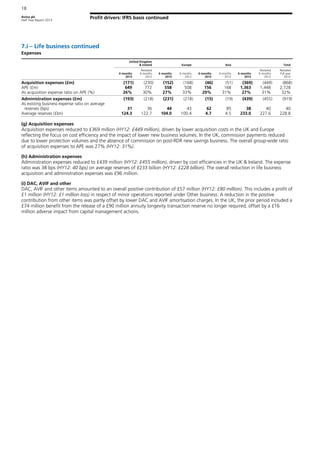
Cash
1.i – Cash remitted to Group
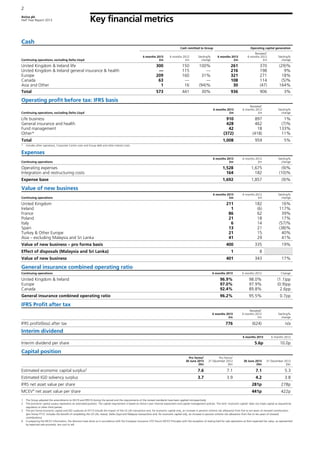
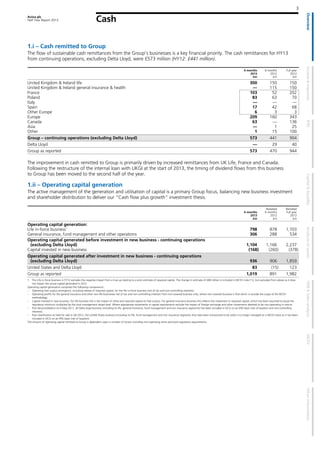
The flow of sustainable cash remittances from the Group’s businesses is a key financial priority. The cash remittances for HY13
from continuing operations, excluding Delta Lloyd, were £573 million (HY12: £441 million).
6 months
2013
£m
6 months
2012
£m
Full year
2012
£m
United Kingdom & Ireland life 300 150 150
United Kingdom & Ireland general insurance & health — 115 150
France 103 52 202
Poland 83 63 70
Italy — — —
Spain 17 42 68
Other Europe 6 3 3
Europe 209 160 343
Canada 63 — 136
Asia — 1 25
Other 1 15 100
Group – continuing operations (excluding Delta Lloyd) 573 441 904
Delta Lloyd — 29 40
Group as reported 573 470 944
The improvement in cash remitted to Group is primarily driven by increased remittances from UK Life, France and Canada.
Following the restructure of the internal loan with UKGI at the start of 2013, the timing of dividend flows from this business
to Group has been moved to the second half of the year.
1.ii – Operating capital generation
The active management of the generation and utilisation of capital is a primary Group focus, balancing new business investment
and shareholder distribution to deliver our “Cash flow plus growth” investment thesis.
6 months
2013
£m
Restated
6 months
2012
£m
Restated
Full year
2012
£m
Operating capital generation:
Life in-force business1
798 878 1,703
General insurance, fund management and other operations 306 288 534
Operating capital generated before investment in new business - continuing operations
(excluding Delta Lloyd) 1,104 1,166 2,237
Capital invested in new business (168) (260) (378)
Operating capital generated after investment in new business - continuing operations
(excluding Delta Lloyd) 936 906 1,859
United States and Delta Lloyd 83 (15) 123
Group as reported 1,019 891 1,982
1 The Life in-force business in FY12 excludes the negative impact from a true up relating to a prior estimate of required capital. The change in estimate of £88 million is included in MCEV note F12, but excluded from above as it does
not impact the actual capital generated in 2012.
Operating capital generation comprises the following components:
– Operating free surplus emergence, including release of required capital, for the life in-force business (net of tax and non-controlling interests);
– Operating profits for the general insurance and other non-life businesses net of tax and non-controlling interests from non-covered business only, where non-covered business is that which is outside the scope of life MCEV
methodology.
– Capital invested in new business. For life business this is the impact of initial and required capital on free surplus. For general insurance business this reflects the movement in required capital, which has been assumed to equal the
regulatory minimum multiplied by the local management target level. Where appropriate movements in capital requirements exclude the impact of foreign exchange and other movements deemed to be non-operating in nature.
– Post deconsolidation on 6 May 2011, all Delta Lloyd business (including its life, general insurance, fund management and non insurance segments) has been included in OCG on an IFRS basis (net of taxation and non-controlling
interests).
– Post classification as held for sale in Q4 2012, the United States business (including its life, fund management and non insurance segments that have been announced to be sold) is no longer managed on a MCEV basis so it has been
included in OCG on an IFRS basis (net of taxation).
The amount of operating capital remitted to Group is dependent upon a number of factors including non-operating items and local regulatory requirements.
Aviva plc
Half Year Report 2013
4
Cash continued
1.ii – Operating capital generation continued
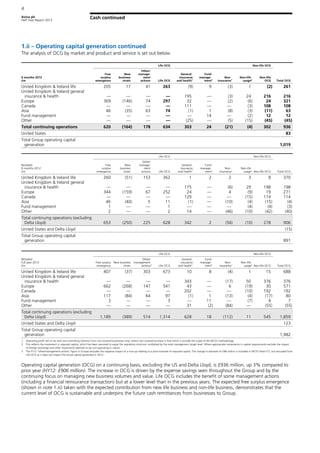
The analysis of OCG by market and product and service is set out below.
Life OCG Non-life OCG
6 months 2013
£m
Free
surplus
emergence
New
business
strain
Other/
manage-
ment
actions Life OCG
General
insurance
and health1
Fund
manage-
ment1
Non-
insurance1
Non-life
usage2
Non-life
OCG Total OCG
United Kingdom & Ireland life 205 17 41 263 (9) 9 (3) 1 (2) 261
United Kingdom & Ireland general
insurance & health — — — — 195 — (3) 24 216 216
Europe 369 (146) 74 297 32 — (2) (6) 24 321
Canada — — — — 111 — — (3) 108 108
Asia 46 (35) 63 74 (1) 1 (8) (3) (11) 63
Fund management — — — — — 14 — (2) 12 12
Other — — — — (25) — (5) (15) (45) (45)
Total continuing operations 620 (164) 178 634 303 24 (21) (4) 302 936
United States 83
Total Group operating capital
generation 1,019
Life OCG Non-life OCG
Restated
6 months 2012
£m
Free
surplus
emergence
New
business
strain
Other/
manage-
ment
actions Life OCG
General
insurance
and health1
Fund
manage-
ment1
Non-
insurance1
Non-life
usage2
Non-life OCG Total OCG
United Kingdom & Ireland life 260 (51) 153 362 1 2 2 3 8 370
United Kingdom & Ireland general
insurance & health — — — — 175 — (6) 29 198 198
Europe 344 (159) 67 252 24 — 4 (9) 19 271
Canada — — — — 129 — — (15) 114 114
Asia 46 (40) 5 11 (1) — (10) (4) (15) (4)
Fund management 1 — — 1 — — — (4) (4) (3)
Other 2 — — 2 14 — (46) (10) (42) (40)
Total continuing operations (excluding
Delta Lloyd) 653 (250) 225 628 342 2 (56) (10) 278 906
United States and Delta Lloyd (15)
Total Group operating capital
generation 891
Life OCG Non-life OCG
Restated
Full year 2012
£m
Free surplus
emergence
New business
strain
Other/
management
actions3
Life OCG
General
insurance
and health1
Fund
manage-
ment1
Non-
insurance1
Non-life
usage2
Non-life OCG Total OCG
United Kingdom & Ireland life 407 (37) 303 673 10 8 (4) 1 15 688
United Kingdom & Ireland general
insurance & health — — — — 343 — (17) 50 376 376
Europe 662 (268) 147 541 43 — 6 (19) 30 571
Canada — — — — 202 — — (10) 192 192
Asia 117 (84) 64 97 (1) 1 (13) (4) (17) 80
Fund management 3 — — 3 — 11 — (7) 4 7
Other — — — — 31 (2) (84) — (55) (55)
Total continuing operations (excluding
Delta Lloyd) 1,189 (389) 514 1,314 628 18 (112) 11 545 1,859
United States and Delta Lloyd 123
Total Group operating capital
generation 1,982
1 Operating profit net of tax and non-controlling interests from non-covered businesses only, where non-covered business is that which is outside the scope of life MCEV methodology.
2 This reflects the movement in required capital, which has been assumed to equal the regulatory minimum multiplied by the local management target level. Where appropriate movements in capital requirements exclude the impact
of foreign exchange and other movements deemed to be non-operating in nature.
3 The FY12 ‘other/management actions’ figure in Europe excludes the negative impact of a true-up relating to a prior estimate of required capital. The change in estimate of £88 million is included in MCEV Note F12, but excluded from
Life OCG as it does not impact the actual capital generated in 2012.
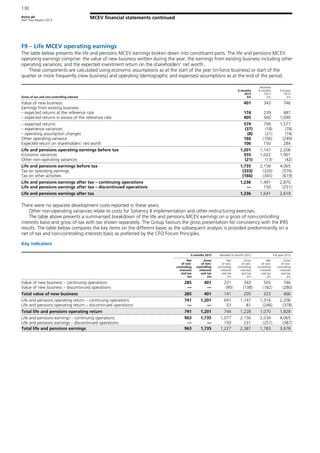
Operating capital generation (OCG) on a continuing basis, excluding the US and Delta Lloyd, is £936 million, up 3% compared to
prior year (HY12: £906 million). The increase in OCG is driven by the expense savings seen throughout the Group and by the
continuing focus on managing new business volumes and value. Life OCG includes the benefit of some management actions
(including a financial reinsurance transaction) but at a lower level than in the previous years. The expected free surplus emergence
(shown in note 1.iii) taken with the expected contribution from new life business and non-life business, demonstrates that the
current level of OCG is sustainable and underpins the future cash remittances from businesses to Group.
Aviva plc
Half Year Report 2013
5
Cash continued
1.iii – Free surplus emergence
Maturity profile of undiscounted free surplus emergence equivalent embedded value cash flows
Total in-force business
Release of future profits and required capital
30 June
2013
£m
31 December
2012
£m
Year 1 1,161 1,190
Year 2 1,133 1,156
Year 3 1,088 1,175
Year 4 1,114 1,168
Year 5 1,091 1,003
Year 6 1,091 977
Year 7 1,046 917
Year 8 1,038 857
Year 9 988 952
Year 10 940 952
Years 11-15 4,215 4,312
Years 16-20 3,630 3,541
Years 20+ 8,857 8,335
Total net of non controlling interests1
27,392 26,535
1 HY13 excludes £132 million (FY12: £385 million), in respect of held for sale operations.
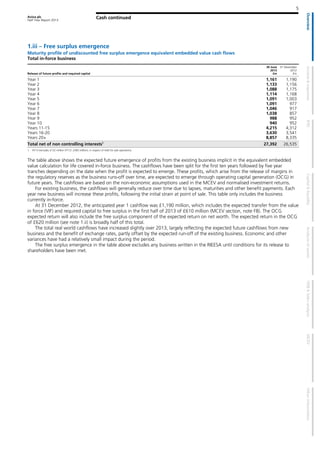
The table above shows the expected future emergence of profits from the existing business implicit in the equivalent embedded
value calculation for life covered in-force business. The cashflows have been split for the first ten years followed by five year
tranches depending on the date when the profit is expected to emerge. These profits, which arise from the release of margins in
the regulatory reserves as the business runs-off over time, are expected to emerge through operating capital generation (OCG) in
future years. The cashflows are based on the non-economic assumptions used in the MCEV and normalised investment returns.
For existing business, the cashflows will generally reduce over time due to lapses, maturities and other benefit payments. Each
year new business will increase these profits, following the initial strain at point of sale. This table only includes the business
currently in-force.
At 31 December 2012, the anticipated year 1 cashflow was £1,190 million, which includes the expected transfer from the value
in force (VIF) and required capital to free surplus in the first half of 2013 of £610 million (MCEV section, note F8). The OCG
expected return will also include the free surplus component of the expected return on net worth. The expected return in the OCG
of £620 million (see note 1.ii) is broadly half of this total.
The total real world cashflows have increased slightly over 2013, largely reflecting the expected future cashflows from new
business and the benefit of exchange rates, partly offset by the expected run-off of the existing business. Economic and other
variances have had a relatively small impact during the period.
The free surplus emergence in the table above excludes any business written in the RIEESA until conditions for its release to
shareholders have been met.
Aviva plc
Half Year Report 2013
6
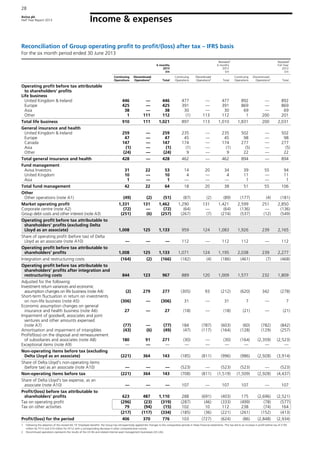
Operating profit: IFRS basis
2 – Operating Profit: IFRS basis
Group operating profit before tax from continuing operations, excluding Delta Lloyd: IFRS basis
For the six month period ended 30 June 2013
Continuing operations, excluding Delta Lloyd
6 months
2013
£m
Restated
6 months
2012
£m
Restated
Full Year
2012
£m
Operating profit before tax attributable to shareholders' profits
Life business
United Kingdom & Ireland 446 477 892
Europe 425 391 869
Asia 38 30 69
Other 1 (1) 1
Total life business (note 7.i) 910 897 1,831
General insurance and health
United Kingdom & Ireland 259 235 502
Europe 47 45 98
Canada 147 174 277
Asia (1) (1) (5)
Other (24) 9 22
Total general insurance and health (note 7.ii) 428 462 894
Fund management
Aviva Investors 31 14 39
United Kingdom 10 4 11
Asia 1 — 1
Total fund management 42 18 51
Other
Other operations (note A1) (49) (87) (177)
Market operating profit 1,331 1,290 2,599
Corporate centre (note A2) (72) (64) (136)
Group debt costs and other interest (note A3) (251) (267) (537)
Operating profit before tax attributable to shareholders' profits (excluding Delta Lloyd as an associate) 1,008 959 1,926
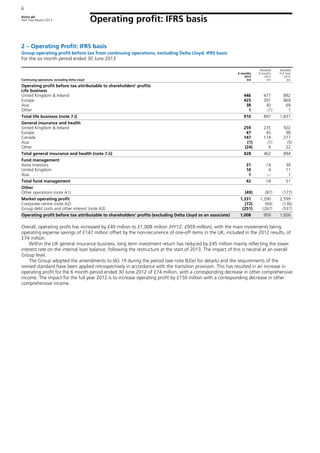
Overall, operating profit has increased by £49 million to £1,008 million (HY12: £959 million), with the main movements being
operating expense savings of £147 million offset by the non-recurrence of one-off items in the UK, included in the 2012 results, of
£74 million.
Within the UK general insurance business, long term investment return has reduced by £45 million mainly reflecting the lower
interest rate on the internal loan balance, following the restructure at the start of 2013. The impact of this is neutral at an overall
Group level.
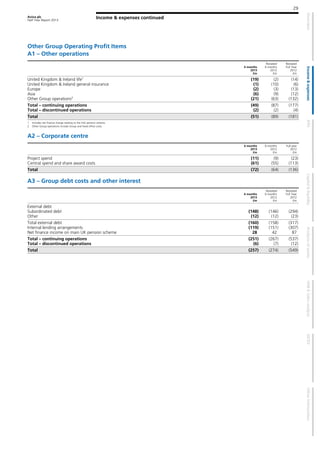
The Group adopted the amendments to IAS 19 during the period (see note B2(e) for details) and the requirements of the
revised standard have been applied retrospectively in accordance with the transition provision. This has resulted in an increase in
operating profit for the 6 month period ended 30 June 2012 of £74 million, with a corresponding decrease in other comprehensive
income. The impact for the full year 2012 is to increase operating profit by £150 million with a corresponding decrease in other
comprehensive income.
Aviva plc
Half Year Report 2013
7
Expenses
3 – Expenses
a) Expense base
Continuing operations
6 months
2013
£m
6 months
2012
£m
Operating expenses 1,528 1,675
Integration and restructuring costs 164 182
Expense base 1,692 1,857
b) Operating expenses1
Continuing operations
6 months
2013
£m
6 months
2012
£m
UK & Ireland life 326 378
UK & Ireland general insurance & health 418 452
Europe 333 353
Canada 196 199
Asia 40 49
Aviva Investors 136 140
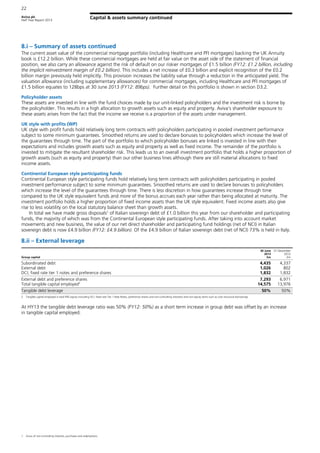
Other Group activities 79 104
Operating cost base – continuing operations 1,528 1,675
1 Operating expenses includes expenses from life, general insurance & health, fund management and other operations.
The table below shows the lines of the IFRS consolidated income statement in which operating expenses have been included:
6 months
2013
£m
6 months
2012
£m
Claims handling costs2
186 189
Non-commission acquisition costs3
468 552
Other expenses 874 934
Operating cost base – continuing operations 1,528 1,675
2 As reported within Net claims and benefits paid of £11,458 million (HY12: £12,290 million).
3 As reported within Fee and commission expense of £2,309 million (HY12: £2,259 million).
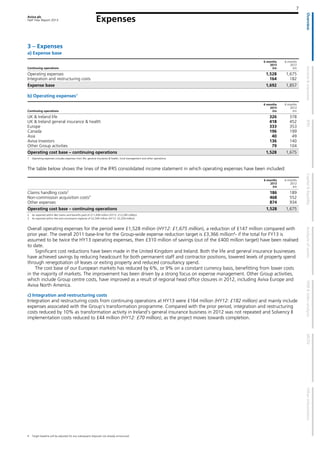
Overall operating expenses for the period were £1,528 million (HY12: £1,675 million), a reduction of £147 million compared with
prior year. The overall 2011 base-line for the Group-wide expense reduction target is £3,366 million4
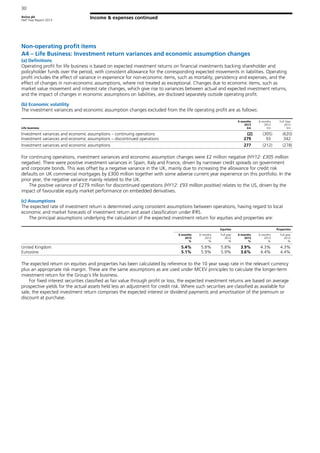
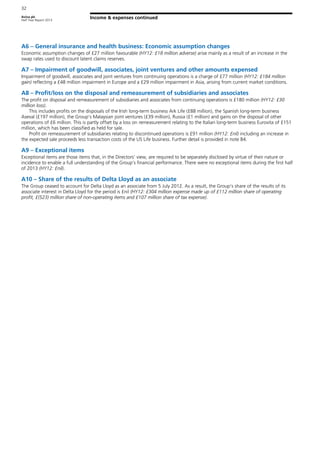
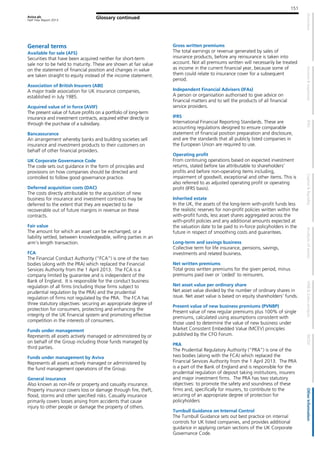
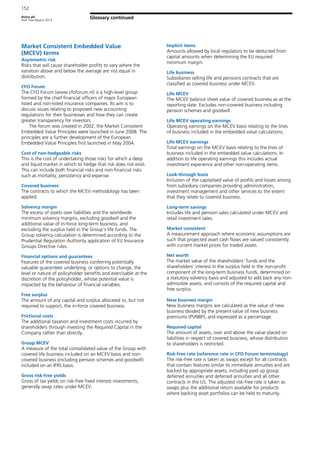
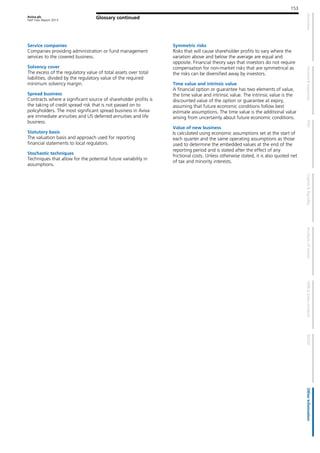
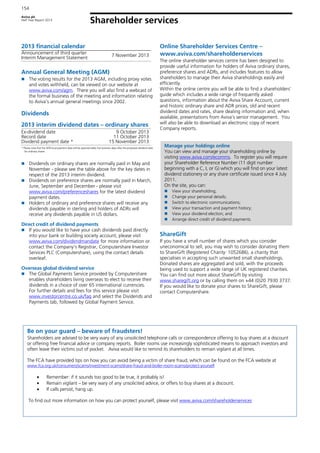
- if the total for FY13 is
assumed to be twice the HY13 operating expenses, then £310 million of savings (out of the £400 million target) have been realised
to date.
Significant cost reductions have been made in the United Kingdom and Ireland. Both the life and general insurance businesses
have achieved savings by reducing headcount for both permanent staff and contractor positions, lowered levels of property spend
through renegotiation of leases or exiting property and reduced consultancy spend.
The cost base of our European markets has reduced by 6%, or 9% on a constant currency basis, benefitting from lower costs
in the majority of markets. The improvement has been driven by a strong focus on expense management. Other Group activities,
which include Group centre costs, have improved as a result of regional head office closures in 2012, including Aviva Europe and
Aviva North America.
c) Integration and restructuring costs
Integration and restructuring costs from continuing operations at HY13 were £164 million (HY12: £182 million) and mainly include
expenses associated with the Group’s transformation programme. Compared with the prior period, integration and restructuring
costs reduced by 10% as transformation activity in Ireland’s general insurance business in 2012 was not repeated and Solvency II
implementation costs reduced to £44 million (HY12: £70 million), as the project moves towards completion.
4 Target baseline will be adjusted for any subsequent disposals not already announced.
Aviva plc
Half Year Report 2013
8
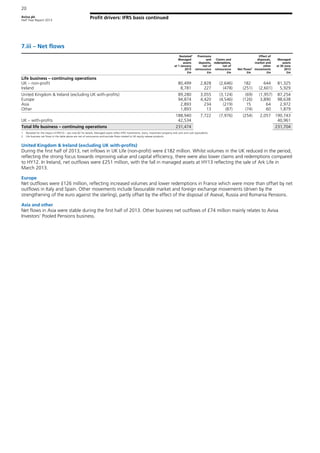
Value of new business
4 – Value of new business by market
Gross of tax and non-controlling interests - continuing operations
6 months
2013
£m
6 months
2012
£m
Full year
2012
£m
United Kingdom 211 182 420
Ireland 1 (6) (8)
United Kingdom & Ireland 212 176 412
France 86 62 119
Poland 21 18 35
Italy 6 14 29
Spain 13 21 56
Turkey 20 13 30
Other Europe 1 2 2
Europe 147 130 271
Asia – excluding Malaysia and Sri Lanka 41 29 55
Value of new business – pro forma basis 400 335 738
Effect of disposals (Malaysia and Sri Lanka) 1 8 8
Total 401 343 746
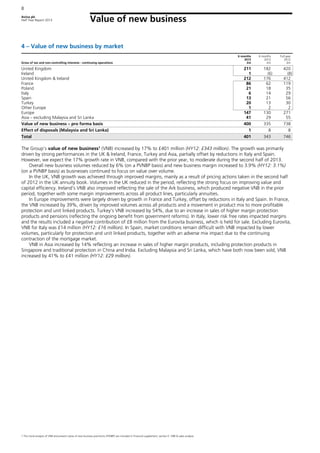
The Group’s value of new business1
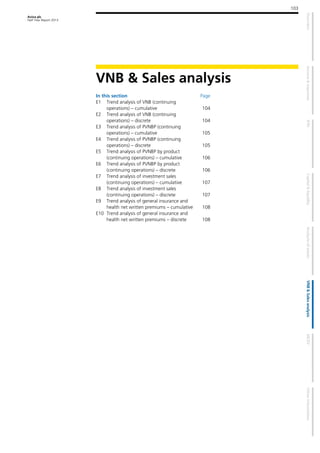
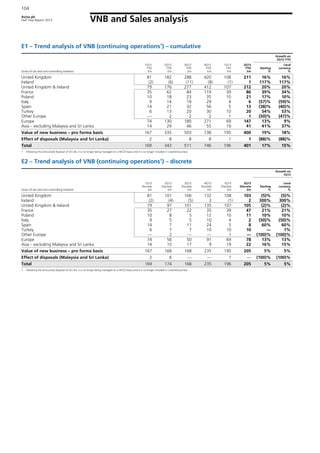
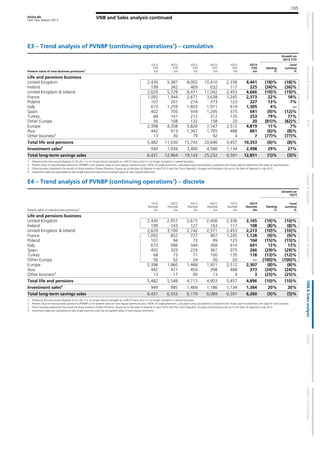
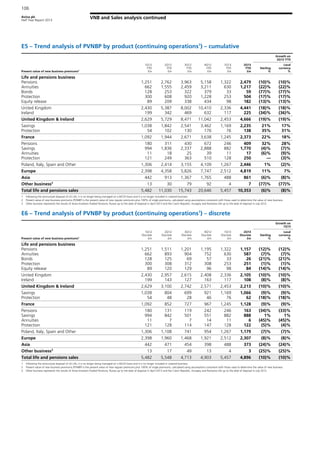
(VNB) increased by 17% to £401 million (HY12: £343 million). The growth was primarily
driven by strong performances in the UK & Ireland, France, Turkey and Asia, partially offset by reductions in Italy and Spain.
However, we expect the 17% growth rate in VNB, compared with the prior year, to moderate during the second half of 2013.
Overall new business volumes reduced by 6% (on a PVNBP basis) and new business margin increased to 3.9% (HY12: 3.1%)
(on a PVNBP basis) as businesses continued to focus on value over volume.
In the UK, VNB growth was achieved through improved margins, mainly as a result of pricing actions taken in the second half
of 2012 in the UK annuity book. Volumes in the UK reduced in the period, reflecting the strong focus on improving value and
capital efficiency. Ireland’s VNB also improved reflecting the sale of the Ark business, which produced negative VNB in the prior
period, together with some margin improvements across all product lines, particularly annuities.
In Europe improvements were largely driven by growth in France and Turkey, offset by reductions in Italy and Spain. In France,
the VNB increased by 39%, driven by improved volumes across all products and a movement in product mix to more profitable
protection and unit linked products. Turkey’s VNB increased by 54%, due to an increase in sales of higher margin protection
products and pensions (reflecting the ongoing benefit from government reforms). In Italy, lower risk free rates impacted margins
and the results included a negative contribution of £8 million from the Eurovita business, which is held for sale. Excluding Eurovita,
VNB for Italy was £14 million (HY12: £16 million). In Spain, market conditions remain difficult with VNB impacted by lower
volumes, particularly for protection and unit linked products, together with an adverse mix impact due to the continuing
contraction of the mortgage market.
VNB in Asia increased by 14% reflecting an increase in sales of higher margin products, including protection products in
Singapore and traditional protection in China and India. Excluding Malaysia and Sri Lanka, which have both now been sold, VNB
increased by 41% to £41 million (HY12: £29 million).
1 The trend analysis of VNB and present value of new business premiums (PVNBP) are included in Financial supplement, section E: VNB & sales analysis.
Aviva plc
Half Year Report 2013
9
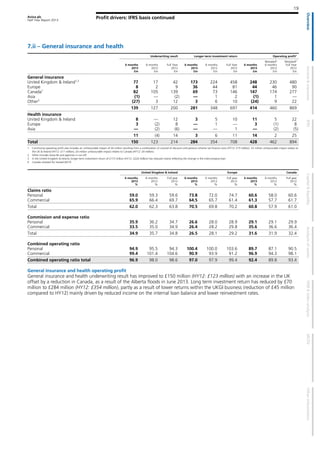
Combined operating ratio
5 – General insurance combined operating ratio (COR)
Net written premiums Claims ratio2
Commission and expense ratio3
Combined operating ratio4
6 months
2013
£m
6 months
2012
£m
Full Year
2012
£m
6 months
2013
%
6 months
2012
%
Full Year
2012
%
6 months
2013
%
6 months
2012
%
Full Year
2012
%
6 months
2013
%
6 months
2012
%
Full Year
2012
%
United Kingdom1
1,963 2,087 4,062 61.3 61.4 63.3 35.0 35.8 35.0 96.3 97.2 98.3
Ireland 146 174 326 70.3 71.9 69.7 33.7 34.6 32.6 104.0 106.5 102.3
United Kingdom & Ireland 2,109 2,261 4,388 62.0 62.3 63.8 34.9 35.7 34.8 96.9 98.0 98.6
Europe 764 726 1,295 70.5 69.8 70.2 26.5 28.1 29.2 97.0 97.9 99.4
Canada 1,126 1,081 2,176 60.8 57.9 61.0 31.6 31.9 32.4 92.4 89.8 93.4
Asia 7 11 22 94.4 70.0 68.5 25.5 34.5 37.1 119.9 104.5 105.6
Other5
20 51 67
Total 4,026 4,130 7,948 63.9 62.4 64.2 32.3 33.1 32.8 96.2 95.5 97.0
1 United Kingdom excluding Aviva Re and agencies in run-off.
2 Claims ratio: Incurred claims expressed as a percentage of net earned premiums.
3 Commission and Expense ratio: Written commissions and expenses expressed as a percentage of net written premiums.
4 Combined operating ratio: Aggregate of claims ratio and commission and expense ratio.
5 Other includes Aviva Re and agencies in run off.
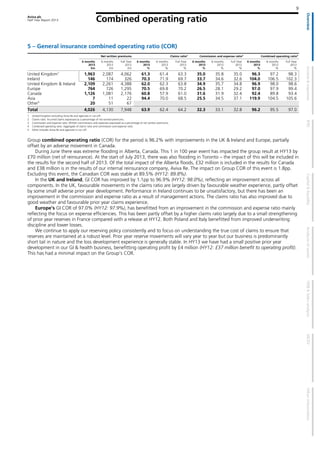
Group combined operating ratio (COR) for the period is 96.2% with improvements in the UK & Ireland and Europe, partially
offset by an adverse movement in Canada.
During June there was extreme flooding in Alberta, Canada. This 1 in 100 year event has impacted the group result at HY13 by
£70 million (net of reinsurance). At the start of July 2013, there was also flooding in Toronto – the impact of this will be included in
the results for the second half of 2013. Of the total impact of the Alberta floods, £32 million is included in the results for Canada
and £38 million is in the results of our internal reinsurance company, Aviva Re. The impact on Group COR of this event is 1.8pp.
Excluding this event, the Canadian COR was stable at 89.5% (HY12: 89.8%).
In the UK and Ireland, GI COR has improved by 1.1pp to 96.9% (HY12: 98.0%), reflecting an improvement across all
components. In the UK, favourable movements in the claims ratio are largely driven by favourable weather experience, partly offset
by some small adverse prior year development. Performance in Ireland continues to be unsatisfactory, but there has been an
improvement in the commission and expense ratio as a result of management actions. The claims ratio has also improved due to
good weather and favourable prior year claims experience.
Europe’s GI COR of 97.0% (HY12: 97.9%), has benefitted from an improvement in the commission and expense ratio mainly
reflecting the focus on expense efficiencies. This has been partly offset by a higher claims ratio largely due to a small strengthening
of prior year reserves in France compared with a release at HY12. Both Poland and Italy benefitted from improved underwriting
discipline and lower losses.
We continue to apply our reserving policy consistently and to focus on understanding the true cost of claims to ensure that
reserves are maintained at a robust level. Prior year reserve movements will vary year to year but our business is predominantly
short tail in nature and the loss development experience is generally stable. In HY13 we have had a small positive prior year
development in our GI & health business, benefitting operating profit by £4 million (HY12: £37 million benefit to operating profit).
This has had a minimal impact on the Group’s COR.
Aviva plc
Half Year Report 2013
10
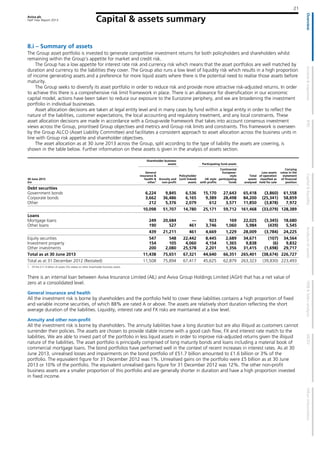
Business unit performance
6.i – United Kingdom and Ireland Life
6 months
2013
£m
6 months
2012
£m
Full year
2012
£m
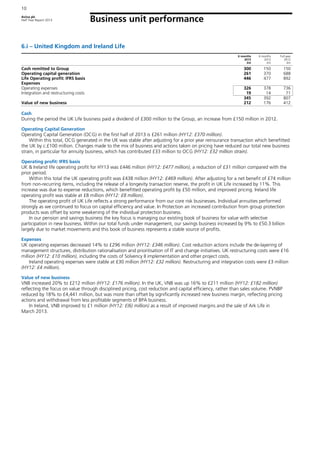
Cash remitted to Group 300 150 150
Operating capital generation 261 370 688
Life Operating profit: IFRS basis 446 477 892
Expenses
Operating expenses 326 378 736
Integration and restructuring costs 19 14 71
345 392 807
Value of new business 212 176 412
Cash
During the period the UK Life business paid a dividend of £300 million to the Group, an increase from £150 million in 2012.
Operating Capital Generation
Operating Capital Generation (OCG) in the first half of 2013 is £261 million (HY12: £370 million).
Within this total, OCG generated in the UK was stable after adjusting for a prior year reinsurance transaction which benefitted
the UK by c.£100 million. Changes made to the mix of business and actions taken on pricing have reduced our total new business
strain, in particular for annuity business, which has contributed £33 million to OCG (HY12: £32 million strain).
Operating profit: IFRS basis
UK & Ireland life operating profit for HY13 was £446 million (HY12: £477 million), a reduction of £31 million compared with the
prior period.
Within this total the UK operating profit was £438 million (HY12: £469 million). After adjusting for a net benefit of £74 million
from non-recurring items, including the release of a longevity transaction reserve, the profit in UK Life increased by 11%. This
increase was due to expense reductions, which benefitted operating profit by £50 million, and improved pricing. Ireland life
operating profit was stable at £8 million (HY12: £8 million).
The operating profit of UK Life reflects a strong performance from our core risk businesses. Individual annuities performed
strongly as we continued to focus on capital efficiency and value. In Protection an increased contribution from group protection
products was offset by some weakening of the individual protection business.
In our pension and savings business the key focus is managing our existing book of business for value with selective
participation in new business. Within our total funds under management, our savings business increased by 9% to £50.3 billion
largely due to market movements and this book of business represents a stable source of profits.
Expenses
UK operating expenses decreased 14% to £296 million (HY12: £346 million). Cost reduction actions include the de-layering of
management structures, distribution rationalisation and prioritisation of IT and change initiatives. UK restructuring costs were £16
million (HY12: £10 million), including the costs of Solvency II implementation and other project costs.
Ireland operating expenses were stable at £30 million (HY12: £32 million). Restructuring and integration costs were £3 million
(HY12: £4 million).
Value of new business
VNB increased 20% to £212 million (HY12: £176 million). In the UK, VNB was up 16% to £211 million (HY12: £182 million)
reflecting the focus on value through disciplined pricing, cost reduction and capital efficiency, rather than sales volume. PVNBP
reduced by 18% to £4,441 million, but was more than offset by significantly increased new business margin, reflecting pricing
actions and withdrawal from less profitable segments of BPA business.
In Ireland, VNB improved to £1 million (HY12: £(6) million) as a result of improved margins and the sale of Ark Life in
March 2013.
Aviva plc
Half Year Report 2013
11
Business unit performance continued
6.ii – United Kingdom and Ireland general insurance & health
6 months
2013
£m
6 months
2012
£m
Full year
2012
£m
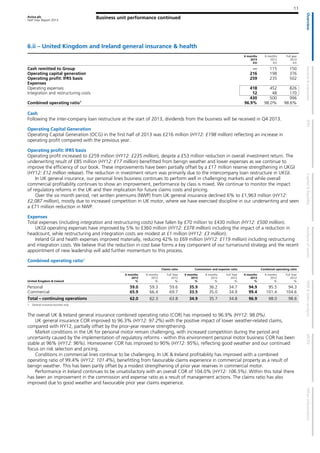
Cash remitted to Group — 115 150
Operating capital generation 216 198 376
Operating profit: IFRS basis 259 235 502
Expenses
Operating expenses 418 452 826
Integration and restructuring costs 12 48 170
430 500 996
Combined operating ratio1
96.9% 98.0% 98.6%
Cash
Following the inter-company loan restructure at the start of 2013, dividends from the business will be received in Q4 2013.
Operating Capital Generation
Operating Capital Generation (OCG) in the first half of 2013 was £216 million (HY12: £198 million) reflecting an increase in
operating profit compared with the previous year.
Operating profit: IFRS basis
Operating profit increased to £259 million (HY12: £235 million), despite a £53 million reduction in overall investment return. The
underwriting result of £85 million (HY12: £17 million) benefitted from benign weather and lower expenses as we continue to
improve the efficiency of our book. These improvements have been partially offset by a £17 million reserve strengthening in UKGI
(HY12: £12 million release). The reduction in investment return was primarily due to the intercompany loan restructure in UKGI.
In UK general insurance, our personal lines business continues to perform well in challenging markets and while overall
commercial profitability continues to show an improvement, performance by class is mixed. We continue to monitor the impact
of regulatory reforms in the UK and their implication for future claims costs and pricing.
Over the six month period, net written premiums (NWP) from UK general insurance declined 6% to £1,963 million (HY12:
£2,087 million), mostly due to increased competition in UK motor, where we have exercised discipline in our underwriting and seen
a £71 million reduction in NWP.
Expenses
Total expenses (including integration and restructuring costs) have fallen by £70 million to £430 million (HY12: £500 million).
UKGI operating expenses have improved by 5% to £360 million (HY12: £378 million) including the impact of a reduction in
headcount, while restructuring and integration costs are modest at £1 million (HY12: £3 million).
Ireland GI and health expenses improved materially, reducing 42% to £69 million (HY12: £119 million) including restructuring
and integration costs. We believe that the reduction in cost base forms a key component of our turnaround strategy and the recent
appointment of new leadership will add further momentum to this process.
Combined operating ratio1
Claims ratio Commission and expense ratio Combined operating ratio
United Kingdom & Ireland
6 months
2013
%
6 months
2012
%
Full Year
2012
%
6 months
2013
%
6 months
2012
%
Full Year
2012
%
6 months
2013
%
6 months
2012
%
Full Year
2012
%
Personal 59.0 59.3 59.6 35.9 36.2 34.7 94.9 95.5 94.3
Commercial 65.9 66.4 69.7 33.5 35.0 34.9 99.4 101.4 104.6
Total – continuing operations 62.0 62.3 63.8 34.9 35.7 34.8 96.9 98.0 98.6
1 General insurance business only.
The overall UK & Ireland general insurance combined operating ratio (COR) has improved to 96.9% (HY12: 98.0%).
UK general insurance COR improved to 96.3% (HY12: 97.2%) with the positive impact of lower weather-related claims,
compared with HY12, partially offset by the prior-year reserve strengthening.
Market conditions in the UK for personal motor remain challenging, with increased competition during the period and
uncertainty caused by the implementation of regulatory reforms - within this environment personal motor business COR has been
stable at 96% (HY12: 96%). Homeowner COR has improved to 90% (HY12: 95%), reflecting good weather and our continued
focus on risk selection and pricing.
Conditions in commercial lines continue to be challenging. In UK & Ireland profitability has improved with a combined
operating ratio of 99.4% (HY12: 101.4%), benefitting from favourable claims experience in commercial property as a result of
benign weather. This has been partly offset by a modest strengthening of prior year reserves in commercial motor.
Performance in Ireland continues to be unsatisfactory with an overall COR of 104.0% (HY12: 106.5%). Within this total there
has been an improvement in the commission and expense ratio as a result of management actions. The claims ratio has also
improved due to good weather and favourable prior year claims experience.
Aviva plc
Half Year Report 2013
12
Business unit performance continued
6.iii – Europe1
6 months
2013
£m
6 months
2012
£m
Full year
2012
£m
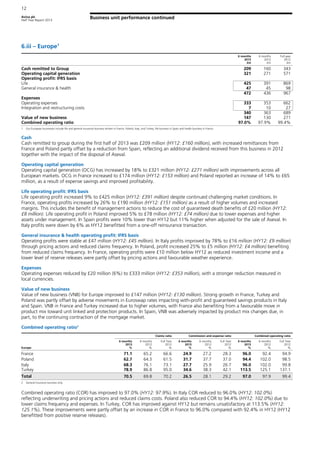
Cash remitted to Group 209 160 343
Operating capital generation 321 271 571
Operating profit: IFRS basis
Life 425 391 869
General insurance & health 47 45 98
472 436 967
Expenses
Operating expenses 333 353 662
Integration and restructuring costs 7 10 27
340 363 689
Value of new business 147 130 271
Combined operating ratio 97.0% 97.9% 99.4%
1 Our European businesses include life and general insurance business written in France, Poland, Italy, and Turkey, life business in Spain and health business in France.
Cash
Cash remitted to group during the first half of 2013 was £209 million (HY12: £160 million), with increased remittances from
France and Poland partly offset by a reduction from Spain, reflecting an additional dividend received from this business in 2012
together with the impact of the disposal of Aseval.
Operating capital generation
Operating capital generation (OCG) has increased by 18% to £321 million (HY12: £271 million) with improvements across all
European markets. OCG in France increased to £174 million (HY12: £153 million) and Poland reported an increase of 14% to £65
million, as a result of expense savings and improved profitability.
Life operating profit: IFRS basis
Life operating profit increased 9% to £425 million (HY12: £391 million) despite continued challenging market conditions. In
France, operating profits increased by 26% to £190 million (HY12: £151 million) as a result of higher volumes and increased
margins. This includes the benefit of management actions to reduce the cost of guaranteed death benefits of £20 million (HY12:
£8 million). Life operating profit in Poland improved 5% to £78 million (HY12: £74 million) due to lower expenses and higher
assets under management. In Spain profits were 10% lower than HY12 but 11% higher when adjusted for the sale of Aseval. In
Italy profits were down by 6% as HY12 benefitted from a one-off reinsurance transaction.
General insurance & health operating profit: IFRS basis
Operating profits were stable at £47 million (HY12: £45 million). In Italy profits improved by 78% to £16 million (HY12: £9 million)
through pricing actions and reduced claims frequency. In Poland, profit increased 25% to £5 million (HY12: £4 million) benefiting
from reduced claims frequency. In France, operating profits were £10 million below HY12 as reduced investment income and a
lower level of reserve releases were partly offset by pricing actions and favourable weather experience.
Expenses
Operating expenses reduced by £20 million (6%) to £333 million (HY12: £353 million), with a stronger reduction measured in
local currencies.
Value of new business
Value of new business (VNB) for Europe improved to £147 million (HY12: £130 million). Strong growth in France, Turkey and
Poland was partly offset by adverse movements in Euroswap rates impacting with-profit and guaranteed savings products in Italy
and Spain. VNB in France and Turkey increased due to higher volumes, with France also benefiting from a favourable move in
product mix toward unit linked and protection products. In Spain, VNB was adversely impacted by product mix changes due, in
part, to the continuing contraction of the mortgage market.
Combined operating ratio2
Claims ratio Commission and expense ratio Combined operating ratio
Europe
6 months
2013
%
6 months
2012
%
Full Year
2012
%
6 months
2013
%
6 months
2012
%
Full Year
2012
%
6 months
2013
%
6 months
2012
%
Full Year
2012
%
France 71.1 65.2 66.6 24.9 27.2 28.3 96.0 92.4 94.9
Poland 62.7 64.3 61.5 31.7 37.7 37.0 94.4 102.0 98.5
Italy 68.3 76.1 73.1 27.7 25.9 26.7 96.0 102.0 99.8
Turkey 78.9 86.8 95.0 34.6 38.3 42.1 113.5 125.1 137.1
Total 70.5 69.8 70.2 26.5 28.1 29.2 97.0 97.9 99.4
2 General Insurance business only.
Combined operating ratio (COR) has improved to 97.0% (HY12: 97.9%). In Italy COR reduced to 96.0% (HY12: 102.0%)
reflecting underwriting and pricing actions and reduced claims costs. Poland also reduced COR to 94.4% (HY12: 102.0%) due to
lower claims frequency and expenses. In Turkey, COR has improved against HY12 but remains unsatisfactory at 113.5% (HY12:
125.1%). These improvements were partly offset by an increase in COR in France to 96.0% compared with 92.4% in HY12 (HY12
benefitted from positive reserve releases).
Aviva plc
Half Year Report 2013
13
Business unit performance continued
6.iv – Canada
6 months
2013
£m
6 months
2012
£m
Full year
2012
£m
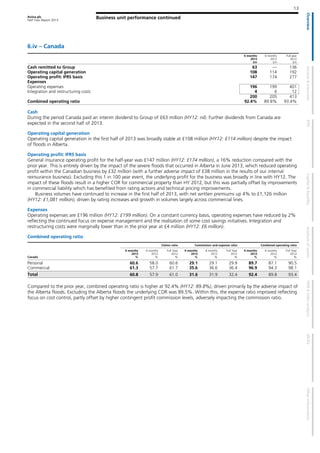
Cash remitted to Group 63 — 136
Operating capital generation 108 114 192
Operating profit: IFRS basis 147 174 277
Expenses
Operating expenses 196 199 401
Integration and restructuring costs 4 6 12
200 205 413
Combined operating ratio 92.4% 89.8% 93.4%
Cash
During the period Canada paid an interim dividend to Group of £63 million (HY12: nil). Further dividends from Canada are
expected in the second half of 2013.
Operating capital generation
Operating capital generation in the first half of 2013 was broadly stable at £108 million (HY12: £114 million) despite the impact
of floods in Alberta.
Operating profit: IFRS basis
General insurance operating profit for the half-year was £147 million (HY12: £174 million), a 16% reduction compared with the
prior year. This is entirely driven by the impact of the severe floods that occurred in Alberta in June 2013, which reduced operating
profit within the Canadian business by £32 million (with a further adverse impact of £38 million in the results of our internal
reinsurance business). Excluding this 1 in 100 year event, the underlying profit for the business was broadly in line with HY12. The
impact of these floods result in a higher COR for commercial property than HY 2012, but this was partially offset by improvements
in commercial liability which has benefited from rating actions and technical pricing improvements.
Business volumes have continued to increase in the first half of 2013, with net written premiums up 4% to £1,126 million
(HY12: £1,081 million), driven by rating increases and growth in volumes largely across commercial lines.
Expenses
Operating expenses are £196 million (HY12: £199 million). On a constant currency basis, operating expenses have reduced by 2%
reflecting the continued focus on expense management and the realisation of some cost savings initiatives. Integration and
restructuring costs were marginally lower than in the prior year at £4 million (HY12: £6 million).
Combined operating ratio
Claims ratio Commission and expense ratio Combined operating ratio
Canada
6 months
2013
%
6 months
2012
%
Full Year
2012
%
6 months
2013
%
6 months
2012
%
Full Year
2012
%
6 months
2013
%
6 months
2012
%
Full Year
2012
%
Personal 60.6 58.0 60.6 29.1 29.1 29.9 89.7 87.1 90.5
Commercial 61.3 57.7 61.7 35.6 36.6 36.4 96.9 94.3 98.1
Total 60.8 57.9 61.0 31.6 31.9 32.4 92.4 89.8 93.4
Compared to the prior year, combined operating ratio is higher at 92.4% (HY12: 89.8%), driven primarily by the adverse impact of
the Alberta floods. Excluding the Alberta floods the underlying COR was 89.5%. Within this, the expense ratio improved reflecting
focus on cost control, partly offset by higher contingent profit commission levels, adversely impacting the commission ratio.
Aviva plc
Half Year Report 2013
14
Business unit performance continued
6.v – Asia
6 months
2013
£m
6 months
2012
£m
Full year
2012
£m
Cash remitted to Group — 1 25
Operating capital generation 63 (4) 80
Operating profit: IFRS basis
Life 38 30 69
General insurance & health (1) (1) (5)
37 29 64
Expenses
Operating expenses 40 49 93
Integration and restructuring costs 3 2 3
43 51 96
Value of new business
Value of new business – excluding Malaysia and Sri Lanka 41 29 55
Effect of disposals (Malaysia and Sri Lanka) 1 8 8
42 37 63
Combined operating ratio 119.9% 104.5% 105.6%
Cash
No dividends were paid to Group in the period but dividends are expected during the second half of the year.
Operating Capital Generation
Operating capital generation in the first half of 2013 was £63 million (HY12: £(4) million), which primarily reflects the positive
impact of a reinsurance transaction in Singapore.
Operating profit: IFRS basis
Overall operating profit from Life and the general insurance and health business increased to £37 million (HY12: £29 million),
primarily driven by improved performance in Singapore’s Life business due to an improved business mix. Within this total, life
business profits grew to £38 million (HY12: £30 million), with a £(1) million result from the non-life business (HY12: £(1) million).
Expenses
Overall expenses have reduced to £43 million (HY12: £51 million), with lower operating expenses, mainly due to the disposal of Sri
Lanka, offset by a marginal increase in integration and restructuring costs reflecting the restructuring of Asia’s head office.
Value of New Business
Value of new business (VNB) for the period was £42 million (HY12: £37 million), with the growth driven by Singapore, China and
India. Singapore’s VNB increased as a result of an improved business mix with strong protection sales and the success of new
product lines launched earlier in the year. Despite a reduction in volumes, both India and China‘s sales mix shifted towards higher
margin traditional protection products, contributing to an increase in VNB. Excluding disposals (Malaysia and Sri Lanka), VNB for
Asia is £41 million (HY12: £29 million), an increase of 41% compared with the previous year.
Combined Operating Ratio
Overall COR for the Asia businesses was 119.9% (HY12: 104.5%), with the deterioration driven by a one-off increase in reserve
margin in Singapore. Overall net written premiums for GI and Health business reduced to £54 million, reflecting the withdrawal
from unprofitable health products in Singapore and the disposal of our Sri Lankan business in Q4 2012.
Aviva plc
Half Year Report 2013
15
Business unit performance continued
6.vi – Fund management
6 months
2013
£m
6 months
2012
£m
Full year
2012
£m
Cash remitted to Group1
1 15 15
Operating capital generation1
12 (3) 7
Operating profit: IFRS basis
Aviva Investors 31 14 39
United Kingdom 10 4 11
Asia 1 — 1
42 18 51
Expenses1
Operating expenses 136 140 306
Integration and restructuring costs 15 19 33
151 159 339
1 Only includes Aviva Investors
Cash
During the period a dividend of £1 million was paid to Group with the majority of the dividends expected in the second half of the
year.
Operating Capital Generation
Aviva Investors operating capital generation has increased compared with the same period last year primarily as a result of higher
operating profits.
Operating profit: IFRS basis
Operating profit generated by Aviva Investors was £31 million (HY12: £14 million), an increase of £17 million compared with the
prior year. This improvement was driven by higher revenues, reflecting positive market movements and performance fees, and
lower costs as a result of the cost saving initiatives undertaken over the last year.
Expenses
Overall operating expenses have fallen by £4 million compared with the first half of 2012, with reductions in staff and recruitment
expenditure. Restructuring costs have also fallen by £4 million due to lower transformation and Solvency II spend.
Net flows and funds under management – Aviva Investors
Internal
£m
External
£m
Total
£m
Aviva Investors
Funds under management at 1 January 2013 185,027 51,309 236,336
Gross Sales 7,539 5,364 12,903
Gross claims/redemptions (9,061) (6,075) (15,136)
Market movements and other 9,505 1,180 10,685
Funds under management at 30 June 2013 193,010 51,778 244,788
Aviva Investors funds under management have increased by £8.5 billion over the first half of the year. This is driven by market
movements and the impact of FX movements.
While we have seen significant external sales in the half year, these have been more than offset by outflows. Sales have
included strong inflows in our UK Liquidity funds, our on-going Aviva Investors business in the US, and our High Yield and
Emerging Market Debt capabilities.
Within internal assets we have seen overall net outflows in our UK continuing business.
Aviva plc
Half Year Report 2013
16
Profit drivers: IFRS basis
7.i – Life business
Life business operating profit before shareholder tax for continuing operations increased by 1% to £910 million (HY12: £897
million).
Total income reduced by 3% to £1,661 million (HY12: £1,721 million) while total expenses fell by 11% to £808 million (HY12:
£904 million), giving an improvement in cost/income ratio to 49% (HY12: 53%). There was a reduction in the overall contribution
from DAC and AVIF amortisation and other items and business, with an aggregate £57 million positive impact for the period from
these items (HY12: £80 million).
In the UK & Ireland, life operating profit reduced by 6%. The prior period result included a £74 million net benefit from non-
recurring items, including the release of a longevity transaction reserve. Excluding these items, the operating profit increased by
11%, with lower new business income more than offset by lower acquisition and administration expenses.
Life operating profit increased by 9% in Europe, driven by increased participating business income and lower acquisition
expenses, and the positive effect of exchange rate movements.
In Asia, an increase in life operating profit of 27% was driven by growth in new business income in Singapore and an overall
reduction in expenses.
United Kingdom & Ireland Europe Asia Total Continuing Operations
6 months
2013
£m
Restated
6 months
2012
£m
Restated
Full Year
2012
£m
6 months
2013
£m
6 months
2012
£m
Full Year
2012
£m
6 months
2013
£m
6 months
2012
£m
Full Year
2012
£m
6 months
2013
£m
Restated
6 months
2012
£m
Restated
Full Year
2012
£m
New business income 231 272 619 106 126 267 50 47 101 387 445 987
Underwriting margin 101 123 261 159 162 339 33 31 58 293 316 658
Investment return 385 390 822 570 538 1,076 26 32 66 981 960 1,964
Total Income 717 785 1,702 835 826 1,682 109 110 225 1,661 1,721 3,609
Acquisition expenses (171) (230) (451) (152) (168) (317) (46) (51) (100) (369) (449) (868)
Administration expenses (193) (218) (426) (231) (218) (450) (15) (19) (43) (439) (455) (919)
Total Expenses (364) (448) (877) (383) (386) (767) (61) (70) (143) (808) (904) (1,787)
DAC, AVIF and other 93 140 67 (27) (49) (46) (10) (10) (13) 56 81 8
446 477 892 425 391 869 38 30 69 909 898 1,830
Other business1
1 (1) 1
Total – continuing operations 910 897 1,831
1 Other business includes the total result for Aviva Investors Pooled Pensions and Aviva Life Reinsurance
Income: New business income and underwriting margin
United Kingdom
& Ireland Europe Asia Total
6 months
2013
Restated
6 months
2012
6 months
2013
6 months
2012
6 months
2013
6 months
2012
6 months
2013
Restated
6 months
2012
Restated
Full year
2012
New business income (£m) 231 272 106 126 50 47 387 445 987
APE (£m) 649 772 558 508 156 168 1,363 1,448 2,728
As margin on APE (%) 36% 35% 19% 25% 32% 28% 28% 31% 36%
Underwriting margin (£m) 101 123 159 162 33 31 293 316 658
Analysed by:
Expenses 23 32 41 43 17 18 81 93 197
Mortality and longevity 53 52 105 106 14 11 172 169 360
Persistency 25 39 13 13 2 2 40 54 101
(a) New business income
New business income reduced to £387 million (HY12: £445 million), due to lower sales volumes in the UK & Ireland and a
reduction in the new business margin on APE in Europe.
In the UK & Ireland, while new business volumes (based on APE) reduced by 16% the margin on APE was stable at 36% (HY12:
35%). Increased profitability from annuity business was offset by lower protection volumes.
In Europe, while new business volume increased (driven by growth in France and Turkey), new business margin on APE
reduced, mainly driven by lower interest rates in Italy. As a result, overall new business income reduced by 16%.
The net contribution from new business is the new business income less associated acquisition expenses. This net contribution
increased to £18 million (HY12: £4 million negative).
(b) Underwriting margin
The underwriting margin reduced to £293 million (HY12: £316 million). The reduced margin in the UK & Ireland was driven by a
lower profit in Ireland following the sale of Ark Life. In Europe, an increased mortality margin in France was primarily driven by
management actions to reduce the cost of guaranteed death benefits which generated additional profits of around £20 million
(HY12: £8 million). This positive variance was more than offset by reduced profits due to the sale of Aseval in Spain during the
current period and the sale of certain smaller European businesses in 2012.
Aviva plc
Half Year Report 2013
17
Profit drivers: IFRS basis continued
7.i – Life business continued
Income: Investment return
United Kingdom
& Ireland Europe Asia Total
6 months
2013
Restated
6 months
2012
6 months
2013
6 months
2012
6 months
2013
6 months
2012
6 months
2013
Restated
6 months
2012
Restated
Full year
2012
Unit-linked margin (£m) 208 212 227 219 12 12 447 443 882
As annual management charge
on average reserves (bps) 90 96 120 124 184 192 104 110 107
Average reserves (£bn) 46.5 44.2 37.8 35.2 1.3 1.3 85.6 80.7 82.1
Participating business (£m) 41 34 254 228 (5) — 290 262 547
As bonus on average reserves (bps) 22 17 82 75 n/a n/a 58 51 54
Average reserves (£bn) 37.3 40.6 61.9 60.6 1.5 1.3 100.7 102.5 101.4
Spread margin (£m) 69 66 18 22 13 14 100 102 197
As spread margin on average
reserves (bps) 34 35 85 96 139 148 43 46 43
Average reserves (£bn) 40.5 37.9 4.3 4.6 1.9 1.9 46.7 44.4 45.3
Expected return on shareholder assets (£m) 67 78 71 69 6 6 144 153 338
Total (£m) 385 390 570 538 26 32 981 960 1,964
(c) Unit-linked margin
The unit-linked margin was stable at £447 million (HY12: £443 million). The margin as a proportion of average unit-linked reserves
was 104 bps (HY12: 110 bps), on average reserves of £86 billion (HY12: £81 billion). The reduced margin on reserves was driven
by the UK, with an on-going shift in business mix from bonds to pensions which have lower average fund charges, and reduced
charges on pensions business in Poland due to a legislative restriction.
(d) Participating business
Income from participating business increased to £290 million (HY12: £262 million). In the UK & Ireland, the shareholder transfer
from with-profit funds increased to £41 million (HY12: £34 million), reflecting increases to bonus rates. In Europe, income
increased to £254 million (HY12: £228 million), driven by higher income in France and Italy and the effect of exchange rate
movements. The majority of participating business income is earned in France, where there is a fixed management charge of
around 50bps on AFER business, which is the largest single component of the business. In Asia, losses were incurred on our
businesses in China and Hong Kong.
(e) Spread margin
Spread business income was stable at £100 million (HY12: £102 million). Spread margins relate mainly to UK immediate annuity
and equity release business. The spread margin in the UK & Ireland increased to £69 million (HY12: £66 million), reflecting growth
in annuity assets under management. In Europe the spread margin reduced due to the sale of Aseval in Spain. The spread margin
on average reserves was 43 bps (HY12: 46 bps), on average reserves of £47 billion (HY12: £44 billion).
(f) Expected return on shareholder assets
Expected returns reduced to £144 million (HY12: £153 million), representing investment income on surplus funds. The reduction in
income relates mainly to the UK, reflecting lower bond yields and a greater proportion of cash assets within surplus funds.
Aviva plc
Half Year Report 2013
18
Profit drivers: IFRS basis continued
7.i – Life business continued
Expenses
United Kingdom
& Ireland Europe Asia Total
6 months
2013
Restated
6 months
2012
6 months
2013
6 months
2012
6 months
2013
6 months
2012
6 months
2013
Restated
6 months
2012
Restated
Full year
2012
Acquisition expenses (£m) (171) (230) (152) (168) (46) (51) (369) (449) (868)
APE (£m) 649 772 558 508 156 168 1,363 1,448 2,728
As acquisition expense ratio on APE (%) 26% 30% 27% 33% 29% 31% 27% 31% 32%
Administration expenses (£m) (193) (218) (231) (218) (15) (19) (439) (455) (919)
As existing business expense ratio on average
reserves (bps) 31 36 44 43 62 85 38 40 40
Average reserves (£bn) 124.3 122.7 104.0 100.4 4.7 4.5 233.0 227.6 228.8
(g) Acquisition expenses
Acquisition expenses reduced to £369 million (HY12: £449 million), driven by lower acquisition costs in the UK and Europe
reflecting the focus on cost efficiency and the impact of lower new business volumes. In the UK, commission payments reduced
due to lower protection volumes and the absence of commission on post-RDR new savings business. The overall group-wide ratio
of acquisition expenses to APE was 27% (HY12: 31%).
(h) Administration expenses
Administration expenses reduced to £439 million (HY12: £455 million), driven by cost efficiencies in the UK & Ireland. The expense
ratio was 38 bps (HY12: 40 bps) on average reserves of £233 billion (HY12: £228 billion). The overall reduction in life business
acquisition and administration expenses was £96 million.
(i) DAC, AVIF and other
DAC, AVIF and other items amounted to an overall positive contribution of £57 million (HY12: £80 million). This includes a profit of
£1 million (HY12: £1 million loss) in respect of minor operations reported under Other business. A reduction in the positive
contribution from other items was partly offset by lower DAC and AVIF amortisation charges. In the UK, the prior period included a
£74 million benefit from the release of a £90 million annuity longevity transaction reserve no longer required, offset by a £16
million adverse impact from capital management actions.
Aviva plc
Half Year Report 2013
19
Profit drivers: IFRS basis continued
7.ii – General insurance and health
Underwriting result Longer-term investment return Operating profit1
6 months
2013
£m
6 months
2012
£m
Full Year
2012
£m
6 months
2013
£m
6 months
2012
£m
Full Year
2012
£m
6 months
2013
£m
Restated4
6 months
2012
£m
Restated4
Full Year
2012
£m
General insurance
United Kingdom & Ireland1,3
77 17 42 173 224 458 248 230 480
Europe 8 2 9 36 44 81 44 46 90
Canada1
82 105 139 69 73 146 147 174 277
Asia (1) — (2) — 1 2 (1) 1 —
Other2
(27) 3 12 3 6 10 (24) 9 22
139 127 200 281 348 697 414 460 869
Health insurance
United Kingdom & Ireland 8 — 12 3 5 10 11 5 22
Europe 3 (2) 8 — 1 — 3 (1) 8
Asia — (2) (6) — — 1 — (2) (5)
11 (4) 14 3 6 11 14 2 25
Total 150 123 214 284 354 708 428 462 894
1 Continuing operating profit also includes an unfavourable impact of £6 million resulting from a combination of unwind of discount and pension scheme net finance costs (HY12: £15 million). £2 million unfavourable impact relates to
the UK & Ireland (HY12: £11 million), £4 million unfavourable impact relates to Canada (HY12: £4 million).
2 Other includes Aviva Re and agencies in run-off.
3 In the United Kingdom & Ireland, longer-term investment return of £173 million (HY12: £224 million) has reduced mainly reflecting the change in the intercompany loan.
4 Canada restated for revised IAS19.
United Kingdom & Ireland Europe Canada
6 months
2013
%
6 months
2012
%
Full year
2012
%
6 months
2013
%
6 months
2012
%
Full year
2012
%
6 months
2013
%
6 months
2012
%
Full year
2012
%
Claims ratio
Personal 59.0 59.3 59.6 73.8 72.0 74.7 60.6 58.0 60.6
Commercial 65.9 66.4 69.7 64.5 65.7 61.4 61.3 57.7 61.7
Total 62.0 62.3 63.8 70.5 69.8 70.2 60.8 57.9 61.0
Commission and expense ratio
Personal 35.9 36.2 34.7 26.6 28.0 28.9 29.1 29.1 29.9
Commercial 33.5 35.0 34.9 26.4 28.2 29.8 35.6 36.6 36.4
Total 34.9 35.7 34.8 26.5 28.1 29.2 31.6 31.9 32.4
Combined operating ratio
Personal 94.9 95.5 94.3 100.4 100.0 103.6 89.7 87.1 90.5
Commercial 99.4 101.4 104.6 90.9 93.9 91.2 96.9 94.3 98.1
Combined operating ratio total 96.9 98.0 98.6 97.0 97.9 99.4 92.4 89.8 93.4
General insurance and health operating profit
General insurance and health underwriting result has improved to £150 million (HY12: £123 million) with an increase in the UK
offset by a reduction in Canada, as a result of the Alberta floods in June 2013. Long term investment return has reduced by £70
million to £284 million (HY12: £354 million), partly as a result of lower returns within the UKGI business (reduction of £45 million
compared to HY12) mainly driven by reduced income on the internal loan balance and lower reinvestment rates.
Aviva plc
Half Year Report 2013
20
Profit drivers: IFRS basis continued
7.iii – Net flows
Restated1
Managed
assets
at 1 January
2013
£m
Premiums
and
deposits,
net of
reinsurance
£m
Claims and
redemptions,
net of
reinsurance
£m
Net flows2
£m
Effect of
disposals,
market and
other
movements
£m
Managed
assets
at 30 June
2013
£m
Life business – continuing operations
UK – non-profit 80,499 2,828 (2,646) 182 644 81,325
Ireland 8,781 227 (478) (251) (2,601) 5,929
United Kingdom & Ireland (excluding UK with-profits) 89,280 3,055 (3,124) (69) (1,957) 87,254
Europe 94,874 4,420 (4,546) (126) 3,890 98,638
Asia 2,893 234 (219) 15 64 2,972
Other 1,893 13 (87) (74) 60 1,879
188,940 7,722 (7,976) (254) 2,057 190,743
UK – with-profits 42,534 40,961
Total life business – continuing operations 231,474 231,704
1 Restated for the impact of IFRS10 – see note B2 for details. Managed assets reflect IFRS investments, loans, investment property and cash and cash equivalents.
2 Life business net flows in the table above are net of reinsurance and exclude flows related to UK equity release products.
United Kingdom & Ireland (excluding UK with-profits)
During the first half of 2013, net inflows in UK Life (non-profit) were £182 million. Whilst volumes in the UK reduced in the period,
reflecting the strong focus towards improving value and capital efficiency, there were also lower claims and redemptions compared
to HY12. In Ireland, net outflows were £251 million, with the fall in managed assets at HY13 reflecting the sale of Ark Life in
March 2013.
Europe
Net outflows were £126 million, reflecting increased volumes and lower redemptions in France which were more than offset by net
outflows in Italy and Spain. Other movements include favourable market and foreign exchange movements (driven by the
strengthening of the euro against the sterling), partly offset by the effect of the disposal of Aseval, Russia and Romania Pensions.
Asia and other
Net flows in Asia were stable during the first half of 2013. Other business net outflows of £74 million mainly relates to Aviva
Investors’ Pooled Pensions business.
Aviva plc
Half Year Report 2013
21
Capital & assets summary
8.i – Summary of assets
The Group asset portfolio is invested to generate competitive investment returns for both policyholders and shareholders whilst
remaining within the Group’s appetite for market and credit risk.
The Group has a low appetite for interest rate risk and currency risk which means that the asset portfolios are well matched by
duration and currency to the liabilities they cover. The Group also runs a low level of liquidity risk which results in a high proportion
of income generating assets and a preference for more liquid assets where there is the potential need to realise those assets before
maturity.
The Group seeks to diversify its asset portfolio in order to reduce risk and provide more attractive risk-adjusted returns. In order
to achieve this there is a comprehensive risk limit framework in place. There is an allowance for diversification in our economic
capital model, actions have been taken to reduce our exposure to the Eurozone periphery, and we are broadening the investment
portfolio in individual businesses.
Asset allocation decisions are taken at legal entity level and in many cases by fund within a legal entity in order to reflect the
nature of the liabilities, customer expectations, the local accounting and regulatory treatment, and any local constraints. These
asset allocation decisions are made in accordance with a Group-wide framework that takes into account consensus investment
views across the Group, prioritised Group objectives and metrics and Group risk limits and constraints. This framework is overseen
by the Group ALCO (Asset Liability Committee) and facilitates a consistent approach to asset allocation across the business units in
line with Group risk appetite and shareholder objectives.
The asset allocation as at 30 June 2013 across the Group, split according to the type of liability the assets are covering, is
shown in the table below. Further information on these assets is given in the analysis of assets section.
Shareholder business
assets Participating fund assets
30 June 2013
£m
General
insurance &
health &
other1
Annuity and
non-profit
Policyholder
(unit linked)
assets
UK style
with profits
Continental
European-
style
participating
funds
Total
assets
analysed
Less assets
of operation
classified as
held for sale
Carrying
value in the
statement
of financial
position
Debt securities
Government bonds 6,224 9,845 6,536 15,170 27,643 65,418 (3,860) 61,558
Corporate bonds 3,662 36,486 6,165 9,389 28,498 84,200 (25,341) 58,859
Other 212 5,376 2,079 612 3,571 11,850 (3,878) 7,972
10,098 51,707 14,780 25,171 59,712 161,468 (33,079) 128,389
Loans
Mortgage loans 249 20,684 — 923 169 22,025 (3,345) 18,680
Other loans 190 527 461 3,746 1,060 5,984 (439) 5,545
439 21,211 461 4,669 1,229 28,009 (3,784) 24,225
Equity securities 547 548 22,442 8,445 2,689 34,671 (107) 34,564
Investment property 154 105 4,060 4,154 1,365 9,838 (6) 9,832
Other investments 200 2,080 25,578 2,201 1,356 31,415 (1,698) 29,717
Total as at 30 June 2013 11,438 75,651 67,321 44,640 66,351 265,401 (38,674) 226,727
Total as at 31 December 2012 (Restated) 11,508 75,894 67,417 45,625 62,879 263,323 (39,830) 223,493
1. Of the £11.4 billion of assets 3% relates to other shareholder business assets.
There is an internal loan between Aviva Insurance Limited (AIL) and Aviva Group Holdings Limited (AGH) that has a net value of
zero at a consolidated level.
General insurance and health
All the investment risk is borne by shareholders and the portfolio held to cover these liabilities contains a high proportion of fixed
and variable income securities, of which 88% are rated A or above. The assets are relatively short duration reflecting the short
average duration of the liabilities. Liquidity, interest rate and FX risks are maintained at a low level.
Annuity and other non-profit
All the investment risk is borne by shareholders. The annuity liabilities have a long duration but are also illiquid as customers cannot
surrender their policies. The assets are chosen to provide stable income with a good cash flow, FX and interest rate match to the
liabilities. We are able to invest part of the portfolio in less liquid assets in order to improve risk-adjusted returns given the illiquid
nature of the liabilities. The asset portfolio is principally comprised of long maturity bonds and loans including a material book of
commercial mortgage loans. The bond portfolios have performed well in the context of recent increases in interest rates. As at 30
June 2013, unrealised losses and impairments on the bond portfolio of £51.7 billion amounted to £1.6 billion or 3% of the
portfolio. The equivalent figure for 31 December 2012 was 1%. Unrealised gains on the portfolio were £5 billion as at 30 June
2013 or 10% of the portfolio. The equivalent unrealised gains figure for 31 December 2012 was 12%. The other non-profit
business assets are a smaller proportion of this portfolio and are generally shorter in duration and have a high proportion invested
in fixed income.
Aviva plc
Half Year Report 2013
22
Capital & assets summary continued
8.i – Summary of assets continued
The current asset value of the commercial mortgage portfolio (including Healthcare and PFI mortgages) backing the UK Annuity
book is £12.2 billion. While these commercial mortgages are held at fair value on the asset side of the statement of financial
position, we also carry an allowance against the risk of default on our riskier mortgages of £1.5 billion (FY12: £1.2 billion, including
the implicit reinvestment margin of £0.2 billion). This includes a net increase of £0.3 billion and explicit recognition of the £0.2
billion margin previously held implicitly. This provision increases the liability value through a reduction in the anticipated yield. The
valuation allowance (including supplementary allowances) for commercial mortgages, including Healthcare and PFI mortgages of
£1.5 billion equates to 128bps at 30 June 2013 (FY12: 89bps). Further detail on this portfolio is shown in section D3.2.
Policyholder assets
These assets are invested in line with the fund choices made by our unit-linked policyholders and the investment risk is borne by
the policyholder. This results in a high allocation to growth assets such as equity and property. Aviva’s shareholder exposure to
these assets arises from the fact that the income we receive is a proportion of the assets under management.
UK style with profits (WP)
UK style with profit funds hold relatively long term contracts with policyholders participating in pooled investment performance
subject to some minimum guarantees. Smoothed returns are used to declare bonuses to policyholders which increase the level of
the guarantees through time. The part of the portfolio to which policyholder bonuses are linked is invested in line with their
expectations and includes growth assets such as equity and property as well as fixed income. The remainder of the portfolio is
invested to mitigate the resultant shareholder risk. This leads us to an overall investment portfolio that holds a higher proportion of
growth assets (such as equity and property) than our other business lines although there are still material allocations to fixed
income assets.
Continental European style participating funds
Continental European style participating funds hold relatively long term contracts with policyholders participating in pooled
investment performance subject to some minimum guarantees. Smoothed returns are used to declare bonuses to policyholders
which increase the level of the guarantees through time. There is less discretion in how guarantees increase through time
compared to the UK style equivalent funds and more of the bonus accrues each year rather than being allocated at maturity. The
investment portfolio holds a higher proportion of fixed income assets than the UK style equivalent. Fixed income assets also give
rise to less volatility on the local statutory balance sheet than growth assets.
In total we have made gross disposals1
of Italian sovereign debt of £1.0 billion this year from our shareholder and participating
funds, the majority of which was from the Continental European style participating funds. After taking into account market
movements and new business, the value of our net direct shareholder and participating fund holdings (net of NCI) in Italian
sovereign debt is now £4.9 billion (FY12: £4.9 billion). Of the £4.9 billion of Italian sovereign debt (net of NCI) 73% is held in Italy.
8.ii – External leverage
Group capital
30 June
2013
£m
31 December
2012
£m
Subordinated debt 4,435 4,337
External debt 1,026 802
DCI, fixed rate tier 1 notes and preference shares 1,832 1,832
External debt and preference shares 7,293 6,971
Total tangible capital employed2
14,575 13,976
Tangible debt leverage 50% 50%
2 Tangible capital employed is total IFRS equity (including DCI, fixed rate Tier 1 Rate Notes, preference shares and non-controlling interests) and non equity items such as core structural borrowings.
At HY13 the tangible debt leverage ratio was 50% (FY12: 50%) as a short term increase in group debt was offset by an increase
in tangible capital employed.
1 Gross of non-controlling interests, purchases and redemptions.
Aviva plc
Half Year Report 2013
23
Capital & assets summary continued
8.iii – Net asset value
At the end of HY13, IFRS net asset value per share was 281 pence (FY12: 278 pence). This movement was driven by operating
profits principally offset by integration and restructuring costs, strengthening of the default provision in relation to UK life
commercial mortgages, payment of the final 2012 dividend to shareholders and remeasurements on pension schemes.
Total IFRS investment return variances were flat. For continuing operations, IFRS investment return variances were £281 million
adverse. In the life business, investment return variances were neutral, with narrowing credit spreads on government and corporate
bonds in France, Italy and Spain offset by the credit default experience and subsequent default provision strengthening in the UK
Life business of £300 million. There were adverse investment variances on general insurance and other business of £279 million,
primarily reflecting an increase in gilt yields in the UK, France and Canada.
The adverse movement on the group’s staff pension schemes of £229 million post tax is principally due to the main UK staff
pension scheme where the surplus has decreased over the period largely as a result of an increase in long-term inflation rates partly
offset by an increase in long term AA corporate bond yield. These adverse changes were slightly mitigated by improvements to the
scheme deficits in the Irish and Canadian pension schemes.
IFRS
30 June
2013
£m
pence per
share2
Restated
31 December
2012
£m
pence per
share2
Equity attributable to shareholders of Aviva plc at 1 January1
8,204 278p 12,643 435p
Operating profit – continuing operations 1,008 35p 2,038 70p
Operating profit – discontinued operations 125 4p 239 8p
Investment return variances and economic assumption changes on life and non life business (2) — (815) (28)p
Profit/(loss) on the disposal and remeasurements of subsidiaries and associates 271 9p (2,523) (86)p
Goodwill impairment and amortisation of intangibles (126) (4)p (1,099) (37)p
Integration and restructuring costs (166) (6)p (468) (16)p
Tax on operating profit and on other activities (334) (11)p (306) (10)p
Non-controlling interests (83) (3)p (168) (6)p
Profit after tax attributable to shareholders of Aviva plc 693 24p (3,102) (105)p
AFS securities (fair value) & other reserve movements (271) (9)p 323 11p
Ordinary dividends net of scrip (264) (9)p (630) (21)p
Direct capital instruments and fixed rate tier 1 notes interest and preference share dividend (22) (1)p (72) (2)p
Foreign exchange rate movements 139 5p (184) (6)p
Remeasurements of pension schemes (229) (8)p (792) (27)p
Other net equity movements3
26 1p 18 (7)p
Equity attributable to shareholders of Aviva plc at 30 June / 31 December1
8,276 281p 8,204 278p
1 Excluding preference shares
2 Number of shares as at 30 June 2013: 2,947 million (31 December 2012: 2,946 million).
3 Other net equity movements per share includes the dilution effect of the increase in number of shares during the period.
MCEV net asset value per share increased to 441 pence (FY12: 422 pence). This movement has been principally driven by operating
profits and positive investment variances offset by integration and restructuring costs, payment of the final 2012 dividend to
shareholders and remeasurements on pension schemes.
MCEV investment return variances of £555 million were primarily generated by the group’s life businesses, which contributed
£834 million, offset by the adverse investment return variances in the non life businesses of £279 million. The life investment return
variances were largely generated by narrowing credit spreads on corporate bonds in the UK and Spain together with narrowing
government bond spreads in Italy and Spain and changes in the prospective UK tax rate.
MCEV4
30 June
2013
£m
pence per
share2
Restated
31 December
2012
£m
pence per
share2
Equity attributable to shareholders of Aviva plc at 1 January1
12,434 422p 12,829 441p
Operating profit – continuing operations 1,287 46p 2,393 82p
Operating profit – discontinued operations 125 4p (390) (13)p
Investment return variances and economic assumption changes on life and non life business 555 19p 1,358 46p
Profit on the disposal and remeasurements of subsidiaries and associates 278 9p 1,094 37p
Goodwill impairment and amortisation of intangibles (138) (5)p (1,143) (39)p
Integration and restructuring costs (165) (6)p (467) (16)p
Exceptional items — — 51 2p
Tax on operating profit and on other activities (582) (20)p (1,021) (35)p
Non-controlling interests (282) (10)p (855) (29)p
Profit after tax attributable to shareholders of Aviva plc 1,078 37p 1,020 35p
AFS securities (fair value) & other reserve movements (235) (8)p 119 5p
Ordinary dividends net of scrip (264) (9)p (630) (21)p
Direct capital instruments and fixed rate tier 1 notes interest and preference share dividend (22) (1)p (72) (2)p
Foreign exchange rate movements 211 7p (58) (2)p
Remeasurements of pension schemes (229) (8)p (792) (27)p
Other net equity movements3
26 1p 18 (7)p
Equity attributable to shareholders of Aviva plc at 30 June / 31 December1
12,999 441p 12,434 422p
1 Excluding preference shares
2 Number of shares as at 30 June 2013: 2,947 million (31 December 2012: 2,946 million).
3 Other net equity movements per share includes the dilution effect of the increase in number of shares during the period.
4 In preparing the MCEV information, the directors have done so in accordance with the European Insurance CFO Forum MCEV Principles with the exception of stating held for sale operations at their expected fair value, as represented
by expected sale proceeds, less cost to sell.
Aviva plc
Half Year Report 2013
24
Capital & assets summary continued
8.iv – Return on equity
Return on equity shareholder funds is calculated as operating return (IFRS basis) net of tax expressed as a percentage of opening
shareholders equity. This has increased to 17.0% (FY12: 11.2%) for HY13, reflecting the impact of the significant asset write
downs experienced in 2012 which adversely impacted closing shareholders equity for that year.
6 months
2013
%
Restated
Full Year
2012
%
United Kingdom & Ireland life 12.9% 15.9%
United Kingdom & Ireland general insurance and health 8.4% 9.5%
Europe 11.0% 12.4%
Canada 21.0% 19.8%
Asia 8.0% 6.1%
Fund management 26.7% 19.5%
Corporate and Other Business n/a n/a
Return on total capital employed (excluding Delta Lloyd and United States) 10.3% 10.0%
Delta Lloyd — 10.8%
United States 55.6% 5.1%
Return on total capital employed 11.3% 9.3%
Subordinated debt 5.3% 4.9%
External debt 2.0% 2.4%
Return on total equity 14.3% 10.9%
Less: Non-controlling interests 11.8% 12.0%
Direct capital instruments and fixed rate tier 1 notes 1.9% 5.6%
Preference capital 9.0% 8.5%
Return on equity shareholders' funds 17.0% 11.2%
8.v – European Insurance Groups Directive (IGD)
UK life
funds
£bn
Other
business
£bn
30 June
2013
£bn
31 December
2012
£bn
Insurance Groups Directive (IGD) capital resources 4.7 9.8 14.5 14.4
Less: capital resource requirement (4.7) (5.6) (10.3) (10.6)
Insurance Group Directive (IGD) excess solvency — 4.2 4.2 3.8
Cover over EU minimum (calculated excluding UK life funds)
1.8
times
1.7
times
The EU Insurance Groups Directive (IGD) regulatory capital solvency surplus has increased by £0.4 billion since FY12 to £4.2 billion.
On a pro forma basis the estimated IGD solvency surplus at 30 June 2013 is £3.7 billion. The pro forma 30 June 2013 position
includes the impact of the announced disposal of the Aviva US Life and Annuities business and related asset management
operations classified as held for sale in the Group IFRS balance sheet.
The key movements over the period are set out in the following table:
£bn
IGD solvency surplus at 31 December 2012 3.8
Operating profits net of other income and expenses 0.6
Dividends and appropriations (0.3)
Market movements including foreign exchange1
(0.2)
Pension scheme funding (0.1)
Disposals 0.6
Other regulatory adjustments (0.2)
Estimated IGD solvency surplus at 30 June 2013 4.2
Pro forma IGD solvency surplus at 30 June 2013 3.7
1 Market movements include the impact of equity, credit spread, interest rate and foreign exchange movements net of the effect of hedging instruments.
Group IGD sensitivity
30 June
2013
£bn
Equities
down
10%
Interest
rates up
1%
Sensitivities on pro forma IGD1
3.7 (0.1) (0.8)
1 The impact of sensitivities on the pro forma position includes the announced disposal of the Aviva US Life and Annuities business and related asset management operations.
The Group proactively manages its balance sheet risk through monitoring, stress analysis and our hedging programme.
The Group’s pro forma IGD surplus is resilient to global equity market falls or a 1% global interest rate rise. The Group’s pro
forma IGD surplus would be approximately £3.3 billion in the event of a 40% fall in equity markets from the 30 June 2013 position
reflecting the hedging that the Group currently has in place.
The impact of a 1% rise in global interest rates is calculated with reference to the regulatory value of debt securities in
continental Europe being capped to local minimum capital requirements in participating funds. This provides the Group’s pro forma
IGD surplus protection from immediate market losses on debt securities.
Aviva plc
Half Year Report 2013
25
Capital & assets summary continued
8.vi – Economic capital
The estimated economic capital surplus represents the excess of Available Economic Capital over Required Economic Capital.
Available Economic Capital is based on MCEV net assets, adjusted for items to convert to an economic basis. Required economic
capital is based on Aviva’s own internal assessment and capital management policies. The term ‘economic capital’ does not imply
capital as required by regulators or other third parties.
Summary of estimated economic capital position
6 months
2013
£bn
Full year
2012
£bn
Available economic capital 17.7 16.6
Standalone required economic capital (17.6) (18.1)
Diversification benefit 7.0 6.8
Diversified required economic capital (10.6) (11.3)
Estimated economic capital position at 30 June/31 December 7.1 5.3
Cover Ratio 167% 147%
Pro forma impacts 0.5 1.8
Estimated pro forma economic capital position at 30 June/31 December 7.6 7.1
Pro forma cover ratio 175% 172%
Analysis of change in economic capital
6 months
2013
£bn
Full Year
2012
£bn
Economic capital surplus position at 1 January 5.3 3.6
MCEV operating earnings 0.7 0.9
Economic variances 0.5 0.7
Other non-operating items (0.1) (0.6)
Dividend and appropriations, and shares issued in lieu of dividends (0.3) (0.7)
Net impact of fixed rate note issuance/call — 0.2
Available capital benefits from Delta Lloyd, Aseval & other disposals 0.4 —
Favourable movements in US 0.6 —
UK increase in commercial mortgage default allowance (0.3) —
Other (0.4) 0.4
Change in available economic capital 1.1 0.9
Impact of trading operations and other 0.5 0.4
Impact of changes in Group hedging (0.1) 0.2
Capital requirement benefits from Delta Lloyd, Aseval & disposals 0.3 0.2
Change in diversified required economic capital 0.7 0.8
Estimated economic capital surplus position at 30 June/31 December 7.1 5.3
Pro forma impacts 0.5 1.8
Estimated pro forma economic capital surplus position at 30 June/31 December 7.6 7.1
The estimated economic capital position has increased by £1.8 billion to £7.1 billion at 30 June 2013 with a corresponding increase
in the cover ratio from 147% to 167%. The cover ratio is now within the Group’s external target of between 160% and 175%.
The improvement during the period has been driven by an increase in available economic capital (reflecting underlying profits,
favourable market movements, the sale completion of Delta Lloyd, Aseval and other disposals, partly offset by payment of the final
FY12 dividend and the adverse impact of the increase in the UK commercial mortgage default allowance) and a reduction in
required capital (reflecting primarily the capital requirement benefits from the above disposals).
The pro forma position includes the benefit of the US transaction (announced in December 2012, which is expected to
complete during the second half of the year) and the impact of strengthening pension schemes from a 5 year to a 10 year stressed
contribution basis. The net impact of these increases the estimated economic capital surplus to £7.6 billion with a cover ratio of
175%. The reduction in pro forma impacts relative to FY12 mainly reflects the sale completion of Aseval, Delta Lloyd and Malaysia
during the period.
Aviva plc
Half Year Report 2013
26
Capital & assets summary continued
8.vi – Economic capital continued
Summary analysis of diversified required economic capital
6 months
2013
£bn
Full year
2012
£bn
Credit risk1
2.3 2.3
Equity risk2
1.9 1.7
Interest rate risk3
0.1 0.1
Other market risk4
1.6 1.5
Life insurance risk5
1.0 1.0
General insurance risk6
0.8 0.9
Other risk7
2.5 2.4
Total (HY13 pro forma basis) 10.2 9.9
Total (HY13 base results) 10.6 11.3
1 Capital held in respect of credit risk recognises the Group’s shareholder exposure to changes in the market value of assets and defaults. Assets captured within this category include corporate bonds and non-domestic sovereigns.
A range of specific stresses are applied reflecting the difference in assumed risk relative to the investment grade and duration.
2 Capital held in respect of equity risk recognises the Group’s shareholder exposure to changes in the market value of assets. The increase in equity risk during the period primarily reflects increases in equity values during the first
six months of 2013.
3 Capital held in respect of interest rate risk recognises the Group’s shareholder exposure to changes in the market value of assets. A range of specific stresses are applied reflecting the difference in assumed risk relative to investment
grade and duration.
4 Capital held in respect of other market risk recognises the Group’s shareholder exposure to changes in the market value of commercial mortgages and property, but also captures risk in association with inflation and foreign
exchange.
5 Capital held in respect of life insurance risk recognises the Group’s shareholder exposure to life insurance specific risks, such as longevity and lapse.
6 Capital held in respect of general insurance risk recognises the Group’s shareholder exposure to general insurance specific risks, such as claims volatility and catastrophe.
7 Capital held in respect of other risk recognises the Group’s shareholder exposure to specific risks unique to particular business units and other items.
Aviva plc
Half Year Report 2013
27
Financial supplement
Page
A Income & expenses 28
B IFRS financial statements 33
C Capital & liquidity 77
D Analysis of assets 87
E VNB & Sales analysis 103
F MCEV financial statements 109
In this section
A Income & expenses 28
Reconciliation of Group operating profit
to profit/(loss) after tax – IFRS basis 28
A1 Other operations 29
A2 Corporate centre 29
A3 Group debt costs and other interest 29
A4 Life business: Investment return variances
and economic assumption changes 30
A5 Non-life business: Short-term fluctuation
in return on investments 31
A6 General insurance & health business:
Economic assumption changes 32
A7 Impairment of goodwill, associates, joint
ventures and other amounts expensed 32
A8 Profit/loss on the disposal and
remeasurement of subsidiaries and
associates 32
A9 Exceptional items 32
A10 Share of the results of Delta Lloyd as an
associate 32
Aviva plc
Half Year Report 2013
28
Income & expenses
Reconciliation of Group operating profit to profit/(loss) after tax – IFRS basis
For the six month period ended 30 June 2013
6 months
2013
£m
Restated1
6 months
2012
£m
Restated1
Full Year
2012
£m
Continuing
Operations
Discontinued
Operations2
Total
Continuing
Operations
Discontinued
Operations2
Total
Continuing
Operations
Discontinued
Operations2
Total
Operating profit before tax attributable
to shareholders' profits
Life business
United Kingdom & Ireland 446 — 446 477 — 477 892 — 892
Europe 425 — 425 391 — 391 869 — 869
Asia 38 — 38 30 — 30 69 — 69
Other 1 111 112 (1) 113 112 1 200 201
Total life business 910 111 1,021 897 113 1,010 1,831 200 2,031
General insurance and health
United Kingdom & Ireland 259 — 259 235 — 235 502 — 502
Europe 47 — 47 45 — 45 98 — 98
Canada 147 — 147 174 — 174 277 — 277
Asia (1) — (1) (1) — (1) (5) — (5)
Other (24) — (24) 9 — 9 22 — 22
Total general insurance and health 428 — 428 462 — 462 894 — 894
Fund management
Aviva Investors 31 22 53 14 20 34 39 55 94
United Kingdom 10 — 10 4 — 4 11 — 11
Asia 1 — 1 — — — 1 — 1
Total fund management 42 22 64 18 20 38 51 55 106
Other
Other operations (note A1) (49) (2) (51) (87) (2) (89) (177) (4) (181)
Market operating profit 1,331 131 1,462 1,290 131 1,421 2,599 251 2,850
Corporate centre (note A2) (72) — (72) (64) — (64) (136) — (136)
Group debt costs and other interest (note A3) (251) (6) (257) (267) (7) (274) (537) (12) (549)
Operating profit before tax attributable to
shareholders' profits (excluding Delta
Lloyd as an associate) 1,008 125 1,133 959 124 1,083 1,926 239 2,165
Share of operating profit (before tax) of Delta
Lloyd as an associate (note A10) — — — 112 — 112 112 — 112
Operating profit before tax attributable to
shareholders' profits 1,008 125 1,133 1,071 124 1,195 2,038 239 2,277
Integration and restructuring costs (164) (2) (166) (182) (4) (186) (461) (7) (468)
Operating profit before tax attributable to
shareholders' profits after integration and
restructuring costs 844 123 967 889 120 1,009 1,577 232 1,809
Adjusted for the following:
Investment return variances and economic
assumption changes on life business (note A4) (2) 279 277 (305) 93 (212) (620) 342 (278)
Short-term fluctuation in return on investments
on non-life business (note A5) (306) — (306) 31 — 31 7 — 7
Economic assumption changes on general
insurance and health business (note A6) 27 — 27 (18) — (18) (21) — (21)
Impairment of goodwill, associates and joint
ventures and other amounts expensed
(note A7) (77) — (77) 184 (787) (603) (60) (782) (842)
Amortisation and impairment of intangibles (43) (6) (49) (47) (117) (164) (128) (129) (257)
Profit/(loss) on the disposal and remeasurement
of subsidiaries and associates (note A8) 180 91 271 (30) — (30) (164) (2,359) (2,523)
Exceptional items (note A9) — — — — — — — — —
Non-operating items before tax (excluding
Delta Lloyd as an associate) (221) 364 143 (185) (811) (996) (986) (2,928) (3,914)
Share of Delta Lloyd's non-operating items
(before tax) as an associate (note A10) — — — (523) — (523) (523) — (523)
Non-operating items before tax (221) 364 143 (708) (811) (1,519) (1,509) (2,928) (4,437)
Share of Delta Lloyd's tax expense, as an
associate (note A10) — — — 107 — 107 107 — 107
Profit/(loss) before tax attributable to
shareholders' profits 623 487 1,110 288 (691) (403) 175 (2,696) (2,521)
Tax on operating profit (296) (23) (319) (287) (46) (333) (499) (78) (577)
Tax on other activities 79 (94) (15) 102 10 112 238 (74) 164
(217) (117) (334) (185) (36) (221) (261) (152) (413)
Profit/(loss) for the period 406 370 776 103 (727) (624) (86) (2,848) (2,934)
1 Following the adoption of the revised IAS 19 ‘Employee benefits’ the Group has retrospectively applied the changes to the comparative periods in these financial statements. This has led to an increase in profit before tax of £150
million for FY12 and £74 million for HY12 with a corresponding decrease in other comprehensive income.
2 Discontinued operations represents the results of the US life and related internal asset management businesses (US Life).
Aviva plc
Half Year Report 2013
29
Income & expenses continued
Other Group Operating Profit Items
A1 – Other operations
6 months
2013
£m
Restated
6 months
2012
£m
Restated
Full Year
2012
£m
United Kingdom & Ireland life1
(19) (2) (14)
United Kingdom & Ireland general insurance (1) (10) (6)
Europe (2) (3) (13)
Asia (6) (9) (12)
Other Group operations2
(21) (63) (132)
Total – continuing operations (49) (87) (177)
Total – discontinued operations (2) (2) (4)
Total (51) (89) (181)
1 Includes net finance charge relating to the Irish pension scheme.
2 Other Group operations include Group and head office costs.
A2 – Corporate centre
6 months
2013
£m
6 months
2012
£m
Full year
2012
£m
Project spend (11) (9) (23)
Central spend and share award costs (61) (55) (113)
Total (72) (64) (136)
A3 – Group debt costs and other interest
6 months
2013
£m
Restated
6 months
2012
£m
Restated
Full Year
2012
£m
External debt
Subordinated debt (148) (146) (294)
Other (12) (12) (23)
Total external debt (160) (158) (317)
Internal lending arrangements (119) (151) (307)
Net finance income on main UK pension scheme 28 42 87
Total – continuing operations (251) (267) (537)
Total – discontinued operations (6) (7) (12)
Total (257) (274) (549)
Aviva plc
Half Year Report 2013
30
Income & expenses continued
Non-operating profit items
A4 – Life Business: Investment return variances and economic assumption changes
(a) Definitions
Operating profit for life business is based on expected investment returns on financial investments backing shareholder and
policyholder funds over the period, with consistent allowance for the corresponding expected movements in liabilities. Operating
profit includes the effect of variance in experience for non-economic items, such as mortality, persistency and expenses, and the
effect of changes in non-economic assumptions, where not treated as exceptional. Changes due to economic items, such as
market value movement and interest rate changes, which give rise to variances between actual and expected investment returns,
and the impact of changes in economic assumptions on liabilities, are disclosed separately outside operating profit.
(b) Economic volatility
The investment variances and economic assumption changes excluded from the life operating profit are as follows:
Life business
6 months
2013
£m
6 months
2012
£m
Full Year
2012
£m
Investment variances and economic assumptions – continuing operations (2) (305) (620)
Investment variances and economic assumptions – discontinued operations 279 93 342
Investment variances and economic assumptions 277 (212) (278)
For continuing operations, investment variances and economic assumption changes were £2 million negative (HY12: £305 million
negative). There were positive investment variances in Spain, Italy and France, driven by narrower credit spreads on government
and corporate bonds. This was offset by a negative variance in the UK, mainly due to increasing the allowance for credit risk
defaults on UK commercial mortgages by £300 million together with some adverse current year experience on this portfolio. In the
prior year, the negative variance mainly related to the UK.
The positive variance of £279 million for discontinued operations (HY12: £93 million positive) relates to the US, driven by the
impact of favourable equity market performance on embedded derivatives.
(c) Assumptions
The expected rate of investment return is determined using consistent assumptions between operations, having regard to local
economic and market forecasts of investment return and asset classification under IFRS.
The principal assumptions underlying the calculation of the expected investment return for equities and properties are:
Equities Properties
6 months
2013
%
6 months
2012
%
Full year
2012
%
6 months
2013
%
6 months
2012
%
Full year
2012
%
United Kingdom 5.4% 5.8% 5.8% 3.9% 4.3% 4.3%
Eurozone 5.1% 5.9% 5.9% 3.6% 4.4% 4.4%
The expected return on equities and properties has been calculated by reference to the 10 year swap rate in the relevant currency
plus an appropriate risk margin. These are the same assumptions as are used under MCEV principles to calculate the longer-term
investment return for the Group’s life business.
For fixed interest securities classified as fair value through profit or loss, the expected investment returns are based on average
prospective yields for the actual assets held less an adjustment for credit risk. Where such securities are classified as available for
sale, the expected investment return comprises the expected interest or dividend payments and amortisation of the premium or
discount at purchase.
Aviva plc
Half Year Report 2013
31
Income & expenses continued
A5 – Non-life business: Short-term fluctuation in return on investments
General Insurance and health - continuing operations
6 months
2013
£m
6 months
2012
£m
Full Year
2012
£m
Analysis of investment income:
– Net investment income 125 422 823
– Foreign exchange on unrealised gains/losses and other charges (12) (11) (97)
113 411 726
Analysed between:
– Longer-term investment return, reported within operating profit 284 354 708
– Short-term fluctuations in investment return, reported outside operating profit (171) 57 18
113 411 726
Short-term fluctuations:
– General insurance and health (171) 57 18
– Other operations1
(135) (26) (11)
Total short-term fluctuations (306) 31 7
1 For 2013 represents short term fluctuations on assets backing non-life business in the France holding company and Group centre investments, including the centre hedging programme. For 2012 represents short term fluctuations on
assets backing non-life business in France holding company.
The longer-term investment return is calculated separately for each principal non-life business unit. In respect of equities and
properties, the return is calculated by multiplying the opening market value of the investments, adjusted for sales and purchases
during the year, by the longer-term rate of investment return. The longer-term rate of investment return is determined using
consistent assumptions between operations, having regard to local economic and market forecasts of investment return. The
allocated longer-term return for other investments is the actual income receivable for the year. Actual income and longer-term
investment return both contain the amortisation of the discounts/premium arising on the acquisition of fixed income securities.
Market value movements which give rise to variances between actual and longer-term investment returns are disclosed
separately in short term fluctuations outside operating profit.
Following restructuring in 2013, the impact of realised and unrealised gains and losses on Group centre investments, including
the centre hedging programme which is designed to economically protect the total Group's capital against adverse equity and
foreign exchange movements, is now included in short-term fluctuations on other operations instead of general insurance and
health.
The adverse movement in short-term fluctuation during the first half of 2013 compared with half-year 2012 is mainly due to an
increase in risk free rates reducing fixed income security market values and other market movements impacting Group centre
investments and the centre hedging programme.
The total assets supporting the general insurance and health business, which contribute towards the longer-term return, are:
30 June
2013
£m
30 June
2012
£m
31 December
2012
£m
Debt securities 9,934 9,515 9,297
Equity securities 389 450 774
Properties 145 144 139
Cash and cash equivalents 2,455 2,327 2,535
Other 6,199 6,193 5,997
Assets supporting general insurance and health business 19,122 18,629 18,742
Assets supporting other non-life business1
195 233 206
Total assets supporting non-life business 19,317 18,862 18,948
1 Represents assets backing non-life business in the France holding company.
The principal assumptions underlying the calculation of the longer-term investment return are:
Longer-term rates of
return on equities
Longer-term rates of
return on property
6 months
2013
%
6 months
2012
%
Full year
2012
%
6 months
2013
%
6 months
2012
%
Full year
2012
%
United Kingdom 5.4% 5.8% 5.8% 3.9% 4.3% 4.3%
Eurozone 5.1% 5.9% 5.9% 3.6% 4.4% 4.4%
Canada 5.8% 5.8% 5.8% 4.3% 4.3% 4.3%
The underlying reference rates are in F18 within the MCEV financial supplement.
Aviva plc
Half Year Report 2013
32
Income & expenses continued
A6 – General insurance and health business: Economic assumption changes
Economic assumption changes of £27 million favourable (HY12: £18 million adverse) arise mainly as a result of an increase in the
swap rates used to discount latent claims reserves.
A7 – Impairment of goodwill, associates, joint ventures and other amounts expensed
Impairment of goodwill, associates and joint ventures from continuing operations is a charge of £77 million (HY12: £184 million
gain) reflecting a £48 million impairment in Europe and a £29 million impairment in Asia, arising from current market conditions.
A8 – Profit/loss on the disposal and remeasurement of subsidiaries and associates
The profit on disposal and remeasurement of subsidiaries and associates from continuing operations is £180 million (HY12: £30
million loss).
This includes profits on the disposals of the Irish long-term business Ark Life (£88 million), the Spanish long-term business
Aseval (£197 million), the Group’s Malaysian joint ventures (£39 million), Russia (£1 million) and gains on the disposal of other
operations of £6 million. This is partly offset by a loss on remeasurement relating to the Italian long-term business Eurovita of £151
million, which has been classified as held for sale.
Profit on remeasurement of subsidiaries relating to discontinued operations is £91 million (HY12: £nil) including an increase in
the expected sale proceeds less transaction costs of the US Life business. Further detail is provided in note B4.
A9 – Exceptional items
Exceptional items are those items that, in the Directors’ view, are required to be separately disclosed by virtue of their nature or
incidence to enable a full understanding of the Group’s financial performance. There were no exceptional items during the first half
of 2013 (HY12: £nil).
A10 – Share of the results of Delta Lloyd as an associate
The Group ceased to account for Delta Lloyd as an associate from 5 July 2012. As a result, the Group’s share of the results of its
associate interest in Delta Lloyd for the period is £nil (HY12: £304 million expense made up of £112 million share of operating
profit, £(523) million share of non-operating items and £107 million share of tax expense).
Aviva plc
Half Year Report 2013
33
IFRS financial statements
In this section Page
Condensed consolidated financial statements
Condensed consolidated income statement 34
Condensed consolidated statement of comprehensive income 35
Condensed consolidated statement of changes in equity 36
Condensed consolidated statement of financial position 37
Condensed consolidated statement of cash flows 38
Notes to the condensed consolidated financial statements
B1 Basis of preparation 39
B2 New standards, interpretations and amendments to published standards that
have been adopted by the Group 40
B3 Exchange rates 42
B4 Subsidiaries 43
B5 Segmental information 46
B6 Tax 58
B7 Earnings per share 60
B8 Dividends and appropriations 61
B9 Insurance liabilities 62
B10 Liability for investment contracts 64
B11 Reinsurance assets 65
B12 Effect of changes in assumptions and estimates during the period 65
B13 Unallocated divisible surplus 66
B14 Borrowings 66
B15 Pension obligations and other provisions 67
B16 Related party transactions 67
B17 Fair value 68
B18 Risk management 71
B19 Cash and cash equivalents 73
Statement of directors’ responsibilities 74
Independent review report to Aviva plc 75
Aviva plc
Half Year Report 2013 IFRS condensed consolidated
financial statements
34
Condensed consolidated income statement
For the six month period ended 30 June 2013
Reviewed
6 months
2013
£m
Restated2, 3, 4
Reviewed
6 months
2012
£m
Restated 3,4
Audited
Full year
2012
£m
Note
Continuing
operations
Discontinued
operations1
Continuing
operations
Discontinued
operations1
Continuing
operations
Discontinued
operations1
Income
Gross written premiums 11,451 1,103 11,810 1,955 22,744 3,796
Premiums ceded to reinsurers (814) (66) (839) (64) (1,571) (207)
Premiums written net of reinsurance 10,637 1,037 10,971 1,891 21,173 3,589
Net change in provision for unearned premiums (89) — (212) — (16) —
Net earned premiums 10,548 1,037 10,759 1,891 21,157 3,589
Fee and commission income 667 5 626 6 1,273 23
Net investment income 3,960 1,493 7,626 1,093 21,141 2,241
Share of (loss)/profit after tax of joint ventures and associates (14) — (73) — (255) —
Profit/(loss) on the disposal and remeasurement of subsidiaries
and associates 180 91 (30) — (164) (2,359)
15,341 2,626 18,908 2,990 43,152 3,494
Expenses
Claims and benefits paid, net of recoveries from reinsurers (11,458) (1,434) (12,290) (1,356) (23,601) (2,721)
Change in insurance liabilities, net of reinsurance 1,909 (140) 1,106 (1,044) (430) (1,566)
Change in investment contract provisions (1,961) (28) (1,040) (46) (4,450) (77)
Change in unallocated divisible surplus 585 — (2,506) — (6,316) —
Fee and commission expense (2,309) (335) (2,259) (130) (4,463) (498)
Other expenses (1,207) (192) (1,289) (1,095) (2,843) (1,307)
Finance costs (295) (10) (321) (10) (653) (21)
(14,736) (2,139) (18,599) (3,681) (42,756) (6,190)
Profit/(loss) before tax 605 487 309 (691) 396 (2,696)
Tax attributable to policyholders' returns B6 18 — (21) — (221) —
Profit/(loss) before tax attributable to shareholders’ profits 623 487 288 (691) 175 (2,696)
Tax (expense)/credit B6 (199) (117) (206) (36) (482) (152)
Less: tax attributable to policyholders' returns B6 (18) — 21 — 221 —
Tax attributable to shareholders' profits (217) (117) (185) (36) (261) (152)
Profit/(loss) after tax 406 370 103 (727) (86) (2,848)
Profit/(loss) from discontinued operations 370 (727) (2,848)
Profit/(loss) for the period 776 (624) (2,934)
Attributable to:
Equity shareholders of Aviva plc 693 (688) (3,102)
Non-controlling interests 83 64 168
776 (624) (2,934)
Earnings per share B7
Basic (pence per share) 22.8p (24.0)p (109.1)p
Diluted (pence per share) 22.5p (24.0)p (109.1)p
Continuing operations – Basic (pence per share) 10.2p 1.0p (11.2)p
Continuing operations – Diluted (pence per share) 10.1p 1.0p (11.2)p
1 Discontinued operations represents the results of the US life and related internal asset management businesses (US Life). For further details see note B4.
2 Following a review of classification of contracts issued by the Group’s Italian long-term business, certain portfolios have been reclassified from participating insurance to participating investment contracts for the 6 months 2012. There
is no impact on the result for the 6 months 2012 as a result of this reclassification.
3 Following the adoption of the revised IAS 19 ‘Employee benefits’ the Group has retrospectively applied the changes to the comparative periods in these financial statements. This has led to an increase in profit before tax of
£150 million for FY12 and £74 million for HY12 with a corresponding decrease in other comprehensive income. For further detail of the impact of the restatement please see note B2.
4 Following the adoption of IFRS 10 ‘Consolidated financial statements’ the Group has retrospectively applied the change to the comparative periods in these financial statements. For further details of the impact of the restatement
please see note B2.
Aviva plc
Half Year Report 2013
IFRS condensed consolidated financial statements continued
35
Condensed consolidated statement of comprehensive income
For the six month period ended 30 June 2013
Note
Reviewed
6 months
2013
£m
Restated2
Reviewed
6 months
2012
£m
Restated2
Audited
Full year
2012
£m
Profit/(loss) for the period from continuing operations 406 103 (86)
Profit/(loss) for the period from discontinued operations1
370 (727) (2,848)
Total profit/(loss) for the period 776 (624) (2,934)
Other comprehensive income from continuing operations:
Items that may be reclassified subsequently to income statement
Investments classified as available for sale
Fair value (losses)/gains (7) 7 27
Fair value (losses)/gains transferred to profit on disposals (1) — 1
Share of other comprehensive income of joint ventures and associates (31) 5 14
Foreign exchange rate movements 358 (193) (200)
Aggregate tax effect – shareholder tax on items that may be reclassified into profit or loss (17) 7 8
Items that will not be reclassified to income statement
Owner-occupied properties – fair value gains/(losses) — (1) (3)
Remeasurements of pension schemes (294) 49 (980)
Aggregate tax effect – shareholder tax on items that will not be reclassified into profit or loss 65 (34) 189
Other comprehensive income, net of tax from continuing operations 73 (160) (944)
Other comprehensive income, net of tax from discontinued operations B4 (206) 105 68
Total other comprehensive income, net of tax (133) (55) (876)
Total comprehensive income for the period from continuing operations 479 (57) (1,030)
Total comprehensive income for the period from discontinued operations 164 (622) (2,780)
Total comprehensive income for the period 643 (679) (3,810)
Attributable to:
Equity shareholders of Aviva plc 489 (703) (3,942)
Non-controlling interests 154 24 132
643 (679) (3,810)
1 Discontinued operations represents the results of the US life and related internal asset management businesses (US Life). For further details see note B4.
2 Following the adoption of the revised IAS 19 ‘Employee benefits’ the Group has retrospectively applied the changes to the comparative periods in these financial statements. This has led to an increase in profit before tax of
£150 million for FY12 and £74 million for HY12 with a corresponding decrease in other comprehensive income. For details see note B2.
Aviva plc
Half Year Report 2013
IFRS condensed consolidated financial statements continued
36
Condensed consolidated statement of changes in equity
For the six month period ended 30 June 2013
Reviewed
6 months
2013
£m
Restated
Reviewed
6 months
2012
£m
Restated
Audited
Full year
2012
£m
Balance at 1 January 11,360 15,363 15,363
Profit/(loss) for the period 776 (624) (2,934)
Other comprehensive income (133) (55) (876)
Total comprehensive income for the period 643 (679) (3,810)
Dividends and appropriations (290) (474) (847)
Shares issued in lieu of dividends — 38 127
Capital contributions from non-controlling interests — 6 20
Non-controlling interests in (disposed)/acquired subsidiaries (147) 5 (6)
Share of dividends declared in the period applicable to non-controlling interests (75) (66) (102)
Transfer to profit on disposal of subsidiaries, joint ventures and associates (157) — 187
Shares acquired by employee trusts — (3) (33)
Shares distributed by employee trusts 3 — 8
Reserves credit for equity compensation plans 23 23 42
Shares issued under equity compensation plans — — 1
Aggregate tax effect – shareholder tax 4 — 18
Issue of fixed rate Tier 1 notes — 392 392
Balance at 30 June/31 December1
11,364 14,605 11,360
1 Included in the above balance are £0.8 billion of currency translation and investment valuation reserves at 30 June 2013 relating to discontinued operations (FY12: £1.0 billion, HY12: £1.0 billion).
Aviva plc
Half Year Report 2013
IFRS condensed consolidated financial statements continued
37
Condensed consolidated statement of financial position
As at 30 June 2013
Note
Reviewed
30 June
2013
£m
Restated1,2
Reviewed
30 June
2012
£m
Restated2
Audited
31 December
2012
£m
Assets
Goodwill 1,504 1,794 1,520
Acquired value of in-force business and intangible assets 1,095 1,649 1,084
Interests in, and loans to, joint ventures 1,237 1,602 1,390
Interests in, and loans to, associates 265 1,005 265
Property and equipment 395 445 391
Investment property 9,832 10,301 9,939
Loans 24,225 26,918 24,537
Financial investments 192,670 213,547 189,019
Reinsurance assets B11 6,907 7,239 6,684
Deferred tax assets 234 262 188
Current tax assets 89 74 67
Receivables 7,981 8,342 7,476
Deferred acquisition costs and other assets 3,417 6,431 3,778
Prepayments and accrued income 2,704 3,175 2,700
Cash and cash equivalents 25,075 24,024 23,102
Assets of operations classified as held for sale B4 41,712 3,962 42,603
Total assets 319,342 310,770 314,743
Equity
Capital
Ordinary share capital 736 729 736
Preference share capital 200 200 200
936 929 936
Capital reserves
Share premium 1,165 1,170 1,165
Merger reserve 3,271 3,271 3,271
4,436 4,441 4,436
Shares held by employee trusts (9) (14) (32)
Other reserves 1,532 1,514 1,675
Retained earnings 1,581 4,854 1,389
Equity attributable to shareholders of Aviva plc 8,476 11,724 8,404
Direct capital instruments and fixed rate tier 1 notes 1,382 1,382 1,382
Non-controlling interests 1,506 1,499 1,574
Total equity 11,364 14,605 11,360
Liabilities
Gross insurance liabilities B9 113,060 145,488 113,091
Gross liabilities for investment contracts B10 113,285 109,901 110,494
Unallocated divisible surplus B13 6,569 3,162 6,931
Net asset value attributable to unitholders 12,340 9,274 10,259
Provisions B15 1,079 1,097 1,119
Deferred tax liabilities 551 1,324 547
Current tax liabilities 130 200 112
Borrowings 8,254 8,112 8,179
Payables and other financial liabilities 9,764 11,045 9,398
Other liabilities 1,826 2,927 1,842
Liabilities of operations classified as held for sale B4 41,120 3,635 41,411
Total liabilities 307,978 296,165 303,383
Total equity and liabilities 319,342 310,770 314,743
1 Following a review of classification of contracts issued by the Group’s Italian long-term business, certain portfolios have been reclassified from participating insurance to participating investment contracts as at 30 June 2012. There is
no impact on the result for the six months to 30 June 2012.
2 The statement of financial position has been restated following the adoption of IFRS 10 ‘Consolidated Financial Statements’- see note B2 for details. There is no impact on the results for any period presented as a result of this
restatement.
Aviva plc
Half Year Report 2013
IFRS condensed consolidated financial statements continued
38
Condensed consolidated statement of cash flows
For the six month period ended 30 June 2013
The cash flows presented in this statement cover all the Group’s activities and include flows from both policyholder and
shareholder activities. All cash and cash equivalents are available for use by the Group.
Notes
Reviewed
6 months
2013
£m
Restated1
Reviewed
6 months
2012
£m
Restated1
Audited
Full year
2012
£m
Cash flows from operating activities
Cash generated from continuing operations 1,237 2,292 2,881
Tax paid (215) (90) (428)
Net cash from operating activities – continuing operations 1,022 2,202 2,453
Net cash from operating activities – discontinued operations 105 174 46
Total net cash from operating activities 1,127 2,376 2,499
Cash flows from investing activities
Acquisitions of, and additions to, subsidiaries, joint ventures and associates, net of cash acquired — (43) (129)
Disposals of subsidiaries, joint ventures and associates, net of cash transferred 388 54 421
New loans to joint ventures and associates (5) (3) (4)
Repayment of loans to joint ventures 5 — 12
Net new loans to joint ventures — (3) 8
Purchases of property and equipment (36) (23) (220)
Proceeds on sale of property and equipment 10 9 43
Purchases of intangible assets (28) (52) (128)
Net cash from/(used in) investing activities – continuing operations 334 (58) (5)
Net cash from/(used in) investing activities – discontinued operations — (6) (10)
Total net cash from/(used in) investing activities 334 (64) (15)
Cash flows from financing activities
Proceeds from issue of fixed rate tier 1 notes, net of transaction costs — 392 392
Treasury shares purchased for employee trusts — (3) (33)
New borrowings drawn down, net of expenses 1,042 1,144 2,529
Repayment of borrowings (871) (1,335) (2,513)
Net drawdown/(repayment) of borrowings 171 (191) 16
Interest paid on borrowings (292) (308) (665)
Preference dividends paid (9) (9) (17)
Ordinary dividends paid (264) (427) (630)
Coupon payments on direct capital instruments and fixed rate tier 1 notes (17) — (73)
Capital contributions from non-controlling interests — 6 20
Dividends paid to non-controlling interests of subsidiaries (75) (66) (102)
Changes in controlling interest in subsidiary — (1) —
Net cash (used in)/from financing activities – continuing operations (486) (607) (1,092)
Net cash (used in)/from financing activities - discontinued operations 15 — (27)
Total net cash (used in)/from financing activities (471) (607) (1,119)
Total net increase/(decrease) in cash and cash equivalents 990 1,705 1,365
Net cash and cash equivalents at 1 January 23,453 22,401 22,401
Effect of exchange rate changes on cash and cash equivalents 595 (338) (313)
Net cash and cash equivalents at 30 June/31 December B19 25,038 23,768 23,453
1 The statement of cash flows has been restated following the adoption of IFRS 10 ‘Consolidated Financial Statements’- see note B2 for details. There is no impact on the results for any period presented as a result of this restatement.
Aviva plc
Half Year Report 2013 Notes to the condensed consolidated
financial statements
39
B1 – Basis of preparation
(a) The condensed consolidated financial statements for the six months to 30 June 2013 have been prepared in accordance with
IAS 34, Interim Financial Reporting, as issued by the International Accounting Standards Board (IASB) and endorsed by the
European Union (EU), and the Disclosure and Transparency Rules of the Financial Conduct Authority.
The accounting policies applied in the condensed consolidated financial statements are the same as those applied in Aviva plc's
2012 Annual Report and Accounts, except for the adoption of new standards, interpretations and amendments to existing
standards as detailed in Note B2.
The results for the six months to 30 June 2013 are unaudited but have been reviewed by the auditor, PricewaterhouseCoopers
LLP. The interim results do not constitute statutory accounts as defined in Section 434 of the Companies Act 2006. The results
for the full year 2012 have been taken from the Group’s 2012 Annual Report and Accounts and have been restated for the
adoption of accounting policies noted in Note B2. Therefore, these interim accounts should be read in conjunction with the
2012 Annual Reports and Accounts that have been prepared in accordance with International Financial Reporting Standards as
issued by the International Accounting Standards Board and endorsed by the European Union. PricewaterhouseCoopers LLP
reported on the 2012 financial statements and their report was unqualified and did not contain a Statement under section 498
(2) or (3) of the Companies Act 2006. The Group’s 2012 Annual Report and Accounts has been filed with the Registrar of
Companies.
After making enquiries, the directors have a reasonable expectation that the Company and the Group as a whole have
adequate resources to continue in operational existence for the foreseeable future. For this reason, they continue to adopt the
going concern basis in preparing the interim financial statements.
(b) Items included in the financial statements of each of the Group’s entities are measured in the currency of the primary economic
environment in which that entity operates (the ’functional currency‘). The consolidated financial statements are stated in
pounds sterling, which is the Company’s functional and presentational currency. Unless otherwise noted, the amounts shown
in the financial statements are in millions of pounds sterling (£m).
(c) The long-term nature of much of the Group’s operations means that, for management’s decision-making and internal
performance management, short-term realised and unrealised investment gains and losses are treated as non-operating items.
As a result, the Group focuses on an operating profit measure that incorporates an expected return on investments supporting
its long-term and non-long-term businesses. Operating profit for long-term business is based on expected investment returns
on financial investments backing shareholder and policyholder funds over the reporting period, with allowance for the
corresponding expected movements in liabilities. Variances between actual and expected investment returns, and the impact of
changes in economic assumptions on liabilities, are disclosed separately outside operating profit. For non-long-term business,
the total investment income, including realised and unrealised gains, is analysed between that calculated using a longer-term
return and short-term fluctuations from that level. Operating profit also excludes impairment of goodwill, associates and joint
ventures; amortisation and impairment of intangibles; the profit or loss on disposal and remeasurement of subsidiaries, joint
ventures and associates; integration and restructuring costs; and exceptional items.
(d) Presentation changes
(i) Discontinued operations
As described in note B4, the Group’s US life and annuity business and associated investment management operations (together
’US Life’), have been classified as held for sale. Consistent with the presentation in the Group’s 2012 Report and Accounts, the
results of US Life for the period, as well as those for preceding periods, have been classified as discontinued operations.
(ii) Change to operating segments
In the first quarter of 2013, the Group announced modifications to its management structure. As a result, the Group’s
operating segments were reviewed to align them with the revised organisational reporting structure. This has resulted in
changes to the reportable operating segments as described in note B5.
(iii) Restatement of prior period
Consistent with the presentation in the 2012 Report and Accounts, certain portfolios of the Group’s Italian long-term business
have been reclassified from participating insurance contracts to participating investment contracts. There has been a
reallocation from gross insurance liabilities at 30 June 2012 to gross liabilities for investment contracts of £2,515 million. The
change in insurance liabilities net of reinsurance recognised in the income statement for the 6 months to 30 June 2012 has
decreased by £124 million, and the change in investment contract provisions has increased by an equal amount. There is no
impact on profit for the period or equity reported for the period ended 30 June 2012.
Aviva plc
Half Year Report 2013
Notes to the condensed consolidated financial statements continued
40
B2 – New standards, interpretations and amendments to published standards that have been
adopted by the Group
The Group has adopted the following new or revised standards that became effective as of 1 January 2013. There is no impact on
the Group’s equity as at 31 December 2012 or at 30 June 2012.
(a) IFRS 10 Consolidated Financial Statements – sets out the requirements for the preparation and presentation of consolidated
financial statements, requiring entities to consolidate entities it controls. The standard changes the definition of control such
that an investor has control over an investee when it is exposed, or has rights, to variable returns from its involvement with the
investee and has the ability to influence those returns through power over the investee. An investor is considered to have
control if all three of the following are met: (1) it has power over an investee; (2) it is exposed to, or has rights to, variable
returns from its involvement with the investee; and (3) it has the ability to use its power over the investee to affect its own
returns. In line with the transitional provisions the requirements have been retrospectively applied at the beginning of the
immediate preceding period. The application of IFRS 10 has resulted in the consolidation of investment vehicles that were not
previously consolidated, and deconsolidation of investment vehicles that were previously consolidated. There is no impact on
the profit for six months ended 30 June 2012 or year ended 31 December 2012 or equity reported. There is no material impact
on the total assets or liabilities in either of the comparative periods. The effect on amounts previously reported at 30 June 2012
and 31 December 2012 is set out in the tables below.
(b) IFRS 11 Joint Arrangements – defines and establishes accounting principles for joint arrangements. The standard distinguishes
between two types of joint arrangements – joint ventures and joint operations – based on how rights and obligations are
shared by parties to the arrangements. The adoption of IFRS 11 has no impact on the interim consolidated financial statements.
(c) IFRS 13 Fair Value Measurement – establishes a single standard for all fair value measurements. The standard does not change
the scope of fair value measurement, but provides further guidance on how fair value should be determined. The changes have
no significant impact on the Group’s application of fair value measurements. IFRS 13 also requires specific disclosures on fair
values, some of which replace existing disclosure requirements in other standards, including IFRS 7 Financial Instruments:
Disclosures. Some of these disclosures are specifically required to be disclosed in the condensed consolidated interim financial
statements by IAS 34 (amended) and are provided in Note B17.
(d) IAS 1 Presentation of Financial Statements (amended) – requires the grouping of items presented in other comprehensive
income according to whether they will subsequently be reclassified to income statement. The criteria when items are required
to be reclassified from other comprehensive income to income statement are set out in “Accounting policies” in the audited
consolidated financial statements included in the Group’s 2012 Report and Accounts. The adoption of the amendments to IAS
1 results in a revised presentation of the statement of comprehensive income in these interim financial statements.
(e) IAS 19 Employee Benefits (revised) – amends the accounting for employee benefits. The revised standard has been applied
retrospectively in accordance with the transitional provision of the standard. The key impact of the revised standard on the
Group’s condensed consolidated financial statements is the replacement of the interest cost on the defined benefit obligation
and the expected return on plan assets with a net interest cost based on the net defined benefit asset or liability and the
discount rate at the beginning of the year. There is no change in the method to determine the discount rate. This has resulted
in an increase in profit before tax of £150 million for the year ended 31 December 2012 and £74 million for the 6 months
ended 30 June 2012 with a corresponding decrease in other comprehensive income as the discount rate applied to assets is
higher than the previously applied expected return on assets. The revised standard has introduced a new term
“remeasurements” comprised of actuarial gains and losses and the difference between actual investment returns less
investment expenses and the return implied by the net interest cost. The effect on amounts previously reported is set out in the
tables below.
Aviva plc
Half Year Report 2013
Notes to the condensed consolidated financial statements continued
41
B2 – New standards, interpretations and amendments to published standards that have been
adopted by the Group continued
Impact of changes in accounting policies/standards on condensed consolidated income statement
6 months 2012 Full year 2012
As reported
£m
Less
discontinued
operations
£m
Effect of
change in
policy
(IFRS 10)
£m
Effect of
change in
policy
(IAS 19)
£m
Restated
continuing
operations
£m
As reported
continuing
operations
£m
Effect of
change in
policy
(IFRS 10)
£m
Effect of
change in
policy
(IAS 19)
£m
Restated
continuing
operations
£m
Total income 21,863 (2,990) (6) 41 18,908 43,095 (28) 85 43,152
Effect of change in policy analysed as:
Net investment income 8,687 (1,093) (9) 41 7,626 21,106 (50) 85 21,141
Share of loss after tax of joint ventures
and associates (76) — 3 — (73) (277) 22 — (255)
Total expenses (22,319) 3,681 6 33 (18,599) (42,849) 28 65 (42,756)
Effect of change in policy analysed as:
Fee and commission expense (2,389) 130 — — (2,259) (4,472) 9 — (4,463)
Other expenses (2,394) 1,095 10 — (1,289) (2,845) 2 — (2,843)
Finance costs (360) 10 (4) 33 (321) (735) 17 65 (653)
(Loss)/profit before tax (456) 691 — 74 309 246 — 150 396
Tax attributable to shareholders’ profits (204) 36 — (17) (185) (227) — (34) (261)
(Loss)/profit after tax (681) 727 — 57 103 (202) — 116 (86)
Loss after tax from discontinued operations — (727) — — (727) (2,848) — — (2,848)
Loss for the period (681) — — 57 (624) (3,050) — 116 (2,934)
Loss for the period attributable to:
Equity shareholders of Aviva plc (745) — — 57 (688) (3,218) — 116 (3,102)
Non-controlling interests 64 — — — 64 168 — — 168
Earnings per share1
Basic earnings per share (26.0p) — — 2.0p (24.0p) (113.1p) — 4.0p (109.1p)
Diluted earnings per share (26.0p) — — 2.0p (24.0p) (113.1p) — 4.0p (109.1p)
1 From continuing and discontinued operations
Impact of changes in accounting policies/standards on condensed consolidated statement of comprehensive income
6 months 2012 Full year 2012
As reported
£m
Less
discontinued
operations
£m
Effect of
change in
policy
(IFRS 10)
£m
Effect of
change in
policy
(IAS 19)
£m
Restated
£m
As reported
£m
Effect of
change in
policy
(IFRS 10)
£m
Effect of
change in
policy
(IAS 19)
£m
Restated
£m
Total comprehensive income for the period (679) — — — (679) (3,810) — — (3,810)
Comprises:
Total (loss)/profit for the period (681) — — 57 (624) (3,050) — 116 (2,934)
Total other comprehensive income, net of tax 2 — — (57) (55) (760) — (116) (876)
Total other comprehensive income, net of tax
analysed as:
From continuing operations 2 (105) — (57) (160) (828) — (116) (944)
From discontinued operations — 105 — — 105 68 — — 68
Effect of change in policy analysed as:
Remeasurement of pension schemes2
123 — — (74) 49 (830) — (150) (980)
Aggregate tax effect – shareholder tax (118) 74 — 17 (27) 163 — 34 197
2 Including actuarial gains/(losses) on pension schemes
Aviva plc
Half Year Report 2013
Notes to the condensed consolidated financial statements continued
42
B2 – New standards, interpretations and amendments to published standards that have been
adopted by the Group continued
Impact of changes in accounting policies on condensed consolidated statement of financial position
30 June 2012 31 December 2012
As reported
£m
Effect of
change in
policy
(IFRS 10)
£m
Effect of
change in
policy
(IAS 19)
£m
Restated
£m
As reported
£m
Effect of
change in
policy
(IFRS 10)
£m
Effect of
change in
policy
(IAS 19)
£m
Restated
£m
Total assets 312,609 (1,839) — 310,770 315,689 (946) — 314,743
Effect of change in policy analysed as:
Interests in, and loans to joint ventures and associates 2,668 (61) — 2,607 1,708 (53) — 1,655
Investment property 11,001 (700) — 10,301 10,815 (876) — 9,939
Financial investments 213,270 277 — 213,547 189,078 (59) — 189,019
Receivables 8,456 (114) — 8,342 7,617 (141) — 7,476
Deferred acquisition costs and other assets 6,444 (13) — 6,431 3,799 (21) — 3,778
Prepayments and accrued income 3,176 (1) — 3,175 2,701 (1) — 2,700
Cash and cash equivalents 25,251 (1,227) — 24,024 22,897 205 — 23,102
Total equity and liabilities 312,609 (1,839) — 310,770 315,689 (946) — 314,743
Total equity 14,605 — — 14,605 11,360 — — 11,360
Total liabilities 298,004 (1,839) — 296,165 304,329 (946) — 303,383
Effect of change in policy analysed as:
Net asset value attributable to unit holders 11,138 (1,864) — 9,274 11,146 (887) — 10,259
Borrowings 8,071 41 — 8,112 8,194 (15) — 8,179
Payables and other financial liabilities 11,061 (16) — 11,045 9,441 (43) — 9,398
Other liabilities 2,927 — — 2,927 1,843 (1) — 1,842
There is no impact from the adoption of these standards on the statement of changes in equity reported at 30 June 2012 or at
31 December 2012. The impact on the statement of cash flows is a £1,227 million decrease in net cash from operating activities
for the six months ended 30 June 2012 (31 December 2012: increase of £205 million). Previously reported cash flows from
financing and investing activities were unaffected.
B3 – Exchange rates
The Group’s principal overseas operations during the period were located within the Eurozone and the United States. The results
and cash flows of these operations have been translated into sterling at the average rates for the period and the assets and
liabilities have been translated at the period end rates as follows:
6 months
2013
6 months
2012
Full year
2012
Eurozone
Average rate (€1 equals) £0.85 £0.82 £0.81
Period end rate (€1 equals) £0.86 £0.81 £0.81
United States
Average rate ($US1 equals) £0.65 £0.63 £0.63
Period end rate ($US1 equals) £0.66 £0.64 £0.62
Aviva plc
Half Year Report 2013
Notes to the condensed consolidated financial statements continued
43
B4– Subsidiaries
This note provides details of the acquisitions and disposals of subsidiaries, joint ventures and associates that the Group has made
during the period, together with details of businesses held for sale at the period end.
(a) Acquisitions
There have been no material acquisitions during the period.
(b) Disposal and remeasurement of subsidiaries, joint ventures and associates
The profit/(loss) on the disposal and remeasurement of subsidiaries, joint ventures and associates comprises:
6 months
2013
£m
6 months
2012
£m
Full year
2012
£m
Ireland – long-term business (see (i) below) 88 — —
Spain – long-term business (see (ii) below) 197 — —
Malaysia (see (iii) below) 39 — —
Russia (see (iv) below) 1 — —
Czech Republic, Hungary and Romania (see (v) below) 1 — 7
Italy – long-term business (see (c)(ii) below) (151) — —
United Kingdom – RAC Limited — (21) (21)
Delta Lloyd Associate — — (129)
Sri Lanka — — 12
Other small operations 5 (9) (33)
Profit/(loss) on disposal and remeasurement from continuing operations 180 (30) (164)
Profit/(loss) on disposal and remeasurement from discontinued operations (see (c)(i) below) 91 — (2,359)
Total profit/(loss) on disposal and remeasurement 271 (30) (2,523)
(i) Irish long-term business
On 17 January 2012 the Group’s Irish long-term subsidiary Ark Life Assurance Company Limited (Ark Life) was classified as held for
sale as a result of Allied Irish Bank (“AIB”) exercising an option to purchase this entity. In addition AIB exercised its option to put its
non-controlling interest in Aviva Life Holdings Ireland Limited (ALHI), another Irish Group subsidiary, to the Group. As a result this
non-controlling interest was reclassified from equity to liabilities. At 31 December 2012 the net assets of Ark Life and the liability to
purchase the ALHI non-controlling interest were recorded in the Group financial statements at management’s best estimates of
settlement value.
On 8 March 2013 the disposal of Ark Life and the acquisition of the non-controlling interest in ALHI were completed, for cash
consideration of £117 million, consistent with the estimated expected net settlement reflected at 31 December 2012, together
with settlement of the non controlling interest purchase liability of £166 million. This transaction resulted in a profit on disposal of
£88 million, calculated as follows:
30 June
2013
£m
Assets
Intangible assets 77
Investment property 13
Financial Investments 2,955
Reinsurance assets 249
Prepayments and accrued income 9
Other assets 77
Cash and cash equivalents 362
Total assets 3,742
Liabilities
Insurance liabilities 1,338
Liability for investment contracts 1,955
Other liabilities 166
Total liabilities 3,459
Net assets disposed of 283
ALHI non controlling interest purchase liability settled 166
Cash consideration 117
Less: Transaction costs (5)
Net consideration 278
Currency translation reserve recycled to the income statement 93
Profit on disposal 88
Aviva plc
Half Year Report 2013
Notes to the condensed consolidated financial statements continued
44
B4 – Subsidiaries continued
(ii) Spanish long-term business – Aseval
On 18 December 2012 Aviva reached a settlement with Bankia S.A. (“Bankia”) to transfer the Group’s 50% interest in its
subsidiary Aseval Aseguradora Valenciana, Sociedad Anónima de Seguros y Reaseguros (“Aseval”), a Spanish life assurance
company, to Bankia. Aseval was classified as held for sale at this date.
On 24 April 2013 the Group disposed of its entire holding in Aseval to Bankia for cash consideration of £502 million resulting
in a profit on disposal of £197 million, calculated as follows:
30 June
2013
£m
Assets
Goodwill 189
Intangible assets 11
Financial Investments 2,378
Reinsurance assets 6
Receivables and other financial assets 12
Prepayments and accrued income 35
Other assets 10
Cash and cash equivalents 75
Total assets 2,716
Liabilities
Insurance liabilities 2,008
Payables and other financial liabilities 76
Other liabilities 120
Total liabilities 2,204
Net assets 512
Non-controlling interests before disposal (158)
Group’s Share of net assets disposed of 354
Cash consideration 502
Less: transaction costs (5)
Net consideration 497
Currency translation reserve recycled to the income statement 54
Profit on disposal 197
(iii) Malaysia
On 12 April 2013 the Group disposed of its 49% interest in its Malaysia long-term business joint ventures, CIMB Aviva Assurance
Berhad and CIMB Aviva Takaful Berhad, to Sun Life Assurance Company of Canada, a subsidiary of Sun Life Financial Inc, for cash
consideration of £153 million resulting in a profit on disposal of £39 million, calculated as follows:
30 June
2013
£m
Interest in joint ventures disposed of 120
Cash consideration 153
Less: Transaction costs (3)
Net consideration 150
Currency translation reserve recycled to the income statement 9
Profit on disposal 39
(iv) Russia
On 8 April 2013 the Group disposed of its subsidiary in Russia, Closed Joint Stock Insurance Company Aviva (Zao) (“Aviva Russia”),
to Blagosostoyanie, a non-state pension fund in Russia, for consideration of £30 million, after transaction costs. Net assets disposed
of were £29 million, comprising gross assets of £155 million and gross liabilities of £126 million resulting in a profit on disposal of
£1 million.
(v) Romania Pensions
On 7 May 2013 the Group sold its Romania Pensions business to MetLife, Inc for consideration of £5 million. Net assets disposed
of were £4 million, comprising gross assets of £11 million and gross liabilities of £7 million resulting in a profit on disposal of
£1 million.
Aviva plc
Half Year Report 2013
Notes to the condensed consolidated financial statements continued
45
B4 – Subsidiaries continued
(c) Assets and liabilities of operations classified as held for sale
The assets and liabilities of operations classified as held for sale as at 30 June 2013 are as follows:
30 June
2013
30 June
2012
31 December
2012
US Life
£m
Other
£m
Total
£m
Total
£m
US Life
£m
Other
£m
Total
£m
Assets
Goodwill — — — — — 183 183
Acquired value of in-force business and intangible assets 496 — 496 108 408 83 491
Interests in, and loans to, joint ventures and associates — 13 13 14 — 126 126
Property and equipment — — — — — 2 2
Investment property 6 — 6 26 6 12 18
Loans 3,784 — 3,784 — 3,397 — 3,397
Financial investments 32,309 2,575 34,884 3,039 31,212 5,203 36,415
Reinsurance assets 699 13 712 244 644 239 883
Deferred acquisition costs 2,342 — 2,342 91 1,468 70 1,538
Other assets 781 179 960 31 769 97 866
Cash and cash equivalents 697 268 965 409 544 373 917
41,114 3,048 44,162 3,962 38,448 6,388 44,836
Additional impairment to write down the disposal group to fair value
less costs to sell (2,306) (144) (2,450) — (2,233) — (2,233)
Total assets 38,808 2,904 41,712 3,962 36,215 6,388 42,603
Liabilities
Insurance liabilities (33,229) (103) (33,332) (1,633) (31,153) (3,294) (34,447)
Liability for investment contracts (2,171) (2,687) (4,858) (1,798) (2,197) (1,857) (4,054)
Unallocated divisible surplus — 18 18 — — (55) (55)
Provisions (176) (1) (177) (7) (184) (3) (187)
Deferred tax liabilities (688) — (688) (12) (672) (8) (680)
Current tax liabilities (19) — (19) (4) — — —
External borrowings (182) (30) (212) — (145) — (145)
Other liabilities (1,820) (32) (1,852) (181) (1,497) (346) (1,843)
Total liabilities (38,285) (2,835) (41,120) (3,635) (35,848) (5,563) (41,411)
Net assets 523 69 592 327 367 825 1,192
(i) US long-term business
On 8 November 2012 the Group confirmed it was in discussions with external parties with respect to its US life operations,
consisting of Aviva Life and Annuity Company and the associated internal asset management operations of Aviva Investors North
America, Inc (“US Life”) and these have been classified as held for sale. On 21 December 2012 the Group announced that it had
agreed to sell US Life to Athene Holding Ltd for consideration of £1.0 billion including the shareholder loan (£1.1 billion including
repayment of an external loan). Following classification as held for sale, US Life was re-measured to fair value less costs to sell. The
results of US life continue to be presented in the Group financial statements, classified as discontinued operations in the income
statement. The transaction is expected to complete in 2013.
As noted in the 2012 report and accounts, there is uncertainty in the ultimate consideration which depends primarily on the
development of the statutory surplus between the announcement of sale and ultimate completion date. At the end of the period,
the fair value less costs to sell was assessed considering movements in the statutory surplus and other items and increased by
£129 million, with an additional £27 million of foreign exchange movements, to £523 million (31 December 2012: £367 million)
reflecting management’s revised best estimate of the expected proceeds.
During the period the underlying net assets of US Life increased slightly resulting in a further impairment of £38 million being
recorded in the income statement so that the impaired carrying value continues to equal the fair value less costs to sell. The charge
was more than offset by the £129 million increase in expected fair value less costs to sell, resulting in a net £91 million profit on
remeasurement in the income statement. Movements in exchange rates resulted in foreign exchange losses of £(164) million being
recognised in other comprehensive income due primarily to the retranslation of the underlying net assets from the opening to
closing rate.
Other comprehensive income, net of tax from discontinued operations of £(206) million includes £303 million fair value losses
on available for sale financial investments, £65 million fair value gains on available for sale financial investments transferred to the
income statement on disposal, offset by £29 million foreign exchange gains, £7 million of gains from the transfer of previously
recognised impairment losses to the income statement and £126 million aggregate shareholder tax effect.
On completion of the disposal the currency translation reserves and investment valuation reserves relating to the US Life
operations, currently recognised within equity, will be recycled to the income statement.
(ii) Other
During the period the Italian long-term business Eurovita Assicurazioni S.p.A (“Eurovita”) was classified as held for sale, as a result
of management determining that the value of this business will principally be recovered through sale. Following classification as
held for sale, Eurovita has been re-measured to fair value less costs to sell. A loss on remeasurement of £151 million has been
recognised within “Profit on the disposal and re-measurement of subsidiaries and associates” in the income statement. Aviva’s
share of this loss is £66 million.
After remeasurement the carrying value of this business is equal to its fair value less costs to sell of £48 million. Net of non-
controlling interests, Aviva’s share of these net assets is £18 million. Eurovita’s results continue to be consolidated. On completion
of the disposal the currency translation reserves relating to Eurovita, currently recognised within equity, will be recycled to the
income statement.
Other businesses classified as held for sale at 30 June 2013 with net assets of £21 million, comprise a joint venture in Taiwan
and other small operations.
Aviva plc
Half Year Report 2013
Notes to the condensed consolidated financial statements continued
46
B5 – Segmental information
The Group’s results can be segmented, either by activity or by geography. Our primary reporting format is on market reporting
lines, with supplementary information being given by business activity. This note provides segmental information on the condensed
consolidated income statement and condensed consolidated statement of financial position.
The Group has determined its operating segments along market reporting lines. These reflect the management structure
whereby a member of the Executive Management team is accountable to the Group CEO for the operating segment for which they
are responsible.
Following announcements in Q1 2013 relating to modifications to its management structure, the Group’s operating segments
were changed to align them with the revised organisational reporting structure. The new segments are set out below. Results for
prior periods have been restated to facilitate comparison.
United Kingdom & Ireland
The United Kingdom and Ireland comprises two operating segments – Life and General Insurance. The principal activities of our UK
and Ireland Life operations are life insurance, long-term health (in the UK) and accident insurance, savings, pensions and annuity
business, whilst UK and Ireland General Insurance provides insurance cover to individuals and businesses, for risks associated mainly
with motor vehicles, property and liability (such as employers’ liability and professional indemnity liability) and medical expenses. UK
& Ireland General Insurance includes the results of our Ireland Health business.
France
The principal activities of our French operations are long-term business and general insurance. The long-term business offers a
range of long-term insurance and savings products, primarily for individuals, with a focus on the unit-linked market. The general
insurance business predominantly sells personal and small commercial lines insurance products through agents and a direct insurer.
Poland
Activities in Poland comprise long-term business and general insurance operations.
Italy, Spain and Other
These countries are not individually significant at a Group level, so have been aggregated into a single reporting segment in line
with IFRS 8. This segment includes our operations in Italy and Spain (including Aseval up until the date of its disposal in April 2013).
The principal activities of our Italian operations are long-term business and general insurance. The life business offers a range of
long-term insurance and savings products, and the general insurance business provides motor and home insurance products to
individuals, as well as small commercial risk insurance to businesses. The operations of Eurovita have been classified as held for sale
as at 30 June 2013. The principal activity of the Spanish operation is the sale of long-term business, accident and health insurance
and a selection of savings products. Our Other European operations include Turkey (both Life and General Insurance) and this
segment also includes the results of our Russian, Czech, Hungarian and Romanian businesses until the date of their disposals.
Canada
The principal activity of the Canadian operation is general insurance. In particular it provides personal and commercial lines
insurance products through a range of distribution channels.
Asia
Our activities in Asia principally comprise our long-term business operations in China, India, Singapore, Hong Kong, South Korea,
Vietnam and Indonesia as well as our life operation in Taiwan which is held for sale as at the balance sheet date. This segment also
includes the results of Sri Lanka and Malaysia until the date of their disposals (in December 2012 and April 2013, respectively). Asia
also includes general insurance operations in Singapore and health operations in Indonesia.
Aviva Investors
Aviva Investors operates in most of the markets in which the Group operates, in particular the UK, France and Canada and other
international businesses, managing policyholders’ and shareholders’ invested funds, providing investment management services for
institutional pension fund mandates and managing a range of retail investment products, including investment funds, unit trusts,
OEICs and ISAs. The internal asset management operations of Aviva Investors North America are being sold with the Group’s US
life operations and are classified as held for sale and as a discontinued operation in these financial statements.
Other Group activities
Investment return on centrally held assets and head office expenses, such as Group treasury and finance functions, together with
certain taxes and financing costs arising on central borrowings are included in ‘Other Group activities’, along with central core
structural borrowings and certain tax balances in the segmental statement of financial position. The results of our reinsurance
operations are also included in this segment.
Discontinued operations
In December 2012 the Group announced it had agreed to sell its US life operations (including the related internal asset
management operations of Aviva Investors) and therefore it has been classified as a discontinued operation for presentation in the
income statement and held for sale in the statement of financial position.
Measurement basis
The accounting policies of the segments are the same as those for the Group as a whole. Any transactions between the business
segments are subject to normal commercial terms and market conditions. The Group evaluates performance of operating segments
on the basis of:
(i) profit or loss from operations before tax attributable to shareholders
(ii) profit or loss from operations before tax attributable to shareholders, adjusted for non-operating items outside the segment
management’s control, including investment market performance and fiscal policy changes.
Aviva plc
Half Year Report 2013
Notes to the condensed consolidated financial statements continued
47
B5 – Segmental information continued
(a) (i) Segmental income statement for the six month period ended 30 June 2013
United Kingdom &
Ireland Europe
Life
£m
GI
£m
France
£m
Poland
£m
Italy,
Spain
and
Other
£m
Canada
£m
Asia
£m
Aviva
Investors3
£m
Other
Group
activities4
£m
Continuing
operations
£m
Discontinued
operations
£m
Total
£m
Gross written premiums 2,588 2,413 2,936 236 1,757 1,162 351 — 8 11,451 1,103 12,554
Premiums ceded to reinsurers (400) (248) (28) (4) (38) (32) (63) — (1) (814) (66) (880)
Internal reinsurance revenue — (4) (3) (1) (7) (4) — — 19 — — —
Net written premiums 2,188 2,161 2,905 231 1,712 1,126 288 — 26 10,637 1,037 11,674
Net change in provision for
unearned premiums (20) 50 (92) (5) 3 (20) (1) — (4) (89) — (89)
Net earned premiums 2,168 2,211 2,813 226 1,715 1,106 287 — 22 10,548 1,037 11,585
Fee and commission income 234 100 64 27 60 21 10 152 (1) 667 5 672
2,402 2,311 2,877 253 1,775 1,127 297 152 21 11,215 1,042 12,257
Net investment income/(expense) 2,468 131 426 (1) 629 (6) 32 44 237 3,960 1,493 5,453
Inter-segment revenue — — — — — — — 55 — 55 33 88
Share of (loss)/profit of joint
ventures and associates (29) — 4 1 3 — 7 — — (14) — (14)
Profit/(loss) on the disposal and
remeasurement of subsidiaries
and associates 88 — — — 53 — 39 — — 180 91 271
Segmental income1
4,929 2,442 3,307 253 2,460 1,121 375 251 258 15,396 2,659 18,055
Claims and benefits paid, net of
recoveries from reinsurers (4,550) (1,440) (2,344) (180) (2,030) (639) (258) — (17) (11,458) (1,434) (12,892)
Change in insurance liabilities, net
of reinsurance 2,381 92 (810) 45 252 (34) 10 — (27) 1,909 (140) 1,769
Change in investment contract
provisions (1,505) — (410) 3 21 — — (70) — (1,961) (28) (1,989)
Change in unallocated divisible
surplus (288) — 883 20 (34) — 4 — — 585 — 585
Amortisation of acquired value of
in-force business (4) — (9) (1) (5) — — — — (19) (63) (82)
Impairment of goodwill and other
intangibles, depreciation and
other amortisation expense (14) (1) (2) — (57) (9) (2) (11) (13) (109) (9) (118)
Other operating expenses (615) (860) (386) (51) (231) (373) (78) (161) (623) (3,378) (448) (3,826)
Impairment losses on AVIF and
tangible assets2
— (10) — — — — — — — (10) (7) (17)
Inter-segment expenses (48) (2) — (3) — (2) — — — (55) (33) (88)
Finance costs (104) (4) (4) — (2) (4) — (3) (174) (295) (10) (305)
Segmental expenses (4,747) (2,225) (3,082) (167) (2,086) (1,061) (324) (245) (854) (14,791) (2,172) (16,963)
Profit/(loss) before tax 182 217 225 86 374 60 51 6 (596) 605 487 1,092
Tax attributable to policyholders'
returns 7 — — — — — 11 — — 18 — 18
Profit/(loss) before tax
attributable to shareholders 189 217 225 86 374 60 62 6 (596) 623 487 1,110
Adjusted for non-operating items:
Reclassification of corporate costs
and unallocated interest 1 3 11 — — — — — (15) — — —
Investment return variances and
economic assumption changes
on long-term business 312 — (58) 2 (230) — (24) — — 2 (279) (277)
Short-term fluctuation in return on
investments backing non-long-
term business — 47 36 — 13 77 — — 133 306 — 306
Economic assumption changes
on general insurance and health
business — (26) — — — — — — (1) (27) — (27)
Impairment of goodwill, associates
and joint ventures — — — — 48 — 29 — — 77 — 77
Amortisation and impairment of
intangibles 9 — — — 9 6 1 11 7 43 6 49
(Profit)/loss on the disposal and
remeasurement of subsidiaries
and associates (88) — — — (53) — (39) — — (180) (91) (271)
Integration and restructuring costs 19 12 2 1 4 4 3 15 104 164 2 166
Operating profit/(loss) before
tax attributable to
shareholders 442 253 216 89 165 147 32 32 (368) 1,008 125 1,133
1 Total reported income, excluding inter-segment revenue, includes £7,012 million from the United Kingdom (Aviva plc’s country of domicile). Income is attributed on the basis of geographical origin which does not differ from revenue
by geographical destination, as most risks are located in the countries where the contracts were written.
2 Impairment losses, and reversal of such losses, recognised directly in other comprehensive income were £nil million and £nil million respectively.
3 Aviva Investors operating profit includes £1 million profit relating to the Aviva Investors Pooled Pensions business.
4 Other group activities include Group Reinsurance.
Aviva plc
Half Year Report 2013
Notes to the condensed consolidated financial statements continued
48
B5 – Segmental information continued
(a) (ii) Segmental income statement for the six month period ended 30 June 2012 – (Restated)6
United Kingdom &
Ireland Europe
Life
£m
GI
£m
France
£m
Poland
£m
Italy5
,
Spain
and
Other
£m
Canada
£m
Asia
£m
Aviva
Investors3
£m
Other
Group
activities4
£m
Continuing
operations
£m
Discontinued
operations
£m
Total
£m
Gross written premiums 3,089 2,565 2,562 217 1,869 1,121 351 — 36 11,810 1,955 13,765
Premiums ceded to reinsurers (413) (240) (26) (4) (61) (36) (53) — (6) (839) (64) (903)
Internal reinsurance revenue (3) (7) (2) (1) (8) (4) — — 25 — — —
Net written premiums 2,673 2,318 2,534 212 1,800 1,081 298 — 55 10,971 1,891 12,862
Net change in provision for
unearned premiums (10) (50) (85) (2) (8) (26) (6) — (25) (212) — (212)
Net earned premiums 2,663 2,268 2,449 210 1,792 1,055 292 — 30 10,759 1,891 12,650
Fee and commission income 219 87 63 28 62 19 5 138 5 626 6 632
2,882 2,355 2,512 238 1,854 1,074 297 138 35 11,385 1,897 13,282
Net investment income/(expense) 2,901 250 2,998 151 1,149 78 84 (2) 17 7,626 1,093 8,719
Inter-segment revenue — — — — — — — 52 — 52 37 89
Share of (loss)/profit of joint
ventures and associates 14 — 4 — — — 6 2 (99) (73) — (73)
(Loss)/profit on the disposal and
remeasurement of subsidiaries
and associates — (21) — — (4) — — — (5) (30) — (30)
Segmental income1
5,797 2,584 5,514 389 2,999 1,152 387 190 (52) 18,960 3,027 21,987
Claims and benefits paid, net of
recoveries from reinsurers (4,750) (1,475) (2,785) (160) (2,284) (608) (202) — (26) (12,290) (1,356) (13,646)
Change in insurance liabilities, net
of reinsurance 1,156 40 (375) (95) 424 (2) (47) — 5 1,106 (1,044) 62
Change in investment contract
provisions (681) — (168) 10 (178) — — (23) — (1,040) (46) (1,086)
Change in unallocated divisible
surplus (355) — (1,537) (5) (577) — (32) — — (2,506) — (2,506)
Amortisation of acquired value of
in-force business (7) — (9) (1) (5) — (1) — — (23) (72) (95)
Impairment of goodwill and other
intangibles, depreciation and
other amortisation expense (41) (6) (1) (1) (34) (9) (3) (5) (25) (125) (906) (1,031)
Other operating expenses (761) (976) (384) (53) (270) (361) (79) (167) (318) (3,369) (237) (3,606)
Impairment losses on AVIF and
tangible assets2
(22) (10) — — 1 — — — — (31) (10) (41)
Inter-segment expenses (47) (1) — (2) — (2) — — — (52) (37) (89)
Finance costs (115) (20) (2) — (1) (4) — (3) (176) (321) (10) (331)
Segmental expenses (5,623) (2,448) (5,261) (307) (2,924) (986) (364) (198) (540) (18,651) (3,718) (22,369)
Profit/(loss) before tax 174 136 253 82 75 166 23 (8) (592) 309 (691) (382)
Tax attributable to policyholders'
returns (20) — — — — — (1) — — (21) — (21)
Profit/(loss) before tax
attributable to shareholders 154 136 253 82 75 166 22 (8) (592) 288 (691) (403)
Adjusted for non-operating items:
Reclassification of corporate costs
and unallocated interest 4 17 13 — 3 — — 1 (38) — — —
Investment return variances and
economic assumption changes on
long-term business 302 — (44) (4) 56 — (5) — — 305 (93) 212
Short-term fluctuation in return on
investments backing non-long-
term business — (23) (33) — (10) (3) — — 38 (31) — (31)
Economic assumption changes on
general insurance and health
business — 18 — — — (1) — — 1 18 — 18
Impairment of goodwill, associates
and joint ventures — — — — 21 — — — (205) (184) 787 603
Amortisation and impairment of
intangibles 9 5 — — 7 6 1 3 16 47 117 164
(Profit)/loss on the disposal and
remeasurement of subsidiaries
and associates — 21 — — 4 — — — 5 30 — 30
Integration and restructuring costs 14 47 6 1 3 6 2 19 84 182 4 186
Share of Delta Lloyd's non-
operating items (before tax), as an
associate — — — — — — — — 523 523 — 523
Share of Delta Lloyd's tax expense,
as an associate — — — — — — — — (107) (107) — (107)
Operating profit/(loss) before
tax attributable to
shareholders 483 221 195 79 159 174 20 15 (275) 1,071 124 1,195
1 Total reported income, excluding inter-segment revenue, includes £7,682 million from the United Kingdom (Aviva plc’s country of domicile). Income is attributed on the basis of geographical origin which does not differ from revenue
by geographical destination, as most risks are located in the countries where the contracts were written.
2 Impairment losses, and reversal of such losses, recognised directly in other comprehensive income were £nil million and £nil million respectively.
3 Aviva Investors operating profit includes £1 million profit relating to the Aviva Investors Pooled Pensions business.
4 Other group activities include Group Reinsurance.
5 Following a review of the classification of contracts issued by the Group’s Italian long-term business, certain portfolios have been reclassified from participating insurance to participating investment contracts. There is no impact on the
results presented for the period to 30 June 2012 as a result of this reclassification.
6 Restated for the adoption of revised IAS19 and IFRS 10. See note B2 for further details.
Aviva plc
Half Year Report 2013
Notes to the condensed consolidated financial statements continued
49
B5 – Segmental information continued
(a) (iii) Segmental income statement for the year ended 31 December 2012 – (Restated)5
United Kingdom & Ireland Europe
Life
£m
GI
£m
France
£m
Poland
£m
Italy,
Spain
and
Other
£m
Canada
£m
Asia
£m
Aviva
Investors3
£m
Other
Group
activities4
£m
Continuing
operations
£m
Discontinued
operations
£m
Total
£m
Gross written premiums 6,363 4,951 4,763 441 3,195 2,248 740 — 43 22,744 3,796 26,540
Premiums ceded to reinsurers (740) (450) (55) (6) (150) (63) (101) — (6) (1,571) (207) (1,778)
Internal reinsurance revenue — (11) (6) (2) (9) (9) (3) — 40 — — —
Net written premiums 5,623 4,490 4,702 433 3,036 2,176 636 — 77 21,173 3,589 24,762
Net change in provision for
unearned premiums (15) 63 (28) (3) 3 (31) (5) — — (16) — (16)
Net earned premiums 5,608 4,553 4,674 430 3,039 2,145 631 — 77 21,157 3,589 24,746
Fee and commission income 448 180 121 57 131 42 10 279 5 1,273 23 1,296
6,056 4,733 4,795 487 3,170 2,187 641 279 82 22,430 3,612 26,042
Net investment income/(expense) 8,561 514 8,047 401 3,136 140 283 (8) 67 21,141 2,241 23,382
Inter-segment revenue — — — — — — — 134 — 134 75 209
Share of (loss)/profit of joint
ventures and associates (15) — 8 2 2 — (3) 7 (256) (255) — (255)
(Loss)/profit on the disposal and
remeasurement of subsidiaries
and associates (2) (21) — — 7 — 12 — (160) (164) (2,359) (2,523)
Segmental income1
14,600 5,226 12,850 890 6,315 2,327 933 412 (267) 43,286 3,569 46,855
Claims and benefits paid, net of
recoveries from reinsurers (9,224) (2,915) (5,272) (341) (3,934) (1,268) (589) — (58) (23,601) (2,721) (26,322)
Change in insurance liabilities, net
of reinsurance 404 (23) (880) (241) 359 (40) (17) — 8 (430) (1,566) (1,996)
Change in investment contract
provisions (3,151) — (983) 19 (296) — — (39) — (4,450) (77) (4,527)
Change in unallocated divisible
surplus (347) — (4,359) (30) (1,491) — (89) — — (6,316) — (6,316)
Amortisation of acquired value of
in-force business (13) — (18) (2) (9) — (1) — — (43) (183) (226)
Impairment of goodwill and other
intangibles, depreciation and
other amortisation expense (107) (9) (3) (1) (129) (17) (6) (9) (55) (336) (916) (1,252)
Other operating expenses (1,449) (1,974) (850) (112) (537) (745) (147) (357) (676) (6,847) (691) (7,538)
Impairment losses on AVIF and
tangible assets2
(34) (43) (1) — (3) — 1 — — (80) (15) (95)
Inter-segment expenses (122) (3) — (5) — (4) — — — (134) (75) (209)
Finance costs (252) (21) (2) — (2) (8) — (5) (363) (653) (21) (674)
Segmental expenses (14,295) (4,988) (12,368) (713) (6,042) (2,082) (848) (410) (1,144) (42,890) (6,265) (49,155)
Profit/(loss) before tax 305 238 482 177 273 245 85 2 (1,411) 396 (2,696) (2,300)
Tax attributable to policyholders'
returns (198) — — — — — (23) — — (221) — (221)
Profit/(loss) before tax
attributable to shareholders 107 238 482 177 273 245 62 2 (1,411) 175 (2,696) (2,521)
Adjusted for non-operating items:
Reclassification of corporate costs
and unallocated interest 7 32 25 — 6 — — 1 (71) — — —
Investment return variances and
economic assumption changes
on long-term business 663 — (28) (13) — — (2) — — 620 (342) 278
Short-term fluctuation in return on
investments backing non-long-
term business — (17) (68) (1) (43) 10 — — 112 (7) — (7)
Economic assumption changes on
general insurance and health
business — 20 — — — — — — 1 21 — 21
Impairment of goodwill, associates
and joint ventures (1) — — — 108 — — — (47) 60 782 842
Amortisation and impairment of
intangibles 54 6 — — 16 11 1 6 34 128 129 257
(Profit)/loss on the disposal and
remeasurement of subsidiaries
and associates 2 21 — — (7) — (12) — 160 164 2,359 2,523
Integration and restructuring costs 71 170 11 5 12 11 4 33 144 461 7 468
Share of Delta Lloyd's non-
operating items (before tax), as
an associate — — — — — — — — 523 523 — 523
Share of Delta Lloyd's tax expense,
as an associate — — — — — — — — (107) (107) — (107)
Operating profit/(loss) before
tax attributable to
shareholders 903 470 422 168 365 277 53 42 (662) 2,038 239 2,277
1 Total reported income, excluding inter-segment revenue, includes £18,582 million from the United Kingdom (Aviva plc’s country of domicile). Income is attributed on the basis of geographical origin which does not differ from
revenue by geographical destination, as most risks are located in the countries where the contracts were written.
2 Impairment losses, and reversal of such losses, recognised directly in other comprehensive income were £nil million and £nil million respectively.
3 Aviva Investors operating profit includes £3 million profit relating to Aviva Investors Pooled Pensions business.
4 Other group activities include Group Reinsurance.
5 Restated for the adoption of revised IAS19 and IFRS 10. See note B2 for further details.
Aviva plc
Half Year Report 2013
Notes to the condensed consolidated financial statements continued
50
B5 – Segmental information continued
(a) (iv) Segmental statement of financial position as at 30 June 2013
United Kingdom &
Ireland Europe
Life
£m
GI
£m
France
£m
Poland
£m
Italy,
Spain
and
Other
£m
Canada
£m
Asia
£m
Aviva
Investors
£m
United
States
£m
Other
Group
activities
£m
Total
£m
Goodwill — 1,043 — 9 314 51 58 29 — — 1,504
Acquired value of in-force business
and intangible assets 125 3 131 9 661 56 4 57 — 49 1,095
Interests in, and loans to, joint
ventures and associates 957 — 158 11 112 — 260 4 — — 1,502
Property and equipment 84 21 232 2 7 21 5 1 — 22 395
Investment property 6,629 8 1,531 — 2 — — 1,016 — 646 9,832
Loans 22,871 343 869 — 25 86 31 — — — 24,225
Financial investments 90,286 4,130 64,579 2,817 20,431 3,719 2,884 774 — 3,050 192,670
Deferred acquisition costs 1,317 511 234 21 118 282 5 — — — 2,488
Other assets 16,993 4,908 12,396 223 2,131 1,205 404 530 — 5,129 43,919
Assets of operations classified as
held for sale — — — — 2,882 — 13 — 38,808 9 41,712
Total assets 139,262 10,967 80,130 3,092 26,683 5,420 3,664 2,411 38,808 8,905 319,342
Insurance liabilities
Long term business and
outstanding claims provisions 69,335 5,751 15,829 2,466 9,792 2,598 2,384 — — 46 108,201
Unearned premiums 259 2,240 483 46 344 1,163 70 — — 5 4,610
Other insurance liabilities — 87 60 — 1 99 — — — 2 249
Liability for investment contracts 51,386 — 50,031 44 9,953 — — 1,871 — — 113,285
Unallocated divisible surplus 2,347 — 3,959 67 34 — 162 — — — 6,569
Net asset value attributable to
unitholders 320 — 4,506 — 341 — — — — 7,173 12,340
External borrowings 2,720 — — — 71 — — — — 5,463 8,254
Other liabilities, including inter-
segment liabilities 6,630 (3,948) 3,020 113 868 423 235 304 — 5,705 13,350
Liabilities of operations classified as
held for sale — — — — 2,834 — — — 38,285 1 41,120
Total liabilities 132,997 4,130 77,888 2,736 24,238 4,283 2,851 2,175 38,285 18,395 307,978
Total equity 11,364
Total equity and liabilities 319,342
Capital expenditure (excluding
business combinations) 20 9 1 — 5 17 — 10 5 5 72
Aviva plc
Half Year Report 2013
Notes to the condensed consolidated financial statements continued
51
B5 – Segmental information continued
(a) (v) Segmental statement of financial position as at 30 June 2012 – (Restated)2
United Kingdom & Ireland Europe
Life
£m
GI
£m
France
£m
Poland
£m
Italy1
,
Spain
and
Other
£m
Canada
£m
Asia
£m
Aviva
Investors
£m
United
States
£m
Other
Group
activities
£m
Total
£m
Goodwill — 1,036 — 8 612 50 60 28 — — 1,794
Acquired value of in-force business
and intangible assets 177 4 141 12 644 44 9 44 526 48 1,649
Interests in, and loans to, joint
ventures and associates 1,196 — 148 9 117 — 520 7 1 609 2,607
Property and equipment 172 15 48 3 19 18 9 12 116 33 445
Investment property 7,098 17 1,270 — 2 — — 1,153 6 755 10,301
Loans 22,281 466 844 — 15 81 39 — 3,192 — 26,918
Financial investments 86,853 4,163 55,670 2,584 23,165 3,789 2,854 739 31,731 1,999 213,547
Deferred acquisition costs 1,463 560 207 18 131 277 5 — 1,839 6 4,506
Other assets 17,929 6,529 12,684 163 2,522 1,118 393 602 1,873 1,228 45,041
Assets of operations classified as held
for sale 3,548 — — — 400 — 14 — — — 3,962
Total assets 140,717 12,790 71,012 2,797 27,627 5,377 3,903 2,585 39,284 4,678 310,770
Insurance liabilities
Long term business and
outstanding claims provisions 70,433 5,801 13,636 2,271 11,825 2,502 2,472 — 31,573 34 140,547
Unearned premiums 234 2,388 426 38 354 1,140 66 — — 30 4,676
Other insurance liabilities — 94 72 — — 97 — — — 2 265
Liability for investment contracts 47,085 — 46,026 51 12,039 — — 2,001 2,699 — 109,901
Unallocated divisible surplus 2,063 — 1,759 59 (823) — 104 — — — 3,162
Net asset value attributable to
unitholders 448 — 4,296 — 19 — — — — 4,511 9,274
External borrowings 2,812 — — — 89 — — — 166 5,045 8,112
Other liabilities, including inter-
segment liabilities 8,263 (4,640) 2,678 90 1,272 412 231 289 2,385 5,613 16,593
Liabilities of operations classified as
held for sale 3,285 — — — 350 — — — — — 3,635
Total liabilities 134,623 3,643 68,893 2,509 25,125 4,151 2,873 2,290 36,823 15,235 296,165
Total equity 14,605
Total equity and liabilities 310,770
Capital expenditure (excluding
business combinations) 36 2 1 1 6 5 2 9 8 11 81
1 Following a review of the classification of contracts issued by the Group’s Italian long-term business, certain portfolios have been reclassified from participating insurance to participating investment contracts. There is no impact on
the results presented for the period to 30 June 2012 as a result of this reclassification.
2 The statement of financial position has been restated following the adoption of IFRS 10 ‘Consolidated Financial Statements’- see note B2 for details. There is no impact on the results for the six months to 30 June 2012 as a result of
this restatement.
Aviva plc
Half Year Report 2013
Notes to the condensed consolidated financial statements continued
52
B5 – Segmental information continued
(a) (vi) Segmental statement of financial position as at 31 December 2012 - (Restated)1
United Kingdom & Ireland Europe
Life
£m
GI
£m
France
£m
Poland
£m
Italy, Spain
and Other
£m
Canada
£m
Asia
£m
Aviva
Investors
£m
United
States
£m
Other
Group
activities
£m
Total
£m
Goodwill — 1,037 — 9 342 50 55 27 — — 1,520
Acquired value of in-force business
and intangible assets 140 3 133 10 633 49 5 56 — 55 1,084
Interests in, and loans to, joint
ventures and associates 1,132 — 148 10 116 — 245 4 — — 1,655
Property and equipment 91 13 220 2 8 21 6 5 — 25 391
Investment property 6,774 8 1,342 — 2 — — 1,093 — 720 9,939
Loans 23,193 369 848 — 14 83 30 — — — 24,537
Financial investments 90,182 3,946 59,853 2,920 21,917 3,766 2,808 759 — 2,868 189,019
Deferred acquisition costs 1,357 519 211 19 117 275 5 — — — 2,503
Other assets 16,756 5,074 11,421 201 2,561 1,053 335 436 — 3,655 41,492
Assets of operations classified
as held for sale 3,490 — — — 2,762 — 126 28 36,187 10 42,603
Total assets 143,115 10,969 74,176 3,171 28,472 5,297 3,615 2,408 36,187 7,333 314,743
Insurance liabilities
Long term business and
outstanding claims provisions 71,282 5,846 14,194 2,517 9,733 2,494 2,285 — — 51 108,402
Unearned premiums 238 2,274 369 41 335 1,127 55 — — 2 4,441
Other insurance liabilities — 86 61 — 1 98 — — — 2 248
Liability for investment contracts 49,719 — 46,952 47 11,893 — — 1,883 — — 110,494
Unallocated divisible surplus 2,055 — 4,591 86 38 — 161 — — — 6,931
Net asset value attributable to
unitholders 320 — 3,351 — 278 — — — — 6,310 10,259
External borrowings 2,934 — — — 101 — — — — 5,144 8,179
Other liabilities, including inter-
segment liabilities 7,439 (4,696) 2,563 99 936 467 236 255 — 5,719 13,018
Liabilities of operations classified as
held for sale 3,257 — — — 2,304 — — 13 35,835 2 41,411
Total liabilities 137,244 3,510 72,081 2,790 25,619 4,186 2,737 2,151 35,835 17,230 303,383
Total equity 11,360
Total equity and liabilities 314,743
Capital expenditure (excluding
business combinations) 63 3 176 2 17 21 3 24 29 39 377
1 The statement of financial position has been restated following the adoption of IFRS 10 ‘Consolidated Financial Statements’- see note B2 for details. There is no impact on the results for the year to 31 December 2012 as a result of
this restatement.
(b) Further analysis by products and services
The Group’s results can be further analysed by products and services which comprise long-term business, general insurance and
health, fund management and other activities.
Long-term business
Our long-term business comprises life insurance, long-term health and accident insurance, savings, pensions and annuity business
written by our life insurance subsidiaries, including managed pension fund business and our share of the other life and related
business written in our associates and joint ventures, as well as lifetime mortgage business written in the UK.
General insurance and health
Our general insurance and health business provides insurance cover to individuals and to small and medium sized businesses, for
risks associated mainly with motor vehicles, property and liability, such as employers’ liability and professional indemnity liability,
and medical expenses.
Fund management
Our fund management business invests policyholders’ and shareholders’ funds, provides investment management services for
institutional pension fund mandates and manages a range of retail investment products, including investment funds, unit trusts,
OEICs and ISAs. Clients include Aviva Group businesses and third-party financial institutions, pension funds, public sector
organisations, investment professionals and private investors.
Other
Other includes, service companies, head office expenses, such as Group treasury and finance functions, and certain financing costs
and taxes not allocated to business segments.
Discontinued operations and Delta Lloyd
In the products and services analysis, the results of US Life (including the related internal asset management business) for all periods
are presented as discontinued operations. Between 1 January 2012 and 5 July 2012, the Groups’ share of the results of its interest
in Delta Lloyd are shown as an associate and, from 5 July 2012 to the year-end, as a financial investment, are shown only within
other activities within continuing operations.
Aviva plc
Half Year Report 2013
Notes to the condensed consolidated financial statements continued
53
B5 – Segmental information continued
(b) (i) Segmental income statement – products and services for the six month period ended 30 June 2013
Long-term
business
£m
General
insurance
and health2
£m
Fund
management
£m
Other
£m
Total
£m
Gross written premiums1
6,553 4,898 — — 11,451
Premiums ceded to reinsurers (465) (349) — — (814)
Net written premiums 6,088 4,549 — — 10,637
Net change in provision for unearned premiums — (89) — — (89)
Net earned premiums 6,088 4,460 — — 10,548
Fee and commission income 312 41 185 129 667
6,400 4,501 185 129 11,215
Net investment income/(expense) 3,615 125 2 218 3,960
Inter-segment revenue — — 48 — 48
Share of (loss)/profit of joint ventures and associates (15) 1 — — (14)
Profit/(loss) on the disposal and remeasurement of subsidiaries and associates 175 — — 5 180
Segmental income 10,175 4,627 235 352 15,389
Claims and benefits paid, net of recoveries from reinsurers (8,573) (2,885) — — (11,458)
Change in insurance liabilities, net of reinsurance 1,917 (8) — — 1,909
Change in investment contract provisions (1,961) — — — (1,961)
Change in unallocated divisible surplus 585 — — — 585
Amortisation of acquired value of in-force business (19) — — — (19)
Impairment of goodwill and other intangibles, depreciation and other amortisation expense (62) (17) (11) (19) (109)
Other operating expenses (990) (1,439) (180) (769) (3,378)
Impairment losses on AVIF and tangible assets — (10) — — (10)
Inter-segment expenses (44) (4) — — (48)
Finance costs (76) (6) (28) (185) (295)
Segmental expenses (9,223) (4,369) (219) (973) (14,784)
Profit/(loss) before tax from continuing operations 952 258 16 (621) 605
Tax attributable to policyholder returns 18 — — — 18
Profit/(loss) before tax attributable to shareholders 970 258 16 (621) 623
Adjusted for:
Non-operating items from continuing operations (60) 170 26 249 385
Operating profit/(loss) before tax attributable to shareholders' profits
from continuing operations 910 428 42 (372) 1,008
Operating profit/(loss) before tax attributable to shareholders' profits
from discontinued operations 111 — 22 (8) 125
Operating profit/(loss) before tax attributable to shareholders' profits 1,021 428 64 (380) 1,133
1 Gross written premiums include inward reinsurance premiums assumed from other companies amounting to £85 million, of which £30 million relates to property and liability insurance and £55 million relates to long-term business.
2 General insurance and health business segment includes gross written premiums of £650 million relating to health business. The remaining business relates to property and liability insurance.
Aviva plc
Half Year Report 2013
Notes to the condensed consolidated financial statements continued
54
B5 – Segmental information continued
(b) (ii) Segmental income statement – products and services for the six month period ended 30 June 2012 – (Restated)3
Long-term
business
£m
General
insurance
and health2
£m
Fund
management
£m
Other
£m
Total
£m
Gross written premiums1
6,855 4,955 — — 11,810
Premiums ceded to reinsurers (499) (340) — — (839)
Net written premiums 6,356 4,615 — — 10,971
Net change in provision for unearned premiums — (212) — — (212)
Net earned premiums 6,356 4,403 — — 10,759
Fee and commission income 302 30 171 123 626
6,658 4,433 171 123 11,385
Net investment income/(expense) 7,199 422 2 3 7,626
Inter-segment revenue — — 47 — 47
Share of profit/(loss) of joint ventures and associates 25 1 — (99) (73)
(Loss)/profit on the disposal and remeasurement of subsidiaries and associates — (21) — (9) (30)
Segmental income 13,882 4,835 220 18 18,955
Claims and benefits paid, net of recoveries from reinsurers (9,443) (2,847) — — (12,290)
Change in insurance liabilities, net of reinsurance 1,095 11 — — 1,106
Change in investment contract provisions (1,040) — — — (1,040)
Change in unallocated divisible surplus (2,506) — — — (2,506)
Amortisation of acquired value of in-force business (23) — — — (23)
Impairment of goodwill and other intangibles, depreciation and other amortisation expense (74) (12) (5) (34) (125)
Other operating expenses (1,181) (1,557) (191) (440) (3,369)
Impairment losses on AVIF and tangible assets (21) (10) — — (31)
Inter-segment expenses (44) (3) — — (47)
Finance costs (87) (13) (29) (192) (321)
Segmental expenses (13,324) (4,431) (225) (666) (18,646)
Profit/(loss) before tax from continuing operations 558 404 (5) (648) 309
Tax attributable to policyholder returns (21) — — — (21)
Profit/(loss) before tax attributable to shareholders 537 404 (5) (648) 288
Adjusted for:
Non-operating items from continuing operations (excluding Delta Lloyd as an associate) 360 58 23 (74) 367
Share of Delta Lloyd's non-operating items (before tax), as an associate — — — 523 523
Share of Delta Lloyd's tax expense, as an associate — — — (107) (107)
Operating profit/(loss) before tax attributable to shareholders' profits
from continuing operations 897 462 18 (306) 1,071
Operating profit/(loss) before tax attributable to shareholders' profits
from discontinued operations 113 — 20 (9) 124
Operating profit/(loss) before tax attributable to shareholders' profits 1,010 462 38 (315) 1,195
1 Gross written premiums include inward reinsurance premiums assumed from other companies amounting to £137 million, of which £83 million relates to property and liability insurance and £54 million relates to long-term business.
2 General insurance and health business segment includes gross written premiums of £610 million relating to health business. The remaining business relates to property and liability insurance.
3 Restated for the adoption of revised IAS19 and IFRS10. See note B2 for further details.
Aviva plc
Half Year Report 2013
Notes to the condensed consolidated financial statements continued
55
B5 – Segmental information continued
(b) (iii) Segmental income statement – products and services for the year ended 31 December 2012 – (Restated)3
Long-term
business
£m
General
insurance
and health2
£m
Fund
management
£m
Other
£m
Total
£m
Gross written premiums1
13,209 9,535 — — 22,744
Premiums ceded to reinsurers (930) (641) — — (1,571)
Net written premiums 12,279 8,894 — — 21,173
Net change in provision for unearned premiums — (16) — — (16)
Net earned premiums 12,279 8,878 — — 21,157
Fee and commission income 632 65 331 245 1,273
12,911 8,943 331 245 22,430
Net investment income/(expense) 20,236 823 6 76 21,141
Inter-segment revenue — — 127 — 127
Share of (loss)/profit of joint ventures and associates (5) 1 3 (254) (255)
Profit/(loss) on the disposal and remeasurement of subsidiaries and associates (6) (21) — (137) (164)
Segmental income 33,136 9,746 467 (70) 43,279
Claims and benefits paid, net of recoveries from reinsurers (17,839) (5,762) — — (23,601)
Change in insurance liabilities, net of reinsurance (359) (71) — — (430)
Change in investment contract provisions (4,450) — — — (4,450)
Change in unallocated divisible surplus (6,316) — — — (6,316)
Amortisation of acquired value of in-force business (43) — — — (43)
Impairment of goodwill and other intangibles, depreciation and other amortisation expense (236) (25) (10) (65) (336)
Other operating expenses (2,457) (3,170) (390) (830) (6,847)
Impairment losses on AVIF and tangible assets (37) (43) — — (80)
Inter-segment expenses (116) (11) — — (127)
Finance costs (198) (28) (56) (371) (653)
Segmental expenses (32,051) (9,110) (456) (1,266) (42,883)
Profit/(loss) before tax from continuing operations 1,085 636 11 (1,336) 396
Tax attributable to policyholder returns (221) — — — (221)
Profit/(loss) before tax attributable to shareholders 864 636 11 (1,336) 175
Adjusted for:
Non-operating items from continuing operations (excluding Delta Lloyd as an associate) 967 258 40 182 1,447
Share of Delta Lloyd's non-operating items (before tax), as an associate — — — 523 523
Share of Delta Lloyd's tax expense, as an associate — — — (107) (107)
Operating profit/(loss) before tax attributable to shareholders' profits
from continuing operations 1,831 894 51 (738) 2,038
Operating profit/(loss) before tax attributable to shareholders' profits
from discontinued operations 200 — 55 (16) 239
Operating profit/(loss) before tax attributable to shareholders' profits 2,031 894 106 (754) 2,277
1 Gross written premiums include inward reinsurance premiums assumed from other companies amounting to £370 million, of which £130 million relates to property and liability insurance and £240 million relates to long-term
business.
2 General insurance and health business segment includes gross written premiums of £1,164 million relating to health business. The remaining business relates to property and liability insurance.
3 Restated for the adoption of revised IAS19 and IFRS10. See note B2 for further details.
Aviva plc
Half Year Report 2013
Notes to the condensed consolidated financial statements continued
56
B5 – Segmental information continued
(c) (i) Segmental statement of financial position as at 30 June 2013
Long-term
business
£m
General
insurance
and health
£m
Fund
management
£m
Other
£m
Total
£m
Goodwill 341 1,060 29 74 1,504
Acquired value of in-force business and intangible assets 802 158 57 78 1,095
Interests in, and loans to, joint ventures and associates 1,492 6 4 — 1,502
Property and equipment 253 105 1 36 395
Investment property 9,041 145 — 646 9,832
Loans 23,785 429 — 11 24,225
Financial investments 179,151 10,563 29 2,927 192,670
Deferred acquisition costs 1,521 955 12 — 2,488
Other assets 29,468 5,606 505 8,340 43,919
Assets of operations classified as held for sale 41,665 9 38 — 41,712
Total assets 287,519 19,036 675 12,112 319,342
Gross insurance liabilities 97,754 15,306 — — 113,060
Gross liabilities for investment contracts 113,285 — — — 113,285
Unallocated divisible surplus 6,569 — — — 6,569
Net asset value attributable to unitholders 5,167 — — 7,173 12,340
External borrowings 2,776 — — 5,478 8,254
Other liabilities, including inter-segment liabilities 8,903 (3,243) 382 7,308 13,350
Liabilities of operations classified as held for sale 40,912 1 13 194 41,120
Total liabilities 275,366 12,064 395 20,153 307,978
Total equity 11,364
Total equity and liabilities 319,342
(c) (ii) Segmental statement of financial position as at 30 June 2012 – (Restated) 2
Long-term1
business
£m
General
insurance
and health
£m
Fund
management
£m
Other
£m
Total
£m
Goodwill 627 1,066 28 73 1,794
Acquired value of in-force business and intangible assets 1,390 137 45 77 1,649
Interests in, and loans to, joint ventures and associates 1,991 6 — 610 2,607
Property and equipment 343 35 12 55 445
Investment property 9,402 144 — 755 10,301
Loans 26,370 423 — 125 26,918
Financial investments 201,021 9,516 45 2,965 213,547
Deferred acquisition costs 3,502 991 13 — 4,506
Other assets 33,024 7,456 540 4,021 45,041
Assets of operations classified as held for sale 3,962 — — — 3,962
Total assets 281,632 19,774 683 8,681 310,770
Gross insurance liabilities 130,308 15,180 — — 145,488
Gross liabilities for investment contracts 109,901 — — — 109,901
Unallocated divisible surplus 3,162 — — — 3,162
Net asset value attributable to unitholders 4,763 — — 4,511 9,274
External borrowings 2,881 — — 5,231 8,112
Other liabilities, including inter-segment liabilities 12,086 (2,827) 383 6,951 16,593
Liabilities of operations classified as held for sale 3,635 — — — 3,635
Total liabilities 266,736 12,353 383 16,693 296,165
Total equity 14,605
Total equity and liabilities 310,770
1 Following a review of the classification of contracts issued by the Group’s Italian long-term business, certain portfolios have been reclassified from participating insurance to participating investment contracts. There is no impact on
the results for the 6 months to 30 June 2012.
2 The statement of financial position has been restated following the adoption of IFRS 10 ‘Consolidated Financial Statements’- see note B2 for details. There is no impact on the results for the six months to 30 June 2012 as a result of
this restatement.
Aviva plc
Half Year Report 2013
Notes to the condensed consolidated financial statements continued
57
B5 – Segmental information continued
(c) (iii) Segmental statement of financial position as at 31 December 2012 – (Restated)1
Long-term
business
£m
General
insurance
and health
£m
Fund
management
£m
Other
£m
Total
£m
Goodwill 361 1,060 27 72 1,520
Acquired value of in-force business and intangible assets 799 146 56 83 1,084
Interests in, and loans to, joint ventures and associates 1,646 5 4 — 1,655
Property and equipment 253 94 5 39 391
Investment property 9,080 139 — 720 9,939
Loans 24,085 433 — 19 24,537
Financial investments 175,889 9,266 39 3,825 189,019
Deferred acquisition costs 1,550 939 14 — 2,503
Other assets 29,185 7,237 453 4,617 41,492
Assets of operations classified as held for sale 42,564 11 28 — 42,603
Total assets 285,412 19,330 626 9,375 314,743
Gross insurance liabilities 98,086 15,005 — — 113,091
Gross liabilities for investment contracts 110,494 — — — 110,494
Unallocated divisible surplus 6,931 — — — 6,931
Net asset value attributable to unitholders 3,949 — — 6,310 10,259
External borrowings 3,019 — — 5,160 8,179
Other liabilities, including inter-segment liabilities 8,734 (2,661) 334 6,611 13,018
Liabilities of operations classified as held for sale 41,237 2 13 159 41,411
Total liabilities 272,450 12,346 347 18,240 303,383
Total equity 11,360
Total equity and liabilities 314,743
1 The statement of financial position has been restated following the adoption of IFRS 10 ‘Consolidated Financial Statements’- see note B2 for details. There is no impact on the results for the year to 31 December 2012 as a result of
this restatement.
Aviva plc
Half Year Report 2013
Notes to the condensed consolidated financial statements continued
58
B6 – Tax
This note analyses the tax charge for the period and explains the factors that affect it.
(a) Tax charged/(credited) to the income statement
(i) The total tax charge comprises:
6 months
2013
£m
Restated
6 months
2012
£m
Restated
Full year
2012
£m
Current tax
For this period 212 220 531
Prior period adjustments (2) (10) (47)
Total current tax from continuing operations 210 210 484
Deferred tax
Origination and reversal of temporary differences (13) 8 (33)
Changes in tax rates or tax laws — (18) (12)
Write-down of deferred tax assets 2 6 43
Total deferred tax from continuing operations (11) (4) (2)
Total tax charged to income statement from continuing operations 199 206 482
Total tax charged to income statement from discontinued operations 117 36 152
Total tax charged to income statement 316 242 634
(ii) The Group, as a proxy for policyholders in the UK, Ireland and Singapore, is required to record taxes on investment income and
gains each year. Accordingly, the tax benefit or expense attributable to UK, Ireland and Singapore insurance policyholder returns is
included in the tax charge. The tax credit attributable to policyholders’ returns included in the charge above is £18 million (HY12:
£21 million charge; FY12: £221 million charge).
(iii) The tax charge/(credit) can be analysed as follows:
6 months
2013
£m
Restated
6 months
2012
£m
Restated
Full year
2012
£m
UK tax (57) 26 (1)
Overseas tax 373 216 635
316 242 634
(b) Tax charged/(credited) to other comprehensive income
(i) The total tax (credit)/charge comprises:
6 months
2013
£m
Restated
6 months
2012
£m
Restated
Full year
2012
£m
Current tax from continuing operations
In respect of pensions and other post-retirement obligations (7) (9) (28)
In respect of foreign exchange movements 20 (10) (17)
13 (19) (45)
Deferred tax from continuing operations
In respect of pensions and other post-retirement obligations (58) 43 (160)
In respect of fair value gains on owner-occupied properties — — (1)
In respect of unrealised gains on investments (3) 3 9
(61) 46 (152)
Tax (credited)/charged to other comprehensive income arising from continuing operations (48) 27 (197)
Tax (credited)/charged to other comprehensive income arising from discontinued operations (126) 74 107
Total tax (credited)/charged to other comprehensive income (174) 101 (90)
Aviva plc
Half Year Report 2013
Notes to the condensed consolidated financial statements continued
59
B6 – Tax continued
(c) Tax credited to equity
Tax credited directly to equity in the period amounted to £4 million (HY12: £nil; FY12: £18 million) and is wholly in respect of
coupon payments on direct capital instruments and fixed rate tier 1 notes.
(d) Tax reconciliation
The tax on the Group’s profit/(loss) before tax differs from the theoretical amount that would arise using the tax rate of the home
country of the Company as follows:
6 months
2013
Restated
6 months 2012
Restated
Full year 2012
Shareholder
£m
Policyholder
£m
Total
£m
Shareholder
£m
Policyholder
£m
Total
£m
Shareholder
£m
Policyholder
£m
Total
£m
Total profit/(loss) before tax 1,110 (18) 1,092 (403) 21 (382) (2,521) 221 (2,300)
Tax calculated at standard UK corporation tax rate
of 23.25% (2012: 24.5%) 258 (4) 254 (99) 5 (94) (618) 54 (564)
Reconciling items
Different basis of tax - policyholders — (14) (14) — 17 17 — 170 170
Adjustment to tax charge in respect of prior
periods 1 — 1 2 — 2 (20) — (20)
Non-assessable income and items not taxed at
the full statutory rate (38) — (38) (63) — (63) (86) — (86)
Non-taxable( profit)/loss on sale of subsidiaries
and associates (64) — (64) 6 — 6 872 — 872
Disallowable expenses 55 — 55 327 — 327 418 — 418
Different local basis of tax on overseas profits 110 — 110 (34) (1) (35) (142) (3) (145)
Change in future local statutory tax rates — — (18) — (18) (13) — (13)
Movement in deferred tax not recognised 21 — 21 31 — 31 (69) — (69)
Tax effect of (profit)/loss from associates and
joint ventures (9) — (9) 71 — 71 75 — 75
Other — — — (2) — (2) (4) — (4)
Total tax charged/(credited) to income
statement 334 (18) 316 221 21 242 413 221 634
The tax (credit)/charge attributable to policyholders' returns is removed from the Group’s total profit/(loss) before tax in arriving at
the Group’s profits/(losses) before tax attributable to shareholders' profits. As the net of tax profits attributable to with-profit and
unit-linked policyholders is zero, the Group’s pre-tax (loss)/profit attributable to policyholders is an amount equal and opposite to
the tax (credit)/charge attributable to policyholders included in the total tax charge. The difference between the policyholder tax
(credit)/charge and the impact of this item in the tax reconciliation can be explained as follows:
6 months
2013
£m
6 months
2012
£m
Full year
2012
£m
Tax attributable to policyholder returns (18) 21 221
UK corporation tax at a rate of 23.25% (2012: 24.5%) in respect of the policyholder tax deduction 4 (5) (54)
Different local basis of tax of overseas profits — 1 3
Different basis of tax – policyholders per tax reconciliation (14) 17 170
The UK corporation tax rate reduced to 23% from 1 April 2013. This rate has been used in the calculation of the UK’s deferred tax
assets and liabilities for the period.
Legislation has been substantively enacted in July 2013 to reduce the main rate of UK corporation tax to 21% from 1 April
2014, with a further reduction to 20% from 1 April 2015. The aggregate impact of the reduction in rate from 23% to 20% would
reduce the deferred tax assets and liabilities and increase IFRS net assets by approximately £17 million and will be recognised in the
second half of the year.
Aviva plc
Half Year Report 2013
Notes to the condensed consolidated financial statements continued
60
B7 – Earnings per share
(a) Basic earnings per share
(i) The profit attributable to ordinary shareholders is:
6 months
2013
Restated
6 months
2012
Restated
Full year
2012
Continuing operations
Operating
profit
£m
Non-
operating
items
£m
Total
£m
Operating
profit
£m
Non-
operating
items
£m
Total
£m
Operating
profit
£m
Non-
operating
items
£m
Total
£m
Profit/(loss) before tax attributable to
shareholders' profits 1,008 (385) 623 1,071 (890) 181 2,038 (1,970) 68
Share of Delta Lloyd's tax expense as an associate — — — (28) 135 107 (28) 135 107
Profit/(loss) before tax 1,008 (385) 623 1,043 (755) 288 2,010 (1,835) 175
Tax attributable to shareholders' (loss)/profit (296) 79 (217) (287) 102 (185) (499) 238 (261)
Profit/(loss) for the period 712 (306) 406 756 (653) 103 1,511 (1,597) (86)
Amount attributable to non-controlling interests (93) 10 (83) (90) 26 (64) (184) 16 (168)
Cumulative preference dividends for the period (9) — (9) (9) — (9) (17) — (17)
Coupon payments in respect of direct capital
instruments (DCI) and fixed rate tier 1 notes (net
of tax) (13) — (13) — — — (55) — (55)
Profit/(loss) attributable to ordinary
shareholders from continuing operations 597 (296) 301 657 (627) 30 1,255 (1,581) (326)
Profit/(loss) attributable to ordinary
shareholders from discontinued operations 102 268 370 78 (805) (727) 161 (3,009) (2,848)
Profit/(loss) attributable to ordinary
shareholders 699 (28) 671 735 (1,432) (697) 1,416 (4,590) (3,174)
(ii) Basic earnings per share is calculated as follows:
6 months
2013
Restated
6 months
2012
Restated
Full year
2012
Before tax
£m
Net of
tax, non-
controlling
interests,
preference
dividends
and DCI1
£m
Per share
p
Before tax
£m
Net of
tax, non-
controlling
interests,
preference
dividends
and DCI
£m
Per share
p
Before tax
£m
Net of
tax, non-
controlling
interests,
preference
dividends
and DCI1
£m
Per share
p
Operating profit attributable to ordinary
shareholders 1,008 597 20.3 1,071 657 22.6 2,038 1,255 43.1
Non-operating items:
Investment return variances and economic
assumption changes on long term business (2) (115) (3.9) (305) (211) (7.3) (620) (499) (17.1)
Short-term fluctuation in return on investments on
non-long-term business (306) (227) (7.7) 31 16 0.5 7 9 0.3
Economic assumption changes on general
insurance and health business 27 21 0.7 (18) (13) (0.4) (21) (16) (0.6)
Impairment of goodwill, associates and joint
ventures (77) (77) (2.6) 184 184 6.3 (60) (60) (2.1)
Amortisation and impairment of intangibles (43) (31) (1.1) (47) (39) (1.3) (128) (84) (2.9)
Profit/(loss) on disposal and remeasurement of
subsidiaries and associates 180 270 9.2 (30) (29) (1.0) (164) (164) (5.6)
Integration and restructuring costs and
exceptional items (164) (137) (4.7) (182) (147) (5.1) (461) (379) (13.0)
Share of Delta Lloyd's non-operating items (before
tax) as an associate — — — (523) (388) (13.3) (523) (388) (13.3)
Share of Delta Lloyd's tax expense, as an associate — — — 107 — — 107 — —
Profit/(loss) attributable to ordinary
shareholders from continuing operations 623 301 10.2 288 30 1.0 175 (326) (11.2)
Profit/(loss) attributable to ordinary
shareholders from discontinued operations 487 370 12.6 (691) (727) (25.0) (2,696) (2,848) (97.9)
Profit/(loss) attributable to ordinary
shareholders 1,110 671 22.8 (403) (697) (24.0) (2,521) (3,174) (109.1)
1 DCI includes direct capital instruments and fixed rate tier 1 notes
(iii) The calculation of basic earnings per share uses a weighted average of 2,942 million (HY12: 2,902 million; FY12: 2,910 million)
ordinary shares in issue, after deducting shares owned by the employee share trusts. The actual number of shares in issue at 30
June 2013 was 2,947 million (HY12: 2,918 million; FY12: 2,946 million) and 2,944 million (HY12: 2,878 million; FY12: 2,936
million) excluding shares owned by the employee share trusts.
Aviva plc
Half Year Report 2013
Notes to the condensed consolidated financial statements continued
61
B7 – Earnings per share continued
(b) Diluted earnings per share
(i) Diluted earnings per share is calculated as follows:
6 months
2013
Restated
6 months
2012
Restated
Full year
2012
Total
£m
Weighted
average
number of
shares
million
Per share
p
Total
£m
Weighted
average
number of
shares
million
Per share
p
Total
£m
Weighted
average
number of
shares
million
Per share
p
Profit/(loss) attributable to ordinary shareholders 301 2,942 10.2 30 2,902 1.0 (326) 2,910 (11.2)
Dilutive effect of share awards and options — 42 (0.1) — 41 — — 44 —
Diluted earnings per share from continuing
operations1
301 2,984 10.1 30 2,943 1.0 (326) 2,954 (11.2)
Profit/(loss) attributable to ordinary shareholders 370 2,942 12.6 (727) 2,902 (25.0) (2,848) 2,910 (97.9)
Dilutive effect of share awards and options — 42 (0.2) — 41 — — 44 —
Diluted earnings per share from discontinued
operations1
370 2,984 12.4 (727) 2,943 (25.0) (2,848) 2,954 (97.9)
Diluted earnings per share 671 2,984 22.5 (697) 2,943 (24.0) (3,174) 2,954 (109.1)
1 Losses have an anti-dilutive effect. Therefore the basic and diluted earnings for periods where the result was a loss have remained the same.
(ii) Diluted operating profit per share on operating profit attributable to ordinary shareholders is calculated as follows:
6 months
2013
Restated
6 months
2012
Restated
Full year
2012
Total
£m
Weighted
average
number of
shares
million
Per share
p
Total
£m
Weighted
average
number of
shares
million
Per share
p
Total
£m
Weighted
average
number of
shares
million
Per share
p
Operating profit attributable to ordinary
shareholders 597 2,942 20.3 657 2,902 22.6 1,255 2,910 43.1
Dilutive effect of share awards and options — 42 (0.3) — 41 (0.3) — 44 (0.6)
Diluted operating profit per share from
continuing operations 597 2,984 20.0 657 2,943 22.3 1,255 2,954 42.5
Operating profit attributable to ordinary
shareholders 102 2,942 3.5 78 2,902 2.7 161 2,910 5.5
Dilutive effect of share awards and options — 42 (0.1) — 41 — — 44 (0.1)
Diluted operating profit per share from
discontinued operations 102 2,984 3.4 78 2,943 2.7 161 2,954 5.4
Diluted operating profit per share 699 2,984 23.4 735 2,943 25.0 1,416 2,954 47.9
B8 – Dividends and appropriations
6 months
2013
£m
6 months
2012
£m
Full year
2012
£m
Ordinary dividends declared and charged to equity in the period
Final 2012 – 9.00 pence per share, paid on 17 May 2013 264 — —
Interim 2012 – 10.00 pence per share, paid on 16 November 2012 — — 292
Final 2011 – 16.00 pence per share, paid on 17 May 2012 — 465 465
264 465 757
Preference dividends declared and charged to equity in the period 9 9 17
Coupon payments on direct capital instruments and fixed rate tier 1 notes 17 — 73
290 474 847
Subsequent to 30 June 2013, the directors declared an interim dividend for 2013 of 5.6 pence per ordinary share (HY12: 10
pence), amounting to £165 million (HY12: £292 million) in total. The dividend will be paid on 15 November and will be accounted
for as an appropriation of retained earnings in the year ending 31 December 2013.
Interest on the direct capital instruments issued in November 2004 and the fixed rate tier 1 notes issued in May 2012 is treated
as an appropriation of retained profits and, accordingly, is accounted for when paid. Tax relief is obtained at a rate of 23.25%
(2012: 24.5%).
Aviva plc
Half Year Report 2013
Notes to the condensed consolidated financial statements continued
62
B9 – Insurance liabilities
(a) Carrying amount
Insurance liabilities at 30 June/31 December comprise:
30 June 2013 30 June 2012 31 December 2012
Long-term
business
£m
General
insurance
and health
£m
Total
£m
Restated1
Long-term
business
£m
General
insurance
and health
£m
Total
£m
Long-term
business
£m
General
insurance
and health
£m
Total
£m
Long-term business provisions
Participating 49,037 — 49,037 50,390 — 50,390 49,473 — 49,473
Unit-linked non-participating 8,225 — 8,225 10,065 — 10,065 9,936 — 9,936
Other non-participating 72,368 — 72,368 70,182 — 70,182 71,781 — 71,781
129,630 — 129,630 130,637 — 130,637 131,190 — 131,190
Outstanding claims provisions 1,455 7,866 9,321 1,304 7,805 9,109 1,342 7,711 9,053
Provision for claims incurred but not reported — 2,820 2,820 — 2,687 2,687 — 2,843 2,843
1,455 10,686 12,141 1,304 10,492 11,796 1,342 10,554 11,896
Provision for unearned premiums — 4,610 4,610 — 4,676 4,676 — 4,441 4,441
Provision arising from liability adequacy tests — 11 11 — 12 12 — 11 11
Total 131,085 15,307 146,392 131,941 15,180 147,121 132,532 15,006 147,538
Less:
Amounts classified as held for sale (33,331) (1) (33,332) (1,633) — (1,633) (34,446) (1) (34,447)
97,754 15,306 113,060 130,308 15,180 145,488 98,086 15,005 113,091
1 Following a review of the classification of contracts issued by the Group’s Italian long-term business, there has been a reclassification at 30 June 2012 from participating insurance liabilities to participating investment contract liabilities
of £2,515 million. There is no impact on profit or equity reported for the period ended 30 June 2012.
(b) Movements in long-term business liabilities
The following movements have occurred in the long-term business provisions during the period:
6 months
2013
£m
Restated1
6 months
2012
£m
Full year
2012
£m
Carrying amount at 1 January 131,190 131,171 131,171
Provisions in respect of new business 2,973 4,317 8,631
Expected change in existing business provisions (3,672) (3,956) (8,362)
Variance between actual and expected experience 764 138 943
Impact of operating assumption changes 36 (40) (718)
Impact of economic assumption changes (1,740) (377) 1,726
Other movements (57) 103 (109)
Change in liability recognised as an expense (1,696) 185 2,111
Effect of portfolio transfers, acquisitions and disposals (3,244) 272 (214)
Foreign exchange rate movements 3,572 (991) (1,878)
Other movements2
(192) — —
Carrying amount at 30 June/31 December 129,630 130,637 131,190
1 Following a review of the classification of contracts issued by the Group’s Italian long-term business, there has been a reclassification at 30 June 2012 from participating insurance liabilities to participating investment contract
liabilities of £2,515 million. There is no impact on profit or equity reported for the period ended 30 June 2012.
2 Other movements, outside profit and loss, of £(192) million, includes £(193) million in respect of the reclassification of contracts issued by the Group’s Italian long-term business from insurance liabilities to participating investment
contract liabilities in the current period.
Aviva plc
Half Year Report 2013
Notes to the condensed consolidated financial statements continued
63
B9 – Insurance liabilities continued
(c) Movements in general insurance and health liabilities
The following changes have occurred in the general insurance and health claims provisions during the period:
6 months
2013
£m
6 months
2012
£m
Full year
2012
£m
Carrying amount at 1 January 10,554 10,745 10,745
Impact of changes in assumptions (48) 50 61
Claim losses and expenses incurred in the current period 3,123 3,021 6,291
Decrease in estimated claim losses and expenses incurred in prior periods (136) (125) (199)
Incurred claims losses and expenses 2,939 2,946 6,153
Less:
Payments made on claims incurred in the current period (1,362) (1,264) (3,243)
Payments made on claims incurred in prior periods (1,764) (1,838) (3,104)
Recoveries on claim payments 108 142 297
Claims payments made in the period, net of recoveries (3,018) (2,960) (6,050)
Unwinding of discounting 9 17 35
Changes in claims reserve recognised as an expense (70) 1 140
Effect of portfolio transfers, acquisitions and disposals (9) (149) (171)
Foreign exchange rate movements 212 (112) (158)
Other movements (1) 7 (2)
Carrying amount at 30 June/31 December 10,686 10,492 10,554
Aviva plc
Half Year Report 2013
Notes to the condensed consolidated financial statements continued
64
B10 – Liability for investment contracts
(a) Carrying amount
The liability for investment contracts at 30 June/31 December comprised:
30 June
2013
£m
Restated1
30 June
2012
£m
31 December
2012
£m
Long-term business
Participating contracts 70,249 65,941 66,849
Non-participating contracts at fair value 46,501 44,130 46,299
Non-participating contracts at amortised cost 1,393 1,628 1,400
47,894 45,758 47,699
118,143 111,699 114,548
Less: Amounts classified as held for sale (4,858) (1,798) (4,054)
Total 113,285 109,901 110,494
1 Following a review of the classification of contracts issued by the Group’s Italian long-term business, there has been a reclassification at 30 June 2012 from participating insurance liabilities to participating investment contract
liabilities of £2,515 million. There is no impact on profit or equity reported for the period ended 30 June 2012.
(b) Movements in participating investment contracts
The following movements have occurred during the period:
6 months
2013
£m
Restated1
6 months
2012
£m
Full year
2012
£m
Carrying amount at 1 January 66,849 67,707 67,707
Provisions in respect of new business 1,686 1,656 2,695
Expected change in existing business provisions (1,100) (1,421) (2,039)
Variance between actual and expected experience (401) (136) 102
Impact of operating assumption changes (2) (4) 9
Impact of economic assumption changes (61) (46) 74
Other movements 7 (75) (82)
Change in liability recognised as an expense 129 (26) 759
Effect of portfolio transfers, acquisitions and disposals (39) — —
Foreign exchange rate movements 3,117 (1,740) (1,610)
Other movements2
193 — (7)
Carrying amount at 30 June/31 December 70,249 65,941 66,849
1 Following a review of the classification of contracts issued by the Group’s Italian long-term business, there has been a reclassification at 30 June 2012 from participating insurance liabilities to participating investment contract
liabilities of £2,515 million. There is no impact on profit or equity reported for the period ended 30 June 2012. In the figures previously published for the first six months of 2012, £112 million of provisions in respect of new business
were offset against the expected change in existing business provisions. The 6 months 2012 figures above have been restated to correct for this.
2 Other movements outside profit and loss, of £193 million are in respect of the reclassification of contracts issued by the Group’s Italian long-term business from insurance liabilities to participating investment contract liabilities in the
current period.
(c) Movements in non-participating investment contracts
The following movements have occurred during the period:
6 months
2013
£m
6 months
2012
£m
Full year
2012
£m
Carrying amount at 1 January 47,699 45,659 45,659
Provisions in respect of new business 1,805 1,905 3,851
Expected change in existing business provisions (1,687) (1,455) (2,531)
Variance between actual and expected experience 1,374 (17) 982
Impact of operating assumption changes 5 1 14
Impact of economic assumption changes (46) (1) 4
Other movements (31) 17 104
Change in liability 1,420 450 2,424
Effect of portfolio transfers, acquisitions and disposals (1,909) — 25
Foreign exchange rate movements 684 (340) (404)
Other movements — (11) (5)
Carrying amount at 30 June/31 December 47,894 45,758 47,699
Aviva plc
Half Year Report 2013
Notes to the condensed consolidated financial statements continued
65
B11 – Reinsurance assets
The reinsurance assets at 30 June/31 December comprised:
30 June
2013
£m
30 June
2012
£m
31 December
2012
£m
Long-term business provisions
Insurance contracts 4,402 4,152 4,291
Participating investment contracts 3 3 3
Non-participating investment contracts1
1,657 1,707 1,678
6,062 5,862 5,972
Outstanding claims provisions 76 134 93
Total long-term business provision 6,138 5,996 6,065
General insurance and health
Outstanding claims provisions 868 818 900
Provisions for claims incurred but not reported 344 405 354
1,212 1,223 1,254
Provisions for unearned premiums 269 264 248
Total general insurance and health 1,481 1,487 1,502
Total 7,619 7,483 7,567
Less: Amounts classified as held for sale (712) (244) (883)
Total 6,907 7,239 6,684
1 Balances in respect of all reinsurance treaties are included under reinsurance assets, regardless of whether they transfer significant insurance risk.
B12 – Effect of changes in assumptions and estimates during the period
This disclosure only allows for the impact on liabilities and related assets, such as unallocated divisible surplus, reinsurance, deferred
acquisition costs and AVIF, and does not allow for offsetting movements in the value of backing financial assets.
6 months
2013
£m
6 months
2012
£m
Full year
2012
£m
Assumptions
Long-term insurance business
Interest rates 1,190 271 (515)
Expenses (16) (3) 11
Persistency rates — 19 —
Mortality for annuity contracts — 90 241
Tax and other assumptions (214) (3) (207)
Investment contracts
Interest rates — (2) (2)
Expenses — — (1)
General insurance and health business
Change in loss ratio assumptions 1 (3) —
Change in discount rate assumptions 27 (18) (21)
Change in expense ratio and other assumptions — (4) (21)
Total 988 347 (515)
The impact of interest rates for long-term business relates primarily to the UK, driven by an increase in the valuation interest rates
for annuity business. This had the effect of reducing liabilities and hence a positive impact on profit. The overall impact on profit
also depends on movements in the value of assets backing the liabilities, which is not included in this disclosure. The impact of tax
and other assumptions includes £0.3 billion relating to strengthening of credit default assumptions for commercial mortgages
backing UK annuity business.
Aviva plc
Half Year Report 2013
Notes to the condensed consolidated financial statements continued
66
B13 – Unallocated divisible surplus
An unallocated divisible surplus (UDS) is established where the nature of policy benefits is such that the division between
shareholder reserves and policyholder liabilities is uncertain at the reporting date. This note shows the movements in the UDS
during the period.
In Italy, the balance was £46 million negative at 30 June 2013 (FY12: £2 million negative, HY12: £834 million negative). In Spain,
certain participating funds had negative UDS balances at 30 June 2013, although in aggregate the UDS balance was £62 million
positive (FY12: £95 million positive, HY12: £12 million positive).
Negative UDS balances result from an accounting mismatch between participating assets carried at market value and
participating liabilities measured using local practice. The negative balances were tested for recoverability using embedded value
methodology and in line with local accounting practice. Testing is conducted at a participating fund-level within each life entity.
The negative balances are considered to be recoverable from margins in the existing participating business liabilities.
In Italy, there was a reversal of £33 million of previous losses for negative UDS considered irrecoverable (FY12: £9 million loss,
HY12: £31 million profit), and in Spain a reversal of £52 million of previous losses (FY12: £33 million profit, HY12: £35 million loss).
In Italy the method for estimation of the recoverable negative UDS balance uses a real-world embedded value method, with a
risk-discount rate of 6.65% (FY12: 6.25%, HY12: 7.10%). The embedded value method includes implicit allowance for the time
value of options and guarantees. If the risk-discount rate were increased by 1% it is estimated that the recoverable negative UDS
balance would reduce by £10 million (FY12: unchanged, HY12 £30 million reduction).
In Spain, the estimation of the recoverable negative UDS balance uses a market-consistent embedded value method.
B14 – Borrowings
On 21 January 2013, Aviva Group Holdings Limited borrowed £200 million as a short term external borrowing which will be repaid
from disposal proceeds.
On 5 July 2013 Aviva plc issued €650 million of subordinated debt bearing interest at 6.125% per annum. The subordinated
debt matures on 5 July 2043 but the Company may, at its sole option, redeem all (but not part) of the debt on 5 July 2023 and on
each interest payment date thereafter. The subordinated debt qualifies as tier 2 capital under current regulatory rules.
6 months
2013
£m
6 months
2012
£m
Full year
2012
£m
Carrying amount at 1 January 6,986 650 650
Change in participating contract assets (810) 2,269 6,140
Change in participating contract liabilities 222 203 253
Other movements 3 34 (77)
Change in liability recognised as an expense (585) 2,506 6,316
Effect of portfolio transfers, acquisition and disposals (115) — 1
Foreign exchange rate movements 265 10 24
Other movements — (4) (5)
Carrying amount at 30 June/31 December 6,551 3,162 6,986
Less: Amounts classified as held for sale 18 — (55)
Total 6,569 3,162 6,931
Aviva plc
Half Year Report 2013
Notes to the condensed consolidated financial statements continued
67
B15 – Pension obligations and other provisions
(a) Provisions in condensed consolidated statement of financial position
In the condensed consolidated statement of financial position, the amount described as provisions includes pension scheme deficits
and comprises:
30 June
2013
£m
30 June
2012
£m
31 December
2012
£m
Deficits in the main staff pension schemes 582 497 651
Deficits in other staff pension schemes 94 84 88
Total obligations to staff pension schemes 676 581 739
Restructuring provisions 184 147 144
Other provisions 396 376 423
Total 1,256 1,104 1,306
Less: Amounts classified as held for sale (177) (7) (187)
1,079 1,097 1,119
(b) Movements in the main schemes’ surpluses and deficits
Movements in the main pension schemes’ surpluses and deficits comprise:
6 months
2013
Restated1
6 months
2012
Restated1
Full year
2012
Pension
scheme
surpluses/
(deficits)
£m
Pension
scheme
surpluses/
(deficits)
£m
Pension
scheme
surpluses/
(deficits)
£m
Net defined benefit asset in the schemes at 1 January 606 1,264 1,264
Employer contributions 83 80 250
Current and past service costs and administrative expenses (16) (11) (19)
Gains on curtailments 4 1 15
Net interest 16 32 68
Remeasurements (294) 49 (980)
Exchange rate movement on foreign plans (23) 8 8
Net defined benefit asset in the schemes at 30 June/31 December 376 1,423 606
Comprising:
Surpluses 958 1,920 1,257
Deficits (582) (497) (651)
376 1,423 606
1 Following the adoption of revised IAS19 “Employee benefits”, the Group has retrospectively applied the changes to the comparative periods. This has led to an increase in profit before tax of £150 million for FY12 and £74 million for
HY12 shown above within net interest, with a corresponding decrease in other comprehensive income, recorded within remeasurements above.
The decrease in the net defined benefit asset is primarily due to a significant increase in the inflation assumption in the UK
schemes, which was partly offset by an increase in long term AA corporate bond yields across all schemes. The IAS 19 net surplus is
sensitive to changing credit spreads since the liabilities are valued with reference to the yield on high quality corporate bonds.
B16 – Related party transactions
During the period, there have been no changes in the nature of the related party transactions from those described in the Group’s
annual report and accounts for the year ended 31 December 2012. There were no transactions with related parties that had a
material effect on the result for the period ended 30 June 2013, 30 June 2012 or 31 December 2012.
Aviva plc
Half Year Report 2013
Notes to the condensed consolidated financial statements continued
68
B17 – Fair value
Fair value methodology
This note explains the methodology for valuing our assets and liabilities measured at fair value and provides an analysis of these
according to a ‘fair value hierarchy’, determined by the market observability of valuation inputs.
Basis for determining fair value hierarchy
For assets and liabilities measured at fair value, we have categorised the measurement basis into a ‘fair value hierarchy’ as follows:
Level 1
Inputs to Level 1 fair values are quoted prices (unadjusted) in active markets for identical assets and liabilities that the entity can
access at the measurement date.
Level 2
Inputs to Level 2 fair values are inputs other than quoted prices included within Level 1 that are observable for the asset or liability,
either directly or indirectly. If the asset or liability has a specified (contractual) term, a Level 2 input must be observable for
substantially the full term of the instrument. Level 2 inputs include the following:
Quoted prices for similar assets and liabilities in active markets.
Quoted prices for identical or similar assets and liabilities in markets that are not active, the prices are not current, or price
quotations vary substantially either over time or among market makers, or in which little information is released publicly.
Inputs other than quoted prices that are observable for the asset or liability (for example, interest rates and yield curves
observable at commonly quoted intervals, implied volatilities, and credit spreads).
Market-corroborated inputs.
Where we use broker quotes and no information as to the observability of inputs is provided by the broker, the investments are
classified as follows:
Where the broker price is validated by using internal models with market observable inputs and the values are similar, we
classify the investment as Level 2.
In circumstances where internal models are not used to validate broker prices, or the observability of inputs used by brokers is
unavailable, the investment is classified as Level 3.
Level 3
Inputs to Level 3 fair values are unobservable inputs for the asset or liability. Unobservable inputs may have been used to measure
fair value to the extent that observable inputs are not available, thereby allowing for situations in which there is little, if any, market
activity for the asset or liability at the measurement date. However, the fair value measurement objective remains the same, i.e. an
exit price at the measurement date from the perspective of a market participant that holds the asset or owes the liability.
Therefore, unobservable inputs reflect the assumptions the business unit considers that market participants would use in pricing
the asset or liability. Examples are certain private equity investments and private placements.
The majority of the Group’s assets and liabilities measured at fair value are based on quoted market information or observable
market data. 5.0% of assets and 1.0% of liabilities measured at fair value are based on estimates and recorded as Level 3. Where
estimates are used, these are based on a combination of independent third-party evidence and internally developed models,
calibrated to market observable data where possible. Third-party valuations using significant unobservable inputs validated against
Level 2 internally modelled valuations are classified as Level 3, where there is a significant difference between the third-party price
and the internally modelled value. Where the difference is insignificant, the instrument would be classified as Level 2.
Changes to valuation technique
There were no changes in the valuation techniques during the period compared to those described in the 2012 annual
consolidated financial statements.
Comparison of the carrying amounts and fair values of financial instruments as at 30 June 2013:
Fair value
£m
Carrying
amount
£m
Financial Assets
Loans 25,008 24,225
Financial Investments
Fixed maturity securities 128,389 128,389
Equity securities 34,564 34,564
Other investments (including derivatives) 29,717 29,717
Financial liabilities
Non-participating investment contracts 45,722 45,722
Net asset value attributable to unitholders 12,340 12,340
Borrowings 8,288 8,254
Derivative liabilities 1,564 1,564
Aviva plc
Half Year Report 2013
Notes to the condensed consolidated financial statements continued
69
B17 – Fair value continued
Fair value of the following assets and liabilities approximate to their carrying amounts:
Receivables
Cash and cash equivalents
Payables and other financial liabilities
The equivalent assets to those above, which are classified as held for sale
Fair value hierarchy analysis
An analysis of assets and liabilities measured at fair value categorised by fair value hierarchy is given below:
Level 1
£m
Level 2
£m
Level 3
£m
Fair Value
£m
Assets
Investment Property — 9,832 — 9,832
Loans1
— 18,431 — 18,431
Financial investments measured at fair value
Fixed maturity securities 108,451 10,679 9,259 128,389
Equity securities 34,062 19 483 34,564
Other investments (including derivatives) 22,625 4,784 2,308 29,717
Financial assets of operations classified as held for sale2
2,231 31,884 833 34,948
Total 167,369 75,629 12,883 255,881
Liabilities
Financial liabilities measured at fair value
Non-participating investment contracts 45,225 298 199 45,722
Borrowings1
— 1,284 — 1,284
Derivative liabilities 138 1,418 8 1,564
Financial liabilities of operations classified as held for sale2
— 612 299 911
Total 45,363 3,612 506 49,481
1 The statement of financial position includes £5,794 million of loans and £6,970 million of borrowings carried at amortised cost.
2 Financial assets and liabilities of operations classified as held for sale relate to those measured at fair value. An analysis of total assets and liabilities of operations classified as held for sale is provided in note B4(c).
Transfers between levels of the fair value hierarchy
For recurring fair value measurements, the Group determines whether transfers have occurred between the levels of the fair value
hierarchy by re-assessing categorisation (based on the lowest level input that is significant to the fair value measurement as a
whole) at the end of the reporting period. During the six month period ended 30 June 2013, there were no transfers of assets or
liabilities from Fair Value hierarchy Level 1 to Level 2 or from Level 2 to Level 1. Transfers out of Level 3 (shown below) relate to
improvements in the market liquidity of certain debt securities held by our business in France, which were transferred to Level 1, as
quoted market prices became available from an active market.
Further information on Level 3 assets and liabilities:
The table below shows movement in the Level 3 assets and liabilities measured at fair value:
Debt
securities
£m
Equity
securities
£m
Other
investments
(including
derivatives)
£m
Financial
assets of
operations
classified as
held for sale
£m
Non
participating
investment
contracts
£m
Derivative
liabilities
£m
Financial
liabilities of
operations
classified as
held for sale
£m
Opening balance at 1 January 2013 9,961 470 2,316 687 (184) (46) (272)
Total net (losses)/gains recognised in the income statement (188) (9) 100 5 — (8) 1
Total net gains/(losses) recognised in the other comprehensive income 1 — — 15 — — —
Purchases 536 4 240 184 — — —
Issuances — — 5 — (15) — (8)
Disposals (589) (7) (332) (97) — 46 —
Transfers into Level 3 51 — 3 — — — —
Transfers out of Level 3 (1,050) — (63) — — — —
Foreign exchange movements 537 25 39 39 — — (20)
Balance at 30 June 2013 9,259 483 2,308 833 (199) (8) (299)
Total net losses recognised in the income statement in the six month period ended 30 June 2013 in respect of Level 3 assets and
liabilities measured at fair value amounted to £99 million. Included in this balance are £52 million of net losses attributable to those
assets and liabilities still held at the end of the period.
Aviva plc
Half Year Report 2013
Notes to the condensed consolidated financial statements continued
70
B17 – Fair value continued
The principal investments classified as Level 3, and the valuation techniques applied to them, are:
Structured bond-type products held by our business in France amounting to £7.7 billion, for which there is no active market.
These bonds are valued either using third-party counterparty or broker quotes. These bonds are validated against internal or
third-party models. These bonds have been classified as Level 3 because either (i) the third-party models included a significant
unobservable liquidity adjustment or (ii) differences between the valuation provided by the counterparty and broker quotes and
the validation model were sufficiently significant to result in a Level 3 classification. At 30 June 2013, the values reported in
respect of these products were the lower of counterparty and broker quotes and modelled valuations.
Notes issued by loan partnerships held by our UK Life business amounting to £0.7 billion, for which there is no active market.
These are valued using counterparty quotes, corroborated against the prices of selected similar securities. In the first six-month
period ended 30 June 2013, there were insufficient market observable transactions in the selected securities to provide a
reliable proxy price to corroborate the counterparty price.
Private equity investment funds amounting to £1.2 billion, of which £1.1 billion is held by our UK business. In valuing our
interest in these funds, we rely on investment valuation reports received from the fund manager, making adjustments for items
such as subsequent draw-downs and distributions between the date of the report and the balance sheet date and the fund
manager’s carried interest.
External hedge funds held principally by businesses in the UK, France, and the US (which is classified as held for sale)
amounting to £1.3 billion. Valuations received from fund managers are based on net asset values. However, insufficient
information is provided on the underlying fund assets to support a classification other than Level 3.
Certain strategic interests in banking partners held by our Italian business amounting to £0.3 billion. Valuations are based on
third-party independent appraisals, or where internally modelled, transactions in similar entities, discounted cash flow
techniques and valuation multiples, using public and internal management information.
Financial assets of operations classified as held for sale represent investments held by our business in the US in external hedge
funds amounting to £0.4 billion (as mentioned and included above) and debt securities amounting to £0.3 billion. The debt
securities are valued based on a consensus view of the prices being held by banks, trading desks and market makers but do not
necessarily represent executable quotes or observable price.
Other Level 3 investments amount to £1.4 billion and relate to a diverse range of different types of securities held by a number
of businesses throughout the Group.
Where possible, the Group tests the sensitivity of the fair values of Level 3 investments to changes in unobservable inputs to
reasonable alternatives. 99% of valuations for Level 3 investments are sourced from independent third parties and, where
appropriate, validated against internally-modelled valuations, third-party models or broker quotes. Where third-party pricing
sources are unwilling to provide a sensitivity analysis for their valuations, the Group undertakes, where feasible, sensitivity analysis
on the following basis:
For third-party valuations validated against internally-modelled valuations using significant unobservable inputs, the sensitivity
of the internally modelled valuation to changes in unobservable inputs to a reasonable alternative is determined.
For third-party valuations either not validated or validated against a third-party model or broker quote, the third-party valuation
in its entirety is considered an unobservable input. Sensitivities are determined by flexing inputs of internal models to a
reasonable alternative, including the yield, NAV multiple, IRR or other suitable valuation multiples of the financial instrument
implied by the third-party valuation. For example, for a fixed income security the implied yield would be the rate of return
which discounts the security’s contractual cash flows to equal the third-party valuation.
On the basis of the methodology outlined above, the Group is able to perform sensitivity analysis for £12.6 billion of the Group’s
Level 3 investments. For these Level 3 investments, changing unobservable valuation inputs to a reasonable alternative would result
in a change in fair value by ± £0.5 billion. Of the £0.3 billion Level 3 investments for which sensitivity analysis is not provided,
investments are held predominantly to back non-linked shareholder business and it is estimated that a 10% change in valuation of
these investments would reduce shareholder profit before tax by £30 million.
Non-participating investment contract liabilities carried within our UK life business amounting to £0.2 billion relate to non-unit
reserves. These are valued based on unobservable inputs, such as future lapses and expense experience, and therefore, have a Level
3 classification. Financial liabilities of operations classified as held for sale amounting to £0.3 billion represent the non-participating
investment contracts in our US business which are valued using valuation techniques with unobservable inputs.
Aviva plc
Half Year Report 2013
Notes to the condensed consolidated financial statements continued
71
B18 – Risk management
As a global insurance group, risk management is at the heart of what we do and is the source of value creation as well as a vital
form of control. It is an integral part of managing and maintaining financial strength and stability for our customers, shareholders
and other stakeholders.
Our sustainability and financial strength are underpinned by an effective risk management process which helps us identify
major risks to which we may be exposed, establish appropriate controls and take mitigating actions for the benefit of our
customers and investors. The Group’s risk strategy is to invest its available capital to optimise the balance between return and risk
while maintaining an appropriate level of economic (i.e. risk-based) capital and regulatory capital. Consequently, our risk
management goals are to:
Embed rigorous risk management throughout the business, based on setting clear risk appetites and staying within these;
Allocate capital where it will make the highest returns on a risk-adjusted basis; and
Meet the expectations of our customers, investors and regulators that we will maintain sufficient capital surpluses to meet our
liabilities even if a number of extreme risks materialise.
Aviva’s risk management framework has been designed and implemented to support these objectives. The key elements of our risk
management framework comprise our risk appetite; risk governance, including risk policies and business standards, risk oversight
committees and roles & responsibilities; and the processes we use to identify, measure, manage, monitor and report (IMMMR)
risks, including the use of our risk models and stress and scenario testing.
Risk environment
The first six months of 2013 have seen an overall strengthening of the financial markets with monetary policies in the US, Europe
and Japan helping to bolster this position. Global equities have rallied at the fastest rate seen in a number of years and corporate
credit spreads have fallen to levels not seen since before the 2008 financial crisis. Sovereign bonds have also benefited from
increased liquidity in the system, principally Europe and Japan, with yields registering the lowest historical rates seen to date.
Currencies remain volatile as investors are quick to respond to political and monetary updates.
As discussions on the Omnibus II Directive (the amendments to the Solvency II Directive) and technical standards continue, there
is still significant uncertainty over the detailed requirements of the new European prudential regime. Aviva continues to actively
participate in the development of Solvency II through key European industry working groups.
On 18 July 2013 Aviva plc was identified by the Financial Stability Board as being a Global Systematically Important Insurer (“G-
SII”). In common with other G-SIIs and Global Systemically Important Financial Institutions, this designation implies an enhanced
level of group supervision and the requirement for Aviva to develop a Systemic Risk Mitigation Plan and Recovery and Resolution
Plans.
Risk profile
We continue to manage our risk profile to reflect Aviva’s objective of maintaining financial strength and reducing capital volatility.
We disposed of the remainder of our holding in Delta Lloyd in January 2013 and our exposure to Italian government bonds
continues to be reduced, reflected in the sell down of approximately £1 billion (gross of NCI, redemptions, and purchases) during
the first half of 2013. As described below, a number of foreign exchange rate, credit and equity hedges are in place and
restrictions on non-domestic investment in sovereign and corporate debt from Greece, Ireland, Italy, Portugal and Spain remain in
place.
Going forward, the Group’s focus will continue to be on building the balance sheet and cash-flow position, and decreasing the
balance sheet volatility and required economic capital.
Our risk management processes enable us to monitor all our capital measures and to identify and manage mismatches between
our assets and liabilities. These processes include the use of derivative hedges which are described in more detail below.
Material risks and uncertainties
In accordance with the requirements of the FCA Handbook (DTR 4.2.7) we provide an update here on the material risks and
uncertainties facing the Group. The types of risks to which the Group is exposed have not changed significantly over the half-year
to 30 June 2013 and remain credit, market, life insurance, general insurance, liquidity, asset management, operational and
reputational risks. These risks are described below. Further detail on these risks is given within note 56 of the Aviva plc annual
report and accounts 2012.
(a) Credit risk
Aviva has a strong record of managing credit risk and we see credit as an area where we can make a good return for the benefit of
both our policyholders and shareholders. We have broad ranging investment restrictions in place on sovereign and corporate debt
exposure to Greece, Ireland, Italy, Portugal and Spain and have actively reduced our exposure to the most vulnerable countries. We
have in place a comprehensive group-wide reporting system that consolidates credit exposures across geographies, business lines
and exposure types. We have a robust framework of limits and controls to diversify the portfolio and enable the early identification
of potential issues. Refer to section D3.3.5 of this report for details of our exposures to Greece, Ireland, Portugal, Spain and Italy.
During the first half of 2013 the credit rating profile of our debt securities portfolio has remained strong, although the average
rating has fallen slightly in line with the general market’s rating agency downgrades. At 30 June 2013, the proportion of our
shareholder debt securities that are investment grade has remained stable at 88.6% (31 December 2012: 88.1%).
The Group has in place a series of macro credit hedges to reduce the overall credit risk exposure. The notional size of these
long-term hedges remained at approximately £4 billion during the first half of 2013.
Aviva plc
Half Year Report 2013
Notes to the condensed consolidated financial statements continued
72
B18 – Risk management continued
(b) Market risk
We continue to limit our direct equity exposure. As discussed earlier, a rolling central equity hedging strategy remains in place to
help control the Group’s overall direct and indirect exposure to equities.
We have a limited appetite for interest rate risk as we do not believe it is adequately rewarded. Our conservative and disciplined
approach to asset and liability management and pricing limit our exposure to interest rate and guarantee risk. Asset and liability
durations across the Group are generally well matched and actions have been taken to manage guarantee risk in the current low
interest rate environment. In particular, a key objective is to match the duration of our annuity liabilities with assets of the same
duration. These assets include corporate bonds, residential mortgages and commercial mortgages. Should they default before
maturity, it is assumed that the Group can reinvest in assets of a similar risk and return profile, which is subject to market
conditions.
Interest rate hedges are used to manage asymmetric interest rate exposures in some of our life insurance businesses as well as
an efficient way to manage cash flow and duration matching (the most material examples relate to guaranteed annuity exposures
in both UK and Ireland). These hedges are used to protect against interest rate falls and are sufficient in scale to materially reduce
the Group’s interest rate exposure.
At a Group level we actively seek to manage currency risk primarily by matching assets and liabilities in functional currencies at
the business unit level. Foreign currency dividends from subsidiaries are hedged using foreign exchange forwards to provide
certainty regarding the sterling value to be received by the Group. As described earlier, hedges have also been used to protect the
Group’s capital against a significant depreciation in local currency versus sterling. At 30 June 2013 the Group had in place Euro and
Canadian Dollar hedges with notional values of £1.1 billion and £0.15 billion respectively. These hedges are used to protect the
Group’s capital against a significant depreciation in the local currency versus sterling.
(c) Liquidity risk
Liquidity risk is the risk of not being able to make payments as they become due because there are insufficient assets in cash form
or that can easily be turned into cash.
The relatively illiquid nature of insurance liabilities is a potential source of additional investment return by allowing us to invest
in higher yielding, but less liquid assets such as commercial mortgages. The Group seeks to ensure that it maintains sufficient liquid
financial resources to meet its obligations as they fall due through the application of a Group liquidity risk policy and business
standard. At Group and business unit level, there is a liquidity risk appetite which requires that sufficient liquid resources be
maintained to cover net outflows in a stress scenario. The Company’s main sources of liquidity are liquid assets held within the
Company and Aviva Group Holdings Limited (AGH), and dividends received from the Group’s insurance and asset management
businesses. Sources of liquidity in normal markets also includes a variety of short and long-term instruments including commercial
papers and medium and long-term debt. In addition to the existing liquid resources and expected inflows, the Group and Company
maintain significant undrawn committed borrowing facilities (£1.5 billion) from a range of leading international banks to further
mitigate this risk.
(d) Life insurance risk
The profile of our life insurance risks, primarily persistency, mortality and expense risk have remained stable in the first half of 2013.
Our economic exposure to longevity risk has increased as the Group continues to write significant volumes of individual annuity
new business in the UK adding to an already significant in force portfolio. Persistency risk remains significant and continues to have
a volatile outlook, with underlying performance linked to economic conditions. Businesses across the Group mitigate this risk
through a range of customer retention activities. The Group has continued to write substantial volumes of life protection business,
and to utilise reinsurance to reduce exposure to potential mortality losses. All life insurance risks benefit from significant
diversification against other risks in the portfolio, limiting the impact on the Group’s aggregate risk profile.
Provisions made for insurance liabilities are inherently uncertain. Due to this uncertainty, life insurance reserves are regularly
reviewed by qualified and experienced actuaries at the business unit and Group level in accordance with the Group’s reserving
framework. This and other risks are subject to an overarching risk management framework and various mechanisms to govern and
control our risks and exposures.
(e) General insurance risk
The Group writes a balanced portfolio of general insurance risk (including personal motor; household; commercial motor; property
and liability) across a geographically diversified spread of markets including UK; Ireland; Canada; France; Italy; Turkey and Poland.
This risk is assumed in line with our underwriting and pricing expertise, to provide an appropriate level of returns for an acceptable
level of risk. Underwriting discipline and a robust governance process is at the core of the Group’s underwriting strategy.
Provisions made for insurance liabilities are inherently uncertain. Due to this uncertainty, general insurance reserves are
regularly reviewed by qualified and experienced actuaries at the business unit and Group level in accordance with the Group’s
reserving framework. These and other key risks, including the occurrence of unexpected claims from a single source or cause and
inadequate reinsurance protection/risk transfer, are subject to an overarching risk management framework and various
mechanisms to govern and control our risks and exposures.
During the first half of 2013, Aviva’s general insurance risk profile has remained stable. As with life insurance risks, general
insurance risks also benefit from the significant diversification that arises from being part of a large and diverse portfolio, limiting
the impact on the Group’s aggregate risk profile. Losses from the Alberta flooding event in Canada are within the Group’s risk
appetite and will therefore be largely retained within the Group. On July 7, 2013, Toronto experienced a severe storm causing
flooding. As a result our general insurance operations are expected to record a loss from this event, which will be recorded in the
third quarter results.
Processes are in place to manage catastrophe risk in individual business units and at a group level. The group cedes much of its
worldwide catastrophe risk to third-party reinsurers but retains a pooled element for its own account gaining diversification benefit.
Aviva successfully completed the renewal of its group-wide catastrophe reinsurance protection on 1 April 2013.
Aviva plc
Half Year Report 2013
Notes to the condensed consolidated financial statements continued
73
B18 – Risk management continued
(f) Asset management risk
Asset management risk arises through exposure to negative investment performance, fund liquidity, and factors that influence
franchise value such as product development appropriateness and capability, and client retention.
Aviva is directly exposed to the risks associated with operating an asset management business through its ownership of Aviva
Investors. The underlying risk profile of our asset management risk is derived from investment performance, specialist investment
professionals and leadership, product development capabilities, fund liquidity, margin, client retention, regulatory developments,
fiduciary and contractual responsibilities. These key risks are monitored on an on-going basis with issues escalated to the
appropriate governance committee.
(g) Operational risk
All of our businesses are subject to operational risks, including the risk of direct or indirect loss resulting from inadequate or failed
internal or external processes, systems and human error or misconduct or from external events. Our systems and processes on
which we are dependent to serve our customers are designed to appropriately identify and address the operational risks associated
with our activities. However, they may nonetheless fail due to IT malfunctions, human error, intentional disruption or hacking of IT
systems, business interruptions, non-performance by third parties or other external events. This could disrupt business operations
resulting in material reputational damage and the loss of customers, and have a consequent material adverse effect on our results
of operations and financial condition. Although we have taken steps to manage these operational risks, we cannot anticipate the
details or timing of all possible operational and systems failures which may adversely impact our business.
The Group maintains constructive relationships with its regulators around the world and developments in relation to key
regulatory changes such as Solvency II are monitored closely. We continue to work with regulatory bodies to help deliver an
appropriate outcome to Solvency II and prepare for the necessary business changes. Similarly, we are monitoring the development
of IFRS 4 Phase 2 and will prepare for the necessary business changes.
Execution risk is inherent in the completion of all strategic transactions including the pending disposal of the Company’s US
business. Such risks include uncertainty in relation to obtaining the required regulatory approvals on satisfactory terms for the
change of control envisaged by such transactions. Such execution risk gives rise to a corresponding potential impact on capital and
liquidity.
As with all insurance groups, the Group is subject to litigation risks as a result of policies written in its insurance subsidiaries.
The Group assesses, and holds provisions in respect of, such litigation risks. For example, provisions are held in technical reserves in
respect of contracts which allow for switches at known prices in Aviva France.
(h) Brand and reputation risk
Our success and results are, to a certain extent, dependent on the strength of our brands, the brands of our partners and our
reputation with customers, agents, regulators, rating agencies, investors and analysts. While we are well recognised, we are
vulnerable to adverse market and customer perception. Any of our brands or our reputation could also be affected if products or
services recommended by us or any of our intermediaries do not perform as expected whether or not the expectations are
founded, or the customer’s expectations for the product have changed. We monitor this risk and have controls in place to limit
our exposure.
B19 – Cash and cash equivalents
Cash and cash equivalents in the statement of cash flows at 30 June/31 December reconciles to the statement of financial position
as follows:
30 June
2013
£m
Restated1
30 June
2012
£m
Restated1
31 December
2012
£m
Cash and cash equivalents 25,075 24,024 23,102
Cash and cash equivalents of operations classified as held for sale 965 409 917
Bank overdrafts (1,002) (665) (566)
Net cash and cash equivalents at 30 June/31 December 25,038 23,768 23,453
1 Restated following the adoption of IFRS 10 ‘consolidated financial statements’ – see note B2 for details.
Aviva plc
Half Year Report 2013
74
Directors’ responsibility statement
74
Directors’ responsibility statement
The directors’ confirm that these condensed interim financial statements have been prepared in accordance with International
Accounting Standard 34, ‘Interim Financial Reporting’, as adopted by the European Union and as issued by the IASB and that the
interim management report includes a fair review of the information required by DTR 4.2.7 and DTR 4.2.8, namely:
an indication of important events that have occurred during the first six months and their impact on the condensed set of
financial statements, and a description of the principal risks and uncertainties for the remaining six months of the financial year;
and
material related-party transactions in the first six months and any material changes in the related-party transactions described in
the last annual report.
Information on the current directors responsible for providing this statement can be found on pages 80 to 82 of Aviva plc’s 2012
Annual Report and Accounts and on the Company’s website at:
http://www.aviva.com/investor-relations/corporate-governance/board-of-directors/
By order of the Board
Mark Wilson Patrick Regan
Group chief executive officer Chief financial officer
7 August 2013
Aviva plc
Half Year Report 2013
75
Independent review report to Aviva plc
Introduction
We have been engaged by the company to review the Condensed consolidated set of financial statements in the half year report
for the six months ended 30 June 2013, which comprises the Condensed consolidated income statement, the Condensed
consolidated statement of comprehensive income, the Condensed consolidated statement of changes in equity, the Condensed
consolidated statement of financial position, the Condensed consolidated statement of cash flows and related notes. We have read
the other information contained in the half year report and considered whether it contains any apparent misstatements or material
inconsistencies with the information in the Condensed consolidated set of financial statements.
Directors’ responsibilities
The half year report is the responsibility of, and has been approved by, the directors. The directors are responsible for preparing the
half year report in accordance with the Disclosure and Transparency Rules of the United Kingdom's Financial Conduct Authority.
As disclosed in note B1, the annual financial statements of the group are prepared in accordance with IFRSs as adopted by the
European Union and as issued by the International Accounting Standards Board. The Condensed consolidated set of financial
statements included in this half year report has been prepared in accordance with International Accounting Standard 34, "Interim
Financial Reporting", as adopted by the European Union and as issued by the International Accounting Standards Board.
Our responsibility
Our responsibility is to express to the company a conclusion on the Condensed consolidated set of financial statements in the half
year report based on our review. This report, including the conclusion, has been prepared for and only for the company for the
purpose of the Disclosure and Transparency Rules of the Financial Conduct Authority and for no other purpose. We do not, in
producing this report, accept or assume responsibility for any other purpose or to any other person to whom this report is shown
or into whose hands it may come save where expressly agreed by our prior consent in writing.
Scope of review
We conducted our review in accordance with International Standard on Review Engagements (UK and Ireland) 2410, ‘Review of
Interim Financial Information Performed by the Independent Auditor of the Entity’ issued by the Auditing Practices Board for use in
the United Kingdom. A review of interim financial information consists of making enquiries, primarily of persons responsible for
financial and accounting matters, and applying analytical and other review procedures. A review is substantially less in scope than
an audit conducted in accordance with International Standards on Auditing (UK and Ireland) and consequently does not enable us
to obtain assurance that we would become aware of all significant matters that might be identified in an audit. Accordingly, we do
not express an audit opinion.
Conclusion
Based on our review, nothing has come to our attention that causes us to believe that the Condensed consolidated set of financial
statements in the half year report for the six months ended 30 June 2013 is not prepared, in all material respects, in accordance
with International Accounting Standard 34 as adopted by the European Union and as issued by the International Accounting
Standards Board, and the Disclosure and Transparency Rules of the United Kingdom's Financial Conduct Authority.
PricewaterhouseCoopers LLP
Chartered Accountants
London
7 August 2013
(a) The maintenance and integrity of the Aviva plc website is the responsibility of the directors; the work carried out by the
auditors does not involve consideration of these matters and, accordingly, the auditors accept no responsibility for any changes
that may have occurred to the financial statements since they were initially presented on the website.
(b) Legislation in the United Kingdom governing the preparation and dissemination of financial statements may differ from
legislation in other jurisdictions.
Aviva plc
Half Year Report 2013
76
This page is intentionally left blank
Aviva plc
Half Year Report 2013
77
Capital & assets
In this section Page
Capital and liquidity
C1 Capital performance 78
C2 Regulatory capital 82
C3 IFRS sensitivity analysis 83
Analysis of assets
D1 Total assets 87
D2 Total assets –Valuation bases/fair
value hierarchy 88
D3 Analysis of asset quality 91
D4 Pension fund assets 101
D5 Available funds 102
D6 Guarantees 102
Aviva plc
Half Year Report 2013
78
Capital and liquidity
C1 – Capital performance
(a) Capital generation and utilisation
6 months
2013
£m
Restated
6 months
2012
£m
Restated
12 months
2012
£m
Group operating capital generated after investment in new business 1,019 891 1,982
Interest, corporate and other costs (271) (321) (677)
External dividends and appropriations, net of shares issued in lieu of dividends (297) (447) (723)
Net operating capital generation after financing 451 123 582
(b) Capital required to write life new business, internal rate of return and payback period
The Group generates a significant amount of capital each year which supports both shareholder distribution and reinvestment in
new business. The new business written requires up front capital investment, due to set-up costs and capital requirements.
The internal rate of return (IRR) is a measure of the shareholder return expected on this capital investment. It is equivalent to
the discount rate at which the present value of the post-tax cash flows expected to be earned over the life time of the business
written, including allowance for the time value of options and guarantees, is equal to the total invested capital to support the
writing of the business. The capital included in the calculation of the IRR is the initial capital required to pay acquisition costs and
set up statutory reserves in excess of premiums received (‘initial capital’), plus required capital at the same level as for the
calculation of the value of new business.
The payback period shows how quickly shareholders can expect the total capital to be repaid. The payback period has been
calculated based on undiscounted cash flows and allows for the initial and required capital.
The projected investment returns in both the IRR and payback period calculations assume that equities, properties and bonds
earn a return in excess of risk-free, consistent with the long-term rate of return assumed in operating earnings.
The internal rates of return on new business written during the period are set out below:
6 months 2013 6 months 2012 Full year 2012
Gross of non-controlling interests
Internal
rate of
return
%
New
business
impact on
free surplus
Payback
period
years
Internal
rate of
return
%
New
business
impact on
free surplus
Payback
period
years
Internal
rate of
return
%
New
business
impact on
free surplus
Payback
period
years
United Kingdom 25% (33) 5 15% 35 7 18% 6 6
Ireland 4% 16 19 2% 16 20 2% 31 25
United Kingdom & Ireland 21% (17) 7 13% 51 9 16% 37 8
France 12% 73 8 11% 70 8 11% 125 8
Poland 19% 14 5 22% 15 4 20% 25 4
Italy 12% 27 6 12% 27 6 12% 41 6
Spain 18% 19 4 16% 23 4 21% 35 4
Other Europe 32% 13 3 20% 24 3 22% 42 3
Europe 15% 146 6 14% 159 6 15% 268 6
Asia 14% 35 11 12% 40 11 11% 84 11
Total – excluding United States 16.3% 164 7 13.5% 250 7 14.9% 389 8
Total – United States — — — 14% 199 5 17% 319 4
Total 16.3% 164 7 13.6% 449 7 15.5% 708 7
Aviva plc
Half Year Report 2013
79
Capital and liquidity continued
C1 – Capital performance continued
(c) Analysis of return of equity - IFRS basis
Operating return1
6 months 2013
Before Tax
£m
After tax
£m
Opening
shareholders'
funds
including
non-
controlling
interests
£m
Return on
equity
%
United Kingdom & Ireland life 446 364 5,646 12.9%
United Kingdom & Ireland general insurance and health 214 168 4,008 8.4%
Europe 472 323 5,860 11.0%
Canada 147 109 1,039 21.0%
Asia 37 33 825 8.0%
Fund management 42 30 225 26.7%
Corporate and Other Business2
(190) (193) (1,471) n/a
Return on total capital employed (excluding United States) 1,168 834 16,132 10.3%
United States 125 102 367 55.6%
Return on total capital employed (including United States) 1,293 936 16,499 11.3%
Subordinated debt (148) (114) (4,337) 5.3%
External debt (12) (8) (802) 2.0%
Return on total equity 1,133 814 11,360 14.3%
Less: Non-controlling interests (93) (1,574) 11.8%
Direct capital instruments and fixed rate tier 1 notes (13) (1,382) 1.9%
Preference capital (9) (200) 9.0%
Return on equity shareholders' funds 699 8,204 17.0%
1 The operating return is based upon Group adjusted operating profit, which is stated before impairment of goodwill, amortisation of intangibles, exceptional items and investment variance.
2 The ‘Corporate and Other Business’ loss before tax of £190 million comprises corporate costs of £72 million, interest on internal lending arrangements of £119 million, other business operating loss (net of investment return) of £27
million offset by finance income on the main UK pension scheme of £28 million.
Operating return1
Full year 2012
Restated
before tax
£m
Restated
after tax
£m
Opening
shareholders'
funds
including
non-
controlling
interests
£m
Restated
return on
equity
%
United Kingdom & Ireland life 892 869 5,478 15.9%
United Kingdom & Ireland general insurance and health 490 370 3,903 9.5%
Europe 967 671 5,420 12.4%
Canada 277 205 1,034 19.8%
Asia 64 56 916 6.1%
Fund management 51 36 185 19.5%
Corporate and Other Business 2
(498) (541) (234) n/a
Return on total capital employed (excluding Delta Lloyd and United States) 2,243 1,666 16,702 10.0%
Delta Lloyd 112 84 776 10.8%
United States 239 161 3,140 5.1%
Return on total capital employed (including Delta Lloyd and United States) 2,594 1,911 20,618 9.3%
Subordinated debt (294) (222) (4,550) 4.9%
External debt (23) (17) (705) 2.4%
Return on total equity 2,277 1,672 15,363 10.9%
Less: Non-controlling interest (184) (1,530) 12.0%
Direct capital instruments and fixed rate tier 1 notes (55) (990) 5.6%
Preference capital (17) (200) 8.5%
Return on equity shareholders' funds 1,416 12,643 11.2%
1 The operating return is based upon Group adjusted operating profit, which is stated before impairment of goodwill, amortisation of intangibles, exceptional items and investment variance.
2 The ‘Corporate and Other Business’ loss before tax of £498 million comprises corporate costs of £136 million, interest on internal lending arrangements of £307 million, other business operating loss (net of investment return) of
£142 million offset by finance income on the main UK pension scheme of £87 million.
Aviva plc
Half Year Report 2013
80
Capital and liquidity continued
C1 – Capital performance continued
(d) Group capital structure
The table below shows how our capital, on both an IFRS and MCEV basis, is deployed by market and how that capital is funded.
30 June
2013
Capital
employed
31 December
2012
Capital
employed
IFRS basis
£m
Internally
generated
AVIF
£m
MCEV4
basis
£m
IFRS basis
£m
Internally
generated
AVIF
£m
MCEV4
basis
£m
United Kingdom & Ireland life 5,336 2,017 7,353 5,646 1,956 7,602
United Kingdom & Ireland general insurance 4,330 — 4,330 4,008 — 4,008
Europe 5,400 3,131 8,531 5,860 2,873 8,733
Canada 1,068 — 1,068 1,039 — 1,039
Asia 746 79 825 825 28 853
Fund Management 234 — 234 225 — 225
Corporate and Other Business1
(812) 12 (800) (1,471) 13 (1,458)
Delta Lloyd — — — — — —
United States 523 — 523 367 — 367
Total capital employed 16,825 5,239 22,064 16,499 4,870 21,369
Financed by
Equity shareholders' funds 8,276 4,723 12,999 8,204 4,230 12,434
Non-controlling interests 1,506 516 2,022 1,574 640 2,214
Direct capital instruments and fixed rate tier 1 notes 1,382 — 1,382 1,382 — 1,382
Preference shares 200 — 200 200 — 200
Subordinated debt 4,435 — 4,435 4,337 — 4,337
External debt 1,026 — 1,026 802 — 802
Total capital employed 16,825 5,239 22,064 16,499 4,870 21,369
Less Goodwill & Other Intangibles (net of tax and non-controlling interests)2
(2,250) (2,137) (2,523) (2,429)
Total tangible capital employed 14,575 19,927 13,976 18,940
Total Debt3
7,293 7,293 6,971 6,971
Tangible debt leverage 50% 37% 50% 37%
1 ‘Corporate’ and ‘other Business’ includes centrally held tangible net assets, the main UK staff pension scheme surplus and also reflects internal lending arrangements. These internal lending arrangements, which net out on
consolidation, arise in relation to the following:
– Post the 2012 year end the Group took action to improve access to its dividends from the Group’s insurances and asset management businesses by undertaking a corporate restructuring whereby Aviva Group Holdings (AGH)
purchased the majority of the overseas businesses from Aviva Insurance Limited (AIL).
– The internal leverage through the interdivisional balance within AIL has been replaced by a formal loan between AIL and AGH with plans in place to reduce this loan by £600 million over the next three years.
– Certain subsidiaries, subject to satisfying standalone capital and liquidity requirements, loan funds to corporate and holding entities. These loans satisfy arm’s-length criteria and all interest payments are made when due.
2 Goodwill and intangibles comprise £1,504 million (FY12: £1,703 million) of goodwill in subsidiaries, £1,095 million (FY12: £1,090 million) of intangibles in subsidiaries and £75 million (FY12: £132 million) of goodwill and intangibles
in joint ventures, net of deferred tax liabilities of £(203) million (FY12: £(188) million) and the non controlling interest share of intangibles of £(221) million (FY12: £(214) million). Under MCEV goodwill and intangibles have been
further impaired by £113 million (FY12: £94 million) which has been reflected in the additional value of in-force long-term business in the MCEV balance sheet.
3 Total debt comprises direct capital instruments and fixed rate tier 1 notes, Aviva Plc preference share capital and core structural borrowings. In addition preference share capital of GA plc of £250 million within non-controlling
interests has been included.
4 In preparing the MCEV information, the directors have done so in accordance with the European Insurance CFO Forum MCEV Principles with the exception of stating held for sale operation at their expected fair value, as represented
by expected sale proceeds, less cost to sell.
Total capital employed is financed by a combination of equity shareholders’ funds, preference capital, subordinated debt
and borrowings. At HY13 we had £16.8 billion (FY12: £16.5 billion) of total capital employed in our trading operations measured
on an IFRS basis and £22.1 billion (FY12: £21.4 billion) of total capital employed on an MCEV basis.
Financial leverage, the ratio of external senior and subordinated debt to tangible capital employed, is 50% (FY12: 50%), and
financial leverage under MCEV is 37% (FY12: 37%).
At HY13 the market value of our external debt, subordinated debt, preference shares (including both Aviva plc preference
shares of £200 million and General Accident plc preference shares, within non-controlling interest, of £250 million), and direct
capital instruments and fixed rate tier 1 notes was £7,499 million (FY12: £7,260 million), with a weighted average cost, post tax, of
4.6% (FY12: 4.4%). The Group Weighted Average Cost of Capital (WACC) is 6.6% (FY12: 6.3%) and has been calculated by
reference to the cost of equity and the cost of debt at the relevant date. The cost of equity at HY13 was 8.1% (FY12: 7.5%) based
on a risk free rate of 2.5% (FY12: 1.9%), an equity risk premium of 4.0% (FY12: 4.0%) and a market beta of 1.4 (FY12: 1.4).
Aviva plc
Half Year Report 2013
81
Capital and liquidity continued
C1 – Capital performance continued
(e) Equity sensitivity analysis
The sensitivity of the group’s total equity, excluding Delta Lloyd and US, on an IFRS basis and MCEV basis at 30 June 2013 to
a 10% fall in global equity markets, a rise of 1% in global interest rates or a 0.5% increase in credit spreads is as follows:
31 December
2012
£bn IFRS basis
30 June
2013
£bn
Equities
down
10%
£bn
Interest
rates up 1%
£bn
0.5%
increased
credit
spread
£bn
11.5 Long-term savings 10.6 (0.1) (0.4) (0.2)
4.6 General insurance and other 5.7 (0.1) (0.5) 0.5
(5.1) Borrowings (5.5) — — —
11.0 Total equity 10.8 (0.2) (0.9) 0.3
Equities down 10%
31 December
2012
£bn MCEV basis
30 June
2013
£bn
Direct
£bn
Indirect
£bn
Interest
rates up 1%
£bn
0.5%
increased
credit
spread
£bn
16.3 Long-term savings 15.9 (0.1) (0.4) (0.5) (1.1)
4.6 General insurance and other 5.7 (0.1) — (0.5) 0.5
(5.1) Borrowings (5.5) — — — —
15.8 Total equity 16.1 (0.2) (0.4) (1.0) (0.6)
These sensitivities assume a full tax charge/credit on market value assumptions. The interest rate sensitivity also assumes an
equivalent movement in both inflation and discount rate (i.e. no change to real interest rates) and therefore incorporates the
offsetting effects of these items on the pension scheme liabilities. A 1% increase in the real interest rate has the effect of reducing
the pension scheme liability in the main UK pension scheme by £1.6 billion (before any associated tax impact).
The 0.5% increased credit spread sensitivities for IFRS and MCEV do not make an allowance for any adjustment to risk-free
interest rates. MCEV sensitivities assume that the credit spread movement relates to credit risk and not liquidity risk; in practice,
credit spread movements may be partially offset due to changes in liquidity risk. Life IFRS sensitivities provide for any impact of
credit spread movements on liability valuations. The IFRS and MCEV sensitivities also include the allocation of staff pension scheme
sensitivities, which assume inflation rates and government bond yields remain constant. In practice, the sensitivity of the business to
changes in credit spreads is subject to a number of complex interactions. The impact of the credit spread movements will be related
to individual portfolio composition and may be driven by changes in credit or liquidity risk; hence, the actual impact may differ
substantially from applying spread movements implied by various published credit spread indices to these sensitivities.
Aviva plc
Half Year Report 2013
82
Capital and liquidity continued
C2 – Regulatory capital
Individual regulated subsidiaries measure and report solvency based on applicable local regulations, including in the UK the
regulations established by the Prudential Regulatory Authority (PRA). These measures are also consolidated under the European
Insurance Groups Directive (IGD) to calculate regulatory capital adequacy at an aggregate Group level, where Aviva has a
regulatory obligation to have a positive position at all times. This measure represents the excess of the aggregate value of
regulatory capital employed in our business over the aggregate minimum solvency requirements imposed by local regulators,
excluding the surplus held in the UK and Ireland with-profit life funds. The minimum solvency requirement for our European
businesses is based on the Solvency 1 Directive. In broad terms, for EU operations, this is set at 4% and 1% of non-linked and unit-
linked life reserves respectively and for our general insurance portfolio of business is the higher of 18% of gross premiums or 26%
of gross claims, in both cases adjusted to reflect the level of reinsurance recoveries. For our major non-European businesses (the US
and Canada) a risk charge on assets and liabilities approach is used.
Based on individual guidance from the PRA we recognise surpluses of the non-profit funds of our UK Life and pensions
businesses which are available for transfer to shareholders. These have decreased to £nil as at 30 June 2013 (FY12: £0.4 billion)
due to the transfer of surpluses to the shareholder fund at the beginning of the year.
(a) Regulatory capital – Group: European Insurance Groups Directive (IGD)
UK life
funds
£bn
Other
business
£bn
30 June
2013
£bn
31 December
2012
£bn
Insurance Groups Directive (IGD) capital resources 4.7 9.8 14.5 14.4
Less: capital resource requirement (4.7) (5.6) (10.3) (10.6)
Insurance Group Directive (IGD) excess solvency — 4.2 4.2 3.8
Cover over EU minimum (calculated excluding UK life funds) 1.8 times 1.7 times
The EU Insurance Groups Directive (IGD) regulatory capital solvency surplus has increased by £0.4 billion since FY12 to £4.2 billion.
On a pro forma basis the estimated IGD solvency surplus at 30 June 2013 is £3.7 billion. The pro forma 30 June 2013 position
includes the impact of the announced disposal of the Aviva US Life and Annuities business and related asset management
operations classified as held for sale in the Group IFRS balance sheet.
The key movements over the period are set out in the following table:
£bn
IGD solvency surplus at 31 December 2012 3.8
Operating profits net of other income and expenses 0.6
Dividends and appropriations (0.3)
Market movements including foreign exchange1
(0.2)
Pension scheme funding (0.1)
Disposals 0.6
Other regulatory adjustments (0.2)
Estimated IGD solvency surplus at 30 June 2013 4.2
1 Market movements include the impact of equity, credit spread, interest rate and foreign exchange movements net of the effect of hedging instruments.
(b) Regulatory capital – UK Life with-profits funds
The available capital of the with-profit funds is represented by the realistic inherited estate. The estate represents the assets of the
long-term with-profit funds less the realistic liabilities for non-profit policies within the funds, less asset shares aggregated across
the with-profit policies and any additional amounts expected at the valuation date to be paid to in-force policyholders in the future
in respect of smoothing costs, guarantees and promises. Realistic balance sheet information is shown below for the three main UK
with-profit funds: New With-Profit Sub Fund (NWPSF), Old With-Profit Sub Fund (OWPSF) and With-Profit Sub-Fund (WPSF). These
realistic liabilities have been included within the long-term business provision and the liability for insurance and investment
contracts on the Group’s IFRS balance sheet at 30 June 2013 and 31 December 2012.
30 June
2013
31 December
2012
Estimated
realistic
assets
£bn
Estimated
realistic
liabilities1
£bn
Estimated
realistic
inherited
estate2
£bn
Capital
support
arrange-
ment3
£bn
Estimated
risk
capital
margin
£bn
Estimated
excess
available
capital
£bn
Estimated
excess
available
capital
£bn
NWPSF 16.6 (16.6) — 0.7 (0.3) 0.4 0.3
OWPSF 2.8 (2.5) 0.3 — (0.1) 0.2 0.2
WPSF4
17.4 (15.4) 2.0 — (0.3) 1.7 1.3
Aggregate 36.8 (34.5) 2.3 0.7 (0.7) 2.3 1.8
1 These realistic liabilities include the shareholders’ share of future bonuses of £0.3 billion (FY12: £0.3 billion). Realistic liabilities adjusted to eliminate the shareholders’ share of future bonuses are £34.2 billion (FY12: £36.0 billion).
These realistic liabilities make provision for guarantees, options and promises on a market consistent stochastic basis. The value of the provision included within realistic liabilities is £1.6 billion, £0.3 billion and £3.1 billion for NWPSF,
OWPSF and WPSF respectively (FY12: £1.8 billion, £0.3 billion and £3.5 billion for NWPSF, OWPSF and WPSF respectively).
2 Estimated realistic inherited estate at FY12 was £nil, £0.3 billion and £1.8 billion for NWPSF, OWPSF and WPSF respectively.
3 The support arrangement represents the reattributed estate (RIEESA) of £0.7 billion at 30 June 2013 (FY12: £0.7 billion).
4 The WPSF fund includes the Provident Mutual (PM) fund which has realistic assets and realistic liabilities of £1.6 billion and therefore does not contribute to the realistic inherited estate.
Aviva plc
Half Year Report 2013
83
Capital and liquidity continued
C2 – Regulatory capital continued
(c) Investment mix
The aggregate investment mix of the assets in the three main with-profit funds was:
30 June
2013
%
31 December
2012
%
Equity 23% 23%
Property 13% 16%
Fixed interest 48% 51%
Other 16% 10%
The equity backing ratios, including property, supporting with-profit asset shares are 72% in NWPSF and OWPSF, and 66%
in WPSF.
C3 – IFRS Sensitivity analysis
The Group uses a number of sensitivity test-based risk management tools to understand the volatility of earnings, the volatility of
its capital requirements, and to manage its capital more efficiently. Primarily, MCEV, ICA, and scenario analysis are used.
Sensitivities to economic and operating experience are regularly produced on all of the Group’s financial performance
measurements to inform the Group’s decision making and planning processes, and as part of the framework for identifying and
quantifying the risks that each of its business units, and the Group as a whole are exposed to.
For long-term business in particular, sensitivities of MCEV performance indicators to changes in both economic and non-
economic experience are continually used to manage the business and to inform the decision making process. More information on
MCEV sensitivities can be found in the presentation of results on an MCEV basis in section F (note F19) of this report.
(a) Life insurance and investment contracts
The nature of long-term business is such that a number of assumptions are made in compiling these financial statements.
Assumptions are made about investment returns, expenses, mortality rates, and persistency in connection with the in-force policies
for each business unit. Assumptions are best estimates based on historic and expected experience of the business. A number of the
key assumptions for the Group’s central scenario are disclosed elsewhere in these statements for both IFRS reporting and reporting
under the MCEV methodology.
(b) General insurance and health business
General insurance and health claim liabilities are estimated by using standard actuarial claims projection techniques.
These methods extrapolate the claims development for each accident year based on the observed development of earlier years.
In most cases, no explicit assumptions are made as projections are based on assumptions implicit in the historic claims.
(c) Sensitivity test results
Illustrative results of sensitivity testing for long-term business, general insurance and health and fund management business and
other operations are set out below. For each sensitivity test the impact of a reasonably possible change in a single factor is shown,
with other assumptions left unchanged.
Sensitivity factor Description of sensitivity factor applied
Interest rate and investment return The impact of a change in market interest rates by a 1% increase or decrease. The test allows
consistently for similar changes to investment returns and movements in the market value of
backing fixed interest securities.
Credit Spreads The impact of a 0.5% increase in credit spreads over risk-free interest rates on corporate bonds
and other non-sovereign credit assets. The test allows for any consequential impact on liability
valuations.
Equity/property market values The impact of a change in equity/property market values by ± 10%.
Expenses The impact of an increase in maintenance expenses by 10%.
Assurance mortality/morbidity (life insurance only) The impact of an increase in mortality/morbidity rates for assurance contracts by 5%.
Annuitant mortality (life insurance only) The impact of a reduction in mortality rates for annuity contracts by 5%.
Gross loss ratios (non-life insurance only) The impact of an increase in gross loss ratios for general insurance and health business by 5%.
Aviva plc
Half Year Report 2013
84
Capital and liquidity continued
C3 – IFRS Sensitivity analysis continued
(d) Long-term businesses
30 June 2013
Impact on profit before tax
£m
Interest
rates
+1%
Interest
rates
-1%
Credit
spreads
+0.5%
Equity/
property
+10%
Equity/
property
-10%
Expenses
+10%
Assurance
mortality
+5%
Annuitant
mortality
-5%
Insurance Participating (125) 20 (80) 20 (70) (25) (5) (50)
Insurance non-participating (135) 80 (410) — — (85) (65) (500)
Investment participating (80) 30 (10) 10 (20) (10) — —
Investment non-participating (55) 25 (5) 10 (15) (15) — —
Assets backing life shareholders' funds — — (40) 45 (45) — — —
Total excluding United States (395) 155 (545) 85 (150) (135) (70) (550)
United States 1,010 (755) 555 — — — — —
Total 615 (600) 10 85 (150) (135) (70) (550)
30 June 2013
Impact on shareholders' equity before tax
£m
Interest
rates
+1%
Interest
rates
-1%
Credit
spreads
+0.5%
Equity/
property
+10%
Equity/
property
-10%
Expenses
+10%
Assurance
mortality
+5%
Annuitant
mortality
-5%
Insurance Participating (125) 20 (80) 20 (70) (25) (5) (50)
Insurance non-participating (135) 80 (410) — — (85) (65) (500)
Investment participating (80) 30 (10) 10 (20) (10) — —
Investment non-participating (55) 25 (5) 10 (15) (15) — —
Assets backing life shareholders' funds (25) 25 (45) 50 (50) — — —
Total excluding United States (420) 180 (550) 90 (155) (135) (70) (550)
United States — — — — — — — —
Total (420) 180 (550) 90 (155) (135) (70) (550)
31 December 2012
Impact on profit before tax
£m
Interest
rates
+1%
Interest
rates
-1%
Credit
spreads
+0.5%
Equity/
property
+10%
Equity/
property
-10%
Expenses
+10%
Assurance
mortality
+5%
Annuitant
mortality
-5%
Insurance Participating (45) (15) (110) 60 (95) (25) (5) (50)
Insurance non-participating (160) 130 (430) — — (75) (45) (470)
Investment participating (55) 45 — 5 (10) (10) — —
Investment non-participating (40) 35 (5) 10 (15) (20) — —
Assets backing life shareholders' funds 10 (15) (40) 45 (45) — — —
Total excluding Delta Lloyd and United States (290) 180 (585) 120 (165) (130) (50) (520)
United States 880 (640) 495 — — — — —
Total excluding Delta Lloyd 590 (460) (90) 120 (165) (130) (50) (520)
31 December 2012
Impact on shareholders' equity before tax
£m
Interest
rates
+1%
Interest
rates
-1%
Credit
spreads
+0.5%
Equity/
property
+10%
Equity/
property
-10%
Expenses
+10%
Assurance
mortality
+5%
Annuitant
mortality
-5%
Insurance Participating (45) (15) (110) 60 (95) (25) (5) (50)
Insurance non-participating (165) 125 (430) — — (75) (45) (470)
Investment participating (55) 45 — 5 (10) (10) — —
Investment non-participating (45) 40 — 10 (15) (20) — —
Assets backing life shareholders' funds (5) — (45) 50 (50) — — —
Total excluding Delta Lloyd and United States (315) 195 (585) 125 (170) (130) (50) (520)
United States — — — — — — — —
Total excluding Delta Lloyd (315) 195 (585) 125 (170) (130) (50) (520)
Changes in sensitivities between HY13 and FY12 reflect movements in market interest rates, portfolio growth, changes to asset mix
and the relative durations of assets and liabilities and asset liability management actions. The sensitivities to economic movements
(excluding the United States) relate mainly to business in the UK. In general, a fall in market interest rates has a beneficial impact
on non-participating business, due to the increase in market value of fixed interest securities and the relative durations of assets
and liabilities; similarly a rise in interest rates has a negative impact. The mortality sensitivities also relate primarily to the UK.
In the United States, most debt securities are classified as AFS for which movements in unrealised gains or losses are taken
directly to shareholders’ equity. This limits the overall sensitivity of IFRS profit to interest rate and credit spread movements.
Following the classification of the business as held for sale in 2012 it was remeasured to fair value less costs to sell. It has been
assumed that economic movements would not materially impact the fair value less costs to sell and the impact on shareholders’
equity is therefore reported as £nil. As a result, were economic movements to occur, the corresponding movements in AFS assets
which would be taken directly to shareholders’ equity are reversed out through profit before tax in order to maintain the
remeasurement value of the US at fair value less costs to sell.
Aviva plc
Half Year Report 2013
85
Capital and liquidity continued
C3 – IFRS Sensitivity analysis continued
(e) General insurance and health businesses
30 June 2013
Impact on profit before tax
£m
Interest
rates
+1%
Interest
rates
-1%
Credit
spreads
+0.5%
Equity/
property
+10%
Equity/
property
-10%
Expenses
+10%
Gross loss
ratios
+5%
Gross of reinsurance (280) 265 (125) 50 (50) (70) (150)
Net of reinsurance (330) 320 (125) 50 (50) (70) (145)
30 June 2013
Impact on shareholders' equity before tax
£m
Interest
rates
+1%
Interest
rates
-1%
Credit
spreads
+0.5%
Equity/
property
+10%
Equity/
property
-10%
Expenses
+10%
Gross loss
ratios
+5%
Gross of reinsurance (280) 265 (125) 50 (50) (25) (150)
Net of reinsurance (330) 320 (125) 50 (50) (25) (145)
31 December 2012
Impact on profit before tax
£m
Interest
rates
+1%
Interest
rates
-1%
Credit
spreads
+0.5%
Equity/
property
+10%
Equity/
property
-10%
Expenses
+10%
Gross loss
ratios
+5%
Gross of reinsurance excluding Delta Lloyd (260) 235 (125) 45 (50) (120) (300)
Net of reinsurance excluding Delta Lloyd (300) 285 (125) 45 (50) (120) (285)
31 December 2012
Impact on shareholders' equity before tax
£m
Interest
rates
+1%
Interest
rates
-1%
Credit
spreads
+0.5%
Equity/
property
+10%
Equity/
property
-10%
Expenses
+10%
Gross loss
ratios
+5%
Gross of reinsurance excluding Delta Lloyd (260) 235 (125) 50 (50) (25) (300)
Net of reinsurance excluding Delta Lloyd (300) 285 (125) 50 (50) (25) (285)
For general insurance, the impact of the expense sensitivity on profit also includes the increase in ongoing administration expenses,
in addition to the increase in the claims handling expense provision.
(f) Fund management and other operations businesses1
30 June 2013
Impact on profit before tax
£m
Interest
rates
+1%
Interest
rates
-1%
Credit
spreads
+0.5%
Equity/
property
+10%
Equity/
property
-10%
Total (5) 5 30 (30) 55
30 June 2013
Impact on shareholders' equity before tax
£m
Interest
rates
+1%
Interest
rates
-1%
Credit
spreads
+0.5%
Equity/
property
+10%
Equity/
property
-10%
Total (5) 5 30 (30) 55
31 December 2012
Impact on profit before tax
£m
Interest
rates
+1%
Interest
rates
-1%
Credit
spreads
+0.5%
Equity/
property
+10%
Equity/
property
-10%
Total excluding Delta Lloyd (5) — 30 (90) 10
31 December 2012
Impact on shareholders' equity before tax
£m
Interest
rates
+1%
Interest
rates
-1%
Credit
spreads
+0.5%
Equity/
property
+10%
Equity/
property
-10%
Total excluding Delta Lloyd (5) — 30 (90) 10
1 The Fund management and other operations are not shown excluding the United States as their sensitivities are immaterial to the group.
(g) Delta Lloyd
The FY12 sensitivities contained in the above tables exclude any contribution from Delta Lloyd following deconsolidation
of this business.
Aviva plc
Half Year Report 2013
86
Capital and liquidity continued
C3 – IFRS Sensitivity analysis continued
(h) Limitations of sensitivity analysis
The previous tables demonstrate the effect of a change in a key assumption while other assumptions remain unchanged. In reality,
there is a correlation between the assumptions and other factors. It should also be noted that these sensitivities are non-linear, and
larger or smaller impacts should not be interpolated or extrapolated from these results.
The sensitivity analyses do not take into consideration that the Group’s assets and liabilities are actively managed. Additionally,
the financial position of the Group may vary at the time that any actual market movement occurs. For example, the Group’s
financial risk management strategy aims to manage the exposure to market fluctuations.
As investment markets move past various trigger levels, management actions could include selling investments, changing
investment portfolio allocation, adjusting bonuses credited to policyholders, and taking other protective action.
A number of the business units use passive assumptions to calculate their long-term business liabilities. Consequently, a change
in the underlying assumptions may not have any impact on the liabilities, whereas assets held at market value in the statement of
financial position will be affected. In these circumstances, the different measurement bases for liabilities and assets may lead to
volatility in shareholders’ equity. Similarly, for general insurance liabilities, the interest rate sensitivities only affect profit and equity
where explicit assumptions are made regarding interest (discount) rates or future inflation.
Other limitations in the above sensitivity analyses include the use of hypothetical market movements to demonstrate potential
risk that only represent the Group’s view of possible near-term market changes that cannot be predicted with any certainty, and
the assumption that all interest rates move in an identical fashion.
Aviva plc
Half Year Report 2013
87
Analysis of assets
D1 – Total assets
As an insurance business, Aviva Group holds a variety of assets to match the characteristics and duration of its insurance liabilities.
Appropriate and effective asset liability matching (on an economic basis) is the principal way in which Aviva manages its
investments. In addition, to support this, Aviva also uses a variety of hedging and other risk management strategies to diversify
away any residual mis-match risk that is outside of the Group’s risk appetite.
30 June 2013
Policyholder
assets
£m
Participating
fund assets
£m
Shareholder
assets
£m
Total assets
analysed
£m
Less
assets of
operations
classified as
held for sale
£m
Balance
sheet total
£m
Goodwill and acquired value of in-force business and intangible assets — — 3,095 3,095 (496) 2,599
Interests in joint ventures and associates 50 1,102 363 1,515 (13) 1,502
Property and equipment — 206 189 395 — 395
Investment property 4,060 5,519 259 9,838 (6) 9,832
Loans 461 5,898 21,650 28,009 (3,784) 24,225
Financial investments
Debt securities 14,780 84,883 61,805 161,468 (33,079) 128,389
Equity securities 22,442 11,134 1,095 34,671 (107) 34,564
Other investments 25,578 3,557 2,280 31,415 (1,698) 29,717
Reinsurance assets 1,553 635 5,431 7,619 (712) 6,907
Deferred tax assets — — 247 247 (13) 234
Current tax assets — — 96 96 (7) 89
Receivables 549 2,414 5,404 8,367 (386) 7,981
Deferred acquisition costs and other assets 4 420 5,409 5,833 (2,416) 3,417
Prepayments and accrued income 132 1,300 1,752 3,184 (480) 2,704
Cash and cash equivalents 4,790 10,838 10,412 26,040 (965) 25,075
Additional impairment to write down the disposal group to fair value less costs to
sell — — (2,450) (2,450) 2,450 —
Assets of operations classified as held for sale — — — — 41,712 41,712
Total 74,399 127,906 117,037 319,342 — 319,342
Total % 23.3% 40.1% 36.6% 100.0% — 100.0%
FY12 restated 73,968 125,366 115,409 314,743 — 314,743
FY12 Total % 23.5% 39.8% 36.7% 100.0% — 100.0%
As at 30 June 2013, 36.6% of Aviva’s total asset base was shareholder assets, 40.1% participating assets where Aviva
shareholders have partial exposure, and 23.3% policyholder assets where Aviva shareholders have no exposure. Of the total assets
(excluding assets held for sale), investment property, loans and financial investments comprise £226.7 billion, compared to £223.5
billion at 31 December 2012.
Aviva plc
Half Year Report 2013
88
Analysis of assets continued
D2 – Total assets – Valuation bases/fair value hierarchy
Total assets – 30 June 2013
Fair value
£m
Amortised
cost
£m
Equity
accounted/
tax assets1
£m
Total
£m
Goodwill and acquired value of in-force business and intangible assets — 3,095 — 3,095
Interests in joint ventures and associates — — 1,515 1,515
Property and equipment 261 134 — 395
Investment property 9,838 — — 9,838
Loans 18,489 9,520 — 28,009
Financial investments
Debt securities 161,468 — — 161,468
Equity securities 34,671 — — 34,671
Other investments 31,415 — — 31,415
Reinsurance assets — 7,619 — 7,619
Deferred tax assets — — 247 247
Current tax assets — — 96 96
Receivables and other financial assets — 8,367 — 8,367
Deferred acquisition costs and other assets — 5,833 — 5,833
Prepayments and accrued income — 3,184 — 3,184
Additional impairment to write down the disposal group to fair value less costs to sell — (2,450) — (2,450)
Cash and cash equivalents 26,040 — — 26,040
Total 282,182 35,302 1,858 319,342
Total % 88.4% 11.0% 0.6% 100.0%
Assets of operations classified as held for sale 35,913 5,740 59 41,712
Total (excluding assets held for sale) 246,269 29,562 1,799 277,630
Total % (excluding assets held for sale) 88.8% 10.6% 0.6% 100.0%
FY12 restated 278,464 34,210 2,069 314,743
FY12 Total % 88.4% 10.9% 0.7% 100.0%
1 Within the Group’s statement of financial position, assets are recognised for deferred tax and current tax. The valuation basis of these assets does not directly fall within any of the categories outlined above. As such, these assets have
been reported together with equity accounted items within the analysis of the Group’s assets.
Total assets – Policyholder assets 30 June 2013
Fair value
£m
Amortised
cost
£m
Equity
accounted/
tax assets1
£m
Total
£m
Goodwill and acquired value of in-force business and intangible assets — — — —
Interests in joint ventures and associates — — 50 50
Property and equipment — — — —
Investment property 4,060 — — 4,060
Loans — 461 — 461
Financial investments
Debt securities 14,780 — — 14,780
Equity securities 22,442 — — 22,442
Other investments 25,578 — — 25,578
Reinsurance assets — 1,553 — 1,553
Deferred tax assets — — — —
Current tax assets — — — —
Receivables and other financial assets — 549 — 549
Deferred acquisition costs and other assets — 4 — 4
Prepayments and accrued income — 132 — 132
Cash and cash equivalents 4,790 — — 4,790
Total 71,650 2,699 50 74,399
Total % 96.3% 3.6% 0.1% 100.0%
Assets of operations classified as held for sale 74 — — 74
Total (excluding assets held for sale) 71,576 2,699 50 74,325
Total % (excluding assets held for sale) 96.3% 3.6% 0.1% 100.0%
FY12 restated 71,196 2,701 71 73,968
FY12 Total % 96.3% 3.6% 0.1% 100.0%
1 Within the Group’s statement of financial position, assets are recognised for deferred tax and current tax. The valuation basis of these assets does not directly fall within any of the categories outlined above. As such, these assets have
been reported together with equity accounted items within the analysis of the Group’s assets.
Aviva plc
Half Year Report 2013
89
Analysis of assets continued
D2 – Total assets – Valuation bases/fair value hierarchy continued
Total assets – Participating fund assets 30 June 2013
Fair value
£m
Amortised
cost
£m
Equity
accounted/
tax assets1
£m
Total
£m
Goodwill and acquired value of in-force business and intangible assets — — — —
Interests in joint ventures and associates — — 1,102 1,102
Property and equipment 135 71 — 206
Investment property 5,519 — — 5,519
Loans 925 4,973 — 5,898
Financial investments
Debt securities 84,883 — — 84,883
Equity securities 11,134 — — 11,134
Other investments 3,557 — — 3,557
Reinsurance assets — 635 — 635
Deferred tax assets — — — —
Current tax assets — — — —
Receivables and other financial assets — 2,414 — 2,414
Deferred acquisition costs and other assets — 420 — 420
Prepayments and accrued income — 1,300 — 1,300
Cash and cash equivalents 10,838 — — 10,838
Total 116,991 9,813 1,102 127,906
Total % 91.5% 7.7% 0.8% 100.0%
Assets of operations classified as held for sale 3,740 484 32 4,256
Total (excluding assets held for sale) 113,251 9,329 1,070 123,650
Total % (excluding assets held for sale) 91.6% 7.5% 0.9% 100.0%
FY12 restated 114,532 9,603 1,231 125,366
FY12 Total % 91.4% 7.6% 1.0% 100.0%
1 Within the Group’s statement of financial position, assets are recognised for deferred tax and current tax. The valuation basis of these assets does not directly fall within any of the categories outlined above. As such, these assets have
been reported together with equity accounted items within the analysis of the Group’s assets.
Total assets – Shareholders assets 30 June 2013
Fair value
£m
Amortised
cost
£m
Equity
accounted/
tax assets1
£m
Total
£m
Goodwill and acquired value of in-force business and intangible assets — 3,095 — 3,095
Interests in joint ventures and associates — — 363 363
Property and equipment 126 63 — 189
Investment property 259 — — 259
Loans 17,564 4,086 — 21,650
Financial investments
Debt securities 61,805 — — 61,805
Equity securities 1,095 — — 1,095
Other investments 2,280 — — 2,280
Reinsurance assets — 5,431 — 5,431
Deferred tax assets — — 247 247
Current tax assets — — 96 96
Receivables and other financial assets — 5,404 — 5,404
Deferred acquisition costs and other assets — 5,409 — 5,409
Prepayments and accrued income — 1,752 — 1,752
Additional impairment to write down the disposal group to fair value less costs to sell — (2,450) — (2,450)
Cash and cash equivalents 10,412 — — 10,412
Total 93,541 22,790 706 117,037
Total % 79.9% 19.5% 0.6% 100.0%
Assets of operations classified as held for sale 32,099 5,256 27 37,382
Total (excluding assets held for sale) 61,442 17,534 679 79,655
Total % (excluding assets held for sale) 77.1% 22.0% 0.9% 100.0%
FY12 restated 92,736 21,906 767 115,409
FY12 Total % 80.4% 19.0% 0.6% 100.0%
1 Within the Group’s statement of financial position, assets are recognised for deferred tax and current tax. The valuation basis of these assets does not directly fall within any of the categories outlined above. As such, these assets have
been reported together with equity accounted items within the analysis of the Group’s assets.
Aviva plc
Half Year Report 2013
90
Analysis of assets continued
D2 – Total assets – Valuation bases/fair value hierarchy continued
Fair value hierarchy
To provide further information on the valuation techniques we use to measure assets carried at fair value, we have categorised the
measurement basis for assets carried at fair value into a ‘fair value hierarchy’ in accordance with the fair value methodology
disclosed in Note B17 in the consolidated financial statements (IFRS section).
Financial assets of operations classified as held for sale have been analysed by underlying financial assets in the following tables.
Fair value hierarchy
Investment property and financial assets - total
30 June 2013
Level 1
£m
Level 2
£m
Level 3
£m
Sub-total
fair value
£m
Amortised
cost
£m
Less:
Assets of
operations
classified as
held for sale
£m
Balance
sheet
total
£m
Investment property — 9,838 — 9,838 — (6) 9,832
Loans — 18,489 — 18,489 9,520 (3,784) 24,225
Debt securities 110,516 41,445 9,507 161,468 — (33,079) 128,389
Equity securities 34,110 76 485 34,671 — (107) 34,564
Other investments (including derivatives) 22,743 5,781 2,891 31,415 — (1,698) 29,717
Assets of operations classified as held for sale — — — — — 38,674 38,674
Total 167,369 75,629 12,883 255,881 9,520 — 265,401
Total % 63.0% 28.5% 4.9% 96.4% 3.6% — 100.0%
Assets of operations classified as held for sale 2,231 31,884 833 34,948 3,726 — 38,674
Total (excluding assets held for sale) 165,138 43,745 12,050 220,933 5,794 — 226,727
Total % (excluding assets held for sale) 72.8% 19.3% 5.3% 97.4% 2.6% — 100.0%
FY12 restated 162,731 78,396 13,440 254,567 8,961 — 263,528
FY12 Total % 61.8% 29.7% 5.1% 96.6% 3.4% — 100.0%
At 30 June 2013, the proportion of total financial assets and investment property classified as Level 1 in the fair value hierarchy has
increased slightly to 63.0% (FY12: 61.8%). Level 2 and Level 3 financial investments, loans and investment properties have reduced
marginally to 28.5% (FY12: 29.7%) and 4.9% (FY12: 5.1%), respectively. Excluding assets classified as held for sale, the
proportion of Level 1 assets at 30 June 2013 increases to 72.8% with Level 2 assets reducing to 19.3% reflecting the impact of the
higher proportion of Level 2 debt securities within the US business (see D3.3.1).
Aviva plc
Half Year Report 2013
91
Analysis of assets continued
D3 – Analysis of asset quality
The analysis of assets that follows provides information about the assets held by the Group. The amounts in individual line items
below may differ from those presented in the IFRS section of this document, as it includes assets which are held for sale.
D3.1 – Investment property
30 June 2013 Restated 31 December 2012
Fair value hierarchy Fair value hierarchy
Investment property - Total
Level 1
£m
Level 2
£m
Level 3
£m
Total
£m
Level 1
£m
Level 2
£m
Level 3
£m
Total
£m
Leased to third parties under operating leases — 9,819 — 9,819 — 9,946 — 9,946
Vacant investment property/held for capital
appreciation — 19 — 19 — 11 — 11
Total — 9,838 — 9,838 — 9,957 — 9,957
Total % — 100.0% — 100.0% — 100.0% — 100.0%
Assets of operations classified as held for sale — 6 — 6 — 18 — 18
Total (excluding assets held for sale) — 9,832 — 9,832 — 9,939 — 9,939
Total % (excluding assets held for sale) — 100.0% — 100.0% — 100.0% — 100.0%
30 June 2013 Restated 31 December 2012
Fair value hierarchy Fair value hierarchy
Investment property - Shareholder assets
Level 1
£m
Level 2
£m
Level 3
£m
Total
£m
Level 1
£m
Level 2
£m
Level 3
£m
Total
£m
Leased to third parties under operating leases — 249 — 249 — 243 — 243
Vacant investment property/held for capital
appreciation — 10 — 10 — 10 — 10
Total — 259 — 259 — 253 — 253
Total % — 100.0% — 100.0% — 100.0% — 100.0%
Assets of operations classified as held for sale — 6 — 6 — 6 — 6
Total (excluding assets held for sale) — 253 — 253 — 247 — 247
Total % (excluding assets held for sale) — 100.0% — 100.0% — 100.0% — 100.0%
97.4% (FY12: 97.5%) of total investment properties by value are held in unit-linked or participating funds. Shareholder exposure
to investment properties is principally through investments in Property Limited Partnerships (PLPs). Depending on the Group’s
interest in these PLPs, its investments are classified as either interests in joint ventures, unit trusts or consolidated as a subsidiary, in
which case the underlying investment properties held by the PLP are included on the balance sheet.
Investment properties are stated at their market values as assessed by qualified external independent valuers or by local
qualified staff of the Group in overseas operations, all with recent relevant experience. Values are calculated using a discounted
cash flow approach and are based on current rental income plus anticipated uplifts at the next rent review, lease expiry or break
option taking into consideration lease incentives, assuming no future growth in the estimated rental value of the property. This
uplift and the discount rate are derived from rates implied by recent market transactions on similar properties. The basis of
valuation therefore naturally falls to be classified as Level 2. Valuations are typically undertaken on a quarterly (and in some cases
monthly) basis.
99.8% (FY12: 99.9%) of total investment properties by value are leased to third parties under operating leases, with the
remainder either being vacant or held for capital appreciation.
Aviva plc
Half Year Report 2013
92
Analysis of assets continued
D3 – Analysis of asset quality continued
D3.2 - Loans
The Group loan portfolio is principally made up of:
Policy loans which are generally collateralised by a lien or charge over the underlying policy;
Loans and advances to banks, which primarily relate to loans of cash collateral received in stock lending transactions. These
loans are fully collateralised by other securities;
Mortgage loans collateralised by property assets; and
Other loans, which include loans to brokers and intermediaries.
Loans with fixed maturities, including policy loans, mortgage loans (at amortised cost) and loans and advances to banks, are
recognised when cash is advanced to borrowers. These loans are carried at their unpaid principal balances and adjusted for
amortisation of premium or discount, non-refundable loan fees and related direct costs. These amounts are deferred and amortised
over the life of the loan as an adjustment to loan yield using the effective interest rate method.
For certain mortgage loans, the Group has taken advantage of the fair value option under IAS 39 to present the mortgages,
associated borrowings, other liabilities and derivative financial instruments at fair value, since they are managed together on a fair
value basis. The mortgage loans are not traded in active markets. These investments are valued using internal models with market
observable inputs such as current property values and credit assumptions, which support classification as Level 2.
Loans - Total
30 June 2013
United
Kingdom &
Ireland
£m
Europe
£m
Canada
£m
Asia
£m
United
States
£m
Total
£m
Policy loans 28 855 — 31 437 1,351
Loans and advances to banks 4,413 — — — — 4,413
Mortgage loans 18,679 1 — — 3,345 22,025
Other loans 94 38 86 — 2 220
Total 23,214 894 86 31 3,784 28,009
Total % 82.9% 3.2% 0.3% 0.1% 13.5% 100.0%
Assets of operations classified as held for sale — — — — 3,784 3,784
Total (excluding assets held for sale) 23,214 894 86 31 — 24,225
Total % (excluding assets held for sale) 95.8% 3.7% 0.4% 0.1% — 100.0%
FY12 Total 23,562 862 83 30 3,397 27,934
FY12 Total % 84.3% 3.1% 0.3% 0.1% 12.2% 100.0%
Loans - Shareholder assets
30 June 2013
United
Kingdom &
Ireland
£m
Europe
£m
Canada
£m
Asia
£m
United
States
£m
Total
£m
Policy loans 8 12 — 10 244 274
Loans and advances to banks 249 — — — — 249
Mortgage loans 17,755 — — — 3,178 20,933
Other loans 94 12 86 — 2 194
Total 18,106 24 86 10 3,424 21,650
Total % 83.6% 0.1% 0.5% — 15.8% 100.0%
Assets of operations classified as held for sale — — — — 3,424 3,424
Total (excluding assets held for sale) 18,106 24 86 10 — 18,226
Total % (excluding assets held for sale) 99.3% 0.1% 0.5% 0.1% — 100.0%
FY12 Total 18,558 14 83 31 3,081 21,767
FY12 Total % 85.2% 0.1% 0.4% 0.1% 14.2% 100.0%
The value of the Group’s loan portfolio (including Policyholder, Participating Fund and Shareholder assets), at 30 June 2013 stood
at £28.0 billion (FY12: £27.9 billion), an increase of £0.1 billion. Excluding assets held for sale, the Group’s loan portfolio amounts
to £24.2 billion.
The total shareholder exposure to loans decreased to £21.6 billion (FY12: £21.8 billion), and represented 77% of the total loan
portfolio, with the remaining 23% split between participating funds (£5.9 billion) and policyholder assets (£0.5 billion).
Of the Group’s total loan portfolio (including Policyholder, Participating Fund and Shareholder assets), 79% (FY12: 79%) is
invested in mortgage loans.
Aviva plc
Half Year Report 2013
93
Analysis of assets continued
D3 – Analysis of asset quality continued
D3.2 – Loans continued
Mortgage loans – Shareholder assets
30 June 2013
United
Kingdom &
Ireland
£m
United
States
£m
Total
£m
Non-securitised mortgage loans
– Residential (Equity release) 3,156 — 3,156
– Commercial 8,371 3,178 11,549
– Healthcare 4,064 — 4,064
15,591 3,178 18,769
Securitised mortgage loans 2,164 — 2,164
Total 17,755 3,178 20,933
Assets of operations classified as held for sale — 3,178 3,178
Total (excluding assets held for sale) 17,755 — 17,755
FY12 Total 18,211 2,859 21,070
The Group’s mortgage loan portfolio spans several business units, primarily in the UK and USA, and across various sectors,
including residential loans, commercial loans and government supported healthcare loans. Aviva’s shareholder exposure to
mortgage loans accounts for 97% of total shareholder asset loans. This section focuses on explaining the shareholder risk within
these exposures.
United Kingdom & Ireland
(Non-securitised mortgage loans)
Residential
The UK non-securitised residential mortgage portfolio has a total current value of £3.2 billion (FY12: £3.2 billion). Movements
during the period include £195 million of new loans and accrued interest, £38 million of redemptions and £198 million of fair
value losses. These mortgages are all in the form of equity release, whereby homeowners mortgage their property to release cash
equity. Due to the low relative levels of equity released in each property, they predominantly have a Loan to Value (“LTV”) of
below 70%, and the average LTV across the portfolio is approximately 29.8% (FY12: 29.6%).
Healthcare
Primary Healthcare & PFI businesses loans included within shareholder assets are £4.1 billion (FY12: £4.1 billion) and are secured
against General Practitioner premises, other primary health related premises or other emergency services related premises. For all
such loans, government support is provided through either direct funding or reimbursement of rental payments to the tenants to
meet income service and provide for the debt to be reduced substantially over the term of the loan. Although the loan principal is
not Government guaranteed, the nature of these businesses and premises provides considerable comfort of an ongoing business
model and low risk of default.
On a market value basis, we estimate the average LTV of these mortgages to be 91%, although as explained above, we do not
consider this to be a key risk indicator. Income support from the Government bodies and the social need for these premises provide
sustained income stability. Aviva therefore considers these loans to be lower risk.
Commercial
Gross exposure by loan to value and arrears is shown in the table below.
Shareholder assets
30 June 2013
>120%
£m
115–120%
£m
110–115%
£m
105–110%
£m
100–105%
£m
95–100%
£m
90–95%
£m
80–90%
£m
70–80%
£m
<70%
£m
Total
£m
Not in arrears 142 168 616 766 1,401 1,268 392 791 947 1,384 7,875
0 – 3 months — — — — — 82 — — — — 82
3 – 6 months — — — — — 32 67 2 — — 101
6 – 12 months — — — — — 56 1 3 — — 60
> 12 months — — — — — 151 102 — — — 253
Total 142 168 616 766 1,401 1,589 562 796 947 1,384 8,371
Of the total £8.4 billion of UK non-securitised commercial mortgage loans in the shareholder fund, £8.1 billion are held by our UK
Life business to back annuity liabilities, and are stated on a fair value basis. The loan exposures for our UK Life business are
calculated on a discounted cash flow basis, and include a risk adjustment through the use of Credit Risk Adjusted Value (“CRAV”)
methods.
Aviva UK General Insurance hold the remaining £0.3 billion of loans which are stated on an amortised cost basis and are
subject to impairment review, using a fair value methodology calibrated to the UK Life approach, adjusted for specific portfolio
characteristics.
Aviva plc
Half Year Report 2013
94
Analysis of assets continued
D3 – Analysis of asset quality continued
D3.2 – Loans continued
For the commercial mortgages held by the UK Life and UK General Insurance business, loan service collection ratios, a key indicator
of mortgage portfolio performance, decreased slightly during the period. Loan Interest Cover (“LIC”), which is defined as the
annual net rental income (including rental deposits and less ground rent) divided by the annual loan interest service, decreased to
1.37x (FY12: 1.40x). Mortgage LTVs decreased during the half year from 95% to 91% (CRAV basis) largely due to an increase in
gilt spot rates (on average 42bps) causing the value of the mortgage assets to decrease, (average property values have fallen c0.6%
since end 2012).
All loans in arrears have been assessed for impairment. Of the £496 million (FY12: £446 million) value of all loans in arrears
included within our shareholder assets, the interest and capital amount in arrears is only £4.1 million.
Although portfolio level metrics are stable or improved, reflecting the quality of new lending, there has been a rise in
impairments, restructuring of loans and requests for forbearance. These relate to loans made prior to the current financial
downturn, with particular exposure to the retail sector in the north of England. As a result we have increased allowances on
commercial mortgages (including healthcare and PFI mortgages) to £1.5 billion (FY12: £1.2 billion including an implicit
reinvestment risk margin of £0.2 billion) against the risk of default on our riskier mortgages. This includes a net increase of £0.3
billion and explicit recognition of the £0.2 billion margin previously held implicitly. For the mortgages with an LTV of greater than
100% there is negative equity at today’s property prices of circa £1.3 billion compared with the underlying value of the properties.
The provision of £1.5 billion therefore would be available to contribute to this amount.
The valuation allowance (including supplementary allowances) of £1.5 billion made in the UK Life business for commercial
mortgages, including healthcare and PFI mortgages, held by Aviva Annuity UK Limited and carried at fair value equates to 128 bps
at 30 June 2013 (FY12: 89 bps).
The total valuation allowance held by Aviva Annuity UK Limited in respect of corporate bonds and mortgages, including
healthcare and PFI mortgages, is £2.2 billion (FY12: £2.0 billion – including the implicit margin of £0.2 billion) over the remaining
term of the UK Life corporate bond and mortgage portfolio.
In addition, we hold £127 million (FY12: £118 million) of impairment provisions in our UK General Insurance mortgage
portfolio, which is carried at amortised cost.
The UK portfolio remains diversified in terms of property type, location and tenants as well as the spread of loans written over
time. The risks in commercial mortgages are addressed through several layers of protection with the mortgage risk profile being
primarily driven by the ability of the underlying tenant rental income to cover loan interest and amortisation. Should any single
tenant default on their rental payment, rental from other tenants backing the same loan often ensures the loan interest cover does
not fall below 1.0x. Where there are multiple loans to a single borrower further protection may be achieved through cross-charging
(or pooling) such that any single loan is also supported by rents received within other pool loans. Additionally, there may be
support provided by the borrower of the loan itself and further loss mitigation from any general floating charge held over assets
within the borrower companies.
If the LIC cover falls below 1.0x and the borrower defaults then Aviva still retains the option of selling the security or
restructuring the loans and benefiting from the protection of the collateral. A combination of these benefits and the higher
recovery levels afforded by property collateral (compared to corporate debt or other uncollateralised credit exposures) should result
in the economic exposure being significantly lower than the gross exposure reported above.
Securitised mortgage loans
Funding for the securitised residential mortgage assets (£2.2 billion) was obtained by issuing loan note securities. Of these loan
notes approximately £260 million are held by Aviva shareholder funds. The remainder are held by third parties external to Aviva. As
any cash shortfall arising once all mortgages have redeemed is borne by the loan note holders, the majority of the credit risk of
these mortgages is borne by third parties. Securitised residential mortgages held are predominantly issued through vehicles in the
UK.
United States
(Non-securitised mortgage loans)
Commercial
Gross exposure by loan to value and arrears is shown in the table below.
Shareholder assets
30 June 2013
>120%
£m
115–120%
£m
110–115%
£m
105–110%
£m
100–105%
£m
95–100%
£m
90–95%
£m
80–90%
£m
70–80%
£m
<70%
£m
Total
£m
Neither past due nor impaired 10 — 3 — 3 15 39 135 543 2,429 3,177
0 – 3 months — — — — — — — — — — —
3 – 6 months — — — — — — — — — — —
6 – 12 months — — — — — — — — — 1 1
> 12 months — — — — — — — — — — —
Total 10 — 3 — 3 15 39 135 543 2,430 3,178
Aviva USA currently holds £3.2 billion (FY12: £2.9 billion) of commercial mortgages included within shareholder assets. These
mortgages continue to perform well, reflecting:
Low underwriting LTVs (shall not exceed 80% at the time of issuance), and consequently a portfolio with an average LTV
of 61% (FY12: 61%);
A highly diversified portfolio, with strong volumes in many states with more stable economies and related real estate values;
and
Strong LIC ratios, with 96% of the loans having an LIC above 1.4x, and 0.9% with LIC below 1.0x.
As at 30 June 2013, the actual amount of interest payments in arrears was £1 million.
Aviva plc
Half Year Report 2013
95
Analysis of assets continued
D3 – Analysis of asset quality continued
D3.3 – Financial investments
30 June 2013 Restated 31 December 2012
Financial investments - Total
Cost/
amortised
cost
£m
Unrealised
gains
£m
Impairments
and
unrealised
losses
£m
Fair value
£m
Cost/
amortised
cost
£m
Unrealised
gains
£m
Impairments
and
unrealised
losses
£m
Fair value
£m
Debt securities 150,832 13,599 (2,963) 161,468 147,822 16,439 (2,030) 162,231
Equity securities 30,155 6,578 (2,062) 34,671 31,453 5,067 (2,177) 34,343
Other investments 30,743 2,513 (1,841) 31,415 27,946 2,063 (1,149) 28,860
Total 211,730 22,690 (6,866) 227,554 207,221 23,569 (5,356) 225,434
Assets of operations classified as held for sale 33,094 3,193 (1,403) 34,884 32,834 3,762 (181) 36,415
Total (excluding assets held for sale) 178,636 19,497 (5,463) 192,670 174,387 19,807 (5,175) 189,019
Aviva holds large quantities of high quality bonds, primarily to match our liability to make guaranteed payments to policyholders.
Some credit risk is taken, partly to increase returns to policyholders and partly to optimise the risk/return profile for shareholders.
The risks are consistent with the products we offer and the related investment mandates, and are in line with our risk appetite.
The Group also holds equities, the majority of which are held in participating funds and policyholder funds, where they form an
integral part of the investment expectations of policyholders and follow well-defined investment mandates. Some equities are also
held in shareholder funds. The vast majority of equity investments are valued at quoted market prices.
D3.3.1 – Debt securities
Fair value hierarchy
Debt securities – Shareholder assets
2013
Level 1
£m
Level 2
£m
Level 3
£m
Total
£m
UK Government 3,916 140 — 4,056
Non-UK Government 7,459 4,517 37 12,013
Europe 6,638 426 37 7,101
North America 481 3,724 — 4,205
Asia Pacific & Other 340 367 — 707
Corporate bonds – Public utilities 2,869 3,186 20 6,075
Corporate convertible bonds — 73 53 126
Other corporate bonds 9,527 23,989 431 33,947
Other 1,556 3,992 40 5,588
Total 25,327 35,897 581 61,805
Total % 41.0% 58.1% 0.9% 100.0%
Assets of operations classified as held for sale 296 29,217 248 29,761
Total (excluding assets held for sale) 25,031 6,680 333 32,044
Total % (excluding assets held for sale) 78.1% 20.8% 1.1% 100.0%
FY12 restated 25,046 36,234 427 61,707
FY12 Total % 40.6% 58.7% 0.7% 100.0%
0.9% (FY12: 0.7%) of shareholder exposure to debt securities and 1.1% excluding assets held for sale is fair valued using models
with significant unobservable market parameters (classified as Fair Value Level 3). Where estimates are used, these are based on a
combination of independent third party evidence and internally developed models, calibrated to market observable data where
possible.
41.0% (FY12: 40.6%) of shareholder exposure to debt securities is based on quoted prices in an active market and are
therefore classified as Fair Value Level 1. The majority of the debt instruments in Level 2 are held by our US and Canadian
businesses. These debt instruments are valued by independent pricing firms in accordance with usual market practice in that region
and consistent with other companies operating in the region are classified as Level 2 in the Fair Value hierarchy. Excluding our US
and Canadian businesses, the proportion of shareholder debt securities classified as Level 1 in the Fair Value hierarchy would be
87.2% (FY12: 84.3%); while excluding assets held for sale (including our US business) 78.1% of shareholder debt securities are
classified as Level 1.
Aviva plc
Half Year Report 2013
96
Analysis of assets continued
D3 – Analysis of asset quality continued
D3.3 – Financial investments continued
D3.3.1 – Debt securities continued
External ratings
Debt securities – Shareholder assets
2013
AAA
£m
AA
£m
A
£m
BBB
£m
Less than
BBB
£m
Non-rated
£m
Total
£m
Government
UK Government — 3,813 44 — — 184 4,041
UK local authorities — 11 — — — 4 15
Non-UK Government 4,647 4,513 1,058 1,692 51 52 12,013
4,647 8,337 1,102 1,692 51 240 16,069
Corporate
Public utilities 23 146 3,600 2,020 65 221 6,075
Convertibles and bonds with warrants — — 19 107 — — 126
Other corporate bonds 1,836 2,951 11,836 11,487 1,484 4,353 33,947
1,859 3,097 15,455 13,614 1,549 4,574 40,148
Certificates of deposits — — — 6 141 204 351
Structured
RMBS1
non-agency ALT A — — — — — — —
RMBS1
non-agency prime 47 21 — — — — 68
RMBS1
agency 773 — — — — — 773
820 21 — — — — 841
CMBS2
1,659 486 265 269 128 — 2,807
ABS3
322 297 122 15 59 10 825
CDO (including CLO)4
— — — — 8 — 8
ABCP5
30 — — — — 23 53
2,011 783 387 284 195 33 3,693
Wrapped credit 1 15 260 77 36 46 435
Other 29 16 78 57 75 13 268
Total 9,367 12,269 17,282 15,730 2,047 5,110 61,805
Total % 15.2% 19.9% 28.0% 25.5% 3.2% 8.2% 100.0%
Assets of operations classified as held for sale 3,288 3,227 8,988 10,414 1,501 2,343 29,761
Total (excluding assets held for sale) 6,079 9,042 8,294 5,316 546 2,767 32,044
Total % (excluding assets held for sale) 19.0% 28.2% 25.9% 16.6% 1.7% 8.6% 100.0%
FY12 restated 12,288 8,877 17,780 15,424 1,924 5,414 61,707
FY12 Total % 19.9% 14.4% 28.8% 25.0% 3.1% 8.8% 100.0%
1 RMBS – Residential Mortgage Backed Security.
2 CMBS – Commercial Mortgage Backed Security.
3 ABS – Asset Backed Security.
4 CDO – Collateralised Debt Obligation, CLO – Collateralised Loan Obligation.
5 ABCP – Asset Backed Commercial Paper.
The overall quality of the book remains strong, despite the continuing downgrade activity by the major rating agencies during the
period. 26% of shareholder exposure to debt securities is in government holdings (FY12: 25%). Our corporate debt securities
portfolio represents 65% (FY12: 66%) of total shareholder debt securities.
The majority of non-rated corporate bonds are held by our businesses in the UK and US.
At 30 June 2013, the proportion of our shareholder debt securities that are investment grade remained stable at 88.6%
(FY12: 88.1%). The remaining 11.4% of shareholder debt securities that do not have an external rating of BBB or higher can be
split as follows:
3.2% are debt securities that are rated as below investment grade;
3.5% are US private placements which are not rated by the major rating agencies, but are rated as investment grade by the
Securities Valuation Office of the National Association of Insurance Commissioners (NAIC), a US national regulatory agency;
and,
4.7% are not rated by the major rating agencies or the NAIC.
Of the securities not rated by an external agency or NAIC most are allocated an internal rating using a methodology largely
consistent with that adopted by an external rating agency, and are considered to be of investment grade credit quality; these
include £2.5 billion of debt securities held in our UK Life business, predominantly made up of private placements and other
corporate bonds, which have been internally rated as investment grade.
The majority of the Residential Mortgage-Backed Securities (RMBS) are U.S. investments and over 89% of this exposure is
backed by one of the U.S. Government Sponsored Entities (GSEs) including Fannie Mae and Freddie Mac which, under the
conservatorship arrangements implemented in September 2008, have an implicit guarantee, although they are not expressly
backed by the full faith and credit of the U.S. Government.
The Group has extremely limited exposure to CDOs, CLOs and ‘Sub-prime’ debt securities.
Asset backed securities (ABS) are held primarily by our UK (£519 million) and US (£305 million) businesses. 91.6% of the
Group’s shareholder holdings in ABS are investment grade. ABS that either have a rating below BBB or are not rated represent
approximately 0.1% of shareholder exposure to debt securities.
Aviva plc
Half Year Report 2013
97
Analysis of assets continued
D3 – Analysis of asset quality continued
D3.3.2 – Equity securities
30 June 2013 Restated 31 December 2012
Fair value hierarchy Fair value hierarchy
Equity securities – Shareholder assets
Level 1
£m
Level 2
£m
Level 3
£m
Total
£m
Level 1
£m
Level 2
£m
Level 3
£m
Total
£m
Public utilities 3 — — 3 18 — — 18
Banks, trusts and insurance companies 131 58 328 517 644 72 327 1,043
Industrial miscellaneous and all other 227 — 16 243 112 — 12 124
Non-redeemable preferred shares 332 — — 332 323 — — 323
Total 693 58 344 1,095 1,097 72 339 1,508
Total % 63.3% 5.3% 31.4% 100.0% 72.7% 4.8% 22.5% 100.0%
Assets of operations classified as held for sale 1 56 3 60 11 61 — 72
Total (excluding assets held for sale) 692 2 341 1,035 1,086 11 339 1,436
Total % (excluding assets held for sale) 66.9% 0.2% 32.9% 100.0% 75.6% 0.8% 23.6% 100.0%
63.3% of our shareholder exposure to equity securities is based on quoted prices in an active market and as such is classified as
Level 1 (FY12: 72.7%). The decrease in Level 1 shareholder equity securities reflects the sale of our holding in Delta Lloyd during
the period. Excluding assets of operations classified as held for sale, 66.9% of shareholder exposure is to equities that are Level 1
(FY12: 75.6%).
Shareholder investments include a strategic holding in Italian banks of £294 million (£150 million, net of any non-controlling
interest share in the Group companies that own the investments).
D3.3.3 – Other investments
30 June 2013 Restated 31 December 2012
Fair value hierarchy Fair value hierarchy
Other investments – Shareholders assets
Level 1
£m
Level 2
£m
Level 3
£m
Total
£m
Level 1
£m
Level 2
£m
Level 3
£m
Total
£m
Unit trusts and other investment vehicles 196 50 436 682 261 22 416 699
Derivative financial instruments 70 1,175 11 1,256 174 896 47 1,117
Deposits with credit institutions 128 11 26 165 143 11 26 180
Minority holdings in property management undertakings — 116 — 116 — 115 — 115
Other 10 — 51 61 10 — 47 57
Total 404 1,352 524 2,280 588 1,044 536 2,168
Total % 17.7% 59.3% 23.0% 100.0% 27.1% 48.2% 24.7% 100.0%
Assets of operations classified as held for sale 70 996 440 1,506 169 658 396 1,223
Total (excluding assets held for sale) 334 356 84 774 419 386 140 945
Total % (excluding assets held for sale) 43.2% 46.0% 10.8% 100.0% 44.4% 40.8% 14.8% 100.0%
In total 77.0% (FY12: 75.3%) of shareholder other investments, are classified as Level 1 or 2 in the fair value hierarchy.
The unit trusts and other investment vehicles invest in a variety of assets, which can include cash equivalents, debt, equity
and property securities. Excluding assets classified as held for sale, 89.2% of shareholder exposure is to other investments that are
Level 1 or 2.
D3.3.4 – Available for sale investments – Impairments and duration and amount of unrealised losses
The total impairment expense for the six months to 30 June 2013 for AFS debt securities was £7 million (FY12: £12 million). The
total AFS impairment expense relates to corporate bonds that are not yet in default but showed continued deterioration in market
value from the previous impairment value.
Total unrealised losses on AFS debt securities, equity securities and other investments at 30 June 2013 were £1,175 million
(FY12: £74 million), £3 million (FY12: £nil) and £12 million (FY12: £5 million) respectively. This increase includes an unrealised loss
on AFS debt securities of £1,169 million attributable to the US operations of the Group, and is a result of a significant increase in
the 10 year Treasury yield curve rate, which has adversely affected the value of the Groups’ investments in US debt securities.
Aviva plc
Half Year Report 2013
98
Analysis of assets continued
D3 – Analysis of asset quality continued
D3.3 – Financial investments continued
D3.3.5 – Exposures to peripheral European countries
Included in our debt securities and other financial assets are exposures to peripheral European countries. All of these assets are
valued on a mark to market basis under IAS 39, and therefore our statement of financial position and income statement already
reflect any reduction in value between the date of purchase and the balance sheet date. The significant majority of these holdings
are within our participating funds where the risk to our shareholders is governed by the nature and extent of our participation
within those funds.
Net of non-controlling interests, our direct shareholder and participating fund asset exposure to the government (and local
authorities and agencies) of Italy is £4.9 billion (FY12: £4.9 billion). Gross of non-controlling interests, 94% of our shareholder
asset exposure to Italy arises from the investment exposure of our Italian business.
Direct sovereign exposures to Greece, Ireland, Portugal, Italy and Spain (net of non-controlling interests, excluding policyholder assets)
Participating Shareholder Total
30 June
2013
£bn
31 December
2012
£bn
30 June
2013
£bn
31 December
2012
£bn
30 June
2013
£bn
31 December
2012
£bn
Greece — — — — — —
Ireland 0.4 0.4 — — 0.4 0.4
Portugal 0.3 0.3 — — 0.3 0.3
Italy 4.5 4.5 0.4 0.4 4.9 4.9
Spain 0.8 0.9 0.5 0.5 1.3 1.4
Total Greece, Ireland, Portugal, Italy and Spain 6.0 6.1 0.9 0.9 6.9 7.0
Direct sovereign exposures to Greece, Ireland, Portugal, Italy and Spain (gross of non-controlling interests, excluding policyholder assets)
Participating Shareholder Total
30 June
2013
£bn
31 December
2012
£bn
30 June
2013
£bn
31 December
2012
£bn
30 June
2013
£bn
31 December
2012
£bn
Greece — — — — — —
Ireland 0.4 0.4 — — 0.4 0.4
Portugal 0.2 0.3 — — 0.2 0.3
Italy 8.6 8.5 0.6 0.6 9.2 9.1
Spain 1.2 1.3 0.9 0.9 2.1 2.2
Total Greece, Ireland, Portugal, Italy and Spain 10.4 10.5 1.5 1.5 11.9 12.0
Aviva plc
Half Year Report 2013
99
Analysis of assets continued
D3 – Analysis of asset quality continued
D3.3 – Financial investments continued
D3.3.6 – Non UK Government debt securities (gross of non-controlling interests)
Policyholder Participating Shareholder Total
Non UK Government Debt Securities
30 June
2013
£m
Restated
31 December
2012
£m
30 June
2013
£m
Restated
31 December
2012
£m
30 June
2013
£m
Restated
31 December
2012
£m
30 June
2013
£m
Restated
31 December
2012
£m
Austria 10 14 705 634 161 123 876 771
Belgium 31 45 1,441 1,343 287 172 1,759 1,560
France 137 191 10,312 9,076 1,657 1,944 12,106 11,211
Germany 140 220 2,163 2,394 748 957 3,051 3,571
Greece 1 — 3 — — — 4 —
Ireland 28 35 363 363 — 26 391 424
Italy 251 265 8,615 8,521 575 617 9,441 9,403
Netherlands 56 69 1,262 1,200 309 228 1,627 1,497
Poland 627 673 923 1,014 419 445 1,969 2,132
Portugal 1 — 242 257 — — 243 257
Spain 41 37 1,174 1,319 908 854 2,123 2,210
European Supranational debt 100 136 2,641 2,928 1,419 1,470 4,160 4,534
Other European countries 326 244 822 651 618 421 1,766 1,316
Europe 1,749 1,929 30,666 29,700 7,101 7,257 39,516 38,886
Canada 13 19 190 196 2,445 2,517 2,648 2,732
United States 140 139 58 56 1,760 1,665 1,958 1,860
North America 153 158 248 252 4,205 4,182 4,606 4,592
Singapore 9 7 401 453 279 276 689 736
Sri Lanka 3 1 4 3 — — 7 4
Other 707 637 1,622 1,315 428 393 2,757 2,345
Asia Pacific and other 719 645 2,027 1,771 707 669 3,453 3,085
Total 2,621 2,732 32,941 31,723 12,013 12,108 47,575 46,563
Assets of operations classified as held for sale 7 197 1,684 556 2,169 2,274 3,860 3,027
Total (excluding assets held for sale) 2,614 2,535 31,257 31,167 9,844 9,834 43,715 43,536
At 30 June 2013, the Group’s total government (non-UK) debt securities stood at £47.6 billion (FY12: £46.6 billion), an increase of
£1.0 billion. The significant majority of these holdings are within our participating funds where the risk to our shareholders is
governed by the nature and extent of our participation within those funds.
Our direct shareholder asset exposure to government (non-UK) debt securities amounts to £12.0 billion (FY12: £12.1 billion).
The primary exposures, relative to total shareholder (non-UK) government debt exposure, are to French (13.8%), German (6.2%),
Spanish (7.6%) and Italian (4.8%) government debt securities.
The participating funds exposure to (non-UK) government debt amounts to £32.9 billion (FY12: £31.7 billion), an increase of
£1.2 billion. The primary exposures, relative to total (non-UK) government debt exposures included within our participating funds,
are to the (non-UK) government debt securities of France (31.3%), Italy (26.2%), Germany (6.6%), Belgium (4.4%), Spain (3.6%),
Netherlands (3.8%) and Poland (2.8%).
Aviva plc
Half Year Report 2013
100
Analysis of assets continued
D3 – Analysis of asset quality continued
D3.3 – Financial investments continued
D3.3.7 – Exposure to worldwide bank debt securities
Direct shareholder and participating fund assets exposures to worldwide bank debt securities (net of non-controlling interests,
excluding policyholder assets)
Shareholder assets Participating fund assets
30 June 2013
Total
senior debt
£bn
Total
subordinated
debt
£bn
Total
debt
£bn
Total
senior debt
£bn
Total
subordinated
debt
£bn
Total
debt
£bn
Austria — — — 0.2 — 0.2
France 0.2 — 0.2 3.7 0.9 4.6
Germany — 0.1 0.1 0.5 0.7 1.2
Ireland — 0.1 0.1 — — —
Italy — 0.1 0.1 0.3 — 0.3
Netherlands 0.4 0.2 0.6 1.9 0.2 2.1
Portugal — — — — — —
Spain 0.7 0.1 0.8 0.9 0.1 1.0
United Kingdom 0.6 0.4 1.0 0.8 1.0 1.8
United States 1.4 0.9 2.3 1.0 0.1 1.1
Other 0.6 0.5 1.1 2.0 0.9 2.9
Total 3.9 2.4 6.3 11.3 3.9 15.2
Assets of operations classified as held for sale 1.2 1.0 2.2 — — —
Total (excluding assets held for sale) 2.7 1.4 4.1 11.3 3.9 15.2
FY12 Total 4.2 2.3 6.5 11.7 3.9 15.6
Net of non-controlling interests, our direct shareholder assets exposure to worldwide bank debt securities is £6.3 billion. The
majority of our holding (61.9%) is in senior debt. The primary exposures are to US (36.5%) and UK (15.9%) banks.
Net of non-controlling interests, the participating fund exposures to worldwide bank debt securities, where the risk to our
shareholders is governed by the nature and extent of our participation within those funds, is £15.2 billion. The majority of the
exposure (74.3%) is in senior debt. Participating funds are the most exposed to French (30.3%), Dutch (13.8%) and UK (11.8%)
banks.
Direct shareholder and participating fund assets exposures to worldwide bank debt securities (gross of non-controlling interests,
excluding policyholder assets)
Shareholder assets Participating fund assets
30 June 2013
Total
senior debt
£bn
Total
subordinated
debt
£bn
Total
debt
£bn
Total
senior debt
£bn
Total
subordinated
debt
£bn
Total
debt
£bn
Austria — — — 0.2 — 0.2
France 0.2 — 0.2 4.1 1.0 5.1
Germany — 0.1 0.1 0.6 0.7 1.3
Ireland — 0.1 0.1 — — —
Italy 0.1 0.1 0.2 0.7 0.1 0.8
Netherlands 0.4 0.2 0.6 2.0 0.3 2.3
Portugal — — — — — —
Spain 1.0 0.1 1.1 1.2 0.1 1.3
United Kingdom 0.6 0.4 1.0 0.9 1.1 2.0
United States 1.4 0.9 2.3 2.3 0.1 2.4
Other 0.6 0.5 1.1 2.5 0.9 3.4
Total 4.3 2.4 6.7 14.5 4.3 18.8
Assets of operations classified as held for sale 1.2 1.0 2.2 — — —
Total (excluding assets held for sale) 3.1 1.4 4.5 14.5 4.3 18.8
FY12 Total 4.9 2.4 7.3 13.3 4.4 17.7
Gross of non-controlling interests, our direct shareholder assets exposure to worldwide bank debt securities is £6.7 billion. The
majority of our holding (64.2%) is in senior debt. The primary exposures are to US (34.3%), Spanish (16.4%) and UK (14.9%)
banks.
Gross of non-controlling interests, the participating fund exposures to worldwide bank debt securities, where the risk to our
shareholders is governed by the nature and extent of our participation within those funds, is £18.8 billion. The majority of the
exposure (77.1%) is in senior debt. Participating funds are the most exposed to French (27.1%), US (12.8%), Dutch (12.2%) and
UK (10.6%) banks.
Aviva plc
Half Year Report 2013
101
Analysis of assets continued
D4 – Pension fund assets
In addition to the assets recognised directly on the Group’s statement of financial position outlined in the disclosures above, the
Group is also exposed to the ‘’Plan assets’’ that are shown net of the present value of scheme liabilities within the IAS 19 net
pension surplus. Pension surpluses are included within other assets and pension deficits are recognised within provisions in the
Group’s consolidated statement of financial position.
Plan assets comprise
30 June 2013 31 December 2012
United
Kingdom
£m
Ireland
£m
Canada
£m
Total
£m
United
Kingdom
£m
Ireland
£m
Canada
£m
Total
£m
Equities 920 96 80 1,096 909 87 92 1,088
Bonds 8,961 259 142 9,362 8,867 260 121 9,248
Property 996 13 — 1,009 914 12 — 926
Other 839 54 24 917 957 47 15 1,019
Total 11,716 422 246 12,384 11,647 406 228 12,281
Risk management and asset allocation strategy
The long-term investment objectives of the trustees and the employers are to limit the risk of the assets failing to meet the liabilities
of the schemes over the long term, and to maximise returns consistent with an acceptable level of risk so as to control the long-
term costs of these schemes. To meet these objectives, each scheme’s assets are invested in a diversified portfolio, consisting
primarily of debt securities, equity securities and property.
Main UK Scheme
Both the Group and the trustees regularly review the asset/liability management of the main UK scheme. It is fully understood that,
whilst the current asset mix is designed to produce appropriate long-term returns, this introduces a material risk of volatility in the
scheme’s surplus or deficit of assets compared with its liabilities.
The principal risks to which the scheme assets are exposed are interest rate, inflation and equity markets. These are actively
mitigated, for example, by using inflation and interest rate swaps. Additionally, the exposure to equities has been reduced over
time. There is also an exposure to currency risk where assets are not denominated in the same currency as the liabilities. The
majority of this exposure has been removed by the use of hedging instruments.
Other schemes
The other schemes are considerably less material but their risks are managed in a similar way to those in the main UK scheme.
Refer to Note B15 for details on the movements in the main schemes’ surpluses and deficits.
Aviva plc
Half Year Report 2013
102
Analysis of assets continued
D5 – Available funds
To ensure access to liquidity as and when needed, the Group maintains £1.5 billion of undrawn committed central borrowing
facilities with various highly rated banks, £0.75 billion of which is allocated to support the credit ratings of Aviva plc’s commercial
paper programmes. The expiry profile of the undrawn committed central borrowing facilities is as follows:
30 June 2013 £m
Expiring within one year 300
Expiring beyond one year 1,200
Total 1,500
D6 – Guarantees
As a normal part of their operating activities, various Group companies have given guarantees and options, including investment
return guarantees, in respect of certain long-term insurance and fund management products.
For the UK Life with-profit business, provisions in respect of these guarantees and options are calculated on a market consistent
basis, in which stochastic models are used to evaluate the level of risk (and additional cost) under a number of economic scenarios,
which allow for the impact of volatility in both interest rates and equity prices. For UK Life non-profit business, provisions do not
materially differ from those determined on a market consistent basis.
In all other businesses, provisions for guarantees and options are calculated on a local basis with sensitivity analysis undertaken
where appropriate to assess the impact on provisioning levels of a movement in interest rates and equity levels (typically a 1%
decrease in interest rates and 10% decline in equity markets).
Aviva plc
Half Year Report 2013
103
VNB & Sales analysis
In this section Page
E1 Trend analysis of VNB (continuing
operations) – cumulative 104
E2 Trend analysis of VNB (continuing
operations) – discrete 104
E3 Trend analysis of PVNBP (continuing
operations) – cumulative 105
E4 Trend analysis of PVNBP (continuing
operations) – discrete 105
E5 Trend analysis of PVNBP by product
(continuing operations) – cumulative 106
E6 Trend analysis of PVNBP by product
(continuing operations) – discrete 106
E7 Trend analysis of investment sales
(continuing operations) – cumulative 107
E8 Trend analysis of investment sales
(continuing operations) – discrete 107
E9 Trend analysis of general insurance and
health net written premiums – cumulative 108
E10 Trend analysis of general insurance and
health net written premiums – discrete 108
Aviva plc
Half Year Report 2013
104
VNB and Sales analysis
E1 – Trend analysis of VNB (continuing operations1
) – cumulative
Growth on
2Q12 YTD
Gross of tax and non-controlling interests
1Q12
YTD
£m
2Q12
YTD
£m
3Q12
YTD
£m
4Q12
YTD
£m
1Q13
YTD
£m
2Q13
YTD
£m
Sterling
%
Local
currency
%
United Kingdom 81 182 288 420 108 211 16% 16%
Ireland (2) (6) (11) (8) (1) 1 117% 117%
United Kingdom & Ireland 79 176 277 412 107 212 20% 20%
France 35 62 84 119 39 86 39% 34%
Poland 10 18 23 35 10 21 17% 10%
Italy 9 14 19 29 4 6 (57)% (59)%
Spain 14 21 32 56 5 13 (38)% (40)%
Turkey 6 13 20 30 10 20 54% 53%
Other Europe — 2 2 2 1 1 (50)% (47)%
Europe 74 130 180 271 69 147 13% 9%
Asia – excluding Malaysia and Sri Lanka 14 29 46 55 19 41 41% 37%
Value of new business – pro forma basis 167 335 503 738 195 400 19% 18%
Effect of disposals (Malaysia and Sri Lanka) 2 8 8 8 1 1 (88)% (88)%
Total 169 343 511 746 196 401 17% 15%
1 Following the announced disposal of US Life, it is no longer being managed on a MCEV basis and it is no longer included in covered business.
E2 – Trend analysis of VNB (continuing operations1
) – discrete
Growth on
1Q13
Gross of tax and non-controlling interests
1Q12
Discrete
£m
2Q12
Discrete
£m
3Q12
Discrete
£m
4Q12
Discrete
£m
1Q13
Discrete
£m
2Q13
Discrete
£m
Sterling
%
Local
currency
%
United Kingdom 81 101 106 132 108 103 (5)% (5)%
Ireland (2) (4) (5) 3 (1) 2 300% 300%
United Kingdom & Ireland 79 97 101 135 107 105 (2)% (2)%
France 35 27 22 35 39 47 21% 21%
Poland 10 8 5 12 10 11 10% 10%
Italy 9 5 5 10 4 2 (50)% (50)%
Spain 14 7 11 24 5 8 60% 60%
Turkey 6 7 7 10 10 10 — 1%
Other Europe — 2 — — 1 — (100)% (100)%
Europe 74 56 50 91 69 78 13% 13%
Asia – excluding Malaysia and Sri Lanka 14 15 17 9 19 22 16% 15%
Value of new business – pro forma basis 167 168 168 235 195 205 5% 5%
Effect of disposals (Malaysia and Sri Lanka) 2 6 — — 1 — (100)% (100)%
Total 169 174 168 235 196 205 5% 5%
1 Following the announced disposal of US Life, it is no longer being managed on a MCEV basis and it is no longer included in covered business.
Aviva plc
Half Year Report 2013
105
VNB and Sales analysis continued
E3 – Trend analysis of PVNBP (continuing operations1
) – cumulative
Growth on
2Q12 YTD
Present value of new business premiums2
1Q12
YTD
£m
2Q12
YTD
£m
3Q12
YTD
£m
4Q12
YTD
£m
1Q13
YTD
£m
2Q13
YTD
£m
Sterling
%
Local
currency
%
Life and pensions business
United Kingdom 2,430 5,387 8,002 10,410 2,336 4,441 (18)% (18)%
Ireland 199 342 469 632 117 225 (34)% (36)%
United Kingdom & Ireland 2,629 5,729 8,471 11,042 2,453 4,666 (19)% (19)%
France 1,092 1,944 2,671 3,638 1,245 2,373 22% 18%
Poland 107 201 274 373 123 227 13% 7%
Italy 673 1,259 1,603 1,971 614 1,305 4% —
Spain 402 705 934 1,295 375 641 (9)% (12)%
Turkey 68 141 212 312 135 253 79% 77%
Other Europe 56 108 132 158 20 20 (81)% (82)%
Europe 2,398 4,358 5,826 7,747 2,512 4,819 11% 7%
Asia 442 913 1,367 1,765 488 861 (6)% (8)%
Other business3
13 30 79 92 4 7 (77)% (77)%
Total life and pensions 5,482 11,030 15,743 20,646 5,457 10,353 (6)% (8)%
Investment sales4
949 1,934 3,400 4,586 1,134 2,498 29% 27%
Total long-term savings sales 6,431 12,964 19,143 25,232 6,591 12,851 (1)% (3)%
1 Following the announced disposal of US Life, it is no longer being managed on a MCEV basis and it is no longer included in covered business.
2 Present value of new business premiums (PVNBP) is the present value of new regular premiums plus 100% of single premiums, calculated using assumptions consistent with those used to determine the value of new business.
3 Other business represents the results of Aviva Investors Pooled Pensions, Russia up to the date of disposal in April 2013 and the Czech Republic, Hungary and Romania Life up to the date of disposal in July 2012.
4 Investment sales are calculated as new single premiums plus the annualised value of new regular premiums.
E4 – Trend analysis of PVNBP (continuing operations1
) – discrete
Growth on
1Q13
Present value of new business premiums2
1Q12
Discrete
£m
2Q12
Discrete
£m
3Q12
Discrete
£m
4Q12
Discrete
£m
1Q13
Discrete
£m
2Q13
Discrete
£m
Sterling
%
Local
currency
%
Life and pensions business
United Kingdom 2,430 2,957 2,615 2,408 2,336 2,105 (10)% (10)%
Ireland 199 143 127 163 117 108 (8)% (8)%
United Kingdom & Ireland 2,629 3,100 2,742 2,571 2,453 2,213 (10)% (10)%
France 1,092 852 727 967 1,245 1,128 (9)% (9)%
Poland 107 94 73 99 123 104 (15)% (15)%
Italy 673 586 344 368 614 691 13% 13%
Spain 402 303 229 361 375 266 (29)% (29)%
Turkey 68 73 71 100 135 118 (13)% (12)%
Other Europe 56 52 24 26 20 — (100)% (100)%
Europe 2,398 1,960 1,468 1,921 2,512 2,307 (8)% (8)%
Asia 442 471 454 398 488 373 (24)% (24)%
Other business3
13 17 49 13 4 3 (25)% (25)%
Total life and pensions 5,482 5,548 4,713 4,903 5,457 4,896 (10)% (10)%
Investment sales4
949 985 1,466 1,186 1,134 1,364 20% 20%
Total long-term savings sales 6,431 6,533 6,179 6,089 6,591 6,260 (5)% (5)%
1 Following the announced disposal of US Life, it is no longer being managed on a MCEV basis and it is no longer included in covered business.
2 Present value of new business premiums (PVNBP) is the present value of new regular premiums plus 100% of single premiums, calculated using assumptions consistent with those used to determine the value of new business.
3 Other business represents the results of Aviva Investors Pooled Pensions, Russia up to the date of disposal in April 2013 and the Czech Republic, Hungary and Romania Life up to the date of disposal in July 2012.
4 Investment sales are calculated as new single premium plus the annualised value of new regular premiums.
Aviva plc
Half Year Report 2013
106
VNB and Sales analysis continued
E5 – Trend analysis of PVNBP by product (continuing operations1
) – cumulative
Growth on
2Q12 YTD
Present value of new business premiums2
1Q12
YTD
£m
2Q12
YTD
£m
3Q12
YTD
£m
4Q12
YTD
£m
1Q13
YTD
£m
2Q13
YTD
£m
Sterling
%
Local
currency
%
Life and pensions business
Pensions 1,251 2,762 3,963 5,158 1,322 2,479 (10)% (10)%
Annuities 662 1,555 2,459 3,211 630 1,217 (22)% (22)%
Bonds 128 253 322 379 33 59 (77)% (77)%
Protection 300 608 920 1,228 253 504 (17)% (17)%
Equity release 89 209 338 434 98 182 (13)% (13)%
United Kingdom 2,430 5,387 8,002 10,410 2,336 4,441 (18)% (18)%
Ireland 199 342 469 632 117 225 (34)% (36)%
United Kingdom & Ireland 2,629 5,729 8,471 11,042 2,453 4,666 (19)% (19)%
Savings 1,038 1,842 2,541 3,462 1,169 2,235 21% 17%
Protection 54 102 130 176 76 138 35% 31%
France 1,092 1,944 2,671 3,638 1,245 2,373 22% 18%
Pensions 180 311 430 672 246 409 32% 28%
Savings 994 1,836 2,337 2,888 882 1,770 (4)% (7)%
Annuities 11 18 25 39 11 17 (6)% (9)%
Protection 121 249 363 510 128 250 — (3)%
Poland, Italy, Spain and Other 1,306 2,414 3,155 4,109 1,267 2,446 1% (2)%
Europe 2,398 4,358 5,826 7,747 2,512 4,819 11% 7%
Asia 442 913 1,367 1,765 488 861 (6)% (8)%
Other business3
13 30 79 92 4 7 (77)% (77)%
Total life and pensions sales 5,482 11,030 15,743 20,646 5,457 10,353 (6)% (8)%
1 Following the announced disposal of US Life, it is no longer being managed on a MCEV basis and it is no longer included in covered business.
2 Present value of new business premiums (PVNBP) is the present value of new regular premiums plus 100% of single premiums, calculated using assumptions consistent with those used to determine the value of new business.
3 Other business represents the results of Aviva Investors Pooled Pensions, Russia up to the date of disposal in April 2013 and the Czech Republic, Hungary and Romania Life up to the date of disposal in July 2012.
E6 – Trend analysis of PVNBP by product (continuing operations1
) – discrete
Growth on
1Q13
Present value of new business premiums2
1Q12
Discrete
£m
2Q12
Discrete
£m
3Q12
Discrete
£m
4Q12
Discrete
£m
1Q13
Discrete
£m
2Q13
Discrete
£m
Sterling
%
Local
currency
%
Life and pensions business
Pensions 1,251 1,511 1,201 1,195 1,322 1,157 (12)% (12)%
Annuities 662 893 904 752 630 587 (7)% (7)%
Bonds 128 125 69 57 33 26 (21)% (21)%
Protection 300 308 312 308 253 251 (1)% (1)%
Equity release 89 120 129 96 98 84 (14)% (14)%
United Kingdom 2,430 2,957 2,615 2,408 2,336 2,105 (10)% (10)%
Ireland 199 143 127 163 117 108 (8)% (8)%
United Kingdom & Ireland 2,629 3,100 2,742 2,571 2,453 2,213 (10)% (10)%
Savings 1,038 804 699 921 1,169 1,066 (9)% (9)%
Protection 54 48 28 46 76 62 (18)% (18)%
France 1,092 852 727 967 1,245 1,128 (9)% (9)%
Pensions 180 131 119 242 246 163 (34)% (33)%
Savings 994 842 501 551 882 888 1% 1%
Annuities 11 7 7 14 11 6 (45)% (45)%
Protection 121 128 114 147 128 122 (5)% (4)%
Poland, Italy, Spain and Other 1,306 1,108 741 954 1,267 1,179 (7)% (7)%
Europe 2,398 1,960 1,468 1,921 2,512 2,307 (8)% (8)%
Asia 442 471 454 398 488 373 (24)% (24)%
Other business3
13 17 49 13 4 3 (25)% (25)%
Total life and pensions sales 5,482 5,548 4,713 4,903 5,457 4,896 (10)% (10)%
1 Following the announced disposal of US Life, it is no longer being managed on a MCEV basis and it is no longer included in covered business.
2 Present value of new business premiums (PVNBP) is the present value of new regular premiums plus 100% of single premiums, calculated using assumptions consistent with those used to determine the value of new business.
3 Other business represents the results of Aviva Investors Pooled Pensions, Russia up to the date of disposal in April 2013 and the Czech Republic, Hungary and Romania Life up to the date of disposal in July 2012.
Aviva plc
Half Year Report 2013
107
VNB and Sales analysis continued
E7 – Trend analysis of Investment sales (continuing operations1
) – cumulative
Growth on
2Q12 YTD
Investment Sales
1Q12
YTD
£m
2Q12
YTD
£m
3Q12
YTD
£m
4Q12
YTD
£m
1Q13
YTD
£m
2Q13
YTD
£m
Sterling
%
Local
Currency
%
United Kingdom & Ireland 432 823 1,269 1,730 305 841 2% 2%
Aviva Investors 479 1,043 2,038 2,727 787 1,563 50% 45%
Asia 38 68 93 129 42 94 38% 34%
Total investment sales 949 1,934 3,400 4,586 1,134 2,498 29% 27%
1 Investment sales are calculated as new single premiums plus the annualised value of new regular premiums.
E8 – Trend analysis of Investment sales (continuing operations1
) – discrete
Growth on
1Q13
Investment Sales
1Q12
Discrete
£m
2Q12
Discrete
£m
3Q12
Discrete
£m
4Q12
Discrete
£m
1Q13
Discrete
£m
2Q13
Discrete
£m
Sterling
%
Local
Currency
%
United Kingdom & Ireland 432 391 446 461 305 536 76% 76%
Aviva Investors 479 564 995 689 787 776 (1)% (1)%
Asia 38 30 25 36 42 52 24% 24%
Total investment sales 949 985 1,466 1,186 1,134 1,364 20% 20%
1 Investment sales are calculated as new single premiums plus the annualised value of new regular premiums.
Aviva plc
Half Year Report 2013
108
VNB and Sales analysis continued
E9 – Trend analysis of general insurance and health net written premiums – cumulative
Growth on
2Q12 YTD
1Q12
YTD
£m
2Q12
YTD
£m
3Q12
YTD
£m
4Q12
YTD
£m
1Q13
YTD
£m
2Q13
YTD
£m
Sterling
%
Local
currency
%
General insurance
United Kingdom 974 2,087 3,091 4,062 923 1,963 (6)% (6)%
Ireland 82 174 252 326 71 146 (16)% (19)%
United Kingdom & Ireland 1,056 2,261 3,343 4,388 994 2,109 (7)% (7)%
Europe 410 726 982 1,295 435 764 5% 2%
Canada 454 1,081 1,635 2,176 470 1,126 4% 3%
Asia 6 11 17 22 3 7 (36)% (38)%
Other 40 51 53 67 20 20 (61)% (61)%
1,966 4,130 6,030 7,948 1,922 4,026 (3)% (4)%
Health insurance
United Kingdom 120 255 389 528 138 289 13% 13%
Ireland 40 57 76 102 36 52 (9)% (12)%
United Kingdom & Ireland 160 312 465 630 174 341 9% 9%
Europe 83 123 161 218 89 135 10% 6%
Asia 27 50 79 98 35 47 (6)% (7)%
270 485 705 946 298 523 8% 6%
Total 2,236 4,615 6,735 8,894 2,220 4,549 (1)% (3)%
E10 – Trend analysis of general insurance and health net written premiums – discrete
Growth on
1Q13
1Q12
Discrete
£m
2Q12
Discrete
£m
3Q12
Discrete
£m
4Q12
Discrete
£m
1Q13
Discrete
£m
2Q13
Discrete
£m
Sterling
%
Local
currency
%
General insurance
United Kingdom 974 1,113 1,004 971 923 1,040 13% 13%
Ireland 82 92 78 74 71 75 6% 6%
United Kingdom & Ireland 1,056 1,205 1,082 1,045 994 1,115 12% 12%
Europe 410 316 256 313 435 329 (24)% (24)%
Canada 454 627 554 541 470 656 40% 40%
Asia 6 5 6 5 3 4 33% 33%
Other 40 11 2 14 20 — (100)% (100)%
1,966 2,164 1,900 1,918 1,922 2,104 9% 9%
Health insurance
United Kingdom 120 135 134 139 138 151 9% 9%
Ireland 40 17 19 26 36 16 (56)% (56)%
United Kingdom & Ireland 160 152 153 165 174 167 (4)% (4)%
Europe 83 40 38 57 89 46 (48)% (48)%
Asia 27 23 29 19 35 12 (66)% (66)%
270 215 220 241 298 225 (24)% (24)%
Total 2,236 2,379 2,120 2,159 2,220 2,329 5% 5%
Aviva plc
Half Year Report 2013
109
MCEV financial statements
In this section Page
Consolidated financial statements
Consolidated income statement – MCEV basis 110
Earnings per share – MCEV basis 111
Consolidated statement of comprehensive
income – MCEV basis 111
Consolidated statement of changes in equity –
MCEV basis 112
Consolidated statement financial position –
MCEV basis 113
Reconciliation of shareholders’ equity on IFRS
and MCEV bases 114
Reconciliation of IFRS total equity to MCEV
net worth 115
Group MCEV analysis of earnings 116
Notes to the condensed consolidated
financial statements
F1 Basis of preparation 117
F2 Development of MCEV 122
F3 Geographical analysis of life MCEV
operating earnings 123
F4 Geographical analysis of fund
management operating earnings 126
F5 Other operations 126
F6 Exceptional items and integration and
restructuring costs 126
F7 Segmentation of consolidated statement
of financial position 127
F8 Analysis of life and pension earnings 128
F9 Life MCEV operating earnings 130
F10 Present value of life new business
premiums 131
F11 Geographical analysis of value of
new business 132
F12 Operating capital generation 133
F13 Maturity profile of business 134
F14 Segmental analysis of life and related
business embedded value 135
F15 Risk allowance within present value of in-
force (VIF) 136
F16 Implied discount rates (IDR) 137
F17 Summary of non-controlling interest in life
and related businesses’ MCEV results 137
F18 Principal assumptions 138
F19 Sensitivity analysis 144
Directors’ responsibility statement 147
Independent review report to the directors of
Aviva plc 148
Aviva plc
Half Year Report 2013
110
MCEV financial statements
Consolidated income statement – MCEV basis
For the six month period ended 30 June 2013
Reviewed
6 months 2013
£m
Restated1
Reviewed
6 months 2012
£m
Restated1
Audited
Full Year 2012
£m
Continuing
Operations
Discontinued
Operations Total
Continuing
Operations
Discontinued
Operations Total
Continuing
Operations
Discontinued
Operations Total
Operating profit/(loss) before tax
attributable to shareholders' profits
United Kingdom & Ireland 443 — 443 471 — 471 923 — 923
Europe 689 — 689 613 — 613 1,171 — 1,171
Asia 69 — 69 56 — 56 107 — 107
Other — — — 7 — 7 5 — 5
United States2
— — — — 81 81 — (378) (378)
Long-term business for continuing operations 1,201 — 1,201 1,147 81 1,228 2,206 (378) 1,828
United States2
— 111 111 — — — — — —
General insurance and health 428 — 428 462 — 462 894 — 894
Fund management3
25 22 47 6 1 7 24 4 28
Other operations4
(44) (2) (46) (81) (2) (83) (170) (4) (174)
Market operating profit/(loss) 1,610 131 1,741 1,534 80 1,614 2,954 (378) 2,576
Corporate centre (72) — (72) (64) — (64) (136) — (136)
Group debt costs and other interest (251) (6) (257) (267) (7) (274) (537) (12) (549)
Operating profit/(loss) before tax
attributable to shareholders' profits
(excluding Delta Lloyd as an associate) 1,287 125 1,412 1,203 73 1,276 2,281 (390) 1,891
Share of operating profit (before tax) of Delta
Lloyd as an associate — — — 112 — 112 112 — 112
Operating profit/(loss) before tax
attributable to shareholders' profits 1,287 125 1,412 1,315 73 1,388 2,393 (390) 2,003
Integration and restructuring costs (163) (2) (165) (185) (3) (188) (464) (3) (467)
Operating profit/(loss) before tax
attributable to shareholders' profits after
integration and restructuring costs 1,124 123 1,247 1,130 70 1,200 1,929 (393) 1,536
Adjusted for the following:
Economic variances on long-term business 555 279 834 1,022 151 1,173 1,901 (6) 1,895
Short-term fluctuation in return on investments
on non-long-term business (306) — (306) 31 — 31 7 — 7
Economic assumption changes on general
insurance and health business 27 — 27 (18) — (18) (21) — (21)
Impairment of goodwill (86) — (86) 184 (787) (603) (154) (782) (936)
Amortisation and impairment of intangibles (46) (6) (52) (36) (98) (134) (110) (97) (207)
Profit on the disposal and remeasurement of
subsidiaries and associates5
187 91 278 (30) — (30) (1) 1,095 1,094
Exceptional items — — — — — — 51 — 51
Non-operating items before tax (excluding
Delta Lloyd as an associate) 331 364 695 1,153 (734) 419 1,673 210 1,883
Share of Delta Lloyd's non-operating items
(before tax) as an associate — — — (523) — (523) (523) — (523)
Non-operating items before tax 331 364 695 630 (734) (104) 1,150 210 1,360
Share of Delta Lloyd's tax expense, as an associate — — — 107 — 107 107 — 107
Profit/(loss) before tax attributable to
shareholders' profits 1,455 487 1,942 1,867 (664) 1,203 3,186 (183) 3,003
Tax on operating profit (412) (23) (435) (406) (25) (431) (780) 134 (646)
Tax on other activities (53) (94) (147) (314) (21) (335) (516) 34 (482)
(465) (117) (582) (720) (46) (766) (1,296) 168 (1,128)
Profit/(loss) for the period 990 370 1,360 1,147 (710) 437 1,890 (15) 1,875
Attributable to:
Equity shareholders' of Aviva plc 708 370 1,078 725 (710) 15 1,035 (15) 1,020
Non-controlling Interest 282 — 282 422 — 422 855 — 855
990 370 1,360 1,147 (710) 437 1,890 (15) 1,875
1 The income statement and other primary MCEV financial statements have been restated as set out in F1 Basis of Preparation.
2 From 1 January 2013 the held for sale US life operations are reported within non-covered business on an IFRS basis as set out in F1 Basis of Preparation. In the half year 2012 and full year 2012 comparatives the US life operations are
within covered business on an MCEV basis and then remeasured at FY12 to fair value less cost to sell.
3 Excludes the proportion of the results of Aviva Investors fund management businesses and other fund management operations within the Group that arises from the provision of fund management services to our life businesses. In
the comparatives US operations exclude results for fund management services related to life business. These results, for continuing operations, are included within the life MCEV operating earnings consistent with the MCEV
methodology.
4 Excludes the proportion of the results of subsidiaries providing services to the Life business. These results are included within the life MCEV operating earnings consistent with the MCEV methodology.
5 Includes profit in respect of remeasurement of held for sale operations to expected fair value less cost to sell, in particular for the US business. In addition this includes profit or loss on completion of the sales of Aseval, Ark Life,
Russia, Romania pensions and Malaysia.
Aviva plc
Half Year Report 2013
111
MCEV financial statements continued
Earnings per share – MCEV basis
Reviewed
6 months 2013
Restated1
Reviewed
6 months 2012
Restated2
Audited
Full Year 2012
Continuing
Operations
Discontinued1
Operations Total
Continuing
Operations
Discontinued
Operations Total
Continuing
Operations
Discontinued
Operations Total
Operating earnings/(losses) per share on an
MCEV basis after tax, attributable to
ordinary shareholders of Aviva plc
Basic (pence per share) 24.2p 3.5p 27.7p 25.0p 1.6p 26.6p 40.4p (8.8)p 31.6p
Diluted3
(pence per share) 23.9p 3.4p 27.3p 24.7p 1.6p 26.3p 39.8p (8.8)p 31.2p
Earnings/(losses) after tax on an MCEV basis,
attributable to ordinary shareholders of
Aviva plc
Basic (pence per share) 23.3p 12.6p 35.9p 24.7p (24.5)p 0.2p 33.1p (0.5)p 32.6p
Diluted3
(pence per share) 23.0p 12.4p 35.4p 24.3p (24.5)p 0.2p 32.6p (0.5)p 32.1p
1 Discontinued operations represents the results of the US life and related internal asset management business (US Life).
2 The income statement and other primary MCEV financial statements have been restated as set out in F1 Basis of Preparation.
3 Losses have an anti-dilutive effect. Therefore the basic and diluted earnings for discontinued operations in 2012 have remained the same.
Consolidated statement of comprehensive income – MCEV basis
For the six month period ended 30 June 2013
Reviewed
6 months
2013
£m
Restated1
Reviewed
6 months
2012
£m
Restated1
Audited
Full Year
2012
£m
Profit for the period from continuing operations 990 1,147 1,890
Profit/(loss) for the period from discontinued operations 370 (710) (15)
Total profit for the period 1,360 437 1,875
Other comprehensive income from continuing operations:
Items that may be reclassified subsequently to income statement
Share of other comprehensive income of joint ventures and associates — (7) (7)
Foreign exchange rate movements 469 (194) (145)
Aggregate tax effect – shareholder tax on items that may be reclassified (20) 10 17
Items that will not be reclassified to income statement
Remeasurement of pension schemes (294) 49 (980)
Aggregate tax effect – shareholders tax on items that will not be reclassified 65 (34) 189
Other comprehensive income, net of tax from continuing operations 220 (176) (926)
Other comprehensive income, net of tax from discontinued operations (206) (8) (14)
Total other comprehensive income net of tax 14 (184) (940)
Total comprehensive income for the period from continuing operations 1,210 971 964
Total comprehensive income for the period from discontinued operations 164 (718) (29)
Total comprehensive income for the period 1,374 253 935
Attributable to:
Equity shareholders of Aviva plc 1,000 (134) 102
Non-controlling Interests 374 387 833
1,374 253 935
1 The income statement and other primary MCEV financial statements have been restated as set out in F1 Basis of Preparation.
Aviva plc
Half Year Report 2013
112
MCEV financial statements continued
Consolidated statement of changes in equity – MCEV basis
For the six month period ended 30 June 2013
Reviewed
6 months
2013
£m
Reviewed
6 months
2012
£m
Audited
Full Year
2012
£m
Balance at 1 January 16,230 15,495 15,495
Total comprehensive income for the period 1,374 253 935
Dividends and appropriations (290) (474) (847)
Shares issued in lieu of dividends — 38 127
Capital contributions from non-controlling interests — 6 20
Share of dividends declared in the period applicable to non-controlling interests (75) (66) (102)
Issue of fixed rate tier 1 notes — 392 392
Transfer to (loss)/profit on disposal of subsidiaries, joint ventures and associates (175) — 187
Non-controlling interest in (disposed)/acquired subsidiaries (491) 5 (13)
Shares acquired by employee trusts — (3) (33)
Shares distributed by employee trusts 3 — 8
Reserves credit for equity compensation plans 23 23 42
Shares issued under equity compensation plans — — 1
Aggregate tax effect – shareholder tax 4 — 18
Total equity 16,603 15,669 16,230
Non-controlling interests (2,022) (1,808) (2,214)
Balance at 30 June/31 December 14,581 13,861 14,016
Aviva plc
Half Year Report 2013
113
MCEV financial statements continued
Consolidated statement of financial position – MCEV basis
As at 30 June 2013
Reviewed
30 June
2013
£m
Restated1
Reviewed
30 June
2012
£m
Restated1
Audited
31 December
2012
£m
Assets
Goodwill 1,504 1,794 1,520
Acquired value of in-force business and other intangibles 1,095 1,649 1,084
Additional value of in-force long-term business2
5,239 1,064 4,870
Interest in, and loans to, joint ventures 1,237 1,602 1,390
Interest in, and loans to, associates 265 1,005 265
Property and equipment 395 445 391
Investment property 9,832 10,301 9,939
Loans 24,225 26,918 24,537
Financial investments 192,670 213,547 189,019
Reinsurance assets 6,907 7,239 6,684
Deferred tax assets 234 262 188
Current tax assets 89 74 67
Receivables 7,981 8,342 7,476
Deferred acquisition costs and other assets 3,417 6,431 3,778
Prepayments and accrued income 2,704 3,175 2,700
Cash and cash equivalents 25,075 24,024 23,102
Assets of operations classified as held for sale 41,712 3,962 42,603
Total assets 324,581 311,834 319,613
Equity
Ordinary share capital 736 729 736
Capital reserves 4,436 4,441 4,436
Other reserves2
1,437 1,066 1,171
Shares held by employee trusts (9) (14) (32)
Retained earnings 1,581 4,854 1,389
Additional retained earnings on an MCEV basis2
4,818 1,203 4,734
Equity attributable to ordinary shareholders of Aviva plc 12,999 12,279 12,434
Preference share capital, direct capital instruments and fixed rate tier 1 notes 1,582 1,582 1,582
Non-controlling interests2
2,022 1,808 2,214
Total equity 16,603 15,669 16,230
Liabilities
Gross insurance liabilities 113,060 145,488 113,091
Gross liabilities for investment contracts 113,285 109,901 110,494
Unallocated divisible surplus 6,569 3,162 6,931
Net asset value attributable to unitholders 12,340 9,274 10,259
Provisions 1,079 1,097 1,119
Deferred tax liabilities 551 1,324 547
Current tax liabilities 130 200 112
External borrowings 8,254 8,112 8,179
Payables and other financial liabilities 9,764 11,045 9,398
Other liabilities 1,826 2,927 1,842
Liabilities of operations classified as held for sale 41,120 3,635 41,411
Total liabilities 307,978 296,165 303,383
Total equity and liabilities 324,581 311,834 319,613
1 The income statement and other primary MCEV financial statements have been restated as set out in F1 Basis of Preparation.
2 The summarised consolidated statement of financial position presented above is unaltered from the corresponding IFRS summarised consolidated statement of financial position with the exception of the following:
Adding the excess of the Life MCEV, including non-controlling interests, over the corresponding Life IFRS net assets is represented as the additional value of in-force long-term business; the corresponding items within equity are
represented by the additional retained profit on an MCEV basis; other reserves and corresponding adjustments to non-controlling interests. Note that the presentation of equity in the ‘Consolidated statement of financial position –
MCEV basis’ is in a different format to the ‘Consolidated statement of financial position – IFRS basis’.
Aviva plc
Half Year Report 2013
114
MCEV financial statements continued
Reconciliation of shareholders’ equity on IFRS and MCEV bases
As at 30 June 2013
Reviewed
30 June 2013
IFRS
£m
Adjustment
£m
MCEV
£m
Ordinary share capital 736 — 736
Capital reserves 4,436 — 4,436
Other reserves 1,532 (95) 1,437
Shares held by employee trusts (9) — (9)
Retained earnings 1,581 — 1,581
Additional retained earnings on an MCEV basis — 4,818 4,818
Equity attributable to ordinary shareholders of Aviva plc 8,276 4,723 12,999
Preference share capital 200 — 200
Direct capital instruments and fixed rate tier 1 notes 1,382 — 1,382
Non-controlling Interests 1,506 516 2,022
Total equity 11,364 5,239 16,603
Reviewed
30 June 2012
IFRS
£m
Adjustment
£m
MCEV
£m
Ordinary share capital 729 — 729
Capital reserves 4,441 — 4,441
Other reserves 1,514 (448) 1,066
Shares held by employee trusts (14) — (14)
Retained earnings 4,854 — 4,854
Additional retained earnings on an MCEV basis — 1,203 1,203
Equity attributable to ordinary shareholders of Aviva plc 11,524 755 12,279
Preference share capital 200 — 200
Direct capital instruments and fixed rate tier 1 notes 1,382 — 1,382
Non-controlling Interests 1,499 309 1,808
Total equity 14,605 1,064 15,669
Audited
31 December 2012
IFRS
£m
Adjustment
£m
MCEV
£m
Ordinary share capital 736 — 736
Capital reserves 4,436 — 4,436
Other reserves 1,675 (504) 1,171
Shares held by employee trusts (32) — (32)
Retained earnings 1,389 — 1,389
Additional retained earnings on an MCEV basis — 4,734 4,734
Equity attributable to ordinary shareholders of Aviva plc 8,204 4,230 12,434
Preference share capital 200 — 200
Direct capital instruments and fixed rate tier 1 notes 1,382 — 1,382
Non-controlling Interests 1,574 640 2,214
Total equity 11,360 4,870 16,230
Aviva plc
Half Year Report 2013
115
MCEV financial statements continued
Reconciliation of IFRS total equity to MCEV net worth
As at 30 June 2013
Reviewed
30 June
2013
£m
Reviewed
30 June
2012
£m
Audited
31 December
2012
£m
Net assets on a statutory IFRS net basis 11,364 14,605 11,360
Adjusting for general business and other net assets on a statutory IFRS net basis 789 291 1,602
Life and related businesses net assets on a statutory IFRS net basis 12,153 14,896 12,962
Adjustment for Life net assets on an IFRS basis1
(1,288) — —
Goodwill and other intangibles (744) (1,234) (989)
Acquired value of in-force business (155) (830) (245)
Adjustment for share of joint ventures and associates (7) (11) (9)
Adjustment for assets to regulatory value net of tax 125 (2,238) 94
Adjustment for DAC and DIR net of tax (1,048) (2,499) (1,134)
Adjustment for differences in technical provisions (694) 3,065 (488)
Other accounting and tax differences 439 (827) 940
MCEV net worth 8,781 10,322 11,131
MCEV value of in-force2
6,434 3,732 5,366
MCEV3
15,215 14,054 16,497
1 Represents held for sale US life operations which from 1 January 2013 are not included in MCEV covered business as set out in F1 Basis of Preparation.
2 Comprises PVFP of £9,030 million (30 June 2012: £6,721 million; 31 December 2012: £8,616 million), FC of £(471) million (30 June 2012: £(579) million; 31 December 2012: £(569) million), CNHR of £(1,162) million (30 June 2012:
£(1,063) million; 31 December 2012: £(1,381) million), and TVOG of £(963) million (30 June 2012: £(1,347) million; 31 December 2012: £(1,300) million).
3 Comprises embedded value of £13,869 million (30 June 2012: 12,902 million; 31 December 2012: £14,941 million) and non-controlling interest in long-term business assets of £1,346 million (30 June 2012: £1,152 million; 31
December 2012: £1,556 million).
Differences between the reconciling items for 30 June 2013, 31 December 2012 and 30 June 2012 arise mainly from different
treatment of the United States business. For 30 June 2013, the Adjustment for Life net assets on an IFRS basis relates to US
operations, which are included on an IFRS basis within non-covered but related to life business. The IFRS net assets are included at
the expected fair value less costs to sell, including the effect of re-measurement at 30 June 2013 and the impact of foreign
exchange movement during the period. For 31 December 2012, IFRS net assets included the expected fair value less costs to sell
for the US and the total difference from the amount included for the US in the MCEV net worth was included in Other accounting
and tax differences. For 30 June 2012, each reconciling item included the appropriate contribution from the US business.
For 30 June 2013 and 31 December 2012, the adjustments for DAC and DIR and differences in technical provisions mainly
relate to the UK & Ireland.
Aviva plc
Half Year Report 2013
116
MCEV financial statements continued
Group MCEV analysis of earnings
For the six month period ending 30 June 2013
Reviewed
6 months 2013
Covered
business1,4
£m
A
Non-
covered
but related
to life
business2
£m
B
Total life
business3
£m
A+B
Non-
covered
relating to
non-life
£m
C
Total non-
covered
business4
£m
B+C
Total
£m
A+B+C
Opening Group MCEV 14,941 1,175 16,116 (2,100) (925) 14,016
Opening Adjustments5
(1,058) 1,058 — — 1,058 —
Adjusted opening Group MCEV 13,883 2,233 16,116 (2,100) 133 14,016
Operating MCEV earnings 741 94 835 3 97 838
Non-operating MCEV earnings 222 186 408 (168) 18 240
Total MCEV earnings 963 280 1,243 (165) 115 1,078
Other movements in IFRS net equity — (417) (417) (67) (484) (484)
Capital and dividend flows (762) 23 (739) 304 327 (435)
Foreign exchange variances 325 108 433 (27) 81 406
Acquired/divested business (540) (217) (757) 757 540 —
Closing Group MCEV 13,869 2,010 15,879 (1,298) 712 14,581
Preference share capital, direct capital instruments and fixed rate tier 1 notes (1,582)
Equity attributable to ordinary shareholders
of Aviva plc on an MCEV basis 12,999
1 Covered business represents the business that the MCEV calculations cover, as detailed in F1 Basis of Preparation. The embedded value is presented net of non-controlling interests and tax.
2 Non-covered but related to life business represents the adjustments to the MCEV, including goodwill, to calculate the long-term business net assets on an MCEV basis. An analysis of net assets on an MCEV basis gross of non-
controlling interests is provided in F7. Note that US Life is part of non-covered but related to life business with effect from 1 January 2013.
3 Net assets for the total life businesses on an MCEV basis presented net of non-controlling interests.
4 Covered business includes an adjustment for held for sale operations through the acquired/divested business line which is reflected as non-operating earnings for non-covered business, consistent with where the profit would arise on
completion of the sale.
5 Represents the transfer of the held for sale US life operations from covered business to non-covered but related to life business as explained in F1 Basis of Preparation.
Restated4
Reviewed
6 months 2012
Covered
business1
£m
A
Non-
covered
but related
to life
business2
£m
B
Total life
business3
£m
A+B
Non-
covered
relating to
non-life
£m
C
Total non-
covered
business
£m
B+C
Total
£m
A+B+C
Opening Group MCEV 12,274 2,533 14,807 (788) 1,745 14,019
Operating MCEV earnings 744 — 744 38 38 782
Non-operating MCEV earnings 483 (873) (390) (377) (1,250) (767)
Total MCEV earnings 1,227 (873) 354 (339) (1,212) 15
Other movements in IFRS net equity — 87 87 (69) 18 18
Capital and dividend flows (508) — (508) 484 484 (24)
Foreign exchange variances (108) (34) (142) (25) (59) (167)
Acquired/divested business 17 31 48 (48) (17) —
Closing Group MCEV 12,902 1,744 14,646 (785) 959 13,861
Preference share capital, direct capital instruments and fixed rate tier 1 notes (1,582)
Equity attributable to ordinary shareholders
of Aviva plc on an MCEV basis 12,279
1 Covered business represents the business that the MCEV calculations cover, as detailed in F1 Basis of preparation. The embedded value is presented net of non-controlling interests and tax.
2 Non-covered but related to life business represents the adjustments to the MCEV, including goodwill, to calculate the long-term business net assets on an MCEV basis. An analysis of net assets on an MCEV basis gross of non-
controlling interests is provided in F7.
3 Net assets for the total life businesses on an MCEV basis presented net of non-controlling interests.
4 The income statement and other primary MCEV financial statements have been restated as set out in F1 Basis of Preparation.
Restated5
Audited
Full year 2012
Covered
business1, 4
£m
A
Non-
covered
but related
to life
business2
£m
B
Total life
business3
£m
A+B
Non-
covered
relating to
non-life
£m
C
Total non-
covered
business
£m
B+C
Total
£m
A+B+C
Opening Group MCEV 12,274 2,533 14,807 (788) 1,745 14,019
Operating MCEV earnings 1,070 — 1,070 (77) (77) 993
Non-operating MCEV earnings 713 (1,203) (490) 517 (686) 27
Total MCEV earnings 1,783 (1,203) 580 440 (763) 1,020
Other movements in IFRS net equity — (145) (145) (637) (782) (782)
Capital and dividend flows (283) — (283) 178 178 (105)
Foreign exchange variances (60) (41) (101) (35) (76) (136)
Acquired/divested business 1,227 31 1,258 (1,258) (1,227) —
Closing Group MCEV 14,941 1,175 16,116 (2,100) (925) 14,016
Preference share capital, direct capital instruments and fixed rate tier 1 notes (1,582)
Equity attributable to ordinary shareholders
of Aviva plc on an MCEV basis 12,434
1 Covered business represents the business that the MCEV calculations cover, as detailed in F1 Basis of Preparation. The embedded value is presented net of non-controlling interests and tax.
2 Non-covered but related to life business represents the adjustments to the MCEV, including goodwill, to calculate the long-term business net assets on an MCEV basis. An analysis of net assets on an MCEV basis gross of non-
controlling interests is provided in F7.
3 Net assets for the total life businesses on an MCEV basis presented net of non-controlling interests.
4 Covered business includes an adjustment for held for sale operations through the acquired/divested business line which is reflected as non-operating earnings for non-covered business, consistent with where the profit would arise on
completion of the sale.
5 The income statement and other primary MCEV financial statements have been restated as set out in F1 Basis of Preparation.
Aviva plc
Half Year Report 2013
117
MCEV financial statements continued
F1 – Basis of preparation
The consolidated income statement and consolidated statement of financial position on pages 110 to 113 present the Group’s
results and financial position for the covered life and related businesses on the Market Consistent Embedded Value (MCEV) basis
and for its non-covered businesses and non-covered but related to life businesses on the International Financial Reporting
Standards (IFRS) basis.
The MCEV methodology adopted is in accordance with the MCEV Principles© published by the CFO Forum in October 2009
with the exception of stating held for sale operations at their expected fair value, as represented by expected sale proceeds, less
cost to sell.
The CFO Forum Guidance is not adopted in a number of respects:
Guidance 2.1 requires that covered business includes contracts regarded as long-term life insurance business. However the US
operations are not included in the covered business from 1 January 2013 as MCEV is not used to manage the business due to
the pending sale of the operation.
Guidance 17.4 requires that sensitivities are provided for the total MCEV results. However, the sensitivity analysis in note F19
excludes held for sale operations, reflecting that these operations are stated at expected fair value less cost to sell.
Guidance 17.3.29 indicates that changes to models to reflect improvements or rectify errors should be included in the ‘other
operating variances’ line in the analysis of earnings. Where possible, such model refinements have been reported in the analysis
of earnings on the line where the impact would have occurred in order to provide better information when considering
assumption changes/experience variances over multiple reporting periods.
Guidance 17.3.32 and 17.3.47 indicates that, when a company has more than one geographical area of operation, the
business classifications disclosed should be consistent with those used for the IFRS financial statements. While MCEV results
have been aligned with Aviva’s management structure following the changes announced in the first quarter of 2013 the
classifications have been presented at a more aggregated level than those segments presented in B5 which are in line
with IFRS 8.
The directors consider that the MCEV methodology gives useful insight into the drivers of financial performance of the Group’s life
and related businesses. This basis values future cash flows from assets consistently with market prices, including explicit allowance
for the impact of uncertainty in future investment returns and other risks. Embedded value is also consistent with the way pricing is
assessed and the business is managed.
The results for our half year report have been reviewed by our auditors, PricewaterhouseCoopers LLP. The
PricewaterhouseCoopers LLP report in respect of the half-year can be found on page 148.
Copyright © Stichting CFO Forum Foundation 2008
Covered business
The MCEV calculations cover the following lines of business unless specifically noted below: life insurance, long-term health and
accident insurance, savings, pensions and annuity business written by our life insurance subsidiaries, including managed pension
fund business and our share of certain life and related business written in our associated undertakings and joint ventures, as well as
the equity release business written in the UK.
Covered business includes the Group’s share of our joint ventures including our associated undertakings in India, China, Turkey,
Malaysia (until disposal in April 2013), Taiwan and South Korea. In addition, the results of Group companies providing significant
administration, fund management and other services and of Group holding companies have been included to the extent that they
relate to covered business. Together these businesses are referred to as “Life and related businesses”.
The following are not included within covered business:
US operations from 1 January 2013 as described under Treatment of US operations below.
Delta Lloyd in the current and all comparative periods. From 6 May 2011 to 5 July 2012, Delta Lloyd was an associate and was
removed from the covered business as MCEV was not used to manage the operation. From 5 July 2012 up to when Delta Lloyd
was sold on 8 January 2013, Aviva’s remaining investment holding is not included within covered business. For ‘Group’ MCEV
reporting, which includes general insurance and other non-covered business, Delta Lloyd is included on an IFRS basis.
Held for Sale operations (excluding US)
Aviva’s methodology adopts the MCEV Principles published by the CFO Forum in October 2009 with the exception of stating held
for sale operations at their expected fair value less cost to sell in the consolidated statement of financial position.
It is considered that the CFO Forum MCEV Principles were designed to define the approach to valuing covered business on an
ongoing basis and do not explicitly define the appropriate treatment of covered business operations that are held for sale. For these
operations, where there is an expected sale price, the directors believe it is reasonable to value the shareholders’ interest as the
expected fair value less cost to sell thus reflecting the expected value upon completion of the transaction.
Certain life covered operations are classified as held for sale, consistent with the IFRS classification as detailed in note F18. The
life covered MCEV for the held for sale operations has been adjusted within the value of in force business and this adjustment has
been reported in the analysis of earnings through the acquired/divested business line, resulting in an increase to the closing MCEV
at 30 June 2013 of £48 million (31 December 2012: £175 million, 30 June 2012: nil). The adjustment reflects the amount needed
to align the contribution to shareholder equity with the expected fair value less cost to sell. There is no impact to the life and
related business MCEV operating profits and total earnings. The consolidated income statement includes a profit on disposal and
remeasurement of subsidiaries and associates, based on the expected fair value less cost to sell, of £48 million (31 December 2012:
£175 million, 30 June 2012: nil) in relation to the life covered held for sale operations.
In line with the preparation of the consolidated statement of financial position - MCEV basis, the assets and liabilities of held
for sale operations are stated at the IFRS values with any differences in measurement on an MCEV basis reflected in the additional
value of in-force long term business.
Within the sensitivity analysis F19, and other disclosures where applicable, held for sale operations are excluded, reflecting that
these operations are stated at expected fair value less cost to sell. Further details are provided against each applicable disclosure.
Aviva plc
Half Year Report 2013
118
MCEV financial statements continued
F1 – Basis of preparation continued
Treatment of US Operations
For 2012, the US was included in covered business. Following the classification of the United States business as Held for Sale on 21
December 2012, the US was re-measured to expected fair value less cost to sell, in line with treatment of other Held for Sale
operations, as described above. This resulted in an increase to the closing life MCEV at 31 December 2012 of £1,095 million to
£1,058 million. This adjustment was reported in the analysis of earnings through the acquired/divested line, and hence there was
no impact to the life and related business MCEV operating profits and total earnings.
From 1 January 2013 the results for the held for sale operations in the US are not included within the covered business as
MCEV is not used to manage this business due to the pending sale of the operations. For Group MCEV reporting, which includes
general insurance and other non-covered business, the US operations are included on an IFRS basis within non-covered but related
to life business. The transfer to non-covered but related to life business is reported as an ‘opening adjustment’ in both the Group
MCEV and covered business analysis of earnings. There is no impact to the total earnings from the transfer as the US operations
are reported on both an IFRS and MCEV basis at the expected fair value less cost to sell. During the period the fair value less costs
to sell of US Life included in the consolidated statement of financial position – MCEV basis has increased to £523 million (31
December 2012: £367 million). Please refer to note B4 for details on how this remeasurement is recognised in the income
statement and in other comprehensive income.
In line with IFRS, the results for the held for sale operations in the United States are presented as discontinued operations.
New business premiums
New business premiums include:
premiums arising from the sale of new contracts during the period;
non-contractual additional premiums; and
expected renewals on new contracts and expected future contractual alterations to new contracts.
The Group’s definition of new business under MCEV includes contracts that meet the definition of “non-participating investment”
contracts under IFRS.
For products sold to individuals, premiums are considered to represent new business where a new contract has been signed,
or where underwriting has been performed. Renewal premiums include contractual renewals, non-contractual variations that are
reasonably predictable and recurrent single premiums that are pre-defined and reasonably predictable.
For group products, new business includes new contracts and increases to aggregate premiums under existing contracts.
Renewal premiums are based on the level of premium received during the reporting period and allow for premiums expected to be
received beyond the expiry of any guaranteed premium rates.
Life and pensions operating earnings
For life and pensions operating earnings, Aviva uses normalised investment returns. The use of asset risk premia reflects
management’s long-term expectations of asset returns in excess of the swap yield from investing in different asset classes.
The normalised investment return on equities and property has been calculated by reference to the ten-year swap rate in the
relevant currency plus an appropriate risk premium. The expected return on bonds has been calculated by reference to the swap
rate consistent with the duration of the backing assets in the relevant currency plus an appropriate risk margin (expected return is
equivalent to the gross redemption yield less an allowance for defaults).
The expected existing business contribution (in excess of reference rate) is calculated using the implied discount rate (IDR),
which itself is based on the normalised investment returns. The methodology applies the IDR to the Value of In Force (VIF) and
Required Capital (RC) components of the MCEV and adds to this the total expected return for Free Surplus (FS) to derive the total
expected return, in a manner consistent with that previously used under European Embedded Value reporting. This total is
presented as the expected existing business contribution (reference rate), expected existing business contribution (in excess of
reference rate) and expected return on shareholders’ net worth (grossed up for tax for pre-tax presentation), with only the excess
contribution being impacted by the approach. For businesses where the IDR is unpublished, the expected return in excess of the
reference rate is calculated as the excess of the real world equivalent embedded value (EqEV) over the MCEV amortised over the
average duration of the portfolio. The approach to expected return has no impact on total return or on the closing balance sheet.
MCEV methodology
Overview
Under the MCEV methodology, profit is recognised as it is earned over the life of products defined within covered business. The
total profit recognised over the lifetime of a policy is the same as under the IFRS basis of reporting, but the timing of recognition is
different.
Calculation of the embedded value
The shareholders’ interest in the life and related businesses is represented by the embedded value. The embedded value is the total
of the net worth of the life and related businesses and the value of in-force covered business. Calculations are performed
separately for each business and are based on the cash flows of that business, after allowing for both external and intra-Group
reinsurance. Where one life business has an interest in another, the net worth of that business excludes the interest in the
dependent company.
The embedded value is calculated on an after-tax basis applying current legislation and practice together with future known
changes. Consistent with CFO Forum guidance issued in 2012, no explicit allowance has been made for the developing European
regulation regime (Solvency II) and associated consequences. No allowance has been made for potential legislation change relating
to Pillar II pensions in Poland, as outlined in section F18. Where gross results are presented, these have been calculated by grossing
up post-tax results at the full rate of corporation tax for each country based on opening period tax rates, apart from the UK, where
a 23% tax rate was used for 2013 for grossing up (2012: 24%).
Aviva plc
Half Year Report 2013
119
MCEV financial statements continued
F1 – Basis of preparation continued
Net worth
The net worth is the market value of the shareholders’ funds and the shareholders’ interest in the surplus held in the non-profit
component of the long-term business funds, determined on a statutory solvency basis and adjusted to add back any non-
admissible assets, and consists of the required capital and free surplus.
Required capital is the market value of assets attributed to the covered business over and above that required to back liabilities
for covered business, for which distribution to shareholders is restricted. Required capital is reported net of implicit items permitted
on a local regulatory basis to cover minimum solvency margins which are assessed at a local entity level. The level of required
capital for each business unit is generally set equal to the highest of:
The level of capital at which the local regulator is empowered to take action;
The capital requirement of the business unit under the Group’s economic capital requirements; and
The target capital level of the business unit;
where “highest of” is assessed as the basis yielding the lowest level of free assets.
For Aviva US, the required capital is set at 325% of the NAIC Company Action Level, in line with management targets and target
credit ratings, for comparative periods.
This methodology reflects the level of capital considered by the directors to be appropriate to manage the business, and
includes any additional shareholder funds not available for distribution, such as the reattributed inherited estate in the UK. The
same definition of required capital is used for both existing and new business except in certain entities in Italy and Spain where
new business reflects the targeted capital level which better reflects the capital requirements of the new business. The total
required capital for the entities in question is based on the overall biting constraint. There is a true-up within economic variances
for the difference between calculating the new business required capital on a target rather than economic capital basis.
The level of required capital across the business units expressed as a percentage of the EU minimum solvency margin (or
equivalent) can be found in F18.
The free surplus is the market value of any assets allocated to, but not required to support, the in-force covered business at the
valuation date.
Value of in-force covered business (VIF)
The value of in-force covered business consists of the following components:
present value of future profits;
time value of financial options and guarantees;
frictional costs of required capital; and
cost of residual non-hedgeable risks.
Present value of future profits (PVFP)
This is the present value of the distributable profits to shareholders arising from the in-force covered business projected on a best
estimate basis.
Distributable profits generally arise when they are released following actuarial valuations. These valuations are carried out in
accordance with any local statutory requirements designed to ensure and demonstrate solvency in long-term business funds. Future
distributable profits will depend on experience in a number of areas such as investment return, discontinuance rates, mortality,
administration costs, as well as management and policyholder actions. Releases to shareholders arising in future years from the in-
force covered business and associated required capital can be projected using assumptions of future experience.
Future profits are projected using best estimate non-economic assumptions and market consistent economic assumptions. In
principle, each cash flow is discounted at a rate that appropriately reflects the riskiness of that cash flow, so higher risk cash flows
are discounted at higher rates. In practice, the PVFP is calculated using the “certainty equivalent” approach, under which the
reference rate is used for both the investment return and the discount rate. This approach ensures that asset cash flows are valued
consistently with the market prices of assets without options and guarantees. Further information on the risk-free rates is given in
note F18.
The PVFP includes the capitalised value of profits and losses arising from subsidiary companies providing administration,
investment management and other services to the extent that they relate to covered business. This is referred to as the “look
through” into service company expenses. In addition, expenses arising in holding companies that relate directly to acquiring or
maintaining covered business have been allowed for. Where external companies provide services to the life and related businesses,
their charges have been allowed for in the underlying projected cost base.
Time value of financial options and guarantees (TVOG)
The PVFP calculation is based on a single (base) economic scenario; however, a single scenario cannot appropriately allow for the
effect of certain product features. If an option or guarantee affects shareholder cash flows in the base scenario, the impact is
included in the PVFP and is referred to as the intrinsic value of the option or guarantee; however, future investment returns are
uncertain and the actual impact on shareholder profits may be higher or lower. The value of in-force business needs to be adjusted
for the impact of the range of potential future outcomes. Stochastic modelling techniques can be used to assess the impact of
potential future outcomes, and the difference between the intrinsic value and the total stochastic value is referred to as the time
value of the option or guarantee.
Stochastic modelling typically involves projecting the future cash flows of the business under thousands of economic scenarios
that are representative of the possible future outcomes for market variables such as interest rates and equity returns. Under a
market consistent approach, the economic scenarios generated reflect the market’s tendency towards risk aversion. Allowance is
made, where appropriate, for the effect of management and/or policyholder actions in different economic conditions on future
assumptions such as asset mix, bonus rates and surrender rates.
Stochastic models are calibrated to market yield curves and volatility levels at the valuation date. Tests are performed to confirm
that the scenarios used produce results that replicate the market price of traded instruments.
Aviva plc
Half Year Report 2013
120
MCEV financial statements continued
F1 – Basis of preparation continued
Where evidence exists that persistency rates are linked to economic scenarios, dynamic lapse assumptions are set that vary
depending on the individual scenarios. This cost is included in the TVOG. Dynamic lapses are modelled for parts of the UK, US (for
comparative periods), French and Spanish businesses. Asymmetries in non-economic assumptions that are linked to economic
scenarios, but that have insufficient evidence for credible dynamic assumptions, are allowed for within mean best estimate
assumptions.
Frictional costs of required capital
The additional costs to a shareholder of holding the assets backing required capital within an insurance company rather than
directly in the market are called frictional costs. They are explicitly deducted from the PVFP. The additional costs allowed for are the
taxation costs and any additional investment expenses on the assets backing the required capital. The level of required capital has
been set out above in the net worth section.
Frictional costs are calculated by projecting forwards the future levels of required capital in line with drivers of the capital
requirement. Tax on investment return and investment expenses are payable on the assets backing required capital, up until the
point that they are released to shareholders.
Cost of residual non-hedgeable risks (CNHR)
The cost of residual non-hedgeable risks (CNHR) covers risks not already allowed for in the time value of options and guarantees or
the PVFP. The allowance includes the impact of both non-hedgeable financial and non-financial risks. The most significant risk not
included in the PVFP or TVOG is operational risk.
Asymmetric risks allowed for in the TVOG or PVFP are described earlier in the basis of preparation. No allowance has been
made within the cost of non-hedgeable risk for symmetrical risks as these are diversifiable by investors.
US capital solutions
Credit has been taken within the US embedded value and value of new business, for comparative periods, for the anticipated
reduction in capital requirements based on management’s intention to enact transactions which allow recognition of additional
assets that can be held against certain reserves, reducing shareholder capital requirements. These ‘AXXX/XXX’ transactions are
fixed-term and are assumed to renew at current market rates. Enacting such transactions is common practice within the US market,
and by the end of 2012, transactions have been enacted for all business written from 2006 to 2012.
New business tax
New business for US (comparative periods) and Italy has been valued on a basis with tax applied at the full corporation rate and
consequential movements in the value of the Deferred Tax Asset included as a variance within existing business operating return.
Participating business
Future regular bonuses on participating business are projected in a manner consistent with current bonus rates and expected future
market-consistent returns on assets deemed to back the policies.
For with-profit funds in the UK and Ireland, for the purpose of recognising the value of the estate, it is assumed that terminal
bonuses are increased to exhaust all of the assets in the fund over the future lifetime of the in-force with-profit policies. However,
under stochastic modelling there may be some extreme economic scenarios when the total assets in the Group’s with-profit funds
are not sufficient to pay all policyholder claims. The average additional shareholder cost arising from this shortfall has been
included in the TVOG.
For profit-sharing business in continental Europe, where policy benefits and shareholder value depend on the timing of realising
gains, the apportionment of unrealised gains between policyholders and shareholders reflect contractual requirements as well as
existing practice. Under certain economic scenarios where additional shareholder injections are required to meet policyholder
payments, the average additional cost has been included in the TVOG.
For comparative periods the embedded value of the US spread-based products anticipates the application of management
discretion allowed for contractually within the policies, subject to contractual guarantees. This includes the ability to change the
crediting rates and indexed strategies available within the policy. Consideration is taken of the economic environment assumed in
future projections and returns in excess of the reference rate are not assumed. Anticipated market and policyholder reaction to
each management action has been considered.
Consolidation adjustments
The effect of transactions between the Group’s life companies such as loans and reinsurance arrangements have been included in
the results split by territory in a consistent manner. No elimination is required on consolidation.
As the MCEV methodology incorporates the impact of profits and losses arising from subsidiary companies providing
administration, investment management and other services to the Group’s life companies, the equivalent profits and losses have
been removed from the relevant segment (other operations or fund management) and are instead included within the results of life
and related businesses. In addition, the underlying basis of calculation for these profits has changed from the IFRS basis to the
MCEV basis.
The capitalised value of the future profits and losses from such service companies are included in the embedded value and
value of new business calculations for the relevant business, but the net assets (representing historical profits and other amounts)
remain under other operations or fund management. In order to reconcile the profits arising in the financial period within each
segment with the assets on the opening and closing statement of financial positions, a transfer of IFRS profits from life and related
business to the appropriate segment is deemed to occur. An equivalent approach has been adopted for expenses within our
holding companies.
The assessments of goodwill, intangibles and pension schemes relating to life insurance business utilise the IFRS measurement
basis with any required adjustment reflected in the additional value of the in force long-term business in the consolidated
statement of financial position.
Aviva plc
Half Year Report 2013
121
MCEV financial statements continued
F1 – Basis of preparation continued
Exchange rates
The Group’s principal overseas operations during the period were located within the Eurozone, the US (for comparative periods)
and Poland.
The results and cash flows of these operations have been translated at the average rates for that period and the assets and
liabilities have been translated at the period end rates. Please refer to note F18.
Restatement of prior period figures
Restatements of IFRS financial statements have been consistently reflected in the Group MCEV financial statements. These reflect:
A change in accounting requirements for employee benefits (IAS 19) resulting in an increase to profit before tax for the 6
month period ending 30 June 2012 of £74 million and profit before tax for the full year 2012 of £150 million in the
consolidated income statement, with a corresponding decrease in other comprehensive income. There is no change to total
comprehensive income or equity reported in the consolidated statements for these periods.
A change in accounting requirement for consolidated financial statements (IFRS 10) resulting in a net decrease in total assets
and total liabilities on an IFRS basis of £1,839 million as at 30 June 2012 and £946 million as at 31 December 2012 in the
consolidated statement of financial position. There is no impact on profit or equity reported for the periods ending 30 June
2012 and 31 December 2012.
A reclassification of certain contracts issued by the Group’s Italian long-term business from participating insurance contracts to
participating investment contracts in the IFRS financial statements. As a result there has been a reallocation from gross
insurance liabilities to gross liabilities for investment contracts of £2,515 million at 30 June 2012 in the consolidated statement
of financial position; this reclassification had previously been applied in the 2012 Report and Accounts. There is no impact on
profit for the period or equity reported for the period ending 30 June 2012.
As described in note B4, the Group’s US life and annuity business and associated investment management operations (together
‘US Life’) have been classified as held for sale. Consistent with the presentation in the Group’s 2012 Report and Accounts, the
results of US Life for the period, as well as those for preceding periods, have been classified as discontinued operations.
In the first quarter of 2013, the Group announced modifications to its management structure. As a result, the Group’s
operating segments were reviewed to align them with the revised organisational reporting structure. This has resulted in
changes to the reportable operating segments as described in note B5. The geographical analysis in MCEV is presented at a
more aggregated level than the reportable operating segments set out in note B5.
IAS1 Presentation of Financial Statements (amended) requires the grouping of items presented in other comprehensive income
according to whether they will subsequently be reclassified to the income statement. The criteria when items are required to be
reclassified from other comprehensive income to the income statement are set out in the “Accounting policies” section in the
audited consolidated financial statements included in the Group’s 2012 Report and Accounts. The adoption of the
amendments to IAS 1 results in a revised presentation of the statement of comprehensive income in these interim financial
statements.
Further explanation of these changes is provided in notes B1 and B2.
Aviva plc
Half Year Report 2013
122
MCEV financial statements continued
F2 – Development of MCEV
The life covered MCEV (net of tax and minority interest) is £13,869 million, a decrease of £14 million in the period from the
adjusted opening MCEV of £13,883 million. This movement comprises earnings of £963 million in the six months, reduced by
dividends and other capital flows from the covered business of £762 million and £540 million reduction reflecting the transfer of
part of our Spanish business to Bankia and disposal of other smaller ventures. These items were partly offset by a positive
movement in the exchange rates.
The opening adjustment, which reduced the MCEV by £1,058 million, from £14,941 million to £13,883 million, is due to the
re-classification of Aviva USA to non-covered business.
Profitability (pre tax and before minority interest, for continuing operations)
New Business
New business volumes reduced by 6% on a PVNBP basis, principally driven by lower sales in the UK. More than offsetting this,
margins improved significantly to 3.9% (HY12: 3.1%). This improvement has been primarily driven by the UK, where the margin
has improved to 4.8% (HY12: 3.4%) mainly as a result of pricing actions taken in the second half of 2012 in the annuity book. In
addition there were strong performances in France, Turkey and Asia, reflecting higher volumes and improved margins, partly offset
by reductions in Italy and Spain. As a result, the value of new business (VNB) has increased by 17% to £401 million (HY12: £343
million).
Expected Return
The total expected return was lower at £685 million before tax and minority interests (HY12: £949 million), consisting of £579
million (HY12: £799 million) expected return from existing business together with £106 million (HY12: £150 million) expected
return on shareholder net worth. The reduction from the previous year is principally driven by changes in Italy and the UK. In Italy,
expected return includes an anticipated release of allowances for guarantees in the opening MCEV. This allowance was significantly
lower at the start of 2013, reflecting the recovery in economic conditions. In the UK the expected return reduced significantly
reflecting a lower IDR at FY12 and a de-risking of shareholder funds.
Management actions and other variances
Experience variances and operating assumption changes total £(45) million (HY12: £(39) million), reflecting the strengthening of
persistency assumptions in Spain following poor short-term experience in our joint ventures.
Other operating variances of £160 million (HY12: £(106) million) primarily reflect the benefit from agreements made to reduce
long-term guarantees as soon as contractually possible on with profit business in Italy. In addition, management actions in France
have reduced the expected value of guaranteed minimum death benefits giving rise to an increase in operating profits.
Non-operating earnings
Non-operating earnings in the period were £534 million (HY12: £1,009 million), made up of economic variances of £555 million
(HY12: £1,022 million) and other non-operating variances of £(21) million (HY12: £(13) million). This variance is driven by
favourable economic variances, particularly in the UK, Spain and Italy. In the UK positive variances arising due to narrowing credit
spreads, future tax rate reductions and asset out performance have been partially offset by adverse credit default experience on
commercial mortgages and losses due to increases in the risk-free rate. In Spain and Italy economic variances have been driven by
narrowing credit spreads.
Life Operating Capital Generation (OCG)
The profitability of the business can be analysed into impacts on free surplus, required capital and value of in force business (see
note F8). This shows how investment in new business generates additional future profit, how expected profits and releases of
capital emerge from existing business in the period, as well as how experience has changed from what was anticipated in the
opening value.
These movements are shown net of tax and minority interest, and the free surplus operating earnings form the basis of OCG
for life and related business.
New Business Strain
Investment in writing new business was £164 million (HY12: £250 million), reflecting the benefit of re-pricing of individual annuity
business in the UK, together with savings in acquisition costs and the impact of lower new business volumes. This investment
included locking in £85 million (HY12: £91 million) of required capital, which will be released over time, and £79 million (HY12:
£159 million) of net worth strain, and has resulted in an increased value of future profits of £364 million (HY12: £390 million).
Expected Transfer to Free Surplus
The expected emergence of profits and run-off of required capital associated with the in-force portfolio contributed £610 million to
OCG (HY12: £620 million). In addition, OCG benefits from the transfer to free surplus from the expected return on shareholders’
net worth of £10 million (HY12: £33 million) to give a total life expected free surplus generation of £620 million (HY12: £653
million).
Management actions and other variances
In aggregate, the impact of experience variances and operating assumption changes on free surplus is small at £(10) million (HY12:
£55 million).
Other operating variances have a positive impact of £188 million (HY12: £170 million). This includes the impact of actions to
convert future value into free surplus, as is normal industry practice, and the reserving benefit arising from actions which improve
expected profitability, including reducing guarantees.
In aggregate, experience variances, assumption changes and other operating variances contribute £178 million to OCG (HY12:
£225 million).
Aviva plc
Half Year Report 2013
123
MCEV financial statements continued
F3 – Geographical analysis of life MCEV operating earnings
Gross of tax and
non-controlling interest
6 months 2013
UK &
Ireland
£m
Europe
£m
Asia
£m
Other
£m
Total
£m
Value of new business 212 147 42 — 401
Earnings from existing business
– expected existing business contribution (reference rate) 95 69 10 — 174
– expected existing business contribution (in excess of reference rate)1
126 273 6 — 405
221 342 16 — 579
Experience variances
– maintenance expense 4 (8) (2) — (6)
– project and other related expenses2
(24) (2) (7) — (33)
– mortality/morbidity 1 4 1 — 6
– lapses3
(16) 6 (1) (1) (12)
– other (1) 7 2 — 8
(36) 7 (7) (1) (37)
Operating assumption changes:
– maintenance expense (1) — — — (1)
– project and other related expenses — — — — —
– mortality/morbidity4
(3) 1 12 — 10
– lapses5
— (25) 1 — (24)
– other 7 — — — 7
3 (24) 13 — (8)
Expected return on shareholders' net worth 36 62 7 1 106
Other operating variances6
7 155 (2) — 160
Earnings before tax and non-controlling interests 443 689 69 — 1,201
1 The expected existing business contribution (in excess of reference rate) for Europe is lower at HY13 than HY12 as the release of the allowance for guarantees in Italy is lower.
2 Within the UK project and other related expenses reflect higher than expected expenditure on development of systems and processes
3 Persistency experience remains volatile across most of our business, in part reflecting the wider economic circumstances. Positive lapse variance in Europe reflects increased lapses on business with guarantees in Italy.
4 Morbidity assumptions have been updated in Korea.
5 Persistency assumptions include additional provisions in Spain reflecting adverse experience in the joint ventures.
6 Other operating variances reflect management actions taken to reduce guarantees on existing business in Italy and France.
Gross of tax and
non-controlling interest
Restated 6 months 2012
UK &
Ireland
£m
Europe
£m
Asia
£m
Other
£m
Continuing
operations
£m
Discontinued
operations
£m
Total
£m
Value of new business 176 130 37 — 343 (138) 205
Earnings from existing business
– expected existing business contribution (reference rate) 109 119 11 — 239 33 272
– expected existing business contribution (in excess of reference rate) 207 350 3 — 560 253 813
316 469 14 — 799 286 1,085
Experience variances
– maintenance expense 8 (6) (1) 1 2 6 8
– project and other related expenses1
(34) (4) (4) — (42) (10) (52)
– mortality/morbidity (9) 14 6 — 11 (9) 2
– lapses2
(14) (4) (8) — (26) 3 (23)
– other3
12 28 (3) — 37 (86) (49)
(37) 28 (10) 1 (18) (96) (114)
Operating assumption changes:
– maintenance expenses 4 — 1 — 5 — 5
– project and other related expenses — — — — — — —
– mortality/morbidity (4) — 4 — — — —
– lapses4
7 (15) 3 — (5) — (5)
– other5
(27) — — 6 (21) — (21)
(20) (15) 8 6 (21) — (21)
Expected return on shareholders' net worth 63 78 9 — 150 31 181
Other operating variances6
(27) (77) (2) — (106) (2) (108)
Earnings before tax and non-controlling interests 471 613 56 7 1,147 81 1,228
1 Project and other related expenses include higher expenditures related to increased level of regulatory change in the UK.
2 Persistency experience remains volatile across most of our business, in part reflecting the wider economic circumstances.
3 Other experience includes the marginal impact of new business on the value of deferred losses in the US and Italy as well as other tax variances in the US.
4 Persistency assumptions include an additional short term provision in Italy reflecting economic circumstances.
5 Other assumption changes include a revision to profit margins on asset management in the UK.
6 Other operating variances include the impact of modelling refinements in France and Italy and the cost of capital management initiatives in the UK.
Aviva plc
Half Year Report 2013
124
MCEV financial statements continued
F3 – Geographical analysis of life MCEV operating earnings continued
Gross of tax and
non-controlling interest
Restated Full year 2012
UK &
Ireland
£m
Europe
£m
Asia
£m
Other
£m
Continuing
operations
£m
Discontinued
operations
£m
Total
£m
Value of new business 412 271 63 — 746 (280) 466
Earnings from existing business
– expected existing business contribution (reference rate) 229 234 24 — 487 85 572
– expected existing business contribution (in excess of reference rate) 403 682 5 — 1,090 483 1,573
632 916 29 — 1,577 568 2,145
Experience variances
– maintenance expense1
(28) (11) — 1 (38) (16) (54)
– project and other related expenses1
(75) (2) (2) — (79) (21) (100)
– mortality/morbidity2
(2) 24 3 — 25 (24) 1
– lapses3
(8) 30 (12) (1) 9 1 10
– other4
(7) 8 3 1 5 (110) (105)
(120) 49 (8) 1 (78) (170) (248)
Operating assumption changes:
– maintenance expenses5
10 (32) (3) 4 (21) — (21)
– project and other related expenses — — — — — — —
– mortality/morbidity6
(34) 32 9 — 7 (220) (213)
– lapses7
(7) (244) — — (251) (72) (323)
– other8
(24) 215 — — 191 (94) 97
(55) (29) 6 4 (74) (386) (460)
Expected return on shareholders' net worth 112 155 16 1 284 63 347
Other operating variances9
(58) (191) 1 (1) (249) (173) (422)
Earnings before tax and non-controlling interests 923 1,171 107 5 2,206 (378) 1,828
1 Adverse expense experience occurred across a number of businesses. Within the UK the maintenance expense variance reflects a one-off realignment of investment expense allocation between With Profit and Non Profit business and
project and other related expenses include higher expenditures related to increased level of regulatory change.
2 Mortality experience continues to be better than the assumption set across a number of our businesses.
3 Persistency experience remains volatile across most of our business, in part reflecting the wider economic circumstances. Positive lapse variance in Europe reflects increased lapses on business with guarantees in Italy.
4 Other experience includes the marginal impact of new business on the value of deferred losses in the US and Italy as well as other tax variances in the US and the impact of policyholders switching to with profit funds in France.
5 Maintenance expense assumptions have been revised based on recent analysis.
6 Mortality assumptions have been updated in the UK and US, primarily related to annuities.
7 Persistency assumptions have been updated in a number of businesses and include additional provisions in Europe reflecting economic circumstances.
8 Other operating assumption changes in Europe relate to a change to assumed management actions in relation to product charges in Poland.
9 Other operating variances relate to modelling refinements in the UK, France and Italy and the cost of capital transactions and model refinements in the US.
Net of tax and
non-controlling interest
6 months 2013
UK &
Ireland
£m
Europe
£m
Asia
£m
Other
£m
Total
£m
Value of new business 163 87 35 — 285
Earnings from existing business
– expected existing business contribution (reference rate) 74 44 8 — 126
– expected existing business contribution (in excess of reference rate)1
97 134 5 — 236
171 178 13 — 362
Experience variances
– maintenance expense 3 (2) (1) — —
– project and other related expenses2
(18) (1) (6) — (25)
– mortality/morbidity 1 2 1 — 4
– lapses3
(13) 2 (1) — (12)
– other (1) 3 1 — 3
(28) 4 (6) — (30)
Operating assumption changes:
– maintenance expense (1) — — — (1)
– project and other related expenses — — — — —
– mortality/morbidity4
(2) — 10 — 8
– lapses5
— (9) 1 — (8)
– other 6 — — — 6
3 (9) 11 — 5
Expected return on shareholders' net worth 28 30 6 — 64
Other operating variances6
6 51 (2) — 55
Earnings after tax and non-controlling interests 343 341 57 — 741
1 The expected existing business contribution (in excess of reference rate) for Europe is lower at HY13 than HY12 as the release of the allowance for guarantees in Italy is lower.
2 Within the UK project and other related expenses reflect higher than expected expenditure on development of systems and processes
3 Persistency experience remains volatile across most of our businesses, in part reflecting the wider economic circumstances. Positive lapse experience in Europe reflects increased lapses on business with guarantees in Italy.
4 Morbidity assumptions have been updated in Korea
5 Persistency assumptions include additional provisions in Spain reflecting adverse experience in the joint ventures.
6 Other operating variances reflect management actions taken to reduce guarantees on existing business in Italy and France.
Aviva plc
Half Year Report 2013
125
MCEV financial statements continued
F3 – Geographical analysis of life MCEV operating earnings continued
Net of tax and
non-controlling interest
Restated 6 months 2012
UK &
Ireland
£m
Europe
£m
Asia
£m
Other
£m
Continuing
operations
£m
Discontinued
operations
£m
Total
£m
Value of new business 135 67 29 — 231 (90) 141
Earnings from existing business
– expected existing business contribution (reference rate) 82 76 8 — 166 21 187
– expected existing business contribution (in excess of reference rate) 156 137 2 — 295 165 460
238 213 10 — 461 186 647
Experience variances —
– maintenance expense 6 (4) — 1 3 4 7
– project and other related expenses1
(25) (3) (3) — (31) (7) (38)
– mortality/morbidity (6) 9 5 — 8 (6) 2
– lapses2
(10) (7) (5) — (22) 2 (20)
– other3
9 11 (2) — 18 (55) (37)
(26) 6 (5) 1 (24) (62) (86)
Operating assumption changes:
– maintenance expenses 3 — — — 3 — 3
– project and other related expenses — — — — — — —
– mortality/morbidity (3) — 3 — — — —
– lapses4
6 (5) 1 — 2 — 2
– other5
(19) — — 4 (15) — (15)
(13) (5) 4 4 (10) — (10)
Expected return on shareholders' net worth 47 37 7 — 91 20 111
Other operating variances6
(20) (34) (3) (1) (58) (1) (59)
Earnings after tax and non-controlling interests 361 284 42 4 691 53 744
1 Project and other related expenses include higher expenditures related to increased level of regulatory change in the UK.
2 Persistency experience remains volatile across most of our business, in part reflecting the wider economic circumstances.
3 Other experience includes the marginal impact of new business on the value of deferred losses in the US and Italy as well as other tax variances in the US.
4 Persistency assumptions include an additional short term provision in Italy reflecting economic circumstances.
5 Other assumption changes include a revision to profit margins on asset management in the UK.
6 Other operating variances include the impact of modelling refinements in France and Italy and the cost of capital management initiatives in the UK.
Net of tax and
non-controlling interest
Restated Full year 2012
UK &
Ireland
£m
Europe
£m
Asia
£m
Other
£m
Continuing
operations
£m
Discontinued
operations
£m
Total
£m
Value of new business 313 142 50 — 505 (182) 323
Earnings from existing business
– expected existing business contribution (reference rate) 173 149 17 — 339 55 394
– expected existing business contribution (in excess of reference rate) 303 270 4 — 577 314 891
476 419 21 — 916 369 1,285
Experience variances —
– maintenance expense1
(21) (5) — 1 (25) (11) (36)
– project and other related expenses1
(57) (2) (2) — (61) (13) (74)
– mortality/morbidity2
(1) 12 3 — 14 (16) (2)
– lapses3
(7) (8) (7) — (22) 1 (21)
– other4
(4) (12) 2 — (14) (72) (86)
(90) (15) (4) 1 (108) (111) (219)
Operating assumption changes:
– maintenance expenses5
7 (34) (2) 3 (26) — (26)
– project and other related expenses (1) — — — (1) — (1)
– mortality/morbidity6
(26) 19 7 — — (143) (143)
– lapses7
(6) (124) (1) — (131) (47) (178)
– other8
(17) 152 — — 135 (61) 74
(43) 13 4 3 (23) (251) (274)
Expected return on shareholders' net worth 85 72 12 — 169 41 210
Other operating variances9
(45) (99) 1 — (143) (112) (255)
Earnings after tax and non-controlling interests 696 532 84 4 1,316 (246) 1,070
1 Adverse expense experience occurred across a number of businesses. Within the UK the maintenance expense variance reflects a one-off realignment of investment expense allocation between With Profit and Non Profit business and
project and other related expenses include higher expenditures related to increased level of regulatory change.
2 Mortality experience continues to be better than the assumption set across a number of our businesses.
3 Persistency experience remains volatile across most of our business, in part reflecting the wider economic circumstances. Positive lapse variance in Europe reflects increased lapses on business with guarantees in Italy.
4 Other experience includes the marginal impact of new business on the value of deferred losses in the US and Italy as well as other tax variances in the US and the impact of policyholders switching to with profit funds in France.
5 Maintenance expense assumptions have been revised based on recent analysis.
6 Mortality assumptions have been updated in the UK and US, primarily related to annuities.
7 Persistency assumptions have been updated in a number of businesses and include additional provisions in Europe reflecting economic circumstances.
8 Other operating assumption changes in Europe relate to a change to assumed management actions in relation to product charges in Poland.
9 Other operating variances relate to modelling refinements in the UK, France and Italy and the cost of capital transactions and model refinements in the US.
Aviva plc
Half Year Report 2013
126
MCEV financial statements continued
F4 – Geographical analysis of fund management operating earnings
The summarised consolidated income statement on an MCEV basis includes earnings from the Group’s fund management
operations as analysed below. This excludes the proportion of the results of Aviva Investors fund management businesses and other
fund management operations within the Group that arise from the provision of fund management services to our Life businesses.
These results are included within the Life MCEV operating earnings.
6 months
2013
£m
Restated
6 months
2012
£m
Full Year
2012
£m
Aviva Investors 14 2 12
United Kingdom 10 4 11
Asia 1 — 1
Total – continuing operations 25 6 24
Total – discontinued operations1
22 1 4
Total 47 7 28
1 Discontinued operations in 2013 represent the result for US operations on an IFRS basis. In the comparatives US operations are on a MCEV basis and exclude results for fund management services related to life business.
F5 – Other operations
Where subsidiaries provide services to our life business, that proportion has been excluded. For MCEV reporting, these results are
included within the Life MCEV operating return.
6 months
2013
£m
Restated
6 months
2012
£m
Restated
Full Year
2012
£m
United Kingdom & Ireland (20) (12) (20)
Europe 3 3 (6)
Asia (6) (9) (12)
Other Group operations (21) (63) (132)
Total – continuing operations (44) (81) (170)
Total – discontinued operations1
(2) (2) (4)
Total (46) (83) (174)
1 Discontinued operations in 2013 represent the result for US operations on an IFRS basis. In the comparatives US operations are on a MCEV basis and exclude results for other operations related to life business.
F6 – Exceptional items and integration and restructuring costs
Exceptional items are those items that, in the Directors’ view, are required to be separately disclosed by virtue of their nature or
incidence to enable a full understanding of the Group’s financial performance. There were no exceptional items during the first half
of 2013 (HY12: nil; FY12: £51 million). For FY12 this related to pension regulation changes in Turkey and Poland.
Integration and restructuring costs for continuing business at HY13 were £163 million (HY12: £185 million; FY12: £464 million)
and mainly include expenses associated with the Group’s transformation programme. Compared with the prior period, integration
and restructuring costs reduced by 10% mainly due to transformation activity in Ireland’s general insurance business during the
first half of 2012 which was not repeated in 2013 and a reduction in Solvency II implementation costs to £43 million (HY12: £71
million; FY12: £95 million), as the project moves towards completion.
Aviva plc
Half Year Report 2013
127
MCEV financial statements continued
F7 – Segmentation of consolidated statement of financial position
30 June 2013 Restated 30 June 2012 Restated 31 December 2012
Life and
related
businesses
£m
General
business
and
other
£m
Group
£m
Life and
related
businesses
£m
General
business and
other
£m
Group
£m
Life and
related
businesses
£m
General
business and
other
£m
Group
£m
Total assets before acquired value of in-force
long-term business 287,405 31,823 319,228 281,014 29,138 310,152 285,285 29,331 314,616
Acquired additional value of in-force long-term
business 114 — 114 618 — 618 127 — 127
Total assets included in the IFRS statement of
financial position 287,519 31,823 319,342 281,632 29,138 310,770 285,412 29,331 314,743
Liabilities of the long-term business (275,366) — (275,366) (266,736) — (266,736) (272,450) — (272,450)
Liabilities of the general insurance and other
businesses — (32,612) (32,612) — (29,429) (29,429) — (30,933) (30,933)
Net assets on a statutory IFRS basis 12,153 (789) 11,364 14,896 (291) 14,605 12,962 (1,602) 11,360
Additional value of in-force long-term business1
5,239 — 5,239 1,064 — 1,064 4,870 — 4,870
Net assets on an MCEV basis2
17,392 (789) 16,603 15,960 (291) 15,669 17,832 (1,602) 16,230
Equity capital, capital reserves, shares held by
employee trusts and other reserves 6,600 6,222 6,311
IFRS basis retained earnings 1,581 4,854 1,389
Additional MCEV basis retained earnings 4,818 1,203 4,734
Equity attributable to ordinary shareholders
of Aviva plc on an MCEV basis 12,999 12,279 12,434
Preference share capital, direct capital instruments
and fixed rate tier 1 notes 1,582 1,582 1,582
Non-controlling interests 2,022 1,808 2,214
MCEV basis total equity 16,603 15,669 16,230
1 The analysis between the Group’s and non-controlling interests’ share of the additional value of in-force long-term business is as follows:
6 months
2013
£m
Full Year
2012
£m
Movement in
year
£m
Group's share included in shareholders' funds 4,818 4,734 84
Non-controlling interests' share 516 640 (124)
Movement in AFS securities (95) (504) 409
Additional value in-force long-term business 5,239 4,870 369
As at 6 months 2012, the additional value in force of long-term business was £1,064 million, comprising Group’s share included in shareholder funds of £1,203 million, non-controlling interests’ share of £309 million and movement in
AFS securities of £(448) million.
2 Analysis of net assets on an MCEV basis is made up as follows:
6 months
2013
£m
6 months
2012
£m
Full Year
2012
£m
Embedded Value 13,869 12,902 14,941
Non-controlling interests 1,346 1,152 1,556
15,215 14,054 16,497
Goodwill and intangible assets allocated to long-term business3
631 1,234 895
Notional allocation of IAS 19 pension fund surplus to long-term business4
258 672 440
Life Net Assets on IFRS Basis5
1,288 — —
Long-term business net assets on an MCEV basis 17,392 15,960 17,832
3 Goodwill and intangible assets includes amounts related to associated undertakings and joint ventures and are after adjustments reflected in the additional value of in-force long-term business in the consolidated statement of
financial position. In HY13 there is an adjustment to impair goodwill and intangibles by a further £13 million compared to IFRS (HY12: nil; FY12 £94 million). In aggregate, the goodwill and intangibles on an MCEV basis is £113
million (HY12: £nil; FY12: £94 million) lower than on an IFRS basis, allowing for exchange rate movements.
4 The value of the Aviva Staff Pension Scheme surplus has been notionally allocated between segments, based on current funding and, within the long-term business net assets on an MCEV basis, the Life proportion has been included.
The pension fund surplus notionally allocated to long-term business is net of the agreed funding borne by the UK with-profit funds.
5 Represents US life held for sale operations which from 1 January 2013 are not included in the MCEV covered business as set out in F1 Basis of Preparation
Aviva plc
Half Year Report 2013
128
MCEV financial statements continued
F8 – Analysis of life and pension earnings
The following table provides an analysis of the movement in embedded value for covered business. The analysis is shown separately
for free surplus, required capital and the value of in-force covered business, and includes amounts transferred between these
categories. All figures are shown net of tax and non-controlling interests.
Net of tax and non-controlling interests
30 June 2013
Free
surplus
£m
Required
capital1
£m
VIF
£m
Total
MCEV
£m
Opening MCEV 2,078 7,789 5,074 14,941
Opening Adjustments2
(252) (1,463) 657 (1,058)
Adjusted Opening MCEV 1,826 6,326 5,731 13,883
New business value (164) 85 364 285
Expected existing business contribution (reference rate) — — 126 126
Expected existing business contribution (in excess of reference rate) — — 236 236
Transfers from VIF and required capital to the free surplus 610 (155) (455) —
Experience variances (15) 56 (71) (30)
Assumption changes 5 6 (6) 5
Expected return on shareholders' net worth 10 54 — 64
Other operating variances 188 (14) (119) 55
Operating MCEV earnings 634 32 75 741
Economic variances (137) (91) 466 238
Other non-operating variances3
(17) — 1 (16)
Total MCEV earnings 480 (59) 542 963
Capital & dividend flows4
(762) — — (762)
Foreign exchange variances 24 198 103 325
Acquired/divested business5
(159) (165) (216) (540)
Closing MCEV 1,409 6,300 6,160 13,869
1 Required capital is shown net of implicit items permitted by local regulators to cover minimum solvency margins.
2 Represents the removal of the US life held for sale operations from covered business on 1 January 2013 as set out in F1 Basis of Preparation
3 Other non-operating variances relate to costs for Solvency II implementation and other restructuring exercises.
4 Included within capital and dividend flows is the transfer to Life and related businesses from other segments consisting of service company profits and losses during the reported period that have emerged from the value of in-force.
Since the ‘look through’ into service companies includes only future profits and losses, these amounts must be eliminated from the closing embedded value.
5 Acquired/divested business includes the adjustment for held for sale operations and the disposal of Aseval, Ark Life, Malaysia, Russia and Romania pensions.
Continuing operations Discontinued operations Total
Net of tax and non-controlling interests
Restated 30 June 2012
Free
surplus
£m
Required
capital1
£m
VIF
£m
Total
MCEV
£m
Free
surplus
£m
Required
capital1
£m
VIF
£m
Total
MCEV
£m
Total
MCEV
£m
Opening MCEV 1,355 6,390 4,327 12,072 (11) 1,575 (1,362) 202 12,274
New business value (250) 91 390 231 (199) 158 (49) (90) 141
Expected existing business contribution
(reference rate) — — 166 166 — — 21 21 187
Expected existing business contribution
(in excess of reference rate) — — 295 295 — — 165 165 460
Transfers from VIF and required capital to
the free surplus 620 (174) (446) — 302 (171) (131) — —
Experience variances 83 (39) (68) (24) (160) 47 51 (62) (86)
Assumption changes (28) 22 (4) (10) — — — — (10)
Expected return on shareholders' net worth 33 58 — 91 (6) 26 — 20 111
Other operating variances 170 3 (231) (58) (35) — 34 (1) (59)
Operating MCEV earnings 628 (39) 102 691 (98) 60 91 53 744
Economic variances (388) 183 601 396 140 13 (55) 98 494
Other non-operating variances2
(11) — 1 (10) (2) — 1 (1) (11)
Total MCEV earnings 229 144 704 1,077 40 73 37 150 1,227
Capital & dividend flows3
(482) — — (482) (26) — — (26) (508)
Foreign exchange variance 3 (102) (9) (108) — (14) 14 — (108)
Acquired/divested business4
5 (4) 16 17 — — — — 17
Closing MCEV 1,110 6,428 5,038 12,576 3 1,634 (1,311) 326 12,902
1 Required capital is shown net of implicit items permitted by local regulators to cover minimum solvency margins.
2 Other non-operating variances relate to costs for Solvency II implementation and other restructuring exercises.
3 Included within capital and dividend flows is the transfer to Life and related businesses from other segments consisting of service company profits and losses during the reported period that have emerged from the value of in-force.
Since the ‘look through’ into service companies includes only future profits and losses, these amounts must be eliminated from the closing embedded value.
4 Acquired/divested business includes acquisition of Pelayo Vida on 17 January 2012.
Aviva plc
Half Year Report 2013
129
MCEV financial statements continued
F8 – Analysis of life and pension earnings continued
Continuing operations Discontinued operations Total
Net of tax and non-controlling interests
Full year 2012
Free
surplus
£m
Required
capital1
£m
VIF
£m
Total
MCEV
£m
Free
surplus
£m
Required
capital1
£m
VIF
£m
Total
MCEV
£m
Total
MCEV
£m
Opening MCEV 1,355 6,390 4,327 12,072 (11) 1,575 (1,362) 202 12,274
New business value (389) 155 739 505 (319) 298 (161) (182) 323
Expected existing business contribution (reference
rate) — — 339 339 — — 55 55 394
Expected existing business contribution (in excess
of reference rate) — — 577 577 — — 314 314 891
Transfers from VIF and required capital to the free
surplus 1,133 (246) (887) — 587 (375) (212) — —
Experience variances 112 (162) (58) (108) (212) 53 48 (111) (219)
Assumption changes — 30 (53) (23) — — (251) (251) (274)
Expected return on shareholders' net worth 56 113 — 169 (7) 48 — 41 210
Other operating variances 314 30 (487) (143) (8) — (104) (112) (255)
Operating MCEV earnings 1,226 (80) 170 1,316 41 24 (311) (246) 1,070
Economic variances (390) 121 1,022 753 216 (67) (153) (4) 749
Other non-operating variances2
(71) — 36 (35) (4) — 3 (1) (36)
Total MCEV earnings 765 41 1,228 2,034 253 (43) (461) (251) 1,783
Capital & dividend flows3
(299) — — (299) 16 — — 16 (283)
Foreign exchange variance 5 (88) 27 (56) (6) (69) 71 (4) (60)
Acquired/divested business4
— (17) 149 132 — — 1,095 1,095 1,227
Closing MCEV 1,826 6,326 5,731 13,883 252 1,463 (657) 1,058 14,941
1 Required capital is shown net of implicit items permitted by local regulators to cover minimum solvency margins.
2 Other non-operating variances relate to costs for Solvency II implementation and other restructuring exercises, as well as the impact of regulatory changes in Poland and Turkey.
3 Included within capital and dividend flows is the transfer to Life and related businesses from other segments consisting of service company profits and losses during the reported period that have emerged from the value of in-force.
Since the ‘look through’ into service companies includes only future profits and losses, these amounts must be eliminated from the closing embedded value.
4 Acquired/divested business includes the adjustment for held for sale operations, the acquisition of Pelayo Vida on 17 January 2012, and the divesture of Czech, Hungarian, Romanian and Sri Lankan Life businesses.
Aviva plc
Half Year Report 2013
130
MCEV financial statements continued
F9 – Life MCEV operating earnings
The table below presents the life and pensions MCEV earnings broken down into constituent parts. The life and pensions MCEV
operating earnings comprise: the value of new business written during the year; the earnings from existing business including other
operating variances; and the expected investment return on the shareholders’ net worth.
These components are calculated using economic assumptions as at the start of the year (in-force business) or start of the
quarter or more frequently (new business) and operating (demographic and expenses) assumptions as at the end of the period.
Gross of tax and non-controlling interest
6 months
2013
£m
Restated
6 months
2012
£m
Full year
2012
£m
Value of new business 401 343 746
Earnings from existing business
– expected returns at the reference rate 174 239 487
– expected returns in excess of the reference rate 405 560 1,090
– expected returns 579 799 1,577
– experience variances (37) (18) (78)
– operating assumption changes (8) (21) (74)
Other operating variance 160 (106) (249)
Expected return on shareholders' net worth 106 150 284
Life and pensions operating earnings before tax 1,201 1,147 2,206
Economic variances 555 1,022 1,901
Other non-operating variances (21) (13) (42)
Life and pensions earnings before tax 1,735 2,156 4,065
Tax on operating earnings (333) (320) (576)
Tax on other activities (166) (345) (619)
Life and pensions earnings after tax – continuing operations 1,236 1,491 2,870
Life and pensions earnings after tax – discontinued operations — 150 (251)
Life and pensions earnings after tax 1,236 1,641 2,619
There were no separate development costs reported in these years.
Other non-operating variances relate to costs for Solvency II implementation and other restructuring exercises.
The table above presents a summarised breakdown of the life and pensions MCEV earnings on a gross of non-controlling
interests basis and gross of tax with tax shown separately. The Group favours the gross presentation for consistency with the IFRS
results. The table below compares the key items on the different bases as the subsequent analysis is provided predominantly on a
net of tax and non-controlling interests basis as preferred by the CFO Forum Principles.
Key indicators
6 months 2013 Restated 6 months 2012 Full year 2012
Net
of non-
controlling
interests
and tax
£m
Gross
of non-
controlling
interests
and tax
£m
Net
of non-
controlling
interests
and tax
£m
Gross
of non-
controlling
interests
and tax
£m
Net
of non-
controlling
interests
and tax
£m
Gross
of non-
controlling
interests
and tax
£m
Value of new business – continuing operations 285 401 231 343 505 746
Value of new business – discontinued operations — — (90) (138) (182) (280)
Total value of new business 285 401 141 205 323 466
Life and pensions operating return – continuing operations 741 1,201 691 1,147 1,316 2,206
Life and pensions operating return – discontinued operations — — 53 81 (246) (378)
Total life and pensions operating return 741 1,201 744 1,228 1,070 1,828
Life and pensions earnings – continuing operations 963 1,735 1,077 2,156 2,034 4,065
Life and pensions earnings – discontinued operations — — 150 231 (251) (387)
Total life and pensions earnings 963 1,735 1,227 2,387 1,783 3,678
Aviva plc
Half Year Report 2013
131
MCEV financial statements continued
F10 – Present value of life new business premiums
The tables below set out the present value of new business premiums (PVNBP) written by the life and related businesses, gross of
tax and non-controlling interests. The PVNBP calculation is equal to total single premium sales received in the period plus the
discounted value of regular premiums expected to be received over the term of the new contracts, and is expressed at the point
of sale.
The premium volumes and projection assumptions used to calculate the present value of regular premiums for each product
are the same as those used to calculate the value of new business, so the components of the new business margin are on a
consistent basis.
The weighted average capitalisation factor (WACF) is the multiple of the annualised regular premium which gives the present
value at point of sale of the regular premiums.
Gross of non-controlling interests
6 months 2013
Regular
premiums
£m WACF
Present
value of
regular
premiums
£m
Single
premiums
£m
Present
value of
new
business
premiums
£m
United Kingdom 344 4.9 1,681 2,760 4,441
Ireland 13 4.2 55 170 225
United Kingdom & Ireland 357 4.9 1,736 2,930 4,666
France 49 8.3 407 1,966 2,373
Poland 23 7.5 173 54 227
Italy 33 5.7 188 1,117 1,305
Spain 31 5.6 175 466 641
Other Europe 58 3.9 225 48 273
Europe 194 6.0 1,168 3,651 4,819
Asia 149 5.3 786 75 861
Other — — — 7 7
Total life and pensions 700 5.3 3,690 6,663 10,353
Gross of non-controlling interests
Restated 6 months 2012
Regular
premiums
£m WACF
Present
value of
regular
premiums
£m
Single
premiums
£m
Present
value of
new
business
premiums
£m
United Kingdom 390 5.2 2,033 3,354 5,387
Ireland 20 4.0 80 262 342
United Kingdom & Ireland 410 5.2 2,113 3,616 5,729
France 40 7.0 280 1,664 1,944
Poland 18 7.6 137 64 201
Italy 39 5.4 210 1,049 1,259
Spain 36 5.5 199 506 705
Other Europe 41 4.9 200 49 249
Europe 174 5.9 1,026 3,332 4,358
Asia 155 5.0 780 133 913
Other — — — 30 30
Total life and pensions – continuing operations 739 5.3 3,919 7,111 11,030
Total life and pensions – discontinued operations1
59 10.3 608 1,465 2,073
Total life and pensions 798 5.7 4,527 8,576 13,103
1 Represents the results of the United States.
Gross of non-controlling interests
Restated Full year 2012
Regular
premiums
£m WACF
Present
value of
regular
premiums
£m
Single
premiums
£m
Present
value of
new
business
premiums
£m
United Kingdom 771 4.9 3,793 6,617 10,410
Ireland 33 3.8 127 505 632
United Kingdom & Ireland 804 4.9 3,920 7,122 11,042
France 74 7.9 584 3,054 3,638
Poland 36 7.3 261 112 373
Italy 54 5.9 317 1,654 1,971
Spain 67 5.6 375 920 1,295
Other Europe 86 4.1 352 119 471
Europe 317 6.0 1,889 5,859 7,748
Asia 282 5.3 1,482 283 1,765
Other — — — 91 91
Total life and pensions – continuing operations 1,403 5.2 7,291 13,355 20,646
Total life and pensions – discontinued operations1
130 11.1 1,440 2,599 4,039
Total life and pensions 1,533 5.7 8,731 15,954 24,685
1 Represents the results of the United States.
Aviva plc
Half Year Report 2013
132
MCEV financial statements continued
F11 – Geographical analysis of value of new business
The tables below set out the present value of new business premiums (PVNBP) written by the life and related businesses, the value
of the new business and the resulting margin, firstly gross and then net of tax and non-controlling interests. The value generated
by new business written during the period is the present value of the projected stream of after-tax distributable profit from that
business, including expected profit between point of sale and the valuation date. It reflects the additional value to shareholders
created through the activity of writing new business including the impacts of interactions between in force and new business with
the exception of tax as noted in the basis of preparation. The value of new business has been calculated using economic
assumption at the point of sale which has been implemented with the assumptions being taken as those appropriate to the start of
each quarter. For contracts that are re-priced more frequently, weekly or monthly economic assumptions have been used. The
operating assumptions are consistent with those used to determine the embedded value. The value of new business is shown after
the effect of the frictional costs of holding required capital, and after the effect of the costs of residual non-hedgeable risks on the
same basis as for the in-force covered business.
Present value of new
business premiums Value of new business New business margin
Gross of tax and non-controlling interest
6 months
2013
£m
Restated
6 months
2012
£m
Full year
2012
£m
6 months
2013
£m
Restated
6 months
2012
£m
Full year
2012
£m
6 months
2013
%
Restated
6 months
2012
%
Full year
2012
%
United Kingdom 4,441 5,387 10,410 211 182 420 4.8% 3.4% 4.0%
Ireland 225 342 632 1 (6) (8) 0.4% (1.8)% (1.3)%
United Kingdom & Ireland 4,666 5,729 11,042 212 176 412 4.5% 3.1% 3.7%
France 2,373 1,944 3,638 86 62 119 3.6% 3.2% 3.3%
Poland 227 201 373 21 18 35 9.3% 9.0% 9.4%
Italy 1,305 1,259 1,971 6 14 29 0.5% 1.1% 1.5%
Spain 641 705 1,295 13 21 56 2.0% 3.0% 4.3%
Other Europe 273 249 471 21 15 32 7.7% 6.0% 6.8%
Europe 4,819 4,358 7,748 147 130 271 3.1% 3.0% 3.5%
Asia 861 913 1,765 42 37 63 4.9% 4.1% 3.6%
Other 7 30 91 — — — — — —
Total life and pensions – continuing
operations 10,353 11,030 20,646 401 343 746 3.9% 3.1% 3.6%
Total life and pensions – discontinued
operations1
2,073 4,039 (138) (280) (6.7)% (6.9)%
Total life and pensions 10,353 13,103 24,685 401 205 466 3.9% 1.6% 1.9%
1 Prior period represents the results of the United States.
Present value of new
business premiums Value of new business New business margin
Net of tax and non-controlling interest
6 months
2013
£m
Restated
6 months
2012
£m
Full year
2012
£m
6 months
2013
£m
Restated
6 months
2012
£m
Full year
2012
£m
6 months
2013
%
Restated
6 months
2012
%
Full year
2012
%
United Kingdom 4,441 5,387 10,410 162 138 319 3.6% 2.6% 3.1%
Ireland 205 256 474 1 (3) (6) 0.5% (1.2)% (1.3)%
United Kingdom & Ireland 4,646 5,643 10,884 163 135 313 3.5% 2.4% 2.9%
France 1,981 1,588 2,996 50 35 67 2.5% 2.2% 2.2%
Poland 205 183 339 16 13 26 7.8% 7.1% 7.7%
Italy 546 549 841 1 4 8 0.2% 0.7% 1.0%
Spain 357 391 719 3 4 15 0.8% 1.0% 2.1%
Other Europe 273 249 470 17 11 26 6.2% 4.4% 5.5%
Europe 3,362 2,960 5,365 87 67 142 2.6% 2.3% 2.6%
Asia 860 903 1,748 35 29 50 4.1% 3.2% 2.9%
Other 7 30 91 — — — — — —
Total life and pensions – continuing
operations 8,875 9,536 18,088 285 231 505 3.2% 2.4% 2.8%
Total life and pensions – discontinued
operations1
2,073 4,039 (90) (182) (4.3)% (4.5)%
Total life and pensions 8,875 11,609 22,127 285 141 323 3.2% 1.2% 1.5%
1 Prior period represents the results of the United States.
Aviva plc
Half Year Report 2013
133
MCEV financial statements continued
F12 – Operating Capital Generation
Existing business New business
Total
business
Net of tax and non-controlling interest
6 months 2013
Transfer
from VIF to
net worth
£m
Return on
net worth
£m
Impact of
experience
variances
and
assumption
changes
on net
worth
£m
Release of
required
capital to
free
surplus
£m
Total
existing
business
surplus
generation
£m
Impact on
net worth
£m
Reduction
in free
surplus
from
required
capital
£m
Total new
business
surplus
generation
£m
Total free
surplus
generation
£m
United Kingdom & Ireland 177 28 119 (78) 246 (7) 24 17 263
Europe 241 30 52 120 443 (48) (98) (146) 297
Asia and Other 37 6 55 11 109 (24) (11) (35) 74
Total 455 64 226 53 798 (79) (85) (164) 634
Existing business New business Total business
Net of tax and non-controlling interest
Restated 6 months 2012
Transfer
from VIF to
net worth
£m
Return on
net worth
£m
Impact of
experience
variances
and
assumption
changes
on net
worth
£m
Release of
required
capital to
free
surplus
£m
Total
existing
business
surplus
generation
£m
Impact on
net worth
£m
Reduction
in free
surplus
from
required
capital
£m
Total new
business
surplus
generation
£m
Total free
surplus
generation
£m
United Kingdom & Ireland 183 47 196 (13) 413 (70) 19 (51) 362
Europe 227 37 14 133 411 (64) (95) (159) 252
Asia and Other 36 7 1 10 54 (25) (15) (40) 14
Total – continuing operations 446 91 211 130 878 (159) (91) (250) 628
Total – discontinued operations1
131 20 (148) 98 101 (41) (158) (199) (98)
Total 577 111 63 228 979 (200) (249) (449) 530
1 Represents the results of the United States.
Existing business New business Total business
Net of tax and non-controlling interest
Restated Full year 2012
Transfer
from VIF to
net worth
£m
Return on
net worth
£m
Impact of
experience
variances
and
assumption
changes
on net
worth
£m
Release of
required
capital to
free
surplus
£m
Total
existing
business
surplus
generation
£m
Impact on
net worth
£m
Reduction
in free
surplus
from
required
capital
£m
Total new
business
surplus
generation
£m
Total free
surplus
generation
£m
United Kingdom & Ireland 364 85 194 67 710 (78) 41 (37) 673
Europe 451 72 72 126 721 (101) (167) (268) 453
Asia and Other 72 12 58 42 184 (55) (29) (84) 100
Total – continuing operations 887 169 324 235 1,615 (234) (155) (389) 1,226
Total – discontinued operations1
212 41 (167) 274 360 (21) (298) (319) 41
Total 1,099 210 157 509 1,975 (255) (453) (708) 1,267
1 Represents the results of the United States.
The above table includes the impact of a true-up of a prior estimate of required capital in Europe, negatively impacting Free Surplus
Generation by £88 million. This is excluded from Life OCG in the “Cash” section of this report as it did not impact the actual
capital generated in 2012.
Aviva plc
Half Year Report 2013
134
MCEV financial statements continued
F13 – Maturity profile of business
(a) Total in-force business
To show the profile of the VIF emergence, the value of VIF in the statements of financial position has been split into five-year
tranches depending on the date when the profit is expected to emerge.
Net of non-controlling interest
30 June 2013
£m 0-51
6-10 11-15 16-20 20+ Total
United Kingdom & Ireland 514 986 731 354 894 3,479
Europe 841 612 376 233 363 2,425
Asia and Other 160 143 38 5 (90) 256
Total 1,515 1,741 1,145 592 1,167 6,160
1 For held for sale operations, the VIF emergence is reported in the 0-5 column.
Net of non-controlling interest
Restated 30 June 2012
£m 0-5 6-10 11-15 16-20 20+ Total
United Kingdom & Ireland 319 780 709 355 768 2,931
Europe 641 426 283 185 260 1,795
Asia and Other 202 131 44 14 (79) 312
Total – excluding United States 1,162 1,337 1,036 554 949 5,038
Total – United States 36 (525) (361) (154) (307) (1,311)
Total 1,198 812 675 400 642 3,727
Net of non-controlling interest
Restated 31 December 2012
£m 0-51
6-10 11-15 16-20 20+ Total
United Kingdom & Ireland 496 893 639 261 812 3,101
Europe 900 517 352 227 381 2,377
Asia and Other 208 137 32 11 (135) 253
Total – excluding United States 1,604 1,547 1,023 499 1,058 5,731
Total – United States (657) — — — — (657)
Total 947 1,547 1,023 499 1,058 5,074
1 For held for sale operations, the VIF emergence is reported in the 0-5 column.
(b) New business
To show the profile of the VIF emergence, the value of new business has been split into five-year tranches depending on the date
when the profit is expected to emerge.
Net of non-controlling interest
30 June 2013
£m 0-51
6-10 11-15 16-20 20+ Total
United Kingdom & Ireland 63 30 15 8 54 170
Europe 57 31 20 13 14 135
Asia and Other 25 17 9 6 2 59
Total 145 78 44 27 70 364
1 For held for sale operations, the VIF emergence is reported in the 0-5 column.
Net of non-controlling interest
Restated 30 June 2012
£m 0-51
6-10 11-15 16-20 20+ Total
United Kingdom & Ireland 50 45 31 22 57 205
Europe 63 30 17 10 11 131
Asia and Other 26 13 6 4 5 54
Total – continuing operations 139 88 54 36 73 390
Total – discontinued operations1
4 (19) (3) (6) (25) (49)
Total 143 69 51 30 48 341
1 Represents the results of the United States.
Net of non-controlling interest
Restated 31 December 2012
£m 0-51
6-10 11-15 16-20 20+ Total
United Kingdom & Ireland 85 73 50 35 148 391
Europe 112 55 35 19 21 242
Asia and Other 53 29 11 9 4 106
Total – continuing operations 250 157 96 63 173 739
Total – discontinued operations2
(161) — — — — (161)
Total 89 157 96 63 173 578
1 For held for sale operations, the VIF emergence is reported in the 0-5 column.
2 Represents the results of the United States.
Aviva plc
Half Year Report 2013
135
MCEV financial statements continued
F14 – Segmental analysis of life and related business embedded value
Net of non-controlling interest
30 June 2013
£m
Free
surplus
£m
Required
Capital1
£m
VIF
£m
Total
MCEV
£m
United Kingdom 907 2,674 3,005 6,586
Ireland 107 188 474 769
United Kingdom & Ireland 1,014 2,862 3,479 7,355
France2
(2) 2,235 1,052 3,285
Poland 137 110 1,208 1,455
Italy2,3
(27) 576 (25) 524
Spain2,3
— 244 76 320
Other Europe 8 19 114 141
Europe 116 3,184 2,425 5,725
Asia 239 244 244 727
Other 40 10 12 62
Total 1,409 6,300 6,160 13,869
1 Required capital is shown net of implicit items permitted by local regulators to cover minimum solvency margins.
2 France, Italy and Spain have a positive surplus on a statutory basis.
3 Required capital in Italy and Spain reflects the current economic environment and is in excess of regulatory requirements.
Net of non-controlling interest
Restated 30 June 2012
£m
Free
surplus
£m
Required
Capital1
£m
VIF
£m
Total
MCEV
£m
United Kingdom 1,093 2,797 2,496 6,386
Ireland 21 310 435 766
United Kingdom & Ireland 1,114 3,107 2,931 7,152
France2
(199) 1,971 992 2,764
Poland 91 104 951 1,146
Italy2 3
(216) 727 (314) 197
Spain 109 219 32 360
Other Europe 28 34 134 196
Europe (187) 3,055 1,795 4,663
Asia 146 256 297 699
Other 37 10 15 62
Total – excluding United States 1,110 6,428 5,038 12,576
Total – United States4
3 1,634 (1,311) 326
Total 1,113 8,062 3,727 12,902
1 Required capital is shown net of implicit items permitted by local regulators to cover minimum solvency margins.
2 France and Italy have a positive surplus on a statutory basis
3 Required capital in Italy reflects the current economic environment and is in excess of regulatory requirements.
4 Aviva USA’s holding company debt amounting to £738 million at 30 June 2012 has been included within non-covered business.
Net of non-controlling interest
Restated 31 December 2012
£m
Free
surplus
£m
Required
Capital1
£m
VIF
£m
Total
MCEV
£m
United Kingdom 1,230 2,648 2,621 6,499
Ireland 96 246 480 822
United Kingdom & Ireland 1,326 2,894 3,101 7,321
France 80 2,106 984 3,170
Poland 161 113 1,282 1,556
Italy2 3
(42) 598 (172) 384
Spain2
58 294 178 530
Other Europe 25 29 105 159
Europe 282 3,140 2,377 5,799
Asia 180 282 240 702
Other 38 10 13 61
Total – excluding United States 1,826 6,326 5,731 13,883
Total – United States4
252 1,463 (657) 1,058
Total 2,078 7,789 5,074 14,941
1 Required capital is shown net of implicit items permitted by local regulators to cover minimum solvency margins.
2 Required capital in Italy and Spain reflects the current economic environment and is in excess of regulatory requirements.
3 Italy has a positive surplus on a statutory basis.
4 Aviva USA’s holding company debt amounting to £708 million at 31 December 2012 has been included within non-covered business.
The required capital across our life businesses varies between 100% and 222% of EU minimum or equivalent (100% to 325% at
HY12; 100% to 325% at FY12). The figures have changed since FY12 given that the US is no longer included in covered business.
The weighted average level of required capital for our life business expressed as a percentage of the EU minimum (or equivalent)
solvency margin has decreased to 117% (HY12: 138%; FY12: 134%). These levels of required capital are used in the calculation of
the Group’s embedded value to evaluate the cost of locked in capital. At 30 June 2013 the aggregate regulatory requirements
based on the EU minimum test amounted to £5.4 billion (HY12: £5.8 billion; FY12: £5.8 billion). At this date, the actual net worth
held in our long-term business, was £7.7 billion (HY12: £9.1 billion; FY12: £9.9 billion) which represents 143% (HY12: 157%;
FY12: 170%) of these minimum requirements.
Aviva plc
Half Year Report 2013
136
MCEV financial statements continued
F15 – Risk allowance within present value of in-force (VIF)
Within the VIF in the tables, there are additional allowances for risks not included within the basic present value of future
profits calculation.
Net of non-controlling interest
30 June 2013
£m
PVFP
£m
Frictional
costs
£m
Non-
hedgeable
risks
£m
Time value
of
financial
options and
guarantees
£m
VIF
£m
United Kingdom 3,710 (240) (432) (33) 3,005
Ireland 503 (6) (23) — 474
United Kingdom & Ireland 4,213 (246) (455) (33) 3,479
France 2,181 (136) (237) (756) 1,052
Poland 1,454 (10) (226) (10) 1,208
Italy 38 (11) (30) (22) (25)
Spain 129 (10) (27) (16) 76
Other Europe 117 (1) (2) — 114
Europe 3,919 (168) (522) (804) 2,425
Asia 406 (31) (84) (47) 244
Other 13 — (1) — 12
Total 8,551 (445) (1,062) (884) 6,160
The removal of the United States from covered business as set out in F1 Basis of Preparation has reduced the total risk allowances.
Excluding the United States, relative to FY12:
Frictional costs have become more negative by £39 million due to economic movements in France.
The allowance for non-hedgeable risks has become less negative by £32 million, primarily in Poland, due to increases in risk-
free rates, and Spain, due to the sale of Aseval, offset by results in France caused by exchange rate movements.
The Time Value of Options and Guarantees has become less negative by £20 million primarily due to management actions in
France and Italy and favourable economics, offset by exchange rate impacts.
Net of non-controlling interest
Restated 30 June 2012
£m
PVFP
£m
Frictional
costs
£m
Non-
hedgeable
risks
£m
Time value of
financial
options and
guarantees
£m
VIF
£m
United Kingdom 3,176 (238) (386) (56) 2,496
Ireland 473 (10) (27) (1) 435
United Kingdom & Ireland 3,649 (248) (413) (57) 2,931
France 1,838 (115) (190) (541) 992
Poland 1,114 (11) (149) (3) 951
Italy (246) (1) (17) (50) (314)
Spain 97 (9) (43) (13) 32
Other Europe 145 (2) (7) (2) 134
Europe 2,948 (138) (406) (609) 1,795
Asia 448 (27) (72) (52) 297
Other 16 — (1) — 15
Total – excluding United States 7,061 (413) (892) (718) 5,038
Total – United States (567) (145) (70) (529) (1,311)
Total 6,494 (558) (962) (1,247) 3,727
Net of non-controlling interest
31 December 2012
£m
PVFP
£m
Frictional
costs
£m
Non-
hedgeable
risks
£m
Time value of
financial
options and
guarantees
£m
VIF
£m
United Kingdom 3,334 (241) (436) (36) 2,621
Ireland 512 (8) (24) — 480
United Kingdom & Ireland 3,846 (249) (460) (36) 3,101
France 2,050 (105) (225) (736) 984
Poland 1,545 (8) (244) (11) 1,282
Italy (96) (7) (34) (35) (172)
Spain 241 (5) (39) (19) 178
Other Europe 108 (1) (2) — 105
Europe 3,848 (126) (544) (801) 2,377
Asia 427 (31) (89) (67) 240
Other 14 — (1) — 13
Total – excluding United States 8,135 (406) (1,094) (904) 5,731
Total – United States (50) (141) (158) (308) (657)
Total 8,085 (547) (1,252) (1,212) 5,074
Aviva plc
Half Year Report 2013
137
MCEV financial statements continued
F16 – Implied discount rates (IDR)
In the valuation of a block of business, the IDR is the rate of discount such that a traditional embedded value calculation for the
covered business equates to the MCEV.
The cash flows projected are the expected future cash flows including expected investment cash flows from equities, bonds and
properties earning a risk premium in excess of risk free, statutory reserves and required capital. The risk premiums used are
consistent with those used in the expected existing business contribution within operating earnings. As the risk premiums are
positive, a discount rate higher than risk-free is required to give a value equal to the market-consistent embedded value.
Average derived risk discount rates are shown below for the embedded value.
30 June
2013
%
Restated
30 June 2012
%
31 December
2012
%
United Kingdom 6.9% 8.5% 7.2%
Ireland1
1.6% 2.6% 1.9%
United Kingdom & Ireland 6.3% 7.6% 6.4%
France 7.0% 6.8% 6.7%
Poland 5.7% 6.4% 5.2%
Italy1
8.9% 32.0% 13.4%
Spain1
11.3% 16.5% 12.9%
Other Europe1
6.3% 6.4% 6.5%
Europe 7.4% 11.5% 8.0%
Asia1
5.4% 4.5% 5.6%
Other — — —
Total – excluding United States1
6.8% 9.3% 7.2%
Total – United States1,2
n/a n/a
Total 6.8% n/a n/a
1 IDRs have been calculated excluding held for sale operations, reflecting that they are stated at expected fair value less cost to sell.
2 Where there is significant difference in projected real world and risk neutral profits and the value of the in force business plus required capital is negative or close to zero, the IDR is not well defined and consequently IDR is not
meaningful.
F17 – Summary of non-controlling interest in life and related businesses’ MCEV results
30 June 2013
Ireland
£m
France
£m
Spain
£m
Italy
£m
Poland
£m
Asia
£m
Total
£m
Share-
holders'
Interest
£m
Group
£m
Value of new business after tax — 6 7 3 1 — 17 285 302
Life MCEV operating earnings after tax — 14 11 95 7 — 127 741 868
Life MCEV earnings/(loss) after tax — 6 93 177 (3) — 273 963 1,236
Closing covered businesses' embedded value — 302 295 547 199 3 1,346 13,869 15,215
Restated 30 June 2012
Ireland
£m
France
£m
Spain
£m
Italy
£m
Poland
£m
Asia
£m
Total
£m
Share-
holders'
Interest
£m
Group
£m
Value of new business after tax (1) 6 10 6 1 1 23 141 164
Life MCEV operating (loss)/earnings after tax (1) 7 34 88 7 2 137 744 881
Life MCEV earnings/(loss) after tax 1 18 (20) 405 8 2 414 1,227 1,641
Closing covered businesses' embedded value 256 209 346 165 156 20 1,152 12,902 14,054
Full year 2012
Ireland
£m
France
£m
Spain
£m
Italy
£m
Poland
£m
Asia
£m
Total
£m
Share-
holders'
Interest
£m
Group
£m
Value of new business after tax (2) 12 24 10 3 1 48 323 371
Life MCEV operating earnings after tax 13 36 79 154 30 2 314 1,070 1,384
Life MCEV earnings after tax 15 75 60 626 59 1 836 1,783 2,619
Closing covered businesses' embedded value 272 280 406 381 214 3 1,556 14,941 16,497
Non-controlling interest in life and related businesses is not impacted by the treatment of held for sale operations. There are no
non-controlling interests in the United Kingdom or United States.
Aviva plc
Half Year Report 2013
138
MCEV financial statements continued
F18 – Principal assumptions
(a) Economic assumptions – Deterministic calculations
Economic assumptions are derived actively, based on market yields on risk-free fixed interest assets at the end of each
reporting period.
In setting the risk-free rate we have, wherever possible, used the mid-price swap yield curve for an AA-rated bank. The curve is
extrapolated beyond the last available market data point to an ultimate forward rate using the Nelson-Siegel functional form if
necessary. For markets in which there is no reliable swap yield curve, the relevant government bond yields are used. For certain
business, swap rates are adjusted for a ‘liquidity premium’ in deriving the risk free rates, and these adjustments are shown below
the reference rate table.
Required capital is shown as a multiple of the EU statutory minimum solvency margin or equivalent.
The principal economic assumptions used are as follows:
Reference rate (spot, swap rates) and expense inflation
United Kingdom
30 June
2013
30 June
2012
Full Year
2012
Full Year
2011
Reference rate
1 year 0.6% 0.9% 0.6% 1.2%
5 years 1.6% 1.3% 1.0% 1.6%
10 years 2.7% 2.2% 1.9% 2.3%
15 years 3.2% 2.7% 2.6% 2.8%
20 years 3.4% 3.0% 2.9% 3.0%
Expense inflation 3.1% 2.6% 2.8% 2.8%
Eurozone
30 June
2013
Restated1
30 June
2012
Full Year
2012
Full year
2011
Reference rate
1 year 0.4% 0.8% 0.3% 1.4%
5 years 1.2% 1.3% 0.8% 1.7%
10 years 2.1% 2.0% 1.6% 2.4%
15 years 2.5% 2.3% 2.1% 2.8%
20 years 2.6% 2.4% 2.3% 2.8%
Expense inflation1
2.5% 2.5% 2.5% 2.5%
1 Based on France, the largest Eurozone business. 30 June 2012 expense inflation restated from overall Eurozone rate.
Poland
30 June
2013
30 June
2012
Full Year
2012
Full year
2011
Reference rate
1 year 2.8% 5.0% 3.4% 4.9%
5 years 3.8% 4.6% 3.4% 4.8%
10 years 4.2% 4.7% 3.5% 5.0%
15 years 4.2% 4.4% 3.4% 4.7%
20 years 4.1% 4.1% 3.2% 4.3%
Expense inflation 2.6% 3.3% 2.1% 2.9%
United States
30 June
2013
30 June
2012
Full Year
2012
Full year
2011
Reference rate
1 year n/a 0.5% 0.3% 0.7%
5 years n/a 1.0% 0.9% 1.2%
10 years n/a 1.8% 1.9% 2.1%
15 years n/a 2.3% 2.4% 2.5%
20 years n/a 2.5% 2.7% 2.6%
Expense inflation n/a 2.0% 2.0% 2.0%
For service companies, expense inflation relates to the underlying expenses rather than the fees charged to the life company.
The following adjustments are made to the swap rate for immediate annuity type contracts and for all contracts for Aviva USA.
The risk-free rate is taken as the swap yield curve for the currency of the liability, adjusted by adding the following to each
swap rate:
New
business
Embedded
value
2Q 2013 1Q 2013 4Q 2012 3Q 2012 2Q 2012 1Q 2012
30 June
2013
30 June
2012
Full Year
2012
UK immediate annuities 1.21% 1.24% 1.19% 1.49% 1.46% 1.34% 1.22% 1.43% 1.30%
UK bulk purchase annuities 1.21% 1.24% 1.19% 1.49% 1.46% 1.34% 1.22% 1.43% 1.30%
France n/a n/a n/a n/a n/a n/a 0.38% 0.87% 0.44%
Spain 0.23% 0.17% 0.13% 0.09% 0.28% 0.35% 0.25% 0.64% 0.30%
US immediate annuities n/a n/a 0.83% 0.95% 1.00% 1.26% n/a 1.17% 0.91%
US deferred annuities and all other contracts n/a n/a 0.70% 0.81% 0.84% 1.07% n/a 0.99% 0.77%
The approach to estimating the market level of liquidity premium in corporate bond assets is consistent with the formula structure
proposed by CFO/CRO Forum and adopted in the Solvency II Fifth Quantitative Impact Study (QIS5).
Aviva plc
Half Year Report 2013
139
MCEV financial statements continued
F18 – Principal assumptions continued
(a) Economic assumptions – Deterministic calculations continued
The formula is:
United Kingdom/Europe: 50% of (iBoxx Corporate bond spread – 40bp)
USA: 60% of (iBoxx Corporate bond spread – 40bp)
For assets valued on a marked to model basis (e.g., commercial mortgages), the liquidity premium is consistent with the underlying
model valuation.
Adjustments are made where liabilities are not fully backed by assets earning a liquidity premium and for contracts that are
exposed to some lapse risk (15% reduction to the market level liquidity premium). There has been no change to the types of
contracts to which a liquidity premium is applied, and it is applied to all components of the MCEV with the exception of the
adjustment for the “look-through” into service company expenses.
Risk premium – used for operating profit, Implied Discount Rates (IDR), Internal Rates of Return (IRR) and payback period
For life and pensions operating earnings, Aviva uses normalised investment returns. The normalised investment returns are
expressed as a swap rate based on the typical duration of the assets held plus an asset risk premium. More detail is given in note
F1 – Basis of preparation.
The use of asset risk premia only impacts operating earnings as expected returns reflect management’s long-term expectations
of asset returns in excess of the reference rate from investing in different asset classes. This assumption does not impact the
embedded value or value of new business as asset risk premia are not recognised until earned. The asset risk premia set out in the
table below are added to the ten year swap rate to calculate expected returns.
All territories
30 June
2013
30 June
2012
Full Year
2012
Full Year
2011
Equity risk premium 3.5% 3.5% 3.5% 3.5%
Property risk premium 2.0% 2.0% 2.0% 2.0%
Future returns on fixed interest investments are calculated from prospective yields less an adjustment for credit risk.
Required capital and tax
Tax rates1
Required capital
(% EU minimum or equivalent)
30 June
2013
30 June
2012
FullYear
2012
Full Year
2011
30 June
2013
30 June
2012
Full Year
2012
United Kingdom2
20.0% 23.0% 23.0% 25.0% 100%/200% 100%/200% 100%/200%
Ireland3
12.5% 12.5% 12.5% 12.5% 180% 174%/180% 174%/180%
France 34.4% 34.4% 34.4% 34.4% 107.5% 107.5% 107.5%
United States n/a 35.0% 35.0% 35.0% n/a 325% 325%
Spain4
30.0% 30.0% 30.0% 30.0% 197% 134% 177%
Italy5
34.3% 34.3% 34.3% 34.3% 222% 305% 243%
Poland 19.0% 19.0% 19.0% 19.0% 125.5% 125.5% 125.5%
1 Current tax legislation and rates have been assumed to continue unaltered except where changes in future tax rates have been substantively enacted with the exception of the United Kingdom as set out below.
2 The required capital in the United Kingdom under MCEV is 100% for unit-linked and other non-participating business and annuity business with 200% for BPA business. In addition, the reattribution of the inherited estate has led to
additional capital being locked in to support the with-profit business, and this has been included within required capital.
3 Required capital in Ireland for comparative periods under MCEV is 174% for bancassurance and 180% for retail business.
4 This is the aggregate required capital for in force business in Spain. The increase in 2012 and 2013 reflects the current economic environment. New business metrics continue to use management target levels of required capital
(119%-138% of EU minimum), which better reflects the capital requirements of the new business.
5 This is the aggregate required capital level for in force business in Italy and reflects the current economic environment. New business metrics continue to use management target levels of required capital (115%-120% of EU
minimum), which better reflects the capital requirements of the new business
Legislation has been substantively enacted in July 2013 to reduce the main rate of UK Corporation tax to 21% from 1 April 2014,
with a further reduction to 20% from 1 April 2015. This reduction to 20% is considered a known future change for MCEV
purposes and has been reflected in the Group’s MCEV net assets as at 30 June 2013.
Other economic assumptions
Required capital relating to with-profit business is generally assumed to be covered by the surplus within the with-profit funds and
no effect has been attributed to shareholders. Where the fund is insufficient and additional shareholder support is required, this is
included within required capital, including the RIEESA in the UK. Bonus rates on participating business have been set at levels
consistent with the economic assumptions. The distribution of profit between policyholders and shareholders within the with-profit
funds assumes that the shareholder interest in conventional with-profit business in the UK and Ireland continues at the current rate
of one-ninth of the cost of bonus.
Aviva plc
Half Year Report 2013
140
MCEV financial statements continued
F18 – Principal assumptions continued
(b) Economic assumptions – Stochastic calculations
The calculation of time value of options and guarantees allows for expected management and policyholder actions in response to
varying future investment conditions. The management actions modelled include changes to asset mix, bonus rates and rates of
interest and other guarantees granted to policyholders. Modelled policyholder actions are described under ‘Non-economic
assumptions’.
Model – United Kingdom and United States
Swap rates are generated by a model, the LIBOR Market Model Plus (LMM+), which projects a full swap curve at monthly intervals.
Forward rates are assumed to have a distribution that lies between the log-normal and normal distributions. Although this no
longer guarantees non-negative interest rates, it maintains interest rates within a more plausible range than the standard Libor
Market Model, and gives a better fit to certain swaption volatility surfaces. The model is calibrated to volatilities for swaptions for
ten year swaps for a range of option terms and strike rates. Swaption volatilities are taken from SuperDerivatives. In the case of the
United States, an adjustment is made to the starting reference rate as described above. After making this adjustment the interest
rate model is calibrated to the swaption implied volatilities supplied by SuperDerivatives. Tests have been performed to ensure that
sufficient scenarios have been used that the result converges to the stochastic value of the business being valued.
The total annual return on equities is calculated as the return on one-year swaps plus an excess return. For the UK, a stochastic
volatility jump defusion model is used, which allows for varying levels of volatility over time and across strike prices. Option
volatilities are taken from Markit. For the US, this excess return is modelled using a log-normal model where volatility varies by time
horizon. This allows the model to capture the term structure of implied volatilities. The model is calibrated to at-the-money options
of a variety of terms.
The model also generates property total returns and real yield curves, which are significant asset classes for the UK only. In the
absence of liquid market data, the property volatilities are based on historic data.
Assumptions for correlations between asset classes have been set based on historic data.
Model – Europe and Asia
Swap rates are generated by a model, the LIBOR Market Model (LMM) that projects a full swap curve at monthly intervals. Forward
rates are assumed to have a log-normal distribution which guarantees non-negative interest rates. The model is calibrated to at-
the-money swaptions of a variety of terms and tenors. Swaption volatilities are taken from SuperDerivatives. Tests have been
performed to ensure that sufficient scenarios have been used that the result converges to the stochastic value of the business being
valued.
The total annual return on equities is calculated as the return on one-year swaps plus an excess return. This excess return is
generally modelled using a log-normal model where volatility varies by time horizon. This allows the model to capture the term
structure of implied volatilities. The model is calibrated to at-the-money options of a variety of terms. Option volatilities are taken
from Markit.
Assumptions for correlations between asset classes have been set based on historic data.
Asset classes
The significant asset classes for UK participating business are equities, property and long-term fixed rate bonds. The most
significant assumptions are the distribution of future long-term interest rates (nominal and real) and swaption implied volatilities.
For many businesses, including France and the US, the most important assets are fixed rate bonds of various durations.
Summary statistics
Swaption implied volatilities
The implied volatility is that determined by Black-Scholes’ formula to reproduce the market price of the option. The following table
sets out the swaption implied volatilities.
30 June 2013 Swap length 30 June 2012 Swap length 31 December 2012 Swap length
Option length 10 years 15 years 20 years 25 years 10 years 15 years 20 years 25 years 10 years 15 years 20 years 25 years
UK sterling
10 years 17.8% 17.4% 17.0% 16.7% 17.7% 16.9% 16.2% 15.7% 17.1% 16.4% 16.0% 15.7%
15 years 16.3% 15.9% 15.4% 15.1% 16.0% 15.4% 14.5% 14.0% 15.2% 14.8% 14.2% 13.9%
20 years 15.9% 15.3% 14.6% 14.2% 15.5% 14.5% 13.6% 13.2% 14.8% 14.1% 13.4% 13.1%
25 years 15.8% 15.1% 14.5% 14.0% 15.2% 14.3% 13.5% 13.1% 14.9% 14.1% 13.5% 13.1%
Euro
10 years 23.8% 23.1% 22.4% 21.9% 29.7% 28.8% 28.4% 27.9% 24.6% 24.0% 23.5% 23.1%
15 years 24.8% 23.4% 21.7% 20.9% 32.7% 30.0% 28.0% 26.8% 25.5% 24.2% 22.7% 21.8%
20 years 24.7% 22.0% 19.6% 18.6% 31.7% 27.9% 25.4% 24.3% 25.7% 23.0% 20.9% 20.1%
25 years 23.0% 19.8% 18.2% 17.1% 29.2% 24.9% 22.9% 21.8% 23.6% 20.5% 18.8% 18.2%
US dollar
10 years n/a n/a n/a n/a 27.2% 25.9% 25.4% 25.6% 23.0% 21.6% 21.2% 21.5%
15 years n/a n/a n/a n/a 26.1% 24.4% 24.0% 24.3% 21.9% 20.1% 20.1% 20.8%
20 years n/a n/a n/a n/a 24.0% 22.5% 22.0% 22.3% 20.4% 19.0% 18.8% 19.4%
25 years n/a n/a n/a n/a 24.0% 23.1% 23.9% 24.1% 20.4% 20.0% 20.4% 20.9%
Aviva plc
Half Year Report 2013
141
MCEV financial statements continued
F18 – Principal assumptions continued
Equity implied volatilities
The implied volatility is that determined by the Black-Scholes formula to reproduce the market price of the option. The following
table sets out the equity implied volatilities.
30 June 2013
Option length UK Ireland France US Spain Italy
5 years 21.7% 22.5% 22.5% n/a 26.3% 22.5%
10 years 25.0% 23.1% 23.1% n/a 27.0% 23.1%
15 years 26.9% 23.4% 23.4% n/a 27.2% 23.4%
30 June 2012
Option length UK Ireland France US Spain Italy
5 years 25.8% 25.7% 25.7% 26.6% 32.8% 25.7%
10 years 27.2% 25.8% 25.8% 29.5% 32.6% 25.8%
15 years 27.6% 27.1% 27.1% 30.5% 33.7% 27.1%
31 December 2012
Option length UK Ireland France US Spain Italy
5 years 23.4% 24.6% 24.6% 23.9% 27.4% 24.6%
10 years 26.3% 24.7% 24.7% 26.6% 28.0% 24.7%
15 years 26.8% 25.0% 25.0% 27.7% 28.2% 25.0%
Property implied volatilities
Best estimate levels of volatility have been used in the absence of meaningful option prices from which implied levels of volatility
can be derived.
For the UK, model property implied volatility is 15% for 30 June 2013 (30 June 2012: 15%; 31 December 2012: 15%).
(c) Non-economic assumptions
Demographic assumptions
Assumed future mortality, morbidity and lapse rates have been derived from an analysis of Aviva’s recent operating experience with
a view to giving a best estimate of future experience. We have anticipated future changes in experience where that is appropriate,
for example we have allowed for improvements in future policyholder longevity.
We have set the assumptions based on a best estimate of shareholder outcomes. In particular, where the policyholder
behaviour varies with economic experience, we have set assumptions which are dynamic, that is, vary depending on the economic
assumptions.
For example, surrender and option take up rate assumptions that vary according to the investment scenario under
consideration have been used in the calculation of the time value of options and guarantees, based on our assessment of likely
policyholder behaviour in different investment scenarios.
Additionally, where demographic experience is not driven by economic scenarios but is asymmetric on a stand-alone basis, the
best estimate assumption considers the weighted-average expected experience, not simply the median or most likely outcome.
Notwithstanding that certain operations have been sold, the Aviva Ireland and Aviva Spain demographic and expense
assumptions have continued to be set assuming the businesses do not incur loss of economies of scale, in advance of the
annual review.
In 2010, a test case was taken to the European Court of Justice to rule on the current law and practice whereby insurers may
take into account a person’s gender in the assessment of risk and consequently the pricing of insurance products. The ruling was
issued on 1 March 2011 and required gender equality for pricing from 21 December 2012. The impact of the ruling on the Group’s
MCEV net assets in our UK and European businesses is not considered to be material.
Expense assumptions
Management expenses and operating expenses of holding companies attributed to life and related businesses have been included
in the MCEV calculations and split between expenses relating to the acquisition of new business, the maintenance of business in-
force and project expenses. Future expense assumptions include an allowance for maintenance expenses and a proportion of
recurring project expenses. Certain expenses of an exceptional nature, when they occur, are identified separately and are generally
charged as incurred. No future productivity gains have been anticipated.
Where subsidiary companies provide administration, investment management or other services to our life businesses, the value
of profits or losses arising from these services have been included in the embedded value and value of new business.
Poland Pensions potential legislation change
On 26 June 2013, the Polish ministers of Finance and Labour announced the outcome of the review of the Pillar II Pensions system
(OFE), presenting three preferred options. An initial consultation period of 30 days has been announced, following which proposed
legislation would be presented to Parliament. Finally, Presidential approval is required. It is expected that this process will complete
in the second half of 2013 but the eventual outcome is uncertain. The expected outcome of each of the options announced is to
substantially reduce the value in force of the Poland Pensions business, which is currently around £500 million. However the range
of potential outcomes and the related level of uncertainty means that it is currently not possible to produce a reliable estimate of
the impact.
Aviva plc
Half Year Report 2013
142
MCEV financial statements continued
F18 – Principal assumptions continued
Non-hedgeable risk
For the balance sheet and operating profit, a charge of 3.6% (HY 2012: 3.3%; FY 2012: 3.6%) has been applied to the group-
diversified capital required on a 1-in-200 one-year basis over the remaining lifetime of in-force business. The charge is set so as to
give an aggregate allowance that is in excess of the expected operational risk costs arising from the in-force covered business over
its remaining lifetime. The increase in the charge since HY 2012 results from a reassessment of the group diversification benefit.
The capital levels used are projected to be sufficient to cover non-hedgeable risks at the 99.5% confidence level one-year after
the valuation date. The capital is equal to the capital from the ICA results for those risks considered including allowance for
management actions consistent with the base MCEV. Diversification benefits are included between non-hedgeable risks of the
covered business. No diversification benefit is assumed with hedgeable risks of the covered business or with non-covered business
in general. The capital has been projected as running off over the remaining life of the in-force portfolio in line with the drivers of
the capital requirement.
In addition to the operational risk allowance, financial non-hedgeable risks and other product level asymmetries have been
allowed for. These allowances are not material as significant financial non-hedgeable risks and product level asymmetries are either
modelled explicitly and included in the TVOG or are included in the PVFP through the use of appropriate best estimate
assumptions.
Other
It has been assumed that there will be no changes to the methods and bases used to calculate the statutory technical provisions
and current surrender values, except where driven by varying future investment conditions under stochastic economic scenarios.
(d) Held for sale operations
Certain life covered operations are classified as held for sale, consistent with the IFRS classification.
US long term business
On 21 December 2012 the Group announced that it had agreed to sell the US life operations, consisting of Aviva Life and Annuity
Company and the associated internal asset management operations of Aviva Investors North America, Inc, to Athene Holding Ltd
for consideration of £1.0 billion including the shareholder loan (£1.1 billion including repayment of external loan) and these
operations have been classified as held for sale. There is uncertainty in the ultimate consideration which depends on the
development of statutory surplus between the announcement of sale and ultimate completion date. The transaction is expected to
complete in 2013. Following classification as held for sale, US Life segment was remeasured to fair value less costs to sell resulting
in an increase to the closing MCEV at 31 December 2012 of £1,095 million, and from 1 January 2013 is no longer included within
the covered business. Subsequent remeasurement has changed the company value on the Group MCEV balance sheet from £367
million to £523 million. Please refer to note B4 for details of how this remeasurement is recognised in the income statement and in
other comprehensive income.
Spanish long-term business – Aseval
On 18 December 2012 Aviva reached a settlement with Bankia S.A. (“Bankia”) to transfer the Group’s entire holding in Aseval
Aseguradora Valenciana, Sociedad Anónima de Seguros y Reaseguros (“Aseval”), a Spanish life assurance company, to Bankia and
Aseval was classified as held for sale. Following classification as held for sale, Aseval, included within the ‘Europe’ operating
segment, was remeasured to fair value less costs to sell resulting in an increase to the closing MCEV at 31 December 2012 of £127
million. The transfer completed on 24 April 2013 with cash consideration of £502 million and profit on disposal of £39 million.
Irish long-term business – Ark Life
Our Irish long-term business is carried out through a subsidiary, Aviva Life Holdings Ireland Limited (“ALHI”), which is 75% owned
by Aviva and 25% owned by Allied Irish Bank (“AIB”). ALHI holds four subsidiaries, one of which is Ark Life Assurance Company
Limited (“Ark Life”) which carries out bancassurance business via a distribution agreement with AIB. The original distribution
agreement was renewable in 2011 but, on 15 December 2011, AIB notified the Group that they did not wish to renew it and the
existing shareholders’ agreement governing ALHI was terminated.
The termination of this agreement triggered the ability for both parties to exercise put and call options that will result in the
unwind of the original structure such that the Ark Life business returns 100% to AIB and the Group will purchase the 25%
minority stake in ALHI. The formal exercise of these options was approved on 17 January 2012 and, as a result, the Ark Life
business became held for sale on that date. Following classification as held for sale, Ireland, included within the ‘United Kingdom &
Ireland’ operating segment, was remeasured to fair value less costs to sell resulting in an increase to the closing MCEV at 31
December 2012 of £20 million. The transaction completed on 8 March 2013 with cash consideration of £117 million and profit on
disposal of £90 million.
Malaysian long-term business
During 2012, the Group’s Malaysian joint ventures, CIMB Aviva Assurance Berhad and CIMB Aviva Takaful Berhad, were classified
as held for sale following the decision of management to seek to dispose of the business. On 17 January 2013 agreement was
reached to sell Aviva’s interests in these businesses to Sun Life Assurance Company of Canada. Following classification as held for
sale, these businesses, included within the ‘Asia’ operating segment, were remeasured to fair value less costs to sell resulting in an
increase to the closing MCEV at 31 December 2012 of £28 million. The transaction completed on 12 April 2013 with cash
consideration of £153 million and profit on disposal of £6 million.
Italian long – term business – Eurovita
During the period the Italian long-term business Eurovita Assicurazioni S.p.A (“Eurovita”) was classified as held for sale, as a result
of management determining that the value of this business will principally be recovered through sale. Following classification as
held for sale, Eurovita, included within the “Europe” operating segment, was remeasured to fair value less cost to sell resulting in
an increase to the closing MCEV at 30 June 2013 of £48 million.
Aviva plc
Half Year Report 2013
143
MCEV financial statements continued
F18 – Principal assumptions continued
Other held for sale operations
During the year the Group entered into negotiations to dispose of Aviva Russia. On 27 February 2013 the Group announced the
sale of the business to Blagosostoyanie. This business is included in the consolidated statement of financial position at 31
December 2012 at its closing MCEV. The transaction completed on 8 April 2013 for a net consideration of £30 million and a loss
on disposal of £2 million.
The sale of our Romania pensions business, which was classified as held for sale in 2012, completed on 7 May 2013, with a
profit on disposal of £1 million. This business is included in the consolidated statement of financial position at 31 December 2012
at its closing MCEV.
During 2010, the Group’s Taiwan joint venture, First-Aviva Life Insurance Co., Ltd., was classified as held for sale following the
decision of management to seek to dispose of the business. A sale of this business was not completed in 2012 and management
have reviewed its classification as held for sale and determined that the classification remains appropriate. The disposal is expected
to be completed within 12 months of the balance sheet date. As the expected sale proceeds are not known, this business is
included in the consolidated statement of financial position at its closing MCEV.
(e) Other assumptions
Valuation of debt
Borrowings in the MCEV consolidated statement of financial position are valued on an IFRS basis, consistent with the primary
financial statements. At 30 June 2013 the market value of the Group’s external debt, subordinated debt, preference shares
including General Accident plc preference shares of £250 million (classified as non-controlling interests) and direct capital
instrument was £7,499 million (30 June 2012: £5,901 million; 31 December 2012: £7,260 million).
30 June
2013
£m
30 June
2012
£m
31 December
2012
£m
Borrowings per summarised consolidated statement of financial position – MCEV basis 8,254 8,112 8,179
Add: Amount included in held for sale 212 — 145
Less: Securitised mortgage funding (1,284) (1,209) (1,332)
Borrowings excluding non-recourse funding – MCEV basis 7,182 6,903 6,992
Less: Operational financing by businesses (1,721) (1,861) (1,853)
External debt and subordinated debt – MCEV basis 5,461 5,042 5,139
Add: Preference shares (including General Accident plc), direct capital instrument and fixed rate tier 1 notes 1,832 1,832 1,832
External debt, subordinated debt, preference shares, direct capital instrument and fixed tier 1 notes – MCEV basis 7,293 6,874 6,971
Effect of marking these instruments to market 206 (973) 289
Market value of external debt, subordinated debt, preference shares, direct capital instrument
and fixed rate tier 1 notes 7,499 5,901 7,260
Exchange rates
The Group’s principal overseas operations during the period were located within the Eurozone, US (for comparative periods) and
Poland. The results and cash flows of these operations have been translated into sterling at the average rates for the period and the
assets and liabilities have been translated at the period end rates as follows:
30 June
2013
30 June
2012
31 December
2012
Eurozone
– Average rate (€1 equals) £0.85 £0.82 £0.81
– Period end rate (€1 equals) £0.86 £0.81 £0.81
United States
– Average rate ($US1 equals) £0.65 £0.63 £0.63
– Period end rate ($US1 equals) £0.66 £0.64 £0.62
Poland
– Average rate (zł1 equals) £0.20 £0.19 £0.19
– Period end rate (zł1 equals) £0.20 £0.19 £0.20
Aviva plc
Half Year Report 2013
144
MCEV financial statements continued
F19 – Sensitivity analysis
(a) Economic assumptions
The following tables show the sensitivity of the embedded value and the value of new business to:
10 basis point increase in the liquidity premium adjustment, where applicable;
one percentage point increase and decrease in the risk-free rate with a floor of 0%, including all consequential changes
(including assumed investment returns for all asset classes, market values of fixed interest assets, risk discount rates);
10% increase and decrease in market values of equity and property assets;
25% multiplicative increase in equity, property and swaption volatilities;
50 basis point increase and decrease in credit spreads with no change to liquidity premium; and
decrease in the level of required capital to 100% EU minimum (or equivalent).
In each sensitivity calculation, all other assumptions remain unchanged except where they are directly affected by the revised
economic conditions. For example, future bonus rates are automatically adjusted to reflect sensitivity changes to future investment
returns. Some of the sensitivity scenarios may have consequential effects on valuation bases, where the basis for certain blocks of
business is actively updated to reflect current economic circumstances. Consequential valuation impacts on the sensitivities are
allowed for where an active valuation basis is used. Where businesses have a target asset mix, the portfolio is re-balanced after a
significant market movement otherwise no re-balancing is assumed.
For new business, the sensitivities reflect the impact of a change immediately after inception of the policy.
In general, the magnitude of the sensitivities will reflect the size of the embedded values, though this will vary as the
sensitivities have different impacts on the different components of the embedded value. In addition, other factors can have a
material impact, such as the nature of the options and guarantees, as well as the types of investments held.
The credit spread sensitivities assume that the change relates to credit risk and not liquidity risk; in practice, credit spread
movements may be partially offset due to changes in liquidity risk. Own sovereign debt is excluded from credit spread sensitivities.
Sensitivities will also vary according to the current economic assumptions, mainly due to the impact of changes to both the
intrinsic cost and time value of options and guarantees. Options and guarantees are the main reason for the asymmetry of the
sensitivities where the guarantee impacts to different extents under the different scenarios.
No sensitivities have been included for held for sale operations, reflecting that these operations are stated at expected fair value
less cost to sell.
Life and related business embedded value
Interest rates
30 June 2013
Embedded value
(net of non-controlling interest)
As reported
in F14
£m
10bp
increase in
adjustment
to risk-free
rates
£m
1%
increase
£m
1%
decrease
£m
Swaption
implied
volatilities
25%
increase
£m
United Kingdom & Ireland 7,355 250 (385) 410 —
France 3,285 5 95 (175) (135)
Poland, Italy, Spain and Other Europe 2,440 5 (100) 105 —
Asia and Other 789 — 115 (235) (5)
Total 13,869 260 (275) 105 (140)
Equity/Property
Market Values Credit Spread
30 June 2013
Embedded value
(net of non-controlling interest)
As reported
in F14
£m
10%
increase
£m
10%
decrease
£m
Volatility
25%
increase
£m
50bps
increase
£m
50bps
decrease
£m
EU
minimum
capital or
equivalent
£m
United Kingdom & Ireland 7,355 225 (250) (175) (1,090) 1,190 —
France 3,285 205 (215) (145) (80) 80 15
Poland, Italy, Spain and Other Europe 2,440 20 (20) (5) (25) 25 5
Asia and Other 789 10 (10) — (20) 20 10
Total 13,869 460 (495) (325) (1,215) 1,315 30
Aviva plc
Half Year Report 2013
145
MCEV financial statements continued
F19 – Sensitivity analysis continued
New business
Interest rates
30 June 2013
Value of new business
(net of tax and non-controlling interest)
As reported
in F11
£m
10bp
increase in
adjustment
to risk-free
rates
£m
1%
increase
£m
1%
decrease
£m
Swaption
implied
volatilities
25%
increase
£m
United Kingdom & Ireland 163 7 (3) 5 —
France 50 — 4 (9) (3)
Poland, Italy, Spain and Other Europe 37 — (2) 2 —
Asia and Other 35 — 7 (10) —
Total 285 7 6 (12) (3)
Equity/Property
Market
Values
Credit
Spread
30 June 2013
Value of new business
(net of tax and non-controlling interest)
As reported
in F11
£m
10%
increase
£m
10%
decrease
£m
Volatility
25%
increase
£m
50bps
increase
£m
50bps
decrease
£m
EU
minimum
capital or
equivalent
£m
United Kingdom & Ireland 163 — — — (40) 45 —
France 50 11 (11) (2) (1) 1 1
Poland, Italy, Spain and Other Europe 37 — — — — — —
Asia and Other 35 — — — — — 1
Total 285 11 (11) (2) (41) 46 2
Aviva plc
Half Year Report 2013
146
MCEV financial statements continued
F19 – Sensitivity analysis continued
(b) Non-economic assumptions
The following tables below show the sensitivity of the embedded value and the value of new business to the following changes in
non-economic assumptions:
10% decrease in maintenance expenses (a 10% sensitivity on a base expense assumption of £10 pa would represent an
expense assumption of £9 pa). Where there is a “look through” into service company expenses the fee charged by the service
company is unchanged while the underlying expense decreases;
10% decrease in lapse rates (a 10% sensitivity on a base assumption of 5% pa would represent a lapse rate of 4.5% pa); and
5% decrease in both mortality and morbidity rates disclosed separately for life assurance and annuity business.
No future management actions are modelled in reaction to the changing non-economic assumptions. In each sensitivity calculation
all other assumptions remain unchanged. No changes to valuation bases have been included.
No sensitivities have been included for held for sale operations, reflecting that these operations are stated at expected fair value
less cost to sell.
Life and related business embedded value
30 June 2013
Embedded value
(net of non-controlling interest)
As reported
in F14
£m
10%
decrease in
maintenance
expenses
£m
10%
decrease in
lapse rates
£m
5%
decrease in
mortality/
morbidity
rates – life
assurance
£m
5%
decrease in
mortality/
morbidity
rates –
annuity
business
£m
United Kingdom & Ireland 7,355 230 65 75 (410)
France 3,285 60 25 25 (20)
Poland, Italy, Spain and Other Europe 2,440 35 95 30 (5)
Asia and Other 789 35 5 20 —
Total 13,869 360 190 150 (435)
30 June 2013
Value of new business
(net of tax and non-controlling interest)
As reported
in F11
£m
10%
decrease in
maintenance
expenses
£m
10%
decrease in
lapse rates
£m
5%
decrease in
mortality/
morbidity
rates – life
assurance
£m
5%
decrease in
mortality/
morbidity
rates –
annuity
business
£m
United Kingdom & Ireland 163 9 5 6 (5)
France 50 4 1 2 —
Poland, Italy, Spain and Other Europe 37 3 9 1 —
Asia and Other 35 3 2 — —
Total 285 19 17 9 (5)
Aviva plc
Half Year Report 2013
147
Directors’ responsibility statement
Statement of directors’ responsibilities in respect of the Market Consistent Embedded Value
(MCEV) basis
When compliance with the European Insurance CFO Forum Market Consistent Embedded Value Principles (MCEV Principles),
published in October 2009, is stated, those principles require the directors to prepare supplementary information in accordance
with the methodology contained in the MCEV Principles and to disclose and explain any non-compliance with the guidance
included in the MCEV Principles.
In preparing this supplementary information, the directors have done so in accordance with these MCEV Principles with the
exception of stating held for sale operations at their expected fair value, as represented by expected sales proceeds, less cost to sell
and have also complied with the guidance as set out in the basis of preparation. Specifically the directors have:
determined assumptions on a realistic basis, having regard to past, current and expected future experience and to relevant
external data, and then applied them consistently;
made estimates that are reasonable and consistent; and,
provided additional disclosures when compliance with the specific requirements of the MCEV Principles is insufficient to enable
users to understand the impact of particular transactions, other events and conditions and the Group’s financial position and
financial performance.
Information on the current directors responsible for providing this statement can be found on pages 80 to 82 of Aviva plc’s 2012
Annual Report and Accounts and on the company’s website http://www.aviva.com/investor-relations/corporate-governance/board-
of-directors/
By order of the Board
Patrick Regan
Chief financial officer
7 August 2013
Aviva plc
Half Year Report 2013
148
Independent review report to Aviva plc
INDEPENDENT REVIEW REPORT TO THE DIRECTORS OF AVIVA plc – MCEV
Introduction
We have been engaged by the company to review the Consolidated MCEV financial statements in the half year report for the six
months ended 30 June 2013, which comprises the Consolidated income statement – MCEV basis, Earnings per share – MCEV
basis, the Consolidated statement of comprehensive income – MCEV basis, the Consolidated statement of changes in equity –
MCEV basis, the Consolidated statement of financial position – MCEV basis, the Reconciliation of shareholders’ equity on IFRS and
MCEV bases, the Reconciliation of IFRS total equity to MCEV net worth, the Group MCEV analysis of earnings and the related
notes. We have read the other information contained in the half year report and considered whether it contains any apparent
misstatements or material inconsistencies with the information in the Consolidated MCEV financial statements.
Directors’ responsibilities
The Consolidated MCEV financial statements in the half year report is the responsibility of, and has been approved by, the
directors. The directors are responsible for preparing the Consolidated MCEV financial statements in the half year report in
accordance with the CFO Forum Principles and the Basis of Preparation set out on pages 117 to 121.
Our responsibility
Our responsibility is to express to the company a conclusion on the Consolidated MCEV financial statements in the half year report
based on our review. This report, including the conclusion, has been prepared for and only for the company in accordance with our
engagement letter dated 7 May 2013 and for no other purpose. We do not, in producing this report, accept or assume
responsibility for any other purpose or to any other person to whom this report is shown or into whose hands it may come save
where expressly agreed by our prior consent in writing.
Scope of review
We conducted our review in accordance with International Standard on Review Engagements (UK and Ireland) 2410, ‘Review of
Interim Financial Information Performed by the Independent Auditor of the Entity’ issued by the Auditing Practices Board for use in
the United Kingdom. A review of interim financial information consists of making enquiries, primarily of persons responsible for
financial and accounting matters, and applying analytical and other review procedures. A review is substantially less in scope than
an audit conducted in accordance with International Standards on Auditing (UK and Ireland) and consequently does not enable us
to obtain assurance that we would become aware of all significant matters that might be identified in an audit. Accordingly, we do
not express an audit opinion.
Basis for Qualified Conclusion on the Consolidated MCEV financial statements
As explained in the Basis of Preparation to the Consolidated MCEV financial statements, the net assets of the held for sale
operations have been stated at their expected fair value less costs to sell because the directors believe this to be a better
assessment of the value to shareholders’ from these operations. By stating the held for sale operations at a value in excess of their
MCEV the Consolidated MCEV financial statements do not comply with the CFO Forum Principles. It is not practicable for us to
quantify the effect of the non-compliance.
Qualified Conclusion on the Consolidated MCEV financial statements
Based on our review, except for the effects of the matter described in the Basis for Qualified Conclusion paragraph, nothing has
come to our attention that causes us to believe that the Consolidated MCEV financial statements in the half year report for the six
months ended 30 June 2013 is not prepared, in all material respects, in accordance with the CFO Forum Principles and the Basis of
Preparation set out on pages 117 to 121.
PricewaterhouseCoopers LLP
Chartered Accountants
London
7 August 2013
1) The maintenance and integrity of the Aviva plc website is the responsibility of the directors; the work carried out by the
auditors does not involve consideration of these matters and, accordingly, the auditors accept no responsibility for any changes
that may have occurred to the Consolidated MCEV financial statements since they were initially presented on the website.
2) Legislation in the United Kingdom governing the preparation and dissemination of financial statements may differ from
legislation in other jurisdictions.
Aviva plc
Half Year Report 2013
149
Other information
In this section Page
Glossary 150
Shareholder services 154
Aviva plc
Half Year Report 2013
150
Glossary
Product definitions
Annuities
A type of policy that pays out regular amounts of benefit,
either immediately and for the remainder of a person’s
lifetime, or deferred to commence from a future date.
Immediate annuities may be purchased for an individual and
his or her dependants or on a bulk purchase basis for groups
of people. Deferred annuities are accumulation contracts,
which may be used to provide benefits in retirement.
Annuities may be guaranteed, unit-linked or index-linked.
Bonds and savings
These are accumulation products with single or regular
premiums and unit-linked or guaranteed investment returns.
Critical Illness cover
Pays out a lump sum if the insured person is diagnosed with
a serious illness that meets the plan definition.
Deferred annuities
An annuity (or pension) due to be paid from a future date or
when the policyholder reaches a specified age. A deferred
annuity may be funded by a policyholder by payment of a
series of regular contributions or by a capital sum.
Group pensions
A pension plan that covers a group of people, which is
typically purchased by a company and offered to their
employees.
Income drawdown
The policyholder can transfer money from any pension fund
to an income drawdown plan from which they receive an
income. The remainder of the pension fund continues to be
invested, giving it the potential for growth.
Investment sales
Comprise retail sales of mutual fund-type products such as
unit trusts, individual savings accounts (ISAs) and open
ended investment companies (OEICs).
ISAs
Individual savings accounts – Tax-efficient plans for investing
in stocks and shares, cash deposits or life insurance
investment funds, subject to certain limits.
Mortgage endowment
An insurance contract combining savings and protection
elements which is designed to repay the principal of a loan
or mortgage.
Mortgage life insurance
A protection contract designed to pay off the outstanding
amount of a mortgage or loan in the event of death of the
insured.
Open ended investment company (OEIC)
An collective investment fund structured as a limited
company in which investors can buy and sell shares.
Pension
A means of providing income in retirement for an individual
and possibly his/her dependants.
Personal pension
A pension plan tailored to the individual policyholder, which
includes the options to stop, start or change their payments.
Protection
An insurance contract that protects the policyholder or
his/her dependants against financial loss on death or ill-
health.
Regular premium
A series of payments are made by the policyholder, typically
monthly or annually, for part of or all of the duration of the
contract.
SICAVs
This is an open-ended investment fund, structured as a
legally independent joint stock company, whose units are
issued in the form of shares.
Single premium
A single lump sum is paid by the policyholder at
commencement of the contract.
Stakeholder pensions
Low cost and flexible pension plans available in the UK,
governed by specific regulations.
Term assurance
A simple form of life insurance, offering cover over a fixed
number of years, during which a lump sum will be paid out
if the life insured dies.
Unit trusts
A form of open ended collective investment constituted
under a trust deed, in which investors can buy and sell units.
Whole life
A protection policy that remains in force for the insured’s
whole life; a lump sum will be paid out on death. Traditional
whole life contracts have fixed premium payments that
typically cannot be missed without lapsing the policy.
Flexible whole life contracts allow the policyholder to vary
the premium and/or amount of life cover, within certain
limits.
Aviva plc
Half Year Report 2013
151
Glossary continued
General terms
Available for sale (AFS)
Securities that have been acquired neither for short-term
sale nor to be held to maturity. These are shown at fair value
on the statement of financial position and changes in value
are taken straight to equity instead of the income statement.
Association of British Insurers (ABI)
A major trade association for UK insurance companies,
established in July 1985.
Acquired value of in force (AVIF)
The present value of future profits on a portfolio of long-term
insurance and investment contracts, acquired either directly or
through the purchase of a subsidiary.
Bancassurance
An arrangement whereby banks and building societies sell
insurance and investment products to their customers on
behalf of other financial providers.
UK Corporate Governance Code
The code sets out guidance in the form of principles and
provisions on how companies should be directed and
controlled to follow good governance practice.
Deferred acquisition costs (DAC)
The costs directly attributable to the acquisition of new
business for insurance and investment contracts may be
deferred to the extent that they are expected to be
recoverable out of future margins in revenue on these
contracts.
Fair value
The amount for which an asset can be exchanged, or a
liability settled, between knowledgeable, willing parties in an
arm’s length transaction.
FCA
The Financial Conduct Authority (“FCA”) is one of the two
bodies (along with the PRA) which replaced the Financial
Services Authority from the 1 April 2013. The FCA is a
company limited by guarantee and is independent of the
Bank of England. It is responsible for the conduct business
regulation of all firms (including those firms subject to
prudential regulation by the PRA) and the prudential
regulation of firms not regulated by the PRA. The FCA has
three statutory objectives: securing an appropriate degree of
protection for consumers, protecting and enhancing the
integrity of the UK financial system and promoting effective
competition in the interests of consumers.
Funds under management
Represents all assets actively managed or administered by or
on behalf of the Group including those funds managed by
third parties.
Funds under management by Aviva
Represents all assets actively managed or administered by
the fund management operations of the Group.
General insurance
Also known as non-life or property and casualty insurance.
Property insurance covers loss or damage through fire, theft,
flood, storms and other specified risks. Casualty insurance
primarily covers losses arising from accidents that cause
injury to other people or damage the property of others.
Gross written premiums
The total earnings or revenue generated by sales of
insurance products, before any reinsurance is taken into
account. Not all premiums written will necessarily be treated
as income in the current financial year, because some of
them could relate to insurance cover for a subsequent
period.
Independent Financial Advisers (IFAs)
A person or organisation authorised to give advice on
financial matters and to sell the products of all financial
service providers.
IFRS
International Financial Reporting Standards. These are
accounting regulations designed to ensure comparable
statement of financial position preparation and disclosure,
and are the standards that all publicly listed companies in
the European Union are required to use.
Operating profit
From continuing operations based on expected investment
returns, stated before tax attributable to shareholders’
profits and before non-operating items including,
impairment of goodwill, exceptional and other items. This is
also referred to as adjusted operating profit or operating
profit (IFRS basis).
Inherited estate
In the UK, the assets of the long-term with-profit funds less
the realistic reserves for non-profit policies written within the
with-profit funds, less asset shares aggregated across the
with-profit policies and any additional amounts expected at
the valuation date to be paid to in-force policyholders in the
future in respect of smoothing costs and guarantees.
Long-term and savings business
Collective term for life insurance, pensions, savings,
investments and related business.
Net written premiums
Total gross written premiums for the given period, minus
premiums paid over or ‘ceded’ to reinsurers.
Net asset value per ordinary share
Net asset value divided by the number of ordinary shares in
issue. Net asset value is based on equity shareholders’ funds.
Present value of new business premiums (PVNBP)
Present value of new regular premiums plus 100% of single
premiums, calculated using assumptions consistent with
those used to determine the value of new business under
Market Consistent Embedded Value (MCEV) principles
published by the CFO Forum.
PRA
The Prudential Regulatory Authority (“PRA”) is one of the
two bodies (along with the FCA) which replaced the
Financial Services Authority from the 1 April 2013. The PRA
is a part of the Bank of England and is responsible for the
prudential regulation of deposit taking institutions, insurers
and major investment firms. The PRA has two statutory
objectives: to promote the safety and soundness of these
firms and, specifically for insurers, to contribute to the
securing of an appropriate degree of protection for
policyholders
Turnbull Guidance on Internal Control
The Turnbull Guidance sets out best practice on internal
controls for UK listed companies, and provides additional
guidance in applying certain sections of the UK Corporate
Governance Code.
Aviva plc
Half Year Report 2013
152
Glossary continued
Market Consistent Embedded Value
(MCEV) terms
Asymmetric risk
Risks that will cause shareholder profits to vary where the
variation above and below the average are not equal in
distribution.
CFO Forum
The CFO Forum (www.cfoforum.nl) is a high-level group
formed by the chief financial officers of major European
listed and non-listed insurance companies. Its aim is to
discuss issues relating to proposed new accounting
regulations for their businesses and how they can create
greater transparency for investors.
The forum was created in 2002, the Market Consistent
Embedded Value Principles were launched in June 2008. The
principles are a further development of the European
Embedded Value Principles first launched in May 2004.
Cost of non-hedgeable risks
This is the cost of undertaking those risks for which a deep
and liquid market in which to hedge that risk does not exist.
This can include both financial risks and non-financial risks
such as mortality, persistency and expense.
Covered business
The contracts to which the MCEV methodology has been
applied.
Solvency margin
The excess of assets over liabilities and the worldwide
minimum solvency margins, excluding goodwill and the
additional value of in-force long-term business, and
excluding the surplus held in the Group’s life funds. The
Group solvency calculation is determined according to the
Prudential Regulation Authority application of EU Insurance
Groups Directive rules.
Financial options and guarantees
Features of the covered business conferring potentially
valuable guarantees underlying, or options to change, the
level or nature of policyholder benefits and exercisable at the
discretion of the policyholder, whose potential value is
impacted by the behaviour of financial variables.
Free surplus
The amount of any capital and surplus allocated to, but not
required to support, the in-force covered business.
Frictional costs
The additional taxation and investment costs incurred by
shareholders through investing the Required Capital in the
Company rather than directly.
Group MCEV
A measure of the total consolidated value of the Group with
covered life business included on an MCEV basis and non-
covered business (including pension schemes and goodwill)
included on an IFRS basis.
Gross risk-free yields
Gross of tax yields on risk-free fixed interest investments,
generally swap rates under MCEV.
Implicit items
Amounts allowed by local regulators to be deducted from
capital amounts when determining the EU required
minimum margin.
Life business
Subsidiaries selling life and pensions contracts that are
classified as covered business under MCEV.
Life MCEV
The MCEV balance sheet value of covered business as at the
reporting date. Excludes non-covered business including
pension schemes and goodwill.
Life MCEV operating earnings
Operating earnings on the MCEV basis relating to the lines
of business included in the embedded value calculations.
Life MCEV earnings
Total earnings on the MCEV basis relating to the lines of
business included in the embedded value calculations. In
addition to life operating earnings this includes actual
investment experience and other non-operating items.
Look-through basis
Inclusion of the capitalised value of profits and losses arising
from subsidiary companies providing administration,
investment management and other services to the extent
that they relate to covered business.
Long-term savings
Includes life and pension sales calculated under MCEV and
retail investment sales.
Market consistent
A measurement approach where economic assumptions are
such that projected asset cash flows are valued consistently
with current market prices for traded assets.
Net worth
The market value of the shareholders’ funds and the
shareholders’ interest in the surplus held in the non-profit
component of the long-term business funds, determined on
a statutory solvency basis and adjusted to add back any non-
admissible assets, and consists of the required capital and
free surplus.
New business margin
New business margins are calculated as the value of new
business divided by the present value of new business
premiums (PVNBP), and expressed as a percentage.
Required capital
The amount of assets, over and above the value placed on
liabilities in respect of covered business, whose distribution
to shareholders is restricted.
Risk-free rate (reference rate in CFO Forum terminology)
The risk-free rate is taken as swaps except for all contracts
that contain features similar to immediate annuities and are
backed by appropriate assets, including paid up group
deferred annuities and deferred annuities and all other
contracts in the US. The adjusted risk-free rate is taken as
swaps plus the additional return available for products
where backing asset portfolios can be held to maturity.
Aviva plc
Half Year Report 2013
153
Glossary continued
Service companies
Companies providing administration or fund management
services to the covered business.
Solvency cover
The excess of the regulatory value of total assets over total
liabilities, divided by the regulatory value of the required
minimum solvency margin.
Spread business
Contracts where a significant source of shareholder profits is
the taking of credit spread risk that is not passed on to
policyholders. The most significant spread business in Aviva
are immediate annuities and US deferred annuities and life
business.
Statutory basis
The valuation basis and approach used for reporting
financial statements to local regulators.
Stochastic techniques
Techniques that allow for the potential future variability in
assumptions.
Symmetric risks
Risks that will cause shareholder profits to vary where the
variation above and below the average are equal and
opposite. Financial theory says that investors do not require
compensation for non-market risks that are symmetrical as
the risks can be diversified away by investors.
Time value and intrinsic value
A financial option or guarantee has two elements of value,
the time value and intrinsic value. The intrinsic value is the
discounted value of the option or guarantee at expiry,
assuming that future economic conditions follow best
estimate assumptions. The time value is the additional value
arising from uncertainty about future economic conditions.
Value of new business
Is calculated using economic assumptions set at the start of
each quarter and the same operating assumptions as those
used to determine the embedded values at the end of the
reporting period and is stated after the effect of any
frictional costs. Unless otherwise stated, it is also quoted net
of tax and minority interests.
Aviva plc
Half Year Report 2013
154
Shareholder services
2013 financial calendar
Announcement of third quarter
Interim Management Statement
7 November 2013
Annual General Meeting (AGM)
The voting results for the 2013 AGM, including proxy votes
and votes withheld, can be viewed on our website at
www.aviva.com/agm. There you will also find a webcast of
the formal business of the meeting and information relating
to Aviva’s annual general meetings since 2002.
Dividends
2013 interim dividend dates – ordinary shares
Ex-dividend date 9 October 2013
Record date 11 October 2013
Dividend payment date * 15 November 2013
* Please note that the ADR local payment date will be approximately five business days after the proposed dividend date
for ordinary shares.
Dividends on ordinary shares are normally paid in May and
November - please see the table above for the key dates in
respect of the 2013 interim dividend.
Dividends on preference shares are normally paid in March,
June, September and December - please visit
www.aviva.com/preferenceshares for the latest dividend
payment dates.
Holders of ordinary and preference shares will receive any
dividends payable in sterling and holders of ADRs will
receive any dividends payable in US dollars.
Direct credit of dividend payments
If you would like to have your cash dividends paid directly
into your bank or building society account, please visit
www.aviva.com/dividendmandate for more information or
contact the Company’s Registrar, Computershare Investor
Services PLC (Computershare), using the contact details
overleaf.
Overseas global dividend service
The Global Payments Service provided by Computershare
enables shareholders living overseas to elect to receive their
dividends in a choice of over 65 international currencies.
For further details and fees for this service please visit
www.investorcentre.co.uk/faq and select the Dividends and
Payments tab, followed by Global Payment Service.
Online Shareholder Services Centre –
www.aviva.com/shareholderservices
The online shareholder services centre has been designed to
provide useful information for holders of Aviva ordinary shares,
preference shares and ADRs, and includes features to allow
shareholders to manage their Aviva shareholdings easily and
efficiently.
Within the online centre you will be able to find a shareholders’
guide which includes a wide range of frequently asked
questions, information about the Aviva Share Account, current
and historic ordinary share and ADR prices, old and recent
dividend dates and rates, share dealing information and, when
available, presentations from Aviva’s senior management. You
will also be able to download an electronic copy of recent
Company reports.
ShareGift
If you have a small number of shares which you consider
uneconomical to sell, you may wish to consider donating them
to ShareGift (Registered Charity: 1052686), a charity that
specialises in accepting such unwanted small shareholdings.
Donated shares are aggregated and sold, with the proceeds
being used to support a wide range of UK registered charities.
You can find out more about ShareGift by visiting
www.sharegift.org or by calling them on +44 (0)20 7930 3737.
If you would like to donate your shares to ShareGift, please
contact Computershare.
Manage your holdings online
You can view and manage your shareholding online by
visiting www.aviva.com/ecomms. To register you will require
your Shareholder Reference Number (11 digit number
beginning with a C, I, or G) which you will find on your latest
dividend stationery or any share certificate issued since 4 July
2011.
On the site, you can:
View your shareholding;
Change your personal details;
Switch to electronic communications;
View your transaction and payment history;
View your dividend election; and
Arrange direct credit of dividend payments.
Be on your guard – beware of fraudsters!
Shareholders are advised to be very wary of any unsolicited telephone calls or correspondence offering to buy shares at a discount
or offering free financial advice or company reports. Boiler rooms use increasingly sophisticated means to approach investors and
often leave their victims out of pocket. Aviva would like to remind its shareholders to remain vigilant at all times.
The FCA have provided tips on how you can avoid being a victim of share fraud, which can be found on the FCA website at
www.fca.org.uk/consumers/scams/investment-scams/share-fraud-and-boiler-room-scams/protect-yourself
• Remember: if it sounds too good to be true, it probably is!
• Remain vigilant – be very wary of any unsolicited advice, or offers to buy shares at a discount.
• If calls persist, hang up.
To find out more information on how you can protect yourself, please visit www.aviva.com/shareholderservices
Aviva plc
Half Year Report 2013
155
Shareholder services continued
Contact details
Ordinary and preference shares – Computershare
For any queries regarding your shareholding, or to advise of
changes to your personal details, please contact our Registrar,
Computershare:
By telephone: 0871 495 0105
Lines are open from 8.30am to 5pm (UK time), Monday to Friday
(excluding public holidays).
Please call +44 117 378 8361 if calling from outside of the UK.
By email: avivaSHARES@computershare.co.uk
In writing: Computershare Investor Services PLC,
The Pavilions, Bridgwater Road, Bristol BS99 6ZZ
American Depositary Receipts (ADRs) – Citibank
For any queries regarding Aviva ADRs, please contact Citibank
Shareholder Services (Citibank):
By telephone: 1 877 248 4237 (1 877-CITI-ADR), or
+1 781 575 4555 if you are calling from outside of the
US. (Lines are open from 8.30am to 6.00pm, Monday to
Friday US Eastern Standard Time).
By email: citibank@shareholders-online.com
In writing: Citibank Shareholder Services,
PO Box 43077, Providence, Rhode Island 02940-3077
USA
Please visit www.citi.com/dr for further information about Aviva’s
ADR programme.
Group Company Secretary
Shareholders may contact the group company secretary as
follows:
By email: aviva.shareholders@aviva.com
In writing: Kirstine Cooper, Group Company Secretary,
St Helen’s, 1 Undershaft, London EC3P 3DQ
By telephone: +44 (0)20 7283 2000
Form 20-F
Aviva is a foreign private issuer in the United States of America
and is subject to certain reporting requirements of the Securities
Exchange Commission (SEC). Aviva files its Form 20-F with the
SEC, copies of which can be found at www.aviva.com/reports.
Useful links for shareholders
Online Shareholder Services Centre
www.aviva.com/shareholderservices
Dividend information for ordinary shares
www.aviva.com/dividends
Annual General Meeting information
www.aviva.com/agm
Aviva share price
www.aviva.com/shareprice
ADR holders
www.aviva.com/adr
Aviva preference shareholders
www.aviva.com/preferenceshares
Aviva preference share price
www.londonstockexchange.com
Do you receive duplicate documents?
A number of shareholders still receive duplicate
documentation and split dividend payments as a result of
having more than one account on the Aviva Register of
Members. If you think you fall into this group and would like
to combine your accounts, please contact Computershare.

Interim Results Announcement 2013

  • 1.
    1 On acontinuing basis, excluding US Life and Delta Lloyd. 2 Operating expenses excludes integration and restructuring costs, US Life and Delta Lloyd. 3 The pro forma economic capital surplus at HY13 includes the impact of the US Life transaction and an increase in pension scheme risk allowance from five to ten years of stressed contributions (FY12: includes the benefit of completing the US Life, Aseval, Delta Lloyd and Malaysia transactions). 4 The economic capital surplus represents an estimated position. The capital requirement is based on Aviva’s own internal assessment and capital management policies. The term ‘economic capital’ does not imply capital as required by regulators or other third parties. News Release Aviva plc Aviva plc Interim Results Statement 6 months 30 June 2013 8 August 2013 Aviva plc Interim Results Announcement 2013 Mark Wilson, Group Chief Executive Officer, said: “In the first half we have taken a number of steps to deliver our investment thesis of cash flow and growth. These results show satisfactory progress in Aviva’s turnaround. “We have achieved profit after tax of £776 million, in contrast to the £624 million loss last year. Cash flows to the Group have increased by 30% to £573 million. Our key measure of sales – value of new business – has increased 17%, driven by the UK, France, Poland, Turkey and Asia. “Although these results continue the positive trends of the first quarter, tackling our legacy issues will take time. “I am committed to achieving for investors what we set out to do: turning around the company to unlock the considerable value in Aviva.” Cash flow Cash remittances to Group up 30% at £573 million1 (HY12: £441 million) Operating capital generation £936 million1 (HY12: £906 million) The interim dividend is 5.6 pence per share (HY12: 10.0 pence per share), consistent with guidance given at the full year 2012 Profit Operating profit 5% higher at £1,008 million1 (HY12: £959 million) IFRS profit after tax of £776 million (HY12: loss after tax of £624 million) Expenses Operating expenses 9% lower at £1,528 million2 (HY12: £1,675 million) Restructuring costs 10% lower at £164 million1 (HY12: £182 million) Value of new business Value of new business up 17% to £401 million (HY12: £343 million) Increase driven by UK Life, France, Poland, Turkey and Asia Combined operating ratio Combined operating ratio 96.2% (HY12: 95.5%) Balance sheet Intercompany loan reduced by £700 million to £5.1 billion IFRS net asset value per share 281p (FY12: 278p) MCEV net asset value per share 441p (FY12: 422p) Pro forma3 economic capital surplus4 within our target range at £7.6 billion, 175% (FY12: £7.1 billion, 172%) Sale of remaining shareholding in Delta Lloyd, disposal of businesses in Russia and Malaysia, and transfer of Aseval completed
  • 2.
    Aviva plc Half YearReport 2013 2 Key financial metrics Cash Cash remitted to Group Operating capital generation Continuing operations, excluding Delta Lloyd 6 months 2013 £m 6 months 2012 £m Sterling% change 6 months 2013 £m Restated1 6 months 2012 £m Sterling% change United Kingdom & Ireland life 300 150 100% 261 370 (29)% United Kingdom & Ireland general insurance & health — 115 — 216 198 9% Europe 209 160 31% 321 271 18% Canada 63 — — 108 114 (5)% Asia and Other 1 16 (94)% 30 (47) 164% Total 573 441 30% 936 906 3% Operating profit before tax: IFRS basis Continuing operations, excluding Delta Lloyd 6 months 2013 £m Restated1 6 months 2012 £m Sterling% change Life business 910 897 1% General insurance and health 428 462 (7)% Fund management 42 18 133% Other* (372) (418) 11% Total 1,008 959 5% * Includes other operations, Corporate Centre costs and Group debt and other interest costs. Expenses Continuing operations 6 months 2013 £m 6 months 2012 £m Sterling% change Operating expenses 1,528 1,675 (9)% Integration and restructuring costs 164 182 (10)% Expense base 1,692 1,857 (9)% Value of new business Continuing operations 6 months 2013 £m 6 months 2012 £m Sterling% change United Kingdom 211 182 16% Ireland 1 (6) 117% France 86 62 39% Poland 21 18 17% Italy 6 14 (57)% Spain 13 21 (38)% Turkey & Other Europe 21 15 40% Asia – excluding Malaysia and Sri Lanka 41 29 41% Value of new business – pro forma basis 400 335 19% Effect of disposals (Malaysia and Sri Lanka) 1 8 Value of new business 401 343 17% General insurance combined operating ratio Continuing operations 6 months 2013 6 months 2012 Change United Kingdom & Ireland 96.9% 98.0% (1.1)pp Europe 97.0% 97.9% (0.9)pp Canada 92.4% 89.8% 2.6pp General insurance combined operating ratio 96.2% 95.5% 0.7pp IFRS Profit after tax 6 months 2013 £m Restated1 6 months 2012 £m Sterling% change IFRS profit/(loss) after tax 776 (624) n/a Interim dividend 6 months 2013 6 months 2012 Interim dividend per share 5.6p 10.0p Capital position Pro forma3 30 June 2013 £bn Pro forma3 31 December 2012 £bn 30 June 2013 £bn 31 December 2012 £bn Estimated economic capital surplus2 7.6 7.1 7.1 5.3 Estimated IGD solvency surplus 3.7 3.9 4.2 3.8 IFRS net asset value per share 281p 278p MCEV4 net asset value per share 441p 422p 1 The Group adopted the amendments to IAS19 and IFRS10 during the period and the requirements of the revised standards have been applied retrospectively. 2 The economic capital surplus represents an estimated position. The capital requirement is based on Aviva’s own internal assessment and capital management policies. The term ‘economic capital’ does not imply capital as required by regulators or other third parties. 3 The pro forma economic capital and IGD surpluses at HY13 include the impact of the US Life transaction and, for economic capital only, an increase in pension scheme risk allowance from five to ten years of stressed contributions (pro forma FY12: includes the benefit of completing the US Life, Aseval, Delta Lloyd and Malaysia transactions and, for economic capital only, an increase in pension scheme risk allowance from five to ten years of stressed contributions). 4 In preparing the MCEV information, the directors have done so in accordance with the European Insurance CFO Forum MCEV Principles with the exception of stating held for sale operations at their expected fair value, as represented by expected sale proceeds, less cost to sell.
  • 3.
    Group Chief ExecutiveOfficer’s Report 3 Aviva plc Half year report 2013 Overview Progress in the first six months of 2013 has been satisfactory. There have been some areas of solid performance and several areas of underperformance which are being addressed. Since becoming Group Chief Executive Officer at the start of the year I have had the opportunity to visit most of our businesses and to speak to many of our people and our customers. We have leading positions in several countries; customer service is strong and our expertise in underwriting, data and predictive analytics are core differentiating skills. It is essential that these skills are shared and developed across the Group for the benefit of all of our stakeholders. In March I set out our investment thesis of ``cash flow plus growth’’ and this is starting to transform the way we do business. We are focusing on five key metrics: cash flow, IFRS operating profit, value of new business, operating expenses and combined operating ratio. In the first half of the year the trends have been satisfactory across these metrics and are broadly consistent with the improvements in the first quarter. Solid progress has been made in reducing the size of the internal loan by £700 million (of which £300 million is in cash) ahead of our commitment to reduce it by £600 million over three years. In addition we have increased our provision for default on the commercial mortgage portfolio by £300 million to £1.5 billion. Cash flow Cash remitted to Group of £573 million OCG stable at £0.9 billion Interim dividend 5.6 pence per share We are managing our businesses in established markets to maximise cash flows to the Group. Cash flows are dividends paid by our business units to Group. In the first half of 2013, £573 million of cash was remitted to Group (HY12: £441 million). Operating capital generation (OCG) was £936 million1 (HY12: £906 million) with improvements in life new business strain, fund management and central costs, offset by fewer one-off positive variances in life and the impact of floods on our general insurance business in Canada. Our priority is to improve the remittance ratios from OCG to dividends, which in previous years have been significantly lower than our peers. In line with our guidance at the full year results in March 2013, the interim dividend is 5.6 pence per share, consistent with the percentage reduction in the 2012 final dividend. We also announced at the full year results that we would eliminate the scrip to stop further shareholder dilution and improve earnings per share growth. IFRS operating profit Operating profit: £1,008 million In the first six months IFRS operating profit was £1,008 million1 (HY12: £959 million). IFRS operating profit levels were 5% higher primarily due to lower expenses. The diversified nature of our business ensured that our profits were resilient despite the economic backdrop and the low interest rate environment. While operating profit is satisfactory at a Group level, it is far from satisfactory in several of our businesses. In Spain and Italy, although underlying profits have increased, there is considerable scope to improve performance. In Ireland and Aviva Investors it is essential that we see a significant improvement in operating performance over time. Although some progress has been made reshaping these turnaround businesses and cutting expenses, there is some way to go before product mix and efficiency levels are adequate. We have recently appointed new leaders in Aviva Investors and Ireland which will help the pace of transformation. Expenses Operating expenses 9% lower at £1,528 million Restructuring costs of £164 million (HY12: £182 million) We have made adequate progress reducing our operating expenses, which are 9% lower at £1,528 million1 (HY12: £1,675 million). There is potential for additional cost savings within the Group which are likely to be allocated towards strategic initiatives including digital and automation, to improve the efficiency of our business going forward. Restructuring cost reductions are in addition to the £400 million expense savings target. In the first half of 2013, restructuring costs were 10% lower at £164 million (HY12: £182 million). Although restructuring costs in 2013 will still be significant, I expect them to be lower than the 2012 level of £461 million1 , with material reductions in 2014. 1 On a continuing basis, excluding US Life and Delta Lloyd.
  • 4.
    Aviva plc Half YearReport 2013 4 Group Chief Executive Officer’s Report continued Value of new business VNB up 17% to £401 million We determine growth not by the top line - we already have scale in many markets - but by the value of new business (VNB), which is the source of future cash flow. VNB increased 17% to £401 million (HY12: £343 million) driven by improved profitability and product mix in UK Life and France, which increased by 16% and 39% respectively. In the growth markets of Poland, Turkey and Asia (excluding Malaysia and Sri Lanka) VNB improved by 17%, 54% and 41% respectively. We expect the overall growth rate in VNB to moderate during the second half of 2013. Combined operating ratio COR at 96.2% Predictive analytics key focus In general insurance, the combined operating ratio (COR) in the first half was satisfactory at 96.2% (HY12: 95.5%). The general insurance performance includes an impact of £70 million as a result of the floods in Alberta, Canada, offset by better than expected weather in the UK. In the UK and Canada, our major general insurance businesses, the combined operating ratios were 96.3% and 92.4% respectively (HY12: 97.2% and 89.8%). We continue to invest in predictive analytics across our personal and commercial lines of business. Our strong personal lines results, particularly in Canada, demonstrate the benefits of the development of centres of excellence in this area. We are focussed on improving our performance across the Group by exporting this capability throughout the business. A key strength of Aviva is our diversification across geography and lines of business. By way of example, in the UK we are starting to experience rate hardening across our commercial lines business at a time of softening rates across personal lines. In Canada, we expect hardening rates in property and softening of rates in motor. Geographic strategy I see Aviva as a portfolio of businesses grouped into three areas: cash flow generators, future cash flow generators and turnaround businesses. Within each of these groups there are areas of underperformance which are being addressed. Our cash flow generators are UK, France and Canada and our objective in these markets is to improve cash flow and profitability. The turnaround businesses are Italy, Spain, Ireland and Aviva Investors. In Spain and Italy we are focused on managing their back books to release free capital and improve cash remittances to group. Aviva Investors has underperformed from a shareholder perspective and we expect it to play a more prominent role in the group going forward. We have recently appointed Euan Munro who will play a pivotal role helping Aviva Investors, a core part of the Group, improve its profitability and contribution to Aviva. Future cash generators are Poland, Turkey, South East Asia and China. These are attractive markets which offer growth potential. In Poland, we are the second largest life and pensions provider. Turkey has demographic and economic characteristics similar to high growth Asian markets and is a key focus for VNB growth. In Asia we are making progress with a more focused approach, concentrating on China and South East Asia. People In the first half of 2013 I have strengthened the management team. This is essential to the transformation of Aviva. New people have been brought in, and others have been promoted from within the business. Khor Hock Seng, David McMillan, Jason Windsor, Nick Amin, Christine Deputy and Euan Munro have been recruited, promoted or added to the Group Executive Committee. We have also made key senior appointments in Ireland, Poland and Investor Relations. In my first six months I have been struck by the professionalism and dedication of Aviva’s people. Their focus, commitment and hard work are driving Aviva’s transformation. Outlook In summary, our performance over the first half of the year has been satisfactory. There are a number of areas that must be addressed, in particular leverage, expenses, and underperformance in some of our markets. These issues are largely within our gift to resolve. Completion of the sale of the US business is important to the Group and we confirm our previous guidance that we expect it to complete by the end of the year. As a business it is important that we deliver for investors what we set out to do. There remains considerable value to unlock in Aviva. Mark Wilson, Group Chief Executive Officer
  • 5.
    5 Aviva plc Half YearReport 2013 Group Chief Financial Officer’s Report Overview Results in the six months to 30 June 2013 have been satisfactory, with operating profit from continuing operations 5% higher, driven primarily by expense reductions. We continue to focus on improving the capital efficiency of our business through lower new business strain, more efficient back-book cash generation and improved remittances. Operating capital generation for the period was £936 million (HY12: £906 million), and remittances of £573 million were received in this half of the year (HY12: £441 million). The bulk of our capital generation comes from our large back- book of life insurance business already written. On average c.£1.1 billion of free surplus from our existing customers will be released over each of the next five years as this book runs off, in addition to contributions from general insurance and asset management, plus management actions including cost saves. This creates a stable and sustainable outlook for our capital generation. In the period, we have taken further steps to strengthen our balance sheet and improve the predictability of future cash flows. We have reduced our internal leverage by £700 million through a combination of £300 million cash repayment and £400 million non-cash methods. Our pro forma IGD surplus and pro forma economic capital ratios are £3.7 billion and 175% respectively, the latter at the top-end of our 160- 175% target range. We have increased the credit default provision in our UK commercial mortgage portfolio by £300 million, so this now stands at £1.5 billion. Business Unit Performance In UK life, operating profit of £438 million was £31 million lower than the prior year period. Expense reductions of £50 million were more than offset by the non-repeat of a £74 million provision release in HY12. Value of new business was 16% higher year-on-year, mostly driven by re-pricing our annuities book. This, along with a greater focus on risk products, resulted in new business margin improving significantly to 34% of annual premium equivalent (HY12: 25%). Overall, performance in UK GI was solid, with operating profit of £239 million, up 5%, despite a £45 million reduction in investment return following the intercompany loan reorganisation. The COR of 96.3% (HY12: 97.2%) benefitted from disciplined underwriting and relatively benign weather. In Canada, the COR of 92.4% (HY12: 89.8%) was impacted by the Alberta floods and operating profit reduced to £147 million as a result (HY12: £174 million). Canada’s strong underwriting ability was demonstrated even in a period of unusually large losses. France had a 15% improvement in operating profit, mostly as a result of a shift to higher margin protection products in life. France is a stable cash generator, with a £103 million remittance to group in the first half of 2013. Our growth markets had strong VNB progression over the period, with Turkey and Asia (excluding Malaysia and Sri Lanka) up 54% and 41% respectively, and more modest growth of 17% in Poland. The higher VNB across these markets was mainly a result of increased sales of higher margin protection products. Capital and liquidity Our capital ratios have remained broadly constant over the six months to 30 June 2013, largely due to the actions taken in 2012 to de-risk the balance sheet along with fairly benign market conditions. Our pro forma economic capital surplus was £7.6 billion at HY13 (FY12: £7.1 billion), representing a capital adequacy ratio of 175% and our pro forma regulatory surplus (IGD) was £3.7 billion (FY12: £3.9 billion). At present, a 50bps downward shift in the yield curve would reduce our economic capital surplus ratio to 170%, still within our targeted range of 160%-175%. We would remain within our targeted capital range should a 20% fall in equity markets or a 100bps widening of credit spreads occur. We have recently been included on the list of nine Global Systemically Important Insurers and will work closely with the regulators to understand the implications of this. This will not have any immediate implications on the level of capital we will be required to hold. The Solvency II capital framework continues to evolve and we participate actively in these discussions. Group centre liquidity currently stands at £1.1 billion. Disposal proceeds along with cash remittances from business units were received during the first half of the year. From this, £300 million of internal loan repayment was made along with the 2012 final dividend.
  • 6.
    Aviva plc Half YearReport 2013 6 Group Chief Financial Officer’s Report continued Intercompany loan Following the restructure of Aviva Insurance Limited (AIL) announced earlier in the year, a £5.8 billion formal loan was established between AIL and Aviva Group Holdings (AGH), the parent company of many of our international subsidiaries. Since then, we have repaid £300 million of the internal loan in cash. Following the removal of AIL’s guarantee of the Group’s commercial paper and consequent increase in economic capital in AIL, a further £400 million of the loan was retired, bringing the balance down to £5.1 billion. As previously announced, we intend to reduce the internal loan by a further £300 million of cash by the end of 2015. We plan on taking additional steps to reduce the loan balance by non-cash methods. External leverage External leverage remains broadly unchanged over the six months of 2013, with a debt to tangible equity ratio of 50% (FY12: 50%). In July 2013, we raised €650 million of hybrid debt ahead of the £0.8 billion of debt up for call in the next eight months. We remain focused on reducing our external leverage ratio to below 40% in the medium term. We anticipate using some of the proceeds from the US life disposal towards reducing our external leverage. Asset portfolio Aviva has a large balance sheet with exposure to approximately £265 billion of financial investments and loans. Most of these assets are held on behalf of policyholders, with no risk of investment loss to shareholders, or in participating funds where most of any potential loss is borne by policyholders. Of the c.£87 billion financial assets to which shareholders are directly exposed, the vast majority is in fixed interest bonds and loans. De-risking of our asset portfolio has continued over the six months, albeit at a more moderate pace. We have made gross disposals of £1 billion1 of Italian sovereign bonds, offset by market movements including FX and disposed of £35 million of Co-Operative Bank bonds prior to the announced bail-in. In the UK, the asset portfolio backing the UK annuity business includes £14.4 billion of corporate debt securities and £12.2 billion of commercial mortgages. Excluding £4.1 billion of healthcare and Private Finance Initiative (PFI) mortgages, which have lower risk characteristics, there exists £8.1 billion of commercial mortgages to which shareholders are exposed. During the first half of the year, impairments on the mortgage portfolio increased above our long term trend and we subsequently carried out an extensive review of the portfolio. Consequently, we have increased the direct provisions against default in the mortgage portfolio by £300 million. The allowance in the liability valuation for mortgages is now £1.5 billion. Net Asset Value IFRS operating profits of 26p per share over the first six months more than covered the payment of the 2012 final dividend of 9p per share. This was also partly offset by the adverse movement of the pension scheme of 8p, which was mainly as a result of an increase in CPI, and the additional commercial mortgage provision which reduced our book value per share by 8p. Net asset value2 IFRS MCEV Opening NAV per share at 31 December 2012 278p 422p Operating profit 26p 27p Dividends (9)p (9)p Investment variances 3p 9p Commercial mortgages (8)p (2)p Pension fund (8)p (8)p Integration and restructuring costs, goodwill impairment and other items (6)p (5)p Foreign exchange 5p 7p Closing NAV per share at 30 June 2013 281p 441p Pat Regan Group Chief Financial Officer 1 Gross of non-controlling interests, purchases and redemptions. 2 Net of tax and non-controlling interests.
  • 7.
    7 Aviva plc Half YearReport 2013 Notes to editors Notes to editors All comparators are for 6 months to 30 June 2013 unless otherwise stated. Income and expenses of foreign entities are translated at average exchange rates while their assets and liabilities are translated at the closing rates on 30 June 2013, 30 June 2012 and 31 December 2012 respectively. The average rates employed in this announcement are 1 euro = £0.85 (6 months to 30 June 2012: 1 euro = £0.82, 12 months to 31 December 2012: 1 euro = £0.81) and US$1 = £0.65 (6 months to 30 June 2012: 1 US$ = £0.63, 12 months to 31 December 2012: 1 US$ = £0.63). Growth rates in the press release have been provided in sterling terms unless stated otherwise. The following supplement presents this information on both a sterling and local currency basis. Cautionary statements: This should be read in conjunction with the documents filed by Aviva plc (the “Company” or “Aviva”) with the United States Securities and Exchange Commission (“SEC”). This announcement contains, and we may make verbal statements containing, “forward-looking statements” with respect to certain of Aviva’s plans and current goals and expectations relating to future financial condition, performance, results, strategic initiatives and objectives. Statements containing the words “believes”, “intends”, “expects”, “plans”, “will,” “seeks”, “aims”, “may”, “could”, “outlook”, “estimates” and “anticipates”, and words of similar meaning, are forward- looking. By their nature, all forward-looking statements involve risk and uncertainty. Accordingly, there are or will be important factors that could cause actual results to differ materially from those indicated in these statements. Aviva believes factors that could cause actual results to differ materially from those indicated in forward-looking statements in the presentation include, but are not limited to: the impact of ongoing difficult conditions in the global financial markets and the economy generally; the impact of various local political, regulatory and economic conditions; market developments and government actions regarding the sovereign debt crisis in Europe; the effect of credit spread volatility on the net unrealised value of the investment portfolio; the effect of losses due to defaults by counterparties, including potential sovereign debt defaults or restructurings, on the value of our investments; changes in interest rates that may cause policyholders to surrender their contracts, reduce the value of our portfolio and impact our asset and liability matching; the impact of changes in equity or property prices on our investment portfolio; fluctuations in currency exchange rates; the effect of market fluctuations on the value of options and guarantees embedded in some of our life insurance products and the value of the assets backing their reserves; the amount of allowances and impairments taken on our investments; the effect of adverse capital and credit market conditions on our ability to meet liquidity needs and our access to capital; a cyclical downturn of the insurance industry; changes in or inaccuracy of assumptions in pricing and reserving for insurance business (particularly with regard to mortality and morbidity trends, lapse rates and policy renewal rates), longevity and endowments; the impact of catastrophic events on our business activities and results of operations; the inability of reinsurers to meet obligations or unavailability of reinsurance coverage; increased competition in the UK and in other countries where we have significant operations; the effect of the European Union’s “Solvency II” rules on our regulatory capital requirements; the impact of actual experience differing from estimates used in valuing and amortising deferred acquisition costs (“DAC”) and acquired value of in-force business (“AVIF”); the impact of recognising an impairment of our goodwill or intangibles with indefinite lives; changes in valuation methodologies, estimates and assumptions used in the valuation of investment securities; the effect of legal proceedings and regulatory investigations; the impact of operational risks, including inadequate or failed internal and external processes, systems and human error or from external events; risks associated with arrangements with third parties, including joint ventures; funding risks associated with our participation in defined benefit staff pension schemes; the failure to attract or retain the necessary key personnel; the effect of systems errors or regulatory changes on the calculation of unit prices or deduction of charges for our unit-linked products that may require retrospective compensation to our customers; the effect of a decline in any of our ratings by rating agencies on our standing among customers, broker-dealers, agents, wholesalers and other distributors of our products and services; changes to our brand and reputation; changes in government regulations or tax laws in jurisdictions where we conduct business; the inability to protect our intellectual property; the effect of undisclosed liabilities, integration issues and other risks associated with our acquisitions; and the timing impact and other uncertainties relating to acquisitions and disposals and relating to other future acquisitions, combinations or disposals within relevant industries. For a more detailed description of these risks, uncertainties and other factors, please see Item 3d, “Risk Factors”, and Item 5, “Operating and Financial Review and Prospects” in Aviva’s Annual Report Form 20-F as filed with the SEC on 25 March 2013. Aviva undertakes no obligation to update the forward looking statements in this announcement or any other forward- looking statements we may make. Forward-looking statements in this presentation are current only as of the date on which such statements are made. Aviva plc is a company registered in England No. 2468686. Registered office St Helen's 1 Undershaft London EC3P 3DQ Contacts Investor contacts Media contacts Timings Colin Simpson +44 (0)20 7662 8115 David Elliot +44 (0)20 7662 8048 Nigel Prideaux +44 (0)20 7662 0215 Andrew Reid +44 (0)20 7662 3131 Sarah Swailes +44 (0)20 7662 6700 Real time media conference call 07:15 hrs BST Analyst presentation 08:15 hrs BST Presentation slides www.aviva.com 06.30hrs BST Live webcast www.avivawebcast.com/interims2013/ 08:15 hrs BST
  • 8.
  • 9.
    Aviva plc Half YearReport 2013 1 Contents In this section Page Overview Key financial metrics 2 1 Cash 3 i Cash remitted to Group 3 ii Operating capital generation 3 iii Free surplus emergence 5 2 Operating profit: IFRS basis 6 3 Expenses 7 4 Value of new business 8 5 Combined operating ratio 9 6 Business unit performance 10 i United Kingdom and Ireland Life 10 ii United Kingdom and Ireland General insurance & health 11 iii Europe 12 iv Canada 13 v Asia 14 vi Fund management 15 7 Profit drivers: IFRS basis 16 i Life business 16 ii General insurance and health 19 iii Net flows 20 8 Capital & assets summary 21 i Summary of assets 21 ii External leverage 22 iii Net asset value 23 iv Return on equity 24 v European Insurance Groups Directive (IGD) 24 vi Economic capital 25 Financial supplement 27 Income & expenses 28 IFRS financial statements 33 Capital & assets 77 Capital & liquidity 78 Analysis of assets 87 VNB & Sales analysis 103 MCEV financial statements 109 Other information 149
  • 10.
    Aviva plc Half YearReport 2013 2 Key financial metrics Cash Cash remitted to Group Operating capital generation Continuing operations, excluding Delta Lloyd 6 months 2013 £m 6 months 2012 £m Sterling% change 6 months 2013 £m Restated1 6 months 2012 £m Sterling% change United Kingdom & Ireland life 300 150 100% 261 370 (29)% United Kingdom & Ireland general insurance & health — 115 — 216 198 9% Europe 209 160 31% 321 271 18% Canada 63 — — 108 114 (5)% Asia and Other 1 16 (94)% 30 (47) 164% Total 573 441 30% 936 906 3% Operating profit before tax: IFRS basis Continuing operations, excluding Delta Lloyd 6 months 2013 £m Restated1 6 months 2012 £m Sterling% change Life business 910 897 1% General insurance and health 428 462 (7)% Fund management 42 18 133% Other* (372) (418) 11% Total 1,008 959 5% * Includes other operations, Corporate Centre costs and Group debt and other interest costs. Expenses Continuing operations 6 months 2013 £m 6 months 2012 £m Sterling% change Operating expenses 1,528 1,675 (9)% Integration and restructuring costs 164 182 (10)% Expense base 1,692 1,857 (9)% Value of new business Continuing operations 6 months 2013 £m 6 months 2012 £m Sterling% change United Kingdom 211 182 16% Ireland 1 (6) 117% France 86 62 39% Poland 21 18 17% Italy 6 14 (57)% Spain 13 21 (38)% Turkey & Other Europe 21 15 40% Asia – excluding Malaysia and Sri Lanka 41 29 41% Value of new business – pro forma basis 400 335 19% Effect of disposals (Malaysia and Sri Lanka) 1 8 Value of new business 401 343 17% General insurance combined operating ratio Continuing operations 6 months 2013 6 months 2012 Change United Kingdom & Ireland 96.9% 98.0% (1.1)pp Europe 97.0% 97.9% (0.9)pp Canada 92.4% 89.8% 2.6pp General insurance combined operating ratio 96.2% 95.5% 0.7pp IFRS Profit after tax 6 months 2013 £m Restated1 6 months 2012 £m Sterling% change IFRS profit/(loss) after tax 776 (624) n/a Interim dividend 6 months 2013 6 months 2012 Interim dividend per share 5.6p 10.0p Capital position Pro forma3 30 June 2013 £bn Pro forma3 31 December 2012 £bn 30 June 2013 £bn 31 December 2012 £bn Estimated economic capital surplus2 7.6 7.1 7.1 5.3 Estimated IGD solvency surplus 3.7 3.9 4.2 3.8 IFRS net asset value per share 281p 278p MCEV4 net asset value per share 441p 422p 1 The Group adopted the amendments to IAS19 and IFRS10 during the period and the requirements of the revised standards have been applied retrospectively. See note B2 for details. 2 The economic capital surplus represents an estimated position. The capital requirement is based on Aviva’s own internal assessment and capital management policies. The term ‘economic capital’ does not imply capital as required by regulators or other third parties. 3 The pro forma economic capital and IGD surpluses at HY13 include the impact of the US Life transaction and, for economic capital only, an increase in pension scheme risk allowance from five to ten years of stressed contributions (pro forma FY12: includes the benefit of completing the US Life, Aseval, Delta Lloyd and Malaysia transactions and, for economic capital only, an increase in pension scheme risk allowance from five to ten years of stressed contributions). 4 In preparing the MCEV information, the directors have done so in accordance with the European Insurance CFO Forum MCEV Principles with the exception of stating held for sale operations at their expected fair value, as represented by expected sale proceeds, less cost to sell.
  • 11.
    Aviva plc Half YearReport 2013 3 Cash 1.i – Cash remitted to Group The flow of sustainable cash remittances from the Group’s businesses is a key financial priority. The cash remittances for HY13 from continuing operations, excluding Delta Lloyd, were £573 million (HY12: £441 million). 6 months 2013 £m 6 months 2012 £m Full year 2012 £m United Kingdom & Ireland life 300 150 150 United Kingdom & Ireland general insurance & health — 115 150 France 103 52 202 Poland 83 63 70 Italy — — — Spain 17 42 68 Other Europe 6 3 3 Europe 209 160 343 Canada 63 — 136 Asia — 1 25 Other 1 15 100 Group – continuing operations (excluding Delta Lloyd) 573 441 904 Delta Lloyd — 29 40 Group as reported 573 470 944 The improvement in cash remitted to Group is primarily driven by increased remittances from UK Life, France and Canada. Following the restructure of the internal loan with UKGI at the start of 2013, the timing of dividend flows from this business to Group has been moved to the second half of the year. 1.ii – Operating capital generation The active management of the generation and utilisation of capital is a primary Group focus, balancing new business investment and shareholder distribution to deliver our “Cash flow plus growth” investment thesis. 6 months 2013 £m Restated 6 months 2012 £m Restated Full year 2012 £m Operating capital generation: Life in-force business1 798 878 1,703 General insurance, fund management and other operations 306 288 534 Operating capital generated before investment in new business - continuing operations (excluding Delta Lloyd) 1,104 1,166 2,237 Capital invested in new business (168) (260) (378) Operating capital generated after investment in new business - continuing operations (excluding Delta Lloyd) 936 906 1,859 United States and Delta Lloyd 83 (15) 123 Group as reported 1,019 891 1,982 1 The Life in-force business in FY12 excludes the negative impact from a true up relating to a prior estimate of required capital. The change in estimate of £88 million is included in MCEV note F12, but excluded from above as it does not impact the actual capital generated in 2012. Operating capital generation comprises the following components: – Operating free surplus emergence, including release of required capital, for the life in-force business (net of tax and non-controlling interests); – Operating profits for the general insurance and other non-life businesses net of tax and non-controlling interests from non-covered business only, where non-covered business is that which is outside the scope of life MCEV methodology. – Capital invested in new business. For life business this is the impact of initial and required capital on free surplus. For general insurance business this reflects the movement in required capital, which has been assumed to equal the regulatory minimum multiplied by the local management target level. Where appropriate movements in capital requirements exclude the impact of foreign exchange and other movements deemed to be non-operating in nature. – Post deconsolidation on 6 May 2011, all Delta Lloyd business (including its life, general insurance, fund management and non insurance segments) has been included in OCG on an IFRS basis (net of taxation and non-controlling interests). – Post classification as held for sale in Q4 2012, the United States business (including its life, fund management and non insurance segments that have been announced to be sold) is no longer managed on a MCEV basis so it has been included in OCG on an IFRS basis (net of taxation). The amount of operating capital remitted to Group is dependent upon a number of factors including non-operating items and local regulatory requirements.
  • 12.
    Aviva plc Half YearReport 2013 4 Cash continued 1.ii – Operating capital generation continued The analysis of OCG by market and product and service is set out below. Life OCG Non-life OCG 6 months 2013 £m Free surplus emergence New business strain Other/ manage- ment actions Life OCG General insurance and health1 Fund manage- ment1 Non- insurance1 Non-life usage2 Non-life OCG Total OCG United Kingdom & Ireland life 205 17 41 263 (9) 9 (3) 1 (2) 261 United Kingdom & Ireland general insurance & health — — — — 195 — (3) 24 216 216 Europe 369 (146) 74 297 32 — (2) (6) 24 321 Canada — — — — 111 — — (3) 108 108 Asia 46 (35) 63 74 (1) 1 (8) (3) (11) 63 Fund management — — — — — 14 — (2) 12 12 Other — — — — (25) — (5) (15) (45) (45) Total continuing operations 620 (164) 178 634 303 24 (21) (4) 302 936 United States 83 Total Group operating capital generation 1,019 Life OCG Non-life OCG Restated 6 months 2012 £m Free surplus emergence New business strain Other/ manage- ment actions Life OCG General insurance and health1 Fund manage- ment1 Non- insurance1 Non-life usage2 Non-life OCG Total OCG United Kingdom & Ireland life 260 (51) 153 362 1 2 2 3 8 370 United Kingdom & Ireland general insurance & health — — — — 175 — (6) 29 198 198 Europe 344 (159) 67 252 24 — 4 (9) 19 271 Canada — — — — 129 — — (15) 114 114 Asia 46 (40) 5 11 (1) — (10) (4) (15) (4) Fund management 1 — — 1 — — — (4) (4) (3) Other 2 — — 2 14 — (46) (10) (42) (40) Total continuing operations (excluding Delta Lloyd) 653 (250) 225 628 342 2 (56) (10) 278 906 United States and Delta Lloyd (15) Total Group operating capital generation 891 Life OCG Non-life OCG Restated Full year 2012 £m Free surplus emergence New business strain Other/ management actions3 Life OCG General insurance and health1 Fund manage- ment1 Non- insurance1 Non-life usage2 Non-life OCG Total OCG United Kingdom & Ireland life 407 (37) 303 673 10 8 (4) 1 15 688 United Kingdom & Ireland general insurance & health — — — — 343 — (17) 50 376 376 Europe 662 (268) 147 541 43 — 6 (19) 30 571 Canada — — — — 202 — — (10) 192 192 Asia 117 (84) 64 97 (1) 1 (13) (4) (17) 80 Fund management 3 — — 3 — 11 — (7) 4 7 Other — — — — 31 (2) (84) — (55) (55) Total continuing operations (excluding Delta Lloyd) 1,189 (389) 514 1,314 628 18 (112) 11 545 1,859 United States and Delta Lloyd 123 Total Group operating capital generation 1,982 1 Operating profit net of tax and non-controlling interests from non-covered businesses only, where non-covered business is that which is outside the scope of life MCEV methodology. 2 This reflects the movement in required capital, which has been assumed to equal the regulatory minimum multiplied by the local management target level. Where appropriate movements in capital requirements exclude the impact of foreign exchange and other movements deemed to be non-operating in nature. 3 The FY12 ‘other/management actions’ figure in Europe excludes the negative impact of a true-up relating to a prior estimate of required capital. The change in estimate of £88 million is included in MCEV Note F12, but excluded from Life OCG as it does not impact the actual capital generated in 2012. Operating capital generation (OCG) on a continuing basis, excluding the US and Delta Lloyd, is £936 million, up 3% compared to prior year (HY12: £906 million). The increase in OCG is driven by the expense savings seen throughout the Group and by the continuing focus on managing new business volumes and value. Life OCG includes the benefit of some management actions (including a financial reinsurance transaction) but at a lower level than in the previous years. The expected free surplus emergence (shown in note 1.iii) taken with the expected contribution from new life business and non-life business, demonstrates that the current level of OCG is sustainable and underpins the future cash remittances from businesses to Group.
  • 13.
    Aviva plc Half YearReport 2013 5 Cash continued 1.iii – Free surplus emergence Maturity profile of undiscounted free surplus emergence equivalent embedded value cash flows Total in-force business Release of future profits and required capital 30 June 2013 £m 31 December 2012 £m Year 1 1,161 1,190 Year 2 1,133 1,156 Year 3 1,088 1,175 Year 4 1,114 1,168 Year 5 1,091 1,003 Year 6 1,091 977 Year 7 1,046 917 Year 8 1,038 857 Year 9 988 952 Year 10 940 952 Years 11-15 4,215 4,312 Years 16-20 3,630 3,541 Years 20+ 8,857 8,335 Total net of non controlling interests1 27,392 26,535 1 HY13 excludes £132 million (FY12: £385 million), in respect of held for sale operations. The table above shows the expected future emergence of profits from the existing business implicit in the equivalent embedded value calculation for life covered in-force business. The cashflows have been split for the first ten years followed by five year tranches depending on the date when the profit is expected to emerge. These profits, which arise from the release of margins in the regulatory reserves as the business runs-off over time, are expected to emerge through operating capital generation (OCG) in future years. The cashflows are based on the non-economic assumptions used in the MCEV and normalised investment returns. For existing business, the cashflows will generally reduce over time due to lapses, maturities and other benefit payments. Each year new business will increase these profits, following the initial strain at point of sale. This table only includes the business currently in-force. At 31 December 2012, the anticipated year 1 cashflow was £1,190 million, which includes the expected transfer from the value in force (VIF) and required capital to free surplus in the first half of 2013 of £610 million (MCEV section, note F8). The OCG expected return will also include the free surplus component of the expected return on net worth. The expected return in the OCG of £620 million (see note 1.ii) is broadly half of this total. The total real world cashflows have increased slightly over 2013, largely reflecting the expected future cashflows from new business and the benefit of exchange rates, partly offset by the expected run-off of the existing business. Economic and other variances have had a relatively small impact during the period. The free surplus emergence in the table above excludes any business written in the RIEESA until conditions for its release to shareholders have been met.
  • 14.
    Aviva plc Half YearReport 2013 6 Operating profit: IFRS basis 2 – Operating Profit: IFRS basis Group operating profit before tax from continuing operations, excluding Delta Lloyd: IFRS basis For the six month period ended 30 June 2013 Continuing operations, excluding Delta Lloyd 6 months 2013 £m Restated 6 months 2012 £m Restated Full Year 2012 £m Operating profit before tax attributable to shareholders' profits Life business United Kingdom & Ireland 446 477 892 Europe 425 391 869 Asia 38 30 69 Other 1 (1) 1 Total life business (note 7.i) 910 897 1,831 General insurance and health United Kingdom & Ireland 259 235 502 Europe 47 45 98 Canada 147 174 277 Asia (1) (1) (5) Other (24) 9 22 Total general insurance and health (note 7.ii) 428 462 894 Fund management Aviva Investors 31 14 39 United Kingdom 10 4 11 Asia 1 — 1 Total fund management 42 18 51 Other Other operations (note A1) (49) (87) (177) Market operating profit 1,331 1,290 2,599 Corporate centre (note A2) (72) (64) (136) Group debt costs and other interest (note A3) (251) (267) (537) Operating profit before tax attributable to shareholders' profits (excluding Delta Lloyd as an associate) 1,008 959 1,926 Overall, operating profit has increased by £49 million to £1,008 million (HY12: £959 million), with the main movements being operating expense savings of £147 million offset by the non-recurrence of one-off items in the UK, included in the 2012 results, of £74 million. Within the UK general insurance business, long term investment return has reduced by £45 million mainly reflecting the lower interest rate on the internal loan balance, following the restructure at the start of 2013. The impact of this is neutral at an overall Group level. The Group adopted the amendments to IAS 19 during the period (see note B2(e) for details) and the requirements of the revised standard have been applied retrospectively in accordance with the transition provision. This has resulted in an increase in operating profit for the 6 month period ended 30 June 2012 of £74 million, with a corresponding decrease in other comprehensive income. The impact for the full year 2012 is to increase operating profit by £150 million with a corresponding decrease in other comprehensive income.
  • 15.
    Aviva plc Half YearReport 2013 7 Expenses 3 – Expenses a) Expense base Continuing operations 6 months 2013 £m 6 months 2012 £m Operating expenses 1,528 1,675 Integration and restructuring costs 164 182 Expense base 1,692 1,857 b) Operating expenses1 Continuing operations 6 months 2013 £m 6 months 2012 £m UK & Ireland life 326 378 UK & Ireland general insurance & health 418 452 Europe 333 353 Canada 196 199 Asia 40 49 Aviva Investors 136 140 Other Group activities 79 104 Operating cost base – continuing operations 1,528 1,675 1 Operating expenses includes expenses from life, general insurance & health, fund management and other operations. The table below shows the lines of the IFRS consolidated income statement in which operating expenses have been included: 6 months 2013 £m 6 months 2012 £m Claims handling costs2 186 189 Non-commission acquisition costs3 468 552 Other expenses 874 934 Operating cost base – continuing operations 1,528 1,675 2 As reported within Net claims and benefits paid of £11,458 million (HY12: £12,290 million). 3 As reported within Fee and commission expense of £2,309 million (HY12: £2,259 million). Overall operating expenses for the period were £1,528 million (HY12: £1,675 million), a reduction of £147 million compared with prior year. The overall 2011 base-line for the Group-wide expense reduction target is £3,366 million4 - if the total for FY13 is assumed to be twice the HY13 operating expenses, then £310 million of savings (out of the £400 million target) have been realised to date. Significant cost reductions have been made in the United Kingdom and Ireland. Both the life and general insurance businesses have achieved savings by reducing headcount for both permanent staff and contractor positions, lowered levels of property spend through renegotiation of leases or exiting property and reduced consultancy spend. The cost base of our European markets has reduced by 6%, or 9% on a constant currency basis, benefitting from lower costs in the majority of markets. The improvement has been driven by a strong focus on expense management. Other Group activities, which include Group centre costs, have improved as a result of regional head office closures in 2012, including Aviva Europe and Aviva North America. c) Integration and restructuring costs Integration and restructuring costs from continuing operations at HY13 were £164 million (HY12: £182 million) and mainly include expenses associated with the Group’s transformation programme. Compared with the prior period, integration and restructuring costs reduced by 10% as transformation activity in Ireland’s general insurance business in 2012 was not repeated and Solvency II implementation costs reduced to £44 million (HY12: £70 million), as the project moves towards completion. 4 Target baseline will be adjusted for any subsequent disposals not already announced.
  • 16.
    Aviva plc Half YearReport 2013 8 Value of new business 4 – Value of new business by market Gross of tax and non-controlling interests - continuing operations 6 months 2013 £m 6 months 2012 £m Full year 2012 £m United Kingdom 211 182 420 Ireland 1 (6) (8) United Kingdom & Ireland 212 176 412 France 86 62 119 Poland 21 18 35 Italy 6 14 29 Spain 13 21 56 Turkey 20 13 30 Other Europe 1 2 2 Europe 147 130 271 Asia – excluding Malaysia and Sri Lanka 41 29 55 Value of new business – pro forma basis 400 335 738 Effect of disposals (Malaysia and Sri Lanka) 1 8 8 Total 401 343 746 The Group’s value of new business1 (VNB) increased by 17% to £401 million (HY12: £343 million). The growth was primarily driven by strong performances in the UK & Ireland, France, Turkey and Asia, partially offset by reductions in Italy and Spain. However, we expect the 17% growth rate in VNB, compared with the prior year, to moderate during the second half of 2013. Overall new business volumes reduced by 6% (on a PVNBP basis) and new business margin increased to 3.9% (HY12: 3.1%) (on a PVNBP basis) as businesses continued to focus on value over volume. In the UK, VNB growth was achieved through improved margins, mainly as a result of pricing actions taken in the second half of 2012 in the UK annuity book. Volumes in the UK reduced in the period, reflecting the strong focus on improving value and capital efficiency. Ireland’s VNB also improved reflecting the sale of the Ark business, which produced negative VNB in the prior period, together with some margin improvements across all product lines, particularly annuities. In Europe improvements were largely driven by growth in France and Turkey, offset by reductions in Italy and Spain. In France, the VNB increased by 39%, driven by improved volumes across all products and a movement in product mix to more profitable protection and unit linked products. Turkey’s VNB increased by 54%, due to an increase in sales of higher margin protection products and pensions (reflecting the ongoing benefit from government reforms). In Italy, lower risk free rates impacted margins and the results included a negative contribution of £8 million from the Eurovita business, which is held for sale. Excluding Eurovita, VNB for Italy was £14 million (HY12: £16 million). In Spain, market conditions remain difficult with VNB impacted by lower volumes, particularly for protection and unit linked products, together with an adverse mix impact due to the continuing contraction of the mortgage market. VNB in Asia increased by 14% reflecting an increase in sales of higher margin products, including protection products in Singapore and traditional protection in China and India. Excluding Malaysia and Sri Lanka, which have both now been sold, VNB increased by 41% to £41 million (HY12: £29 million). 1 The trend analysis of VNB and present value of new business premiums (PVNBP) are included in Financial supplement, section E: VNB & sales analysis.
  • 17.
    Aviva plc Half YearReport 2013 9 Combined operating ratio 5 – General insurance combined operating ratio (COR) Net written premiums Claims ratio2 Commission and expense ratio3 Combined operating ratio4 6 months 2013 £m 6 months 2012 £m Full Year 2012 £m 6 months 2013 % 6 months 2012 % Full Year 2012 % 6 months 2013 % 6 months 2012 % Full Year 2012 % 6 months 2013 % 6 months 2012 % Full Year 2012 % United Kingdom1 1,963 2,087 4,062 61.3 61.4 63.3 35.0 35.8 35.0 96.3 97.2 98.3 Ireland 146 174 326 70.3 71.9 69.7 33.7 34.6 32.6 104.0 106.5 102.3 United Kingdom & Ireland 2,109 2,261 4,388 62.0 62.3 63.8 34.9 35.7 34.8 96.9 98.0 98.6 Europe 764 726 1,295 70.5 69.8 70.2 26.5 28.1 29.2 97.0 97.9 99.4 Canada 1,126 1,081 2,176 60.8 57.9 61.0 31.6 31.9 32.4 92.4 89.8 93.4 Asia 7 11 22 94.4 70.0 68.5 25.5 34.5 37.1 119.9 104.5 105.6 Other5 20 51 67 Total 4,026 4,130 7,948 63.9 62.4 64.2 32.3 33.1 32.8 96.2 95.5 97.0 1 United Kingdom excluding Aviva Re and agencies in run-off. 2 Claims ratio: Incurred claims expressed as a percentage of net earned premiums. 3 Commission and Expense ratio: Written commissions and expenses expressed as a percentage of net written premiums. 4 Combined operating ratio: Aggregate of claims ratio and commission and expense ratio. 5 Other includes Aviva Re and agencies in run off. Group combined operating ratio (COR) for the period is 96.2% with improvements in the UK & Ireland and Europe, partially offset by an adverse movement in Canada. During June there was extreme flooding in Alberta, Canada. This 1 in 100 year event has impacted the group result at HY13 by £70 million (net of reinsurance). At the start of July 2013, there was also flooding in Toronto – the impact of this will be included in the results for the second half of 2013. Of the total impact of the Alberta floods, £32 million is included in the results for Canada and £38 million is in the results of our internal reinsurance company, Aviva Re. The impact on Group COR of this event is 1.8pp. Excluding this event, the Canadian COR was stable at 89.5% (HY12: 89.8%). In the UK and Ireland, GI COR has improved by 1.1pp to 96.9% (HY12: 98.0%), reflecting an improvement across all components. In the UK, favourable movements in the claims ratio are largely driven by favourable weather experience, partly offset by some small adverse prior year development. Performance in Ireland continues to be unsatisfactory, but there has been an improvement in the commission and expense ratio as a result of management actions. The claims ratio has also improved due to good weather and favourable prior year claims experience. Europe’s GI COR of 97.0% (HY12: 97.9%), has benefitted from an improvement in the commission and expense ratio mainly reflecting the focus on expense efficiencies. This has been partly offset by a higher claims ratio largely due to a small strengthening of prior year reserves in France compared with a release at HY12. Both Poland and Italy benefitted from improved underwriting discipline and lower losses. We continue to apply our reserving policy consistently and to focus on understanding the true cost of claims to ensure that reserves are maintained at a robust level. Prior year reserve movements will vary year to year but our business is predominantly short tail in nature and the loss development experience is generally stable. In HY13 we have had a small positive prior year development in our GI & health business, benefitting operating profit by £4 million (HY12: £37 million benefit to operating profit). This has had a minimal impact on the Group’s COR.
  • 18.
    Aviva plc Half YearReport 2013 10 Business unit performance 6.i – United Kingdom and Ireland Life 6 months 2013 £m 6 months 2012 £m Full year 2012 £m Cash remitted to Group 300 150 150 Operating capital generation 261 370 688 Life Operating profit: IFRS basis 446 477 892 Expenses Operating expenses 326 378 736 Integration and restructuring costs 19 14 71 345 392 807 Value of new business 212 176 412 Cash During the period the UK Life business paid a dividend of £300 million to the Group, an increase from £150 million in 2012. Operating Capital Generation Operating Capital Generation (OCG) in the first half of 2013 is £261 million (HY12: £370 million). Within this total, OCG generated in the UK was stable after adjusting for a prior year reinsurance transaction which benefitted the UK by c.£100 million. Changes made to the mix of business and actions taken on pricing have reduced our total new business strain, in particular for annuity business, which has contributed £33 million to OCG (HY12: £32 million strain). Operating profit: IFRS basis UK & Ireland life operating profit for HY13 was £446 million (HY12: £477 million), a reduction of £31 million compared with the prior period. Within this total the UK operating profit was £438 million (HY12: £469 million). After adjusting for a net benefit of £74 million from non-recurring items, including the release of a longevity transaction reserve, the profit in UK Life increased by 11%. This increase was due to expense reductions, which benefitted operating profit by £50 million, and improved pricing. Ireland life operating profit was stable at £8 million (HY12: £8 million). The operating profit of UK Life reflects a strong performance from our core risk businesses. Individual annuities performed strongly as we continued to focus on capital efficiency and value. In Protection an increased contribution from group protection products was offset by some weakening of the individual protection business. In our pension and savings business the key focus is managing our existing book of business for value with selective participation in new business. Within our total funds under management, our savings business increased by 9% to £50.3 billion largely due to market movements and this book of business represents a stable source of profits. Expenses UK operating expenses decreased 14% to £296 million (HY12: £346 million). Cost reduction actions include the de-layering of management structures, distribution rationalisation and prioritisation of IT and change initiatives. UK restructuring costs were £16 million (HY12: £10 million), including the costs of Solvency II implementation and other project costs. Ireland operating expenses were stable at £30 million (HY12: £32 million). Restructuring and integration costs were £3 million (HY12: £4 million). Value of new business VNB increased 20% to £212 million (HY12: £176 million). In the UK, VNB was up 16% to £211 million (HY12: £182 million) reflecting the focus on value through disciplined pricing, cost reduction and capital efficiency, rather than sales volume. PVNBP reduced by 18% to £4,441 million, but was more than offset by significantly increased new business margin, reflecting pricing actions and withdrawal from less profitable segments of BPA business. In Ireland, VNB improved to £1 million (HY12: £(6) million) as a result of improved margins and the sale of Ark Life in March 2013.
  • 19.
    Aviva plc Half YearReport 2013 11 Business unit performance continued 6.ii – United Kingdom and Ireland general insurance & health 6 months 2013 £m 6 months 2012 £m Full year 2012 £m Cash remitted to Group — 115 150 Operating capital generation 216 198 376 Operating profit: IFRS basis 259 235 502 Expenses Operating expenses 418 452 826 Integration and restructuring costs 12 48 170 430 500 996 Combined operating ratio1 96.9% 98.0% 98.6% Cash Following the inter-company loan restructure at the start of 2013, dividends from the business will be received in Q4 2013. Operating Capital Generation Operating Capital Generation (OCG) in the first half of 2013 was £216 million (HY12: £198 million) reflecting an increase in operating profit compared with the previous year. Operating profit: IFRS basis Operating profit increased to £259 million (HY12: £235 million), despite a £53 million reduction in overall investment return. The underwriting result of £85 million (HY12: £17 million) benefitted from benign weather and lower expenses as we continue to improve the efficiency of our book. These improvements have been partially offset by a £17 million reserve strengthening in UKGI (HY12: £12 million release). The reduction in investment return was primarily due to the intercompany loan restructure in UKGI. In UK general insurance, our personal lines business continues to perform well in challenging markets and while overall commercial profitability continues to show an improvement, performance by class is mixed. We continue to monitor the impact of regulatory reforms in the UK and their implication for future claims costs and pricing. Over the six month period, net written premiums (NWP) from UK general insurance declined 6% to £1,963 million (HY12: £2,087 million), mostly due to increased competition in UK motor, where we have exercised discipline in our underwriting and seen a £71 million reduction in NWP. Expenses Total expenses (including integration and restructuring costs) have fallen by £70 million to £430 million (HY12: £500 million). UKGI operating expenses have improved by 5% to £360 million (HY12: £378 million) including the impact of a reduction in headcount, while restructuring and integration costs are modest at £1 million (HY12: £3 million). Ireland GI and health expenses improved materially, reducing 42% to £69 million (HY12: £119 million) including restructuring and integration costs. We believe that the reduction in cost base forms a key component of our turnaround strategy and the recent appointment of new leadership will add further momentum to this process. Combined operating ratio1 Claims ratio Commission and expense ratio Combined operating ratio United Kingdom & Ireland 6 months 2013 % 6 months 2012 % Full Year 2012 % 6 months 2013 % 6 months 2012 % Full Year 2012 % 6 months 2013 % 6 months 2012 % Full Year 2012 % Personal 59.0 59.3 59.6 35.9 36.2 34.7 94.9 95.5 94.3 Commercial 65.9 66.4 69.7 33.5 35.0 34.9 99.4 101.4 104.6 Total – continuing operations 62.0 62.3 63.8 34.9 35.7 34.8 96.9 98.0 98.6 1 General insurance business only. The overall UK & Ireland general insurance combined operating ratio (COR) has improved to 96.9% (HY12: 98.0%). UK general insurance COR improved to 96.3% (HY12: 97.2%) with the positive impact of lower weather-related claims, compared with HY12, partially offset by the prior-year reserve strengthening. Market conditions in the UK for personal motor remain challenging, with increased competition during the period and uncertainty caused by the implementation of regulatory reforms - within this environment personal motor business COR has been stable at 96% (HY12: 96%). Homeowner COR has improved to 90% (HY12: 95%), reflecting good weather and our continued focus on risk selection and pricing. Conditions in commercial lines continue to be challenging. In UK & Ireland profitability has improved with a combined operating ratio of 99.4% (HY12: 101.4%), benefitting from favourable claims experience in commercial property as a result of benign weather. This has been partly offset by a modest strengthening of prior year reserves in commercial motor. Performance in Ireland continues to be unsatisfactory with an overall COR of 104.0% (HY12: 106.5%). Within this total there has been an improvement in the commission and expense ratio as a result of management actions. The claims ratio has also improved due to good weather and favourable prior year claims experience.
  • 20.
    Aviva plc Half YearReport 2013 12 Business unit performance continued 6.iii – Europe1 6 months 2013 £m 6 months 2012 £m Full year 2012 £m Cash remitted to Group 209 160 343 Operating capital generation 321 271 571 Operating profit: IFRS basis Life 425 391 869 General insurance & health 47 45 98 472 436 967 Expenses Operating expenses 333 353 662 Integration and restructuring costs 7 10 27 340 363 689 Value of new business 147 130 271 Combined operating ratio 97.0% 97.9% 99.4% 1 Our European businesses include life and general insurance business written in France, Poland, Italy, and Turkey, life business in Spain and health business in France. Cash Cash remitted to group during the first half of 2013 was £209 million (HY12: £160 million), with increased remittances from France and Poland partly offset by a reduction from Spain, reflecting an additional dividend received from this business in 2012 together with the impact of the disposal of Aseval. Operating capital generation Operating capital generation (OCG) has increased by 18% to £321 million (HY12: £271 million) with improvements across all European markets. OCG in France increased to £174 million (HY12: £153 million) and Poland reported an increase of 14% to £65 million, as a result of expense savings and improved profitability. Life operating profit: IFRS basis Life operating profit increased 9% to £425 million (HY12: £391 million) despite continued challenging market conditions. In France, operating profits increased by 26% to £190 million (HY12: £151 million) as a result of higher volumes and increased margins. This includes the benefit of management actions to reduce the cost of guaranteed death benefits of £20 million (HY12: £8 million). Life operating profit in Poland improved 5% to £78 million (HY12: £74 million) due to lower expenses and higher assets under management. In Spain profits were 10% lower than HY12 but 11% higher when adjusted for the sale of Aseval. In Italy profits were down by 6% as HY12 benefitted from a one-off reinsurance transaction. General insurance & health operating profit: IFRS basis Operating profits were stable at £47 million (HY12: £45 million). In Italy profits improved by 78% to £16 million (HY12: £9 million) through pricing actions and reduced claims frequency. In Poland, profit increased 25% to £5 million (HY12: £4 million) benefiting from reduced claims frequency. In France, operating profits were £10 million below HY12 as reduced investment income and a lower level of reserve releases were partly offset by pricing actions and favourable weather experience. Expenses Operating expenses reduced by £20 million (6%) to £333 million (HY12: £353 million), with a stronger reduction measured in local currencies. Value of new business Value of new business (VNB) for Europe improved to £147 million (HY12: £130 million). Strong growth in France, Turkey and Poland was partly offset by adverse movements in Euroswap rates impacting with-profit and guaranteed savings products in Italy and Spain. VNB in France and Turkey increased due to higher volumes, with France also benefiting from a favourable move in product mix toward unit linked and protection products. In Spain, VNB was adversely impacted by product mix changes due, in part, to the continuing contraction of the mortgage market. Combined operating ratio2 Claims ratio Commission and expense ratio Combined operating ratio Europe 6 months 2013 % 6 months 2012 % Full Year 2012 % 6 months 2013 % 6 months 2012 % Full Year 2012 % 6 months 2013 % 6 months 2012 % Full Year 2012 % France 71.1 65.2 66.6 24.9 27.2 28.3 96.0 92.4 94.9 Poland 62.7 64.3 61.5 31.7 37.7 37.0 94.4 102.0 98.5 Italy 68.3 76.1 73.1 27.7 25.9 26.7 96.0 102.0 99.8 Turkey 78.9 86.8 95.0 34.6 38.3 42.1 113.5 125.1 137.1 Total 70.5 69.8 70.2 26.5 28.1 29.2 97.0 97.9 99.4 2 General Insurance business only. Combined operating ratio (COR) has improved to 97.0% (HY12: 97.9%). In Italy COR reduced to 96.0% (HY12: 102.0%) reflecting underwriting and pricing actions and reduced claims costs. Poland also reduced COR to 94.4% (HY12: 102.0%) due to lower claims frequency and expenses. In Turkey, COR has improved against HY12 but remains unsatisfactory at 113.5% (HY12: 125.1%). These improvements were partly offset by an increase in COR in France to 96.0% compared with 92.4% in HY12 (HY12 benefitted from positive reserve releases).
  • 21.
    Aviva plc Half YearReport 2013 13 Business unit performance continued 6.iv – Canada 6 months 2013 £m 6 months 2012 £m Full year 2012 £m Cash remitted to Group 63 — 136 Operating capital generation 108 114 192 Operating profit: IFRS basis 147 174 277 Expenses Operating expenses 196 199 401 Integration and restructuring costs 4 6 12 200 205 413 Combined operating ratio 92.4% 89.8% 93.4% Cash During the period Canada paid an interim dividend to Group of £63 million (HY12: nil). Further dividends from Canada are expected in the second half of 2013. Operating capital generation Operating capital generation in the first half of 2013 was broadly stable at £108 million (HY12: £114 million) despite the impact of floods in Alberta. Operating profit: IFRS basis General insurance operating profit for the half-year was £147 million (HY12: £174 million), a 16% reduction compared with the prior year. This is entirely driven by the impact of the severe floods that occurred in Alberta in June 2013, which reduced operating profit within the Canadian business by £32 million (with a further adverse impact of £38 million in the results of our internal reinsurance business). Excluding this 1 in 100 year event, the underlying profit for the business was broadly in line with HY12. The impact of these floods result in a higher COR for commercial property than HY 2012, but this was partially offset by improvements in commercial liability which has benefited from rating actions and technical pricing improvements. Business volumes have continued to increase in the first half of 2013, with net written premiums up 4% to £1,126 million (HY12: £1,081 million), driven by rating increases and growth in volumes largely across commercial lines. Expenses Operating expenses are £196 million (HY12: £199 million). On a constant currency basis, operating expenses have reduced by 2% reflecting the continued focus on expense management and the realisation of some cost savings initiatives. Integration and restructuring costs were marginally lower than in the prior year at £4 million (HY12: £6 million). Combined operating ratio Claims ratio Commission and expense ratio Combined operating ratio Canada 6 months 2013 % 6 months 2012 % Full Year 2012 % 6 months 2013 % 6 months 2012 % Full Year 2012 % 6 months 2013 % 6 months 2012 % Full Year 2012 % Personal 60.6 58.0 60.6 29.1 29.1 29.9 89.7 87.1 90.5 Commercial 61.3 57.7 61.7 35.6 36.6 36.4 96.9 94.3 98.1 Total 60.8 57.9 61.0 31.6 31.9 32.4 92.4 89.8 93.4 Compared to the prior year, combined operating ratio is higher at 92.4% (HY12: 89.8%), driven primarily by the adverse impact of the Alberta floods. Excluding the Alberta floods the underlying COR was 89.5%. Within this, the expense ratio improved reflecting focus on cost control, partly offset by higher contingent profit commission levels, adversely impacting the commission ratio.
  • 22.
    Aviva plc Half YearReport 2013 14 Business unit performance continued 6.v – Asia 6 months 2013 £m 6 months 2012 £m Full year 2012 £m Cash remitted to Group — 1 25 Operating capital generation 63 (4) 80 Operating profit: IFRS basis Life 38 30 69 General insurance & health (1) (1) (5) 37 29 64 Expenses Operating expenses 40 49 93 Integration and restructuring costs 3 2 3 43 51 96 Value of new business Value of new business – excluding Malaysia and Sri Lanka 41 29 55 Effect of disposals (Malaysia and Sri Lanka) 1 8 8 42 37 63 Combined operating ratio 119.9% 104.5% 105.6% Cash No dividends were paid to Group in the period but dividends are expected during the second half of the year. Operating Capital Generation Operating capital generation in the first half of 2013 was £63 million (HY12: £(4) million), which primarily reflects the positive impact of a reinsurance transaction in Singapore. Operating profit: IFRS basis Overall operating profit from Life and the general insurance and health business increased to £37 million (HY12: £29 million), primarily driven by improved performance in Singapore’s Life business due to an improved business mix. Within this total, life business profits grew to £38 million (HY12: £30 million), with a £(1) million result from the non-life business (HY12: £(1) million). Expenses Overall expenses have reduced to £43 million (HY12: £51 million), with lower operating expenses, mainly due to the disposal of Sri Lanka, offset by a marginal increase in integration and restructuring costs reflecting the restructuring of Asia’s head office. Value of New Business Value of new business (VNB) for the period was £42 million (HY12: £37 million), with the growth driven by Singapore, China and India. Singapore’s VNB increased as a result of an improved business mix with strong protection sales and the success of new product lines launched earlier in the year. Despite a reduction in volumes, both India and China‘s sales mix shifted towards higher margin traditional protection products, contributing to an increase in VNB. Excluding disposals (Malaysia and Sri Lanka), VNB for Asia is £41 million (HY12: £29 million), an increase of 41% compared with the previous year. Combined Operating Ratio Overall COR for the Asia businesses was 119.9% (HY12: 104.5%), with the deterioration driven by a one-off increase in reserve margin in Singapore. Overall net written premiums for GI and Health business reduced to £54 million, reflecting the withdrawal from unprofitable health products in Singapore and the disposal of our Sri Lankan business in Q4 2012.
  • 23.
    Aviva plc Half YearReport 2013 15 Business unit performance continued 6.vi – Fund management 6 months 2013 £m 6 months 2012 £m Full year 2012 £m Cash remitted to Group1 1 15 15 Operating capital generation1 12 (3) 7 Operating profit: IFRS basis Aviva Investors 31 14 39 United Kingdom 10 4 11 Asia 1 — 1 42 18 51 Expenses1 Operating expenses 136 140 306 Integration and restructuring costs 15 19 33 151 159 339 1 Only includes Aviva Investors Cash During the period a dividend of £1 million was paid to Group with the majority of the dividends expected in the second half of the year. Operating Capital Generation Aviva Investors operating capital generation has increased compared with the same period last year primarily as a result of higher operating profits. Operating profit: IFRS basis Operating profit generated by Aviva Investors was £31 million (HY12: £14 million), an increase of £17 million compared with the prior year. This improvement was driven by higher revenues, reflecting positive market movements and performance fees, and lower costs as a result of the cost saving initiatives undertaken over the last year. Expenses Overall operating expenses have fallen by £4 million compared with the first half of 2012, with reductions in staff and recruitment expenditure. Restructuring costs have also fallen by £4 million due to lower transformation and Solvency II spend. Net flows and funds under management – Aviva Investors Internal £m External £m Total £m Aviva Investors Funds under management at 1 January 2013 185,027 51,309 236,336 Gross Sales 7,539 5,364 12,903 Gross claims/redemptions (9,061) (6,075) (15,136) Market movements and other 9,505 1,180 10,685 Funds under management at 30 June 2013 193,010 51,778 244,788 Aviva Investors funds under management have increased by £8.5 billion over the first half of the year. This is driven by market movements and the impact of FX movements. While we have seen significant external sales in the half year, these have been more than offset by outflows. Sales have included strong inflows in our UK Liquidity funds, our on-going Aviva Investors business in the US, and our High Yield and Emerging Market Debt capabilities. Within internal assets we have seen overall net outflows in our UK continuing business.
  • 24.
    Aviva plc Half YearReport 2013 16 Profit drivers: IFRS basis 7.i – Life business Life business operating profit before shareholder tax for continuing operations increased by 1% to £910 million (HY12: £897 million). Total income reduced by 3% to £1,661 million (HY12: £1,721 million) while total expenses fell by 11% to £808 million (HY12: £904 million), giving an improvement in cost/income ratio to 49% (HY12: 53%). There was a reduction in the overall contribution from DAC and AVIF amortisation and other items and business, with an aggregate £57 million positive impact for the period from these items (HY12: £80 million). In the UK & Ireland, life operating profit reduced by 6%. The prior period result included a £74 million net benefit from non- recurring items, including the release of a longevity transaction reserve. Excluding these items, the operating profit increased by 11%, with lower new business income more than offset by lower acquisition and administration expenses. Life operating profit increased by 9% in Europe, driven by increased participating business income and lower acquisition expenses, and the positive effect of exchange rate movements. In Asia, an increase in life operating profit of 27% was driven by growth in new business income in Singapore and an overall reduction in expenses. United Kingdom & Ireland Europe Asia Total Continuing Operations 6 months 2013 £m Restated 6 months 2012 £m Restated Full Year 2012 £m 6 months 2013 £m 6 months 2012 £m Full Year 2012 £m 6 months 2013 £m 6 months 2012 £m Full Year 2012 £m 6 months 2013 £m Restated 6 months 2012 £m Restated Full Year 2012 £m New business income 231 272 619 106 126 267 50 47 101 387 445 987 Underwriting margin 101 123 261 159 162 339 33 31 58 293 316 658 Investment return 385 390 822 570 538 1,076 26 32 66 981 960 1,964 Total Income 717 785 1,702 835 826 1,682 109 110 225 1,661 1,721 3,609 Acquisition expenses (171) (230) (451) (152) (168) (317) (46) (51) (100) (369) (449) (868) Administration expenses (193) (218) (426) (231) (218) (450) (15) (19) (43) (439) (455) (919) Total Expenses (364) (448) (877) (383) (386) (767) (61) (70) (143) (808) (904) (1,787) DAC, AVIF and other 93 140 67 (27) (49) (46) (10) (10) (13) 56 81 8 446 477 892 425 391 869 38 30 69 909 898 1,830 Other business1 1 (1) 1 Total – continuing operations 910 897 1,831 1 Other business includes the total result for Aviva Investors Pooled Pensions and Aviva Life Reinsurance Income: New business income and underwriting margin United Kingdom & Ireland Europe Asia Total 6 months 2013 Restated 6 months 2012 6 months 2013 6 months 2012 6 months 2013 6 months 2012 6 months 2013 Restated 6 months 2012 Restated Full year 2012 New business income (£m) 231 272 106 126 50 47 387 445 987 APE (£m) 649 772 558 508 156 168 1,363 1,448 2,728 As margin on APE (%) 36% 35% 19% 25% 32% 28% 28% 31% 36% Underwriting margin (£m) 101 123 159 162 33 31 293 316 658 Analysed by: Expenses 23 32 41 43 17 18 81 93 197 Mortality and longevity 53 52 105 106 14 11 172 169 360 Persistency 25 39 13 13 2 2 40 54 101 (a) New business income New business income reduced to £387 million (HY12: £445 million), due to lower sales volumes in the UK & Ireland and a reduction in the new business margin on APE in Europe. In the UK & Ireland, while new business volumes (based on APE) reduced by 16% the margin on APE was stable at 36% (HY12: 35%). Increased profitability from annuity business was offset by lower protection volumes. In Europe, while new business volume increased (driven by growth in France and Turkey), new business margin on APE reduced, mainly driven by lower interest rates in Italy. As a result, overall new business income reduced by 16%. The net contribution from new business is the new business income less associated acquisition expenses. This net contribution increased to £18 million (HY12: £4 million negative). (b) Underwriting margin The underwriting margin reduced to £293 million (HY12: £316 million). The reduced margin in the UK & Ireland was driven by a lower profit in Ireland following the sale of Ark Life. In Europe, an increased mortality margin in France was primarily driven by management actions to reduce the cost of guaranteed death benefits which generated additional profits of around £20 million (HY12: £8 million). This positive variance was more than offset by reduced profits due to the sale of Aseval in Spain during the current period and the sale of certain smaller European businesses in 2012.
  • 25.
    Aviva plc Half YearReport 2013 17 Profit drivers: IFRS basis continued 7.i – Life business continued Income: Investment return United Kingdom & Ireland Europe Asia Total 6 months 2013 Restated 6 months 2012 6 months 2013 6 months 2012 6 months 2013 6 months 2012 6 months 2013 Restated 6 months 2012 Restated Full year 2012 Unit-linked margin (£m) 208 212 227 219 12 12 447 443 882 As annual management charge on average reserves (bps) 90 96 120 124 184 192 104 110 107 Average reserves (£bn) 46.5 44.2 37.8 35.2 1.3 1.3 85.6 80.7 82.1 Participating business (£m) 41 34 254 228 (5) — 290 262 547 As bonus on average reserves (bps) 22 17 82 75 n/a n/a 58 51 54 Average reserves (£bn) 37.3 40.6 61.9 60.6 1.5 1.3 100.7 102.5 101.4 Spread margin (£m) 69 66 18 22 13 14 100 102 197 As spread margin on average reserves (bps) 34 35 85 96 139 148 43 46 43 Average reserves (£bn) 40.5 37.9 4.3 4.6 1.9 1.9 46.7 44.4 45.3 Expected return on shareholder assets (£m) 67 78 71 69 6 6 144 153 338 Total (£m) 385 390 570 538 26 32 981 960 1,964 (c) Unit-linked margin The unit-linked margin was stable at £447 million (HY12: £443 million). The margin as a proportion of average unit-linked reserves was 104 bps (HY12: 110 bps), on average reserves of £86 billion (HY12: £81 billion). The reduced margin on reserves was driven by the UK, with an on-going shift in business mix from bonds to pensions which have lower average fund charges, and reduced charges on pensions business in Poland due to a legislative restriction. (d) Participating business Income from participating business increased to £290 million (HY12: £262 million). In the UK & Ireland, the shareholder transfer from with-profit funds increased to £41 million (HY12: £34 million), reflecting increases to bonus rates. In Europe, income increased to £254 million (HY12: £228 million), driven by higher income in France and Italy and the effect of exchange rate movements. The majority of participating business income is earned in France, where there is a fixed management charge of around 50bps on AFER business, which is the largest single component of the business. In Asia, losses were incurred on our businesses in China and Hong Kong. (e) Spread margin Spread business income was stable at £100 million (HY12: £102 million). Spread margins relate mainly to UK immediate annuity and equity release business. The spread margin in the UK & Ireland increased to £69 million (HY12: £66 million), reflecting growth in annuity assets under management. In Europe the spread margin reduced due to the sale of Aseval in Spain. The spread margin on average reserves was 43 bps (HY12: 46 bps), on average reserves of £47 billion (HY12: £44 billion). (f) Expected return on shareholder assets Expected returns reduced to £144 million (HY12: £153 million), representing investment income on surplus funds. The reduction in income relates mainly to the UK, reflecting lower bond yields and a greater proportion of cash assets within surplus funds.
  • 26.
    Aviva plc Half YearReport 2013 18 Profit drivers: IFRS basis continued 7.i – Life business continued Expenses United Kingdom & Ireland Europe Asia Total 6 months 2013 Restated 6 months 2012 6 months 2013 6 months 2012 6 months 2013 6 months 2012 6 months 2013 Restated 6 months 2012 Restated Full year 2012 Acquisition expenses (£m) (171) (230) (152) (168) (46) (51) (369) (449) (868) APE (£m) 649 772 558 508 156 168 1,363 1,448 2,728 As acquisition expense ratio on APE (%) 26% 30% 27% 33% 29% 31% 27% 31% 32% Administration expenses (£m) (193) (218) (231) (218) (15) (19) (439) (455) (919) As existing business expense ratio on average reserves (bps) 31 36 44 43 62 85 38 40 40 Average reserves (£bn) 124.3 122.7 104.0 100.4 4.7 4.5 233.0 227.6 228.8 (g) Acquisition expenses Acquisition expenses reduced to £369 million (HY12: £449 million), driven by lower acquisition costs in the UK and Europe reflecting the focus on cost efficiency and the impact of lower new business volumes. In the UK, commission payments reduced due to lower protection volumes and the absence of commission on post-RDR new savings business. The overall group-wide ratio of acquisition expenses to APE was 27% (HY12: 31%). (h) Administration expenses Administration expenses reduced to £439 million (HY12: £455 million), driven by cost efficiencies in the UK & Ireland. The expense ratio was 38 bps (HY12: 40 bps) on average reserves of £233 billion (HY12: £228 billion). The overall reduction in life business acquisition and administration expenses was £96 million. (i) DAC, AVIF and other DAC, AVIF and other items amounted to an overall positive contribution of £57 million (HY12: £80 million). This includes a profit of £1 million (HY12: £1 million loss) in respect of minor operations reported under Other business. A reduction in the positive contribution from other items was partly offset by lower DAC and AVIF amortisation charges. In the UK, the prior period included a £74 million benefit from the release of a £90 million annuity longevity transaction reserve no longer required, offset by a £16 million adverse impact from capital management actions.
  • 27.
    Aviva plc Half YearReport 2013 19 Profit drivers: IFRS basis continued 7.ii – General insurance and health Underwriting result Longer-term investment return Operating profit1 6 months 2013 £m 6 months 2012 £m Full Year 2012 £m 6 months 2013 £m 6 months 2012 £m Full Year 2012 £m 6 months 2013 £m Restated4 6 months 2012 £m Restated4 Full Year 2012 £m General insurance United Kingdom & Ireland1,3 77 17 42 173 224 458 248 230 480 Europe 8 2 9 36 44 81 44 46 90 Canada1 82 105 139 69 73 146 147 174 277 Asia (1) — (2) — 1 2 (1) 1 — Other2 (27) 3 12 3 6 10 (24) 9 22 139 127 200 281 348 697 414 460 869 Health insurance United Kingdom & Ireland 8 — 12 3 5 10 11 5 22 Europe 3 (2) 8 — 1 — 3 (1) 8 Asia — (2) (6) — — 1 — (2) (5) 11 (4) 14 3 6 11 14 2 25 Total 150 123 214 284 354 708 428 462 894 1 Continuing operating profit also includes an unfavourable impact of £6 million resulting from a combination of unwind of discount and pension scheme net finance costs (HY12: £15 million). £2 million unfavourable impact relates to the UK & Ireland (HY12: £11 million), £4 million unfavourable impact relates to Canada (HY12: £4 million). 2 Other includes Aviva Re and agencies in run-off. 3 In the United Kingdom & Ireland, longer-term investment return of £173 million (HY12: £224 million) has reduced mainly reflecting the change in the intercompany loan. 4 Canada restated for revised IAS19. United Kingdom & Ireland Europe Canada 6 months 2013 % 6 months 2012 % Full year 2012 % 6 months 2013 % 6 months 2012 % Full year 2012 % 6 months 2013 % 6 months 2012 % Full year 2012 % Claims ratio Personal 59.0 59.3 59.6 73.8 72.0 74.7 60.6 58.0 60.6 Commercial 65.9 66.4 69.7 64.5 65.7 61.4 61.3 57.7 61.7 Total 62.0 62.3 63.8 70.5 69.8 70.2 60.8 57.9 61.0 Commission and expense ratio Personal 35.9 36.2 34.7 26.6 28.0 28.9 29.1 29.1 29.9 Commercial 33.5 35.0 34.9 26.4 28.2 29.8 35.6 36.6 36.4 Total 34.9 35.7 34.8 26.5 28.1 29.2 31.6 31.9 32.4 Combined operating ratio Personal 94.9 95.5 94.3 100.4 100.0 103.6 89.7 87.1 90.5 Commercial 99.4 101.4 104.6 90.9 93.9 91.2 96.9 94.3 98.1 Combined operating ratio total 96.9 98.0 98.6 97.0 97.9 99.4 92.4 89.8 93.4 General insurance and health operating profit General insurance and health underwriting result has improved to £150 million (HY12: £123 million) with an increase in the UK offset by a reduction in Canada, as a result of the Alberta floods in June 2013. Long term investment return has reduced by £70 million to £284 million (HY12: £354 million), partly as a result of lower returns within the UKGI business (reduction of £45 million compared to HY12) mainly driven by reduced income on the internal loan balance and lower reinvestment rates.
  • 28.
    Aviva plc Half YearReport 2013 20 Profit drivers: IFRS basis continued 7.iii – Net flows Restated1 Managed assets at 1 January 2013 £m Premiums and deposits, net of reinsurance £m Claims and redemptions, net of reinsurance £m Net flows2 £m Effect of disposals, market and other movements £m Managed assets at 30 June 2013 £m Life business – continuing operations UK – non-profit 80,499 2,828 (2,646) 182 644 81,325 Ireland 8,781 227 (478) (251) (2,601) 5,929 United Kingdom & Ireland (excluding UK with-profits) 89,280 3,055 (3,124) (69) (1,957) 87,254 Europe 94,874 4,420 (4,546) (126) 3,890 98,638 Asia 2,893 234 (219) 15 64 2,972 Other 1,893 13 (87) (74) 60 1,879 188,940 7,722 (7,976) (254) 2,057 190,743 UK – with-profits 42,534 40,961 Total life business – continuing operations 231,474 231,704 1 Restated for the impact of IFRS10 – see note B2 for details. Managed assets reflect IFRS investments, loans, investment property and cash and cash equivalents. 2 Life business net flows in the table above are net of reinsurance and exclude flows related to UK equity release products. United Kingdom & Ireland (excluding UK with-profits) During the first half of 2013, net inflows in UK Life (non-profit) were £182 million. Whilst volumes in the UK reduced in the period, reflecting the strong focus towards improving value and capital efficiency, there were also lower claims and redemptions compared to HY12. In Ireland, net outflows were £251 million, with the fall in managed assets at HY13 reflecting the sale of Ark Life in March 2013. Europe Net outflows were £126 million, reflecting increased volumes and lower redemptions in France which were more than offset by net outflows in Italy and Spain. Other movements include favourable market and foreign exchange movements (driven by the strengthening of the euro against the sterling), partly offset by the effect of the disposal of Aseval, Russia and Romania Pensions. Asia and other Net flows in Asia were stable during the first half of 2013. Other business net outflows of £74 million mainly relates to Aviva Investors’ Pooled Pensions business.
  • 29.
    Aviva plc Half YearReport 2013 21 Capital & assets summary 8.i – Summary of assets The Group asset portfolio is invested to generate competitive investment returns for both policyholders and shareholders whilst remaining within the Group’s appetite for market and credit risk. The Group has a low appetite for interest rate risk and currency risk which means that the asset portfolios are well matched by duration and currency to the liabilities they cover. The Group also runs a low level of liquidity risk which results in a high proportion of income generating assets and a preference for more liquid assets where there is the potential need to realise those assets before maturity. The Group seeks to diversify its asset portfolio in order to reduce risk and provide more attractive risk-adjusted returns. In order to achieve this there is a comprehensive risk limit framework in place. There is an allowance for diversification in our economic capital model, actions have been taken to reduce our exposure to the Eurozone periphery, and we are broadening the investment portfolio in individual businesses. Asset allocation decisions are taken at legal entity level and in many cases by fund within a legal entity in order to reflect the nature of the liabilities, customer expectations, the local accounting and regulatory treatment, and any local constraints. These asset allocation decisions are made in accordance with a Group-wide framework that takes into account consensus investment views across the Group, prioritised Group objectives and metrics and Group risk limits and constraints. This framework is overseen by the Group ALCO (Asset Liability Committee) and facilitates a consistent approach to asset allocation across the business units in line with Group risk appetite and shareholder objectives. The asset allocation as at 30 June 2013 across the Group, split according to the type of liability the assets are covering, is shown in the table below. Further information on these assets is given in the analysis of assets section. Shareholder business assets Participating fund assets 30 June 2013 £m General insurance & health & other1 Annuity and non-profit Policyholder (unit linked) assets UK style with profits Continental European- style participating funds Total assets analysed Less assets of operation classified as held for sale Carrying value in the statement of financial position Debt securities Government bonds 6,224 9,845 6,536 15,170 27,643 65,418 (3,860) 61,558 Corporate bonds 3,662 36,486 6,165 9,389 28,498 84,200 (25,341) 58,859 Other 212 5,376 2,079 612 3,571 11,850 (3,878) 7,972 10,098 51,707 14,780 25,171 59,712 161,468 (33,079) 128,389 Loans Mortgage loans 249 20,684 — 923 169 22,025 (3,345) 18,680 Other loans 190 527 461 3,746 1,060 5,984 (439) 5,545 439 21,211 461 4,669 1,229 28,009 (3,784) 24,225 Equity securities 547 548 22,442 8,445 2,689 34,671 (107) 34,564 Investment property 154 105 4,060 4,154 1,365 9,838 (6) 9,832 Other investments 200 2,080 25,578 2,201 1,356 31,415 (1,698) 29,717 Total as at 30 June 2013 11,438 75,651 67,321 44,640 66,351 265,401 (38,674) 226,727 Total as at 31 December 2012 (Restated) 11,508 75,894 67,417 45,625 62,879 263,323 (39,830) 223,493 1. Of the £11.4 billion of assets 3% relates to other shareholder business assets. There is an internal loan between Aviva Insurance Limited (AIL) and Aviva Group Holdings Limited (AGH) that has a net value of zero at a consolidated level. General insurance and health All the investment risk is borne by shareholders and the portfolio held to cover these liabilities contains a high proportion of fixed and variable income securities, of which 88% are rated A or above. The assets are relatively short duration reflecting the short average duration of the liabilities. Liquidity, interest rate and FX risks are maintained at a low level. Annuity and other non-profit All the investment risk is borne by shareholders. The annuity liabilities have a long duration but are also illiquid as customers cannot surrender their policies. The assets are chosen to provide stable income with a good cash flow, FX and interest rate match to the liabilities. We are able to invest part of the portfolio in less liquid assets in order to improve risk-adjusted returns given the illiquid nature of the liabilities. The asset portfolio is principally comprised of long maturity bonds and loans including a material book of commercial mortgage loans. The bond portfolios have performed well in the context of recent increases in interest rates. As at 30 June 2013, unrealised losses and impairments on the bond portfolio of £51.7 billion amounted to £1.6 billion or 3% of the portfolio. The equivalent figure for 31 December 2012 was 1%. Unrealised gains on the portfolio were £5 billion as at 30 June 2013 or 10% of the portfolio. The equivalent unrealised gains figure for 31 December 2012 was 12%. The other non-profit business assets are a smaller proportion of this portfolio and are generally shorter in duration and have a high proportion invested in fixed income.
  • 30.
    Aviva plc Half YearReport 2013 22 Capital & assets summary continued 8.i – Summary of assets continued The current asset value of the commercial mortgage portfolio (including Healthcare and PFI mortgages) backing the UK Annuity book is £12.2 billion. While these commercial mortgages are held at fair value on the asset side of the statement of financial position, we also carry an allowance against the risk of default on our riskier mortgages of £1.5 billion (FY12: £1.2 billion, including the implicit reinvestment margin of £0.2 billion). This includes a net increase of £0.3 billion and explicit recognition of the £0.2 billion margin previously held implicitly. This provision increases the liability value through a reduction in the anticipated yield. The valuation allowance (including supplementary allowances) for commercial mortgages, including Healthcare and PFI mortgages of £1.5 billion equates to 128bps at 30 June 2013 (FY12: 89bps). Further detail on this portfolio is shown in section D3.2. Policyholder assets These assets are invested in line with the fund choices made by our unit-linked policyholders and the investment risk is borne by the policyholder. This results in a high allocation to growth assets such as equity and property. Aviva’s shareholder exposure to these assets arises from the fact that the income we receive is a proportion of the assets under management. UK style with profits (WP) UK style with profit funds hold relatively long term contracts with policyholders participating in pooled investment performance subject to some minimum guarantees. Smoothed returns are used to declare bonuses to policyholders which increase the level of the guarantees through time. The part of the portfolio to which policyholder bonuses are linked is invested in line with their expectations and includes growth assets such as equity and property as well as fixed income. The remainder of the portfolio is invested to mitigate the resultant shareholder risk. This leads us to an overall investment portfolio that holds a higher proportion of growth assets (such as equity and property) than our other business lines although there are still material allocations to fixed income assets. Continental European style participating funds Continental European style participating funds hold relatively long term contracts with policyholders participating in pooled investment performance subject to some minimum guarantees. Smoothed returns are used to declare bonuses to policyholders which increase the level of the guarantees through time. There is less discretion in how guarantees increase through time compared to the UK style equivalent funds and more of the bonus accrues each year rather than being allocated at maturity. The investment portfolio holds a higher proportion of fixed income assets than the UK style equivalent. Fixed income assets also give rise to less volatility on the local statutory balance sheet than growth assets. In total we have made gross disposals1 of Italian sovereign debt of £1.0 billion this year from our shareholder and participating funds, the majority of which was from the Continental European style participating funds. After taking into account market movements and new business, the value of our net direct shareholder and participating fund holdings (net of NCI) in Italian sovereign debt is now £4.9 billion (FY12: £4.9 billion). Of the £4.9 billion of Italian sovereign debt (net of NCI) 73% is held in Italy. 8.ii – External leverage Group capital 30 June 2013 £m 31 December 2012 £m Subordinated debt 4,435 4,337 External debt 1,026 802 DCI, fixed rate tier 1 notes and preference shares 1,832 1,832 External debt and preference shares 7,293 6,971 Total tangible capital employed2 14,575 13,976 Tangible debt leverage 50% 50% 2 Tangible capital employed is total IFRS equity (including DCI, fixed rate Tier 1 Rate Notes, preference shares and non-controlling interests) and non equity items such as core structural borrowings. At HY13 the tangible debt leverage ratio was 50% (FY12: 50%) as a short term increase in group debt was offset by an increase in tangible capital employed. 1 Gross of non-controlling interests, purchases and redemptions.
  • 31.
    Aviva plc Half YearReport 2013 23 Capital & assets summary continued 8.iii – Net asset value At the end of HY13, IFRS net asset value per share was 281 pence (FY12: 278 pence). This movement was driven by operating profits principally offset by integration and restructuring costs, strengthening of the default provision in relation to UK life commercial mortgages, payment of the final 2012 dividend to shareholders and remeasurements on pension schemes. Total IFRS investment return variances were flat. For continuing operations, IFRS investment return variances were £281 million adverse. In the life business, investment return variances were neutral, with narrowing credit spreads on government and corporate bonds in France, Italy and Spain offset by the credit default experience and subsequent default provision strengthening in the UK Life business of £300 million. There were adverse investment variances on general insurance and other business of £279 million, primarily reflecting an increase in gilt yields in the UK, France and Canada. The adverse movement on the group’s staff pension schemes of £229 million post tax is principally due to the main UK staff pension scheme where the surplus has decreased over the period largely as a result of an increase in long-term inflation rates partly offset by an increase in long term AA corporate bond yield. These adverse changes were slightly mitigated by improvements to the scheme deficits in the Irish and Canadian pension schemes. IFRS 30 June 2013 £m pence per share2 Restated 31 December 2012 £m pence per share2 Equity attributable to shareholders of Aviva plc at 1 January1 8,204 278p 12,643 435p Operating profit – continuing operations 1,008 35p 2,038 70p Operating profit – discontinued operations 125 4p 239 8p Investment return variances and economic assumption changes on life and non life business (2) — (815) (28)p Profit/(loss) on the disposal and remeasurements of subsidiaries and associates 271 9p (2,523) (86)p Goodwill impairment and amortisation of intangibles (126) (4)p (1,099) (37)p Integration and restructuring costs (166) (6)p (468) (16)p Tax on operating profit and on other activities (334) (11)p (306) (10)p Non-controlling interests (83) (3)p (168) (6)p Profit after tax attributable to shareholders of Aviva plc 693 24p (3,102) (105)p AFS securities (fair value) & other reserve movements (271) (9)p 323 11p Ordinary dividends net of scrip (264) (9)p (630) (21)p Direct capital instruments and fixed rate tier 1 notes interest and preference share dividend (22) (1)p (72) (2)p Foreign exchange rate movements 139 5p (184) (6)p Remeasurements of pension schemes (229) (8)p (792) (27)p Other net equity movements3 26 1p 18 (7)p Equity attributable to shareholders of Aviva plc at 30 June / 31 December1 8,276 281p 8,204 278p 1 Excluding preference shares 2 Number of shares as at 30 June 2013: 2,947 million (31 December 2012: 2,946 million). 3 Other net equity movements per share includes the dilution effect of the increase in number of shares during the period. MCEV net asset value per share increased to 441 pence (FY12: 422 pence). This movement has been principally driven by operating profits and positive investment variances offset by integration and restructuring costs, payment of the final 2012 dividend to shareholders and remeasurements on pension schemes. MCEV investment return variances of £555 million were primarily generated by the group’s life businesses, which contributed £834 million, offset by the adverse investment return variances in the non life businesses of £279 million. The life investment return variances were largely generated by narrowing credit spreads on corporate bonds in the UK and Spain together with narrowing government bond spreads in Italy and Spain and changes in the prospective UK tax rate. MCEV4 30 June 2013 £m pence per share2 Restated 31 December 2012 £m pence per share2 Equity attributable to shareholders of Aviva plc at 1 January1 12,434 422p 12,829 441p Operating profit – continuing operations 1,287 46p 2,393 82p Operating profit – discontinued operations 125 4p (390) (13)p Investment return variances and economic assumption changes on life and non life business 555 19p 1,358 46p Profit on the disposal and remeasurements of subsidiaries and associates 278 9p 1,094 37p Goodwill impairment and amortisation of intangibles (138) (5)p (1,143) (39)p Integration and restructuring costs (165) (6)p (467) (16)p Exceptional items — — 51 2p Tax on operating profit and on other activities (582) (20)p (1,021) (35)p Non-controlling interests (282) (10)p (855) (29)p Profit after tax attributable to shareholders of Aviva plc 1,078 37p 1,020 35p AFS securities (fair value) & other reserve movements (235) (8)p 119 5p Ordinary dividends net of scrip (264) (9)p (630) (21)p Direct capital instruments and fixed rate tier 1 notes interest and preference share dividend (22) (1)p (72) (2)p Foreign exchange rate movements 211 7p (58) (2)p Remeasurements of pension schemes (229) (8)p (792) (27)p Other net equity movements3 26 1p 18 (7)p Equity attributable to shareholders of Aviva plc at 30 June / 31 December1 12,999 441p 12,434 422p 1 Excluding preference shares 2 Number of shares as at 30 June 2013: 2,947 million (31 December 2012: 2,946 million). 3 Other net equity movements per share includes the dilution effect of the increase in number of shares during the period. 4 In preparing the MCEV information, the directors have done so in accordance with the European Insurance CFO Forum MCEV Principles with the exception of stating held for sale operations at their expected fair value, as represented by expected sale proceeds, less cost to sell.
  • 32.
    Aviva plc Half YearReport 2013 24 Capital & assets summary continued 8.iv – Return on equity Return on equity shareholder funds is calculated as operating return (IFRS basis) net of tax expressed as a percentage of opening shareholders equity. This has increased to 17.0% (FY12: 11.2%) for HY13, reflecting the impact of the significant asset write downs experienced in 2012 which adversely impacted closing shareholders equity for that year. 6 months 2013 % Restated Full Year 2012 % United Kingdom & Ireland life 12.9% 15.9% United Kingdom & Ireland general insurance and health 8.4% 9.5% Europe 11.0% 12.4% Canada 21.0% 19.8% Asia 8.0% 6.1% Fund management 26.7% 19.5% Corporate and Other Business n/a n/a Return on total capital employed (excluding Delta Lloyd and United States) 10.3% 10.0% Delta Lloyd — 10.8% United States 55.6% 5.1% Return on total capital employed 11.3% 9.3% Subordinated debt 5.3% 4.9% External debt 2.0% 2.4% Return on total equity 14.3% 10.9% Less: Non-controlling interests 11.8% 12.0% Direct capital instruments and fixed rate tier 1 notes 1.9% 5.6% Preference capital 9.0% 8.5% Return on equity shareholders' funds 17.0% 11.2% 8.v – European Insurance Groups Directive (IGD) UK life funds £bn Other business £bn 30 June 2013 £bn 31 December 2012 £bn Insurance Groups Directive (IGD) capital resources 4.7 9.8 14.5 14.4 Less: capital resource requirement (4.7) (5.6) (10.3) (10.6) Insurance Group Directive (IGD) excess solvency — 4.2 4.2 3.8 Cover over EU minimum (calculated excluding UK life funds) 1.8 times 1.7 times The EU Insurance Groups Directive (IGD) regulatory capital solvency surplus has increased by £0.4 billion since FY12 to £4.2 billion. On a pro forma basis the estimated IGD solvency surplus at 30 June 2013 is £3.7 billion. The pro forma 30 June 2013 position includes the impact of the announced disposal of the Aviva US Life and Annuities business and related asset management operations classified as held for sale in the Group IFRS balance sheet. The key movements over the period are set out in the following table: £bn IGD solvency surplus at 31 December 2012 3.8 Operating profits net of other income and expenses 0.6 Dividends and appropriations (0.3) Market movements including foreign exchange1 (0.2) Pension scheme funding (0.1) Disposals 0.6 Other regulatory adjustments (0.2) Estimated IGD solvency surplus at 30 June 2013 4.2 Pro forma IGD solvency surplus at 30 June 2013 3.7 1 Market movements include the impact of equity, credit spread, interest rate and foreign exchange movements net of the effect of hedging instruments. Group IGD sensitivity 30 June 2013 £bn Equities down 10% Interest rates up 1% Sensitivities on pro forma IGD1 3.7 (0.1) (0.8) 1 The impact of sensitivities on the pro forma position includes the announced disposal of the Aviva US Life and Annuities business and related asset management operations. The Group proactively manages its balance sheet risk through monitoring, stress analysis and our hedging programme. The Group’s pro forma IGD surplus is resilient to global equity market falls or a 1% global interest rate rise. The Group’s pro forma IGD surplus would be approximately £3.3 billion in the event of a 40% fall in equity markets from the 30 June 2013 position reflecting the hedging that the Group currently has in place. The impact of a 1% rise in global interest rates is calculated with reference to the regulatory value of debt securities in continental Europe being capped to local minimum capital requirements in participating funds. This provides the Group’s pro forma IGD surplus protection from immediate market losses on debt securities.
  • 33.
    Aviva plc Half YearReport 2013 25 Capital & assets summary continued 8.vi – Economic capital The estimated economic capital surplus represents the excess of Available Economic Capital over Required Economic Capital. Available Economic Capital is based on MCEV net assets, adjusted for items to convert to an economic basis. Required economic capital is based on Aviva’s own internal assessment and capital management policies. The term ‘economic capital’ does not imply capital as required by regulators or other third parties. Summary of estimated economic capital position 6 months 2013 £bn Full year 2012 £bn Available economic capital 17.7 16.6 Standalone required economic capital (17.6) (18.1) Diversification benefit 7.0 6.8 Diversified required economic capital (10.6) (11.3) Estimated economic capital position at 30 June/31 December 7.1 5.3 Cover Ratio 167% 147% Pro forma impacts 0.5 1.8 Estimated pro forma economic capital position at 30 June/31 December 7.6 7.1 Pro forma cover ratio 175% 172% Analysis of change in economic capital 6 months 2013 £bn Full Year 2012 £bn Economic capital surplus position at 1 January 5.3 3.6 MCEV operating earnings 0.7 0.9 Economic variances 0.5 0.7 Other non-operating items (0.1) (0.6) Dividend and appropriations, and shares issued in lieu of dividends (0.3) (0.7) Net impact of fixed rate note issuance/call — 0.2 Available capital benefits from Delta Lloyd, Aseval & other disposals 0.4 — Favourable movements in US 0.6 — UK increase in commercial mortgage default allowance (0.3) — Other (0.4) 0.4 Change in available economic capital 1.1 0.9 Impact of trading operations and other 0.5 0.4 Impact of changes in Group hedging (0.1) 0.2 Capital requirement benefits from Delta Lloyd, Aseval & disposals 0.3 0.2 Change in diversified required economic capital 0.7 0.8 Estimated economic capital surplus position at 30 June/31 December 7.1 5.3 Pro forma impacts 0.5 1.8 Estimated pro forma economic capital surplus position at 30 June/31 December 7.6 7.1 The estimated economic capital position has increased by £1.8 billion to £7.1 billion at 30 June 2013 with a corresponding increase in the cover ratio from 147% to 167%. The cover ratio is now within the Group’s external target of between 160% and 175%. The improvement during the period has been driven by an increase in available economic capital (reflecting underlying profits, favourable market movements, the sale completion of Delta Lloyd, Aseval and other disposals, partly offset by payment of the final FY12 dividend and the adverse impact of the increase in the UK commercial mortgage default allowance) and a reduction in required capital (reflecting primarily the capital requirement benefits from the above disposals). The pro forma position includes the benefit of the US transaction (announced in December 2012, which is expected to complete during the second half of the year) and the impact of strengthening pension schemes from a 5 year to a 10 year stressed contribution basis. The net impact of these increases the estimated economic capital surplus to £7.6 billion with a cover ratio of 175%. The reduction in pro forma impacts relative to FY12 mainly reflects the sale completion of Aseval, Delta Lloyd and Malaysia during the period.
  • 34.
    Aviva plc Half YearReport 2013 26 Capital & assets summary continued 8.vi – Economic capital continued Summary analysis of diversified required economic capital 6 months 2013 £bn Full year 2012 £bn Credit risk1 2.3 2.3 Equity risk2 1.9 1.7 Interest rate risk3 0.1 0.1 Other market risk4 1.6 1.5 Life insurance risk5 1.0 1.0 General insurance risk6 0.8 0.9 Other risk7 2.5 2.4 Total (HY13 pro forma basis) 10.2 9.9 Total (HY13 base results) 10.6 11.3 1 Capital held in respect of credit risk recognises the Group’s shareholder exposure to changes in the market value of assets and defaults. Assets captured within this category include corporate bonds and non-domestic sovereigns. A range of specific stresses are applied reflecting the difference in assumed risk relative to the investment grade and duration. 2 Capital held in respect of equity risk recognises the Group’s shareholder exposure to changes in the market value of assets. The increase in equity risk during the period primarily reflects increases in equity values during the first six months of 2013. 3 Capital held in respect of interest rate risk recognises the Group’s shareholder exposure to changes in the market value of assets. A range of specific stresses are applied reflecting the difference in assumed risk relative to investment grade and duration. 4 Capital held in respect of other market risk recognises the Group’s shareholder exposure to changes in the market value of commercial mortgages and property, but also captures risk in association with inflation and foreign exchange. 5 Capital held in respect of life insurance risk recognises the Group’s shareholder exposure to life insurance specific risks, such as longevity and lapse. 6 Capital held in respect of general insurance risk recognises the Group’s shareholder exposure to general insurance specific risks, such as claims volatility and catastrophe. 7 Capital held in respect of other risk recognises the Group’s shareholder exposure to specific risks unique to particular business units and other items.
  • 35.
    Aviva plc Half YearReport 2013 27 Financial supplement Page A Income & expenses 28 B IFRS financial statements 33 C Capital & liquidity 77 D Analysis of assets 87 E VNB & Sales analysis 103 F MCEV financial statements 109 In this section A Income & expenses 28 Reconciliation of Group operating profit to profit/(loss) after tax – IFRS basis 28 A1 Other operations 29 A2 Corporate centre 29 A3 Group debt costs and other interest 29 A4 Life business: Investment return variances and economic assumption changes 30 A5 Non-life business: Short-term fluctuation in return on investments 31 A6 General insurance & health business: Economic assumption changes 32 A7 Impairment of goodwill, associates, joint ventures and other amounts expensed 32 A8 Profit/loss on the disposal and remeasurement of subsidiaries and associates 32 A9 Exceptional items 32 A10 Share of the results of Delta Lloyd as an associate 32
  • 36.
    Aviva plc Half YearReport 2013 28 Income & expenses Reconciliation of Group operating profit to profit/(loss) after tax – IFRS basis For the six month period ended 30 June 2013 6 months 2013 £m Restated1 6 months 2012 £m Restated1 Full Year 2012 £m Continuing Operations Discontinued Operations2 Total Continuing Operations Discontinued Operations2 Total Continuing Operations Discontinued Operations2 Total Operating profit before tax attributable to shareholders' profits Life business United Kingdom & Ireland 446 — 446 477 — 477 892 — 892 Europe 425 — 425 391 — 391 869 — 869 Asia 38 — 38 30 — 30 69 — 69 Other 1 111 112 (1) 113 112 1 200 201 Total life business 910 111 1,021 897 113 1,010 1,831 200 2,031 General insurance and health United Kingdom & Ireland 259 — 259 235 — 235 502 — 502 Europe 47 — 47 45 — 45 98 — 98 Canada 147 — 147 174 — 174 277 — 277 Asia (1) — (1) (1) — (1) (5) — (5) Other (24) — (24) 9 — 9 22 — 22 Total general insurance and health 428 — 428 462 — 462 894 — 894 Fund management Aviva Investors 31 22 53 14 20 34 39 55 94 United Kingdom 10 — 10 4 — 4 11 — 11 Asia 1 — 1 — — — 1 — 1 Total fund management 42 22 64 18 20 38 51 55 106 Other Other operations (note A1) (49) (2) (51) (87) (2) (89) (177) (4) (181) Market operating profit 1,331 131 1,462 1,290 131 1,421 2,599 251 2,850 Corporate centre (note A2) (72) — (72) (64) — (64) (136) — (136) Group debt costs and other interest (note A3) (251) (6) (257) (267) (7) (274) (537) (12) (549) Operating profit before tax attributable to shareholders' profits (excluding Delta Lloyd as an associate) 1,008 125 1,133 959 124 1,083 1,926 239 2,165 Share of operating profit (before tax) of Delta Lloyd as an associate (note A10) — — — 112 — 112 112 — 112 Operating profit before tax attributable to shareholders' profits 1,008 125 1,133 1,071 124 1,195 2,038 239 2,277 Integration and restructuring costs (164) (2) (166) (182) (4) (186) (461) (7) (468) Operating profit before tax attributable to shareholders' profits after integration and restructuring costs 844 123 967 889 120 1,009 1,577 232 1,809 Adjusted for the following: Investment return variances and economic assumption changes on life business (note A4) (2) 279 277 (305) 93 (212) (620) 342 (278) Short-term fluctuation in return on investments on non-life business (note A5) (306) — (306) 31 — 31 7 — 7 Economic assumption changes on general insurance and health business (note A6) 27 — 27 (18) — (18) (21) — (21) Impairment of goodwill, associates and joint ventures and other amounts expensed (note A7) (77) — (77) 184 (787) (603) (60) (782) (842) Amortisation and impairment of intangibles (43) (6) (49) (47) (117) (164) (128) (129) (257) Profit/(loss) on the disposal and remeasurement of subsidiaries and associates (note A8) 180 91 271 (30) — (30) (164) (2,359) (2,523) Exceptional items (note A9) — — — — — — — — — Non-operating items before tax (excluding Delta Lloyd as an associate) (221) 364 143 (185) (811) (996) (986) (2,928) (3,914) Share of Delta Lloyd's non-operating items (before tax) as an associate (note A10) — — — (523) — (523) (523) — (523) Non-operating items before tax (221) 364 143 (708) (811) (1,519) (1,509) (2,928) (4,437) Share of Delta Lloyd's tax expense, as an associate (note A10) — — — 107 — 107 107 — 107 Profit/(loss) before tax attributable to shareholders' profits 623 487 1,110 288 (691) (403) 175 (2,696) (2,521) Tax on operating profit (296) (23) (319) (287) (46) (333) (499) (78) (577) Tax on other activities 79 (94) (15) 102 10 112 238 (74) 164 (217) (117) (334) (185) (36) (221) (261) (152) (413) Profit/(loss) for the period 406 370 776 103 (727) (624) (86) (2,848) (2,934) 1 Following the adoption of the revised IAS 19 ‘Employee benefits’ the Group has retrospectively applied the changes to the comparative periods in these financial statements. This has led to an increase in profit before tax of £150 million for FY12 and £74 million for HY12 with a corresponding decrease in other comprehensive income. 2 Discontinued operations represents the results of the US life and related internal asset management businesses (US Life).
  • 37.
    Aviva plc Half YearReport 2013 29 Income & expenses continued Other Group Operating Profit Items A1 – Other operations 6 months 2013 £m Restated 6 months 2012 £m Restated Full Year 2012 £m United Kingdom & Ireland life1 (19) (2) (14) United Kingdom & Ireland general insurance (1) (10) (6) Europe (2) (3) (13) Asia (6) (9) (12) Other Group operations2 (21) (63) (132) Total – continuing operations (49) (87) (177) Total – discontinued operations (2) (2) (4) Total (51) (89) (181) 1 Includes net finance charge relating to the Irish pension scheme. 2 Other Group operations include Group and head office costs. A2 – Corporate centre 6 months 2013 £m 6 months 2012 £m Full year 2012 £m Project spend (11) (9) (23) Central spend and share award costs (61) (55) (113) Total (72) (64) (136) A3 – Group debt costs and other interest 6 months 2013 £m Restated 6 months 2012 £m Restated Full Year 2012 £m External debt Subordinated debt (148) (146) (294) Other (12) (12) (23) Total external debt (160) (158) (317) Internal lending arrangements (119) (151) (307) Net finance income on main UK pension scheme 28 42 87 Total – continuing operations (251) (267) (537) Total – discontinued operations (6) (7) (12) Total (257) (274) (549)
  • 38.
    Aviva plc Half YearReport 2013 30 Income & expenses continued Non-operating profit items A4 – Life Business: Investment return variances and economic assumption changes (a) Definitions Operating profit for life business is based on expected investment returns on financial investments backing shareholder and policyholder funds over the period, with consistent allowance for the corresponding expected movements in liabilities. Operating profit includes the effect of variance in experience for non-economic items, such as mortality, persistency and expenses, and the effect of changes in non-economic assumptions, where not treated as exceptional. Changes due to economic items, such as market value movement and interest rate changes, which give rise to variances between actual and expected investment returns, and the impact of changes in economic assumptions on liabilities, are disclosed separately outside operating profit. (b) Economic volatility The investment variances and economic assumption changes excluded from the life operating profit are as follows: Life business 6 months 2013 £m 6 months 2012 £m Full Year 2012 £m Investment variances and economic assumptions – continuing operations (2) (305) (620) Investment variances and economic assumptions – discontinued operations 279 93 342 Investment variances and economic assumptions 277 (212) (278) For continuing operations, investment variances and economic assumption changes were £2 million negative (HY12: £305 million negative). There were positive investment variances in Spain, Italy and France, driven by narrower credit spreads on government and corporate bonds. This was offset by a negative variance in the UK, mainly due to increasing the allowance for credit risk defaults on UK commercial mortgages by £300 million together with some adverse current year experience on this portfolio. In the prior year, the negative variance mainly related to the UK. The positive variance of £279 million for discontinued operations (HY12: £93 million positive) relates to the US, driven by the impact of favourable equity market performance on embedded derivatives. (c) Assumptions The expected rate of investment return is determined using consistent assumptions between operations, having regard to local economic and market forecasts of investment return and asset classification under IFRS. The principal assumptions underlying the calculation of the expected investment return for equities and properties are: Equities Properties 6 months 2013 % 6 months 2012 % Full year 2012 % 6 months 2013 % 6 months 2012 % Full year 2012 % United Kingdom 5.4% 5.8% 5.8% 3.9% 4.3% 4.3% Eurozone 5.1% 5.9% 5.9% 3.6% 4.4% 4.4% The expected return on equities and properties has been calculated by reference to the 10 year swap rate in the relevant currency plus an appropriate risk margin. These are the same assumptions as are used under MCEV principles to calculate the longer-term investment return for the Group’s life business. For fixed interest securities classified as fair value through profit or loss, the expected investment returns are based on average prospective yields for the actual assets held less an adjustment for credit risk. Where such securities are classified as available for sale, the expected investment return comprises the expected interest or dividend payments and amortisation of the premium or discount at purchase.
  • 39.
    Aviva plc Half YearReport 2013 31 Income & expenses continued A5 – Non-life business: Short-term fluctuation in return on investments General Insurance and health - continuing operations 6 months 2013 £m 6 months 2012 £m Full Year 2012 £m Analysis of investment income: – Net investment income 125 422 823 – Foreign exchange on unrealised gains/losses and other charges (12) (11) (97) 113 411 726 Analysed between: – Longer-term investment return, reported within operating profit 284 354 708 – Short-term fluctuations in investment return, reported outside operating profit (171) 57 18 113 411 726 Short-term fluctuations: – General insurance and health (171) 57 18 – Other operations1 (135) (26) (11) Total short-term fluctuations (306) 31 7 1 For 2013 represents short term fluctuations on assets backing non-life business in the France holding company and Group centre investments, including the centre hedging programme. For 2012 represents short term fluctuations on assets backing non-life business in France holding company. The longer-term investment return is calculated separately for each principal non-life business unit. In respect of equities and properties, the return is calculated by multiplying the opening market value of the investments, adjusted for sales and purchases during the year, by the longer-term rate of investment return. The longer-term rate of investment return is determined using consistent assumptions between operations, having regard to local economic and market forecasts of investment return. The allocated longer-term return for other investments is the actual income receivable for the year. Actual income and longer-term investment return both contain the amortisation of the discounts/premium arising on the acquisition of fixed income securities. Market value movements which give rise to variances between actual and longer-term investment returns are disclosed separately in short term fluctuations outside operating profit. Following restructuring in 2013, the impact of realised and unrealised gains and losses on Group centre investments, including the centre hedging programme which is designed to economically protect the total Group's capital against adverse equity and foreign exchange movements, is now included in short-term fluctuations on other operations instead of general insurance and health. The adverse movement in short-term fluctuation during the first half of 2013 compared with half-year 2012 is mainly due to an increase in risk free rates reducing fixed income security market values and other market movements impacting Group centre investments and the centre hedging programme. The total assets supporting the general insurance and health business, which contribute towards the longer-term return, are: 30 June 2013 £m 30 June 2012 £m 31 December 2012 £m Debt securities 9,934 9,515 9,297 Equity securities 389 450 774 Properties 145 144 139 Cash and cash equivalents 2,455 2,327 2,535 Other 6,199 6,193 5,997 Assets supporting general insurance and health business 19,122 18,629 18,742 Assets supporting other non-life business1 195 233 206 Total assets supporting non-life business 19,317 18,862 18,948 1 Represents assets backing non-life business in the France holding company. The principal assumptions underlying the calculation of the longer-term investment return are: Longer-term rates of return on equities Longer-term rates of return on property 6 months 2013 % 6 months 2012 % Full year 2012 % 6 months 2013 % 6 months 2012 % Full year 2012 % United Kingdom 5.4% 5.8% 5.8% 3.9% 4.3% 4.3% Eurozone 5.1% 5.9% 5.9% 3.6% 4.4% 4.4% Canada 5.8% 5.8% 5.8% 4.3% 4.3% 4.3% The underlying reference rates are in F18 within the MCEV financial supplement.
  • 40.
    Aviva plc Half YearReport 2013 32 Income & expenses continued A6 – General insurance and health business: Economic assumption changes Economic assumption changes of £27 million favourable (HY12: £18 million adverse) arise mainly as a result of an increase in the swap rates used to discount latent claims reserves. A7 – Impairment of goodwill, associates, joint ventures and other amounts expensed Impairment of goodwill, associates and joint ventures from continuing operations is a charge of £77 million (HY12: £184 million gain) reflecting a £48 million impairment in Europe and a £29 million impairment in Asia, arising from current market conditions. A8 – Profit/loss on the disposal and remeasurement of subsidiaries and associates The profit on disposal and remeasurement of subsidiaries and associates from continuing operations is £180 million (HY12: £30 million loss). This includes profits on the disposals of the Irish long-term business Ark Life (£88 million), the Spanish long-term business Aseval (£197 million), the Group’s Malaysian joint ventures (£39 million), Russia (£1 million) and gains on the disposal of other operations of £6 million. This is partly offset by a loss on remeasurement relating to the Italian long-term business Eurovita of £151 million, which has been classified as held for sale. Profit on remeasurement of subsidiaries relating to discontinued operations is £91 million (HY12: £nil) including an increase in the expected sale proceeds less transaction costs of the US Life business. Further detail is provided in note B4. A9 – Exceptional items Exceptional items are those items that, in the Directors’ view, are required to be separately disclosed by virtue of their nature or incidence to enable a full understanding of the Group’s financial performance. There were no exceptional items during the first half of 2013 (HY12: £nil). A10 – Share of the results of Delta Lloyd as an associate The Group ceased to account for Delta Lloyd as an associate from 5 July 2012. As a result, the Group’s share of the results of its associate interest in Delta Lloyd for the period is £nil (HY12: £304 million expense made up of £112 million share of operating profit, £(523) million share of non-operating items and £107 million share of tax expense).
  • 41.
    Aviva plc Half YearReport 2013 33 IFRS financial statements In this section Page Condensed consolidated financial statements Condensed consolidated income statement 34 Condensed consolidated statement of comprehensive income 35 Condensed consolidated statement of changes in equity 36 Condensed consolidated statement of financial position 37 Condensed consolidated statement of cash flows 38 Notes to the condensed consolidated financial statements B1 Basis of preparation 39 B2 New standards, interpretations and amendments to published standards that have been adopted by the Group 40 B3 Exchange rates 42 B4 Subsidiaries 43 B5 Segmental information 46 B6 Tax 58 B7 Earnings per share 60 B8 Dividends and appropriations 61 B9 Insurance liabilities 62 B10 Liability for investment contracts 64 B11 Reinsurance assets 65 B12 Effect of changes in assumptions and estimates during the period 65 B13 Unallocated divisible surplus 66 B14 Borrowings 66 B15 Pension obligations and other provisions 67 B16 Related party transactions 67 B17 Fair value 68 B18 Risk management 71 B19 Cash and cash equivalents 73 Statement of directors’ responsibilities 74 Independent review report to Aviva plc 75
  • 42.
    Aviva plc Half YearReport 2013 IFRS condensed consolidated financial statements 34 Condensed consolidated income statement For the six month period ended 30 June 2013 Reviewed 6 months 2013 £m Restated2, 3, 4 Reviewed 6 months 2012 £m Restated 3,4 Audited Full year 2012 £m Note Continuing operations Discontinued operations1 Continuing operations Discontinued operations1 Continuing operations Discontinued operations1 Income Gross written premiums 11,451 1,103 11,810 1,955 22,744 3,796 Premiums ceded to reinsurers (814) (66) (839) (64) (1,571) (207) Premiums written net of reinsurance 10,637 1,037 10,971 1,891 21,173 3,589 Net change in provision for unearned premiums (89) — (212) — (16) — Net earned premiums 10,548 1,037 10,759 1,891 21,157 3,589 Fee and commission income 667 5 626 6 1,273 23 Net investment income 3,960 1,493 7,626 1,093 21,141 2,241 Share of (loss)/profit after tax of joint ventures and associates (14) — (73) — (255) — Profit/(loss) on the disposal and remeasurement of subsidiaries and associates 180 91 (30) — (164) (2,359) 15,341 2,626 18,908 2,990 43,152 3,494 Expenses Claims and benefits paid, net of recoveries from reinsurers (11,458) (1,434) (12,290) (1,356) (23,601) (2,721) Change in insurance liabilities, net of reinsurance 1,909 (140) 1,106 (1,044) (430) (1,566) Change in investment contract provisions (1,961) (28) (1,040) (46) (4,450) (77) Change in unallocated divisible surplus 585 — (2,506) — (6,316) — Fee and commission expense (2,309) (335) (2,259) (130) (4,463) (498) Other expenses (1,207) (192) (1,289) (1,095) (2,843) (1,307) Finance costs (295) (10) (321) (10) (653) (21) (14,736) (2,139) (18,599) (3,681) (42,756) (6,190) Profit/(loss) before tax 605 487 309 (691) 396 (2,696) Tax attributable to policyholders' returns B6 18 — (21) — (221) — Profit/(loss) before tax attributable to shareholders’ profits 623 487 288 (691) 175 (2,696) Tax (expense)/credit B6 (199) (117) (206) (36) (482) (152) Less: tax attributable to policyholders' returns B6 (18) — 21 — 221 — Tax attributable to shareholders' profits (217) (117) (185) (36) (261) (152) Profit/(loss) after tax 406 370 103 (727) (86) (2,848) Profit/(loss) from discontinued operations 370 (727) (2,848) Profit/(loss) for the period 776 (624) (2,934) Attributable to: Equity shareholders of Aviva plc 693 (688) (3,102) Non-controlling interests 83 64 168 776 (624) (2,934) Earnings per share B7 Basic (pence per share) 22.8p (24.0)p (109.1)p Diluted (pence per share) 22.5p (24.0)p (109.1)p Continuing operations – Basic (pence per share) 10.2p 1.0p (11.2)p Continuing operations – Diluted (pence per share) 10.1p 1.0p (11.2)p 1 Discontinued operations represents the results of the US life and related internal asset management businesses (US Life). For further details see note B4. 2 Following a review of classification of contracts issued by the Group’s Italian long-term business, certain portfolios have been reclassified from participating insurance to participating investment contracts for the 6 months 2012. There is no impact on the result for the 6 months 2012 as a result of this reclassification. 3 Following the adoption of the revised IAS 19 ‘Employee benefits’ the Group has retrospectively applied the changes to the comparative periods in these financial statements. This has led to an increase in profit before tax of £150 million for FY12 and £74 million for HY12 with a corresponding decrease in other comprehensive income. For further detail of the impact of the restatement please see note B2. 4 Following the adoption of IFRS 10 ‘Consolidated financial statements’ the Group has retrospectively applied the change to the comparative periods in these financial statements. For further details of the impact of the restatement please see note B2.
  • 43.
    Aviva plc Half YearReport 2013 IFRS condensed consolidated financial statements continued 35 Condensed consolidated statement of comprehensive income For the six month period ended 30 June 2013 Note Reviewed 6 months 2013 £m Restated2 Reviewed 6 months 2012 £m Restated2 Audited Full year 2012 £m Profit/(loss) for the period from continuing operations 406 103 (86) Profit/(loss) for the period from discontinued operations1 370 (727) (2,848) Total profit/(loss) for the period 776 (624) (2,934) Other comprehensive income from continuing operations: Items that may be reclassified subsequently to income statement Investments classified as available for sale Fair value (losses)/gains (7) 7 27 Fair value (losses)/gains transferred to profit on disposals (1) — 1 Share of other comprehensive income of joint ventures and associates (31) 5 14 Foreign exchange rate movements 358 (193) (200) Aggregate tax effect – shareholder tax on items that may be reclassified into profit or loss (17) 7 8 Items that will not be reclassified to income statement Owner-occupied properties – fair value gains/(losses) — (1) (3) Remeasurements of pension schemes (294) 49 (980) Aggregate tax effect – shareholder tax on items that will not be reclassified into profit or loss 65 (34) 189 Other comprehensive income, net of tax from continuing operations 73 (160) (944) Other comprehensive income, net of tax from discontinued operations B4 (206) 105 68 Total other comprehensive income, net of tax (133) (55) (876) Total comprehensive income for the period from continuing operations 479 (57) (1,030) Total comprehensive income for the period from discontinued operations 164 (622) (2,780) Total comprehensive income for the period 643 (679) (3,810) Attributable to: Equity shareholders of Aviva plc 489 (703) (3,942) Non-controlling interests 154 24 132 643 (679) (3,810) 1 Discontinued operations represents the results of the US life and related internal asset management businesses (US Life). For further details see note B4. 2 Following the adoption of the revised IAS 19 ‘Employee benefits’ the Group has retrospectively applied the changes to the comparative periods in these financial statements. This has led to an increase in profit before tax of £150 million for FY12 and £74 million for HY12 with a corresponding decrease in other comprehensive income. For details see note B2.
  • 44.
    Aviva plc Half YearReport 2013 IFRS condensed consolidated financial statements continued 36 Condensed consolidated statement of changes in equity For the six month period ended 30 June 2013 Reviewed 6 months 2013 £m Restated Reviewed 6 months 2012 £m Restated Audited Full year 2012 £m Balance at 1 January 11,360 15,363 15,363 Profit/(loss) for the period 776 (624) (2,934) Other comprehensive income (133) (55) (876) Total comprehensive income for the period 643 (679) (3,810) Dividends and appropriations (290) (474) (847) Shares issued in lieu of dividends — 38 127 Capital contributions from non-controlling interests — 6 20 Non-controlling interests in (disposed)/acquired subsidiaries (147) 5 (6) Share of dividends declared in the period applicable to non-controlling interests (75) (66) (102) Transfer to profit on disposal of subsidiaries, joint ventures and associates (157) — 187 Shares acquired by employee trusts — (3) (33) Shares distributed by employee trusts 3 — 8 Reserves credit for equity compensation plans 23 23 42 Shares issued under equity compensation plans — — 1 Aggregate tax effect – shareholder tax 4 — 18 Issue of fixed rate Tier 1 notes — 392 392 Balance at 30 June/31 December1 11,364 14,605 11,360 1 Included in the above balance are £0.8 billion of currency translation and investment valuation reserves at 30 June 2013 relating to discontinued operations (FY12: £1.0 billion, HY12: £1.0 billion).
  • 45.
    Aviva plc Half YearReport 2013 IFRS condensed consolidated financial statements continued 37 Condensed consolidated statement of financial position As at 30 June 2013 Note Reviewed 30 June 2013 £m Restated1,2 Reviewed 30 June 2012 £m Restated2 Audited 31 December 2012 £m Assets Goodwill 1,504 1,794 1,520 Acquired value of in-force business and intangible assets 1,095 1,649 1,084 Interests in, and loans to, joint ventures 1,237 1,602 1,390 Interests in, and loans to, associates 265 1,005 265 Property and equipment 395 445 391 Investment property 9,832 10,301 9,939 Loans 24,225 26,918 24,537 Financial investments 192,670 213,547 189,019 Reinsurance assets B11 6,907 7,239 6,684 Deferred tax assets 234 262 188 Current tax assets 89 74 67 Receivables 7,981 8,342 7,476 Deferred acquisition costs and other assets 3,417 6,431 3,778 Prepayments and accrued income 2,704 3,175 2,700 Cash and cash equivalents 25,075 24,024 23,102 Assets of operations classified as held for sale B4 41,712 3,962 42,603 Total assets 319,342 310,770 314,743 Equity Capital Ordinary share capital 736 729 736 Preference share capital 200 200 200 936 929 936 Capital reserves Share premium 1,165 1,170 1,165 Merger reserve 3,271 3,271 3,271 4,436 4,441 4,436 Shares held by employee trusts (9) (14) (32) Other reserves 1,532 1,514 1,675 Retained earnings 1,581 4,854 1,389 Equity attributable to shareholders of Aviva plc 8,476 11,724 8,404 Direct capital instruments and fixed rate tier 1 notes 1,382 1,382 1,382 Non-controlling interests 1,506 1,499 1,574 Total equity 11,364 14,605 11,360 Liabilities Gross insurance liabilities B9 113,060 145,488 113,091 Gross liabilities for investment contracts B10 113,285 109,901 110,494 Unallocated divisible surplus B13 6,569 3,162 6,931 Net asset value attributable to unitholders 12,340 9,274 10,259 Provisions B15 1,079 1,097 1,119 Deferred tax liabilities 551 1,324 547 Current tax liabilities 130 200 112 Borrowings 8,254 8,112 8,179 Payables and other financial liabilities 9,764 11,045 9,398 Other liabilities 1,826 2,927 1,842 Liabilities of operations classified as held for sale B4 41,120 3,635 41,411 Total liabilities 307,978 296,165 303,383 Total equity and liabilities 319,342 310,770 314,743 1 Following a review of classification of contracts issued by the Group’s Italian long-term business, certain portfolios have been reclassified from participating insurance to participating investment contracts as at 30 June 2012. There is no impact on the result for the six months to 30 June 2012. 2 The statement of financial position has been restated following the adoption of IFRS 10 ‘Consolidated Financial Statements’- see note B2 for details. There is no impact on the results for any period presented as a result of this restatement.
  • 46.
    Aviva plc Half YearReport 2013 IFRS condensed consolidated financial statements continued 38 Condensed consolidated statement of cash flows For the six month period ended 30 June 2013 The cash flows presented in this statement cover all the Group’s activities and include flows from both policyholder and shareholder activities. All cash and cash equivalents are available for use by the Group. Notes Reviewed 6 months 2013 £m Restated1 Reviewed 6 months 2012 £m Restated1 Audited Full year 2012 £m Cash flows from operating activities Cash generated from continuing operations 1,237 2,292 2,881 Tax paid (215) (90) (428) Net cash from operating activities – continuing operations 1,022 2,202 2,453 Net cash from operating activities – discontinued operations 105 174 46 Total net cash from operating activities 1,127 2,376 2,499 Cash flows from investing activities Acquisitions of, and additions to, subsidiaries, joint ventures and associates, net of cash acquired — (43) (129) Disposals of subsidiaries, joint ventures and associates, net of cash transferred 388 54 421 New loans to joint ventures and associates (5) (3) (4) Repayment of loans to joint ventures 5 — 12 Net new loans to joint ventures — (3) 8 Purchases of property and equipment (36) (23) (220) Proceeds on sale of property and equipment 10 9 43 Purchases of intangible assets (28) (52) (128) Net cash from/(used in) investing activities – continuing operations 334 (58) (5) Net cash from/(used in) investing activities – discontinued operations — (6) (10) Total net cash from/(used in) investing activities 334 (64) (15) Cash flows from financing activities Proceeds from issue of fixed rate tier 1 notes, net of transaction costs — 392 392 Treasury shares purchased for employee trusts — (3) (33) New borrowings drawn down, net of expenses 1,042 1,144 2,529 Repayment of borrowings (871) (1,335) (2,513) Net drawdown/(repayment) of borrowings 171 (191) 16 Interest paid on borrowings (292) (308) (665) Preference dividends paid (9) (9) (17) Ordinary dividends paid (264) (427) (630) Coupon payments on direct capital instruments and fixed rate tier 1 notes (17) — (73) Capital contributions from non-controlling interests — 6 20 Dividends paid to non-controlling interests of subsidiaries (75) (66) (102) Changes in controlling interest in subsidiary — (1) — Net cash (used in)/from financing activities – continuing operations (486) (607) (1,092) Net cash (used in)/from financing activities - discontinued operations 15 — (27) Total net cash (used in)/from financing activities (471) (607) (1,119) Total net increase/(decrease) in cash and cash equivalents 990 1,705 1,365 Net cash and cash equivalents at 1 January 23,453 22,401 22,401 Effect of exchange rate changes on cash and cash equivalents 595 (338) (313) Net cash and cash equivalents at 30 June/31 December B19 25,038 23,768 23,453 1 The statement of cash flows has been restated following the adoption of IFRS 10 ‘Consolidated Financial Statements’- see note B2 for details. There is no impact on the results for any period presented as a result of this restatement.
  • 47.
    Aviva plc Half YearReport 2013 Notes to the condensed consolidated financial statements 39 B1 – Basis of preparation (a) The condensed consolidated financial statements for the six months to 30 June 2013 have been prepared in accordance with IAS 34, Interim Financial Reporting, as issued by the International Accounting Standards Board (IASB) and endorsed by the European Union (EU), and the Disclosure and Transparency Rules of the Financial Conduct Authority. The accounting policies applied in the condensed consolidated financial statements are the same as those applied in Aviva plc's 2012 Annual Report and Accounts, except for the adoption of new standards, interpretations and amendments to existing standards as detailed in Note B2. The results for the six months to 30 June 2013 are unaudited but have been reviewed by the auditor, PricewaterhouseCoopers LLP. The interim results do not constitute statutory accounts as defined in Section 434 of the Companies Act 2006. The results for the full year 2012 have been taken from the Group’s 2012 Annual Report and Accounts and have been restated for the adoption of accounting policies noted in Note B2. Therefore, these interim accounts should be read in conjunction with the 2012 Annual Reports and Accounts that have been prepared in accordance with International Financial Reporting Standards as issued by the International Accounting Standards Board and endorsed by the European Union. PricewaterhouseCoopers LLP reported on the 2012 financial statements and their report was unqualified and did not contain a Statement under section 498 (2) or (3) of the Companies Act 2006. The Group’s 2012 Annual Report and Accounts has been filed with the Registrar of Companies. After making enquiries, the directors have a reasonable expectation that the Company and the Group as a whole have adequate resources to continue in operational existence for the foreseeable future. For this reason, they continue to adopt the going concern basis in preparing the interim financial statements. (b) Items included in the financial statements of each of the Group’s entities are measured in the currency of the primary economic environment in which that entity operates (the ’functional currency‘). The consolidated financial statements are stated in pounds sterling, which is the Company’s functional and presentational currency. Unless otherwise noted, the amounts shown in the financial statements are in millions of pounds sterling (£m). (c) The long-term nature of much of the Group’s operations means that, for management’s decision-making and internal performance management, short-term realised and unrealised investment gains and losses are treated as non-operating items. As a result, the Group focuses on an operating profit measure that incorporates an expected return on investments supporting its long-term and non-long-term businesses. Operating profit for long-term business is based on expected investment returns on financial investments backing shareholder and policyholder funds over the reporting period, with allowance for the corresponding expected movements in liabilities. Variances between actual and expected investment returns, and the impact of changes in economic assumptions on liabilities, are disclosed separately outside operating profit. For non-long-term business, the total investment income, including realised and unrealised gains, is analysed between that calculated using a longer-term return and short-term fluctuations from that level. Operating profit also excludes impairment of goodwill, associates and joint ventures; amortisation and impairment of intangibles; the profit or loss on disposal and remeasurement of subsidiaries, joint ventures and associates; integration and restructuring costs; and exceptional items. (d) Presentation changes (i) Discontinued operations As described in note B4, the Group’s US life and annuity business and associated investment management operations (together ’US Life’), have been classified as held for sale. Consistent with the presentation in the Group’s 2012 Report and Accounts, the results of US Life for the period, as well as those for preceding periods, have been classified as discontinued operations. (ii) Change to operating segments In the first quarter of 2013, the Group announced modifications to its management structure. As a result, the Group’s operating segments were reviewed to align them with the revised organisational reporting structure. This has resulted in changes to the reportable operating segments as described in note B5. (iii) Restatement of prior period Consistent with the presentation in the 2012 Report and Accounts, certain portfolios of the Group’s Italian long-term business have been reclassified from participating insurance contracts to participating investment contracts. There has been a reallocation from gross insurance liabilities at 30 June 2012 to gross liabilities for investment contracts of £2,515 million. The change in insurance liabilities net of reinsurance recognised in the income statement for the 6 months to 30 June 2012 has decreased by £124 million, and the change in investment contract provisions has increased by an equal amount. There is no impact on profit for the period or equity reported for the period ended 30 June 2012.
  • 48.
    Aviva plc Half YearReport 2013 Notes to the condensed consolidated financial statements continued 40 B2 – New standards, interpretations and amendments to published standards that have been adopted by the Group The Group has adopted the following new or revised standards that became effective as of 1 January 2013. There is no impact on the Group’s equity as at 31 December 2012 or at 30 June 2012. (a) IFRS 10 Consolidated Financial Statements – sets out the requirements for the preparation and presentation of consolidated financial statements, requiring entities to consolidate entities it controls. The standard changes the definition of control such that an investor has control over an investee when it is exposed, or has rights, to variable returns from its involvement with the investee and has the ability to influence those returns through power over the investee. An investor is considered to have control if all three of the following are met: (1) it has power over an investee; (2) it is exposed to, or has rights to, variable returns from its involvement with the investee; and (3) it has the ability to use its power over the investee to affect its own returns. In line with the transitional provisions the requirements have been retrospectively applied at the beginning of the immediate preceding period. The application of IFRS 10 has resulted in the consolidation of investment vehicles that were not previously consolidated, and deconsolidation of investment vehicles that were previously consolidated. There is no impact on the profit for six months ended 30 June 2012 or year ended 31 December 2012 or equity reported. There is no material impact on the total assets or liabilities in either of the comparative periods. The effect on amounts previously reported at 30 June 2012 and 31 December 2012 is set out in the tables below. (b) IFRS 11 Joint Arrangements – defines and establishes accounting principles for joint arrangements. The standard distinguishes between two types of joint arrangements – joint ventures and joint operations – based on how rights and obligations are shared by parties to the arrangements. The adoption of IFRS 11 has no impact on the interim consolidated financial statements. (c) IFRS 13 Fair Value Measurement – establishes a single standard for all fair value measurements. The standard does not change the scope of fair value measurement, but provides further guidance on how fair value should be determined. The changes have no significant impact on the Group’s application of fair value measurements. IFRS 13 also requires specific disclosures on fair values, some of which replace existing disclosure requirements in other standards, including IFRS 7 Financial Instruments: Disclosures. Some of these disclosures are specifically required to be disclosed in the condensed consolidated interim financial statements by IAS 34 (amended) and are provided in Note B17. (d) IAS 1 Presentation of Financial Statements (amended) – requires the grouping of items presented in other comprehensive income according to whether they will subsequently be reclassified to income statement. The criteria when items are required to be reclassified from other comprehensive income to income statement are set out in “Accounting policies” in the audited consolidated financial statements included in the Group’s 2012 Report and Accounts. The adoption of the amendments to IAS 1 results in a revised presentation of the statement of comprehensive income in these interim financial statements. (e) IAS 19 Employee Benefits (revised) – amends the accounting for employee benefits. The revised standard has been applied retrospectively in accordance with the transitional provision of the standard. The key impact of the revised standard on the Group’s condensed consolidated financial statements is the replacement of the interest cost on the defined benefit obligation and the expected return on plan assets with a net interest cost based on the net defined benefit asset or liability and the discount rate at the beginning of the year. There is no change in the method to determine the discount rate. This has resulted in an increase in profit before tax of £150 million for the year ended 31 December 2012 and £74 million for the 6 months ended 30 June 2012 with a corresponding decrease in other comprehensive income as the discount rate applied to assets is higher than the previously applied expected return on assets. The revised standard has introduced a new term “remeasurements” comprised of actuarial gains and losses and the difference between actual investment returns less investment expenses and the return implied by the net interest cost. The effect on amounts previously reported is set out in the tables below.
  • 49.
    Aviva plc Half YearReport 2013 Notes to the condensed consolidated financial statements continued 41 B2 – New standards, interpretations and amendments to published standards that have been adopted by the Group continued Impact of changes in accounting policies/standards on condensed consolidated income statement 6 months 2012 Full year 2012 As reported £m Less discontinued operations £m Effect of change in policy (IFRS 10) £m Effect of change in policy (IAS 19) £m Restated continuing operations £m As reported continuing operations £m Effect of change in policy (IFRS 10) £m Effect of change in policy (IAS 19) £m Restated continuing operations £m Total income 21,863 (2,990) (6) 41 18,908 43,095 (28) 85 43,152 Effect of change in policy analysed as: Net investment income 8,687 (1,093) (9) 41 7,626 21,106 (50) 85 21,141 Share of loss after tax of joint ventures and associates (76) — 3 — (73) (277) 22 — (255) Total expenses (22,319) 3,681 6 33 (18,599) (42,849) 28 65 (42,756) Effect of change in policy analysed as: Fee and commission expense (2,389) 130 — — (2,259) (4,472) 9 — (4,463) Other expenses (2,394) 1,095 10 — (1,289) (2,845) 2 — (2,843) Finance costs (360) 10 (4) 33 (321) (735) 17 65 (653) (Loss)/profit before tax (456) 691 — 74 309 246 — 150 396 Tax attributable to shareholders’ profits (204) 36 — (17) (185) (227) — (34) (261) (Loss)/profit after tax (681) 727 — 57 103 (202) — 116 (86) Loss after tax from discontinued operations — (727) — — (727) (2,848) — — (2,848) Loss for the period (681) — — 57 (624) (3,050) — 116 (2,934) Loss for the period attributable to: Equity shareholders of Aviva plc (745) — — 57 (688) (3,218) — 116 (3,102) Non-controlling interests 64 — — — 64 168 — — 168 Earnings per share1 Basic earnings per share (26.0p) — — 2.0p (24.0p) (113.1p) — 4.0p (109.1p) Diluted earnings per share (26.0p) — — 2.0p (24.0p) (113.1p) — 4.0p (109.1p) 1 From continuing and discontinued operations Impact of changes in accounting policies/standards on condensed consolidated statement of comprehensive income 6 months 2012 Full year 2012 As reported £m Less discontinued operations £m Effect of change in policy (IFRS 10) £m Effect of change in policy (IAS 19) £m Restated £m As reported £m Effect of change in policy (IFRS 10) £m Effect of change in policy (IAS 19) £m Restated £m Total comprehensive income for the period (679) — — — (679) (3,810) — — (3,810) Comprises: Total (loss)/profit for the period (681) — — 57 (624) (3,050) — 116 (2,934) Total other comprehensive income, net of tax 2 — — (57) (55) (760) — (116) (876) Total other comprehensive income, net of tax analysed as: From continuing operations 2 (105) — (57) (160) (828) — (116) (944) From discontinued operations — 105 — — 105 68 — — 68 Effect of change in policy analysed as: Remeasurement of pension schemes2 123 — — (74) 49 (830) — (150) (980) Aggregate tax effect – shareholder tax (118) 74 — 17 (27) 163 — 34 197 2 Including actuarial gains/(losses) on pension schemes
  • 50.
    Aviva plc Half YearReport 2013 Notes to the condensed consolidated financial statements continued 42 B2 – New standards, interpretations and amendments to published standards that have been adopted by the Group continued Impact of changes in accounting policies on condensed consolidated statement of financial position 30 June 2012 31 December 2012 As reported £m Effect of change in policy (IFRS 10) £m Effect of change in policy (IAS 19) £m Restated £m As reported £m Effect of change in policy (IFRS 10) £m Effect of change in policy (IAS 19) £m Restated £m Total assets 312,609 (1,839) — 310,770 315,689 (946) — 314,743 Effect of change in policy analysed as: Interests in, and loans to joint ventures and associates 2,668 (61) — 2,607 1,708 (53) — 1,655 Investment property 11,001 (700) — 10,301 10,815 (876) — 9,939 Financial investments 213,270 277 — 213,547 189,078 (59) — 189,019 Receivables 8,456 (114) — 8,342 7,617 (141) — 7,476 Deferred acquisition costs and other assets 6,444 (13) — 6,431 3,799 (21) — 3,778 Prepayments and accrued income 3,176 (1) — 3,175 2,701 (1) — 2,700 Cash and cash equivalents 25,251 (1,227) — 24,024 22,897 205 — 23,102 Total equity and liabilities 312,609 (1,839) — 310,770 315,689 (946) — 314,743 Total equity 14,605 — — 14,605 11,360 — — 11,360 Total liabilities 298,004 (1,839) — 296,165 304,329 (946) — 303,383 Effect of change in policy analysed as: Net asset value attributable to unit holders 11,138 (1,864) — 9,274 11,146 (887) — 10,259 Borrowings 8,071 41 — 8,112 8,194 (15) — 8,179 Payables and other financial liabilities 11,061 (16) — 11,045 9,441 (43) — 9,398 Other liabilities 2,927 — — 2,927 1,843 (1) — 1,842 There is no impact from the adoption of these standards on the statement of changes in equity reported at 30 June 2012 or at 31 December 2012. The impact on the statement of cash flows is a £1,227 million decrease in net cash from operating activities for the six months ended 30 June 2012 (31 December 2012: increase of £205 million). Previously reported cash flows from financing and investing activities were unaffected. B3 – Exchange rates The Group’s principal overseas operations during the period were located within the Eurozone and the United States. The results and cash flows of these operations have been translated into sterling at the average rates for the period and the assets and liabilities have been translated at the period end rates as follows: 6 months 2013 6 months 2012 Full year 2012 Eurozone Average rate (€1 equals) £0.85 £0.82 £0.81 Period end rate (€1 equals) £0.86 £0.81 £0.81 United States Average rate ($US1 equals) £0.65 £0.63 £0.63 Period end rate ($US1 equals) £0.66 £0.64 £0.62
  • 51.
    Aviva plc Half YearReport 2013 Notes to the condensed consolidated financial statements continued 43 B4– Subsidiaries This note provides details of the acquisitions and disposals of subsidiaries, joint ventures and associates that the Group has made during the period, together with details of businesses held for sale at the period end. (a) Acquisitions There have been no material acquisitions during the period. (b) Disposal and remeasurement of subsidiaries, joint ventures and associates The profit/(loss) on the disposal and remeasurement of subsidiaries, joint ventures and associates comprises: 6 months 2013 £m 6 months 2012 £m Full year 2012 £m Ireland – long-term business (see (i) below) 88 — — Spain – long-term business (see (ii) below) 197 — — Malaysia (see (iii) below) 39 — — Russia (see (iv) below) 1 — — Czech Republic, Hungary and Romania (see (v) below) 1 — 7 Italy – long-term business (see (c)(ii) below) (151) — — United Kingdom – RAC Limited — (21) (21) Delta Lloyd Associate — — (129) Sri Lanka — — 12 Other small operations 5 (9) (33) Profit/(loss) on disposal and remeasurement from continuing operations 180 (30) (164) Profit/(loss) on disposal and remeasurement from discontinued operations (see (c)(i) below) 91 — (2,359) Total profit/(loss) on disposal and remeasurement 271 (30) (2,523) (i) Irish long-term business On 17 January 2012 the Group’s Irish long-term subsidiary Ark Life Assurance Company Limited (Ark Life) was classified as held for sale as a result of Allied Irish Bank (“AIB”) exercising an option to purchase this entity. In addition AIB exercised its option to put its non-controlling interest in Aviva Life Holdings Ireland Limited (ALHI), another Irish Group subsidiary, to the Group. As a result this non-controlling interest was reclassified from equity to liabilities. At 31 December 2012 the net assets of Ark Life and the liability to purchase the ALHI non-controlling interest were recorded in the Group financial statements at management’s best estimates of settlement value. On 8 March 2013 the disposal of Ark Life and the acquisition of the non-controlling interest in ALHI were completed, for cash consideration of £117 million, consistent with the estimated expected net settlement reflected at 31 December 2012, together with settlement of the non controlling interest purchase liability of £166 million. This transaction resulted in a profit on disposal of £88 million, calculated as follows: 30 June 2013 £m Assets Intangible assets 77 Investment property 13 Financial Investments 2,955 Reinsurance assets 249 Prepayments and accrued income 9 Other assets 77 Cash and cash equivalents 362 Total assets 3,742 Liabilities Insurance liabilities 1,338 Liability for investment contracts 1,955 Other liabilities 166 Total liabilities 3,459 Net assets disposed of 283 ALHI non controlling interest purchase liability settled 166 Cash consideration 117 Less: Transaction costs (5) Net consideration 278 Currency translation reserve recycled to the income statement 93 Profit on disposal 88
  • 52.
    Aviva plc Half YearReport 2013 Notes to the condensed consolidated financial statements continued 44 B4 – Subsidiaries continued (ii) Spanish long-term business – Aseval On 18 December 2012 Aviva reached a settlement with Bankia S.A. (“Bankia”) to transfer the Group’s 50% interest in its subsidiary Aseval Aseguradora Valenciana, Sociedad Anónima de Seguros y Reaseguros (“Aseval”), a Spanish life assurance company, to Bankia. Aseval was classified as held for sale at this date. On 24 April 2013 the Group disposed of its entire holding in Aseval to Bankia for cash consideration of £502 million resulting in a profit on disposal of £197 million, calculated as follows: 30 June 2013 £m Assets Goodwill 189 Intangible assets 11 Financial Investments 2,378 Reinsurance assets 6 Receivables and other financial assets 12 Prepayments and accrued income 35 Other assets 10 Cash and cash equivalents 75 Total assets 2,716 Liabilities Insurance liabilities 2,008 Payables and other financial liabilities 76 Other liabilities 120 Total liabilities 2,204 Net assets 512 Non-controlling interests before disposal (158) Group’s Share of net assets disposed of 354 Cash consideration 502 Less: transaction costs (5) Net consideration 497 Currency translation reserve recycled to the income statement 54 Profit on disposal 197 (iii) Malaysia On 12 April 2013 the Group disposed of its 49% interest in its Malaysia long-term business joint ventures, CIMB Aviva Assurance Berhad and CIMB Aviva Takaful Berhad, to Sun Life Assurance Company of Canada, a subsidiary of Sun Life Financial Inc, for cash consideration of £153 million resulting in a profit on disposal of £39 million, calculated as follows: 30 June 2013 £m Interest in joint ventures disposed of 120 Cash consideration 153 Less: Transaction costs (3) Net consideration 150 Currency translation reserve recycled to the income statement 9 Profit on disposal 39 (iv) Russia On 8 April 2013 the Group disposed of its subsidiary in Russia, Closed Joint Stock Insurance Company Aviva (Zao) (“Aviva Russia”), to Blagosostoyanie, a non-state pension fund in Russia, for consideration of £30 million, after transaction costs. Net assets disposed of were £29 million, comprising gross assets of £155 million and gross liabilities of £126 million resulting in a profit on disposal of £1 million. (v) Romania Pensions On 7 May 2013 the Group sold its Romania Pensions business to MetLife, Inc for consideration of £5 million. Net assets disposed of were £4 million, comprising gross assets of £11 million and gross liabilities of £7 million resulting in a profit on disposal of £1 million.
  • 53.
    Aviva plc Half YearReport 2013 Notes to the condensed consolidated financial statements continued 45 B4 – Subsidiaries continued (c) Assets and liabilities of operations classified as held for sale The assets and liabilities of operations classified as held for sale as at 30 June 2013 are as follows: 30 June 2013 30 June 2012 31 December 2012 US Life £m Other £m Total £m Total £m US Life £m Other £m Total £m Assets Goodwill — — — — — 183 183 Acquired value of in-force business and intangible assets 496 — 496 108 408 83 491 Interests in, and loans to, joint ventures and associates — 13 13 14 — 126 126 Property and equipment — — — — — 2 2 Investment property 6 — 6 26 6 12 18 Loans 3,784 — 3,784 — 3,397 — 3,397 Financial investments 32,309 2,575 34,884 3,039 31,212 5,203 36,415 Reinsurance assets 699 13 712 244 644 239 883 Deferred acquisition costs 2,342 — 2,342 91 1,468 70 1,538 Other assets 781 179 960 31 769 97 866 Cash and cash equivalents 697 268 965 409 544 373 917 41,114 3,048 44,162 3,962 38,448 6,388 44,836 Additional impairment to write down the disposal group to fair value less costs to sell (2,306) (144) (2,450) — (2,233) — (2,233) Total assets 38,808 2,904 41,712 3,962 36,215 6,388 42,603 Liabilities Insurance liabilities (33,229) (103) (33,332) (1,633) (31,153) (3,294) (34,447) Liability for investment contracts (2,171) (2,687) (4,858) (1,798) (2,197) (1,857) (4,054) Unallocated divisible surplus — 18 18 — — (55) (55) Provisions (176) (1) (177) (7) (184) (3) (187) Deferred tax liabilities (688) — (688) (12) (672) (8) (680) Current tax liabilities (19) — (19) (4) — — — External borrowings (182) (30) (212) — (145) — (145) Other liabilities (1,820) (32) (1,852) (181) (1,497) (346) (1,843) Total liabilities (38,285) (2,835) (41,120) (3,635) (35,848) (5,563) (41,411) Net assets 523 69 592 327 367 825 1,192 (i) US long-term business On 8 November 2012 the Group confirmed it was in discussions with external parties with respect to its US life operations, consisting of Aviva Life and Annuity Company and the associated internal asset management operations of Aviva Investors North America, Inc (“US Life”) and these have been classified as held for sale. On 21 December 2012 the Group announced that it had agreed to sell US Life to Athene Holding Ltd for consideration of £1.0 billion including the shareholder loan (£1.1 billion including repayment of an external loan). Following classification as held for sale, US Life was re-measured to fair value less costs to sell. The results of US life continue to be presented in the Group financial statements, classified as discontinued operations in the income statement. The transaction is expected to complete in 2013. As noted in the 2012 report and accounts, there is uncertainty in the ultimate consideration which depends primarily on the development of the statutory surplus between the announcement of sale and ultimate completion date. At the end of the period, the fair value less costs to sell was assessed considering movements in the statutory surplus and other items and increased by £129 million, with an additional £27 million of foreign exchange movements, to £523 million (31 December 2012: £367 million) reflecting management’s revised best estimate of the expected proceeds. During the period the underlying net assets of US Life increased slightly resulting in a further impairment of £38 million being recorded in the income statement so that the impaired carrying value continues to equal the fair value less costs to sell. The charge was more than offset by the £129 million increase in expected fair value less costs to sell, resulting in a net £91 million profit on remeasurement in the income statement. Movements in exchange rates resulted in foreign exchange losses of £(164) million being recognised in other comprehensive income due primarily to the retranslation of the underlying net assets from the opening to closing rate. Other comprehensive income, net of tax from discontinued operations of £(206) million includes £303 million fair value losses on available for sale financial investments, £65 million fair value gains on available for sale financial investments transferred to the income statement on disposal, offset by £29 million foreign exchange gains, £7 million of gains from the transfer of previously recognised impairment losses to the income statement and £126 million aggregate shareholder tax effect. On completion of the disposal the currency translation reserves and investment valuation reserves relating to the US Life operations, currently recognised within equity, will be recycled to the income statement. (ii) Other During the period the Italian long-term business Eurovita Assicurazioni S.p.A (“Eurovita”) was classified as held for sale, as a result of management determining that the value of this business will principally be recovered through sale. Following classification as held for sale, Eurovita has been re-measured to fair value less costs to sell. A loss on remeasurement of £151 million has been recognised within “Profit on the disposal and re-measurement of subsidiaries and associates” in the income statement. Aviva’s share of this loss is £66 million. After remeasurement the carrying value of this business is equal to its fair value less costs to sell of £48 million. Net of non- controlling interests, Aviva’s share of these net assets is £18 million. Eurovita’s results continue to be consolidated. On completion of the disposal the currency translation reserves relating to Eurovita, currently recognised within equity, will be recycled to the income statement. Other businesses classified as held for sale at 30 June 2013 with net assets of £21 million, comprise a joint venture in Taiwan and other small operations.
  • 54.
    Aviva plc Half YearReport 2013 Notes to the condensed consolidated financial statements continued 46 B5 – Segmental information The Group’s results can be segmented, either by activity or by geography. Our primary reporting format is on market reporting lines, with supplementary information being given by business activity. This note provides segmental information on the condensed consolidated income statement and condensed consolidated statement of financial position. The Group has determined its operating segments along market reporting lines. These reflect the management structure whereby a member of the Executive Management team is accountable to the Group CEO for the operating segment for which they are responsible. Following announcements in Q1 2013 relating to modifications to its management structure, the Group’s operating segments were changed to align them with the revised organisational reporting structure. The new segments are set out below. Results for prior periods have been restated to facilitate comparison. United Kingdom & Ireland The United Kingdom and Ireland comprises two operating segments – Life and General Insurance. The principal activities of our UK and Ireland Life operations are life insurance, long-term health (in the UK) and accident insurance, savings, pensions and annuity business, whilst UK and Ireland General Insurance provides insurance cover to individuals and businesses, for risks associated mainly with motor vehicles, property and liability (such as employers’ liability and professional indemnity liability) and medical expenses. UK & Ireland General Insurance includes the results of our Ireland Health business. France The principal activities of our French operations are long-term business and general insurance. The long-term business offers a range of long-term insurance and savings products, primarily for individuals, with a focus on the unit-linked market. The general insurance business predominantly sells personal and small commercial lines insurance products through agents and a direct insurer. Poland Activities in Poland comprise long-term business and general insurance operations. Italy, Spain and Other These countries are not individually significant at a Group level, so have been aggregated into a single reporting segment in line with IFRS 8. This segment includes our operations in Italy and Spain (including Aseval up until the date of its disposal in April 2013). The principal activities of our Italian operations are long-term business and general insurance. The life business offers a range of long-term insurance and savings products, and the general insurance business provides motor and home insurance products to individuals, as well as small commercial risk insurance to businesses. The operations of Eurovita have been classified as held for sale as at 30 June 2013. The principal activity of the Spanish operation is the sale of long-term business, accident and health insurance and a selection of savings products. Our Other European operations include Turkey (both Life and General Insurance) and this segment also includes the results of our Russian, Czech, Hungarian and Romanian businesses until the date of their disposals. Canada The principal activity of the Canadian operation is general insurance. In particular it provides personal and commercial lines insurance products through a range of distribution channels. Asia Our activities in Asia principally comprise our long-term business operations in China, India, Singapore, Hong Kong, South Korea, Vietnam and Indonesia as well as our life operation in Taiwan which is held for sale as at the balance sheet date. This segment also includes the results of Sri Lanka and Malaysia until the date of their disposals (in December 2012 and April 2013, respectively). Asia also includes general insurance operations in Singapore and health operations in Indonesia. Aviva Investors Aviva Investors operates in most of the markets in which the Group operates, in particular the UK, France and Canada and other international businesses, managing policyholders’ and shareholders’ invested funds, providing investment management services for institutional pension fund mandates and managing a range of retail investment products, including investment funds, unit trusts, OEICs and ISAs. The internal asset management operations of Aviva Investors North America are being sold with the Group’s US life operations and are classified as held for sale and as a discontinued operation in these financial statements. Other Group activities Investment return on centrally held assets and head office expenses, such as Group treasury and finance functions, together with certain taxes and financing costs arising on central borrowings are included in ‘Other Group activities’, along with central core structural borrowings and certain tax balances in the segmental statement of financial position. The results of our reinsurance operations are also included in this segment. Discontinued operations In December 2012 the Group announced it had agreed to sell its US life operations (including the related internal asset management operations of Aviva Investors) and therefore it has been classified as a discontinued operation for presentation in the income statement and held for sale in the statement of financial position. Measurement basis The accounting policies of the segments are the same as those for the Group as a whole. Any transactions between the business segments are subject to normal commercial terms and market conditions. The Group evaluates performance of operating segments on the basis of: (i) profit or loss from operations before tax attributable to shareholders (ii) profit or loss from operations before tax attributable to shareholders, adjusted for non-operating items outside the segment management’s control, including investment market performance and fiscal policy changes.
  • 55.
    Aviva plc Half YearReport 2013 Notes to the condensed consolidated financial statements continued 47 B5 – Segmental information continued (a) (i) Segmental income statement for the six month period ended 30 June 2013 United Kingdom & Ireland Europe Life £m GI £m France £m Poland £m Italy, Spain and Other £m Canada £m Asia £m Aviva Investors3 £m Other Group activities4 £m Continuing operations £m Discontinued operations £m Total £m Gross written premiums 2,588 2,413 2,936 236 1,757 1,162 351 — 8 11,451 1,103 12,554 Premiums ceded to reinsurers (400) (248) (28) (4) (38) (32) (63) — (1) (814) (66) (880) Internal reinsurance revenue — (4) (3) (1) (7) (4) — — 19 — — — Net written premiums 2,188 2,161 2,905 231 1,712 1,126 288 — 26 10,637 1,037 11,674 Net change in provision for unearned premiums (20) 50 (92) (5) 3 (20) (1) — (4) (89) — (89) Net earned premiums 2,168 2,211 2,813 226 1,715 1,106 287 — 22 10,548 1,037 11,585 Fee and commission income 234 100 64 27 60 21 10 152 (1) 667 5 672 2,402 2,311 2,877 253 1,775 1,127 297 152 21 11,215 1,042 12,257 Net investment income/(expense) 2,468 131 426 (1) 629 (6) 32 44 237 3,960 1,493 5,453 Inter-segment revenue — — — — — — — 55 — 55 33 88 Share of (loss)/profit of joint ventures and associates (29) — 4 1 3 — 7 — — (14) — (14) Profit/(loss) on the disposal and remeasurement of subsidiaries and associates 88 — — — 53 — 39 — — 180 91 271 Segmental income1 4,929 2,442 3,307 253 2,460 1,121 375 251 258 15,396 2,659 18,055 Claims and benefits paid, net of recoveries from reinsurers (4,550) (1,440) (2,344) (180) (2,030) (639) (258) — (17) (11,458) (1,434) (12,892) Change in insurance liabilities, net of reinsurance 2,381 92 (810) 45 252 (34) 10 — (27) 1,909 (140) 1,769 Change in investment contract provisions (1,505) — (410) 3 21 — — (70) — (1,961) (28) (1,989) Change in unallocated divisible surplus (288) — 883 20 (34) — 4 — — 585 — 585 Amortisation of acquired value of in-force business (4) — (9) (1) (5) — — — — (19) (63) (82) Impairment of goodwill and other intangibles, depreciation and other amortisation expense (14) (1) (2) — (57) (9) (2) (11) (13) (109) (9) (118) Other operating expenses (615) (860) (386) (51) (231) (373) (78) (161) (623) (3,378) (448) (3,826) Impairment losses on AVIF and tangible assets2 — (10) — — — — — — — (10) (7) (17) Inter-segment expenses (48) (2) — (3) — (2) — — — (55) (33) (88) Finance costs (104) (4) (4) — (2) (4) — (3) (174) (295) (10) (305) Segmental expenses (4,747) (2,225) (3,082) (167) (2,086) (1,061) (324) (245) (854) (14,791) (2,172) (16,963) Profit/(loss) before tax 182 217 225 86 374 60 51 6 (596) 605 487 1,092 Tax attributable to policyholders' returns 7 — — — — — 11 — — 18 — 18 Profit/(loss) before tax attributable to shareholders 189 217 225 86 374 60 62 6 (596) 623 487 1,110 Adjusted for non-operating items: Reclassification of corporate costs and unallocated interest 1 3 11 — — — — — (15) — — — Investment return variances and economic assumption changes on long-term business 312 — (58) 2 (230) — (24) — — 2 (279) (277) Short-term fluctuation in return on investments backing non-long- term business — 47 36 — 13 77 — — 133 306 — 306 Economic assumption changes on general insurance and health business — (26) — — — — — — (1) (27) — (27) Impairment of goodwill, associates and joint ventures — — — — 48 — 29 — — 77 — 77 Amortisation and impairment of intangibles 9 — — — 9 6 1 11 7 43 6 49 (Profit)/loss on the disposal and remeasurement of subsidiaries and associates (88) — — — (53) — (39) — — (180) (91) (271) Integration and restructuring costs 19 12 2 1 4 4 3 15 104 164 2 166 Operating profit/(loss) before tax attributable to shareholders 442 253 216 89 165 147 32 32 (368) 1,008 125 1,133 1 Total reported income, excluding inter-segment revenue, includes £7,012 million from the United Kingdom (Aviva plc’s country of domicile). Income is attributed on the basis of geographical origin which does not differ from revenue by geographical destination, as most risks are located in the countries where the contracts were written. 2 Impairment losses, and reversal of such losses, recognised directly in other comprehensive income were £nil million and £nil million respectively. 3 Aviva Investors operating profit includes £1 million profit relating to the Aviva Investors Pooled Pensions business. 4 Other group activities include Group Reinsurance.
  • 56.
    Aviva plc Half YearReport 2013 Notes to the condensed consolidated financial statements continued 48 B5 – Segmental information continued (a) (ii) Segmental income statement for the six month period ended 30 June 2012 – (Restated)6 United Kingdom & Ireland Europe Life £m GI £m France £m Poland £m Italy5 , Spain and Other £m Canada £m Asia £m Aviva Investors3 £m Other Group activities4 £m Continuing operations £m Discontinued operations £m Total £m Gross written premiums 3,089 2,565 2,562 217 1,869 1,121 351 — 36 11,810 1,955 13,765 Premiums ceded to reinsurers (413) (240) (26) (4) (61) (36) (53) — (6) (839) (64) (903) Internal reinsurance revenue (3) (7) (2) (1) (8) (4) — — 25 — — — Net written premiums 2,673 2,318 2,534 212 1,800 1,081 298 — 55 10,971 1,891 12,862 Net change in provision for unearned premiums (10) (50) (85) (2) (8) (26) (6) — (25) (212) — (212) Net earned premiums 2,663 2,268 2,449 210 1,792 1,055 292 — 30 10,759 1,891 12,650 Fee and commission income 219 87 63 28 62 19 5 138 5 626 6 632 2,882 2,355 2,512 238 1,854 1,074 297 138 35 11,385 1,897 13,282 Net investment income/(expense) 2,901 250 2,998 151 1,149 78 84 (2) 17 7,626 1,093 8,719 Inter-segment revenue — — — — — — — 52 — 52 37 89 Share of (loss)/profit of joint ventures and associates 14 — 4 — — — 6 2 (99) (73) — (73) (Loss)/profit on the disposal and remeasurement of subsidiaries and associates — (21) — — (4) — — — (5) (30) — (30) Segmental income1 5,797 2,584 5,514 389 2,999 1,152 387 190 (52) 18,960 3,027 21,987 Claims and benefits paid, net of recoveries from reinsurers (4,750) (1,475) (2,785) (160) (2,284) (608) (202) — (26) (12,290) (1,356) (13,646) Change in insurance liabilities, net of reinsurance 1,156 40 (375) (95) 424 (2) (47) — 5 1,106 (1,044) 62 Change in investment contract provisions (681) — (168) 10 (178) — — (23) — (1,040) (46) (1,086) Change in unallocated divisible surplus (355) — (1,537) (5) (577) — (32) — — (2,506) — (2,506) Amortisation of acquired value of in-force business (7) — (9) (1) (5) — (1) — — (23) (72) (95) Impairment of goodwill and other intangibles, depreciation and other amortisation expense (41) (6) (1) (1) (34) (9) (3) (5) (25) (125) (906) (1,031) Other operating expenses (761) (976) (384) (53) (270) (361) (79) (167) (318) (3,369) (237) (3,606) Impairment losses on AVIF and tangible assets2 (22) (10) — — 1 — — — — (31) (10) (41) Inter-segment expenses (47) (1) — (2) — (2) — — — (52) (37) (89) Finance costs (115) (20) (2) — (1) (4) — (3) (176) (321) (10) (331) Segmental expenses (5,623) (2,448) (5,261) (307) (2,924) (986) (364) (198) (540) (18,651) (3,718) (22,369) Profit/(loss) before tax 174 136 253 82 75 166 23 (8) (592) 309 (691) (382) Tax attributable to policyholders' returns (20) — — — — — (1) — — (21) — (21) Profit/(loss) before tax attributable to shareholders 154 136 253 82 75 166 22 (8) (592) 288 (691) (403) Adjusted for non-operating items: Reclassification of corporate costs and unallocated interest 4 17 13 — 3 — — 1 (38) — — — Investment return variances and economic assumption changes on long-term business 302 — (44) (4) 56 — (5) — — 305 (93) 212 Short-term fluctuation in return on investments backing non-long- term business — (23) (33) — (10) (3) — — 38 (31) — (31) Economic assumption changes on general insurance and health business — 18 — — — (1) — — 1 18 — 18 Impairment of goodwill, associates and joint ventures — — — — 21 — — — (205) (184) 787 603 Amortisation and impairment of intangibles 9 5 — — 7 6 1 3 16 47 117 164 (Profit)/loss on the disposal and remeasurement of subsidiaries and associates — 21 — — 4 — — — 5 30 — 30 Integration and restructuring costs 14 47 6 1 3 6 2 19 84 182 4 186 Share of Delta Lloyd's non- operating items (before tax), as an associate — — — — — — — — 523 523 — 523 Share of Delta Lloyd's tax expense, as an associate — — — — — — — — (107) (107) — (107) Operating profit/(loss) before tax attributable to shareholders 483 221 195 79 159 174 20 15 (275) 1,071 124 1,195 1 Total reported income, excluding inter-segment revenue, includes £7,682 million from the United Kingdom (Aviva plc’s country of domicile). Income is attributed on the basis of geographical origin which does not differ from revenue by geographical destination, as most risks are located in the countries where the contracts were written. 2 Impairment losses, and reversal of such losses, recognised directly in other comprehensive income were £nil million and £nil million respectively. 3 Aviva Investors operating profit includes £1 million profit relating to the Aviva Investors Pooled Pensions business. 4 Other group activities include Group Reinsurance. 5 Following a review of the classification of contracts issued by the Group’s Italian long-term business, certain portfolios have been reclassified from participating insurance to participating investment contracts. There is no impact on the results presented for the period to 30 June 2012 as a result of this reclassification. 6 Restated for the adoption of revised IAS19 and IFRS 10. See note B2 for further details.
  • 57.
    Aviva plc Half YearReport 2013 Notes to the condensed consolidated financial statements continued 49 B5 – Segmental information continued (a) (iii) Segmental income statement for the year ended 31 December 2012 – (Restated)5 United Kingdom & Ireland Europe Life £m GI £m France £m Poland £m Italy, Spain and Other £m Canada £m Asia £m Aviva Investors3 £m Other Group activities4 £m Continuing operations £m Discontinued operations £m Total £m Gross written premiums 6,363 4,951 4,763 441 3,195 2,248 740 — 43 22,744 3,796 26,540 Premiums ceded to reinsurers (740) (450) (55) (6) (150) (63) (101) — (6) (1,571) (207) (1,778) Internal reinsurance revenue — (11) (6) (2) (9) (9) (3) — 40 — — — Net written premiums 5,623 4,490 4,702 433 3,036 2,176 636 — 77 21,173 3,589 24,762 Net change in provision for unearned premiums (15) 63 (28) (3) 3 (31) (5) — — (16) — (16) Net earned premiums 5,608 4,553 4,674 430 3,039 2,145 631 — 77 21,157 3,589 24,746 Fee and commission income 448 180 121 57 131 42 10 279 5 1,273 23 1,296 6,056 4,733 4,795 487 3,170 2,187 641 279 82 22,430 3,612 26,042 Net investment income/(expense) 8,561 514 8,047 401 3,136 140 283 (8) 67 21,141 2,241 23,382 Inter-segment revenue — — — — — — — 134 — 134 75 209 Share of (loss)/profit of joint ventures and associates (15) — 8 2 2 — (3) 7 (256) (255) — (255) (Loss)/profit on the disposal and remeasurement of subsidiaries and associates (2) (21) — — 7 — 12 — (160) (164) (2,359) (2,523) Segmental income1 14,600 5,226 12,850 890 6,315 2,327 933 412 (267) 43,286 3,569 46,855 Claims and benefits paid, net of recoveries from reinsurers (9,224) (2,915) (5,272) (341) (3,934) (1,268) (589) — (58) (23,601) (2,721) (26,322) Change in insurance liabilities, net of reinsurance 404 (23) (880) (241) 359 (40) (17) — 8 (430) (1,566) (1,996) Change in investment contract provisions (3,151) — (983) 19 (296) — — (39) — (4,450) (77) (4,527) Change in unallocated divisible surplus (347) — (4,359) (30) (1,491) — (89) — — (6,316) — (6,316) Amortisation of acquired value of in-force business (13) — (18) (2) (9) — (1) — — (43) (183) (226) Impairment of goodwill and other intangibles, depreciation and other amortisation expense (107) (9) (3) (1) (129) (17) (6) (9) (55) (336) (916) (1,252) Other operating expenses (1,449) (1,974) (850) (112) (537) (745) (147) (357) (676) (6,847) (691) (7,538) Impairment losses on AVIF and tangible assets2 (34) (43) (1) — (3) — 1 — — (80) (15) (95) Inter-segment expenses (122) (3) — (5) — (4) — — — (134) (75) (209) Finance costs (252) (21) (2) — (2) (8) — (5) (363) (653) (21) (674) Segmental expenses (14,295) (4,988) (12,368) (713) (6,042) (2,082) (848) (410) (1,144) (42,890) (6,265) (49,155) Profit/(loss) before tax 305 238 482 177 273 245 85 2 (1,411) 396 (2,696) (2,300) Tax attributable to policyholders' returns (198) — — — — — (23) — — (221) — (221) Profit/(loss) before tax attributable to shareholders 107 238 482 177 273 245 62 2 (1,411) 175 (2,696) (2,521) Adjusted for non-operating items: Reclassification of corporate costs and unallocated interest 7 32 25 — 6 — — 1 (71) — — — Investment return variances and economic assumption changes on long-term business 663 — (28) (13) — — (2) — — 620 (342) 278 Short-term fluctuation in return on investments backing non-long- term business — (17) (68) (1) (43) 10 — — 112 (7) — (7) Economic assumption changes on general insurance and health business — 20 — — — — — — 1 21 — 21 Impairment of goodwill, associates and joint ventures (1) — — — 108 — — — (47) 60 782 842 Amortisation and impairment of intangibles 54 6 — — 16 11 1 6 34 128 129 257 (Profit)/loss on the disposal and remeasurement of subsidiaries and associates 2 21 — — (7) — (12) — 160 164 2,359 2,523 Integration and restructuring costs 71 170 11 5 12 11 4 33 144 461 7 468 Share of Delta Lloyd's non- operating items (before tax), as an associate — — — — — — — — 523 523 — 523 Share of Delta Lloyd's tax expense, as an associate — — — — — — — — (107) (107) — (107) Operating profit/(loss) before tax attributable to shareholders 903 470 422 168 365 277 53 42 (662) 2,038 239 2,277 1 Total reported income, excluding inter-segment revenue, includes £18,582 million from the United Kingdom (Aviva plc’s country of domicile). Income is attributed on the basis of geographical origin which does not differ from revenue by geographical destination, as most risks are located in the countries where the contracts were written. 2 Impairment losses, and reversal of such losses, recognised directly in other comprehensive income were £nil million and £nil million respectively. 3 Aviva Investors operating profit includes £3 million profit relating to Aviva Investors Pooled Pensions business. 4 Other group activities include Group Reinsurance. 5 Restated for the adoption of revised IAS19 and IFRS 10. See note B2 for further details.
  • 58.
    Aviva plc Half YearReport 2013 Notes to the condensed consolidated financial statements continued 50 B5 – Segmental information continued (a) (iv) Segmental statement of financial position as at 30 June 2013 United Kingdom & Ireland Europe Life £m GI £m France £m Poland £m Italy, Spain and Other £m Canada £m Asia £m Aviva Investors £m United States £m Other Group activities £m Total £m Goodwill — 1,043 — 9 314 51 58 29 — — 1,504 Acquired value of in-force business and intangible assets 125 3 131 9 661 56 4 57 — 49 1,095 Interests in, and loans to, joint ventures and associates 957 — 158 11 112 — 260 4 — — 1,502 Property and equipment 84 21 232 2 7 21 5 1 — 22 395 Investment property 6,629 8 1,531 — 2 — — 1,016 — 646 9,832 Loans 22,871 343 869 — 25 86 31 — — — 24,225 Financial investments 90,286 4,130 64,579 2,817 20,431 3,719 2,884 774 — 3,050 192,670 Deferred acquisition costs 1,317 511 234 21 118 282 5 — — — 2,488 Other assets 16,993 4,908 12,396 223 2,131 1,205 404 530 — 5,129 43,919 Assets of operations classified as held for sale — — — — 2,882 — 13 — 38,808 9 41,712 Total assets 139,262 10,967 80,130 3,092 26,683 5,420 3,664 2,411 38,808 8,905 319,342 Insurance liabilities Long term business and outstanding claims provisions 69,335 5,751 15,829 2,466 9,792 2,598 2,384 — — 46 108,201 Unearned premiums 259 2,240 483 46 344 1,163 70 — — 5 4,610 Other insurance liabilities — 87 60 — 1 99 — — — 2 249 Liability for investment contracts 51,386 — 50,031 44 9,953 — — 1,871 — — 113,285 Unallocated divisible surplus 2,347 — 3,959 67 34 — 162 — — — 6,569 Net asset value attributable to unitholders 320 — 4,506 — 341 — — — — 7,173 12,340 External borrowings 2,720 — — — 71 — — — — 5,463 8,254 Other liabilities, including inter- segment liabilities 6,630 (3,948) 3,020 113 868 423 235 304 — 5,705 13,350 Liabilities of operations classified as held for sale — — — — 2,834 — — — 38,285 1 41,120 Total liabilities 132,997 4,130 77,888 2,736 24,238 4,283 2,851 2,175 38,285 18,395 307,978 Total equity 11,364 Total equity and liabilities 319,342 Capital expenditure (excluding business combinations) 20 9 1 — 5 17 — 10 5 5 72
  • 59.
    Aviva plc Half YearReport 2013 Notes to the condensed consolidated financial statements continued 51 B5 – Segmental information continued (a) (v) Segmental statement of financial position as at 30 June 2012 – (Restated)2 United Kingdom & Ireland Europe Life £m GI £m France £m Poland £m Italy1 , Spain and Other £m Canada £m Asia £m Aviva Investors £m United States £m Other Group activities £m Total £m Goodwill — 1,036 — 8 612 50 60 28 — — 1,794 Acquired value of in-force business and intangible assets 177 4 141 12 644 44 9 44 526 48 1,649 Interests in, and loans to, joint ventures and associates 1,196 — 148 9 117 — 520 7 1 609 2,607 Property and equipment 172 15 48 3 19 18 9 12 116 33 445 Investment property 7,098 17 1,270 — 2 — — 1,153 6 755 10,301 Loans 22,281 466 844 — 15 81 39 — 3,192 — 26,918 Financial investments 86,853 4,163 55,670 2,584 23,165 3,789 2,854 739 31,731 1,999 213,547 Deferred acquisition costs 1,463 560 207 18 131 277 5 — 1,839 6 4,506 Other assets 17,929 6,529 12,684 163 2,522 1,118 393 602 1,873 1,228 45,041 Assets of operations classified as held for sale 3,548 — — — 400 — 14 — — — 3,962 Total assets 140,717 12,790 71,012 2,797 27,627 5,377 3,903 2,585 39,284 4,678 310,770 Insurance liabilities Long term business and outstanding claims provisions 70,433 5,801 13,636 2,271 11,825 2,502 2,472 — 31,573 34 140,547 Unearned premiums 234 2,388 426 38 354 1,140 66 — — 30 4,676 Other insurance liabilities — 94 72 — — 97 — — — 2 265 Liability for investment contracts 47,085 — 46,026 51 12,039 — — 2,001 2,699 — 109,901 Unallocated divisible surplus 2,063 — 1,759 59 (823) — 104 — — — 3,162 Net asset value attributable to unitholders 448 — 4,296 — 19 — — — — 4,511 9,274 External borrowings 2,812 — — — 89 — — — 166 5,045 8,112 Other liabilities, including inter- segment liabilities 8,263 (4,640) 2,678 90 1,272 412 231 289 2,385 5,613 16,593 Liabilities of operations classified as held for sale 3,285 — — — 350 — — — — — 3,635 Total liabilities 134,623 3,643 68,893 2,509 25,125 4,151 2,873 2,290 36,823 15,235 296,165 Total equity 14,605 Total equity and liabilities 310,770 Capital expenditure (excluding business combinations) 36 2 1 1 6 5 2 9 8 11 81 1 Following a review of the classification of contracts issued by the Group’s Italian long-term business, certain portfolios have been reclassified from participating insurance to participating investment contracts. There is no impact on the results presented for the period to 30 June 2012 as a result of this reclassification. 2 The statement of financial position has been restated following the adoption of IFRS 10 ‘Consolidated Financial Statements’- see note B2 for details. There is no impact on the results for the six months to 30 June 2012 as a result of this restatement.
  • 60.
    Aviva plc Half YearReport 2013 Notes to the condensed consolidated financial statements continued 52 B5 – Segmental information continued (a) (vi) Segmental statement of financial position as at 31 December 2012 - (Restated)1 United Kingdom & Ireland Europe Life £m GI £m France £m Poland £m Italy, Spain and Other £m Canada £m Asia £m Aviva Investors £m United States £m Other Group activities £m Total £m Goodwill — 1,037 — 9 342 50 55 27 — — 1,520 Acquired value of in-force business and intangible assets 140 3 133 10 633 49 5 56 — 55 1,084 Interests in, and loans to, joint ventures and associates 1,132 — 148 10 116 — 245 4 — — 1,655 Property and equipment 91 13 220 2 8 21 6 5 — 25 391 Investment property 6,774 8 1,342 — 2 — — 1,093 — 720 9,939 Loans 23,193 369 848 — 14 83 30 — — — 24,537 Financial investments 90,182 3,946 59,853 2,920 21,917 3,766 2,808 759 — 2,868 189,019 Deferred acquisition costs 1,357 519 211 19 117 275 5 — — — 2,503 Other assets 16,756 5,074 11,421 201 2,561 1,053 335 436 — 3,655 41,492 Assets of operations classified as held for sale 3,490 — — — 2,762 — 126 28 36,187 10 42,603 Total assets 143,115 10,969 74,176 3,171 28,472 5,297 3,615 2,408 36,187 7,333 314,743 Insurance liabilities Long term business and outstanding claims provisions 71,282 5,846 14,194 2,517 9,733 2,494 2,285 — — 51 108,402 Unearned premiums 238 2,274 369 41 335 1,127 55 — — 2 4,441 Other insurance liabilities — 86 61 — 1 98 — — — 2 248 Liability for investment contracts 49,719 — 46,952 47 11,893 — — 1,883 — — 110,494 Unallocated divisible surplus 2,055 — 4,591 86 38 — 161 — — — 6,931 Net asset value attributable to unitholders 320 — 3,351 — 278 — — — — 6,310 10,259 External borrowings 2,934 — — — 101 — — — — 5,144 8,179 Other liabilities, including inter- segment liabilities 7,439 (4,696) 2,563 99 936 467 236 255 — 5,719 13,018 Liabilities of operations classified as held for sale 3,257 — — — 2,304 — — 13 35,835 2 41,411 Total liabilities 137,244 3,510 72,081 2,790 25,619 4,186 2,737 2,151 35,835 17,230 303,383 Total equity 11,360 Total equity and liabilities 314,743 Capital expenditure (excluding business combinations) 63 3 176 2 17 21 3 24 29 39 377 1 The statement of financial position has been restated following the adoption of IFRS 10 ‘Consolidated Financial Statements’- see note B2 for details. There is no impact on the results for the year to 31 December 2012 as a result of this restatement. (b) Further analysis by products and services The Group’s results can be further analysed by products and services which comprise long-term business, general insurance and health, fund management and other activities. Long-term business Our long-term business comprises life insurance, long-term health and accident insurance, savings, pensions and annuity business written by our life insurance subsidiaries, including managed pension fund business and our share of the other life and related business written in our associates and joint ventures, as well as lifetime mortgage business written in the UK. General insurance and health Our general insurance and health business provides insurance cover to individuals and to small and medium sized businesses, for risks associated mainly with motor vehicles, property and liability, such as employers’ liability and professional indemnity liability, and medical expenses. Fund management Our fund management business invests policyholders’ and shareholders’ funds, provides investment management services for institutional pension fund mandates and manages a range of retail investment products, including investment funds, unit trusts, OEICs and ISAs. Clients include Aviva Group businesses and third-party financial institutions, pension funds, public sector organisations, investment professionals and private investors. Other Other includes, service companies, head office expenses, such as Group treasury and finance functions, and certain financing costs and taxes not allocated to business segments. Discontinued operations and Delta Lloyd In the products and services analysis, the results of US Life (including the related internal asset management business) for all periods are presented as discontinued operations. Between 1 January 2012 and 5 July 2012, the Groups’ share of the results of its interest in Delta Lloyd are shown as an associate and, from 5 July 2012 to the year-end, as a financial investment, are shown only within other activities within continuing operations.
  • 61.
    Aviva plc Half YearReport 2013 Notes to the condensed consolidated financial statements continued 53 B5 – Segmental information continued (b) (i) Segmental income statement – products and services for the six month period ended 30 June 2013 Long-term business £m General insurance and health2 £m Fund management £m Other £m Total £m Gross written premiums1 6,553 4,898 — — 11,451 Premiums ceded to reinsurers (465) (349) — — (814) Net written premiums 6,088 4,549 — — 10,637 Net change in provision for unearned premiums — (89) — — (89) Net earned premiums 6,088 4,460 — — 10,548 Fee and commission income 312 41 185 129 667 6,400 4,501 185 129 11,215 Net investment income/(expense) 3,615 125 2 218 3,960 Inter-segment revenue — — 48 — 48 Share of (loss)/profit of joint ventures and associates (15) 1 — — (14) Profit/(loss) on the disposal and remeasurement of subsidiaries and associates 175 — — 5 180 Segmental income 10,175 4,627 235 352 15,389 Claims and benefits paid, net of recoveries from reinsurers (8,573) (2,885) — — (11,458) Change in insurance liabilities, net of reinsurance 1,917 (8) — — 1,909 Change in investment contract provisions (1,961) — — — (1,961) Change in unallocated divisible surplus 585 — — — 585 Amortisation of acquired value of in-force business (19) — — — (19) Impairment of goodwill and other intangibles, depreciation and other amortisation expense (62) (17) (11) (19) (109) Other operating expenses (990) (1,439) (180) (769) (3,378) Impairment losses on AVIF and tangible assets — (10) — — (10) Inter-segment expenses (44) (4) — — (48) Finance costs (76) (6) (28) (185) (295) Segmental expenses (9,223) (4,369) (219) (973) (14,784) Profit/(loss) before tax from continuing operations 952 258 16 (621) 605 Tax attributable to policyholder returns 18 — — — 18 Profit/(loss) before tax attributable to shareholders 970 258 16 (621) 623 Adjusted for: Non-operating items from continuing operations (60) 170 26 249 385 Operating profit/(loss) before tax attributable to shareholders' profits from continuing operations 910 428 42 (372) 1,008 Operating profit/(loss) before tax attributable to shareholders' profits from discontinued operations 111 — 22 (8) 125 Operating profit/(loss) before tax attributable to shareholders' profits 1,021 428 64 (380) 1,133 1 Gross written premiums include inward reinsurance premiums assumed from other companies amounting to £85 million, of which £30 million relates to property and liability insurance and £55 million relates to long-term business. 2 General insurance and health business segment includes gross written premiums of £650 million relating to health business. The remaining business relates to property and liability insurance.
  • 62.
    Aviva plc Half YearReport 2013 Notes to the condensed consolidated financial statements continued 54 B5 – Segmental information continued (b) (ii) Segmental income statement – products and services for the six month period ended 30 June 2012 – (Restated)3 Long-term business £m General insurance and health2 £m Fund management £m Other £m Total £m Gross written premiums1 6,855 4,955 — — 11,810 Premiums ceded to reinsurers (499) (340) — — (839) Net written premiums 6,356 4,615 — — 10,971 Net change in provision for unearned premiums — (212) — — (212) Net earned premiums 6,356 4,403 — — 10,759 Fee and commission income 302 30 171 123 626 6,658 4,433 171 123 11,385 Net investment income/(expense) 7,199 422 2 3 7,626 Inter-segment revenue — — 47 — 47 Share of profit/(loss) of joint ventures and associates 25 1 — (99) (73) (Loss)/profit on the disposal and remeasurement of subsidiaries and associates — (21) — (9) (30) Segmental income 13,882 4,835 220 18 18,955 Claims and benefits paid, net of recoveries from reinsurers (9,443) (2,847) — — (12,290) Change in insurance liabilities, net of reinsurance 1,095 11 — — 1,106 Change in investment contract provisions (1,040) — — — (1,040) Change in unallocated divisible surplus (2,506) — — — (2,506) Amortisation of acquired value of in-force business (23) — — — (23) Impairment of goodwill and other intangibles, depreciation and other amortisation expense (74) (12) (5) (34) (125) Other operating expenses (1,181) (1,557) (191) (440) (3,369) Impairment losses on AVIF and tangible assets (21) (10) — — (31) Inter-segment expenses (44) (3) — — (47) Finance costs (87) (13) (29) (192) (321) Segmental expenses (13,324) (4,431) (225) (666) (18,646) Profit/(loss) before tax from continuing operations 558 404 (5) (648) 309 Tax attributable to policyholder returns (21) — — — (21) Profit/(loss) before tax attributable to shareholders 537 404 (5) (648) 288 Adjusted for: Non-operating items from continuing operations (excluding Delta Lloyd as an associate) 360 58 23 (74) 367 Share of Delta Lloyd's non-operating items (before tax), as an associate — — — 523 523 Share of Delta Lloyd's tax expense, as an associate — — — (107) (107) Operating profit/(loss) before tax attributable to shareholders' profits from continuing operations 897 462 18 (306) 1,071 Operating profit/(loss) before tax attributable to shareholders' profits from discontinued operations 113 — 20 (9) 124 Operating profit/(loss) before tax attributable to shareholders' profits 1,010 462 38 (315) 1,195 1 Gross written premiums include inward reinsurance premiums assumed from other companies amounting to £137 million, of which £83 million relates to property and liability insurance and £54 million relates to long-term business. 2 General insurance and health business segment includes gross written premiums of £610 million relating to health business. The remaining business relates to property and liability insurance. 3 Restated for the adoption of revised IAS19 and IFRS10. See note B2 for further details.
  • 63.
    Aviva plc Half YearReport 2013 Notes to the condensed consolidated financial statements continued 55 B5 – Segmental information continued (b) (iii) Segmental income statement – products and services for the year ended 31 December 2012 – (Restated)3 Long-term business £m General insurance and health2 £m Fund management £m Other £m Total £m Gross written premiums1 13,209 9,535 — — 22,744 Premiums ceded to reinsurers (930) (641) — — (1,571) Net written premiums 12,279 8,894 — — 21,173 Net change in provision for unearned premiums — (16) — — (16) Net earned premiums 12,279 8,878 — — 21,157 Fee and commission income 632 65 331 245 1,273 12,911 8,943 331 245 22,430 Net investment income/(expense) 20,236 823 6 76 21,141 Inter-segment revenue — — 127 — 127 Share of (loss)/profit of joint ventures and associates (5) 1 3 (254) (255) Profit/(loss) on the disposal and remeasurement of subsidiaries and associates (6) (21) — (137) (164) Segmental income 33,136 9,746 467 (70) 43,279 Claims and benefits paid, net of recoveries from reinsurers (17,839) (5,762) — — (23,601) Change in insurance liabilities, net of reinsurance (359) (71) — — (430) Change in investment contract provisions (4,450) — — — (4,450) Change in unallocated divisible surplus (6,316) — — — (6,316) Amortisation of acquired value of in-force business (43) — — — (43) Impairment of goodwill and other intangibles, depreciation and other amortisation expense (236) (25) (10) (65) (336) Other operating expenses (2,457) (3,170) (390) (830) (6,847) Impairment losses on AVIF and tangible assets (37) (43) — — (80) Inter-segment expenses (116) (11) — — (127) Finance costs (198) (28) (56) (371) (653) Segmental expenses (32,051) (9,110) (456) (1,266) (42,883) Profit/(loss) before tax from continuing operations 1,085 636 11 (1,336) 396 Tax attributable to policyholder returns (221) — — — (221) Profit/(loss) before tax attributable to shareholders 864 636 11 (1,336) 175 Adjusted for: Non-operating items from continuing operations (excluding Delta Lloyd as an associate) 967 258 40 182 1,447 Share of Delta Lloyd's non-operating items (before tax), as an associate — — — 523 523 Share of Delta Lloyd's tax expense, as an associate — — — (107) (107) Operating profit/(loss) before tax attributable to shareholders' profits from continuing operations 1,831 894 51 (738) 2,038 Operating profit/(loss) before tax attributable to shareholders' profits from discontinued operations 200 — 55 (16) 239 Operating profit/(loss) before tax attributable to shareholders' profits 2,031 894 106 (754) 2,277 1 Gross written premiums include inward reinsurance premiums assumed from other companies amounting to £370 million, of which £130 million relates to property and liability insurance and £240 million relates to long-term business. 2 General insurance and health business segment includes gross written premiums of £1,164 million relating to health business. The remaining business relates to property and liability insurance. 3 Restated for the adoption of revised IAS19 and IFRS10. See note B2 for further details.
  • 64.
    Aviva plc Half YearReport 2013 Notes to the condensed consolidated financial statements continued 56 B5 – Segmental information continued (c) (i) Segmental statement of financial position as at 30 June 2013 Long-term business £m General insurance and health £m Fund management £m Other £m Total £m Goodwill 341 1,060 29 74 1,504 Acquired value of in-force business and intangible assets 802 158 57 78 1,095 Interests in, and loans to, joint ventures and associates 1,492 6 4 — 1,502 Property and equipment 253 105 1 36 395 Investment property 9,041 145 — 646 9,832 Loans 23,785 429 — 11 24,225 Financial investments 179,151 10,563 29 2,927 192,670 Deferred acquisition costs 1,521 955 12 — 2,488 Other assets 29,468 5,606 505 8,340 43,919 Assets of operations classified as held for sale 41,665 9 38 — 41,712 Total assets 287,519 19,036 675 12,112 319,342 Gross insurance liabilities 97,754 15,306 — — 113,060 Gross liabilities for investment contracts 113,285 — — — 113,285 Unallocated divisible surplus 6,569 — — — 6,569 Net asset value attributable to unitholders 5,167 — — 7,173 12,340 External borrowings 2,776 — — 5,478 8,254 Other liabilities, including inter-segment liabilities 8,903 (3,243) 382 7,308 13,350 Liabilities of operations classified as held for sale 40,912 1 13 194 41,120 Total liabilities 275,366 12,064 395 20,153 307,978 Total equity 11,364 Total equity and liabilities 319,342 (c) (ii) Segmental statement of financial position as at 30 June 2012 – (Restated) 2 Long-term1 business £m General insurance and health £m Fund management £m Other £m Total £m Goodwill 627 1,066 28 73 1,794 Acquired value of in-force business and intangible assets 1,390 137 45 77 1,649 Interests in, and loans to, joint ventures and associates 1,991 6 — 610 2,607 Property and equipment 343 35 12 55 445 Investment property 9,402 144 — 755 10,301 Loans 26,370 423 — 125 26,918 Financial investments 201,021 9,516 45 2,965 213,547 Deferred acquisition costs 3,502 991 13 — 4,506 Other assets 33,024 7,456 540 4,021 45,041 Assets of operations classified as held for sale 3,962 — — — 3,962 Total assets 281,632 19,774 683 8,681 310,770 Gross insurance liabilities 130,308 15,180 — — 145,488 Gross liabilities for investment contracts 109,901 — — — 109,901 Unallocated divisible surplus 3,162 — — — 3,162 Net asset value attributable to unitholders 4,763 — — 4,511 9,274 External borrowings 2,881 — — 5,231 8,112 Other liabilities, including inter-segment liabilities 12,086 (2,827) 383 6,951 16,593 Liabilities of operations classified as held for sale 3,635 — — — 3,635 Total liabilities 266,736 12,353 383 16,693 296,165 Total equity 14,605 Total equity and liabilities 310,770 1 Following a review of the classification of contracts issued by the Group’s Italian long-term business, certain portfolios have been reclassified from participating insurance to participating investment contracts. There is no impact on the results for the 6 months to 30 June 2012. 2 The statement of financial position has been restated following the adoption of IFRS 10 ‘Consolidated Financial Statements’- see note B2 for details. There is no impact on the results for the six months to 30 June 2012 as a result of this restatement.
  • 65.
    Aviva plc Half YearReport 2013 Notes to the condensed consolidated financial statements continued 57 B5 – Segmental information continued (c) (iii) Segmental statement of financial position as at 31 December 2012 – (Restated)1 Long-term business £m General insurance and health £m Fund management £m Other £m Total £m Goodwill 361 1,060 27 72 1,520 Acquired value of in-force business and intangible assets 799 146 56 83 1,084 Interests in, and loans to, joint ventures and associates 1,646 5 4 — 1,655 Property and equipment 253 94 5 39 391 Investment property 9,080 139 — 720 9,939 Loans 24,085 433 — 19 24,537 Financial investments 175,889 9,266 39 3,825 189,019 Deferred acquisition costs 1,550 939 14 — 2,503 Other assets 29,185 7,237 453 4,617 41,492 Assets of operations classified as held for sale 42,564 11 28 — 42,603 Total assets 285,412 19,330 626 9,375 314,743 Gross insurance liabilities 98,086 15,005 — — 113,091 Gross liabilities for investment contracts 110,494 — — — 110,494 Unallocated divisible surplus 6,931 — — — 6,931 Net asset value attributable to unitholders 3,949 — — 6,310 10,259 External borrowings 3,019 — — 5,160 8,179 Other liabilities, including inter-segment liabilities 8,734 (2,661) 334 6,611 13,018 Liabilities of operations classified as held for sale 41,237 2 13 159 41,411 Total liabilities 272,450 12,346 347 18,240 303,383 Total equity 11,360 Total equity and liabilities 314,743 1 The statement of financial position has been restated following the adoption of IFRS 10 ‘Consolidated Financial Statements’- see note B2 for details. There is no impact on the results for the year to 31 December 2012 as a result of this restatement.
  • 66.
    Aviva plc Half YearReport 2013 Notes to the condensed consolidated financial statements continued 58 B6 – Tax This note analyses the tax charge for the period and explains the factors that affect it. (a) Tax charged/(credited) to the income statement (i) The total tax charge comprises: 6 months 2013 £m Restated 6 months 2012 £m Restated Full year 2012 £m Current tax For this period 212 220 531 Prior period adjustments (2) (10) (47) Total current tax from continuing operations 210 210 484 Deferred tax Origination and reversal of temporary differences (13) 8 (33) Changes in tax rates or tax laws — (18) (12) Write-down of deferred tax assets 2 6 43 Total deferred tax from continuing operations (11) (4) (2) Total tax charged to income statement from continuing operations 199 206 482 Total tax charged to income statement from discontinued operations 117 36 152 Total tax charged to income statement 316 242 634 (ii) The Group, as a proxy for policyholders in the UK, Ireland and Singapore, is required to record taxes on investment income and gains each year. Accordingly, the tax benefit or expense attributable to UK, Ireland and Singapore insurance policyholder returns is included in the tax charge. The tax credit attributable to policyholders’ returns included in the charge above is £18 million (HY12: £21 million charge; FY12: £221 million charge). (iii) The tax charge/(credit) can be analysed as follows: 6 months 2013 £m Restated 6 months 2012 £m Restated Full year 2012 £m UK tax (57) 26 (1) Overseas tax 373 216 635 316 242 634 (b) Tax charged/(credited) to other comprehensive income (i) The total tax (credit)/charge comprises: 6 months 2013 £m Restated 6 months 2012 £m Restated Full year 2012 £m Current tax from continuing operations In respect of pensions and other post-retirement obligations (7) (9) (28) In respect of foreign exchange movements 20 (10) (17) 13 (19) (45) Deferred tax from continuing operations In respect of pensions and other post-retirement obligations (58) 43 (160) In respect of fair value gains on owner-occupied properties — — (1) In respect of unrealised gains on investments (3) 3 9 (61) 46 (152) Tax (credited)/charged to other comprehensive income arising from continuing operations (48) 27 (197) Tax (credited)/charged to other comprehensive income arising from discontinued operations (126) 74 107 Total tax (credited)/charged to other comprehensive income (174) 101 (90)
  • 67.
    Aviva plc Half YearReport 2013 Notes to the condensed consolidated financial statements continued 59 B6 – Tax continued (c) Tax credited to equity Tax credited directly to equity in the period amounted to £4 million (HY12: £nil; FY12: £18 million) and is wholly in respect of coupon payments on direct capital instruments and fixed rate tier 1 notes. (d) Tax reconciliation The tax on the Group’s profit/(loss) before tax differs from the theoretical amount that would arise using the tax rate of the home country of the Company as follows: 6 months 2013 Restated 6 months 2012 Restated Full year 2012 Shareholder £m Policyholder £m Total £m Shareholder £m Policyholder £m Total £m Shareholder £m Policyholder £m Total £m Total profit/(loss) before tax 1,110 (18) 1,092 (403) 21 (382) (2,521) 221 (2,300) Tax calculated at standard UK corporation tax rate of 23.25% (2012: 24.5%) 258 (4) 254 (99) 5 (94) (618) 54 (564) Reconciling items Different basis of tax - policyholders — (14) (14) — 17 17 — 170 170 Adjustment to tax charge in respect of prior periods 1 — 1 2 — 2 (20) — (20) Non-assessable income and items not taxed at the full statutory rate (38) — (38) (63) — (63) (86) — (86) Non-taxable( profit)/loss on sale of subsidiaries and associates (64) — (64) 6 — 6 872 — 872 Disallowable expenses 55 — 55 327 — 327 418 — 418 Different local basis of tax on overseas profits 110 — 110 (34) (1) (35) (142) (3) (145) Change in future local statutory tax rates — — (18) — (18) (13) — (13) Movement in deferred tax not recognised 21 — 21 31 — 31 (69) — (69) Tax effect of (profit)/loss from associates and joint ventures (9) — (9) 71 — 71 75 — 75 Other — — — (2) — (2) (4) — (4) Total tax charged/(credited) to income statement 334 (18) 316 221 21 242 413 221 634 The tax (credit)/charge attributable to policyholders' returns is removed from the Group’s total profit/(loss) before tax in arriving at the Group’s profits/(losses) before tax attributable to shareholders' profits. As the net of tax profits attributable to with-profit and unit-linked policyholders is zero, the Group’s pre-tax (loss)/profit attributable to policyholders is an amount equal and opposite to the tax (credit)/charge attributable to policyholders included in the total tax charge. The difference between the policyholder tax (credit)/charge and the impact of this item in the tax reconciliation can be explained as follows: 6 months 2013 £m 6 months 2012 £m Full year 2012 £m Tax attributable to policyholder returns (18) 21 221 UK corporation tax at a rate of 23.25% (2012: 24.5%) in respect of the policyholder tax deduction 4 (5) (54) Different local basis of tax of overseas profits — 1 3 Different basis of tax – policyholders per tax reconciliation (14) 17 170 The UK corporation tax rate reduced to 23% from 1 April 2013. This rate has been used in the calculation of the UK’s deferred tax assets and liabilities for the period. Legislation has been substantively enacted in July 2013 to reduce the main rate of UK corporation tax to 21% from 1 April 2014, with a further reduction to 20% from 1 April 2015. The aggregate impact of the reduction in rate from 23% to 20% would reduce the deferred tax assets and liabilities and increase IFRS net assets by approximately £17 million and will be recognised in the second half of the year.
  • 68.
    Aviva plc Half YearReport 2013 Notes to the condensed consolidated financial statements continued 60 B7 – Earnings per share (a) Basic earnings per share (i) The profit attributable to ordinary shareholders is: 6 months 2013 Restated 6 months 2012 Restated Full year 2012 Continuing operations Operating profit £m Non- operating items £m Total £m Operating profit £m Non- operating items £m Total £m Operating profit £m Non- operating items £m Total £m Profit/(loss) before tax attributable to shareholders' profits 1,008 (385) 623 1,071 (890) 181 2,038 (1,970) 68 Share of Delta Lloyd's tax expense as an associate — — — (28) 135 107 (28) 135 107 Profit/(loss) before tax 1,008 (385) 623 1,043 (755) 288 2,010 (1,835) 175 Tax attributable to shareholders' (loss)/profit (296) 79 (217) (287) 102 (185) (499) 238 (261) Profit/(loss) for the period 712 (306) 406 756 (653) 103 1,511 (1,597) (86) Amount attributable to non-controlling interests (93) 10 (83) (90) 26 (64) (184) 16 (168) Cumulative preference dividends for the period (9) — (9) (9) — (9) (17) — (17) Coupon payments in respect of direct capital instruments (DCI) and fixed rate tier 1 notes (net of tax) (13) — (13) — — — (55) — (55) Profit/(loss) attributable to ordinary shareholders from continuing operations 597 (296) 301 657 (627) 30 1,255 (1,581) (326) Profit/(loss) attributable to ordinary shareholders from discontinued operations 102 268 370 78 (805) (727) 161 (3,009) (2,848) Profit/(loss) attributable to ordinary shareholders 699 (28) 671 735 (1,432) (697) 1,416 (4,590) (3,174) (ii) Basic earnings per share is calculated as follows: 6 months 2013 Restated 6 months 2012 Restated Full year 2012 Before tax £m Net of tax, non- controlling interests, preference dividends and DCI1 £m Per share p Before tax £m Net of tax, non- controlling interests, preference dividends and DCI £m Per share p Before tax £m Net of tax, non- controlling interests, preference dividends and DCI1 £m Per share p Operating profit attributable to ordinary shareholders 1,008 597 20.3 1,071 657 22.6 2,038 1,255 43.1 Non-operating items: Investment return variances and economic assumption changes on long term business (2) (115) (3.9) (305) (211) (7.3) (620) (499) (17.1) Short-term fluctuation in return on investments on non-long-term business (306) (227) (7.7) 31 16 0.5 7 9 0.3 Economic assumption changes on general insurance and health business 27 21 0.7 (18) (13) (0.4) (21) (16) (0.6) Impairment of goodwill, associates and joint ventures (77) (77) (2.6) 184 184 6.3 (60) (60) (2.1) Amortisation and impairment of intangibles (43) (31) (1.1) (47) (39) (1.3) (128) (84) (2.9) Profit/(loss) on disposal and remeasurement of subsidiaries and associates 180 270 9.2 (30) (29) (1.0) (164) (164) (5.6) Integration and restructuring costs and exceptional items (164) (137) (4.7) (182) (147) (5.1) (461) (379) (13.0) Share of Delta Lloyd's non-operating items (before tax) as an associate — — — (523) (388) (13.3) (523) (388) (13.3) Share of Delta Lloyd's tax expense, as an associate — — — 107 — — 107 — — Profit/(loss) attributable to ordinary shareholders from continuing operations 623 301 10.2 288 30 1.0 175 (326) (11.2) Profit/(loss) attributable to ordinary shareholders from discontinued operations 487 370 12.6 (691) (727) (25.0) (2,696) (2,848) (97.9) Profit/(loss) attributable to ordinary shareholders 1,110 671 22.8 (403) (697) (24.0) (2,521) (3,174) (109.1) 1 DCI includes direct capital instruments and fixed rate tier 1 notes (iii) The calculation of basic earnings per share uses a weighted average of 2,942 million (HY12: 2,902 million; FY12: 2,910 million) ordinary shares in issue, after deducting shares owned by the employee share trusts. The actual number of shares in issue at 30 June 2013 was 2,947 million (HY12: 2,918 million; FY12: 2,946 million) and 2,944 million (HY12: 2,878 million; FY12: 2,936 million) excluding shares owned by the employee share trusts.
  • 69.
    Aviva plc Half YearReport 2013 Notes to the condensed consolidated financial statements continued 61 B7 – Earnings per share continued (b) Diluted earnings per share (i) Diluted earnings per share is calculated as follows: 6 months 2013 Restated 6 months 2012 Restated Full year 2012 Total £m Weighted average number of shares million Per share p Total £m Weighted average number of shares million Per share p Total £m Weighted average number of shares million Per share p Profit/(loss) attributable to ordinary shareholders 301 2,942 10.2 30 2,902 1.0 (326) 2,910 (11.2) Dilutive effect of share awards and options — 42 (0.1) — 41 — — 44 — Diluted earnings per share from continuing operations1 301 2,984 10.1 30 2,943 1.0 (326) 2,954 (11.2) Profit/(loss) attributable to ordinary shareholders 370 2,942 12.6 (727) 2,902 (25.0) (2,848) 2,910 (97.9) Dilutive effect of share awards and options — 42 (0.2) — 41 — — 44 — Diluted earnings per share from discontinued operations1 370 2,984 12.4 (727) 2,943 (25.0) (2,848) 2,954 (97.9) Diluted earnings per share 671 2,984 22.5 (697) 2,943 (24.0) (3,174) 2,954 (109.1) 1 Losses have an anti-dilutive effect. Therefore the basic and diluted earnings for periods where the result was a loss have remained the same. (ii) Diluted operating profit per share on operating profit attributable to ordinary shareholders is calculated as follows: 6 months 2013 Restated 6 months 2012 Restated Full year 2012 Total £m Weighted average number of shares million Per share p Total £m Weighted average number of shares million Per share p Total £m Weighted average number of shares million Per share p Operating profit attributable to ordinary shareholders 597 2,942 20.3 657 2,902 22.6 1,255 2,910 43.1 Dilutive effect of share awards and options — 42 (0.3) — 41 (0.3) — 44 (0.6) Diluted operating profit per share from continuing operations 597 2,984 20.0 657 2,943 22.3 1,255 2,954 42.5 Operating profit attributable to ordinary shareholders 102 2,942 3.5 78 2,902 2.7 161 2,910 5.5 Dilutive effect of share awards and options — 42 (0.1) — 41 — — 44 (0.1) Diluted operating profit per share from discontinued operations 102 2,984 3.4 78 2,943 2.7 161 2,954 5.4 Diluted operating profit per share 699 2,984 23.4 735 2,943 25.0 1,416 2,954 47.9 B8 – Dividends and appropriations 6 months 2013 £m 6 months 2012 £m Full year 2012 £m Ordinary dividends declared and charged to equity in the period Final 2012 – 9.00 pence per share, paid on 17 May 2013 264 — — Interim 2012 – 10.00 pence per share, paid on 16 November 2012 — — 292 Final 2011 – 16.00 pence per share, paid on 17 May 2012 — 465 465 264 465 757 Preference dividends declared and charged to equity in the period 9 9 17 Coupon payments on direct capital instruments and fixed rate tier 1 notes 17 — 73 290 474 847 Subsequent to 30 June 2013, the directors declared an interim dividend for 2013 of 5.6 pence per ordinary share (HY12: 10 pence), amounting to £165 million (HY12: £292 million) in total. The dividend will be paid on 15 November and will be accounted for as an appropriation of retained earnings in the year ending 31 December 2013. Interest on the direct capital instruments issued in November 2004 and the fixed rate tier 1 notes issued in May 2012 is treated as an appropriation of retained profits and, accordingly, is accounted for when paid. Tax relief is obtained at a rate of 23.25% (2012: 24.5%).
  • 70.
    Aviva plc Half YearReport 2013 Notes to the condensed consolidated financial statements continued 62 B9 – Insurance liabilities (a) Carrying amount Insurance liabilities at 30 June/31 December comprise: 30 June 2013 30 June 2012 31 December 2012 Long-term business £m General insurance and health £m Total £m Restated1 Long-term business £m General insurance and health £m Total £m Long-term business £m General insurance and health £m Total £m Long-term business provisions Participating 49,037 — 49,037 50,390 — 50,390 49,473 — 49,473 Unit-linked non-participating 8,225 — 8,225 10,065 — 10,065 9,936 — 9,936 Other non-participating 72,368 — 72,368 70,182 — 70,182 71,781 — 71,781 129,630 — 129,630 130,637 — 130,637 131,190 — 131,190 Outstanding claims provisions 1,455 7,866 9,321 1,304 7,805 9,109 1,342 7,711 9,053 Provision for claims incurred but not reported — 2,820 2,820 — 2,687 2,687 — 2,843 2,843 1,455 10,686 12,141 1,304 10,492 11,796 1,342 10,554 11,896 Provision for unearned premiums — 4,610 4,610 — 4,676 4,676 — 4,441 4,441 Provision arising from liability adequacy tests — 11 11 — 12 12 — 11 11 Total 131,085 15,307 146,392 131,941 15,180 147,121 132,532 15,006 147,538 Less: Amounts classified as held for sale (33,331) (1) (33,332) (1,633) — (1,633) (34,446) (1) (34,447) 97,754 15,306 113,060 130,308 15,180 145,488 98,086 15,005 113,091 1 Following a review of the classification of contracts issued by the Group’s Italian long-term business, there has been a reclassification at 30 June 2012 from participating insurance liabilities to participating investment contract liabilities of £2,515 million. There is no impact on profit or equity reported for the period ended 30 June 2012. (b) Movements in long-term business liabilities The following movements have occurred in the long-term business provisions during the period: 6 months 2013 £m Restated1 6 months 2012 £m Full year 2012 £m Carrying amount at 1 January 131,190 131,171 131,171 Provisions in respect of new business 2,973 4,317 8,631 Expected change in existing business provisions (3,672) (3,956) (8,362) Variance between actual and expected experience 764 138 943 Impact of operating assumption changes 36 (40) (718) Impact of economic assumption changes (1,740) (377) 1,726 Other movements (57) 103 (109) Change in liability recognised as an expense (1,696) 185 2,111 Effect of portfolio transfers, acquisitions and disposals (3,244) 272 (214) Foreign exchange rate movements 3,572 (991) (1,878) Other movements2 (192) — — Carrying amount at 30 June/31 December 129,630 130,637 131,190 1 Following a review of the classification of contracts issued by the Group’s Italian long-term business, there has been a reclassification at 30 June 2012 from participating insurance liabilities to participating investment contract liabilities of £2,515 million. There is no impact on profit or equity reported for the period ended 30 June 2012. 2 Other movements, outside profit and loss, of £(192) million, includes £(193) million in respect of the reclassification of contracts issued by the Group’s Italian long-term business from insurance liabilities to participating investment contract liabilities in the current period.
  • 71.
    Aviva plc Half YearReport 2013 Notes to the condensed consolidated financial statements continued 63 B9 – Insurance liabilities continued (c) Movements in general insurance and health liabilities The following changes have occurred in the general insurance and health claims provisions during the period: 6 months 2013 £m 6 months 2012 £m Full year 2012 £m Carrying amount at 1 January 10,554 10,745 10,745 Impact of changes in assumptions (48) 50 61 Claim losses and expenses incurred in the current period 3,123 3,021 6,291 Decrease in estimated claim losses and expenses incurred in prior periods (136) (125) (199) Incurred claims losses and expenses 2,939 2,946 6,153 Less: Payments made on claims incurred in the current period (1,362) (1,264) (3,243) Payments made on claims incurred in prior periods (1,764) (1,838) (3,104) Recoveries on claim payments 108 142 297 Claims payments made in the period, net of recoveries (3,018) (2,960) (6,050) Unwinding of discounting 9 17 35 Changes in claims reserve recognised as an expense (70) 1 140 Effect of portfolio transfers, acquisitions and disposals (9) (149) (171) Foreign exchange rate movements 212 (112) (158) Other movements (1) 7 (2) Carrying amount at 30 June/31 December 10,686 10,492 10,554
  • 72.
    Aviva plc Half YearReport 2013 Notes to the condensed consolidated financial statements continued 64 B10 – Liability for investment contracts (a) Carrying amount The liability for investment contracts at 30 June/31 December comprised: 30 June 2013 £m Restated1 30 June 2012 £m 31 December 2012 £m Long-term business Participating contracts 70,249 65,941 66,849 Non-participating contracts at fair value 46,501 44,130 46,299 Non-participating contracts at amortised cost 1,393 1,628 1,400 47,894 45,758 47,699 118,143 111,699 114,548 Less: Amounts classified as held for sale (4,858) (1,798) (4,054) Total 113,285 109,901 110,494 1 Following a review of the classification of contracts issued by the Group’s Italian long-term business, there has been a reclassification at 30 June 2012 from participating insurance liabilities to participating investment contract liabilities of £2,515 million. There is no impact on profit or equity reported for the period ended 30 June 2012. (b) Movements in participating investment contracts The following movements have occurred during the period: 6 months 2013 £m Restated1 6 months 2012 £m Full year 2012 £m Carrying amount at 1 January 66,849 67,707 67,707 Provisions in respect of new business 1,686 1,656 2,695 Expected change in existing business provisions (1,100) (1,421) (2,039) Variance between actual and expected experience (401) (136) 102 Impact of operating assumption changes (2) (4) 9 Impact of economic assumption changes (61) (46) 74 Other movements 7 (75) (82) Change in liability recognised as an expense 129 (26) 759 Effect of portfolio transfers, acquisitions and disposals (39) — — Foreign exchange rate movements 3,117 (1,740) (1,610) Other movements2 193 — (7) Carrying amount at 30 June/31 December 70,249 65,941 66,849 1 Following a review of the classification of contracts issued by the Group’s Italian long-term business, there has been a reclassification at 30 June 2012 from participating insurance liabilities to participating investment contract liabilities of £2,515 million. There is no impact on profit or equity reported for the period ended 30 June 2012. In the figures previously published for the first six months of 2012, £112 million of provisions in respect of new business were offset against the expected change in existing business provisions. The 6 months 2012 figures above have been restated to correct for this. 2 Other movements outside profit and loss, of £193 million are in respect of the reclassification of contracts issued by the Group’s Italian long-term business from insurance liabilities to participating investment contract liabilities in the current period. (c) Movements in non-participating investment contracts The following movements have occurred during the period: 6 months 2013 £m 6 months 2012 £m Full year 2012 £m Carrying amount at 1 January 47,699 45,659 45,659 Provisions in respect of new business 1,805 1,905 3,851 Expected change in existing business provisions (1,687) (1,455) (2,531) Variance between actual and expected experience 1,374 (17) 982 Impact of operating assumption changes 5 1 14 Impact of economic assumption changes (46) (1) 4 Other movements (31) 17 104 Change in liability 1,420 450 2,424 Effect of portfolio transfers, acquisitions and disposals (1,909) — 25 Foreign exchange rate movements 684 (340) (404) Other movements — (11) (5) Carrying amount at 30 June/31 December 47,894 45,758 47,699
  • 73.
    Aviva plc Half YearReport 2013 Notes to the condensed consolidated financial statements continued 65 B11 – Reinsurance assets The reinsurance assets at 30 June/31 December comprised: 30 June 2013 £m 30 June 2012 £m 31 December 2012 £m Long-term business provisions Insurance contracts 4,402 4,152 4,291 Participating investment contracts 3 3 3 Non-participating investment contracts1 1,657 1,707 1,678 6,062 5,862 5,972 Outstanding claims provisions 76 134 93 Total long-term business provision 6,138 5,996 6,065 General insurance and health Outstanding claims provisions 868 818 900 Provisions for claims incurred but not reported 344 405 354 1,212 1,223 1,254 Provisions for unearned premiums 269 264 248 Total general insurance and health 1,481 1,487 1,502 Total 7,619 7,483 7,567 Less: Amounts classified as held for sale (712) (244) (883) Total 6,907 7,239 6,684 1 Balances in respect of all reinsurance treaties are included under reinsurance assets, regardless of whether they transfer significant insurance risk. B12 – Effect of changes in assumptions and estimates during the period This disclosure only allows for the impact on liabilities and related assets, such as unallocated divisible surplus, reinsurance, deferred acquisition costs and AVIF, and does not allow for offsetting movements in the value of backing financial assets. 6 months 2013 £m 6 months 2012 £m Full year 2012 £m Assumptions Long-term insurance business Interest rates 1,190 271 (515) Expenses (16) (3) 11 Persistency rates — 19 — Mortality for annuity contracts — 90 241 Tax and other assumptions (214) (3) (207) Investment contracts Interest rates — (2) (2) Expenses — — (1) General insurance and health business Change in loss ratio assumptions 1 (3) — Change in discount rate assumptions 27 (18) (21) Change in expense ratio and other assumptions — (4) (21) Total 988 347 (515) The impact of interest rates for long-term business relates primarily to the UK, driven by an increase in the valuation interest rates for annuity business. This had the effect of reducing liabilities and hence a positive impact on profit. The overall impact on profit also depends on movements in the value of assets backing the liabilities, which is not included in this disclosure. The impact of tax and other assumptions includes £0.3 billion relating to strengthening of credit default assumptions for commercial mortgages backing UK annuity business.
  • 74.
    Aviva plc Half YearReport 2013 Notes to the condensed consolidated financial statements continued 66 B13 – Unallocated divisible surplus An unallocated divisible surplus (UDS) is established where the nature of policy benefits is such that the division between shareholder reserves and policyholder liabilities is uncertain at the reporting date. This note shows the movements in the UDS during the period. In Italy, the balance was £46 million negative at 30 June 2013 (FY12: £2 million negative, HY12: £834 million negative). In Spain, certain participating funds had negative UDS balances at 30 June 2013, although in aggregate the UDS balance was £62 million positive (FY12: £95 million positive, HY12: £12 million positive). Negative UDS balances result from an accounting mismatch between participating assets carried at market value and participating liabilities measured using local practice. The negative balances were tested for recoverability using embedded value methodology and in line with local accounting practice. Testing is conducted at a participating fund-level within each life entity. The negative balances are considered to be recoverable from margins in the existing participating business liabilities. In Italy, there was a reversal of £33 million of previous losses for negative UDS considered irrecoverable (FY12: £9 million loss, HY12: £31 million profit), and in Spain a reversal of £52 million of previous losses (FY12: £33 million profit, HY12: £35 million loss). In Italy the method for estimation of the recoverable negative UDS balance uses a real-world embedded value method, with a risk-discount rate of 6.65% (FY12: 6.25%, HY12: 7.10%). The embedded value method includes implicit allowance for the time value of options and guarantees. If the risk-discount rate were increased by 1% it is estimated that the recoverable negative UDS balance would reduce by £10 million (FY12: unchanged, HY12 £30 million reduction). In Spain, the estimation of the recoverable negative UDS balance uses a market-consistent embedded value method. B14 – Borrowings On 21 January 2013, Aviva Group Holdings Limited borrowed £200 million as a short term external borrowing which will be repaid from disposal proceeds. On 5 July 2013 Aviva plc issued €650 million of subordinated debt bearing interest at 6.125% per annum. The subordinated debt matures on 5 July 2043 but the Company may, at its sole option, redeem all (but not part) of the debt on 5 July 2023 and on each interest payment date thereafter. The subordinated debt qualifies as tier 2 capital under current regulatory rules. 6 months 2013 £m 6 months 2012 £m Full year 2012 £m Carrying amount at 1 January 6,986 650 650 Change in participating contract assets (810) 2,269 6,140 Change in participating contract liabilities 222 203 253 Other movements 3 34 (77) Change in liability recognised as an expense (585) 2,506 6,316 Effect of portfolio transfers, acquisition and disposals (115) — 1 Foreign exchange rate movements 265 10 24 Other movements — (4) (5) Carrying amount at 30 June/31 December 6,551 3,162 6,986 Less: Amounts classified as held for sale 18 — (55) Total 6,569 3,162 6,931
  • 75.
    Aviva plc Half YearReport 2013 Notes to the condensed consolidated financial statements continued 67 B15 – Pension obligations and other provisions (a) Provisions in condensed consolidated statement of financial position In the condensed consolidated statement of financial position, the amount described as provisions includes pension scheme deficits and comprises: 30 June 2013 £m 30 June 2012 £m 31 December 2012 £m Deficits in the main staff pension schemes 582 497 651 Deficits in other staff pension schemes 94 84 88 Total obligations to staff pension schemes 676 581 739 Restructuring provisions 184 147 144 Other provisions 396 376 423 Total 1,256 1,104 1,306 Less: Amounts classified as held for sale (177) (7) (187) 1,079 1,097 1,119 (b) Movements in the main schemes’ surpluses and deficits Movements in the main pension schemes’ surpluses and deficits comprise: 6 months 2013 Restated1 6 months 2012 Restated1 Full year 2012 Pension scheme surpluses/ (deficits) £m Pension scheme surpluses/ (deficits) £m Pension scheme surpluses/ (deficits) £m Net defined benefit asset in the schemes at 1 January 606 1,264 1,264 Employer contributions 83 80 250 Current and past service costs and administrative expenses (16) (11) (19) Gains on curtailments 4 1 15 Net interest 16 32 68 Remeasurements (294) 49 (980) Exchange rate movement on foreign plans (23) 8 8 Net defined benefit asset in the schemes at 30 June/31 December 376 1,423 606 Comprising: Surpluses 958 1,920 1,257 Deficits (582) (497) (651) 376 1,423 606 1 Following the adoption of revised IAS19 “Employee benefits”, the Group has retrospectively applied the changes to the comparative periods. This has led to an increase in profit before tax of £150 million for FY12 and £74 million for HY12 shown above within net interest, with a corresponding decrease in other comprehensive income, recorded within remeasurements above. The decrease in the net defined benefit asset is primarily due to a significant increase in the inflation assumption in the UK schemes, which was partly offset by an increase in long term AA corporate bond yields across all schemes. The IAS 19 net surplus is sensitive to changing credit spreads since the liabilities are valued with reference to the yield on high quality corporate bonds. B16 – Related party transactions During the period, there have been no changes in the nature of the related party transactions from those described in the Group’s annual report and accounts for the year ended 31 December 2012. There were no transactions with related parties that had a material effect on the result for the period ended 30 June 2013, 30 June 2012 or 31 December 2012.
  • 76.
    Aviva plc Half YearReport 2013 Notes to the condensed consolidated financial statements continued 68 B17 – Fair value Fair value methodology This note explains the methodology for valuing our assets and liabilities measured at fair value and provides an analysis of these according to a ‘fair value hierarchy’, determined by the market observability of valuation inputs. Basis for determining fair value hierarchy For assets and liabilities measured at fair value, we have categorised the measurement basis into a ‘fair value hierarchy’ as follows: Level 1 Inputs to Level 1 fair values are quoted prices (unadjusted) in active markets for identical assets and liabilities that the entity can access at the measurement date. Level 2 Inputs to Level 2 fair values are inputs other than quoted prices included within Level 1 that are observable for the asset or liability, either directly or indirectly. If the asset or liability has a specified (contractual) term, a Level 2 input must be observable for substantially the full term of the instrument. Level 2 inputs include the following: Quoted prices for similar assets and liabilities in active markets. Quoted prices for identical or similar assets and liabilities in markets that are not active, the prices are not current, or price quotations vary substantially either over time or among market makers, or in which little information is released publicly. Inputs other than quoted prices that are observable for the asset or liability (for example, interest rates and yield curves observable at commonly quoted intervals, implied volatilities, and credit spreads). Market-corroborated inputs. Where we use broker quotes and no information as to the observability of inputs is provided by the broker, the investments are classified as follows: Where the broker price is validated by using internal models with market observable inputs and the values are similar, we classify the investment as Level 2. In circumstances where internal models are not used to validate broker prices, or the observability of inputs used by brokers is unavailable, the investment is classified as Level 3. Level 3 Inputs to Level 3 fair values are unobservable inputs for the asset or liability. Unobservable inputs may have been used to measure fair value to the extent that observable inputs are not available, thereby allowing for situations in which there is little, if any, market activity for the asset or liability at the measurement date. However, the fair value measurement objective remains the same, i.e. an exit price at the measurement date from the perspective of a market participant that holds the asset or owes the liability. Therefore, unobservable inputs reflect the assumptions the business unit considers that market participants would use in pricing the asset or liability. Examples are certain private equity investments and private placements. The majority of the Group’s assets and liabilities measured at fair value are based on quoted market information or observable market data. 5.0% of assets and 1.0% of liabilities measured at fair value are based on estimates and recorded as Level 3. Where estimates are used, these are based on a combination of independent third-party evidence and internally developed models, calibrated to market observable data where possible. Third-party valuations using significant unobservable inputs validated against Level 2 internally modelled valuations are classified as Level 3, where there is a significant difference between the third-party price and the internally modelled value. Where the difference is insignificant, the instrument would be classified as Level 2. Changes to valuation technique There were no changes in the valuation techniques during the period compared to those described in the 2012 annual consolidated financial statements. Comparison of the carrying amounts and fair values of financial instruments as at 30 June 2013: Fair value £m Carrying amount £m Financial Assets Loans 25,008 24,225 Financial Investments Fixed maturity securities 128,389 128,389 Equity securities 34,564 34,564 Other investments (including derivatives) 29,717 29,717 Financial liabilities Non-participating investment contracts 45,722 45,722 Net asset value attributable to unitholders 12,340 12,340 Borrowings 8,288 8,254 Derivative liabilities 1,564 1,564
  • 77.
    Aviva plc Half YearReport 2013 Notes to the condensed consolidated financial statements continued 69 B17 – Fair value continued Fair value of the following assets and liabilities approximate to their carrying amounts: Receivables Cash and cash equivalents Payables and other financial liabilities The equivalent assets to those above, which are classified as held for sale Fair value hierarchy analysis An analysis of assets and liabilities measured at fair value categorised by fair value hierarchy is given below: Level 1 £m Level 2 £m Level 3 £m Fair Value £m Assets Investment Property — 9,832 — 9,832 Loans1 — 18,431 — 18,431 Financial investments measured at fair value Fixed maturity securities 108,451 10,679 9,259 128,389 Equity securities 34,062 19 483 34,564 Other investments (including derivatives) 22,625 4,784 2,308 29,717 Financial assets of operations classified as held for sale2 2,231 31,884 833 34,948 Total 167,369 75,629 12,883 255,881 Liabilities Financial liabilities measured at fair value Non-participating investment contracts 45,225 298 199 45,722 Borrowings1 — 1,284 — 1,284 Derivative liabilities 138 1,418 8 1,564 Financial liabilities of operations classified as held for sale2 — 612 299 911 Total 45,363 3,612 506 49,481 1 The statement of financial position includes £5,794 million of loans and £6,970 million of borrowings carried at amortised cost. 2 Financial assets and liabilities of operations classified as held for sale relate to those measured at fair value. An analysis of total assets and liabilities of operations classified as held for sale is provided in note B4(c). Transfers between levels of the fair value hierarchy For recurring fair value measurements, the Group determines whether transfers have occurred between the levels of the fair value hierarchy by re-assessing categorisation (based on the lowest level input that is significant to the fair value measurement as a whole) at the end of the reporting period. During the six month period ended 30 June 2013, there were no transfers of assets or liabilities from Fair Value hierarchy Level 1 to Level 2 or from Level 2 to Level 1. Transfers out of Level 3 (shown below) relate to improvements in the market liquidity of certain debt securities held by our business in France, which were transferred to Level 1, as quoted market prices became available from an active market. Further information on Level 3 assets and liabilities: The table below shows movement in the Level 3 assets and liabilities measured at fair value: Debt securities £m Equity securities £m Other investments (including derivatives) £m Financial assets of operations classified as held for sale £m Non participating investment contracts £m Derivative liabilities £m Financial liabilities of operations classified as held for sale £m Opening balance at 1 January 2013 9,961 470 2,316 687 (184) (46) (272) Total net (losses)/gains recognised in the income statement (188) (9) 100 5 — (8) 1 Total net gains/(losses) recognised in the other comprehensive income 1 — — 15 — — — Purchases 536 4 240 184 — — — Issuances — — 5 — (15) — (8) Disposals (589) (7) (332) (97) — 46 — Transfers into Level 3 51 — 3 — — — — Transfers out of Level 3 (1,050) — (63) — — — — Foreign exchange movements 537 25 39 39 — — (20) Balance at 30 June 2013 9,259 483 2,308 833 (199) (8) (299) Total net losses recognised in the income statement in the six month period ended 30 June 2013 in respect of Level 3 assets and liabilities measured at fair value amounted to £99 million. Included in this balance are £52 million of net losses attributable to those assets and liabilities still held at the end of the period.
  • 78.
    Aviva plc Half YearReport 2013 Notes to the condensed consolidated financial statements continued 70 B17 – Fair value continued The principal investments classified as Level 3, and the valuation techniques applied to them, are: Structured bond-type products held by our business in France amounting to £7.7 billion, for which there is no active market. These bonds are valued either using third-party counterparty or broker quotes. These bonds are validated against internal or third-party models. These bonds have been classified as Level 3 because either (i) the third-party models included a significant unobservable liquidity adjustment or (ii) differences between the valuation provided by the counterparty and broker quotes and the validation model were sufficiently significant to result in a Level 3 classification. At 30 June 2013, the values reported in respect of these products were the lower of counterparty and broker quotes and modelled valuations. Notes issued by loan partnerships held by our UK Life business amounting to £0.7 billion, for which there is no active market. These are valued using counterparty quotes, corroborated against the prices of selected similar securities. In the first six-month period ended 30 June 2013, there were insufficient market observable transactions in the selected securities to provide a reliable proxy price to corroborate the counterparty price. Private equity investment funds amounting to £1.2 billion, of which £1.1 billion is held by our UK business. In valuing our interest in these funds, we rely on investment valuation reports received from the fund manager, making adjustments for items such as subsequent draw-downs and distributions between the date of the report and the balance sheet date and the fund manager’s carried interest. External hedge funds held principally by businesses in the UK, France, and the US (which is classified as held for sale) amounting to £1.3 billion. Valuations received from fund managers are based on net asset values. However, insufficient information is provided on the underlying fund assets to support a classification other than Level 3. Certain strategic interests in banking partners held by our Italian business amounting to £0.3 billion. Valuations are based on third-party independent appraisals, or where internally modelled, transactions in similar entities, discounted cash flow techniques and valuation multiples, using public and internal management information. Financial assets of operations classified as held for sale represent investments held by our business in the US in external hedge funds amounting to £0.4 billion (as mentioned and included above) and debt securities amounting to £0.3 billion. The debt securities are valued based on a consensus view of the prices being held by banks, trading desks and market makers but do not necessarily represent executable quotes or observable price. Other Level 3 investments amount to £1.4 billion and relate to a diverse range of different types of securities held by a number of businesses throughout the Group. Where possible, the Group tests the sensitivity of the fair values of Level 3 investments to changes in unobservable inputs to reasonable alternatives. 99% of valuations for Level 3 investments are sourced from independent third parties and, where appropriate, validated against internally-modelled valuations, third-party models or broker quotes. Where third-party pricing sources are unwilling to provide a sensitivity analysis for their valuations, the Group undertakes, where feasible, sensitivity analysis on the following basis: For third-party valuations validated against internally-modelled valuations using significant unobservable inputs, the sensitivity of the internally modelled valuation to changes in unobservable inputs to a reasonable alternative is determined. For third-party valuations either not validated or validated against a third-party model or broker quote, the third-party valuation in its entirety is considered an unobservable input. Sensitivities are determined by flexing inputs of internal models to a reasonable alternative, including the yield, NAV multiple, IRR or other suitable valuation multiples of the financial instrument implied by the third-party valuation. For example, for a fixed income security the implied yield would be the rate of return which discounts the security’s contractual cash flows to equal the third-party valuation. On the basis of the methodology outlined above, the Group is able to perform sensitivity analysis for £12.6 billion of the Group’s Level 3 investments. For these Level 3 investments, changing unobservable valuation inputs to a reasonable alternative would result in a change in fair value by ± £0.5 billion. Of the £0.3 billion Level 3 investments for which sensitivity analysis is not provided, investments are held predominantly to back non-linked shareholder business and it is estimated that a 10% change in valuation of these investments would reduce shareholder profit before tax by £30 million. Non-participating investment contract liabilities carried within our UK life business amounting to £0.2 billion relate to non-unit reserves. These are valued based on unobservable inputs, such as future lapses and expense experience, and therefore, have a Level 3 classification. Financial liabilities of operations classified as held for sale amounting to £0.3 billion represent the non-participating investment contracts in our US business which are valued using valuation techniques with unobservable inputs.
  • 79.
    Aviva plc Half YearReport 2013 Notes to the condensed consolidated financial statements continued 71 B18 – Risk management As a global insurance group, risk management is at the heart of what we do and is the source of value creation as well as a vital form of control. It is an integral part of managing and maintaining financial strength and stability for our customers, shareholders and other stakeholders. Our sustainability and financial strength are underpinned by an effective risk management process which helps us identify major risks to which we may be exposed, establish appropriate controls and take mitigating actions for the benefit of our customers and investors. The Group’s risk strategy is to invest its available capital to optimise the balance between return and risk while maintaining an appropriate level of economic (i.e. risk-based) capital and regulatory capital. Consequently, our risk management goals are to: Embed rigorous risk management throughout the business, based on setting clear risk appetites and staying within these; Allocate capital where it will make the highest returns on a risk-adjusted basis; and Meet the expectations of our customers, investors and regulators that we will maintain sufficient capital surpluses to meet our liabilities even if a number of extreme risks materialise. Aviva’s risk management framework has been designed and implemented to support these objectives. The key elements of our risk management framework comprise our risk appetite; risk governance, including risk policies and business standards, risk oversight committees and roles & responsibilities; and the processes we use to identify, measure, manage, monitor and report (IMMMR) risks, including the use of our risk models and stress and scenario testing. Risk environment The first six months of 2013 have seen an overall strengthening of the financial markets with monetary policies in the US, Europe and Japan helping to bolster this position. Global equities have rallied at the fastest rate seen in a number of years and corporate credit spreads have fallen to levels not seen since before the 2008 financial crisis. Sovereign bonds have also benefited from increased liquidity in the system, principally Europe and Japan, with yields registering the lowest historical rates seen to date. Currencies remain volatile as investors are quick to respond to political and monetary updates. As discussions on the Omnibus II Directive (the amendments to the Solvency II Directive) and technical standards continue, there is still significant uncertainty over the detailed requirements of the new European prudential regime. Aviva continues to actively participate in the development of Solvency II through key European industry working groups. On 18 July 2013 Aviva plc was identified by the Financial Stability Board as being a Global Systematically Important Insurer (“G- SII”). In common with other G-SIIs and Global Systemically Important Financial Institutions, this designation implies an enhanced level of group supervision and the requirement for Aviva to develop a Systemic Risk Mitigation Plan and Recovery and Resolution Plans. Risk profile We continue to manage our risk profile to reflect Aviva’s objective of maintaining financial strength and reducing capital volatility. We disposed of the remainder of our holding in Delta Lloyd in January 2013 and our exposure to Italian government bonds continues to be reduced, reflected in the sell down of approximately £1 billion (gross of NCI, redemptions, and purchases) during the first half of 2013. As described below, a number of foreign exchange rate, credit and equity hedges are in place and restrictions on non-domestic investment in sovereign and corporate debt from Greece, Ireland, Italy, Portugal and Spain remain in place. Going forward, the Group’s focus will continue to be on building the balance sheet and cash-flow position, and decreasing the balance sheet volatility and required economic capital. Our risk management processes enable us to monitor all our capital measures and to identify and manage mismatches between our assets and liabilities. These processes include the use of derivative hedges which are described in more detail below. Material risks and uncertainties In accordance with the requirements of the FCA Handbook (DTR 4.2.7) we provide an update here on the material risks and uncertainties facing the Group. The types of risks to which the Group is exposed have not changed significantly over the half-year to 30 June 2013 and remain credit, market, life insurance, general insurance, liquidity, asset management, operational and reputational risks. These risks are described below. Further detail on these risks is given within note 56 of the Aviva plc annual report and accounts 2012. (a) Credit risk Aviva has a strong record of managing credit risk and we see credit as an area where we can make a good return for the benefit of both our policyholders and shareholders. We have broad ranging investment restrictions in place on sovereign and corporate debt exposure to Greece, Ireland, Italy, Portugal and Spain and have actively reduced our exposure to the most vulnerable countries. We have in place a comprehensive group-wide reporting system that consolidates credit exposures across geographies, business lines and exposure types. We have a robust framework of limits and controls to diversify the portfolio and enable the early identification of potential issues. Refer to section D3.3.5 of this report for details of our exposures to Greece, Ireland, Portugal, Spain and Italy. During the first half of 2013 the credit rating profile of our debt securities portfolio has remained strong, although the average rating has fallen slightly in line with the general market’s rating agency downgrades. At 30 June 2013, the proportion of our shareholder debt securities that are investment grade has remained stable at 88.6% (31 December 2012: 88.1%). The Group has in place a series of macro credit hedges to reduce the overall credit risk exposure. The notional size of these long-term hedges remained at approximately £4 billion during the first half of 2013.
  • 80.
    Aviva plc Half YearReport 2013 Notes to the condensed consolidated financial statements continued 72 B18 – Risk management continued (b) Market risk We continue to limit our direct equity exposure. As discussed earlier, a rolling central equity hedging strategy remains in place to help control the Group’s overall direct and indirect exposure to equities. We have a limited appetite for interest rate risk as we do not believe it is adequately rewarded. Our conservative and disciplined approach to asset and liability management and pricing limit our exposure to interest rate and guarantee risk. Asset and liability durations across the Group are generally well matched and actions have been taken to manage guarantee risk in the current low interest rate environment. In particular, a key objective is to match the duration of our annuity liabilities with assets of the same duration. These assets include corporate bonds, residential mortgages and commercial mortgages. Should they default before maturity, it is assumed that the Group can reinvest in assets of a similar risk and return profile, which is subject to market conditions. Interest rate hedges are used to manage asymmetric interest rate exposures in some of our life insurance businesses as well as an efficient way to manage cash flow and duration matching (the most material examples relate to guaranteed annuity exposures in both UK and Ireland). These hedges are used to protect against interest rate falls and are sufficient in scale to materially reduce the Group’s interest rate exposure. At a Group level we actively seek to manage currency risk primarily by matching assets and liabilities in functional currencies at the business unit level. Foreign currency dividends from subsidiaries are hedged using foreign exchange forwards to provide certainty regarding the sterling value to be received by the Group. As described earlier, hedges have also been used to protect the Group’s capital against a significant depreciation in local currency versus sterling. At 30 June 2013 the Group had in place Euro and Canadian Dollar hedges with notional values of £1.1 billion and £0.15 billion respectively. These hedges are used to protect the Group’s capital against a significant depreciation in the local currency versus sterling. (c) Liquidity risk Liquidity risk is the risk of not being able to make payments as they become due because there are insufficient assets in cash form or that can easily be turned into cash. The relatively illiquid nature of insurance liabilities is a potential source of additional investment return by allowing us to invest in higher yielding, but less liquid assets such as commercial mortgages. The Group seeks to ensure that it maintains sufficient liquid financial resources to meet its obligations as they fall due through the application of a Group liquidity risk policy and business standard. At Group and business unit level, there is a liquidity risk appetite which requires that sufficient liquid resources be maintained to cover net outflows in a stress scenario. The Company’s main sources of liquidity are liquid assets held within the Company and Aviva Group Holdings Limited (AGH), and dividends received from the Group’s insurance and asset management businesses. Sources of liquidity in normal markets also includes a variety of short and long-term instruments including commercial papers and medium and long-term debt. In addition to the existing liquid resources and expected inflows, the Group and Company maintain significant undrawn committed borrowing facilities (£1.5 billion) from a range of leading international banks to further mitigate this risk. (d) Life insurance risk The profile of our life insurance risks, primarily persistency, mortality and expense risk have remained stable in the first half of 2013. Our economic exposure to longevity risk has increased as the Group continues to write significant volumes of individual annuity new business in the UK adding to an already significant in force portfolio. Persistency risk remains significant and continues to have a volatile outlook, with underlying performance linked to economic conditions. Businesses across the Group mitigate this risk through a range of customer retention activities. The Group has continued to write substantial volumes of life protection business, and to utilise reinsurance to reduce exposure to potential mortality losses. All life insurance risks benefit from significant diversification against other risks in the portfolio, limiting the impact on the Group’s aggregate risk profile. Provisions made for insurance liabilities are inherently uncertain. Due to this uncertainty, life insurance reserves are regularly reviewed by qualified and experienced actuaries at the business unit and Group level in accordance with the Group’s reserving framework. This and other risks are subject to an overarching risk management framework and various mechanisms to govern and control our risks and exposures. (e) General insurance risk The Group writes a balanced portfolio of general insurance risk (including personal motor; household; commercial motor; property and liability) across a geographically diversified spread of markets including UK; Ireland; Canada; France; Italy; Turkey and Poland. This risk is assumed in line with our underwriting and pricing expertise, to provide an appropriate level of returns for an acceptable level of risk. Underwriting discipline and a robust governance process is at the core of the Group’s underwriting strategy. Provisions made for insurance liabilities are inherently uncertain. Due to this uncertainty, general insurance reserves are regularly reviewed by qualified and experienced actuaries at the business unit and Group level in accordance with the Group’s reserving framework. These and other key risks, including the occurrence of unexpected claims from a single source or cause and inadequate reinsurance protection/risk transfer, are subject to an overarching risk management framework and various mechanisms to govern and control our risks and exposures. During the first half of 2013, Aviva’s general insurance risk profile has remained stable. As with life insurance risks, general insurance risks also benefit from the significant diversification that arises from being part of a large and diverse portfolio, limiting the impact on the Group’s aggregate risk profile. Losses from the Alberta flooding event in Canada are within the Group’s risk appetite and will therefore be largely retained within the Group. On July 7, 2013, Toronto experienced a severe storm causing flooding. As a result our general insurance operations are expected to record a loss from this event, which will be recorded in the third quarter results. Processes are in place to manage catastrophe risk in individual business units and at a group level. The group cedes much of its worldwide catastrophe risk to third-party reinsurers but retains a pooled element for its own account gaining diversification benefit. Aviva successfully completed the renewal of its group-wide catastrophe reinsurance protection on 1 April 2013.
  • 81.
    Aviva plc Half YearReport 2013 Notes to the condensed consolidated financial statements continued 73 B18 – Risk management continued (f) Asset management risk Asset management risk arises through exposure to negative investment performance, fund liquidity, and factors that influence franchise value such as product development appropriateness and capability, and client retention. Aviva is directly exposed to the risks associated with operating an asset management business through its ownership of Aviva Investors. The underlying risk profile of our asset management risk is derived from investment performance, specialist investment professionals and leadership, product development capabilities, fund liquidity, margin, client retention, regulatory developments, fiduciary and contractual responsibilities. These key risks are monitored on an on-going basis with issues escalated to the appropriate governance committee. (g) Operational risk All of our businesses are subject to operational risks, including the risk of direct or indirect loss resulting from inadequate or failed internal or external processes, systems and human error or misconduct or from external events. Our systems and processes on which we are dependent to serve our customers are designed to appropriately identify and address the operational risks associated with our activities. However, they may nonetheless fail due to IT malfunctions, human error, intentional disruption or hacking of IT systems, business interruptions, non-performance by third parties or other external events. This could disrupt business operations resulting in material reputational damage and the loss of customers, and have a consequent material adverse effect on our results of operations and financial condition. Although we have taken steps to manage these operational risks, we cannot anticipate the details or timing of all possible operational and systems failures which may adversely impact our business. The Group maintains constructive relationships with its regulators around the world and developments in relation to key regulatory changes such as Solvency II are monitored closely. We continue to work with regulatory bodies to help deliver an appropriate outcome to Solvency II and prepare for the necessary business changes. Similarly, we are monitoring the development of IFRS 4 Phase 2 and will prepare for the necessary business changes. Execution risk is inherent in the completion of all strategic transactions including the pending disposal of the Company’s US business. Such risks include uncertainty in relation to obtaining the required regulatory approvals on satisfactory terms for the change of control envisaged by such transactions. Such execution risk gives rise to a corresponding potential impact on capital and liquidity. As with all insurance groups, the Group is subject to litigation risks as a result of policies written in its insurance subsidiaries. The Group assesses, and holds provisions in respect of, such litigation risks. For example, provisions are held in technical reserves in respect of contracts which allow for switches at known prices in Aviva France. (h) Brand and reputation risk Our success and results are, to a certain extent, dependent on the strength of our brands, the brands of our partners and our reputation with customers, agents, regulators, rating agencies, investors and analysts. While we are well recognised, we are vulnerable to adverse market and customer perception. Any of our brands or our reputation could also be affected if products or services recommended by us or any of our intermediaries do not perform as expected whether or not the expectations are founded, or the customer’s expectations for the product have changed. We monitor this risk and have controls in place to limit our exposure. B19 – Cash and cash equivalents Cash and cash equivalents in the statement of cash flows at 30 June/31 December reconciles to the statement of financial position as follows: 30 June 2013 £m Restated1 30 June 2012 £m Restated1 31 December 2012 £m Cash and cash equivalents 25,075 24,024 23,102 Cash and cash equivalents of operations classified as held for sale 965 409 917 Bank overdrafts (1,002) (665) (566) Net cash and cash equivalents at 30 June/31 December 25,038 23,768 23,453 1 Restated following the adoption of IFRS 10 ‘consolidated financial statements’ – see note B2 for details.
  • 82.
    Aviva plc Half YearReport 2013 74 Directors’ responsibility statement 74 Directors’ responsibility statement The directors’ confirm that these condensed interim financial statements have been prepared in accordance with International Accounting Standard 34, ‘Interim Financial Reporting’, as adopted by the European Union and as issued by the IASB and that the interim management report includes a fair review of the information required by DTR 4.2.7 and DTR 4.2.8, namely: an indication of important events that have occurred during the first six months and their impact on the condensed set of financial statements, and a description of the principal risks and uncertainties for the remaining six months of the financial year; and material related-party transactions in the first six months and any material changes in the related-party transactions described in the last annual report. Information on the current directors responsible for providing this statement can be found on pages 80 to 82 of Aviva plc’s 2012 Annual Report and Accounts and on the Company’s website at: http://www.aviva.com/investor-relations/corporate-governance/board-of-directors/ By order of the Board Mark Wilson Patrick Regan Group chief executive officer Chief financial officer 7 August 2013
  • 83.
    Aviva plc Half YearReport 2013 75 Independent review report to Aviva plc Independent review report to Aviva plc Introduction We have been engaged by the company to review the Condensed consolidated set of financial statements in the half year report for the six months ended 30 June 2013, which comprises the Condensed consolidated income statement, the Condensed consolidated statement of comprehensive income, the Condensed consolidated statement of changes in equity, the Condensed consolidated statement of financial position, the Condensed consolidated statement of cash flows and related notes. We have read the other information contained in the half year report and considered whether it contains any apparent misstatements or material inconsistencies with the information in the Condensed consolidated set of financial statements. Directors’ responsibilities The half year report is the responsibility of, and has been approved by, the directors. The directors are responsible for preparing the half year report in accordance with the Disclosure and Transparency Rules of the United Kingdom's Financial Conduct Authority. As disclosed in note B1, the annual financial statements of the group are prepared in accordance with IFRSs as adopted by the European Union and as issued by the International Accounting Standards Board. The Condensed consolidated set of financial statements included in this half year report has been prepared in accordance with International Accounting Standard 34, "Interim Financial Reporting", as adopted by the European Union and as issued by the International Accounting Standards Board. Our responsibility Our responsibility is to express to the company a conclusion on the Condensed consolidated set of financial statements in the half year report based on our review. This report, including the conclusion, has been prepared for and only for the company for the purpose of the Disclosure and Transparency Rules of the Financial Conduct Authority and for no other purpose. We do not, in producing this report, accept or assume responsibility for any other purpose or to any other person to whom this report is shown or into whose hands it may come save where expressly agreed by our prior consent in writing. Scope of review We conducted our review in accordance with International Standard on Review Engagements (UK and Ireland) 2410, ‘Review of Interim Financial Information Performed by the Independent Auditor of the Entity’ issued by the Auditing Practices Board for use in the United Kingdom. A review of interim financial information consists of making enquiries, primarily of persons responsible for financial and accounting matters, and applying analytical and other review procedures. A review is substantially less in scope than an audit conducted in accordance with International Standards on Auditing (UK and Ireland) and consequently does not enable us to obtain assurance that we would become aware of all significant matters that might be identified in an audit. Accordingly, we do not express an audit opinion. Conclusion Based on our review, nothing has come to our attention that causes us to believe that the Condensed consolidated set of financial statements in the half year report for the six months ended 30 June 2013 is not prepared, in all material respects, in accordance with International Accounting Standard 34 as adopted by the European Union and as issued by the International Accounting Standards Board, and the Disclosure and Transparency Rules of the United Kingdom's Financial Conduct Authority. PricewaterhouseCoopers LLP Chartered Accountants London 7 August 2013 (a) The maintenance and integrity of the Aviva plc website is the responsibility of the directors; the work carried out by the auditors does not involve consideration of these matters and, accordingly, the auditors accept no responsibility for any changes that may have occurred to the financial statements since they were initially presented on the website. (b) Legislation in the United Kingdom governing the preparation and dissemination of financial statements may differ from legislation in other jurisdictions.
  • 84.
    Aviva plc Half YearReport 2013 76 This page is intentionally left blank
  • 85.
    Aviva plc Half YearReport 2013 77 Capital & assets In this section Page Capital and liquidity C1 Capital performance 78 C2 Regulatory capital 82 C3 IFRS sensitivity analysis 83 Analysis of assets D1 Total assets 87 D2 Total assets –Valuation bases/fair value hierarchy 88 D3 Analysis of asset quality 91 D4 Pension fund assets 101 D5 Available funds 102 D6 Guarantees 102
  • 86.
    Aviva plc Half YearReport 2013 78 Capital and liquidity C1 – Capital performance (a) Capital generation and utilisation 6 months 2013 £m Restated 6 months 2012 £m Restated 12 months 2012 £m Group operating capital generated after investment in new business 1,019 891 1,982 Interest, corporate and other costs (271) (321) (677) External dividends and appropriations, net of shares issued in lieu of dividends (297) (447) (723) Net operating capital generation after financing 451 123 582 (b) Capital required to write life new business, internal rate of return and payback period The Group generates a significant amount of capital each year which supports both shareholder distribution and reinvestment in new business. The new business written requires up front capital investment, due to set-up costs and capital requirements. The internal rate of return (IRR) is a measure of the shareholder return expected on this capital investment. It is equivalent to the discount rate at which the present value of the post-tax cash flows expected to be earned over the life time of the business written, including allowance for the time value of options and guarantees, is equal to the total invested capital to support the writing of the business. The capital included in the calculation of the IRR is the initial capital required to pay acquisition costs and set up statutory reserves in excess of premiums received (‘initial capital’), plus required capital at the same level as for the calculation of the value of new business. The payback period shows how quickly shareholders can expect the total capital to be repaid. The payback period has been calculated based on undiscounted cash flows and allows for the initial and required capital. The projected investment returns in both the IRR and payback period calculations assume that equities, properties and bonds earn a return in excess of risk-free, consistent with the long-term rate of return assumed in operating earnings. The internal rates of return on new business written during the period are set out below: 6 months 2013 6 months 2012 Full year 2012 Gross of non-controlling interests Internal rate of return % New business impact on free surplus Payback period years Internal rate of return % New business impact on free surplus Payback period years Internal rate of return % New business impact on free surplus Payback period years United Kingdom 25% (33) 5 15% 35 7 18% 6 6 Ireland 4% 16 19 2% 16 20 2% 31 25 United Kingdom & Ireland 21% (17) 7 13% 51 9 16% 37 8 France 12% 73 8 11% 70 8 11% 125 8 Poland 19% 14 5 22% 15 4 20% 25 4 Italy 12% 27 6 12% 27 6 12% 41 6 Spain 18% 19 4 16% 23 4 21% 35 4 Other Europe 32% 13 3 20% 24 3 22% 42 3 Europe 15% 146 6 14% 159 6 15% 268 6 Asia 14% 35 11 12% 40 11 11% 84 11 Total – excluding United States 16.3% 164 7 13.5% 250 7 14.9% 389 8 Total – United States — — — 14% 199 5 17% 319 4 Total 16.3% 164 7 13.6% 449 7 15.5% 708 7
  • 87.
    Aviva plc Half YearReport 2013 79 Capital and liquidity continued C1 – Capital performance continued (c) Analysis of return of equity - IFRS basis Operating return1 6 months 2013 Before Tax £m After tax £m Opening shareholders' funds including non- controlling interests £m Return on equity % United Kingdom & Ireland life 446 364 5,646 12.9% United Kingdom & Ireland general insurance and health 214 168 4,008 8.4% Europe 472 323 5,860 11.0% Canada 147 109 1,039 21.0% Asia 37 33 825 8.0% Fund management 42 30 225 26.7% Corporate and Other Business2 (190) (193) (1,471) n/a Return on total capital employed (excluding United States) 1,168 834 16,132 10.3% United States 125 102 367 55.6% Return on total capital employed (including United States) 1,293 936 16,499 11.3% Subordinated debt (148) (114) (4,337) 5.3% External debt (12) (8) (802) 2.0% Return on total equity 1,133 814 11,360 14.3% Less: Non-controlling interests (93) (1,574) 11.8% Direct capital instruments and fixed rate tier 1 notes (13) (1,382) 1.9% Preference capital (9) (200) 9.0% Return on equity shareholders' funds 699 8,204 17.0% 1 The operating return is based upon Group adjusted operating profit, which is stated before impairment of goodwill, amortisation of intangibles, exceptional items and investment variance. 2 The ‘Corporate and Other Business’ loss before tax of £190 million comprises corporate costs of £72 million, interest on internal lending arrangements of £119 million, other business operating loss (net of investment return) of £27 million offset by finance income on the main UK pension scheme of £28 million. Operating return1 Full year 2012 Restated before tax £m Restated after tax £m Opening shareholders' funds including non- controlling interests £m Restated return on equity % United Kingdom & Ireland life 892 869 5,478 15.9% United Kingdom & Ireland general insurance and health 490 370 3,903 9.5% Europe 967 671 5,420 12.4% Canada 277 205 1,034 19.8% Asia 64 56 916 6.1% Fund management 51 36 185 19.5% Corporate and Other Business 2 (498) (541) (234) n/a Return on total capital employed (excluding Delta Lloyd and United States) 2,243 1,666 16,702 10.0% Delta Lloyd 112 84 776 10.8% United States 239 161 3,140 5.1% Return on total capital employed (including Delta Lloyd and United States) 2,594 1,911 20,618 9.3% Subordinated debt (294) (222) (4,550) 4.9% External debt (23) (17) (705) 2.4% Return on total equity 2,277 1,672 15,363 10.9% Less: Non-controlling interest (184) (1,530) 12.0% Direct capital instruments and fixed rate tier 1 notes (55) (990) 5.6% Preference capital (17) (200) 8.5% Return on equity shareholders' funds 1,416 12,643 11.2% 1 The operating return is based upon Group adjusted operating profit, which is stated before impairment of goodwill, amortisation of intangibles, exceptional items and investment variance. 2 The ‘Corporate and Other Business’ loss before tax of £498 million comprises corporate costs of £136 million, interest on internal lending arrangements of £307 million, other business operating loss (net of investment return) of £142 million offset by finance income on the main UK pension scheme of £87 million.
  • 88.
    Aviva plc Half YearReport 2013 80 Capital and liquidity continued C1 – Capital performance continued (d) Group capital structure The table below shows how our capital, on both an IFRS and MCEV basis, is deployed by market and how that capital is funded. 30 June 2013 Capital employed 31 December 2012 Capital employed IFRS basis £m Internally generated AVIF £m MCEV4 basis £m IFRS basis £m Internally generated AVIF £m MCEV4 basis £m United Kingdom & Ireland life 5,336 2,017 7,353 5,646 1,956 7,602 United Kingdom & Ireland general insurance 4,330 — 4,330 4,008 — 4,008 Europe 5,400 3,131 8,531 5,860 2,873 8,733 Canada 1,068 — 1,068 1,039 — 1,039 Asia 746 79 825 825 28 853 Fund Management 234 — 234 225 — 225 Corporate and Other Business1 (812) 12 (800) (1,471) 13 (1,458) Delta Lloyd — — — — — — United States 523 — 523 367 — 367 Total capital employed 16,825 5,239 22,064 16,499 4,870 21,369 Financed by Equity shareholders' funds 8,276 4,723 12,999 8,204 4,230 12,434 Non-controlling interests 1,506 516 2,022 1,574 640 2,214 Direct capital instruments and fixed rate tier 1 notes 1,382 — 1,382 1,382 — 1,382 Preference shares 200 — 200 200 — 200 Subordinated debt 4,435 — 4,435 4,337 — 4,337 External debt 1,026 — 1,026 802 — 802 Total capital employed 16,825 5,239 22,064 16,499 4,870 21,369 Less Goodwill & Other Intangibles (net of tax and non-controlling interests)2 (2,250) (2,137) (2,523) (2,429) Total tangible capital employed 14,575 19,927 13,976 18,940 Total Debt3 7,293 7,293 6,971 6,971 Tangible debt leverage 50% 37% 50% 37% 1 ‘Corporate’ and ‘other Business’ includes centrally held tangible net assets, the main UK staff pension scheme surplus and also reflects internal lending arrangements. These internal lending arrangements, which net out on consolidation, arise in relation to the following: – Post the 2012 year end the Group took action to improve access to its dividends from the Group’s insurances and asset management businesses by undertaking a corporate restructuring whereby Aviva Group Holdings (AGH) purchased the majority of the overseas businesses from Aviva Insurance Limited (AIL). – The internal leverage through the interdivisional balance within AIL has been replaced by a formal loan between AIL and AGH with plans in place to reduce this loan by £600 million over the next three years. – Certain subsidiaries, subject to satisfying standalone capital and liquidity requirements, loan funds to corporate and holding entities. These loans satisfy arm’s-length criteria and all interest payments are made when due. 2 Goodwill and intangibles comprise £1,504 million (FY12: £1,703 million) of goodwill in subsidiaries, £1,095 million (FY12: £1,090 million) of intangibles in subsidiaries and £75 million (FY12: £132 million) of goodwill and intangibles in joint ventures, net of deferred tax liabilities of £(203) million (FY12: £(188) million) and the non controlling interest share of intangibles of £(221) million (FY12: £(214) million). Under MCEV goodwill and intangibles have been further impaired by £113 million (FY12: £94 million) which has been reflected in the additional value of in-force long-term business in the MCEV balance sheet. 3 Total debt comprises direct capital instruments and fixed rate tier 1 notes, Aviva Plc preference share capital and core structural borrowings. In addition preference share capital of GA plc of £250 million within non-controlling interests has been included. 4 In preparing the MCEV information, the directors have done so in accordance with the European Insurance CFO Forum MCEV Principles with the exception of stating held for sale operation at their expected fair value, as represented by expected sale proceeds, less cost to sell. Total capital employed is financed by a combination of equity shareholders’ funds, preference capital, subordinated debt and borrowings. At HY13 we had £16.8 billion (FY12: £16.5 billion) of total capital employed in our trading operations measured on an IFRS basis and £22.1 billion (FY12: £21.4 billion) of total capital employed on an MCEV basis. Financial leverage, the ratio of external senior and subordinated debt to tangible capital employed, is 50% (FY12: 50%), and financial leverage under MCEV is 37% (FY12: 37%). At HY13 the market value of our external debt, subordinated debt, preference shares (including both Aviva plc preference shares of £200 million and General Accident plc preference shares, within non-controlling interest, of £250 million), and direct capital instruments and fixed rate tier 1 notes was £7,499 million (FY12: £7,260 million), with a weighted average cost, post tax, of 4.6% (FY12: 4.4%). The Group Weighted Average Cost of Capital (WACC) is 6.6% (FY12: 6.3%) and has been calculated by reference to the cost of equity and the cost of debt at the relevant date. The cost of equity at HY13 was 8.1% (FY12: 7.5%) based on a risk free rate of 2.5% (FY12: 1.9%), an equity risk premium of 4.0% (FY12: 4.0%) and a market beta of 1.4 (FY12: 1.4).
  • 89.
    Aviva plc Half YearReport 2013 81 Capital and liquidity continued C1 – Capital performance continued (e) Equity sensitivity analysis The sensitivity of the group’s total equity, excluding Delta Lloyd and US, on an IFRS basis and MCEV basis at 30 June 2013 to a 10% fall in global equity markets, a rise of 1% in global interest rates or a 0.5% increase in credit spreads is as follows: 31 December 2012 £bn IFRS basis 30 June 2013 £bn Equities down 10% £bn Interest rates up 1% £bn 0.5% increased credit spread £bn 11.5 Long-term savings 10.6 (0.1) (0.4) (0.2) 4.6 General insurance and other 5.7 (0.1) (0.5) 0.5 (5.1) Borrowings (5.5) — — — 11.0 Total equity 10.8 (0.2) (0.9) 0.3 Equities down 10% 31 December 2012 £bn MCEV basis 30 June 2013 £bn Direct £bn Indirect £bn Interest rates up 1% £bn 0.5% increased credit spread £bn 16.3 Long-term savings 15.9 (0.1) (0.4) (0.5) (1.1) 4.6 General insurance and other 5.7 (0.1) — (0.5) 0.5 (5.1) Borrowings (5.5) — — — — 15.8 Total equity 16.1 (0.2) (0.4) (1.0) (0.6) These sensitivities assume a full tax charge/credit on market value assumptions. The interest rate sensitivity also assumes an equivalent movement in both inflation and discount rate (i.e. no change to real interest rates) and therefore incorporates the offsetting effects of these items on the pension scheme liabilities. A 1% increase in the real interest rate has the effect of reducing the pension scheme liability in the main UK pension scheme by £1.6 billion (before any associated tax impact). The 0.5% increased credit spread sensitivities for IFRS and MCEV do not make an allowance for any adjustment to risk-free interest rates. MCEV sensitivities assume that the credit spread movement relates to credit risk and not liquidity risk; in practice, credit spread movements may be partially offset due to changes in liquidity risk. Life IFRS sensitivities provide for any impact of credit spread movements on liability valuations. The IFRS and MCEV sensitivities also include the allocation of staff pension scheme sensitivities, which assume inflation rates and government bond yields remain constant. In practice, the sensitivity of the business to changes in credit spreads is subject to a number of complex interactions. The impact of the credit spread movements will be related to individual portfolio composition and may be driven by changes in credit or liquidity risk; hence, the actual impact may differ substantially from applying spread movements implied by various published credit spread indices to these sensitivities.
  • 90.
    Aviva plc Half YearReport 2013 82 Capital and liquidity continued C2 – Regulatory capital Individual regulated subsidiaries measure and report solvency based on applicable local regulations, including in the UK the regulations established by the Prudential Regulatory Authority (PRA). These measures are also consolidated under the European Insurance Groups Directive (IGD) to calculate regulatory capital adequacy at an aggregate Group level, where Aviva has a regulatory obligation to have a positive position at all times. This measure represents the excess of the aggregate value of regulatory capital employed in our business over the aggregate minimum solvency requirements imposed by local regulators, excluding the surplus held in the UK and Ireland with-profit life funds. The minimum solvency requirement for our European businesses is based on the Solvency 1 Directive. In broad terms, for EU operations, this is set at 4% and 1% of non-linked and unit- linked life reserves respectively and for our general insurance portfolio of business is the higher of 18% of gross premiums or 26% of gross claims, in both cases adjusted to reflect the level of reinsurance recoveries. For our major non-European businesses (the US and Canada) a risk charge on assets and liabilities approach is used. Based on individual guidance from the PRA we recognise surpluses of the non-profit funds of our UK Life and pensions businesses which are available for transfer to shareholders. These have decreased to £nil as at 30 June 2013 (FY12: £0.4 billion) due to the transfer of surpluses to the shareholder fund at the beginning of the year. (a) Regulatory capital – Group: European Insurance Groups Directive (IGD) UK life funds £bn Other business £bn 30 June 2013 £bn 31 December 2012 £bn Insurance Groups Directive (IGD) capital resources 4.7 9.8 14.5 14.4 Less: capital resource requirement (4.7) (5.6) (10.3) (10.6) Insurance Group Directive (IGD) excess solvency — 4.2 4.2 3.8 Cover over EU minimum (calculated excluding UK life funds) 1.8 times 1.7 times The EU Insurance Groups Directive (IGD) regulatory capital solvency surplus has increased by £0.4 billion since FY12 to £4.2 billion. On a pro forma basis the estimated IGD solvency surplus at 30 June 2013 is £3.7 billion. The pro forma 30 June 2013 position includes the impact of the announced disposal of the Aviva US Life and Annuities business and related asset management operations classified as held for sale in the Group IFRS balance sheet. The key movements over the period are set out in the following table: £bn IGD solvency surplus at 31 December 2012 3.8 Operating profits net of other income and expenses 0.6 Dividends and appropriations (0.3) Market movements including foreign exchange1 (0.2) Pension scheme funding (0.1) Disposals 0.6 Other regulatory adjustments (0.2) Estimated IGD solvency surplus at 30 June 2013 4.2 1 Market movements include the impact of equity, credit spread, interest rate and foreign exchange movements net of the effect of hedging instruments. (b) Regulatory capital – UK Life with-profits funds The available capital of the with-profit funds is represented by the realistic inherited estate. The estate represents the assets of the long-term with-profit funds less the realistic liabilities for non-profit policies within the funds, less asset shares aggregated across the with-profit policies and any additional amounts expected at the valuation date to be paid to in-force policyholders in the future in respect of smoothing costs, guarantees and promises. Realistic balance sheet information is shown below for the three main UK with-profit funds: New With-Profit Sub Fund (NWPSF), Old With-Profit Sub Fund (OWPSF) and With-Profit Sub-Fund (WPSF). These realistic liabilities have been included within the long-term business provision and the liability for insurance and investment contracts on the Group’s IFRS balance sheet at 30 June 2013 and 31 December 2012. 30 June 2013 31 December 2012 Estimated realistic assets £bn Estimated realistic liabilities1 £bn Estimated realistic inherited estate2 £bn Capital support arrange- ment3 £bn Estimated risk capital margin £bn Estimated excess available capital £bn Estimated excess available capital £bn NWPSF 16.6 (16.6) — 0.7 (0.3) 0.4 0.3 OWPSF 2.8 (2.5) 0.3 — (0.1) 0.2 0.2 WPSF4 17.4 (15.4) 2.0 — (0.3) 1.7 1.3 Aggregate 36.8 (34.5) 2.3 0.7 (0.7) 2.3 1.8 1 These realistic liabilities include the shareholders’ share of future bonuses of £0.3 billion (FY12: £0.3 billion). Realistic liabilities adjusted to eliminate the shareholders’ share of future bonuses are £34.2 billion (FY12: £36.0 billion). These realistic liabilities make provision for guarantees, options and promises on a market consistent stochastic basis. The value of the provision included within realistic liabilities is £1.6 billion, £0.3 billion and £3.1 billion for NWPSF, OWPSF and WPSF respectively (FY12: £1.8 billion, £0.3 billion and £3.5 billion for NWPSF, OWPSF and WPSF respectively). 2 Estimated realistic inherited estate at FY12 was £nil, £0.3 billion and £1.8 billion for NWPSF, OWPSF and WPSF respectively. 3 The support arrangement represents the reattributed estate (RIEESA) of £0.7 billion at 30 June 2013 (FY12: £0.7 billion). 4 The WPSF fund includes the Provident Mutual (PM) fund which has realistic assets and realistic liabilities of £1.6 billion and therefore does not contribute to the realistic inherited estate.
  • 91.
    Aviva plc Half YearReport 2013 83 Capital and liquidity continued C2 – Regulatory capital continued (c) Investment mix The aggregate investment mix of the assets in the three main with-profit funds was: 30 June 2013 % 31 December 2012 % Equity 23% 23% Property 13% 16% Fixed interest 48% 51% Other 16% 10% The equity backing ratios, including property, supporting with-profit asset shares are 72% in NWPSF and OWPSF, and 66% in WPSF. C3 – IFRS Sensitivity analysis The Group uses a number of sensitivity test-based risk management tools to understand the volatility of earnings, the volatility of its capital requirements, and to manage its capital more efficiently. Primarily, MCEV, ICA, and scenario analysis are used. Sensitivities to economic and operating experience are regularly produced on all of the Group’s financial performance measurements to inform the Group’s decision making and planning processes, and as part of the framework for identifying and quantifying the risks that each of its business units, and the Group as a whole are exposed to. For long-term business in particular, sensitivities of MCEV performance indicators to changes in both economic and non- economic experience are continually used to manage the business and to inform the decision making process. More information on MCEV sensitivities can be found in the presentation of results on an MCEV basis in section F (note F19) of this report. (a) Life insurance and investment contracts The nature of long-term business is such that a number of assumptions are made in compiling these financial statements. Assumptions are made about investment returns, expenses, mortality rates, and persistency in connection with the in-force policies for each business unit. Assumptions are best estimates based on historic and expected experience of the business. A number of the key assumptions for the Group’s central scenario are disclosed elsewhere in these statements for both IFRS reporting and reporting under the MCEV methodology. (b) General insurance and health business General insurance and health claim liabilities are estimated by using standard actuarial claims projection techniques. These methods extrapolate the claims development for each accident year based on the observed development of earlier years. In most cases, no explicit assumptions are made as projections are based on assumptions implicit in the historic claims. (c) Sensitivity test results Illustrative results of sensitivity testing for long-term business, general insurance and health and fund management business and other operations are set out below. For each sensitivity test the impact of a reasonably possible change in a single factor is shown, with other assumptions left unchanged. Sensitivity factor Description of sensitivity factor applied Interest rate and investment return The impact of a change in market interest rates by a 1% increase or decrease. The test allows consistently for similar changes to investment returns and movements in the market value of backing fixed interest securities. Credit Spreads The impact of a 0.5% increase in credit spreads over risk-free interest rates on corporate bonds and other non-sovereign credit assets. The test allows for any consequential impact on liability valuations. Equity/property market values The impact of a change in equity/property market values by ± 10%. Expenses The impact of an increase in maintenance expenses by 10%. Assurance mortality/morbidity (life insurance only) The impact of an increase in mortality/morbidity rates for assurance contracts by 5%. Annuitant mortality (life insurance only) The impact of a reduction in mortality rates for annuity contracts by 5%. Gross loss ratios (non-life insurance only) The impact of an increase in gross loss ratios for general insurance and health business by 5%.
  • 92.
    Aviva plc Half YearReport 2013 84 Capital and liquidity continued C3 – IFRS Sensitivity analysis continued (d) Long-term businesses 30 June 2013 Impact on profit before tax £m Interest rates +1% Interest rates -1% Credit spreads +0.5% Equity/ property +10% Equity/ property -10% Expenses +10% Assurance mortality +5% Annuitant mortality -5% Insurance Participating (125) 20 (80) 20 (70) (25) (5) (50) Insurance non-participating (135) 80 (410) — — (85) (65) (500) Investment participating (80) 30 (10) 10 (20) (10) — — Investment non-participating (55) 25 (5) 10 (15) (15) — — Assets backing life shareholders' funds — — (40) 45 (45) — — — Total excluding United States (395) 155 (545) 85 (150) (135) (70) (550) United States 1,010 (755) 555 — — — — — Total 615 (600) 10 85 (150) (135) (70) (550) 30 June 2013 Impact on shareholders' equity before tax £m Interest rates +1% Interest rates -1% Credit spreads +0.5% Equity/ property +10% Equity/ property -10% Expenses +10% Assurance mortality +5% Annuitant mortality -5% Insurance Participating (125) 20 (80) 20 (70) (25) (5) (50) Insurance non-participating (135) 80 (410) — — (85) (65) (500) Investment participating (80) 30 (10) 10 (20) (10) — — Investment non-participating (55) 25 (5) 10 (15) (15) — — Assets backing life shareholders' funds (25) 25 (45) 50 (50) — — — Total excluding United States (420) 180 (550) 90 (155) (135) (70) (550) United States — — — — — — — — Total (420) 180 (550) 90 (155) (135) (70) (550) 31 December 2012 Impact on profit before tax £m Interest rates +1% Interest rates -1% Credit spreads +0.5% Equity/ property +10% Equity/ property -10% Expenses +10% Assurance mortality +5% Annuitant mortality -5% Insurance Participating (45) (15) (110) 60 (95) (25) (5) (50) Insurance non-participating (160) 130 (430) — — (75) (45) (470) Investment participating (55) 45 — 5 (10) (10) — — Investment non-participating (40) 35 (5) 10 (15) (20) — — Assets backing life shareholders' funds 10 (15) (40) 45 (45) — — — Total excluding Delta Lloyd and United States (290) 180 (585) 120 (165) (130) (50) (520) United States 880 (640) 495 — — — — — Total excluding Delta Lloyd 590 (460) (90) 120 (165) (130) (50) (520) 31 December 2012 Impact on shareholders' equity before tax £m Interest rates +1% Interest rates -1% Credit spreads +0.5% Equity/ property +10% Equity/ property -10% Expenses +10% Assurance mortality +5% Annuitant mortality -5% Insurance Participating (45) (15) (110) 60 (95) (25) (5) (50) Insurance non-participating (165) 125 (430) — — (75) (45) (470) Investment participating (55) 45 — 5 (10) (10) — — Investment non-participating (45) 40 — 10 (15) (20) — — Assets backing life shareholders' funds (5) — (45) 50 (50) — — — Total excluding Delta Lloyd and United States (315) 195 (585) 125 (170) (130) (50) (520) United States — — — — — — — — Total excluding Delta Lloyd (315) 195 (585) 125 (170) (130) (50) (520) Changes in sensitivities between HY13 and FY12 reflect movements in market interest rates, portfolio growth, changes to asset mix and the relative durations of assets and liabilities and asset liability management actions. The sensitivities to economic movements (excluding the United States) relate mainly to business in the UK. In general, a fall in market interest rates has a beneficial impact on non-participating business, due to the increase in market value of fixed interest securities and the relative durations of assets and liabilities; similarly a rise in interest rates has a negative impact. The mortality sensitivities also relate primarily to the UK. In the United States, most debt securities are classified as AFS for which movements in unrealised gains or losses are taken directly to shareholders’ equity. This limits the overall sensitivity of IFRS profit to interest rate and credit spread movements. Following the classification of the business as held for sale in 2012 it was remeasured to fair value less costs to sell. It has been assumed that economic movements would not materially impact the fair value less costs to sell and the impact on shareholders’ equity is therefore reported as £nil. As a result, were economic movements to occur, the corresponding movements in AFS assets which would be taken directly to shareholders’ equity are reversed out through profit before tax in order to maintain the remeasurement value of the US at fair value less costs to sell.
  • 93.
    Aviva plc Half YearReport 2013 85 Capital and liquidity continued C3 – IFRS Sensitivity analysis continued (e) General insurance and health businesses 30 June 2013 Impact on profit before tax £m Interest rates +1% Interest rates -1% Credit spreads +0.5% Equity/ property +10% Equity/ property -10% Expenses +10% Gross loss ratios +5% Gross of reinsurance (280) 265 (125) 50 (50) (70) (150) Net of reinsurance (330) 320 (125) 50 (50) (70) (145) 30 June 2013 Impact on shareholders' equity before tax £m Interest rates +1% Interest rates -1% Credit spreads +0.5% Equity/ property +10% Equity/ property -10% Expenses +10% Gross loss ratios +5% Gross of reinsurance (280) 265 (125) 50 (50) (25) (150) Net of reinsurance (330) 320 (125) 50 (50) (25) (145) 31 December 2012 Impact on profit before tax £m Interest rates +1% Interest rates -1% Credit spreads +0.5% Equity/ property +10% Equity/ property -10% Expenses +10% Gross loss ratios +5% Gross of reinsurance excluding Delta Lloyd (260) 235 (125) 45 (50) (120) (300) Net of reinsurance excluding Delta Lloyd (300) 285 (125) 45 (50) (120) (285) 31 December 2012 Impact on shareholders' equity before tax £m Interest rates +1% Interest rates -1% Credit spreads +0.5% Equity/ property +10% Equity/ property -10% Expenses +10% Gross loss ratios +5% Gross of reinsurance excluding Delta Lloyd (260) 235 (125) 50 (50) (25) (300) Net of reinsurance excluding Delta Lloyd (300) 285 (125) 50 (50) (25) (285) For general insurance, the impact of the expense sensitivity on profit also includes the increase in ongoing administration expenses, in addition to the increase in the claims handling expense provision. (f) Fund management and other operations businesses1 30 June 2013 Impact on profit before tax £m Interest rates +1% Interest rates -1% Credit spreads +0.5% Equity/ property +10% Equity/ property -10% Total (5) 5 30 (30) 55 30 June 2013 Impact on shareholders' equity before tax £m Interest rates +1% Interest rates -1% Credit spreads +0.5% Equity/ property +10% Equity/ property -10% Total (5) 5 30 (30) 55 31 December 2012 Impact on profit before tax £m Interest rates +1% Interest rates -1% Credit spreads +0.5% Equity/ property +10% Equity/ property -10% Total excluding Delta Lloyd (5) — 30 (90) 10 31 December 2012 Impact on shareholders' equity before tax £m Interest rates +1% Interest rates -1% Credit spreads +0.5% Equity/ property +10% Equity/ property -10% Total excluding Delta Lloyd (5) — 30 (90) 10 1 The Fund management and other operations are not shown excluding the United States as their sensitivities are immaterial to the group. (g) Delta Lloyd The FY12 sensitivities contained in the above tables exclude any contribution from Delta Lloyd following deconsolidation of this business.
  • 94.
    Aviva plc Half YearReport 2013 86 Capital and liquidity continued C3 – IFRS Sensitivity analysis continued (h) Limitations of sensitivity analysis The previous tables demonstrate the effect of a change in a key assumption while other assumptions remain unchanged. In reality, there is a correlation between the assumptions and other factors. It should also be noted that these sensitivities are non-linear, and larger or smaller impacts should not be interpolated or extrapolated from these results. The sensitivity analyses do not take into consideration that the Group’s assets and liabilities are actively managed. Additionally, the financial position of the Group may vary at the time that any actual market movement occurs. For example, the Group’s financial risk management strategy aims to manage the exposure to market fluctuations. As investment markets move past various trigger levels, management actions could include selling investments, changing investment portfolio allocation, adjusting bonuses credited to policyholders, and taking other protective action. A number of the business units use passive assumptions to calculate their long-term business liabilities. Consequently, a change in the underlying assumptions may not have any impact on the liabilities, whereas assets held at market value in the statement of financial position will be affected. In these circumstances, the different measurement bases for liabilities and assets may lead to volatility in shareholders’ equity. Similarly, for general insurance liabilities, the interest rate sensitivities only affect profit and equity where explicit assumptions are made regarding interest (discount) rates or future inflation. Other limitations in the above sensitivity analyses include the use of hypothetical market movements to demonstrate potential risk that only represent the Group’s view of possible near-term market changes that cannot be predicted with any certainty, and the assumption that all interest rates move in an identical fashion.
  • 95.
    Aviva plc Half YearReport 2013 87 Analysis of assets D1 – Total assets As an insurance business, Aviva Group holds a variety of assets to match the characteristics and duration of its insurance liabilities. Appropriate and effective asset liability matching (on an economic basis) is the principal way in which Aviva manages its investments. In addition, to support this, Aviva also uses a variety of hedging and other risk management strategies to diversify away any residual mis-match risk that is outside of the Group’s risk appetite. 30 June 2013 Policyholder assets £m Participating fund assets £m Shareholder assets £m Total assets analysed £m Less assets of operations classified as held for sale £m Balance sheet total £m Goodwill and acquired value of in-force business and intangible assets — — 3,095 3,095 (496) 2,599 Interests in joint ventures and associates 50 1,102 363 1,515 (13) 1,502 Property and equipment — 206 189 395 — 395 Investment property 4,060 5,519 259 9,838 (6) 9,832 Loans 461 5,898 21,650 28,009 (3,784) 24,225 Financial investments Debt securities 14,780 84,883 61,805 161,468 (33,079) 128,389 Equity securities 22,442 11,134 1,095 34,671 (107) 34,564 Other investments 25,578 3,557 2,280 31,415 (1,698) 29,717 Reinsurance assets 1,553 635 5,431 7,619 (712) 6,907 Deferred tax assets — — 247 247 (13) 234 Current tax assets — — 96 96 (7) 89 Receivables 549 2,414 5,404 8,367 (386) 7,981 Deferred acquisition costs and other assets 4 420 5,409 5,833 (2,416) 3,417 Prepayments and accrued income 132 1,300 1,752 3,184 (480) 2,704 Cash and cash equivalents 4,790 10,838 10,412 26,040 (965) 25,075 Additional impairment to write down the disposal group to fair value less costs to sell — — (2,450) (2,450) 2,450 — Assets of operations classified as held for sale — — — — 41,712 41,712 Total 74,399 127,906 117,037 319,342 — 319,342 Total % 23.3% 40.1% 36.6% 100.0% — 100.0% FY12 restated 73,968 125,366 115,409 314,743 — 314,743 FY12 Total % 23.5% 39.8% 36.7% 100.0% — 100.0% As at 30 June 2013, 36.6% of Aviva’s total asset base was shareholder assets, 40.1% participating assets where Aviva shareholders have partial exposure, and 23.3% policyholder assets where Aviva shareholders have no exposure. Of the total assets (excluding assets held for sale), investment property, loans and financial investments comprise £226.7 billion, compared to £223.5 billion at 31 December 2012.
  • 96.
    Aviva plc Half YearReport 2013 88 Analysis of assets continued D2 – Total assets – Valuation bases/fair value hierarchy Total assets – 30 June 2013 Fair value £m Amortised cost £m Equity accounted/ tax assets1 £m Total £m Goodwill and acquired value of in-force business and intangible assets — 3,095 — 3,095 Interests in joint ventures and associates — — 1,515 1,515 Property and equipment 261 134 — 395 Investment property 9,838 — — 9,838 Loans 18,489 9,520 — 28,009 Financial investments Debt securities 161,468 — — 161,468 Equity securities 34,671 — — 34,671 Other investments 31,415 — — 31,415 Reinsurance assets — 7,619 — 7,619 Deferred tax assets — — 247 247 Current tax assets — — 96 96 Receivables and other financial assets — 8,367 — 8,367 Deferred acquisition costs and other assets — 5,833 — 5,833 Prepayments and accrued income — 3,184 — 3,184 Additional impairment to write down the disposal group to fair value less costs to sell — (2,450) — (2,450) Cash and cash equivalents 26,040 — — 26,040 Total 282,182 35,302 1,858 319,342 Total % 88.4% 11.0% 0.6% 100.0% Assets of operations classified as held for sale 35,913 5,740 59 41,712 Total (excluding assets held for sale) 246,269 29,562 1,799 277,630 Total % (excluding assets held for sale) 88.8% 10.6% 0.6% 100.0% FY12 restated 278,464 34,210 2,069 314,743 FY12 Total % 88.4% 10.9% 0.7% 100.0% 1 Within the Group’s statement of financial position, assets are recognised for deferred tax and current tax. The valuation basis of these assets does not directly fall within any of the categories outlined above. As such, these assets have been reported together with equity accounted items within the analysis of the Group’s assets. Total assets – Policyholder assets 30 June 2013 Fair value £m Amortised cost £m Equity accounted/ tax assets1 £m Total £m Goodwill and acquired value of in-force business and intangible assets — — — — Interests in joint ventures and associates — — 50 50 Property and equipment — — — — Investment property 4,060 — — 4,060 Loans — 461 — 461 Financial investments Debt securities 14,780 — — 14,780 Equity securities 22,442 — — 22,442 Other investments 25,578 — — 25,578 Reinsurance assets — 1,553 — 1,553 Deferred tax assets — — — — Current tax assets — — — — Receivables and other financial assets — 549 — 549 Deferred acquisition costs and other assets — 4 — 4 Prepayments and accrued income — 132 — 132 Cash and cash equivalents 4,790 — — 4,790 Total 71,650 2,699 50 74,399 Total % 96.3% 3.6% 0.1% 100.0% Assets of operations classified as held for sale 74 — — 74 Total (excluding assets held for sale) 71,576 2,699 50 74,325 Total % (excluding assets held for sale) 96.3% 3.6% 0.1% 100.0% FY12 restated 71,196 2,701 71 73,968 FY12 Total % 96.3% 3.6% 0.1% 100.0% 1 Within the Group’s statement of financial position, assets are recognised for deferred tax and current tax. The valuation basis of these assets does not directly fall within any of the categories outlined above. As such, these assets have been reported together with equity accounted items within the analysis of the Group’s assets.
  • 97.
    Aviva plc Half YearReport 2013 89 Analysis of assets continued D2 – Total assets – Valuation bases/fair value hierarchy continued Total assets – Participating fund assets 30 June 2013 Fair value £m Amortised cost £m Equity accounted/ tax assets1 £m Total £m Goodwill and acquired value of in-force business and intangible assets — — — — Interests in joint ventures and associates — — 1,102 1,102 Property and equipment 135 71 — 206 Investment property 5,519 — — 5,519 Loans 925 4,973 — 5,898 Financial investments Debt securities 84,883 — — 84,883 Equity securities 11,134 — — 11,134 Other investments 3,557 — — 3,557 Reinsurance assets — 635 — 635 Deferred tax assets — — — — Current tax assets — — — — Receivables and other financial assets — 2,414 — 2,414 Deferred acquisition costs and other assets — 420 — 420 Prepayments and accrued income — 1,300 — 1,300 Cash and cash equivalents 10,838 — — 10,838 Total 116,991 9,813 1,102 127,906 Total % 91.5% 7.7% 0.8% 100.0% Assets of operations classified as held for sale 3,740 484 32 4,256 Total (excluding assets held for sale) 113,251 9,329 1,070 123,650 Total % (excluding assets held for sale) 91.6% 7.5% 0.9% 100.0% FY12 restated 114,532 9,603 1,231 125,366 FY12 Total % 91.4% 7.6% 1.0% 100.0% 1 Within the Group’s statement of financial position, assets are recognised for deferred tax and current tax. The valuation basis of these assets does not directly fall within any of the categories outlined above. As such, these assets have been reported together with equity accounted items within the analysis of the Group’s assets. Total assets – Shareholders assets 30 June 2013 Fair value £m Amortised cost £m Equity accounted/ tax assets1 £m Total £m Goodwill and acquired value of in-force business and intangible assets — 3,095 — 3,095 Interests in joint ventures and associates — — 363 363 Property and equipment 126 63 — 189 Investment property 259 — — 259 Loans 17,564 4,086 — 21,650 Financial investments Debt securities 61,805 — — 61,805 Equity securities 1,095 — — 1,095 Other investments 2,280 — — 2,280 Reinsurance assets — 5,431 — 5,431 Deferred tax assets — — 247 247 Current tax assets — — 96 96 Receivables and other financial assets — 5,404 — 5,404 Deferred acquisition costs and other assets — 5,409 — 5,409 Prepayments and accrued income — 1,752 — 1,752 Additional impairment to write down the disposal group to fair value less costs to sell — (2,450) — (2,450) Cash and cash equivalents 10,412 — — 10,412 Total 93,541 22,790 706 117,037 Total % 79.9% 19.5% 0.6% 100.0% Assets of operations classified as held for sale 32,099 5,256 27 37,382 Total (excluding assets held for sale) 61,442 17,534 679 79,655 Total % (excluding assets held for sale) 77.1% 22.0% 0.9% 100.0% FY12 restated 92,736 21,906 767 115,409 FY12 Total % 80.4% 19.0% 0.6% 100.0% 1 Within the Group’s statement of financial position, assets are recognised for deferred tax and current tax. The valuation basis of these assets does not directly fall within any of the categories outlined above. As such, these assets have been reported together with equity accounted items within the analysis of the Group’s assets.
  • 98.
    Aviva plc Half YearReport 2013 90 Analysis of assets continued D2 – Total assets – Valuation bases/fair value hierarchy continued Fair value hierarchy To provide further information on the valuation techniques we use to measure assets carried at fair value, we have categorised the measurement basis for assets carried at fair value into a ‘fair value hierarchy’ in accordance with the fair value methodology disclosed in Note B17 in the consolidated financial statements (IFRS section). Financial assets of operations classified as held for sale have been analysed by underlying financial assets in the following tables. Fair value hierarchy Investment property and financial assets - total 30 June 2013 Level 1 £m Level 2 £m Level 3 £m Sub-total fair value £m Amortised cost £m Less: Assets of operations classified as held for sale £m Balance sheet total £m Investment property — 9,838 — 9,838 — (6) 9,832 Loans — 18,489 — 18,489 9,520 (3,784) 24,225 Debt securities 110,516 41,445 9,507 161,468 — (33,079) 128,389 Equity securities 34,110 76 485 34,671 — (107) 34,564 Other investments (including derivatives) 22,743 5,781 2,891 31,415 — (1,698) 29,717 Assets of operations classified as held for sale — — — — — 38,674 38,674 Total 167,369 75,629 12,883 255,881 9,520 — 265,401 Total % 63.0% 28.5% 4.9% 96.4% 3.6% — 100.0% Assets of operations classified as held for sale 2,231 31,884 833 34,948 3,726 — 38,674 Total (excluding assets held for sale) 165,138 43,745 12,050 220,933 5,794 — 226,727 Total % (excluding assets held for sale) 72.8% 19.3% 5.3% 97.4% 2.6% — 100.0% FY12 restated 162,731 78,396 13,440 254,567 8,961 — 263,528 FY12 Total % 61.8% 29.7% 5.1% 96.6% 3.4% — 100.0% At 30 June 2013, the proportion of total financial assets and investment property classified as Level 1 in the fair value hierarchy has increased slightly to 63.0% (FY12: 61.8%). Level 2 and Level 3 financial investments, loans and investment properties have reduced marginally to 28.5% (FY12: 29.7%) and 4.9% (FY12: 5.1%), respectively. Excluding assets classified as held for sale, the proportion of Level 1 assets at 30 June 2013 increases to 72.8% with Level 2 assets reducing to 19.3% reflecting the impact of the higher proportion of Level 2 debt securities within the US business (see D3.3.1).
  • 99.
    Aviva plc Half YearReport 2013 91 Analysis of assets continued D3 – Analysis of asset quality The analysis of assets that follows provides information about the assets held by the Group. The amounts in individual line items below may differ from those presented in the IFRS section of this document, as it includes assets which are held for sale. D3.1 – Investment property 30 June 2013 Restated 31 December 2012 Fair value hierarchy Fair value hierarchy Investment property - Total Level 1 £m Level 2 £m Level 3 £m Total £m Level 1 £m Level 2 £m Level 3 £m Total £m Leased to third parties under operating leases — 9,819 — 9,819 — 9,946 — 9,946 Vacant investment property/held for capital appreciation — 19 — 19 — 11 — 11 Total — 9,838 — 9,838 — 9,957 — 9,957 Total % — 100.0% — 100.0% — 100.0% — 100.0% Assets of operations classified as held for sale — 6 — 6 — 18 — 18 Total (excluding assets held for sale) — 9,832 — 9,832 — 9,939 — 9,939 Total % (excluding assets held for sale) — 100.0% — 100.0% — 100.0% — 100.0% 30 June 2013 Restated 31 December 2012 Fair value hierarchy Fair value hierarchy Investment property - Shareholder assets Level 1 £m Level 2 £m Level 3 £m Total £m Level 1 £m Level 2 £m Level 3 £m Total £m Leased to third parties under operating leases — 249 — 249 — 243 — 243 Vacant investment property/held for capital appreciation — 10 — 10 — 10 — 10 Total — 259 — 259 — 253 — 253 Total % — 100.0% — 100.0% — 100.0% — 100.0% Assets of operations classified as held for sale — 6 — 6 — 6 — 6 Total (excluding assets held for sale) — 253 — 253 — 247 — 247 Total % (excluding assets held for sale) — 100.0% — 100.0% — 100.0% — 100.0% 97.4% (FY12: 97.5%) of total investment properties by value are held in unit-linked or participating funds. Shareholder exposure to investment properties is principally through investments in Property Limited Partnerships (PLPs). Depending on the Group’s interest in these PLPs, its investments are classified as either interests in joint ventures, unit trusts or consolidated as a subsidiary, in which case the underlying investment properties held by the PLP are included on the balance sheet. Investment properties are stated at their market values as assessed by qualified external independent valuers or by local qualified staff of the Group in overseas operations, all with recent relevant experience. Values are calculated using a discounted cash flow approach and are based on current rental income plus anticipated uplifts at the next rent review, lease expiry or break option taking into consideration lease incentives, assuming no future growth in the estimated rental value of the property. This uplift and the discount rate are derived from rates implied by recent market transactions on similar properties. The basis of valuation therefore naturally falls to be classified as Level 2. Valuations are typically undertaken on a quarterly (and in some cases monthly) basis. 99.8% (FY12: 99.9%) of total investment properties by value are leased to third parties under operating leases, with the remainder either being vacant or held for capital appreciation.
  • 100.
    Aviva plc Half YearReport 2013 92 Analysis of assets continued D3 – Analysis of asset quality continued D3.2 - Loans The Group loan portfolio is principally made up of: Policy loans which are generally collateralised by a lien or charge over the underlying policy; Loans and advances to banks, which primarily relate to loans of cash collateral received in stock lending transactions. These loans are fully collateralised by other securities; Mortgage loans collateralised by property assets; and Other loans, which include loans to brokers and intermediaries. Loans with fixed maturities, including policy loans, mortgage loans (at amortised cost) and loans and advances to banks, are recognised when cash is advanced to borrowers. These loans are carried at their unpaid principal balances and adjusted for amortisation of premium or discount, non-refundable loan fees and related direct costs. These amounts are deferred and amortised over the life of the loan as an adjustment to loan yield using the effective interest rate method. For certain mortgage loans, the Group has taken advantage of the fair value option under IAS 39 to present the mortgages, associated borrowings, other liabilities and derivative financial instruments at fair value, since they are managed together on a fair value basis. The mortgage loans are not traded in active markets. These investments are valued using internal models with market observable inputs such as current property values and credit assumptions, which support classification as Level 2. Loans - Total 30 June 2013 United Kingdom & Ireland £m Europe £m Canada £m Asia £m United States £m Total £m Policy loans 28 855 — 31 437 1,351 Loans and advances to banks 4,413 — — — — 4,413 Mortgage loans 18,679 1 — — 3,345 22,025 Other loans 94 38 86 — 2 220 Total 23,214 894 86 31 3,784 28,009 Total % 82.9% 3.2% 0.3% 0.1% 13.5% 100.0% Assets of operations classified as held for sale — — — — 3,784 3,784 Total (excluding assets held for sale) 23,214 894 86 31 — 24,225 Total % (excluding assets held for sale) 95.8% 3.7% 0.4% 0.1% — 100.0% FY12 Total 23,562 862 83 30 3,397 27,934 FY12 Total % 84.3% 3.1% 0.3% 0.1% 12.2% 100.0% Loans - Shareholder assets 30 June 2013 United Kingdom & Ireland £m Europe £m Canada £m Asia £m United States £m Total £m Policy loans 8 12 — 10 244 274 Loans and advances to banks 249 — — — — 249 Mortgage loans 17,755 — — — 3,178 20,933 Other loans 94 12 86 — 2 194 Total 18,106 24 86 10 3,424 21,650 Total % 83.6% 0.1% 0.5% — 15.8% 100.0% Assets of operations classified as held for sale — — — — 3,424 3,424 Total (excluding assets held for sale) 18,106 24 86 10 — 18,226 Total % (excluding assets held for sale) 99.3% 0.1% 0.5% 0.1% — 100.0% FY12 Total 18,558 14 83 31 3,081 21,767 FY12 Total % 85.2% 0.1% 0.4% 0.1% 14.2% 100.0% The value of the Group’s loan portfolio (including Policyholder, Participating Fund and Shareholder assets), at 30 June 2013 stood at £28.0 billion (FY12: £27.9 billion), an increase of £0.1 billion. Excluding assets held for sale, the Group’s loan portfolio amounts to £24.2 billion. The total shareholder exposure to loans decreased to £21.6 billion (FY12: £21.8 billion), and represented 77% of the total loan portfolio, with the remaining 23% split between participating funds (£5.9 billion) and policyholder assets (£0.5 billion). Of the Group’s total loan portfolio (including Policyholder, Participating Fund and Shareholder assets), 79% (FY12: 79%) is invested in mortgage loans.
  • 101.
    Aviva plc Half YearReport 2013 93 Analysis of assets continued D3 – Analysis of asset quality continued D3.2 – Loans continued Mortgage loans – Shareholder assets 30 June 2013 United Kingdom & Ireland £m United States £m Total £m Non-securitised mortgage loans – Residential (Equity release) 3,156 — 3,156 – Commercial 8,371 3,178 11,549 – Healthcare 4,064 — 4,064 15,591 3,178 18,769 Securitised mortgage loans 2,164 — 2,164 Total 17,755 3,178 20,933 Assets of operations classified as held for sale — 3,178 3,178 Total (excluding assets held for sale) 17,755 — 17,755 FY12 Total 18,211 2,859 21,070 The Group’s mortgage loan portfolio spans several business units, primarily in the UK and USA, and across various sectors, including residential loans, commercial loans and government supported healthcare loans. Aviva’s shareholder exposure to mortgage loans accounts for 97% of total shareholder asset loans. This section focuses on explaining the shareholder risk within these exposures. United Kingdom & Ireland (Non-securitised mortgage loans) Residential The UK non-securitised residential mortgage portfolio has a total current value of £3.2 billion (FY12: £3.2 billion). Movements during the period include £195 million of new loans and accrued interest, £38 million of redemptions and £198 million of fair value losses. These mortgages are all in the form of equity release, whereby homeowners mortgage their property to release cash equity. Due to the low relative levels of equity released in each property, they predominantly have a Loan to Value (“LTV”) of below 70%, and the average LTV across the portfolio is approximately 29.8% (FY12: 29.6%). Healthcare Primary Healthcare & PFI businesses loans included within shareholder assets are £4.1 billion (FY12: £4.1 billion) and are secured against General Practitioner premises, other primary health related premises or other emergency services related premises. For all such loans, government support is provided through either direct funding or reimbursement of rental payments to the tenants to meet income service and provide for the debt to be reduced substantially over the term of the loan. Although the loan principal is not Government guaranteed, the nature of these businesses and premises provides considerable comfort of an ongoing business model and low risk of default. On a market value basis, we estimate the average LTV of these mortgages to be 91%, although as explained above, we do not consider this to be a key risk indicator. Income support from the Government bodies and the social need for these premises provide sustained income stability. Aviva therefore considers these loans to be lower risk. Commercial Gross exposure by loan to value and arrears is shown in the table below. Shareholder assets 30 June 2013 >120% £m 115–120% £m 110–115% £m 105–110% £m 100–105% £m 95–100% £m 90–95% £m 80–90% £m 70–80% £m <70% £m Total £m Not in arrears 142 168 616 766 1,401 1,268 392 791 947 1,384 7,875 0 – 3 months — — — — — 82 — — — — 82 3 – 6 months — — — — — 32 67 2 — — 101 6 – 12 months — — — — — 56 1 3 — — 60 > 12 months — — — — — 151 102 — — — 253 Total 142 168 616 766 1,401 1,589 562 796 947 1,384 8,371 Of the total £8.4 billion of UK non-securitised commercial mortgage loans in the shareholder fund, £8.1 billion are held by our UK Life business to back annuity liabilities, and are stated on a fair value basis. The loan exposures for our UK Life business are calculated on a discounted cash flow basis, and include a risk adjustment through the use of Credit Risk Adjusted Value (“CRAV”) methods. Aviva UK General Insurance hold the remaining £0.3 billion of loans which are stated on an amortised cost basis and are subject to impairment review, using a fair value methodology calibrated to the UK Life approach, adjusted for specific portfolio characteristics.
  • 102.
    Aviva plc Half YearReport 2013 94 Analysis of assets continued D3 – Analysis of asset quality continued D3.2 – Loans continued For the commercial mortgages held by the UK Life and UK General Insurance business, loan service collection ratios, a key indicator of mortgage portfolio performance, decreased slightly during the period. Loan Interest Cover (“LIC”), which is defined as the annual net rental income (including rental deposits and less ground rent) divided by the annual loan interest service, decreased to 1.37x (FY12: 1.40x). Mortgage LTVs decreased during the half year from 95% to 91% (CRAV basis) largely due to an increase in gilt spot rates (on average 42bps) causing the value of the mortgage assets to decrease, (average property values have fallen c0.6% since end 2012). All loans in arrears have been assessed for impairment. Of the £496 million (FY12: £446 million) value of all loans in arrears included within our shareholder assets, the interest and capital amount in arrears is only £4.1 million. Although portfolio level metrics are stable or improved, reflecting the quality of new lending, there has been a rise in impairments, restructuring of loans and requests for forbearance. These relate to loans made prior to the current financial downturn, with particular exposure to the retail sector in the north of England. As a result we have increased allowances on commercial mortgages (including healthcare and PFI mortgages) to £1.5 billion (FY12: £1.2 billion including an implicit reinvestment risk margin of £0.2 billion) against the risk of default on our riskier mortgages. This includes a net increase of £0.3 billion and explicit recognition of the £0.2 billion margin previously held implicitly. For the mortgages with an LTV of greater than 100% there is negative equity at today’s property prices of circa £1.3 billion compared with the underlying value of the properties. The provision of £1.5 billion therefore would be available to contribute to this amount. The valuation allowance (including supplementary allowances) of £1.5 billion made in the UK Life business for commercial mortgages, including healthcare and PFI mortgages, held by Aviva Annuity UK Limited and carried at fair value equates to 128 bps at 30 June 2013 (FY12: 89 bps). The total valuation allowance held by Aviva Annuity UK Limited in respect of corporate bonds and mortgages, including healthcare and PFI mortgages, is £2.2 billion (FY12: £2.0 billion – including the implicit margin of £0.2 billion) over the remaining term of the UK Life corporate bond and mortgage portfolio. In addition, we hold £127 million (FY12: £118 million) of impairment provisions in our UK General Insurance mortgage portfolio, which is carried at amortised cost. The UK portfolio remains diversified in terms of property type, location and tenants as well as the spread of loans written over time. The risks in commercial mortgages are addressed through several layers of protection with the mortgage risk profile being primarily driven by the ability of the underlying tenant rental income to cover loan interest and amortisation. Should any single tenant default on their rental payment, rental from other tenants backing the same loan often ensures the loan interest cover does not fall below 1.0x. Where there are multiple loans to a single borrower further protection may be achieved through cross-charging (or pooling) such that any single loan is also supported by rents received within other pool loans. Additionally, there may be support provided by the borrower of the loan itself and further loss mitigation from any general floating charge held over assets within the borrower companies. If the LIC cover falls below 1.0x and the borrower defaults then Aviva still retains the option of selling the security or restructuring the loans and benefiting from the protection of the collateral. A combination of these benefits and the higher recovery levels afforded by property collateral (compared to corporate debt or other uncollateralised credit exposures) should result in the economic exposure being significantly lower than the gross exposure reported above. Securitised mortgage loans Funding for the securitised residential mortgage assets (£2.2 billion) was obtained by issuing loan note securities. Of these loan notes approximately £260 million are held by Aviva shareholder funds. The remainder are held by third parties external to Aviva. As any cash shortfall arising once all mortgages have redeemed is borne by the loan note holders, the majority of the credit risk of these mortgages is borne by third parties. Securitised residential mortgages held are predominantly issued through vehicles in the UK. United States (Non-securitised mortgage loans) Commercial Gross exposure by loan to value and arrears is shown in the table below. Shareholder assets 30 June 2013 >120% £m 115–120% £m 110–115% £m 105–110% £m 100–105% £m 95–100% £m 90–95% £m 80–90% £m 70–80% £m <70% £m Total £m Neither past due nor impaired 10 — 3 — 3 15 39 135 543 2,429 3,177 0 – 3 months — — — — — — — — — — — 3 – 6 months — — — — — — — — — — — 6 – 12 months — — — — — — — — — 1 1 > 12 months — — — — — — — — — — — Total 10 — 3 — 3 15 39 135 543 2,430 3,178 Aviva USA currently holds £3.2 billion (FY12: £2.9 billion) of commercial mortgages included within shareholder assets. These mortgages continue to perform well, reflecting: Low underwriting LTVs (shall not exceed 80% at the time of issuance), and consequently a portfolio with an average LTV of 61% (FY12: 61%); A highly diversified portfolio, with strong volumes in many states with more stable economies and related real estate values; and Strong LIC ratios, with 96% of the loans having an LIC above 1.4x, and 0.9% with LIC below 1.0x. As at 30 June 2013, the actual amount of interest payments in arrears was £1 million.
  • 103.
    Aviva plc Half YearReport 2013 95 Analysis of assets continued D3 – Analysis of asset quality continued D3.3 – Financial investments 30 June 2013 Restated 31 December 2012 Financial investments - Total Cost/ amortised cost £m Unrealised gains £m Impairments and unrealised losses £m Fair value £m Cost/ amortised cost £m Unrealised gains £m Impairments and unrealised losses £m Fair value £m Debt securities 150,832 13,599 (2,963) 161,468 147,822 16,439 (2,030) 162,231 Equity securities 30,155 6,578 (2,062) 34,671 31,453 5,067 (2,177) 34,343 Other investments 30,743 2,513 (1,841) 31,415 27,946 2,063 (1,149) 28,860 Total 211,730 22,690 (6,866) 227,554 207,221 23,569 (5,356) 225,434 Assets of operations classified as held for sale 33,094 3,193 (1,403) 34,884 32,834 3,762 (181) 36,415 Total (excluding assets held for sale) 178,636 19,497 (5,463) 192,670 174,387 19,807 (5,175) 189,019 Aviva holds large quantities of high quality bonds, primarily to match our liability to make guaranteed payments to policyholders. Some credit risk is taken, partly to increase returns to policyholders and partly to optimise the risk/return profile for shareholders. The risks are consistent with the products we offer and the related investment mandates, and are in line with our risk appetite. The Group also holds equities, the majority of which are held in participating funds and policyholder funds, where they form an integral part of the investment expectations of policyholders and follow well-defined investment mandates. Some equities are also held in shareholder funds. The vast majority of equity investments are valued at quoted market prices. D3.3.1 – Debt securities Fair value hierarchy Debt securities – Shareholder assets 2013 Level 1 £m Level 2 £m Level 3 £m Total £m UK Government 3,916 140 — 4,056 Non-UK Government 7,459 4,517 37 12,013 Europe 6,638 426 37 7,101 North America 481 3,724 — 4,205 Asia Pacific & Other 340 367 — 707 Corporate bonds – Public utilities 2,869 3,186 20 6,075 Corporate convertible bonds — 73 53 126 Other corporate bonds 9,527 23,989 431 33,947 Other 1,556 3,992 40 5,588 Total 25,327 35,897 581 61,805 Total % 41.0% 58.1% 0.9% 100.0% Assets of operations classified as held for sale 296 29,217 248 29,761 Total (excluding assets held for sale) 25,031 6,680 333 32,044 Total % (excluding assets held for sale) 78.1% 20.8% 1.1% 100.0% FY12 restated 25,046 36,234 427 61,707 FY12 Total % 40.6% 58.7% 0.7% 100.0% 0.9% (FY12: 0.7%) of shareholder exposure to debt securities and 1.1% excluding assets held for sale is fair valued using models with significant unobservable market parameters (classified as Fair Value Level 3). Where estimates are used, these are based on a combination of independent third party evidence and internally developed models, calibrated to market observable data where possible. 41.0% (FY12: 40.6%) of shareholder exposure to debt securities is based on quoted prices in an active market and are therefore classified as Fair Value Level 1. The majority of the debt instruments in Level 2 are held by our US and Canadian businesses. These debt instruments are valued by independent pricing firms in accordance with usual market practice in that region and consistent with other companies operating in the region are classified as Level 2 in the Fair Value hierarchy. Excluding our US and Canadian businesses, the proportion of shareholder debt securities classified as Level 1 in the Fair Value hierarchy would be 87.2% (FY12: 84.3%); while excluding assets held for sale (including our US business) 78.1% of shareholder debt securities are classified as Level 1.
  • 104.
    Aviva plc Half YearReport 2013 96 Analysis of assets continued D3 – Analysis of asset quality continued D3.3 – Financial investments continued D3.3.1 – Debt securities continued External ratings Debt securities – Shareholder assets 2013 AAA £m AA £m A £m BBB £m Less than BBB £m Non-rated £m Total £m Government UK Government — 3,813 44 — — 184 4,041 UK local authorities — 11 — — — 4 15 Non-UK Government 4,647 4,513 1,058 1,692 51 52 12,013 4,647 8,337 1,102 1,692 51 240 16,069 Corporate Public utilities 23 146 3,600 2,020 65 221 6,075 Convertibles and bonds with warrants — — 19 107 — — 126 Other corporate bonds 1,836 2,951 11,836 11,487 1,484 4,353 33,947 1,859 3,097 15,455 13,614 1,549 4,574 40,148 Certificates of deposits — — — 6 141 204 351 Structured RMBS1 non-agency ALT A — — — — — — — RMBS1 non-agency prime 47 21 — — — — 68 RMBS1 agency 773 — — — — — 773 820 21 — — — — 841 CMBS2 1,659 486 265 269 128 — 2,807 ABS3 322 297 122 15 59 10 825 CDO (including CLO)4 — — — — 8 — 8 ABCP5 30 — — — — 23 53 2,011 783 387 284 195 33 3,693 Wrapped credit 1 15 260 77 36 46 435 Other 29 16 78 57 75 13 268 Total 9,367 12,269 17,282 15,730 2,047 5,110 61,805 Total % 15.2% 19.9% 28.0% 25.5% 3.2% 8.2% 100.0% Assets of operations classified as held for sale 3,288 3,227 8,988 10,414 1,501 2,343 29,761 Total (excluding assets held for sale) 6,079 9,042 8,294 5,316 546 2,767 32,044 Total % (excluding assets held for sale) 19.0% 28.2% 25.9% 16.6% 1.7% 8.6% 100.0% FY12 restated 12,288 8,877 17,780 15,424 1,924 5,414 61,707 FY12 Total % 19.9% 14.4% 28.8% 25.0% 3.1% 8.8% 100.0% 1 RMBS – Residential Mortgage Backed Security. 2 CMBS – Commercial Mortgage Backed Security. 3 ABS – Asset Backed Security. 4 CDO – Collateralised Debt Obligation, CLO – Collateralised Loan Obligation. 5 ABCP – Asset Backed Commercial Paper. The overall quality of the book remains strong, despite the continuing downgrade activity by the major rating agencies during the period. 26% of shareholder exposure to debt securities is in government holdings (FY12: 25%). Our corporate debt securities portfolio represents 65% (FY12: 66%) of total shareholder debt securities. The majority of non-rated corporate bonds are held by our businesses in the UK and US. At 30 June 2013, the proportion of our shareholder debt securities that are investment grade remained stable at 88.6% (FY12: 88.1%). The remaining 11.4% of shareholder debt securities that do not have an external rating of BBB or higher can be split as follows: 3.2% are debt securities that are rated as below investment grade; 3.5% are US private placements which are not rated by the major rating agencies, but are rated as investment grade by the Securities Valuation Office of the National Association of Insurance Commissioners (NAIC), a US national regulatory agency; and, 4.7% are not rated by the major rating agencies or the NAIC. Of the securities not rated by an external agency or NAIC most are allocated an internal rating using a methodology largely consistent with that adopted by an external rating agency, and are considered to be of investment grade credit quality; these include £2.5 billion of debt securities held in our UK Life business, predominantly made up of private placements and other corporate bonds, which have been internally rated as investment grade. The majority of the Residential Mortgage-Backed Securities (RMBS) are U.S. investments and over 89% of this exposure is backed by one of the U.S. Government Sponsored Entities (GSEs) including Fannie Mae and Freddie Mac which, under the conservatorship arrangements implemented in September 2008, have an implicit guarantee, although they are not expressly backed by the full faith and credit of the U.S. Government. The Group has extremely limited exposure to CDOs, CLOs and ‘Sub-prime’ debt securities. Asset backed securities (ABS) are held primarily by our UK (£519 million) and US (£305 million) businesses. 91.6% of the Group’s shareholder holdings in ABS are investment grade. ABS that either have a rating below BBB or are not rated represent approximately 0.1% of shareholder exposure to debt securities.
  • 105.
    Aviva plc Half YearReport 2013 97 Analysis of assets continued D3 – Analysis of asset quality continued D3.3.2 – Equity securities 30 June 2013 Restated 31 December 2012 Fair value hierarchy Fair value hierarchy Equity securities – Shareholder assets Level 1 £m Level 2 £m Level 3 £m Total £m Level 1 £m Level 2 £m Level 3 £m Total £m Public utilities 3 — — 3 18 — — 18 Banks, trusts and insurance companies 131 58 328 517 644 72 327 1,043 Industrial miscellaneous and all other 227 — 16 243 112 — 12 124 Non-redeemable preferred shares 332 — — 332 323 — — 323 Total 693 58 344 1,095 1,097 72 339 1,508 Total % 63.3% 5.3% 31.4% 100.0% 72.7% 4.8% 22.5% 100.0% Assets of operations classified as held for sale 1 56 3 60 11 61 — 72 Total (excluding assets held for sale) 692 2 341 1,035 1,086 11 339 1,436 Total % (excluding assets held for sale) 66.9% 0.2% 32.9% 100.0% 75.6% 0.8% 23.6% 100.0% 63.3% of our shareholder exposure to equity securities is based on quoted prices in an active market and as such is classified as Level 1 (FY12: 72.7%). The decrease in Level 1 shareholder equity securities reflects the sale of our holding in Delta Lloyd during the period. Excluding assets of operations classified as held for sale, 66.9% of shareholder exposure is to equities that are Level 1 (FY12: 75.6%). Shareholder investments include a strategic holding in Italian banks of £294 million (£150 million, net of any non-controlling interest share in the Group companies that own the investments). D3.3.3 – Other investments 30 June 2013 Restated 31 December 2012 Fair value hierarchy Fair value hierarchy Other investments – Shareholders assets Level 1 £m Level 2 £m Level 3 £m Total £m Level 1 £m Level 2 £m Level 3 £m Total £m Unit trusts and other investment vehicles 196 50 436 682 261 22 416 699 Derivative financial instruments 70 1,175 11 1,256 174 896 47 1,117 Deposits with credit institutions 128 11 26 165 143 11 26 180 Minority holdings in property management undertakings — 116 — 116 — 115 — 115 Other 10 — 51 61 10 — 47 57 Total 404 1,352 524 2,280 588 1,044 536 2,168 Total % 17.7% 59.3% 23.0% 100.0% 27.1% 48.2% 24.7% 100.0% Assets of operations classified as held for sale 70 996 440 1,506 169 658 396 1,223 Total (excluding assets held for sale) 334 356 84 774 419 386 140 945 Total % (excluding assets held for sale) 43.2% 46.0% 10.8% 100.0% 44.4% 40.8% 14.8% 100.0% In total 77.0% (FY12: 75.3%) of shareholder other investments, are classified as Level 1 or 2 in the fair value hierarchy. The unit trusts and other investment vehicles invest in a variety of assets, which can include cash equivalents, debt, equity and property securities. Excluding assets classified as held for sale, 89.2% of shareholder exposure is to other investments that are Level 1 or 2. D3.3.4 – Available for sale investments – Impairments and duration and amount of unrealised losses The total impairment expense for the six months to 30 June 2013 for AFS debt securities was £7 million (FY12: £12 million). The total AFS impairment expense relates to corporate bonds that are not yet in default but showed continued deterioration in market value from the previous impairment value. Total unrealised losses on AFS debt securities, equity securities and other investments at 30 June 2013 were £1,175 million (FY12: £74 million), £3 million (FY12: £nil) and £12 million (FY12: £5 million) respectively. This increase includes an unrealised loss on AFS debt securities of £1,169 million attributable to the US operations of the Group, and is a result of a significant increase in the 10 year Treasury yield curve rate, which has adversely affected the value of the Groups’ investments in US debt securities.
  • 106.
    Aviva plc Half YearReport 2013 98 Analysis of assets continued D3 – Analysis of asset quality continued D3.3 – Financial investments continued D3.3.5 – Exposures to peripheral European countries Included in our debt securities and other financial assets are exposures to peripheral European countries. All of these assets are valued on a mark to market basis under IAS 39, and therefore our statement of financial position and income statement already reflect any reduction in value between the date of purchase and the balance sheet date. The significant majority of these holdings are within our participating funds where the risk to our shareholders is governed by the nature and extent of our participation within those funds. Net of non-controlling interests, our direct shareholder and participating fund asset exposure to the government (and local authorities and agencies) of Italy is £4.9 billion (FY12: £4.9 billion). Gross of non-controlling interests, 94% of our shareholder asset exposure to Italy arises from the investment exposure of our Italian business. Direct sovereign exposures to Greece, Ireland, Portugal, Italy and Spain (net of non-controlling interests, excluding policyholder assets) Participating Shareholder Total 30 June 2013 £bn 31 December 2012 £bn 30 June 2013 £bn 31 December 2012 £bn 30 June 2013 £bn 31 December 2012 £bn Greece — — — — — — Ireland 0.4 0.4 — — 0.4 0.4 Portugal 0.3 0.3 — — 0.3 0.3 Italy 4.5 4.5 0.4 0.4 4.9 4.9 Spain 0.8 0.9 0.5 0.5 1.3 1.4 Total Greece, Ireland, Portugal, Italy and Spain 6.0 6.1 0.9 0.9 6.9 7.0 Direct sovereign exposures to Greece, Ireland, Portugal, Italy and Spain (gross of non-controlling interests, excluding policyholder assets) Participating Shareholder Total 30 June 2013 £bn 31 December 2012 £bn 30 June 2013 £bn 31 December 2012 £bn 30 June 2013 £bn 31 December 2012 £bn Greece — — — — — — Ireland 0.4 0.4 — — 0.4 0.4 Portugal 0.2 0.3 — — 0.2 0.3 Italy 8.6 8.5 0.6 0.6 9.2 9.1 Spain 1.2 1.3 0.9 0.9 2.1 2.2 Total Greece, Ireland, Portugal, Italy and Spain 10.4 10.5 1.5 1.5 11.9 12.0
  • 107.
    Aviva plc Half YearReport 2013 99 Analysis of assets continued D3 – Analysis of asset quality continued D3.3 – Financial investments continued D3.3.6 – Non UK Government debt securities (gross of non-controlling interests) Policyholder Participating Shareholder Total Non UK Government Debt Securities 30 June 2013 £m Restated 31 December 2012 £m 30 June 2013 £m Restated 31 December 2012 £m 30 June 2013 £m Restated 31 December 2012 £m 30 June 2013 £m Restated 31 December 2012 £m Austria 10 14 705 634 161 123 876 771 Belgium 31 45 1,441 1,343 287 172 1,759 1,560 France 137 191 10,312 9,076 1,657 1,944 12,106 11,211 Germany 140 220 2,163 2,394 748 957 3,051 3,571 Greece 1 — 3 — — — 4 — Ireland 28 35 363 363 — 26 391 424 Italy 251 265 8,615 8,521 575 617 9,441 9,403 Netherlands 56 69 1,262 1,200 309 228 1,627 1,497 Poland 627 673 923 1,014 419 445 1,969 2,132 Portugal 1 — 242 257 — — 243 257 Spain 41 37 1,174 1,319 908 854 2,123 2,210 European Supranational debt 100 136 2,641 2,928 1,419 1,470 4,160 4,534 Other European countries 326 244 822 651 618 421 1,766 1,316 Europe 1,749 1,929 30,666 29,700 7,101 7,257 39,516 38,886 Canada 13 19 190 196 2,445 2,517 2,648 2,732 United States 140 139 58 56 1,760 1,665 1,958 1,860 North America 153 158 248 252 4,205 4,182 4,606 4,592 Singapore 9 7 401 453 279 276 689 736 Sri Lanka 3 1 4 3 — — 7 4 Other 707 637 1,622 1,315 428 393 2,757 2,345 Asia Pacific and other 719 645 2,027 1,771 707 669 3,453 3,085 Total 2,621 2,732 32,941 31,723 12,013 12,108 47,575 46,563 Assets of operations classified as held for sale 7 197 1,684 556 2,169 2,274 3,860 3,027 Total (excluding assets held for sale) 2,614 2,535 31,257 31,167 9,844 9,834 43,715 43,536 At 30 June 2013, the Group’s total government (non-UK) debt securities stood at £47.6 billion (FY12: £46.6 billion), an increase of £1.0 billion. The significant majority of these holdings are within our participating funds where the risk to our shareholders is governed by the nature and extent of our participation within those funds. Our direct shareholder asset exposure to government (non-UK) debt securities amounts to £12.0 billion (FY12: £12.1 billion). The primary exposures, relative to total shareholder (non-UK) government debt exposure, are to French (13.8%), German (6.2%), Spanish (7.6%) and Italian (4.8%) government debt securities. The participating funds exposure to (non-UK) government debt amounts to £32.9 billion (FY12: £31.7 billion), an increase of £1.2 billion. The primary exposures, relative to total (non-UK) government debt exposures included within our participating funds, are to the (non-UK) government debt securities of France (31.3%), Italy (26.2%), Germany (6.6%), Belgium (4.4%), Spain (3.6%), Netherlands (3.8%) and Poland (2.8%).
  • 108.
    Aviva plc Half YearReport 2013 100 Analysis of assets continued D3 – Analysis of asset quality continued D3.3 – Financial investments continued D3.3.7 – Exposure to worldwide bank debt securities Direct shareholder and participating fund assets exposures to worldwide bank debt securities (net of non-controlling interests, excluding policyholder assets) Shareholder assets Participating fund assets 30 June 2013 Total senior debt £bn Total subordinated debt £bn Total debt £bn Total senior debt £bn Total subordinated debt £bn Total debt £bn Austria — — — 0.2 — 0.2 France 0.2 — 0.2 3.7 0.9 4.6 Germany — 0.1 0.1 0.5 0.7 1.2 Ireland — 0.1 0.1 — — — Italy — 0.1 0.1 0.3 — 0.3 Netherlands 0.4 0.2 0.6 1.9 0.2 2.1 Portugal — — — — — — Spain 0.7 0.1 0.8 0.9 0.1 1.0 United Kingdom 0.6 0.4 1.0 0.8 1.0 1.8 United States 1.4 0.9 2.3 1.0 0.1 1.1 Other 0.6 0.5 1.1 2.0 0.9 2.9 Total 3.9 2.4 6.3 11.3 3.9 15.2 Assets of operations classified as held for sale 1.2 1.0 2.2 — — — Total (excluding assets held for sale) 2.7 1.4 4.1 11.3 3.9 15.2 FY12 Total 4.2 2.3 6.5 11.7 3.9 15.6 Net of non-controlling interests, our direct shareholder assets exposure to worldwide bank debt securities is £6.3 billion. The majority of our holding (61.9%) is in senior debt. The primary exposures are to US (36.5%) and UK (15.9%) banks. Net of non-controlling interests, the participating fund exposures to worldwide bank debt securities, where the risk to our shareholders is governed by the nature and extent of our participation within those funds, is £15.2 billion. The majority of the exposure (74.3%) is in senior debt. Participating funds are the most exposed to French (30.3%), Dutch (13.8%) and UK (11.8%) banks. Direct shareholder and participating fund assets exposures to worldwide bank debt securities (gross of non-controlling interests, excluding policyholder assets) Shareholder assets Participating fund assets 30 June 2013 Total senior debt £bn Total subordinated debt £bn Total debt £bn Total senior debt £bn Total subordinated debt £bn Total debt £bn Austria — — — 0.2 — 0.2 France 0.2 — 0.2 4.1 1.0 5.1 Germany — 0.1 0.1 0.6 0.7 1.3 Ireland — 0.1 0.1 — — — Italy 0.1 0.1 0.2 0.7 0.1 0.8 Netherlands 0.4 0.2 0.6 2.0 0.3 2.3 Portugal — — — — — — Spain 1.0 0.1 1.1 1.2 0.1 1.3 United Kingdom 0.6 0.4 1.0 0.9 1.1 2.0 United States 1.4 0.9 2.3 2.3 0.1 2.4 Other 0.6 0.5 1.1 2.5 0.9 3.4 Total 4.3 2.4 6.7 14.5 4.3 18.8 Assets of operations classified as held for sale 1.2 1.0 2.2 — — — Total (excluding assets held for sale) 3.1 1.4 4.5 14.5 4.3 18.8 FY12 Total 4.9 2.4 7.3 13.3 4.4 17.7 Gross of non-controlling interests, our direct shareholder assets exposure to worldwide bank debt securities is £6.7 billion. The majority of our holding (64.2%) is in senior debt. The primary exposures are to US (34.3%), Spanish (16.4%) and UK (14.9%) banks. Gross of non-controlling interests, the participating fund exposures to worldwide bank debt securities, where the risk to our shareholders is governed by the nature and extent of our participation within those funds, is £18.8 billion. The majority of the exposure (77.1%) is in senior debt. Participating funds are the most exposed to French (27.1%), US (12.8%), Dutch (12.2%) and UK (10.6%) banks.
  • 109.
    Aviva plc Half YearReport 2013 101 Analysis of assets continued D4 – Pension fund assets In addition to the assets recognised directly on the Group’s statement of financial position outlined in the disclosures above, the Group is also exposed to the ‘’Plan assets’’ that are shown net of the present value of scheme liabilities within the IAS 19 net pension surplus. Pension surpluses are included within other assets and pension deficits are recognised within provisions in the Group’s consolidated statement of financial position. Plan assets comprise 30 June 2013 31 December 2012 United Kingdom £m Ireland £m Canada £m Total £m United Kingdom £m Ireland £m Canada £m Total £m Equities 920 96 80 1,096 909 87 92 1,088 Bonds 8,961 259 142 9,362 8,867 260 121 9,248 Property 996 13 — 1,009 914 12 — 926 Other 839 54 24 917 957 47 15 1,019 Total 11,716 422 246 12,384 11,647 406 228 12,281 Risk management and asset allocation strategy The long-term investment objectives of the trustees and the employers are to limit the risk of the assets failing to meet the liabilities of the schemes over the long term, and to maximise returns consistent with an acceptable level of risk so as to control the long- term costs of these schemes. To meet these objectives, each scheme’s assets are invested in a diversified portfolio, consisting primarily of debt securities, equity securities and property. Main UK Scheme Both the Group and the trustees regularly review the asset/liability management of the main UK scheme. It is fully understood that, whilst the current asset mix is designed to produce appropriate long-term returns, this introduces a material risk of volatility in the scheme’s surplus or deficit of assets compared with its liabilities. The principal risks to which the scheme assets are exposed are interest rate, inflation and equity markets. These are actively mitigated, for example, by using inflation and interest rate swaps. Additionally, the exposure to equities has been reduced over time. There is also an exposure to currency risk where assets are not denominated in the same currency as the liabilities. The majority of this exposure has been removed by the use of hedging instruments. Other schemes The other schemes are considerably less material but their risks are managed in a similar way to those in the main UK scheme. Refer to Note B15 for details on the movements in the main schemes’ surpluses and deficits.
  • 110.
    Aviva plc Half YearReport 2013 102 Analysis of assets continued D5 – Available funds To ensure access to liquidity as and when needed, the Group maintains £1.5 billion of undrawn committed central borrowing facilities with various highly rated banks, £0.75 billion of which is allocated to support the credit ratings of Aviva plc’s commercial paper programmes. The expiry profile of the undrawn committed central borrowing facilities is as follows: 30 June 2013 £m Expiring within one year 300 Expiring beyond one year 1,200 Total 1,500 D6 – Guarantees As a normal part of their operating activities, various Group companies have given guarantees and options, including investment return guarantees, in respect of certain long-term insurance and fund management products. For the UK Life with-profit business, provisions in respect of these guarantees and options are calculated on a market consistent basis, in which stochastic models are used to evaluate the level of risk (and additional cost) under a number of economic scenarios, which allow for the impact of volatility in both interest rates and equity prices. For UK Life non-profit business, provisions do not materially differ from those determined on a market consistent basis. In all other businesses, provisions for guarantees and options are calculated on a local basis with sensitivity analysis undertaken where appropriate to assess the impact on provisioning levels of a movement in interest rates and equity levels (typically a 1% decrease in interest rates and 10% decline in equity markets).
  • 111.
    Aviva plc Half YearReport 2013 103 VNB & Sales analysis In this section Page E1 Trend analysis of VNB (continuing operations) – cumulative 104 E2 Trend analysis of VNB (continuing operations) – discrete 104 E3 Trend analysis of PVNBP (continuing operations) – cumulative 105 E4 Trend analysis of PVNBP (continuing operations) – discrete 105 E5 Trend analysis of PVNBP by product (continuing operations) – cumulative 106 E6 Trend analysis of PVNBP by product (continuing operations) – discrete 106 E7 Trend analysis of investment sales (continuing operations) – cumulative 107 E8 Trend analysis of investment sales (continuing operations) – discrete 107 E9 Trend analysis of general insurance and health net written premiums – cumulative 108 E10 Trend analysis of general insurance and health net written premiums – discrete 108
  • 112.
    Aviva plc Half YearReport 2013 104 VNB and Sales analysis E1 – Trend analysis of VNB (continuing operations1 ) – cumulative Growth on 2Q12 YTD Gross of tax and non-controlling interests 1Q12 YTD £m 2Q12 YTD £m 3Q12 YTD £m 4Q12 YTD £m 1Q13 YTD £m 2Q13 YTD £m Sterling % Local currency % United Kingdom 81 182 288 420 108 211 16% 16% Ireland (2) (6) (11) (8) (1) 1 117% 117% United Kingdom & Ireland 79 176 277 412 107 212 20% 20% France 35 62 84 119 39 86 39% 34% Poland 10 18 23 35 10 21 17% 10% Italy 9 14 19 29 4 6 (57)% (59)% Spain 14 21 32 56 5 13 (38)% (40)% Turkey 6 13 20 30 10 20 54% 53% Other Europe — 2 2 2 1 1 (50)% (47)% Europe 74 130 180 271 69 147 13% 9% Asia – excluding Malaysia and Sri Lanka 14 29 46 55 19 41 41% 37% Value of new business – pro forma basis 167 335 503 738 195 400 19% 18% Effect of disposals (Malaysia and Sri Lanka) 2 8 8 8 1 1 (88)% (88)% Total 169 343 511 746 196 401 17% 15% 1 Following the announced disposal of US Life, it is no longer being managed on a MCEV basis and it is no longer included in covered business. E2 – Trend analysis of VNB (continuing operations1 ) – discrete Growth on 1Q13 Gross of tax and non-controlling interests 1Q12 Discrete £m 2Q12 Discrete £m 3Q12 Discrete £m 4Q12 Discrete £m 1Q13 Discrete £m 2Q13 Discrete £m Sterling % Local currency % United Kingdom 81 101 106 132 108 103 (5)% (5)% Ireland (2) (4) (5) 3 (1) 2 300% 300% United Kingdom & Ireland 79 97 101 135 107 105 (2)% (2)% France 35 27 22 35 39 47 21% 21% Poland 10 8 5 12 10 11 10% 10% Italy 9 5 5 10 4 2 (50)% (50)% Spain 14 7 11 24 5 8 60% 60% Turkey 6 7 7 10 10 10 — 1% Other Europe — 2 — — 1 — (100)% (100)% Europe 74 56 50 91 69 78 13% 13% Asia – excluding Malaysia and Sri Lanka 14 15 17 9 19 22 16% 15% Value of new business – pro forma basis 167 168 168 235 195 205 5% 5% Effect of disposals (Malaysia and Sri Lanka) 2 6 — — 1 — (100)% (100)% Total 169 174 168 235 196 205 5% 5% 1 Following the announced disposal of US Life, it is no longer being managed on a MCEV basis and it is no longer included in covered business.
  • 113.
    Aviva plc Half YearReport 2013 105 VNB and Sales analysis continued E3 – Trend analysis of PVNBP (continuing operations1 ) – cumulative Growth on 2Q12 YTD Present value of new business premiums2 1Q12 YTD £m 2Q12 YTD £m 3Q12 YTD £m 4Q12 YTD £m 1Q13 YTD £m 2Q13 YTD £m Sterling % Local currency % Life and pensions business United Kingdom 2,430 5,387 8,002 10,410 2,336 4,441 (18)% (18)% Ireland 199 342 469 632 117 225 (34)% (36)% United Kingdom & Ireland 2,629 5,729 8,471 11,042 2,453 4,666 (19)% (19)% France 1,092 1,944 2,671 3,638 1,245 2,373 22% 18% Poland 107 201 274 373 123 227 13% 7% Italy 673 1,259 1,603 1,971 614 1,305 4% — Spain 402 705 934 1,295 375 641 (9)% (12)% Turkey 68 141 212 312 135 253 79% 77% Other Europe 56 108 132 158 20 20 (81)% (82)% Europe 2,398 4,358 5,826 7,747 2,512 4,819 11% 7% Asia 442 913 1,367 1,765 488 861 (6)% (8)% Other business3 13 30 79 92 4 7 (77)% (77)% Total life and pensions 5,482 11,030 15,743 20,646 5,457 10,353 (6)% (8)% Investment sales4 949 1,934 3,400 4,586 1,134 2,498 29% 27% Total long-term savings sales 6,431 12,964 19,143 25,232 6,591 12,851 (1)% (3)% 1 Following the announced disposal of US Life, it is no longer being managed on a MCEV basis and it is no longer included in covered business. 2 Present value of new business premiums (PVNBP) is the present value of new regular premiums plus 100% of single premiums, calculated using assumptions consistent with those used to determine the value of new business. 3 Other business represents the results of Aviva Investors Pooled Pensions, Russia up to the date of disposal in April 2013 and the Czech Republic, Hungary and Romania Life up to the date of disposal in July 2012. 4 Investment sales are calculated as new single premiums plus the annualised value of new regular premiums. E4 – Trend analysis of PVNBP (continuing operations1 ) – discrete Growth on 1Q13 Present value of new business premiums2 1Q12 Discrete £m 2Q12 Discrete £m 3Q12 Discrete £m 4Q12 Discrete £m 1Q13 Discrete £m 2Q13 Discrete £m Sterling % Local currency % Life and pensions business United Kingdom 2,430 2,957 2,615 2,408 2,336 2,105 (10)% (10)% Ireland 199 143 127 163 117 108 (8)% (8)% United Kingdom & Ireland 2,629 3,100 2,742 2,571 2,453 2,213 (10)% (10)% France 1,092 852 727 967 1,245 1,128 (9)% (9)% Poland 107 94 73 99 123 104 (15)% (15)% Italy 673 586 344 368 614 691 13% 13% Spain 402 303 229 361 375 266 (29)% (29)% Turkey 68 73 71 100 135 118 (13)% (12)% Other Europe 56 52 24 26 20 — (100)% (100)% Europe 2,398 1,960 1,468 1,921 2,512 2,307 (8)% (8)% Asia 442 471 454 398 488 373 (24)% (24)% Other business3 13 17 49 13 4 3 (25)% (25)% Total life and pensions 5,482 5,548 4,713 4,903 5,457 4,896 (10)% (10)% Investment sales4 949 985 1,466 1,186 1,134 1,364 20% 20% Total long-term savings sales 6,431 6,533 6,179 6,089 6,591 6,260 (5)% (5)% 1 Following the announced disposal of US Life, it is no longer being managed on a MCEV basis and it is no longer included in covered business. 2 Present value of new business premiums (PVNBP) is the present value of new regular premiums plus 100% of single premiums, calculated using assumptions consistent with those used to determine the value of new business. 3 Other business represents the results of Aviva Investors Pooled Pensions, Russia up to the date of disposal in April 2013 and the Czech Republic, Hungary and Romania Life up to the date of disposal in July 2012. 4 Investment sales are calculated as new single premium plus the annualised value of new regular premiums.
  • 114.
    Aviva plc Half YearReport 2013 106 VNB and Sales analysis continued E5 – Trend analysis of PVNBP by product (continuing operations1 ) – cumulative Growth on 2Q12 YTD Present value of new business premiums2 1Q12 YTD £m 2Q12 YTD £m 3Q12 YTD £m 4Q12 YTD £m 1Q13 YTD £m 2Q13 YTD £m Sterling % Local currency % Life and pensions business Pensions 1,251 2,762 3,963 5,158 1,322 2,479 (10)% (10)% Annuities 662 1,555 2,459 3,211 630 1,217 (22)% (22)% Bonds 128 253 322 379 33 59 (77)% (77)% Protection 300 608 920 1,228 253 504 (17)% (17)% Equity release 89 209 338 434 98 182 (13)% (13)% United Kingdom 2,430 5,387 8,002 10,410 2,336 4,441 (18)% (18)% Ireland 199 342 469 632 117 225 (34)% (36)% United Kingdom & Ireland 2,629 5,729 8,471 11,042 2,453 4,666 (19)% (19)% Savings 1,038 1,842 2,541 3,462 1,169 2,235 21% 17% Protection 54 102 130 176 76 138 35% 31% France 1,092 1,944 2,671 3,638 1,245 2,373 22% 18% Pensions 180 311 430 672 246 409 32% 28% Savings 994 1,836 2,337 2,888 882 1,770 (4)% (7)% Annuities 11 18 25 39 11 17 (6)% (9)% Protection 121 249 363 510 128 250 — (3)% Poland, Italy, Spain and Other 1,306 2,414 3,155 4,109 1,267 2,446 1% (2)% Europe 2,398 4,358 5,826 7,747 2,512 4,819 11% 7% Asia 442 913 1,367 1,765 488 861 (6)% (8)% Other business3 13 30 79 92 4 7 (77)% (77)% Total life and pensions sales 5,482 11,030 15,743 20,646 5,457 10,353 (6)% (8)% 1 Following the announced disposal of US Life, it is no longer being managed on a MCEV basis and it is no longer included in covered business. 2 Present value of new business premiums (PVNBP) is the present value of new regular premiums plus 100% of single premiums, calculated using assumptions consistent with those used to determine the value of new business. 3 Other business represents the results of Aviva Investors Pooled Pensions, Russia up to the date of disposal in April 2013 and the Czech Republic, Hungary and Romania Life up to the date of disposal in July 2012. E6 – Trend analysis of PVNBP by product (continuing operations1 ) – discrete Growth on 1Q13 Present value of new business premiums2 1Q12 Discrete £m 2Q12 Discrete £m 3Q12 Discrete £m 4Q12 Discrete £m 1Q13 Discrete £m 2Q13 Discrete £m Sterling % Local currency % Life and pensions business Pensions 1,251 1,511 1,201 1,195 1,322 1,157 (12)% (12)% Annuities 662 893 904 752 630 587 (7)% (7)% Bonds 128 125 69 57 33 26 (21)% (21)% Protection 300 308 312 308 253 251 (1)% (1)% Equity release 89 120 129 96 98 84 (14)% (14)% United Kingdom 2,430 2,957 2,615 2,408 2,336 2,105 (10)% (10)% Ireland 199 143 127 163 117 108 (8)% (8)% United Kingdom & Ireland 2,629 3,100 2,742 2,571 2,453 2,213 (10)% (10)% Savings 1,038 804 699 921 1,169 1,066 (9)% (9)% Protection 54 48 28 46 76 62 (18)% (18)% France 1,092 852 727 967 1,245 1,128 (9)% (9)% Pensions 180 131 119 242 246 163 (34)% (33)% Savings 994 842 501 551 882 888 1% 1% Annuities 11 7 7 14 11 6 (45)% (45)% Protection 121 128 114 147 128 122 (5)% (4)% Poland, Italy, Spain and Other 1,306 1,108 741 954 1,267 1,179 (7)% (7)% Europe 2,398 1,960 1,468 1,921 2,512 2,307 (8)% (8)% Asia 442 471 454 398 488 373 (24)% (24)% Other business3 13 17 49 13 4 3 (25)% (25)% Total life and pensions sales 5,482 5,548 4,713 4,903 5,457 4,896 (10)% (10)% 1 Following the announced disposal of US Life, it is no longer being managed on a MCEV basis and it is no longer included in covered business. 2 Present value of new business premiums (PVNBP) is the present value of new regular premiums plus 100% of single premiums, calculated using assumptions consistent with those used to determine the value of new business. 3 Other business represents the results of Aviva Investors Pooled Pensions, Russia up to the date of disposal in April 2013 and the Czech Republic, Hungary and Romania Life up to the date of disposal in July 2012.
  • 115.
    Aviva plc Half YearReport 2013 107 VNB and Sales analysis continued E7 – Trend analysis of Investment sales (continuing operations1 ) – cumulative Growth on 2Q12 YTD Investment Sales 1Q12 YTD £m 2Q12 YTD £m 3Q12 YTD £m 4Q12 YTD £m 1Q13 YTD £m 2Q13 YTD £m Sterling % Local Currency % United Kingdom & Ireland 432 823 1,269 1,730 305 841 2% 2% Aviva Investors 479 1,043 2,038 2,727 787 1,563 50% 45% Asia 38 68 93 129 42 94 38% 34% Total investment sales 949 1,934 3,400 4,586 1,134 2,498 29% 27% 1 Investment sales are calculated as new single premiums plus the annualised value of new regular premiums. E8 – Trend analysis of Investment sales (continuing operations1 ) – discrete Growth on 1Q13 Investment Sales 1Q12 Discrete £m 2Q12 Discrete £m 3Q12 Discrete £m 4Q12 Discrete £m 1Q13 Discrete £m 2Q13 Discrete £m Sterling % Local Currency % United Kingdom & Ireland 432 391 446 461 305 536 76% 76% Aviva Investors 479 564 995 689 787 776 (1)% (1)% Asia 38 30 25 36 42 52 24% 24% Total investment sales 949 985 1,466 1,186 1,134 1,364 20% 20% 1 Investment sales are calculated as new single premiums plus the annualised value of new regular premiums.
  • 116.
    Aviva plc Half YearReport 2013 108 VNB and Sales analysis continued E9 – Trend analysis of general insurance and health net written premiums – cumulative Growth on 2Q12 YTD 1Q12 YTD £m 2Q12 YTD £m 3Q12 YTD £m 4Q12 YTD £m 1Q13 YTD £m 2Q13 YTD £m Sterling % Local currency % General insurance United Kingdom 974 2,087 3,091 4,062 923 1,963 (6)% (6)% Ireland 82 174 252 326 71 146 (16)% (19)% United Kingdom & Ireland 1,056 2,261 3,343 4,388 994 2,109 (7)% (7)% Europe 410 726 982 1,295 435 764 5% 2% Canada 454 1,081 1,635 2,176 470 1,126 4% 3% Asia 6 11 17 22 3 7 (36)% (38)% Other 40 51 53 67 20 20 (61)% (61)% 1,966 4,130 6,030 7,948 1,922 4,026 (3)% (4)% Health insurance United Kingdom 120 255 389 528 138 289 13% 13% Ireland 40 57 76 102 36 52 (9)% (12)% United Kingdom & Ireland 160 312 465 630 174 341 9% 9% Europe 83 123 161 218 89 135 10% 6% Asia 27 50 79 98 35 47 (6)% (7)% 270 485 705 946 298 523 8% 6% Total 2,236 4,615 6,735 8,894 2,220 4,549 (1)% (3)% E10 – Trend analysis of general insurance and health net written premiums – discrete Growth on 1Q13 1Q12 Discrete £m 2Q12 Discrete £m 3Q12 Discrete £m 4Q12 Discrete £m 1Q13 Discrete £m 2Q13 Discrete £m Sterling % Local currency % General insurance United Kingdom 974 1,113 1,004 971 923 1,040 13% 13% Ireland 82 92 78 74 71 75 6% 6% United Kingdom & Ireland 1,056 1,205 1,082 1,045 994 1,115 12% 12% Europe 410 316 256 313 435 329 (24)% (24)% Canada 454 627 554 541 470 656 40% 40% Asia 6 5 6 5 3 4 33% 33% Other 40 11 2 14 20 — (100)% (100)% 1,966 2,164 1,900 1,918 1,922 2,104 9% 9% Health insurance United Kingdom 120 135 134 139 138 151 9% 9% Ireland 40 17 19 26 36 16 (56)% (56)% United Kingdom & Ireland 160 152 153 165 174 167 (4)% (4)% Europe 83 40 38 57 89 46 (48)% (48)% Asia 27 23 29 19 35 12 (66)% (66)% 270 215 220 241 298 225 (24)% (24)% Total 2,236 2,379 2,120 2,159 2,220 2,329 5% 5%
  • 117.
    Aviva plc Half YearReport 2013 109 MCEV financial statements In this section Page Consolidated financial statements Consolidated income statement – MCEV basis 110 Earnings per share – MCEV basis 111 Consolidated statement of comprehensive income – MCEV basis 111 Consolidated statement of changes in equity – MCEV basis 112 Consolidated statement financial position – MCEV basis 113 Reconciliation of shareholders’ equity on IFRS and MCEV bases 114 Reconciliation of IFRS total equity to MCEV net worth 115 Group MCEV analysis of earnings 116 Notes to the condensed consolidated financial statements F1 Basis of preparation 117 F2 Development of MCEV 122 F3 Geographical analysis of life MCEV operating earnings 123 F4 Geographical analysis of fund management operating earnings 126 F5 Other operations 126 F6 Exceptional items and integration and restructuring costs 126 F7 Segmentation of consolidated statement of financial position 127 F8 Analysis of life and pension earnings 128 F9 Life MCEV operating earnings 130 F10 Present value of life new business premiums 131 F11 Geographical analysis of value of new business 132 F12 Operating capital generation 133 F13 Maturity profile of business 134 F14 Segmental analysis of life and related business embedded value 135 F15 Risk allowance within present value of in- force (VIF) 136 F16 Implied discount rates (IDR) 137 F17 Summary of non-controlling interest in life and related businesses’ MCEV results 137 F18 Principal assumptions 138 F19 Sensitivity analysis 144 Directors’ responsibility statement 147 Independent review report to the directors of Aviva plc 148
  • 118.
    Aviva plc Half YearReport 2013 110 MCEV financial statements Consolidated income statement – MCEV basis For the six month period ended 30 June 2013 Reviewed 6 months 2013 £m Restated1 Reviewed 6 months 2012 £m Restated1 Audited Full Year 2012 £m Continuing Operations Discontinued Operations Total Continuing Operations Discontinued Operations Total Continuing Operations Discontinued Operations Total Operating profit/(loss) before tax attributable to shareholders' profits United Kingdom & Ireland 443 — 443 471 — 471 923 — 923 Europe 689 — 689 613 — 613 1,171 — 1,171 Asia 69 — 69 56 — 56 107 — 107 Other — — — 7 — 7 5 — 5 United States2 — — — — 81 81 — (378) (378) Long-term business for continuing operations 1,201 — 1,201 1,147 81 1,228 2,206 (378) 1,828 United States2 — 111 111 — — — — — — General insurance and health 428 — 428 462 — 462 894 — 894 Fund management3 25 22 47 6 1 7 24 4 28 Other operations4 (44) (2) (46) (81) (2) (83) (170) (4) (174) Market operating profit/(loss) 1,610 131 1,741 1,534 80 1,614 2,954 (378) 2,576 Corporate centre (72) — (72) (64) — (64) (136) — (136) Group debt costs and other interest (251) (6) (257) (267) (7) (274) (537) (12) (549) Operating profit/(loss) before tax attributable to shareholders' profits (excluding Delta Lloyd as an associate) 1,287 125 1,412 1,203 73 1,276 2,281 (390) 1,891 Share of operating profit (before tax) of Delta Lloyd as an associate — — — 112 — 112 112 — 112 Operating profit/(loss) before tax attributable to shareholders' profits 1,287 125 1,412 1,315 73 1,388 2,393 (390) 2,003 Integration and restructuring costs (163) (2) (165) (185) (3) (188) (464) (3) (467) Operating profit/(loss) before tax attributable to shareholders' profits after integration and restructuring costs 1,124 123 1,247 1,130 70 1,200 1,929 (393) 1,536 Adjusted for the following: Economic variances on long-term business 555 279 834 1,022 151 1,173 1,901 (6) 1,895 Short-term fluctuation in return on investments on non-long-term business (306) — (306) 31 — 31 7 — 7 Economic assumption changes on general insurance and health business 27 — 27 (18) — (18) (21) — (21) Impairment of goodwill (86) — (86) 184 (787) (603) (154) (782) (936) Amortisation and impairment of intangibles (46) (6) (52) (36) (98) (134) (110) (97) (207) Profit on the disposal and remeasurement of subsidiaries and associates5 187 91 278 (30) — (30) (1) 1,095 1,094 Exceptional items — — — — — — 51 — 51 Non-operating items before tax (excluding Delta Lloyd as an associate) 331 364 695 1,153 (734) 419 1,673 210 1,883 Share of Delta Lloyd's non-operating items (before tax) as an associate — — — (523) — (523) (523) — (523) Non-operating items before tax 331 364 695 630 (734) (104) 1,150 210 1,360 Share of Delta Lloyd's tax expense, as an associate — — — 107 — 107 107 — 107 Profit/(loss) before tax attributable to shareholders' profits 1,455 487 1,942 1,867 (664) 1,203 3,186 (183) 3,003 Tax on operating profit (412) (23) (435) (406) (25) (431) (780) 134 (646) Tax on other activities (53) (94) (147) (314) (21) (335) (516) 34 (482) (465) (117) (582) (720) (46) (766) (1,296) 168 (1,128) Profit/(loss) for the period 990 370 1,360 1,147 (710) 437 1,890 (15) 1,875 Attributable to: Equity shareholders' of Aviva plc 708 370 1,078 725 (710) 15 1,035 (15) 1,020 Non-controlling Interest 282 — 282 422 — 422 855 — 855 990 370 1,360 1,147 (710) 437 1,890 (15) 1,875 1 The income statement and other primary MCEV financial statements have been restated as set out in F1 Basis of Preparation. 2 From 1 January 2013 the held for sale US life operations are reported within non-covered business on an IFRS basis as set out in F1 Basis of Preparation. In the half year 2012 and full year 2012 comparatives the US life operations are within covered business on an MCEV basis and then remeasured at FY12 to fair value less cost to sell. 3 Excludes the proportion of the results of Aviva Investors fund management businesses and other fund management operations within the Group that arises from the provision of fund management services to our life businesses. In the comparatives US operations exclude results for fund management services related to life business. These results, for continuing operations, are included within the life MCEV operating earnings consistent with the MCEV methodology. 4 Excludes the proportion of the results of subsidiaries providing services to the Life business. These results are included within the life MCEV operating earnings consistent with the MCEV methodology. 5 Includes profit in respect of remeasurement of held for sale operations to expected fair value less cost to sell, in particular for the US business. In addition this includes profit or loss on completion of the sales of Aseval, Ark Life, Russia, Romania pensions and Malaysia.
  • 119.
    Aviva plc Half YearReport 2013 111 MCEV financial statements continued Earnings per share – MCEV basis Reviewed 6 months 2013 Restated1 Reviewed 6 months 2012 Restated2 Audited Full Year 2012 Continuing Operations Discontinued1 Operations Total Continuing Operations Discontinued Operations Total Continuing Operations Discontinued Operations Total Operating earnings/(losses) per share on an MCEV basis after tax, attributable to ordinary shareholders of Aviva plc Basic (pence per share) 24.2p 3.5p 27.7p 25.0p 1.6p 26.6p 40.4p (8.8)p 31.6p Diluted3 (pence per share) 23.9p 3.4p 27.3p 24.7p 1.6p 26.3p 39.8p (8.8)p 31.2p Earnings/(losses) after tax on an MCEV basis, attributable to ordinary shareholders of Aviva plc Basic (pence per share) 23.3p 12.6p 35.9p 24.7p (24.5)p 0.2p 33.1p (0.5)p 32.6p Diluted3 (pence per share) 23.0p 12.4p 35.4p 24.3p (24.5)p 0.2p 32.6p (0.5)p 32.1p 1 Discontinued operations represents the results of the US life and related internal asset management business (US Life). 2 The income statement and other primary MCEV financial statements have been restated as set out in F1 Basis of Preparation. 3 Losses have an anti-dilutive effect. Therefore the basic and diluted earnings for discontinued operations in 2012 have remained the same. Consolidated statement of comprehensive income – MCEV basis For the six month period ended 30 June 2013 Reviewed 6 months 2013 £m Restated1 Reviewed 6 months 2012 £m Restated1 Audited Full Year 2012 £m Profit for the period from continuing operations 990 1,147 1,890 Profit/(loss) for the period from discontinued operations 370 (710) (15) Total profit for the period 1,360 437 1,875 Other comprehensive income from continuing operations: Items that may be reclassified subsequently to income statement Share of other comprehensive income of joint ventures and associates — (7) (7) Foreign exchange rate movements 469 (194) (145) Aggregate tax effect – shareholder tax on items that may be reclassified (20) 10 17 Items that will not be reclassified to income statement Remeasurement of pension schemes (294) 49 (980) Aggregate tax effect – shareholders tax on items that will not be reclassified 65 (34) 189 Other comprehensive income, net of tax from continuing operations 220 (176) (926) Other comprehensive income, net of tax from discontinued operations (206) (8) (14) Total other comprehensive income net of tax 14 (184) (940) Total comprehensive income for the period from continuing operations 1,210 971 964 Total comprehensive income for the period from discontinued operations 164 (718) (29) Total comprehensive income for the period 1,374 253 935 Attributable to: Equity shareholders of Aviva plc 1,000 (134) 102 Non-controlling Interests 374 387 833 1,374 253 935 1 The income statement and other primary MCEV financial statements have been restated as set out in F1 Basis of Preparation.
  • 120.
    Aviva plc Half YearReport 2013 112 MCEV financial statements continued Consolidated statement of changes in equity – MCEV basis For the six month period ended 30 June 2013 Reviewed 6 months 2013 £m Reviewed 6 months 2012 £m Audited Full Year 2012 £m Balance at 1 January 16,230 15,495 15,495 Total comprehensive income for the period 1,374 253 935 Dividends and appropriations (290) (474) (847) Shares issued in lieu of dividends — 38 127 Capital contributions from non-controlling interests — 6 20 Share of dividends declared in the period applicable to non-controlling interests (75) (66) (102) Issue of fixed rate tier 1 notes — 392 392 Transfer to (loss)/profit on disposal of subsidiaries, joint ventures and associates (175) — 187 Non-controlling interest in (disposed)/acquired subsidiaries (491) 5 (13) Shares acquired by employee trusts — (3) (33) Shares distributed by employee trusts 3 — 8 Reserves credit for equity compensation plans 23 23 42 Shares issued under equity compensation plans — — 1 Aggregate tax effect – shareholder tax 4 — 18 Total equity 16,603 15,669 16,230 Non-controlling interests (2,022) (1,808) (2,214) Balance at 30 June/31 December 14,581 13,861 14,016
  • 121.
    Aviva plc Half YearReport 2013 113 MCEV financial statements continued Consolidated statement of financial position – MCEV basis As at 30 June 2013 Reviewed 30 June 2013 £m Restated1 Reviewed 30 June 2012 £m Restated1 Audited 31 December 2012 £m Assets Goodwill 1,504 1,794 1,520 Acquired value of in-force business and other intangibles 1,095 1,649 1,084 Additional value of in-force long-term business2 5,239 1,064 4,870 Interest in, and loans to, joint ventures 1,237 1,602 1,390 Interest in, and loans to, associates 265 1,005 265 Property and equipment 395 445 391 Investment property 9,832 10,301 9,939 Loans 24,225 26,918 24,537 Financial investments 192,670 213,547 189,019 Reinsurance assets 6,907 7,239 6,684 Deferred tax assets 234 262 188 Current tax assets 89 74 67 Receivables 7,981 8,342 7,476 Deferred acquisition costs and other assets 3,417 6,431 3,778 Prepayments and accrued income 2,704 3,175 2,700 Cash and cash equivalents 25,075 24,024 23,102 Assets of operations classified as held for sale 41,712 3,962 42,603 Total assets 324,581 311,834 319,613 Equity Ordinary share capital 736 729 736 Capital reserves 4,436 4,441 4,436 Other reserves2 1,437 1,066 1,171 Shares held by employee trusts (9) (14) (32) Retained earnings 1,581 4,854 1,389 Additional retained earnings on an MCEV basis2 4,818 1,203 4,734 Equity attributable to ordinary shareholders of Aviva plc 12,999 12,279 12,434 Preference share capital, direct capital instruments and fixed rate tier 1 notes 1,582 1,582 1,582 Non-controlling interests2 2,022 1,808 2,214 Total equity 16,603 15,669 16,230 Liabilities Gross insurance liabilities 113,060 145,488 113,091 Gross liabilities for investment contracts 113,285 109,901 110,494 Unallocated divisible surplus 6,569 3,162 6,931 Net asset value attributable to unitholders 12,340 9,274 10,259 Provisions 1,079 1,097 1,119 Deferred tax liabilities 551 1,324 547 Current tax liabilities 130 200 112 External borrowings 8,254 8,112 8,179 Payables and other financial liabilities 9,764 11,045 9,398 Other liabilities 1,826 2,927 1,842 Liabilities of operations classified as held for sale 41,120 3,635 41,411 Total liabilities 307,978 296,165 303,383 Total equity and liabilities 324,581 311,834 319,613 1 The income statement and other primary MCEV financial statements have been restated as set out in F1 Basis of Preparation. 2 The summarised consolidated statement of financial position presented above is unaltered from the corresponding IFRS summarised consolidated statement of financial position with the exception of the following: Adding the excess of the Life MCEV, including non-controlling interests, over the corresponding Life IFRS net assets is represented as the additional value of in-force long-term business; the corresponding items within equity are represented by the additional retained profit on an MCEV basis; other reserves and corresponding adjustments to non-controlling interests. Note that the presentation of equity in the ‘Consolidated statement of financial position – MCEV basis’ is in a different format to the ‘Consolidated statement of financial position – IFRS basis’.
  • 122.
    Aviva plc Half YearReport 2013 114 MCEV financial statements continued Reconciliation of shareholders’ equity on IFRS and MCEV bases As at 30 June 2013 Reviewed 30 June 2013 IFRS £m Adjustment £m MCEV £m Ordinary share capital 736 — 736 Capital reserves 4,436 — 4,436 Other reserves 1,532 (95) 1,437 Shares held by employee trusts (9) — (9) Retained earnings 1,581 — 1,581 Additional retained earnings on an MCEV basis — 4,818 4,818 Equity attributable to ordinary shareholders of Aviva plc 8,276 4,723 12,999 Preference share capital 200 — 200 Direct capital instruments and fixed rate tier 1 notes 1,382 — 1,382 Non-controlling Interests 1,506 516 2,022 Total equity 11,364 5,239 16,603 Reviewed 30 June 2012 IFRS £m Adjustment £m MCEV £m Ordinary share capital 729 — 729 Capital reserves 4,441 — 4,441 Other reserves 1,514 (448) 1,066 Shares held by employee trusts (14) — (14) Retained earnings 4,854 — 4,854 Additional retained earnings on an MCEV basis — 1,203 1,203 Equity attributable to ordinary shareholders of Aviva plc 11,524 755 12,279 Preference share capital 200 — 200 Direct capital instruments and fixed rate tier 1 notes 1,382 — 1,382 Non-controlling Interests 1,499 309 1,808 Total equity 14,605 1,064 15,669 Audited 31 December 2012 IFRS £m Adjustment £m MCEV £m Ordinary share capital 736 — 736 Capital reserves 4,436 — 4,436 Other reserves 1,675 (504) 1,171 Shares held by employee trusts (32) — (32) Retained earnings 1,389 — 1,389 Additional retained earnings on an MCEV basis — 4,734 4,734 Equity attributable to ordinary shareholders of Aviva plc 8,204 4,230 12,434 Preference share capital 200 — 200 Direct capital instruments and fixed rate tier 1 notes 1,382 — 1,382 Non-controlling Interests 1,574 640 2,214 Total equity 11,360 4,870 16,230
  • 123.
    Aviva plc Half YearReport 2013 115 MCEV financial statements continued Reconciliation of IFRS total equity to MCEV net worth As at 30 June 2013 Reviewed 30 June 2013 £m Reviewed 30 June 2012 £m Audited 31 December 2012 £m Net assets on a statutory IFRS net basis 11,364 14,605 11,360 Adjusting for general business and other net assets on a statutory IFRS net basis 789 291 1,602 Life and related businesses net assets on a statutory IFRS net basis 12,153 14,896 12,962 Adjustment for Life net assets on an IFRS basis1 (1,288) — — Goodwill and other intangibles (744) (1,234) (989) Acquired value of in-force business (155) (830) (245) Adjustment for share of joint ventures and associates (7) (11) (9) Adjustment for assets to regulatory value net of tax 125 (2,238) 94 Adjustment for DAC and DIR net of tax (1,048) (2,499) (1,134) Adjustment for differences in technical provisions (694) 3,065 (488) Other accounting and tax differences 439 (827) 940 MCEV net worth 8,781 10,322 11,131 MCEV value of in-force2 6,434 3,732 5,366 MCEV3 15,215 14,054 16,497 1 Represents held for sale US life operations which from 1 January 2013 are not included in MCEV covered business as set out in F1 Basis of Preparation. 2 Comprises PVFP of £9,030 million (30 June 2012: £6,721 million; 31 December 2012: £8,616 million), FC of £(471) million (30 June 2012: £(579) million; 31 December 2012: £(569) million), CNHR of £(1,162) million (30 June 2012: £(1,063) million; 31 December 2012: £(1,381) million), and TVOG of £(963) million (30 June 2012: £(1,347) million; 31 December 2012: £(1,300) million). 3 Comprises embedded value of £13,869 million (30 June 2012: 12,902 million; 31 December 2012: £14,941 million) and non-controlling interest in long-term business assets of £1,346 million (30 June 2012: £1,152 million; 31 December 2012: £1,556 million). Differences between the reconciling items for 30 June 2013, 31 December 2012 and 30 June 2012 arise mainly from different treatment of the United States business. For 30 June 2013, the Adjustment for Life net assets on an IFRS basis relates to US operations, which are included on an IFRS basis within non-covered but related to life business. The IFRS net assets are included at the expected fair value less costs to sell, including the effect of re-measurement at 30 June 2013 and the impact of foreign exchange movement during the period. For 31 December 2012, IFRS net assets included the expected fair value less costs to sell for the US and the total difference from the amount included for the US in the MCEV net worth was included in Other accounting and tax differences. For 30 June 2012, each reconciling item included the appropriate contribution from the US business. For 30 June 2013 and 31 December 2012, the adjustments for DAC and DIR and differences in technical provisions mainly relate to the UK & Ireland.
  • 124.
    Aviva plc Half YearReport 2013 116 MCEV financial statements continued Group MCEV analysis of earnings For the six month period ending 30 June 2013 Reviewed 6 months 2013 Covered business1,4 £m A Non- covered but related to life business2 £m B Total life business3 £m A+B Non- covered relating to non-life £m C Total non- covered business4 £m B+C Total £m A+B+C Opening Group MCEV 14,941 1,175 16,116 (2,100) (925) 14,016 Opening Adjustments5 (1,058) 1,058 — — 1,058 — Adjusted opening Group MCEV 13,883 2,233 16,116 (2,100) 133 14,016 Operating MCEV earnings 741 94 835 3 97 838 Non-operating MCEV earnings 222 186 408 (168) 18 240 Total MCEV earnings 963 280 1,243 (165) 115 1,078 Other movements in IFRS net equity — (417) (417) (67) (484) (484) Capital and dividend flows (762) 23 (739) 304 327 (435) Foreign exchange variances 325 108 433 (27) 81 406 Acquired/divested business (540) (217) (757) 757 540 — Closing Group MCEV 13,869 2,010 15,879 (1,298) 712 14,581 Preference share capital, direct capital instruments and fixed rate tier 1 notes (1,582) Equity attributable to ordinary shareholders of Aviva plc on an MCEV basis 12,999 1 Covered business represents the business that the MCEV calculations cover, as detailed in F1 Basis of Preparation. The embedded value is presented net of non-controlling interests and tax. 2 Non-covered but related to life business represents the adjustments to the MCEV, including goodwill, to calculate the long-term business net assets on an MCEV basis. An analysis of net assets on an MCEV basis gross of non- controlling interests is provided in F7. Note that US Life is part of non-covered but related to life business with effect from 1 January 2013. 3 Net assets for the total life businesses on an MCEV basis presented net of non-controlling interests. 4 Covered business includes an adjustment for held for sale operations through the acquired/divested business line which is reflected as non-operating earnings for non-covered business, consistent with where the profit would arise on completion of the sale. 5 Represents the transfer of the held for sale US life operations from covered business to non-covered but related to life business as explained in F1 Basis of Preparation. Restated4 Reviewed 6 months 2012 Covered business1 £m A Non- covered but related to life business2 £m B Total life business3 £m A+B Non- covered relating to non-life £m C Total non- covered business £m B+C Total £m A+B+C Opening Group MCEV 12,274 2,533 14,807 (788) 1,745 14,019 Operating MCEV earnings 744 — 744 38 38 782 Non-operating MCEV earnings 483 (873) (390) (377) (1,250) (767) Total MCEV earnings 1,227 (873) 354 (339) (1,212) 15 Other movements in IFRS net equity — 87 87 (69) 18 18 Capital and dividend flows (508) — (508) 484 484 (24) Foreign exchange variances (108) (34) (142) (25) (59) (167) Acquired/divested business 17 31 48 (48) (17) — Closing Group MCEV 12,902 1,744 14,646 (785) 959 13,861 Preference share capital, direct capital instruments and fixed rate tier 1 notes (1,582) Equity attributable to ordinary shareholders of Aviva plc on an MCEV basis 12,279 1 Covered business represents the business that the MCEV calculations cover, as detailed in F1 Basis of preparation. The embedded value is presented net of non-controlling interests and tax. 2 Non-covered but related to life business represents the adjustments to the MCEV, including goodwill, to calculate the long-term business net assets on an MCEV basis. An analysis of net assets on an MCEV basis gross of non- controlling interests is provided in F7. 3 Net assets for the total life businesses on an MCEV basis presented net of non-controlling interests. 4 The income statement and other primary MCEV financial statements have been restated as set out in F1 Basis of Preparation. Restated5 Audited Full year 2012 Covered business1, 4 £m A Non- covered but related to life business2 £m B Total life business3 £m A+B Non- covered relating to non-life £m C Total non- covered business £m B+C Total £m A+B+C Opening Group MCEV 12,274 2,533 14,807 (788) 1,745 14,019 Operating MCEV earnings 1,070 — 1,070 (77) (77) 993 Non-operating MCEV earnings 713 (1,203) (490) 517 (686) 27 Total MCEV earnings 1,783 (1,203) 580 440 (763) 1,020 Other movements in IFRS net equity — (145) (145) (637) (782) (782) Capital and dividend flows (283) — (283) 178 178 (105) Foreign exchange variances (60) (41) (101) (35) (76) (136) Acquired/divested business 1,227 31 1,258 (1,258) (1,227) — Closing Group MCEV 14,941 1,175 16,116 (2,100) (925) 14,016 Preference share capital, direct capital instruments and fixed rate tier 1 notes (1,582) Equity attributable to ordinary shareholders of Aviva plc on an MCEV basis 12,434 1 Covered business represents the business that the MCEV calculations cover, as detailed in F1 Basis of Preparation. The embedded value is presented net of non-controlling interests and tax. 2 Non-covered but related to life business represents the adjustments to the MCEV, including goodwill, to calculate the long-term business net assets on an MCEV basis. An analysis of net assets on an MCEV basis gross of non- controlling interests is provided in F7. 3 Net assets for the total life businesses on an MCEV basis presented net of non-controlling interests. 4 Covered business includes an adjustment for held for sale operations through the acquired/divested business line which is reflected as non-operating earnings for non-covered business, consistent with where the profit would arise on completion of the sale. 5 The income statement and other primary MCEV financial statements have been restated as set out in F1 Basis of Preparation.
  • 125.
    Aviva plc Half YearReport 2013 117 MCEV financial statements continued F1 – Basis of preparation The consolidated income statement and consolidated statement of financial position on pages 110 to 113 present the Group’s results and financial position for the covered life and related businesses on the Market Consistent Embedded Value (MCEV) basis and for its non-covered businesses and non-covered but related to life businesses on the International Financial Reporting Standards (IFRS) basis. The MCEV methodology adopted is in accordance with the MCEV Principles© published by the CFO Forum in October 2009 with the exception of stating held for sale operations at their expected fair value, as represented by expected sale proceeds, less cost to sell. The CFO Forum Guidance is not adopted in a number of respects: Guidance 2.1 requires that covered business includes contracts regarded as long-term life insurance business. However the US operations are not included in the covered business from 1 January 2013 as MCEV is not used to manage the business due to the pending sale of the operation. Guidance 17.4 requires that sensitivities are provided for the total MCEV results. However, the sensitivity analysis in note F19 excludes held for sale operations, reflecting that these operations are stated at expected fair value less cost to sell. Guidance 17.3.29 indicates that changes to models to reflect improvements or rectify errors should be included in the ‘other operating variances’ line in the analysis of earnings. Where possible, such model refinements have been reported in the analysis of earnings on the line where the impact would have occurred in order to provide better information when considering assumption changes/experience variances over multiple reporting periods. Guidance 17.3.32 and 17.3.47 indicates that, when a company has more than one geographical area of operation, the business classifications disclosed should be consistent with those used for the IFRS financial statements. While MCEV results have been aligned with Aviva’s management structure following the changes announced in the first quarter of 2013 the classifications have been presented at a more aggregated level than those segments presented in B5 which are in line with IFRS 8. The directors consider that the MCEV methodology gives useful insight into the drivers of financial performance of the Group’s life and related businesses. This basis values future cash flows from assets consistently with market prices, including explicit allowance for the impact of uncertainty in future investment returns and other risks. Embedded value is also consistent with the way pricing is assessed and the business is managed. The results for our half year report have been reviewed by our auditors, PricewaterhouseCoopers LLP. The PricewaterhouseCoopers LLP report in respect of the half-year can be found on page 148. Copyright © Stichting CFO Forum Foundation 2008 Covered business The MCEV calculations cover the following lines of business unless specifically noted below: life insurance, long-term health and accident insurance, savings, pensions and annuity business written by our life insurance subsidiaries, including managed pension fund business and our share of certain life and related business written in our associated undertakings and joint ventures, as well as the equity release business written in the UK. Covered business includes the Group’s share of our joint ventures including our associated undertakings in India, China, Turkey, Malaysia (until disposal in April 2013), Taiwan and South Korea. In addition, the results of Group companies providing significant administration, fund management and other services and of Group holding companies have been included to the extent that they relate to covered business. Together these businesses are referred to as “Life and related businesses”. The following are not included within covered business: US operations from 1 January 2013 as described under Treatment of US operations below. Delta Lloyd in the current and all comparative periods. From 6 May 2011 to 5 July 2012, Delta Lloyd was an associate and was removed from the covered business as MCEV was not used to manage the operation. From 5 July 2012 up to when Delta Lloyd was sold on 8 January 2013, Aviva’s remaining investment holding is not included within covered business. For ‘Group’ MCEV reporting, which includes general insurance and other non-covered business, Delta Lloyd is included on an IFRS basis. Held for Sale operations (excluding US) Aviva’s methodology adopts the MCEV Principles published by the CFO Forum in October 2009 with the exception of stating held for sale operations at their expected fair value less cost to sell in the consolidated statement of financial position. It is considered that the CFO Forum MCEV Principles were designed to define the approach to valuing covered business on an ongoing basis and do not explicitly define the appropriate treatment of covered business operations that are held for sale. For these operations, where there is an expected sale price, the directors believe it is reasonable to value the shareholders’ interest as the expected fair value less cost to sell thus reflecting the expected value upon completion of the transaction. Certain life covered operations are classified as held for sale, consistent with the IFRS classification as detailed in note F18. The life covered MCEV for the held for sale operations has been adjusted within the value of in force business and this adjustment has been reported in the analysis of earnings through the acquired/divested business line, resulting in an increase to the closing MCEV at 30 June 2013 of £48 million (31 December 2012: £175 million, 30 June 2012: nil). The adjustment reflects the amount needed to align the contribution to shareholder equity with the expected fair value less cost to sell. There is no impact to the life and related business MCEV operating profits and total earnings. The consolidated income statement includes a profit on disposal and remeasurement of subsidiaries and associates, based on the expected fair value less cost to sell, of £48 million (31 December 2012: £175 million, 30 June 2012: nil) in relation to the life covered held for sale operations. In line with the preparation of the consolidated statement of financial position - MCEV basis, the assets and liabilities of held for sale operations are stated at the IFRS values with any differences in measurement on an MCEV basis reflected in the additional value of in-force long term business. Within the sensitivity analysis F19, and other disclosures where applicable, held for sale operations are excluded, reflecting that these operations are stated at expected fair value less cost to sell. Further details are provided against each applicable disclosure.
  • 126.
    Aviva plc Half YearReport 2013 118 MCEV financial statements continued F1 – Basis of preparation continued Treatment of US Operations For 2012, the US was included in covered business. Following the classification of the United States business as Held for Sale on 21 December 2012, the US was re-measured to expected fair value less cost to sell, in line with treatment of other Held for Sale operations, as described above. This resulted in an increase to the closing life MCEV at 31 December 2012 of £1,095 million to £1,058 million. This adjustment was reported in the analysis of earnings through the acquired/divested line, and hence there was no impact to the life and related business MCEV operating profits and total earnings. From 1 January 2013 the results for the held for sale operations in the US are not included within the covered business as MCEV is not used to manage this business due to the pending sale of the operations. For Group MCEV reporting, which includes general insurance and other non-covered business, the US operations are included on an IFRS basis within non-covered but related to life business. The transfer to non-covered but related to life business is reported as an ‘opening adjustment’ in both the Group MCEV and covered business analysis of earnings. There is no impact to the total earnings from the transfer as the US operations are reported on both an IFRS and MCEV basis at the expected fair value less cost to sell. During the period the fair value less costs to sell of US Life included in the consolidated statement of financial position – MCEV basis has increased to £523 million (31 December 2012: £367 million). Please refer to note B4 for details on how this remeasurement is recognised in the income statement and in other comprehensive income. In line with IFRS, the results for the held for sale operations in the United States are presented as discontinued operations. New business premiums New business premiums include: premiums arising from the sale of new contracts during the period; non-contractual additional premiums; and expected renewals on new contracts and expected future contractual alterations to new contracts. The Group’s definition of new business under MCEV includes contracts that meet the definition of “non-participating investment” contracts under IFRS. For products sold to individuals, premiums are considered to represent new business where a new contract has been signed, or where underwriting has been performed. Renewal premiums include contractual renewals, non-contractual variations that are reasonably predictable and recurrent single premiums that are pre-defined and reasonably predictable. For group products, new business includes new contracts and increases to aggregate premiums under existing contracts. Renewal premiums are based on the level of premium received during the reporting period and allow for premiums expected to be received beyond the expiry of any guaranteed premium rates. Life and pensions operating earnings For life and pensions operating earnings, Aviva uses normalised investment returns. The use of asset risk premia reflects management’s long-term expectations of asset returns in excess of the swap yield from investing in different asset classes. The normalised investment return on equities and property has been calculated by reference to the ten-year swap rate in the relevant currency plus an appropriate risk premium. The expected return on bonds has been calculated by reference to the swap rate consistent with the duration of the backing assets in the relevant currency plus an appropriate risk margin (expected return is equivalent to the gross redemption yield less an allowance for defaults). The expected existing business contribution (in excess of reference rate) is calculated using the implied discount rate (IDR), which itself is based on the normalised investment returns. The methodology applies the IDR to the Value of In Force (VIF) and Required Capital (RC) components of the MCEV and adds to this the total expected return for Free Surplus (FS) to derive the total expected return, in a manner consistent with that previously used under European Embedded Value reporting. This total is presented as the expected existing business contribution (reference rate), expected existing business contribution (in excess of reference rate) and expected return on shareholders’ net worth (grossed up for tax for pre-tax presentation), with only the excess contribution being impacted by the approach. For businesses where the IDR is unpublished, the expected return in excess of the reference rate is calculated as the excess of the real world equivalent embedded value (EqEV) over the MCEV amortised over the average duration of the portfolio. The approach to expected return has no impact on total return or on the closing balance sheet. MCEV methodology Overview Under the MCEV methodology, profit is recognised as it is earned over the life of products defined within covered business. The total profit recognised over the lifetime of a policy is the same as under the IFRS basis of reporting, but the timing of recognition is different. Calculation of the embedded value The shareholders’ interest in the life and related businesses is represented by the embedded value. The embedded value is the total of the net worth of the life and related businesses and the value of in-force covered business. Calculations are performed separately for each business and are based on the cash flows of that business, after allowing for both external and intra-Group reinsurance. Where one life business has an interest in another, the net worth of that business excludes the interest in the dependent company. The embedded value is calculated on an after-tax basis applying current legislation and practice together with future known changes. Consistent with CFO Forum guidance issued in 2012, no explicit allowance has been made for the developing European regulation regime (Solvency II) and associated consequences. No allowance has been made for potential legislation change relating to Pillar II pensions in Poland, as outlined in section F18. Where gross results are presented, these have been calculated by grossing up post-tax results at the full rate of corporation tax for each country based on opening period tax rates, apart from the UK, where a 23% tax rate was used for 2013 for grossing up (2012: 24%).
  • 127.
    Aviva plc Half YearReport 2013 119 MCEV financial statements continued F1 – Basis of preparation continued Net worth The net worth is the market value of the shareholders’ funds and the shareholders’ interest in the surplus held in the non-profit component of the long-term business funds, determined on a statutory solvency basis and adjusted to add back any non- admissible assets, and consists of the required capital and free surplus. Required capital is the market value of assets attributed to the covered business over and above that required to back liabilities for covered business, for which distribution to shareholders is restricted. Required capital is reported net of implicit items permitted on a local regulatory basis to cover minimum solvency margins which are assessed at a local entity level. The level of required capital for each business unit is generally set equal to the highest of: The level of capital at which the local regulator is empowered to take action; The capital requirement of the business unit under the Group’s economic capital requirements; and The target capital level of the business unit; where “highest of” is assessed as the basis yielding the lowest level of free assets. For Aviva US, the required capital is set at 325% of the NAIC Company Action Level, in line with management targets and target credit ratings, for comparative periods. This methodology reflects the level of capital considered by the directors to be appropriate to manage the business, and includes any additional shareholder funds not available for distribution, such as the reattributed inherited estate in the UK. The same definition of required capital is used for both existing and new business except in certain entities in Italy and Spain where new business reflects the targeted capital level which better reflects the capital requirements of the new business. The total required capital for the entities in question is based on the overall biting constraint. There is a true-up within economic variances for the difference between calculating the new business required capital on a target rather than economic capital basis. The level of required capital across the business units expressed as a percentage of the EU minimum solvency margin (or equivalent) can be found in F18. The free surplus is the market value of any assets allocated to, but not required to support, the in-force covered business at the valuation date. Value of in-force covered business (VIF) The value of in-force covered business consists of the following components: present value of future profits; time value of financial options and guarantees; frictional costs of required capital; and cost of residual non-hedgeable risks. Present value of future profits (PVFP) This is the present value of the distributable profits to shareholders arising from the in-force covered business projected on a best estimate basis. Distributable profits generally arise when they are released following actuarial valuations. These valuations are carried out in accordance with any local statutory requirements designed to ensure and demonstrate solvency in long-term business funds. Future distributable profits will depend on experience in a number of areas such as investment return, discontinuance rates, mortality, administration costs, as well as management and policyholder actions. Releases to shareholders arising in future years from the in- force covered business and associated required capital can be projected using assumptions of future experience. Future profits are projected using best estimate non-economic assumptions and market consistent economic assumptions. In principle, each cash flow is discounted at a rate that appropriately reflects the riskiness of that cash flow, so higher risk cash flows are discounted at higher rates. In practice, the PVFP is calculated using the “certainty equivalent” approach, under which the reference rate is used for both the investment return and the discount rate. This approach ensures that asset cash flows are valued consistently with the market prices of assets without options and guarantees. Further information on the risk-free rates is given in note F18. The PVFP includes the capitalised value of profits and losses arising from subsidiary companies providing administration, investment management and other services to the extent that they relate to covered business. This is referred to as the “look through” into service company expenses. In addition, expenses arising in holding companies that relate directly to acquiring or maintaining covered business have been allowed for. Where external companies provide services to the life and related businesses, their charges have been allowed for in the underlying projected cost base. Time value of financial options and guarantees (TVOG) The PVFP calculation is based on a single (base) economic scenario; however, a single scenario cannot appropriately allow for the effect of certain product features. If an option or guarantee affects shareholder cash flows in the base scenario, the impact is included in the PVFP and is referred to as the intrinsic value of the option or guarantee; however, future investment returns are uncertain and the actual impact on shareholder profits may be higher or lower. The value of in-force business needs to be adjusted for the impact of the range of potential future outcomes. Stochastic modelling techniques can be used to assess the impact of potential future outcomes, and the difference between the intrinsic value and the total stochastic value is referred to as the time value of the option or guarantee. Stochastic modelling typically involves projecting the future cash flows of the business under thousands of economic scenarios that are representative of the possible future outcomes for market variables such as interest rates and equity returns. Under a market consistent approach, the economic scenarios generated reflect the market’s tendency towards risk aversion. Allowance is made, where appropriate, for the effect of management and/or policyholder actions in different economic conditions on future assumptions such as asset mix, bonus rates and surrender rates. Stochastic models are calibrated to market yield curves and volatility levels at the valuation date. Tests are performed to confirm that the scenarios used produce results that replicate the market price of traded instruments.
  • 128.
    Aviva plc Half YearReport 2013 120 MCEV financial statements continued F1 – Basis of preparation continued Where evidence exists that persistency rates are linked to economic scenarios, dynamic lapse assumptions are set that vary depending on the individual scenarios. This cost is included in the TVOG. Dynamic lapses are modelled for parts of the UK, US (for comparative periods), French and Spanish businesses. Asymmetries in non-economic assumptions that are linked to economic scenarios, but that have insufficient evidence for credible dynamic assumptions, are allowed for within mean best estimate assumptions. Frictional costs of required capital The additional costs to a shareholder of holding the assets backing required capital within an insurance company rather than directly in the market are called frictional costs. They are explicitly deducted from the PVFP. The additional costs allowed for are the taxation costs and any additional investment expenses on the assets backing the required capital. The level of required capital has been set out above in the net worth section. Frictional costs are calculated by projecting forwards the future levels of required capital in line with drivers of the capital requirement. Tax on investment return and investment expenses are payable on the assets backing required capital, up until the point that they are released to shareholders. Cost of residual non-hedgeable risks (CNHR) The cost of residual non-hedgeable risks (CNHR) covers risks not already allowed for in the time value of options and guarantees or the PVFP. The allowance includes the impact of both non-hedgeable financial and non-financial risks. The most significant risk not included in the PVFP or TVOG is operational risk. Asymmetric risks allowed for in the TVOG or PVFP are described earlier in the basis of preparation. No allowance has been made within the cost of non-hedgeable risk for symmetrical risks as these are diversifiable by investors. US capital solutions Credit has been taken within the US embedded value and value of new business, for comparative periods, for the anticipated reduction in capital requirements based on management’s intention to enact transactions which allow recognition of additional assets that can be held against certain reserves, reducing shareholder capital requirements. These ‘AXXX/XXX’ transactions are fixed-term and are assumed to renew at current market rates. Enacting such transactions is common practice within the US market, and by the end of 2012, transactions have been enacted for all business written from 2006 to 2012. New business tax New business for US (comparative periods) and Italy has been valued on a basis with tax applied at the full corporation rate and consequential movements in the value of the Deferred Tax Asset included as a variance within existing business operating return. Participating business Future regular bonuses on participating business are projected in a manner consistent with current bonus rates and expected future market-consistent returns on assets deemed to back the policies. For with-profit funds in the UK and Ireland, for the purpose of recognising the value of the estate, it is assumed that terminal bonuses are increased to exhaust all of the assets in the fund over the future lifetime of the in-force with-profit policies. However, under stochastic modelling there may be some extreme economic scenarios when the total assets in the Group’s with-profit funds are not sufficient to pay all policyholder claims. The average additional shareholder cost arising from this shortfall has been included in the TVOG. For profit-sharing business in continental Europe, where policy benefits and shareholder value depend on the timing of realising gains, the apportionment of unrealised gains between policyholders and shareholders reflect contractual requirements as well as existing practice. Under certain economic scenarios where additional shareholder injections are required to meet policyholder payments, the average additional cost has been included in the TVOG. For comparative periods the embedded value of the US spread-based products anticipates the application of management discretion allowed for contractually within the policies, subject to contractual guarantees. This includes the ability to change the crediting rates and indexed strategies available within the policy. Consideration is taken of the economic environment assumed in future projections and returns in excess of the reference rate are not assumed. Anticipated market and policyholder reaction to each management action has been considered. Consolidation adjustments The effect of transactions between the Group’s life companies such as loans and reinsurance arrangements have been included in the results split by territory in a consistent manner. No elimination is required on consolidation. As the MCEV methodology incorporates the impact of profits and losses arising from subsidiary companies providing administration, investment management and other services to the Group’s life companies, the equivalent profits and losses have been removed from the relevant segment (other operations or fund management) and are instead included within the results of life and related businesses. In addition, the underlying basis of calculation for these profits has changed from the IFRS basis to the MCEV basis. The capitalised value of the future profits and losses from such service companies are included in the embedded value and value of new business calculations for the relevant business, but the net assets (representing historical profits and other amounts) remain under other operations or fund management. In order to reconcile the profits arising in the financial period within each segment with the assets on the opening and closing statement of financial positions, a transfer of IFRS profits from life and related business to the appropriate segment is deemed to occur. An equivalent approach has been adopted for expenses within our holding companies. The assessments of goodwill, intangibles and pension schemes relating to life insurance business utilise the IFRS measurement basis with any required adjustment reflected in the additional value of the in force long-term business in the consolidated statement of financial position.
  • 129.
    Aviva plc Half YearReport 2013 121 MCEV financial statements continued F1 – Basis of preparation continued Exchange rates The Group’s principal overseas operations during the period were located within the Eurozone, the US (for comparative periods) and Poland. The results and cash flows of these operations have been translated at the average rates for that period and the assets and liabilities have been translated at the period end rates. Please refer to note F18. Restatement of prior period figures Restatements of IFRS financial statements have been consistently reflected in the Group MCEV financial statements. These reflect: A change in accounting requirements for employee benefits (IAS 19) resulting in an increase to profit before tax for the 6 month period ending 30 June 2012 of £74 million and profit before tax for the full year 2012 of £150 million in the consolidated income statement, with a corresponding decrease in other comprehensive income. There is no change to total comprehensive income or equity reported in the consolidated statements for these periods. A change in accounting requirement for consolidated financial statements (IFRS 10) resulting in a net decrease in total assets and total liabilities on an IFRS basis of £1,839 million as at 30 June 2012 and £946 million as at 31 December 2012 in the consolidated statement of financial position. There is no impact on profit or equity reported for the periods ending 30 June 2012 and 31 December 2012. A reclassification of certain contracts issued by the Group’s Italian long-term business from participating insurance contracts to participating investment contracts in the IFRS financial statements. As a result there has been a reallocation from gross insurance liabilities to gross liabilities for investment contracts of £2,515 million at 30 June 2012 in the consolidated statement of financial position; this reclassification had previously been applied in the 2012 Report and Accounts. There is no impact on profit for the period or equity reported for the period ending 30 June 2012. As described in note B4, the Group’s US life and annuity business and associated investment management operations (together ‘US Life’) have been classified as held for sale. Consistent with the presentation in the Group’s 2012 Report and Accounts, the results of US Life for the period, as well as those for preceding periods, have been classified as discontinued operations. In the first quarter of 2013, the Group announced modifications to its management structure. As a result, the Group’s operating segments were reviewed to align them with the revised organisational reporting structure. This has resulted in changes to the reportable operating segments as described in note B5. The geographical analysis in MCEV is presented at a more aggregated level than the reportable operating segments set out in note B5. IAS1 Presentation of Financial Statements (amended) requires the grouping of items presented in other comprehensive income according to whether they will subsequently be reclassified to the income statement. The criteria when items are required to be reclassified from other comprehensive income to the income statement are set out in the “Accounting policies” section in the audited consolidated financial statements included in the Group’s 2012 Report and Accounts. The adoption of the amendments to IAS 1 results in a revised presentation of the statement of comprehensive income in these interim financial statements. Further explanation of these changes is provided in notes B1 and B2.
  • 130.
    Aviva plc Half YearReport 2013 122 MCEV financial statements continued F2 – Development of MCEV The life covered MCEV (net of tax and minority interest) is £13,869 million, a decrease of £14 million in the period from the adjusted opening MCEV of £13,883 million. This movement comprises earnings of £963 million in the six months, reduced by dividends and other capital flows from the covered business of £762 million and £540 million reduction reflecting the transfer of part of our Spanish business to Bankia and disposal of other smaller ventures. These items were partly offset by a positive movement in the exchange rates. The opening adjustment, which reduced the MCEV by £1,058 million, from £14,941 million to £13,883 million, is due to the re-classification of Aviva USA to non-covered business. Profitability (pre tax and before minority interest, for continuing operations) New Business New business volumes reduced by 6% on a PVNBP basis, principally driven by lower sales in the UK. More than offsetting this, margins improved significantly to 3.9% (HY12: 3.1%). This improvement has been primarily driven by the UK, where the margin has improved to 4.8% (HY12: 3.4%) mainly as a result of pricing actions taken in the second half of 2012 in the annuity book. In addition there were strong performances in France, Turkey and Asia, reflecting higher volumes and improved margins, partly offset by reductions in Italy and Spain. As a result, the value of new business (VNB) has increased by 17% to £401 million (HY12: £343 million). Expected Return The total expected return was lower at £685 million before tax and minority interests (HY12: £949 million), consisting of £579 million (HY12: £799 million) expected return from existing business together with £106 million (HY12: £150 million) expected return on shareholder net worth. The reduction from the previous year is principally driven by changes in Italy and the UK. In Italy, expected return includes an anticipated release of allowances for guarantees in the opening MCEV. This allowance was significantly lower at the start of 2013, reflecting the recovery in economic conditions. In the UK the expected return reduced significantly reflecting a lower IDR at FY12 and a de-risking of shareholder funds. Management actions and other variances Experience variances and operating assumption changes total £(45) million (HY12: £(39) million), reflecting the strengthening of persistency assumptions in Spain following poor short-term experience in our joint ventures. Other operating variances of £160 million (HY12: £(106) million) primarily reflect the benefit from agreements made to reduce long-term guarantees as soon as contractually possible on with profit business in Italy. In addition, management actions in France have reduced the expected value of guaranteed minimum death benefits giving rise to an increase in operating profits. Non-operating earnings Non-operating earnings in the period were £534 million (HY12: £1,009 million), made up of economic variances of £555 million (HY12: £1,022 million) and other non-operating variances of £(21) million (HY12: £(13) million). This variance is driven by favourable economic variances, particularly in the UK, Spain and Italy. In the UK positive variances arising due to narrowing credit spreads, future tax rate reductions and asset out performance have been partially offset by adverse credit default experience on commercial mortgages and losses due to increases in the risk-free rate. In Spain and Italy economic variances have been driven by narrowing credit spreads. Life Operating Capital Generation (OCG) The profitability of the business can be analysed into impacts on free surplus, required capital and value of in force business (see note F8). This shows how investment in new business generates additional future profit, how expected profits and releases of capital emerge from existing business in the period, as well as how experience has changed from what was anticipated in the opening value. These movements are shown net of tax and minority interest, and the free surplus operating earnings form the basis of OCG for life and related business. New Business Strain Investment in writing new business was £164 million (HY12: £250 million), reflecting the benefit of re-pricing of individual annuity business in the UK, together with savings in acquisition costs and the impact of lower new business volumes. This investment included locking in £85 million (HY12: £91 million) of required capital, which will be released over time, and £79 million (HY12: £159 million) of net worth strain, and has resulted in an increased value of future profits of £364 million (HY12: £390 million). Expected Transfer to Free Surplus The expected emergence of profits and run-off of required capital associated with the in-force portfolio contributed £610 million to OCG (HY12: £620 million). In addition, OCG benefits from the transfer to free surplus from the expected return on shareholders’ net worth of £10 million (HY12: £33 million) to give a total life expected free surplus generation of £620 million (HY12: £653 million). Management actions and other variances In aggregate, the impact of experience variances and operating assumption changes on free surplus is small at £(10) million (HY12: £55 million). Other operating variances have a positive impact of £188 million (HY12: £170 million). This includes the impact of actions to convert future value into free surplus, as is normal industry practice, and the reserving benefit arising from actions which improve expected profitability, including reducing guarantees. In aggregate, experience variances, assumption changes and other operating variances contribute £178 million to OCG (HY12: £225 million).
  • 131.
    Aviva plc Half YearReport 2013 123 MCEV financial statements continued F3 – Geographical analysis of life MCEV operating earnings Gross of tax and non-controlling interest 6 months 2013 UK & Ireland £m Europe £m Asia £m Other £m Total £m Value of new business 212 147 42 — 401 Earnings from existing business – expected existing business contribution (reference rate) 95 69 10 — 174 – expected existing business contribution (in excess of reference rate)1 126 273 6 — 405 221 342 16 — 579 Experience variances – maintenance expense 4 (8) (2) — (6) – project and other related expenses2 (24) (2) (7) — (33) – mortality/morbidity 1 4 1 — 6 – lapses3 (16) 6 (1) (1) (12) – other (1) 7 2 — 8 (36) 7 (7) (1) (37) Operating assumption changes: – maintenance expense (1) — — — (1) – project and other related expenses — — — — — – mortality/morbidity4 (3) 1 12 — 10 – lapses5 — (25) 1 — (24) – other 7 — — — 7 3 (24) 13 — (8) Expected return on shareholders' net worth 36 62 7 1 106 Other operating variances6 7 155 (2) — 160 Earnings before tax and non-controlling interests 443 689 69 — 1,201 1 The expected existing business contribution (in excess of reference rate) for Europe is lower at HY13 than HY12 as the release of the allowance for guarantees in Italy is lower. 2 Within the UK project and other related expenses reflect higher than expected expenditure on development of systems and processes 3 Persistency experience remains volatile across most of our business, in part reflecting the wider economic circumstances. Positive lapse variance in Europe reflects increased lapses on business with guarantees in Italy. 4 Morbidity assumptions have been updated in Korea. 5 Persistency assumptions include additional provisions in Spain reflecting adverse experience in the joint ventures. 6 Other operating variances reflect management actions taken to reduce guarantees on existing business in Italy and France. Gross of tax and non-controlling interest Restated 6 months 2012 UK & Ireland £m Europe £m Asia £m Other £m Continuing operations £m Discontinued operations £m Total £m Value of new business 176 130 37 — 343 (138) 205 Earnings from existing business – expected existing business contribution (reference rate) 109 119 11 — 239 33 272 – expected existing business contribution (in excess of reference rate) 207 350 3 — 560 253 813 316 469 14 — 799 286 1,085 Experience variances – maintenance expense 8 (6) (1) 1 2 6 8 – project and other related expenses1 (34) (4) (4) — (42) (10) (52) – mortality/morbidity (9) 14 6 — 11 (9) 2 – lapses2 (14) (4) (8) — (26) 3 (23) – other3 12 28 (3) — 37 (86) (49) (37) 28 (10) 1 (18) (96) (114) Operating assumption changes: – maintenance expenses 4 — 1 — 5 — 5 – project and other related expenses — — — — — — — – mortality/morbidity (4) — 4 — — — — – lapses4 7 (15) 3 — (5) — (5) – other5 (27) — — 6 (21) — (21) (20) (15) 8 6 (21) — (21) Expected return on shareholders' net worth 63 78 9 — 150 31 181 Other operating variances6 (27) (77) (2) — (106) (2) (108) Earnings before tax and non-controlling interests 471 613 56 7 1,147 81 1,228 1 Project and other related expenses include higher expenditures related to increased level of regulatory change in the UK. 2 Persistency experience remains volatile across most of our business, in part reflecting the wider economic circumstances. 3 Other experience includes the marginal impact of new business on the value of deferred losses in the US and Italy as well as other tax variances in the US. 4 Persistency assumptions include an additional short term provision in Italy reflecting economic circumstances. 5 Other assumption changes include a revision to profit margins on asset management in the UK. 6 Other operating variances include the impact of modelling refinements in France and Italy and the cost of capital management initiatives in the UK.
  • 132.
    Aviva plc Half YearReport 2013 124 MCEV financial statements continued F3 – Geographical analysis of life MCEV operating earnings continued Gross of tax and non-controlling interest Restated Full year 2012 UK & Ireland £m Europe £m Asia £m Other £m Continuing operations £m Discontinued operations £m Total £m Value of new business 412 271 63 — 746 (280) 466 Earnings from existing business – expected existing business contribution (reference rate) 229 234 24 — 487 85 572 – expected existing business contribution (in excess of reference rate) 403 682 5 — 1,090 483 1,573 632 916 29 — 1,577 568 2,145 Experience variances – maintenance expense1 (28) (11) — 1 (38) (16) (54) – project and other related expenses1 (75) (2) (2) — (79) (21) (100) – mortality/morbidity2 (2) 24 3 — 25 (24) 1 – lapses3 (8) 30 (12) (1) 9 1 10 – other4 (7) 8 3 1 5 (110) (105) (120) 49 (8) 1 (78) (170) (248) Operating assumption changes: – maintenance expenses5 10 (32) (3) 4 (21) — (21) – project and other related expenses — — — — — — — – mortality/morbidity6 (34) 32 9 — 7 (220) (213) – lapses7 (7) (244) — — (251) (72) (323) – other8 (24) 215 — — 191 (94) 97 (55) (29) 6 4 (74) (386) (460) Expected return on shareholders' net worth 112 155 16 1 284 63 347 Other operating variances9 (58) (191) 1 (1) (249) (173) (422) Earnings before tax and non-controlling interests 923 1,171 107 5 2,206 (378) 1,828 1 Adverse expense experience occurred across a number of businesses. Within the UK the maintenance expense variance reflects a one-off realignment of investment expense allocation between With Profit and Non Profit business and project and other related expenses include higher expenditures related to increased level of regulatory change. 2 Mortality experience continues to be better than the assumption set across a number of our businesses. 3 Persistency experience remains volatile across most of our business, in part reflecting the wider economic circumstances. Positive lapse variance in Europe reflects increased lapses on business with guarantees in Italy. 4 Other experience includes the marginal impact of new business on the value of deferred losses in the US and Italy as well as other tax variances in the US and the impact of policyholders switching to with profit funds in France. 5 Maintenance expense assumptions have been revised based on recent analysis. 6 Mortality assumptions have been updated in the UK and US, primarily related to annuities. 7 Persistency assumptions have been updated in a number of businesses and include additional provisions in Europe reflecting economic circumstances. 8 Other operating assumption changes in Europe relate to a change to assumed management actions in relation to product charges in Poland. 9 Other operating variances relate to modelling refinements in the UK, France and Italy and the cost of capital transactions and model refinements in the US. Net of tax and non-controlling interest 6 months 2013 UK & Ireland £m Europe £m Asia £m Other £m Total £m Value of new business 163 87 35 — 285 Earnings from existing business – expected existing business contribution (reference rate) 74 44 8 — 126 – expected existing business contribution (in excess of reference rate)1 97 134 5 — 236 171 178 13 — 362 Experience variances – maintenance expense 3 (2) (1) — — – project and other related expenses2 (18) (1) (6) — (25) – mortality/morbidity 1 2 1 — 4 – lapses3 (13) 2 (1) — (12) – other (1) 3 1 — 3 (28) 4 (6) — (30) Operating assumption changes: – maintenance expense (1) — — — (1) – project and other related expenses — — — — — – mortality/morbidity4 (2) — 10 — 8 – lapses5 — (9) 1 — (8) – other 6 — — — 6 3 (9) 11 — 5 Expected return on shareholders' net worth 28 30 6 — 64 Other operating variances6 6 51 (2) — 55 Earnings after tax and non-controlling interests 343 341 57 — 741 1 The expected existing business contribution (in excess of reference rate) for Europe is lower at HY13 than HY12 as the release of the allowance for guarantees in Italy is lower. 2 Within the UK project and other related expenses reflect higher than expected expenditure on development of systems and processes 3 Persistency experience remains volatile across most of our businesses, in part reflecting the wider economic circumstances. Positive lapse experience in Europe reflects increased lapses on business with guarantees in Italy. 4 Morbidity assumptions have been updated in Korea 5 Persistency assumptions include additional provisions in Spain reflecting adverse experience in the joint ventures. 6 Other operating variances reflect management actions taken to reduce guarantees on existing business in Italy and France.
  • 133.
    Aviva plc Half YearReport 2013 125 MCEV financial statements continued F3 – Geographical analysis of life MCEV operating earnings continued Net of tax and non-controlling interest Restated 6 months 2012 UK & Ireland £m Europe £m Asia £m Other £m Continuing operations £m Discontinued operations £m Total £m Value of new business 135 67 29 — 231 (90) 141 Earnings from existing business – expected existing business contribution (reference rate) 82 76 8 — 166 21 187 – expected existing business contribution (in excess of reference rate) 156 137 2 — 295 165 460 238 213 10 — 461 186 647 Experience variances — – maintenance expense 6 (4) — 1 3 4 7 – project and other related expenses1 (25) (3) (3) — (31) (7) (38) – mortality/morbidity (6) 9 5 — 8 (6) 2 – lapses2 (10) (7) (5) — (22) 2 (20) – other3 9 11 (2) — 18 (55) (37) (26) 6 (5) 1 (24) (62) (86) Operating assumption changes: – maintenance expenses 3 — — — 3 — 3 – project and other related expenses — — — — — — — – mortality/morbidity (3) — 3 — — — — – lapses4 6 (5) 1 — 2 — 2 – other5 (19) — — 4 (15) — (15) (13) (5) 4 4 (10) — (10) Expected return on shareholders' net worth 47 37 7 — 91 20 111 Other operating variances6 (20) (34) (3) (1) (58) (1) (59) Earnings after tax and non-controlling interests 361 284 42 4 691 53 744 1 Project and other related expenses include higher expenditures related to increased level of regulatory change in the UK. 2 Persistency experience remains volatile across most of our business, in part reflecting the wider economic circumstances. 3 Other experience includes the marginal impact of new business on the value of deferred losses in the US and Italy as well as other tax variances in the US. 4 Persistency assumptions include an additional short term provision in Italy reflecting economic circumstances. 5 Other assumption changes include a revision to profit margins on asset management in the UK. 6 Other operating variances include the impact of modelling refinements in France and Italy and the cost of capital management initiatives in the UK. Net of tax and non-controlling interest Restated Full year 2012 UK & Ireland £m Europe £m Asia £m Other £m Continuing operations £m Discontinued operations £m Total £m Value of new business 313 142 50 — 505 (182) 323 Earnings from existing business – expected existing business contribution (reference rate) 173 149 17 — 339 55 394 – expected existing business contribution (in excess of reference rate) 303 270 4 — 577 314 891 476 419 21 — 916 369 1,285 Experience variances — – maintenance expense1 (21) (5) — 1 (25) (11) (36) – project and other related expenses1 (57) (2) (2) — (61) (13) (74) – mortality/morbidity2 (1) 12 3 — 14 (16) (2) – lapses3 (7) (8) (7) — (22) 1 (21) – other4 (4) (12) 2 — (14) (72) (86) (90) (15) (4) 1 (108) (111) (219) Operating assumption changes: – maintenance expenses5 7 (34) (2) 3 (26) — (26) – project and other related expenses (1) — — — (1) — (1) – mortality/morbidity6 (26) 19 7 — — (143) (143) – lapses7 (6) (124) (1) — (131) (47) (178) – other8 (17) 152 — — 135 (61) 74 (43) 13 4 3 (23) (251) (274) Expected return on shareholders' net worth 85 72 12 — 169 41 210 Other operating variances9 (45) (99) 1 — (143) (112) (255) Earnings after tax and non-controlling interests 696 532 84 4 1,316 (246) 1,070 1 Adverse expense experience occurred across a number of businesses. Within the UK the maintenance expense variance reflects a one-off realignment of investment expense allocation between With Profit and Non Profit business and project and other related expenses include higher expenditures related to increased level of regulatory change. 2 Mortality experience continues to be better than the assumption set across a number of our businesses. 3 Persistency experience remains volatile across most of our business, in part reflecting the wider economic circumstances. Positive lapse variance in Europe reflects increased lapses on business with guarantees in Italy. 4 Other experience includes the marginal impact of new business on the value of deferred losses in the US and Italy as well as other tax variances in the US and the impact of policyholders switching to with profit funds in France. 5 Maintenance expense assumptions have been revised based on recent analysis. 6 Mortality assumptions have been updated in the UK and US, primarily related to annuities. 7 Persistency assumptions have been updated in a number of businesses and include additional provisions in Europe reflecting economic circumstances. 8 Other operating assumption changes in Europe relate to a change to assumed management actions in relation to product charges in Poland. 9 Other operating variances relate to modelling refinements in the UK, France and Italy and the cost of capital transactions and model refinements in the US.
  • 134.
    Aviva plc Half YearReport 2013 126 MCEV financial statements continued F4 – Geographical analysis of fund management operating earnings The summarised consolidated income statement on an MCEV basis includes earnings from the Group’s fund management operations as analysed below. This excludes the proportion of the results of Aviva Investors fund management businesses and other fund management operations within the Group that arise from the provision of fund management services to our Life businesses. These results are included within the Life MCEV operating earnings. 6 months 2013 £m Restated 6 months 2012 £m Full Year 2012 £m Aviva Investors 14 2 12 United Kingdom 10 4 11 Asia 1 — 1 Total – continuing operations 25 6 24 Total – discontinued operations1 22 1 4 Total 47 7 28 1 Discontinued operations in 2013 represent the result for US operations on an IFRS basis. In the comparatives US operations are on a MCEV basis and exclude results for fund management services related to life business. F5 – Other operations Where subsidiaries provide services to our life business, that proportion has been excluded. For MCEV reporting, these results are included within the Life MCEV operating return. 6 months 2013 £m Restated 6 months 2012 £m Restated Full Year 2012 £m United Kingdom & Ireland (20) (12) (20) Europe 3 3 (6) Asia (6) (9) (12) Other Group operations (21) (63) (132) Total – continuing operations (44) (81) (170) Total – discontinued operations1 (2) (2) (4) Total (46) (83) (174) 1 Discontinued operations in 2013 represent the result for US operations on an IFRS basis. In the comparatives US operations are on a MCEV basis and exclude results for other operations related to life business. F6 – Exceptional items and integration and restructuring costs Exceptional items are those items that, in the Directors’ view, are required to be separately disclosed by virtue of their nature or incidence to enable a full understanding of the Group’s financial performance. There were no exceptional items during the first half of 2013 (HY12: nil; FY12: £51 million). For FY12 this related to pension regulation changes in Turkey and Poland. Integration and restructuring costs for continuing business at HY13 were £163 million (HY12: £185 million; FY12: £464 million) and mainly include expenses associated with the Group’s transformation programme. Compared with the prior period, integration and restructuring costs reduced by 10% mainly due to transformation activity in Ireland’s general insurance business during the first half of 2012 which was not repeated in 2013 and a reduction in Solvency II implementation costs to £43 million (HY12: £71 million; FY12: £95 million), as the project moves towards completion.
  • 135.
    Aviva plc Half YearReport 2013 127 MCEV financial statements continued F7 – Segmentation of consolidated statement of financial position 30 June 2013 Restated 30 June 2012 Restated 31 December 2012 Life and related businesses £m General business and other £m Group £m Life and related businesses £m General business and other £m Group £m Life and related businesses £m General business and other £m Group £m Total assets before acquired value of in-force long-term business 287,405 31,823 319,228 281,014 29,138 310,152 285,285 29,331 314,616 Acquired additional value of in-force long-term business 114 — 114 618 — 618 127 — 127 Total assets included in the IFRS statement of financial position 287,519 31,823 319,342 281,632 29,138 310,770 285,412 29,331 314,743 Liabilities of the long-term business (275,366) — (275,366) (266,736) — (266,736) (272,450) — (272,450) Liabilities of the general insurance and other businesses — (32,612) (32,612) — (29,429) (29,429) — (30,933) (30,933) Net assets on a statutory IFRS basis 12,153 (789) 11,364 14,896 (291) 14,605 12,962 (1,602) 11,360 Additional value of in-force long-term business1 5,239 — 5,239 1,064 — 1,064 4,870 — 4,870 Net assets on an MCEV basis2 17,392 (789) 16,603 15,960 (291) 15,669 17,832 (1,602) 16,230 Equity capital, capital reserves, shares held by employee trusts and other reserves 6,600 6,222 6,311 IFRS basis retained earnings 1,581 4,854 1,389 Additional MCEV basis retained earnings 4,818 1,203 4,734 Equity attributable to ordinary shareholders of Aviva plc on an MCEV basis 12,999 12,279 12,434 Preference share capital, direct capital instruments and fixed rate tier 1 notes 1,582 1,582 1,582 Non-controlling interests 2,022 1,808 2,214 MCEV basis total equity 16,603 15,669 16,230 1 The analysis between the Group’s and non-controlling interests’ share of the additional value of in-force long-term business is as follows: 6 months 2013 £m Full Year 2012 £m Movement in year £m Group's share included in shareholders' funds 4,818 4,734 84 Non-controlling interests' share 516 640 (124) Movement in AFS securities (95) (504) 409 Additional value in-force long-term business 5,239 4,870 369 As at 6 months 2012, the additional value in force of long-term business was £1,064 million, comprising Group’s share included in shareholder funds of £1,203 million, non-controlling interests’ share of £309 million and movement in AFS securities of £(448) million. 2 Analysis of net assets on an MCEV basis is made up as follows: 6 months 2013 £m 6 months 2012 £m Full Year 2012 £m Embedded Value 13,869 12,902 14,941 Non-controlling interests 1,346 1,152 1,556 15,215 14,054 16,497 Goodwill and intangible assets allocated to long-term business3 631 1,234 895 Notional allocation of IAS 19 pension fund surplus to long-term business4 258 672 440 Life Net Assets on IFRS Basis5 1,288 — — Long-term business net assets on an MCEV basis 17,392 15,960 17,832 3 Goodwill and intangible assets includes amounts related to associated undertakings and joint ventures and are after adjustments reflected in the additional value of in-force long-term business in the consolidated statement of financial position. In HY13 there is an adjustment to impair goodwill and intangibles by a further £13 million compared to IFRS (HY12: nil; FY12 £94 million). In aggregate, the goodwill and intangibles on an MCEV basis is £113 million (HY12: £nil; FY12: £94 million) lower than on an IFRS basis, allowing for exchange rate movements. 4 The value of the Aviva Staff Pension Scheme surplus has been notionally allocated between segments, based on current funding and, within the long-term business net assets on an MCEV basis, the Life proportion has been included. The pension fund surplus notionally allocated to long-term business is net of the agreed funding borne by the UK with-profit funds. 5 Represents US life held for sale operations which from 1 January 2013 are not included in the MCEV covered business as set out in F1 Basis of Preparation
  • 136.
    Aviva plc Half YearReport 2013 128 MCEV financial statements continued F8 – Analysis of life and pension earnings The following table provides an analysis of the movement in embedded value for covered business. The analysis is shown separately for free surplus, required capital and the value of in-force covered business, and includes amounts transferred between these categories. All figures are shown net of tax and non-controlling interests. Net of tax and non-controlling interests 30 June 2013 Free surplus £m Required capital1 £m VIF £m Total MCEV £m Opening MCEV 2,078 7,789 5,074 14,941 Opening Adjustments2 (252) (1,463) 657 (1,058) Adjusted Opening MCEV 1,826 6,326 5,731 13,883 New business value (164) 85 364 285 Expected existing business contribution (reference rate) — — 126 126 Expected existing business contribution (in excess of reference rate) — — 236 236 Transfers from VIF and required capital to the free surplus 610 (155) (455) — Experience variances (15) 56 (71) (30) Assumption changes 5 6 (6) 5 Expected return on shareholders' net worth 10 54 — 64 Other operating variances 188 (14) (119) 55 Operating MCEV earnings 634 32 75 741 Economic variances (137) (91) 466 238 Other non-operating variances3 (17) — 1 (16) Total MCEV earnings 480 (59) 542 963 Capital & dividend flows4 (762) — — (762) Foreign exchange variances 24 198 103 325 Acquired/divested business5 (159) (165) (216) (540) Closing MCEV 1,409 6,300 6,160 13,869 1 Required capital is shown net of implicit items permitted by local regulators to cover minimum solvency margins. 2 Represents the removal of the US life held for sale operations from covered business on 1 January 2013 as set out in F1 Basis of Preparation 3 Other non-operating variances relate to costs for Solvency II implementation and other restructuring exercises. 4 Included within capital and dividend flows is the transfer to Life and related businesses from other segments consisting of service company profits and losses during the reported period that have emerged from the value of in-force. Since the ‘look through’ into service companies includes only future profits and losses, these amounts must be eliminated from the closing embedded value. 5 Acquired/divested business includes the adjustment for held for sale operations and the disposal of Aseval, Ark Life, Malaysia, Russia and Romania pensions. Continuing operations Discontinued operations Total Net of tax and non-controlling interests Restated 30 June 2012 Free surplus £m Required capital1 £m VIF £m Total MCEV £m Free surplus £m Required capital1 £m VIF £m Total MCEV £m Total MCEV £m Opening MCEV 1,355 6,390 4,327 12,072 (11) 1,575 (1,362) 202 12,274 New business value (250) 91 390 231 (199) 158 (49) (90) 141 Expected existing business contribution (reference rate) — — 166 166 — — 21 21 187 Expected existing business contribution (in excess of reference rate) — — 295 295 — — 165 165 460 Transfers from VIF and required capital to the free surplus 620 (174) (446) — 302 (171) (131) — — Experience variances 83 (39) (68) (24) (160) 47 51 (62) (86) Assumption changes (28) 22 (4) (10) — — — — (10) Expected return on shareholders' net worth 33 58 — 91 (6) 26 — 20 111 Other operating variances 170 3 (231) (58) (35) — 34 (1) (59) Operating MCEV earnings 628 (39) 102 691 (98) 60 91 53 744 Economic variances (388) 183 601 396 140 13 (55) 98 494 Other non-operating variances2 (11) — 1 (10) (2) — 1 (1) (11) Total MCEV earnings 229 144 704 1,077 40 73 37 150 1,227 Capital & dividend flows3 (482) — — (482) (26) — — (26) (508) Foreign exchange variance 3 (102) (9) (108) — (14) 14 — (108) Acquired/divested business4 5 (4) 16 17 — — — — 17 Closing MCEV 1,110 6,428 5,038 12,576 3 1,634 (1,311) 326 12,902 1 Required capital is shown net of implicit items permitted by local regulators to cover minimum solvency margins. 2 Other non-operating variances relate to costs for Solvency II implementation and other restructuring exercises. 3 Included within capital and dividend flows is the transfer to Life and related businesses from other segments consisting of service company profits and losses during the reported period that have emerged from the value of in-force. Since the ‘look through’ into service companies includes only future profits and losses, these amounts must be eliminated from the closing embedded value. 4 Acquired/divested business includes acquisition of Pelayo Vida on 17 January 2012.
  • 137.
    Aviva plc Half YearReport 2013 129 MCEV financial statements continued F8 – Analysis of life and pension earnings continued Continuing operations Discontinued operations Total Net of tax and non-controlling interests Full year 2012 Free surplus £m Required capital1 £m VIF £m Total MCEV £m Free surplus £m Required capital1 £m VIF £m Total MCEV £m Total MCEV £m Opening MCEV 1,355 6,390 4,327 12,072 (11) 1,575 (1,362) 202 12,274 New business value (389) 155 739 505 (319) 298 (161) (182) 323 Expected existing business contribution (reference rate) — — 339 339 — — 55 55 394 Expected existing business contribution (in excess of reference rate) — — 577 577 — — 314 314 891 Transfers from VIF and required capital to the free surplus 1,133 (246) (887) — 587 (375) (212) — — Experience variances 112 (162) (58) (108) (212) 53 48 (111) (219) Assumption changes — 30 (53) (23) — — (251) (251) (274) Expected return on shareholders' net worth 56 113 — 169 (7) 48 — 41 210 Other operating variances 314 30 (487) (143) (8) — (104) (112) (255) Operating MCEV earnings 1,226 (80) 170 1,316 41 24 (311) (246) 1,070 Economic variances (390) 121 1,022 753 216 (67) (153) (4) 749 Other non-operating variances2 (71) — 36 (35) (4) — 3 (1) (36) Total MCEV earnings 765 41 1,228 2,034 253 (43) (461) (251) 1,783 Capital & dividend flows3 (299) — — (299) 16 — — 16 (283) Foreign exchange variance 5 (88) 27 (56) (6) (69) 71 (4) (60) Acquired/divested business4 — (17) 149 132 — — 1,095 1,095 1,227 Closing MCEV 1,826 6,326 5,731 13,883 252 1,463 (657) 1,058 14,941 1 Required capital is shown net of implicit items permitted by local regulators to cover minimum solvency margins. 2 Other non-operating variances relate to costs for Solvency II implementation and other restructuring exercises, as well as the impact of regulatory changes in Poland and Turkey. 3 Included within capital and dividend flows is the transfer to Life and related businesses from other segments consisting of service company profits and losses during the reported period that have emerged from the value of in-force. Since the ‘look through’ into service companies includes only future profits and losses, these amounts must be eliminated from the closing embedded value. 4 Acquired/divested business includes the adjustment for held for sale operations, the acquisition of Pelayo Vida on 17 January 2012, and the divesture of Czech, Hungarian, Romanian and Sri Lankan Life businesses.
  • 138.
    Aviva plc Half YearReport 2013 130 MCEV financial statements continued F9 – Life MCEV operating earnings The table below presents the life and pensions MCEV earnings broken down into constituent parts. The life and pensions MCEV operating earnings comprise: the value of new business written during the year; the earnings from existing business including other operating variances; and the expected investment return on the shareholders’ net worth. These components are calculated using economic assumptions as at the start of the year (in-force business) or start of the quarter or more frequently (new business) and operating (demographic and expenses) assumptions as at the end of the period. Gross of tax and non-controlling interest 6 months 2013 £m Restated 6 months 2012 £m Full year 2012 £m Value of new business 401 343 746 Earnings from existing business – expected returns at the reference rate 174 239 487 – expected returns in excess of the reference rate 405 560 1,090 – expected returns 579 799 1,577 – experience variances (37) (18) (78) – operating assumption changes (8) (21) (74) Other operating variance 160 (106) (249) Expected return on shareholders' net worth 106 150 284 Life and pensions operating earnings before tax 1,201 1,147 2,206 Economic variances 555 1,022 1,901 Other non-operating variances (21) (13) (42) Life and pensions earnings before tax 1,735 2,156 4,065 Tax on operating earnings (333) (320) (576) Tax on other activities (166) (345) (619) Life and pensions earnings after tax – continuing operations 1,236 1,491 2,870 Life and pensions earnings after tax – discontinued operations — 150 (251) Life and pensions earnings after tax 1,236 1,641 2,619 There were no separate development costs reported in these years. Other non-operating variances relate to costs for Solvency II implementation and other restructuring exercises. The table above presents a summarised breakdown of the life and pensions MCEV earnings on a gross of non-controlling interests basis and gross of tax with tax shown separately. The Group favours the gross presentation for consistency with the IFRS results. The table below compares the key items on the different bases as the subsequent analysis is provided predominantly on a net of tax and non-controlling interests basis as preferred by the CFO Forum Principles. Key indicators 6 months 2013 Restated 6 months 2012 Full year 2012 Net of non- controlling interests and tax £m Gross of non- controlling interests and tax £m Net of non- controlling interests and tax £m Gross of non- controlling interests and tax £m Net of non- controlling interests and tax £m Gross of non- controlling interests and tax £m Value of new business – continuing operations 285 401 231 343 505 746 Value of new business – discontinued operations — — (90) (138) (182) (280) Total value of new business 285 401 141 205 323 466 Life and pensions operating return – continuing operations 741 1,201 691 1,147 1,316 2,206 Life and pensions operating return – discontinued operations — — 53 81 (246) (378) Total life and pensions operating return 741 1,201 744 1,228 1,070 1,828 Life and pensions earnings – continuing operations 963 1,735 1,077 2,156 2,034 4,065 Life and pensions earnings – discontinued operations — — 150 231 (251) (387) Total life and pensions earnings 963 1,735 1,227 2,387 1,783 3,678
  • 139.
    Aviva plc Half YearReport 2013 131 MCEV financial statements continued F10 – Present value of life new business premiums The tables below set out the present value of new business premiums (PVNBP) written by the life and related businesses, gross of tax and non-controlling interests. The PVNBP calculation is equal to total single premium sales received in the period plus the discounted value of regular premiums expected to be received over the term of the new contracts, and is expressed at the point of sale. The premium volumes and projection assumptions used to calculate the present value of regular premiums for each product are the same as those used to calculate the value of new business, so the components of the new business margin are on a consistent basis. The weighted average capitalisation factor (WACF) is the multiple of the annualised regular premium which gives the present value at point of sale of the regular premiums. Gross of non-controlling interests 6 months 2013 Regular premiums £m WACF Present value of regular premiums £m Single premiums £m Present value of new business premiums £m United Kingdom 344 4.9 1,681 2,760 4,441 Ireland 13 4.2 55 170 225 United Kingdom & Ireland 357 4.9 1,736 2,930 4,666 France 49 8.3 407 1,966 2,373 Poland 23 7.5 173 54 227 Italy 33 5.7 188 1,117 1,305 Spain 31 5.6 175 466 641 Other Europe 58 3.9 225 48 273 Europe 194 6.0 1,168 3,651 4,819 Asia 149 5.3 786 75 861 Other — — — 7 7 Total life and pensions 700 5.3 3,690 6,663 10,353 Gross of non-controlling interests Restated 6 months 2012 Regular premiums £m WACF Present value of regular premiums £m Single premiums £m Present value of new business premiums £m United Kingdom 390 5.2 2,033 3,354 5,387 Ireland 20 4.0 80 262 342 United Kingdom & Ireland 410 5.2 2,113 3,616 5,729 France 40 7.0 280 1,664 1,944 Poland 18 7.6 137 64 201 Italy 39 5.4 210 1,049 1,259 Spain 36 5.5 199 506 705 Other Europe 41 4.9 200 49 249 Europe 174 5.9 1,026 3,332 4,358 Asia 155 5.0 780 133 913 Other — — — 30 30 Total life and pensions – continuing operations 739 5.3 3,919 7,111 11,030 Total life and pensions – discontinued operations1 59 10.3 608 1,465 2,073 Total life and pensions 798 5.7 4,527 8,576 13,103 1 Represents the results of the United States. Gross of non-controlling interests Restated Full year 2012 Regular premiums £m WACF Present value of regular premiums £m Single premiums £m Present value of new business premiums £m United Kingdom 771 4.9 3,793 6,617 10,410 Ireland 33 3.8 127 505 632 United Kingdom & Ireland 804 4.9 3,920 7,122 11,042 France 74 7.9 584 3,054 3,638 Poland 36 7.3 261 112 373 Italy 54 5.9 317 1,654 1,971 Spain 67 5.6 375 920 1,295 Other Europe 86 4.1 352 119 471 Europe 317 6.0 1,889 5,859 7,748 Asia 282 5.3 1,482 283 1,765 Other — — — 91 91 Total life and pensions – continuing operations 1,403 5.2 7,291 13,355 20,646 Total life and pensions – discontinued operations1 130 11.1 1,440 2,599 4,039 Total life and pensions 1,533 5.7 8,731 15,954 24,685 1 Represents the results of the United States.
  • 140.
    Aviva plc Half YearReport 2013 132 MCEV financial statements continued F11 – Geographical analysis of value of new business The tables below set out the present value of new business premiums (PVNBP) written by the life and related businesses, the value of the new business and the resulting margin, firstly gross and then net of tax and non-controlling interests. The value generated by new business written during the period is the present value of the projected stream of after-tax distributable profit from that business, including expected profit between point of sale and the valuation date. It reflects the additional value to shareholders created through the activity of writing new business including the impacts of interactions between in force and new business with the exception of tax as noted in the basis of preparation. The value of new business has been calculated using economic assumption at the point of sale which has been implemented with the assumptions being taken as those appropriate to the start of each quarter. For contracts that are re-priced more frequently, weekly or monthly economic assumptions have been used. The operating assumptions are consistent with those used to determine the embedded value. The value of new business is shown after the effect of the frictional costs of holding required capital, and after the effect of the costs of residual non-hedgeable risks on the same basis as for the in-force covered business. Present value of new business premiums Value of new business New business margin Gross of tax and non-controlling interest 6 months 2013 £m Restated 6 months 2012 £m Full year 2012 £m 6 months 2013 £m Restated 6 months 2012 £m Full year 2012 £m 6 months 2013 % Restated 6 months 2012 % Full year 2012 % United Kingdom 4,441 5,387 10,410 211 182 420 4.8% 3.4% 4.0% Ireland 225 342 632 1 (6) (8) 0.4% (1.8)% (1.3)% United Kingdom & Ireland 4,666 5,729 11,042 212 176 412 4.5% 3.1% 3.7% France 2,373 1,944 3,638 86 62 119 3.6% 3.2% 3.3% Poland 227 201 373 21 18 35 9.3% 9.0% 9.4% Italy 1,305 1,259 1,971 6 14 29 0.5% 1.1% 1.5% Spain 641 705 1,295 13 21 56 2.0% 3.0% 4.3% Other Europe 273 249 471 21 15 32 7.7% 6.0% 6.8% Europe 4,819 4,358 7,748 147 130 271 3.1% 3.0% 3.5% Asia 861 913 1,765 42 37 63 4.9% 4.1% 3.6% Other 7 30 91 — — — — — — Total life and pensions – continuing operations 10,353 11,030 20,646 401 343 746 3.9% 3.1% 3.6% Total life and pensions – discontinued operations1 2,073 4,039 (138) (280) (6.7)% (6.9)% Total life and pensions 10,353 13,103 24,685 401 205 466 3.9% 1.6% 1.9% 1 Prior period represents the results of the United States. Present value of new business premiums Value of new business New business margin Net of tax and non-controlling interest 6 months 2013 £m Restated 6 months 2012 £m Full year 2012 £m 6 months 2013 £m Restated 6 months 2012 £m Full year 2012 £m 6 months 2013 % Restated 6 months 2012 % Full year 2012 % United Kingdom 4,441 5,387 10,410 162 138 319 3.6% 2.6% 3.1% Ireland 205 256 474 1 (3) (6) 0.5% (1.2)% (1.3)% United Kingdom & Ireland 4,646 5,643 10,884 163 135 313 3.5% 2.4% 2.9% France 1,981 1,588 2,996 50 35 67 2.5% 2.2% 2.2% Poland 205 183 339 16 13 26 7.8% 7.1% 7.7% Italy 546 549 841 1 4 8 0.2% 0.7% 1.0% Spain 357 391 719 3 4 15 0.8% 1.0% 2.1% Other Europe 273 249 470 17 11 26 6.2% 4.4% 5.5% Europe 3,362 2,960 5,365 87 67 142 2.6% 2.3% 2.6% Asia 860 903 1,748 35 29 50 4.1% 3.2% 2.9% Other 7 30 91 — — — — — — Total life and pensions – continuing operations 8,875 9,536 18,088 285 231 505 3.2% 2.4% 2.8% Total life and pensions – discontinued operations1 2,073 4,039 (90) (182) (4.3)% (4.5)% Total life and pensions 8,875 11,609 22,127 285 141 323 3.2% 1.2% 1.5% 1 Prior period represents the results of the United States.
  • 141.
    Aviva plc Half YearReport 2013 133 MCEV financial statements continued F12 – Operating Capital Generation Existing business New business Total business Net of tax and non-controlling interest 6 months 2013 Transfer from VIF to net worth £m Return on net worth £m Impact of experience variances and assumption changes on net worth £m Release of required capital to free surplus £m Total existing business surplus generation £m Impact on net worth £m Reduction in free surplus from required capital £m Total new business surplus generation £m Total free surplus generation £m United Kingdom & Ireland 177 28 119 (78) 246 (7) 24 17 263 Europe 241 30 52 120 443 (48) (98) (146) 297 Asia and Other 37 6 55 11 109 (24) (11) (35) 74 Total 455 64 226 53 798 (79) (85) (164) 634 Existing business New business Total business Net of tax and non-controlling interest Restated 6 months 2012 Transfer from VIF to net worth £m Return on net worth £m Impact of experience variances and assumption changes on net worth £m Release of required capital to free surplus £m Total existing business surplus generation £m Impact on net worth £m Reduction in free surplus from required capital £m Total new business surplus generation £m Total free surplus generation £m United Kingdom & Ireland 183 47 196 (13) 413 (70) 19 (51) 362 Europe 227 37 14 133 411 (64) (95) (159) 252 Asia and Other 36 7 1 10 54 (25) (15) (40) 14 Total – continuing operations 446 91 211 130 878 (159) (91) (250) 628 Total – discontinued operations1 131 20 (148) 98 101 (41) (158) (199) (98) Total 577 111 63 228 979 (200) (249) (449) 530 1 Represents the results of the United States. Existing business New business Total business Net of tax and non-controlling interest Restated Full year 2012 Transfer from VIF to net worth £m Return on net worth £m Impact of experience variances and assumption changes on net worth £m Release of required capital to free surplus £m Total existing business surplus generation £m Impact on net worth £m Reduction in free surplus from required capital £m Total new business surplus generation £m Total free surplus generation £m United Kingdom & Ireland 364 85 194 67 710 (78) 41 (37) 673 Europe 451 72 72 126 721 (101) (167) (268) 453 Asia and Other 72 12 58 42 184 (55) (29) (84) 100 Total – continuing operations 887 169 324 235 1,615 (234) (155) (389) 1,226 Total – discontinued operations1 212 41 (167) 274 360 (21) (298) (319) 41 Total 1,099 210 157 509 1,975 (255) (453) (708) 1,267 1 Represents the results of the United States. The above table includes the impact of a true-up of a prior estimate of required capital in Europe, negatively impacting Free Surplus Generation by £88 million. This is excluded from Life OCG in the “Cash” section of this report as it did not impact the actual capital generated in 2012.
  • 142.
    Aviva plc Half YearReport 2013 134 MCEV financial statements continued F13 – Maturity profile of business (a) Total in-force business To show the profile of the VIF emergence, the value of VIF in the statements of financial position has been split into five-year tranches depending on the date when the profit is expected to emerge. Net of non-controlling interest 30 June 2013 £m 0-51 6-10 11-15 16-20 20+ Total United Kingdom & Ireland 514 986 731 354 894 3,479 Europe 841 612 376 233 363 2,425 Asia and Other 160 143 38 5 (90) 256 Total 1,515 1,741 1,145 592 1,167 6,160 1 For held for sale operations, the VIF emergence is reported in the 0-5 column. Net of non-controlling interest Restated 30 June 2012 £m 0-5 6-10 11-15 16-20 20+ Total United Kingdom & Ireland 319 780 709 355 768 2,931 Europe 641 426 283 185 260 1,795 Asia and Other 202 131 44 14 (79) 312 Total – excluding United States 1,162 1,337 1,036 554 949 5,038 Total – United States 36 (525) (361) (154) (307) (1,311) Total 1,198 812 675 400 642 3,727 Net of non-controlling interest Restated 31 December 2012 £m 0-51 6-10 11-15 16-20 20+ Total United Kingdom & Ireland 496 893 639 261 812 3,101 Europe 900 517 352 227 381 2,377 Asia and Other 208 137 32 11 (135) 253 Total – excluding United States 1,604 1,547 1,023 499 1,058 5,731 Total – United States (657) — — — — (657) Total 947 1,547 1,023 499 1,058 5,074 1 For held for sale operations, the VIF emergence is reported in the 0-5 column. (b) New business To show the profile of the VIF emergence, the value of new business has been split into five-year tranches depending on the date when the profit is expected to emerge. Net of non-controlling interest 30 June 2013 £m 0-51 6-10 11-15 16-20 20+ Total United Kingdom & Ireland 63 30 15 8 54 170 Europe 57 31 20 13 14 135 Asia and Other 25 17 9 6 2 59 Total 145 78 44 27 70 364 1 For held for sale operations, the VIF emergence is reported in the 0-5 column. Net of non-controlling interest Restated 30 June 2012 £m 0-51 6-10 11-15 16-20 20+ Total United Kingdom & Ireland 50 45 31 22 57 205 Europe 63 30 17 10 11 131 Asia and Other 26 13 6 4 5 54 Total – continuing operations 139 88 54 36 73 390 Total – discontinued operations1 4 (19) (3) (6) (25) (49) Total 143 69 51 30 48 341 1 Represents the results of the United States. Net of non-controlling interest Restated 31 December 2012 £m 0-51 6-10 11-15 16-20 20+ Total United Kingdom & Ireland 85 73 50 35 148 391 Europe 112 55 35 19 21 242 Asia and Other 53 29 11 9 4 106 Total – continuing operations 250 157 96 63 173 739 Total – discontinued operations2 (161) — — — — (161) Total 89 157 96 63 173 578 1 For held for sale operations, the VIF emergence is reported in the 0-5 column. 2 Represents the results of the United States.
  • 143.
    Aviva plc Half YearReport 2013 135 MCEV financial statements continued F14 – Segmental analysis of life and related business embedded value Net of non-controlling interest 30 June 2013 £m Free surplus £m Required Capital1 £m VIF £m Total MCEV £m United Kingdom 907 2,674 3,005 6,586 Ireland 107 188 474 769 United Kingdom & Ireland 1,014 2,862 3,479 7,355 France2 (2) 2,235 1,052 3,285 Poland 137 110 1,208 1,455 Italy2,3 (27) 576 (25) 524 Spain2,3 — 244 76 320 Other Europe 8 19 114 141 Europe 116 3,184 2,425 5,725 Asia 239 244 244 727 Other 40 10 12 62 Total 1,409 6,300 6,160 13,869 1 Required capital is shown net of implicit items permitted by local regulators to cover minimum solvency margins. 2 France, Italy and Spain have a positive surplus on a statutory basis. 3 Required capital in Italy and Spain reflects the current economic environment and is in excess of regulatory requirements. Net of non-controlling interest Restated 30 June 2012 £m Free surplus £m Required Capital1 £m VIF £m Total MCEV £m United Kingdom 1,093 2,797 2,496 6,386 Ireland 21 310 435 766 United Kingdom & Ireland 1,114 3,107 2,931 7,152 France2 (199) 1,971 992 2,764 Poland 91 104 951 1,146 Italy2 3 (216) 727 (314) 197 Spain 109 219 32 360 Other Europe 28 34 134 196 Europe (187) 3,055 1,795 4,663 Asia 146 256 297 699 Other 37 10 15 62 Total – excluding United States 1,110 6,428 5,038 12,576 Total – United States4 3 1,634 (1,311) 326 Total 1,113 8,062 3,727 12,902 1 Required capital is shown net of implicit items permitted by local regulators to cover minimum solvency margins. 2 France and Italy have a positive surplus on a statutory basis 3 Required capital in Italy reflects the current economic environment and is in excess of regulatory requirements. 4 Aviva USA’s holding company debt amounting to £738 million at 30 June 2012 has been included within non-covered business. Net of non-controlling interest Restated 31 December 2012 £m Free surplus £m Required Capital1 £m VIF £m Total MCEV £m United Kingdom 1,230 2,648 2,621 6,499 Ireland 96 246 480 822 United Kingdom & Ireland 1,326 2,894 3,101 7,321 France 80 2,106 984 3,170 Poland 161 113 1,282 1,556 Italy2 3 (42) 598 (172) 384 Spain2 58 294 178 530 Other Europe 25 29 105 159 Europe 282 3,140 2,377 5,799 Asia 180 282 240 702 Other 38 10 13 61 Total – excluding United States 1,826 6,326 5,731 13,883 Total – United States4 252 1,463 (657) 1,058 Total 2,078 7,789 5,074 14,941 1 Required capital is shown net of implicit items permitted by local regulators to cover minimum solvency margins. 2 Required capital in Italy and Spain reflects the current economic environment and is in excess of regulatory requirements. 3 Italy has a positive surplus on a statutory basis. 4 Aviva USA’s holding company debt amounting to £708 million at 31 December 2012 has been included within non-covered business. The required capital across our life businesses varies between 100% and 222% of EU minimum or equivalent (100% to 325% at HY12; 100% to 325% at FY12). The figures have changed since FY12 given that the US is no longer included in covered business. The weighted average level of required capital for our life business expressed as a percentage of the EU minimum (or equivalent) solvency margin has decreased to 117% (HY12: 138%; FY12: 134%). These levels of required capital are used in the calculation of the Group’s embedded value to evaluate the cost of locked in capital. At 30 June 2013 the aggregate regulatory requirements based on the EU minimum test amounted to £5.4 billion (HY12: £5.8 billion; FY12: £5.8 billion). At this date, the actual net worth held in our long-term business, was £7.7 billion (HY12: £9.1 billion; FY12: £9.9 billion) which represents 143% (HY12: 157%; FY12: 170%) of these minimum requirements.
  • 144.
    Aviva plc Half YearReport 2013 136 MCEV financial statements continued F15 – Risk allowance within present value of in-force (VIF) Within the VIF in the tables, there are additional allowances for risks not included within the basic present value of future profits calculation. Net of non-controlling interest 30 June 2013 £m PVFP £m Frictional costs £m Non- hedgeable risks £m Time value of financial options and guarantees £m VIF £m United Kingdom 3,710 (240) (432) (33) 3,005 Ireland 503 (6) (23) — 474 United Kingdom & Ireland 4,213 (246) (455) (33) 3,479 France 2,181 (136) (237) (756) 1,052 Poland 1,454 (10) (226) (10) 1,208 Italy 38 (11) (30) (22) (25) Spain 129 (10) (27) (16) 76 Other Europe 117 (1) (2) — 114 Europe 3,919 (168) (522) (804) 2,425 Asia 406 (31) (84) (47) 244 Other 13 — (1) — 12 Total 8,551 (445) (1,062) (884) 6,160 The removal of the United States from covered business as set out in F1 Basis of Preparation has reduced the total risk allowances. Excluding the United States, relative to FY12: Frictional costs have become more negative by £39 million due to economic movements in France. The allowance for non-hedgeable risks has become less negative by £32 million, primarily in Poland, due to increases in risk- free rates, and Spain, due to the sale of Aseval, offset by results in France caused by exchange rate movements. The Time Value of Options and Guarantees has become less negative by £20 million primarily due to management actions in France and Italy and favourable economics, offset by exchange rate impacts. Net of non-controlling interest Restated 30 June 2012 £m PVFP £m Frictional costs £m Non- hedgeable risks £m Time value of financial options and guarantees £m VIF £m United Kingdom 3,176 (238) (386) (56) 2,496 Ireland 473 (10) (27) (1) 435 United Kingdom & Ireland 3,649 (248) (413) (57) 2,931 France 1,838 (115) (190) (541) 992 Poland 1,114 (11) (149) (3) 951 Italy (246) (1) (17) (50) (314) Spain 97 (9) (43) (13) 32 Other Europe 145 (2) (7) (2) 134 Europe 2,948 (138) (406) (609) 1,795 Asia 448 (27) (72) (52) 297 Other 16 — (1) — 15 Total – excluding United States 7,061 (413) (892) (718) 5,038 Total – United States (567) (145) (70) (529) (1,311) Total 6,494 (558) (962) (1,247) 3,727 Net of non-controlling interest 31 December 2012 £m PVFP £m Frictional costs £m Non- hedgeable risks £m Time value of financial options and guarantees £m VIF £m United Kingdom 3,334 (241) (436) (36) 2,621 Ireland 512 (8) (24) — 480 United Kingdom & Ireland 3,846 (249) (460) (36) 3,101 France 2,050 (105) (225) (736) 984 Poland 1,545 (8) (244) (11) 1,282 Italy (96) (7) (34) (35) (172) Spain 241 (5) (39) (19) 178 Other Europe 108 (1) (2) — 105 Europe 3,848 (126) (544) (801) 2,377 Asia 427 (31) (89) (67) 240 Other 14 — (1) — 13 Total – excluding United States 8,135 (406) (1,094) (904) 5,731 Total – United States (50) (141) (158) (308) (657) Total 8,085 (547) (1,252) (1,212) 5,074
  • 145.
    Aviva plc Half YearReport 2013 137 MCEV financial statements continued F16 – Implied discount rates (IDR) In the valuation of a block of business, the IDR is the rate of discount such that a traditional embedded value calculation for the covered business equates to the MCEV. The cash flows projected are the expected future cash flows including expected investment cash flows from equities, bonds and properties earning a risk premium in excess of risk free, statutory reserves and required capital. The risk premiums used are consistent with those used in the expected existing business contribution within operating earnings. As the risk premiums are positive, a discount rate higher than risk-free is required to give a value equal to the market-consistent embedded value. Average derived risk discount rates are shown below for the embedded value. 30 June 2013 % Restated 30 June 2012 % 31 December 2012 % United Kingdom 6.9% 8.5% 7.2% Ireland1 1.6% 2.6% 1.9% United Kingdom & Ireland 6.3% 7.6% 6.4% France 7.0% 6.8% 6.7% Poland 5.7% 6.4% 5.2% Italy1 8.9% 32.0% 13.4% Spain1 11.3% 16.5% 12.9% Other Europe1 6.3% 6.4% 6.5% Europe 7.4% 11.5% 8.0% Asia1 5.4% 4.5% 5.6% Other — — — Total – excluding United States1 6.8% 9.3% 7.2% Total – United States1,2 n/a n/a Total 6.8% n/a n/a 1 IDRs have been calculated excluding held for sale operations, reflecting that they are stated at expected fair value less cost to sell. 2 Where there is significant difference in projected real world and risk neutral profits and the value of the in force business plus required capital is negative or close to zero, the IDR is not well defined and consequently IDR is not meaningful. F17 – Summary of non-controlling interest in life and related businesses’ MCEV results 30 June 2013 Ireland £m France £m Spain £m Italy £m Poland £m Asia £m Total £m Share- holders' Interest £m Group £m Value of new business after tax — 6 7 3 1 — 17 285 302 Life MCEV operating earnings after tax — 14 11 95 7 — 127 741 868 Life MCEV earnings/(loss) after tax — 6 93 177 (3) — 273 963 1,236 Closing covered businesses' embedded value — 302 295 547 199 3 1,346 13,869 15,215 Restated 30 June 2012 Ireland £m France £m Spain £m Italy £m Poland £m Asia £m Total £m Share- holders' Interest £m Group £m Value of new business after tax (1) 6 10 6 1 1 23 141 164 Life MCEV operating (loss)/earnings after tax (1) 7 34 88 7 2 137 744 881 Life MCEV earnings/(loss) after tax 1 18 (20) 405 8 2 414 1,227 1,641 Closing covered businesses' embedded value 256 209 346 165 156 20 1,152 12,902 14,054 Full year 2012 Ireland £m France £m Spain £m Italy £m Poland £m Asia £m Total £m Share- holders' Interest £m Group £m Value of new business after tax (2) 12 24 10 3 1 48 323 371 Life MCEV operating earnings after tax 13 36 79 154 30 2 314 1,070 1,384 Life MCEV earnings after tax 15 75 60 626 59 1 836 1,783 2,619 Closing covered businesses' embedded value 272 280 406 381 214 3 1,556 14,941 16,497 Non-controlling interest in life and related businesses is not impacted by the treatment of held for sale operations. There are no non-controlling interests in the United Kingdom or United States.
  • 146.
    Aviva plc Half YearReport 2013 138 MCEV financial statements continued F18 – Principal assumptions (a) Economic assumptions – Deterministic calculations Economic assumptions are derived actively, based on market yields on risk-free fixed interest assets at the end of each reporting period. In setting the risk-free rate we have, wherever possible, used the mid-price swap yield curve for an AA-rated bank. The curve is extrapolated beyond the last available market data point to an ultimate forward rate using the Nelson-Siegel functional form if necessary. For markets in which there is no reliable swap yield curve, the relevant government bond yields are used. For certain business, swap rates are adjusted for a ‘liquidity premium’ in deriving the risk free rates, and these adjustments are shown below the reference rate table. Required capital is shown as a multiple of the EU statutory minimum solvency margin or equivalent. The principal economic assumptions used are as follows: Reference rate (spot, swap rates) and expense inflation United Kingdom 30 June 2013 30 June 2012 Full Year 2012 Full Year 2011 Reference rate 1 year 0.6% 0.9% 0.6% 1.2% 5 years 1.6% 1.3% 1.0% 1.6% 10 years 2.7% 2.2% 1.9% 2.3% 15 years 3.2% 2.7% 2.6% 2.8% 20 years 3.4% 3.0% 2.9% 3.0% Expense inflation 3.1% 2.6% 2.8% 2.8% Eurozone 30 June 2013 Restated1 30 June 2012 Full Year 2012 Full year 2011 Reference rate 1 year 0.4% 0.8% 0.3% 1.4% 5 years 1.2% 1.3% 0.8% 1.7% 10 years 2.1% 2.0% 1.6% 2.4% 15 years 2.5% 2.3% 2.1% 2.8% 20 years 2.6% 2.4% 2.3% 2.8% Expense inflation1 2.5% 2.5% 2.5% 2.5% 1 Based on France, the largest Eurozone business. 30 June 2012 expense inflation restated from overall Eurozone rate. Poland 30 June 2013 30 June 2012 Full Year 2012 Full year 2011 Reference rate 1 year 2.8% 5.0% 3.4% 4.9% 5 years 3.8% 4.6% 3.4% 4.8% 10 years 4.2% 4.7% 3.5% 5.0% 15 years 4.2% 4.4% 3.4% 4.7% 20 years 4.1% 4.1% 3.2% 4.3% Expense inflation 2.6% 3.3% 2.1% 2.9% United States 30 June 2013 30 June 2012 Full Year 2012 Full year 2011 Reference rate 1 year n/a 0.5% 0.3% 0.7% 5 years n/a 1.0% 0.9% 1.2% 10 years n/a 1.8% 1.9% 2.1% 15 years n/a 2.3% 2.4% 2.5% 20 years n/a 2.5% 2.7% 2.6% Expense inflation n/a 2.0% 2.0% 2.0% For service companies, expense inflation relates to the underlying expenses rather than the fees charged to the life company. The following adjustments are made to the swap rate for immediate annuity type contracts and for all contracts for Aviva USA. The risk-free rate is taken as the swap yield curve for the currency of the liability, adjusted by adding the following to each swap rate: New business Embedded value 2Q 2013 1Q 2013 4Q 2012 3Q 2012 2Q 2012 1Q 2012 30 June 2013 30 June 2012 Full Year 2012 UK immediate annuities 1.21% 1.24% 1.19% 1.49% 1.46% 1.34% 1.22% 1.43% 1.30% UK bulk purchase annuities 1.21% 1.24% 1.19% 1.49% 1.46% 1.34% 1.22% 1.43% 1.30% France n/a n/a n/a n/a n/a n/a 0.38% 0.87% 0.44% Spain 0.23% 0.17% 0.13% 0.09% 0.28% 0.35% 0.25% 0.64% 0.30% US immediate annuities n/a n/a 0.83% 0.95% 1.00% 1.26% n/a 1.17% 0.91% US deferred annuities and all other contracts n/a n/a 0.70% 0.81% 0.84% 1.07% n/a 0.99% 0.77% The approach to estimating the market level of liquidity premium in corporate bond assets is consistent with the formula structure proposed by CFO/CRO Forum and adopted in the Solvency II Fifth Quantitative Impact Study (QIS5).
  • 147.
    Aviva plc Half YearReport 2013 139 MCEV financial statements continued F18 – Principal assumptions continued (a) Economic assumptions – Deterministic calculations continued The formula is: United Kingdom/Europe: 50% of (iBoxx Corporate bond spread – 40bp) USA: 60% of (iBoxx Corporate bond spread – 40bp) For assets valued on a marked to model basis (e.g., commercial mortgages), the liquidity premium is consistent with the underlying model valuation. Adjustments are made where liabilities are not fully backed by assets earning a liquidity premium and for contracts that are exposed to some lapse risk (15% reduction to the market level liquidity premium). There has been no change to the types of contracts to which a liquidity premium is applied, and it is applied to all components of the MCEV with the exception of the adjustment for the “look-through” into service company expenses. Risk premium – used for operating profit, Implied Discount Rates (IDR), Internal Rates of Return (IRR) and payback period For life and pensions operating earnings, Aviva uses normalised investment returns. The normalised investment returns are expressed as a swap rate based on the typical duration of the assets held plus an asset risk premium. More detail is given in note F1 – Basis of preparation. The use of asset risk premia only impacts operating earnings as expected returns reflect management’s long-term expectations of asset returns in excess of the reference rate from investing in different asset classes. This assumption does not impact the embedded value or value of new business as asset risk premia are not recognised until earned. The asset risk premia set out in the table below are added to the ten year swap rate to calculate expected returns. All territories 30 June 2013 30 June 2012 Full Year 2012 Full Year 2011 Equity risk premium 3.5% 3.5% 3.5% 3.5% Property risk premium 2.0% 2.0% 2.0% 2.0% Future returns on fixed interest investments are calculated from prospective yields less an adjustment for credit risk. Required capital and tax Tax rates1 Required capital (% EU minimum or equivalent) 30 June 2013 30 June 2012 FullYear 2012 Full Year 2011 30 June 2013 30 June 2012 Full Year 2012 United Kingdom2 20.0% 23.0% 23.0% 25.0% 100%/200% 100%/200% 100%/200% Ireland3 12.5% 12.5% 12.5% 12.5% 180% 174%/180% 174%/180% France 34.4% 34.4% 34.4% 34.4% 107.5% 107.5% 107.5% United States n/a 35.0% 35.0% 35.0% n/a 325% 325% Spain4 30.0% 30.0% 30.0% 30.0% 197% 134% 177% Italy5 34.3% 34.3% 34.3% 34.3% 222% 305% 243% Poland 19.0% 19.0% 19.0% 19.0% 125.5% 125.5% 125.5% 1 Current tax legislation and rates have been assumed to continue unaltered except where changes in future tax rates have been substantively enacted with the exception of the United Kingdom as set out below. 2 The required capital in the United Kingdom under MCEV is 100% for unit-linked and other non-participating business and annuity business with 200% for BPA business. In addition, the reattribution of the inherited estate has led to additional capital being locked in to support the with-profit business, and this has been included within required capital. 3 Required capital in Ireland for comparative periods under MCEV is 174% for bancassurance and 180% for retail business. 4 This is the aggregate required capital for in force business in Spain. The increase in 2012 and 2013 reflects the current economic environment. New business metrics continue to use management target levels of required capital (119%-138% of EU minimum), which better reflects the capital requirements of the new business. 5 This is the aggregate required capital level for in force business in Italy and reflects the current economic environment. New business metrics continue to use management target levels of required capital (115%-120% of EU minimum), which better reflects the capital requirements of the new business Legislation has been substantively enacted in July 2013 to reduce the main rate of UK Corporation tax to 21% from 1 April 2014, with a further reduction to 20% from 1 April 2015. This reduction to 20% is considered a known future change for MCEV purposes and has been reflected in the Group’s MCEV net assets as at 30 June 2013. Other economic assumptions Required capital relating to with-profit business is generally assumed to be covered by the surplus within the with-profit funds and no effect has been attributed to shareholders. Where the fund is insufficient and additional shareholder support is required, this is included within required capital, including the RIEESA in the UK. Bonus rates on participating business have been set at levels consistent with the economic assumptions. The distribution of profit between policyholders and shareholders within the with-profit funds assumes that the shareholder interest in conventional with-profit business in the UK and Ireland continues at the current rate of one-ninth of the cost of bonus.
  • 148.
    Aviva plc Half YearReport 2013 140 MCEV financial statements continued F18 – Principal assumptions continued (b) Economic assumptions – Stochastic calculations The calculation of time value of options and guarantees allows for expected management and policyholder actions in response to varying future investment conditions. The management actions modelled include changes to asset mix, bonus rates and rates of interest and other guarantees granted to policyholders. Modelled policyholder actions are described under ‘Non-economic assumptions’. Model – United Kingdom and United States Swap rates are generated by a model, the LIBOR Market Model Plus (LMM+), which projects a full swap curve at monthly intervals. Forward rates are assumed to have a distribution that lies between the log-normal and normal distributions. Although this no longer guarantees non-negative interest rates, it maintains interest rates within a more plausible range than the standard Libor Market Model, and gives a better fit to certain swaption volatility surfaces. The model is calibrated to volatilities for swaptions for ten year swaps for a range of option terms and strike rates. Swaption volatilities are taken from SuperDerivatives. In the case of the United States, an adjustment is made to the starting reference rate as described above. After making this adjustment the interest rate model is calibrated to the swaption implied volatilities supplied by SuperDerivatives. Tests have been performed to ensure that sufficient scenarios have been used that the result converges to the stochastic value of the business being valued. The total annual return on equities is calculated as the return on one-year swaps plus an excess return. For the UK, a stochastic volatility jump defusion model is used, which allows for varying levels of volatility over time and across strike prices. Option volatilities are taken from Markit. For the US, this excess return is modelled using a log-normal model where volatility varies by time horizon. This allows the model to capture the term structure of implied volatilities. The model is calibrated to at-the-money options of a variety of terms. The model also generates property total returns and real yield curves, which are significant asset classes for the UK only. In the absence of liquid market data, the property volatilities are based on historic data. Assumptions for correlations between asset classes have been set based on historic data. Model – Europe and Asia Swap rates are generated by a model, the LIBOR Market Model (LMM) that projects a full swap curve at monthly intervals. Forward rates are assumed to have a log-normal distribution which guarantees non-negative interest rates. The model is calibrated to at- the-money swaptions of a variety of terms and tenors. Swaption volatilities are taken from SuperDerivatives. Tests have been performed to ensure that sufficient scenarios have been used that the result converges to the stochastic value of the business being valued. The total annual return on equities is calculated as the return on one-year swaps plus an excess return. This excess return is generally modelled using a log-normal model where volatility varies by time horizon. This allows the model to capture the term structure of implied volatilities. The model is calibrated to at-the-money options of a variety of terms. Option volatilities are taken from Markit. Assumptions for correlations between asset classes have been set based on historic data. Asset classes The significant asset classes for UK participating business are equities, property and long-term fixed rate bonds. The most significant assumptions are the distribution of future long-term interest rates (nominal and real) and swaption implied volatilities. For many businesses, including France and the US, the most important assets are fixed rate bonds of various durations. Summary statistics Swaption implied volatilities The implied volatility is that determined by Black-Scholes’ formula to reproduce the market price of the option. The following table sets out the swaption implied volatilities. 30 June 2013 Swap length 30 June 2012 Swap length 31 December 2012 Swap length Option length 10 years 15 years 20 years 25 years 10 years 15 years 20 years 25 years 10 years 15 years 20 years 25 years UK sterling 10 years 17.8% 17.4% 17.0% 16.7% 17.7% 16.9% 16.2% 15.7% 17.1% 16.4% 16.0% 15.7% 15 years 16.3% 15.9% 15.4% 15.1% 16.0% 15.4% 14.5% 14.0% 15.2% 14.8% 14.2% 13.9% 20 years 15.9% 15.3% 14.6% 14.2% 15.5% 14.5% 13.6% 13.2% 14.8% 14.1% 13.4% 13.1% 25 years 15.8% 15.1% 14.5% 14.0% 15.2% 14.3% 13.5% 13.1% 14.9% 14.1% 13.5% 13.1% Euro 10 years 23.8% 23.1% 22.4% 21.9% 29.7% 28.8% 28.4% 27.9% 24.6% 24.0% 23.5% 23.1% 15 years 24.8% 23.4% 21.7% 20.9% 32.7% 30.0% 28.0% 26.8% 25.5% 24.2% 22.7% 21.8% 20 years 24.7% 22.0% 19.6% 18.6% 31.7% 27.9% 25.4% 24.3% 25.7% 23.0% 20.9% 20.1% 25 years 23.0% 19.8% 18.2% 17.1% 29.2% 24.9% 22.9% 21.8% 23.6% 20.5% 18.8% 18.2% US dollar 10 years n/a n/a n/a n/a 27.2% 25.9% 25.4% 25.6% 23.0% 21.6% 21.2% 21.5% 15 years n/a n/a n/a n/a 26.1% 24.4% 24.0% 24.3% 21.9% 20.1% 20.1% 20.8% 20 years n/a n/a n/a n/a 24.0% 22.5% 22.0% 22.3% 20.4% 19.0% 18.8% 19.4% 25 years n/a n/a n/a n/a 24.0% 23.1% 23.9% 24.1% 20.4% 20.0% 20.4% 20.9%
  • 149.
    Aviva plc Half YearReport 2013 141 MCEV financial statements continued F18 – Principal assumptions continued Equity implied volatilities The implied volatility is that determined by the Black-Scholes formula to reproduce the market price of the option. The following table sets out the equity implied volatilities. 30 June 2013 Option length UK Ireland France US Spain Italy 5 years 21.7% 22.5% 22.5% n/a 26.3% 22.5% 10 years 25.0% 23.1% 23.1% n/a 27.0% 23.1% 15 years 26.9% 23.4% 23.4% n/a 27.2% 23.4% 30 June 2012 Option length UK Ireland France US Spain Italy 5 years 25.8% 25.7% 25.7% 26.6% 32.8% 25.7% 10 years 27.2% 25.8% 25.8% 29.5% 32.6% 25.8% 15 years 27.6% 27.1% 27.1% 30.5% 33.7% 27.1% 31 December 2012 Option length UK Ireland France US Spain Italy 5 years 23.4% 24.6% 24.6% 23.9% 27.4% 24.6% 10 years 26.3% 24.7% 24.7% 26.6% 28.0% 24.7% 15 years 26.8% 25.0% 25.0% 27.7% 28.2% 25.0% Property implied volatilities Best estimate levels of volatility have been used in the absence of meaningful option prices from which implied levels of volatility can be derived. For the UK, model property implied volatility is 15% for 30 June 2013 (30 June 2012: 15%; 31 December 2012: 15%). (c) Non-economic assumptions Demographic assumptions Assumed future mortality, morbidity and lapse rates have been derived from an analysis of Aviva’s recent operating experience with a view to giving a best estimate of future experience. We have anticipated future changes in experience where that is appropriate, for example we have allowed for improvements in future policyholder longevity. We have set the assumptions based on a best estimate of shareholder outcomes. In particular, where the policyholder behaviour varies with economic experience, we have set assumptions which are dynamic, that is, vary depending on the economic assumptions. For example, surrender and option take up rate assumptions that vary according to the investment scenario under consideration have been used in the calculation of the time value of options and guarantees, based on our assessment of likely policyholder behaviour in different investment scenarios. Additionally, where demographic experience is not driven by economic scenarios but is asymmetric on a stand-alone basis, the best estimate assumption considers the weighted-average expected experience, not simply the median or most likely outcome. Notwithstanding that certain operations have been sold, the Aviva Ireland and Aviva Spain demographic and expense assumptions have continued to be set assuming the businesses do not incur loss of economies of scale, in advance of the annual review. In 2010, a test case was taken to the European Court of Justice to rule on the current law and practice whereby insurers may take into account a person’s gender in the assessment of risk and consequently the pricing of insurance products. The ruling was issued on 1 March 2011 and required gender equality for pricing from 21 December 2012. The impact of the ruling on the Group’s MCEV net assets in our UK and European businesses is not considered to be material. Expense assumptions Management expenses and operating expenses of holding companies attributed to life and related businesses have been included in the MCEV calculations and split between expenses relating to the acquisition of new business, the maintenance of business in- force and project expenses. Future expense assumptions include an allowance for maintenance expenses and a proportion of recurring project expenses. Certain expenses of an exceptional nature, when they occur, are identified separately and are generally charged as incurred. No future productivity gains have been anticipated. Where subsidiary companies provide administration, investment management or other services to our life businesses, the value of profits or losses arising from these services have been included in the embedded value and value of new business. Poland Pensions potential legislation change On 26 June 2013, the Polish ministers of Finance and Labour announced the outcome of the review of the Pillar II Pensions system (OFE), presenting three preferred options. An initial consultation period of 30 days has been announced, following which proposed legislation would be presented to Parliament. Finally, Presidential approval is required. It is expected that this process will complete in the second half of 2013 but the eventual outcome is uncertain. The expected outcome of each of the options announced is to substantially reduce the value in force of the Poland Pensions business, which is currently around £500 million. However the range of potential outcomes and the related level of uncertainty means that it is currently not possible to produce a reliable estimate of the impact.
  • 150.
    Aviva plc Half YearReport 2013 142 MCEV financial statements continued F18 – Principal assumptions continued Non-hedgeable risk For the balance sheet and operating profit, a charge of 3.6% (HY 2012: 3.3%; FY 2012: 3.6%) has been applied to the group- diversified capital required on a 1-in-200 one-year basis over the remaining lifetime of in-force business. The charge is set so as to give an aggregate allowance that is in excess of the expected operational risk costs arising from the in-force covered business over its remaining lifetime. The increase in the charge since HY 2012 results from a reassessment of the group diversification benefit. The capital levels used are projected to be sufficient to cover non-hedgeable risks at the 99.5% confidence level one-year after the valuation date. The capital is equal to the capital from the ICA results for those risks considered including allowance for management actions consistent with the base MCEV. Diversification benefits are included between non-hedgeable risks of the covered business. No diversification benefit is assumed with hedgeable risks of the covered business or with non-covered business in general. The capital has been projected as running off over the remaining life of the in-force portfolio in line with the drivers of the capital requirement. In addition to the operational risk allowance, financial non-hedgeable risks and other product level asymmetries have been allowed for. These allowances are not material as significant financial non-hedgeable risks and product level asymmetries are either modelled explicitly and included in the TVOG or are included in the PVFP through the use of appropriate best estimate assumptions. Other It has been assumed that there will be no changes to the methods and bases used to calculate the statutory technical provisions and current surrender values, except where driven by varying future investment conditions under stochastic economic scenarios. (d) Held for sale operations Certain life covered operations are classified as held for sale, consistent with the IFRS classification. US long term business On 21 December 2012 the Group announced that it had agreed to sell the US life operations, consisting of Aviva Life and Annuity Company and the associated internal asset management operations of Aviva Investors North America, Inc, to Athene Holding Ltd for consideration of £1.0 billion including the shareholder loan (£1.1 billion including repayment of external loan) and these operations have been classified as held for sale. There is uncertainty in the ultimate consideration which depends on the development of statutory surplus between the announcement of sale and ultimate completion date. The transaction is expected to complete in 2013. Following classification as held for sale, US Life segment was remeasured to fair value less costs to sell resulting in an increase to the closing MCEV at 31 December 2012 of £1,095 million, and from 1 January 2013 is no longer included within the covered business. Subsequent remeasurement has changed the company value on the Group MCEV balance sheet from £367 million to £523 million. Please refer to note B4 for details of how this remeasurement is recognised in the income statement and in other comprehensive income. Spanish long-term business – Aseval On 18 December 2012 Aviva reached a settlement with Bankia S.A. (“Bankia”) to transfer the Group’s entire holding in Aseval Aseguradora Valenciana, Sociedad Anónima de Seguros y Reaseguros (“Aseval”), a Spanish life assurance company, to Bankia and Aseval was classified as held for sale. Following classification as held for sale, Aseval, included within the ‘Europe’ operating segment, was remeasured to fair value less costs to sell resulting in an increase to the closing MCEV at 31 December 2012 of £127 million. The transfer completed on 24 April 2013 with cash consideration of £502 million and profit on disposal of £39 million. Irish long-term business – Ark Life Our Irish long-term business is carried out through a subsidiary, Aviva Life Holdings Ireland Limited (“ALHI”), which is 75% owned by Aviva and 25% owned by Allied Irish Bank (“AIB”). ALHI holds four subsidiaries, one of which is Ark Life Assurance Company Limited (“Ark Life”) which carries out bancassurance business via a distribution agreement with AIB. The original distribution agreement was renewable in 2011 but, on 15 December 2011, AIB notified the Group that they did not wish to renew it and the existing shareholders’ agreement governing ALHI was terminated. The termination of this agreement triggered the ability for both parties to exercise put and call options that will result in the unwind of the original structure such that the Ark Life business returns 100% to AIB and the Group will purchase the 25% minority stake in ALHI. The formal exercise of these options was approved on 17 January 2012 and, as a result, the Ark Life business became held for sale on that date. Following classification as held for sale, Ireland, included within the ‘United Kingdom & Ireland’ operating segment, was remeasured to fair value less costs to sell resulting in an increase to the closing MCEV at 31 December 2012 of £20 million. The transaction completed on 8 March 2013 with cash consideration of £117 million and profit on disposal of £90 million. Malaysian long-term business During 2012, the Group’s Malaysian joint ventures, CIMB Aviva Assurance Berhad and CIMB Aviva Takaful Berhad, were classified as held for sale following the decision of management to seek to dispose of the business. On 17 January 2013 agreement was reached to sell Aviva’s interests in these businesses to Sun Life Assurance Company of Canada. Following classification as held for sale, these businesses, included within the ‘Asia’ operating segment, were remeasured to fair value less costs to sell resulting in an increase to the closing MCEV at 31 December 2012 of £28 million. The transaction completed on 12 April 2013 with cash consideration of £153 million and profit on disposal of £6 million. Italian long – term business – Eurovita During the period the Italian long-term business Eurovita Assicurazioni S.p.A (“Eurovita”) was classified as held for sale, as a result of management determining that the value of this business will principally be recovered through sale. Following classification as held for sale, Eurovita, included within the “Europe” operating segment, was remeasured to fair value less cost to sell resulting in an increase to the closing MCEV at 30 June 2013 of £48 million.
  • 151.
    Aviva plc Half YearReport 2013 143 MCEV financial statements continued F18 – Principal assumptions continued Other held for sale operations During the year the Group entered into negotiations to dispose of Aviva Russia. On 27 February 2013 the Group announced the sale of the business to Blagosostoyanie. This business is included in the consolidated statement of financial position at 31 December 2012 at its closing MCEV. The transaction completed on 8 April 2013 for a net consideration of £30 million and a loss on disposal of £2 million. The sale of our Romania pensions business, which was classified as held for sale in 2012, completed on 7 May 2013, with a profit on disposal of £1 million. This business is included in the consolidated statement of financial position at 31 December 2012 at its closing MCEV. During 2010, the Group’s Taiwan joint venture, First-Aviva Life Insurance Co., Ltd., was classified as held for sale following the decision of management to seek to dispose of the business. A sale of this business was not completed in 2012 and management have reviewed its classification as held for sale and determined that the classification remains appropriate. The disposal is expected to be completed within 12 months of the balance sheet date. As the expected sale proceeds are not known, this business is included in the consolidated statement of financial position at its closing MCEV. (e) Other assumptions Valuation of debt Borrowings in the MCEV consolidated statement of financial position are valued on an IFRS basis, consistent with the primary financial statements. At 30 June 2013 the market value of the Group’s external debt, subordinated debt, preference shares including General Accident plc preference shares of £250 million (classified as non-controlling interests) and direct capital instrument was £7,499 million (30 June 2012: £5,901 million; 31 December 2012: £7,260 million). 30 June 2013 £m 30 June 2012 £m 31 December 2012 £m Borrowings per summarised consolidated statement of financial position – MCEV basis 8,254 8,112 8,179 Add: Amount included in held for sale 212 — 145 Less: Securitised mortgage funding (1,284) (1,209) (1,332) Borrowings excluding non-recourse funding – MCEV basis 7,182 6,903 6,992 Less: Operational financing by businesses (1,721) (1,861) (1,853) External debt and subordinated debt – MCEV basis 5,461 5,042 5,139 Add: Preference shares (including General Accident plc), direct capital instrument and fixed rate tier 1 notes 1,832 1,832 1,832 External debt, subordinated debt, preference shares, direct capital instrument and fixed tier 1 notes – MCEV basis 7,293 6,874 6,971 Effect of marking these instruments to market 206 (973) 289 Market value of external debt, subordinated debt, preference shares, direct capital instrument and fixed rate tier 1 notes 7,499 5,901 7,260 Exchange rates The Group’s principal overseas operations during the period were located within the Eurozone, US (for comparative periods) and Poland. The results and cash flows of these operations have been translated into sterling at the average rates for the period and the assets and liabilities have been translated at the period end rates as follows: 30 June 2013 30 June 2012 31 December 2012 Eurozone – Average rate (€1 equals) £0.85 £0.82 £0.81 – Period end rate (€1 equals) £0.86 £0.81 £0.81 United States – Average rate ($US1 equals) £0.65 £0.63 £0.63 – Period end rate ($US1 equals) £0.66 £0.64 £0.62 Poland – Average rate (zł1 equals) £0.20 £0.19 £0.19 – Period end rate (zł1 equals) £0.20 £0.19 £0.20
  • 152.
    Aviva plc Half YearReport 2013 144 MCEV financial statements continued F19 – Sensitivity analysis (a) Economic assumptions The following tables show the sensitivity of the embedded value and the value of new business to: 10 basis point increase in the liquidity premium adjustment, where applicable; one percentage point increase and decrease in the risk-free rate with a floor of 0%, including all consequential changes (including assumed investment returns for all asset classes, market values of fixed interest assets, risk discount rates); 10% increase and decrease in market values of equity and property assets; 25% multiplicative increase in equity, property and swaption volatilities; 50 basis point increase and decrease in credit spreads with no change to liquidity premium; and decrease in the level of required capital to 100% EU minimum (or equivalent). In each sensitivity calculation, all other assumptions remain unchanged except where they are directly affected by the revised economic conditions. For example, future bonus rates are automatically adjusted to reflect sensitivity changes to future investment returns. Some of the sensitivity scenarios may have consequential effects on valuation bases, where the basis for certain blocks of business is actively updated to reflect current economic circumstances. Consequential valuation impacts on the sensitivities are allowed for where an active valuation basis is used. Where businesses have a target asset mix, the portfolio is re-balanced after a significant market movement otherwise no re-balancing is assumed. For new business, the sensitivities reflect the impact of a change immediately after inception of the policy. In general, the magnitude of the sensitivities will reflect the size of the embedded values, though this will vary as the sensitivities have different impacts on the different components of the embedded value. In addition, other factors can have a material impact, such as the nature of the options and guarantees, as well as the types of investments held. The credit spread sensitivities assume that the change relates to credit risk and not liquidity risk; in practice, credit spread movements may be partially offset due to changes in liquidity risk. Own sovereign debt is excluded from credit spread sensitivities. Sensitivities will also vary according to the current economic assumptions, mainly due to the impact of changes to both the intrinsic cost and time value of options and guarantees. Options and guarantees are the main reason for the asymmetry of the sensitivities where the guarantee impacts to different extents under the different scenarios. No sensitivities have been included for held for sale operations, reflecting that these operations are stated at expected fair value less cost to sell. Life and related business embedded value Interest rates 30 June 2013 Embedded value (net of non-controlling interest) As reported in F14 £m 10bp increase in adjustment to risk-free rates £m 1% increase £m 1% decrease £m Swaption implied volatilities 25% increase £m United Kingdom & Ireland 7,355 250 (385) 410 — France 3,285 5 95 (175) (135) Poland, Italy, Spain and Other Europe 2,440 5 (100) 105 — Asia and Other 789 — 115 (235) (5) Total 13,869 260 (275) 105 (140) Equity/Property Market Values Credit Spread 30 June 2013 Embedded value (net of non-controlling interest) As reported in F14 £m 10% increase £m 10% decrease £m Volatility 25% increase £m 50bps increase £m 50bps decrease £m EU minimum capital or equivalent £m United Kingdom & Ireland 7,355 225 (250) (175) (1,090) 1,190 — France 3,285 205 (215) (145) (80) 80 15 Poland, Italy, Spain and Other Europe 2,440 20 (20) (5) (25) 25 5 Asia and Other 789 10 (10) — (20) 20 10 Total 13,869 460 (495) (325) (1,215) 1,315 30
  • 153.
    Aviva plc Half YearReport 2013 145 MCEV financial statements continued F19 – Sensitivity analysis continued New business Interest rates 30 June 2013 Value of new business (net of tax and non-controlling interest) As reported in F11 £m 10bp increase in adjustment to risk-free rates £m 1% increase £m 1% decrease £m Swaption implied volatilities 25% increase £m United Kingdom & Ireland 163 7 (3) 5 — France 50 — 4 (9) (3) Poland, Italy, Spain and Other Europe 37 — (2) 2 — Asia and Other 35 — 7 (10) — Total 285 7 6 (12) (3) Equity/Property Market Values Credit Spread 30 June 2013 Value of new business (net of tax and non-controlling interest) As reported in F11 £m 10% increase £m 10% decrease £m Volatility 25% increase £m 50bps increase £m 50bps decrease £m EU minimum capital or equivalent £m United Kingdom & Ireland 163 — — — (40) 45 — France 50 11 (11) (2) (1) 1 1 Poland, Italy, Spain and Other Europe 37 — — — — — — Asia and Other 35 — — — — — 1 Total 285 11 (11) (2) (41) 46 2
  • 154.
    Aviva plc Half YearReport 2013 146 MCEV financial statements continued F19 – Sensitivity analysis continued (b) Non-economic assumptions The following tables below show the sensitivity of the embedded value and the value of new business to the following changes in non-economic assumptions: 10% decrease in maintenance expenses (a 10% sensitivity on a base expense assumption of £10 pa would represent an expense assumption of £9 pa). Where there is a “look through” into service company expenses the fee charged by the service company is unchanged while the underlying expense decreases; 10% decrease in lapse rates (a 10% sensitivity on a base assumption of 5% pa would represent a lapse rate of 4.5% pa); and 5% decrease in both mortality and morbidity rates disclosed separately for life assurance and annuity business. No future management actions are modelled in reaction to the changing non-economic assumptions. In each sensitivity calculation all other assumptions remain unchanged. No changes to valuation bases have been included. No sensitivities have been included for held for sale operations, reflecting that these operations are stated at expected fair value less cost to sell. Life and related business embedded value 30 June 2013 Embedded value (net of non-controlling interest) As reported in F14 £m 10% decrease in maintenance expenses £m 10% decrease in lapse rates £m 5% decrease in mortality/ morbidity rates – life assurance £m 5% decrease in mortality/ morbidity rates – annuity business £m United Kingdom & Ireland 7,355 230 65 75 (410) France 3,285 60 25 25 (20) Poland, Italy, Spain and Other Europe 2,440 35 95 30 (5) Asia and Other 789 35 5 20 — Total 13,869 360 190 150 (435) 30 June 2013 Value of new business (net of tax and non-controlling interest) As reported in F11 £m 10% decrease in maintenance expenses £m 10% decrease in lapse rates £m 5% decrease in mortality/ morbidity rates – life assurance £m 5% decrease in mortality/ morbidity rates – annuity business £m United Kingdom & Ireland 163 9 5 6 (5) France 50 4 1 2 — Poland, Italy, Spain and Other Europe 37 3 9 1 — Asia and Other 35 3 2 — — Total 285 19 17 9 (5)
  • 155.
    Aviva plc Half YearReport 2013 147 Directors’ responsibility statement Statement of directors’ responsibilities in respect of the Market Consistent Embedded Value (MCEV) basis When compliance with the European Insurance CFO Forum Market Consistent Embedded Value Principles (MCEV Principles), published in October 2009, is stated, those principles require the directors to prepare supplementary information in accordance with the methodology contained in the MCEV Principles and to disclose and explain any non-compliance with the guidance included in the MCEV Principles. In preparing this supplementary information, the directors have done so in accordance with these MCEV Principles with the exception of stating held for sale operations at their expected fair value, as represented by expected sales proceeds, less cost to sell and have also complied with the guidance as set out in the basis of preparation. Specifically the directors have: determined assumptions on a realistic basis, having regard to past, current and expected future experience and to relevant external data, and then applied them consistently; made estimates that are reasonable and consistent; and, provided additional disclosures when compliance with the specific requirements of the MCEV Principles is insufficient to enable users to understand the impact of particular transactions, other events and conditions and the Group’s financial position and financial performance. Information on the current directors responsible for providing this statement can be found on pages 80 to 82 of Aviva plc’s 2012 Annual Report and Accounts and on the company’s website http://www.aviva.com/investor-relations/corporate-governance/board- of-directors/ By order of the Board Patrick Regan Chief financial officer 7 August 2013
  • 156.
    Aviva plc Half YearReport 2013 148 Independent review report to Aviva plc INDEPENDENT REVIEW REPORT TO THE DIRECTORS OF AVIVA plc – MCEV Introduction We have been engaged by the company to review the Consolidated MCEV financial statements in the half year report for the six months ended 30 June 2013, which comprises the Consolidated income statement – MCEV basis, Earnings per share – MCEV basis, the Consolidated statement of comprehensive income – MCEV basis, the Consolidated statement of changes in equity – MCEV basis, the Consolidated statement of financial position – MCEV basis, the Reconciliation of shareholders’ equity on IFRS and MCEV bases, the Reconciliation of IFRS total equity to MCEV net worth, the Group MCEV analysis of earnings and the related notes. We have read the other information contained in the half year report and considered whether it contains any apparent misstatements or material inconsistencies with the information in the Consolidated MCEV financial statements. Directors’ responsibilities The Consolidated MCEV financial statements in the half year report is the responsibility of, and has been approved by, the directors. The directors are responsible for preparing the Consolidated MCEV financial statements in the half year report in accordance with the CFO Forum Principles and the Basis of Preparation set out on pages 117 to 121. Our responsibility Our responsibility is to express to the company a conclusion on the Consolidated MCEV financial statements in the half year report based on our review. This report, including the conclusion, has been prepared for and only for the company in accordance with our engagement letter dated 7 May 2013 and for no other purpose. We do not, in producing this report, accept or assume responsibility for any other purpose or to any other person to whom this report is shown or into whose hands it may come save where expressly agreed by our prior consent in writing. Scope of review We conducted our review in accordance with International Standard on Review Engagements (UK and Ireland) 2410, ‘Review of Interim Financial Information Performed by the Independent Auditor of the Entity’ issued by the Auditing Practices Board for use in the United Kingdom. A review of interim financial information consists of making enquiries, primarily of persons responsible for financial and accounting matters, and applying analytical and other review procedures. A review is substantially less in scope than an audit conducted in accordance with International Standards on Auditing (UK and Ireland) and consequently does not enable us to obtain assurance that we would become aware of all significant matters that might be identified in an audit. Accordingly, we do not express an audit opinion. Basis for Qualified Conclusion on the Consolidated MCEV financial statements As explained in the Basis of Preparation to the Consolidated MCEV financial statements, the net assets of the held for sale operations have been stated at their expected fair value less costs to sell because the directors believe this to be a better assessment of the value to shareholders’ from these operations. By stating the held for sale operations at a value in excess of their MCEV the Consolidated MCEV financial statements do not comply with the CFO Forum Principles. It is not practicable for us to quantify the effect of the non-compliance. Qualified Conclusion on the Consolidated MCEV financial statements Based on our review, except for the effects of the matter described in the Basis for Qualified Conclusion paragraph, nothing has come to our attention that causes us to believe that the Consolidated MCEV financial statements in the half year report for the six months ended 30 June 2013 is not prepared, in all material respects, in accordance with the CFO Forum Principles and the Basis of Preparation set out on pages 117 to 121. PricewaterhouseCoopers LLP Chartered Accountants London 7 August 2013 1) The maintenance and integrity of the Aviva plc website is the responsibility of the directors; the work carried out by the auditors does not involve consideration of these matters and, accordingly, the auditors accept no responsibility for any changes that may have occurred to the Consolidated MCEV financial statements since they were initially presented on the website. 2) Legislation in the United Kingdom governing the preparation and dissemination of financial statements may differ from legislation in other jurisdictions.
  • 157.
    Aviva plc Half YearReport 2013 149 Other information In this section Page Glossary 150 Shareholder services 154
  • 158.
    Aviva plc Half YearReport 2013 150 Glossary Product definitions Annuities A type of policy that pays out regular amounts of benefit, either immediately and for the remainder of a person’s lifetime, or deferred to commence from a future date. Immediate annuities may be purchased for an individual and his or her dependants or on a bulk purchase basis for groups of people. Deferred annuities are accumulation contracts, which may be used to provide benefits in retirement. Annuities may be guaranteed, unit-linked or index-linked. Bonds and savings These are accumulation products with single or regular premiums and unit-linked or guaranteed investment returns. Critical Illness cover Pays out a lump sum if the insured person is diagnosed with a serious illness that meets the plan definition. Deferred annuities An annuity (or pension) due to be paid from a future date or when the policyholder reaches a specified age. A deferred annuity may be funded by a policyholder by payment of a series of regular contributions or by a capital sum. Group pensions A pension plan that covers a group of people, which is typically purchased by a company and offered to their employees. Income drawdown The policyholder can transfer money from any pension fund to an income drawdown plan from which they receive an income. The remainder of the pension fund continues to be invested, giving it the potential for growth. Investment sales Comprise retail sales of mutual fund-type products such as unit trusts, individual savings accounts (ISAs) and open ended investment companies (OEICs). ISAs Individual savings accounts – Tax-efficient plans for investing in stocks and shares, cash deposits or life insurance investment funds, subject to certain limits. Mortgage endowment An insurance contract combining savings and protection elements which is designed to repay the principal of a loan or mortgage. Mortgage life insurance A protection contract designed to pay off the outstanding amount of a mortgage or loan in the event of death of the insured. Open ended investment company (OEIC) An collective investment fund structured as a limited company in which investors can buy and sell shares. Pension A means of providing income in retirement for an individual and possibly his/her dependants. Personal pension A pension plan tailored to the individual policyholder, which includes the options to stop, start or change their payments. Protection An insurance contract that protects the policyholder or his/her dependants against financial loss on death or ill- health. Regular premium A series of payments are made by the policyholder, typically monthly or annually, for part of or all of the duration of the contract. SICAVs This is an open-ended investment fund, structured as a legally independent joint stock company, whose units are issued in the form of shares. Single premium A single lump sum is paid by the policyholder at commencement of the contract. Stakeholder pensions Low cost and flexible pension plans available in the UK, governed by specific regulations. Term assurance A simple form of life insurance, offering cover over a fixed number of years, during which a lump sum will be paid out if the life insured dies. Unit trusts A form of open ended collective investment constituted under a trust deed, in which investors can buy and sell units. Whole life A protection policy that remains in force for the insured’s whole life; a lump sum will be paid out on death. Traditional whole life contracts have fixed premium payments that typically cannot be missed without lapsing the policy. Flexible whole life contracts allow the policyholder to vary the premium and/or amount of life cover, within certain limits.
  • 159.
    Aviva plc Half YearReport 2013 151 Glossary continued General terms Available for sale (AFS) Securities that have been acquired neither for short-term sale nor to be held to maturity. These are shown at fair value on the statement of financial position and changes in value are taken straight to equity instead of the income statement. Association of British Insurers (ABI) A major trade association for UK insurance companies, established in July 1985. Acquired value of in force (AVIF) The present value of future profits on a portfolio of long-term insurance and investment contracts, acquired either directly or through the purchase of a subsidiary. Bancassurance An arrangement whereby banks and building societies sell insurance and investment products to their customers on behalf of other financial providers. UK Corporate Governance Code The code sets out guidance in the form of principles and provisions on how companies should be directed and controlled to follow good governance practice. Deferred acquisition costs (DAC) The costs directly attributable to the acquisition of new business for insurance and investment contracts may be deferred to the extent that they are expected to be recoverable out of future margins in revenue on these contracts. Fair value The amount for which an asset can be exchanged, or a liability settled, between knowledgeable, willing parties in an arm’s length transaction. FCA The Financial Conduct Authority (“FCA”) is one of the two bodies (along with the PRA) which replaced the Financial Services Authority from the 1 April 2013. The FCA is a company limited by guarantee and is independent of the Bank of England. It is responsible for the conduct business regulation of all firms (including those firms subject to prudential regulation by the PRA) and the prudential regulation of firms not regulated by the PRA. The FCA has three statutory objectives: securing an appropriate degree of protection for consumers, protecting and enhancing the integrity of the UK financial system and promoting effective competition in the interests of consumers. Funds under management Represents all assets actively managed or administered by or on behalf of the Group including those funds managed by third parties. Funds under management by Aviva Represents all assets actively managed or administered by the fund management operations of the Group. General insurance Also known as non-life or property and casualty insurance. Property insurance covers loss or damage through fire, theft, flood, storms and other specified risks. Casualty insurance primarily covers losses arising from accidents that cause injury to other people or damage the property of others. Gross written premiums The total earnings or revenue generated by sales of insurance products, before any reinsurance is taken into account. Not all premiums written will necessarily be treated as income in the current financial year, because some of them could relate to insurance cover for a subsequent period. Independent Financial Advisers (IFAs) A person or organisation authorised to give advice on financial matters and to sell the products of all financial service providers. IFRS International Financial Reporting Standards. These are accounting regulations designed to ensure comparable statement of financial position preparation and disclosure, and are the standards that all publicly listed companies in the European Union are required to use. Operating profit From continuing operations based on expected investment returns, stated before tax attributable to shareholders’ profits and before non-operating items including, impairment of goodwill, exceptional and other items. This is also referred to as adjusted operating profit or operating profit (IFRS basis). Inherited estate In the UK, the assets of the long-term with-profit funds less the realistic reserves for non-profit policies written within the with-profit funds, less asset shares aggregated across the with-profit policies and any additional amounts expected at the valuation date to be paid to in-force policyholders in the future in respect of smoothing costs and guarantees. Long-term and savings business Collective term for life insurance, pensions, savings, investments and related business. Net written premiums Total gross written premiums for the given period, minus premiums paid over or ‘ceded’ to reinsurers. Net asset value per ordinary share Net asset value divided by the number of ordinary shares in issue. Net asset value is based on equity shareholders’ funds. Present value of new business premiums (PVNBP) Present value of new regular premiums plus 100% of single premiums, calculated using assumptions consistent with those used to determine the value of new business under Market Consistent Embedded Value (MCEV) principles published by the CFO Forum. PRA The Prudential Regulatory Authority (“PRA”) is one of the two bodies (along with the FCA) which replaced the Financial Services Authority from the 1 April 2013. The PRA is a part of the Bank of England and is responsible for the prudential regulation of deposit taking institutions, insurers and major investment firms. The PRA has two statutory objectives: to promote the safety and soundness of these firms and, specifically for insurers, to contribute to the securing of an appropriate degree of protection for policyholders Turnbull Guidance on Internal Control The Turnbull Guidance sets out best practice on internal controls for UK listed companies, and provides additional guidance in applying certain sections of the UK Corporate Governance Code.
  • 160.
    Aviva plc Half YearReport 2013 152 Glossary continued Market Consistent Embedded Value (MCEV) terms Asymmetric risk Risks that will cause shareholder profits to vary where the variation above and below the average are not equal in distribution. CFO Forum The CFO Forum (www.cfoforum.nl) is a high-level group formed by the chief financial officers of major European listed and non-listed insurance companies. Its aim is to discuss issues relating to proposed new accounting regulations for their businesses and how they can create greater transparency for investors. The forum was created in 2002, the Market Consistent Embedded Value Principles were launched in June 2008. The principles are a further development of the European Embedded Value Principles first launched in May 2004. Cost of non-hedgeable risks This is the cost of undertaking those risks for which a deep and liquid market in which to hedge that risk does not exist. This can include both financial risks and non-financial risks such as mortality, persistency and expense. Covered business The contracts to which the MCEV methodology has been applied. Solvency margin The excess of assets over liabilities and the worldwide minimum solvency margins, excluding goodwill and the additional value of in-force long-term business, and excluding the surplus held in the Group’s life funds. The Group solvency calculation is determined according to the Prudential Regulation Authority application of EU Insurance Groups Directive rules. Financial options and guarantees Features of the covered business conferring potentially valuable guarantees underlying, or options to change, the level or nature of policyholder benefits and exercisable at the discretion of the policyholder, whose potential value is impacted by the behaviour of financial variables. Free surplus The amount of any capital and surplus allocated to, but not required to support, the in-force covered business. Frictional costs The additional taxation and investment costs incurred by shareholders through investing the Required Capital in the Company rather than directly. Group MCEV A measure of the total consolidated value of the Group with covered life business included on an MCEV basis and non- covered business (including pension schemes and goodwill) included on an IFRS basis. Gross risk-free yields Gross of tax yields on risk-free fixed interest investments, generally swap rates under MCEV. Implicit items Amounts allowed by local regulators to be deducted from capital amounts when determining the EU required minimum margin. Life business Subsidiaries selling life and pensions contracts that are classified as covered business under MCEV. Life MCEV The MCEV balance sheet value of covered business as at the reporting date. Excludes non-covered business including pension schemes and goodwill. Life MCEV operating earnings Operating earnings on the MCEV basis relating to the lines of business included in the embedded value calculations. Life MCEV earnings Total earnings on the MCEV basis relating to the lines of business included in the embedded value calculations. In addition to life operating earnings this includes actual investment experience and other non-operating items. Look-through basis Inclusion of the capitalised value of profits and losses arising from subsidiary companies providing administration, investment management and other services to the extent that they relate to covered business. Long-term savings Includes life and pension sales calculated under MCEV and retail investment sales. Market consistent A measurement approach where economic assumptions are such that projected asset cash flows are valued consistently with current market prices for traded assets. Net worth The market value of the shareholders’ funds and the shareholders’ interest in the surplus held in the non-profit component of the long-term business funds, determined on a statutory solvency basis and adjusted to add back any non- admissible assets, and consists of the required capital and free surplus. New business margin New business margins are calculated as the value of new business divided by the present value of new business premiums (PVNBP), and expressed as a percentage. Required capital The amount of assets, over and above the value placed on liabilities in respect of covered business, whose distribution to shareholders is restricted. Risk-free rate (reference rate in CFO Forum terminology) The risk-free rate is taken as swaps except for all contracts that contain features similar to immediate annuities and are backed by appropriate assets, including paid up group deferred annuities and deferred annuities and all other contracts in the US. The adjusted risk-free rate is taken as swaps plus the additional return available for products where backing asset portfolios can be held to maturity.
  • 161.
    Aviva plc Half YearReport 2013 153 Glossary continued Service companies Companies providing administration or fund management services to the covered business. Solvency cover The excess of the regulatory value of total assets over total liabilities, divided by the regulatory value of the required minimum solvency margin. Spread business Contracts where a significant source of shareholder profits is the taking of credit spread risk that is not passed on to policyholders. The most significant spread business in Aviva are immediate annuities and US deferred annuities and life business. Statutory basis The valuation basis and approach used for reporting financial statements to local regulators. Stochastic techniques Techniques that allow for the potential future variability in assumptions. Symmetric risks Risks that will cause shareholder profits to vary where the variation above and below the average are equal and opposite. Financial theory says that investors do not require compensation for non-market risks that are symmetrical as the risks can be diversified away by investors. Time value and intrinsic value A financial option or guarantee has two elements of value, the time value and intrinsic value. The intrinsic value is the discounted value of the option or guarantee at expiry, assuming that future economic conditions follow best estimate assumptions. The time value is the additional value arising from uncertainty about future economic conditions. Value of new business Is calculated using economic assumptions set at the start of each quarter and the same operating assumptions as those used to determine the embedded values at the end of the reporting period and is stated after the effect of any frictional costs. Unless otherwise stated, it is also quoted net of tax and minority interests.
  • 162.
    Aviva plc Half YearReport 2013 154 Shareholder services 2013 financial calendar Announcement of third quarter Interim Management Statement 7 November 2013 Annual General Meeting (AGM) The voting results for the 2013 AGM, including proxy votes and votes withheld, can be viewed on our website at www.aviva.com/agm. There you will also find a webcast of the formal business of the meeting and information relating to Aviva’s annual general meetings since 2002. Dividends 2013 interim dividend dates – ordinary shares Ex-dividend date 9 October 2013 Record date 11 October 2013 Dividend payment date * 15 November 2013 * Please note that the ADR local payment date will be approximately five business days after the proposed dividend date for ordinary shares. Dividends on ordinary shares are normally paid in May and November - please see the table above for the key dates in respect of the 2013 interim dividend. Dividends on preference shares are normally paid in March, June, September and December - please visit www.aviva.com/preferenceshares for the latest dividend payment dates. Holders of ordinary and preference shares will receive any dividends payable in sterling and holders of ADRs will receive any dividends payable in US dollars. Direct credit of dividend payments If you would like to have your cash dividends paid directly into your bank or building society account, please visit www.aviva.com/dividendmandate for more information or contact the Company’s Registrar, Computershare Investor Services PLC (Computershare), using the contact details overleaf. Overseas global dividend service The Global Payments Service provided by Computershare enables shareholders living overseas to elect to receive their dividends in a choice of over 65 international currencies. For further details and fees for this service please visit www.investorcentre.co.uk/faq and select the Dividends and Payments tab, followed by Global Payment Service. Online Shareholder Services Centre – www.aviva.com/shareholderservices The online shareholder services centre has been designed to provide useful information for holders of Aviva ordinary shares, preference shares and ADRs, and includes features to allow shareholders to manage their Aviva shareholdings easily and efficiently. Within the online centre you will be able to find a shareholders’ guide which includes a wide range of frequently asked questions, information about the Aviva Share Account, current and historic ordinary share and ADR prices, old and recent dividend dates and rates, share dealing information and, when available, presentations from Aviva’s senior management. You will also be able to download an electronic copy of recent Company reports. ShareGift If you have a small number of shares which you consider uneconomical to sell, you may wish to consider donating them to ShareGift (Registered Charity: 1052686), a charity that specialises in accepting such unwanted small shareholdings. Donated shares are aggregated and sold, with the proceeds being used to support a wide range of UK registered charities. You can find out more about ShareGift by visiting www.sharegift.org or by calling them on +44 (0)20 7930 3737. If you would like to donate your shares to ShareGift, please contact Computershare. Manage your holdings online You can view and manage your shareholding online by visiting www.aviva.com/ecomms. To register you will require your Shareholder Reference Number (11 digit number beginning with a C, I, or G) which you will find on your latest dividend stationery or any share certificate issued since 4 July 2011. On the site, you can: View your shareholding; Change your personal details; Switch to electronic communications; View your transaction and payment history; View your dividend election; and Arrange direct credit of dividend payments. Be on your guard – beware of fraudsters! Shareholders are advised to be very wary of any unsolicited telephone calls or correspondence offering to buy shares at a discount or offering free financial advice or company reports. Boiler rooms use increasingly sophisticated means to approach investors and often leave their victims out of pocket. Aviva would like to remind its shareholders to remain vigilant at all times. The FCA have provided tips on how you can avoid being a victim of share fraud, which can be found on the FCA website at www.fca.org.uk/consumers/scams/investment-scams/share-fraud-and-boiler-room-scams/protect-yourself • Remember: if it sounds too good to be true, it probably is! • Remain vigilant – be very wary of any unsolicited advice, or offers to buy shares at a discount. • If calls persist, hang up. To find out more information on how you can protect yourself, please visit www.aviva.com/shareholderservices
  • 163.
    Aviva plc Half YearReport 2013 155 Shareholder services continued Contact details Ordinary and preference shares – Computershare For any queries regarding your shareholding, or to advise of changes to your personal details, please contact our Registrar, Computershare: By telephone: 0871 495 0105 Lines are open from 8.30am to 5pm (UK time), Monday to Friday (excluding public holidays). Please call +44 117 378 8361 if calling from outside of the UK. By email: avivaSHARES@computershare.co.uk In writing: Computershare Investor Services PLC, The Pavilions, Bridgwater Road, Bristol BS99 6ZZ American Depositary Receipts (ADRs) – Citibank For any queries regarding Aviva ADRs, please contact Citibank Shareholder Services (Citibank): By telephone: 1 877 248 4237 (1 877-CITI-ADR), or +1 781 575 4555 if you are calling from outside of the US. (Lines are open from 8.30am to 6.00pm, Monday to Friday US Eastern Standard Time). By email: citibank@shareholders-online.com In writing: Citibank Shareholder Services, PO Box 43077, Providence, Rhode Island 02940-3077 USA Please visit www.citi.com/dr for further information about Aviva’s ADR programme. Group Company Secretary Shareholders may contact the group company secretary as follows: By email: aviva.shareholders@aviva.com In writing: Kirstine Cooper, Group Company Secretary, St Helen’s, 1 Undershaft, London EC3P 3DQ By telephone: +44 (0)20 7283 2000 Form 20-F Aviva is a foreign private issuer in the United States of America and is subject to certain reporting requirements of the Securities Exchange Commission (SEC). Aviva files its Form 20-F with the SEC, copies of which can be found at www.aviva.com/reports. Useful links for shareholders Online Shareholder Services Centre www.aviva.com/shareholderservices Dividend information for ordinary shares www.aviva.com/dividends Annual General Meeting information www.aviva.com/agm Aviva share price www.aviva.com/shareprice ADR holders www.aviva.com/adr Aviva preference shareholders www.aviva.com/preferenceshares Aviva preference share price www.londonstockexchange.com Do you receive duplicate documents? A number of shareholders still receive duplicate documentation and split dividend payments as a result of having more than one account on the Aviva Register of Members. If you think you fall into this group and would like to combine your accounts, please contact Computershare.