Food Production Foundation -II BHM -201T
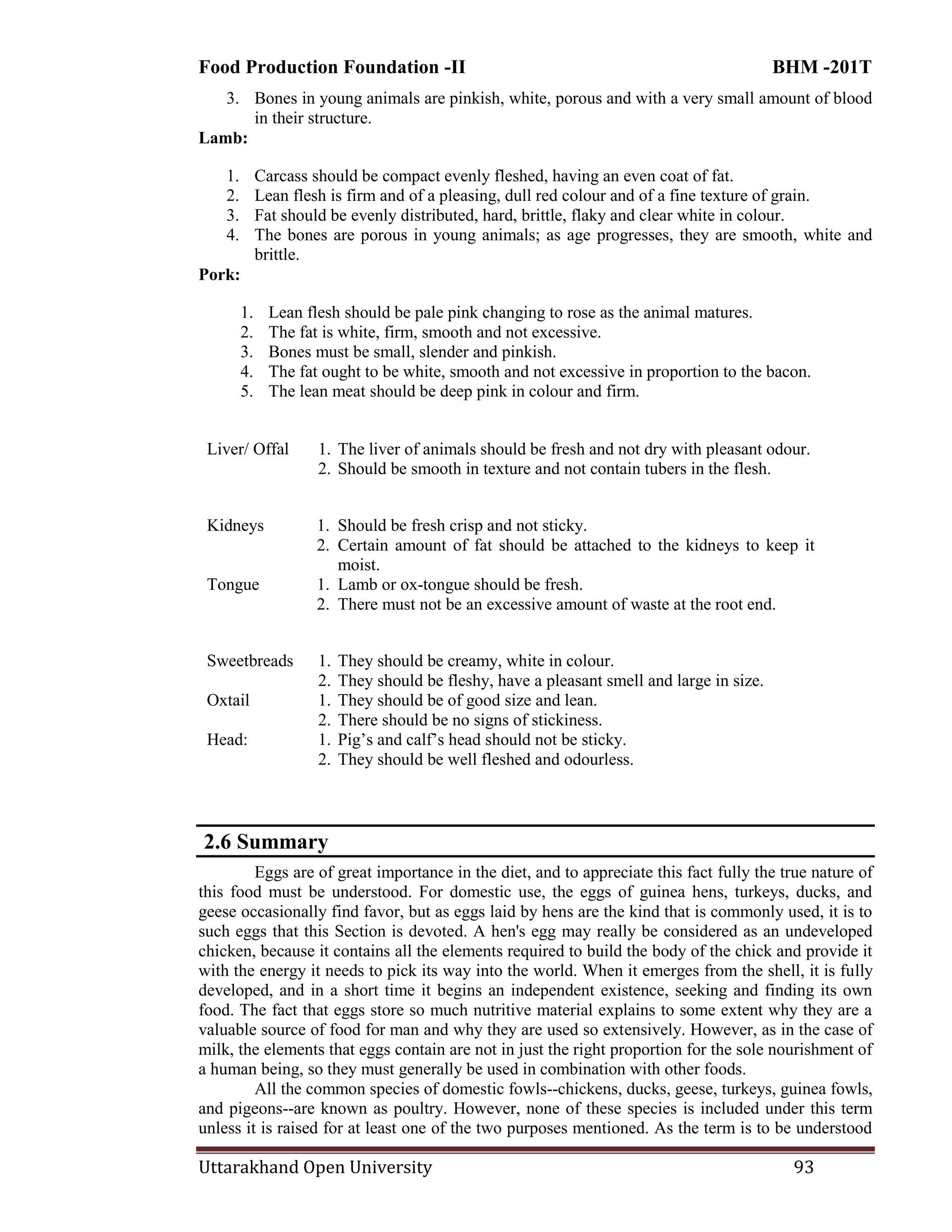
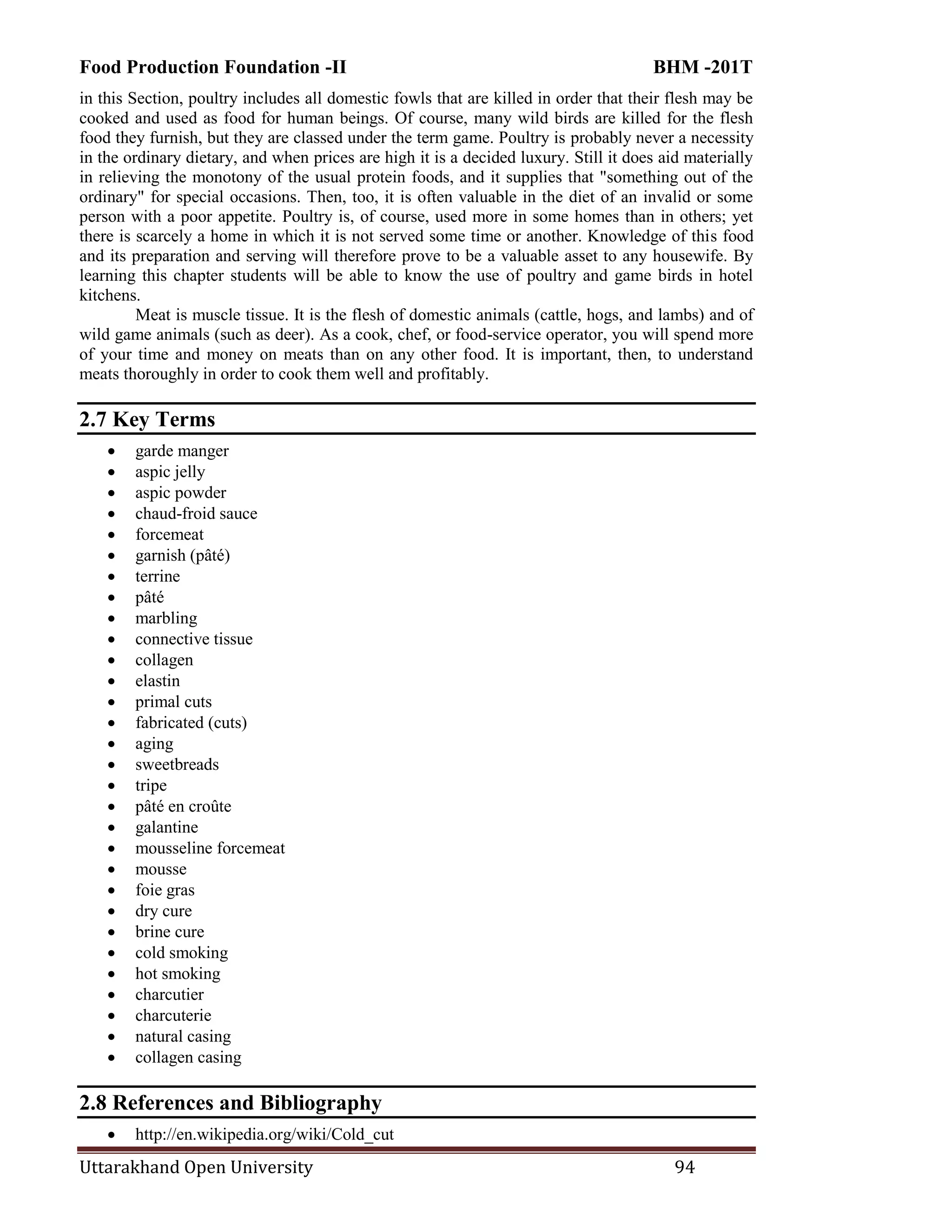
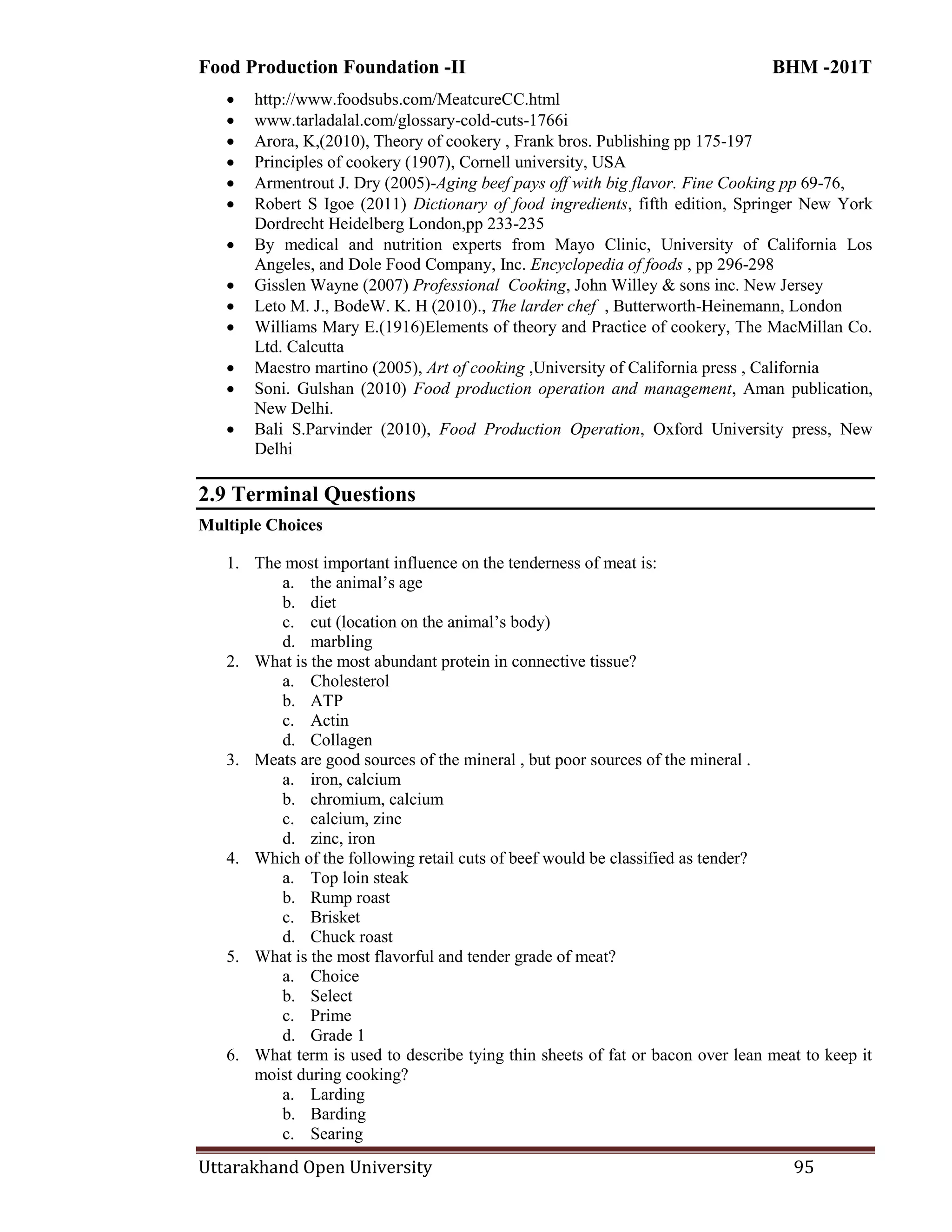
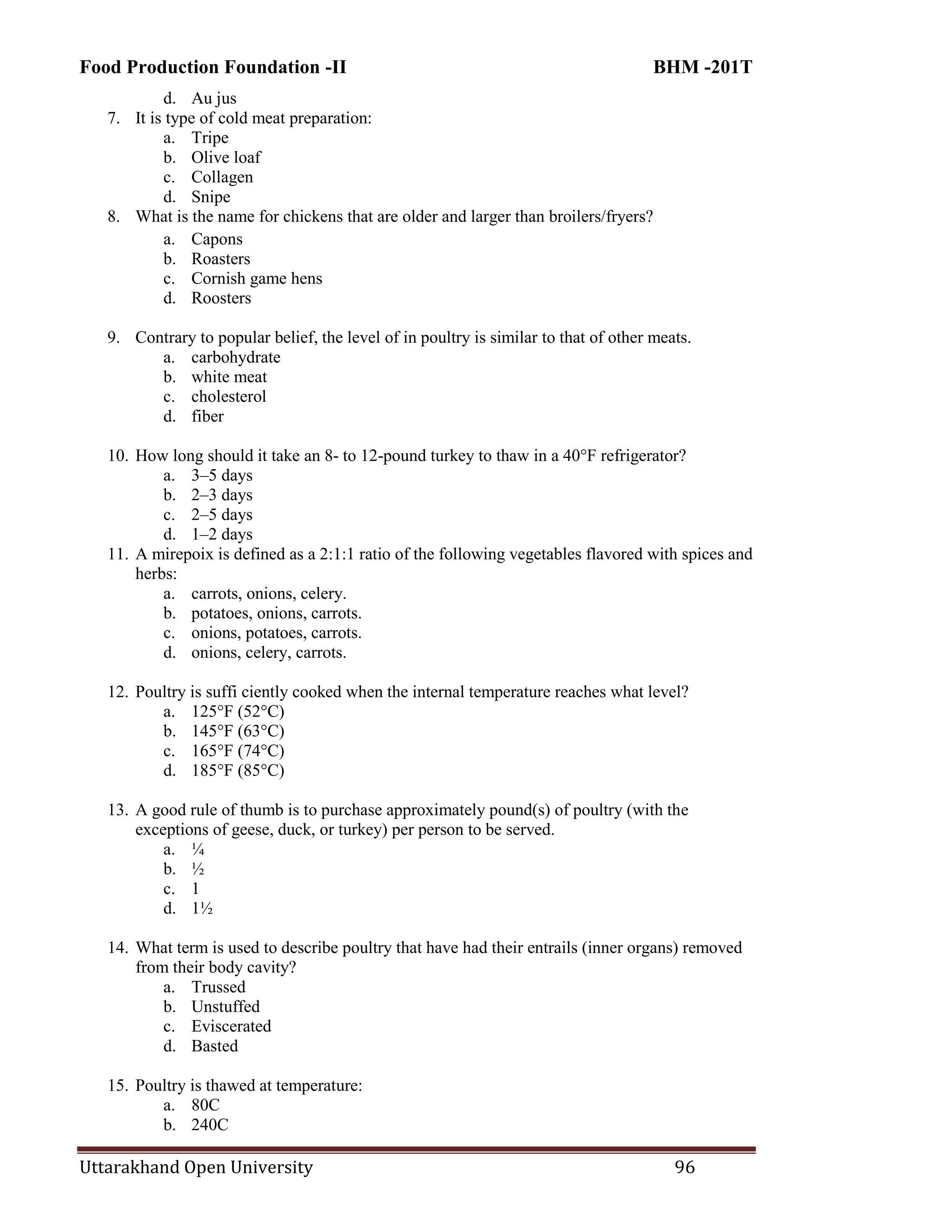
Uttarakhand Open University 1
UNIT: 01
METHODS OF COOKING
Structure
1.1 Introduction
1.2 Objectives
1.3 Heat and Cooking
1.3.1 What is heat?
1.3.2 Effect of Heat on food
1.3.3 Method of heat transfer
1.4 Methods of cooking
1.5 Moist heat Methods of Cooking
1.5.1 Boiling
1.5.2 Poaching
1.5.3 Steaming
1.5.4 Stewing
1.5.5 Braising
1.6 Dry heat Methods of Cooking
1.6.1 Baking
1.6.2 Roasting
1.6.3 Grilling
1.7 Frying
1.8 Modern Methods of cooking
1.8.1 Paper Bag (en papillotte)
1.8.2 Microwave Cooking
1.8.3 Infra-red Cooking
1.9 HACCP Standards and Professional Kitchens
1.9.1 Introduction
1.9.2 What is HACCP?
1.9.3 Food Preparation Hazard and Control Rules
1.10 Summary
1.11 Key Terms
1.12 References and Bibliography
1.13 Review Questions
1.1 Introduction
This chapter deals with basic principles. You will learn about what happens to food when it is
heated, about how food is cooked by different methods, and about rules of seasoning and
flavouring. It is important to understand the science of food and cooking so you can successfully
use these principles in the kitchen.
1.2 Objectives
After reading this unit the learner will be able to understand:
• Methods of heat transfer
Food Production Foundation -II BHM -201T
Uttarakhand Open University 2
• Effect of heat on food
• Moist heat Methods of Cooking
• Dry heat Methods of Cooking
• Frying
• Modern Methods of cooking
1.3 Heat and Cooking
To cook food means to heat it in order to make certain changes in it. Skillful cooks know exactly
what changes they want to make and what they have to do to get them right. To learn these
cooking skills, it is important for you to know why foods behave as they do when heated. For this,
you have to study the theory. Perhaps not all of this section will make sense to you at first. But the
ideas should become clearer to you after you think about them in relation to specific techniques,
as demonstrated by your instructor. Later in your studies, when you are learning about cooking
meats, fish, vegetables, and other foods, review this section from time to time. Not only will you
understand it better but also it should help you make more sense of the procedures you are
learning and practicing.
1.3.1 What is Heat?
Heat is a form of energy associated with the motion of atoms or molecules. When a substance
absorbs heat, its molecules moves faster. In liquids and gases, the molecules move more quickly
from place to place and bounce off each other more frequently. In solids, the molecules stay
mostly in place, but they vibrate with more energy. Temperature can be defined as a measure of
this molecular activity. The higher the temperature, the faster the molecules are moving. When we
add enough heat to foods, the molecules may move so fast the structure of the food changes. For
example, sucrose (regular sugar) may break apart and form new molecules that happen to have a
brown colour and the taste of caramel. Or protein molecules may break apart and reform with a
different structure. Creating these molecular changes is called cooking.
1.3.2 Effect of Heat on Food
Foods are composed of proteins, fats, carbohydrates, and water, plus small amounts of other
compounds such as minerals (including salt), vitamins, pigments (colouring agents), and flavour
elements. It is important to understand how these components react when heated or mixed with
other foods. You will then be better equipped to correct cooking faults when they occur and to
anticipate the effects of changing cooking methods, cooking temperatures, or ingredient
proportions. The following discussion is concerned with the physical and chemical reactions that
affect the components of food.
Carbohydrates : Starches and sugars are carbohydrates. Both compounds are present in foods in
many forms. They are found in fruits, vegetables, grains, beans, and nuts. Meats and fish also
contain a small amount of carbohydrate. For the cook, the two most important changes in
carbohydrates caused by heat are caramelisation and gelatinization. Caramelization is the
browning of sugars. The browning of sautéed vegetables and thevgolden color of bread crust are
forms of caramelization. Gelatinization occurs when starches absorb water and swell. This is a
major principle in the thickening of sauces and in the production of breads and pastries. Acids
inhibit gelatinization. A sauce thickened with flour or starch will be thinner if it contains acid.
Food Production Foundation -II BHM -201T
Uttarakhand Open University 3
Fruit and Vegetable Fibre: Fibre is the name for a group of complex substances that give
structure and firmness to plants. Fibre cannot be digested. The softening of fruits and vegetables
in cooking is, in part, the breaking down of fibre. Sugar makes fibre firmer. Fruit cooked with
sugar keeps its shape better than fruit cooked without sugar. Baking soda (and other alkalis)
makes fiber softer. Vegetables should not be cooked with baking soda because they become
mushy and lose vitamins.
Proteins: Protein is a major component of meats, poultry, fish, eggs, milk, and milk products. It
is present in smaller amounts in nuts, beans, and grains. Proteins consist of long chains of
components called amino acids. These chains normally form tight coils. As proteins are heated,
the coils gradually unwind. At this point, the protein is said to be denatured. For the cook, the
important fact about denaturing is that, when the protein coils unwind, they become attracted to
each other and form bonds. This bonding is called coagulation. The coagulated proteins form a
solid network of bonds and become firm. As the temperature increases, the proteins shrink,
become firmer, and lose more moisture. Exposure of proteins to excessive heat toughens them
and makes them dry. Most proteins complete coagulation or are cooked at 160°-185°F (71°-
85°C). Many protein foods, such as meats, contain small quantities of carbohydrate. When
proteins are heated to about 310°F (154°C), the amino acids in the protein chains react with the
carbohydrate molecules and undergo a complex chemical reaction. The result is that they turn
brown and develop richer flavours. This reaction is called the Millard reaction. It is what happens
when meat browns. Because of the high temperature it requires, the Millard reaction takes place
only on the dry surface of the food. Because of its water content, the interior of the meat cannot
get this hot. Connective tissues are special proteins present in meats. Meats with a great deal of
connective tissue are tough, but some connective tissues are dissolved when cooked slowly with
moisture. Cooking tough meats properly, therefore, makes them tenderer. Acids, such as lemon
juice, vinegar, and tomato products, have two effects on proteins:
• They speed coagulation.
• They help dissolve some connective tissues.
Fats: Fats are present in meats, poultry, fish, eggs, milk products, nuts, whole grains, and, to a
lesser extent, vegetables and fruits. Fats are also important as cooking mediums, as for frying.
Fats can be either solid or liquid at room temperature. Liquid fats are called oils. When solid fats
are heated, they melt, or change from solid to liquid. The melting point of solid fats varies. When
fats are heated, they begin to break down. When hot enough, they deteriorate rapidly and begin to
smoke. The temperature at which this happens is called the smoke point, and it varies by type of
fat. A stable fat-one with a high smoke point-is an important consideration in deep-fat frying.
Many flavour compounds dissolve in fat, so fats are important carriers of flavour. When fats melt
and are lost from food, some flavours, as well as some vitamins, are lost with them.
Minerals, Vitamins, Pigments, And Flavour Components: Minerals and vitamins are
important to the nutritional quality of the food. Pigments and flavour components are important to
a food's appearance and taste and may determine whether the food is appetizing enough to eat. So
it is important to preserve all these elements. Some of these components are soluble in water, and
others are soluble in fats. All of these components may be leached out, or dissolved away, from
foods during cooking. Vitamins and pigments may also be destroyed by heat, by long cooking,
and by other elements present during cooking. It is important, then, to select cooking methods that
Food Production Foundation -II BHM -201T
Uttarakhand Open University 4
preserve, as much as possible, a food's nutrients, taste, and appearance. This is addressed
whenever cooking techniques are explained in the remainder of this book.
Water: Nearly all foods contain water. Dried foods may contain as little as a fraction of 1 percent
water, but fresh meats, fish, vegetables, and fruits consist mostly of water. Water exists in three
states: solid (ice), liquid, and gas (water vapour or steam). At sea level, pure liquid water becomes
solid, or freezes, at 32°F (0°C) and turns to steam at 212°F (100°C). When water molecules turn
to steam and energetically escape into the atmosphere, water is said to be boiling. Water can also
turn from liquid to gas at lower temperatures. When water turns to gas at any temperature, the
process is called evaporation. Evaporation occurs more slowly the lower the temperature is.
Evaporation is responsible for the drying of foods. The drying of food surfaces as they are cooked
enables them to be browned. Many minerals and other compounds dissolve in water, so water can
be a carrier of flavour and of nutritional value. When water carries dissolved compounds, such as
salt or sugar, its freezing point is lowered and its boiling point is raised.
1.3.3 Method of Heat Transfer
There are three methods to transfer heat:
1. Conduction
2. Convection
3. Radiation
Conduction: This is the transfer of heat through a solid object by contact. Some materials are
good conductor while some are bad. Some material can retain heat like ceramics, iron while some
materials can not such as copper.
Convection: Convection involves the transfer of heat in liquid and gases. Convection of air and
Convection of liquids
Radiation: Radiation involves the transfer of heat by electromagnetic waves such as infra-red and
microwaves. When this wave passes through food, looses some of its energy in form of heat.
CHECK YOUR PROGRESS-I
Q.1 What is effect of heat on carbohydrate?
________________________________________________________________________
________________________________________________________________________
________________________________________________________________________
________________________________________________________________________
________________________________________________________________________
________________________________________________________________________
________________________________________________________________________
________________________________________________________________________
________________________________________________________________________
________________________________________________________________________
________________________________________________________________________
Food Production Foundation -II BHM -201T
Uttarakhand Open University 5
Q.2 What is heat?
________________________________________________________________________
________________________________________________________________________
________________________________________________________________________
________________________________________________________________________
________________________________________________________________________
________________________________________________________________________
________________________________________________________________________
________________________________________________________________________
________________________________________________________________________
________________________________________________________________________
________________________________________________________________________
Q.3 What are the different methods of heat transfer?
________________________________________________________________________
________________________________________________________________________
________________________________________________________________________
________________________________________________________________________
________________________________________________________________________
________________________________________________________________________
________________________________________________________________________
________________________________________________________________________
________________________________________________________________________
________________________________________________________________________
________________________________________________________________________
1.4 Methods of Cooking
Different cooking methods are suited to different kinds of foods. For example, some meats are
high in connective tissue and are tough unless this tissue is broken down slowly by moist heat.
Other meats are low in connective tissue and naturally tender. They are at their best and juiciest
when cooked with dry heat to a rare or medium-done stage.
Many other factors must be considered when choosing cooking methods for meats, fish, and
vegetables, such as the flavour and appearance imparted by browning, the flavour imparted by
fats, and the firmness or delicacy of the product. These factors are discussed in later chapters with
respect to individual foods. Cooking methods are classified as moist heat or dry heat.
• Moist-heat methods are those in which the heat is conducted to the food product by
water or water-based liquids such as stock and sauces, or by steam.
• Dry-heat methods are those in which the heat is conducted without moisture-that is, by
hot air, hot metal, radiation, or hot fat. We usually divide dry-heat methods into two
categories:
 Without Fat
 With Fat
Food Production Foundation -II BHM -201T
Uttarakhand Open University 6
1.5 Moist Heat Methods of Cooking
Moist-heat methods are those in which the heat is conducted to the food product by water or
water-based liquids such as stock and sauces, or by steam. Following are the moist heat method of
cooking:
 Boiling
 Poaching
 Steaming
 Stewing
 Braising
1.5.1 Boiling
Boiling is cooking of prepared food in a liquid at boiling point. The liquid be water, court-
bouillon, milk or stock. The Purpose of Boiling Food Is:
• Pleasant taste & agreeable flavour
• Suitable texture
• Easy to digest and safe to eat.
There is Two Way of Boiling:
1. Place food in boiling liquid, re-boil and then reduce heat. (Simmering)
2. Cover the food with cold liquid, boil and then reduce the heat.
NOTE: Court-bouillon is fish cooking liquid prepared by simmering sliced carrot, sliced onion,
parsley stalk, sprig of thyme, salt, bay leaf, vinegar and peppercorn in water for 30-40 minutes
and then strained.
Effect of Boiling
• Gentle Boiling Break down tough fibers (tenderize)
• Tough connective tissues of meat Soluble gelatin
• Coagulation of Protein without hardening.
Advantages of Boiling
• Tougher and Older joints of M P palatable & digestible
• Appropriate for large-scale cooking and economic to fuel]
• Nutritious, well-flavored stock can be produced
Food added to Boiling Liquid
• Suitable for green veritable as they can retain maximum colour, and nutrition ( if boiling
is for minimum time)
• Seals the natural juices in meat.
Food added to Cold Liquid
• Helps to tenderize and extract maximum flavour
• Avoid damage to shape of food
Time and Temperature Control
• Temperature must be controlled to avoid over cooking
Food Production Foundation -II BHM -201T
Uttarakhand Open University 7
• Although approximate cooking time for most foods, the age, quality and size of food will
also affect the cooking time.
General Rules
• Select pans which are neither too small or too large
• While adding food to boiling liquid ensure sufficient liquid is there at boiling point
• Frequently skimming
• Simmer to minimize evaporation of cooking liquid
Safety
• Select containers of right capacity
• Move pans of boiling liquid with care
• Position of handles
• Extra care while adding or removing food
Parboiling
• Parboiling is the boiling the food until it is only partially cooked
• The food is placed in boiling liquid for short time so that it's outside becomes soft
• The cooking process is the completed by using another method
• Use for quantity cooking
Blanching
• It is not strictly a method of cooking
• Blanching means placing food in boiling liquid for 1 to 2 minute and the refresh with cold
water.
• This method is used to remove skin from tomato, fruits and nuts
• This helps to prepare vegetables and fruit for freezing.
• It destroys enzyme and help to retain colour and nutrition by sealing surface.
Disadvantages of Boiling
• Flavours and colour of food in cooking liquid
• Loss of water soluble vitamins and nutrients.
1.5.2 Poaching
Poaching is the cooking of food in the required amount of liquid at just below boiling point.
Purpose of Poaching
• Easy to digest
• To get suitable tender texture
• Pleasant to eat as appropriate sauce is made from cooking liquid
Two Ways of Poaching
• Shallow poaching
• Deep poaching
SHALLOW POACHING
• The food cooked in this method is covered in minimum amount of cooking liquid
• Never allowed to boil (Temperature below 1000C)
• To prevent boiling complete cooking in a moderately hot oven
DEEP POACHING
• Food cooked in this method covered with more water. E.g.. Poaching of eggs.(8Cm.or 3"
water cover)
Food Production Foundation -II BHM -201T
Uttarakhand Open University 8
• Poaching is ideal for food like Fish, Egg, Fruit and delicate vegetable such as Asparagus
Effects of Poaching
Poaching helps to tenderize the fibrous structure of the food, and the raw texture of the food
becomes edible by chemical process.
Method of Poaching
• Heat liquid to boiling point then reduce the temperature
• Gently lower the food in cooking liquid.
• Allow the food to remain in liquid until cooked.
• Remove the food and reserve the liquid if it is to be used for sauce.
Principles of Poaching
• Cooking liquid kept below BP (to avoid damage to food)
• Sufficient quantity of liquid (to prevent uneven cooking)
Advantages of Poaching
• Food with delicate texture is cooked without breaking up
• Poached foods are easy to digest
• Addition of fat is not required (Good for health conscious)
Disadvantages of Poaching
• Not suitable for large pieces of food
• Some flavour and nutrients are lost in cooking liquid
• Little development in colour and flavour
1.5.3 Steaming
Steaming is the cooking of prepared foods by steam (moist heat) under varying degree of
pressure. Purpose of Steaming
• Easy to digest
• To get edible texture
• Pleasant to taste
• Retain maximum nutrition
Methods of Steaming
1. Atmospheric or Low pressure steaming
• DIRECT - Cooking food in steamer of a pan of boiling water
• INDIRECT - Between two plates over a pan of boiling water
2. High pressure steaming
• There is a equipment built such that it does not allows steam to escape, therefore pressure
of steam is built up, thus increasing the temperature and reducing the cooking time.
Vacuum Cooking In Pouch
• This is also known as sous-vide
• Food sealed in vacuum pouches and cooked by steam
Advantages
• Minimum change in texture
• Minimum weight loss
Food Production Foundation -II BHM -201T
Uttarakhand Open University 9
• No drying out and minimal colour loss
• Garnishing can be done before vacuum packing & Cooking
• Food is cooked in it's own natural juices
• Labour saving and uniformity of standards
Steps of Steaming
• Principles of Steaming
• Smaller pieces of food are suitable for steaming
• Doors of steamer should be closed
• Green vegetables are not suitable (Colour will distort )
• Potato & Root vegetable to be cut and placed on tray
Pressure Cooking
• Pressure cooking makes use of steam from water boiled in sealed container of oven
(Pressure cooker).
• Boiling point of water varies with pressure.
• At atmospheric pressure water boils at 1000
C
• With increase of pressure Boiling Point of water increases
• In this method pressure in side the cooking container is increased which results in
increasing Boiling Point of water which in turns gives more heat to food and food is
cooked early
Procedure of Pressure Cooking
• Check the water level in cooking container.
• Ensure tight seal
• Use perforated tray for vegetable
• When cooking is complete allow the pressure to return to normal pressure
Advantages of Steaming
• Less loss of nutrients from food
• Food retains maximum colour and flavour
• Cooking time is reduced
• Fuel saving
Disadvantages of Steaming
• Steaming is slow ( If Pressure cooker is not used)
• Steaming does not allow much development of flavour
8.5.4 Stewing
"Stewing is the slow cooking of food cut into pieces and cooked in the minimum amount of
cooking liquid, the food and the liquid are served together"
• A tight-fitting lid must be used during cooking to retain the juices and flavour.
• The temperature is held at simmering point over an extended period.
Types of Stews
Types of stewing is charted as under:
Food Production Foundation -II BHM -201T
Uttarakhand Open University 10
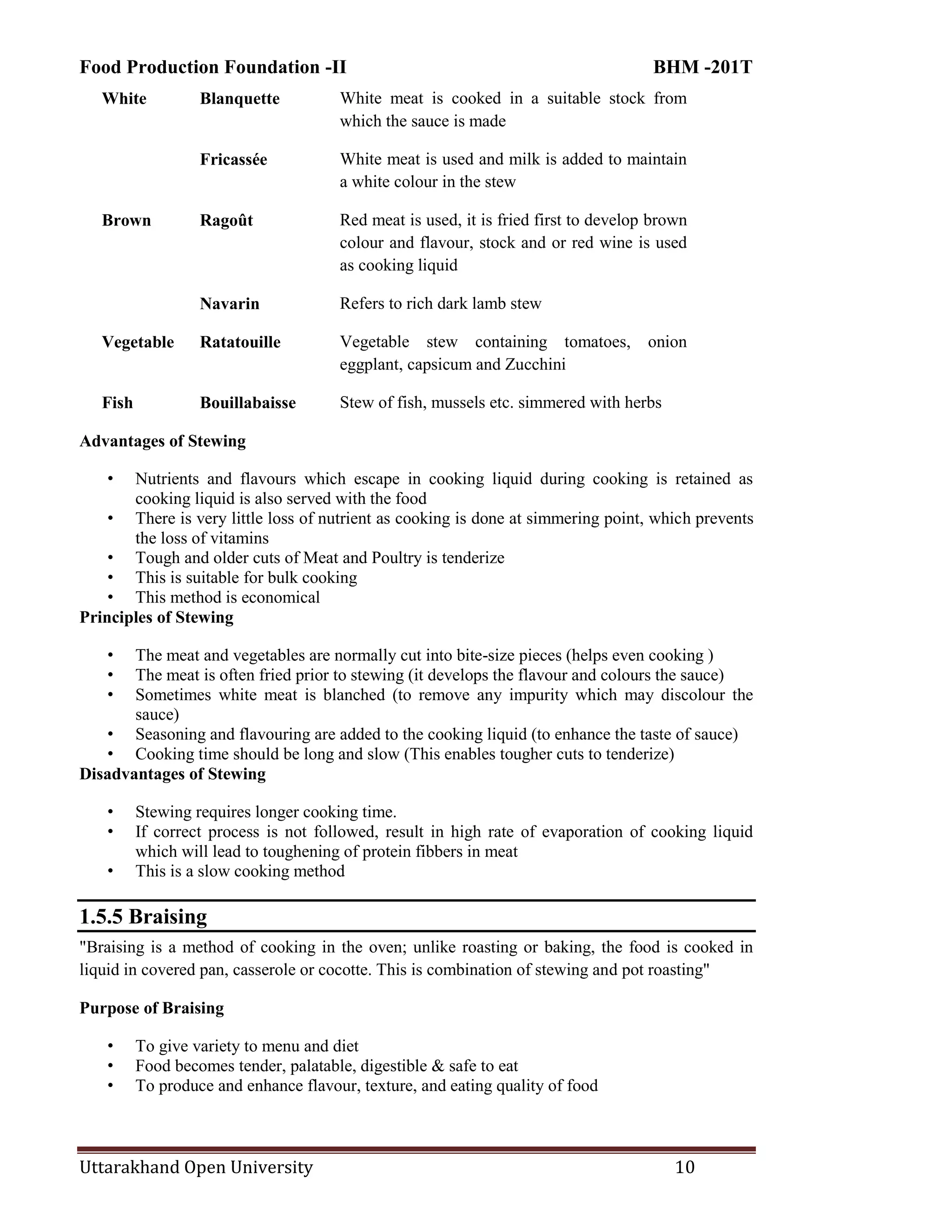
White Blanquette White meat is cooked in a suitable stock from
which the sauce is made
Fricassée White meat is used and milk is added to maintain
a white colour in the stew
Brown Ragoût Red meat is used, it is fried first to develop brown
colour and flavour, stock and or red wine is used
as cooking liquid
Navarin Refers to rich dark lamb stew
Vegetable Ratatouille Vegetable stew containing tomatoes, onion
eggplant, capsicum and Zucchini
Fish Bouillabaisse Stew of fish, mussels etc. simmered with herbs
Advantages of Stewing
• Nutrients and flavours which escape in cooking liquid during cooking is retained as
cooking liquid is also served with the food
• There is very little loss of nutrient as cooking is done at simmering point, which prevents
the loss of vitamins
• Tough and older cuts of Meat and Poultry is tenderize
• This is suitable for bulk cooking
• This method is economical
Principles of Stewing
• The meat and vegetables are normally cut into bite-size pieces (helps even cooking )
• The meat is often fried prior to stewing (it develops the flavour and colours the sauce)
• Sometimes white meat is blanched (to remove any impurity which may discolour the
sauce)
• Seasoning and flavouring are added to the cooking liquid (to enhance the taste of sauce)
• Cooking time should be long and slow (This enables tougher cuts to tenderize)
Disadvantages of Stewing
• Stewing requires longer cooking time.
• If correct process is not followed, result in high rate of evaporation of cooking liquid
which will lead to toughening of protein fibbers in meat
• This is a slow cooking method
1.5.5 Braising
"Braising is a method of cooking in the oven; unlike roasting or baking, the food is cooked in
liquid in covered pan, casserole or cocotte. This is combination of stewing and pot roasting"
Purpose of Braising
• To give variety to menu and diet
• Food becomes tender, palatable, digestible & safe to eat
• To produce and enhance flavour, texture, and eating quality of food
Food Production Foundation -II BHM -201T
Uttarakhand Open University 11
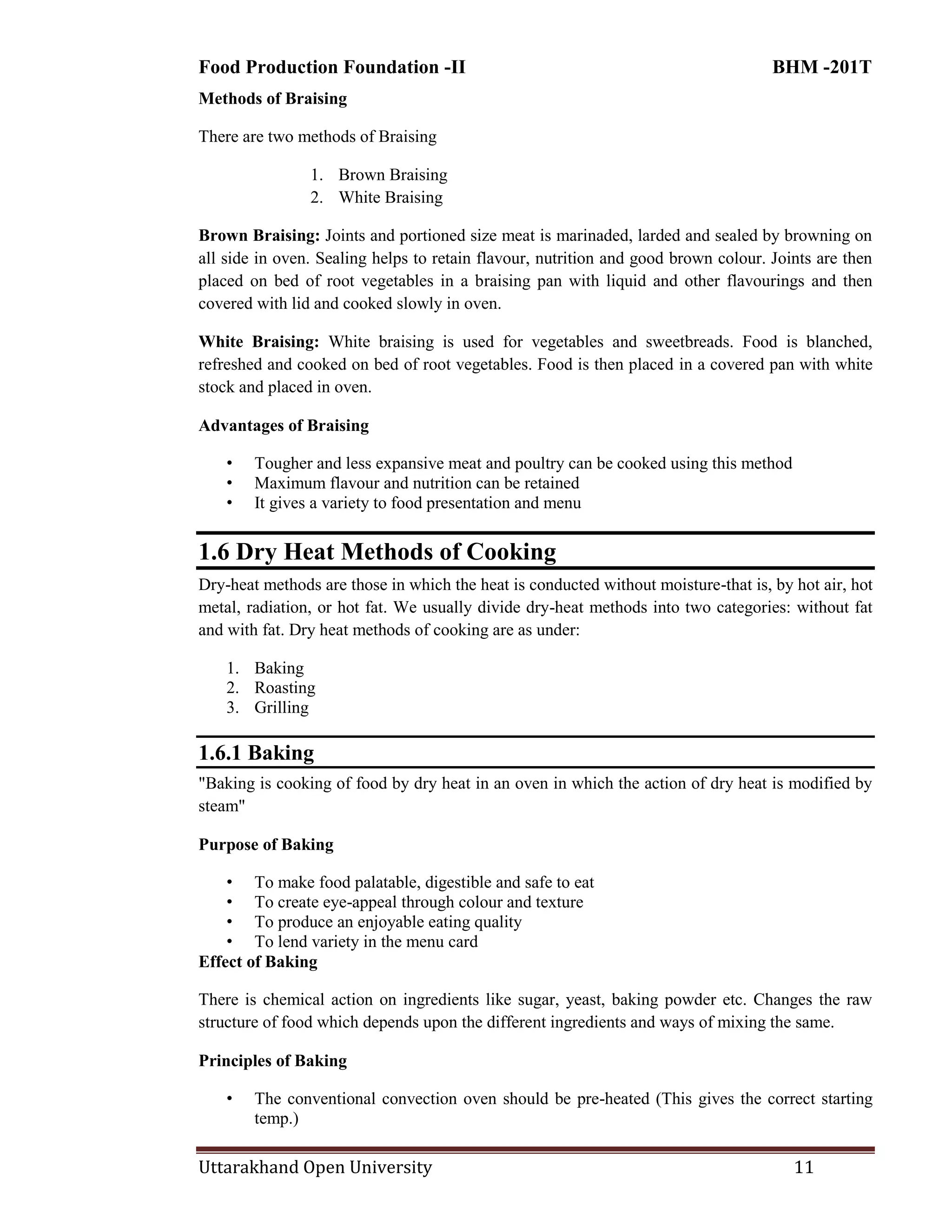
Methods of Braising
There are two methods of Braising
1. Brown Braising
2. White Braising
Brown Braising: Joints and portioned size meat is marinaded, larded and sealed by browning on
all side in oven. Sealing helps to retain flavour, nutrition and good brown colour. Joints are then
placed on bed of root vegetables in a braising pan with liquid and other flavourings and then
covered with lid and cooked slowly in oven.
White Braising: White braising is used for vegetables and sweetbreads. Food is blanched,
refreshed and cooked on bed of root vegetables. Food is then placed in a covered pan with white
stock and placed in oven.
Advantages of Braising
• Tougher and less expansive meat and poultry can be cooked using this method
• Maximum flavour and nutrition can be retained
• It gives a variety to food presentation and menu
1.6 Dry Heat Methods of Cooking
Dry-heat methods are those in which the heat is conducted without moisture-that is, by hot air, hot
metal, radiation, or hot fat. We usually divide dry-heat methods into two categories: without fat
and with fat. Dry heat methods of cooking are as under:
1. Baking
2. Roasting
3. Grilling
1.6.1 Baking
"Baking is cooking of food by dry heat in an oven in which the action of dry heat is modified by
steam"
Purpose of Baking
• To make food palatable, digestible and safe to eat
• To create eye-appeal through colour and texture
• To produce an enjoyable eating quality
• To lend variety in the menu card
Effect of Baking
There is chemical action on ingredients like sugar, yeast, baking powder etc. Changes the raw
structure of food which depends upon the different ingredients and ways of mixing the same.
Principles of Baking
• The conventional convection oven should be pre-heated (This gives the correct starting
temp.)
Food Production Foundation -II BHM -201T
Uttarakhand Open University 12
• Products should be placed evenly in the oven (This allows the even hot air circulation)
• Products should be placed in greased or lined tins or tray ( Helps to remove finished food
easily)
• Items taking long time should be placed in lined tin at lower shelf ( prevent
drying & burning of crust )
Dry Baking
• In this method when food is placed in pre-heated oven, steam arises from water content of
food, this steam combines with the dry heat of the oven is used to cook food.
• Using this method Cakes, Pastry, Baked jacket potatoes etc. are prepared.
Baking With Increased Humidity
In this method while baking the humidity of oven is increased by placing a bowl of water of
injecting steam thus increasing water content in food which improves eating quality of the food.
This is used to bake bread.
Baking With Heat Modification
In this method food is placed in container. Food items such as egg custard is baked in this way,
this prevents the over cooking of food.
Advantages of Baking
• A wide variety of sweet and savory food is prepared
• Baking yields appetizing, eye-appealing food with mouth watering aroma
• Uniformity in color and degree of cooking can be achieved even in bulk cooking
• Temperatures can be effectively controlled
• Adding and removing food for baking is very easy
General Rules
• Oven should always be pre-heated
• Accuracy is essential in measuring and weighing and controlling temperature
• Trays and moulds should be greased or lined
• Once process of baking starts minimize the opening the doors of oven
• Use thick dry oven mitts while placing or removing food in oven
• Trays and oven should not be overloaded
• One should be very careful while placing food in oven and while removing the same
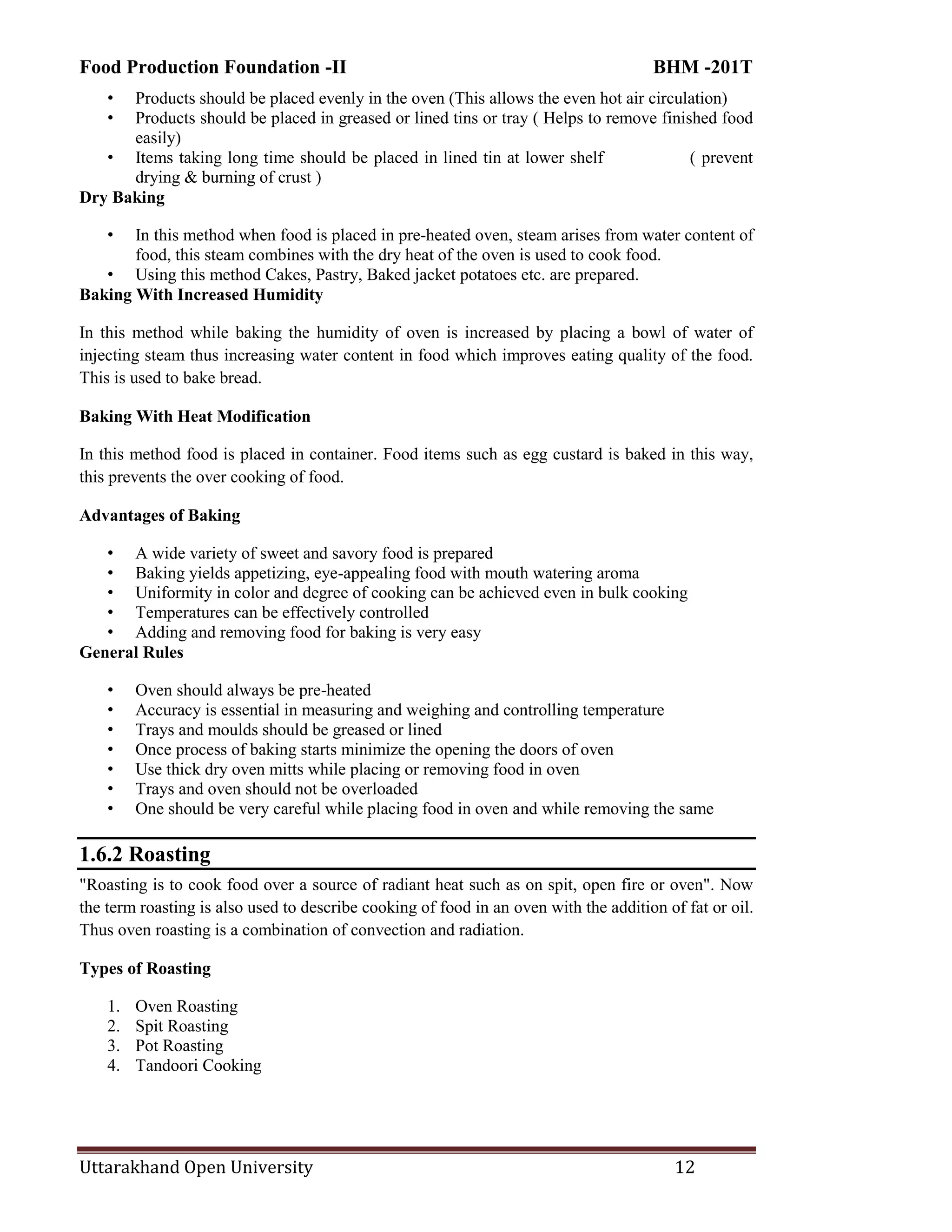
1.6.2 Roasting
"Roasting is to cook food over a source of radiant heat such as on spit, open fire or oven". Now
the term roasting is also used to describe cooking of food in an oven with the addition of fat or oil.
Thus oven roasting is a combination of convection and radiation.
Types of Roasting
1. Oven Roasting
2. Spit Roasting
3. Pot Roasting
4. Tandoori Cooking
Food Production Foundation -II BHM -201T
Uttarakhand Open University 13
Oven Roasting: It is cooking food in an oven. In this method hot convection of air is produced
inside the oven which is responsible for cooking of food. Heat conducted from the base of
cooking try is responsible for browning of food which is desirable with some food e.g. Potatoes,
where a crisp golden brown colour is required.
Spit Roasting: Food is cooked over spit (live charcoal) or open fire. Food is rotated slowly over
the source of heat, and is cooked by radiant heat and convection of air depending upon the
position of food in relation to fire. Usually large joints of meat are cooked by this method. This
method produces its own distinct colour, flavour and texture in cooked food.
Pot Roasting: Pot roasting is cooking food on bed of root vegetable in a covered pan. This is not
a true roast as moist heat (steam) trapped under the lid of closed utensil is used to cook the food.
This method is also known as POÊLÉ. Using this method will result in retention of maximum
flavor of ingredients.
Tandoori Cooking: Tandoori cooking is done in a clay oven known as tandoor using dry heat.
Although the source of heat is at the base of the oven but heat is evenly distributed as clay
radiates heat evenly.
Method
• The marinated food (marinating may be done 20Min to 2 Hr. in advance depending upon
the type of food) such as meat, fish & poultry is placed vertically inside the oven.
• Naan etc are slapped on the wall of the tandoor
• The temperature of tandoor is 3750
C or 7000
F
Advantages of Roasting
• Good quality of meat and poultry is tenderized and succulent when roasted
• Meat juices oozing from the joints are used for gravy and enhance flavor
• Energy and oven temperature can be controlled
• Ovens with transparent doors enables cooking to be observed
• Access, adjustment and removal of food is very easy
• This method involves the minimum risk of Fire
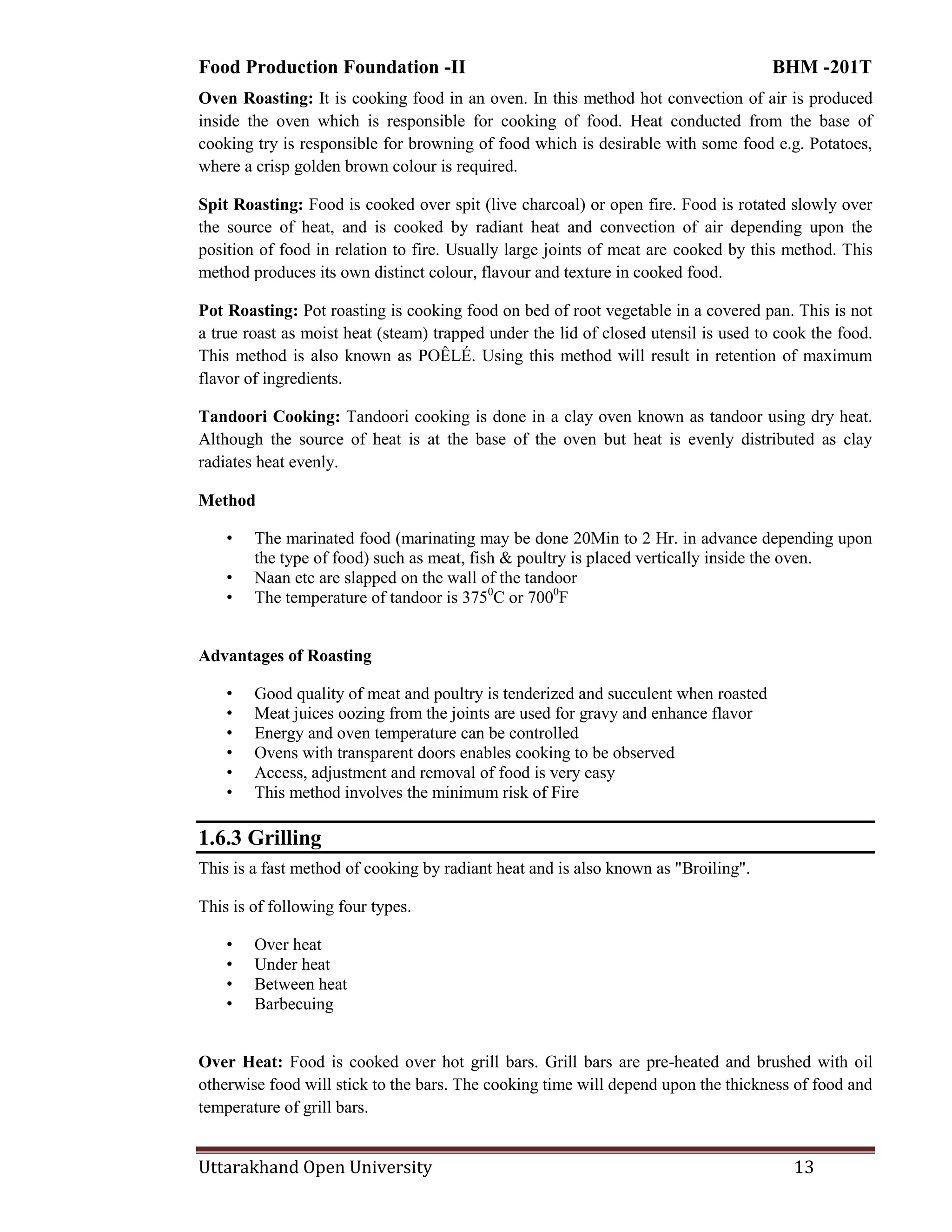
1.6.3 Grilling
This is a fast method of cooking by radiant heat and is also known as "Broiling".
This is of following four types.
• Over heat
• Under heat
• Between heat
• Barbecuing
Over Heat: Food is cooked over hot grill bars. Grill bars are pre-heated and brushed with oil
otherwise food will stick to the bars. The cooking time will depend upon the thickness of food and
temperature of grill bars.
Food Production Foundation -II BHM -201T
Uttarakhand Open University 14
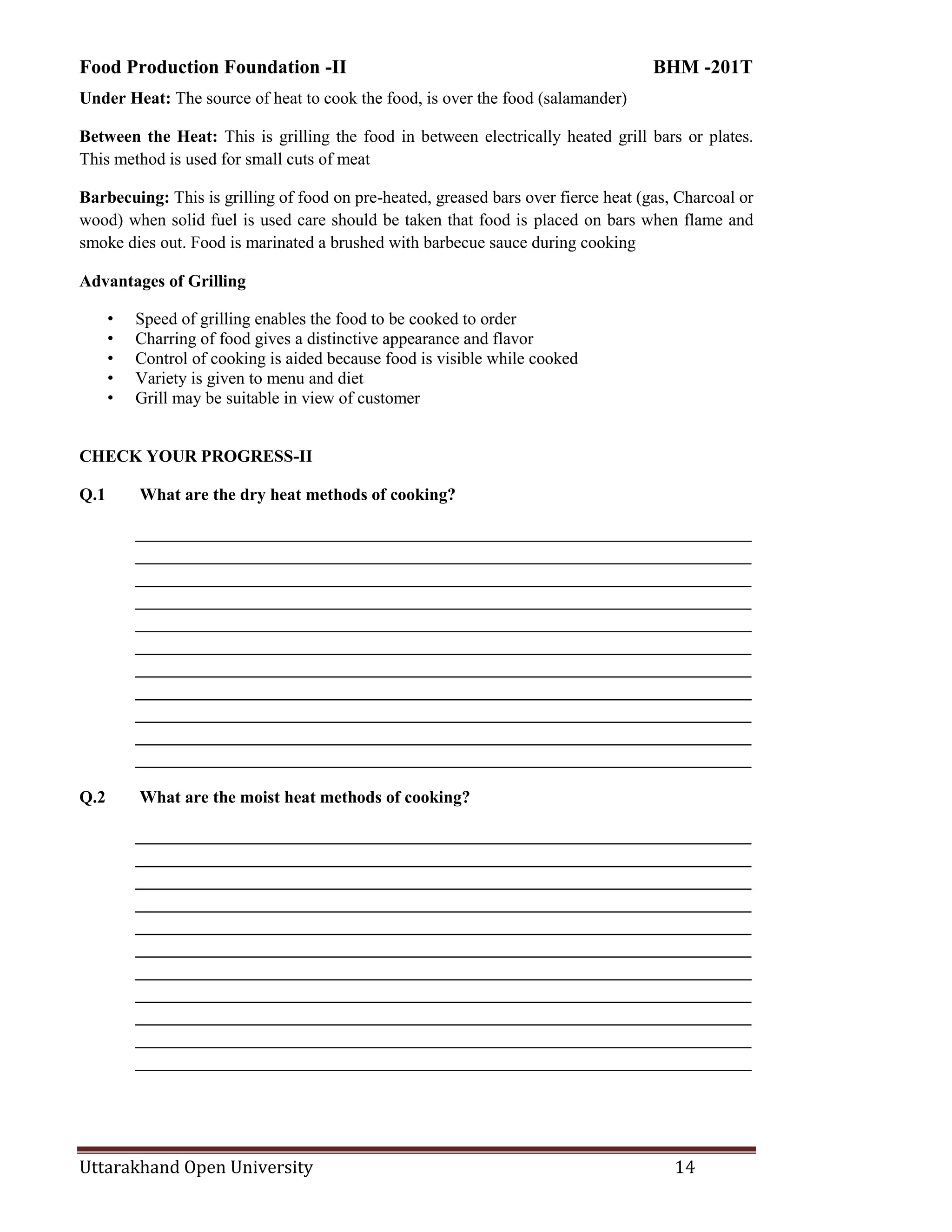
Under Heat: The source of heat to cook the food, is over the food (salamander)
Between the Heat: This is grilling the food in between electrically heated grill bars or plates.
This method is used for small cuts of meat
Barbecuing: This is grilling of food on pre-heated, greased bars over fierce heat (gas, Charcoal or
wood) when solid fuel is used care should be taken that food is placed on bars when flame and
smoke dies out. Food is marinated a brushed with barbecue sauce during cooking
Advantages of Grilling
• Speed of grilling enables the food to be cooked to order
• Charring of food gives a distinctive appearance and flavor
• Control of cooking is aided because food is visible while cooked
• Variety is given to menu and diet
• Grill may be suitable in view of customer
CHECK YOUR PROGRESS-II
Q.1 What are the dry heat methods of cooking?
________________________________________________________________________
________________________________________________________________________
________________________________________________________________________
________________________________________________________________________
________________________________________________________________________
________________________________________________________________________
________________________________________________________________________
________________________________________________________________________
________________________________________________________________________
________________________________________________________________________
________________________________________________________________________
Q.2 What are the moist heat methods of cooking?
________________________________________________________________________
________________________________________________________________________
________________________________________________________________________
________________________________________________________________________
________________________________________________________________________
________________________________________________________________________
________________________________________________________________________
________________________________________________________________________
________________________________________________________________________
________________________________________________________________________
________________________________________________________________________
Food Production Foundation -II BHM -201T
Uttarakhand Open University 15
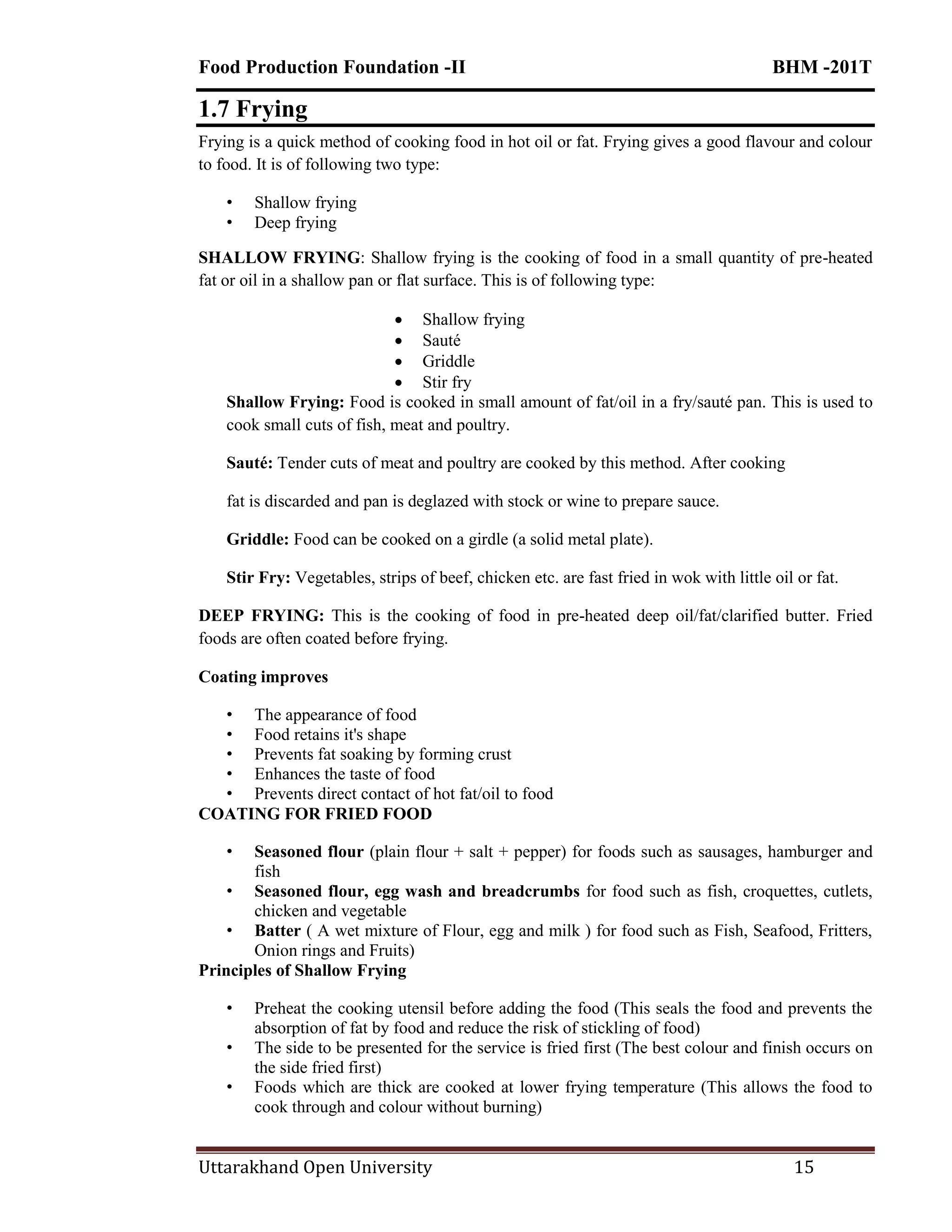
1.7 Frying
Frying is a quick method of cooking food in hot oil or fat. Frying gives a good flavour and colour
to food. It is of following two type:
• Shallow frying
• Deep frying
SHALLOW FRYING: Shallow frying is the cooking of food in a small quantity of pre-heated
fat or oil in a shallow pan or flat surface. This is of following type:
 Shallow frying
 Sauté
 Griddle
 Stir fry
Shallow Frying: Food is cooked in small amount of fat/oil in a fry/sauté pan. This is used to
cook small cuts of fish, meat and poultry.
Sauté: Tender cuts of meat and poultry are cooked by this method. After cooking
fat is discarded and pan is deglazed with stock or wine to prepare sauce.
Griddle: Food can be cooked on a girdle (a solid metal plate).
Stir Fry: Vegetables, strips of beef, chicken etc. are fast fried in wok with little oil or fat.
DEEP FRYING: This is the cooking of food in pre-heated deep oil/fat/clarified butter. Fried
foods are often coated before frying.
Coating improves
• The appearance of food
• Food retains it's shape
• Prevents fat soaking by forming crust
• Enhances the taste of food
• Prevents direct contact of hot fat/oil to food
COATING FOR FRIED FOOD
• Seasoned flour (plain flour + salt + pepper) for foods such as sausages, hamburger and
fish
• Seasoned flour, egg wash and breadcrumbs for food such as fish, croquettes, cutlets,
chicken and vegetable
• Batter ( A wet mixture of Flour, egg and milk ) for food such as Fish, Seafood, Fritters,
Onion rings and Fruits)
Principles of Shallow Frying
• Preheat the cooking utensil before adding the food (This seals the food and prevents the
absorption of fat by food and reduce the risk of stickling of food)
• The side to be presented for the service is fried first (The best colour and finish occurs on
the side fried first)
• Foods which are thick are cooked at lower frying temperature (This allows the food to
cook through and colour without burning)
Food Production Foundation -II BHM -201T
Uttarakhand Open University 16
• Different foods to be fried in same pan should be cooked in order of relative cooking
time, that is food which will take longer time to cook are placed in the pan first ( this
allows food to be prepared at time of service)
• Frying pan is moved and turned during cooking ( this helps in even distribution of heat
and results even browning and cooking of food)
• Tongues are used to move and turn food
• Foods are turned over when moisture appears on surface
• Food should be seasoned before shallow frying
• All fried foods are well drained before service
• Food should never be crowded in frying pan
Principles of Deep Frying
• Food should be of uniform size
• Food should be chilled after crumbing, loose crumbs shaken free and the surface patted
• If coated in butter, any excess should be drained off and the food slowly lowered into the
fryer
• Very cold or frozen food, should be added in small pieces and quantities
• Residues of crumbs, batter or food should be skimmed form frying medium
• Frying medium should be at correct temperature before adding food
• The temperature of cooking medium should not exceed the cooking temperature of the
food
• Food should be dried before immersing in hot frying medium
• When removing drain the fat over the fryer
• All fried foods should be drained on absorbent kitchen paper before serving
• Food should be seasoned away from the fryer
• Fried food should be served immediately after frying
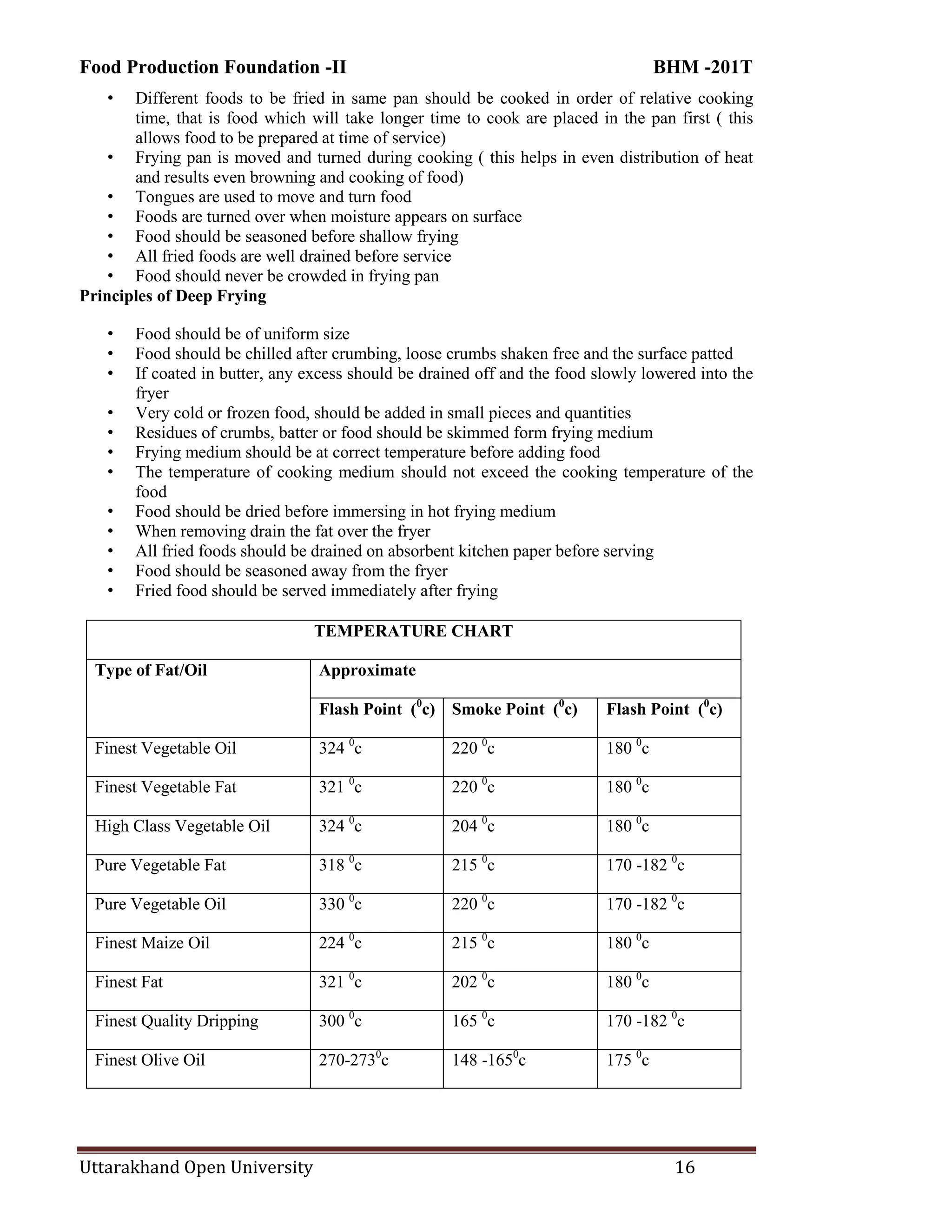
TEMPERATURE CHART
Type of Fat/Oil Approximate
Flash Point (0
c) Smoke Point (0
c) Flash Point (0
c)
Finest Vegetable Oil 324 0
c 220 0
c 180 0
c
Finest Vegetable Fat 321 0
c 220 0
c 180 0
c
High Class Vegetable Oil 324 0
c 204 0
c 180 0
c
Pure Vegetable Fat 318 0
c 215 0
c 170 -182 0
c
Pure Vegetable Oil 330 0
c 220 0
c 170 -182 0
c
Finest Maize Oil 224 0
c 215 0
c 180 0
c
Finest Fat 321 0
c 202 0
c 180 0
c
Finest Quality Dripping 300 0
c 165 0
c 170 -182 0
c
Finest Olive Oil 270-2730
c 148 -1650
c 175 0
c
Food Production Foundation -II BHM -201T
Uttarakhand Open University 17
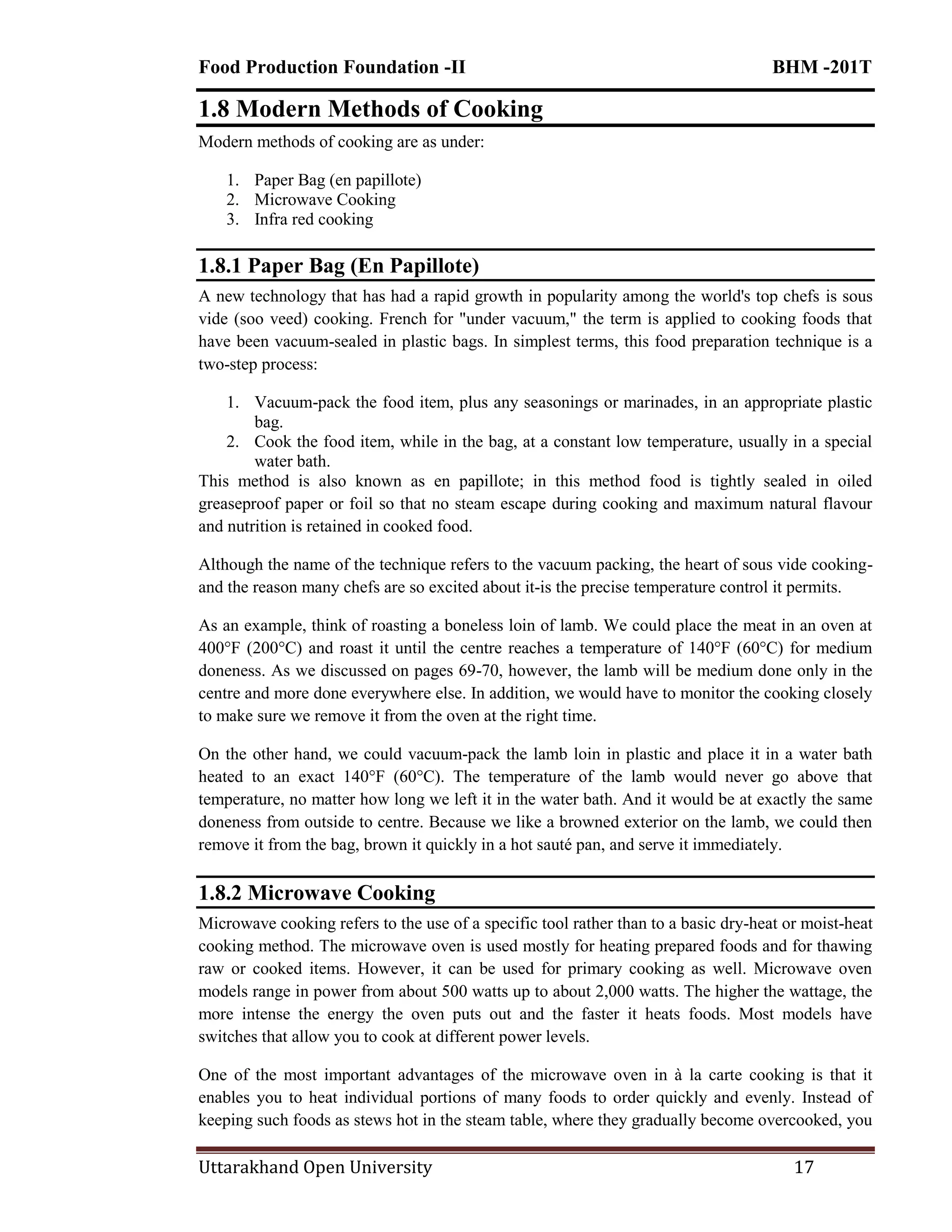
1.8 Modern Methods of Cooking
Modern methods of cooking are as under:
1. Paper Bag (en papillote)
2. Microwave Cooking
3. Infra red cooking
1.8.1 Paper Bag (En Papillote)
A new technology that has had a rapid growth in popularity among the world's top chefs is sous
vide (soo veed) cooking. French for "under vacuum," the term is applied to cooking foods that
have been vacuum-sealed in plastic bags. In simplest terms, this food preparation technique is a
two-step process:
1. Vacuum-pack the food item, plus any seasonings or marinades, in an appropriate plastic
bag.
2. Cook the food item, while in the bag, at a constant low temperature, usually in a special
water bath.
This method is also known as en papillote; in this method food is tightly sealed in oiled
greaseproof paper or foil so that no steam escape during cooking and maximum natural flavour
and nutrition is retained in cooked food.
Although the name of the technique refers to the vacuum packing, the heart of sous vide cooking-
and the reason many chefs are so excited about it-is the precise temperature control it permits.
As an example, think of roasting a boneless loin of lamb. We could place the meat in an oven at
400°F (200°C) and roast it until the centre reaches a temperature of 140°F (60°C) for medium
doneness. As we discussed on pages 69-70, however, the lamb will be medium done only in the
centre and more done everywhere else. In addition, we would have to monitor the cooking closely
to make sure we remove it from the oven at the right time.
On the other hand, we could vacuum-pack the lamb loin in plastic and place it in a water bath
heated to an exact 140°F (60°C). The temperature of the lamb would never go above that
temperature, no matter how long we left it in the water bath. And it would be at exactly the same
doneness from outside to centre. Because we like a browned exterior on the lamb, we could then
remove it from the bag, brown it quickly in a hot sauté pan, and serve it immediately.
1.8.2 Microwave Cooking
Microwave cooking refers to the use of a specific tool rather than to a basic dry-heat or moist-heat
cooking method. The microwave oven is used mostly for heating prepared foods and for thawing
raw or cooked items. However, it can be used for primary cooking as well. Microwave oven
models range in power from about 500 watts up to about 2,000 watts. The higher the wattage, the
more intense the energy the oven puts out and the faster it heats foods. Most models have
switches that allow you to cook at different power levels.
One of the most important advantages of the microwave oven in à la carte cooking is that it
enables you to heat individual portions of many foods to order quickly and evenly. Instead of
keeping such foods as stews hot in the steam table, where they gradually become overcooked, you
Food Production Foundation -II BHM -201T
Uttarakhand Open University 18
can keep them refrigerated (either in bulk or in individual portions) and reheat each order as
needed. This is perhaps the main reason why most restaurants have one or more microwave
ovens, even though they may not use them for primary cooking.
Because the microwave oven is a unique tool in food service, the cook should observe the
following special points regarding its use:
• Small items will not brown in a standard microwave. Large roasts may brown somewhat
from the heat generated in the item itself. Some models have browning elements that use
conventional heat.
• Watch timing carefully. Overcooking is the most common error in microwave use. High
energy levels cook small items very rapidly.
• Large items should be turned once or twice for even cooking.
• An on/off cycle is often used for large items to allow time for heat to be conducted to the
interior.
• If your equipment has a defrost cycle (which switches the oven to lower power), use this
cycle rather than full power to thaw frozen foods. Lower power enables the item to thaw
more evenly, with less danger of partially cooking it. If your oven does not have this
feature, use an on/off cycle.
• Sliced, cooked meats and other items that are likely to dry out in the microwave should be
protected either by wrapping them loosely in plastic or wax paper or by covering them
with a sauce or gravy.
• Because microwaves act only on water molecules, foods with high water content, such as
vegetables, heat faster than denser, drier foods, such as cooked meats.
• Foods at the edge of a dish or plate heat faster than foods in the centre. This is because
they are hit by rays bouncing off the walls of the oven as well as by rays directly from the
energy source. Therefore:
o Depress the centre of casseroles so the food is not as thick there as at the edges.
This will help it heat more evenly.
o When you are heating several foods at once on a plate, put the moist, quick-
heating items like vegetables in the centre and the denser, slower-heating items at
the edges.
o Because microwaves do not penetrate metal, aluminium foil and other metals
shield foods from the radiant energy. For example, a potato wrapped in foil will
not cook in a microwave oven.
o Because microwaves cook so rapidly, they will not break down the connective
tissues of less tender meats. Slow, moist cooking is necessary for dissolving these
connective tissues.
• The more food placed in a microwave at once, the longer the cooking time. Thus, the
primary advantage of microwave cooking-speed-is lost with large roasts and other large
quantities.
1.8.3 Infra-red cooking
Infra -red cooking is the latest way of cooking involving less energy and hazard. In a
broiler, an electric element or a ceramic element heated by a gas flame becomes so
hot that it gives off infra red radiation, which cooks the food. There is also high-
intensity infra red ovens designed to heat food rapidly. Infrared can be used in
cooking and heating food as it predominantly heats the opaque, absorbent objects,
rather than the air around them.
Food Production Foundation -II BHM -201T
Uttarakhand Open University 19
CHECK YOUR PROGRESS-III
Q.1 Define frying? Explain various types of frying.
________________________________________________________________________
________________________________________________________________________
________________________________________________________________________
________________________________________________________________________
________________________________________________________________________
________________________________________________________________________
________________________________________________________________________
________________________________________________________________________
________________________________________________________________________
________________________________________________________________________
________________________________________________________________________
Q.2 Write a short note on microwave cooking?
________________________________________________________________________
________________________________________________________________________
________________________________________________________________________
________________________________________________________________________
________________________________________________________________________
________________________________________________________________________
________________________________________________________________________
________________________________________________________________________
________________________________________________________________________
________________________________________________________________________
________________________________________________________________________
1.9 HACCP Standards and Professional Kitchens
Food safety is a scientific discipline describing handling, preparation, and storage of food
in ways that prevent food borne illness. This includes a number of routines that should be
followed to avoid potentially severe health hazards. Food can transmit disease from
person to person as well as serve as a growth medium for bacteria that can cause food
poisoning. HACCP is a systematic approach which has been established and provides
brief guidelines of preventing food borne illness in during procurement, processing,
holding and dispersing of food materials. In this unit you will learn in brief about the food
born health concerns and details about the guidelines of HACCP which will help you in
providing better food to the consumers.
1.9.1 Introduction
Food safety has been of concern to mankind since the dawn of history. Despite progress
in food science and technology, food borne diseases remains one of the world‘s most
widespread public health problems in the contemporary world. According to WHO, up to
1/3 rd of the population of developed countries are affected by the food borne illness each
Food Production Foundation -II BHM -201T
Uttarakhand Open University 20
year and the problem are slowly growing in the developed countries. Food and water
borne diarrheal disease are the leading causes, killing approx2.2 million people annually,
mostly children.
"Food borne illness in the United States is a major cause of personal distress, preventable
death, and avoidable economic burden. Mead et al. (1999) estimated that food borne
diseases cause 76 million illnesses, 325,000 hospitalizations, and 5,000 deaths in the
United States each year…The annual cost of food borne illness in terms of pain and
suffering, reduced productivity, and medical costs is estimated to be $10-83 billion.‖
Who has the responsibility for ensuring safe food?
―Delivering safe food to the dinner table is the culmination of the work of many people.
Producers, shippers, processors, distributors, handlers, and numerous others perform
actions every day that may affect the safety of our food. Everyone's challenge is to
perform these individual actions as well as possible, so that the food Indians eat is free
from physical hazards and dangerous levels of pathogenic microorganisms and hazardous
chemicals.‖ While every player in the flow of food from farm to table has some degree of
responsibility for food safety, you are usually the last line of defense before food reaches
the consumer. Because of this, you have a significant share of the responsibility for
ensuring safe food. By voluntarily developing a food safety management system, you can
better ensure that the foods served or sold in your establishment are safe.
What are food safety hazards?
Hazards are biological, physical, or chemical properties that may cause food to be unsafe
for human consumption. The goal of a food safety management system is to control
certain factors that lead to out-of-control hazards. Because many foods are agricultural
products and have started their journey to your door as animals and plants raised in the
environment, they may contain microscopic organisms. Some of these organisms are
pathogens which mean that under the right conditions and in the right numbers, they can
make someone who eats them sick. Raw animal foods such as meat, poultry, fish,
shellfish, and eggs often carry bacteria, viruses, or parasites that can be harmful to
humans. Food can become contaminated by toxic chemicals or toxins in your
establishment or in the environment. Physical objects may also contaminate food and
cause injury. Food may become naturally contaminated from the soil in which it is grown
or from harvest, storage, or transportation practices. Some foods undergo further
processing and at times, despite best efforts, become contaminated. These inherent
hazards, along with the hazards that may be introduced in your establishment such as
metal fragments from grinding can lead to injury, illness, or death. Hazards are a huge
threat to your business. Think of hazards as ticking bombs in your establishment. Unless
they are kept under control, they could result in financial ruin for your business.
The different types of food hazards include:
Biological agents
• Bacteria and their
toxins
• Parasites
• Viruses
Physical Objects
• Bandages
• Jewelry
• Stones
• Glass
Chemical Contamination
• Natural plant and animal
toxins
•Unlabeled allergens
(allergen-causing protein)
Food Production Foundation -II BHM -201T
Uttarakhand Open University 21
• Bone and metal
fragments
• Packaging materials
• Nonfood-grade
lubricants
• Cleaning compounds
• Food additives
• Insecticides
What are food-borne illness risk factors?
The Food Safety and Standard Authority of India (FSSAI), identifies the most significant
contributing factors to food borne illness. Five of these broad categories of contributing
factors directly relate to food safety concerns within retail and food service
establishments and are collectively termed by the FSSAI as ―food borne illness risk
factors.‖ These five broad categories are:
1. Food from Unsafe Sources
2. Inadequate Cooking
3. Improper Holding Temperatures
4. Contaminated Equipment
5. Poor Personal Hygiene
1.9.2 What is HACCP?
HACCP, as you may already know, is an acronym that stands for Hazard Analysis
Critical Control Point, a systematic, science based approach used in production as a
means to assure food safety. The concept for HACCP was developed in the 1960‘s by the
Pillsbury Company in consultation with the US National Aeronautics and Space
Administration (NASA) and the U.S Army laboratories at Natick which developed
microbial safety of food stuffs including physical and chemical hazards in foods. HACCP
is therefore the most cost effective approach devised for ensuring the safety of food.
HACCP-an effective food safety assurance system
From the above definition, HACCP is a food-related operation which considers the
following points
1. Identify and assess hazards at every stage of operations, right from start to
finish.
2. Determine the critical control points.
3. Establish the critical limit and procedure to monitor each critical control
points, and
4. Establish corrective procedures.
5. It is a preventive and a continuous approach to food safety identifying
examining, analyzing/evaluating and establishing corrective measures and
controlling hazards at every stage of a food related operation.
Need for HACCP
Unlike traditional safety assurance programmes focused on identifying problems in the
finished product, HACCP, a recent proactive, preventive technique, focused on
identifying potential problems and controlling them during the design and production
process itself, as highlighted in Figure 1.1
Food Production Foundation -II BHM -201T
Uttarakhand Open University 22
HACCP
Advantages of HACCP
From our understanding of HACCP, so far, we can generalize that HACCP provides us a
systemic approach to food safety. It is a proactive strategy, aimed at continuous problems
prevention and is cost effective to be shared by all the players in the food chain, which
includes producers, transformers/handlers of the food from production to storage and to
its ultimate consumption.
 It is a proactive system for assuring safe production of food by emphasizing
prevention rather than inspection;
 Addresses all types of hazards – microbiological, physical and chemical and
reduces the risk of contamination;
 Focuses on identifying and preventing hazards from contaminating food
 Is based on sound science
 Permits more efficient and effective government oversight, primarily, because
the record keeping allows investigation to see how well it is doing on any
given day
 Places responsibility for ensuring food safety appropriately on the food
manufacture or distributer.
 Helps food companies compete more effectively in the world market, and
 Reduces barriers to International trade by demonstrating conformance to
international standards and regulations and requirements of overseas markets.
The other benefits of HACCP are:
A) Benefit to consumers
 Reduces risk of food borne diseases
 Increased confidence in food supply
 Increased awareness in basic hygiene
 Increase quality of life ( health and socioeconomic)
 B) Benefits to Industry
Food Production Foundation -II BHM -201T
Uttarakhand Open University 23
 Increased market access
 Reduction in production costs through reduced wastage and recall of food
 Increased consumer and government confidence
 Mitigating the business risk
 C) Benefit to Government
 Improved public health
 Reduced public health cost
 Enhanced facilitation of International trade
 Increased confidence of the community in the food supply
Safe Quality Food (SQF) 2000 is a HACCP quality code designed specifically for
business in the food industry.
The Principles of HACCP
The 1997 National Advisory Committee for the Microbiological Criteria for Foods
(NACMCF) recommendations updated the seven HACCP principles to include the
following:
1. Perform a Hazard Analysis. The first principle is about understanding the operation
and determining what food safety hazards are likely to occur. The manager needs to
understand how the people, equipment, methods, and foods all affect each other. The
processes and procedures used to prepare the food are also considered. This usually
involves defining the operational steps (receiving, storage, preparation, cooking, etc.) that
occur as food enters and moves through the operation. Additionally, this step involves
determining the control measures that can be used to eliminate, prevent, or reduce food
safety hazards. Control measures include such activities as implementation of employee
health policies to restrict or exclude ill employees and proper hand washing.
2. Decide on the Critical Control Points (CCPs). Once the control measures in
principle no. 1 are determined, it is necessary to identify which of the control measures
are absolutely essential to ensuring safe food. An operational step where control can be
applied and is essential for ensuring that a food safety hazard is eliminated, prevented or
reduced to an acceptable level is a critical Control point (CCP). When determining
whether a certain step is a CCP, if there is a later step that will prevent, reduce, or
eliminate a hazard to an acceptable level, then the former step is not a CCP. It is
important to know that not all steps are CCPs. Generally, there are only a few CCPs in
each food preparation process because CCPs involve only those steps that are absolutely
essential to food safety.
3. Determine or establish the Critical Points. Each CCP‘s must have boundaries that
define safety. Critical limits are the parameters that must be achieved to control a food
safety hazard. For example, when cooking pork chops, the Food Code sets the critical
limit at 145 ºF for 15 seconds. When critical limits are not met, the food may not be safe.
Critical limits are measurable and observable.
4. Establish Procedures to Monitor CCPs. Once CCPs and critical limits have been
determined, someone needs to keep track of the CCPs as the food flows through the
operation. Monitoring involves making direct observations or measurements to see that
Food Production Foundation -II BHM -201T
Uttarakhand Open University 24
the CCPs are kept under control by adhering to the established critical limits.
5. Establish Corrective Actions. While monitoring CCPs, occasionally the process or
procedure will fail to meet the established critical limits. This step establishes a plan for
what happens when a critical limit has not been met at a CCP. The operator decides what
the actions will be, communicates those actions to the employees, and trains them in
making the right decisions. This preventive approach is the heart of HACCP. Problems
will arise, but you need to find them and correct them before they cause illness or injury.
6. Establish Verification Procedures. This principle is about making sure that the
system is scientifically-sound to effectively control the hazards. In addition, this step
ensures that the system is operating according to what is specified in the plan. Designated
individuals like the manager periodically make observations of employees‘ monitoring
activities, calibrate equipment and temperature measuring devices, review
records/actions, and discuss procedures with the employees. All of these activities are for
the purpose of ensuring that the HACCP plan is addressing the food safety concerns and,
if not, checking to see if it needs to be modified or improved.
7. Establish a Documentation and Record Keeping System. There are certain written
records or kinds of documentation that are needed in order to verify that the system is
working. These records will normally involve the HACCP plan itself and any monitoring,
corrective action, or calibration records produced in the operation of the HACCP system.
Verification records may also be included. Records maintained in a HACCP system serve
to document that an ongoing, effective system is in place. Record keeping should be as
simple as possible in order to make it more likely that employees will have the time to
keep the records.
CHECK YOUR PROGRESS -IV
1) What are the principles of HACCP?
________________________________________________________________________
________________________________________________________________________
________________________________________________________________________
________________________________________________________________________
________________________________________________________________________
________________________________________________________________________
________________________________________________________________________
________________________________________________________________________
________________________________________________________________________
________________________________________________________________________
________________________________________________________________________
2) What are the benefits of HACCP?
________________________________________________________________________
________________________________________________________________________
________________________________________________________________________
________________________________________________________________________
________________________________________________________________________
Food Production Foundation -II BHM -201T
Uttarakhand Open University 25
________________________________________________________________________
________________________________________________________________________
________________________________________________________________________
________________________________________________________________________
________________________________________________________________________
________________________________________________________________________
3) What are the different types of food hazards?
________________________________________________________________________
________________________________________________________________________
________________________________________________________________________
________________________________________________________________________
________________________________________________________________________
________________________________________________________________________
________________________________________________________________________
________________________________________________________________________
________________________________________________________________________
________________________________________________________________________
________________________________________________________________________
4) How does customers benefit from HACCP?
________________________________________________________________________
________________________________________________________________________
________________________________________________________________________
________________________________________________________________________
________________________________________________________________________
________________________________________________________________________
________________________________________________________________________
________________________________________________________________________
________________________________________________________________________
________________________________________________________________________
________________________________________________________________________
The use of HACCP as a food safety management system
Since the 1960‘s, food safety professionals have recognized the importance of HACCP
principles for controlling risk factors that directly contribute to food borne illness. The
principles of HACCP embody the concept of active managerial control by encouraging
participation in a system that ensures food borne illness risk factors are controlled. The
success of a HACCP program (or plan) is dependent upon both facilities and people. The
facilities and equipment should be designed to facilitate safe food preparation and
handling practices by employees.
Properly implemented, a food safety management system based on HACCP principles
may offer you the following other advantages:
 Reduction in product loss
Food Production Foundation -II BHM -201T
Uttarakhand Open University 26
 Increase in product quality
 Better control of product inventory
 Consistency in product preparation
 Increase in profit
 Increase in employee awareness and participation in food safety
Guidelines for Application of HACCP Principles
Implementation of HACCP: HACCP is a system that assists organizations to identify
potential food safety hazards in the entire food supply chain and to take preventive
measures for their control. HACCP focuses on the prevention of hazards rather than
relying on end product testing. The following sequence of 12 steps, included in the
guidelines developed by the Codex Committee on Food Hygiene, is the recommended
approach to develop a HACCP programme.
Step 1: Assemble HACCP team
Set up a multi-disciplinary team that includes representatives from production, sanitation,
quality control, food microbiology, etc. This team should be assigned specific segments
of the food chain to be covered in the HACCP system, and be entrusted with developing a
HACCP system as described from Step 2 onwards. Top management must give its full
support to the team. If the required expertise is not available within the company, bring in
help from a consultant.
Step 2: Describe product
Draw up a full description of the product for which the HACCP plan is to be prepared,
including product composition, structure, processing conditions, packaging, storage and
distribution conditions, required shelf life, instructions for use, etc.
Step 3: Identify intended use
Identify the intended use of the product by the end-user or consumer. You need to
determine where the product will be sold as well as the target group (e.g. institutional
catering, homes for senior citizens, hospitals, etc.).
Step 4: Construct flow diagram
You need to carefully examine the product/process and produce a flow diagram around
which to base the HACCP study. Whatever the format you choose, study all the steps
involved in the process – including delays during or between the steps from receiving the
raw material to placing the end-product on the market – in sequence, and present them in
a detailed flow diagram with sufficient technical data. In the diagram, you might also
want to include the movements of raw materials, products, wastes, a plan of working
premises, equipment layout, product storage and distribution, and of employee moves or
changes.
Step 5: On-site confirmation of flow diagram
The HACCP team should confirm the processing operation against the flow diagram
during all stages and hours of operation and amend the flow diagram if necessary.
Food Production Foundation -II BHM -201T
Uttarakhand Open University 27
Step 6: List all potential hazards associated with each step, conduct a hazard
analysis, and consider any measures to control hazards
Using the flow diagram, the team should list all the hazards – biological, chemical or
physical – that may reasonably be expected to occur at each process step, and describe the
preventive measures that can be used to control such hazards (for example, the use of air
curtains, hand and feet washing at entrance to processing areas, wearing of head gear, use
of good manufacturing practices [GMP]/standard operating procedures [SOP]/ sanitation
standard operating procedures [SSOP], etc.).
Step 7: Determine Critical Control Points (CCPs)
You may wish to use a decision tree with ―yes‖ or ―no‖ answers to facilitate the
determination of CCPs (See Annex A). When applying the decision tree, you need to
remain flexible and use common sense to avoid, wherever possible, unnecessary control
points throughout the whole manufacturing process. If you identify hazards at a step
where control is necessary for safety and no preventive measures exist at that step, you
need to modify the process at that step, or at an earlier or a later stage, to include a
preventive measure. For example, in a slaughterhouse, covering carcasses with a sanitized
cloth to prevent infection by flies is a preventive measure at the carcass stage, which
substitutes for a preventive measure such as washing the prepared meat at the next stage,
as it will not be possible to disinfect the meat at this stage, i.e., during cutting or mincing
operations.
Step 8: Establish critical limits for each CCP
You need to establish critical limits for each CCP. They are normally derived from
specifications included in the food legislation of a country or in national or international
standards (e.g. moisture levels in milk powder, or pH level and chlorine limit in potable
water, etc.). When limits are not taken from regulatory standards (e.g. frozen storage
temperature) or from existing and validated guides of good manufacturing practices, the
HACCP team should ascertain the validity of such limits relative to the control of
identified hazards and critical points.
Step 9: Establish a system of monitoring each CCP
Monitoring is the scheduled measurement or observation of a CCP to determine
conformance to its critical limits. The monitoring procedures must be able to determine
loss of control, if any, at the CCP (e.g. improper control of the temperature that may lead
to faults in the functioning of a pasteurization unit in a dairy plant). Monitoring for CCPs
needs to be done rapidly, as they later relate to on-line processes, and there is usually no
time for lengthy analytical testing. Physical and chemical measurements are often
preferred as these can be done rapidly and can frequently indicate microbiological control
of the product. The programme of observations or measurements should properly identify
for each critical point:
 Who is to perform monitoring and checking;
 When monitoring and checking are performed; and
 How monitoring and checking are performed.
All records and documents associated with monitoring CCPs must be signed by the
person(s) doing the monitoring.
Food Production Foundation -II BHM -201T
Uttarakhand Open University 28
Step 10: Establish corrective actions
The HACCP team should develop specific corrective actions and document them in the
HACCP plan for each CCP in the HACCP system so that they can deal with deviations
when they occur. Such corrective action should include:
 Proper identification of the person(s) responsible for implementation of a
corrective action;
 Actions required to correct the observed deviation;
 Action to be taken with regard to products manufactured during the period
when the process was out of control; and
 Written records of measures taken.
The actions must ensure, for example, that the CCP has been brought under control, that
procedures or conditions that created the out-of-control situation have been corrected, and
the food affected, disposed off safely, etc.
Step 11: Establish verification procedure
Develop a verification procedure to ensure that the HACCP system is working correctly.
The procedure should include the frequency of verification, which should be conducted
by a responsible and independent person. Examples of verification include auditing
methods, random sampling and analysis, etc.
Step 12: Establish documentation and record keeping
The HACCP system requires efficient documentation and accurate record keeping. For
example, hazard analysis, identified CCPs and their limits (including revisions, if any)
should be documented. Examples of records are CCP monitoring records, records of
deviation found and corrective action taken on them, etc.
Food Pre-Preparation Hazard and Control Rules
Food Thawing: Thaw in the refrigerator. Thawing can also be done in the microwave
followed by immediate cooking or in cold, flowing water. Alternatively, food / meat can
be cooked directly from the frozen. If thawing, make sure the center gets thawed by
testing with your thermometer for a temperature of above 32ºF before beginning the
cooking process.
Food washing: All raw fruits and vegetables must be double washed before preparation.
Take off the wrapper leaves and put the vegetables in the first wash sink with a lot of cold
water. Agitate for 1 minute to loosen dirt. Remove from the first sink and put in the
second sink with clean water and scrub / agitate again. Drain dry.
Serving raw foods: All raw food has some degree of pathogenic microorganism and
chemical contamination. There is always a question as to the safety of raw food. The best
prevention strategy is to buy from a safe source. A safe source can best be defined as one
where personnel are knowledgeable about the hazards of the product and know the
process used to assure the
safety of the food they sell. They can tell you what they have done to assist you in
removing dirt and bacteria from the raw food.
Food Production Foundation -II BHM -201T
Uttarakhand Open University 29
Hard foreign objects: Be very careful to keep hard and foreign objects out of food. Keep
can openers closed. Wrap spice and herb seeds in cheesecloth bags so they can be
removed. Watch for bones. Remove all packaging material. Do not use staples or twist-
ties. Always sort through dry beans, lentils, etc. to remove grits and stones.
Ingredient control: Observe all ingredients as they are used in food preparation and
reject any that are off-color, have strange odors, appear to have bubbles when they should
not, show evidence of insects or rodents, or in any other manner appear to be below
standard. If you have any doubt, throw it out. Before disposing of the food, record it on
the waste control sheet and show it to your supervisor. Never use taste or smell to judge
safety. Very hazardous food can smell and taste fine. Do not add fresh food to cold food.
Before disposing of the food, record it on the waste control sheet and show it to your
supervisor. Never use taste or smell to judge safety. Very hazardous food can smell and
taste fine. Do not add fresh food to old food.
Allergenic ingredient control: The final step before any product is produced is to verify
that the ingredients being used are exactly the ingredients that are specified; that the
equipment food contact surfaces are clean; and there will be no ingredient cross-
contamination from the last item produced. Separate raw and cooked food preparation
equipment. Keep raw and cooked food separate. Use separate cutting boards and knives
for working with raw and cooked foods. Equipment with raw food contamination must
not contact cooked food without first being cleaned and sanitized. Never store a raw
product above a cooked product.
1.9.3 Food Preparation Hazard and Control Rules
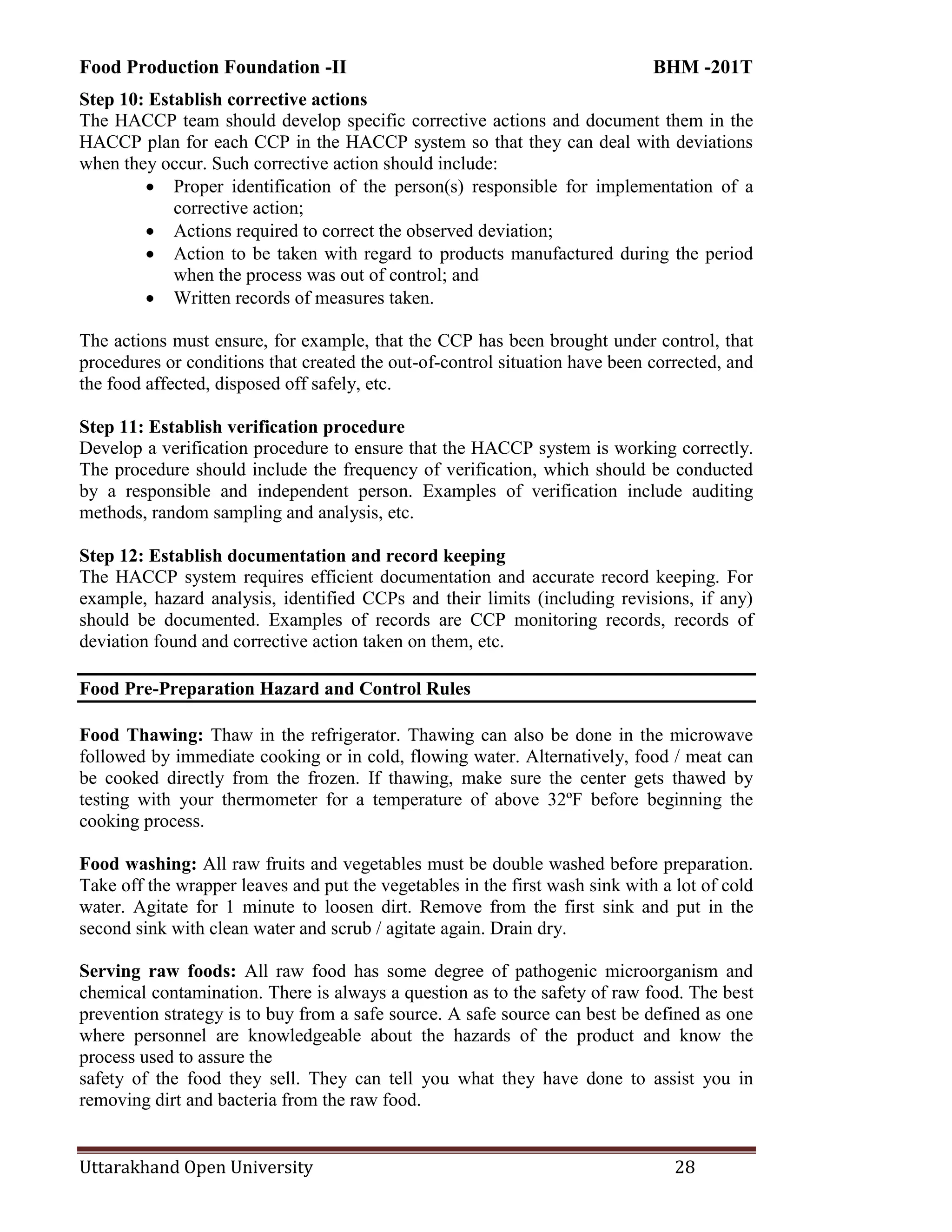
Cooking temperatures
Use a thermometer to check internal cooking temperatures.
Microwave cooking. Cover and cook food to ≥165ºF (stir or rotate the food during the
cooking process), then let the food stand with cover on for 2 minutes.
Food tasting. Use a fresh, sanitized utensil each time food is tasted so that contaminants
from the mouth will not get into the food. Roasts and thick foods. Once cooked, these
food items will be kept at >130ºF.
Sauté and thin foods. A thin-stem, tip-sensitive, calibrated, digital thermometer will be
used to assure that center temperatures meet pasteurization standards.
Food items Cook to this temperature or hotter
Poultry 165 o
F
Ground/punctured meat, fish, eggs 155 o
F
Solid cuts of meat, fish, eggs 145 o
F
Roast beef 130 o
F
Food Production Foundation -II BHM -201T
Uttarakhand Open University 30
Sauces, soups, and beverages. Hollandaise and other egg and heavy cream sauces do not
tolerate continuous 150ºF holding. Make hollandaise, béarnaise, and mayonnaise sauces
with 1 tablespoon of vinegar or lemon juice per egg yolk, and they will have a pH of less
than 4.1 and be safe.
Fruits, vegetables, legumes, and cereals. Many fruits are high- acid foods (pH <4.6) and
are not a food safety problem unless mixed with meat, fish, or poultry items. Cereals and
raw vegetables (carrots, potatoes, onions, cabbage, mushrooms, etc.) are contaminated
with spores and before cooking and must be kept cold (less than 41ºF) or packaged to
allow air exchange. After cooking, all vegetables, such as green beans, baked or boiled
potatoes, and cereals, such as rice, will have activated spores and must be maintained
above 135ºF or cooled to below 41ºF within 6 hours.
Bread, batters, and pastry. Bread and pastry dough are not as hazardous as other foods,
because normally they are moderately dry. Care must be taken if a very moist product is
produced. Icing and protein (milk and egg) fillings can be hazardous. These fillings must
be cooled to 41ºF in 6 hours before using in items such as éclairs or custard pies. When a
hazardous topping, such as an egg white meringue, is baked or browned, the center
temperature of the meringue and temperature at the interface of the pie and meringue
must reach 165ºF to kill Salmonella. The pie and meringue must be safely cooled to 41ºF.
Cooked mixtures should be placed in cakes, shells, crusts, or other baked goods while still
hot, above 165ºF, then the topping added, and the item baked or cooked. This controls
contamination on the surface of the product.
Batters (such as pancake batter) held at room temperature shall be discarded after 4 hours
of use.
Hot combination dishes. When cooked or precooked ingredients are combined and
reheated, they must reach a center temperature of 165ºF in less than 2 hours.
Cold combination dishes. These foods are always a potential hazard. Wash, cook, cool,
and prepare all ingredients separately and start with them at a temperature such as 41ºF,
so that, when combined, the temperature is less than 50ºF. Adding the flavoring and
spices in the sauce or dressing before mixing ingredients will help provide uniform flavor
distribution. You can prepare large batches if the temperature is always below 50ºF,
which controls the toxin production by Staphylococcus aureus. When preparing these
items, always wash hands before starting and use sanitized utensils and containers.
Food Transport, Holding, and Serving Hazard and Control Rules
Hot holding. To keep food at 135ºF or hotter, preheat equipment to 135ºF or hotter
before adding food.
Food serving temperatures. All foods served to customers shall be above 135°F
(57.2°C) [150°F (65.6°C) for quality] or below 41°F (5°C) when they leave the service
area. Improperly cooked, warmed, or held food, or food that shows signs of deterioration,
is rejected.
Food Production Foundation -II BHM -201T
Uttarakhand Open University 31
Serving, packaging, transporting. Keep hot food covered as much as possible to
maintain surface temperatures and prevent surface dehydration. Hot food must be above
135ºF or, if between 135 and 41ºF, served within 4 hours. If food is open on a steam
table, buffet, or service line, the surface temperatures will be below 130ºF unless the pan
is covered. Check on individual portions every 20 minutes, and casseroles at least every
hour. Open, hot food should be discarded if not used within 4 hours.
Reheating for hot holding
 Heat food to 165ºF or hotter in 2 hours or less.
 Use a thermometer to check the temperature.
Beverage dispensing equipment. Make sure all beverages dispensing equipment is
cleaned regularly, according to manufacturer's instructions.
Milk product dispensers. Thoroughly clean milk and milk product dispensers, such as
soft-serve machines (especially the gaskets and O-rings.) Always sanitize them before
they are put
into use each day, and replace gaskets when damaged.
Salad bar. Ice in non-refrigerated salad bars shall be filled to the level of food in the
containers. Ice is not needed in mechanically refrigerated salad bars. Cold food items
must be cold (41ºF or less) before being placed in the salad bar, because salad bar units
are not designed to cool food. Cold food items will slowly warm to about 55°F in the top
layers in most salad bars. Therefore, leftover salad bar product shall never be added to
fresh product beyond the safe time-temperature allowed. Some leftover salad bar items
(e.g., carrot sticks, chopped onions, celery sticks) may be used in a recipe (stews or
soups) in the kitchen.
Dispensing tableware and flatware. Tableware and flatware (both multiple use and
single service) shall be dispensed in a sanitary manner so that surfaces that comes into
contact with food
or the mouth is protected from contamination. Handles of flatware shall be presented to
the user. No unnecessary tableware is left on the table with the customer. All tableware
left with the customer is washed before it is reused.
Self-service food, dishes, and utensils. The customer must not be allowed to return to a
salad bar or buffet line for refill with used dishes. Take the dirty dishes and utensils, and
give the customer fresh tableware and a clean plate for additional food. They can return
with a used cup or glass for more of a beverage.
Food exposed to the customer. Serve customers only the amount of jelly, butter, bread,
cream, etc. that they are likely to consume. All unpackaged food left with the customer
must be thrown out. Packaged food such as crackers and jelly can be reserved. No
unnecessary open food is left on the table with the customer.
Table condiments. Condiment containers shall be clean and uncontaminated, not open or
abused, and shall be discarded replaced if they appear to be below standard. Individually
portioned condiments may be provided for table service or counter service. Condiment
bins shall be kept clean. Commercially packed condiment containers shall not be refilled.
Food Production Foundation -II BHM -201T
Uttarakhand Open University 32
Ingredients in partially filled condiment containers may be sent to the kitchen for use in
cooking.
Ice. Use tongs or a plastic or metal scoop to fill glasses with ice so that there is never a
chance of a chip of glass getting mixed in the ice. Keep all glass (such as coffee pots) and
other breakable ceramic tableware away from the ice bins or machine. Never reuse ice
that has been in contact with food packages or used for displays. If you think that any
glass or other contaminating material has gotten into the ice, throw it out.
Cooling Food
Cooling hot foods: Cooked / prepared food shall be cooled from 135°F to less than 41°F
in 6 hours or less (from 135°F to 70°F within 2 hours followed by cooling to 41°F or
below within a total cooling time of 6 hours). . Use a thermometer to check this.
Quick cooling methods
1. Use shallow pans (for soups, sauces, gravies, etc.): This method can also be
used for small-to-medium-sized pieces of meat.
a.Put a 2-inch layer of food in a shallow, metal pan.
b.Do not cover.
c. Put the pan in the cooler where cold air can blow
across it.
d.Cover, label and date the food after it has cooled.
2. Ice bath
 Put the food container into an ice bath.
 Stir the food every 30 minutes—more often if possible.
3. Add ice instead of water (to soups, stews, etc.)
 Add only half the water before cooking.
 After cooking, add the other half as ice.
4. Use chilling wands or paddles (for large containers)
 Place the clean, frozen wand in the food and stir.
 Use another rapid-cooling method to finish, such as the
shallow pan method described above.
Storage time. Food spoilage microorganisms can grow and continue to reduce the quality
of cooked, cooled, ready-to-eat food while it is refrigerated. All stored food must be dated
and rotated. The longer it is held, the lower the quality and customer satisfaction.
Storage containers. Single-use items such as plastic bread bags, seamed metal cans,
ketchup bottles, crimped aluminum pie tins, and glass jars shall not be reused after
original contents have been removed. Food (particularly high-acid food) shall never be
stored, prepared, and cooked or processed in containers that contain toxic materials such
as galvanized metal, chipped enamelware, lead and lead glazes, or copper.
Cold holding
Temperature- Keep food at 41ºF or cooler at all times.
Time
Foods prepared in the establishment: These foods can be served for up to 7 days after
preparation if they are date labeled (see below) and stored below 41ºF.
Food Production Foundation -II BHM -201T
Uttarakhand Open University 33
Foods purchased in ready-to-eat form (e.g., sliced sandwich meat and hot dogs): These
foods can be served for up to 7 days after opening if they are date labeled (see below) and
stored below 41ºF.
Date labeling. Label a food with its preparation date if it is going to be held longer than
24 hours.
Freezing
a. This stops the 7-day clock, but does not set it back to zero.
b. Before freezing a food, label it with the number of days it was held after cooking
or opening.
c. After thawing, the food can be served for the rest of the original 7 days.
d. If the food was not date labeled before it was frozen, serve it within 24 hours after
thawing or throw it away.
Waste products. Waste products are not stored in any storage area.
Your Responsibility in The Work Place
Although employees have a legal obligation to ensure health, safety and security within
the workplace , employees, colleagues and other persons are also responsible for taking
these issues in hand.
Any health safety, hygiene and security issue such as burnt hand or a case of food
poisoning must be reported immediately to the seniors in a recorded manner with the
following columns
 Date and time of accident
 Name of the person
 Nature and cause of accident
 Who were present nearby?
 Reason of cause ( if possible)
 Any remedial action if required
Food hygiene involves the following:
1. Personal hygiene
It is required that good hygiene systems are followed by all food handlers.
 Have a shower at least once a day.
 Always change the clothes you wear every day.
 Never wear jewelry or timepieces on you during the working hours.
 Have short trimmed hair. Women chefs are to cover their hair with nets
 Shave even if there is a slight growth of facial hair
 Keep your fingernails short and clean
 Wear shoes that cover the whole foot not thongs or sandals to prevent
accidents in the kitchen.
 Wear clean, neat clothing that is not damaged or exposed to the skin and
covers arms and legs to help prevent injury if there is an accident.
 Always use clean utensils and never us utensils that have been used for raw
food with cooked food.
Food Production Foundation -II BHM -201T
Uttarakhand Open University 34
 Do not smoke near or around food preparation area.
 Smoking is strictly prohibited at working area.
 Always wear clean and sanitized protective clothing like chef coat, hat, apron
trousers etc. while working in kitchen.
 Wash your hands in between jobs with luke warm water and detergent. Pat it
dry
 See a doctor at least once a month to ensure you are disease free.
2. Tasting food whilst cooking
 Use disposable spoons for tasting food.
 Food should never be tasted using fingers, as it just like spitting into the food
 Food handlers should never chew gums, eat sweets, or tough their mouth and
nose while cooking.
Clean and hygienic work area
 The use of premises which are clean and can be correctly maintained is
essential for the preparation, cooking and service of food. Cross contamination
risks should be minimized by provision of separate preparation areas for the
various raw and cooked foods. The table describes the various fittings and
fixtures that are needed to be considered in a kitchen before the main
equipment is planned.
 Floors - Should be durable, non-slip and non-permeable.
 Walls - Ceramic wall tiles were considered the best surf ace for areas where
liquids splash a wall surface, potentially overcoming a damp or hygienic
problem.
 Ventilation- The requirement of a higher performance kitchen ventilation
system for modern kitchen with hoods and canopy system is essential.
 Lightening- Good lighting is essential to avoid eye strain. Natural lights are
best but where artificial lightening is used some thought should be given to the
type used.
 Ceiling- White coloured to reflect light, smooth textured, without cracks is
recommended.
 Equipments- should be easy to handle, without any sharp edges, noiseless, can
be cleaned and maintained easily.
CHECK YOUR PROGRESS -V
1) What are the advantages of food safety management system based on HACCP?
________________________________________________________________________
________________________________________________________________________
________________________________________________________________________
________________________________________________________________________
________________________________________________________________________
________________________________________________________________________
________________________________________________________________________
________________________________________________________________________
________________________________________________________________________
Food Production Foundation -II BHM -201T
Uttarakhand Open University 35
2) How will you determine the CCPs?
________________________________________________________________________
________________________________________________________________________
________________________________________________________________________
________________________________________________________________________
________________________________________________________________________
________________________________________________________________________
________________________________________________________________________
________________________________________________________________________
________________________________________________________________________
________________________________________________________________________
________________________________________________________________________
3) Why should we not taste cooked food with fingers?
________________________________________________________________________
________________________________________________________________________
________________________________________________________________________
________________________________________________________________________
________________________________________________________________________
________________________________________________________________________
________________________________________________________________________
________________________________________________________________________
________________________________________________________________________
________________________________________________________________________
________________________________________________________________________
4) How can you hold cold combination dishes?
________________________________________________________________________
________________________________________________________________________
________________________________________________________________________
________________________________________________________________________
________________________________________________________________________
________________________________________________________________________
________________________________________________________________________
________________________________________________________________________
________________________________________________________________________
________________________________________________________________________
________________________________________________________________________
1.10 Summary
This unit starts with defining heat and its application in cooking. We have covered
the various methods of transfer of heat. The cooking is application of heat to the food and
the heat that is applied to food may be moist or dry and depending upon this methods of
cooking food is categorised in to many categories like boiling, poaching, steaming,
Food Production Foundation -II BHM -201T
Uttarakhand Open University 36
grilling, frying, baking, roasting etc. All the methods of cooking is been discussed in this
unit.
It is now well known that the end product inspection and testing and even 100
percent inspection does not provide safety of food. It has inherent limitation of mapping
the potential hazards that could be present in a lot of raw material or food product.
Further, with the rampant rise in contaminants in the environment and the food chain,
there are increasing concerns today among the consumers about the food they eat. It is in
this context that, we learnt HACCP offers greater confidence in the food chain through
evolving of s preventive food safety assurance system. Besides enhancing food safety,
HAACCP implementation is toady vital for us as a nation on account of International
obligations like agreements on Sanitary and Phytosanitary Measures(SPS) and technical
Barriers to trade (TBT)
Among the benefits, the unit highlighted that the HACCP system overcomes many
of the limitations of the traditional approaches to food safety control. In addition, it offers
several benefits to the consumers, industry and government.
1.11 Key Terms
Baking: Baking is cooking of food by dry heat in an oven in which the action of dry heat
is modified by steam.
Barbecuing: This is grilling of food on pre-heated, greased bars over fierce heat (gas,
Charcoal or wood) when solid fuel is used care should be taken that food is placed on
bars when flame and smoke dies out. Food is marinated a brushed with barbecue sauce
during cooking
Batter ( A wet mixture of Flour, egg and milk ) for food such as Fish, Seafood, Fritters,
Onion rings and Fruits)
Between the Heat: This is grilling the food in between electrically heated grill bars or
plates. This method is used for small cuts of meat
Blanching: Blanching means placing food in boiling liquid for 1 to 2 minute and the
refresh with cold water.
Blanquette: White meat is cooked in a suitable stock from which the sauce is made.
Boiling: Boiling is cooking of prepared food in a liquid at boiling point. The liquid be
water, court-bouillon, milk or stock.
Bouillabaisse: Stew of fish, mussels etc. simmered with herbs
Food Production Foundation -II BHM -201T
Uttarakhand Open University 37
Braising: Braising is a method of cooking in the oven; unlike roasting or baking, the food
is cooked in liquid in covered pan, casserole or cocotte. This is combination of stewing
and pot roasting.
Brown Braising: Joints and portioned size meat is marinaded, larded and sealed by
browning on all side in oven. Sealing helps to retain flavour, nutrition and good brown
colour. Joints are then placed on bed of root vegetables in a braising pan with liquid and
other flavourings and then covered with lid and cooked slowly in oven.
Caramelization is the browning of sugars. The browning of sautéed vegetables and
thevgolden color of bread crust are forms of caramelization.
Coagulation: When the protein coils unwind, they become attracted to each other and
form bonds. This bonding is called coagulation.
Conduction: This is the transfer of heat through a solid object by contact. Some materials
are good conductor while some are bad. Some material can retain heat like ceramics, iron
while some materials can not such as copper.
Convection: Convection involves the transfer of heat in liquid and gases. Convection of
air and Convection of liquids
Court-bouillon is fish cooking liquid prepared by simmering sliced carrot, sliced onion,
parsley stalk, sprig of thyme, salt, bay leaf, vinegar and peppercorn in water for 30-40
minutes and then strained.
Deep Frying: This is the cooking of food in pre-heated deep oil/fat/clarified butter. Fried
foods are often coated before frying.
Denaturing of Proteins: Proteins consist of long chains of components called amino
acids. These chains normally form tight coils. As proteins are heated, the coils gradually
unwind. At this point, the protein is said to be denatured.
Dry-heat methods are those in which the heat is conducted without moisture-that is, by
hot air, hot metal, radiation, or hot fat. We usually divide dry-heat methods into two
categories:
Fricassée: White meat is used and milk is added to maintain a white colour in the stew.
Frying: Frying is a quick method of cooking food in hot oil or fat. Frying gives a good
flavour and colour to food.
Gelatinization occurs when starches absorb water and swell. This is a major principle in
the thickening of sauces and in the production of breads and pastries. Acids inhibit
gelatinization.
Griddle: Food can be cooked on a girdle (a solid metal plate).
Food Production Foundation -II BHM -201T
Uttarakhand Open University 38
Grilling: This is a fast method of cooking by radiant heat and is also known as "Broiling.
HACCP: Stands for Hazard Analysis Critical Control Point
Heat: Heat is a form of energy associated with the motion of atoms or molecules.
Infra-red cooking: Infra -red cooking is the latest way of cooking involving less energy
and hazard. In a broiler, an electric element or a ceramic element heated by a gas flame
becomes so hot that it gives off infra red radiation, which cooks the food. There is also
high-intensity infra red ovens designed to heat food rapidly. Infrared can be used in
cooking and heating food as it predominantly heats the opaque, absorbent objects, rather
than the air around them.
Microwave Cooking: Microwave cooking refers to the use of a specific tool rather than
to a basic dry-heat or moist-heat cooking method. The microwave oven is used mostly for
heating prepared foods and for thawing raw or cooked items.
Millard reaction: When proteins are heated to about 310°F (154°C), the amino acids in
the protein chains react with the carbohydrate molecules and undergo a complex chemical
reaction. The result is that they turn brown and develop richer flavours. This reaction is
called the Millard reaction.
Moist-heat methods are those in which the heat is conducted to the food product by
water or water-based liquids such as stock and sauces, or by steam.
Navarin: Refers to rich dark lamb stew
Oven Roasting: It is cooking food in an oven. In this method hot convection of air is
produced inside the oven which is responsible for cooking of food. Heat conducted from
the base of cooking try is responsible for browning of food which is desirable with some
food e.g. Potatoes, where a crisp golden brown colour is required.
Over Heat: Food is cooked over hot grill bars. Grill bars are pre-heated and brushed with
oil otherwise food will stick to the bars. The cooking time will depend upon the thickness
of food and temperature of grill bars.
Paper Bag (En Papillote): A new technology that has had a rapid growth in popularity
among the world's top chefs is sous vide (soo veed) cooking. French for "under vacuum,"
the term is applied to cooking foods that have been vacuum-sealed in plastic bags.
Parboiling: Parboiling is the boiling the food until it is only partially cooked. The food is
placed in boiling liquid for short time so that it's outside becomes soft. The cooking
process is the completed by using another method. Use for quantity cooking
Poaching: Poaching is the cooking of food in the required amount of liquid at just below
boiling point.
Food Production Foundation -II BHM -201T
Uttarakhand Open University 39
Pot Roasting: Pot roasting is cooking food on bed of root vegetable in a covered pan.
This is not a true roast as moist heat (steam) trapped under the lid of closed utensil is used
to cook the food. This method is also known as POÊLÉ. Using this method will result in
retention of maximum flavor of ingredients.
Radiation: Radiation involves the transfer of heat by electromagnetic waves such as
infra-red and microwaves. When this wave passes through food, looses some of its energy
in form of heat.
Ragoût: Red meat is used, it is fried first to develop brown colour and flavour, stock and
or red wine is used as cooking liquid.
Ratatouille: Vegetable stew containing tomatoes, onion eggplant, capsicum and
Zucchini.
Roasting: Roasting is to cook food over a source of radiant heat such as on spit, open fire
or oven.
Sauté: Tender cuts of meat and poultry are cooked by this method. After cooking fat is
discarded and pan is deglazed with stock or wine to prepare sauce.
Seasoned flour (plain flour + salt + pepper) for foods such as sausages, hamburger and
fish
Seasoned flour, egg wash and breadcrumbs for food such as fish, croquettes, cutlets,
chicken and vegetable
Shallow Frying: Shallow frying is the cooking of food in a small quantity of pre-heated
fat or oil in a shallow pan or flat surface.
Spit Roasting: Food is cooked over spit (live charcoal) or open fire. Food is rotated
slowly over the source of heat, and is cooked by radiant heat and convection of air
depending upon the position of food in relation to fire. Usually large joints of meat are
cooked by this method. This method produces its own distinct colour, flavour and texture
in cooked food.
Steaming: Steaming is the cooking of prepared foods by steam (moist heat) under
varying degree of pressure.
Stewing: Stewing is the slow cooking of food cut into pieces and cooked in the minimum
amount of cooking liquid, the food and the liquid are served together.
Stir Fry: Vegetables, strips of beef, chicken etc. are fast fried in wok with little oil or fat.
Tandoori Cooking: Tandoori cooking is done in a clay oven known as tandoor using dry
heat. Although the source of heat is at the base of the oven but heat is evenly distributed
as clay radiates heat evenly.
Under Heat: The source of heat to cook the food, is over the food (salamander)
Food Production Foundation -II BHM -201T
Uttarakhand Open University 40
White Braising: White braising is used for vegetables and sweetbreads. Food is
blanched, refreshed and cooked on bed of root vegetables. Food is then placed in a
covered pan with white stock and placed in oven
1.12 References/Bibliography
 http://en.wikipedia.org/wiki/Cold_cut
 http://www.foodsubs.com/MeatcureCC.html
 www.tarladalal.com/glossary-cold-cuts-1766i
 Arora, K,(2010), Theory of cookery , Frank bros. Publishing pp 175-197
 Principles of cookery (1907), Cornell university, USA
 Armentrout J. Dry (2005)-Aging beef pays off with big flavor. Fine Cooking pp 69-76,
 Robert S Igoe (2011) Dictionary of food ingredients, fifth edition, Springer New York
Dordrecht Heidelberg London,pp 233-235
 By medical and nutrition experts from Mayo Clinic, University of California Los
Angeles, and Dole Food Company, Inc. Encyclopedia of foods , pp 296-298
 Gisslen Wayne (2007) Professional Cooking, John Willey & sons inc. New Jersey
 Leto M. J., BodeW. K. H (2010)., The larder chef , Butterworth-Heinemann, London
 Williams Mary E.(1916)Elements of theory and Practice of cookery, The MacMillan Co.
Ltd. Calcutta
 Maestro martino (2005), Art of cooking ,University of California press , California
 Soni. Gulshan (2010) Food production operation and management, Aman publication,
New Delhi.
 Bali S.Parvinder (2010), Food Production Operation, Oxford University press, New
Delhi
1.13 Review Questions
Q. Write short note on:
1. Effect of heat on food
2. Methods of transfer of heat
3. Dry heat method of cooking
4. Moist heat method of cooking
5. Frying
6. Paper bag cooking
7. Microwave cooking
Food Production Foundation -II BHM -201T
Uttarakhand Open University 41
UNIT: 2
EGGS, POULTRY AND MEAT
Structure
2.1 Introduction
2.2 Objectives
2.3 Understanding Eggs
2.3.1 Function of Eggs
2.3.2 Changes in Prepared Eggs
2.3.3 Cooking of Eggs
2.3.4 Purchase of Eggs
2.3.5 Storage of Eggs
2.3.6 Other Uses of Eggs
2.4 Understanding Poultry and Game
2.4.1 Types Poultry
2.4.2 Composition of Meat
2.4.3 Different Cuts of Poultry
2.4.4 Game Birds and Speciality Products
2.4.5 Cooking Poultry
2.4.5.1 Determining Doneness
2.4.6 Purchase and Storage of Poultry
2.5 Understanding meat
2.5.1 Beef
2.5.2 Mutton
2.5.3 Pork
2.6 Summary
2.7 Key Terms
2.8 References and Bibliography
2.9 Review Questions
2.1 Introduction
In this unit we are going to learn about egg, which is similar in use as milk. Eggs are of great
importance in the diet, and to appreciate this fact fully the true nature of this food must be
understood. For domestic use, the eggs of guinea hens, turkeys, ducks, and geese occasionally
find favor, but as eggs laid by hens are the kind that is commonly used, it is to such eggs that this
Section is devoted. A hen's egg may really be considered as an undeveloped chicken, because it
contains all the elements required to build the body of the chick and provide it with the energy it
needs to pick its way into the world. When it emerges from the shell, it is fully developed, and in
a short time it begins an independent existence, seeking and finding its own food. The fact that
eggs store so much nutritive material explains to some extent why they are a valuable source of
food for man and why they are used so extensively. However, as in the case of milk, the elements
that eggs contain are not in just the right proportion for the sole nourishment of a human being, so
they must generally be used in combination with other foods.
Food Production Foundation -II BHM -201T
Uttarakhand Open University 42
Next we will learn in details about poultry and game birds which are used in the hotel kitchens.
Poultry is the term used to designate birds that have
been domesticated, or brought under the control of
man, for two purposes, namely, the eggs they produce
and the flesh food they supply. All the common
species of domestic fowls--chickens, ducks, geese,
turkeys, guinea fowls, and pigeons--are known as
poultry. However, none of these species is included
under this term unless it is raised for at least one of the
two purposes mentioned. As the term is to be
understood in this Section, poultry includes all
domestic fowls
that are killed in order that their flesh may be cooked and
used as food for human beings. Of course, many wild birds
are killed for the flesh food they furnish, but they are
classed under the term game. Poultry is probably never a
necessity in the ordinary dietary, and when prices are high
it is a decided luxury. Still it does aid materially in
relieving the monotony of the usual protein foods, and it
supplies that "something out of the ordinary" for special
occasions. Then, too, it is often valuable in the diet of an
invalid or some person with a poor appetite. Poultry is, of
course, used more in some homes than in others; yet there
is scarcely a home in which it is not served some time or
another. Knowledge of this food and its preparation and
serving will therefore prove to be a valuable asset to any housewife. By learning this chapter
students will be able to know the use of poultry and game birds in hotel kitchens.
In the last section of the unit we will learn about meat. Meat is muscle tissue. It is the flesh of
domestic animals (cattle, hogs, and lambs) and of wild game animals (such as deer). As a cook,
chef, or food-service operator, you will spend more of your time and money on meats than on any
other food. It is important, then, to understand meats thoroughly in order to cook them well and
profitably. Why are some meats tender and some tough? How can you tell one cut from another
when there are so many? How do you determine the best way to cook each cut?
2.2 Objective
The objective of this unit is to understand the following:
 Types and characteristics of egg
 Egg cookery
 Purchasing eggs
 Different types of poultry and game birds
 Their muscle structure and cooking techniques
 Their purchase specifications and storage
 The different types of meat and meat products available for human consumption.
 Knowledge of the different meat cuts and their use
 Knowledge of cold cuts and their use
 Handling meat and its products
Food Production Foundation -II BHM -201T
Uttarakhand Open University 43
 Purchasing meat and its products
2.3 Understanding Egg
Inspection: The Egg Products Inspection Act of 1970 requires that egg processing plants be
inspected and that their eggs and egg products be wholesome, unadulterated, and truthfully
labeled. This law is enforced by the USDA Poultry Division and applies to all eggs, whether
imported or shipped intra- or interstate. Eggs that do not pass inspection, called restricted eggs,
are not allowed to be sold whole to the consumer. Examples of restricted eggs are those with
cracked shells, called checks; leakers, which have cracked shells as well as broken membranes;
dirties, which have at least one fourth of their shell covered with dirt or stain; and in-edibles,
which have greenish egg whites or are fertilized, rotten, moldy, or bloody.
Grading: Once eggs pass inspection, a producer can pay the USDA to have them graded for
quality. The best-quality eggs are graded USDA Grade AA, followed by USDA Grade A. USDA
Grade B, the lowest grade, is available to food service establishments and not sold directly to
consumers.
Market Forms: The eggs are available in following form in the market:
1. Fresh eggs or shell eggs.
 These are most often used for breakfast cookery and are the main subject of this section.
2. Frozen eggs.
 Whole eggs
 Whites
 Yolks
 Whole eggs with extra yolks
Frozen eggs are usually made from high-quality fresh eggs and are excellent for use in scrambled
eggs, omelets, French toast, and in baking. They are pasteurized and are usually purchased in 30-
pound (13.6-kg) cans. These take at least two days to thaw at refrigerator temperatures.
3. Dried eggs.
 Whole eggs
 Yolks
 Whites
Dried eggs are used
primarily for baking.
They are not suggested
for use in breakfast
cookery. Unlike most
dehydrated products,
dried eggs are not shelf-
stable and must be kept
refrigerated or frozen, tightly sealed.
TYPE OF EGGS
In hotel kitchens and in standard recipes about 53.0 gm is considered the best size of egg used.
The prizes of eggs depend upon the size and not on the taste, because all are same in taste. Eggs
which are reared in winters are considered better than those in summers.
Food Production Foundation -II BHM -201T
Uttarakhand Open University 44
Brown eggs: Many consumers like to buy brown-shelled eggs, even pay more for them, because
they think they are more nutritious, more flavorful, or somehow more natural. In fact, shell color
is determined by the breed of the hen and has no relation to the flavor, purity, or nutritional value
of the egg.
Egg Substitutes: Egg yolks, in addition to being high in fat, are also high in cholesterol. Efforts
to reduce cholesterol in the diet have led to the development of commercial egg substitutes. These
are of two types:
1. Egg substitutes that can be used to make such dishes as scrambled eggs, omelets, and custards
are made of pasteurized egg whites with the addition of a blend of ingredients to substitute for the
yolks, such as vegetable oil, milk solids, vegetable gums, salt, emulsifiers, and vitamin additives.
They are sold in bulk liquid form, usually frozen, and can be substituted, ounce for ounce, for
whole liquid eggs in most egg preparations.
2. Eggless egg substitutes contain no egg product. They are made of flours or other starches, plus
vegetable gums and stabilizers, and, sometimes, soy protein. They are intended for use in baked
goods only and are not suitable for use in breakfast egg preparations or custards. If they contain
no milk products (read ingredient lists on individual products), they may be used in vegan diets.
STRUCTURE
OF EGGS:
When the egg is
freshly laid, the
shell is
completely
filled. The air
cell is formed
by contraction
of the contents
during cooling
and by the loss
of moisture. A
high-quality egg
has only a small
air cell. The yolk is well-centered in the albumen and is surrounded by the vitelline membrane,
which is colorless. The germinal disc, where fertilization takes place, is attached to the yolk. On
opposite sides of the yolk are two, twisted, whitish cord-like objects known as chalazae. Their
function is to support the yolk in the center of the albumen. Chalazae may vary in size and
density, but do not affect either cooking performance or nutritional value.
A large portion of the albumen is thick. Surrounding the albumen are two shell membranes and
the shell itself. The shell contains several thousand pores that permit the egg to "breathe."
Eggs have four main parts:
Shell — As the name suggests, this is the fragile and porous outer covering. The shell is made
mostly of minerals — calcium carbonate, magnesium carbonate, and calcium phosphate.
Shell membranes — These are layers of protein fibers that stick to the shell. They provide
additional protection for the egg‘s insides, preventing mold and bacteria from getting in, for
example.
Food Production Foundation -II BHM -201T
Uttarakhand Open University 45
Albumen — This is the white of the egg. It is almost all protein and water.
Yolk — The yellow bull‘s eye of the egg, the yolk is made of a substance called ―vitellus.‖ It can
be a pale yellow or dark yellow. About 30 percent of the yolk is fat, and about 16 percent is
protein. The remainder is made up of solids.
Composition of egg: Eggs are composed of shell, yolk, and white. A whole egg weighs
about 52-55 Gms, has 73.7% water, 12.9% proteins, 11.5 % fat, 1 % carbohydrate and
0.9% minerals.
ESSENTIAL NUTRIENTS: Eggs are especially valuable as a source of protein. In fact, egg
protein is used as the standard against which the quality of other food proteins is measured. One
egg contains about 6 to 7 grams of protein. People of all ages need adequate protein for building
and repairing body tissues. The fat in the yolk is so finely emulsified that it is digested easily,
even by infants. The ratio of unsaturated to saturated fats is about 2 to 1. This is considered very
desirable. Oleic acid is the main unsaturated fat. It has no effect on blood cholesterol. Eggs
contain vitamin A, the B vitamins (thiamin, riboflavin, and niacin), and vitamin D. All are
necessary during childhood and adolescence for growth. Eggs also contain an abundant supply of
minerals, such as iron and phosphorus, which are essential for building and maintaining strong,
healthy bodies. But eggs are low in calcium (it is in the shell), and contain little or no vitamin C.
2.3.1 FUNCTION OF EGGS
Eggs are oft en combined with other ingredients. Their unique ability to flavor, Color, emulsify or
thicken, bind, foam, Interfere, color, coat, leaven, clarify, and prevent crystallization makes them
nearly indispensable in cooking. They are often used for these purposes in prepared foods such as
snacks, entrees, and processed meats. Some of these unique qualities of eggs are now discussed.
Emulsifying: Lecithin, found in egg yolks, is a natural emulsifying agent: one end of the
molecule attracts water, while the other end is drawn to fat. Eggs thus help keep fat and water or
other liquid compounds from separating, so they are oft en used to thicken and stabilize foods
such as salad dressings, hollandaise and béarnaise sauces, mayonnaise, ice cream, cream puffs,
and certain cakes.
Binding: The high protein content of eggs makes them excellent binders. Fish, chicken,
vegetables, and other foods are often dipped in beaten egg and then rolled in breading, batter,
flour, or cereal. During cooking, heat coagulates the eggs‘ protein, which then acts as an adhesive,
binding the other ingredients to the surfaces of the cooked material. Egg also binds together
mixtures such as meatloaf, meatballs, lasagna, and manicotti. When the mixture cooks, the egg
proteins firm and stabilize, providing structural strength. Too much egg, however, can cause
foods to become overly firm and dry.
Foaming: The capacity of egg whites to be beaten into foam that increases to six or eight times its
original volume is invaluable in food preparation. Egg-white foams are used to aerate and leaven
a number of food products, such as puff y omelets, soufflés, angel food cake, sponge cake, and
meringues. The best eggs to use for egg-white foam are fresh eggs, because they have thick egg
whites, which contribute to stable foam. Older eggs have thinner whites, which beat to a larger
volume but are less stable and may collapse during heating. Consistency, regardless of an egg‘s
age, is achieved in some food service establishments by the use of dried egg whites. The
formation and stability of egg white foams also depend upon the beating technique; the
temperature; the type of bowl; the careful separation of yolks and whites; and whether or not
Food Production Foundation -II BHM -201T
Uttarakhand Open University 46
sugar, fluid, salt, or acid have been added . The skillful control of all these factors yields the best
possible egg-white foam.
2.3.2 CHANGES IN PREPARED EGGS
Eggs are extremely versatile and can be prepared alone or in combination with other foods. Hen
eggs are the primary ingredient in a dish, it is best to use the highest quality (Grade AA or A) and
those packed within 28 days of laying. Countless recipes that include eggs can be cooked by
either dry- or moist-heat methods. Before these are discussed, a brief overview of the changes that
can occur in prepared eggs is presented.
Effects of Temperature and Time: The key to cooking eggs is to keep the temperature low
and/or the cooking time short. Heating eggs at high temperatures and/or for long periods of time
diminishes the eggs‘ texture, flavor, and color. Overheated proteins become tough and rubbery
and shrink from dehydration, which is why overcooked scrambled eggs look curdled and feel dry
and rubbery.
Coagulation Temperatures: Egg whites and yolks coagulate at different temperatures. Egg
whites fi rst start to coagulate at about 140°F (60°C) and become completely coagulated at
149°F–158°F (65°C–70°C). Slightly warmer temperatures of about 144°F– 158°F (62°C–70°C)
are needed for the egg yolks to start coagulating. This difference allows eggs to be cooked so their
whites are firm but the yolks remain soft. An egg may be cooked at 142°F (61°C) for an hour and
still have a soft yolk. Also, beaten eggs coagulate at a slightly higher temperature (about
156°F/69°C).
Effects of Added Ingredients: Adding other ingredients to eggs changes their coagulation
temperature. For example, incorporating milk into whole eggs in a custard dish increases the
coagulation temperature to about 175°F (79°C). Sugar also increases coagulation temperature,
whereas the addition of salt and/or acid lowers it. Eggs can curdle if too much of an acidic
ingredient, such as tomato or vinegar, is added.
Color Changes: Undesirable color changes may occur during egg preparation. Sometimes when
eggs are overcooked or heated at too high a temperature, the sulfur in the egg white may combine
with the iron in the yolk, the cooking water, or other iron sources to form ferrous sulfide, a green-
colored compound with a strong odor and flavor. To eliminate the problem of ―green yolk,‖ it is
best to use stainless steel equipment and low cooking temperatures, to avoid overcooking, to cool
hard-cooked eggs quickly in cold water, and to serve them immediately. Another change in heated
eggs, which is more difficult to prevent, is the slight browning that results from the Maillard
reaction, in which egg proteins react with the few carbohydrates contained in the egg.
2.3.3 COOKING OF EGGS
Dry-Heat Preparation: Dry-heat preparation of eggs primarily involves frying and baking. Egg
dishes that are commonly fried are fried eggs, scrambled eggs, and omelets. Baked egg dishes
include shirred eggs, meringues (both soft and hard), and soufflés. These dry-heat methods are
now further discussed.
Frying: A frying pan, a sauté pan (omelet pan), or even a griddle can be used to fry eggs. Cast
iron pans work best for eggs if the pans are primed or seasoned. Priming is accomplished by
rubbing a clean frying pan with a thin layer of vegetable oil and setting it on moderate heat, which
is then briefly increased to high. Then it is removed from the heat and allowed to cool. Washing
the frying pan with soap or cooking anything but eggs in it removes the primed surface. Nonstick
Food Production Foundation -II BHM -201T
Uttarakhand Open University 47
pans do not need to be primed or seasoned. Frying is used to prepare fried and scrambled eggs
and omelets.
Fried Eggs: For each fried egg, about 1 teaspoon or less of butter, margarine, or oil is added to a
hot pan. Clarified butter can also be used; it will not burn like regular butter. To cut down on fat,
a bit of fat may be spread on the pan‘s surface with a paper towel or waxed paper, or a vegetable
spray may be applied to its surface before heating. Too little fat causes sticking, but excessive fat
will result in greasy eggs. The fat should be hot enough to prevent the eggs from running, but not
so hot that it toughens the egg proteins. The temperature is just right when a drop of water
dropped into a hot pan sizzles instead of either rolling around or instantly vaporizing into the air.
Yolks are less likely to break open when the eggs are cracked if the eggs are allowed to warm
very briefly in a bowl of hot water. Broken yolks can also be avoided by using fresh eggs and/or
by first breaking the eggs into a bowl or other container rather than dropping them directly from
the shell into a frying pan or griddle. Then, once the pan and the fat have been heated to the right
stage, the eggs should be slid from the bowl, no more than two at a time, onto the pan or griddle.
The heat should be lowered immediately to medium-high. Coagulation is then allowed to occur
according to the following ―cook-to order‖ stages:
• Sunny-side up-The egg is cooked until the white is set and the yolk is still soft. The egg
is not flipped. Sunny-side up eggs may not be sufficiently cooked to eliminate bacteria,
and thus some state health departments do not allow them to be served to the public.
Covering the pan with a lid during cooking gives the yolk a rather opaque appearance, but
eliminates any risk of an undercooked egg.
• Over easy-The eggs are flipped over when the whites are 75 percent set. Cooking
continues until the whites are completely cooked but the yolks are still soft.
• Over medium-The same as over easy, except that the yolks are partially set.
• Over hard-The same as over easy, except that the yolks are completely set.
Scrambled Eggs: Scrambled eggs are beaten while raw until well blended and may be seasoned
with salt and pepper or other seasonings. Liquid in the form of milk, cream, or water may be
added to impart more body and/or flavor and a soft, creamy texture. The added liquid, a
tablespoon or less for each egg, creates steam during cooking, which lifts the eggs and makes
them lighter and fluffier. Too much liquid makes the eggs watery and forms small, tough, curd-
like masses. The beaten egg mixture is poured onto a heated surface, the heat is reduced, and the
eggs are gently stirred as soon as they begin to coagulate. Too much stirring will break the egg
into too many small pieces, so it is better to lift the cooked egg repeatedly with a spatula so the
undercooked portions may slide underneath rather than literally to stir them. Scrambled eggs are
finished cooking when they are set, yet still soft and moist. Like most egg dishes, they are best
when served immediately. In restaurants or when cooking for large crowds, it is recommended
that scrambled eggs be prepared in small batches, generally 3 quarts or less at a time.
Omelets: When eggs are beaten, cooked, and rolled into a cigar shape or folded into a f lat half
circle, the resulting dish is called an omelet. Both plain (French or American-style) and puff y
(fluffy) omelets can be prepared with or without fillings. Omelet preparation is considered so
important by chefs that it is not unusual for a job applicant to be asked to chop an onion and make
an omelet as part of the interview process. Plain omelets consist of whole eggs, beaten, seasoned
as desired, and poured into a prepared pan heated to medium-high. Once the mixture is in the pan,
the heat is lowered to medium, and the mixture is not stirred. Uncooked portions are allowed to
cook by lifting just the edges of the omelet with a spatula so the runny mixture flows underneath.
When the top is firm, the omelet can be folded in half, rolled and folded over itself, or rolled and
Food Production Foundation -II BHM -201T
Uttarakhand Open University 48
slid onto a dish. If fillings are to be added, they are placed on top of the omelet just before it is
folded.
Baking: Baking eggs and their ingredients leads to several different egg dishes: shirred eggs,
meringues, and soufflés.
Shirred Eggs: Whole eggs that are baked and served in individual dishes are called shirred eggs.
The egg is cracked, gently placed into a cup from which it can be rolled into a container coated
with butter or margarine, and then baked in an oven at 350°F (177°C) until cooked to order.
Meringue: A meringue is egg white foam used in dessert dishes as a pie topping, a cake layer, or
as frosting. It may also serve as a dessert on its own or be combined in other ways with dessert
ingredients. Meringues are made by whipping egg white into foam and adding sugar, the amount
of which determines whether the meringue is soft or hard. Soft meringues are made with about 2
tablespoons of granulated (preferably superfine) sugar per egg white and are often used as pie
toppings (e.g., lemon meringue pie). The sugar is gradually added to the egg whites—three will
cover an average pie—and the mixture is whipped to the soft peak stage. The meringue is then
spread immediately over the still-warm filling. A warm filling is necessary so the egg-white
proteins can coagulate and bind to it. The whole pie with the meringue is then baked in the oven
at between 325°F (163°C) and 350°F (177°C) for about 15 minutes. A temperature that is too low
dries the meringue; a temperature that is too high shrinks it. Some problems that can occur when
preparing soft meringues are shrinking, weeping, and beading.
• Shrinking- To prevent the meringue from shrinking back and leaving an unsightly gap
around the outside edges of the pie, it should be spread to slightly overlap the entire
perimeter of the crust.
• Weeping-Also known as syneresis, weeping may be caused by under-beating the eggs,
which leaves unbeaten whites on the bottom of the beating bowl, or by under-coagulation,
created, for example, by placing meringue on a cold pie filling. A meringue can be
protected from weeping by adding a teaspoon of cornstarch to the sugar before beating it
into the egg whites.
• Beading- Un-dissolved sugar is the main cause of beading, but overcooking (over-
coagulation) also contributes to this phenomenon. Beading can be avoided by using
shorter cooking times and increasing the temperature up to 425°F (218°C). Hard
meringues are usually baked as cookies, but they can be formed into different shapes and
used as decorations on puddings or other desserts. They are prepared with twice the
amount of sugar used in soft meringues, about 4 tablespoons (¼ cup) per egg white.
Confectioner‘s sugar is preferred over granulated sugar for use in hard meringues,
because it is more evenly distributed through the beaten egg whites and lacks a gritty
texture. Egg whites are beaten to the stiff stage, the sugar is beaten in, and the resultant
meringue is shaped, placed on a parchment-covered baking sheet, and baked at the low
temperature of 225°F (107°C) for about an hour or longer, depending on the size of the
individual portions. When the meringue is delicately browned and the end product firm,
the oven is turned off , the door left open, and the meringue left in the cooling oven for at
least 5 minutes. Once the meringue is removed from the oven, the remainder of the
cooling period should occur in a warm place free of drafts.
Soufflés: A soufflé is actually a modified omelet. The main ingredients of a soufflé are a thick
base generally made from a white sauce or pastry cream, egg-white foam, and flavoring
ingredients. Initially, the egg yolks and whites are separated. A thick white sauce or pastry cream
is prepared and combined with the egg yolks. Stiffly beaten egg whites are folded into the thick
Food Production Foundation -II BHM -201T
Uttarakhand Open University 49
egg yolk mixture (Figure 12-13). For a main dish soufflé, flavoring ingredients such as diced or
grated cheese, cooked meat, cooked seafood, and/or vegetables and seasonings are added to this
mixture. Dessert soufflés will include sweet ingredients like sugar, chocolate, or fruit, but the
process is the same. Whichever the type of soufflé, the entire combination is gently poured into a
lightly greased soufflé dish or other deep baking dish, placed in a larger pan of hot water, and
baked in a moderate (350°F/177°C) oven for 50 to 60 minutes or until delicately browned and
firm to the touch. Small, individual soufflés will take less time. The oven door should not be
opened during baking until time to check for doneness, because it creates a draft that can cause
the soufflé to fall. Doneness is determined by gently shaking the oven rack. If the center jiggles,
even slightly, more baking time is required.
When combining beaten egg whites with other heavier mixtures, it is best to pour the heavier
mixture onto the beaten egg whites. Then gradually, using a spoon or rubber spatula, combine the
ingredients with a downward stroke into the bowl, across, up, and over the mixture. Come up
through the center of the mixture about every three strokes and rotate the bowl during folding.
Fold just until there are no streaks remaining in the mixture. Avoid stirring, which will force air
out of the egg whites.
Moist-Heat Preparation: Eggs can be prepared by moist heat using a variety of methods. Most
common among these are ―boiled‖ eggs, coddled eggs prepared in a cup, poached eggs, a variety
of custards, and eggs that are prepared using the microwave. In all cases, eggs are cooked at
simmering temperatures. Each of these methods and some of the egg dishes produced are now
discussed in more detail.
Coddling: Coddled eggs are prepared by breaking an egg into a small cup, called a coddler, made
of porcelain or heat-proof glass with a screw-on top, and submerging the whole coddler in
simmering water until the egg is cooked. The coddler should be buttered or greased before adding
the raw egg. Cream or other flavorings such as ham or bacon are sometimes added before
cooking. Once done, the egg is eaten directly out of the coddler.
Poaching: Eggs are poached by being cracked and simmered in enough water to cover the egg by
at least twice its depth. Fresh USDA Grade AA eggs are best to use for poaching, because the
whites are firmer and less likely to spread out in the water and create streamers, floating strands of
partially cooked egg whites. Salt (½ teaspoon per cup) and/or vinegar (1 teaspoon per cup) may
be added to the water to speed coagulation and help to maintain a compact, oval shape of the egg.
On the other hand, salt or vinegar will give the cooked egg a shinier, tougher, and, perhaps, more
shriveled surface than the one cooked in plain water. Poached eggs are cooked for 3 to 5 minutes,
removed with a slotted spoon, drained, trimmed of any streamers, and served immediately. The
well-poached egg should have a firm yolk and compact white. Poached eggs are commonly used
for eggs Benedict, consisting of an English muffin layered with a slice of ham or Canadian bacon,
followed by a poached egg, and topped with a dollop of hollandaise sauce.
Custards: Custards are mixtures of milk and/ or cream, sweeteners (sugar, honey), flavorings
(vanilla, nutmeg, etc.), and eggs or egg yolks. Custards are thickened by the coagulation of egg
proteins during cooking. These egg proteins denature when heated and recombine to form a
network that sets or coagulates, at the right temperature, to form the solid gel of custard. All
custard dishes are very susceptible to microbial contamination and should be covered and
refrigerated as soon as possible after preparation. Custards are distinguished by whether they are
sweet or savory, and by their preparation method: stirred or baked.
Hard or Soft ―Boiled‖: Although the term hard-boiled eggs are commonly used, eggs should
actually be simmered and never boiled, because they will become tough and rubbery if so treated.
The high heat of boiling also transforms the iron in the egg yolk into ferrous sulfide, causing the
Food Production Foundation -II BHM -201T
Uttarakhand Open University 50
greenish-black color and unpleasant flavor found in the yolk of overly hard-cooked eggs. There
are two methods for hard-cooking eggs: hot start and cold start. Each has advantages and
disadvantages; each produces acceptable products.
Hot-Start Method: In the hot-start method, the water is heated to boiling and then the eggs are
completely immersed in the boiling water. The heat is immediately reduced to simmer, and the
eggs are cooked for 3 to 15 minutes, depending on the desired doneness:
• Soft 3 to 4 minutes
• Medium 5 to 7 minutes
• Hard 12 to 15 minutes
The cooked eggs are drained and then rinsed under cold running water to stop further cooking
from residual heat. The extreme temperature change from hot to cold also helps loosen the egg‘s
membrane from the shell, making it easier to peel. To further ease peeling, the first crack should
be made at the air cell located at the larger end of the egg, and then the egg rolled gently between
the hands to break the shell all over. Peeling under cold running water also makes the job easier.
Fresher eggs are harder to peel because the air cell is smaller and the membrane is tight against
the cell wall. Although the larger air cell and higher pH of older eggs makes them easier to peel,
they also tend to break more easily during heating. The benefits of using the hot-start method are
greater temperature control, eggs that are easier to peel, and a shorter total cooking time. A
drawback is that lowering the eggs into boiling water may cause them to crack.
Cold-Start Method: In the cold start method, the eggs are placed in a saucepan with enough cold
water to cover them by at least an inch. Th e water is brought to a boil, immediately lowered to a
simmer, and the eggs are then cooked to order:
• Soft 1 minute
• Medium 3 to 5 minutes
• Hard 10 minutes
Another way to prepare hard-cooked eggs from a cold start is to remove the pan from the heat as
soon as the water boils, cover it tightly, and let it stand for 20 minutes. Cold-start eggs are less
likely to crack during cooking. The advantages to the cold-start method are that less attention to
the process is required, the eggs are easier to add to the water, and they are less likely to break.
On the other hand, starting eggs out in cold water may cause the egg white by the shell‘s surface
to be more rubbery, and there is a greater chance of a greenish tint forming on the egg white.
Once cooked, eggs can be cut into slices or wedges using the slicing equipment. Dipping the knife
in hot water before slicing keeps the hard-cooked eggs from falling apart. To tell a hard-cooked
egg from a raw one, spin the egg on its side. A smoothly spinning egg is hard cooked, while one
that wobbles out of balance is not.
Custards: Custards are mixtures of milk and/ or cream, sweeteners (sugar, honey), flavorings
(vanilla, nutmeg, etc.), and eggs or egg yolks. Custards are thickened by the coagulation of egg
proteins during cooking. These egg proteins denature when heated and recombine to form a
network that sets or coagulates, at the right temperature, to form the solid gel of custard. All
custard dishes are very susceptible to microbial contamination and should be covered and
refrigerated as soon as possible after preparation. Custards are distinguished by whether they are
sweet or savory, and by their preparation method: stirred or baked.
Sweet and Savory Custards: Sweet custards are served as desserts in the form of puddings or as
fillings for éclairs and pies. Savory (non-sweet) custards are used for dishes such as quiches. A
popular quiche made with bacon and Swiss cheese is known as quiche Lorraine.
Stirred Custard (Soft Custard or Custard Sauce): The ingredients of this custard are stirred
while being heated on the range over low heat or i n a double boiler. The mixture retains a
smooth, creamy, fluid consistency. Stirred custard is oft en eaten as a pudding; however, it may
Food Production Foundation -II BHM -201T
Uttarakhand Open University 51
provide the base for many frozen desserts; be served as a sauce for cake, fruit, and other desserts;
or be used to replace eggnog. The repeated stirring prevents the formation of a gel, so the custard
mixture thickens instead of gels.
Baked Custard: Baked custards are actually an example of dry-heat preparation. Both types of
custards begin with the same ingredients, but are simply heated differently. Baked custard mixes
are poured into ungreased custard cups that are placed in the oven, usually in a water bath (bain-
marie), where they sit undisturbed and gel during baking. A water bath is made by filling a large,
low-sided pan with 1 inch of hot water, into which the cups containing the custard mix are placed.
The layer of water insulates the cups and prevents the outside of the custard from cooking to
completion before the inside has had a chance to coagulate.
CHECK YOUR PROGRESS-I
Q1. Classify different types of eggs?
________________________________________________________________________
________________________________________________________________________
________________________________________________________________________
________________________________________________________________________
________________________________________________________________________
________________________________________________________________________
________________________________________________________________________
________________________________________________________________________
________________________________________________________________________
________________________________________________________________________
________________________________________________________________________
________________________________________________________________________
________________________________________________________________________
________________________________________________________________________
________________________________________________________________________
________________________________________________________________________
________________________________________________________________________
Q2. What are different methods of boiling eggs?
________________________________________________________________________
________________________________________________________________________
________________________________________________________________________
________________________________________________________________________
________________________________________________________________________
________________________________________________________________________
________________________________________________________________________
________________________________________________________________________
________________________________________________________________________
________________________________________________________________________
________________________________________________________________________
Food Production Foundation -II BHM -201T
Uttarakhand Open University 52
Q3. Why do greenish black ring forms in boiled eggs?
________________________________________________________________________
________________________________________________________________________
________________________________________________________________________
________________________________________________________________________
________________________________________________________________________
________________________________________________________________________
________________________________________________________________________
________________________________________________________________________
________________________________________________________________________
________________________________________________________________________
________________________________________________________________________
2.3.4 PURCHASE OF EGGS
1. Eggs should always be purchased from reputed shop or grahak sangh or Govt.
cooperative society
2. Colour - could be either brown or white but does not affect the quality of eggs.
3. Size and weight - Average weight of an egg is about 52-55 gm and the weight of
each egg is proportional to its size.
4. Egg Yolk – Upstanding, well-rounded and of a good even color indicates
freshness. The red spot on the yolk indicates that the egg is fertilized and it is
prominent only when it is hatching.
5. Shell- Any cracks on the shell indicates deterioration of quality of he eggs. The
shell should be clean, well shaped, strong and slightly rough.
6. Purchase only the amount needed for 1 –2 weeks
7. Buy farm fresh or refrigerated eggs.
8. Inspect carefully and discard any chipped ones.
Test for freshness:
1. If an egg is kept, thick white gradually changes into thin white and the water
passes from the white into the yolk. The yolk looses strength and begins to flatten,
water evaporates from the egg and is replaced by air and as water is heavier than
air, and fresh eggs are heavier than stale ones. So if an egg is stale it will float ion
water.
2. Candling – When fresh eggs are held to the strong light, they have a uniform rosy
tint and the yolk is firmly suspended in the center. The look more transparent on
top. Stale eggs look cloudy and opaque and the yolk settles against the shell. Eggs
having dark spots on the shell are definitely bad.
2.3.5 STORAGE OF EGGS
Eggs begin to deteriorate as soon as they are laid and lose quality very rapidly at room
temperature. In fact, an egg will age more in 1 day at room temperature than in 1 week in the
refrigerator. To ensure the freshness of whole or liquid eggs, they may be refrigerated, frozen, or
dried. Proper storage is critical for eggs because they contain all the nutrients necessary to support
the growth of a bird. Their nutrient content, especially water and protein, is ideal for bacterial
growth and for this reason eggs should always be properly stored.
Food Production Foundation -II BHM -201T
Uttarakhand Open University 53
REFRIGERATION
Whole Eggs: An eggshell is not airtight. There are as many as 17,000 tiny pores over the shell‘s
surface, so keeping eggs in the carton and refrigerated helps to retain their freshness. Several
signs distinguish fresh eggs from those that have aged. Changes in proteins over time cause egg
whites to thin. Fresh eggs also have more prominent, viscous chalazae on either side of the yolk
than older eggs. In the process of aging, the vitelline membrane weakens and the yolk migrates or
breaks. The size of an egg‘s air cell provides another indication of its age. The air cell gap
between the membranes increases in size as the egg ages because moisture and carbon dioxide
escape through the porous shell. Although the air cell size increases with age, the purpose of this
space in every egg is to provide the chick with some air for its first breath, which it needs to break
out of the shell. Proper refrigeration of eggs helps to delay these changes and protects them from
microbial growth, thus helping to maintain their quality. Many home refrigerators have built-in
egg containers, but eggs retain their moisture better and keep longer if stored in the carton. It also
helps prevent flavors and odors from being absorbed through their porous shells. Eggs should be
stored in dry conditions, so damp cartons should not the carton with their large ends up to prevent
the air cell from moving toward the yolk. Washing eggs is not recommended, because this will
remove the oil coating applied by the processor to prevent microbial growth and moisture loss.
Shelf Life of Refrigerated Eggs: Refrigerated whole eggs should stay fresh for about 1 month
even though the recommended storage time is 1 week. Separated egg yolks may be stored
submerged in water in the refrigerator, but should be used within 2 days. Egg whites kept tightly
covered in a glass container will last up to 4 days. When multiple cartons of eggs are purchased,
the eggs should be used according to the ―first in-first out‖ method—meaning that the oldest eggs
are used first.
Pasteurized Eggs: The USDA regulations require that all liquid, frozen, or dried eggs be
pasteurized or otherwise treated to protect against Salmonella. Commercial outlets frequently use
refrigerated liquid eggs that have been pasteurized. Typical processed food products that may
incorporate pasteurized liquid egg whites include baked goods, candies, and chilled or frozen
desserts. After they are pasteurized, the advantages of liquid eggs over whole eggs or even frozen
egg blends are convenience; consistent quality; microbial safety; and costs savings in terms of
space, labor, and freezing. New to the scene are eggs pasteurized in their shells that are being
marketed to the consumer.
Frozen: Freezing a whole egg is not possible because the expanding liquids will cause it to crack.
Food manufacturers solve this dilemma by breaking the eggs open at the processing plants where
the contents are frozen whole (whites and yolk mixed together) or separated as whites or yolks.
Prior to being frozen, the liquid whole eggs are usually pasteurized (140°F–143°F/52°C–55°C for
3½ minutes). Egg whites by themselves denature if pasteurized, so prior to this process they are
often combined with a small amount of lactic acid and aluminum sulfate. There are several
drawbacks to using frozen pasteurized eggs: they are costly to freeze and keep frozen, they must
be thawed, they are cumbersome to portion and they have lowered functional quality. Fortunately,
separated egg whites are not adversely affected by freezing. Some commercially frozen egg
whites have added stabilizers and whipping aids to improve their ability to form large, stable
foams. For separated yolks, sugar, corn syrup, or salt is added (2 to 10 percent) to prevent them
from becoming viscous and rubbery when thawed. Salt is used in frozen eggs only if they will be
incorporated into sweet foods that will partially mask the salty taste. When freezing eggs at home,
1 tablespoon of sugar (corn syrup) or ½ teaspoon of salt is added for every cup of blended eggs.
Raw egg whites can be frozen with no special measures taken.
Dried: Drying eggs is a simple process. Whole eggs or separated yolks are spray-dried to create a
fi ne powder, which is mixed with anti-caking substances to prevent clumping. Egg whites are
Food Production Foundation -II BHM -201T
Uttarakhand Open University 54
dried in different ways to form granule, flake, or milled textures. Dried eggs sometimes brown
because of the Maillard reaction, but this can be prevented by removing glucose from the eggs
before drying with the aid of an enzyme (glucose oxidase) or by yeast fermentation. Once dried,
eggs can be stored in the refrigerator for up to a year, but they must be kept in tightly closed
containers to prevent the clumping that can result from moisture accumulation. Dried eggs, used
extensively by food manufacturers, are particularly advantageous when storage and refrigeration
space is limited. The major disadvantage of using dried eggs is that they lose many of the
functional and sensory qualities of eggs, and are highly susceptible to bacterial contamination.
Therefore, they should be used only when the end product will be thoroughly heated.
CHECK YOUR PROGRESS-II
Q1. What do you mean by sunny side up?
________________________________________________________________________
________________________________________________________________________
________________________________________________________________________
________________________________________________________________________
________________________________________________________________________
________________________________________________________________________
________________________________________________________________________
________________________________________________________________________
________________________________________________________________________
________________________________________________________________________
________________________________________________________________________
Q2. What is the composition of egg?
________________________________________________________________________
________________________________________________________________________
________________________________________________________________________
________________________________________________________________________
________________________________________________________________________
________________________________________________________________________
________________________________________________________________________
________________________________________________________________________
________________________________________________________________________
________________________________________________________________________
________________________________________________________________________
Q3. What are the coagulation temperatures of different components of egg?
________________________________________________________________________
________________________________________________________________________
________________________________________________________________________
________________________________________________________________________
________________________________________________________________________
________________________________________________________________________
________________________________________________________________________
________________________________________________________________________
________________________________________________________________________
________________________________________________________________________
________________________________________________________________________
Food Production Foundation -II BHM -201T
Uttarakhand Open University 55
2.3.6 OTHER USES OF EGGS
1. As Horsdoeuvres (egg mayonnaise)
2. As salads (fish salads, Russian salad)
3. As main course (egg Florentine, egg curry, scrambled eggs)
4. As garnish (chicken biriyanis, Salads)
5. Sauces (mayonnaise, hollandaise)
6. Custard (caramel custard)
7. Thickening agents (soups, puddings)
8. Emulsifying agent (mayonnaise)
9. Pastries (sponges)
10. Leavening agent (soufflé, cakes, meringue)
11. Clarifying agent (consommé)
12. Flavoring agent (custards)
13. Enriching agent (Bombay duck)
14. Glazing agent (patties, buns, rolls)
15. Binding agent (croquettes, puddings)
2.4 Understanding Poultry and Game
The word poultry refers to all domesticated birds raised for their meat. Although chickens are the
most popular poultry consumed, other species include turkeys, ducks, geese, guinea fowls, and
pigeons (squabs). Game birds such as pheasant, wild duck, and quail are also consumed, but few
of them reach the marketplace. Emus and ostriches, though not yet readily available in all parts of
the country, are being bred for their lower-fat meat. Despite the variety of poultry, chickens,
raised by humans for over 4,000 years, remain the most common poultry consumed. Chickens are
especially useful because both their meat and their eggs are consumed. The popularity of chicken
and turkey continues to increase at the expense of beef. Poultry is important to the diet, and the
purpose of this chapter is to discuss poultry classification, composition, purchasing, preparation,
and storage.
2.4.1 Types Poultry
Classification: Poultry breeders and dealers divide the domestic fowls into three classes. In the
first class are included those which have combs, such as chickens, turkeys, and guinea fowls.
Quails and pheasants belong to this class also, but they are very seldom domesticated. The birds
in this class are distinguished by two kinds of tissue--light meat on the breast and dark meat on
the other parts of the body. In the second class are included those fowls which swim, such as
ducks and geese. These are characterized by web feet and long thick bills, and their meat is more
nearly the same color over the entire body. The third class is comprised of birds that belong to the
family of doves. Pigeons, which are called squabs when used as food, are the only domesticated
birds of this class. They stand between the other two classes with respect to their flesh, which has
some difference in color between the breast and other muscles, but not so much as chicken and
other fowls of the first class.
Ready-to-eat poultry is classified according to age and gender. Classifications vary from species
to species; chickens are classified as broilers, fryers, and so on, and turkeys as toms and hens. In
the past, there was a stewing hen classification in the chicken category, but such a designation is
Food Production Foundation -II BHM -201T
Uttarakhand Open University 56
now rare. Younger poultry are usually preferred because they are more tender and have less fat
than older birds.
Chickens: Chickens sold on the market may be male or female, and differ in the age at which
they are slaughtered and their weight. The younger chickens coming to market are classed as
broilers/fryers, roasters, capons, and Cornish game hens.
Broilers/Fryers: Broilers and/or fryers are chickens of either sex, slaughtered under 10 weeks of
age (usually 7 weeks), and weighing approximately 3 to 5 pounds. They can be used not just for
broiling and frying, as the names imply, but in any other way desired. At the market, these
chickens will have soft skin, tender meat, and a flexible breastbone.
Roasters: Roasters are older and therefore larger than broilers/fryers. These chickens are of either
sex, are usually processed at 10 to 12 weeks of age, and weigh 6 to 8 pounds. The breastbone is
less flexible than it is in broilers, having become calcified with age.
Other Domestic Poultry: The flesh of ducks and geese is not as widely consumed as that of
chickens or turkeys, and is considered a luxury food item by many people. Ducks are usually
marketed when they are 7 to 8 weeks old and weigh 3 to 7 pounds in their ready-to- cook state.
Geese are marketed at about 11 weeks of age and have a ready-to- cook weight of 6 to 12 pounds.
Other birds such as guinea fowl, squab (young pigeon), quail, and pheasant are also sometimes
consumed. Occasionally these birds may be served in restaurants as delicacies or special entrées.
The immature version of these birds is preferred for consumption. For example, younger guinea
fowl weighing 1¾ to 2½ pounds (live weight) are preferred over mature guinea fowl that are
normally 1 pound heavier. Squab are processed just before they leave the nest, or at about 30 days
of age.
Capons: Capons are castrated male chickens that usually reach the market under 4 months of age
weighing 12 to 14 pounds. The tenderness and juiciness of the meat is comparable to that of
broiler/fryers.
Mature Chickens: Older adult chickens over 10 months of age, both female (hens, fowls, baking
chickens, or stewing chickens) and male (cocks or roosters), have outlasted their breeding
capabilities. Their meat is tougher, the skin coarser, and the breastbone less flexible. They are best
used in stews, soups, and other slow cooking dishes.
Turkeys: The turkeys bred for their meat today look very different from the Meleagris gallopavo
silvestris depicted in the familiar old paintings of pilgrims and Native Americans at the first
Thanksgiving. Turkeys consumed today are actually descended from the Meleagris gallopavo
domesticated by the Aztecs of Mexico. Right now, seven standard breeds of turkey exist, but only
the broad-breasted white is of commercial significance. Turkeys are classified as fryer roasters,
hens, and toms. Fryer-roasters are very young turkeys, under 12 weeks old, with a ready-to-cook
weight of around 7 pounds. They are seldom found in the markets, however; young hens and toms
are more oft en sold. A young hen will weigh less than a young tom of the same age. Young toms
are usually processed at about 17½ weeks of age, while the hens are processed earlier, at 14½
weeks, when they weigh 26 and 14 pounds, respectively. The ready-to-cook weight varies from 8
to 15 pounds for a young hen and from 25 to 30 pounds for a young tom.
Food Production Foundation -II BHM -201T
Uttarakhand Open University 57
2.4.2 Composition of Meat
The composition of poultry (muscle tissue, connective tissue, etc.) is similar to that of meat. The
flesh of poultry and game birds is muscle tissue, as is the flesh of beef, lamb, veal, pork, and
game. Its composition and structure are essentially the same as those of meat. The muscle tissue is
composed of:
 Water (about 75 percent)
 Protein (about 20 percent)
 Fat (up to 5 percent)
Other elements, including carbohydrate, in small quantities. Remember that muscles consist of
muscle fibers held together in bundles by connective tissue.
Maturity and Tenderness: We learned that the tenderness of a piece of meat—or poultry—is
related to connective tissue and that connective tissue increases with • Use or exercise of the
muscle. • Maturity or age of the animal or bird.
1. Use or exercise is of less concern in poultry. Most poultry is so young that it is relatively
tender throughout. However, there are differences, discussed in the next section, between light
meat and dark meat.
2. Maturity is a major consideration when selecting poultry. Young, tender birds are cooked by
dry-heat methods, such as broiling, frying, and roasting, as well as by moist-heat methods. Older,
tougher birds need slow, moist heat to be made palatable.
Light Meat and Dark Meat: Poultry is not divided into as many small cuts as are meats.
Chicken and turkey, however, are usually thought of as consisting of two kinds of parts,
depending on the color of the meat. These color differences reflect other differences:
―Light meat‖—breast and wings
Less fat
Less connective tissue
Cooks faster
―Dark meat‖—legs (drumsticks and thighs)
More fat
More connective tissue
Takes longer to cook
Duck, goose, and squab have all dark meat, but the same differences in connective tissue hold
true. The dark color of dark meat is due to a protein called myoglobin. This protein stores oxygen
for muscles to use during periods of great activity. The breast muscles of birds are used for flying,
and because chickens and turkeys rarely, if ever, fly, these muscles don‘t need a great deal of
myoglobin. In flying birds, such as ducks, the breast muscles have more myoglobin and thus are
darker. Active muscles, in addition to being darker, also have more connective tissue.
2.4.3 Different Cuts of Poultry
There are many ways to cut up chickens. Every chef has his or her preferred methods. Some of
these methods are illustrated, step by step, in Figures 5.1 and 5.2. These show how to split a
Food Production Foundation -II BHM -201T
Uttarakhand Open University 58
chicken for broiling and how to cut whole chickens into quarters and eighths, for both bone-in
parts and semi-boneless pieces. Cutting chicken apart at the joints is also known as disjointing. As
for meats, it is important to know the bone structure of chicken in order to cut it up. The best way
to learn this is to practice cutting chickens.
Safety Tips: Raw poultry and meat should not be washed prior to preparation because this
increases the danger of cross-contamination. Because most bacteria are on the surface of the meat
or the inside cavity, washing may spread them to counter surfaces, utensils, and read ready-to-eat
foods.
Thawing Frozen Poultry: Freezing will largely protect against bacterial growth while the poultry
is frozen, but precautions should be taken during and after thawing, when any bacteria that are
present may begin to grow. The refrigerator is the best place to thaw frozen birds, and its use
requires planning ahead. It takes about a day for a 3½-pound chicken and 1 to 5 days for a turkey
to defrost, depending on its weight (Table 8-2). When the cavity is sufficiently thawed, the
package of internal organs should be removed, and the cavity rinsed. Thawing whole poultry at
room temperature, in the microwave oven, or under running cold water is not recommended.
Food Production Foundation -II BHM -201T
Uttarakhand Open University 59
Food Production Foundation -II BHM -201T
Uttarakhand Open University 60
2.4.4 Game Birds and Specialty Products
In recent years, the availability of such birds as quail and squab has increased dramatically, and
they are seen regularly on restaurant menus. The poultry items discussed in this section are
classified as game birds, but they are all, in fact, raised domestically. While farm-raised pheasants
and partridge lack the full gamy flavor of their wild cousins, they do have a richer, somewhat
game-like taste when compared to chicken. With bland, factory-raised chickens dominating the
market, cooks and eaters are turning more and more to exotic poultry and are willing to pay the
higher price. Traditionally, true wild game is hung and allowed to age, usually before plucking
and dressing. The purpose is essentially the same as for aging beef, namely to allow the natural
Food Production Foundation -II BHM -201T
Uttarakhand Open University 61
enzymes in the meat to tenderize it and to develop flavor. Often, game is hung until it becomes
high, to the point where spoiled meat is mistaken for aged meat. With today‘s farm-raised game
birds, this procedure is not appropriate. Anyway, most customers prefer a fresh taste to a strong,
gamy one (fig. 5.3).
Quail are small, weighing about 4 to 5 ounces (110 to 140 g) each. A normal portion is two birds.
They have meaty breasts for their size, but not much meat on the legs. Quail are richly flavored
without being gamy. The French name is caille.
Partridges are about the size of Rock Cornish game hens, weighing about 1 pound (450 g) each.
It is important to look for young, tender birds because mature partridge is likely to be tough. They
have excellent flavor, but not as delicate as squab or pheasant. The French names are perdreau
(young partridge) and perdrix (mature partridge).
Pheasant is a popular game bird , and farm-raised pheasant is widely available. Most pheasant
sold weighs from 2 to 21⁄2 pounds (900 to 1200 gm), but young pheasant weighing 1 pound (450
g) or less is also available. This bird has delicate, light-colored meat with subtle flavor similar to
that of chicken. Most recipes for chicken are also suitable for pheasant, but the simplest
preparations are usually the best, because the flavor stands well on its own and is easily covered
by too many spices. Pheasant can be dry if over-cooked. The French name is faisan.
Wild ducks of numerous varieties are eaten, but mallard is the most common. Farm-raised
mallards weigh from 1½ to 3 pounds (700 to 1400 gm).Unlike domestic duck, wild duck is very
lean. It has dark, flavorful flesh. Handling game birds is easy if you remember that their structure
is basically the same as the structure of chickens. All the cutting and trussing techniques you learn
for chicken can be applied to these other birds. Because farm-raised game birds are usually young
and tender, they can be roasted, sautéed, grilled, and barbecued. The most important thing to
remember about them is that they are usually very lean. Therefore, they are best served slightly
rare. If cooked to well done, they become dry. This is especially true of wild duck, which is
almost inedible if overcooked. Wild duck is usually left rarer than the other birds discussed here.
Its meat is then red and juicy.
Quail is similar to pheasant but it‘s flesh doesn‘t become as dry, but it too has the best flavor if
still slightly pink at the bone.
Another category of farm-raised birds increasing in popularity is the category technically known
as ratites. Ostrich and emu are the most familiar members of this category. Meat from both birds
is widely available. It is lean and red and resembles venison or very lean beef in appearance,
although it is slightly lighter in color than venison. Because ostrich and emu are so lean, they are
best cooked to the medium rare or, at most, medium stage to avoid dryness. Recommended
internal temperature is 155° to 160°F (68° to 71°C).Grilling, sautéing, and pan-frying are the best
cooking methods for small, tender cuts, while larger tender cuts can be roasted. Moist-heat
methods, especially braising, are sometimes recommended for less tender cuts, but this often
results in excessively dry meat because it is so lean. Take care to avoid overcooking if you braise
ostrich or emu. Another option is to grind the less tender cuts. Mixed with seasonings and added
moisture, ground emu and ostrich can make excellent burgers, meatballs, and meatloaf. Ostrich
and emu are best cooked like other lean red meats and game. Recipes for venison, in particular,
are often excellent when applied to these meats, as are recipes
Food Production Foundation -II BHM -201T
Uttarakhand Open University 62
Game Birds
for grilled or sautéed beef. Ostrich producers often recommend cooking their product like veal.
This may be slightly misleading because veal is often cooked medium well or well done.
Nevertheless, grilled, sautéed, and roast veal recipes can often be used for ostrich and emu as
well, as long as the meat is not over-cooked.
Food Production Foundation -II BHM -201T
Uttarakhand Open University 63
CHECK YOUR PROGRESS -III
Q.1 Name five game birds?
________________________________________________________________________
________________________________________________________________________
________________________________________________________________________
________________________________________________________________________
________________________________________________________________________
________________________________________________________________________
________________________________________________________________________
________________________________________________________________________
________________________________________________________________________
________________________________________________________________________
________________________________________________________________________
Q.2. What arte capons?
________________________________________________________________________
________________________________________________________________________
________________________________________________________________________
________________________________________________________________________
________________________________________________________________________
________________________________________________________________________
________________________________________________________________________
________________________________________________________________________
________________________________________________________________________
________________________________________________________________________
________________________________________________________________________
Q.3 What are drumsticks?
________________________________________________________________________
________________________________________________________________________
________________________________________________________________________
________________________________________________________________________
________________________________________________________________________
________________________________________________________________________
________________________________________________________________________
________________________________________________________________________
________________________________________________________________________
________________________________________________________________________
________________________________________________________________________
2.4.5 Cooking Poultry
Roasting and Baking: The general procedures for roasting and baking meats also apply to
poultry; however, there are some differences in the ways poultry items are handled. The
Food Production Foundation -II BHM -201T
Uttarakhand Open University 64
guidelines below should be observed. Remember that poultry items are almost always cooked
well done (except for squab and game birds).
Seasoning and basting
1. Seasonings and, if desired, a little mirepoix or a bouquet garni should be placed inside the
cavity. You need to season the skin only if it is to be served and eaten, as the seasonings
will not penetrate the skin.
2. Oil the skin before roasting to help in browning and to protect against drying. The skin
may be basted with fat only during roasting, but this is unnecessary if the bird is roasted
breast down (and turned breast up just at the end of the roasting period to brown).
Basting is beneficial for large turkeys, which must be subjected to dry heat for several hours. If
you baste large poultry during roasting, do it every 20 to 30 minutes. More frequent basting
results in the loss of a great deal of heat from the oven because the door is opened so frequently.
Basting is unnecessary for duck and goose, which have a great deal of fat under the skin. These
birds are usually roasted breast up for that reason.
Temperature
Selection of roasting temperature depends on the product being roasted.
1. Low-temperature roasting is best for large items such as turkeys and capons. It results in a
tender, juicy product. Large turkeys may be roasted at 250° to 325°F (120° to 165°C). For most
operations, however, cooking times at the lower end of this range are too long. In addition, if a
turkey is stuffed, it is not advisable to roast it at a very low temperature because the interior
temperature will take too long to rise, providing a good breeding ground for bacteria. Some
recipes call for starting large turkeys at a high temperature for 15 to 30 minutes in order to brown
them. This is usually not necessary because they will likely brown anyway during the long
cooking time. Smaller items, such as roasting chickens, are usually roasted at 325° to 375°F (165°
to 190°C). Small items roasted at low temperatures may not brown well by the time they are done.
In such cases, the heat can be turned up for a few minutes when they are almost done in order to
brown them.
2. The searing method may be used for chickens under 4 to 5 pounds (2 kg) and for baked
chicken parts. That is, start roasting in the oven at 450°F (230°C) for 15 minutes, then reduce the
oven temperature to 250° to 325°F (120° to 160°C). These small items cook so quickly that
continuous roasting at a low temperature produces very little browning. Ducks and geese also
may be started at a high temperature in order to melt off some of the heavy fat layer under the
skin and to make the skin brown and crisp.
3. High-temperature roasting is used for small items such as squab and game birds, which are
often served rare. Cornish hens and other small poultry under 3 pounds (1.35 kg) may also be
flash-roasted. Great care is necessary when roasting at high temperatures, however, because the
poultry will quickly become overcooked if left in the oven only a few minutes too long. For
example, a 21⁄2-pound (1.2 kg) chicken or guinea hen roasted at 450°F (230°C) may be perfectly
cooked and nicely browned after 45 minutes but overcooked and dry if left another 10 minutes.
Ducks may also be roasted at a continuously high temperature (400° to 425°F/200° to 220°C)
because their fat content protects them from drying. Great care should be used to prevent
overcooking, however, because this can happen very quickly at these temperatures. (Goose should
Food Production Foundation -II BHM -201T
Uttarakhand Open University 65
not be roasted at a continuously high temperature because of its larger size and the length of time
it takes to cook.)
Baked Poultry: Roasting and baking are the same process. Cutting up the chicken doesn‘t change
the cooking method. Baked chicken or turkey parts are treated like roasted poultry. Chicken parts
are sometimes coated with seasoned crumbs or flour and rolled in fat before baking. Such
products are sometimes misleadingly called oven-fried because of their resemblance to breaded
fried chicken.
Broiling and Grilling: Tender, young poultry items may be cooked on the grill or broiler using
the same procedure as for steaks and chops. Use lower temperatures than for meats. The outside
can be burned easily before the inside is cooked through. Poultry skin, in particular, browns and
then burns very easily. For quantity production, broiled chicken is sometimes finished in the oven
on sheet pans, preferably on racks. Start poultry pieces skin side down. This helps keep flavorful
juices from dripping out. Brush generously with melted butter or other fat before and during
broiling. Because the skin of broiled chicken is often eaten, it may be seasoned before cooking.
• Large or thick poultry items are not well suited to broiling and grilling because it takes so
long for the heat to penetrate to the center and cook them through. For example, turkey
thighs could be broiled if you kept the heat low enough, but, in practice, this is rarely done.
On the other hand, if you boned them out and flattened them lightly with a cutlet mallet,
you would make them more suitable for broiling and grilling.
• Grilled meat and poultry items are fairly simple, straightforward dishes, without the
variety of ingredients and components you find in, for example, stews. However, there are
several ways you can give variety to grilled poultry:
1. Marinate the poultry or rub it with seasonings before cooking: Keep in mind that
marinade ingredients such as sugar and tomato burn easily, so use these with care. Also,
herbs on the surface of the poultry burn easily. Charred rosemary can give a pleasant
aroma to the food, but herbs such as parsley,if used in large quantity and allowed to burn,
may taste like burned leaves.
1. Baste with seasoned butter, marinade, or other flavorings during broiling: Again, be
careful with ingredients that burn easily. Use them only toward the end of cooking.
2. Serve with an appropriate sauce or seasoned butter: Flavored butters can be placed on
top of the grilled poultry, but sauces should be underneath or on the side so they don‘t
detract from the crisp, browned skin.
3. Select vegetable garnishes for variety and interest: Well-chosen and carefully plated
garnishes should be thought of as part of the whole presentation, not just something
served on the side.
Sautéing, pan-frying, and deep-frying: Because chicken and turkey are lean, tender meats,
cooking in fat is an appropriate and popular way to prepare them. The procedures for sautéing and
pan-frying meats apply to chicken as well. Also, please note the following guidelines that apply
particularly to poultry and game bird items. Tender game birds and specialty poultry items may
also be cooked by sautéing or pan-frying. For most game birds, only the breasts are usually
cooked by these methods. The legs are small and have more connective tissue, so they require
longer cooking. They are often braised or roasted until tender and served as garnish for the breast,
either bone-in or as boneless meat. For lean items, such as squab, partridge, and quail, the breasts
are best if not cooked well done but kept somewhat pink inside, or even rare, to preserve
moisture. Breast of pheasant and guinea may also be served with a little pink in the interior,
Food Production Foundation -II BHM -201T
Uttarakhand Open University 66
although because this meat is so similar to the white meat of chicken, many customers may prefer
it well done. Dark red poultry, such as ostrich and emu steaks and breast of duck, are also lean
and most often served medium to medium rare. Remember, however, that the minimum safe
temperature for ostrich and emu is 155°F (68°C). Duck breasts present a special case for pan-
frying because of the heavy layer of fat between the skin and the meat. Pan-fried duck breasts are
started skin side down and cooked until much of the fat has rendered and the skin is crisp. This
will take several minutes, or most of the cooking time. To finish, they are turned over and cooked
skin side up for just a few moments, until they reach the desired doneness.
Sautéing
1. Boneless chicken breasts, thin slices of turkey breast, and other quick-cooking items are
ideal for sautéing.
2. Larger items, such as bone-in chicken cut into eighths, are harder to cook to doneness by
sautéing because they need longer cooking times. Such items are often browned by
sautéing and then finished by another method, such as baking or braising. Breasts of game
birds, on the other hand, may be cooked rare or medium and can thus be easily cooked
from start to finish on the stovetop.
3. In classical cuisine, there are preparations for chicken called sautés, many of which are
actually made by braising. The basic procedure for sautéing meats is used, except that the
chicken is only partially cooked by sautéing. It is then finished by simmering briefly in
the sauce made by deglazing the pan. Recipes for this kind of preparation are included
under ―Braising‖.
Pan-frying
1. Pan-fried chicken is usually breaded or floured before cooking for even browning and
crispness.
2. About 1⁄4 inch (1⁄2 cm) or more of fat is needed in the pan to pan-fry chicken.
3. The side that is to be face up on the plate should be browned first for best appearance.
4. This is called the presentation side. For chicken pieces, this is usually the skin side. After
browning on all sides over moderately high heat, lower the heat so the chicken will cook
to doneness without overbrowning. Pan-fried chicken takes about 30 to 45 minutes to
cook.
Simmering and poaching: Simmering and poaching are both methods of cooking in a liquid.
The major difference is the temperature. In simmering, the liquid is a little below the boiling point
and bubbling very gently. In poaching, the temperature is even lower, and the liquid is not really
bubbling. Also, less liquid is usually used for poaching.
Simmering
1. The simmering method is used to cook fowl and other tough items,which require long
cooking in moist heat to be made tender. Cooking time is about 21⁄2 hours.
2. The cooking liquid is usually water seasoned with salt and, most often, with mirepoix and
herbs.
3. Simmered fowl yields a rich, flavorful broth. The meat can be used for soups, creamed
dishes, casseroles, salads, and similar preparations.
4. Start the fowl in cold water if a flavorful soup is your main objective. Start with hot water
to retain more flavor in the meat.
Food Production Foundation -II BHM -201T
Uttarakhand Open University 67
Poaching
1. The poaching method is used to gently cook tender poultry in order to retain moisture
and to develop a light, subtle flavor. Cooking time is usually short because the product is
naturally tender.
2. The cooking liquid is usually stock, sometimes with the addition of wine and other
flavorings and seasonings. Cold liquid is added to the poultry product in the pan to cover
partway, and the pan must be covered to retain steam. Covering also helps prevent
drying and discoloration.
3. After cooking, the liquid may be used to make a sauce, such as suprême sauce, to serve
with the cooked product.
4. It is important to drain the poultry well after cooking, since any remaining liquid may
spoil the appearance of the sauce on the plate.
5. Poaching may be done on the range-top or in the oven. Oven poaching provides more
even heat.
Braising: A moist-heat cooking method, braising may be used to tenderize tough poultry
products. Also, as for veal and pork, it can be used to provide moistness and flavor to tender
poultry items. Coq au vin, the well-known braised chicken in red wine, was originally made with
a tough old rooster (coq), but today the same recipe is applied to tender young chicken. Poultry
products are braised using the same procedures as for meats, except that mirepoix is frequently
omitted. Other flavoring ingredients may be used instead, depending on the recipe.
Dressings and stuffing: Stuffing chickens and turkeys is usually not practical in production
kitchens. Baking the stuffing separately gives better results, for these reasons:
1. Safety-Stuffing inside a bird is an ideal breeding ground for bacteria that cause food
poisoning.
2. Quality-Additional roasting time is needed to heat the stuffing through. The result is
often overcooked poultry.
3. Efficiency-Filling poultry with stuffing and removing it after roasting is impractical,
time consuming, and messy.
Stuffing that is baked separately is usually called dressing. Is poultry ever stuffed? Yes. Small
birds served whole as one or two portions can be stuffed and often are. Stuffed Cornish hens or
small game birds such as quail are popular items.
Basic ingredients of dressings
1. Starch base, such as bread or rice.
2. Aromatic vegetables, generally onions and celery.
3. Fat, such as butter or chicken fat, for sautéing the vegetables and for providing richness.
Dressings for chicken and turkey, which are lean, may require more fat than dressings for
duck and goose, which are fatty.
4. Liquid, usually stock, to provide moisture.
5. Seasonings, herbs, and spices.
6. Eggs, sometimes added as a binder but not always necessary.
7. Other ingredients for flavor, character, and bulk, such as:
 Sausage Chestnuts
 Oysters Fruits
 Giblets Nuts
Food Production Foundation -II BHM -201T
Uttarakhand Open University 68
2.4.5.1 Determining Doneness
Determining Doneness: Poultry should always be heated until well done to enhance flavor and to
minimize the risk of food-borne bacterial illnesses. Doneness may be determined by internal
temperature, color changes, and/or touch and time/weight tables, each of which is discussed
below.
Internal Temperature: The best way to check poultry for doneness is to use a meat
thermometer. It should be inserted into the thickest part of the breast, although it can also be
inserted into the inner thigh. In either case it should not touch bone or fat. Poultry is sufficiently
cooked when the internal temperature reaches a minimum of 165°F (74°C) for at least 15 seconds.
The pop-up indicators that some poultry producers place in turkey breasts are not always reliable,
so check for other signs of doneness. A thermometer placed in the center of any stuffing must
reach a minimum temperature of 165°F (74°C).
Color Change: When the skin on oven-roasted chicken or turkey reaches a golden brown color, it
is time to test for doneness. The juices coming out of the bird should have turned from pink to
clear, and a bit of bone should be showing on the tip of the legs. When a turkey is roasted breast
side up, the breast should be covered with metal foil or a bit of cooking oil to keep the breast from
over-browning or burning. The foil should be removed 45 minutes to an hour before the end of
heating to allow for final browning.
Touch: When pressed firmly with one or two fingers, the well-done bird‘s flesh will feel firm, not
soft. White meat may be firmer than dark meat, in part because certain proteins have a higher gel-
forming ability in white muscle than they do in the dark muscles. Another way to tell whether or
not the poultry is done through touch is to wiggle the drumstick-it should move easily in its joint.
Time/Weight Charts: Time/weight charts appear on the packaging of all frozen and many fresh
birds. It takes about 1½ hours in a 350°F (177°C) oven to thoroughly cook a 3½-pound chicken.
Preparation times for turkeys depend on their weight and are reduced for those roasted in one of
the special oven bags (Fig 5.3). Although there are time/weight charts for frozen turkeys, it is not
recommended that they be cooked from the solidly frozen state, because they may not be heated
enough to destroy the microorganisms (fig.12.3).
Food Production Foundation -II BHM -201T
Uttarakhand Open University 69
CHECK YOUR PROGRESS -IV
Q.1 What do you mean by dressing poultry?
________________________________________________________________________
________________________________________________________________________
________________________________________________________________________
________________________________________________________________________
________________________________________________________________________
________________________________________________________________________
________________________________________________________________________
________________________________________________________________________
________________________________________________________________________
________________________________________________________________________
________________________________________________________________________
Q.2. What is searing?
________________________________________________________________________
________________________________________________________________________
________________________________________________________________________
________________________________________________________________________
________________________________________________________________________
________________________________________________________________________
________________________________________________________________________
________________________________________________________________________
________________________________________________________________________
________________________________________________________________________
_______________________________________________________________________
Q.3 What do you mean by basting?
________________________________________________________________________
________________________________________________________________________
________________________________________________________________________
________________________________________________________________________
________________________________________________________________________
________________________________________________________________________
________________________________________________________________________
________________________________________________________________________
________________________________________________________________________
________________________________________________________________________
________________________________________________________________________
2.4.6 Purchase and Storage of Poultry
 Flesh firm but pliable, with a fine texture.
 Not too much fat, especially in abdominal cavity.
 White or yellow skin, according to breed.
Food Production Foundation -II BHM -201T
Uttarakhand Open University 70
 No cuts, scores, rubbed portions on skin or blood patches.
 The breast should be straight, broad and well fleshed.
 Wings compact, small head, with neat comb and wattles.
 The bones fine, legs short and well fleshed
Safe Handling
 Wash hands, cutting board, utensils, and work surface with hot, soapy water before and
after handling raw and cooked poultry.
 Keep raw poultry in the refrigerator (40 °F). Cook within 1 to 2 days, or freeze it.
 Keep frozen poultry in the freezer (0 °F). Cook promptly after thawing. Thaw in the
refrigerator; in cold water, changing the water every 30 minutes; or in a microwave oven.
 Keep cooked poultry in the refrigerator.
 Use within 4 days, or freeze it.
 Completely cook poultry at one time. Never partially cook, then store and finish cooking
later.
 Whole birds should be stuffed just before cooking.
 Mix dry ingredients with other ingredients (for example, margarine, onion, and broth) just
before stuffing the bird.
 Remove stuffing from the bird immediately after cooking. Store stuffing separately in the
refrigerator.
 When serving poultry, never leave it out of the refrigerator more than 2 hours.
 Put cooked poultry on a clean plate, never on a plate that held raw poultry and had not yet
been thoroughly washed.
2.5 Understanding Meat
Meat is the general term for any muscle from any animal. However, most people think of meat as
meaning ―red meat.‖ This section describes red meats, including the common American staples of
beef, pork, lamb, and veal. Also included are ostrich, rabbit, buffalo, and game meats. Rabbit,
buffalo, and game meats were once common to the American menu but are now eaten much less
often. The same is true of so-called variety meats — brain, heart, kidney, liver, tripe, and tongue.
Whereas Americans once needed to make use of every part of a slaughtered animal, the
abundance of food, along with changing tastes and attitudes, has made variety meats only rare
additions to meals.
Meat is composed of three basic materials: water, protein, and fat. On average, lean muscle tissue
is about 75 percent water, 18 percent protein, and 3 percent fat. The eventual texture and taste of
the cooked meat depend on the amount of fat and water in the tissue and on the kinds of proteins.
In general, the most tender cuts of meat have more fat and less fibrous muscle. Tougher tissue
from older animals often has more flavor. Both limitations can be overcome by using the proper
cooking methods. Roughly 50 percent of the protein in meat comes from fibers that contract the
muscle and 30 percent from oxygen-storing pigments called myoglobin and various enzymes. The
remaining 20 percent comes from connective tissues that hold the muscles together. Now let us
discuss the composition in detail:
Water: Water is about 75 percent of muscle tissue. With such a high percentage of water, you can
see why shrinkage can be a big problem in cooking meat. Too much moisture loss means dry
meat, loss of weight, and loss of profit.
Food Production Foundation -II BHM -201T
Uttarakhand Open University 71
Protein: Protein is an important nutrient and the most abundant solid material in meat. About 20
percent of muscle tissue is protein. As we learned in earlier chapter, protein coagulates when it is
heated. This means it becomes firmer and loses moisture. Coagulation is related to doneness.
When protein has coagulated to the desired degree, the meat is said to be ―done.‖ Doneness is
discussed later in this chapter. After protein has coagulated, applying higher heat toughens it.
Fat: Fat accounts for up to 5 percent of muscle tissue. Of course, more fat may surround the
muscles. A beef carcass can be as much as 30 percent fat. Because of health and dietary concerns,
many meat animals are being bred and raised with a lower fat content than in past years.
Nevertheless, a certain amount of fat is desirable for three reasons:
Juiciness: Marbling is fat deposited within the muscle tissue. The juiciness we enjoy in well
marbled beef is due more to fat than to moisture. Surface fat protects the meat—especially
roasts—from drying out during cooking as well as in storage. Adding surface fats where they are
lacking is called barding.
Tenderness: Marbling separates muscle fibers, making them easier to chew.
Flavor: Fat is perhaps the main source of flavor in meat. A well-marbled Prime (top grade) steak
tastes ―beefier‖ than the same cut of a lower grade.
Carbohydrate: Meat contains a very small amount of carbohydrate. From the standpoint of
nutrition, its quantity is so small that it is insignificant. It is important, however, because it plays a
necessary part in the complex reaction, called the Maillard reaction, that takes place when meats
are brow ned by roasting, broiling, or sautéing. Without these carbohydrates, the desirable flavor
and appearance of browned meats would not be achieved.
STRUCTURE
Muscle Fibers: Lean meat is composed of long, thin muscle fibers bound together in bundles.
These determine the texture or grain of a piece of meat. Fine-grained meat is composed of small
fibers found in small bundles. Coarse-textured meat has large fibers. Feel the cut surface of a
tenderloin steak, and compare its smooth texture to the rough cut surface of brisket or bottom
round.
Connective Tissue: Muscle fibers are bound together in a network of proteins called connective
tissue. Each muscle fiber also is covered in a sheath of connective tissue. It is important for the
cook to understand connective tissue for one basic reason:
Connective tissue is tough. To cook meats successfully, you should know
• Which meats are high in connective tissue and which are low.
• What are the best ways to make tough meats tender?
1. Meats are highest in connective tissue if
 They come from muscles that are more exercised. Muscles in the legs, for example, have
more connective tissue than muscles in the back.
Food Production Foundation -II BHM -201T
Uttarakhand Open University 72
 They come from older animals. Veal is more tender than meat from a young steer, which,
in turn, is more tender than meat from an old bull or cow. (Young animals have
connective tissue, too, but it becomes harder to break down as the animal ages.)
2. Meats high in connective tissue can be made tender by using proper cooking techniques.
There are two kinds of connective tissue: collagen, which is white in color, and elastin, which is
yellow.
Collagen: Long, slow cooking in the presence of moisture breaks down or dissolves collagen by
turning it into gelatin and water. Of course, muscle tissue is about 75 percent water, so moisture is
always present when meats are cooked. Except for very large roasts, however, long cooking by a
dry-heat method has the danger of evaporating too much moisture and drying out the meat.
Therefore, moist-heat cooking methods at low temperatures are most effective for turning a meat
high in connective tissue into a tender, juicy finished product.
Other factors also help tenderize collagen:
Acid helps dissolve collagen. Marinating meat in an acid mixture, or adding an acid such as
tomato or wine to the cooking liquid, helps tenderize it. Enzymes are naturally present in meats.
They break down some connective tissue and other proteins as meat ages. These enzymes are
inactive at freezing temperatures, slow-acting under refrigeration, active at room temperature, and
destroyed by heat above 140°F (60°C). Tenderizers are enzymes such as papain (extracted from
papaya) that are added to meats by the cook or injected into the animal before slaughter. Exercise
care when using enzyme tenderizers. Too long an exposure at room temperature can make the
meat undesirably mushy.
Elastin: Older animals have a higher proportion of elastin than younger animals. Elastin is not
broken down in cooking. Tenderizing can be accomplished only by removing the elastin (cutting
away any tendons) and by mechanically breaking up the fibers, as in Pounding and cubing (cubed
steaks) Grinding (hamburger) Slicing the cooked meat very thin against the grain (as in London
broil)
Muscle Fibre
Understanding Different Cuts
The following discussion of meat cuts focuses on the four primary meat categories in the
wholesale and retail markets: beef, lamb, veal, and pork. Keep in mind, however, that game
Food Production Foundation -II BHM -201T
Uttarakhand Open University 73
animals, discussed later in the chapter, have the same bone and muscle structure and are generally
divided into the same or similar cuts as nongame animals. Meat cuts are based on two factors:
1. The muscle and bone structure of the meat.
2. Uses of and appropriate cooking methods for various parts of the animal.
Carcasses: The carcass is the whole animal, minus the entrails, head, feet, and hide (except pork,
from which only the entrails and head are removed). Whole carcasses are rarely purchased by
food-service operators because of the skill and labor required in cutting and because of the
problem of total utilization.
Sides, Quarters, Fore-saddles, Hind-saddles: These represent the first step in breaking down a
carcass. Again, these larger cuts are no longer frequently used in food service. Fewer
establishments cut their own meats.
1. Beef is split first through the backbone into sides. Sides are divided between the 12th
and
13th ribs into forequarter and hindquarter.
2. Veal and lamb are not split into sides but are divided in half into fore saddle and hind
saddle. For veal, the cut is made between the 11th and 12th ribs. Lamb, on the other hand,
is split either between the 12th and 13th rib or after the 13th rib, depending on the cutting
style.
3. Pork carcasses are not divided in this way. They are cut directly into primal cuts
Primal or Wholesale Cuts: These are the primary divisions of quarters, fore-saddles, hind-
saddles, and carcasses. These cuts, called primal cuts, are still used, to some extent, in food
service, because they
1. Are small enough to be manageable in many food-service kitchens.
2. Are still large enough to allow a variety of cuts for different uses or needs.
3. Are easier to utilize completely than quarters or halves.
Each primal may be fabricated, or cut up and trimmed, in several ways. Primal cuts are always
the starting point for smaller cuts. For this reason, it will benefit you to be able to identify each
one. Figure 5.3, 5.4 and 5.5 shows the traditional cuts. Learn the names of the primals, their
location on the carcass, and the most important cuts that come from each. Then, whenever you
work with a piece of meat, try to identify it exactly and match it with its primal cut.
Fabricated Cuts: Primal cuts are fabricated into smaller cuts for roasts, steaks, chops, cutlets,
stewing meat, ground meat, and so forth, according to individual customer requirements and, if
applicable, The amount of trim and exact specifications can have many variations. For example, a
beef primal rib can be trimmed and prepared for roasting at least nine ways. Portion-controlled
cuts are ready-to-cook meats cut according to customer‘s specifications. Steaks and chops are
ordered either by weight per steak or by thickness. Portion controlled cuts require the least work
for the cook of all meat cuts. They are also the most expensive per pound of all categories of cuts.
Especial Variety of Meat
Kosher Meats: Kosher meats are from certain animals (cattle, sheep, and goats, but not swine)
designated as clean that have been slaughtered according to Jewish religious practices dating back
more than 3,000 years. The animal must be slaughtered in the presence of a rabbi or other
Food Production Foundation -II BHM -201T
Uttarakhand Open University 74
approved individual with a single stroke of a knife, be completely bled, and have all its arteries
and veins removed. Blood must not be consumed because in the Jewish tradition it is synonymous
with life. The hindquarter is rarely used for kosher meats because it is so difficult to remove the
blood vessels in this area.
Halal Meats: As discussed in Chapter 1, halal is defined as ―permitted,‖ and it often refers to
meat. Most meat is allowed except pork and carnivorous animals with fangs (lions, wolves, tigers,
dogs, etc.). Acceptable animals need to be sacrificed according to Muslim guidelines.
Organic Meats: The demand for the more expensive organic meats is increasing. Organic beef
standards were established in 2002 by the United States government. Organic meat is defined as
being derived from cattle fed only milk, grasses, and grains from birth to slaughter.
Processed Meats: About one third of all meat is processed; meaning it has been changed from its
original fresh cut Ham, sausage, and bacon are the most popular processed meat products. Other
examples of processed meats include salami, bologna, bratwurst, and pastrami.
AGING
Green Meat: Soon after slaughter, an animal‘s muscles stiffen due to chemical changes in the
flesh. This stiffness, called rigor mortis, gradually disappears. Softening takes three to four days
for beef, less time for smaller carcasses like veal, lamb, and pork. This softening is caused by
enzymes in the flesh. Green meat is meat that has not had enough time to soften. It is tough and
relatively flavorless. Because it takes several days for meats to reach the kitchen from the
slaughterhouse, green meat is seldom a problem with commercially available meats, except when
meat is frozen while still green. The problem is sometimes encountered with game killed for
home consumption, if the hunter cuts and freezes the meat when it is too fresh.
Aged Meat: Enzyme action continues in muscle tissue even after meat is no longer green. This
tenderizes the flesh even more and develops more flavor. Holding meats in coolers under
controlled conditions to provide time for this natural tenderizing is called aging. Beef and lamb
can be aged because high-quality carcasses have enough fat cover to protect them from bacteria
and from drying. Veal has no fat cover, so it is not aged. Pork does not require aging. Aging does
not mean just storing meat in the refrigerator. There is a difference between aged meat and old
meat conditions must be carefully controlled so the meat becomes naturally tender without
spoiling. There are two primary methods used for aging.
Effect of Heat on Meat
Meat is usually the most expensive portion of a meal; therefore, its preparation is usually given
extra consideration. It‘s important to observe the changes in the meat during heating, to look for
signs of doneness, and to realize the differences between dry-heat and moist-heat preparations.
Selecting a meat cut partially determines how the meat will be prepared.
Tenderness and Juiciness: Cooking meats at the correct temperature for the right amount of time
will maximize their tenderness, juiciness, and flavor. Although heat makes meat more palatable,
exposing it to high temperatures for too long will toughen, shrink, and harden meat because such
exposure shortens muscle fibers, denatures proteins, and causes the meat to dehydrate. Even with
proper cooking, it is not unusual for a 4-ounce piece of meat to be cooked to 3 ounces. During
Food Production Foundation -II BHM -201T
Uttarakhand Open University 75
heating, the collagen molecule begins to denature at 102°F (39°C), and collapses at 149°F (65°C),
resulting in a considerable loss of volume and length in the meat. Another factor contributing to
meat shrinkage is the freeing of some water as the meat‘s other proteins denature and lose their
water-binding capacity. Tenderness starts to decrease as temperatures reach 104°F (40°C). Longer
cooking at lower temperatures makes meat, especially the tougher cuts, more tender by breaking
down the collagen, which often gelatinizes during cooling. As has been mentioned, any fat in the
meat melts as it is cooked, which increases tenderness, juiciness, and flavor. When meat is very
lean, it may be desirable to add fat to it.
Searing: Searing meats at high heat creates desirable flavor and color by browning the surfaces. It
was long believed that searing the surface of meat ―seals the pores,‖ keeping in juices. This does
not actually happen. Meat does not have pores but rather an open network of fibers. Think of the
surface of a steak as resembling the cut end of a thick rope. There are no pores to seal. It is true
that heavy browning creates a kind of crust on the surface of the meat, but this crust is no more
waterproof than an un-browned surface. You can easily demonstrate this. Place a steak or chop on
a hot griddle or grill and sear it well. Turn it over and continue cooking. As it cooks, you will see
meat juices driven up through the seared top surface. You will continue to hear a sizzling sound,
which is the sound of moisture escaping from the meat and quickly vaporizing. Remove the
finished steak from the grill and let it set on a plate for a few minutes, and you will see a small
pool of juices collect. Everyone who has cooked a steak has seen this demonstration that searing
doesn‘t seal. Roasts cooked from the start at a low temperature retain more juices than roasts that
are seared at high heat first. Steaks, chops, and cutlets cooked quickly at high heat retain more
moisture at first because the intense heat instantly evaporates the juices from the surface of the
meat and forces internal juices further into the meat. This permits browning, because moisture
creates steam and inhibits browning. However, overcooked steaks are dry whether or not they
were seared.
Flavor Changes: Natural compounds in meat yield that characteristic meat flavor, but other
factors contribute to flavor as well, including protein coagulation, melting and breakdown of fats,
organic acids, and nitrogen-containing compounds. The trace amount of carbohydrates in meat
contributes to the special flavor of browned meat surfaces as these sugars react with proteins in
the Maillard reaction, producing the desirable brown color. Storing meat for more than 2 days in
the refrigerator or heating leftover meat can result in an unfavorable warmed-over flavor (WOF),
which is best avoided by reheating the meat in a microwave oven.
Fat content: Meats high in fat, such as Prime beef or lamb, are generally cooked without added
fat, such as by roasting or broiling. Meats low in fat, such as veal, is often cooked with added fat
to prevent dryness. Sautéing, pan-frying, or braising is generally preferable to broiling for veal
chops that are cooked well done. Fat can be added to lean meats in two ways:
 Barding-Tying slices of fat, such as pork fatback, over meats with no natural fat cover to
protect them while roasting.
 Larding-Inserting strips of fat with a larding needle into meats low in marbling.
 Basting- lapping fat or oil over cooking meat while roasting to prevent it from drying up
and to increase the colour and flavour.
Color Changes: Meat pigments change color as the meat is cooked. Doneness can be determined
by observing the following colors in red meats:
Food Production Foundation -II BHM -201T
Uttarakhand Open University 76
1. Rare. Strong red interior. Rare meat does not reach a final internal temperature
considered microbiologically safe.
2. Medium. Rosy pink interior and not quite as juicy as a rare piece of meat.
3. Well done. Brown interior. No traces of red or pink left. Moist, but no longer juicy.
Determining Doneness: Several changes occur in meat during cooking, and a multitude of
factors affect the cooking times of meats: the effects of carryover cooking; differences in the type,
size, and cut of meat; the presence of bones, which conduct heat faster than flesh, or of fat, which
acts as an insulator; the actual oven temperature; the temperature of the meat before heating; and
variations in the degree of doneness preferred by the preparer. Various methods are used to
determine doneness and sometimes more than one method is used. Those discussed below include
internal temperature, time/weight charts, color changes, and touch.
Internal Temperature: Using a meat thermometer is the most accurate method of determining
doneness. There are several different styles of meat thermometers on the market; some are
inserted into meats before heating and others, such as instant-read thermometers, can be inserted
at any time. The thermometer should be inserted into the thickest portion of the meat and in such
a way as not to touch any fat or bone. Meat thermometers should be thoroughly sanitized after
each use. According to the USDA, the final internal temperatures for beef are as follows (Fig 5.3):
• Rare: 136°F–140°F (58°C–60°C)
• Medium: 160°F–167°F (71°C–75°C)
• Well done: 172°F–180°F (78°C–82°C)
CHECK YOUR PROGRESS -V
Q.1 What is elastin?
________________________________________________________________________
________________________________________________________________________
________________________________________________________________________
________________________________________________________________________
________________________________________________________________________
________________________________________________________________________
________________________________________________________________________
________________________________________________________________________
________________________________________________________________________
________________________________________________________________________
________________________________________________________________________
Q.2. What do you mean by primal cuts ?
________________________________________________________________________
________________________________________________________________________
________________________________________________________________________
________________________________________________________________________
________________________________________________________________________
________________________________________________________________________
Food Production Foundation -II BHM -201T
Uttarakhand Open University 77
Q.3 Name three types of natural tenderizers?
________________________________________________________________________
________________________________________________________________________
________________________________________________________________________
________________________________________________________________________
________________________________________________________________________
________________________________________________________________________
________________________________________________________________________
________________________________________________________________________
________________________________________________________________________
________________________________________________________________________
________________________________________________________________________
Factors That Make Meat Tender
1. Moist heat: white connective tissue called collagen, changes into gelatin when moist heat
is applied to it. Yellow connective tissue is called elastin, and this does not change by
Food Production Foundation -II BHM -201T
Uttarakhand Open University 78
cooking or marinading. It should be either discarded or finely minced or chopped, which
breaks it down.
2. Use of tenderizers: they make the meat tender. Commercial tenderizers contain
proteolitic enzymes, such as papain, and enzyme found in raw papaya and its leaf. Raw
papaya paste when applied to meat helps to tenderize it. Other acidic foods like pineapple,
fruit and tender leaves, vinegar, tomatoes, curd, tamarind also helps to tender meat tender.
3. Ripening and aging of meat: meat should not be eaten immediately after killing as rigor
mortis sets in and stiffens the muscles. The muscles is hung in cool conditions 10-
20C(34-360F), the time period varies depending upon the type of meat, i.e beef, mutton,
etc. There is improvement in tenderness, flavour, moisture and colour in the meat. Veal
and pork are not hung.
4. Marinating: tough meats are soaked in an acidic solution, i,e, wine, curd , lemon juice or
vinegar to make the meat tender and enhance flavour.
5. Mechanical: pounding and grinding is done to meat to break down the connective tissue.
Grinding breaks and cuts the muscle fibres and connective tissues making it possible for
all ground meats to be prepared in a fashion similar to that used for tender cuts. Pounding
is used to tenderize the meat; this process breaks and tears only the surface meat fibres
and connective tissue.
Cooking of Meat
Dry-Heat Preparation: Tender cuts are usually prepared by one of the dry-heating methods:
roasting (baking), broiling, grilling, pan-broiling, and frying.
Roasting: Roasting is the heating of moderate-too large, tender cuts of meat in the dry, hot air of
an oven. A roast will usually be at least 2½ inches thick and provide more than three servings.
The meat is placed, fat side up (if it has any), on a rack in an open pan. The rack prevents the
meat from sitting in its own juices, which would cause the meat to simmer rather than to roast. If
a rack is not available, one can be made by lining up carrots and celery stalks lengthwise across
the bottom of the pan. Temperatures from 300°F–350°F (149°C–177°C) are recommended for
roasting and should produce an evenly cooked, easy to carve; juicy, tender, flavorful roast with a
greater yield than roasting at higher temperatures would have produced. Higher temperatures of
350°F–500°F (177°C–260°C) are recommended to produce roasts with deeply seared crusts in
less time, but the higher oven temperatures cause greater shrinkage. In general, it usually takes 18
to 30 minutes of roasting time for every pound of meat. As previously mentioned, roasts should
be removed from the oven slightly before their final desired temperature is reached and allowed to
stand for 15 to 30 minutes in order for carryover cooking to occur. This will also make carving
easier and result in a more evenly juicy roast.
Broiling, grilling, and pan-broiling: Broiling and grilling are dry-heat cooking methods, which
use very high heat to cook meat quickly. Properly broiled meats have a well-browned, flavorful
crust on the outside, and the inside is cooked to the desired doneness and still juicy. It may be
helpful to think of broiling and grilling as browning techniques rather than cooking techniques.
This is because the best, juiciest broiled meats are those cooked to the rare or medium-done stage.
Because of the intense heat, it is difficult to broil meats to the well-done stage and still keep them
juicy. Pork and veal, which are usually eaten well done, are generally better griddled, sautéed, or
braised than broiled or grilled.(Veal can be broiled successfully if the customer prefers it still a
little pink inside.) For best results, only high-quality, tender cuts with a good fat content should be
broiled.
Food Production Foundation -II BHM -201T
Uttarakhand Open University 79
Cooking time depends on two factors:
1. The desired doneness.
2. The thickness of the cut.
In other words, a well-done steak should be cooked at a lower heat than a rare one. A thin steak
cooked rare must be broiled at a higher temperature than a thick one cooked rare. To control the
cooking temperature of a broiler, raise or lower the rack. On a grill, set different areas for
different temperatures and grill meats in the appropriate area.
Seasoning: As with roasting, chefs disagree on when to season. Some feel that meats should not
be seasoned before broiling. This is because salt draws moisture to the surface and retards
browning. Others feel that seasoning before broiling improves the taste of the meat because the
seasonings become part of the brown crust rather than something sprinkled on afterward.
Generally, if you have a professional broiler that has been properly preheated, it is not difficult to
brown meat that has been salted. Low-powered broilers such as those found in home kitchens, on
the other hand, do not get as hot. In such cases, it is better to salt after broiling, not before. One
way around this problem is to serve the meat with a seasoned butter. Another option is to marinate
the meat in seasoned oil 30 minutes or more before broiling. Be sure to dry marinated meats well
before placing them on the broiler.
Sauces and accompaniments for grilled and broiled meats: Many kinds of sauces and
accompaniments are appropriate for grilled meats, including compound butters, butter sauces such
as béarnaise; brown sauce variations such as Bercy, mushroom, and bordelaise; tomato sauce
variations; and salsas and relishes. For other examples, see the recipes in this section. Note that,
unlike pan sauces made by deglazing sauté pans, all these sauces are prepared in advance because
broiling or grilling does not give you the opportunity to deglaze a pan. Part of the appeal of
broiled and grilled meats is their brown, crisp surface. For this reason, it is best not to cover the
item with the sauce. Also, less sauce is usually served with grilled items than with sautéed items.
Serve the sauce on the side or around the meat or, at most, in a thin ribbon across only part of the
meat. Similarly, vegetables and accompaniments for broiled and grilled meats should, in most
cases, not be heavily sauced. Grilled vegetables are often good choices as accompaniments.
FRYING
Deglazing the pan: A sauce made by deglazing the pan often accompanies sautéed meats. To
deglaze means to swirl a liquid in a sauté or other pan to dissolve cooked particles of food
remaining on the bottom. The deglazing liquid can be used to flavor a sauce in one of two ways:
1. Add the reduced deglazing liquid to a prepared sauce. The deglazing liquid adds flavor
and color to the sauce.
2. Use the deglazing liquid to make a freshly prepared sauce. Add stock or other liquids and
other flavoring and thickening ingredients and finish the sauce as indicated in the recipe.
Sautéing, pan-frying, and deep-frying are suitable for tender, small pieces of meat that are low in
fat or that have a breaded coating.
Sautéing is identical to pan-broiling except that a small amount of fat is heated to the sizzling
point before the meat is added. Examples of sautéed meat dishes include liver and onions, veal
Oscar, veal picatta, and veal cordon bleu. Liver should be salted after it is sautéed or else it will
toughen and shrivel. Stir-frying is a type of sautéing that has become increasingly popular. For
Food Production Foundation -II BHM -201T
Uttarakhand Open University 80
stir-frying, thin slices of meat are cooked in an oiled wok or other sloping-sided pan. The meat is
stirred constantly over high heat for about 3 minutes to promote even heating. When the meat is
done, it is moved to the side, and chopped vegetables are added to the pan. As soon as they are
barely tender, they are mixed with the meat and any desired sauces or flavorings.
Pan-Frying In pan-frying, more fat (but no more than up to ½ inch deep), lower heating
temperatures, and longer cooking times are used than what is common in sautéing. Typically,
pan-fried meat cuts are larger and include steaks, chops, and sliced pieces of liver. Meats are often
seasoned and coated with fl our or breading before pan-frying. The fat used in sautéing or in pan-
frying should be vegetable oil or clarified butter. The low smoking temperatures of whole butter
and margarine make them unsuitable for frying. An alternative to frying steaks and chops in oil is
to use a nonstick pan or to sprinkle the pan with a thin layer of salt. The pan is heated until a drop
of water hisses; the meat is then added, fried, and turned when the underside has reached the
desired brownness.
Deep-Frying Meat, with the exception of chicken-fried steak, is seldom deep-fried. When it is,
the meat is usually cut into small pieces and dipped in seasoned fl our or cornstarch, placed in a
wire basket, submerged in oil preheated to 300°F–360°F (149°C–182°C), and heated until golden
brown.
Moist-Heat Preparation: Less tender cuts of meat, which tend to come from more heavily
exercised muscles or older animals, are usually prepared by moist-heat methods such as braising,
simmering/stewing, or steaming.
Braising: Braising consists of simmering meat, in a covered pan, in a small amount of water or
other liquid. It is ideal for less tender cuts such as beef chuck, round steak, and flank steak,
because braising breaks down collagen and tenderizes the meat. Braising can transform a meat‘s
texture from tough to fork-tender. Some smaller meat cuts such as round steaks, pork and veal
chops, and organ meats are also good braisers. The most common braised meats are pot roasts,
which are large cuts of meat cooked whole and served in slices covered with their own cooking
liquid. Adding vegetables completes the meal and adds color. Chopped vegetables commonly
added to pot roasts include potatoes, carrots, onions, celery, and tomatoes. Although not
necessary, browning the meat prior to adding the liquid improves the final color and flavor.
Before browning, the meat should be dried with a paper towel, and it is sometimes dredged with
seasoned fl our. As with any browning, it is essential not to overcrowd the pan and to brown the
meat in batches, if necessary. After the liquid is added, the pan is covered and the liquid brought
to a simmer; boiling must be guarded against because it will toughen the meat. The goal is to
simmer the meat until it is tender. Doneness when braising is determined by fork tenderness. The
flavor of the braising liquid can be enhanced by the addition of wine, soup stock, marinades,
seasonings, or tomato products. Only enough liquid, no more than 1 inch, should be added to
produce steam. If too much liquid is used, it can reduce the flavor by sheer dilution.
Simmering or Stewing: Meats are not often simmered. Part of the reason simmered meats are not
as popular may be that they lack the kind of flavor produced by browning with dry heat.
However, simmering is used effectively for less tender cuts for which browning is not desired or
not appropriate. Popular examples of simmered meats are cured products such as ham and corned
beef, fresh or cured tongue, fresh beef brisket, and white stews such as veal blanquettes. The term
stewing means cooking small pieces of meat by simmering or braising (a composite method that
Food Production Foundation -II BHM -201T
Uttarakhand Open University 81
includes both browning and simmering). Stews cooked by braising are covered in the next
section. One difference between stews and many other simmered meats is that stews are served in
a sauce or gravy made of the cooking liquid.
Liquids and flavoring Ingredients for simmered meats: The kind of meat to be cooked
determines the kind and amount of cooking liquid to use as well as the kinds of flavorings and
seasonings to use.
1. For fresh meats, use enough liquid to cover the meat completely, but don‘t use too much,
as flavors will be diluted. Water is the main cooking liquid, but other liquids, such as
wine, can be added to flavor the meat. Use herbs, spices, and a generous amount of
mirepoix to give a good flavor to the meat.
2. For cured meats, especially meats that are heavily salted or smoked use a generous
amount of water to help draw excess salt or smoky flavor from the meat. In some cases,
such as country hams, the water may even have to be changed during cooking to remove
salt from the meat. Heavily seasoned cured meats, such as corned beef, are often
simmered in pure, unseasoned water, but milder cured meats may be simmered with
mirepoix and herbs. Do not add salt, however, because cured meats already contain a
great deal of salt.
Steaming: Steaming exposes food directly to moist heat. Meats can be steamed in a pressure
cooker or in a tightly covered pan. They can also be wrapped in aluminum foil or placed in a
plastic oven bag, which is then placed in a heated oven. Oven bags are heat-resistant nylon bags
made to withstand oven temperatures in order to provide steam to foods that are being roasted.
They are used to cook a variety of foods, but are most oft en used for cooking large cuts of meat
such as turkey, ham, or beef roasts. Because the meat cannot be observed during heating in a
pressure cooker, its doneness is determined by timing. Meats also heat very well in a crockery
cooker, an electrical appliance that will gently steam meat to extreme tenderness with only a little
added liquid. Depending on the size and toughness of the cut, this may take anywhere from 6 to
12 hours. The long heating time and relatively low temperature may pose food safety concerns.
Microwaving: Microwave ovens are usually not the best option for cooking meats, except for
thawing and reheating leftovers. They decrease juiciness, do not brown, and do not heat
sufficiently to kill pathogens such as Trichinella spiralis. Microwaved meats do not taste the same
as meats cooked by other time-tested methods, primarily because they do not get browned. Brown
condiments such as Kitchen Bouquet, Worcestershire sauce, soy sauce, or steak or barbecue
sauces can be used to add color to the meat or to cover it up, hiding the fact that the surface
appears uncooked. Microwave browning skillets and grills are also available, but the flavor and
texture problems remain the same. The power emissions from microwave ovens vary from brand
to brand, so the manufacturer‘s instructions should be followed whenever a microwave is used for
preparing meat or meat dishes.
Carving: Meat should not be sliced in just any manner, because the way it is sliced affects its
tenderness. The first step in slicing meat is to determine the direction in which the muscle fibers
run, called the grain. This can be seen on the surface of the meat. It may be difficult to find the
grain in larger cuts such as roasts, because they consist of parts of several different muscles, each
with its own grain. When carving meats, it is important to cut across the grain to increase
Food Production Foundation -II BHM -201T
Uttarakhand Open University 82
tenderness. Cutting across the grain shortens the muscle fibers into smaller segments, making the
meat easier to chew.
Cooking Variety Meats (Offals)
Variety meats, also known as offal, include various organs, glands, and other meats that don‘t
form a part of the dressed carcass of the animal. For cooking purposes, we can divide the most
popular variety meats into two Groups:
Glandular meats Muscle meats
1. Liver Heart
2. Kidneys Tongue
3. Sweetbreads Tripe
4. Brains Oxtails
Glandular meats do not consist of muscle tissue like regular meats but instead are internal organs
or glands. This fact is important for two reasons. First, because they do not consist of bundles of
muscle fibers, the texture of glandular Meats is unlike that of regular meats. Because they are not
muscle tissue, they are naturally tender and does not need long, slow cooking like muscular
variety meats do. If Organ meats are dry and tough, it is usually because they have been
overcooked. Second, glandular meats are much more perishable than muscle meats. While some
Muscle meats, especially beef, benefit from aging, organ meats must be very fresh to be of the
best quality. Liver, sweetbreads, and brains must be used within a day or two after Purchase. If
brains or sweetbreads must be kept longer, they should be blanched as Described below so they
will keep another day or two. Heart, tongue, oxtails, and tripe are made of muscle tissue, just like
other meats from the carcass. They are all tough, however, and must be cooked for a long time by
Simmering or braising in order to be made tender.
Liver: Calf‘s liver is the most prized because it is tender and delicate in flavor. It is easily
recognized by its pale, pinkish color. Most calf‘s liver is served pan-fried, sautéed, or broiled.
Beef liver is darker in color (see accompanying photo), stronger in flavor, and Tougher than
calf‘s liver. It is also pan-fried or broiled, and it is frequently braised. Pork liver is also available,
but it is used mostly in pâtés and sausages.
Preparation
• Remove outer skin.
• Slice on the bias about 1⁄4 inch (1⁄2 cm) thick. Slicing is easier if liver is
• Partially frozen.
• Remove tough membranes.
Cooking
• Cook to order. Do not cook ahead.
• To broil: Brush with (or dip in) oil or melted butter. Broil according to basic procedure
• For meats.
• To pan-fry, griddle, or sauté: Dredge in seasoned flour. Cook in desired fat over
moderately
• High heat.
• Do not overcook, unless customer requests well done. To be moist, liver must be
Food Production Foundation -II BHM -201T
Uttarakhand Open University 83
• Slightly pink inside. Liver cooked well done is very dry.
• Serve with bacon, French-fried or smothered onions, or seasoned butter.
Kidneys: Veal and lamb kidneys are the most popular, especially in the more upscale restaurants.
They are usually prepared by sautéing and broiling. Beef kidneys are tougher and more strongly
flavored. They are often cooked by braising and served in specialty items, like steak and kidney
pie. Pork livers not often used. Veal kidneys weigh about 8 to 12 oz (225 to 350 g) each. Lamb
kidneys are very small, about 11⁄2 to 3 oz (40 to 85 g) each. If you purchase whole lamb or veal
carcasses, you will find a pair of kidneys inside the cavity, attached to the small of the back in the
Region of the tenderloin and surrounded by a heavy layer of fat or suet.
Preparation: If the kidney is encased in fat, pull the fat away with your hands and use a knife to
cut it Away from the core area where the ducts emerge from inside the kidney. Lamb kidneys are
usually broiled and served two or three per portion, or as part of A mixed grill. Butterfly them by
splitting them almost in half, starting at the curved or convex side. Spread them open and skewer
them to hold them open during cooking. Veal kidneys can be broiled like lamb kidneys, but they
are most often cut up, Sautéed, and served in a sauce. To prepare them for sautéing, first split
them in half. Remove the white ducts from the center. Then cut into large dice or thick slices.
Cooking: There are two main pitfalls to cooking kidneys. First, they become tough and rubbery if
over-cooked. Properly cooked, they are pink in the middle and still tender and juicy. Cooking
time is very short. Second, they have a high moisture content, which can interfere with proper
Sautéing. Make sure the pan is very hot before adding the kidneys, and do not overcrowd the pan.
Failure to do this results in kidneys that are boiled in their juices rather Than sautéed. To avoid
overcooking when sautéing over high heat, do not try to brown the kidneys too heavily. Brown
them only lightly and remove them from the pan when they are still somewhat rare. Set them
aside while you deglaze the pan and prepare the Sauce. During this time, some juices will be
released from the kidneys. Drain this juice and add it to the sauce if desired, or discard it if you
feel that the flavor is too strong. Finally, add the kidneys to the sauce and warm them gently. Do
not let them simmer long. Serve at once.
SWEETBREADS: Sweetbreads are the thymus glands of calves and young beef animals.(The
gland gradually Disappears as the animal matures.) They are considered a delicacy and are often
expensive. Sweetbreads are mild in flavor and delicate in texture. They are usually Braised or
breaded and sautéed in butter. Before cooking, sweetbreads should be prepared according to the
following procedure:
1. Soak in several changes of cold water for several hours or overnight. This removes blood,
which would darken the meat when cooked.
2. Blanch in simmering salted water for 10 minutes. Some chefs like to add a little lemon
juice or vinegar to the water to preserve whiteness and make the meat firmer.
3. Refresh under cold water and peel off membranes and connective tissue.
4. Press between two trays, with a light weight on top, and refrigerate for several hours. If
desired, wrap in cheesecloth before pressing.
5. Prepare for cooking:
• For braising, leave whole or cut into large dice.
• For breading and sautéing, split in half horizontally. Pass through Standard
• Breading Procedure or dredge in flour.
Food Production Foundation -II BHM -201T
Uttarakhand Open University 84
Brains: Brains are not a popular item, but they are delicate in both flavor and texture. Calf‘s
brains are the most frequently used. Brains are very perishable and should be cooked as soon as
possible. They are also fragile and must be handled carefully. Brains must be pre-prepared
according to the following procedure. They may then be served hot with black butter or cooled,
then dipped in batter, deep-fried, and served with tomato sauce.
1. Soak in fresh water, as for sweetbreads.
2. Peel off outer membrane (this may be done before or after poaching).
3. Poach 20 minutes in court bouillon made of 1 oz (25 ml) lemon juice or vinegar
1. Per pint (500 ml) of salted water, plus a bouquet garni.
4. Drain and serve immediately, or cool in fresh, cold water.
Heart: Heart, usually from veal or beef, is very tough and lean. It can be braised or simmered, or
it may be ground and added to chopped meat for casserole dishes and meatloaf. Before cooking,
trim coarse fibers and veins inside and at top.
Tongue: Cooked beef tongue is popular as a cold, sliced meat for sandwiches. It may be fresh,
cured, or smoked. Veal and lamb tongues are also available. Tongue is almost always cooked by
simmering. After simmering, remove the skin and trim the gristle at the base of the tongue before
slicing.
Oxtails: Oxtails contain flavorful meat and a rich gelatin content, making them highly desirable
for soups and stews. To disjoint oxtails, cut into sections at the joints with a French knife or
butcher knife. Do not use a cleaver, or you may splinter the bones.
Tripe: Tripe is the muscular stomach lining of meat animals. Although lamb and pork tripe are
sometimes available, beef tripe is by far the most widely used because cattle have four stomachs,
there are four kinds of beef tripe. Honeycomb tripe, from the second stomach, is the kind most
widely available. Other kinds, however, can be substituted in recipes that call for honeycomb
tripe. In France, another type of beef tripe, known as Gras-double, is popular; it is smooth rather
than honeycombed. Most tripe that comes from the market has been partially cooked, but it still
requires several hours of simmering to be made tender. Undercooked tripe is chewy and
somewhat rubbery, but tripe that has simmered long enough is tender, with a pleasant gelatinous
texture. To prepare, first remove any lumps of fat by pulling or cutting them off. Next, blanch the
tripe, if desired. Although it is already partially cooked when purchased, blanching freshens it.
Place it in a pot with cold, salted water. Bring to a boil, simmer 5 To 10 minutes, drain, and rinse
under cold water.
Other Variety Meats
Intestines: The most common use for intestines is to make sausage casings. Chitterlings are pork
intestines that are treated like tripe. They are blanched or simmered, then braised or fried.
Chitterlings are generally available in 10-pound (4.5-kg) Pails. Because they shrink a great deal
when simmered, this quantity yields only 3 Pounds (1.3 kg) or less of finished product.
Caul: Pig‘s caul is a fatty membrane covering the animal‘s stomach. It looks somewhat like a
delicate piece of lace. Its main uses are to line terrines and to wrap forcemeats and other foods so
they hold their shape during cooking and do not dry out. Sausage patties Wrapped in caul are
Food Production Foundation -II BHM -201T
Uttarakhand Open University 85
called crêpinettes. The advantage of using caul instead of fat back to line terrines is that the caul
is so thin it melts away almost completely during cooking.
Feet: Feet are exceptionally rich in gelatin. For this reason, they are added to soups, stews, and
stocks to add richness and body. Indeed, some stews made with feet, such as Tripes À la Mode de
Caen, may be so rich in gelatin that not only do they solidify when cold but they can even be
unmolded and sliced like cold cuts. Pig‘s feet are readily available in most markets. Calf‘s feet
and ox‘s feet are also available, But often only on the wholesale market. The feet from older
animals have less Gelatins. If a recipe calls for a calf‘s foot but none is available, in most cases
you can substitute two pig‘s feet.
2.5.1Beef
The ancestor of beef cattle was a type of wild ox domesticated in ancient Greece and Turkey
during the Stone Age (around 10,000 BC). Since that time, hundreds of breeding lines have been
specially developed to provide cattle that serve as abundant sources of good quality beef. Red
meat consumption continues to increase among North American consumers. Beef originates from
cattle that are classified according to age and gender.
 Steers. Male cattle that are castrated while young so that they will gain weight quickly.
Food Production Foundation -II BHM -201T
Uttarakhand Open University 86
 Bulls. Consumers often do not see the tougher meat from bulls. These older un-castrated
males that provide stag meat are usually used for breeding and then later for processed
meats and pet foods.
 Heifers and cows. Heifers, females that have not borne a calf, are also used for meat. The
meat from cows, female cattle that have borne calves, is less desirable than that from
steers or heifers.
 Calves. Calves 3 to 8 months old are too old for veal and too young for beef. If they go
to market between 8 and 12 months, their meat is referred to as baby beef.
 Veal comes from the young calves of beef cattle, either male or female, between the ages
of 3 weeks and 3 months. These very young animals are fed a milk-based diet or formula
and have their movements greatly restricted, resulting in meat with an exceptionally
milky flavor, pale color, and tender texture. Some retailers have stopped selling veal,
however, because of possible consumer objections over what is perceived as the
inhumane treatment of these animals. The meat from calves allowed to roam in a pasture
is called free-range veal and it is slightly less tender than traditionally fed veal.
DIFFERENT CUTS OF BEEF
Food Production Foundation -II BHM -201T
Uttarakhand Open University 87
Cooking Of Different Cuts of Beef
2.5.3 Mutton
The youngest lamb is called spring lamb. It is slaughtered before it begins a diet of solid food, and
its meat is light in color and delicate in flavor. Older lamb is darker in color and has a more
pronounced flavor. After the age of one year, this meat is no longer called lamb but mutton, and it
has a still darker color and stronger flavor. Little mutton is sold in North America. (In some
markets the name mutton may also be used for goat meat, although this is not traditional English
usage.)
Lambs are smaller than either cattle or swine, so the leg wholesale cuts are usually cut into roasts,
with leg of lamb being the most common (Fig.5.3). A rack of lamb consists of seven or eight rib
chops; the backbone is usually removed to make carving easier. A fancier cut is crown roast of
lamb, which consists of two rib sections or racks attached to the backbone. Formed into a circle or
crown, it can be stuffed and is often decorated just before serving by covering the bone tips with
Food Production Foundation -II BHM -201T
Uttarakhand Open University 88
paper frills, making a very handsome main dish for any table. Lamb chops are frequently cut from
the loin, rack (rib), or shoulder. Loin chops are the most tender.
Different Cuts of Mutton
Cuts of Lamb
Cooking Of Different Cuts of Mutton
2.5.4 Pork
Most pork is derived from young swine of either gender slaughtered at between 5½ and 7 months
of age. Technically, pigs are less than 4 months old, whereas hogs are older than 4 months,
although the terms are often used interchangeably. In recent times, pork has been bred to be leaner
and more tender. Over the last 30 years, this has resulted in a 50% increase in the amount of lean
meat yielded per animal. About one third of all pork is sold fresh, whereas the rest is cured and
provided to consumers as ham, sausage, luncheon meats, and bacon. Salt pork and fat back are
Food Production Foundation -II BHM -201T
Uttarakhand Open University 89
cuts of fatty tissue from pigs that are used as flavoring agents, for example, in Boston baked beans
or to wrap cuts of meat prior to cooking.
Different Cuts of Pork
DIFFERENT CUTS OF PORK
Ham Bacon and Gammon
Ham is cured pork, and according to USDA standards, only meat from the hind leg of a hog can
be labeled ham. Several types of cooked ham products are available for purchase. Most of us use
the terms gammon and ham interchangeably and few of us are sufficiently sophisticated
consumers to notice the difference when we eat either gammon or ham. In fact both ham and
gammon are cut from the leg of a pig. The meat is the same but the preparation and treatment is
different. Ham and gammon are both cured meats. This means that they are treated with salt,
known as brining, and other substances before being eaten. Ham is meat that is cut from the
carcass and then treated.
Gammon is meat that is cut from the carcass after the brining treatment. Both gammons and
hams might also be smoked.
Bacon is cured and smoked meat from the side of a hog. It should be balanced in its proportion of
fat to lean. When cooked, bacon with too much lean will be less tender, whereas bacon with too
high a proportion of fat will shrink too much.
Food Production Foundation -II BHM -201T
Uttarakhand Open University 90
Cooking of Different Cuts of Pork
Cold Cuts
Cold cuts are precooked or cured meat, often sausages or meat loaves, that are sliced and usually
served cold on sandwiches or on party trays. Cold cuts also may be known as lunch meats,
luncheon meats, sandwich meats, cooked meats, sliced meats, cold meats and deli meats. They
can be bought pre-sliced in vacuum packs at a supermarket or grocery store, or they can be
purchased at a delicatessen or deli counter, where they might be sliced to order. Most pre-sliced
cold cuts are higher in fat and sodium than those that are sliced to order, as a larger exposed
surface requires stronger preservatives. These meat products are prepared either hot or cold, but
are always served cold.
Names of some variety of cold cuts:
1. Salami
2. Basturma
3. Bierwurst
4. Blockwurst
5. Bologna
6. Pepperoni
7. Jagdwurst
8. Bierwurst
9. Liverwurst
10. Blood Sausages
11. Olive Loaf
12. Pate
13. Plockwurst
14. Ringwurst
15. Headcheese
16. Tongue Loaf
17. Corned Beef
18. Pastrami
19. Mortadella
20. Galantina
21. Mortadella
Storing cold cuts: Cold cuts lose their freshness quickly once sliced, so it's best to keep them for
only three to five days; packaged meats also last that long after they've been opened. To prevent
spoilage, store both in recyclable plastic bags or airtight plastic containers and keep them in the
refrigerator's meat drawer or toward the back, where it's usually coldest.
Food Production Foundation -II BHM -201T
Uttarakhand Open University 91
Storage of Meat
Meat contains high percentages of water and protein, both ideal for the growth of
microorganisms. Consequently, meat should be stored in the refrigerator or freezer. Raw meat and
poultry are stamped with ―use by‖ dates on the packaging; they should be cooked or frozen by
this date. After cooking, ground meat can be stored up to 2 days, and whole cuts of meat can be
stored for 3 to 5 days.
Refrigerated: Meats are best refrigerated at just above freezing (32°F/0°C), between 32°F and
36°F (0°C–2°C). They do not freeze until the temperature drops to below 28°F (−2°C). The best
place to store meats in the refrigerator is in the coldest part. Many refrigerators have such an area
or a compartment reserved for meat storage.
Wrapping Meat: Most retail meats are packaged with plastic wrap and can be refrigerated in
their original wrap for up to 2 days. After that time, the store wrapping should be removed and
replaced by loosely wrapped plastic wrap, wax paper, or aluminum foil. Leaving the tight store
wrapping on meat for more than 2 days creates moist surfaces, which promote bacterial growth
and deterioration of the meat.
Controlled-Atmosphere Packaging (CAP): One alternative to storing meats for long periods of
time at refrigeration temperatures is a patented, controlled atmosphere package (CAP) available
only to meat wholesalers. It can extend the shelf life of fresh red meat from the current 2 days to
up to 28 days. The process involves using a special package that allows the removal of oxygen
and its replacement with a mixture of 70% nitrogen and 30% carbon dioxide.
Frozen: Meats to be frozen should be wrapped tightly in aluminum foil, heavy plastic bags, or
freezer paper and stored at or below 0°F (−18°C) (Figure 7-25). It is a good idea to first trim meat
of bone and fat and to divide it up into individual servings before wrapping and freezing it. Most
beef cuts can be kept frozen for 6 to 12 months, but ground beef should be frozen for no longer
than about 3 months (see back inside cover of this book). The colder temperatures reached by
commercial freezers for at least 20 days at 5°F (−15°C) can kill T. spiralis. If not frozen to this
degree, pork should always be cooked to the recommended temperature of 160°F (71°C).
Wrappers often hide the identity of their contents, so the packages of frozen foods should be
labeled and dated. It is better to make more frequent purchases than to freeze meat for extended
periods of time, which can reduce its quality. The texture and flavor of thawed meats will be
adversely affected if they are refrozen. Freezer burn, caused by loss of moisture from the frozen
food‘s surface, can result if meat is stored longer than the recommended storage time or wrapped
in materials that are not vapor proof or are punctured. The dehydration of freezer burn causes a
discolored surface on the meat that becomes very dry, tough, and somewhat bitter in flavor when
cooked.
CHECK YOUR PROGRESS -VI
Q.1 What do you mean by aging? Why is it important?
________________________________________________________________________
________________________________________________________________________
________________________________________________________________________
________________________________________________________________________
Food Production Foundation -II BHM -201T
Uttarakhand Open University 92
________________________________________________________________________
________________________________________________________________________
________________________________________________________________________
________________________________________________________________________
________________________________________________________________________
________________________________________________________________________
________________________________________________________________________
Q.2. What are offals?
________________________________________________________________________
________________________________________________________________________
________________________________________________________________________
________________________________________________________________________
________________________________________________________________________
________________________________________________________________________
________________________________________________________________________
________________________________________________________________________
________________________________________________________________________
________________________________________________________________________
______________________________________________________________________
Q.3 What is caul?
________________________________________________________________________
________________________________________________________________________
________________________________________________________________________
________________________________________________________________________
________________________________________________________________________
________________________________________________________________________
________________________________________________________________________
________________________________________________________________________
________________________________________________________________________
________________________________________________________________________
_______________________________________________________________________
Purchasing Mutton, Beef and Pork
Beef:
1. Fresh meat must be hung to allow it to become tender. The colour darkens after it has
been hung.
2. Lean meat should be bright red, with small flecks of fat interspersed in the muscles
(marbled).
3. The fat should be firm, brittle in texture, creamy white in colour and odourless.
Veal:
1. The flesh should be pale, pink, firm, not soft or flabby.
2. Cut surfaces should be moist.
Food Production Foundation -II BHM -201T
Uttarakhand Open University 93
3. Bones in young animals are pinkish, white, porous and with a very small amount of blood
in their structure.
Lamb:
1. Carcass should be compact evenly fleshed, having an even coat of fat.
2. Lean flesh is firm and of a pleasing, dull red colour and of a fine texture of grain.
3. Fat should be evenly distributed, hard, brittle, flaky and clear white in colour.
4. The bones are porous in young animals; as age progresses, they are smooth, white and
brittle.
Pork:
1. Lean flesh should be pale pink changing to rose as the animal matures.
2. The fat is white, firm, smooth and not excessive.
3. Bones must be small, slender and pinkish.
4. The fat ought to be white, smooth and not excessive in proportion to the bacon.
5. The lean meat should be deep pink in colour and firm.
Liver/ Offal 1. The liver of animals should be fresh and not dry with pleasant odour.
2. Should be smooth in texture and not contain tubers in the flesh.
Kidneys 1. Should be fresh crisp and not sticky.
2. Certain amount of fat should be attached to the kidneys to keep it
moist.
Tongue 1. Lamb or ox-tongue should be fresh.
2. There must not be an excessive amount of waste at the root end.
Sweetbreads 1. They should be creamy, white in colour.
2. They should be fleshy, have a pleasant smell and large in size.
Oxtail 1. They should be of good size and lean.
2. There should be no signs of stickiness.
Head: 1. Pig‘s and calf‘s head should not be sticky.
2. They should be well fleshed and odourless.
2.6 Summary
Eggs are of great importance in the diet, and to appreciate this fact fully the true nature of
this food must be understood. For domestic use, the eggs of guinea hens, turkeys, ducks, and
geese occasionally find favor, but as eggs laid by hens are the kind that is commonly used, it is to
such eggs that this Section is devoted. A hen's egg may really be considered as an undeveloped
chicken, because it contains all the elements required to build the body of the chick and provide it
with the energy it needs to pick its way into the world. When it emerges from the shell, it is fully
developed, and in a short time it begins an independent existence, seeking and finding its own
food. The fact that eggs store so much nutritive material explains to some extent why they are a
valuable source of food for man and why they are used so extensively. However, as in the case of
milk, the elements that eggs contain are not in just the right proportion for the sole nourishment of
a human being, so they must generally be used in combination with other foods.
All the common species of domestic fowls--chickens, ducks, geese, turkeys, guinea fowls,
and pigeons--are known as poultry. However, none of these species is included under this term
unless it is raised for at least one of the two purposes mentioned. As the term is to be understood
Food Production Foundation -II BHM -201T
Uttarakhand Open University 94
in this Section, poultry includes all domestic fowls that are killed in order that their flesh may be
cooked and used as food for human beings. Of course, many wild birds are killed for the flesh
food they furnish, but they are classed under the term game. Poultry is probably never a necessity
in the ordinary dietary, and when prices are high it is a decided luxury. Still it does aid materially
in relieving the monotony of the usual protein foods, and it supplies that "something out of the
ordinary" for special occasions. Then, too, it is often valuable in the diet of an invalid or some
person with a poor appetite. Poultry is, of course, used more in some homes than in others; yet
there is scarcely a home in which it is not served some time or another. Knowledge of this food
and its preparation and serving will therefore prove to be a valuable asset to any housewife. By
learning this chapter students will be able to know the use of poultry and game birds in hotel
kitchens.
Meat is muscle tissue. It is the flesh of domestic animals (cattle, hogs, and lambs) and of
wild game animals (such as deer). As a cook, chef, or food-service operator, you will spend more
of your time and money on meats than on any other food. It is important, then, to understand
meats thoroughly in order to cook them well and profitably.
2.7 Key Terms
 garde manger
 aspic jelly
 aspic powder
 chaud-froid sauce
 forcemeat
 garnish (pâté)
 terrine
 pâté
 marbling
 connective tissue
 collagen
 elastin
 primal cuts
 fabricated (cuts)
 aging
 sweetbreads
 tripe
 pâté en croûte
 galantine
 mousseline forcemeat
 mousse
 foie gras
 dry cure
 brine cure
 cold smoking
 hot smoking
 charcutier
 charcuterie
 natural casing
 collagen casing
2.8 References and Bibliography
 http://en.wikipedia.org/wiki/Cold_cut
Food Production Foundation -II BHM -201T
Uttarakhand Open University 95
 http://www.foodsubs.com/MeatcureCC.html
 www.tarladalal.com/glossary-cold-cuts-1766i
 Arora, K,(2010), Theory of cookery , Frank bros. Publishing pp 175-197
 Principles of cookery (1907), Cornell university, USA
 Armentrout J. Dry (2005)-Aging beef pays off with big flavor. Fine Cooking pp 69-76,
 Robert S Igoe (2011) Dictionary of food ingredients, fifth edition, Springer New York
Dordrecht Heidelberg London,pp 233-235
 By medical and nutrition experts from Mayo Clinic, University of California Los
Angeles, and Dole Food Company, Inc. Encyclopedia of foods , pp 296-298
 Gisslen Wayne (2007) Professional Cooking, John Willey & sons inc. New Jersey
 Leto M. J., BodeW. K. H (2010)., The larder chef , Butterworth-Heinemann, London
 Williams Mary E.(1916)Elements of theory and Practice of cookery, The MacMillan Co.
Ltd. Calcutta
 Maestro martino (2005), Art of cooking ,University of California press , California
 Soni. Gulshan (2010) Food production operation and management, Aman publication,
New Delhi.
 Bali S.Parvinder (2010), Food Production Operation, Oxford University press, New
Delhi
2.9 Terminal Questions
Multiple Choices
1. The most important influence on the tenderness of meat is:
a. the animal‘s age
b. diet
c. cut (location on the animal‘s body)
d. marbling
2. What is the most abundant protein in connective tissue?
a. Cholesterol
b. ATP
c. Actin
d. Collagen
3. Meats are good sources of the mineral , but poor sources of the mineral .
a. iron, calcium
b. chromium, calcium
c. calcium, zinc
d. zinc, iron
4. Which of the following retail cuts of beef would be classified as tender?
a. Top loin steak
b. Rump roast
c. Brisket
d. Chuck roast
5. What is the most flavorful and tender grade of meat?
a. Choice
b. Select
c. Prime
d. Grade 1
6. What term is used to describe tying thin sheets of fat or bacon over lean meat to keep it
moist during cooking?
a. Larding
b. Barding
c. Searing
Food Production Foundation -II BHM -201T
Uttarakhand Open University 96
d. Au jus
7. It is type of cold meat preparation:
a. Tripe
b. Olive loaf
c. Collagen
d. Snipe
8. What is the name for chickens that are older and larger than broilers/fryers?
a. Capons
b. Roasters
c. Cornish game hens
d. Roosters
9. Contrary to popular belief, the level of in poultry is similar to that of other meats.
a. carbohydrate
b. white meat
c. cholesterol
d. fiber
10. How long should it take an 8- to 12-pound turkey to thaw in a 40°F refrigerator?
a. 3–5 days
b. 2–3 days
c. 2–5 days
d. 1–2 days
11. A mirepoix is defined as a 2:1:1 ratio of the following vegetables flavored with spices and
herbs:
a. carrots, onions, celery.
b. potatoes, onions, carrots.
c. onions, potatoes, carrots.
d. onions, celery, carrots.
12. Poultry is suffi ciently cooked when the internal temperature reaches what level?
a. 125°F (52°C)
b. 145°F (63°C)
c. 165°F (74°C)
d. 185°F (85°C)
13. A good rule of thumb is to purchase approximately pound(s) of poultry (with the
exceptions of geese, duck, or turkey) per person to be served.
a. ¼
b. ½
c. 1
d. 1½
14. What term is used to describe poultry that have had their entrails (inner organs) removed
from their body cavity?
a. Trussed
b. Unstuffed
c. Eviscerated
d. Basted
15. Poultry is thawed at temperature:
a. 80C
b. 240C
Food Production Foundation -II BHM -201T
Uttarakhand Open University 97
c. -40C
d. 150C
16. Drumstick refers to:
a. Fruit
b. Breast piece
c. Game
d. Leg piece cut
17. Light meat refers to:
a. breast and wings
b. Less fat
c. Less connective tissue
Short answer type questions:
1. What are the different forms of eggs available in the market?
2. How does time and temperature affect the cooking quality of egg?
3. Why is egg important to human beings?
4. Discuss the method of poaching eggs?
5. How will you judge the freshness of egg?
6. Why are hens or fowl not roasted in commercial kitchens?
7. Discuss the methods for determining the doneness of baked chicken or turkey.
8. How should fresh and frozen poultry be stored?
9. What are the general recommendations for microwaving poultry?
10. Why are most game birds better if not cooked until well done?
11. Describe the basic steps involved in roasting or baking poultry.
12. What precautions should be taken when handling and storing poultry?
Long answer type questions:
1. Describe how poultry is classified and then briefly discuss the various classifications of
chicken.
2. Describe the three roasting methods discussed in this chapter: low-temperature roasting,
searing, and high temperature roasting. When is each used? .
3. Why is it difficult to cook large chicken pieces by deep frying? How can this problem be
solved?
4. What are the differences between simmering and poaching as applied to poultry?
5. Give three reasons for baking dressing in a separate pan rather than stuffing it into roast
poultry.
6. Write a note on the composition of poultry meat.
7. Explain briefly the different egg substitutes?
8. Draw the structure of eggs and explain the different parts .
9. Discuss the different functions of egg.
10. Explain the different methods of preparing boiled egg?
11. What do you mean by meringue? How it is formed?
12. How will you purchase egg?
13. Briefly describe the following components of meat: muscle tissue, connective tissue,
adipose tissue, and bone.
14. List the USDA quality grades for beef. How do these diff er from the yield grade?
Food Production Foundation -II BHM -201T
Uttarakhand Open University 98
15. Discuss how the following factors affect meat tenderness: cut, age, heredity, diet,
marbling, and slaughtering conditions.
16. What is rigor mortis? Describe the changes that occur in meat during aging.
17. List and briefly describe the various methods for artificially tenderizing meats.
18. Define these terms:
a. wholesale/primal cuts,
b. IMPS, kosher meats,
c. variety meats,
d. processed meats,
e. mechanically deboned meat,
f. restructured meat.
19. Briefly describe four methods for determining the doneness of cooked meats.
20. Describe the general process of preparing meats by the following methods: roasting
(include an explanation of carryover cooking), broiling, pan-broiling, braising, and
stewing.
21. Discuss the special requirements for the storage of fresh meats, including temperature,
packaging, and maximum storage time.
Food Production Foundation -II BHM -201T
Uttarakhand Open University 99
UNIT: 3
FISHES IN COOKING
Structure
3.1 Introduction
3.2 Objective
3.3 Classification of fish
3.4 Composition of fish
3.5 Preparing fish
3.5.1 Dressing and filleting fish
3.6 Cooking and finishing of basic fish and shellfish
3.6.1 Some problems in cooking fish
3.7 Using frozen fish
3.8 Serving fish
3.9 Purchasing fish
3.9.1 Purchase Specifications for Fish
3.10 Storing fish
3.11 Indian and Foreign fish
3.12 Summary
3.13 Key Terms
3.14 References and Bibliography
3.15 Terminal Questions
3.1 Introduction
In the last unit we have studied about eggs and egg cookery. In this unit we are going to
understand and learn about the different types of fishes and their culinary use.
Humans were eating fish, shellfish, and sea mammals long before they started cultivating plants
or domesticating animals for food. Excavations of Stone Age sites have uncovered fishnets,
spears, and fishing hooks made from the upper beaks of birds. Seafood is now the only major
food source that is still hunted. Most other food sources are raised or grown. At present, there are
over 20,000 known species of edible fish, shellfish, and sea mammals. Of these, approximately
250 species are harvested commercially in the United States, of which millions of tons are being
served up annually for the consumption of humans and domesticated animals. This chapter
focuses on those species and examines their classification, composition, purchase, preparation,
and storage.
3.2 Objective
After reading this unit learner will:
o Explain how the cooking qualities of fish are affected by its lack of connective
tissue.
o Determine doneness in cooked fish.
Food Production Foundation -II BHM -201T
Uttarakhand Open University 100
o Demonstrate the appropriate cooking methods for fat and lean fish.
o List seven basic market forms of fish.
o Dress and fillet round fish and flatfish.
o List and describe common varieties of saltwater and freshwater fin fish used in
North American food service.
o Identify the characteristics of fresh fish, and contrast them with characteristics of
not-so-fresh fish.
o Store fish and fish products.
o Understand the popular varieties of shellfish, and discuss their characteristics.
o Outline the special safe handling and cooking procedures for shellfish.
3.3 Classification of Fish
The staggering variety of creatures harvested from the water makes it difficult to classify them
using only one set of criteria. As a result, several categories have arisen in order to distinguish
them from each other: vertebrate or invertebrate, salt- or freshwater, and lean or fat. Although
these classifications are used to distinguish among different fish, a vertebrate could live in salt or
fresh water, and be either lean or fat. The Food and Drug Administration (FDA) has attempted to
standardize fish nomenclature by publishing the ―Guide to Acceptable Market Names for Food
Fish Sold in Interstate Commerce,” and requiring that fish be named according to this
publication, The FDA guide is the recommended way to classify fish and shellfish, but the three
common methods mentioned above are now described (Fig 11.1):
 Vertebrate or invertebrate
 Salt- or freshwater
 Lean or fat.
Vertebrate or Invertebrate: This classification divides water animals according to the presence
or absence of a backbone.
Vertebrate: The vertebrate category includes finfish, which obtain their oxygen from the water
through their gills, and sea mammals, all of which must get their oxygen from above the water‘s
surface. Finfish-Fin fish are found in the fresh water of rivers, lakes, and streams, and the salt
water of oceans and seas. The most popular finfish in North America are tuna, cod, Alaska
pollack, salmon, catfish, and flounder/sole. Sea Mammals- Sea mammals include dolphin, whale,
and seal.
Invertebrate: The invertebrate category includes shellfish, most of which have external skeletons
or shells. The term shellfish is a commercial rather than a scientific classification, and includes the
invertebrate crustaceans and mollusks. Examples of crustaceans are shrimp, crab, lobster, and
crayfish. Mollusks include bivalves, univalves, and cephalopods. Bivalve creatures, including
clams, oysters, mussels, and scallops, are contained within two hard shells that are hinged
together. The univalves, such as conch and abalone, have only a single hard shell. Cephalopods,
which include octopus and squid, have an almost rubbery soft inner shell, which will be familiar
to parakeet owners as a cuttlebone.
Salt- or Freshwater: The majority of the fish eaten in the United States are taken from salty
waters, but many also come from freshwater lakes, ponds, and streams. Saltwater fish often have
Food Production Foundation -II BHM -201T
Uttarakhand Open University 101
a more distinct flavor than freshwater fish. Sole, however, is a very mild-flavored saltwater fish,
and is one of several exceptions to the taste generalization. Some saltwater fish other than sole are
halibut, cod, flounder, haddock, mackerel, red snapper, salmon, shark, striped bass, swordfish,
and tuna. Catfish, perch, pike, and trout are the most common freshwater varieties.
Lean or Fat: Fish are sometimes identified by their fat content, but in this case, fat is a relative
term. Fish are not very fatty compared to most other meats. A 3-ounce cooked portion of a lean
fish (less than 5% fat) such as cod, pike, haddock, flounder, sole, whiting, red snapper, halibut, or
bass contains less than 2.5 grams of fat. The same portion of fatty fish (more than 5% fat) yields 5
to 10+ grams of fat. Examples include salmon, mackerel, lake trout, tuna, butterfish, whitefish,
and herring.
3.4 Composition of Fish
As are meats and poultry, seafood‘s are valuable sources of good quality protein, with fish
averaging 18 to 20% of this important nutrient. Many fish are lower in fat and cholesterol than
moderately fat beef. There is an additional nutritional reason for eating fish on a regular basis.
The fat in most fish is much unsaturated. Included among the unsaturated fats in fish oil are
(omega) – 3 Polyunsaturated Fatty acids PUFA, the most imp9rtant of which is called
eicosapentaenoic acid (EPA). The fat in many fish contains 8 to 12% EPA and 30 to 45% total
PUFA. This makes fish a very important source of these nutrients. The intake of which is
apparently related to a decreased risk of coronary heart disease. The food value of shellfish is
similar to that of fish, as it contains some carbohydrates in the form of glycogen. Lobsters have
less than 1%, but abalone, clams, mussels, oysters and scallops have from 3 to 5%. The
shellfishes are little bit sweet, because of the glucose farmed by enzyme action from the glycogen.
Shellfish also contains protein, calcium, magnesium, iron, phosphorous and iodine. Marine fish
are a dependable source of iodine. Oysters, clams and lobsters are the highest in iodine of all
seafood. Shrimps ranks next with crab and other ocean fish last in order. Flat fish contains more
vitamin A and D than lean fish varieties. Canned salmon is a fair source of vitamin A and a good
source of riboflavin and niacin.
Food Production Foundation -II BHM -201T
Uttarakhand Open University 102
3.5 Preparing Fish
Fishes are cut according to the need of the food preparation department.
Preparing a whole fish
Fish such as trout, salmon, sole and plaice can be prepared whole ready for cooking.
How to prepare a whole round fish
 Remove the eyes and gills.
 Gut the fish (removing innards).
 Remove the scales and trim the fins.
 Wash thoroughly.
How to prepare a whole flat fish
 Remove the eyes and gills.
 Gut the fish.
 Remove the skin
 Wash thoroughly
Coating: This is when the fish – either whole or in portions – is covered in an outer coating of
batter, flour, egg and breadcrumbs or seasoned flour.
The purpose of this coating is:
 to enhance the appearance of the fish dish
 to meet recipe requirements
 to protect the delicate flesh inside.
Some fish dishes that are coated are:
 cod in batter – the fish is coated in batter
 plaice meunière – the fish is coated in flour
 Goujons of plaice – the fish is coated in flour, egg and breadcrumbs.

Batter is a mix of eggs, flour and liquid which can be water or milk, or even beer. When deep-
fried batter forms a crispy coating around the fish. When cooked it is usually golden brown.
Flour is usually seasoned and when fried it provides a golden coating. The flesh can still be seen.
Flour, eggs and breadcrumbs provide a golden crispy coating when shallow- or deep-fried.
Marinating: Marinating is a technique used to flavour fish. It can be done by combining a
cooked or uncooked liquid or paste with the fish in a dish. The liquid or paste is called a
marinade. It contains ingredients which will alter and enhance the flavour of the fish which is
being marinated.
The fish can be left in the marinade for short or long periods. The fish should be covered
completely by the liquid or paste.
If a whole fish is used (e.g. trout), incisions can be cut into the body of the fish to allow the
flavour of the marinade to merge into the fish.
Tools and equipment: The tools and equipment relevant to the preparation of fish and shellfish
The different cuts of fish are:
1. Fillet – a cut of fish free from bones and skin.
2. Darne – a slice of round fish cut on the bone.
Food Production Foundation -II BHM -201T
Uttarakhand Open University 103
3. Troncon – a slice of flat fish cut on the bone.
4. Supreme – the best and choicest cut of fish, devoid of any bones.
5. Delice – fillet of fish, neatly stuffed and folded.
6. Goujon – fillet of fish cut into 8cm X 0.5 cm strips.
7. Goujonettes – smaller than a goujon, 5 cm X 0.5 cm strips.
8. Paupiette – fillet of fish cut, stuffed and rolled.
9. En –Tresse – fillet of fish slit into three, leaving the top intact, can be plaited.
10. En – Lorgnette – a cut of fish resembling a pair of monocles. The fillet is slit into two,
leaving one end intact and is rolled
Food Production Foundation -II BHM -201T
Uttarakhand Open University 104
CHECK YOUR PROGRESS -I
Q.1 Name 5 invertebrate fish.
________________________________________________________________________
________________________________________________________________________
________________________________________________________________________
________________________________________________________________________
________________________________________________________________________
________________________________________________________________________
________________________________________________________________________
________________________________________________________________________
________________________________________________________________________
________________________________________________________________________
________________________________________________________________________
Q.2. What do you mean by crustaceans?
________________________________________________________________________
________________________________________________________________________
________________________________________________________________________
________________________________________________________________________
________________________________________________________________________
________________________________________________________________________
________________________________________________________________________
________________________________________________________________________
________________________________________________________________________
Q.3 What do you mean by lean fish? Give suitable examples
________________________________________________________________________
________________________________________________________________________
________________________________________________________________________
________________________________________________________________________
________________________________________________________________________
________________________________________________________________________
________________________________________________________________________
________________________________________________________________________
3.5.1 Dressing and Filleting Fish
Dressing and Filleting
Although most of you will work with ready-to-cook fish products, you should know how to clean
and fillet whole fish.
1. Dressing. Figure illustrates how to dress a whole fish.
Food Production Foundation -II BHM -201T
Uttarakhand Open University 105
2. Filleting. There are two basic shapes of fish: flatfish (like flounder and sole) and round fish
(like cod and trout). They are filleted differently. Flatfish have four fillets; round fish have two.
Figures shows the two methods for filleting these fish.
3.6 Cooking and Finishing Of Basic Fish and Shellfish
It is important to note that most shellfish dishes
are washed, cooked and then prepared.
COOKING METHODS
Boiling: Boiling is the most common method
of cooking shellfish. Fish are not usually
boiled – poaching is the more appropriate
technique.
Steaming: All types of fish and shellfish are
suitable for steaming. Steamed fish is often
eaten by people on diets or people who are
unwell because it ensures maximum nutritional
content.
Poaching: Poaching is a common cooking
method for fish. The amount of liquid used
Food Production Foundation -II BHM -201T
Uttarakhand Open University 106
depends on the size of the fish cut or the shellfish to be cooked. A whole salmon will clearly need
more liquid than a salmon darne. The equipment used to poach fish should be a heavy-based pan
with a lid, or a lipped tray, which will hold liquid. If using a tray, place buttered greaseproof paper
over the food to keep the fish moist and prevent it from drying out. All poaching is started on the
top of a stove, but some poached fish can be finished in an oven. Fish stock or a court bouillon is
usually the appropriate liquor used to poach fish and this fish stock takes 30 minutes to prepare
and cook. When poaching fish or shellfish, bring the liquid to the boil and then simmer gently.
The liquid may form part of a sauce to accompany the dish.
There are two types of poaching: deep poaching and shallow poaching.
Deep poaching is when a whole fish or cut is totally immersed in a special pan called a fish
kettle. The skin is left on to protect the flesh of the fish but it is removed later on. The liquid in
which the fish or shellfish is poached is more acidic than when poaching in the conventional
manner.
Shallow poaching is when the fish or cut is placed in a tray or pan. Liquid, either stock or milk is
added but does not cover the whole fish or cut. The liquid is brought to the boil the dish may be
finished in the oven. Before putting the dish in the oven, a cartouche (buttered piece of
greaseproof paper) is placed over the fish to keep the steam in and to keep the fish moist during
cooking.
FRYING
Deep-frying: Fish or shellfish are usually coated in a batter (fish and chips) or breadcrumbs
(scampi or goujons) before being deep-fried. These coatings provide a crisp texture to fish and
shellfish and protect them from being damaged by the hot oil. Coatings include batters and
breadcrumbs.
Batters consist of flour, eggs and baking powder or yeast mixed with water, milk or beer. The
yeast or baking powder aerates the batter and makes it lighter.
Breadcrumbs – the fish is coated in flour and dipped in egg wash (beaten egg) before being
passed through fresh breadcrumbs. The coating is sealed by the hot oil, keeping the fish or
shellfish (scampi) moist. Breadcrumbs colour very quickly, so the temperature has to be checked
carefully. Bread-crumbed fish can be deep-fried and then finished in the oven. All fish can be
deep-fried, as can many types of shellfish, e.g. cod, plaice, scampi (langoustines) and prawns
(coated). Hot oil cooks the fish quickly. However, if the oil is too cool it will take longer to cook
the fish and more fat will be absorbed. A thermostatically controlled deep fat fryer is required to
deep-fry fish.
Shallow-frying: Shallow-frying can make a fish or shellfish dish more appealing and also add
colour to the product. Plaice coated in seasoned flour with the addition of a nut butter sauce
(beurre noisette) is a traditional recipe for shallow-frying. Fish and shellfish can be shallow-fried
in pieces (medallions) as steaks, darnes, troncons, and even whole (trout). The length of cooking
time will vary. A whole trout will take significantly longer to cook than monkfish medallions.
Some fish dishes require no coating on the fish. Shellfish such as prawns may be shallow-fried
with just the addition of some chilli or garlic.
Food Production Foundation -II BHM -201T
Uttarakhand Open University 107
Fish such as sea bass should be placed skin-side down first and cooked until crisp and golden. To
shallow-fry fish you will need:
 a fish slice or palette knife and other utensils such as tongs to turn the fillets or
shellfish
 trays and wires to place the cooked fish or shellfish on.
Grilling: Overcooking fish or shellfish by grilling will make them dry. Your skill and experience
is required to identify when the fish is cooked. (Firm flesh, correct core temperature, correct
colour, crispy skins are all signs.) Cooking times will vary depending on the type and thickness of
the fish cut. Most fish are suitable for grilling, as are crustaceans like prawns. Other shellfish like
cockles, whelks and mussels are not usually grilled. Some fish cuts that have been coated in
breadcrumbs may also be grilled. Dip the fish in melted butter and breadcrumbs rather than flour,
egg and breadcrumbs. To grill whole fish and large fillets, score or make incisions on the skin
side of the fish to enable the heat to penetrate the whole fish. Trout is a good example of a whole
fish suitable for grilling.
Baking: Baking tends to dry out the fish, so various methods are used to keep the fish moist:
 Wrap the fish in foil.
 Place the fish or cut into a greaseproof bag (en papillote).
 Stuff the inside of the fish so moisture steams through the fish.
 Wrap pastry around the fish (en croute).
 Bake the fish in a sauce.
 Combine steam and dry heat in a combination oven.
3.6.1 Some Problems in Cooking Fish
Doneness and Flaking: When fish is cooked, the flesh breaks apart into its natural separations.
This is called flaking. Most books, somewhat misleadingly, say that fish is done when it flakes
easily. Unfortunately, some cooks interpret this as ―nearly falling apart.‖ Because fish continues
to cook in its retained heat even when removed from the fire, it is often dreadfully overcooked by
the time it reaches the customer. Fish is very delicate and is easily overcooked.
Observe these tests for doneness:
 The fish just separates into flakes—that is, it is beginning to flake but does not yet fall
apart easily.
 If bone is present, the flesh separates from the bone, and the bone is no longer pink.
 The flesh has turned from translucent to opaque (usually white, depending on the kind of
fish).
 Remember, the major flaw in fish preparation is overcooking.
Cooking Fat Fish and Lean Fish: The fat content of fish ranges from 0.5 percent to 20 percent.
Lean fish are those that are low in fat. Examples: flounder, sole, cod, red snapper, bass, perch,
halibut, pike. Fat fish are those that are high in fat. Examples: salmon, tuna, trout, butterfish,
mackerel.
Cooking lean fish: Because lean fish has almost no fat, it can easily become dry, especially if
overcooked. It is often served with sauces to enhance moistness and give richness.
Food Production Foundation -II BHM -201T
Uttarakhand Open University 108
Moist-heat methods. Lean fish is especially well suited to poaching. This method preserves
moistness.
Dry-heat methods. Lean fish, if it is broiled or baked, should be basted with butter or oil. Take
special care not to overcook it, or the fish will be dry.
Dry-heat methods with fat. Lean fish may be fried or sautéed. The fish gains palatability from the
added fat.
COOKING FAT FISH : The fat in these fish enables them to tolerate more heat without
becoming dry.
Moist-heat methods. Fat fish, like lean fish, can be cooked by moist heat. Poached salmon and
trout are very popular.
Dry-heat methods. Fat fish are well suited to broiling and baking. The dry heat helps eliminate
excessive oiliness.
Dry-heat methods with fat. Large fat fish, like salmon, and stronger-flavored fish, like bluefish
and mackerel, may be cooked in fat, but care should be taken to avoid excessive greasiness.
Smaller ones, like trout, are often pan-fried. Drain the fish well before serving.
3.7 Using Frozen Fish
For frozen fish check that
 It is not thawed
 It has a fresh smell or no smell
 It has no frees burns
 Sea foods, specially mollusks, should be purchased alive
 Keep stored at -1 to –18 degree centigrade.
 Keep fillets wrapped in plastic
 Thaw overnight in a cold room at 0 degree centigrade in a try to prevent juices over
flowing
 If in emergency wrap in a plastic bay and thaw under running cold water
 Never ever thaw in direct in direct in direct contact with water
 Never refreeze a thawed fish (or any other products)
3.8 Serving Fish
Fish and shellfish are high-risk foods. They must be cooked to a temperature of 63°C or above
(except for oysters which are eaten raw). Once cooked and held at service temperature of 63°C,
fish will dry out quickly. Therefore it is important to cook and serve fish and shellfish as required
or to order. Garnishes for fish and shellfish are specific to the dish requirement. Garnishes are
used to make the finished dish look more appealing. Accompaniments are other sauces or foods
used to enhance the finished dish, or are simply good to eat with the cooked fish. Some traditional
garnishes and accompaniments for fish and shellfish:
 Tomato sauce (accompaniment)
 Lemon slices or wedges (garnish)
 Parsley chopped or deep-fried (garnish)
Food Production Foundation -II BHM -201T
Uttarakhand Open University 109
 Tartare sauce (accompaniment)
 Brown bread and butter (accompaniment)
 Hollandaise sauce (accompaniment)
 Beurre noisette (accompaniment).
3.9 Purchasing Fish
Market forms
1. Whole fish- this is the fish as it is caught, completely intact.
2. Drawn fish- the viscera (guts) are removed, but head, tail, and the fins are still
intact.
3. Dressed fish- the viscera, fins and the scales are removed. The head and tails may
also be removed, depending upon the fish. Also known as pan-dressed.
4. Steaks- these are cross section cuts, with a portion of the backbone in each cut.
The skin is not generally removed. Steaks are usually available from large round
fish, although one flat fish, the halibut may also be cut into steaks.
5. Fillets- this is the boneless piece of fish, removed from the either side of the
backbone. The skin may or may not be removed.
6. Shucked- is the removal of a mollusk or fish from the shell; this term also refers
to the items market form sold as meat only, along with the natural juice known as
liquor. E.g. mollusks, clams, oysters, mussels etc.
Quality for Selection:
1. Fresh finfish has firm, a stiff body, and tight scales.
2. Fish should have a fresh, clean briny aroma. Strong aroma again suggests that the fish is
aging or improperly handled or stored.
3. The gills are bright red or maroon in color.
4. The eyes are bright and unsunken and not cloudiness.
5. The flesh should be translucent and so when pressed with finger the impression goes off
quickly.
6. The exterior of fresh fish has little or no smell
7. The skin should be shiny, of good color, moist, should be covered with sea slime.
8. In white fish, the flesh should be really white, not jointly yellow
9. The body should be rather heavy in relation to the length and the flesh plump and springy
10. The flesh should not come away from the bones.
11. The tail should be stiff.
12. The scales should lie flat, moist, and plentiful and should be firmly attached.
13. There must be no bruising or blood clots.
14. There should be no area of discoloration.
3.9.1 Purchase Specifications For Fish
Purchase of fish and shellfish relies on three major factors. These are presented below
 Availability – seafood in season should be purchased. It tastes better and is relatively cheaper
in cost.
 Freshness – freshness should be given paramount importance while purchasing seafood. The
quality of the final product depends upon the freshness of the ingredient.
 Percentage of Wastage – Processing seafood involves a lot of wastage of the flesh that is
reflected in the cost. The exact needs of the establishment should be known, it helps to
Food Production Foundation -II BHM -201T
Uttarakhand Open University 110
purchase the right cuts thereby saving time, energy and money. However for all this, there are
some guidelines that should be borne in mind while selecting and buying seafood.
FISH
 Fish should smell of the sea (marine) and riverweed (fresh).
 There should not be any unpleasant/‘fishy‘ odour.
 Eyes should be bright, moist and bulging.
 Gills under dorsal fins should be red/pink and not light-brown/grey in colour.
 No finger impression to be left on skin when pressed.
 Scales, if present should be plentiful and moist.
 Skin should be moist covered with sea slime, free of abrasions/bruises.
 Tail should be firm and stiff.
 Should be purchased daily, as far as possible. Either cut/whole.
 It should be transported in iceboxes filled with crushed ice.
SHELLFISH –
 If possible, they should be bought alive.
 They should feel heavy for its size. The specimens should be active.
 Claws and pincers should be intact and bound.
 Tails of prawns and shrimp to be springy and no black spots/chlorine marks should be
present.
 Bivalves such as oysters and mussels should be tightly shut.
 No external dirt should be present.
 Whelks should move into shell when prodded.
3.10 Storing Fish
Fresh fish is extremely perishable and spoils rapidly. After fish is caught, it is stored on ice, or in
a frozen salt solution to achieve a somewhat lower temperature, until it is ready for sale.
The fish must be kept in the coldest part of the refrigerator until it is ready to be cooked. It should
be stored in the same wrapper it had in the market.
Live mollusks should be refrigerated in containers covered loosely with a damp cloth. Live
shellfish should not be stored in airtight containers or in water. Fresh fish long-term storage, fish
must be frozen.
Objective of Storage:
 To keep it in fresh condition
 To prevent from drying
 To prevent it from communicating flavour to other foods.
3.11 Some Indian and Foreign Fish Varieties
Here are the names of some Indian fish (Fig .4.8 and 4.9)
1.Chamli— Cape Comorin
2.Sunera--- Along Mumbai coast
3.Hilsa---- West Bengal, Andhra, Tamil Nadu
Food Production Foundation -II BHM -201T
Uttarakhand Open University 111
4.Pomfret—Indian coast
5.Sole ----- Kerala, south coast
6.Bhetki—East coast of India
7.Rohu----West Bengal
8.Malli--- Northern Region Rivers
9.Surmai—East and west coast
10. Jheenga (prawn)—west coast, Malabar Coast, estuaries of Kerala, Chilka Lake
Some foreign fish
1.Anchovy--- round with fatty flesh- Caspian Sea.
2.Bass--- round fish found in Black sea, Atlantic and Pacific region.
3.Blue fish--- round fish found in Gulf of Mexico and the Atlantic waters.
4.Cat fish--- round fish found in the Gulf of Mexico and the Atlantic Oceans.
5.Cod--- Round, firm, white fish found in The Atlantic.
6.Eel---- Round oily fish found in North Atlantic and coasts of Europe and America.
7.Dolphin---- round fish found in Pacific and the Atlantic waters.
8.Salmon--- Found in Atlantic waters. Is firm, round and oily fish.
9.Trout--- found in Mediterranean are round fatty fish.
10. Tuna--- Found in the Coasts of Europe and America .
CHECK YOUR PROGRESS -II
Q.1 Name 3 Indian and 3 foreign fish
________________________________________________________________________
________________________________________________________________________
________________________________________________________________________
________________________________________________________________________
________________________________________________________________________
________________________________________________________________________
________________________________________________________________________
Q.2. Name three shellfish
________________________________________________________________________
________________________________________________________________________
________________________________________________________________________
________________________________________________________________________
________________________________________________________________________
________________________________________________________________________
________________________________________________________________________
Q.3 Name three fish dishes
________________________________________________________________________
________________________________________________________________________
________________________________________________________________________
________________________________________________________________________
________________________________________________________________________
________________________________________________________________________
________________________________________________________________________
Food Production Foundation -II BHM -201T
Uttarakhand Open University 112
Food Production Foundation -II BHM -201T
Uttarakhand Open University 113
3.12 Summary
There are over 20,000 known spices of edible fish, shellfish, and sea mamals. Humans were
eating fish, shellfish, and sea mammals long before they started cultivating plants or
domesticating animals for food. Excavations of Stone Age sites have uncovered fishnets, spears,
and fishing hooks made from the upper beaks of birds. Seafood is now the only major food source
that is still hunted. Most other food sources are raised or grown. At present, there are over 20,000
known species of edible fish, shellfish, and sea mammals. Of these, approximately 250 species are
harvested commercially in the United States, of which millions of tons are being served up
annually for the consumption of humans and domesticated animals. This chapter focuses on those
species and examines their classification, composition, purchase, preparation, and storage
Food Production Foundation -II BHM -201T
Uttarakhand Open University 114
3.13 Key Terms
 Vertebrate- animals who have well built backbone
 Invertebrate- animals that do not have backbone
 Lean- means less fatty
 Dressing- cleaning the scales
 Flaking- muscles breaking down in flakes
 Thaw- bring anything from frozen state to room temperature.
3.14Reference and Bibliography
 Labensky Sarah R. (1999), On cooking ,., Alan M.Hause, Prentice Hall , New Jersey ,pp
454-534
 Wayne Gisslen (1999),Professional cooking,John Willey &Sons.inc. New Jersey ,pp442-
469
 Womens Institute library of cookery , Woman's Institute Of Domestic Arts And Sciences,
Inc. pp109-223
 Arora K. (2010), Theory Of Cookery, Frank Bros & Co Ltd ., New Delhi, pp121-135
 Wayne Gisslen (1999),Professional cooking,John Willey &Sons.inc. New Jersey
 Labensky Sarah R. (1999), On cooking ,., Alan M.Hause, Prentice Hall , New Jersey
 Arora K. (2010), Theory Of Cookery, Frank Bros & Co Ltd ., New Delhi,
 Willaims L.A . Cookery, The Mcmillan Company, Canada
3.15 Terminal Questions
Short answer type questions:
1. What is the difference between crustacean fish, cephalopods and mollusk fish?
2. How will you prepare whole fish before cutting to size?
3. Discuss how fish is served to plate
4. What are the problems associated while cooking lean fish?
5. What are the point you should remember while using frozen fish?
6. How will you poach fish ?
7. What cooking methods are applicable to shellfish?
8. List some traditional accompaniments and garnishes for fish and shellfish.
Long answer type questions:
1. Classify fish with suitable examples.
2. Discuss the composition of fish.
3. Discuss the different cuts of fish with diagram
4. Discuss in detail the different frying method applied to fish
5. How will you select fish while purchasing?
State true or false:
1. We marinate fish to enhance its body odour.
2. Cod is a lean fish
3. Large fish fillet is called supreme.
4. We can obtain 4 full fillet from round fish.
Food Production Foundation -II BHM -201T
Uttarakhand Open University 115
5. Octopus has 8 legs and is a type of shelfish
6. Eel looks like snake
7. Darne is a fish cut
8. Fish poaching liquor is called court bouillon.
9. Thawing is associated with filleting
10. Conch is a type of cutting equipment
Food Production Foundation -II BHM -201T
Uttarakhand Open University 116
UNIT: 4
VEGETABLES, CUTS AND COOKERY
Structure
4.1 Introduction
4.2 Objective
4.3 Understanding Vegetables
4.3.1 Classification of Vegetables
4.3.2 Composition of Vegetable
4.3.2.1 Colour Pigments in Vegetables
4.3.3 Understanding Different Vegetable Cuts
4.3.4 Cooking of Vegetables
4.3.4.1 Preparation of Vegetables before Cooking
4.3.5 Controlling Texture Changes
4.3.6 Controlling Flavour Changes
4.3.7 Controlling Colour Changes
4.3.8 Controlling Nutrient Losses
4.3.9 Handling Vegetables
4.4 Description of Some Vegetables
4.4.1 Broccoli,
4.4.2 Cabbage
4.4.3 Potatoes
4.4.4 Onions
4.4.5 Spinach
4.4.6 Cucumber
4.4.7 Tomatoes
4.4.8 Avocado
4.4.9 Beetroot
4.4.10 French Beans
4.4.11 Bottle Gourd
4.4.12 Pumpkin
4.4.13 Ladyfinger
4.4.14 Colocasia
4.4.15 Carrot
4.4.16 Turnips
4.5 Purchasing Fresh Vegetables
4.5.1 Purchasing Preserved Vegetables
4.6 Storage of Vegetables
4.7 Summary
4.8 Key Terms
4.9 References/Bibliography
4.10 Terminal Questions
4.1 Introduction
Webster‘s dictionary refers to vegetables as ―any plant‖ whose parts are used as food. In practice,
a vegetable is the edible part of a plant (raw or cooked) accompanying the main course of a meal.
Imagine a meal consisting of just meat, dairy products, and a starch. It is the vegetables (and
Food Production Foundation -II BHM -201T
Uttarakhand Open University 117
fruits, discussed in the next chapter) that impart color and sometimes unique flavors and
textures to meals. This chapter focuses on vegetables, specifically their classification,
composition, purchase, preparation, and storage.
4.2 Objective
The objective of this unit is to make the students learn and understand:
 The different kinds of vegetables used in cookery
 Their preparation technique
 Their cooking methods
 Storage and preservation
4.3 Understanding Vegetables
As understood in cookery, vegetables refer to plants or parts of plants that are used as food.
Vegetables may consist of the entire plant, as, for example, the beet; the stem, as asparagus and
celery; the root, as carrot and turnip; the underground stem, or tuber, as the white potato and
onion; the foliage, as cabbage and spinach; the flower of the plant, as cauliflower; the pods, which
hold the seeds of the plant or the seeds themselves, as peas and beans; or that which in reality is
fruit, although for table use always considered a vegetable, as the tomato and eggplant.
Because of this large assortment, vegetables afford the greatest possible variety in flavor,
appearance, texture, quality, and food value. They
therefore assume a place of very great importance in
the diet of individuals and in the plans of the
housewife who has all the meals to prepare for her
family. In fact, there is scarcely a meal, except
breakfast, at which vegetables are not served. For
dinner, they form a part or all of each course in the
meal, except, perhaps, the dessert, and occasionally
they may be used for this. Although two or more
vegetables are nearly always served in even a simple
meal, the use of vegetables in most households is
limited to those few varieties which are especially
preferred by the family. As a rule, there are a
number of other vegetables that would be very
acceptable if prepared in certain appetizing ways.
An effort should therefore be made to include all
such vegetables in the dietary, for they may be used
to decided advantage and at the same time they
afford variety in the meals. The constant demand for
variety in this food makes acceptable new recipes
for the preparation of the vegetables already known and information for the use of the unfamiliar
kinds. Because they are so perishable, vegetables require extra care from receiving to service.
Freshness is their most appealing and attractive quality, and one must be especially careful to
preserve it. The goals of proper vegetable cookery are to preserve and enhance fresh flavor,
texture, and color, and to prepare and serve vegetables that are not just accepted but sought after.
4.3.1 Classification of Vegetables
One method of classifying vegetables is to define them by the part of he plant from which they
originated. For example, Figure (1.1) shows that vegetables may be derived from almost any part
of a plant: roots (carrots, beets, turnips, and radishes); bulbs (onions and garlic); stems (celery and
Food Production Foundation -II BHM -201T
Uttarakhand Open University 118
asparagus); leaves (spinach and lettuce); seeds (beans, corn, and peas); and even flowers
(broccoli and cauliflower). In addition, there are foods that are routinely called vegetables and
used as vegetables, but that are actually fruits. Botanically, fruits are the part of the plant that
contains its seeds—specifically, the mature ovaries of plants. If it derives from a flower, then it is
usually a fruit. The fruits most often seen masquerading as vegetables include tomatoes, squash,
Vegetables are classified according to which part of the plant is eaten. Some vegetables may fall
into more than one category when more than one part of the plant is eaten, e.g. both the roots and
leaves of beetroot can be eaten.
1. Bulbs- Usually grow just below the surface of the ground and produce a fleshy, leafy
shoot above ground. Bulbs usually consist of layers or clustered segments. e.g. onion,
shallot, garlic, spring onion, leek, fennel.
2. Flower- The edible flowers of certain vegetables. e.g. cauliflower, broccoli, gaai laan
(Chinese sprouting broccoli), brocco flower, globe artichoke.
3. Fruits- Vegetable fruit are fleshy and contain seeds. e.g. egg plant, capsicum,
courgette, okra, pumpkin, tomato, choko, scallopini.
4. Fungi -When referring to vegetables, fungi are commonly known as mushrooms. e.g.
button, flats, shitake, oyster, gourmet brown, wood ear, enokitaki, truffle.
5. Leaves- The edible leaves of plants. e.g. bok choy, cabbage, lettuce, silver beet,
spinach, witloof, puha.
6. Roots- Usually a long or round-shaped taproot. e.g. carrot, turnip, beetroot, swede,
radish, parsnip, celeriac.
7. Seeds- Also known as legumes, seeds are usually obtained from pods. The pod is
sometimes eaten along with the seed. e.g. broad been, French bean, pea, snow pea,
snake beans, butter beans.
8. Stems- The edible stalks of plants when the stalk is the main part of the vegetable. e.g.
asparagus, celery, kohlrabi.
9. Tubers- Vegetables which grow underground on the root of a plant. e.g. potato,
kumara, yam, taro, Jerusalem artichoke, Maori potato.
4.3.2 Composition of Vegetable
Structure of plant cells and cell wall: Cells are the building blocks of both plant and animal
organisms. One of the major differences between the two types of cells is that plants lack the
skeletal structure that provides support in animal organisms. Instead, each plant cell gains its
structural support by being surrounded by a sturdy wall. Contributing to the strength of these cell
walls are several fibrous compounds that are indigestible by humans. Fiber cellulose, pectic
compounds, hemicellulose, lignin, and gums. Humans are unable to break down fiber because
they lack the enzyme necessary to break down cellulose to the glucose molecules that the body
can use. Two indigestible fibers are pectic compounds and hemicellulose. These substances found
within and between cell walls serve as a type of intra- and intercellular cement, giving firmness
and elasticity to the tissues. The outer layer of the skin, peel, or rind has a higher proportion of
cellulose and hemicellulose than the inner, thinner layers do. The surface cells of these protective
layers secrete a waxy cutin, a water-impermeable coat that protects the plant. Lignin is one of the
few types of fiber found in foods that is a non-carbohydrate compound (it is made from polymers
of phenolic alcohols). As vegetables mature, their lignin concentrations increase. This is why
spinach stems and the inner cores of carrots, asparagus spears, and broccoli become tougher with
age and do not soft en when heated. Other fibrous compounds found in plants are gums,
polysaccharides with a unique ability to absorb water and swell to several times their original
volume. They are often added to processed foods such as ice cream, candies, and salad dressings
to increase their viscosity. Examples of food gums derived from plants include algin, carob bean
gum, carrageenan, gum arabic, gum guar, locust bean, gum tragacanth, and gum karaya.
Food Production Foundation -II BHM -201T
Uttarakhand Open University 119
Acids Organic acids found in the cell contribute to its pH and to the food‘s flavor and acidity.
Most vegetables have a pH of about 5.0 to 5.6, with tomatoes slightly lower (pH 4.0 to 4.6) and
corn, peas, and potatoes slightly higher (pH 6.1 to 6.3).
4.3.2.1 Colour Pigments in Vegetables
Vegetables (and fruits) are clothed in all the colors of the rainbow, and so brighten meals that
would otherwise look bland with only meat, dairy products, grains, and bread on the table. The
selection of fruits and vegetables is oft en based upon the way they look, and color is an important
attribute of a meal‘s appearance. Plant pigments fall into three major groups: carotenoids,
chlorophylls, and flavonoids. Carotenoids and chlorophylls are found in plastids and are fat
soluble. Flavonoid pigments are water soluble, and have a tendency to be lost in cooking water.
Carotenoid: Carotenoids (alpha-,beta-, and gammacarotenes), along with lycopenes and
xanthophylls, account for most of the yellow-orange and some of the red color of fruits and
vegetables. Carotenes lend reddish-orange color to carrots and winter squashes. Lycopenes, which
are a deeper red, provide the bright color of tomatoes. Light yellow xanthophylls pigments color
pineapples. Heat affects the color of vegetables, most likely because it modifies the pigments‘
chemical structure. Exposure to oxygen also causes oxidation of pigments and a resulting loss in
color. Vegetables containing beta-carotene should not be overheated, because this pigment not
only contributes to color but can also be converted to vitamin A; therefore, its destruction would
be doubly undesirable.
Chlorophyll: Chlorophyll, the pigment responsible for the green color of plants, also makes
possible the essential process of photosynthesis, in which leaves capture the sun‘s light energy to
convert carbon dioxide and water to carbohydrates. It is not surprising that plants rich in
chlorophyll include most of the leafy green vegetables such as lettuce, spinach, broccoli, green
cabbage, and kale. In older plants or those picked and exposed to sunlight, chlorophyll is
degraded, causing underlying pigments to show. This is why leaves may turn yellow in fresh
parsley or broccoli florets left too long on the produce stand. The process is similar to what
happens in autumn, when the non-green colors, which have been in the leaves all along but
masked by the darker, green chlorophyll, are allowed to show as the chlorophyll diminishes with
the changing light and cooler temperatures.
Flavonoids: Flavonoid pigments include anthocyanins (red-blue), anthoxanthins (creamy to
white), and betalains (purplish-red). Anthocyanins Most of the red, purple, and blue colors seen in
fruits and vegetables derive from anthocyanin. Although numerous fruits contain this pigment, it
is found in only a few vegetables—red cabbage, eggplant, radish, and red potato. The color of the
anthocyanins in these foods is affected by several factors, including changes in pH that may occur
during simmering. Acidic tap water intensifies the red color of anthocyanins; alkaline water
changes the reddish-blue hue first to an unappetizing blue and then to green. The latter process is
sometimes observed in red cabbage and can be prevented by adding acid ingredients such as
apple, lemon juice, or vinegar.
Anthoxanthins: Anthoxanthins are actually a composite of compounds known as flavones,
flavonols, and flavonones. They are the reason for the cream or white color of cauliflower,
onions, white potatoes, and turnips. Further whitening can be achieved by adding acidic
ingredients such as cream of tartar or vinegar. Anthoxanthins turn an undesirable yellow color in
alkaline water, and can even change to blue-black or red-brown under excessive heating or in the
presence of iron or copper.
Betalains: Betalain pigments (red betacyanins and yellow betaxanthins) give beets their deep
purplish-red color. It is important to leave beets unpeeled until after they are cooked in order to
Food Production Foundation -II BHM -201T
Uttarakhand Open University 120
prevent their rich color from bleeding out into the water. For the same reason, 1 or 2 inches of
stem should be left at the top during cooking. Acidic ingredients such as vinegar convert the
purplish-red hue of beets to a brighter red. In an alkaline medium, the red color shift s to yellow.
4.3.3 Understanding Different Vegetable Cuts
Cuts of vegetables
a) Chiffonade- very finely sliced or shredded leafy vegetables used as garnish or base for
cold food presentation.
b) Roundel’s- round, disc shaped cut from cylindrical piece of vegetable.
c) Diagonals- are oval shaped slices or elongated slices cut from cylindrical piece of
vegetable
Chopping- uneven small cuts
d) Brunoise- fine dices- 1/8‖ x 1/8‖ x 1/8‖ or small dice ½‖
e) Mecedoine- ½ cm or ¼ ‖ dices
f) Julienne- very thin strips of 1/8‖ x 1/8‖ x 1 ½ ‖
g) Shredding- thin slices of uneven sized shreds
h) Jardinière- baton shape- 1‖ x ¼ ‖ x ¼ ‖
i) Batonnet- ¼ ‖ x ¼ ‖x ¼ ‖
j) Paysanne- ½‖ x ½ ‖ x ¼ ‖
k) Wedges- tomato or lemon cut into moon shape
l) Mirepoix- rough diced vegetables such as onions, carrots, celery and leeks
m) Bretonne- 1‖ cubes
Food Production Foundation -II BHM -201T
Uttarakhand Open University 121
n) Delmonico- 3/8 ‖ cube
o) Chateaux / Tourner- barrel shaped
p) Straw- 1/10 ‖ x 2‖
r) Pont neuf- 1‖ x 1‖ x 2 ½ ‖
s) Fermier -irregular shape, varied diameter; thickness as needed.
CHECK YOUR PROGRESS -I
Q.1 Classify vegetables with suitable examples.
________________________________________________________________________
________________________________________________________________________
________________________________________________________________________
________________________________________________________________________
________________________________________________________________________
________________________________________________________________________
________________________________________________________________________
________________________________________________________________________
________________________________________________________________________
________________________________________________________________________
________________________________________________________________________
Q.2. List five cuts of vegetables.
________________________________________________________________________
________________________________________________________________________
________________________________________________________________________
________________________________________________________________________
________________________________________________________________________
________________________________________________________________________
________________________________________________________________________
________________________________________________________________________
________________________________________________________________________
________________________________________________________________________
________________________________________________________________________
________________________________________________________________________
Food Production Foundation -II BHM -201T
Uttarakhand Open University 122
Q.3 Write a note on Colouring pigments in vegetables.
___________________________________________________________________________
___________________________________________________________________________
___________________________________________________________________________
___________________________________________________________________________
___________________________________________________________________________
___________________________________________________________________________
___________________________________________________________________________
___________________________________________________________________________
___________________________________________________________________________
___________________________________________________________________________
___________________________________________________________________________
___________________________________________________________________________
________________________________________________________________________
4.3.4 Cooking of Vegetables
Why do need to cook vegetables? Simply because of the following:
a. Easily digestible- as the fibers breakdown with the effect of heat.
b. Easily mastic able- can be chewed easily
c. Equal distribution of minerals and nutrients in all parts of the vegetables- as some
useful ingredients are present in the skin of the vegetables and when they are cooked,
they dissolve in water and get inserted in the flesh of the vegetables.
d. All harmful bacteria and microorganisms are killed with the effect of the heat.
e. To preserve them.
f. To improve color and texture of the vegetable.
g. To improve the flavor and palatability of the vegetable.
h. To remove harmful alkaloids.
i. Vegetables should be cooked just before service, so that they are not overcooked and
have become soggy.
j. If cut unprepared vegetables are needed to be stored, they should be blanched first
and then refreshed in iced water and then stored in fridge.
k. Green coloured vegetables must be cooked by adding a pinch of cooking soda (soda
bicarbonate) to retain its colour. (Chlorophyll on cooking losses magnesium which
holds the colour). The rest of the nutrients present make the vegetables dull brown in
colour.
l. Either alkali or acids do not disturb Carotenoids in vegetables and therefore their
colours are not disturbed while cooking.
m. White and red vegetables (which have flavonoids pigments) must be cooked by
adding a small amount of acid like vinegar or lemon juice to retain its colour.
n. When preparing assortment of vegetables, cook each vegetable separately or one after
the other, together in the same liquid depending upon their toughness, so that the final
product has all the items evenly cooked.
While cooking vegetables it is utmost important to keep its nutrients, shape, colour and flavour
intact without minimum loss. Certain points must be remembered while cooking vegetables:
 Peel the skin thinly or leave it on. Nutrients are often at their highest concentration just
beneath the skin. Peeling can mean the best part is thrown away.
 Rinse vegetables.
 Use a sharp knife when cutting vegetables to minimize cell damage. Damaged cells
release enzymes which destroy vitamin C.
Food Production Foundation -II BHM -201T
Uttarakhand Open University 123
 Cook vegetables as soon as possible after preparation. Do not soak them. Vitamin C is
destroyed when cut surfaces are exposed. Water soluble vitamins B and C will be lost in
soaking water.
 Use a small amount of water when cooking. The water soluble vitamins will leech into
the cooking water which is often thrown away. Save vegetable water for use in soups,
stocks and gravies.
 Take care not to overcook vegetables. Most should be tender but still slightly crisp; this
will vary with personal preference. Starchy vegetables, such as potatoes and kumara,
should be tender throughout.
 When stir-frying, cook at a high temperature for a short time and use as little oil as
possible. Try using water in place of oil, or start with oil and sprinkle on water as the pan
dries out.
 The addition of baking soda to vegetables should be avoided. Whilst it does make the
vegetables look greener, it destroys valuable vitamins.
 Eat vegetables as soon as possible after cooking. Heat sensitive vitamins will be
destroyed if held at a high temperature for prolonged periods.
4.3.4.1 Preparation of Vegetables before Cooking
One should note the following before starting for cooking of vegetables:
a) All vegetables should be washed before cooking
b) All scars, bruises and wounds should be trimmed before preparation.
c) Vegetables should be cut in uniform shape and sizes for even cooking and to retain
flavour, nutrients and colour.
d) Remove all eyes, heads, from the vegetables.
e) All vegetables which has high iron content or those which are grown must be generally
immersed in water after cutting, to avoid oxidation, which will result in browning and
dull appearance.
f) Steaming vegetables conserves the maximum amount of nutrients by subjecting the
vegetables to the least amount of heat. Cut your vegetables into small pieces for quicker
steaming.
For most frozen vegetables, use ½ cup of water for every 2 cups of vegetables.
Notable exceptions: Use 1 cup of water for every 2 cups of beans.
Corn on the cob should be cooked with enough water to cover completely. Vegetable size can
significantly shorten or lengthen cooking times. Here are some basic times:
a) Spinach -- 3 to 4 minutes
b) Turnip greens -- 15 to 20 minutes
c) Other greens -- 10 to 12 minutes
d) Summer Squash or Zucchini -- 8 to 12 minutes
e) Large beans cut snap beans, broccoli, carrots, cauliflower, corn and peas -- 3
to 10 minutes.
g) Cook all underground vegetables, or root vegetables, which are grown in dark, in covered pots
and pans. Those that are grown in air should be cooked openly. The reason is trapping valuable
nutrients and releasing harmful nutrients.
h) Short cooking methods reduce loss of nutrients, colour, flavour and texture.
Canned vegetables-There are two basic rules for warming vegetables in cans to help preserve
nutrients and maintain appearance:
1. Never boil canned vegetables.
2. Raise the temperature to 180 degrees and remove from heat.
To prepare vegetables in cans, drain the liquid into a saucepan and bring it to a boil. Add the
vegetables, heat through for about two minutes without boiling, and serve. Here are some other
helpful hints:
Food Production Foundation -II BHM -201T
Uttarakhand Open University 124
 Prepare canned vegetables in small batches. Don't overcook vegetables by heating too
much at once and letting them sit on a warm stove.
 Avoid excessive stirring of vegetables while warming and prior to serving. Stirring causes
the vegetables to break apart and look less attractive.
 Always add vegetables in cans last to dishes that involve combining them with other
ingredients during the cooking process. Although there will be exceptions to this advice,
the "last in" rule again helps maintain the appearance of the final dish.
 Retain and use the liquid they are packed in to maximize the nutritive value that
vegetables in cans provide. Use the juice to cook the vegetables in, or add to soup and
stews to enhance flavor.
Canned vegetables are ideal for the microwave. Due to the shorter heat exposure time, nutrient
losses in canned vegetables are minimized when the microwave is used for heating. The ideal way
to heat canned vegetables is to warm the liquid in a microwave-safe dish before adding the
vegetables, then heat through.
For a single half-cup serving, one minute to 1- ½ minutes on high setting in the microwave is
best. It takes four to five minutes to heat 15 ounces of canned vegetables.
Fresh Vegetables-One of the best methods of cooking vegetables to conserve maximum food
values is to cook them only until tender in just enough water to prevent scorching. Use a pan with
a tight-fitting lid. Covering the pan helps prevent the escape of steam and vapor so that vegetables
can be cooked quickly in a small amount of water.
The amount of water used in cooking vegetables is of major importance in preventing loss of
water-soluble nutrients, such as vitamin C, the B vitamins, and some of the minerals. The smaller
the amount of water used in cooking, the more food value retained in the cooked vegetable.
So-called "waterless" cooking refers to cooking vegetables with only the water that remains on
the vegetables after rinsing and the juice extracted from the vegetables. This method does not
permit quick cooking, however, and conserves nutritive values no better than cooking vegetables
quickly in a small amount of water.
Boiling root and tuber vegetables (carrots, sweet potatoes, potatoes) in their skins retains more
vitamins and minerals than cooking these vegetables pared and cut. Tests show that potatoes
boiled whole in their skins retain practically all of their vitamin C, thiamine, and other nutrients.
Baking potatoes and sweet potatoes whole in their skins conserves the nutritive values of these
vegetables well.
Stir-frying is a quick way of cooking vegetables in a frying pan with a small amount of oil. This
is a good method for conserving the nutrients in succulent vegetables, such as cabbage.
Steaming under pressure in a pressure saucepan is a quick and satisfactory method of vegetable
cookery-particularly for potatoes, turnips, and carrots-if the cooking period is carefully timed.
Prolonged cooking under pressure often results in loss of food value as does holding and
reheating vegetables.
Microwaving can be used in place of boiling or steaming to cook several vegetables. Cut broccoli
into florets and place in a microwaveable bowl with a small amount of water, and salt or butter if
desired. Cover and cook on high for 1 1/2 minutes for a 1/2 cup serving.
Frozen Vegetables-Most frozen vegetable products will have specific instructions for cooking,
but here are a few tips to ensure you preserve the quality of the vegetables you are preparing:
 Although vegetables are blanched before freezing, they should be cooked thoroughly
before serving in cold food items.
Food Production Foundation -II BHM -201T
Uttarakhand Open University 125
 Use a very small amount of water, usually1/4 to 1/2 cup - just enough to cover the bottom
of the cooking utensil.
 Heat the water first, and then add the vegetables.
 Don't overcook, as this will cause the vegetables to lose nutrients and quality of texture.
 Use only what you need and store the rest, because reheating causes a loss of nutrients.
 As with canned vegetables, maintain appearance by adding last to other dishes and not
over stirring.
 Microwaving is best as it helps retain vitamins and fresh flavor.
4.3.5 Controlling Texture Changes
Changing texture is one of the main purposes of cooking vegetables.
Fiber
The fiber structures of vegetables (including cellulose and pectines) give them shape and
firmness. Cooking softens some of these components.
The amount of fiber varies
i. In different vegetables. Spinach and tomatoes have less fibre than carrots and turnips, for
example.
ii. In different examples of the same vegetables. Old, tough carrots have more fiber than
young, fresh carrots.
iii. In the same vegetable. The tender tips of asparagus and broccoli have less fiber than
their tougher stalks.
FIBER IS MADE FIRMER BY
1. Acids.
Lemon juice, vinegar, and tomato products, when added to cooking vegetables, extend the
cooking time.
2. Sugars.
Sugar strengthens cell structure. You will use this principle primarily in fruit cookery. For firm
poached apples or pears, for example, cook in a heavy syrup. For applesauce, cook apples until
soft before sweetening.
FIBER IS SOFTENED BY
1. Heat.
In general, longer cooking means softer vegetables.
2. Alkalis.
Do not add baking soda to green vegetables. Not only does it destroy vitamins but it also makes
the vegetables unpleasantly mushy.
Starch
Starch is another vegetable component that affects texture.
Food Production Foundation -II BHM -201T
Uttarakhand Open University 126
1. Dry starchy foods like dried legumes (beans, peas, lentils), rice, and macaroni products Dried
beans are usually soaked before cooking to replace lost moisture. Vegetables must be cooked in
enough water for the starch granules to absorb moisture and soften.
2. Moist starchy vegetables like potatoes and sweet potatoes have enough moisture of their own,
but they must still be cooked until the starch granules soften.
Doneness: A vegetable is said to be done when it reaches the desired degree of tenderness. This
stage varies from vegetable to vegetable. Some, such as winter squash, eggplant, and braised
celery, are considered properly cooked when they are quite soft. Most vegetables, however, are
best cooked very briefly, until they are crisp-tender or al dente (firm to the bite). At this stage of
tenderness they not only have the most pleasing texture but also retain maximum flavor, color,
and nutrients.
4.3.6 Controlling Flavour Changes
Cooking Produces Flavor Loss: Many flavors are lost during cooking by dissolving into the
cooking liquid and by evaporation.
The longer a vegetable is cooked, the more flavor it loses.
Flavor loss can be controlled in several ways:
1. Cook for as short a time as possible.
2. Use boiling salted water. Starting vegetables in boiling water shortens cooking time.
3. The addition of salt helps reduce flavor loss.
4. Use just enough water to cover to minimize leaching. Note that this rule contradicts rule 1
in that adding vegetables to a small quantity of water lowers the temperature more, so
cooking time is extended. Save your questions on this until you have finished reading the
sections on color and nutritional changes.
5. Steam vegetables whenever appropriate. Steam cooking reduces leaching out of flavor
and shortens cooking time.
Strong-flavored vegetables: With certain strong-flavored vegetables, it is desirable to lose some
of the flavor to make them more appealing to the taste. These include the onion family (onions,
garlic, leeks, shallots), the cabbage family (cabbage, Brussels sprouts, cauliflower, broccoli), and
some root vegetables (turnips, rutabagas). When cooking strong-flavored vegetables, leave
uncovered to allow these flavors to escape, and use larger amounts of water.
Cooking Produces Flavor Changes: Cooked vegetables do not taste like raw vegetables because
cooking produces certain chemical changes. As long as the vegetables are not overcooked, this
change is desirable. It produces the flavors one looks for in vegetable dishes. Overcooking
produces undesirable changes in members of the cabbage family. They develop a strong,
unpleasant flavor. Cabbage and its relatives should be cooked quickly, uncovered.
Cooking and Sweetness: Young, freshly harvested vegetables have a relatively high sugar
content that makes them taste sweet. As they mature, or as they sit in storage, the sugar gradually
changes to starch. This is especially noticeable in corn, peas, carrots, turnips, and beets.
To serve sweet-tasting vegetables:
1. Try to serve young, fresh vegetables that have been stored as short a time as possible.
2. For older vegetables, especially those just listed, add a small amount of sugar to the
cooking water to replace lost sweetness.
Food Production Foundation -II BHM -201T
Uttarakhand Open University 127
CHECK YOUR PROGRESS -II
Q.1 Write a note on preparation of Vegetables before Cooking.
________________________________________________________________________
________________________________________________________________________
________________________________________________________________________
________________________________________________________________________
________________________________________________________________________
________________________________________________________________________
________________________________________________________________________
________________________________________________________________________
________________________________________________________________________
________________________________________________________________________
________________________________________________________________________
Q.2. How you will Control Flavour Changes in vegetables while cooking?
________________________________________________________________________
________________________________________________________________________
________________________________________________________________________
________________________________________________________________________
________________________________________________________________________
________________________________________________________________________
________________________________________________________________________
________________________________________________________________________
________________________________________________________________________
________________________________________________________________________
________________________________________________________________________
________________________________________________________________________
Q.3 . How you will Control texture changes in vegetables while cooking?
________________________________________________________________________
________________________________________________________________________
________________________________________________________________________
________________________________________________________________________
________________________________________________________________________
________________________________________________________________________
________________________________________________________________________
________________________________________________________________________
________________________________________________________________________
________________________________________________________________________
________________________________________________________________________
________________________________________________________________________
________________________________________________________________________
________________________________________________________________________
_____________________________________________________________________
Food Production Foundation -II BHM -201T
Uttarakhand Open University 128
4.3.7 Controlling Colour Changes
It is important to preserve as much natural color as possible when cooking vegetables. Because
customers may reject or accept a vegetable on the basis of its appearance, it can be said that its
visual quality is as important as its flavor or nutritional value. Pigments are compounds that give
vegetables their color. Different pigments react in different ways to heat and to acids and other
elements that may be present during cooking, so it is necessary to discuss them one at a time.
White Vegetables: Pigments called anthoxanthins (an tho zan thins) and flavonoids range from
pale yellow to white. These are the primary coloring compounds in potatoes, onions, cauliflower,
and white cabbage and in the white parts of such vegetables as celery, cucumbers, and zucchini.
White pigments stay white in acid and turn yellow in alkaline water. To keep vegetables such as
cauliflower white, add a little lemon juice or cream of tartar to the cooking water. (Don‘t add too
much, though, as this may toughen the vegetable.) Covering the pot also helps keep acids in.
Cooking for a short time, especially in a steamer, helps maintain color (and flavor and nutrients as
well). Overcooking or holding too long in a steam table turns white vegetables dull yellow or
gray.
Red Vegetables: Red pigments, called anthocyanins, are found in only a few vegetables, mainly
red cabbage and beets. Blueberries also are colored by these red pigments. (The red color of
tomatoes and red peppers is due to the same pigments that color carrots yellow or orange.) Red
pigments react very strongly to acids and alkalis.
Acids turn them a brighter red.
Alkalis turn them blue or blue-green (not a very appetizing color for red cabbage).
Red beets and red cabbage, therefore, have their best color when cooked with a small amount of
acid. Red cabbage is often cooked with tart apples for this reason. When a strongly acid vegetable
is desired, as for Harvard beets or braised red cabbage, add just a small amount of acid at first.
Acids toughen vegetables and prolong cooking time. Add the rest when the vegetables are tender.
Red pigments dissolve easily in water. This means
1. Use a short cooking time. Overcooked red vegetables lose a lot of color.
2. Use only as much water as is necessary.
2. Cook beets whole and unpeeled, with root and an inch of stem attached, to protect color.
Skins easily slip off cooked beets.
3. When steaming, use solid pans instead of perforated pans to retain the red juices.
4. Whenever possible, serve the cooking liquid as a sauce with the vegetable.
Green Vegetables: Green colouring, or chlorophyll, is present in all green plants. Green
vegetables are common in the kitchen, so it is important to understand the special handling
required by this pigment. Acids are enemies of green vegetables. Both acid and long cooking turn
green vegetables a drab olive green.
Protect the color of green vegetables by
1. Cooking uncovered to allow plant acids to escape.
2. Cooking for the shortest possible time. Properly cooked green vegetables are tender crisp, not
mushy.
3. Cooking in small batches rather than holding for long periods in a steam table.
Food Production Foundation -II BHM -201T
Uttarakhand Open University 129
Steaming is rapidly becoming the preferred method for cooking green vegetables. Steam cooks
food rapidly, lessens the dissolving out of nutrients and flavor, and does not break up delicate
vegetables. Overcooking, however, can occur rapidly in steamers.
4. Do not use baking soda to maintain green color. Soda destroys vitamins and makes texture
unpleasantly mushy and slippery.
How much water should be used when boiling? A large quantity of water helps dissolve plant
acids; helps preserve colors, and speeds cooking. But some cooks feel an excessive amount of
nutrients are lost. See the next section for further discussion.
Yellow and Orange Vegetables: Yellow and orange pigments, called carotenoids, are found in
carrots, corn, winter squash, rutabaga, sweet potatoes, tomatoes, and red peppers. These pigments
are very stable. They are little affected by acids or alkalis. Long cooking can dull the color,
however. Short cooking not only prevents dulling of the color but also preserves vitamins and
flavors.
4.3.8 Controlling Nutrient Losses
Vegetables are an important part of our diet because they supply a wide variety of essential
nutrients. They are our major sources of vitamins A and C and are rich in many other vitamins
and minerals. Unfortunately, many of these nutrients are easily lost.
Six factors are responsible for most nutrient loss:
1. High temperature.
2. Long cooking.
3. Leaching (dissolving out).
4. Alkalis (baking soda, hard water).
5. Plant enzymes (which are active at warm temperatures but destroyed by high heat).
6. Oxygen.
Some nutrient loss is inevitable because it is rarely possible to avoid all of these conditions at the
same time. For example,
• Pressure steaming shortens cooking time, but the high temperature destroys some
vitamins.
• Braising uses low heat, but the cooking time is longer.
• Baking eliminates the leaching out of vitamins and minerals, but the long cooking and
high temperature cause nutrient loss.
• Boiling is faster than simmering, but the higher temperature can be harmful and the
rapid activity can break up delicate vegetables and increase loss through leaching.
• Cutting vegetables into small pieces decreases cooking time, but it increases leaching
by creating more exposed surfaces.
• Even steaming allows some leaching out of nutrients into the moisture that condenses
on the vegetables and then drips off.
Cooking in a Little Liquid versus a Lot of Liquid
This is an area of controversy with good arguments on both sides.
Food Production Foundation -II BHM -201T
Uttarakhand Open University 130
1. Using a lot of liquid increases vitamin loss by leaching. Use just enough liquid to cover.
Save the cooking liquid for reheating the vegetables or for stocks or soups.
2. Using a little liquid increases cooking time. When the vegetables are combined with the
small quantity of boiling water, the temperature is lowered greatly and the vegetables
must sit in warm water while it again heats up. Also, plant enzymes may destroy some
vitamins before the water again becomes hot enough to destroy them. Tests have shown
that, for these reasons, no more nutrients are lost when vegetables are cooked in a lot of
water than when vegetables are cooked in just enough water to cover. When cooking
green vegetables, there is an added advantage to using a lot of water. Plant acids are more
quickly diluted and driven off, better preserving the color. The best cooking methods,
nutritionally, are usually those that produce the most attractive, flavorful products.
4.3.9 Handling Vegetables
FRESH VEGETABLES
Washing
 Wash all vegetables thoroughly.
 Root vegetables that are not peeled, such as potatoes for baking, should be scrubbed very
well with a stiff vegetable brush.
 Wash green, leafy vegetables in several changes of cold water. Lift the greens from the
water so the sand can sink to the bottom. Pouring off into a colander dumps the sand back
onto the leaves.
 After washing, drain well and refrigerate lightly covered. The purpose of covering is to
prevent drying, but covering too tightly cuts off air circulation. This can be a problem if
the product is stored more than a day because mold is more likely to grow in a damp,
closed space. Use a drain insert in the storage container to allow drainage.
Soaking
 With a few exceptions, do not soak vegetables for long periods. Flavor and nutrients leach
out.
 Cabbage, broccoli, Brussels sprouts, and cauliflower may be soaked 30 minutes in cold
salted water to eliminate insects, if necessary.
 Limp vegetables can be soaked briefly in cold water to restore crispness.
 Dried legumes are soaked for several hours before cooking to replace moisture lost in
drying. Dried beans absorb their weight in water.
Peeling and Cutting
 Peel most vegetables as thinly as possible. Many nutrients lie just under the skin.
 Cut vegetables into uniform pieces for even cooking.
 Peel and cut vegetables as close to cooking time as possible to prevent drying and loss of
vitamins through oxidation.
 For machine paring, sort vegetables for evenness of size to minimize waste.
 Treat vegetables that brown easily (potatoes, eggplant, artichokes, sweet potatoes) with an
acid, such as lemon juice, or an antioxidant solution, or hold under water until ready to
use (some vitamins and minerals will be lost).
 Save edible trim for soups, stocks, and vegetable purées.
Food Production Foundation -II BHM -201T
Uttarakhand Open University 131
CHECK YOUR PROGRESS -III
Q.1 How you will Control colour changes in vegetables while cooking?
________________________________________________________________________
________________________________________________________________________
________________________________________________________________________
________________________________________________________________________
________________________________________________________________________
________________________________________________________________________
________________________________________________________________________
________________________________________________________________________
________________________________________________________________________
________________________________________________________________________
________________________________________________________________________
Q.2. How you will Control nutritional loss in vegetables while cooking?
________________________________________________________________________
________________________________________________________________________
________________________________________________________________________
________________________________________________________________________
________________________________________________________________________
________________________________________________________________________
________________________________________________________________________
________________________________________________________________________
________________________________________________________________________
________________________________________________________________________
________________________________________________________________________
________________________________________________________________________
Q.3 Write note on ‗Handling Vegetables‘.
________________________________________________________________________
________________________________________________________________________
________________________________________________________________________
________________________________________________________________________
________________________________________________________________________
________________________________________________________________________
________________________________________________________________________
________________________________________________________________________
________________________________________________________________________
________________________________________________________________________
________________________________________________________________________
4.4 Description of Some Vegetables
Descreption of some of the vegetables are as under:
 Broccoli
Food Production Foundation -II BHM -201T
Uttarakhand Open University 132
 Cabbage
 Potatoes
 Onions
 Spinach
 Cucumber
 Tomatoes
 Avocado
 Beetroot
 French Beans
 Bottle Gourd
 Pumpkin
 Ladyfinger
 Colocasia
 Carrot
 Turnips
4.4.1 Broccoli
A brassica related to cauliflower which exists in two forms, the heading or calabrese type
and the sprouting type, Brassica
oleraceae var. italica. It includes kale,
cauliflower, Brussels sprouts, bok
choy, cabbage, collard greens,
rutabaga, and turnips. The sprouting
varieties are harvested in spring after
overwintering and consist of small
immature purple or green tight clusters
of miniature flowers which branch
from a thick 1 m tall main stem. They
are cut repeatedly for use as a
vegetable or salad item until they
become too small to be of use. Eaten raw, boiled, steamed, cold or hot. These nutrition
powerhouses supply loads of nutrients for few calories.
4.4.2 Cabbage
The cabbage is the oldest of the edible
varieties of vegetables which provided
inspiration for the gatherers in their plant-
hunting and their culinary creativity. The
wild cabbage, Brassica oleracea, was a
small plant but had firm, fleshy leaves. It
grew in all European coastal areas, absorbing
fortifying mineral salts, and can still be
found on the coasts of the English Channel.
The magic of cultivation has now created
some 400 varieties: there are green cabbages,
red cabbages, white cabbages, pointed or
wrinkle-leaved Italian cabbages, round, frost-resistant North European cabbages, kohl-
Food Production Foundation -II BHM -201T
Uttarakhand Open University 133
rabi with its edible roots, oilseed rape, broccoli grown for its spears of flower-heads,
Brussels sprouts grown ever since the seventeenth century for the little buds sprouting
from the stem, and the cauliflowers that resemble a bridal bouquet and were popular in
ancient Greece and known to the Romans, but then fell out of favour until La Quintinie
reintroduced them at Versailles. The elongated Chinese cabbage and the swede are also
brassicas.
4.4.3 Potatoes
One of the commonest and most
versatile of vegetables which is
the swollen tip of an underground
stem of the plant Solanum
tuberosum, used as a store of
starch to support the growth of
new stems from the eyes. The two
main types are floury and waxy,
distinguished by the cohesiveness
of the tissues. Waxy potatoes are
less dense than floury and will
float in a brine of 1 part salt to 11
parts water. Stem end blackening
due to the reaction of compounds in the potato with iron during cooking can be
minimized by boiling with acidulated water (0.5 tsp of cream of tartar per pint). Common
varieties of waxy potatoes in the UK are Arran Comet, Ulster Sceptre, Maris Bard,
Pentland Javelin, Alcmaria and Romano and of floury potatoes, Desirée, Estima, Home
Guard, Kerrs Pink, King Edward, Maris Peer, Maris Piper, Pentland Dell, and Pentland
Squire.
4.4.4 Onions
A white pungent
bulb from a plant,
Allium cepa,
originating in Asia
but now grown all
over the world. It is
the most important
culinary vegetable
and comes in many
varieties. Scallions
and spring onions
are immature forms
of onion harvested
before the bulb has
swollen. Varieties include globe, Spanish, Italian red, white, button, silverskin and spring
onion.
Food Production Foundation -II BHM -201T
Uttarakhand Open University 134
4.4.5 Spinach
A fast-growing annual plant, Spinacia oleracea,
which grows as a loose cluster of leaves to a height
of 15 to 20 cm and a spread of 15 cm. Used as a
vegetable and puréed as a base for other food. Very
popular in Italian cooking as a colouring for pasta
and as a constituent of fillings.
4.4.6 Cucumber
A fruit of a member of the Cucurbitaceae family,
Cucumis sativus,, introduced to the UK from India
in 1573 and harvested in the unripe green stage
between 5 and 35 cm in length and 1.5 to 5 cm in
diameter. The smaller ones are usually pickled in
flavoured brine or vinegar, the larger are generally
eaten raw as a salad vegetable or deseeded, salted,
drained and diced combined with herbs and yoghurt
or used as a bulking agent in various mixtures.
4.4.7 Tomatoes
The fruit of an annual plant (in temperate
climates) or short-lived perennial (in warm
climates), Lycopersicon esculentum, of
which some varieties grow to over 2.5 m
high whilst others are low bushes. Although
technically a fruit they are used exclusively
as a salad or cooking vegetable or as a
flavouring and thickener for a range of soups,
sauces and other cooked dishes. The fruits
are from 1 cm to over 10 cm in diameter, slightly flattened spheres with a yellow to red
fleshy pulp divided internally in hollow segments each containing a slack pulp with
embedded seeds. They are easily skinned by blanching for 10 to 20 seconds in boiling
water and are used skinned and unskinned, raw, cooked and sometimes deseeded in a
wide variety of dishes. Most tomatoes of
commerce are picked green and ripened in
the box. Vine ripened tomatoes found in
warmer climates generally have a superior
flavour.
4.4.8 Avocado
Avocado: Avocados are also known as
Alligator Pears, which is mainly due to
their shape and the leathery appearance of
their skin. The fruit that is grown on
Persea Americana, which is an evergreen tree from the Lauraceae family. Although it
Food Production Foundation -II BHM -201T
Uttarakhand Open University 135
doesn‘t resemble these relatives, avocados are closely related to cinnamon and bay laurel.
It is usually tall and can grow up to a height of 65 feet. The approximate weight of
avocados is between eight ounces and three pounds, depending on the variety of avocado.
It is harvested early and then allowed to ripen gradually when it is sold commercially.
This is why avocados are called climacteric fruits, which only ripen after harvesting, just
like bananas.
4.4.9 Beetroot
A biennial plant, Beta vulgaris vulgaris, grown as an
annual for the swollen root which grows at ground
level. Most are deep red but there are pink and yellow
varieties. The roots contain a high proportion of sugar
and as the red colour easily leaches out they a re boiled
in t heir s k ins as a vegetable. They are also used for
soup (borscht) and pickled in vinegar. The young
leaves may be used as a vegetable.
4.4.10 French Beans
A South American, half-hardy annual legume,
Phaseolus vulgaris, usually a dwarf bush but
occasionally climbing, which carries 10 to 15 cm
long thin fleshy pods, usually green but some yellow
or purple. When immature, the whole pod is eaten as
a vegetable. At a later stage when the pods become
stringy
the fresh
green
beans
are
known
as flageolet beans and can be treated as peas,
i.e.used as they are or dried. When fully
mature, cream- or fawn-coloured and
completely dry, the beans are known as
haricot beans. They are grown extensively
all over the world.
4.4.11 Bottle Gourd
Although often scooped out and dried for
ornamental use, this fruit of the plant
Lageneria siceraria is used when young as a
somewhat bland vegetable after removing
the large seeds. It looks like a smooth
cucumber with a bulge at the flower end.
Used to make kampyo.
Food Production Foundation -II BHM -201T
Uttarakhand Open University 136
4.4.12 Pumpkin
The various yellow to orange fruits of a vine,
Cucurbita pepo, a member of the
Cucurbitaceae family native to America.
Pumpkins are usually used for decoration e.g.
jack o‘ lantern and Connecticut field cultivars.
Pumpkin pie is usually made from squash
which have better cooking qualities; New
England sugar however is a small pie
pumpkin.
4.4.14 Okra
The seed pod of a plant, Abelmoschus
esculentus, used when young as a vegetable or
when mature, dried and powdered as a
flavouring. Generally about 5 to 10 cm long,
green, deeply ridged and full of seeds. They
liberate a gelatinous material when cooked
unless treated with lemon juice and salt prior
to frying. In the Middle East great care is taken
not to cut the pod if the release of gelatinous
material is not wanted. Grown in most hot
areas of the world. Also called gumbo,
gombo, lady’s fingers, ochro, bhindi, bindi,
bamiya.
4.4.15 Colocasia
A Mediterranean tuber of the genus Colocasia, similar in size to a small pointed swede,
up to 2 kg in weight, with a rough, light brown skin and a starchy, bland, white flesh.
Used in stews or fried. Also called cologassi, kolocassi.
Food Production Foundation -II BHM -201T
Uttarakhand Open University 137
4.4.16 Carrot
An orange-coloured, tubular
root vegetable from a biennial
plant, Daucus carota, common
all over the world. One of the
aromatic vegetables used for
its flavour but also eaten raw
when young or cooked as a
vegetable.
4.4.17 Turnips
A temperate climate biennial
plant, Brassica rapa (Rapifera
Group), grown as an annual
for the swollen underground
roots which are 2.5 to 7 cm in
diameter and round, flat or
long and tapering. The hard
flesh is white or yellow and
the skin white, pink, red or
yellow. Young turnips may be
eaten raw or pickled, the
mature ones are used as a root
vegetable. The young leaves
are known as turnip tops.
CHECK YOUR PROGRESS -IV
Q.1 Describe few root vegetables.
________________________________________________________________________
________________________________________________________________________
________________________________________________________________________
________________________________________________________________________
________________________________________________________________________
________________________________________________________________________
________________________________________________________________________
________________________________________________________________________
________________________________________________________________________
________________________________________________________________________
________________________________________________________________________
Food Production Foundation -II BHM -201T
Uttarakhand Open University 138
Q.2. Describe few green leafy vegetables.
________________________________________________________________________
________________________________________________________________________
________________________________________________________________________
________________________________________________________________________
________________________________________________________________________
________________________________________________________________________
________________________________________________________________________
________________________________________________________________________
________________________________________________________________________
________________________________________________________________________
________________________________________________________________________
________________________________________________________________________
4.5 Purchasing Fresh Vegetables
In general, many fresh commodities must necessarily be shipped in firm condition, such as pears,
tomatoes, cauliflower, avocados and tomatoes. Better retailers are conditioning these products to
just the stage of ripeness the consumer likes - by the time they arrive at the point of sale.
1. Check the characteristic signs of freshness such as bright, lively color and crispness.
Vegetables are usually at their best quality and price at the peak of their season.
2. Demand freshness! Check the characteristic signs of freshness such as bright, lively color
and crispness. Vegetables are usually at their best quality and price at the peak of their
season.
3. Buy mature fruit. A green peach or nectarine, for example, will not ripen but merely
soften some and wither. A cantaloupe picked too green will soften but will not be sweet
and juicy. Some commodities do not gain sugar after harvest, because they have no
reserve starch for conversion to sugar. On the other hand, bananas and pears gain sugar as
well as tenderness after harvest.
4. Handle with care. Fresh fruits and vegetables, because of their perishability, require
constant attention to keep their fresh appearance. The less you handle them when
purchasing, or in the home, the longer their life. Don't pinch, squeeze or poke them. For
bruising leads to damage and damage results in more spoilage for you or your retailer.
5. Use thoughtful care to prevent injury to vegetables. Some vegetables are hardier than
others, but bruising and damage can be prevented by just being careful. The consumer
pays for carelessness in the long run.
6. Don't buy because of low price alone. It doesn't pay to buy more vegetables than you can
properly store in your refrigerator or use without waste. Most fresh vegetables can be
stored for 2 to 5 days, except for root vegetables, which can be stored from 1 to several
weeks.
7. Avoid decay. It's a waste of money to buy fresh vegetables affected by decay. Even if you
do trim off the decayed area, rapid deterioration is likely to spread to the salvaged area.
Paying a few cents extra for vegetables in good condition is a good investment.
8. Some vegetables are labeled with a FPA quality grade. The quality of most fresh
vegetables can be judged reasonably well by their external appearance. Therefore,
consumers can usually make a good selection of vegetables from retail display counters
even without the help of a grade mark or other identification of quality. Vegetables are
available year-round from both domestic production and imports from other countries.
Food Production Foundation -II BHM -201T
Uttarakhand Open University 139
4.5.1 Purchasing Preserved Vegetables
It is generally agreed that the quality of frozen and canned vegetables can never equal that of the
best-quality fresh product at its peak of maturity, prepared properly, and cooked while still fresh.
However, because of the high perishability of fresh produce, seasonal variations in availability
and price, and the amount of labor required to handle fresh produce in commercial kitchens, food
service relies, to a great extent, on processed vegetables. Therefore, it is important to know how to
handle processed foods properly.
The quality of processed vegetables varies greatly. For example, frozen cauliflower always lacks
the slightly crunchy texture of properly cooked fresh cauliflower. In fact, most frozen vegetables
are a bit mushier than fresh because cell walls rupture during freezing. On the other hand, frozen
peas are almost universally accepted, not just for their convenience but for their dependably high
quality in comparison with the highly perishable fresh product We learned that convenience foods
are products that are partially or completely prepared or processed by the manufacturer. This
means you should treat frozen and canned vegetables as though they are partially or fully cooked
fresh vegetables, which deserve the same care in handling, heating, seasoning, and presentation.
HANDLING FROZEN VEGETABLES
Checking quality: Examine all frozen products when received to make sure they have
experienced no loss of
quality. Check in particular for the following:
1. Temperature.
Check the temperature inside the case with a thermometer. Is it still 0°F (–18°C) or below, or
have the vegetables begun to thaw during shipment?
2. Large ice crystals.
A little frost is normal, but lots of ice means poor handling.
3. Signs of leaking on the carton.
This is another obvious sign of thawing.
4. Freezer burn.
Open a package and check the vegetables themselves. Is the color bright and natural, or is there
yellowing or drying on the surface?
HANDLING CANNED VEGETABLES
Checking quality and Reject damaged cans on receipt.
Puffed or swollen cans indicate spoilage. Small dents may be harmless, but large dents may mean
the can‘s protective lining has been damaged. Avoid rusted or leaking cans.
2. Know the drained weight.
This varies with different grades of different vegetables and should be specified when ordering.
Typical drained weights are 60 to 65 percent of total contents. You must know this drained weight
in order to calculate the number of servings the can contains. Some canned products, such as
tomato sauce and cream-style corn, have no drained weight because the entire contents are served.
Food Production Foundation -II BHM -201T
Uttarakhand Open University 140
3. Check the grade.
Grades are determined by the packers or by federal inspectors. They are based on factors like
color, absence of defect, and sieve size (size of individual pieces). Check to make sure you receive
the grade you ordered (and paid for).
HANDLING DRIED VEGETABLES
There are two basic kinds of dried vegetable.
Dried legumes
Dried beans and peas have been used as food for thousands of years, and they continue to be
important foods today. In fact, with today‘s increased interest in healthful eating and in vegetables
of all sorts, many more interesting varieties of beans are widely available now than only a few
years ago. Although legumes are dried forms of seed vegetables, they are hard and starchy and
handled much like grains (which are also dried seeds).
Freeze-dried and other dehydrated vegetables
Drying has always been an important method for preserving vegetables, especially before modern
canning and freezing techniques were developed. Modern technology has developed new methods
for drying foods, so a great variety of dried products is on the market, including dried potatoes,
onions, carrots, celery, beans, peppers, tomatoes, and mushrooms. Follow manufacturers‘
directions for reconstituting these products. Many must be soaked in cold or warm water for
specific lengths of time. They continue to absorb water as they are simmered. Instant dried
products, especially potatoes, require only the addition of a boiling liquid and seasonings to be
ready to serve. Again, manufacturers‘ directions vary with their brands. An important category of
dried vegetable is dried mushrooms. Many flavorful wild mushrooms are in season for only a
short time and are in limited supply at high prices. They are available year round in dried form,
however. The most popular types—morels, chanterelles, and porcini—are illustrated, along with
dried shiitake, a cultivated mushroom that originated in Japan and China. Dried mushrooms
should be soaked in hot water until soft, then drained and lightly squeezed before being cooked.
The flavorful soaking liquid is strained and used as a flavoring for cooking liquids and sauces.
4.6 Storage
Besides saving nutrients, proper storage and preparation can prevent harmful bacteria from
making food unsafe for consumption. Before handling any food, be sure to wash your hands and
clean any utensils or countertops you plan to utilize. Also wash your hands and equipment
between handling different foods to prevent cross-contamination. Always use soap. Rinse all fresh
vegetables thoroughly before cooking or eating. If you have any cooked product left over, seal it
in a clean container and refrigerate. Leaving food sit out unprotected not only allows the food to
spoil more quickly, it also attracts bacteria that will make your cooking and eating area
unsanitary.
Fresh Vegetables
a) The length of time raw vegetables are stored, as well as storage temperature and
humidity, affects retention of their nutrients.
b) Vegetables such as spinach, broccoli, and salad greens need to be refrigerated promptly in
the vegetable crisper or in moisture-proof bags. They keep their nutrients best at near-
freezing temperature and at high humidity
c) Cabbage should not be allowed to dry out. If it is to be held for a few days, wrap it or put
it in the vegetable crisper where the humidity is high.
Food Production Foundation -II BHM -201T
Uttarakhand Open University 141
d) Green peas and green French beans hold their nutrients better if left in their pods until
ready to use. If shelled, put them into plastic bags before storing in the refrigerator
e) Tomatoes bought or picked before they turn red keep their nutrients best if ripened out of
the sun at temperatures from 60 to 75 degrees F. Cover under-ripe tomatoes with a cloth
and leave them at room temperature. Do not ripen tomatoes on a hot windowsill or in the
refrigerator. Ripe, firm tomatoes, held in the refrigerator or at a cool room temperature for
several days, do not lose much vitamin C. When they become overripe, loss of vitamin C
increases.
f) Carrots, sweet potatoes, potatoes, and other roots and tubers retain their most important
food values reasonably well if kept cool and moist enough to prevent withering.
Canned Vegetables
Vegetables in cans are convenient to store and use. However, extremes in temperature and
humidity can affect their shelf life and nutritional quality. Following these basic rules can prevent
most problems.
a) Avoid temperature extremes. Store cans in a cool place where the temperature is between
55 and 70 degrees F (67 degrees F is ideal). Vegetables in cans stored at 85 degrees F lose
twice as much vitamins content as those stored at 67 degrees F.
b) Low humidity prevents damage to cans. While exterior rust does not affect the contents of
cans, its presence indicates that you are storing cans in an area that has too much
humidity.
c) Most vegetables in cans will remain in good shape for two or three years. However, it's
best to use them within a year. Use a first in, first out system (FIFO).
Frozen Vegetables
a) The most important aspect of storing frozen vegetables is to keep them frozen. In order to
limit the amount of time frozen vegetables are exposed to warmer temperatures, buy all
your frozen foods last when grocery shopping. You may also want to bring a cooler to
store frozen foods for the ride home, especially in the hot summer months. When you get
home, put away all frozen items first.
b) Optimal freezer temperatures range from 0 to 20 degrees F. It is better to avoid storing
frozen vegetables in self-defrosting freezers, because the thaw cycle destroys the cell
structure of the product, thus reducing the quality.
c) Upon removing the vegetables from the freezer for use, check to see that the packaging
has not been punctured or ripped. If the packaging remains intact, the product should
remain in good shape for a long time, although 24 months is the rule of thumb.
d) If you plan to use only part of a package of frozen vegetables, you can safely store the
rest and use it later, as long as it is sealed properly. Do not let the unused portion thaw
before refreezing, as ice crystals will affect the quality of the product.
e) Keep in mind that freezing does not kill bacteria; it merely slows down their growth.
Therefore, if a product already contains bacteria, they will still be there when it is thawed,
regardless of how long it has been frozen. That is why it is important to maintain freezing
temperatures and air-tight packaging.
f) Proper preparation makes a difference
CHECK YOUR PROGRESS -V
Q.1 Write a note on Storage of Vegetables.
________________________________________________________________________
________________________________________________________________________
________________________________________________________________________
________________________________________________________________________
________________________________________________________________________
Food Production Foundation -II BHM -201T
Uttarakhand Open University 142
________________________________________________________________________
________________________________________________________________________
________________________________________________________________________
________________________________________________________________________
________________________________________________________________________
________________________________________________________________________
________________________________________________________________________
________________________________________________________________________
________________________________________________________________________
________________________________________________________________________
________________________________________________________________________
________________________________________________________________________
Q.2. Write a note on Purchase of Fresh Vegetables.
________________________________________________________________________
________________________________________________________________________
________________________________________________________________________
________________________________________________________________________
________________________________________________________________________
________________________________________________________________________
________________________________________________________________________
________________________________________________________________________
________________________________________________________________________
________________________________________________________________________
________________________________________________________________________
________________________________________________________________________
________________________________________________________________________
________________________________________________________________________
Q.3 Write a note on Purchase of Preserved Vegetables.
________________________________________________________________________
________________________________________________________________________
________________________________________________________________________
________________________________________________________________________
________________________________________________________________________
________________________________________________________________________
________________________________________________________________________
________________________________________________________________________
________________________________________________________________________
________________________________________________________________________
________________________________________________________________________
________________________________________________________________________
________________________________________________________________________
________________________________________________________________________
________________________________________________________________________
Food Production Foundation -II BHM -201T
Uttarakhand Open University 143
4.7 Summary
Vegetables in raw or cooked form add colour, flavour, and texture to meals as well as enhance a
meal‘s overall nutritional value. Vegetables may be derived from almost any part of the plant.
Plant part considered edible includes the root, bulbs, stems, leaves, seeds, and even flowers. A
few vegetables are actually fruits; they are the part of the plant that contains its seeds. Most fresh
vegetables are naturally low in calories, cholesterol, sodium, and fat. Vegetables are usually good
sources of carbohydrates (especially fiber), certain vitamins/minerals, and non-nutritive
compounds called phytochemicals, which possess health-protective benefits.
4.8 Key Terms
 Betalin- deep purple-red colouring vegetables.
 Brunoise- fine dices- 1/8‖ x 1/8‖ x 1/8‖ or small dice ½‖
 Bulb- Usually grow just below the surface of the ground and produce a fleshy, leafy
shoot above ground.
 Carotenoids-orange yellow or red colouring vegetables
 Chiffonade- fine hair-like-thin strips like vegetable cutting
 CUTTING: Reducing to small pieces of a large food using knife
 DICING: Dicing is cutting small cubes of vegetable using knife.
 EMULSIFICATION: Dispersing one liquid into another is which it is insoluble.
 FILTRATION: Filtration is a process of separating solids from liquid through fine mesh.
 Flavanoids- red, purple or blue colouring pigments
 FLAVOURING: A bundle of herbs and vegetable to impart flavour to food e.g. Bouquet-
garni
 FLOATATION: Separation on the basis of specific gravity
 FOLDING: Combing different ingredients together so that no reduction in lightness occur
 GRATING: Reducing to small sized particle by rubbing on a rough surface
 GRINDING: Reducing into small fragment by using grinder
 HOMOGENIZATION: Sub-dividing large drops into smaller one by forcing them through
small aperture under pressure e.g. homogenization of fat to cream.
 MACEDONIA: 6-8 mm cubes of vegetable or fruits
 MANDOLINS: It is a cutting utensil used to cut vegetable
 Mashing: This is a method of breaking up of soft food by application of pressure
 Mecedoine- ½ cm or ¼ ‖ dices
 MERINGUE: Whipped egg white & sugar and baked is different shapes
 MINCING: Cutting into very fine pieces
 MIRE POIX: Roughly chopping of root vegetable
 PARING: Paring is removing the surface layer in circular motion by pressure of a knife-
edge all around the object.
 PEELING: Peeling means removing of outer peel of fruit and vegetable. The outer layer
can be stripped off by using steam.
 Pont neuf- 1‖ x 1‖ x 2 ½ ‖ cut vegetables
 PRESSING: Separating liquid portion from solid by application of weight or mechanical
pressure
 PUREEING: Liquidating food
 REDUCTION: Removal of water
 REFINING: Freeing any materials from impurities
 RENDERING: Separating fat from connective tissue by application of heat
 Roots- Usually a long or round-shaped taproot. e.g. carrot, turnip, beetroot, swede, radish,
parsnip, celeriac.
 SHREDDING: Shredding is cutting into long narrow piece using shredder or knife.
 SIEVING: Passing through fine wire mesh to remove impurities
 SKIMMING: Skimming is removal of floating layer by passing utensil (ladle) under it.
Food Production Foundation -II BHM -201T
Uttarakhand Open University 144
 SLICING: Cutting into the slices
 SLITTING: Making a slit in the middle lengthwise
 Tubers- Vegetables which grow underground on the root of a plant. e.g. potato, kumara,
yam, taro, Jerusalem artichoke, Maori potato.
 WASHING: Washing means cleaning vegetable using water to remove superficial dirt.
Washing is done using cold water and before cutting vegetable s.
4.9 References and Bibliography
 Gisslen Wayne (1995) Professional Cooking, John Wiley & sons, Inc, New York, pp 523-
603
 Willaims Mary E. (1916), Theory and practice of cookery, The McMillan company,
London
 Brown Amy (2008), Understanding Food: Principles and Preparation, Fourth Edition,
Wadsworth, USA
 Bagchi S.N. & Sharma Anita (2004) Text book of Food and Beverage Service, Aman
publications, New Delhi.
 Soni. Gulshan (2010) Food production operation and management, Aman publication,
New Delhi.
4.10 Terminal Questions
Short answer type questions:
Q1. What do you mean by vegetables? Why are they important to our diet?
Q2. Discuss in short the different composition of vegetables
Q3. What is chlorophyll? How this pigment restored while cooking?
Q4. What are Betalins?
Q5. What is the difference between chiffonade, julienne and shredding?
Q6. What should we keep in mind while preparing vegetables for cooking?
Q7. How will we select fresh vegetables?
Q8. What should be done to control flavour change in vegetables while cooking?
Long answer type questions:
Q1. Classify vegetables with at-least two examples of each.
Q2. Discuss in brief the effect of heat on vegetables.
Q3. Write in brief the different vegetable cuts with diagram.
Q4. Why do we cook vegetables?
Q5. What precautions should be taken while cooking frozen and canned vegetables?

HACAP METHODS.pdf

  • 1.
    Food Production Foundation-II BHM -201T Uttarakhand Open University 1 UNIT: 01 METHODS OF COOKING Structure 1.1 Introduction 1.2 Objectives 1.3 Heat and Cooking 1.3.1 What is heat? 1.3.2 Effect of Heat on food 1.3.3 Method of heat transfer 1.4 Methods of cooking 1.5 Moist heat Methods of Cooking 1.5.1 Boiling 1.5.2 Poaching 1.5.3 Steaming 1.5.4 Stewing 1.5.5 Braising 1.6 Dry heat Methods of Cooking 1.6.1 Baking 1.6.2 Roasting 1.6.3 Grilling 1.7 Frying 1.8 Modern Methods of cooking 1.8.1 Paper Bag (en papillotte) 1.8.2 Microwave Cooking 1.8.3 Infra-red Cooking 1.9 HACCP Standards and Professional Kitchens 1.9.1 Introduction 1.9.2 What is HACCP? 1.9.3 Food Preparation Hazard and Control Rules 1.10 Summary 1.11 Key Terms 1.12 References and Bibliography 1.13 Review Questions 1.1 Introduction This chapter deals with basic principles. You will learn about what happens to food when it is heated, about how food is cooked by different methods, and about rules of seasoning and flavouring. It is important to understand the science of food and cooking so you can successfully use these principles in the kitchen. 1.2 Objectives After reading this unit the learner will be able to understand: • Methods of heat transfer
  • 2.
    Food Production Foundation-II BHM -201T Uttarakhand Open University 2 • Effect of heat on food • Moist heat Methods of Cooking • Dry heat Methods of Cooking • Frying • Modern Methods of cooking 1.3 Heat and Cooking To cook food means to heat it in order to make certain changes in it. Skillful cooks know exactly what changes they want to make and what they have to do to get them right. To learn these cooking skills, it is important for you to know why foods behave as they do when heated. For this, you have to study the theory. Perhaps not all of this section will make sense to you at first. But the ideas should become clearer to you after you think about them in relation to specific techniques, as demonstrated by your instructor. Later in your studies, when you are learning about cooking meats, fish, vegetables, and other foods, review this section from time to time. Not only will you understand it better but also it should help you make more sense of the procedures you are learning and practicing. 1.3.1 What is Heat? Heat is a form of energy associated with the motion of atoms or molecules. When a substance absorbs heat, its molecules moves faster. In liquids and gases, the molecules move more quickly from place to place and bounce off each other more frequently. In solids, the molecules stay mostly in place, but they vibrate with more energy. Temperature can be defined as a measure of this molecular activity. The higher the temperature, the faster the molecules are moving. When we add enough heat to foods, the molecules may move so fast the structure of the food changes. For example, sucrose (regular sugar) may break apart and form new molecules that happen to have a brown colour and the taste of caramel. Or protein molecules may break apart and reform with a different structure. Creating these molecular changes is called cooking. 1.3.2 Effect of Heat on Food Foods are composed of proteins, fats, carbohydrates, and water, plus small amounts of other compounds such as minerals (including salt), vitamins, pigments (colouring agents), and flavour elements. It is important to understand how these components react when heated or mixed with other foods. You will then be better equipped to correct cooking faults when they occur and to anticipate the effects of changing cooking methods, cooking temperatures, or ingredient proportions. The following discussion is concerned with the physical and chemical reactions that affect the components of food. Carbohydrates : Starches and sugars are carbohydrates. Both compounds are present in foods in many forms. They are found in fruits, vegetables, grains, beans, and nuts. Meats and fish also contain a small amount of carbohydrate. For the cook, the two most important changes in carbohydrates caused by heat are caramelisation and gelatinization. Caramelization is the browning of sugars. The browning of sautéed vegetables and thevgolden color of bread crust are forms of caramelization. Gelatinization occurs when starches absorb water and swell. This is a major principle in the thickening of sauces and in the production of breads and pastries. Acids inhibit gelatinization. A sauce thickened with flour or starch will be thinner if it contains acid.
  • 3.
    Food Production Foundation-II BHM -201T Uttarakhand Open University 3 Fruit and Vegetable Fibre: Fibre is the name for a group of complex substances that give structure and firmness to plants. Fibre cannot be digested. The softening of fruits and vegetables in cooking is, in part, the breaking down of fibre. Sugar makes fibre firmer. Fruit cooked with sugar keeps its shape better than fruit cooked without sugar. Baking soda (and other alkalis) makes fiber softer. Vegetables should not be cooked with baking soda because they become mushy and lose vitamins. Proteins: Protein is a major component of meats, poultry, fish, eggs, milk, and milk products. It is present in smaller amounts in nuts, beans, and grains. Proteins consist of long chains of components called amino acids. These chains normally form tight coils. As proteins are heated, the coils gradually unwind. At this point, the protein is said to be denatured. For the cook, the important fact about denaturing is that, when the protein coils unwind, they become attracted to each other and form bonds. This bonding is called coagulation. The coagulated proteins form a solid network of bonds and become firm. As the temperature increases, the proteins shrink, become firmer, and lose more moisture. Exposure of proteins to excessive heat toughens them and makes them dry. Most proteins complete coagulation or are cooked at 160°-185°F (71°- 85°C). Many protein foods, such as meats, contain small quantities of carbohydrate. When proteins are heated to about 310°F (154°C), the amino acids in the protein chains react with the carbohydrate molecules and undergo a complex chemical reaction. The result is that they turn brown and develop richer flavours. This reaction is called the Millard reaction. It is what happens when meat browns. Because of the high temperature it requires, the Millard reaction takes place only on the dry surface of the food. Because of its water content, the interior of the meat cannot get this hot. Connective tissues are special proteins present in meats. Meats with a great deal of connective tissue are tough, but some connective tissues are dissolved when cooked slowly with moisture. Cooking tough meats properly, therefore, makes them tenderer. Acids, such as lemon juice, vinegar, and tomato products, have two effects on proteins: • They speed coagulation. • They help dissolve some connective tissues. Fats: Fats are present in meats, poultry, fish, eggs, milk products, nuts, whole grains, and, to a lesser extent, vegetables and fruits. Fats are also important as cooking mediums, as for frying. Fats can be either solid or liquid at room temperature. Liquid fats are called oils. When solid fats are heated, they melt, or change from solid to liquid. The melting point of solid fats varies. When fats are heated, they begin to break down. When hot enough, they deteriorate rapidly and begin to smoke. The temperature at which this happens is called the smoke point, and it varies by type of fat. A stable fat-one with a high smoke point-is an important consideration in deep-fat frying. Many flavour compounds dissolve in fat, so fats are important carriers of flavour. When fats melt and are lost from food, some flavours, as well as some vitamins, are lost with them. Minerals, Vitamins, Pigments, And Flavour Components: Minerals and vitamins are important to the nutritional quality of the food. Pigments and flavour components are important to a food's appearance and taste and may determine whether the food is appetizing enough to eat. So it is important to preserve all these elements. Some of these components are soluble in water, and others are soluble in fats. All of these components may be leached out, or dissolved away, from foods during cooking. Vitamins and pigments may also be destroyed by heat, by long cooking, and by other elements present during cooking. It is important, then, to select cooking methods that
  • 4.
    Food Production Foundation-II BHM -201T Uttarakhand Open University 4 preserve, as much as possible, a food's nutrients, taste, and appearance. This is addressed whenever cooking techniques are explained in the remainder of this book. Water: Nearly all foods contain water. Dried foods may contain as little as a fraction of 1 percent water, but fresh meats, fish, vegetables, and fruits consist mostly of water. Water exists in three states: solid (ice), liquid, and gas (water vapour or steam). At sea level, pure liquid water becomes solid, or freezes, at 32°F (0°C) and turns to steam at 212°F (100°C). When water molecules turn to steam and energetically escape into the atmosphere, water is said to be boiling. Water can also turn from liquid to gas at lower temperatures. When water turns to gas at any temperature, the process is called evaporation. Evaporation occurs more slowly the lower the temperature is. Evaporation is responsible for the drying of foods. The drying of food surfaces as they are cooked enables them to be browned. Many minerals and other compounds dissolve in water, so water can be a carrier of flavour and of nutritional value. When water carries dissolved compounds, such as salt or sugar, its freezing point is lowered and its boiling point is raised. 1.3.3 Method of Heat Transfer There are three methods to transfer heat: 1. Conduction 2. Convection 3. Radiation Conduction: This is the transfer of heat through a solid object by contact. Some materials are good conductor while some are bad. Some material can retain heat like ceramics, iron while some materials can not such as copper. Convection: Convection involves the transfer of heat in liquid and gases. Convection of air and Convection of liquids Radiation: Radiation involves the transfer of heat by electromagnetic waves such as infra-red and microwaves. When this wave passes through food, looses some of its energy in form of heat. CHECK YOUR PROGRESS-I Q.1 What is effect of heat on carbohydrate? ________________________________________________________________________ ________________________________________________________________________ ________________________________________________________________________ ________________________________________________________________________ ________________________________________________________________________ ________________________________________________________________________ ________________________________________________________________________ ________________________________________________________________________ ________________________________________________________________________ ________________________________________________________________________ ________________________________________________________________________
  • 5.
    Food Production Foundation-II BHM -201T Uttarakhand Open University 5 Q.2 What is heat? ________________________________________________________________________ ________________________________________________________________________ ________________________________________________________________________ ________________________________________________________________________ ________________________________________________________________________ ________________________________________________________________________ ________________________________________________________________________ ________________________________________________________________________ ________________________________________________________________________ ________________________________________________________________________ ________________________________________________________________________ Q.3 What are the different methods of heat transfer? ________________________________________________________________________ ________________________________________________________________________ ________________________________________________________________________ ________________________________________________________________________ ________________________________________________________________________ ________________________________________________________________________ ________________________________________________________________________ ________________________________________________________________________ ________________________________________________________________________ ________________________________________________________________________ ________________________________________________________________________ 1.4 Methods of Cooking Different cooking methods are suited to different kinds of foods. For example, some meats are high in connective tissue and are tough unless this tissue is broken down slowly by moist heat. Other meats are low in connective tissue and naturally tender. They are at their best and juiciest when cooked with dry heat to a rare or medium-done stage. Many other factors must be considered when choosing cooking methods for meats, fish, and vegetables, such as the flavour and appearance imparted by browning, the flavour imparted by fats, and the firmness or delicacy of the product. These factors are discussed in later chapters with respect to individual foods. Cooking methods are classified as moist heat or dry heat. • Moist-heat methods are those in which the heat is conducted to the food product by water or water-based liquids such as stock and sauces, or by steam. • Dry-heat methods are those in which the heat is conducted without moisture-that is, by hot air, hot metal, radiation, or hot fat. We usually divide dry-heat methods into two categories:  Without Fat  With Fat
  • 6.
    Food Production Foundation-II BHM -201T Uttarakhand Open University 6 1.5 Moist Heat Methods of Cooking Moist-heat methods are those in which the heat is conducted to the food product by water or water-based liquids such as stock and sauces, or by steam. Following are the moist heat method of cooking:  Boiling  Poaching  Steaming  Stewing  Braising 1.5.1 Boiling Boiling is cooking of prepared food in a liquid at boiling point. The liquid be water, court- bouillon, milk or stock. The Purpose of Boiling Food Is: • Pleasant taste & agreeable flavour • Suitable texture • Easy to digest and safe to eat. There is Two Way of Boiling: 1. Place food in boiling liquid, re-boil and then reduce heat. (Simmering) 2. Cover the food with cold liquid, boil and then reduce the heat. NOTE: Court-bouillon is fish cooking liquid prepared by simmering sliced carrot, sliced onion, parsley stalk, sprig of thyme, salt, bay leaf, vinegar and peppercorn in water for 30-40 minutes and then strained. Effect of Boiling • Gentle Boiling Break down tough fibers (tenderize) • Tough connective tissues of meat Soluble gelatin • Coagulation of Protein without hardening. Advantages of Boiling • Tougher and Older joints of M P palatable & digestible • Appropriate for large-scale cooking and economic to fuel] • Nutritious, well-flavored stock can be produced Food added to Boiling Liquid • Suitable for green veritable as they can retain maximum colour, and nutrition ( if boiling is for minimum time) • Seals the natural juices in meat. Food added to Cold Liquid • Helps to tenderize and extract maximum flavour • Avoid damage to shape of food Time and Temperature Control • Temperature must be controlled to avoid over cooking
  • 7.
    Food Production Foundation-II BHM -201T Uttarakhand Open University 7 • Although approximate cooking time for most foods, the age, quality and size of food will also affect the cooking time. General Rules • Select pans which are neither too small or too large • While adding food to boiling liquid ensure sufficient liquid is there at boiling point • Frequently skimming • Simmer to minimize evaporation of cooking liquid Safety • Select containers of right capacity • Move pans of boiling liquid with care • Position of handles • Extra care while adding or removing food Parboiling • Parboiling is the boiling the food until it is only partially cooked • The food is placed in boiling liquid for short time so that it's outside becomes soft • The cooking process is the completed by using another method • Use for quantity cooking Blanching • It is not strictly a method of cooking • Blanching means placing food in boiling liquid for 1 to 2 minute and the refresh with cold water. • This method is used to remove skin from tomato, fruits and nuts • This helps to prepare vegetables and fruit for freezing. • It destroys enzyme and help to retain colour and nutrition by sealing surface. Disadvantages of Boiling • Flavours and colour of food in cooking liquid • Loss of water soluble vitamins and nutrients. 1.5.2 Poaching Poaching is the cooking of food in the required amount of liquid at just below boiling point. Purpose of Poaching • Easy to digest • To get suitable tender texture • Pleasant to eat as appropriate sauce is made from cooking liquid Two Ways of Poaching • Shallow poaching • Deep poaching SHALLOW POACHING • The food cooked in this method is covered in minimum amount of cooking liquid • Never allowed to boil (Temperature below 1000C) • To prevent boiling complete cooking in a moderately hot oven DEEP POACHING • Food cooked in this method covered with more water. E.g.. Poaching of eggs.(8Cm.or 3" water cover)
  • 8.
    Food Production Foundation-II BHM -201T Uttarakhand Open University 8 • Poaching is ideal for food like Fish, Egg, Fruit and delicate vegetable such as Asparagus Effects of Poaching Poaching helps to tenderize the fibrous structure of the food, and the raw texture of the food becomes edible by chemical process. Method of Poaching • Heat liquid to boiling point then reduce the temperature • Gently lower the food in cooking liquid. • Allow the food to remain in liquid until cooked. • Remove the food and reserve the liquid if it is to be used for sauce. Principles of Poaching • Cooking liquid kept below BP (to avoid damage to food) • Sufficient quantity of liquid (to prevent uneven cooking) Advantages of Poaching • Food with delicate texture is cooked without breaking up • Poached foods are easy to digest • Addition of fat is not required (Good for health conscious) Disadvantages of Poaching • Not suitable for large pieces of food • Some flavour and nutrients are lost in cooking liquid • Little development in colour and flavour 1.5.3 Steaming Steaming is the cooking of prepared foods by steam (moist heat) under varying degree of pressure. Purpose of Steaming • Easy to digest • To get edible texture • Pleasant to taste • Retain maximum nutrition Methods of Steaming 1. Atmospheric or Low pressure steaming • DIRECT - Cooking food in steamer of a pan of boiling water • INDIRECT - Between two plates over a pan of boiling water 2. High pressure steaming • There is a equipment built such that it does not allows steam to escape, therefore pressure of steam is built up, thus increasing the temperature and reducing the cooking time. Vacuum Cooking In Pouch • This is also known as sous-vide • Food sealed in vacuum pouches and cooked by steam Advantages • Minimum change in texture • Minimum weight loss
  • 9.
    Food Production Foundation-II BHM -201T Uttarakhand Open University 9 • No drying out and minimal colour loss • Garnishing can be done before vacuum packing & Cooking • Food is cooked in it's own natural juices • Labour saving and uniformity of standards Steps of Steaming • Principles of Steaming • Smaller pieces of food are suitable for steaming • Doors of steamer should be closed • Green vegetables are not suitable (Colour will distort ) • Potato & Root vegetable to be cut and placed on tray Pressure Cooking • Pressure cooking makes use of steam from water boiled in sealed container of oven (Pressure cooker). • Boiling point of water varies with pressure. • At atmospheric pressure water boils at 1000 C • With increase of pressure Boiling Point of water increases • In this method pressure in side the cooking container is increased which results in increasing Boiling Point of water which in turns gives more heat to food and food is cooked early Procedure of Pressure Cooking • Check the water level in cooking container. • Ensure tight seal • Use perforated tray for vegetable • When cooking is complete allow the pressure to return to normal pressure Advantages of Steaming • Less loss of nutrients from food • Food retains maximum colour and flavour • Cooking time is reduced • Fuel saving Disadvantages of Steaming • Steaming is slow ( If Pressure cooker is not used) • Steaming does not allow much development of flavour 8.5.4 Stewing "Stewing is the slow cooking of food cut into pieces and cooked in the minimum amount of cooking liquid, the food and the liquid are served together" • A tight-fitting lid must be used during cooking to retain the juices and flavour. • The temperature is held at simmering point over an extended period. Types of Stews Types of stewing is charted as under:
  • 10.
    Food Production Foundation-II BHM -201T Uttarakhand Open University 10 White Blanquette White meat is cooked in a suitable stock from which the sauce is made Fricassée White meat is used and milk is added to maintain a white colour in the stew Brown Ragoût Red meat is used, it is fried first to develop brown colour and flavour, stock and or red wine is used as cooking liquid Navarin Refers to rich dark lamb stew Vegetable Ratatouille Vegetable stew containing tomatoes, onion eggplant, capsicum and Zucchini Fish Bouillabaisse Stew of fish, mussels etc. simmered with herbs Advantages of Stewing • Nutrients and flavours which escape in cooking liquid during cooking is retained as cooking liquid is also served with the food • There is very little loss of nutrient as cooking is done at simmering point, which prevents the loss of vitamins • Tough and older cuts of Meat and Poultry is tenderize • This is suitable for bulk cooking • This method is economical Principles of Stewing • The meat and vegetables are normally cut into bite-size pieces (helps even cooking ) • The meat is often fried prior to stewing (it develops the flavour and colours the sauce) • Sometimes white meat is blanched (to remove any impurity which may discolour the sauce) • Seasoning and flavouring are added to the cooking liquid (to enhance the taste of sauce) • Cooking time should be long and slow (This enables tougher cuts to tenderize) Disadvantages of Stewing • Stewing requires longer cooking time. • If correct process is not followed, result in high rate of evaporation of cooking liquid which will lead to toughening of protein fibbers in meat • This is a slow cooking method 1.5.5 Braising "Braising is a method of cooking in the oven; unlike roasting or baking, the food is cooked in liquid in covered pan, casserole or cocotte. This is combination of stewing and pot roasting" Purpose of Braising • To give variety to menu and diet • Food becomes tender, palatable, digestible & safe to eat • To produce and enhance flavour, texture, and eating quality of food
  • 11.
    Food Production Foundation-II BHM -201T Uttarakhand Open University 11 Methods of Braising There are two methods of Braising 1. Brown Braising 2. White Braising Brown Braising: Joints and portioned size meat is marinaded, larded and sealed by browning on all side in oven. Sealing helps to retain flavour, nutrition and good brown colour. Joints are then placed on bed of root vegetables in a braising pan with liquid and other flavourings and then covered with lid and cooked slowly in oven. White Braising: White braising is used for vegetables and sweetbreads. Food is blanched, refreshed and cooked on bed of root vegetables. Food is then placed in a covered pan with white stock and placed in oven. Advantages of Braising • Tougher and less expansive meat and poultry can be cooked using this method • Maximum flavour and nutrition can be retained • It gives a variety to food presentation and menu 1.6 Dry Heat Methods of Cooking Dry-heat methods are those in which the heat is conducted without moisture-that is, by hot air, hot metal, radiation, or hot fat. We usually divide dry-heat methods into two categories: without fat and with fat. Dry heat methods of cooking are as under: 1. Baking 2. Roasting 3. Grilling 1.6.1 Baking "Baking is cooking of food by dry heat in an oven in which the action of dry heat is modified by steam" Purpose of Baking • To make food palatable, digestible and safe to eat • To create eye-appeal through colour and texture • To produce an enjoyable eating quality • To lend variety in the menu card Effect of Baking There is chemical action on ingredients like sugar, yeast, baking powder etc. Changes the raw structure of food which depends upon the different ingredients and ways of mixing the same. Principles of Baking • The conventional convection oven should be pre-heated (This gives the correct starting temp.)
  • 12.
    Food Production Foundation-II BHM -201T Uttarakhand Open University 12 • Products should be placed evenly in the oven (This allows the even hot air circulation) • Products should be placed in greased or lined tins or tray ( Helps to remove finished food easily) • Items taking long time should be placed in lined tin at lower shelf ( prevent drying & burning of crust ) Dry Baking • In this method when food is placed in pre-heated oven, steam arises from water content of food, this steam combines with the dry heat of the oven is used to cook food. • Using this method Cakes, Pastry, Baked jacket potatoes etc. are prepared. Baking With Increased Humidity In this method while baking the humidity of oven is increased by placing a bowl of water of injecting steam thus increasing water content in food which improves eating quality of the food. This is used to bake bread. Baking With Heat Modification In this method food is placed in container. Food items such as egg custard is baked in this way, this prevents the over cooking of food. Advantages of Baking • A wide variety of sweet and savory food is prepared • Baking yields appetizing, eye-appealing food with mouth watering aroma • Uniformity in color and degree of cooking can be achieved even in bulk cooking • Temperatures can be effectively controlled • Adding and removing food for baking is very easy General Rules • Oven should always be pre-heated • Accuracy is essential in measuring and weighing and controlling temperature • Trays and moulds should be greased or lined • Once process of baking starts minimize the opening the doors of oven • Use thick dry oven mitts while placing or removing food in oven • Trays and oven should not be overloaded • One should be very careful while placing food in oven and while removing the same 1.6.2 Roasting "Roasting is to cook food over a source of radiant heat such as on spit, open fire or oven". Now the term roasting is also used to describe cooking of food in an oven with the addition of fat or oil. Thus oven roasting is a combination of convection and radiation. Types of Roasting 1. Oven Roasting 2. Spit Roasting 3. Pot Roasting 4. Tandoori Cooking
  • 13.
    Food Production Foundation-II BHM -201T Uttarakhand Open University 13 Oven Roasting: It is cooking food in an oven. In this method hot convection of air is produced inside the oven which is responsible for cooking of food. Heat conducted from the base of cooking try is responsible for browning of food which is desirable with some food e.g. Potatoes, where a crisp golden brown colour is required. Spit Roasting: Food is cooked over spit (live charcoal) or open fire. Food is rotated slowly over the source of heat, and is cooked by radiant heat and convection of air depending upon the position of food in relation to fire. Usually large joints of meat are cooked by this method. This method produces its own distinct colour, flavour and texture in cooked food. Pot Roasting: Pot roasting is cooking food on bed of root vegetable in a covered pan. This is not a true roast as moist heat (steam) trapped under the lid of closed utensil is used to cook the food. This method is also known as POÊLÉ. Using this method will result in retention of maximum flavor of ingredients. Tandoori Cooking: Tandoori cooking is done in a clay oven known as tandoor using dry heat. Although the source of heat is at the base of the oven but heat is evenly distributed as clay radiates heat evenly. Method • The marinated food (marinating may be done 20Min to 2 Hr. in advance depending upon the type of food) such as meat, fish & poultry is placed vertically inside the oven. • Naan etc are slapped on the wall of the tandoor • The temperature of tandoor is 3750 C or 7000 F Advantages of Roasting • Good quality of meat and poultry is tenderized and succulent when roasted • Meat juices oozing from the joints are used for gravy and enhance flavor • Energy and oven temperature can be controlled • Ovens with transparent doors enables cooking to be observed • Access, adjustment and removal of food is very easy • This method involves the minimum risk of Fire 1.6.3 Grilling This is a fast method of cooking by radiant heat and is also known as "Broiling". This is of following four types. • Over heat • Under heat • Between heat • Barbecuing Over Heat: Food is cooked over hot grill bars. Grill bars are pre-heated and brushed with oil otherwise food will stick to the bars. The cooking time will depend upon the thickness of food and temperature of grill bars.
  • 14.
    Food Production Foundation-II BHM -201T Uttarakhand Open University 14 Under Heat: The source of heat to cook the food, is over the food (salamander) Between the Heat: This is grilling the food in between electrically heated grill bars or plates. This method is used for small cuts of meat Barbecuing: This is grilling of food on pre-heated, greased bars over fierce heat (gas, Charcoal or wood) when solid fuel is used care should be taken that food is placed on bars when flame and smoke dies out. Food is marinated a brushed with barbecue sauce during cooking Advantages of Grilling • Speed of grilling enables the food to be cooked to order • Charring of food gives a distinctive appearance and flavor • Control of cooking is aided because food is visible while cooked • Variety is given to menu and diet • Grill may be suitable in view of customer CHECK YOUR PROGRESS-II Q.1 What are the dry heat methods of cooking? ________________________________________________________________________ ________________________________________________________________________ ________________________________________________________________________ ________________________________________________________________________ ________________________________________________________________________ ________________________________________________________________________ ________________________________________________________________________ ________________________________________________________________________ ________________________________________________________________________ ________________________________________________________________________ ________________________________________________________________________ Q.2 What are the moist heat methods of cooking? ________________________________________________________________________ ________________________________________________________________________ ________________________________________________________________________ ________________________________________________________________________ ________________________________________________________________________ ________________________________________________________________________ ________________________________________________________________________ ________________________________________________________________________ ________________________________________________________________________ ________________________________________________________________________ ________________________________________________________________________
  • 15.
    Food Production Foundation-II BHM -201T Uttarakhand Open University 15 1.7 Frying Frying is a quick method of cooking food in hot oil or fat. Frying gives a good flavour and colour to food. It is of following two type: • Shallow frying • Deep frying SHALLOW FRYING: Shallow frying is the cooking of food in a small quantity of pre-heated fat or oil in a shallow pan or flat surface. This is of following type:  Shallow frying  Sauté  Griddle  Stir fry Shallow Frying: Food is cooked in small amount of fat/oil in a fry/sauté pan. This is used to cook small cuts of fish, meat and poultry. Sauté: Tender cuts of meat and poultry are cooked by this method. After cooking fat is discarded and pan is deglazed with stock or wine to prepare sauce. Griddle: Food can be cooked on a girdle (a solid metal plate). Stir Fry: Vegetables, strips of beef, chicken etc. are fast fried in wok with little oil or fat. DEEP FRYING: This is the cooking of food in pre-heated deep oil/fat/clarified butter. Fried foods are often coated before frying. Coating improves • The appearance of food • Food retains it's shape • Prevents fat soaking by forming crust • Enhances the taste of food • Prevents direct contact of hot fat/oil to food COATING FOR FRIED FOOD • Seasoned flour (plain flour + salt + pepper) for foods such as sausages, hamburger and fish • Seasoned flour, egg wash and breadcrumbs for food such as fish, croquettes, cutlets, chicken and vegetable • Batter ( A wet mixture of Flour, egg and milk ) for food such as Fish, Seafood, Fritters, Onion rings and Fruits) Principles of Shallow Frying • Preheat the cooking utensil before adding the food (This seals the food and prevents the absorption of fat by food and reduce the risk of stickling of food) • The side to be presented for the service is fried first (The best colour and finish occurs on the side fried first) • Foods which are thick are cooked at lower frying temperature (This allows the food to cook through and colour without burning)
  • 16.
    Food Production Foundation-II BHM -201T Uttarakhand Open University 16 • Different foods to be fried in same pan should be cooked in order of relative cooking time, that is food which will take longer time to cook are placed in the pan first ( this allows food to be prepared at time of service) • Frying pan is moved and turned during cooking ( this helps in even distribution of heat and results even browning and cooking of food) • Tongues are used to move and turn food • Foods are turned over when moisture appears on surface • Food should be seasoned before shallow frying • All fried foods are well drained before service • Food should never be crowded in frying pan Principles of Deep Frying • Food should be of uniform size • Food should be chilled after crumbing, loose crumbs shaken free and the surface patted • If coated in butter, any excess should be drained off and the food slowly lowered into the fryer • Very cold or frozen food, should be added in small pieces and quantities • Residues of crumbs, batter or food should be skimmed form frying medium • Frying medium should be at correct temperature before adding food • The temperature of cooking medium should not exceed the cooking temperature of the food • Food should be dried before immersing in hot frying medium • When removing drain the fat over the fryer • All fried foods should be drained on absorbent kitchen paper before serving • Food should be seasoned away from the fryer • Fried food should be served immediately after frying TEMPERATURE CHART Type of Fat/Oil Approximate Flash Point (0 c) Smoke Point (0 c) Flash Point (0 c) Finest Vegetable Oil 324 0 c 220 0 c 180 0 c Finest Vegetable Fat 321 0 c 220 0 c 180 0 c High Class Vegetable Oil 324 0 c 204 0 c 180 0 c Pure Vegetable Fat 318 0 c 215 0 c 170 -182 0 c Pure Vegetable Oil 330 0 c 220 0 c 170 -182 0 c Finest Maize Oil 224 0 c 215 0 c 180 0 c Finest Fat 321 0 c 202 0 c 180 0 c Finest Quality Dripping 300 0 c 165 0 c 170 -182 0 c Finest Olive Oil 270-2730 c 148 -1650 c 175 0 c
  • 17.
    Food Production Foundation-II BHM -201T Uttarakhand Open University 17 1.8 Modern Methods of Cooking Modern methods of cooking are as under: 1. Paper Bag (en papillote) 2. Microwave Cooking 3. Infra red cooking 1.8.1 Paper Bag (En Papillote) A new technology that has had a rapid growth in popularity among the world's top chefs is sous vide (soo veed) cooking. French for "under vacuum," the term is applied to cooking foods that have been vacuum-sealed in plastic bags. In simplest terms, this food preparation technique is a two-step process: 1. Vacuum-pack the food item, plus any seasonings or marinades, in an appropriate plastic bag. 2. Cook the food item, while in the bag, at a constant low temperature, usually in a special water bath. This method is also known as en papillote; in this method food is tightly sealed in oiled greaseproof paper or foil so that no steam escape during cooking and maximum natural flavour and nutrition is retained in cooked food. Although the name of the technique refers to the vacuum packing, the heart of sous vide cooking- and the reason many chefs are so excited about it-is the precise temperature control it permits. As an example, think of roasting a boneless loin of lamb. We could place the meat in an oven at 400°F (200°C) and roast it until the centre reaches a temperature of 140°F (60°C) for medium doneness. As we discussed on pages 69-70, however, the lamb will be medium done only in the centre and more done everywhere else. In addition, we would have to monitor the cooking closely to make sure we remove it from the oven at the right time. On the other hand, we could vacuum-pack the lamb loin in plastic and place it in a water bath heated to an exact 140°F (60°C). The temperature of the lamb would never go above that temperature, no matter how long we left it in the water bath. And it would be at exactly the same doneness from outside to centre. Because we like a browned exterior on the lamb, we could then remove it from the bag, brown it quickly in a hot sauté pan, and serve it immediately. 1.8.2 Microwave Cooking Microwave cooking refers to the use of a specific tool rather than to a basic dry-heat or moist-heat cooking method. The microwave oven is used mostly for heating prepared foods and for thawing raw or cooked items. However, it can be used for primary cooking as well. Microwave oven models range in power from about 500 watts up to about 2,000 watts. The higher the wattage, the more intense the energy the oven puts out and the faster it heats foods. Most models have switches that allow you to cook at different power levels. One of the most important advantages of the microwave oven in à la carte cooking is that it enables you to heat individual portions of many foods to order quickly and evenly. Instead of keeping such foods as stews hot in the steam table, where they gradually become overcooked, you
  • 18.
    Food Production Foundation-II BHM -201T Uttarakhand Open University 18 can keep them refrigerated (either in bulk or in individual portions) and reheat each order as needed. This is perhaps the main reason why most restaurants have one or more microwave ovens, even though they may not use them for primary cooking. Because the microwave oven is a unique tool in food service, the cook should observe the following special points regarding its use: • Small items will not brown in a standard microwave. Large roasts may brown somewhat from the heat generated in the item itself. Some models have browning elements that use conventional heat. • Watch timing carefully. Overcooking is the most common error in microwave use. High energy levels cook small items very rapidly. • Large items should be turned once or twice for even cooking. • An on/off cycle is often used for large items to allow time for heat to be conducted to the interior. • If your equipment has a defrost cycle (which switches the oven to lower power), use this cycle rather than full power to thaw frozen foods. Lower power enables the item to thaw more evenly, with less danger of partially cooking it. If your oven does not have this feature, use an on/off cycle. • Sliced, cooked meats and other items that are likely to dry out in the microwave should be protected either by wrapping them loosely in plastic or wax paper or by covering them with a sauce or gravy. • Because microwaves act only on water molecules, foods with high water content, such as vegetables, heat faster than denser, drier foods, such as cooked meats. • Foods at the edge of a dish or plate heat faster than foods in the centre. This is because they are hit by rays bouncing off the walls of the oven as well as by rays directly from the energy source. Therefore: o Depress the centre of casseroles so the food is not as thick there as at the edges. This will help it heat more evenly. o When you are heating several foods at once on a plate, put the moist, quick- heating items like vegetables in the centre and the denser, slower-heating items at the edges. o Because microwaves do not penetrate metal, aluminium foil and other metals shield foods from the radiant energy. For example, a potato wrapped in foil will not cook in a microwave oven. o Because microwaves cook so rapidly, they will not break down the connective tissues of less tender meats. Slow, moist cooking is necessary for dissolving these connective tissues. • The more food placed in a microwave at once, the longer the cooking time. Thus, the primary advantage of microwave cooking-speed-is lost with large roasts and other large quantities. 1.8.3 Infra-red cooking Infra -red cooking is the latest way of cooking involving less energy and hazard. In a broiler, an electric element or a ceramic element heated by a gas flame becomes so hot that it gives off infra red radiation, which cooks the food. There is also high- intensity infra red ovens designed to heat food rapidly. Infrared can be used in cooking and heating food as it predominantly heats the opaque, absorbent objects, rather than the air around them.
  • 19.
    Food Production Foundation-II BHM -201T Uttarakhand Open University 19 CHECK YOUR PROGRESS-III Q.1 Define frying? Explain various types of frying. ________________________________________________________________________ ________________________________________________________________________ ________________________________________________________________________ ________________________________________________________________________ ________________________________________________________________________ ________________________________________________________________________ ________________________________________________________________________ ________________________________________________________________________ ________________________________________________________________________ ________________________________________________________________________ ________________________________________________________________________ Q.2 Write a short note on microwave cooking? ________________________________________________________________________ ________________________________________________________________________ ________________________________________________________________________ ________________________________________________________________________ ________________________________________________________________________ ________________________________________________________________________ ________________________________________________________________________ ________________________________________________________________________ ________________________________________________________________________ ________________________________________________________________________ ________________________________________________________________________ 1.9 HACCP Standards and Professional Kitchens Food safety is a scientific discipline describing handling, preparation, and storage of food in ways that prevent food borne illness. This includes a number of routines that should be followed to avoid potentially severe health hazards. Food can transmit disease from person to person as well as serve as a growth medium for bacteria that can cause food poisoning. HACCP is a systematic approach which has been established and provides brief guidelines of preventing food borne illness in during procurement, processing, holding and dispersing of food materials. In this unit you will learn in brief about the food born health concerns and details about the guidelines of HACCP which will help you in providing better food to the consumers. 1.9.1 Introduction Food safety has been of concern to mankind since the dawn of history. Despite progress in food science and technology, food borne diseases remains one of the world‘s most widespread public health problems in the contemporary world. According to WHO, up to 1/3 rd of the population of developed countries are affected by the food borne illness each
  • 20.
    Food Production Foundation-II BHM -201T Uttarakhand Open University 20 year and the problem are slowly growing in the developed countries. Food and water borne diarrheal disease are the leading causes, killing approx2.2 million people annually, mostly children. "Food borne illness in the United States is a major cause of personal distress, preventable death, and avoidable economic burden. Mead et al. (1999) estimated that food borne diseases cause 76 million illnesses, 325,000 hospitalizations, and 5,000 deaths in the United States each year…The annual cost of food borne illness in terms of pain and suffering, reduced productivity, and medical costs is estimated to be $10-83 billion.‖ Who has the responsibility for ensuring safe food? ―Delivering safe food to the dinner table is the culmination of the work of many people. Producers, shippers, processors, distributors, handlers, and numerous others perform actions every day that may affect the safety of our food. Everyone's challenge is to perform these individual actions as well as possible, so that the food Indians eat is free from physical hazards and dangerous levels of pathogenic microorganisms and hazardous chemicals.‖ While every player in the flow of food from farm to table has some degree of responsibility for food safety, you are usually the last line of defense before food reaches the consumer. Because of this, you have a significant share of the responsibility for ensuring safe food. By voluntarily developing a food safety management system, you can better ensure that the foods served or sold in your establishment are safe. What are food safety hazards? Hazards are biological, physical, or chemical properties that may cause food to be unsafe for human consumption. The goal of a food safety management system is to control certain factors that lead to out-of-control hazards. Because many foods are agricultural products and have started their journey to your door as animals and plants raised in the environment, they may contain microscopic organisms. Some of these organisms are pathogens which mean that under the right conditions and in the right numbers, they can make someone who eats them sick. Raw animal foods such as meat, poultry, fish, shellfish, and eggs often carry bacteria, viruses, or parasites that can be harmful to humans. Food can become contaminated by toxic chemicals or toxins in your establishment or in the environment. Physical objects may also contaminate food and cause injury. Food may become naturally contaminated from the soil in which it is grown or from harvest, storage, or transportation practices. Some foods undergo further processing and at times, despite best efforts, become contaminated. These inherent hazards, along with the hazards that may be introduced in your establishment such as metal fragments from grinding can lead to injury, illness, or death. Hazards are a huge threat to your business. Think of hazards as ticking bombs in your establishment. Unless they are kept under control, they could result in financial ruin for your business. The different types of food hazards include: Biological agents • Bacteria and their toxins • Parasites • Viruses Physical Objects • Bandages • Jewelry • Stones • Glass Chemical Contamination • Natural plant and animal toxins •Unlabeled allergens (allergen-causing protein)
  • 21.
    Food Production Foundation-II BHM -201T Uttarakhand Open University 21 • Bone and metal fragments • Packaging materials • Nonfood-grade lubricants • Cleaning compounds • Food additives • Insecticides What are food-borne illness risk factors? The Food Safety and Standard Authority of India (FSSAI), identifies the most significant contributing factors to food borne illness. Five of these broad categories of contributing factors directly relate to food safety concerns within retail and food service establishments and are collectively termed by the FSSAI as ―food borne illness risk factors.‖ These five broad categories are: 1. Food from Unsafe Sources 2. Inadequate Cooking 3. Improper Holding Temperatures 4. Contaminated Equipment 5. Poor Personal Hygiene 1.9.2 What is HACCP? HACCP, as you may already know, is an acronym that stands for Hazard Analysis Critical Control Point, a systematic, science based approach used in production as a means to assure food safety. The concept for HACCP was developed in the 1960‘s by the Pillsbury Company in consultation with the US National Aeronautics and Space Administration (NASA) and the U.S Army laboratories at Natick which developed microbial safety of food stuffs including physical and chemical hazards in foods. HACCP is therefore the most cost effective approach devised for ensuring the safety of food. HACCP-an effective food safety assurance system From the above definition, HACCP is a food-related operation which considers the following points 1. Identify and assess hazards at every stage of operations, right from start to finish. 2. Determine the critical control points. 3. Establish the critical limit and procedure to monitor each critical control points, and 4. Establish corrective procedures. 5. It is a preventive and a continuous approach to food safety identifying examining, analyzing/evaluating and establishing corrective measures and controlling hazards at every stage of a food related operation. Need for HACCP Unlike traditional safety assurance programmes focused on identifying problems in the finished product, HACCP, a recent proactive, preventive technique, focused on identifying potential problems and controlling them during the design and production process itself, as highlighted in Figure 1.1
  • 22.
    Food Production Foundation-II BHM -201T Uttarakhand Open University 22 HACCP Advantages of HACCP From our understanding of HACCP, so far, we can generalize that HACCP provides us a systemic approach to food safety. It is a proactive strategy, aimed at continuous problems prevention and is cost effective to be shared by all the players in the food chain, which includes producers, transformers/handlers of the food from production to storage and to its ultimate consumption.  It is a proactive system for assuring safe production of food by emphasizing prevention rather than inspection;  Addresses all types of hazards – microbiological, physical and chemical and reduces the risk of contamination;  Focuses on identifying and preventing hazards from contaminating food  Is based on sound science  Permits more efficient and effective government oversight, primarily, because the record keeping allows investigation to see how well it is doing on any given day  Places responsibility for ensuring food safety appropriately on the food manufacture or distributer.  Helps food companies compete more effectively in the world market, and  Reduces barriers to International trade by demonstrating conformance to international standards and regulations and requirements of overseas markets. The other benefits of HACCP are: A) Benefit to consumers  Reduces risk of food borne diseases  Increased confidence in food supply  Increased awareness in basic hygiene  Increase quality of life ( health and socioeconomic)  B) Benefits to Industry
  • 23.
    Food Production Foundation-II BHM -201T Uttarakhand Open University 23  Increased market access  Reduction in production costs through reduced wastage and recall of food  Increased consumer and government confidence  Mitigating the business risk  C) Benefit to Government  Improved public health  Reduced public health cost  Enhanced facilitation of International trade  Increased confidence of the community in the food supply Safe Quality Food (SQF) 2000 is a HACCP quality code designed specifically for business in the food industry. The Principles of HACCP The 1997 National Advisory Committee for the Microbiological Criteria for Foods (NACMCF) recommendations updated the seven HACCP principles to include the following: 1. Perform a Hazard Analysis. The first principle is about understanding the operation and determining what food safety hazards are likely to occur. The manager needs to understand how the people, equipment, methods, and foods all affect each other. The processes and procedures used to prepare the food are also considered. This usually involves defining the operational steps (receiving, storage, preparation, cooking, etc.) that occur as food enters and moves through the operation. Additionally, this step involves determining the control measures that can be used to eliminate, prevent, or reduce food safety hazards. Control measures include such activities as implementation of employee health policies to restrict or exclude ill employees and proper hand washing. 2. Decide on the Critical Control Points (CCPs). Once the control measures in principle no. 1 are determined, it is necessary to identify which of the control measures are absolutely essential to ensuring safe food. An operational step where control can be applied and is essential for ensuring that a food safety hazard is eliminated, prevented or reduced to an acceptable level is a critical Control point (CCP). When determining whether a certain step is a CCP, if there is a later step that will prevent, reduce, or eliminate a hazard to an acceptable level, then the former step is not a CCP. It is important to know that not all steps are CCPs. Generally, there are only a few CCPs in each food preparation process because CCPs involve only those steps that are absolutely essential to food safety. 3. Determine or establish the Critical Points. Each CCP‘s must have boundaries that define safety. Critical limits are the parameters that must be achieved to control a food safety hazard. For example, when cooking pork chops, the Food Code sets the critical limit at 145 ºF for 15 seconds. When critical limits are not met, the food may not be safe. Critical limits are measurable and observable. 4. Establish Procedures to Monitor CCPs. Once CCPs and critical limits have been determined, someone needs to keep track of the CCPs as the food flows through the operation. Monitoring involves making direct observations or measurements to see that
  • 24.
    Food Production Foundation-II BHM -201T Uttarakhand Open University 24 the CCPs are kept under control by adhering to the established critical limits. 5. Establish Corrective Actions. While monitoring CCPs, occasionally the process or procedure will fail to meet the established critical limits. This step establishes a plan for what happens when a critical limit has not been met at a CCP. The operator decides what the actions will be, communicates those actions to the employees, and trains them in making the right decisions. This preventive approach is the heart of HACCP. Problems will arise, but you need to find them and correct them before they cause illness or injury. 6. Establish Verification Procedures. This principle is about making sure that the system is scientifically-sound to effectively control the hazards. In addition, this step ensures that the system is operating according to what is specified in the plan. Designated individuals like the manager periodically make observations of employees‘ monitoring activities, calibrate equipment and temperature measuring devices, review records/actions, and discuss procedures with the employees. All of these activities are for the purpose of ensuring that the HACCP plan is addressing the food safety concerns and, if not, checking to see if it needs to be modified or improved. 7. Establish a Documentation and Record Keeping System. There are certain written records or kinds of documentation that are needed in order to verify that the system is working. These records will normally involve the HACCP plan itself and any monitoring, corrective action, or calibration records produced in the operation of the HACCP system. Verification records may also be included. Records maintained in a HACCP system serve to document that an ongoing, effective system is in place. Record keeping should be as simple as possible in order to make it more likely that employees will have the time to keep the records. CHECK YOUR PROGRESS -IV 1) What are the principles of HACCP? ________________________________________________________________________ ________________________________________________________________________ ________________________________________________________________________ ________________________________________________________________________ ________________________________________________________________________ ________________________________________________________________________ ________________________________________________________________________ ________________________________________________________________________ ________________________________________________________________________ ________________________________________________________________________ ________________________________________________________________________ 2) What are the benefits of HACCP? ________________________________________________________________________ ________________________________________________________________________ ________________________________________________________________________ ________________________________________________________________________ ________________________________________________________________________
  • 25.
    Food Production Foundation-II BHM -201T Uttarakhand Open University 25 ________________________________________________________________________ ________________________________________________________________________ ________________________________________________________________________ ________________________________________________________________________ ________________________________________________________________________ ________________________________________________________________________ 3) What are the different types of food hazards? ________________________________________________________________________ ________________________________________________________________________ ________________________________________________________________________ ________________________________________________________________________ ________________________________________________________________________ ________________________________________________________________________ ________________________________________________________________________ ________________________________________________________________________ ________________________________________________________________________ ________________________________________________________________________ ________________________________________________________________________ 4) How does customers benefit from HACCP? ________________________________________________________________________ ________________________________________________________________________ ________________________________________________________________________ ________________________________________________________________________ ________________________________________________________________________ ________________________________________________________________________ ________________________________________________________________________ ________________________________________________________________________ ________________________________________________________________________ ________________________________________________________________________ ________________________________________________________________________ The use of HACCP as a food safety management system Since the 1960‘s, food safety professionals have recognized the importance of HACCP principles for controlling risk factors that directly contribute to food borne illness. The principles of HACCP embody the concept of active managerial control by encouraging participation in a system that ensures food borne illness risk factors are controlled. The success of a HACCP program (or plan) is dependent upon both facilities and people. The facilities and equipment should be designed to facilitate safe food preparation and handling practices by employees. Properly implemented, a food safety management system based on HACCP principles may offer you the following other advantages:  Reduction in product loss
  • 26.
    Food Production Foundation-II BHM -201T Uttarakhand Open University 26  Increase in product quality  Better control of product inventory  Consistency in product preparation  Increase in profit  Increase in employee awareness and participation in food safety Guidelines for Application of HACCP Principles Implementation of HACCP: HACCP is a system that assists organizations to identify potential food safety hazards in the entire food supply chain and to take preventive measures for their control. HACCP focuses on the prevention of hazards rather than relying on end product testing. The following sequence of 12 steps, included in the guidelines developed by the Codex Committee on Food Hygiene, is the recommended approach to develop a HACCP programme. Step 1: Assemble HACCP team Set up a multi-disciplinary team that includes representatives from production, sanitation, quality control, food microbiology, etc. This team should be assigned specific segments of the food chain to be covered in the HACCP system, and be entrusted with developing a HACCP system as described from Step 2 onwards. Top management must give its full support to the team. If the required expertise is not available within the company, bring in help from a consultant. Step 2: Describe product Draw up a full description of the product for which the HACCP plan is to be prepared, including product composition, structure, processing conditions, packaging, storage and distribution conditions, required shelf life, instructions for use, etc. Step 3: Identify intended use Identify the intended use of the product by the end-user or consumer. You need to determine where the product will be sold as well as the target group (e.g. institutional catering, homes for senior citizens, hospitals, etc.). Step 4: Construct flow diagram You need to carefully examine the product/process and produce a flow diagram around which to base the HACCP study. Whatever the format you choose, study all the steps involved in the process – including delays during or between the steps from receiving the raw material to placing the end-product on the market – in sequence, and present them in a detailed flow diagram with sufficient technical data. In the diagram, you might also want to include the movements of raw materials, products, wastes, a plan of working premises, equipment layout, product storage and distribution, and of employee moves or changes. Step 5: On-site confirmation of flow diagram The HACCP team should confirm the processing operation against the flow diagram during all stages and hours of operation and amend the flow diagram if necessary.
  • 27.
    Food Production Foundation-II BHM -201T Uttarakhand Open University 27 Step 6: List all potential hazards associated with each step, conduct a hazard analysis, and consider any measures to control hazards Using the flow diagram, the team should list all the hazards – biological, chemical or physical – that may reasonably be expected to occur at each process step, and describe the preventive measures that can be used to control such hazards (for example, the use of air curtains, hand and feet washing at entrance to processing areas, wearing of head gear, use of good manufacturing practices [GMP]/standard operating procedures [SOP]/ sanitation standard operating procedures [SSOP], etc.). Step 7: Determine Critical Control Points (CCPs) You may wish to use a decision tree with ―yes‖ or ―no‖ answers to facilitate the determination of CCPs (See Annex A). When applying the decision tree, you need to remain flexible and use common sense to avoid, wherever possible, unnecessary control points throughout the whole manufacturing process. If you identify hazards at a step where control is necessary for safety and no preventive measures exist at that step, you need to modify the process at that step, or at an earlier or a later stage, to include a preventive measure. For example, in a slaughterhouse, covering carcasses with a sanitized cloth to prevent infection by flies is a preventive measure at the carcass stage, which substitutes for a preventive measure such as washing the prepared meat at the next stage, as it will not be possible to disinfect the meat at this stage, i.e., during cutting or mincing operations. Step 8: Establish critical limits for each CCP You need to establish critical limits for each CCP. They are normally derived from specifications included in the food legislation of a country or in national or international standards (e.g. moisture levels in milk powder, or pH level and chlorine limit in potable water, etc.). When limits are not taken from regulatory standards (e.g. frozen storage temperature) or from existing and validated guides of good manufacturing practices, the HACCP team should ascertain the validity of such limits relative to the control of identified hazards and critical points. Step 9: Establish a system of monitoring each CCP Monitoring is the scheduled measurement or observation of a CCP to determine conformance to its critical limits. The monitoring procedures must be able to determine loss of control, if any, at the CCP (e.g. improper control of the temperature that may lead to faults in the functioning of a pasteurization unit in a dairy plant). Monitoring for CCPs needs to be done rapidly, as they later relate to on-line processes, and there is usually no time for lengthy analytical testing. Physical and chemical measurements are often preferred as these can be done rapidly and can frequently indicate microbiological control of the product. The programme of observations or measurements should properly identify for each critical point:  Who is to perform monitoring and checking;  When monitoring and checking are performed; and  How monitoring and checking are performed. All records and documents associated with monitoring CCPs must be signed by the person(s) doing the monitoring.
  • 28.
    Food Production Foundation-II BHM -201T Uttarakhand Open University 28 Step 10: Establish corrective actions The HACCP team should develop specific corrective actions and document them in the HACCP plan for each CCP in the HACCP system so that they can deal with deviations when they occur. Such corrective action should include:  Proper identification of the person(s) responsible for implementation of a corrective action;  Actions required to correct the observed deviation;  Action to be taken with regard to products manufactured during the period when the process was out of control; and  Written records of measures taken. The actions must ensure, for example, that the CCP has been brought under control, that procedures or conditions that created the out-of-control situation have been corrected, and the food affected, disposed off safely, etc. Step 11: Establish verification procedure Develop a verification procedure to ensure that the HACCP system is working correctly. The procedure should include the frequency of verification, which should be conducted by a responsible and independent person. Examples of verification include auditing methods, random sampling and analysis, etc. Step 12: Establish documentation and record keeping The HACCP system requires efficient documentation and accurate record keeping. For example, hazard analysis, identified CCPs and their limits (including revisions, if any) should be documented. Examples of records are CCP monitoring records, records of deviation found and corrective action taken on them, etc. Food Pre-Preparation Hazard and Control Rules Food Thawing: Thaw in the refrigerator. Thawing can also be done in the microwave followed by immediate cooking or in cold, flowing water. Alternatively, food / meat can be cooked directly from the frozen. If thawing, make sure the center gets thawed by testing with your thermometer for a temperature of above 32ºF before beginning the cooking process. Food washing: All raw fruits and vegetables must be double washed before preparation. Take off the wrapper leaves and put the vegetables in the first wash sink with a lot of cold water. Agitate for 1 minute to loosen dirt. Remove from the first sink and put in the second sink with clean water and scrub / agitate again. Drain dry. Serving raw foods: All raw food has some degree of pathogenic microorganism and chemical contamination. There is always a question as to the safety of raw food. The best prevention strategy is to buy from a safe source. A safe source can best be defined as one where personnel are knowledgeable about the hazards of the product and know the process used to assure the safety of the food they sell. They can tell you what they have done to assist you in removing dirt and bacteria from the raw food.
  • 29.
    Food Production Foundation-II BHM -201T Uttarakhand Open University 29 Hard foreign objects: Be very careful to keep hard and foreign objects out of food. Keep can openers closed. Wrap spice and herb seeds in cheesecloth bags so they can be removed. Watch for bones. Remove all packaging material. Do not use staples or twist- ties. Always sort through dry beans, lentils, etc. to remove grits and stones. Ingredient control: Observe all ingredients as they are used in food preparation and reject any that are off-color, have strange odors, appear to have bubbles when they should not, show evidence of insects or rodents, or in any other manner appear to be below standard. If you have any doubt, throw it out. Before disposing of the food, record it on the waste control sheet and show it to your supervisor. Never use taste or smell to judge safety. Very hazardous food can smell and taste fine. Do not add fresh food to cold food. Before disposing of the food, record it on the waste control sheet and show it to your supervisor. Never use taste or smell to judge safety. Very hazardous food can smell and taste fine. Do not add fresh food to old food. Allergenic ingredient control: The final step before any product is produced is to verify that the ingredients being used are exactly the ingredients that are specified; that the equipment food contact surfaces are clean; and there will be no ingredient cross- contamination from the last item produced. Separate raw and cooked food preparation equipment. Keep raw and cooked food separate. Use separate cutting boards and knives for working with raw and cooked foods. Equipment with raw food contamination must not contact cooked food without first being cleaned and sanitized. Never store a raw product above a cooked product. 1.9.3 Food Preparation Hazard and Control Rules Cooking temperatures Use a thermometer to check internal cooking temperatures. Microwave cooking. Cover and cook food to ≥165ºF (stir or rotate the food during the cooking process), then let the food stand with cover on for 2 minutes. Food tasting. Use a fresh, sanitized utensil each time food is tasted so that contaminants from the mouth will not get into the food. Roasts and thick foods. Once cooked, these food items will be kept at >130ºF. Sauté and thin foods. A thin-stem, tip-sensitive, calibrated, digital thermometer will be used to assure that center temperatures meet pasteurization standards. Food items Cook to this temperature or hotter Poultry 165 o F Ground/punctured meat, fish, eggs 155 o F Solid cuts of meat, fish, eggs 145 o F Roast beef 130 o F
  • 30.
    Food Production Foundation-II BHM -201T Uttarakhand Open University 30 Sauces, soups, and beverages. Hollandaise and other egg and heavy cream sauces do not tolerate continuous 150ºF holding. Make hollandaise, béarnaise, and mayonnaise sauces with 1 tablespoon of vinegar or lemon juice per egg yolk, and they will have a pH of less than 4.1 and be safe. Fruits, vegetables, legumes, and cereals. Many fruits are high- acid foods (pH <4.6) and are not a food safety problem unless mixed with meat, fish, or poultry items. Cereals and raw vegetables (carrots, potatoes, onions, cabbage, mushrooms, etc.) are contaminated with spores and before cooking and must be kept cold (less than 41ºF) or packaged to allow air exchange. After cooking, all vegetables, such as green beans, baked or boiled potatoes, and cereals, such as rice, will have activated spores and must be maintained above 135ºF or cooled to below 41ºF within 6 hours. Bread, batters, and pastry. Bread and pastry dough are not as hazardous as other foods, because normally they are moderately dry. Care must be taken if a very moist product is produced. Icing and protein (milk and egg) fillings can be hazardous. These fillings must be cooled to 41ºF in 6 hours before using in items such as éclairs or custard pies. When a hazardous topping, such as an egg white meringue, is baked or browned, the center temperature of the meringue and temperature at the interface of the pie and meringue must reach 165ºF to kill Salmonella. The pie and meringue must be safely cooled to 41ºF. Cooked mixtures should be placed in cakes, shells, crusts, or other baked goods while still hot, above 165ºF, then the topping added, and the item baked or cooked. This controls contamination on the surface of the product. Batters (such as pancake batter) held at room temperature shall be discarded after 4 hours of use. Hot combination dishes. When cooked or precooked ingredients are combined and reheated, they must reach a center temperature of 165ºF in less than 2 hours. Cold combination dishes. These foods are always a potential hazard. Wash, cook, cool, and prepare all ingredients separately and start with them at a temperature such as 41ºF, so that, when combined, the temperature is less than 50ºF. Adding the flavoring and spices in the sauce or dressing before mixing ingredients will help provide uniform flavor distribution. You can prepare large batches if the temperature is always below 50ºF, which controls the toxin production by Staphylococcus aureus. When preparing these items, always wash hands before starting and use sanitized utensils and containers. Food Transport, Holding, and Serving Hazard and Control Rules Hot holding. To keep food at 135ºF or hotter, preheat equipment to 135ºF or hotter before adding food. Food serving temperatures. All foods served to customers shall be above 135°F (57.2°C) [150°F (65.6°C) for quality] or below 41°F (5°C) when they leave the service area. Improperly cooked, warmed, or held food, or food that shows signs of deterioration, is rejected.
  • 31.
    Food Production Foundation-II BHM -201T Uttarakhand Open University 31 Serving, packaging, transporting. Keep hot food covered as much as possible to maintain surface temperatures and prevent surface dehydration. Hot food must be above 135ºF or, if between 135 and 41ºF, served within 4 hours. If food is open on a steam table, buffet, or service line, the surface temperatures will be below 130ºF unless the pan is covered. Check on individual portions every 20 minutes, and casseroles at least every hour. Open, hot food should be discarded if not used within 4 hours. Reheating for hot holding  Heat food to 165ºF or hotter in 2 hours or less.  Use a thermometer to check the temperature. Beverage dispensing equipment. Make sure all beverages dispensing equipment is cleaned regularly, according to manufacturer's instructions. Milk product dispensers. Thoroughly clean milk and milk product dispensers, such as soft-serve machines (especially the gaskets and O-rings.) Always sanitize them before they are put into use each day, and replace gaskets when damaged. Salad bar. Ice in non-refrigerated salad bars shall be filled to the level of food in the containers. Ice is not needed in mechanically refrigerated salad bars. Cold food items must be cold (41ºF or less) before being placed in the salad bar, because salad bar units are not designed to cool food. Cold food items will slowly warm to about 55°F in the top layers in most salad bars. Therefore, leftover salad bar product shall never be added to fresh product beyond the safe time-temperature allowed. Some leftover salad bar items (e.g., carrot sticks, chopped onions, celery sticks) may be used in a recipe (stews or soups) in the kitchen. Dispensing tableware and flatware. Tableware and flatware (both multiple use and single service) shall be dispensed in a sanitary manner so that surfaces that comes into contact with food or the mouth is protected from contamination. Handles of flatware shall be presented to the user. No unnecessary tableware is left on the table with the customer. All tableware left with the customer is washed before it is reused. Self-service food, dishes, and utensils. The customer must not be allowed to return to a salad bar or buffet line for refill with used dishes. Take the dirty dishes and utensils, and give the customer fresh tableware and a clean plate for additional food. They can return with a used cup or glass for more of a beverage. Food exposed to the customer. Serve customers only the amount of jelly, butter, bread, cream, etc. that they are likely to consume. All unpackaged food left with the customer must be thrown out. Packaged food such as crackers and jelly can be reserved. No unnecessary open food is left on the table with the customer. Table condiments. Condiment containers shall be clean and uncontaminated, not open or abused, and shall be discarded replaced if they appear to be below standard. Individually portioned condiments may be provided for table service or counter service. Condiment bins shall be kept clean. Commercially packed condiment containers shall not be refilled.
  • 32.
    Food Production Foundation-II BHM -201T Uttarakhand Open University 32 Ingredients in partially filled condiment containers may be sent to the kitchen for use in cooking. Ice. Use tongs or a plastic or metal scoop to fill glasses with ice so that there is never a chance of a chip of glass getting mixed in the ice. Keep all glass (such as coffee pots) and other breakable ceramic tableware away from the ice bins or machine. Never reuse ice that has been in contact with food packages or used for displays. If you think that any glass or other contaminating material has gotten into the ice, throw it out. Cooling Food Cooling hot foods: Cooked / prepared food shall be cooled from 135°F to less than 41°F in 6 hours or less (from 135°F to 70°F within 2 hours followed by cooling to 41°F or below within a total cooling time of 6 hours). . Use a thermometer to check this. Quick cooling methods 1. Use shallow pans (for soups, sauces, gravies, etc.): This method can also be used for small-to-medium-sized pieces of meat. a.Put a 2-inch layer of food in a shallow, metal pan. b.Do not cover. c. Put the pan in the cooler where cold air can blow across it. d.Cover, label and date the food after it has cooled. 2. Ice bath  Put the food container into an ice bath.  Stir the food every 30 minutes—more often if possible. 3. Add ice instead of water (to soups, stews, etc.)  Add only half the water before cooking.  After cooking, add the other half as ice. 4. Use chilling wands or paddles (for large containers)  Place the clean, frozen wand in the food and stir.  Use another rapid-cooling method to finish, such as the shallow pan method described above. Storage time. Food spoilage microorganisms can grow and continue to reduce the quality of cooked, cooled, ready-to-eat food while it is refrigerated. All stored food must be dated and rotated. The longer it is held, the lower the quality and customer satisfaction. Storage containers. Single-use items such as plastic bread bags, seamed metal cans, ketchup bottles, crimped aluminum pie tins, and glass jars shall not be reused after original contents have been removed. Food (particularly high-acid food) shall never be stored, prepared, and cooked or processed in containers that contain toxic materials such as galvanized metal, chipped enamelware, lead and lead glazes, or copper. Cold holding Temperature- Keep food at 41ºF or cooler at all times. Time Foods prepared in the establishment: These foods can be served for up to 7 days after preparation if they are date labeled (see below) and stored below 41ºF.
  • 33.
    Food Production Foundation-II BHM -201T Uttarakhand Open University 33 Foods purchased in ready-to-eat form (e.g., sliced sandwich meat and hot dogs): These foods can be served for up to 7 days after opening if they are date labeled (see below) and stored below 41ºF. Date labeling. Label a food with its preparation date if it is going to be held longer than 24 hours. Freezing a. This stops the 7-day clock, but does not set it back to zero. b. Before freezing a food, label it with the number of days it was held after cooking or opening. c. After thawing, the food can be served for the rest of the original 7 days. d. If the food was not date labeled before it was frozen, serve it within 24 hours after thawing or throw it away. Waste products. Waste products are not stored in any storage area. Your Responsibility in The Work Place Although employees have a legal obligation to ensure health, safety and security within the workplace , employees, colleagues and other persons are also responsible for taking these issues in hand. Any health safety, hygiene and security issue such as burnt hand or a case of food poisoning must be reported immediately to the seniors in a recorded manner with the following columns  Date and time of accident  Name of the person  Nature and cause of accident  Who were present nearby?  Reason of cause ( if possible)  Any remedial action if required Food hygiene involves the following: 1. Personal hygiene It is required that good hygiene systems are followed by all food handlers.  Have a shower at least once a day.  Always change the clothes you wear every day.  Never wear jewelry or timepieces on you during the working hours.  Have short trimmed hair. Women chefs are to cover their hair with nets  Shave even if there is a slight growth of facial hair  Keep your fingernails short and clean  Wear shoes that cover the whole foot not thongs or sandals to prevent accidents in the kitchen.  Wear clean, neat clothing that is not damaged or exposed to the skin and covers arms and legs to help prevent injury if there is an accident.  Always use clean utensils and never us utensils that have been used for raw food with cooked food.
  • 34.
    Food Production Foundation-II BHM -201T Uttarakhand Open University 34  Do not smoke near or around food preparation area.  Smoking is strictly prohibited at working area.  Always wear clean and sanitized protective clothing like chef coat, hat, apron trousers etc. while working in kitchen.  Wash your hands in between jobs with luke warm water and detergent. Pat it dry  See a doctor at least once a month to ensure you are disease free. 2. Tasting food whilst cooking  Use disposable spoons for tasting food.  Food should never be tasted using fingers, as it just like spitting into the food  Food handlers should never chew gums, eat sweets, or tough their mouth and nose while cooking. Clean and hygienic work area  The use of premises which are clean and can be correctly maintained is essential for the preparation, cooking and service of food. Cross contamination risks should be minimized by provision of separate preparation areas for the various raw and cooked foods. The table describes the various fittings and fixtures that are needed to be considered in a kitchen before the main equipment is planned.  Floors - Should be durable, non-slip and non-permeable.  Walls - Ceramic wall tiles were considered the best surf ace for areas where liquids splash a wall surface, potentially overcoming a damp or hygienic problem.  Ventilation- The requirement of a higher performance kitchen ventilation system for modern kitchen with hoods and canopy system is essential.  Lightening- Good lighting is essential to avoid eye strain. Natural lights are best but where artificial lightening is used some thought should be given to the type used.  Ceiling- White coloured to reflect light, smooth textured, without cracks is recommended.  Equipments- should be easy to handle, without any sharp edges, noiseless, can be cleaned and maintained easily. CHECK YOUR PROGRESS -V 1) What are the advantages of food safety management system based on HACCP? ________________________________________________________________________ ________________________________________________________________________ ________________________________________________________________________ ________________________________________________________________________ ________________________________________________________________________ ________________________________________________________________________ ________________________________________________________________________ ________________________________________________________________________ ________________________________________________________________________
  • 35.
    Food Production Foundation-II BHM -201T Uttarakhand Open University 35 2) How will you determine the CCPs? ________________________________________________________________________ ________________________________________________________________________ ________________________________________________________________________ ________________________________________________________________________ ________________________________________________________________________ ________________________________________________________________________ ________________________________________________________________________ ________________________________________________________________________ ________________________________________________________________________ ________________________________________________________________________ ________________________________________________________________________ 3) Why should we not taste cooked food with fingers? ________________________________________________________________________ ________________________________________________________________________ ________________________________________________________________________ ________________________________________________________________________ ________________________________________________________________________ ________________________________________________________________________ ________________________________________________________________________ ________________________________________________________________________ ________________________________________________________________________ ________________________________________________________________________ ________________________________________________________________________ 4) How can you hold cold combination dishes? ________________________________________________________________________ ________________________________________________________________________ ________________________________________________________________________ ________________________________________________________________________ ________________________________________________________________________ ________________________________________________________________________ ________________________________________________________________________ ________________________________________________________________________ ________________________________________________________________________ ________________________________________________________________________ ________________________________________________________________________ 1.10 Summary This unit starts with defining heat and its application in cooking. We have covered the various methods of transfer of heat. The cooking is application of heat to the food and the heat that is applied to food may be moist or dry and depending upon this methods of cooking food is categorised in to many categories like boiling, poaching, steaming,
  • 36.
    Food Production Foundation-II BHM -201T Uttarakhand Open University 36 grilling, frying, baking, roasting etc. All the methods of cooking is been discussed in this unit. It is now well known that the end product inspection and testing and even 100 percent inspection does not provide safety of food. It has inherent limitation of mapping the potential hazards that could be present in a lot of raw material or food product. Further, with the rampant rise in contaminants in the environment and the food chain, there are increasing concerns today among the consumers about the food they eat. It is in this context that, we learnt HACCP offers greater confidence in the food chain through evolving of s preventive food safety assurance system. Besides enhancing food safety, HAACCP implementation is toady vital for us as a nation on account of International obligations like agreements on Sanitary and Phytosanitary Measures(SPS) and technical Barriers to trade (TBT) Among the benefits, the unit highlighted that the HACCP system overcomes many of the limitations of the traditional approaches to food safety control. In addition, it offers several benefits to the consumers, industry and government. 1.11 Key Terms Baking: Baking is cooking of food by dry heat in an oven in which the action of dry heat is modified by steam. Barbecuing: This is grilling of food on pre-heated, greased bars over fierce heat (gas, Charcoal or wood) when solid fuel is used care should be taken that food is placed on bars when flame and smoke dies out. Food is marinated a brushed with barbecue sauce during cooking Batter ( A wet mixture of Flour, egg and milk ) for food such as Fish, Seafood, Fritters, Onion rings and Fruits) Between the Heat: This is grilling the food in between electrically heated grill bars or plates. This method is used for small cuts of meat Blanching: Blanching means placing food in boiling liquid for 1 to 2 minute and the refresh with cold water. Blanquette: White meat is cooked in a suitable stock from which the sauce is made. Boiling: Boiling is cooking of prepared food in a liquid at boiling point. The liquid be water, court-bouillon, milk or stock. Bouillabaisse: Stew of fish, mussels etc. simmered with herbs
  • 37.
    Food Production Foundation-II BHM -201T Uttarakhand Open University 37 Braising: Braising is a method of cooking in the oven; unlike roasting or baking, the food is cooked in liquid in covered pan, casserole or cocotte. This is combination of stewing and pot roasting. Brown Braising: Joints and portioned size meat is marinaded, larded and sealed by browning on all side in oven. Sealing helps to retain flavour, nutrition and good brown colour. Joints are then placed on bed of root vegetables in a braising pan with liquid and other flavourings and then covered with lid and cooked slowly in oven. Caramelization is the browning of sugars. The browning of sautéed vegetables and thevgolden color of bread crust are forms of caramelization. Coagulation: When the protein coils unwind, they become attracted to each other and form bonds. This bonding is called coagulation. Conduction: This is the transfer of heat through a solid object by contact. Some materials are good conductor while some are bad. Some material can retain heat like ceramics, iron while some materials can not such as copper. Convection: Convection involves the transfer of heat in liquid and gases. Convection of air and Convection of liquids Court-bouillon is fish cooking liquid prepared by simmering sliced carrot, sliced onion, parsley stalk, sprig of thyme, salt, bay leaf, vinegar and peppercorn in water for 30-40 minutes and then strained. Deep Frying: This is the cooking of food in pre-heated deep oil/fat/clarified butter. Fried foods are often coated before frying. Denaturing of Proteins: Proteins consist of long chains of components called amino acids. These chains normally form tight coils. As proteins are heated, the coils gradually unwind. At this point, the protein is said to be denatured. Dry-heat methods are those in which the heat is conducted without moisture-that is, by hot air, hot metal, radiation, or hot fat. We usually divide dry-heat methods into two categories: Fricassée: White meat is used and milk is added to maintain a white colour in the stew. Frying: Frying is a quick method of cooking food in hot oil or fat. Frying gives a good flavour and colour to food. Gelatinization occurs when starches absorb water and swell. This is a major principle in the thickening of sauces and in the production of breads and pastries. Acids inhibit gelatinization. Griddle: Food can be cooked on a girdle (a solid metal plate).
  • 38.
    Food Production Foundation-II BHM -201T Uttarakhand Open University 38 Grilling: This is a fast method of cooking by radiant heat and is also known as "Broiling. HACCP: Stands for Hazard Analysis Critical Control Point Heat: Heat is a form of energy associated with the motion of atoms or molecules. Infra-red cooking: Infra -red cooking is the latest way of cooking involving less energy and hazard. In a broiler, an electric element or a ceramic element heated by a gas flame becomes so hot that it gives off infra red radiation, which cooks the food. There is also high-intensity infra red ovens designed to heat food rapidly. Infrared can be used in cooking and heating food as it predominantly heats the opaque, absorbent objects, rather than the air around them. Microwave Cooking: Microwave cooking refers to the use of a specific tool rather than to a basic dry-heat or moist-heat cooking method. The microwave oven is used mostly for heating prepared foods and for thawing raw or cooked items. Millard reaction: When proteins are heated to about 310°F (154°C), the amino acids in the protein chains react with the carbohydrate molecules and undergo a complex chemical reaction. The result is that they turn brown and develop richer flavours. This reaction is called the Millard reaction. Moist-heat methods are those in which the heat is conducted to the food product by water or water-based liquids such as stock and sauces, or by steam. Navarin: Refers to rich dark lamb stew Oven Roasting: It is cooking food in an oven. In this method hot convection of air is produced inside the oven which is responsible for cooking of food. Heat conducted from the base of cooking try is responsible for browning of food which is desirable with some food e.g. Potatoes, where a crisp golden brown colour is required. Over Heat: Food is cooked over hot grill bars. Grill bars are pre-heated and brushed with oil otherwise food will stick to the bars. The cooking time will depend upon the thickness of food and temperature of grill bars. Paper Bag (En Papillote): A new technology that has had a rapid growth in popularity among the world's top chefs is sous vide (soo veed) cooking. French for "under vacuum," the term is applied to cooking foods that have been vacuum-sealed in plastic bags. Parboiling: Parboiling is the boiling the food until it is only partially cooked. The food is placed in boiling liquid for short time so that it's outside becomes soft. The cooking process is the completed by using another method. Use for quantity cooking Poaching: Poaching is the cooking of food in the required amount of liquid at just below boiling point.
  • 39.
    Food Production Foundation-II BHM -201T Uttarakhand Open University 39 Pot Roasting: Pot roasting is cooking food on bed of root vegetable in a covered pan. This is not a true roast as moist heat (steam) trapped under the lid of closed utensil is used to cook the food. This method is also known as POÊLÉ. Using this method will result in retention of maximum flavor of ingredients. Radiation: Radiation involves the transfer of heat by electromagnetic waves such as infra-red and microwaves. When this wave passes through food, looses some of its energy in form of heat. Ragoût: Red meat is used, it is fried first to develop brown colour and flavour, stock and or red wine is used as cooking liquid. Ratatouille: Vegetable stew containing tomatoes, onion eggplant, capsicum and Zucchini. Roasting: Roasting is to cook food over a source of radiant heat such as on spit, open fire or oven. Sauté: Tender cuts of meat and poultry are cooked by this method. After cooking fat is discarded and pan is deglazed with stock or wine to prepare sauce. Seasoned flour (plain flour + salt + pepper) for foods such as sausages, hamburger and fish Seasoned flour, egg wash and breadcrumbs for food such as fish, croquettes, cutlets, chicken and vegetable Shallow Frying: Shallow frying is the cooking of food in a small quantity of pre-heated fat or oil in a shallow pan or flat surface. Spit Roasting: Food is cooked over spit (live charcoal) or open fire. Food is rotated slowly over the source of heat, and is cooked by radiant heat and convection of air depending upon the position of food in relation to fire. Usually large joints of meat are cooked by this method. This method produces its own distinct colour, flavour and texture in cooked food. Steaming: Steaming is the cooking of prepared foods by steam (moist heat) under varying degree of pressure. Stewing: Stewing is the slow cooking of food cut into pieces and cooked in the minimum amount of cooking liquid, the food and the liquid are served together. Stir Fry: Vegetables, strips of beef, chicken etc. are fast fried in wok with little oil or fat. Tandoori Cooking: Tandoori cooking is done in a clay oven known as tandoor using dry heat. Although the source of heat is at the base of the oven but heat is evenly distributed as clay radiates heat evenly. Under Heat: The source of heat to cook the food, is over the food (salamander)
  • 40.
    Food Production Foundation-II BHM -201T Uttarakhand Open University 40 White Braising: White braising is used for vegetables and sweetbreads. Food is blanched, refreshed and cooked on bed of root vegetables. Food is then placed in a covered pan with white stock and placed in oven 1.12 References/Bibliography  http://en.wikipedia.org/wiki/Cold_cut  http://www.foodsubs.com/MeatcureCC.html  www.tarladalal.com/glossary-cold-cuts-1766i  Arora, K,(2010), Theory of cookery , Frank bros. Publishing pp 175-197  Principles of cookery (1907), Cornell university, USA  Armentrout J. Dry (2005)-Aging beef pays off with big flavor. Fine Cooking pp 69-76,  Robert S Igoe (2011) Dictionary of food ingredients, fifth edition, Springer New York Dordrecht Heidelberg London,pp 233-235  By medical and nutrition experts from Mayo Clinic, University of California Los Angeles, and Dole Food Company, Inc. Encyclopedia of foods , pp 296-298  Gisslen Wayne (2007) Professional Cooking, John Willey & sons inc. New Jersey  Leto M. J., BodeW. K. H (2010)., The larder chef , Butterworth-Heinemann, London  Williams Mary E.(1916)Elements of theory and Practice of cookery, The MacMillan Co. Ltd. Calcutta  Maestro martino (2005), Art of cooking ,University of California press , California  Soni. Gulshan (2010) Food production operation and management, Aman publication, New Delhi.  Bali S.Parvinder (2010), Food Production Operation, Oxford University press, New Delhi 1.13 Review Questions Q. Write short note on: 1. Effect of heat on food 2. Methods of transfer of heat 3. Dry heat method of cooking 4. Moist heat method of cooking 5. Frying 6. Paper bag cooking 7. Microwave cooking
  • 41.
    Food Production Foundation-II BHM -201T Uttarakhand Open University 41 UNIT: 2 EGGS, POULTRY AND MEAT Structure 2.1 Introduction 2.2 Objectives 2.3 Understanding Eggs 2.3.1 Function of Eggs 2.3.2 Changes in Prepared Eggs 2.3.3 Cooking of Eggs 2.3.4 Purchase of Eggs 2.3.5 Storage of Eggs 2.3.6 Other Uses of Eggs 2.4 Understanding Poultry and Game 2.4.1 Types Poultry 2.4.2 Composition of Meat 2.4.3 Different Cuts of Poultry 2.4.4 Game Birds and Speciality Products 2.4.5 Cooking Poultry 2.4.5.1 Determining Doneness 2.4.6 Purchase and Storage of Poultry 2.5 Understanding meat 2.5.1 Beef 2.5.2 Mutton 2.5.3 Pork 2.6 Summary 2.7 Key Terms 2.8 References and Bibliography 2.9 Review Questions 2.1 Introduction In this unit we are going to learn about egg, which is similar in use as milk. Eggs are of great importance in the diet, and to appreciate this fact fully the true nature of this food must be understood. For domestic use, the eggs of guinea hens, turkeys, ducks, and geese occasionally find favor, but as eggs laid by hens are the kind that is commonly used, it is to such eggs that this Section is devoted. A hen's egg may really be considered as an undeveloped chicken, because it contains all the elements required to build the body of the chick and provide it with the energy it needs to pick its way into the world. When it emerges from the shell, it is fully developed, and in a short time it begins an independent existence, seeking and finding its own food. The fact that eggs store so much nutritive material explains to some extent why they are a valuable source of food for man and why they are used so extensively. However, as in the case of milk, the elements that eggs contain are not in just the right proportion for the sole nourishment of a human being, so they must generally be used in combination with other foods.
  • 42.
    Food Production Foundation-II BHM -201T Uttarakhand Open University 42 Next we will learn in details about poultry and game birds which are used in the hotel kitchens. Poultry is the term used to designate birds that have been domesticated, or brought under the control of man, for two purposes, namely, the eggs they produce and the flesh food they supply. All the common species of domestic fowls--chickens, ducks, geese, turkeys, guinea fowls, and pigeons--are known as poultry. However, none of these species is included under this term unless it is raised for at least one of the two purposes mentioned. As the term is to be understood in this Section, poultry includes all domestic fowls that are killed in order that their flesh may be cooked and used as food for human beings. Of course, many wild birds are killed for the flesh food they furnish, but they are classed under the term game. Poultry is probably never a necessity in the ordinary dietary, and when prices are high it is a decided luxury. Still it does aid materially in relieving the monotony of the usual protein foods, and it supplies that "something out of the ordinary" for special occasions. Then, too, it is often valuable in the diet of an invalid or some person with a poor appetite. Poultry is, of course, used more in some homes than in others; yet there is scarcely a home in which it is not served some time or another. Knowledge of this food and its preparation and serving will therefore prove to be a valuable asset to any housewife. By learning this chapter students will be able to know the use of poultry and game birds in hotel kitchens. In the last section of the unit we will learn about meat. Meat is muscle tissue. It is the flesh of domestic animals (cattle, hogs, and lambs) and of wild game animals (such as deer). As a cook, chef, or food-service operator, you will spend more of your time and money on meats than on any other food. It is important, then, to understand meats thoroughly in order to cook them well and profitably. Why are some meats tender and some tough? How can you tell one cut from another when there are so many? How do you determine the best way to cook each cut? 2.2 Objective The objective of this unit is to understand the following:  Types and characteristics of egg  Egg cookery  Purchasing eggs  Different types of poultry and game birds  Their muscle structure and cooking techniques  Their purchase specifications and storage  The different types of meat and meat products available for human consumption.  Knowledge of the different meat cuts and their use  Knowledge of cold cuts and their use  Handling meat and its products
  • 43.
    Food Production Foundation-II BHM -201T Uttarakhand Open University 43  Purchasing meat and its products 2.3 Understanding Egg Inspection: The Egg Products Inspection Act of 1970 requires that egg processing plants be inspected and that their eggs and egg products be wholesome, unadulterated, and truthfully labeled. This law is enforced by the USDA Poultry Division and applies to all eggs, whether imported or shipped intra- or interstate. Eggs that do not pass inspection, called restricted eggs, are not allowed to be sold whole to the consumer. Examples of restricted eggs are those with cracked shells, called checks; leakers, which have cracked shells as well as broken membranes; dirties, which have at least one fourth of their shell covered with dirt or stain; and in-edibles, which have greenish egg whites or are fertilized, rotten, moldy, or bloody. Grading: Once eggs pass inspection, a producer can pay the USDA to have them graded for quality. The best-quality eggs are graded USDA Grade AA, followed by USDA Grade A. USDA Grade B, the lowest grade, is available to food service establishments and not sold directly to consumers. Market Forms: The eggs are available in following form in the market: 1. Fresh eggs or shell eggs.  These are most often used for breakfast cookery and are the main subject of this section. 2. Frozen eggs.  Whole eggs  Whites  Yolks  Whole eggs with extra yolks Frozen eggs are usually made from high-quality fresh eggs and are excellent for use in scrambled eggs, omelets, French toast, and in baking. They are pasteurized and are usually purchased in 30- pound (13.6-kg) cans. These take at least two days to thaw at refrigerator temperatures. 3. Dried eggs.  Whole eggs  Yolks  Whites Dried eggs are used primarily for baking. They are not suggested for use in breakfast cookery. Unlike most dehydrated products, dried eggs are not shelf- stable and must be kept refrigerated or frozen, tightly sealed. TYPE OF EGGS In hotel kitchens and in standard recipes about 53.0 gm is considered the best size of egg used. The prizes of eggs depend upon the size and not on the taste, because all are same in taste. Eggs which are reared in winters are considered better than those in summers.
  • 44.
    Food Production Foundation-II BHM -201T Uttarakhand Open University 44 Brown eggs: Many consumers like to buy brown-shelled eggs, even pay more for them, because they think they are more nutritious, more flavorful, or somehow more natural. In fact, shell color is determined by the breed of the hen and has no relation to the flavor, purity, or nutritional value of the egg. Egg Substitutes: Egg yolks, in addition to being high in fat, are also high in cholesterol. Efforts to reduce cholesterol in the diet have led to the development of commercial egg substitutes. These are of two types: 1. Egg substitutes that can be used to make such dishes as scrambled eggs, omelets, and custards are made of pasteurized egg whites with the addition of a blend of ingredients to substitute for the yolks, such as vegetable oil, milk solids, vegetable gums, salt, emulsifiers, and vitamin additives. They are sold in bulk liquid form, usually frozen, and can be substituted, ounce for ounce, for whole liquid eggs in most egg preparations. 2. Eggless egg substitutes contain no egg product. They are made of flours or other starches, plus vegetable gums and stabilizers, and, sometimes, soy protein. They are intended for use in baked goods only and are not suitable for use in breakfast egg preparations or custards. If they contain no milk products (read ingredient lists on individual products), they may be used in vegan diets. STRUCTURE OF EGGS: When the egg is freshly laid, the shell is completely filled. The air cell is formed by contraction of the contents during cooling and by the loss of moisture. A high-quality egg has only a small air cell. The yolk is well-centered in the albumen and is surrounded by the vitelline membrane, which is colorless. The germinal disc, where fertilization takes place, is attached to the yolk. On opposite sides of the yolk are two, twisted, whitish cord-like objects known as chalazae. Their function is to support the yolk in the center of the albumen. Chalazae may vary in size and density, but do not affect either cooking performance or nutritional value. A large portion of the albumen is thick. Surrounding the albumen are two shell membranes and the shell itself. The shell contains several thousand pores that permit the egg to "breathe." Eggs have four main parts: Shell — As the name suggests, this is the fragile and porous outer covering. The shell is made mostly of minerals — calcium carbonate, magnesium carbonate, and calcium phosphate. Shell membranes — These are layers of protein fibers that stick to the shell. They provide additional protection for the egg‘s insides, preventing mold and bacteria from getting in, for example.
  • 45.
    Food Production Foundation-II BHM -201T Uttarakhand Open University 45 Albumen — This is the white of the egg. It is almost all protein and water. Yolk — The yellow bull‘s eye of the egg, the yolk is made of a substance called ―vitellus.‖ It can be a pale yellow or dark yellow. About 30 percent of the yolk is fat, and about 16 percent is protein. The remainder is made up of solids. Composition of egg: Eggs are composed of shell, yolk, and white. A whole egg weighs about 52-55 Gms, has 73.7% water, 12.9% proteins, 11.5 % fat, 1 % carbohydrate and 0.9% minerals. ESSENTIAL NUTRIENTS: Eggs are especially valuable as a source of protein. In fact, egg protein is used as the standard against which the quality of other food proteins is measured. One egg contains about 6 to 7 grams of protein. People of all ages need adequate protein for building and repairing body tissues. The fat in the yolk is so finely emulsified that it is digested easily, even by infants. The ratio of unsaturated to saturated fats is about 2 to 1. This is considered very desirable. Oleic acid is the main unsaturated fat. It has no effect on blood cholesterol. Eggs contain vitamin A, the B vitamins (thiamin, riboflavin, and niacin), and vitamin D. All are necessary during childhood and adolescence for growth. Eggs also contain an abundant supply of minerals, such as iron and phosphorus, which are essential for building and maintaining strong, healthy bodies. But eggs are low in calcium (it is in the shell), and contain little or no vitamin C. 2.3.1 FUNCTION OF EGGS Eggs are oft en combined with other ingredients. Their unique ability to flavor, Color, emulsify or thicken, bind, foam, Interfere, color, coat, leaven, clarify, and prevent crystallization makes them nearly indispensable in cooking. They are often used for these purposes in prepared foods such as snacks, entrees, and processed meats. Some of these unique qualities of eggs are now discussed. Emulsifying: Lecithin, found in egg yolks, is a natural emulsifying agent: one end of the molecule attracts water, while the other end is drawn to fat. Eggs thus help keep fat and water or other liquid compounds from separating, so they are oft en used to thicken and stabilize foods such as salad dressings, hollandaise and béarnaise sauces, mayonnaise, ice cream, cream puffs, and certain cakes. Binding: The high protein content of eggs makes them excellent binders. Fish, chicken, vegetables, and other foods are often dipped in beaten egg and then rolled in breading, batter, flour, or cereal. During cooking, heat coagulates the eggs‘ protein, which then acts as an adhesive, binding the other ingredients to the surfaces of the cooked material. Egg also binds together mixtures such as meatloaf, meatballs, lasagna, and manicotti. When the mixture cooks, the egg proteins firm and stabilize, providing structural strength. Too much egg, however, can cause foods to become overly firm and dry. Foaming: The capacity of egg whites to be beaten into foam that increases to six or eight times its original volume is invaluable in food preparation. Egg-white foams are used to aerate and leaven a number of food products, such as puff y omelets, soufflés, angel food cake, sponge cake, and meringues. The best eggs to use for egg-white foam are fresh eggs, because they have thick egg whites, which contribute to stable foam. Older eggs have thinner whites, which beat to a larger volume but are less stable and may collapse during heating. Consistency, regardless of an egg‘s age, is achieved in some food service establishments by the use of dried egg whites. The formation and stability of egg white foams also depend upon the beating technique; the temperature; the type of bowl; the careful separation of yolks and whites; and whether or not
  • 46.
    Food Production Foundation-II BHM -201T Uttarakhand Open University 46 sugar, fluid, salt, or acid have been added . The skillful control of all these factors yields the best possible egg-white foam. 2.3.2 CHANGES IN PREPARED EGGS Eggs are extremely versatile and can be prepared alone or in combination with other foods. Hen eggs are the primary ingredient in a dish, it is best to use the highest quality (Grade AA or A) and those packed within 28 days of laying. Countless recipes that include eggs can be cooked by either dry- or moist-heat methods. Before these are discussed, a brief overview of the changes that can occur in prepared eggs is presented. Effects of Temperature and Time: The key to cooking eggs is to keep the temperature low and/or the cooking time short. Heating eggs at high temperatures and/or for long periods of time diminishes the eggs‘ texture, flavor, and color. Overheated proteins become tough and rubbery and shrink from dehydration, which is why overcooked scrambled eggs look curdled and feel dry and rubbery. Coagulation Temperatures: Egg whites and yolks coagulate at different temperatures. Egg whites fi rst start to coagulate at about 140°F (60°C) and become completely coagulated at 149°F–158°F (65°C–70°C). Slightly warmer temperatures of about 144°F– 158°F (62°C–70°C) are needed for the egg yolks to start coagulating. This difference allows eggs to be cooked so their whites are firm but the yolks remain soft. An egg may be cooked at 142°F (61°C) for an hour and still have a soft yolk. Also, beaten eggs coagulate at a slightly higher temperature (about 156°F/69°C). Effects of Added Ingredients: Adding other ingredients to eggs changes their coagulation temperature. For example, incorporating milk into whole eggs in a custard dish increases the coagulation temperature to about 175°F (79°C). Sugar also increases coagulation temperature, whereas the addition of salt and/or acid lowers it. Eggs can curdle if too much of an acidic ingredient, such as tomato or vinegar, is added. Color Changes: Undesirable color changes may occur during egg preparation. Sometimes when eggs are overcooked or heated at too high a temperature, the sulfur in the egg white may combine with the iron in the yolk, the cooking water, or other iron sources to form ferrous sulfide, a green- colored compound with a strong odor and flavor. To eliminate the problem of ―green yolk,‖ it is best to use stainless steel equipment and low cooking temperatures, to avoid overcooking, to cool hard-cooked eggs quickly in cold water, and to serve them immediately. Another change in heated eggs, which is more difficult to prevent, is the slight browning that results from the Maillard reaction, in which egg proteins react with the few carbohydrates contained in the egg. 2.3.3 COOKING OF EGGS Dry-Heat Preparation: Dry-heat preparation of eggs primarily involves frying and baking. Egg dishes that are commonly fried are fried eggs, scrambled eggs, and omelets. Baked egg dishes include shirred eggs, meringues (both soft and hard), and soufflés. These dry-heat methods are now further discussed. Frying: A frying pan, a sauté pan (omelet pan), or even a griddle can be used to fry eggs. Cast iron pans work best for eggs if the pans are primed or seasoned. Priming is accomplished by rubbing a clean frying pan with a thin layer of vegetable oil and setting it on moderate heat, which is then briefly increased to high. Then it is removed from the heat and allowed to cool. Washing the frying pan with soap or cooking anything but eggs in it removes the primed surface. Nonstick
  • 47.
    Food Production Foundation-II BHM -201T Uttarakhand Open University 47 pans do not need to be primed or seasoned. Frying is used to prepare fried and scrambled eggs and omelets. Fried Eggs: For each fried egg, about 1 teaspoon or less of butter, margarine, or oil is added to a hot pan. Clarified butter can also be used; it will not burn like regular butter. To cut down on fat, a bit of fat may be spread on the pan‘s surface with a paper towel or waxed paper, or a vegetable spray may be applied to its surface before heating. Too little fat causes sticking, but excessive fat will result in greasy eggs. The fat should be hot enough to prevent the eggs from running, but not so hot that it toughens the egg proteins. The temperature is just right when a drop of water dropped into a hot pan sizzles instead of either rolling around or instantly vaporizing into the air. Yolks are less likely to break open when the eggs are cracked if the eggs are allowed to warm very briefly in a bowl of hot water. Broken yolks can also be avoided by using fresh eggs and/or by first breaking the eggs into a bowl or other container rather than dropping them directly from the shell into a frying pan or griddle. Then, once the pan and the fat have been heated to the right stage, the eggs should be slid from the bowl, no more than two at a time, onto the pan or griddle. The heat should be lowered immediately to medium-high. Coagulation is then allowed to occur according to the following ―cook-to order‖ stages: • Sunny-side up-The egg is cooked until the white is set and the yolk is still soft. The egg is not flipped. Sunny-side up eggs may not be sufficiently cooked to eliminate bacteria, and thus some state health departments do not allow them to be served to the public. Covering the pan with a lid during cooking gives the yolk a rather opaque appearance, but eliminates any risk of an undercooked egg. • Over easy-The eggs are flipped over when the whites are 75 percent set. Cooking continues until the whites are completely cooked but the yolks are still soft. • Over medium-The same as over easy, except that the yolks are partially set. • Over hard-The same as over easy, except that the yolks are completely set. Scrambled Eggs: Scrambled eggs are beaten while raw until well blended and may be seasoned with salt and pepper or other seasonings. Liquid in the form of milk, cream, or water may be added to impart more body and/or flavor and a soft, creamy texture. The added liquid, a tablespoon or less for each egg, creates steam during cooking, which lifts the eggs and makes them lighter and fluffier. Too much liquid makes the eggs watery and forms small, tough, curd- like masses. The beaten egg mixture is poured onto a heated surface, the heat is reduced, and the eggs are gently stirred as soon as they begin to coagulate. Too much stirring will break the egg into too many small pieces, so it is better to lift the cooked egg repeatedly with a spatula so the undercooked portions may slide underneath rather than literally to stir them. Scrambled eggs are finished cooking when they are set, yet still soft and moist. Like most egg dishes, they are best when served immediately. In restaurants or when cooking for large crowds, it is recommended that scrambled eggs be prepared in small batches, generally 3 quarts or less at a time. Omelets: When eggs are beaten, cooked, and rolled into a cigar shape or folded into a f lat half circle, the resulting dish is called an omelet. Both plain (French or American-style) and puff y (fluffy) omelets can be prepared with or without fillings. Omelet preparation is considered so important by chefs that it is not unusual for a job applicant to be asked to chop an onion and make an omelet as part of the interview process. Plain omelets consist of whole eggs, beaten, seasoned as desired, and poured into a prepared pan heated to medium-high. Once the mixture is in the pan, the heat is lowered to medium, and the mixture is not stirred. Uncooked portions are allowed to cook by lifting just the edges of the omelet with a spatula so the runny mixture flows underneath. When the top is firm, the omelet can be folded in half, rolled and folded over itself, or rolled and
  • 48.
    Food Production Foundation-II BHM -201T Uttarakhand Open University 48 slid onto a dish. If fillings are to be added, they are placed on top of the omelet just before it is folded. Baking: Baking eggs and their ingredients leads to several different egg dishes: shirred eggs, meringues, and soufflés. Shirred Eggs: Whole eggs that are baked and served in individual dishes are called shirred eggs. The egg is cracked, gently placed into a cup from which it can be rolled into a container coated with butter or margarine, and then baked in an oven at 350°F (177°C) until cooked to order. Meringue: A meringue is egg white foam used in dessert dishes as a pie topping, a cake layer, or as frosting. It may also serve as a dessert on its own or be combined in other ways with dessert ingredients. Meringues are made by whipping egg white into foam and adding sugar, the amount of which determines whether the meringue is soft or hard. Soft meringues are made with about 2 tablespoons of granulated (preferably superfine) sugar per egg white and are often used as pie toppings (e.g., lemon meringue pie). The sugar is gradually added to the egg whites—three will cover an average pie—and the mixture is whipped to the soft peak stage. The meringue is then spread immediately over the still-warm filling. A warm filling is necessary so the egg-white proteins can coagulate and bind to it. The whole pie with the meringue is then baked in the oven at between 325°F (163°C) and 350°F (177°C) for about 15 minutes. A temperature that is too low dries the meringue; a temperature that is too high shrinks it. Some problems that can occur when preparing soft meringues are shrinking, weeping, and beading. • Shrinking- To prevent the meringue from shrinking back and leaving an unsightly gap around the outside edges of the pie, it should be spread to slightly overlap the entire perimeter of the crust. • Weeping-Also known as syneresis, weeping may be caused by under-beating the eggs, which leaves unbeaten whites on the bottom of the beating bowl, or by under-coagulation, created, for example, by placing meringue on a cold pie filling. A meringue can be protected from weeping by adding a teaspoon of cornstarch to the sugar before beating it into the egg whites. • Beading- Un-dissolved sugar is the main cause of beading, but overcooking (over- coagulation) also contributes to this phenomenon. Beading can be avoided by using shorter cooking times and increasing the temperature up to 425°F (218°C). Hard meringues are usually baked as cookies, but they can be formed into different shapes and used as decorations on puddings or other desserts. They are prepared with twice the amount of sugar used in soft meringues, about 4 tablespoons (¼ cup) per egg white. Confectioner‘s sugar is preferred over granulated sugar for use in hard meringues, because it is more evenly distributed through the beaten egg whites and lacks a gritty texture. Egg whites are beaten to the stiff stage, the sugar is beaten in, and the resultant meringue is shaped, placed on a parchment-covered baking sheet, and baked at the low temperature of 225°F (107°C) for about an hour or longer, depending on the size of the individual portions. When the meringue is delicately browned and the end product firm, the oven is turned off , the door left open, and the meringue left in the cooling oven for at least 5 minutes. Once the meringue is removed from the oven, the remainder of the cooling period should occur in a warm place free of drafts. Soufflés: A soufflé is actually a modified omelet. The main ingredients of a soufflé are a thick base generally made from a white sauce or pastry cream, egg-white foam, and flavoring ingredients. Initially, the egg yolks and whites are separated. A thick white sauce or pastry cream is prepared and combined with the egg yolks. Stiffly beaten egg whites are folded into the thick
  • 49.
    Food Production Foundation-II BHM -201T Uttarakhand Open University 49 egg yolk mixture (Figure 12-13). For a main dish soufflé, flavoring ingredients such as diced or grated cheese, cooked meat, cooked seafood, and/or vegetables and seasonings are added to this mixture. Dessert soufflés will include sweet ingredients like sugar, chocolate, or fruit, but the process is the same. Whichever the type of soufflé, the entire combination is gently poured into a lightly greased soufflé dish or other deep baking dish, placed in a larger pan of hot water, and baked in a moderate (350°F/177°C) oven for 50 to 60 minutes or until delicately browned and firm to the touch. Small, individual soufflés will take less time. The oven door should not be opened during baking until time to check for doneness, because it creates a draft that can cause the soufflé to fall. Doneness is determined by gently shaking the oven rack. If the center jiggles, even slightly, more baking time is required. When combining beaten egg whites with other heavier mixtures, it is best to pour the heavier mixture onto the beaten egg whites. Then gradually, using a spoon or rubber spatula, combine the ingredients with a downward stroke into the bowl, across, up, and over the mixture. Come up through the center of the mixture about every three strokes and rotate the bowl during folding. Fold just until there are no streaks remaining in the mixture. Avoid stirring, which will force air out of the egg whites. Moist-Heat Preparation: Eggs can be prepared by moist heat using a variety of methods. Most common among these are ―boiled‖ eggs, coddled eggs prepared in a cup, poached eggs, a variety of custards, and eggs that are prepared using the microwave. In all cases, eggs are cooked at simmering temperatures. Each of these methods and some of the egg dishes produced are now discussed in more detail. Coddling: Coddled eggs are prepared by breaking an egg into a small cup, called a coddler, made of porcelain or heat-proof glass with a screw-on top, and submerging the whole coddler in simmering water until the egg is cooked. The coddler should be buttered or greased before adding the raw egg. Cream or other flavorings such as ham or bacon are sometimes added before cooking. Once done, the egg is eaten directly out of the coddler. Poaching: Eggs are poached by being cracked and simmered in enough water to cover the egg by at least twice its depth. Fresh USDA Grade AA eggs are best to use for poaching, because the whites are firmer and less likely to spread out in the water and create streamers, floating strands of partially cooked egg whites. Salt (½ teaspoon per cup) and/or vinegar (1 teaspoon per cup) may be added to the water to speed coagulation and help to maintain a compact, oval shape of the egg. On the other hand, salt or vinegar will give the cooked egg a shinier, tougher, and, perhaps, more shriveled surface than the one cooked in plain water. Poached eggs are cooked for 3 to 5 minutes, removed with a slotted spoon, drained, trimmed of any streamers, and served immediately. The well-poached egg should have a firm yolk and compact white. Poached eggs are commonly used for eggs Benedict, consisting of an English muffin layered with a slice of ham or Canadian bacon, followed by a poached egg, and topped with a dollop of hollandaise sauce. Custards: Custards are mixtures of milk and/ or cream, sweeteners (sugar, honey), flavorings (vanilla, nutmeg, etc.), and eggs or egg yolks. Custards are thickened by the coagulation of egg proteins during cooking. These egg proteins denature when heated and recombine to form a network that sets or coagulates, at the right temperature, to form the solid gel of custard. All custard dishes are very susceptible to microbial contamination and should be covered and refrigerated as soon as possible after preparation. Custards are distinguished by whether they are sweet or savory, and by their preparation method: stirred or baked. Hard or Soft ―Boiled‖: Although the term hard-boiled eggs are commonly used, eggs should actually be simmered and never boiled, because they will become tough and rubbery if so treated. The high heat of boiling also transforms the iron in the egg yolk into ferrous sulfide, causing the
  • 50.
    Food Production Foundation-II BHM -201T Uttarakhand Open University 50 greenish-black color and unpleasant flavor found in the yolk of overly hard-cooked eggs. There are two methods for hard-cooking eggs: hot start and cold start. Each has advantages and disadvantages; each produces acceptable products. Hot-Start Method: In the hot-start method, the water is heated to boiling and then the eggs are completely immersed in the boiling water. The heat is immediately reduced to simmer, and the eggs are cooked for 3 to 15 minutes, depending on the desired doneness: • Soft 3 to 4 minutes • Medium 5 to 7 minutes • Hard 12 to 15 minutes The cooked eggs are drained and then rinsed under cold running water to stop further cooking from residual heat. The extreme temperature change from hot to cold also helps loosen the egg‘s membrane from the shell, making it easier to peel. To further ease peeling, the first crack should be made at the air cell located at the larger end of the egg, and then the egg rolled gently between the hands to break the shell all over. Peeling under cold running water also makes the job easier. Fresher eggs are harder to peel because the air cell is smaller and the membrane is tight against the cell wall. Although the larger air cell and higher pH of older eggs makes them easier to peel, they also tend to break more easily during heating. The benefits of using the hot-start method are greater temperature control, eggs that are easier to peel, and a shorter total cooking time. A drawback is that lowering the eggs into boiling water may cause them to crack. Cold-Start Method: In the cold start method, the eggs are placed in a saucepan with enough cold water to cover them by at least an inch. Th e water is brought to a boil, immediately lowered to a simmer, and the eggs are then cooked to order: • Soft 1 minute • Medium 3 to 5 minutes • Hard 10 minutes Another way to prepare hard-cooked eggs from a cold start is to remove the pan from the heat as soon as the water boils, cover it tightly, and let it stand for 20 minutes. Cold-start eggs are less likely to crack during cooking. The advantages to the cold-start method are that less attention to the process is required, the eggs are easier to add to the water, and they are less likely to break. On the other hand, starting eggs out in cold water may cause the egg white by the shell‘s surface to be more rubbery, and there is a greater chance of a greenish tint forming on the egg white. Once cooked, eggs can be cut into slices or wedges using the slicing equipment. Dipping the knife in hot water before slicing keeps the hard-cooked eggs from falling apart. To tell a hard-cooked egg from a raw one, spin the egg on its side. A smoothly spinning egg is hard cooked, while one that wobbles out of balance is not. Custards: Custards are mixtures of milk and/ or cream, sweeteners (sugar, honey), flavorings (vanilla, nutmeg, etc.), and eggs or egg yolks. Custards are thickened by the coagulation of egg proteins during cooking. These egg proteins denature when heated and recombine to form a network that sets or coagulates, at the right temperature, to form the solid gel of custard. All custard dishes are very susceptible to microbial contamination and should be covered and refrigerated as soon as possible after preparation. Custards are distinguished by whether they are sweet or savory, and by their preparation method: stirred or baked. Sweet and Savory Custards: Sweet custards are served as desserts in the form of puddings or as fillings for éclairs and pies. Savory (non-sweet) custards are used for dishes such as quiches. A popular quiche made with bacon and Swiss cheese is known as quiche Lorraine. Stirred Custard (Soft Custard or Custard Sauce): The ingredients of this custard are stirred while being heated on the range over low heat or i n a double boiler. The mixture retains a smooth, creamy, fluid consistency. Stirred custard is oft en eaten as a pudding; however, it may
  • 51.
    Food Production Foundation-II BHM -201T Uttarakhand Open University 51 provide the base for many frozen desserts; be served as a sauce for cake, fruit, and other desserts; or be used to replace eggnog. The repeated stirring prevents the formation of a gel, so the custard mixture thickens instead of gels. Baked Custard: Baked custards are actually an example of dry-heat preparation. Both types of custards begin with the same ingredients, but are simply heated differently. Baked custard mixes are poured into ungreased custard cups that are placed in the oven, usually in a water bath (bain- marie), where they sit undisturbed and gel during baking. A water bath is made by filling a large, low-sided pan with 1 inch of hot water, into which the cups containing the custard mix are placed. The layer of water insulates the cups and prevents the outside of the custard from cooking to completion before the inside has had a chance to coagulate. CHECK YOUR PROGRESS-I Q1. Classify different types of eggs? ________________________________________________________________________ ________________________________________________________________________ ________________________________________________________________________ ________________________________________________________________________ ________________________________________________________________________ ________________________________________________________________________ ________________________________________________________________________ ________________________________________________________________________ ________________________________________________________________________ ________________________________________________________________________ ________________________________________________________________________ ________________________________________________________________________ ________________________________________________________________________ ________________________________________________________________________ ________________________________________________________________________ ________________________________________________________________________ ________________________________________________________________________ Q2. What are different methods of boiling eggs? ________________________________________________________________________ ________________________________________________________________________ ________________________________________________________________________ ________________________________________________________________________ ________________________________________________________________________ ________________________________________________________________________ ________________________________________________________________________ ________________________________________________________________________ ________________________________________________________________________ ________________________________________________________________________ ________________________________________________________________________
  • 52.
    Food Production Foundation-II BHM -201T Uttarakhand Open University 52 Q3. Why do greenish black ring forms in boiled eggs? ________________________________________________________________________ ________________________________________________________________________ ________________________________________________________________________ ________________________________________________________________________ ________________________________________________________________________ ________________________________________________________________________ ________________________________________________________________________ ________________________________________________________________________ ________________________________________________________________________ ________________________________________________________________________ ________________________________________________________________________ 2.3.4 PURCHASE OF EGGS 1. Eggs should always be purchased from reputed shop or grahak sangh or Govt. cooperative society 2. Colour - could be either brown or white but does not affect the quality of eggs. 3. Size and weight - Average weight of an egg is about 52-55 gm and the weight of each egg is proportional to its size. 4. Egg Yolk – Upstanding, well-rounded and of a good even color indicates freshness. The red spot on the yolk indicates that the egg is fertilized and it is prominent only when it is hatching. 5. Shell- Any cracks on the shell indicates deterioration of quality of he eggs. The shell should be clean, well shaped, strong and slightly rough. 6. Purchase only the amount needed for 1 –2 weeks 7. Buy farm fresh or refrigerated eggs. 8. Inspect carefully and discard any chipped ones. Test for freshness: 1. If an egg is kept, thick white gradually changes into thin white and the water passes from the white into the yolk. The yolk looses strength and begins to flatten, water evaporates from the egg and is replaced by air and as water is heavier than air, and fresh eggs are heavier than stale ones. So if an egg is stale it will float ion water. 2. Candling – When fresh eggs are held to the strong light, they have a uniform rosy tint and the yolk is firmly suspended in the center. The look more transparent on top. Stale eggs look cloudy and opaque and the yolk settles against the shell. Eggs having dark spots on the shell are definitely bad. 2.3.5 STORAGE OF EGGS Eggs begin to deteriorate as soon as they are laid and lose quality very rapidly at room temperature. In fact, an egg will age more in 1 day at room temperature than in 1 week in the refrigerator. To ensure the freshness of whole or liquid eggs, they may be refrigerated, frozen, or dried. Proper storage is critical for eggs because they contain all the nutrients necessary to support the growth of a bird. Their nutrient content, especially water and protein, is ideal for bacterial growth and for this reason eggs should always be properly stored.
  • 53.
    Food Production Foundation-II BHM -201T Uttarakhand Open University 53 REFRIGERATION Whole Eggs: An eggshell is not airtight. There are as many as 17,000 tiny pores over the shell‘s surface, so keeping eggs in the carton and refrigerated helps to retain their freshness. Several signs distinguish fresh eggs from those that have aged. Changes in proteins over time cause egg whites to thin. Fresh eggs also have more prominent, viscous chalazae on either side of the yolk than older eggs. In the process of aging, the vitelline membrane weakens and the yolk migrates or breaks. The size of an egg‘s air cell provides another indication of its age. The air cell gap between the membranes increases in size as the egg ages because moisture and carbon dioxide escape through the porous shell. Although the air cell size increases with age, the purpose of this space in every egg is to provide the chick with some air for its first breath, which it needs to break out of the shell. Proper refrigeration of eggs helps to delay these changes and protects them from microbial growth, thus helping to maintain their quality. Many home refrigerators have built-in egg containers, but eggs retain their moisture better and keep longer if stored in the carton. It also helps prevent flavors and odors from being absorbed through their porous shells. Eggs should be stored in dry conditions, so damp cartons should not the carton with their large ends up to prevent the air cell from moving toward the yolk. Washing eggs is not recommended, because this will remove the oil coating applied by the processor to prevent microbial growth and moisture loss. Shelf Life of Refrigerated Eggs: Refrigerated whole eggs should stay fresh for about 1 month even though the recommended storage time is 1 week. Separated egg yolks may be stored submerged in water in the refrigerator, but should be used within 2 days. Egg whites kept tightly covered in a glass container will last up to 4 days. When multiple cartons of eggs are purchased, the eggs should be used according to the ―first in-first out‖ method—meaning that the oldest eggs are used first. Pasteurized Eggs: The USDA regulations require that all liquid, frozen, or dried eggs be pasteurized or otherwise treated to protect against Salmonella. Commercial outlets frequently use refrigerated liquid eggs that have been pasteurized. Typical processed food products that may incorporate pasteurized liquid egg whites include baked goods, candies, and chilled or frozen desserts. After they are pasteurized, the advantages of liquid eggs over whole eggs or even frozen egg blends are convenience; consistent quality; microbial safety; and costs savings in terms of space, labor, and freezing. New to the scene are eggs pasteurized in their shells that are being marketed to the consumer. Frozen: Freezing a whole egg is not possible because the expanding liquids will cause it to crack. Food manufacturers solve this dilemma by breaking the eggs open at the processing plants where the contents are frozen whole (whites and yolk mixed together) or separated as whites or yolks. Prior to being frozen, the liquid whole eggs are usually pasteurized (140°F–143°F/52°C–55°C for 3½ minutes). Egg whites by themselves denature if pasteurized, so prior to this process they are often combined with a small amount of lactic acid and aluminum sulfate. There are several drawbacks to using frozen pasteurized eggs: they are costly to freeze and keep frozen, they must be thawed, they are cumbersome to portion and they have lowered functional quality. Fortunately, separated egg whites are not adversely affected by freezing. Some commercially frozen egg whites have added stabilizers and whipping aids to improve their ability to form large, stable foams. For separated yolks, sugar, corn syrup, or salt is added (2 to 10 percent) to prevent them from becoming viscous and rubbery when thawed. Salt is used in frozen eggs only if they will be incorporated into sweet foods that will partially mask the salty taste. When freezing eggs at home, 1 tablespoon of sugar (corn syrup) or ½ teaspoon of salt is added for every cup of blended eggs. Raw egg whites can be frozen with no special measures taken. Dried: Drying eggs is a simple process. Whole eggs or separated yolks are spray-dried to create a fi ne powder, which is mixed with anti-caking substances to prevent clumping. Egg whites are
  • 54.
    Food Production Foundation-II BHM -201T Uttarakhand Open University 54 dried in different ways to form granule, flake, or milled textures. Dried eggs sometimes brown because of the Maillard reaction, but this can be prevented by removing glucose from the eggs before drying with the aid of an enzyme (glucose oxidase) or by yeast fermentation. Once dried, eggs can be stored in the refrigerator for up to a year, but they must be kept in tightly closed containers to prevent the clumping that can result from moisture accumulation. Dried eggs, used extensively by food manufacturers, are particularly advantageous when storage and refrigeration space is limited. The major disadvantage of using dried eggs is that they lose many of the functional and sensory qualities of eggs, and are highly susceptible to bacterial contamination. Therefore, they should be used only when the end product will be thoroughly heated. CHECK YOUR PROGRESS-II Q1. What do you mean by sunny side up? ________________________________________________________________________ ________________________________________________________________________ ________________________________________________________________________ ________________________________________________________________________ ________________________________________________________________________ ________________________________________________________________________ ________________________________________________________________________ ________________________________________________________________________ ________________________________________________________________________ ________________________________________________________________________ ________________________________________________________________________ Q2. What is the composition of egg? ________________________________________________________________________ ________________________________________________________________________ ________________________________________________________________________ ________________________________________________________________________ ________________________________________________________________________ ________________________________________________________________________ ________________________________________________________________________ ________________________________________________________________________ ________________________________________________________________________ ________________________________________________________________________ ________________________________________________________________________ Q3. What are the coagulation temperatures of different components of egg? ________________________________________________________________________ ________________________________________________________________________ ________________________________________________________________________ ________________________________________________________________________ ________________________________________________________________________ ________________________________________________________________________ ________________________________________________________________________ ________________________________________________________________________ ________________________________________________________________________ ________________________________________________________________________ ________________________________________________________________________
  • 55.
    Food Production Foundation-II BHM -201T Uttarakhand Open University 55 2.3.6 OTHER USES OF EGGS 1. As Horsdoeuvres (egg mayonnaise) 2. As salads (fish salads, Russian salad) 3. As main course (egg Florentine, egg curry, scrambled eggs) 4. As garnish (chicken biriyanis, Salads) 5. Sauces (mayonnaise, hollandaise) 6. Custard (caramel custard) 7. Thickening agents (soups, puddings) 8. Emulsifying agent (mayonnaise) 9. Pastries (sponges) 10. Leavening agent (soufflé, cakes, meringue) 11. Clarifying agent (consommé) 12. Flavoring agent (custards) 13. Enriching agent (Bombay duck) 14. Glazing agent (patties, buns, rolls) 15. Binding agent (croquettes, puddings) 2.4 Understanding Poultry and Game The word poultry refers to all domesticated birds raised for their meat. Although chickens are the most popular poultry consumed, other species include turkeys, ducks, geese, guinea fowls, and pigeons (squabs). Game birds such as pheasant, wild duck, and quail are also consumed, but few of them reach the marketplace. Emus and ostriches, though not yet readily available in all parts of the country, are being bred for their lower-fat meat. Despite the variety of poultry, chickens, raised by humans for over 4,000 years, remain the most common poultry consumed. Chickens are especially useful because both their meat and their eggs are consumed. The popularity of chicken and turkey continues to increase at the expense of beef. Poultry is important to the diet, and the purpose of this chapter is to discuss poultry classification, composition, purchasing, preparation, and storage. 2.4.1 Types Poultry Classification: Poultry breeders and dealers divide the domestic fowls into three classes. In the first class are included those which have combs, such as chickens, turkeys, and guinea fowls. Quails and pheasants belong to this class also, but they are very seldom domesticated. The birds in this class are distinguished by two kinds of tissue--light meat on the breast and dark meat on the other parts of the body. In the second class are included those fowls which swim, such as ducks and geese. These are characterized by web feet and long thick bills, and their meat is more nearly the same color over the entire body. The third class is comprised of birds that belong to the family of doves. Pigeons, which are called squabs when used as food, are the only domesticated birds of this class. They stand between the other two classes with respect to their flesh, which has some difference in color between the breast and other muscles, but not so much as chicken and other fowls of the first class. Ready-to-eat poultry is classified according to age and gender. Classifications vary from species to species; chickens are classified as broilers, fryers, and so on, and turkeys as toms and hens. In the past, there was a stewing hen classification in the chicken category, but such a designation is
  • 56.
    Food Production Foundation-II BHM -201T Uttarakhand Open University 56 now rare. Younger poultry are usually preferred because they are more tender and have less fat than older birds. Chickens: Chickens sold on the market may be male or female, and differ in the age at which they are slaughtered and their weight. The younger chickens coming to market are classed as broilers/fryers, roasters, capons, and Cornish game hens. Broilers/Fryers: Broilers and/or fryers are chickens of either sex, slaughtered under 10 weeks of age (usually 7 weeks), and weighing approximately 3 to 5 pounds. They can be used not just for broiling and frying, as the names imply, but in any other way desired. At the market, these chickens will have soft skin, tender meat, and a flexible breastbone. Roasters: Roasters are older and therefore larger than broilers/fryers. These chickens are of either sex, are usually processed at 10 to 12 weeks of age, and weigh 6 to 8 pounds. The breastbone is less flexible than it is in broilers, having become calcified with age. Other Domestic Poultry: The flesh of ducks and geese is not as widely consumed as that of chickens or turkeys, and is considered a luxury food item by many people. Ducks are usually marketed when they are 7 to 8 weeks old and weigh 3 to 7 pounds in their ready-to- cook state. Geese are marketed at about 11 weeks of age and have a ready-to- cook weight of 6 to 12 pounds. Other birds such as guinea fowl, squab (young pigeon), quail, and pheasant are also sometimes consumed. Occasionally these birds may be served in restaurants as delicacies or special entrées. The immature version of these birds is preferred for consumption. For example, younger guinea fowl weighing 1¾ to 2½ pounds (live weight) are preferred over mature guinea fowl that are normally 1 pound heavier. Squab are processed just before they leave the nest, or at about 30 days of age. Capons: Capons are castrated male chickens that usually reach the market under 4 months of age weighing 12 to 14 pounds. The tenderness and juiciness of the meat is comparable to that of broiler/fryers. Mature Chickens: Older adult chickens over 10 months of age, both female (hens, fowls, baking chickens, or stewing chickens) and male (cocks or roosters), have outlasted their breeding capabilities. Their meat is tougher, the skin coarser, and the breastbone less flexible. They are best used in stews, soups, and other slow cooking dishes. Turkeys: The turkeys bred for their meat today look very different from the Meleagris gallopavo silvestris depicted in the familiar old paintings of pilgrims and Native Americans at the first Thanksgiving. Turkeys consumed today are actually descended from the Meleagris gallopavo domesticated by the Aztecs of Mexico. Right now, seven standard breeds of turkey exist, but only the broad-breasted white is of commercial significance. Turkeys are classified as fryer roasters, hens, and toms. Fryer-roasters are very young turkeys, under 12 weeks old, with a ready-to-cook weight of around 7 pounds. They are seldom found in the markets, however; young hens and toms are more oft en sold. A young hen will weigh less than a young tom of the same age. Young toms are usually processed at about 17½ weeks of age, while the hens are processed earlier, at 14½ weeks, when they weigh 26 and 14 pounds, respectively. The ready-to-cook weight varies from 8 to 15 pounds for a young hen and from 25 to 30 pounds for a young tom.
  • 57.
    Food Production Foundation-II BHM -201T Uttarakhand Open University 57 2.4.2 Composition of Meat The composition of poultry (muscle tissue, connective tissue, etc.) is similar to that of meat. The flesh of poultry and game birds is muscle tissue, as is the flesh of beef, lamb, veal, pork, and game. Its composition and structure are essentially the same as those of meat. The muscle tissue is composed of:  Water (about 75 percent)  Protein (about 20 percent)  Fat (up to 5 percent) Other elements, including carbohydrate, in small quantities. Remember that muscles consist of muscle fibers held together in bundles by connective tissue. Maturity and Tenderness: We learned that the tenderness of a piece of meat—or poultry—is related to connective tissue and that connective tissue increases with • Use or exercise of the muscle. • Maturity or age of the animal or bird. 1. Use or exercise is of less concern in poultry. Most poultry is so young that it is relatively tender throughout. However, there are differences, discussed in the next section, between light meat and dark meat. 2. Maturity is a major consideration when selecting poultry. Young, tender birds are cooked by dry-heat methods, such as broiling, frying, and roasting, as well as by moist-heat methods. Older, tougher birds need slow, moist heat to be made palatable. Light Meat and Dark Meat: Poultry is not divided into as many small cuts as are meats. Chicken and turkey, however, are usually thought of as consisting of two kinds of parts, depending on the color of the meat. These color differences reflect other differences: ―Light meat‖—breast and wings Less fat Less connective tissue Cooks faster ―Dark meat‖—legs (drumsticks and thighs) More fat More connective tissue Takes longer to cook Duck, goose, and squab have all dark meat, but the same differences in connective tissue hold true. The dark color of dark meat is due to a protein called myoglobin. This protein stores oxygen for muscles to use during periods of great activity. The breast muscles of birds are used for flying, and because chickens and turkeys rarely, if ever, fly, these muscles don‘t need a great deal of myoglobin. In flying birds, such as ducks, the breast muscles have more myoglobin and thus are darker. Active muscles, in addition to being darker, also have more connective tissue. 2.4.3 Different Cuts of Poultry There are many ways to cut up chickens. Every chef has his or her preferred methods. Some of these methods are illustrated, step by step, in Figures 5.1 and 5.2. These show how to split a
  • 58.
    Food Production Foundation-II BHM -201T Uttarakhand Open University 58 chicken for broiling and how to cut whole chickens into quarters and eighths, for both bone-in parts and semi-boneless pieces. Cutting chicken apart at the joints is also known as disjointing. As for meats, it is important to know the bone structure of chicken in order to cut it up. The best way to learn this is to practice cutting chickens. Safety Tips: Raw poultry and meat should not be washed prior to preparation because this increases the danger of cross-contamination. Because most bacteria are on the surface of the meat or the inside cavity, washing may spread them to counter surfaces, utensils, and read ready-to-eat foods. Thawing Frozen Poultry: Freezing will largely protect against bacterial growth while the poultry is frozen, but precautions should be taken during and after thawing, when any bacteria that are present may begin to grow. The refrigerator is the best place to thaw frozen birds, and its use requires planning ahead. It takes about a day for a 3½-pound chicken and 1 to 5 days for a turkey to defrost, depending on its weight (Table 8-2). When the cavity is sufficiently thawed, the package of internal organs should be removed, and the cavity rinsed. Thawing whole poultry at room temperature, in the microwave oven, or under running cold water is not recommended.
  • 59.
    Food Production Foundation-II BHM -201T Uttarakhand Open University 59
  • 60.
    Food Production Foundation-II BHM -201T Uttarakhand Open University 60 2.4.4 Game Birds and Specialty Products In recent years, the availability of such birds as quail and squab has increased dramatically, and they are seen regularly on restaurant menus. The poultry items discussed in this section are classified as game birds, but they are all, in fact, raised domestically. While farm-raised pheasants and partridge lack the full gamy flavor of their wild cousins, they do have a richer, somewhat game-like taste when compared to chicken. With bland, factory-raised chickens dominating the market, cooks and eaters are turning more and more to exotic poultry and are willing to pay the higher price. Traditionally, true wild game is hung and allowed to age, usually before plucking and dressing. The purpose is essentially the same as for aging beef, namely to allow the natural
  • 61.
    Food Production Foundation-II BHM -201T Uttarakhand Open University 61 enzymes in the meat to tenderize it and to develop flavor. Often, game is hung until it becomes high, to the point where spoiled meat is mistaken for aged meat. With today‘s farm-raised game birds, this procedure is not appropriate. Anyway, most customers prefer a fresh taste to a strong, gamy one (fig. 5.3). Quail are small, weighing about 4 to 5 ounces (110 to 140 g) each. A normal portion is two birds. They have meaty breasts for their size, but not much meat on the legs. Quail are richly flavored without being gamy. The French name is caille. Partridges are about the size of Rock Cornish game hens, weighing about 1 pound (450 g) each. It is important to look for young, tender birds because mature partridge is likely to be tough. They have excellent flavor, but not as delicate as squab or pheasant. The French names are perdreau (young partridge) and perdrix (mature partridge). Pheasant is a popular game bird , and farm-raised pheasant is widely available. Most pheasant sold weighs from 2 to 21⁄2 pounds (900 to 1200 gm), but young pheasant weighing 1 pound (450 g) or less is also available. This bird has delicate, light-colored meat with subtle flavor similar to that of chicken. Most recipes for chicken are also suitable for pheasant, but the simplest preparations are usually the best, because the flavor stands well on its own and is easily covered by too many spices. Pheasant can be dry if over-cooked. The French name is faisan. Wild ducks of numerous varieties are eaten, but mallard is the most common. Farm-raised mallards weigh from 1½ to 3 pounds (700 to 1400 gm).Unlike domestic duck, wild duck is very lean. It has dark, flavorful flesh. Handling game birds is easy if you remember that their structure is basically the same as the structure of chickens. All the cutting and trussing techniques you learn for chicken can be applied to these other birds. Because farm-raised game birds are usually young and tender, they can be roasted, sautéed, grilled, and barbecued. The most important thing to remember about them is that they are usually very lean. Therefore, they are best served slightly rare. If cooked to well done, they become dry. This is especially true of wild duck, which is almost inedible if overcooked. Wild duck is usually left rarer than the other birds discussed here. Its meat is then red and juicy. Quail is similar to pheasant but it‘s flesh doesn‘t become as dry, but it too has the best flavor if still slightly pink at the bone. Another category of farm-raised birds increasing in popularity is the category technically known as ratites. Ostrich and emu are the most familiar members of this category. Meat from both birds is widely available. It is lean and red and resembles venison or very lean beef in appearance, although it is slightly lighter in color than venison. Because ostrich and emu are so lean, they are best cooked to the medium rare or, at most, medium stage to avoid dryness. Recommended internal temperature is 155° to 160°F (68° to 71°C).Grilling, sautéing, and pan-frying are the best cooking methods for small, tender cuts, while larger tender cuts can be roasted. Moist-heat methods, especially braising, are sometimes recommended for less tender cuts, but this often results in excessively dry meat because it is so lean. Take care to avoid overcooking if you braise ostrich or emu. Another option is to grind the less tender cuts. Mixed with seasonings and added moisture, ground emu and ostrich can make excellent burgers, meatballs, and meatloaf. Ostrich and emu are best cooked like other lean red meats and game. Recipes for venison, in particular, are often excellent when applied to these meats, as are recipes
  • 62.
    Food Production Foundation-II BHM -201T Uttarakhand Open University 62 Game Birds for grilled or sautéed beef. Ostrich producers often recommend cooking their product like veal. This may be slightly misleading because veal is often cooked medium well or well done. Nevertheless, grilled, sautéed, and roast veal recipes can often be used for ostrich and emu as well, as long as the meat is not over-cooked.
  • 63.
    Food Production Foundation-II BHM -201T Uttarakhand Open University 63 CHECK YOUR PROGRESS -III Q.1 Name five game birds? ________________________________________________________________________ ________________________________________________________________________ ________________________________________________________________________ ________________________________________________________________________ ________________________________________________________________________ ________________________________________________________________________ ________________________________________________________________________ ________________________________________________________________________ ________________________________________________________________________ ________________________________________________________________________ ________________________________________________________________________ Q.2. What arte capons? ________________________________________________________________________ ________________________________________________________________________ ________________________________________________________________________ ________________________________________________________________________ ________________________________________________________________________ ________________________________________________________________________ ________________________________________________________________________ ________________________________________________________________________ ________________________________________________________________________ ________________________________________________________________________ ________________________________________________________________________ Q.3 What are drumsticks? ________________________________________________________________________ ________________________________________________________________________ ________________________________________________________________________ ________________________________________________________________________ ________________________________________________________________________ ________________________________________________________________________ ________________________________________________________________________ ________________________________________________________________________ ________________________________________________________________________ ________________________________________________________________________ ________________________________________________________________________ 2.4.5 Cooking Poultry Roasting and Baking: The general procedures for roasting and baking meats also apply to poultry; however, there are some differences in the ways poultry items are handled. The
  • 64.
    Food Production Foundation-II BHM -201T Uttarakhand Open University 64 guidelines below should be observed. Remember that poultry items are almost always cooked well done (except for squab and game birds). Seasoning and basting 1. Seasonings and, if desired, a little mirepoix or a bouquet garni should be placed inside the cavity. You need to season the skin only if it is to be served and eaten, as the seasonings will not penetrate the skin. 2. Oil the skin before roasting to help in browning and to protect against drying. The skin may be basted with fat only during roasting, but this is unnecessary if the bird is roasted breast down (and turned breast up just at the end of the roasting period to brown). Basting is beneficial for large turkeys, which must be subjected to dry heat for several hours. If you baste large poultry during roasting, do it every 20 to 30 minutes. More frequent basting results in the loss of a great deal of heat from the oven because the door is opened so frequently. Basting is unnecessary for duck and goose, which have a great deal of fat under the skin. These birds are usually roasted breast up for that reason. Temperature Selection of roasting temperature depends on the product being roasted. 1. Low-temperature roasting is best for large items such as turkeys and capons. It results in a tender, juicy product. Large turkeys may be roasted at 250° to 325°F (120° to 165°C). For most operations, however, cooking times at the lower end of this range are too long. In addition, if a turkey is stuffed, it is not advisable to roast it at a very low temperature because the interior temperature will take too long to rise, providing a good breeding ground for bacteria. Some recipes call for starting large turkeys at a high temperature for 15 to 30 minutes in order to brown them. This is usually not necessary because they will likely brown anyway during the long cooking time. Smaller items, such as roasting chickens, are usually roasted at 325° to 375°F (165° to 190°C). Small items roasted at low temperatures may not brown well by the time they are done. In such cases, the heat can be turned up for a few minutes when they are almost done in order to brown them. 2. The searing method may be used for chickens under 4 to 5 pounds (2 kg) and for baked chicken parts. That is, start roasting in the oven at 450°F (230°C) for 15 minutes, then reduce the oven temperature to 250° to 325°F (120° to 160°C). These small items cook so quickly that continuous roasting at a low temperature produces very little browning. Ducks and geese also may be started at a high temperature in order to melt off some of the heavy fat layer under the skin and to make the skin brown and crisp. 3. High-temperature roasting is used for small items such as squab and game birds, which are often served rare. Cornish hens and other small poultry under 3 pounds (1.35 kg) may also be flash-roasted. Great care is necessary when roasting at high temperatures, however, because the poultry will quickly become overcooked if left in the oven only a few minutes too long. For example, a 21⁄2-pound (1.2 kg) chicken or guinea hen roasted at 450°F (230°C) may be perfectly cooked and nicely browned after 45 minutes but overcooked and dry if left another 10 minutes. Ducks may also be roasted at a continuously high temperature (400° to 425°F/200° to 220°C) because their fat content protects them from drying. Great care should be used to prevent overcooking, however, because this can happen very quickly at these temperatures. (Goose should
  • 65.
    Food Production Foundation-II BHM -201T Uttarakhand Open University 65 not be roasted at a continuously high temperature because of its larger size and the length of time it takes to cook.) Baked Poultry: Roasting and baking are the same process. Cutting up the chicken doesn‘t change the cooking method. Baked chicken or turkey parts are treated like roasted poultry. Chicken parts are sometimes coated with seasoned crumbs or flour and rolled in fat before baking. Such products are sometimes misleadingly called oven-fried because of their resemblance to breaded fried chicken. Broiling and Grilling: Tender, young poultry items may be cooked on the grill or broiler using the same procedure as for steaks and chops. Use lower temperatures than for meats. The outside can be burned easily before the inside is cooked through. Poultry skin, in particular, browns and then burns very easily. For quantity production, broiled chicken is sometimes finished in the oven on sheet pans, preferably on racks. Start poultry pieces skin side down. This helps keep flavorful juices from dripping out. Brush generously with melted butter or other fat before and during broiling. Because the skin of broiled chicken is often eaten, it may be seasoned before cooking. • Large or thick poultry items are not well suited to broiling and grilling because it takes so long for the heat to penetrate to the center and cook them through. For example, turkey thighs could be broiled if you kept the heat low enough, but, in practice, this is rarely done. On the other hand, if you boned them out and flattened them lightly with a cutlet mallet, you would make them more suitable for broiling and grilling. • Grilled meat and poultry items are fairly simple, straightforward dishes, without the variety of ingredients and components you find in, for example, stews. However, there are several ways you can give variety to grilled poultry: 1. Marinate the poultry or rub it with seasonings before cooking: Keep in mind that marinade ingredients such as sugar and tomato burn easily, so use these with care. Also, herbs on the surface of the poultry burn easily. Charred rosemary can give a pleasant aroma to the food, but herbs such as parsley,if used in large quantity and allowed to burn, may taste like burned leaves. 1. Baste with seasoned butter, marinade, or other flavorings during broiling: Again, be careful with ingredients that burn easily. Use them only toward the end of cooking. 2. Serve with an appropriate sauce or seasoned butter: Flavored butters can be placed on top of the grilled poultry, but sauces should be underneath or on the side so they don‘t detract from the crisp, browned skin. 3. Select vegetable garnishes for variety and interest: Well-chosen and carefully plated garnishes should be thought of as part of the whole presentation, not just something served on the side. Sautéing, pan-frying, and deep-frying: Because chicken and turkey are lean, tender meats, cooking in fat is an appropriate and popular way to prepare them. The procedures for sautéing and pan-frying meats apply to chicken as well. Also, please note the following guidelines that apply particularly to poultry and game bird items. Tender game birds and specialty poultry items may also be cooked by sautéing or pan-frying. For most game birds, only the breasts are usually cooked by these methods. The legs are small and have more connective tissue, so they require longer cooking. They are often braised or roasted until tender and served as garnish for the breast, either bone-in or as boneless meat. For lean items, such as squab, partridge, and quail, the breasts are best if not cooked well done but kept somewhat pink inside, or even rare, to preserve moisture. Breast of pheasant and guinea may also be served with a little pink in the interior,
  • 66.
    Food Production Foundation-II BHM -201T Uttarakhand Open University 66 although because this meat is so similar to the white meat of chicken, many customers may prefer it well done. Dark red poultry, such as ostrich and emu steaks and breast of duck, are also lean and most often served medium to medium rare. Remember, however, that the minimum safe temperature for ostrich and emu is 155°F (68°C). Duck breasts present a special case for pan- frying because of the heavy layer of fat between the skin and the meat. Pan-fried duck breasts are started skin side down and cooked until much of the fat has rendered and the skin is crisp. This will take several minutes, or most of the cooking time. To finish, they are turned over and cooked skin side up for just a few moments, until they reach the desired doneness. Sautéing 1. Boneless chicken breasts, thin slices of turkey breast, and other quick-cooking items are ideal for sautéing. 2. Larger items, such as bone-in chicken cut into eighths, are harder to cook to doneness by sautéing because they need longer cooking times. Such items are often browned by sautéing and then finished by another method, such as baking or braising. Breasts of game birds, on the other hand, may be cooked rare or medium and can thus be easily cooked from start to finish on the stovetop. 3. In classical cuisine, there are preparations for chicken called sautés, many of which are actually made by braising. The basic procedure for sautéing meats is used, except that the chicken is only partially cooked by sautéing. It is then finished by simmering briefly in the sauce made by deglazing the pan. Recipes for this kind of preparation are included under ―Braising‖. Pan-frying 1. Pan-fried chicken is usually breaded or floured before cooking for even browning and crispness. 2. About 1⁄4 inch (1⁄2 cm) or more of fat is needed in the pan to pan-fry chicken. 3. The side that is to be face up on the plate should be browned first for best appearance. 4. This is called the presentation side. For chicken pieces, this is usually the skin side. After browning on all sides over moderately high heat, lower the heat so the chicken will cook to doneness without overbrowning. Pan-fried chicken takes about 30 to 45 minutes to cook. Simmering and poaching: Simmering and poaching are both methods of cooking in a liquid. The major difference is the temperature. In simmering, the liquid is a little below the boiling point and bubbling very gently. In poaching, the temperature is even lower, and the liquid is not really bubbling. Also, less liquid is usually used for poaching. Simmering 1. The simmering method is used to cook fowl and other tough items,which require long cooking in moist heat to be made tender. Cooking time is about 21⁄2 hours. 2. The cooking liquid is usually water seasoned with salt and, most often, with mirepoix and herbs. 3. Simmered fowl yields a rich, flavorful broth. The meat can be used for soups, creamed dishes, casseroles, salads, and similar preparations. 4. Start the fowl in cold water if a flavorful soup is your main objective. Start with hot water to retain more flavor in the meat.
  • 67.
    Food Production Foundation-II BHM -201T Uttarakhand Open University 67 Poaching 1. The poaching method is used to gently cook tender poultry in order to retain moisture and to develop a light, subtle flavor. Cooking time is usually short because the product is naturally tender. 2. The cooking liquid is usually stock, sometimes with the addition of wine and other flavorings and seasonings. Cold liquid is added to the poultry product in the pan to cover partway, and the pan must be covered to retain steam. Covering also helps prevent drying and discoloration. 3. After cooking, the liquid may be used to make a sauce, such as suprême sauce, to serve with the cooked product. 4. It is important to drain the poultry well after cooking, since any remaining liquid may spoil the appearance of the sauce on the plate. 5. Poaching may be done on the range-top or in the oven. Oven poaching provides more even heat. Braising: A moist-heat cooking method, braising may be used to tenderize tough poultry products. Also, as for veal and pork, it can be used to provide moistness and flavor to tender poultry items. Coq au vin, the well-known braised chicken in red wine, was originally made with a tough old rooster (coq), but today the same recipe is applied to tender young chicken. Poultry products are braised using the same procedures as for meats, except that mirepoix is frequently omitted. Other flavoring ingredients may be used instead, depending on the recipe. Dressings and stuffing: Stuffing chickens and turkeys is usually not practical in production kitchens. Baking the stuffing separately gives better results, for these reasons: 1. Safety-Stuffing inside a bird is an ideal breeding ground for bacteria that cause food poisoning. 2. Quality-Additional roasting time is needed to heat the stuffing through. The result is often overcooked poultry. 3. Efficiency-Filling poultry with stuffing and removing it after roasting is impractical, time consuming, and messy. Stuffing that is baked separately is usually called dressing. Is poultry ever stuffed? Yes. Small birds served whole as one or two portions can be stuffed and often are. Stuffed Cornish hens or small game birds such as quail are popular items. Basic ingredients of dressings 1. Starch base, such as bread or rice. 2. Aromatic vegetables, generally onions and celery. 3. Fat, such as butter or chicken fat, for sautéing the vegetables and for providing richness. Dressings for chicken and turkey, which are lean, may require more fat than dressings for duck and goose, which are fatty. 4. Liquid, usually stock, to provide moisture. 5. Seasonings, herbs, and spices. 6. Eggs, sometimes added as a binder but not always necessary. 7. Other ingredients for flavor, character, and bulk, such as:  Sausage Chestnuts  Oysters Fruits  Giblets Nuts
  • 68.
    Food Production Foundation-II BHM -201T Uttarakhand Open University 68 2.4.5.1 Determining Doneness Determining Doneness: Poultry should always be heated until well done to enhance flavor and to minimize the risk of food-borne bacterial illnesses. Doneness may be determined by internal temperature, color changes, and/or touch and time/weight tables, each of which is discussed below. Internal Temperature: The best way to check poultry for doneness is to use a meat thermometer. It should be inserted into the thickest part of the breast, although it can also be inserted into the inner thigh. In either case it should not touch bone or fat. Poultry is sufficiently cooked when the internal temperature reaches a minimum of 165°F (74°C) for at least 15 seconds. The pop-up indicators that some poultry producers place in turkey breasts are not always reliable, so check for other signs of doneness. A thermometer placed in the center of any stuffing must reach a minimum temperature of 165°F (74°C). Color Change: When the skin on oven-roasted chicken or turkey reaches a golden brown color, it is time to test for doneness. The juices coming out of the bird should have turned from pink to clear, and a bit of bone should be showing on the tip of the legs. When a turkey is roasted breast side up, the breast should be covered with metal foil or a bit of cooking oil to keep the breast from over-browning or burning. The foil should be removed 45 minutes to an hour before the end of heating to allow for final browning. Touch: When pressed firmly with one or two fingers, the well-done bird‘s flesh will feel firm, not soft. White meat may be firmer than dark meat, in part because certain proteins have a higher gel- forming ability in white muscle than they do in the dark muscles. Another way to tell whether or not the poultry is done through touch is to wiggle the drumstick-it should move easily in its joint. Time/Weight Charts: Time/weight charts appear on the packaging of all frozen and many fresh birds. It takes about 1½ hours in a 350°F (177°C) oven to thoroughly cook a 3½-pound chicken. Preparation times for turkeys depend on their weight and are reduced for those roasted in one of the special oven bags (Fig 5.3). Although there are time/weight charts for frozen turkeys, it is not recommended that they be cooked from the solidly frozen state, because they may not be heated enough to destroy the microorganisms (fig.12.3).
  • 69.
    Food Production Foundation-II BHM -201T Uttarakhand Open University 69 CHECK YOUR PROGRESS -IV Q.1 What do you mean by dressing poultry? ________________________________________________________________________ ________________________________________________________________________ ________________________________________________________________________ ________________________________________________________________________ ________________________________________________________________________ ________________________________________________________________________ ________________________________________________________________________ ________________________________________________________________________ ________________________________________________________________________ ________________________________________________________________________ ________________________________________________________________________ Q.2. What is searing? ________________________________________________________________________ ________________________________________________________________________ ________________________________________________________________________ ________________________________________________________________________ ________________________________________________________________________ ________________________________________________________________________ ________________________________________________________________________ ________________________________________________________________________ ________________________________________________________________________ ________________________________________________________________________ _______________________________________________________________________ Q.3 What do you mean by basting? ________________________________________________________________________ ________________________________________________________________________ ________________________________________________________________________ ________________________________________________________________________ ________________________________________________________________________ ________________________________________________________________________ ________________________________________________________________________ ________________________________________________________________________ ________________________________________________________________________ ________________________________________________________________________ ________________________________________________________________________ 2.4.6 Purchase and Storage of Poultry  Flesh firm but pliable, with a fine texture.  Not too much fat, especially in abdominal cavity.  White or yellow skin, according to breed.
  • 70.
    Food Production Foundation-II BHM -201T Uttarakhand Open University 70  No cuts, scores, rubbed portions on skin or blood patches.  The breast should be straight, broad and well fleshed.  Wings compact, small head, with neat comb and wattles.  The bones fine, legs short and well fleshed Safe Handling  Wash hands, cutting board, utensils, and work surface with hot, soapy water before and after handling raw and cooked poultry.  Keep raw poultry in the refrigerator (40 °F). Cook within 1 to 2 days, or freeze it.  Keep frozen poultry in the freezer (0 °F). Cook promptly after thawing. Thaw in the refrigerator; in cold water, changing the water every 30 minutes; or in a microwave oven.  Keep cooked poultry in the refrigerator.  Use within 4 days, or freeze it.  Completely cook poultry at one time. Never partially cook, then store and finish cooking later.  Whole birds should be stuffed just before cooking.  Mix dry ingredients with other ingredients (for example, margarine, onion, and broth) just before stuffing the bird.  Remove stuffing from the bird immediately after cooking. Store stuffing separately in the refrigerator.  When serving poultry, never leave it out of the refrigerator more than 2 hours.  Put cooked poultry on a clean plate, never on a plate that held raw poultry and had not yet been thoroughly washed. 2.5 Understanding Meat Meat is the general term for any muscle from any animal. However, most people think of meat as meaning ―red meat.‖ This section describes red meats, including the common American staples of beef, pork, lamb, and veal. Also included are ostrich, rabbit, buffalo, and game meats. Rabbit, buffalo, and game meats were once common to the American menu but are now eaten much less often. The same is true of so-called variety meats — brain, heart, kidney, liver, tripe, and tongue. Whereas Americans once needed to make use of every part of a slaughtered animal, the abundance of food, along with changing tastes and attitudes, has made variety meats only rare additions to meals. Meat is composed of three basic materials: water, protein, and fat. On average, lean muscle tissue is about 75 percent water, 18 percent protein, and 3 percent fat. The eventual texture and taste of the cooked meat depend on the amount of fat and water in the tissue and on the kinds of proteins. In general, the most tender cuts of meat have more fat and less fibrous muscle. Tougher tissue from older animals often has more flavor. Both limitations can be overcome by using the proper cooking methods. Roughly 50 percent of the protein in meat comes from fibers that contract the muscle and 30 percent from oxygen-storing pigments called myoglobin and various enzymes. The remaining 20 percent comes from connective tissues that hold the muscles together. Now let us discuss the composition in detail: Water: Water is about 75 percent of muscle tissue. With such a high percentage of water, you can see why shrinkage can be a big problem in cooking meat. Too much moisture loss means dry meat, loss of weight, and loss of profit.
  • 71.
    Food Production Foundation-II BHM -201T Uttarakhand Open University 71 Protein: Protein is an important nutrient and the most abundant solid material in meat. About 20 percent of muscle tissue is protein. As we learned in earlier chapter, protein coagulates when it is heated. This means it becomes firmer and loses moisture. Coagulation is related to doneness. When protein has coagulated to the desired degree, the meat is said to be ―done.‖ Doneness is discussed later in this chapter. After protein has coagulated, applying higher heat toughens it. Fat: Fat accounts for up to 5 percent of muscle tissue. Of course, more fat may surround the muscles. A beef carcass can be as much as 30 percent fat. Because of health and dietary concerns, many meat animals are being bred and raised with a lower fat content than in past years. Nevertheless, a certain amount of fat is desirable for three reasons: Juiciness: Marbling is fat deposited within the muscle tissue. The juiciness we enjoy in well marbled beef is due more to fat than to moisture. Surface fat protects the meat—especially roasts—from drying out during cooking as well as in storage. Adding surface fats where they are lacking is called barding. Tenderness: Marbling separates muscle fibers, making them easier to chew. Flavor: Fat is perhaps the main source of flavor in meat. A well-marbled Prime (top grade) steak tastes ―beefier‖ than the same cut of a lower grade. Carbohydrate: Meat contains a very small amount of carbohydrate. From the standpoint of nutrition, its quantity is so small that it is insignificant. It is important, however, because it plays a necessary part in the complex reaction, called the Maillard reaction, that takes place when meats are brow ned by roasting, broiling, or sautéing. Without these carbohydrates, the desirable flavor and appearance of browned meats would not be achieved. STRUCTURE Muscle Fibers: Lean meat is composed of long, thin muscle fibers bound together in bundles. These determine the texture or grain of a piece of meat. Fine-grained meat is composed of small fibers found in small bundles. Coarse-textured meat has large fibers. Feel the cut surface of a tenderloin steak, and compare its smooth texture to the rough cut surface of brisket or bottom round. Connective Tissue: Muscle fibers are bound together in a network of proteins called connective tissue. Each muscle fiber also is covered in a sheath of connective tissue. It is important for the cook to understand connective tissue for one basic reason: Connective tissue is tough. To cook meats successfully, you should know • Which meats are high in connective tissue and which are low. • What are the best ways to make tough meats tender? 1. Meats are highest in connective tissue if  They come from muscles that are more exercised. Muscles in the legs, for example, have more connective tissue than muscles in the back.
  • 72.
    Food Production Foundation-II BHM -201T Uttarakhand Open University 72  They come from older animals. Veal is more tender than meat from a young steer, which, in turn, is more tender than meat from an old bull or cow. (Young animals have connective tissue, too, but it becomes harder to break down as the animal ages.) 2. Meats high in connective tissue can be made tender by using proper cooking techniques. There are two kinds of connective tissue: collagen, which is white in color, and elastin, which is yellow. Collagen: Long, slow cooking in the presence of moisture breaks down or dissolves collagen by turning it into gelatin and water. Of course, muscle tissue is about 75 percent water, so moisture is always present when meats are cooked. Except for very large roasts, however, long cooking by a dry-heat method has the danger of evaporating too much moisture and drying out the meat. Therefore, moist-heat cooking methods at low temperatures are most effective for turning a meat high in connective tissue into a tender, juicy finished product. Other factors also help tenderize collagen: Acid helps dissolve collagen. Marinating meat in an acid mixture, or adding an acid such as tomato or wine to the cooking liquid, helps tenderize it. Enzymes are naturally present in meats. They break down some connective tissue and other proteins as meat ages. These enzymes are inactive at freezing temperatures, slow-acting under refrigeration, active at room temperature, and destroyed by heat above 140°F (60°C). Tenderizers are enzymes such as papain (extracted from papaya) that are added to meats by the cook or injected into the animal before slaughter. Exercise care when using enzyme tenderizers. Too long an exposure at room temperature can make the meat undesirably mushy. Elastin: Older animals have a higher proportion of elastin than younger animals. Elastin is not broken down in cooking. Tenderizing can be accomplished only by removing the elastin (cutting away any tendons) and by mechanically breaking up the fibers, as in Pounding and cubing (cubed steaks) Grinding (hamburger) Slicing the cooked meat very thin against the grain (as in London broil) Muscle Fibre Understanding Different Cuts The following discussion of meat cuts focuses on the four primary meat categories in the wholesale and retail markets: beef, lamb, veal, and pork. Keep in mind, however, that game
  • 73.
    Food Production Foundation-II BHM -201T Uttarakhand Open University 73 animals, discussed later in the chapter, have the same bone and muscle structure and are generally divided into the same or similar cuts as nongame animals. Meat cuts are based on two factors: 1. The muscle and bone structure of the meat. 2. Uses of and appropriate cooking methods for various parts of the animal. Carcasses: The carcass is the whole animal, minus the entrails, head, feet, and hide (except pork, from which only the entrails and head are removed). Whole carcasses are rarely purchased by food-service operators because of the skill and labor required in cutting and because of the problem of total utilization. Sides, Quarters, Fore-saddles, Hind-saddles: These represent the first step in breaking down a carcass. Again, these larger cuts are no longer frequently used in food service. Fewer establishments cut their own meats. 1. Beef is split first through the backbone into sides. Sides are divided between the 12th and 13th ribs into forequarter and hindquarter. 2. Veal and lamb are not split into sides but are divided in half into fore saddle and hind saddle. For veal, the cut is made between the 11th and 12th ribs. Lamb, on the other hand, is split either between the 12th and 13th rib or after the 13th rib, depending on the cutting style. 3. Pork carcasses are not divided in this way. They are cut directly into primal cuts Primal or Wholesale Cuts: These are the primary divisions of quarters, fore-saddles, hind- saddles, and carcasses. These cuts, called primal cuts, are still used, to some extent, in food service, because they 1. Are small enough to be manageable in many food-service kitchens. 2. Are still large enough to allow a variety of cuts for different uses or needs. 3. Are easier to utilize completely than quarters or halves. Each primal may be fabricated, or cut up and trimmed, in several ways. Primal cuts are always the starting point for smaller cuts. For this reason, it will benefit you to be able to identify each one. Figure 5.3, 5.4 and 5.5 shows the traditional cuts. Learn the names of the primals, their location on the carcass, and the most important cuts that come from each. Then, whenever you work with a piece of meat, try to identify it exactly and match it with its primal cut. Fabricated Cuts: Primal cuts are fabricated into smaller cuts for roasts, steaks, chops, cutlets, stewing meat, ground meat, and so forth, according to individual customer requirements and, if applicable, The amount of trim and exact specifications can have many variations. For example, a beef primal rib can be trimmed and prepared for roasting at least nine ways. Portion-controlled cuts are ready-to-cook meats cut according to customer‘s specifications. Steaks and chops are ordered either by weight per steak or by thickness. Portion controlled cuts require the least work for the cook of all meat cuts. They are also the most expensive per pound of all categories of cuts. Especial Variety of Meat Kosher Meats: Kosher meats are from certain animals (cattle, sheep, and goats, but not swine) designated as clean that have been slaughtered according to Jewish religious practices dating back more than 3,000 years. The animal must be slaughtered in the presence of a rabbi or other
  • 74.
    Food Production Foundation-II BHM -201T Uttarakhand Open University 74 approved individual with a single stroke of a knife, be completely bled, and have all its arteries and veins removed. Blood must not be consumed because in the Jewish tradition it is synonymous with life. The hindquarter is rarely used for kosher meats because it is so difficult to remove the blood vessels in this area. Halal Meats: As discussed in Chapter 1, halal is defined as ―permitted,‖ and it often refers to meat. Most meat is allowed except pork and carnivorous animals with fangs (lions, wolves, tigers, dogs, etc.). Acceptable animals need to be sacrificed according to Muslim guidelines. Organic Meats: The demand for the more expensive organic meats is increasing. Organic beef standards were established in 2002 by the United States government. Organic meat is defined as being derived from cattle fed only milk, grasses, and grains from birth to slaughter. Processed Meats: About one third of all meat is processed; meaning it has been changed from its original fresh cut Ham, sausage, and bacon are the most popular processed meat products. Other examples of processed meats include salami, bologna, bratwurst, and pastrami. AGING Green Meat: Soon after slaughter, an animal‘s muscles stiffen due to chemical changes in the flesh. This stiffness, called rigor mortis, gradually disappears. Softening takes three to four days for beef, less time for smaller carcasses like veal, lamb, and pork. This softening is caused by enzymes in the flesh. Green meat is meat that has not had enough time to soften. It is tough and relatively flavorless. Because it takes several days for meats to reach the kitchen from the slaughterhouse, green meat is seldom a problem with commercially available meats, except when meat is frozen while still green. The problem is sometimes encountered with game killed for home consumption, if the hunter cuts and freezes the meat when it is too fresh. Aged Meat: Enzyme action continues in muscle tissue even after meat is no longer green. This tenderizes the flesh even more and develops more flavor. Holding meats in coolers under controlled conditions to provide time for this natural tenderizing is called aging. Beef and lamb can be aged because high-quality carcasses have enough fat cover to protect them from bacteria and from drying. Veal has no fat cover, so it is not aged. Pork does not require aging. Aging does not mean just storing meat in the refrigerator. There is a difference between aged meat and old meat conditions must be carefully controlled so the meat becomes naturally tender without spoiling. There are two primary methods used for aging. Effect of Heat on Meat Meat is usually the most expensive portion of a meal; therefore, its preparation is usually given extra consideration. It‘s important to observe the changes in the meat during heating, to look for signs of doneness, and to realize the differences between dry-heat and moist-heat preparations. Selecting a meat cut partially determines how the meat will be prepared. Tenderness and Juiciness: Cooking meats at the correct temperature for the right amount of time will maximize their tenderness, juiciness, and flavor. Although heat makes meat more palatable, exposing it to high temperatures for too long will toughen, shrink, and harden meat because such exposure shortens muscle fibers, denatures proteins, and causes the meat to dehydrate. Even with proper cooking, it is not unusual for a 4-ounce piece of meat to be cooked to 3 ounces. During
  • 75.
    Food Production Foundation-II BHM -201T Uttarakhand Open University 75 heating, the collagen molecule begins to denature at 102°F (39°C), and collapses at 149°F (65°C), resulting in a considerable loss of volume and length in the meat. Another factor contributing to meat shrinkage is the freeing of some water as the meat‘s other proteins denature and lose their water-binding capacity. Tenderness starts to decrease as temperatures reach 104°F (40°C). Longer cooking at lower temperatures makes meat, especially the tougher cuts, more tender by breaking down the collagen, which often gelatinizes during cooling. As has been mentioned, any fat in the meat melts as it is cooked, which increases tenderness, juiciness, and flavor. When meat is very lean, it may be desirable to add fat to it. Searing: Searing meats at high heat creates desirable flavor and color by browning the surfaces. It was long believed that searing the surface of meat ―seals the pores,‖ keeping in juices. This does not actually happen. Meat does not have pores but rather an open network of fibers. Think of the surface of a steak as resembling the cut end of a thick rope. There are no pores to seal. It is true that heavy browning creates a kind of crust on the surface of the meat, but this crust is no more waterproof than an un-browned surface. You can easily demonstrate this. Place a steak or chop on a hot griddle or grill and sear it well. Turn it over and continue cooking. As it cooks, you will see meat juices driven up through the seared top surface. You will continue to hear a sizzling sound, which is the sound of moisture escaping from the meat and quickly vaporizing. Remove the finished steak from the grill and let it set on a plate for a few minutes, and you will see a small pool of juices collect. Everyone who has cooked a steak has seen this demonstration that searing doesn‘t seal. Roasts cooked from the start at a low temperature retain more juices than roasts that are seared at high heat first. Steaks, chops, and cutlets cooked quickly at high heat retain more moisture at first because the intense heat instantly evaporates the juices from the surface of the meat and forces internal juices further into the meat. This permits browning, because moisture creates steam and inhibits browning. However, overcooked steaks are dry whether or not they were seared. Flavor Changes: Natural compounds in meat yield that characteristic meat flavor, but other factors contribute to flavor as well, including protein coagulation, melting and breakdown of fats, organic acids, and nitrogen-containing compounds. The trace amount of carbohydrates in meat contributes to the special flavor of browned meat surfaces as these sugars react with proteins in the Maillard reaction, producing the desirable brown color. Storing meat for more than 2 days in the refrigerator or heating leftover meat can result in an unfavorable warmed-over flavor (WOF), which is best avoided by reheating the meat in a microwave oven. Fat content: Meats high in fat, such as Prime beef or lamb, are generally cooked without added fat, such as by roasting or broiling. Meats low in fat, such as veal, is often cooked with added fat to prevent dryness. Sautéing, pan-frying, or braising is generally preferable to broiling for veal chops that are cooked well done. Fat can be added to lean meats in two ways:  Barding-Tying slices of fat, such as pork fatback, over meats with no natural fat cover to protect them while roasting.  Larding-Inserting strips of fat with a larding needle into meats low in marbling.  Basting- lapping fat or oil over cooking meat while roasting to prevent it from drying up and to increase the colour and flavour. Color Changes: Meat pigments change color as the meat is cooked. Doneness can be determined by observing the following colors in red meats:
  • 76.
    Food Production Foundation-II BHM -201T Uttarakhand Open University 76 1. Rare. Strong red interior. Rare meat does not reach a final internal temperature considered microbiologically safe. 2. Medium. Rosy pink interior and not quite as juicy as a rare piece of meat. 3. Well done. Brown interior. No traces of red or pink left. Moist, but no longer juicy. Determining Doneness: Several changes occur in meat during cooking, and a multitude of factors affect the cooking times of meats: the effects of carryover cooking; differences in the type, size, and cut of meat; the presence of bones, which conduct heat faster than flesh, or of fat, which acts as an insulator; the actual oven temperature; the temperature of the meat before heating; and variations in the degree of doneness preferred by the preparer. Various methods are used to determine doneness and sometimes more than one method is used. Those discussed below include internal temperature, time/weight charts, color changes, and touch. Internal Temperature: Using a meat thermometer is the most accurate method of determining doneness. There are several different styles of meat thermometers on the market; some are inserted into meats before heating and others, such as instant-read thermometers, can be inserted at any time. The thermometer should be inserted into the thickest portion of the meat and in such a way as not to touch any fat or bone. Meat thermometers should be thoroughly sanitized after each use. According to the USDA, the final internal temperatures for beef are as follows (Fig 5.3): • Rare: 136°F–140°F (58°C–60°C) • Medium: 160°F–167°F (71°C–75°C) • Well done: 172°F–180°F (78°C–82°C) CHECK YOUR PROGRESS -V Q.1 What is elastin? ________________________________________________________________________ ________________________________________________________________________ ________________________________________________________________________ ________________________________________________________________________ ________________________________________________________________________ ________________________________________________________________________ ________________________________________________________________________ ________________________________________________________________________ ________________________________________________________________________ ________________________________________________________________________ ________________________________________________________________________ Q.2. What do you mean by primal cuts ? ________________________________________________________________________ ________________________________________________________________________ ________________________________________________________________________ ________________________________________________________________________ ________________________________________________________________________ ________________________________________________________________________
  • 77.
    Food Production Foundation-II BHM -201T Uttarakhand Open University 77 Q.3 Name three types of natural tenderizers? ________________________________________________________________________ ________________________________________________________________________ ________________________________________________________________________ ________________________________________________________________________ ________________________________________________________________________ ________________________________________________________________________ ________________________________________________________________________ ________________________________________________________________________ ________________________________________________________________________ ________________________________________________________________________ ________________________________________________________________________ Factors That Make Meat Tender 1. Moist heat: white connective tissue called collagen, changes into gelatin when moist heat is applied to it. Yellow connective tissue is called elastin, and this does not change by
  • 78.
    Food Production Foundation-II BHM -201T Uttarakhand Open University 78 cooking or marinading. It should be either discarded or finely minced or chopped, which breaks it down. 2. Use of tenderizers: they make the meat tender. Commercial tenderizers contain proteolitic enzymes, such as papain, and enzyme found in raw papaya and its leaf. Raw papaya paste when applied to meat helps to tenderize it. Other acidic foods like pineapple, fruit and tender leaves, vinegar, tomatoes, curd, tamarind also helps to tender meat tender. 3. Ripening and aging of meat: meat should not be eaten immediately after killing as rigor mortis sets in and stiffens the muscles. The muscles is hung in cool conditions 10- 20C(34-360F), the time period varies depending upon the type of meat, i.e beef, mutton, etc. There is improvement in tenderness, flavour, moisture and colour in the meat. Veal and pork are not hung. 4. Marinating: tough meats are soaked in an acidic solution, i,e, wine, curd , lemon juice or vinegar to make the meat tender and enhance flavour. 5. Mechanical: pounding and grinding is done to meat to break down the connective tissue. Grinding breaks and cuts the muscle fibres and connective tissues making it possible for all ground meats to be prepared in a fashion similar to that used for tender cuts. Pounding is used to tenderize the meat; this process breaks and tears only the surface meat fibres and connective tissue. Cooking of Meat Dry-Heat Preparation: Tender cuts are usually prepared by one of the dry-heating methods: roasting (baking), broiling, grilling, pan-broiling, and frying. Roasting: Roasting is the heating of moderate-too large, tender cuts of meat in the dry, hot air of an oven. A roast will usually be at least 2½ inches thick and provide more than three servings. The meat is placed, fat side up (if it has any), on a rack in an open pan. The rack prevents the meat from sitting in its own juices, which would cause the meat to simmer rather than to roast. If a rack is not available, one can be made by lining up carrots and celery stalks lengthwise across the bottom of the pan. Temperatures from 300°F–350°F (149°C–177°C) are recommended for roasting and should produce an evenly cooked, easy to carve; juicy, tender, flavorful roast with a greater yield than roasting at higher temperatures would have produced. Higher temperatures of 350°F–500°F (177°C–260°C) are recommended to produce roasts with deeply seared crusts in less time, but the higher oven temperatures cause greater shrinkage. In general, it usually takes 18 to 30 minutes of roasting time for every pound of meat. As previously mentioned, roasts should be removed from the oven slightly before their final desired temperature is reached and allowed to stand for 15 to 30 minutes in order for carryover cooking to occur. This will also make carving easier and result in a more evenly juicy roast. Broiling, grilling, and pan-broiling: Broiling and grilling are dry-heat cooking methods, which use very high heat to cook meat quickly. Properly broiled meats have a well-browned, flavorful crust on the outside, and the inside is cooked to the desired doneness and still juicy. It may be helpful to think of broiling and grilling as browning techniques rather than cooking techniques. This is because the best, juiciest broiled meats are those cooked to the rare or medium-done stage. Because of the intense heat, it is difficult to broil meats to the well-done stage and still keep them juicy. Pork and veal, which are usually eaten well done, are generally better griddled, sautéed, or braised than broiled or grilled.(Veal can be broiled successfully if the customer prefers it still a little pink inside.) For best results, only high-quality, tender cuts with a good fat content should be broiled.
  • 79.
    Food Production Foundation-II BHM -201T Uttarakhand Open University 79 Cooking time depends on two factors: 1. The desired doneness. 2. The thickness of the cut. In other words, a well-done steak should be cooked at a lower heat than a rare one. A thin steak cooked rare must be broiled at a higher temperature than a thick one cooked rare. To control the cooking temperature of a broiler, raise or lower the rack. On a grill, set different areas for different temperatures and grill meats in the appropriate area. Seasoning: As with roasting, chefs disagree on when to season. Some feel that meats should not be seasoned before broiling. This is because salt draws moisture to the surface and retards browning. Others feel that seasoning before broiling improves the taste of the meat because the seasonings become part of the brown crust rather than something sprinkled on afterward. Generally, if you have a professional broiler that has been properly preheated, it is not difficult to brown meat that has been salted. Low-powered broilers such as those found in home kitchens, on the other hand, do not get as hot. In such cases, it is better to salt after broiling, not before. One way around this problem is to serve the meat with a seasoned butter. Another option is to marinate the meat in seasoned oil 30 minutes or more before broiling. Be sure to dry marinated meats well before placing them on the broiler. Sauces and accompaniments for grilled and broiled meats: Many kinds of sauces and accompaniments are appropriate for grilled meats, including compound butters, butter sauces such as béarnaise; brown sauce variations such as Bercy, mushroom, and bordelaise; tomato sauce variations; and salsas and relishes. For other examples, see the recipes in this section. Note that, unlike pan sauces made by deglazing sauté pans, all these sauces are prepared in advance because broiling or grilling does not give you the opportunity to deglaze a pan. Part of the appeal of broiled and grilled meats is their brown, crisp surface. For this reason, it is best not to cover the item with the sauce. Also, less sauce is usually served with grilled items than with sautéed items. Serve the sauce on the side or around the meat or, at most, in a thin ribbon across only part of the meat. Similarly, vegetables and accompaniments for broiled and grilled meats should, in most cases, not be heavily sauced. Grilled vegetables are often good choices as accompaniments. FRYING Deglazing the pan: A sauce made by deglazing the pan often accompanies sautéed meats. To deglaze means to swirl a liquid in a sauté or other pan to dissolve cooked particles of food remaining on the bottom. The deglazing liquid can be used to flavor a sauce in one of two ways: 1. Add the reduced deglazing liquid to a prepared sauce. The deglazing liquid adds flavor and color to the sauce. 2. Use the deglazing liquid to make a freshly prepared sauce. Add stock or other liquids and other flavoring and thickening ingredients and finish the sauce as indicated in the recipe. Sautéing, pan-frying, and deep-frying are suitable for tender, small pieces of meat that are low in fat or that have a breaded coating. Sautéing is identical to pan-broiling except that a small amount of fat is heated to the sizzling point before the meat is added. Examples of sautéed meat dishes include liver and onions, veal Oscar, veal picatta, and veal cordon bleu. Liver should be salted after it is sautéed or else it will toughen and shrivel. Stir-frying is a type of sautéing that has become increasingly popular. For
  • 80.
    Food Production Foundation-II BHM -201T Uttarakhand Open University 80 stir-frying, thin slices of meat are cooked in an oiled wok or other sloping-sided pan. The meat is stirred constantly over high heat for about 3 minutes to promote even heating. When the meat is done, it is moved to the side, and chopped vegetables are added to the pan. As soon as they are barely tender, they are mixed with the meat and any desired sauces or flavorings. Pan-Frying In pan-frying, more fat (but no more than up to ½ inch deep), lower heating temperatures, and longer cooking times are used than what is common in sautéing. Typically, pan-fried meat cuts are larger and include steaks, chops, and sliced pieces of liver. Meats are often seasoned and coated with fl our or breading before pan-frying. The fat used in sautéing or in pan- frying should be vegetable oil or clarified butter. The low smoking temperatures of whole butter and margarine make them unsuitable for frying. An alternative to frying steaks and chops in oil is to use a nonstick pan or to sprinkle the pan with a thin layer of salt. The pan is heated until a drop of water hisses; the meat is then added, fried, and turned when the underside has reached the desired brownness. Deep-Frying Meat, with the exception of chicken-fried steak, is seldom deep-fried. When it is, the meat is usually cut into small pieces and dipped in seasoned fl our or cornstarch, placed in a wire basket, submerged in oil preheated to 300°F–360°F (149°C–182°C), and heated until golden brown. Moist-Heat Preparation: Less tender cuts of meat, which tend to come from more heavily exercised muscles or older animals, are usually prepared by moist-heat methods such as braising, simmering/stewing, or steaming. Braising: Braising consists of simmering meat, in a covered pan, in a small amount of water or other liquid. It is ideal for less tender cuts such as beef chuck, round steak, and flank steak, because braising breaks down collagen and tenderizes the meat. Braising can transform a meat‘s texture from tough to fork-tender. Some smaller meat cuts such as round steaks, pork and veal chops, and organ meats are also good braisers. The most common braised meats are pot roasts, which are large cuts of meat cooked whole and served in slices covered with their own cooking liquid. Adding vegetables completes the meal and adds color. Chopped vegetables commonly added to pot roasts include potatoes, carrots, onions, celery, and tomatoes. Although not necessary, browning the meat prior to adding the liquid improves the final color and flavor. Before browning, the meat should be dried with a paper towel, and it is sometimes dredged with seasoned fl our. As with any browning, it is essential not to overcrowd the pan and to brown the meat in batches, if necessary. After the liquid is added, the pan is covered and the liquid brought to a simmer; boiling must be guarded against because it will toughen the meat. The goal is to simmer the meat until it is tender. Doneness when braising is determined by fork tenderness. The flavor of the braising liquid can be enhanced by the addition of wine, soup stock, marinades, seasonings, or tomato products. Only enough liquid, no more than 1 inch, should be added to produce steam. If too much liquid is used, it can reduce the flavor by sheer dilution. Simmering or Stewing: Meats are not often simmered. Part of the reason simmered meats are not as popular may be that they lack the kind of flavor produced by browning with dry heat. However, simmering is used effectively for less tender cuts for which browning is not desired or not appropriate. Popular examples of simmered meats are cured products such as ham and corned beef, fresh or cured tongue, fresh beef brisket, and white stews such as veal blanquettes. The term stewing means cooking small pieces of meat by simmering or braising (a composite method that
  • 81.
    Food Production Foundation-II BHM -201T Uttarakhand Open University 81 includes both browning and simmering). Stews cooked by braising are covered in the next section. One difference between stews and many other simmered meats is that stews are served in a sauce or gravy made of the cooking liquid. Liquids and flavoring Ingredients for simmered meats: The kind of meat to be cooked determines the kind and amount of cooking liquid to use as well as the kinds of flavorings and seasonings to use. 1. For fresh meats, use enough liquid to cover the meat completely, but don‘t use too much, as flavors will be diluted. Water is the main cooking liquid, but other liquids, such as wine, can be added to flavor the meat. Use herbs, spices, and a generous amount of mirepoix to give a good flavor to the meat. 2. For cured meats, especially meats that are heavily salted or smoked use a generous amount of water to help draw excess salt or smoky flavor from the meat. In some cases, such as country hams, the water may even have to be changed during cooking to remove salt from the meat. Heavily seasoned cured meats, such as corned beef, are often simmered in pure, unseasoned water, but milder cured meats may be simmered with mirepoix and herbs. Do not add salt, however, because cured meats already contain a great deal of salt. Steaming: Steaming exposes food directly to moist heat. Meats can be steamed in a pressure cooker or in a tightly covered pan. They can also be wrapped in aluminum foil or placed in a plastic oven bag, which is then placed in a heated oven. Oven bags are heat-resistant nylon bags made to withstand oven temperatures in order to provide steam to foods that are being roasted. They are used to cook a variety of foods, but are most oft en used for cooking large cuts of meat such as turkey, ham, or beef roasts. Because the meat cannot be observed during heating in a pressure cooker, its doneness is determined by timing. Meats also heat very well in a crockery cooker, an electrical appliance that will gently steam meat to extreme tenderness with only a little added liquid. Depending on the size and toughness of the cut, this may take anywhere from 6 to 12 hours. The long heating time and relatively low temperature may pose food safety concerns. Microwaving: Microwave ovens are usually not the best option for cooking meats, except for thawing and reheating leftovers. They decrease juiciness, do not brown, and do not heat sufficiently to kill pathogens such as Trichinella spiralis. Microwaved meats do not taste the same as meats cooked by other time-tested methods, primarily because they do not get browned. Brown condiments such as Kitchen Bouquet, Worcestershire sauce, soy sauce, or steak or barbecue sauces can be used to add color to the meat or to cover it up, hiding the fact that the surface appears uncooked. Microwave browning skillets and grills are also available, but the flavor and texture problems remain the same. The power emissions from microwave ovens vary from brand to brand, so the manufacturer‘s instructions should be followed whenever a microwave is used for preparing meat or meat dishes. Carving: Meat should not be sliced in just any manner, because the way it is sliced affects its tenderness. The first step in slicing meat is to determine the direction in which the muscle fibers run, called the grain. This can be seen on the surface of the meat. It may be difficult to find the grain in larger cuts such as roasts, because they consist of parts of several different muscles, each with its own grain. When carving meats, it is important to cut across the grain to increase
  • 82.
    Food Production Foundation-II BHM -201T Uttarakhand Open University 82 tenderness. Cutting across the grain shortens the muscle fibers into smaller segments, making the meat easier to chew. Cooking Variety Meats (Offals) Variety meats, also known as offal, include various organs, glands, and other meats that don‘t form a part of the dressed carcass of the animal. For cooking purposes, we can divide the most popular variety meats into two Groups: Glandular meats Muscle meats 1. Liver Heart 2. Kidneys Tongue 3. Sweetbreads Tripe 4. Brains Oxtails Glandular meats do not consist of muscle tissue like regular meats but instead are internal organs or glands. This fact is important for two reasons. First, because they do not consist of bundles of muscle fibers, the texture of glandular Meats is unlike that of regular meats. Because they are not muscle tissue, they are naturally tender and does not need long, slow cooking like muscular variety meats do. If Organ meats are dry and tough, it is usually because they have been overcooked. Second, glandular meats are much more perishable than muscle meats. While some Muscle meats, especially beef, benefit from aging, organ meats must be very fresh to be of the best quality. Liver, sweetbreads, and brains must be used within a day or two after Purchase. If brains or sweetbreads must be kept longer, they should be blanched as Described below so they will keep another day or two. Heart, tongue, oxtails, and tripe are made of muscle tissue, just like other meats from the carcass. They are all tough, however, and must be cooked for a long time by Simmering or braising in order to be made tender. Liver: Calf‘s liver is the most prized because it is tender and delicate in flavor. It is easily recognized by its pale, pinkish color. Most calf‘s liver is served pan-fried, sautéed, or broiled. Beef liver is darker in color (see accompanying photo), stronger in flavor, and Tougher than calf‘s liver. It is also pan-fried or broiled, and it is frequently braised. Pork liver is also available, but it is used mostly in pâtés and sausages. Preparation • Remove outer skin. • Slice on the bias about 1⁄4 inch (1⁄2 cm) thick. Slicing is easier if liver is • Partially frozen. • Remove tough membranes. Cooking • Cook to order. Do not cook ahead. • To broil: Brush with (or dip in) oil or melted butter. Broil according to basic procedure • For meats. • To pan-fry, griddle, or sauté: Dredge in seasoned flour. Cook in desired fat over moderately • High heat. • Do not overcook, unless customer requests well done. To be moist, liver must be
  • 83.
    Food Production Foundation-II BHM -201T Uttarakhand Open University 83 • Slightly pink inside. Liver cooked well done is very dry. • Serve with bacon, French-fried or smothered onions, or seasoned butter. Kidneys: Veal and lamb kidneys are the most popular, especially in the more upscale restaurants. They are usually prepared by sautéing and broiling. Beef kidneys are tougher and more strongly flavored. They are often cooked by braising and served in specialty items, like steak and kidney pie. Pork livers not often used. Veal kidneys weigh about 8 to 12 oz (225 to 350 g) each. Lamb kidneys are very small, about 11⁄2 to 3 oz (40 to 85 g) each. If you purchase whole lamb or veal carcasses, you will find a pair of kidneys inside the cavity, attached to the small of the back in the Region of the tenderloin and surrounded by a heavy layer of fat or suet. Preparation: If the kidney is encased in fat, pull the fat away with your hands and use a knife to cut it Away from the core area where the ducts emerge from inside the kidney. Lamb kidneys are usually broiled and served two or three per portion, or as part of A mixed grill. Butterfly them by splitting them almost in half, starting at the curved or convex side. Spread them open and skewer them to hold them open during cooking. Veal kidneys can be broiled like lamb kidneys, but they are most often cut up, Sautéed, and served in a sauce. To prepare them for sautéing, first split them in half. Remove the white ducts from the center. Then cut into large dice or thick slices. Cooking: There are two main pitfalls to cooking kidneys. First, they become tough and rubbery if over-cooked. Properly cooked, they are pink in the middle and still tender and juicy. Cooking time is very short. Second, they have a high moisture content, which can interfere with proper Sautéing. Make sure the pan is very hot before adding the kidneys, and do not overcrowd the pan. Failure to do this results in kidneys that are boiled in their juices rather Than sautéed. To avoid overcooking when sautéing over high heat, do not try to brown the kidneys too heavily. Brown them only lightly and remove them from the pan when they are still somewhat rare. Set them aside while you deglaze the pan and prepare the Sauce. During this time, some juices will be released from the kidneys. Drain this juice and add it to the sauce if desired, or discard it if you feel that the flavor is too strong. Finally, add the kidneys to the sauce and warm them gently. Do not let them simmer long. Serve at once. SWEETBREADS: Sweetbreads are the thymus glands of calves and young beef animals.(The gland gradually Disappears as the animal matures.) They are considered a delicacy and are often expensive. Sweetbreads are mild in flavor and delicate in texture. They are usually Braised or breaded and sautéed in butter. Before cooking, sweetbreads should be prepared according to the following procedure: 1. Soak in several changes of cold water for several hours or overnight. This removes blood, which would darken the meat when cooked. 2. Blanch in simmering salted water for 10 minutes. Some chefs like to add a little lemon juice or vinegar to the water to preserve whiteness and make the meat firmer. 3. Refresh under cold water and peel off membranes and connective tissue. 4. Press between two trays, with a light weight on top, and refrigerate for several hours. If desired, wrap in cheesecloth before pressing. 5. Prepare for cooking: • For braising, leave whole or cut into large dice. • For breading and sautéing, split in half horizontally. Pass through Standard • Breading Procedure or dredge in flour.
  • 84.
    Food Production Foundation-II BHM -201T Uttarakhand Open University 84 Brains: Brains are not a popular item, but they are delicate in both flavor and texture. Calf‘s brains are the most frequently used. Brains are very perishable and should be cooked as soon as possible. They are also fragile and must be handled carefully. Brains must be pre-prepared according to the following procedure. They may then be served hot with black butter or cooled, then dipped in batter, deep-fried, and served with tomato sauce. 1. Soak in fresh water, as for sweetbreads. 2. Peel off outer membrane (this may be done before or after poaching). 3. Poach 20 minutes in court bouillon made of 1 oz (25 ml) lemon juice or vinegar 1. Per pint (500 ml) of salted water, plus a bouquet garni. 4. Drain and serve immediately, or cool in fresh, cold water. Heart: Heart, usually from veal or beef, is very tough and lean. It can be braised or simmered, or it may be ground and added to chopped meat for casserole dishes and meatloaf. Before cooking, trim coarse fibers and veins inside and at top. Tongue: Cooked beef tongue is popular as a cold, sliced meat for sandwiches. It may be fresh, cured, or smoked. Veal and lamb tongues are also available. Tongue is almost always cooked by simmering. After simmering, remove the skin and trim the gristle at the base of the tongue before slicing. Oxtails: Oxtails contain flavorful meat and a rich gelatin content, making them highly desirable for soups and stews. To disjoint oxtails, cut into sections at the joints with a French knife or butcher knife. Do not use a cleaver, or you may splinter the bones. Tripe: Tripe is the muscular stomach lining of meat animals. Although lamb and pork tripe are sometimes available, beef tripe is by far the most widely used because cattle have four stomachs, there are four kinds of beef tripe. Honeycomb tripe, from the second stomach, is the kind most widely available. Other kinds, however, can be substituted in recipes that call for honeycomb tripe. In France, another type of beef tripe, known as Gras-double, is popular; it is smooth rather than honeycombed. Most tripe that comes from the market has been partially cooked, but it still requires several hours of simmering to be made tender. Undercooked tripe is chewy and somewhat rubbery, but tripe that has simmered long enough is tender, with a pleasant gelatinous texture. To prepare, first remove any lumps of fat by pulling or cutting them off. Next, blanch the tripe, if desired. Although it is already partially cooked when purchased, blanching freshens it. Place it in a pot with cold, salted water. Bring to a boil, simmer 5 To 10 minutes, drain, and rinse under cold water. Other Variety Meats Intestines: The most common use for intestines is to make sausage casings. Chitterlings are pork intestines that are treated like tripe. They are blanched or simmered, then braised or fried. Chitterlings are generally available in 10-pound (4.5-kg) Pails. Because they shrink a great deal when simmered, this quantity yields only 3 Pounds (1.3 kg) or less of finished product. Caul: Pig‘s caul is a fatty membrane covering the animal‘s stomach. It looks somewhat like a delicate piece of lace. Its main uses are to line terrines and to wrap forcemeats and other foods so they hold their shape during cooking and do not dry out. Sausage patties Wrapped in caul are
  • 85.
    Food Production Foundation-II BHM -201T Uttarakhand Open University 85 called crêpinettes. The advantage of using caul instead of fat back to line terrines is that the caul is so thin it melts away almost completely during cooking. Feet: Feet are exceptionally rich in gelatin. For this reason, they are added to soups, stews, and stocks to add richness and body. Indeed, some stews made with feet, such as Tripes À la Mode de Caen, may be so rich in gelatin that not only do they solidify when cold but they can even be unmolded and sliced like cold cuts. Pig‘s feet are readily available in most markets. Calf‘s feet and ox‘s feet are also available, But often only on the wholesale market. The feet from older animals have less Gelatins. If a recipe calls for a calf‘s foot but none is available, in most cases you can substitute two pig‘s feet. 2.5.1Beef The ancestor of beef cattle was a type of wild ox domesticated in ancient Greece and Turkey during the Stone Age (around 10,000 BC). Since that time, hundreds of breeding lines have been specially developed to provide cattle that serve as abundant sources of good quality beef. Red meat consumption continues to increase among North American consumers. Beef originates from cattle that are classified according to age and gender.  Steers. Male cattle that are castrated while young so that they will gain weight quickly.
  • 86.
    Food Production Foundation-II BHM -201T Uttarakhand Open University 86  Bulls. Consumers often do not see the tougher meat from bulls. These older un-castrated males that provide stag meat are usually used for breeding and then later for processed meats and pet foods.  Heifers and cows. Heifers, females that have not borne a calf, are also used for meat. The meat from cows, female cattle that have borne calves, is less desirable than that from steers or heifers.  Calves. Calves 3 to 8 months old are too old for veal and too young for beef. If they go to market between 8 and 12 months, their meat is referred to as baby beef.  Veal comes from the young calves of beef cattle, either male or female, between the ages of 3 weeks and 3 months. These very young animals are fed a milk-based diet or formula and have their movements greatly restricted, resulting in meat with an exceptionally milky flavor, pale color, and tender texture. Some retailers have stopped selling veal, however, because of possible consumer objections over what is perceived as the inhumane treatment of these animals. The meat from calves allowed to roam in a pasture is called free-range veal and it is slightly less tender than traditionally fed veal. DIFFERENT CUTS OF BEEF DIFFERENT CUTS OF BEEF
  • 87.
    Food Production Foundation-II BHM -201T Uttarakhand Open University 87 Cooking Of Different Cuts of Beef 2.5.3 Mutton The youngest lamb is called spring lamb. It is slaughtered before it begins a diet of solid food, and its meat is light in color and delicate in flavor. Older lamb is darker in color and has a more pronounced flavor. After the age of one year, this meat is no longer called lamb but mutton, and it has a still darker color and stronger flavor. Little mutton is sold in North America. (In some markets the name mutton may also be used for goat meat, although this is not traditional English usage.) Lambs are smaller than either cattle or swine, so the leg wholesale cuts are usually cut into roasts, with leg of lamb being the most common (Fig.5.3). A rack of lamb consists of seven or eight rib chops; the backbone is usually removed to make carving easier. A fancier cut is crown roast of lamb, which consists of two rib sections or racks attached to the backbone. Formed into a circle or crown, it can be stuffed and is often decorated just before serving by covering the bone tips with
  • 88.
    Food Production Foundation-II BHM -201T Uttarakhand Open University 88 paper frills, making a very handsome main dish for any table. Lamb chops are frequently cut from the loin, rack (rib), or shoulder. Loin chops are the most tender. Different Cuts of Mutton Cuts of Lamb Cooking Of Different Cuts of Mutton 2.5.4 Pork Most pork is derived from young swine of either gender slaughtered at between 5½ and 7 months of age. Technically, pigs are less than 4 months old, whereas hogs are older than 4 months, although the terms are often used interchangeably. In recent times, pork has been bred to be leaner and more tender. Over the last 30 years, this has resulted in a 50% increase in the amount of lean meat yielded per animal. About one third of all pork is sold fresh, whereas the rest is cured and provided to consumers as ham, sausage, luncheon meats, and bacon. Salt pork and fat back are
  • 89.
    Food Production Foundation-II BHM -201T Uttarakhand Open University 89 cuts of fatty tissue from pigs that are used as flavoring agents, for example, in Boston baked beans or to wrap cuts of meat prior to cooking. Different Cuts of Pork DIFFERENT CUTS OF PORK Ham Bacon and Gammon Ham is cured pork, and according to USDA standards, only meat from the hind leg of a hog can be labeled ham. Several types of cooked ham products are available for purchase. Most of us use the terms gammon and ham interchangeably and few of us are sufficiently sophisticated consumers to notice the difference when we eat either gammon or ham. In fact both ham and gammon are cut from the leg of a pig. The meat is the same but the preparation and treatment is different. Ham and gammon are both cured meats. This means that they are treated with salt, known as brining, and other substances before being eaten. Ham is meat that is cut from the carcass and then treated. Gammon is meat that is cut from the carcass after the brining treatment. Both gammons and hams might also be smoked. Bacon is cured and smoked meat from the side of a hog. It should be balanced in its proportion of fat to lean. When cooked, bacon with too much lean will be less tender, whereas bacon with too high a proportion of fat will shrink too much.
  • 90.
    Food Production Foundation-II BHM -201T Uttarakhand Open University 90 Cooking of Different Cuts of Pork Cold Cuts Cold cuts are precooked or cured meat, often sausages or meat loaves, that are sliced and usually served cold on sandwiches or on party trays. Cold cuts also may be known as lunch meats, luncheon meats, sandwich meats, cooked meats, sliced meats, cold meats and deli meats. They can be bought pre-sliced in vacuum packs at a supermarket or grocery store, or they can be purchased at a delicatessen or deli counter, where they might be sliced to order. Most pre-sliced cold cuts are higher in fat and sodium than those that are sliced to order, as a larger exposed surface requires stronger preservatives. These meat products are prepared either hot or cold, but are always served cold. Names of some variety of cold cuts: 1. Salami 2. Basturma 3. Bierwurst 4. Blockwurst 5. Bologna 6. Pepperoni 7. Jagdwurst 8. Bierwurst 9. Liverwurst 10. Blood Sausages 11. Olive Loaf 12. Pate 13. Plockwurst 14. Ringwurst 15. Headcheese 16. Tongue Loaf 17. Corned Beef 18. Pastrami 19. Mortadella 20. Galantina 21. Mortadella Storing cold cuts: Cold cuts lose their freshness quickly once sliced, so it's best to keep them for only three to five days; packaged meats also last that long after they've been opened. To prevent spoilage, store both in recyclable plastic bags or airtight plastic containers and keep them in the refrigerator's meat drawer or toward the back, where it's usually coldest.
  • 91.
    Food Production Foundation-II BHM -201T Uttarakhand Open University 91 Storage of Meat Meat contains high percentages of water and protein, both ideal for the growth of microorganisms. Consequently, meat should be stored in the refrigerator or freezer. Raw meat and poultry are stamped with ―use by‖ dates on the packaging; they should be cooked or frozen by this date. After cooking, ground meat can be stored up to 2 days, and whole cuts of meat can be stored for 3 to 5 days. Refrigerated: Meats are best refrigerated at just above freezing (32°F/0°C), between 32°F and 36°F (0°C–2°C). They do not freeze until the temperature drops to below 28°F (−2°C). The best place to store meats in the refrigerator is in the coldest part. Many refrigerators have such an area or a compartment reserved for meat storage. Wrapping Meat: Most retail meats are packaged with plastic wrap and can be refrigerated in their original wrap for up to 2 days. After that time, the store wrapping should be removed and replaced by loosely wrapped plastic wrap, wax paper, or aluminum foil. Leaving the tight store wrapping on meat for more than 2 days creates moist surfaces, which promote bacterial growth and deterioration of the meat. Controlled-Atmosphere Packaging (CAP): One alternative to storing meats for long periods of time at refrigeration temperatures is a patented, controlled atmosphere package (CAP) available only to meat wholesalers. It can extend the shelf life of fresh red meat from the current 2 days to up to 28 days. The process involves using a special package that allows the removal of oxygen and its replacement with a mixture of 70% nitrogen and 30% carbon dioxide. Frozen: Meats to be frozen should be wrapped tightly in aluminum foil, heavy plastic bags, or freezer paper and stored at or below 0°F (−18°C) (Figure 7-25). It is a good idea to first trim meat of bone and fat and to divide it up into individual servings before wrapping and freezing it. Most beef cuts can be kept frozen for 6 to 12 months, but ground beef should be frozen for no longer than about 3 months (see back inside cover of this book). The colder temperatures reached by commercial freezers for at least 20 days at 5°F (−15°C) can kill T. spiralis. If not frozen to this degree, pork should always be cooked to the recommended temperature of 160°F (71°C). Wrappers often hide the identity of their contents, so the packages of frozen foods should be labeled and dated. It is better to make more frequent purchases than to freeze meat for extended periods of time, which can reduce its quality. The texture and flavor of thawed meats will be adversely affected if they are refrozen. Freezer burn, caused by loss of moisture from the frozen food‘s surface, can result if meat is stored longer than the recommended storage time or wrapped in materials that are not vapor proof or are punctured. The dehydration of freezer burn causes a discolored surface on the meat that becomes very dry, tough, and somewhat bitter in flavor when cooked. CHECK YOUR PROGRESS -VI Q.1 What do you mean by aging? Why is it important? ________________________________________________________________________ ________________________________________________________________________ ________________________________________________________________________ ________________________________________________________________________
  • 92.
    Food Production Foundation-II BHM -201T Uttarakhand Open University 92 ________________________________________________________________________ ________________________________________________________________________ ________________________________________________________________________ ________________________________________________________________________ ________________________________________________________________________ ________________________________________________________________________ ________________________________________________________________________ Q.2. What are offals? ________________________________________________________________________ ________________________________________________________________________ ________________________________________________________________________ ________________________________________________________________________ ________________________________________________________________________ ________________________________________________________________________ ________________________________________________________________________ ________________________________________________________________________ ________________________________________________________________________ ________________________________________________________________________ ______________________________________________________________________ Q.3 What is caul? ________________________________________________________________________ ________________________________________________________________________ ________________________________________________________________________ ________________________________________________________________________ ________________________________________________________________________ ________________________________________________________________________ ________________________________________________________________________ ________________________________________________________________________ ________________________________________________________________________ ________________________________________________________________________ _______________________________________________________________________ Purchasing Mutton, Beef and Pork Beef: 1. Fresh meat must be hung to allow it to become tender. The colour darkens after it has been hung. 2. Lean meat should be bright red, with small flecks of fat interspersed in the muscles (marbled). 3. The fat should be firm, brittle in texture, creamy white in colour and odourless. Veal: 1. The flesh should be pale, pink, firm, not soft or flabby. 2. Cut surfaces should be moist.
  • 93.
    Food Production Foundation-II BHM -201T Uttarakhand Open University 93 3. Bones in young animals are pinkish, white, porous and with a very small amount of blood in their structure. Lamb: 1. Carcass should be compact evenly fleshed, having an even coat of fat. 2. Lean flesh is firm and of a pleasing, dull red colour and of a fine texture of grain. 3. Fat should be evenly distributed, hard, brittle, flaky and clear white in colour. 4. The bones are porous in young animals; as age progresses, they are smooth, white and brittle. Pork: 1. Lean flesh should be pale pink changing to rose as the animal matures. 2. The fat is white, firm, smooth and not excessive. 3. Bones must be small, slender and pinkish. 4. The fat ought to be white, smooth and not excessive in proportion to the bacon. 5. The lean meat should be deep pink in colour and firm. Liver/ Offal 1. The liver of animals should be fresh and not dry with pleasant odour. 2. Should be smooth in texture and not contain tubers in the flesh. Kidneys 1. Should be fresh crisp and not sticky. 2. Certain amount of fat should be attached to the kidneys to keep it moist. Tongue 1. Lamb or ox-tongue should be fresh. 2. There must not be an excessive amount of waste at the root end. Sweetbreads 1. They should be creamy, white in colour. 2. They should be fleshy, have a pleasant smell and large in size. Oxtail 1. They should be of good size and lean. 2. There should be no signs of stickiness. Head: 1. Pig‘s and calf‘s head should not be sticky. 2. They should be well fleshed and odourless. 2.6 Summary Eggs are of great importance in the diet, and to appreciate this fact fully the true nature of this food must be understood. For domestic use, the eggs of guinea hens, turkeys, ducks, and geese occasionally find favor, but as eggs laid by hens are the kind that is commonly used, it is to such eggs that this Section is devoted. A hen's egg may really be considered as an undeveloped chicken, because it contains all the elements required to build the body of the chick and provide it with the energy it needs to pick its way into the world. When it emerges from the shell, it is fully developed, and in a short time it begins an independent existence, seeking and finding its own food. The fact that eggs store so much nutritive material explains to some extent why they are a valuable source of food for man and why they are used so extensively. However, as in the case of milk, the elements that eggs contain are not in just the right proportion for the sole nourishment of a human being, so they must generally be used in combination with other foods. All the common species of domestic fowls--chickens, ducks, geese, turkeys, guinea fowls, and pigeons--are known as poultry. However, none of these species is included under this term unless it is raised for at least one of the two purposes mentioned. As the term is to be understood
  • 94.
    Food Production Foundation-II BHM -201T Uttarakhand Open University 94 in this Section, poultry includes all domestic fowls that are killed in order that their flesh may be cooked and used as food for human beings. Of course, many wild birds are killed for the flesh food they furnish, but they are classed under the term game. Poultry is probably never a necessity in the ordinary dietary, and when prices are high it is a decided luxury. Still it does aid materially in relieving the monotony of the usual protein foods, and it supplies that "something out of the ordinary" for special occasions. Then, too, it is often valuable in the diet of an invalid or some person with a poor appetite. Poultry is, of course, used more in some homes than in others; yet there is scarcely a home in which it is not served some time or another. Knowledge of this food and its preparation and serving will therefore prove to be a valuable asset to any housewife. By learning this chapter students will be able to know the use of poultry and game birds in hotel kitchens. Meat is muscle tissue. It is the flesh of domestic animals (cattle, hogs, and lambs) and of wild game animals (such as deer). As a cook, chef, or food-service operator, you will spend more of your time and money on meats than on any other food. It is important, then, to understand meats thoroughly in order to cook them well and profitably. 2.7 Key Terms  garde manger  aspic jelly  aspic powder  chaud-froid sauce  forcemeat  garnish (pâté)  terrine  pâté  marbling  connective tissue  collagen  elastin  primal cuts  fabricated (cuts)  aging  sweetbreads  tripe  pâté en croûte  galantine  mousseline forcemeat  mousse  foie gras  dry cure  brine cure  cold smoking  hot smoking  charcutier  charcuterie  natural casing  collagen casing 2.8 References and Bibliography  http://en.wikipedia.org/wiki/Cold_cut
  • 95.
    Food Production Foundation-II BHM -201T Uttarakhand Open University 95  http://www.foodsubs.com/MeatcureCC.html  www.tarladalal.com/glossary-cold-cuts-1766i  Arora, K,(2010), Theory of cookery , Frank bros. Publishing pp 175-197  Principles of cookery (1907), Cornell university, USA  Armentrout J. Dry (2005)-Aging beef pays off with big flavor. Fine Cooking pp 69-76,  Robert S Igoe (2011) Dictionary of food ingredients, fifth edition, Springer New York Dordrecht Heidelberg London,pp 233-235  By medical and nutrition experts from Mayo Clinic, University of California Los Angeles, and Dole Food Company, Inc. Encyclopedia of foods , pp 296-298  Gisslen Wayne (2007) Professional Cooking, John Willey & sons inc. New Jersey  Leto M. J., BodeW. K. H (2010)., The larder chef , Butterworth-Heinemann, London  Williams Mary E.(1916)Elements of theory and Practice of cookery, The MacMillan Co. Ltd. Calcutta  Maestro martino (2005), Art of cooking ,University of California press , California  Soni. Gulshan (2010) Food production operation and management, Aman publication, New Delhi.  Bali S.Parvinder (2010), Food Production Operation, Oxford University press, New Delhi 2.9 Terminal Questions Multiple Choices 1. The most important influence on the tenderness of meat is: a. the animal‘s age b. diet c. cut (location on the animal‘s body) d. marbling 2. What is the most abundant protein in connective tissue? a. Cholesterol b. ATP c. Actin d. Collagen 3. Meats are good sources of the mineral , but poor sources of the mineral . a. iron, calcium b. chromium, calcium c. calcium, zinc d. zinc, iron 4. Which of the following retail cuts of beef would be classified as tender? a. Top loin steak b. Rump roast c. Brisket d. Chuck roast 5. What is the most flavorful and tender grade of meat? a. Choice b. Select c. Prime d. Grade 1 6. What term is used to describe tying thin sheets of fat or bacon over lean meat to keep it moist during cooking? a. Larding b. Barding c. Searing
  • 96.
    Food Production Foundation-II BHM -201T Uttarakhand Open University 96 d. Au jus 7. It is type of cold meat preparation: a. Tripe b. Olive loaf c. Collagen d. Snipe 8. What is the name for chickens that are older and larger than broilers/fryers? a. Capons b. Roasters c. Cornish game hens d. Roosters 9. Contrary to popular belief, the level of in poultry is similar to that of other meats. a. carbohydrate b. white meat c. cholesterol d. fiber 10. How long should it take an 8- to 12-pound turkey to thaw in a 40°F refrigerator? a. 3–5 days b. 2–3 days c. 2–5 days d. 1–2 days 11. A mirepoix is defined as a 2:1:1 ratio of the following vegetables flavored with spices and herbs: a. carrots, onions, celery. b. potatoes, onions, carrots. c. onions, potatoes, carrots. d. onions, celery, carrots. 12. Poultry is suffi ciently cooked when the internal temperature reaches what level? a. 125°F (52°C) b. 145°F (63°C) c. 165°F (74°C) d. 185°F (85°C) 13. A good rule of thumb is to purchase approximately pound(s) of poultry (with the exceptions of geese, duck, or turkey) per person to be served. a. ¼ b. ½ c. 1 d. 1½ 14. What term is used to describe poultry that have had their entrails (inner organs) removed from their body cavity? a. Trussed b. Unstuffed c. Eviscerated d. Basted 15. Poultry is thawed at temperature: a. 80C b. 240C
  • 97.
    Food Production Foundation-II BHM -201T Uttarakhand Open University 97 c. -40C d. 150C 16. Drumstick refers to: a. Fruit b. Breast piece c. Game d. Leg piece cut 17. Light meat refers to: a. breast and wings b. Less fat c. Less connective tissue Short answer type questions: 1. What are the different forms of eggs available in the market? 2. How does time and temperature affect the cooking quality of egg? 3. Why is egg important to human beings? 4. Discuss the method of poaching eggs? 5. How will you judge the freshness of egg? 6. Why are hens or fowl not roasted in commercial kitchens? 7. Discuss the methods for determining the doneness of baked chicken or turkey. 8. How should fresh and frozen poultry be stored? 9. What are the general recommendations for microwaving poultry? 10. Why are most game birds better if not cooked until well done? 11. Describe the basic steps involved in roasting or baking poultry. 12. What precautions should be taken when handling and storing poultry? Long answer type questions: 1. Describe how poultry is classified and then briefly discuss the various classifications of chicken. 2. Describe the three roasting methods discussed in this chapter: low-temperature roasting, searing, and high temperature roasting. When is each used? . 3. Why is it difficult to cook large chicken pieces by deep frying? How can this problem be solved? 4. What are the differences between simmering and poaching as applied to poultry? 5. Give three reasons for baking dressing in a separate pan rather than stuffing it into roast poultry. 6. Write a note on the composition of poultry meat. 7. Explain briefly the different egg substitutes? 8. Draw the structure of eggs and explain the different parts . 9. Discuss the different functions of egg. 10. Explain the different methods of preparing boiled egg? 11. What do you mean by meringue? How it is formed? 12. How will you purchase egg? 13. Briefly describe the following components of meat: muscle tissue, connective tissue, adipose tissue, and bone. 14. List the USDA quality grades for beef. How do these diff er from the yield grade?
  • 98.
    Food Production Foundation-II BHM -201T Uttarakhand Open University 98 15. Discuss how the following factors affect meat tenderness: cut, age, heredity, diet, marbling, and slaughtering conditions. 16. What is rigor mortis? Describe the changes that occur in meat during aging. 17. List and briefly describe the various methods for artificially tenderizing meats. 18. Define these terms: a. wholesale/primal cuts, b. IMPS, kosher meats, c. variety meats, d. processed meats, e. mechanically deboned meat, f. restructured meat. 19. Briefly describe four methods for determining the doneness of cooked meats. 20. Describe the general process of preparing meats by the following methods: roasting (include an explanation of carryover cooking), broiling, pan-broiling, braising, and stewing. 21. Discuss the special requirements for the storage of fresh meats, including temperature, packaging, and maximum storage time.
  • 99.
    Food Production Foundation-II BHM -201T Uttarakhand Open University 99 UNIT: 3 FISHES IN COOKING Structure 3.1 Introduction 3.2 Objective 3.3 Classification of fish 3.4 Composition of fish 3.5 Preparing fish 3.5.1 Dressing and filleting fish 3.6 Cooking and finishing of basic fish and shellfish 3.6.1 Some problems in cooking fish 3.7 Using frozen fish 3.8 Serving fish 3.9 Purchasing fish 3.9.1 Purchase Specifications for Fish 3.10 Storing fish 3.11 Indian and Foreign fish 3.12 Summary 3.13 Key Terms 3.14 References and Bibliography 3.15 Terminal Questions 3.1 Introduction In the last unit we have studied about eggs and egg cookery. In this unit we are going to understand and learn about the different types of fishes and their culinary use. Humans were eating fish, shellfish, and sea mammals long before they started cultivating plants or domesticating animals for food. Excavations of Stone Age sites have uncovered fishnets, spears, and fishing hooks made from the upper beaks of birds. Seafood is now the only major food source that is still hunted. Most other food sources are raised or grown. At present, there are over 20,000 known species of edible fish, shellfish, and sea mammals. Of these, approximately 250 species are harvested commercially in the United States, of which millions of tons are being served up annually for the consumption of humans and domesticated animals. This chapter focuses on those species and examines their classification, composition, purchase, preparation, and storage. 3.2 Objective After reading this unit learner will: o Explain how the cooking qualities of fish are affected by its lack of connective tissue. o Determine doneness in cooked fish.
  • 100.
    Food Production Foundation-II BHM -201T Uttarakhand Open University 100 o Demonstrate the appropriate cooking methods for fat and lean fish. o List seven basic market forms of fish. o Dress and fillet round fish and flatfish. o List and describe common varieties of saltwater and freshwater fin fish used in North American food service. o Identify the characteristics of fresh fish, and contrast them with characteristics of not-so-fresh fish. o Store fish and fish products. o Understand the popular varieties of shellfish, and discuss their characteristics. o Outline the special safe handling and cooking procedures for shellfish. 3.3 Classification of Fish The staggering variety of creatures harvested from the water makes it difficult to classify them using only one set of criteria. As a result, several categories have arisen in order to distinguish them from each other: vertebrate or invertebrate, salt- or freshwater, and lean or fat. Although these classifications are used to distinguish among different fish, a vertebrate could live in salt or fresh water, and be either lean or fat. The Food and Drug Administration (FDA) has attempted to standardize fish nomenclature by publishing the ―Guide to Acceptable Market Names for Food Fish Sold in Interstate Commerce,” and requiring that fish be named according to this publication, The FDA guide is the recommended way to classify fish and shellfish, but the three common methods mentioned above are now described (Fig 11.1):  Vertebrate or invertebrate  Salt- or freshwater  Lean or fat. Vertebrate or Invertebrate: This classification divides water animals according to the presence or absence of a backbone. Vertebrate: The vertebrate category includes finfish, which obtain their oxygen from the water through their gills, and sea mammals, all of which must get their oxygen from above the water‘s surface. Finfish-Fin fish are found in the fresh water of rivers, lakes, and streams, and the salt water of oceans and seas. The most popular finfish in North America are tuna, cod, Alaska pollack, salmon, catfish, and flounder/sole. Sea Mammals- Sea mammals include dolphin, whale, and seal. Invertebrate: The invertebrate category includes shellfish, most of which have external skeletons or shells. The term shellfish is a commercial rather than a scientific classification, and includes the invertebrate crustaceans and mollusks. Examples of crustaceans are shrimp, crab, lobster, and crayfish. Mollusks include bivalves, univalves, and cephalopods. Bivalve creatures, including clams, oysters, mussels, and scallops, are contained within two hard shells that are hinged together. The univalves, such as conch and abalone, have only a single hard shell. Cephalopods, which include octopus and squid, have an almost rubbery soft inner shell, which will be familiar to parakeet owners as a cuttlebone. Salt- or Freshwater: The majority of the fish eaten in the United States are taken from salty waters, but many also come from freshwater lakes, ponds, and streams. Saltwater fish often have
  • 101.
    Food Production Foundation-II BHM -201T Uttarakhand Open University 101 a more distinct flavor than freshwater fish. Sole, however, is a very mild-flavored saltwater fish, and is one of several exceptions to the taste generalization. Some saltwater fish other than sole are halibut, cod, flounder, haddock, mackerel, red snapper, salmon, shark, striped bass, swordfish, and tuna. Catfish, perch, pike, and trout are the most common freshwater varieties. Lean or Fat: Fish are sometimes identified by their fat content, but in this case, fat is a relative term. Fish are not very fatty compared to most other meats. A 3-ounce cooked portion of a lean fish (less than 5% fat) such as cod, pike, haddock, flounder, sole, whiting, red snapper, halibut, or bass contains less than 2.5 grams of fat. The same portion of fatty fish (more than 5% fat) yields 5 to 10+ grams of fat. Examples include salmon, mackerel, lake trout, tuna, butterfish, whitefish, and herring. 3.4 Composition of Fish As are meats and poultry, seafood‘s are valuable sources of good quality protein, with fish averaging 18 to 20% of this important nutrient. Many fish are lower in fat and cholesterol than moderately fat beef. There is an additional nutritional reason for eating fish on a regular basis. The fat in most fish is much unsaturated. Included among the unsaturated fats in fish oil are (omega) – 3 Polyunsaturated Fatty acids PUFA, the most imp9rtant of which is called eicosapentaenoic acid (EPA). The fat in many fish contains 8 to 12% EPA and 30 to 45% total PUFA. This makes fish a very important source of these nutrients. The intake of which is apparently related to a decreased risk of coronary heart disease. The food value of shellfish is similar to that of fish, as it contains some carbohydrates in the form of glycogen. Lobsters have less than 1%, but abalone, clams, mussels, oysters and scallops have from 3 to 5%. The shellfishes are little bit sweet, because of the glucose farmed by enzyme action from the glycogen. Shellfish also contains protein, calcium, magnesium, iron, phosphorous and iodine. Marine fish are a dependable source of iodine. Oysters, clams and lobsters are the highest in iodine of all seafood. Shrimps ranks next with crab and other ocean fish last in order. Flat fish contains more vitamin A and D than lean fish varieties. Canned salmon is a fair source of vitamin A and a good source of riboflavin and niacin.
  • 102.
    Food Production Foundation-II BHM -201T Uttarakhand Open University 102 3.5 Preparing Fish Fishes are cut according to the need of the food preparation department. Preparing a whole fish Fish such as trout, salmon, sole and plaice can be prepared whole ready for cooking. How to prepare a whole round fish  Remove the eyes and gills.  Gut the fish (removing innards).  Remove the scales and trim the fins.  Wash thoroughly. How to prepare a whole flat fish  Remove the eyes and gills.  Gut the fish.  Remove the skin  Wash thoroughly Coating: This is when the fish – either whole or in portions – is covered in an outer coating of batter, flour, egg and breadcrumbs or seasoned flour. The purpose of this coating is:  to enhance the appearance of the fish dish  to meet recipe requirements  to protect the delicate flesh inside. Some fish dishes that are coated are:  cod in batter – the fish is coated in batter  plaice meunière – the fish is coated in flour  Goujons of plaice – the fish is coated in flour, egg and breadcrumbs.  Batter is a mix of eggs, flour and liquid which can be water or milk, or even beer. When deep- fried batter forms a crispy coating around the fish. When cooked it is usually golden brown. Flour is usually seasoned and when fried it provides a golden coating. The flesh can still be seen. Flour, eggs and breadcrumbs provide a golden crispy coating when shallow- or deep-fried. Marinating: Marinating is a technique used to flavour fish. It can be done by combining a cooked or uncooked liquid or paste with the fish in a dish. The liquid or paste is called a marinade. It contains ingredients which will alter and enhance the flavour of the fish which is being marinated. The fish can be left in the marinade for short or long periods. The fish should be covered completely by the liquid or paste. If a whole fish is used (e.g. trout), incisions can be cut into the body of the fish to allow the flavour of the marinade to merge into the fish. Tools and equipment: The tools and equipment relevant to the preparation of fish and shellfish The different cuts of fish are: 1. Fillet – a cut of fish free from bones and skin. 2. Darne – a slice of round fish cut on the bone.
  • 103.
    Food Production Foundation-II BHM -201T Uttarakhand Open University 103 3. Troncon – a slice of flat fish cut on the bone. 4. Supreme – the best and choicest cut of fish, devoid of any bones. 5. Delice – fillet of fish, neatly stuffed and folded. 6. Goujon – fillet of fish cut into 8cm X 0.5 cm strips. 7. Goujonettes – smaller than a goujon, 5 cm X 0.5 cm strips. 8. Paupiette – fillet of fish cut, stuffed and rolled. 9. En –Tresse – fillet of fish slit into three, leaving the top intact, can be plaited. 10. En – Lorgnette – a cut of fish resembling a pair of monocles. The fillet is slit into two, leaving one end intact and is rolled
  • 104.
    Food Production Foundation-II BHM -201T Uttarakhand Open University 104 CHECK YOUR PROGRESS -I Q.1 Name 5 invertebrate fish. ________________________________________________________________________ ________________________________________________________________________ ________________________________________________________________________ ________________________________________________________________________ ________________________________________________________________________ ________________________________________________________________________ ________________________________________________________________________ ________________________________________________________________________ ________________________________________________________________________ ________________________________________________________________________ ________________________________________________________________________ Q.2. What do you mean by crustaceans? ________________________________________________________________________ ________________________________________________________________________ ________________________________________________________________________ ________________________________________________________________________ ________________________________________________________________________ ________________________________________________________________________ ________________________________________________________________________ ________________________________________________________________________ ________________________________________________________________________ Q.3 What do you mean by lean fish? Give suitable examples ________________________________________________________________________ ________________________________________________________________________ ________________________________________________________________________ ________________________________________________________________________ ________________________________________________________________________ ________________________________________________________________________ ________________________________________________________________________ ________________________________________________________________________ 3.5.1 Dressing and Filleting Fish Dressing and Filleting Although most of you will work with ready-to-cook fish products, you should know how to clean and fillet whole fish. 1. Dressing. Figure illustrates how to dress a whole fish.
  • 105.
    Food Production Foundation-II BHM -201T Uttarakhand Open University 105 2. Filleting. There are two basic shapes of fish: flatfish (like flounder and sole) and round fish (like cod and trout). They are filleted differently. Flatfish have four fillets; round fish have two. Figures shows the two methods for filleting these fish. 3.6 Cooking and Finishing Of Basic Fish and Shellfish It is important to note that most shellfish dishes are washed, cooked and then prepared. COOKING METHODS Boiling: Boiling is the most common method of cooking shellfish. Fish are not usually boiled – poaching is the more appropriate technique. Steaming: All types of fish and shellfish are suitable for steaming. Steamed fish is often eaten by people on diets or people who are unwell because it ensures maximum nutritional content. Poaching: Poaching is a common cooking method for fish. The amount of liquid used
  • 106.
    Food Production Foundation-II BHM -201T Uttarakhand Open University 106 depends on the size of the fish cut or the shellfish to be cooked. A whole salmon will clearly need more liquid than a salmon darne. The equipment used to poach fish should be a heavy-based pan with a lid, or a lipped tray, which will hold liquid. If using a tray, place buttered greaseproof paper over the food to keep the fish moist and prevent it from drying out. All poaching is started on the top of a stove, but some poached fish can be finished in an oven. Fish stock or a court bouillon is usually the appropriate liquor used to poach fish and this fish stock takes 30 minutes to prepare and cook. When poaching fish or shellfish, bring the liquid to the boil and then simmer gently. The liquid may form part of a sauce to accompany the dish. There are two types of poaching: deep poaching and shallow poaching. Deep poaching is when a whole fish or cut is totally immersed in a special pan called a fish kettle. The skin is left on to protect the flesh of the fish but it is removed later on. The liquid in which the fish or shellfish is poached is more acidic than when poaching in the conventional manner. Shallow poaching is when the fish or cut is placed in a tray or pan. Liquid, either stock or milk is added but does not cover the whole fish or cut. The liquid is brought to the boil the dish may be finished in the oven. Before putting the dish in the oven, a cartouche (buttered piece of greaseproof paper) is placed over the fish to keep the steam in and to keep the fish moist during cooking. FRYING Deep-frying: Fish or shellfish are usually coated in a batter (fish and chips) or breadcrumbs (scampi or goujons) before being deep-fried. These coatings provide a crisp texture to fish and shellfish and protect them from being damaged by the hot oil. Coatings include batters and breadcrumbs. Batters consist of flour, eggs and baking powder or yeast mixed with water, milk or beer. The yeast or baking powder aerates the batter and makes it lighter. Breadcrumbs – the fish is coated in flour and dipped in egg wash (beaten egg) before being passed through fresh breadcrumbs. The coating is sealed by the hot oil, keeping the fish or shellfish (scampi) moist. Breadcrumbs colour very quickly, so the temperature has to be checked carefully. Bread-crumbed fish can be deep-fried and then finished in the oven. All fish can be deep-fried, as can many types of shellfish, e.g. cod, plaice, scampi (langoustines) and prawns (coated). Hot oil cooks the fish quickly. However, if the oil is too cool it will take longer to cook the fish and more fat will be absorbed. A thermostatically controlled deep fat fryer is required to deep-fry fish. Shallow-frying: Shallow-frying can make a fish or shellfish dish more appealing and also add colour to the product. Plaice coated in seasoned flour with the addition of a nut butter sauce (beurre noisette) is a traditional recipe for shallow-frying. Fish and shellfish can be shallow-fried in pieces (medallions) as steaks, darnes, troncons, and even whole (trout). The length of cooking time will vary. A whole trout will take significantly longer to cook than monkfish medallions. Some fish dishes require no coating on the fish. Shellfish such as prawns may be shallow-fried with just the addition of some chilli or garlic.
  • 107.
    Food Production Foundation-II BHM -201T Uttarakhand Open University 107 Fish such as sea bass should be placed skin-side down first and cooked until crisp and golden. To shallow-fry fish you will need:  a fish slice or palette knife and other utensils such as tongs to turn the fillets or shellfish  trays and wires to place the cooked fish or shellfish on. Grilling: Overcooking fish or shellfish by grilling will make them dry. Your skill and experience is required to identify when the fish is cooked. (Firm flesh, correct core temperature, correct colour, crispy skins are all signs.) Cooking times will vary depending on the type and thickness of the fish cut. Most fish are suitable for grilling, as are crustaceans like prawns. Other shellfish like cockles, whelks and mussels are not usually grilled. Some fish cuts that have been coated in breadcrumbs may also be grilled. Dip the fish in melted butter and breadcrumbs rather than flour, egg and breadcrumbs. To grill whole fish and large fillets, score or make incisions on the skin side of the fish to enable the heat to penetrate the whole fish. Trout is a good example of a whole fish suitable for grilling. Baking: Baking tends to dry out the fish, so various methods are used to keep the fish moist:  Wrap the fish in foil.  Place the fish or cut into a greaseproof bag (en papillote).  Stuff the inside of the fish so moisture steams through the fish.  Wrap pastry around the fish (en croute).  Bake the fish in a sauce.  Combine steam and dry heat in a combination oven. 3.6.1 Some Problems in Cooking Fish Doneness and Flaking: When fish is cooked, the flesh breaks apart into its natural separations. This is called flaking. Most books, somewhat misleadingly, say that fish is done when it flakes easily. Unfortunately, some cooks interpret this as ―nearly falling apart.‖ Because fish continues to cook in its retained heat even when removed from the fire, it is often dreadfully overcooked by the time it reaches the customer. Fish is very delicate and is easily overcooked. Observe these tests for doneness:  The fish just separates into flakes—that is, it is beginning to flake but does not yet fall apart easily.  If bone is present, the flesh separates from the bone, and the bone is no longer pink.  The flesh has turned from translucent to opaque (usually white, depending on the kind of fish).  Remember, the major flaw in fish preparation is overcooking. Cooking Fat Fish and Lean Fish: The fat content of fish ranges from 0.5 percent to 20 percent. Lean fish are those that are low in fat. Examples: flounder, sole, cod, red snapper, bass, perch, halibut, pike. Fat fish are those that are high in fat. Examples: salmon, tuna, trout, butterfish, mackerel. Cooking lean fish: Because lean fish has almost no fat, it can easily become dry, especially if overcooked. It is often served with sauces to enhance moistness and give richness.
  • 108.
    Food Production Foundation-II BHM -201T Uttarakhand Open University 108 Moist-heat methods. Lean fish is especially well suited to poaching. This method preserves moistness. Dry-heat methods. Lean fish, if it is broiled or baked, should be basted with butter or oil. Take special care not to overcook it, or the fish will be dry. Dry-heat methods with fat. Lean fish may be fried or sautéed. The fish gains palatability from the added fat. COOKING FAT FISH : The fat in these fish enables them to tolerate more heat without becoming dry. Moist-heat methods. Fat fish, like lean fish, can be cooked by moist heat. Poached salmon and trout are very popular. Dry-heat methods. Fat fish are well suited to broiling and baking. The dry heat helps eliminate excessive oiliness. Dry-heat methods with fat. Large fat fish, like salmon, and stronger-flavored fish, like bluefish and mackerel, may be cooked in fat, but care should be taken to avoid excessive greasiness. Smaller ones, like trout, are often pan-fried. Drain the fish well before serving. 3.7 Using Frozen Fish For frozen fish check that  It is not thawed  It has a fresh smell or no smell  It has no frees burns  Sea foods, specially mollusks, should be purchased alive  Keep stored at -1 to –18 degree centigrade.  Keep fillets wrapped in plastic  Thaw overnight in a cold room at 0 degree centigrade in a try to prevent juices over flowing  If in emergency wrap in a plastic bay and thaw under running cold water  Never ever thaw in direct in direct in direct contact with water  Never refreeze a thawed fish (or any other products) 3.8 Serving Fish Fish and shellfish are high-risk foods. They must be cooked to a temperature of 63°C or above (except for oysters which are eaten raw). Once cooked and held at service temperature of 63°C, fish will dry out quickly. Therefore it is important to cook and serve fish and shellfish as required or to order. Garnishes for fish and shellfish are specific to the dish requirement. Garnishes are used to make the finished dish look more appealing. Accompaniments are other sauces or foods used to enhance the finished dish, or are simply good to eat with the cooked fish. Some traditional garnishes and accompaniments for fish and shellfish:  Tomato sauce (accompaniment)  Lemon slices or wedges (garnish)  Parsley chopped or deep-fried (garnish)
  • 109.
    Food Production Foundation-II BHM -201T Uttarakhand Open University 109  Tartare sauce (accompaniment)  Brown bread and butter (accompaniment)  Hollandaise sauce (accompaniment)  Beurre noisette (accompaniment). 3.9 Purchasing Fish Market forms 1. Whole fish- this is the fish as it is caught, completely intact. 2. Drawn fish- the viscera (guts) are removed, but head, tail, and the fins are still intact. 3. Dressed fish- the viscera, fins and the scales are removed. The head and tails may also be removed, depending upon the fish. Also known as pan-dressed. 4. Steaks- these are cross section cuts, with a portion of the backbone in each cut. The skin is not generally removed. Steaks are usually available from large round fish, although one flat fish, the halibut may also be cut into steaks. 5. Fillets- this is the boneless piece of fish, removed from the either side of the backbone. The skin may or may not be removed. 6. Shucked- is the removal of a mollusk or fish from the shell; this term also refers to the items market form sold as meat only, along with the natural juice known as liquor. E.g. mollusks, clams, oysters, mussels etc. Quality for Selection: 1. Fresh finfish has firm, a stiff body, and tight scales. 2. Fish should have a fresh, clean briny aroma. Strong aroma again suggests that the fish is aging or improperly handled or stored. 3. The gills are bright red or maroon in color. 4. The eyes are bright and unsunken and not cloudiness. 5. The flesh should be translucent and so when pressed with finger the impression goes off quickly. 6. The exterior of fresh fish has little or no smell 7. The skin should be shiny, of good color, moist, should be covered with sea slime. 8. In white fish, the flesh should be really white, not jointly yellow 9. The body should be rather heavy in relation to the length and the flesh plump and springy 10. The flesh should not come away from the bones. 11. The tail should be stiff. 12. The scales should lie flat, moist, and plentiful and should be firmly attached. 13. There must be no bruising or blood clots. 14. There should be no area of discoloration. 3.9.1 Purchase Specifications For Fish Purchase of fish and shellfish relies on three major factors. These are presented below  Availability – seafood in season should be purchased. It tastes better and is relatively cheaper in cost.  Freshness – freshness should be given paramount importance while purchasing seafood. The quality of the final product depends upon the freshness of the ingredient.  Percentage of Wastage – Processing seafood involves a lot of wastage of the flesh that is reflected in the cost. The exact needs of the establishment should be known, it helps to
  • 110.
    Food Production Foundation-II BHM -201T Uttarakhand Open University 110 purchase the right cuts thereby saving time, energy and money. However for all this, there are some guidelines that should be borne in mind while selecting and buying seafood. FISH  Fish should smell of the sea (marine) and riverweed (fresh).  There should not be any unpleasant/‘fishy‘ odour.  Eyes should be bright, moist and bulging.  Gills under dorsal fins should be red/pink and not light-brown/grey in colour.  No finger impression to be left on skin when pressed.  Scales, if present should be plentiful and moist.  Skin should be moist covered with sea slime, free of abrasions/bruises.  Tail should be firm and stiff.  Should be purchased daily, as far as possible. Either cut/whole.  It should be transported in iceboxes filled with crushed ice. SHELLFISH –  If possible, they should be bought alive.  They should feel heavy for its size. The specimens should be active.  Claws and pincers should be intact and bound.  Tails of prawns and shrimp to be springy and no black spots/chlorine marks should be present.  Bivalves such as oysters and mussels should be tightly shut.  No external dirt should be present.  Whelks should move into shell when prodded. 3.10 Storing Fish Fresh fish is extremely perishable and spoils rapidly. After fish is caught, it is stored on ice, or in a frozen salt solution to achieve a somewhat lower temperature, until it is ready for sale. The fish must be kept in the coldest part of the refrigerator until it is ready to be cooked. It should be stored in the same wrapper it had in the market. Live mollusks should be refrigerated in containers covered loosely with a damp cloth. Live shellfish should not be stored in airtight containers or in water. Fresh fish long-term storage, fish must be frozen. Objective of Storage:  To keep it in fresh condition  To prevent from drying  To prevent it from communicating flavour to other foods. 3.11 Some Indian and Foreign Fish Varieties Here are the names of some Indian fish (Fig .4.8 and 4.9) 1.Chamli— Cape Comorin 2.Sunera--- Along Mumbai coast 3.Hilsa---- West Bengal, Andhra, Tamil Nadu
  • 111.
    Food Production Foundation-II BHM -201T Uttarakhand Open University 111 4.Pomfret—Indian coast 5.Sole ----- Kerala, south coast 6.Bhetki—East coast of India 7.Rohu----West Bengal 8.Malli--- Northern Region Rivers 9.Surmai—East and west coast 10. Jheenga (prawn)—west coast, Malabar Coast, estuaries of Kerala, Chilka Lake Some foreign fish 1.Anchovy--- round with fatty flesh- Caspian Sea. 2.Bass--- round fish found in Black sea, Atlantic and Pacific region. 3.Blue fish--- round fish found in Gulf of Mexico and the Atlantic waters. 4.Cat fish--- round fish found in the Gulf of Mexico and the Atlantic Oceans. 5.Cod--- Round, firm, white fish found in The Atlantic. 6.Eel---- Round oily fish found in North Atlantic and coasts of Europe and America. 7.Dolphin---- round fish found in Pacific and the Atlantic waters. 8.Salmon--- Found in Atlantic waters. Is firm, round and oily fish. 9.Trout--- found in Mediterranean are round fatty fish. 10. Tuna--- Found in the Coasts of Europe and America . CHECK YOUR PROGRESS -II Q.1 Name 3 Indian and 3 foreign fish ________________________________________________________________________ ________________________________________________________________________ ________________________________________________________________________ ________________________________________________________________________ ________________________________________________________________________ ________________________________________________________________________ ________________________________________________________________________ Q.2. Name three shellfish ________________________________________________________________________ ________________________________________________________________________ ________________________________________________________________________ ________________________________________________________________________ ________________________________________________________________________ ________________________________________________________________________ ________________________________________________________________________ Q.3 Name three fish dishes ________________________________________________________________________ ________________________________________________________________________ ________________________________________________________________________ ________________________________________________________________________ ________________________________________________________________________ ________________________________________________________________________ ________________________________________________________________________
  • 112.
    Food Production Foundation-II BHM -201T Uttarakhand Open University 112
  • 113.
    Food Production Foundation-II BHM -201T Uttarakhand Open University 113 3.12 Summary There are over 20,000 known spices of edible fish, shellfish, and sea mamals. Humans were eating fish, shellfish, and sea mammals long before they started cultivating plants or domesticating animals for food. Excavations of Stone Age sites have uncovered fishnets, spears, and fishing hooks made from the upper beaks of birds. Seafood is now the only major food source that is still hunted. Most other food sources are raised or grown. At present, there are over 20,000 known species of edible fish, shellfish, and sea mammals. Of these, approximately 250 species are harvested commercially in the United States, of which millions of tons are being served up annually for the consumption of humans and domesticated animals. This chapter focuses on those species and examines their classification, composition, purchase, preparation, and storage
  • 114.
    Food Production Foundation-II BHM -201T Uttarakhand Open University 114 3.13 Key Terms  Vertebrate- animals who have well built backbone  Invertebrate- animals that do not have backbone  Lean- means less fatty  Dressing- cleaning the scales  Flaking- muscles breaking down in flakes  Thaw- bring anything from frozen state to room temperature. 3.14Reference and Bibliography  Labensky Sarah R. (1999), On cooking ,., Alan M.Hause, Prentice Hall , New Jersey ,pp 454-534  Wayne Gisslen (1999),Professional cooking,John Willey &Sons.inc. New Jersey ,pp442- 469  Womens Institute library of cookery , Woman's Institute Of Domestic Arts And Sciences, Inc. pp109-223  Arora K. (2010), Theory Of Cookery, Frank Bros & Co Ltd ., New Delhi, pp121-135  Wayne Gisslen (1999),Professional cooking,John Willey &Sons.inc. New Jersey  Labensky Sarah R. (1999), On cooking ,., Alan M.Hause, Prentice Hall , New Jersey  Arora K. (2010), Theory Of Cookery, Frank Bros & Co Ltd ., New Delhi,  Willaims L.A . Cookery, The Mcmillan Company, Canada 3.15 Terminal Questions Short answer type questions: 1. What is the difference between crustacean fish, cephalopods and mollusk fish? 2. How will you prepare whole fish before cutting to size? 3. Discuss how fish is served to plate 4. What are the problems associated while cooking lean fish? 5. What are the point you should remember while using frozen fish? 6. How will you poach fish ? 7. What cooking methods are applicable to shellfish? 8. List some traditional accompaniments and garnishes for fish and shellfish. Long answer type questions: 1. Classify fish with suitable examples. 2. Discuss the composition of fish. 3. Discuss the different cuts of fish with diagram 4. Discuss in detail the different frying method applied to fish 5. How will you select fish while purchasing? State true or false: 1. We marinate fish to enhance its body odour. 2. Cod is a lean fish 3. Large fish fillet is called supreme. 4. We can obtain 4 full fillet from round fish.
  • 115.
    Food Production Foundation-II BHM -201T Uttarakhand Open University 115 5. Octopus has 8 legs and is a type of shelfish 6. Eel looks like snake 7. Darne is a fish cut 8. Fish poaching liquor is called court bouillon. 9. Thawing is associated with filleting 10. Conch is a type of cutting equipment
  • 116.
    Food Production Foundation-II BHM -201T Uttarakhand Open University 116 UNIT: 4 VEGETABLES, CUTS AND COOKERY Structure 4.1 Introduction 4.2 Objective 4.3 Understanding Vegetables 4.3.1 Classification of Vegetables 4.3.2 Composition of Vegetable 4.3.2.1 Colour Pigments in Vegetables 4.3.3 Understanding Different Vegetable Cuts 4.3.4 Cooking of Vegetables 4.3.4.1 Preparation of Vegetables before Cooking 4.3.5 Controlling Texture Changes 4.3.6 Controlling Flavour Changes 4.3.7 Controlling Colour Changes 4.3.8 Controlling Nutrient Losses 4.3.9 Handling Vegetables 4.4 Description of Some Vegetables 4.4.1 Broccoli, 4.4.2 Cabbage 4.4.3 Potatoes 4.4.4 Onions 4.4.5 Spinach 4.4.6 Cucumber 4.4.7 Tomatoes 4.4.8 Avocado 4.4.9 Beetroot 4.4.10 French Beans 4.4.11 Bottle Gourd 4.4.12 Pumpkin 4.4.13 Ladyfinger 4.4.14 Colocasia 4.4.15 Carrot 4.4.16 Turnips 4.5 Purchasing Fresh Vegetables 4.5.1 Purchasing Preserved Vegetables 4.6 Storage of Vegetables 4.7 Summary 4.8 Key Terms 4.9 References/Bibliography 4.10 Terminal Questions 4.1 Introduction Webster‘s dictionary refers to vegetables as ―any plant‖ whose parts are used as food. In practice, a vegetable is the edible part of a plant (raw or cooked) accompanying the main course of a meal. Imagine a meal consisting of just meat, dairy products, and a starch. It is the vegetables (and
  • 117.
    Food Production Foundation-II BHM -201T Uttarakhand Open University 117 fruits, discussed in the next chapter) that impart color and sometimes unique flavors and textures to meals. This chapter focuses on vegetables, specifically their classification, composition, purchase, preparation, and storage. 4.2 Objective The objective of this unit is to make the students learn and understand:  The different kinds of vegetables used in cookery  Their preparation technique  Their cooking methods  Storage and preservation 4.3 Understanding Vegetables As understood in cookery, vegetables refer to plants or parts of plants that are used as food. Vegetables may consist of the entire plant, as, for example, the beet; the stem, as asparagus and celery; the root, as carrot and turnip; the underground stem, or tuber, as the white potato and onion; the foliage, as cabbage and spinach; the flower of the plant, as cauliflower; the pods, which hold the seeds of the plant or the seeds themselves, as peas and beans; or that which in reality is fruit, although for table use always considered a vegetable, as the tomato and eggplant. Because of this large assortment, vegetables afford the greatest possible variety in flavor, appearance, texture, quality, and food value. They therefore assume a place of very great importance in the diet of individuals and in the plans of the housewife who has all the meals to prepare for her family. In fact, there is scarcely a meal, except breakfast, at which vegetables are not served. For dinner, they form a part or all of each course in the meal, except, perhaps, the dessert, and occasionally they may be used for this. Although two or more vegetables are nearly always served in even a simple meal, the use of vegetables in most households is limited to those few varieties which are especially preferred by the family. As a rule, there are a number of other vegetables that would be very acceptable if prepared in certain appetizing ways. An effort should therefore be made to include all such vegetables in the dietary, for they may be used to decided advantage and at the same time they afford variety in the meals. The constant demand for variety in this food makes acceptable new recipes for the preparation of the vegetables already known and information for the use of the unfamiliar kinds. Because they are so perishable, vegetables require extra care from receiving to service. Freshness is their most appealing and attractive quality, and one must be especially careful to preserve it. The goals of proper vegetable cookery are to preserve and enhance fresh flavor, texture, and color, and to prepare and serve vegetables that are not just accepted but sought after. 4.3.1 Classification of Vegetables One method of classifying vegetables is to define them by the part of he plant from which they originated. For example, Figure (1.1) shows that vegetables may be derived from almost any part of a plant: roots (carrots, beets, turnips, and radishes); bulbs (onions and garlic); stems (celery and
  • 118.
    Food Production Foundation-II BHM -201T Uttarakhand Open University 118 asparagus); leaves (spinach and lettuce); seeds (beans, corn, and peas); and even flowers (broccoli and cauliflower). In addition, there are foods that are routinely called vegetables and used as vegetables, but that are actually fruits. Botanically, fruits are the part of the plant that contains its seeds—specifically, the mature ovaries of plants. If it derives from a flower, then it is usually a fruit. The fruits most often seen masquerading as vegetables include tomatoes, squash, Vegetables are classified according to which part of the plant is eaten. Some vegetables may fall into more than one category when more than one part of the plant is eaten, e.g. both the roots and leaves of beetroot can be eaten. 1. Bulbs- Usually grow just below the surface of the ground and produce a fleshy, leafy shoot above ground. Bulbs usually consist of layers or clustered segments. e.g. onion, shallot, garlic, spring onion, leek, fennel. 2. Flower- The edible flowers of certain vegetables. e.g. cauliflower, broccoli, gaai laan (Chinese sprouting broccoli), brocco flower, globe artichoke. 3. Fruits- Vegetable fruit are fleshy and contain seeds. e.g. egg plant, capsicum, courgette, okra, pumpkin, tomato, choko, scallopini. 4. Fungi -When referring to vegetables, fungi are commonly known as mushrooms. e.g. button, flats, shitake, oyster, gourmet brown, wood ear, enokitaki, truffle. 5. Leaves- The edible leaves of plants. e.g. bok choy, cabbage, lettuce, silver beet, spinach, witloof, puha. 6. Roots- Usually a long or round-shaped taproot. e.g. carrot, turnip, beetroot, swede, radish, parsnip, celeriac. 7. Seeds- Also known as legumes, seeds are usually obtained from pods. The pod is sometimes eaten along with the seed. e.g. broad been, French bean, pea, snow pea, snake beans, butter beans. 8. Stems- The edible stalks of plants when the stalk is the main part of the vegetable. e.g. asparagus, celery, kohlrabi. 9. Tubers- Vegetables which grow underground on the root of a plant. e.g. potato, kumara, yam, taro, Jerusalem artichoke, Maori potato. 4.3.2 Composition of Vegetable Structure of plant cells and cell wall: Cells are the building blocks of both plant and animal organisms. One of the major differences between the two types of cells is that plants lack the skeletal structure that provides support in animal organisms. Instead, each plant cell gains its structural support by being surrounded by a sturdy wall. Contributing to the strength of these cell walls are several fibrous compounds that are indigestible by humans. Fiber cellulose, pectic compounds, hemicellulose, lignin, and gums. Humans are unable to break down fiber because they lack the enzyme necessary to break down cellulose to the glucose molecules that the body can use. Two indigestible fibers are pectic compounds and hemicellulose. These substances found within and between cell walls serve as a type of intra- and intercellular cement, giving firmness and elasticity to the tissues. The outer layer of the skin, peel, or rind has a higher proportion of cellulose and hemicellulose than the inner, thinner layers do. The surface cells of these protective layers secrete a waxy cutin, a water-impermeable coat that protects the plant. Lignin is one of the few types of fiber found in foods that is a non-carbohydrate compound (it is made from polymers of phenolic alcohols). As vegetables mature, their lignin concentrations increase. This is why spinach stems and the inner cores of carrots, asparagus spears, and broccoli become tougher with age and do not soft en when heated. Other fibrous compounds found in plants are gums, polysaccharides with a unique ability to absorb water and swell to several times their original volume. They are often added to processed foods such as ice cream, candies, and salad dressings to increase their viscosity. Examples of food gums derived from plants include algin, carob bean gum, carrageenan, gum arabic, gum guar, locust bean, gum tragacanth, and gum karaya.
  • 119.
    Food Production Foundation-II BHM -201T Uttarakhand Open University 119 Acids Organic acids found in the cell contribute to its pH and to the food‘s flavor and acidity. Most vegetables have a pH of about 5.0 to 5.6, with tomatoes slightly lower (pH 4.0 to 4.6) and corn, peas, and potatoes slightly higher (pH 6.1 to 6.3). 4.3.2.1 Colour Pigments in Vegetables Vegetables (and fruits) are clothed in all the colors of the rainbow, and so brighten meals that would otherwise look bland with only meat, dairy products, grains, and bread on the table. The selection of fruits and vegetables is oft en based upon the way they look, and color is an important attribute of a meal‘s appearance. Plant pigments fall into three major groups: carotenoids, chlorophylls, and flavonoids. Carotenoids and chlorophylls are found in plastids and are fat soluble. Flavonoid pigments are water soluble, and have a tendency to be lost in cooking water. Carotenoid: Carotenoids (alpha-,beta-, and gammacarotenes), along with lycopenes and xanthophylls, account for most of the yellow-orange and some of the red color of fruits and vegetables. Carotenes lend reddish-orange color to carrots and winter squashes. Lycopenes, which are a deeper red, provide the bright color of tomatoes. Light yellow xanthophylls pigments color pineapples. Heat affects the color of vegetables, most likely because it modifies the pigments‘ chemical structure. Exposure to oxygen also causes oxidation of pigments and a resulting loss in color. Vegetables containing beta-carotene should not be overheated, because this pigment not only contributes to color but can also be converted to vitamin A; therefore, its destruction would be doubly undesirable. Chlorophyll: Chlorophyll, the pigment responsible for the green color of plants, also makes possible the essential process of photosynthesis, in which leaves capture the sun‘s light energy to convert carbon dioxide and water to carbohydrates. It is not surprising that plants rich in chlorophyll include most of the leafy green vegetables such as lettuce, spinach, broccoli, green cabbage, and kale. In older plants or those picked and exposed to sunlight, chlorophyll is degraded, causing underlying pigments to show. This is why leaves may turn yellow in fresh parsley or broccoli florets left too long on the produce stand. The process is similar to what happens in autumn, when the non-green colors, which have been in the leaves all along but masked by the darker, green chlorophyll, are allowed to show as the chlorophyll diminishes with the changing light and cooler temperatures. Flavonoids: Flavonoid pigments include anthocyanins (red-blue), anthoxanthins (creamy to white), and betalains (purplish-red). Anthocyanins Most of the red, purple, and blue colors seen in fruits and vegetables derive from anthocyanin. Although numerous fruits contain this pigment, it is found in only a few vegetables—red cabbage, eggplant, radish, and red potato. The color of the anthocyanins in these foods is affected by several factors, including changes in pH that may occur during simmering. Acidic tap water intensifies the red color of anthocyanins; alkaline water changes the reddish-blue hue first to an unappetizing blue and then to green. The latter process is sometimes observed in red cabbage and can be prevented by adding acid ingredients such as apple, lemon juice, or vinegar. Anthoxanthins: Anthoxanthins are actually a composite of compounds known as flavones, flavonols, and flavonones. They are the reason for the cream or white color of cauliflower, onions, white potatoes, and turnips. Further whitening can be achieved by adding acidic ingredients such as cream of tartar or vinegar. Anthoxanthins turn an undesirable yellow color in alkaline water, and can even change to blue-black or red-brown under excessive heating or in the presence of iron or copper. Betalains: Betalain pigments (red betacyanins and yellow betaxanthins) give beets their deep purplish-red color. It is important to leave beets unpeeled until after they are cooked in order to
  • 120.
    Food Production Foundation-II BHM -201T Uttarakhand Open University 120 prevent their rich color from bleeding out into the water. For the same reason, 1 or 2 inches of stem should be left at the top during cooking. Acidic ingredients such as vinegar convert the purplish-red hue of beets to a brighter red. In an alkaline medium, the red color shift s to yellow. 4.3.3 Understanding Different Vegetable Cuts Cuts of vegetables a) Chiffonade- very finely sliced or shredded leafy vegetables used as garnish or base for cold food presentation. b) Roundel’s- round, disc shaped cut from cylindrical piece of vegetable. c) Diagonals- are oval shaped slices or elongated slices cut from cylindrical piece of vegetable Chopping- uneven small cuts d) Brunoise- fine dices- 1/8‖ x 1/8‖ x 1/8‖ or small dice ½‖ e) Mecedoine- ½ cm or ¼ ‖ dices f) Julienne- very thin strips of 1/8‖ x 1/8‖ x 1 ½ ‖ g) Shredding- thin slices of uneven sized shreds h) Jardinière- baton shape- 1‖ x ¼ ‖ x ¼ ‖ i) Batonnet- ¼ ‖ x ¼ ‖x ¼ ‖ j) Paysanne- ½‖ x ½ ‖ x ¼ ‖ k) Wedges- tomato or lemon cut into moon shape l) Mirepoix- rough diced vegetables such as onions, carrots, celery and leeks m) Bretonne- 1‖ cubes
  • 121.
    Food Production Foundation-II BHM -201T Uttarakhand Open University 121 n) Delmonico- 3/8 ‖ cube o) Chateaux / Tourner- barrel shaped p) Straw- 1/10 ‖ x 2‖ r) Pont neuf- 1‖ x 1‖ x 2 ½ ‖ s) Fermier -irregular shape, varied diameter; thickness as needed. CHECK YOUR PROGRESS -I Q.1 Classify vegetables with suitable examples. ________________________________________________________________________ ________________________________________________________________________ ________________________________________________________________________ ________________________________________________________________________ ________________________________________________________________________ ________________________________________________________________________ ________________________________________________________________________ ________________________________________________________________________ ________________________________________________________________________ ________________________________________________________________________ ________________________________________________________________________ Q.2. List five cuts of vegetables. ________________________________________________________________________ ________________________________________________________________________ ________________________________________________________________________ ________________________________________________________________________ ________________________________________________________________________ ________________________________________________________________________ ________________________________________________________________________ ________________________________________________________________________ ________________________________________________________________________ ________________________________________________________________________ ________________________________________________________________________ ________________________________________________________________________
  • 122.
    Food Production Foundation-II BHM -201T Uttarakhand Open University 122 Q.3 Write a note on Colouring pigments in vegetables. ___________________________________________________________________________ ___________________________________________________________________________ ___________________________________________________________________________ ___________________________________________________________________________ ___________________________________________________________________________ ___________________________________________________________________________ ___________________________________________________________________________ ___________________________________________________________________________ ___________________________________________________________________________ ___________________________________________________________________________ ___________________________________________________________________________ ___________________________________________________________________________ ________________________________________________________________________ 4.3.4 Cooking of Vegetables Why do need to cook vegetables? Simply because of the following: a. Easily digestible- as the fibers breakdown with the effect of heat. b. Easily mastic able- can be chewed easily c. Equal distribution of minerals and nutrients in all parts of the vegetables- as some useful ingredients are present in the skin of the vegetables and when they are cooked, they dissolve in water and get inserted in the flesh of the vegetables. d. All harmful bacteria and microorganisms are killed with the effect of the heat. e. To preserve them. f. To improve color and texture of the vegetable. g. To improve the flavor and palatability of the vegetable. h. To remove harmful alkaloids. i. Vegetables should be cooked just before service, so that they are not overcooked and have become soggy. j. If cut unprepared vegetables are needed to be stored, they should be blanched first and then refreshed in iced water and then stored in fridge. k. Green coloured vegetables must be cooked by adding a pinch of cooking soda (soda bicarbonate) to retain its colour. (Chlorophyll on cooking losses magnesium which holds the colour). The rest of the nutrients present make the vegetables dull brown in colour. l. Either alkali or acids do not disturb Carotenoids in vegetables and therefore their colours are not disturbed while cooking. m. White and red vegetables (which have flavonoids pigments) must be cooked by adding a small amount of acid like vinegar or lemon juice to retain its colour. n. When preparing assortment of vegetables, cook each vegetable separately or one after the other, together in the same liquid depending upon their toughness, so that the final product has all the items evenly cooked. While cooking vegetables it is utmost important to keep its nutrients, shape, colour and flavour intact without minimum loss. Certain points must be remembered while cooking vegetables:  Peel the skin thinly or leave it on. Nutrients are often at their highest concentration just beneath the skin. Peeling can mean the best part is thrown away.  Rinse vegetables.  Use a sharp knife when cutting vegetables to minimize cell damage. Damaged cells release enzymes which destroy vitamin C.
  • 123.
    Food Production Foundation-II BHM -201T Uttarakhand Open University 123  Cook vegetables as soon as possible after preparation. Do not soak them. Vitamin C is destroyed when cut surfaces are exposed. Water soluble vitamins B and C will be lost in soaking water.  Use a small amount of water when cooking. The water soluble vitamins will leech into the cooking water which is often thrown away. Save vegetable water for use in soups, stocks and gravies.  Take care not to overcook vegetables. Most should be tender but still slightly crisp; this will vary with personal preference. Starchy vegetables, such as potatoes and kumara, should be tender throughout.  When stir-frying, cook at a high temperature for a short time and use as little oil as possible. Try using water in place of oil, or start with oil and sprinkle on water as the pan dries out.  The addition of baking soda to vegetables should be avoided. Whilst it does make the vegetables look greener, it destroys valuable vitamins.  Eat vegetables as soon as possible after cooking. Heat sensitive vitamins will be destroyed if held at a high temperature for prolonged periods. 4.3.4.1 Preparation of Vegetables before Cooking One should note the following before starting for cooking of vegetables: a) All vegetables should be washed before cooking b) All scars, bruises and wounds should be trimmed before preparation. c) Vegetables should be cut in uniform shape and sizes for even cooking and to retain flavour, nutrients and colour. d) Remove all eyes, heads, from the vegetables. e) All vegetables which has high iron content or those which are grown must be generally immersed in water after cutting, to avoid oxidation, which will result in browning and dull appearance. f) Steaming vegetables conserves the maximum amount of nutrients by subjecting the vegetables to the least amount of heat. Cut your vegetables into small pieces for quicker steaming. For most frozen vegetables, use ½ cup of water for every 2 cups of vegetables. Notable exceptions: Use 1 cup of water for every 2 cups of beans. Corn on the cob should be cooked with enough water to cover completely. Vegetable size can significantly shorten or lengthen cooking times. Here are some basic times: a) Spinach -- 3 to 4 minutes b) Turnip greens -- 15 to 20 minutes c) Other greens -- 10 to 12 minutes d) Summer Squash or Zucchini -- 8 to 12 minutes e) Large beans cut snap beans, broccoli, carrots, cauliflower, corn and peas -- 3 to 10 minutes. g) Cook all underground vegetables, or root vegetables, which are grown in dark, in covered pots and pans. Those that are grown in air should be cooked openly. The reason is trapping valuable nutrients and releasing harmful nutrients. h) Short cooking methods reduce loss of nutrients, colour, flavour and texture. Canned vegetables-There are two basic rules for warming vegetables in cans to help preserve nutrients and maintain appearance: 1. Never boil canned vegetables. 2. Raise the temperature to 180 degrees and remove from heat. To prepare vegetables in cans, drain the liquid into a saucepan and bring it to a boil. Add the vegetables, heat through for about two minutes without boiling, and serve. Here are some other helpful hints:
  • 124.
    Food Production Foundation-II BHM -201T Uttarakhand Open University 124  Prepare canned vegetables in small batches. Don't overcook vegetables by heating too much at once and letting them sit on a warm stove.  Avoid excessive stirring of vegetables while warming and prior to serving. Stirring causes the vegetables to break apart and look less attractive.  Always add vegetables in cans last to dishes that involve combining them with other ingredients during the cooking process. Although there will be exceptions to this advice, the "last in" rule again helps maintain the appearance of the final dish.  Retain and use the liquid they are packed in to maximize the nutritive value that vegetables in cans provide. Use the juice to cook the vegetables in, or add to soup and stews to enhance flavor. Canned vegetables are ideal for the microwave. Due to the shorter heat exposure time, nutrient losses in canned vegetables are minimized when the microwave is used for heating. The ideal way to heat canned vegetables is to warm the liquid in a microwave-safe dish before adding the vegetables, then heat through. For a single half-cup serving, one minute to 1- ½ minutes on high setting in the microwave is best. It takes four to five minutes to heat 15 ounces of canned vegetables. Fresh Vegetables-One of the best methods of cooking vegetables to conserve maximum food values is to cook them only until tender in just enough water to prevent scorching. Use a pan with a tight-fitting lid. Covering the pan helps prevent the escape of steam and vapor so that vegetables can be cooked quickly in a small amount of water. The amount of water used in cooking vegetables is of major importance in preventing loss of water-soluble nutrients, such as vitamin C, the B vitamins, and some of the minerals. The smaller the amount of water used in cooking, the more food value retained in the cooked vegetable. So-called "waterless" cooking refers to cooking vegetables with only the water that remains on the vegetables after rinsing and the juice extracted from the vegetables. This method does not permit quick cooking, however, and conserves nutritive values no better than cooking vegetables quickly in a small amount of water. Boiling root and tuber vegetables (carrots, sweet potatoes, potatoes) in their skins retains more vitamins and minerals than cooking these vegetables pared and cut. Tests show that potatoes boiled whole in their skins retain practically all of their vitamin C, thiamine, and other nutrients. Baking potatoes and sweet potatoes whole in their skins conserves the nutritive values of these vegetables well. Stir-frying is a quick way of cooking vegetables in a frying pan with a small amount of oil. This is a good method for conserving the nutrients in succulent vegetables, such as cabbage. Steaming under pressure in a pressure saucepan is a quick and satisfactory method of vegetable cookery-particularly for potatoes, turnips, and carrots-if the cooking period is carefully timed. Prolonged cooking under pressure often results in loss of food value as does holding and reheating vegetables. Microwaving can be used in place of boiling or steaming to cook several vegetables. Cut broccoli into florets and place in a microwaveable bowl with a small amount of water, and salt or butter if desired. Cover and cook on high for 1 1/2 minutes for a 1/2 cup serving. Frozen Vegetables-Most frozen vegetable products will have specific instructions for cooking, but here are a few tips to ensure you preserve the quality of the vegetables you are preparing:  Although vegetables are blanched before freezing, they should be cooked thoroughly before serving in cold food items.
  • 125.
    Food Production Foundation-II BHM -201T Uttarakhand Open University 125  Use a very small amount of water, usually1/4 to 1/2 cup - just enough to cover the bottom of the cooking utensil.  Heat the water first, and then add the vegetables.  Don't overcook, as this will cause the vegetables to lose nutrients and quality of texture.  Use only what you need and store the rest, because reheating causes a loss of nutrients.  As with canned vegetables, maintain appearance by adding last to other dishes and not over stirring.  Microwaving is best as it helps retain vitamins and fresh flavor. 4.3.5 Controlling Texture Changes Changing texture is one of the main purposes of cooking vegetables. Fiber The fiber structures of vegetables (including cellulose and pectines) give them shape and firmness. Cooking softens some of these components. The amount of fiber varies i. In different vegetables. Spinach and tomatoes have less fibre than carrots and turnips, for example. ii. In different examples of the same vegetables. Old, tough carrots have more fiber than young, fresh carrots. iii. In the same vegetable. The tender tips of asparagus and broccoli have less fiber than their tougher stalks. FIBER IS MADE FIRMER BY 1. Acids. Lemon juice, vinegar, and tomato products, when added to cooking vegetables, extend the cooking time. 2. Sugars. Sugar strengthens cell structure. You will use this principle primarily in fruit cookery. For firm poached apples or pears, for example, cook in a heavy syrup. For applesauce, cook apples until soft before sweetening. FIBER IS SOFTENED BY 1. Heat. In general, longer cooking means softer vegetables. 2. Alkalis. Do not add baking soda to green vegetables. Not only does it destroy vitamins but it also makes the vegetables unpleasantly mushy. Starch Starch is another vegetable component that affects texture.
  • 126.
    Food Production Foundation-II BHM -201T Uttarakhand Open University 126 1. Dry starchy foods like dried legumes (beans, peas, lentils), rice, and macaroni products Dried beans are usually soaked before cooking to replace lost moisture. Vegetables must be cooked in enough water for the starch granules to absorb moisture and soften. 2. Moist starchy vegetables like potatoes and sweet potatoes have enough moisture of their own, but they must still be cooked until the starch granules soften. Doneness: A vegetable is said to be done when it reaches the desired degree of tenderness. This stage varies from vegetable to vegetable. Some, such as winter squash, eggplant, and braised celery, are considered properly cooked when they are quite soft. Most vegetables, however, are best cooked very briefly, until they are crisp-tender or al dente (firm to the bite). At this stage of tenderness they not only have the most pleasing texture but also retain maximum flavor, color, and nutrients. 4.3.6 Controlling Flavour Changes Cooking Produces Flavor Loss: Many flavors are lost during cooking by dissolving into the cooking liquid and by evaporation. The longer a vegetable is cooked, the more flavor it loses. Flavor loss can be controlled in several ways: 1. Cook for as short a time as possible. 2. Use boiling salted water. Starting vegetables in boiling water shortens cooking time. 3. The addition of salt helps reduce flavor loss. 4. Use just enough water to cover to minimize leaching. Note that this rule contradicts rule 1 in that adding vegetables to a small quantity of water lowers the temperature more, so cooking time is extended. Save your questions on this until you have finished reading the sections on color and nutritional changes. 5. Steam vegetables whenever appropriate. Steam cooking reduces leaching out of flavor and shortens cooking time. Strong-flavored vegetables: With certain strong-flavored vegetables, it is desirable to lose some of the flavor to make them more appealing to the taste. These include the onion family (onions, garlic, leeks, shallots), the cabbage family (cabbage, Brussels sprouts, cauliflower, broccoli), and some root vegetables (turnips, rutabagas). When cooking strong-flavored vegetables, leave uncovered to allow these flavors to escape, and use larger amounts of water. Cooking Produces Flavor Changes: Cooked vegetables do not taste like raw vegetables because cooking produces certain chemical changes. As long as the vegetables are not overcooked, this change is desirable. It produces the flavors one looks for in vegetable dishes. Overcooking produces undesirable changes in members of the cabbage family. They develop a strong, unpleasant flavor. Cabbage and its relatives should be cooked quickly, uncovered. Cooking and Sweetness: Young, freshly harvested vegetables have a relatively high sugar content that makes them taste sweet. As they mature, or as they sit in storage, the sugar gradually changes to starch. This is especially noticeable in corn, peas, carrots, turnips, and beets. To serve sweet-tasting vegetables: 1. Try to serve young, fresh vegetables that have been stored as short a time as possible. 2. For older vegetables, especially those just listed, add a small amount of sugar to the cooking water to replace lost sweetness.
  • 127.
    Food Production Foundation-II BHM -201T Uttarakhand Open University 127 CHECK YOUR PROGRESS -II Q.1 Write a note on preparation of Vegetables before Cooking. ________________________________________________________________________ ________________________________________________________________________ ________________________________________________________________________ ________________________________________________________________________ ________________________________________________________________________ ________________________________________________________________________ ________________________________________________________________________ ________________________________________________________________________ ________________________________________________________________________ ________________________________________________________________________ ________________________________________________________________________ Q.2. How you will Control Flavour Changes in vegetables while cooking? ________________________________________________________________________ ________________________________________________________________________ ________________________________________________________________________ ________________________________________________________________________ ________________________________________________________________________ ________________________________________________________________________ ________________________________________________________________________ ________________________________________________________________________ ________________________________________________________________________ ________________________________________________________________________ ________________________________________________________________________ ________________________________________________________________________ Q.3 . How you will Control texture changes in vegetables while cooking? ________________________________________________________________________ ________________________________________________________________________ ________________________________________________________________________ ________________________________________________________________________ ________________________________________________________________________ ________________________________________________________________________ ________________________________________________________________________ ________________________________________________________________________ ________________________________________________________________________ ________________________________________________________________________ ________________________________________________________________________ ________________________________________________________________________ ________________________________________________________________________ ________________________________________________________________________ _____________________________________________________________________
  • 128.
    Food Production Foundation-II BHM -201T Uttarakhand Open University 128 4.3.7 Controlling Colour Changes It is important to preserve as much natural color as possible when cooking vegetables. Because customers may reject or accept a vegetable on the basis of its appearance, it can be said that its visual quality is as important as its flavor or nutritional value. Pigments are compounds that give vegetables their color. Different pigments react in different ways to heat and to acids and other elements that may be present during cooking, so it is necessary to discuss them one at a time. White Vegetables: Pigments called anthoxanthins (an tho zan thins) and flavonoids range from pale yellow to white. These are the primary coloring compounds in potatoes, onions, cauliflower, and white cabbage and in the white parts of such vegetables as celery, cucumbers, and zucchini. White pigments stay white in acid and turn yellow in alkaline water. To keep vegetables such as cauliflower white, add a little lemon juice or cream of tartar to the cooking water. (Don‘t add too much, though, as this may toughen the vegetable.) Covering the pot also helps keep acids in. Cooking for a short time, especially in a steamer, helps maintain color (and flavor and nutrients as well). Overcooking or holding too long in a steam table turns white vegetables dull yellow or gray. Red Vegetables: Red pigments, called anthocyanins, are found in only a few vegetables, mainly red cabbage and beets. Blueberries also are colored by these red pigments. (The red color of tomatoes and red peppers is due to the same pigments that color carrots yellow or orange.) Red pigments react very strongly to acids and alkalis. Acids turn them a brighter red. Alkalis turn them blue or blue-green (not a very appetizing color for red cabbage). Red beets and red cabbage, therefore, have their best color when cooked with a small amount of acid. Red cabbage is often cooked with tart apples for this reason. When a strongly acid vegetable is desired, as for Harvard beets or braised red cabbage, add just a small amount of acid at first. Acids toughen vegetables and prolong cooking time. Add the rest when the vegetables are tender. Red pigments dissolve easily in water. This means 1. Use a short cooking time. Overcooked red vegetables lose a lot of color. 2. Use only as much water as is necessary. 2. Cook beets whole and unpeeled, with root and an inch of stem attached, to protect color. Skins easily slip off cooked beets. 3. When steaming, use solid pans instead of perforated pans to retain the red juices. 4. Whenever possible, serve the cooking liquid as a sauce with the vegetable. Green Vegetables: Green colouring, or chlorophyll, is present in all green plants. Green vegetables are common in the kitchen, so it is important to understand the special handling required by this pigment. Acids are enemies of green vegetables. Both acid and long cooking turn green vegetables a drab olive green. Protect the color of green vegetables by 1. Cooking uncovered to allow plant acids to escape. 2. Cooking for the shortest possible time. Properly cooked green vegetables are tender crisp, not mushy. 3. Cooking in small batches rather than holding for long periods in a steam table.
  • 129.
    Food Production Foundation-II BHM -201T Uttarakhand Open University 129 Steaming is rapidly becoming the preferred method for cooking green vegetables. Steam cooks food rapidly, lessens the dissolving out of nutrients and flavor, and does not break up delicate vegetables. Overcooking, however, can occur rapidly in steamers. 4. Do not use baking soda to maintain green color. Soda destroys vitamins and makes texture unpleasantly mushy and slippery. How much water should be used when boiling? A large quantity of water helps dissolve plant acids; helps preserve colors, and speeds cooking. But some cooks feel an excessive amount of nutrients are lost. See the next section for further discussion. Yellow and Orange Vegetables: Yellow and orange pigments, called carotenoids, are found in carrots, corn, winter squash, rutabaga, sweet potatoes, tomatoes, and red peppers. These pigments are very stable. They are little affected by acids or alkalis. Long cooking can dull the color, however. Short cooking not only prevents dulling of the color but also preserves vitamins and flavors. 4.3.8 Controlling Nutrient Losses Vegetables are an important part of our diet because they supply a wide variety of essential nutrients. They are our major sources of vitamins A and C and are rich in many other vitamins and minerals. Unfortunately, many of these nutrients are easily lost. Six factors are responsible for most nutrient loss: 1. High temperature. 2. Long cooking. 3. Leaching (dissolving out). 4. Alkalis (baking soda, hard water). 5. Plant enzymes (which are active at warm temperatures but destroyed by high heat). 6. Oxygen. Some nutrient loss is inevitable because it is rarely possible to avoid all of these conditions at the same time. For example, • Pressure steaming shortens cooking time, but the high temperature destroys some vitamins. • Braising uses low heat, but the cooking time is longer. • Baking eliminates the leaching out of vitamins and minerals, but the long cooking and high temperature cause nutrient loss. • Boiling is faster than simmering, but the higher temperature can be harmful and the rapid activity can break up delicate vegetables and increase loss through leaching. • Cutting vegetables into small pieces decreases cooking time, but it increases leaching by creating more exposed surfaces. • Even steaming allows some leaching out of nutrients into the moisture that condenses on the vegetables and then drips off. Cooking in a Little Liquid versus a Lot of Liquid This is an area of controversy with good arguments on both sides.
  • 130.
    Food Production Foundation-II BHM -201T Uttarakhand Open University 130 1. Using a lot of liquid increases vitamin loss by leaching. Use just enough liquid to cover. Save the cooking liquid for reheating the vegetables or for stocks or soups. 2. Using a little liquid increases cooking time. When the vegetables are combined with the small quantity of boiling water, the temperature is lowered greatly and the vegetables must sit in warm water while it again heats up. Also, plant enzymes may destroy some vitamins before the water again becomes hot enough to destroy them. Tests have shown that, for these reasons, no more nutrients are lost when vegetables are cooked in a lot of water than when vegetables are cooked in just enough water to cover. When cooking green vegetables, there is an added advantage to using a lot of water. Plant acids are more quickly diluted and driven off, better preserving the color. The best cooking methods, nutritionally, are usually those that produce the most attractive, flavorful products. 4.3.9 Handling Vegetables FRESH VEGETABLES Washing  Wash all vegetables thoroughly.  Root vegetables that are not peeled, such as potatoes for baking, should be scrubbed very well with a stiff vegetable brush.  Wash green, leafy vegetables in several changes of cold water. Lift the greens from the water so the sand can sink to the bottom. Pouring off into a colander dumps the sand back onto the leaves.  After washing, drain well and refrigerate lightly covered. The purpose of covering is to prevent drying, but covering too tightly cuts off air circulation. This can be a problem if the product is stored more than a day because mold is more likely to grow in a damp, closed space. Use a drain insert in the storage container to allow drainage. Soaking  With a few exceptions, do not soak vegetables for long periods. Flavor and nutrients leach out.  Cabbage, broccoli, Brussels sprouts, and cauliflower may be soaked 30 minutes in cold salted water to eliminate insects, if necessary.  Limp vegetables can be soaked briefly in cold water to restore crispness.  Dried legumes are soaked for several hours before cooking to replace moisture lost in drying. Dried beans absorb their weight in water. Peeling and Cutting  Peel most vegetables as thinly as possible. Many nutrients lie just under the skin.  Cut vegetables into uniform pieces for even cooking.  Peel and cut vegetables as close to cooking time as possible to prevent drying and loss of vitamins through oxidation.  For machine paring, sort vegetables for evenness of size to minimize waste.  Treat vegetables that brown easily (potatoes, eggplant, artichokes, sweet potatoes) with an acid, such as lemon juice, or an antioxidant solution, or hold under water until ready to use (some vitamins and minerals will be lost).  Save edible trim for soups, stocks, and vegetable purées.
  • 131.
    Food Production Foundation-II BHM -201T Uttarakhand Open University 131 CHECK YOUR PROGRESS -III Q.1 How you will Control colour changes in vegetables while cooking? ________________________________________________________________________ ________________________________________________________________________ ________________________________________________________________________ ________________________________________________________________________ ________________________________________________________________________ ________________________________________________________________________ ________________________________________________________________________ ________________________________________________________________________ ________________________________________________________________________ ________________________________________________________________________ ________________________________________________________________________ Q.2. How you will Control nutritional loss in vegetables while cooking? ________________________________________________________________________ ________________________________________________________________________ ________________________________________________________________________ ________________________________________________________________________ ________________________________________________________________________ ________________________________________________________________________ ________________________________________________________________________ ________________________________________________________________________ ________________________________________________________________________ ________________________________________________________________________ ________________________________________________________________________ ________________________________________________________________________ Q.3 Write note on ‗Handling Vegetables‘. ________________________________________________________________________ ________________________________________________________________________ ________________________________________________________________________ ________________________________________________________________________ ________________________________________________________________________ ________________________________________________________________________ ________________________________________________________________________ ________________________________________________________________________ ________________________________________________________________________ ________________________________________________________________________ ________________________________________________________________________ 4.4 Description of Some Vegetables Descreption of some of the vegetables are as under:  Broccoli
  • 132.
    Food Production Foundation-II BHM -201T Uttarakhand Open University 132  Cabbage  Potatoes  Onions  Spinach  Cucumber  Tomatoes  Avocado  Beetroot  French Beans  Bottle Gourd  Pumpkin  Ladyfinger  Colocasia  Carrot  Turnips 4.4.1 Broccoli A brassica related to cauliflower which exists in two forms, the heading or calabrese type and the sprouting type, Brassica oleraceae var. italica. It includes kale, cauliflower, Brussels sprouts, bok choy, cabbage, collard greens, rutabaga, and turnips. The sprouting varieties are harvested in spring after overwintering and consist of small immature purple or green tight clusters of miniature flowers which branch from a thick 1 m tall main stem. They are cut repeatedly for use as a vegetable or salad item until they become too small to be of use. Eaten raw, boiled, steamed, cold or hot. These nutrition powerhouses supply loads of nutrients for few calories. 4.4.2 Cabbage The cabbage is the oldest of the edible varieties of vegetables which provided inspiration for the gatherers in their plant- hunting and their culinary creativity. The wild cabbage, Brassica oleracea, was a small plant but had firm, fleshy leaves. It grew in all European coastal areas, absorbing fortifying mineral salts, and can still be found on the coasts of the English Channel. The magic of cultivation has now created some 400 varieties: there are green cabbages, red cabbages, white cabbages, pointed or wrinkle-leaved Italian cabbages, round, frost-resistant North European cabbages, kohl-
  • 133.
    Food Production Foundation-II BHM -201T Uttarakhand Open University 133 rabi with its edible roots, oilseed rape, broccoli grown for its spears of flower-heads, Brussels sprouts grown ever since the seventeenth century for the little buds sprouting from the stem, and the cauliflowers that resemble a bridal bouquet and were popular in ancient Greece and known to the Romans, but then fell out of favour until La Quintinie reintroduced them at Versailles. The elongated Chinese cabbage and the swede are also brassicas. 4.4.3 Potatoes One of the commonest and most versatile of vegetables which is the swollen tip of an underground stem of the plant Solanum tuberosum, used as a store of starch to support the growth of new stems from the eyes. The two main types are floury and waxy, distinguished by the cohesiveness of the tissues. Waxy potatoes are less dense than floury and will float in a brine of 1 part salt to 11 parts water. Stem end blackening due to the reaction of compounds in the potato with iron during cooking can be minimized by boiling with acidulated water (0.5 tsp of cream of tartar per pint). Common varieties of waxy potatoes in the UK are Arran Comet, Ulster Sceptre, Maris Bard, Pentland Javelin, Alcmaria and Romano and of floury potatoes, Desirée, Estima, Home Guard, Kerrs Pink, King Edward, Maris Peer, Maris Piper, Pentland Dell, and Pentland Squire. 4.4.4 Onions A white pungent bulb from a plant, Allium cepa, originating in Asia but now grown all over the world. It is the most important culinary vegetable and comes in many varieties. Scallions and spring onions are immature forms of onion harvested before the bulb has swollen. Varieties include globe, Spanish, Italian red, white, button, silverskin and spring onion.
  • 134.
    Food Production Foundation-II BHM -201T Uttarakhand Open University 134 4.4.5 Spinach A fast-growing annual plant, Spinacia oleracea, which grows as a loose cluster of leaves to a height of 15 to 20 cm and a spread of 15 cm. Used as a vegetable and puréed as a base for other food. Very popular in Italian cooking as a colouring for pasta and as a constituent of fillings. 4.4.6 Cucumber A fruit of a member of the Cucurbitaceae family, Cucumis sativus,, introduced to the UK from India in 1573 and harvested in the unripe green stage between 5 and 35 cm in length and 1.5 to 5 cm in diameter. The smaller ones are usually pickled in flavoured brine or vinegar, the larger are generally eaten raw as a salad vegetable or deseeded, salted, drained and diced combined with herbs and yoghurt or used as a bulking agent in various mixtures. 4.4.7 Tomatoes The fruit of an annual plant (in temperate climates) or short-lived perennial (in warm climates), Lycopersicon esculentum, of which some varieties grow to over 2.5 m high whilst others are low bushes. Although technically a fruit they are used exclusively as a salad or cooking vegetable or as a flavouring and thickener for a range of soups, sauces and other cooked dishes. The fruits are from 1 cm to over 10 cm in diameter, slightly flattened spheres with a yellow to red fleshy pulp divided internally in hollow segments each containing a slack pulp with embedded seeds. They are easily skinned by blanching for 10 to 20 seconds in boiling water and are used skinned and unskinned, raw, cooked and sometimes deseeded in a wide variety of dishes. Most tomatoes of commerce are picked green and ripened in the box. Vine ripened tomatoes found in warmer climates generally have a superior flavour. 4.4.8 Avocado Avocado: Avocados are also known as Alligator Pears, which is mainly due to their shape and the leathery appearance of their skin. The fruit that is grown on Persea Americana, which is an evergreen tree from the Lauraceae family. Although it
  • 135.
    Food Production Foundation-II BHM -201T Uttarakhand Open University 135 doesn‘t resemble these relatives, avocados are closely related to cinnamon and bay laurel. It is usually tall and can grow up to a height of 65 feet. The approximate weight of avocados is between eight ounces and three pounds, depending on the variety of avocado. It is harvested early and then allowed to ripen gradually when it is sold commercially. This is why avocados are called climacteric fruits, which only ripen after harvesting, just like bananas. 4.4.9 Beetroot A biennial plant, Beta vulgaris vulgaris, grown as an annual for the swollen root which grows at ground level. Most are deep red but there are pink and yellow varieties. The roots contain a high proportion of sugar and as the red colour easily leaches out they a re boiled in t heir s k ins as a vegetable. They are also used for soup (borscht) and pickled in vinegar. The young leaves may be used as a vegetable. 4.4.10 French Beans A South American, half-hardy annual legume, Phaseolus vulgaris, usually a dwarf bush but occasionally climbing, which carries 10 to 15 cm long thin fleshy pods, usually green but some yellow or purple. When immature, the whole pod is eaten as a vegetable. At a later stage when the pods become stringy the fresh green beans are known as flageolet beans and can be treated as peas, i.e.used as they are or dried. When fully mature, cream- or fawn-coloured and completely dry, the beans are known as haricot beans. They are grown extensively all over the world. 4.4.11 Bottle Gourd Although often scooped out and dried for ornamental use, this fruit of the plant Lageneria siceraria is used when young as a somewhat bland vegetable after removing the large seeds. It looks like a smooth cucumber with a bulge at the flower end. Used to make kampyo.
  • 136.
    Food Production Foundation-II BHM -201T Uttarakhand Open University 136 4.4.12 Pumpkin The various yellow to orange fruits of a vine, Cucurbita pepo, a member of the Cucurbitaceae family native to America. Pumpkins are usually used for decoration e.g. jack o‘ lantern and Connecticut field cultivars. Pumpkin pie is usually made from squash which have better cooking qualities; New England sugar however is a small pie pumpkin. 4.4.14 Okra The seed pod of a plant, Abelmoschus esculentus, used when young as a vegetable or when mature, dried and powdered as a flavouring. Generally about 5 to 10 cm long, green, deeply ridged and full of seeds. They liberate a gelatinous material when cooked unless treated with lemon juice and salt prior to frying. In the Middle East great care is taken not to cut the pod if the release of gelatinous material is not wanted. Grown in most hot areas of the world. Also called gumbo, gombo, lady’s fingers, ochro, bhindi, bindi, bamiya. 4.4.15 Colocasia A Mediterranean tuber of the genus Colocasia, similar in size to a small pointed swede, up to 2 kg in weight, with a rough, light brown skin and a starchy, bland, white flesh. Used in stews or fried. Also called cologassi, kolocassi.
  • 137.
    Food Production Foundation-II BHM -201T Uttarakhand Open University 137 4.4.16 Carrot An orange-coloured, tubular root vegetable from a biennial plant, Daucus carota, common all over the world. One of the aromatic vegetables used for its flavour but also eaten raw when young or cooked as a vegetable. 4.4.17 Turnips A temperate climate biennial plant, Brassica rapa (Rapifera Group), grown as an annual for the swollen underground roots which are 2.5 to 7 cm in diameter and round, flat or long and tapering. The hard flesh is white or yellow and the skin white, pink, red or yellow. Young turnips may be eaten raw or pickled, the mature ones are used as a root vegetable. The young leaves are known as turnip tops. CHECK YOUR PROGRESS -IV Q.1 Describe few root vegetables. ________________________________________________________________________ ________________________________________________________________________ ________________________________________________________________________ ________________________________________________________________________ ________________________________________________________________________ ________________________________________________________________________ ________________________________________________________________________ ________________________________________________________________________ ________________________________________________________________________ ________________________________________________________________________ ________________________________________________________________________
  • 138.
    Food Production Foundation-II BHM -201T Uttarakhand Open University 138 Q.2. Describe few green leafy vegetables. ________________________________________________________________________ ________________________________________________________________________ ________________________________________________________________________ ________________________________________________________________________ ________________________________________________________________________ ________________________________________________________________________ ________________________________________________________________________ ________________________________________________________________________ ________________________________________________________________________ ________________________________________________________________________ ________________________________________________________________________ ________________________________________________________________________ 4.5 Purchasing Fresh Vegetables In general, many fresh commodities must necessarily be shipped in firm condition, such as pears, tomatoes, cauliflower, avocados and tomatoes. Better retailers are conditioning these products to just the stage of ripeness the consumer likes - by the time they arrive at the point of sale. 1. Check the characteristic signs of freshness such as bright, lively color and crispness. Vegetables are usually at their best quality and price at the peak of their season. 2. Demand freshness! Check the characteristic signs of freshness such as bright, lively color and crispness. Vegetables are usually at their best quality and price at the peak of their season. 3. Buy mature fruit. A green peach or nectarine, for example, will not ripen but merely soften some and wither. A cantaloupe picked too green will soften but will not be sweet and juicy. Some commodities do not gain sugar after harvest, because they have no reserve starch for conversion to sugar. On the other hand, bananas and pears gain sugar as well as tenderness after harvest. 4. Handle with care. Fresh fruits and vegetables, because of their perishability, require constant attention to keep their fresh appearance. The less you handle them when purchasing, or in the home, the longer their life. Don't pinch, squeeze or poke them. For bruising leads to damage and damage results in more spoilage for you or your retailer. 5. Use thoughtful care to prevent injury to vegetables. Some vegetables are hardier than others, but bruising and damage can be prevented by just being careful. The consumer pays for carelessness in the long run. 6. Don't buy because of low price alone. It doesn't pay to buy more vegetables than you can properly store in your refrigerator or use without waste. Most fresh vegetables can be stored for 2 to 5 days, except for root vegetables, which can be stored from 1 to several weeks. 7. Avoid decay. It's a waste of money to buy fresh vegetables affected by decay. Even if you do trim off the decayed area, rapid deterioration is likely to spread to the salvaged area. Paying a few cents extra for vegetables in good condition is a good investment. 8. Some vegetables are labeled with a FPA quality grade. The quality of most fresh vegetables can be judged reasonably well by their external appearance. Therefore, consumers can usually make a good selection of vegetables from retail display counters even without the help of a grade mark or other identification of quality. Vegetables are available year-round from both domestic production and imports from other countries.
  • 139.
    Food Production Foundation-II BHM -201T Uttarakhand Open University 139 4.5.1 Purchasing Preserved Vegetables It is generally agreed that the quality of frozen and canned vegetables can never equal that of the best-quality fresh product at its peak of maturity, prepared properly, and cooked while still fresh. However, because of the high perishability of fresh produce, seasonal variations in availability and price, and the amount of labor required to handle fresh produce in commercial kitchens, food service relies, to a great extent, on processed vegetables. Therefore, it is important to know how to handle processed foods properly. The quality of processed vegetables varies greatly. For example, frozen cauliflower always lacks the slightly crunchy texture of properly cooked fresh cauliflower. In fact, most frozen vegetables are a bit mushier than fresh because cell walls rupture during freezing. On the other hand, frozen peas are almost universally accepted, not just for their convenience but for their dependably high quality in comparison with the highly perishable fresh product We learned that convenience foods are products that are partially or completely prepared or processed by the manufacturer. This means you should treat frozen and canned vegetables as though they are partially or fully cooked fresh vegetables, which deserve the same care in handling, heating, seasoning, and presentation. HANDLING FROZEN VEGETABLES Checking quality: Examine all frozen products when received to make sure they have experienced no loss of quality. Check in particular for the following: 1. Temperature. Check the temperature inside the case with a thermometer. Is it still 0°F (–18°C) or below, or have the vegetables begun to thaw during shipment? 2. Large ice crystals. A little frost is normal, but lots of ice means poor handling. 3. Signs of leaking on the carton. This is another obvious sign of thawing. 4. Freezer burn. Open a package and check the vegetables themselves. Is the color bright and natural, or is there yellowing or drying on the surface? HANDLING CANNED VEGETABLES Checking quality and Reject damaged cans on receipt. Puffed or swollen cans indicate spoilage. Small dents may be harmless, but large dents may mean the can‘s protective lining has been damaged. Avoid rusted or leaking cans. 2. Know the drained weight. This varies with different grades of different vegetables and should be specified when ordering. Typical drained weights are 60 to 65 percent of total contents. You must know this drained weight in order to calculate the number of servings the can contains. Some canned products, such as tomato sauce and cream-style corn, have no drained weight because the entire contents are served.
  • 140.
    Food Production Foundation-II BHM -201T Uttarakhand Open University 140 3. Check the grade. Grades are determined by the packers or by federal inspectors. They are based on factors like color, absence of defect, and sieve size (size of individual pieces). Check to make sure you receive the grade you ordered (and paid for). HANDLING DRIED VEGETABLES There are two basic kinds of dried vegetable. Dried legumes Dried beans and peas have been used as food for thousands of years, and they continue to be important foods today. In fact, with today‘s increased interest in healthful eating and in vegetables of all sorts, many more interesting varieties of beans are widely available now than only a few years ago. Although legumes are dried forms of seed vegetables, they are hard and starchy and handled much like grains (which are also dried seeds). Freeze-dried and other dehydrated vegetables Drying has always been an important method for preserving vegetables, especially before modern canning and freezing techniques were developed. Modern technology has developed new methods for drying foods, so a great variety of dried products is on the market, including dried potatoes, onions, carrots, celery, beans, peppers, tomatoes, and mushrooms. Follow manufacturers‘ directions for reconstituting these products. Many must be soaked in cold or warm water for specific lengths of time. They continue to absorb water as they are simmered. Instant dried products, especially potatoes, require only the addition of a boiling liquid and seasonings to be ready to serve. Again, manufacturers‘ directions vary with their brands. An important category of dried vegetable is dried mushrooms. Many flavorful wild mushrooms are in season for only a short time and are in limited supply at high prices. They are available year round in dried form, however. The most popular types—morels, chanterelles, and porcini—are illustrated, along with dried shiitake, a cultivated mushroom that originated in Japan and China. Dried mushrooms should be soaked in hot water until soft, then drained and lightly squeezed before being cooked. The flavorful soaking liquid is strained and used as a flavoring for cooking liquids and sauces. 4.6 Storage Besides saving nutrients, proper storage and preparation can prevent harmful bacteria from making food unsafe for consumption. Before handling any food, be sure to wash your hands and clean any utensils or countertops you plan to utilize. Also wash your hands and equipment between handling different foods to prevent cross-contamination. Always use soap. Rinse all fresh vegetables thoroughly before cooking or eating. If you have any cooked product left over, seal it in a clean container and refrigerate. Leaving food sit out unprotected not only allows the food to spoil more quickly, it also attracts bacteria that will make your cooking and eating area unsanitary. Fresh Vegetables a) The length of time raw vegetables are stored, as well as storage temperature and humidity, affects retention of their nutrients. b) Vegetables such as spinach, broccoli, and salad greens need to be refrigerated promptly in the vegetable crisper or in moisture-proof bags. They keep their nutrients best at near- freezing temperature and at high humidity c) Cabbage should not be allowed to dry out. If it is to be held for a few days, wrap it or put it in the vegetable crisper where the humidity is high.
  • 141.
    Food Production Foundation-II BHM -201T Uttarakhand Open University 141 d) Green peas and green French beans hold their nutrients better if left in their pods until ready to use. If shelled, put them into plastic bags before storing in the refrigerator e) Tomatoes bought or picked before they turn red keep their nutrients best if ripened out of the sun at temperatures from 60 to 75 degrees F. Cover under-ripe tomatoes with a cloth and leave them at room temperature. Do not ripen tomatoes on a hot windowsill or in the refrigerator. Ripe, firm tomatoes, held in the refrigerator or at a cool room temperature for several days, do not lose much vitamin C. When they become overripe, loss of vitamin C increases. f) Carrots, sweet potatoes, potatoes, and other roots and tubers retain their most important food values reasonably well if kept cool and moist enough to prevent withering. Canned Vegetables Vegetables in cans are convenient to store and use. However, extremes in temperature and humidity can affect their shelf life and nutritional quality. Following these basic rules can prevent most problems. a) Avoid temperature extremes. Store cans in a cool place where the temperature is between 55 and 70 degrees F (67 degrees F is ideal). Vegetables in cans stored at 85 degrees F lose twice as much vitamins content as those stored at 67 degrees F. b) Low humidity prevents damage to cans. While exterior rust does not affect the contents of cans, its presence indicates that you are storing cans in an area that has too much humidity. c) Most vegetables in cans will remain in good shape for two or three years. However, it's best to use them within a year. Use a first in, first out system (FIFO). Frozen Vegetables a) The most important aspect of storing frozen vegetables is to keep them frozen. In order to limit the amount of time frozen vegetables are exposed to warmer temperatures, buy all your frozen foods last when grocery shopping. You may also want to bring a cooler to store frozen foods for the ride home, especially in the hot summer months. When you get home, put away all frozen items first. b) Optimal freezer temperatures range from 0 to 20 degrees F. It is better to avoid storing frozen vegetables in self-defrosting freezers, because the thaw cycle destroys the cell structure of the product, thus reducing the quality. c) Upon removing the vegetables from the freezer for use, check to see that the packaging has not been punctured or ripped. If the packaging remains intact, the product should remain in good shape for a long time, although 24 months is the rule of thumb. d) If you plan to use only part of a package of frozen vegetables, you can safely store the rest and use it later, as long as it is sealed properly. Do not let the unused portion thaw before refreezing, as ice crystals will affect the quality of the product. e) Keep in mind that freezing does not kill bacteria; it merely slows down their growth. Therefore, if a product already contains bacteria, they will still be there when it is thawed, regardless of how long it has been frozen. That is why it is important to maintain freezing temperatures and air-tight packaging. f) Proper preparation makes a difference CHECK YOUR PROGRESS -V Q.1 Write a note on Storage of Vegetables. ________________________________________________________________________ ________________________________________________________________________ ________________________________________________________________________ ________________________________________________________________________ ________________________________________________________________________
  • 142.
    Food Production Foundation-II BHM -201T Uttarakhand Open University 142 ________________________________________________________________________ ________________________________________________________________________ ________________________________________________________________________ ________________________________________________________________________ ________________________________________________________________________ ________________________________________________________________________ ________________________________________________________________________ ________________________________________________________________________ ________________________________________________________________________ ________________________________________________________________________ ________________________________________________________________________ ________________________________________________________________________ Q.2. Write a note on Purchase of Fresh Vegetables. ________________________________________________________________________ ________________________________________________________________________ ________________________________________________________________________ ________________________________________________________________________ ________________________________________________________________________ ________________________________________________________________________ ________________________________________________________________________ ________________________________________________________________________ ________________________________________________________________________ ________________________________________________________________________ ________________________________________________________________________ ________________________________________________________________________ ________________________________________________________________________ ________________________________________________________________________ Q.3 Write a note on Purchase of Preserved Vegetables. ________________________________________________________________________ ________________________________________________________________________ ________________________________________________________________________ ________________________________________________________________________ ________________________________________________________________________ ________________________________________________________________________ ________________________________________________________________________ ________________________________________________________________________ ________________________________________________________________________ ________________________________________________________________________ ________________________________________________________________________ ________________________________________________________________________ ________________________________________________________________________ ________________________________________________________________________ ________________________________________________________________________
  • 143.
    Food Production Foundation-II BHM -201T Uttarakhand Open University 143 4.7 Summary Vegetables in raw or cooked form add colour, flavour, and texture to meals as well as enhance a meal‘s overall nutritional value. Vegetables may be derived from almost any part of the plant. Plant part considered edible includes the root, bulbs, stems, leaves, seeds, and even flowers. A few vegetables are actually fruits; they are the part of the plant that contains its seeds. Most fresh vegetables are naturally low in calories, cholesterol, sodium, and fat. Vegetables are usually good sources of carbohydrates (especially fiber), certain vitamins/minerals, and non-nutritive compounds called phytochemicals, which possess health-protective benefits. 4.8 Key Terms  Betalin- deep purple-red colouring vegetables.  Brunoise- fine dices- 1/8‖ x 1/8‖ x 1/8‖ or small dice ½‖  Bulb- Usually grow just below the surface of the ground and produce a fleshy, leafy shoot above ground.  Carotenoids-orange yellow or red colouring vegetables  Chiffonade- fine hair-like-thin strips like vegetable cutting  CUTTING: Reducing to small pieces of a large food using knife  DICING: Dicing is cutting small cubes of vegetable using knife.  EMULSIFICATION: Dispersing one liquid into another is which it is insoluble.  FILTRATION: Filtration is a process of separating solids from liquid through fine mesh.  Flavanoids- red, purple or blue colouring pigments  FLAVOURING: A bundle of herbs and vegetable to impart flavour to food e.g. Bouquet- garni  FLOATATION: Separation on the basis of specific gravity  FOLDING: Combing different ingredients together so that no reduction in lightness occur  GRATING: Reducing to small sized particle by rubbing on a rough surface  GRINDING: Reducing into small fragment by using grinder  HOMOGENIZATION: Sub-dividing large drops into smaller one by forcing them through small aperture under pressure e.g. homogenization of fat to cream.  MACEDONIA: 6-8 mm cubes of vegetable or fruits  MANDOLINS: It is a cutting utensil used to cut vegetable  Mashing: This is a method of breaking up of soft food by application of pressure  Mecedoine- ½ cm or ¼ ‖ dices  MERINGUE: Whipped egg white & sugar and baked is different shapes  MINCING: Cutting into very fine pieces  MIRE POIX: Roughly chopping of root vegetable  PARING: Paring is removing the surface layer in circular motion by pressure of a knife- edge all around the object.  PEELING: Peeling means removing of outer peel of fruit and vegetable. The outer layer can be stripped off by using steam.  Pont neuf- 1‖ x 1‖ x 2 ½ ‖ cut vegetables  PRESSING: Separating liquid portion from solid by application of weight or mechanical pressure  PUREEING: Liquidating food  REDUCTION: Removal of water  REFINING: Freeing any materials from impurities  RENDERING: Separating fat from connective tissue by application of heat  Roots- Usually a long or round-shaped taproot. e.g. carrot, turnip, beetroot, swede, radish, parsnip, celeriac.  SHREDDING: Shredding is cutting into long narrow piece using shredder or knife.  SIEVING: Passing through fine wire mesh to remove impurities  SKIMMING: Skimming is removal of floating layer by passing utensil (ladle) under it.
  • 144.
    Food Production Foundation-II BHM -201T Uttarakhand Open University 144  SLICING: Cutting into the slices  SLITTING: Making a slit in the middle lengthwise  Tubers- Vegetables which grow underground on the root of a plant. e.g. potato, kumara, yam, taro, Jerusalem artichoke, Maori potato.  WASHING: Washing means cleaning vegetable using water to remove superficial dirt. Washing is done using cold water and before cutting vegetable s. 4.9 References and Bibliography  Gisslen Wayne (1995) Professional Cooking, John Wiley & sons, Inc, New York, pp 523- 603  Willaims Mary E. (1916), Theory and practice of cookery, The McMillan company, London  Brown Amy (2008), Understanding Food: Principles and Preparation, Fourth Edition, Wadsworth, USA  Bagchi S.N. & Sharma Anita (2004) Text book of Food and Beverage Service, Aman publications, New Delhi.  Soni. Gulshan (2010) Food production operation and management, Aman publication, New Delhi. 4.10 Terminal Questions Short answer type questions: Q1. What do you mean by vegetables? Why are they important to our diet? Q2. Discuss in short the different composition of vegetables Q3. What is chlorophyll? How this pigment restored while cooking? Q4. What are Betalins? Q5. What is the difference between chiffonade, julienne and shredding? Q6. What should we keep in mind while preparing vegetables for cooking? Q7. How will we select fresh vegetables? Q8. What should be done to control flavour change in vegetables while cooking? Long answer type questions: Q1. Classify vegetables with at-least two examples of each. Q2. Discuss in brief the effect of heat on vegetables. Q3. Write in brief the different vegetable cuts with diagram. Q4. Why do we cook vegetables? Q5. What precautions should be taken while cooking frozen and canned vegetables?