The International Journal Of Engineering And Science (IJES) 
|| Volume || 3 || Issue || 8 || Pages || 64-68 || 2014 || 
ISSN (e): 2319 – 1813 ISSN (p): 2319 – 1805 
www.theijes.com The IJES Page 64 
Multiband Circular Microstrip Patch Antenna for WLAN 
Application 
1Jaijit Singh , 2 Sonam Thakur, 3Kanchan Sharma, 
1Department Of ECE GTBIT (Delhi) , 
2,3Department of ECE, IGDTUW Kashmere Gate, Delhi – 110006 
--------------------------------------------------- ABSTRACT------------------------------------------------------- 
A compact single layer Microstrip Patch Antenna (MSA) for 3.6 – 15 GHz WLAN applications is presented in 
this paper. The implementation of proposed technique is commercially performed using available 
electromagnetic simulators. These simulators are mainly based on the method of finite difference time domain 
(FDTD) to achieve the desired specifications. The circular patch antenna with optimal co-axial feed is 
determined and used for 802.11 WLAN applications. The obtained results show stable radiation characteristics 
in the desired band. The experimented results for BER and power radiation are also presented. 
Keywords BER ,BW, Co-Axial Feed , CST, Microstrip Patch Antenna (MSA), PEC, WLAN 
----------------------------------------------------------------------------------------------------------------------------- ---------- 
Date of Submission: 10 August 2014 Date of Publication: 30 August 2014 
----------------------------------------------------------------------------------------------------------------------------- ---------- 
I. INTRODUCTION 
Due to increasing growth of wireless systems and demand for a variety of new wireless applications 
like WLAN, design of broadband and high gain antennas to cover a wide frequency range is highly in demand. 
The study of above will be beneficial in applications like high performance aircraft, satellite, missile, mobile 
radio and wireless communications. The design and implementation of the above antennas have several 
advantages like small size, low-cost fabrication, low profile, conformability, ease of installation and integration 
with feed networks. 
With advancement of technology, the requirement of an antenna to resonate at more than one frequency i.e. 
multi-banding is also increasing day by day. Microstrip patch antenna is best choice to fulfil the above 
requirements. Along with that a Microstrip patch antenna offers many advantages like low fabrication cost, 
supports both linear as well as circular polarization etc. Bandwidth of a Microstrip patch antenna can be 
improved by various methods like cutting U-slot [1], increasing the substrate height, decreasing of substrate 
width etc. Antenna array can also be used to improve the bandwidth [2]. In this paper a simple Microstrip patch 
antenna with coaxial feed is designed [3],[4]. 
II. ANTENNA DESIGN CALCULATIONS 
A) Calculation of width: For efficient radiation, the width w is given as 
2 
2 1 r r 
c 
w 
f 
 
  
(1) 
B) Calculation of Extension length: 
  
0.412 ( 0.3) 0.264 
0.258 0.8 
ref 
ref 
w 
h 
h 
L 
w 
h 
  
     
    
  
     
  
(2) 
C) Effective dielectric constant 
0.5 
1 1 12 
1 
2 2 
r r 
ref 
h 
w 
 
      
      
  
(3)
Multiband Circular Microstrip Patch... 
www.theijes.com The IJES Page 65 
D) Actual Length 
 0.5 2 
2 r ref 
c 
L L 
f 
   
 
(4) 
E) Dimension of circular patch antenna is calculated as: 
  
0.5 
9 
0.5 
2 
1 ln 1.7726 
2 
8.791 10 
r 
r r 
F 
a 
h F 
F h 
F 
f 
 
 
 
 
     
             
 
 
 
(5) 
Where F is fringing effect which makes the patch electrically larger. Now the effective radius of the antenna is 
1/2 
2 
1 ln 1.7726 
2 e 
r 
h a 
a a 
a h 
 
 
     
        
      
(6) 
III. ANTENNA DESIGN 
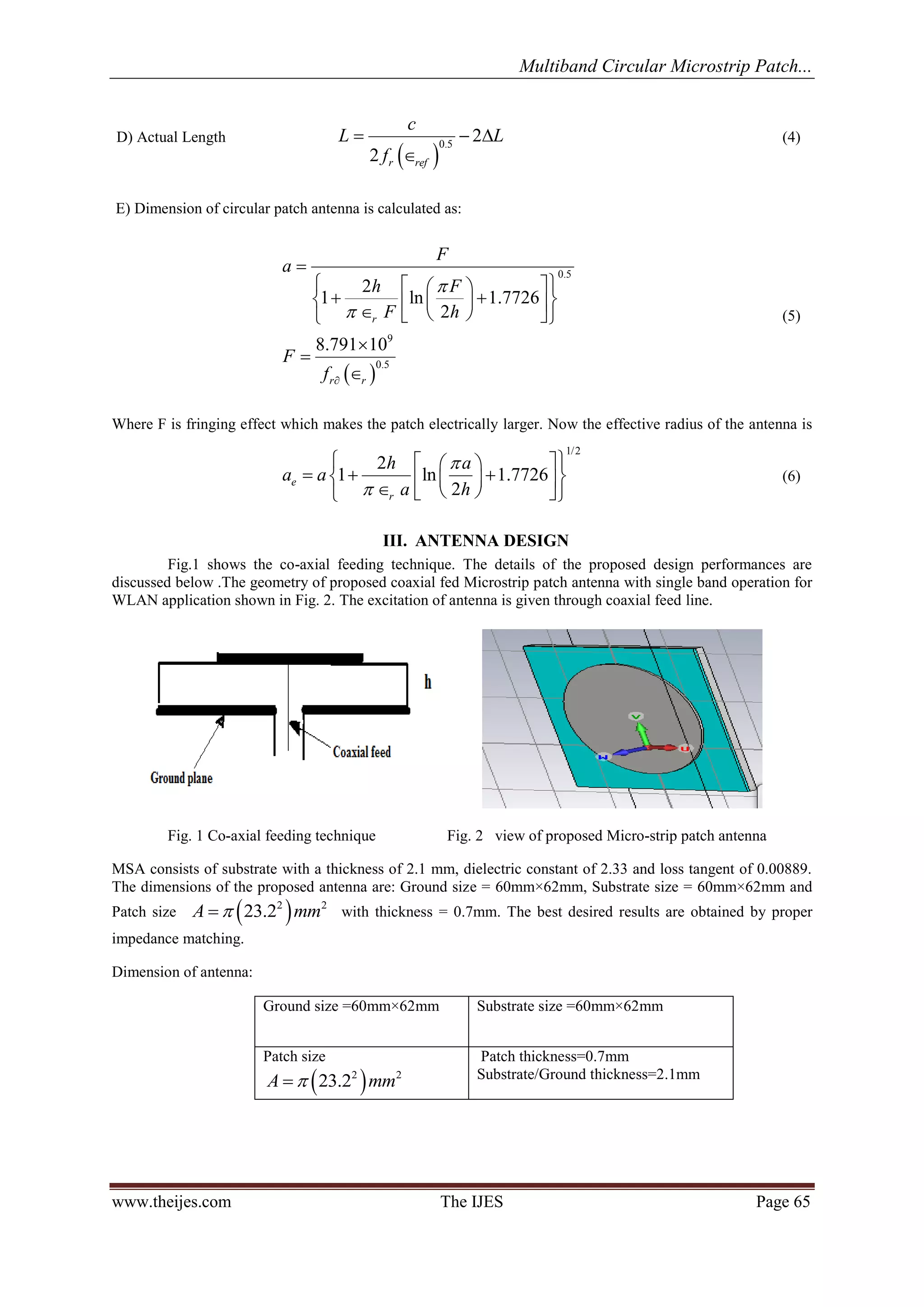
Fig.1 shows the co-axial feeding technique. The details of the proposed design performances are 
discussed below .The geometry of proposed coaxial fed Microstrip patch antenna with single band operation for 
WLAN application shown in Fig. 2. The excitation of antenna is given through coaxial feed line. 
Fig. 1 Co-axial feeding technique Fig. 2 view of proposed Micro-strip patch antenna 
MSA consists of substrate with a thickness of 2.1 mm, dielectric constant of 2.33 and loss tangent of 0.00889. 
The dimensions of the proposed antenna are: Ground size = 60mm×62mm, Substrate size = 60mm×62mm and 
Patch size   2 2 A  23.2 mm with thickness = 0.7mm. The best desired results are obtained by proper 
impedance matching. 
Dimension of antenna: 
Ground size =60mm×62mm Substrate size =60mm×62mm 
Patch size 
  2 2 A  23.2 mm 
Patch thickness=0.7mm 
Substrate/Ground thickness=2.1mm
Multiband Circular Microstrip Patch... 
www.theijes.com The IJES Page 66 
Fig.3 Side view of the proposed Microstrip patch antenna 
The side view of the coaxial fed proposed antenna is shown in Fig .3. 
IV. SIMULATION RESULTS 
Simulation studies of proposed antenna are carried out using CST Microwave Studio .The simulated 
reflection coefficient 푆11 of the proposed antenna shown in dB. The scattering parameter 푆11 gives the 
reflection coefficient at port 1 where we apply the input to the Microstrip patch antenna. It should be less than - 
10 dB for the acceptable operation. It shows that the proposed antenna resonates at frequency equal to 2.344 
GHz which gives the wideband characteristic of the patch antenna. The simulator shows the bandwidth of about 
140 MHz (2.34-2.48 GHz) which is achieved at -10 dB reflection coefficient (VSWR≤2) [3]. The reflection 
coefficient value that is achieved at this resonant frequency is equal to -23.901 dB. This reflection coefficient 
value suggests that there is good matching at the frequency point below the -10 dB region. It covers the 
frequency band for the WLAN application. 
Fig. 6 3D Radiation pattern for 푓푟=2.3 GHz 
Radiation pattern is a graphical representation of the relative field strength that can transmit or received by the 
antenna. The antenna should not have the side lobes and back lobes .Ideally lobe is defined as a roundish and 
flattish projecting or hanging part of patch surface. We can minimize them but we cannot remove them 
completely. Figure 6 shows the simulated 3-D radiation pattern with directivity of 7.061 dBi for proposed 
antenna configuration at the resonating frequency of 2.314 GHz. 
Fig. 7(a) E-plane with theta phase Fig. 7(b) H-plane with phi phase 
Figure 7(a) and (b) show the simulated E-plane (phi=90º, theta=varying) and H-plane (theta=90º, phi=varying) 
radiation patterns for proposed antenna configuration at the resonating frequency of 2.314 GHz.
Multiband Circular Microstrip Patch... 
www.theijes.com The IJES Page 67 
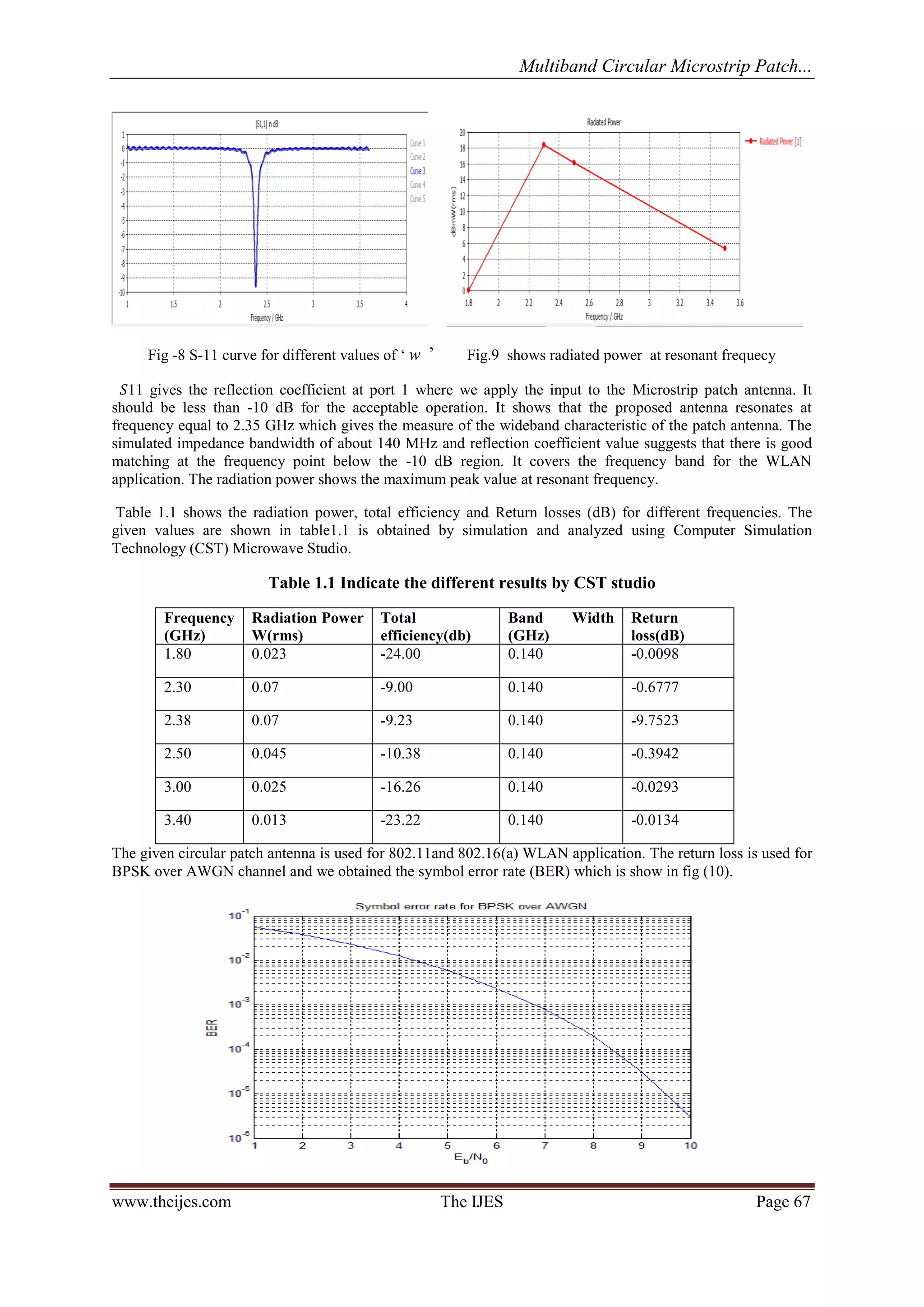
Fig -8 S-11 curve for different values of „ w ‟ Fig.9 shows radiated power at resonant frequecy 
푆11 gives the reflection coefficient at port 1 where we apply the input to the Microstrip patch antenna. It 
should be less than -10 dB for the acceptable operation. It shows that the proposed antenna resonates at 
frequency equal to 2.35 GHz which gives the measure of the wideband characteristic of the patch antenna. The 
simulated impedance bandwidth of about 140 MHz and reflection coefficient value suggests that there is good 
matching at the frequency point below the -10 dB region. It covers the frequency band for the WLAN 
application. The radiation power shows the maximum peak value at resonant frequency. 
Table 1.1 shows the radiation power, total efficiency and Return losses (dB) for different frequencies. The 
given values are shown in table1.1 is obtained by simulation and analyzed using Computer Simulation 
Technology (CST) Microwave Studio. 
Table 1.1 Indicate the different results by CST studio 
Frequency 
(GHz) 
Radiation Power 
W(rms) 
Total 
efficiency(db) 
Band Width 
(GHz) 
Return 
loss(dB) 
1.80 0.023 -24.00 0.140 -0.0098 
2.30 0.07 -9.00 0.140 -0.6777 
2.38 0.07 -9.23 0.140 -9.7523 
2.50 0.045 -10.38 0.140 -0.3942 
3.00 0.025 -16.26 0.140 -0.0293 
3.40 0.013 -23.22 0.140 -0.0134 
The given circular patch antenna is used for 802.11and 802.16(a) WLAN application. The return loss is used for 
BPSK over AWGN channel and we obtained the symbol error rate (BER) which is show in fig (10).
Multiband Circular Microstrip Patch... 
www.theijes.com The IJES Page 68 
Fig 10 BER plotation of circular patch antenna using AWGN channel 
V. CONCLUSION 
In this paper, a suspended configuration of circular patch antenna with coaxial feed is introduced to obtain a wideband characteristic. By optimizing the antenna parameters, concludes a wide impedance bandwidth of 2.34-2.48 GHz. The structure of the antenna is simple which helps in 802.11 and 802.16(a) WLAN application. The simulated and measured results show that the bandwidth of the patch antenna is successfully broadened; the proposed antenna shows the better performance in higher data rate for communications requiring circular polarizations. The designed antenna has future growth in OFDM and WLAN systems. REFERENCES [1] S. Chaimool, K. L. Chung, "CPW-fed mirrored-L monopole antenna with distinct triple bands for WiFi and WiMAX applications," Electron. Lett., vol. 45,no. 18, pp. 928-929, Aug. 2009. [2] J. H. Lu, B. J. Huang, "Planar multi-band monopole antenna with L-shaped parasitic strip for WiMAX application," Electron. Lett., vol. 46, no. 10, pp. 671- 672, May 2010. [3] L. Boccia, I. Russo, G. Amendola, G. Di Massa, “Varactor tuned Frequency Selective Surface for beam steering applications”, IEEE Antennas and Propagation Society International Symposium (APSURSI), pp. 1 – 4, 2010 [4] B. J. Kwaha, O. N Inyang & P. Amalu, “The circular Microstrip patch Antenna-Design and Implementation”, IJRRAS,vol. 18,no.8 ,pp 1~11,July-2011 [5] Seung Hyun Lee․Young-Je Sung ,” A Compact Triple Band Antenna for a Wireless USB Dongle ,” Journal of Electromagnetic Engineering and Science ,vol. 12, no. 2, pp185~188, Jun. 2012. [6] Z.Y. Zong, R.Xu, C. Chen, W. Wu, “Miniaturized Dualband Loaded Frequency Selective Surfaces with Close Band Spacing”, IEEE Asia-Pacific Microwave Conference APMC, pp.1 – 4, 2008. [7] H.Liu,K.L.Ford,R.JLangley ,”Miniaturized dualband loaded frequency selective surfaces with close band spacing”, Electronics Letters, vol. 44, Issue 18, pp. 1054-1055, 2008. [8] H. Liu, K. L. Ford, and R. J. Langley, “Novel Planar Band Pass Lump-Loaded Frequency Selective Surface”, IEEE MTT-S International Microwave Workshop Series on Art of Miniaturizing RF and Microwave Passive Components, pp. 87 – 89, 2008. [9] F.Bayatpur and K. Sarabandi “Tuning Performance of Metamaterial-Based Frequency Selective Surfaces”, IEEE Trans. Antennas Propag., vol. 57, no. 2, Feb. 2009. AUTHORS PROFILE 
Mr Jaijit singh received B.E Degree in Electronics and Telecommunication Engineering From Institute of Electronics and Telecommunication engineering, Delhi in 2003. Currently he is pursuing M.Tech. degree in ECE Stream from Guru Gobind Singh Indraprasthe University , Delhi. His Research interest include Antenna design, Image processing VLSI Design.

Multiband Circular Microstrip Patch Antenna for WLAN Application

  • 1.
    The International JournalOf Engineering And Science (IJES) || Volume || 3 || Issue || 8 || Pages || 64-68 || 2014 || ISSN (e): 2319 – 1813 ISSN (p): 2319 – 1805 www.theijes.com The IJES Page 64 Multiband Circular Microstrip Patch Antenna for WLAN Application 1Jaijit Singh , 2 Sonam Thakur, 3Kanchan Sharma, 1Department Of ECE GTBIT (Delhi) , 2,3Department of ECE, IGDTUW Kashmere Gate, Delhi – 110006 --------------------------------------------------- ABSTRACT------------------------------------------------------- A compact single layer Microstrip Patch Antenna (MSA) for 3.6 – 15 GHz WLAN applications is presented in this paper. The implementation of proposed technique is commercially performed using available electromagnetic simulators. These simulators are mainly based on the method of finite difference time domain (FDTD) to achieve the desired specifications. The circular patch antenna with optimal co-axial feed is determined and used for 802.11 WLAN applications. The obtained results show stable radiation characteristics in the desired band. The experimented results for BER and power radiation are also presented. Keywords BER ,BW, Co-Axial Feed , CST, Microstrip Patch Antenna (MSA), PEC, WLAN ----------------------------------------------------------------------------------------------------------------------------- ---------- Date of Submission: 10 August 2014 Date of Publication: 30 August 2014 ----------------------------------------------------------------------------------------------------------------------------- ---------- I. INTRODUCTION Due to increasing growth of wireless systems and demand for a variety of new wireless applications like WLAN, design of broadband and high gain antennas to cover a wide frequency range is highly in demand. The study of above will be beneficial in applications like high performance aircraft, satellite, missile, mobile radio and wireless communications. The design and implementation of the above antennas have several advantages like small size, low-cost fabrication, low profile, conformability, ease of installation and integration with feed networks. With advancement of technology, the requirement of an antenna to resonate at more than one frequency i.e. multi-banding is also increasing day by day. Microstrip patch antenna is best choice to fulfil the above requirements. Along with that a Microstrip patch antenna offers many advantages like low fabrication cost, supports both linear as well as circular polarization etc. Bandwidth of a Microstrip patch antenna can be improved by various methods like cutting U-slot [1], increasing the substrate height, decreasing of substrate width etc. Antenna array can also be used to improve the bandwidth [2]. In this paper a simple Microstrip patch antenna with coaxial feed is designed [3],[4]. II. ANTENNA DESIGN CALCULATIONS A) Calculation of width: For efficient radiation, the width w is given as 2 2 1 r r c w f    (1) B) Calculation of Extension length:   0.412 ( 0.3) 0.264 0.258 0.8 ref ref w h h L w h                     (2) C) Effective dielectric constant 0.5 1 1 12 1 2 2 r r ref h w                (3)
  • 2.
    Multiband Circular MicrostripPatch... www.theijes.com The IJES Page 65 D) Actual Length  0.5 2 2 r ref c L L f     (4) E) Dimension of circular patch antenna is calculated as:   0.5 9 0.5 2 1 ln 1.7726 2 8.791 10 r r r F a h F F h F f                          (5) Where F is fringing effect which makes the patch electrically larger. Now the effective radius of the antenna is 1/2 2 1 ln 1.7726 2 e r h a a a a h                      (6) III. ANTENNA DESIGN Fig.1 shows the co-axial feeding technique. The details of the proposed design performances are discussed below .The geometry of proposed coaxial fed Microstrip patch antenna with single band operation for WLAN application shown in Fig. 2. The excitation of antenna is given through coaxial feed line. Fig. 1 Co-axial feeding technique Fig. 2 view of proposed Micro-strip patch antenna MSA consists of substrate with a thickness of 2.1 mm, dielectric constant of 2.33 and loss tangent of 0.00889. The dimensions of the proposed antenna are: Ground size = 60mm×62mm, Substrate size = 60mm×62mm and Patch size   2 2 A  23.2 mm with thickness = 0.7mm. The best desired results are obtained by proper impedance matching. Dimension of antenna: Ground size =60mm×62mm Substrate size =60mm×62mm Patch size   2 2 A  23.2 mm Patch thickness=0.7mm Substrate/Ground thickness=2.1mm
  • 3.
    Multiband Circular MicrostripPatch... www.theijes.com The IJES Page 66 Fig.3 Side view of the proposed Microstrip patch antenna The side view of the coaxial fed proposed antenna is shown in Fig .3. IV. SIMULATION RESULTS Simulation studies of proposed antenna are carried out using CST Microwave Studio .The simulated reflection coefficient 푆11 of the proposed antenna shown in dB. The scattering parameter 푆11 gives the reflection coefficient at port 1 where we apply the input to the Microstrip patch antenna. It should be less than - 10 dB for the acceptable operation. It shows that the proposed antenna resonates at frequency equal to 2.344 GHz which gives the wideband characteristic of the patch antenna. The simulator shows the bandwidth of about 140 MHz (2.34-2.48 GHz) which is achieved at -10 dB reflection coefficient (VSWR≤2) [3]. The reflection coefficient value that is achieved at this resonant frequency is equal to -23.901 dB. This reflection coefficient value suggests that there is good matching at the frequency point below the -10 dB region. It covers the frequency band for the WLAN application. Fig. 6 3D Radiation pattern for 푓푟=2.3 GHz Radiation pattern is a graphical representation of the relative field strength that can transmit or received by the antenna. The antenna should not have the side lobes and back lobes .Ideally lobe is defined as a roundish and flattish projecting or hanging part of patch surface. We can minimize them but we cannot remove them completely. Figure 6 shows the simulated 3-D radiation pattern with directivity of 7.061 dBi for proposed antenna configuration at the resonating frequency of 2.314 GHz. Fig. 7(a) E-plane with theta phase Fig. 7(b) H-plane with phi phase Figure 7(a) and (b) show the simulated E-plane (phi=90º, theta=varying) and H-plane (theta=90º, phi=varying) radiation patterns for proposed antenna configuration at the resonating frequency of 2.314 GHz.
  • 4.
    Multiband Circular MicrostripPatch... www.theijes.com The IJES Page 67 Fig -8 S-11 curve for different values of „ w ‟ Fig.9 shows radiated power at resonant frequecy 푆11 gives the reflection coefficient at port 1 where we apply the input to the Microstrip patch antenna. It should be less than -10 dB for the acceptable operation. It shows that the proposed antenna resonates at frequency equal to 2.35 GHz which gives the measure of the wideband characteristic of the patch antenna. The simulated impedance bandwidth of about 140 MHz and reflection coefficient value suggests that there is good matching at the frequency point below the -10 dB region. It covers the frequency band for the WLAN application. The radiation power shows the maximum peak value at resonant frequency. Table 1.1 shows the radiation power, total efficiency and Return losses (dB) for different frequencies. The given values are shown in table1.1 is obtained by simulation and analyzed using Computer Simulation Technology (CST) Microwave Studio. Table 1.1 Indicate the different results by CST studio Frequency (GHz) Radiation Power W(rms) Total efficiency(db) Band Width (GHz) Return loss(dB) 1.80 0.023 -24.00 0.140 -0.0098 2.30 0.07 -9.00 0.140 -0.6777 2.38 0.07 -9.23 0.140 -9.7523 2.50 0.045 -10.38 0.140 -0.3942 3.00 0.025 -16.26 0.140 -0.0293 3.40 0.013 -23.22 0.140 -0.0134 The given circular patch antenna is used for 802.11and 802.16(a) WLAN application. The return loss is used for BPSK over AWGN channel and we obtained the symbol error rate (BER) which is show in fig (10).
  • 5.
    Multiband Circular MicrostripPatch... www.theijes.com The IJES Page 68 Fig 10 BER plotation of circular patch antenna using AWGN channel V. CONCLUSION In this paper, a suspended configuration of circular patch antenna with coaxial feed is introduced to obtain a wideband characteristic. By optimizing the antenna parameters, concludes a wide impedance bandwidth of 2.34-2.48 GHz. The structure of the antenna is simple which helps in 802.11 and 802.16(a) WLAN application. The simulated and measured results show that the bandwidth of the patch antenna is successfully broadened; the proposed antenna shows the better performance in higher data rate for communications requiring circular polarizations. The designed antenna has future growth in OFDM and WLAN systems. REFERENCES [1] S. Chaimool, K. L. Chung, "CPW-fed mirrored-L monopole antenna with distinct triple bands for WiFi and WiMAX applications," Electron. Lett., vol. 45,no. 18, pp. 928-929, Aug. 2009. [2] J. H. Lu, B. J. Huang, "Planar multi-band monopole antenna with L-shaped parasitic strip for WiMAX application," Electron. Lett., vol. 46, no. 10, pp. 671- 672, May 2010. [3] L. Boccia, I. Russo, G. Amendola, G. Di Massa, “Varactor tuned Frequency Selective Surface for beam steering applications”, IEEE Antennas and Propagation Society International Symposium (APSURSI), pp. 1 – 4, 2010 [4] B. J. Kwaha, O. N Inyang & P. Amalu, “The circular Microstrip patch Antenna-Design and Implementation”, IJRRAS,vol. 18,no.8 ,pp 1~11,July-2011 [5] Seung Hyun Lee․Young-Je Sung ,” A Compact Triple Band Antenna for a Wireless USB Dongle ,” Journal of Electromagnetic Engineering and Science ,vol. 12, no. 2, pp185~188, Jun. 2012. [6] Z.Y. Zong, R.Xu, C. Chen, W. Wu, “Miniaturized Dualband Loaded Frequency Selective Surfaces with Close Band Spacing”, IEEE Asia-Pacific Microwave Conference APMC, pp.1 – 4, 2008. [7] H.Liu,K.L.Ford,R.JLangley ,”Miniaturized dualband loaded frequency selective surfaces with close band spacing”, Electronics Letters, vol. 44, Issue 18, pp. 1054-1055, 2008. [8] H. Liu, K. L. Ford, and R. J. Langley, “Novel Planar Band Pass Lump-Loaded Frequency Selective Surface”, IEEE MTT-S International Microwave Workshop Series on Art of Miniaturizing RF and Microwave Passive Components, pp. 87 – 89, 2008. [9] F.Bayatpur and K. Sarabandi “Tuning Performance of Metamaterial-Based Frequency Selective Surfaces”, IEEE Trans. Antennas Propag., vol. 57, no. 2, Feb. 2009. AUTHORS PROFILE Mr Jaijit singh received B.E Degree in Electronics and Telecommunication Engineering From Institute of Electronics and Telecommunication engineering, Delhi in 2003. Currently he is pursuing M.Tech. degree in ECE Stream from Guru Gobind Singh Indraprasthe University , Delhi. His Research interest include Antenna design, Image processing VLSI Design.