International Research Journal of Engineering and Technology (IRJET) e-ISSN: 2395-0056
Volume: 06 Issue: 06 | June 2019 www.irjet.net p-ISSN: 2395-0072
© 2019, IRJET | Impact Factor value: 7.211 | ISO 9001:2008 Certified Journal | Page 114
Microstrip Patch Antenna Design for Military Applications
CH. S. Srinivas1, Damaraju Sri Sai Satyanarayana2
1UG Research Scholar, Dept. of Electronics and Communication Engineering, Sreyas Institute of Engineering and
Technology, Telangana, India
2UG Research Scholar, Dept. of Electronics and Communication Engineering, Sreyas Institute of Engineering and
Technology, Telangana, India
-------------------------------------------------------------------------***------------------------------------------------------------------------
Abstract:- In recent days the design and development of antennas for various applications has grabbed attention and
interest of various technocrats which is highly remarkable. This has led to the development of various techniques which has
improvised the electrical parameters like Gain, Bandwidth, Directivity etc., of the antennas. The square shape will provide the
broad bandwidth, which is required in various applications like remote sensing, biomedical application. This project aims to
study various electrical performance parameters related to antennas and develop the E-shaped patch antenna which will
operate for microwave applications. The entire design and analytical studies will be carried out in Computer Simulation Tool
(CST).
Keywords: Communication, Gain, Efficiency, Antenna Bandwidth, Directivity
1. INTRODUCTION TO ANTENNAS
Conventional microstrip patch antennas have many limitations such bandwidth, return loss, single input frequency, and
gain and polarization etc.; to overcome these problems a conventional E-patch antenna is designed with the frequency of
2.54GHz which is S-band. The S-band is used in mobile frequency applications. To implement this design many microstrip
feeding techniques are can be used. The basic E-patch antenna consists of 4 layers they are ground, substrate, patch and
feedline. The main application of these are used in military areas and other fields like GPS, LAN, Wi-Fi.
2. RELATED WORK
I. Sung, Y. J et al.,[1] This paper describes of a square patch antenna with an input impedance bandwidth of
2.2GHz-2.45 GHz for wireless applications. In this a dual feed generate mode patch is used as a starting point for
circular polarization and L-shaped islands to connect or reconnect main patch via RF switches are placed around
the patch.
II. Chen, Shing-Hau et al.,[2] This paper describes of a single feed reconfigurable square ring patch antenna with a
pattern diversity present in it. The structure of antenna has four shorting walls placed and connected directly to
patch and others are connected to the patch via pins diodes. By controlling the patch two modes are operated
that are monopolar and normal patch mode by this a -10db impedance is been overlapped in two modes.
III. Yang, Fan et al.,[3] This paper describes of an microstrip antenna with a switchable slot to achieve circular
polarization diversity to design these two orthogonal slots are incorporated into the patch and pin diodes are
used to on and off the slots and using this left and right circular polarizations are determined.
IV. Singhal, P. K et al.,[4] This paper describes a double layer slotted patch microstrip patch antenna with a single
probe feeding technique to lower patch with an input impedance of 6.1GHz for VSWR value of less than 2
(VSWR≤ 2). The result is it has a bandwidth of 6.25%.
3. CST STUDIO SUITE
The CST STUDIO SUITE is an electromagnetic stimulation tool which is used to analyze, design and stimulate different
types of antennas. The CST studio suite is also used optimize devices and systems at all stages of development of antennas.
The CST studio is used in different industries, automotive, aerospace etc. The CST is a virtual prototype. By using these
prototypes instead of physical prototypes engineers can study the prototypes in the earliest stages of design and reduce
the physical models that needed to construct and by using this we can reduce the wastage of materials and design an ideal
model without wasting any materials. The other main advantage of this prototypes is cost of antennas can be estimated
and be reduced by using various materials.
International Research Journal of Engineering and Technology (IRJET) e-ISSN: 2395-0056
Volume: 06 Issue: 06 | June 2019 www.irjet.net p-ISSN: 2395-0072
© 2019, IRJET | Impact Factor value: 7.211 | ISO 9001:2008 Certified Journal | Page 115
4. DESIGN EQUATIONS FOR ANTENNA
Both the antennas can be design by using following equations. By using these equations, we can easily find out the values
for dimensions of E shape patch.
a. Calculation of Width:
The width of the micro strip patch antenna is given by the equation
W=
√
(1)
on substituting, C=3*108 m/sec , fo= 2.4 GHz , we get
W= 36.2789
b. Calculation of Effective Dielectric Constant:
The calculation of effective dielectric constant of micro strip patch antenna is given by the equation
ɛreff = [1+12 ]-1/2 (2)
on substituting h=1.6mm, w=mm, er=4.7, we get
ɛreff = 3.84591
c. Calculation of Effective Length:
The calculation of effective length of the micro strip antenna is given by the equation
Leff =
√
(3)
On substituting c=3*108, f0=2.45 GHz , ɛreff=4.7mm,we get
Leff=31.2194
d. Calculation of Length extension:
The calculation of effective length of the micro strip antenna is given by the equation
(4)
On substituting h=1.6mm, w= 36.2789mm,
ɛreff = 3.84591, we get
ΔL= 2.995
International Research Journal of Engineering and Technology (IRJET) e-ISSN: 2395-0056
Volume: 06 Issue: 06 | June 2019 www.irjet.net p-ISSN: 2395-0072
© 2019, IRJET | Impact Factor value: 7.211 | ISO 9001:2008 Certified Journal | Page 116
e. Calculation of length :
The length of the micro strip patch antenna is given by the equation
(5)
On substituting Leff = 31.2194 and ΔL=2.995 we get
L=36.27
f. Calculation of length of feedline:
The length of feedline is given by the equation
(6)
Fi= 4.8mm
Table 1 Design parameters of 2.45GHz
5. PROPOSED SYSTEM
The stimulation is carried out in CST microwave studio software. The design parameters in this paper is an input
impedance band width of 2.45GHz and with height is 1.6mm respectively with dielectric constant is 4.7.
6. ANALYSIS OF ANTENNA
According to stimulation the operating frequency is 2.45GHz and with dielectric constant εr=4.7 and thickness of substrate
is 1.6mm respectively. The antennas are designed with substrate i.e.; FR-4(lossy).
Parameter Specifications Units (mm)
Length of the Patch L 36.27
Width of the Patch W 36.27
Gap between patch
and Inset Feed
Gpf 1
Height of Ground
Plane
Wg 72.54
Length of Ground
Plane
Lg 72.54
International Research Journal of Engineering and Technology (IRJET) e-ISSN: 2395-0056
Volume: 06 Issue: 06 | June 2019 www.irjet.net p-ISSN: 2395-0072
© 2019, IRJET | Impact Factor value: 7.211 | ISO 9001:2008 Certified Journal | Page 117
Figure 1 E-patch antenna layout [5]
A. Patch antenna design for frequency 2.45GHz:
In this patch antenna, the antenna is fed with operating frequency of 2.45GHz with dielectric constant (FR-4 lossy) εr =4.7
with height of substrate h=1.6mm basing on these design parameters square patch antenna design formulas are used and
following table is obtained.
Figure 2 Proposed Antenna Design for 2.45GHz
7. RESULTS & ANALYSIS
Figure 3 S-Parameters measurements of 2.45 GHz
International Research Journal of Engineering and Technology (IRJET) e-ISSN: 2395-0056
Volume: 06 Issue: 06 | June 2019 www.irjet.net p-ISSN: 2395-0072
© 2019, IRJET | Impact Factor value: 7.211 | ISO 9001:2008 Certified Journal | Page 118
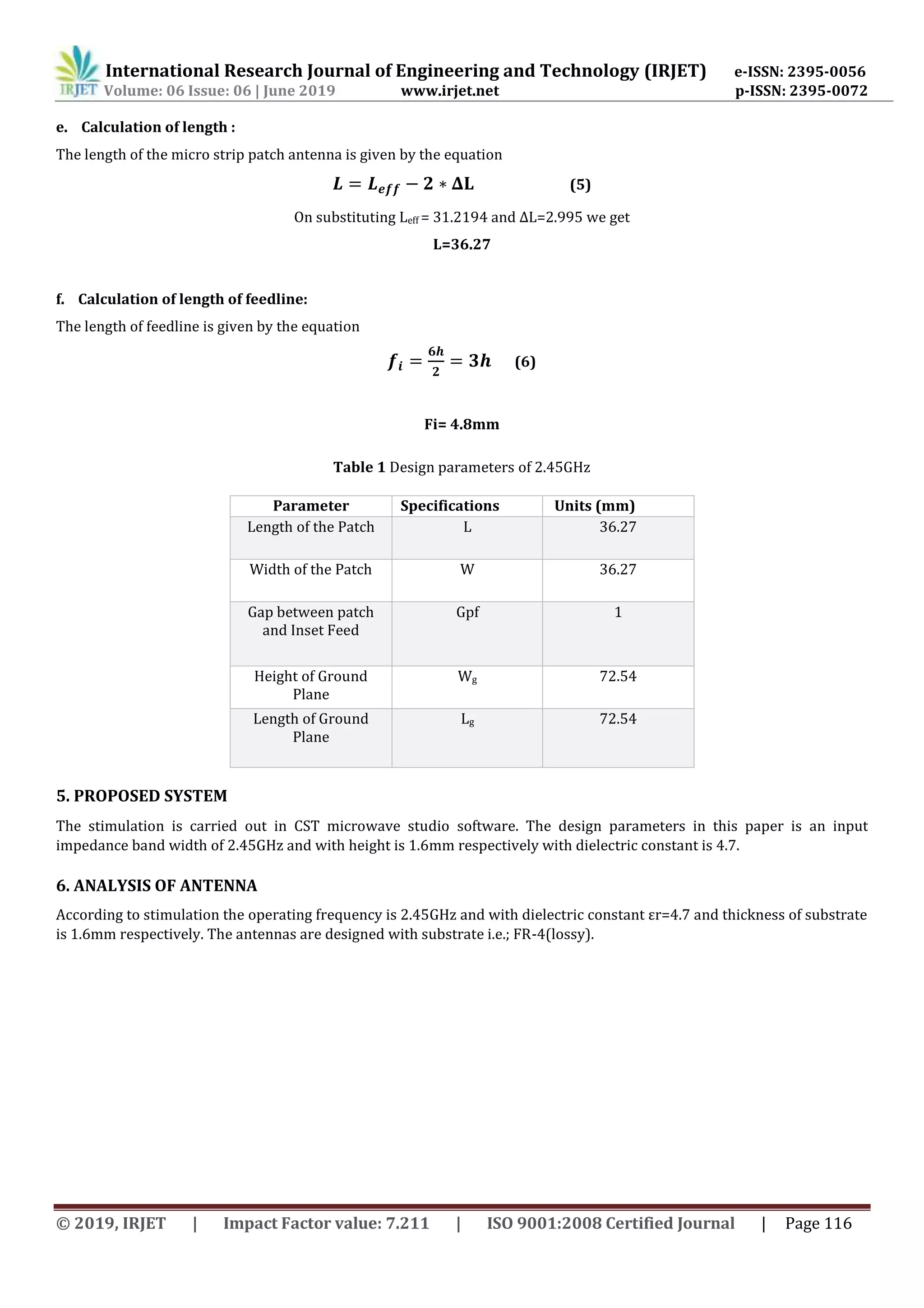
Figure 4 E-field at (f=2 GHz) modelled in CST
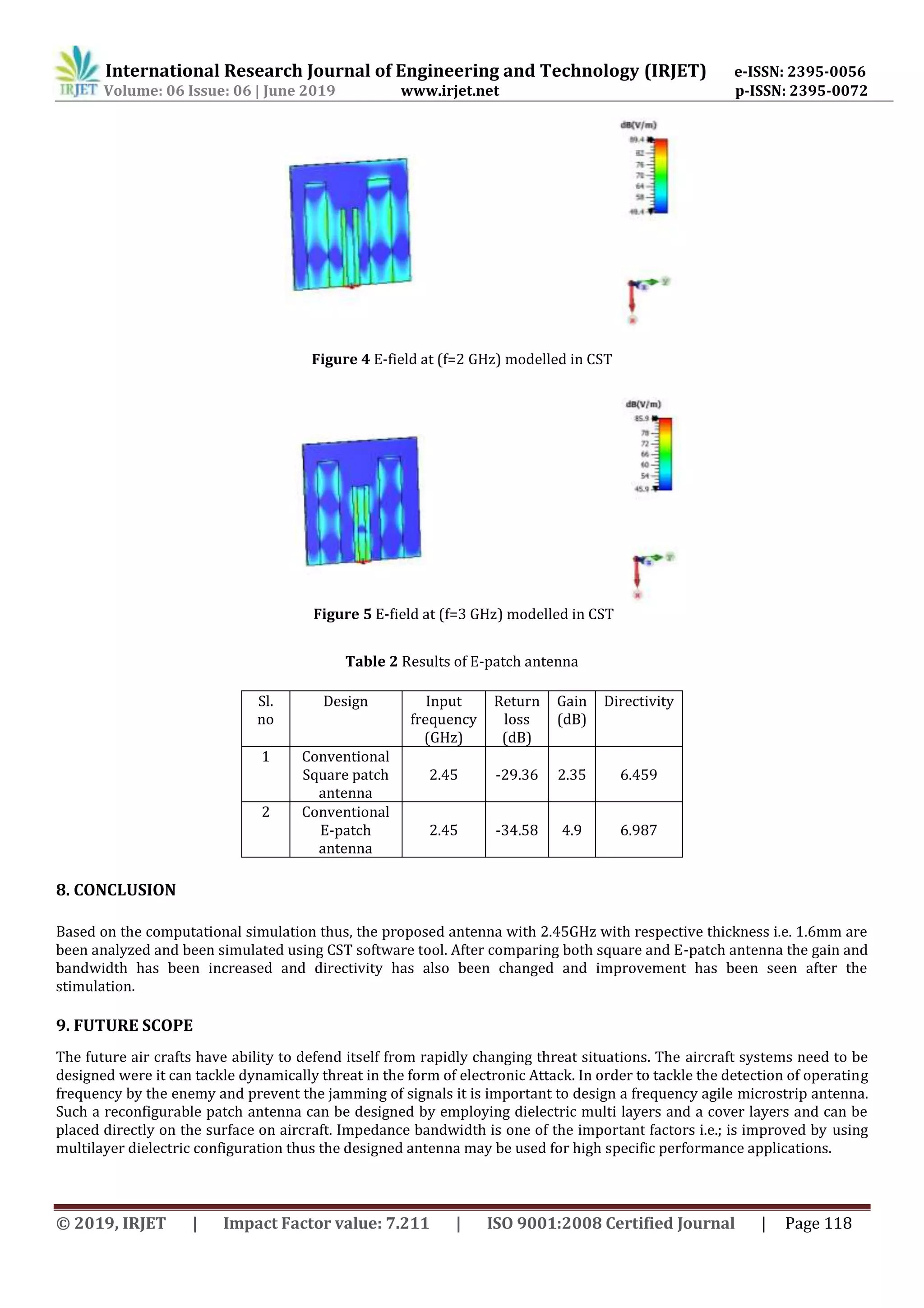
Figure 5 E-field at (f=3 GHz) modelled in CST
Table 2 Results of E-patch antenna
8. CONCLUSION
Based on the computational simulation thus, the proposed antenna with 2.45GHz with respective thickness i.e. 1.6mm are
been analyzed and been simulated using CST software tool. After comparing both square and E-patch antenna the gain and
bandwidth has been increased and directivity has also been changed and improvement has been seen after the
stimulation.
9. FUTURE SCOPE
The future air crafts have ability to defend itself from rapidly changing threat situations. The aircraft systems need to be
designed were it can tackle dynamically threat in the form of electronic Attack. In order to tackle the detection of operating
frequency by the enemy and prevent the jamming of signals it is important to design a frequency agile microstrip antenna.
Such a reconfigurable patch antenna can be designed by employing dielectric multi layers and a cover layers and can be
placed directly on the surface on aircraft. Impedance bandwidth is one of the important factors i.e.; is improved by using
multilayer dielectric configuration thus the designed antenna may be used for high specific performance applications.
Sl.
no
Design Input
frequency
(GHz)
Return
loss
(dB)
Gain
(dB)
Directivity
1 Conventional
Square patch
antenna
2.45 -29.36 2.35 6.459
2 Conventional
E-patch
antenna
2.45 -34.58 4.9 6.987
International Research Journal of Engineering and Technology (IRJET) e-ISSN: 2395-0056
Volume: 06 Issue: 06 | June 2019 www.irjet.net p-ISSN: 2395-0072
© 2019, IRJET | Impact Factor value: 7.211 | ISO 9001:2008 Certified Journal | Page 119
REFERENCES
[1] Babu, Jagadeesh & Rama Krishna, Kalva & Dr.L.Pratap, Reddy. “A Modified E Shaped Patch Antenna For Mimo Systems”.
International Journal on Computer Science and Engineering. 2.(2010).
[2] Sung, Y. J. "Reconfigurable patch antenna for polarization diversity." IEEE Transactions on antennas and propagation
56.9 (2008): 3053-3054.
[3] Chen, Shing-Hau, Jeen-Sheen Row, and Kin-Lu Wong. "Reconfigurable square-ring patch antenna with pattern
diversity." IEEE Transactions on Antennas and Propagation 55.2 (2007): 472-475.
[4] Yang, Fan, and Yahya Rahmat-Samii. "A reconfigurable patch antenna using switchable slots for circular polarization
diversity." IEEE Microwave and Wireless Components Letters 12.3 (2002): 96-98.
[5] Singhal, P. K., Bhawana Dhaniram, and Smita Banerjee. "A stacked square patch slotted broadband microstrip antenna."
Journal of Microwaves, Optoelectronics and Electromagnetic Applications (JMOe) 3.2 (2003): 60-66

IRJET- Microstrip Patch Antenna Design for Military Applications

  • 1.
    International Research Journalof Engineering and Technology (IRJET) e-ISSN: 2395-0056 Volume: 06 Issue: 06 | June 2019 www.irjet.net p-ISSN: 2395-0072 © 2019, IRJET | Impact Factor value: 7.211 | ISO 9001:2008 Certified Journal | Page 114 Microstrip Patch Antenna Design for Military Applications CH. S. Srinivas1, Damaraju Sri Sai Satyanarayana2 1UG Research Scholar, Dept. of Electronics and Communication Engineering, Sreyas Institute of Engineering and Technology, Telangana, India 2UG Research Scholar, Dept. of Electronics and Communication Engineering, Sreyas Institute of Engineering and Technology, Telangana, India -------------------------------------------------------------------------***------------------------------------------------------------------------ Abstract:- In recent days the design and development of antennas for various applications has grabbed attention and interest of various technocrats which is highly remarkable. This has led to the development of various techniques which has improvised the electrical parameters like Gain, Bandwidth, Directivity etc., of the antennas. The square shape will provide the broad bandwidth, which is required in various applications like remote sensing, biomedical application. This project aims to study various electrical performance parameters related to antennas and develop the E-shaped patch antenna which will operate for microwave applications. The entire design and analytical studies will be carried out in Computer Simulation Tool (CST). Keywords: Communication, Gain, Efficiency, Antenna Bandwidth, Directivity 1. INTRODUCTION TO ANTENNAS Conventional microstrip patch antennas have many limitations such bandwidth, return loss, single input frequency, and gain and polarization etc.; to overcome these problems a conventional E-patch antenna is designed with the frequency of 2.54GHz which is S-band. The S-band is used in mobile frequency applications. To implement this design many microstrip feeding techniques are can be used. The basic E-patch antenna consists of 4 layers they are ground, substrate, patch and feedline. The main application of these are used in military areas and other fields like GPS, LAN, Wi-Fi. 2. RELATED WORK I. Sung, Y. J et al.,[1] This paper describes of a square patch antenna with an input impedance bandwidth of 2.2GHz-2.45 GHz for wireless applications. In this a dual feed generate mode patch is used as a starting point for circular polarization and L-shaped islands to connect or reconnect main patch via RF switches are placed around the patch. II. Chen, Shing-Hau et al.,[2] This paper describes of a single feed reconfigurable square ring patch antenna with a pattern diversity present in it. The structure of antenna has four shorting walls placed and connected directly to patch and others are connected to the patch via pins diodes. By controlling the patch two modes are operated that are monopolar and normal patch mode by this a -10db impedance is been overlapped in two modes. III. Yang, Fan et al.,[3] This paper describes of an microstrip antenna with a switchable slot to achieve circular polarization diversity to design these two orthogonal slots are incorporated into the patch and pin diodes are used to on and off the slots and using this left and right circular polarizations are determined. IV. Singhal, P. K et al.,[4] This paper describes a double layer slotted patch microstrip patch antenna with a single probe feeding technique to lower patch with an input impedance of 6.1GHz for VSWR value of less than 2 (VSWR≤ 2). The result is it has a bandwidth of 6.25%. 3. CST STUDIO SUITE The CST STUDIO SUITE is an electromagnetic stimulation tool which is used to analyze, design and stimulate different types of antennas. The CST studio suite is also used optimize devices and systems at all stages of development of antennas. The CST studio is used in different industries, automotive, aerospace etc. The CST is a virtual prototype. By using these prototypes instead of physical prototypes engineers can study the prototypes in the earliest stages of design and reduce the physical models that needed to construct and by using this we can reduce the wastage of materials and design an ideal model without wasting any materials. The other main advantage of this prototypes is cost of antennas can be estimated and be reduced by using various materials.
  • 2.
    International Research Journalof Engineering and Technology (IRJET) e-ISSN: 2395-0056 Volume: 06 Issue: 06 | June 2019 www.irjet.net p-ISSN: 2395-0072 © 2019, IRJET | Impact Factor value: 7.211 | ISO 9001:2008 Certified Journal | Page 115 4. DESIGN EQUATIONS FOR ANTENNA Both the antennas can be design by using following equations. By using these equations, we can easily find out the values for dimensions of E shape patch. a. Calculation of Width: The width of the micro strip patch antenna is given by the equation W= √ (1) on substituting, C=3*108 m/sec , fo= 2.4 GHz , we get W= 36.2789 b. Calculation of Effective Dielectric Constant: The calculation of effective dielectric constant of micro strip patch antenna is given by the equation ɛreff = [1+12 ]-1/2 (2) on substituting h=1.6mm, w=mm, er=4.7, we get ɛreff = 3.84591 c. Calculation of Effective Length: The calculation of effective length of the micro strip antenna is given by the equation Leff = √ (3) On substituting c=3*108, f0=2.45 GHz , ɛreff=4.7mm,we get Leff=31.2194 d. Calculation of Length extension: The calculation of effective length of the micro strip antenna is given by the equation (4) On substituting h=1.6mm, w= 36.2789mm, ɛreff = 3.84591, we get ΔL= 2.995
  • 3.
    International Research Journalof Engineering and Technology (IRJET) e-ISSN: 2395-0056 Volume: 06 Issue: 06 | June 2019 www.irjet.net p-ISSN: 2395-0072 © 2019, IRJET | Impact Factor value: 7.211 | ISO 9001:2008 Certified Journal | Page 116 e. Calculation of length : The length of the micro strip patch antenna is given by the equation (5) On substituting Leff = 31.2194 and ΔL=2.995 we get L=36.27 f. Calculation of length of feedline: The length of feedline is given by the equation (6) Fi= 4.8mm Table 1 Design parameters of 2.45GHz 5. PROPOSED SYSTEM The stimulation is carried out in CST microwave studio software. The design parameters in this paper is an input impedance band width of 2.45GHz and with height is 1.6mm respectively with dielectric constant is 4.7. 6. ANALYSIS OF ANTENNA According to stimulation the operating frequency is 2.45GHz and with dielectric constant εr=4.7 and thickness of substrate is 1.6mm respectively. The antennas are designed with substrate i.e.; FR-4(lossy). Parameter Specifications Units (mm) Length of the Patch L 36.27 Width of the Patch W 36.27 Gap between patch and Inset Feed Gpf 1 Height of Ground Plane Wg 72.54 Length of Ground Plane Lg 72.54
  • 4.
    International Research Journalof Engineering and Technology (IRJET) e-ISSN: 2395-0056 Volume: 06 Issue: 06 | June 2019 www.irjet.net p-ISSN: 2395-0072 © 2019, IRJET | Impact Factor value: 7.211 | ISO 9001:2008 Certified Journal | Page 117 Figure 1 E-patch antenna layout [5] A. Patch antenna design for frequency 2.45GHz: In this patch antenna, the antenna is fed with operating frequency of 2.45GHz with dielectric constant (FR-4 lossy) εr =4.7 with height of substrate h=1.6mm basing on these design parameters square patch antenna design formulas are used and following table is obtained. Figure 2 Proposed Antenna Design for 2.45GHz 7. RESULTS & ANALYSIS Figure 3 S-Parameters measurements of 2.45 GHz
  • 5.
    International Research Journalof Engineering and Technology (IRJET) e-ISSN: 2395-0056 Volume: 06 Issue: 06 | June 2019 www.irjet.net p-ISSN: 2395-0072 © 2019, IRJET | Impact Factor value: 7.211 | ISO 9001:2008 Certified Journal | Page 118 Figure 4 E-field at (f=2 GHz) modelled in CST Figure 5 E-field at (f=3 GHz) modelled in CST Table 2 Results of E-patch antenna 8. CONCLUSION Based on the computational simulation thus, the proposed antenna with 2.45GHz with respective thickness i.e. 1.6mm are been analyzed and been simulated using CST software tool. After comparing both square and E-patch antenna the gain and bandwidth has been increased and directivity has also been changed and improvement has been seen after the stimulation. 9. FUTURE SCOPE The future air crafts have ability to defend itself from rapidly changing threat situations. The aircraft systems need to be designed were it can tackle dynamically threat in the form of electronic Attack. In order to tackle the detection of operating frequency by the enemy and prevent the jamming of signals it is important to design a frequency agile microstrip antenna. Such a reconfigurable patch antenna can be designed by employing dielectric multi layers and a cover layers and can be placed directly on the surface on aircraft. Impedance bandwidth is one of the important factors i.e.; is improved by using multilayer dielectric configuration thus the designed antenna may be used for high specific performance applications. Sl. no Design Input frequency (GHz) Return loss (dB) Gain (dB) Directivity 1 Conventional Square patch antenna 2.45 -29.36 2.35 6.459 2 Conventional E-patch antenna 2.45 -34.58 4.9 6.987
  • 6.
    International Research Journalof Engineering and Technology (IRJET) e-ISSN: 2395-0056 Volume: 06 Issue: 06 | June 2019 www.irjet.net p-ISSN: 2395-0072 © 2019, IRJET | Impact Factor value: 7.211 | ISO 9001:2008 Certified Journal | Page 119 REFERENCES [1] Babu, Jagadeesh & Rama Krishna, Kalva & Dr.L.Pratap, Reddy. “A Modified E Shaped Patch Antenna For Mimo Systems”. International Journal on Computer Science and Engineering. 2.(2010). [2] Sung, Y. J. "Reconfigurable patch antenna for polarization diversity." IEEE Transactions on antennas and propagation 56.9 (2008): 3053-3054. [3] Chen, Shing-Hau, Jeen-Sheen Row, and Kin-Lu Wong. "Reconfigurable square-ring patch antenna with pattern diversity." IEEE Transactions on Antennas and Propagation 55.2 (2007): 472-475. [4] Yang, Fan, and Yahya Rahmat-Samii. "A reconfigurable patch antenna using switchable slots for circular polarization diversity." IEEE Microwave and Wireless Components Letters 12.3 (2002): 96-98. [5] Singhal, P. K., Bhawana Dhaniram, and Smita Banerjee. "A stacked square patch slotted broadband microstrip antenna." Journal of Microwaves, Optoelectronics and Electromagnetic Applications (JMOe) 3.2 (2003): 60-66