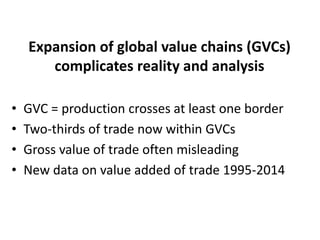
Expansion of global value chains (GVCs)
complicates reality and analysis
• GVC = production crosses at least one border
• Two-thirds of trade now within GVCs
• Gross value of trade often misleading
• New data on value added of trade 1995-2014
“Smile curve” for China’s exports of
electrical and optical equipment, 2009
U.S. IT manufacturing: hours and
compensation, 1995-2009
Chinese IT manufacturing: hours and
compensation, 1995-2009
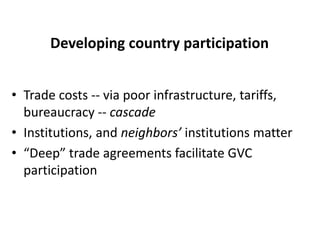
Developing country participation
• Trade costs -- via poor infrastructure, tariffs,
bureaucracy -- cascade
• Institutions, and neighbors’ institutions matter
• “Deep” trade agreements facilitate GVC
participation
Most trade is in goods, not services
82 80 79
18 20 21
1980 1995 2009
Gross Exports of Goods and Services as a share of Total World Gross Exports
Goods Services
In value added terms, however, nearly
half of trade now is in services
69
61
57
31
39
43
1980 1995 2009
Value Added of Goods and Services as a share of Value
Added Exports
Goods Services
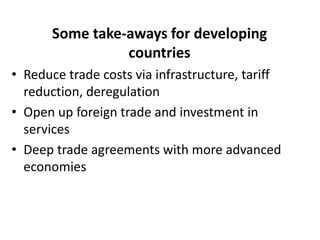
Some take-aways for developing
countries
• Reduce trade costs via infrastructure, tariff
reduction, deregulation
• Open up foreign trade and investment in
services
• Deep trade agreements with more advanced
economies
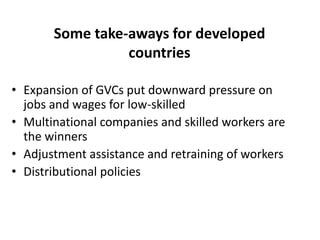
Some take-aways for developed
countries
• Expansion of GVCs put downward pressure on
jobs and wages for low-skilled
• Multinational companies and skilled workers are
the winners
• Adjustment assistance and retraining of workers
• Distributional policies

gvc presentation.pptx

  • 2.
    Expansion of globalvalue chains (GVCs) complicates reality and analysis • GVC = production crosses at least one border • Two-thirds of trade now within GVCs • Gross value of trade often misleading • New data on value added of trade 1995-2014
  • 3.
    “Smile curve” forChina’s exports of electrical and optical equipment, 2009
  • 4.
    U.S. IT manufacturing:hours and compensation, 1995-2009
  • 5.
    Chinese IT manufacturing:hours and compensation, 1995-2009
  • 6.
    Developing country participation •Trade costs -- via poor infrastructure, tariffs, bureaucracy -- cascade • Institutions, and neighbors’ institutions matter • “Deep” trade agreements facilitate GVC participation
  • 7.
    Most trade isin goods, not services 82 80 79 18 20 21 1980 1995 2009 Gross Exports of Goods and Services as a share of Total World Gross Exports Goods Services
  • 8.
    In value addedterms, however, nearly half of trade now is in services 69 61 57 31 39 43 1980 1995 2009 Value Added of Goods and Services as a share of Value Added Exports Goods Services
  • 9.
    Some take-aways fordeveloping countries • Reduce trade costs via infrastructure, tariff reduction, deregulation • Open up foreign trade and investment in services • Deep trade agreements with more advanced economies
  • 10.
    Some take-aways fordeveloped countries • Expansion of GVCs put downward pressure on jobs and wages for low-skilled • Multinational companies and skilled workers are the winners • Adjustment assistance and retraining of workers • Distributional policies