Recommended
PPTX
PDF
Diagnosis and treatment of gummy smile
PPTX
Gummy Smile with Evidence in Orthodontics.pptx
PPTX
PPT
Differential diagnosis and management of gummy smile
PDF
Gummy Smile and Optimization of Dentofacial Esthetics
PPTX
Gummy Smile .pptx jhytdwaww.pptx ghjkbfu
PPTX
MANAGEMENT OF GUMMY SMILE – A GOLDEN WAY.pptx
PPTX
PDF
Management of Gummy smile
PPT
case of orthopedo >> by Najma ALamami
PPTX
case presentation 5 TOBACCO POUCH KERATOSIS.pptx
PPTX
gummy smile ... by sampita dhali (1) [Autosaved].pptx
PPT
PDF
PDF
PPTX
Developmental oro facial disturbances part ii
PPTX
clinical case presentation of aesthetically compromised patient with reduce...
PPTX
Journal club on gummy smile presentation.pptx
PPTX
Traumatic fibroma made easy
PPTX
Lip Repositioning flap.pptx
PPTX
Orthodontics case presentation pp yehya
PPTX
Scleroderma from the Neck Up
PPTX
Scleroderma from the Neck up
PPT
KERATOCYSTIC ODONTOGENIC TUMOR.ppt uploaded
PPTX
PPT
PPT
PPTX
power point presentation on PERIODONTAL LIGAMENT.pptx
PPTX
seminar presentation on Perioodontal ligament
More Related Content
PPTX
PDF
Diagnosis and treatment of gummy smile
PPTX
Gummy Smile with Evidence in Orthodontics.pptx
PPTX
PPT
Differential diagnosis and management of gummy smile
PDF
Gummy Smile and Optimization of Dentofacial Esthetics
PPTX
Gummy Smile .pptx jhytdwaww.pptx ghjkbfu
PPTX
MANAGEMENT OF GUMMY SMILE – A GOLDEN WAY.pptx
Similar to Gummy_Smile_Case_Scenario_Presentation.pptx
PPTX
PDF
Management of Gummy smile
PPT
case of orthopedo >> by Najma ALamami
PPTX
case presentation 5 TOBACCO POUCH KERATOSIS.pptx
PPTX
gummy smile ... by sampita dhali (1) [Autosaved].pptx
PPT
PDF
PDF
PPTX
Developmental oro facial disturbances part ii
PPTX
clinical case presentation of aesthetically compromised patient with reduce...
PPTX
Journal club on gummy smile presentation.pptx
PPTX
Traumatic fibroma made easy
PPTX
Lip Repositioning flap.pptx
PPTX
Orthodontics case presentation pp yehya
PPTX
Scleroderma from the Neck Up
PPTX
Scleroderma from the Neck up
PPT
KERATOCYSTIC ODONTOGENIC TUMOR.ppt uploaded
PPTX
PPT
PPT
More from aruna0611
PPTX
power point presentation on PERIODONTAL LIGAMENT.pptx
PPTX
seminar presentation on Perioodontal ligament
PPTX
Histo physiology and function of Perioodntal ligament
PPTX
Anatomy and physiology of periodontal ligament
PPTX
Periodontal plastic and esthetic surgery
PPT
DENTAL CALCULUS complete power point presenattion
PPTX
PERIOdontal treatment in female patients
PPTX
diabetesperio-180928051513.pptxsssssssss
PPT
periodontal therapy in female patients.ppt
PPTX
HOST MODULATION THERAPY:an advancement.pptx
PPTX
Genetics and periodontal disease power point
PPT
calculus in periodontics power point presentation
Recently uploaded
PDF
Disciplines and Ideas in the Applied Social Sciences
PPTX
Chapter 9. burns management first aid.pptx
PDF
JURISPRUDENCE IN PHILIPPINE HEALTHCARE REPORT.pdf
PPTX
Chapter 5 Integumentary System ( Anatomy and Physiology) .pptx
PPTX
LEARNING PROCESS.Shilpa Hotakar Psychology.pptx
PPTX
Grief and Bereavement Child health Nursing.pptx
PPTX
USG of abdominal injury interpretation uses
PPT
National child policy.ppt child health nursing
PPTX
Geriatric Health in Nepal: Aging Process, Health Problems, and Care Services
PDF
How Google Reviews Build Patient Trust in Hospitals
PDF
Importance of Safe Drinking Water in Commercial and Public Places
PPTX
Hypothalamus short notes on location, function and disorders by Dr. Neha [PT]...
PDF
ENJOYING LOW CARB DIETS FOR WEIGHT LOSS/
PDF
Step-by-Step Guide to Outsourcing Telehealth Billing Services Successfully
PDF
A Guide to Your Benefits: 2026 MVP Medicare Advantage Plans
PPTX
FACTORS AFFECTING IMAGE QUALITY IN MRI RITAM MOHAPATRA.pptx
PPTX
"Strategic Approaches to Enhancing Healthcare Management & Leadership Effecti...
PPTX
Compassionate Hospice Care Services in Orange County, NY
PPTX
GMP_Summary_Presentation_Dr_SSD_19-01-2026.pptx
PPTX
Role of Ginger as a nutraceutical against (CINV).pptx
Gummy_Smile_Case_Scenario_Presentation.pptx 1. 2. Case Summary
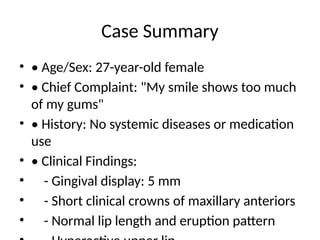
• • Age/Sex: 27-year-old female
• • Chief Complaint: "My smile shows too much
of my gums"
• • History: No systemic diseases or medication
use
• • Clinical Findings:
• - Gingival display: 5 mm
• - Short clinical crowns of maxillary anteriors
• - Normal lip length and eruption pattern
3. Learning Objectives
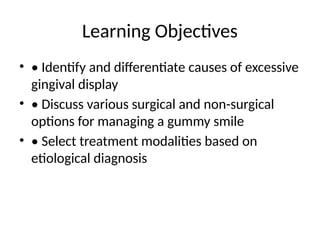
• • Identify and differentiate causes of excessive
gingival display
• • Discuss various surgical and non-surgical
options for managing a gummy smile
• • Select treatment modalities based on
etiological diagnosis
4. Diagnostic & Etiological
Classification
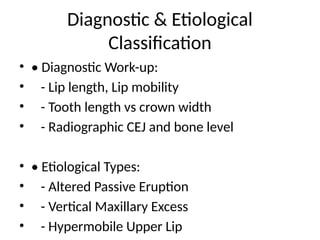
• • Diagnostic Work-up:
• - Lip length, Lip mobility
• - Tooth length vs crown width
• - Radiographic CEJ and bone level
• • Etiological Types:
• - Altered Passive Eruption
• - Vertical Maxillary Excess
• - Hypermobile Upper Lip
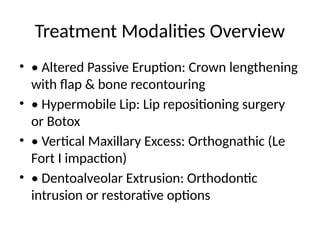
5. Treatment Modalities Overview
• • Altered Passive Eruption: Crown lengthening
with flap & bone recontouring
• • Hypermobile Lip: Lip repositioning surgery
or Botox
• • Vertical Maxillary Excess: Orthognathic (Le
Fort I impaction)
• • Dentoalveolar Extrusion: Orthodontic
intrusion or restorative options
6. Scientific References
• 1. Garber DA, Salama MA. Periodontol 2000.
1996.
• 2. Silberberg N, Goldstein M, Smidt A.
Quintessence Int. 2009.
• 3. Humayun N, et al. J Contemp Dent Pract.
2010.


![gummy smile ... by sampita dhali (1) [Autosaved].pptx](https://cdn.slidesharecdn.com/ss_thumbnails/gummysmile-240822170221-bbfd4416-thumbnail.jpg?width=640&height=640&fit=bounds)


![Hypothalamus short notes on location, function and disorders by Dr. Neha [PT]...](https://cdn.slidesharecdn.com/ss_thumbnails/hypothalamusbydr-260124142231-2b48143d-thumbnail.jpg?width=640&height=640&fit=bounds)


