Google Science Fair 2013
Chung Ray Ern
Ng Yu Song
Hari Kope
[Teacher Mentor] Mrs Yau Pooi Har
Urine to Fuel
Introductory Video
Google Science Fair 2013
The Need
- Increased need for renewable sources of energy
- Renewable?
- Environmentally friendly?
- Inexpensive?
- Producing fuel from Petrol
- Non-renewable
- Fast-depleting
- Not Environmentally Friendly
Google Science Fair 2013
The Need
- Attempts at incorporating waste and renewable energy
- World population of 7 billion
- Average person produces 1.5 liters of urine a day
- 11 billion liters of urine produced a day
- Producing hydrogen as a fuel from urine
- Renewable
- Cheap
- Environmentally friendly
Google Science Fair 2013
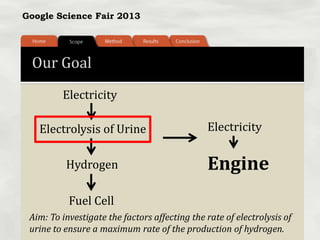
Our Goal
Electricity
Electrolysis of Urine Electricity
Fuel Cell
Hydrogen Engine
Aim: To investigate the factors affecting the rate of electrolysis of
urine to ensure a maximum rate of the production of hydrogen.
Google Science Fair 2013
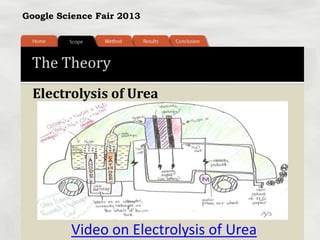
The Theory
Video on Electrolysis of Urea
Electrolysis of Urea
Google Science Fair 2013
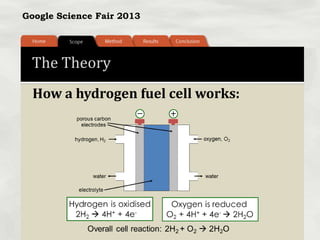
The Theory
How a hydrogen fuel cell works:
Google Science Fair 2013
The Scope
We investigated 4 factors:
• Concentration of Urea
• Material of Electrode
• Alkalinity
• Surface Area of Electrode
Google Science Fair 2013
The Procedure
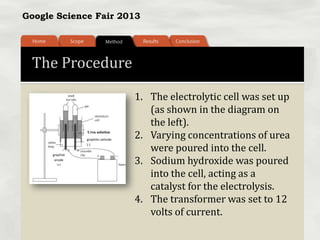
Urea solution
graphite
anode
(+)
graphite cathode
(-)
1. The electrolytic cell was set up
(as shown in the diagram on
the left).
2. Varying concentrations of urea
were poured into the cell.
3. Sodium hydroxide was poured
into the cell, acting as a
catalyst for the electrolysis.
4. The transformer was set to 12
volts of current.
Google Science Fair 2013
The Procedure
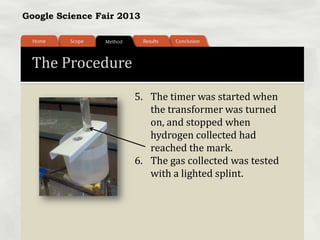
5. The timer was started when
the transformer was turned
on, and stopped when
hydrogen collected had
reached the mark.
6. The gas collected was tested
with a lighted splint.
Google Science Fair 2013
The Procedure
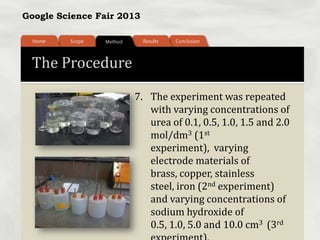
7. The experiment was repeated
with varying concentrations of
urea of 0.1, 0.5, 1.0, 1.5 and 2.0
mol/dm3 (1st
experiment), varying
electrode materials of
brass, copper, stainless
steel, iron (2nd experiment)
and varying concentrations of
sodium hydroxide of
0.5, 1.0, 5.0 and 10.0 cm3 (3rd
Google Science Fair 2013
The Procedure
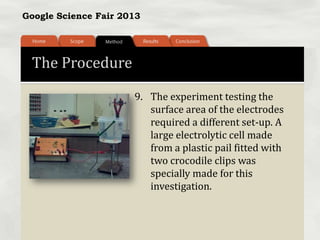
9. The experiment testing the
surface area of the electrodes
required a different set-up. A
large electrolytic cell made
from a plastic pail fitted with
two crocodile clips was
specially made for this
investigation.
Google Science Fair 2013
The Procedure
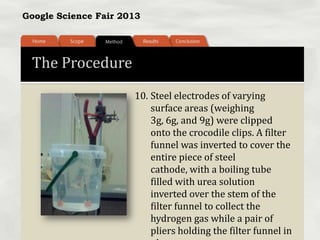
10. Steel electrodes of varying
surface areas (weighing
3g, 6g, and 9g) were clipped
onto the crocodile clips. A filter
funnel was inverted to cover the
entire piece of steel
cathode, with a boiling tube
filled with urea solution
inverted over the stem of the
filter funnel to collect the
hydrogen gas while a pair of
pliers holding the filter funnel in
Google Science Fair 2013
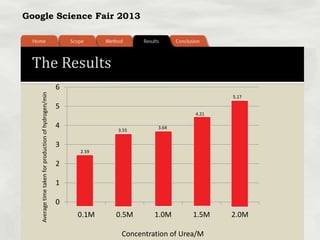
The Results
Concentration of Urea/M
Averagetimetakenforproductionofhydrogen/min
0
1
2
3
4
5
6
0.1M 0.5M 1.0M 1.5M 2.0M
2.59
3.55
3.64
4.21
5.17
Google Science Fair 2013
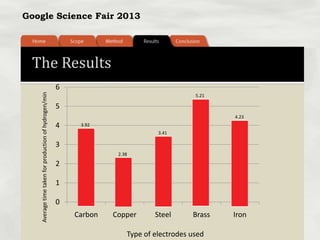
The Results
Type of electrodes used
Averagetimetakenforproductionofhydrogen/min
0
1
2
3
4
5
6
Carbon Copper Steel Brass Iron
3.92
5.21
4.23
3.41
2.38
Google Science Fair 2013
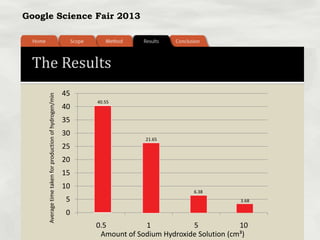
The Results
Averagetimetakenforproductionofhydrogen/min
Amount of Sodium Hydroxide Solution (cm³)
0
5
10
15
20
25
30
35
40
45
0.5 1 5 10
40.55
6.38
3.68
21.65
Google Science Fair 2013
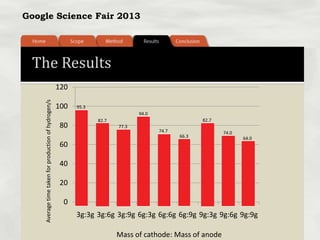
The Results
Averagetimetakenforproductionofhydrogen/s
Mass of cathode: Mass of anode
0
20
40
60
80
100
120
3g:3g 3g:6g 3g:9g 6g:3g 6g:6g 6g:9g 9g:3g 9g:6g 9g:9g
95.3
74.0
64.0
74.7
82.7
94.0
66.3
82.7
77.3
Google Science Fair 2013
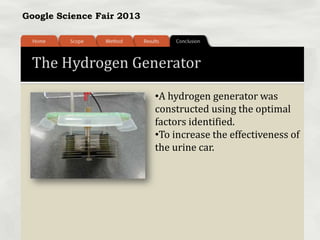
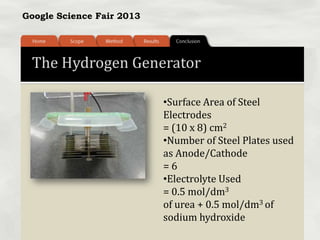
The Hydrogen Generator
•A hydrogen generator was
constructed using the optimal
factors identified.
•To increase the effectiveness of
the urine car.
Google Science Fair 2013
The Hydrogen Generator
•Surface Area of Steel
Electrodes
= (10 x 8) cm2
•Number of Steel Plates used
as Anode/Cathode
= 6
•Electrolyte Used
= 0.5 mol/dm3
of urea + 0.5 mol/dm3 of
sodium hydroxide
Google Science Fair 2013
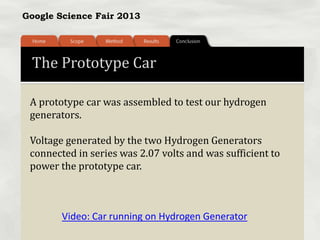
The Prototype Car
A prototype car was assembled to test our hydrogen
generators.
Voltage generated by the two Hydrogen Generators
connected in series was 2.07 volts and was sufficient to
power the prototype car.
Video: Car running on Hydrogen Generator
Google Science Fair 2013
Conclusion
• Rate of production of hydrogen gas decreases with
increased concentration of urea
• Fastest rate of electrolysis of urea using copper
electrodes
•copper reacts with the sodium hydroxide
• stainless steel electrodes are the next best option
• Sodium hydroxide solution added to the electrolyte
• strong alkali, good conductor due to free moving
ions speeds up electrolysis
• also helps absorbs carbon dioxide produced
•electrodes used should have a large surface area
• allows for more ions to be oxidised and reduced

Gsf final 3

  • 1.
    Google Science Fair2013 Chung Ray Ern Ng Yu Song Hari Kope [Teacher Mentor] Mrs Yau Pooi Har Urine to Fuel Introductory Video
  • 2.
    Google Science Fair2013 The Need - Increased need for renewable sources of energy - Renewable? - Environmentally friendly? - Inexpensive? - Producing fuel from Petrol - Non-renewable - Fast-depleting - Not Environmentally Friendly
  • 3.
    Google Science Fair2013 The Need - Attempts at incorporating waste and renewable energy - World population of 7 billion - Average person produces 1.5 liters of urine a day - 11 billion liters of urine produced a day - Producing hydrogen as a fuel from urine - Renewable - Cheap - Environmentally friendly
  • 4.
    Google Science Fair2013 Our Goal Electricity Electrolysis of Urine Electricity Fuel Cell Hydrogen Engine Aim: To investigate the factors affecting the rate of electrolysis of urine to ensure a maximum rate of the production of hydrogen.
  • 5.
    Google Science Fair2013 The Theory Video on Electrolysis of Urea Electrolysis of Urea
  • 6.
    Google Science Fair2013 The Theory How a hydrogen fuel cell works:
  • 7.
    Google Science Fair2013 The Scope We investigated 4 factors: • Concentration of Urea • Material of Electrode • Alkalinity • Surface Area of Electrode
  • 8.
    Google Science Fair2013 The Procedure Urea solution graphite anode (+) graphite cathode (-) 1. The electrolytic cell was set up (as shown in the diagram on the left). 2. Varying concentrations of urea were poured into the cell. 3. Sodium hydroxide was poured into the cell, acting as a catalyst for the electrolysis. 4. The transformer was set to 12 volts of current.
  • 9.
    Google Science Fair2013 The Procedure 5. The timer was started when the transformer was turned on, and stopped when hydrogen collected had reached the mark. 6. The gas collected was tested with a lighted splint.
  • 10.
    Google Science Fair2013 The Procedure 7. The experiment was repeated with varying concentrations of urea of 0.1, 0.5, 1.0, 1.5 and 2.0 mol/dm3 (1st experiment), varying electrode materials of brass, copper, stainless steel, iron (2nd experiment) and varying concentrations of sodium hydroxide of 0.5, 1.0, 5.0 and 10.0 cm3 (3rd
  • 11.
    Google Science Fair2013 The Procedure 9. The experiment testing the surface area of the electrodes required a different set-up. A large electrolytic cell made from a plastic pail fitted with two crocodile clips was specially made for this investigation.
  • 12.
    Google Science Fair2013 The Procedure 10. Steel electrodes of varying surface areas (weighing 3g, 6g, and 9g) were clipped onto the crocodile clips. A filter funnel was inverted to cover the entire piece of steel cathode, with a boiling tube filled with urea solution inverted over the stem of the filter funnel to collect the hydrogen gas while a pair of pliers holding the filter funnel in
  • 13.
    Google Science Fair2013 The Results Concentration of Urea/M Averagetimetakenforproductionofhydrogen/min 0 1 2 3 4 5 6 0.1M 0.5M 1.0M 1.5M 2.0M 2.59 3.55 3.64 4.21 5.17
  • 14.
    Google Science Fair2013 The Results Type of electrodes used Averagetimetakenforproductionofhydrogen/min 0 1 2 3 4 5 6 Carbon Copper Steel Brass Iron 3.92 5.21 4.23 3.41 2.38
  • 15.
    Google Science Fair2013 The Results Averagetimetakenforproductionofhydrogen/min Amount of Sodium Hydroxide Solution (cm³) 0 5 10 15 20 25 30 35 40 45 0.5 1 5 10 40.55 6.38 3.68 21.65
  • 16.
    Google Science Fair2013 The Results Averagetimetakenforproductionofhydrogen/s Mass of cathode: Mass of anode 0 20 40 60 80 100 120 3g:3g 3g:6g 3g:9g 6g:3g 6g:6g 6g:9g 9g:3g 9g:6g 9g:9g 95.3 74.0 64.0 74.7 82.7 94.0 66.3 82.7 77.3
  • 17.
    Google Science Fair2013 The Hydrogen Generator •A hydrogen generator was constructed using the optimal factors identified. •To increase the effectiveness of the urine car.
  • 18.
    Google Science Fair2013 The Hydrogen Generator •Surface Area of Steel Electrodes = (10 x 8) cm2 •Number of Steel Plates used as Anode/Cathode = 6 •Electrolyte Used = 0.5 mol/dm3 of urea + 0.5 mol/dm3 of sodium hydroxide
  • 19.
    Google Science Fair2013 The Prototype Car A prototype car was assembled to test our hydrogen generators. Voltage generated by the two Hydrogen Generators connected in series was 2.07 volts and was sufficient to power the prototype car. Video: Car running on Hydrogen Generator
  • 20.
    Google Science Fair2013 Conclusion • Rate of production of hydrogen gas decreases with increased concentration of urea • Fastest rate of electrolysis of urea using copper electrodes •copper reacts with the sodium hydroxide • stainless steel electrodes are the next best option • Sodium hydroxide solution added to the electrolyte • strong alkali, good conductor due to free moving ions speeds up electrolysis • also helps absorbs carbon dioxide produced •electrodes used should have a large surface area • allows for more ions to be oxidised and reduced