gRPC Load Balancing on
Kubernetes without Tears
Orig Author: William Morgan (Buoyant)
Slide by : Soohan Ahn
Orignial blog post link
• https://kubernetes.io/blog/2018/11/07/grpc-load-
balancing-on-kubernetes-without-tears/
Why does gRPC need special load
balancing?
• gRPC is built on HTTP/2
• HTTP/2 is designed to have a single long-lived TCP
connection
Why does gRPC need special load
balancing?
• gRPC is built on HTTP/2
• HTTP/2 is designed to have a single long-lived TCP
connection
• Reduces the overhead of connection management
• Connection balancing doesn't work well
Why does gRPC need special load
balancing?
• Connection balancing doesn't work well
• Once the connection is established, there’s no more balancing to be
done.
• All requests will get pinned to a single destination pod.
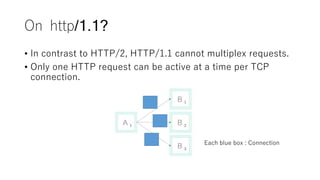
On http/1.1?
• In contrast to HTTP/2, HTTP/1.1 cannot multiplex requests.
• Only one HTTP request can be active at a time per TCP
connection.
Each blue box : Connection
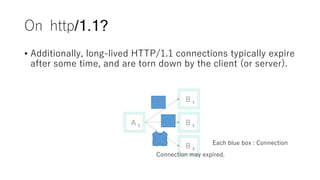
On http/1.1?
• Additionally, long-lived HTTP/1.1 connections typically expire
after some time, and are torn down by the client (or server).
Connection may expired.
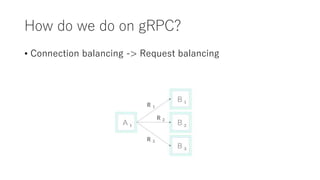
How do we do on gRPC?
• Connection balancing -> Request balancing
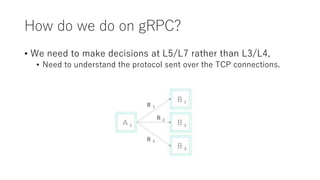
How do we do on gRPC?
• We need to make decisions at L5/L7 rather than L3/L4,
• Need to understand the protocol sent over the TCP connections.
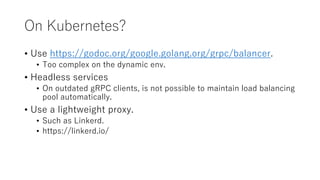
On Kubernetes?
• Use https://godoc.org/google.golang.org/grpc/balancer.
• Too complex on the dynamic env.
• Headless services
• On outdated gRPC clients, is not possible to maintain load balancing
pool automatically.
• Use a lightweight proxy.
• Such as Linkerd.
• https://linkerd.io/
Linkerd
• A CNCF-hosted service mesh for Kubernetes.
• Also functions as a service sidecar.

Grpc load balancing

  • 1.
    gRPC Load Balancingon Kubernetes without Tears Orig Author: William Morgan (Buoyant) Slide by : Soohan Ahn
  • 2.
    Orignial blog postlink • https://kubernetes.io/blog/2018/11/07/grpc-load- balancing-on-kubernetes-without-tears/
  • 3.
    Why does gRPCneed special load balancing? • gRPC is built on HTTP/2 • HTTP/2 is designed to have a single long-lived TCP connection
  • 4.
    Why does gRPCneed special load balancing? • gRPC is built on HTTP/2 • HTTP/2 is designed to have a single long-lived TCP connection • Reduces the overhead of connection management • Connection balancing doesn't work well
  • 5.
    Why does gRPCneed special load balancing? • Connection balancing doesn't work well • Once the connection is established, there’s no more balancing to be done. • All requests will get pinned to a single destination pod.
  • 6.
    On http/1.1? • Incontrast to HTTP/2, HTTP/1.1 cannot multiplex requests. • Only one HTTP request can be active at a time per TCP connection. Each blue box : Connection
  • 7.
    Each blue box: Connection On http/1.1? • Additionally, long-lived HTTP/1.1 connections typically expire after some time, and are torn down by the client (or server). Connection may expired.
  • 8.
    How do wedo on gRPC? • Connection balancing -> Request balancing
  • 9.
    How do wedo on gRPC? • We need to make decisions at L5/L7 rather than L3/L4, • Need to understand the protocol sent over the TCP connections.
  • 10.
    On Kubernetes? • Usehttps://godoc.org/google.golang.org/grpc/balancer. • Too complex on the dynamic env. • Headless services • On outdated gRPC clients, is not possible to maintain load balancing pool automatically. • Use a lightweight proxy. • Such as Linkerd. • https://linkerd.io/
  • 11.
    Linkerd • A CNCF-hostedservice mesh for Kubernetes. • Also functions as a service sidecar.