Growth Through Strategic Alliances (wecompress.com).pptx
Here are the teams assigned for the strategic alliance project:
Team 1: FMCG
Team 2: Airlines
Team 3: Automobiles
Team 4: E-Commerce
Team 5: Banking
Team 6: Railways
Team 7: Healthcare
Team 8: No industry specified
• In today'sbusiness landscape, growth and innovation are taking new forms.
• Strategic alliances between global players and startups have become a game-
changing approach to staying competitive.
• This collaboration merges the strengths of established giants and agile
startups, presenting unique opportunities for innovation, market expansion,
and value creation.
• We have to delve in the potential impact of such alliances, proving to be a
game-changer for both parties.
• By leveraging each other's expertise and resources, these partnerships pave the
way for groundbreaking solutions and unlock growth potential in a rapidly
evolving market.
• Embracing strategic alliances is key for businesses aiming to remain relevant
and successful in an ever-changing global economy.
19.
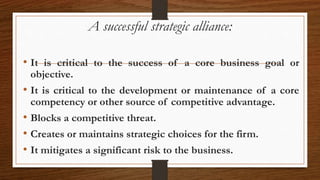
A successful strategicalliance:
• It is critical to the success of a core business goal or
objective.
• It is critical to the development or maintenance of a core
competency or other source of competitive advantage.
• Blocks a competitive threat.
• Creates or maintains strategic choices for the firm.
• It mitigates a significant risk to the business.
20.
How to Co-Sellwith Your Ecosystem
Partners
We’ve developed a 40-page eBook on how to build a partner co-sell program
with your ecosystem partners.
The time is now for you to work together with your partners to optimize
ecosystems and address the complexity of changing customer demands,
markets, and supply chains together.
1.IDC estimates that by the year 2023, there will be a $7.1 trillion investment in
digital transformation (DX) across the globe.
2.Current estimates for companies co-selling with partners is expected to be
over $300 billion!
3.According to Accenture, 76% of business leaders agree that current business
models will be unrecognizable in the next five years; and ecosystems will be the
primary change agent.
Learn the ins and outs of co-selling your solutions with your partners.
22.
Complementary Strengths
Strategic alliancesthrive on the principle of complementary strengths.
• Partner with organizations that possess skills, assets, or market presence that
complement your own.
• This synergy enhances the value proposition offered to customers.
• For instance, Nike's collaboration with Apple to create the Nike+ product line
showcased the combination of Nike's athletic expertise with Apple's technological
capabilities, resulting in innovative products that catered to the needs of fitness
enthusiasts.
23.
Shared Objectives
• Alignmentof objectives is critical for successful strategic alliances.
• Seek partners who share similar long-term goals, values, and visions.
• According to a study by the Institute for Mergers, Acquisitions, and Alliances, strategic
alliances with shared objectives have a higher success rate.
• When both parties have a common purpose, it fosters collaboration, streamlines
decision-making, and ensures effective resource allocation.
24.
Targeted Audience
• Collaboratingwith partners who have access to your target audience can significantly
enhance your marketing efforts.
• Identify partners with a strong customer base or market presence within your desired
target segments.
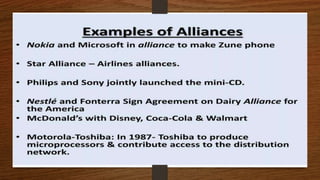
• For example, McDonald's strategic alliance with Coca-Cola enables both
brands to leverage each other's extensive reach and brand loyalty, resulting in
increased sales and brand visibility.
25.
4. Clear Communicationand Trust
• Clear and open communication is fundamental to successful strategic alliances.
• Establish effective communication channels and ensure transparency in expectations,
roles, and responsibilities.
• Building trust is crucial for long-term collaboration.
• According to a study by PricewaterhouseCoopers, trust is cited as the most
important factor for alliance success by 81% of executives.
• Trust forms the bedrock for effective problem-solving, conflict resolution, and joint
decision-making.
26.
5. Coordinated MarketingEfforts
• Coordinating marketing efforts is a pivotal aspect of collaborative marketing success.
• Develop joint marketing campaigns that leverage the strengths and resources of both
alliance partners.
• For instance, the strategic alliance between Samsung and Disney resulted in co-
branded marketing campaigns for Samsung products featuring popular Disney
characters.
• This collaboration not only increased brand visibility but also enhanced customer
appeal and engagement.
27.
6. Value Co-creation
•Successful strategic alliances go beyond mere collaboration; they focus on value co-
creation.
• Work together with your alliance partners to develop innovative solutions, unique
offerings, or enhanced customer experiences.
• By pooling resources, expertise, and insights, you can create differentiated products
or services that address evolving customer needs.
• This value co-creation strengthens the alliance, fosters customer loyalty, and drives
market growth.
28.
7. Continuous Evaluationand Adaptation
• Regular evaluation and adaptation are essential for the long-term success of a strategic
alliance.
• Monitor key performance indicators, gather customer feedback, and assess the impact
on both organizations' marketing efforts.
• This ongoing evaluation allows for identifying areas for improvement, addressing
challenges, and ensuring alignment with strategic objectives.
• Flexibility and adaptability are vital to navigating changing market dynamics and
maintaining a successful alliance.
29.
Teams
• Team -1:FMCG
• Team 2 : Airlines
• Team 3: Automobiles
• Team 4: E Commerce
• Team 5: Banking
• Team: 6: Railways
• Team 7: Healthcare
• Team 8: